Cambridge A Level Physical Education 9396 — 2018 Oct/Nov Paper 1 · Variant 1
9396/11/O/N/18 · 90 marks · ≈101 min
The question paper and its mark scheme, free to read here and free to download. This is Cambridge’s own paper, exactly as it was sat.
Question paper8 pages




Mark scheme10 pages
Answers below. Sit the paper first if you are practising.
Paper as text
Question paper, page 1
This document consists of 5 printed pages, 3 blank pages and 1 Insert. DC (NH/FC) 144161/2 © UCLES 2018 [Turn over * 8 5 6 4 6 9 5 1 0 2 * PHYSICAL EDUCATION 9396/11 Paper 1 October/November 2018 2 hours 30 minutes No Additional Materials are required. READ THESE INSTRUCTIONS FIRST An answer booklet is provided inside this question paper. You should follow the instructions on the front cover of the answer booklet. If you need additional answer paper ask the invigilator for a continuation booklet. Answer all questions. Electronic calculators may be used. You may lose marks if you do not show your working or if you do not use appropriate units. The number of marks is given in brackets [ ] at the end of each question or part question. Cambridge International Examinations Cambridge International Advanced Subsidiary and Advanced Level
Question paper, page 2
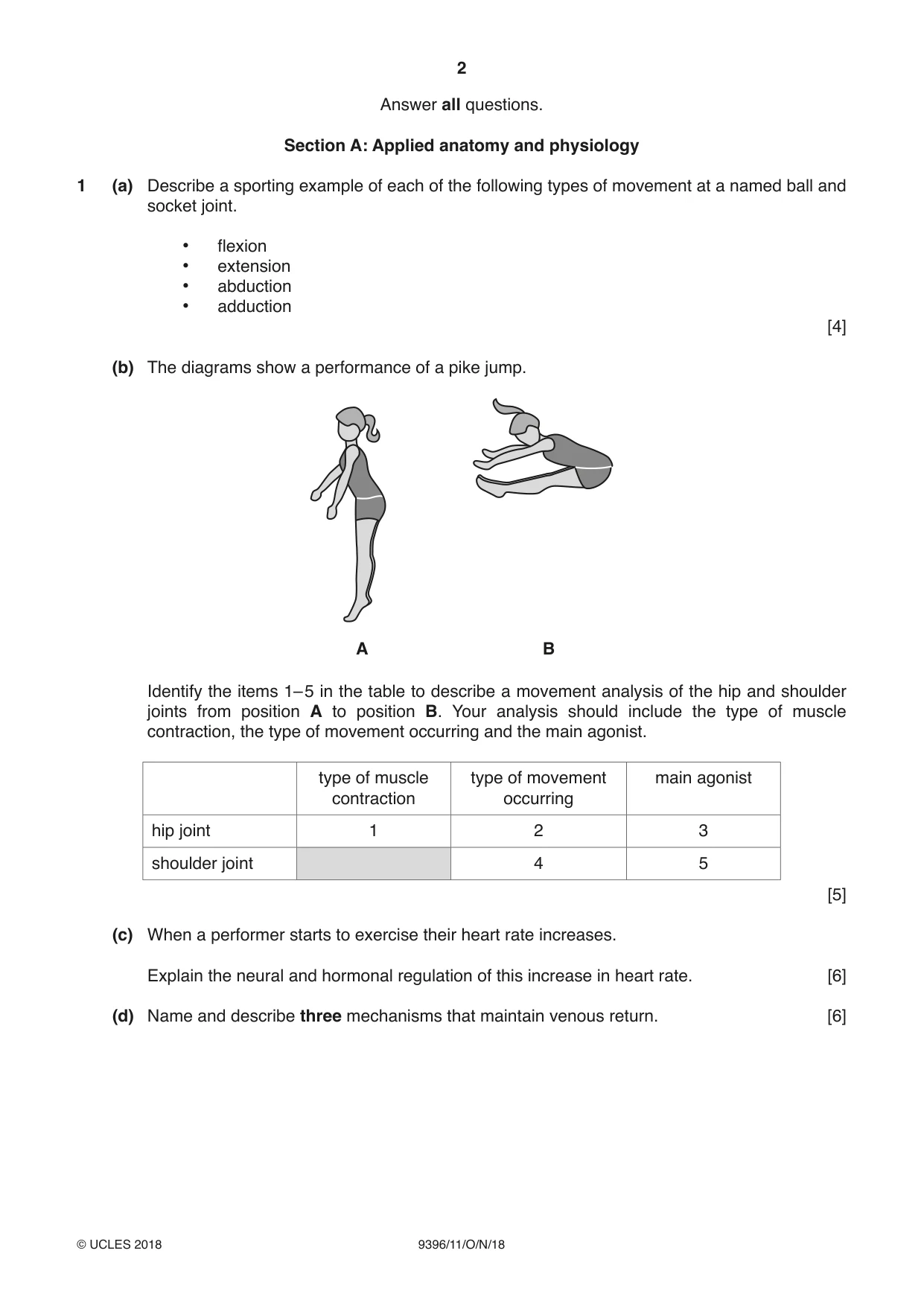
2 9396/11/O/N/18 © UCLES 2018 Answer all questions. Section A: Applied anatomy and physiology 1 (a) Describe a sporting example of each of the following types of movement at a named ball and socket joint. • flexion • extension • abduction • adduction [4] (b) The diagrams show a performance of a pike jump. A B Identify the items 1–5 in the table to describe a movement analysis of the hip and shoulder joints from position A to position B. Your analysis should include the type of muscle contraction, the type of movement occurring and the main agonist. type of muscle contraction type of movement occurring main agonist hip joint 1 2 3 shoulder joint 4 5 [5] (c) When a performer starts to exercise their heart rate increases. Explain the neural and hormonal regulation of this increase in heart rate. [6] (d) Name and describe three mechanisms that maintain venous return. [6]
Question paper, page 3
3 9396/11/O/N/18 © UCLES 2018 [Turn over (e) The vital capacity of the lungs is the sum of the following lung volumes. • tidal volume • expiratory reserve volume • inspiratory reserve volume Describe the effect of exercise on each of these three lung volumes. [3] (f) (i) Explain the process of gaseous exchange between the alveoli and capillaries. [2] (ii) Explain how the structure of the alveoli and the capillaries improve the efficiency of gaseous exchange. [4] [Total: 30]
Question paper, page 4
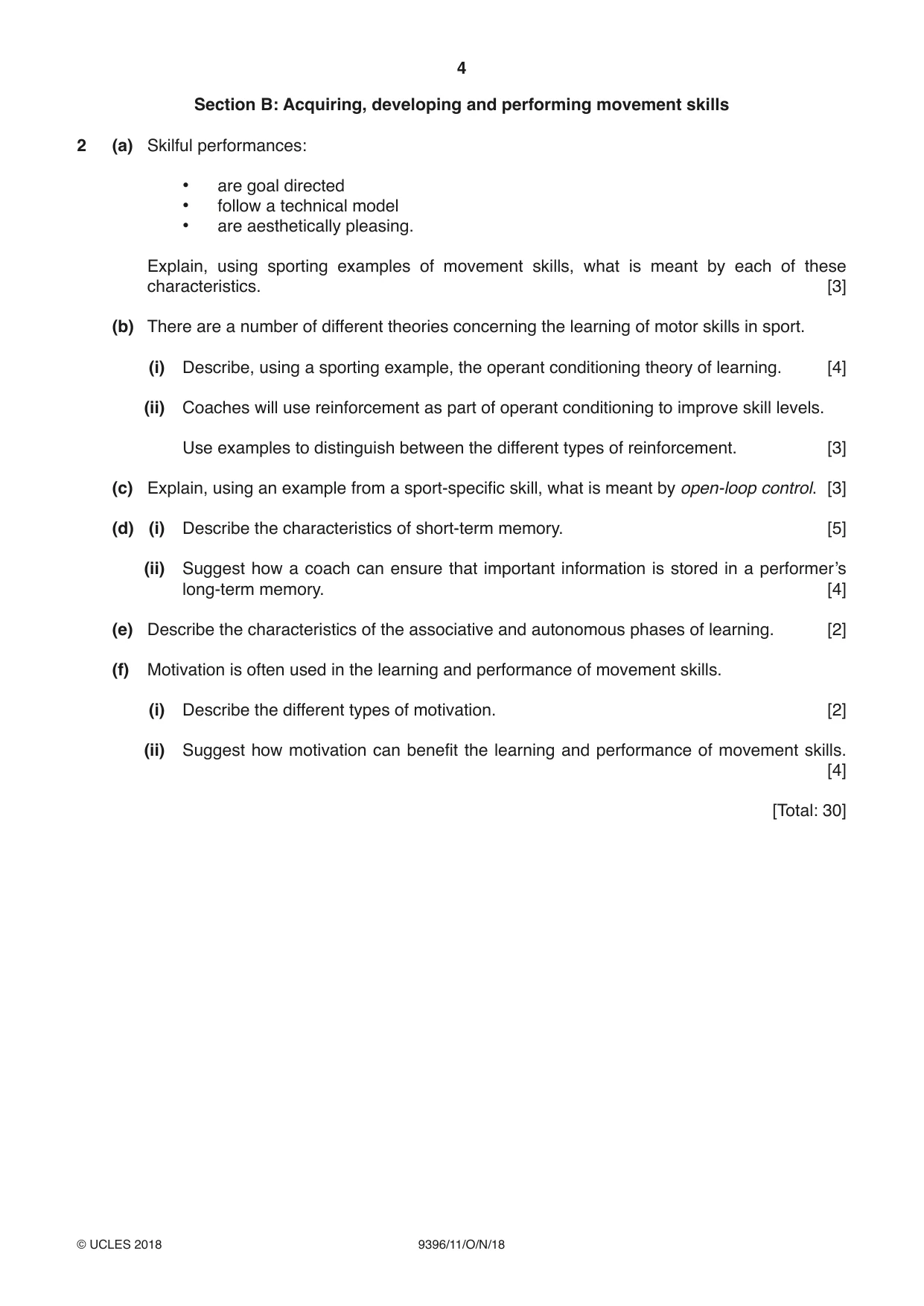
4 9396/11/O/N/18 © UCLES 2018 Section B: Acquiring, developing and performing movement skills 2 (a) Skilful performances: • are goal directed • follow a technical model • are aesthetically pleasing. Explain, using sporting examples of movement skills, what is meant by each of these characteristics. [3] (b) There are a number of different theories concerning the learning of motor skills in sport. (i) Describe, using a sporting example, the operant conditioning theory of learning. [4] (ii) Coaches will use reinforcement as part of operant conditioning to improve skill levels. Use examples to distinguish between the different types of reinforcement. [3] (c) Explain, using an example from a sport-specific skill, what is meant by open-loop control. [3] (d) (i) Describe the characteristics of short-term memory. [5] (ii) Suggest how a coach can ensure that important information is stored in a performer’s long-term memory. [4] (e) Describe the characteristics of the associative and autonomous phases of learning. [2] (f) Motivation is often used in the learning and performance of movement skills. (i) Describe the different types of motivation. [2] (ii) Suggest how motivation can benefit the learning and performance of movement skills. [4] [Total: 30]
Question paper, page 5
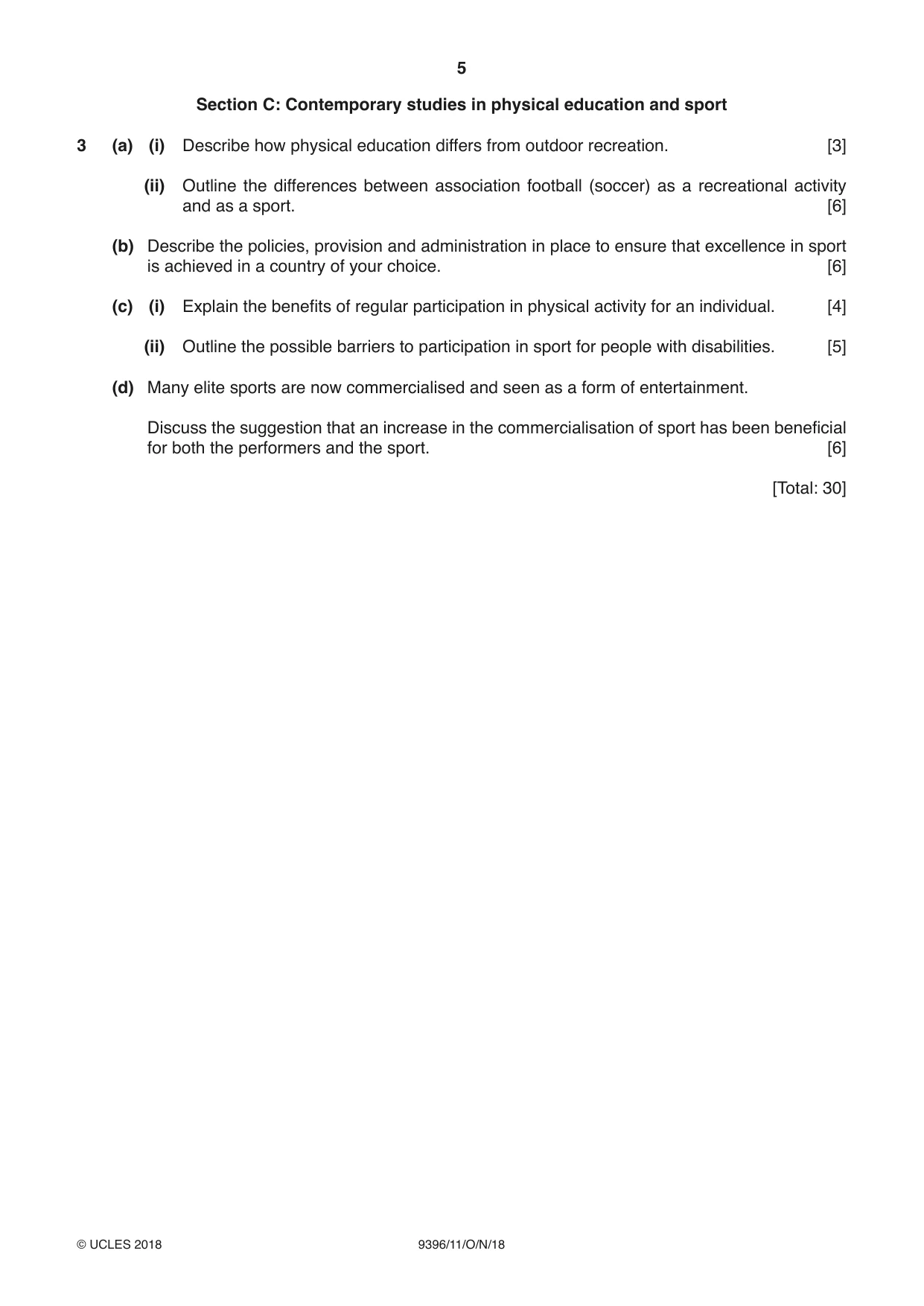
5 9396/11/O/N/18 © UCLES 2018 Section C: Contemporary studies in physical education and sport 3 (a) (i) Describe how physical education differs from outdoor recreation. [3] (ii) Outline the differences between association football (soccer) as a recreational activity and as a sport. [6] (b) Describe the policies, provision and administration in place to ensure that excellence in sport is achieved in a country of your choice. [6] (c) (i) Explain the benefits of regular participation in physical activity for an individual. [4] (ii) Outline the possible barriers to participation in sport for people with disabilities. [5] (d) Many elite sports are now commercialised and seen as a form of entertainment. Discuss the suggestion that an increase in the commercialisation of sport has been beneficial for both the performers and the sport. [6] [Total: 30]
Question paper, page 6
6 9396/11/O/N/18 © UCLES 2018 BLANK PAGE
Question paper, page 7
7 9396/11/O/N/18 © UCLES 2018 BLANK PAGE
Question paper, page 8
8 9396/11/O/N/18 © UCLES 2018 BLANK PAGE Permission to reproduce items where third-party owned material protected by copyright is included has been sought and cleared where possible. Every reasonable effort has been made by the publisher (UCLES) to trace copyright holders, but if any items requiring clearance have unwittingly been included, the publisher will be pleased to make amends at the earliest possible opportunity. To avoid the issue of disclosure of answer-related information to candidates, all copyright acknowledgements are reproduced online in the Cambridge International Examinations Copyright Acknowledgements Booklet. This is produced for each series of examinations and is freely available to download at www.cie.org.uk after the live examination series. Cambridge International Examinations is part of the Cambridge Assessment Group. Cambridge Assessment is the brand name of University of Cambridge Local Examinations Syndicate (UCLES), which is itself a department of the University of Cambridge.
Mark scheme, page 1
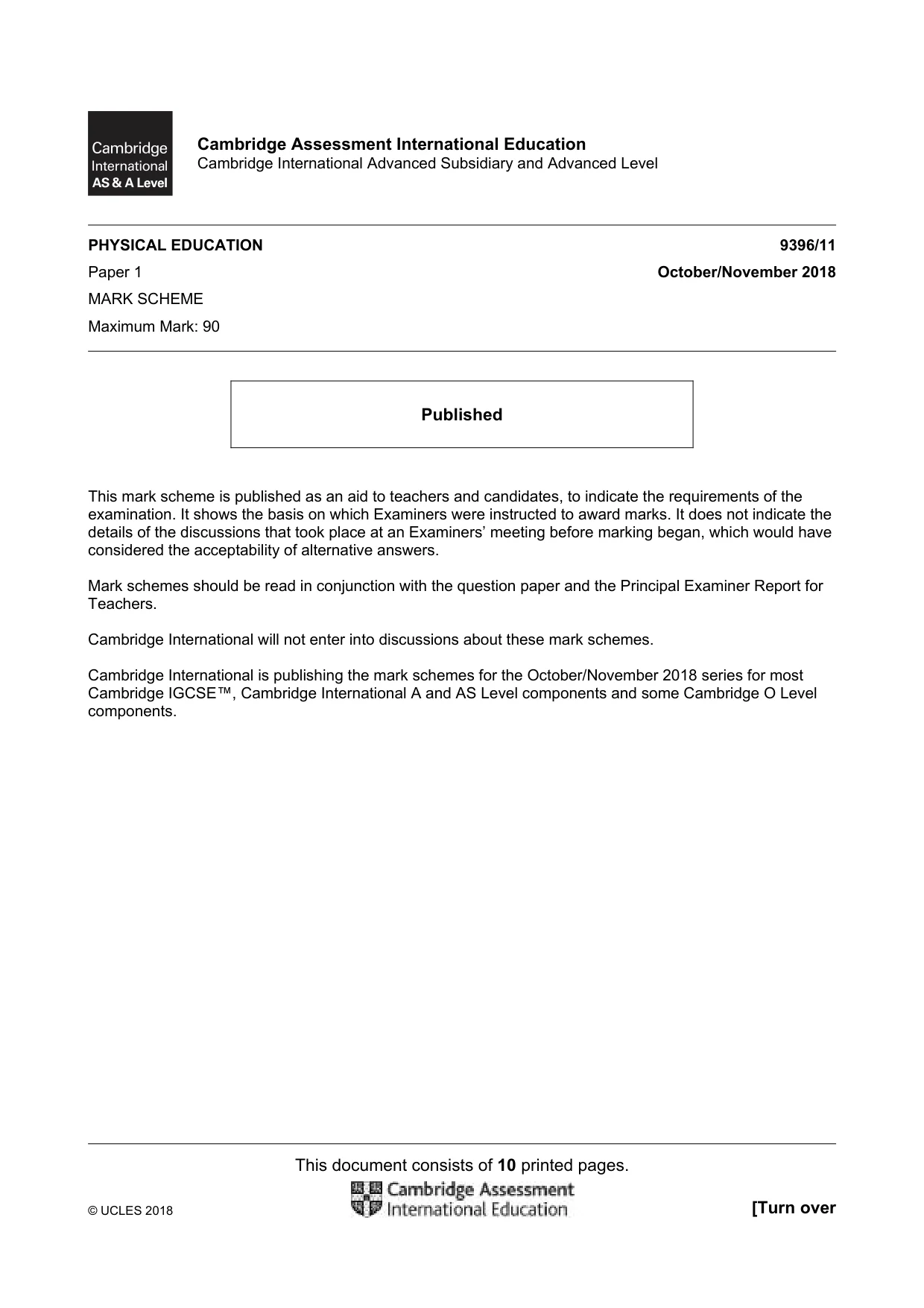
This document consists of 10 printed pages. © UCLES 2018 [Turn over Cambridge Assessment International Education Cambridge International Advanced Subsidiary and Advanced Level PHYSICAL EDUCATION 9396/11 Paper 1 October/November 2018 MARK SCHEME Maximum Mark: 90 Published This mark scheme is published as an aid to teachers and candidates, to indicate the requirements of the examination. It shows the basis on which Examiners were instructed to award marks. It does not indicate the details of the discussions that took place at an Examiners’ meeting before marking began, which would have considered the acceptability of alternative answers. Mark schemes should be read in conjunction with the question paper and the Principal Examiner Report for Teachers. Cambridge International will not enter into discussions about these mark schemes. Cambridge International is publishing the mark schemes for the October/November 2018 series for most Cambridge IGCSE™, Cambridge International A and AS Level components and some Cambridge O Level components.
Mark scheme, page 2
9396/11 Cambridge International AS/A Level – Mark Scheme PUBLISHED October/November 2018 © UCLES 2018 Page 2 of 10 Generic Marking Principles These general marking principles must be applied by all examiners when marking candidate answers. They should be applied alongside the specific content of the mark scheme or generic level descriptors for a question. Each question paper and mark scheme will also comply with these marking principles. GENERIC MARKING PRINCIPLE 1: Marks must be awarded in line with: • the specific content of the mark scheme or the generic level descriptors for the question • the specific skills defined in the mark scheme or in the generic level descriptors for the question • the standard of response required by a candidate as exemplified by the standardisation scripts. GENERIC MARKING PRINCIPLE 2: Marks awarded are always whole marks (not half marks, or other fractions). GENERIC MARKING PRINCIPLE 3: Marks must be awarded positively: • marks are awarded for correct/valid answers, as defined in the mark scheme. However, credit is given for valid answers which go beyond the scope of the syllabus and mark scheme, referring to your Team Leader as appropriate • marks are awarded when candidates clearly demonstrate what they know and can do • marks are not deducted for errors • marks are not deducted for omissions • answers should only be judged on the quality of spelling, punctuation and grammar when these features are specifically assessed by the question as indicated by the mark scheme. The meaning, however, should be unambiguous. GENERIC MARKING PRINCIPLE 4: Rules must be applied consistently e.g. in situations where candidates have not followed instructions or in the application of generic level descriptors. GENERIC MARKING PRINCIPLE 5: Marks should be awarded using the full range of marks defined in the mark scheme for the question (however; the use of the full mark range may be limited according to the quality of the candidate responses seen). GENERIC MARKING PRINCIPLE 6: Marks awarded are based solely on the requirements as defined in the mark scheme. Marks should not be awarded with grade thresholds or grade descriptors in mind.
Mark scheme, page 3
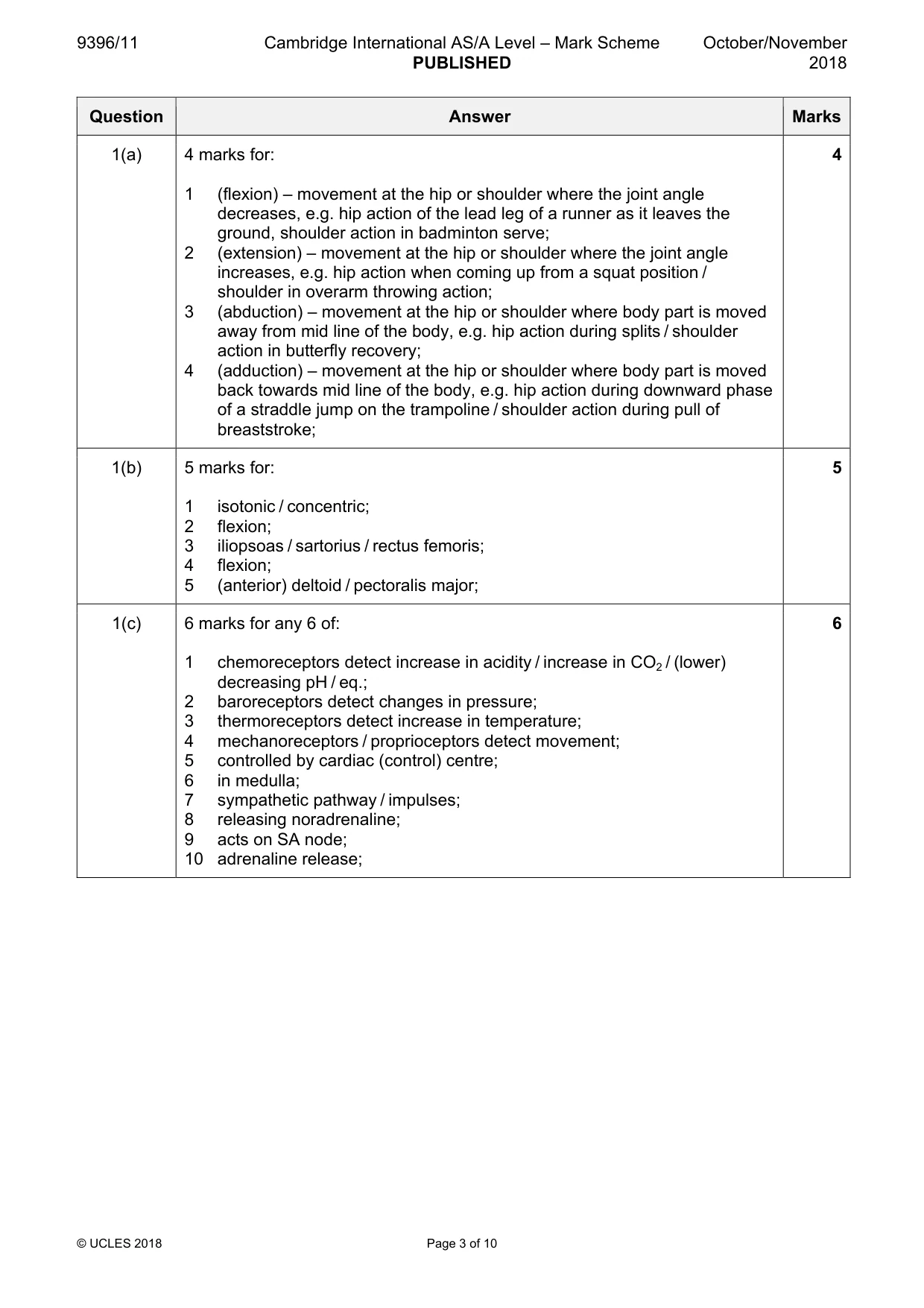
9396/11 Cambridge International AS/A Level – Mark Scheme PUBLISHED October/November 2018 © UCLES 2018 Page 3 of 10 Question Answer Marks 1(a) 4 marks for: 1 (flexion) – movement at the hip or shoulder where the joint angle decreases, e.g. hip action of the lead leg of a runner as it leaves the ground, shoulder action in badminton serve; 2 (extension) – movement at the hip or shoulder where the joint angle increases, e.g. hip action when coming up from a squat position / shoulder in overarm throwing action; 3 (abduction) – movement at the hip or shoulder where body part is moved away from mid line of the body, e.g. hip action during splits / shoulder action in butterfly recovery; 4 (adduction) – movement at the hip or shoulder where body part is moved back towards mid line of the body, e.g. hip action during downward phase of a straddle jump on the trampoline / shoulder action during pull of breaststroke; 4 1(b) 5 marks for: 1 isotonic / concentric; 2 flexion; 3 iliopsoas / sartorius / rectus femoris; 4 flexion; 5 (anterior) deltoid / pectoralis major; 5 1(c) 6 marks for any 6 of: 1 chemoreceptors detect increase in acidity / increase in CO2 / (lower) decreasing pH / eq.; 2 baroreceptors detect changes in pressure; 3 thermoreceptors detect increase in temperature; 4 mechanoreceptors / proprioceptors detect movement; 5 controlled by cardiac (control) centre; 6 in medulla; 7 sympathetic pathway / impulses; 8 releasing noradrenaline; 9 acts on SA node; 10 adrenaline release; 6
Mark scheme, page 4
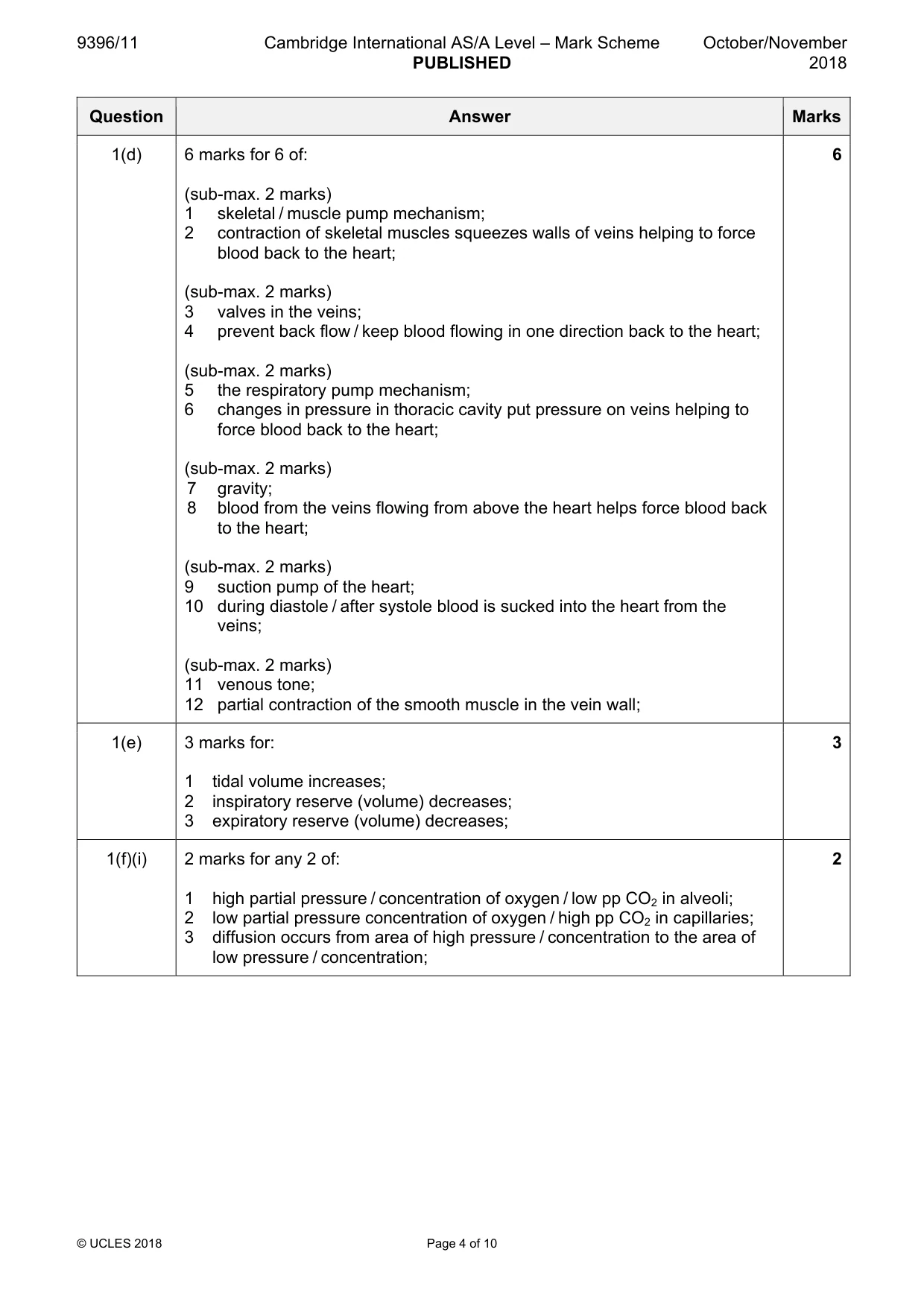
9396/11 Cambridge International AS/A Level – Mark Scheme PUBLISHED October/November 2018 © UCLES 2018 Page 4 of 10 Question Answer Marks 1(d) 6 marks for 6 of: (sub-max. 2 marks) 1 skeletal / muscle pump mechanism; 2 contraction of skeletal muscles squeezes walls of veins helping to force blood back to the heart; (sub-max. 2 marks) 3 valves in the veins; 4 prevent back flow / keep blood flowing in one direction back to the heart; (sub-max. 2 marks) 5 the respiratory pump mechanism; 6 changes in pressure in thoracic cavity put pressure on veins helping to force blood back to the heart; (sub-max. 2 marks) 7 gravity; 8 blood from the veins flowing from above the heart helps force blood back to the heart; (sub-max. 2 marks) 9 suction pump of the heart; 10 during diastole / after systole blood is sucked into the heart from the veins; (sub-max. 2 marks) 11 venous tone; 12 partial contraction of the smooth muscle in the vein wall; 6 1(e) 3 marks for: 1 tidal volume increases; 2 inspiratory reserve (volume) decreases; 3 expiratory reserve (volume) decreases; 3 1(f)(i) 2 marks for any 2 of: 1 high partial pressure / concentration of oxygen / low pp CO2 in alveoli; 2 low partial pressure concentration of oxygen / high pp CO2 in capillaries; 3 diffusion occurs from area of high pressure / concentration to the area of low pressure / concentration; 2
Mark scheme, page 5
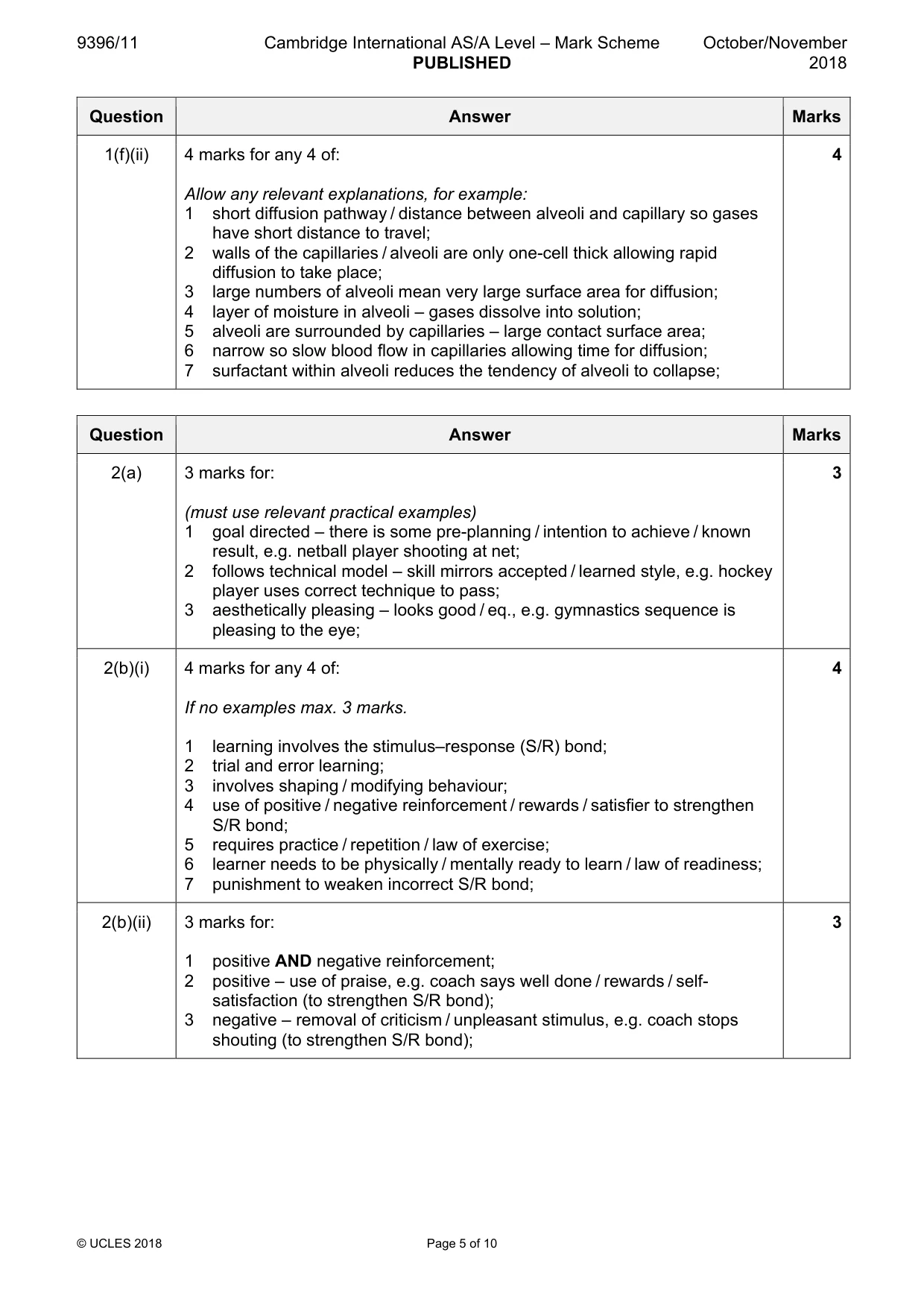
9396/11 Cambridge International AS/A Level – Mark Scheme PUBLISHED October/November 2018 © UCLES 2018 Page 5 of 10 Question Answer Marks 1(f)(ii) 4 marks for any 4 of: Allow any relevant explanations, for example: 1 short diffusion pathway / distance between alveoli and capillary so gases have short distance to travel; 2 walls of the capillaries / alveoli are only one-cell thick allowing rapid diffusion to take place; 3 large numbers of alveoli mean very large surface area for diffusion; 4 layer of moisture in alveoli – gases dissolve into solution; 5 alveoli are surrounded by capillaries – large contact surface area; 6 narrow so slow blood flow in capillaries allowing time for diffusion; 7 surfactant within alveoli reduces the tendency of alveoli to collapse; 4 Question Answer Marks 2(a) 3 marks for: (must use relevant practical examples) 1 goal directed – there is some pre-planning / intention to achieve / known result, e.g. netball player shooting at net; 2 follows technical model – skill mirrors accepted / learned style, e.g. hockey player uses correct technique to pass; 3 aesthetically pleasing – looks good / eq., e.g. gymnastics sequence is pleasing to the eye; 3 2(b)(i) 4 marks for any 4 of: If no examples max. 3 marks. 1 learning involves the stimulus–response (S/R) bond; 2 trial and error learning; 3 involves shaping / modifying behaviour; 4 use of positive / negative reinforcement / rewards / satisfier to strengthen S/R bond; 5 requires practice / repetition / law of exercise; 6 learner needs to be physically / mentally ready to learn / law of readiness; 7 punishment to weaken incorrect S/R bond; 4 2(b)(ii) 3 marks for: 1 positive AND negative reinforcement; 2 positive – use of praise, e.g. coach says well done / rewards / self- satisfaction (to strengthen S/R bond); 3 negative – removal of criticism / unpleasant stimulus, e.g. coach stops shouting (to strengthen S/R bond); 3
Mark scheme, page 6
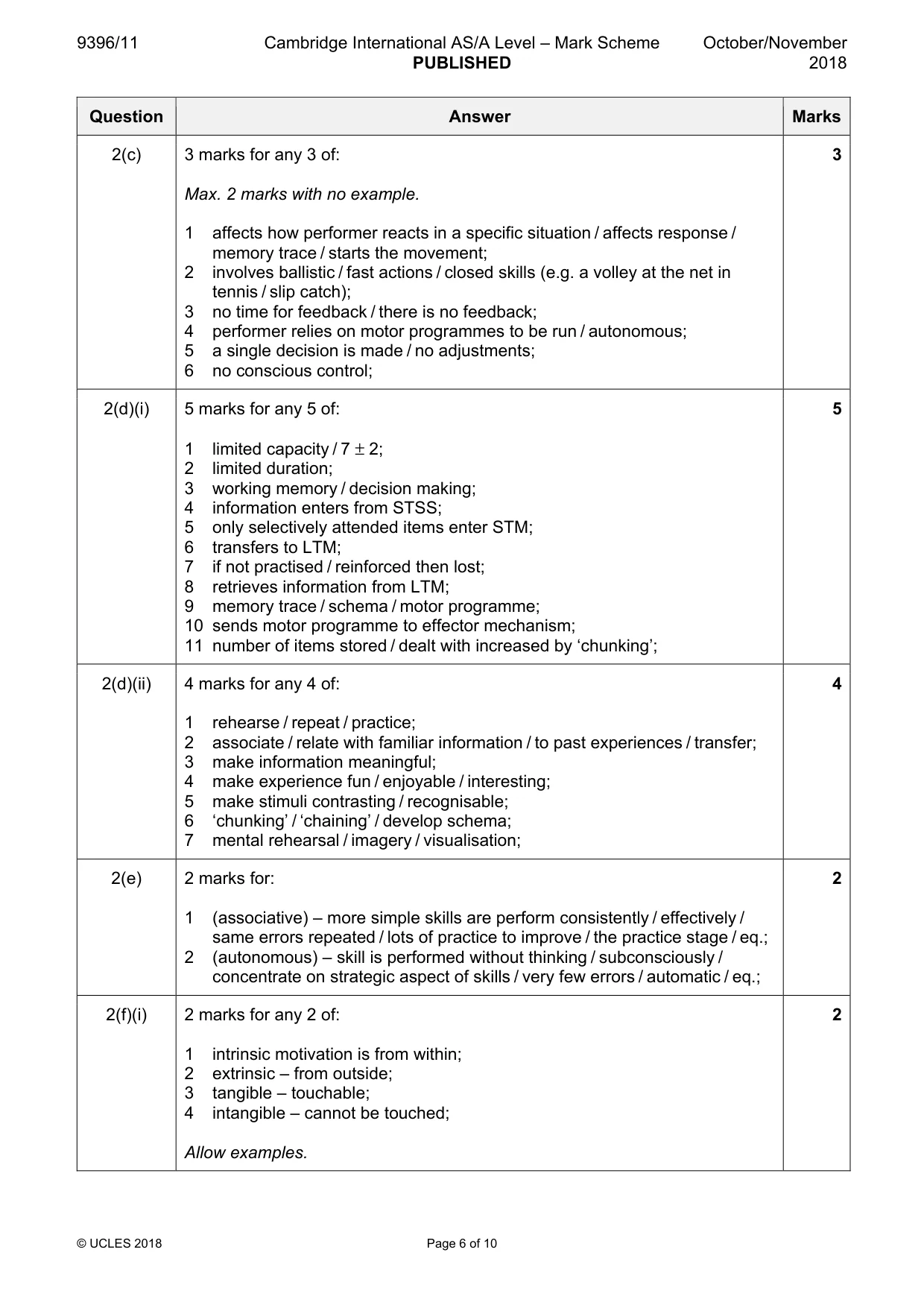
9396/11 Cambridge International AS/A Level – Mark Scheme PUBLISHED October/November 2018 © UCLES 2018 Page 6 of 10 Question Answer Marks 2(c) 3 marks for any 3 of: Max. 2 marks with no example. 1 affects how performer reacts in a specific situation / affects response / memory trace / starts the movement; 2 involves ballistic / fast actions / closed skills (e.g. a volley at the net in tennis / slip catch); 3 no time for feedback / there is no feedback; 4 performer relies on motor programmes to be run / autonomous; 5 a single decision is made / no adjustments; 6 no conscious control; 3 2(d)(i) 5 marks for any 5 of: 1 limited capacity / 7 ± 2; 2 limited duration; 3 working memory / decision making; 4 information enters from STSS; 5 only selectively attended items enter STM; 6 transfers to LTM; 7 if not practised / reinforced then lost; 8 retrieves information from LTM; 9 memory trace / schema / motor programme; 10 sends motor programme to effector mechanism; 11 number of items stored / dealt with increased by ‘chunking’; 5 2(d)(ii) 4 marks for any 4 of: 1 rehearse / repeat / practice; 2 associate / relate with familiar information / to past experiences / transfer; 3 make information meaningful; 4 make experience fun / enjoyable / interesting; 5 make stimuli contrasting / recognisable; 6 ‘chunking’ / ‘chaining’ / develop schema; 7 mental rehearsal / imagery / visualisation; 4 2(e) 2 marks for: 1 (associative) – more simple skills are perform consistently / effectively / same errors repeated / lots of practice to improve / the practice stage / eq.; 2 (autonomous) – skill is performed without thinking / subconsciously / concentrate on strategic aspect of skills / very few errors / automatic / eq.; 2 2(f)(i) 2 marks for any 2 of: 1 intrinsic motivation is from within; 2 extrinsic – from outside; 3 tangible – touchable; 4 intangible – cannot be touched; Allow examples. 2
Mark scheme, page 7
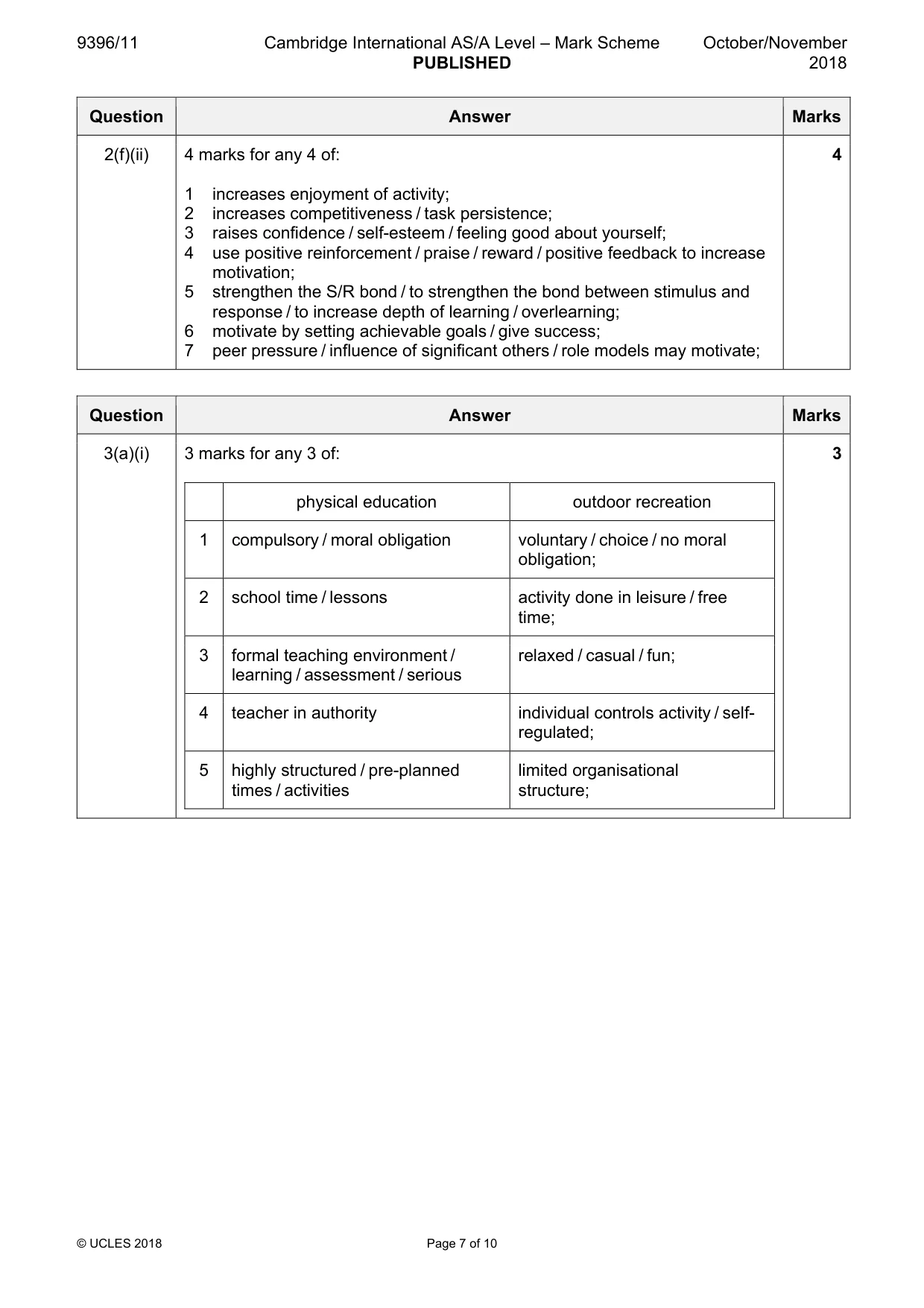
9396/11 Cambridge International AS/A Level – Mark Scheme PUBLISHED October/November 2018 © UCLES 2018 Page 7 of 10 Question Answer Marks 2(f)(ii) 4 marks for any 4 of: 1 increases enjoyment of activity; 2 increases competitiveness / task persistence; 3 raises confidence / self-esteem / feeling good about yourself; 4 use positive reinforcement / praise / reward / positive feedback to increase motivation; 5 strengthen the S/R bond / to strengthen the bond between stimulus and response / to increase depth of learning / overlearning; 6 motivate by setting achievable goals / give success; 7 peer pressure / influence of significant others / role models may motivate; 4 Question Answer Marks 3(a)(i) 3 marks for any 3 of: physical education outdoor recreation 1 compulsory / moral obligation voluntary / choice / no moral obligation; 2 school time / lessons activity done in leisure / free time; 3 formal teaching environment / learning / assessment / serious relaxed / casual / fun; 4 teacher in authority individual controls activity / self- regulated; 5 highly structured / pre-planned times / activities limited organisational structure; 3
Mark scheme, page 8
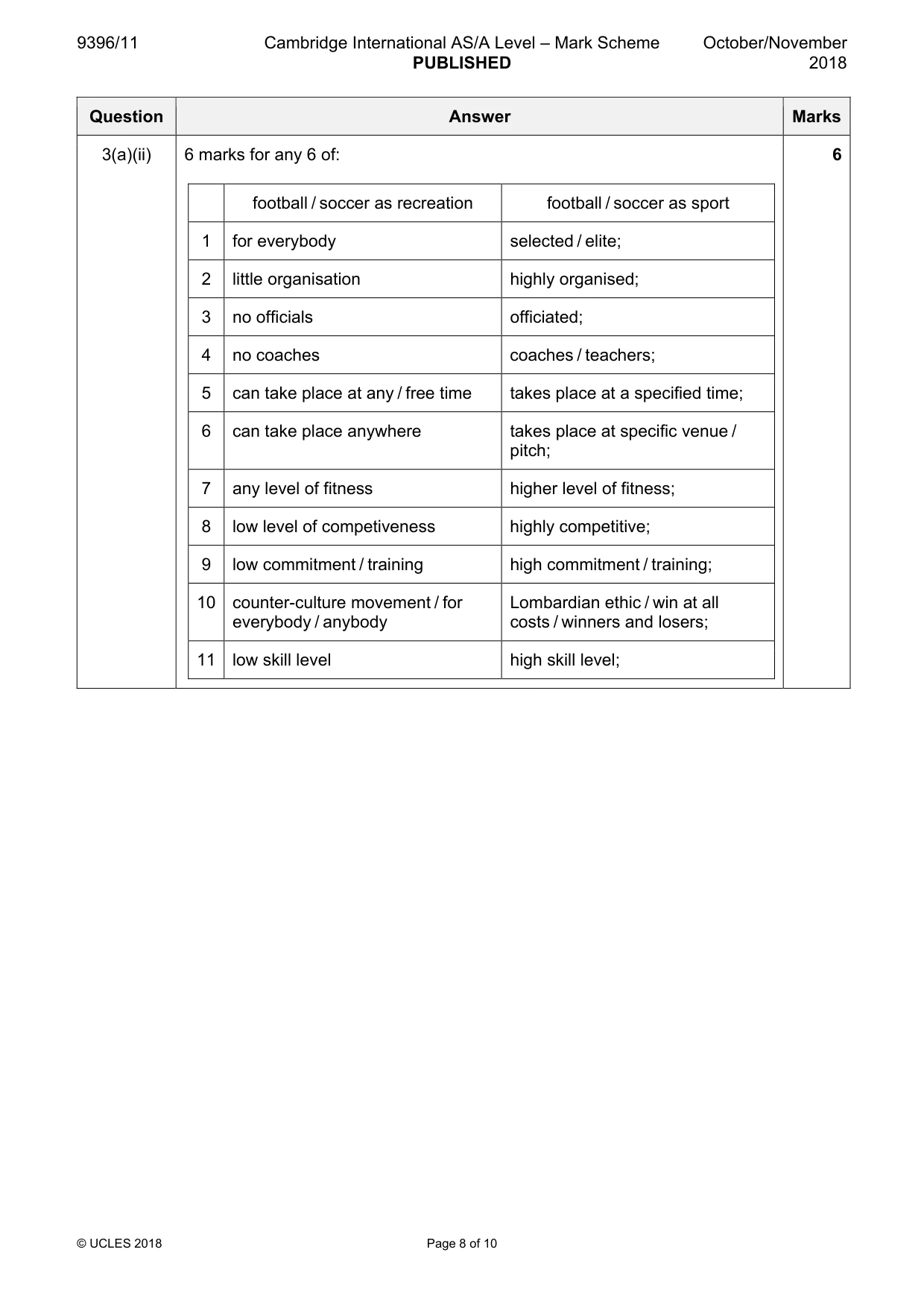
9396/11 Cambridge International AS/A Level – Mark Scheme PUBLISHED October/November 2018 © UCLES 2018 Page 8 of 10 Question Answer Marks 3(a)(ii) 6 marks for any 6 of: football / soccer as recreation football / soccer as sport 1 for everybody selected / elite; 2 little organisation highly organised; 3 no officials officiated; 4 no coaches coaches / teachers; 5 can take place at any / free time takes place at a specified time; 6 can take place anywhere takes place at specific venue / pitch; 7 any level of fitness higher level of fitness; 8 low level of competiveness highly competitive; 9 low commitment / training high commitment / training; 10 counter-culture movement / for everybody / anybody Lombardian ethic / win at all costs / winners and losers; 11 low skill level high skill level; 6
Mark scheme, page 9
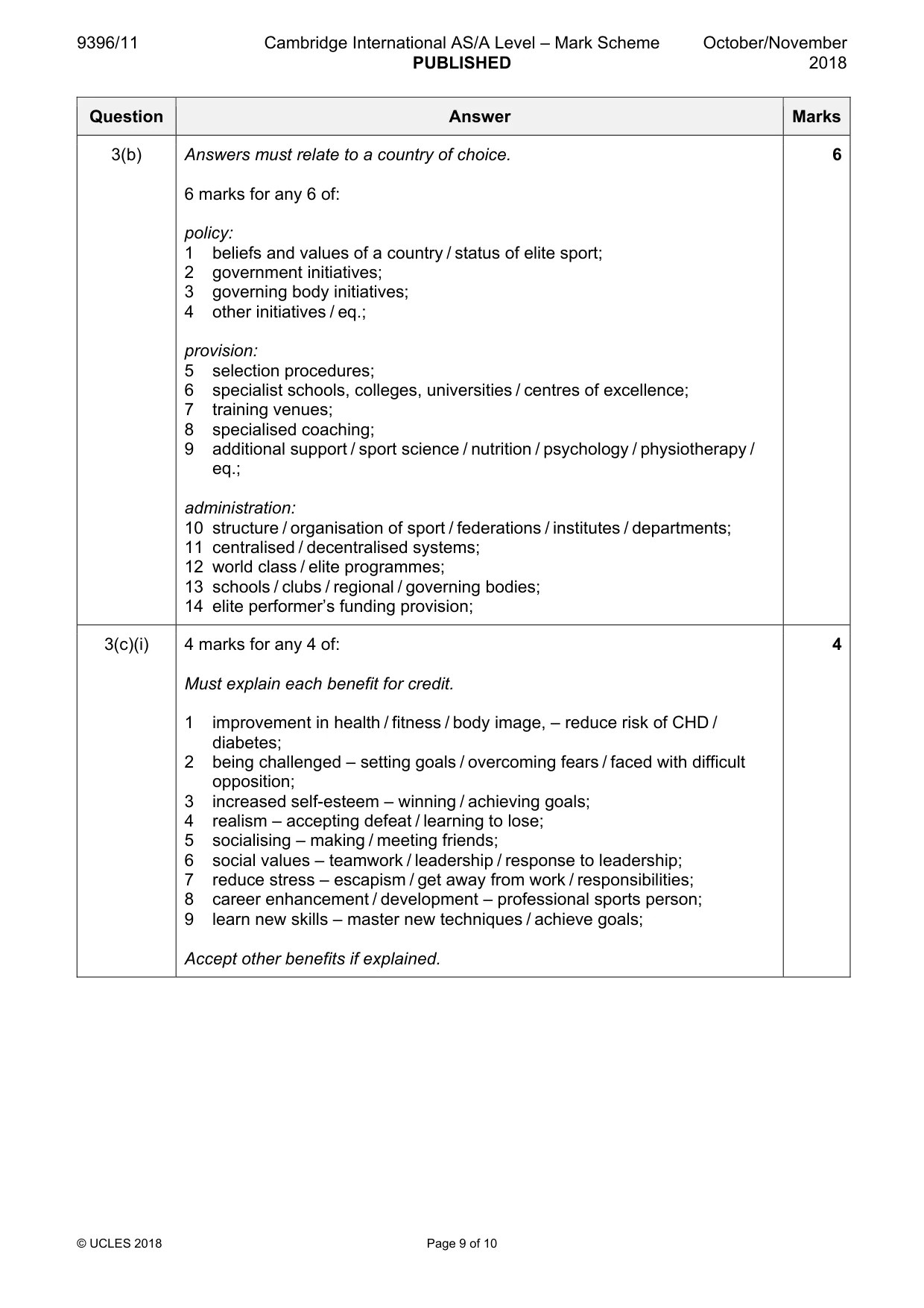
9396/11 Cambridge International AS/A Level – Mark Scheme PUBLISHED October/November 2018 © UCLES 2018 Page 9 of 10 Question Answer Marks 3(b) Answers must relate to a country of choice. 6 marks for any 6 of: policy: 1 beliefs and values of a country / status of elite sport; 2 government initiatives; 3 governing body initiatives; 4 other initiatives / eq.; provision: 5 selection procedures; 6 specialist schools, colleges, universities / centres of excellence; 7 training venues; 8 specialised coaching; 9 additional support / sport science / nutrition / psychology / physiotherapy / eq.; administration: 10 structure / organisation of sport / federations / institutes / departments; 11 centralised / decentralised systems; 12 world class / elite programmes; 13 schools / clubs / regional / governing bodies; 14 elite performer’s funding provision; 6 3(c)(i) 4 marks for any 4 of: Must explain each benefit for credit. 1 improvement in health / fitness / body image, – reduce risk of CHD / diabetes; 2 being challenged – setting goals / overcoming fears / faced with difficult opposition; 3 increased self-esteem – winning / achieving goals; 4 realism – accepting defeat / learning to lose; 5 socialising – making / meeting friends; 6 social values – teamwork / leadership / response to leadership; 7 reduce stress – escapism / get away from work / responsibilities; 8 career enhancement / development – professional sports person; 9 learn new skills – master new techniques / achieve goals; Accept other benefits if explained. 4
Mark scheme, page 10
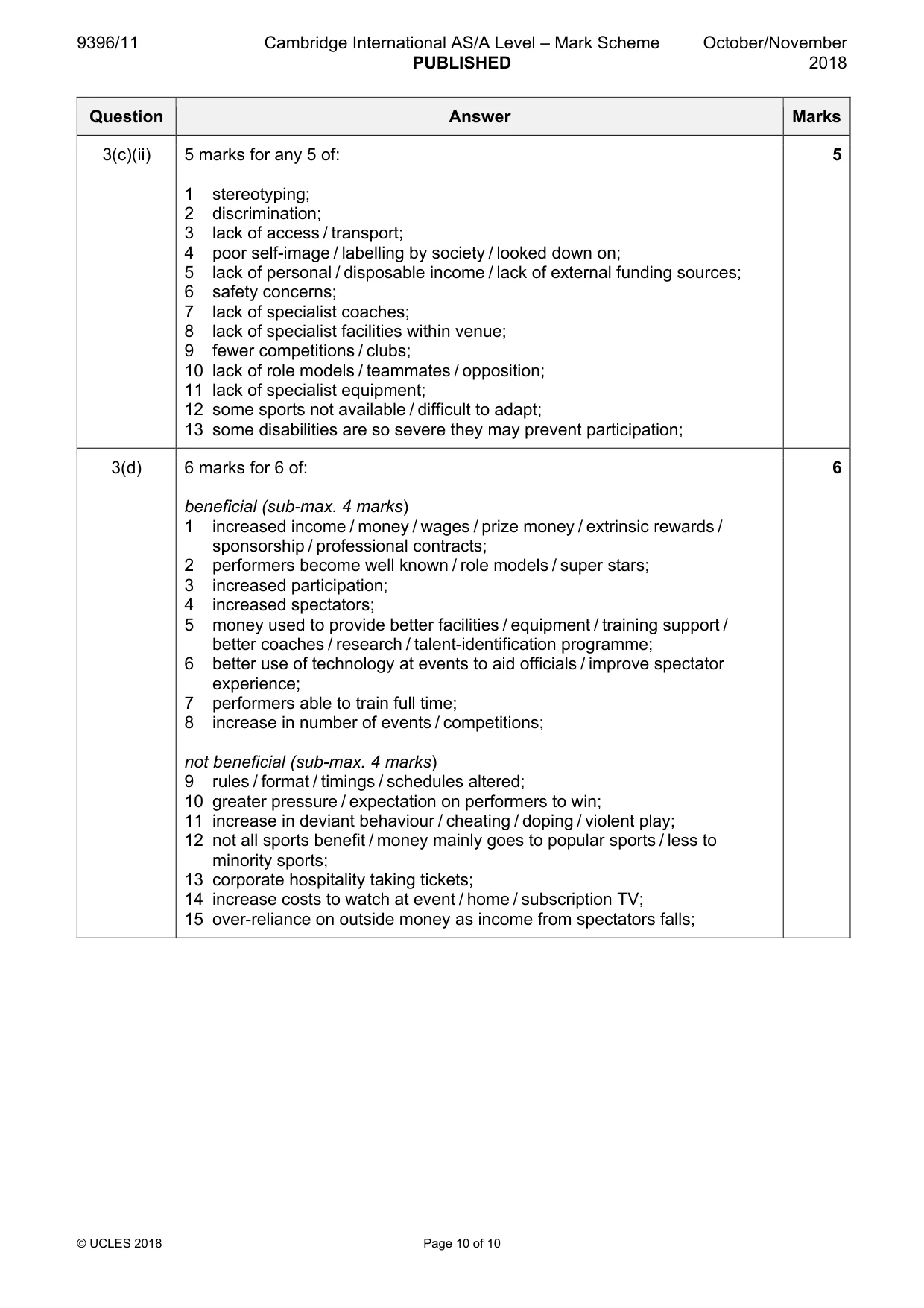
9396/11 Cambridge International AS/A Level – Mark Scheme PUBLISHED October/November 2018 © UCLES 2018 Page 10 of 10 Question Answer Marks 3(c)(ii) 5 marks for any 5 of: 1 stereotyping; 2 discrimination; 3 lack of access / transport; 4 poor self-image / labelling by society / looked down on; 5 lack of personal / disposable income / lack of external funding sources; 6 safety concerns; 7 lack of specialist coaches; 8 lack of specialist facilities within venue; 9 fewer competitions / clubs; 10 lack of role models / teammates / opposition; 11 lack of specialist equipment; 12 some sports not available / difficult to adapt; 13 some disabilities are so severe they may prevent participation; 5 3(d) 6 marks for 6 of: beneficial (sub-max. 4 marks) 1 increased income / money / wages / prize money / extrinsic rewards / sponsorship / professional contracts; 2 performers become well known / role models / super stars; 3 increased participation; 4 increased spectators; 5 money used to provide better facilities / equipment / training support / better coaches / research / talent-identification programme; 6 better use of technology at events to aid officials / improve spectator experience; 7 performers able to train full time; 8 increase in number of events / competitions; not beneficial (sub-max. 4 marks) 9 rules / format / timings / schedules altered; 10 greater pressure / expectation on performers to win; 11 increase in deviant behaviour / cheating / doping / violent play; 12 not all sports benefit / money mainly goes to popular sports / less to minority sports; 13 corporate hospitality taking tickets; 14 increase costs to watch at event / home / subscription TV; 15 over-reliance on outside money as income from spectators falls; 6
What you needed in this session
Cambridge’s own grade thresholds for 2018 Oct/Nov, Paper 1 · Variant 1. A higher threshold means an easier paper — the bar moves with how the cohort did.