Cambridge A Level Physical Education 9396 — 2017 Oct/Nov Paper 1 · Variant 2
9396/12/O/N/17 · 90 marks · ≈101 min
The question paper and its mark scheme, free to read here and free to download. This is Cambridge’s own paper, exactly as it was sat.
Question paper8 pages



Mark scheme9 pages
Answers below. Sit the paper first if you are practising.
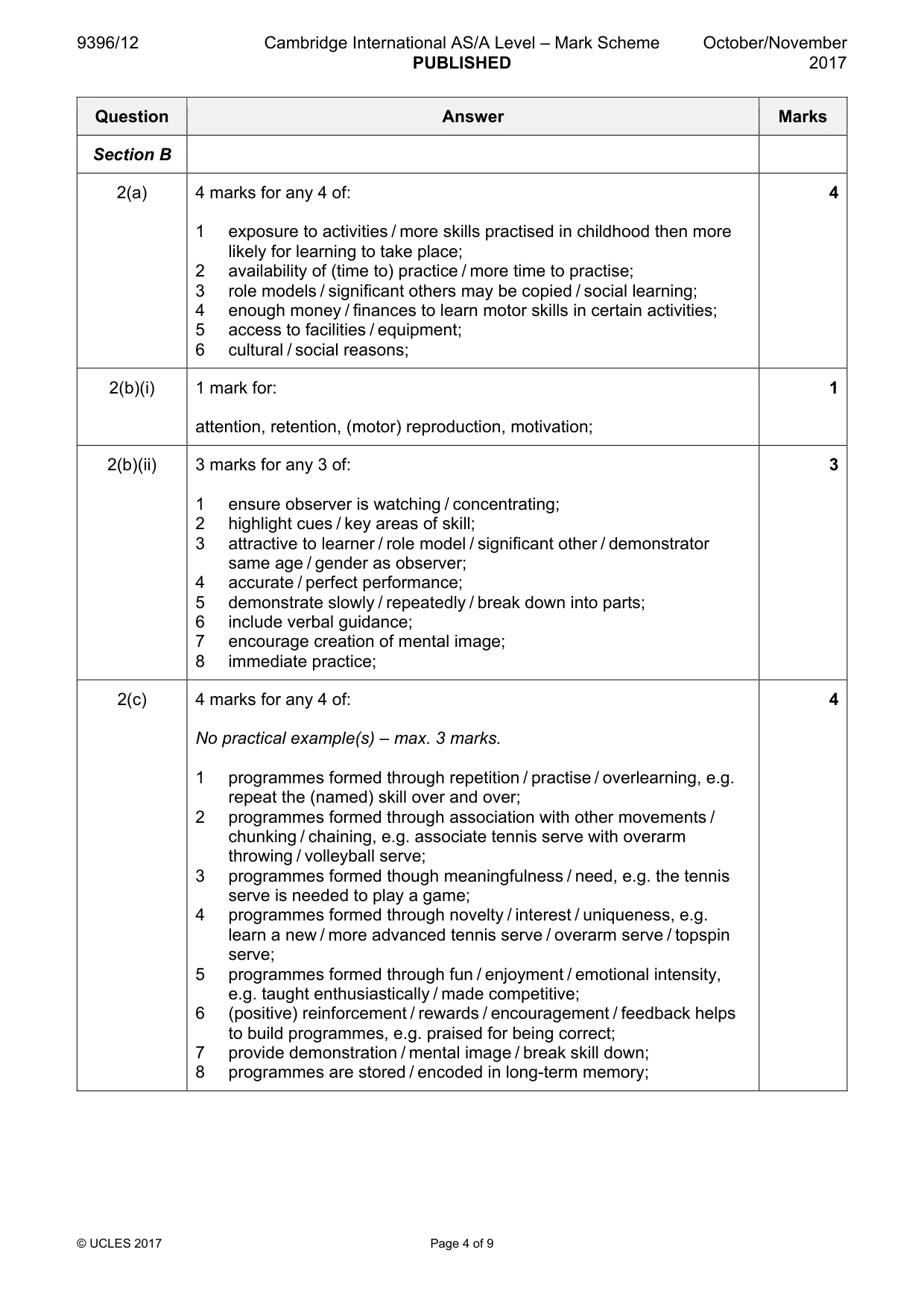
Paper as text
Question paper, page 1
This document consists of 5 printed pages, 3 blank pages and 1 Insert. DC (ST/SW) 127458/3 © UCLES 2017 [Turn over Cambridge International Examinations Cambridge International Advanced Subsidiary and Advanced Level * 8 0 4 5 4 9 7 4 6 5 * PHYSICAL EDUCATION 9396/12 Paper 1 October/November 2017 2 hours 30 minutes No Additional Materials are required. READ THESE INSTRUCTIONS FIRST An answer booklet is provided inside this question paper. You should follow the instructions on the front cover of the answer booklet. If you need additional answer paper ask the invigilator for a continuation booklet. Answer all questions. Electronic calculators may be used. You may lose marks if you do not show your working or if you do not use appropriate units. The number of marks is given in brackets [ ] at the end of each question or part question.
Question paper, page 2
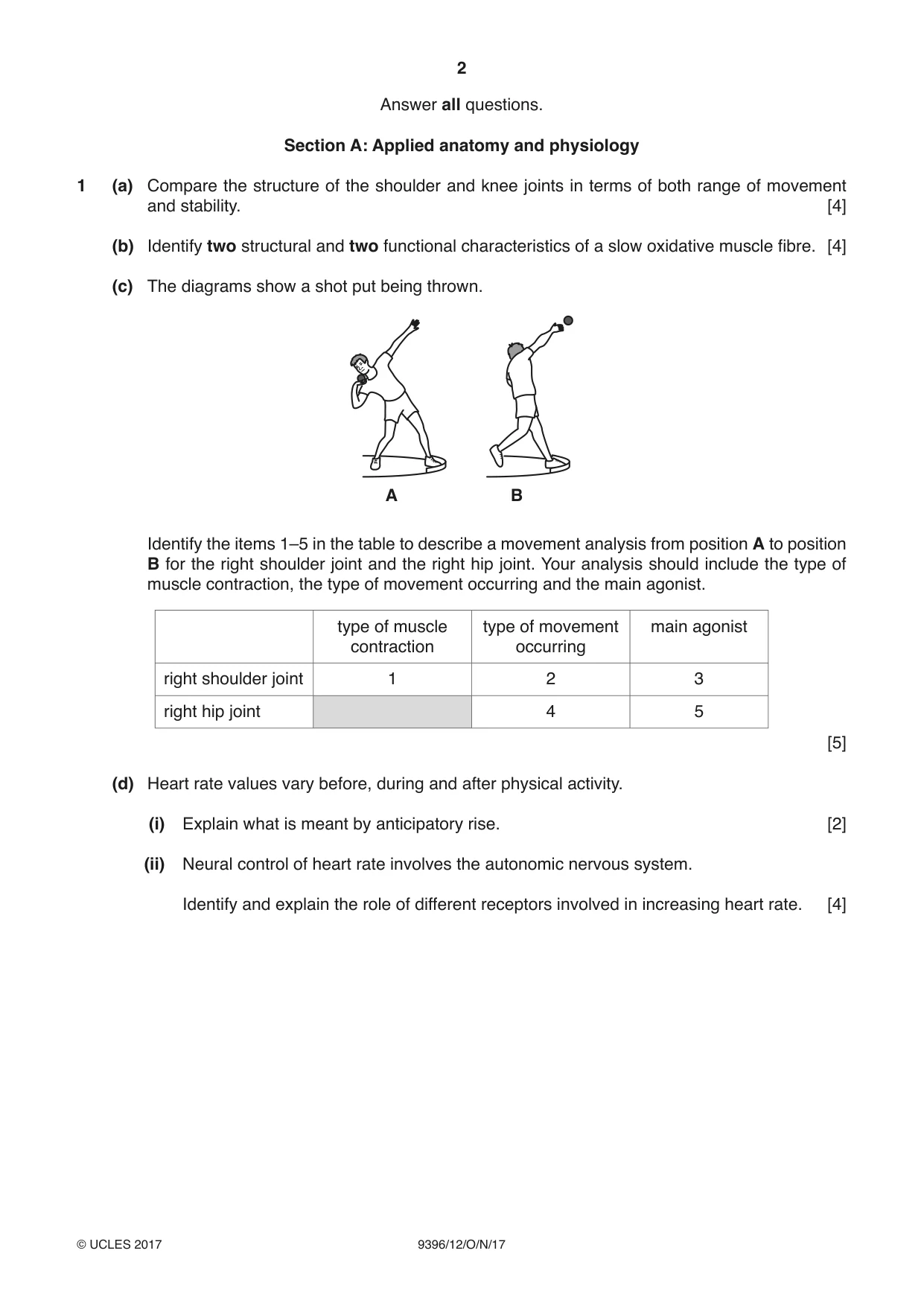
2 9396/12/O/N/17 © UCLES 2017 Answer all questions. Section A: Applied anatomy and physiology 1 (a) Compare the structure of the shoulder and knee joints in terms of both range of movement and stability. [4] (b) Identify two structural and two functional characteristics of a slow oxidative muscle fibre. [4] (c) The diagrams show a shot put being thrown. A B Identify the items 1–5 in the table to describe a movement analysis from position A to position B for the right shoulder joint and the right hip joint. Your analysis should include the type of muscle contraction, the type of movement occurring and the main agonist. type of muscle contraction type of movement occurring main agonist right shoulder joint 1 2 3 right hip joint 4 5 [5] (d) Heart rate values vary before, during and after physical activity. (i) Explain what is meant by anticipatory rise. [2] (ii) Neural control of heart rate involves the autonomic nervous system. Identify and explain the role of different receptors involved in increasing heart rate. [4]
Question paper, page 3
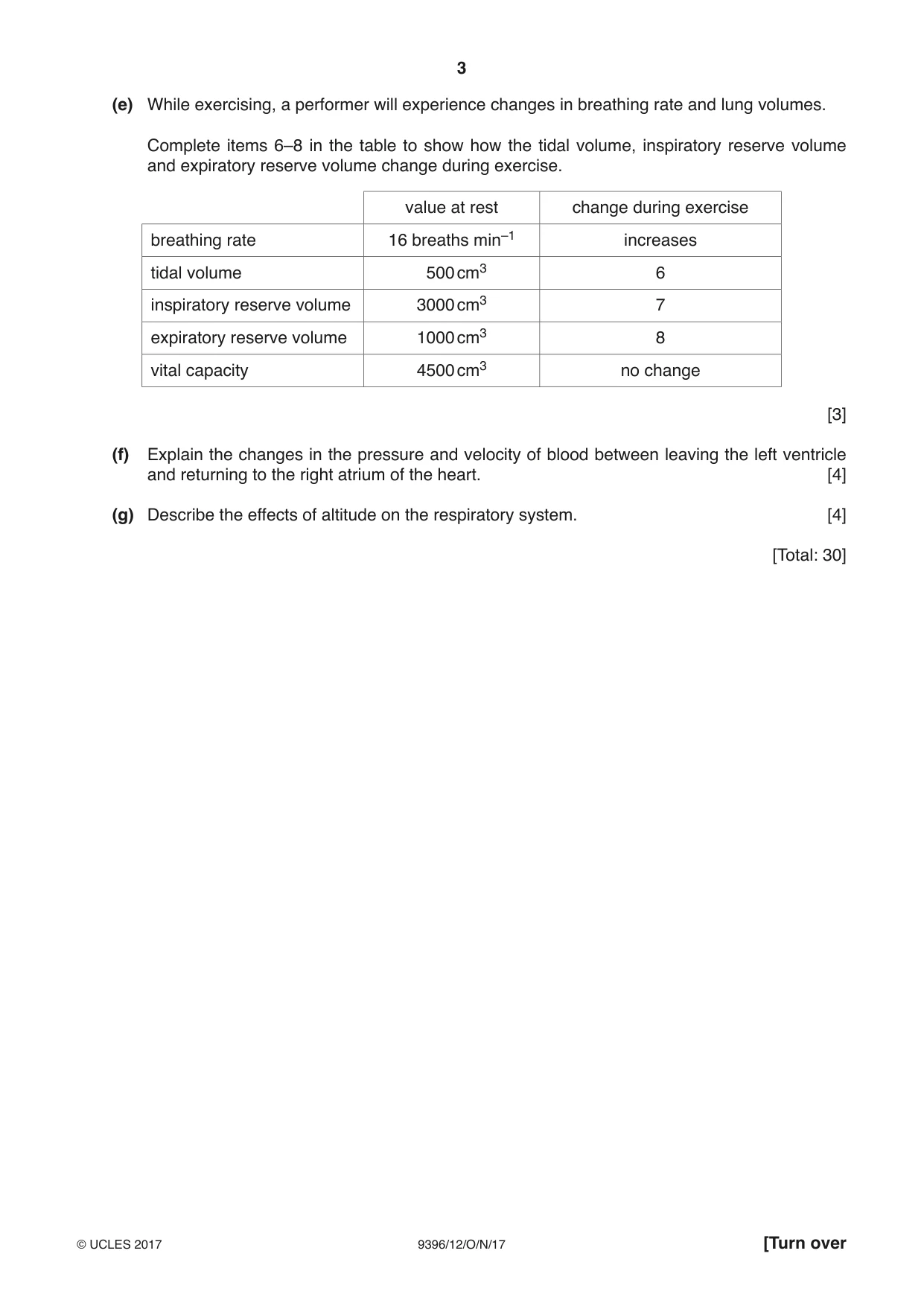
3 9396/12/O/N/17 © UCLES 2017 [Turn over (e) While exercising, a performer will experience changes in breathing rate and lung volumes. Complete items 6–8 in the table to show how the tidal volume, inspiratory reserve volume and expiratory reserve volume change during exercise. value at rest change during exercise breathing rate 16 breaths min–1 increases tidal volume 500 cm3 6 inspiratory reserve volume 3000 cm3 7 expiratory reserve volume 1000 cm3 8 vital capacity 4500 cm3 no change [3] (f) Explain the changes in the pressure and velocity of blood between leaving the left ventricle and returning to the right atrium of the heart. [4] (g) Describe the effects of altitude on the respiratory system. [4] [Total: 30]
Question paper, page 4
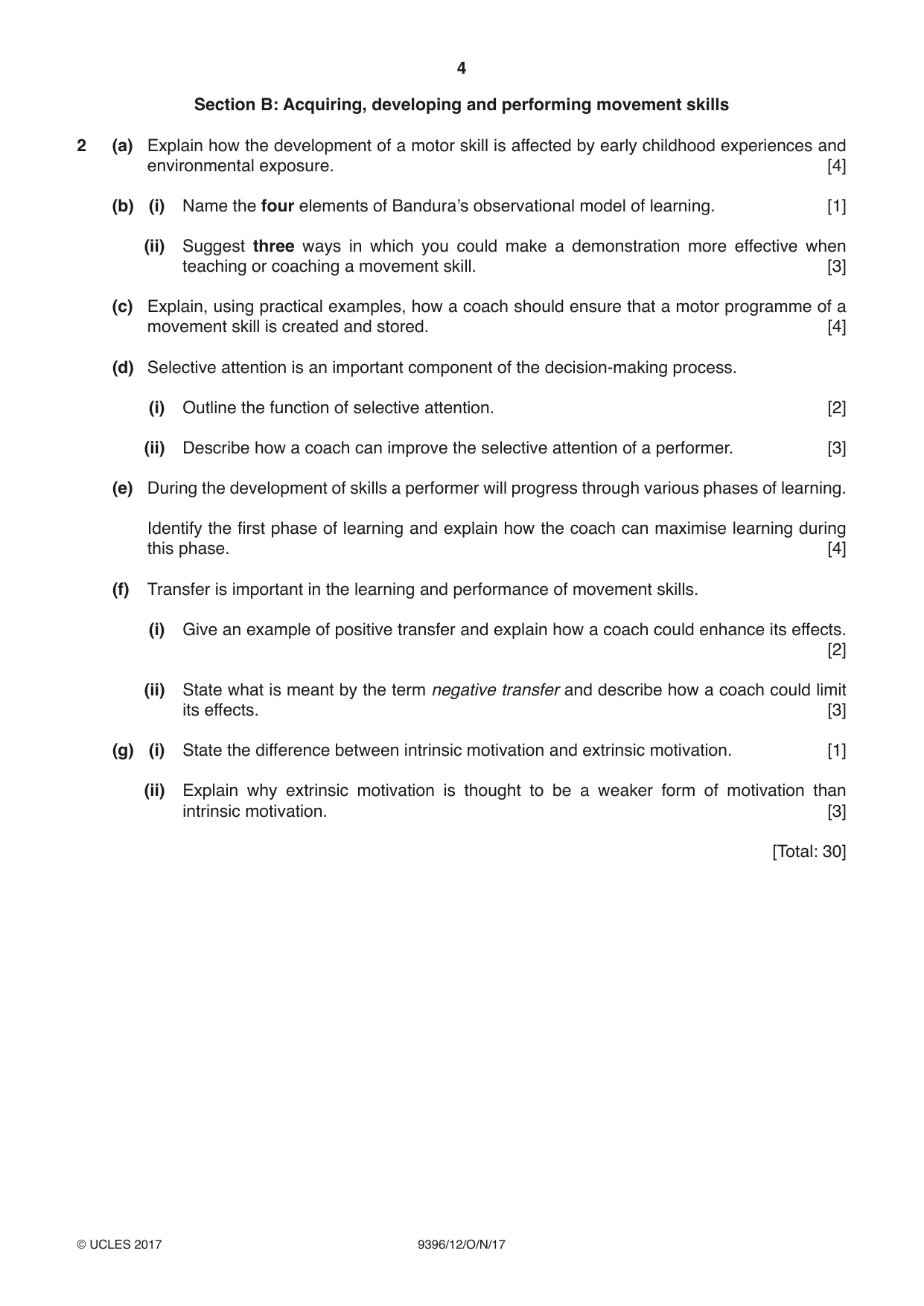
4 9396/12/O/N/17 © UCLES 2017 Section B: Acquiring, developing and performing movement skills 2 (a) Explain how the development of a motor skill is affected by early childhood experiences and environmental exposure. [4] (b) (i) Name the four elements of Bandura’s observational model of learning. [1] (ii) Suggest three ways in which you could make a demonstration more effective when teaching or coaching a movement skill. [3] (c) Explain, using practical examples, how a coach should ensure that a motor programme of a movement skill is created and stored. [4] (d) Selective attention is an important component of the decision-making process. (i) Outline the function of selective attention. [2] (ii) Describe how a coach can improve the selective attention of a performer. [3] (e) During the development of skills a performer will progress through various phases of learning. Identify the first phase of learning and explain how the coach can maximise learning during this phase. [4] (f) Transfer is important in the learning and performance of movement skills. (i) Give an example of positive transfer and explain how a coach could enhance its effects. [2] (ii) State what is meant by the term negative transfer and describe how a coach could limit its effects. [3] (g) (i) State the difference between intrinsic motivation and extrinsic motivation. [1] (ii) Explain why extrinsic motivation is thought to be a weaker form of motivation than intrinsic motivation. [3] [Total: 30]
Question paper, page 5
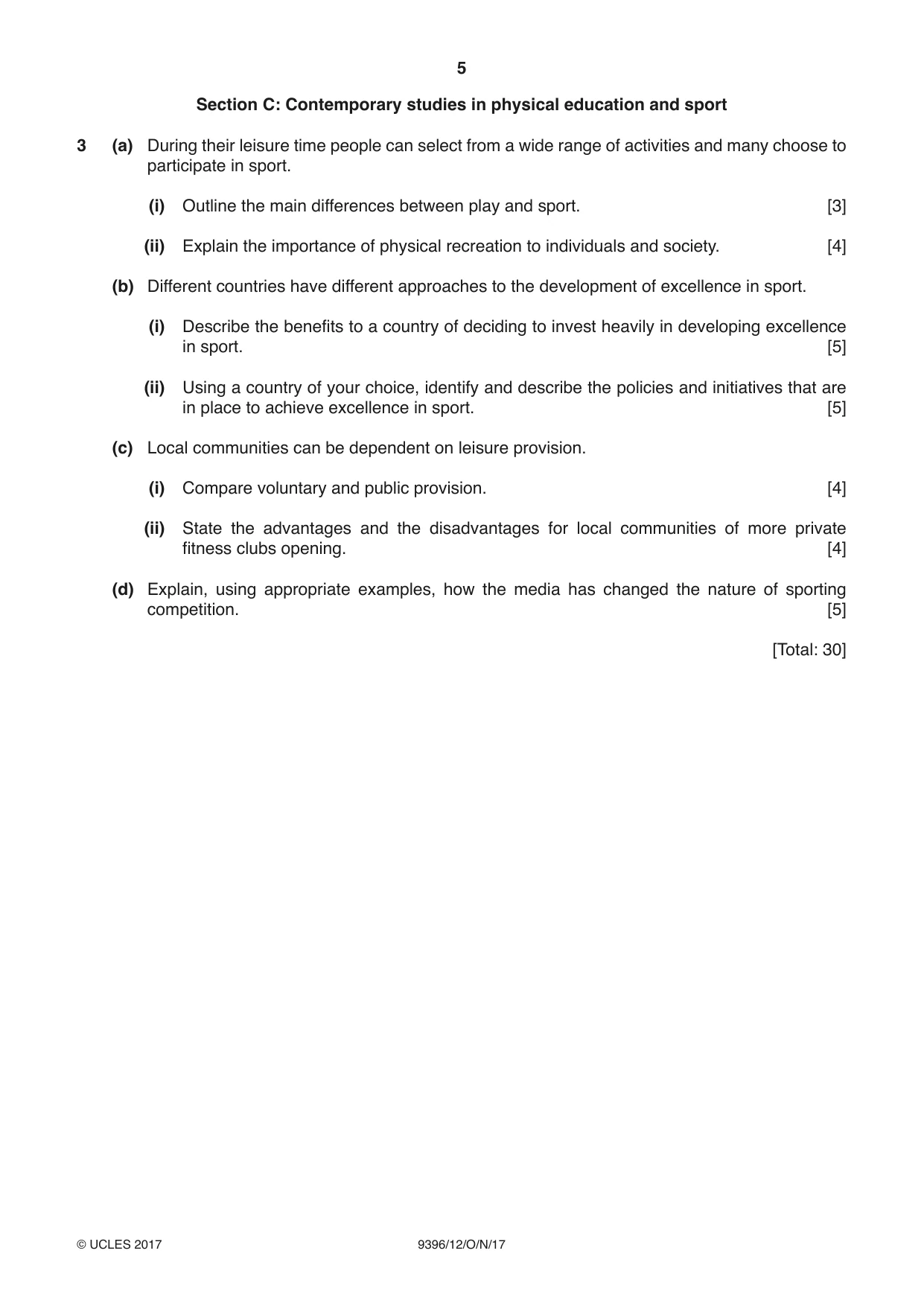
5 9396/12/O/N/17 © UCLES 2017 Section C: Contemporary studies in physical education and sport 3 (a) During their leisure time people can select from a wide range of activities and many choose to participate in sport. (i) Outline the main differences between play and sport. [3] (ii) Explain the importance of physical recreation to individuals and society. [4] (b) Different countries have different approaches to the development of excellence in sport. (i) Describe the benefits to a country of deciding to invest heavily in developing excellence in sport. [5] (ii) Using a country of your choice, identify and describe the policies and initiatives that are in place to achieve excellence in sport. [5] (c) Local communities can be dependent on leisure provision. (i) Compare voluntary and public provision. [4] (ii) State the advantages and the disadvantages for local communities of more private fitness clubs opening. [4] (d) Explain, using appropriate examples, how the media has changed the nature of sporting competition. [5] [Total: 30]
Question paper, page 6
6 9396/12/O/N/17 © UCLES 2017 BLANK PAGE
Question paper, page 7
7 9396/12/O/N/17 © UCLES 2017 BLANK PAGE
Question paper, page 8
8 9396/12/O/N/17 © UCLES 2017 BLANK PAGE Permission to reproduce items where third-party owned material protected by copyright is included has been sought and cleared where possible. Every reasonable effort has been made by the publisher (UCLES) to trace copyright holders, but if any items requiring clearance have unwittingly been included, the publisher will be pleased to make amends at the earliest possible opportunity. To avoid the issue of disclosure of answer-related information to candidates, all copyright acknowledgements are reproduced online in the Cambridge International Examinations Copyright Acknowledgements Booklet. This is produced for each series of examinations and is freely available to download at www.cie.org.uk after the live examination series. Cambridge International Examinations is part of the Cambridge Assessment Group. Cambridge Assessment is the brand name of University of Cambridge Local Examinations Syndicate (UCLES), which is itself a department of the University of Cambridge.
Mark scheme, page 1
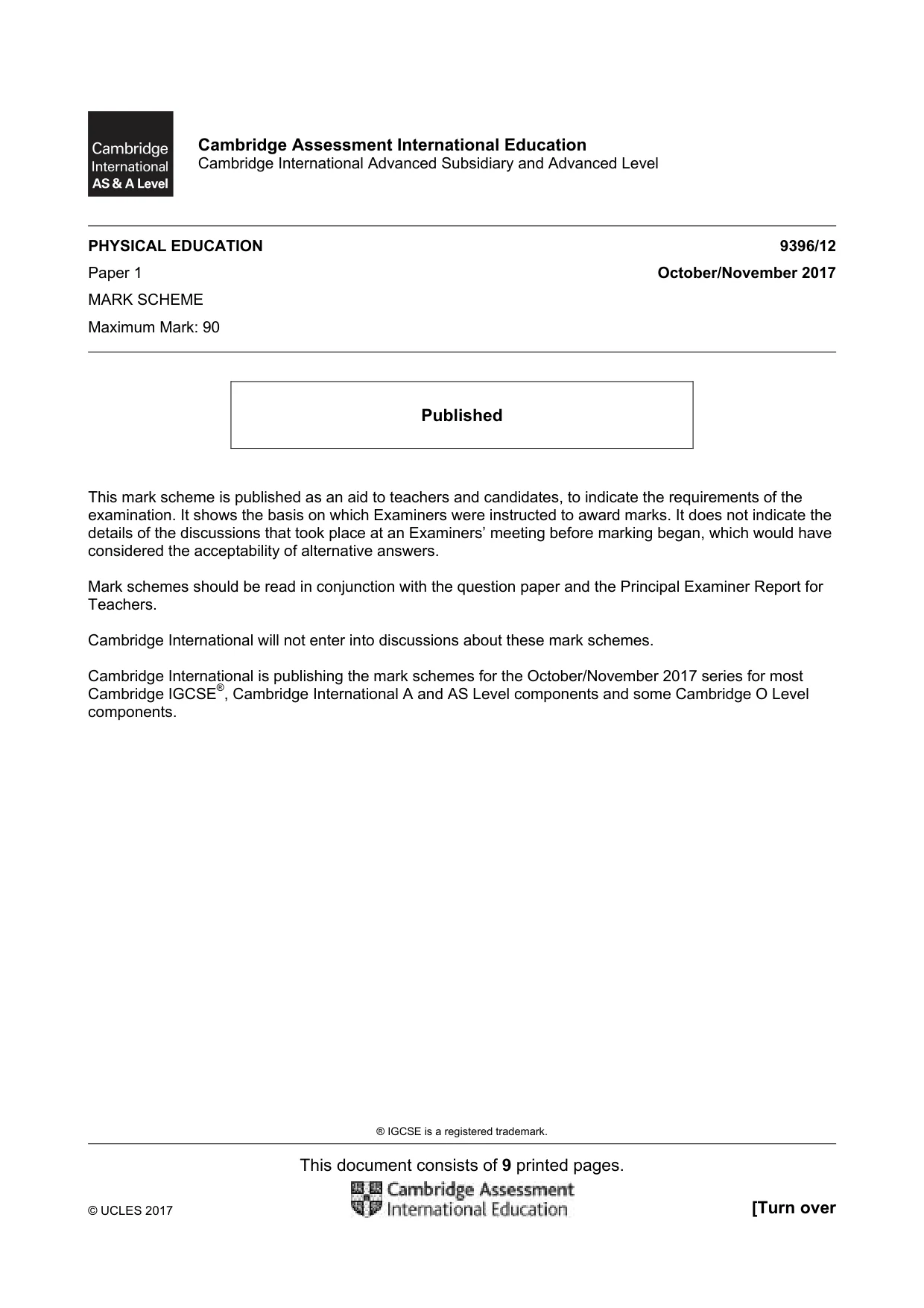
® IGCSE is a registered trademark. This document consists of 9 printed pages. © UCLES 2017 [Turn over Cambridge Assessment International Education Cambridge International Advanced Subsidiary and Advanced Level PHYSICAL EDUCATION 9396/12 Paper 1 October/November 2017 MARK SCHEME Maximum Mark: 90 Published This mark scheme is published as an aid to teachers and candidates, to indicate the requirements of the examination. It shows the basis on which Examiners were instructed to award marks. It does not indicate the details of the discussions that took place at an Examiners’ meeting before marking began, which would have considered the acceptability of alternative answers. Mark schemes should be read in conjunction with the question paper and the Principal Examiner Report for Teachers. Cambridge International will not enter into discussions about these mark schemes. Cambridge International is publishing the mark schemes for the October/November 2017 series for most Cambridge IGCSE®, Cambridge International A and AS Level components and some Cambridge O Level components.
Mark scheme, page 2
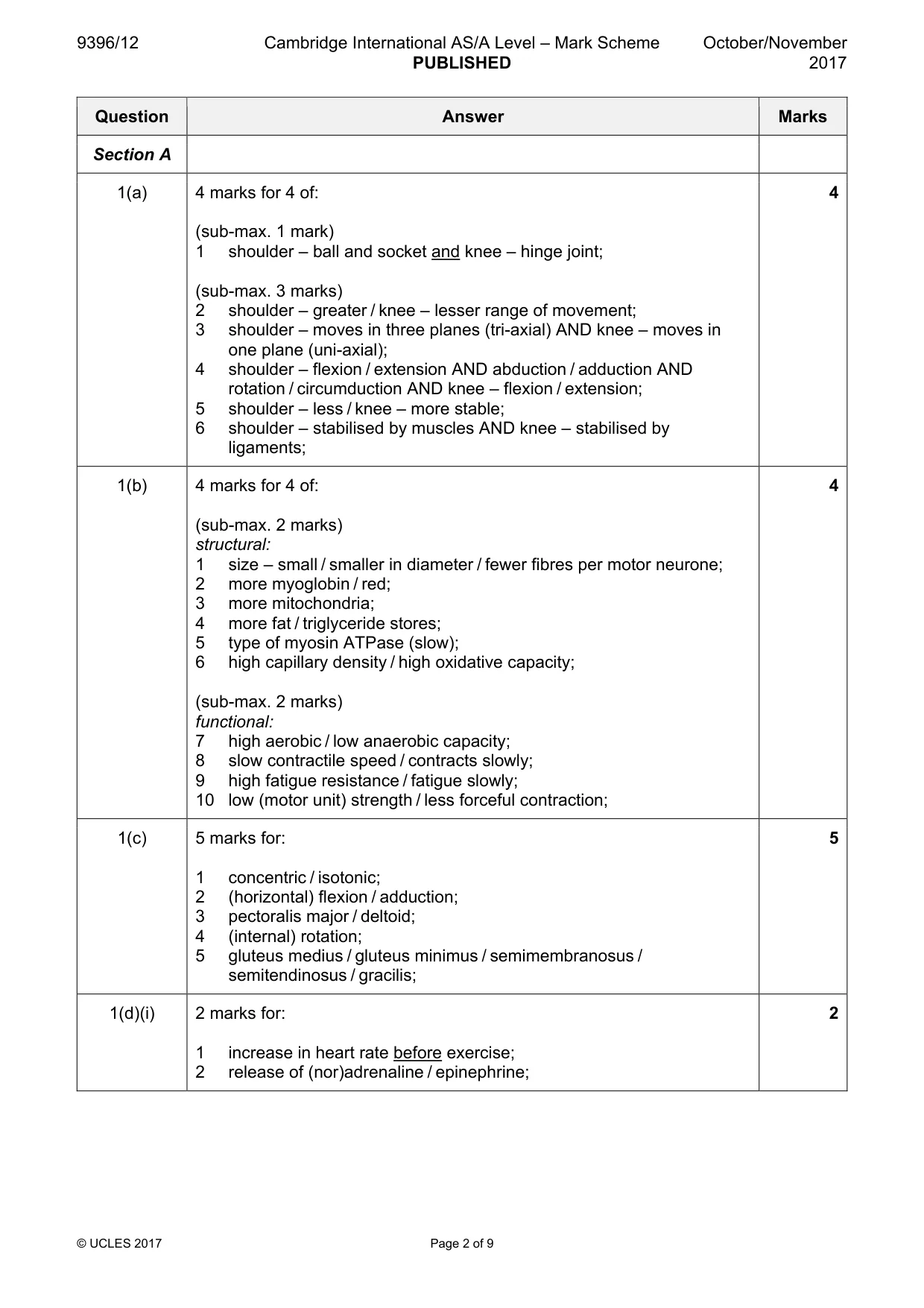
9396/12 Cambridge International AS/A Level – Mark Scheme PUBLISHED October/November 2017 © UCLES 2017 Page 2 of 9 Question Answer Marks Section A 1(a) 4 marks for 4 of: (sub-max. 1 mark) 1 shoulder – ball and socket and knee – hinge joint; (sub-max. 3 marks) 2 shoulder – greater / knee – lesser range of movement; 3 shoulder – moves in three planes (tri-axial) AND knee – moves in one plane (uni-axial); 4 shoulder – flexion / extension AND abduction / adduction AND rotation / circumduction AND knee – flexion / extension; 5 shoulder – less / knee – more stable; 6 shoulder – stabilised by muscles AND knee – stabilised by ligaments; 4 1(b) 4 marks for 4 of: (sub-max. 2 marks) structural: 1 size – small / smaller in diameter / fewer fibres per motor neurone; 2 more myoglobin / red; 3 more mitochondria; 4 more fat / triglyceride stores; 5 type of myosin ATPase (slow); 6 high capillary density / high oxidative capacity; (sub-max. 2 marks) functional: 7 high aerobic / low anaerobic capacity; 8 slow contractile speed / contracts slowly; 9 high fatigue resistance / fatigue slowly; 10 low (motor unit) strength / less forceful contraction; 4 1(c) 5 marks for: 1 concentric / isotonic; 2 (horizontal) flexion / adduction; 3 pectoralis major / deltoid; 4 (internal) rotation; 5 gluteus medius / gluteus minimus / semimembranosus / semitendinosus / gracilis; 5 1(d)(i) 2 marks for: 1 increase in heart rate before exercise; 2 release of (nor)adrenaline / epinephrine; 2
Mark scheme, page 3
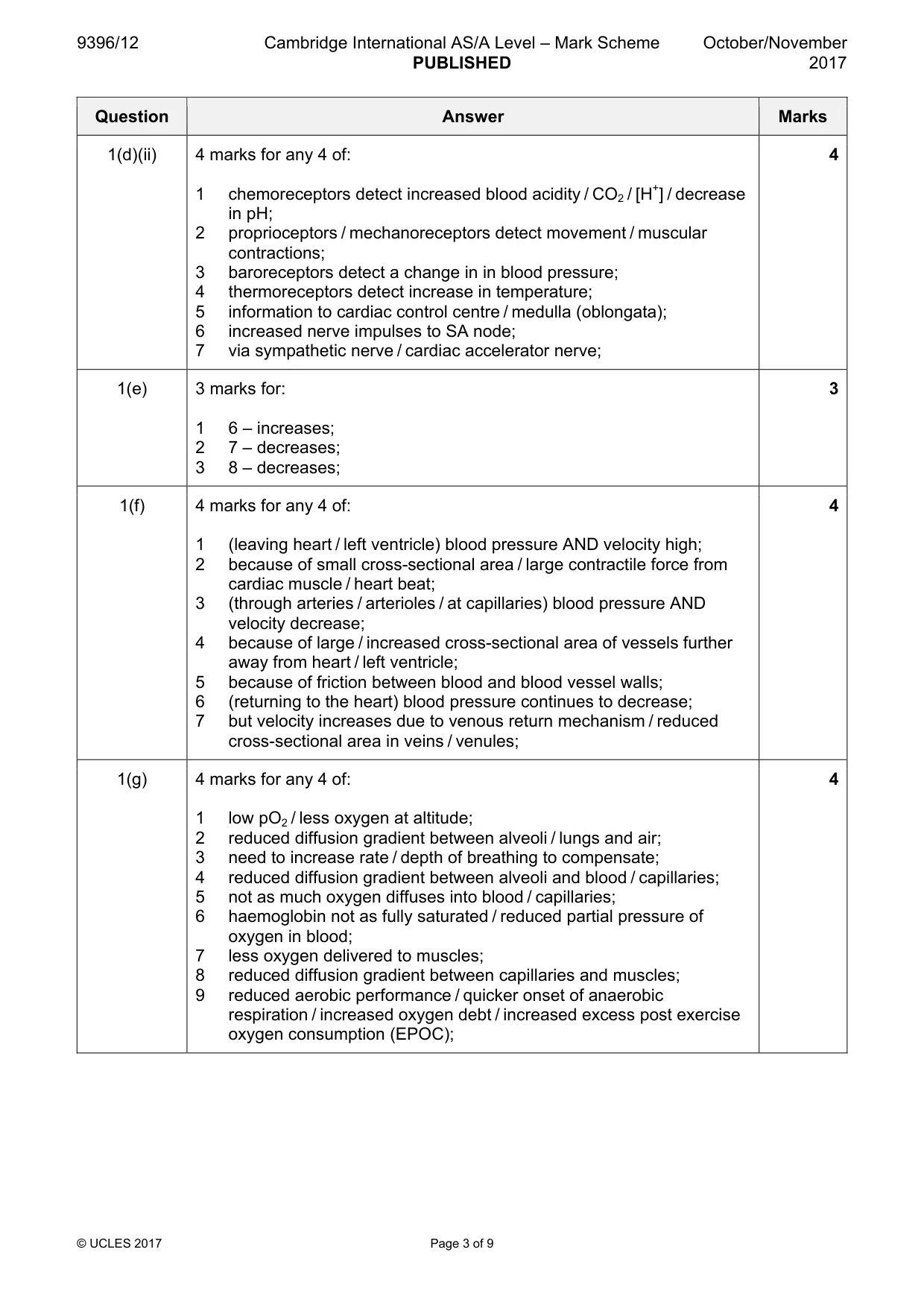
9396/12 Cambridge International AS/A Level – Mark Scheme PUBLISHED October/November 2017 © UCLES 2017 Page 3 of 9 Question Answer Marks 1(d)(ii) 4 marks for any 4 of: 1 chemoreceptors detect increased blood acidity / CO2 / [H+] / decrease in pH; 2 proprioceptors / mechanoreceptors detect movement / muscular contractions; 3 baroreceptors detect a change in in blood pressure; 4 thermoreceptors detect increase in temperature; 5 information to cardiac control centre / medulla (oblongata); 6 increased nerve impulses to SA node; 7 via sympathetic nerve / cardiac accelerator nerve; 4 1(e) 3 marks for: 1 6 – increases; 2 7 – decreases; 3 8 – decreases; 3 1(f) 4 marks for any 4 of: 1 (leaving heart / left ventricle) blood pressure AND velocity high; 2 because of small cross-sectional area / large contractile force from cardiac muscle / heart beat; 3 (through arteries / arterioles / at capillaries) blood pressure AND velocity decrease; 4 because of large / increased cross-sectional area of vessels further away from heart / left ventricle; 5 because of friction between blood and blood vessel walls; 6 (returning to the heart) blood pressure continues to decrease; 7 but velocity increases due to venous return mechanism / reduced cross-sectional area in veins / venules; 4 1(g) 4 marks for any 4 of: 1 low pO2 / less oxygen at altitude; 2 reduced diffusion gradient between alveoli / lungs and air; 3 need to increase rate / depth of breathing to compensate; 4 reduced diffusion gradient between alveoli and blood / capillaries; 5 not as much oxygen diffuses into blood / capillaries; 6 haemoglobin not as fully saturated / reduced partial pressure of oxygen in blood; 7 less oxygen delivered to muscles; 8 reduced diffusion gradient between capillaries and muscles; 9 reduced aerobic performance / quicker onset of anaerobic respiration / increased oxygen debt / increased excess post exercise oxygen consumption (EPOC); 4
Mark scheme, page 4
9396/12 Cambridge International AS/A Level – Mark Scheme PUBLISHED October/November 2017 © UCLES 2017 Page 4 of 9 Question Answer Marks Section B 2(a) 4 marks for any 4 of: 1 exposure to activities / more skills practised in childhood then more likely for learning to take place; 2 availability of (time to) practice / more time to practise; 3 role models / significant others may be copied / social learning; 4 enough money / finances to learn motor skills in certain activities; 5 access to facilities / equipment; 6 cultural / social reasons; 4 2(b)(i) 1 mark for: attention, retention, (motor) reproduction, motivation; 1 2(b)(ii) 3 marks for any 3 of: 1 ensure observer is watching / concentrating; 2 highlight cues / key areas of skill; 3 attractive to learner / role model / significant other / demonstrator same age / gender as observer; 4 accurate / perfect performance; 5 demonstrate slowly / repeatedly / break down into parts; 6 include verbal guidance; 7 encourage creation of mental image; 8 immediate practice; 3 2(c) 4 marks for any 4 of: No practical example(s) – max. 3 marks. 1 programmes formed through repetition / practise / overlearning, e.g. repeat the (named) skill over and over; 2 programmes formed through association with other movements / chunking / chaining, e.g. associate tennis serve with overarm throwing / volleyball serve; 3 programmes formed though meaningfulness / need, e.g. the tennis serve is needed to play a game; 4 programmes formed through novelty / interest / uniqueness, e.g. learn a new / more advanced tennis serve / overarm serve / topspin serve; 5 programmes formed through fun / enjoyment / emotional intensity, e.g. taught enthusiastically / made competitive; 6 (positive) reinforcement / rewards / encouragement / feedback helps to build programmes, e.g. praised for being correct; 7 provide demonstration / mental image / break skill down; 8 programmes are stored / encoded in long-term memory; 4
Mark scheme, page 5
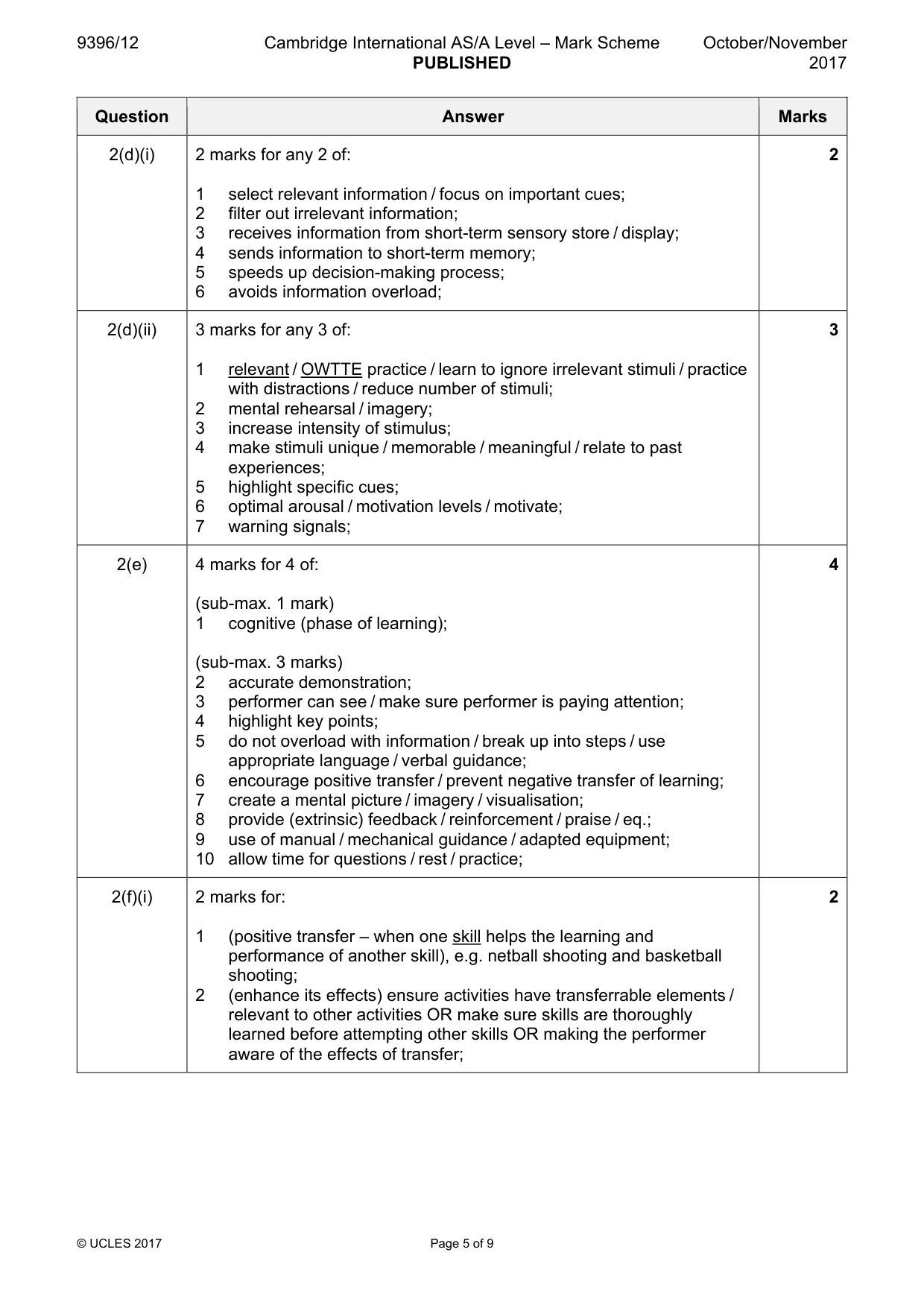
9396/12 Cambridge International AS/A Level – Mark Scheme PUBLISHED October/November 2017 © UCLES 2017 Page 5 of 9 Question Answer Marks 2(d)(i) 2 marks for any 2 of: 1 select relevant information / focus on important cues; 2 filter out irrelevant information; 3 receives information from short-term sensory store / display; 4 sends information to short-term memory; 5 speeds up decision-making process; 6 avoids information overload; 2 2(d)(ii) 3 marks for any 3 of: 1 relevant / OWTTE practice / learn to ignore irrelevant stimuli / practice with distractions / reduce number of stimuli; 2 mental rehearsal / imagery; 3 increase intensity of stimulus; 4 make stimuli unique / memorable / meaningful / relate to past experiences; 5 highlight specific cues; 6 optimal arousal / motivation levels / motivate; 7 warning signals; 3 2(e) 4 marks for 4 of: (sub-max. 1 mark) 1 cognitive (phase of learning); (sub-max. 3 marks) 2 accurate demonstration; 3 performer can see / make sure performer is paying attention; 4 highlight key points; 5 do not overload with information / break up into steps / use appropriate language / verbal guidance; 6 encourage positive transfer / prevent negative transfer of learning; 7 create a mental picture / imagery / visualisation; 8 provide (extrinsic) feedback / reinforcement / praise / eq.; 9 use of manual / mechanical guidance / adapted equipment; 10 allow time for questions / rest / practice; 4 2(f)(i) 2 marks for: 1 (positive transfer – when one skill helps the learning and performance of another skill), e.g. netball shooting and basketball shooting; 2 (enhance its effects) ensure activities have transferrable elements / relevant to other activities OR make sure skills are thoroughly learned before attempting other skills OR making the performer aware of the effects of transfer; 2
Mark scheme, page 6
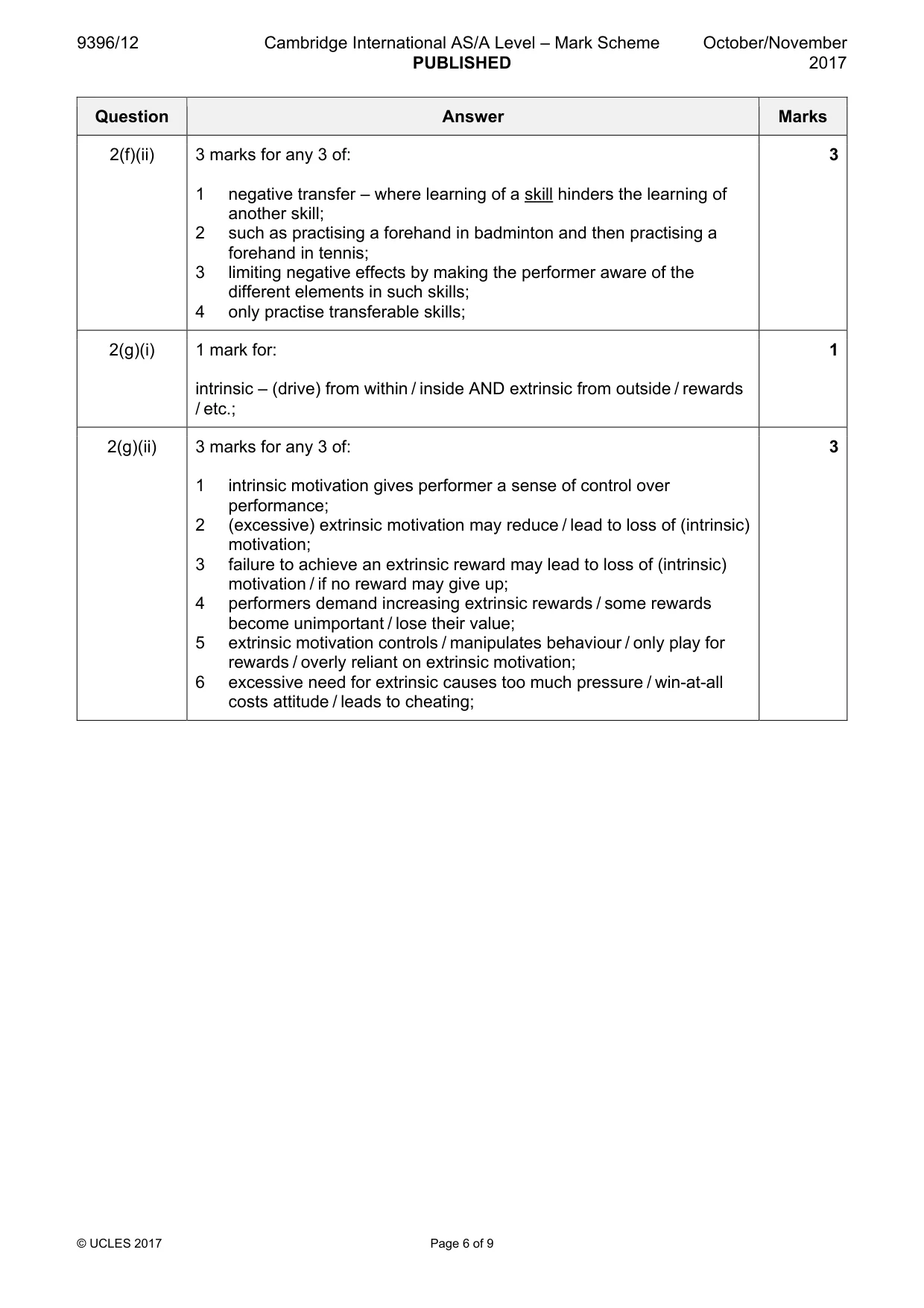
9396/12 Cambridge International AS/A Level – Mark Scheme PUBLISHED October/November 2017 © UCLES 2017 Page 6 of 9 Question Answer Marks 2(f)(ii) 3 marks for any 3 of: 1 negative transfer – where learning of a skill hinders the learning of another skill; 2 such as practising a forehand in badminton and then practising a forehand in tennis; 3 limiting negative effects by making the performer aware of the different elements in such skills; 4 only practise transferable skills; 3 2(g)(i) 1 mark for: intrinsic – (drive) from within / inside AND extrinsic from outside / rewards / etc.; 1 2(g)(ii) 3 marks for any 3 of: 1 intrinsic motivation gives performer a sense of control over performance; 2 (excessive) extrinsic motivation may reduce / lead to loss of (intrinsic) motivation; 3 failure to achieve an extrinsic reward may lead to loss of (intrinsic) motivation / if no reward may give up; 4 performers demand increasing extrinsic rewards / some rewards become unimportant / lose their value; 5 extrinsic motivation controls / manipulates behaviour / only play for rewards / overly reliant on extrinsic motivation; 6 excessive need for extrinsic causes too much pressure / win-at-all costs attitude / leads to cheating; 3
Mark scheme, page 7
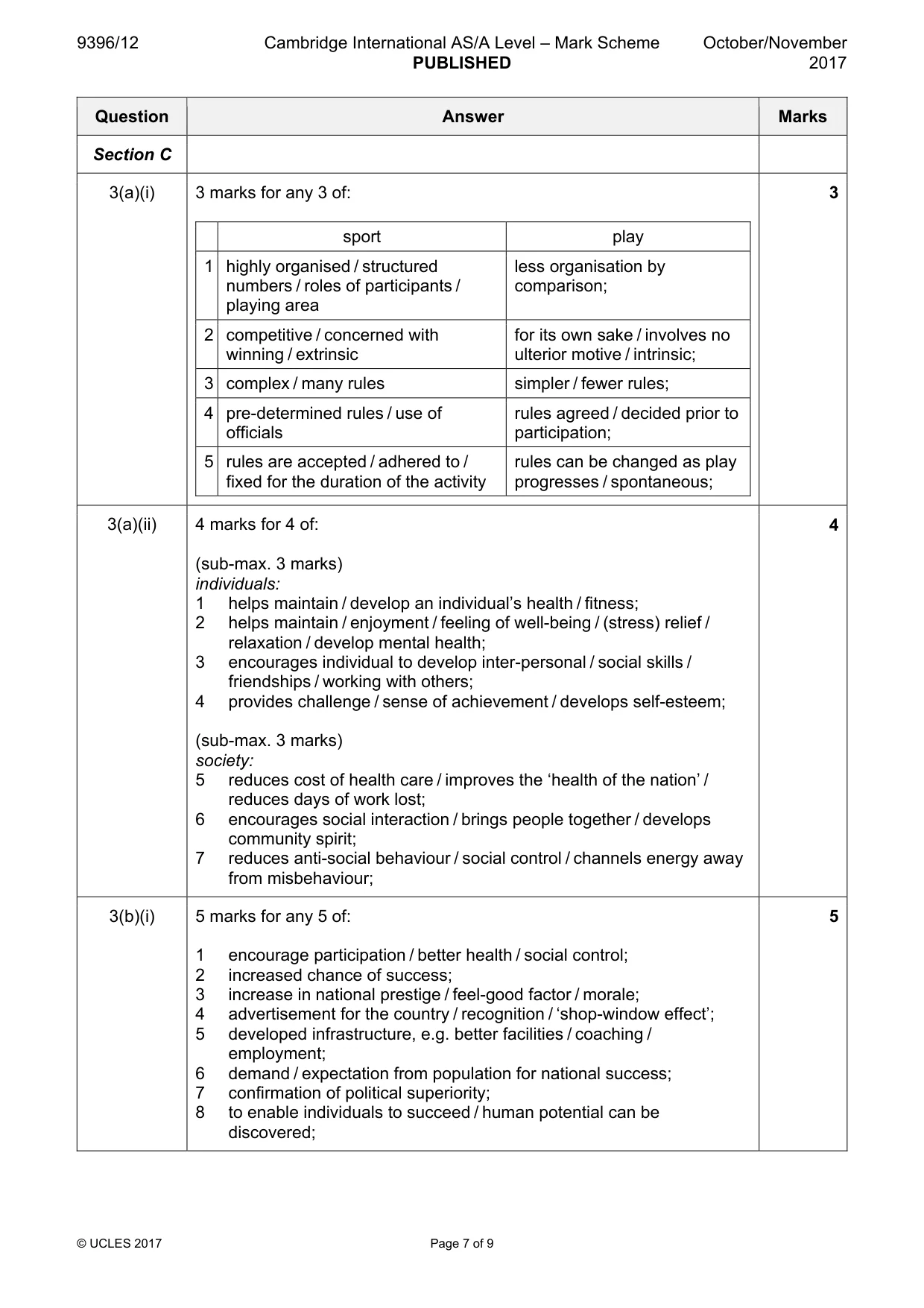
9396/12 Cambridge International AS/A Level – Mark Scheme PUBLISHED October/November 2017 © UCLES 2017 Page 7 of 9 Question Answer Marks Section C 3(a)(i) 3 marks for any 3 of: sport play 1 highly organised / structured numbers / roles of participants / playing area less organisation by comparison; 2 competitive / concerned with winning / extrinsic for its own sake / involves no ulterior motive / intrinsic; 3 complex / many rules simpler / fewer rules; 4 pre-determined rules / use of officials rules agreed / decided prior to participation; 5 rules are accepted / adhered to / fixed for the duration of the activity rules can be changed as play progresses / spontaneous; 3 3(a)(ii) 4 marks for 4 of: (sub-max. 3 marks) individuals: 1 helps maintain / develop an individual’s health / fitness; 2 helps maintain / enjoyment / feeling of well-being / (stress) relief / relaxation / develop mental health; 3 encourages individual to develop inter-personal / social skills / friendships / working with others; 4 provides challenge / sense of achievement / develops self-esteem; (sub-max. 3 marks) society: 5 reduces cost of health care / improves the ‘health of the nation’ / reduces days of work lost; 6 encourages social interaction / brings people together / develops community spirit; 7 reduces anti-social behaviour / social control / channels energy away from misbehaviour; 4 3(b)(i) 5 marks for any 5 of: 1 encourage participation / better health / social control; 2 increased chance of success; 3 increase in national prestige / feel-good factor / morale; 4 advertisement for the country / recognition / ‘shop-window effect’; 5 developed infrastructure, e.g. better facilities / coaching / employment; 6 demand / expectation from population for national success; 7 confirmation of political superiority; 8 to enable individuals to succeed / human potential can be discovered; 5
Mark scheme, page 8
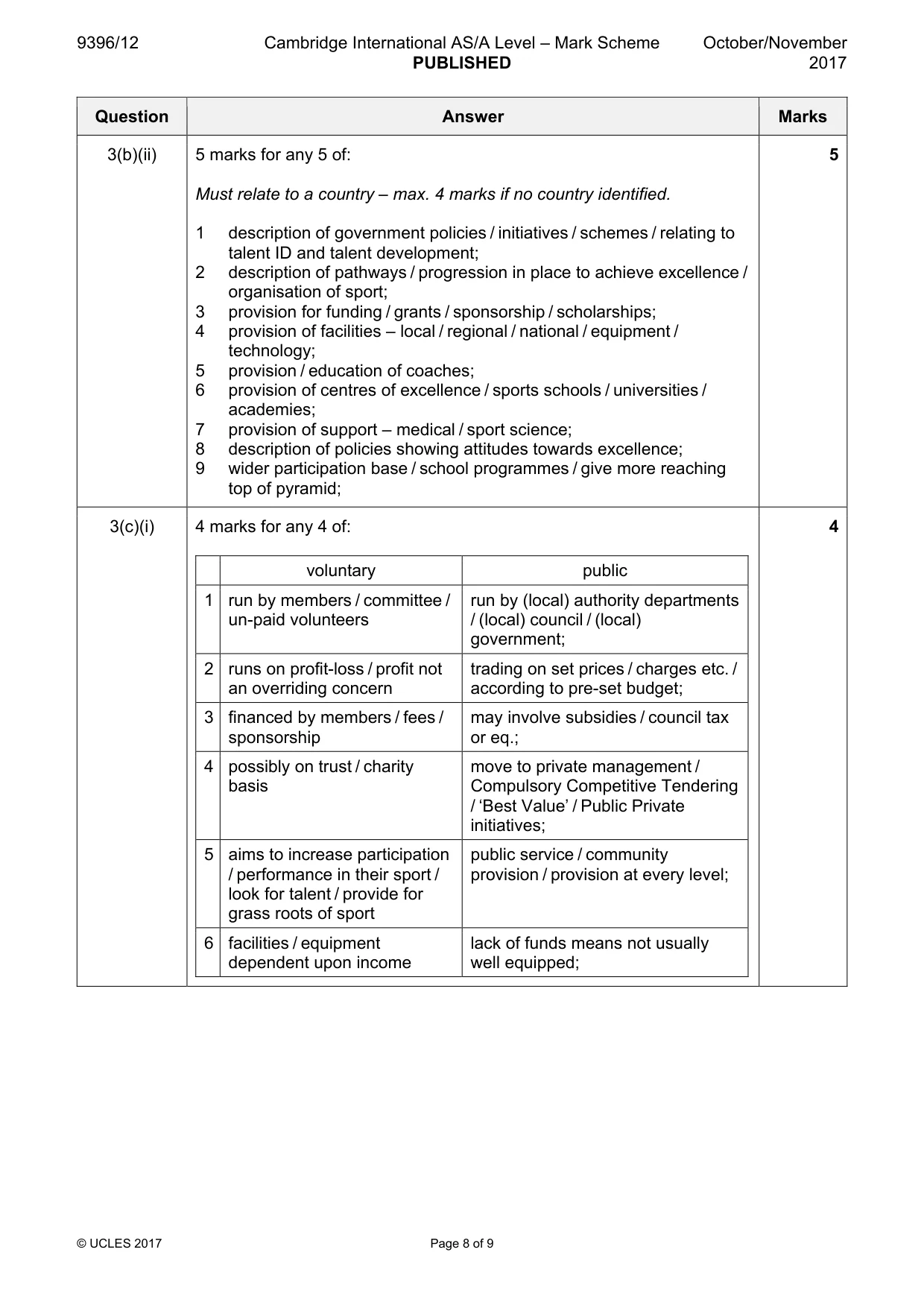
9396/12 Cambridge International AS/A Level – Mark Scheme PUBLISHED October/November 2017 © UCLES 2017 Page 8 of 9 Question Answer Marks 3(b)(ii) 5 marks for any 5 of: Must relate to a country – max. 4 marks if no country identified. 1 description of government policies / initiatives / schemes / relating to talent ID and talent development; 2 description of pathways / progression in place to achieve excellence / organisation of sport; 3 provision for funding / grants / sponsorship / scholarships; 4 provision of facilities – local / regional / national / equipment / technology; 5 provision / education of coaches; 6 provision of centres of excellence / sports schools / universities / academies; 7 provision of support – medical / sport science; 8 description of policies showing attitudes towards excellence; 9 wider participation base / school programmes / give more reaching top of pyramid; 5 3(c)(i) 4 marks for any 4 of: voluntary public 1 run by members / committee / un-paid volunteers run by (local) authority departments / (local) council / (local) government; 2 runs on profit-loss / profit not an overriding concern trading on set prices / charges etc. / according to pre-set budget; 3 financed by members / fees / sponsorship may involve subsidies / council tax or eq.; 4 possibly on trust / charity basis move to private management / Compulsory Competitive Tendering / ‘Best Value’ / Public Private initiatives; 5 aims to increase participation / performance in their sport / look for talent / provide for grass roots of sport public service / community provision / provision at every level; 6 facilities / equipment dependent upon income lack of funds means not usually well equipped; 4
Mark scheme, page 9
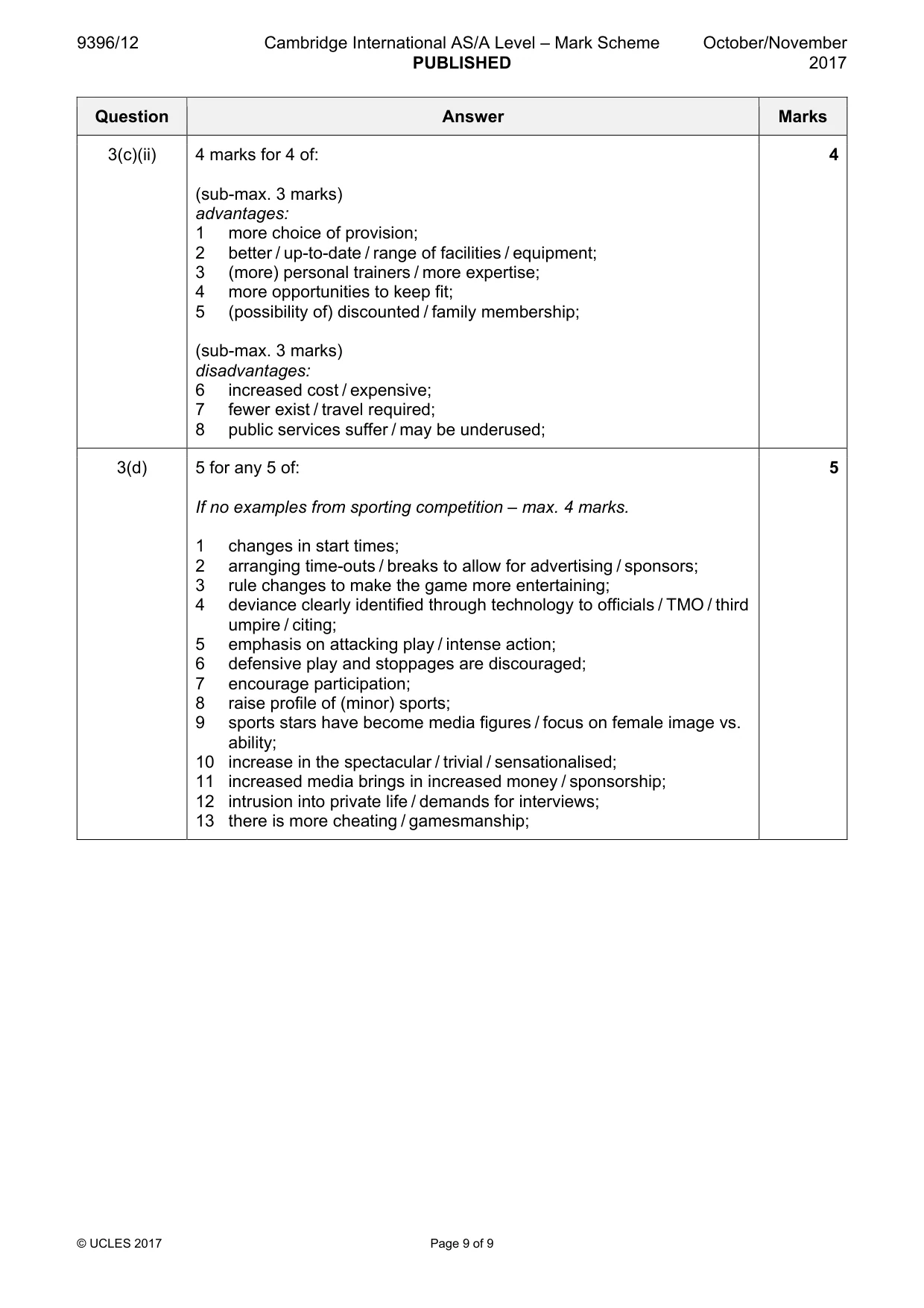
9396/12 Cambridge International AS/A Level – Mark Scheme PUBLISHED October/November 2017 © UCLES 2017 Page 9 of 9 Question Answer Marks 3(c)(ii) 4 marks for 4 of: (sub-max. 3 marks) advantages: 1 more choice of provision; 2 better / up-to-date / range of facilities / equipment; 3 (more) personal trainers / more expertise; 4 more opportunities to keep fit; 5 (possibility of) discounted / family membership; (sub-max. 3 marks) disadvantages: 6 increased cost / expensive; 7 fewer exist / travel required; 8 public services suffer / may be underused; 4 3(d) 5 for any 5 of: If no examples from sporting competition – max. 4 marks. 1 changes in start times; 2 arranging time-outs / breaks to allow for advertising / sponsors; 3 rule changes to make the game more entertaining; 4 deviance clearly identified through technology to officials / TMO / third umpire / citing; 5 emphasis on attacking play / intense action; 6 defensive play and stoppages are discouraged; 7 encourage participation; 8 raise profile of (minor) sports; 9 sports stars have become media figures / focus on female image vs. ability; 10 increase in the spectacular / trivial / sensationalised; 11 increased media brings in increased money / sponsorship; 12 intrusion into private life / demands for interviews; 13 there is more cheating / gamesmanship; 5
What you needed in this session
Cambridge’s own grade thresholds for 2017 Oct/Nov, Paper 1 · Variant 2. A higher threshold means an easier paper — the bar moves with how the cohort did.