Cambridge A Level Physical Education 9396 — 2017 Oct/Nov Paper 1 · Variant 1
9396/11/O/N/17 · 90 marks · ≈101 min
The question paper and its mark scheme, free to read here and free to download. This is Cambridge’s own paper, exactly as it was sat.
Question paper8 pages




Mark scheme9 pages
Answers below. Sit the paper first if you are practising.

Paper as text
Question paper, page 1
This document consists of 5 printed pages, 3 blank pages and 1 Insert. DC (ST/SW) 127463/2 © UCLES 2017 [Turn over Cambridge International Examinations Cambridge International Advanced Subsidiary and Advanced Level * 2 5 3 2 7 7 5 5 4 7 * PHYSICAL EDUCATION 9396/11 Paper 1 October/November 2017 2 hours 30 minutes No Additional Materials are required. READ THESE INSTRUCTIONS FIRST An answer booklet is provided inside this question paper. You should follow the instructions on the front cover of the answer booklet. If you need additional answer paper ask the invigilator for a continuation booklet. Answer all questions. Electronic calculators may be used. You may lose marks if you do not show your working or if you do not use appropriate units. The number of marks is given in brackets [ ] at the end of each question or part question.
Question paper, page 2
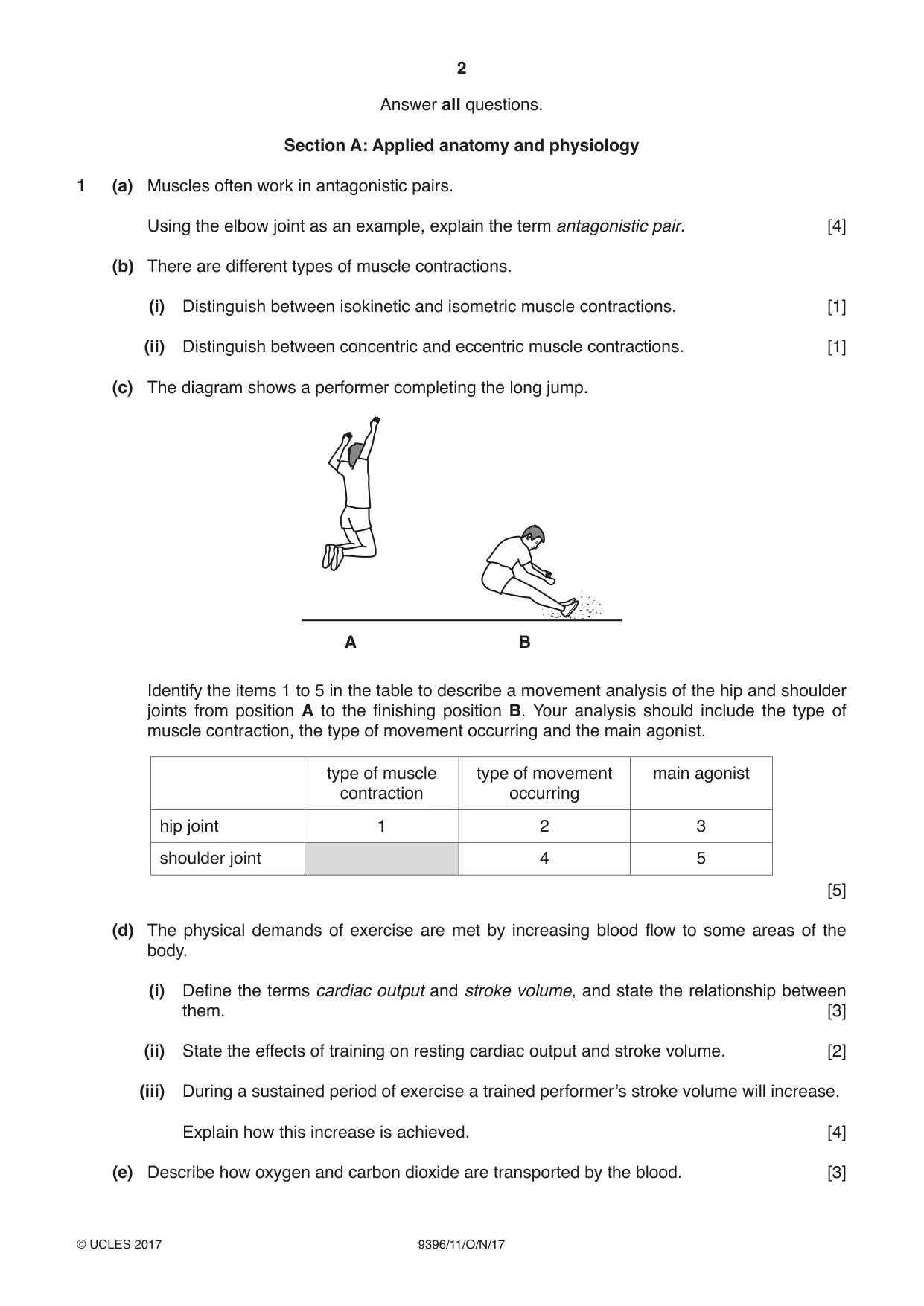
2 9396/11/O/N/17 © UCLES 2017 Answer all questions. Section A: Applied anatomy and physiology 1 (a) Muscles often work in antagonistic pairs. Using the elbow joint as an example, explain the term antagonistic pair. [4] (b) There are different types of muscle contractions. (i) Distinguish between isokinetic and isometric muscle contractions. [1] (ii) Distinguish between concentric and eccentric muscle contractions. [1] (c) The diagram shows a performer completing the long jump. A B Identify the items 1 to 5 in the table to describe a movement analysis of the hip and shoulder joints from position A to the finishing position B. Your analysis should include the type of muscle contraction, the type of movement occurring and the main agonist. type of muscle contraction type of movement occurring main agonist hip joint 1 2 3 shoulder joint 4 5 [5] (d) The physical demands of exercise are met by increasing blood flow to some areas of the body. (i) Define the terms cardiac output and stroke volume, and state the relationship between them. [3] (ii) State the effects of training on resting cardiac output and stroke volume. [2] (iii) During a sustained period of exercise a trained performer’s stroke volume will increase. Explain how this increase is achieved. [4] (e) Describe how oxygen and carbon dioxide are transported by the blood. [3]
Question paper, page 3
3 9396/11/O/N/17 © UCLES 2017 [Turn over (f) When exercising, the respiratory system plays an important role in the gaseous exchange process. (i) Describe the changes that occur to the mechanics of breathing during exercise. [3] (ii) Describe the effects of long-term endurance training that help make the gaseous exchange process more efficient. [4] [Total: 30]
Question paper, page 4
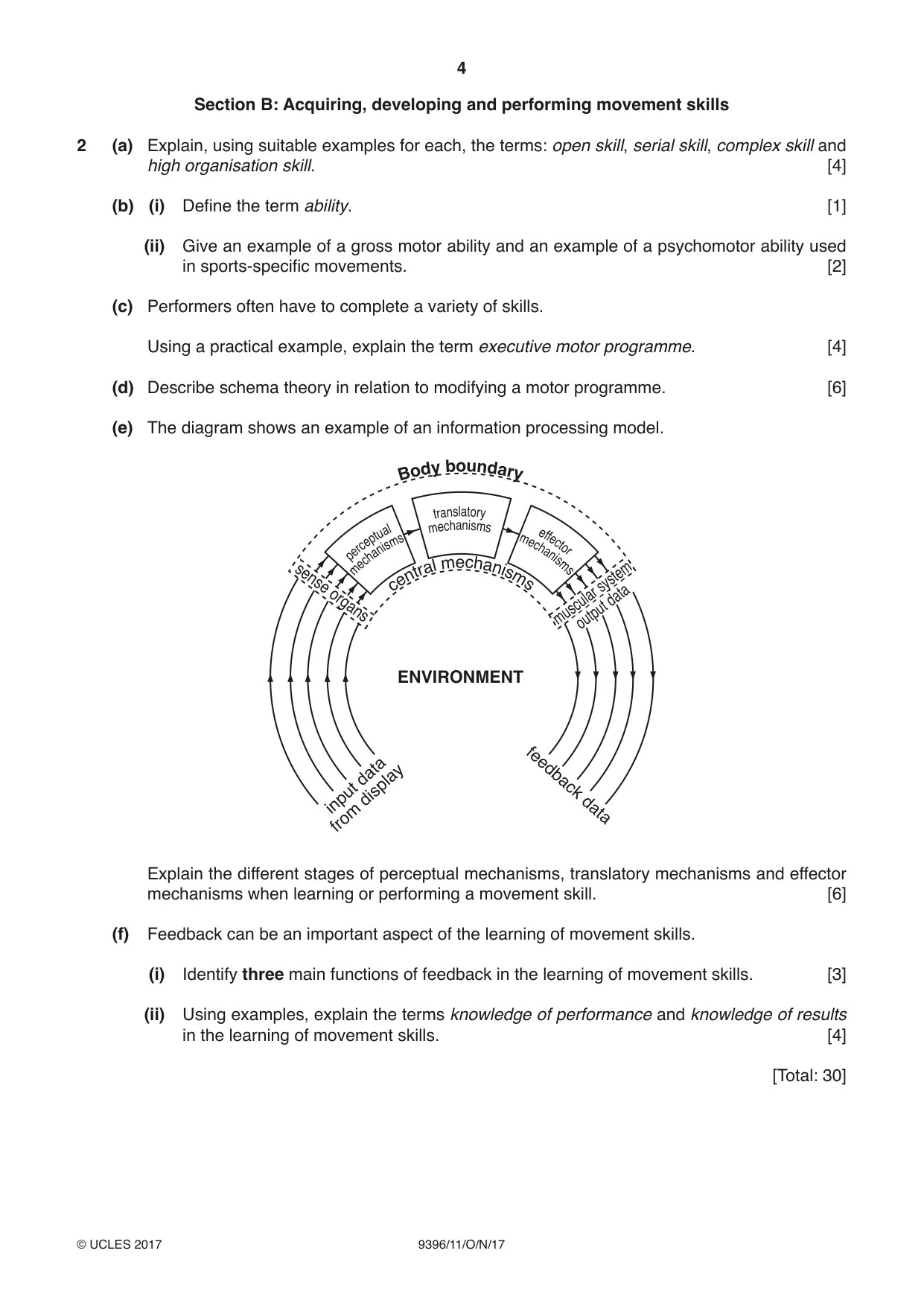
4 9396/11/O/N/17 © UCLES 2017 Section B: Acquiring, developing and performing movement skills 2 (a) Explain, using suitable examples for each, the terms: open skill, serial skill, complex skill and high organisation skill. [4] (b) (i) Define the term ability. [1] (ii) Give an example of a gross motor ability and an example of a psychomotor ability used in sports-specific movements. [2] (c) Performers often have to complete a variety of skills. Using a practical example, explain the term executive motor programme. [4] (d) Describe schema theory in relation to modifying a motor programme. [6] (e) The diagram shows an example of an information processing model. c e n t r a l m e c h a n i s m s B o d y bo u n d ar y m ec ha ni s m s pe rc ep tu al m ec ha ni s m s tr an sl at or y m ec ha ni s m s ef fe ct or ENVIRONMENT input data from display feedback data sense organs muscular system output data Explain the different stages of perceptual mechanisms, translatory mechanisms and effector mechanisms when learning or performing a movement skill. [6] (f) Feedback can be an important aspect of the learning of movement skills. (i) Identify three main functions of feedback in the learning of movement skills. [3] (ii) Using examples, explain the terms knowledge of performance and knowledge of results in the learning of movement skills. [4] [Total: 30]
Question paper, page 5
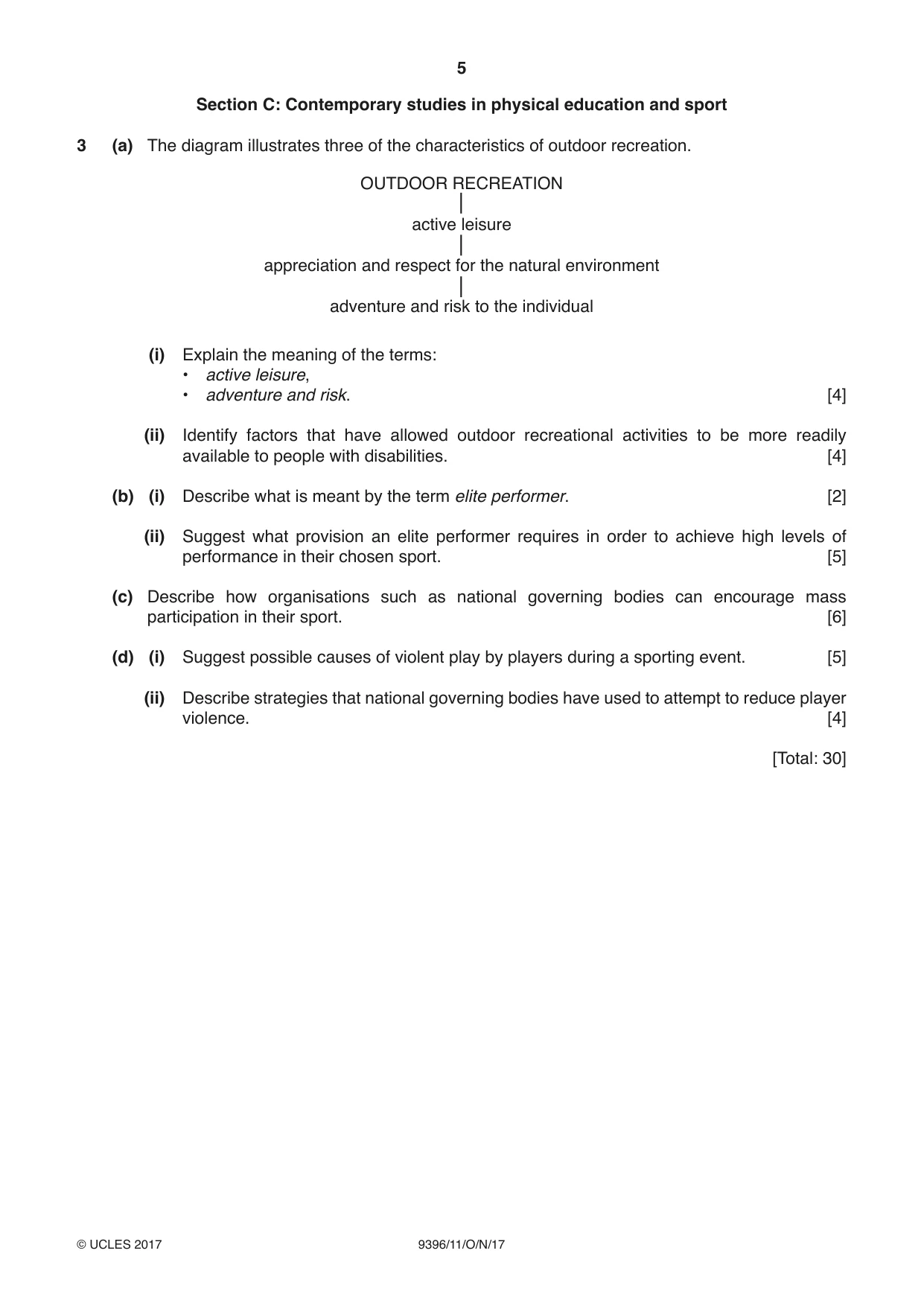
5 9396/11/O/N/17 © UCLES 2017 Section C: Contemporary studies in physical education and sport 3 (a) The diagram illustrates three of the characteristics of outdoor recreation. OUTDOOR RECREATION active leisure appreciation and respect for the natural environment adventure and risk to the individual (i) Explain the meaning of the terms: • active leisure, • adventure and risk. [4] (ii) Identify factors that have allowed outdoor recreational activities to be more readily available to people with disabilities. [4] (b) (i) Describe what is meant by the term elite performer. [2] (ii) Suggest what provision an elite performer requires in order to achieve high levels of performance in their chosen sport. [5] (c) Describe how organisations such as national governing bodies can encourage mass participation in their sport. [6] (d) (i) Suggest possible causes of violent play by players during a sporting event. [5] (ii) Describe strategies that national governing bodies have used to attempt to reduce player violence. [4] [Total: 30]
Question paper, page 6
6 9396/11/O/N/17 © UCLES 2017 BLANK PAGE
Question paper, page 7
7 9396/11/O/N/17 © UCLES 2017 BLANK PAGE
Question paper, page 8
8 9396/11/O/N/17 © UCLES 2017 Permission to reproduce items where third-party owned material protected by copyright is included has been sought and cleared where possible. Every reasonable effort has been made by the publisher (UCLES) to trace copyright holders, but if any items requiring clearance have unwittingly been included, the publisher will be pleased to make amends at the earliest possible opportunity. To avoid the issue of disclosure of answer-related information to candidates, all copyright acknowledgements are reproduced online in the Cambridge International Examinations Copyright Acknowledgements Booklet. This is produced for each series of examinations and is freely available to download at www.cie.org.uk after the live examination series. Cambridge International Examinations is part of the Cambridge Assessment Group. Cambridge Assessment is the brand name of University of Cambridge Local Examinations Syndicate (UCLES), which is itself a department of the University of Cambridge. BLANK PAGE
Mark scheme, page 1
® IGCSE is a registered trademark. This document consists of 9 printed pages. © UCLES 2017 [Turn over Cambridge Assessment International Education Cambridge International Advanced Subsidiary and Advanced Level PHYSICAL EDUCATION 9396/11 Paper 1 October/November 2017 MARK SCHEME Maximum Mark: 90 Published This mark scheme is published as an aid to teachers and candidates, to indicate the requirements of the examination. It shows the basis on which Examiners were instructed to award marks. It does not indicate the details of the discussions that took place at an Examiners’ meeting before marking began, which would have considered the acceptability of alternative answers. Mark schemes should be read in conjunction with the question paper and the Principal Examiner Report for Teachers. Cambridge International will not enter into discussions about these mark schemes. Cambridge International is publishing the mark schemes for the October/November 2017 series for most Cambridge IGCSE®, Cambridge International A and AS Level components and some Cambridge O Level components.
Mark scheme, page 2
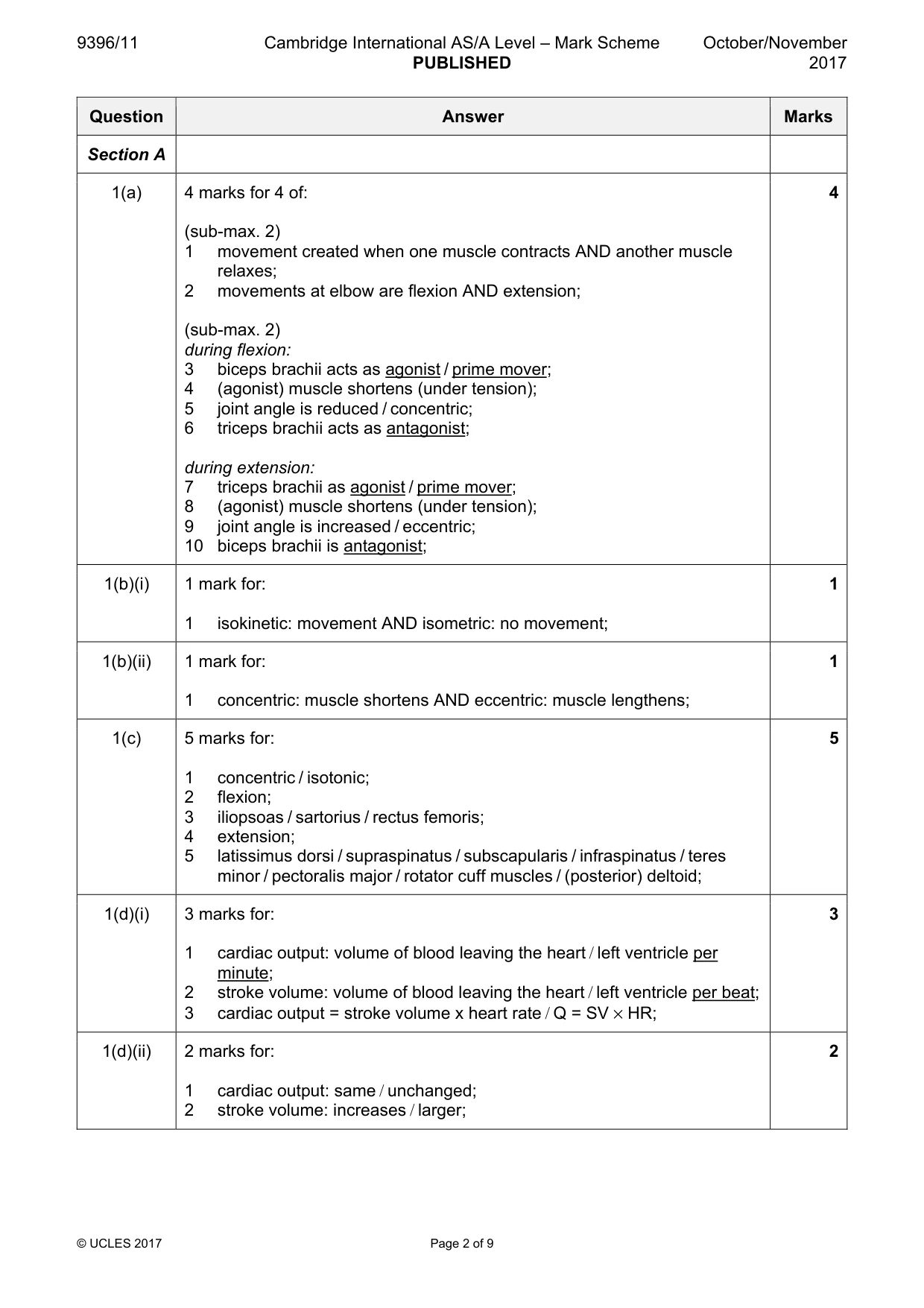
9396/11 Cambridge International AS/A Level – Mark Scheme PUBLISHED October/November 2017 © UCLES 2017 Page 2 of 9 Question Answer Marks Section A 1(a) 4 marks for 4 of: (sub-max. 2) 1 movement created when one muscle contracts AND another muscle relaxes; 2 movements at elbow are flexion AND extension; (sub-max. 2) during flexion: 3 biceps brachii acts as agonist / prime mover; 4 (agonist) muscle shortens (under tension); 5 joint angle is reduced / concentric; 6 triceps brachii acts as antagonist; during extension: 7 triceps brachii as agonist / prime mover; 8 (agonist) muscle shortens (under tension); 9 joint angle is increased / eccentric; 10 biceps brachii is antagonist; 4 1(b)(i) 1 mark for: 1 isokinetic: movement AND isometric: no movement; 1 1(b)(ii) 1 mark for: 1 concentric: muscle shortens AND eccentric: muscle lengthens; 1 1(c) 5 marks for: 1 concentric / isotonic; 2 flexion; 3 iliopsoas / sartorius / rectus femoris; 4 extension; 5 latissimus dorsi / supraspinatus / subscapularis / infraspinatus / teres minor / pectoralis major / rotator cuff muscles / (posterior) deltoid; 5 1(d)(i) 3 marks for: 1 cardiac output: volume of blood leaving the heart / left ventricle per minute; 2 stroke volume: volume of blood leaving the heart / left ventricle per beat; 3 cardiac output = stroke volume x heart rate / Q = SV × HR; 3 1(d)(ii) 2 marks for: 1 cardiac output: same / unchanged; 2 stroke volume: increases / larger; 2
Mark scheme, page 3
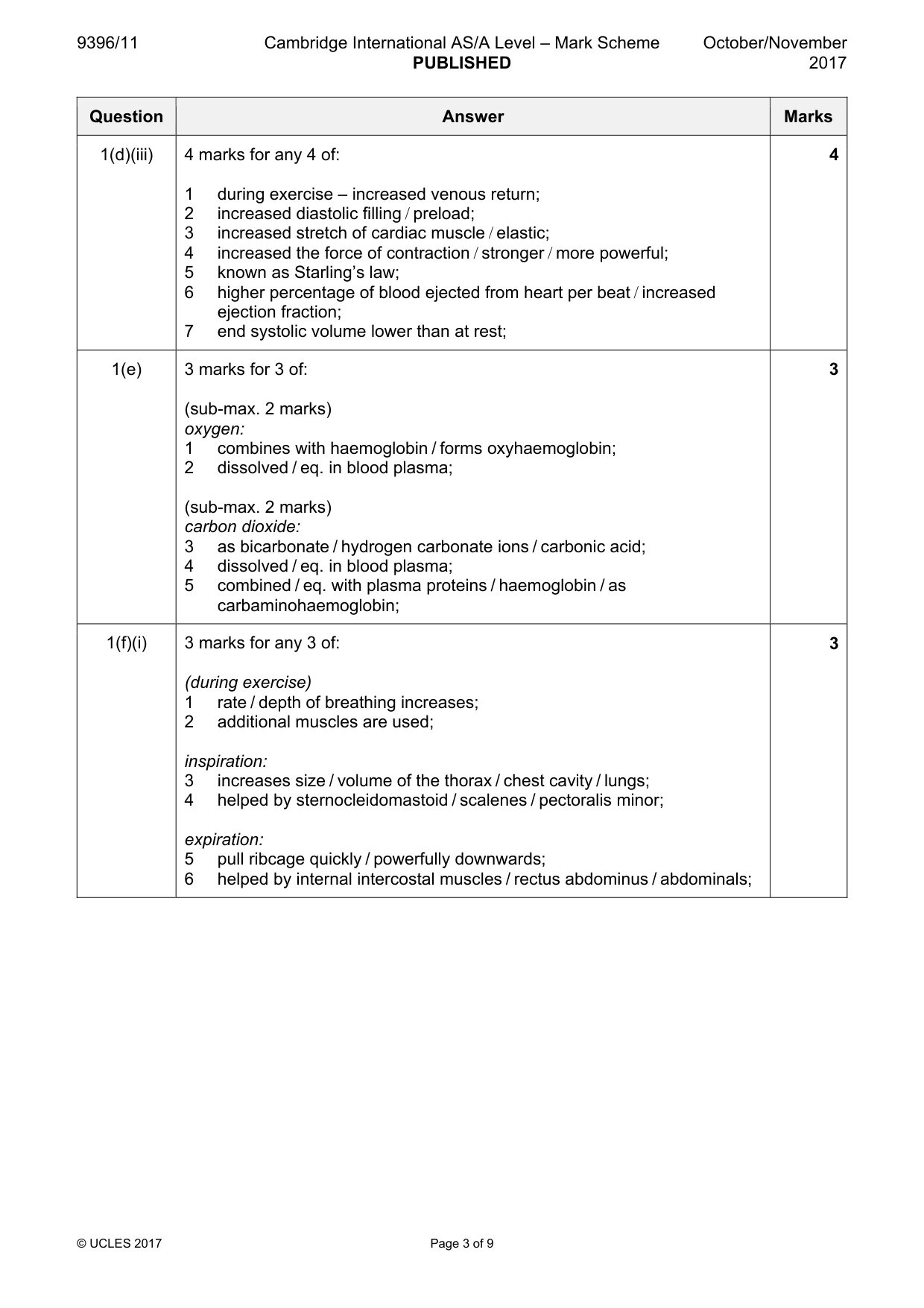
9396/11 Cambridge International AS/A Level – Mark Scheme PUBLISHED October/November 2017 © UCLES 2017 Page 3 of 9 Question Answer Marks 1(d)(iii) 4 marks for any 4 of: 1 during exercise – increased venous return; 2 increased diastolic filling / preload; 3 increased stretch of cardiac muscle / elastic; 4 increased the force of contraction / stronger / more powerful; 5 known as Starling’s law; 6 higher percentage of blood ejected from heart per beat / increased ejection fraction; 7 end systolic volume lower than at rest; 4 1(e) 3 marks for 3 of: (sub-max. 2 marks) oxygen: 1 combines with haemoglobin / forms oxyhaemoglobin; 2 dissolved / eq. in blood plasma; (sub-max. 2 marks) carbon dioxide: 3 as bicarbonate / hydrogen carbonate ions / carbonic acid; 4 dissolved / eq. in blood plasma; 5 combined / eq. with plasma proteins / haemoglobin / as carbaminohaemoglobin; 3 1(f)(i) 3 marks for any 3 of: (during exercise) 1 rate / depth of breathing increases; 2 additional muscles are used; inspiration: 3 increases size / volume of the thorax / chest cavity / lungs; 4 helped by sternocleidomastoid / scalenes / pectoralis minor; expiration: 5 pull ribcage quickly / powerfully downwards; 6 helped by internal intercostal muscles / rectus abdominus / abdominals; 3
Mark scheme, page 4
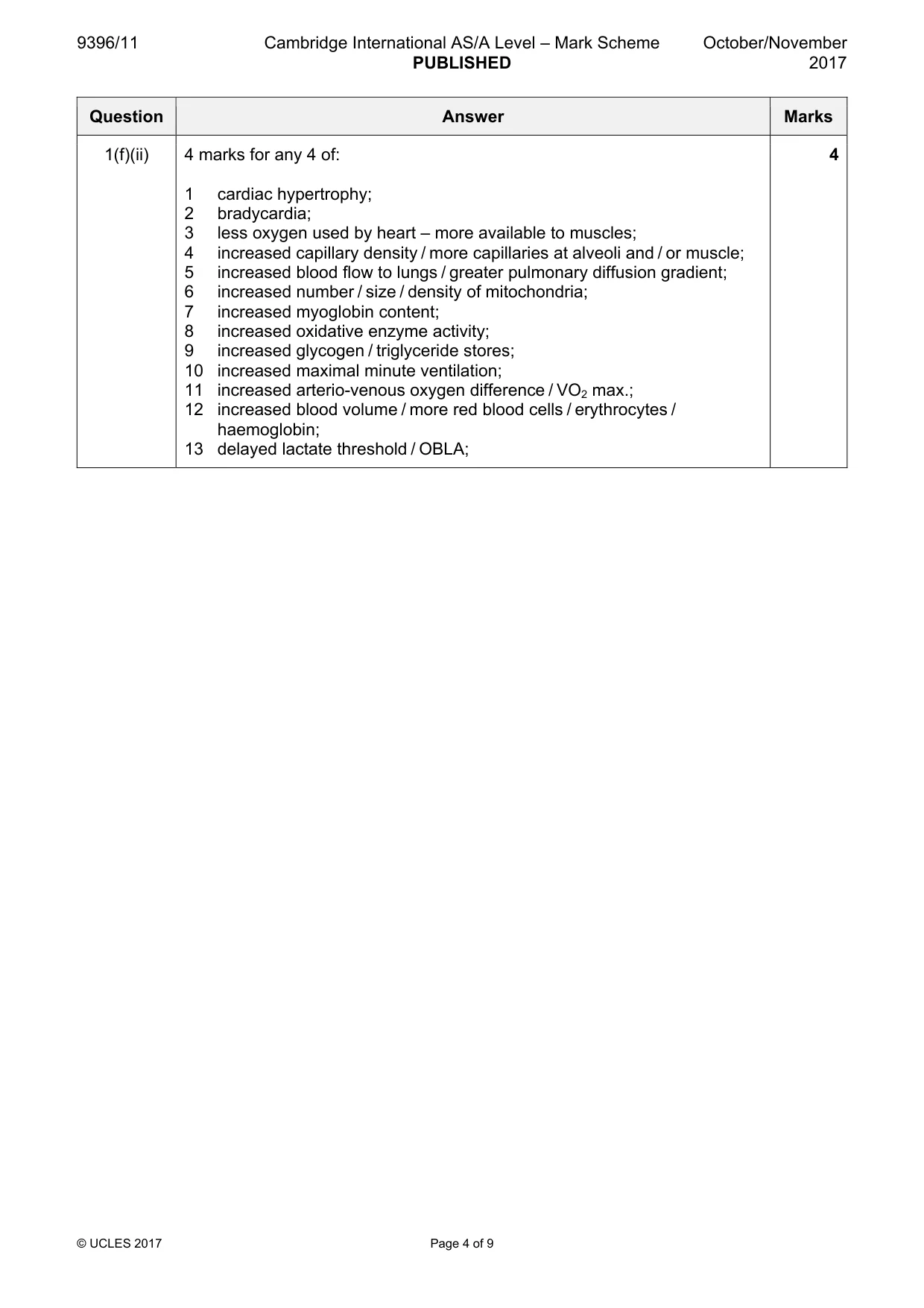
9396/11 Cambridge International AS/A Level – Mark Scheme PUBLISHED October/November 2017 © UCLES 2017 Page 4 of 9 Question Answer Marks 1(f)(ii) 4 marks for any 4 of: 1 cardiac hypertrophy; 2 bradycardia; 3 less oxygen used by heart – more available to muscles; 4 increased capillary density / more capillaries at alveoli and / or muscle; 5 increased blood flow to lungs / greater pulmonary diffusion gradient; 6 increased number / size / density of mitochondria; 7 increased myoglobin content; 8 increased oxidative enzyme activity; 9 increased glycogen / triglyceride stores; 10 increased maximal minute ventilation; 11 increased arterio-venous oxygen difference / VO2 max.; 12 increased blood volume / more red blood cells / erythrocytes / haemoglobin; 13 delayed lactate threshold / OBLA; 4
Mark scheme, page 5
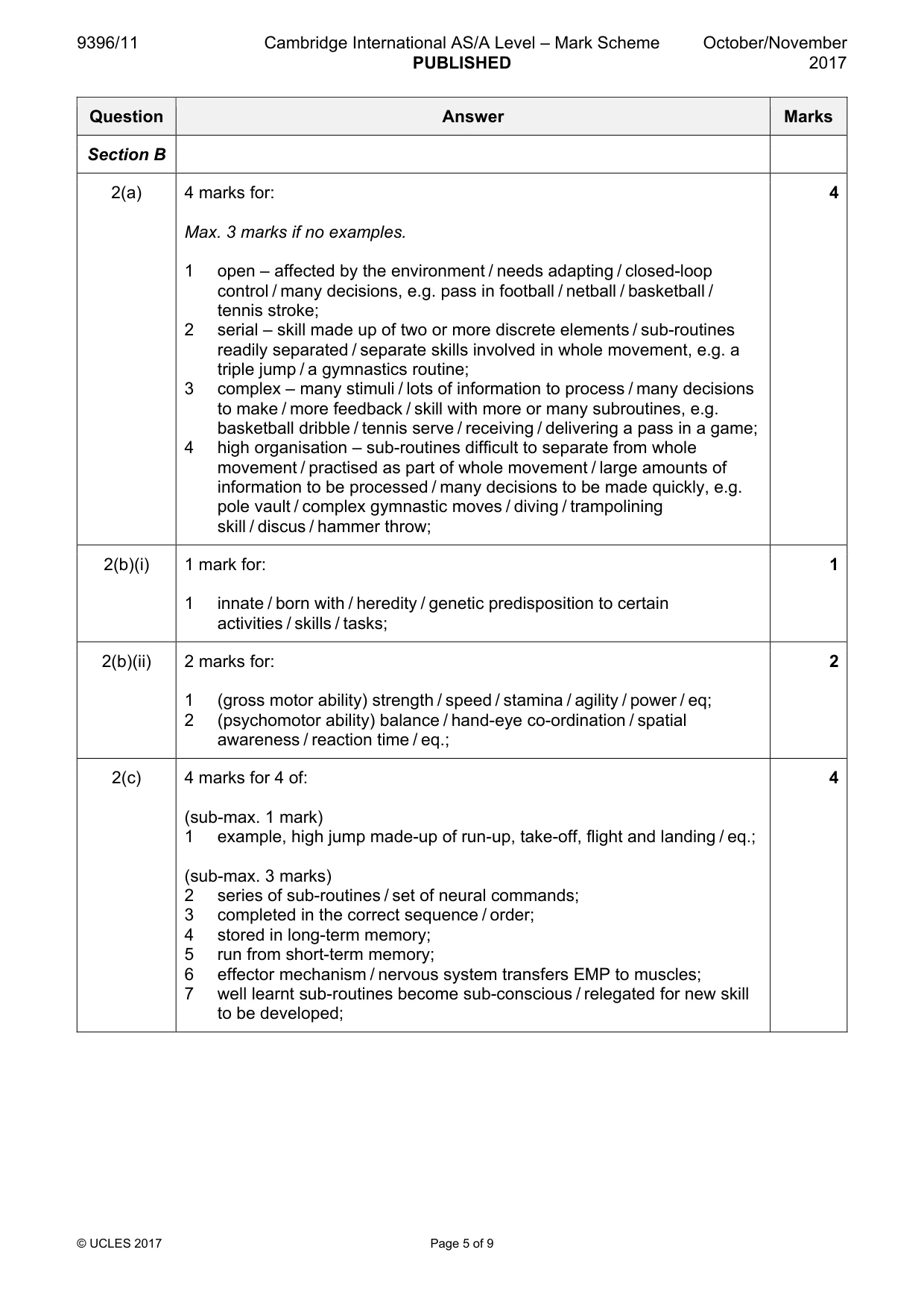
9396/11 Cambridge International AS/A Level – Mark Scheme PUBLISHED October/November 2017 © UCLES 2017 Page 5 of 9 Question Answer Marks Section B 2(a) 4 marks for: Max. 3 marks if no examples. 1 open – affected by the environment / needs adapting / closed-loop control / many decisions, e.g. pass in football / netball / basketball / tennis stroke; 2 serial – skill made up of two or more discrete elements / sub-routines readily separated / separate skills involved in whole movement, e.g. a triple jump / a gymnastics routine; 3 complex – many stimuli / lots of information to process / many decisions to make / more feedback / skill with more or many subroutines, e.g. basketball dribble / tennis serve / receiving / delivering a pass in a game; 4 high organisation – sub-routines difficult to separate from whole movement / practised as part of whole movement / large amounts of information to be processed / many decisions to be made quickly, e.g. pole vault / complex gymnastic moves / diving / trampolining skill / discus / hammer throw; 4 2(b)(i) 1 mark for: 1 innate / born with / heredity / genetic predisposition to certain activities / skills / tasks; 1 2(b)(ii) 2 marks for: 1 (gross motor ability) strength / speed / stamina / agility / power / eq; 2 (psychomotor ability) balance / hand-eye co-ordination / spatial awareness / reaction time / eq.; 2 2(c) 4 marks for 4 of: (sub-max. 1 mark) 1 example, high jump made-up of run-up, take-off, flight and landing / eq.; (sub-max. 3 marks) 2 series of sub-routines / set of neural commands; 3 completed in the correct sequence / order; 4 stored in long-term memory; 5 run from short-term memory; 6 effector mechanism / nervous system transfers EMP to muscles; 7 well learnt sub-routines become sub-conscious / relegated for new skill to be developed; 4
Mark scheme, page 6
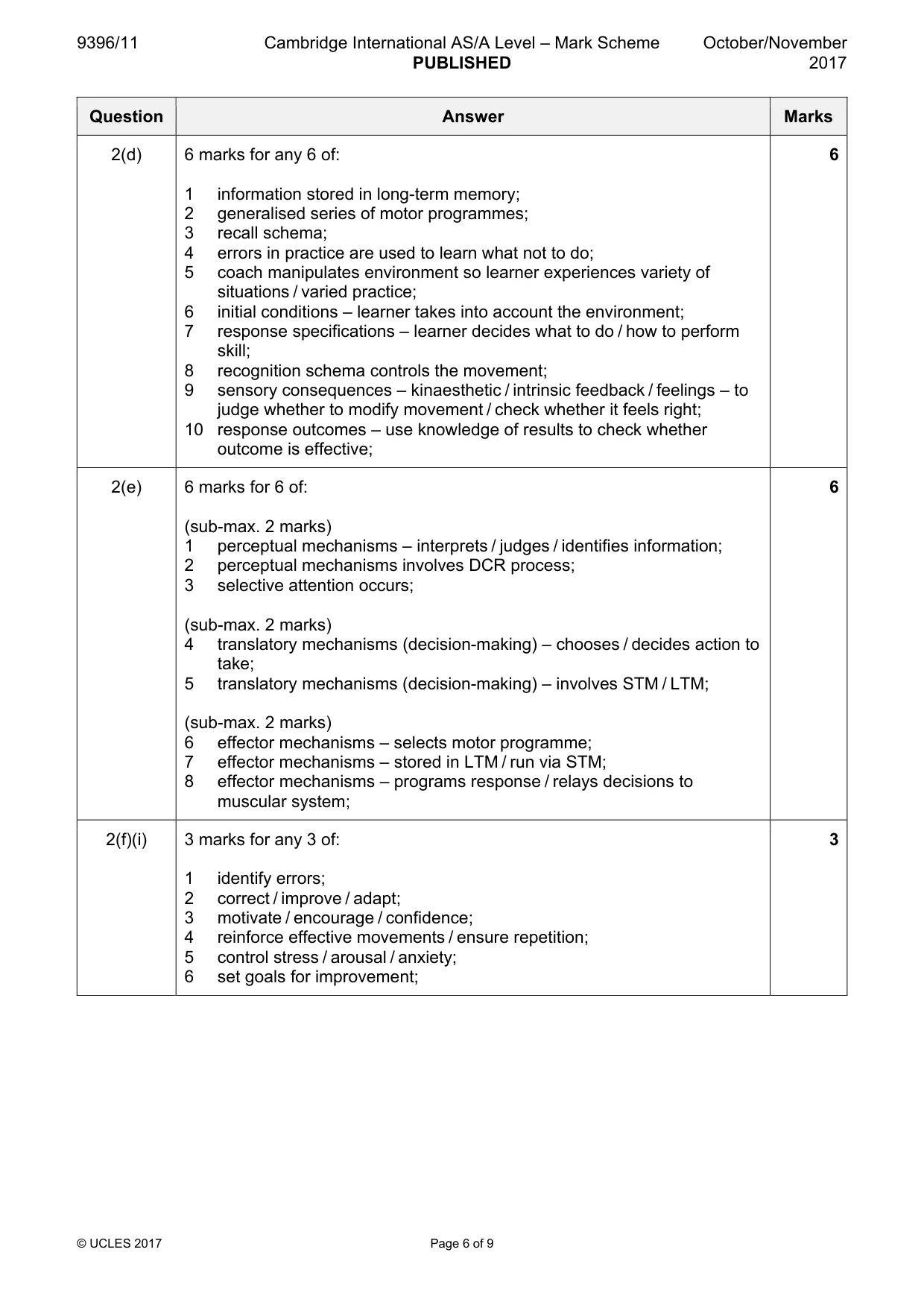
9396/11 Cambridge International AS/A Level – Mark Scheme PUBLISHED October/November 2017 © UCLES 2017 Page 6 of 9 Question Answer Marks 2(d) 6 marks for any 6 of: 1 information stored in long-term memory; 2 generalised series of motor programmes; 3 recall schema; 4 errors in practice are used to learn what not to do; 5 coach manipulates environment so learner experiences variety of situations / varied practice; 6 initial conditions – learner takes into account the environment; 7 response specifications – learner decides what to do / how to perform skill; 8 recognition schema controls the movement; 9 sensory consequences – kinaesthetic / intrinsic feedback / feelings – to judge whether to modify movement / check whether it feels right; 10 response outcomes – use knowledge of results to check whether outcome is effective; 6 2(e) 6 marks for 6 of: (sub-max. 2 marks) 1 perceptual mechanisms – interprets / judges / identifies information; 2 perceptual mechanisms involves DCR process; 3 selective attention occurs; (sub-max. 2 marks) 4 translatory mechanisms (decision-making) – chooses / decides action to take; 5 translatory mechanisms (decision-making) – involves STM / LTM; (sub-max. 2 marks) 6 effector mechanisms – selects motor programme; 7 effector mechanisms – stored in LTM / run via STM; 8 effector mechanisms – programs response / relays decisions to muscular system; 6 2(f)(i) 3 marks for any 3 of: 1 identify errors; 2 correct / improve / adapt; 3 motivate / encourage / confidence; 4 reinforce effective movements / ensure repetition; 5 control stress / arousal / anxiety; 6 set goals for improvement; 3
Mark scheme, page 7
9396/11 Cambridge International AS/A Level – Mark Scheme PUBLISHED October/November 2017 © UCLES 2017 Page 7 of 9 Question Answer Marks 2(f)(ii) 4 marks for: Max. 2 marks without examples. 1 knowledge of performance: getting (intrinsic / extrinsic) feedback about an action / movement; 2 e.g. tennis serve technique OR getting information about whether a strategy worked in basketball; 3 knowledge of results: getting feedback from official / coach / crowd about outcome; 4 e.g. points awarded for floor routine OR points scored in basketball; 4
Mark scheme, page 8
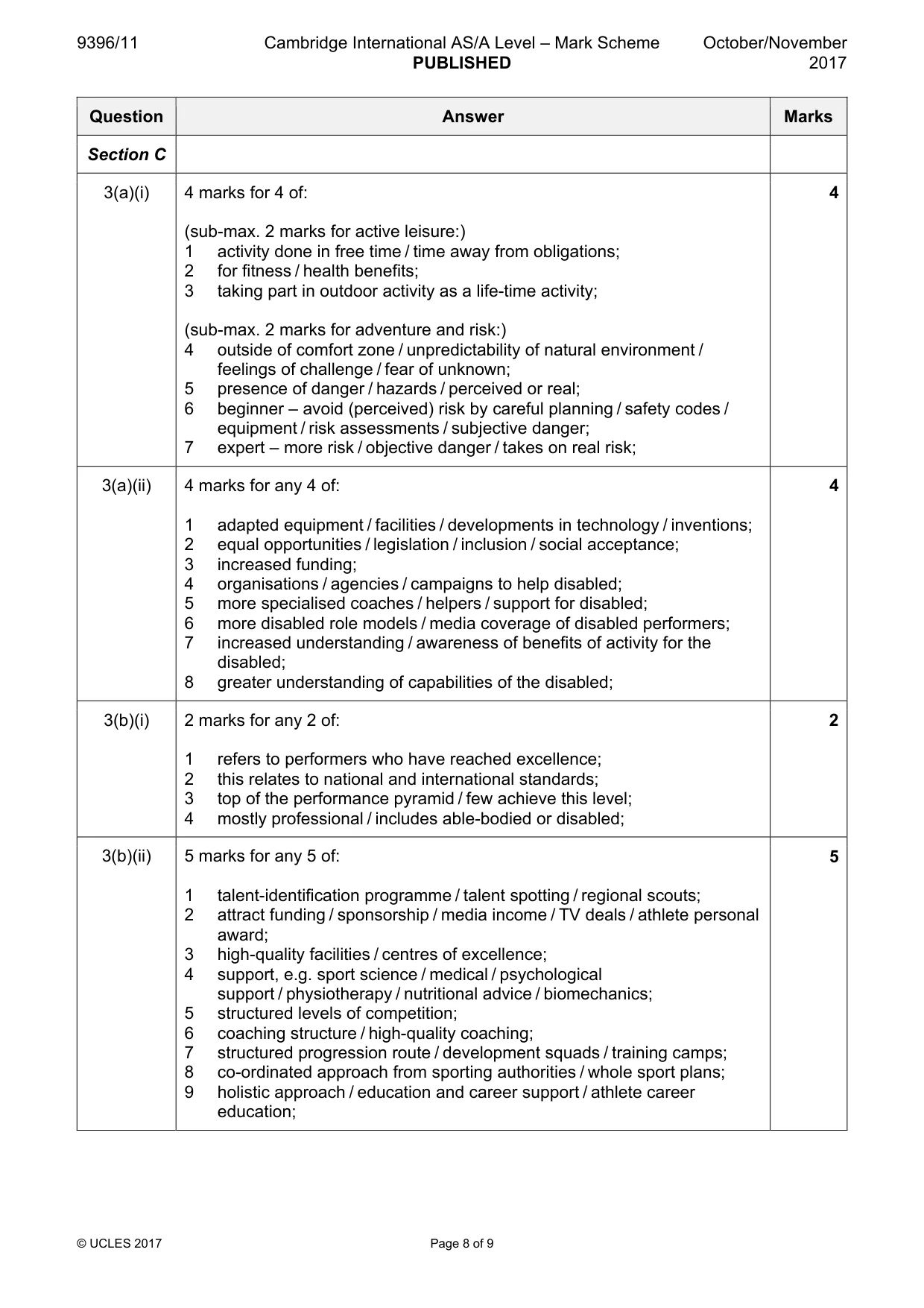
9396/11 Cambridge International AS/A Level – Mark Scheme PUBLISHED October/November 2017 © UCLES 2017 Page 8 of 9 Question Answer Marks Section C 3(a)(i) 4 marks for 4 of: (sub-max. 2 marks for active leisure:) 1 activity done in free time / time away from obligations; 2 for fitness / health benefits; 3 taking part in outdoor activity as a life-time activity; (sub-max. 2 marks for adventure and risk:) 4 outside of comfort zone / unpredictability of natural environment / feelings of challenge / fear of unknown; 5 presence of danger / hazards / perceived or real; 6 beginner – avoid (perceived) risk by careful planning / safety codes / equipment / risk assessments / subjective danger; 7 expert – more risk / objective danger / takes on real risk; 4 3(a)(ii) 4 marks for any 4 of: 1 adapted equipment / facilities / developments in technology / inventions; 2 equal opportunities / legislation / inclusion / social acceptance; 3 increased funding; 4 organisations / agencies / campaigns to help disabled; 5 more specialised coaches / helpers / support for disabled; 6 more disabled role models / media coverage of disabled performers; 7 increased understanding / awareness of benefits of activity for the disabled; 8 greater understanding of capabilities of the disabled; 4 3(b)(i) 2 marks for any 2 of: 1 refers to performers who have reached excellence; 2 this relates to national and international standards; 3 top of the performance pyramid / few achieve this level; 4 mostly professional / includes able-bodied or disabled; 2 3(b)(ii) 5 marks for any 5 of: 1 talent-identification programme / talent spotting / regional scouts; 2 attract funding / sponsorship / media income / TV deals / athlete personal award; 3 high-quality facilities / centres of excellence; 4 support, e.g. sport science / medical / psychological support / physiotherapy / nutritional advice / biomechanics; 5 structured levels of competition; 6 coaching structure / high-quality coaching; 7 structured progression route / development squads / training camps; 8 co-ordinated approach from sporting authorities / whole sport plans; 9 holistic approach / education and career support / athlete career education; 5
Mark scheme, page 9
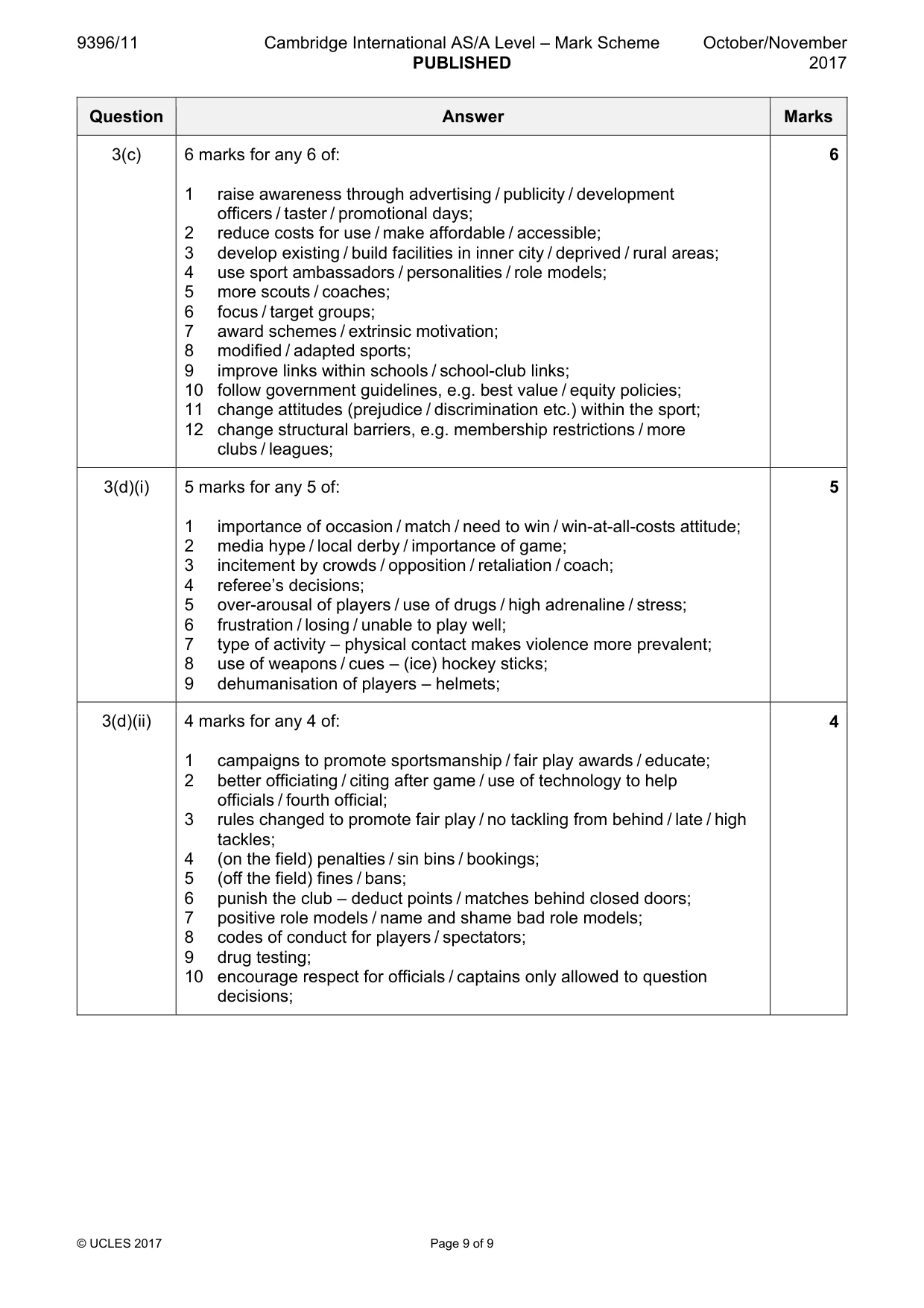
9396/11 Cambridge International AS/A Level – Mark Scheme PUBLISHED October/November 2017 © UCLES 2017 Page 9 of 9 Question Answer Marks 3(c) 6 marks for any 6 of: 1 raise awareness through advertising / publicity / development officers / taster / promotional days; 2 reduce costs for use / make affordable / accessible; 3 develop existing / build facilities in inner city / deprived / rural areas; 4 use sport ambassadors / personalities / role models; 5 more scouts / coaches; 6 focus / target groups; 7 award schemes / extrinsic motivation; 8 modified / adapted sports; 9 improve links within schools / school-club links; 10 follow government guidelines, e.g. best value / equity policies; 11 change attitudes (prejudice / discrimination etc.) within the sport; 12 change structural barriers, e.g. membership restrictions / more clubs / leagues; 6 3(d)(i) 5 marks for any 5 of: 1 importance of occasion / match / need to win / win-at-all-costs attitude; 2 media hype / local derby / importance of game; 3 incitement by crowds / opposition / retaliation / coach; 4 referee’s decisions; 5 over-arousal of players / use of drugs / high adrenaline / stress; 6 frustration / losing / unable to play well; 7 type of activity – physical contact makes violence more prevalent; 8 use of weapons / cues – (ice) hockey sticks; 9 dehumanisation of players – helmets; 5 3(d)(ii) 4 marks for any 4 of: 1 campaigns to promote sportsmanship / fair play awards / educate; 2 better officiating / citing after game / use of technology to help officials / fourth official; 3 rules changed to promote fair play / no tackling from behind / late / high tackles; 4 (on the field) penalties / sin bins / bookings; 5 (off the field) fines / bans; 6 punish the club – deduct points / matches behind closed doors; 7 positive role models / name and shame bad role models; 8 codes of conduct for players / spectators; 9 drug testing; 10 encourage respect for officials / captains only allowed to question decisions; 4
What you needed in this session
Cambridge’s own grade thresholds for 2017 Oct/Nov, Paper 1 · Variant 1. A higher threshold means an easier paper — the bar moves with how the cohort did.