Cambridge A Level Physical Education 9396 — 2017 Oct/Nov Paper 1 · Variant 3
9396/13/O/N/17 · 90 marks · ≈101 min
The question paper and its mark scheme, free to read here and free to download. This is Cambridge’s own paper, exactly as it was sat.
Question paper8 pages



Mark scheme10 pages
Answers below. Sit the paper first if you are practising.
Paper as text
Question paper, page 1
This document consists of 5 printed pages, 3 blank pages and 1 Insert. DC (ST/SW) 127449/3 © UCLES 2017 [Turn over Cambridge International Examinations Cambridge International Advanced Subsidiary and Advanced Level * 5 9 0 4 7 9 0 0 5 1 * PHYSICAL EDUCATION 9396/13 Paper 1 October/November 2017 2 hours 30 minutes No Additional Materials are required. READ THESE INSTRUCTIONS FIRST An answer booklet is provided inside this question paper. You should follow the instructions on the front cover of the answer booklet. If you need additional answer paper ask the invigilator for a continuation booklet. Answer all questions. Electronic calculators may be used. You may lose marks if you do not show your working or if you do not use appropriate units. The number of marks is given in brackets [ ] at the end of each question or part question.
Question paper, page 2
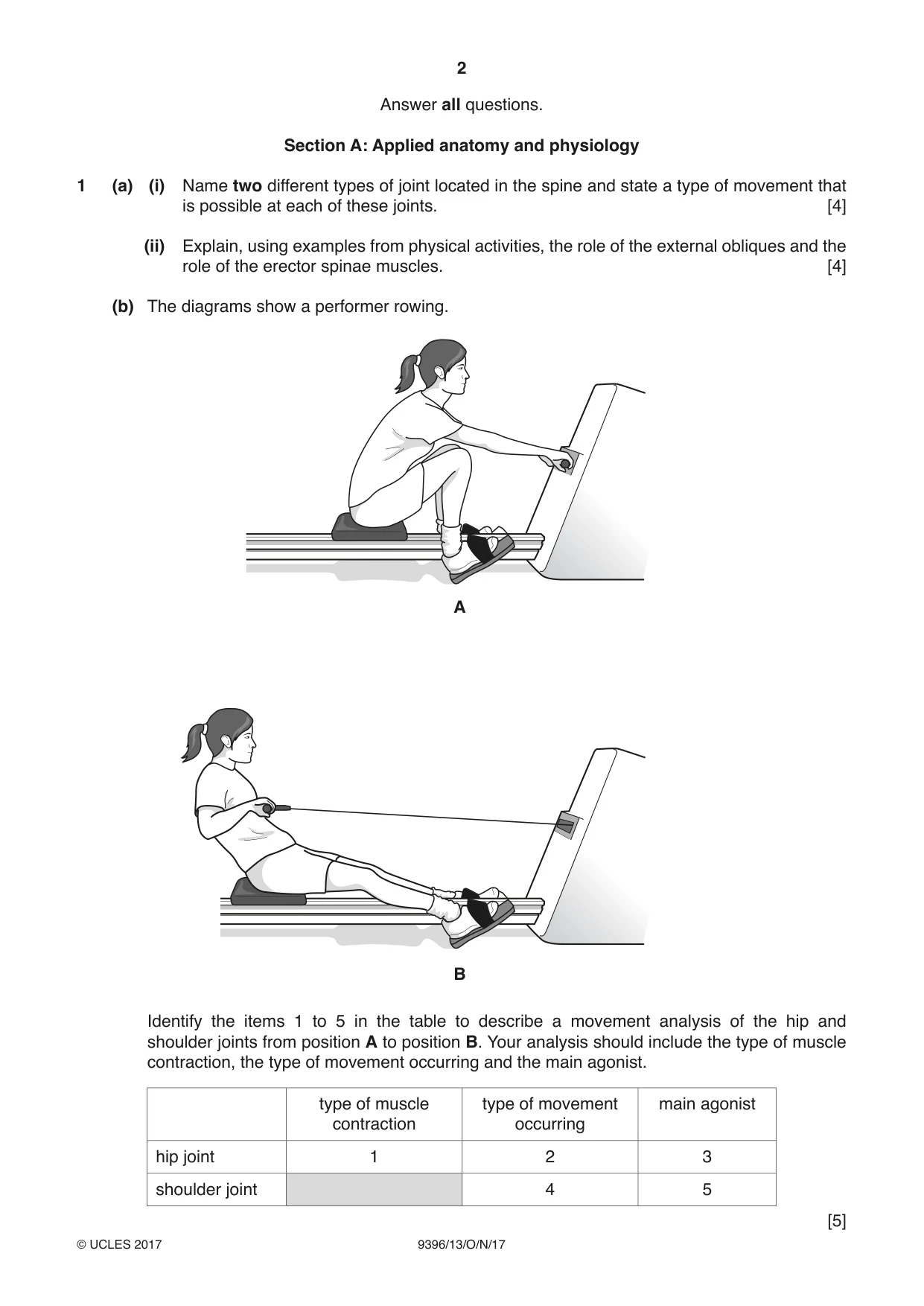
2 9396/13/O/N/17 © UCLES 2017 Answer all questions. Section A: Applied anatomy and physiology 1 (a) (i) Name two different types of joint located in the spine and state a type of movement that is possible at each of these joints. [4] (ii) Explain, using examples from physical activities, the role of the external obliques and the role of the erector spinae muscles. [4] (b) The diagrams show a performer rowing. B A Identify the items 1 to 5 in the table to describe a movement analysis of the hip and shoulder joints from position A to position B. Your analysis should include the type of muscle contraction, the type of movement occurring and the main agonist. type of muscle contraction type of movement occurring main agonist hip joint 1 2 3 shoulder joint 4 5 [5]
Question paper, page 3
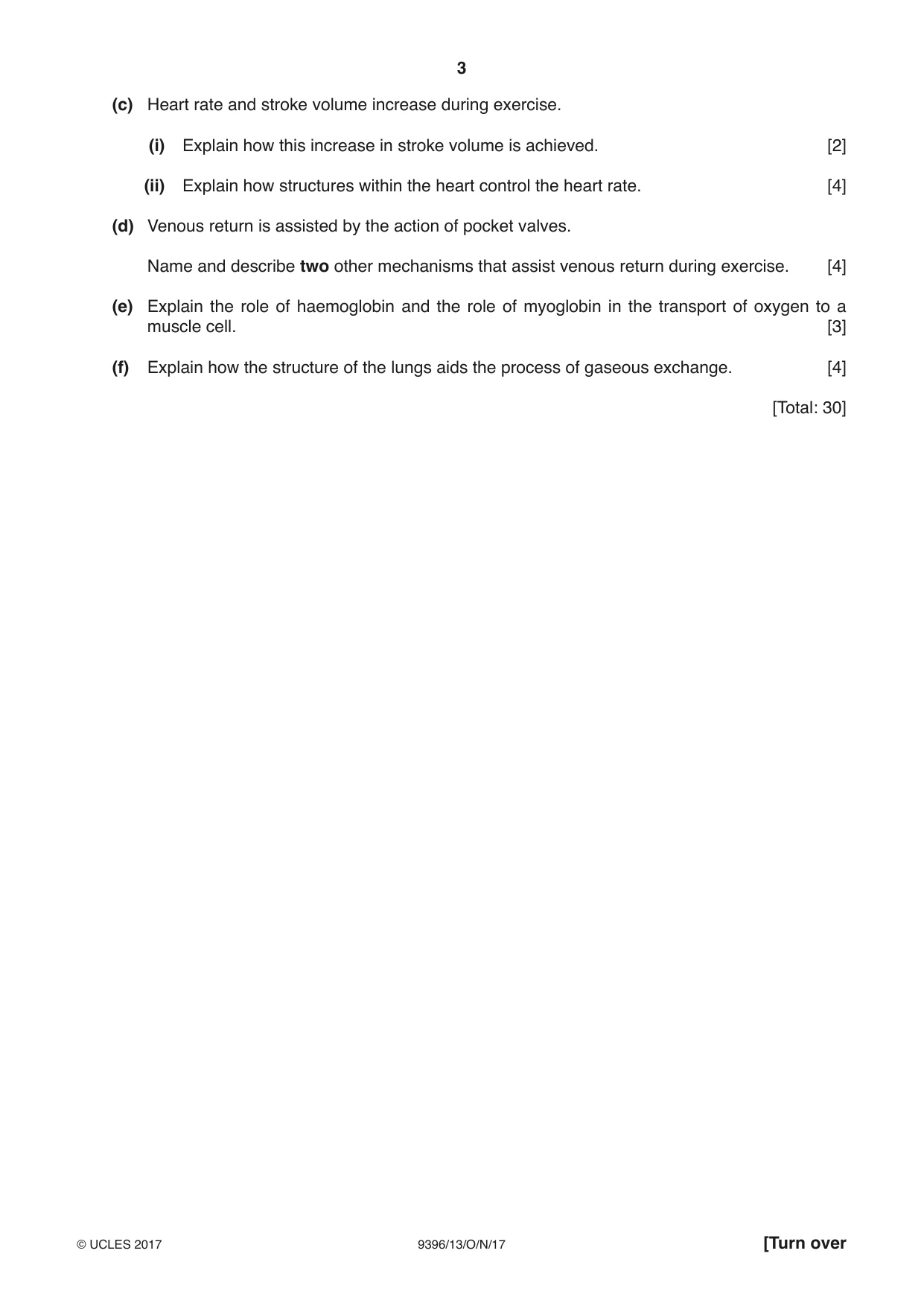
3 9396/13/O/N/17 © UCLES 2017 [Turn over (c) Heart rate and stroke volume increase during exercise. (i) Explain how this increase in stroke volume is achieved. [2] (ii) Explain how structures within the heart control the heart rate. [4] (d) Venous return is assisted by the action of pocket valves. Name and describe two other mechanisms that assist venous return during exercise. [4] (e) Explain the role of haemoglobin and the role of myoglobin in the transport of oxygen to a muscle cell. [3] (f) Explain how the structure of the lungs aids the process of gaseous exchange. [4] [Total: 30]
Question paper, page 4
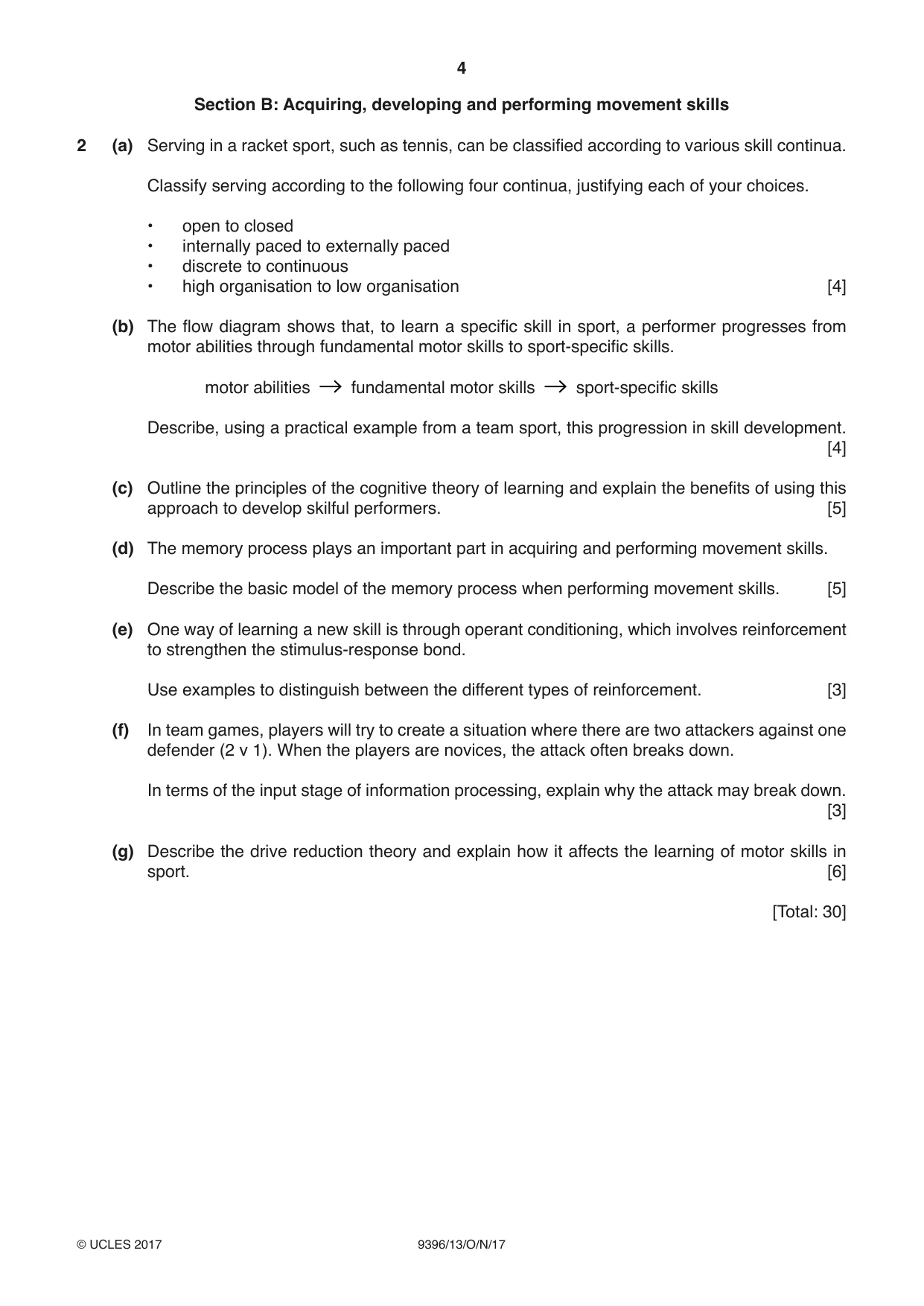
4 9396/13/O/N/17 © UCLES 2017 Section B: Acquiring, developing and performing movement skills 2 (a) Serving in a racket sport, such as tennis, can be classified according to various skill continua. Classify serving according to the following four continua, justifying each of your choices. • open to closed • internally paced to externally paced • discrete to continuous • high organisation to low organisation [4] (b) The flow diagram shows that, to learn a specific skill in sport, a performer progresses from motor abilities through fundamental motor skills to sport-specific skills. motor abilities fundamental motor skills sport-specific skills Describe, using a practical example from a team sport, this progression in skill development. [4] (c) Outline the principles of the cognitive theory of learning and explain the benefits of using this approach to develop skilful performers. [5] (d) The memory process plays an important part in acquiring and performing movement skills. Describe the basic model of the memory process when performing movement skills. [5] (e) One way of learning a new skill is through operant conditioning, which involves reinforcement to strengthen the stimulus-response bond. Use examples to distinguish between the different types of reinforcement. [3] (f) In team games, players will try to create a situation where there are two attackers against one defender (2 v 1). When the players are novices, the attack often breaks down. In terms of the input stage of information processing, explain why the attack may break down. [3] (g) Describe the drive reduction theory and explain how it affects the learning of motor skills in sport. [6] [Total: 30]
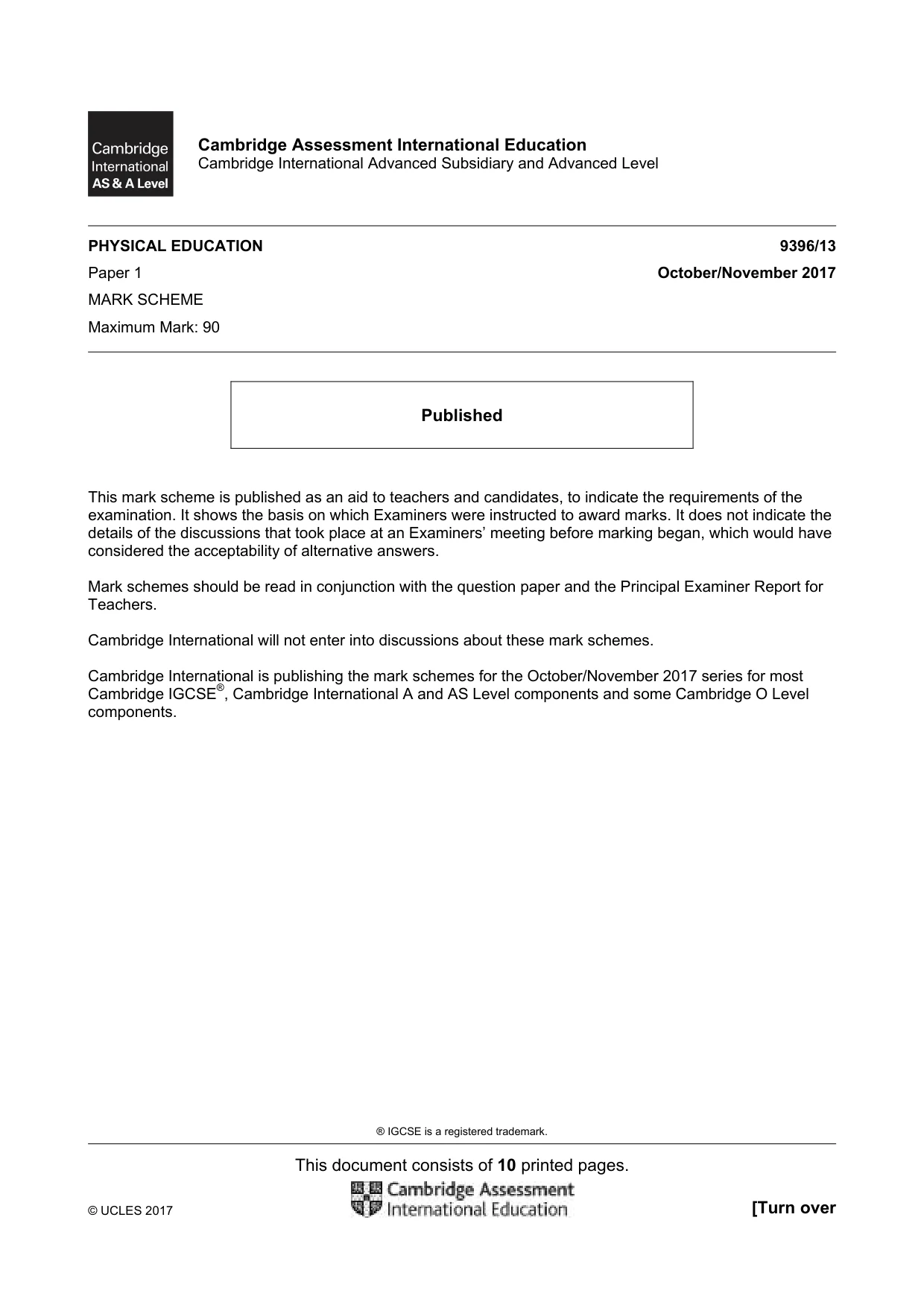
Question paper, page 5
5 9396/13/O/N/17 © UCLES 2017 Section C: Contemporary studies in physical education and sport 3 (a) Outline the ways a school physical education programme encourages participation in sport. [4] (b) Outdoor and adventurous activities, such as canoeing and rock climbing, take place in the natural environment and involve risk. Explain, using examples from canoeing or rock climbing, what is meant by real risk and what is meant by perceived risk. [4] (c) (i) State and describe the four levels of the sport performance pyramid. [4] (ii) Suggest what provision is required for a performer to stay at the highest level of the performance pyramid. [4] (d) (i) Outline the potential benefits to an individual of continued participation in physical activity. [4] (ii) Suggest reasons why some people do not take part in physical activity. [4] (e) Discuss the impact of the media and the commercialisation of sport on spectators. [6] [Total: 30]
Question paper, page 6
6 9396/13/O/N/17 © UCLES 2017 BLANK PAGE
Question paper, page 7
7 9396/13/O/N/17 © UCLES 2017 BLANK PAGE
Question paper, page 8
8 9396/13/O/N/17 © UCLES 2017 BLANK PAGE Permission to reproduce items where third-party owned material protected by copyright is included has been sought and cleared where possible. Every reasonable effort has been made by the publisher (UCLES) to trace copyright holders, but if any items requiring clearance have unwittingly been included, the publisher will be pleased to make amends at the earliest possible opportunity. To avoid the issue of disclosure of answer-related information to candidates, all copyright acknowledgements are reproduced online in the Cambridge International Examinations Copyright Acknowledgements Booklet. This is produced for each series of examinations and is freely available to download at www.cie.org.uk after the live examination series. Cambridge International Examinations is part of the Cambridge Assessment Group. Cambridge Assessment is the brand name of University of Cambridge Local Examinations Syndicate (UCLES), which is itself a department of the University of Cambridge.
Mark scheme, page 1
® IGCSE is a registered trademark. This document consists of 10 printed pages. © UCLES 2017 [Turn over Cambridge Assessment International Education Cambridge International Advanced Subsidiary and Advanced Level PHYSICAL EDUCATION 9396/13 Paper 1 October/November 2017 MARK SCHEME Maximum Mark: 90 Published This mark scheme is published as an aid to teachers and candidates, to indicate the requirements of the examination. It shows the basis on which Examiners were instructed to award marks. It does not indicate the details of the discussions that took place at an Examiners’ meeting before marking began, which would have considered the acceptability of alternative answers. Mark schemes should be read in conjunction with the question paper and the Principal Examiner Report for Teachers. Cambridge International will not enter into discussions about these mark schemes. Cambridge International is publishing the mark schemes for the October/November 2017 series for most Cambridge IGCSE®, Cambridge International A and AS Level components and some Cambridge O Level components.
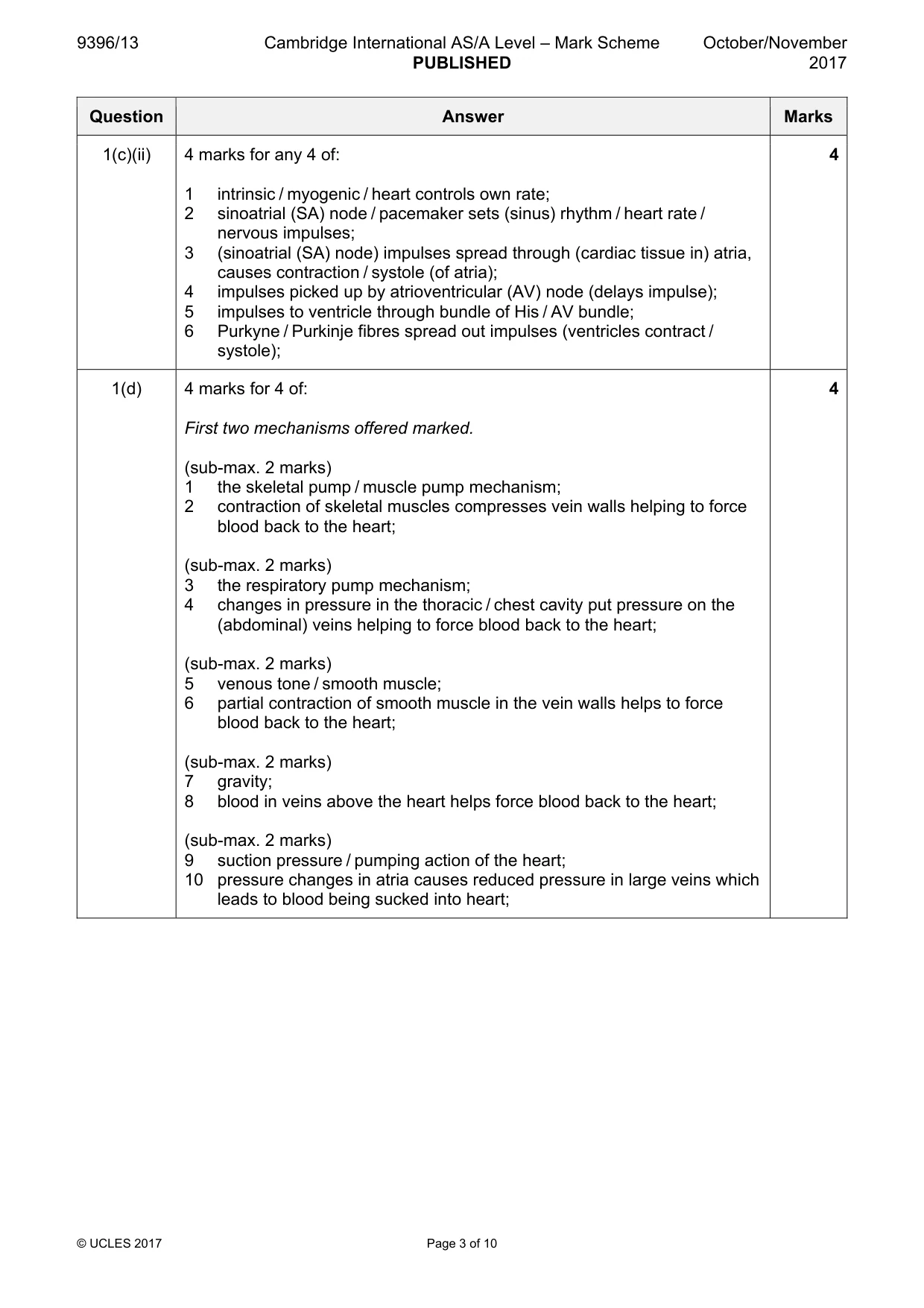
Mark scheme, page 2
9396/13 Cambridge International AS/A Level – Mark Scheme PUBLISHED October/November 2017 © UCLES 2017 Page 2 of 10 Question Answer Marks Section A 1(a)(i) 4 marks for 4 of: (sub-max. 2 marks) 1 pivot joint; 2 rotation; (sub-max. 2 marks) 3 cartilaginous / semi-moveable joint / slightly movable; 4 flexion / extension / rotation; (sub-max. 2 marks) 5 gliding joint; 6 flexion / extension / rotation / circumduction; 4 1(a)(ii) 4 marks for: (external obliques) 1 cause trunk rotation / twisting; 2 an example of an activity using this type of movement; (erector spinae) 3 cause extension / hyperextension of the spine; 4 an example of an activity using this type of movement; 4 1(b) 5 marks for: 1 concentric / isotonic; 2 extension; 3 gluteus maximus / biceps femoris / semimembranosus / semitendinosus; 4 (horizontal) adduction / extension; 5 trapezius / latissimus dorsi / deltoid / rotator cuff / infraspinatus / teres minor; 5 1(c)(i) 2 marks for any 2 of: 1 during exercise – increased venous return; 2 increased diastolic filling / preload / increased stretch of cardiac muscle / elastic; 3 increased the force of contraction / stronger / powerful; 4 known as Starling’s law; 5 higher percentage of blood ejected from heart per beat / increased ejection fraction / end systolic volume lower than at rest; 2
Mark scheme, page 3
9396/13 Cambridge International AS/A Level – Mark Scheme PUBLISHED October/November 2017 © UCLES 2017 Page 3 of 10 Question Answer Marks 1(c)(ii) 4 marks for any 4 of: 1 intrinsic / myogenic / heart controls own rate; 2 sinoatrial (SA) node / pacemaker sets (sinus) rhythm / heart rate / nervous impulses; 3 (sinoatrial (SA) node) impulses spread through (cardiac tissue in) atria, causes contraction / systole (of atria); 4 impulses picked up by atrioventricular (AV) node (delays impulse); 5 impulses to ventricle through bundle of His / AV bundle; 6 Purkyne / Purkinje fibres spread out impulses (ventricles contract / systole); 4 1(d) 4 marks for 4 of: First two mechanisms offered marked. (sub-max. 2 marks) 1 the skeletal pump / muscle pump mechanism; 2 contraction of skeletal muscles compresses vein walls helping to force blood back to the heart; (sub-max. 2 marks) 3 the respiratory pump mechanism; 4 changes in pressure in the thoracic / chest cavity put pressure on the (abdominal) veins helping to force blood back to the heart; (sub-max. 2 marks) 5 venous tone / smooth muscle; 6 partial contraction of smooth muscle in the vein walls helps to force blood back to the heart; (sub-max. 2 marks) 7 gravity; 8 blood in veins above the heart helps force blood back to the heart; (sub-max. 2 marks) 9 suction pressure / pumping action of the heart; 10 pressure changes in atria causes reduced pressure in large veins which leads to blood being sucked into heart; 4
Mark scheme, page 4
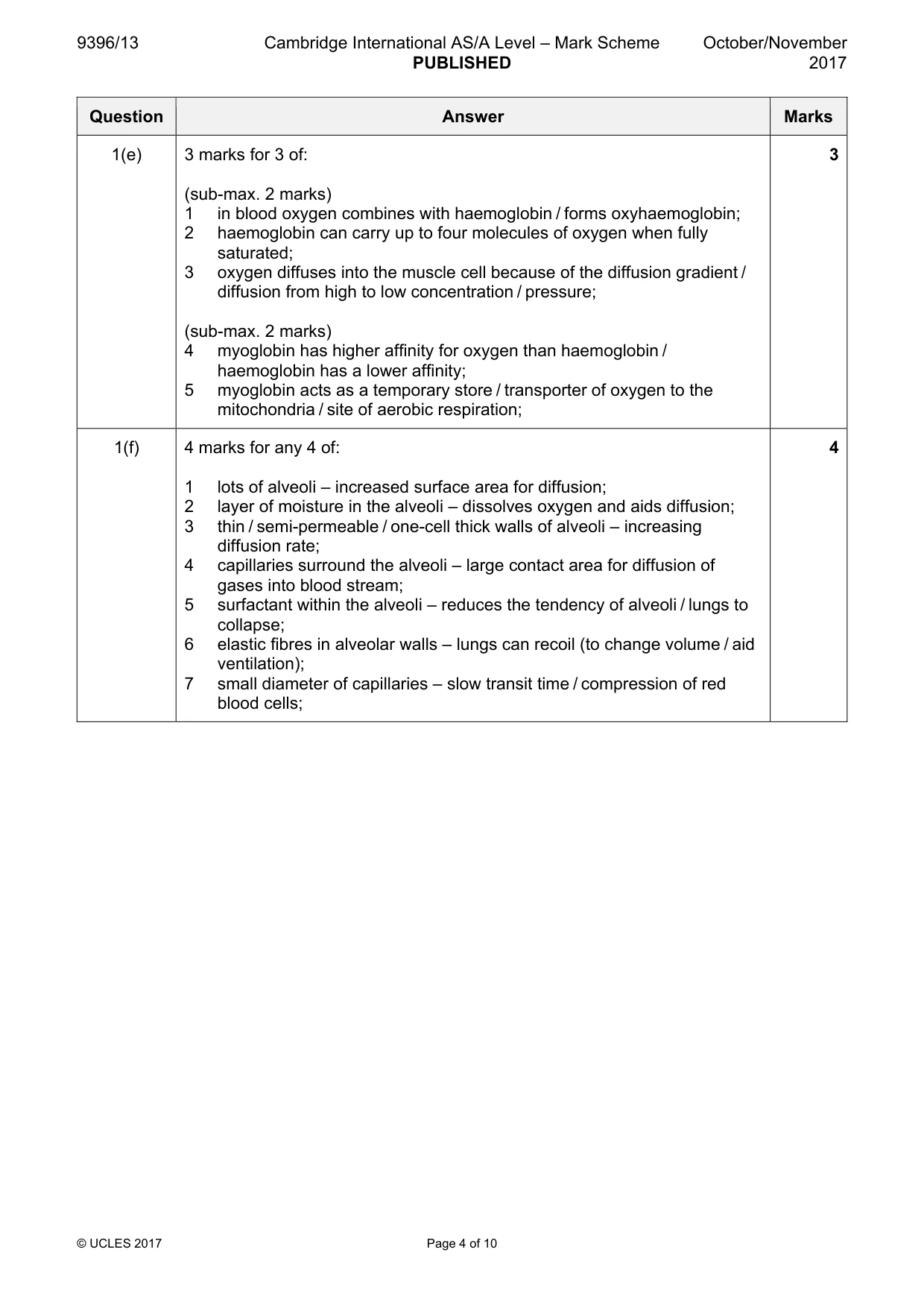
9396/13 Cambridge International AS/A Level – Mark Scheme PUBLISHED October/November 2017 © UCLES 2017 Page 4 of 10 Question Answer Marks 1(e) 3 marks for 3 of: (sub-max. 2 marks) 1 in blood oxygen combines with haemoglobin / forms oxyhaemoglobin; 2 haemoglobin can carry up to four molecules of oxygen when fully saturated; 3 oxygen diffuses into the muscle cell because of the diffusion gradient / diffusion from high to low concentration / pressure; (sub-max. 2 marks) 4 myoglobin has higher affinity for oxygen than haemoglobin / haemoglobin has a lower affinity; 5 myoglobin acts as a temporary store / transporter of oxygen to the mitochondria / site of aerobic respiration; 3 1(f) 4 marks for any 4 of: 1 lots of alveoli – increased surface area for diffusion; 2 layer of moisture in the alveoli – dissolves oxygen and aids diffusion; 3 thin / semi-permeable / one-cell thick walls of alveoli – increasing diffusion rate; 4 capillaries surround the alveoli – large contact area for diffusion of gases into blood stream; 5 surfactant within the alveoli – reduces the tendency of alveoli / lungs to collapse; 6 elastic fibres in alveolar walls – lungs can recoil (to change volume / aid ventilation); 7 small diameter of capillaries – slow transit time / compression of red blood cells; 4
Mark scheme, page 5
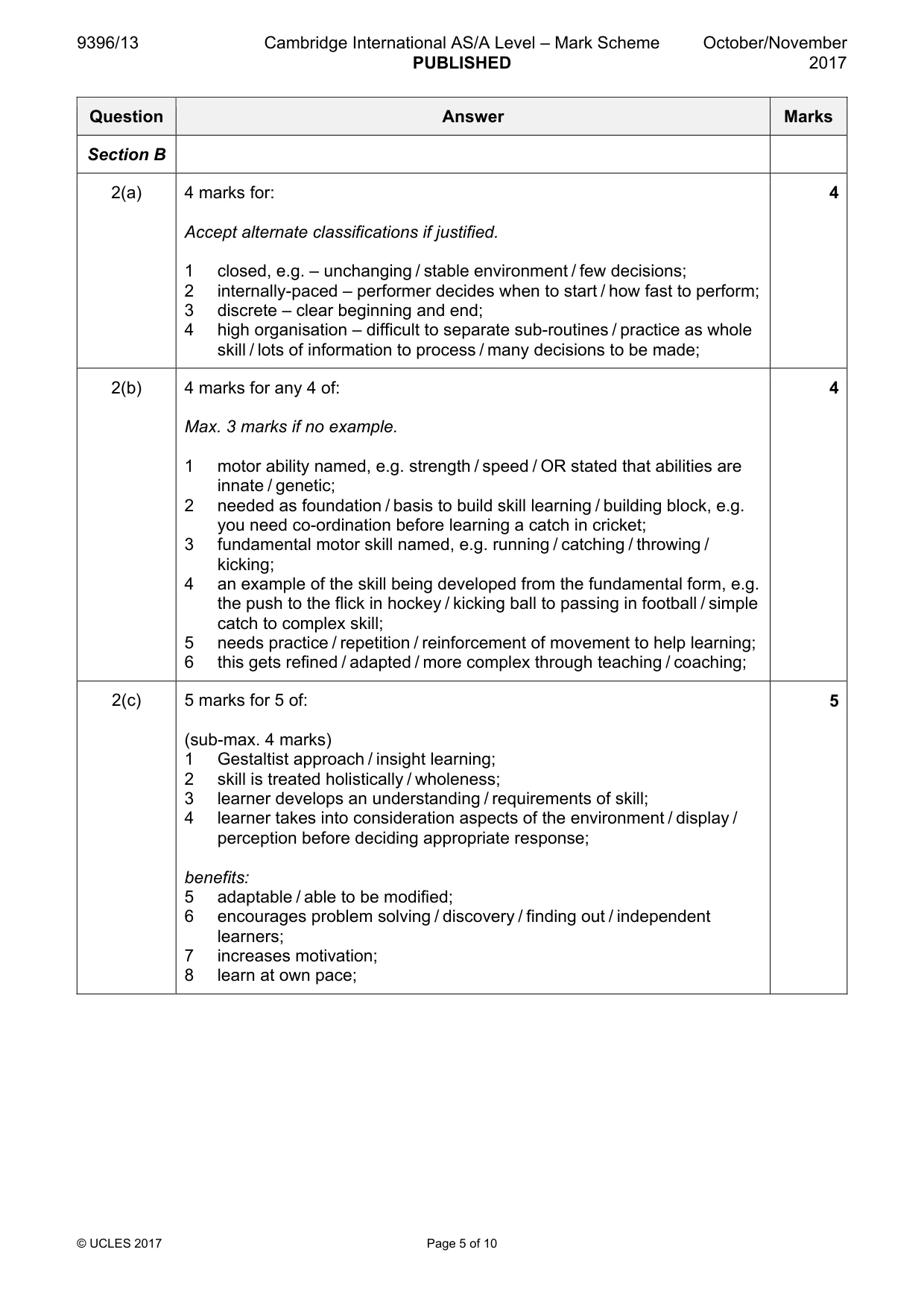
9396/13 Cambridge International AS/A Level – Mark Scheme PUBLISHED October/November 2017 © UCLES 2017 Page 5 of 10 Question Answer Marks Section B 2(a) 4 marks for: Accept alternate classifications if justified. 1 closed, e.g. – unchanging / stable environment / few decisions; 2 internally-paced – performer decides when to start / how fast to perform; 3 discrete – clear beginning and end; 4 high organisation – difficult to separate sub-routines / practice as whole skill / lots of information to process / many decisions to be made; 4 2(b) 4 marks for any 4 of: Max. 3 marks if no example. 1 motor ability named, e.g. strength / speed / OR stated that abilities are innate / genetic; 2 needed as foundation / basis to build skill learning / building block, e.g. you need co-ordination before learning a catch in cricket; 3 fundamental motor skill named, e.g. running / catching / throwing / kicking; 4 an example of the skill being developed from the fundamental form, e.g. the push to the flick in hockey / kicking ball to passing in football / simple catch to complex skill; 5 needs practice / repetition / reinforcement of movement to help learning; 6 this gets refined / adapted / more complex through teaching / coaching; 4 2(c) 5 marks for 5 of: (sub-max. 4 marks) 1 Gestaltist approach / insight learning; 2 skill is treated holistically / wholeness; 3 learner develops an understanding / requirements of skill; 4 learner takes into consideration aspects of the environment / display / perception before deciding appropriate response; benefits: 5 adaptable / able to be modified; 6 encourages problem solving / discovery / finding out / independent learners; 7 increases motivation; 8 learn at own pace; 5
Mark scheme, page 6
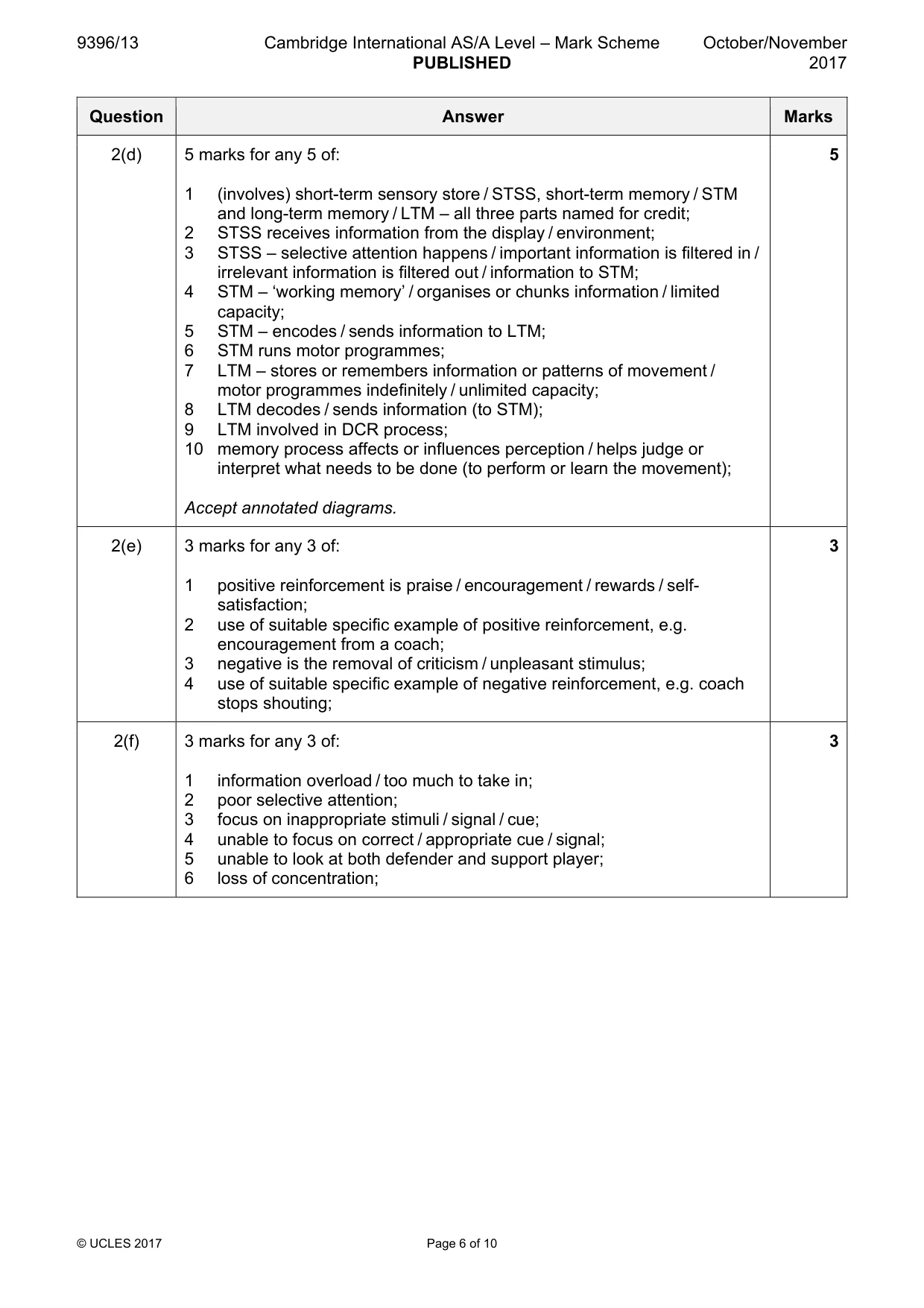
9396/13 Cambridge International AS/A Level – Mark Scheme PUBLISHED October/November 2017 © UCLES 2017 Page 6 of 10 Question Answer Marks 2(d) 5 marks for any 5 of: 1 (involves) short-term sensory store / STSS, short-term memory / STM and long-term memory / LTM – all three parts named for credit; 2 STSS receives information from the display / environment; 3 STSS – selective attention happens / important information is filtered in / irrelevant information is filtered out / information to STM; 4 STM – ‘working memory’ / organises or chunks information / limited capacity; 5 STM – encodes / sends information to LTM; 6 STM runs motor programmes; 7 LTM – stores or remembers information or patterns of movement / motor programmes indefinitely / unlimited capacity; 8 LTM decodes / sends information (to STM); 9 LTM involved in DCR process; 10 memory process affects or influences perception / helps judge or interpret what needs to be done (to perform or learn the movement); Accept annotated diagrams. 5 2(e) 3 marks for any 3 of: 1 positive reinforcement is praise / encouragement / rewards / self- satisfaction; 2 use of suitable specific example of positive reinforcement, e.g. encouragement from a coach; 3 negative is the removal of criticism / unpleasant stimulus; 4 use of suitable specific example of negative reinforcement, e.g. coach stops shouting; 3 2(f) 3 marks for any 3 of: 1 information overload / too much to take in; 2 poor selective attention; 3 focus on inappropriate stimuli / signal / cue; 4 unable to focus on correct / appropriate cue / signal; 5 unable to look at both defender and support player; 6 loss of concentration; 3
Mark scheme, page 7
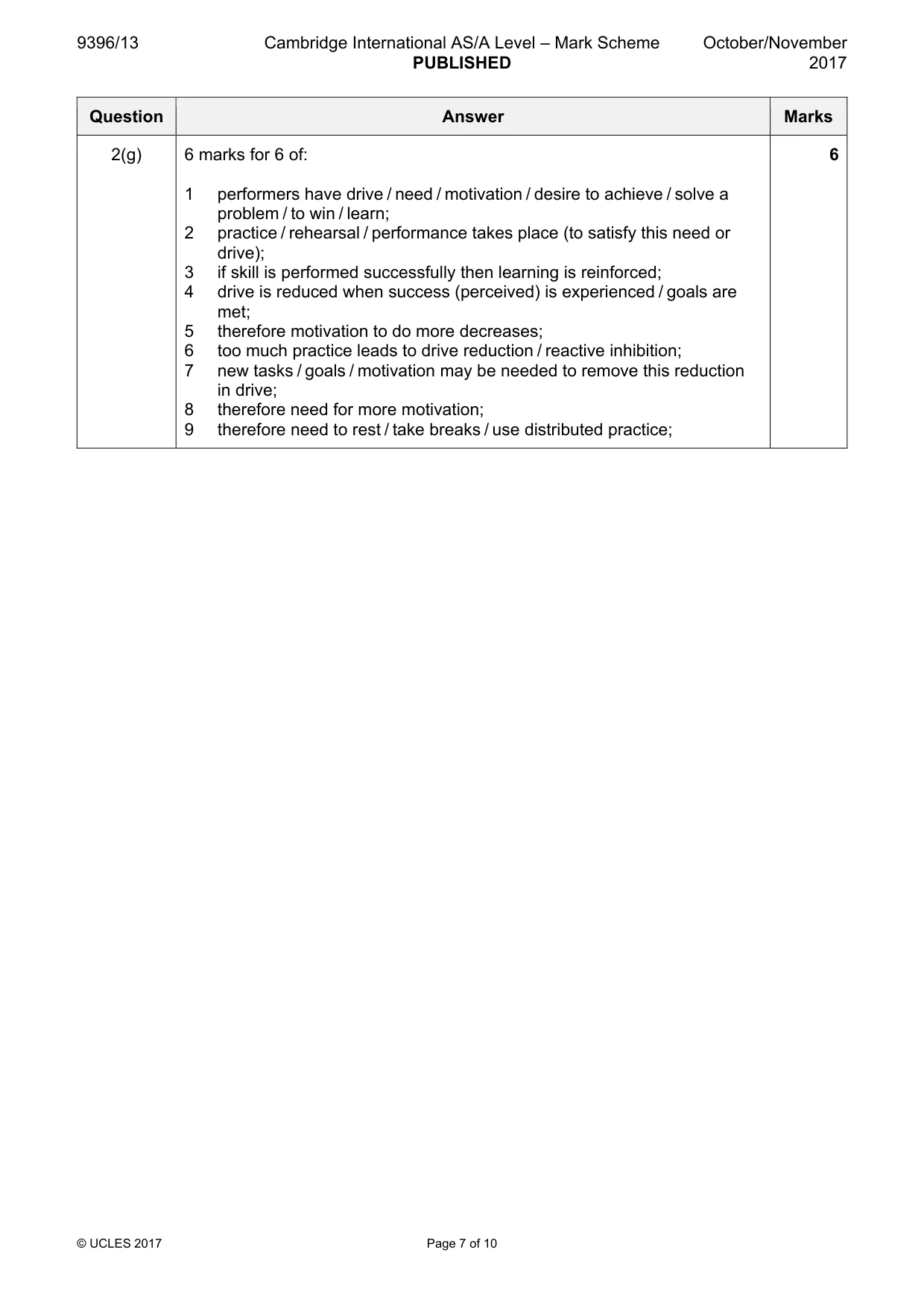
9396/13 Cambridge International AS/A Level – Mark Scheme PUBLISHED October/November 2017 © UCLES 2017 Page 7 of 10 Question Answer Marks 2(g) 6 marks for 6 of: 1 performers have drive / need / motivation / desire to achieve / solve a problem / to win / learn; 2 practice / rehearsal / performance takes place (to satisfy this need or drive); 3 if skill is performed successfully then learning is reinforced; 4 drive is reduced when success (perceived) is experienced / goals are met; 5 therefore motivation to do more decreases; 6 too much practice leads to drive reduction / reactive inhibition; 7 new tasks / goals / motivation may be needed to remove this reduction in drive; 8 therefore need for more motivation; 9 therefore need to rest / take breaks / use distributed practice; 6
Mark scheme, page 8
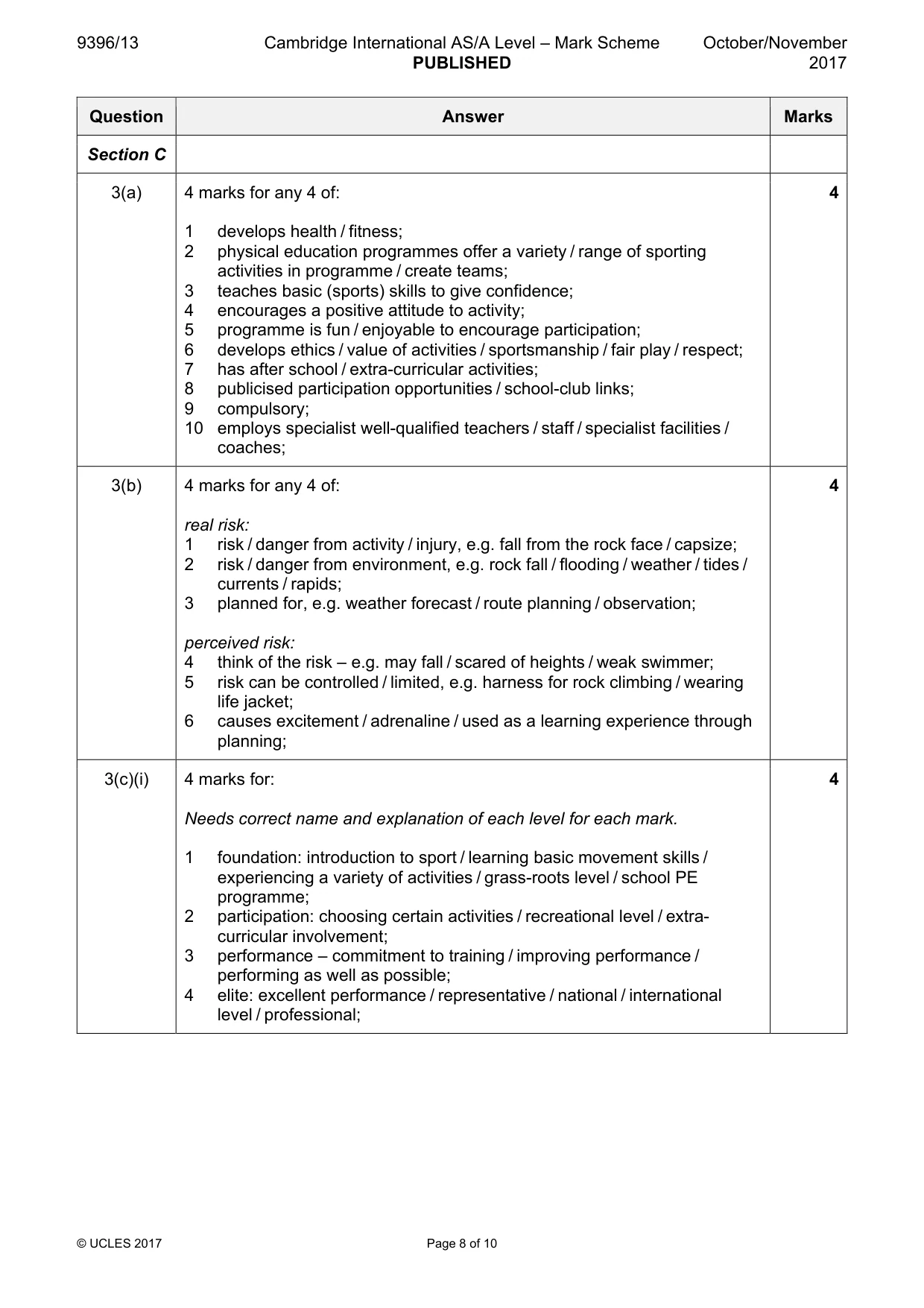
9396/13 Cambridge International AS/A Level – Mark Scheme PUBLISHED October/November 2017 © UCLES 2017 Page 8 of 10 Question Answer Marks Section C 3(a) 4 marks for any 4 of: 1 develops health / fitness; 2 physical education programmes offer a variety / range of sporting activities in programme / create teams; 3 teaches basic (sports) skills to give confidence; 4 encourages a positive attitude to activity; 5 programme is fun / enjoyable to encourage participation; 6 develops ethics / value of activities / sportsmanship / fair play / respect; 7 has after school / extra-curricular activities; 8 publicised participation opportunities / school-club links; 9 compulsory; 10 employs specialist well-qualified teachers / staff / specialist facilities / coaches; 4 3(b) 4 marks for any 4 of: real risk: 1 risk / danger from activity / injury, e.g. fall from the rock face / capsize; 2 risk / danger from environment, e.g. rock fall / flooding / weather / tides / currents / rapids; 3 planned for, e.g. weather forecast / route planning / observation; perceived risk: 4 think of the risk – e.g. may fall / scared of heights / weak swimmer; 5 risk can be controlled / limited, e.g. harness for rock climbing / wearing life jacket; 6 causes excitement / adrenaline / used as a learning experience through planning; 4 3(c)(i) 4 marks for: Needs correct name and explanation of each level for each mark. 1 foundation: introduction to sport / learning basic movement skills / experiencing a variety of activities / grass-roots level / school PE programme; 2 participation: choosing certain activities / recreational level / extra- curricular involvement; 3 performance – commitment to training / improving performance / performing as well as possible; 4 elite: excellent performance / representative / national / international level / professional; 4
Mark scheme, page 9
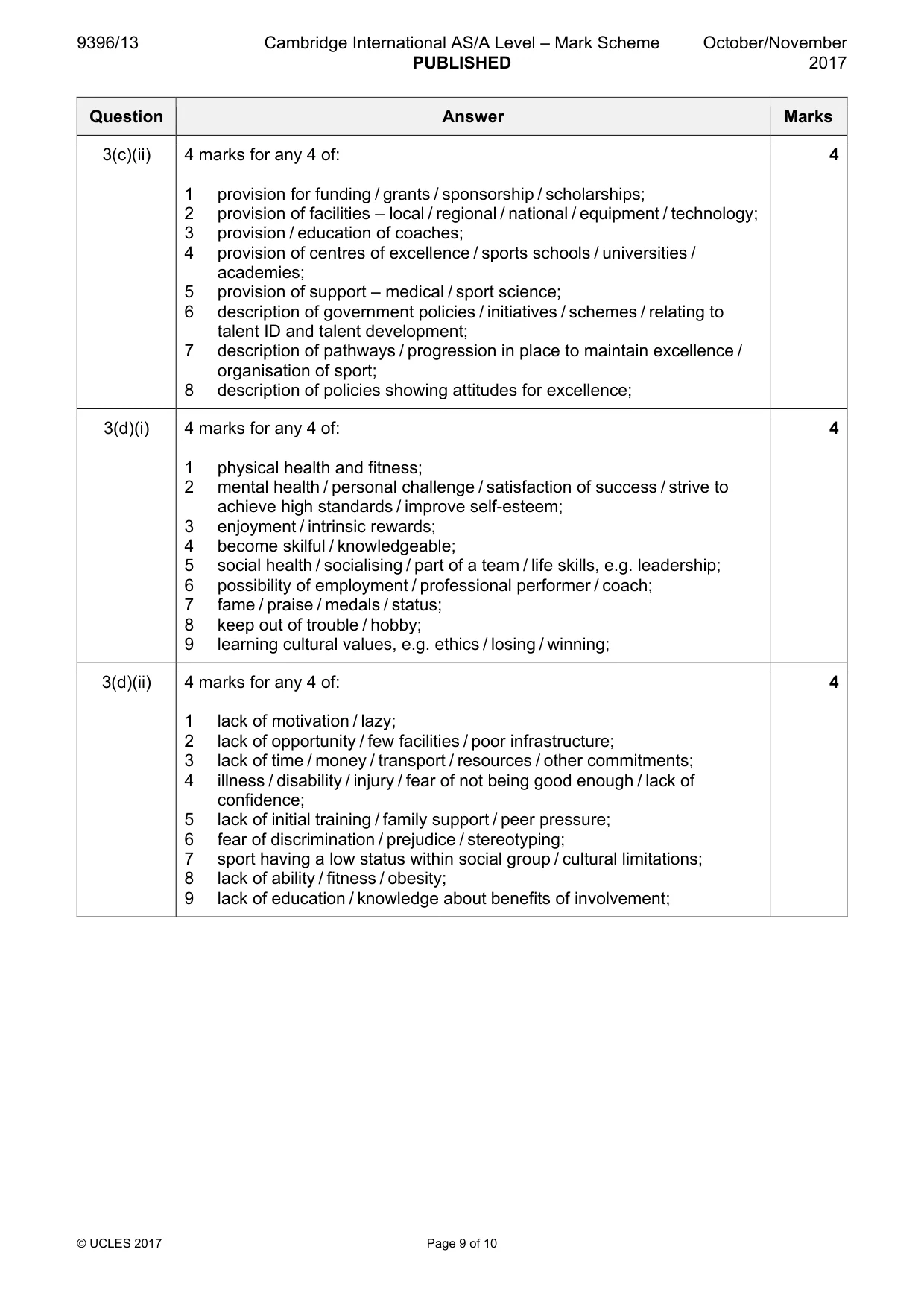
9396/13 Cambridge International AS/A Level – Mark Scheme PUBLISHED October/November 2017 © UCLES 2017 Page 9 of 10 Question Answer Marks 3(c)(ii) 4 marks for any 4 of: 1 provision for funding / grants / sponsorship / scholarships; 2 provision of facilities – local / regional / national / equipment / technology; 3 provision / education of coaches; 4 provision of centres of excellence / sports schools / universities / academies; 5 provision of support – medical / sport science; 6 description of government policies / initiatives / schemes / relating to talent ID and talent development; 7 description of pathways / progression in place to maintain excellence / organisation of sport; 8 description of policies showing attitudes for excellence; 4 3(d)(i) 4 marks for any 4 of: 1 physical health and fitness; 2 mental health / personal challenge / satisfaction of success / strive to achieve high standards / improve self-esteem; 3 enjoyment / intrinsic rewards; 4 become skilful / knowledgeable; 5 social health / socialising / part of a team / life skills, e.g. leadership; 6 possibility of employment / professional performer / coach; 7 fame / praise / medals / status; 8 keep out of trouble / hobby; 9 learning cultural values, e.g. ethics / losing / winning; 4 3(d)(ii) 4 marks for any 4 of: 1 lack of motivation / lazy; 2 lack of opportunity / few facilities / poor infrastructure; 3 lack of time / money / transport / resources / other commitments; 4 illness / disability / injury / fear of not being good enough / lack of confidence; 5 lack of initial training / family support / peer pressure; 6 fear of discrimination / prejudice / stereotyping; 7 sport having a low status within social group / cultural limitations; 8 lack of ability / fitness / obesity; 9 lack of education / knowledge about benefits of involvement; 4
Mark scheme, page 10
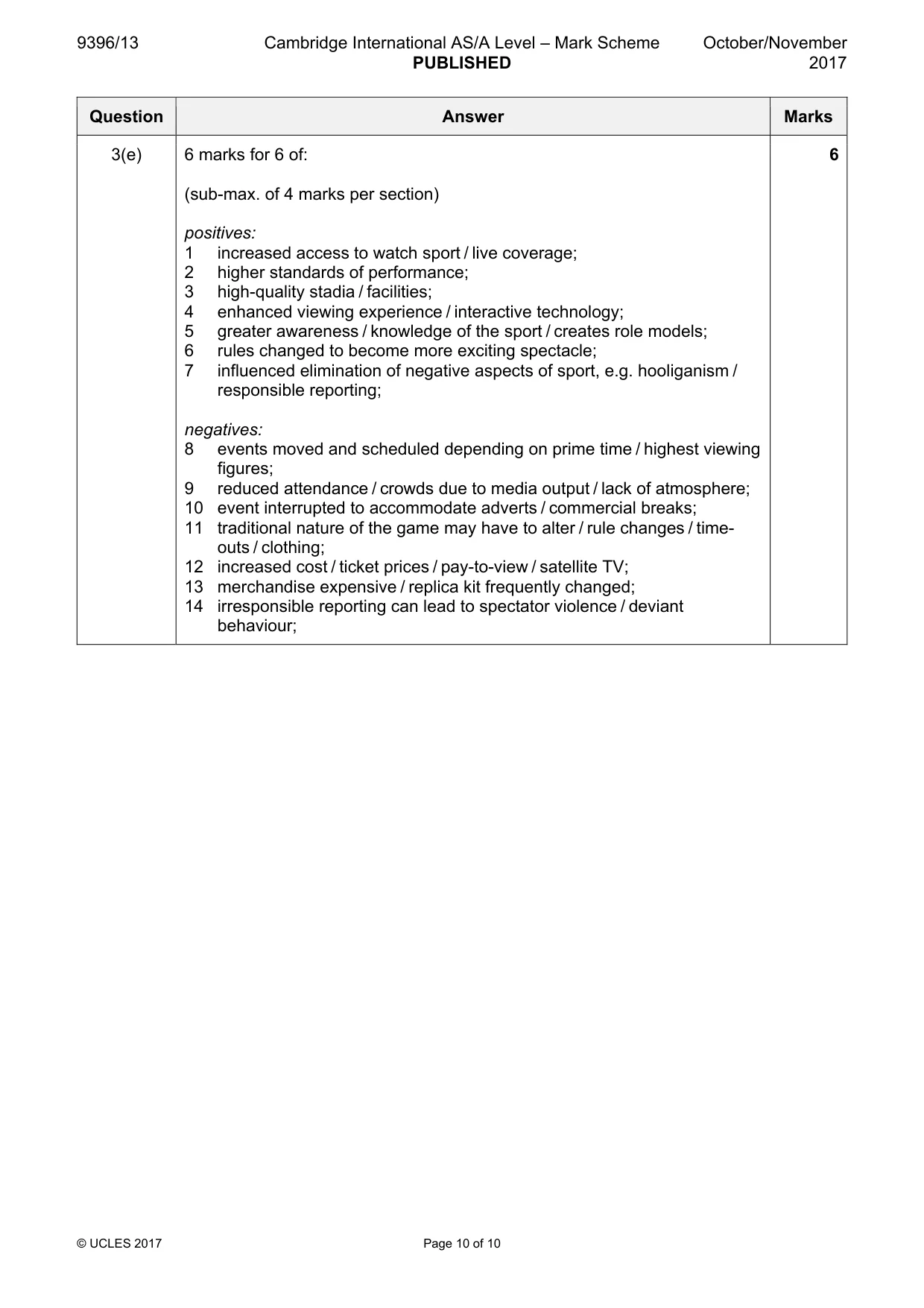
9396/13 Cambridge International AS/A Level – Mark Scheme PUBLISHED October/November 2017 © UCLES 2017 Page 10 of 10 Question Answer Marks 3(e) 6 marks for 6 of: (sub-max. of 4 marks per section) positives: 1 increased access to watch sport / live coverage; 2 higher standards of performance; 3 high-quality stadia / facilities; 4 enhanced viewing experience / interactive technology; 5 greater awareness / knowledge of the sport / creates role models; 6 rules changed to become more exciting spectacle; 7 influenced elimination of negative aspects of sport, e.g. hooliganism / responsible reporting; negatives: 8 events moved and scheduled depending on prime time / highest viewing figures; 9 reduced attendance / crowds due to media output / lack of atmosphere; 10 event interrupted to accommodate adverts / commercial breaks; 11 traditional nature of the game may have to alter / rule changes / time- outs / clothing; 12 increased cost / ticket prices / pay-to-view / satellite TV; 13 merchandise expensive / replica kit frequently changed; 14 irresponsible reporting can lead to spectator violence / deviant behaviour; 6
What you needed in this session
Cambridge’s own grade thresholds for 2017 Oct/Nov, Paper 1 · Variant 3. A higher threshold means an easier paper — the bar moves with how the cohort did.