Cambridge A Level Physical Education 9396 — 2016 Oct/Nov Paper 1 · Variant 2
9396/12/O/N/16 · 90 marks · ≈101 min
The question paper and its mark scheme, free to read here and free to download. This is Cambridge’s own paper, exactly as it was sat.
Question paper4 pages
Mark scheme9 pages
Answers below. Sit the paper first if you are practising.
Paper as text
Question paper, page 1
This document consists of 4 printed pages and 1 insert. DC (ST/SW) 146486/4 © UCLES 2016 [Turn over Cambridge International Examinations Cambridge International Advanced Subsidiary and Advanced Level * 3 6 4 6 4 5 2 4 9 0 * PHYSICAL EDUCATION 9396/12 Paper 1 October/November 2016 2 hours 30 minutes No Additional Materials are required. READ THESE INSTRUCTIONS FIRST An answer booklet is provided inside this question paper. You should follow the instructions on the front cover of the answer booklet. If you need additional answer paper ask the invigilator for a continuation booklet. Answer all questions. Electronic calculators may be used. You may lose marks if you do not show your working or if you do not use appropriate units. The number of marks is given in brackets [ ] at the end of each question or part question.
Question paper, page 2
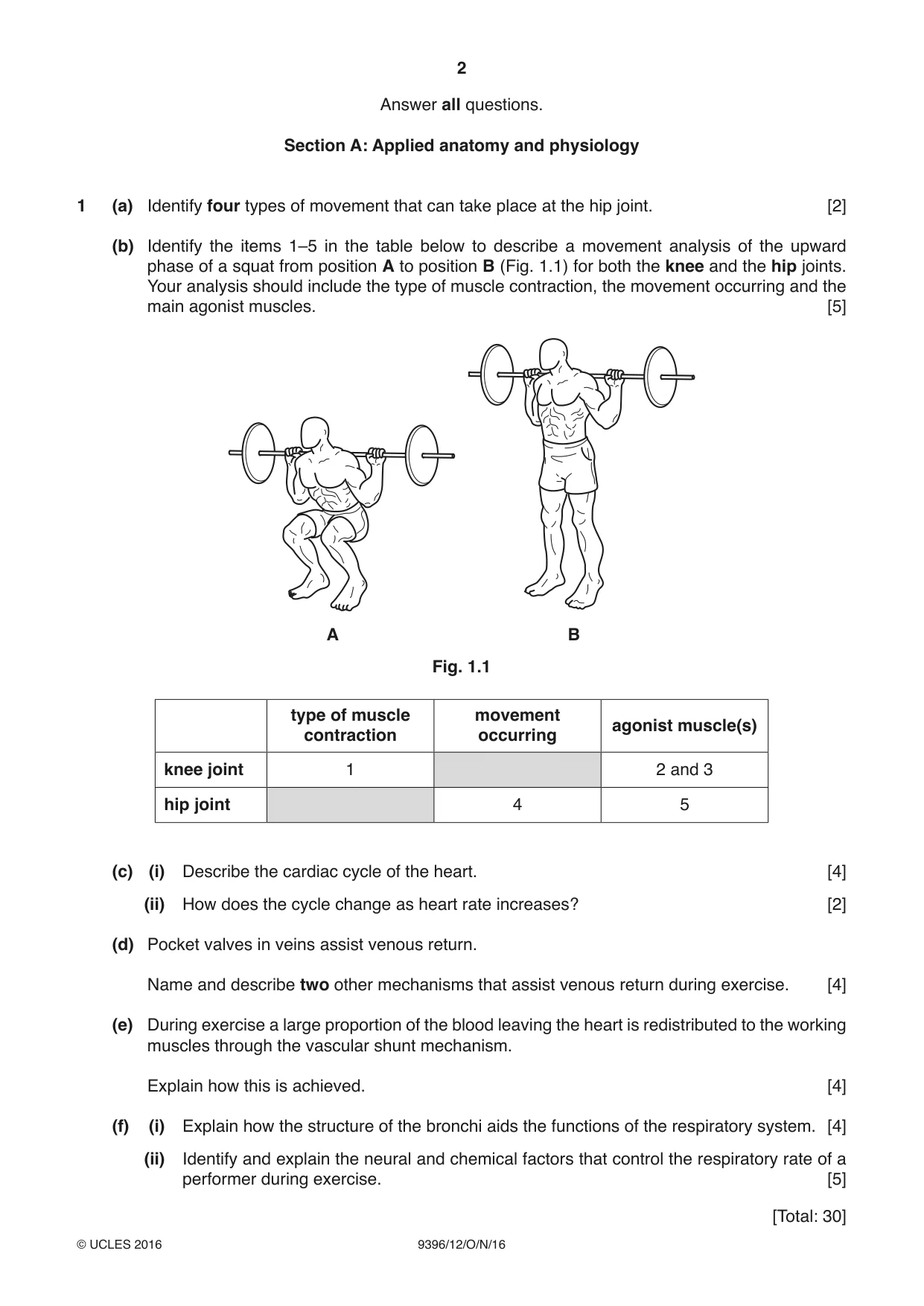
2 9396/12/O/N/16 © UCLES 2016 Answer all questions. Section A: Applied anatomy and physiology 1 (a) Identify four types of movement that can take place at the hip joint. [2] (b) Identify the items 1–5 in the table below to describe a movement analysis of the upward phase of a squat from position A to position B (Fig. 1.1) for both the knee and the hip joints. Your analysis should include the type of muscle contraction, the movement occurring and the main agonist muscles. [5] A B Fig. 1.1 type of muscle contraction movement occurring agonist muscle(s) knee joint 1 2 and 3 hip joint 4 5 (c) (i) Describe the cardiac cycle of the heart. [4] (ii) How does the cycle change as heart rate increases? [2] (d) Pocket valves in veins assist venous return. Name and describe two other mechanisms that assist venous return during exercise. [4] (e) During exercise a large proportion of the blood leaving the heart is redistributed to the working muscles through the vascular shunt mechanism. Explain how this is achieved. [4] (f) (i) Explain how the structure of the bronchi aids the functions of the respiratory system. [4] (ii) Identify and explain the neural and chemical factors that control the respiratory rate of a performer during exercise. [5] [Total: 30]
Question paper, page 3
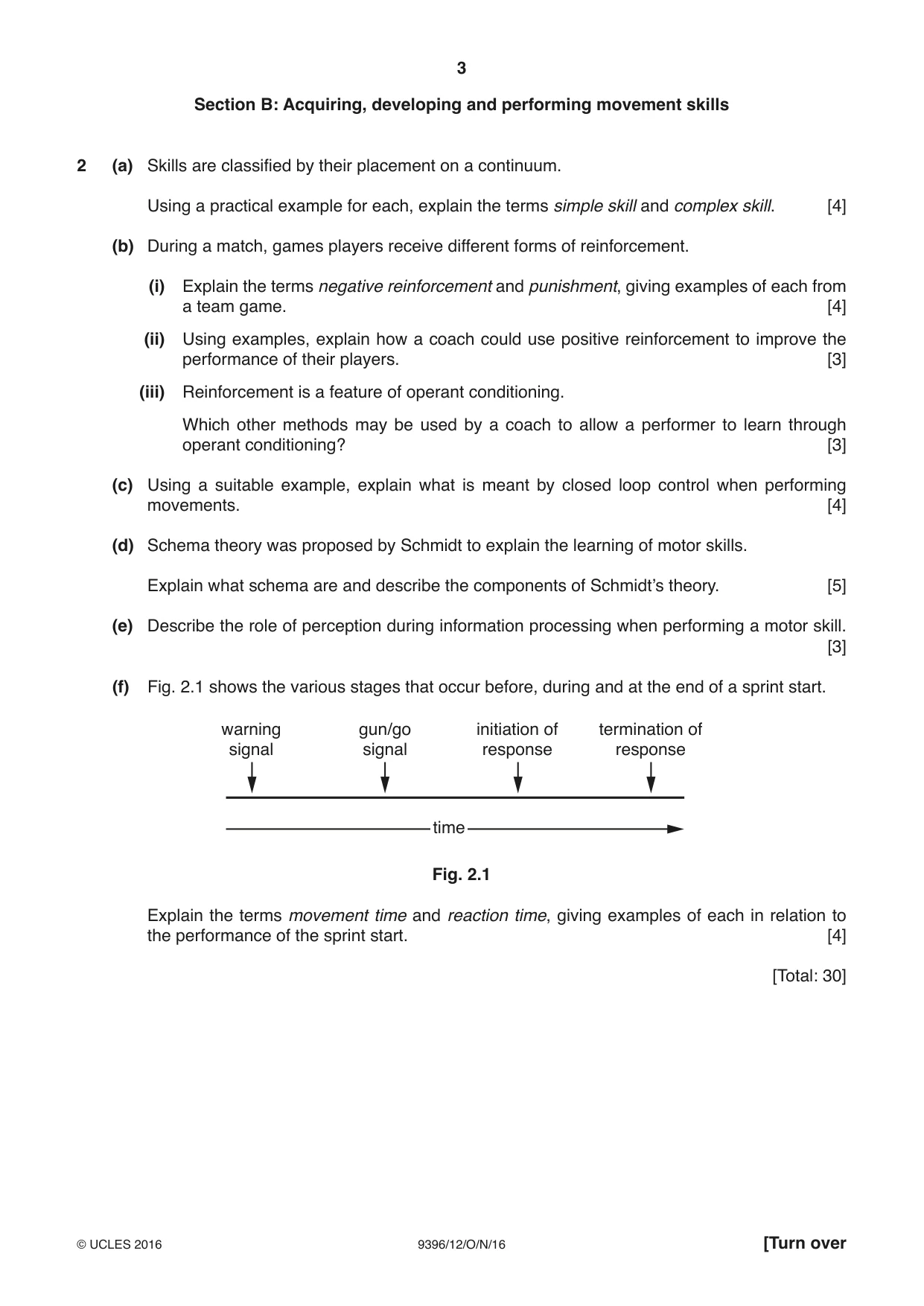
3 9396/12/O/N/16 © UCLES 2016 [Turn over Section B: Acquiring, developing and performing movement skills 2 (a) Skills are classified by their placement on a continuum. Using a practical example for each, explain the terms simple skill and complex skill. [4] (b) During a match, games players receive different forms of reinforcement. (i) Explain the terms negative reinforcement and punishment, giving examples of each from a team game. [4] (ii) Using examples, explain how a coach could use positive reinforcement to improve the performance of their players. [3] (iii) Reinforcement is a feature of operant conditioning. Which other methods may be used by a coach to allow a performer to learn through operant conditioning? [3] (c) Using a suitable example, explain what is meant by closed loop control when performing movements. [4] (d) Schema theory was proposed by Schmidt to explain the learning of motor skills. Explain what schema are and describe the components of Schmidt’s theory. [5] (e) Describe the role of perception during information processing when performing a motor skill. [3] (f) Fig. 2.1 shows the various stages that occur before, during and at the end of a sprint start. warning signal gun/go signal initiation of response time termination of response Fig. 2.1 Explain the terms movement time and reaction time, giving examples of each in relation to the performance of the sprint start. [4] [Total: 30]
Question paper, page 4
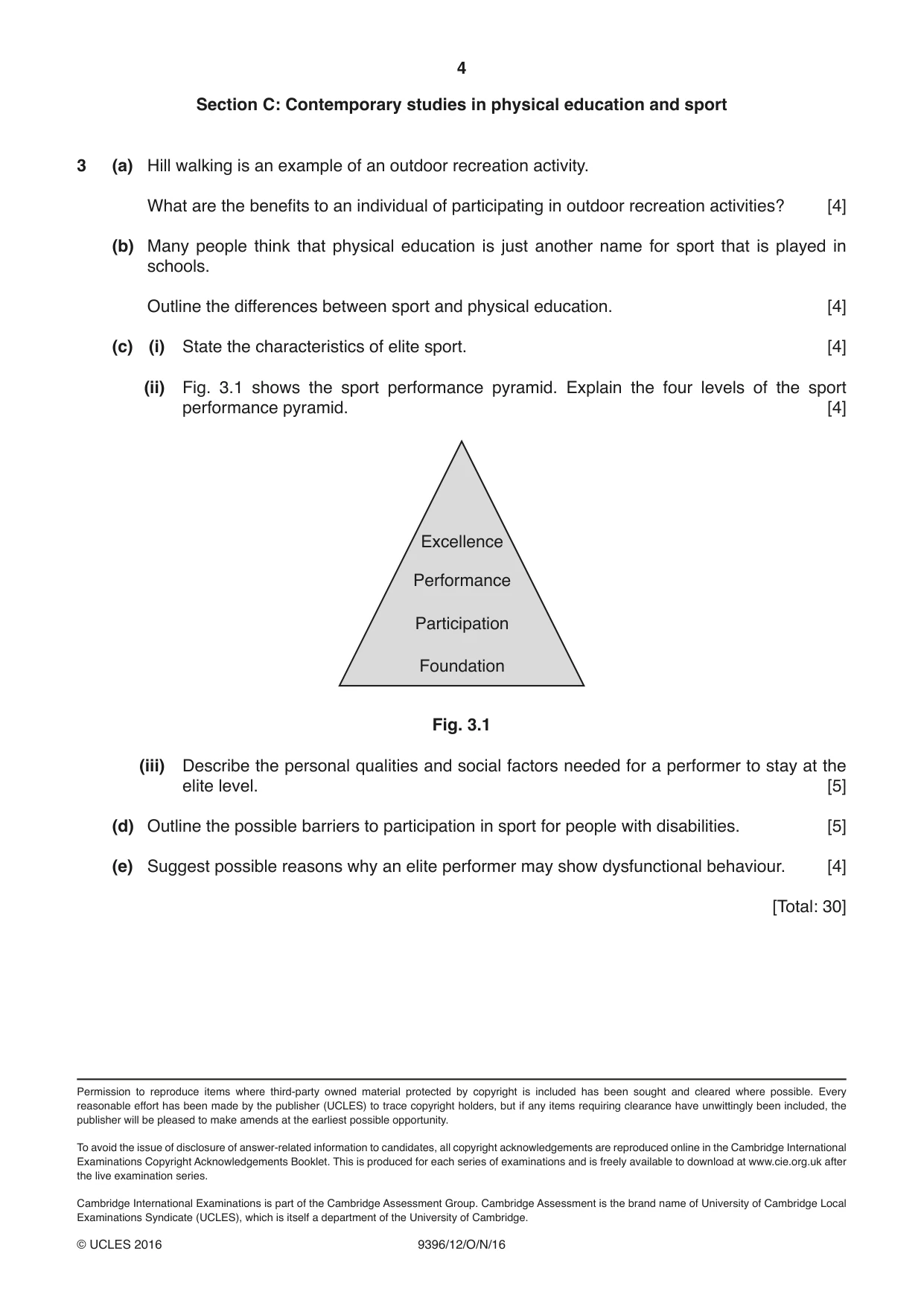
4 9396/12/O/N/16 © UCLES 2016 Section C: Contemporary studies in physical education and sport 3 (a) Hill walking is an example of an outdoor recreation activity. What are the benefits to an individual of participating in outdoor recreation activities? [4] (b) Many people think that physical education is just another name for sport that is played in schools. Outline the differences between sport and physical education. [4] (c) (i) State the characteristics of elite sport. [4] (ii) Fig. 3.1 shows the sport performance pyramid. Explain the four levels of the sport performance pyramid. [4] Excellence Performance Participation Foundation Fig. 3.1 (iii) Describe the personal qualities and social factors needed for a performer to stay at the elite level. [5] (d) Outline the possible barriers to participation in sport for people with disabilities. [5] (e) Suggest possible reasons why an elite performer may show dysfunctional behaviour. [4] [Total: 30] Permission to reproduce items where third-party owned material protected by copyright is included has been sought and cleared where possible. Every reasonable effort has been made by the publisher (UCLES) to trace copyright holders, but if any items requiring clearance have unwittingly been included, the publisher will be pleased to make amends at the earliest possible opportunity. To avoid the issue of disclosure of answer-related information to candidates, all copyright acknowledgements are reproduced online in the Cambridge International Examinations Copyright Acknowledgements Booklet. This is produced for each series of examinations and is freely available to download at www.cie.org.uk after the live examination series. Cambridge International Examinations is part of the Cambridge Assessment Group. Cambridge Assessment is the brand name of University of Cambridge Local Examinations Syndicate (UCLES), which is itself a department of the University of Cambridge.
Mark scheme, page 1
® IGCSE is the registered trademark of Cambridge International Examinations. This document consists of 9 printed pages. © UCLES 2016 [Turn over Cambridge International Examinations Cambridge International Advanced Subsidiary and Advanced Level PHYSICAL EDUCATION 9396/12 Paper 1 October/November 2016 MARK SCHEME Maximum Mark: 90 Published This mark scheme is published as an aid to teachers and candidates, to indicate the requirements of the examination. It shows the basis on which Examiners were instructed to award marks. It does not indicate the details of the discussions that took place at an Examiners’ meeting before marking began, which would have considered the acceptability of alternative answers. Mark schemes should be read in conjunction with the question paper and the Principal Examiner Report for Teachers. Cambridge will not enter into discussions about these mark schemes. Cambridge is publishing the mark schemes for the October/November 2016 series for most Cambridge IGCSE®, Cambridge International A and AS Level components and some Cambridge O Level components.
Mark scheme, page 2
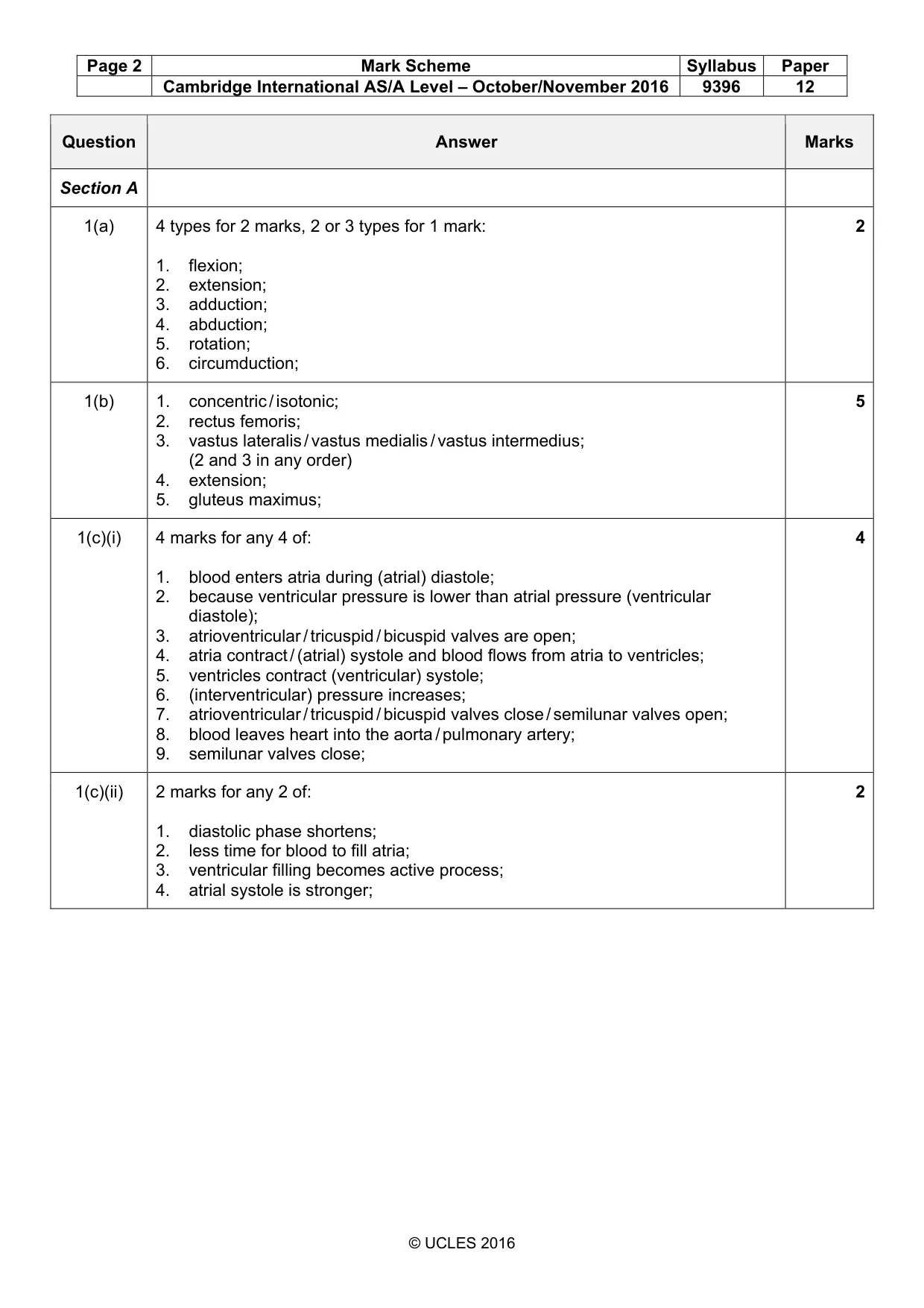
Page 2 Mark Scheme Syllabus Paper Cambridge International AS/A Level – October/November 2016 9396 12 © UCLES 2016 Question Answer Marks Section A 1(a) 4 types for 2 marks, 2 or 3 types for 1 mark: 1. flexion; 2. extension; 3. adduction; 4. abduction; 5. rotation; 6. circumduction; 2 1(b) 1. concentric / isotonic; 2. rectus femoris; 3. vastus lateralis / vastus medialis / vastus intermedius; (2 and 3 in any order) 4. extension; 5. gluteus maximus; 5 1(c)(i) 4 marks for any 4 of: 1. blood enters atria during (atrial) diastole; 2. because ventricular pressure is lower than atrial pressure (ventricular diastole); 3. atrioventricular / tricuspid / bicuspid valves are open; 4. atria contract / (atrial) systole and blood flows from atria to ventricles; 5. ventricles contract (ventricular) systole; 6. (interventricular) pressure increases; 7. atrioventricular / tricuspid / bicuspid valves close / semilunar valves open; 8. blood leaves heart into the aorta / pulmonary artery; 9. semilunar valves close; 4 1(c)(ii) 2 marks for any 2 of: 1. diastolic phase shortens; 2. less time for blood to fill atria; 3. ventricular filling becomes active process; 4. atrial systole is stronger; 2
Mark scheme, page 3
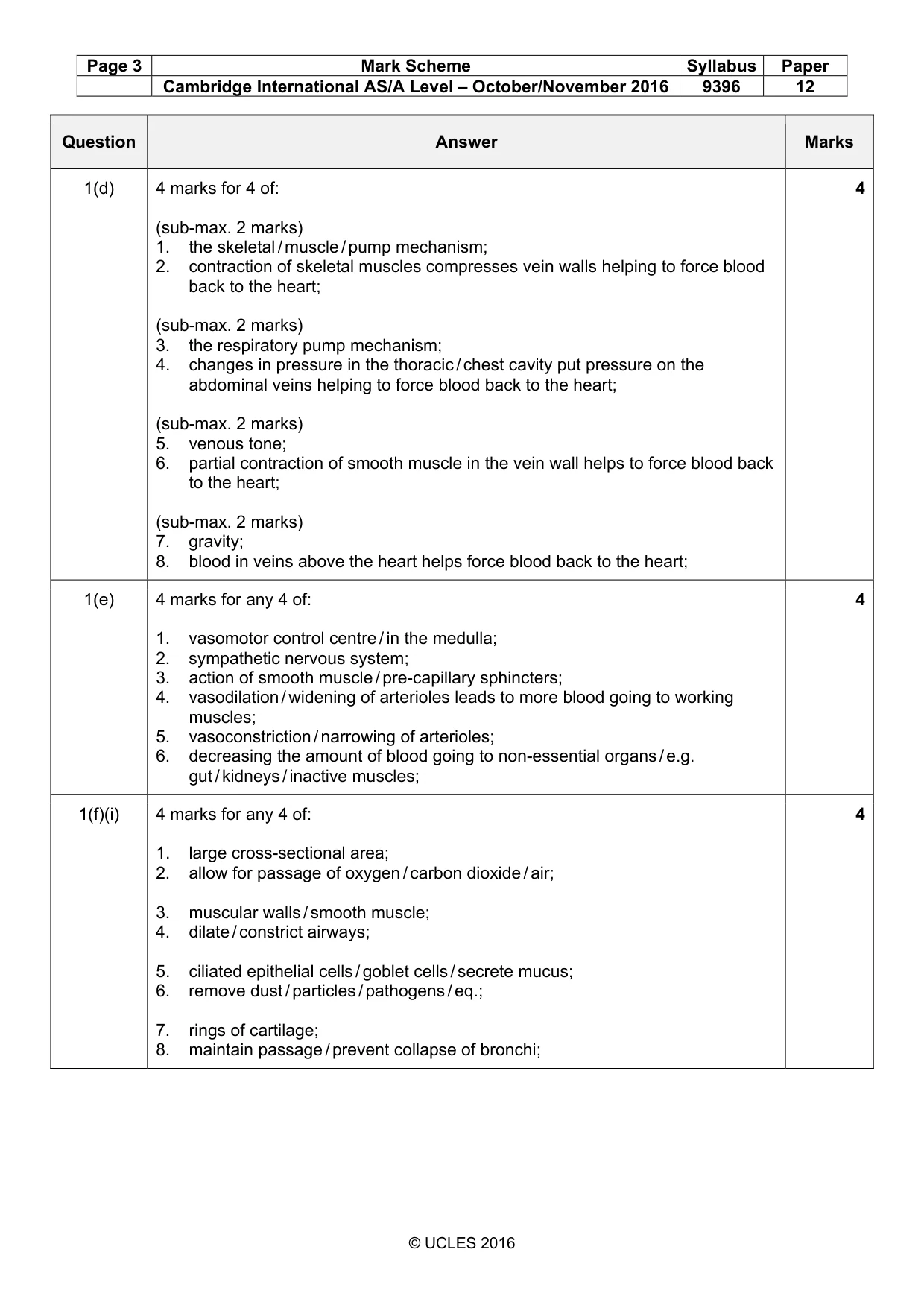
Page 3 Mark Scheme Syllabus Paper Cambridge International AS/A Level – October/November 2016 9396 12 © UCLES 2016 Question Answer Marks 1(d) 4 marks for 4 of: (sub-max. 2 marks) 1. the skeletal / muscle / pump mechanism; 2. contraction of skeletal muscles compresses vein walls helping to force blood back to the heart; (sub-max. 2 marks) 3. the respiratory pump mechanism; 4. changes in pressure in the thoracic / chest cavity put pressure on the abdominal veins helping to force blood back to the heart; (sub-max. 2 marks) 5. venous tone; 6. partial contraction of smooth muscle in the vein wall helps to force blood back to the heart; (sub-max. 2 marks) 7. gravity; 8. blood in veins above the heart helps force blood back to the heart; 4 1(e) 4 marks for any 4 of: 1. vasomotor control centre / in the medulla; 2. sympathetic nervous system; 3. action of smooth muscle / pre-capillary sphincters; 4. vasodilation / widening of arterioles leads to more blood going to working muscles; 5. vasoconstriction / narrowing of arterioles; 6. decreasing the amount of blood going to non-essential organs / e.g. gut / kidneys / inactive muscles; 4 1(f)(i) 4 marks for any 4 of: 1. large cross-sectional area; 2. allow for passage of oxygen / carbon dioxide / air; 3. muscular walls / smooth muscle; 4. dilate / constrict airways; 5. ciliated epithelial cells / goblet cells / secrete mucus; 6. remove dust / particles / pathogens / eq.; 7. rings of cartilage; 8. maintain passage / prevent collapse of bronchi; 4
Mark scheme, page 4
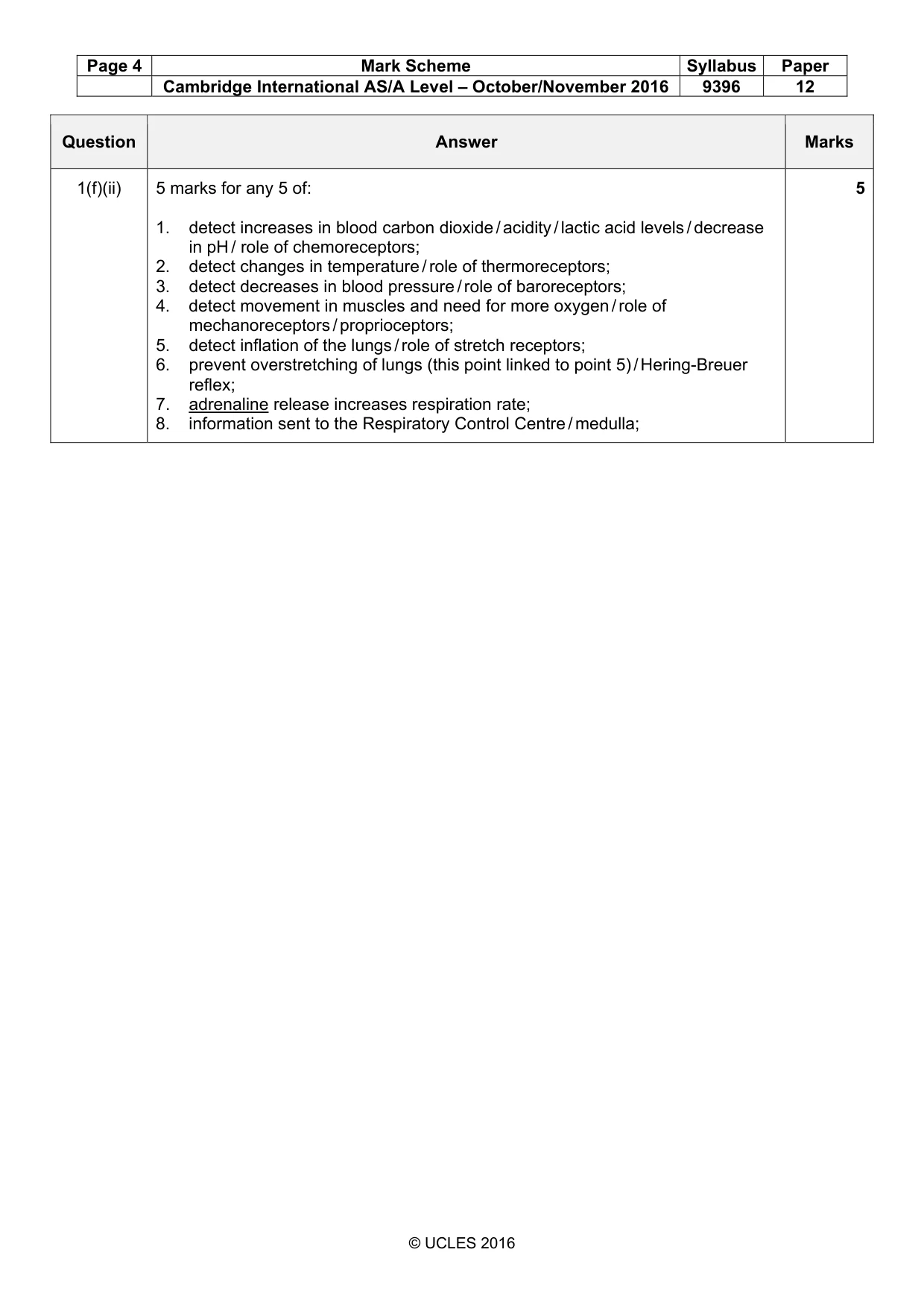
Page 4 Mark Scheme Syllabus Paper Cambridge International AS/A Level – October/November 2016 9396 12 © UCLES 2016 Question Answer Marks 1(f)(ii) 5 marks for any 5 of: 1. detect increases in blood carbon dioxide / acidity / lactic acid levels / decrease in pH / role of chemoreceptors; 2. detect changes in temperature / role of thermoreceptors; 3. detect decreases in blood pressure / role of baroreceptors; 4. detect movement in muscles and need for more oxygen / role of mechanoreceptors / proprioceptors; 5. detect inflation of the lungs / role of stretch receptors; 6. prevent overstretching of lungs (this point linked to point 5) / Hering-Breuer reflex; 7. adrenaline release increases respiration rate; 8. information sent to the Respiratory Control Centre / medulla; 5
Mark scheme, page 5
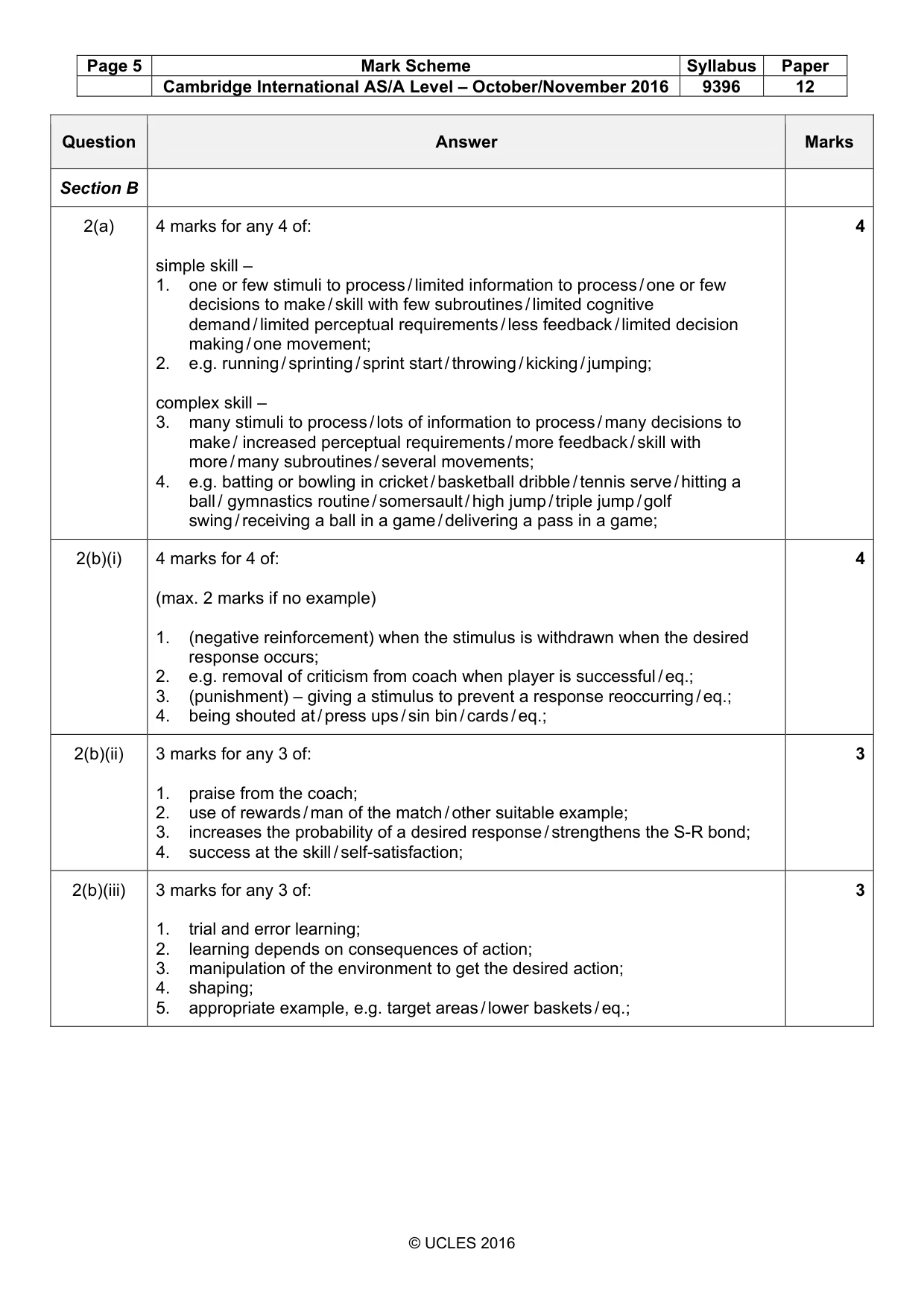
Page 5 Mark Scheme Syllabus Paper Cambridge International AS/A Level – October/November 2016 9396 12 © UCLES 2016 Question Answer Marks Section B 2(a) 4 marks for any 4 of: simple skill – 1. one or few stimuli to process / limited information to process / one or few decisions to make / skill with few subroutines / limited cognitive demand / limited perceptual requirements / less feedback / limited decision making / one movement; 2. e.g. running / sprinting / sprint start / throwing / kicking / jumping; complex skill – 3. many stimuli to process / lots of information to process / many decisions to make / increased perceptual requirements / more feedback / skill with more / many subroutines / several movements; 4. e.g. batting or bowling in cricket / basketball dribble / tennis serve / hitting a ball / gymnastics routine / somersault / high jump / triple jump / golf swing / receiving a ball in a game / delivering a pass in a game; 4 2(b)(i) 4 marks for 4 of: (max. 2 marks if no example) 1. (negative reinforcement) when the stimulus is withdrawn when the desired response occurs; 2. e.g. removal of criticism from coach when player is successful / eq.; 3. (punishment) – giving a stimulus to prevent a response reoccurring / eq.; 4. being shouted at / press ups / sin bin / cards / eq.; 4 2(b)(ii) 3 marks for any 3 of: 1. praise from the coach; 2. use of rewards / man of the match / other suitable example; 3. increases the probability of a desired response / strengthens the S-R bond; 4. success at the skill / self-satisfaction; 3 2(b)(iii) 3 marks for any 3 of: 1. trial and error learning; 2. learning depends on consequences of action; 3. manipulation of the environment to get the desired action; 4. shaping; 5. appropriate example, e.g. target areas / lower baskets / eq.; 3
Mark scheme, page 6
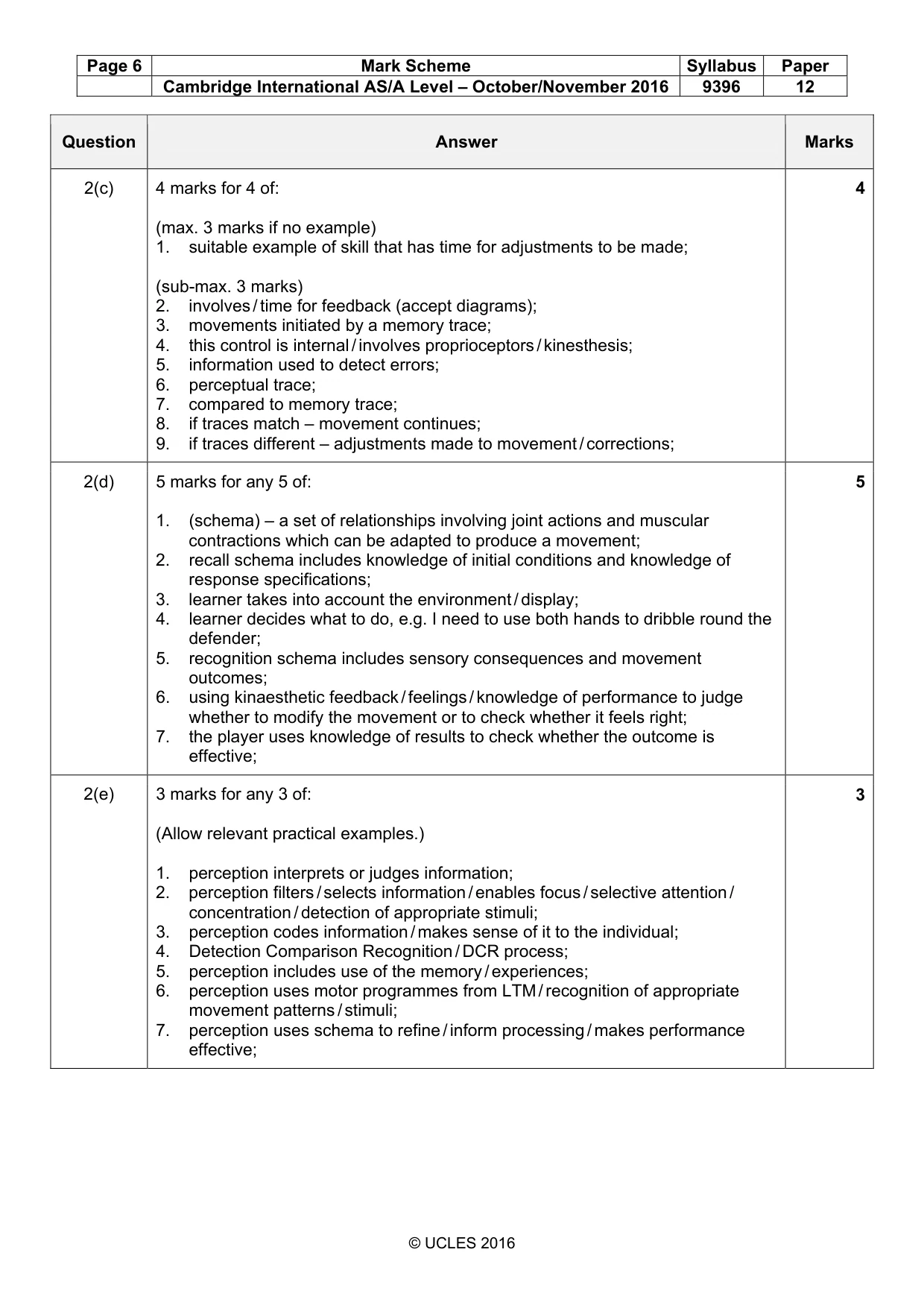
Page 6 Mark Scheme Syllabus Paper Cambridge International AS/A Level – October/November 2016 9396 12 © UCLES 2016 Question Answer Marks 2(c) 4 marks for 4 of: (max. 3 marks if no example) 1. suitable example of skill that has time for adjustments to be made; (sub-max. 3 marks) 2. involves / time for feedback (accept diagrams); 3. movements initiated by a memory trace; 4. this control is internal / involves proprioceptors / kinesthesis; 5. information used to detect errors; 6. perceptual trace; 7. compared to memory trace; 8. if traces match – movement continues; 9. if traces different – adjustments made to movement / corrections; 4 2(d) 5 marks for any 5 of: 1. (schema) – a set of relationships involving joint actions and muscular contractions which can be adapted to produce a movement; 2. recall schema includes knowledge of initial conditions and knowledge of response specifications; 3. learner takes into account the environment / display; 4. learner decides what to do, e.g. I need to use both hands to dribble round the defender; 5. recognition schema includes sensory consequences and movement outcomes; 6. using kinaesthetic feedback / feelings / knowledge of performance to judge whether to modify the movement or to check whether it feels right; 7. the player uses knowledge of results to check whether the outcome is effective; 5 2(e) 3 marks for any 3 of: (Allow relevant practical examples.) 1. perception interprets or judges information; 2. perception filters / selects information / enables focus / selective attention / concentration / detection of appropriate stimuli; 3. perception codes information / makes sense of it to the individual; 4. Detection Comparison Recognition / DCR process; 5. perception includes use of the memory / experiences; 6. perception uses motor programmes from LTM / recognition of appropriate movement patterns / stimuli; 7. perception uses schema to refine / inform processing / makes performance effective; 3
Mark scheme, page 7
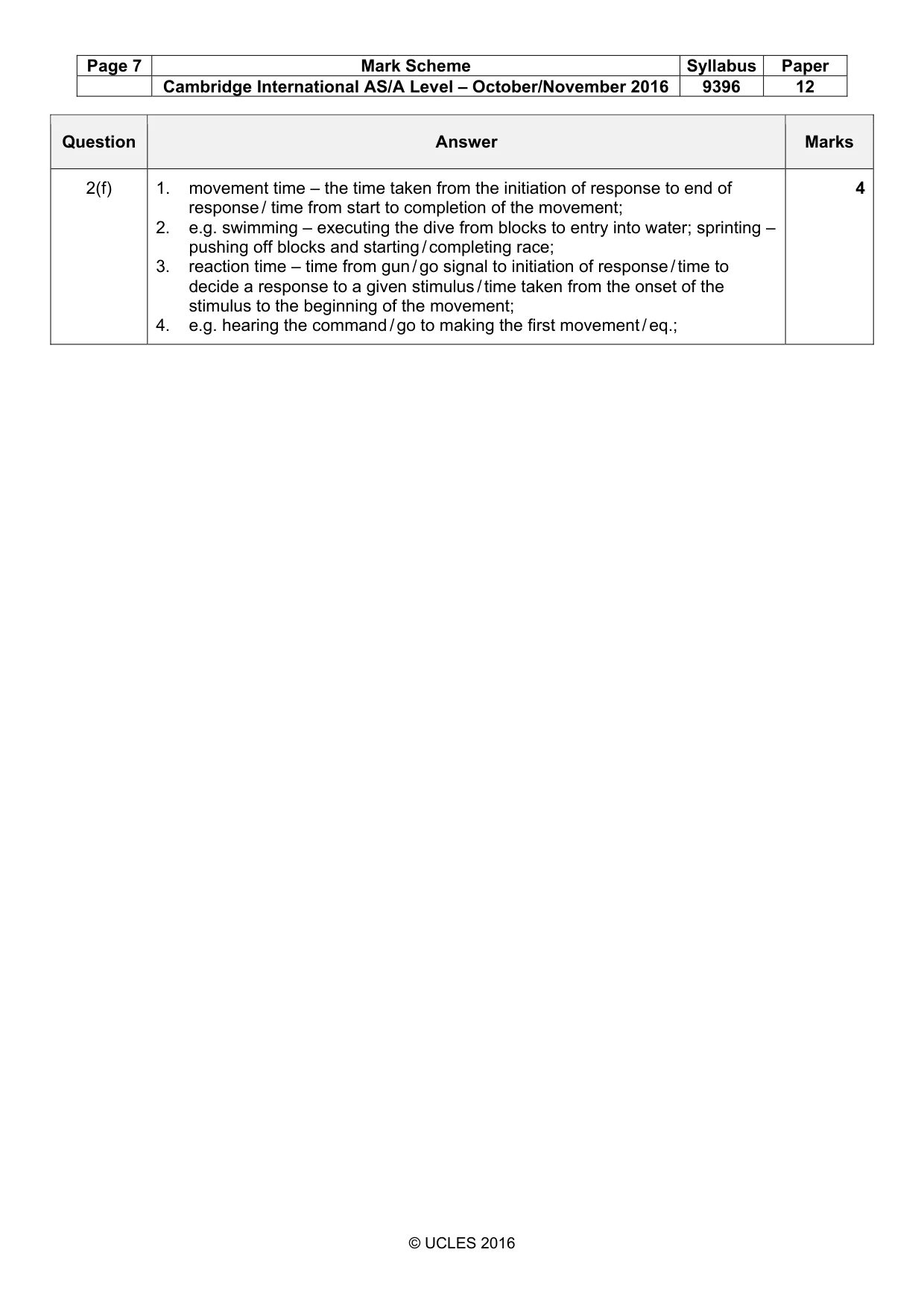
Page 7 Mark Scheme Syllabus Paper Cambridge International AS/A Level – October/November 2016 9396 12 © UCLES 2016 Question Answer Marks 2(f) 1. movement time – the time taken from the initiation of response to end of response / time from start to completion of the movement; 2. e.g. swimming – executing the dive from blocks to entry into water; sprinting – pushing off blocks and starting / completing race; 3. reaction time – time from gun / go signal to initiation of response / time to decide a response to a given stimulus / time taken from the onset of the stimulus to the beginning of the movement; 4. e.g. hearing the command / go to making the first movement / eq.; 4
Mark scheme, page 8
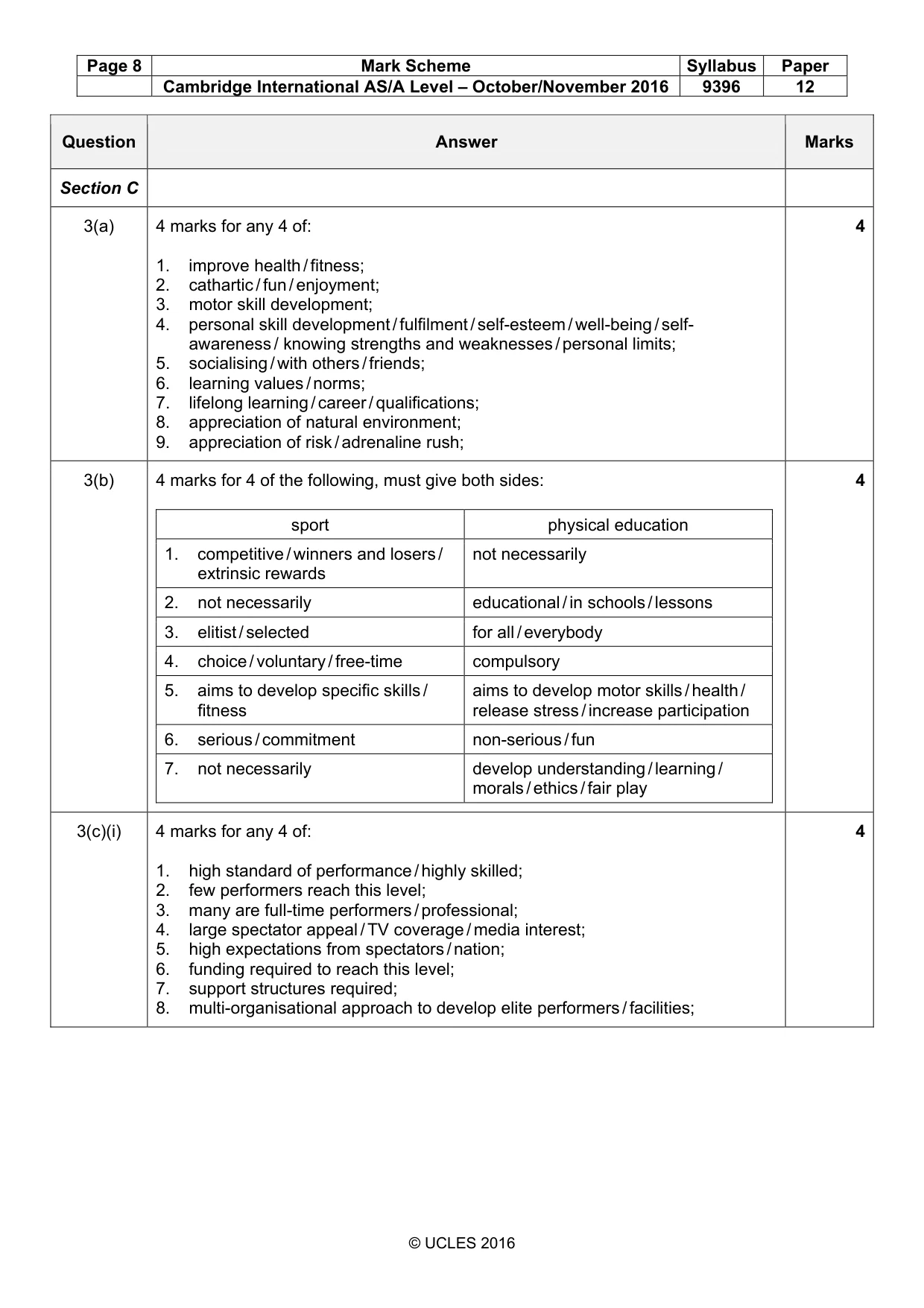
Page 8 Mark Scheme Syllabus Paper Cambridge International AS/A Level – October/November 2016 9396 12 © UCLES 2016 Question Answer Marks Section C 3(a) 4 marks for any 4 of: 1. improve health / fitness; 2. cathartic / fun / enjoyment; 3. motor skill development; 4. personal skill development / fulfilment / self-esteem / well-being / self- awareness / knowing strengths and weaknesses / personal limits; 5. socialising / with others / friends; 6. learning values / norms; 7. lifelong learning / career / qualifications; 8. appreciation of natural environment; 9. appreciation of risk / adrenaline rush; 4 3(b) 4 marks for 4 of the following, must give both sides: sport physical education 1. competitive / winners and losers / extrinsic rewards not necessarily 2. not necessarily educational / in schools / lessons 3. elitist / selected for all / everybody 4. choice / voluntary / free-time compulsory 5. aims to develop specific skills / fitness aims to develop motor skills / health / release stress / increase participation 6. serious / commitment non-serious / fun 7. not necessarily develop understanding / learning / morals / ethics / fair play 4 3(c)(i) 4 marks for any 4 of: 1. high standard of performance / highly skilled; 2. few performers reach this level; 3. many are full-time performers / professional; 4. large spectator appeal / TV coverage / media interest; 5. high expectations from spectators / nation; 6. funding required to reach this level; 7. support structures required; 8. multi-organisational approach to develop elite performers / facilities; 4
Mark scheme, page 9
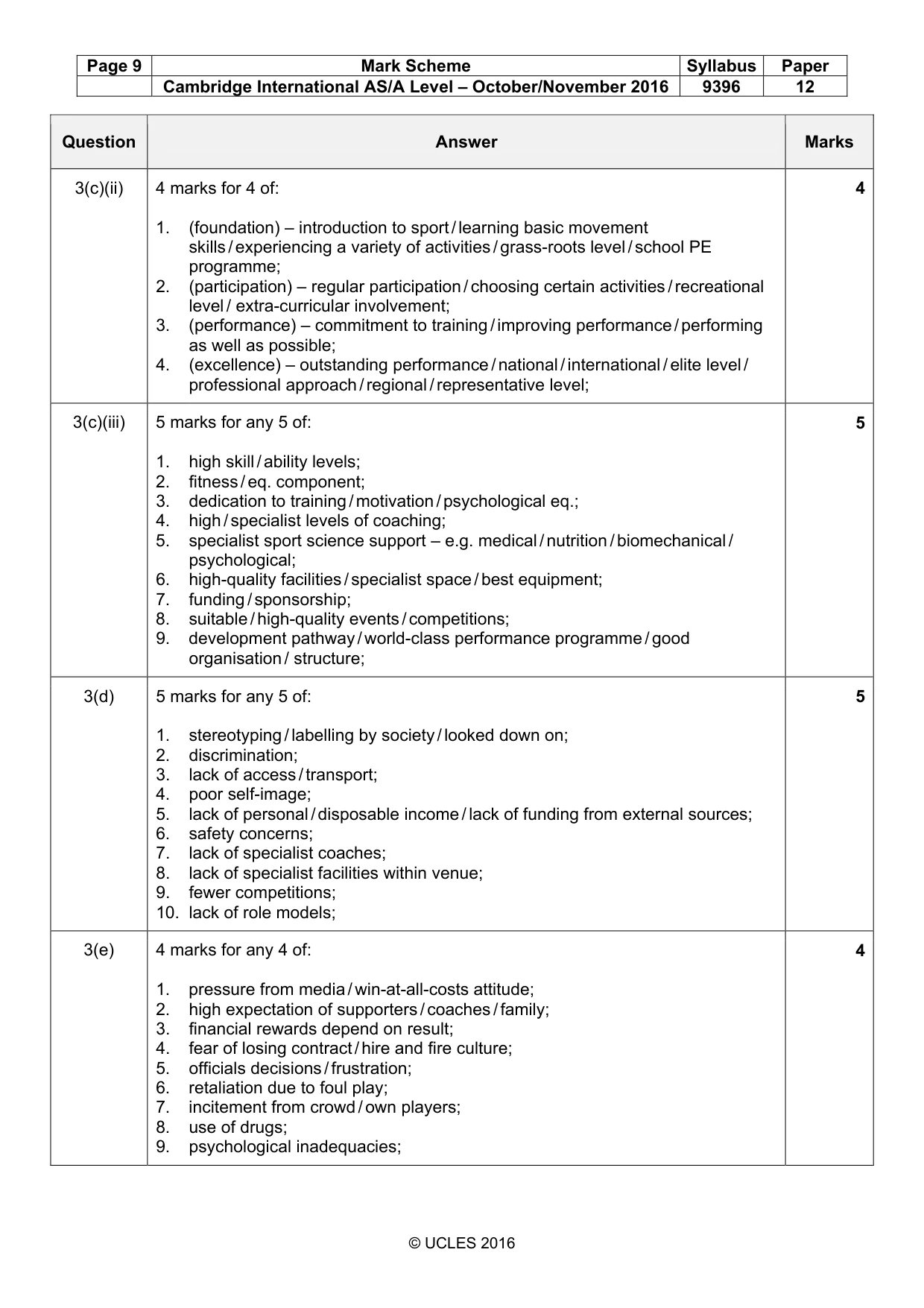
Page 9 Mark Scheme Syllabus Paper Cambridge International AS/A Level – October/November 2016 9396 12 © UCLES 2016 Question Answer Marks 3(c)(ii) 4 marks for 4 of: 1. (foundation) – introduction to sport / learning basic movement skills / experiencing a variety of activities / grass-roots level / school PE programme; 2. (participation) – regular participation / choosing certain activities / recreational level / extra-curricular involvement; 3. (performance) – commitment to training / improving performance / performing as well as possible; 4. (excellence) – outstanding performance / national / international / elite level / professional approach / regional / representative level; 4 3(c)(iii) 5 marks for any 5 of: 1. high skill / ability levels; 2. fitness / eq. component; 3. dedication to training / motivation / psychological eq.; 4. high / specialist levels of coaching; 5. specialist sport science support – e.g. medical / nutrition / biomechanical / psychological; 6. high-quality facilities / specialist space / best equipment; 7. funding / sponsorship; 8. suitable / high-quality events / competitions; 9. development pathway / world-class performance programme / good organisation / structure; 5 3(d) 5 marks for any 5 of: 1. stereotyping / labelling by society / looked down on; 2. discrimination; 3. lack of access / transport; 4. poor self-image; 5. lack of personal / disposable income / lack of funding from external sources; 6. safety concerns; 7. lack of specialist coaches; 8. lack of specialist facilities within venue; 9. fewer competitions; 10. lack of role models; 5 3(e) 4 marks for any 4 of: 1. pressure from media / win-at-all-costs attitude; 2. high expectation of supporters / coaches / family; 3. financial rewards depend on result; 4. fear of losing contract / hire and fire culture; 5. officials decisions / frustration; 6. retaliation due to foul play; 7. incitement from crowd / own players; 8. use of drugs; 9. psychological inadequacies; 4
What you needed in this session
Cambridge’s own grade thresholds for 2016 Oct/Nov, Paper 1 · Variant 2. A higher threshold means an easier paper — the bar moves with how the cohort did.