Cambridge A Level Physical Education 9396 — 2016 Oct/Nov Paper 1 · Variant 1
9396/11/O/N/16 · 90 marks · ≈101 min
The question paper and its mark scheme, free to read here and free to download. This is Cambridge’s own paper, exactly as it was sat.
Question paper4 pages
Mark scheme7 pages
Answers below. Sit the paper first if you are practising.
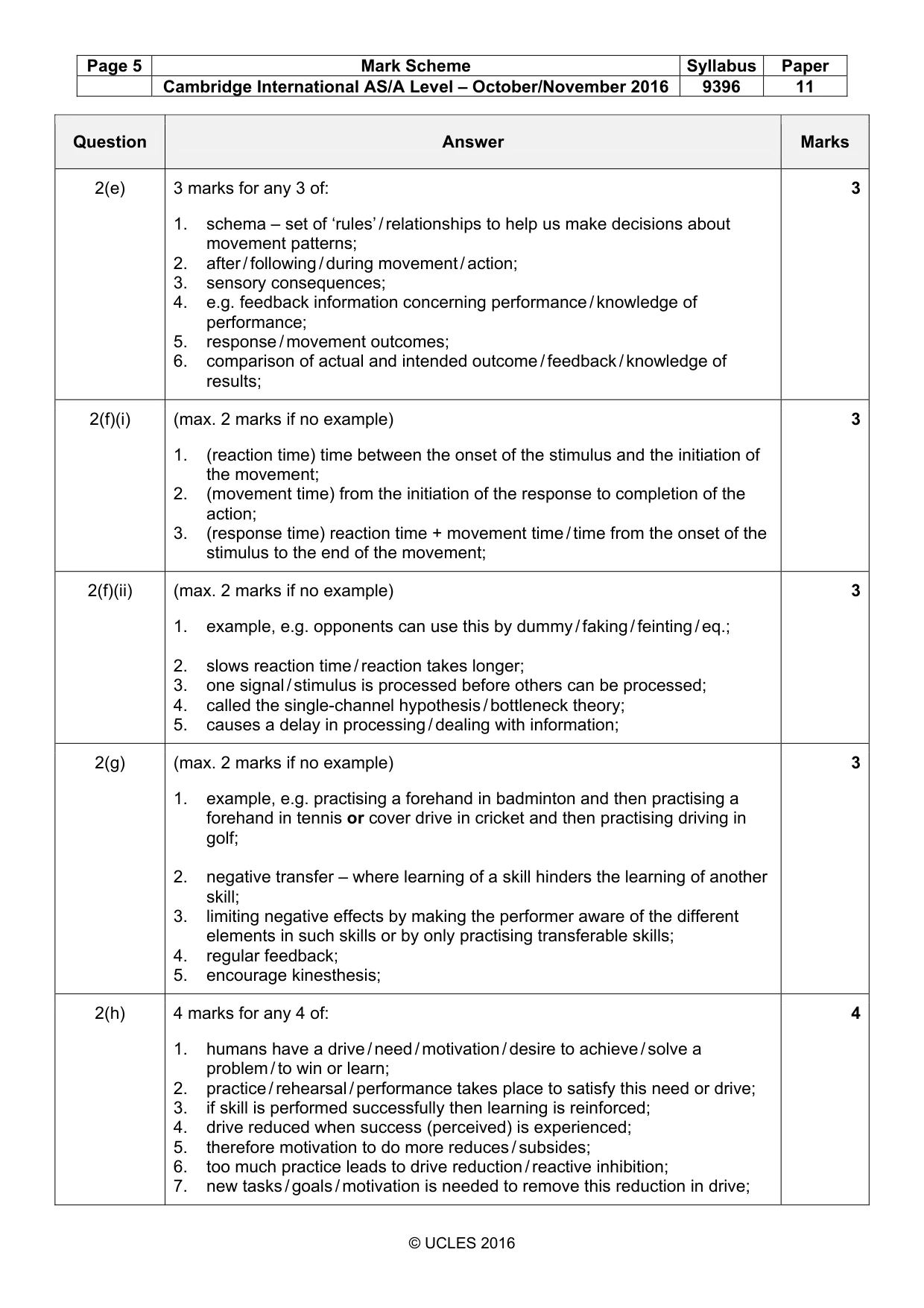
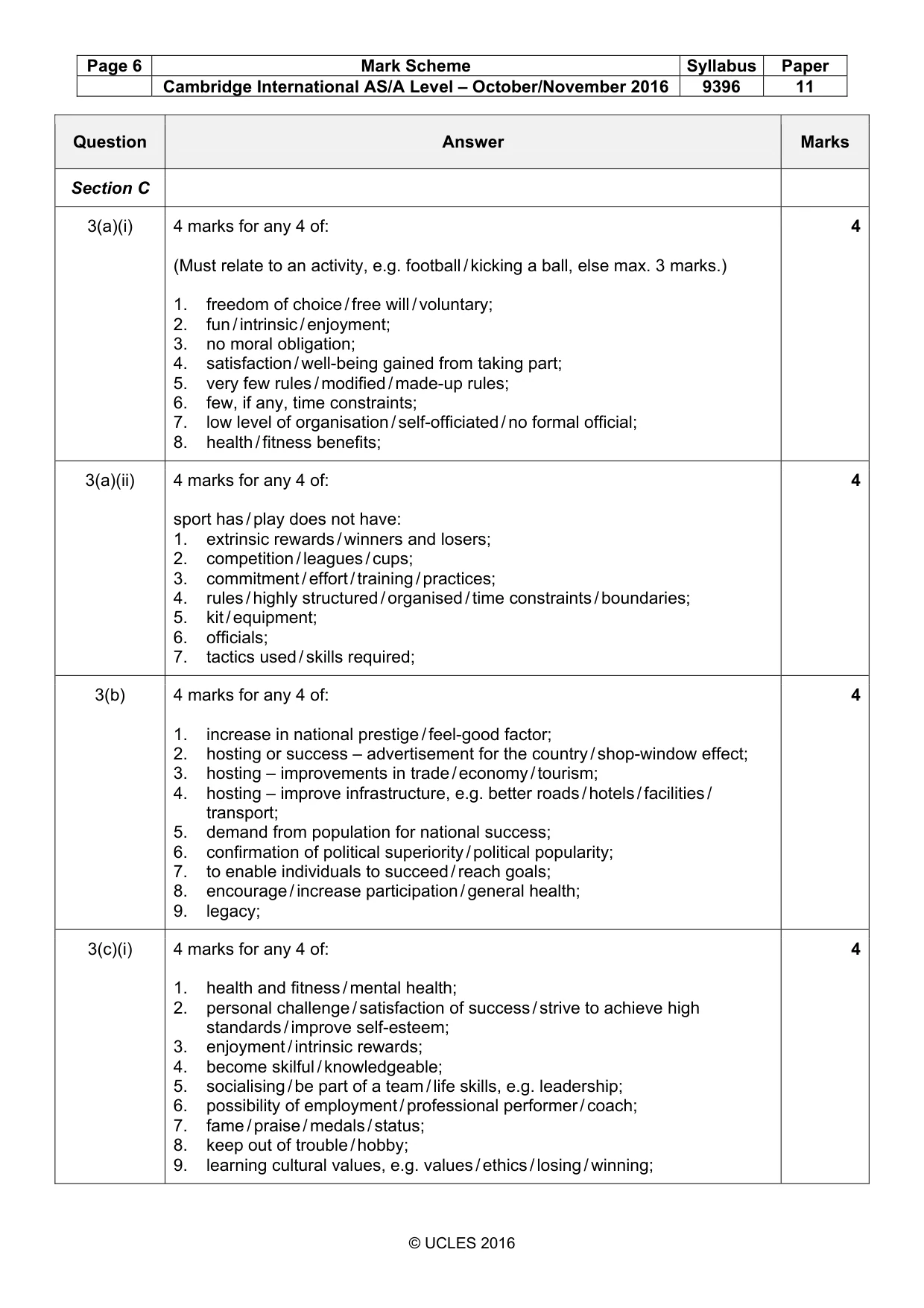
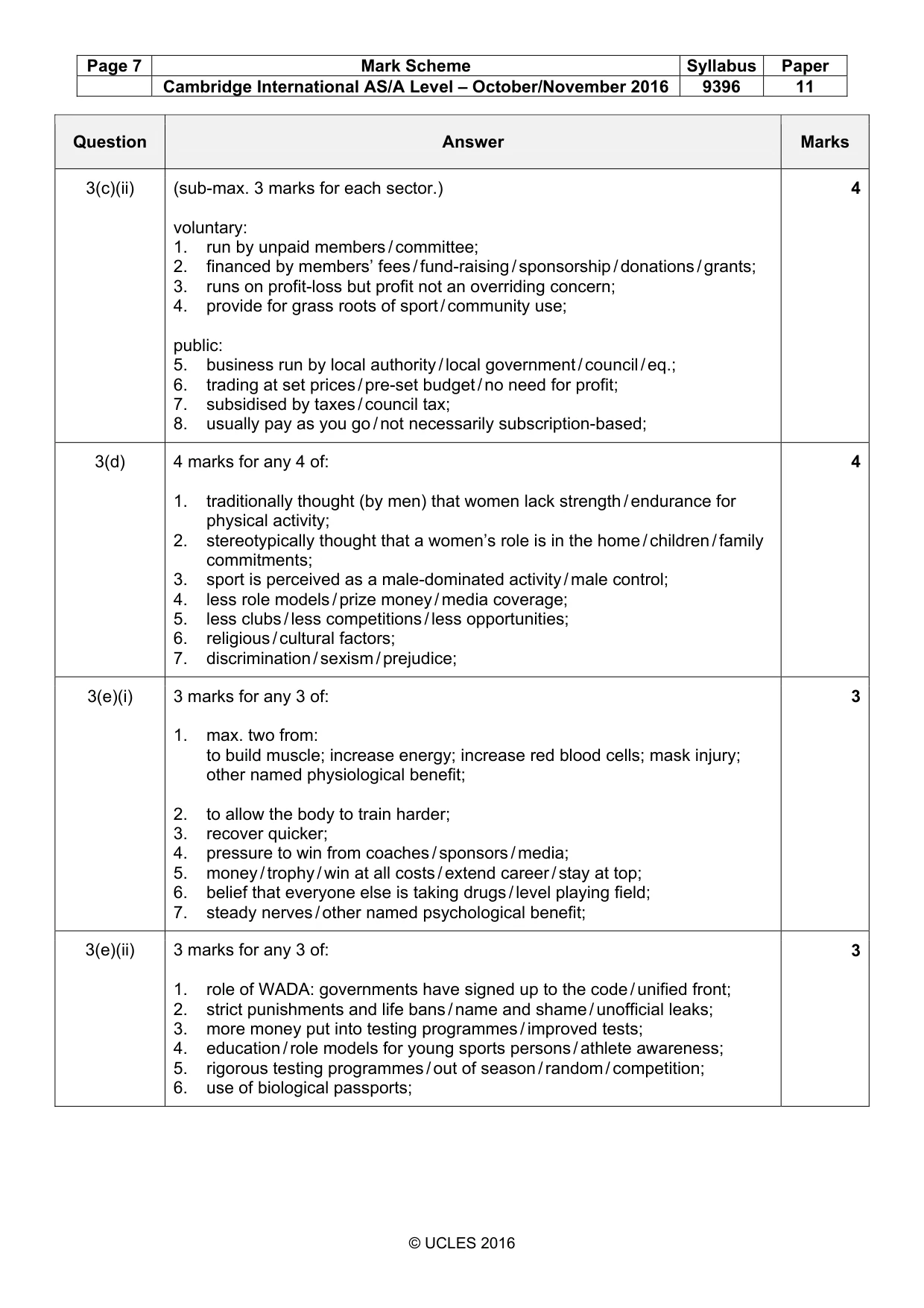
Paper as text
Question paper, page 1
This document consists of 4 printed pages and 1 insert. DC (ST/SW) 109243/3 © UCLES 2016 [Turn over Cambridge International Examinations Cambridge International Advanced Subsidiary and Advanced Level * 3 5 8 1 9 0 2 9 8 1 * PHYSICAL EDUCATION 9396/11 Paper 1 October/November 2016 2 hours 30 minutes No Additional Materials are required. READ THESE INSTRUCTIONS FIRST An answer booklet is provided inside this question paper. You should follow the instructions on the front cover of the answer booklet. If you need additional answer paper ask the invigilator for a continuation booklet. Answer all questions. Electronic calculators may be used. You may lose marks if you do not show your working or if you do not use appropriate units. The number of marks is given in brackets [ ] at the end of each question or part question.
Question paper, page 2
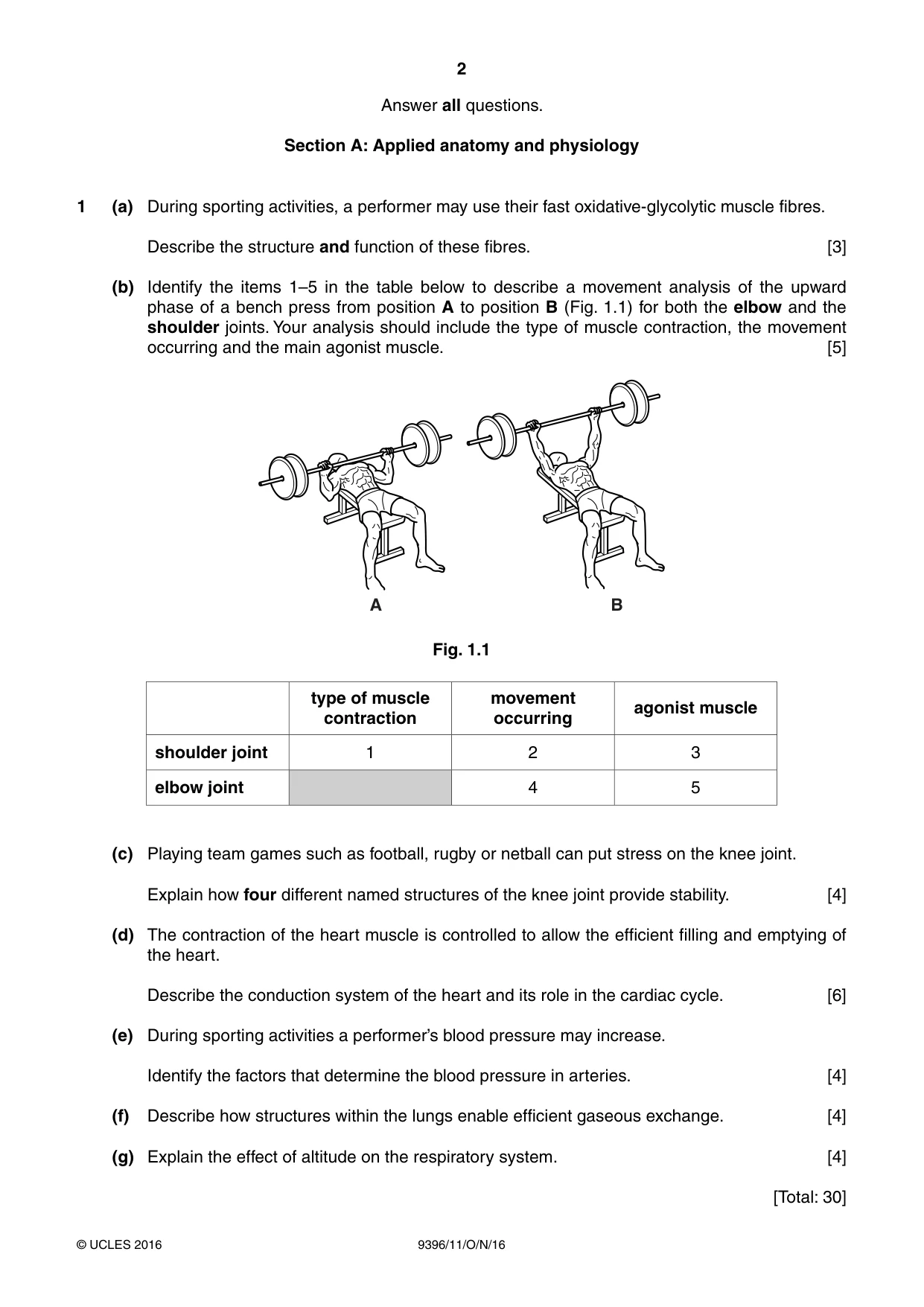
2 9396/11/O/N/16 © UCLES 2016 Answer all questions. Section A: Applied anatomy and physiology 1 (a) During sporting activities, a performer may use their fast oxidative-glycolytic muscle fibres. Describe the structure and function of these fibres. [3] (b) Identify the items 1–5 in the table below to describe a movement analysis of the upward phase of a bench press from position A to position B (Fig. 1.1) for both the elbow and the shoulder joints. Your analysis should include the type of muscle contraction, the movement occurring and the main agonist muscle. [5] A B Fig. 1.1 type of muscle contraction movement occurring agonist muscle shoulder joint 1 2 3 elbow joint 4 5 (c) Playing team games such as football, rugby or netball can put stress on the knee joint. Explain how four different named structures of the knee joint provide stability. [4] (d) The contraction of the heart muscle is controlled to allow the efficient filling and emptying of the heart. Describe the conduction system of the heart and its role in the cardiac cycle. [6] (e) During sporting activities a performer’s blood pressure may increase. Identify the factors that determine the blood pressure in arteries. [4] (f) Describe how structures within the lungs enable efficient gaseous exchange. [4] (g) Explain the effect of altitude on the respiratory system. [4] [Total: 30]
Question paper, page 3
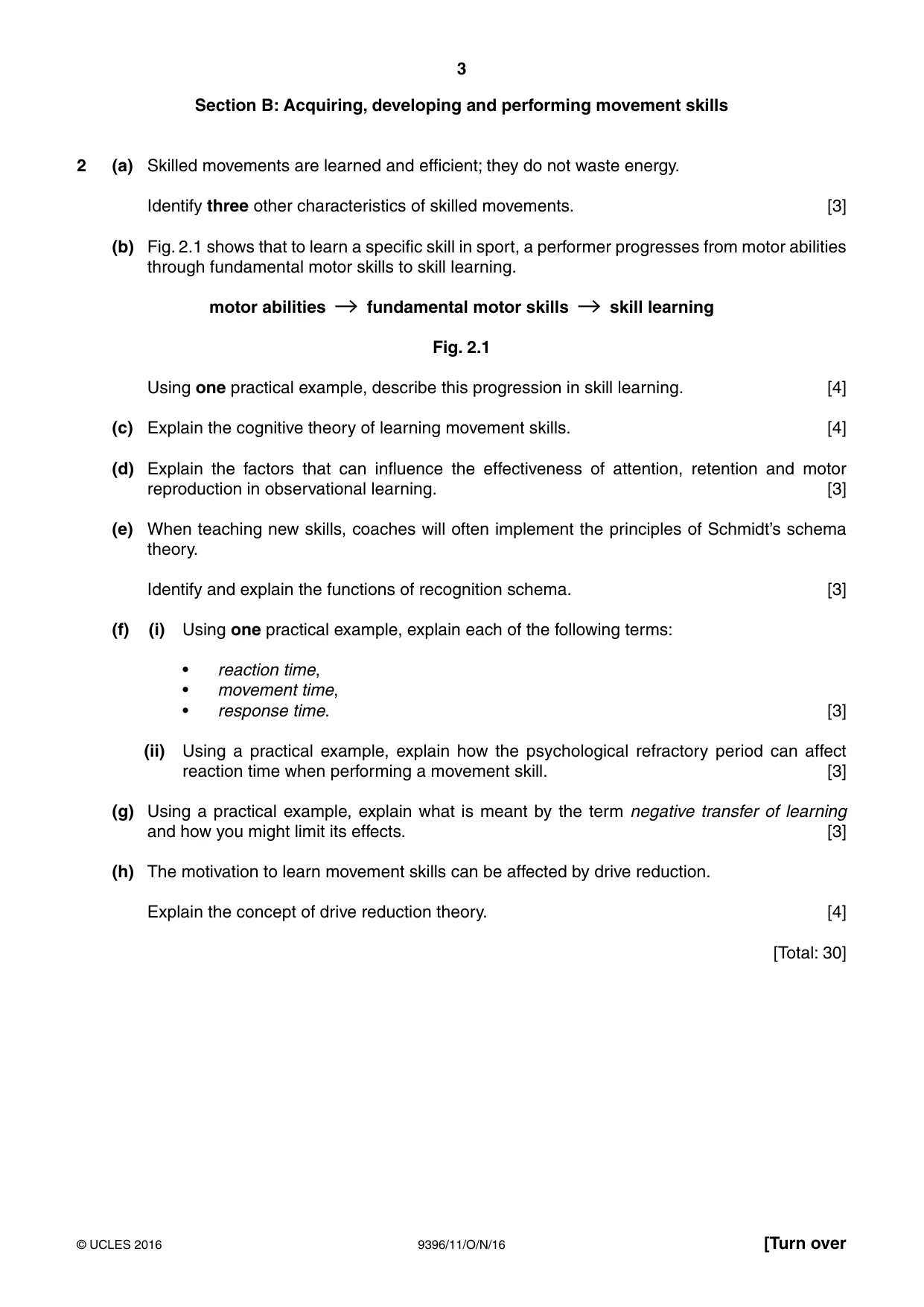
3 9396/11/O/N/16 © UCLES 2016 [Turn over Section B: Acquiring, developing and performing movement skills 2 (a) Skilled movements are learned and efficient; they do not waste energy. Identify three other characteristics of skilled movements. [3] (b) Fig. 2.1 shows that to learn a specific skill in sport, a performer progresses from motor abilities through fundamental motor skills to skill learning. motor abilities fundamental motor skills skill learning Fig. 2.1 Using one practical example, describe this progression in skill learning. [4] (c) Explain the cognitive theory of learning movement skills. [4] (d) Explain the factors that can influence the effectiveness of attention, retention and motor reproduction in observational learning. [3] (e) When teaching new skills, coaches will often implement the principles of Schmidt’s schema theory. Identify and explain the functions of recognition schema. [3] (f) (i) Using one practical example, explain each of the following terms: • reaction time, • movement time, • response time. [3] (ii) Using a practical example, explain how the psychological refractory period can affect reaction time when performing a movement skill. [3] (g) Using a practical example, explain what is meant by the term negative transfer of learning and how you might limit its effects. [3] (h) The motivation to learn movement skills can be affected by drive reduction. Explain the concept of drive reduction theory. [4] [Total: 30]
Question paper, page 4
4 9396/11/O/N/16 © UCLES 2016 Section C: Contemporary studies in physical education and sport 3 (a) Play is a concept within physical education and sport. (i) Using an activity of your choice, explain four similarities between play and recreation. [4] (ii) State four ways in which sport differs from play. [4] (b) Why do many countries invest heavily to achieve Olympic success? [4] (c) (i) Outline the potential benefits to an individual of continued participation in physical activity. [4] (ii) Participation in physical activity is dependent on leisure provision. Explain the terms voluntary provision and public provision. [4] (d) Describe the barriers which may prevent women from taking part in physical activity. [4] (e) Elite sport is waging a constant battle over the use of performance enhancing drugs. (i) Explain why some performers choose to take performance enhancing drugs. [3] (ii) Describe some of the measures which have been put in place to solve this problem. [3] [Total: 30] Permission to reproduce items where third-party owned material protected by copyright is included has been sought and cleared where possible. Every reasonable effort has been made by the publisher (UCLES) to trace copyright holders, but if any items requiring clearance have unwittingly been included, the publisher will be pleased to make amends at the earliest possible opportunity. To avoid the issue of disclosure of answer-related information to candidates, all copyright acknowledgements are reproduced online in the Cambridge International Examinations Copyright Acknowledgements Booklet. This is produced for each series of examinations and is freely available to download at www.cie.org.uk after the live examination series. Cambridge International Examinations is part of the Cambridge Assessment Group. Cambridge Assessment is the brand name of University of Cambridge Local Examinations Syndicate (UCLES), which is itself a department of the University of Cambridge.
Mark scheme, page 1
® IGCSE is the registered trademark of Cambridge International Examinations. This document consists of 7 printed pages. © UCLES 2016 [Turn over Cambridge International Examinations Cambridge International Advanced Subsidiary and Advanced Level PHYSICAL EDUCATION 9396/11 Paper 1 October/November 2016 MARK SCHEME Maximum Mark: 90 Published This mark scheme is published as an aid to teachers and candidates, to indicate the requirements of the examination. It shows the basis on which Examiners were instructed to award marks. It does not indicate the details of the discussions that took place at an Examiners’ meeting before marking began, which would have considered the acceptability of alternative answers. Mark schemes should be read in conjunction with the question paper and the Principal Examiner Report for Teachers. Cambridge will not enter into discussions about these mark schemes. Cambridge is publishing the mark schemes for the October/November 2016 series for most Cambridge IGCSE®, Cambridge International A and AS Level components and some Cambridge O Level components.
Mark scheme, page 2
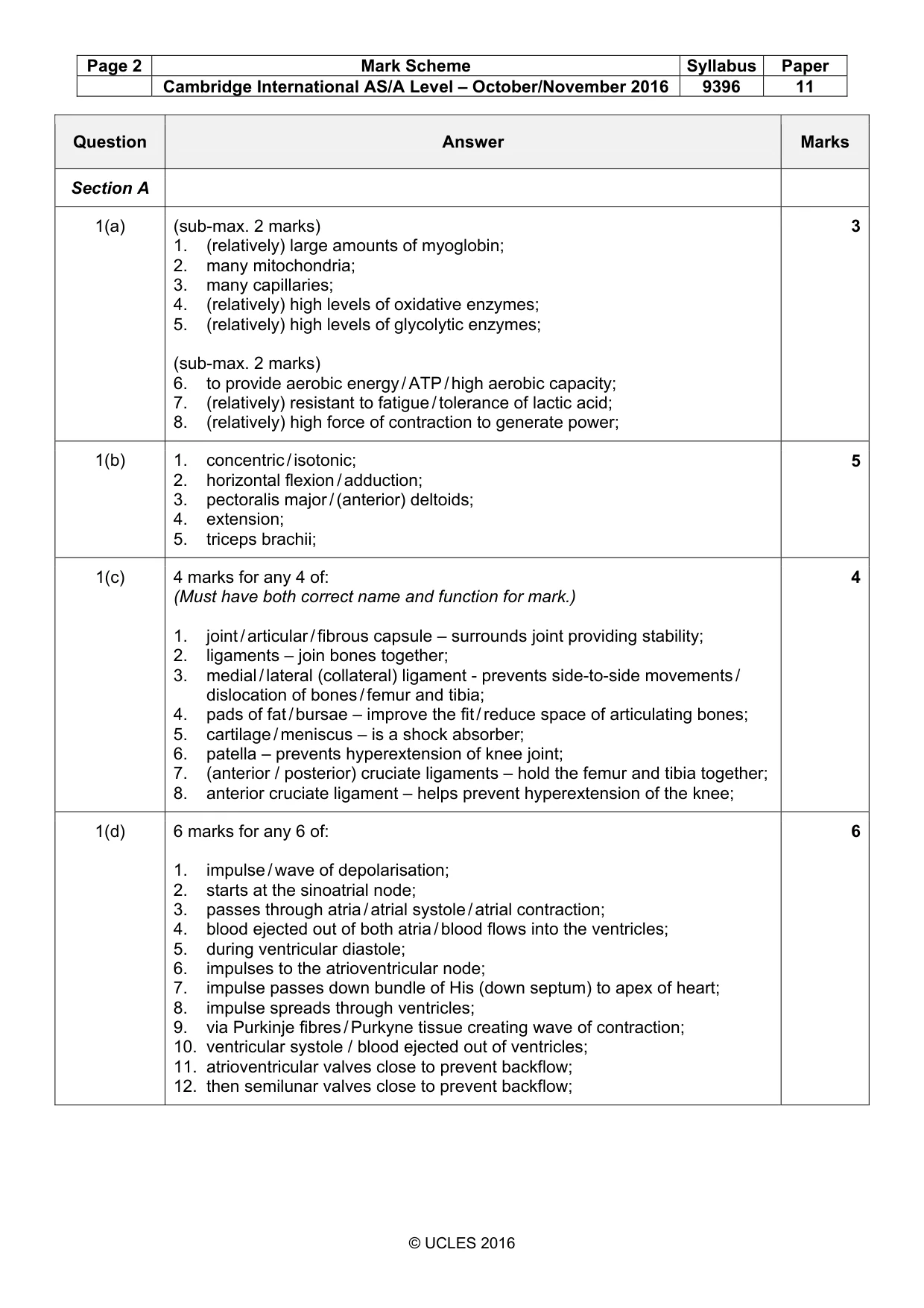
Page 2 Mark Scheme Syllabus Paper Cambridge International AS/A Level – October/November 2016 9396 11 © UCLES 2016 Question Answer Marks Section A 1(a) (sub-max. 2 marks) 1. (relatively) large amounts of myoglobin; 2. many mitochondria; 3. many capillaries; 4. (relatively) high levels of oxidative enzymes; 5. (relatively) high levels of glycolytic enzymes; (sub-max. 2 marks) 6. to provide aerobic energy / ATP / high aerobic capacity; 7. (relatively) resistant to fatigue / tolerance of lactic acid; 8. (relatively) high force of contraction to generate power; 3 1(b) 1. concentric / isotonic; 2. horizontal flexion / adduction; 3. pectoralis major / (anterior) deltoids; 4. extension; 5. triceps brachii; 5 1(c) 4 marks for any 4 of: (Must have both correct name and function for mark.) 1. joint / articular / fibrous capsule – surrounds joint providing stability; 2. ligaments – join bones together; 3. medial / lateral (collateral) ligament - prevents side-to-side movements / dislocation of bones / femur and tibia; 4. pads of fat / bursae – improve the fit / reduce space of articulating bones; 5. cartilage / meniscus – is a shock absorber; 6. patella – prevents hyperextension of knee joint; 7. (anterior / posterior) cruciate ligaments – hold the femur and tibia together; 8. anterior cruciate ligament – helps prevent hyperextension of the knee; 4 1(d) 6 marks for any 6 of: 1. impulse / wave of depolarisation; 2. starts at the sinoatrial node; 3. passes through atria / atrial systole / atrial contraction; 4. blood ejected out of both atria / blood flows into the ventricles; 5. during ventricular diastole; 6. impulses to the atrioventricular node; 7. impulse passes down bundle of His (down septum) to apex of heart; 8. impulse spreads through ventricles; 9. via Purkinje fibres / Purkyne tissue creating wave of contraction; 10. ventricular systole / blood ejected out of ventricles; 11. atrioventricular valves close to prevent backflow; 12. then semilunar valves close to prevent backflow; 6
Mark scheme, page 3
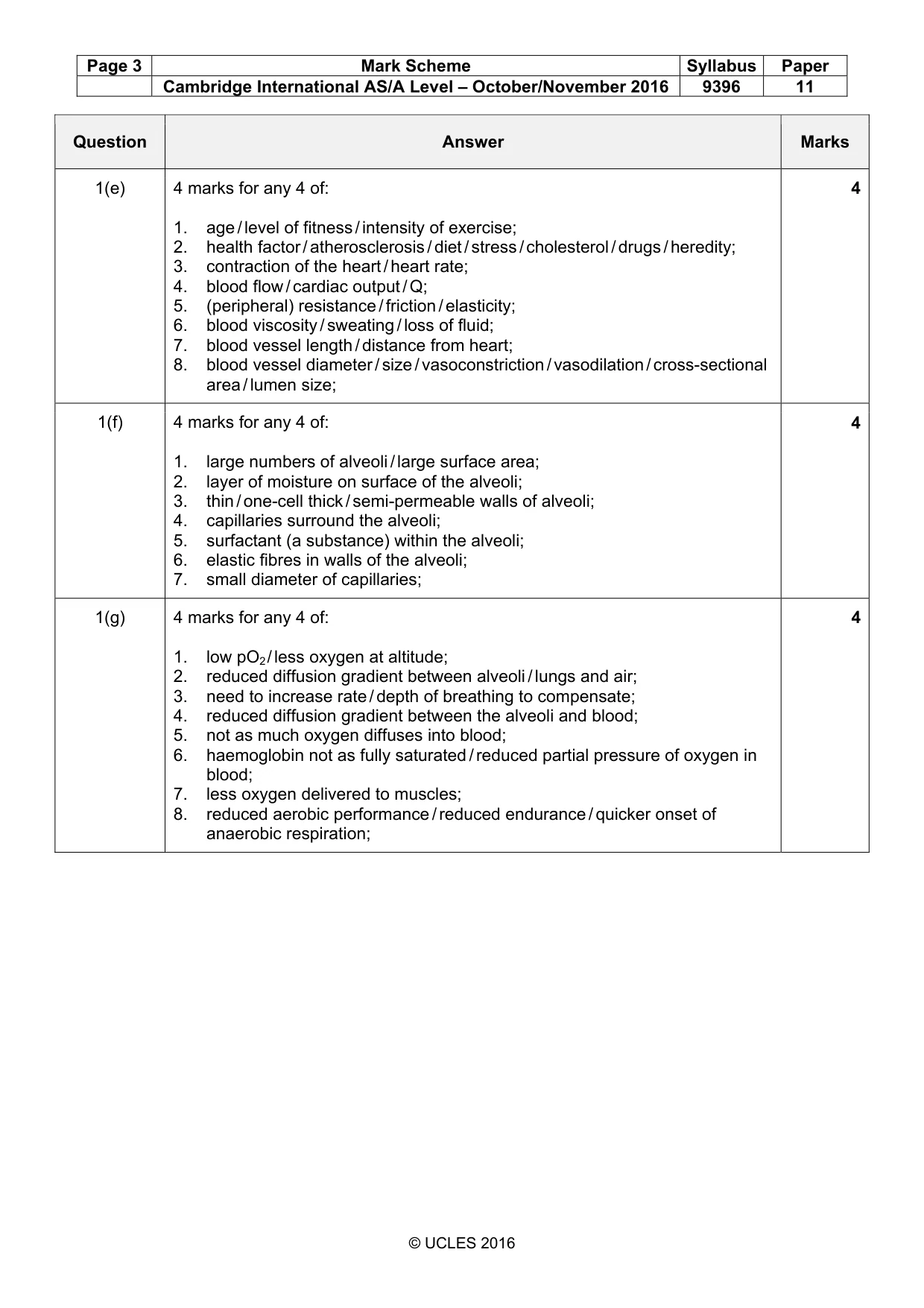
Page 3 Mark Scheme Syllabus Paper Cambridge International AS/A Level – October/November 2016 9396 11 © UCLES 2016 Question Answer Marks 1(e) 4 marks for any 4 of: 1. age / level of fitness / intensity of exercise; 2. health factor / atherosclerosis / diet / stress / cholesterol / drugs / heredity; 3. contraction of the heart / heart rate; 4. blood flow / cardiac output / Q; 5. (peripheral) resistance / friction / elasticity; 6. blood viscosity / sweating / loss of fluid; 7. blood vessel length / distance from heart; 8. blood vessel diameter / size / vasoconstriction / vasodilation / cross-sectional area / lumen size; 4 1(f) 4 marks for any 4 of: 1. large numbers of alveoli / large surface area; 2. layer of moisture on surface of the alveoli; 3. thin / one-cell thick / semi-permeable walls of alveoli; 4. capillaries surround the alveoli; 5. surfactant (a substance) within the alveoli; 6. elastic fibres in walls of the alveoli; 7. small diameter of capillaries; 4 1(g) 4 marks for any 4 of: 1. low pO2 / less oxygen at altitude; 2. reduced diffusion gradient between alveoli / lungs and air; 3. need to increase rate / depth of breathing to compensate; 4. reduced diffusion gradient between the alveoli and blood; 5. not as much oxygen diffuses into blood; 6. haemoglobin not as fully saturated / reduced partial pressure of oxygen in blood; 7. less oxygen delivered to muscles; 8. reduced aerobic performance / reduced endurance / quicker onset of anaerobic respiration; 4
Mark scheme, page 4
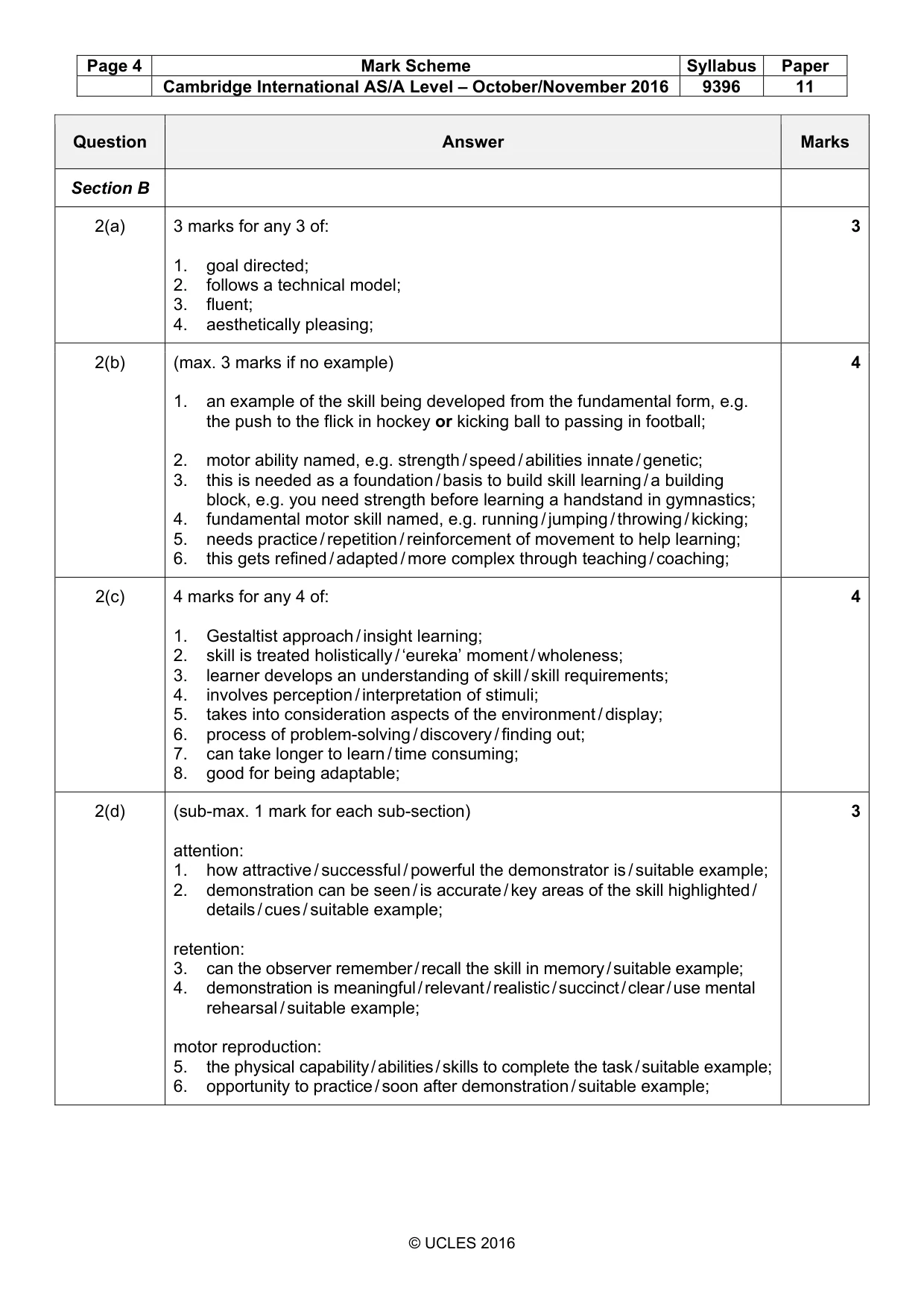
Page 4 Mark Scheme Syllabus Paper Cambridge International AS/A Level – October/November 2016 9396 11 © UCLES 2016 Question Answer Marks Section B 2(a) 3 marks for any 3 of: 1. goal directed; 2. follows a technical model; 3. fluent; 4. aesthetically pleasing; 3 2(b) (max. 3 marks if no example) 1. an example of the skill being developed from the fundamental form, e.g. the push to the flick in hockey or kicking ball to passing in football; 2. motor ability named, e.g. strength / speed / abilities innate / genetic; 3. this is needed as a foundation / basis to build skill learning / a building block, e.g. you need strength before learning a handstand in gymnastics; 4. fundamental motor skill named, e.g. running / jumping / throwing / kicking; 5. needs practice / repetition / reinforcement of movement to help learning; 6. this gets refined / adapted / more complex through teaching / coaching; 4 2(c) 4 marks for any 4 of: 1. Gestaltist approach / insight learning; 2. skill is treated holistically / ‘eureka’ moment / wholeness; 3. learner develops an understanding of skill / skill requirements; 4. involves perception / interpretation of stimuli; 5. takes into consideration aspects of the environment / display; 6. process of problem-solving / discovery / finding out; 7. can take longer to learn / time consuming; 8. good for being adaptable; 4 2(d) (sub-max. 1 mark for each sub-section) attention: 1. how attractive / successful / powerful the demonstrator is / suitable example; 2. demonstration can be seen / is accurate / key areas of the skill highlighted / details / cues / suitable example; retention: 3. can the observer remember / recall the skill in memory / suitable example; 4. demonstration is meaningful / relevant / realistic / succinct / clear / use mental rehearsal / suitable example; motor reproduction: 5. the physical capability / abilities / skills to complete the task / suitable example; 6. opportunity to practice / soon after demonstration / suitable example; 3
Mark scheme, page 5
Page 5 Mark Scheme Syllabus Paper Cambridge International AS/A Level – October/November 2016 9396 11 © UCLES 2016 Question Answer Marks 2(e) 3 marks for any 3 of: 1. schema – set of ‘rules’ / relationships to help us make decisions about movement patterns; 2. after / following / during movement / action; 3. sensory consequences; 4. e.g. feedback information concerning performance / knowledge of performance; 5. response / movement outcomes; 6. comparison of actual and intended outcome / feedback / knowledge of results; 3 2(f)(i) (max. 2 marks if no example) 1. (reaction time) time between the onset of the stimulus and the initiation of the movement; 2. (movement time) from the initiation of the response to completion of the action; 3. (response time) reaction time + movement time / time from the onset of the stimulus to the end of the movement; 3 2(f)(ii) (max. 2 marks if no example) 1. example, e.g. opponents can use this by dummy / faking / feinting / eq.; 2. slows reaction time / reaction takes longer; 3. one signal / stimulus is processed before others can be processed; 4. called the single-channel hypothesis / bottleneck theory; 5. causes a delay in processing / dealing with information; 3 2(g) (max. 2 marks if no example) 1. example, e.g. practising a forehand in badminton and then practising a forehand in tennis or cover drive in cricket and then practising driving in golf; 2. negative transfer – where learning of a skill hinders the learning of another skill; 3. limiting negative effects by making the performer aware of the different elements in such skills or by only practising transferable skills; 4. regular feedback; 5. encourage kinesthesis; 3 2(h) 4 marks for any 4 of: 1. humans have a drive / need / motivation / desire to achieve / solve a problem / to win or learn; 2. practice / rehearsal / performance takes place to satisfy this need or drive; 3. if skill is performed successfully then learning is reinforced; 4. drive reduced when success (perceived) is experienced; 5. therefore motivation to do more reduces / subsides; 6. too much practice leads to drive reduction / reactive inhibition; 7. new tasks / goals / motivation is needed to remove this reduction in drive; 4
Mark scheme, page 6
Page 6 Mark Scheme Syllabus Paper Cambridge International AS/A Level – October/November 2016 9396 11 © UCLES 2016 Question Answer Marks Section C 3(a)(i) 4 marks for any 4 of: (Must relate to an activity, e.g. football / kicking a ball, else max. 3 marks.) 1. freedom of choice / free will / voluntary; 2. fun / intrinsic / enjoyment; 3. no moral obligation; 4. satisfaction / well-being gained from taking part; 5. very few rules / modified / made-up rules; 6. few, if any, time constraints; 7. low level of organisation / self-officiated / no formal official; 8. health / fitness benefits; 4 3(a)(ii) 4 marks for any 4 of: sport has / play does not have: 1. extrinsic rewards / winners and losers; 2. competition / leagues / cups; 3. commitment / effort / training / practices; 4. rules / highly structured / organised / time constraints / boundaries; 5. kit / equipment; 6. officials; 7. tactics used / skills required; 4 3(b) 4 marks for any 4 of: 1. increase in national prestige / feel-good factor; 2. hosting or success – advertisement for the country / shop-window effect; 3. hosting – improvements in trade / economy / tourism; 4. hosting – improve infrastructure, e.g. better roads / hotels / facilities / transport; 5. demand from population for national success; 6. confirmation of political superiority / political popularity; 7. to enable individuals to succeed / reach goals; 8. encourage / increase participation / general health; 9. legacy; 4 3(c)(i) 4 marks for any 4 of: 1. health and fitness / mental health; 2. personal challenge / satisfaction of success / strive to achieve high standards / improve self-esteem; 3. enjoyment / intrinsic rewards; 4. become skilful / knowledgeable; 5. socialising / be part of a team / life skills, e.g. leadership; 6. possibility of employment / professional performer / coach; 7. fame / praise / medals / status; 8. keep out of trouble / hobby; 9. learning cultural values, e.g. values / ethics / losing / winning; 4
Mark scheme, page 7
Page 7 Mark Scheme Syllabus Paper Cambridge International AS/A Level – October/November 2016 9396 11 © UCLES 2016 Question Answer Marks 3(c)(ii) (sub-max. 3 marks for each sector.) voluntary: 1. run by unpaid members / committee; 2. financed by members’ fees / fund-raising / sponsorship / donations / grants; 3. runs on profit-loss but profit not an overriding concern; 4. provide for grass roots of sport / community use; public: 5. business run by local authority / local government / council / eq.; 6. trading at set prices / pre-set budget / no need for profit; 7. subsidised by taxes / council tax; 8. usually pay as you go / not necessarily subscription-based; 4 3(d) 4 marks for any 4 of: 1. traditionally thought (by men) that women lack strength / endurance for physical activity; 2. stereotypically thought that a women’s role is in the home / children / family commitments; 3. sport is perceived as a male-dominated activity / male control; 4. less role models / prize money / media coverage; 5. less clubs / less competitions / less opportunities; 6. religious / cultural factors; 7. discrimination / sexism / prejudice; 4 3(e)(i) 3 marks for any 3 of: 1. max. two from: to build muscle; increase energy; increase red blood cells; mask injury; other named physiological benefit; 2. to allow the body to train harder; 3. recover quicker; 4. pressure to win from coaches / sponsors / media; 5. money / trophy / win at all costs / extend career / stay at top; 6. belief that everyone else is taking drugs / level playing field; 7. steady nerves / other named psychological benefit; 3 3(e)(ii) 3 marks for any 3 of: 1. role of WADA: governments have signed up to the code / unified front; 2. strict punishments and life bans / name and shame / unofficial leaks; 3. more money put into testing programmes / improved tests; 4. education / role models for young sports persons / athlete awareness; 5. rigorous testing programmes / out of season / random / competition; 6. use of biological passports; 3
What you needed in this session
Cambridge’s own grade thresholds for 2016 Oct/Nov, Paper 1 · Variant 1. A higher threshold means an easier paper — the bar moves with how the cohort did.