Cambridge A Level Physical Education 9396 — 2016 Oct/Nov Paper 1 · Variant 3
9396/13/O/N/16 · 90 marks · ≈101 min
The question paper and its mark scheme, free to read here and free to download. This is Cambridge’s own paper, exactly as it was sat.
Question paper4 pages
Mark scheme8 pages
Answers below. Sit the paper first if you are practising.
Paper as text
Question paper, page 1
This document consists of 4 printed pages and 1 insert. DC (ST/SW) 109245/2 © UCLES 2016 [Turn over Cambridge International Examinations Cambridge International Advanced Subsidiary and Advanced Level * 6 5 8 0 9 1 2 4 6 9 * PHYSICAL EDUCATION 9396/13 Paper 1 October/November 2016 2 hours 30 minutes No Additional Materials are required. READ THESE INSTRUCTIONS FIRST An answer booklet is provided inside this question paper. You should follow the instructions on the front cover of the answer booklet. If you need additional answer paper ask the invigilator for a continuation booklet. Answer all questions. Electronic calculators may be used. You may lose marks if you do not show your working or if you do not use appropriate units. The number of marks is given in brackets [ ] at the end of each question or part question.
Question paper, page 2
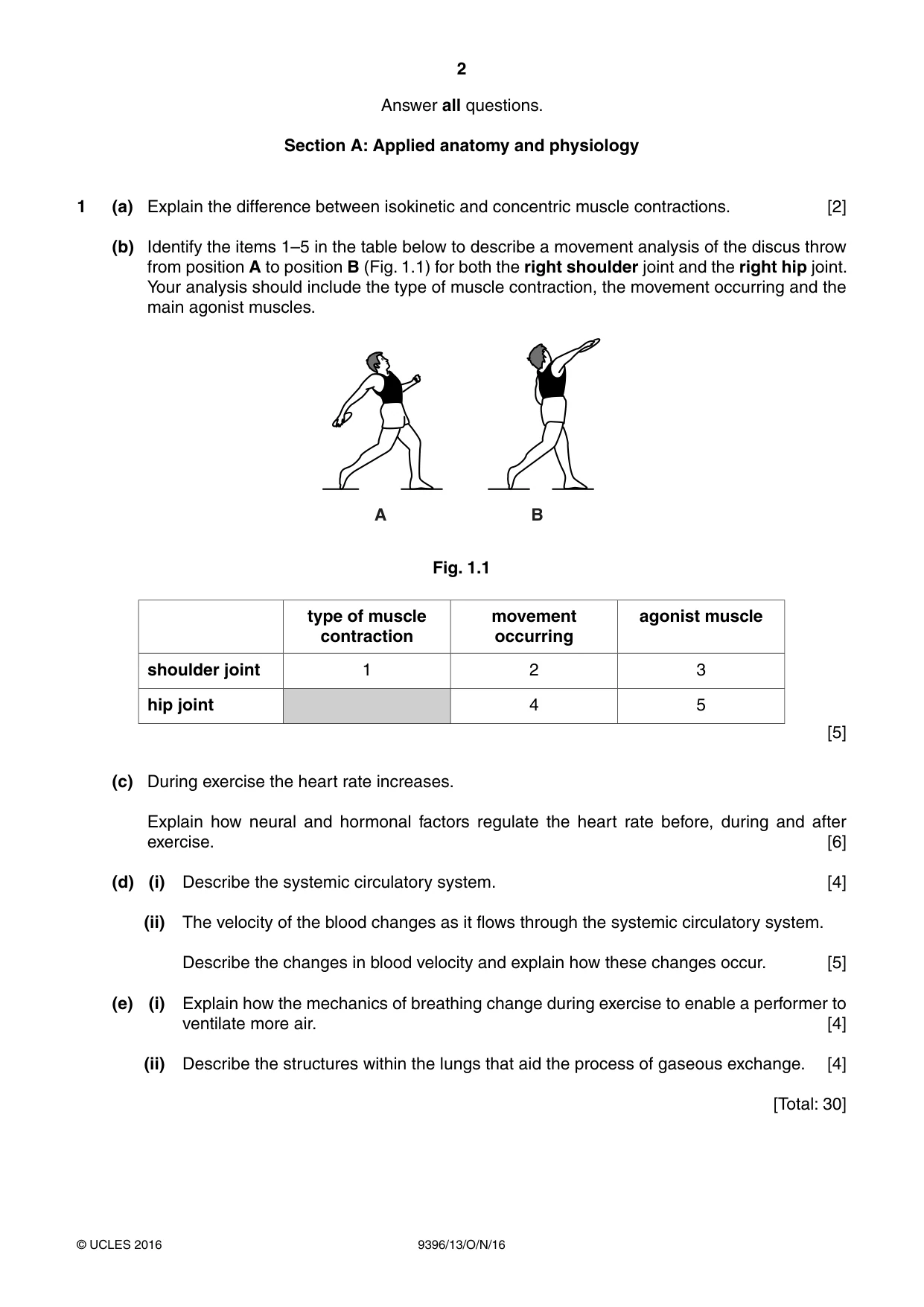
2 9396/13/O/N/16 © UCLES 2016 Answer all questions. Section A: Applied anatomy and physiology 1 (a) Explain the difference between isokinetic and concentric muscle contractions. [2] (b) Identify the items 1–5 in the table below to describe a movement analysis of the discus throw from position A to position B (Fig. 1.1) for both the right shoulder joint and the right hip joint. Your analysis should include the type of muscle contraction, the movement occurring and the main agonist muscles. A B Fig. 1.1 type of muscle contraction movement occurring agonist muscle shoulder joint 1 2 3 hip joint 4 5 [5] (c) During exercise the heart rate increases. Explain how neural and hormonal factors regulate the heart rate before, during and after exercise. [6] (d) (i) Describe the systemic circulatory system. [4] (ii) The velocity of the blood changes as it flows through the systemic circulatory system. Describe the changes in blood velocity and explain how these changes occur. [5] (e) (i) Explain how the mechanics of breathing change during exercise to enable a performer to ventilate more air. [4] (ii) Describe the structures within the lungs that aid the process of gaseous exchange. [4] [Total: 30]
Question paper, page 3
3 9396/13/O/N/16 © UCLES 2016 [Turn over Section B: Acquiring, developing and performing movement skills 2 (a) Skilful performances: • are learned, • are goal directed, • follow technical models, • are aesthetically pleasing. Using practical examples, describe what is meant by each of these characteristics. [4] (b) Bandura’s observational learning theory is one way of describing the learning of motor skills and involves the following elements. attention – retention – motor reproduction – motivation Using examples, describe each of these elements of observational learning. [4] (c) Using a sporting example, explain how motor programmes are formed. [5] (d) Using an example from a sport specific skill, explain open loop control. [3] (e) Selective attention is a component of information processing that allows skills to be completed effectively. How could a coach improve a performer’s selective attention? [4] (f) The memory process plays an important part in acquiring and performing motor skills. Describe the basic model of the memory process when performing motor skills. [5] (g) Use the Inverted U theory to explain how levels of arousal can affect the performance of motor skills. [5] [Total: 30]
Question paper, page 4
4 9396/13/O/N/16 © UCLES 2016 Section C: Contemporary studies in physical education and sport 3 (a) Play is considered to be a valuable activity for children. How do young children benefit from play? [3] (b) State three characteristics of sport. [3] (c) Using a country of your choice, describe the policies and initiatives that are in place to achieve excellence in sport. [5] (d) Local communities are dependent on different bodies to provide leisure facilities for physical activity. (i) What are the advantages of private bodies providing facilities for a local community? [3] (ii) Identify and describe two other bodies that provide leisure facilities. [4] (e) More men take part in regular physical activity than women. Suggest ways in which more women can be encouraged to take part in physical activity. [4] (f) Explain how sponsorship of sport is closely linked to the media. [4] (g) How is the ethic of fair play encouraged and maintained in elite sport? [4] [Total: 30] Permission to reproduce items where third-party owned material protected by copyright is included has been sought and cleared where possible. Every reasonable effort has been made by the publisher (UCLES) to trace copyright holders, but if any items requiring clearance have unwittingly been included, the publisher will be pleased to make amends at the earliest possible opportunity. To avoid the issue of disclosure of answer-related information to candidates, all copyright acknowledgements are reproduced online in the Cambridge International Examinations Copyright Acknowledgements Booklet. This is produced for each series of examinations and is freely available to download at www.cie.org.uk after the live examination series. Cambridge International Examinations is part of the Cambridge Assessment Group. Cambridge Assessment is the brand name of University of Cambridge Local Examinations Syndicate (UCLES), which is itself a department of the University of Cambridge.
Mark scheme, page 1
® IGCSE is the registered trademark of Cambridge International Examinations. This document consists of 8 printed pages. © UCLES 2016 [Turn over Cambridge International Examinations Cambridge International Advanced Subsidiary and Advanced Level PHYSICAL EDUCATION 9396/13 Paper 1 October/November 2016 MARK SCHEME Maximum Mark: 90 Published This mark scheme is published as an aid to teachers and candidates, to indicate the requirements of the examination. It shows the basis on which Examiners were instructed to award marks. It does not indicate the details of the discussions that took place at an Examiners’ meeting before marking began, which would have considered the acceptability of alternative answers. Mark schemes should be read in conjunction with the question paper and the Principal Examiner Report for Teachers. Cambridge will not enter into discussions about these mark schemes. Cambridge is publishing the mark schemes for the October/November 2016 series for most Cambridge IGCSE®, Cambridge International A and AS Level components and some Cambridge O Level components.
Mark scheme, page 2
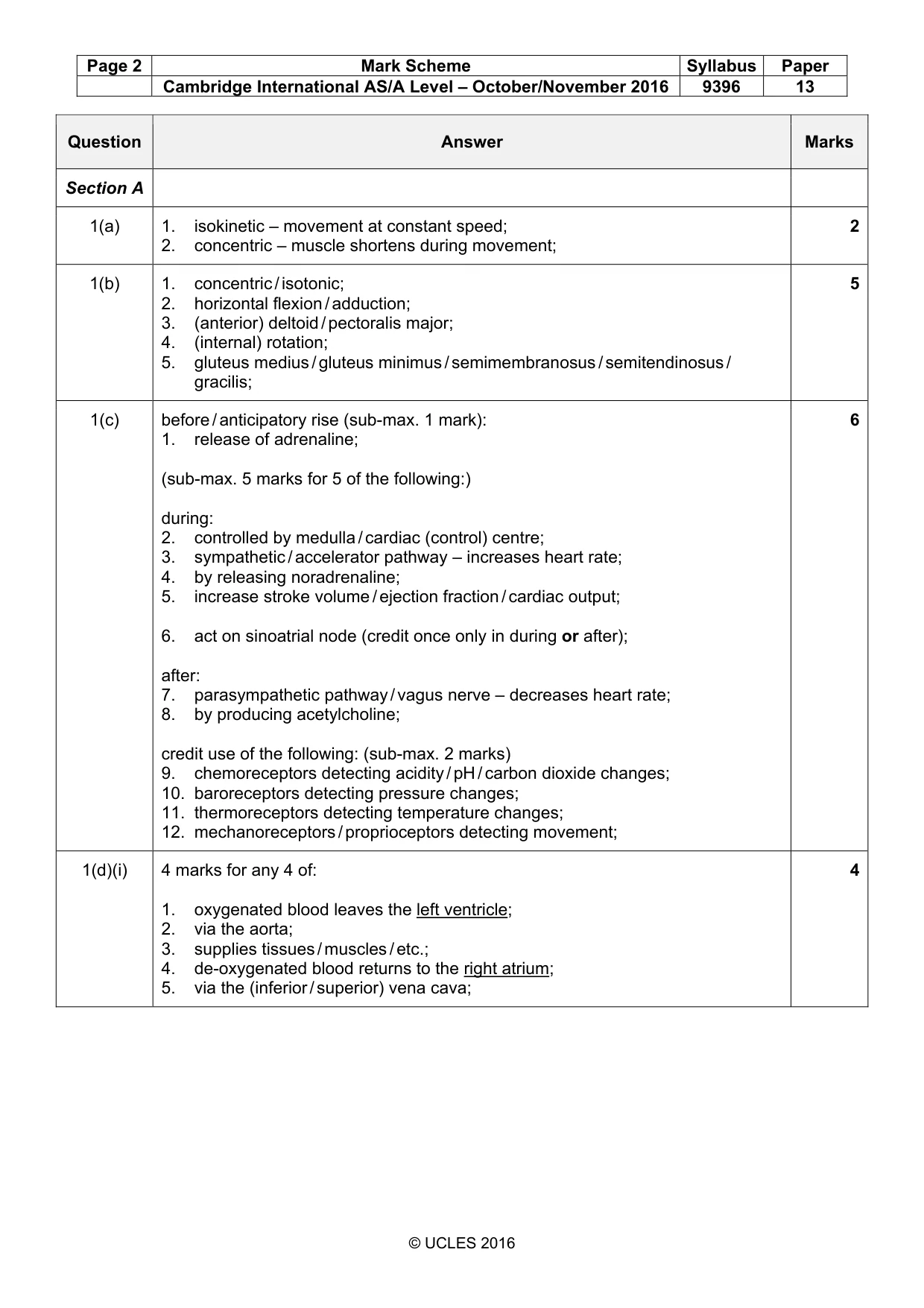
Page 2 Mark Scheme Syllabus Paper Cambridge International AS/A Level – October/November 2016 9396 13 © UCLES 2016 Question Answer Marks Section A 1(a) 1. isokinetic – movement at constant speed; 2. concentric – muscle shortens during movement; 2 1(b) 1. concentric / isotonic; 2. horizontal flexion / adduction; 3. (anterior) deltoid / pectoralis major; 4. (internal) rotation; 5. gluteus medius / gluteus minimus / semimembranosus / semitendinosus / gracilis; 5 1(c) before / anticipatory rise (sub-max. 1 mark): 1. release of adrenaline; (sub-max. 5 marks for 5 of the following:) during: 2. controlled by medulla / cardiac (control) centre; 3. sympathetic / accelerator pathway – increases heart rate; 4. by releasing noradrenaline; 5. increase stroke volume / ejection fraction / cardiac output; 6. act on sinoatrial node (credit once only in during or after); after: 7. parasympathetic pathway / vagus nerve – decreases heart rate; 8. by producing acetylcholine; credit use of the following: (sub-max. 2 marks) 9. chemoreceptors detecting acidity / pH / carbon dioxide changes; 10. baroreceptors detecting pressure changes; 11. thermoreceptors detecting temperature changes; 12. mechanoreceptors / proprioceptors detecting movement; 6 1(d)(i) 4 marks for any 4 of: 1. oxygenated blood leaves the left ventricle; 2. via the aorta; 3. supplies tissues / muscles / etc.; 4. de-oxygenated blood returns to the right atrium; 5. via the (inferior / superior) vena cava; 4
Mark scheme, page 3
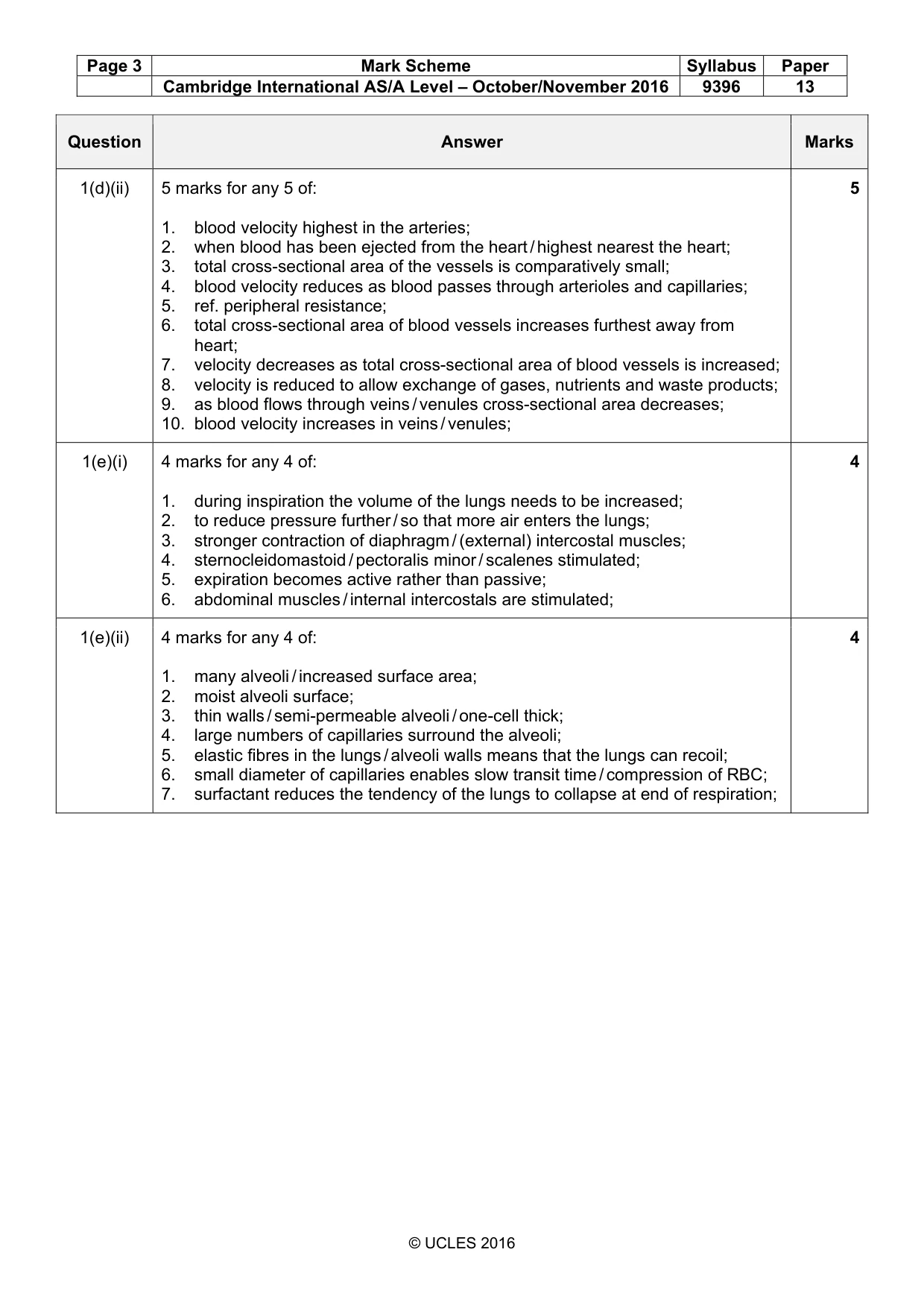
Page 3 Mark Scheme Syllabus Paper Cambridge International AS/A Level – October/November 2016 9396 13 © UCLES 2016 Question Answer Marks 1(d)(ii) 5 marks for any 5 of: 1. blood velocity highest in the arteries; 2. when blood has been ejected from the heart / highest nearest the heart; 3. total cross-sectional area of the vessels is comparatively small; 4. blood velocity reduces as blood passes through arterioles and capillaries; 5. ref. peripheral resistance; 6. total cross-sectional area of blood vessels increases furthest away from heart; 7. velocity decreases as total cross-sectional area of blood vessels is increased; 8. velocity is reduced to allow exchange of gases, nutrients and waste products; 9. as blood flows through veins / venules cross-sectional area decreases; 10. blood velocity increases in veins / venules; 5 1(e)(i) 4 marks for any 4 of: 1. during inspiration the volume of the lungs needs to be increased; 2. to reduce pressure further / so that more air enters the lungs; 3. stronger contraction of diaphragm / (external) intercostal muscles; 4. sternocleidomastoid / pectoralis minor / scalenes stimulated; 5. expiration becomes active rather than passive; 6. abdominal muscles / internal intercostals are stimulated; 4 1(e)(ii) 4 marks for any 4 of: 1. many alveoli / increased surface area; 2. moist alveoli surface; 3. thin walls / semi-permeable alveoli / one-cell thick; 4. large numbers of capillaries surround the alveoli; 5. elastic fibres in the lungs / alveoli walls means that the lungs can recoil; 6. small diameter of capillaries enables slow transit time / compression of RBC; 7. surfactant reduces the tendency of the lungs to collapse at end of respiration; 4
Mark scheme, page 4
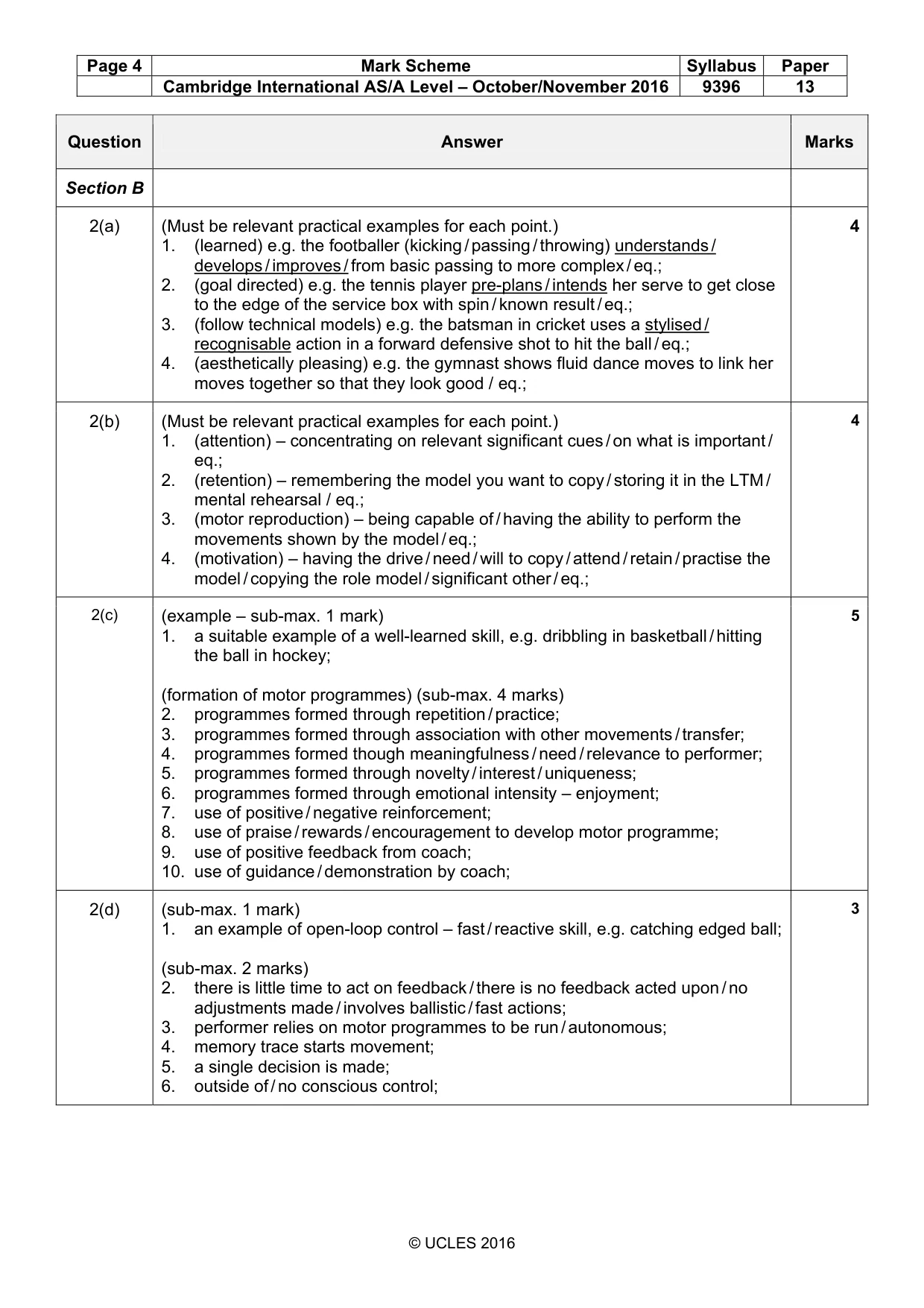
Page 4 Mark Scheme Syllabus Paper Cambridge International AS/A Level – October/November 2016 9396 13 © UCLES 2016 Question Answer Marks Section B 2(a) (Must be relevant practical examples for each point.) 1. (learned) e.g. the footballer (kicking / passing / throwing) understands / develops / improves / from basic passing to more complex / eq.; 2. (goal directed) e.g. the tennis player pre-plans / intends her serve to get close to the edge of the service box with spin / known result / eq.; 3. (follow technical models) e.g. the batsman in cricket uses a stylised / recognisable action in a forward defensive shot to hit the ball / eq.; 4. (aesthetically pleasing) e.g. the gymnast shows fluid dance moves to link her moves together so that they look good / eq.; 4 2(b) (Must be relevant practical examples for each point.) 1. (attention) – concentrating on relevant significant cues / on what is important / eq.; 2. (retention) – remembering the model you want to copy / storing it in the LTM / mental rehearsal / eq.; 3. (motor reproduction) – being capable of / having the ability to perform the movements shown by the model / eq.; 4. (motivation) – having the drive / need / will to copy / attend / retain / practise the model / copying the role model / significant other / eq.; 4 2(c) (example – sub-max. 1 mark) 1. a suitable example of a well-learned skill, e.g. dribbling in basketball / hitting the ball in hockey; (formation of motor programmes) (sub-max. 4 marks) 2. programmes formed through repetition / practice; 3. programmes formed through association with other movements / transfer; 4. programmes formed though meaningfulness / need / relevance to performer; 5. programmes formed through novelty / interest / uniqueness; 6. programmes formed through emotional intensity – enjoyment; 7. use of positive / negative reinforcement; 8. use of praise / rewards / encouragement to develop motor programme; 9. use of positive feedback from coach; 10. use of guidance / demonstration by coach; 5 2(d) (sub-max. 1 mark) 1. an example of open-loop control – fast / reactive skill, e.g. catching edged ball; (sub-max. 2 marks) 2. there is little time to act on feedback / there is no feedback acted upon / no adjustments made / involves ballistic / fast actions; 3. performer relies on motor programmes to be run / autonomous; 4. memory trace starts movement; 5. a single decision is made; 6. outside of / no conscious control; 3
Mark scheme, page 5
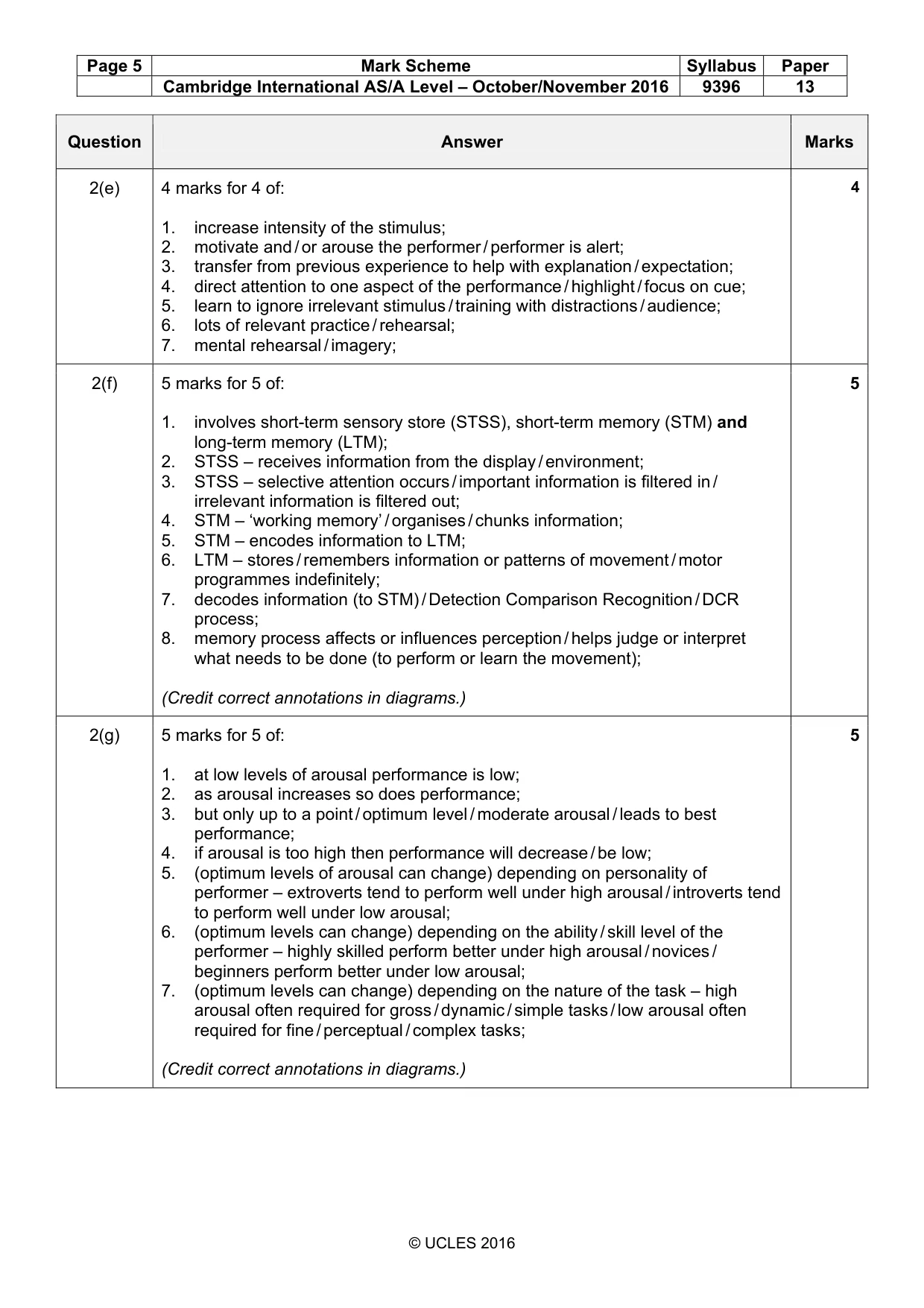
Page 5 Mark Scheme Syllabus Paper Cambridge International AS/A Level – October/November 2016 9396 13 © UCLES 2016 Question Answer Marks 2(e) 4 marks for 4 of: 1. increase intensity of the stimulus; 2. motivate and / or arouse the performer / performer is alert; 3. transfer from previous experience to help with explanation / expectation; 4. direct attention to one aspect of the performance / highlight / focus on cue; 5. learn to ignore irrelevant stimulus / training with distractions / audience; 6. lots of relevant practice / rehearsal; 7. mental rehearsal / imagery; 4 2(f) 5 marks for 5 of: 1. involves short-term sensory store (STSS), short-term memory (STM) and long-term memory (LTM); 2. STSS – receives information from the display / environment; 3. STSS – selective attention occurs / important information is filtered in / irrelevant information is filtered out; 4. STM – ‘working memory’ / organises / chunks information; 5. STM – encodes information to LTM; 6. LTM – stores / remembers information or patterns of movement / motor programmes indefinitely; 7. decodes information (to STM) / Detection Comparison Recognition / DCR process; 8. memory process affects or influences perception / helps judge or interpret what needs to be done (to perform or learn the movement); (Credit correct annotations in diagrams.) 5 2(g) 5 marks for 5 of: 1. at low levels of arousal performance is low; 2. as arousal increases so does performance; 3. but only up to a point / optimum level / moderate arousal / leads to best performance; 4. if arousal is too high then performance will decrease / be low; 5. (optimum levels of arousal can change) depending on personality of performer – extroverts tend to perform well under high arousal / introverts tend to perform well under low arousal; 6. (optimum levels can change) depending on the ability / skill level of the performer – highly skilled perform better under high arousal / novices / beginners perform better under low arousal; 7. (optimum levels can change) depending on the nature of the task – high arousal often required for gross / dynamic / simple tasks / low arousal often required for fine / perceptual / complex tasks; (Credit correct annotations in diagrams.) 5
Mark scheme, page 6
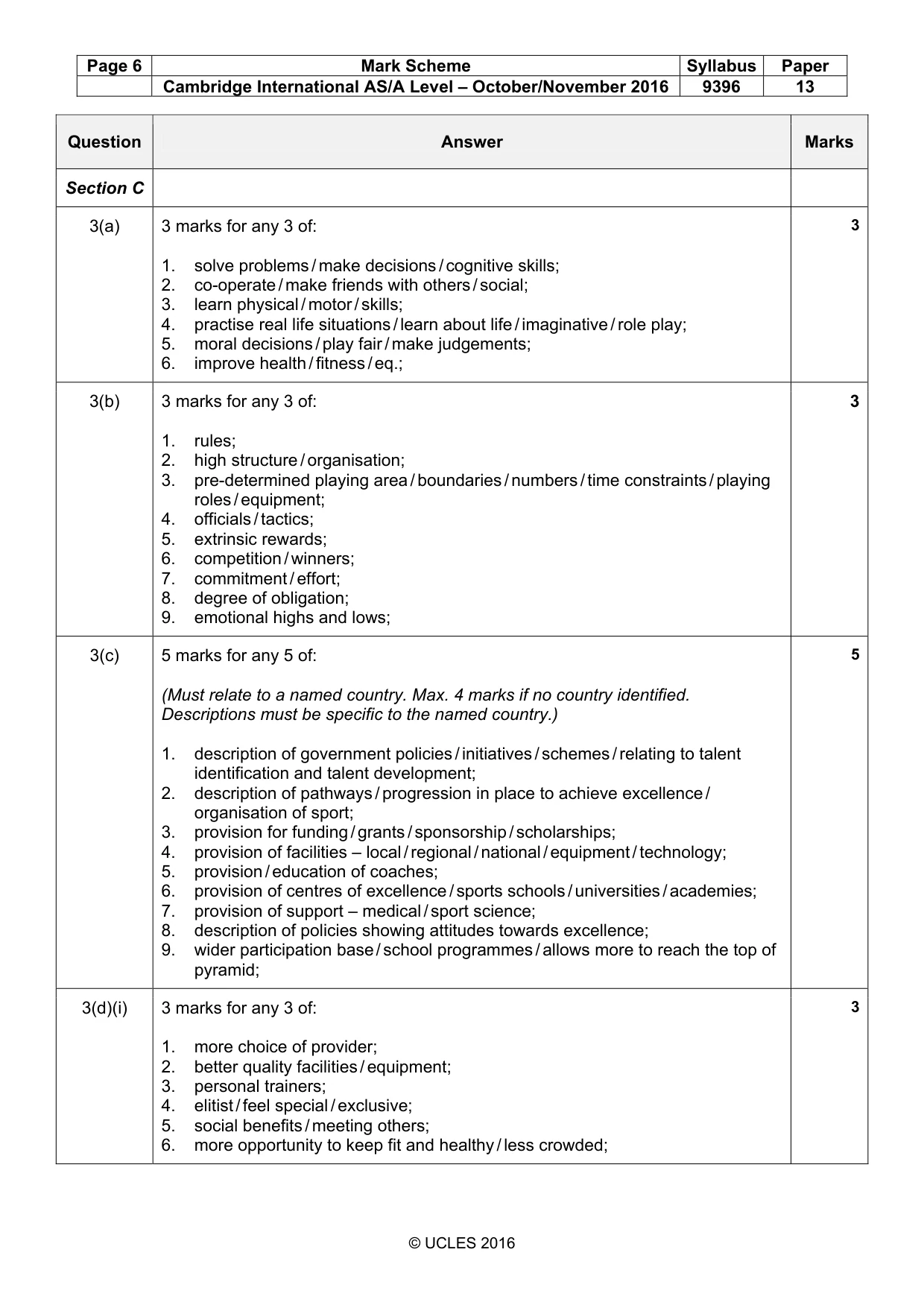
Page 6 Mark Scheme Syllabus Paper Cambridge International AS/A Level – October/November 2016 9396 13 © UCLES 2016 Question Answer Marks Section C 3(a) 3 marks for any 3 of: 1. solve problems / make decisions / cognitive skills; 2. co-operate / make friends with others / social; 3. learn physical / motor / skills; 4. practise real life situations / learn about life / imaginative / role play; 5. moral decisions / play fair / make judgements; 6. improve health / fitness / eq.; 3 3(b) 3 marks for any 3 of: 1. rules; 2. high structure / organisation; 3. pre-determined playing area / boundaries / numbers / time constraints / playing roles / equipment; 4. officials / tactics; 5. extrinsic rewards; 6. competition / winners; 7. commitment / effort; 8. degree of obligation; 9. emotional highs and lows; 3 3(c) 5 marks for any 5 of: (Must relate to a named country. Max. 4 marks if no country identified. Descriptions must be specific to the named country.) 1. description of government policies / initiatives / schemes / relating to talent identification and talent development; 2. description of pathways / progression in place to achieve excellence / organisation of sport; 3. provision for funding / grants / sponsorship / scholarships; 4. provision of facilities – local / regional / national / equipment / technology; 5. provision / education of coaches; 6. provision of centres of excellence / sports schools / universities / academies; 7. provision of support – medical / sport science; 8. description of policies showing attitudes towards excellence; 9. wider participation base / school programmes / allows more to reach the top of pyramid; 5 3(d)(i) 3 marks for any 3 of: 1. more choice of provider; 2. better quality facilities / equipment; 3. personal trainers; 4. elitist / feel special / exclusive; 5. social benefits / meeting others; 6. more opportunity to keep fit and healthy / less crowded; 3
Mark scheme, page 7
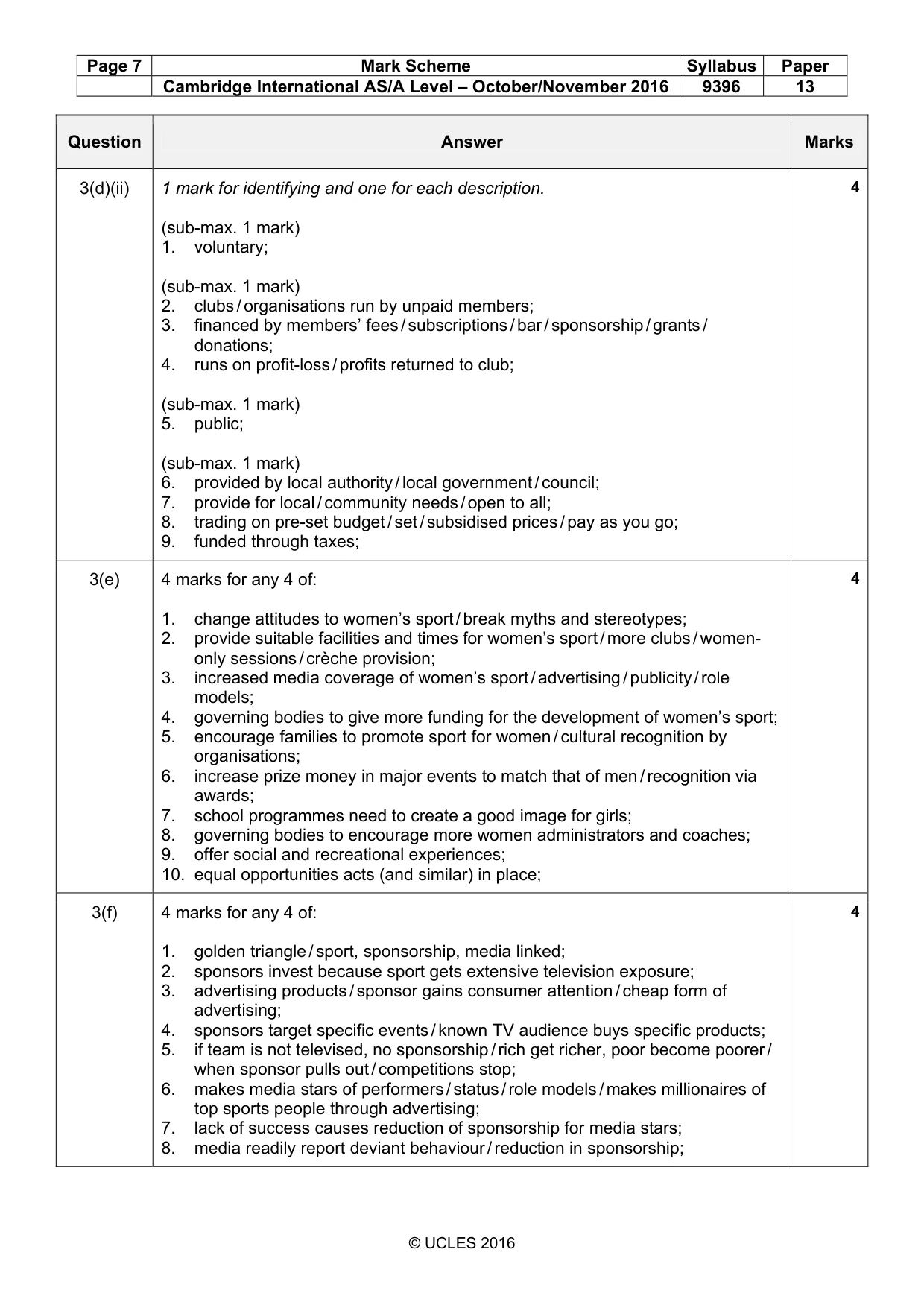
Page 7 Mark Scheme Syllabus Paper Cambridge International AS/A Level – October/November 2016 9396 13 © UCLES 2016 Question Answer Marks 3(d)(ii) 1 mark for identifying and one for each description. (sub-max. 1 mark) 1. voluntary; (sub-max. 1 mark) 2. clubs / organisations run by unpaid members; 3. financed by members’ fees / subscriptions / bar / sponsorship / grants / donations; 4. runs on profit-loss / profits returned to club; (sub-max. 1 mark) 5. public; (sub-max. 1 mark) 6. provided by local authority / local government / council; 7. provide for local / community needs / open to all; 8. trading on pre-set budget / set / subsidised prices / pay as you go; 9. funded through taxes; 4 3(e) 4 marks for any 4 of: 1. change attitudes to women’s sport / break myths and stereotypes; 2. provide suitable facilities and times for women’s sport / more clubs / women- only sessions / crèche provision; 3. increased media coverage of women’s sport / advertising / publicity / role models; 4. governing bodies to give more funding for the development of women’s sport; 5. encourage families to promote sport for women / cultural recognition by organisations; 6. increase prize money in major events to match that of men / recognition via awards; 7. school programmes need to create a good image for girls; 8. governing bodies to encourage more women administrators and coaches; 9. offer social and recreational experiences; 10. equal opportunities acts (and similar) in place; 4 3(f) 4 marks for any 4 of: 1. golden triangle / sport, sponsorship, media linked; 2. sponsors invest because sport gets extensive television exposure; 3. advertising products / sponsor gains consumer attention / cheap form of advertising; 4. sponsors target specific events / known TV audience buys specific products; 5. if team is not televised, no sponsorship / rich get richer, poor become poorer / when sponsor pulls out / competitions stop; 6. makes media stars of performers / status / role models / makes millionaires of top sports people through advertising; 7. lack of success causes reduction of sponsorship for media stars; 8. media readily report deviant behaviour / reduction in sponsorship; 4
Mark scheme, page 8
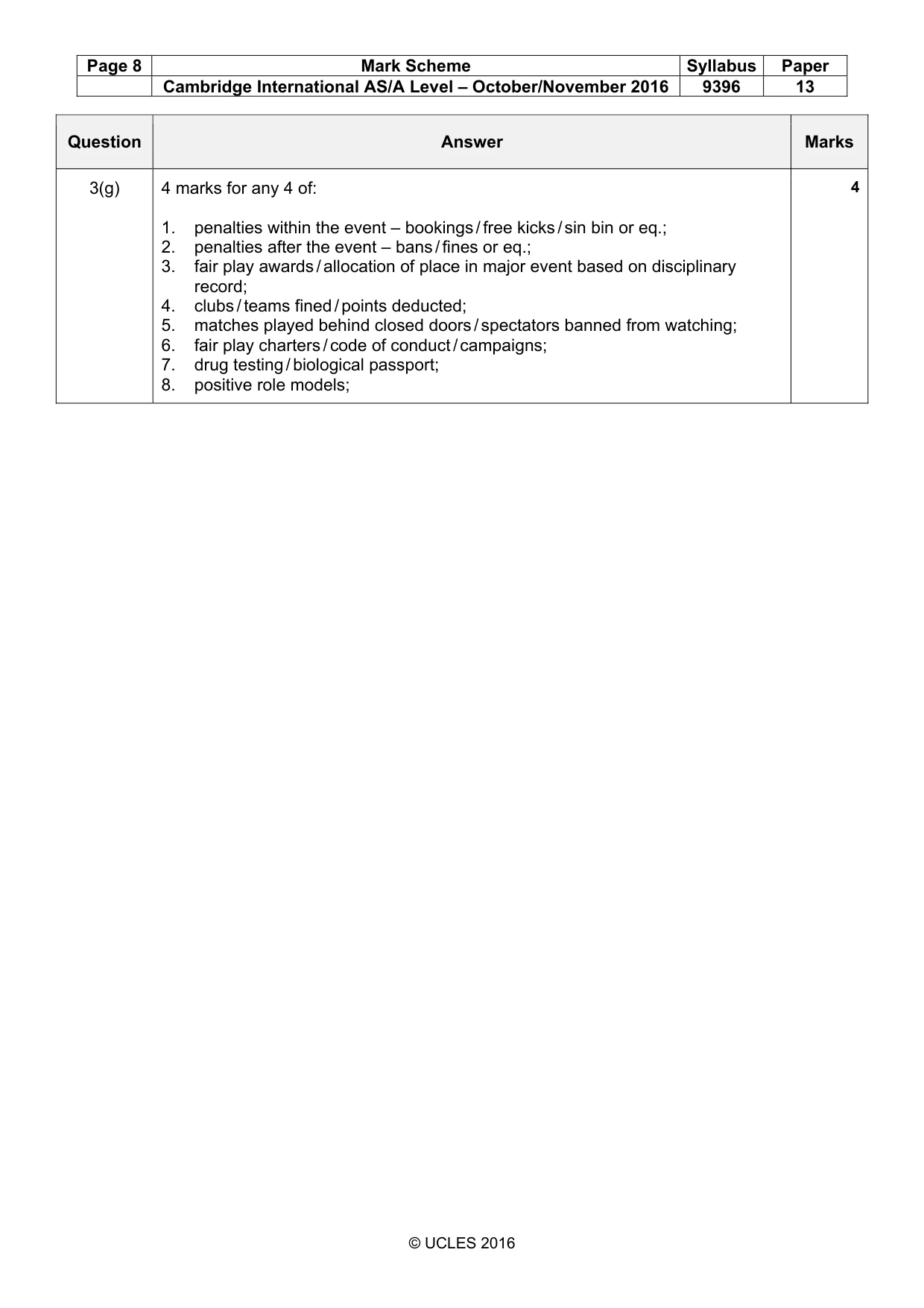
Page 8 Mark Scheme Syllabus Paper Cambridge International AS/A Level – October/November 2016 9396 13 © UCLES 2016 Question Answer Marks 3(g) 4 marks for any 4 of: 1. penalties within the event – bookings / free kicks / sin bin or eq.; 2. penalties after the event – bans / fines or eq.; 3. fair play awards / allocation of place in major event based on disciplinary record; 4. clubs / teams fined / points deducted; 5. matches played behind closed doors / spectators banned from watching; 6. fair play charters / code of conduct / campaigns; 7. drug testing / biological passport; 8. positive role models; 4
What you needed in this session
Cambridge’s own grade thresholds for 2016 Oct/Nov, Paper 1 · Variant 3. A higher threshold means an easier paper — the bar moves with how the cohort did.