Cambridge A Level Physical Education 9396 — 2015 Oct/Nov Paper 1 · Variant 2
9396/12/O/N/15 · 90 marks · ≈101 min
The question paper and its mark scheme, free to read here and free to download. This is Cambridge’s own paper, exactly as it was sat.
Question paper4 pages
Mark scheme8 pages
Answers below. Sit the paper first if you are practising.
Paper as text
Question paper, page 1
This document consists of 4 printed pages and 1 insert. DC (AC/CGW) 93713/3 © UCLES 2015 [Turn over Cambridge International Examinations Cambridge International Advanced Subsidiary and Advanced Level * 9 4 1 6 8 8 3 6 9 2 * PHYSICAL EDUCATION 9396/12 Paper 1 October/November 2015 2 hours 30 minutes No Additional Materials are required. READ THESE INSTRUCTIONS FIRST An answer booklet is provided inside this question paper. You should follow the instructions on the front cover of the answer booklet. If you need additional answer paper ask the invigilator for a continuation booklet. Answer all questions. Electronic calculators may be used. You may lose marks if you do not show your working or if you do not use appropriate units. The number of marks is given in brackets [ ] at the end of each question or part question.
Question paper, page 2
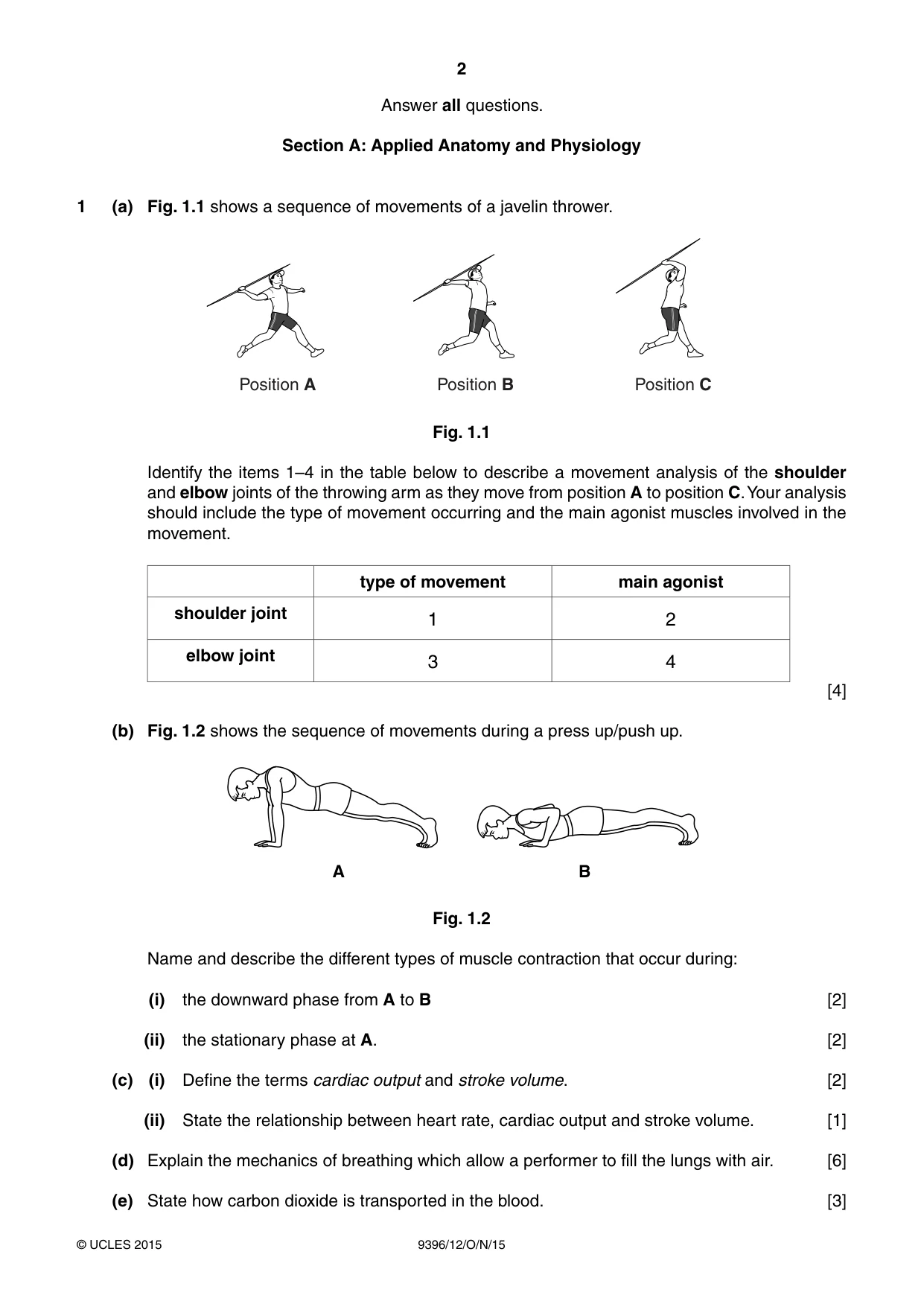
2 9396/12/O/N/15 © UCLES 2015 Answer all questions. Section A: Applied Anatomy and Physiology 1 (a) Fig. 1.1 shows a sequence of movements of a javelin thrower. Position A Position B Position C Fig. 1.1 Identify the items 1–4 in the table below to describe a movement analysis of the shoulder and elbow joints of the throwing arm as they move from position A to position C. Your analysis should include the type of movement occurring and the main agonist muscles involved in the movement. type of movement main agonist shoulder joint 1 2 elbow joint 3 4 [4] (b) Fig. 1.2 shows the sequence of movements during a press up/push up. A B Fig. 1.2 Name and describe the different types of muscle contraction that occur during: (i) the downward phase from A to B [2] (ii) the stationary phase at A. [2] (c) (i) Define the terms cardiac output and stroke volume. [2] (ii) State the relationship between heart rate, cardiac output and stroke volume. [1] (d) Explain the mechanics of breathing which allow a performer to fill the lungs with air. [6] (e) State how carbon dioxide is transported in the blood. [3]
Question paper, page 3
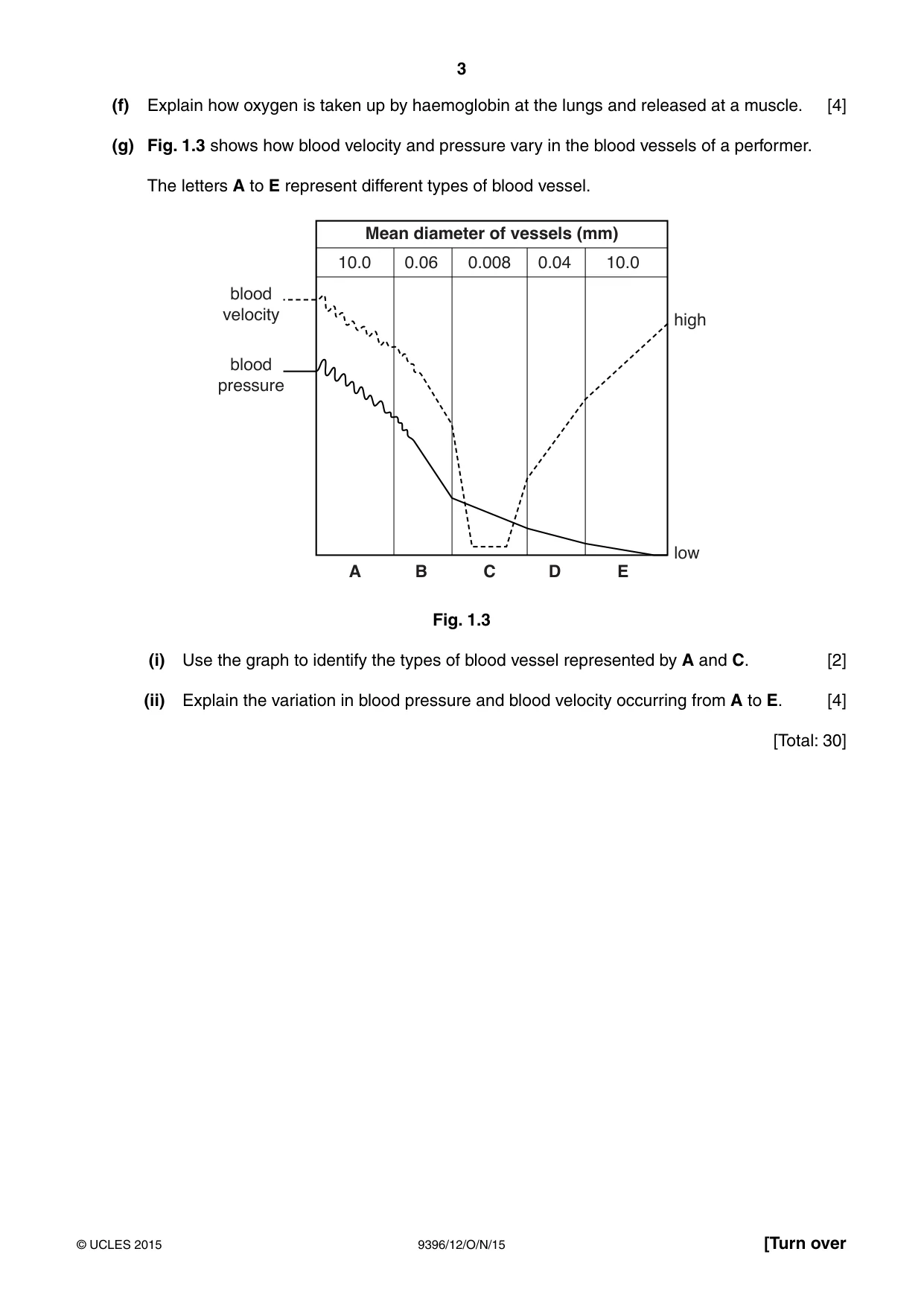
3 9396/12/O/N/15 © UCLES 2015 [Turn over (f) Explain how oxygen is taken up by haemoglobin at the lungs and released at a muscle. [4] (g) Fig. 1.3 shows how blood velocity and pressure vary in the blood vessels of a performer. The letters A to E represent different types of blood vessel. Mean diameter of vessels (mm) 10.0 blood velocity blood pressure 0.06 0.008 0.04 10.0 high low A B C D E Fig. 1.3 (i) Use the graph to identify the types of blood vessel represented by A and C. [2] (ii) Explain the variation in blood pressure and blood velocity occurring from A to E. [4] [Total: 30]
Question paper, page 4
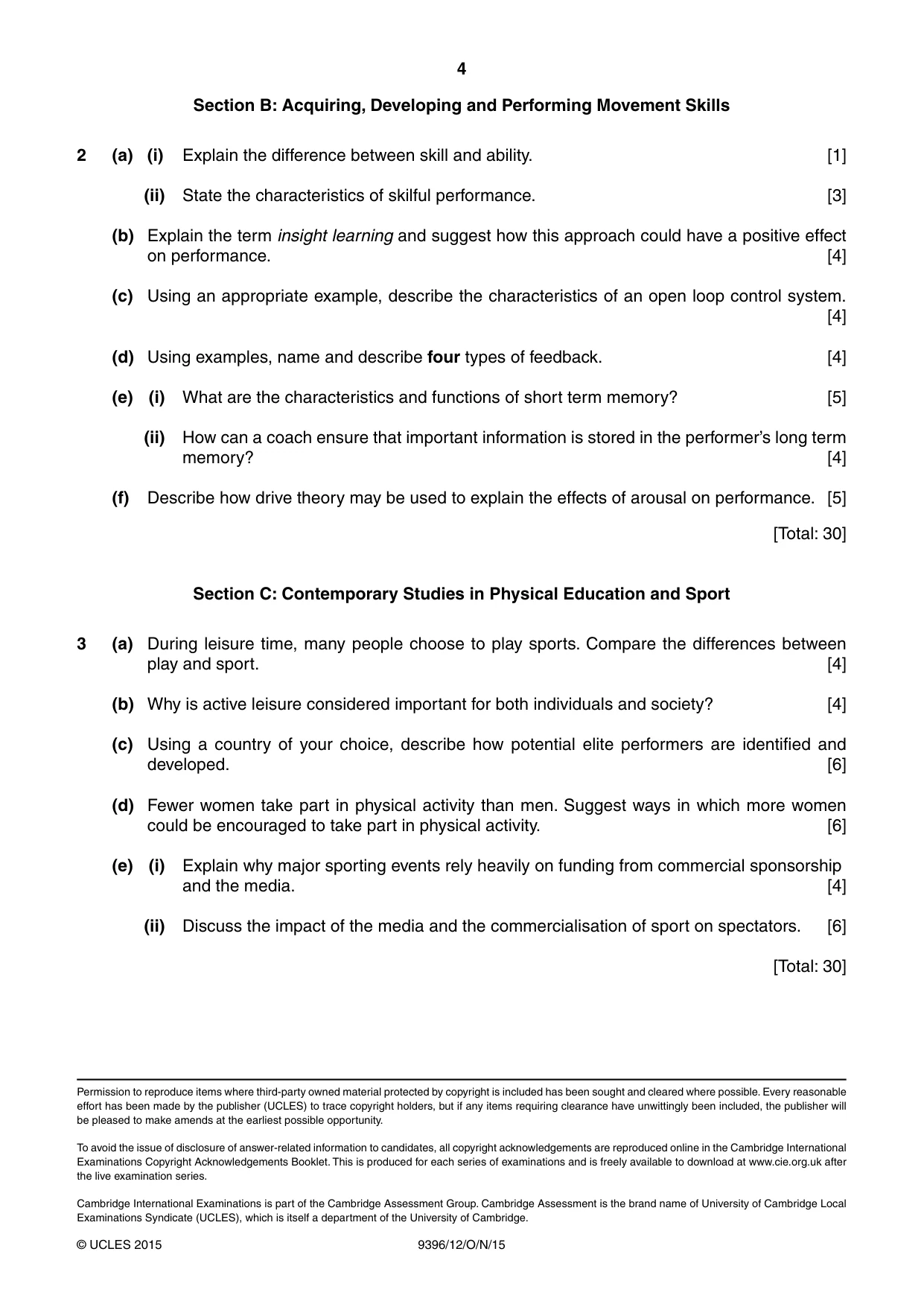
4 9396/12/O/N/15 © UCLES 2015 Section B: Acquiring, Developing and Performing Movement Skills 2 (a) (i) Explain the difference between skill and ability. [1] (ii) State the characteristics of skilful performance. [3] (b) Explain the term insight learning and suggest how this approach could have a positive effect on performance. [4] (c) Using an appropriate example, describe the characteristics of an open loop control system. [4] (d) Using examples, name and describe four types of feedback. [4] (e) (i) What are the characteristics and functions of short term memory? [5] (ii) How can a coach ensure that important information is stored in the performer’s long term memory? [4] (f) Describe how drive theory may be used to explain the effects of arousal on performance. [5] [Total: 30] Section C: Contemporary Studies in Physical Education and Sport 3 (a) During leisure time, many people choose to play sports. Compare the differences between play and sport. [4] (b) Why is active leisure considered important for both individuals and society? [4] (c) Using a country of your choice, describe how potential elite performers are identified and developed. [6] (d) Fewer women take part in physical activity than men. Suggest ways in which more women could be encouraged to take part in physical activity. [6] (e) (i) Explain why major sporting events rely heavily on funding from commercial sponsorship and the media. [4] (ii) Discuss the impact of the media and the commercialisation of sport on spectators. [6] [Total: 30] Permission to reproduce items where third-party owned material protected by copyright is included has been sought and cleared where possible. Every reasonable effort has been made by the publisher (UCLES) to trace copyright holders, but if any items requiring clearance have unwittingly been included, the publisher will be pleased to make amends at the earliest possible opportunity. To avoid the issue of disclosure of answer-related information to candidates, all copyright acknowledgements are reproduced online in the Cambridge International Examinations Copyright Acknowledgements Booklet. This is produced for each series of examinations and is freely available to download at www.cie.org.uk after the live examination series. Cambridge International Examinations is part of the Cambridge Assessment Group. Cambridge Assessment is the brand name of University of Cambridge Local Examinations Syndicate (UCLES), which is itself a department of the University of Cambridge.
Mark scheme, page 1
® IGCSE is the registered trademark of Cambridge International Examinations. CAMBRIDGE INTERNATIONAL EXAMINATIONS Cambridge International Advanced Subsidiary Level MARK SCHEME for the October/November 2015 series 9396 PHYSICAL EDUCATION 9396/12 Paper 1, maximum raw mark 90 This mark scheme is published as an aid to teachers and candidates, to indicate the requirements of the examination. It shows the basis on which Examiners were instructed to award marks. It does not indicate the details of the discussions that took place at an Examiners’ meeting before marking began, which would have considered the acceptability of alternative answers. Mark schemes should be read in conjunction with the question paper and the Principal Examiner Report for Teachers. Cambridge will not enter into discussions about these mark schemes. Cambridge is publishing the mark schemes for the October/November 2015 series for most Cambridge IGCSE®, Cambridge International A and AS Level components and some Cambridge O Level components.
Mark scheme, page 2
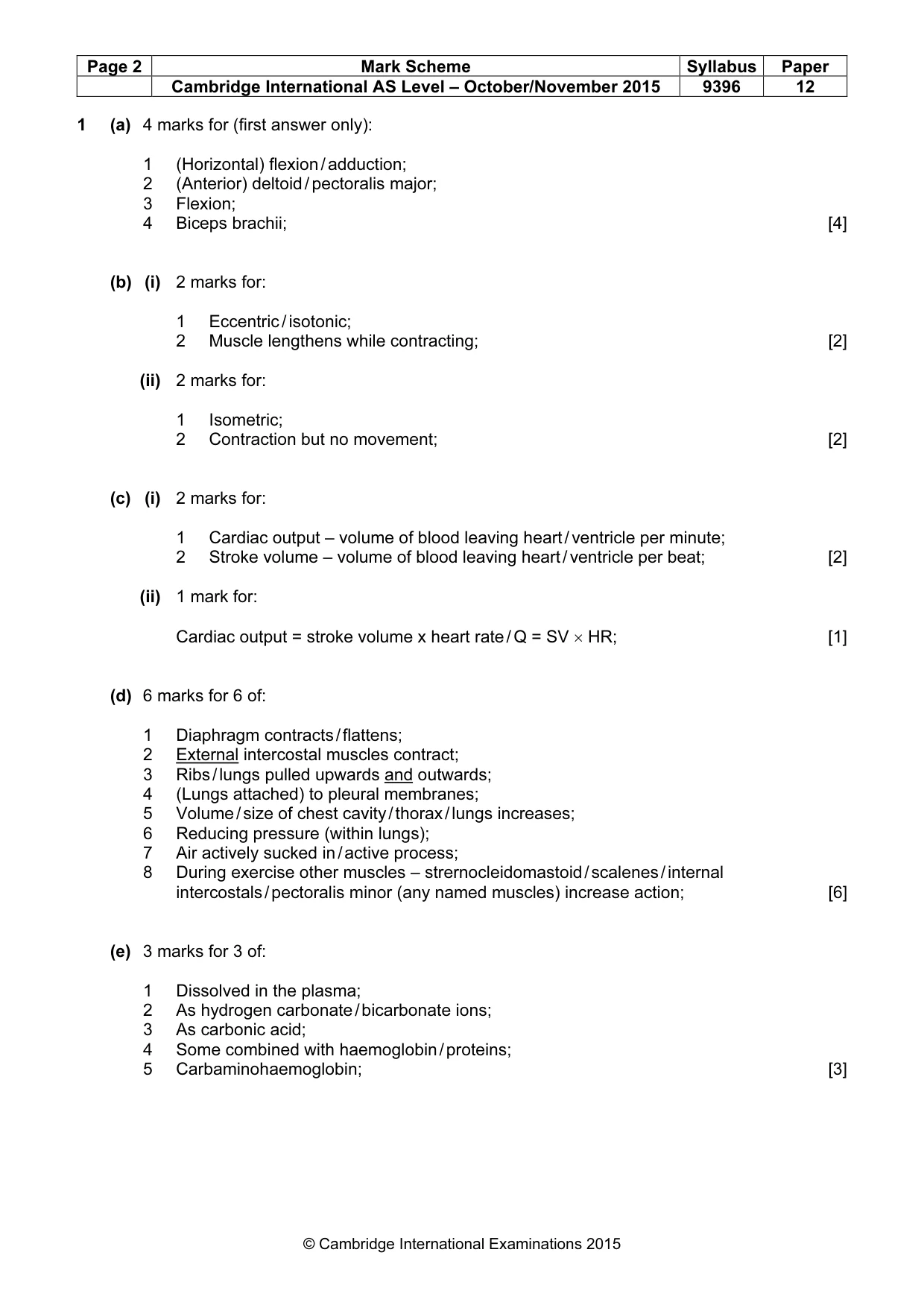
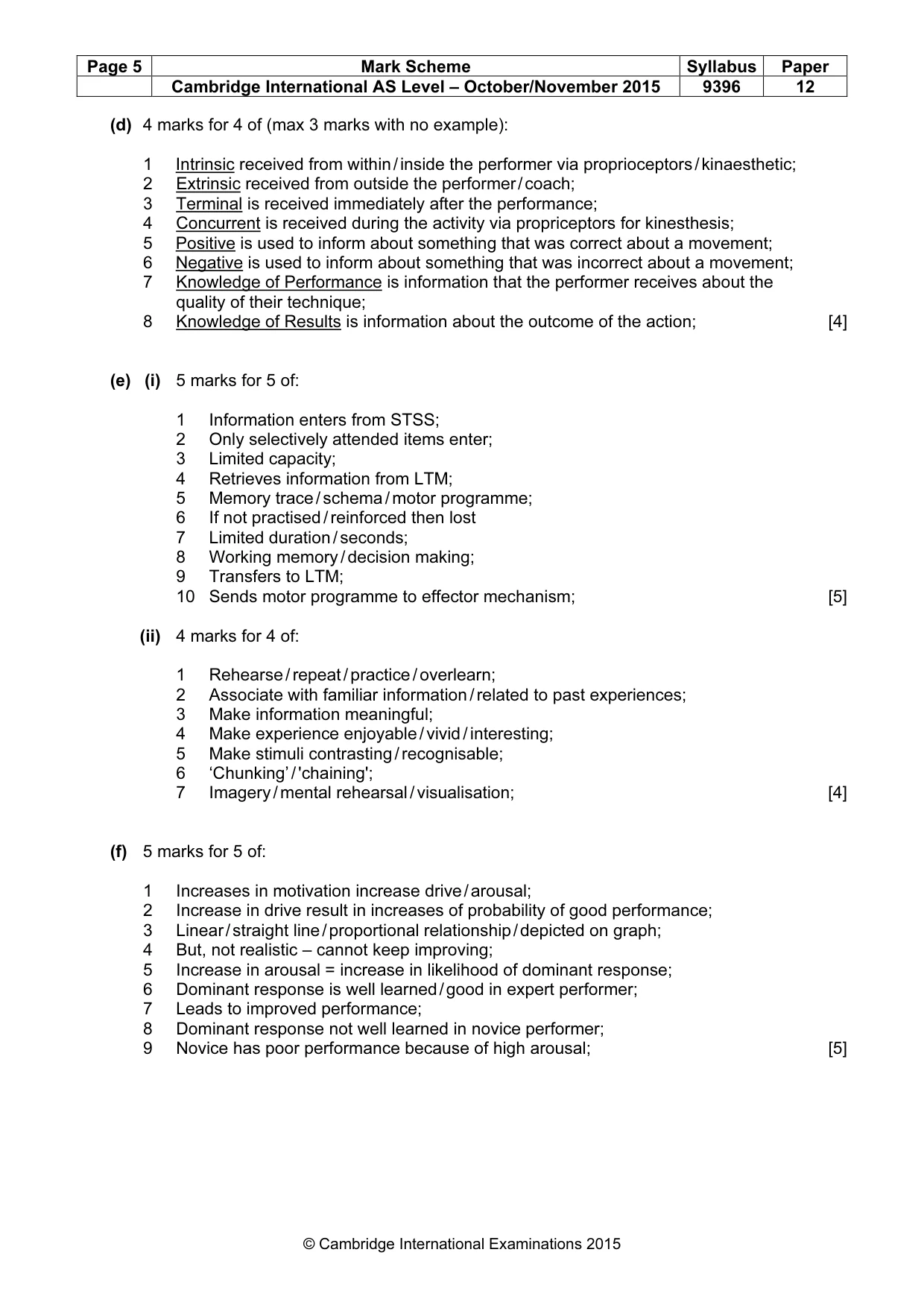
Page 2 Mark Scheme Syllabus Paper Cambridge International AS Level – October/November 2015 9396 12 © Cambridge International Examinations 2015 1 (a) 4 marks for (first answer only): 1 (Horizontal) flexion / adduction; 2 (Anterior) deltoid / pectoralis major; 3 Flexion; 4 Biceps brachii; [4] (b) (i) 2 marks for: 1 Eccentric / isotonic; 2 Muscle lengthens while contracting; [2] (ii) 2 marks for: 1 Isometric; 2 Contraction but no movement; [2] (c) (i) 2 marks for: 1 Cardiac output – volume of blood leaving heart / ventricle per minute; 2 Stroke volume – volume of blood leaving heart / ventricle per beat; [2] (ii) 1 mark for: Cardiac output = stroke volume x heart rate / Q = SV × HR; [1] (d) 6 marks for 6 of: 1 Diaphragm contracts / flattens; 2 External intercostal muscles contract; 3 Ribs / lungs pulled upwards and outwards; 4 (Lungs attached) to pleural membranes; 5 Volume / size of chest cavity / thorax / lungs increases; 6 Reducing pressure (within lungs); 7 Air actively sucked in / active process; 8 During exercise other muscles – strernocleidomastoid / scalenes / internal intercostals / pectoralis minor (any named muscles) increase action; [6] (e) 3 marks for 3 of: 1 Dissolved in the plasma; 2 As hydrogen carbonate / bicarbonate ions; 3 As carbonic acid; 4 Some combined with haemoglobin / proteins; 5 Carbaminohaemoglobin; [3]
Mark scheme, page 3
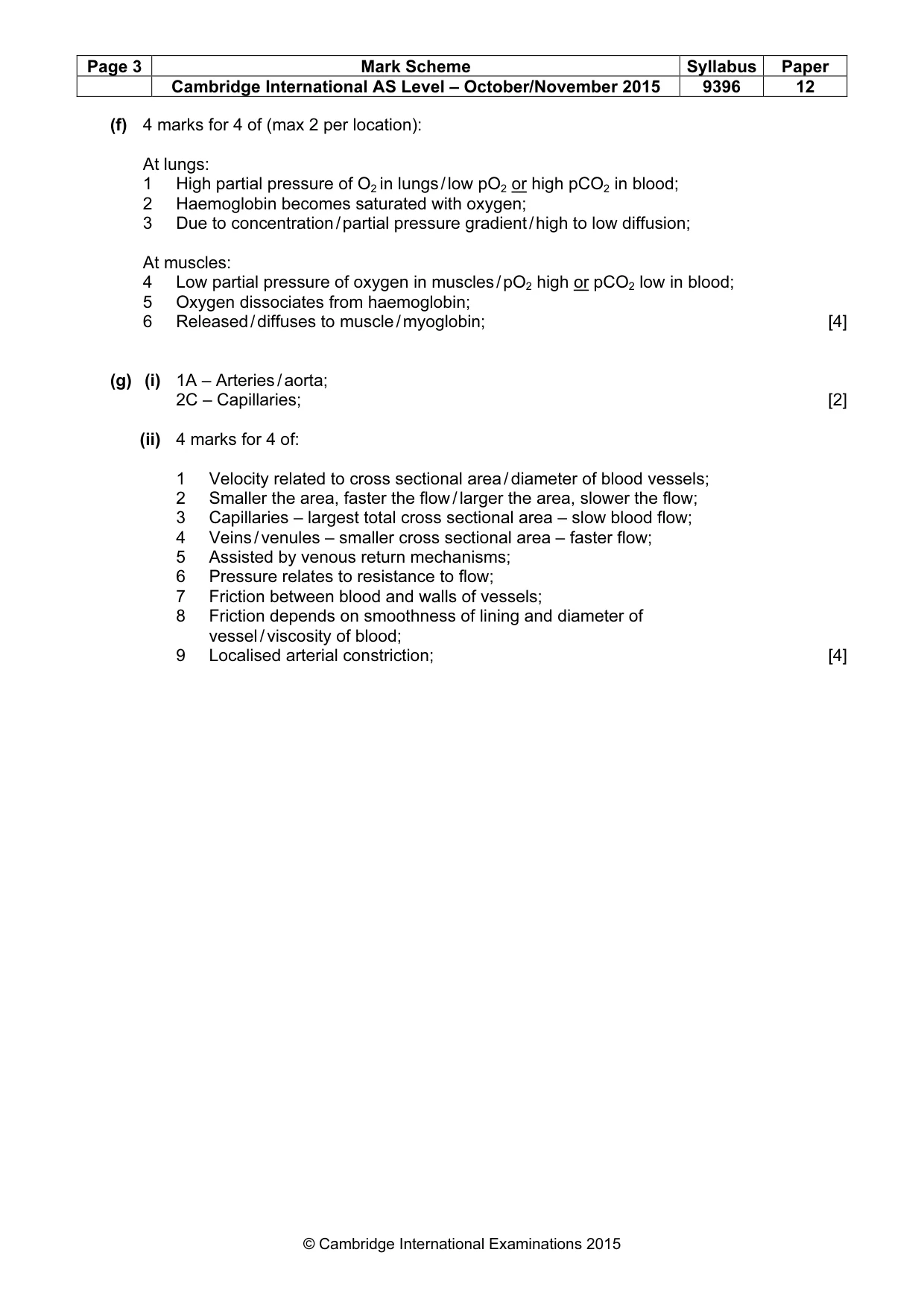
Page 3 Mark Scheme Syllabus Paper Cambridge International AS Level – October/November 2015 9396 12 © Cambridge International Examinations 2015 (f) 4 marks for 4 of (max 2 per location): At lungs: 1 High partial pressure of O2 in lungs / low pO2 or high pCO2 in blood; 2 Haemoglobin becomes saturated with oxygen; 3 Due to concentration / partial pressure gradient / high to low diffusion; At muscles: 4 Low partial pressure of oxygen in muscles / pO2 high or pCO2 low in blood; 5 Oxygen dissociates from haemoglobin; 6 Released / diffuses to muscle / myoglobin; [4] (g) (i) 1A – Arteries / aorta; 2C – Capillaries; [2] (ii) 4 marks for 4 of: 1 Velocity related to cross sectional area / diameter of blood vessels; 2 Smaller the area, faster the flow / larger the area, slower the flow; 3 Capillaries – largest total cross sectional area – slow blood flow; 4 Veins / venules – smaller cross sectional area – faster flow; 5 Assisted by venous return mechanisms; 6 Pressure relates to resistance to flow; 7 Friction between blood and walls of vessels; 8 Friction depends on smoothness of lining and diameter of vessel / viscosity of blood; 9 Localised arterial constriction; [4]
Mark scheme, page 4
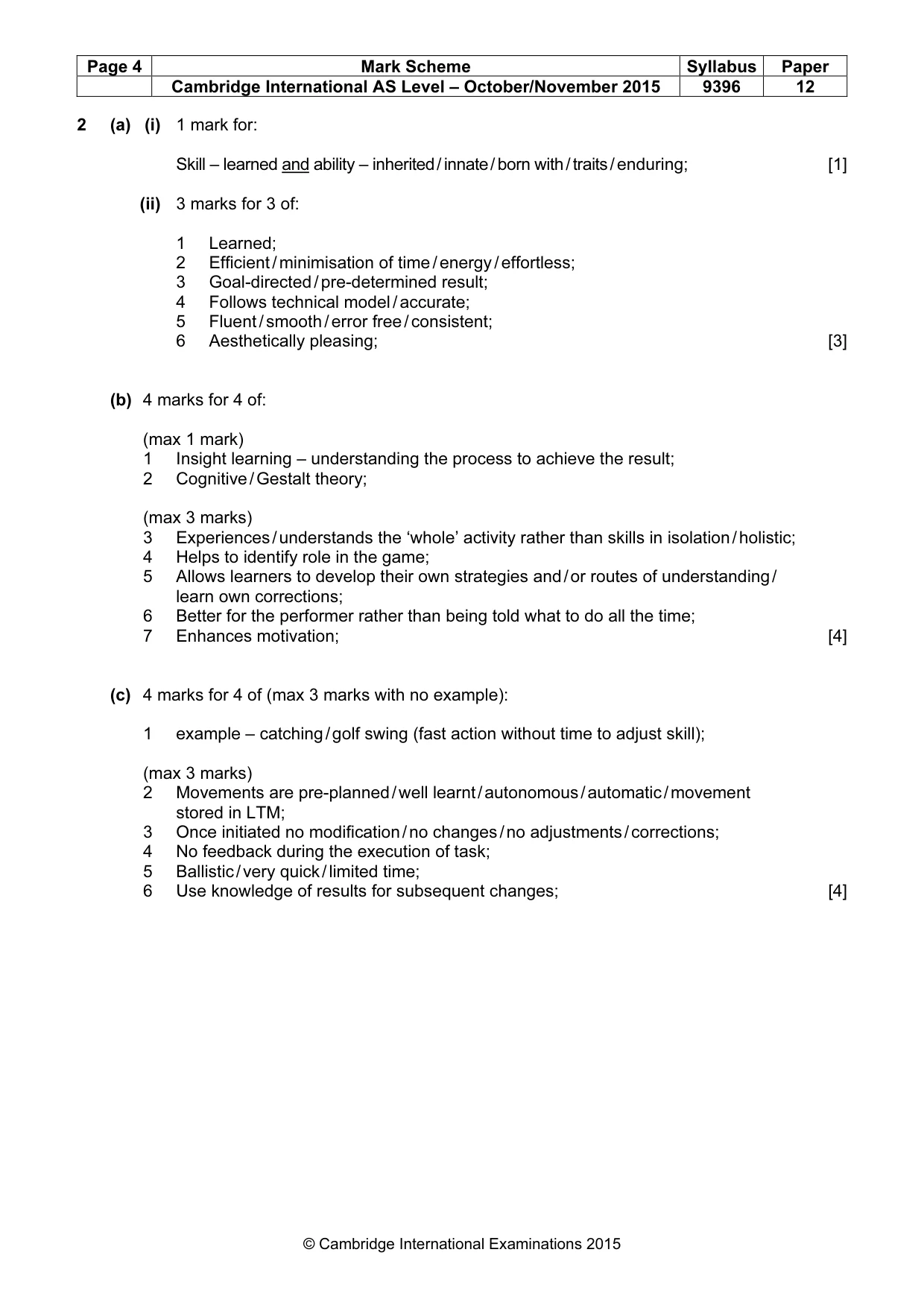
Page 4 Mark Scheme Syllabus Paper Cambridge International AS Level – October/November 2015 9396 12 © Cambridge International Examinations 2015 2 (a) (i) 1 mark for: Skill – learned and ability – inherited / innate / born with / traits / enduring; [1] (ii) 3 marks for 3 of: 1 Learned; 2 Efficient / minimisation of time / energy / effortless; 3 Goal-directed / pre-determined result; 4 Follows technical model / accurate; 5 Fluent / smooth / error free / consistent; 6 Aesthetically pleasing; [3] (b) 4 marks for 4 of: (max 1 mark) 1 Insight learning – understanding the process to achieve the result; 2 Cognitive / Gestalt theory; (max 3 marks) 3 Experiences / understands the ‘whole’ activity rather than skills in isolation / holistic; 4 Helps to identify role in the game; 5 Allows learners to develop their own strategies and / or routes of understanding / learn own corrections; 6 Better for the performer rather than being told what to do all the time; 7 Enhances motivation; [4] (c) 4 marks for 4 of (max 3 marks with no example): 1 example – catching / golf swing (fast action without time to adjust skill); (max 3 marks) 2 Movements are pre-planned / well learnt / autonomous / automatic / movement stored in LTM; 3 Once initiated no modification / no changes / no adjustments / corrections; 4 No feedback during the execution of task; 5 Ballistic / very quick / limited time; 6 Use knowledge of results for subsequent changes; [4]
Mark scheme, page 5
Page 5 Mark Scheme Syllabus Paper Cambridge International AS Level – October/November 2015 9396 12 © Cambridge International Examinations 2015 (d) 4 marks for 4 of (max 3 marks with no example): 1 Intrinsic received from within / inside the performer via proprioceptors / kinaesthetic; 2 Extrinsic received from outside the performer / coach; 3 Terminal is received immediately after the performance; 4 Concurrent is received during the activity via propriceptors for kinesthesis; 5 Positive is used to inform about something that was correct about a movement; 6 Negative is used to inform about something that was incorrect about a movement; 7 Knowledge of Performance is information that the performer receives about the quality of their technique; 8 Knowledge of Results is information about the outcome of the action; [4] (e) (i) 5 marks for 5 of: 1 Information enters from STSS; 2 Only selectively attended items enter; 3 Limited capacity; 4 Retrieves information from LTM; 5 Memory trace / schema / motor programme; 6 If not practised / reinforced then lost 7 Limited duration / seconds; 8 Working memory / decision making; 9 Transfers to LTM; 10 Sends motor programme to effector mechanism; [5] (ii) 4 marks for 4 of: 1 Rehearse / repeat / practice / overlearn; 2 Associate with familiar information / related to past experiences; 3 Make information meaningful; 4 Make experience enjoyable / vivid / interesting; 5 Make stimuli contrasting / recognisable; 6 ‘Chunking’ / 'chaining'; 7 Imagery / mental rehearsal / visualisation; [4] (f) 5 marks for 5 of: 1 Increases in motivation increase drive / arousal; 2 Increase in drive result in increases of probability of good performance; 3 Linear / straight line / proportional relationship / depicted on graph; 4 But, not realistic – cannot keep improving; 5 Increase in arousal = increase in likelihood of dominant response; 6 Dominant response is well learned / good in expert performer; 7 Leads to improved performance; 8 Dominant response not well learned in novice performer; 9 Novice has poor performance because of high arousal; [5]
Mark scheme, page 6
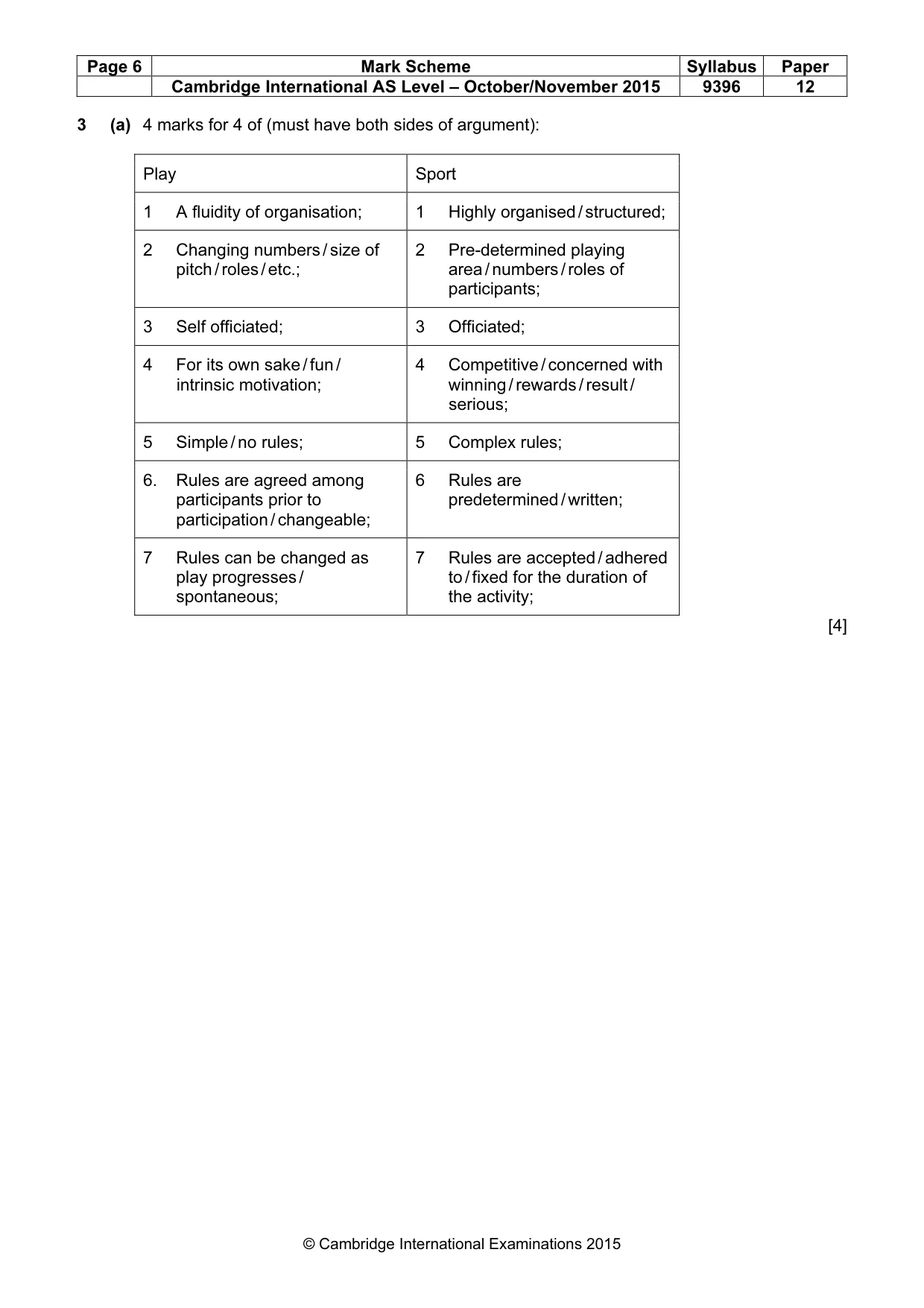
Page 6 Mark Scheme Syllabus Paper Cambridge International AS Level – October/November 2015 9396 12 © Cambridge International Examinations 2015 3 (a) 4 marks for 4 of (must have both sides of argument): Play Sport 1 A fluidity of organisation; 1 Highly organised / structured; 2 Changing numbers / size of pitch / roles / etc.; 2 Pre-determined playing area / numbers / roles of participants; 3 Self officiated; 3 Officiated; 4 For its own sake / fun / intrinsic motivation; 4 Competitive / concerned with winning / rewards / result / serious; 5 Simple / no rules; 5 Complex rules; 6. Rules are agreed among participants prior to participation / changeable; 6 Rules are predetermined / written; 7 Rules can be changed as play progresses / spontaneous; 7 Rules are accepted / adhered to / fixed for the duration of the activity; [4]
Mark scheme, page 7
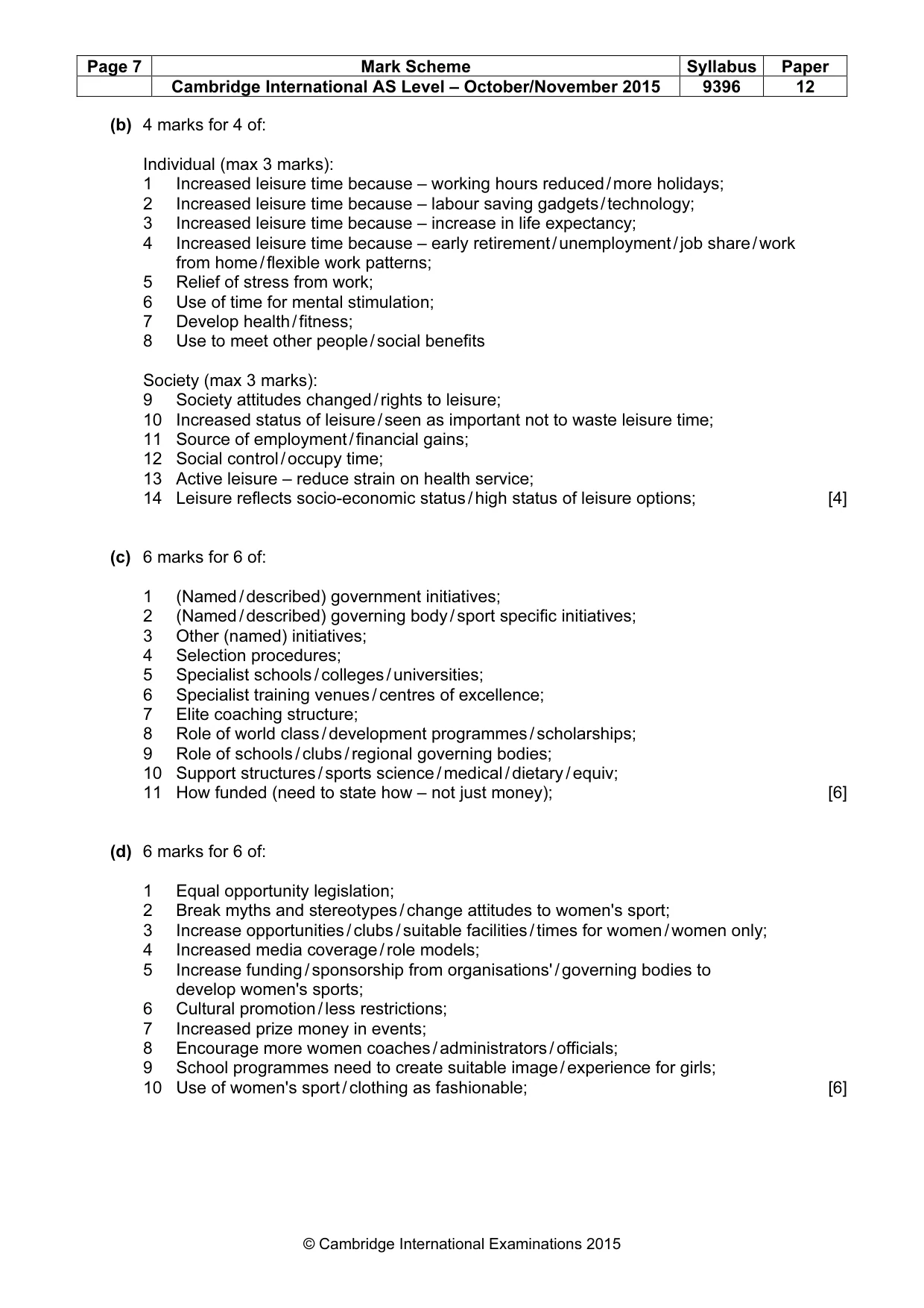
Page 7 Mark Scheme Syllabus Paper Cambridge International AS Level – October/November 2015 9396 12 © Cambridge International Examinations 2015 (b) 4 marks for 4 of: Individual (max 3 marks): 1 Increased leisure time because – working hours reduced / more holidays; 2 Increased leisure time because – labour saving gadgets / technology; 3 Increased leisure time because – increase in life expectancy; 4 Increased leisure time because – early retirement / unemployment / job share / work from home / flexible work patterns; 5 Relief of stress from work; 6 Use of time for mental stimulation; 7 Develop health / fitness; 8 Use to meet other people / social benefits Society (max 3 marks): 9 Society attitudes changed / rights to leisure; 10 Increased status of leisure / seen as important not to waste leisure time; 11 Source of employment / financial gains; 12 Social control / occupy time; 13 Active leisure – reduce strain on health service; 14 Leisure reflects socio-economic status / high status of leisure options; [4] (c) 6 marks for 6 of: 1 (Named / described) government initiatives; 2 (Named / described) governing body / sport specific initiatives; 3 Other (named) initiatives; 4 Selection procedures; 5 Specialist schools / colleges / universities; 6 Specialist training venues / centres of excellence; 7 Elite coaching structure; 8 Role of world class / development programmes / scholarships; 9 Role of schools / clubs / regional governing bodies; 10 Support structures / sports science / medical / dietary / equiv; 11 How funded (need to state how – not just money); [6] (d) 6 marks for 6 of: 1 Equal opportunity legislation; 2 Break myths and stereotypes / change attitudes to women's sport; 3 Increase opportunities / clubs / suitable facilities / times for women / women only; 4 Increased media coverage / role models; 5 Increase funding / sponsorship from organisations' / governing bodies to develop women's sports; 6 Cultural promotion / less restrictions; 7 Increased prize money in events; 8 Encourage more women coaches / administrators / officials; 9 School programmes need to create suitable image / experience for girls; 10 Use of women's sport / clothing as fashionable; [6]
Mark scheme, page 8
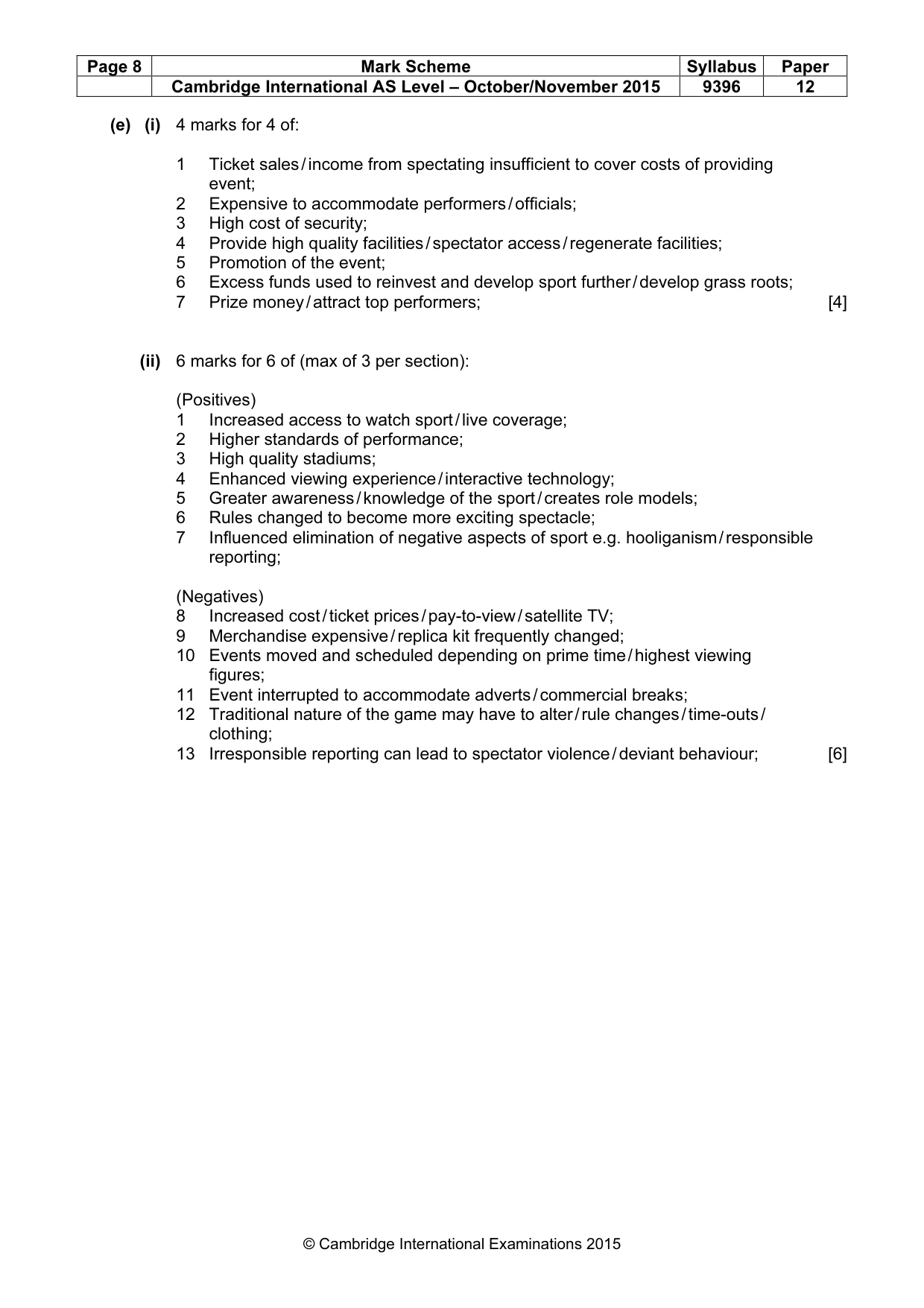
Page 8 Mark Scheme Syllabus Paper Cambridge International AS Level – October/November 2015 9396 12 © Cambridge International Examinations 2015 (e) (i) 4 marks for 4 of: 1 Ticket sales / income from spectating insufficient to cover costs of providing event; 2 Expensive to accommodate performers / officials; 3 High cost of security; 4 Provide high quality facilities / spectator access / regenerate facilities; 5 Promotion of the event; 6 Excess funds used to reinvest and develop sport further / develop grass roots; 7 Prize money / attract top performers; [4] (ii) 6 marks for 6 of (max of 3 per section): (Positives) 1 Increased access to watch sport / live coverage; 2 Higher standards of performance; 3 High quality stadiums; 4 Enhanced viewing experience / interactive technology; 5 Greater awareness / knowledge of the sport / creates role models; 6 Rules changed to become more exciting spectacle; 7 Influenced elimination of negative aspects of sport e.g. hooliganism / responsible reporting; (Negatives) 8 Increased cost / ticket prices / pay-to-view / satellite TV; 9 Merchandise expensive / replica kit frequently changed; 10 Events moved and scheduled depending on prime time / highest viewing figures; 11 Event interrupted to accommodate adverts / commercial breaks; 12 Traditional nature of the game may have to alter / rule changes / time-outs / clothing; 13 Irresponsible reporting can lead to spectator violence / deviant behaviour; [6]
What you needed in this session
Cambridge’s own grade thresholds for 2015 Oct/Nov, Paper 1 · Variant 2. A higher threshold means an easier paper — the bar moves with how the cohort did.