Cambridge A Level Physical Education 9396 — 2015 Oct/Nov Paper 1 · Variant 3
9396/13/O/N/15 · 90 marks · ≈101 min
The question paper and its mark scheme, free to read here and free to download. This is Cambridge’s own paper, exactly as it was sat.
Question paper4 pages
Mark scheme6 pages
Answers below. Sit the paper first if you are practising.
Paper as text
Question paper, page 1
This document consists of 4 printed pages and 1 insert. DC (AC/CGW) 93711/5 © UCLES 2015 [Turn over Cambridge International Examinations Cambridge International Advanced Subsidiary and Advanced Level * 2 5 1 4 0 4 5 2 9 8 * PHYSICAL EDUCATION 9396/13 Paper 1 October/November 2015 2 hours 30 minutes No Additional Materials are required. READ THESE INSTRUCTIONS FIRST An answer booklet is provided inside this question paper. You should follow the instructions on the front cover of the answer booklet. If you need additional answer paper ask the invigilator for a continuation booklet. Answer all questions. Electronic calculators may be used. You may lose marks if you do not show your working or if you do not use appropriate units. The number of marks is given in brackets [ ] at the end of each question or part question.
Question paper, page 2
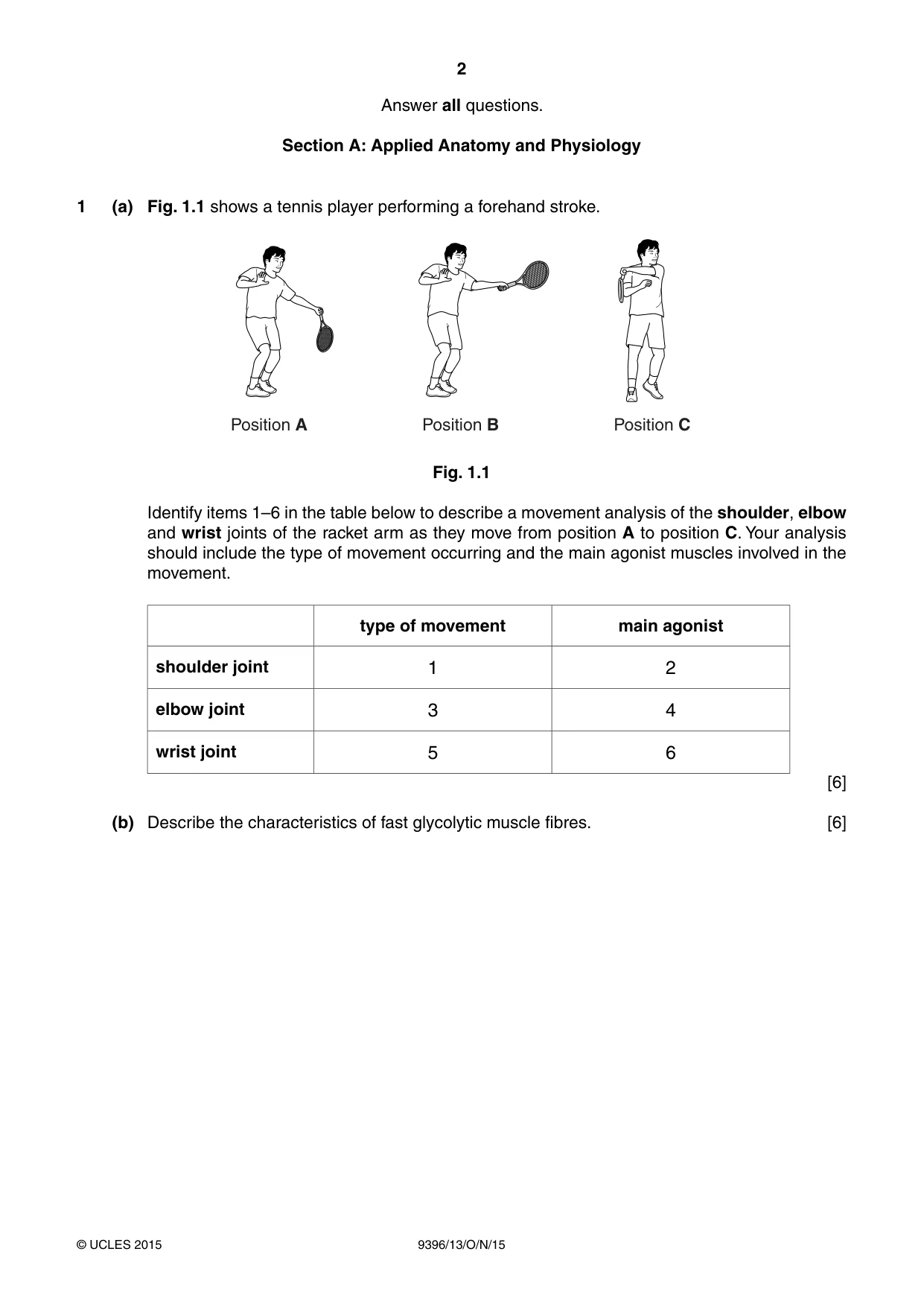
2 9396/13/O/N/15 © UCLES 2015 Answer all questions. Section A: Applied Anatomy and Physiology 1 (a) Fig. 1.1 shows a tennis player performing a forehand stroke. Position A Position B Position C Fig. 1.1 Identify items 1–6 in the table below to describe a movement analysis of the shoulder, elbow and wrist joints of the racket arm as they move from position A to position C. Your analysis should include the type of movement occurring and the main agonist muscles involved in the movement. type of movement main agonist shoulder joint 1 2 elbow joint 3 4 wrist joint 5 6 [6] (b) Describe the characteristics of fast glycolytic muscle fibres. [6]
Question paper, page 3
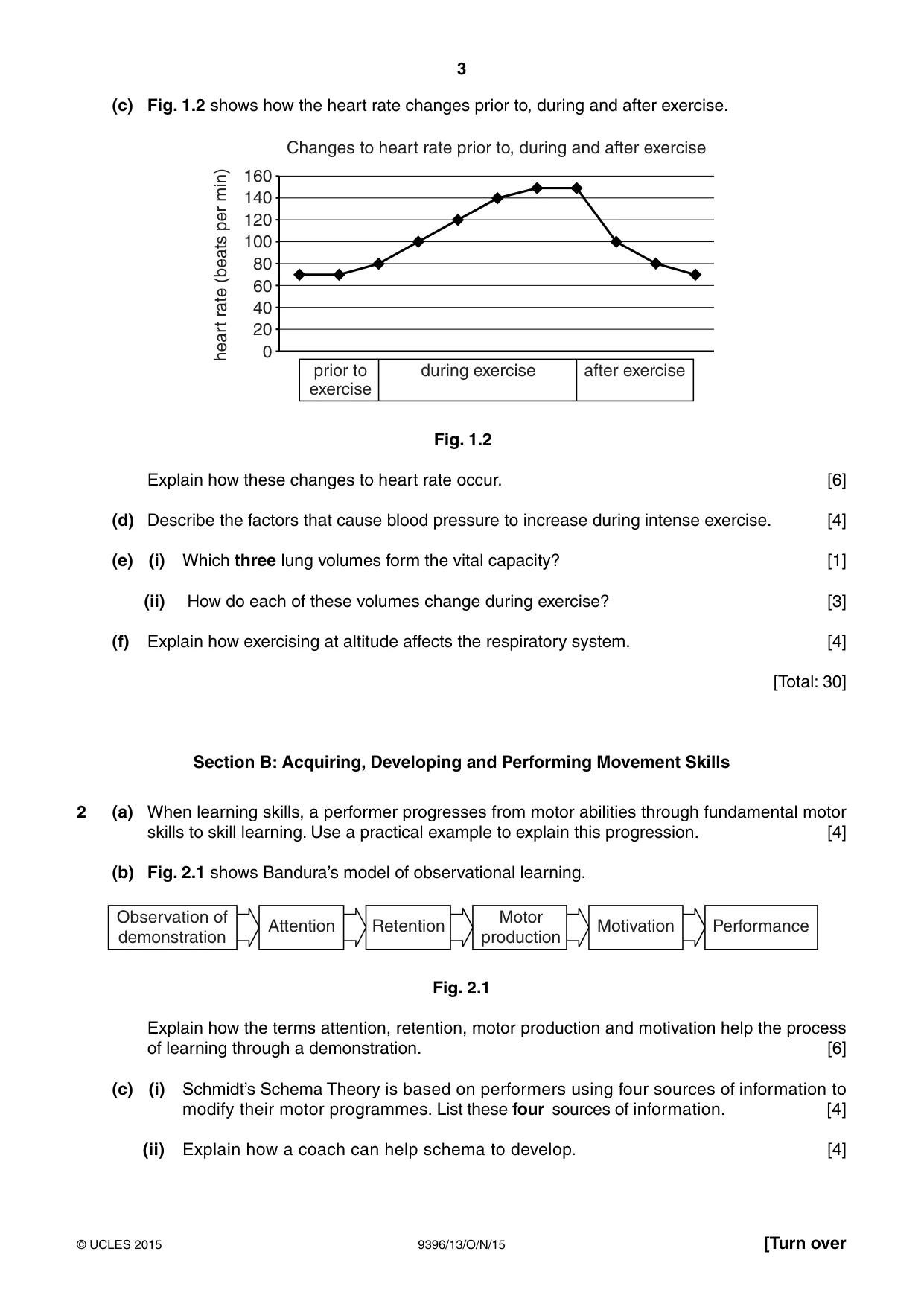
3 9396/13/O/N/15 © UCLES 2015 [Turn over (c) Fig. 1.2 shows how the heart rate changes prior to, during and after exercise. 160 Changes to heart rate prior to, during and after exercise during exercise prior to exercise after exercise 140 120 100 80 heart rate (beats per min) 60 40 20 0 Fig. 1.2 Explain how these changes to heart rate occur. [6] (d) Describe the factors that cause blood pressure to increase during intense exercise. [4] (e) (i) Which three lung volumes form the vital capacity? [1] (ii) How do each of these volumes change during exercise? [3] (f) Explain how exercising at altitude affects the respiratory system. [4] [Total: 30] Section B: Acquiring, Developing and Performing Movement Skills 2 (a) When learning skills, a performer progresses from motor abilities through fundamental motor skills to skill learning. Use a practical example to explain this progression. [4] (b) Fig. 2.1 shows Bandura’s model of observational learning. Observation of demonstration Attention Performance Retention Motivation Motor production Fig. 2.1 Explain how the terms attention, retention, motor production and motivation help the process of learning through a demonstration. [6] (c) (i) Schmidt’s Schema Theory is based on performers using four sources of information to modify their motor programmes. List these four sources of information. [4] (ii) Explain how a coach can help schema to develop. [4]
Question paper, page 4
4 9396/13/O/N/15 © UCLES 2015 (d) (i) Define the terms movement time, response time and reaction time. [3] (ii) What strategies could a performer use to achieve a faster response time? [4] (e) (i) Name and describe the characteristics of the second and third phases of learning. [2] (ii) What strategies could a coach use to help a performer progress from the second phase to the third phase of learning? [3] [Total: 30] Section C: Contemporary Studies in Physical Education and Sport 3 (a) (i) Using suitable examples, explain what is meant by the terms outdoor education and outdoor recreation. [4] (ii) State the educational and recreational values and qualities that a child might gain when participating in outdoor and adventurous activities. [6] (b) (i) Suggest reasons why governments try to increase participation in physical activities. [4] (ii) Using a country of your choice, describe four initiatives that have been used by organisations to increase participation. [4] (c) Describe the possible causes of violence by players during a sporting event. [6] (d) Discuss the positive and negative effects that the media may have on sporting events. [6] [Total: 30] Permission to reproduce items where third-party owned material protected by copyright is included has been sought and cleared where possible. Every reasonable effort has been made by the publisher (UCLES) to trace copyright holders, but if any items requiring clearance have unwittingly been included, the publisher will be pleased to make amends at the earliest possible opportunity. To avoid the issue of disclosure of answer-related information to candidates, all copyright acknowledgements are reproduced online in the Cambridge International Examinations Copyright Acknowledgements Booklet. This is produced for each series of examinations and is freely available to download at www.cie.org.uk after the live examination series. Cambridge International Examinations is part of the Cambridge Assessment Group. Cambridge Assessment is the brand name of University of Cambridge Local Examinations Syndicate (UCLES), which is itself a department of the University of Cambridge.
Mark scheme, page 1
® IGCSE is the registered trademark of Cambridge International Examinations. CAMBRIDGE INTERNATIONAL EXAMINATIONS Cambridge International Advanced Subsidiary Level MARK SCHEME for the October/November 2015 series 9396 PHYSICAL EDUCATION 9396/13 Paper 1, maximum raw mark 90 This mark scheme is published as an aid to teachers and candidates, to indicate the requirements of the examination. It shows the basis on which Examiners were instructed to award marks. It does not indicate the details of the discussions that took place at an Examiners’ meeting before marking began, which would have considered the acceptability of alternative answers. Mark schemes should be read in conjunction with the question paper and the Principal Examiner Report for Teachers. Cambridge will not enter into discussions about these mark schemes. Cambridge is publishing the mark schemes for the October/November 2015 series for most Cambridge IGCSE®, Cambridge International A and AS Level components and some Cambridge O Level components.
Mark scheme, page 2
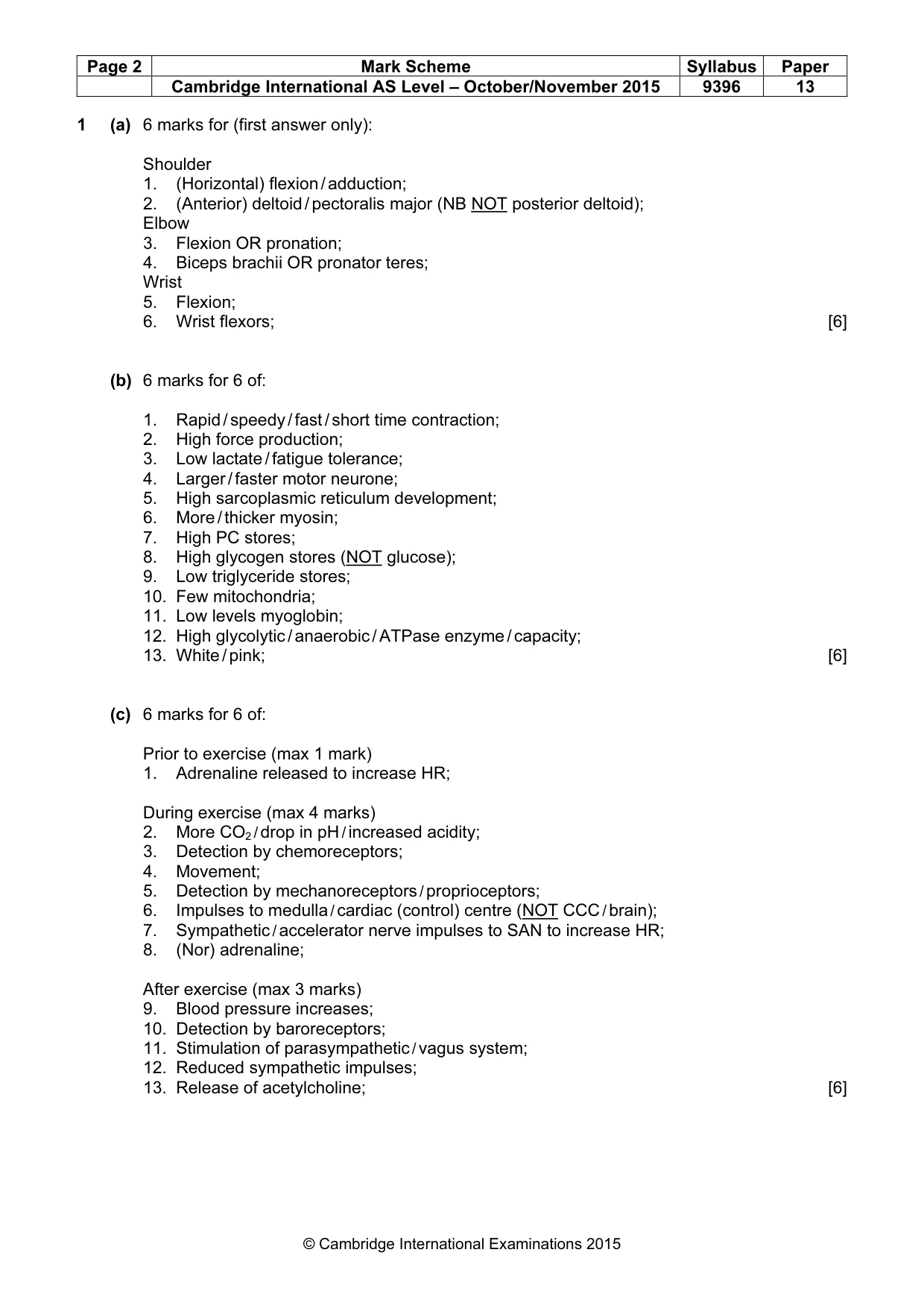
Page 2 Mark Scheme Syllabus Paper Cambridge International AS Level – October/November 2015 9396 13 © Cambridge International Examinations 2015 1 (a) 6 marks for (first answer only): Shoulder 1. (Horizontal) flexion / adduction; 2. (Anterior) deltoid / pectoralis major (NB NOT posterior deltoid); Elbow 3. Flexion OR pronation; 4. Biceps brachii OR pronator teres; Wrist 5. Flexion; 6. Wrist flexors; [6] (b) 6 marks for 6 of: 1. Rapid / speedy / fast / short time contraction; 2. High force production; 3. Low lactate / fatigue tolerance; 4. Larger / faster motor neurone; 5. High sarcoplasmic reticulum development; 6. More / thicker myosin; 7. High PC stores; 8. High glycogen stores (NOT glucose); 9. Low triglyceride stores; 10. Few mitochondria; 11. Low levels myoglobin; 12. High glycolytic / anaerobic / ATPase enzyme / capacity; 13. White / pink; [6] (c) 6 marks for 6 of: Prior to exercise (max 1 mark) 1. Adrenaline released to increase HR; During exercise (max 4 marks) 2. More CO2 / drop in pH / increased acidity; 3. Detection by chemoreceptors; 4. Movement; 5. Detection by mechanoreceptors / proprioceptors; 6. Impulses to medulla / cardiac (control) centre (NOT CCC / brain); 7. Sympathetic / accelerator nerve impulses to SAN to increase HR; 8. (Nor) adrenaline; After exercise (max 3 marks) 9. Blood pressure increases; 10. Detection by baroreceptors; 11. Stimulation of parasympathetic / vagus system; 12. Reduced sympathetic impulses; 13. Release of acetylcholine; [6]
Mark scheme, page 3
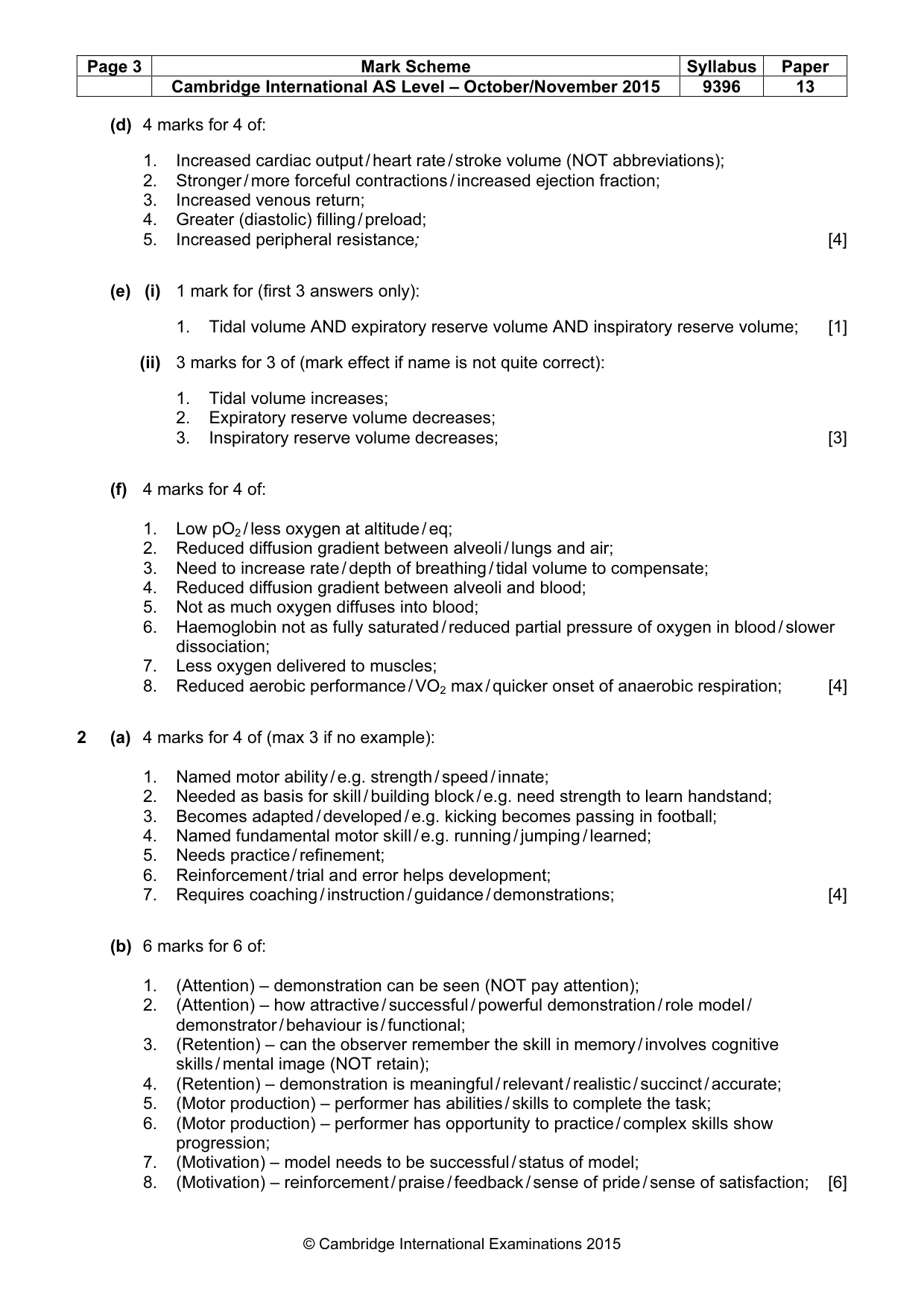
Page 3 Mark Scheme Syllabus Paper Cambridge International AS Level – October/November 2015 9396 13 © Cambridge International Examinations 2015 (d) 4 marks for 4 of: 1. Increased cardiac output / heart rate / stroke volume (NOT abbreviations); 2. Stronger / more forceful contractions / increased ejection fraction; 3. Increased venous return; 4. Greater (diastolic) filling / preload; 5. Increased peripheral resistance; [4] (e) (i) 1 mark for (first 3 answers only): 1. Tidal volume AND expiratory reserve volume AND inspiratory reserve volume; [1] (ii) 3 marks for 3 of (mark effect if name is not quite correct): 1. Tidal volume increases; 2. Expiratory reserve volume decreases; 3. Inspiratory reserve volume decreases; [3] (f) 4 marks for 4 of: 1. Low pO2 / less oxygen at altitude / eq; 2. Reduced diffusion gradient between alveoli / lungs and air; 3. Need to increase rate / depth of breathing / tidal volume to compensate; 4. Reduced diffusion gradient between alveoli and blood; 5. Not as much oxygen diffuses into blood; 6. Haemoglobin not as fully saturated / reduced partial pressure of oxygen in blood / slower dissociation; 7. Less oxygen delivered to muscles; 8. Reduced aerobic performance / VO2 max / quicker onset of anaerobic respiration; [4] 2 (a) 4 marks for 4 of (max 3 if no example): 1. Named motor ability / e.g. strength / speed / innate; 2. Needed as basis for skill / building block / e.g. need strength to learn handstand; 3. Becomes adapted / developed / e.g. kicking becomes passing in football; 4. Named fundamental motor skill / e.g. running / jumping / learned; 5. Needs practice / refinement; 6. Reinforcement / trial and error helps development; 7. Requires coaching / instruction / guidance / demonstrations; [4] (b) 6 marks for 6 of: 1. (Attention) – demonstration can be seen (NOT pay attention); 2. (Attention) – how attractive / successful / powerful demonstration / role model / demonstrator / behaviour is / functional; 3. (Retention) – can the observer remember the skill in memory / involves cognitive skills / mental image (NOT retain); 4. (Retention) – demonstration is meaningful / relevant / realistic / succinct / accurate; 5. (Motor production) – performer has abilities / skills to complete the task; 6. (Motor production) – performer has opportunity to practice / complex skills show progression; 7. (Motivation) – model needs to be successful / status of model; 8. (Motivation) – reinforcement / praise / feedback / sense of pride / sense of satisfaction; [6]
Mark scheme, page 4
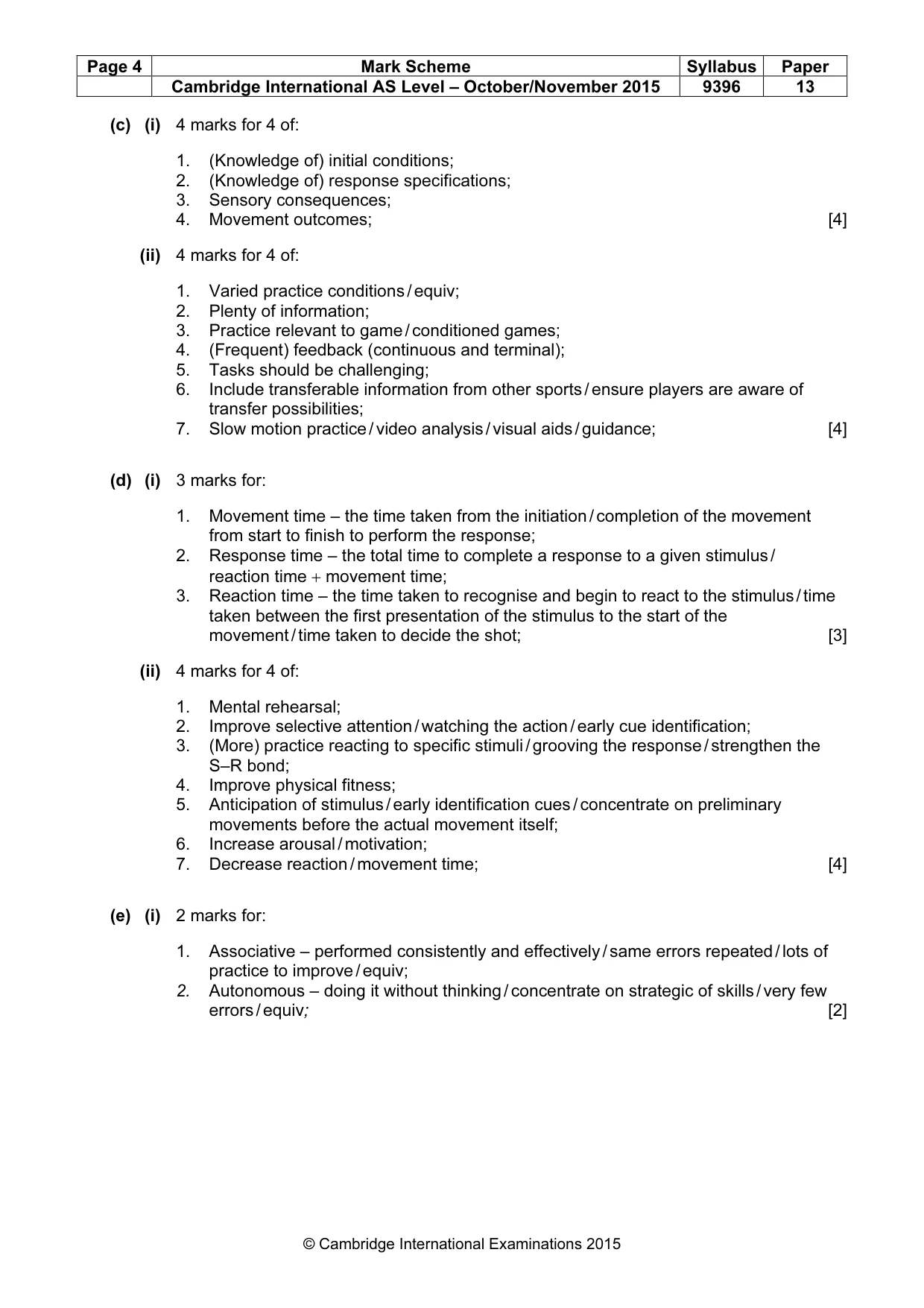
Page 4 Mark Scheme Syllabus Paper Cambridge International AS Level – October/November 2015 9396 13 © Cambridge International Examinations 2015 (c) (i) 4 marks for 4 of: 1. (Knowledge of) initial conditions; 2. (Knowledge of) response specifications; 3. Sensory consequences; 4. Movement outcomes; [4] (ii) 4 marks for 4 of: 1. Varied practice conditions / equiv; 2. Plenty of information; 3. Practice relevant to game / conditioned games; 4. (Frequent) feedback (continuous and terminal); 5. Tasks should be challenging; 6. Include transferable information from other sports / ensure players are aware of transfer possibilities; 7. Slow motion practice / video analysis / visual aids / guidance; [4] (d) (i) 3 marks for: 1. Movement time – the time taken from the initiation / completion of the movement from start to finish to perform the response; 2. Response time – the total time to complete a response to a given stimulus / reaction time + movement time; 3. Reaction time – the time taken to recognise and begin to react to the stimulus / time taken between the first presentation of the stimulus to the start of the movement / time taken to decide the shot; [3] (ii) 4 marks for 4 of: 1. Mental rehearsal; 2. Improve selective attention / watching the action / early cue identification; 3. (More) practice reacting to specific stimuli / grooving the response / strengthen the S–R bond; 4. Improve physical fitness; 5. Anticipation of stimulus / early identification cues / concentrate on preliminary movements before the actual movement itself; 6. Increase arousal / motivation; 7. Decrease reaction / movement time; [4] (e) (i) 2 marks for: 1. Associative – performed consistently and effectively / same errors repeated / lots of practice to improve / equiv; 2. Autonomous – doing it without thinking / concentrate on strategic of skills / very few errors / equiv; [2]
Mark scheme, page 5
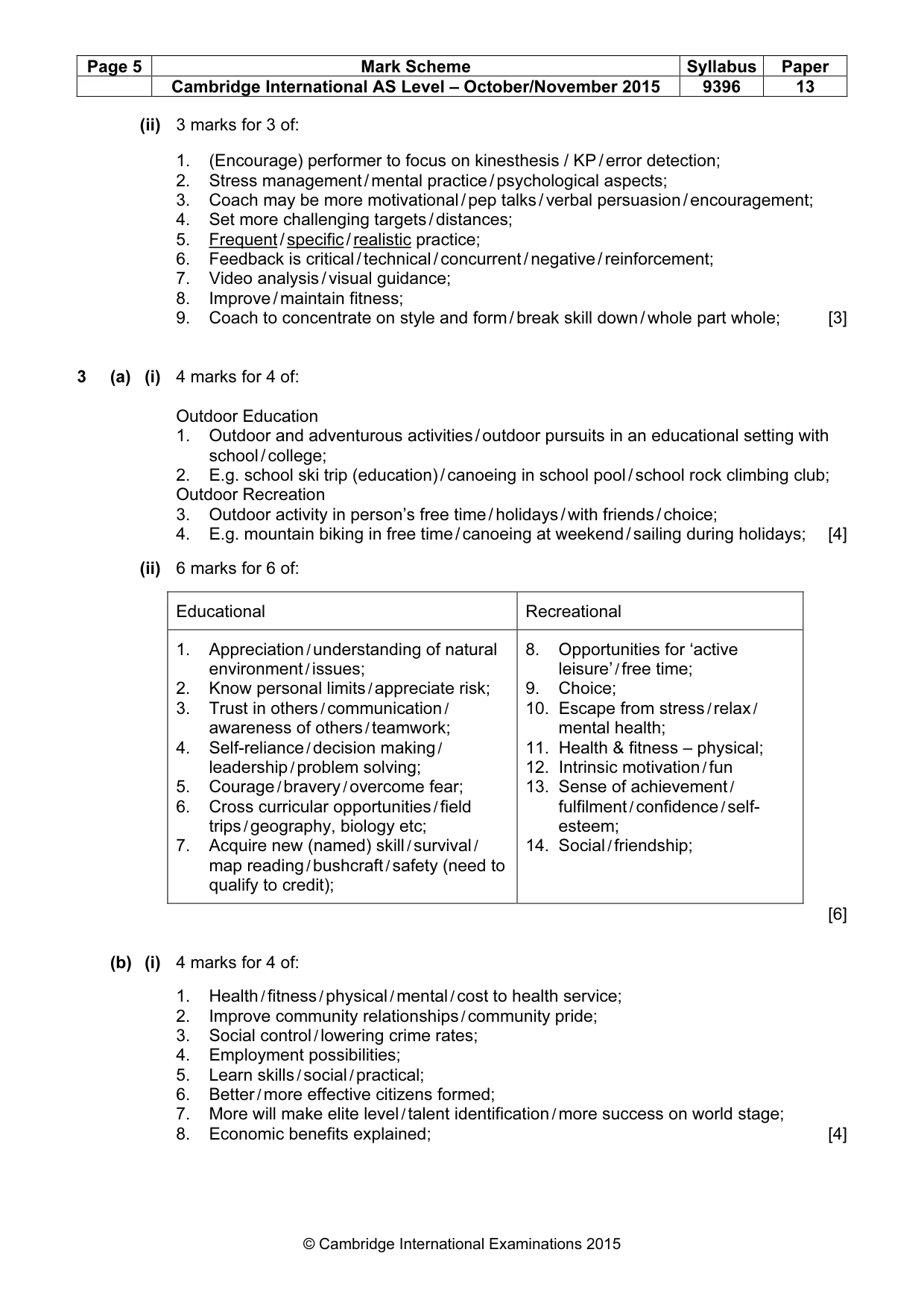
Page 5 Mark Scheme Syllabus Paper Cambridge International AS Level – October/November 2015 9396 13 © Cambridge International Examinations 2015 (ii) 3 marks for 3 of: 1. (Encourage) performer to focus on kinesthesis / KP / error detection; 2. Stress management / mental practice / psychological aspects; 3. Coach may be more motivational / pep talks / verbal persuasion / encouragement; 4. Set more challenging targets / distances; 5. Frequent / specific / realistic practice; 6. Feedback is critical / technical / concurrent / negative / reinforcement; 7. Video analysis / visual guidance; 8. Improve / maintain fitness; 9. Coach to concentrate on style and form / break skill down / whole part whole; [3] 3 (a) (i) 4 marks for 4 of: Outdoor Education 1. Outdoor and adventurous activities / outdoor pursuits in an educational setting with school / college; 2. E.g. school ski trip (education) / canoeing in school pool / school rock climbing club; Outdoor Recreation 3. Outdoor activity in person’s free time / holidays / with friends / choice; 4. E.g. mountain biking in free time / canoeing at weekend / sailing during holidays; [4] (ii) 6 marks for 6 of: Educational Recreational 1. Appreciation / understanding of natural environment / issues; 2. Know personal limits / appreciate risk; 3. Trust in others / communication / awareness of others / teamwork; 4. Self-reliance / decision making / leadership / problem solving; 5. Courage / bravery / overcome fear; 6. Cross curricular opportunities / field trips / geography, biology etc; 7. Acquire new (named) skill / survival / map reading / bushcraft / safety (need to qualify to credit); 8. Opportunities for ‘active leisure’ / free time; 9. Choice; 10. Escape from stress / relax / mental health; 11. Health & fitness – physical; 12. Intrinsic motivation / fun 13. Sense of achievement / fulfilment / confidence / self- esteem; 14. Social / friendship; [6] (b) (i) 4 marks for 4 of: 1. Health / fitness / physical / mental / cost to health service; 2. Improve community relationships / community pride; 3. Social control / lowering crime rates; 4. Employment possibilities; 5. Learn skills / social / practical; 6. Better / more effective citizens formed; 7. More will make elite level / talent identification / more success on world stage; 8. Economic benefits explained; [4]
Mark scheme, page 6
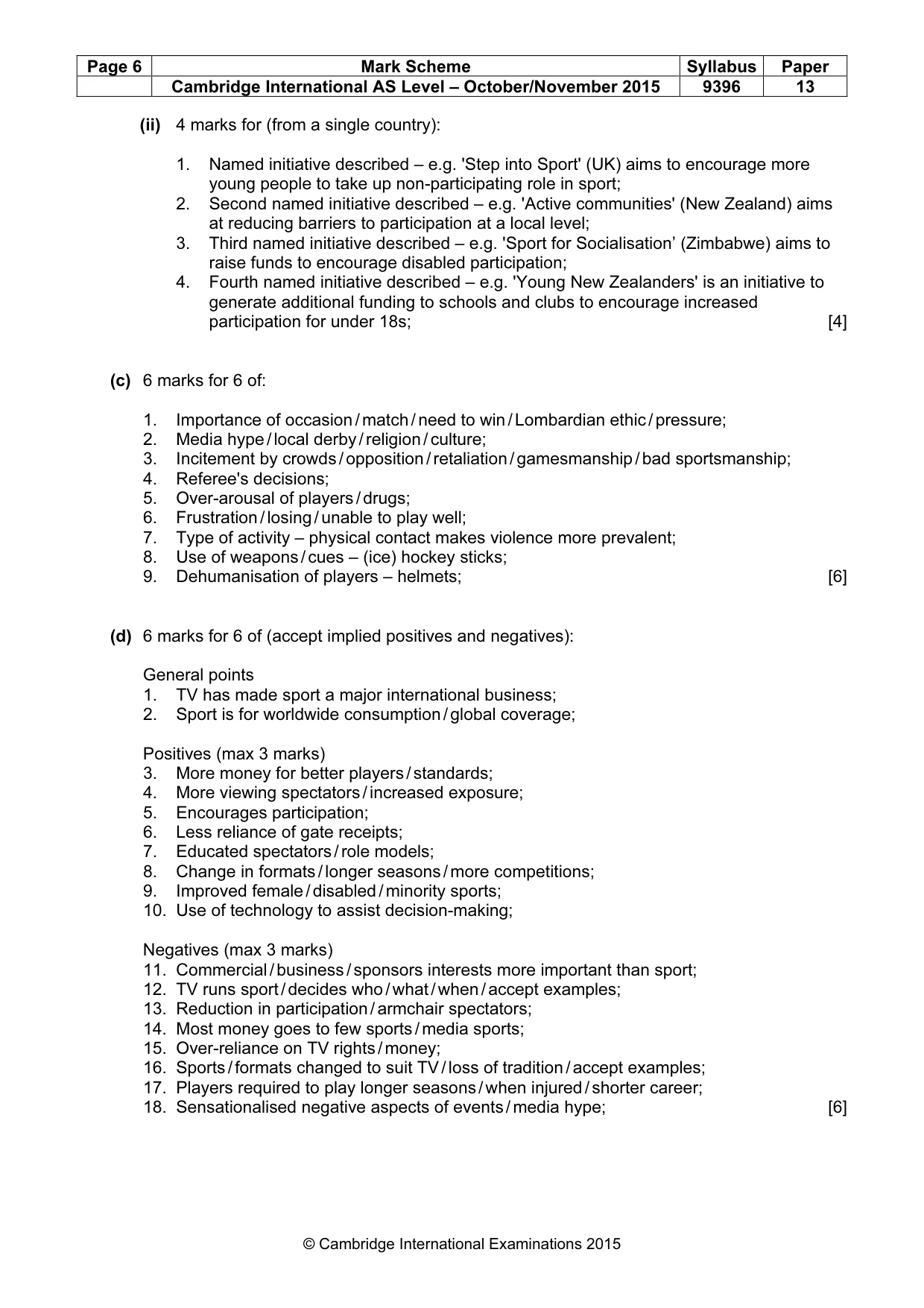
Page 6 Mark Scheme Syllabus Paper Cambridge International AS Level – October/November 2015 9396 13 © Cambridge International Examinations 2015 (ii) 4 marks for (from a single country): 1. Named initiative described – e.g. 'Step into Sport' (UK) aims to encourage more young people to take up non-participating role in sport; 2. Second named initiative described – e.g. 'Active communities' (New Zealand) aims at reducing barriers to participation at a local level; 3. Third named initiative described – e.g. 'Sport for Socialisation’ (Zimbabwe) aims to raise funds to encourage disabled participation; 4. Fourth named initiative described – e.g. 'Young New Zealanders' is an initiative to generate additional funding to schools and clubs to encourage increased participation for under 18s; [4] (c) 6 marks for 6 of: 1. Importance of occasion / match / need to win / Lombardian ethic / pressure; 2. Media hype / local derby / religion / culture; 3. Incitement by crowds / opposition / retaliation / gamesmanship / bad sportsmanship; 4. Referee's decisions; 5. Over-arousal of players / drugs; 6. Frustration / losing / unable to play well; 7. Type of activity – physical contact makes violence more prevalent; 8. Use of weapons / cues – (ice) hockey sticks; 9. Dehumanisation of players – helmets; [6] (d) 6 marks for 6 of (accept implied positives and negatives): General points 1. TV has made sport a major international business; 2. Sport is for worldwide consumption / global coverage; Positives (max 3 marks) 3. More money for better players / standards; 4. More viewing spectators / increased exposure; 5. Encourages participation; 6. Less reliance of gate receipts; 7. Educated spectators / role models; 8. Change in formats / longer seasons / more competitions; 9. Improved female / disabled / minority sports; 10. Use of technology to assist decision-making; Negatives (max 3 marks) 11. Commercial / business / sponsors interests more important than sport; 12. TV runs sport / decides who / what / when / accept examples; 13. Reduction in participation / armchair spectators; 14. Most money goes to few sports / media sports; 15. Over-reliance on TV rights / money; 16. Sports / formats changed to suit TV / loss of tradition / accept examples; 17. Players required to play longer seasons / when injured / shorter career; 18. Sensationalised negative aspects of events / media hype; [6]
What you needed in this session
Cambridge’s own grade thresholds for 2015 Oct/Nov, Paper 1 · Variant 3. A higher threshold means an easier paper — the bar moves with how the cohort did.