Cambridge A Level Physical Education 9396 — 2015 Oct/Nov Paper 1 · Variant 1
9396/11/O/N/15 · 90 marks · ≈101 min
The question paper and its mark scheme, free to read here and free to download. This is Cambridge’s own paper, exactly as it was sat.
Question paper4 pages
Mark scheme7 pages
Answers below. Sit the paper first if you are practising.
Paper as text
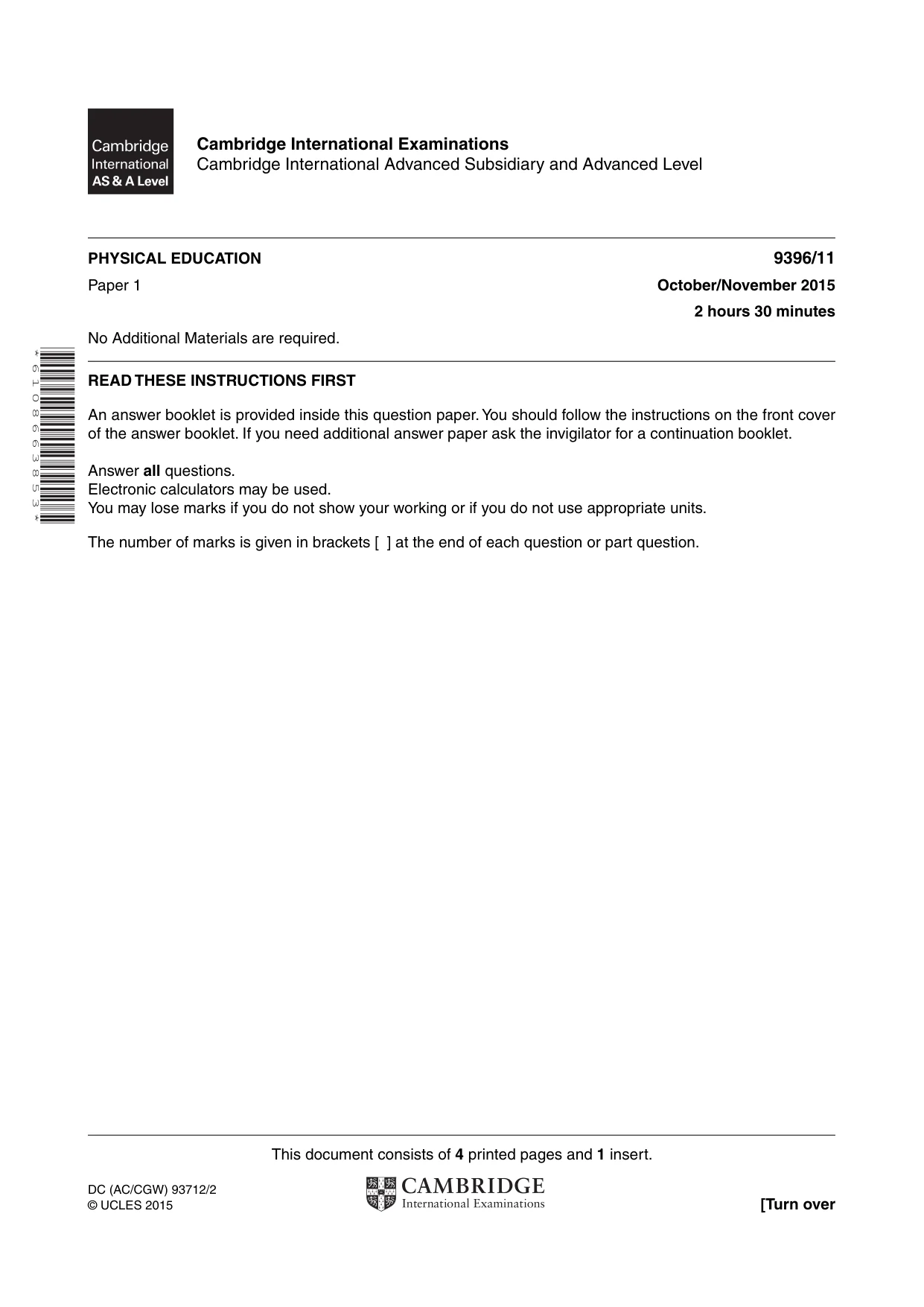
Question paper, page 1
This document consists of 4 printed pages and 1 insert. DC (AC/CGW) 93712/2 © UCLES 2015 [Turn over Cambridge International Examinations Cambridge International Advanced Subsidiary and Advanced Level * 6 1 0 8 6 6 3 8 5 3 * PHYSICAL EDUCATION 9396/11 Paper 1 October/November 2015 2 hours 30 minutes No Additional Materials are required. READ THESE INSTRUCTIONS FIRST An answer booklet is provided inside this question paper. You should follow the instructions on the front cover of the answer booklet. If you need additional answer paper ask the invigilator for a continuation booklet. Answer all questions. Electronic calculators may be used. You may lose marks if you do not show your working or if you do not use appropriate units. The number of marks is given in brackets [ ] at the end of each question or part question.
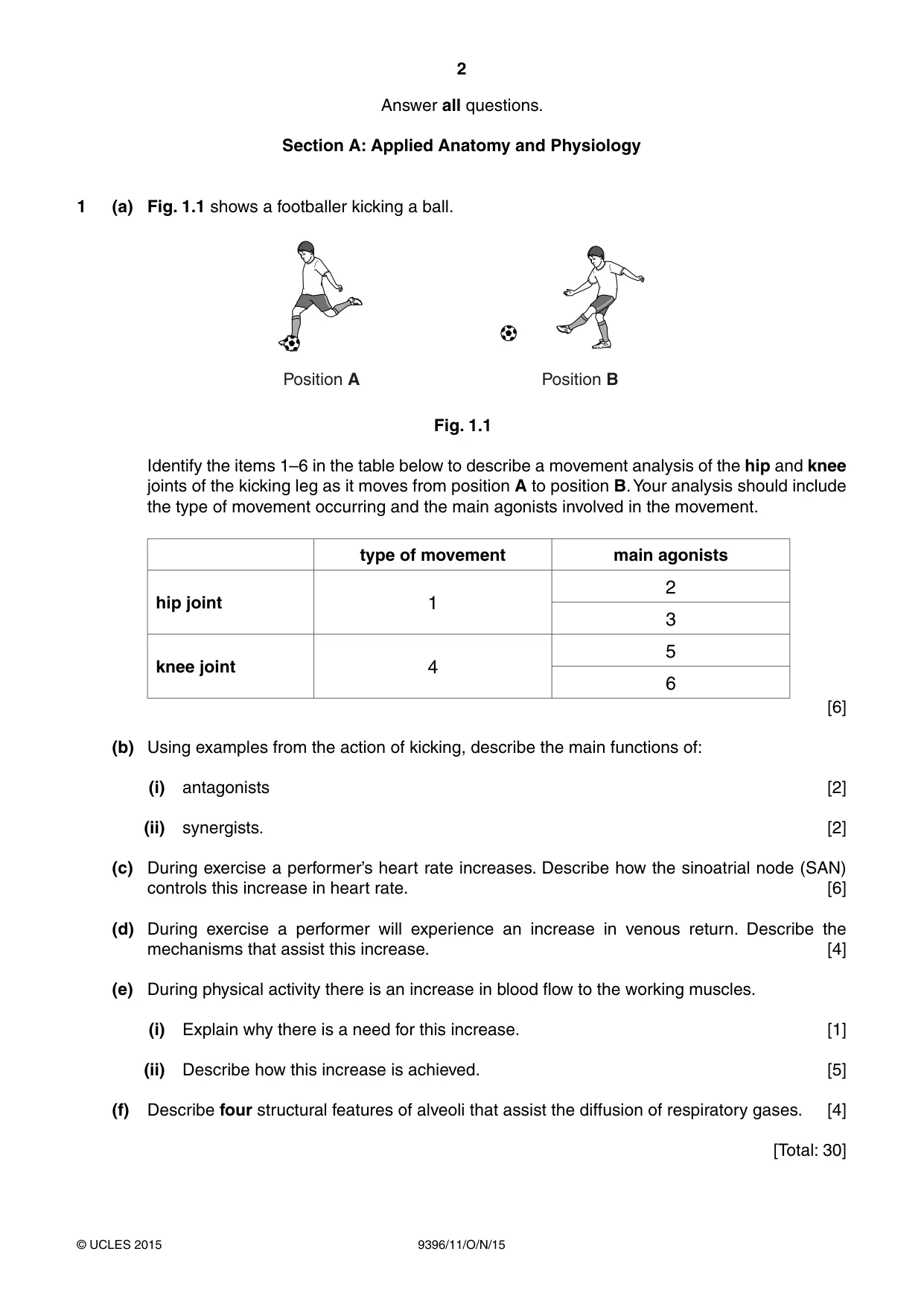
Question paper, page 2
2 9396/11/O/N/15 © UCLES 2015 Answer all questions. Section A: Applied Anatomy and Physiology 1 (a) Fig. 1.1 shows a footballer kicking a ball. Position A Position B Fig. 1.1 Identify the items 1–6 in the table below to describe a movement analysis of the hip and knee joints of the kicking leg as it moves from position A to position B. Your analysis should include the type of movement occurring and the main agonists involved in the movement. type of movement main agonists hip joint 1 2 3 knee joint 4 5 6 [6] (b) Using examples from the action of kicking, describe the main functions of: (i) antagonists [2] (ii) synergists. [2] (c) During exercise a performer’s heart rate increases. Describe how the sinoatrial node (SAN) controls this increase in heart rate. [6] (d) During exercise a performer will experience an increase in venous return. Describe the mechanisms that assist this increase. [4] (e) During physical activity there is an increase in blood flow to the working muscles. (i) Explain why there is a need for this increase. [1] (ii) Describe how this increase is achieved. [5] (f) Describe four structural features of alveoli that assist the diffusion of respiratory gases. [4] [Total: 30]
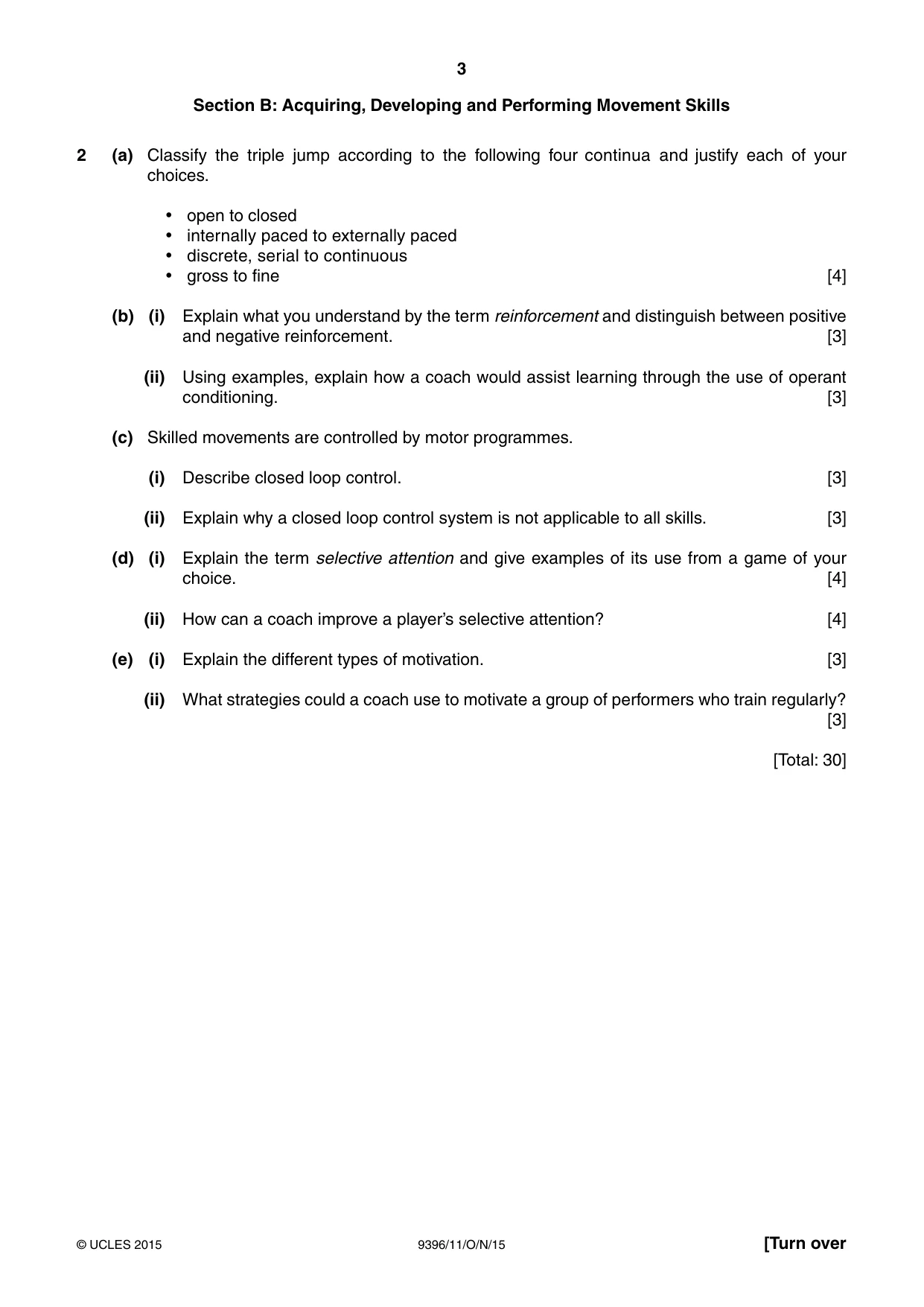
Question paper, page 3
3 9396/11/O/N/15 © UCLES 2015 [Turn over Section B: Acquiring, Developing and Performing Movement Skills 2 (a) Classify the triple jump according to the following four continua and justify each of your choices. • open to closed • internally paced to externally paced • discrete, serial to continuous • gross to fine [4] (b) (i) Explain what you understand by the term reinforcement and distinguish between positive and negative reinforcement. [3] (ii) Using examples, explain how a coach would assist learning through the use of operant conditioning. [3] (c) Skilled movements are controlled by motor programmes. (i) Describe closed loop control. [3] (ii) Explain why a closed loop control system is not applicable to all skills. [3] (d) (i) Explain the term selective attention and give examples of its use from a game of your choice. [4] (ii) How can a coach improve a player’s selective attention? [4] (e) (i) Explain the different types of motivation. [3] (ii) What strategies could a coach use to motivate a group of performers who train regularly? [3] [Total: 30]
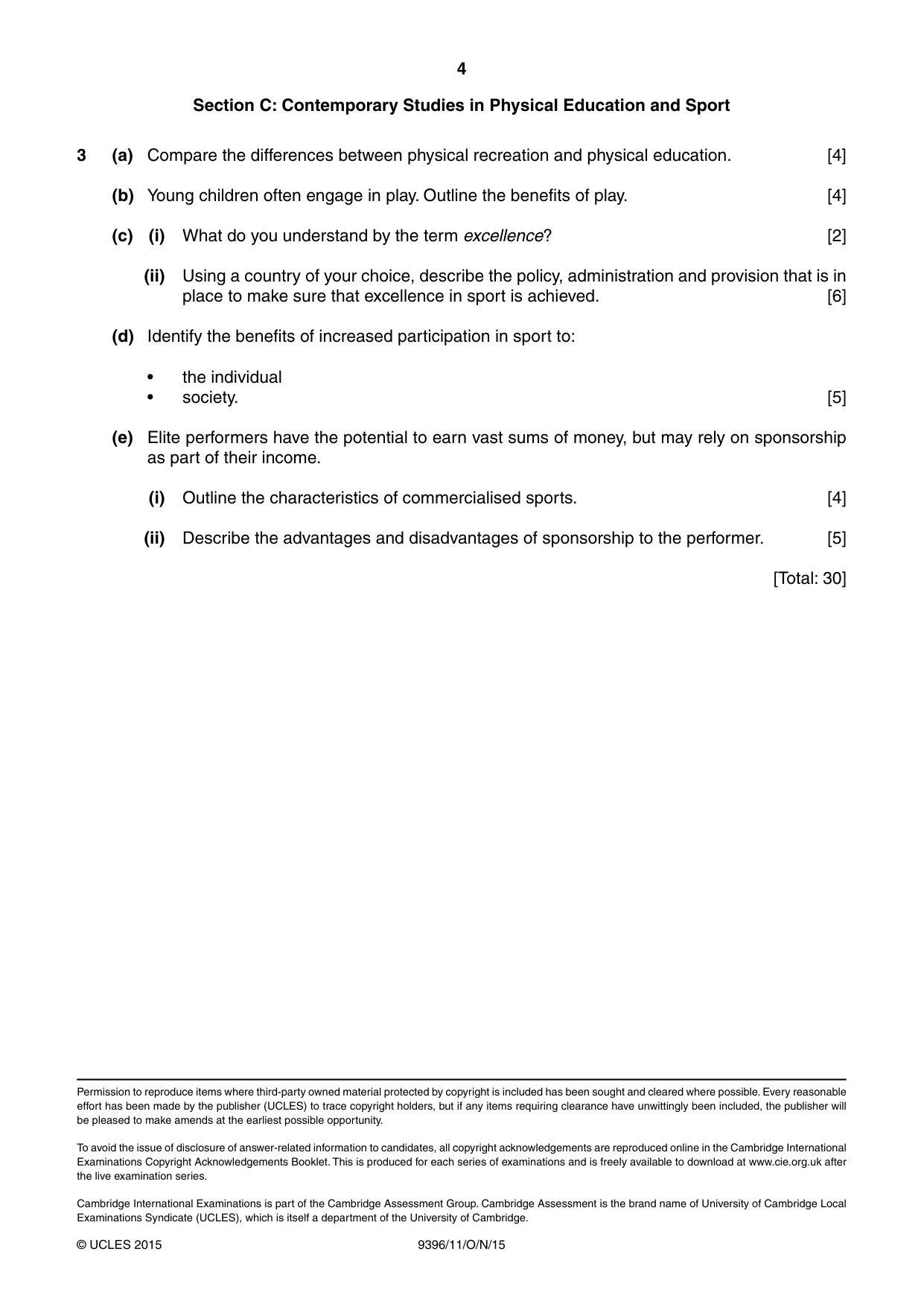
Question paper, page 4
4 9396/11/O/N/15 © UCLES 2015 Section C: Contemporary Studies in Physical Education and Sport 3 (a) Compare the differences between physical recreation and physical education. [4] (b) Young children often engage in play. Outline the benefits of play. [4] (c) (i) What do you understand by the term excellence? [2] (ii) Using a country of your choice, describe the policy, administration and provision that is in place to make sure that excellence in sport is achieved. [6] (d) Identify the benefits of increased participation in sport to: • the individual • society. [5] (e) Elite performers have the potential to earn vast sums of money, but may rely on sponsorship as part of their income. (i) Outline the characteristics of commercialised sports. [4] (ii) Describe the advantages and disadvantages of sponsorship to the performer. [5] [Total: 30] Permission to reproduce items where third-party owned material protected by copyright is included has been sought and cleared where possible. Every reasonable effort has been made by the publisher (UCLES) to trace copyright holders, but if any items requiring clearance have unwittingly been included, the publisher will be pleased to make amends at the earliest possible opportunity. To avoid the issue of disclosure of answer-related information to candidates, all copyright acknowledgements are reproduced online in the Cambridge International Examinations Copyright Acknowledgements Booklet. This is produced for each series of examinations and is freely available to download at www.cie.org.uk after the live examination series. Cambridge International Examinations is part of the Cambridge Assessment Group. Cambridge Assessment is the brand name of University of Cambridge Local Examinations Syndicate (UCLES), which is itself a department of the University of Cambridge.
Mark scheme, page 1
® IGCSE is the registered trademark of Cambridge International Examinations. CAMBRIDGE INTERNATIONAL EXAMINATIONS Cambridge International Advanced Subsidiary Level MARK SCHEME for the October/November 2015 series 9396 PHYSICAL EDUCATION 9396/11 Paper 1, maximum raw mark 90 This mark scheme is published as an aid to teachers and candidates, to indicate the requirements of the examination. It shows the basis on which Examiners were instructed to award marks. It does not indicate the details of the discussions that took place at an Examiners’ meeting before marking began, which would have considered the acceptability of alternative answers. Mark schemes should be read in conjunction with the question paper and the Principal Examiner Report for Teachers. Cambridge will not enter into discussions about these mark schemes. Cambridge is publishing the mark schemes for the October/November 2015 series for most Cambridge IGCSE®, Cambridge International A and AS Level components and some Cambridge O Level components.
Mark scheme, page 2
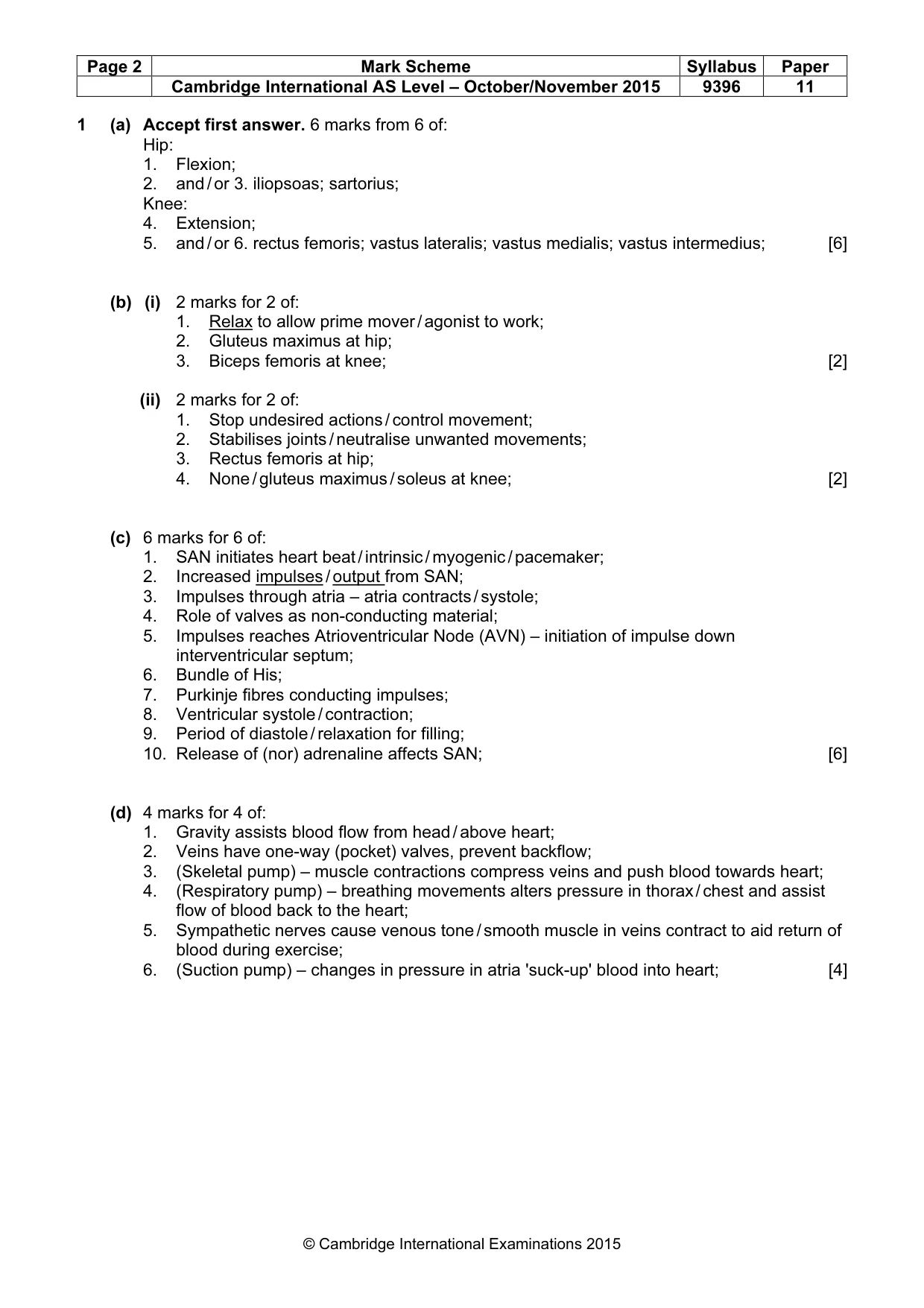
Page 2 Mark Scheme Syllabus Paper Cambridge International AS Level – October/November 2015 9396 11 © Cambridge International Examinations 2015 1 (a) Accept first answer. 6 marks from 6 of: Hip: 1. Flexion; 2. and / or 3. iliopsoas; sartorius; Knee: 4. Extension; 5. and / or 6. rectus femoris; vastus lateralis; vastus medialis; vastus intermedius; [6] (b) (i) 2 marks for 2 of: 1. Relax to allow prime mover / agonist to work; 2. Gluteus maximus at hip; 3. Biceps femoris at knee; [2] (ii) 2 marks for 2 of: 1. Stop undesired actions / control movement; 2. Stabilises joints / neutralise unwanted movements; 3. Rectus femoris at hip; 4. None / gluteus maximus / soleus at knee; [2] (c) 6 marks for 6 of: 1. SAN initiates heart beat / intrinsic / myogenic / pacemaker; 2. Increased impulses / output from SAN; 3. Impulses through atria – atria contracts / systole; 4. Role of valves as non-conducting material; 5. Impulses reaches Atrioventricular Node (AVN) – initiation of impulse down interventricular septum; 6. Bundle of His; 7. Purkinje fibres conducting impulses; 8. Ventricular systole / contraction; 9. Period of diastole / relaxation for filling; 10. Release of (nor) adrenaline affects SAN; [6] (d) 4 marks for 4 of: 1. Gravity assists blood flow from head / above heart; 2. Veins have one-way (pocket) valves, prevent backflow; 3. (Skeletal pump) – muscle contractions compress veins and push blood towards heart; 4. (Respiratory pump) – breathing movements alters pressure in thorax / chest and assist flow of blood back to the heart; 5. Sympathetic nerves cause venous tone / smooth muscle in veins contract to aid return of blood during exercise; 6. (Suction pump) – changes in pressure in atria 'suck-up' blood into heart; [4]
Mark scheme, page 3
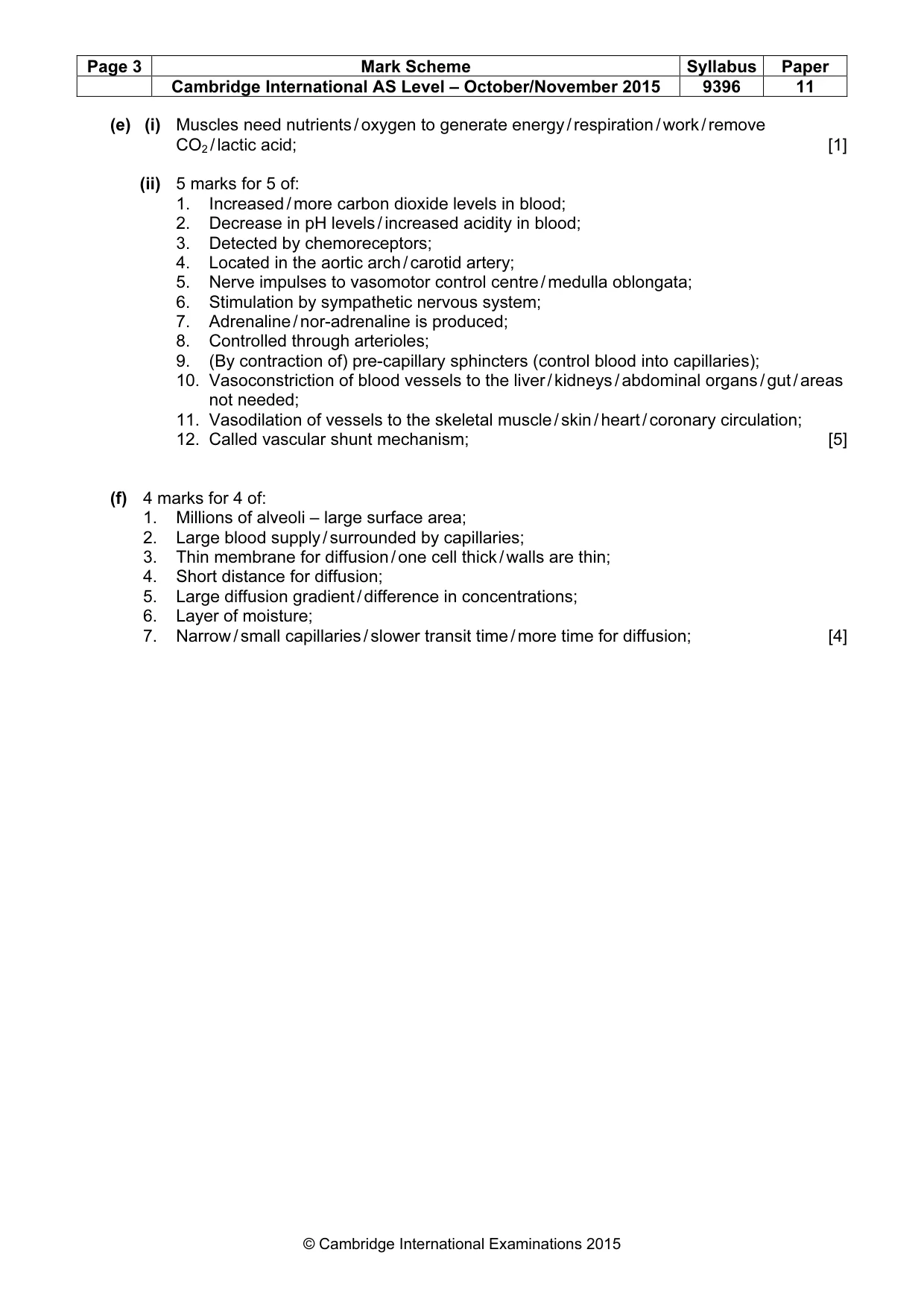
Page 3 Mark Scheme Syllabus Paper Cambridge International AS Level – October/November 2015 9396 11 © Cambridge International Examinations 2015 (e) (i) Muscles need nutrients / oxygen to generate energy / respiration / work / remove CO2 / lactic acid; [1] (ii) 5 marks for 5 of: 1. Increased / more carbon dioxide levels in blood; 2. Decrease in pH levels / increased acidity in blood; 3. Detected by chemoreceptors; 4. Located in the aortic arch / carotid artery; 5. Nerve impulses to vasomotor control centre / medulla oblongata; 6. Stimulation by sympathetic nervous system; 7. Adrenaline / nor-adrenaline is produced; 8. Controlled through arterioles; 9. (By contraction of) pre-capillary sphincters (control blood into capillaries); 10. Vasoconstriction of blood vessels to the liver / kidneys / abdominal organs / gut / areas not needed; 11. Vasodilation of vessels to the skeletal muscle / skin / heart / coronary circulation; 12. Called vascular shunt mechanism; [5] (f) 4 marks for 4 of: 1. Millions of alveoli – large surface area; 2. Large blood supply / surrounded by capillaries; 3. Thin membrane for diffusion / one cell thick / walls are thin; 4. Short distance for diffusion; 5. Large diffusion gradient / difference in concentrations; 6. Layer of moisture; 7. Narrow / small capillaries / slower transit time / more time for diffusion; [4]
Mark scheme, page 4
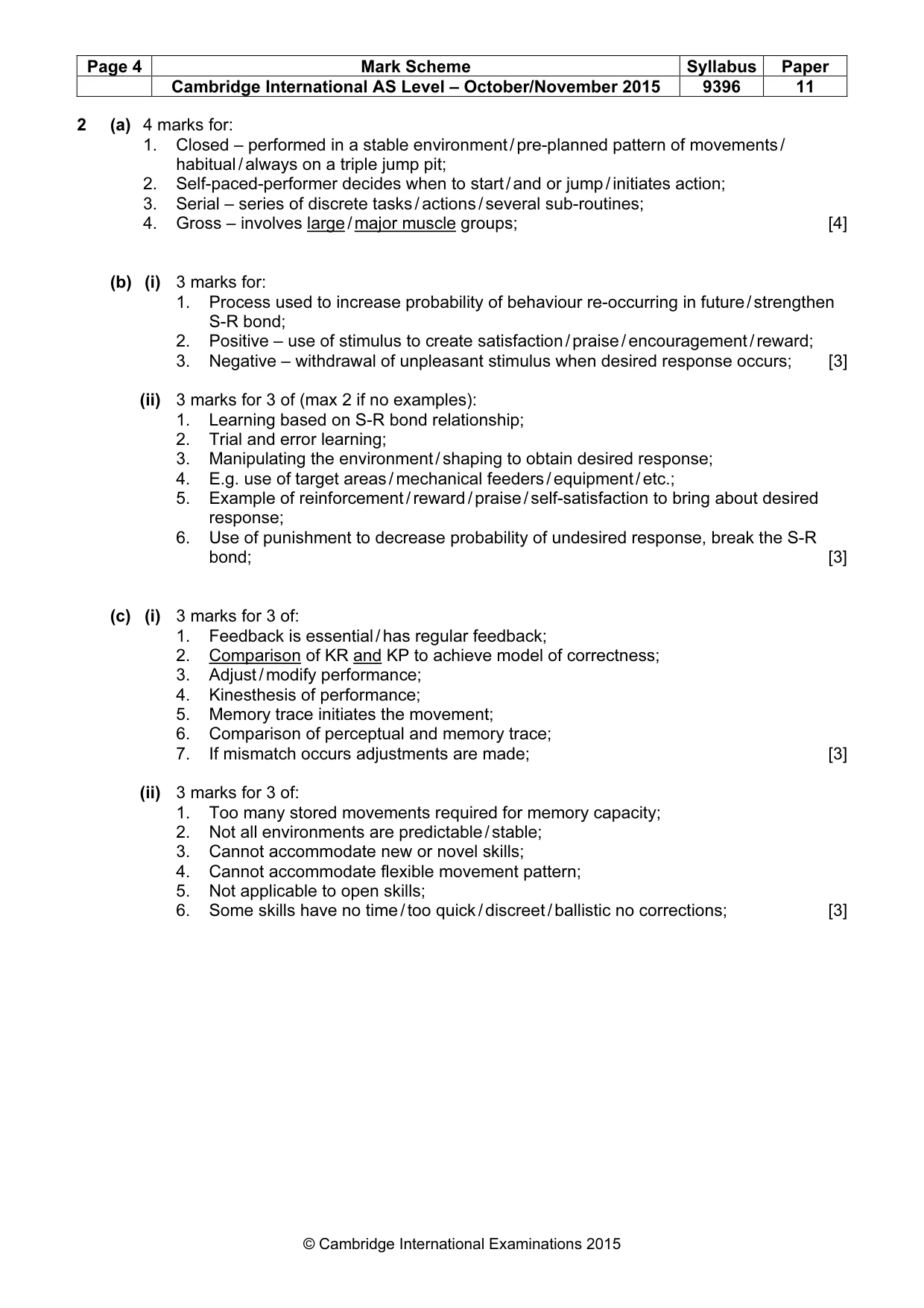
Page 4 Mark Scheme Syllabus Paper Cambridge International AS Level – October/November 2015 9396 11 © Cambridge International Examinations 2015 2 (a) 4 marks for: 1. Closed – performed in a stable environment / pre-planned pattern of movements / habitual / always on a triple jump pit; 2. Self-paced-performer decides when to start / and or jump / initiates action; 3. Serial – series of discrete tasks / actions / several sub-routines; 4. Gross – involves large / major muscle groups; [4] (b) (i) 3 marks for: 1. Process used to increase probability of behaviour re-occurring in future / strengthen S-R bond; 2. Positive – use of stimulus to create satisfaction / praise / encouragement / reward; 3. Negative – withdrawal of unpleasant stimulus when desired response occurs; [3] (ii) 3 marks for 3 of (max 2 if no examples): 1. Learning based on S-R bond relationship; 2. Trial and error learning; 3. Manipulating the environment / shaping to obtain desired response; 4. E.g. use of target areas / mechanical feeders / equipment / etc.; 5. Example of reinforcement / reward / praise / self-satisfaction to bring about desired response; 6. Use of punishment to decrease probability of undesired response, break the S-R bond; [3] (c) (i) 3 marks for 3 of: 1. Feedback is essential / has regular feedback; 2. Comparison of KR and KP to achieve model of correctness; 3. Adjust / modify performance; 4. Kinesthesis of performance; 5. Memory trace initiates the movement; 6. Comparison of perceptual and memory trace; 7. If mismatch occurs adjustments are made; [3] (ii) 3 marks for 3 of: 1. Too many stored movements required for memory capacity; 2. Not all environments are predictable / stable; 3. Cannot accommodate new or novel skills; 4. Cannot accommodate flexible movement pattern; 5. Not applicable to open skills; 6. Some skills have no time / too quick / discreet / ballistic no corrections; [3]
Mark scheme, page 5
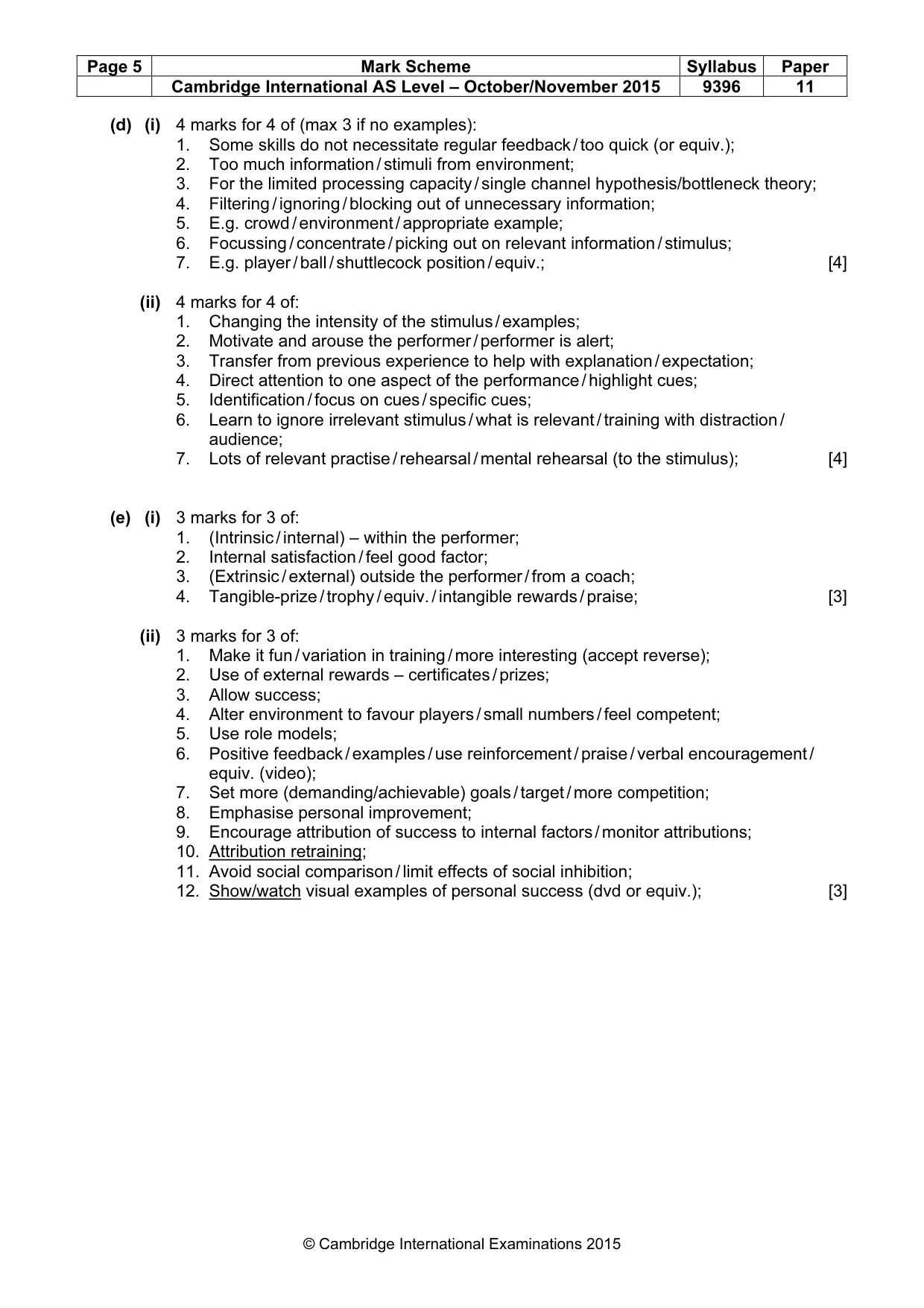
Page 5 Mark Scheme Syllabus Paper Cambridge International AS Level – October/November 2015 9396 11 © Cambridge International Examinations 2015 (d) (i) 4 marks for 4 of (max 3 if no examples): 1. Some skills do not necessitate regular feedback / too quick (or equiv.); 2. Too much information / stimuli from environment; 3. For the limited processing capacity / single channel hypothesis/bottleneck theory; 4. Filtering / ignoring / blocking out of unnecessary information; 5. E.g. crowd / environment / appropriate example; 6. Focussing / concentrate / picking out on relevant information / stimulus; 7. E.g. player / ball / shuttlecock position / equiv.; [4] (ii) 4 marks for 4 of: 1. Changing the intensity of the stimulus / examples; 2. Motivate and arouse the performer / performer is alert; 3. Transfer from previous experience to help with explanation / expectation; 4. Direct attention to one aspect of the performance / highlight cues; 5. Identification / focus on cues / specific cues; 6. Learn to ignore irrelevant stimulus / what is relevant / training with distraction / audience; 7. Lots of relevant practise / rehearsal / mental rehearsal (to the stimulus); [4] (e) (i) 3 marks for 3 of: 1. (Intrinsic / internal) – within the performer; 2. Internal satisfaction / feel good factor; 3. (Extrinsic / external) outside the performer / from a coach; 4. Tangible-prize / trophy / equiv. / intangible rewards / praise; [3] (ii) 3 marks for 3 of: 1. Make it fun / variation in training / more interesting (accept reverse); 2. Use of external rewards – certificates / prizes; 3. Allow success; 4. Alter environment to favour players / small numbers / feel competent; 5. Use role models; 6. Positive feedback / examples / use reinforcement / praise / verbal encouragement / equiv. (video); 7. Set more (demanding/achievable) goals / target / more competition; 8. Emphasise personal improvement; 9. Encourage attribution of success to internal factors / monitor attributions; 10. Attribution retraining; 11. Avoid social comparison / limit effects of social inhibition; 12. Show/watch visual examples of personal success (dvd or equiv.); [3]
Mark scheme, page 6
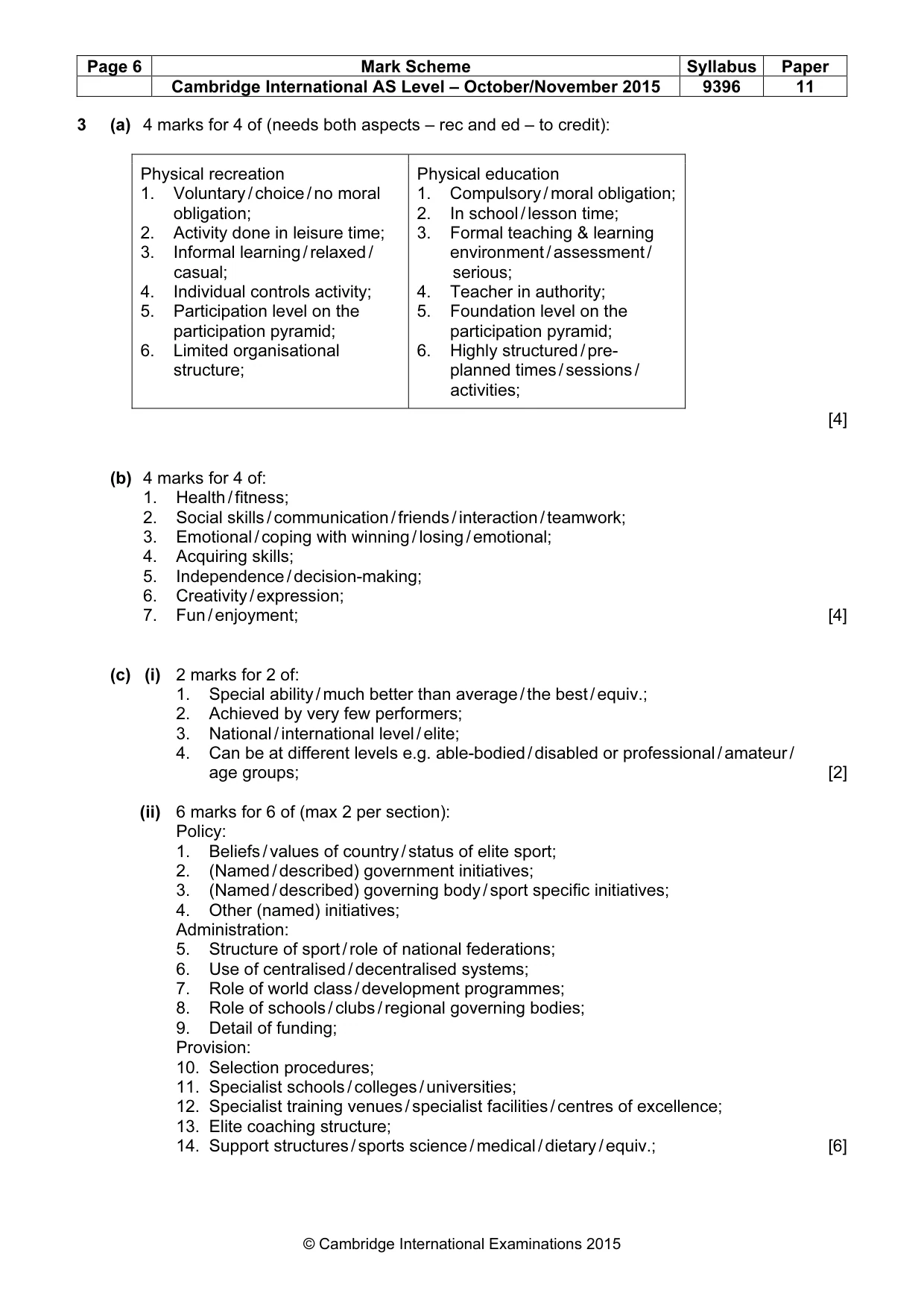
Page 6 Mark Scheme Syllabus Paper Cambridge International AS Level – October/November 2015 9396 11 © Cambridge International Examinations 2015 3 (a) 4 marks for 4 of (needs both aspects – rec and ed – to credit): Physical recreation 1. Voluntary / choice / no moral obligation; 2. Activity done in leisure time; 3. Informal learning / relaxed / casual; 4. Individual controls activity; 5. Participation level on the participation pyramid; 6. Limited organisational structure; Physical education 1. Compulsory / moral obligation; 2. In school / lesson time; 3. Formal teaching & learning environment / assessment / serious; 4. Teacher in authority; 5. Foundation level on the participation pyramid; 6. Highly structured / pre- planned times / sessions / activities; [4] (b) 4 marks for 4 of: 1. Health / fitness; 2. Social skills / communication / friends / interaction / teamwork; 3. Emotional / coping with winning / losing / emotional; 4. Acquiring skills; 5. Independence / decision-making; 6. Creativity / expression; 7. Fun / enjoyment; [4] (c) (i) 2 marks for 2 of: 1. Special ability / much better than average / the best / equiv.; 2. Achieved by very few performers; 3. National / international level / elite; 4. Can be at different levels e.g. able-bodied / disabled or professional / amateur / age groups; [2] (ii) 6 marks for 6 of (max 2 per section): Policy: 1. Beliefs / values of country / status of elite sport; 2. (Named / described) government initiatives; 3. (Named / described) governing body / sport specific initiatives; 4. Other (named) initiatives; Administration: 5. Structure of sport / role of national federations; 6. Use of centralised / decentralised systems; 7. Role of world class / development programmes; 8. Role of schools / clubs / regional governing bodies; 9. Detail of funding; Provision: 10. Selection procedures; 11. Specialist schools / colleges / universities; 12. Specialist training venues / specialist facilities / centres of excellence; 13. Elite coaching structure; 14. Support structures / sports science / medical / dietary / equiv.; [6]
Mark scheme, page 7
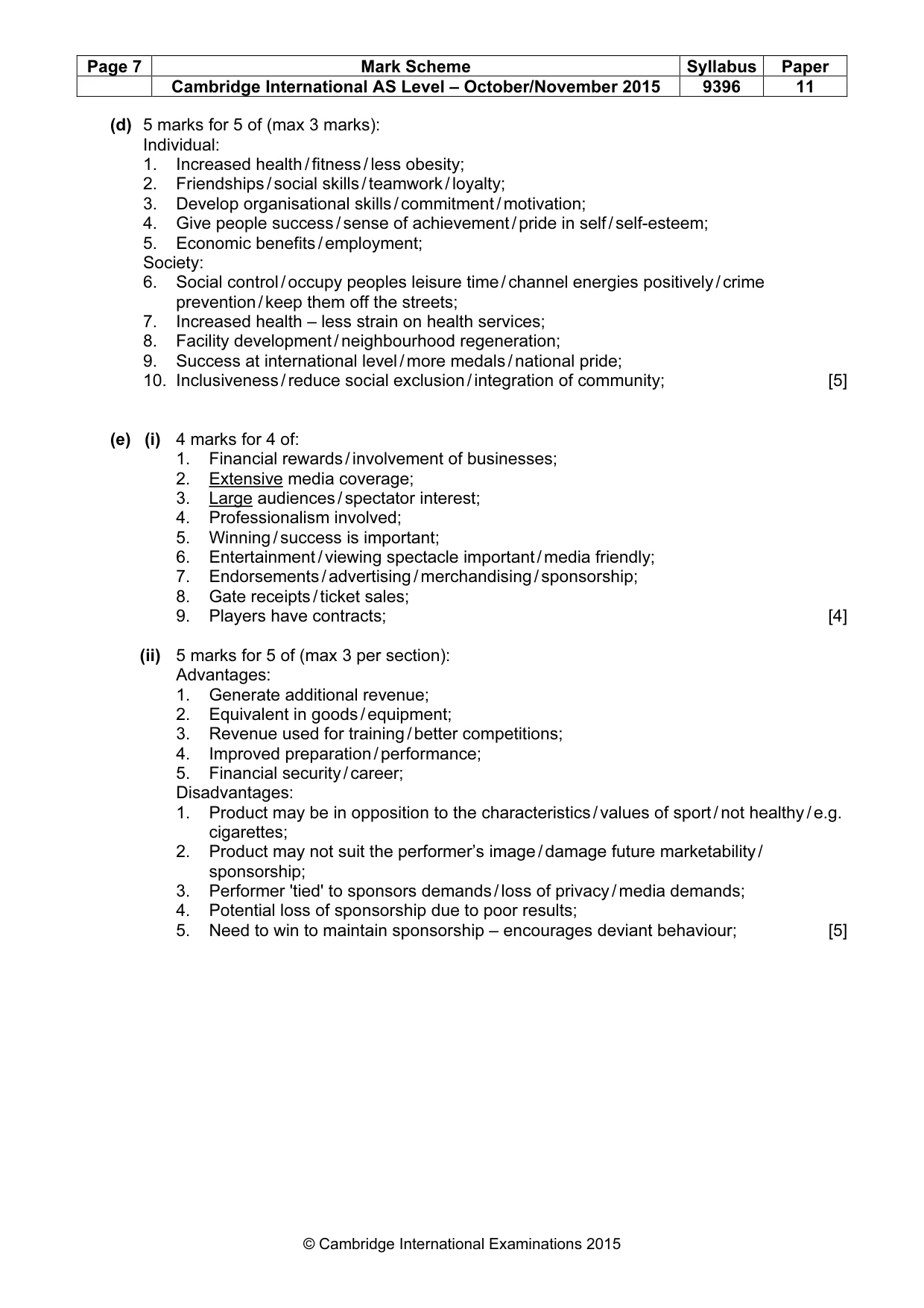
Page 7 Mark Scheme Syllabus Paper Cambridge International AS Level – October/November 2015 9396 11 © Cambridge International Examinations 2015 (d) 5 marks for 5 of (max 3 marks): Individual: 1. Increased health / fitness / less obesity; 2. Friendships / social skills / teamwork / loyalty; 3. Develop organisational skills / commitment / motivation; 4. Give people success / sense of achievement / pride in self / self-esteem; 5. Economic benefits / employment; Society: 6. Social control / occupy peoples leisure time / channel energies positively / crime prevention / keep them off the streets; 7. Increased health – less strain on health services; 8. Facility development / neighbourhood regeneration; 9. Success at international level / more medals / national pride; 10. Inclusiveness / reduce social exclusion / integration of community; [5] (e) (i) 4 marks for 4 of: 1. Financial rewards / involvement of businesses; 2. Extensive media coverage; 3. Large audiences / spectator interest; 4. Professionalism involved; 5. Winning / success is important; 6. Entertainment / viewing spectacle important / media friendly; 7. Endorsements / advertising / merchandising / sponsorship; 8. Gate receipts / ticket sales; 9. Players have contracts; [4] (ii) 5 marks for 5 of (max 3 per section): Advantages: 1. Generate additional revenue; 2. Equivalent in goods / equipment; 3. Revenue used for training / better competitions; 4. Improved preparation / performance; 5. Financial security / career; Disadvantages: 1. Product may be in opposition to the characteristics / values of sport / not healthy / e.g. cigarettes; 2. Product may not suit the performer’s image / damage future marketability / sponsorship; 3. Performer 'tied' to sponsors demands / loss of privacy / media demands; 4. Potential loss of sponsorship due to poor results; 5. Need to win to maintain sponsorship – encourages deviant behaviour; [5]
What you needed in this session
Cambridge’s own grade thresholds for 2015 Oct/Nov, Paper 1 · Variant 1. A higher threshold means an easier paper — the bar moves with how the cohort did.