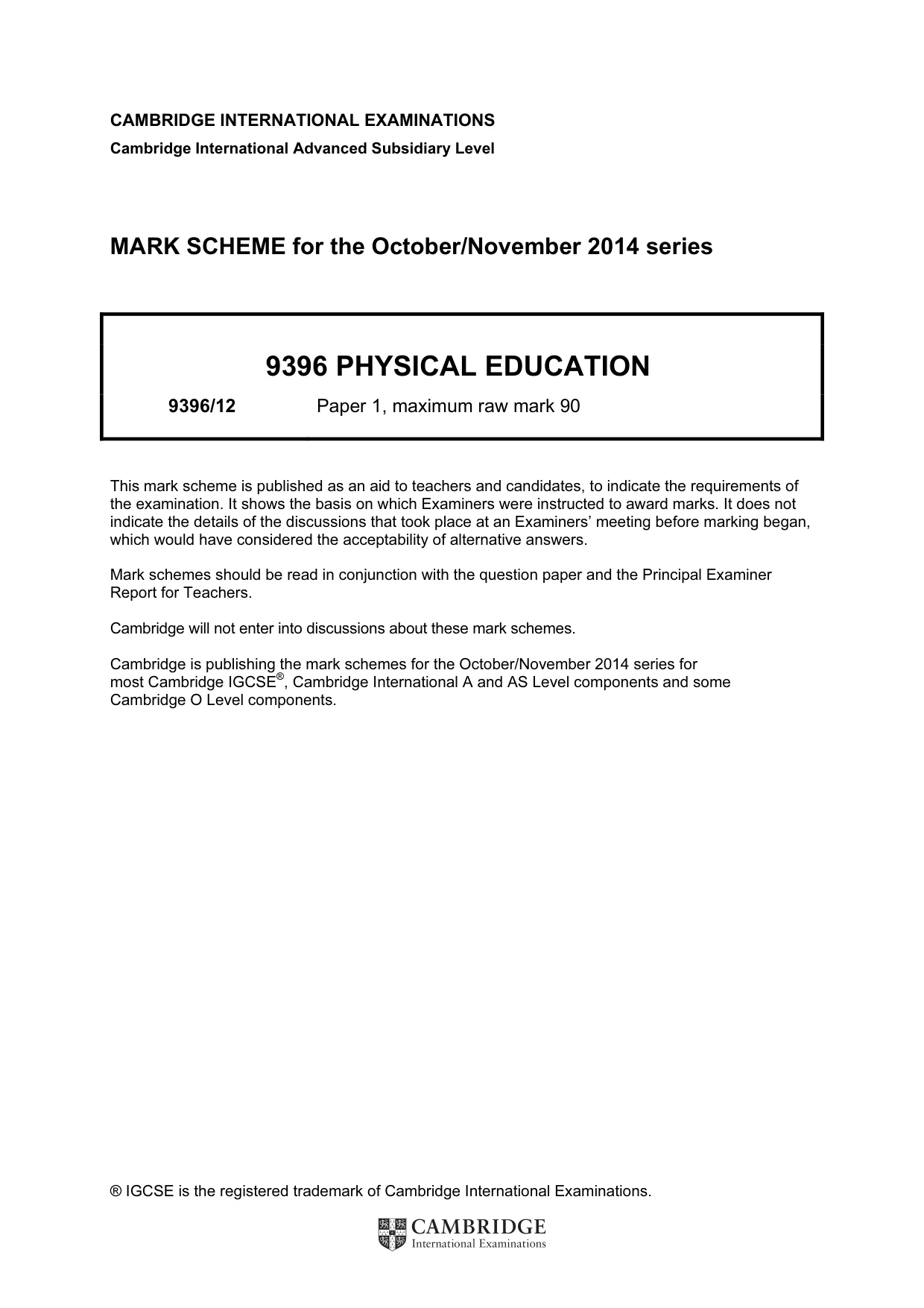
Cambridge A Level Physical Education 9396 — 2014 Oct/Nov Paper 1 · Variant 2
9396/12/O/N/14 · 90 marks · ≈101 min
The question paper and its mark scheme, free to read here and free to download. This is Cambridge’s own paper, exactly as it was sat.
Question paper4 pages
Mark scheme7 pages
Answers below. Sit the paper first if you are practising.
Paper as text
Question paper, page 1
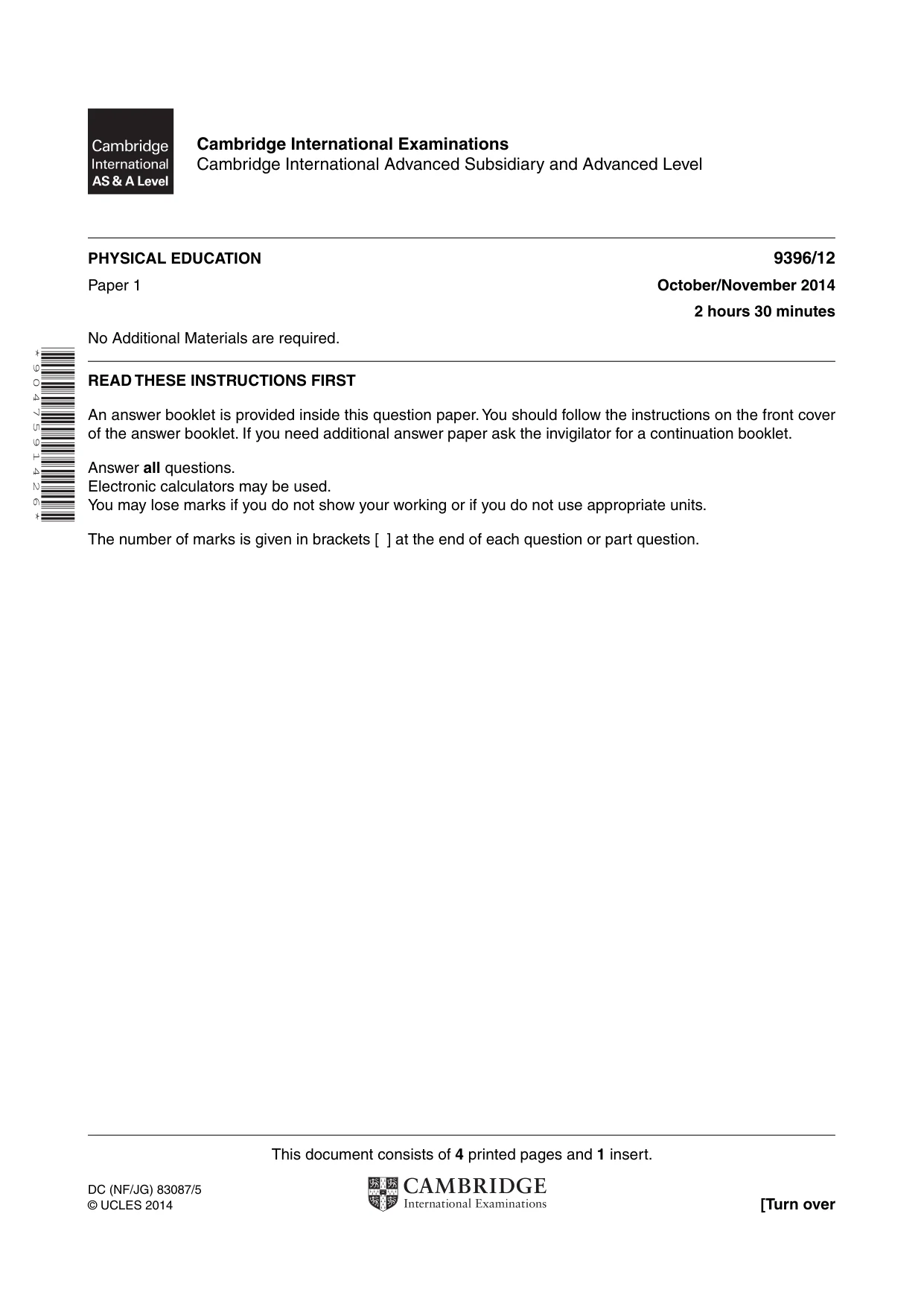
This document consists of 4 printed pages and 1 insert. DC (NF/JG) 83087/5 © UCLES 2014 [Turn over Cambridge International Examinations Cambridge International Advanced Subsidiary and Advanced Level * 9 0 4 7 5 9 1 4 2 6 * PHYSICAL EDUCATION 9396/12 Paper 1 October/November 2014 2 hours 30 minutes No Additional Materials are required. READ THESE INSTRUCTIONS FIRST An answer booklet is provided inside this question paper. You should follow the instructions on the front cover of the answer booklet. If you need additional answer paper ask the invigilator for a continuation booklet. Answer all questions. Electronic calculators may be used. You may lose marks if you do not show your working or if you do not use appropriate units. The number of marks is given in brackets [ ] at the end of each question or part question.
Question paper, page 2
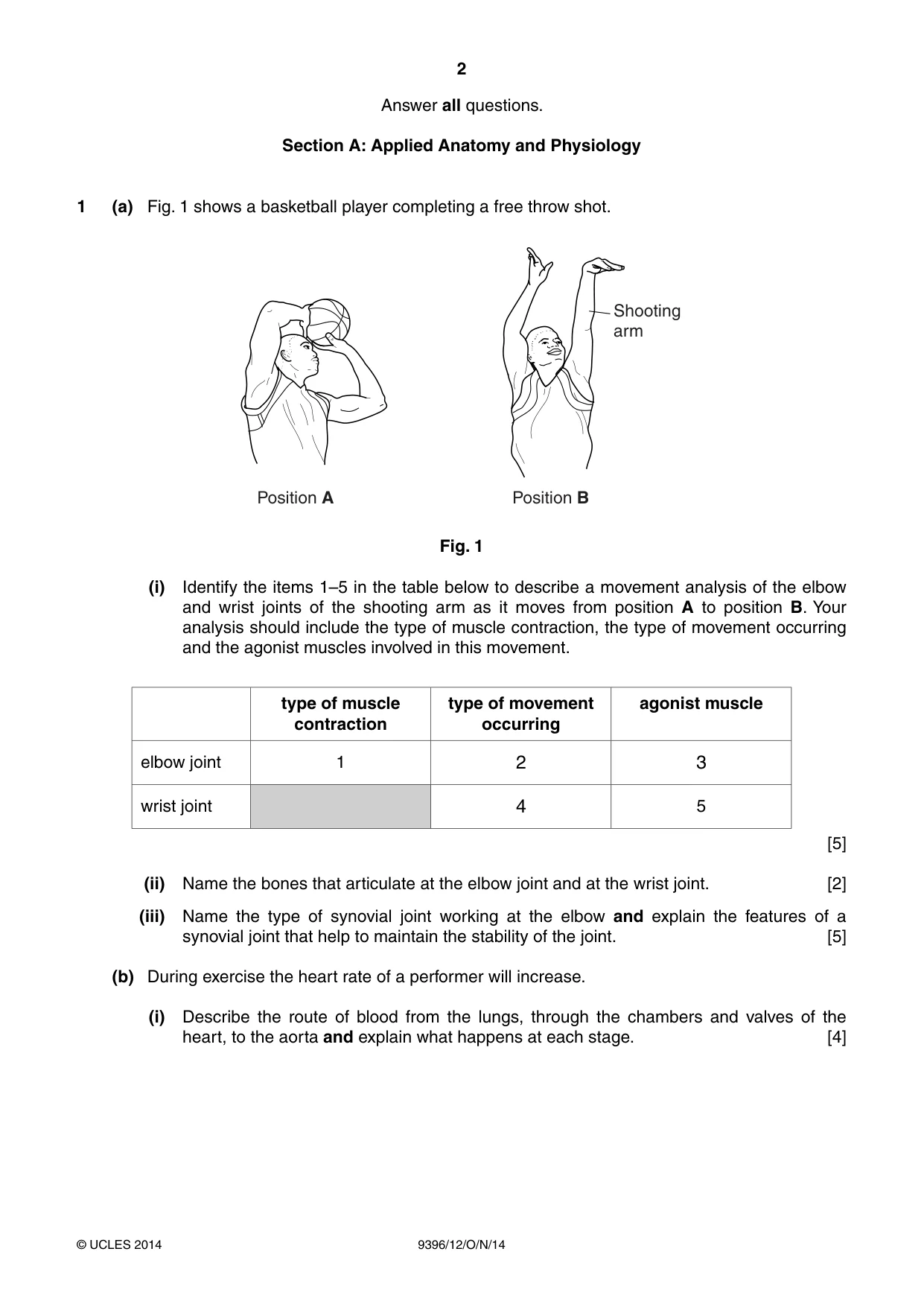
2 9396/12/O/N/14 © UCLES 2014 Answer all questions. Section A: Applied Anatomy and Physiology 1 (a) Fig. 1 shows a basketball player completing a free throw shot. Shooting arm Position A Position B Fig. 1 (i) Identify the items 1–5 in the table below to describe a movement analysis of the elbow and wrist joints of the shooting arm as it moves from position A to position B. Your analysis should include the type of muscle contraction, the type of movement occurring and the agonist muscles involved in this movement. type of muscle contraction type of movement occurring agonist muscle elbow joint 1 2 3 wrist joint 4 5 [5] (ii) Name the bones that articulate at the elbow joint and at the wrist joint. [2] (iii) Name the type of synovial joint working at the elbow and explain the features of a synovial joint that help to maintain the stability of the joint. [5] (b) During exercise the heart rate of a performer will increase. (i) Describe the route of blood from the lungs, through the chambers and valves of the heart, to the aorta and explain what happens at each stage. [4]
Question paper, page 3
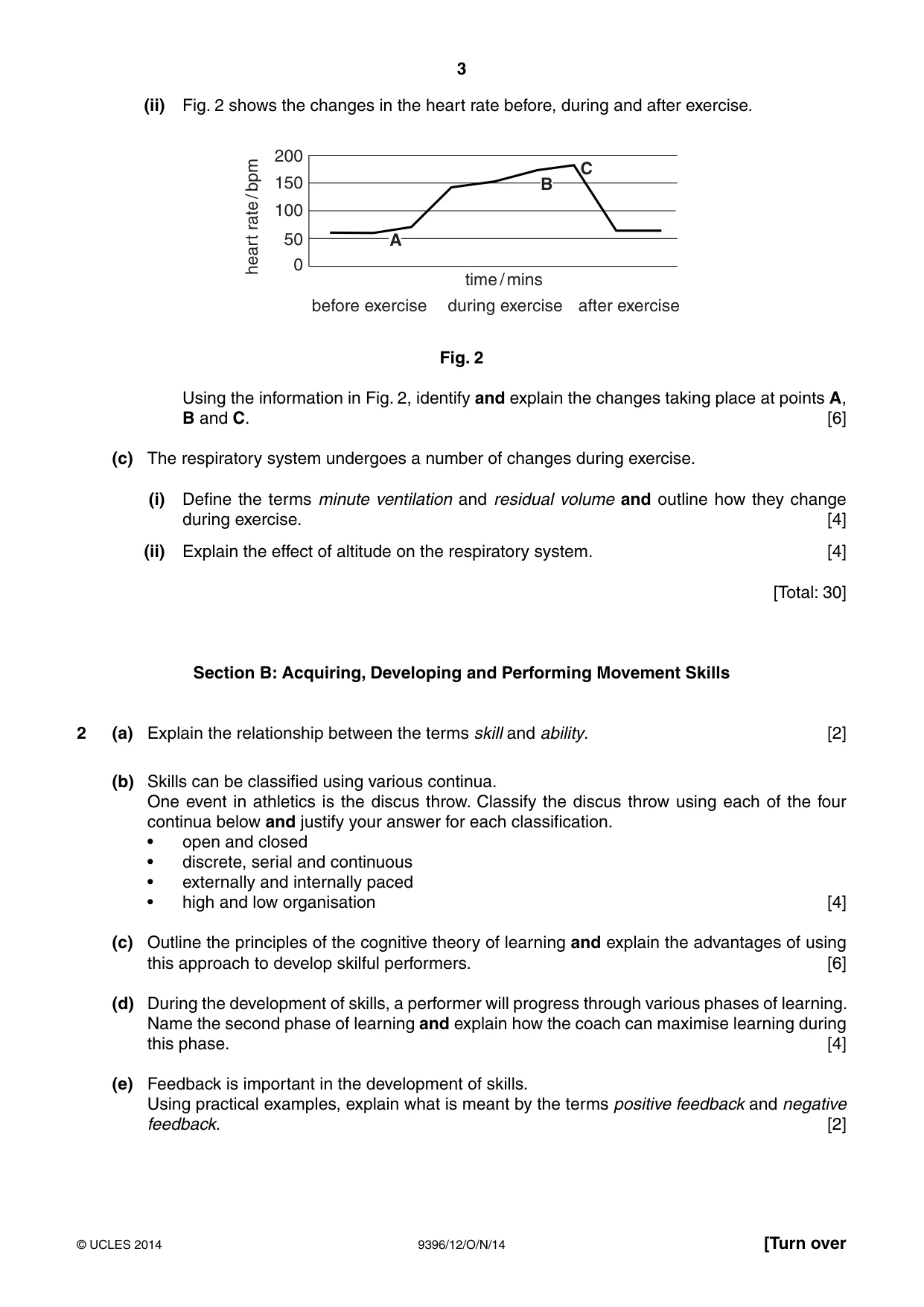
3 9396/12/O/N/14 © UCLES 2014 [Turn over (ii) Fig. 2 shows the changes in the heart rate before, during and after exercise. heart rate / bpm 200 150 100 50 0 before exercise during exercise after exercise time / mins C B A Fig. 2 Using the information in Fig. 2, identify and explain the changes taking place at points A, B and C. [6] (c) The respiratory system undergoes a number of changes during exercise. (i) Define the terms minute ventilation and residual volume and outline how they change during exercise. [4] (ii) Explain the effect of altitude on the respiratory system. [4] [Total: 30] Section B: Acquiring, Developing and Performing Movement Skills 2 (a) Explain the relationship between the terms skill and ability. [2] (b) Skills can be classified using various continua. One event in athletics is the discus throw. Classify the discus throw using each of the four continua below and justify your answer for each classification. • open and closed • discrete, serial and continuous • externally and internally paced • high and low organisation [4] (c) Outline the principles of the cognitive theory of learning and explain the advantages of using this approach to develop skilful performers. [6] (d) During the development of skills, a performer will progress through various phases of learning. Name the second phase of learning and explain how the coach can maximise learning during this phase. [4] (e) Feedback is important in the development of skills. Using practical examples, explain what is meant by the terms positive feedback and negative feedback. [2]
Question paper, page 4
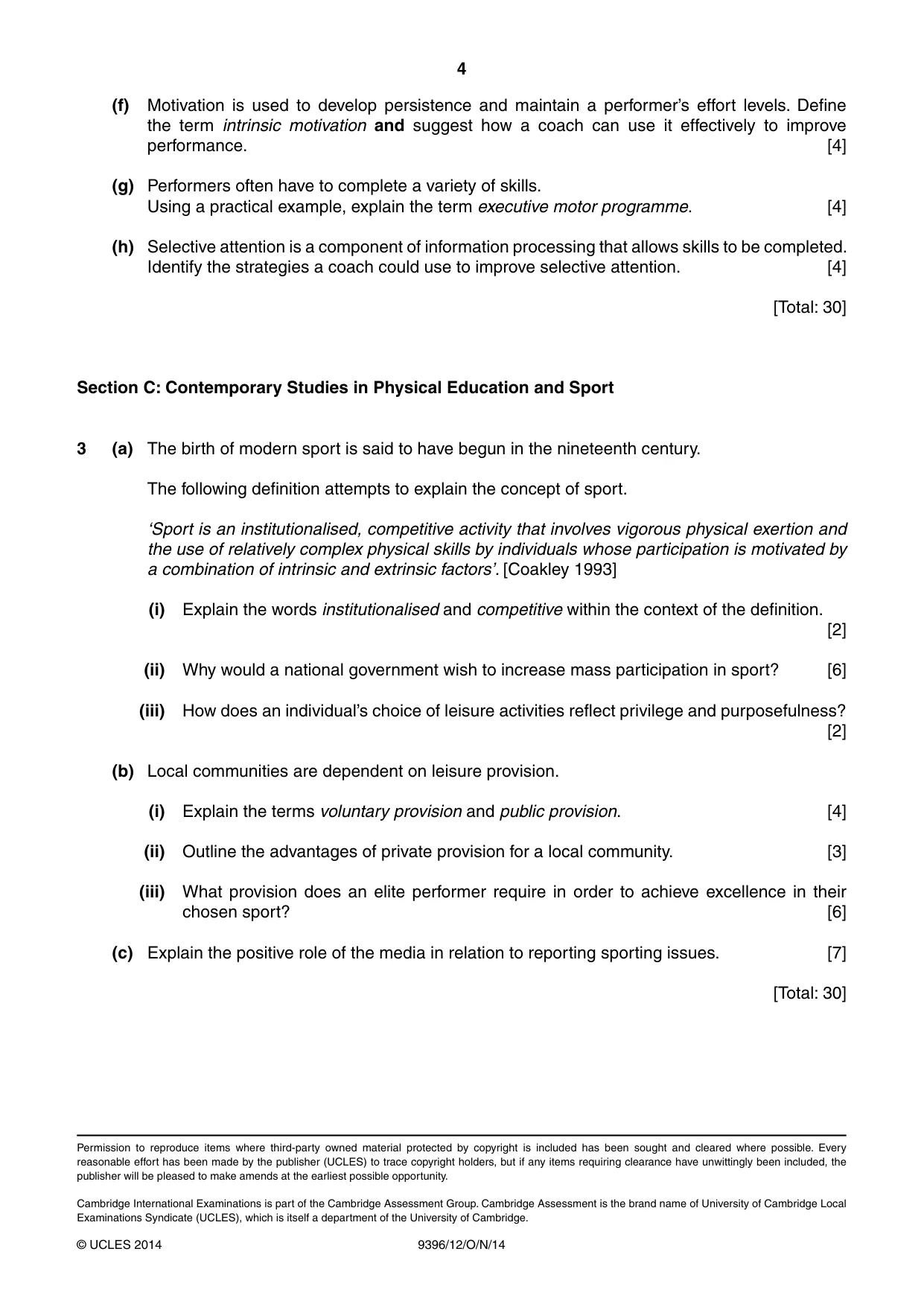
4 9396/12/O/N/14 © UCLES 2014 (f) Motivation is used to develop persistence and maintain a performer’s effort levels. Define the term intrinsic motivation and suggest how a coach can use it effectively to improve performance. [4] (g) Performers often have to complete a variety of skills. Using a practical example, explain the term executive motor programme. [4] (h) Selective attention is a component of information processing that allows skills to be completed. Identify the strategies a coach could use to improve selective attention. [4] [Total: 30] Section C: Contemporary Studies in Physical Education and Sport 3 (a) The birth of modern sport is said to have begun in the nineteenth century. The following definition attempts to explain the concept of sport. ‘Sport is an institutionalised, competitive activity that involves vigorous physical exertion and the use of relatively complex physical skills by individuals whose participation is motivated by a combination of intrinsic and extrinsic factors’. [Coakley 1993] (i) Explain the words institutionalised and competitive within the context of the definition. [2] (ii) Why would a national government wish to increase mass participation in sport? [6] (iii) How does an individual’s choice of leisure activities reflect privilege and purposefulness? [2] (b) Local communities are dependent on leisure provision. (i) Explain the terms voluntary provision and public provision. [4] (ii) Outline the advantages of private provision for a local community. [3] (iii) What provision does an elite performer require in order to achieve excellence in their chosen sport? [6] (c) Explain the positive role of the media in relation to reporting sporting issues. [7] [Total: 30] Permission to reproduce items where third-party owned material protected by copyright is included has been sought and cleared where possible. Every reasonable effort has been made by the publisher (UCLES) to trace copyright holders, but if any items requiring clearance have unwittingly been included, the publisher will be pleased to make amends at the earliest possible opportunity. Cambridge International Examinations is part of the Cambridge Assessment Group. Cambridge Assessment is the brand name of University of Cambridge Local Examinations Syndicate (UCLES), which is itself a department of the University of Cambridge.
Mark scheme, page 1
® IGCSE is the registered trademark of Cambridge International Examinations. CAMBRIDGE INTERNATIONAL EXAMINATIONS Cambridge International Advanced Subsidiary Level MARK SCHEME for the October/November 2014 series 9396 PHYSICAL EDUCATION 9396/12 Paper 1, maximum raw mark 90 This mark scheme is published as an aid to teachers and candidates, to indicate the requirements of the examination. It shows the basis on which Examiners were instructed to award marks. It does not indicate the details of the discussions that took place at an Examiners’ meeting before marking began, which would have considered the acceptability of alternative answers. Mark schemes should be read in conjunction with the question paper and the Principal Examiner Report for Teachers. Cambridge will not enter into discussions about these mark schemes. Cambridge is publishing the mark schemes for the October/November 2014 series for most Cambridge IGCSE®, Cambridge International A and AS Level components and some Cambridge O Level components.
Mark scheme, page 2
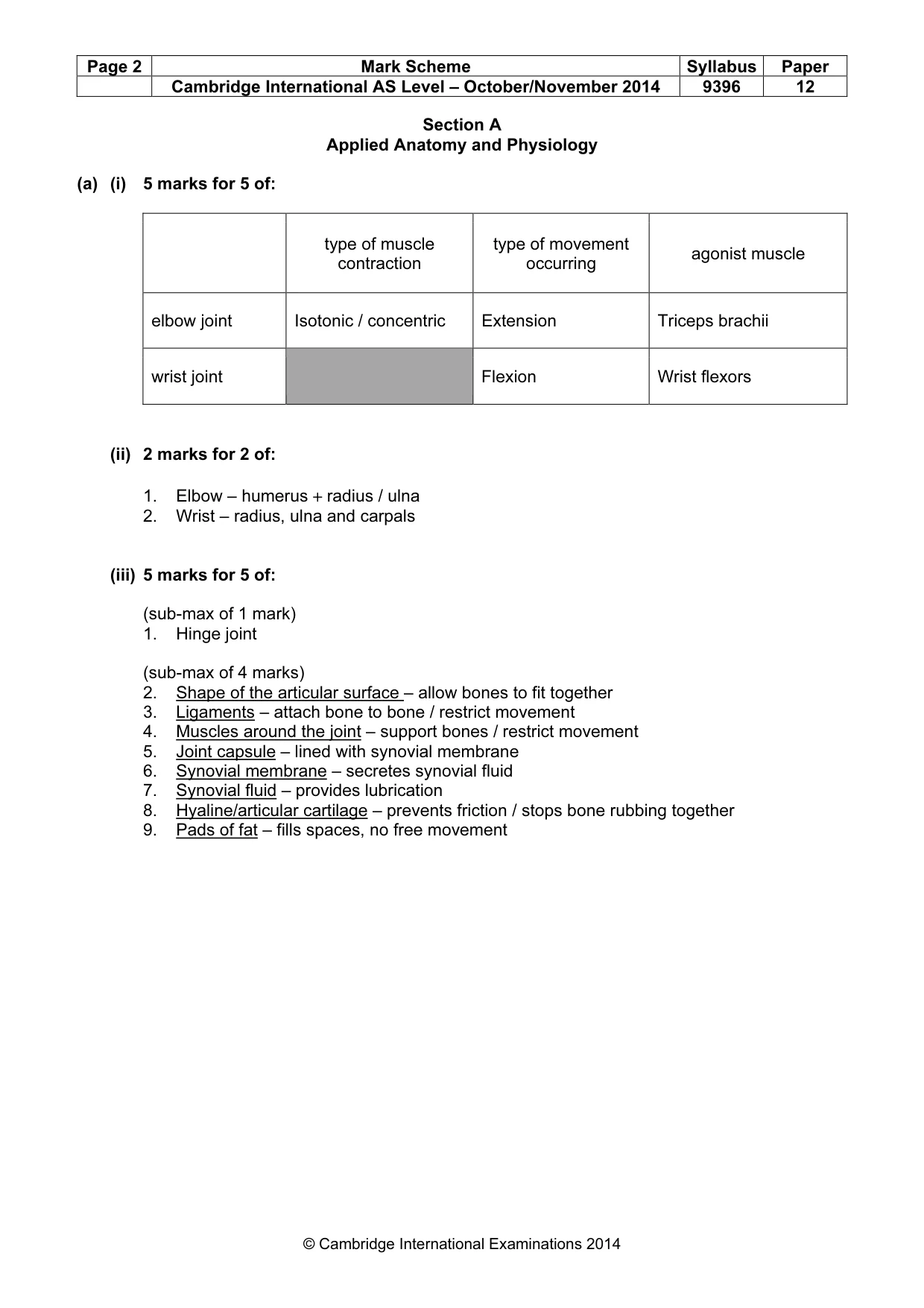
Page 2 Mark Scheme Syllabus Paper Cambridge International AS Level – October/November 2014 9396 12 © Cambridge International Examinations 2014 Section A Applied Anatomy and Physiology (a) (i) 5 marks for 5 of: type of muscle contraction type of movement occurring agonist muscle elbow joint Isotonic / concentric Extension Triceps brachii wrist joint Flexion Wrist flexors (ii) 2 marks for 2 of: 1. Elbow – humerus + radius / ulna 2. Wrist – radius, ulna and carpals (iii) 5 marks for 5 of: (sub-max of 1 mark) 1. Hinge joint (sub-max of 4 marks) 2. Shape of the articular surface – allow bones to fit together 3. Ligaments – attach bone to bone / restrict movement 4. Muscles around the joint – support bones / restrict movement 5. Joint capsule – lined with synovial membrane 6. Synovial membrane – secretes synovial fluid 7. Synovial fluid – provides lubrication 8. Hyaline/articular cartilage – prevents friction / stops bone rubbing together 9. Pads of fat – fills spaces, no free movement
Mark scheme, page 3
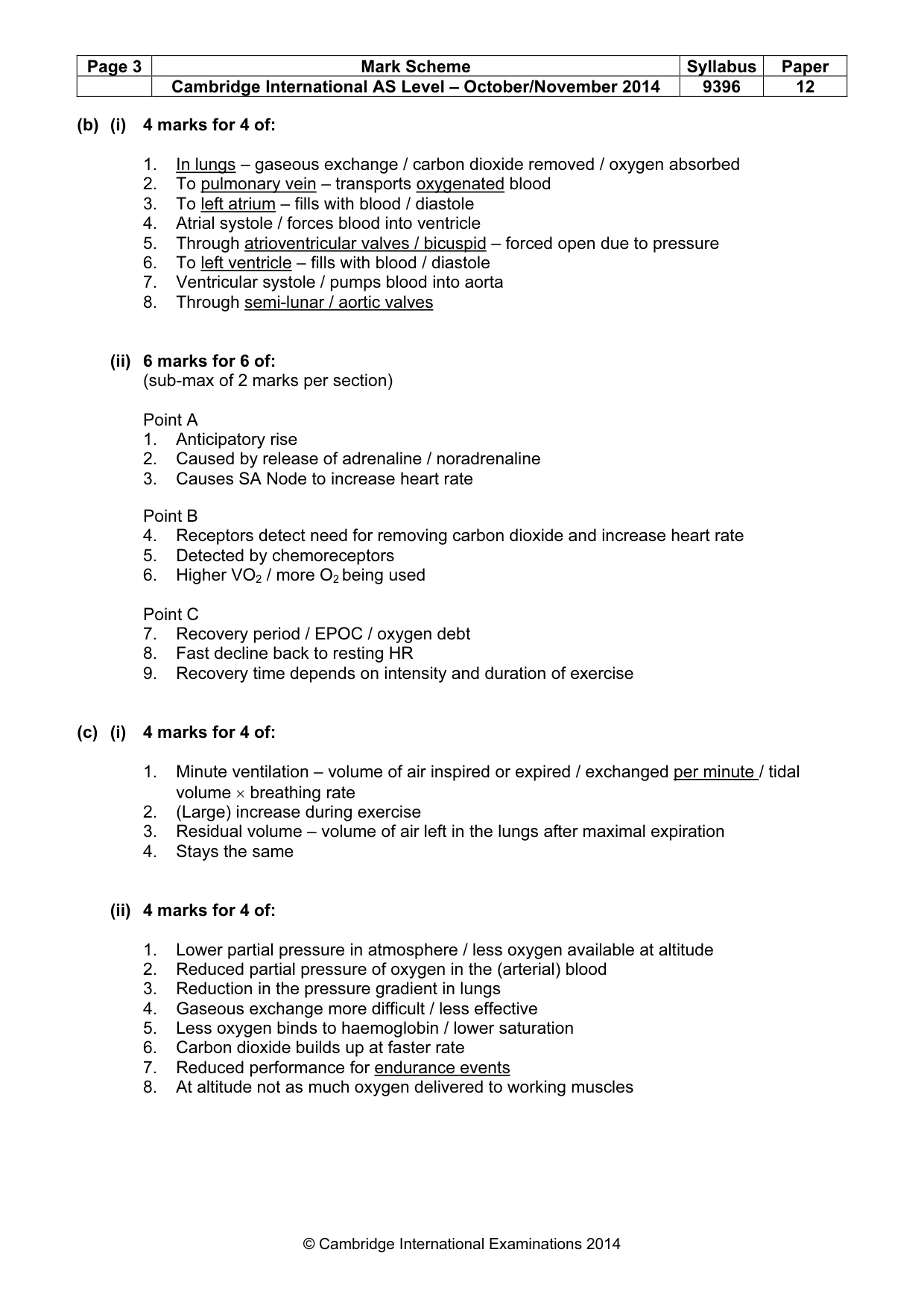
Page 3 Mark Scheme Syllabus Paper Cambridge International AS Level – October/November 2014 9396 12 © Cambridge International Examinations 2014 (b) (i) 4 marks for 4 of: 1. In lungs – gaseous exchange / carbon dioxide removed / oxygen absorbed 2. To pulmonary vein – transports oxygenated blood 3. To left atrium – fills with blood / diastole 4. Atrial systole / forces blood into ventricle 5. Through atrioventricular valves / bicuspid – forced open due to pressure 6. To left ventricle – fills with blood / diastole 7. Ventricular systole / pumps blood into aorta 8. Through semi-lunar / aortic valves (ii) 6 marks for 6 of: (sub-max of 2 marks per section) Point A 1. Anticipatory rise 2. Caused by release of adrenaline / noradrenaline 3. Causes SA Node to increase heart rate Point B 4. Receptors detect need for removing carbon dioxide and increase heart rate 5. Detected by chemoreceptors 6. Higher VO2 / more O2 being used Point C 7. Recovery period / EPOC / oxygen debt 8. Fast decline back to resting HR 9. Recovery time depends on intensity and duration of exercise (c) (i) 4 marks for 4 of: 1. Minute ventilation – volume of air inspired or expired / exchanged per minute / tidal volume × breathing rate 2. (Large) increase during exercise 3. Residual volume – volume of air left in the lungs after maximal expiration 4. Stays the same (ii) 4 marks for 4 of: 1. Lower partial pressure in atmosphere / less oxygen available at altitude 2. Reduced partial pressure of oxygen in the (arterial) blood 3. Reduction in the pressure gradient in lungs 4. Gaseous exchange more difficult / less effective 5. Less oxygen binds to haemoglobin / lower saturation 6. Carbon dioxide builds up at faster rate 7. Reduced performance for endurance events 8. At altitude not as much oxygen delivered to working muscles
Mark scheme, page 4
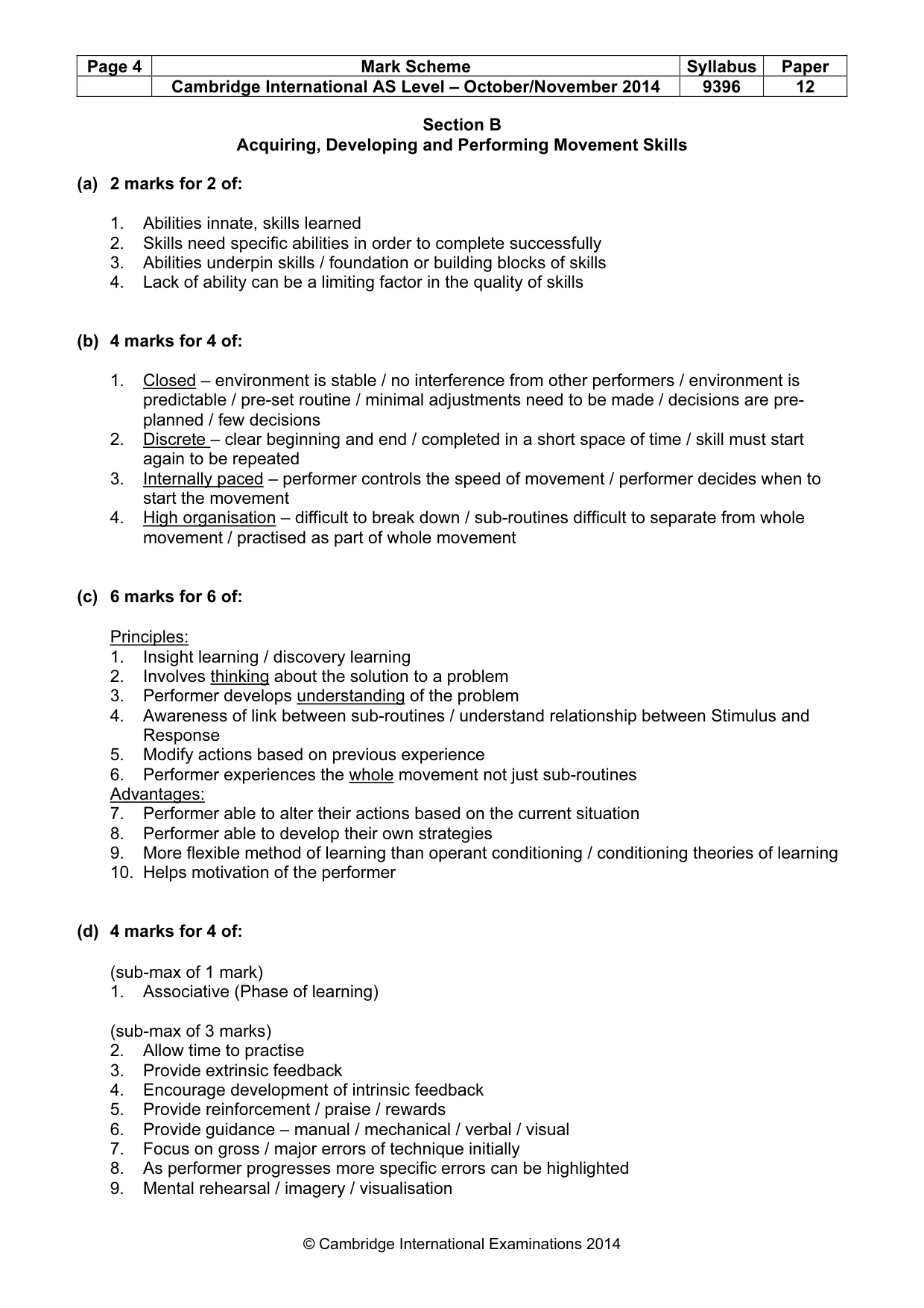
Page 4 Mark Scheme Syllabus Paper Cambridge International AS Level – October/November 2014 9396 12 © Cambridge International Examinations 2014 Section B Acquiring, Developing and Performing Movement Skills (a) 2 marks for 2 of: 1. Abilities innate, skills learned 2. Skills need specific abilities in order to complete successfully 3. Abilities underpin skills / foundation or building blocks of skills 4. Lack of ability can be a limiting factor in the quality of skills (b) 4 marks for 4 of: 1. Closed – environment is stable / no interference from other performers / environment is predictable / pre-set routine / minimal adjustments need to be made / decisions are pre- planned / few decisions 2. Discrete – clear beginning and end / completed in a short space of time / skill must start again to be repeated 3. Internally paced – performer controls the speed of movement / performer decides when to start the movement 4. High organisation – difficult to break down / sub-routines difficult to separate from whole movement / practised as part of whole movement (c) 6 marks for 6 of: Principles: 1. Insight learning / discovery learning 2. Involves thinking about the solution to a problem 3. Performer develops understanding of the problem 4. Awareness of link between sub-routines / understand relationship between Stimulus and Response 5. Modify actions based on previous experience 6. Performer experiences the whole movement not just sub-routines Advantages: 7. Performer able to alter their actions based on the current situation 8. Performer able to develop their own strategies 9. More flexible method of learning than operant conditioning / conditioning theories of learning 10. Helps motivation of the performer (d) 4 marks for 4 of: (sub-max of 1 mark) 1. Associative (Phase of learning) (sub-max of 3 marks) 2. Allow time to practise 3. Provide extrinsic feedback 4. Encourage development of intrinsic feedback 5. Provide reinforcement / praise / rewards 6. Provide guidance – manual / mechanical / verbal / visual 7. Focus on gross / major errors of technique initially 8. As performer progresses more specific errors can be highlighted 9. Mental rehearsal / imagery / visualisation
Mark scheme, page 5
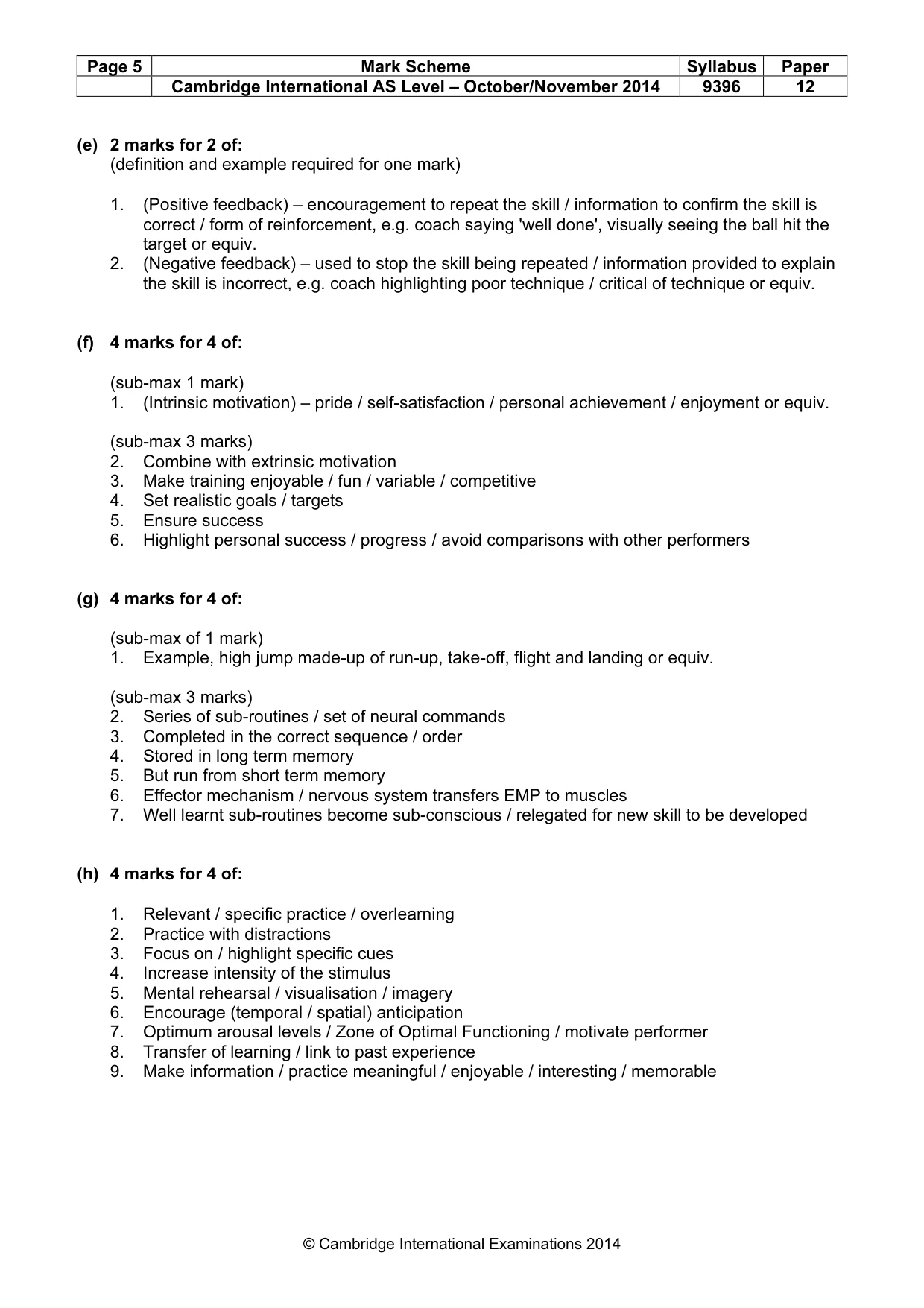
Page 5 Mark Scheme Syllabus Paper Cambridge International AS Level – October/November 2014 9396 12 © Cambridge International Examinations 2014 (e) 2 marks for 2 of: (definition and example required for one mark) 1. (Positive feedback) – encouragement to repeat the skill / information to confirm the skill is correct / form of reinforcement, e.g. coach saying 'well done', visually seeing the ball hit the target or equiv. 2. (Negative feedback) – used to stop the skill being repeated / information provided to explain the skill is incorrect, e.g. coach highlighting poor technique / critical of technique or equiv. (f) 4 marks for 4 of: (sub-max 1 mark) 1. (Intrinsic motivation) – pride / self-satisfaction / personal achievement / enjoyment or equiv. (sub-max 3 marks) 2. Combine with extrinsic motivation 3. Make training enjoyable / fun / variable / competitive 4. Set realistic goals / targets 5. Ensure success 6. Highlight personal success / progress / avoid comparisons with other performers (g) 4 marks for 4 of: (sub-max of 1 mark) 1. Example, high jump made-up of run-up, take-off, flight and landing or equiv. (sub-max 3 marks) 2. Series of sub-routines / set of neural commands 3. Completed in the correct sequence / order 4. Stored in long term memory 5. But run from short term memory 6. Effector mechanism / nervous system transfers EMP to muscles 7. Well learnt sub-routines become sub-conscious / relegated for new skill to be developed (h) 4 marks for 4 of: 1. Relevant / specific practice / overlearning 2. Practice with distractions 3. Focus on / highlight specific cues 4. Increase intensity of the stimulus 5. Mental rehearsal / visualisation / imagery 6. Encourage (temporal / spatial) anticipation 7. Optimum arousal levels / Zone of Optimal Functioning / motivate performer 8. Transfer of learning / link to past experience 9. Make information / practice meaningful / enjoyable / interesting / memorable
Mark scheme, page 6
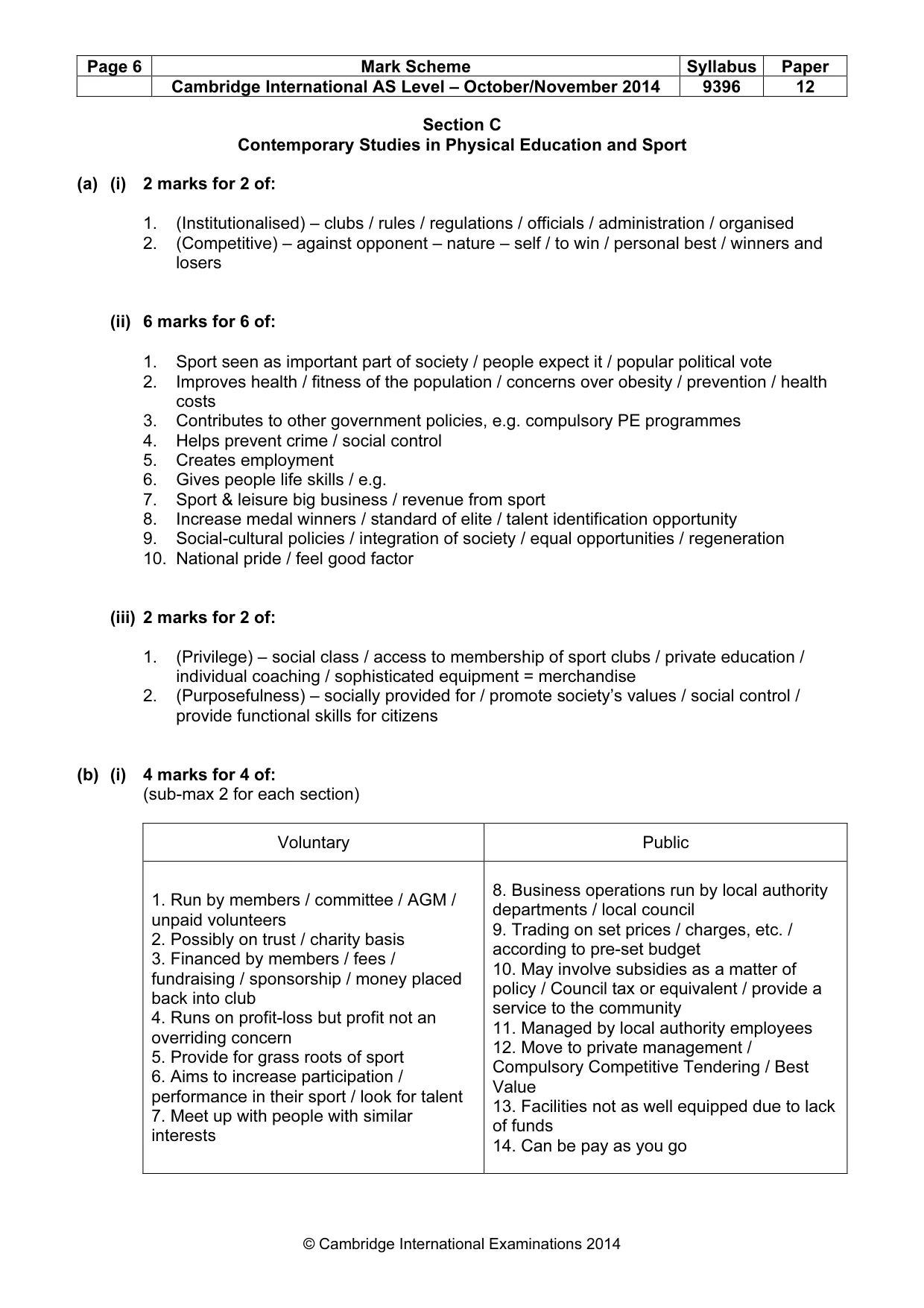
Page 6 Mark Scheme Syllabus Paper Cambridge International AS Level – October/November 2014 9396 12 © Cambridge International Examinations 2014 Section C Contemporary Studies in Physical Education and Sport (a) (i) 2 marks for 2 of: 1. (Institutionalised) – clubs / rules / regulations / officials / administration / organised 2. (Competitive) – against opponent – nature – self / to win / personal best / winners and losers (ii) 6 marks for 6 of: 1. Sport seen as important part of society / people expect it / popular political vote 2. Improves health / fitness of the population / concerns over obesity / prevention / health costs 3. Contributes to other government policies, e.g. compulsory PE programmes 4. Helps prevent crime / social control 5. Creates employment 6. Gives people life skills / e.g. 7. Sport & leisure big business / revenue from sport 8. Increase medal winners / standard of elite / talent identification opportunity 9. Social-cultural policies / integration of society / equal opportunities / regeneration 10. National pride / feel good factor (iii) 2 marks for 2 of: 1. (Privilege) – social class / access to membership of sport clubs / private education / individual coaching / sophisticated equipment = merchandise 2. (Purposefulness) – socially provided for / promote society’s values / social control / provide functional skills for citizens (b) (i) 4 marks for 4 of: (sub-max 2 for each section) Voluntary Public 1. Run by members / committee / AGM / unpaid volunteers 2. Possibly on trust / charity basis 3. Financed by members / fees / fundraising / sponsorship / money placed back into club 4. Runs on profit-loss but profit not an overriding concern 5. Provide for grass roots of sport 6. Aims to increase participation / performance in their sport / look for talent 7. Meet up with people with similar interests 8. Business operations run by local authority departments / local council 9. Trading on set prices / charges, etc. / according to pre-set budget 10. May involve subsidies as a matter of policy / Council tax or equivalent / provide a service to the community 11. Managed by local authority employees 12. Move to private management / Compulsory Competitive Tendering / Best Value 13. Facilities not as well equipped due to lack of funds 14. Can be pay as you go
Mark scheme, page 7
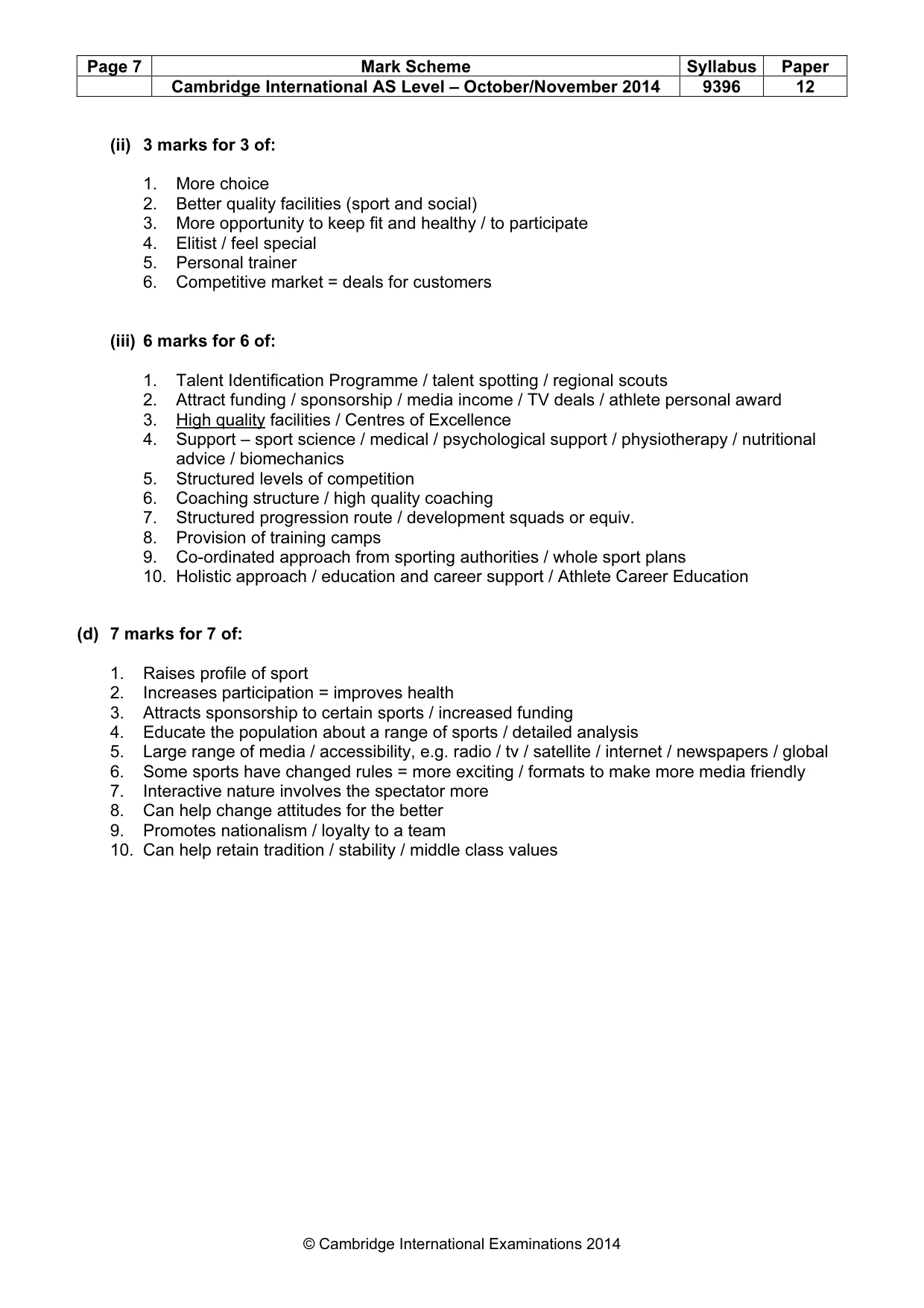
Page 7 Mark Scheme Syllabus Paper Cambridge International AS Level – October/November 2014 9396 12 © Cambridge International Examinations 2014 (ii) 3 marks for 3 of: 1. More choice 2. Better quality facilities (sport and social) 3. More opportunity to keep fit and healthy / to participate 4. Elitist / feel special 5. Personal trainer 6. Competitive market = deals for customers (iii) 6 marks for 6 of: 1. Talent Identification Programme / talent spotting / regional scouts 2. Attract funding / sponsorship / media income / TV deals / athlete personal award 3. High quality facilities / Centres of Excellence 4. Support – sport science / medical / psychological support / physiotherapy / nutritional advice / biomechanics 5. Structured levels of competition 6. Coaching structure / high quality coaching 7. Structured progression route / development squads or equiv. 8. Provision of training camps 9. Co-ordinated approach from sporting authorities / whole sport plans 10. Holistic approach / education and career support / Athlete Career Education (d) 7 marks for 7 of: 1. Raises profile of sport 2. Increases participation = improves health 3. Attracts sponsorship to certain sports / increased funding 4. Educate the population about a range of sports / detailed analysis 5. Large range of media / accessibility, e.g. radio / tv / satellite / internet / newspapers / global 6. Some sports have changed rules = more exciting / formats to make more media friendly 7. Interactive nature involves the spectator more 8. Can help change attitudes for the better 9. Promotes nationalism / loyalty to a team 10. Can help retain tradition / stability / middle class values
What you needed in this session
Cambridge’s own grade thresholds for 2014 Oct/Nov, Paper 1 · Variant 2. A higher threshold means an easier paper — the bar moves with how the cohort did.