Cambridge A Level Physical Education 9396 — 2014 Oct/Nov Paper 1 · Variant 1
9396/11/O/N/14 · 90 marks · ≈101 min
The question paper and its mark scheme, free to read here and free to download. This is Cambridge’s own paper, exactly as it was sat.
Question paper4 pages
Mark scheme
No mark scheme is in the library for this paper.
Paper as text
Question paper, page 1
This document consists of 4 printed pages and 1 insert. DC (NF/JG) 83088/4 © UCLES 2014 [Turn over Cambridge International Examinations Cambridge International Advanced Subsidiary and Advanced Level * 3 6 8 2 2 1 4 8 5 4 * PHYSICAL EDUCATION 9396/11 Paper 1 October/November 2014 2 hours 30 minutes No Additional Materials are required. READ THESE INSTRUCTIONS FIRST An answer booklet is provided inside this question paper. You should follow the instructions on the front cover of the answer booklet. If you need additional answer paper ask the invigilator for a continuation booklet. Answer all questions. Electronic calculators may be used. You may lose marks if you do not show your working or if you do not use appropriate units. The number of marks is given in brackets [ ] at the end of each question or part question.
Question paper, page 2
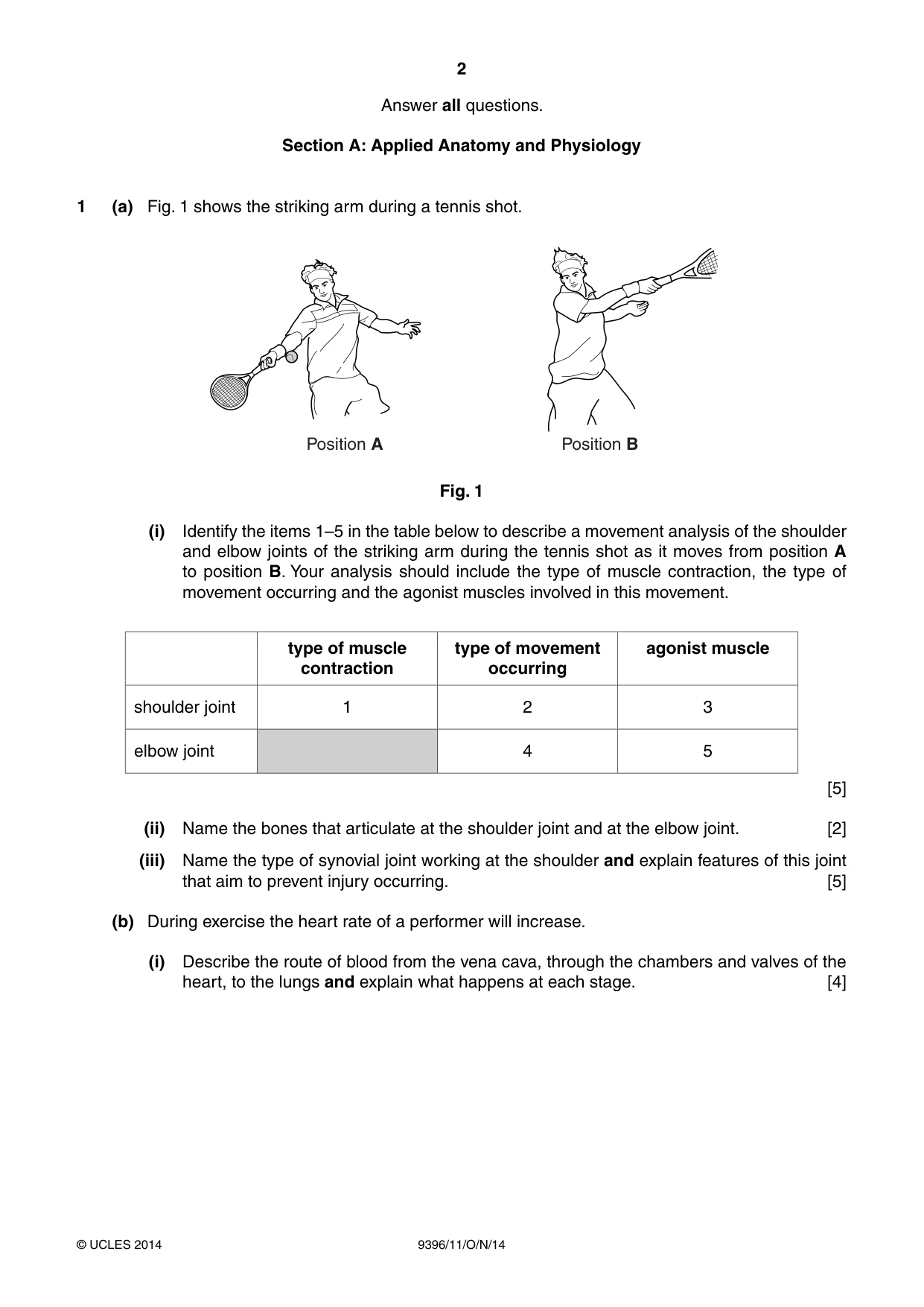
2 9396/11/O/N/14 © UCLES 2014 Answer all questions. Section A: Applied Anatomy and Physiology 1 (a) Fig. 1 shows the striking arm during a tennis shot. Position A Position B Fig. 1 (i) Identify the items 1–5 in the table below to describe a movement analysis of the shoulder and elbow joints of the striking arm during the tennis shot as it moves from position A to position B. Your analysis should include the type of muscle contraction, the type of movement occurring and the agonist muscles involved in this movement. type of muscle contraction type of movement occurring agonist muscle shoulder joint 1 2 3 elbow joint 4 5 [5] (ii) Name the bones that articulate at the shoulder joint and at the elbow joint. [2] (iii) Name the type of synovial joint working at the shoulder and explain features of this joint that aim to prevent injury occurring. [5] (b) During exercise the heart rate of a performer will increase. (i) Describe the route of blood from the vena cava, through the chambers and valves of the heart, to the lungs and explain what happens at each stage. [4]
Question paper, page 3
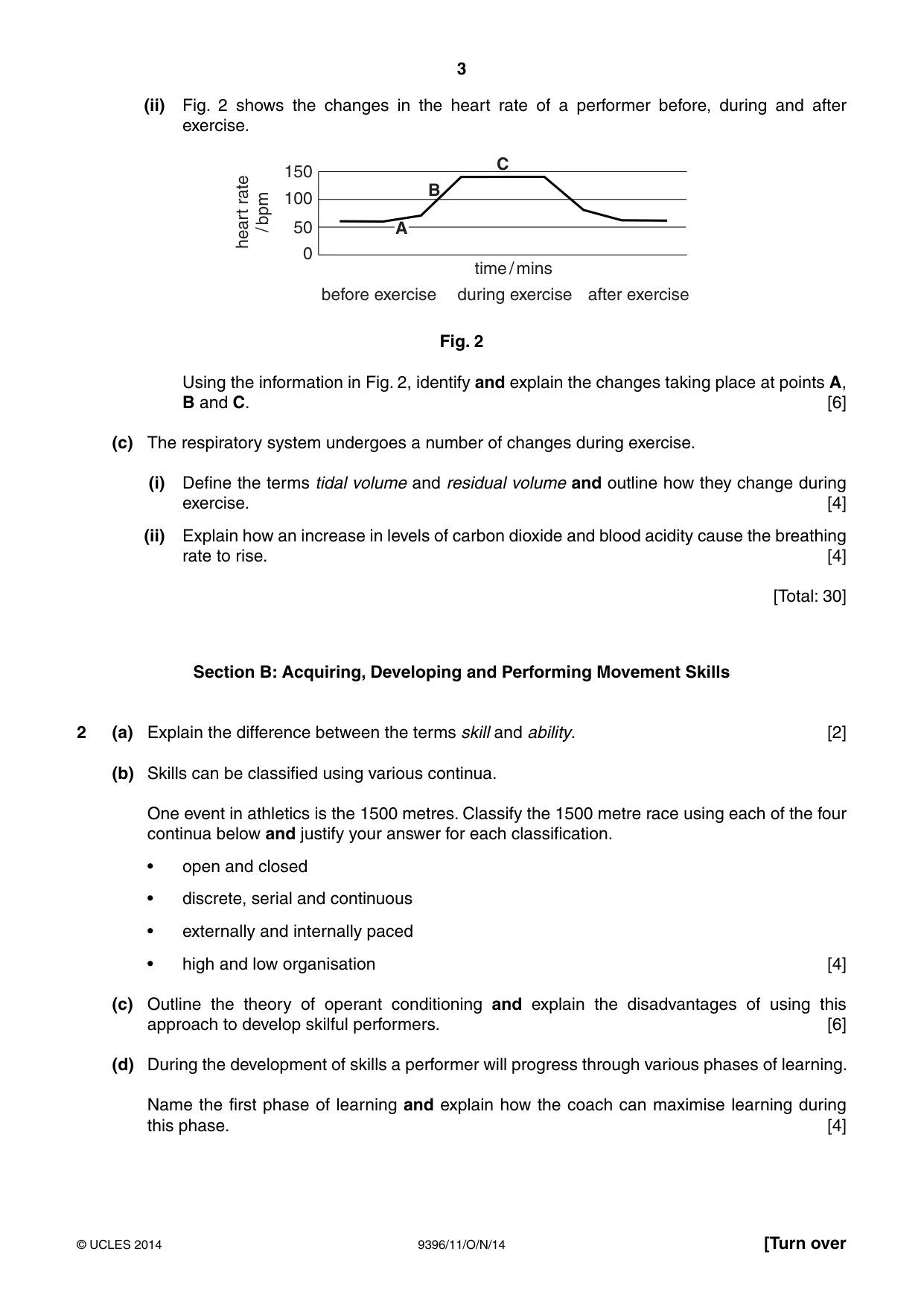
3 9396/11/O/N/14 © UCLES 2014 [Turn over (ii) Fig. 2 shows the changes in the heart rate of a performer before, during and after exercise. heart rate / bpm 150 100 50 0 A B C before exercise during exercise after exercise time / mins Fig. 2 Using the information in Fig. 2, identify and explain the changes taking place at points A, B and C. [6] (c) The respiratory system undergoes a number of changes during exercise. (i) Define the terms tidal volume and residual volume and outline how they change during exercise. [4] (ii) Explain how an increase in levels of carbon dioxide and blood acidity cause the breathing rate to rise. [4] [Total: 30] Section B: Acquiring, Developing and Performing Movement Skills 2 (a) Explain the difference between the terms skill and ability. [2] (b) Skills can be classified using various continua. One event in athletics is the 1500 metres. Classify the 1500 metre race using each of the four continua below and justify your answer for each classification. • open and closed • discrete, serial and continuous • externally and internally paced • high and low organisation [4] (c) Outline the theory of operant conditioning and explain the disadvantages of using this approach to develop skilful performers. [6] (d) During the development of skills a performer will progress through various phases of learning. Name the first phase of learning and explain how the coach can maximise learning during this phase. [4]
Question paper, page 4
4 9396/11/O/N/14 © UCLES 2014 (e) Feedback is important in the development of skills. Using practical examples, explain what is meant by the terms terminal and concurrent feedback. [2] (f) Motivation is used to develop persistence and maintain a performer’s effort levels. Define the terms intrinsic and extrinsic motivation and explain which of these is considered to be the most important. [4] (g) Performers often have to complete a variety of skills, also known as motor programmes. Explain the difference between open loop control and closed loop control. [4] (h) The memory process is a component of information processing that allows skills to be completed. Identify the strategies a coach could use to improve the memory process. [4] [Total: 30] Section C: Contemporary Studies in Physical Education and Sport 3 (a) Outdoor and adventurous activities have become increasingly popular. (i) Explain, using practical examples, the terms outdoor recreation and outdoor education. [4] (ii) Rock climbing is an example of an outdoor recreation activity. What are the benefits to an individual from participating in outdoor recreation activities? [4] (b) Explain the social factors that may affect an individual’s opportunity to participate in sport. [6] (c) Countries have different approaches to the development of sporting excellence. (i) What are the advantages of a country deciding to invest heavily in developing elite sport? [5] (ii) What are the possible negative effects on a performer’s ethics when participating in elite sport? [4] (d) How can sporting organisations attempt to counteract an increase in spectator violence? [7] [Total: 30] Permission to reproduce items where third-party owned material protected by copyright is included has been sought and cleared where possible. Every reasonable effort has been made by the publisher (UCLES) to trace copyright holders, but if any items requiring clearance have unwittingly been included, the publisher will be pleased to make amends at the earliest possible opportunity. Cambridge International Examinations is part of the Cambridge Assessment Group. Cambridge Assessment is the brand name of University of Cambridge Local Examinations Syndicate (UCLES), which is itself a department of the University of Cambridge.
What you needed in this session
Cambridge’s own grade thresholds for 2014 Oct/Nov, Paper 1 · Variant 1. A higher threshold means an easier paper — the bar moves with how the cohort did.