Cambridge A Level Physical Education 9396 — 2014 Oct/Nov Paper 1 · Variant 3
9396/13/O/N/14 · 90 marks · ≈101 min
The question paper and its mark scheme, free to read here and free to download. This is Cambridge’s own paper, exactly as it was sat.
Question paper4 pages
Mark scheme8 pages
Answers below. Sit the paper first if you are practising.
Paper as text
Question paper, page 1
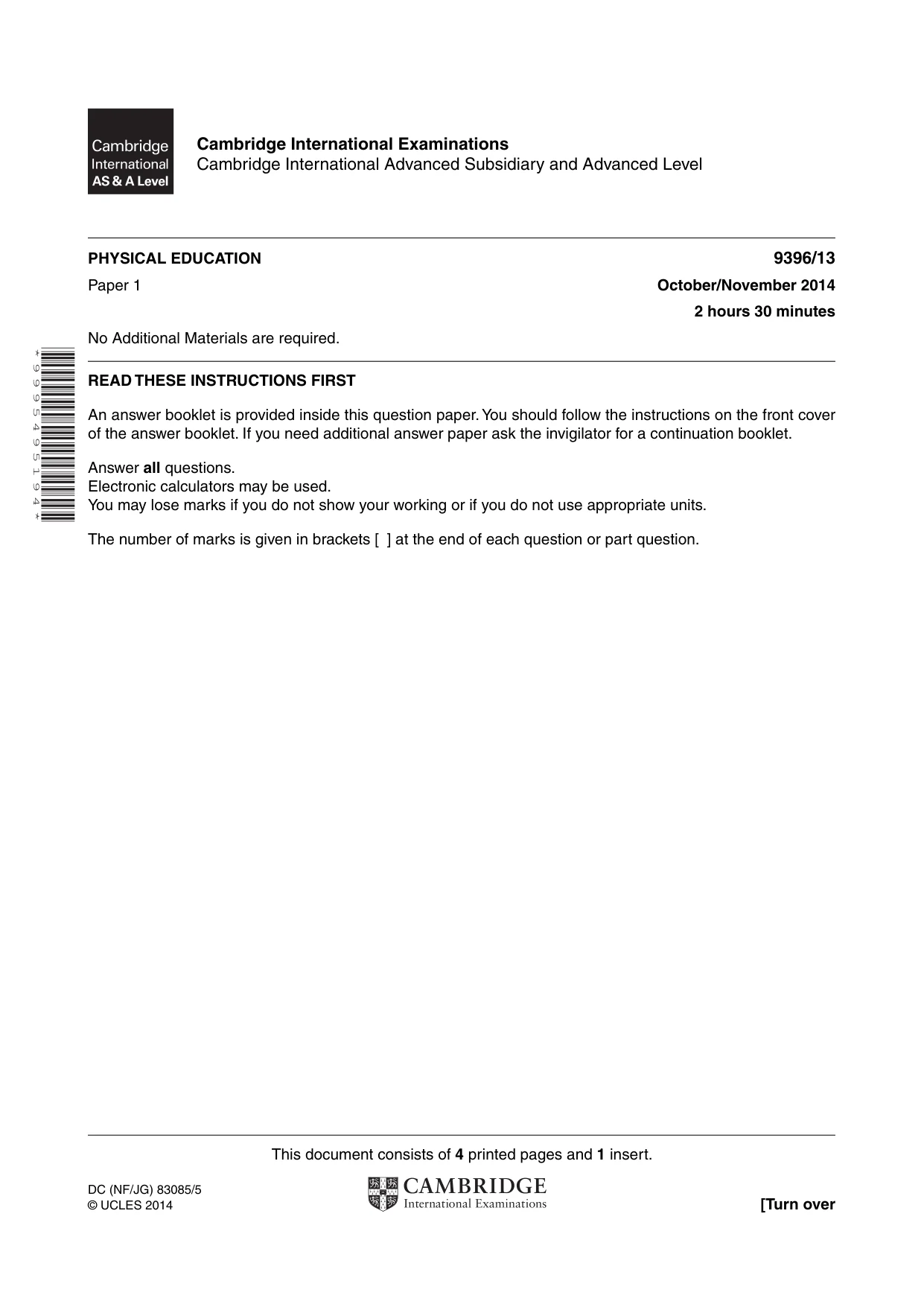
This document consists of 4 printed pages and 1 insert. DC (NF/JG) 83085/5 © UCLES 2014 [Turn over Cambridge International Examinations Cambridge International Advanced Subsidiary and Advanced Level * 9 9 9 5 4 9 5 1 9 4 * PHYSICAL EDUCATION 9396/13 Paper 1 October/November 2014 2 hours 30 minutes No Additional Materials are required. READ THESE INSTRUCTIONS FIRST An answer booklet is provided inside this question paper. You should follow the instructions on the front cover of the answer booklet. If you need additional answer paper ask the invigilator for a continuation booklet. Answer all questions. Electronic calculators may be used. You may lose marks if you do not show your working or if you do not use appropriate units. The number of marks is given in brackets [ ] at the end of each question or part question.
Question paper, page 2
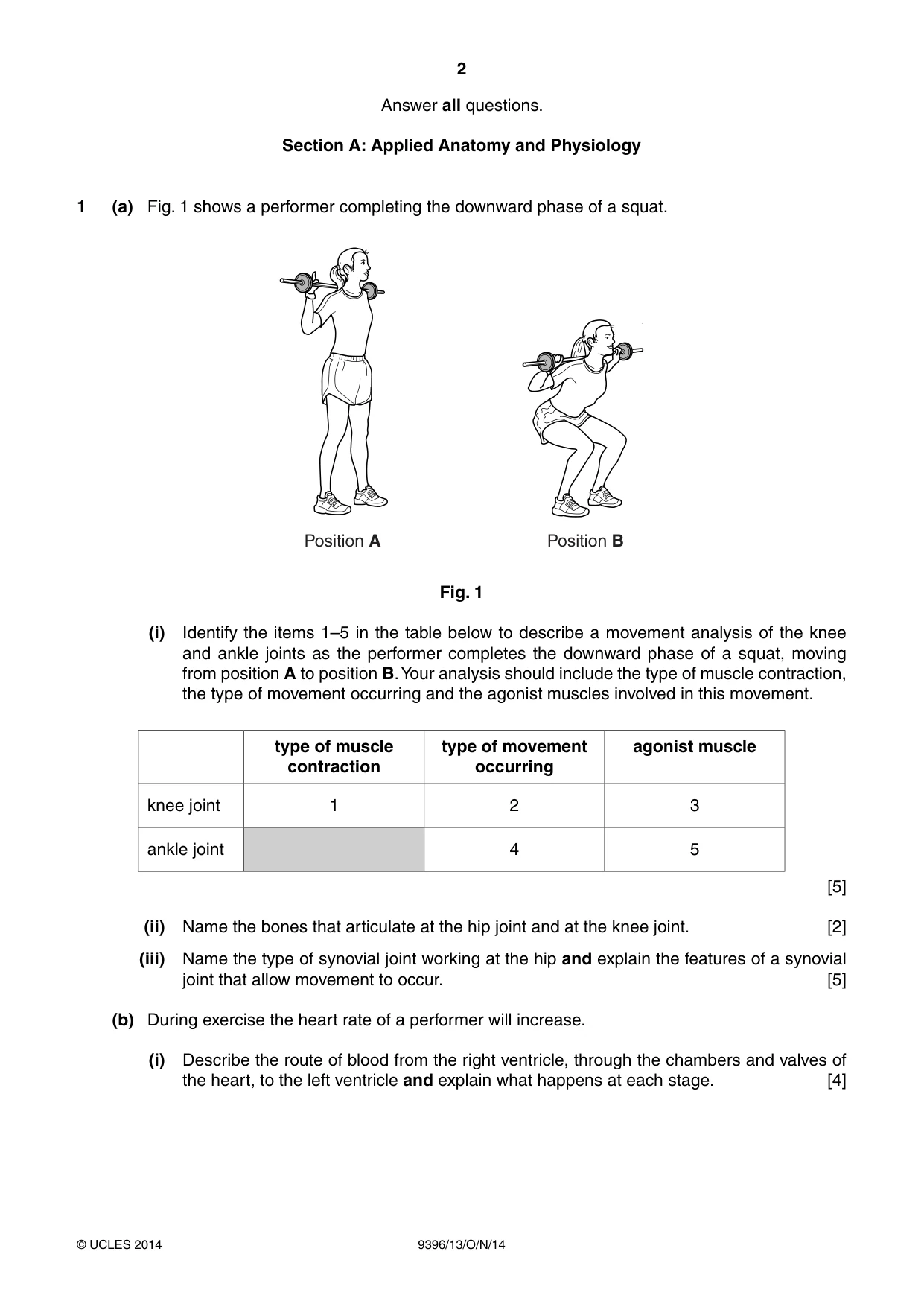
2 9396/13/O/N/14 © UCLES 2014 Answer all questions. Section A: Applied Anatomy and Physiology 1 (a) Fig. 1 shows a performer completing the downward phase of a squat. Position A Position B Fig. 1 (i) Identify the items 1–5 in the table below to describe a movement analysis of the knee and ankle joints as the performer completes the downward phase of a squat, moving from position A to position B. Your analysis should include the type of muscle contraction, the type of movement occurring and the agonist muscles involved in this movement. type of muscle contraction type of movement occurring agonist muscle knee joint 1 2 3 ankle joint 4 5 [5] (ii) Name the bones that articulate at the hip joint and at the knee joint. [2] (iii) Name the type of synovial joint working at the hip and explain the features of a synovial joint that allow movement to occur. [5] (b) During exercise the heart rate of a performer will increase. (i) Describe the route of blood from the right ventricle, through the chambers and valves of the heart, to the left ventricle and explain what happens at each stage. [4]
Question paper, page 3
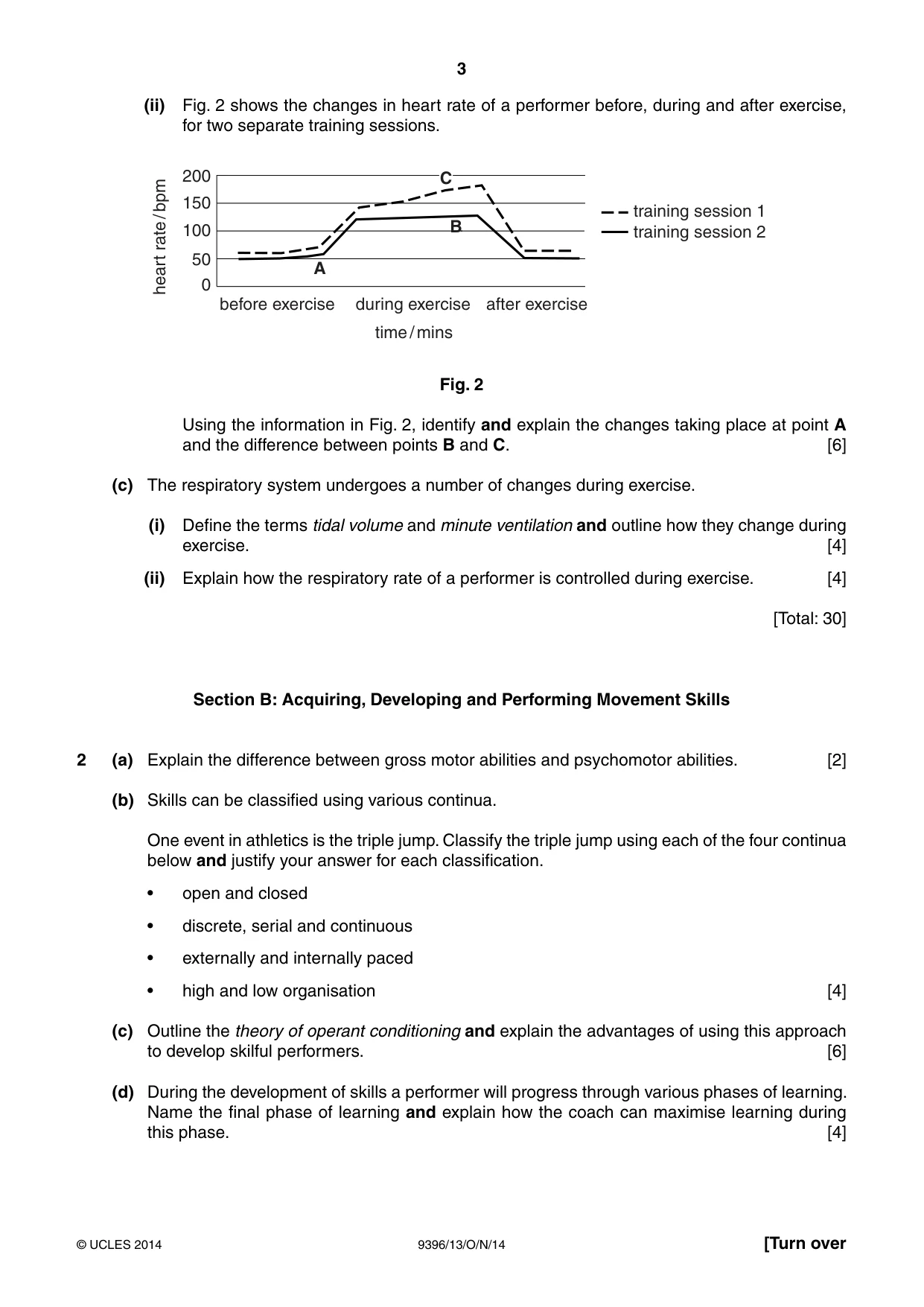
3 9396/13/O/N/14 © UCLES 2014 [Turn over (ii) Fig. 2 shows the changes in heart rate of a performer before, during and after exercise, for two separate training sessions. heart rate / bpm 200 150 100 50 0 training session 1 training session 2 A B before exercise during exercise after exercise C time / mins Fig. 2 Using the information in Fig. 2, identify and explain the changes taking place at point A and the difference between points B and C. [6] (c) The respiratory system undergoes a number of changes during exercise. (i) Define the terms tidal volume and minute ventilation and outline how they change during exercise. [4] (ii) Explain how the respiratory rate of a performer is controlled during exercise. [4] [Total: 30] Section B: Acquiring, Developing and Performing Movement Skills 2 (a) Explain the difference between gross motor abilities and psychomotor abilities. [2] (b) Skills can be classified using various continua. One event in athletics is the triple jump. Classify the triple jump using each of the four continua below and justify your answer for each classification. • open and closed • discrete, serial and continuous • externally and internally paced • high and low organisation [4] (c) Outline the theory of operant conditioning and explain the advantages of using this approach to develop skilful performers. [6] (d) During the development of skills a performer will progress through various phases of learning. Name the final phase of learning and explain how the coach can maximise learning during this phase. [4]
Question paper, page 4
4 9396/13/O/N/14 © UCLES 2014 (e) Feedback is important in the development of skills. Using practical examples, explain what is meant by the terms intrinsic and extrinsic feedback. [2] (f) Motivation is used to develop persistence and maintain a performer’s effort levels. Define the term extrinsic motivation and outline the possible disadvantages of using extrinsic motivation. [4] (g) Performers often have to complete a variety of skills. Using a practical example, explain the term closed loop control. [4] (h) The response time of a performer is an important factor that allows skills to be completed successfully. Identify the strategies a coach could use to improve the response time of a performer. [4] [Total: 30] Section C – Contemporary Studies in Physical Education and Sport 3 (a) The majority of people are introduced to a range of sporting activities through physical education programmes. (i) What are the aims of physical education? Use examples to support your answer. [4] (ii) Outdoor education introduces children to situations involving an element of danger. Explain what is meant by subjective and objective danger. [4] (iii) How does the concept of physical education differ from physical recreation? [5] (b) (i) Using examples, identify how sport and politics have been linked. [6] (ii) How can sporting authorities attempt to reduce the number of sport performers using drugs? [4] (c) (i) Explain the terms equal opportunities and esteem in relation to sport participation. [2] (ii) How can National Governing Bodies encourage mass participation in their sport? [5] [Total: 30] Permission to reproduce items where third-party owned material protected by copyright is included has been sought and cleared where possible. Every reasonable effort has been made by the publisher (UCLES) to trace copyright holders, but if any items requiring clearance have unwittingly been included, the publisher will be pleased to make amends at the earliest possible opportunity. Cambridge International Examinations is part of the Cambridge Assessment Group. Cambridge Assessment is the brand name of University of Cambridge Local Examinations Syndicate (UCLES), which is itself a department of the University of Cambridge.
Mark scheme, page 1
® IGCSE is the registered trademark of Cambridge International Examinations. CAMBRIDGE INTERNATIONAL EXAMINATIONS Cambridge International Advanced Subsidiary Level MARK SCHEME for the October/November 2014 series 9396 PHYSICAL EDUCATION 9396/13 Paper 1, maximum raw mark 90 This mark scheme is published as an aid to teachers and candidates, to indicate the requirements of the examination. It shows the basis on which Examiners were instructed to award marks. It does not indicate the details of the discussions that took place at an Examiners’ meeting before marking began, which would have considered the acceptability of alternative answers. Mark schemes should be read in conjunction with the question paper and the Principal Examiner Report for Teachers. Cambridge will not enter into discussions about these mark schemes. Cambridge is publishing the mark schemes for the October/November 2014 series for most Cambridge IGCSE®, Cambridge International A and AS Level components and some Cambridge O Level components.
Mark scheme, page 2
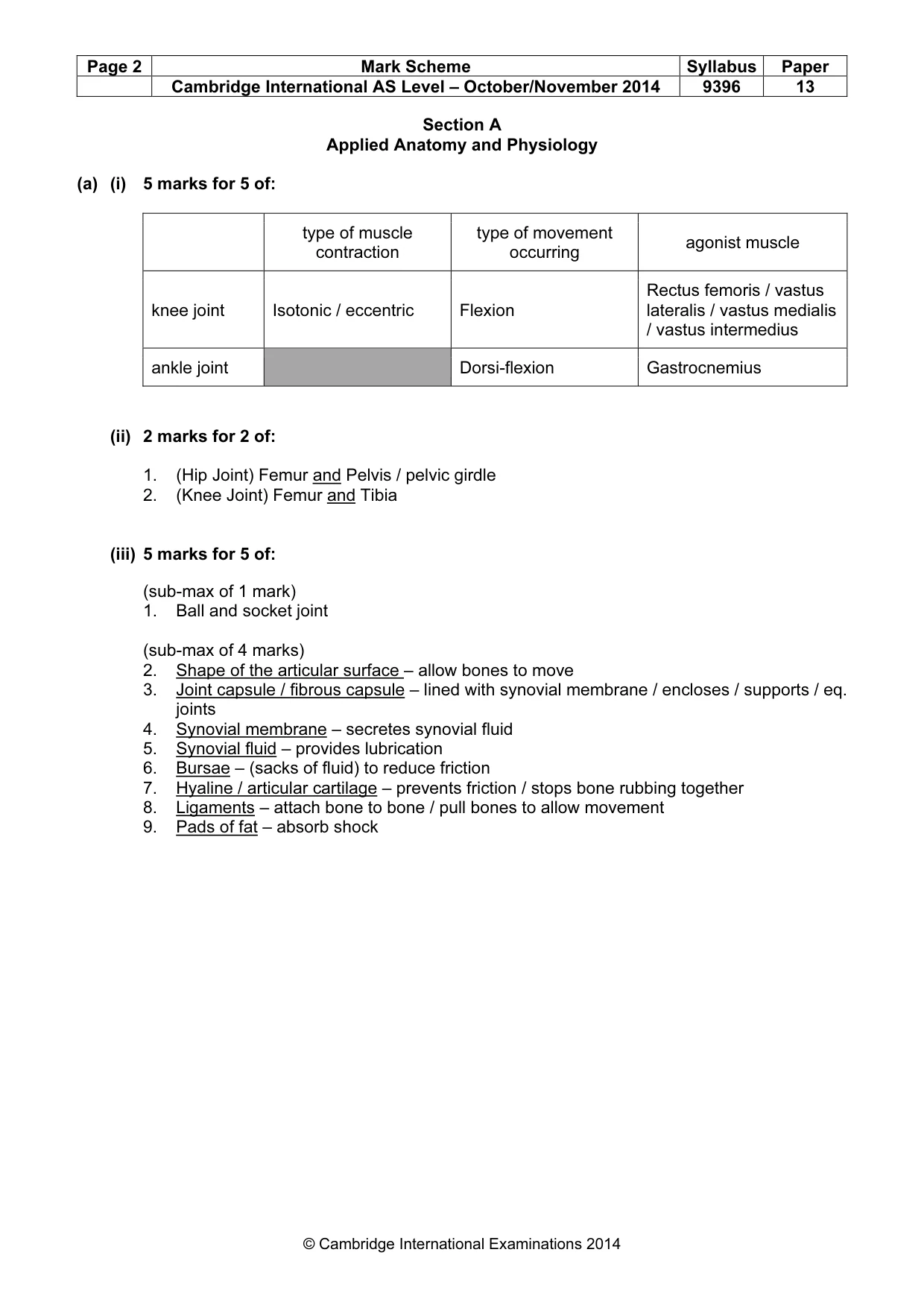
Page 2 Mark Scheme Syllabus Paper Cambridge International AS Level – October/November 2014 9396 13 © Cambridge International Examinations 2014 Section A Applied Anatomy and Physiology (a) (i) 5 marks for 5 of: type of muscle contraction type of movement occurring agonist muscle knee joint Isotonic / eccentric Flexion Rectus femoris / vastus lateralis / vastus medialis / vastus intermedius ankle joint Dorsi-flexion Gastrocnemius (ii) 2 marks for 2 of: 1. (Hip Joint) Femur and Pelvis / pelvic girdle 2. (Knee Joint) Femur and Tibia (iii) 5 marks for 5 of: (sub-max of 1 mark) 1. Ball and socket joint (sub-max of 4 marks) 2. Shape of the articular surface – allow bones to move 3. Joint capsule / fibrous capsule – lined with synovial membrane / encloses / supports / eq. joints 4. Synovial membrane – secretes synovial fluid 5. Synovial fluid – provides lubrication 6. Bursae – (sacks of fluid) to reduce friction 7. Hyaline / articular cartilage – prevents friction / stops bone rubbing together 8. Ligaments – attach bone to bone / pull bones to allow movement 9. Pads of fat – absorb shock
Mark scheme, page 3
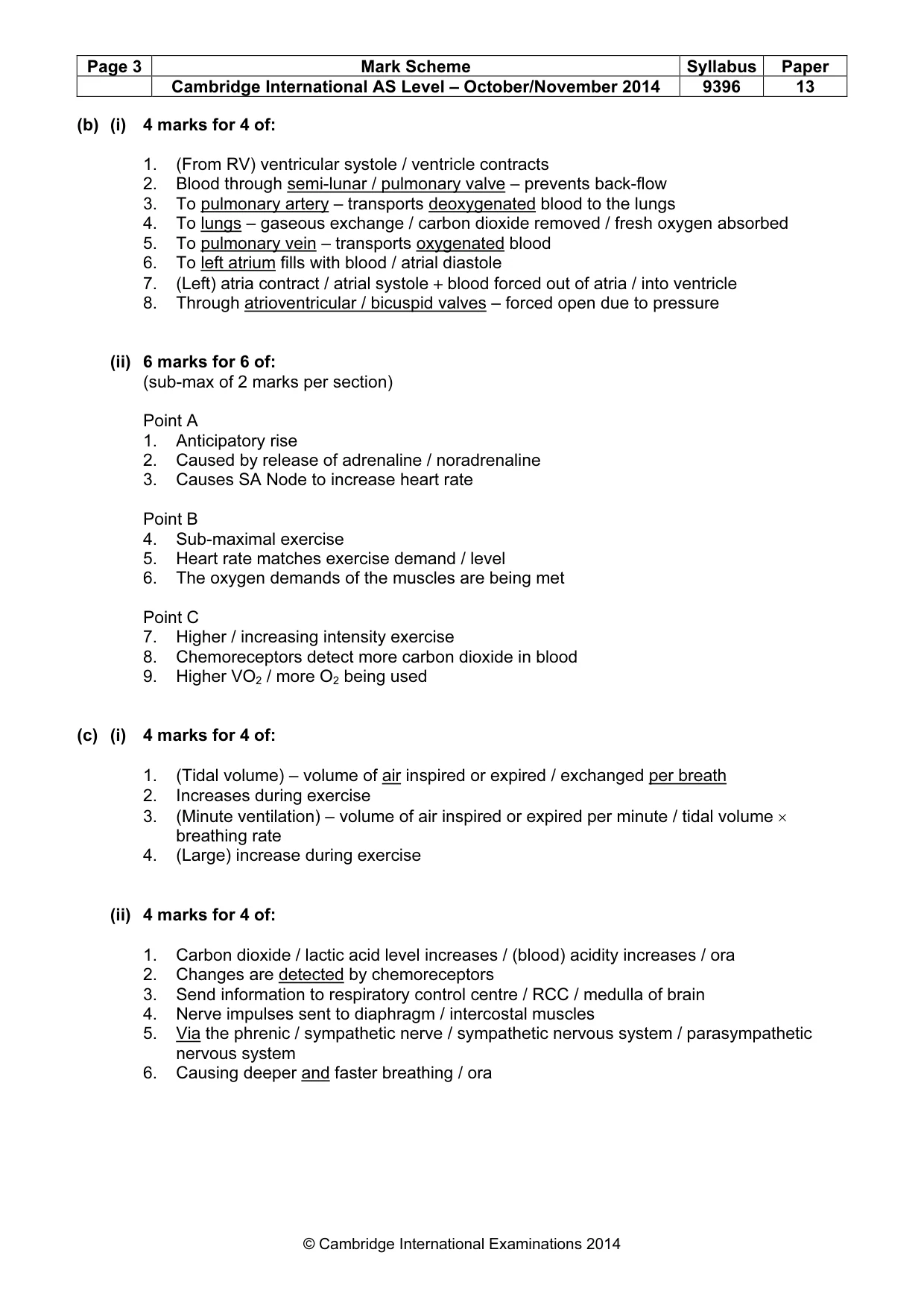
Page 3 Mark Scheme Syllabus Paper Cambridge International AS Level – October/November 2014 9396 13 © Cambridge International Examinations 2014 (b) (i) 4 marks for 4 of: 1. (From RV) ventricular systole / ventricle contracts 2. Blood through semi-lunar / pulmonary valve – prevents back-flow 3. To pulmonary artery – transports deoxygenated blood to the lungs 4. To lungs – gaseous exchange / carbon dioxide removed / fresh oxygen absorbed 5. To pulmonary vein – transports oxygenated blood 6. To left atrium fills with blood / atrial diastole 7. (Left) atria contract / atrial systole + blood forced out of atria / into ventricle 8. Through atrioventricular / bicuspid valves – forced open due to pressure (ii) 6 marks for 6 of: (sub-max of 2 marks per section) Point A 1. Anticipatory rise 2. Caused by release of adrenaline / noradrenaline 3. Causes SA Node to increase heart rate Point B 4. Sub-maximal exercise 5. Heart rate matches exercise demand / level 6. The oxygen demands of the muscles are being met Point C 7. Higher / increasing intensity exercise 8. Chemoreceptors detect more carbon dioxide in blood 9. Higher VO2 / more O2 being used (c) (i) 4 marks for 4 of: 1. (Tidal volume) – volume of air inspired or expired / exchanged per breath 2. Increases during exercise 3. (Minute ventilation) – volume of air inspired or expired per minute / tidal volume × breathing rate 4. (Large) increase during exercise (ii) 4 marks for 4 of: 1. Carbon dioxide / lactic acid level increases / (blood) acidity increases / ora 2. Changes are detected by chemoreceptors 3. Send information to respiratory control centre / RCC / medulla of brain 4. Nerve impulses sent to diaphragm / intercostal muscles 5. Via the phrenic / sympathetic nerve / sympathetic nervous system / parasympathetic nervous system 6. Causing deeper and faster breathing / ora
Mark scheme, page 4
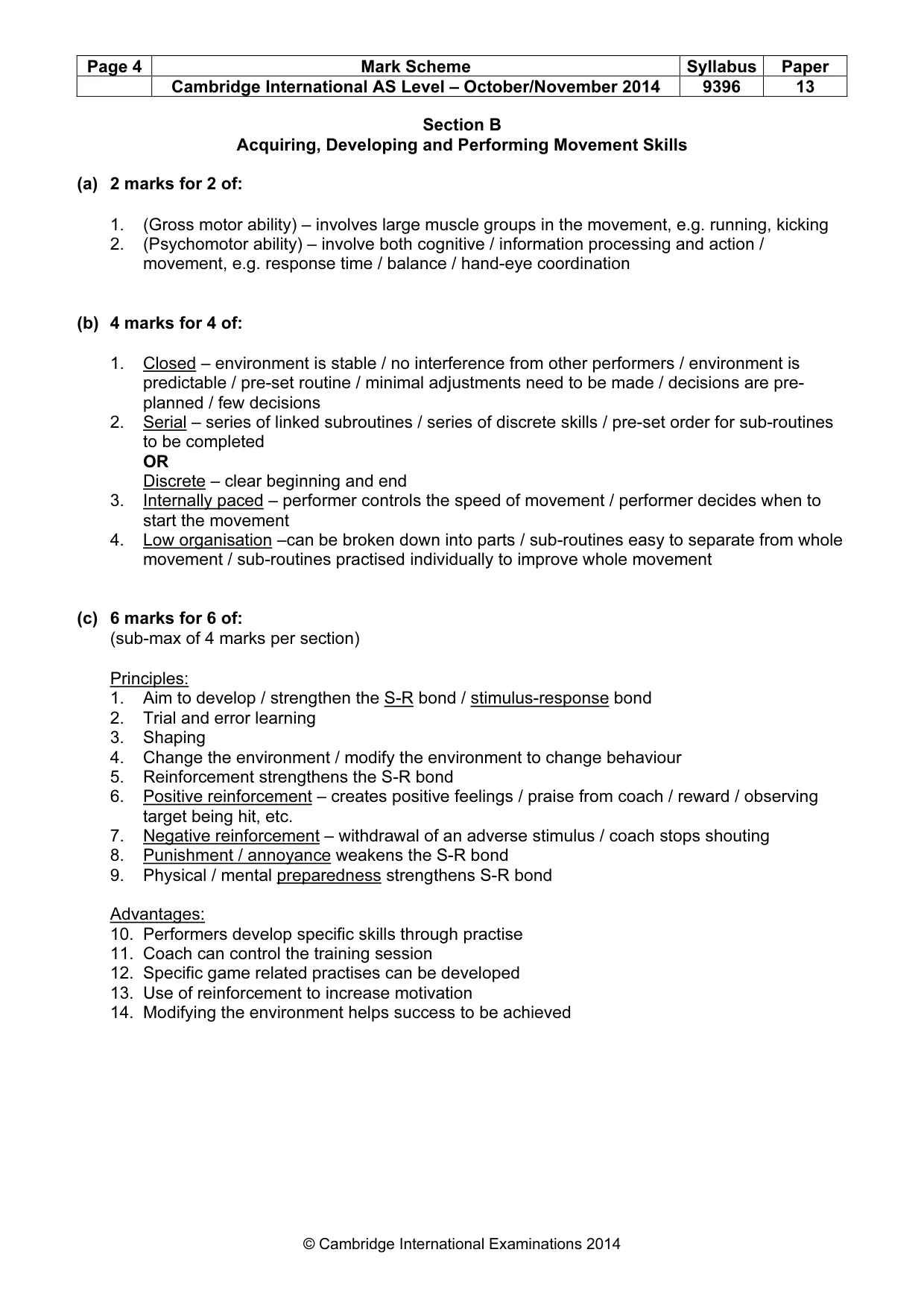
Page 4 Mark Scheme Syllabus Paper Cambridge International AS Level – October/November 2014 9396 13 © Cambridge International Examinations 2014 Section B Acquiring, Developing and Performing Movement Skills (a) 2 marks for 2 of: 1. (Gross motor ability) – involves large muscle groups in the movement, e.g. running, kicking 2. (Psychomotor ability) – involve both cognitive / information processing and action / movement, e.g. response time / balance / hand-eye coordination (b) 4 marks for 4 of: 1. Closed – environment is stable / no interference from other performers / environment is predictable / pre-set routine / minimal adjustments need to be made / decisions are pre- planned / few decisions 2. Serial – series of linked subroutines / series of discrete skills / pre-set order for sub-routines to be completed OR Discrete – clear beginning and end 3. Internally paced – performer controls the speed of movement / performer decides when to start the movement 4. Low organisation –can be broken down into parts / sub-routines easy to separate from whole movement / sub-routines practised individually to improve whole movement (c) 6 marks for 6 of: (sub-max of 4 marks per section) Principles: 1. Aim to develop / strengthen the S-R bond / stimulus-response bond 2. Trial and error learning 3. Shaping 4. Change the environment / modify the environment to change behaviour 5. Reinforcement strengthens the S-R bond 6. Positive reinforcement – creates positive feelings / praise from coach / reward / observing target being hit, etc. 7. Negative reinforcement – withdrawal of an adverse stimulus / coach stops shouting 8. Punishment / annoyance weakens the S-R bond 9. Physical / mental preparedness strengthens S-R bond Advantages: 10. Performers develop specific skills through practise 11. Coach can control the training session 12. Specific game related practises can be developed 13. Use of reinforcement to increase motivation 14. Modifying the environment helps success to be achieved
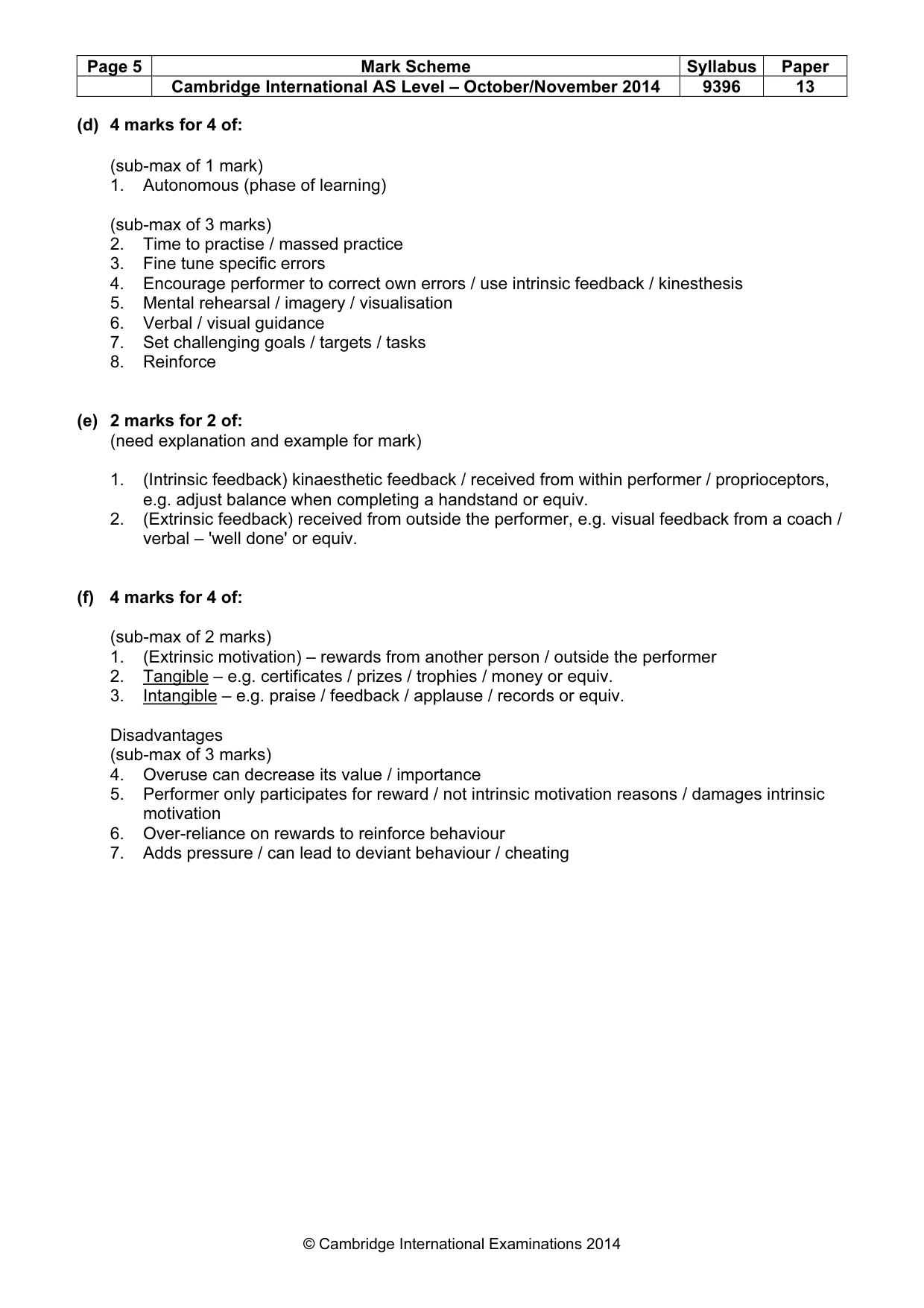
Mark scheme, page 5
Page 5 Mark Scheme Syllabus Paper Cambridge International AS Level – October/November 2014 9396 13 © Cambridge International Examinations 2014 (d) 4 marks for 4 of: (sub-max of 1 mark) 1. Autonomous (phase of learning) (sub-max of 3 marks) 2. Time to practise / massed practice 3. Fine tune specific errors 4. Encourage performer to correct own errors / use intrinsic feedback / kinesthesis 5. Mental rehearsal / imagery / visualisation 6. Verbal / visual guidance 7. Set challenging goals / targets / tasks 8. Reinforce (e) 2 marks for 2 of: (need explanation and example for mark) 1. (Intrinsic feedback) kinaesthetic feedback / received from within performer / proprioceptors, e.g. adjust balance when completing a handstand or equiv. 2. (Extrinsic feedback) received from outside the performer, e.g. visual feedback from a coach / verbal – 'well done' or equiv. (f) 4 marks for 4 of: (sub-max of 2 marks) 1. (Extrinsic motivation) – rewards from another person / outside the performer 2. Tangible – e.g. certificates / prizes / trophies / money or equiv. 3. Intangible – e.g. praise / feedback / applause / records or equiv. Disadvantages (sub-max of 3 marks) 4. Overuse can decrease its value / importance 5. Performer only participates for reward / not intrinsic motivation reasons / damages intrinsic motivation 6. Over-reliance on rewards to reinforce behaviour 7. Adds pressure / can lead to deviant behaviour / cheating
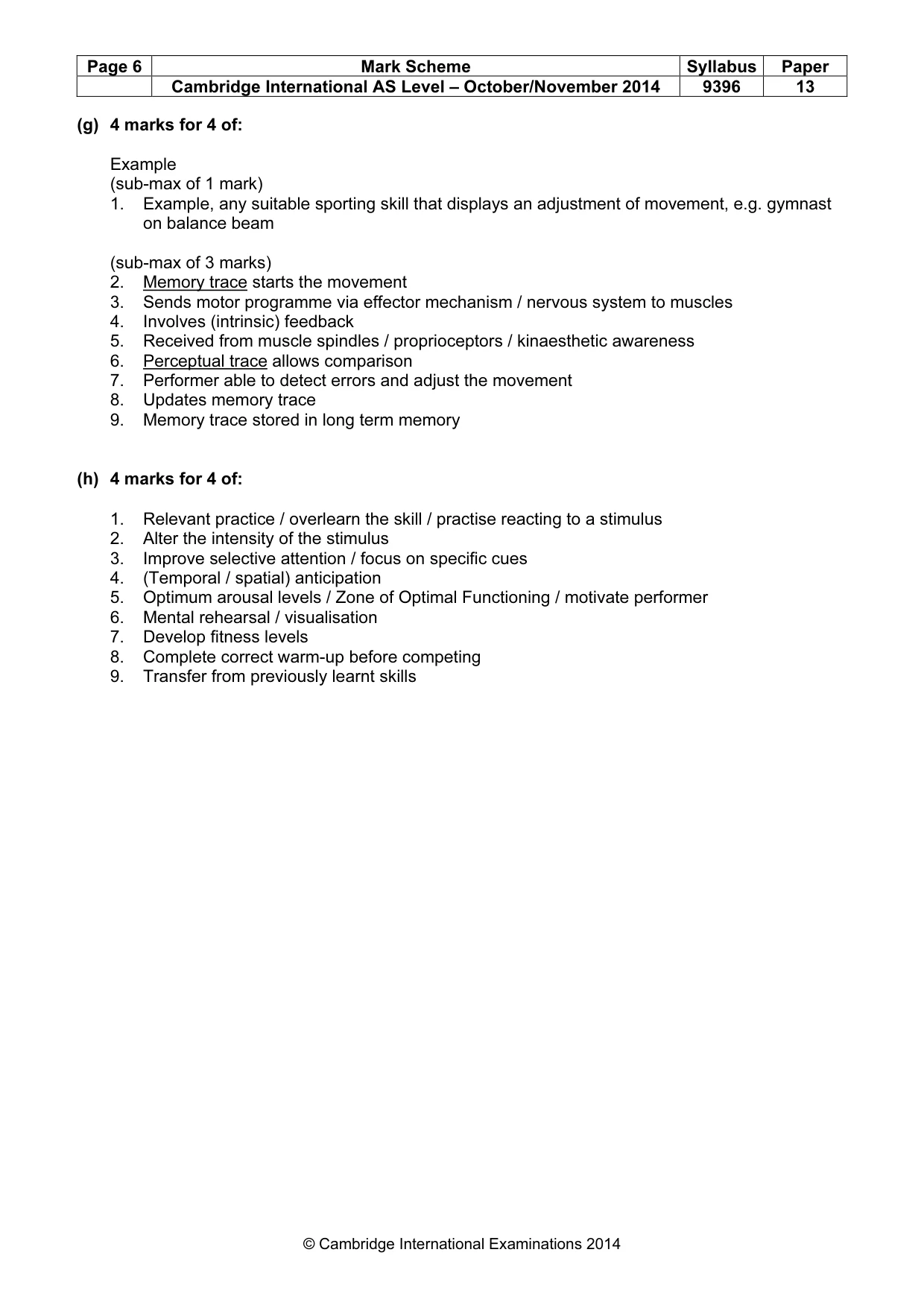
Mark scheme, page 6
Page 6 Mark Scheme Syllabus Paper Cambridge International AS Level – October/November 2014 9396 13 © Cambridge International Examinations 2014 (g) 4 marks for 4 of: Example (sub-max of 1 mark) 1. Example, any suitable sporting skill that displays an adjustment of movement, e.g. gymnast on balance beam (sub-max of 3 marks) 2. Memory trace starts the movement 3. Sends motor programme via effector mechanism / nervous system to muscles 4. Involves (intrinsic) feedback 5. Received from muscle spindles / proprioceptors / kinaesthetic awareness 6. Perceptual trace allows comparison 7. Performer able to detect errors and adjust the movement 8. Updates memory trace 9. Memory trace stored in long term memory (h) 4 marks for 4 of: 1. Relevant practice / overlearn the skill / practise reacting to a stimulus 2. Alter the intensity of the stimulus 3. Improve selective attention / focus on specific cues 4. (Temporal / spatial) anticipation 5. Optimum arousal levels / Zone of Optimal Functioning / motivate performer 6. Mental rehearsal / visualisation 7. Develop fitness levels 8. Complete correct warm-up before competing 9. Transfer from previously learnt skills
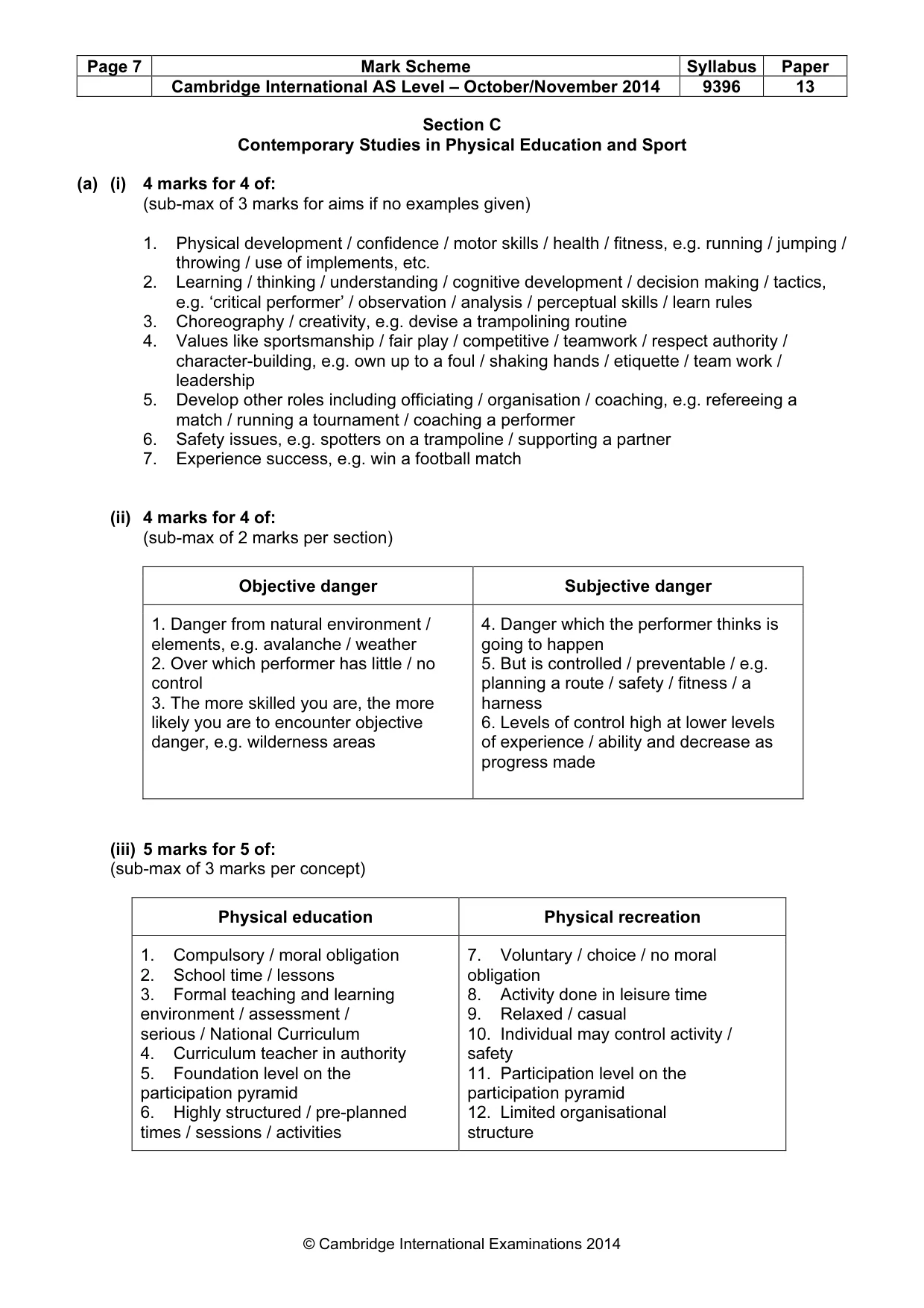
Mark scheme, page 7
Page 7 Mark Scheme Syllabus Paper Cambridge International AS Level – October/November 2014 9396 13 © Cambridge International Examinations 2014 Section C Contemporary Studies in Physical Education and Sport (a) (i) 4 marks for 4 of: (sub-max of 3 marks for aims if no examples given) 1. Physical development / confidence / motor skills / health / fitness, e.g. running / jumping / throwing / use of implements, etc. 2. Learning / thinking / understanding / cognitive development / decision making / tactics, e.g. ‘critical performer’ / observation / analysis / perceptual skills / learn rules 3. Choreography / creativity, e.g. devise a trampolining routine 4. Values like sportsmanship / fair play / competitive / teamwork / respect authority / character-building, e.g. own up to a foul / shaking hands / etiquette / team work / leadership 5. Develop other roles including officiating / organisation / coaching, e.g. refereeing a match / running a tournament / coaching a performer 6. Safety issues, e.g. spotters on a trampoline / supporting a partner 7. Experience success, e.g. win a football match (ii) 4 marks for 4 of: (sub-max of 2 marks per section) Objective danger Subjective danger 1. Danger from natural environment / elements, e.g. avalanche / weather 2. Over which performer has little / no control 3. The more skilled you are, the more likely you are to encounter objective danger, e.g. wilderness areas 4. Danger which the performer thinks is going to happen 5. But is controlled / preventable / e.g. planning a route / safety / fitness / a harness 6. Levels of control high at lower levels of experience / ability and decrease as progress made (iii) 5 marks for 5 of: (sub-max of 3 marks per concept) Physical education Physical recreation 1. Compulsory / moral obligation 2. School time / lessons 3. Formal teaching and learning environment / assessment / serious / National Curriculum 4. Curriculum teacher in authority 5. Foundation level on the participation pyramid 6. Highly structured / pre-planned times / sessions / activities 7. Voluntary / choice / no moral obligation 8. Activity done in leisure time 9. Relaxed / casual 10. Individual may control activity / safety 11. Participation level on the participation pyramid 12. Limited organisational structure
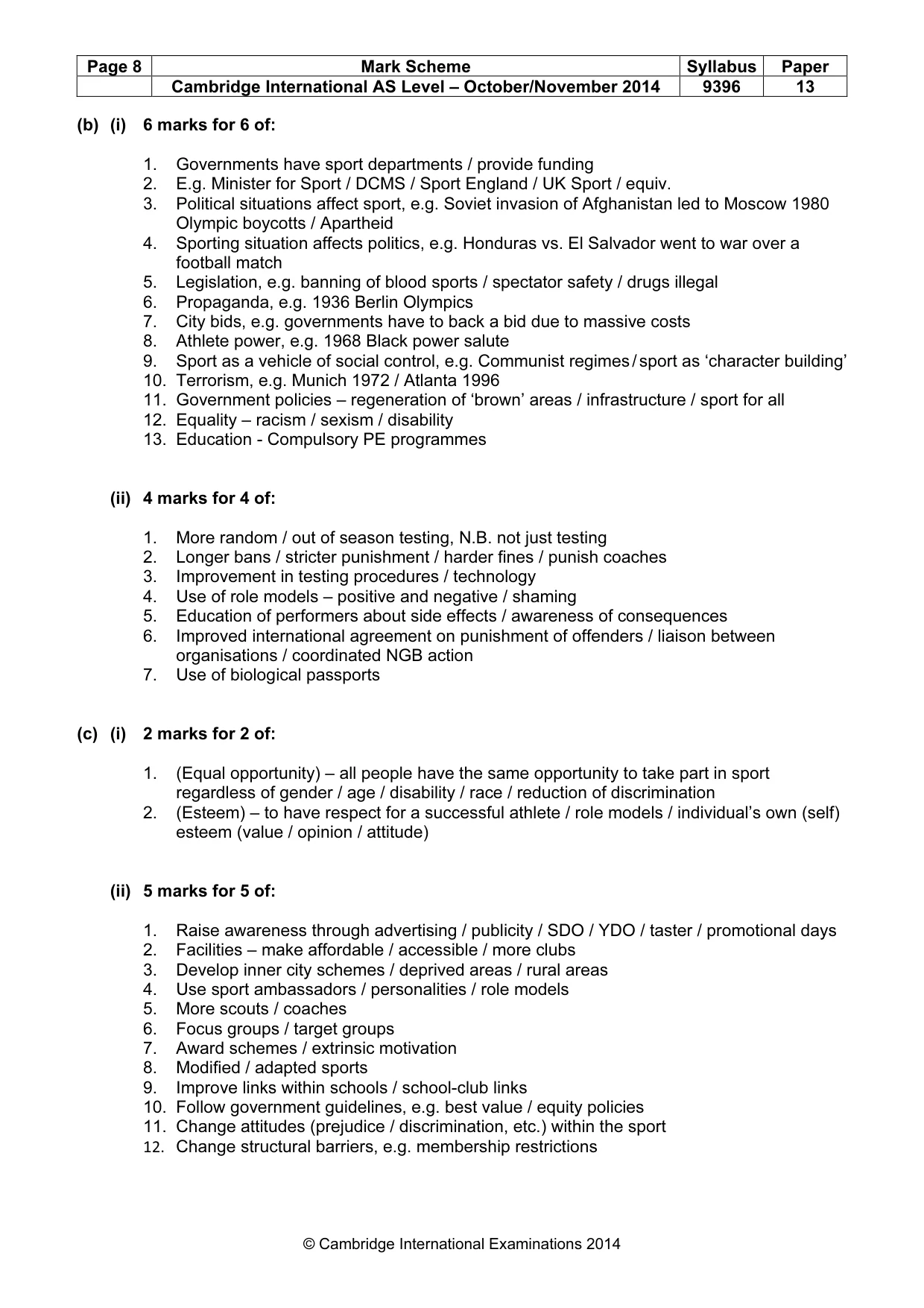
Mark scheme, page 8
Page 8 Mark Scheme Syllabus Paper Cambridge International AS Level – October/November 2014 9396 13 © Cambridge International Examinations 2014 (b) (i) 6 marks for 6 of: 1. Governments have sport departments / provide funding 2. E.g. Minister for Sport / DCMS / Sport England / UK Sport / equiv. 3. Political situations affect sport, e.g. Soviet invasion of Afghanistan led to Moscow 1980 Olympic boycotts / Apartheid 4. Sporting situation affects politics, e.g. Honduras vs. El Salvador went to war over a football match 5. Legislation, e.g. banning of blood sports / spectator safety / drugs illegal 6. Propaganda, e.g. 1936 Berlin Olympics 7. City bids, e.g. governments have to back a bid due to massive costs 8. Athlete power, e.g. 1968 Black power salute 9. Sport as a vehicle of social control, e.g. Communist regimes / sport as ‘character building’ 10. Terrorism, e.g. Munich 1972 / Atlanta 1996 11. Government policies – regeneration of ‘brown’ areas / infrastructure / sport for all 12. Equality – racism / sexism / disability 13. Education - Compulsory PE programmes (ii) 4 marks for 4 of: 1. More random / out of season testing, N.B. not just testing 2. Longer bans / stricter punishment / harder fines / punish coaches 3. Improvement in testing procedures / technology 4. Use of role models – positive and negative / shaming 5. Education of performers about side effects / awareness of consequences 6. Improved international agreement on punishment of offenders / liaison between organisations / coordinated NGB action 7. Use of biological passports (c) (i) 2 marks for 2 of: 1. (Equal opportunity) – all people have the same opportunity to take part in sport regardless of gender / age / disability / race / reduction of discrimination 2. (Esteem) – to have respect for a successful athlete / role models / individual’s own (self) esteem (value / opinion / attitude) (ii) 5 marks for 5 of: 1. Raise awareness through advertising / publicity / SDO / YDO / taster / promotional days 2. Facilities – make affordable / accessible / more clubs 3. Develop inner city schemes / deprived areas / rural areas 4. Use sport ambassadors / personalities / role models 5. More scouts / coaches 6. Focus groups / target groups 7. Award schemes / extrinsic motivation 8. Modified / adapted sports 9. Improve links within schools / school-club links 10. Follow government guidelines, e.g. best value / equity policies 11. Change attitudes (prejudice / discrimination, etc.) within the sport 12. Change structural barriers, e.g. membership restrictions
What you needed in this session
Cambridge’s own grade thresholds for 2014 Oct/Nov, Paper 1 · Variant 3. A higher threshold means an easier paper — the bar moves with how the cohort did.