Cambridge A Level Physical Education 9396 — 2013 Oct/Nov Paper 1 · Variant 2
9396/12/O/N/13 · 90 marks · ≈101 min
The question paper and its mark scheme, free to read here and free to download. This is Cambridge’s own paper, exactly as it was sat.
Question paper4 pages
Mark scheme11 pages
Answers below. Sit the paper first if you are practising.
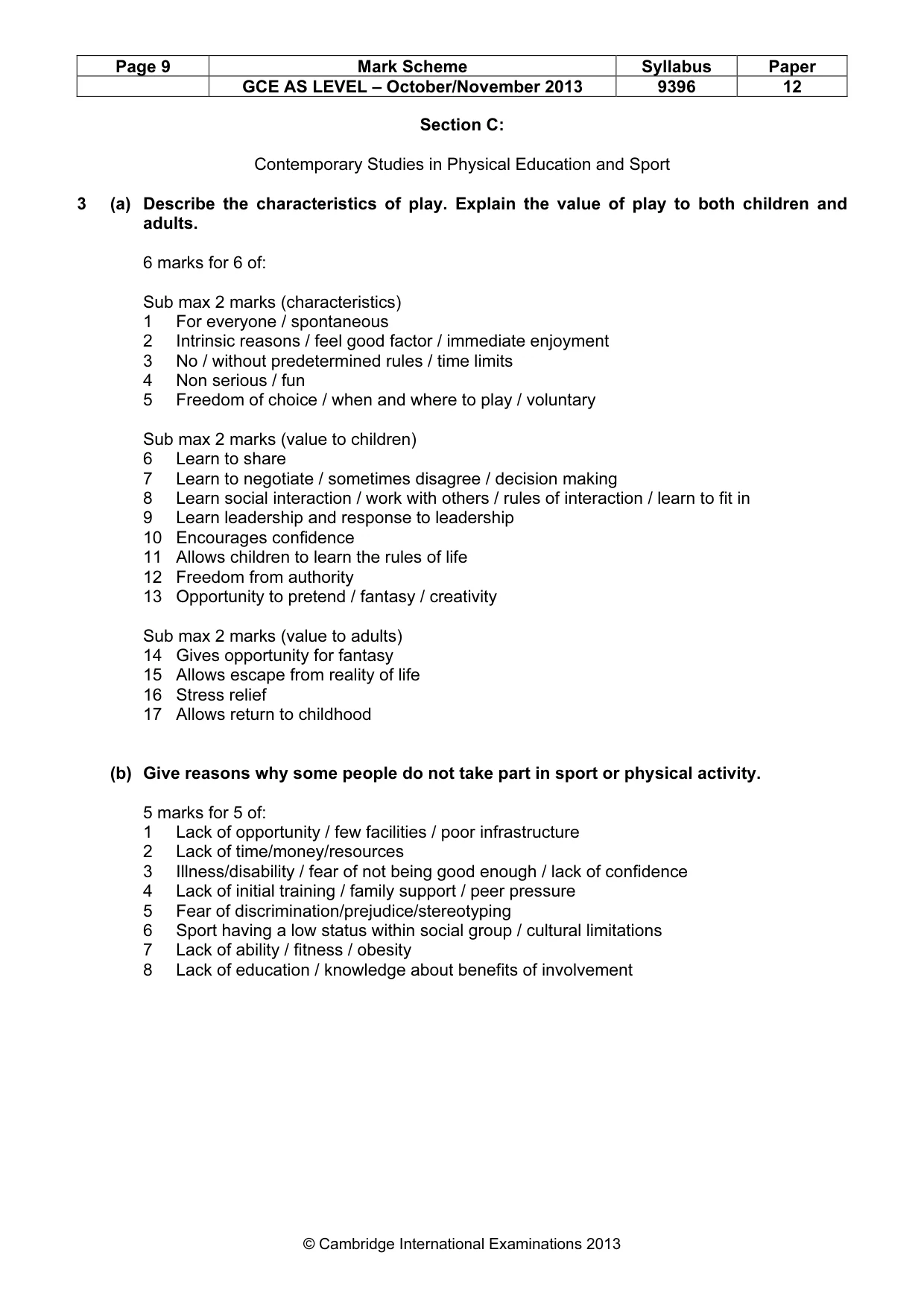
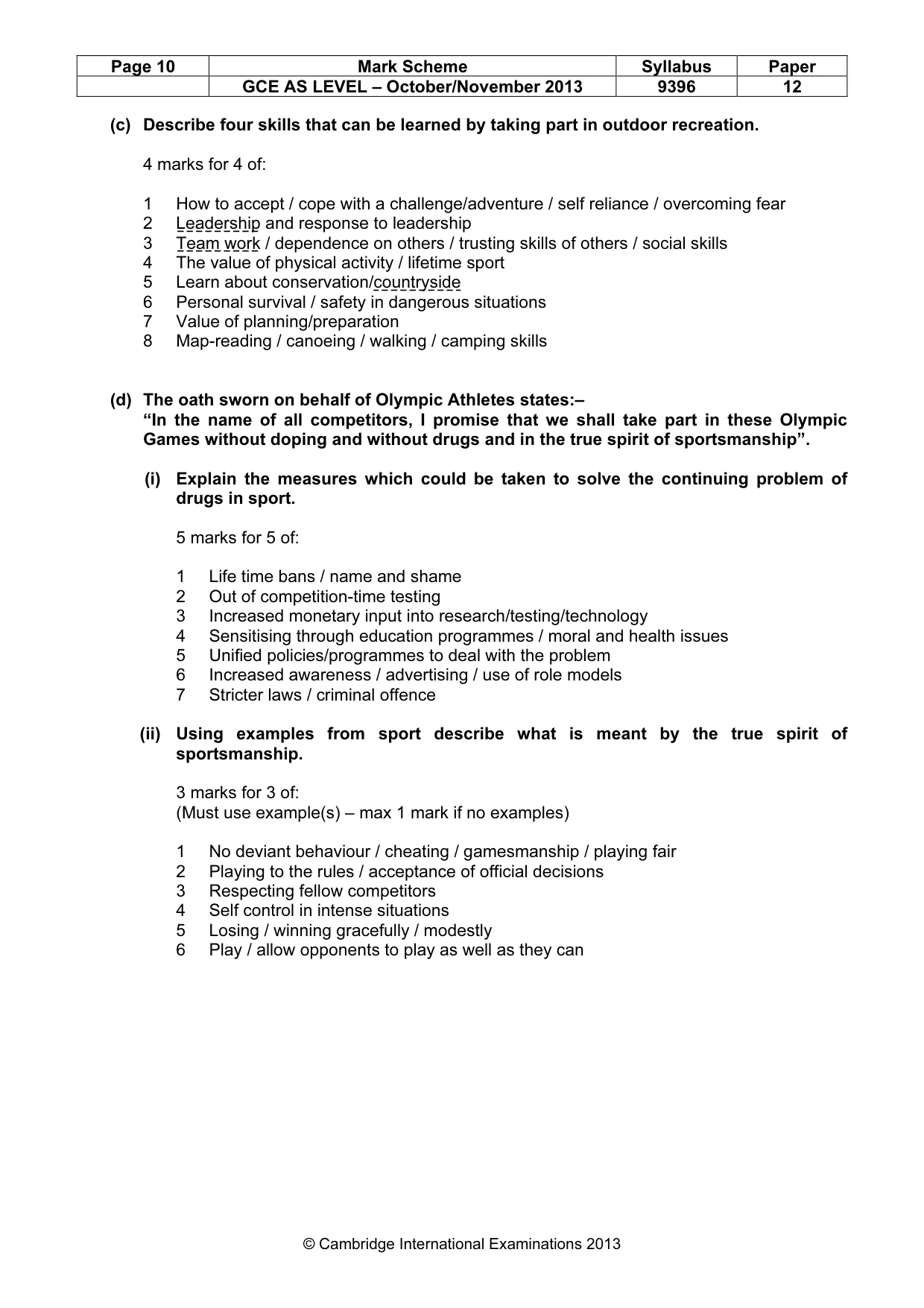
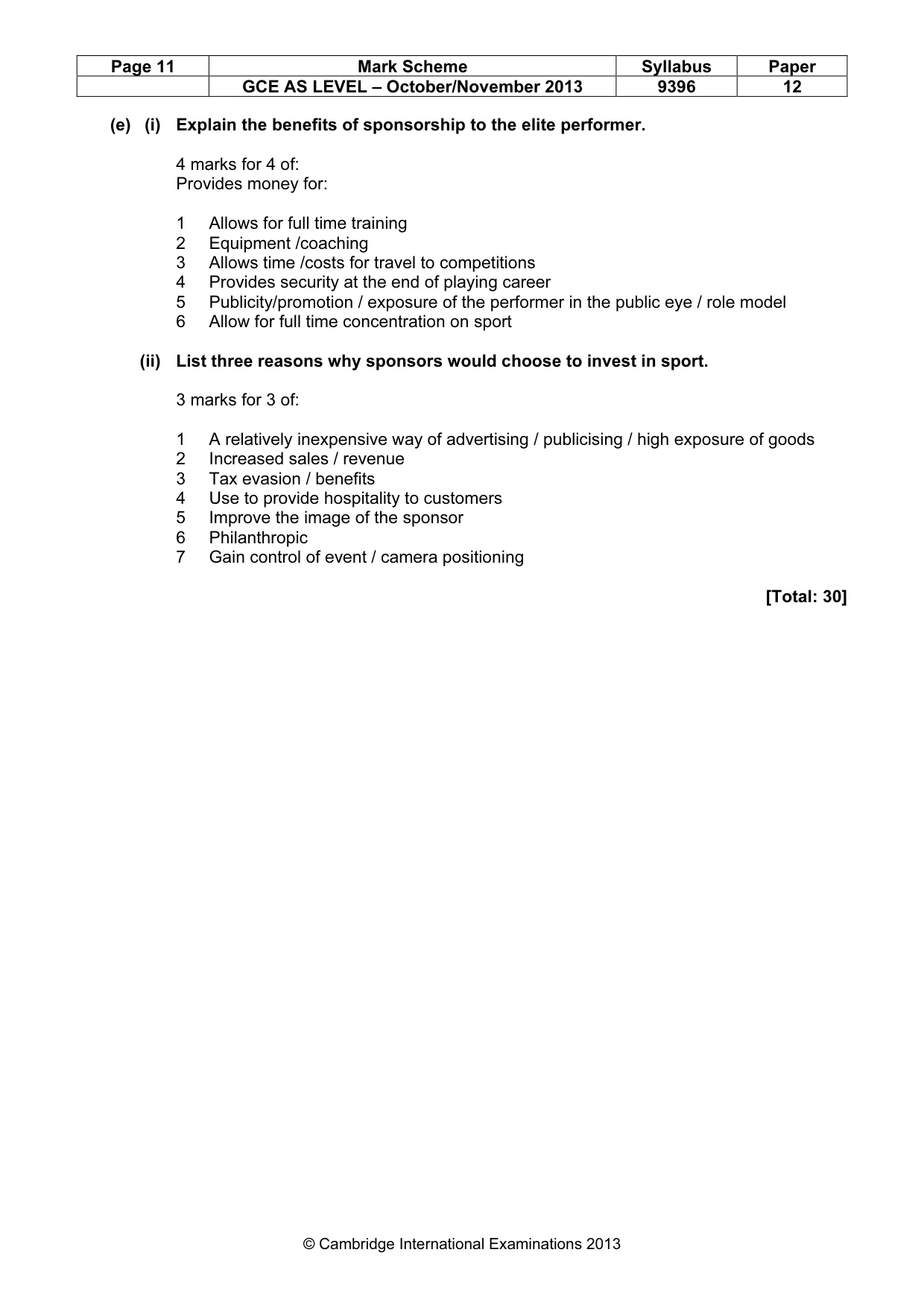
Paper as text
Question paper, page 1
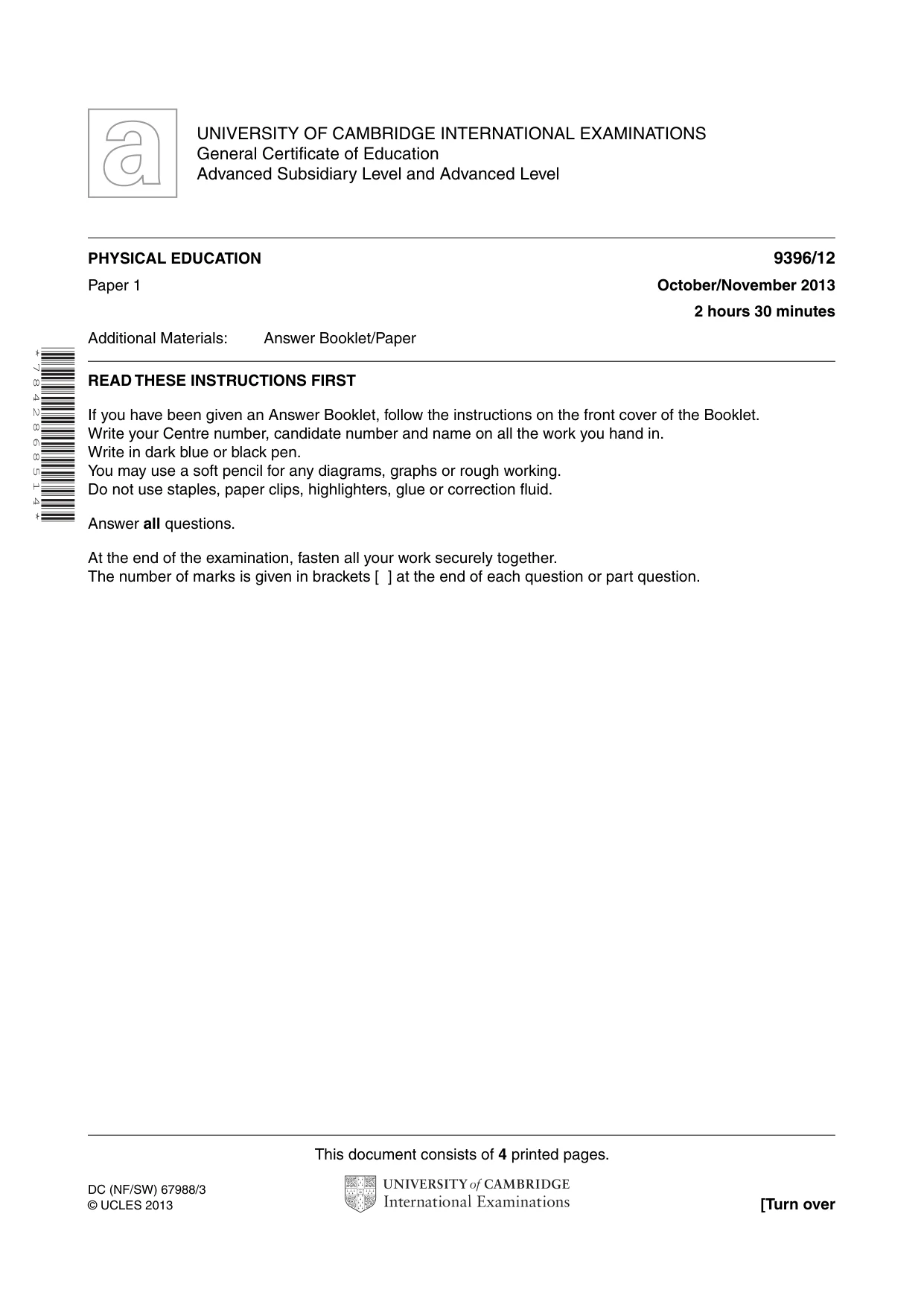
This document consists of 4 printed pages. DC (NF/SW) 67988/3 © UCLES 2013 [Turn over UNIVERSITY OF CAMBRIDGE INTERNATIONAL EXAMINATIONS General Certificate of Education Advanced Subsidiary Level and Advanced Level * 7 8 4 2 8 6 8 5 1 4 * PHYSICAL EDUCATION 9396/12 Paper 1 October/November 2013 2 hours 30 minutes Additional Materials: Answer Booklet/Paper READ THESE INSTRUCTIONS FIRST If you have been given an Answer Booklet, follow the instructions on the front cover of the Booklet. Write your Centre number, candidate number and name on all the work you hand in. Write in dark blue or black pen. You may use a soft pencil for any diagrams, graphs or rough working. Do not use staples, paper clips, highlighters, glue or correction fluid. Answer all questions. At the end of the examination, fasten all your work securely together. The number of marks is given in brackets [ ] at the end of each question or part question.
Question paper, page 2
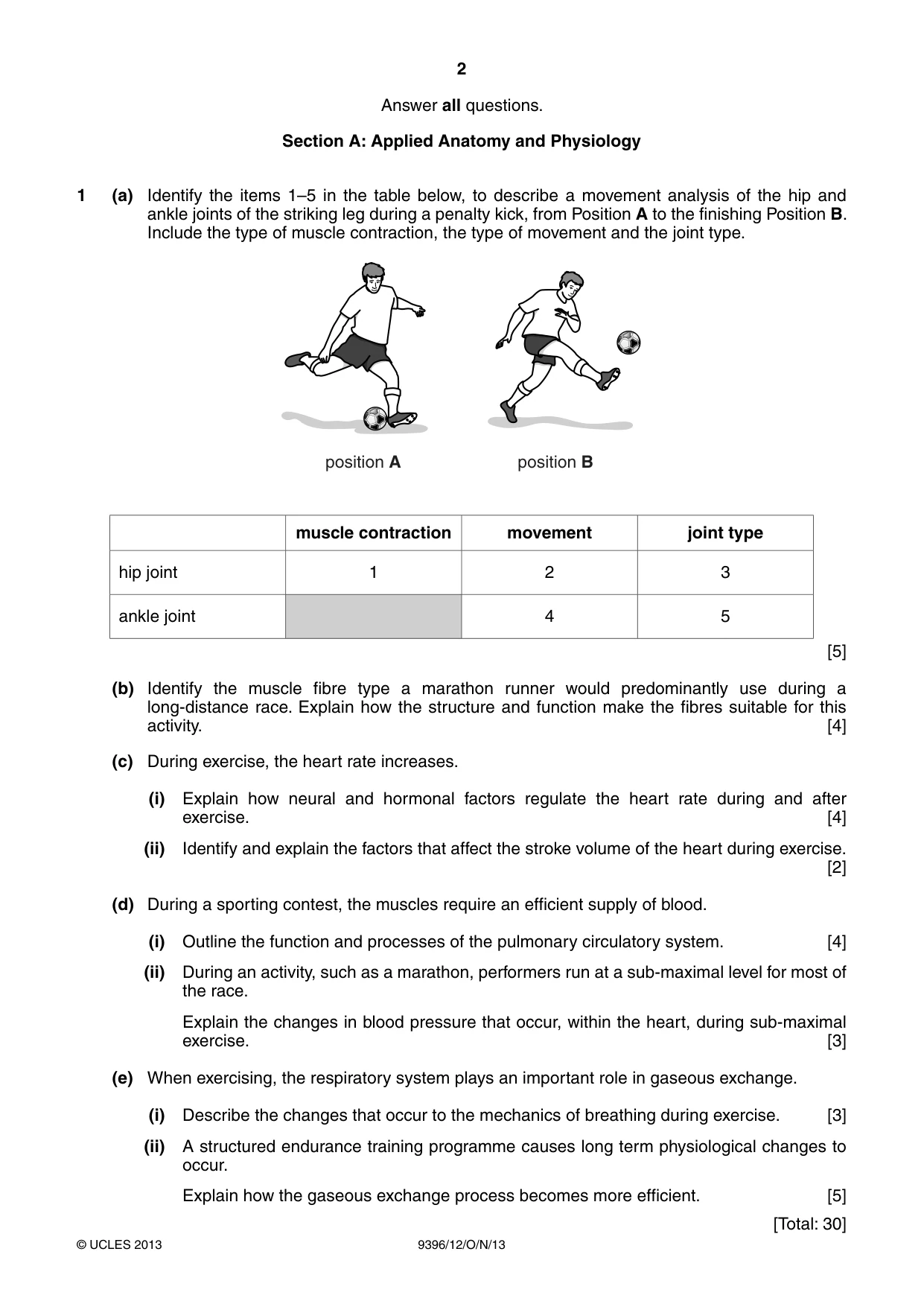
2 9396/12/O/N/13 © UCLES 2013 Answer all questions. Section A: Applied Anatomy and Physiology 1 (a) Identify the items 1–5 in the table below, to describe a movement analysis of the hip and ankle joints of the striking leg during a penalty kick, from Position A to the finishing Position B. Include the type of muscle contraction, the type of movement and the joint type. position A position B muscle contraction movement joint type hip joint 1 2 3 ankle joint 4 5 [5] (b) Identify the muscle fibre type a marathon runner would predominantly use during a long-distance race. Explain how the structure and function make the fibres suitable for this activity. [4] (c) During exercise, the heart rate increases. (i) Explain how neural and hormonal factors regulate the heart rate during and after exercise. [4] (ii) Identify and explain the factors that affect the stroke volume of the heart during exercise. [2] (d) During a sporting contest, the muscles require an efficient supply of blood. (i) Outline the function and processes of the pulmonary circulatory system. [4] (ii) During an activity, such as a marathon, performers run at a sub-maximal level for most of the race. Explain the changes in blood pressure that occur, within the heart, during sub-maximal exercise. [3] (e) When exercising, the respiratory system plays an important role in gaseous exchange. (i) Describe the changes that occur to the mechanics of breathing during exercise. [3] (ii) A structured endurance training programme causes long term physiological changes to occur. Explain how the gaseous exchange process becomes more efficient. [5] [Total: 30]
Question paper, page 3
3 9396/12/O/N/13 © UCLES 2013 [Turn over Section B: Acquiring, Developing and Performing Movement Skills 2 (a) Skilful performances are often: • goal directed • follow a technical model • aesthetically pleasing. Describe practical examples of the performance of movement skills to show what is meant by each of these characteristics. [3] (b) Bandura’s Theory of observational learning includes the four elements: attention, retention, motor reproduction and motivation. Explain each of these elements for learning a movement skill in sport. [4] (c) Motor skills can be classified as discrete, serial or continuous. Using a practical example for each, describe these classifications. [3] (d) Effective feedback is important when learning motor skills. Describe each of the following types of feedback: • Intrinsic • Terminal • Concurrent • Positive. [4] (e) Using a practical example, explain how a motor programme of a movement skill is created and stored. [5] (f) Describe the role of perception in the basic model of information processing when performing a motor skill [5] (g) Describe the drive reduction theory and explain how it affects the learning of motor skills in sport. [6] [Total: 30]
Question paper, page 4
4 9396/12/O/N/13 © UCLES 2013 Section C: Contemporary Studies in Physical Education and Sport 3 (a) Describe the characteristics of play. Explain the value of play to both children and adults. [6] (b) Give reasons why some people do not take part in sport or physical activity. [5] (c) Describe four skills that can be learned by taking part in outdoor recreation. [4] (d) The oath sworn on behalf of Olympic Athletes states:- “In the name of all competitors, I promise that we shall take part in these Olympic Games without doping and without drugs and in the true spirit of sportsmanship”. (i) Explain the measures which could be used to solve the continuing problem of drugs in sport. [5] (ii) Using examples from sport, describe the true spirit of sportsmanship. [3] (e) (i) Explain the benefits of sponsorship to an elite performer. [4] (ii) List three reasons why a sponsor would choose to invest in sport. [3] [Total: 30] Permission to reproduce items where third-party owned material protected by copyright is included has been sought and cleared where possible. Every reasonable effort has been made by the publisher (UCLES) to trace copyright holders, but if any items requiring clearance have unwittingly been included, the publisher will be pleased to make amends at the earliest possible opportunity. University of Cambridge International Examinations is part of the Cambridge Assessment Group. Cambridge Assessment is the brand name of University of Cambridge Local Examinations Syndicate (UCLES), which is itself a department of the University of Cambridge.
Mark scheme, page 1
CAMBRIDGE INTERNATIONAL EXAMINATIONS GCE Advanced Subsidiary Level MARK SCHEME for the October/November 2013 series 9396 PHYSICAL EDUCATION 9396/12 (Theory), maximum raw mark 90 This mark scheme is published as an aid to teachers and candidates, to indicate the requirements of the examination. It shows the basis on which Examiners were instructed to award marks. It does not indicate the details of the discussions that took place at an Examiners’ meeting before marking began, which would have considered the acceptability of alternative answers. Mark schemes should be read in conjunction with the question paper and the Principal Examiner Report for Teachers. Cambridge will not enter into discussions about these mark schemes. Cambridge is publishing the mark schemes for the October/November 2013 series for most IGCSE, GCE Advanced Level and Advanced Subsidiary Level components and some Ordinary Level components.
Mark scheme, page 2
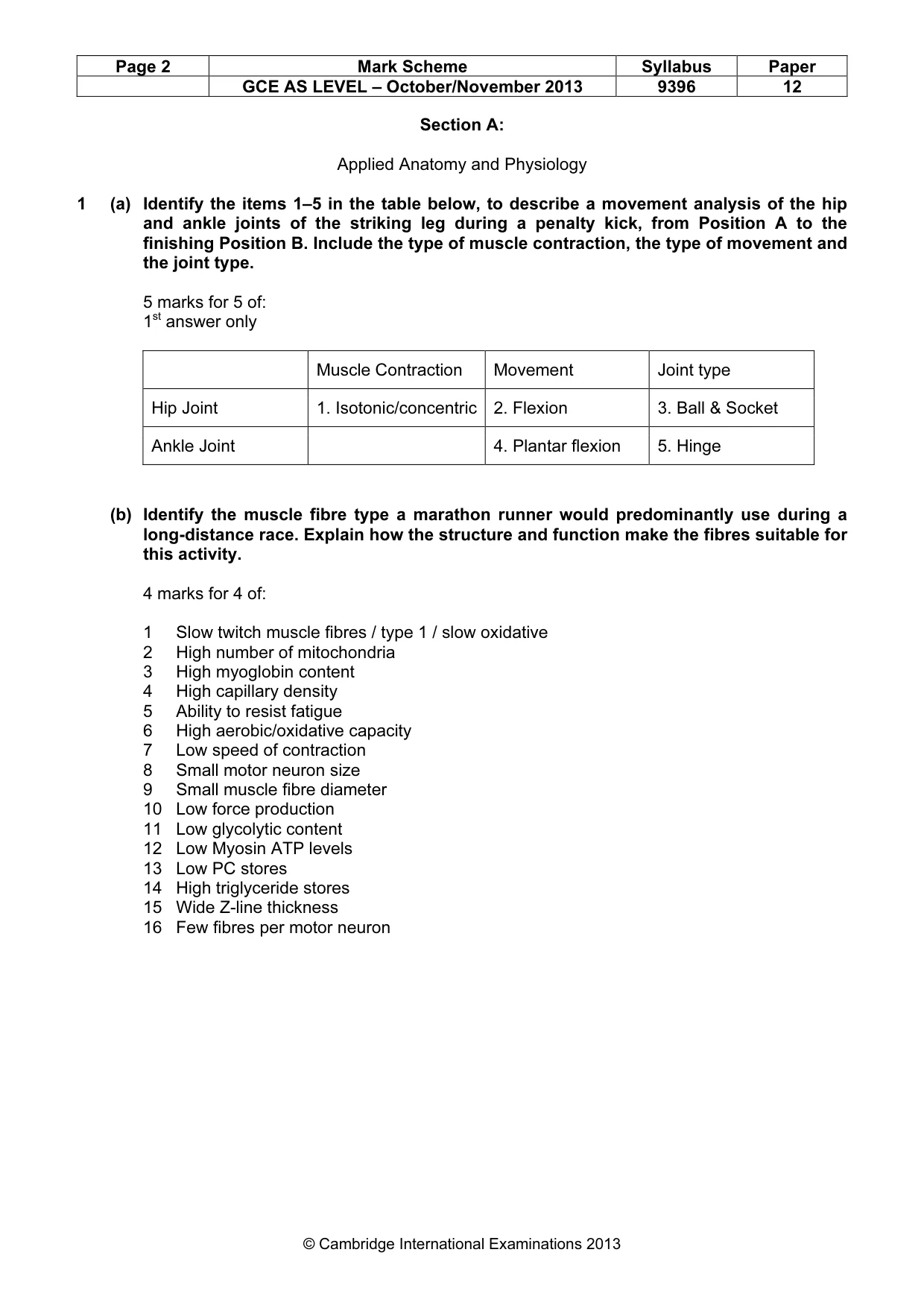
Page 2 Mark Scheme Syllabus Paper GCE AS LEVEL – October/November 2013 9396 12 © Cambridge International Examinations 2013 Section A: Applied Anatomy and Physiology 1 (a) Identify the items 1–5 in the table below, to describe a movement analysis of the hip and ankle joints of the striking leg during a penalty kick, from Position A to the finishing Position B. Include the type of muscle contraction, the type of movement and the joint type. 5 marks for 5 of: 1st answer only Muscle Contraction Movement Joint type Hip Joint 1. Isotonic/concentric 2. Flexion 3. Ball & Socket Ankle Joint 4. Plantar flexion 5. Hinge (b) Identify the muscle fibre type a marathon runner would predominantly use during a long-distance race. Explain how the structure and function make the fibres suitable for this activity. 4 marks for 4 of: 1 Slow twitch muscle fibres / type 1 / slow oxidative 2 High number of mitochondria 3 High myoglobin content 4 High capillary density 5 Ability to resist fatigue 6 High aerobic/oxidative capacity 7 Low speed of contraction 8 Small motor neuron size 9 Small muscle fibre diameter 10 Low force production 11 Low glycolytic content 12 Low Myosin ATP levels 13 Low PC stores 14 High triglyceride stores 15 Wide Z-line thickness 16 Few fibres per motor neuron
Mark scheme, page 3
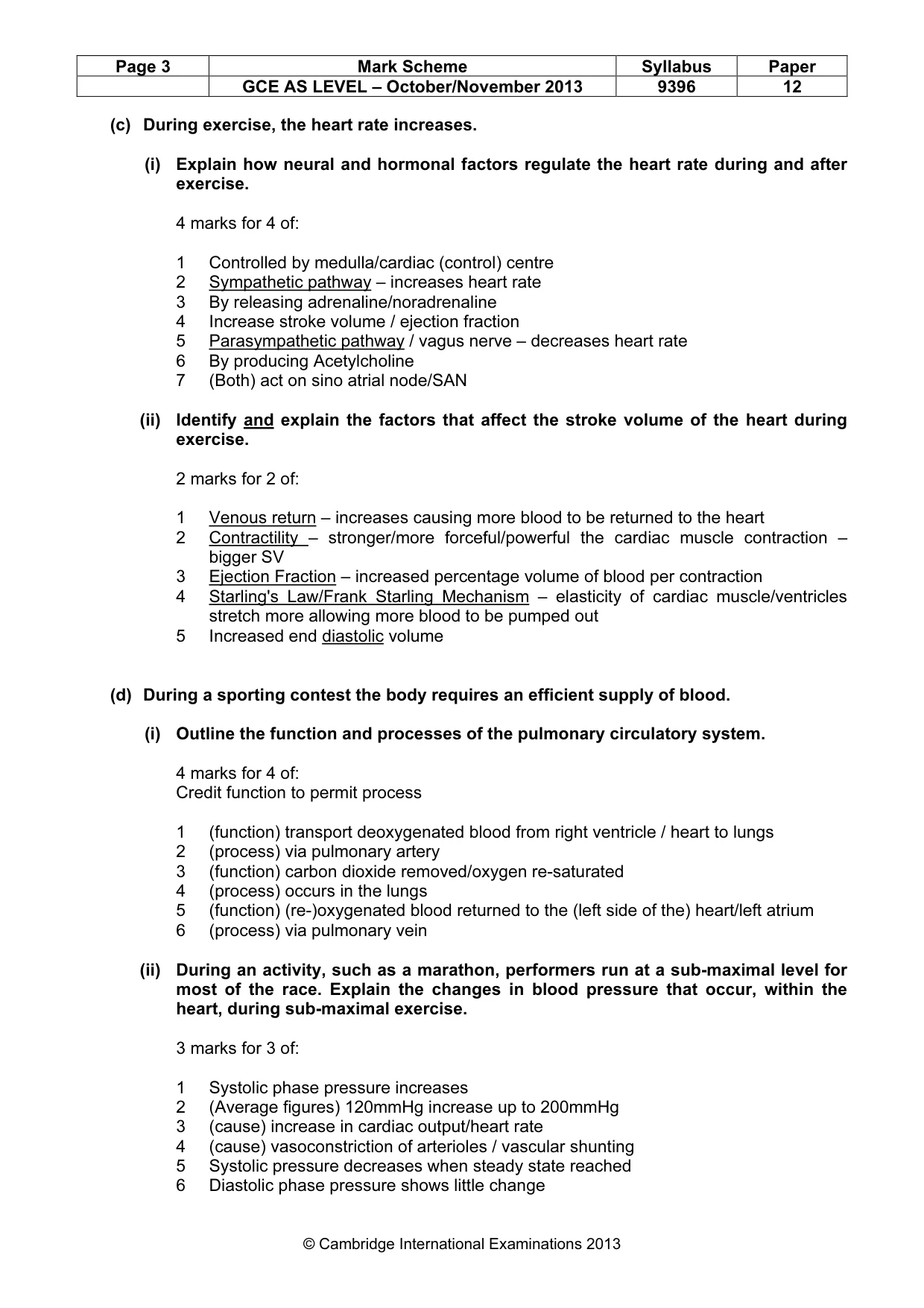
Page 3 Mark Scheme Syllabus Paper GCE AS LEVEL – October/November 2013 9396 12 © Cambridge International Examinations 2013 (c) During exercise, the heart rate increases. (i) Explain how neural and hormonal factors regulate the heart rate during and after exercise. 4 marks for 4 of: 1 Controlled by medulla/cardiac (control) centre 2 Sympathetic pathway – increases heart rate 3 By releasing adrenaline/noradrenaline 4 Increase stroke volume / ejection fraction 5 Parasympathetic pathway / vagus nerve – decreases heart rate 6 By producing Acetylcholine 7 (Both) act on sino atrial node/SAN (ii) Identify and explain the factors that affect the stroke volume of the heart during exercise. 2 marks for 2 of: 1 Venous return – increases causing more blood to be returned to the heart 2 Contractility – stronger/more forceful/powerful the cardiac muscle contraction – bigger SV 3 Ejection Fraction – increased percentage volume of blood per contraction 4 Starling's Law/Frank Starling Mechanism – elasticity of cardiac muscle/ventricles stretch more allowing more blood to be pumped out 5 Increased end diastolic volume (d) During a sporting contest the body requires an efficient supply of blood. (i) Outline the function and processes of the pulmonary circulatory system. 4 marks for 4 of: Credit function to permit process 1 (function) transport deoxygenated blood from right ventricle / heart to lungs 2 (process) via pulmonary artery 3 (function) carbon dioxide removed/oxygen re-saturated 4 (process) occurs in the lungs 5 (function) (re-)oxygenated blood returned to the (left side of the) heart/left atrium 6 (process) via pulmonary vein (ii) During an activity, such as a marathon, performers run at a sub-maximal level for most of the race. Explain the changes in blood pressure that occur, within the heart, during sub-maximal exercise. 3 marks for 3 of: 1 Systolic phase pressure increases 2 (Average figures) 120mmHg increase up to 200mmHg 3 (cause) increase in cardiac output/heart rate 4 (cause) vasoconstriction of arterioles / vascular shunting 5 Systolic pressure decreases when steady state reached 6 Diastolic phase pressure shows little change
Mark scheme, page 4
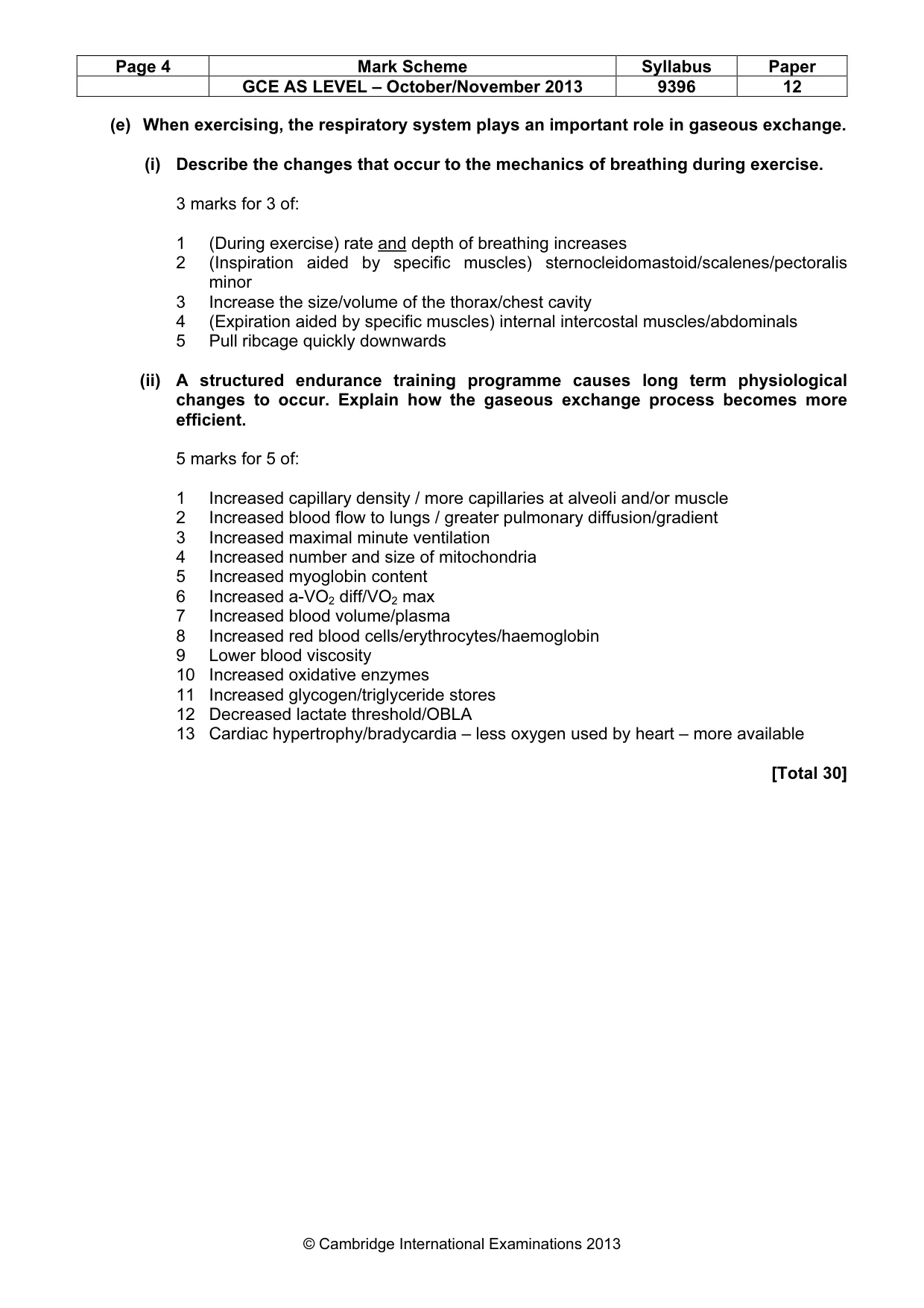
Page 4 Mark Scheme Syllabus Paper GCE AS LEVEL – October/November 2013 9396 12 © Cambridge International Examinations 2013 (e) When exercising, the respiratory system plays an important role in gaseous exchange. (i) Describe the changes that occur to the mechanics of breathing during exercise. 3 marks for 3 of: 1 (During exercise) rate and depth of breathing increases 2 (Inspiration aided by specific muscles) sternocleidomastoid/scalenes/pectoralis minor 3 Increase the size/volume of the thorax/chest cavity 4 (Expiration aided by specific muscles) internal intercostal muscles/abdominals 5 Pull ribcage quickly downwards (ii) A structured endurance training programme causes long term physiological changes to occur. Explain how the gaseous exchange process becomes more efficient. 5 marks for 5 of: 1 Increased capillary density / more capillaries at alveoli and/or muscle 2 Increased blood flow to lungs / greater pulmonary diffusion/gradient 3 Increased maximal minute ventilation 4 Increased number and size of mitochondria 5 Increased myoglobin content 6 Increased a-VO2 diff/VO2 max 7 Increased blood volume/plasma 8 Increased red blood cells/erythrocytes/haemoglobin 9 Lower blood viscosity 10 Increased oxidative enzymes 11 Increased glycogen/triglyceride stores 12 Decreased lactate threshold/OBLA 13 Cardiac hypertrophy/bradycardia – less oxygen used by heart – more available [Total 30]
Mark scheme, page 5
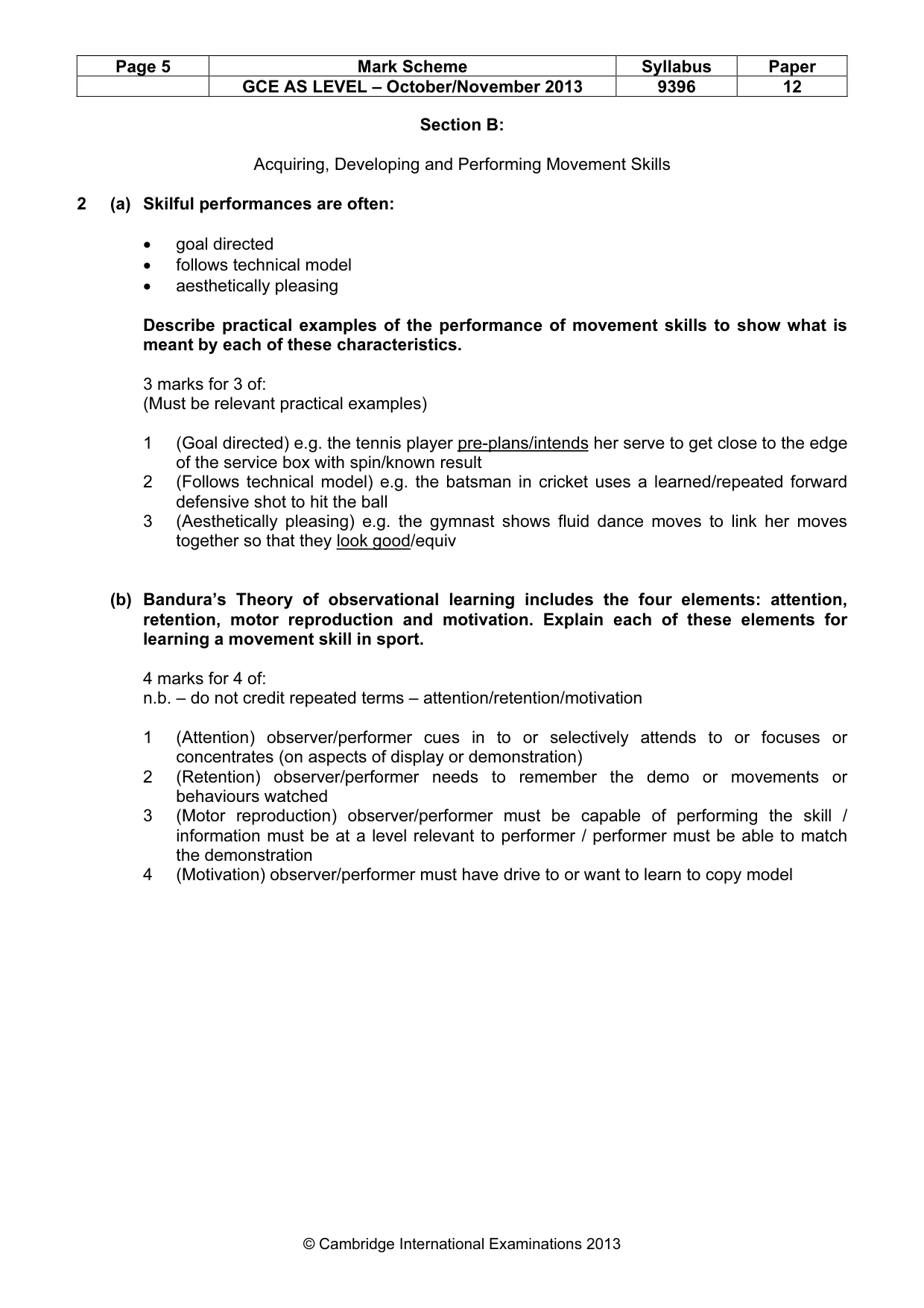
Page 5 Mark Scheme Syllabus Paper GCE AS LEVEL – October/November 2013 9396 12 © Cambridge International Examinations 2013 Section B: Acquiring, Developing and Performing Movement Skills 2 (a) Skilful performances are often: • goal directed • follows technical model • aesthetically pleasing Describe practical examples of the performance of movement skills to show what is meant by each of these characteristics. 3 marks for 3 of: (Must be relevant practical examples) 1 (Goal directed) e.g. the tennis player pre-plans/intends her serve to get close to the edge of the service box with spin/known result 2 (Follows technical model) e.g. the batsman in cricket uses a learned/repeated forward defensive shot to hit the ball 3 (Aesthetically pleasing) e.g. the gymnast shows fluid dance moves to link her moves together so that they look good/equiv (b) Bandura’s Theory of observational learning includes the four elements: attention, retention, motor reproduction and motivation. Explain each of these elements for learning a movement skill in sport. 4 marks for 4 of: n.b. – do not credit repeated terms – attention/retention/motivation 1 (Attention) observer/performer cues in to or selectively attends to or focuses or concentrates (on aspects of display or demonstration) 2 (Retention) observer/performer needs to remember the demo or movements or behaviours watched 3 (Motor reproduction) observer/performer must be capable of performing the skill / information must be at a level relevant to performer / performer must be able to match the demonstration 4 (Motivation) observer/performer must have drive to or want to learn to copy model
Mark scheme, page 6
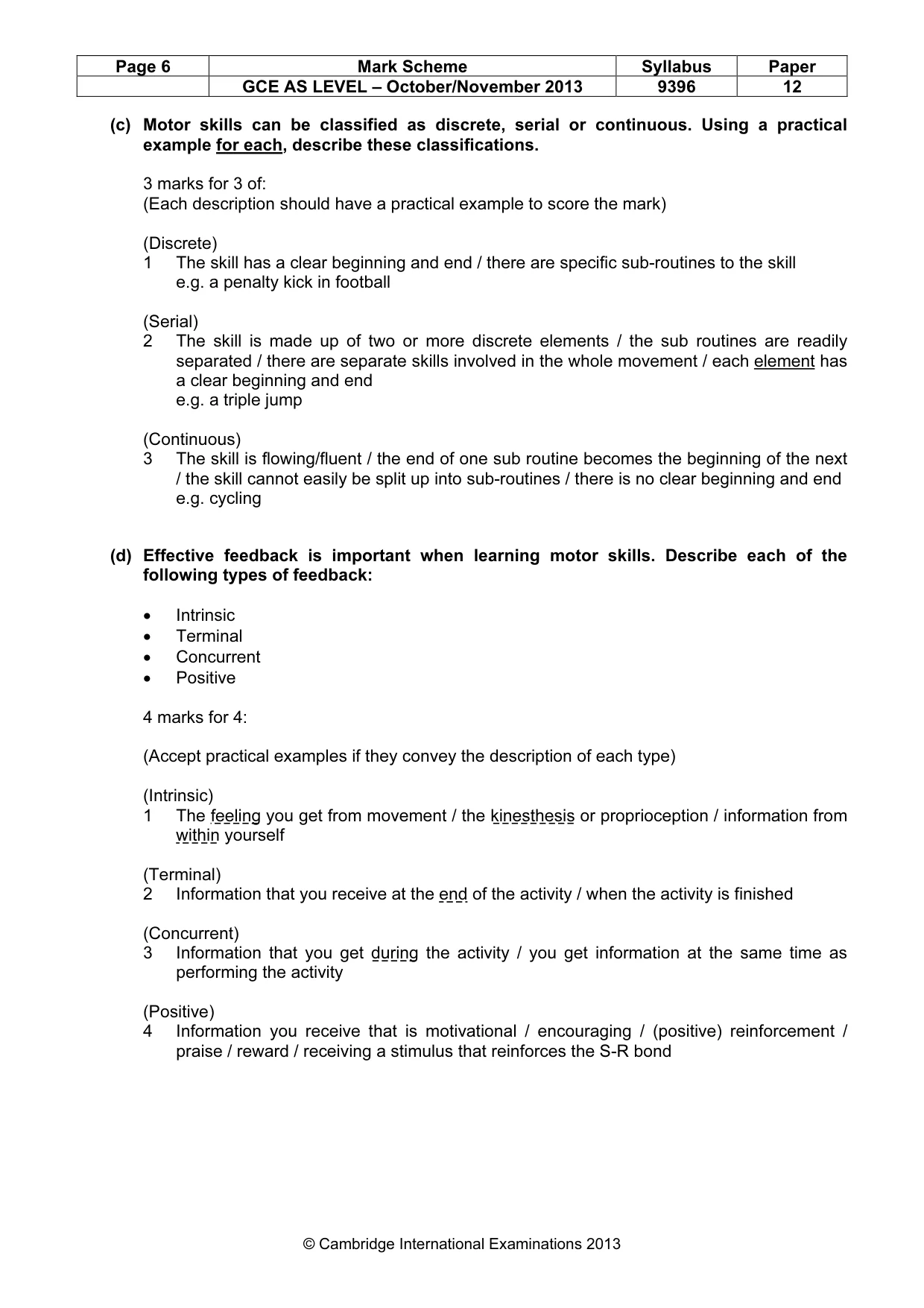
Page 6 Mark Scheme Syllabus Paper GCE AS LEVEL – October/November 2013 9396 12 © Cambridge International Examinations 2013 (c) Motor skills can be classified as discrete, serial or continuous. Using a practical example for each, describe these classifications. 3 marks for 3 of: (Each description should have a practical example to score the mark) (Discrete) 1 The skill has a clear beginning and end / there are specific sub-routines to the skill e.g. a penalty kick in football (Serial) 2 The skill is made up of two or more discrete elements / the sub routines are readily separated / there are separate skills involved in the whole movement / each element has a clear beginning and end e.g. a triple jump (Continuous) 3 The skill is flowing/fluent / the end of one sub routine becomes the beginning of the next / the skill cannot easily be split up into sub-routines / there is no clear beginning and end e.g. cycling (d) Effective feedback is important when learning motor skills. Describe each of the following types of feedback: • Intrinsic • Terminal • Concurrent • Positive 4 marks for 4: (Accept practical examples if they convey the description of each type) (Intrinsic) 1 The feeling you get from movement / the kinesthesis or proprioception / information from within yourself (Terminal) 2 Information that you receive at the end of the activity / when the activity is finished (Concurrent) 3 Information that you get during the activity / you get information at the same time as performing the activity (Positive) 4 Information you receive that is motivational / encouraging / (positive) reinforcement / praise / reward / receiving a stimulus that reinforces the S-R bond
Mark scheme, page 7
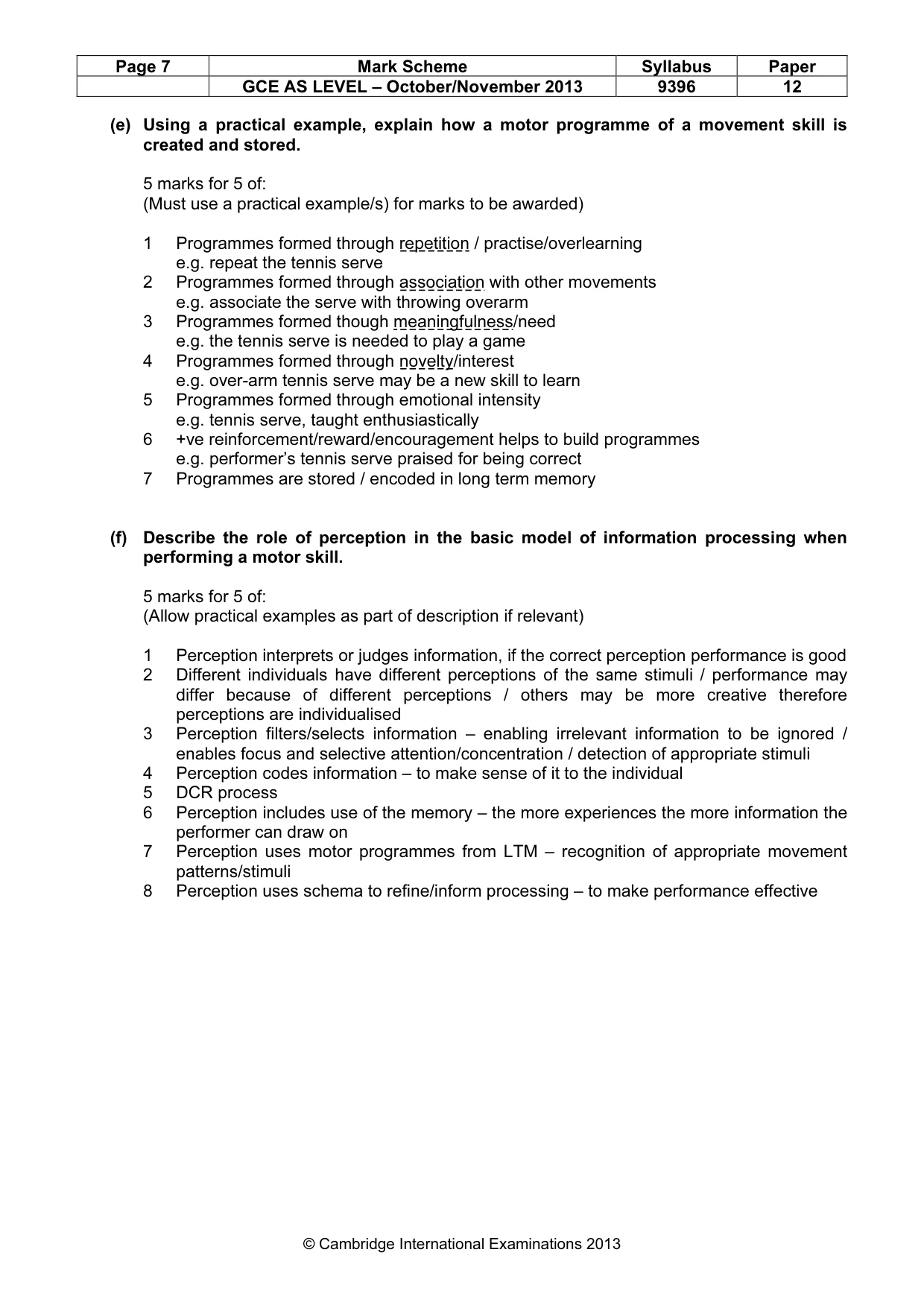
Page 7 Mark Scheme Syllabus Paper GCE AS LEVEL – October/November 2013 9396 12 © Cambridge International Examinations 2013 (e) Using a practical example, explain how a motor programme of a movement skill is created and stored. 5 marks for 5 of: (Must use a practical example/s) for marks to be awarded) 1 Programmes formed through repetition / practise/overlearning e.g. repeat the tennis serve 2 Programmes formed through association with other movements e.g. associate the serve with throwing overarm 3 Programmes formed though meaningfulness/need e.g. the tennis serve is needed to play a game 4 Programmes formed through novelty/interest e.g. over-arm tennis serve may be a new skill to learn 5 Programmes formed through emotional intensity e.g. tennis serve, taught enthusiastically 6 +ve reinforcement/reward/encouragement helps to build programmes e.g. performer’s tennis serve praised for being correct 7 Programmes are stored / encoded in long term memory (f) Describe the role of perception in the basic model of information processing when performing a motor skill. 5 marks for 5 of: (Allow practical examples as part of description if relevant) 1 Perception interprets or judges information, if the correct perception performance is good 2 Different individuals have different perceptions of the same stimuli / performance may differ because of different perceptions / others may be more creative therefore perceptions are individualised 3 Perception filters/selects information – enabling irrelevant information to be ignored / enables focus and selective attention/concentration / detection of appropriate stimuli 4 Perception codes information – to make sense of it to the individual 5 DCR process 6 Perception includes use of the memory – the more experiences the more information the performer can draw on 7 Perception uses motor programmes from LTM – recognition of appropriate movement patterns/stimuli 8 Perception uses schema to refine/inform processing – to make performance effective
Mark scheme, page 8
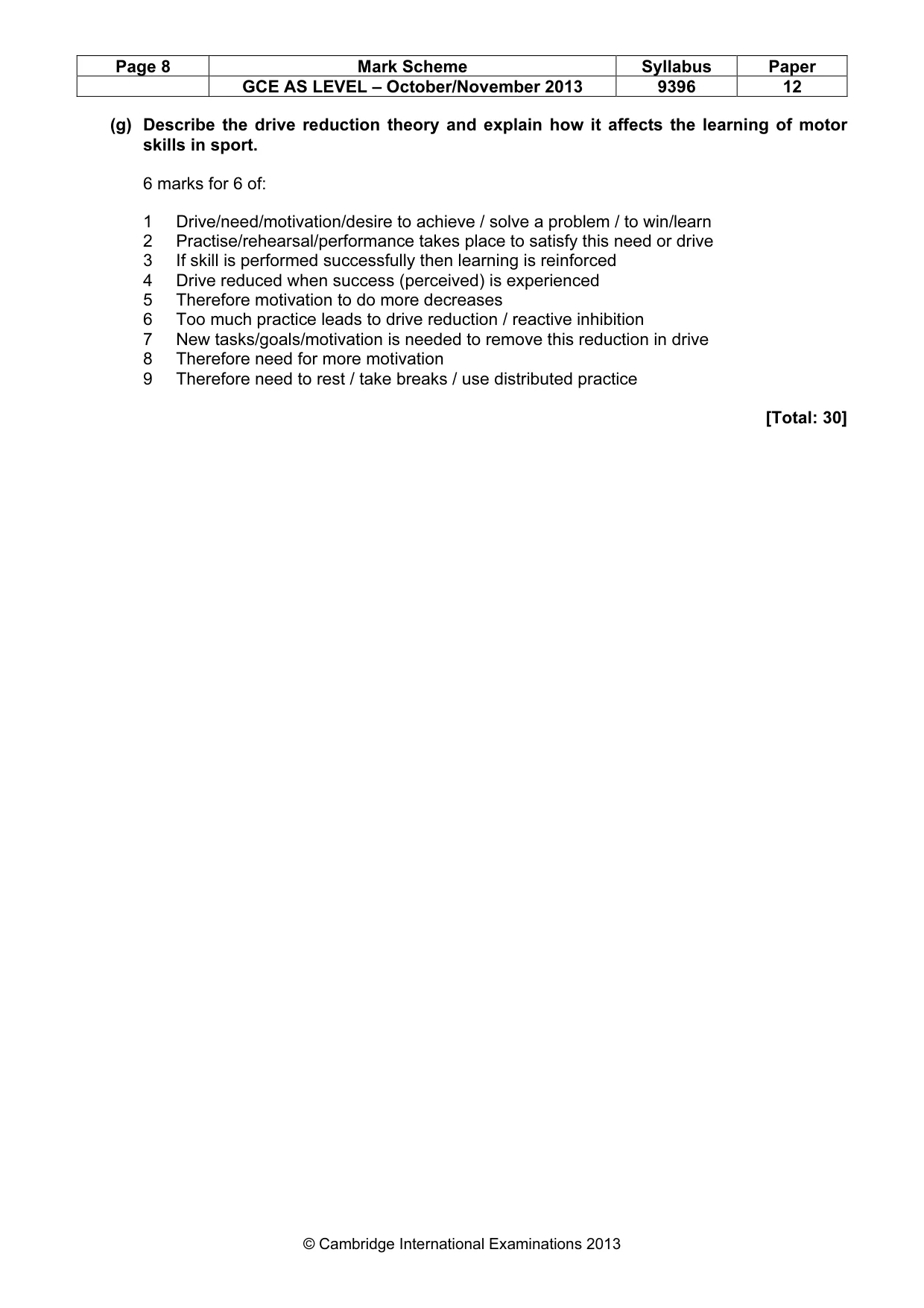
Page 8 Mark Scheme Syllabus Paper GCE AS LEVEL – October/November 2013 9396 12 © Cambridge International Examinations 2013 (g) Describe the drive reduction theory and explain how it affects the learning of motor skills in sport. 6 marks for 6 of: 1 Drive/need/motivation/desire to achieve / solve a problem / to win/learn 2 Practise/rehearsal/performance takes place to satisfy this need or drive 3 If skill is performed successfully then learning is reinforced 4 Drive reduced when success (perceived) is experienced 5 Therefore motivation to do more decreases 6 Too much practice leads to drive reduction / reactive inhibition 7 New tasks/goals/motivation is needed to remove this reduction in drive 8 Therefore need for more motivation 9 Therefore need to rest / take breaks / use distributed practice [Total: 30]
Mark scheme, page 9
Page 9 Mark Scheme Syllabus Paper GCE AS LEVEL – October/November 2013 9396 12 © Cambridge International Examinations 2013 Section C: Contemporary Studies in Physical Education and Sport 3 (a) Describe the characteristics of play. Explain the value of play to both children and adults. 6 marks for 6 of: Sub max 2 marks (characteristics) 1 For everyone / spontaneous 2 Intrinsic reasons / feel good factor / immediate enjoyment 3 No / without predetermined rules / time limits 4 Non serious / fun 5 Freedom of choice / when and where to play / voluntary Sub max 2 marks (value to children) 6 Learn to share 7 Learn to negotiate / sometimes disagree / decision making 8 Learn social interaction / work with others / rules of interaction / learn to fit in 9 Learn leadership and response to leadership 10 Encourages confidence 11 Allows children to learn the rules of life 12 Freedom from authority 13 Opportunity to pretend / fantasy / creativity Sub max 2 marks (value to adults) 14 Gives opportunity for fantasy 15 Allows escape from reality of life 16 Stress relief 17 Allows return to childhood (b) Give reasons why some people do not take part in sport or physical activity. 5 marks for 5 of: 1 Lack of opportunity / few facilities / poor infrastructure 2 Lack of time/money/resources 3 Illness/disability / fear of not being good enough / lack of confidence 4 Lack of initial training / family support / peer pressure 5 Fear of discrimination/prejudice/stereotyping 6 Sport having a low status within social group / cultural limitations 7 Lack of ability / fitness / obesity 8 Lack of education / knowledge about benefits of involvement
Mark scheme, page 10
Page 10 Mark Scheme Syllabus Paper GCE AS LEVEL – October/November 2013 9396 12 © Cambridge International Examinations 2013 (c) Describe four skills that can be learned by taking part in outdoor recreation. 4 marks for 4 of: 1 How to accept / cope with a challenge/adventure / self reliance / overcoming fear 2 Leadership and response to leadership 3 Team work / dependence on others / trusting skills of others / social skills 4 The value of physical activity / lifetime sport 5 Learn about conservation/countryside 6 Personal survival / safety in dangerous situations 7 Value of planning/preparation 8 Map-reading / canoeing / walking / camping skills (d) The oath sworn on behalf of Olympic Athletes states:– “In the name of all competitors, I promise that we shall take part in these Olympic Games without doping and without drugs and in the true spirit of sportsmanship”. (i) Explain the measures which could be taken to solve the continuing problem of drugs in sport. 5 marks for 5 of: 1 Life time bans / name and shame 2 Out of competition-time testing 3 Increased monetary input into research/testing/technology 4 Sensitising through education programmes / moral and health issues 5 Unified policies/programmes to deal with the problem 6 Increased awareness / advertising / use of role models 7 Stricter laws / criminal offence (ii) Using examples from sport describe what is meant by the true spirit of sportsmanship. 3 marks for 3 of: (Must use example(s) – max 1 mark if no examples) 1 No deviant behaviour / cheating / gamesmanship / playing fair 2 Playing to the rules / acceptance of official decisions 3 Respecting fellow competitors 4 Self control in intense situations 5 Losing / winning gracefully / modestly 6 Play / allow opponents to play as well as they can
Mark scheme, page 11
Page 11 Mark Scheme Syllabus Paper GCE AS LEVEL – October/November 2013 9396 12 © Cambridge International Examinations 2013 (e) (i) Explain the benefits of sponsorship to the elite performer. 4 marks for 4 of: Provides money for: 1 Allows for full time training 2 Equipment /coaching 3 Allows time /costs for travel to competitions 4 Provides security at the end of playing career 5 Publicity/promotion / exposure of the performer in the public eye / role model 6 Allow for full time concentration on sport (ii) List three reasons why sponsors would choose to invest in sport. 3 marks for 3 of: 1 A relatively inexpensive way of advertising / publicising / high exposure of goods 2 Increased sales / revenue 3 Tax evasion / benefits 4 Use to provide hospitality to customers 5 Improve the image of the sponsor 6 Philanthropic 7 Gain control of event / camera positioning [Total: 30]
What you needed in this session
Cambridge’s own grade thresholds for 2013 Oct/Nov, Paper 1 · Variant 2. A higher threshold means an easier paper — the bar moves with how the cohort did.