Cambridge A Level Physical Education 9396 — 2013 Oct/Nov Paper 1 · Variant 3
9396/13/O/N/13 · 90 marks · ≈101 min
The question paper and its mark scheme, free to read here and free to download. This is Cambridge’s own paper, exactly as it was sat.
Question paper4 pages
Mark scheme13 pages
Answers below. Sit the paper first if you are practising.
Paper as text
Question paper, page 1
This document consists of 4 printed pages. DC (NF/SW) 67989/3 © UCLES 2013 [Turn over UNIVERSITY OF CAMBRIDGE INTERNATIONAL EXAMINATIONS General Certificate of Education Advanced Subsidiary Level and Advanced Level * 0 8 9 5 9 0 3 6 6 5 * PHYSICAL EDUCATION 9396/13 Paper 1 October/November 2013 2 hours 30 minutes Additional Materials: Answer Booklet/Paper READ THESE INSTRUCTIONS FIRST If you have been given an Answer Booklet, follow the instructions on the front cover of the Booklet. Write your Centre number, candidate number and name on all the work you hand in. Write in dark blue or black pen. You may use a soft pencil for any diagrams, graphs or rough working. Do not use staples, paper clips, highlighters, glue or correction fluid. Answer all questions. At the end of the examination, fasten all your work securely together. The number of marks is given in brackets [ ] at the end of each question or part question.
Question paper, page 2
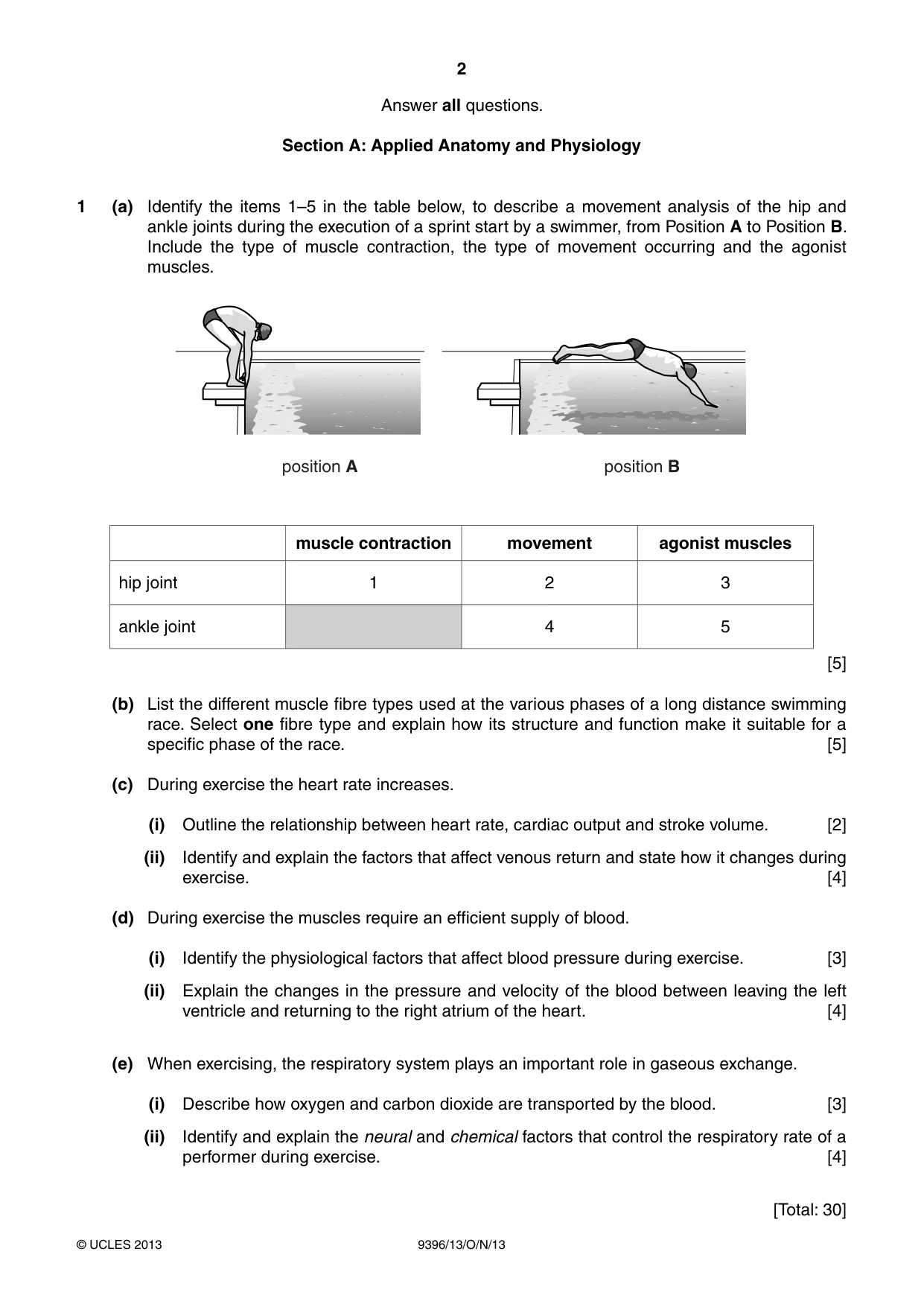
2 9396/13/O/N/13 © UCLES 2013 Answer all questions. Section A: Applied Anatomy and Physiology 1 (a) Identify the items 1–5 in the table below, to describe a movement analysis of the hip and ankle joints during the execution of a sprint start by a swimmer, from Position A to Position B. Include the type of muscle contraction, the type of movement occurring and the agonist muscles. position A position B muscle contraction movement agonist muscles hip joint 1 2 3 ankle joint 4 5 [5] (b) List the different muscle fibre types used at the various phases of a long distance swimming race. Select one fibre type and explain how its structure and function make it suitable for a specific phase of the race. [5] (c) During exercise the heart rate increases. (i) Outline the relationship between heart rate, cardiac output and stroke volume. [2] (ii) Identify and explain the factors that affect venous return and state how it changes during exercise. [4] (d) During exercise the muscles require an efficient supply of blood. (i) Identify the physiological factors that affect blood pressure during exercise. [3] (ii) Explain the changes in the pressure and velocity of the blood between leaving the left ventricle and returning to the right atrium of the heart. [4] (e) When exercising, the respiratory system plays an important role in gaseous exchange. (i) Describe how oxygen and carbon dioxide are transported by the blood. [3] (ii) Identify and explain the neural and chemical factors that control the respiratory rate of a performer during exercise. [4] [Total: 30]
Question paper, page 3
3 9396/13/O/N/13 © UCLES 2013 [Turn over Section B: Acquiring, Developing and Performing Movement Skills 2 (a) Some sports, such as badminton, benefit from quick reactions when performing movement skills. Give three factors that could affect the reaction time of a performer. [3] (b) One theory of learning describes the strengthening of the stimulus response (S-R) bond. Explain what is meant by an S-R bond and how it can be strengthened when learning movement skills. [4] (c) One way of classifying movement skills uses the open-closed continuum. Give three characteristics of a closed skill. [3] (d) Schmidt’s theory of the learning of motor skills assumes four rules of schema: • knowledge of initial conditions • knowledge of response specifications • sensory consequences • movement outcomes. Explain briefly what is meant by a schema by describing each of these four rules. [4] (e) State the main functions of feedback when trying to learn a motor skill in sport. [5] (f) What is meant by transfer of learning? Using practical examples from learning motor skills explain how transfer can be either positive or negative. [5] (g) A performer’s level of arousal often influences their performance of movement skills. Use the Inverted-U theory to explain how the level of arousal can affect performance of a movement skill. [6] [Total: 30]
Question paper, page 4
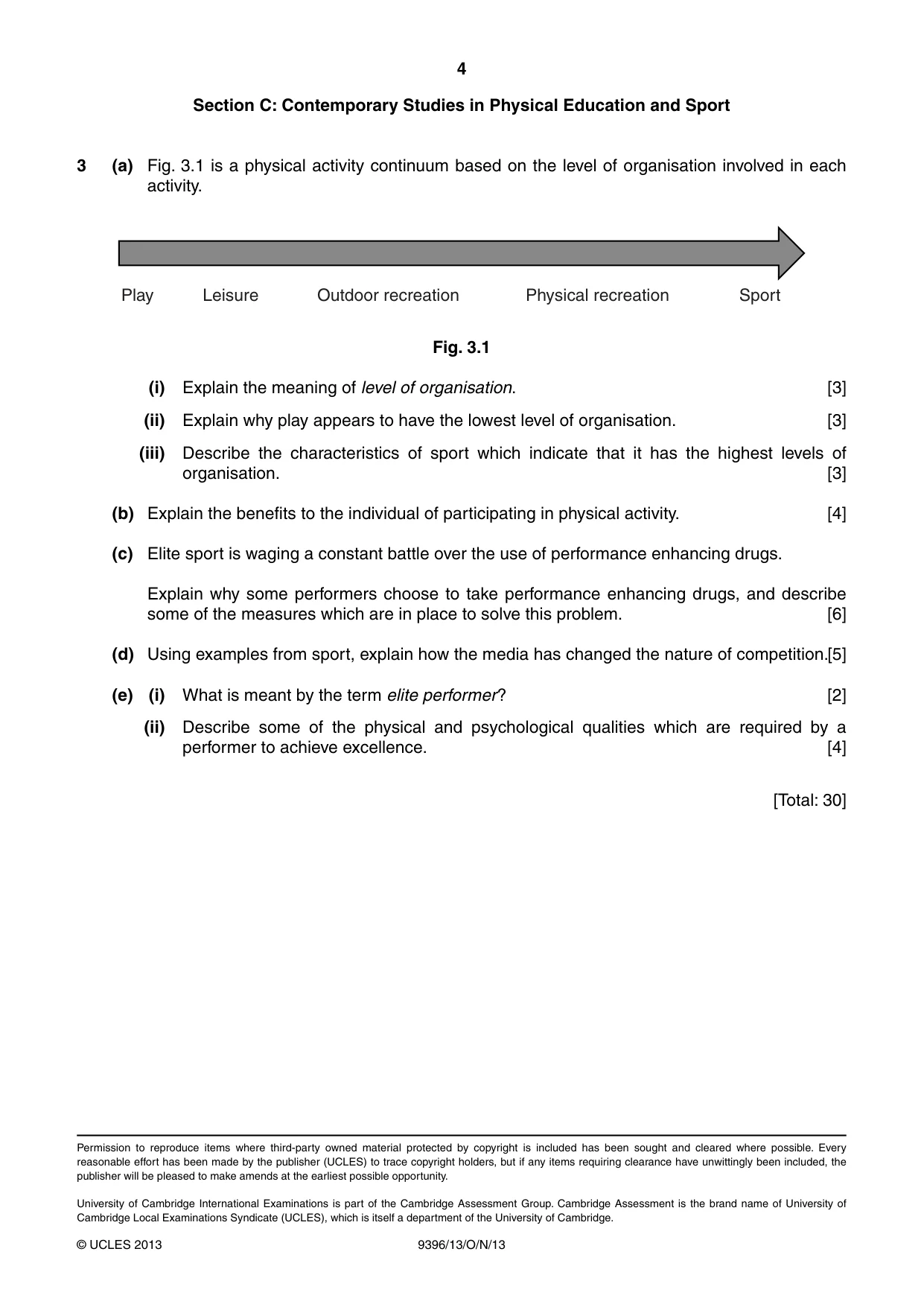
4 9396/13/O/N/13 © UCLES 2013 Section C: Contemporary Studies in Physical Education and Sport 3 (a) Fig. 3.1 is a physical activity continuum based on the level of organisation involved in each activity. Play Leisure Outdoor recreation Physical recreation Sport Fig. 3.1 (i) Explain the meaning of level of organisation. [3] (ii) Explain why play appears to have the lowest level of organisation. [3] (iii) Describe the characteristics of sport which indicate that it has the highest levels of organisation. [3] (b) Explain the benefits to the individual of participating in physical activity. [4] (c) Elite sport is waging a constant battle over the use of performance enhancing drugs. Explain why some performers choose to take performance enhancing drugs, and describe some of the measures which are in place to solve this problem. [6] (d) Using examples from sport, explain how the media has changed the nature of competition. [5] (e) (i) What is meant by the term elite performer? [2] (ii) Describe some of the physical and psychological qualities which are required by a performer to achieve excellence. [4] [Total: 30] Permission to reproduce items where third-party owned material protected by copyright is included has been sought and cleared where possible. Every reasonable effort has been made by the publisher (UCLES) to trace copyright holders, but if any items requiring clearance have unwittingly been included, the publisher will be pleased to make amends at the earliest possible opportunity. University of Cambridge International Examinations is part of the Cambridge Assessment Group. Cambridge Assessment is the brand name of University of Cambridge Local Examinations Syndicate (UCLES), which is itself a department of the University of Cambridge.
Mark scheme, page 1
CAMBRIDGE INTERNATIONAL EXAMINATIONS GCE Advanced Subsidiary Level MARK SCHEME for the October/November 2013 series 9396 PHYSICAL EDUCATION 9396/13 Paper 1 (Theory), maximum raw mark 90 This mark scheme is published as an aid to teachers and candidates, to indicate the requirements of the examination. It shows the basis on which Examiners were instructed to award marks. It does not indicate the details of the discussions that took place at an Examiners’ meeting before marking began, which would have considered the acceptability of alternative answers. Mark schemes should be read in conjunction with the question paper and the Principal Examiner Report for Teachers. Cambridge will not enter into discussions about these mark schemes. Cambridge is publishing the mark schemes for the October/November 2013 series for most IGCSE, GCE Advanced Level and Advanced Subsidiary Level components and some Ordinary Level components.
Mark scheme, page 2
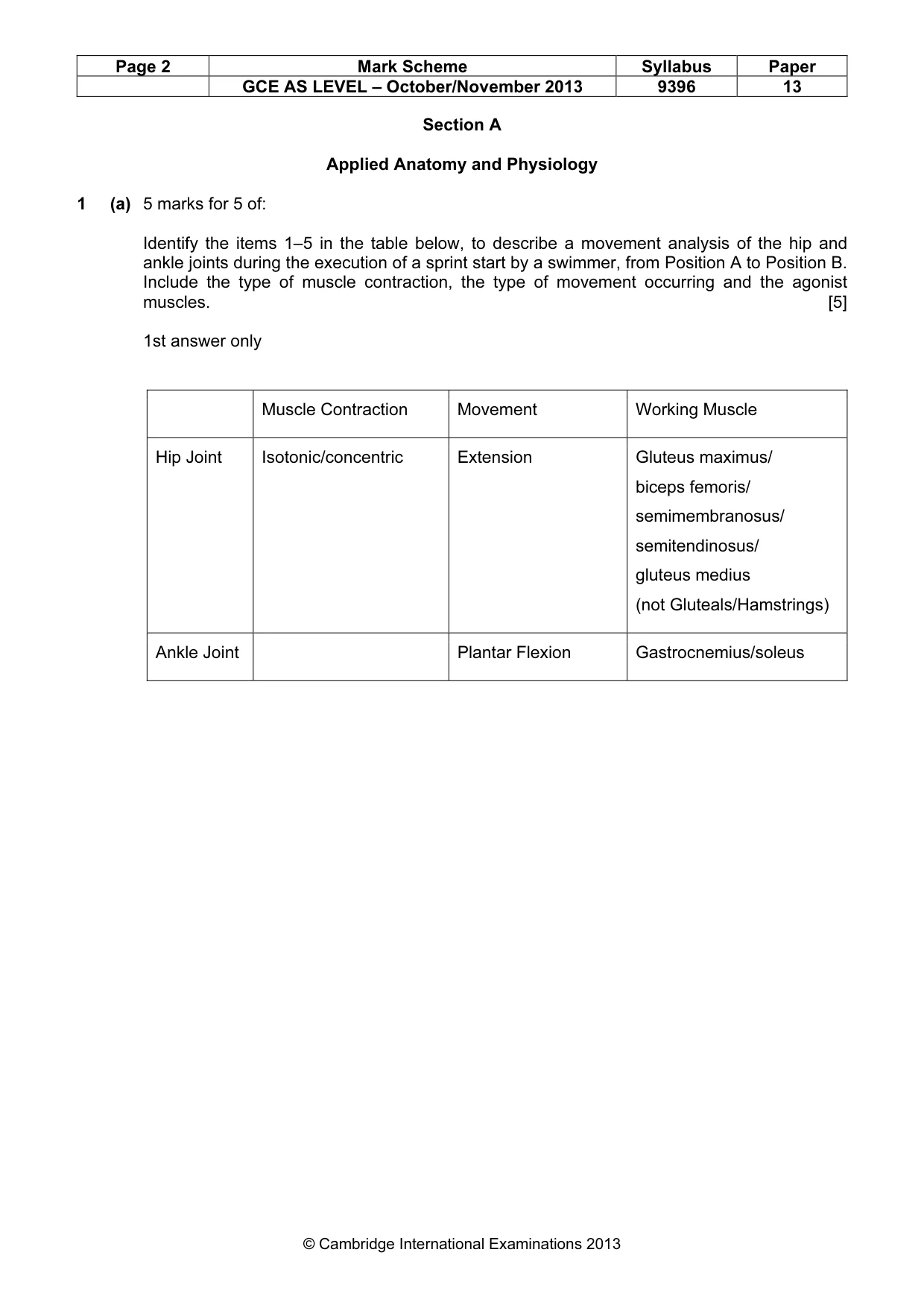
Page 2 Mark Scheme Syllabus Paper GCE AS LEVEL – October/November 2013 9396 13 © Cambridge International Examinations 2013 Section A Applied Anatomy and Physiology 1 (a) 5 marks for 5 of: Identify the items 1–5 in the table below, to describe a movement analysis of the hip and ankle joints during the execution of a sprint start by a swimmer, from Position A to Position B. Include the type of muscle contraction, the type of movement occurring and the agonist muscles. [5] 1st answer only Muscle Contraction Movement Working Muscle Hip Joint Isotonic/concentric Extension Gluteus maximus/ biceps femoris/ semimembranosus/ semitendinosus/ gluteus medius (not Gluteals/Hamstrings) Ankle Joint Plantar Flexion Gastrocnemius/soleus
Mark scheme, page 3
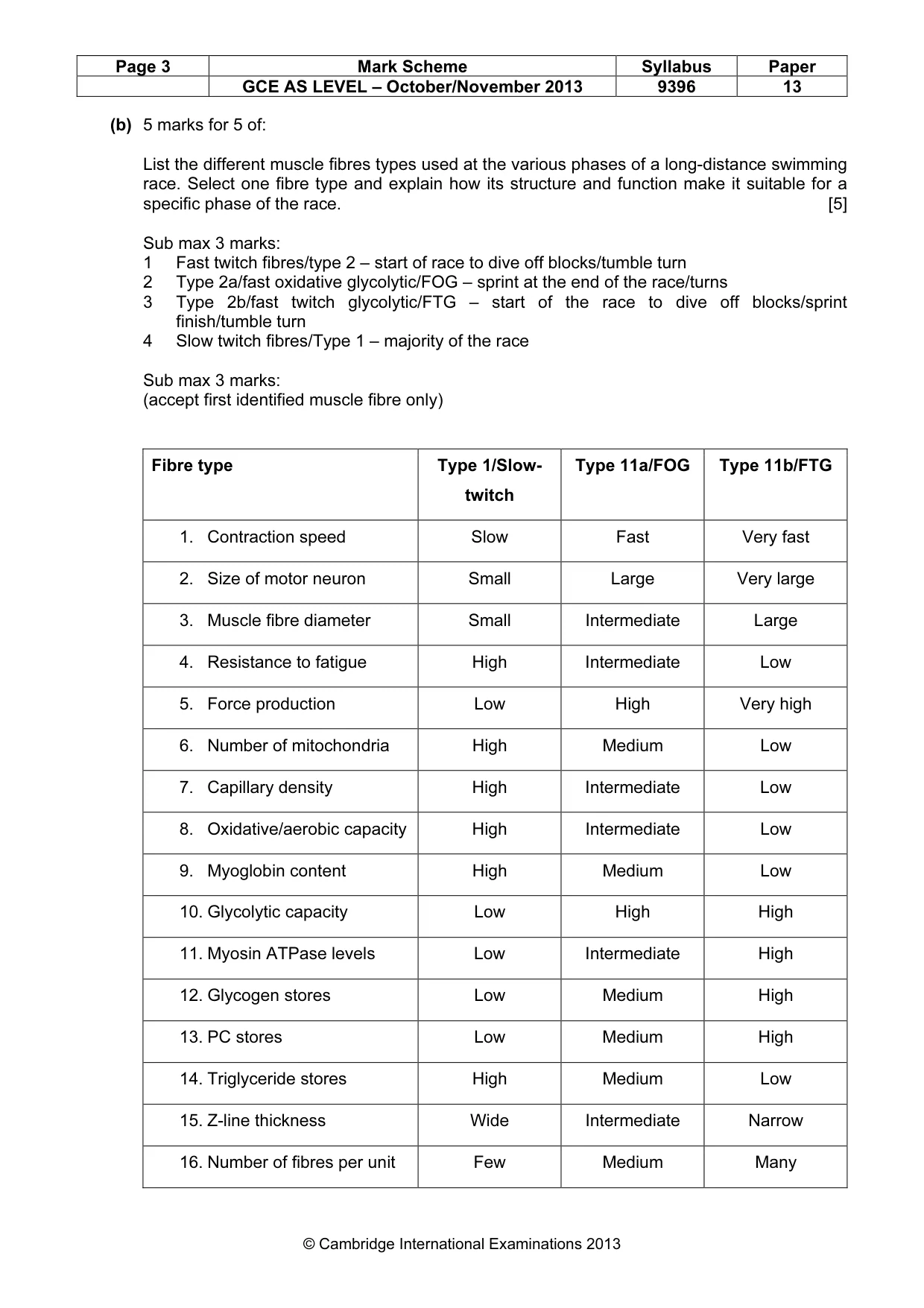
Page 3 Mark Scheme Syllabus Paper GCE AS LEVEL – October/November 2013 9396 13 © Cambridge International Examinations 2013 (b) 5 marks for 5 of: List the different muscle fibres types used at the various phases of a long-distance swimming race. Select one fibre type and explain how its structure and function make it suitable for a specific phase of the race. [5] Sub max 3 marks: 1 Fast twitch fibres/type 2 – start of race to dive off blocks/tumble turn 2 Type 2a/fast oxidative glycolytic/FOG – sprint at the end of the race/turns 3 Type 2b/fast twitch glycolytic/FTG – start of the race to dive off blocks/sprint finish/tumble turn 4 Slow twitch fibres/Type 1 – majority of the race Sub max 3 marks: (accept first identified muscle fibre only) Fibre type Type 1/Slow- twitch Type 11a/FOG Type 11b/FTG 1. Contraction speed Slow Fast Very fast 2. Size of motor neuron Small Large Very large 3. Muscle fibre diameter Small Intermediate Large 4. Resistance to fatigue High Intermediate Low 5. Force production Low High Very high 6. Number of mitochondria High Medium Low 7. Capillary density High Intermediate Low 8. Oxidative/aerobic capacity High Intermediate Low 9. Myoglobin content High Medium Low 10. Glycolytic capacity Low High High 11. Myosin ATPase levels Low Intermediate High 12. Glycogen stores Low Medium High 13. PC stores Low Medium High 14. Triglyceride stores High Medium Low 15. Z-line thickness Wide Intermediate Narrow 16. Number of fibres per unit Few Medium Many
Mark scheme, page 4
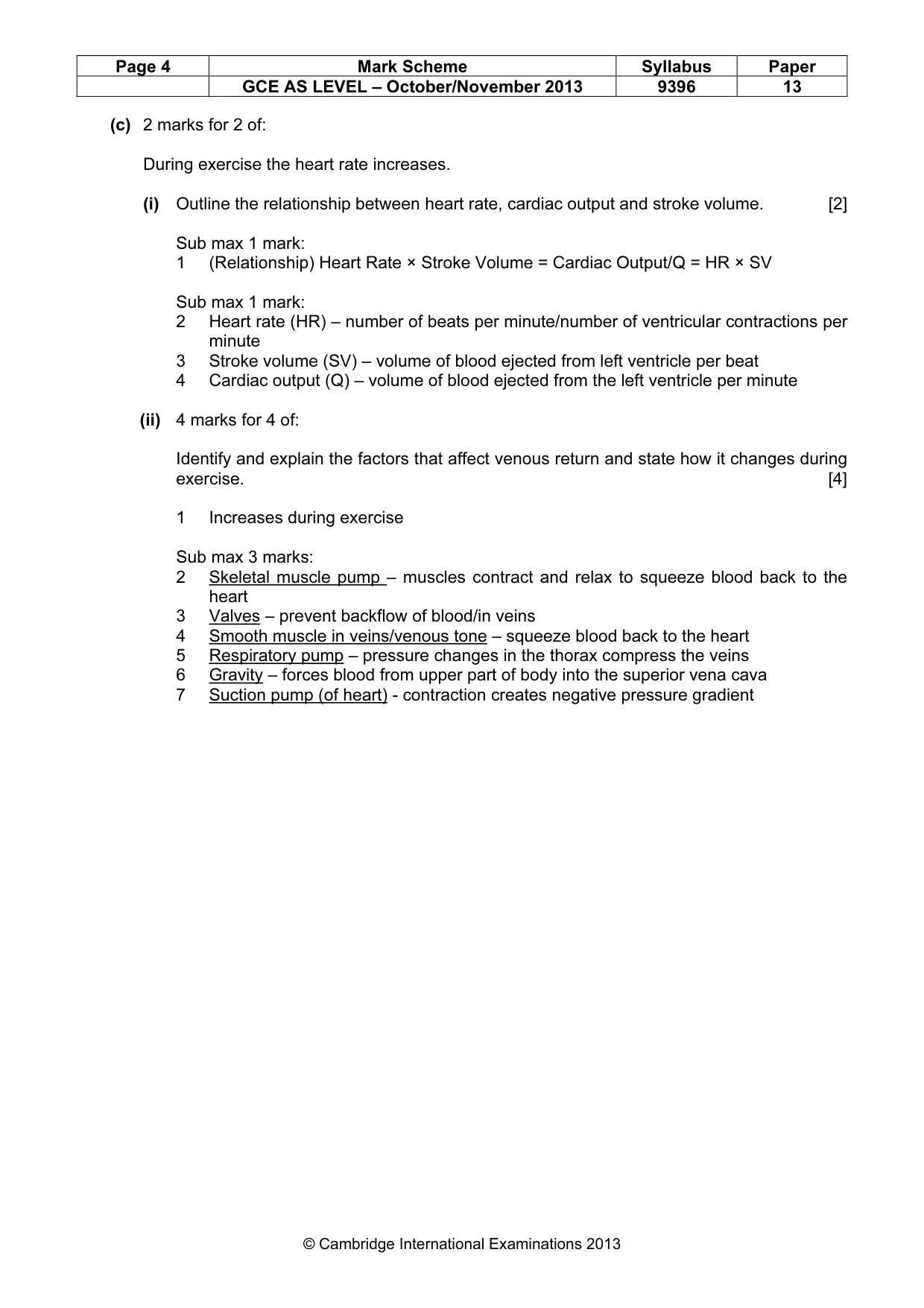
Page 4 Mark Scheme Syllabus Paper GCE AS LEVEL – October/November 2013 9396 13 © Cambridge International Examinations 2013 (c) 2 marks for 2 of: During exercise the heart rate increases. (i) Outline the relationship between heart rate, cardiac output and stroke volume. [2] Sub max 1 mark: 1 (Relationship) Heart Rate × Stroke Volume = Cardiac Output/Q = HR × SV Sub max 1 mark: 2 Heart rate (HR) – number of beats per minute/number of ventricular contractions per minute 3 Stroke volume (SV) – volume of blood ejected from left ventricle per beat 4 Cardiac output (Q) – volume of blood ejected from the left ventricle per minute (ii) 4 marks for 4 of: Identify and explain the factors that affect venous return and state how it changes during exercise. [4] 1 Increases during exercise Sub max 3 marks: 2 Skeletal muscle pump – muscles contract and relax to squeeze blood back to the heart 3 Valves – prevent backflow of blood/in veins 4 Smooth muscle in veins/venous tone – squeeze blood back to the heart 5 Respiratory pump – pressure changes in the thorax compress the veins 6 Gravity – forces blood from upper part of body into the superior vena cava 7 Suction pump (of heart) - contraction creates negative pressure gradient
Mark scheme, page 5
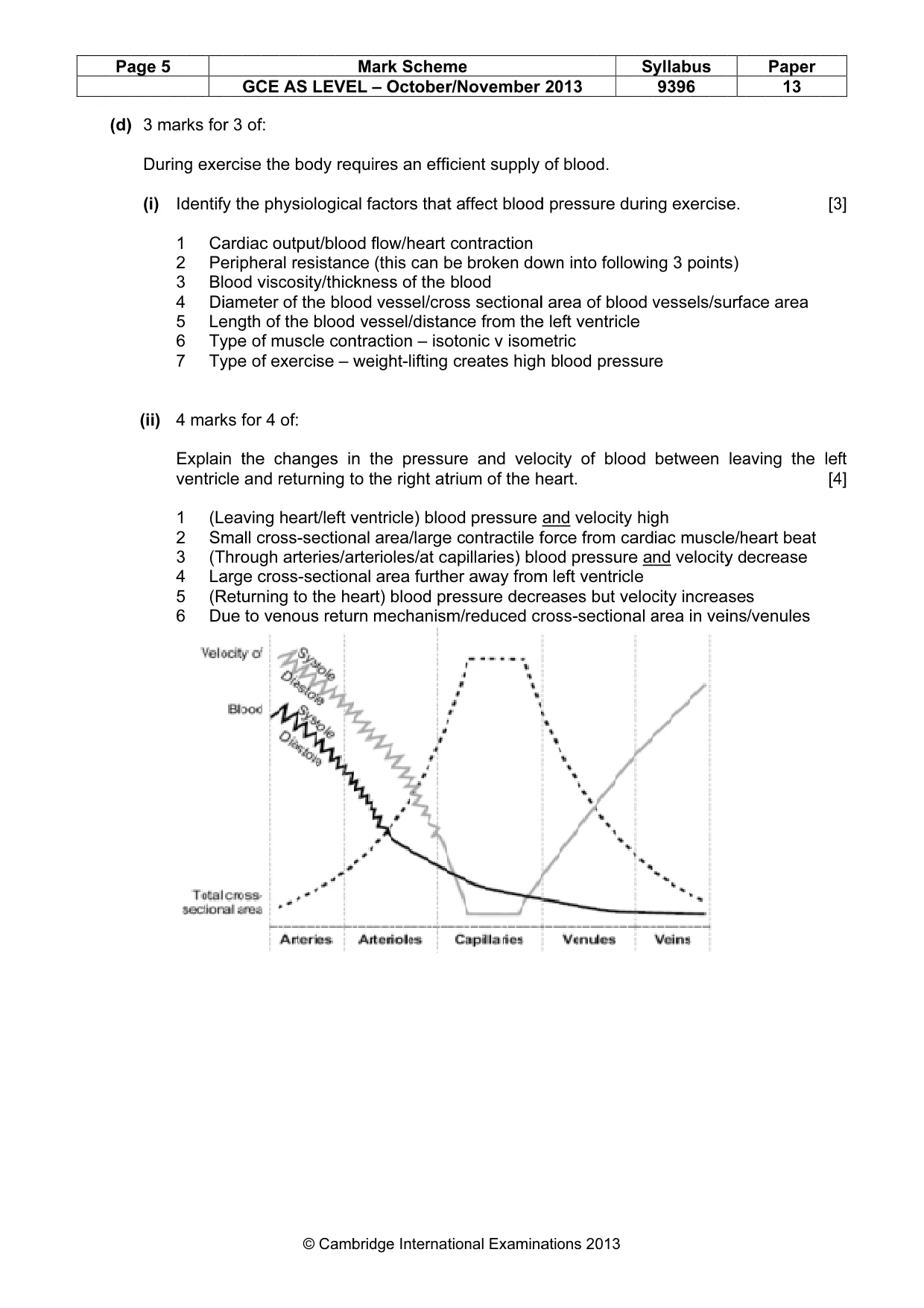
( Pa (d) age ) 3 D ( (i e 5 3 m Dur i) i) 5 mar ring Id 1 2 3 4 5 6 7 4 E ve 1 2 3 4 5 6 rks g e den ma xp ent for exe ntify Ca Pe Bl Di Le Ty Ty ark lain tric (L Sm (T La (R Du r 3 erci y th ard erip oo iam eng ype ype ks f n t cle ea ma Thro arg Retu ue GC of se he diac phe d v met gth e o e o for the an vin all c oug e c urn to CE f: th ph c o era visc ter of f m f e r 4 e c nd r ng cro gh cro ning ve AS e b hys outp al re cos of f th mus xe of: cha ret he ss- art oss g t eno S L © bod siol put esi sity the e b scle rcis ang urn art -se ter -se o t ous LEV Ca dy og t/bl ista y/th e b blo e c se ges nin t/le ecti ries ect he s re VE amb req ica loo anc hick bloo od con – w s in g t ft v ion s/a ion he etur Ma EL – brid qui al fa od f ce kne od ve ntra we n t o t ven nal rte nal ear rn ark – O dge ires act flow (th ess ve ess acti eigh the the ntri are erio are rt) b me k S Oct e In s a tors w/h his s o ess sel/ ion ht-l e p rig cle ea/ oles ea blo ech Sch tob nter an e s th hea ca of th sel/ /dis n – lifti pres ght e) b /lar s/a fu ood han hem ber rnat effi hat art n b he /cro sta iso ng ssu t at bloo rge t ca rth d pr nism me r/N tion icie t af co be blo oss anc oto cr ure triu od e co ap her res m/r e Nov nal ent ffec ontr bro ood s se ce f onic rea e a um pr ont illa aw ssu red vem Ex t su ct b rac oke d ect from c v ates and of res tra arie way ure duc mb xam upp blo ctio en tion m t iso s h d v the su ctil es) y fr de ced ber mina ply ood on do nal the om igh velo e h re le f blo rom ecr d c 20 atio of d pr own l ar e le metr h b ocit hea an for ood m le rea ros 013 ons blo res n in rea eft v ric loo ty art. d v ce d p eft se ss- 3 s 20 ood ssu nto a of ven od of vel fro pres ve s b sec 013 d. ure fo f b ntri pre bl oc om ssu entr but ctio 3 du llow loo icle ess loo ity ca ure ricl ve ona S urin win od v e sur od hig ard e a e eloc al a yll 93 ng ng ves re be gh iac nd city are ab 396 ex 3 p sse etw c m ve y in ea i bus 6 erc poi els/ wee mus eloc ncr in v s cise nts /su en scle city rea vei e. s) urfa lea e/h y d se ins ace avin hea ec s /ve Pa e a ng art rea enu ape 13 rea th be ase ule er a he at e s [3 lef [4 3] ft 4]
Mark scheme, page 6
Page 6 Mark Scheme Syllabus Paper GCE AS LEVEL – October/November 2013 9396 13 © Cambridge International Examinations 2013 (e) 3 marks for 3 of: When exercising, the respiratory system plays an important role in gaseous exchange. (i) Describe how oxygen and carbon dioxide are transported by the blood. [3] (Oxygen) 1 Combines with haemoglobin/oxy-haemoglobin 2 Dissolved (equiv) in blood plasma Sub max 2 marks: (Carbon dioxide) 3 As bicarbonate/hydrogen carbonate ions/carbonic acid 4 Dissolved (equiv) in blood plasma 5 Combined/attached with plasma proteins/haemoglobin/forms carbaminohaemoglobin (ii) 4 marks for 4 of: Identify and explain the neural and chemical factors that control the respiratory rate of a performer during exercise. [4] 1 Information sent to the Respiratory Control Centre/medulla 2 Chemoreceptors – detect changes in oxygen and carbon dioxide/blood acidity levels/lactic acid build-up 3 Thermoreceptors – detect changes in temperature 4 Stretch receptors – detect inflation of the lungs 5 Hering-Breur reflex – Prevent over-stretching of lungs (this point linked to point 5) 6 Mechanoreceptors/proprioceptors – detect movement in muscles and need for more oxygen 7 Baroreceptors - detect changes in blood pressure 8 Adrenaline release increases respiration rate [Total: 30]
Mark scheme, page 7
Page 7 Mark Scheme Syllabus Paper GCE AS LEVEL – October/November 2013 9396 13 © Cambridge International Examinations 2013 Section B Acquiring, Developing and Performing Movement Skills 2 (a) 3 marks for 3 of Some sports, such as badminton, benefit from quick reactions when performing movement skills. Give three factors that could affect the reaction time of a performer. [3] (Mark first three only) 1 Number of stimuli/number of possible alternative responses/number of decisions to be made /open/complex/externally-paced skills 2 Psychological refractory period 3 Single channel hypothesis 4 Distractions/ability to selectively attend/focus/spectator distractions/social inhibition 5 Age/senses deteriorating 6 Gender 7 Level of personal fitness/health/injury/somatotype/length of neural pathways/height 8 Past experience/presence of motor programmes/level of skill/ability 9 Relevant environmental factors – weather/temperature 10 Consumption of alcohol or drugs/medication 11 Amount of (recent) sleep/level of arousal/anxiety/stress/alertness 12 Type of stimulus – bright/loud 13 Personality – extroverts v introverts 14 Anticipation (b) 4 marks for 4 of: One theory of learning describes the strengthening of the stimulus-response (S/R) bond. Explain what is meant by an S/R bond and how it can be strengthened when learning movement skills. [4] Sub max 1 mark: 1 Idea of conditioning/practice linking behaviour/action to signal/situation Sub max 3 marks: 1 Through positive reinforcement – use of rewards/praise 2 Negative reinforcement by removing the negative stimulus 3 Repetition/drills/intense training/(Thorndike’s) law of exercise 4 Showing benefits/understanding/cognitive aspects of skill learning 5 Teach as a whole to help this understanding/insight learning 6 (Thorndike’s) law of effect/giving a ‘satisfier’ rather than an ‘annoyer’/praise 7 (Thorndike’s) law of ‘readiness’/physical/mental preparation 8 Punishment when response is incorrect – reduces bond but may strengthen other learned S-R bond 9 Feedback on performance/information to correct errors 10 Specific preparation e.g. selective attention
Mark scheme, page 8
Page 8 Mark Scheme Syllabus Paper GCE AS LEVEL – October/November 2013 9396 13 © Cambridge International Examinations 2013 (c) 3 marks for 3 of: One way of classifying movement skills uses the open-closed continuum. Give three characteristics of a closed skill. [3] 1 Is not affected by environment/same or similar patterns of movement required 2 Is predominantly habitual/can be autonomous/is repeatable 3 Is usually simple/no need to process a lot of information or stimuli/few decisions 4 Usually internally/self-paced/speed controlled by the performer (d) 4 marks for 4 of: Schmidt’s theory of the learning of motor skills assumes four rules of schema: • knowledge of initial conditions • knowledge of response specifications • sensory consequences • movement outcomes Explain briefly what is meant by a schema by describing each of these four rules. [4] 1 (Knowledge of initial conditions) – learner takes into account the environment/display 2 (Knowledge of response specifications) – learner decides what to do e.g. I need to use both hands to dribble round the defender 3 (Sensory consequences) – using kinaesthetic feedback/feelings to judge whether to modify the movement or to check whether it feels right/K.P. 4 (Movement outcomes) – the player uses knowledge of results to check whether the outcome is effective (e) 5 marks for 5 of: State the main functions of feedback when trying to learn a motor skill in sport. [5] 1 To give information on technique/K.P. 2 To give information on end result/how you got on/K.R. 3 To give information on errors/mistakes/to improve skills/performance or strategies/techniques/adjust motor programmes 4 To motivate/drive 5 To control arousal/to keep performer free from stress/less anxious 6 To punish if movement is wrong 7 To strengthen the S/R bond/re-inforcement 8 To keep performer safe 9 To give goals for future success
Mark scheme, page 9
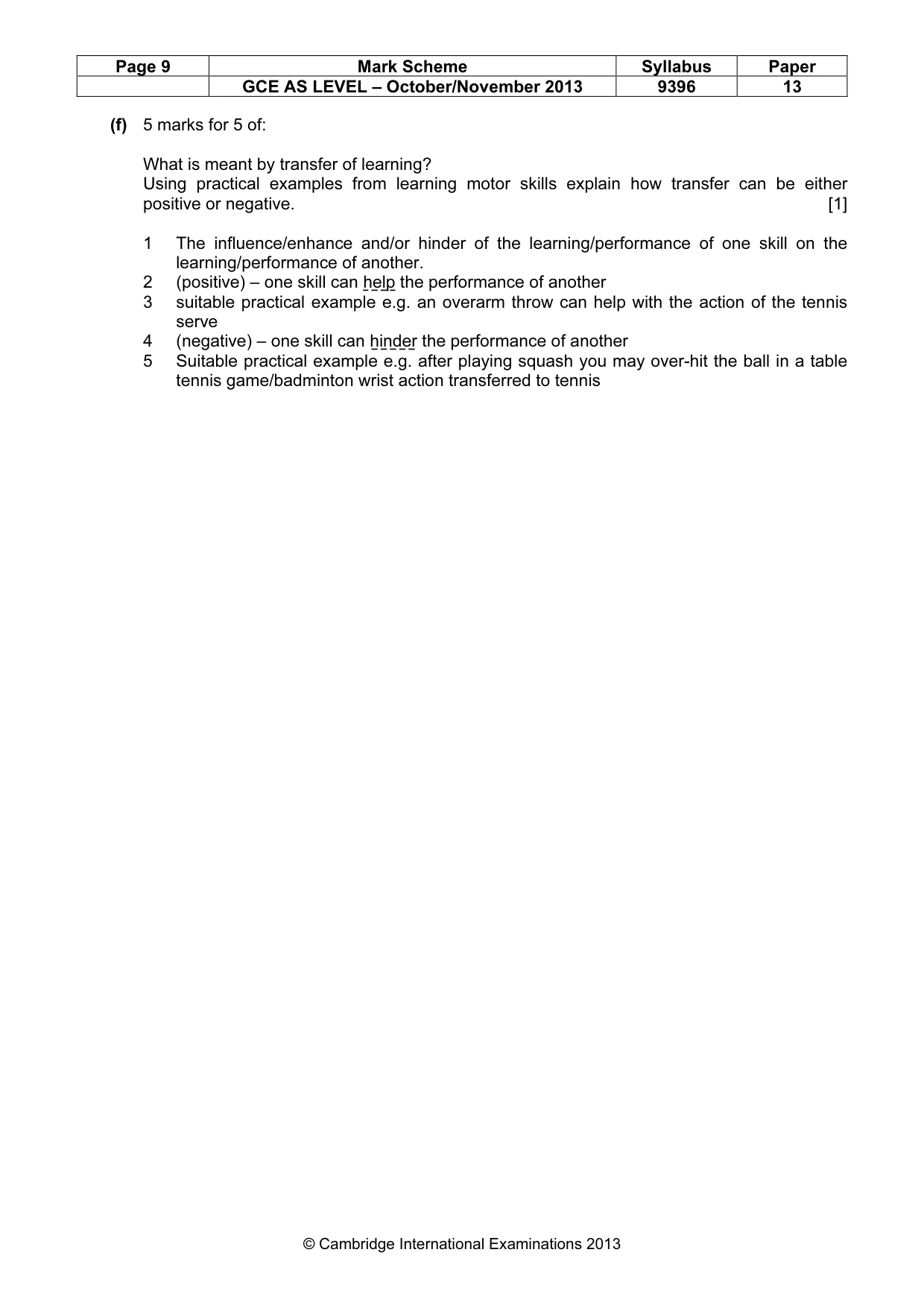
Page 9 Mark Scheme Syllabus Paper GCE AS LEVEL – October/November 2013 9396 13 © Cambridge International Examinations 2013 (f) 5 marks for 5 of: What is meant by transfer of learning? Using practical examples from learning motor skills explain how transfer can be either positive or negative. [1] 1 The influence/enhance and/or hinder of the learning/performance of one skill on the learning/performance of another. 2 (positive) – one skill can help the performance of another 3 suitable practical example e.g. an overarm throw can help with the action of the tennis serve 4 (negative) – one skill can hinder the performance of another 5 Suitable practical example e.g. after playing squash you may over-hit the ball in a table tennis game/badminton wrist action transferred to tennis
Mark scheme, page 10
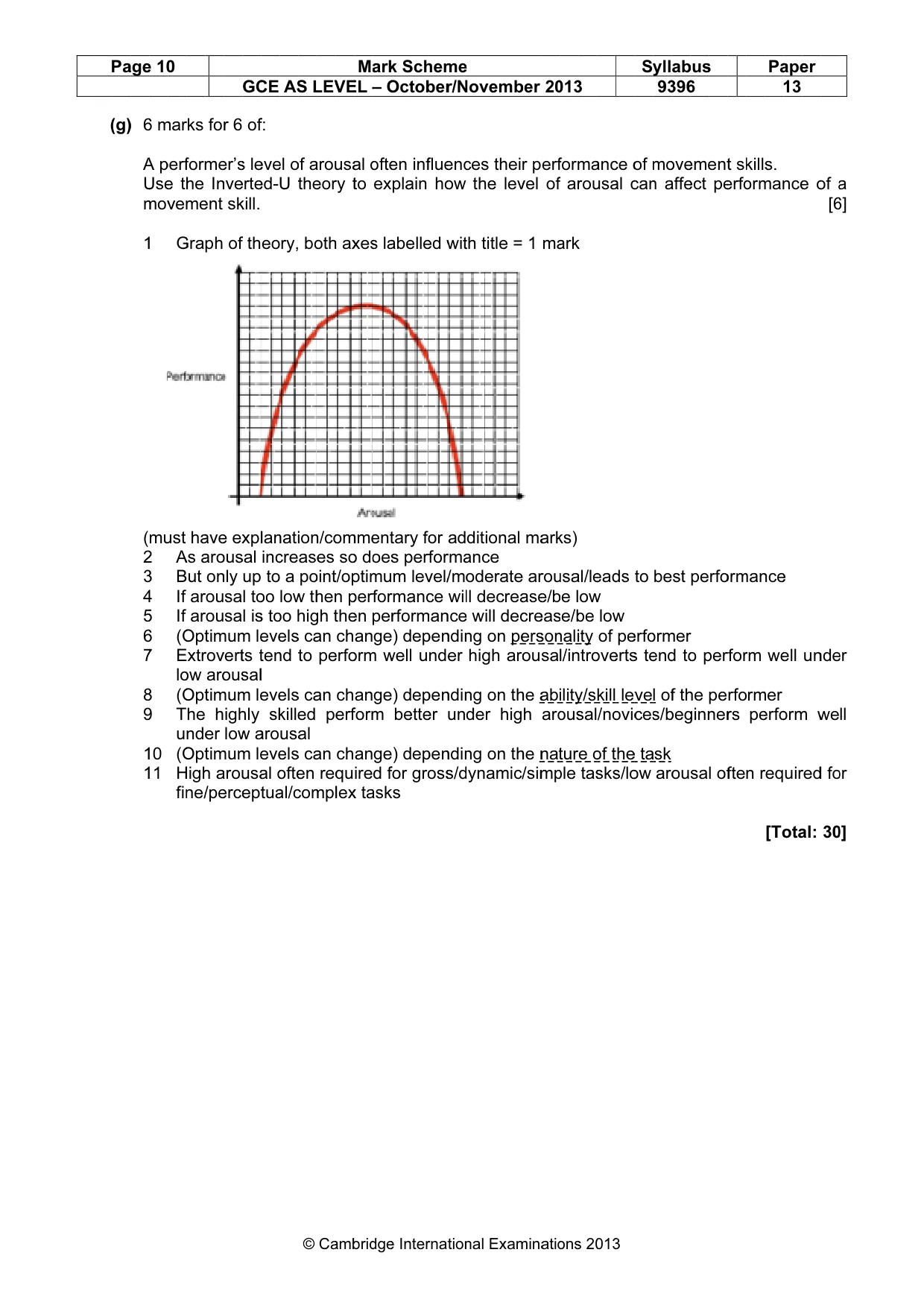
( Pa (g) age ) 6 A U m 1 ( 2 3 4 5 6 7 8 9 1 1 e 10 6 m A p Use mov 1 mu 2 3 4 5 6 7 8 9 10 11 0 mar perf e th vem G ust A B If If (O E lo (O T u (O H fin rks form he me Gra ha As a ut ar ar Opt xtr ow Opt he nde Opt High ne/ for me In ent ph ave aro on rou rou tim rov aro tim h er tim h a /pe r 6 er’s nve sk of e ex ous nly sa sa mum vert ous mum igh low mum arou erce GC of s le erte kill. f th xpl sal up l to l is m le ts t sal m le hly w a m le usa ept CE f: eve ed- eo lan inc to oo s to eve ten l eve sk aro eve al o tua AS el o U t ry, nati cre a low oo h els nd t els kille usa els ofte al/c S L © of a the bo ion ase po w th hig s ca to s ca ed al s ca en com LEV Ca arou eor oth n/co es oint hen gh t an pe an pe an req mpl VE amb usa ry t h ax om so t/op n p the ch erfo ch erf ch qu lex Ma EL – brid al o to xes mme o do ptim perf en p an orm an form an ire x ta ark – O dge ofte ex s la ent oes mu for per ge m w ge m ge d f ask k S Oct e In en pla abe tary s p m rma rfo ) d well ) d be ) d for ks Sch tob nter inf ain elle y fo perf lev anc rm dep l u dep ette dep gro hem ber rnat flue ho ed w or for vel/ ce man pen nde pen er pen oss me r/N tion enc ow wit ad rma /mo wil nce ndin er ndin un ndin s/d e Nov nal ces th th t dit anc ode ll d e w ng hig ng de ng dyn vem Ex s th he title ion ce era ec ill d on gh on r h on am mb xam hei lev e = nal ate crea dec n pe aro n th hig n th mic/ ber mina r p vel 1 ma e ar ase cre ers ou he a h he n /sim 20 atio erf of ma ark rou e/b eas son sa ab aro nat mp 013 ons form f ar ark ks) usa be l se/b nali l/in ility ous tur ple 3 s 20 ma rou k al/le ow be ity ntro y/s sal re o tas 013 anc usa ead w low of ove kill /no of t sks 3 ce o al c ds w pe erts lev ovic the s/lo S of m can to erfo s te ve ces e ta ow yll 93 mo n a be orm end l of s/b ask aro ab 396 ove affe st mer d to f th beg ou bus 6 eme ect pe r o p he ginn sa s ent pe rfo per pe ner l of t sk erfo orm rfor rfo rs fte kills orm man rm rm pe n r Pa s. man nce we mer erfo req [To ape 13 nce e ell orm uir ota er e o un m w red al: of a [6 nde we d fo 30 a 6] er ll or 0]
Mark scheme, page 11
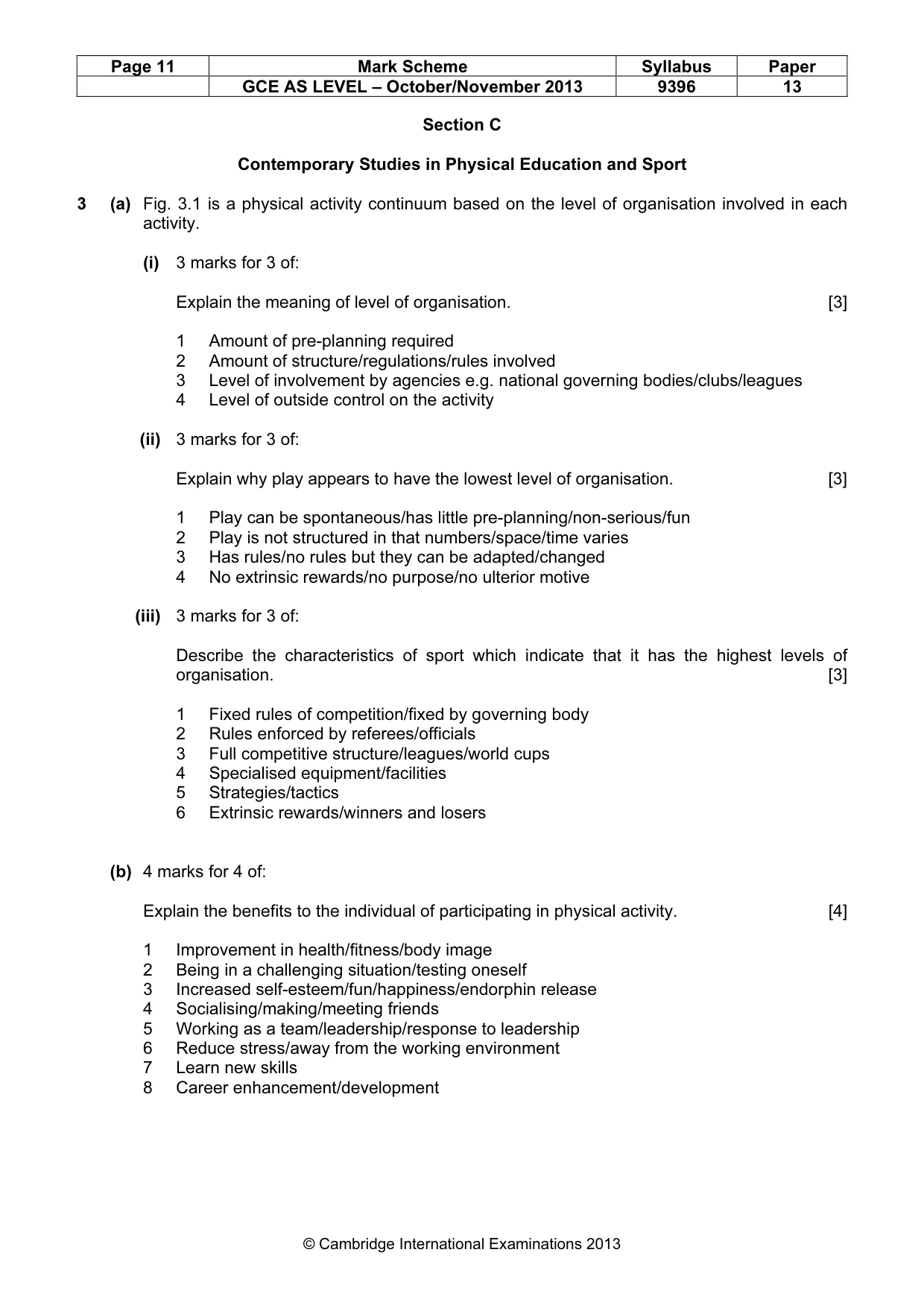
Page 11 Mark Scheme Syllabus Paper GCE AS LEVEL – October/November 2013 9396 13 © Cambridge International Examinations 2013 Section C Contemporary Studies in Physical Education and Sport 3 (a) Fig. 3.1 is a physical activity continuum based on the level of organisation involved in each activity. (i) 3 marks for 3 of: Explain the meaning of level of organisation. [3] 1 Amount of pre-planning required 2 Amount of structure/regulations/rules involved 3 Level of involvement by agencies e.g. national governing bodies/clubs/leagues 4 Level of outside control on the activity (ii) 3 marks for 3 of: Explain why play appears to have the lowest level of organisation. [3] 1 Play can be spontaneous/has little pre-planning/non-serious/fun 2 Play is not structured in that numbers/space/time varies 3 Has rules/no rules but they can be adapted/changed 4 No extrinsic rewards/no purpose/no ulterior motive (iii) 3 marks for 3 of: Describe the characteristics of sport which indicate that it has the highest levels of organisation. [3] 1 Fixed rules of competition/fixed by governing body 2 Rules enforced by referees/officials 3 Full competitive structure/leagues/world cups 4 Specialised equipment/facilities 5 Strategies/tactics 6 Extrinsic rewards/winners and losers (b) 4 marks for 4 of: Explain the benefits to the individual of participating in physical activity. [4] 1 Improvement in health/fitness/body image 2 Being in a challenging situation/testing oneself 3 Increased self-esteem/fun/happiness/endorphin release 4 Socialising/making/meeting friends 5 Working as a team/leadership/response to leadership 6 Reduce stress/away from the working environment 7 Learn new skills 8 Career enhancement/development
Mark scheme, page 12
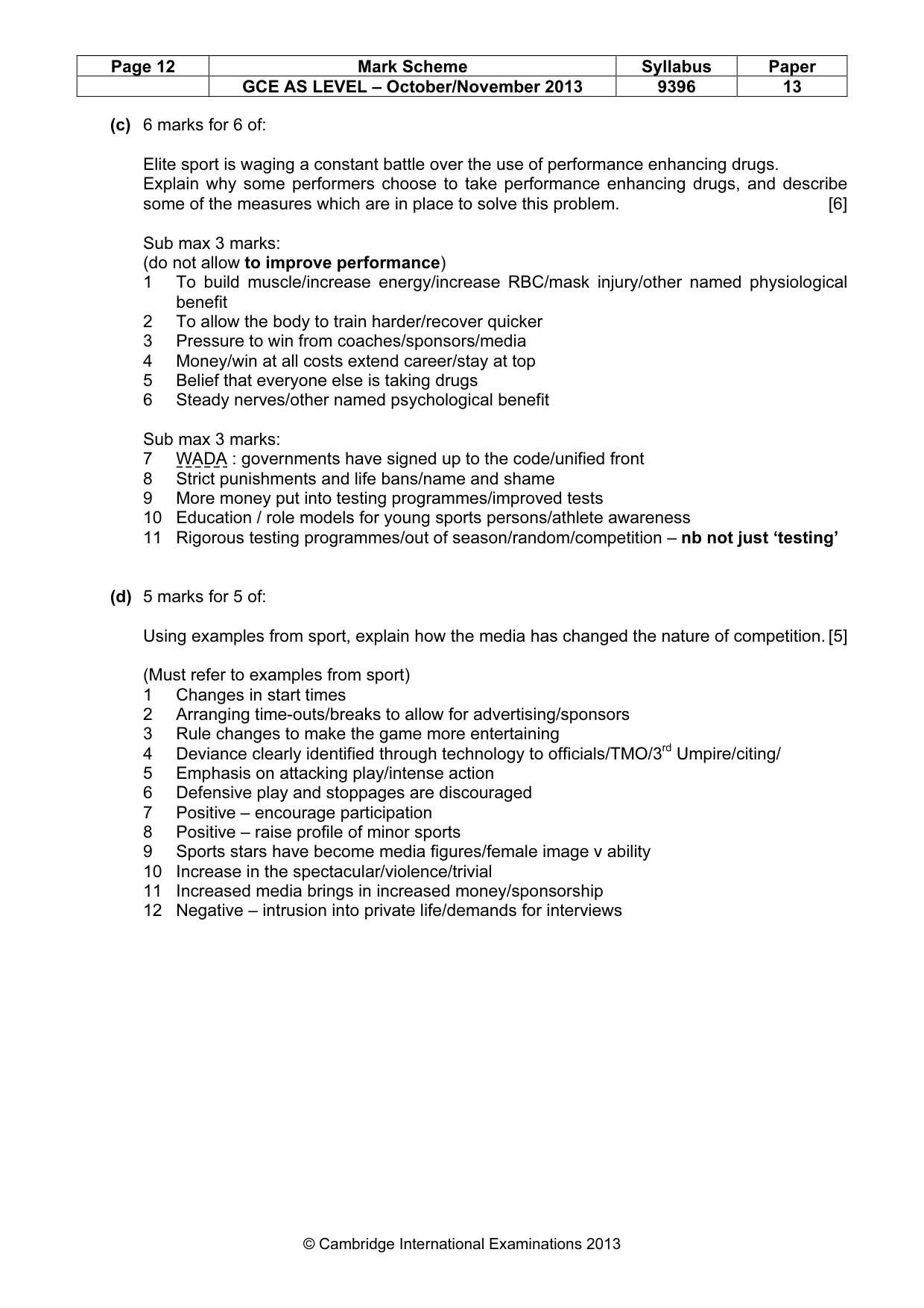
Page 12 Mark Scheme Syllabus Paper GCE AS LEVEL – October/November 2013 9396 13 © Cambridge International Examinations 2013 (c) 6 marks for 6 of: Elite sport is waging a constant battle over the use of performance enhancing drugs. Explain why some performers choose to take performance enhancing drugs, and describe some of the measures which are in place to solve this problem. [6] Sub max 3 marks: (do not allow to improve performance) 1 To build muscle/increase energy/increase RBC/mask injury/other named physiological benefit 2 To allow the body to train harder/recover quicker 3 Pressure to win from coaches/sponsors/media 4 Money/win at all costs extend career/stay at top 5 Belief that everyone else is taking drugs 6 Steady nerves/other named psychological benefit Sub max 3 marks: 7 WADA : governments have signed up to the code/unified front 8 Strict punishments and life bans/name and shame 9 More money put into testing programmes/improved tests 10 Education / role models for young sports persons/athlete awareness 11 Rigorous testing programmes/out of season/random/competition – nb not just ‘testing’ (d) 5 marks for 5 of: Using examples from sport, explain how the media has changed the nature of competition. [5] (Must refer to examples from sport) 1 Changes in start times 2 Arranging time-outs/breaks to allow for advertising/sponsors 3 Rule changes to make the game more entertaining 4 Deviance clearly identified through technology to officials/TMO/3rd Umpire/citing/ 5 Emphasis on attacking play/intense action 6 Defensive play and stoppages are discouraged 7 Positive – encourage participation 8 Positive – raise profile of minor sports 9 Sports stars have become media figures/female image v ability 10 Increase in the spectacular/violence/trivial 11 Increased media brings in increased money/sponsorship 12 Negative – intrusion into private life/demands for interviews
Mark scheme, page 13
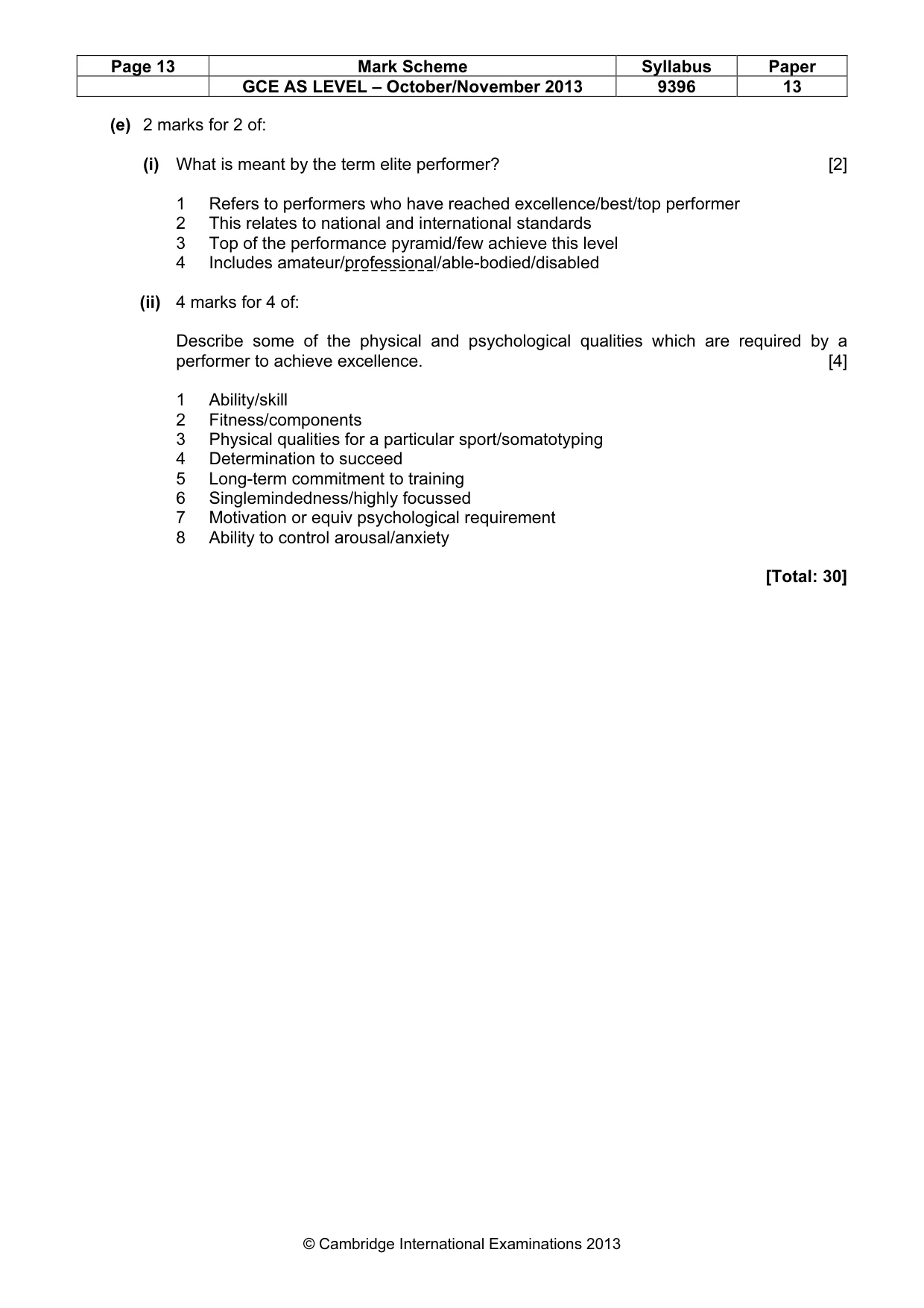
Page 13 Mark Scheme Syllabus Paper GCE AS LEVEL – October/November 2013 9396 13 © Cambridge International Examinations 2013 (e) 2 marks for 2 of: (i) What is meant by the term elite performer? [2] 1 Refers to performers who have reached excellence/best/top performer 2 This relates to national and international standards 3 Top of the performance pyramid/few achieve this level 4 Includes amateur/professional/able-bodied/disabled (ii) 4 marks for 4 of: Describe some of the physical and psychological qualities which are required by a performer to achieve excellence. [4] 1 Ability/skill 2 Fitness/components 3 Physical qualities for a particular sport/somatotyping 4 Determination to succeed 5 Long-term commitment to training 6 Singlemindedness/highly focussed 7 Motivation or equiv psychological requirement 8 Ability to control arousal/anxiety [Total: 30]
What you needed in this session
Cambridge’s own grade thresholds for 2013 Oct/Nov, Paper 1 · Variant 3. A higher threshold means an easier paper — the bar moves with how the cohort did.