Cambridge A Level Physical Education 9396 — 2013 Oct/Nov Paper 1 · Variant 1
9396/11/O/N/13 · 90 marks · ≈101 min
The question paper and its mark scheme, free to read here and free to download. This is Cambridge’s own paper, exactly as it was sat.
Question paper4 pages
Mark scheme10 pages
Answers below. Sit the paper first if you are practising.
Paper as text
Question paper, page 1
This document consists of 4 printed pages. DC (NF/SW) 67987/3 © UCLES 2013 [Turn over UNIVERSITY OF CAMBRIDGE INTERNATIONAL EXAMINATIONS General Certificate of Education Advanced Subsidiary Level and Advanced Level * 7 0 1 5 9 0 1 6 4 7 * PHYSICAL EDUCATION 9396/11 Paper 1 October/November 2013 2 hours 30 minutes Additional Materials: Answer Booklet/Paper READ THESE INSTRUCTIONS FIRST If you have been given an Answer Booklet, follow the instructions on the front cover of the Booklet. Write your Centre number, candidate number and name on all the work you hand in. Write in dark blue or black pen. You may use a soft pencil for any diagrams, graphs or rough working. Do not use staples, paper clips, highlighters, glue or correction fluid. Answer all questions. At the end of the examination, fasten all your work securely together. The number of marks is given in brackets [ ] at the end of each question or part question.
Question paper, page 2
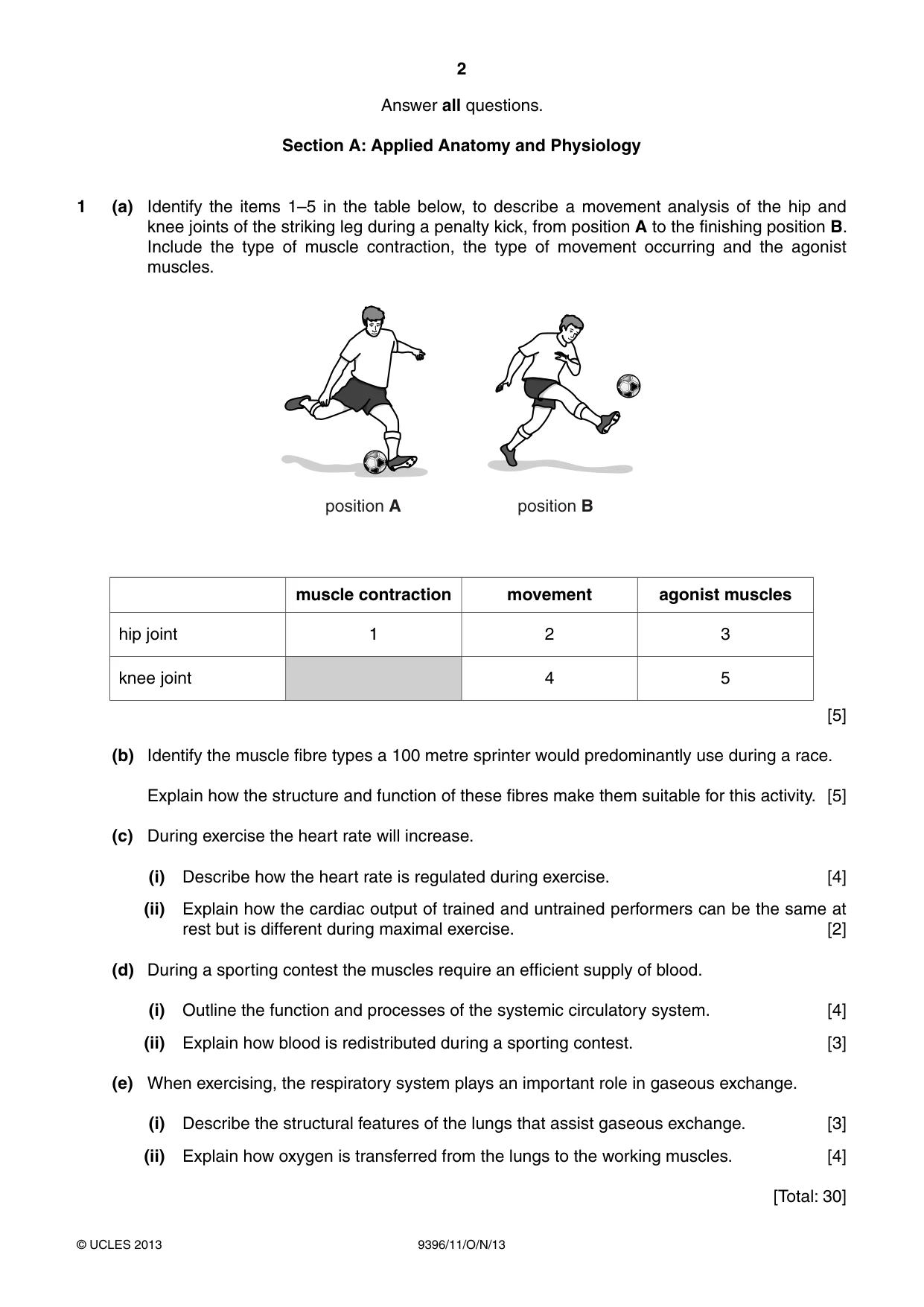
2 9396/11/O/N/13 © UCLES 2013 Answer all questions. Section A: Applied Anatomy and Physiology 1 (a) Identify the items 1–5 in the table below, to describe a movement analysis of the hip and knee joints of the striking leg during a penalty kick, from position A to the finishing position B. Include the type of muscle contraction, the type of movement occurring and the agonist muscles. position A position B muscle contraction movement agonist muscles hip joint 1 2 3 knee joint 4 5 [5] (b) Identify the muscle fibre types a 100 metre sprinter would predominantly use during a race. Explain how the structure and function of these fibres make them suitable for this activity. [5] (c) During exercise the heart rate will increase. (i) Describe how the heart rate is regulated during exercise. [4] (ii) Explain how the cardiac output of trained and untrained performers can be the same at rest but is different during maximal exercise. [2] (d) During a sporting contest the muscles require an efficient supply of blood. (i) Outline the function and processes of the systemic circulatory system. [4] (ii) Explain how blood is redistributed during a sporting contest. [3] (e) When exercising, the respiratory system plays an important role in gaseous exchange. (i) Describe the structural features of the lungs that assist gaseous exchange. [3] (ii) Explain how oxygen is transferred from the lungs to the working muscles. [4] [Total: 30]
Question paper, page 3
3 9396/11/O/N/13 © UCLES 2013 [Turn over Section B: Acquiring, Developing and Performing Movement Skills 2 (a) Skills are classified by placement on a continuum of characteristics. Using a practical example for each, explain the terms simple skill and complex skill. [4] (b) The memory plays an important part in acquiring and performing movement skills. Describe the basic model of the memory process when performing movement skills. [4] (c) Explain what is meant by closed loop control when performing movement skills. [4] (d) Movement skills can often take time to learn fully. Name and describe the three phases of learning movement skills. [3] (e) Explain how motor skill development is affected by early childhood experiences and environmental exposure. [4] (f) Motivation is often used in the learning and performance of movement skills. Describe how methods of motivation can be effective in the learning and performance of movement skills. [5] (g) The learning of skills can be seen as the strengthening of the S-R bond. Using a practical example, explain the term S-R bond and suggest how the S-R bond can be strengthened. [6] [Total: 30]
Question paper, page 4
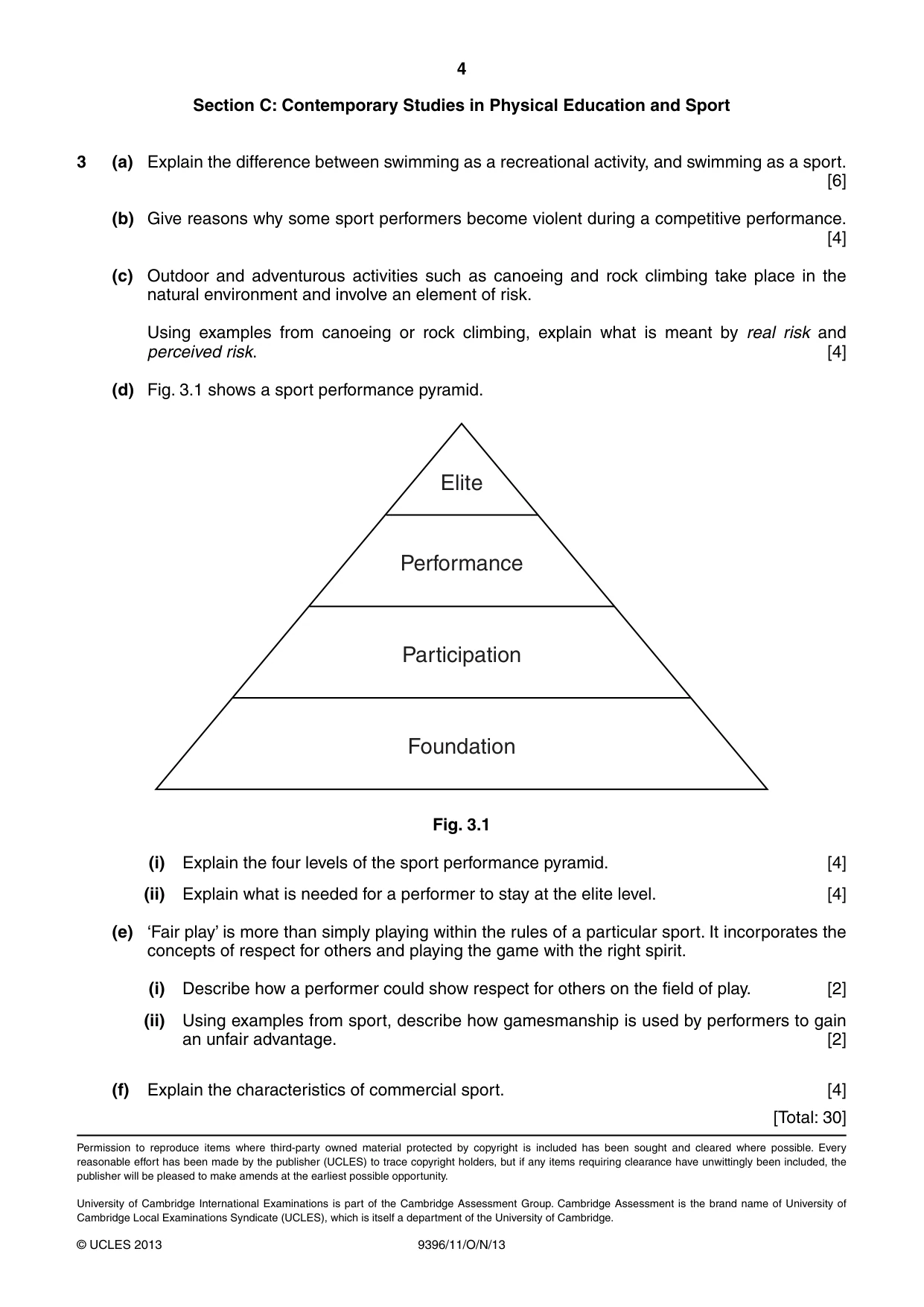
4 9396/11/O/N/13 © UCLES 2013 Section C: Contemporary Studies in Physical Education and Sport 3 (a) Explain the difference between swimming as a recreational activity, and swimming as a sport. [6] (b) Give reasons why some sport performers become violent during a competitive performance. [4] (c) Outdoor and adventurous activities such as canoeing and rock climbing take place in the natural environment and involve an element of risk. Using examples from canoeing or rock climbing, explain what is meant by real risk and perceived risk. [4] (d) Fig. 3.1 shows a sport performance pyramid. Elite Performance Participation Foundation Fig. 3.1 (i) Explain the four levels of the sport performance pyramid. [4] (ii) Explain what is needed for a performer to stay at the elite level. [4] (e) ‘Fair play’ is more than simply playing within the rules of a particular sport. It incorporates the concepts of respect for others and playing the game with the right spirit. (i) Describe how a performer could show respect for others on the field of play. [2] (ii) Using examples from sport, describe how gamesmanship is used by performers to gain an unfair advantage. [2] (f) Explain the characteristics of commercial sport. [4] [Total: 30] Permission to reproduce items where third-party owned material protected by copyright is included has been sought and cleared where possible. Every reasonable effort has been made by the publisher (UCLES) to trace copyright holders, but if any items requiring clearance have unwittingly been included, the publisher will be pleased to make amends at the earliest possible opportunity. University of Cambridge International Examinations is part of the Cambridge Assessment Group. Cambridge Assessment is the brand name of University of Cambridge Local Examinations Syndicate (UCLES), which is itself a department of the University of Cambridge.
Mark scheme, page 1
CAMBRIDGE INTERNATIONAL EXAMINATIONS GCE Advanced Subsidiary Level MARK SCHEME for the October/November 2013 series 9396 PHYSICAL EDUCATION 9396/11 Paper 1 (Theory), maximum raw mark 90 This mark scheme is published as an aid to teachers and candidates, to indicate the requirements of the examination. It shows the basis on which Examiners were instructed to award marks. It does not indicate the details of the discussions that took place at an Examiners’ meeting before marking began, which would have considered the acceptability of alternative answers. Mark schemes should be read in conjunction with the question paper and the Principal Examiner Report for Teachers. Cambridge will not enter into discussions about these mark schemes. Cambridge is publishing the mark schemes for the October/November 2013 series for most IGCSE, GCE Advanced Level and Advanced Subsidiary Level components and some Ordinary Level components.
Mark scheme, page 2
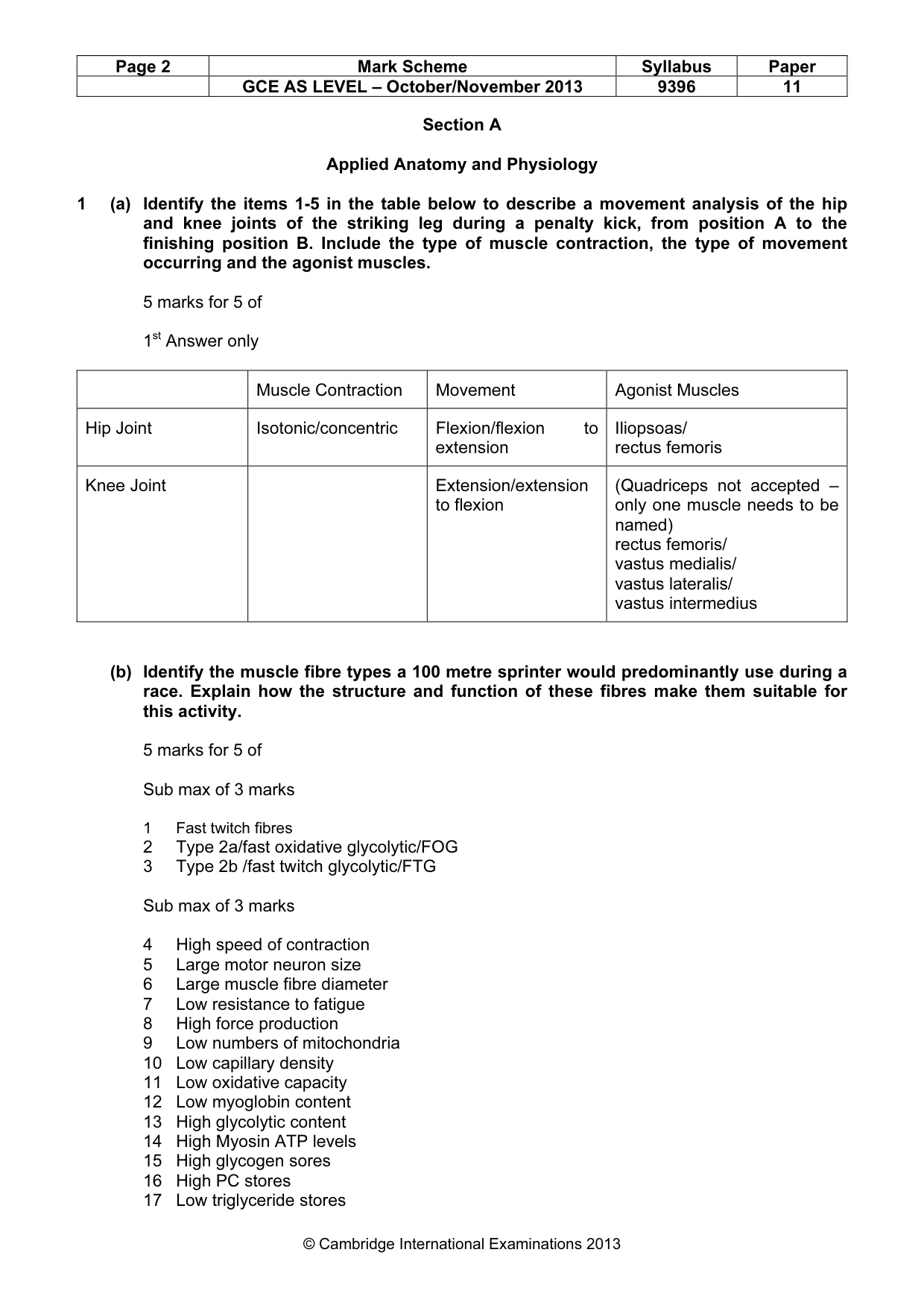
Page 2 Mark Scheme Syllabus Paper GCE AS LEVEL – October/November 2013 9396 11 © Cambridge International Examinations 2013 Section A Applied Anatomy and Physiology 1 (a) Identify the items 1-5 in the table below to describe a movement analysis of the hip and knee joints of the striking leg during a penalty kick, from position A to the finishing position B. Include the type of muscle contraction, the type of movement occurring and the agonist muscles. 5 marks for 5 of 1st Answer only Muscle Contraction Movement Agonist Muscles Hip Joint Isotonic/concentric Flexion/flexion to extension Iliopsoas/ rectus femoris Knee Joint Extension/extension to flexion (Quadriceps not accepted – only one muscle needs to be named) rectus femoris/ vastus medialis/ vastus lateralis/ vastus intermedius (b) Identify the muscle fibre types a 100 metre sprinter would predominantly use during a race. Explain how the structure and function of these fibres make them suitable for this activity. 5 marks for 5 of Sub max of 3 marks 1 Fast twitch fibres 2 Type 2a/fast oxidative glycolytic/FOG 3 Type 2b /fast twitch glycolytic/FTG Sub max of 3 marks 4 High speed of contraction 5 Large motor neuron size 6 Large muscle fibre diameter 7 Low resistance to fatigue 8 High force production 9 Low numbers of mitochondria 10 Low capillary density 11 Low oxidative capacity 12 Low myoglobin content 13 High glycolytic content 14 High Myosin ATP levels 15 High glycogen sores 16 High PC stores 17 Low triglyceride stores
Mark scheme, page 3
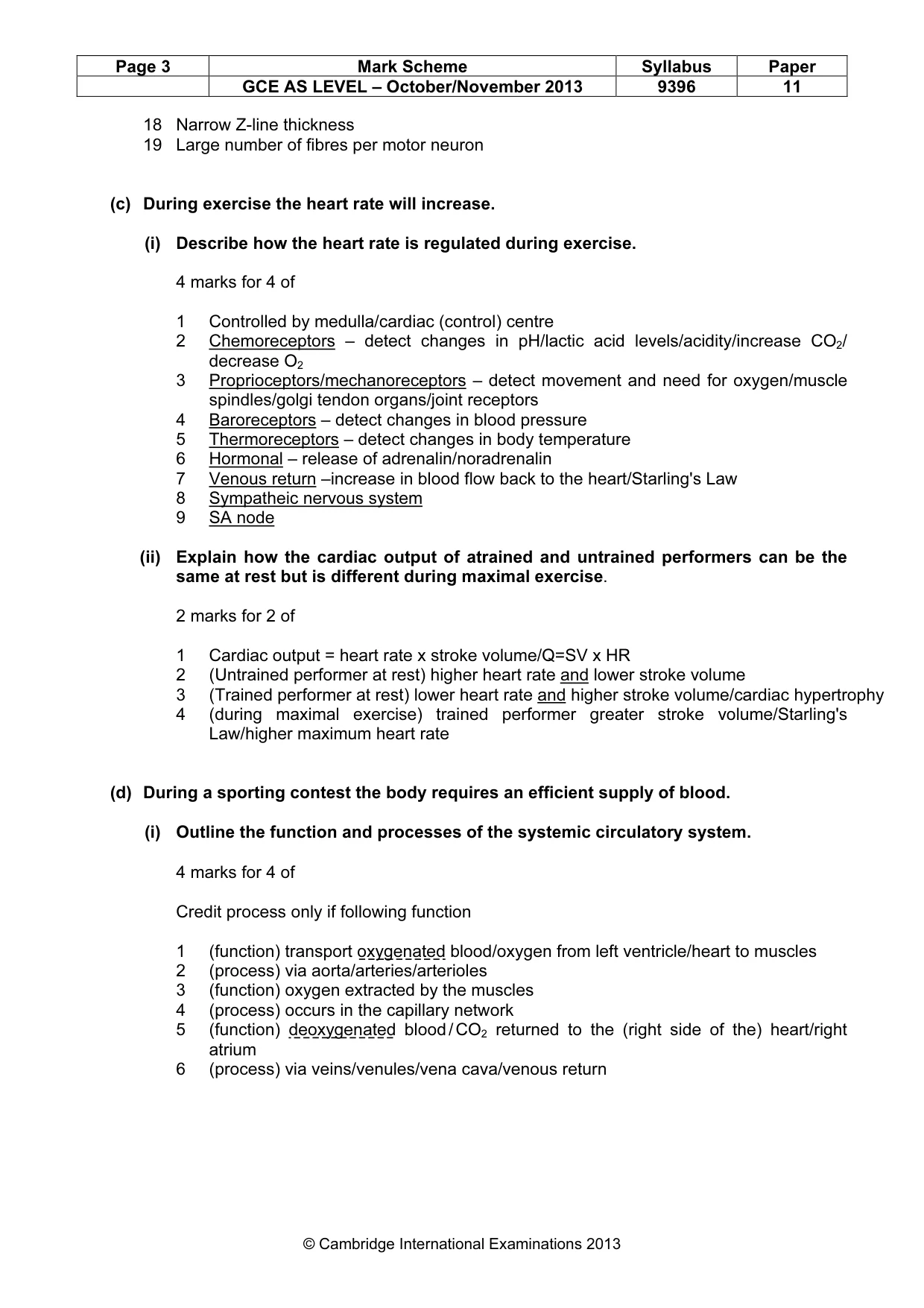
Page 3 Mark Scheme Syllabus Paper GCE AS LEVEL – October/November 2013 9396 11 © Cambridge International Examinations 2013 18 Narrow Z-line thickness 19 Large number of fibres per motor neuron (c) During exercise the heart rate will increase. (i) Describe how the heart rate is regulated during exercise. 4 marks for 4 of 1 Controlled by medulla/cardiac (control) centre 2 Chemoreceptors – detect changes in pH/lactic acid levels/acidity/increase CO2/ decrease O2 3 Proprioceptors/mechanoreceptors – detect movement and need for oxygen/muscle spindles/golgi tendon organs/joint receptors 4 Baroreceptors – detect changes in blood pressure 5 Thermoreceptors – detect changes in body temperature 6 Hormonal – release of adrenalin/noradrenalin 7 Venous return –increase in blood flow back to the heart/Starling's Law 8 Sympatheic nervous system 9 SA node (ii) Explain how the cardiac output of atrained and untrained performers can be the same at rest but is different during maximal exercise. 2 marks for 2 of 1 Cardiac output = heart rate x stroke volume/Q=SV x HR 2 (Untrained performer at rest) higher heart rate and lower stroke volume 3 (Trained performer at rest) lower heart rate and higher stroke volume/cardiac hypertrophy 4 (during maximal exercise) trained performer greater stroke volume/Starling's Law/higher maximum heart rate (d) During a sporting contest the body requires an efficient supply of blood. (i) Outline the function and processes of the systemic circulatory system. 4 marks for 4 of Credit process only if following function 1 (function) transport oxygenated blood/oxygen from left ventricle/heart to muscles 2 (process) via aorta/arteries/arterioles 3 (function) oxygen extracted by the muscles 4 (process) occurs in the capillary network 5 (function) deoxygenated blood / CO2 returned to the (right side of the) heart/right atrium 6 (process) via veins/venules/vena cava/venous return
Mark scheme, page 4
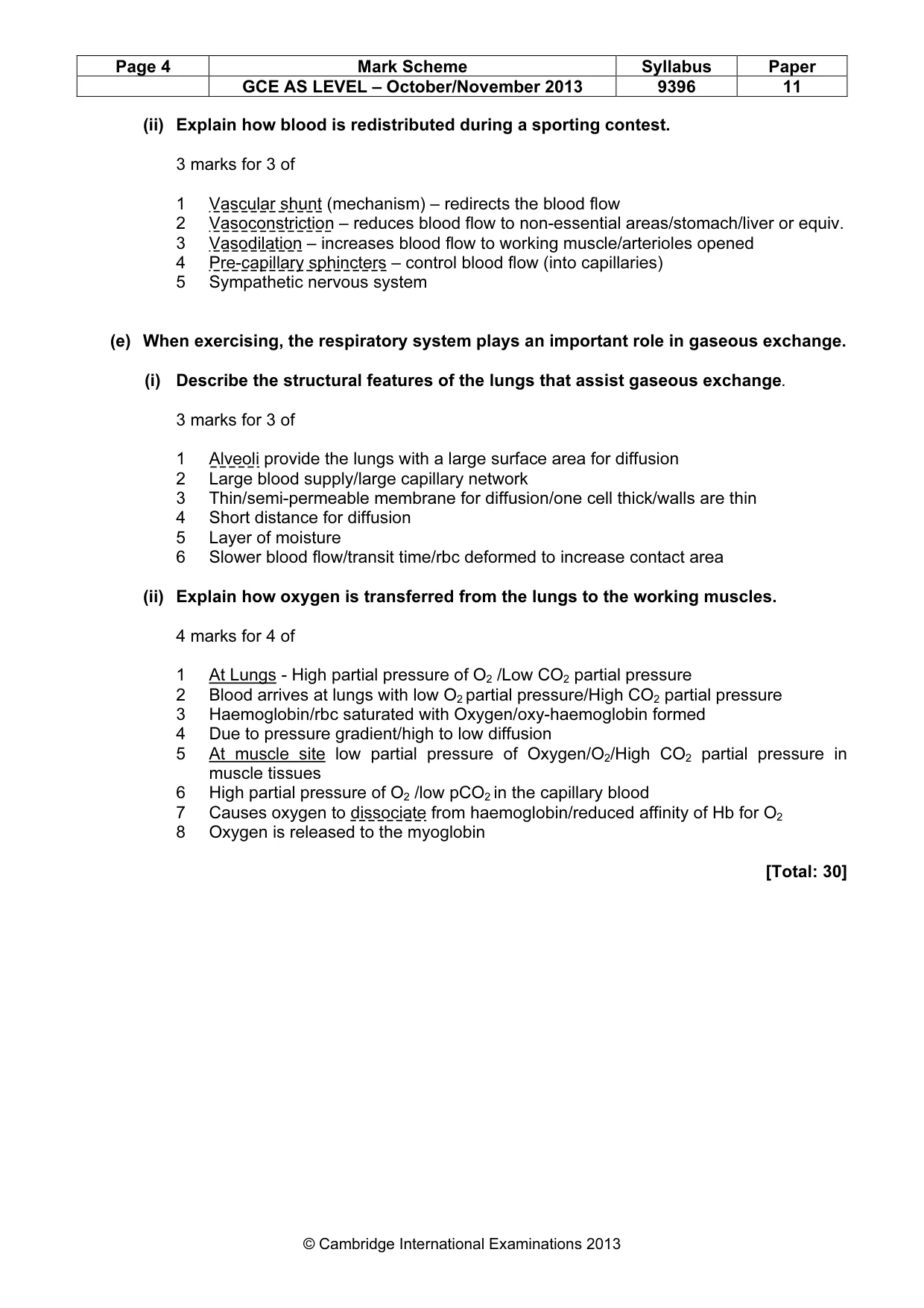
Page 4 Mark Scheme Syllabus Paper GCE AS LEVEL – October/November 2013 9396 11 © Cambridge International Examinations 2013 (ii) Explain how blood is redistributed during a sporting contest. 3 marks for 3 of 1 Vascular shunt (mechanism) – redirects the blood flow 2 Vasoconstriction – reduces blood flow to non-essential areas/stomach/liver or equiv. 3 Vasodilation – increases blood flow to working muscle/arterioles opened 4 Pre-capillary sphincters – control blood flow (into capillaries) 5 Sympathetic nervous system (e) When exercising, the respiratory system plays an important role in gaseous exchange. (i) Describe the structural features of the lungs that assist gaseous exchange. 3 marks for 3 of 1 Alveoli provide the lungs with a large surface area for diffusion 2 Large blood supply/large capillary network 3 Thin/semi-permeable membrane for diffusion/one cell thick/walls are thin 4 Short distance for diffusion 5 Layer of moisture 6 Slower blood flow/transit time/rbc deformed to increase contact area (ii) Explain how oxygen is transferred from the lungs to the working muscles. 4 marks for 4 of 1 At Lungs - High partial pressure of O2 /Low CO2 partial pressure 2 Blood arrives at lungs with low O2 partial pressure/High CO2 partial pressure 3 Haemoglobin/rbc saturated with Oxygen/oxy-haemoglobin formed 4 Due to pressure gradient/high to low diffusion 5 At muscle site low partial pressure of Oxygen/O2/High CO2 partial pressure in muscle tissues 6 High partial pressure of O2 /low pCO2 in the capillary blood 7 Causes oxygen to dissociate from haemoglobin/reduced affinity of Hb for O2 8 Oxygen is released to the myoglobin [Total: 30]
Mark scheme, page 5
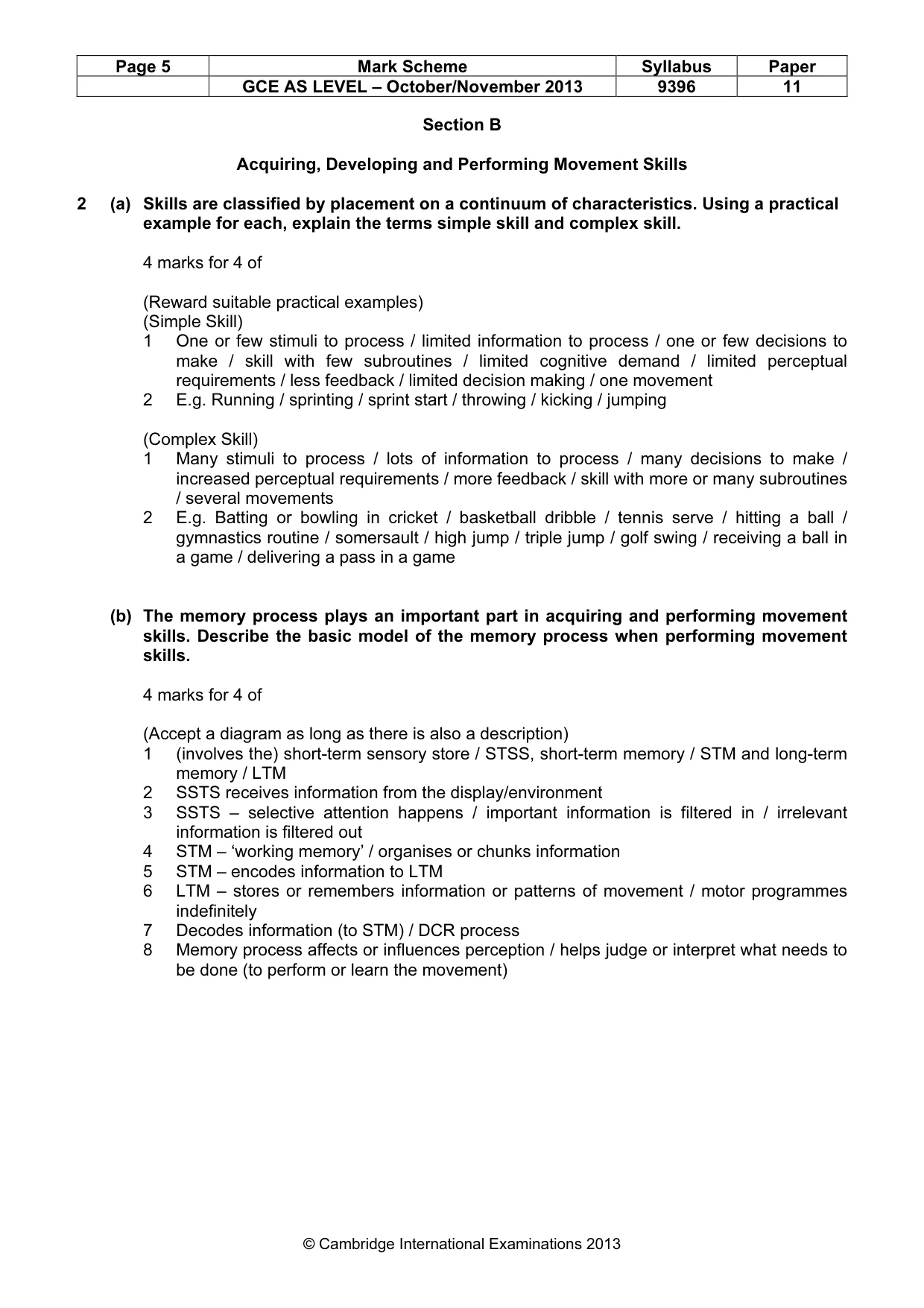
Page 5 Mark Scheme Syllabus Paper GCE AS LEVEL – October/November 2013 9396 11 © Cambridge International Examinations 2013 Section B Acquiring, Developing and Performing Movement Skills 2 (a) Skills are classified by placement on a continuum of characteristics. Using a practical example for each, explain the terms simple skill and complex skill. 4 marks for 4 of (Reward suitable practical examples) (Simple Skill) 1 One or few stimuli to process / limited information to process / one or few decisions to make / skill with few subroutines / limited cognitive demand / limited perceptual requirements / less feedback / limited decision making / one movement 2 E.g. Running / sprinting / sprint start / throwing / kicking / jumping (Complex Skill) 1 Many stimuli to process / lots of information to process / many decisions to make / increased perceptual requirements / more feedback / skill with more or many subroutines / several movements 2 E.g. Batting or bowling in cricket / basketball dribble / tennis serve / hitting a ball / gymnastics routine / somersault / high jump / triple jump / golf swing / receiving a ball in a game / delivering a pass in a game (b) The memory process plays an important part in acquiring and performing movement skills. Describe the basic model of the memory process when performing movement skills. 4 marks for 4 of (Accept a diagram as long as there is also a description) 1 (involves the) short-term sensory store / STSS, short-term memory / STM and long-term memory / LTM 2 SSTS receives information from the display/environment 3 SSTS – selective attention happens / important information is filtered in / irrelevant information is filtered out 4 STM – ‘working memory’ / organises or chunks information 5 STM – encodes information to LTM 6 LTM – stores or remembers information or patterns of movement / motor programmes indefinitely 7 Decodes information (to STM) / DCR process 8 Memory process affects or influences perception / helps judge or interpret what needs to be done (to perform or learn the movement)
Mark scheme, page 6
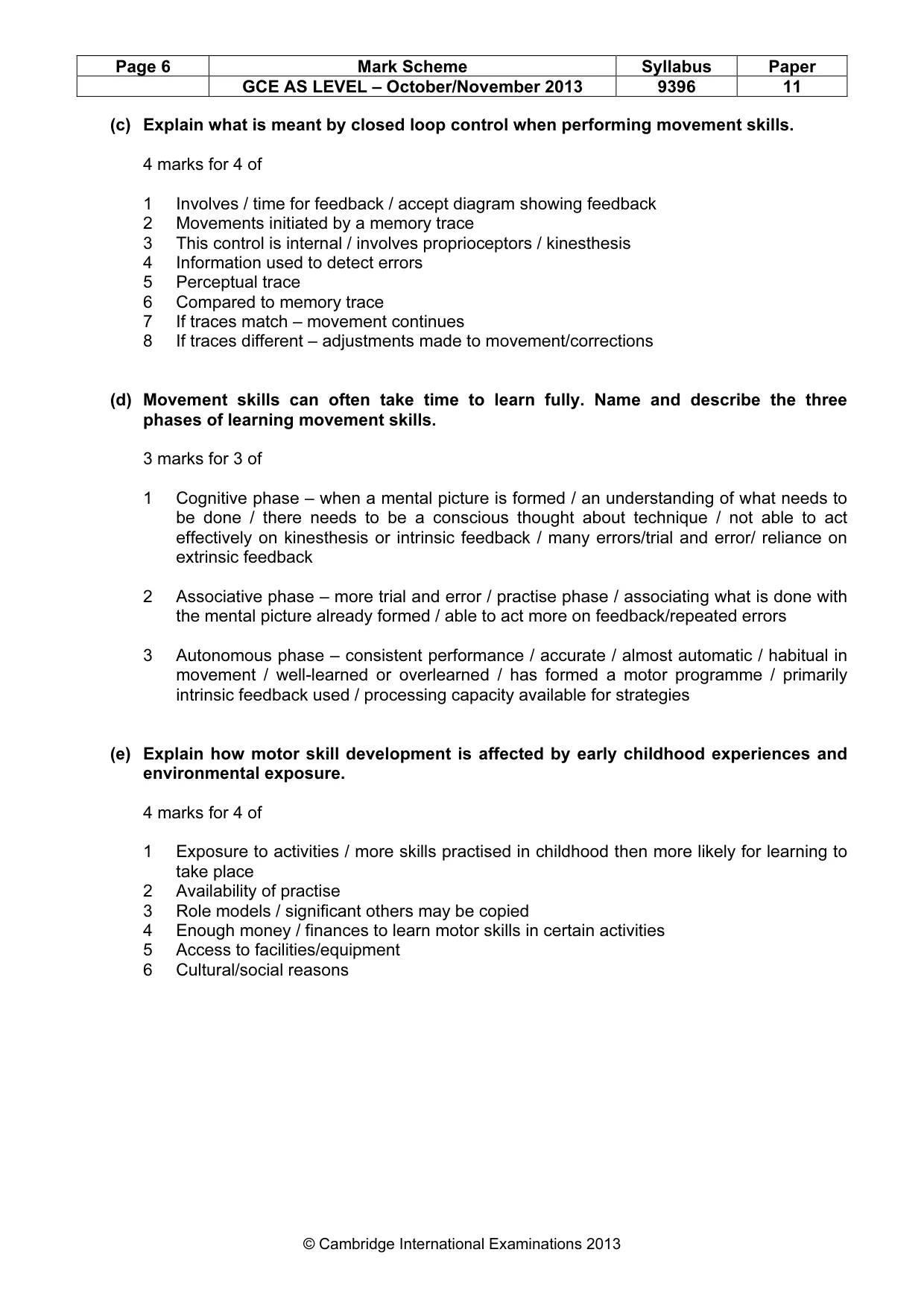
Page 6 Mark Scheme Syllabus Paper GCE AS LEVEL – October/November 2013 9396 11 © Cambridge International Examinations 2013 (c) Explain what is meant by closed loop control when performing movement skills. 4 marks for 4 of 1 Involves / time for feedback / accept diagram showing feedback 2 Movements initiated by a memory trace 3 This control is internal / involves proprioceptors / kinesthesis 4 Information used to detect errors 5 Perceptual trace 6 Compared to memory trace 7 If traces match – movement continues 8 If traces different – adjustments made to movement/corrections (d) Movement skills can often take time to learn fully. Name and describe the three phases of learning movement skills. 3 marks for 3 of 1 Cognitive phase – when a mental picture is formed / an understanding of what needs to be done / there needs to be a conscious thought about technique / not able to act effectively on kinesthesis or intrinsic feedback / many errors/trial and error/ reliance on extrinsic feedback 2 Associative phase – more trial and error / practise phase / associating what is done with the mental picture already formed / able to act more on feedback/repeated errors 3 Autonomous phase – consistent performance / accurate / almost automatic / habitual in movement / well-learned or overlearned / has formed a motor programme / primarily intrinsic feedback used / processing capacity available for strategies (e) Explain how motor skill development is affected by early childhood experiences and environmental exposure. 4 marks for 4 of 1 Exposure to activities / more skills practised in childhood then more likely for learning to take place 2 Availability of practise 3 Role models / significant others may be copied 4 Enough money / finances to learn motor skills in certain activities 5 Access to facilities/equipment 6 Cultural/social reasons
Mark scheme, page 7
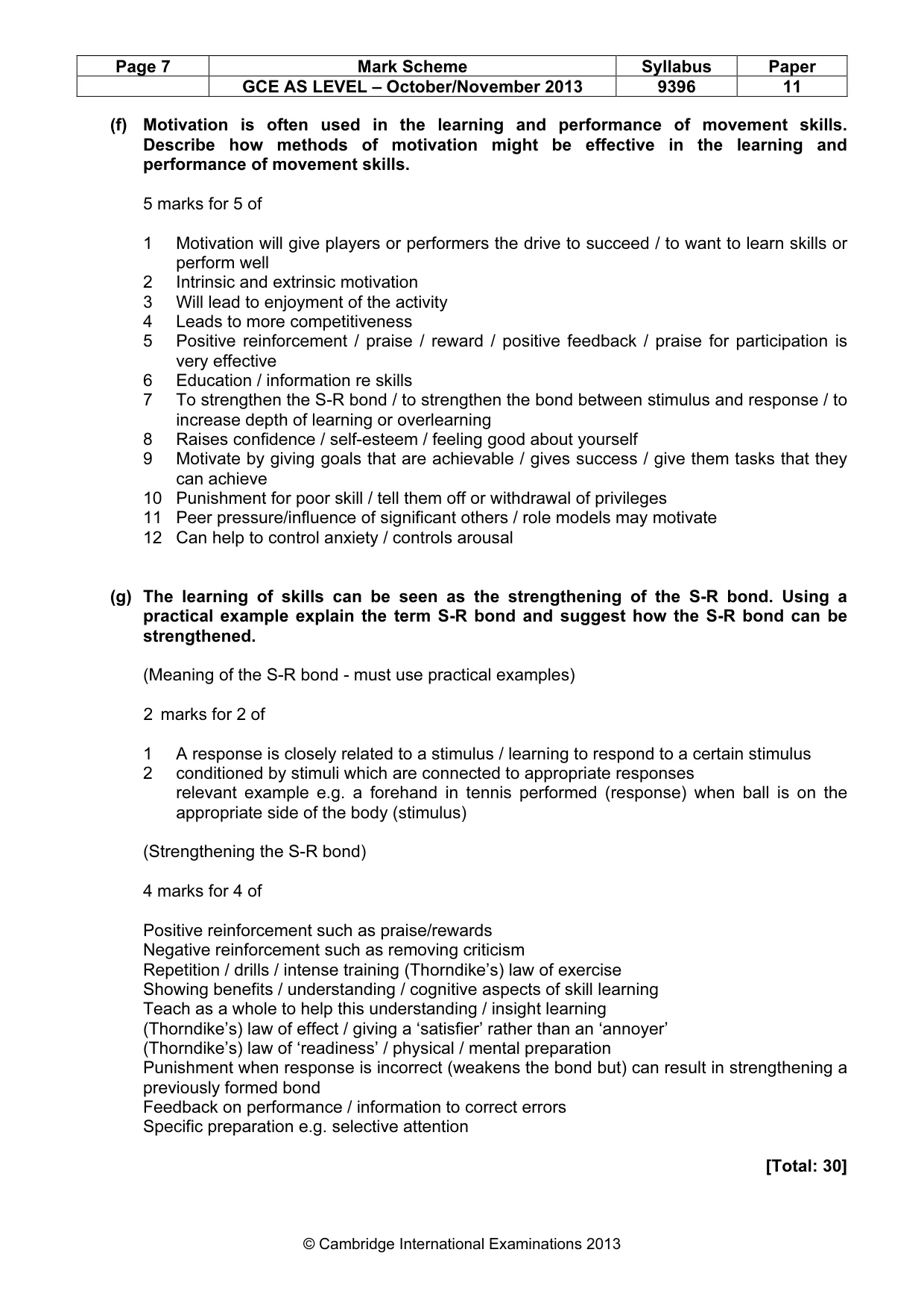
Page 7 Mark Scheme Syllabus Paper GCE AS LEVEL – October/November 2013 9396 11 © Cambridge International Examinations 2013 (f) Motivation is often used in the learning and performance of movement skills. Describe how methods of motivation might be effective in the learning and performance of movement skills. 5 marks for 5 of 1 Motivation will give players or performers the drive to succeed / to want to learn skills or perform well 2 Intrinsic and extrinsic motivation 3 Will lead to enjoyment of the activity 4 Leads to more competitiveness 5 Positive reinforcement / praise / reward / positive feedback / praise for participation is very effective 6 Education / information re skills 7 To strengthen the S-R bond / to strengthen the bond between stimulus and response / to increase depth of learning or overlearning 8 Raises confidence / self-esteem / feeling good about yourself 9 Motivate by giving goals that are achievable / gives success / give them tasks that they can achieve 10 Punishment for poor skill / tell them off or withdrawal of privileges 11 Peer pressure/influence of significant others / role models may motivate 12 Can help to control anxiety / controls arousal (g) The learning of skills can be seen as the strengthening of the S-R bond. Using a practical example explain the term S-R bond and suggest how the S-R bond can be strengthened. (Meaning of the S-R bond - must use practical examples) 2 marks for 2 of 1 A response is closely related to a stimulus / learning to respond to a certain stimulus 2 conditioned by stimuli which are connected to appropriate responses relevant example e.g. a forehand in tennis performed (response) when ball is on the appropriate side of the body (stimulus) (Strengthening the S-R bond) 4 marks for 4 of Positive reinforcement such as praise/rewards Negative reinforcement such as removing criticism Repetition / drills / intense training (Thorndike’s) law of exercise Showing benefits / understanding / cognitive aspects of skill learning Teach as a whole to help this understanding / insight learning (Thorndike’s) law of effect / giving a ‘satisfier’ rather than an ‘annoyer’ (Thorndike’s) law of ‘readiness’ / physical / mental preparation Punishment when response is incorrect (weakens the bond but) can result in strengthening a previously formed bond Feedback on performance / information to correct errors Specific preparation e.g. selective attention [Total: 30]
Mark scheme, page 8
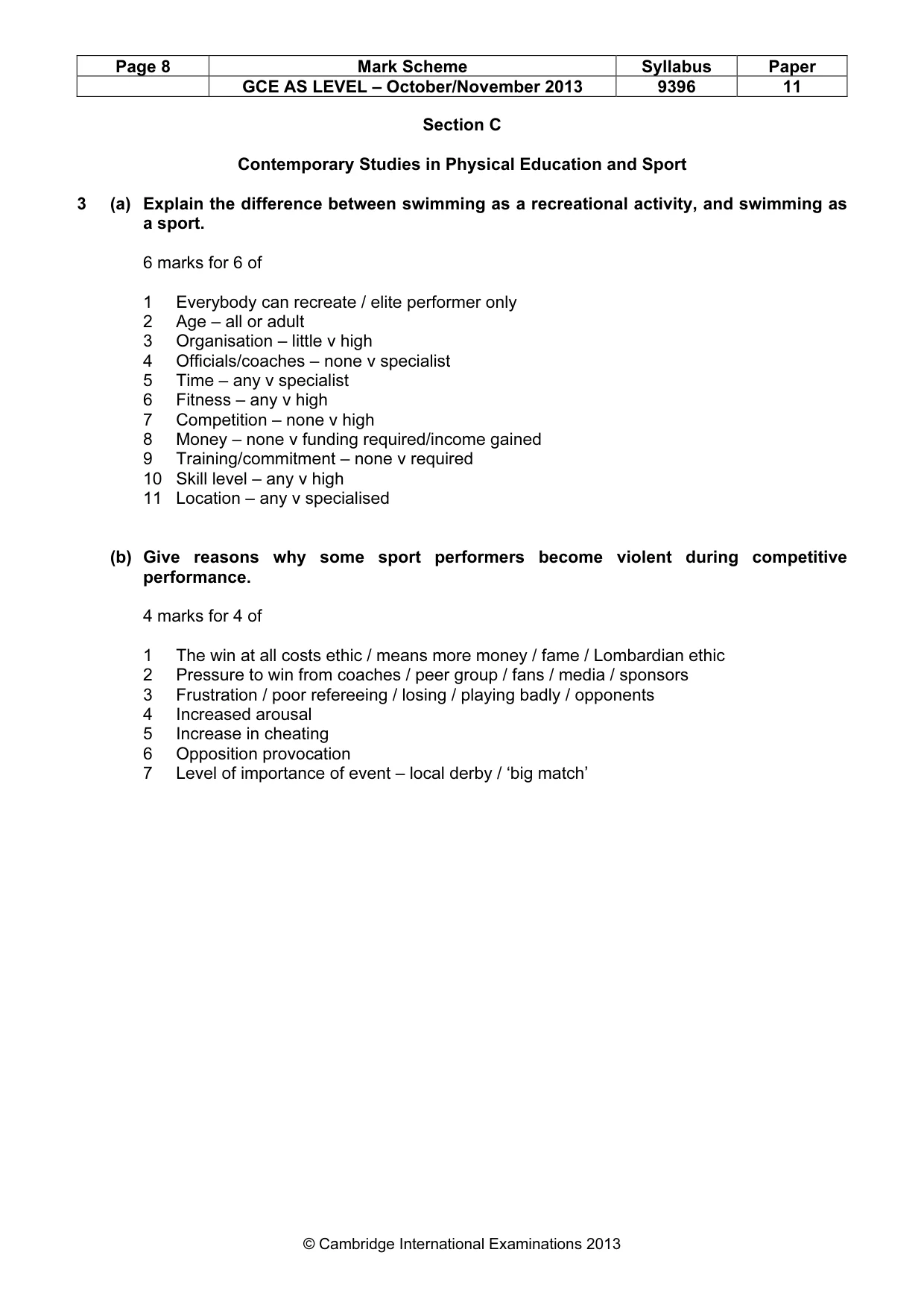
Page 8 Mark Scheme Syllabus Paper GCE AS LEVEL – October/November 2013 9396 11 © Cambridge International Examinations 2013 Section C Contemporary Studies in Physical Education and Sport 3 (a) Explain the difference between swimming as a recreational activity, and swimming as a sport. 6 marks for 6 of 1 Everybody can recreate / elite performer only 2 Age – all or adult 3 Organisation – little v high 4 Officials/coaches – none v specialist 5 Time – any v specialist 6 Fitness – any v high 7 Competition – none v high 8 Money – none v funding required/income gained 9 Training/commitment – none v required 10 Skill level – any v high 11 Location – any v specialised (b) Give reasons why some sport performers become violent during competitive performance. 4 marks for 4 of 1 The win at all costs ethic / means more money / fame / Lombardian ethic 2 Pressure to win from coaches / peer group / fans / media / sponsors 3 Frustration / poor refereeing / losing / playing badly / opponents 4 Increased arousal 5 Increase in cheating 6 Opposition provocation 7 Level of importance of event – local derby / ‘big match’
Mark scheme, page 9
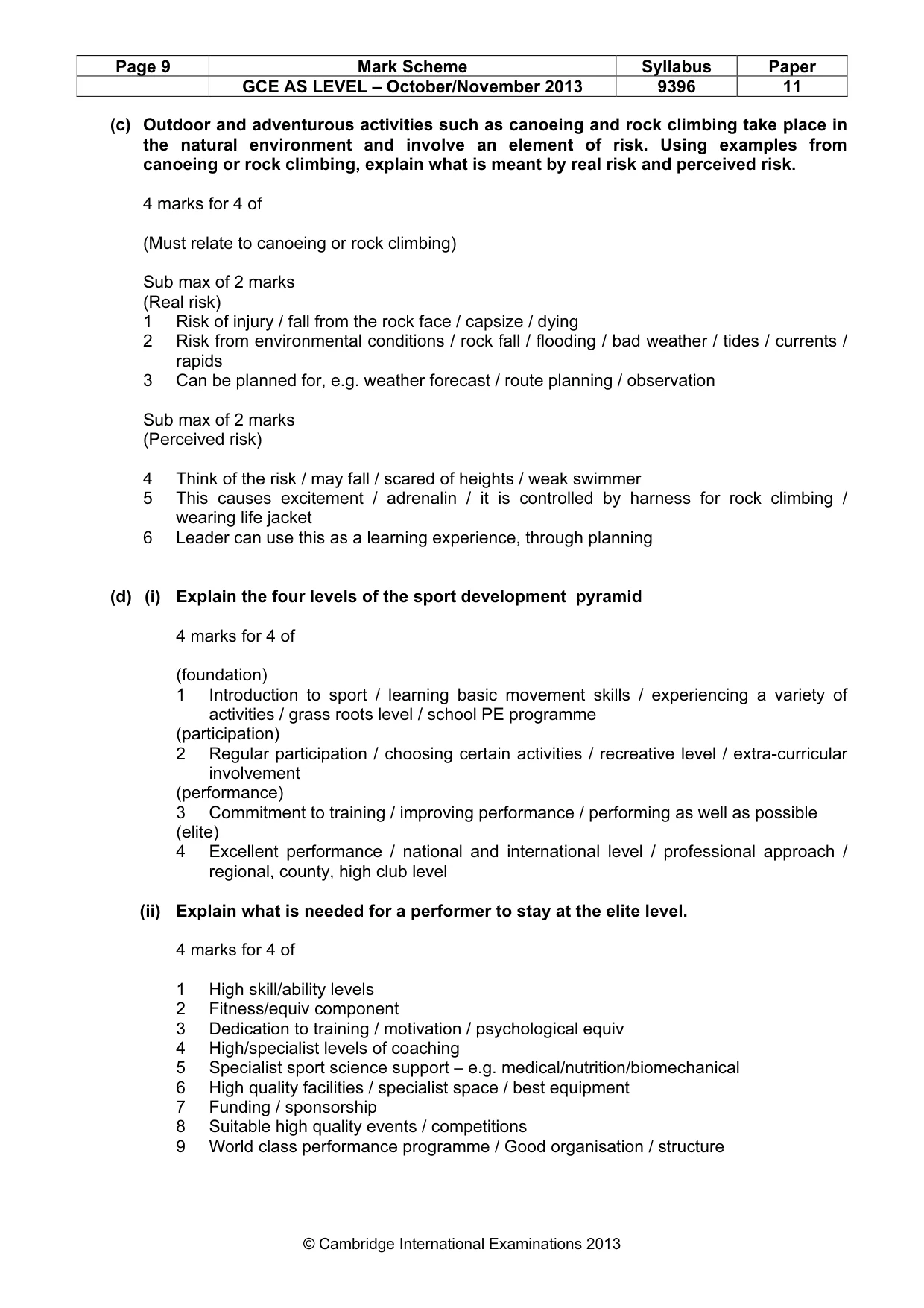
Page 9 Mark Scheme Syllabus Paper GCE AS LEVEL – October/November 2013 9396 11 © Cambridge International Examinations 2013 (c) Outdoor and adventurous activities such as canoeing and rock climbing take place in the natural environment and involve an element of risk. Using examples from canoeing or rock climbing, explain what is meant by real risk and perceived risk. 4 marks for 4 of (Must relate to canoeing or rock climbing) Sub max of 2 marks (Real risk) 1 Risk of injury / fall from the rock face / capsize / dying 2 Risk from environmental conditions / rock fall / flooding / bad weather / tides / currents / rapids 3 Can be planned for, e.g. weather forecast / route planning / observation Sub max of 2 marks (Perceived risk) 4 Think of the risk / may fall / scared of heights / weak swimmer 5 This causes excitement / adrenalin / it is controlled by harness for rock climbing / wearing life jacket 6 Leader can use this as a learning experience, through planning (d) (i) Explain the four levels of the sport development pyramid 4 marks for 4 of (foundation) 1 Introduction to sport / learning basic movement skills / experiencing a variety of activities / grass roots level / school PE programme (participation) 2 Regular participation / choosing certain activities / recreative level / extra-curricular involvement (performance) 3 Commitment to training / improving performance / performing as well as possible (elite) 4 Excellent performance / national and international level / professional approach / regional, county, high club level (ii) Explain what is needed for a performer to stay at the elite level. 4 marks for 4 of 1 High skill/ability levels 2 Fitness/equiv component 3 Dedication to training / motivation / psychological equiv 4 High/specialist levels of coaching 5 Specialist sport science support – e.g. medical/nutrition/biomechanical 6 High quality facilities / specialist space / best equipment 7 Funding / sponsorship 8 Suitable high quality events / competitions 9 World class performance programme / Good organisation / structure
Mark scheme, page 10
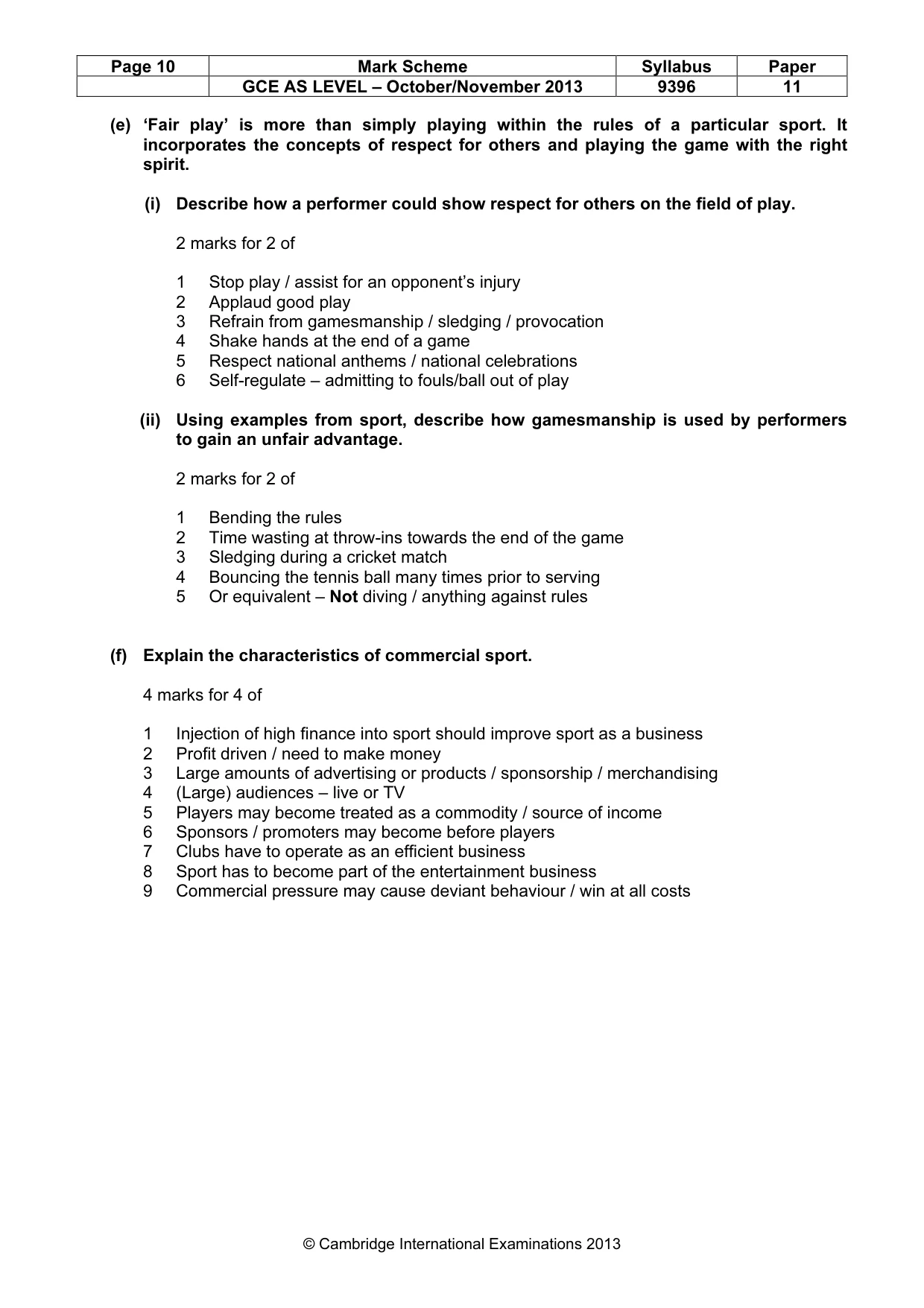
Page 10 Mark Scheme Syllabus Paper GCE AS LEVEL – October/November 2013 9396 11 © Cambridge International Examinations 2013 (e) ‘Fair play’ is more than simply playing within the rules of a particular sport. It incorporates the concepts of respect for others and playing the game with the right spirit. (i) Describe how a performer could show respect for others on the field of play. 2 marks for 2 of 1 Stop play / assist for an opponent’s injury 2 Applaud good play 3 Refrain from gamesmanship / sledging / provocation 4 Shake hands at the end of a game 5 Respect national anthems / national celebrations 6 Self-regulate – admitting to fouls/ball out of play (ii) Using examples from sport, describe how gamesmanship is used by performers to gain an unfair advantage. 2 marks for 2 of 1 Bending the rules 2 Time wasting at throw-ins towards the end of the game 3 Sledging during a cricket match 4 Bouncing the tennis ball many times prior to serving 5 Or equivalent – Not diving / anything against rules (f) Explain the characteristics of commercial sport. 4 marks for 4 of 1 Injection of high finance into sport should improve sport as a business 2 Profit driven / need to make money 3 Large amounts of advertising or products / sponsorship / merchandising 4 (Large) audiences – live or TV 5 Players may become treated as a commodity / source of income 6 Sponsors / promoters may become before players 7 Clubs have to operate as an efficient business 8 Sport has to become part of the entertainment business 9 Commercial pressure may cause deviant behaviour / win at all costs
What you needed in this session
Cambridge’s own grade thresholds for 2013 Oct/Nov, Paper 1 · Variant 1. A higher threshold means an easier paper — the bar moves with how the cohort did.