Cambridge A Level Physical Education 9396 — 2011 Oct/Nov Paper 3 · Variant 2
9396/32/O/N/11 · 90 marks · ≈101 min
The question paper and its mark scheme, free to read here and free to download. This is Cambridge’s own paper, exactly as it was sat.
Question paper4 pages
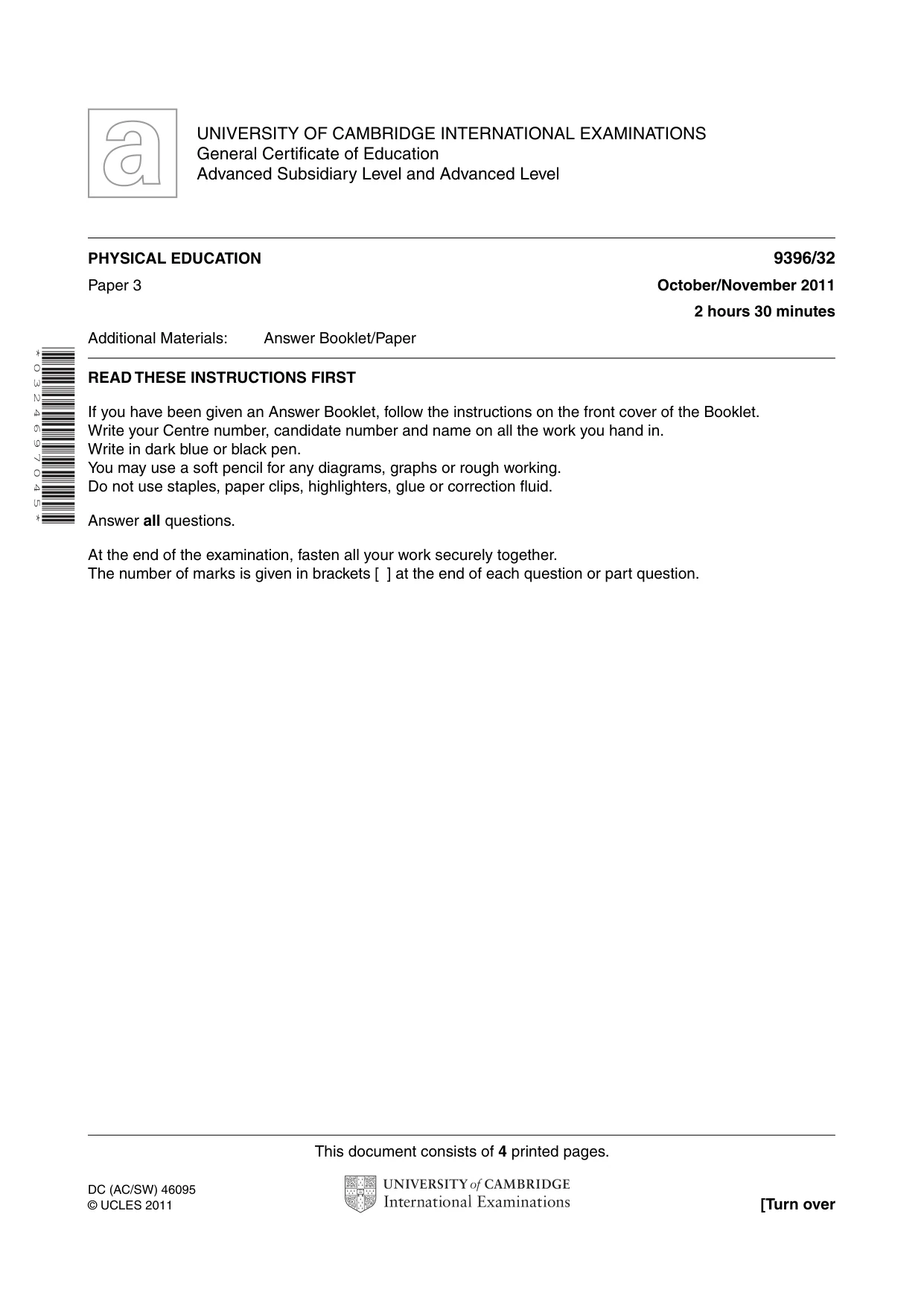
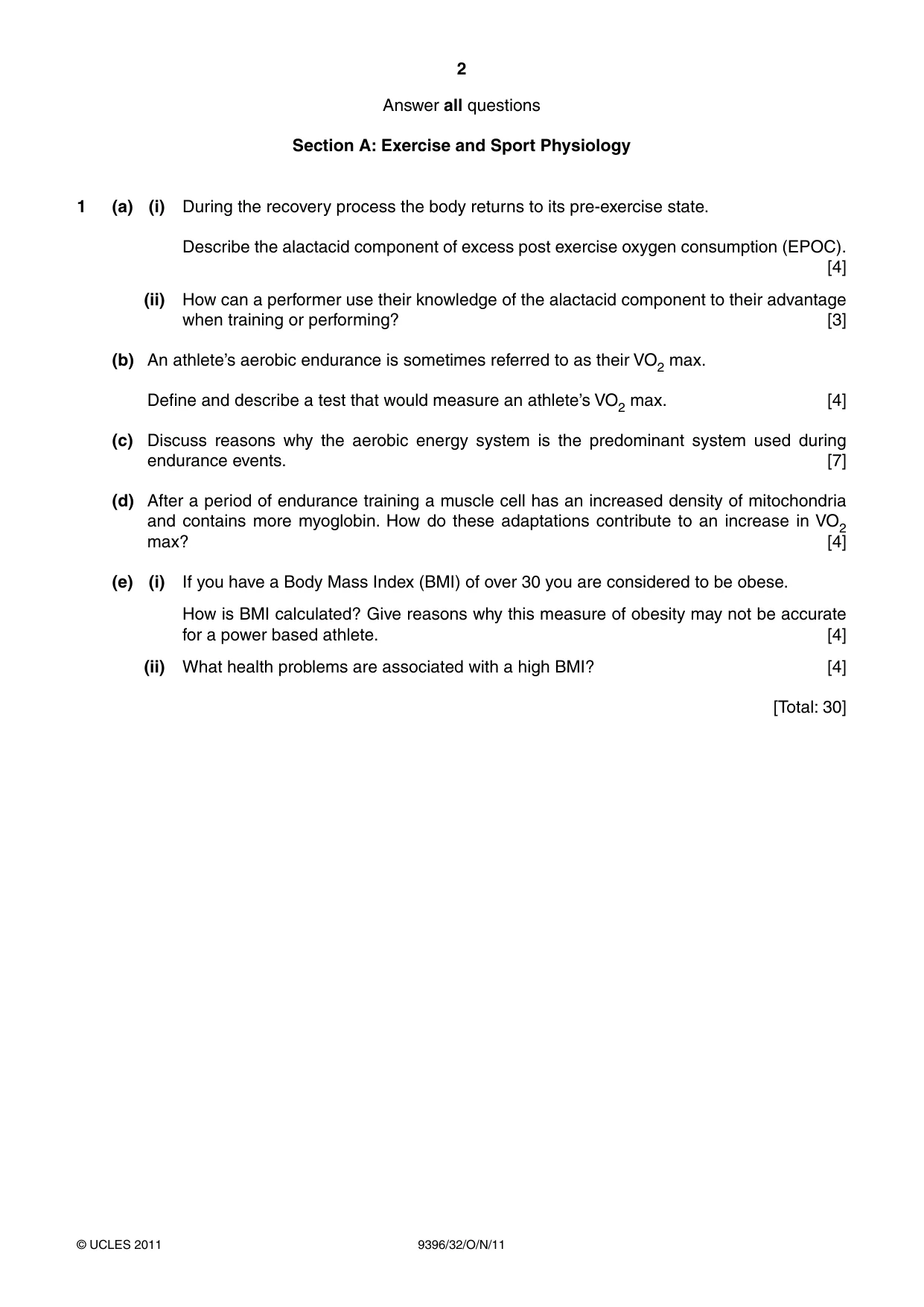
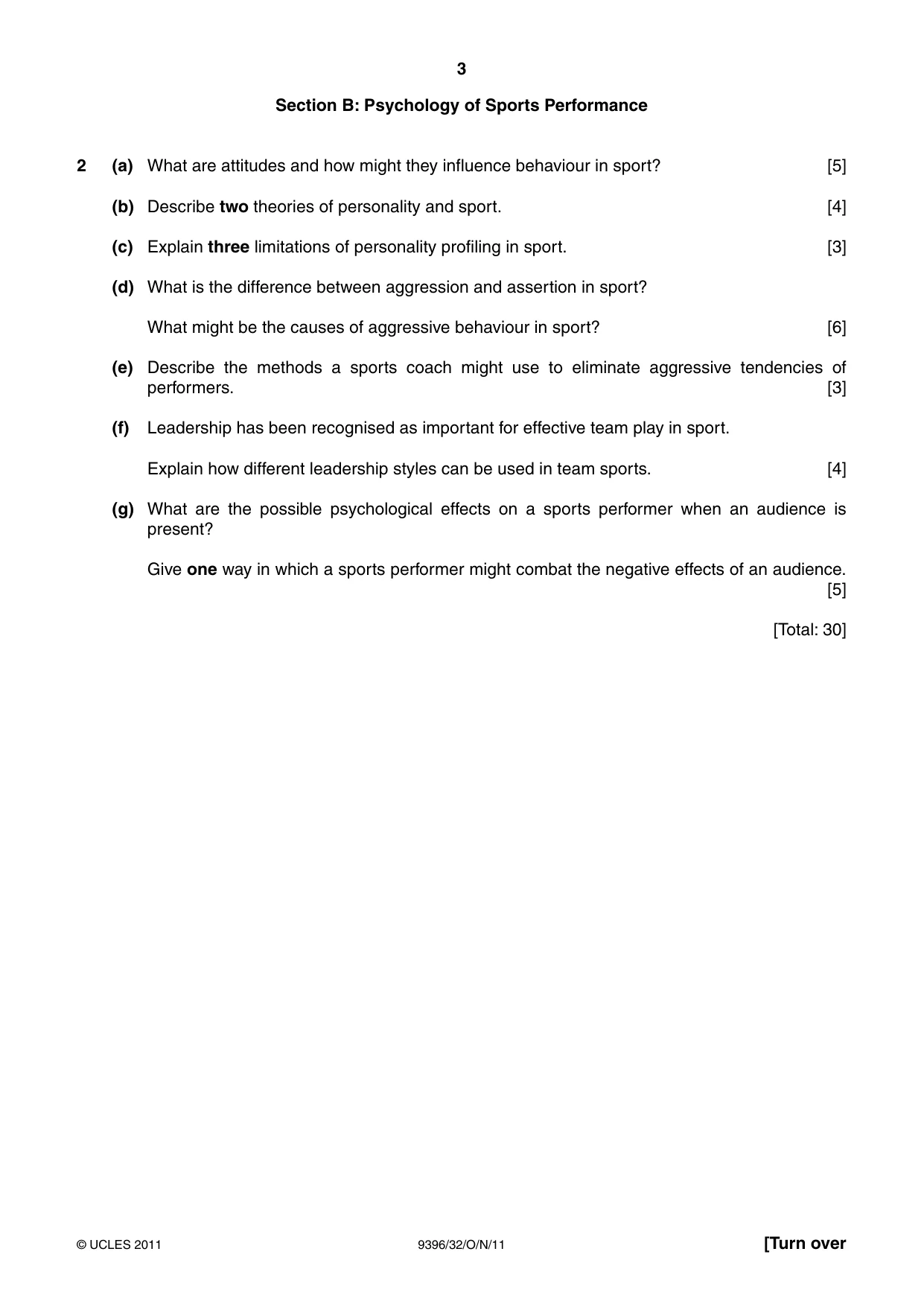
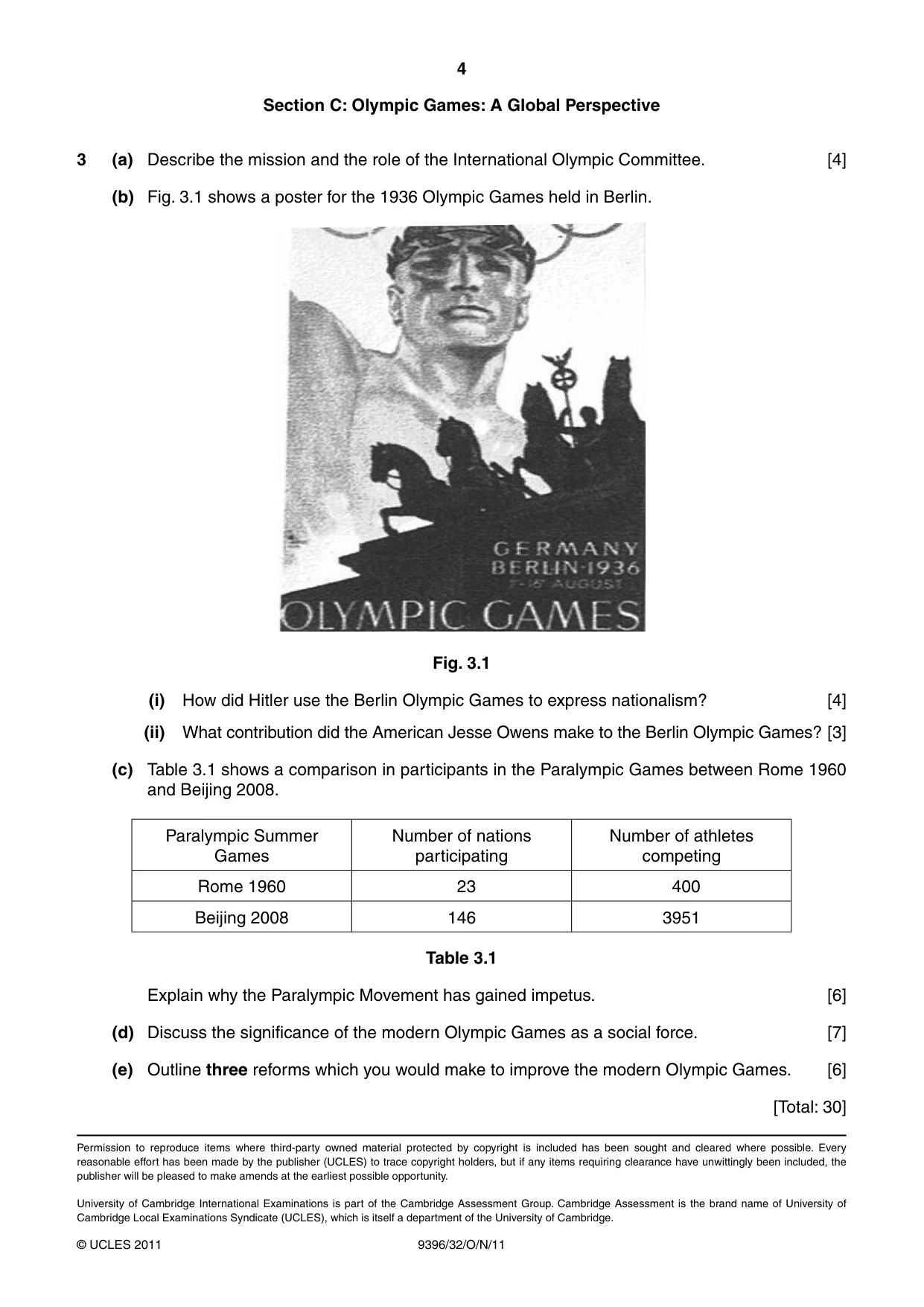
Mark scheme11 pages
Answers below. Sit the paper first if you are practising.
Paper as text
Question paper, page 1
This document consists of 4 printed pages. DC (AC/SW) 46095 © UCLES 2011 [Turn over UNIVERSITY OF CAMBRIDGE INTERNATIONAL EXAMINATIONS General Certificate of Education Advanced Subsidiary Level and Advanced Level READ THESE INSTRUCTIONS FIRST If you have been given an Answer Booklet, follow the instructions on the front cover of the Booklet. Write your Centre number, candidate number and name on all the work you hand in. Write in dark blue or black pen. You may use a soft pencil for any diagrams, graphs or rough working. Do not use staples, paper clips, highlighters, glue or correction fluid. Answer all questions. At the end of the examination, fasten all your work securely together. The number of marks is given in brackets [ ] at the end of each question or part question. * 0 3 2 4 6 9 7 0 4 5 * PHYSICAL EDUCATION 9396/32 Paper 3 October/November 2011 2 hours 30 minutes Additional Materials: Answer Booklet/Paper
Question paper, page 2
2 9396/32/O/N/11 © UCLES 2011 Answer all questions Section A: Exercise and Sport Physiology 1 (a) (i) During the recovery process the body returns to its pre-exercise state. Describe the alactacid component of excess post exercise oxygen consumption (EPOC). [4] (ii) How can a performer use their knowledge of the alactacid component to their advantage when training or performing? [3] (b) An athlete’s aerobic endurance is sometimes referred to as their VO2 max. Define and describe a test that would measure an athlete’s VO2 max. [4] (c) Discuss reasons why the aerobic energy system is the predominant system used during endurance events. [7] (d) After a period of endurance training a muscle cell has an increased density of mitochondria and contains more myoglobin. How do these adaptations contribute to an increase in VO2 max? [4] (e) (i) If you have a Body Mass Index (BMI) of over 30 you are considered to be obese. How is BMI calculated? Give reasons why this measure of obesity may not be accurate for a power based athlete. [4] (ii) What health problems are associated with a high BMI? [4] [Total: 30]
Question paper, page 3
3 9396/32/O/N/11 © UCLES 2011 [Turn over Section B: Psychology of Sports Performance 2 (a) What are attitudes and how might they influence behaviour in sport? [5] (b) Describe two theories of personality and sport. [4] (c) Explain three limitations of personality profiling in sport. [3] (d) What is the difference between aggression and assertion in sport? What might be the causes of aggressive behaviour in sport? [6] (e) Describe the methods a sports coach might use to eliminate aggressive tendencies of performers. [3] (f) Leadership has been recognised as important for effective team play in sport. Explain how different leadership styles can be used in team sports. [4] (g) What are the possible psychological effects on a sports performer when an audience is present? Give one way in which a sports performer might combat the negative effects of an audience. [5] [Total: 30]
Question paper, page 4
4 9396/32/O/N/11 © UCLES 2011 Section C: Olympic Games: A Global Perspective 3 (a) Describe the mission and the role of the International Olympic Committee. [4] (b) Fig. 3.1 shows a poster for the 1936 Olympic Games held in Berlin. Fig. 3.1 (i) How did Hitler use the Berlin Olympic Games to express nationalism? [4] (ii) What contribution did the American Jesse Owens make to the Berlin Olympic Games? [3] (c) Table 3.1 shows a comparison in participants in the Paralympic Games between Rome 1960 and Beijing 2008. Paralympic Summer Games Number of nations participating Number of athletes competing Rome 1960 23 400 Beijing 2008 146 3951 Table 3.1 Explain why the Paralympic Movement has gained impetus. [6] (d) Discuss the significance of the modern Olympic Games as a social force. [7] (e) Outline three reforms which you would make to improve the modern Olympic Games. [6] [Total: 30] Permission to reproduce items where third-party owned material protected by copyright is included has been sought and cleared where possible. Every reasonable effort has been made by the publisher (UCLES) to trace copyright holders, but if any items requiring clearance have unwittingly been included, the publisher will be pleased to make amends at the earliest possible opportunity. University of Cambridge International Examinations is part of the Cambridge Assessment Group. Cambridge Assessment is the brand name of University of Cambridge Local Examinations Syndicate (UCLES), which is itself a department of the University of Cambridge.
Mark scheme, page 1
UNIVERSITY OF CAMBRIDGE INTERNATIONAL EXAMINATIONS GCE Advanced Level MARK SCHEME for the October/November 2011 question paper for the guidance of teachers 9396 PHYSICAL EDUCATION 9396/32 Paper 3 (Theory), maximum raw mark 90 This mark scheme is published as an aid to teachers and candidates, to indicate the requirements of the examination. It shows the basis on which Examiners were instructed to award marks. It does not indicate the details of the discussions that took place at an Examiners’ meeting before marking began, which would have considered the acceptability of alternative answers. Mark schemes must be read in conjunction with the question papers and the report on the examination. • Cambridge will not enter into discussions or correspondence in connection with these mark schemes. Cambridge is publishing the mark schemes for the October/November 2011 question papers for most IGCSE, GCE Advanced Level and Advanced Subsidiary Level syllabuses and some Ordinary Level syllabuses.
Mark scheme, page 2
Page 2 Mark Scheme: Teachers’ version Syllabus Paper GCE A LEVEL – October/November 2011 9396 32 © University of Cambridge International Examinations 2011 Section A Exercise and Sport Physiology 1 (a) (i) 4 marks from: 1 the alactacid component occurs first 2 using some of the excess post exercise oxygen consumption 3 process restores the ATP / PC stores depleted during exercise 4 the energy for these reversible, endothermic reactions 5 is made available by the aerobic breakdown of fats and carbohydrate 6 the alactacid component takes between two and three minutes for full recovery 7 and uses up to 4 litres of oxygen / O2 consumption remains high 8 it takes approximately 30 seconds to resynthesise 50% of PC stores 9 during this component the myoglobin oxygen stores are replenished (ii) 3 marks from: 1 useful when planning interval sessions / reps and sets 2 for max speed work need to allow enough time for full recovery 3 for endurance work need to allow time for only partial recovery 4 50% of PC stores can be replenished in 30 secs 5 therefore making good use of time-outs / substitutions / full time allocation between games, etc. is important 6 during stoppage of play taking time e.g. injury / throw in / corner kick 7 changing tactics to lower intensity and gain recovery time (b) 4 marks in total Sub max 1 mark for: VO2 max is the maximal volume of oxygen that can be utilised in one minute during maximal exercise (measured in ml/kg/min) OR an identification of a valid test e.g. multistage fitness test. Sub max 3 marks for description of appropriate aerobic test e.g. multi-stage fitness test) 1 progressive test to maximum 2 20 metre shuttle 3 time allocated to complete each shuttle 4 when performer cannot keep within test is stopped 5 level of shuttle reached will give a predicted VO2 max score
Mark scheme, page 3
Page 3 Mark Scheme: Teachers’ version Syllabus Paper GCE A LEVEL – October/November 2011 9396 32 © University of Cambridge International Examinations 2011 (c) 7 marks from: Alactic system 1 the alactic energy system not appropriate as it has short threshold / small amounts of PC 2 the alactic energy system not appropriate as it only produces small amounts of ATP Lactic system 3 the lactic energy system / anaerobic glycolysis is not appropriate as it produces lactic acid 4 this eventually builds up/OBLA 5 causing fatigue 6 this system can only partially breakdown carbohydrate and cannot break down fat 7 there are only limited stores of carbohydrate 8 only produces limited amount of ATP / 2 ATP Aerobic system 9 this system does not produce fatiguing by-products / carbon dioxide and water 10 this system can also breakdown fat 11 fat yields far more ATP per gram 12 the body has large stores of fat 13 this system can completely breakdown carbohydrate providing 36/38 ATP / high yield of ATP 14 can last a long time (d) 4 marks in total Sub max 2 marks for mitochondria 1 mitochondria is where aerobic metabolism takes place 2 therefore more food stores can be broken down aerobically / increase in oxygen consumption 3 producing far more ATP / energy for endurance work 4 increase in aerobic enzymes Sub max 2 marks for myoglobin 4 myoglobin has an affinity for oxygen and is located in the cells 5 helps carry oxygen to the mitochondria therefore more oxygen available for aerobic respiration (e) (i) 4 marks in total Sub max 1 mark for: 1 calculated by weight divided by height squared Sub max 3 marks for: 1 power based athletes will have small percentage of body fat 2 but will have large percentage of muscle tissue 3 muscle weighs (three times) more than fat (per unit of volume) 4 trained athletes are more likely to have a higher bone density 5 which means they have stronger bones and they weigh more 6 overall weight is distorted which makes the BMI inaccurate
Mark scheme, page 4
Page 4 Mark Scheme: Teachers’ version Syllabus Paper GCE A LEVEL – October/November 2011 9396 32 © University of Cambridge International Examinations 2011 (ii) 4 marks from: 1 excess weight makes it more difficult to exercise as the body has to work harder to carry additional weight 2 contributes to CHD / heart attacks / heart problems 3 build up of low density lipoproteins (LDL) / high cholesterol 4 this can lead to development of fatty plaques in arteries (atherosclerosis) 5 raises risk of cancer 6 more likely to develop (type 2) diabetes as overweight people develop insulin resistance 7 diabetes / high blood glucose 8 develop fatty liver disease as fat accumulates round the liver leading to inflammation / liver disease 9 increases risk of hypertension / high blood pressure 10 arteries become partially blocked by fatty deposits / narrows lumen of artery / greater peripheral resistance 11 develop deep vein thrombosis 12 develop respiratory problems, breathlessness / sleep apnoea 13 back pain / immobility 14 joint degeneration/osteoarthritis 15 psychological problems [Total: 30]
Mark scheme, page 5
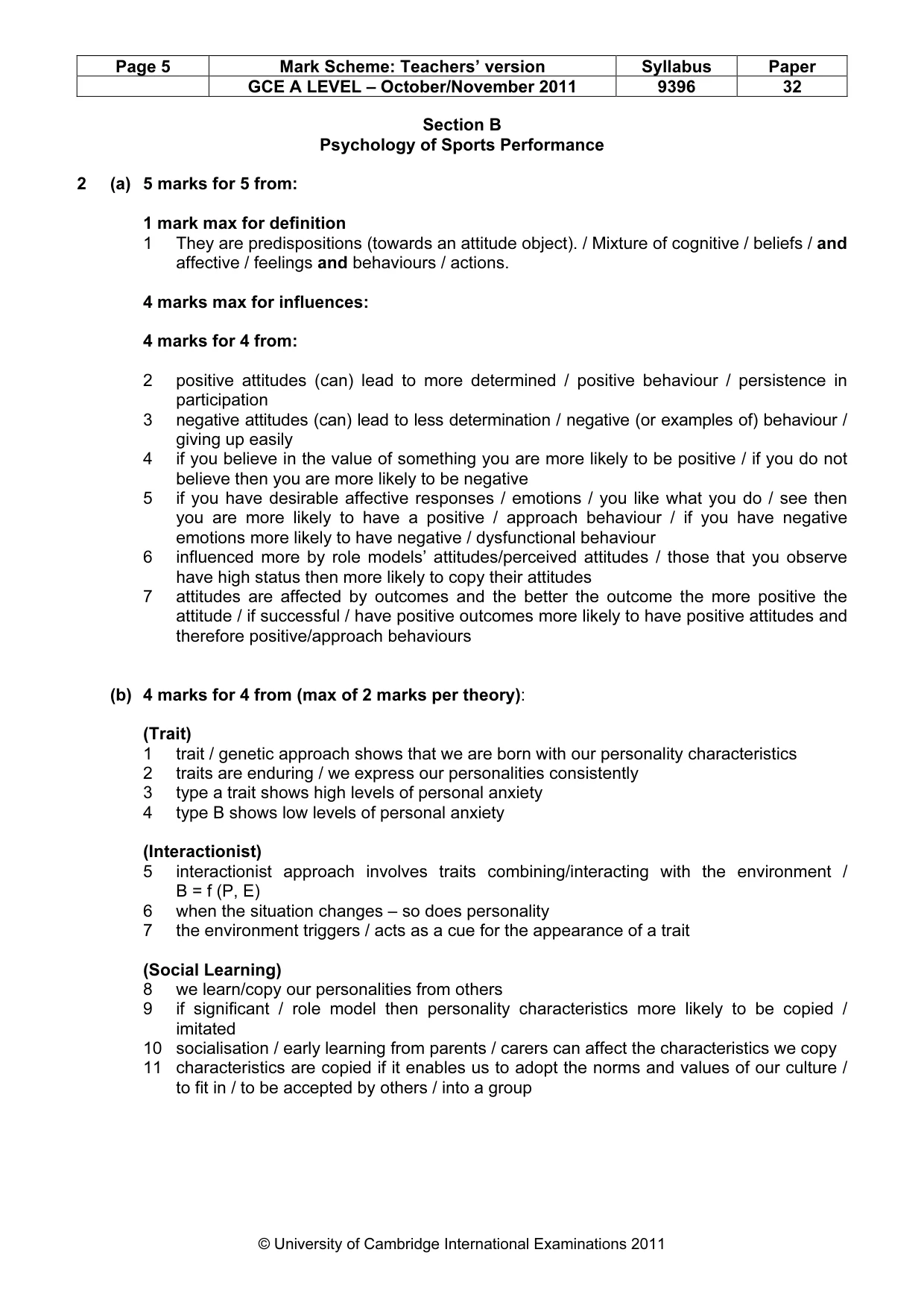
Page 5 Mark Scheme: Teachers’ version Syllabus Paper GCE A LEVEL – October/November 2011 9396 32 © University of Cambridge International Examinations 2011 Section B Psychology of Sports Performance 2 (a) 5 marks for 5 from: 1 mark max for definition 1 They are predispositions (towards an attitude object). / Mixture of cognitive / beliefs / and affective / feelings and behaviours / actions. 4 marks max for influences: 4 marks for 4 from: 2 positive attitudes (can) lead to more determined / positive behaviour / persistence in participation 3 negative attitudes (can) lead to less determination / negative (or examples of) behaviour / giving up easily 4 if you believe in the value of something you are more likely to be positive / if you do not believe then you are more likely to be negative 5 if you have desirable affective responses / emotions / you like what you do / see then you are more likely to have a positive / approach behaviour / if you have negative emotions more likely to have negative / dysfunctional behaviour 6 influenced more by role models’ attitudes/perceived attitudes / those that you observe have high status then more likely to copy their attitudes 7 attitudes are affected by outcomes and the better the outcome the more positive the attitude / if successful / have positive outcomes more likely to have positive attitudes and therefore positive/approach behaviours (b) 4 marks for 4 from (max of 2 marks per theory): (Trait) 1 trait / genetic approach shows that we are born with our personality characteristics 2 traits are enduring / we express our personalities consistently 3 type a trait shows high levels of personal anxiety 4 type B shows low levels of personal anxiety (Interactionist) 5 interactionist approach involves traits combining/interacting with the environment / B = f (P, E) 6 when the situation changes – so does personality 7 the environment triggers / acts as a cue for the appearance of a trait (Social Learning) 8 we learn/copy our personalities from others 9 if significant / role model then personality characteristics more likely to be copied / imitated 10 socialisation / early learning from parents / carers can affect the characteristics we copy 11 characteristics are copied if it enables us to adopt the norms and values of our culture / to fit in / to be accepted by others / into a group
Mark scheme, page 6
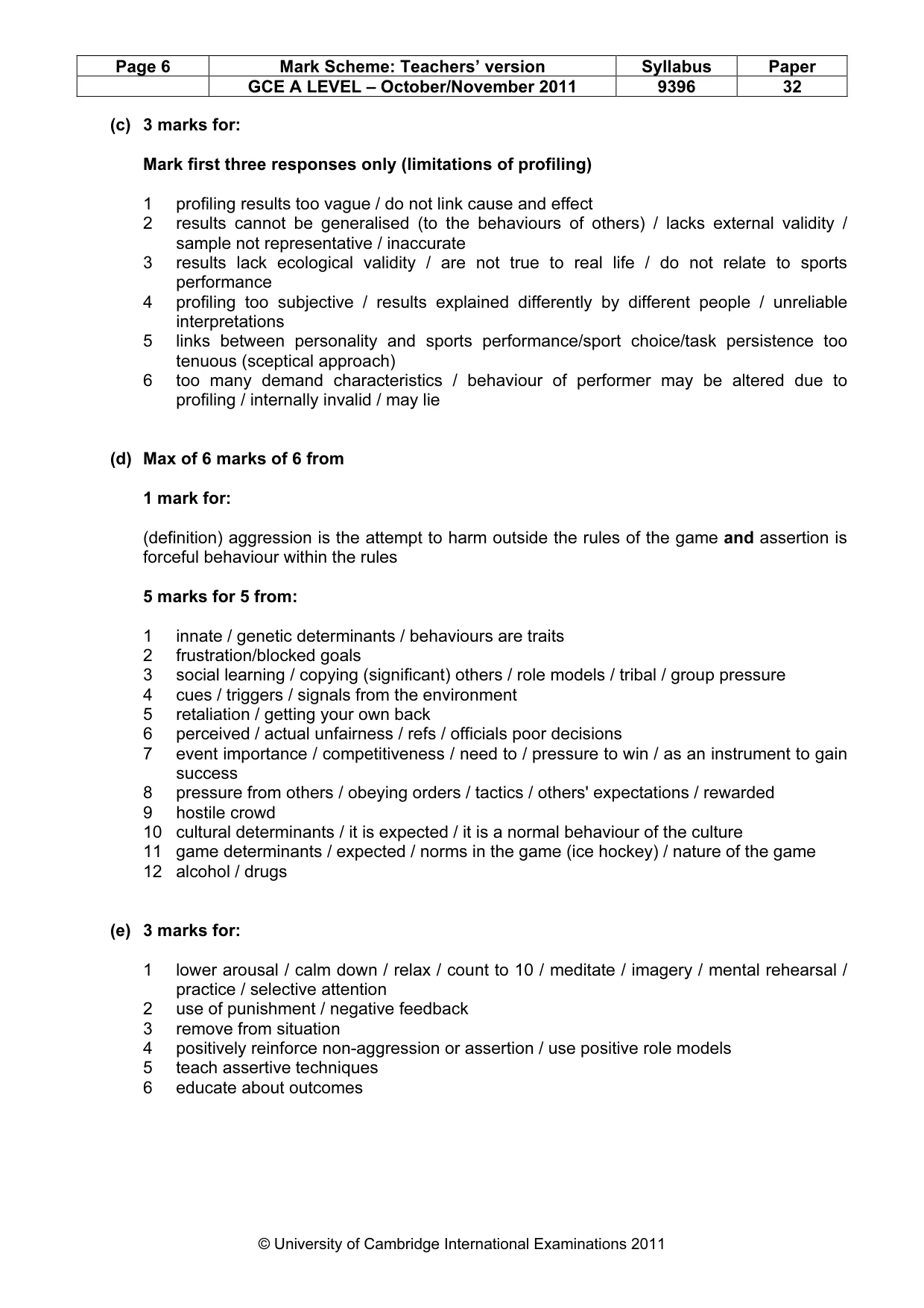
Page 6 Mark Scheme: Teachers’ version Syllabus Paper GCE A LEVEL – October/November 2011 9396 32 © University of Cambridge International Examinations 2011 (c) 3 marks for: Mark first three responses only (limitations of profiling) 1 profiling results too vague / do not link cause and effect 2 results cannot be generalised (to the behaviours of others) / lacks external validity / sample not representative / inaccurate 3 results lack ecological validity / are not true to real life / do not relate to sports performance 4 profiling too subjective / results explained differently by different people / unreliable interpretations 5 links between personality and sports performance/sport choice/task persistence too tenuous (sceptical approach) 6 too many demand characteristics / behaviour of performer may be altered due to profiling / internally invalid / may lie (d) Max of 6 marks of 6 from 1 mark for: (definition) aggression is the attempt to harm outside the rules of the game and assertion is forceful behaviour within the rules 5 marks for 5 from: 1 innate / genetic determinants / behaviours are traits 2 frustration/blocked goals 3 social learning / copying (significant) others / role models / tribal / group pressure 4 cues / triggers / signals from the environment 5 retaliation / getting your own back 6 perceived / actual unfairness / refs / officials poor decisions 7 event importance / competitiveness / need to / pressure to win / as an instrument to gain success 8 pressure from others / obeying orders / tactics / others' expectations / rewarded 9 hostile crowd 10 cultural determinants / it is expected / it is a normal behaviour of the culture 11 game determinants / expected / norms in the game (ice hockey) / nature of the game 12 alcohol / drugs (e) 3 marks for: 1 lower arousal / calm down / relax / count to 10 / meditate / imagery / mental rehearsal / practice / selective attention 2 use of punishment / negative feedback 3 remove from situation 4 positively reinforce non-aggression or assertion / use positive role models 5 teach assertive techniques 6 educate about outcomes
Mark scheme, page 7
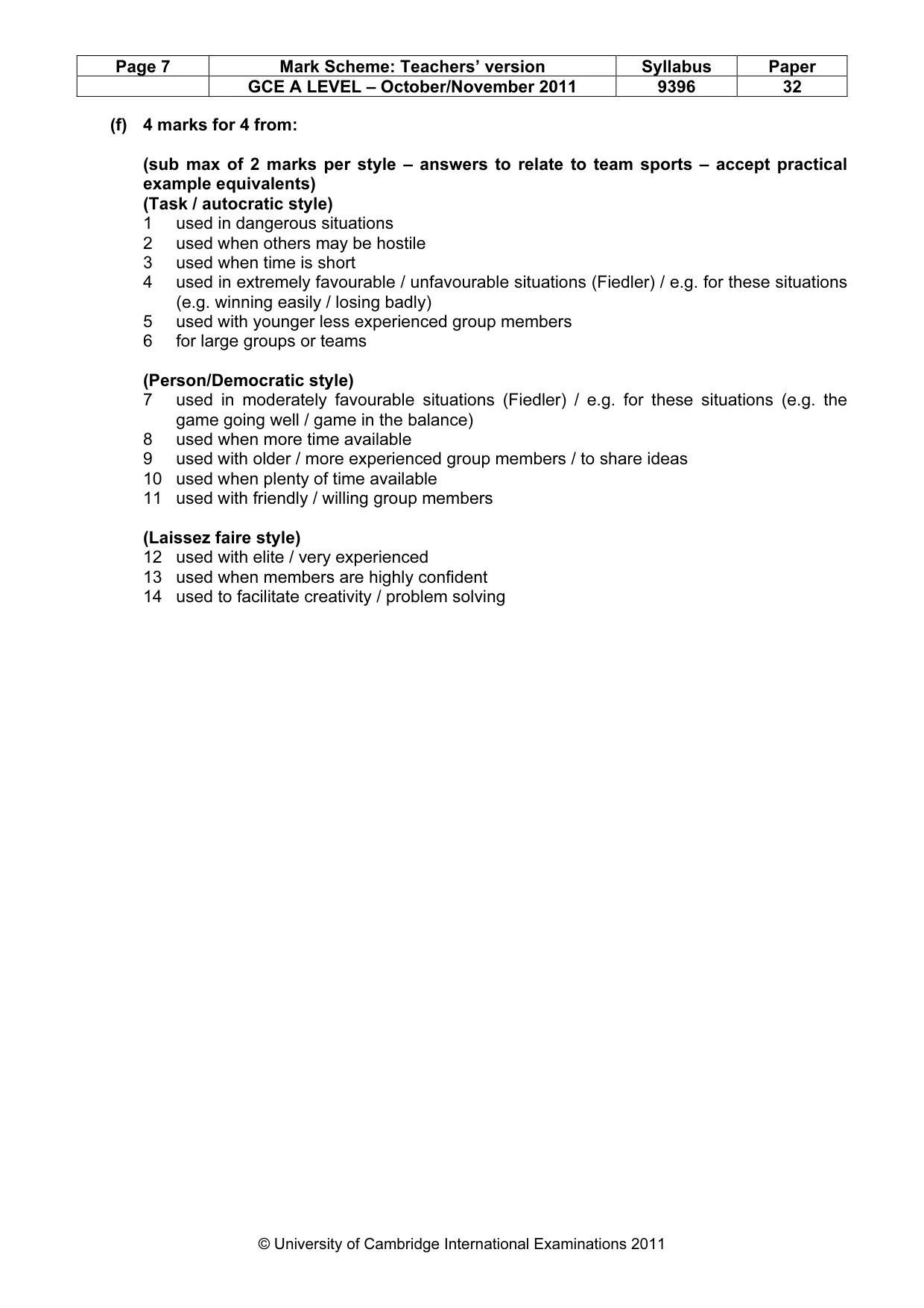
Page 7 Mark Scheme: Teachers’ version Syllabus Paper GCE A LEVEL – October/November 2011 9396 32 © University of Cambridge International Examinations 2011 (f) 4 marks for 4 from: (sub max of 2 marks per style – answers to relate to team sports – accept practical example equivalents) (Task / autocratic style) 1 used in dangerous situations 2 used when others may be hostile 3 used when time is short 4 used in extremely favourable / unfavourable situations (Fiedler) / e.g. for these situations (e.g. winning easily / losing badly) 5 used with younger less experienced group members 6 for large groups or teams (Person/Democratic style) 7 used in moderately favourable situations (Fiedler) / e.g. for these situations (e.g. the game going well / game in the balance) 8 used when more time available 9 used with older / more experienced group members / to share ideas 10 used when plenty of time available 11 used with friendly / willing group members (Laissez faire style) 12 used with elite / very experienced 13 used when members are highly confident 14 used to facilitate creativity / problem solving
Mark scheme, page 8
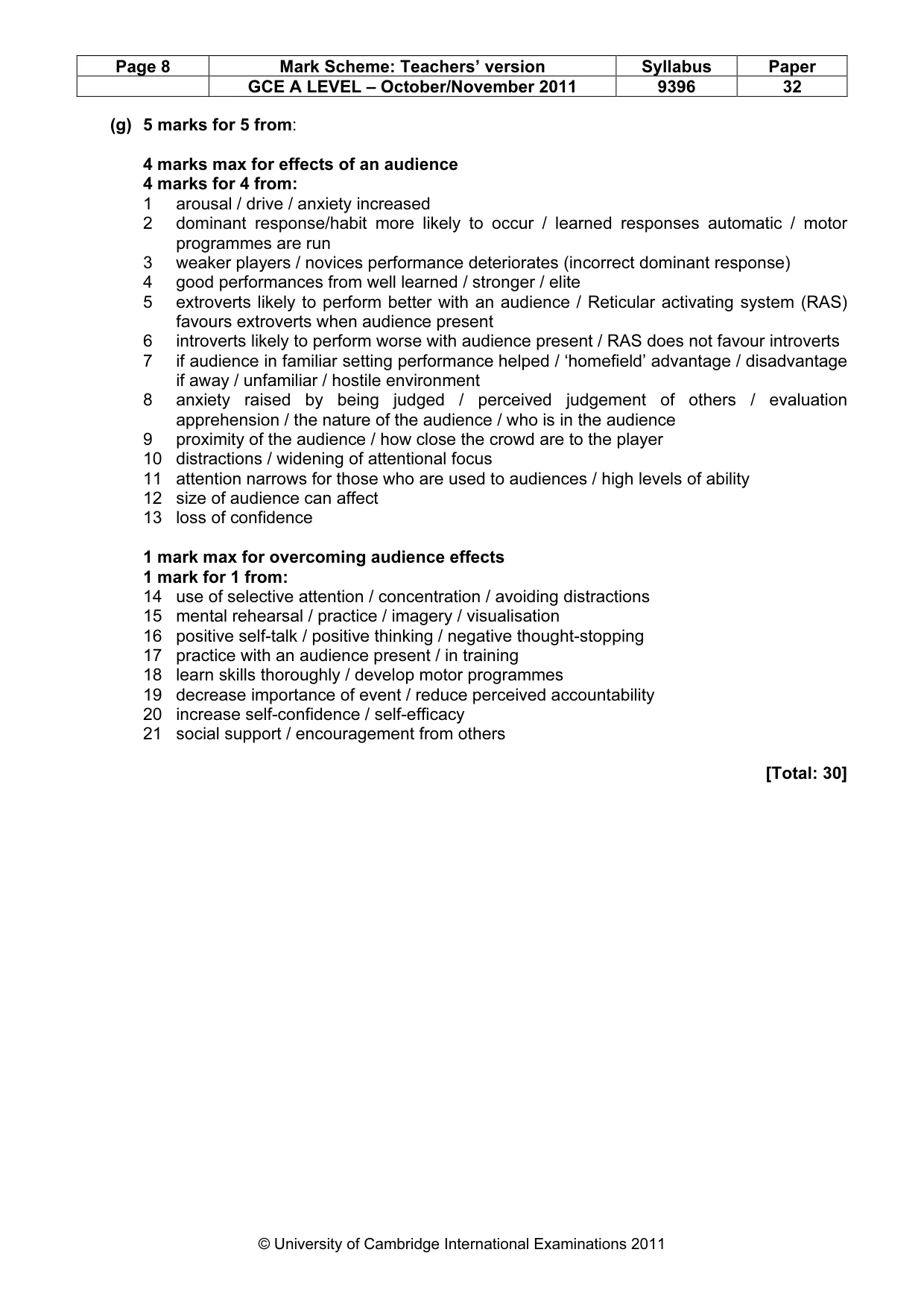
Page 8 Mark Scheme: Teachers’ version Syllabus Paper GCE A LEVEL – October/November 2011 9396 32 © University of Cambridge International Examinations 2011 (g) 5 marks for 5 from: 4 marks max for effects of an audience 4 marks for 4 from: 1 arousal / drive / anxiety increased 2 dominant response/habit more likely to occur / learned responses automatic / motor programmes are run 3 weaker players / novices performance deteriorates (incorrect dominant response) 4 good performances from well learned / stronger / elite 5 extroverts likely to perform better with an audience / Reticular activating system (RAS) favours extroverts when audience present 6 introverts likely to perform worse with audience present / RAS does not favour introverts 7 if audience in familiar setting performance helped / ‘homefield’ advantage / disadvantage if away / unfamiliar / hostile environment 8 anxiety raised by being judged / perceived judgement of others / evaluation apprehension / the nature of the audience / who is in the audience 9 proximity of the audience / how close the crowd are to the player 10 distractions / widening of attentional focus 11 attention narrows for those who are used to audiences / high levels of ability 12 size of audience can affect 13 loss of confidence 1 mark max for overcoming audience effects 1 mark for 1 from: 14 use of selective attention / concentration / avoiding distractions 15 mental rehearsal / practice / imagery / visualisation 16 positive self-talk / positive thinking / negative thought-stopping 17 practice with an audience present / in training 18 learn skills thoroughly / develop motor programmes 19 decrease importance of event / reduce perceived accountability 20 increase self-confidence / self-efficacy 21 social support / encouragement from others [Total: 30]
Mark scheme, page 9
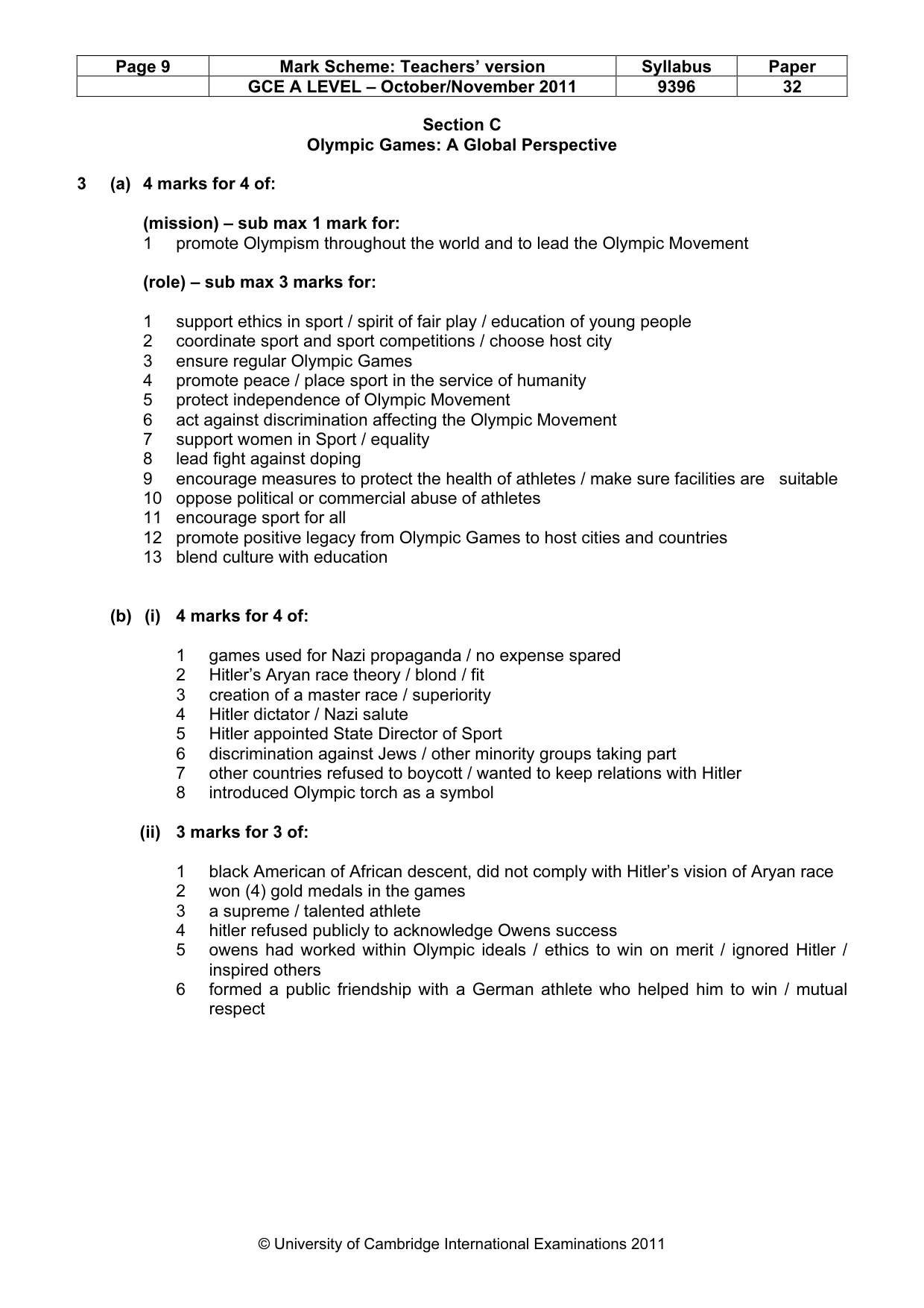
Page 9 Mark Scheme: Teachers’ version Syllabus Paper GCE A LEVEL – October/November 2011 9396 32 © University of Cambridge International Examinations 2011 Section C Olympic Games: A Global Perspective 3 (a) 4 marks for 4 of: (mission) – sub max 1 mark for: 1 promote Olympism throughout the world and to lead the Olympic Movement (role) – sub max 3 marks for: 1 support ethics in sport / spirit of fair play / education of young people 2 coordinate sport and sport competitions / choose host city 3 ensure regular Olympic Games 4 promote peace / place sport in the service of humanity 5 protect independence of Olympic Movement 6 act against discrimination affecting the Olympic Movement 7 support women in Sport / equality 8 lead fight against doping 9 encourage measures to protect the health of athletes / make sure facilities are suitable 10 oppose political or commercial abuse of athletes 11 encourage sport for all 12 promote positive legacy from Olympic Games to host cities and countries 13 blend culture with education (b) (i) 4 marks for 4 of: 1 games used for Nazi propaganda / no expense spared 2 Hitler’s Aryan race theory / blond / fit 3 creation of a master race / superiority 4 Hitler dictator / Nazi salute 5 Hitler appointed State Director of Sport 6 discrimination against Jews / other minority groups taking part 7 other countries refused to boycott / wanted to keep relations with Hitler 8 introduced Olympic torch as a symbol (ii) 3 marks for 3 of: 1 black American of African descent, did not comply with Hitler’s vision of Aryan race 2 won (4) gold medals in the games 3 a supreme / talented athlete 4 hitler refused publicly to acknowledge Owens success 5 owens had worked within Olympic ideals / ethics to win on merit / ignored Hitler / inspired others 6 formed a public friendship with a German athlete who helped him to win / mutual respect
Mark scheme, page 10
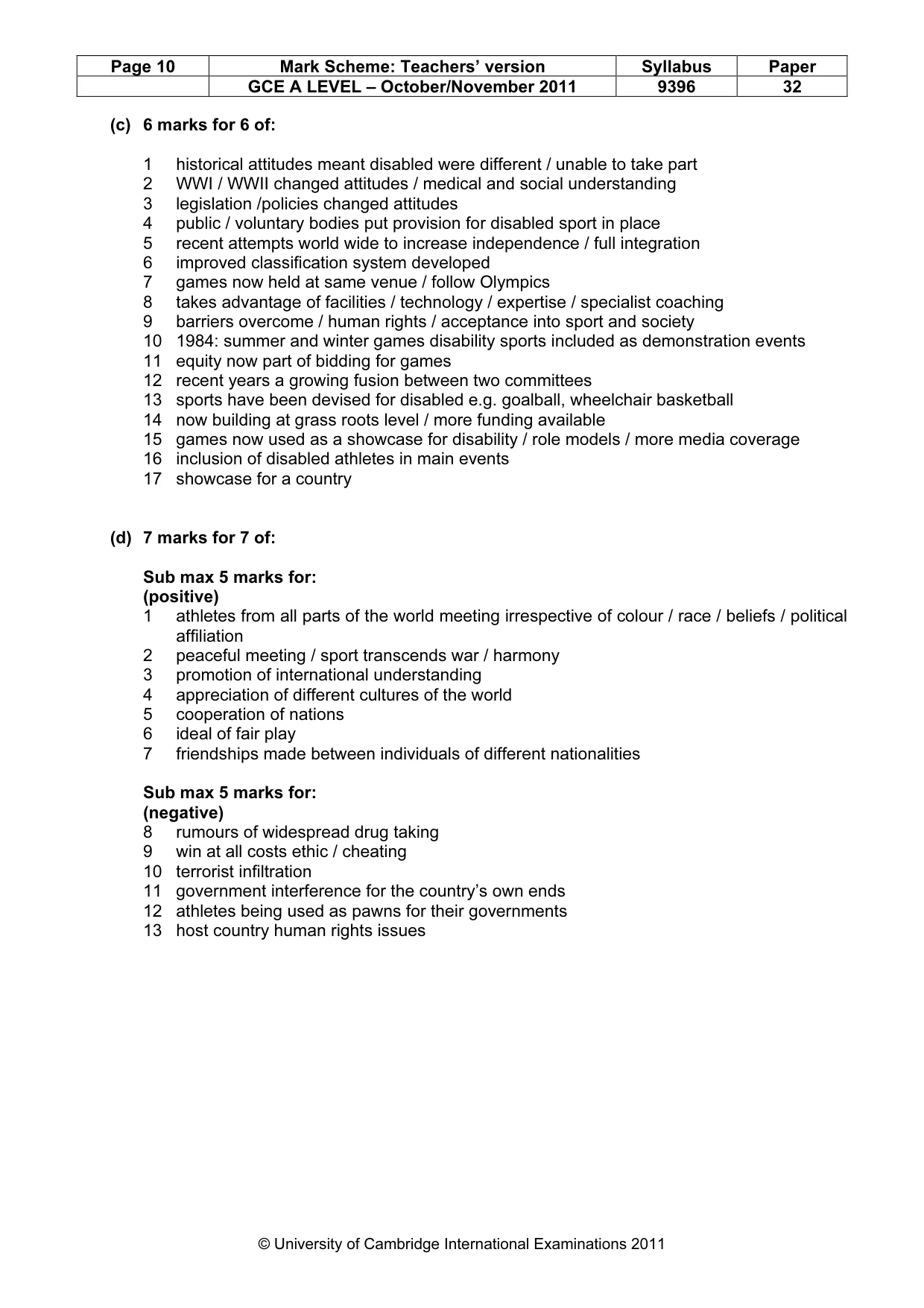
Page 10 Mark Scheme: Teachers’ version Syllabus Paper GCE A LEVEL – October/November 2011 9396 32 © University of Cambridge International Examinations 2011 (c) 6 marks for 6 of: 1 historical attitudes meant disabled were different / unable to take part 2 WWI / WWII changed attitudes / medical and social understanding 3 legislation /policies changed attitudes 4 public / voluntary bodies put provision for disabled sport in place 5 recent attempts world wide to increase independence / full integration 6 improved classification system developed 7 games now held at same venue / follow Olympics 8 takes advantage of facilities / technology / expertise / specialist coaching 9 barriers overcome / human rights / acceptance into sport and society 10 1984: summer and winter games disability sports included as demonstration events 11 equity now part of bidding for games 12 recent years a growing fusion between two committees 13 sports have been devised for disabled e.g. goalball, wheelchair basketball 14 now building at grass roots level / more funding available 15 games now used as a showcase for disability / role models / more media coverage 16 inclusion of disabled athletes in main events 17 showcase for a country (d) 7 marks for 7 of: Sub max 5 marks for: (positive) 1 athletes from all parts of the world meeting irrespective of colour / race / beliefs / political affiliation 2 peaceful meeting / sport transcends war / harmony 3 promotion of international understanding 4 appreciation of different cultures of the world 5 cooperation of nations 6 ideal of fair play 7 friendships made between individuals of different nationalities Sub max 5 marks for: (negative) 8 rumours of widespread drug taking 9 win at all costs ethic / cheating 10 terrorist infiltration 11 government interference for the country’s own ends 12 athletes being used as pawns for their governments 13 host country human rights issues
Mark scheme, page 11
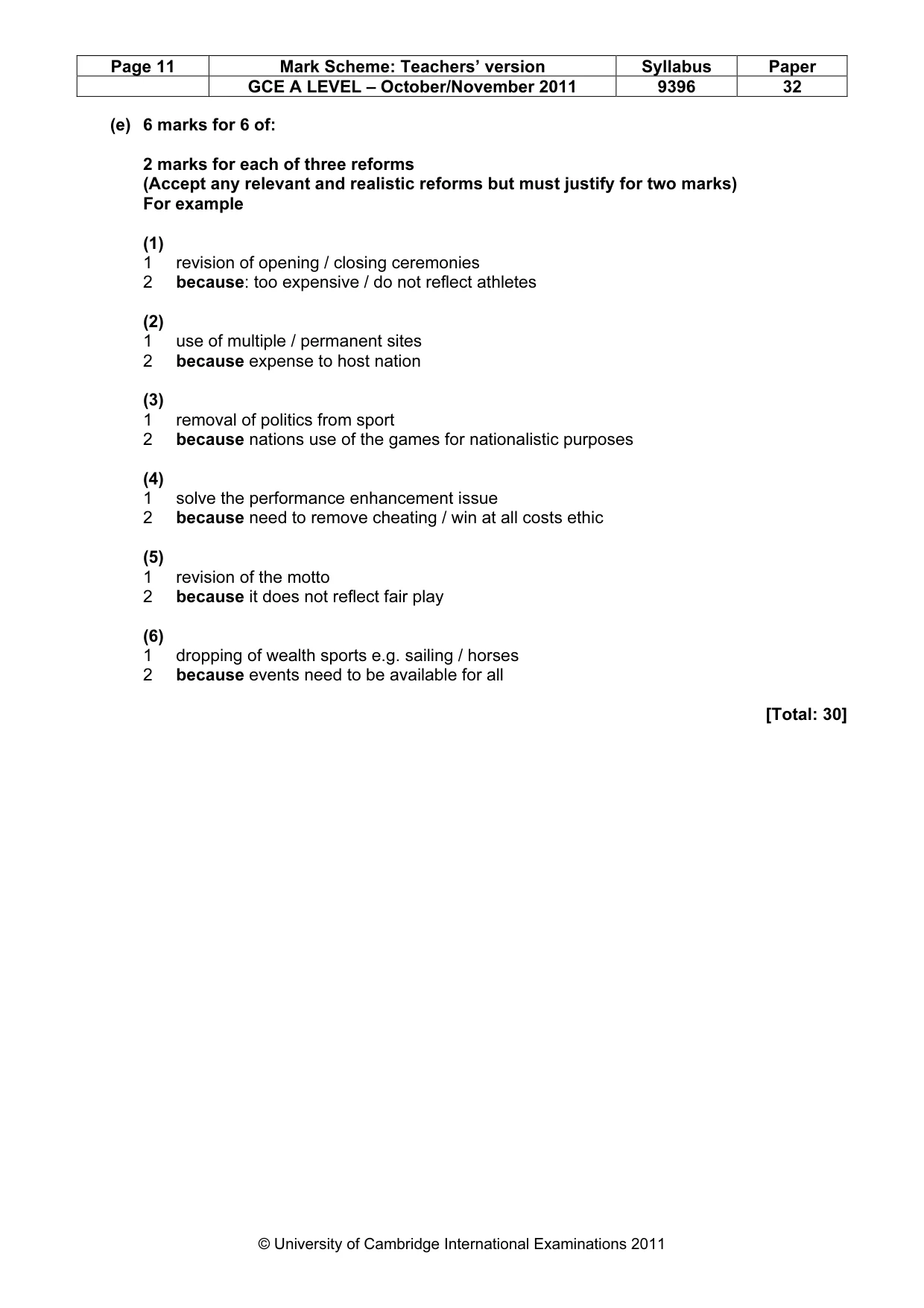
Page 11 Mark Scheme: Teachers’ version Syllabus Paper GCE A LEVEL – October/November 2011 9396 32 © University of Cambridge International Examinations 2011 (e) 6 marks for 6 of: 2 marks for each of three reforms (Accept any relevant and realistic reforms but must justify for two marks) For example (1) 1 revision of opening / closing ceremonies 2 because: too expensive / do not reflect athletes (2) 1 use of multiple / permanent sites 2 because expense to host nation (3) 1 removal of politics from sport 2 because nations use of the games for nationalistic purposes (4) 1 solve the performance enhancement issue 2 because need to remove cheating / win at all costs ethic (5) 1 revision of the motto 2 because it does not reflect fair play (6) 1 dropping of wealth sports e.g. sailing / horses 2 because events need to be available for all [Total: 30]
What you needed in this session
Cambridge’s own grade thresholds for 2011 Oct/Nov, Paper 3 · Variant 2. A higher threshold means an easier paper — the bar moves with how the cohort did.