Questions as text
Q1 · The weights of apples of a certain variety are normally distributed with mean 82 grams 9709/52 Feb/March 2020
3 The weights of apples of a certain variety are normally distributed with mean 82 grams. 22% of these apples have a weight greater than 87 grams. (a) Find the standard deviation of the weights of these apples. [3] … … … … … … … … … … … (b) Find the probability that the weight of a randomly chosen apple of this variety differs from the mean weight by less than 4 grams. [4] … … … … … … … … … … …
7 marks
Mark scheme: 3(a) 87 − 82 M1 Using ± standardisation formula, not σ2 , not σ , P(X > 87) = P Z > = 0.22 σ no continuity correction 5 B1 AWRT ±0.772 seen P Z < = 0.78 B0 for ±0.228 σ 5 = 0.772 σ σ = 6.48 A1 3 3(b) 4 4 M1 Using ±4 used within a standardisation formula (SOI), P − < Z < = P ( −0.6176 < Z < 0.6176 ) σ σ allow σ 2, σ and continuity correction M1 Standardisation formula applied to both their ±4 Φ = 0.7317 M1 Correct area 2Φ − 1 oe linked to final solution Prob = 2Φ −=1 2 ( 0.7317 ) − 1 = 0.463 A1 4
This question in 9709/52 Feb/March 2020
Q2 · In Greenton, 70% of the adults own a car 9709/52 Feb/March 2020
5 In Greenton, 70% of the adults own a car. A random sample of 8 adults from Greenton is chosen. (a) Find the probability that the number of adults in this sample who own a car is less than 6. [3] … … … … … … … … … … … … … … … … … … … … … … … … A random sample of 120 adults from Greenton is now chosen. (b) Use an approximation to find the probability that more than 75 of them own a car. [5] … … … … … … … … … … … … … … … … … … … … … … … …
8 marks
Mark scheme: 5(a) 1 – P(6, 7, 8) M1 x 8 − x One term 8Cx p (1 − p ) , 0 < p < 1, x ≠ 0 = 1 – (8C6 0.7 6 0.32 + 8C7 0.7 7 0.31 + 0.7 8 ) = 1 – 0.55177 A1 Correct unsimplified expression, or better = 0.448 A1 Alternative method for question 5(a) P(0, 1, 2, 3, 4, 5) M1 x 8 − x One term 8Cx p (1 − p ) , 0 < p < 1, x ≠ 0 = 0.38 + 8C1 0.710.37 +8C2 0.720.36 + 8C3 0.730.35 + 8C40.740.34 + 8C5 0.750.33 A1 Correct unsimplified expression, or better = 0.448 A1 3 5(b) Mean = 120 × 0.7 = 84 B1 Correct mean and variance, allow unsimplified Var = 120 × 0.7 × 0.3 = 25.2 75.5 − 84 M1 Substituting their µ and σ into the ±standardising formula (any P( more than 75) = P z > number), not σ2, not √σ 25.2 M1 Using continuity correction 75.5 or 74.5 P( z > −1.693) M1 Appropriate area Φ , from final process, must be a probability = 0.955 A1 Allow 0.9545 < p ⩽ 0.955 5
This question in 9709/52 Feb/March 2020
Q3 · The lengths of female snakes of a particular species are normally distributed with mean… 9709/51 May/June 2020
6 The lengths of female snakes of a particular species are normally distributed with mean 54 cm and standard deviation 6.1 cm. (a) Find the probability that a randomly chosen female snake of this species has length between 50 cm and 60 cm. [4] … … … … … … … … … … … … … … … … … … … … … … … The lengths of male snakes of this species also have a normal distribution. A scientist measures the lengths of a random sample of 200 male snakes of this species. He finds that 32 have lengths less than 45 cm and 17 have lengths more than 56 cm. (b) Find estimates for the mean and standard deviation of the lengths of male snakes of this species. [5] … … … … … … … … … … … … … … … … … … … … … … …
9 marks
Mark scheme: 6(a) ( ) 50 54 60 54 P P 0.6557 0.9836 6.1 6.1 z Z − − < < = − < < Both values correct A1 Φ (0.9836) – Φ (–0.6557) = Φ (0.9836) + Φ (0.6557) – 1 = 0.8375 + 0.7441 – 1 (Correct area) M1 0.582 A1 4 Question Answer Marks 6(b) 45 0.994 μ σ − = − B1 56 1.372 μ σ − = B1 One appropriate standardisation equation with ߤ, ߪ, z-value (not probability) and 45 or 56. M1 11 = 2.366 σ (M1 for correct algebraic elimination of µ or σ from their two simultaneous equations to form an equation in one variable) M1 σ = 4.65, μ = 49.6 A1 5
This question in 9709/51 May/June 2020
Q4 · Trees in the Redian forest are classified as tall, medium or short, according to their… 9709/52 May/June 2020
4 Trees in the Redian forest are classified as tall, medium or short, according to their height. The heights can be modelled by a normal distribution with mean 40 m and standard deviation 12 m. Trees with a height of less than 25 m are classified as short. (a) Find the probability that a randomly chosen tree is classified as short. [3] … … … … … … … … … … … … … Of the trees that are classified as tall or medium, one third are tall and two thirds are medium. (b) Show that the probability that a randomly chosen tree is classified as tall is 0.298, correct to 3 decimal places. [2] … … … … … … … (c) Find the height above which trees are classified as tall. [3] … … … … … … … … … … … … … … … … … … … … … … … … …
8 marks
Mark scheme: 4(a) ( ) ( ) ( ) ( ) 25 40 P 25 P P 1.25 P 25 P 12 X z z X z − < = < = < − < = < M1 1 – 0.8944 M1 0.106 A1 3 4(b) 0.8944 divided by 3 (M1 for 1 - their (a) divided by 3) M1 0.298 AG A1 2 4(c) 0.2981 gives z = 0.53 B1 40 0.53 12 h − = M1 h = 46.4 A1 3
This question in 9709/52 May/June 2020
Q5 · On any given day, the probability that Moena messages her friend Pasha is 0.72 9709/52 May/June 2020
7 On any given day, the probability that Moena messages her friend Pasha is 0.72. (a) Find the probability that for a random sample of 12 days Moena messages Pasha on no more than 9 days. [3] … … … … … … … … … … … … … … … … (b) Moena messages Pasha on 1 January. Find the probability that the next day on which she messages Pasha is 5 January. [1] … … … … … … (c) Use an approximation to find the probability that in any period of 100 days Moena messages Pasha on fewer than 64 days. [5] … … … … … … … … … … … … … … … … … … … … … … … … …
9 marks
Mark scheme: 7(a) = 1 – [12C100.72100.282 + 12C11 0.72110.281+0.7212] 1 – (0.19372 + 0.09057 + 0.01941) A1 0.696 A1 3 7(b) 0.283 × 0.72 = 0.0158 B1 1 Question Answer Marks 7(c) Mean = 100 × 0.72 = 72 Var = 100 × 0.72 × 0.28 = 20.16 M1 P(less than 64) = P 63.5 72 20.16 z − < (M1 for substituting their µ and σ into ±standardisation formula with a numerical value for ‘63.5’) M1 Using either 63.5 or 64.5 within a ±standardisation formula M1 Appropriate area Φ, from standardisation formula P(z<…) in final solution = P(z < –1.893) M1 0.0292 A1 5
This question in 9709/52 May/June 2020
Q6 · The time in hours that Davin plays on his games machine each day is normally distributed… 9709/51 Oct/Nov 2020
5 The time in hours that Davin plays on his games machine each day is normally distributed with mean 3.5 and standard deviation 0.9. (a) Find the probability that on a randomly chosen day Davin plays on his games machine for more than 4.2 hours. [3] … … … … … … … … … … … … … … (b) On 90% of days Davin plays on his games machine for more than t hours. Find the value of t. [3] … … … … … … … … … … … … … … (c) Calculate an estimate for the number of days in a year (365 days) on which Davin plays on his games machine for between 2.8 and 4.2 hours. [3] … … … … … … … … … … … … … … … … …
9 marks
Mark scheme: 5(a) P(X > 4.2) = P( 4.2 3.5) 0.9 z − > = P( 0.7778) z > M1 Using ± standardisation formula, no 2 or σ σ , continuity correction 1 – 0·7818 M1 Appropriate area Φ , from standardisation formula P(z>…) in final solution 0·218 A1 3 5(b) 1.282 z = − B1 ±1.282 seen (critical value) 3.5 1.282 0.9 t − = − M1 An equation using ±standardisation formula with a z-value, condone 2 , σ σ and continuity correction 2.35 t = A1 AWRT, only dependent on M mark 3 Question Answer Marks Guidance 5(c) P(2.8 < X < 4.2) = 1 – 2 × their 5(a) ≡ 2(1 – their 5(a)) – 1 ≡ 2(0·5 – their 5(a)) = 0·5636 B1 FT FT from their 5(a) < 0.5 or correct Accept unevaluated probability OE Accept 0·564 Number of days = 365 × 0·5636 = 205·7 M1 365 × their p So, 205 (days) A1 FT Accept 205 or 206, not 205·0 or 206·0 no approximation/ rounding stated FT must be an integer value Alternative method for question 5(c) P 2.8 3.5 4.2 3.5 0.9 0.9 z − − < < ( ) ( ) Φ 0.7778 1 Φ0.7778 = − − = 0·7818 – (1 – 0·7818) = 0·5636 B1 0·5635 < p ⩽ 0·564 OE Number of days = 365 × 0·5636 = 205·7 M1 365 × their p So, 205 (days) A1 FT Accept 205 or 206, not 205·0 or 206·0 no approximation/ rounding stated FT must be an integer value 3
This question in 9709/51 Oct/Nov 2020
Q7 · Pia runs 2 km every day and her times in minutes are normally distributed with mean 10.1… 9709/52 Oct/Nov 2020
3 Pia runs 2 km every day and her times in minutes are normally distributed with mean 10.1 and standard deviation 1.3. (a) Find the probability that on a randomly chosen day Pia takes longer than 11.3 minutes to run 2 km. [3] … … … … … … … … … … … … … … (b) On 75% of days, Pia takes longer than t minutes to run 2 km. Find the value of t. [3] … … … … … … … … … … … … … … … … … (c) On how many days in a period of 90 days would you expect Pia to take between 8.9 and 11.3 minutes to run 2 km? [3] … … … … … … … … … … … … … … …
9 marks
Mark scheme: 3(a) P(X > 11.3) = P( 11.3 10.1 1.3 − > z ) = P( 0 9231) > ⋅ z M1 Using ± standardisation formula, no 2 or σ σ , continuity correction 1 – 0.822 M1 Appropriate area Φ , from standardisation formula P(z>…) in final solution 0·178 A1 0.1779… 3 3(b) 0 674 = −⋅ z B1 ±0.674 seen (critical value) 10.1 0 674 1.3 − = −⋅ t M1 An equation using ±standardisation formula with a z-value, condone 2 or σ σ , continuity correction. t = 9·22 A1 AWRT. Only dependent on M1 3 Question Answer Marks Guidance 3(c) P(8.9 < X < 11.3) = 1 – 2 × their 3(a) ≡ 2(1 – their 3(a)) – 1 ≡ 2(0·5 – their 3(a)) =0.644 B1 FT FT from their 3(a) < 0·5 or correct, accept unevaluated probability OE Number of days = 90 × 0·644 = 57·96 M1 90 × their p seen, 0 < p < 1 So 57 (days) A1 FT Accept 57 or 58, not 57·0 or 58·0, no approximation/rounding stated FT must be an integer value Alternative method for question 3(c) P 8 9 10 1 11.3 10.1 1 3 1 3 ⋅− ⋅ − < < ⋅ ⋅ z ( ) ( ) ( ) Φ 0 9231 1 Φ 0 9231 = ⋅ − − ⋅ oe = 0·822 – (1 – 0·822) = 0·644 B1 Accept unevaluated probability Number of days = 90 × 0·644 = 57·96 M1 90 × their p seen, 0 < p < 1 So 57 (days) A1 FT Accept 57 or 58, not 57·0 or 58·0, no approximation/rounding stated FT must be an integer value 3
This question in 9709/52 Oct/Nov 2020
Q8 · The times taken to swim 100 metres by members of a large swimming club have a normal… 9709/53 Oct/Nov 2020
1 The times taken to swim 100 metres by members of a large swimming club have a normal distribution with mean 62 seconds and standard deviation 5 seconds. (a) Find the probability that a randomly chosen member of the club takes between 56 and 66 seconds to swim 100 metres. [3] … … … … … … … … … … (b) 13% of the members of the club take more than t minutes to swim 100 metres. Find the value of t. [3] … … … … … … … … … … …
6 marks
Mark scheme: 1(a) P(56 < X < 66) = P 56 62 66 62 5 5 z − − < < = P( 1.2 0.8) − < < z 2 or σ σ , allow continuity correction ( ) ( ) Φ 0.8 Φ 1.2 1 + − = 0.7881 + 0.8849 – 1 M1 Appropriate area Φ , from standardisation formula in final solution 0.673 A1 3 1(b) 1.127 = z B1 ±(1.126 – 1.127) seen, 4 sf or more 60 62 1.127 5 − = t 60t = 5.635+62=67.635 M1 z-value = ( ) 60 62 5 − ± t condone z-value = ( ) 62 5 − ± t no continuity correction, condone 2 or σ σ t = 1.13 A1 CAO 3
This question in 9709/53 Oct/Nov 2020
Q9 · The time spent by shoppers in a large shopping centre has a normal distribution with mean… 9709/52 Feb/March 2021
3 The time spent by shoppers in a large shopping centre has a normal distribution with mean 96 minutes and standard deviation 18 minutes. (a) Find the probability that a shopper chosen at random spends between 85 and 100 minutes in the shopping centre. [3] … … … … … … … … … … 88% of shoppers spend more than t minutes in the shopping centre. (b) Find the value of t. [3] … … … … … … … … … … …
6 marks
Mark scheme: 3(a) 85 96 100 96 P 18 18 z − − < < M1 Use of ±standardisation formula once with appropriate values substituted, no continuity correction, not σ2 or √σ. ( ) ( ) ( ) P 0.6111 0.2222 0.2222 0.6111 1 0.5879 0.7294 1 z − < < = Φ + Φ − = + − M1 Appropriate area Φ, from final process, must be probability. Use of (1 – z) implies M0. 0∙317 A1 Final answer which rounds to 0∙317. 3 Question Answer Marks Guidance 3(b) z = ±1∙175 B1 1∙17 ⩽ z ⩽ 1∙18 or –1∙18 ⩽ z ⩽ –1∙17 96 1.175 18 − − = t M1 An equation using ±standardisation formula with a z-value, condone σ2, √σ or continuity correction. E.g. equating to 0∙88, 0∙12, 0∙8106, 0∙1894, 0∙5478, 0∙4522, ±0∙175 or ±2∙175 implies M0. 74∙85 or 74∙9 A1 74∙85 ⩽ t ⩽ 74∙9 3
This question in 9709/52 Feb/March 2021
Q10 · A company produces a particular type of metal rod 9709/51 May/June 2021
2 A company produces a particular type of metal rod. The lengths of these rods are normally distributed with mean 25.2 cm and standard deviation 0.4 cm. A random sample of 500 of these rods is chosen. How many rods in this sample would you expect to have a length that is within 0.5 cm of the mean length? [5] … … … … … … … … … … … … … … … … … … … … … … …
5 marks
Mark scheme: 2 ( ) ( ) 25.2 25.5 0.50 25.2 25.2 0.50 0.4 0.4 − + − − < < P z 0.5 0.5 0.4 0.4 = − < < P z correction, σ2, √ σ ( ) 2 1.25 1 = Φ − 2 0.8944 1 = × − A1 For AWRT 0.8944 SOI M1 Appropriate area 2Φ – 1 OE, from final process, must be probability 0.7888 A1 Accept AWRT 0.789 Number of rods = 0.7888 500 × = 394 or 395 B1FT Correct or FT their 4SF (or better) probability, final answer must be positive integer, not 394.0 or 395.0, no approximation/rounding stated, only 1 answer 5
This question in 9709/51 May/June 2021
Q11 · In Questa, 60% of the adults travel to work by car 9709/51 May/June 2021
6 In Questa, 60% of the adults travel to work by car. (a) A random sample of 12 adults from Questa is taken. Find the probability that the number who travel to work by car is less than 10. [3] … … … … … … … … … … … … … … … (b) A random sample of 150 adults from Questa is taken. Use an approximation to find the probability that the number who travel to work by car is less than 81. [5] … … … … … … … … … … … … … … … … … … … … … … … (c) Justify the use of your approximation in part (b). [1] … … … … … …
9 marks
Mark scheme: 6(a) [= 1 – (0.063852 + 0.017414 + 0.0021768)] A1 Correct unsimplified expression, or better. [1 – 0.083443] = 0.917 A1 AWRT Alternative method for Question 6(a) P (0,1,2,3,4,5,6,7,8,9) = 12C00.60 0.412 + 12C1 0.61 0.411+ ………….12C9 0.69 0.43 [= 0.000016777 + 0.00030199 + 0.0024914 + 0.012457 + 0.042043 + 0.10090 + 0.17658 + 0.22703 + 0.21284 + 0.14189] M1 One term: 12Cx px (1 – p)12-x for 0 < x < 12, any p allowed. A1 Correct unsimplified expression with at least the first two and last terms 0.917 A1 WWW, AWRT 3 Question Answer Marks Guidance 6(b) [Mean =] 0.6 × 150 [= 90]; [Variance =] 0.6 × 150 × 0.4 [= 36] B1 Correct mean and variance. Accept evaluated or unsimplified ( ) 80.5 90 81 6 − < = < P X P Z M1 Substituting their mean and variance into ±standardisation formula (with a numerical value for 80.5), allow σ2, √ σ, but not µ ± 0.5 M1 Using continuity correction 80.5 or 81.5 ( ) 1.5833 1 0.9433 Φ − = − M1 Appropriate area Φ, from final process, must be probability 0.0567 A1 AWRT 5 6(c) np = 90, nq = 60 both greater than 5 B1 At least nq evaluated and statement >5 required 1
This question in 9709/51 May/June 2021
Q12 · The weights of bags of sugar are normally distributed with mean 1.04 kg and standard… 9709/52 May/June 2021
2 The weights of bags of sugar are normally distributed with mean 1.04 kg and standard deviation 3 kg. In a random sample of 2000 bags of sugar, 72 weighed more than 1.10 kg. Find the value of 3. [4] … … … … … … … … … … … … … … … … … … … … … … … …
4 marks
Mark scheme: 2 ( ) ( ) 72 1.1 0.036 2000 > = = P X z = ±1.798 1.1 1.04 1.798 σ − = 0.06 1.798 σ = B1 1.1 and 1.04 substituted in ±standardisation formula, allow continuity correction, not σ2 or √ σ M1 Equate their ±standardisation formula to a z-value and to solve for the appropriate area leading to final answer (expect σ < 0.5). 0.06 Accept value σ ± = − z 0.0334 σ = A1 0.03335 ≤ σ ≤ 0.0334. At least 3 3s.f. 4
This question in 9709/52 May/June 2021
Q13 · Every day Richard takes a flight between Astan and Bejin 9709/52 May/June 2021
5 Every day Richard takes a flight between Astan and Bejin. On any day, the probability that the flight arrives early is 0.15, the probability that it arrives on time is 0.55 and the probability that it arrives late is 0.3. (a) Find the probability that on each of 3 randomly chosen days, Richard’s flight does not arrive late. [1] … … … … … (b) Find the probability that for 9 randomly chosen days, Richard’s flight arrives early at least 3 times. [3] … … … … … … … … … … … … … … … … (c) 60 days are chosen at random. Use an approximation to find the probability that Richard’s flight arrives early at least 12 times. [5] … … … … … … … … … … … … … … … … … … … … … … … …
9 marks
Mark scheme: 5(a) ( ) 3 [ 0.7 ] 0.343 = Alternative method for Question 5(a) [(0.15)3 + 3C1(0.15)2(0.55) + 3C2(0.15)(0.55)2 + (0.55)3 =] 0.343 B1 Evaluated WWW 1 5(b) 1 – (0.859 + 9C1 0.151 0.858 + 9C2 0.152 0.857) [1 – (0.231617 + 0.367862 + 0.259667)] M1 One term: 9Cx px (1 – p)9-x for 0 < x < 9, any 0 < p < 1 A1 Correct expression, accept unsimplified. 0.141 A1 0.1408 ⩽ ans ⩽ 0.141, award at most accurate value. Alternative method for Question 5(b) 9C3 0.153 0.856 + 9C4 0.154 0.855 + 9C5 0.155 0.854 + 9C6 0.156 0.853 + 9C7 0.157 0.852 + 9C8 0.158 0.85 + 0.159 M1 One term: 9Cx px (1 – p)9-x for 0 < x < 9, any 0 < p < 1 A1 Correct expression, accept unsimplified. 0.141 A1 0.1408 ⩽ ans ⩽ 0.141, award at most accurate value. 3 Question Answer Marks Guidance 5(c) Mean [ ] 60 0.15 9 = × = Variance [ ] 60 0.15 0.85 7.65 = × × = B1 Correct mean and variance, allow unsimplified. (2.765 ≤ σ ≤ 2.77 imply correct variance) ( ) 11.5 9 12 7.65 − ≥ = > X P Z M1 Substituting their mean and variance into ±standardisation formula (any number for 11.5), not σ2 or √ σ M1 Using continuity correction 11.5 or 12.5 in their standardisation formula. ( ) 1 0.9039 1 0.8169 −Φ = − M1 Appropriate area Φ, from final process, must be probability. 0.183 A1 Final AWRT 5
This question in 9709/52 May/June 2021
Q14 · The times, in minutes, that Karli spends each day on social media are normally… 9709/51 Oct/Nov 2021
7 The times, in minutes, that Karli spends each day on social media are normally distributed with mean 125 and standard deviation 24. (a) (i) On how many days of the year (365 days) would you expect Karli to spend more than 142 minutes on social media? [5] … … … … … … … … … … … … … … … (ii) Find the probability that Karli spends more than 142 minutes on social media on fewer than 2 of 10 randomly chosen days. [3] … … … … … … … … … … … … … … … … … (b) On 90% of days, Karli spends more than t minutes on social media. Find the value of t. [3] … … … … … … … … … … … … …
11 marks
Mark scheme: 7(a)(i) P(X > 142) = P 142 125 24 Z − > M1 Substitution of correct values into the ±Standardisation formula, allow continuity correction, not σ2, √σ. [= P( 0.7083) ]1 0.7604 > = − Z M1 Appropriate numerical area Φ, from final process, must be probability, expect p < 0.5. 0.2396 A1 0.239 ⩽ p ⩽ 0.240 to at least 3sf. Their 0.2396 × 365 [= 87.454] M1 FT their 4sf (or better) probability. 87 or 88 A1 FT Final answer must be positive integer, no indication of approximation/rounding, only dependent on previous M mark. SC B1 FT for their 3sf probability × 365 = integer value, condone 0.24 used. 5 7(a)(ii) P(0, 1) = 0.760410 + 10C1 × 0.23961 × 0.76049 [= 0.064628 + 0.20364] M1 One term: 10Cx px (1 – p)10–x for 0 < x < 10, any p. A1 FT Correct unsimplified expression using their probability to at least 3sf from (a)(i) or correct. 0.268 A1 AWRT, WWW. 3 7(b) 1.282 = ± z B1 Correct value only, critical value. 125 1.282 24 − = − t M1 Use of ± Standardisation formula with correct values substituted, allow continuity correction, σ2, √ σ, to form an equation with a z-value and not probability. 94.2 = t A1 AWRT, condone AWRT 94.3. Not dependent on B mark. 3
This question in 9709/51 Oct/Nov 2021
Q15 · The times taken, in minutes, to complete a particular task by employees at a large… 9709/52 Oct/Nov 2021
6 The times taken, in minutes, to complete a particular task by employees at a large company are normally distributed with mean 32.2 and standard deviation 9.6. (a) Find the probability that a randomly chosen employee takes more than 28.6 minutes to complete the task. [3] … … … … … … … … … … (b) 20% of employees take longer than t minutes to complete the task. Find the value of t. [3] … … … … … … … … … … … (c) Find the probability that the time taken to complete the task by a randomly chosen employee differs from the mean by less than 15.0 minutes. [4] … … … … … … … … … … … … … … … … … … … … … … … … …
10 marks
Mark scheme: 6(a) ( ) 28.6 32.2 P 28.6 9.6 X P Z − > = > ( ) 0.375 P Z = > − M1 28.6, 32.2 and 9.6 substituted appropriately in ± Standardisation formula once, allow continuity correction of ± 0.05, no σ2, √σ. ( ) [Φ 0.375 their = ] their 0.6462 M1 Appropriate numerical area, from final process, must be probability, expect > 0.5. 0.646 A1 AWRT 3 6(b) 0.842 z = ± B1 0.841 < z ⩽ 0.842 or -0.842 ⩽ z < –0.841 seen. 32.2 0.842 9.6 t − = M1 Substituting 32.2 and 9.6 into ± standardisation formula, no continuity correction, allow σ2, √σ, must be equated to a z-value. 40.3 t = A1 40.28 ⩽ t ⩽ 40.3 WWW 3 Question Answer Marks Guidance 6(c) 15 15 9.6 9.6 P Z − < < ( 1.5625 1.5625) P Z − < < M1 Identifying at least one of 15 9.6 and 15 9.6 − as the appropriate z-values or substituting their (32.2 ± 15) into ± Standardisation formula once, no continuity correction, σ2 nor √σ. Condone ±1.563 for M1. [2 15 Φ(9.6 ) – 1 ] = 2 × 0.9409 – 1 A1 p = 0.941 AWRT SOI M1 Appropriate area 2Φ – 1 oe, (eg 1 – 2 × 0.0591, 2 × (0.9409 – 0.5) or 0.9409 – 0.0591), from final process, must be probability > 0.5. 0.882 A1 4
This question in 9709/52 Oct/Nov 2021
Q16 · Raj wants to improve his fitness, so every day he goes for a run 9709/53 Oct/Nov 2021
4 Raj wants to improve his fitness, so every day he goes for a run. The times, in minutes, of his runs have a normal distribution with mean 41.2 and standard deviation 3.6. (a) Find the probability that on a randomly chosen day Raj runs for more than 43.2 minutes. [3] … … … … … … … … … … … … (b) Find an estimate for the number of days in a year (365 days) on which Raj runs for less than 43.2 minutes. [2] … … … … … … … … … … (c) On 95% of days, Raj runs for more than t minutes. Find the value of t. [3] … … … … … … … … … … … … … … … … … … … … … … … …
8 marks
Mark scheme: 4(a) ( ) 43.2 41.2 43.2 ( 0.5556) 3.6 P X P Z P Z − > = > = > M1 Use of ±Standardisation formula once, allow continuity correction, not σ2, √ σ. 1 – ( ) Φ 0.5556 1 0.7108 = − M1 Appropriate area Φ, from final process, must be probability. 0.289 A1 AWRT 3 4(b) Probability = 1 – their (a) = 1 – 0.2892 = 0.7108 B1FT 1 – their (a) or correct. 0.7108 × 365 = 259.4 259, 260 B1FT FT their 4SF (or better) probability, final answer must be positive integer. 2 4(c) 1.645 z = ± B1 CAO, critical z value. 41.2 1.645 3.6 t − = − M1 Use of ±standardisation formula with µ, σ equated to a z-value, no continuity correction, allow σ2, √ σ. 35.3 t = A1 3
This question in 9709/53 Oct/Nov 2021
Q17 · The weights of male leopards in a particular region are normally distributed with mean… 9709/52 Feb/March 2022
4 The weights of male leopards in a particular region are normally distributed with mean 55kg and standard deviation 6kg. (a) Find the probability that a randomly chosen male leopard from this region weighs between 46 and 62kg. [4] … … … … … … … … … … … … … The weights of female leopards in this region are normally distributed with mean 42kg and standard deviation 3 kg. It is known that 25% of female leopards in the region weigh less than 36kg. (b) Find the value of 3. [3] … … … … … … … … … … … … … The distributions of the weights of male and female leopards are independent of each other. A male leopard and a female leopard are each chosen at random. (c) Find the probability that both the weights of these leopards are less than 46kg. [4] … … … … … … … … … … … … … … … … …
11 marks
Mark scheme: 4(a) P( 46 55 62 55 46 62) P 6 6 X Z − − < < = < < M1 46 or 62, 55 and 6 substituted into ±standardisation formula once. Condone 62 and continuity correction ±0.5 7 P 1.5 6 = − < < Z B1 Both standardisation values correct, accept unsimplified ( ) ( ) 7 =Φ 1 Φ 1.5 6 − − = ( ) 0.8784 0.9332 1 + − M1 Calculating the appropriate area from stated Φs of z-values, must be probabilities. 0.812 A1 0∙8115 < p ⩽ 0∙812 4 4(b) z = ±0.674 B1 CAO, critical z-value 36 42 0.674 σ − = − M1 36 and 42 substituted in ±standardisation formula, no continuity correction, not σ2, √ σ, equated to a z-value [ ] 8.9 0 σ = A1 WWW. Only dependent on M. 3 Question Answer Marks Guidance 4(c) P(male < 46) = 1−their 0.9332 = 0.0668 M1 FT value from part (a) or Correct: 46 55 1 Φ 6 − − ,condone continuity correction, σ2, √ σ, and probability found. Condone unsupported correct value stated. P(female < 46) = P( ( ) 46 42 ) Φ 0.449 8.90 − < = Z their 0.6732 = M1 46, 42 and their 4(b) σ (or correct σ) substituted in ±standardisation formula, condone continuity correction, σ2, √ σ, and probability found Condone 4 8.90 their . P(both) = 0.0668 ×0.6732 M1 Product of their 2 probabilities (0 < both < 1) Not 0.25 or their final answer to 4(a) used. 0.0450 or 0.0449 A1 0∙0449 ⩽ p ⩽ 0∙0450 4
This question in 9709/52 Feb/March 2022
Q18 · The lengths, in cm, of the leaves of a particular type are modelled by the distribution N… 9709/51 May/June 2022
5 The lengths, in cm, of the leaves of a particular type are modelled by the distribution N 5.2, 1.52 . (a) Find the probability that a randomly chosen leaf of this type has length less than 6cm. [2] … … … … … … … … … … … The lengths of the leaves of another type are also modelled by a normal distribution. A scientist measures the lengths of a random sample of 500 leaves of this type and finds that 46 are less than 3cm long and 95 are more than 8cm long. (b) Find estimates for the mean and standard deviation of the lengths of leaves of this type. [5] … … … … … … … … … … … … … … … … … … … … (c) In a random sample of 2000 leaves of this second type, how many would the scientist expect to find with lengths more than 1 standard deviation from the mean? [4] … … … … … … … … … … … … … …
11 marks
Mark scheme: 5(a) P(X < 6) = P(Z < 6 5.2) P( 0.5333) 1.5 Z M1 6, 5.2, 1.5 substituted into ± standardisation formula, condone 1.52, continuity correction 0.5 0.703 A1 2 5(b) 1 3 1.329 z 2 8 0.878 z B1 1.328 < z1 ⩽ 1.329 or −1.329 ⩽ z1 < −1.328 B1 0.877 < z2 ⩽ 0.878 or −0.878 ⩽ z2 < −0.877 Solve to find at least one unknown: 3 1.329 8 0.878 M1 Use of the ± standardisation formula once with μ, σ, a z-value (not 0.8179, 0.7910, 0.5367, 0.5753, 0.19, 0.092 etc.) and 3 or 8, condone continuity correction but not σ2 or √σ M1 Use either the elimination method or the substitution method to solve their two equations in μ and σ 2.27, 6.01 A1 2.26 ⩽ σ ⩽ 2.27, 6.01 ⩽ μ ⩽ 6.02 5 Question Answer Marks Guidance 5(c) [P(Z < −1) + P(Z >1)] Φ(1) – Φ(−1) = = 2 – 2 Φ 1 = 2 – 2 0.8413 M1 Identify 1 and –1 as the appropriate z-values. M1 Calculating the appropriate area from stated phis of z-values which must be ± the same number 0.3174 A1 Accept AWRT 0.317 Number of leaves: 2000 0.3174 = 634.8 so 634 or 635 B1 FT FT their 4 s.f. (or better) probability, final answer must be positive integer no approximation or rounding stated 4
This question in 9709/51 May/June 2022
Q19 · The weights, in kg, of bags of rice produced by Anders have the distribution N 2.02, 0.032 9709/52 May/June 2022
4 The weights, in kg, of bags of rice produced by Anders have the distribution N 2.02, 0.032 . (a) Find the probability that a randomly chosen bag of rice produced by Anders weighs between 1.98 and 2.03kg. [3] … … … … … … … … … … … … … … … … … … … … … … … … The weights of bags of rice produced by Binders are normally distributed with mean 2.55kg and standard deviation 3 kg. In a random sample of 5000 of these bags, 134 weighed more than 2.6kg. (b) Find the value of 3. [4] … … … … … … … … … … … … … … … … … … … … … … … …
7 marks
Mark scheme: 4(a) [P(1.98 < X < 2.03) = ]P(1.98 2.02 2.03 2.02) 0.03 0.03 z [= P( 1.333 0.333) z ] 1.98 or 2.03 substituted appropriately. Condone 0.032 and continuity correction ±0.005, not √0.03. [= Φ 0.333 1 Φ 1.333 ] = 0.6304 + 0.9087 – 1 M1 Calculating the appropriate probability area from their z-values. (or 0.6304 – 0.09121 or (0.9087 – 0.5) + (0.6304 – 0.5) etc) 0.539 A1 0.539 ⩽ z < 0.5395 Only dependent upon 2nd M mark. If M0 scored SC B1 for 0.539 ⩽ z < 0.5395. 3 4(b) [P(X > 2.6) = 134 0.0268 5000 ] [P(X<2.6) = 1 – 0.0268 =] 0.9732 B1 0.9732 or 4866 2433 or 5000 2500 seen. 2.6 2.55 1.93 M1 Use of ±standardisation formula with 2.6 and 2.55 substituted, no 2, or continuity correction. M1 Their standardisation formula with values substituted equated to z-value which rounds to ±1.93. 0.0259 A1 AWRT 0.0259 or 5 193 . If M0 earned, SC B1 for correct final answer. 4
This question in 9709/52 May/June 2022
Q20 · The residents of Persham were surveyed about the reliability of their internet service 9709/51 Oct/Nov 2022
2 The residents of Persham were surveyed about the reliability of their internet service. 12% rated the service as ‘poor’, 36% rated it as ‘satisfactory’ and 52% rated it as ‘good’. A random sample of 8 residents of Persham is chosen. (a) Find the probability that more than 2 and fewer than 8 of them rate their internet service as poor or satisfactory. [3] … … … … … … … … … A random sample of 125 residents of Persham is now chosen. (b) Use an approximation to find the probability that more than 72 of these residents rate their internet service as good. [5] … … … … … … … … … …
8 marks
Mark scheme: 2(a) [P(3, 4, …7) = 1 – P(0, 1, 2, 8)] M1 x 8 − x One term 8Cx p (1 − p ) , for 0 < x < 8, 0 < p < 1 = 1 − ( 8C0 0.480 0.528 + 8C1 0.481 0.52 7 + 8C2 0.482 0.526 + 8C8 0.488 0.52 0 ) = 1 – (0.00534597 + 0.039478 + 0.127544 + 0.0028179) A1 Correct expression, accept unsimplified, no terms omitted, leading to final answer. 0.825 B1 Mark the final answer at the most accurate value. 0.8248 < p ⩽ 0.825 WWW. Alternative method for Question 2(a) [P(3, 4, 5, 6, 7) =] M1 x 8 − x One term 8Cx p (1 − p ) , for 0<x<8, 0<p<1 8C3 0.483 0.525 + 8C4 0.484 0.52 4 + 8C5 0.485 0.523 + 8C6 0.486 0.52 2 + 8C7 0.487 0.521 A1 Correct expression, accept unsimplified, no terms omitted, leading to final answer. 0.825 B1 Final answer 0.8248 < p ⩽ 0.825 WWW. 3 2(b) [Mean = 0.52 125 =]65, B1 65 and 31.2 seen, allow unsimplified. May be seen in var = 0.52 0.48 125 = 31.2 standardisation formula. (5.585 < σ ⩽ 5.586 imply correct variance). 72.5 − M1 Substituting their 65 and their 31.2 into ±standardisation [P(X > 72) = ]P( Z 65) [= P( Z 1.343 )] 31.2 formula (any number for 72∙5), not their 31.2, √ their 5.586 . M1 Using continuity correction 72∙5 or 71∙5 in their standardisation formula . 7.5 7.5 Note or seen gains M2 BOD 31.2 5.586 = 1 – 0.9104 M1 Appropriate area Φ, from final process, must be probability. 0.0896 A1 0.0896 ⩽ p ⩽ 0.0897 WWW. 5
This question in 9709/51 Oct/Nov 2022
Q21 · In a large population, the systolic blood pressure (SBP) of adults is normally… 9709/51 Oct/Nov 2022
4 In a large population, the systolic blood pressure (SBP) of adults is normally distributed with mean 125.4 and standard deviation 18.6. (a) Find the probability that the SBP of a randomly chosen adult is less than 132. [2] … … … … … … … … … The SBP of 12-year-old children in the same population is normally distributed with mean 117. Of these children 88% have SBP more than 108. (b) Find the standard deviation of this distribution. [3] … … … … … … … … … … … … Three adults are chosen at random from this population. (c) Find the probability that each of these three adults has SBP within 1.5 standard deviations of the mean. [4] … … … … … … … … … … … … … … … … … … … … … … … …
9 marks
Mark scheme: 4(a) 132 − M1 Use of ±standardisation formula with 132 and 125.4 substituted, P(X<132) = P( Z 125.4) = P( Z 0.3548) 18.6 condone continuity correction 132±0.5 and use of 18.62, 18.6 0.639 A1 0.6385 < p ⩽ 0.639 If M0 scored, SC B1 for 0.6385 < p ⩽ 0.639 2 4(b) 108 − 117 B1 1.1749 < z ⩽ 1.175 or – 1.175 ⩽ z < −1.1749 = −1.175 M1 108 and 117 substituted in ±standardisation formula, no continuity correction, not σ2, √ σ, equated to a z-value. = 7.66 A1 7.659 ⩽ σ ⩽ 7.66 If M0 scored, SC B1 for 7.659 ⩽ σ ⩽ 7.66 3 4(c) P( −1.5 Z 1.5) M1 {Both 1.5 and –1.5 seen as z-values [Φ(1.5) – Φ(−1.5)] or appropriate use of 1.5 or −1.5} and {no other z-values in part}. [= 2Φ (1.5 ) −]1 = 2 their 0.9332 − 1 M1 Calculating the appropriate area from stated phis of z-values or their 0.9332 − (1 − their 0.9332 ) which must be ± the same number. Condone their 0.0668 as (1 – their 0.9332). or 2 ( their 0.9332 − 0.5 ) 0.8664 A1 Accept answers wrt 0.866 If A0 scored SC B1 for answers wrt 0.866 0.86643 = 0.650 36 B1 FT FT their 4SF (or better) probability, accept final answers to 3SF. 4
This question in 9709/51 Oct/Nov 2022
Q22 · The lengths of the rods produced by a company are normally distributed with mean 55.6mm… 9709/52 Oct/Nov 2022
2 The lengths of the rods produced by a company are normally distributed with mean 55.6mm and standard deviation 1.2mm. (a) In a random sample of 400 of these rods, how many would you expect to have length less than 54.8mm? [4] … … … … … … … … … … … (b) Find the probability that a randomly chosen rod produced by this company has a length that is within half a standard deviation of the mean. [3] … … … … … … … … … …
7 marks
Mark scheme: 2(a) 54.8 − M1 Use of ± standardisation formula, with 54.8, 55.6 and 1.2 [P(X<54.8)] = P( Z 55.6) 2 1.2 substituted. condone 1.2 , 1.2 or continuity correction of 54.75 or 54.85 [= P( Z −0.6667)] = 1 − 0.7477 M1 Appropriate area Φ, from final process, must be probability. = 0.2523 A1 0.252 ⩽ p ⩽ 0.2525 If A0 scored S CB1 for 0.252 ⩽ p ⩽ 0.2525 [Expected number =] 400 0.2523 = 100.92 B1 FT FT their 4SF (or better) probability from a normal calculation. 100 or 101 Must be a single integer answer. 4 2(b) 1 M1 {Both ½ and –½ seen as z-values [P( − Z 1) = Φ(½ ) – Φ(−½) =] or appropriate use of +½ or −½} 2 2 and {no other z-values in part}. 1 2Φ − 1 56.2 − 55.6 55 .0 − 55.6 2 Condone and seen as z-values. 1.2 1.2 = 2 their 0.6915 − 1 or their 0.6915 − (1 − their 0.6915 ) M1 Calculating the appropriate area from stated phis of z-values which or 2 ( 0.6915 − 0.5 ) must be ± the same number. 0.383 A1 0.3829 ⩽ z ⩽ 0.383 If A0 scored SC B1 for 0.3829 ⩽ z ⩽ 0.383 3
This question in 9709/52 Oct/Nov 2022
Q23 · At a company’s call centre, 90% of callers are connected immediately to a representative 9709/52 Oct/Nov 2022
6 At a company’s call centre, 90% of callers are connected immediately to a representative. A random sample of 12 callers is chosen. (a) Find the probability that fewer than 10 of these callers are connected immediately. [3] … … … … … … … … … … … … … … … … … … … … … … … A random sample of 80 callers is chosen. (b) Use an approximation to find the probability that more than 69 of these callers are connected immediately. [5] … … … … … … … … … … … … … … … … … (c) Justify the use of your approximation in part (b). [1] … … … … …
9 marks
Mark scheme: 6(a) [1 – P(10, 11, 12) =] M1 x 12 − x One term 12Cx p (1 − p ) , for 0 < x < 12, 0 < p < 1 1 − ( 12C10 0.910 0.12 + 12C11 0.911 0.11 + 12C12 0.912 0.10 ) = 1 – (0.230128 + 0.376573 + 0.282430) A1 Correct expression, accept unsimplified, no terms omitted, leading to final answer. 0.111 B1 Mark the final answer at the most accurate value, 0.1108 < p ⩽ 0.111 WWW. Alternative method for Question 6(a) [P(0,1,2,3,4,5,6,7,8,9) =] M1 x 12 − x One term 12Cx p (1 − p ) , for 0 < x < 12, 0 < p < 1 12C0 0.9 0 0.112 +12C1 0.91 0.111 +12C2 0.9 2 0.110 +12C3 0.93 0.19 +12C4 0.9 4 0.18 +12C5 0.95 0.17 +12C6 0.96 0.16 +12C7 0.97 0.15 +12C8 A1 Correct expression, accept unsimplified, no terms omitted, leading 0.98 0.14 +12C9 0.99 0.13 ) to final answer. If answer correct condone omission of any 7 of the 8 middle terms. 0.111 B1 Final answer 0.1108 < p ⩽ 0.111 WWW. 3 6(b) [Mean = 80 0.9 =] 72, B1 72 and 7.2 seen, allow unsimplified. Variance = 80 0.9 0.1 = 7.2 May be seen in standardisation formula. (2.683 ⩽ σ < 2.684 imply correct variance). 69.5 − M1 Substituting their mean and their variance into ±standardisation P(X > 69) = P( Z 72) 7.2 formula (any number for 69∙5), not their 7.2, not √their 2.683 M1 Using continuity correction 69∙5 or 68∙5 in their standardisation formula. [= P( Z −0.9317) =] M1 Appropriate area Φ, from final process, must be probability. Φ ( 0.9317 ) 0.824 A1 0.8239 ⩽ p ⩽ 0.8243 WWW. 5 6(c) np = 72, nq = 8 Both greater than 5, [so approximation is valid] B1 np, nq evaluated accurately. both np & nq referenced correctly. > 5 or greater than 5 seen. 1
This question in 9709/52 Oct/Nov 2022
Q24 · Company A produces bags of sugar 9709/53 Oct/Nov 2022
5 Company A produces bags of sugar. An inspector finds that on average 10% of the bags are underweight. 10 of the bags are chosen at random. (a) Find the probability that fewer than 3 of these bags are underweight. [3] … … … … … … … … … … … … The weights of the bags of sugar produced by company B are normally distributed with mean 1.04kg and standard deviation 0.06kg. (b) Find the probability that a randomly chosen bag produced by company B weighs more than 1.11kg. [3] … … … … … … … … … … … … … … 81% of the bags of sugar produced by company B weigh less than wkg. (c) Find the value of w. [3] … … … … … … … … … … … … … … … …
9 marks
Mark scheme: 5(a) [P(0, 1, 2) =] 10C0 0.10 0.910 + 10C1 0.11 0.99 + 10C2 0.12 0.98 M1 One term 10Cx p x (1 − p )10 − x , 0 p 1, x 0 = 0.348678+0.38742+0.19371 A1 Correct expression, accept unsimplified. 0.930 B1 0.9298 ⩽ p ⩽ 0.9303 Alternative method for Question 5(a) [1 – P(3, 4, 5, 6, 7, 8, 9, 10) = 1 – (10C3 0.97 0.13 +10C4 0.96 0.14 +10C5 M1 One term 10Cx p x (1 − p )10 − x , 0.95 0.15 +10C6 0.9 4 0.16 +10C7 0.93 0.17 +10C8 0.9 2 0.18 +10C9 0.91 0.19 0 p 1, x 0 +10C10 0.9 0 0.110 ) A1 Correct expression, accept unsimplified. 0.930 B1 0.9298 ⩽ p ⩽ 0.9303 3 5(b) 1.11 − M1 1.11, 1.04 and 0.06 substituted into ±Standardisation [P(X > 1.11) = ]P( Z 1.04) = P( Z 1.167) formula, no continuity correction not 0.062 or √0.06 0.06 = 1 – 0.8784 M1 1 – their 0.8784 as final answer, must be probability. (Expect final ans < 0∙5 ). 0.122 A1 0.1216 ⩽ p ⩽ 0.122 SC M0 M1 B1 for 0.122 with no standardisation formula. 3 5(c) w − B1 0.8775 < z ⩽ 0.878 or −0.878 ⩽ z < −0.8775 seen. [P(X < w) = P( Z 1.04) = 0.81] 0.06 M1 1.04 and 0.06 substituted in ±standardisation formula, no w − 1.04 = 0.878 continuity correction, not σ2, √ σ, equated to a z-value. 0.06 w = 1.09 A1 1.09 ⩽ w ⩽ 1.093 3
This question in 9709/53 Oct/Nov 2022
Q25 · In a cycling event the times taken to complete a course are modelled by a normal… 9709/52 Feb/March 2023
6 In a cycling event the times taken to complete a course are modelled by a normal distribution with mean 62.3 minutes and standard deviation 8.4 minutes. (a) Find the probability that a randomly chosen cyclist has a time less than 74 minutes. [2] … … … … … … … … (b) Find the probability that 4 randomly chosen cyclists all have times between 50 and 74 minutes. [4] … … … … … … … … … … … … … … In a different cycling event, the times can also be modelled by a normal distribution. 23% of the cyclists have times less than 36 minutes and 10% of the cyclists have times greater than 54 minutes. (c) Find estimates for the mean and standard deviation of this distribution. [5] … … … … … … … … … … … … … … … … … … … … … … … …
11 marks
Mark scheme: 6(a) 74 − 62.3 M1 Use of ± standardisation formula with 74, 62.3 and 8.4 [P(X < 74) =] P Z 2 , not √8.4, no continuity = P ( Z 1.393 ) substituted appropriately, not 8.4 8.4 correction. = 0.918 A1 0.918 ⩽ p ⩽ 0.9185 . 2 6(b) 50 − 62.3 74 − 62.3 M1 Use of ± standardisation formula with both 74 (may be seen in Z [P( 50 X 74 ) = P] 6(a) if their value seen) & 50, 62.3 and 8.4 substituted 8.4 8.4 appropriately. [P( −1.464 Z 1.393)] 2 Condone use of 8.4 , 8.4 and continuity correction ±0.5 (73.5 or 74.5 and 49.5 or 50.5). [Φ (1.464 ) + Φ (1.393) − 1 ] M1 Calculating the appropriate probability area from stated Φ of z-values (leading to their final answer > 0.5) but not 0.9285 + 0.9182 – 1 symmetrical values. = 0.847 A1 0.8465 ⩽ p < 0.8475 . SC B1 for 0.8465 ⩽ p < 0.8475 if M0A0 awarded. ( 0.8467 ) 4 = 0.514 B1 FT Accept 0.513 ⩽ p ⩽ 0.514 . FT (their 4-figure p)4, 0 < p < 1. 4 6(c) 36 − B1 −0.740 < z1 < −0.738 or 0.738 < z1 < 0.740 . z1 = = −0.739 B1 z2 = ±1.282 (critical value). 54 − z 2 = = 1.282 M1 Use of the ±standardisation formula once with μ, σ and a z- value (not 0.23, 0.77, 0.90, 0.10, ±0.261, ±0.282…). Condone continuity correction ±0.5, not 2, . Solve, obtaining values for and σ M1 Solve using the elimination method, substitution method or = 42.6, = 8.91 other appropriate approach to obtain values for both μ and σ. A1 42.58 ⩽ µ ⩽ 42.6, 8.90 ⩽ σ ⩽ 8.91 . 5 7(a) Method 1: Arrangements with 3 Es together – arrangements with 3 Es together and 2 Ds together 7! B1 7! 2!− 6! 2! – e, e a positive integer (including 0). M1 f – 6!, f > 6! M1 7! 6! − , a,c = 1, 2 and b,d = 1, 3. a !b ! c ! d ! 1800 A1 Method 2: Identified scenarios ^ EEE ^ ^ ^ 6 5 B1 5! × j, j a positive integer (j = 1 may be implied). 5! 2 6 M1 k ! 6 5 k ! 6 k ! 2P 7 6 , C 2 , or k ! , m ! 2 m ! m ! 2 n k a positive integer (k = 1 may be implied), m = 1, 2 n = 1, 2, 3. M1 m ( m − 1) k ! k a positive integer > 1, m = 10, 9, 8, 7, 6 and n n = 1, 2. 1800 A1 4 7(b) First 2 marks: Method 1 – Number of arrangements with 2 Ds in one position with 4 letters in between – repeats allowed 7! × 4 × 2 M1 7! × s, s = positive integer > 1. M1 t! × 4 × 2, t = 8, 7, 6. Condone t! × 8. First 2 marks: Method 2 – Picking 2Ds, arranging 4 letters from remaining letters between and then arranging terms 7 4P 4! 2! M1 7 4P a ! b! , 1 ⩽ a ⩽ 6 and b = 1, 2, 3. M1 7Pc 4! 2! , c = 3, 4, 5. First 2 marks: Method 3 – Identified scenarios involving Es between Ds D ^ ^ ^ ^ D E E E = 4C4 × 4! × 4! ×2! = 1152 M1 1 identified scenario value correct. D E ^ ^ ^ D E E ^ = 4C3 × 4! × 4! × 3 ×2! = 13824 D E E ^ ^ D E ^ ^ = 4C2 × 4! × 4! × 3 ×2! = 20736 M1 4 appropriate scenarios added, no incorrect. D E E E ^ D ^ ^ ^ = 4C1 × 4! × 4! ×2! = 4608
This question in 9709/52 Feb/March 2023
Q26 · A mathematical puzzle is given to a large number of students 9709/51 May/June 2023
4 A mathematical puzzle is given to a large number of students. The times taken to complete the puzzle are normally distributed with mean 14.6 minutes and standard deviation 5.2 minutes. (a) In a random sample of 250 of the students, how many would you expect to have taken more than 20 minutes to complete the puzzle? [4] … … … … … … … … … … … … … … … … … … … … … … … All the students are given a second puzzle to complete. Their times, in minutes, are normally distributed with mean - and standard deviation 3. It is found that 20% of the students have times less than 14.5 minutes and 67% of the students have times greater than 18.5 minutes. (b) Find the value of - and the value of 3. [5] … … … … … … … … … … … … … … … … … … … … … … …
9 marks
Mark scheme: 4(a) P( 20 14.6) ( 1.03846) 5.2 Z P Z M1 Use of ± standardisation formula with 20, 14.6 and 5.2 not 2 , not , no continuity correction. 1 – 0.8504 M1 Calculating the appropriate probability area (leading to their final answer). 0.150 A1 0.1496, 0.149 < p ⩽ 0.15[0] . Only dependent on the 2nd M mark so M0M1A1 possible. SC B1 for 0.149 < p ⩽ 0.15[0] if M0M0A0 awarded. [250 their 0.1496 =] 37, 38 B1 FT Strict FT their at least 4-figure probability seen anywhere (give BOD if they go on to use 0.150). Final answer must be positive integer, no approximation or rounding stated. 4 4(b) z1 = 14.5 0.842 z2 = 18.5 0.44 B1 −0.843 < z1 < −0.841 or 0.841 < z1 < 0.843 . B1 −0.441 < z2 < −0.439 or 0.439 < z2 < 0.441 . M1 Use of the ±standardisation formula once with μ, σ and a z-value (not 0.20, 0.80, 0.67, 0.23, 0.5793, 0.7881, 0.7486, 0.591 or 1 - z i.e. 0.158 etc.). Condone continuity correction ±0.05, not 2, . Solve, obtaining values for and σ . 22.9, 9.95 M1 Solve using the elimination method, substitution method or other appropriate approach to obtain values for both μ and σ. A1 AWRT 22.9, 9.95 . 5
This question in 9709/51 May/June 2023
Q27 · The lengths of Western bluebirds are normally distributed with mean 16.5cm and standard… 9709/52 May/June 2023
5 The lengths of Western bluebirds are normally distributed with mean 16.5cm and standard deviation 0.6cm. A random sample of 150 of these birds is selected. (a) How many of these 150 birds would you expect to have length between 15.4cm and 16.8cm? [4] … … … … … … … … … … … The lengths of Eastern bluebirds are normally distributed with mean 18.4cm and standard deviation 3 cm. It is known that 72% of Eastern bluebirds have length greater than 17.1cm. (b) Find the value of 3. [3] … … … … … … … … … … … … … … A random sample of 120 Eastern bluebirds is chosen. (c) Use an approximation to find the probability that fewer than 80 of these 120 bluebirds have length greater than 17.1cm. [5] … … … … … … … … … … … … … … … … …
12 marks
Mark scheme: 5(a) [P(15.4 < X < 16.8 ) =] P(15.4 16.5 16.8 16.5) 0.6 0.6 Z [= P( 1.833 0.5) Z ] M1 Use of ± standardisation formula once with 16.5, 0.6 and either 15.4 or 16.8 substituted. [= Φ 0.5 Φ 1.833 1 ] 0.6915 0.9666 – 1 M1 Calculating the appropriate probability area (leading to their final answer, expect > 0.5). 0.6915 – (1 – 0.9666) or (0.6915 – 0.5) + (0.9666 – 0.5) OE are alternatives. = 0.658 A1 0.658 ≤ p < 0.6585 . If A0 scored, SC B1 for 0.658 ⩽ p < 0.6585 . [Expected number =] 0.6581 150 = 98, 99 B1 FT FT their 4SF (or better) probability from a normal calculation. Must be a positive single integer answer. No approximation notation. 4 5(b) 17.1 18.4 0.72 P Z 17.1 18.4 0.583 B1 0.5825 < z ⩽ 0.583 or – 0.583 ⩽ z < – 0.5825 seen. M1 Use of the ± standardisation formula with 17.1, 18.4, σ and a z-value (not 0.28, 0.72, 0.4175, 0.2358, 0.7642, 0.6103, 0.3897, …). Condone continuity correct ± 0.05, not 2, . 2.23 A1 AWRT 3 Question Answer Marks Guidance 5(c) [Mean = 120 0.72 =] 86.4 [Var = 120 0.72 0.28 =] 24.192 B1 86.4, 84 2 5 and 24 24 125 , 24.192 to at least 3SF seen, allow unsimplified. May be seen in standardisation formula. (4.918 ⩽ σ ⩽ 4.919 implies correct variance) Incorrect notation is penalised. P(X < 80) = P( 79.5 86.4) 24.192 Z M1 Substituting their mean (not 18.4) and their positive 4.9185 into ± standardisation formula (any number for 79.5), condone their 4.9182 and √their 4.918 . M1 Using continuity correction 79.5 or 80.5 in their standardisation formula. [P( 1. Z 4029) = 1− Φ 1.403 ] 1 − 0.9196 M1 Appropriate area Φ, from final process, must be a probability. Expect final answer < 0.5 . Note: correct final answer implies this M1. 0.0804 A1 0.0803 ⩽ p ⩽ 0.0804 5
This question in 9709/52 May/June 2023
Q28 · The mass of grapes sold per day by a large shop can be modelled by a normal distribution… 9709/53 May/June 2023
6 The mass of grapes sold per day by a large shop can be modelled by a normal distribution with mean 28kg. On 10% of days less than 16kg of grapes are sold. (a) Find the standard deviation of the mass of grapes sold per day. [3] … … … … … … … … … … … … … … … The mass of grapes sold on any day is independent of the mass sold on any other day. (b) 12 days are chosen at random. Find the probability that less than 16kg of grapes are sold on more than 2 of these 12 days. [3] … … … … … … … … … … … … (c) In a random sample of 365 days, on how many days would you expect the mass of grapes sold to be within 1.3 standard deviations of the mean? [4] … … … … … … … … … … … … … … … … …
10 marks
Mark scheme: 6(a) 16 28 P 16 P 0.1 X Z 16 28 1.282 M1 Use of the ±standardisation formula with 16, 28, σ and a z-value (not 0.1, 0.9, 0.282, 0.5398, 0.8159) equated to a z-value. Condone continuity correct ±0.5, not 2, . Condone 12 1.282 . 9.36 A1 3 6(b) [1 − P(0, 1, 2) =] 1 – (12C0(0.1)0 (0.9)12 + 12C1 (0.1)1 (0.9)11 + 12C2 (0.1)2 (0.9)10 ) [1 – (0.2824 + 0.3766 + 0.2301)] M1 One term 12Cx 12 1 x x p p , 0 1 p . 0,1,2 x . A1 Correct expression, accept unsimplified, no terms omitted leading to final answer. 0.111 B1 0.1108699… rounded to at least 3SF. Alternative Method for Question 6(b) P(3,4,5,6,7,8,9,10,11,12) = 12C3 (0.1)3 (0.9)9 + 12C4 (0.1)4 (0.9)8+ … + 12C11 (0.1)11 (0.9)1 + 12C12 (0.1)12 (0.9)0 [0.08523 + 0.02131 + … + 1.08×10⁻¹⁰ + 1×10-12] M1 One term 12Cx 12 1 x x p p , 0 1 p . 0,1,2 x . A1 Correct expression, accept unsimplified, no terms omitted leading to final answer. 0.111 B1 0.1108699… rounded to at least 3SF. 3 Question Answer Marks Guidance 6(c) [P( 1.3 1.3 Z ) = 2 Φ(1.3) – 1 ] = 2 × 0.9032 – 1 B1 Identifying at least one of −1.3 or 1.3 as the appropriate z-values. M1 Calculating the appropriate probability area from 2 symmetrical z-values (leading to their final answer, expect > 0.5). = 0.806, 504 625 A1 0.8064, 0.806 ⩽ p < 0.8065 . [In 365 days 0.8064 365 ] = 294 or 295 B1 FT Strict FT their at least 4-figure probability (not z-value). Final answer must be positive integer, no approximation or rounding stated. 4 Question Answer Marks Guidance 7(a) Method 1: Total number of arrangements – number of arrangements with Cs together 10! 9! 2!4! 4! [75600-15120] M1 10! , ! ! c a b a ≠ b, a = 1, 2, b = 1, 4, with c being a positive integer. M1 ! 4! e d , e = 8, 9, 10, with d being a positive integer. = 60480 A1 Exact value only. SC B1 for final answer 60480 www. Method 2: Arrangements ^ ^ C ^ C ^ ^ ^ ^ ^ 8! 9 8 4! 2 M1 8! 4! f seen, with f being a positive integer. M1 9 8 g h , with g being a positive integer, h = 1, 2. g × 9C2 and g × 9P2 are acceptable. = 60480 A1 Exact value only. SC B1 for final answer 60480 www. 3
This question in 9709/53 May/June 2023
Q29 · A farmer sells eggs 9709/51 Oct/Nov 2023
3 A farmer sells eggs. The weights, in grams, of the eggs can be modelled by a normal distribution with mean 80.5 and standard deviation 6.6. Eggs are classified as small, medium or large according to their weight. A small egg weighs less than 76 grams and 40% of the eggs are classified as medium. (a) Find the percentage of eggs that are classified as small. [3] … … … … … … … … … … (b) Find the least possible weight of an egg classified as large. [3] … … … … … … … … … … … … 150 of the eggs for sale last week were weighed. (c) Use an approximation to find the probability that more than 68 of these eggs were classified as medium. [5] … … … … … … … … … … … … … … … … … … … … … … … …
11 marks
Mark scheme: 3(a) 76 − M1 Use of ± standardisation formula with 76, 80.5 and 6.6, condone [P(X < 76) =] P( Z 80.5) 2 6.6 6.6 or 6.6, no continuity correction. [= Φ(−0.6818) = 1 −Φ(0.6818) = ] M1 Calculating the appropriate probability area (leading to their final answer). 1 – 0.7524 = 0.2476 24.8% A1 24.75% < ans ⩽ 24.8% (percentage value required). If A0 scored, SC B1 for 24.75% < ans ⩽ 24.8% www. 3 3(b) [% of large eggs = 100 – 40 – 24.76 = 35.24] B1 0.378 ⩽ z < 0.3791 or −0.3791 < z ⩽ −0.378 seen. x − [P(Z > 80.5) = 0.40 + 0.2476 = 0.6476] M1 Use of ± standardisation formula with x, 80.5, 6.6 and a z-value (not 6.6 2 0.6476, 0.3524, 0.4, 0.2476) (treat ±0.38 as a z-value), not 6.6 , not x − 80.5 = 0.378 6.6 6.6 , no continuity correction. x = 83 .0 A1 awrt 83.0 3 3(c) Mean =150 0.4 = 60 B1 60 and 36 seen, allow unsimplified. Var =150 0.4 0.6 = 36 68.5 − 60 M1 Substituting their 60 and their 6 into ± standardisation formula (any P(X > 68) = P ( Z ) number for 68.5), condone their σ2 and their √σ. 36 M1 Using continuity correction 67.5 or 68.5 in their standardisation formula. P ( Z 1.417) = 1 − Φ (1.417 ) M1 Appropriate area Φ, from final process, must be a probability. [= 1 – 0.9217] 0.0783 A1 0.07825 < p ⩽ 0.0783 If A0 scored, SC B1 for 0.07825 < p ⩽ 0.0783. 5
This question in 9709/51 Oct/Nov 2023
Q30 · The heights of the members of a club are normally distributed with mean 166cm and… 9709/52 Oct/Nov 2023
5 (a) The heights of the members of a club are normally distributed with mean 166cm and standard deviation 10cm. (i) Find the probability that a randomly chosen member of the club has height less than 170cm. [2] … … … … … … … … … … (ii) Given that 40% of the members have heights greater than hcm, find the value of h correct to 2 decimal places. [3] … … … … … … … … … … … … (b) The random variable X is normally distributed with mean - and standard deviation 3. Given that 3 = 23-, find the probability that a randomly chosen value of X is positive. [3] … … … … … … … … … … … … … … … … … … … … … … … …
8 marks
Mark scheme: 5(a)(i) 170 − 166 M1 Use of ± standardisation formula with 170, [P(X < 170) =] P(Z < ) 166 and 10 substituted appropriately, 10 condone 10 2 , 10, condone continuity correction ± 0.5. [= P(Z < 0.4 ) =] 0.655 A1 0.655 ⩽ p < 0.6555 If M0 awarded, SC B1 for correct answer www. 2 5(a)(ii) h − 166 B1 0.253 ⩽ z ⩽ 0.2535 or −0.2535 ⩽ z ⩽ −0.253 P Z = 0.4 seen. 10 h − 166 M1 Use of the ±standardisation formula with h, = 0.253 10 166, 10 and a z-value (not 1 – z-value), not 10 2 , 10 , no continuity correction. h = 168.53 A1 If M0 scored, SC B1 for 168.53 ⩽ h ⩽ 168.535, 168.5. SC B1 for 168.54 from z = 0.254. 3 5(b) M1 Use of the ±standardisation formula with 0, μ 0 − 0 − 2 Z = X 0 ) = P P ( P Z and substituted for σ. 2 3 3 Or use of the ± standardisation formula with 3 0,and 3 substituted for . 0 − 2 2 Or P Z = P( Z −1.5) A1 -1.5 seen, no additional terms (e.g. x – 1.5 A0). Condone Z < 1.5. If M0 scored, SC B1 Z > −1.5 or Z < 1.5 seen www. = 0.933 final answer A1 0.933 ⩽ p < 0.9333. If M0 scored, SC B1 0.933 ⩽p < 0.9333 seen www. 3
This question in 9709/52 Oct/Nov 2023
Q31 · The weights of large bags of pasta produced by a company are normally distributed with… 9709/53 Oct/Nov 2023
2 The weights of large bags of pasta produced by a company are normally distributed with mean 1.5kg and standard deviation 0.05kg. (a) Find the probability that a randomly chosen large bag of pasta weighs between 1.42kg and 1.52kg. [3] … … … … … … … … … … The weights of small bags of pasta produced by the company are normally distributed with mean 0.75kg and standard deviation 3 kg. It is found that 68% of these small bags have weight less than 0.9kg. (b) Find the value of 3. [3] … … … … … … … … … …
6 marks
Mark scheme: 2(a) − 1.5 1.52 − M1 Use of ± standardisation formula once with 1.5, 0.05 and either [P(1.42 < X <1.52) =] P(1.42 Z 1.5) 2 0.05 0.05 1.42 or 1.52, allow or , no continuity correction. [= P( −1.6 Z 0.4) = Φ ( 0.4 ) + Φ (1.6 ) − 1] M1 Calculating the appropriate probability area (leading to their final answer, expect > 0.5). = 0.6554 + 0.9452 – 1 or 0.6554 – 0.0548 = 0.601 A1 0.6005 < p ⩽ 0.601 SC B1 for 0.601 with no standardisation seen. 3 2(b) 0.9 − 0.75 B1 0.467 z 0.468 or − 0.468 z −0.467 seen Z = 0.68 X 0.9 ) = P P ( M1 ±standardisation formula with 0.9, 0.75, σ equating to a z-value 0.9 − 0.75 = 0.468 (not 0.32, 0.68, 0.532, 0.7517, 0.2483, 0.6255,) . Condone continuity correct ±0.05, not 2, . 0.15 Condone = 0.468 . 25 A1 0.3205 ⩽ σ < 0.3215 = 0.321 , SC B1 if M0 www. 78 3
This question in 9709/53 Oct/Nov 2023
Q32 · A company sells small and large bags of rice 9709/52 Feb/March 2024
4 A company sells small and large bags of rice. The masses of the small bags of rice are normally distributed with mean 1.20 kg and standard deviation 0.16 kg. (a) In a random sample of 500 of these small bags of rice, how many would you expect to have a mass greater than 1.26 kg? [4] … … … … … … … … … … … … … … The masses of the large bags of rice are normally distributed with mean 2.50 kg and standard deviation v kg. 20% of these large bags of rice have a mass less than 2.40 kg. (b) Find the value of v. [3] … … … … … … … … … … … … … … … … A random sample of 80 large bags of rice is chosen. (c) Use a suitable approximation to find the probability that fewer than 22 of these large bags of rice have a mass less than 2.40 kg. [5] … … … … … … … … … … … … … … … … … …
12 marks
Mark scheme: 4(a) 1.26 − 1.20 M1 Use of ± standardisation formula with 1.26, 1.20 and 0.16, not [P(X > 1.26) = P Z ] 0.16 2, not , no continuity correction. = P ( Z 0.375 ) = 1 – 0.6462 M1 Calculating the appropriate probability area, (leading to their final probability, expect < 0.5). = 0.354 A1 0.3538, 0.3535 < p ⩽ 0.354. Only dependent on the 2nd M mark. SC B1 for 0.3535 < p ⩽ 0.354 if M0M0A0 awarded. [500 × their 0.3538] = 176, 177 B1 FT Strict FT their at least 4-figure calculated probability, seen anywhere (not a z-value). Final answer must be a single positive integer value, no approximation or rounding stated. 4 4(b) 2.40 − 2.50 B1 –0.842 ⩽ z < –0.8415 or 0.8415 < z ⩽ 0.842 seen. P Z = 0.20 M1 Use of the ± standardisation formula with 2.40, 2.50, and a z- value (not 0.20, 0.80, 0.158, 0.7881, 0.2119, 0.5793, 0.4207, …), not 2. 2.40 − 2.50 = −0.842 Condone continuity correction of ± 0.005. 0.1 Condone − = −0.842 etc. for M1. = 0.119 A1 0.1185 < ⩽ 0.119. 3 4(c) [Mean = 80 0.2 =]16 B1 16 and 12.8 seen, allow unsimplified. May be seen in standardisation formula. [Variance = 8 0 0.2 0.8 =]12.8 8 5 , 3.5777… to at least three significant figures implies 5 correct variance. Incorrect notation penalised. 21.5 − 16 M1 Substituting their 16 (not 1.2, 2.5) and their 12.8 (not 0.16, [P(X < 22) = P( Z ] ) their 0.119) in the ± standardising formula (any number for 12.8 21.5), condone 2 or . [P( Z 1.537 ) = Φ (1.537 ) ] M1 Using continuity correction 21.5 or 22.5 in their standardisation formula. M1 Appropriate area Φ, from final process, must be a probability. 0.938 A1 0.9375 < p ⩽ 0.938. 5
This question in 9709/52 Feb/March 2024
Q33 · The lengths of the tails of adult raccoons of a certain species are normally distributed… 9709/51 May/June 2024
2 The lengths of the tails of adult raccoons of a certain species are normally distributed with mean 28 cm and standard deviation 3.3 cm. (a) Find the probability that a randomly chosen adult raccoon of this species has a tail length between 23 cm and 35 cm. [4] … … … … … … … … … … … … The masses of adult raccoons of this species are normally distributed with mean 8.5 kg and standard deviation v kg. 75% of adult raccoons of this species have mass greater than 7.6 kg. (b) Find the value of v. [3] … … … … … … … … … … …
7 marks
Mark scheme: 2(a) P(23 < X < 35) = P( 23 28 35 28 3.3 3.3 Z ) [= P( 1.515 2.121) Z ] allow 2, allow , no continuity correction. A1 One fully correct ± standardisation formula. [= Φ 2.121 Φ 1.5151 1 ] 0.9830 0.9351 – 1 M1 Appropriate area Φ, from final process, must be a probability. = 0.918 A1 AWRT 4 2(b) [P(X > 7.6) = P( 7.6 8.5) Z = 0.75] 7.6 8.5 0.674 B1 0.674 or – 0.674 seen. CAO as critical value. M1 Use of the ± standardisation formula with 7.6, 8.5, σ and a z-value (not 0.75, 0.25, 0.7734, 0.2266, 0.5987 nor 1 – z-value: 0.326, 0.5987). Condone use of 0.9. 1.34 A1 1.33 ⩽ σ ⩽ 1.34 3
This question in 9709/51 May/June 2024
Q34 · In a certain area in the Arctic the probability that it snows on any given day is 0.7… 9709/51 May/June 2024
5 In a certain area in the Arctic the probability that it snows on any given day is 0.7, independent of all other days. (a) Find the probability that in a week (7 days) it snows on at least five days. [3] … … … … … … … … … … … … … … A week in which it snows on at least five days out of seven is called a ‘white’ week. (b) Find the probability that in three randomly chosen weeks at least one is a white week. [2] … … … … … … … … … … In a different area in the Arctic, the probability that a week is a white week is 0.8 . (c) Use a suitable approximation to find the probability that in 60 randomly chosen weeks fewer than 47 are white weeks. [5] … … … … … … … … … … … … … … … … … … … … … … … … … …
10 marks
Mark scheme: 5(a) Method 1 [P(5, 6, 7) =] 7C5 0.75 0.32 + 7C6 0.76 0.31 + 0.77 [ = 0.31765 + 0.24706 + 0.08235] M1 One term 7Cx 7 , 1 x x p p with 0 1, 0 p x or 7. A1 Correct expression, accept unsimplified, no terms omitted leading to final answer. = 0.647 B1 0.647 ⩽ p < 0.6475 Method 2 [P(5, 6, 7) = 1 – P(0, 1, 2, 3, 4) =] 1 – {0.37 +7C1 0.71 0.36 +7C2 0.72 0.35 +7C3 0.73 0.34 +7C4 0.74 0.33} (M1) One term 7Cx 7 , 1 x x p p with 0 1, 0 p x or 7. (A1) Correct expression, accept unsimplified, no terms omitted leading to final answer. Condone omission of final bracket ‘}’. If other brackets omitted, allow recovery if 1 – 0.35294 seen. = 0.647 (B1) 0.647 ⩽ p < 0.6475 3 Question Answer Marks Guidance 5(b) Method 1 [1 – P(0 white weeks) =] 1 – (1 – 0.647)3 M1 1 – p3, 0 < p < 1, p = 1 – their (a), or correct. 0.956 A1 Method 2 [P(1, 2, 3 white weeks) = ] 2 2 3 3 0.647 0.353 3 0.647 0.353 0.647 (M1) 2 2 3, 3 1 3 1 q q q q q q = their (a), or correct. 0.956 (A1) 2 Question Answer Marks Guidance 5(c) [Mean = 60 0.8 ] 48 [Variance = 6 0 0.8 0.2 ] 9.6 B1 48 and 9.6, 3 48 9 , 5 5 seen, allow unsimplified. May be seen in the standardisation formula ([σ =] 3.098 ⩽ σ ⩽ 3.1[0] implies correct variance). Incorrect notation penalised but values can be used as anticipated in remainder of question. P(X < 47) = P 46.5 48 9.6 Z M1 Substituting their µ and σ into ± standardising formula (any number for 46.5), not their σ2 or . their M1 Use continuity correction 46.5 or 47.5 in their standardised formula. Note: 1.5 1.5 or 3.098 9.6 seen gains M2 BOD. [P( 0.4841) Z = 1 Φ 0.4841 ] 1 – 0.6858 M1 Appropriate area Φ, from final process, must be a probability. Expect final answer < 0.5. Note: appropriate final answer implies this M1. = 0.314 A1 0.314 ⩽ p < 0.3145 5
This question in 9709/51 May/June 2024
Q35 · The weights of oranges can be modelled by a normal distribution with mean 131 grams and… 9709/52 May/June 2024
3 The weights of oranges can be modelled by a normal distribution with mean 131 grams and standard deviation 54 grams. Oranges are classified as small, medium or large. A large orange weighs at least 184 grams and 20% of oranges are classified as small. (a) Find the percentage of oranges that are classified as large. [3] … … … … … … … … … … … … … … … … … … … … … … … … … (b) Find the greatest possible weight of a small orange. [3] … … … … … … … … … … … … … … … … … … … … … … … … … … …
6 marks
Mark scheme: 3(a) P(X >184) = P 184 131 54 Z [= P( 0.9815) Z ] continuity correction. Condone use of 2, . 1 – 0.837 [= 0.163] M1 Calculating the appropriate probability area (leading to their final answer). Percentage [= 0.163 100] 16.3 A1 AWRT 3 3(b) [P(X < w) = P(Z < 131) 54 w = 0.2] 131 0.842 54 w B1 −0.842 ⩽ z < −0.8415 or 0.8415 < z ⩽ 0.842 seen. M1 Use of the ± standardisation formula with 131, 54, w and a z-value (not 0.2, 0.8, 0.158, 0.508[0], 0.492[0], 0.7881, 0.2119, 0.5593, 0.4407). w = 85.5 A1 85.5 ⩽ p ⩽ 85.6 Signs must be consistent to create a positive answer. 3
This question in 9709/52 May/June 2024
Q36 · In a certain country, the heights of the adult population are normally distributed with… 9709/53 May/June 2024
2 In a certain country, the heights of the adult population are normally distributed with mean 1.64 m and standard deviation 0.25 m. (a) Find the probability that an adult chosen at random from this country will have height greater than 1.93 m. [3] … … … … … … … … … … … … … … … … … … … … … … … … … In another country, the heights of the adult population are also normally distributed. 33% of the adult population have height less than 1.56 m. 25% of the adult population have height greater than 1.86 m. (b) Find the mean and the standard deviation of this distribution. [5] … … … … … … … … … … … … … … … … … … … … … … … … … …
8 marks
Mark scheme: 2(a) P 1.93 1.64 0.25 Z P(Z > 1.16) substituted, not 2, not , no continuity correction. 1 – 0.8770 M1 Appropriate area Φ resulting from a standardisation, from final process, must be probability. Note: the appropriate probability answer implies this M1. 0.123 A1 0.123 ⩽ p < 0.12303 If M0 M0, SC B1 if no standardisation shown. 3 2(b) 1.56 0.44 1.86 0.674 B1 −0.441 < z1 < −0.439 or 0.439 < z1 < 0.441 seen. B1 z2 = 0.674 or z2 = – 0.674 seen, CAO, critical value. M1 Use of the ±standardisation formula once with μ, σ equating to a z- value (not 0.33, 0.67. 0.25, 0.75, 0.6293, 0.5987, 0.7486, 0.7734, (1 – 0.44), (1 – 0.674)). Condone continuity correct ± 0.005, not 2, . Solve, obtaining values for and σ 1.68, 0.269 M1 Solve two equations in μ and σ using the elimination method, substitution method or other appropriate approach to obtain values for both μ and σ. A1 AWRT 1.68, 0.269. If one or both of the M marks have not been awarded, SC B1 for both correct. 5
This question in 9709/53 May/June 2024
Q37 · The weights of the green apples sold by a shop are normally distributed with mean 90… 9709/51 Oct/Nov 2024
5 The weights of the green apples sold by a shop are normally distributed with mean 90 grams and standard deviation 8 grams. (a) Find the probability that a randomly chosen green apple weighs between 83 grams and 95 grams. [4] … … … … … … … … … … … … … … … … … … … … … … … … … (b) The shop also sells red apples. 60% of the red apples sold by the shop weigh more than 80 grams. 160 red apples are chosen at random from the shop. Use a suitable approximation to find the probability that fewer than 105 of the chosen red apples weigh more than 80 grams. [5] … … … … … … … … … … … … … … … … … … … … … … … … …
9 marks
Mark scheme: 5(a) 83 − 90 95 − 90 M1 Using ± standardisation formula with 90, 8 and either 83 or P(83 < X < 95) = P( Z ) 2 95. Not , not σ, no continuity correction. 8 8 = P( −0.875 Z 0.625) A1 Both ±0.875 OE and ±0.625 OE seen. If M0 scored, SC B1 for both ±0.875 and ±0.625 seen M1 Calculating the appropriate probability area, leading to their [ Φ ( 0.625 ) + Φ ( 0.875 ) − 1 ] final probability. Expect final answer > 0.5. = 0.7340 + 0.8092 – 1 = 0.543 A1 0.5432, 0.543 ⩽ p < 0.5435. Only dependent on the 2nd M mark. 4 5(b) [Mean =160 0.6 =]96 B1 96 and 38.4 seen, allow unsimplified. May be seen in the standardisation formula. [Var =160 0.6 0.4 =]38.4 8 15 , 6.19677 to at least 4 SF 5 implies correct variance Withold mark if variance clearly identified as standard deviation, condone N(96, 38.4 ) if standardisation formula correct or variance/standard deviation correctly stated as well. 104.5 − M1 Substituting their 96 and their 38.4 into the ±standardising P(X < 105) = P( Z 96) formula (any number for 104.5), condone σ2 or √σ. 38.4 M1 Use continuity correction 104.5 or 105.5 in their [P( Z 1.372) = Φ (1.372 ) ] standardisation formula. 8.5 8.5 Note: or seen gains M2 BOD. 38.4 6.197 M1 Appropriate area Φ, from final process, must be a probability. Expect final answer > 0.5. = 0.915[0] A1 0.9149 ⩽ p ⩽ 0.915. If one or more M marks not scored, SC B1 for 0.9149 ⩽ p ⩽ 0.915.
This question in 9709/51 Oct/Nov 2024
Q38 · The heights of the female students at Breven college are normally distributed: • 90% of… 9709/51 Oct/Nov 2024
6 The heights of the female students at Breven college are normally distributed: • 90% of the female students have heights less than 182.7 cm. • 40% of the female students have heights less than 162.5 cm. (a) Find the mean and the standard deviation of the heights of the female students at Breven college. [5] … … … … … … … … … … … … … … … … … … … … … … … … … Ten female students are chosen at random from those at Breven college. (b) Find the probability that fewer than 8 of these 10 students have heights more than 162.5 cm. [3] … … … … … … … … … … … … … … … … … … … … … … … … … …
8 marks
Mark scheme: 6(a) 182.7 − B1 1.282 or – 1.282 seen, CAO (critical value). = 1.282 B1 −0.2535 < z ⩽ −0.253 or 0.253 ⩽ z < 0.2535 seen. 162.5 − = −0.253 M1 One standardisation formula, not σ2, or √σ, with 182.7 or 162.5 substituted correctly equated to a z value (not 0.9, 0.1, 0.8159, 0.5398, 0.4, 0.6, 0.6554, 0.7257, …). Solve, obtaining values for and σ M1 Either a single expression with one variable eliminated formed or two expressions with both variables on the same side seen with at least one variable value stated. = 165.8, σ = 13.2 A1 Answers must be to at least 1 DP (context). 5 6(b) Method 1 8 2 M1 x 10 − x [P(X < 8) = 1 – P(8, 9, 10) =] 1 – (10C8 ( 0.6 ) ( 0.4 ) + 10C9 One term 10Cx ( p ) (1 − p ) . With 0 p 1, x 0 or 10. ( 0.6 )9 ( 0.4 )1 + ( 0.6 )10 ) A1 Correct unsimplified expression. Allow 10 for 10C9. Condone omission of last bracket only. [= 1 – (0.12093 + 0.040311 + 0.0060466)] If both brackets omitted in unsimplified expression allow recovery for final stated calculation of 1 – 0.1673 or final answer WRT 0.8327. = 0.833 B1 0.8327 < p ⩽ 0.833. Method 2 ( 0.4 )10 +10C1 ( 0.6 )1 ( 0.4 )9 +10C2 ( 0.6 ) 2 ( 0.4 )8 +10C3 ( 0.6 )3 ( 0.4 )7 + M1 One term 10Cx ( p ) x (1 − p )10 − x . With 0 p 1, x 0 or 10. 10C4 ( 0.6 ) 4 ( 0.4 )6 +10C5 ( 0.6 )5 ( 0.4 )5 + 10C6 ( 0.6 )6 ( 0.4 ) 4 + 10C7 A1 Correct unsimplified expression. ( 0.6 )7 ( 0.4 )3 1.0486 10 −4 + 1.5729 10 −3 ++ 0.21499 = 0.833 B1 0.8327 < p ⩽ 0.833. 3
This question in 9709/51 Oct/Nov 2024
Q39 · In Molimba, the heights, in cm, of adult males are normally distributed with mean 176 cm… 9709/53 Oct/Nov 2024
3 In Molimba, the heights, in cm, of adult males are normally distributed with mean 176 cm and standard deviation 4.8 cm. (a) Find the probability that a randomly chosen adult male in Molimba has a height greater than 170 cm. [3] … … … … … … … … … 60% of adult males in Molimba have a height between 170 cm and k cm, where k is greater than 170. (b) Find the value of k, giving your answer correct to 1 decimal place. [4] … … … … … … … … … … … … … …
7 marks
Mark scheme: 3(a) 170 − 176 M1 Using ± standardisation formula with 170, [P(X > 170) = P( Z ] ) 176 and 4.8 substituted appropriately. 4.8 Condone 2 and . No continuity correction. = 0.894 M1 Appropriate area Φ, from final process, Φ ( 1.25 ) must be a probability. Expect final answer > 0.5. A1 0.894 or 0.89435 ⩽ p ⩽ 0.8944. If A0 scored, SC B1 for 0.894 or 0.89435 ⩽ p ⩽ 0.8944, WWW. 3 3(b) P(h < 170) = 1 – 0.8944 = 0.1056 M1 1 – their 3(a) seen or implied by 0.7056 or 0.2944 k − 176 −1 B1 0.540 < z ⩽0.541 or −0.541 ⩽ z < 0.540 = 0.541 = Φ ( 0.1056 + 0.6 ) seen. 4.8 M1 Use of ±standardisation formula with k, 176, 4.8 equated to a z-value (not 1.25, 0.7601, 0.2399, 0.7056, 0.7257, 0.8313, 0.253 0.894, 0.6, 0.4), not 4.82, not 4.8 , no continuity correction. k = 178.6 A1 CAO (answer required to 1 dp). 4
This question in 9709/53 Oct/Nov 2024
Q40 · Last year, an online store sold a large number of computers 9709/52 Feb/March 2025
2 Last year, an online store sold a large number of computers. 55% of the computers were made by company F, 30% were made by company G and 15% were made by company H. A random sample of 3 customers who each bought a computer from this store is chosen. (a) Find the probability that the 3 customers bought computers all made by different companies. [1] … … … … … … … … A random sample of 12 customers who each bought a computer from this store is chosen. (b) Find the probability that fewer than 10 of these customers bought a computer made by company F. [3] … … … … … … … … … … … … … … A random sample of 140 customers who each bought a computer from this store is chosen. (c) Use a suitable approximation to find the probability that more than 24 of these customers bought a computer made by company H. [5] … … … … … … … … … … … … … … … … … … … … … … … … … …
9 marks
Mark scheme: 2(a) 297 B1 148500 0.55 0.3 0.15 3! = 0.1485, Accept , condone 0.149. 2000 1000000 1 2(b) Method 1 [1 – P(10, 11, 12) = ] M1 x 12 − x One term of the form 12Cx ( p ) (1 − p ) , 1 – {12C10 0.5510 0.452 + 12C11 0.5511 0.45 + 0.5512} = 0 < p < 1, x ≠ 0 or 12. [1 – (0.0338529 + 0.0075229 + 0.0007662) =] A1 Correct unsimplified expression, no terms omitted leading to final answer. Condone omission of last bracket ‘}’ only. = 0.958 B1 0.9575 < p ≤ 0.958. Method 2 [P(0,1,2,3,4,5,6,7,8,9) =] M1 x 12 − x One term of the form 12Cx ( p ) (1 − p ) , 0 < p < 1, x ≠ 0 0.4512 +12C1 0.551 0.4511 + … + 12C9 0.5590.453 or 12. A1 Correct unsimplified expression, no more than 7 ‘middle’ terms omitted leading to final answer. = 0.958 B1 0.9575 < p ⩽ 0.958. 3 2(c) [Mean = 140 0.15 =] 21 B1 17 21 and 17.85 (or 17 ) seen, allow unsimplified. [Variance = 14 0 0.15 0.85 =]17.85 20 May be in standardisation formula. ( = 17.85, 4.224926 to at least 4SF implies correct variance). Withhold mark if variance clearly identified as standard deviation, condone N(21, 17.85 ) if standardisation formula correct or variance/standard deviation correctly stated as well. 24.5 − 21 M1 Substituting their µ and their σ into the ± standardisation P(X 24) = P Z formula (any number for 24.5), allow σ2 or √σ. 17.85 M1 Use continuity correction 23.5 or 24.5 in their standardisation formula. 3.5 3.5 Note: If no working or seen gains 17.85 4.225 M2 BOD. [P( Z 0.8284 ) = 1 − Φ ( 0.8284 ) ] M1 Appropriate area Φ, from final process, must be a probability. 1 – 0.7961 May be implied by a sketch of the required probability area. Note: correct final answer implies this M1. Expect final answer < 0.5. = 0.204 A1 Final answer AWRT. 5
This question in 9709/52 Feb/March 2025
Q41 · The mass of peaches sold per day in a supermarket is normally distributed with mean 65.8… 9709/52 Feb/March 2025
5 The mass of peaches sold per day in a supermarket is normally distributed with mean 65.8 kg and standard deviation 9.6 kg. (a) Find the probability that the mass of peaches sold on any given day is between 56 kg and 75 kg. [3] … … … … … … … … … … … … … … … … … … … … … … … … … The mass of cherries sold per day in a supermarket is normally distributed with mean 72.4 kg and standard deviation v kg. It is known that on 10% of days less than 59.1 kg of cherries are sold. (b) Find the value of v. [3] … … … … … … … … … … … The supermarket is open 7 days a week. (c) Find the probability that, in a randomly chosen week, the first day on which less than 59.1 kg of cherries are sold is the fifth day of the week. [1] … … … (d) Find the probability that, in a randomly chosen week, the first day on which less than 59.1 kg of cherries are sold is before the fifth day of the week. [2] … … … … … … … …
9 marks
Mark scheme: 5(a) 56 − 65.8 75 − M1 Use of ±standardisation formula once with 65.8, 9.6 and [P(56 < X < 75) =] P( Z 65.8) 2 9.6 9.6 either 56 or 75. No continuity correction, not , not . = P ( − 1.0208 Z 0.9583) [ Φ ( 0.9583 ) + Φ (1.0208 ) −]1 M1 Appropriate probability area Φ, from final process. Must be a probability. (expect > 0.5). = 0.8309 + 0.8463 – 1 or 0.8309 – (1 – 0.8463) or 0.8309 – 0.1537 or (0.8309 – 0.5) + (0.8463 – 0.5) or 0.3309 + 0.3463 = 0.677 A1 AWRT. If 1 or more M mark not awarded, SC1 for final answer 0.677 AWRT WWW. 3 5(b) 59.1 − 72.4 B1 1.282 or – 1.282 seen cao (critical value). P Z = 0.10 M1 ±standardisation formula with 59.1, 72.4, σ equating to a z-value (not 0.1, 0.9, 0.5398, 0.4602, 0.8159, 0.1841). 59.1 − 72.4 = −1.282 Condone continuity correction of ±0.05, not σ2 and not √σ. 13.3 Condone = −1.282 . = 10.4 A1 AWRT. Signs must be consistent throughout. If M1 not awarded, SC1 = 10.4 WWW. 3 5(c) ( 0.9 ) 4 ( 0.1) = 0.0656 1 B1 1 5(d) Method 1 4 M1 d [P(X < 5) =] 1 − ( 0.9 ) 1 − ( 0.9 ) d = 4, 5. = 0.344 A1 0.3439. Method 2 [P(X < 5) =] 0.1 + ( 0.1)( 0.9 ) + ( 0.1)( 0.9 ) 2 + ( 0.1)( 0.9 )3 M1 0.1 + ( 0.1)( 0.9 ) + ( 0.1)( 0.9 ) 2 + ( 0.1)( 0.9 )3 + ( 0.1)( 0.9 ) 4 or or 1 – ( ( 0.1)( 0.9 ) 4 + ( 0.1)( 0.9 )5 + ( 0.1)( 0.9 )6 + ( 0.9 )7 ) 1 – ( ( 0.1)( 0.9 ) 4 + ( 0.1)( 0.9 ) 5 + ( 0.1)( 0.9 ) 6 + ( 0.9 ) 7 ) . = 0.344 A1 0.3439. 2
This question in 9709/52 Feb/March 2025
Q42 · The masses of the bags of rice made by a company are normally distributed with mean n kg… 9709/51 May/June 2025
1 The masses of the bags of rice made by a company are normally distributed with mean n kg and standard deviation 0.14 kg. The probability that the mass of a randomly chosen bag of this rice is less than 1.48 kg is 0.22. Find the value of n. [3] … … … … … … … … … … … … … … … … … … … … … … … … …
3 marks
Mark scheme: Question Answer Marks Guidance 1 1.48 − B1 0.771 < z < 0.773 or −0.773 < z < −0.771 seen. P ( Z ) = 0.22 0.14 1.48 − M1 Use of the ±standardisation formula with µ, 1.48 and 0.14 and = − 0.772 equating to a z-value (not 0.78, 0.22, 0.5871, 0.7823, 0.228). 0.14 Condone σ2, and continuity correction ±0.005. = 1.59 A1 1.585 < µ ⩽ 1.59. If M0 scored SC B1 for correct answer WWW. 3 2(a) Method 1 total arrangements with As together – arrangements with As together and Os together 7! M1 7! − 6! – k , where k is an integer ⩾ 1. 2! 2 n – 6! M1 n – 6!, where n is an integer > 720. 1800 A1 3 Method 2 arrangements of other 6 letters with the As together and then the Os placed 6 5 M1 5! × p, where p is an integer > 1. 5! 2 M1 6 5 q , q × 6C2, q × 6P2, q × 6 × 5, q an integer > 1. 2 1800 A1 3
This question in 9709/51 May/June 2025
Q43 · Every Saturday, a particular community holds a ‘Puzzle’ event to raise money for a new… 9709/51 May/June 2025
4 Every Saturday, a particular community holds a ‘Puzzle’ event to raise money for a new Leisure Centre. Competitors attempt to solve a puzzle as quickly as possible. Last Saturday, 600 competitors took part. The times taken to complete the puzzle were normally distributed with mean 32.4 minutes and standard deviation 2.5 minutes. (a) How many competitors would you expect to have times within 1.2 minutes of the mean time? [4] … … … … … … … … … … … … … … … In this Saturday’s event, 60% of the competitors had times less than 36.0 minutes. (b) 9 competitors who took part in this Saturday’s event are selected at random. Find the probability that at least 2 and fewer than 8 of these competitors had times less than 36.0 minutes. [3] … … … … … … … … … … … … … … … (c) 80 competitors who took part in this Saturday’s event are selected at random. Use a suitable approximation to find the probability that more than 50 of these competitors had times less than 36.0 minutes. [5] … … … … … … … … … … … … … … … …
12 marks
Mark scheme: 4(a) −1.2 1.2 M1 OE P( Z ) 2 2.5 2.5 Using ± standardisation formula, not , not σ, no continuity correction Use of ±standardisation formula once with 32.4, 2.5 and either 31.2 or 33.6. No continuity correction, not ,2 not 1.2 1.2 Implied by either − or seen 2.5 2.5 [ = Φ ( 0.48 ) + Φ ( −0.48 ) = 2Φ ( 0.48 ) − 1 ] M1 Calculating the correct probability area (leading to their final probability). 2 × 0.6844 – 1 or 2 × (0.6844 – 0.5) or 0.6844 – 0.3156 This may be implied by the correct or appropriate probability area. 0.3688 A1 Expected number = 0.3688 600 = 221.28 so 221 or 222 B1 FT FT their 4-figure probability to obtain a single integer answer. No approximation indicated, condone use of 3sf probability here if more accurate answer seen earlier. 4 4(b) Method 1 [P(2 ⩽ X < 8) = 1 – P(0, 1, 8, 9) = ] M1 One term of the form 9Cx ( p ) x (1 − p )9 − x , 0 p 1, x 0 or 9 1 – (0.49 + 9C1 0.48 0.6 + 9C8 0.410.68 + 0.69) = A1 Correct un-simplified expression. Condone omission of last bracket only. If both brackets omitted in [1 – 0.000262144 – 0.00353894 – 0.060466176 – 0.010077696 =] un-simplified expression, allow recovery for final stated calculation of 1 – 0.07434… or better. 0.926 B1 0.925 < p ⩽ 0.926 from correct working. Method 2 [P(2 ⩽ X < 8) = P(2, 3, 4, 5, 6, 7) = ] M1 One term of the form 9Cx ( p ) x (1 − p )9 − x , 0 p 1, x 0 or 9. 9C2 0.47 0.62 +9C3 0.46 0.63 +9C4 0.45 0.64 +9C5 0.44 0.65 +9C6 0.43 A1 Correct un-simplified expression. 0.66 +9C7 0.42 0.67 0.926 B1 0.925 < p ⩽ 0.926 from correct working. 3 4(c) Mean = 80 0.6 = 48 B1 48 and 19.2 (CAO) seen, allow un-simplified. Variance = 80 0.6 0.4 = 19.2 May be in standardisation formula. (4.38178… to at least 4SF identified as σ implies correct variance). Do not condone clear incorrect identification. 50.5 − M1 Substituting their 48 and their 19.2 into the ±standardising [P(X 50 ) =] P( Z 48) formula (any number for 50.5), allow σ2 or √σ. 19.2 M1 Use continuity correction 49.5 or 50.5 in their standardisation formula. 2.5 2.5 Note: If no working or seen gains B2. 19.2 4.382 [P( Z 0.571 ) = 1 − Φ ( 0.571) = ] M1 Appropriate probability area, from final process, must be a probability. 1 – 0.7160 = May be implied by a sketch of the required probability area. Expect final answer < 0.5. 0.284 A1 AWRT 5
This question in 9709/51 May/June 2025
Q44 · Kestrels are birds whose adult wingspans are normally distributed with mean 74.8 cm and… 9709/52 May/June 2025
7 Kestrels are birds whose adult wingspans are normally distributed with mean 74.8 cm and standard deviation 3.2 cm. A random sample of 120 adult kestrels is selected. (a) How many of these 120 adult kestrels would you expect to have wingspan between 72.4 cm and 76.3 cm? [4] … … … … … … … … … … … … … … The masses of adult kestrels are normally distributed with mean n kg and standard deviation v kg. It is known that 20% of adult kestrels have mass greater than 0.202 kg and 28% have mass less than 0.185 kg. (b) Find the value of n and the value of v. [5] … … … … … … … … … … … … … … … … … … … …
9 marks
Mark scheme: 7(a) 72.4 − 74.8 76.3 − 74.8 M1 Use of ±standardisation formula once with 74.8, 3.2 P Z and either 72.4 or 76.3. 3.2 3.2 No continuity correction, not σ2, not . [ Φ ( 0.75 ) + Φ ( 0.4688 ) − 1] M1 Calculating the appropriate probability area, must be a probability = 0.7734 + 0.6804 – 1 (assume a 4SF value in the calculation it is a or ( 0.7734 − 0.5 ) + ( 0.6804 − 0.5 ) probability, assume a 3SF value in the calculation it or 0.7734 – 0.3196 is not a probability). or 0.6804 – 0.2266 (leading to their final answer, expect < 0.5). or 0.2734 + 0.1804 Unless there is a misread, the probability area calculation must be structured as shown. = 0.4538 A1 AWRT 0.454 WWW. Expected number = 0.4538 120 = 54.46 B1 FT Strict FT their 4-figure probability × 120 (check so 54 with calculator). (or 55) One integer answer. (One integer answer stated) No indication of approximation, e.g. , , about, 2 SF . 4 7(b) 0.202 − B1 0.841 < z1 < 0.843 or −0.843 < z1 < −0.841 seen. = 0.842 B1 0.582 < z2 < 0.584 or −0.584 < z2 < −0.582 seen. 0.185 − = − 0.583 M1 Use of the ±standardisation formula once with µ, σ equating to a z-value (not 0.20, 0.80, 0.28, 0.72, 0.5793, 0.4207, 0.6103, 0.3897, 0.7881, 0.2119, 0.7642, 0.2358, –0.417, 0.417, -0.158 0.158, etc). No continuity correction, not σ2, not . Solve, obtaining values for µ and σ M1 Solve 2 equations in µ and σ with an attempt at the elimination method, substitution method or other = 0.192, = 0.0119 appropriate approach to obtain values for both µ and σ . A1 AWRT = 0.192, = 0.0119 . There must be consistency with signs in the 0.017 solution, e.g. = = 0.0119 is not −1.425 acceptable, A0. If one or both the M marks have been withheld, SCB1 for both correct WWW. 5 7(c) Method 1 [P(X < 3) = P(0, 1, 2) = ] M1 x 10 − x One term of the form 10Cx ( p ) (1 − p ) , 0 < p < 1, x 0 or 10. 0.810 + 10C1 0.89 0.2 + 10C2 0.88 0.22 [= 0.107374 + 0.268435 + 0.301989 ] A1 Correct un-simplified expression. 0.678 B1 0.677 < p ⩽ 0.678. Method 2 [P(X < 3) = 1 – P(3, 4, 5, 6, 7, 8, 9, 10) = ] M1 x 10 − x One term of the form 10Cx ( p ) (1 − p ) , 0 < p < 1, x 0 or 10. 1 – {10C3 0.87 0.23 + 10C4 0.86 0.24 + … + 0.210} A1 Correct un-simplified expression. 0.678 B1 0.677 < p ⩽ 0.678 3
This question in 9709/52 May/June 2025
Q45 · A company sells bags of pasta 9709/53 May/June 2025
6 A company sells bags of pasta. The masses of large bags of pasta are normally distributed with mean 2.50 kg and standard deviation 0.12 kg. (a) Find the probability that the mass of pasta in a randomly chosen large bag is less than 2.65 kg. [2] … … … … … … … … … A restaurant manager buys 160 of these large bags of pasta. (b) Find the number of bags for which you would expect the mass of pasta to be more than 1.65 standard deviations above the mean. [3] … … … … … … … … … … … … … … … The masses of small bags of pasta sold by the company are normally distributed with mean n kg and standard deviation v kg. Tests show that 77% of these bags have masses greater than 1.26 kg, and 44% have masses less than 1.35 kg. (c) Find, in either order, the value of n and the value of v. [5] … … … … … … … … … … … … … … … … … … … … … … … … …
10 marks
Mark scheme: 6(a) [P(X < 2.65) =] P(Z < 2.65 − 2.50) [ = P(Z < 1.25)] M1 Substituting 2.65, 2.50 and 0.12 into the ±standardisation formula allow σ2 or √σ. Condone continuity correction ±0.005. 0.12 = 0.894 A1 0.894 ⩽ p ⩽ 0.8944. 2 6(b) P(Z > 2.50 + 1.65 0.12 − 2.50) = P(Z > 1.65) M1 Seeing 2.50 + 1.65 × 0.12 or 2.698 and 2.50 and 0.12 substituted into the ±standardisation formula with a direct attempt to find the 0.12 probability area. Accept numerator of 1.65 0.12. Accept Z linked to 1.65 with a direct attempt to find the probability area. Do not allow σ2 or √σ. No continuity correction. = 1 – 0.9505 = 0.0495 A1 AWRT. Expected number = 0.0495 160 = 7.92 , so 7 or 8 B1 FT Strict FT their at least 4-DP calculated probability, seen anywhere (not a z-value). Final answer must be a single positive integer value, no approximation or rounding stated. 3 6(c) 1.26 − B1 0.738 < z1 < 0.740 or −0.740 < z1 < −0.738 seen. = − 0.739 B1 0.150 < z2 < 0.152 or −0.152 < z2 < −0.150 seen. 1.35 − = −0.151 M1 Use of the ±standardisation formula once with µ, σ equating to a z- value (not 0.77, 0.23, 0.44, 0.56, 0.7794, 0.5910, 0.6700, 0.7123, 0.2206, 0.4090, 0.3300, 0.2877). No continuity correction, not σ2, not . Solve, obtaining values for µ and σ M1 Solve 2 equations in µ and σ using the elimination method, substitution method or other appropriate approach to obtain values = 1.37, = 0.153 for both µ and σ. A1 AWRT = 1.37, = 0.153 . If one or both the M marks have been withheld, SCB1 for both correct. 5
This question in 9709/53 May/June 2025
Q46 · The heights of trees in a certain forest are classified as tall, medium or small 9709/55 May/June 2025
2 The heights of trees in a certain forest are classified as tall, medium or small. The heights can be modelled by a normal distribution with mean 20 m and standard deviation 5 m. Trees with a height of less than 14 m are classified as small. (a) For 150 randomly chosen trees from this forest, how many would you expect to be classified as small? [4] … … … … … … … … … … … … Trees from this forest are classified as tall if their height is at least h m. 25% of the trees are classified as tall. (b) Find the value of h. [3] … … … … … … … … … …
7 marks
Mark scheme: 2(a) 14 − M1 14, 20 and 5 substituted into ± Standardisation [P(X < 14) =] P( Z 20) formula, no continuity correction, condone σ2 or √σ. 5 [= P( Z −1.2) ] = 1 – 0.8849 M1 Appropriate area Φ, from final process, must be probability. (Expect final ans < 0∙5 ). Note: the correct final answer may imply M1 from use of calculator. = 0.115 A1 0.1150 ⩽ z ⩽ 0.1151. [Number =] 150 × 0.1151 = 17.265 so 17 or 18 B1FT FT their probability - final answer must be positive integer. 4 2(b) h − B1 ±0.674 seen CAO – critical value. [P( X h ) = 0.25, so P( Z 20) = 0.75 ] 5 M1 20 and 5 substituted in ±standardisation formula, no h − 20 = 0.674 continuity correction, not σ2, √ σ, equated to a z- 5 value. Note: 0.75; 0.25; 0.5987; 0.7734, 0.326 are NOT z- values. h = 23.4 A1 AWRT. Only dependent on M mark. 3
This question in 9709/55 May/June 2025
Q47 · On any given day, Cooper either wears a blue jumper or he wears a green jumper or he does… 9709/51 Oct/Nov 2025
5 On any given day, Cooper either wears a blue jumper or he wears a green jumper or he does not wear a jumper. The probability that he wears a blue jumper is 0.6 and the probability that he wears a green jumper is 0.3. Whether Cooper wears a jumper of either colour, or does not wear a jumper, on any day is independent of his choice on any other day. (a) Find the probability, that in a week (7 days), Cooper wears a blue jumper on at least 5 days. [3] … … … … … … … … … … (b) Use a suitable approximation to find the probability that, in any 150-day period, Cooper does not wear a jumper on fewer than 22 days. [5] … … … … … … … … … … … … …
8 marks
Mark scheme: 5(b) [Mean = 0.1 150 =]15 B1 15 and 13.5 seen, allowed un-simplified. May be seen in the [Variance = 0.1 150 0.9 =]13.5 standardisation formula. = 13.5, 3.674 3.6742346 implies correct variance . ( ) Withhold mark if variance clearly identified as standard deviation, condone 15, 13.5 if standardisation formula correct or N( ) variance/standard deviation correctly stated as well. 21.5 − 15 M1 Substituting their µ and σ into the ±standardising formula (any [P(X < 22 ) = P( Z ] ) number for 21.5), allow σ2 or √σ. 13.5 M1 Use continuity correction 21.5 or 22.5 in standardisation formula. [P( Z 1.769 ) = Φ (1.769 ) ] M1 Appropriate area Φ, from final process, must be a probability Note: correct final answer implies this M1. 0.962 A1 AWRT 0.962. 5
This question in 9709/51 Oct/Nov 2025
Q48 · The heights of the 124 Senior members of the Giraffes basketball club are normally… 9709/52 Oct/Nov 2025
3 The heights of the 124 Senior members of the Giraffes basketball club are normally distributed with mean 187.4 cm and standard deviation 6.4 cm. (a) How many members of the club would you expect to have heights within 5 cm of the mean? [4] … … … … … … … … … … … … … … … … … … … … … … … … … … The heights of the Junior members of the Giraffes club are normally distributed with mean 172.7 cm and standard deviation v cm. 23% of these members have height less than 170.3 cm. (b) Find the value of v. [3] … … … … … … … … … … … … … … … … … … … … … … … … … …
7 marks
Mark scheme: 3(a) 182.4 − 187.4 192.4 − 187.4 M1 Substituting 187.4 and 6.4 and either 182.4 or 192.4 appropriately P Z 6.4 6.4 into one ±standardising formula, allow σ2 or . 5 5 Note − or scores M1. 6.4 6.4 [= P( − 0.78125 < Z < 0.78125) = 2Φ ( 0.7813 ) −]1 M1 Appropriate area Φ, from final process. Must be a probability. There may be small variations in the probability values used – the = 2 0.7826 − 1 values here are from the tables. Or 0.7826 − (1 − 0.7826 ) Expect final answer > 0.5. Or 0.7826 − 0.2174 Condone omission of brackets if recovered for their values. Or ( 0.7826 − 0.5 ) + ( 0.7826 − 0.5 ) Or 2 0.2826 0.5652 A1 0.565 ⩽ p < 0.5655 SOI. If one or both M marks not awarded, SCB1 for 0.565 ⩽ p < 0.5655 SOI. [Expected number = 124 0.5652 = 70.08, ] B1FT Strict FT their at least 4 figure probability × 124 (Check with 70 calculator) One integer answer, expect 70 or 71. No indication of ‘approximation’, e.g. , , about, 2SF . 4 3(b) 170.3 − B1 0.7385 < z < 0.7395 or –0.7395 < z < −0.7385 seen. [P(X < 170.3) = 0.23, P(Z > 172.7) = 0.77] M1 ±standardisation formula with 170.3, 172.7, σ equated to a z-value (not 0.23, 0.77, 0.261, 0.591, 0.409, 0.7794, 0.2206, 1 – their z- 170.3 − 172.7 = −0.739 value …). or Condone continuity correction ±0.05. 172.7 − 170.3 = 0.739 Do not allow σ2 or . 2.4 Condone = 0.739 . = 3.25 A1 3.245 ⩽ σ ⩽ 3.25. Do not award for improper fractions. There must be consistency with signs in the solution, e.g. 172.7 − 170.3 = −0.739, so σ = 3.25 is not acceptable, A0. 3
This question in 9709/52 Oct/Nov 2025
Q49 · For a randomly chosen person, their next birthday is equally likely to occur on any day… 9709/52 Oct/Nov 2025
6 For a randomly chosen person, their next birthday is equally likely to occur on any day of the week, independently of any other person’s birthday. (a) Find the probability that, out of 10 randomly chosen people, none of them will have their next birthday on a Saturday or Sunday. [1] … … … … … … … … … (b) Find the probability that, out of 10 randomly chosen people, fewer than 3 will have their next birthday on a Wednesday. [3] … … … … … … … … … … … … … … … (c) Use a suitable approximation to find the probability that, out of 392 randomly chosen people, more than 65 will have their next birthday on a Friday. [5] … … … … … … … … … … … … … … … … … … … … … … … … … … …
9 marks
Mark scheme: 6(a) 10 B1 0.03457… 5 9765625 [ =] 0.0346, 7 282475249 1 6(b) Method 1 8 2 9 10 M1 x 10 − x 6 1 6 1 6 One term 10Cx ( p ) (1 − p ) . [P(0, 1, 2) =] 10C2 + 10C1 + 7 7 7 7 7 With 0 p 1, x 0 or 10. = 0.2675729 + 0.3567639 + 0.2140583 = A1 Correct un-simplified expression. Allow 10 for 10C1. 0.838 B1 0.838 ⩽ p ⩽ 0.839. 10 9 2 8 M1 x 10 − x 1 6 1 6 1 One term 10Cx ( p ) (1 − p ) . [P(0,1,2) =] 1 –{ + 10C9 + 10C1 + 10C1 7 7 7 7 7 With 0 p 1, x 0 or 10. 6 3 1 7 6 4 1 6 6 5 1 5 + 10C1 + 10C1 + 10C1 A1 Correct un-simplified expression. Allow 10 for 10C1. 7 7 7 7 7 7 Condone omission of up to 5 of the middle 6 terms. 6 4 1 6 6 3 1 7 Condone omission of last bracket only. + 10C1 } 7 7 7 7 If both brackets omitted in un-simplified expression allow recovery for final stated calculation of 1 – 0.1616 or final answer WRT to 0.8384. 0.838 B1 0.838 ⩽ p ⩽ 0.8385. 3 6(c) 1 B1 56 and 48 seen, allow un-simplified, may be seen in the [Mean = 392 =] 56 standardisation formula. 7 1 6 [Variance = 392 = ] 48 ( = 48,4 3, 6.928 6.9283 implies correct variance. 7 7 Condone N(30, 48 ) if standardisation formula is correct or variance/standard deviation correctly stated as well. 65.5 − 56 M1 Substituting their µ and positive σ into the ± standardising formula [P(X > 65) = P( Z ] ) (any number for 65.5), allow σ2 or √σ. 48 M1 Use continuity correction 64.5 or 65.5 in ±standardisation formula 9.5 9.5 Note: If no standardisation formula seen or 48 6.928 scores M2. [= 1 − Φ (1.3712 ) ] M1 Appropriate area Φ, from final process, must be a probability. = 1 – 0.9149 May be implied by a sketch of the required probability area. Note: correct final answer implies this M1. Expect final answer < 0.5. = 0.0851 final answer A1 Final answer Accept 0.08505 ⩽ p ⩽ 0.0852. 5 7(a) Method 1 Total arrangements with 3 Os together – total arrangements with 3 Os together and 2 Ls together. 8! B1 8! 2!− 7! 2! seen alone (not multiplied/divided). B1 b − 7!, 5040 b . M1 8! 7! − , c = 1, 2 d = 1, 3 . c ! c ! d ! = 15120 A1 CAO. Method 2 ^ ^ OOO ^ ^ ^ , Arrangements with OOOs together and no Ls, Ls inserted separately. 7 6 B1 6!e,1 e 42 . 6! 2 B1 7 7 2P f 6, 1 f accept 7C2 or . 2 2 M1 6! 7 6, g = 1,3 h = 1,2,3 . g ! h = 15120 A1 CAO. 4 7(b) Method 1 L _ _ _ _ _ L _ _ _ 8! B1 8! 3! 4 3! i , i 1 . M1 8! 4, j = 1, 2, 3 . j ! 26880 A1 CAO. Method 2 4! B1 8 5P k , k 1 . 8 P5 3! M1 8 4! 8 Pm or Pm 4, m = 3, 4, 5. 3! 8 4! 8 or C5 or C5 4. 3! 26880 A1 CAO. 3
This question in 9709/52 Oct/Nov 2025
Q50 · The times taken by Obi to walk to work each morning are normally distributed with mean… 9709/53 Oct/Nov 2025
7 The times taken by Obi to walk to work each morning are normally distributed with mean 14.8 minutes and standard deviation 1.5 minutes. (a) Find the probability that, on a randomly chosen day, Obi takes more than 15.6 minutes to walk to work. [3] … … … … … … … … … … … (b) On 90% of days, Obi takes more than t minutes to walk to work. Find the value of t. [3] … … … … … … … … … … … … Obi walks to work 5 days a week for 45 weeks in a year. (c) On how many days in a year would you expect Obi to take within one minute of the mean time to walk to work? [4] … … … … … … … … … … … … … … … … … … … … … … … … … … Additional page If you use the following page to complete the answer to any question, the question number must be clearly shown. … … … … … … … … … … … … … … … … … … … … … … … … …
10 marks
Mark scheme: 7(a) 15.6 − M1 Use of ± standardisation formula with 15.6, 14.8 and 1.5 [P(X > 15.6) = P(Z >] 14.8) 2 1.5 substituted, condone , condone , condone continuity correction of 0.05 . [= 1 − Φ ( 0.5333 )] M1 Calculating the appropriate probability area (leading to their final answer, expect < 0.5). = 1 − 0.7029 = 0.297 A1 AWRT 0.297. If one or both M marks not awarded, SCB1 for AWRT 0.297 WWW. 3 7(b) t − B1 −1.282 or 1.282 seen, CAO – critical value. [P(X > 15.6) = P(Z >] [P(Z > 14.8) = 0.9] 1.5 M1 Using ± standardisation formula with 14.8, 1.5 and t equating t − 14.8 = −1.282 to a z-value (not 0.8159, 0.1841, 0.9, 0.1, 0.5398, 0.4602 …) 1.5 2 not , not , no continuity correction. t = 12.9 A1 AWRT 12.9. 3 7(c) 13.8 − 14.8 M1 Substituting 14.8 and 1.5 and either 13.8 or 15.8 appropriately [P(X > 13.8) = P(Z >] and/or 1.5 into one ±standardising formula, not σ2 or , no continuity correction. 15.8 − 14.8 [P(X < 15.8) = P(Z < ] 1.5 SCM1 – Condone substituting 14.8 and 1.5 and either 14.3 or 15.3 appropriately into one ±standardising formula, not σ2 or Or , no continuity correction. − 1 [P(Z) ] and/or 1.5 1 [P(Z) ] 1.5 [= 2 Φ ( 0.6667 ) −]1 M1 Calculating the appropriate probability area (leading to their final answer, expect < 0.5) from their Z-values. = 2 0.7477 − 1 Or 2 ( 0.7477 − 0.5 ) Or 0.7477 − (1 − 0.7477 ) Or 0.7477 − 0.2523 = 0.495(4) A1 AWRT 0.495. If one or both M marks not awarded, SCB1 for AWRT 0.495 SOI. [Expected number of days =] 0.4954 5 45 = 111.465, B1FT Strict FT their at least 4 figure probability × 225 (Check with so 111 days calculator). One integer answer, expect 111 or 112. No indication of ‘approximation’, e.g. , , about , 3SF. 4
This question in 9709/53 Oct/Nov 2025
Q51 · A large number of runners took part in two charity runs to raise money for a new… 9709/55 Oct/Nov 2025
6 A large number of runners took part in two charity runs to raise money for a new community centre. In the first run, the times to complete the run were normally distributed with mean 46.3 seconds and standard deviation 6.4 seconds. (a) Find the probability that a randomly chosen runner took more than 55.1 seconds to complete the run. [3] … … … … … … … … … … … … … In the second run, the times to complete the run were normally distributed with mean 39.8 seconds and standard deviation v seconds. 10% of the runners took more than 48.6 seconds. (b) Find the value of v. [3] … … … … … … … … 150 runners are chosen at random from those who took part in the second run. (c) Use an approximation to find the probability that fewer than 20 of the 150 runners took more than 48.6 seconds to complete the run. [5] … … … … … … … … … … … … … … … … … … … … … … … … … Additional page If you use the following page to complete the answer to any question, the question number must be clearly shown. … … … … … … … … … … … … … … … … … … … … … … … … …
11 marks
Mark scheme: 6(a) 55.1 − 46.3 M1 Use of ± standardisation formula with 55.1, 46.3 and 6.4 [P(X > 55.1)] = P( Z ) [= P(Z > 1.375)] substituted appropriately, no continuity correction, allow 6.4 2 6.4 2 or 6.4 . ( ) ( ) [= 1 − Φ (1.375 ) ] M1 Calculating the appropriate probability area (leading to the final answer, expect <0.5). = 1 − 0.9155 = 0.0845 A1 0.0845 ⩽ z ⩽ 0.0846 If one or both M marks not awarded, SCB1 for 0.0845 ⩽ z ⩽ 0.0846. 3 6(b) 48.6 − 39.8 B1 ±1.282 seen, CAO, critical value. [P(X > 4.86) = P Z = 0.10, 48.6 − 39.8 P Z = 0.90] 48.6 − 39.8 M1 ± standardisation formula with 48.6, 39.8 and σ equating to a z- = 1.282 value (not 0.10, 0.90, 0.5398,0.4602, 0.8159, 0.1841, 1 – their z- value), not ,2 condone continuity correction of ±0.05. 8.8 A1 AWRT. Not dependent on B mark being awarded. Condone 6.87. = = 6.86 1.282 3 6(c) Mean = 0.1 150 = 15 B1 15 and 13.5 seen, allow un-simplified. May be seen in standardisation formula. Variance = 150 0.1 0.9 = 13.5 3 6 ( = 13.5, 3.674 3.675 implies correct variance. 2 Withhold mark if variance clearly identified as standard deviation, condone N 15, 13.5 if standardisation formula correct or ( ) variance/standard deviation correctly stated as well. 19.5 − 15 M1 Using 20 (with or without a cc) and their mean and sd found using [P(X < 20) =] P Z [= P(Z < 1.2247)] 2 150 in ± standardisation formula, not . 13.5 M1 Using continuity correction 19.5 or 20.5 in a standardisation formula. 4.5 4.5 Note: or gains M2. 13.5 3.674 = 0.8897 M1 Appropriate area Φ, from final process. Must be a probability. Φ ( 1.2247 ) Note: correct final answer implies this M1. = 0.890 A1 AWRT. 5
This question in 9709/55 Oct/Nov 2025
 1 / 85
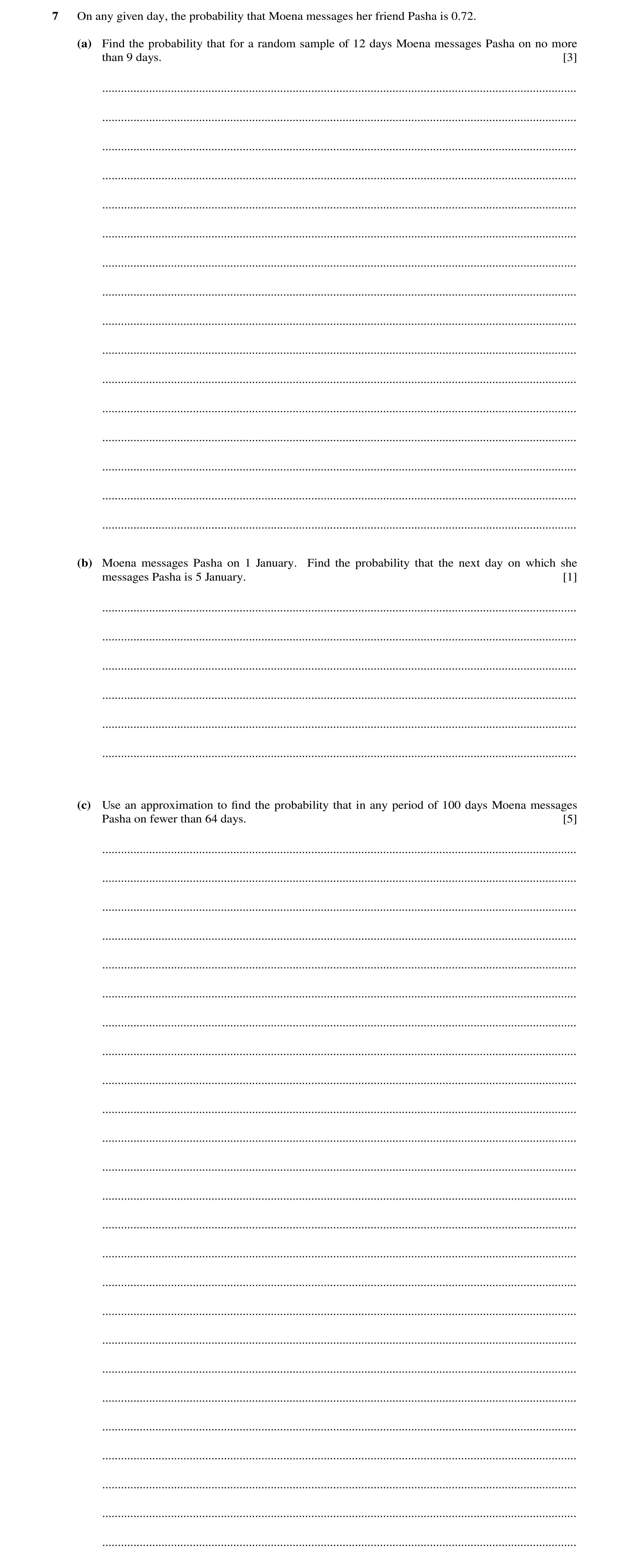
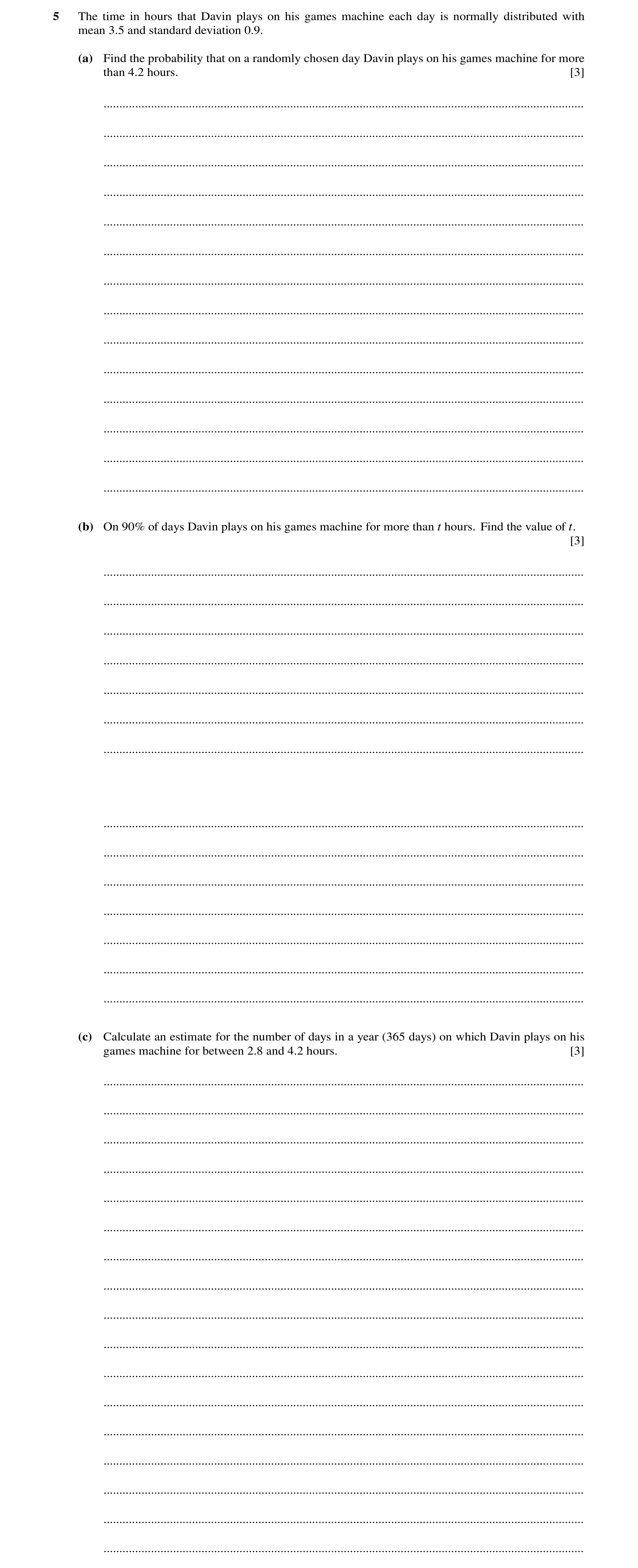
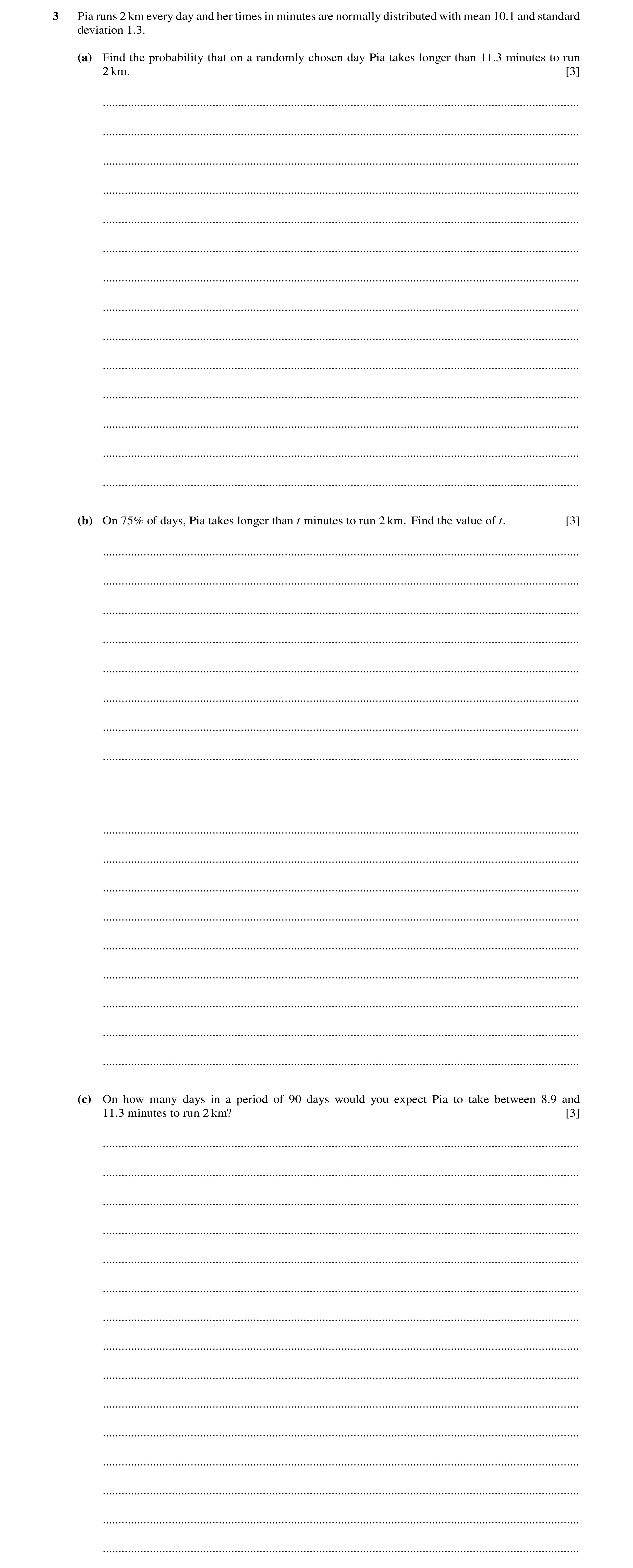
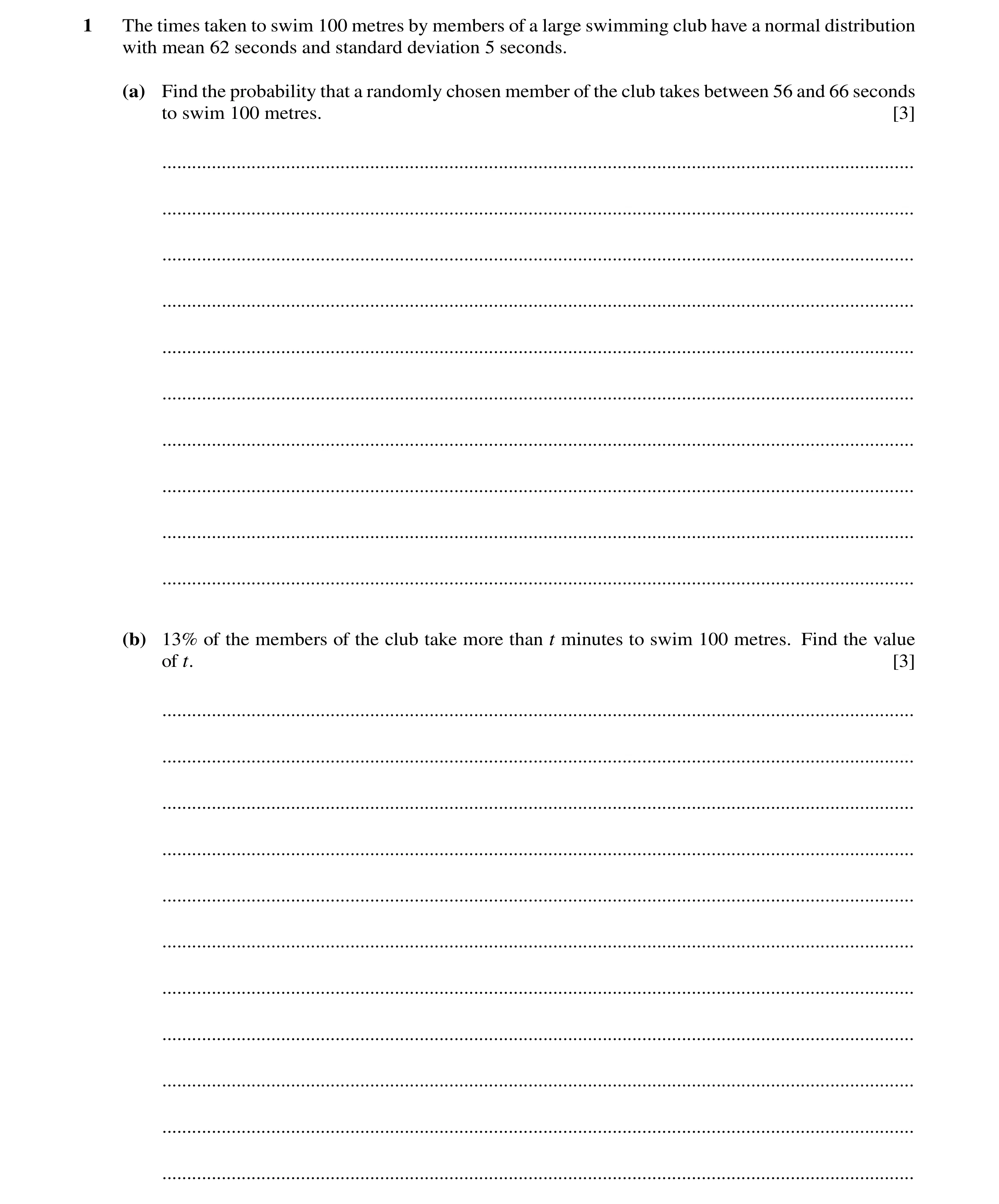 13 / 85
 14 / 85
 15 / 85
 18 / 85
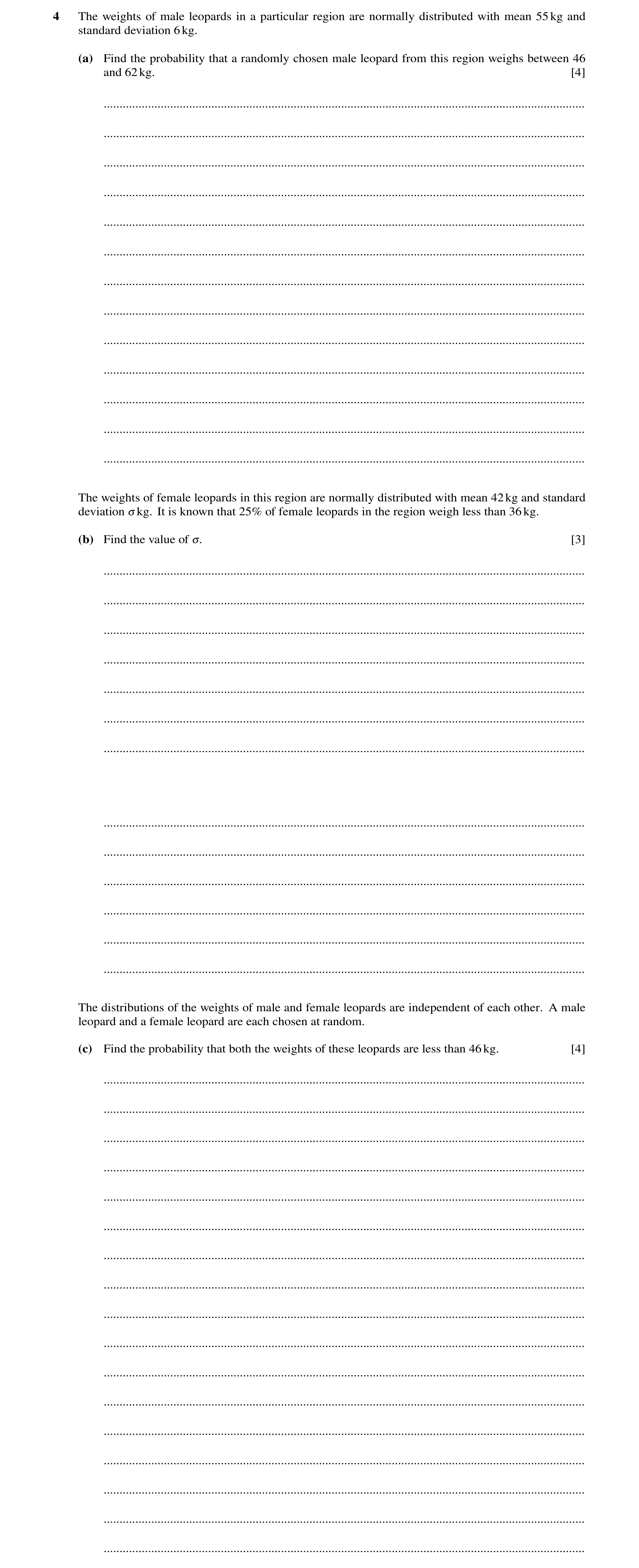
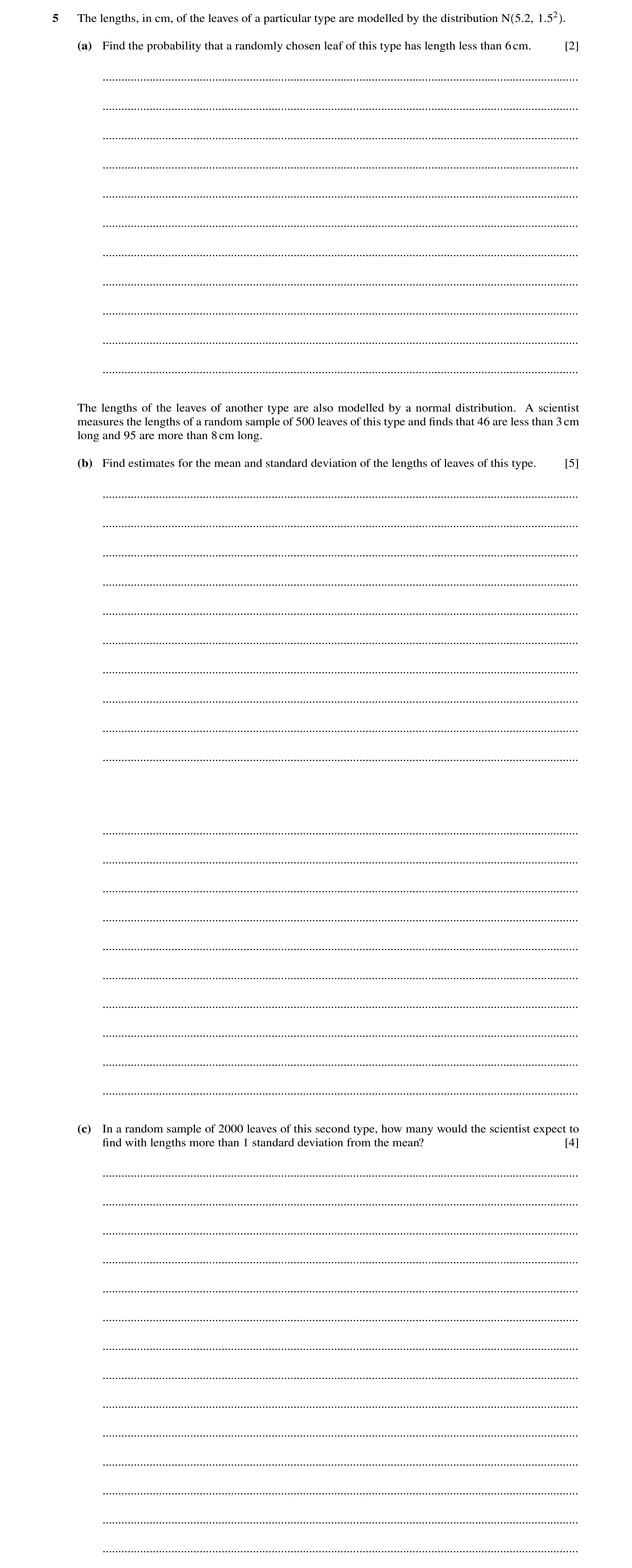
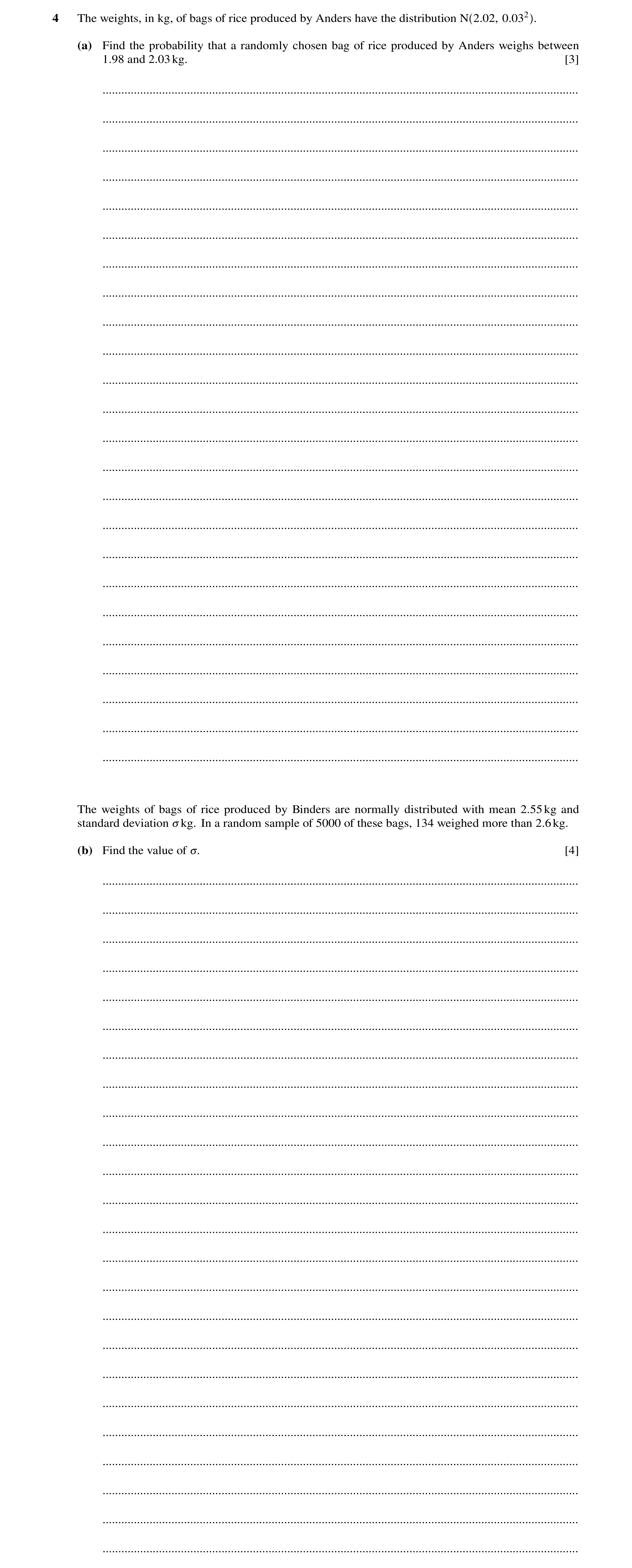
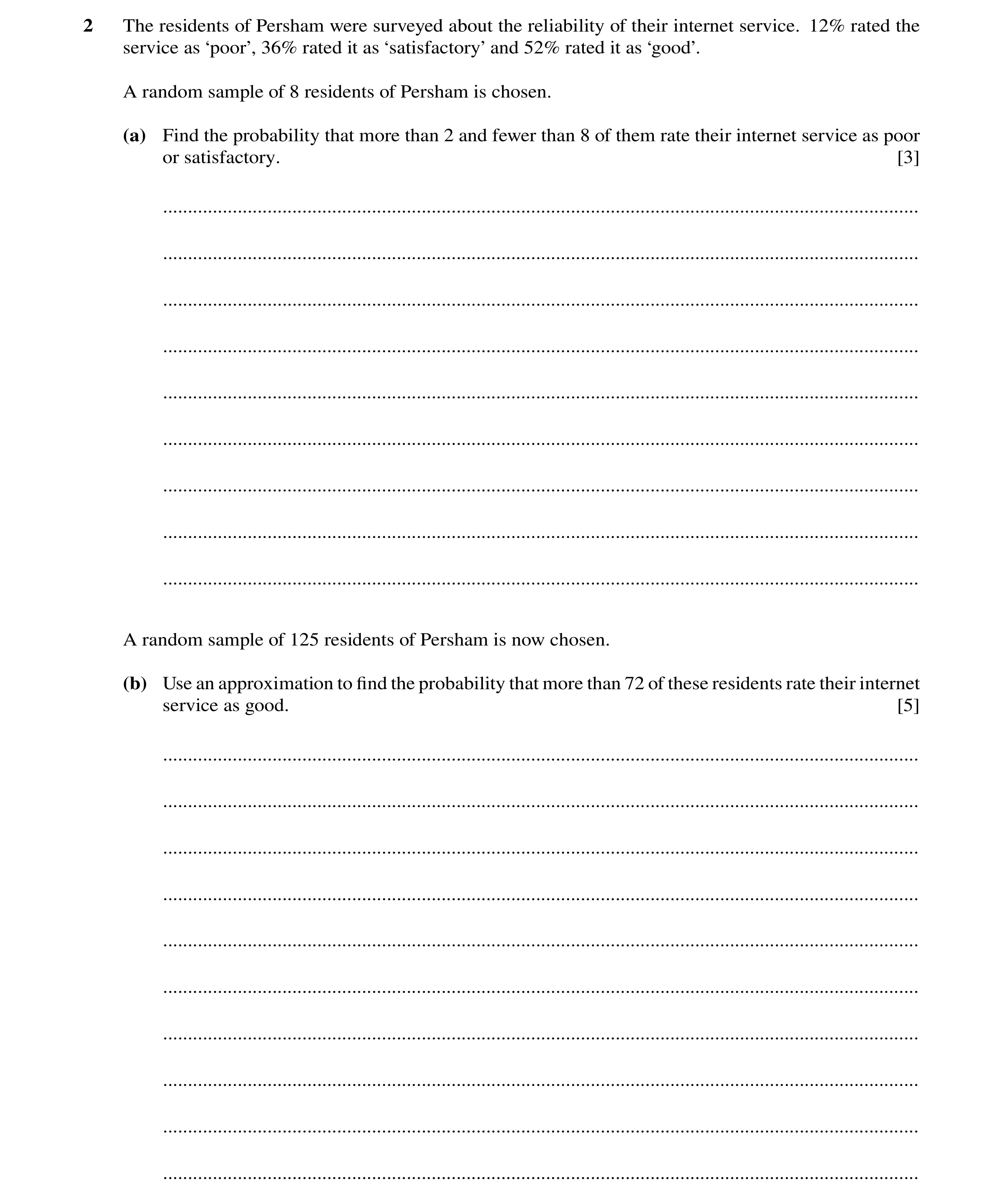 32 / 85
 35 / 85
 50 / 85
 53 / 85
 64 / 85
 69 / 85
 76 / 85
 77 / 85
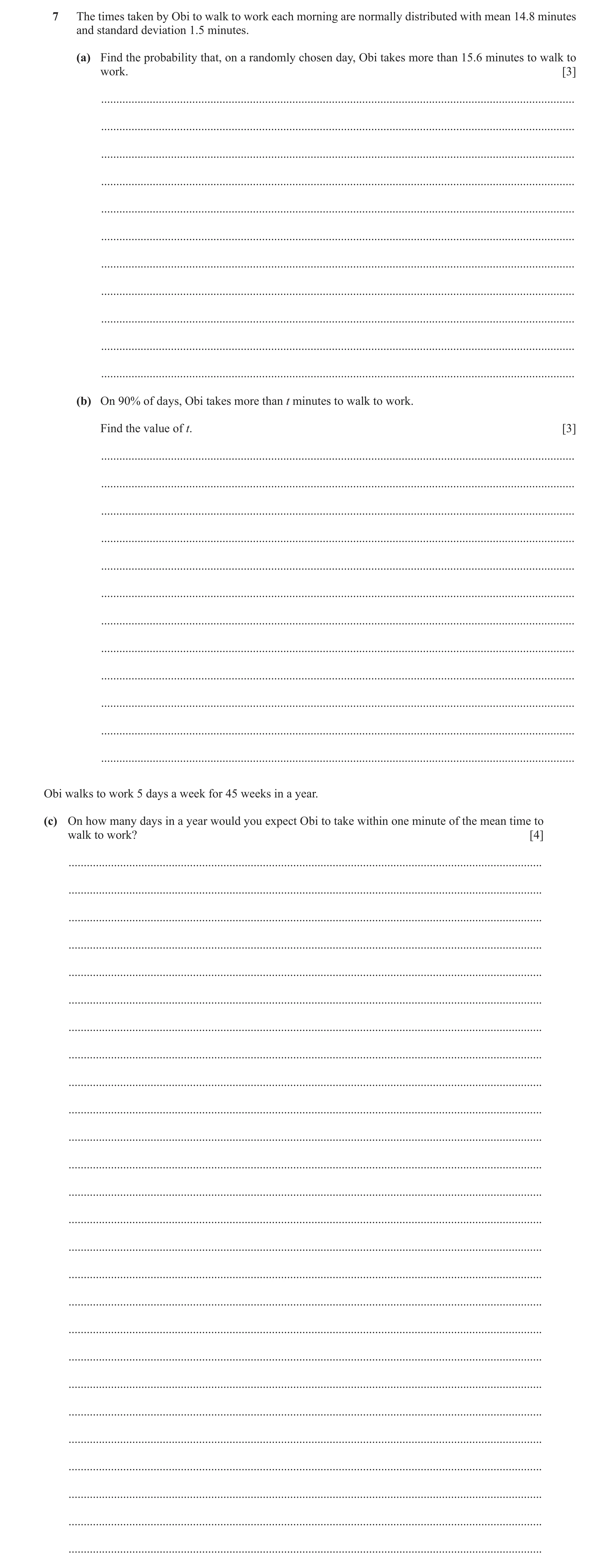
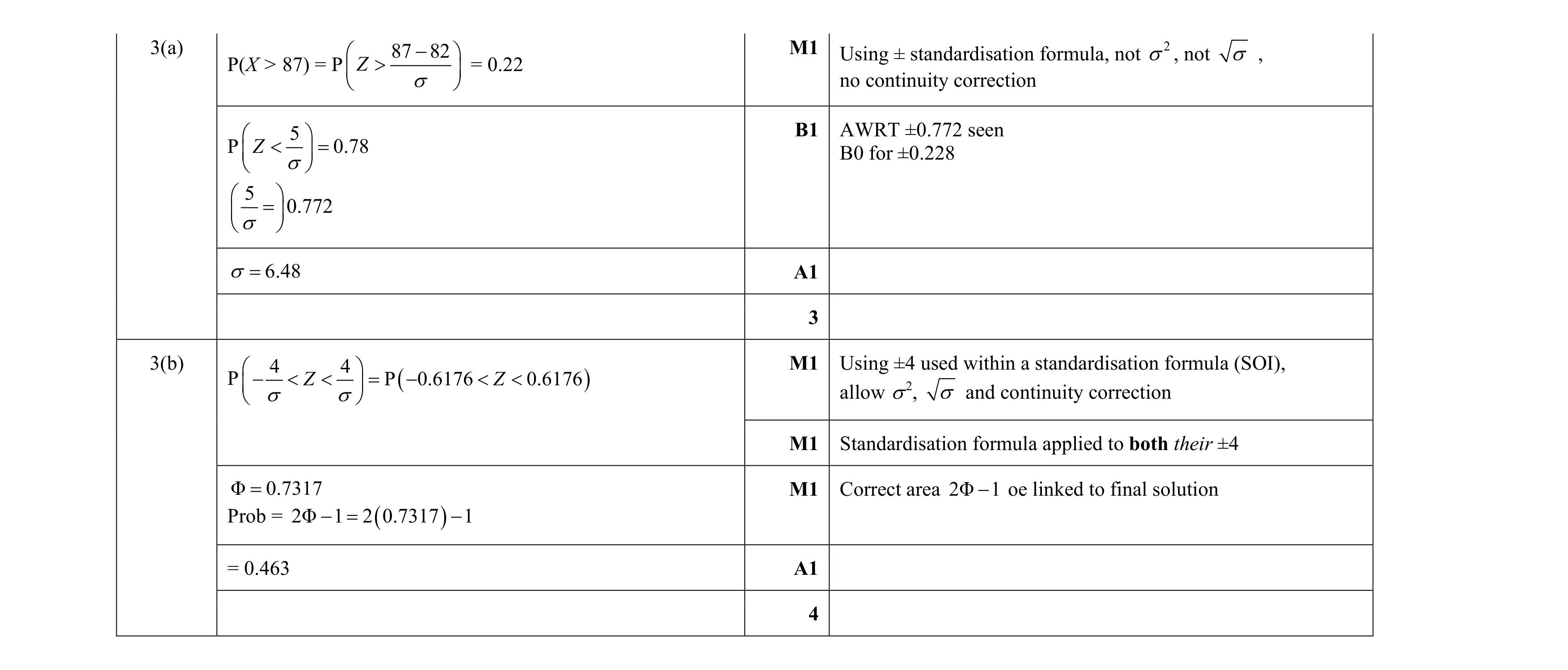 7
7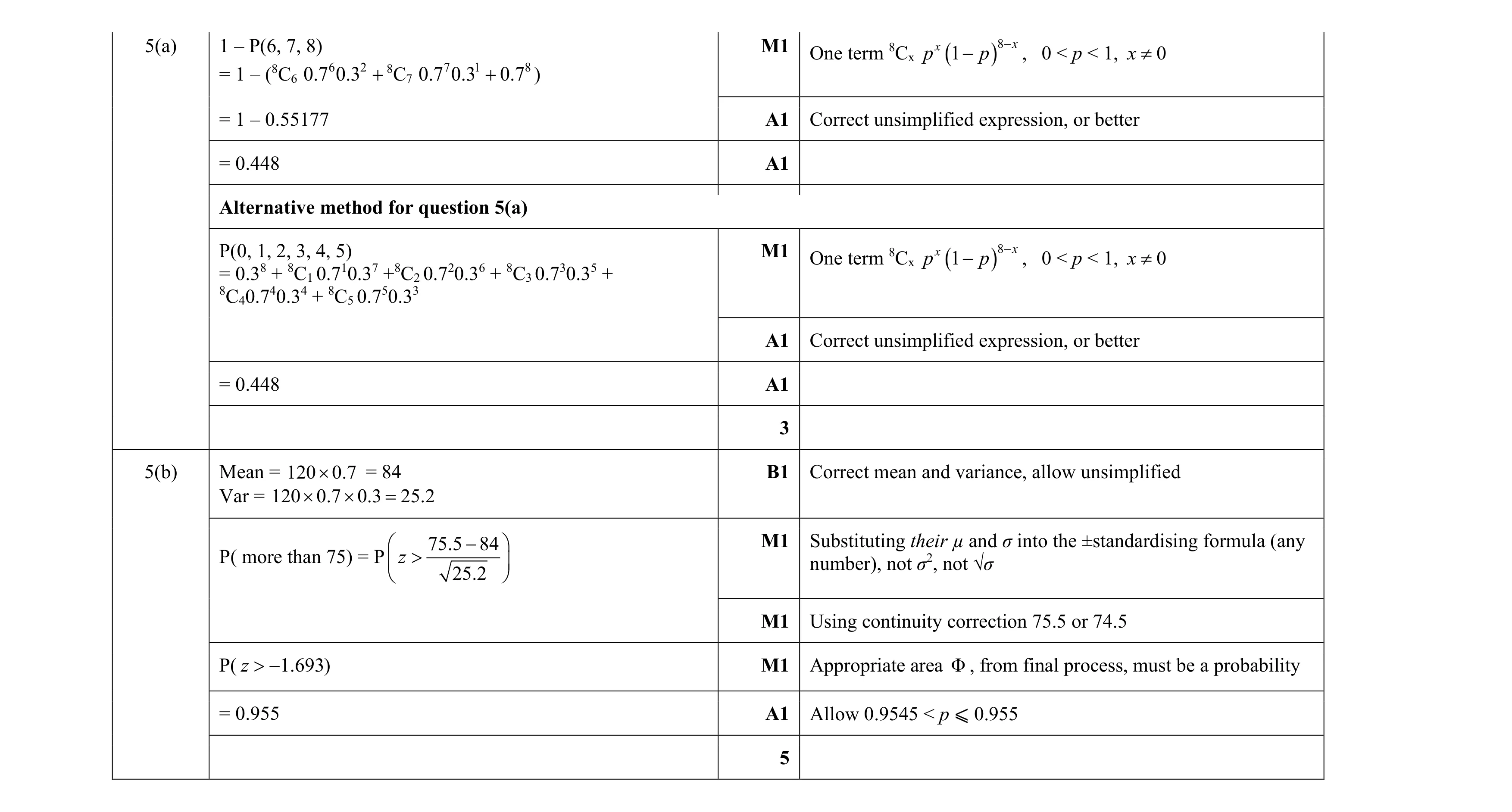 8
8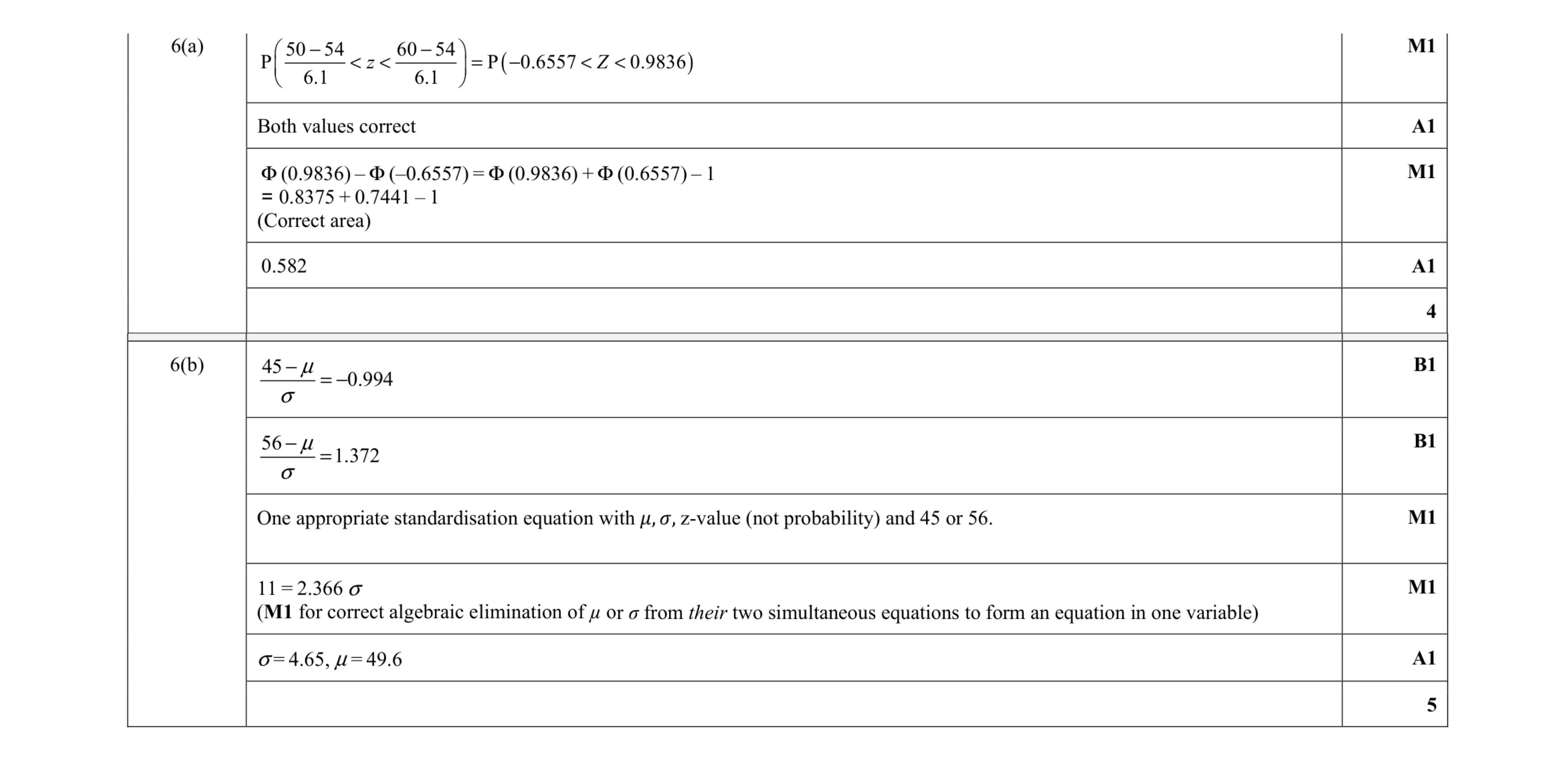 9
9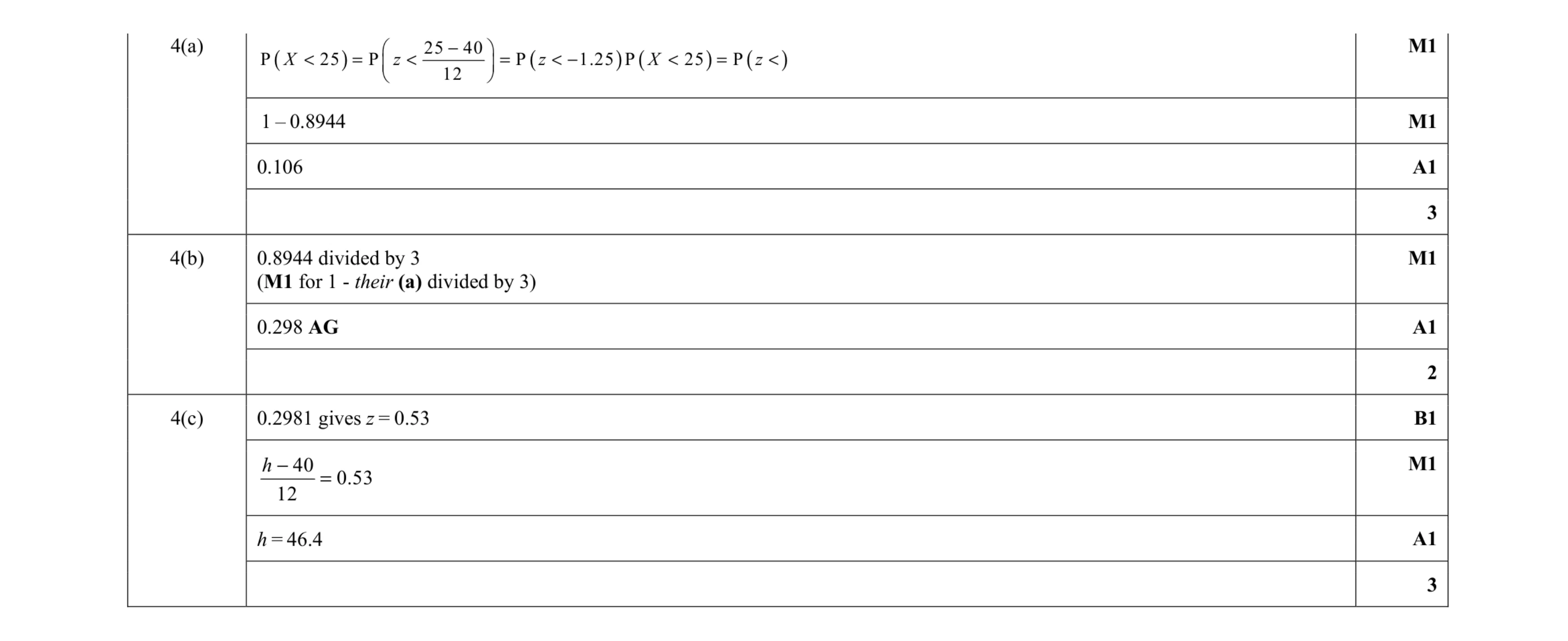 8
8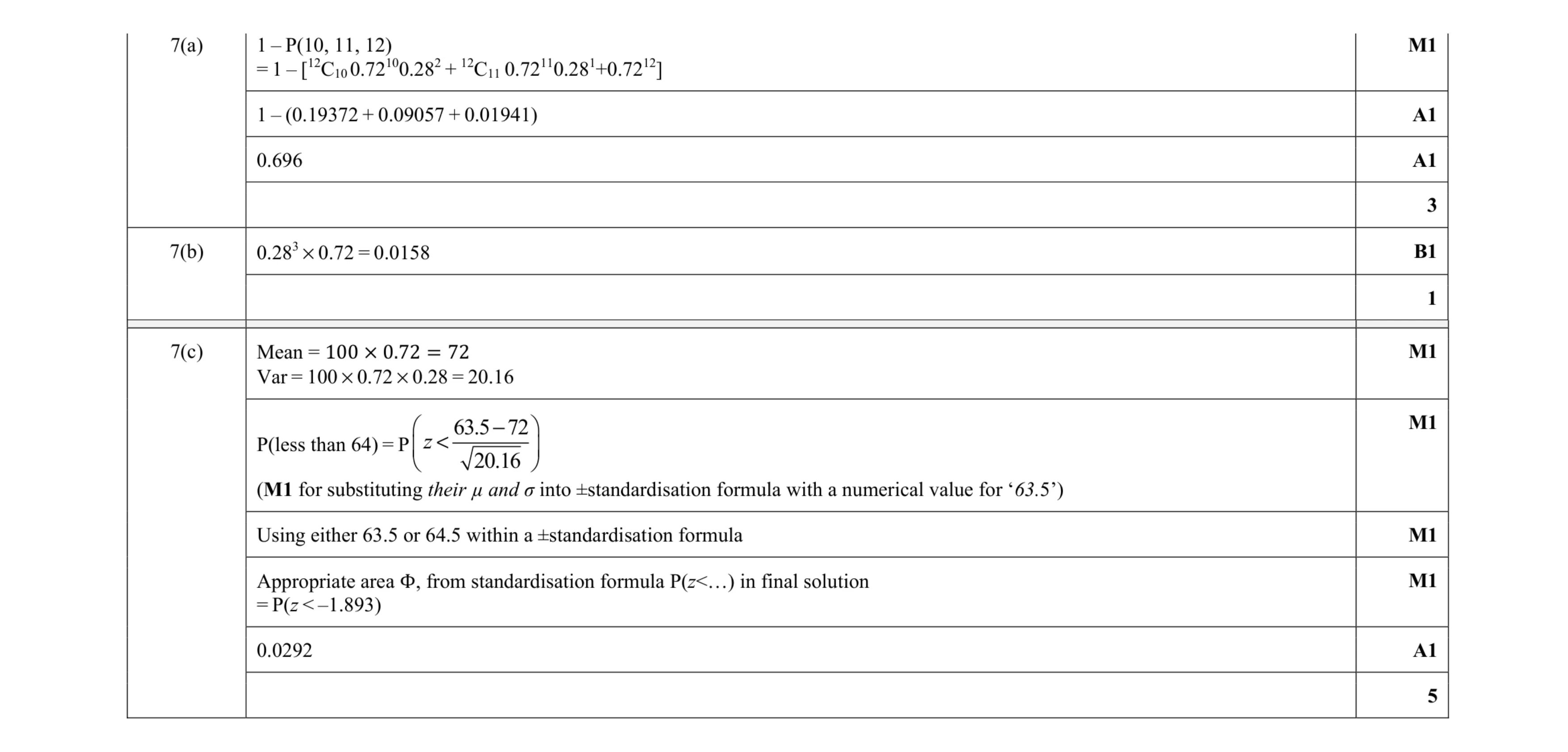 9
9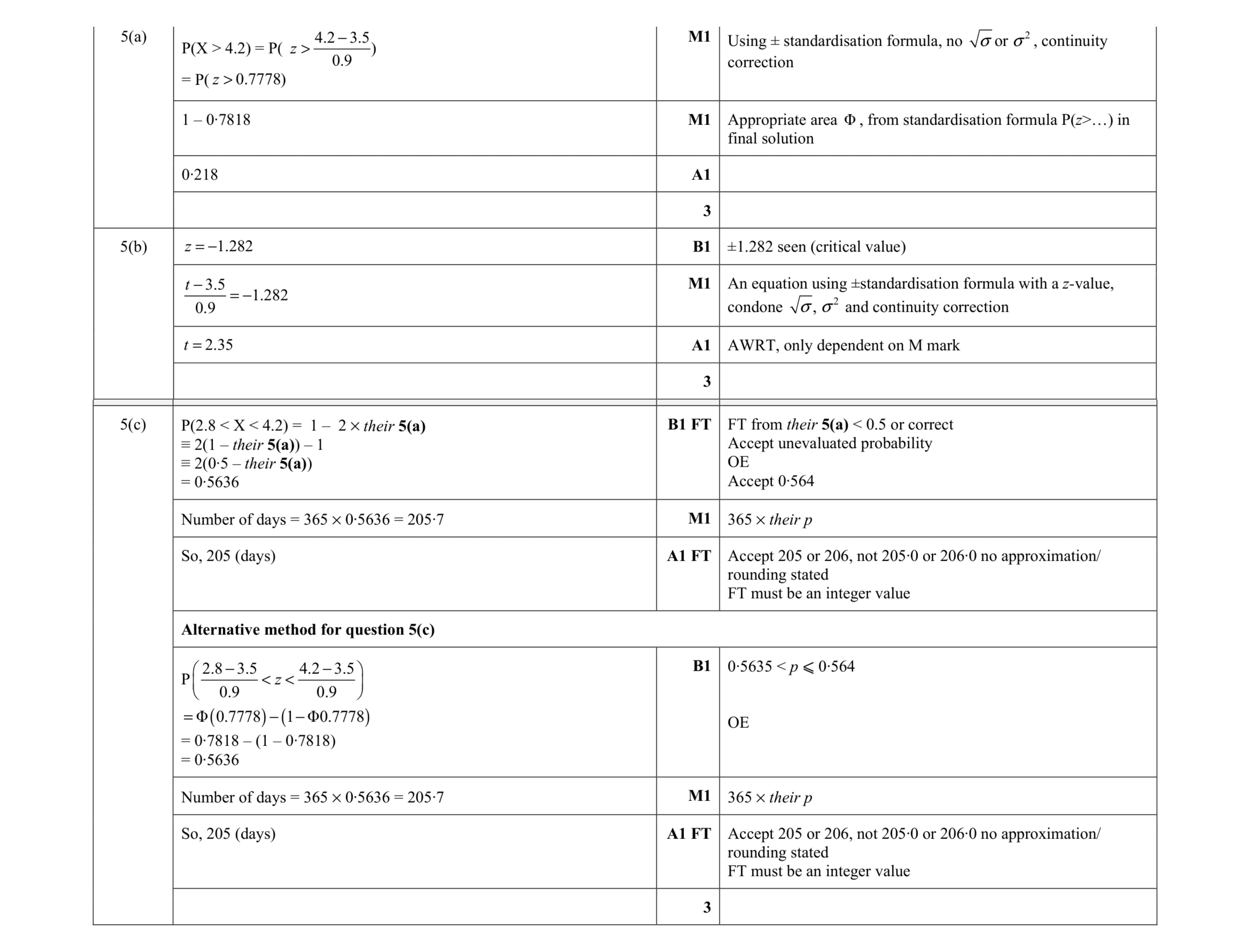 9
9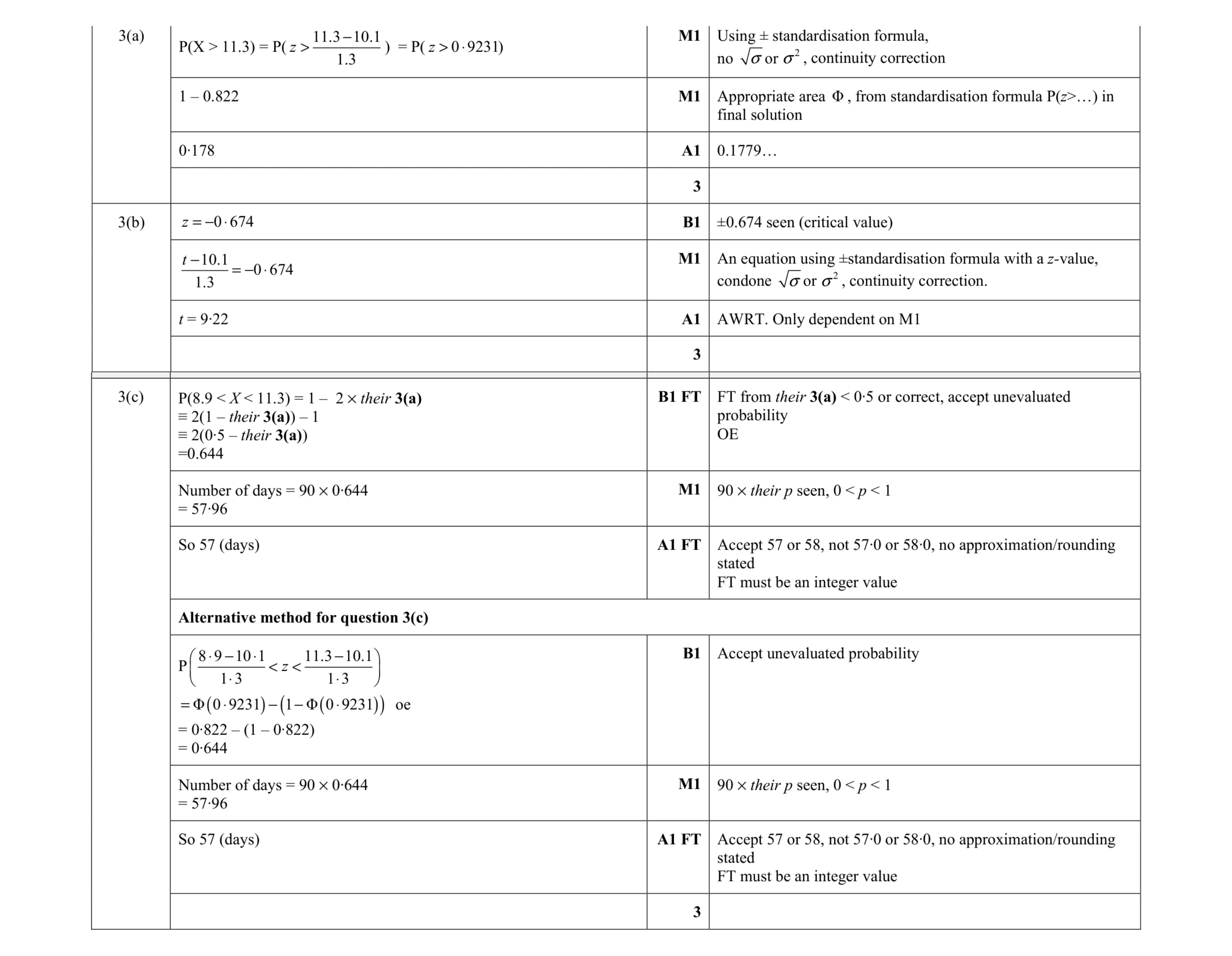 9
9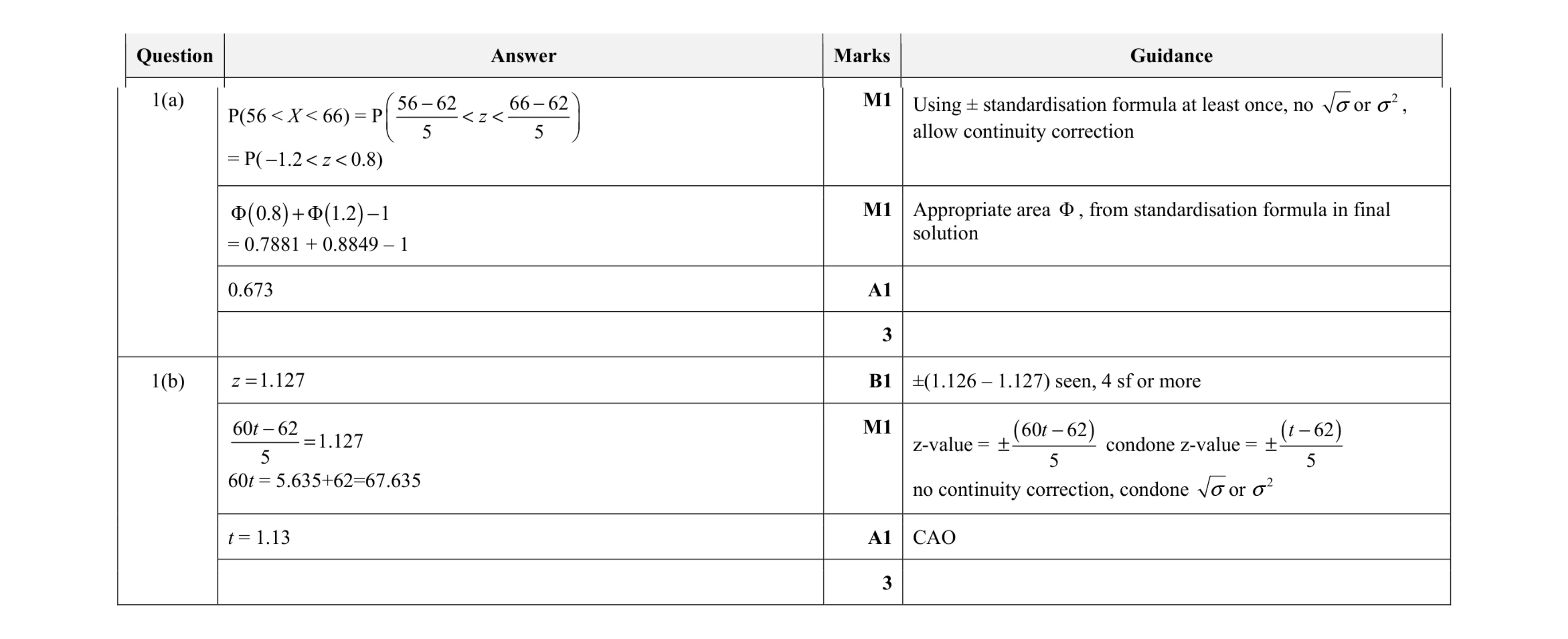 6
6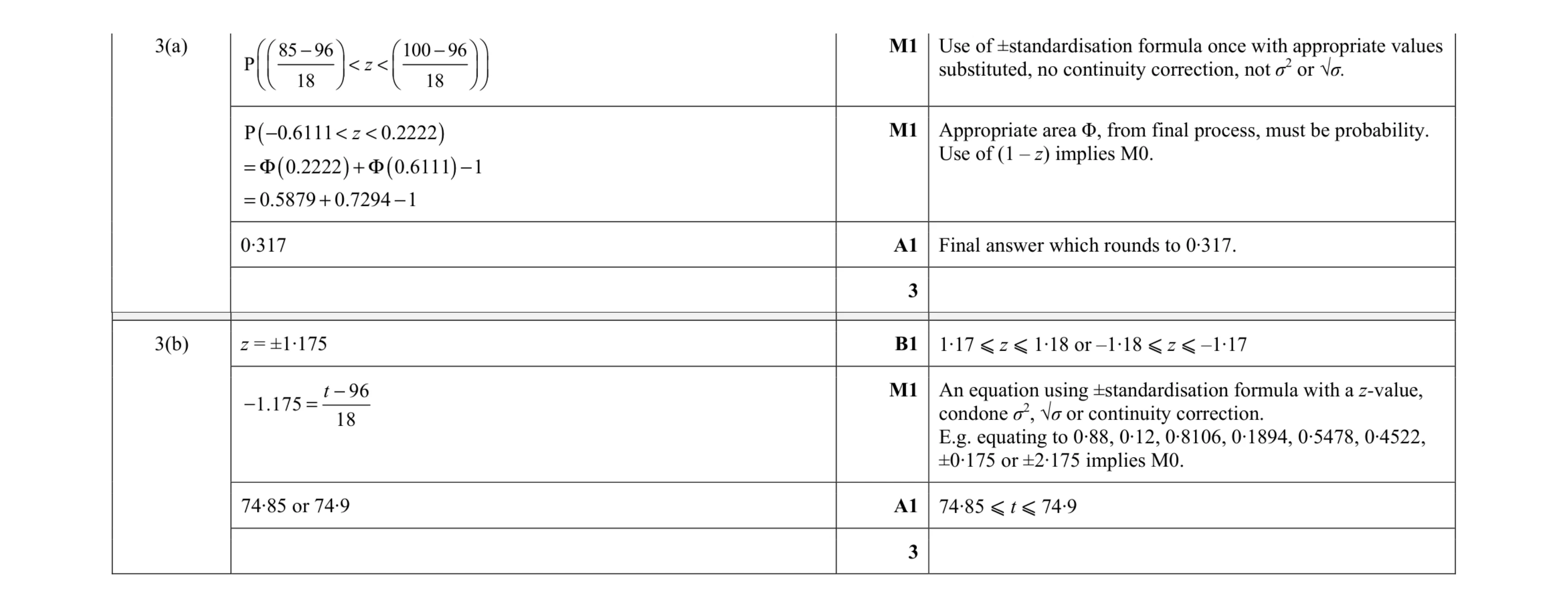 6
6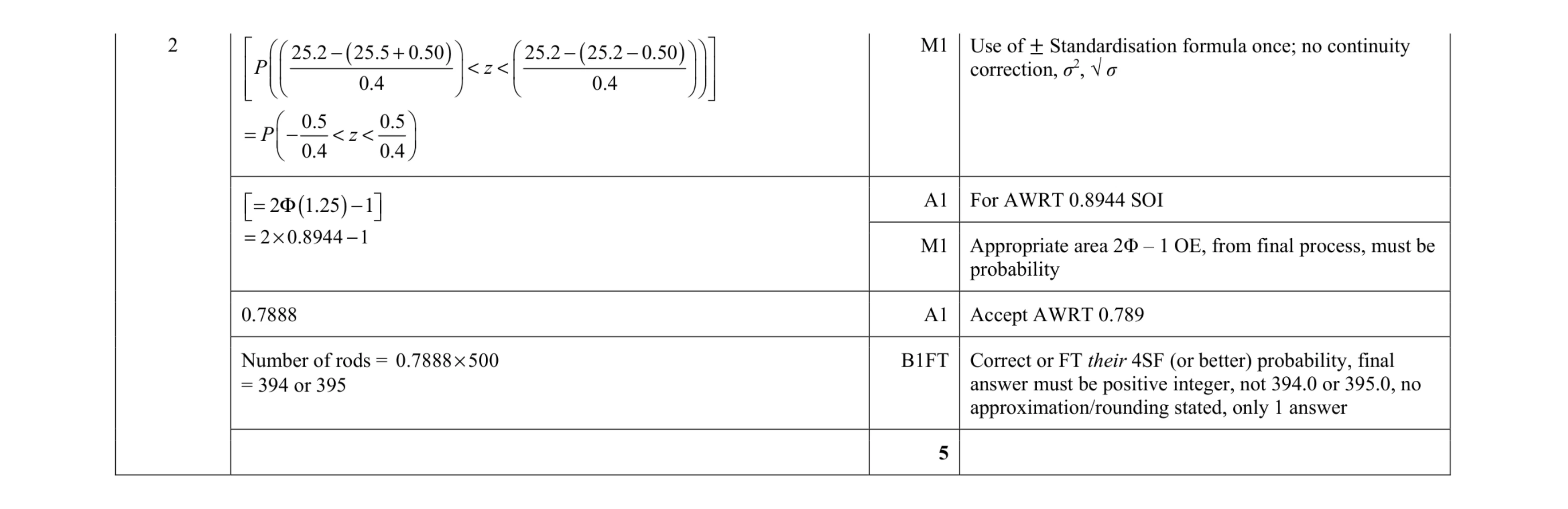 5
5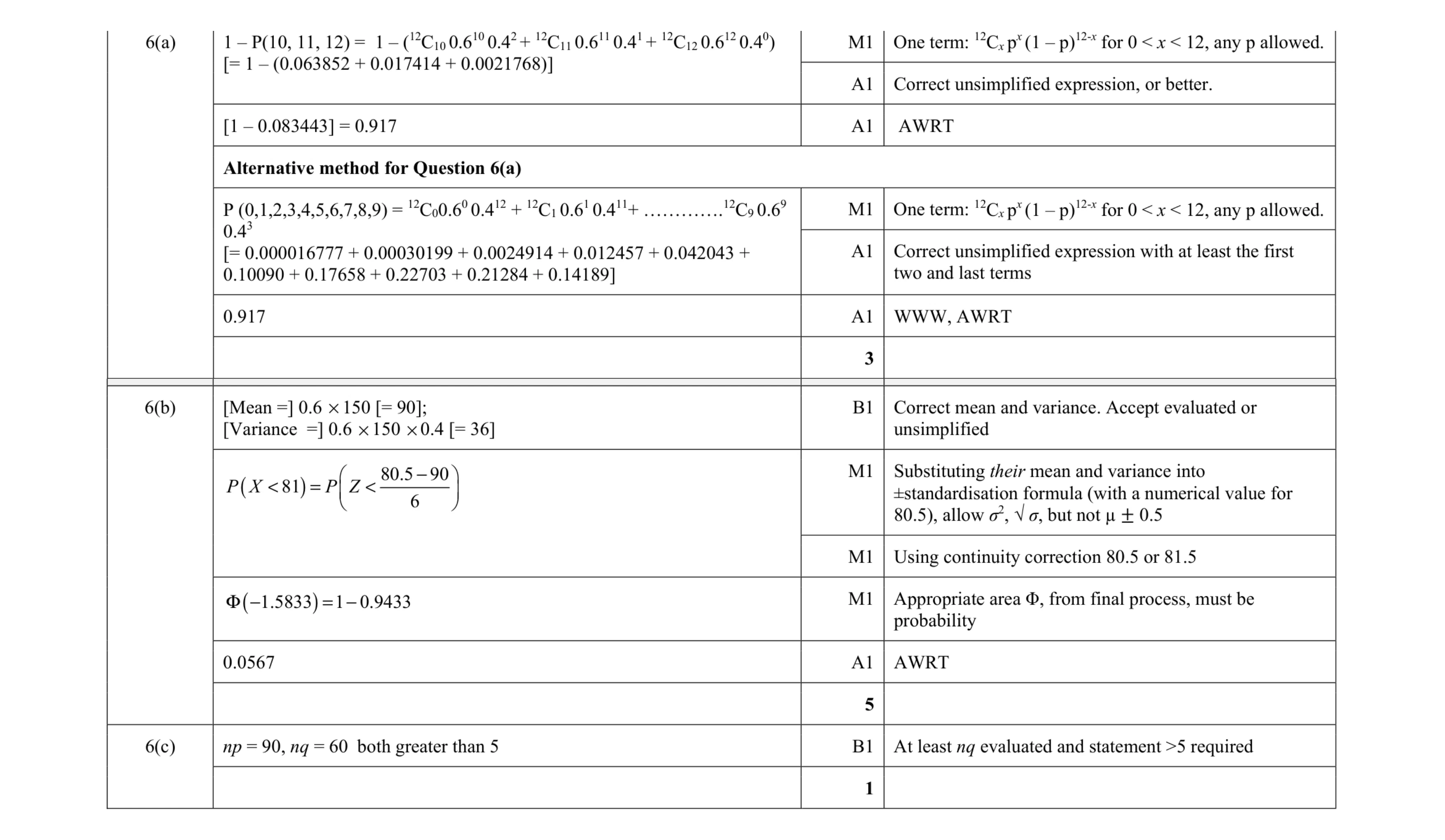 9
9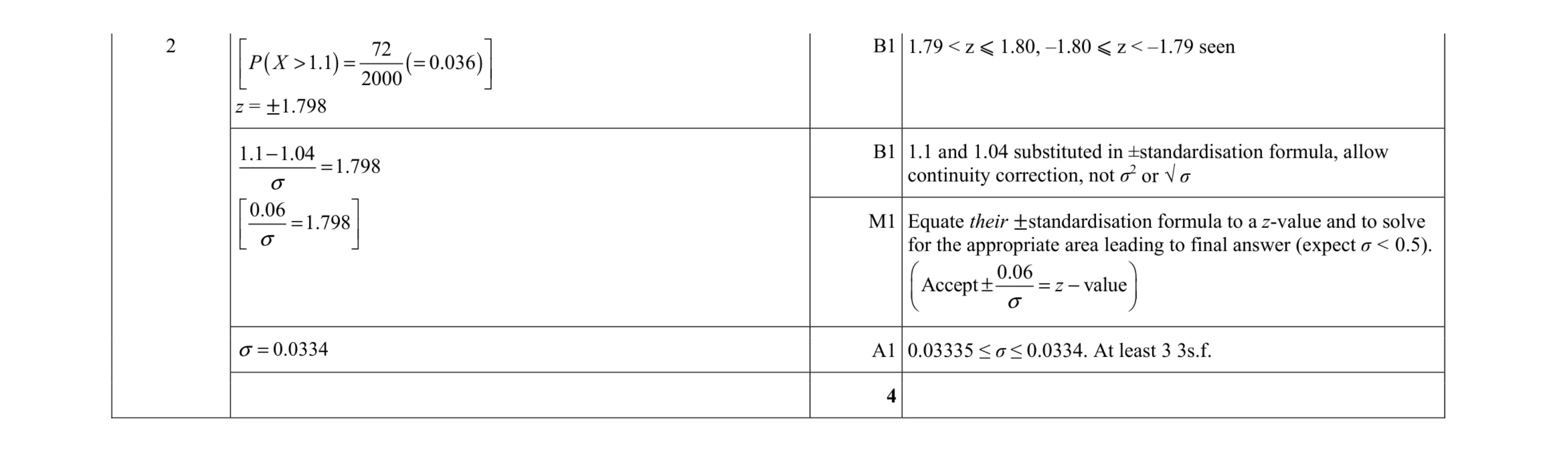 4
4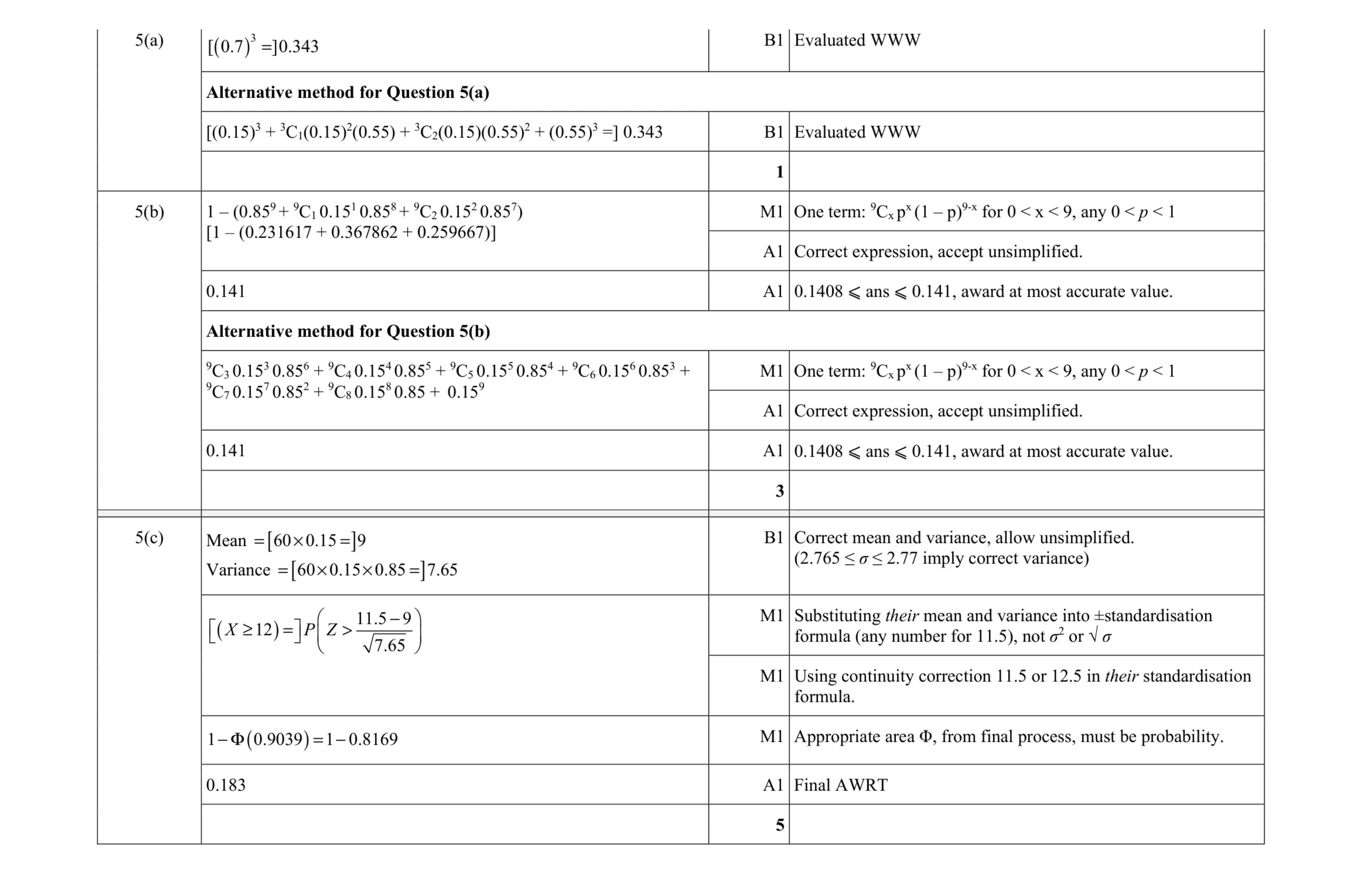 9
9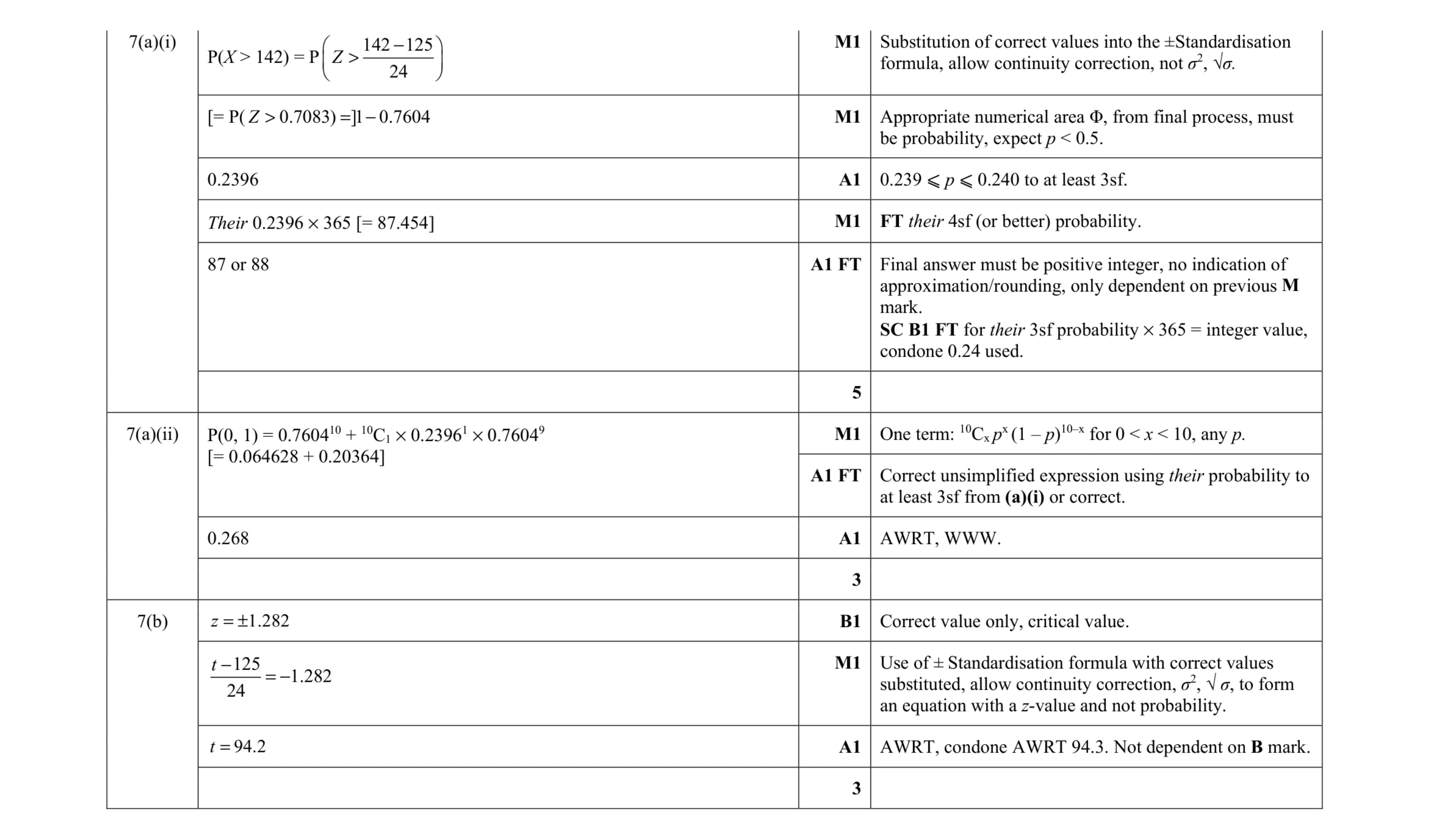 11
11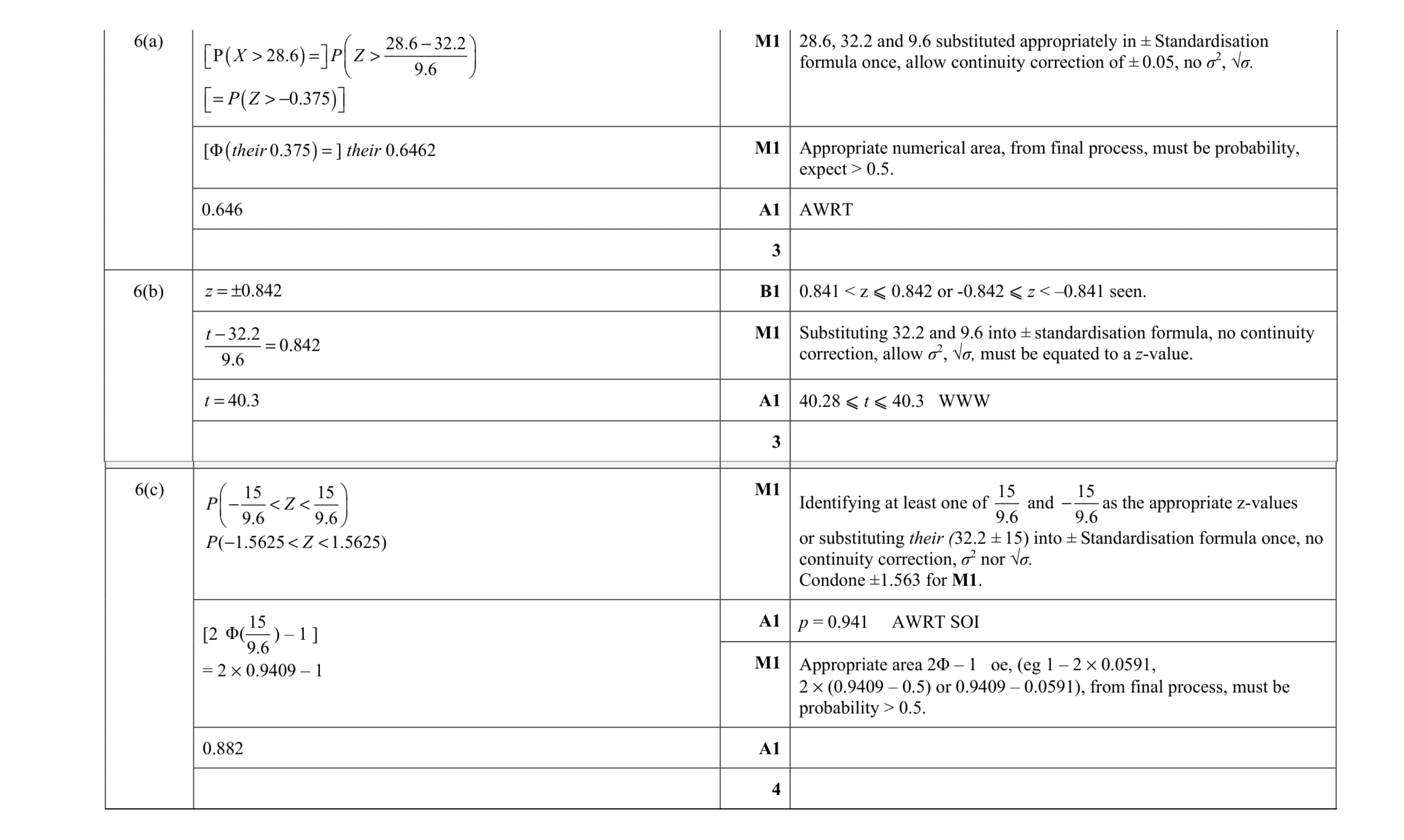 10
10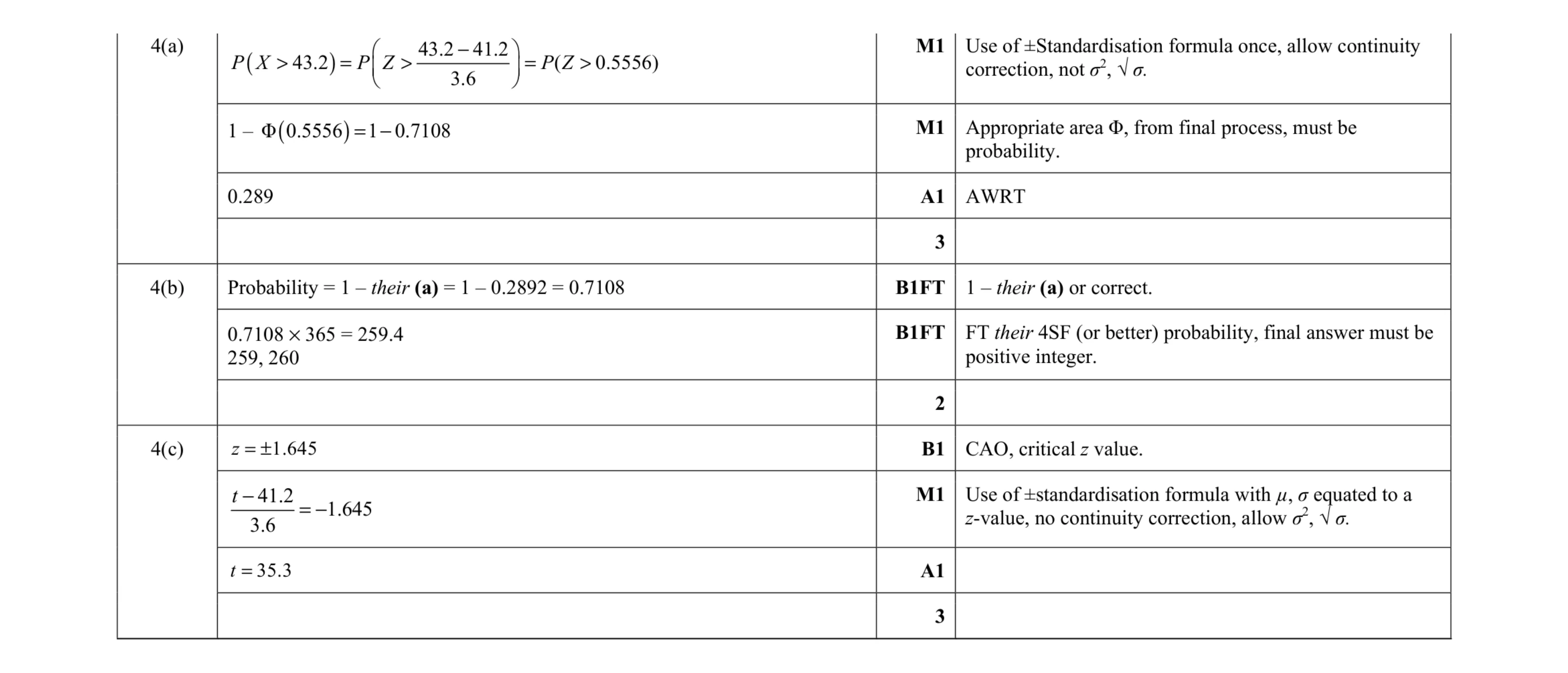 8
8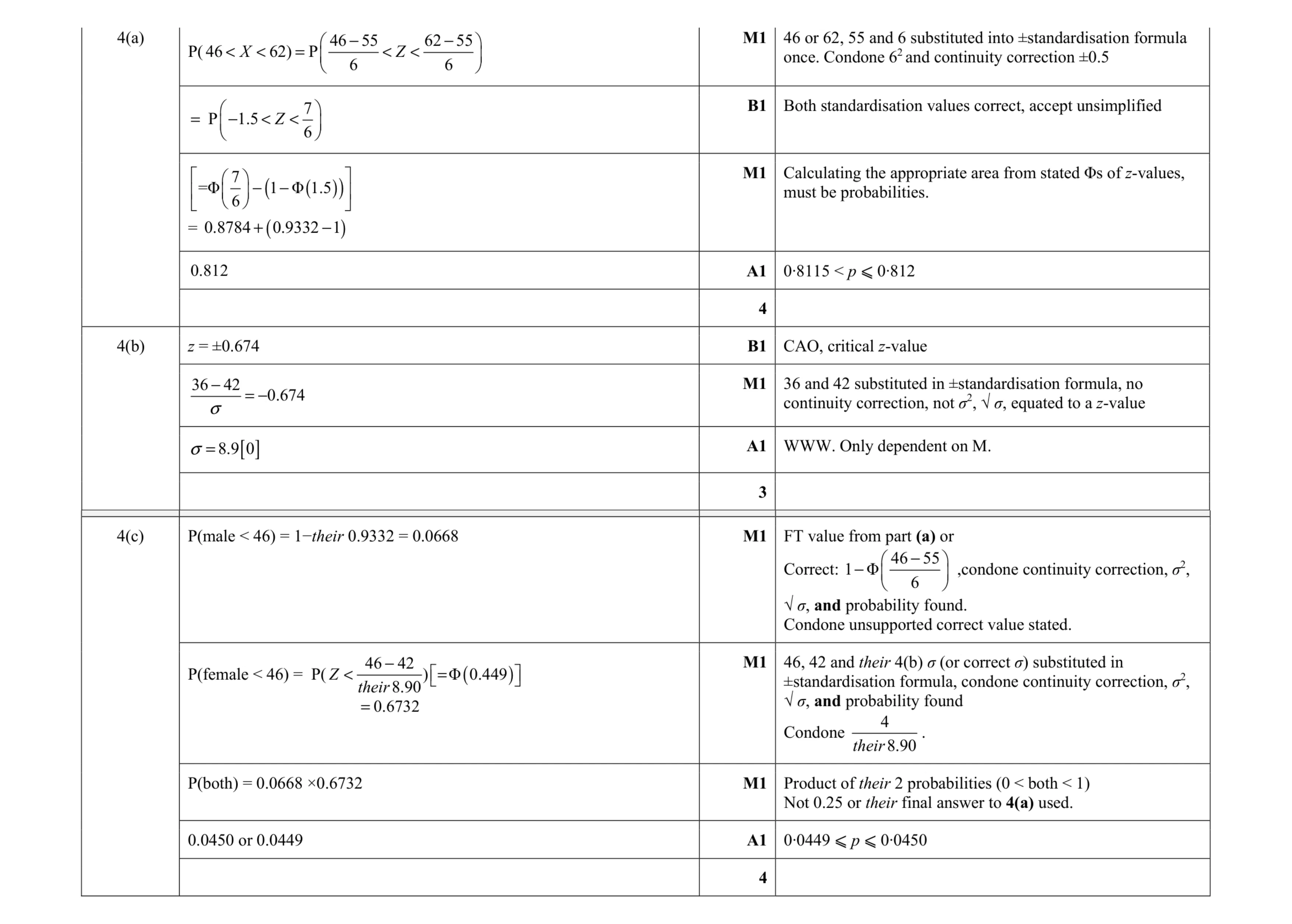 11
11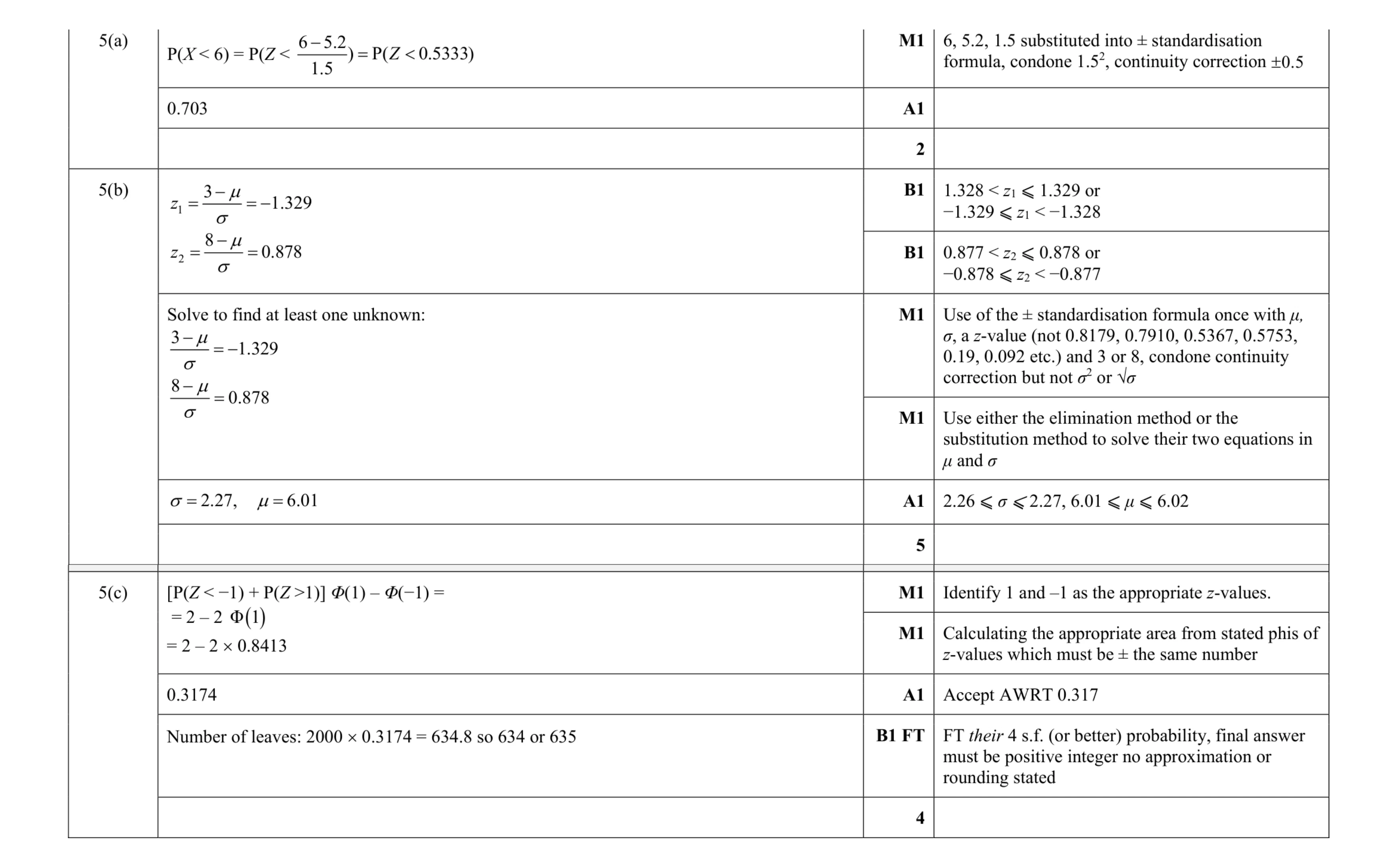 11
11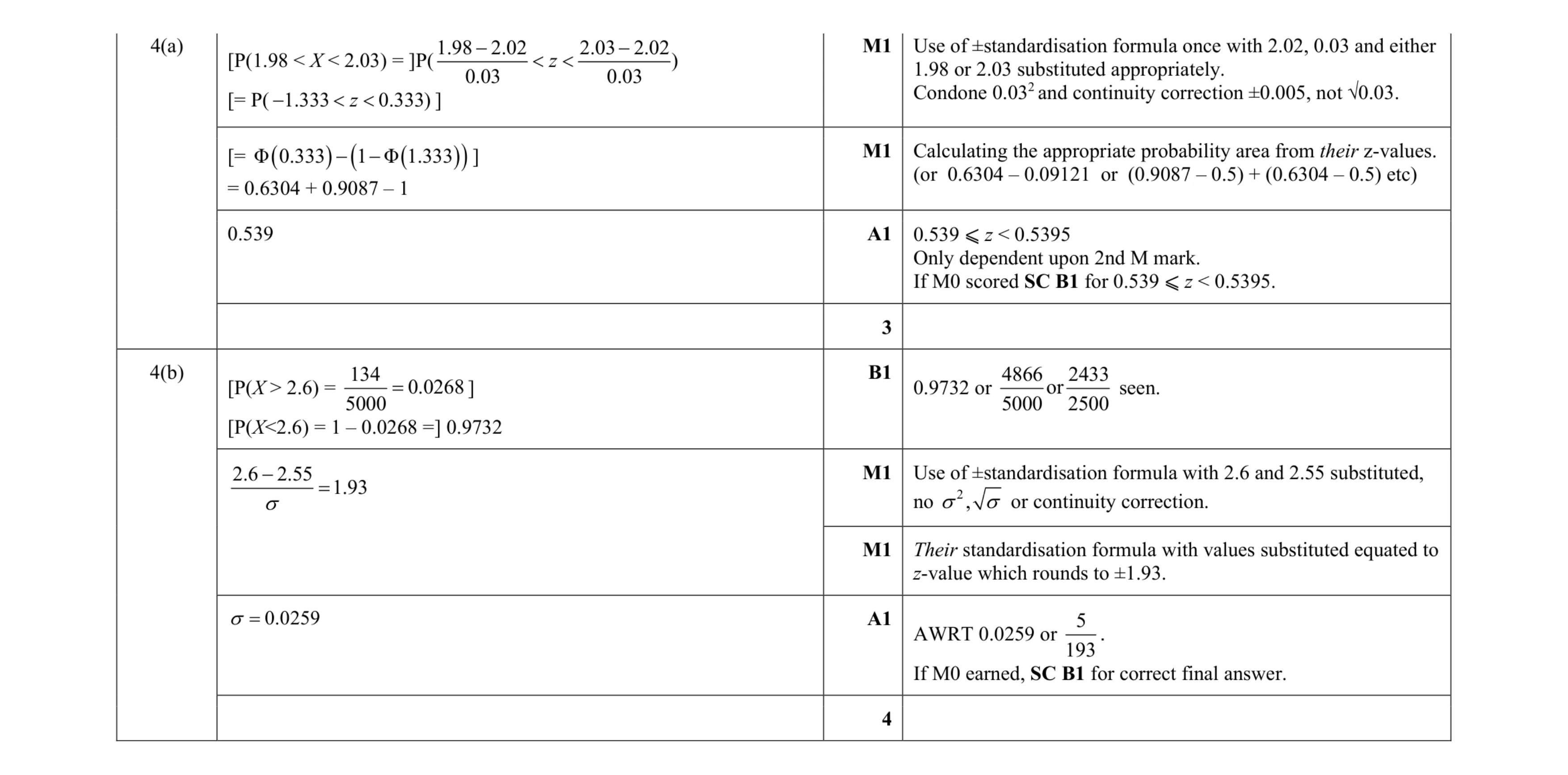 7
7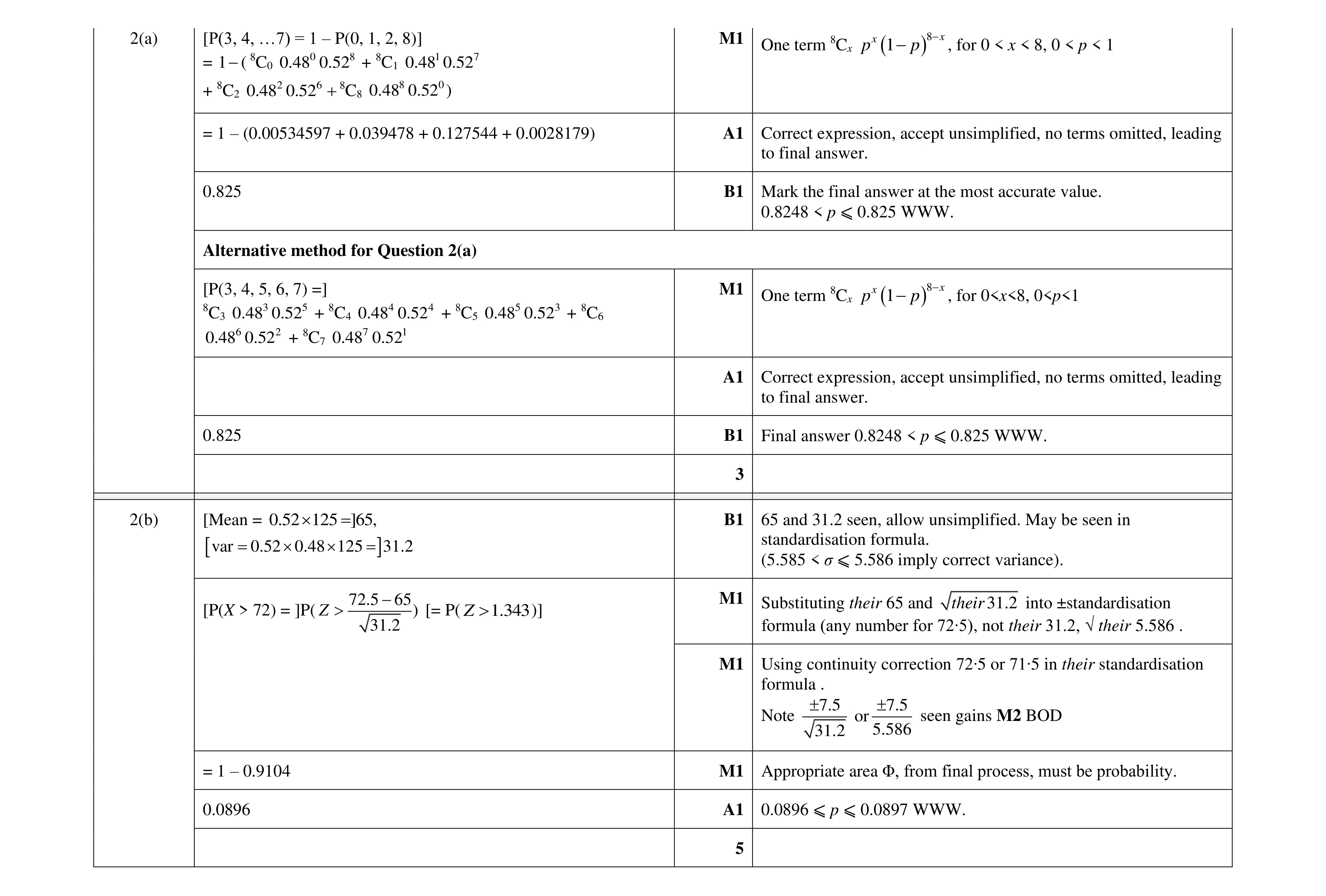 8
8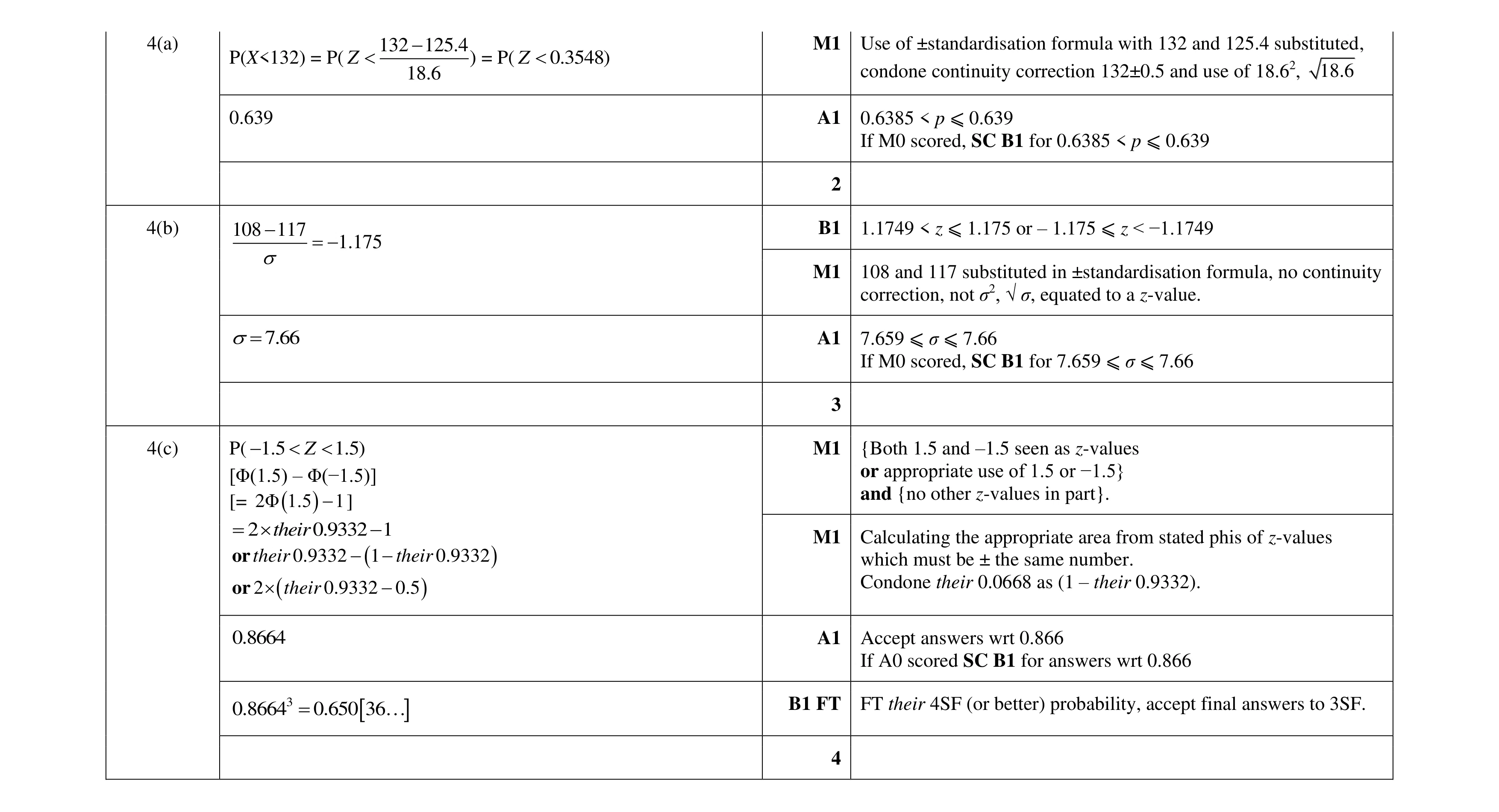 9
9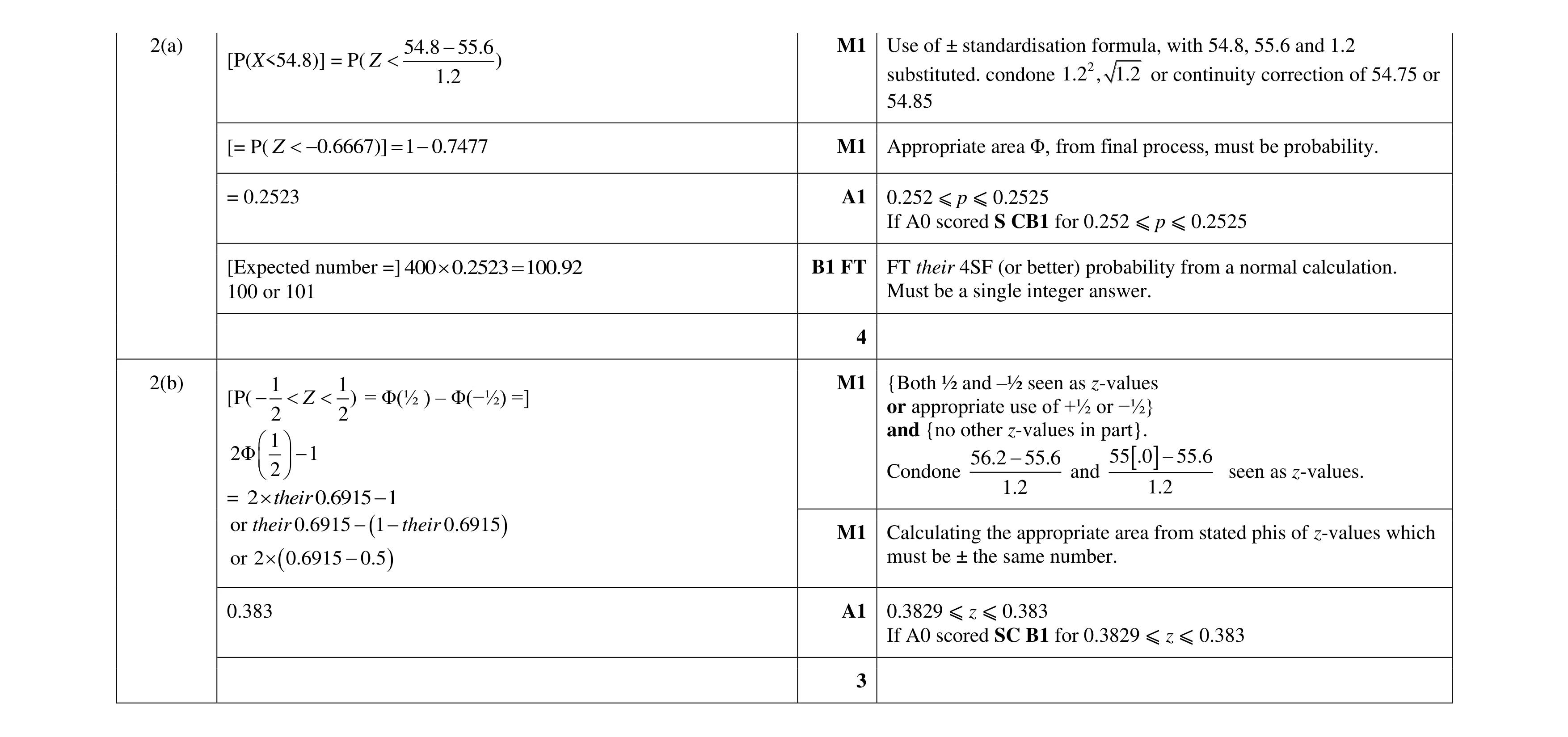 7
7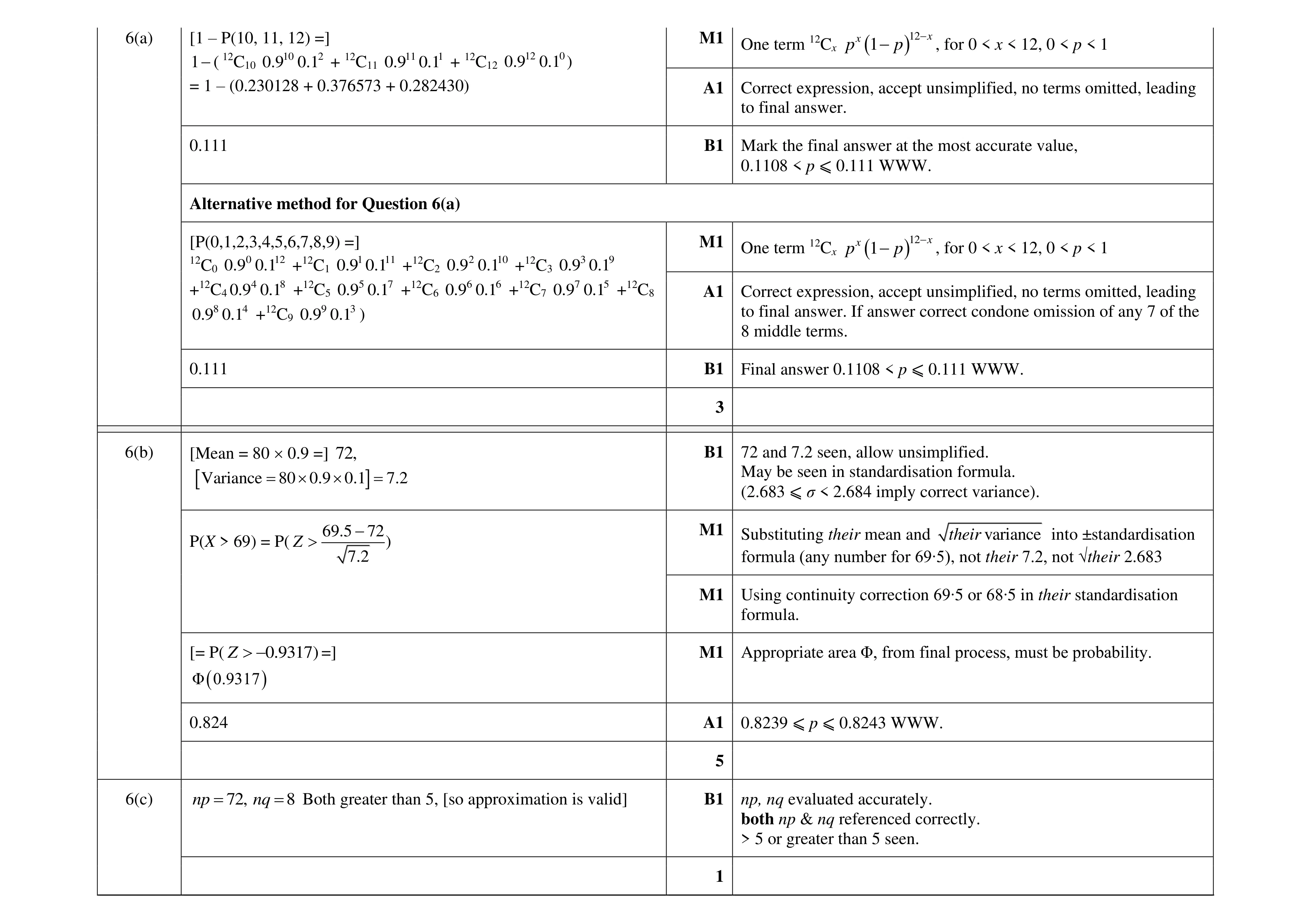 9
9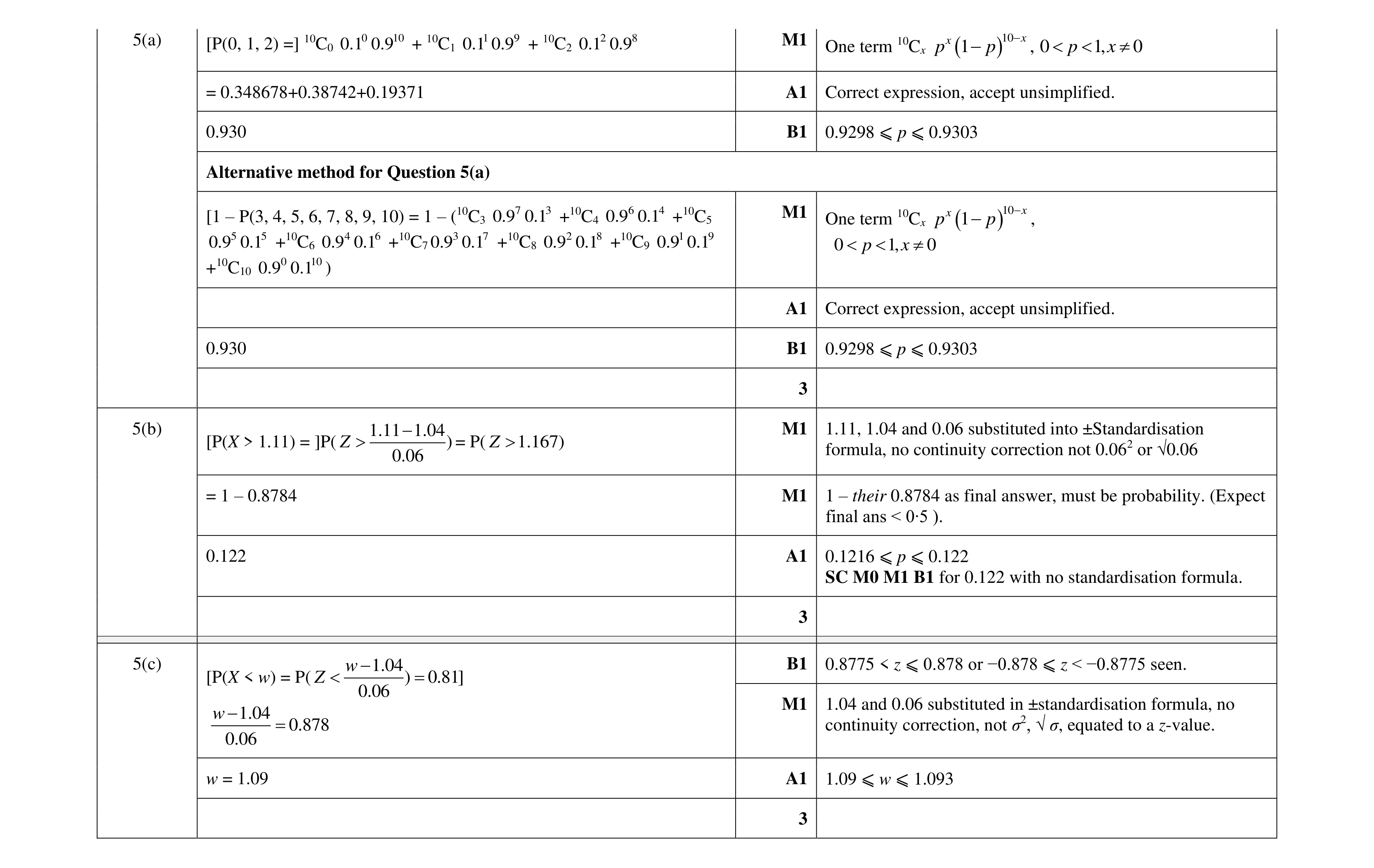 9
9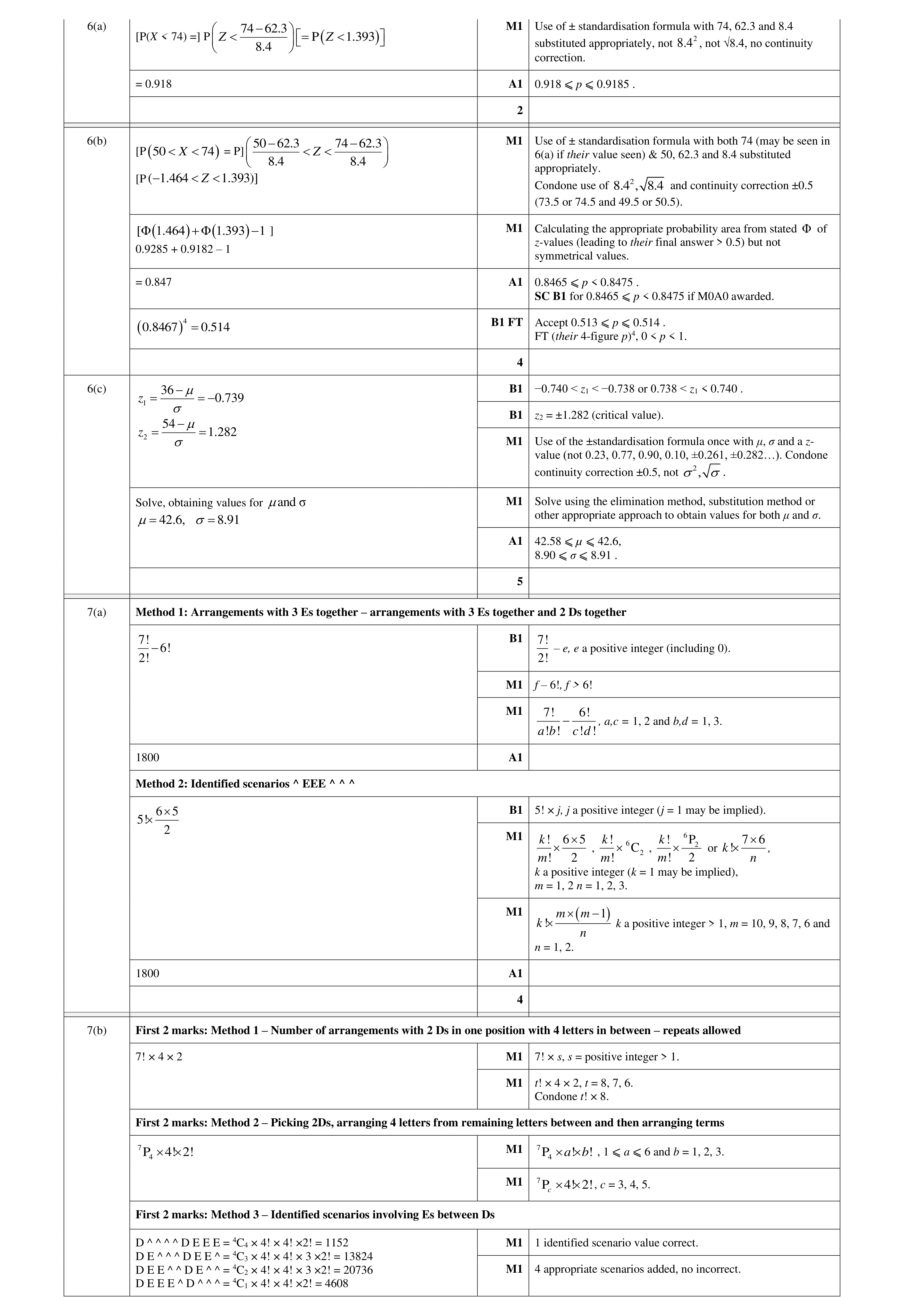 11
11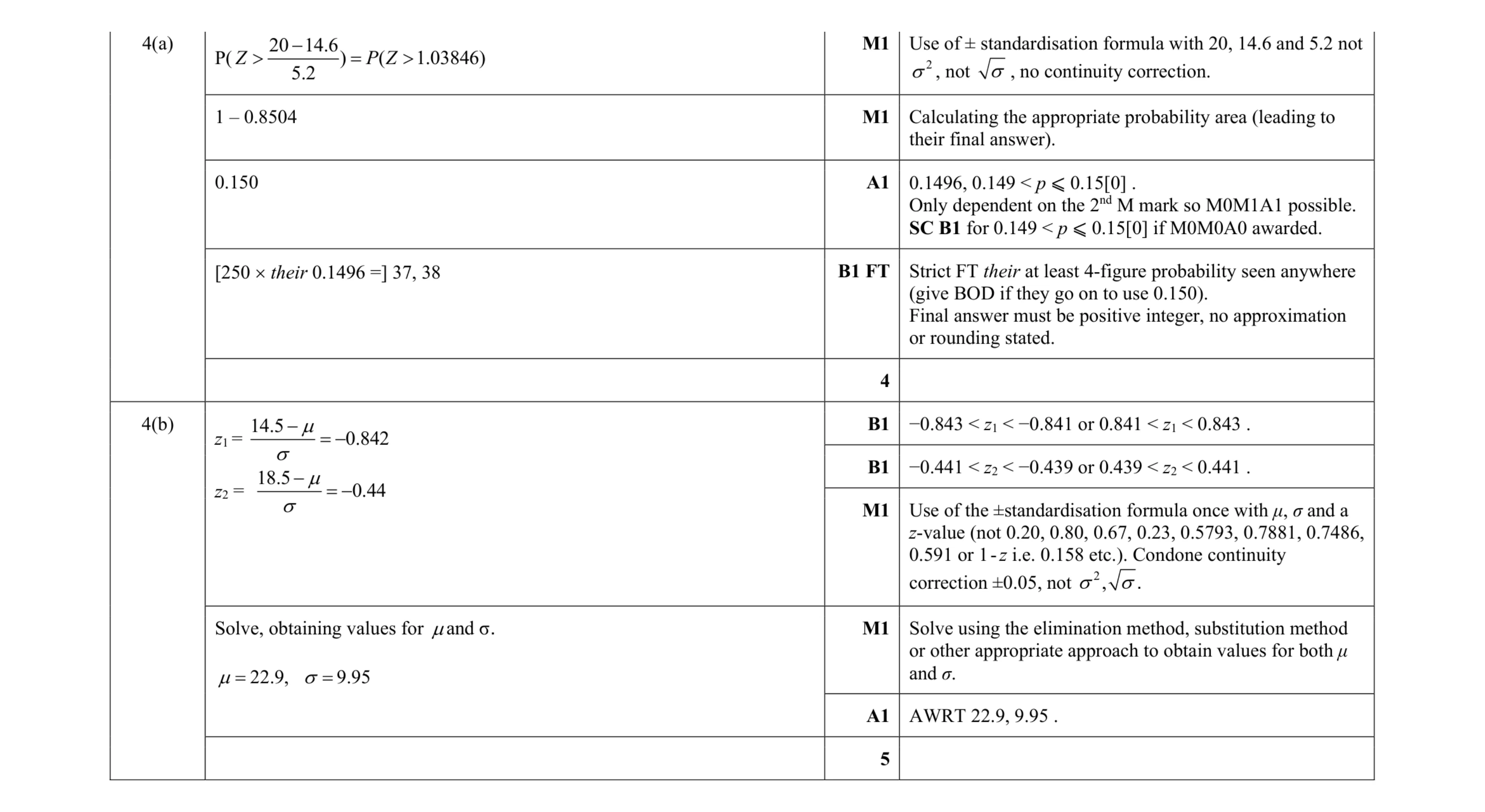 9
9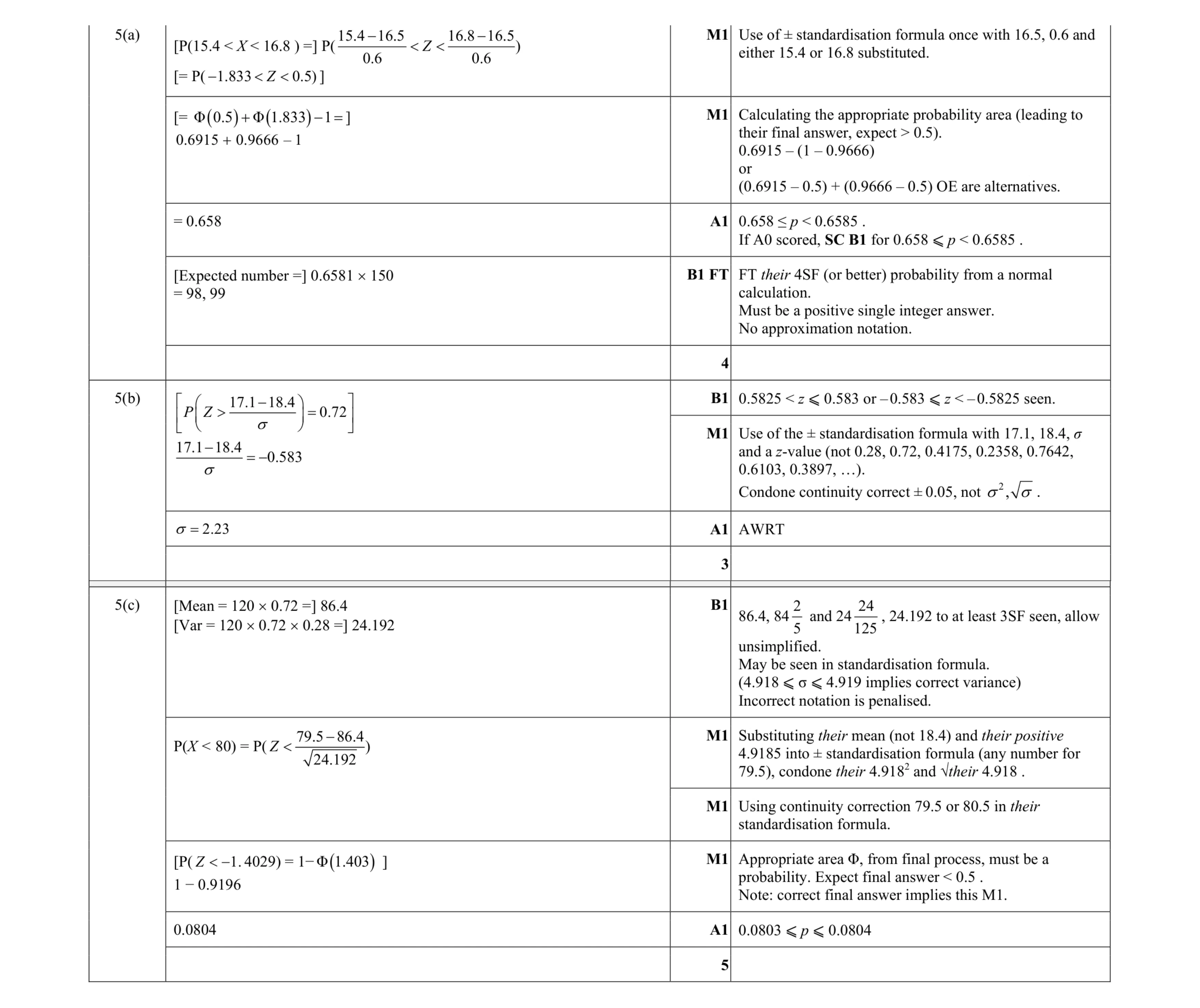 12
12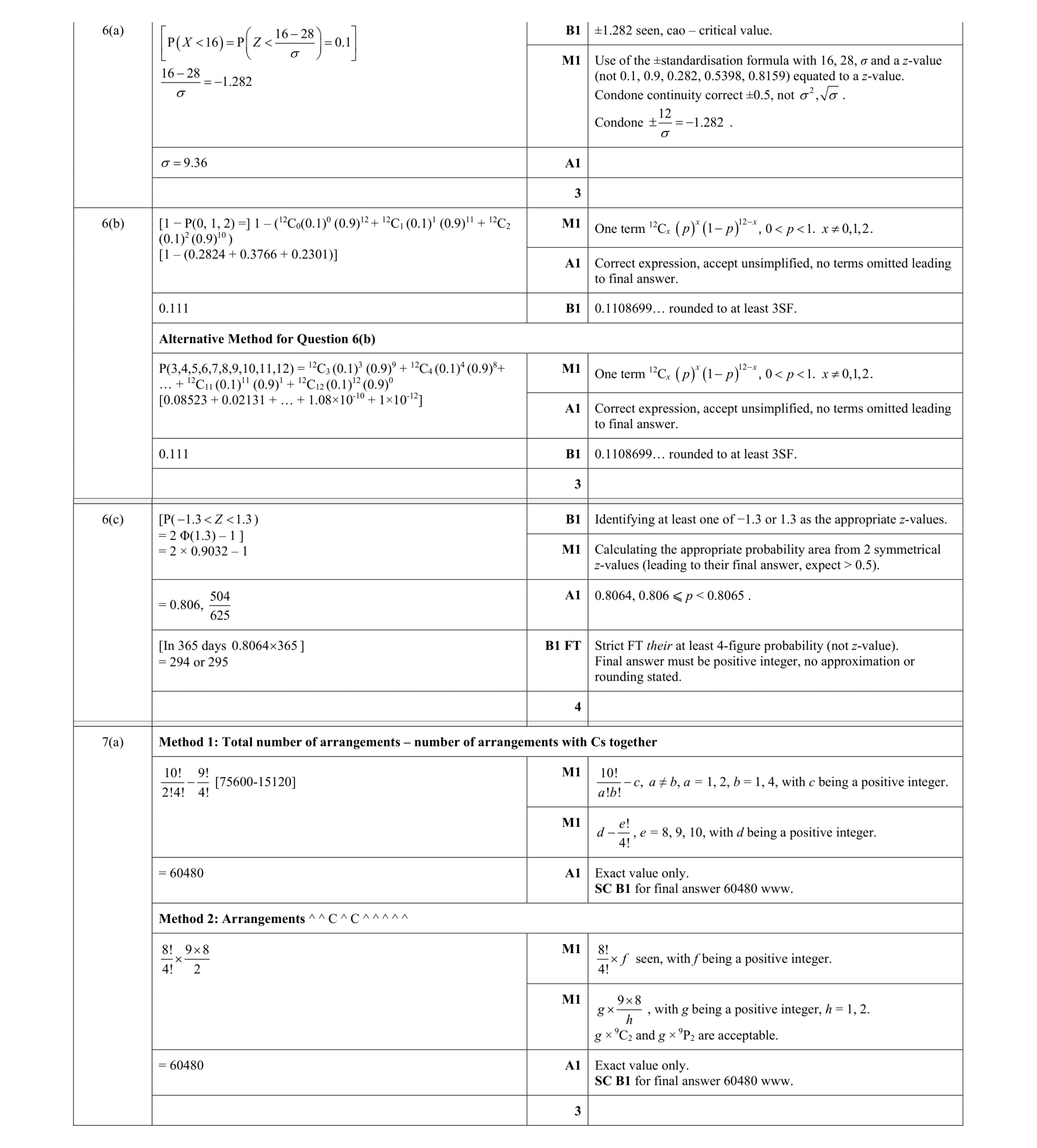 10
10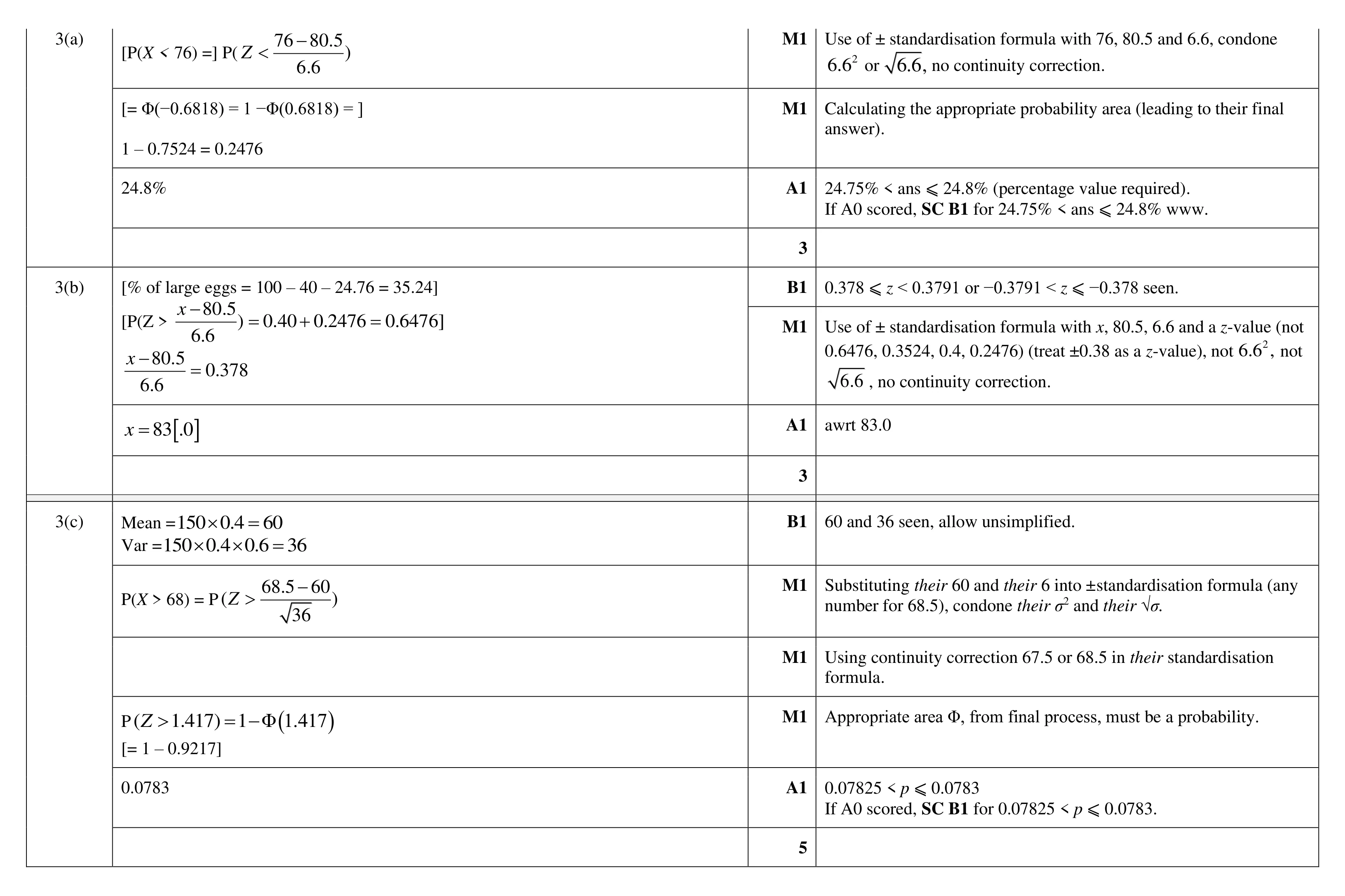 11
11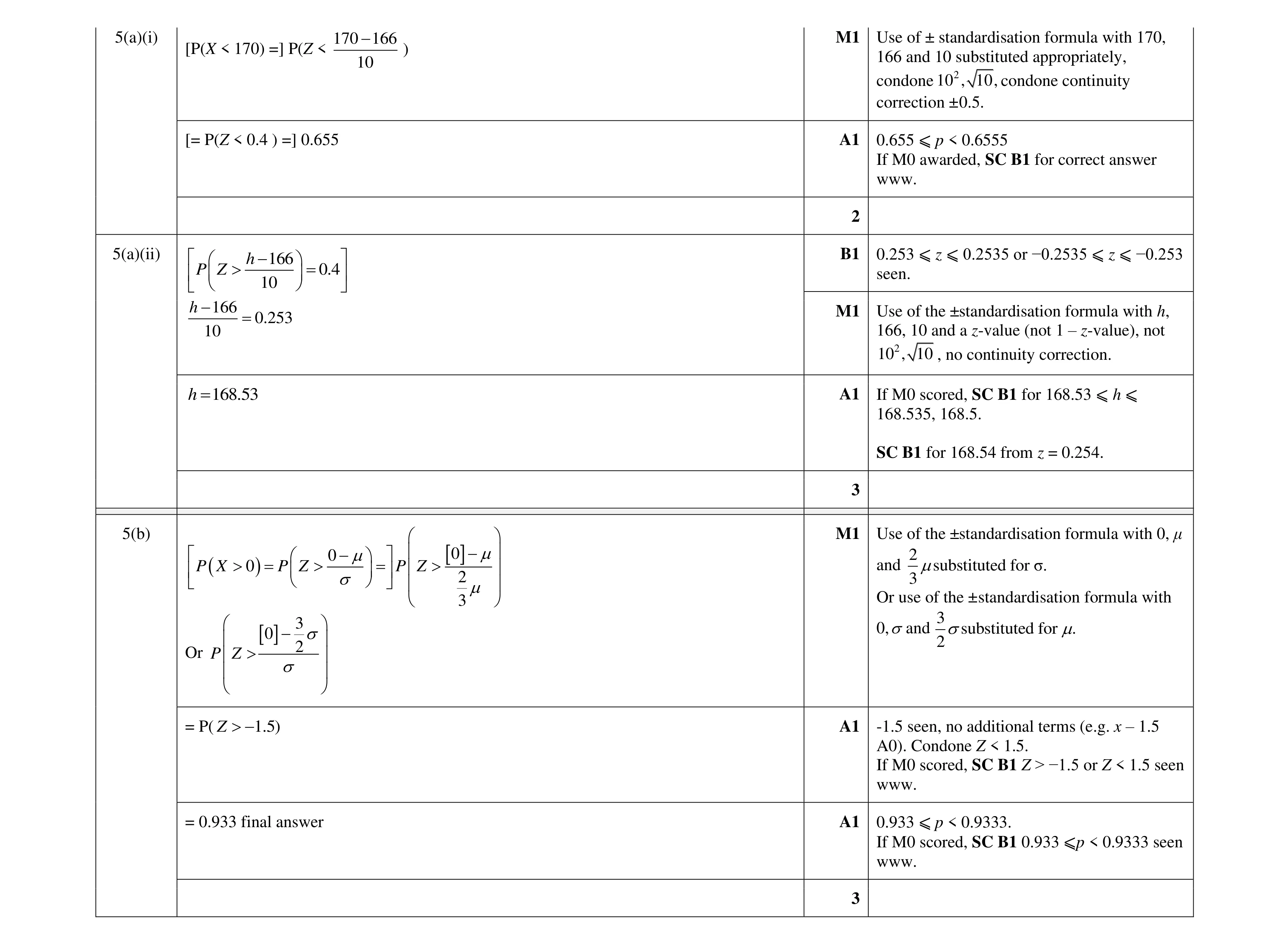 8
8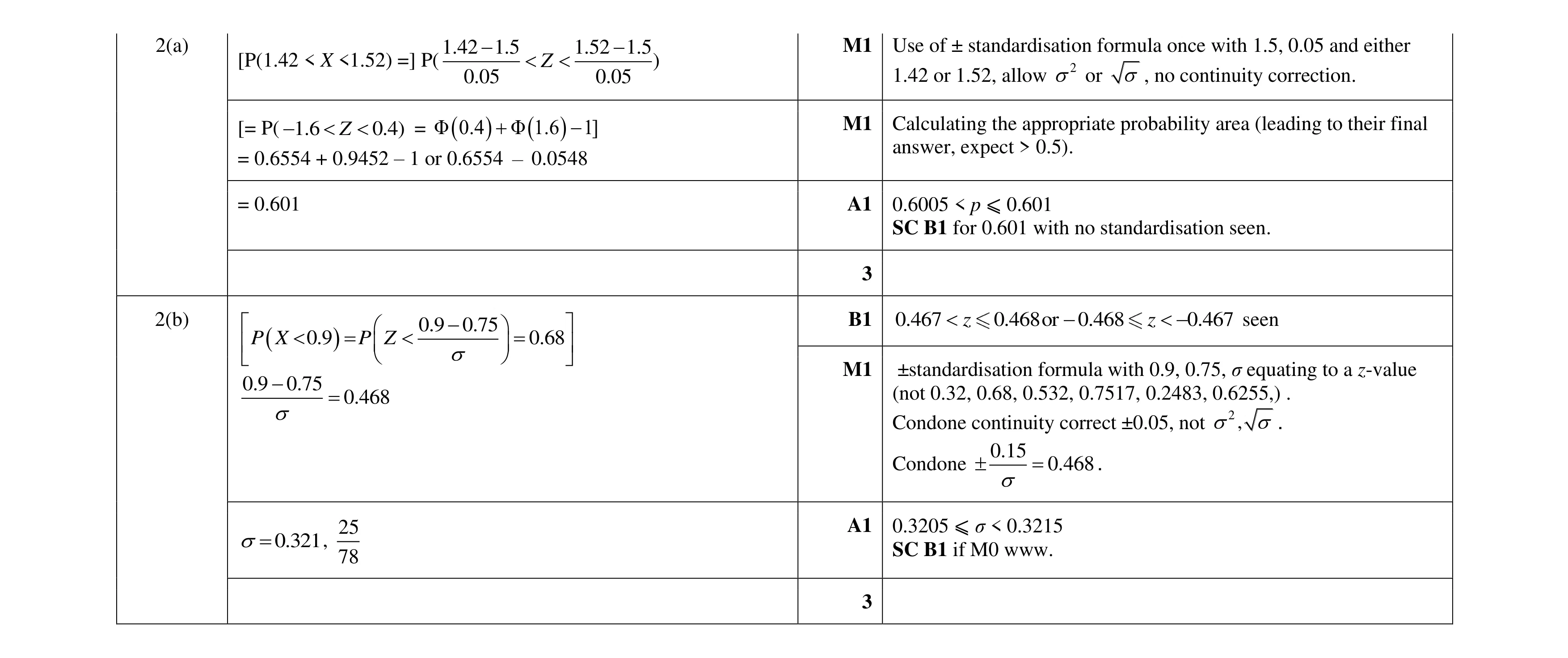 6
6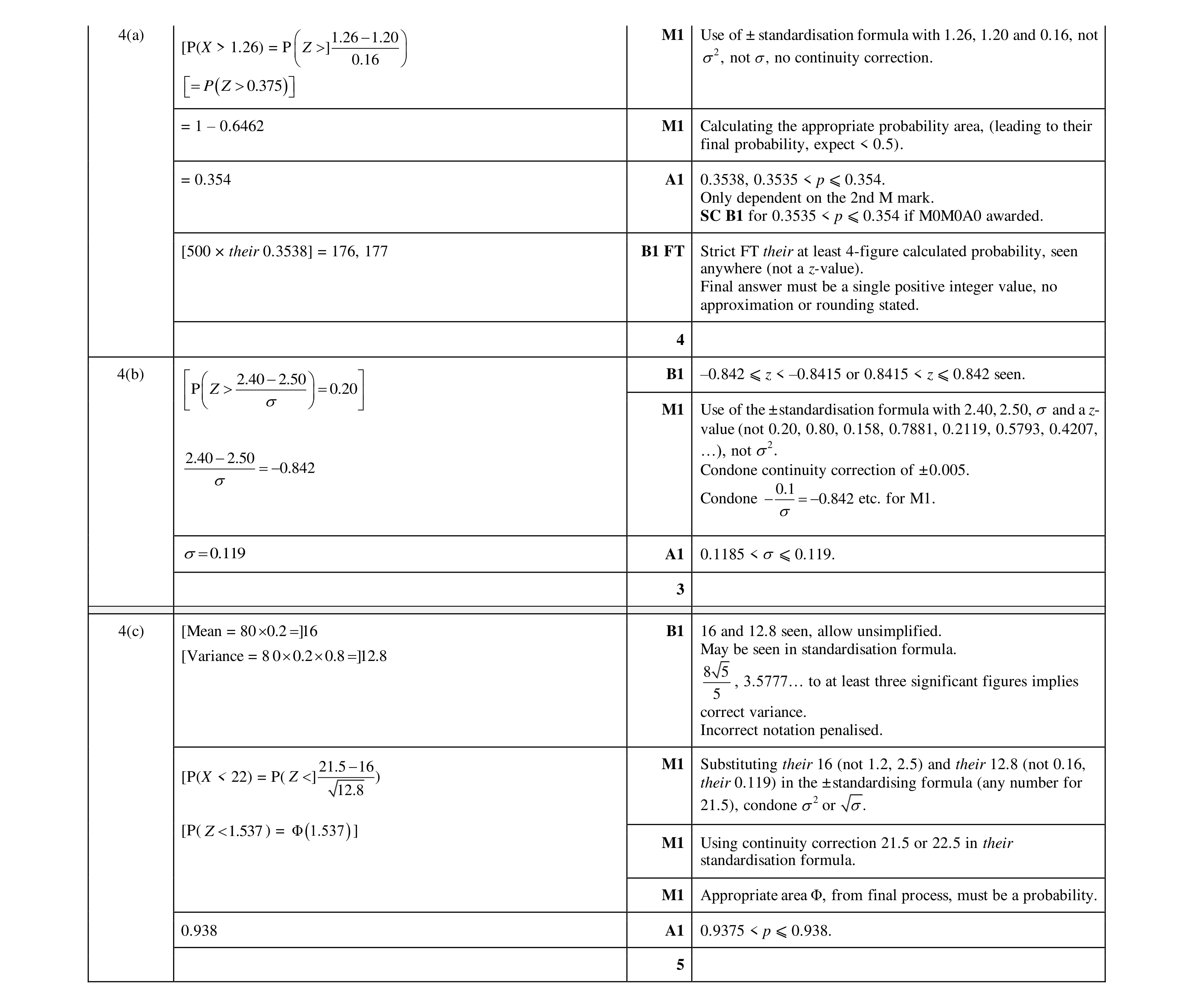 12
12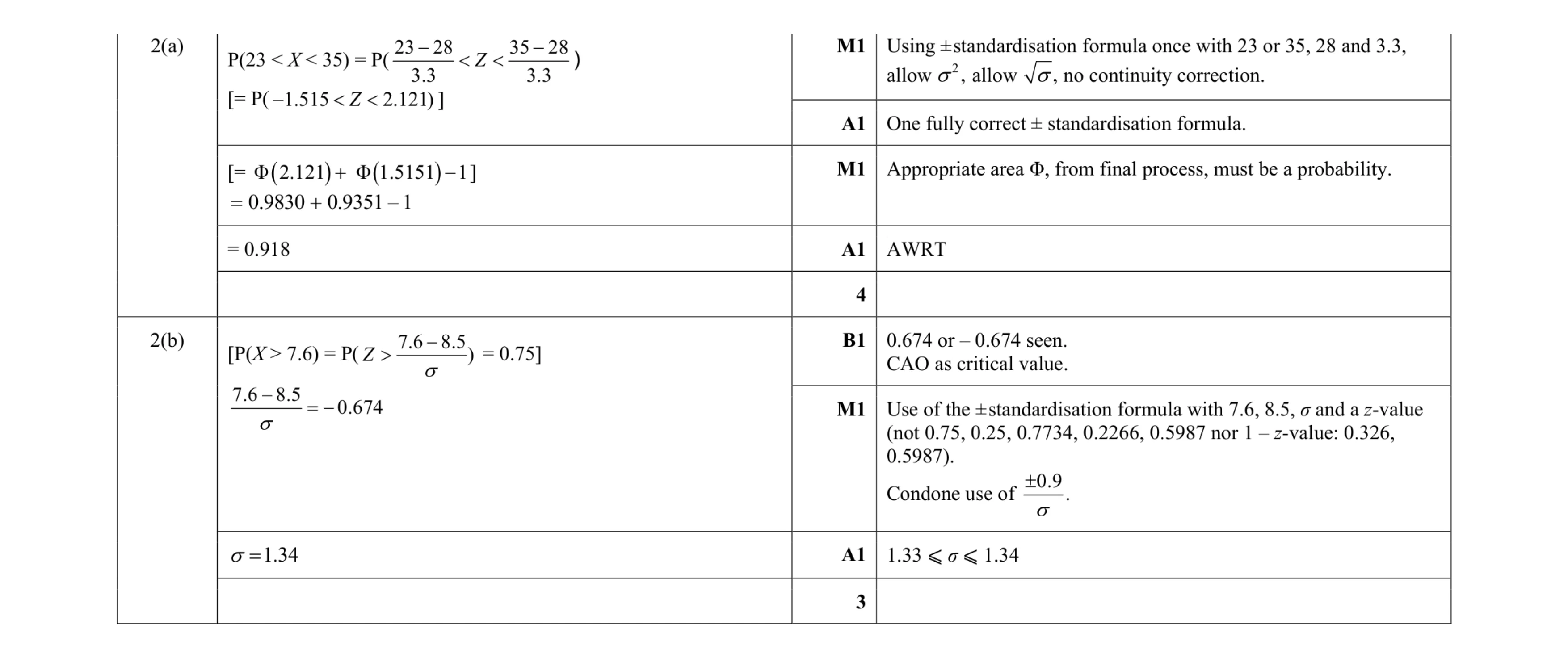 7
7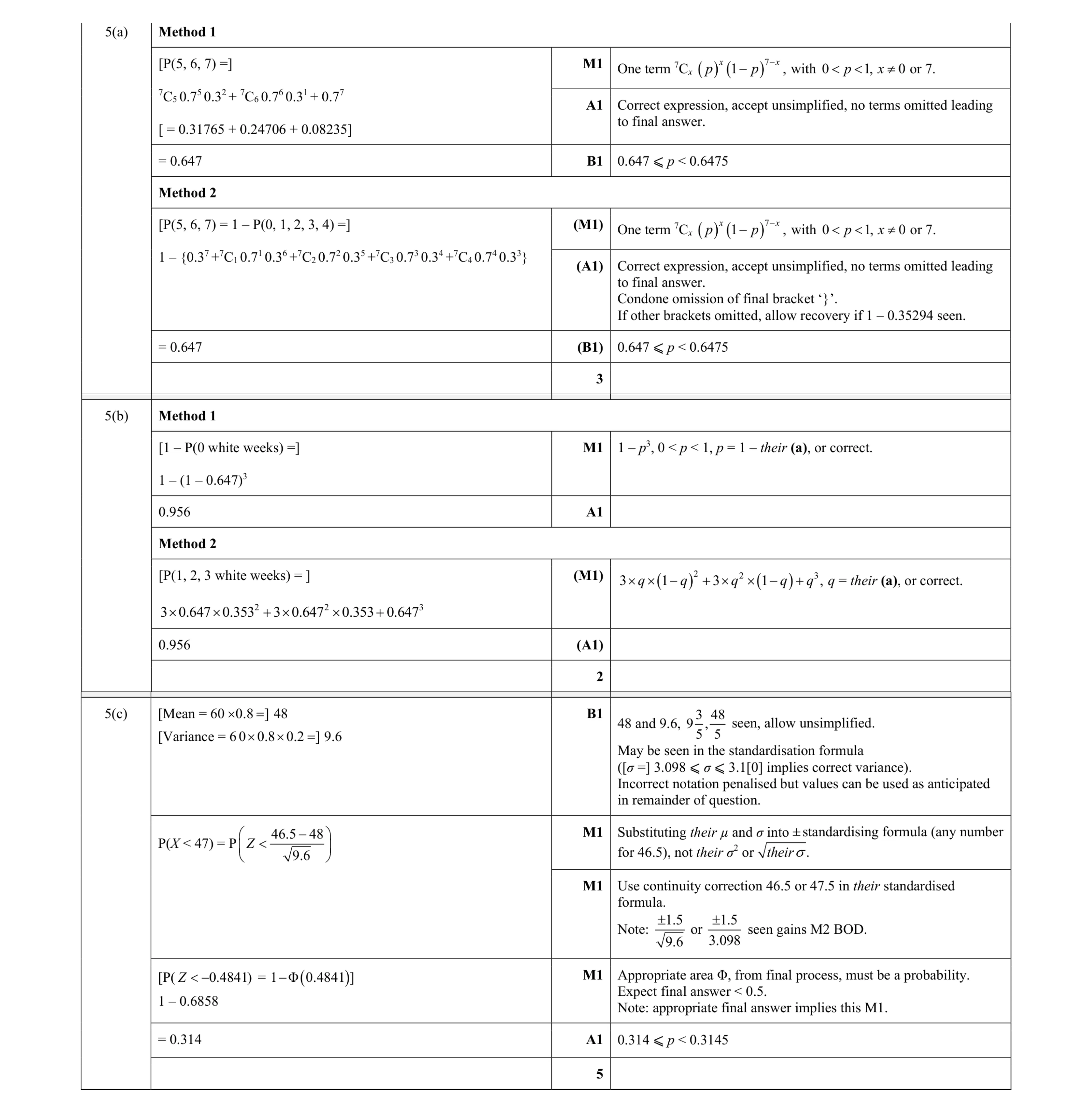 10
10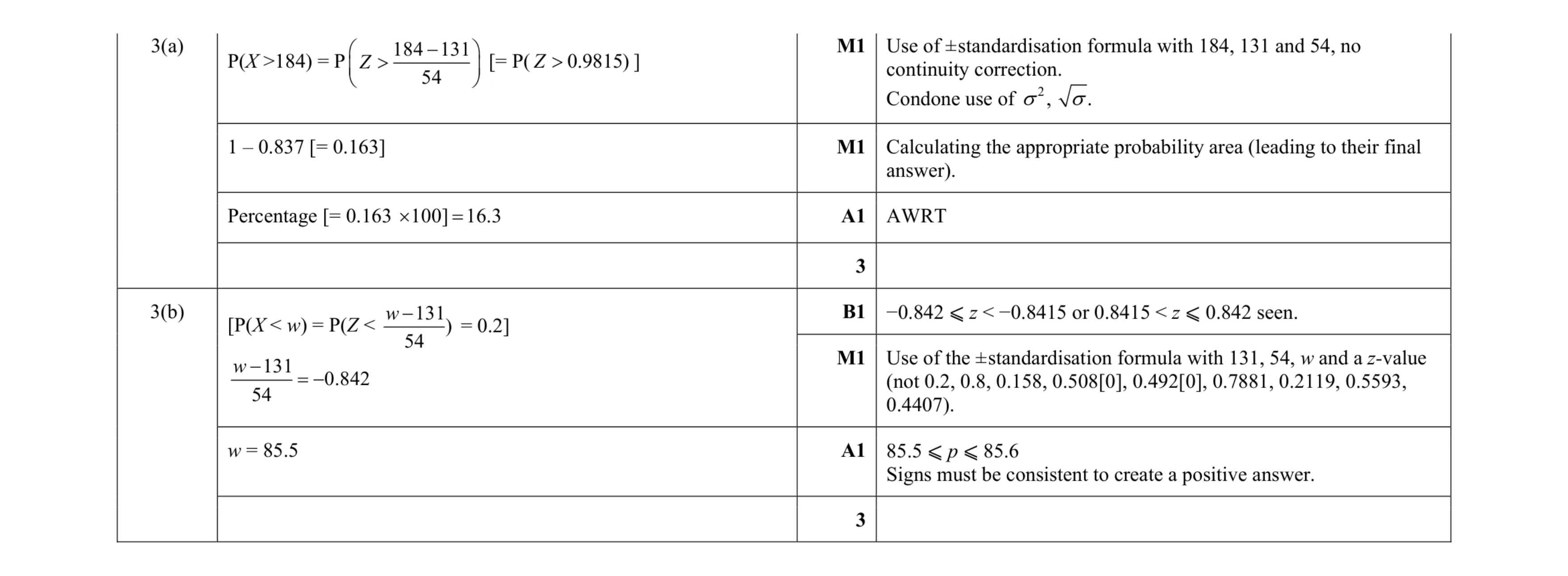 6
6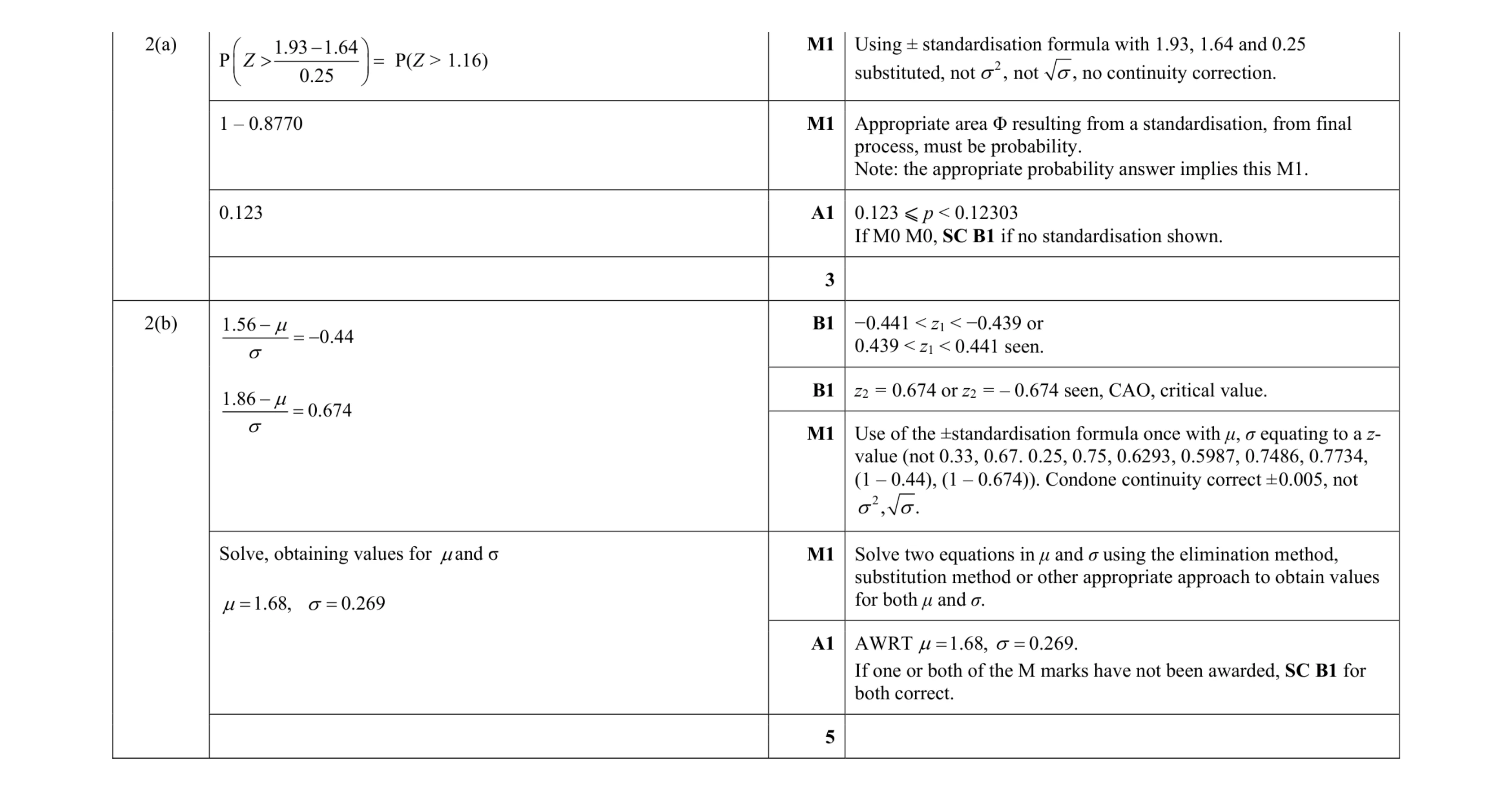 8
8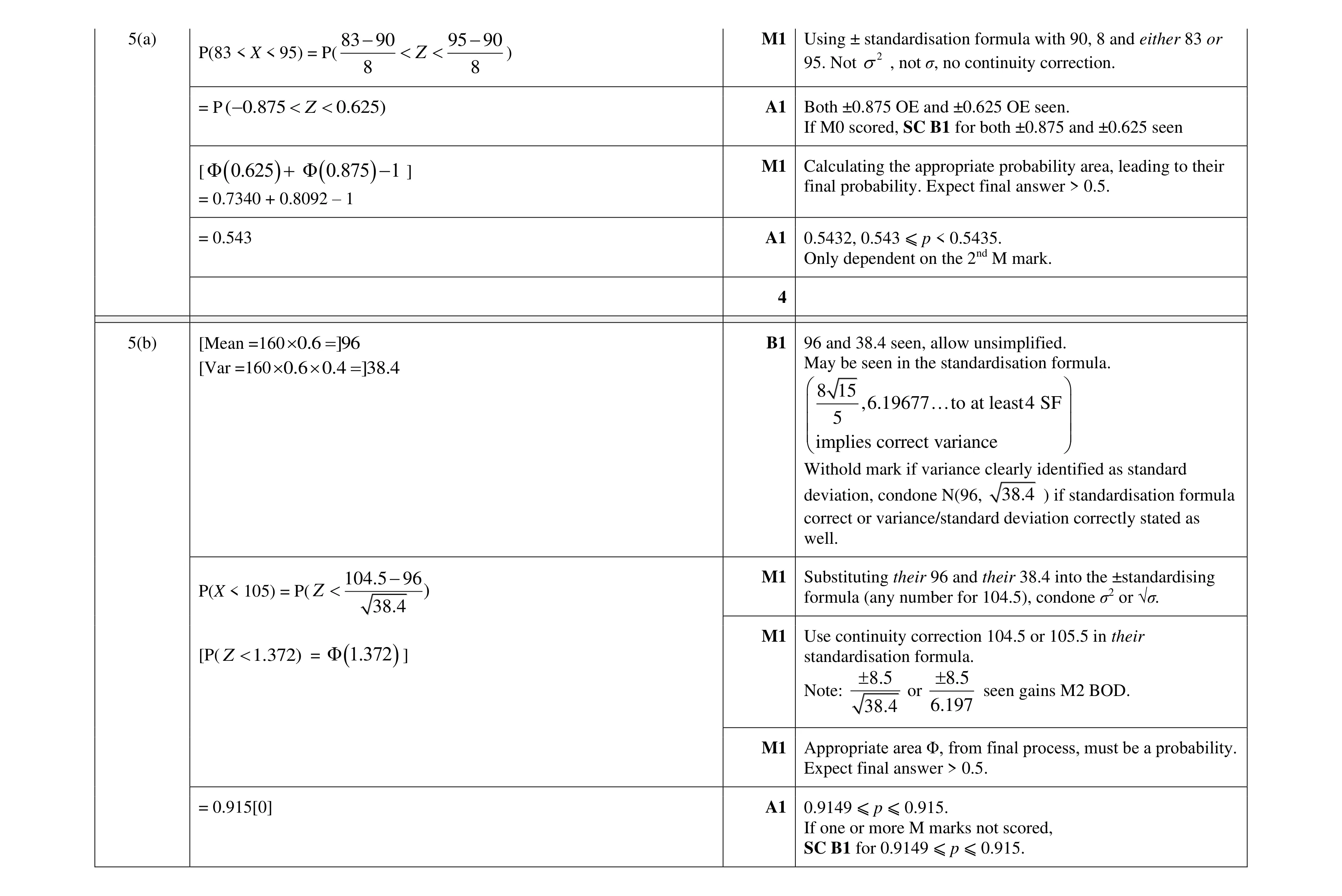 9
9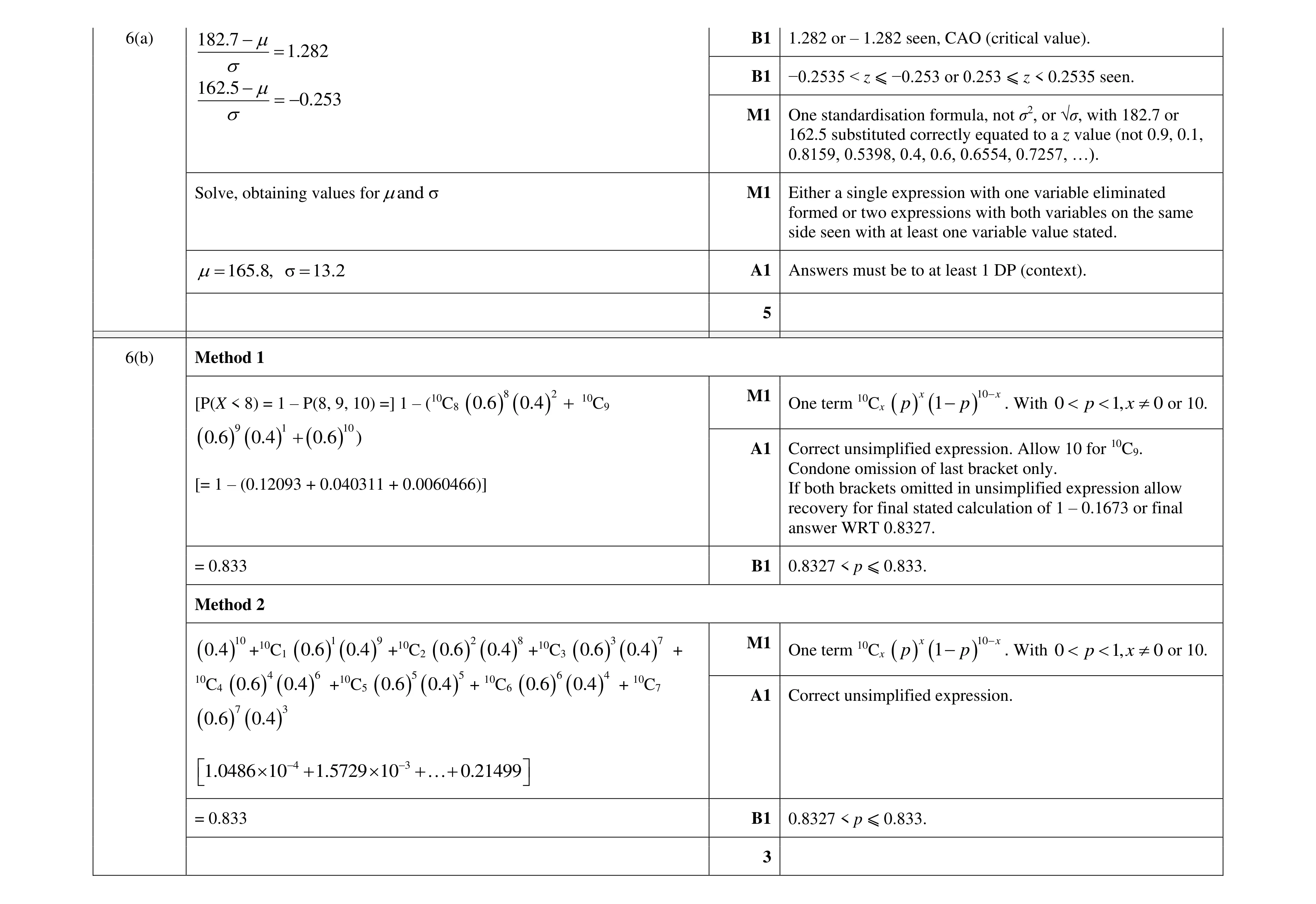 8
8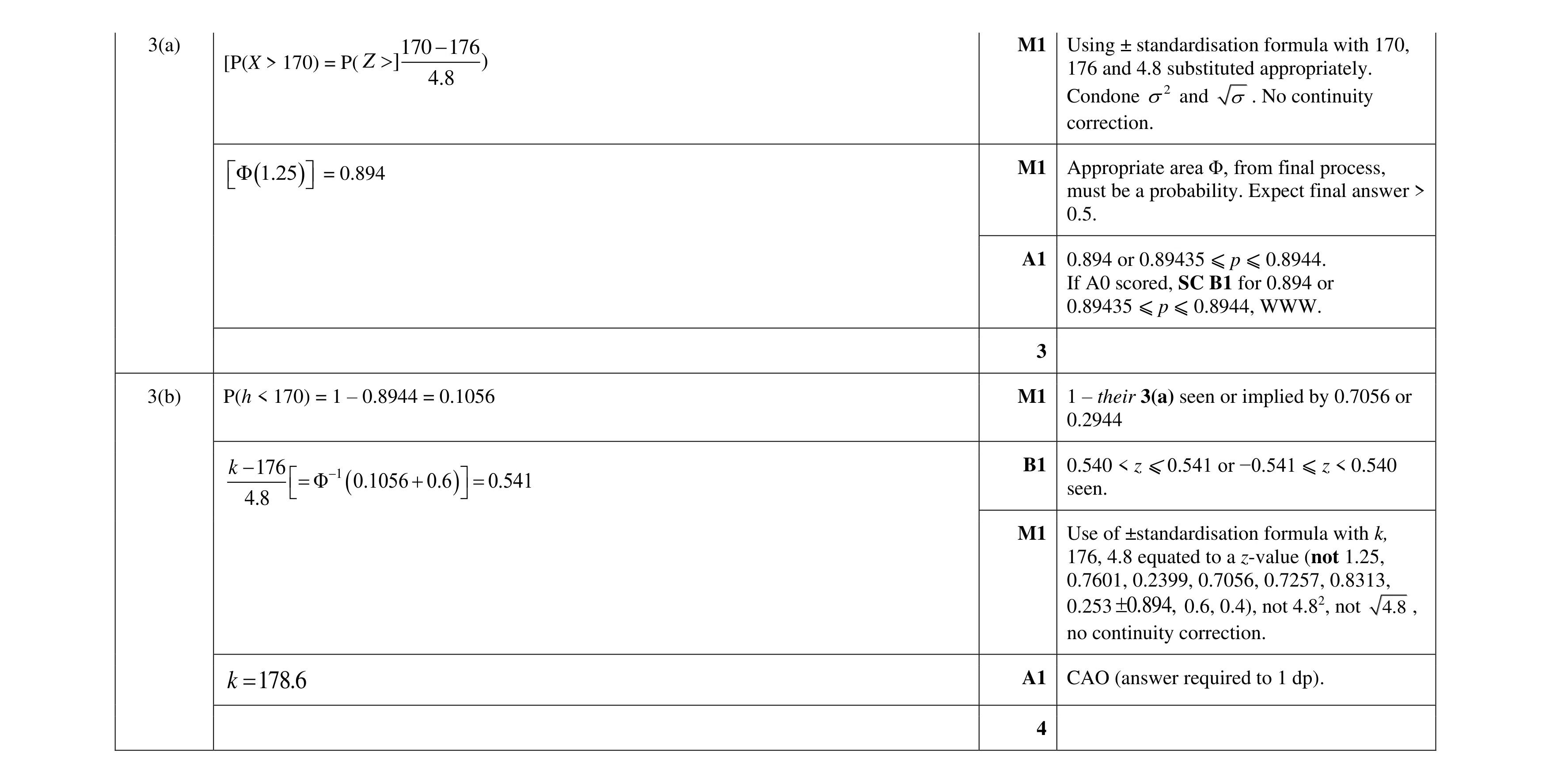 7
7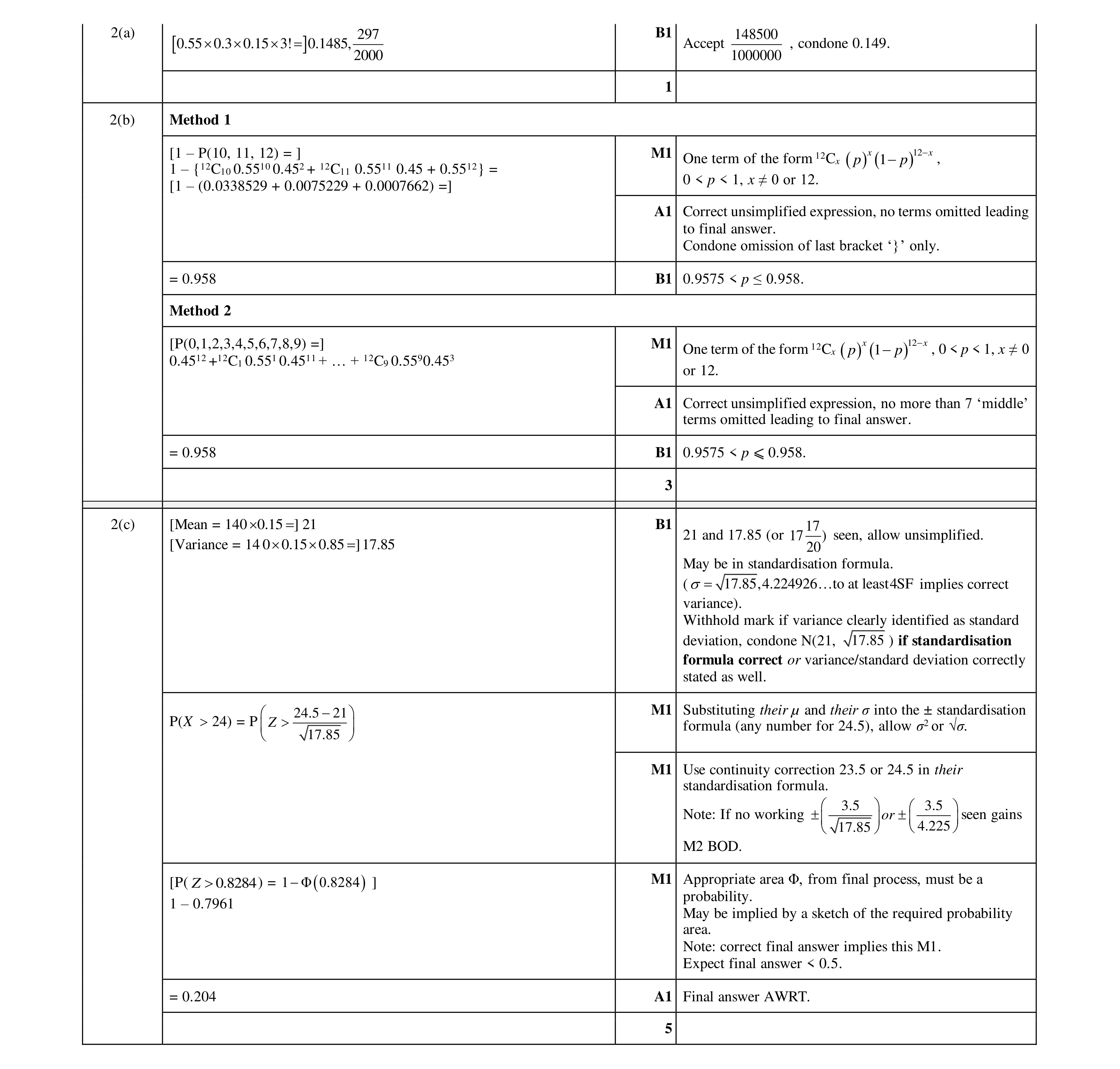 9
9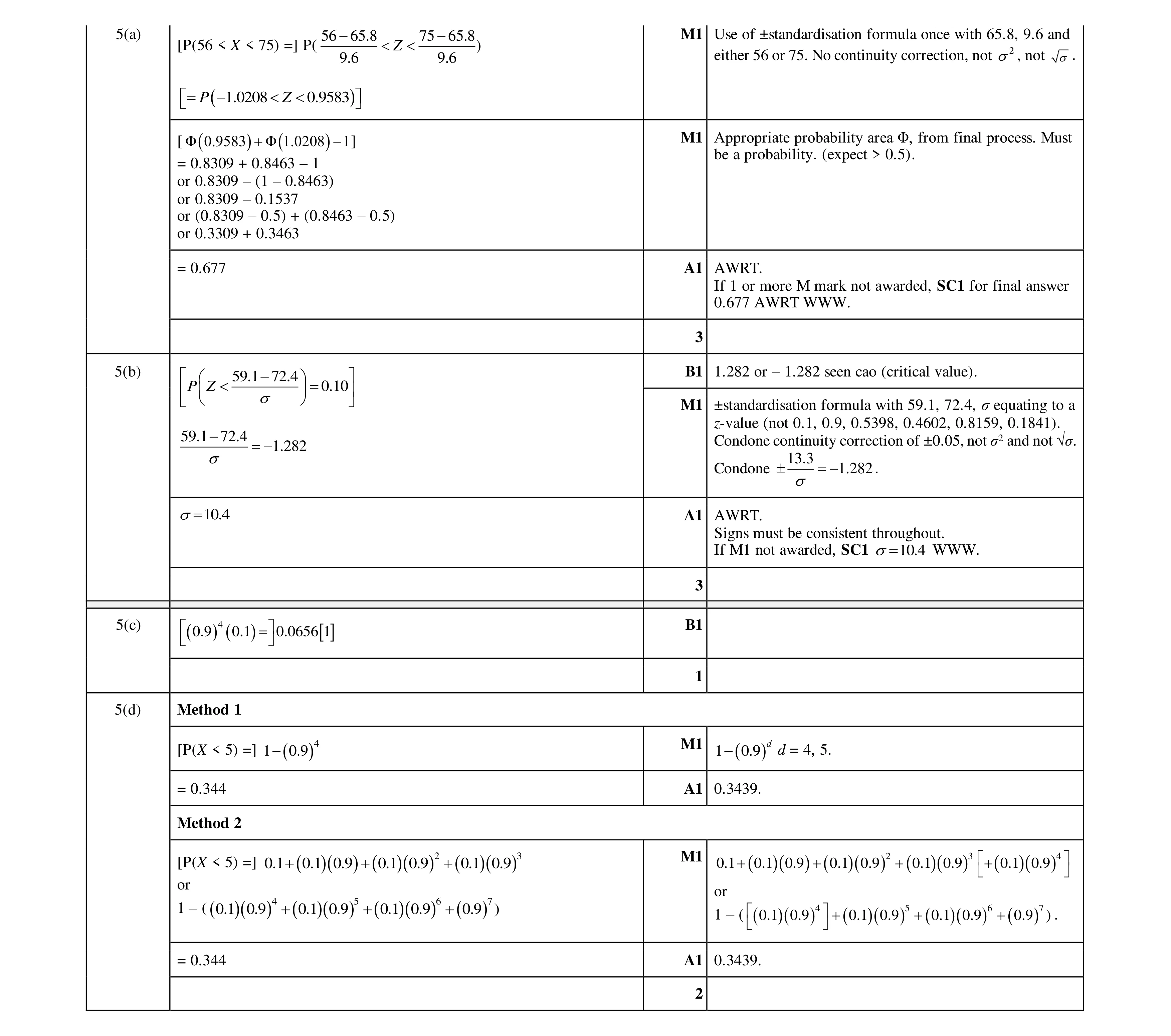 9
9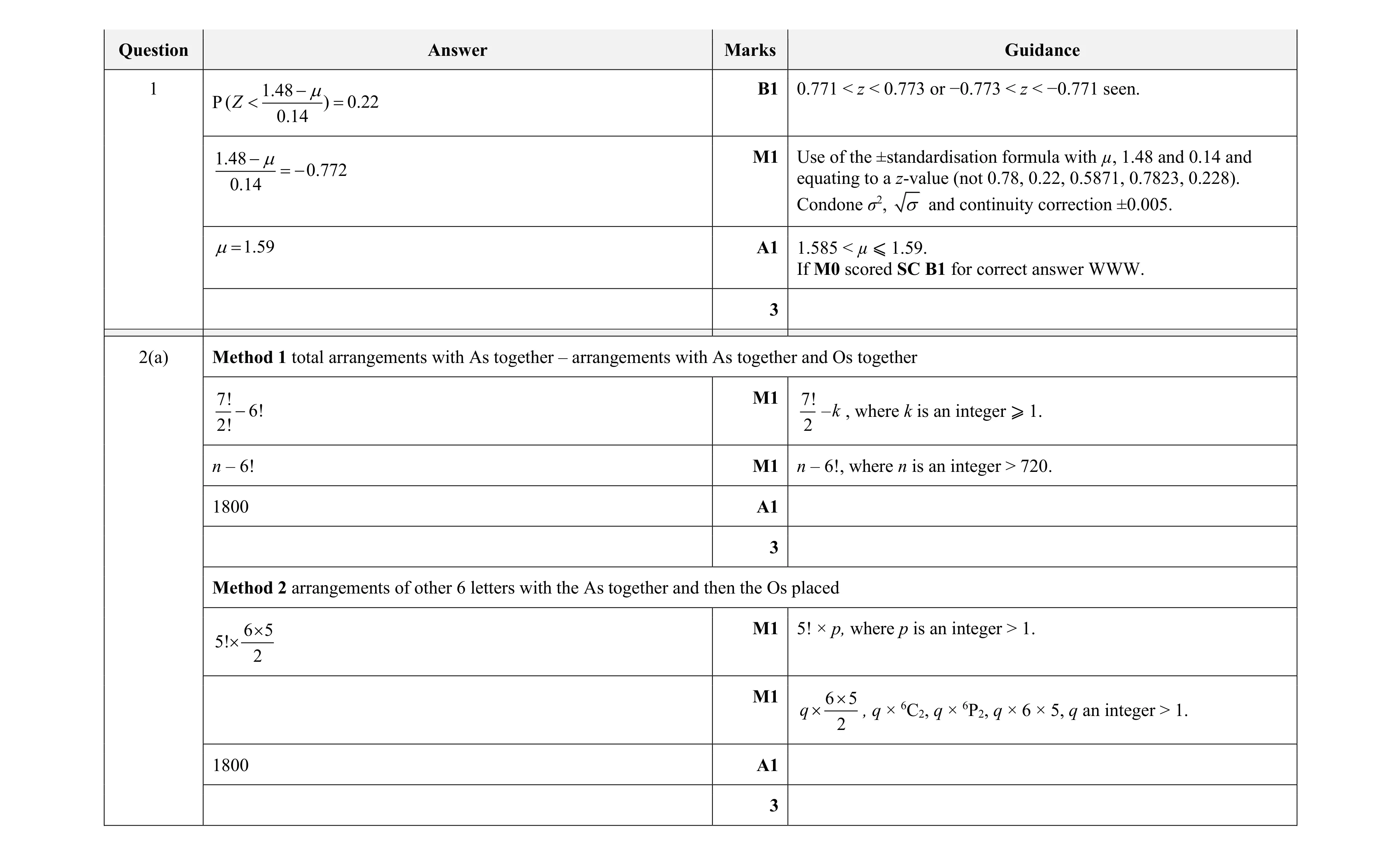 3
3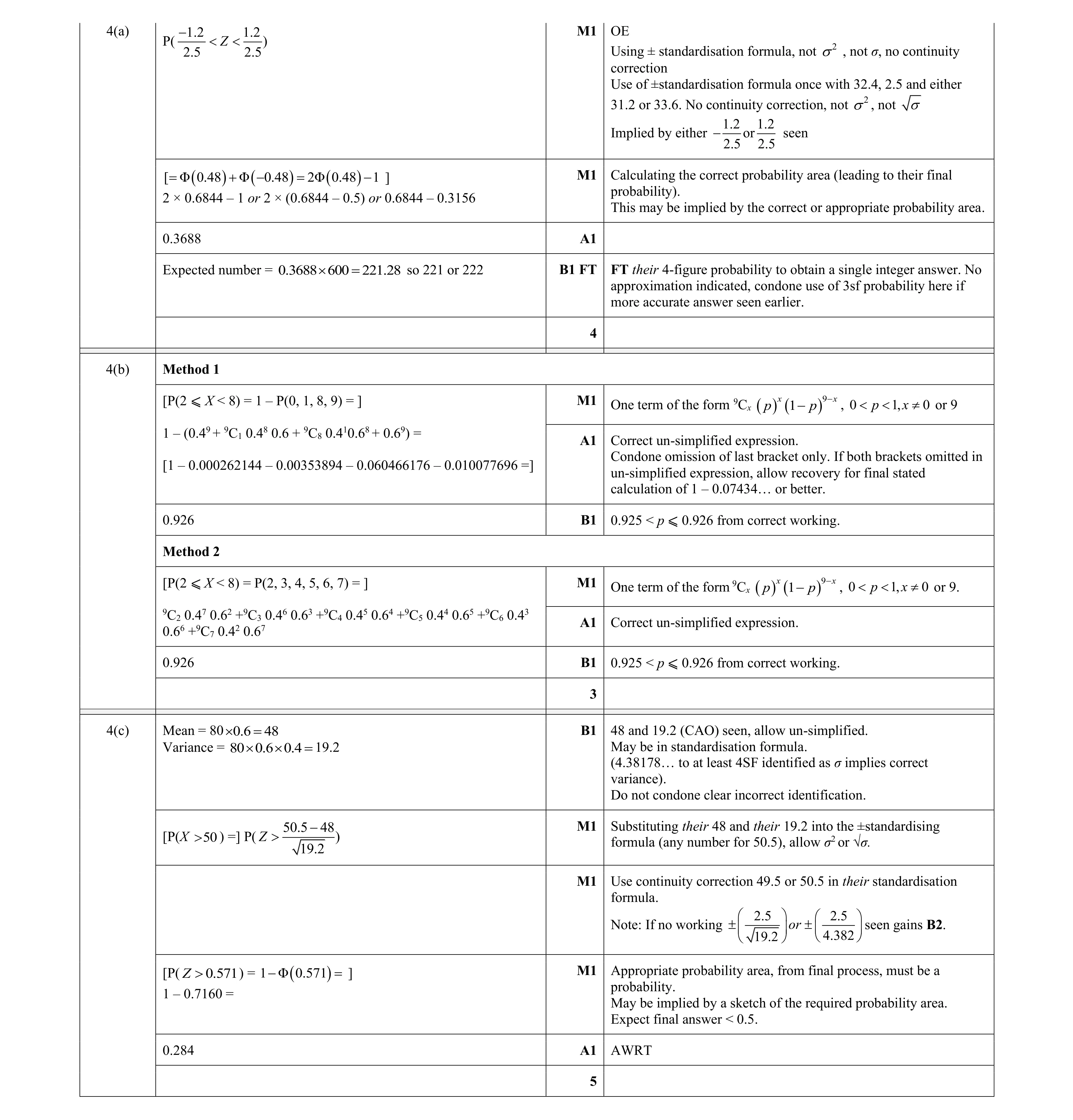 12
12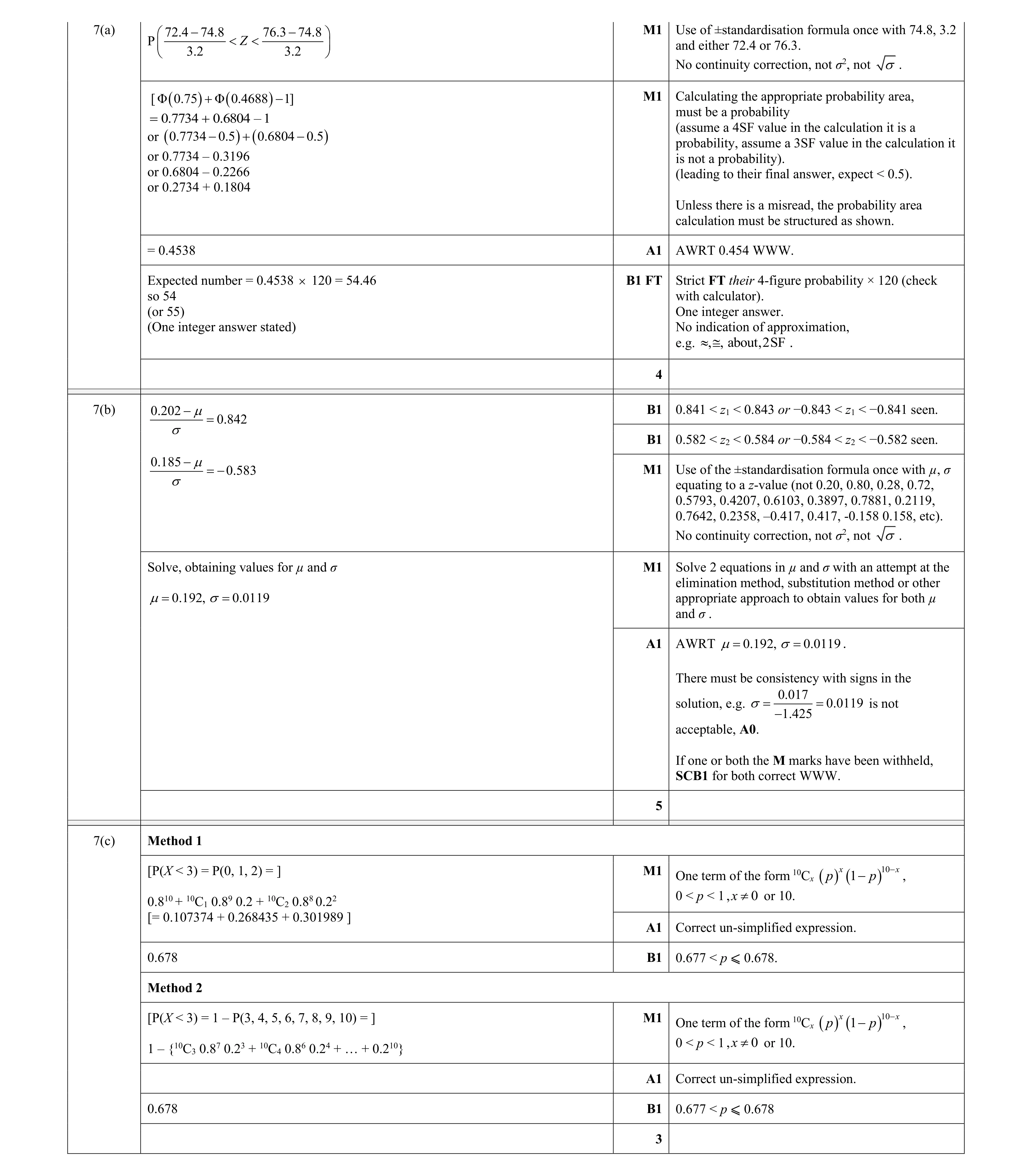 9
9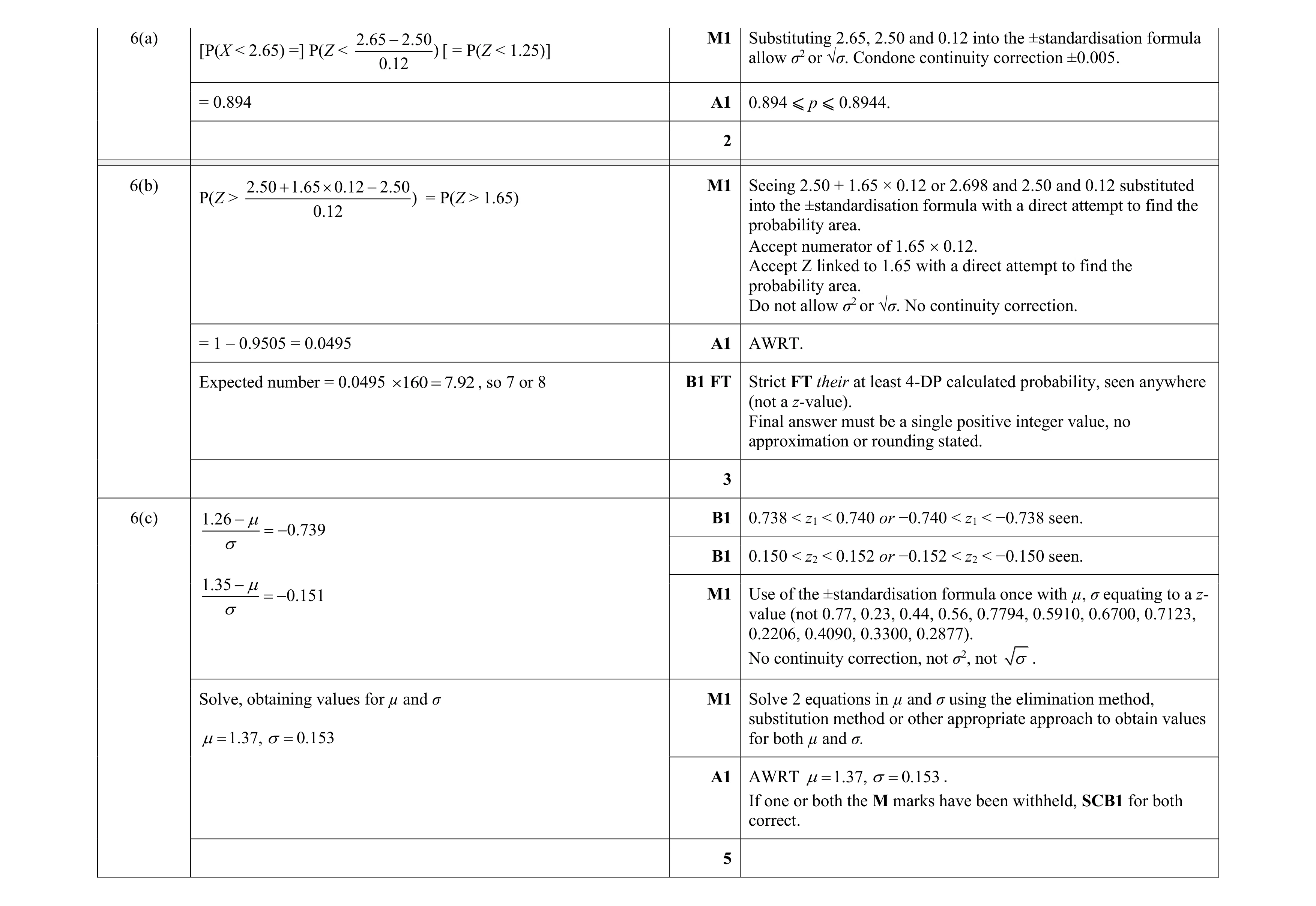 10
10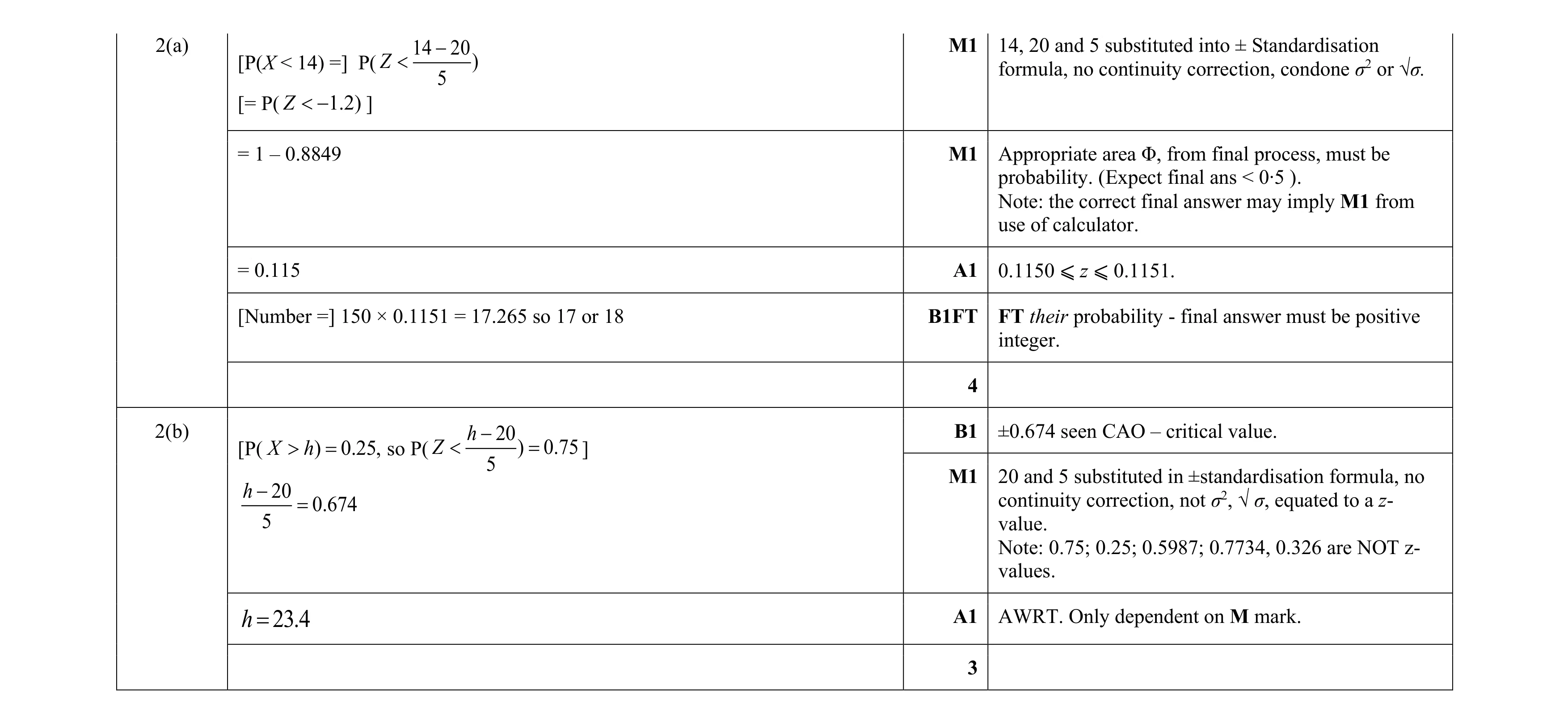 7
7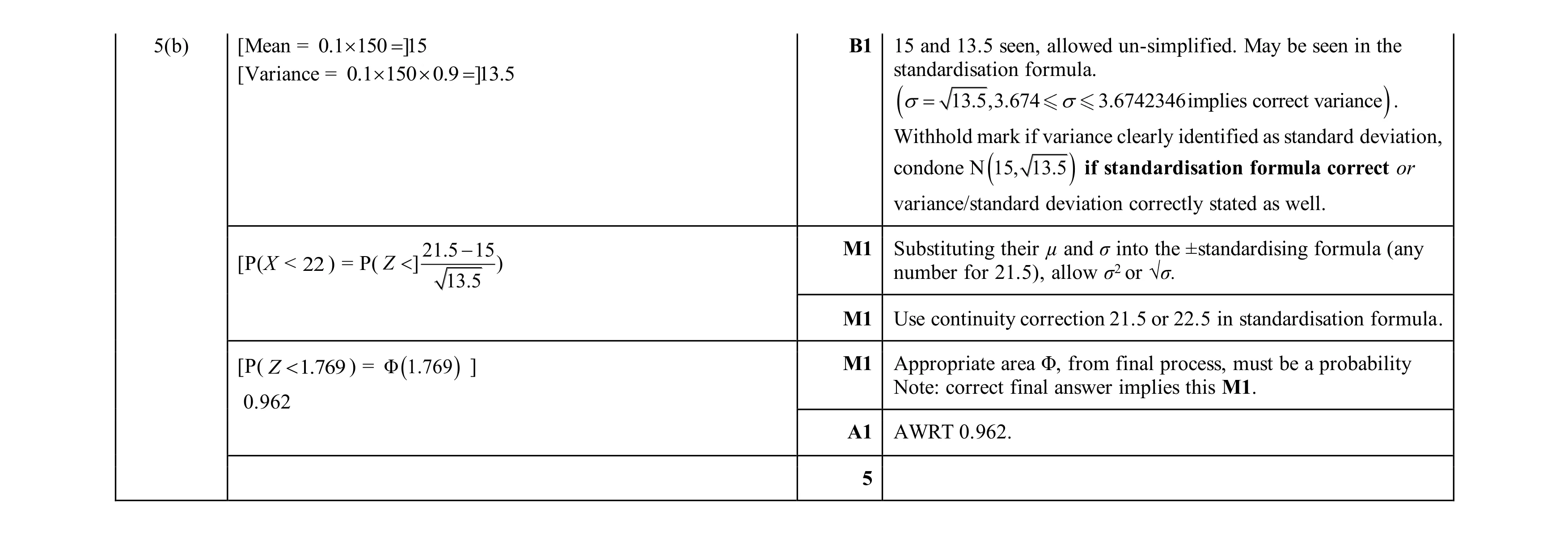 8
8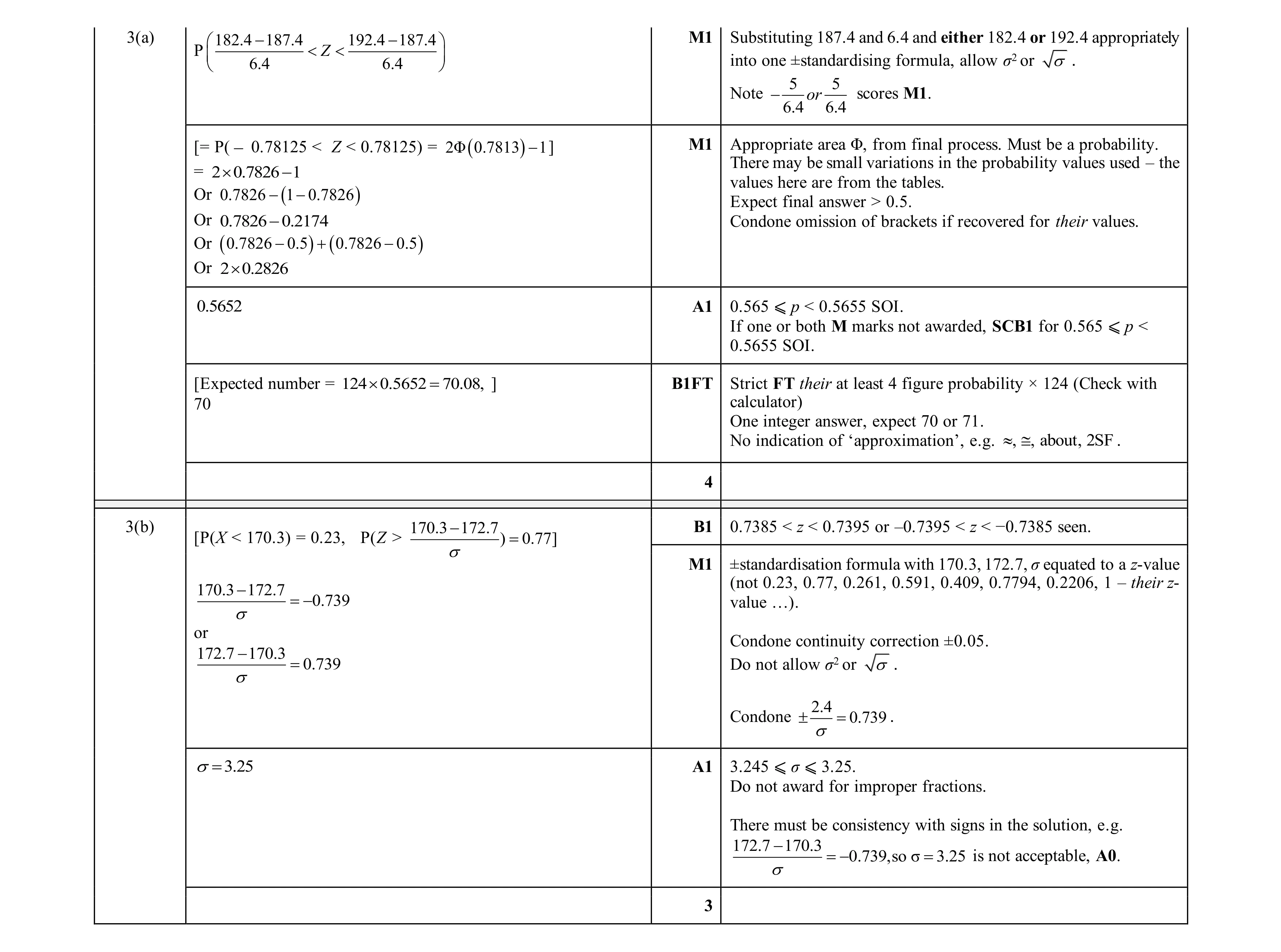 7
7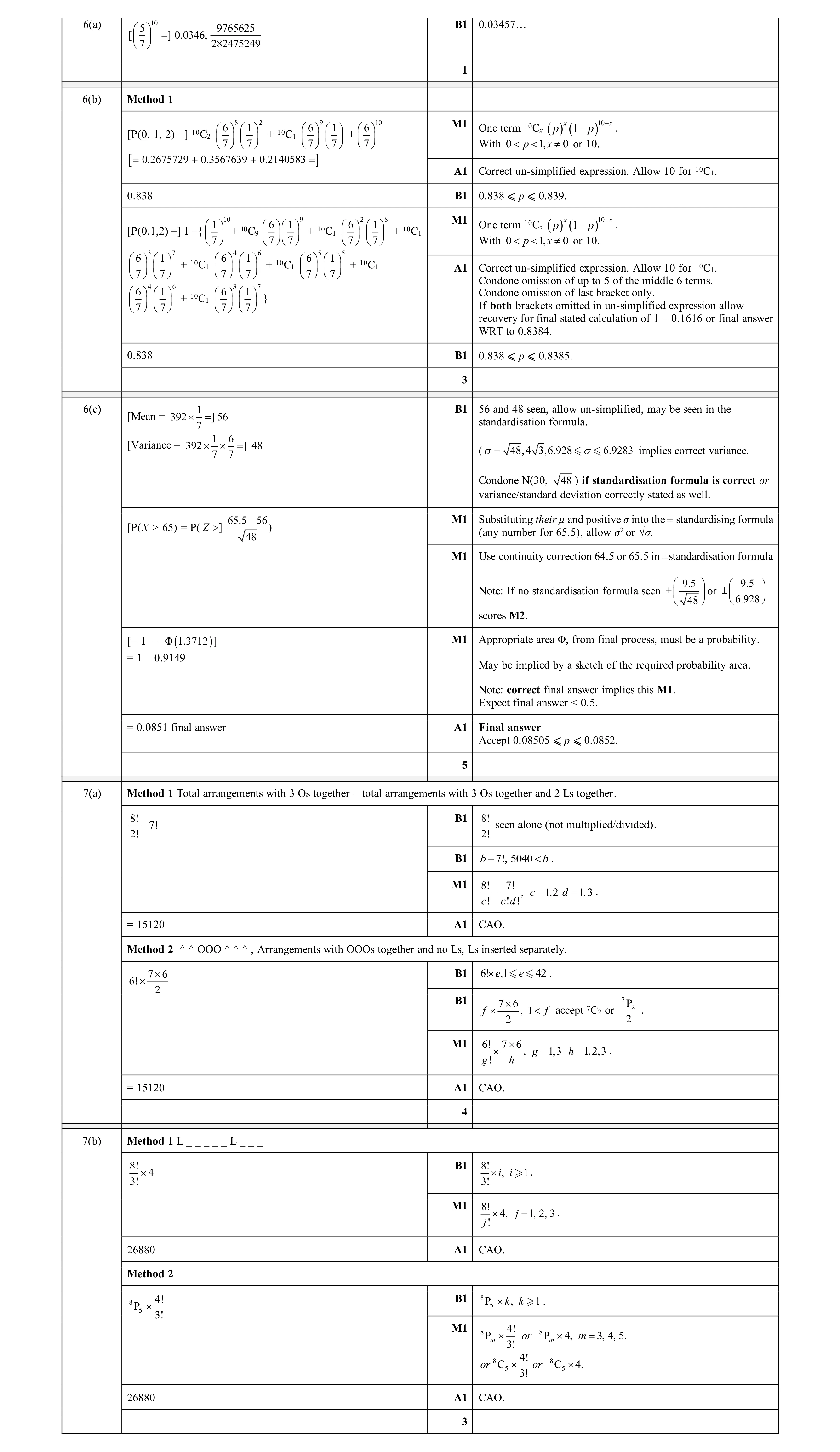 9
9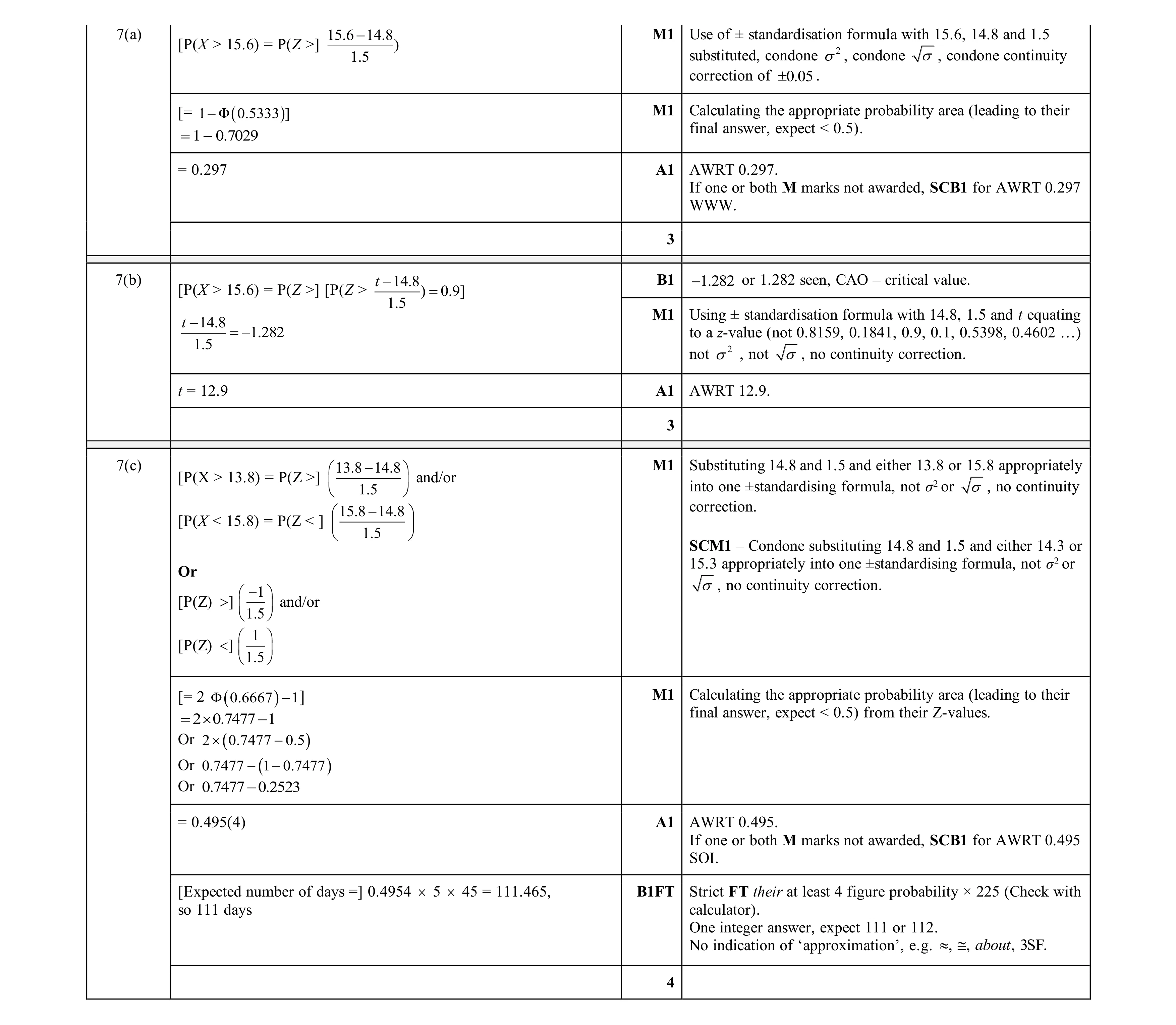 10
10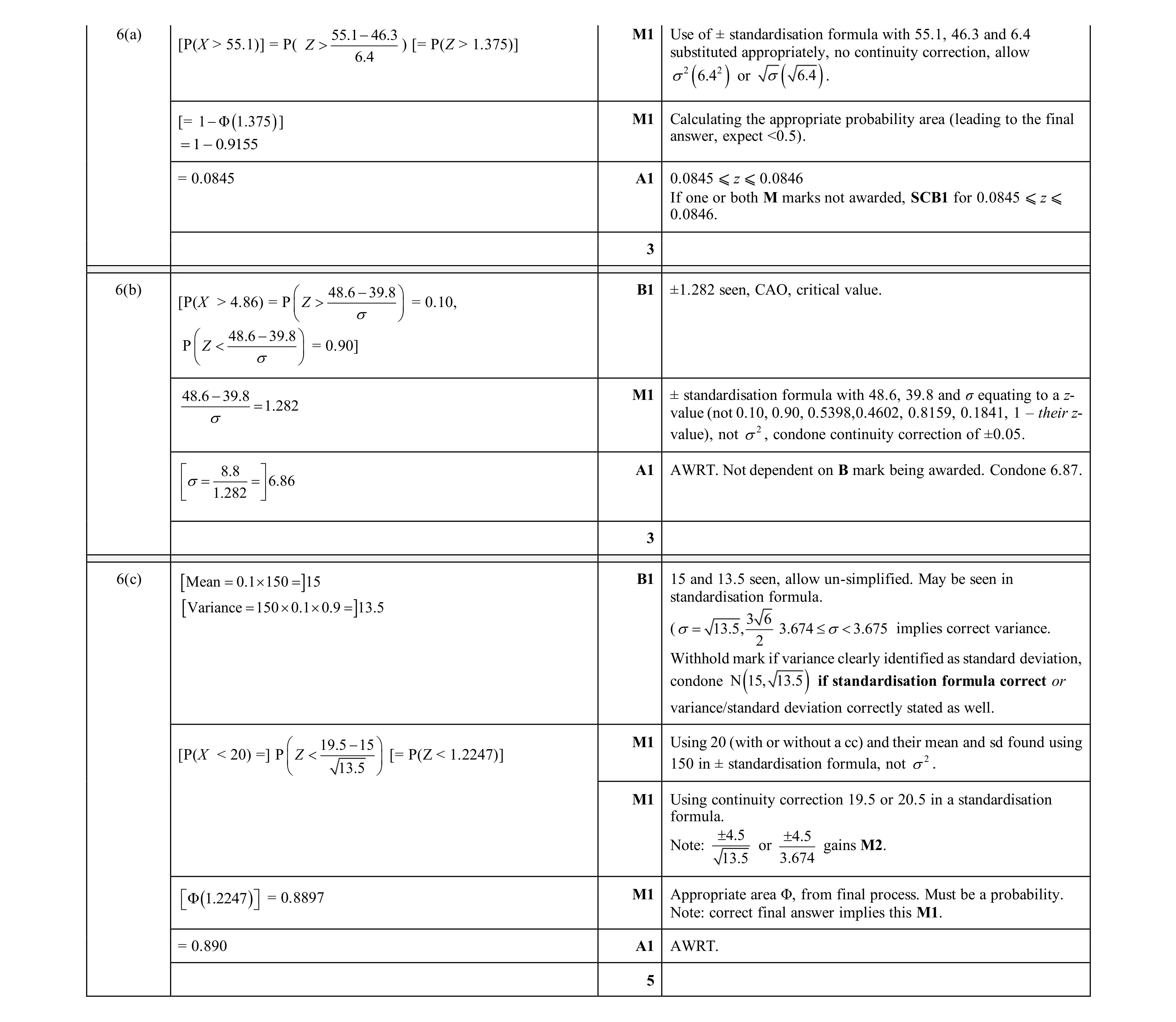 11
11