Cambridge A Level Mathematics 9709 — 2025 May/June Paper 5 · Variant 5
9709/55/M/J/25 · 6 questions · 50 marks · ≈56 min
The question paper and its mark scheme, free to read here and free to download. This is Cambridge’s own paper, exactly as it was sat.
Question paper12 pages

Mark scheme20 pages
Answers below. Sit the paper first if you are practising.
Questions as text
Q1 · Two fair 6-sided dice with faces labelled 1, 2, 3, 4, 5, 6 are thrown
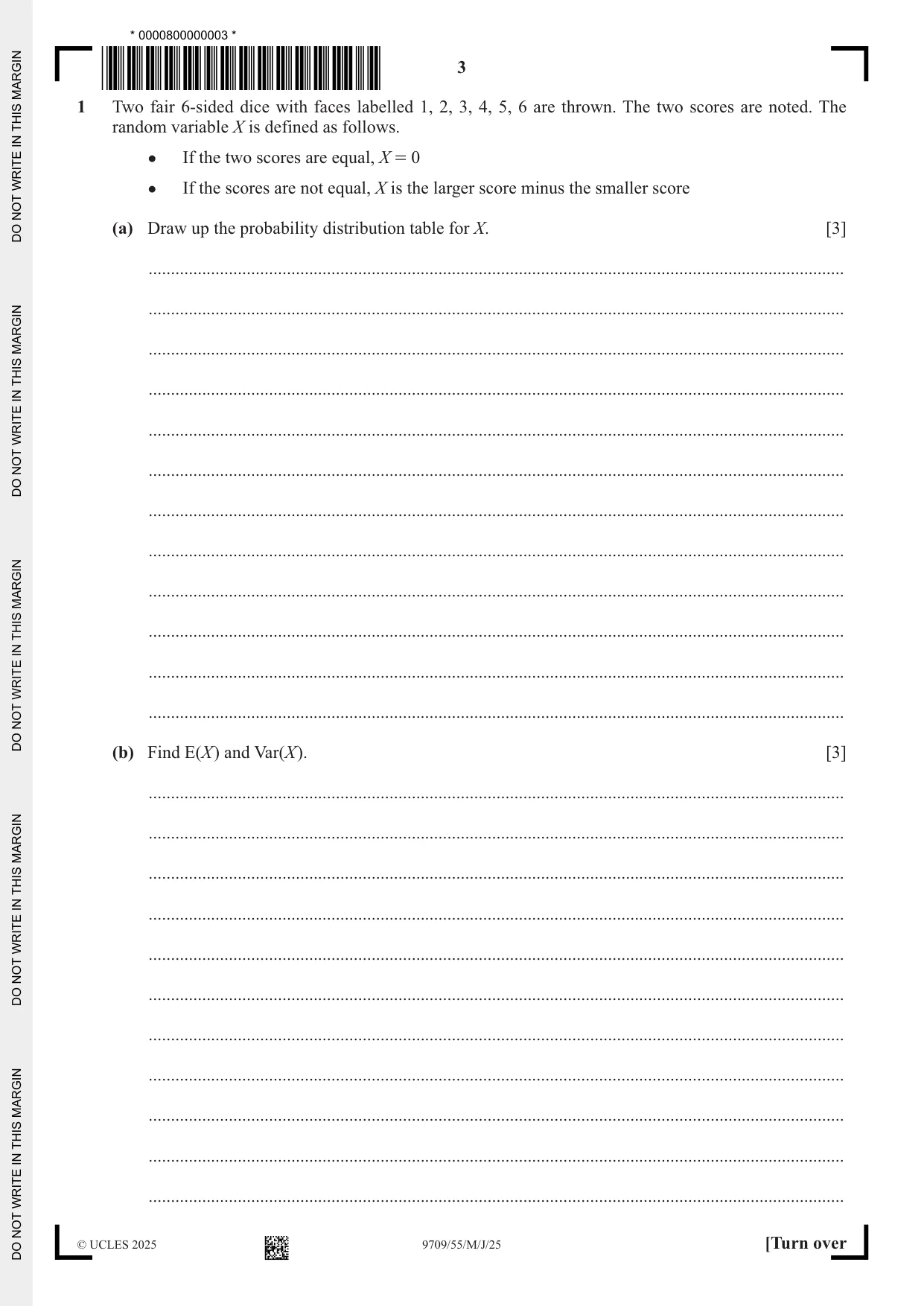
1 Two fair 6-sided dice with faces labelled 1, 2, 3, 4, 5, 6 are thrown. The two scores are noted. The random variable X is defined as follows. ● If the two scores are equal, X = 0 ● If the scores are not equal, X is the larger score minus the smaller score (a) Draw up the probability distribution table for X. [3] ............................................................................................................................................................ ............................................................................................................................................................ ............................................................................................................................................................ ............................................................................................................................................................ ............................................................................................................................................................ ............................................................................................................................................................ ............................................................................................................................................................ ............................................................................................................................................................ ............................................................................................................................................................ ............................................................................................................................................................ ............................................................................................................................................................ ............................................................................................................................................................ (b) Find E(X ) and Var(X ). [3] ............................................................................................................................................................ ............................................................................................................................................................ ............................................................................................................................................................ ............................................................................................................................................................ ............................................................................................................................................................ ............................................................................................................................................................ ............................................................................................................................................................ ............................................................................................................................................................ ............................................................................................................................................................ ............................................................................................................................................................ ............................................................................................................................................................
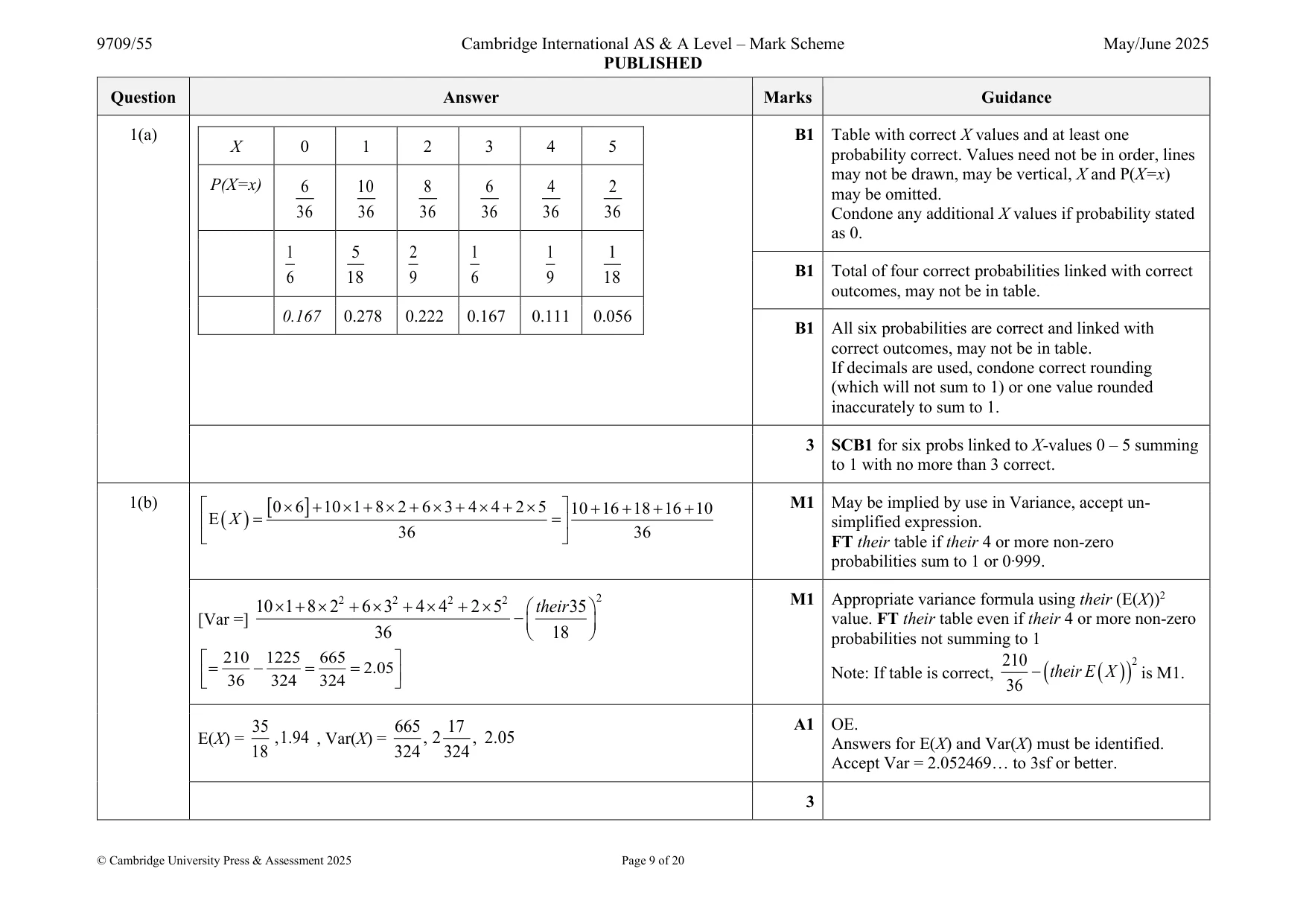
Mark scheme: Question Answer Marks Guidance 1(a) B1 Table with correct X values and at least one X 0 1 2 3 4 5 probability correct. Values need not be in order, lines may not be drawn, may be vertical, X and P(X=x) P(X=x) 6 10 8 6 4 2 may be omitted. 36 36 36 36 36 36 Condone any additional X values if probability stated as 0. 1 5 2 1 1 1 B1 Total of four correct probabilities linked with correct 6 18 9 6 9 18 outcomes, may not be in table. 0.167 0.278 0.222 0.167 0.111 0.056 B1 All six probabilities are correct and linked with correct outcomes, may not be in table. If decimals are used, condone correct rounding (which will not sum to 1) or one value rounded inaccurately to sum to 1. 3 SCB1 for six probs linked to X-values 0 – 5 summing to 1 with no more than 3 correct. 1(b) 0 6 + 10 +1 8 2 + 6 +3 4 4 + 2 5 10 + 16 + 18 + 16 + 10 M1 May be implied by use in Variance, accept un- E ( X ) = = simplified expression. 36 36 FT their table if their 4 or more non-zero probabilities sum to 1 or 0∙999. 2 2 2 2 2 M1 Appropriate variance formula using their (E(X))2 10 +1 8 2 + 6 3 + 4 4 + 2 5 their 35 [Var =] − value. FT their table even if their 4 or more non-zero 36 18 probabilities not summing to 1 210 1225 665 210 2 = − = = 2.05 Note: If table is correct, − ( their E ( X ) ) is M1. 36 324 324 36 35 665 17 A1 OE. E(X) = , 1.94 , Var(X) = , 2 , 2.05 Answers for E(X) and Var(X) must be identified. 18 324 324 Accept Var = 2.052469… to 3sf or better. 3
Q2 · The heights of trees in a certain forest are classified as tall, medium or small
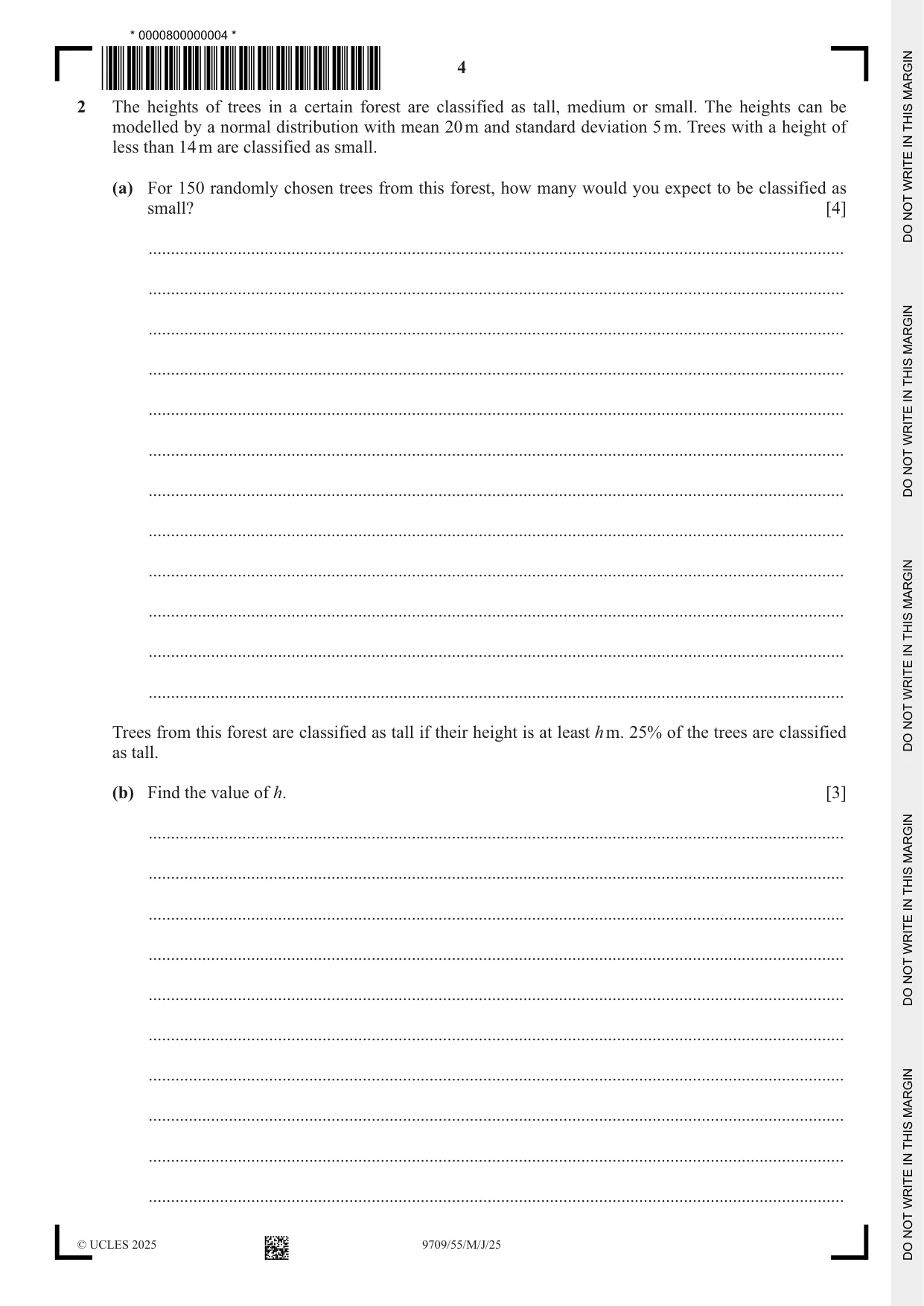
2 The heights of trees in a certain forest are classified as tall, medium or small. The heights can be modelled by a normal distribution with mean 20 m and standard deviation 5 m. Trees with a height of less than 14 m are classified as small. (a) For 150 randomly chosen trees from this forest, how many would you expect to be classified as small? [4] ............................................................................................................................................................ ............................................................................................................................................................ ............................................................................................................................................................ ............................................................................................................................................................ ............................................................................................................................................................ ............................................................................................................................................................ ............................................................................................................................................................ ............................................................................................................................................................ ............................................................................................................................................................ ............................................................................................................................................................ ............................................................................................................................................................ ............................................................................................................................................................ Trees from this forest are classified as tall if their height is at least h m. 25% of the trees are classified as tall. (b) Find the value of h. [3] ............................................................................................................................................................ ............................................................................................................................................................ ............................................................................................................................................................ ............................................................................................................................................................ ............................................................................................................................................................ ............................................................................................................................................................ ............................................................................................................................................................ ............................................................................................................................................................ ............................................................................................................................................................ ............................................................................................................................................................
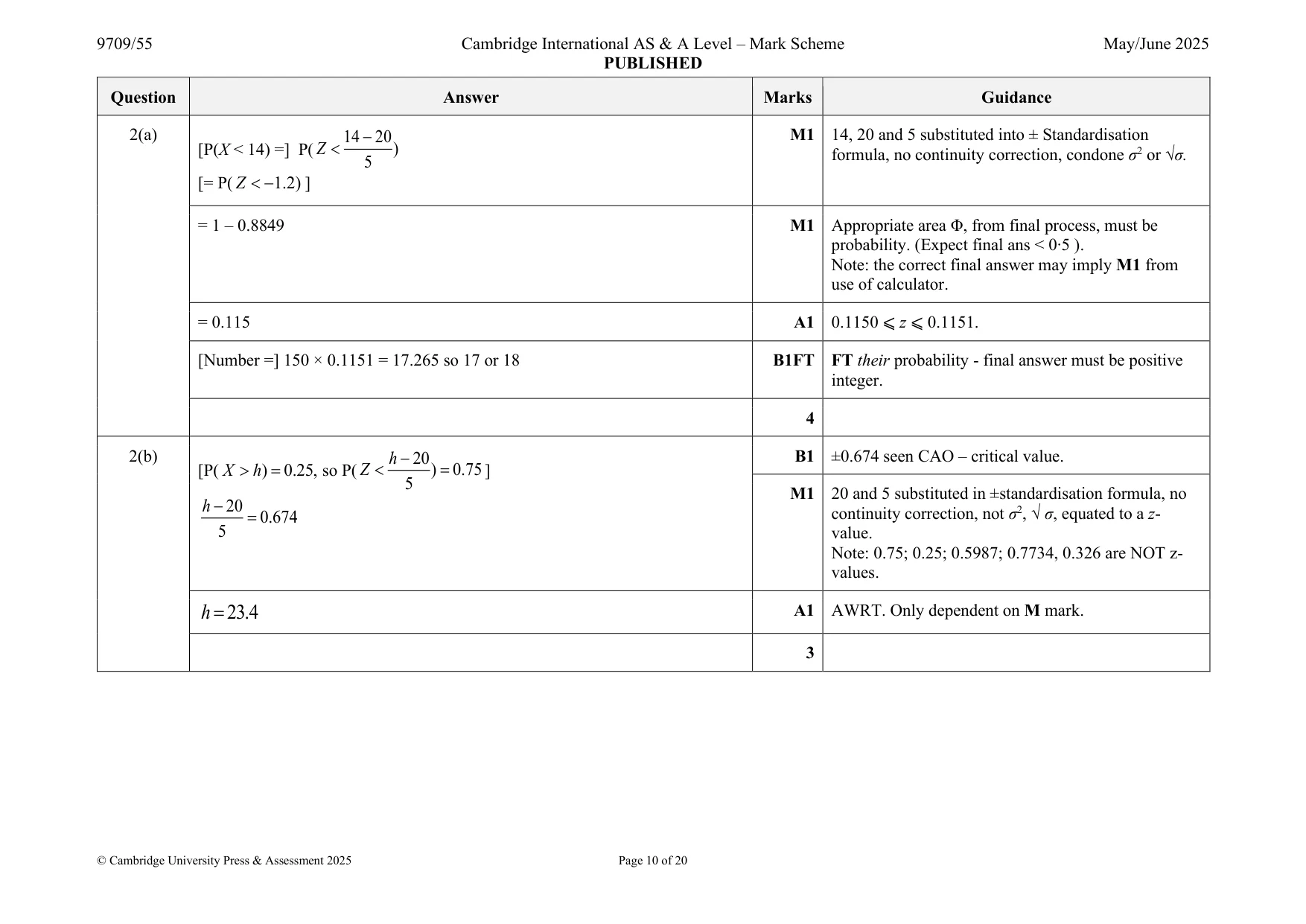
Mark scheme: 2(a) 14 − M1 14, 20 and 5 substituted into ± Standardisation [P(X < 14) =] P( Z 20) formula, no continuity correction, condone σ2 or √σ. 5 [= P( Z −1.2) ] = 1 – 0.8849 M1 Appropriate area Φ, from final process, must be probability. (Expect final ans < 0∙5 ). Note: the correct final answer may imply M1 from use of calculator. = 0.115 A1 0.1150 ⩽ z ⩽ 0.1151. [Number =] 150 × 0.1151 = 17.265 so 17 or 18 B1FT FT their probability - final answer must be positive integer. 4 2(b) h − B1 ±0.674 seen CAO – critical value. [P( X h ) = 0.25, so P( Z 20) = 0.75 ] 5 M1 20 and 5 substituted in ±standardisation formula, no h − 20 = 0.674 continuity correction, not σ2, √ σ, equated to a z- 5 value. Note: 0.75; 0.25; 0.5987; 0.7734, 0.326 are NOT z- values. h = 23.4 A1 AWRT. Only dependent on M mark. 3
Q3 · In a certain large school, on average, two pupils in five have music lessons
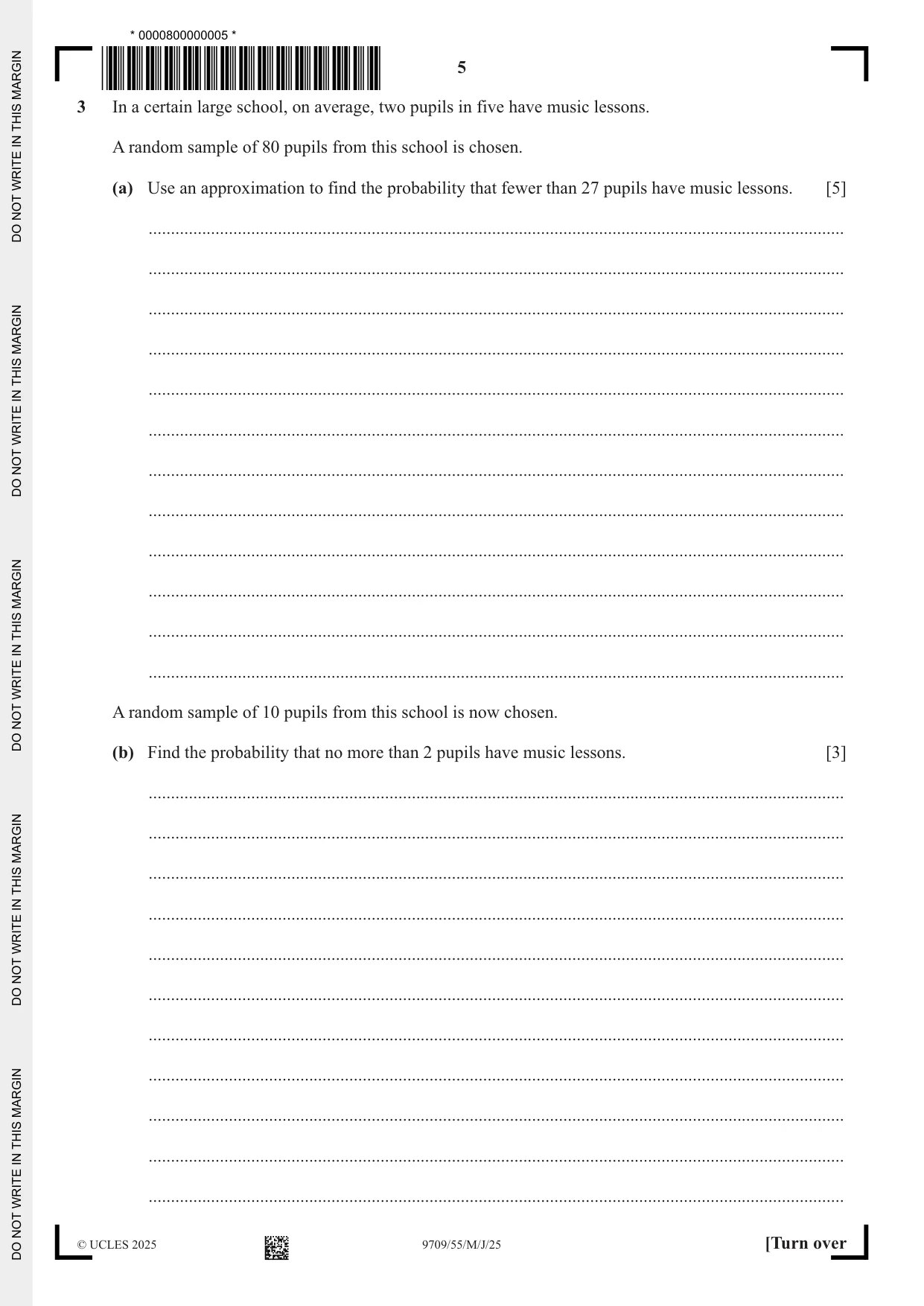
3 In a certain large school, on average, two pupils in five have music lessons. A random sample of 80 pupils from this school is chosen. (a) Use an approximation to find the probability that fewer than 27 pupils have music lessons. [5] ............................................................................................................................................................ ............................................................................................................................................................ ............................................................................................................................................................ ............................................................................................................................................................ ............................................................................................................................................................ ............................................................................................................................................................ ............................................................................................................................................................ ............................................................................................................................................................ ............................................................................................................................................................ ............................................................................................................................................................ ............................................................................................................................................................ ............................................................................................................................................................ A random sample of 10 pupils from this school is now chosen. (b) Find the probability that no more than 2 pupils have music lessons. [3] ............................................................................................................................................................ ............................................................................................................................................................ ............................................................................................................................................................ ............................................................................................................................................................ ............................................................................................................................................................ ............................................................................................................................................................ ............................................................................................................................................................ ............................................................................................................................................................ ............................................................................................................................................................ ............................................................................................................................................................ ............................................................................................................................................................
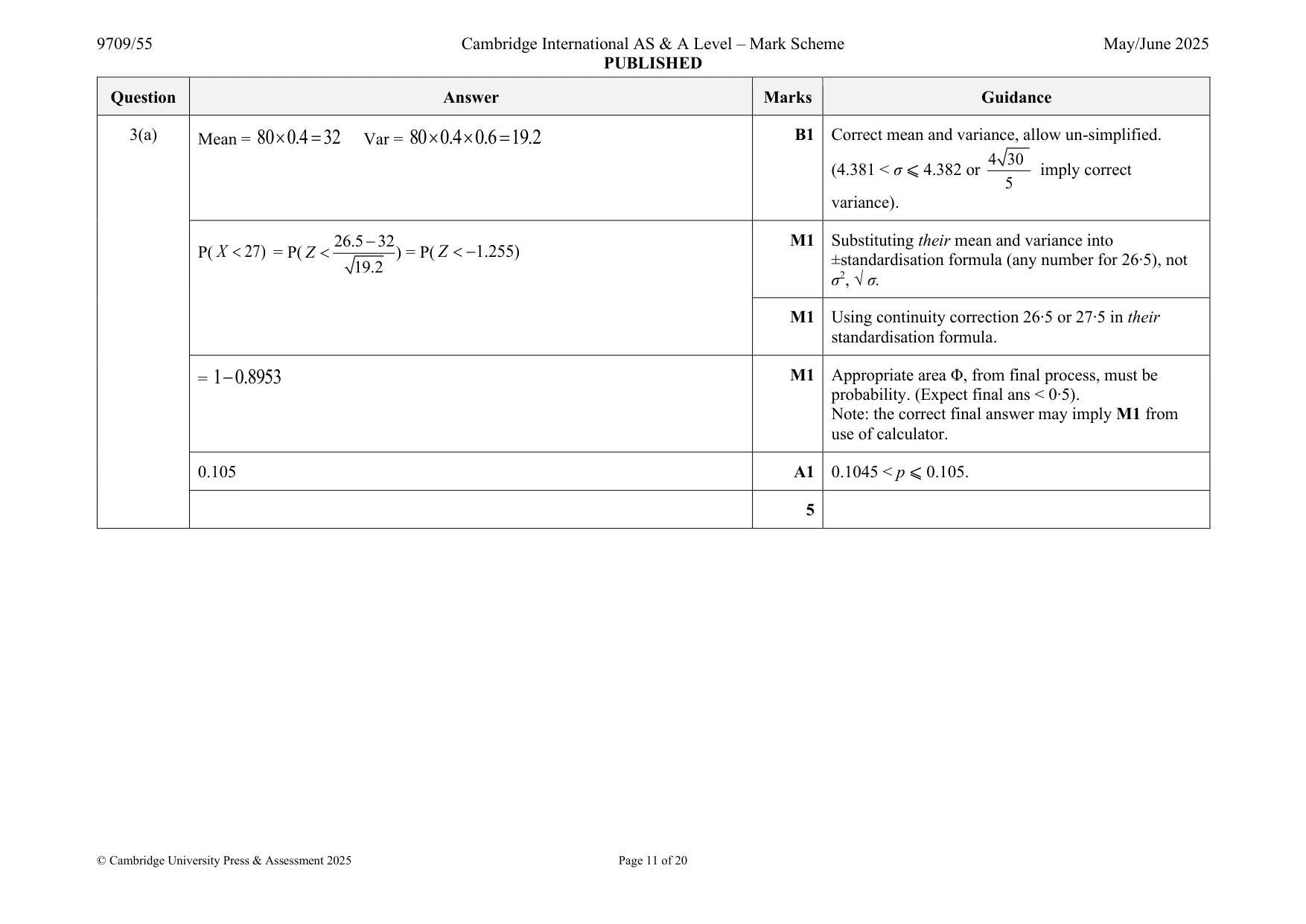
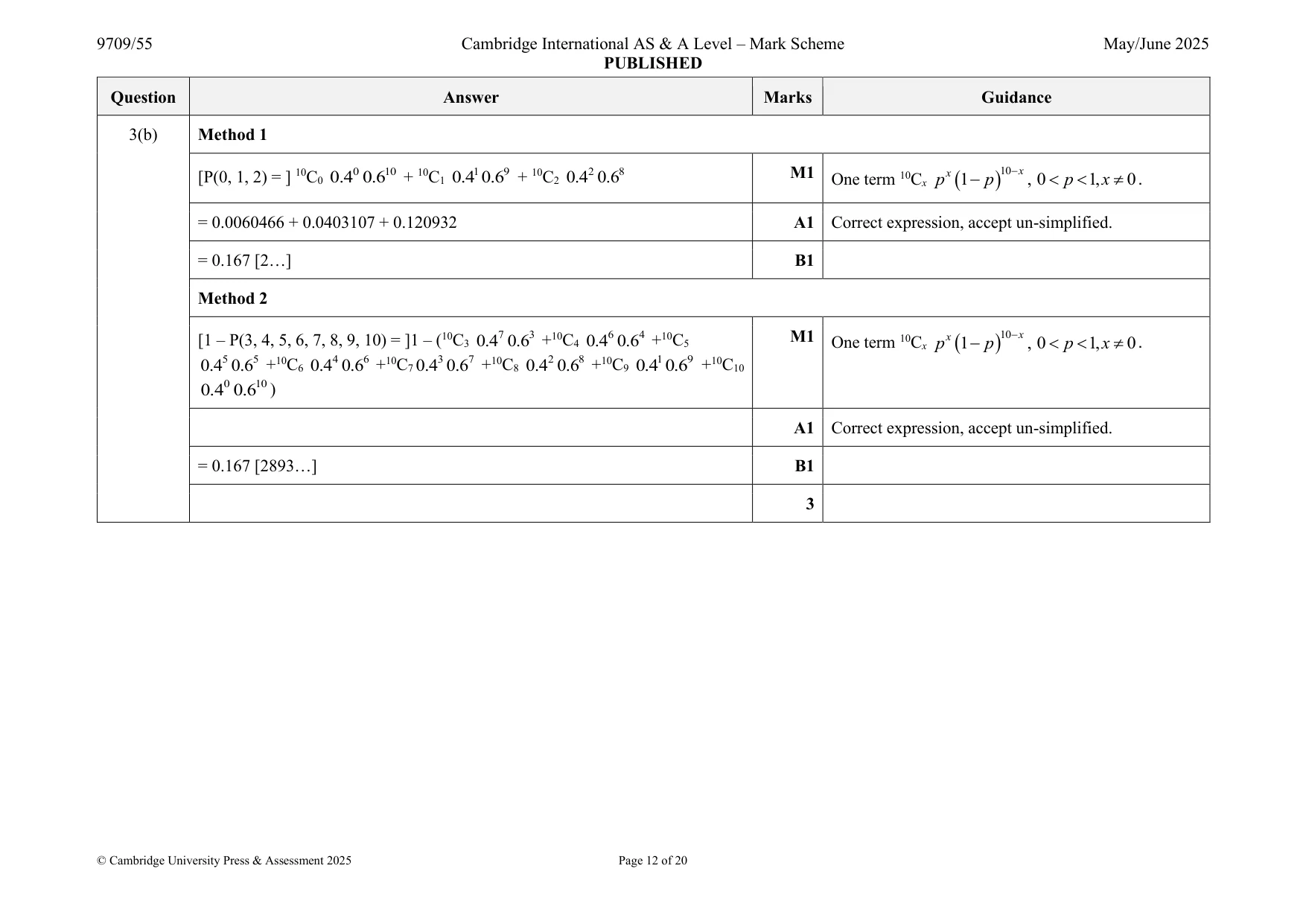
Mark scheme: 3(a) Mean = 80 0.4 = 32 Var = 80 0.4 0.6 = 19.2 B1 Correct mean and variance, allow un-simplified. 4 30 (4.381 < σ ⩽ 4.382 or imply correct 5 variance). 26.5 − M1 Substituting their mean and variance into P( X 27) = P( Z 32) = P( Z −1.255) ±standardisation formula (any number for 26∙5), not 19.2 σ2, √ σ. M1 Using continuity correction 26∙5 or 27∙5 in their standardisation formula. = 1 − 0.8953 M1 Appropriate area Φ, from final process, must be probability. (Expect final ans < 0∙5). Note: the correct final answer may imply M1 from use of calculator. 0.105 A1 0.1045 < p ⩽ 0.105. 5 3(b) Method 1 [P(0, 1, 2) = ] 10C0 0.40 0.610 + 10C1 0.41 0.69 + 10C2 0.42 0.68 M1 One term 10Cx p x (1 − p )10 − x , 0 p 1, x 0 . = 0.0060466 + 0.0403107 + 0.120932 A1 Correct expression, accept un-simplified. = 0.167 [2…] B1 Method 2 [1 – P(3, 4, 5, 6, 7, 8, 9, 10) = ]1 – (10C3 0.47 0.63 +10C4 0.46 0.64 +10C5 M1 One term 10Cx p x (1 − p )10 − x , 0 p 1, x 0 . 0.45 0.65 +10C6 0.44 0.66 +10C7 0.43 0.67 +10C8 0.42 0.68 +10C9 0.41 0.69 +10C10 0.40 0.610 ) A1 Correct expression, accept un-simplified. = 0.167 [2893…] B1 3
Q4 · Students applying to Drydale College take an entrance test
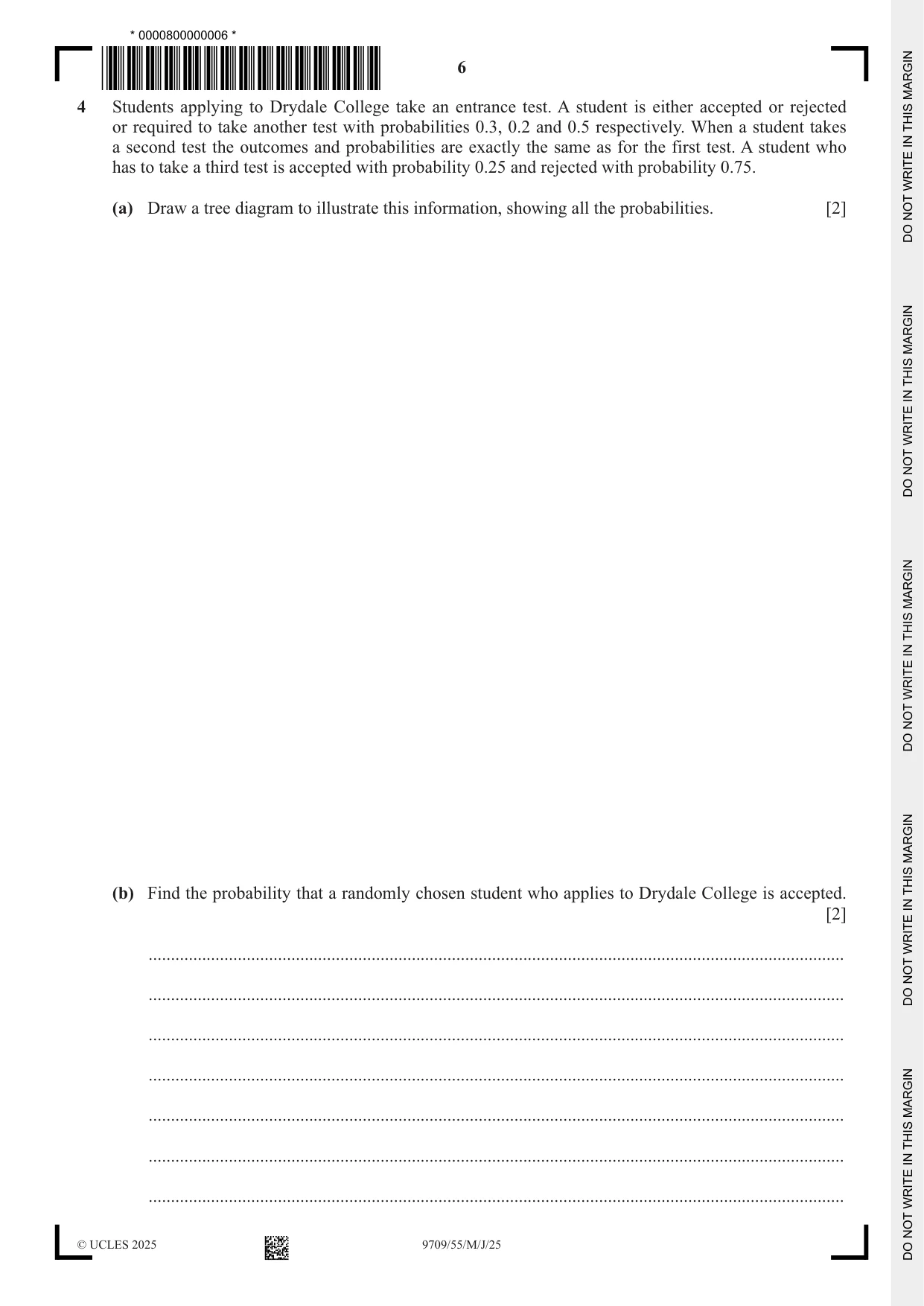
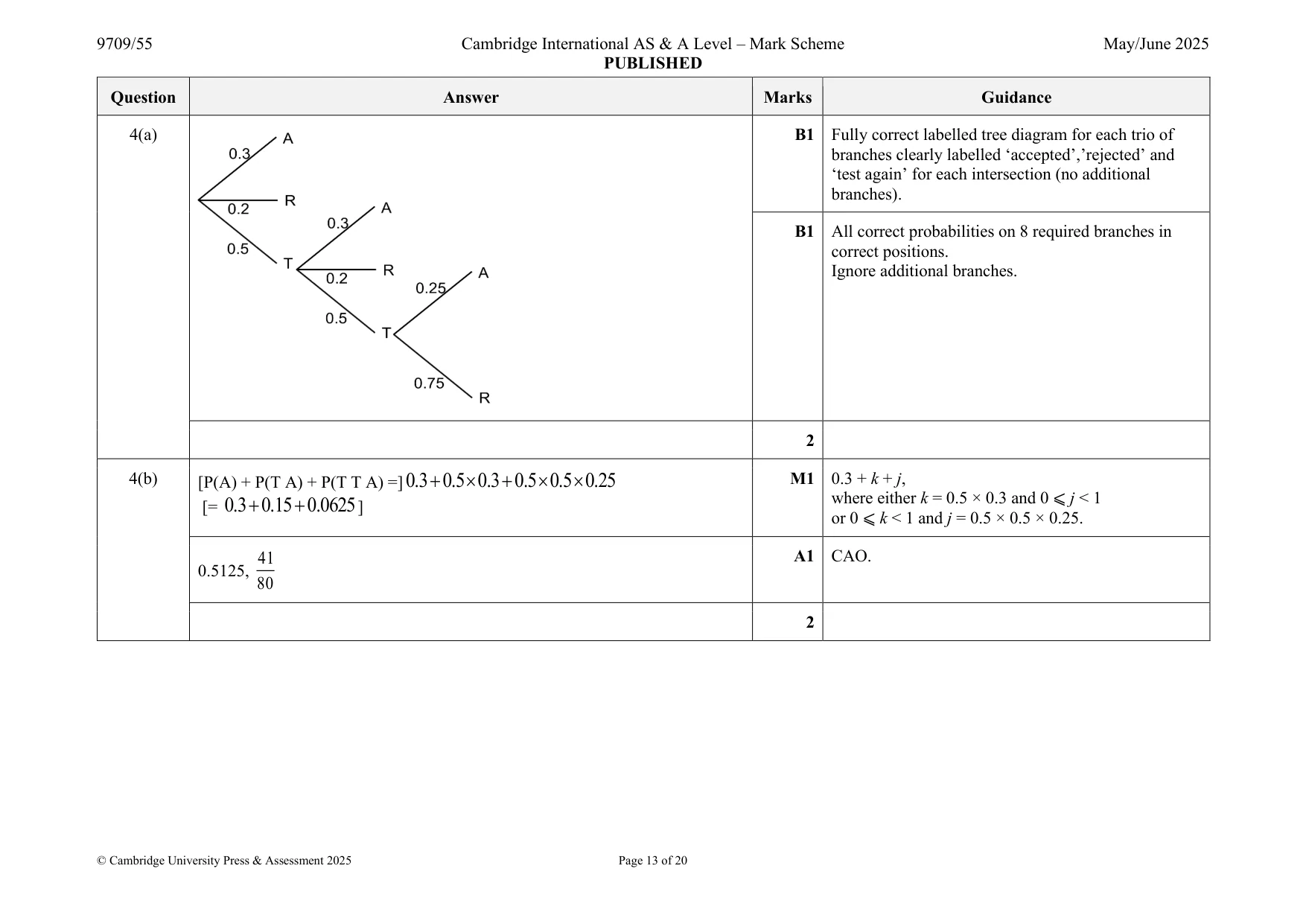
4 Students applying to Drydale College take an entrance test. A student is either accepted or rejected or required to take another test with probabilities 0.3, 0.2 and 0.5 respectively. When a student takes a second test the outcomes and probabilities are exactly the same as for the first test. A student who has to take a third test is accepted with probability 0.25 and rejected with probability 0.75. (a) Draw a tree diagram to illustrate this information, showing all the probabilities. [2] (b) Find the probability that a randomly chosen student who applies to Drydale College is accepted. [2] ............................................................................................................................................................ ............................................................................................................................................................ ............................................................................................................................................................ ............................................................................................................................................................ ............................................................................................................................................................ ............................................................................................................................................................ ............................................................................................................................................................ (c) Find the probability that a randomly chosen student who applies to Drydale College takes at least two tests given that the student is accepted. [3] ............................................................................................................................................................ ............................................................................................................................................................ ............................................................................................................................................................ ............................................................................................................................................................ ............................................................................................................................................................ ............................................................................................................................................................ ............................................................................................................................................................ ............................................................................................................................................................ ............................................................................................................................................................ ............................................................................................................................................................ ............................................................................................................................................................ ............................................................................................................................................................ ............................................................................................................................................................ ............................................................................................................................................................ ............................................................................................................................................................ Three friends apply to Drydale College. (d) Find the probability that all three are rejected. [2] ............................................................................................................................................................ ............................................................................................................................................................ ............................................................................................................................................................ ............................................................................................................................................................ ............................................................................................................................................................ ............................................................................................................................................................ ............................................................................................................................................................ ............................................................................................................................................................ ............................................................................................................................................................ ............................................................................................................................................................
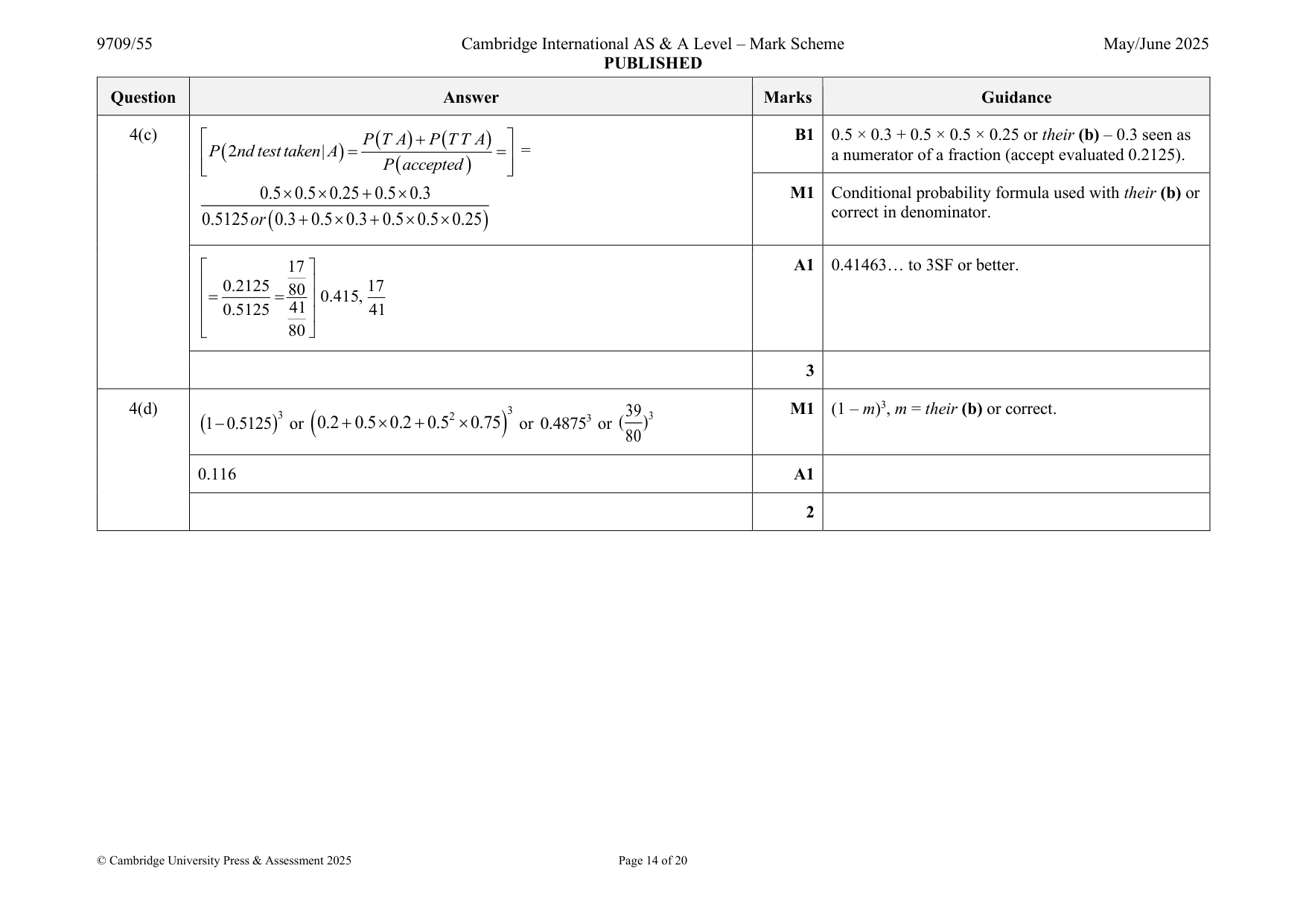
Mark scheme: 4(a) B1 Fully correct labelled tree diagram for each trio of branches clearly labelled ‘accepted’,’rejected’ and ‘test again’ for each intersection (no additional branches). B1 All correct probabilities on 8 required branches in correct positions. Ignore additional branches. 2 4(b) [P(A) + P(T A) + P(T T A) =]0.3 + 0.5 0.3 + 0.5 0.5 0.25 M1 0.3 + k + j, where either k = 0.5 × 0.3 and 0 ⩽ j < 1 [= 0.3 + 0.15 + 0.0625 ] or 0 ⩽ k < 1 and j = 0.5 × 0.5 × 0.25. 41 A1 CAO. 0.5125, 80 2 4(c) P ( T A ) + P ( T T A ) B1 0.5 × 0.3 + 0.5 × 0.5 × 0.25 or their (b) – 0.3 seen as P ( 2nd testtaken | A ) = = = a numerator of a fraction (accept evaluated 0.2125). P ( accepted ) 0.5 0.5 0.25 + 0.5 0.3 M1 Conditional probability formula used with their (b) or correct in denominator. 0.5125 or ( 0.3 + 0.5 0.3 + 0.5 0.5 0.25 ) 17 A1 0.41463… to 3SF or better. 0.2125 80 17 = = 0.415, 0.5125 41 41 80 3 34(d) 3 2 3 39 3 M1 (1 – m)3, m = their (b) or correct. 0.2 + 0.5 0.2 + 0.5 0.75 or 0.4875 or ( ) (1 − 0.5125 ) or ( ) 80 0.116 A1 2
Q5 · The Smarts and the Teasers are two quiz teams that each contain 11 members
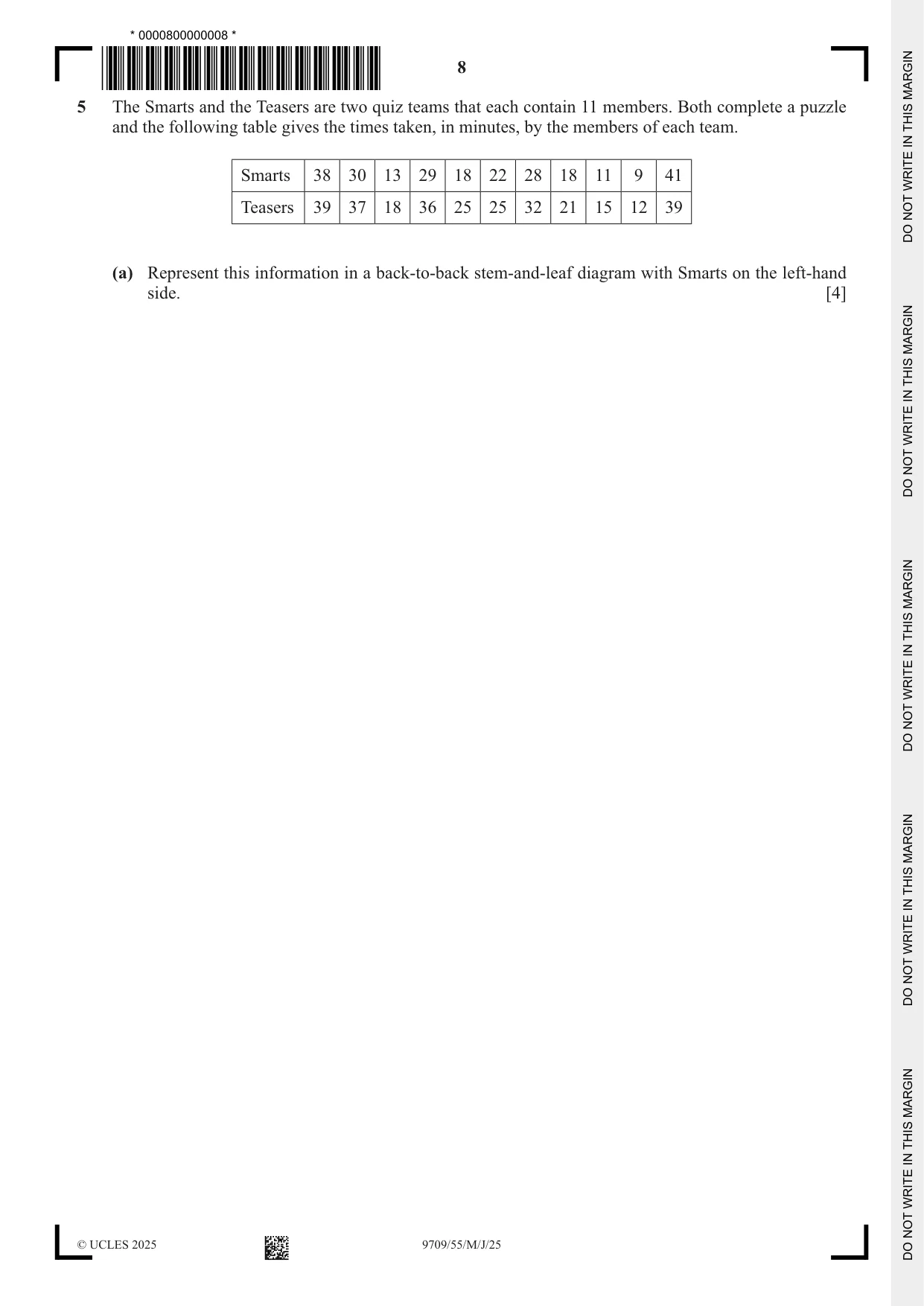
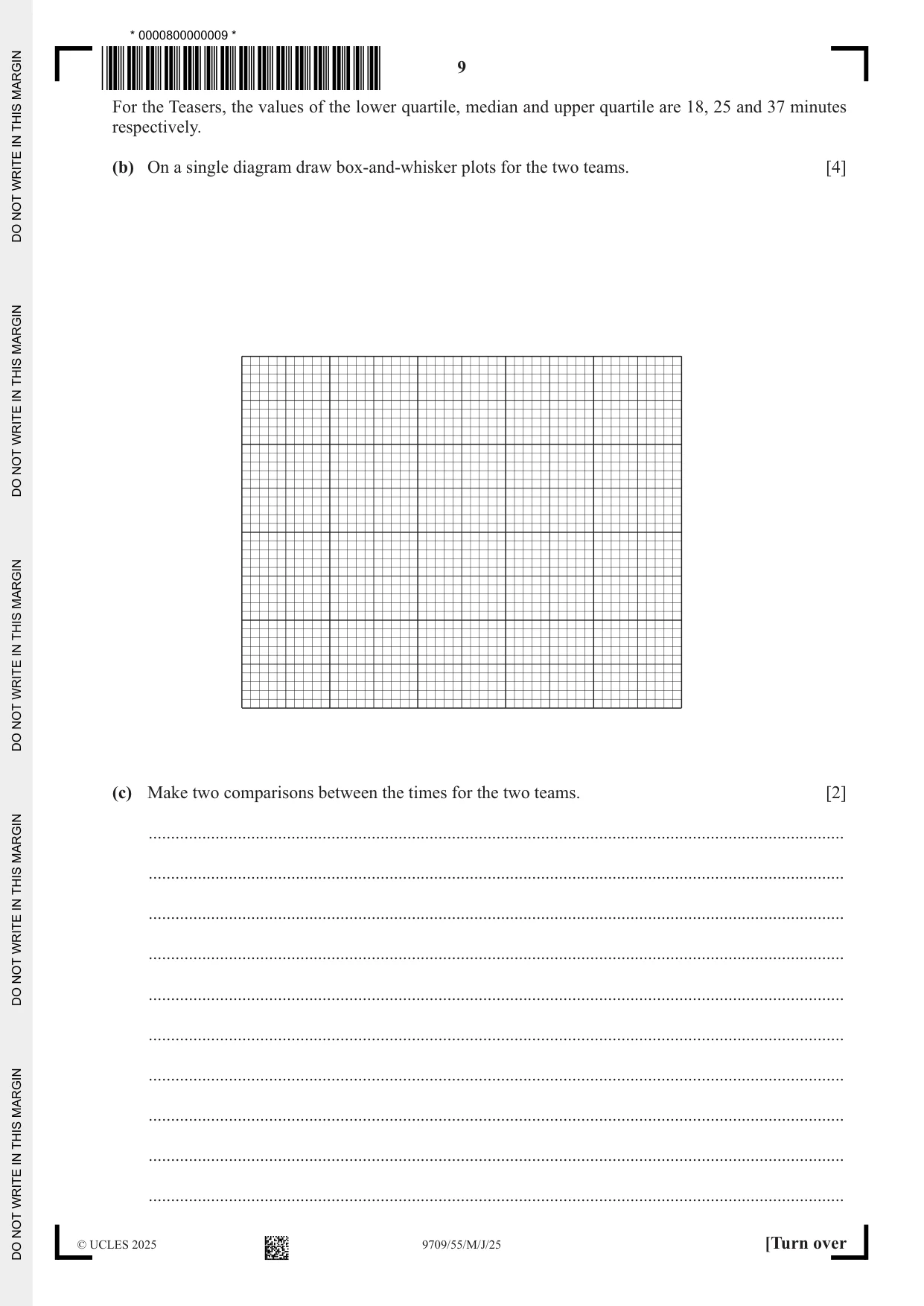
5 The Smarts and the Teasers are two quiz teams that each contain 11 members. Both complete a puzzle and the following table gives the times taken, in minutes, by the members of each team. Smarts 38 30 13 29 18 22 28 18 11 9 41 Teasers 39 37 18 36 25 25 32 21 15 12 39 (a) Represent this information in a back-to-back stem-and-leaf diagram with Smarts on the left-hand side. [4] For the Teasers, the values of the lower quartile, median and upper quartile are 18, 25 and 37 minutes respectively. (b) On a single diagram draw box-and-whisker plots for the two teams. [4] (c) Make two comparisons between the times for the two teams. [2] ............................................................................................................................................................ ............................................................................................................................................................ ............................................................................................................................................................ ............................................................................................................................................................ ............................................................................................................................................................ ............................................................................................................................................................ ............................................................................................................................................................ ............................................................................................................................................................ ............................................................................................................................................................ ............................................................................................................................................................
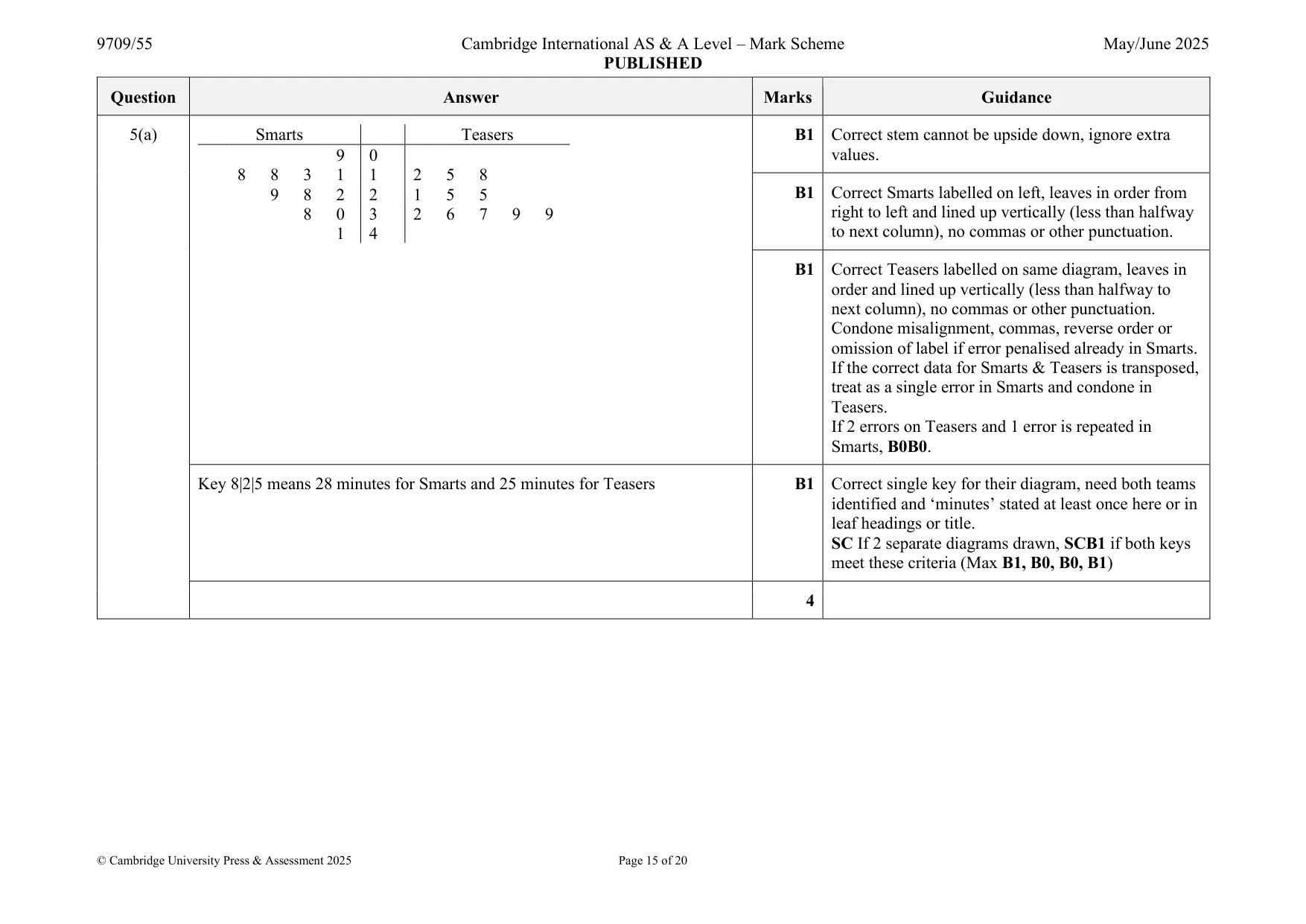
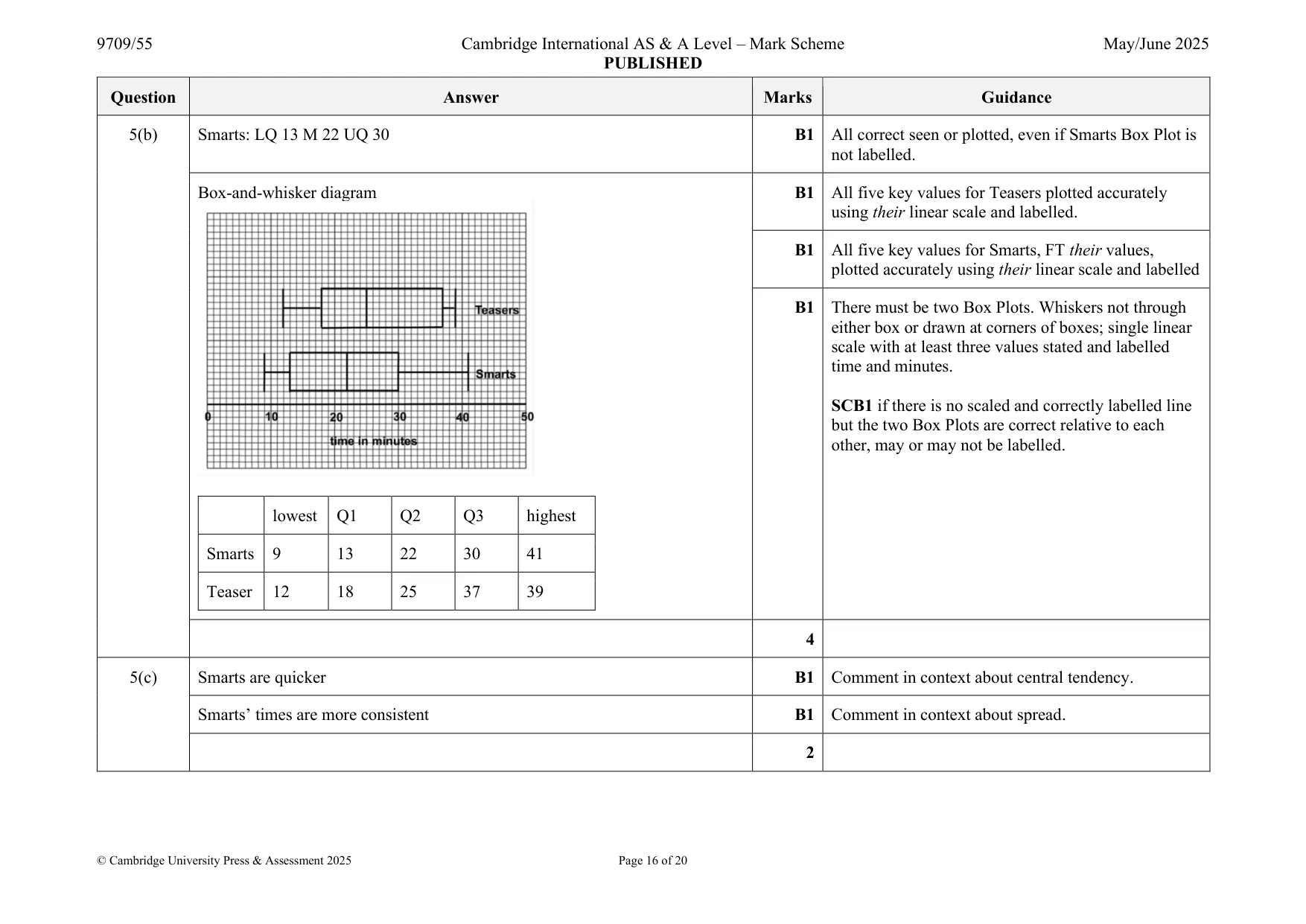
Mark scheme: 5(a) Smarts Teasers B1 Correct stem cannot be upside down, ignore extra 9 0 values. 8 8 3 1 1 2 5 8 9 8 2 2 1 5 5 B1 Correct Smarts labelled on left, leaves in order from 8 0 3 2 6 7 9 9 right to left and lined up vertically (less than halfway 1 4 to next column), no commas or other punctuation. B1 Correct Teasers labelled on same diagram, leaves in order and lined up vertically (less than halfway to next column), no commas or other punctuation. Condone misalignment, commas, reverse order or omission of label if error penalised already in Smarts. If the correct data for Smarts & Teasers is transposed, treat as a single error in Smarts and condone in Teasers. If 2 errors on Teasers and 1 error is repeated in Smarts, B0B0. Key 8|2|5 means 28 minutes for Smarts and 25 minutes for Teasers B1 Correct single key for their diagram, need both teams identified and ‘minutes’ stated at least once here or in leaf headings or title. SC If 2 separate diagrams drawn, SCB1 if both keys meet these criteria (Max B1, B0, B0, B1) 4 5(b) Smarts: LQ 13 M 22 UQ 30 B1 All correct seen or plotted, even if Smarts Box Plot is not labelled. Box-and-whisker diagram B1 All five key values for Teasers plotted accurately using their linear scale and labelled. B1 All five key values for Smarts, FT their values, plotted accurately using their linear scale and labelled B1 There must be two Box Plots. Whiskers not through either box or drawn at corners of boxes; single linear scale with at least three values stated and labelled time and minutes. SCB1 if there is no scaled and correctly labelled line but the two Box Plots are correct relative to each other, may or may not be labelled. lowest Q1 Q2 Q3 highest Smarts 9 13 22 30 41 Teaser 12 18 25 37 39 4 5(c) Smarts are quicker B1 Comment in context about central tendency. Smarts’ times are more consistent B1 Comment in context about spread. 2
Q6 · A darts club has 12 members made up of 7 men and 5 women
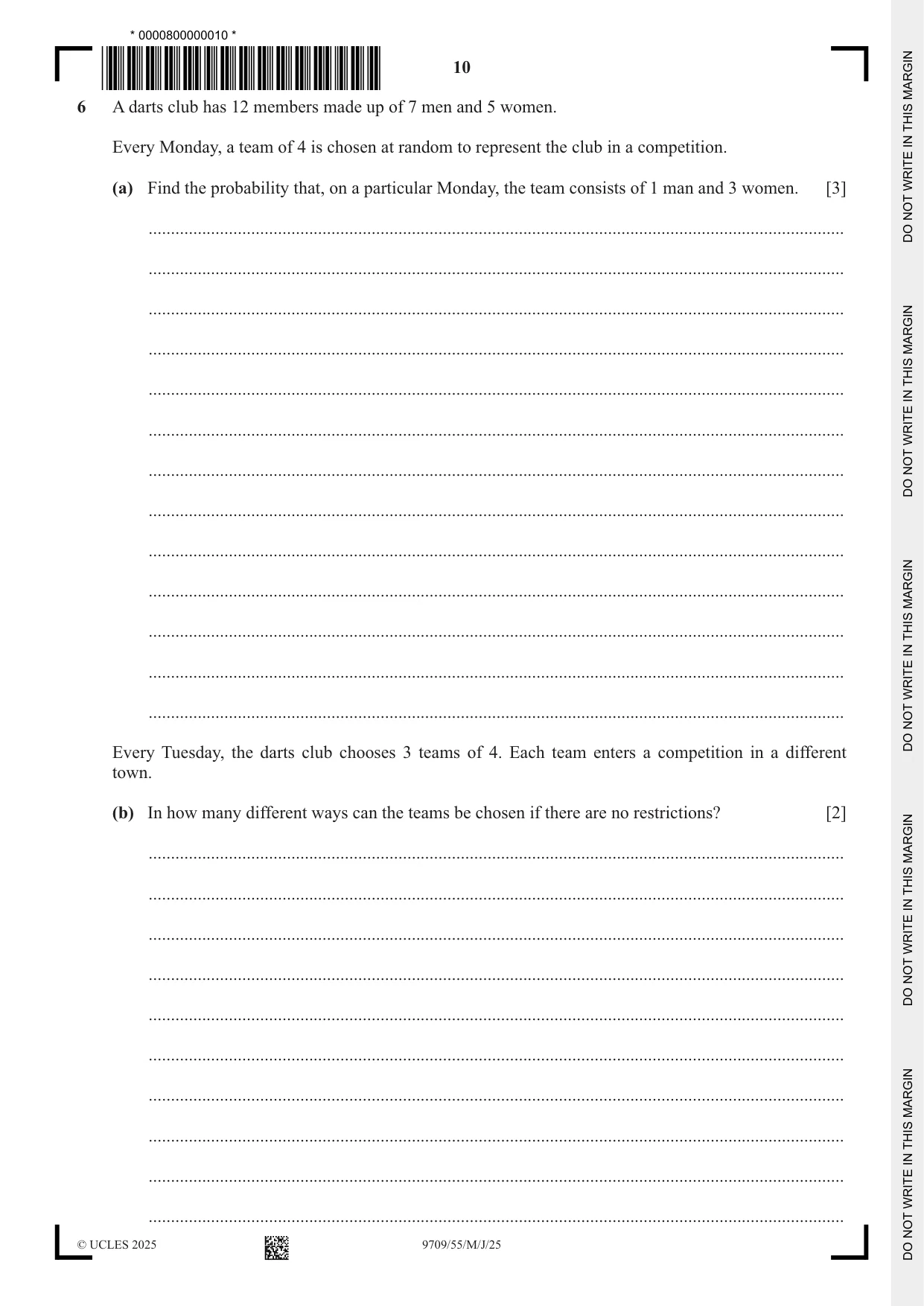
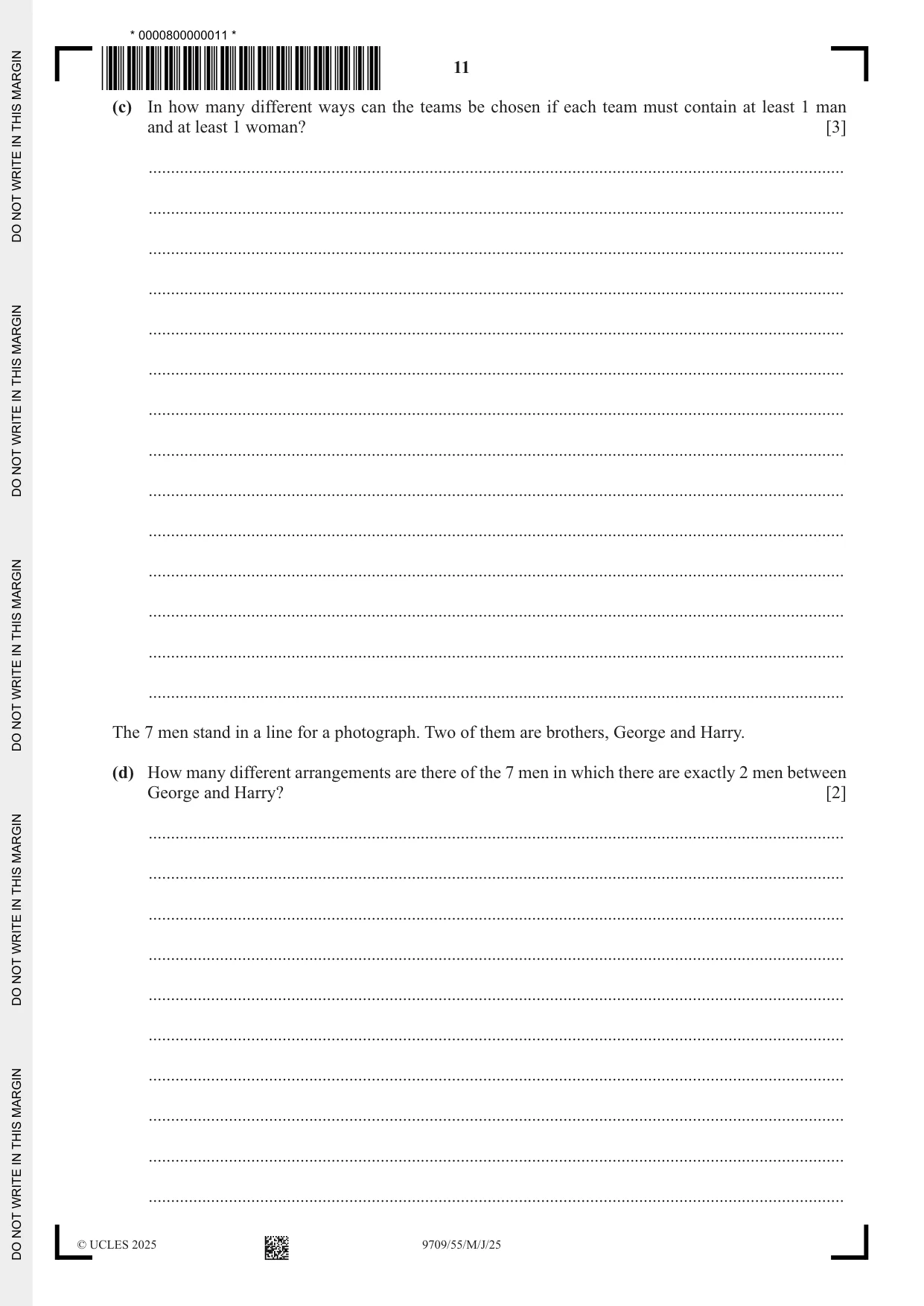
6 A darts club has 12 members made up of 7 men and 5 women. Every Monday, a team of 4 is chosen at random to represent the club in a competition. (a) Find the probability that, on a particular Monday, the team consists of 1 man and 3 women. [3] ............................................................................................................................................................ ............................................................................................................................................................ ............................................................................................................................................................ ............................................................................................................................................................ ............................................................................................................................................................ ............................................................................................................................................................ ............................................................................................................................................................ ............................................................................................................................................................ ............................................................................................................................................................ ............................................................................................................................................................ ............................................................................................................................................................ ............................................................................................................................................................ ............................................................................................................................................................ Every Tuesday, the darts club chooses 3 teams of 4. Each team enters a competition in a different town. (b) In how many different ways can the teams be chosen if there are no restrictions? [2] ............................................................................................................................................................ ............................................................................................................................................................ ............................................................................................................................................................ ............................................................................................................................................................ ............................................................................................................................................................ ............................................................................................................................................................ ............................................................................................................................................................ ............................................................................................................................................................ ............................................................................................................................................................ ............................................................................................................................................................ (c) In how many different ways can the teams be chosen if each team must contain at least 1 man and at least 1 woman? [3] ............................................................................................................................................................ ............................................................................................................................................................ ............................................................................................................................................................ ............................................................................................................................................................ ............................................................................................................................................................ ............................................................................................................................................................ ............................................................................................................................................................ ............................................................................................................................................................ ............................................................................................................................................................ ............................................................................................................................................................ ............................................................................................................................................................ ............................................................................................................................................................ ............................................................................................................................................................ ............................................................................................................................................................ The 7 men stand in a line for a photograph. Two of them are brothers, George and Harry. (d) How many different arrangements are there of the 7 men in which there are exactly 2 men between George and Harry? [2] ............................................................................................................................................................ ............................................................................................................................................................ ............................................................................................................................................................ ............................................................................................................................................................ ............................................................................................................................................................ ............................................................................................................................................................ ............................................................................................................................................................ ............................................................................................................................................................ ............................................................................................................................................................ ............................................................................................................................................................ Additional page If you use the following page to complete the answer to any question, the question number must be clearly shown. ............................................................................................................................................................................ ............................................................................................................................................................................ ............................................................................................................................................................................ ............................................................................................................................................................................ ............................................................................................................................................................................ ............................................................................................................................................................................ ............................................................................................................................................................................ ............................................................................................................................................................................ ............................................................................................................................................................................ ............................................................................................................................................................................ ............................................................................................................................................................................ ............................................................................................................................................................................ ............................................................................................................................................................................ ............................................................................................................................................................................ ............................................................................................................................................................................ ............................................................................................................................................................................ ............................................................................................................................................................................ ............................................................................................................................................................................ ............................................................................................................................................................................ ............................................................................................................................................................................ ............................................................................................................................................................................ ............................................................................................................................................................................
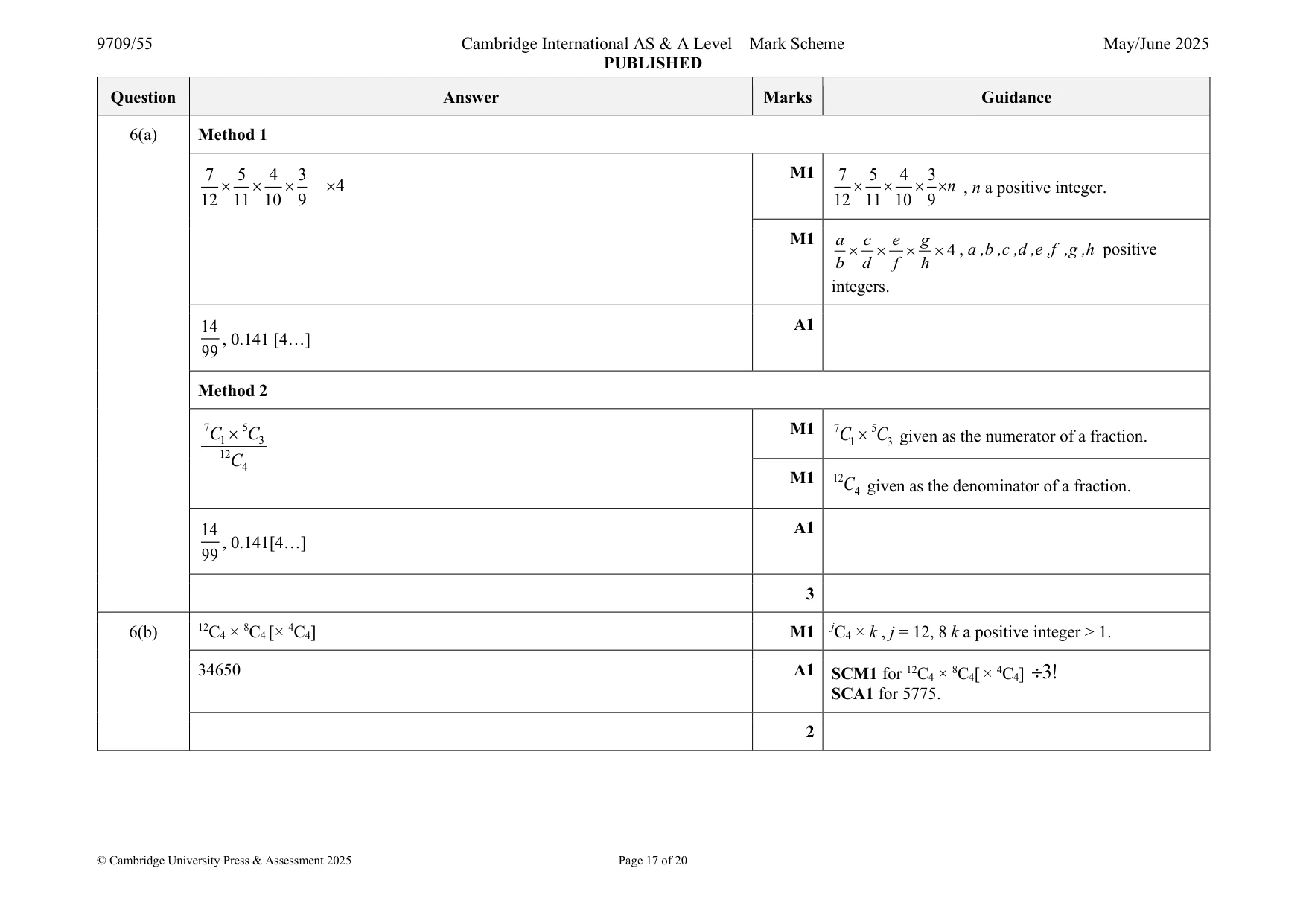
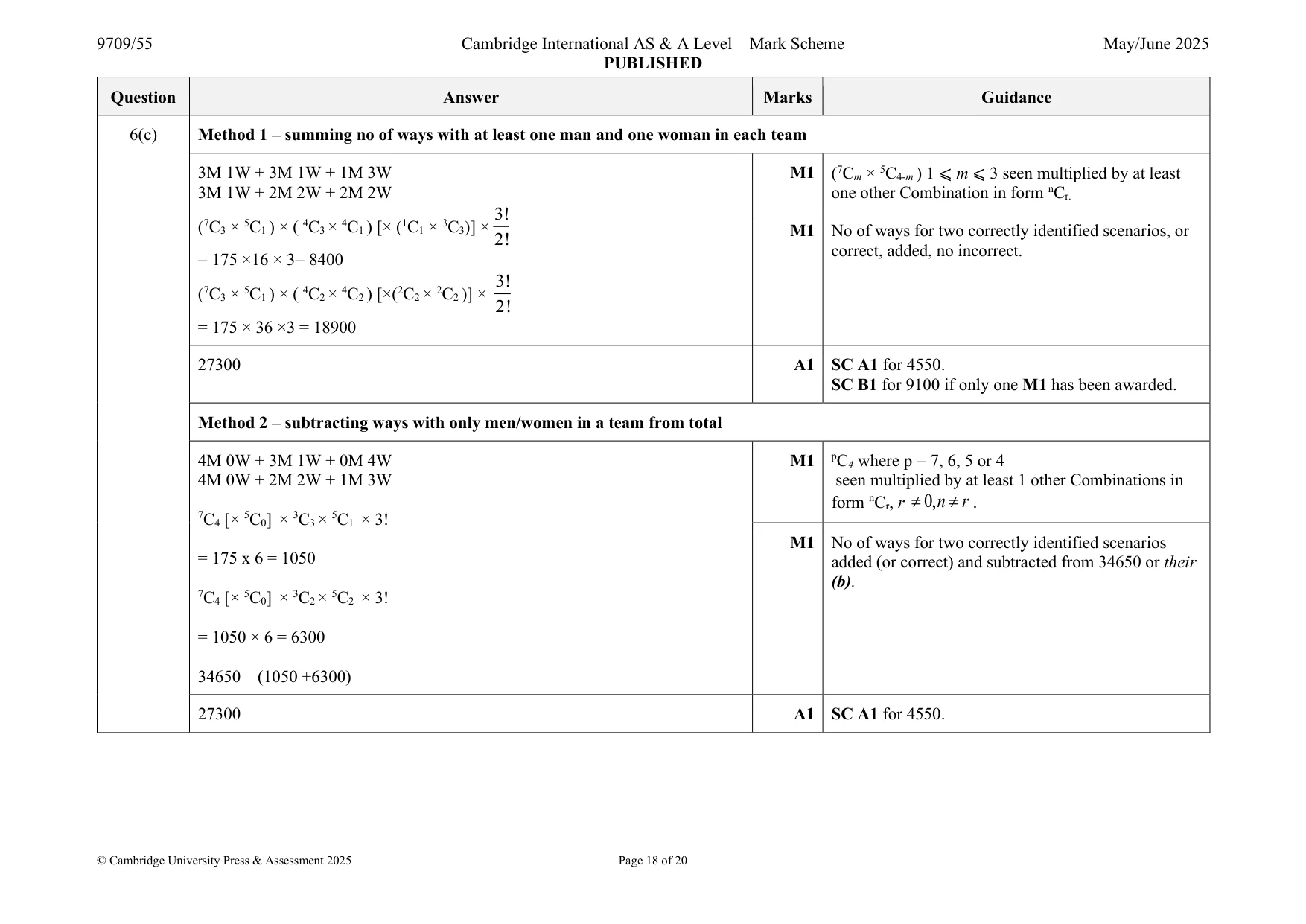
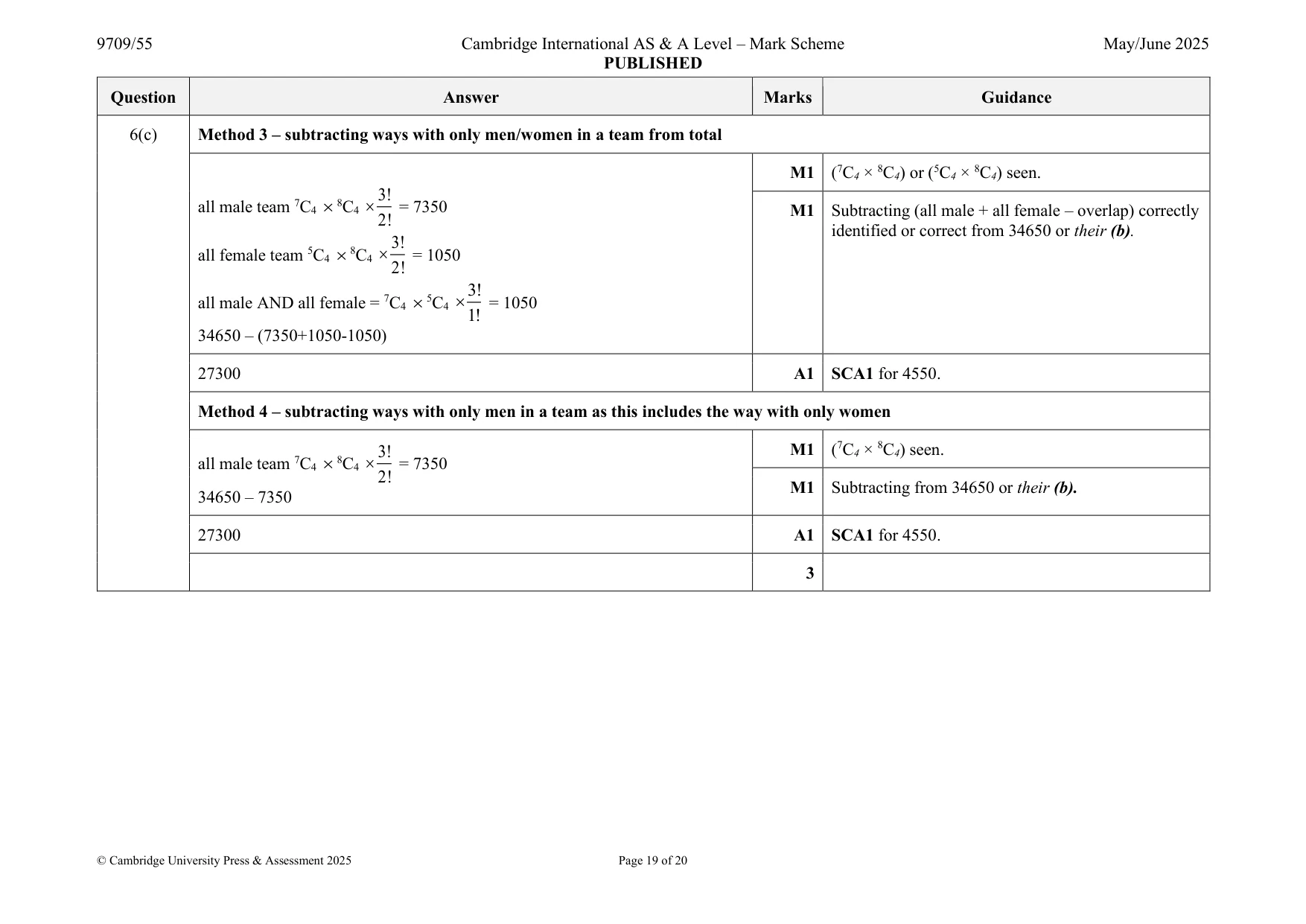
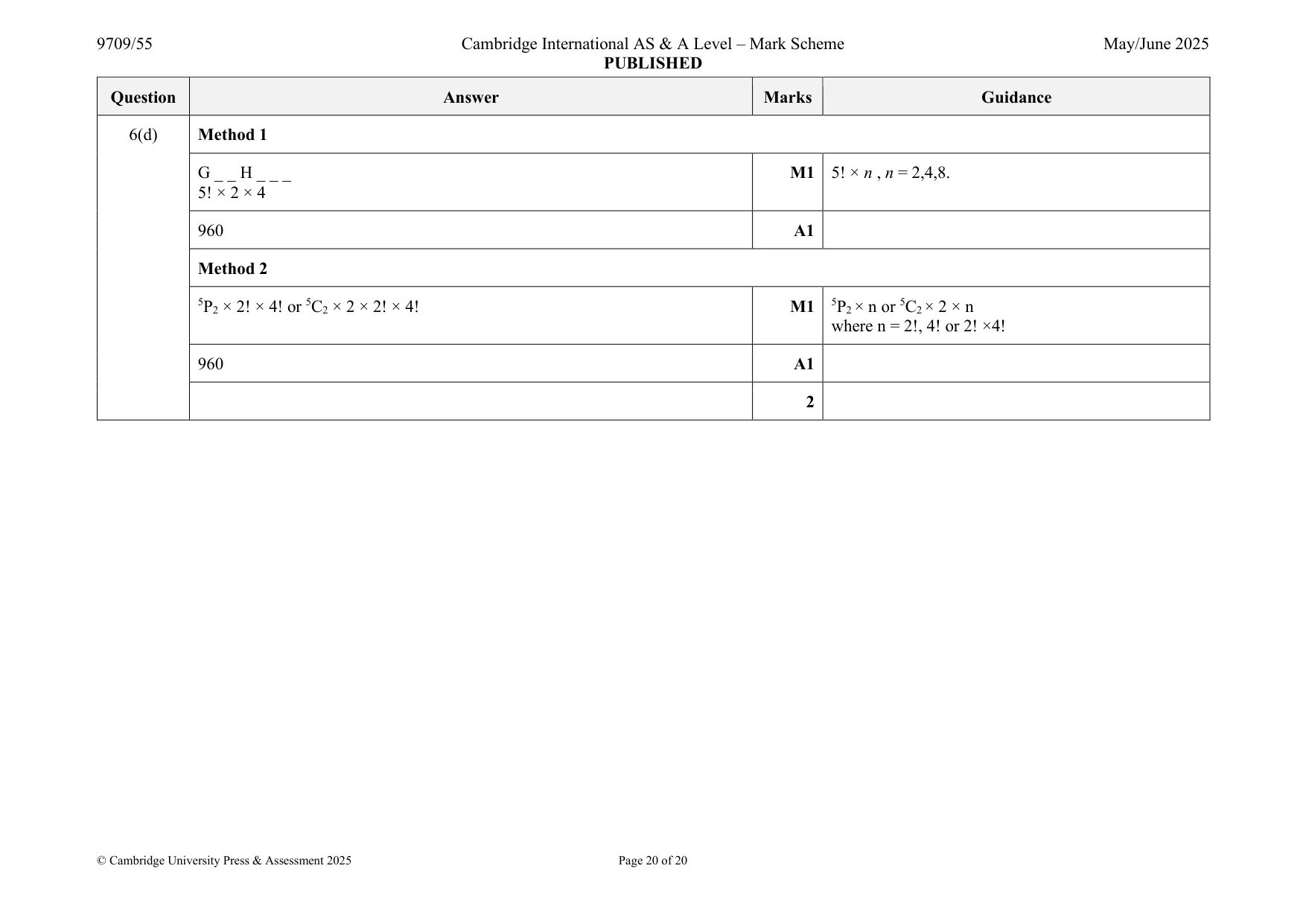
Mark scheme: 6(b) 12C4 × 8C4 [× 4C4] M1 jC4 × k , j = 12, 8 k a positive integer > 1. 34650 A1 SCM1 for 12C4 × 8C4[ × 4C4] 3! SCA1 for 5775. 2 6(c) Method 1 – summing no of ways with at least one man and one woman in each team 3M 1W + 3M 1W + 1M 3W M1 (7Cm × 5C4-m ) 1 ⩽ m ⩽ 3 seen multiplied by at least 3M 1W + 2M 2W + 2M 2W one other Combination in form nCr. 3! (7C3 × 5C1 ) × ( 4C3 × 4C1 ) [× (1C1 × 3C3)] × M1 No of ways for two correctly identified scenarios, or 2! correct, added, no incorrect. = 175 ×16 × 3= 8400 3! (7C3 × 5C1 ) × ( 4C2 × 4C2 ) [×(2C2 × 2C2 )] × 2! = 175 × 36 ×3 = 18900 27300 A1 SC A1 for 4550. SC B1 for 9100 if only one M1 has been awarded. Method 2 – subtracting ways with only men/women in a team from total 4M 0W + 3M 1W + 0M 4W M1 pC4 where p = 7, 6, 5 or 4 4M 0W + 2M 2W + 1M 3W seen multiplied by at least 1 other Combinations in form nCr, r 0, n r . 7C4 [× 5C0] × 3C3 × 5C1 × 3! M1 No of ways for two correctly identified scenarios = 175 x 6 = 1050 added (or correct) and subtracted from 34650 or their (b). 7C4 [× 5C0] × 3C2 × 5C2 × 3! = 1050 × 6 = 6300 34650 – (1050 +6300) 27300 A1 SC A1 for 4550. 6(c) Method 3 – subtracting ways with only men/women in a team from total M1 (7C4 × 8C4) or (5C4 × 8C4) seen. 3! all male team 7C4 8C4 = 7350 M1 Subtracting (all male + all female – overlap) correctly 2! identified or correct from 34650 or their (b). 3! all female team 5C4 8C4 = 1050 2! 3! all male AND all female = 7C4 5C4 = 1050 1! 34650 – (7350+1050-1050) 27300 A1 SCA1 for 4550. Method 4 – subtracting ways with only men in a team as this includes the way with only women 3! M1 (7C4 × 8C4) seen. all male team 7C4 8C4 = 7350 2! M1 Subtracting from 34650 or their (b). 34650 – 7350 27300 A1 SCA1 for 4550. 3 6(d) Method 1 G _ _ H _ _ _ M1 5! × n , n = 2,4,8. 5! × 2 × 4 960 A1 Method 2 5P2 × 2! × 4! or 5C2 × 2 × 2! × 4! M1 5P2 × n or 5C2 × 2 × n where n = 2!, 4! or 2! ×4! 960 A1 2
What was in this paper
The subtopics covered by these 6 questions, and how many questions each got. Open one in a new tab to see every Cambridge question on it.
What you needed in this session
Cambridge’s own grade thresholds for 2025 May/June, Paper 5 · Variant 5. A higher threshold means an easier paper — the bar moves with how the cohort did.