Cambridge A Level Mathematics 9709 — 2023 Oct/Nov Paper 5 · Variant 2
9709/52/O/N/23 · 6 questions · 50 marks · ≈56 min
The question paper and its mark scheme, free to read here and free to download. This is Cambridge’s own paper, exactly as it was sat.
Question paper12 pages
Mark scheme21 pages
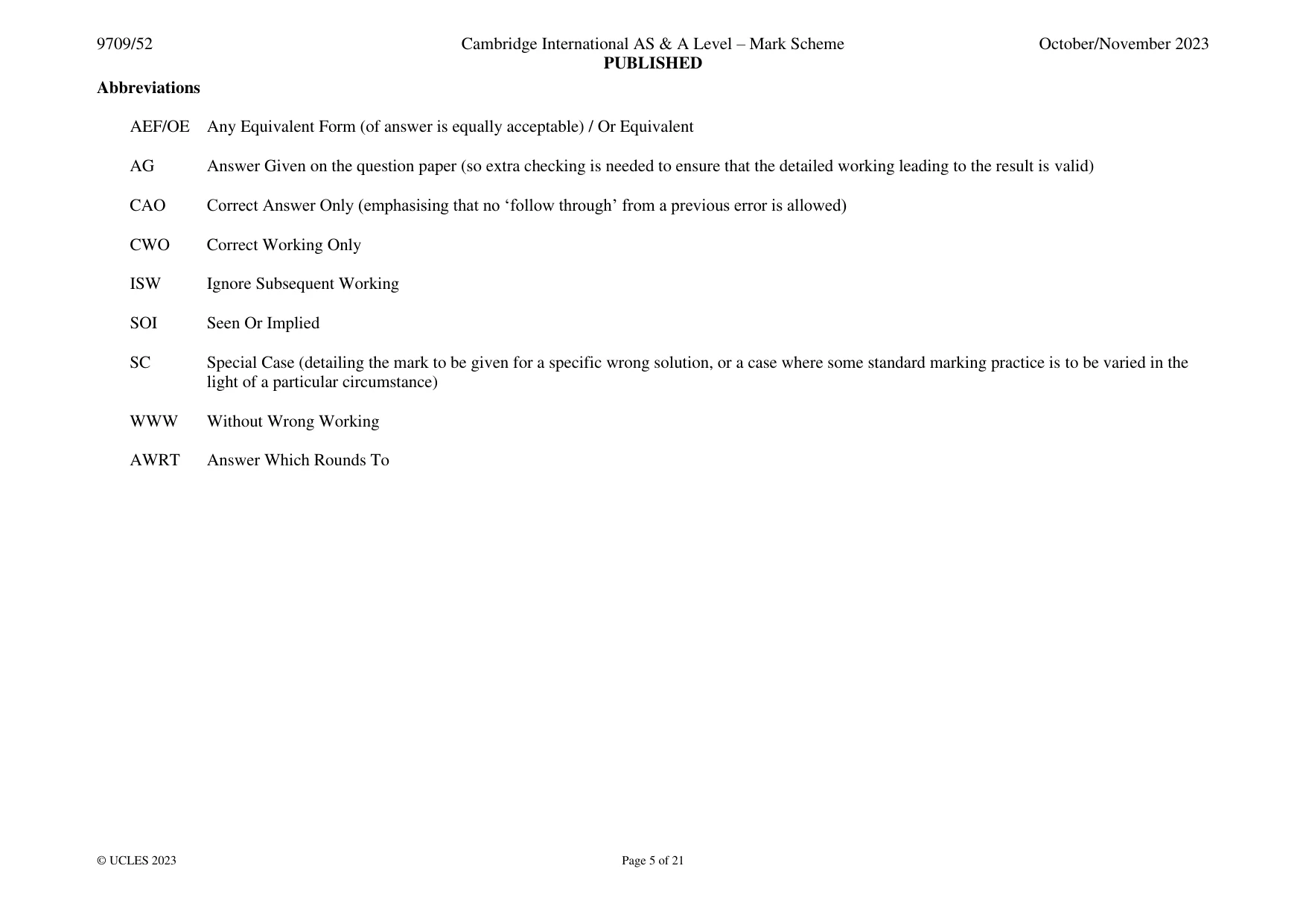
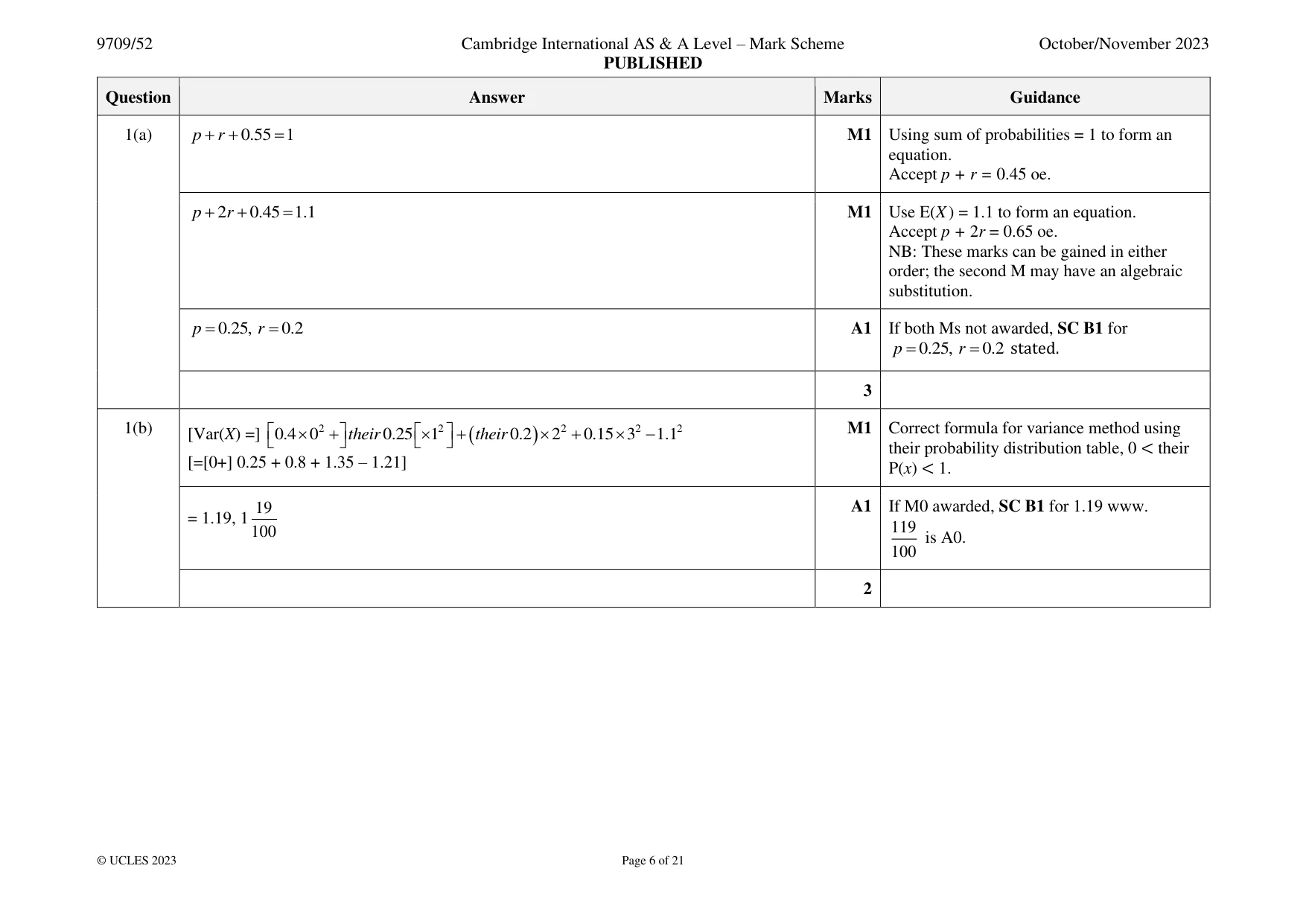
Answers below. Sit the paper first if you are practising.
Questions as text
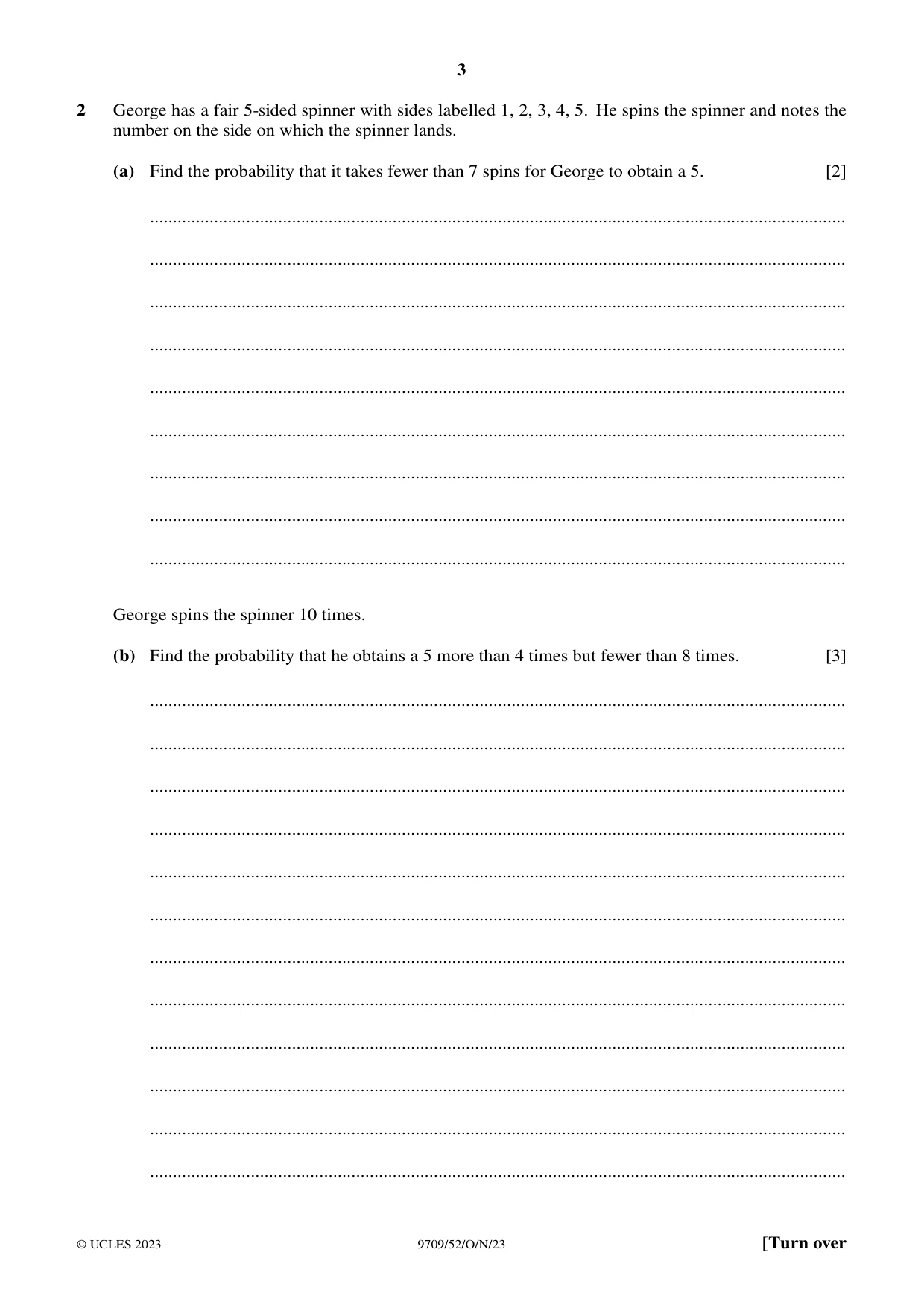
Q2 · George has a fair 5-sided spinner with sides labelled 1, 2, 3, 4, 5
2 George has a fair 5-sided spinner with sides labelled 1, 2, 3, 4, 5. He spins the spinner and notes the number on the side on which the spinner lands. (a) Find the probability that it takes fewer than 7 spins for George to obtain a 5. [2] ........................................................................................................................................................ ........................................................................................................................................................ ........................................................................................................................................................ ........................................................................................................................................................ ........................................................................................................................................................ ........................................................................................................................................................ ........................................................................................................................................................ ........................................................................................................................................................ ........................................................................................................................................................ George spins the spinner 10 times. (b) Find the probability that he obtains a 5 more than 4 times but fewer than 8 times. [3] ........................................................................................................................................................ ........................................................................................................................................................ ........................................................................................................................................................ ........................................................................................................................................................ ........................................................................................................................................................ ........................................................................................................................................................ ........................................................................................................................................................ ........................................................................................................................................................ ........................................................................................................................................................ ........................................................................................................................................................ ........................................................................................................................................................ ........................................................................................................................................................
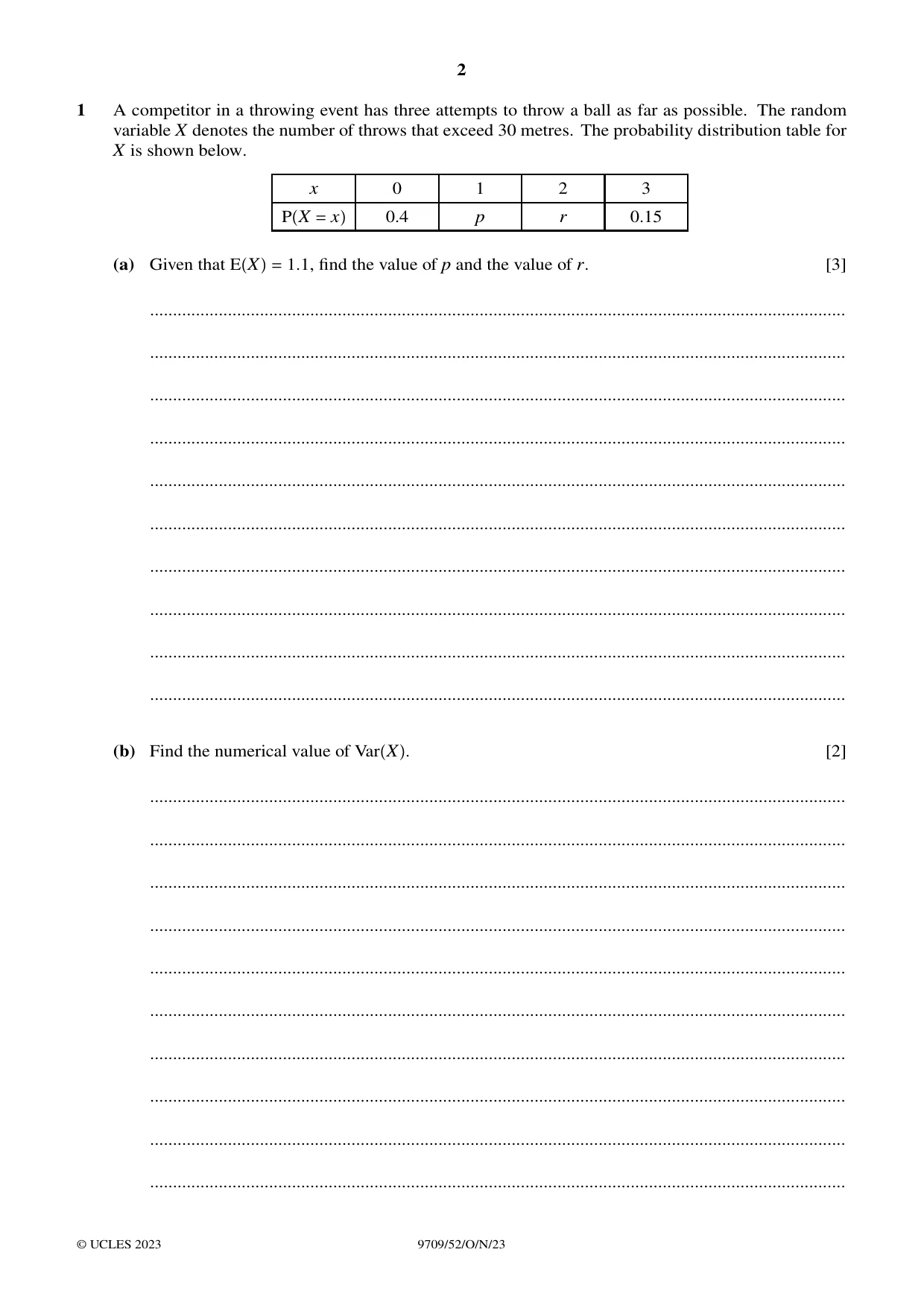
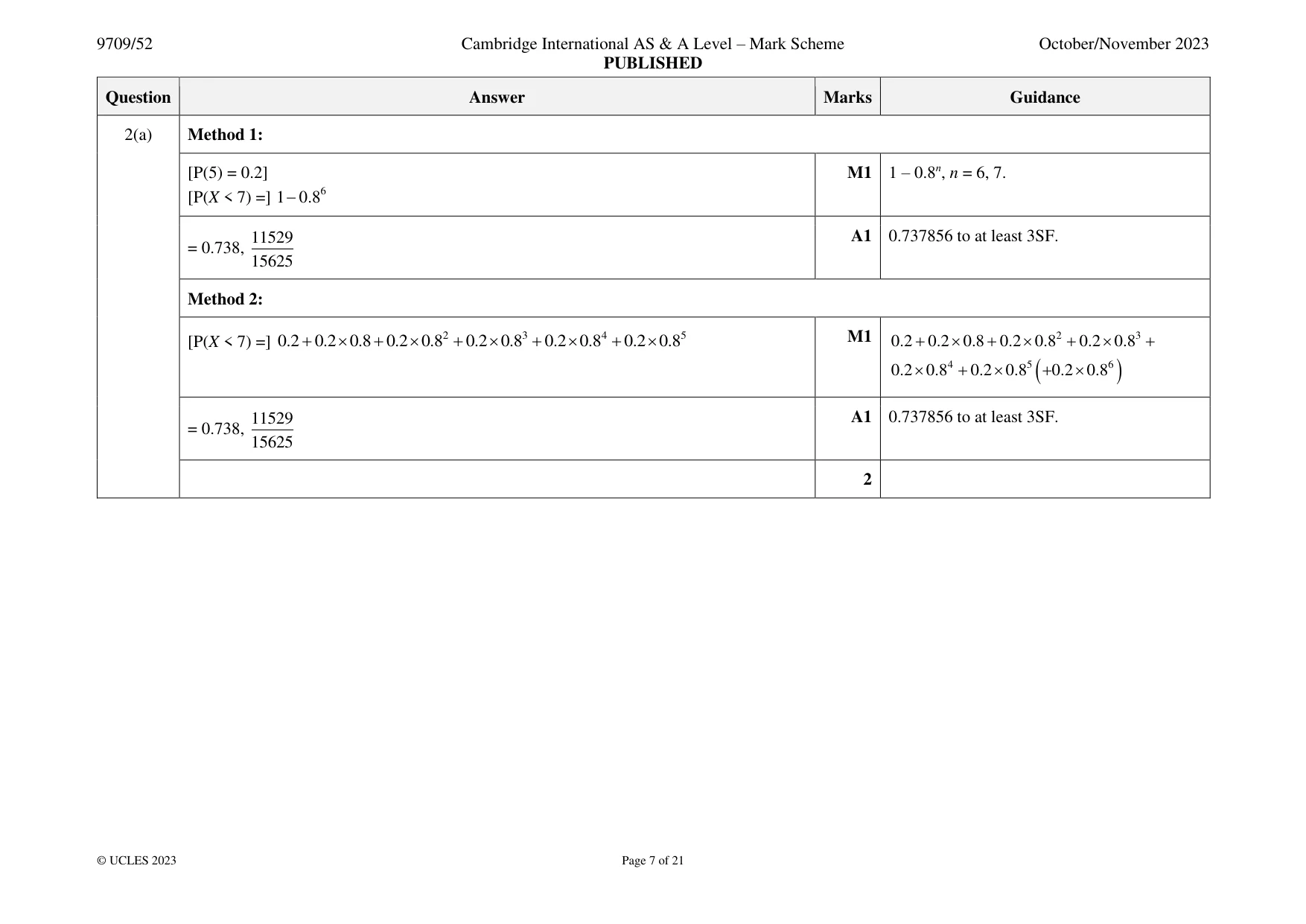
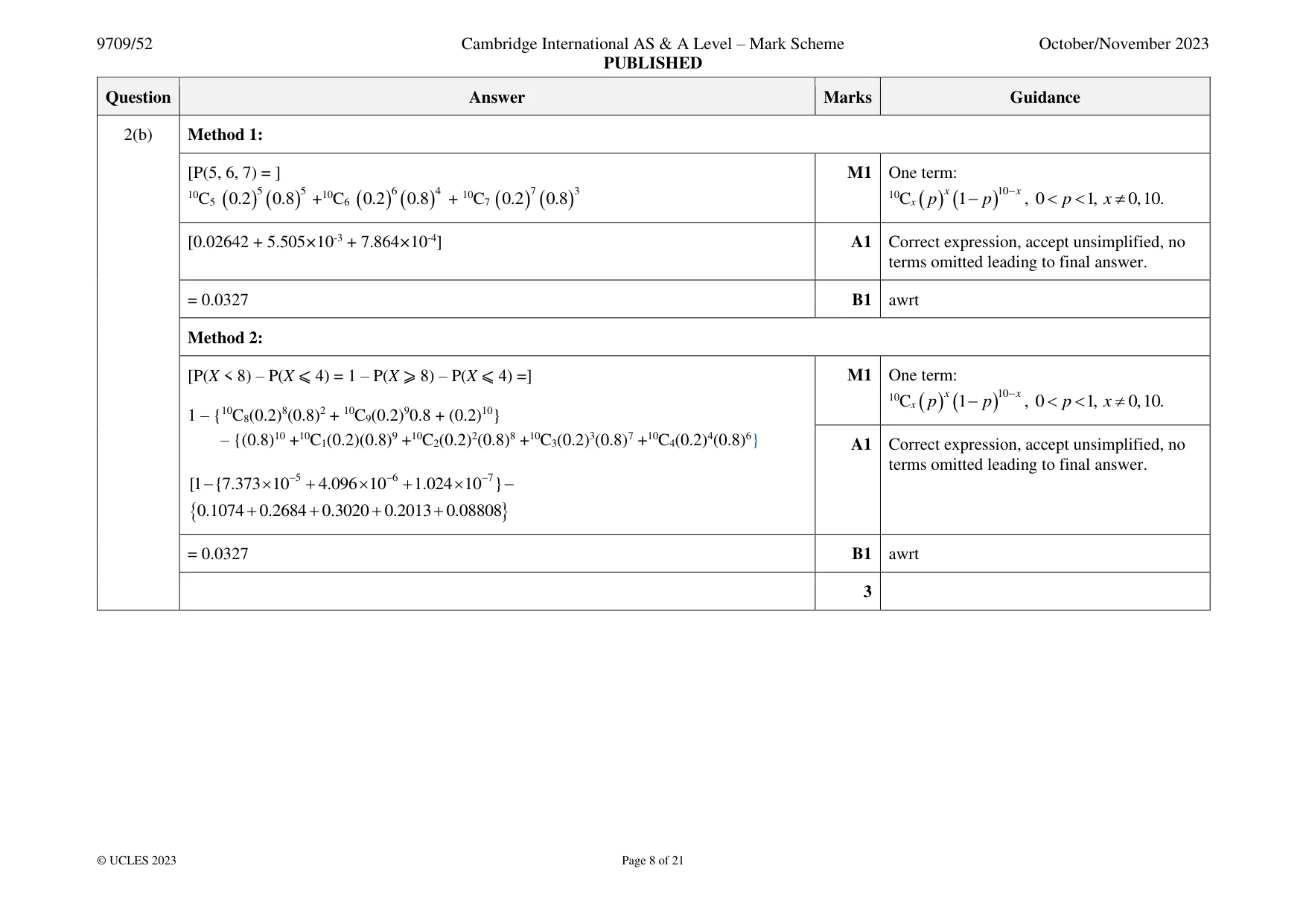
Mark scheme: 2(a) Method 1: [P(5) = 0.2] M1 1 – 0.8n, n = 6, 7. [P(X < 7) =] 1 − 0.86 11529 A1 0.737856 to at least 3SF. = 0.738, 15625 Method 2: [P(X < 7) =] 0.2 + 0.2 0.8 + 0.2 0.82 + 0.2 0.83 + 0.2 0.8 4 + 0.2 0.85 M1 0.2 + 0.2 0.8 + 0.2 0.8 2 + 0.2 0.83 + 0.2 0.8 4 + 0.2 0.85 +0.2 0.86 ( ) 11529 A1 0.737856 to at least 3SF. = 0.738, 15625 2 2(b) Method 1: [P(5, 6, 7) = ] M1 One term: 5 5 6 4 7 3 x 10 − x 10C5 ( 0.2 ) ( 0.8 ) +10C6 ( 0.2 ) ( 0.8 ) + 10C7 ( 0.2 ) ( 0.8 ) 10Cx ( p ) (1 − p ) , 0 p 1, x 0,10. [0.02642 + 5.505 × 10⁻³ + 7.864 × 10⁻⁴] A1 Correct expression, accept unsimplified, no terms omitted leading to final answer. = 0.0327 B1 awrt Method 2: [P(X < 8) – P(X ⩽ 4) = 1 – P(X ⩾ 8) – P(X ⩽ 4) =] M1 One term: x 10 − x 10Cx ( p ) (1 − p ) , 0 p 1, x 0,10. 1 – {10C8(0.2)8(0.8)2 + 10C9(0.2)90.8 + (0.2)10} – {(0.8)10 +10C1(0.2)(0.8)9 +10C2(0.2)2(0.8)8 +10C3(0.2)3(0.8)7 +10C4(0.2)4(0.8)6} A1 Correct expression, accept unsimplified, no terms omitted leading to final answer. [1 − {7.373 10 −5 + 4.096 10 −6 + 1.024 10 −7 } − 0.1074 + 0.2684 + 0.3020 + 0.2013 + 0.08808 = 0.0327 B1 awrt 3
Q3 · A factory produces a certain type of electrical component
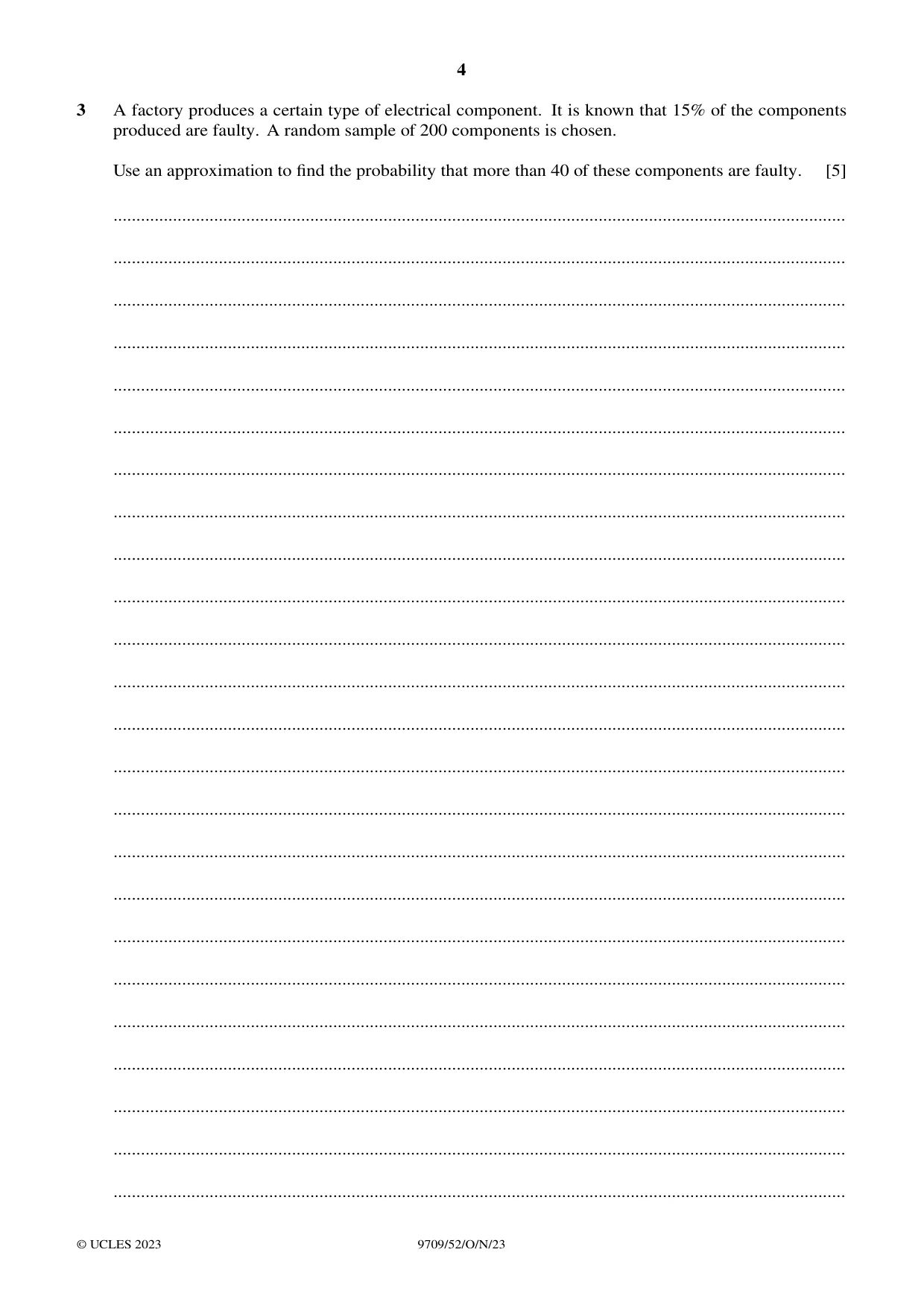
3 A factory produces a certain type of electrical component. It is known that 15% of the components produced are faulty. A random sample of 200 components is chosen. Use an approximation to find the probability that more than 40 of these components are faulty. [5] ................................................................................................................................................................ ................................................................................................................................................................ ................................................................................................................................................................ ................................................................................................................................................................ ................................................................................................................................................................ ................................................................................................................................................................ ................................................................................................................................................................ ................................................................................................................................................................ ................................................................................................................................................................ ................................................................................................................................................................ ................................................................................................................................................................ ................................................................................................................................................................ ................................................................................................................................................................ ................................................................................................................................................................ ................................................................................................................................................................ ................................................................................................................................................................ ................................................................................................................................................................ ................................................................................................................................................................ ................................................................................................................................................................ ................................................................................................................................................................ ................................................................................................................................................................ ................................................................................................................................................................ ................................................................................................................................................................ ................................................................................................................................................................
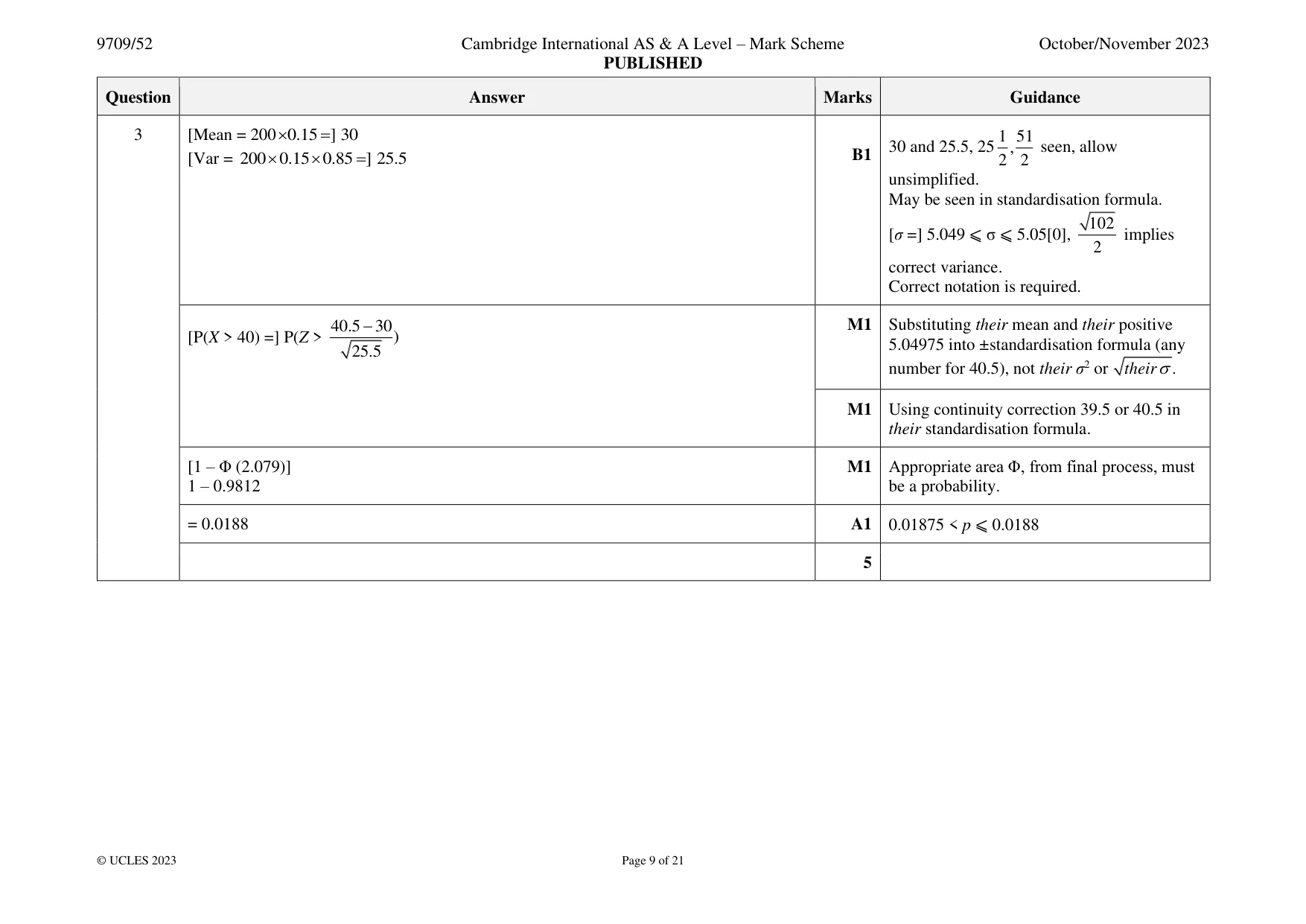
Mark scheme: 3 [Mean = 200 0.15 =] 30 1 51 30 and 25.5, 25 , seen, allow [Var = 200 0.15 0.85 =] 25.5 B1 2 2 unsimplified. May be seen in standardisation formula. 102 [σ =] 5.049 ⩽ σ ⩽ 5.05[0], implies 2 correct variance. Correct notation is required. 40.5 − 30) M1 Substituting their mean and their positive [P(X > 40) =] P(Z > 5.04975 into ± standardisation formula (any 25.5 number for 40.5), not their σ2 or their. M1 Using continuity correction 39.5 or 40.5 in their standardisation formula. [1 – Φ (2.079)] M1 Appropriate area Φ, from final process, must 1 – 0.9812 be a probability. = 0.0188 A1 0.01875 < p ⩽ 0.0188 5
Q4 · The heights, in cm, of the 11 players in each of two teams, the Aces and the Jets, are…
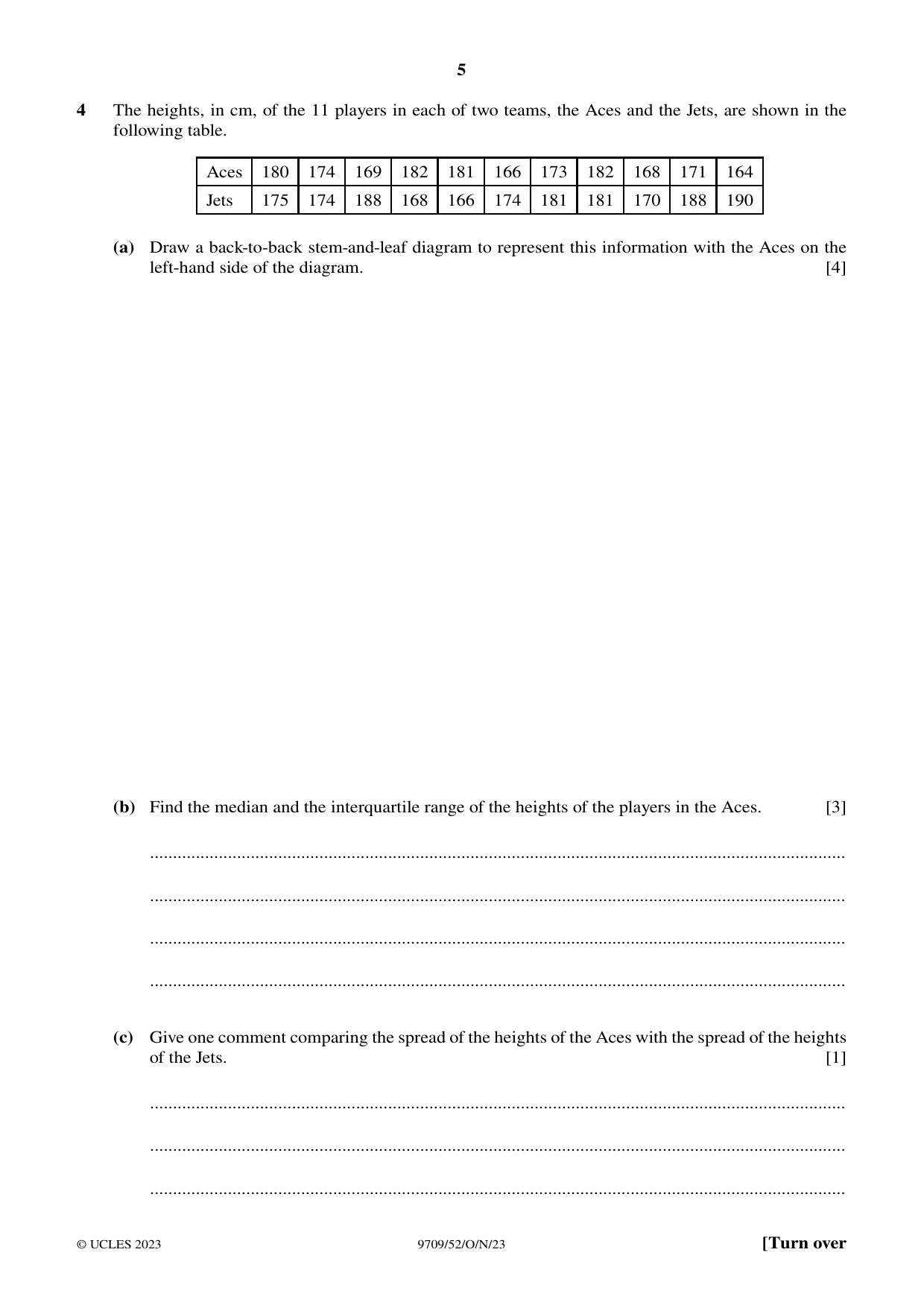
4 The heights, in cm, of the 11 players in each of two teams, the Aces and the Jets, are shown in the following table. Aces 180 174 169 182 181 166 173 182 168 171 164 Jets 175 174 188 168 166 174 181 181 170 188 190 (a) Draw a back-to-back stem-and-leaf diagram to represent this information with the Aces on the left-hand side of the diagram. [4] (b) Find the median and the interquartile range of the heights of the players in the Aces. [3] ........................................................................................................................................................ ........................................................................................................................................................ ........................................................................................................................................................ ........................................................................................................................................................ (c) Give one comment comparing the spread of the heights of the Aces with the spread of the heights of the Jets. [1] ........................................................................................................................................................ ........................................................................................................................................................ ........................................................................................................................................................
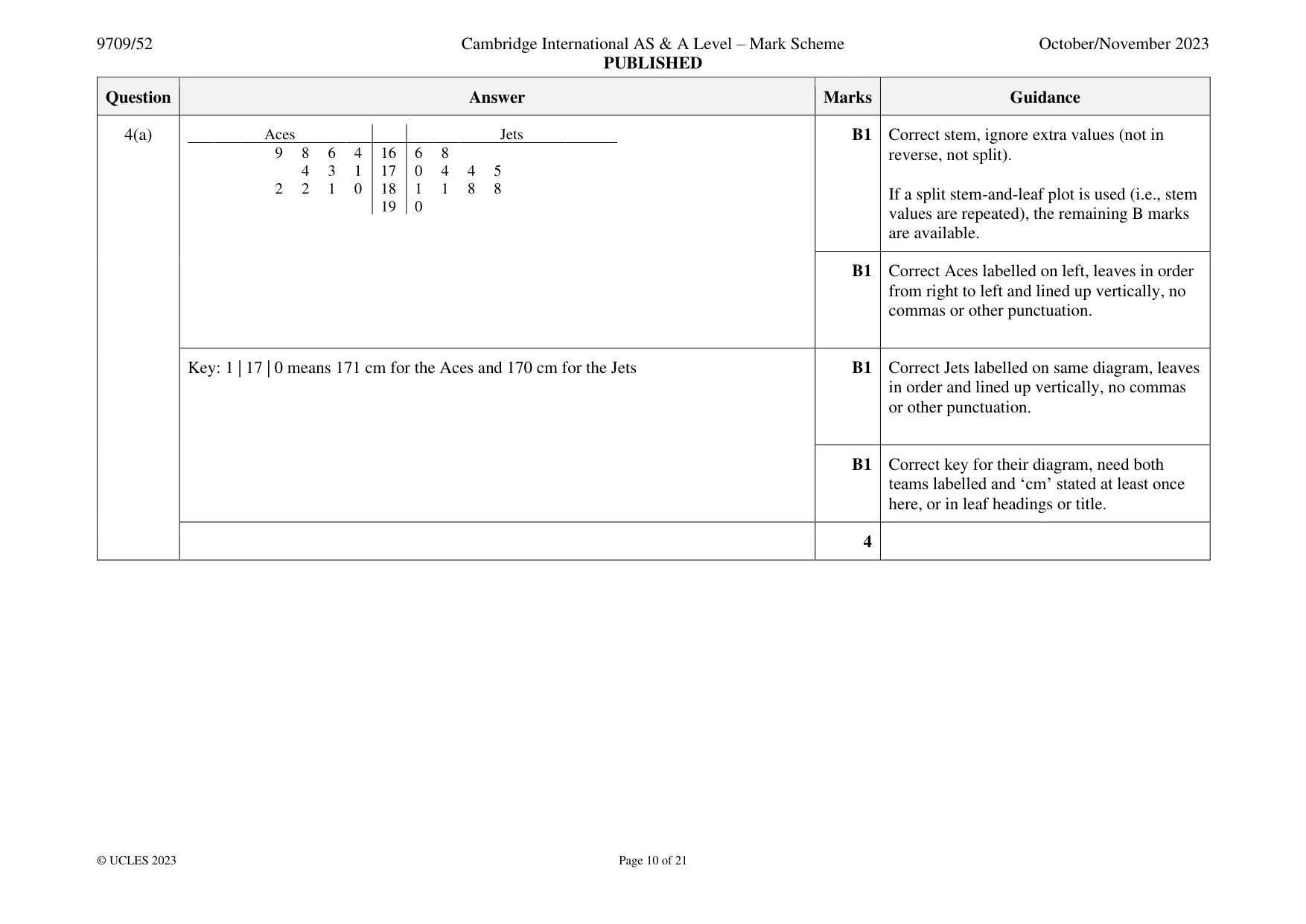
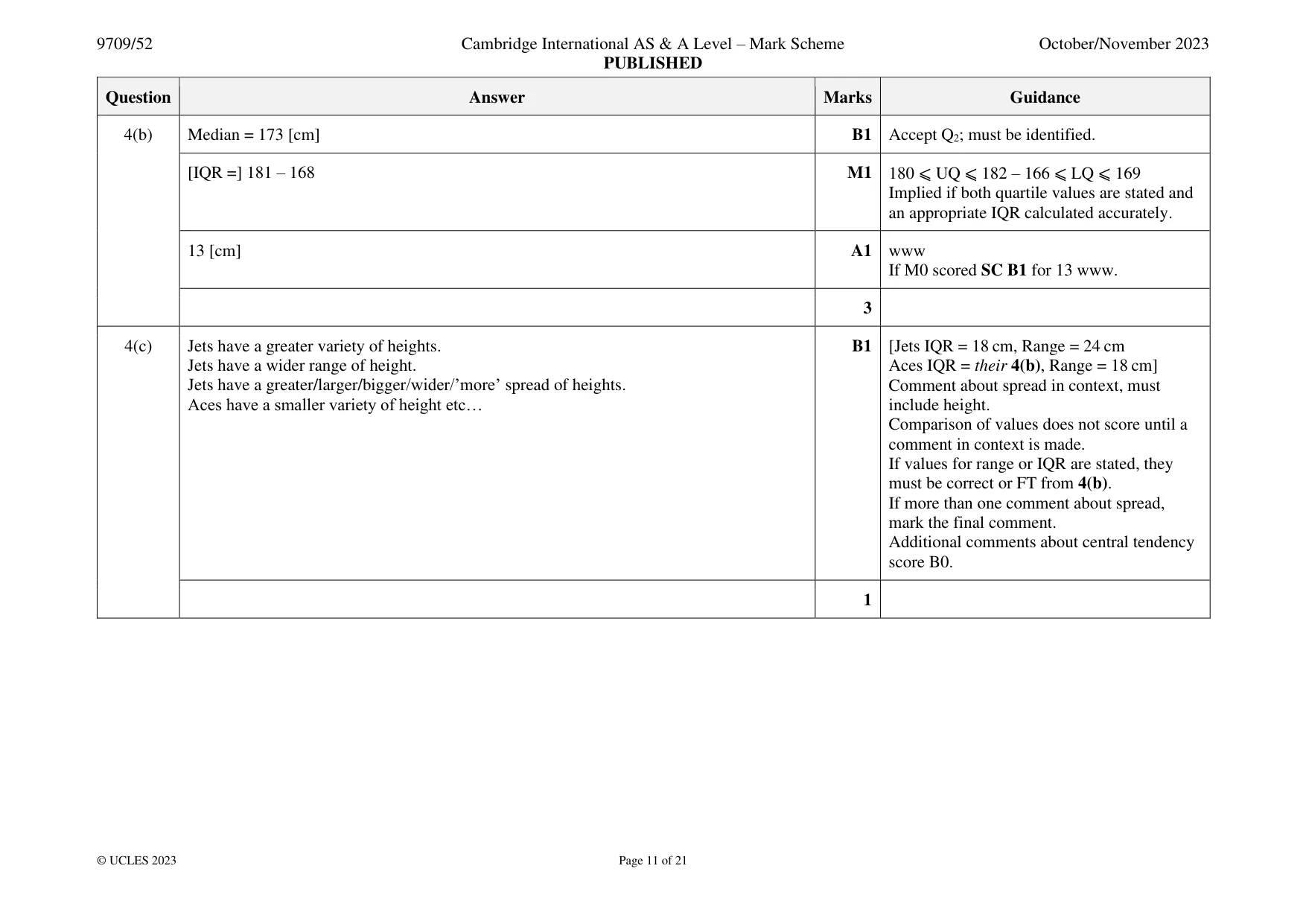
Mark scheme: 4(a) Aces Jets B1 Correct stem, ignore extra values (not in 9 8 6 4 16 6 8 reverse, not split). 4 3 1 17 0 4 4 5 2 2 1 0 18 1 1 8 8 If a split stem-and-leaf plot is used (i.e., stem 19 0 values are repeated), the remaining B marks are available. B1 Correct Aces labelled on left, leaves in order from right to left and lined up vertically, no commas or other punctuation. Key: 1 | 17 | 0 means 171 cm for the Aces and 170 cm for the Jets B1 Correct Jets labelled on same diagram, leaves in order and lined up vertically, no commas or other punctuation. B1 Correct key for their diagram, need both teams labelled and ‘cm’ stated at least once here, or in leaf headings or title. 4 4(b) Median = 173 [cm] B1 Accept Q2; must be identified. [IQR =] 181 – 168 M1 180 ⩽ UQ ⩽ 182 – 166 ⩽ LQ ⩽ 169 Implied if both quartile values are stated and an appropriate IQR calculated accurately. 13 [cm] A1 www If M0 scored SC B1 for 13 www. 3 4(c) Jets have a greater variety of heights. B1 [Jets IQR = 18 cm, Range = 24 cm Jets have a wider range of height. Aces IQR = their 4(b), Range = 18 cm] Jets have a greater/larger/bigger/wider/’more’ spread of heights. Comment about spread in context, must Aces have a smaller variety of height etc… include height. Comparison of values does not score until a comment in context is made. If values for range or IQR are stated, they must be correct or FT from 4(b). If more than one comment about spread, mark the final comment. Additional comments about central tendency score B0. 1
Q5 · The heights of the members of a club are normally distributed with mean 166cm and…
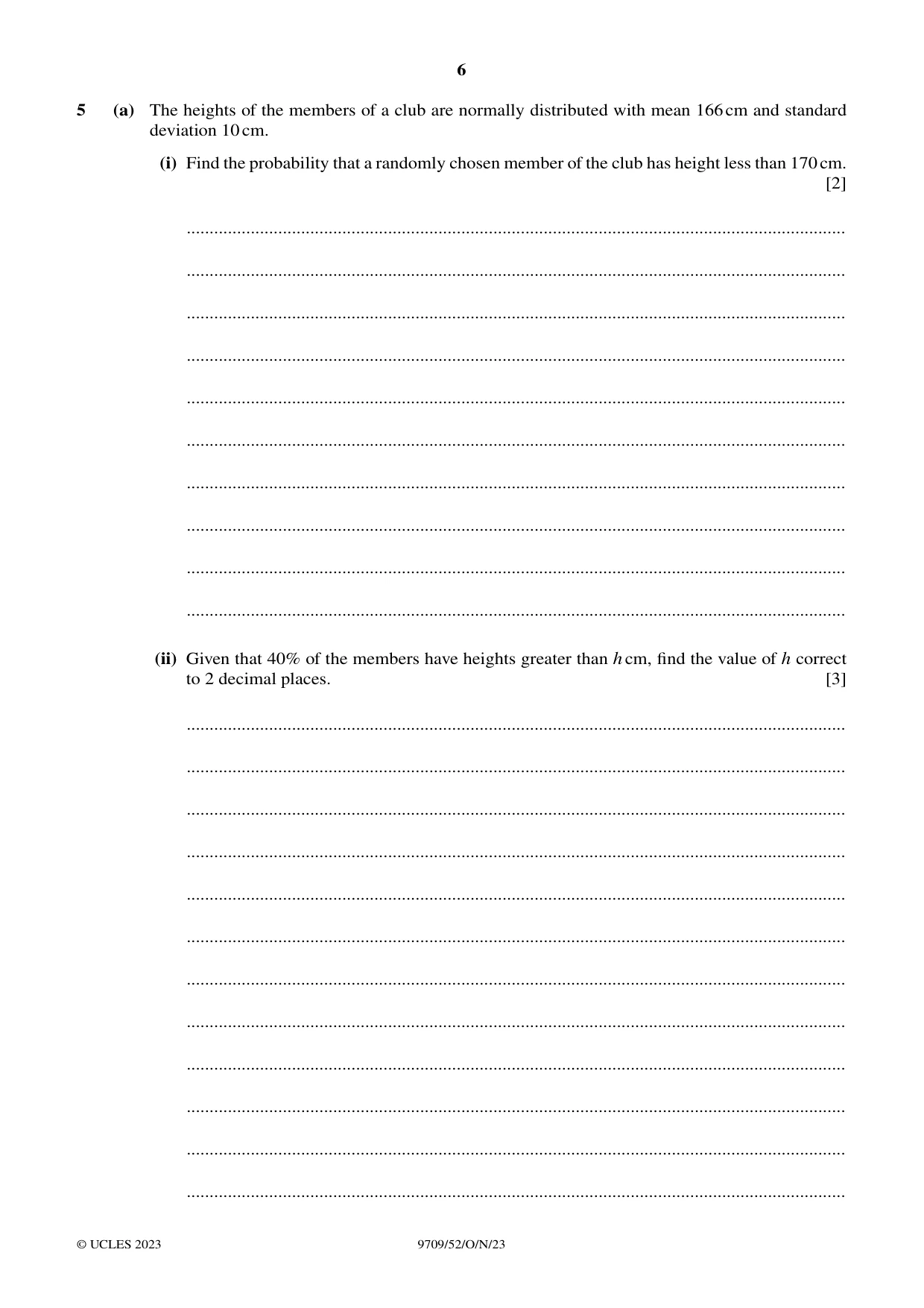
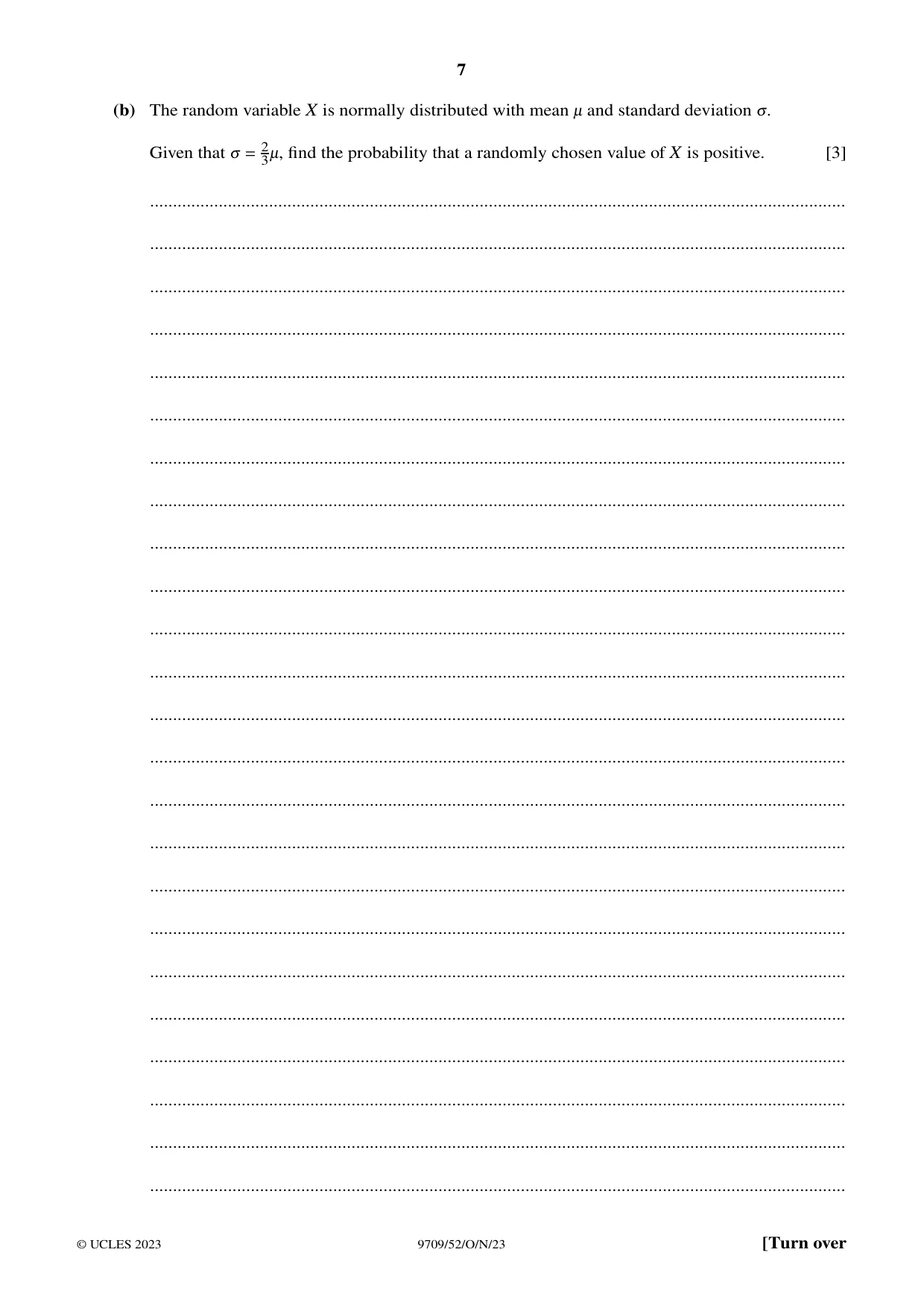
5 (a) The heights of the members of a club are normally distributed with mean 166cm and standard deviation 10cm. (i) Find the probability that a randomly chosen member of the club has height less than 170cm. [2] ................................................................................................................................................ ................................................................................................................................................ ................................................................................................................................................ ................................................................................................................................................ ................................................................................................................................................ ................................................................................................................................................ ................................................................................................................................................ ................................................................................................................................................ ................................................................................................................................................ ................................................................................................................................................ (ii) Given that 40% of the members have heights greater than hcm, find the value of h correct to 2 decimal places. [3] ................................................................................................................................................ ................................................................................................................................................ ................................................................................................................................................ ................................................................................................................................................ ................................................................................................................................................ ................................................................................................................................................ ................................................................................................................................................ ................................................................................................................................................ ................................................................................................................................................ ................................................................................................................................................ ................................................................................................................................................ ................................................................................................................................................ (b) The random variable X is normally distributed with mean - and standard deviation 3. Given that 3 = 23-, find the probability that a randomly chosen value of X is positive. [3] ........................................................................................................................................................ ........................................................................................................................................................ ........................................................................................................................................................ ........................................................................................................................................................ ........................................................................................................................................................ ........................................................................................................................................................ ........................................................................................................................................................ ........................................................................................................................................................ ........................................................................................................................................................ ........................................................................................................................................................ ........................................................................................................................................................ ........................................................................................................................................................ ........................................................................................................................................................ ........................................................................................................................................................ ........................................................................................................................................................ ........................................................................................................................................................ ........................................................................................................................................................ ........................................................................................................................................................ ........................................................................................................................................................ ........................................................................................................................................................ ........................................................................................................................................................ ........................................................................................................................................................ ........................................................................................................................................................ ........................................................................................................................................................
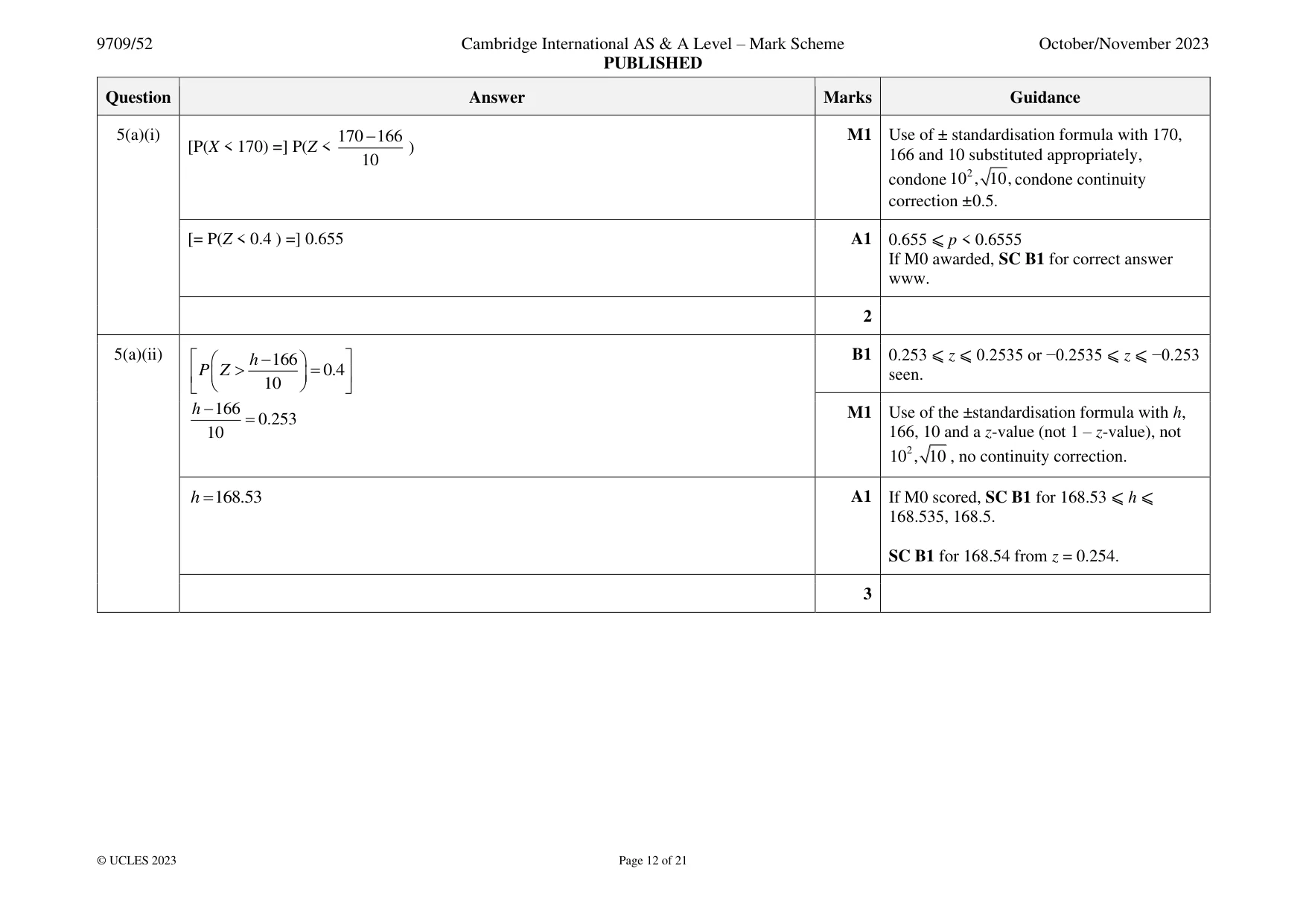
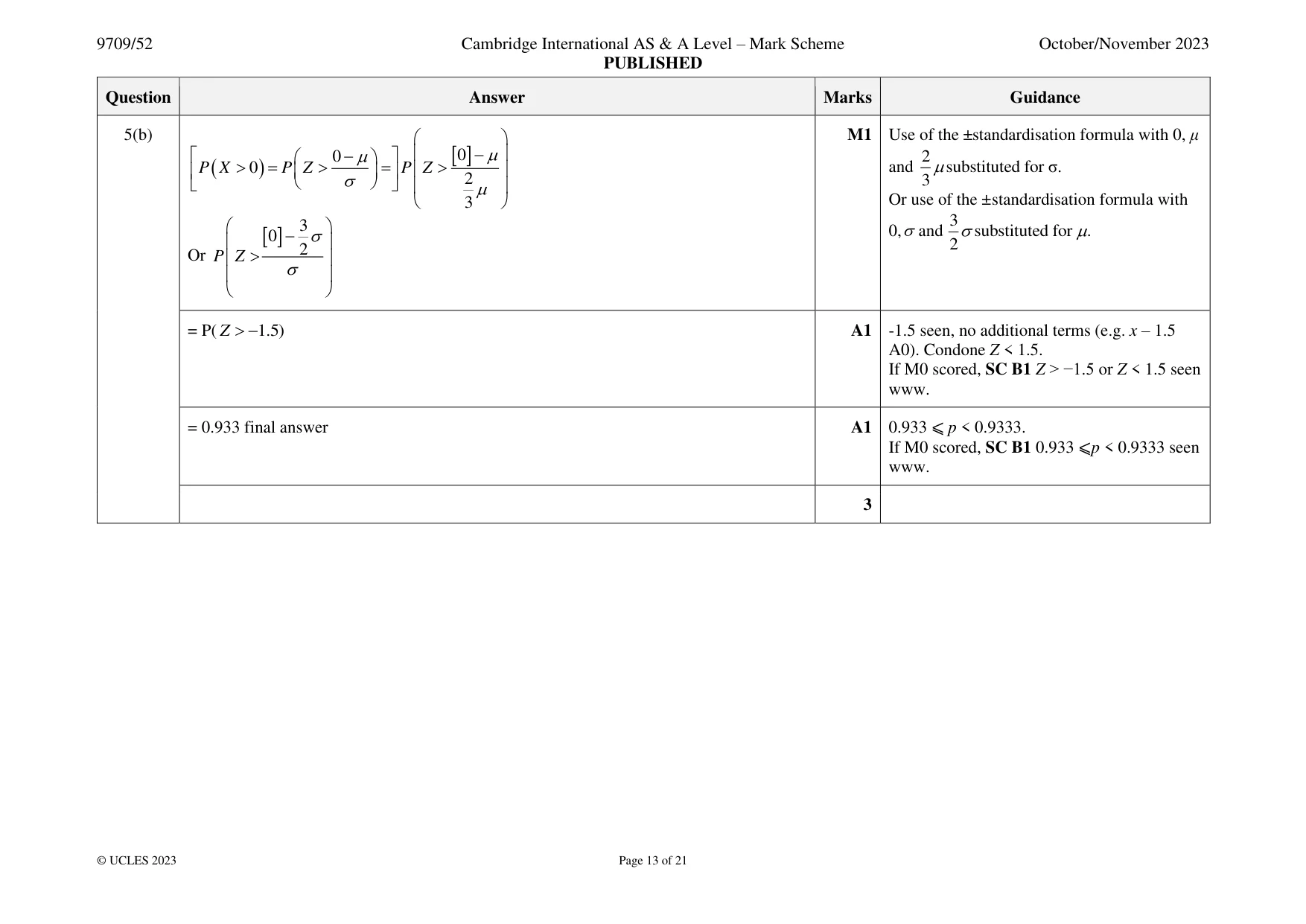
Mark scheme: 5(a)(i) 170 − 166 M1 Use of ± standardisation formula with 170, [P(X < 170) =] P(Z < ) 166 and 10 substituted appropriately, 10 condone 10 2 , 10, condone continuity correction ± 0.5. [= P(Z < 0.4 ) =] 0.655 A1 0.655 ⩽ p < 0.6555 If M0 awarded, SC B1 for correct answer www. 2 5(a)(ii) h − 166 B1 0.253 ⩽ z ⩽ 0.2535 or −0.2535 ⩽ z ⩽ −0.253 P Z = 0.4 seen. 10 h − 166 M1 Use of the ±standardisation formula with h, = 0.253 10 166, 10 and a z-value (not 1 – z-value), not 10 2 , 10 , no continuity correction. h = 168.53 A1 If M0 scored, SC B1 for 168.53 ⩽ h ⩽ 168.535, 168.5. SC B1 for 168.54 from z = 0.254. 3 5(b) M1 Use of the ±standardisation formula with 0, μ 0 − 0 − 2 Z = X 0 ) = P P ( P Z and substituted for σ. 2 3 3 Or use of the ± standardisation formula with 3 0,and 3 substituted for . 0 − 2 2 Or P Z = P( Z −1.5) A1 -1.5 seen, no additional terms (e.g. x – 1.5 A0). Condone Z < 1.5. If M0 scored, SC B1 Z > −1.5 or Z < 1.5 seen www. = 0.933 final answer A1 0.933 ⩽ p < 0.9333. If M0 scored, SC B1 0.933 ⩽p < 0.9333 seen www. 3
Q6 · Freddie has two bags of marbles
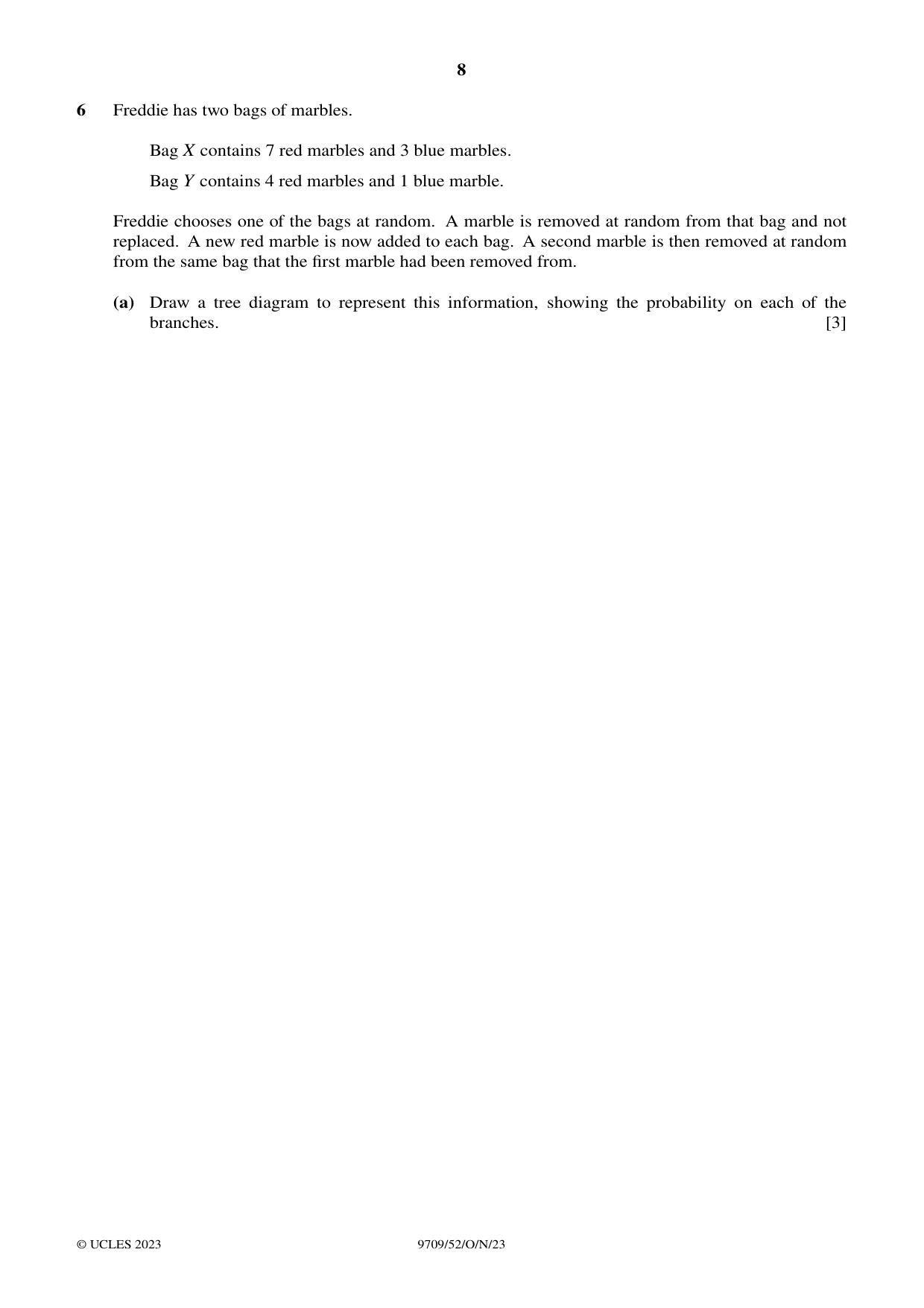
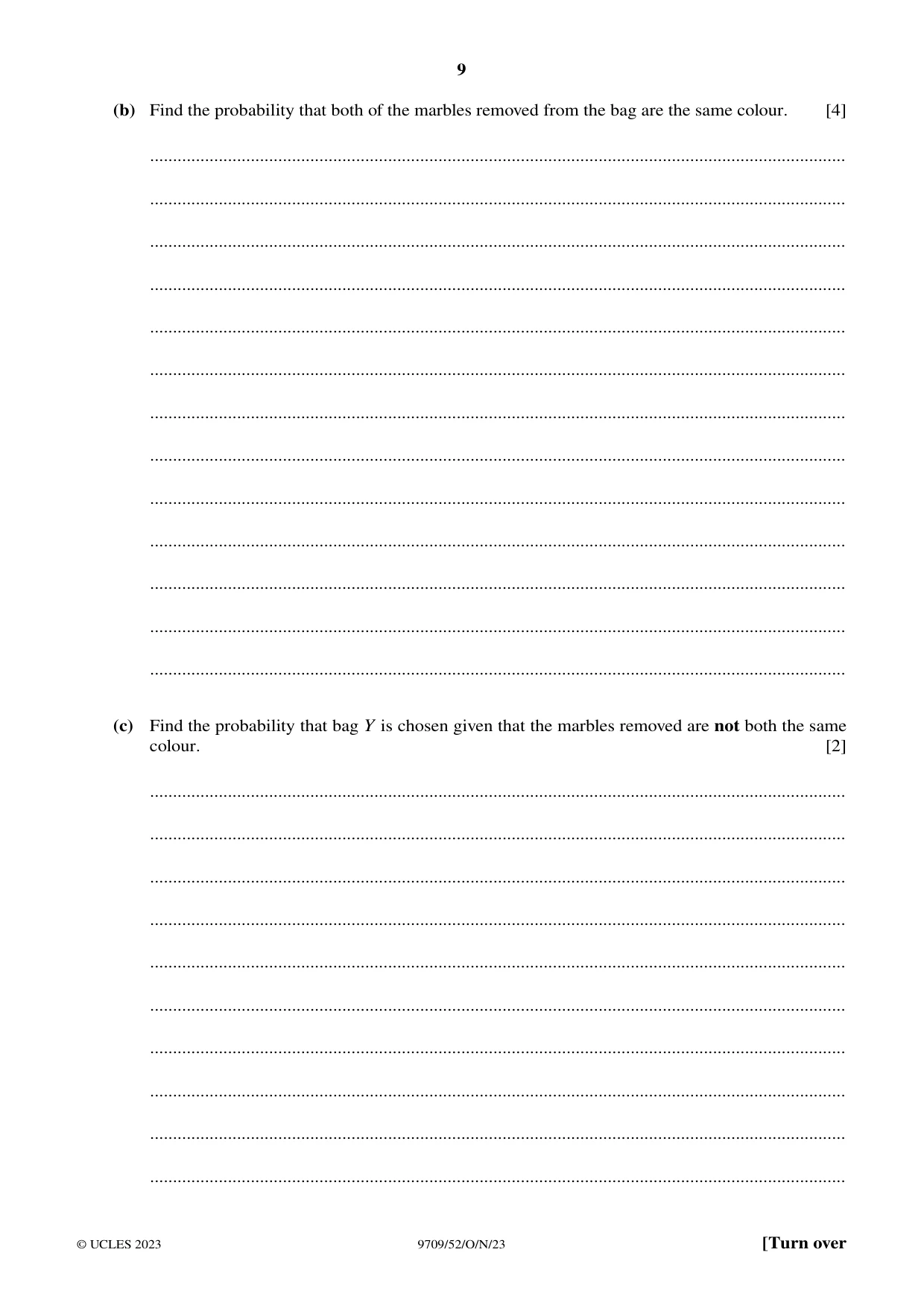
6 Freddie has two bags of marbles. Bag X contains 7 red marbles and 3 blue marbles. Bag Y contains 4 red marbles and 1 blue marble. Freddie chooses one of the bags at random. A marble is removed at random from that bag and not replaced. A new red marble is now added to each bag. A second marble is then removed at random from the same bag that the first marble had been removed from. (a) Draw a tree diagram to represent this information, showing the probability on each of the branches. [3] (b) Find the probability that both of the marbles removed from the bag are the same colour. [4] ........................................................................................................................................................ ........................................................................................................................................................ ........................................................................................................................................................ ........................................................................................................................................................ ........................................................................................................................................................ ........................................................................................................................................................ ........................................................................................................................................................ ........................................................................................................................................................ ........................................................................................................................................................ ........................................................................................................................................................ ........................................................................................................................................................ ........................................................................................................................................................ ........................................................................................................................................................ (c) Find the probability that bag Y is chosen given that the marbles removed are not both the same colour. [2] ........................................................................................................................................................ ........................................................................................................................................................ ........................................................................................................................................................ ........................................................................................................................................................ ........................................................................................................................................................ ........................................................................................................................................................ ........................................................................................................................................................ ........................................................................................................................................................ ........................................................................................................................................................ ........................................................................................................................................................
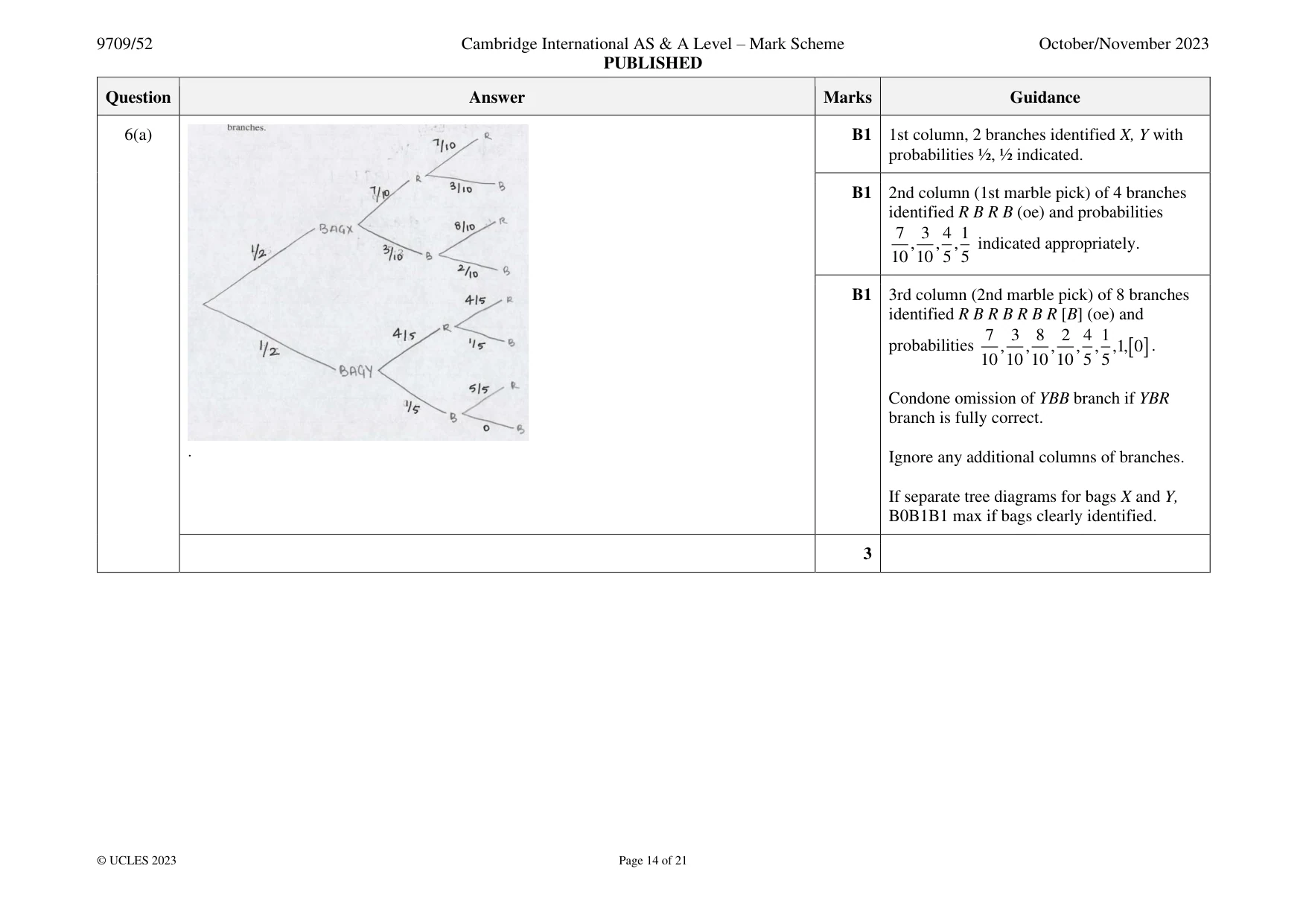
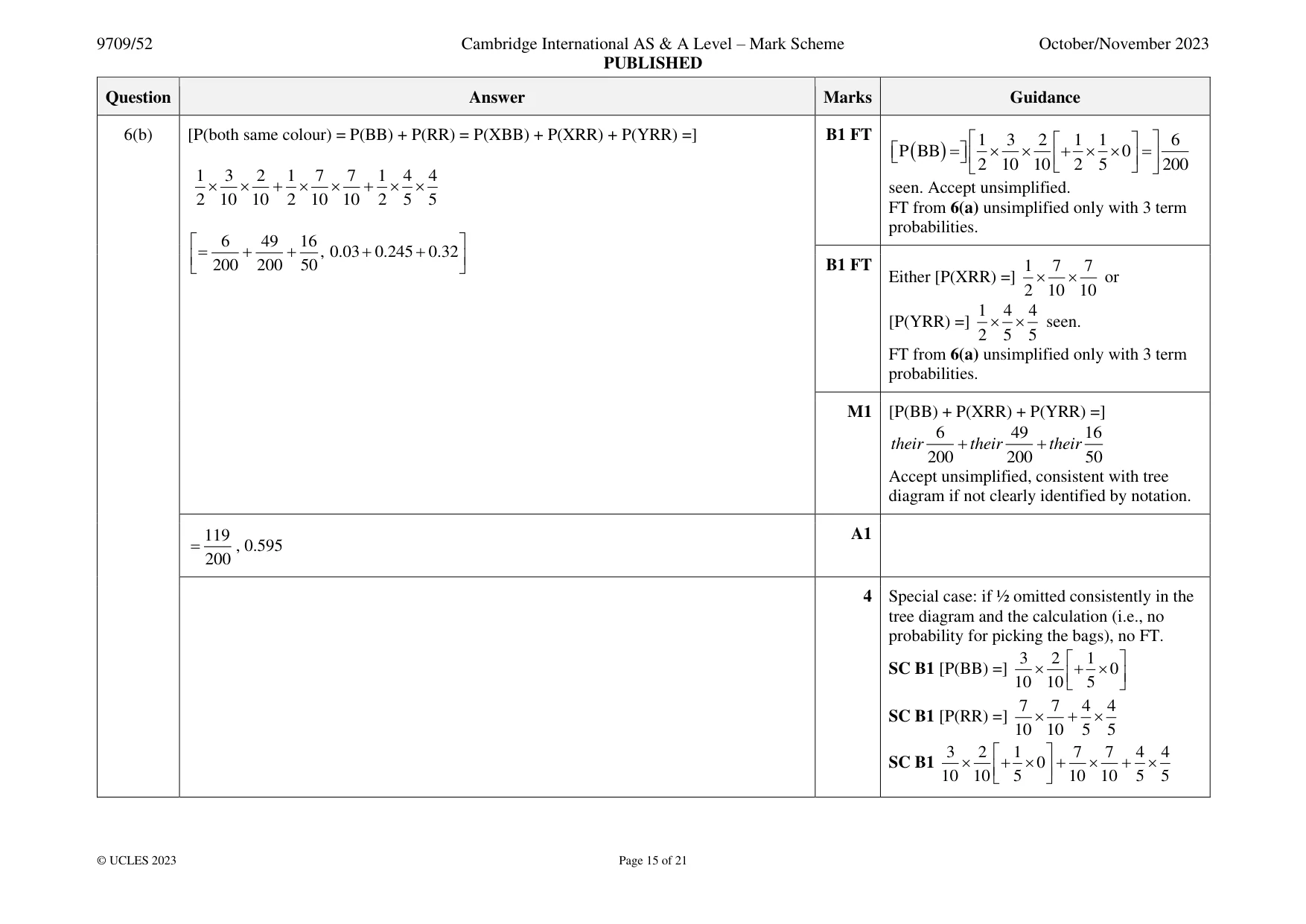
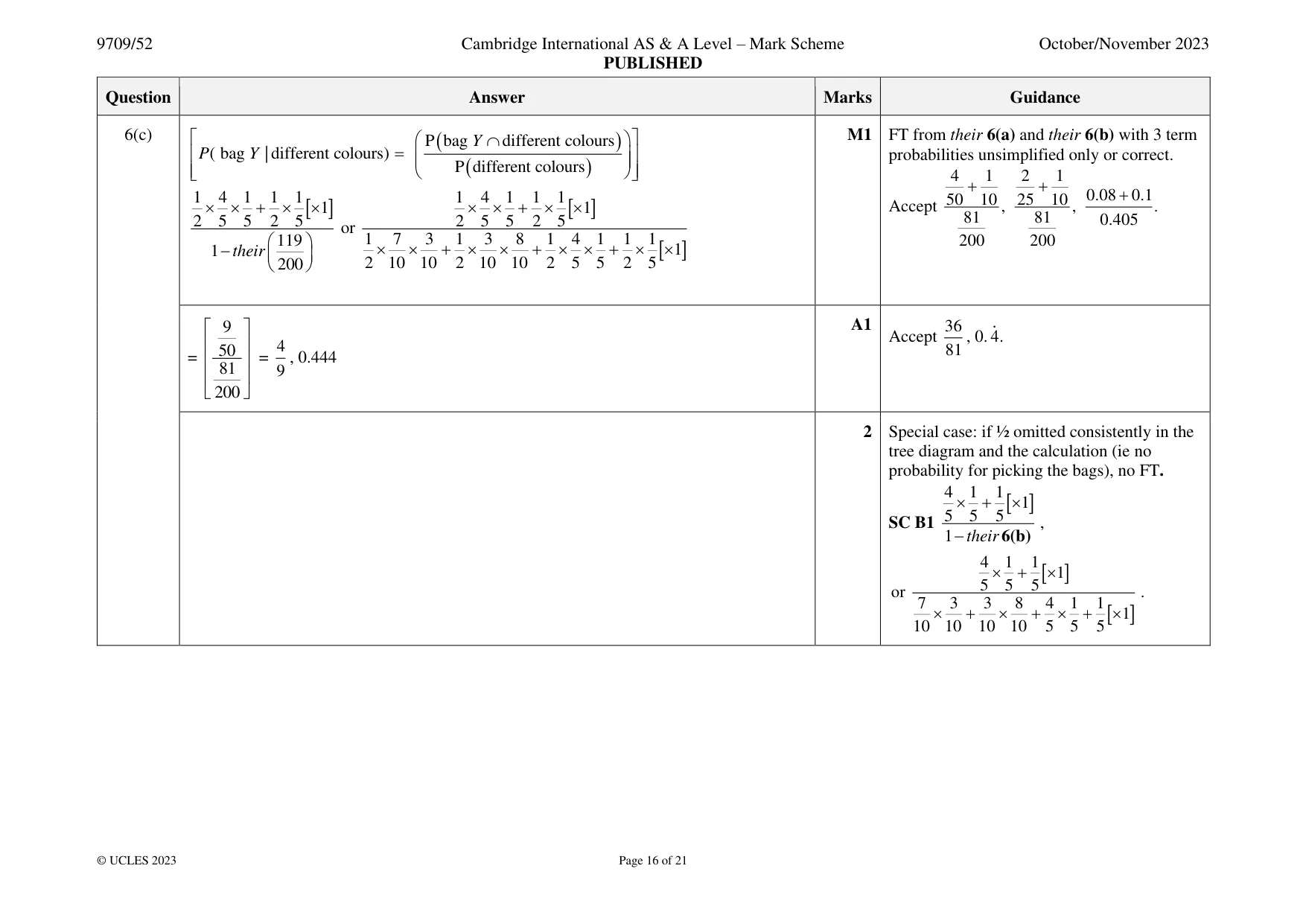
Mark scheme: 6(a) B1 1st column, 2 branches identified X, Y with probabilities ½, ½ indicated. B1 2nd column (1st marble pick) of 4 branches identified R B R B (oe) and probabilities 7 3 4 1 , , , indicated appropriately. 10 10 5 5 B1 3rd column (2nd marble pick) of 8 branches identified R B R B R B R [B] (oe) and 7 3 8 2 4 1 probabilities , , , , , ,1, 0 . 10 10 10 10 5 5 Condone omission of YBB branch if YBR branch is fully correct. . Ignore any additional columns of branches. If separate tree diagrams for bags X and Y, B0B1B1 max if bags clearly identified. 3 6(b) [P(both same colour) = P(BB) + P(RR) = P(XBB) + P(XRR) + P(YRR) =] B1 FT 1 3 2 1 1 6 0 = P ( BB ) = + 2 10 10 2 5 200 1 3 2 1 7 7 1 4 4 + + seen. Accept unsimplified. 2 10 10 2 10 10 2 5 5 FT from 6(a) unsimplified only with 3 term probabilities. 6 49 16 = + + , 0.03 + 0.245 + 0.32 200 200 50 B1 FT 1 7 7 Either [P(XRR) =] or 2 10 10 1 4 4 [P(YRR) =] seen. 2 5 5 FT from 6(a) unsimplified only with 3 term probabilities. M1 [P(BB) + P(XRR) + P(YRR) =] 6 49 16 their + their + their 200 200 50 Accept unsimplified, consistent with tree diagram if not clearly identified by notation. 119 A1 = , 0.595 200 4 Special case: if ½ omitted consistently in the tree diagram and the calculation (i.e., no probability for picking the bags), no FT. 3 2 1 SC B1 [P(BB) =] + 0 10 10 5 7 7 4 4 SC B1 [P(RR) =] + 10 10 5 5 3 2 1 7 7 4 4 SC B1 + 0 + + 10 10 5 10 10 5 5 6(c) P ( bag Y different colours ) M1 FT from their 6(a) and their 6(b) with 3 term P ( bag Y | different colours) = probabilities unsimplified only or correct. P ( different colours ) 4 1 2 1 + + 1 4 1 1 1 1 4 1 1 1 50 10 25 10 0.08 + 0.1 , , . + 1 + 1 Accept 2 5 5 2 5 2 5 5 2 5 81 81 0.405 or 119 1 7 3 1 3 8 1 4 1 1 1 200 200 1 1 − their + + + 200 2 10 10 2 10 10 2 5 5 2 5 9 A1 36 Accept , 0. 4. 4 81 50 = = , 0.444 81 9 200 2 Special case: if ½ omitted consistently in the tree diagram and the calculation (ie no probability for picking the bags), no FT. 4 1 1 + 1 5 5 5 SC B1 , 1 − their 6(b) 4 1 1 + 1 5 5 5 or . 7 3 3 8 4 1 1 + + + 1 10 10 10 10 5 5 5
Q7 · Find the number of different arrangements of the 9 letters in the word ANDROMEDA in which…
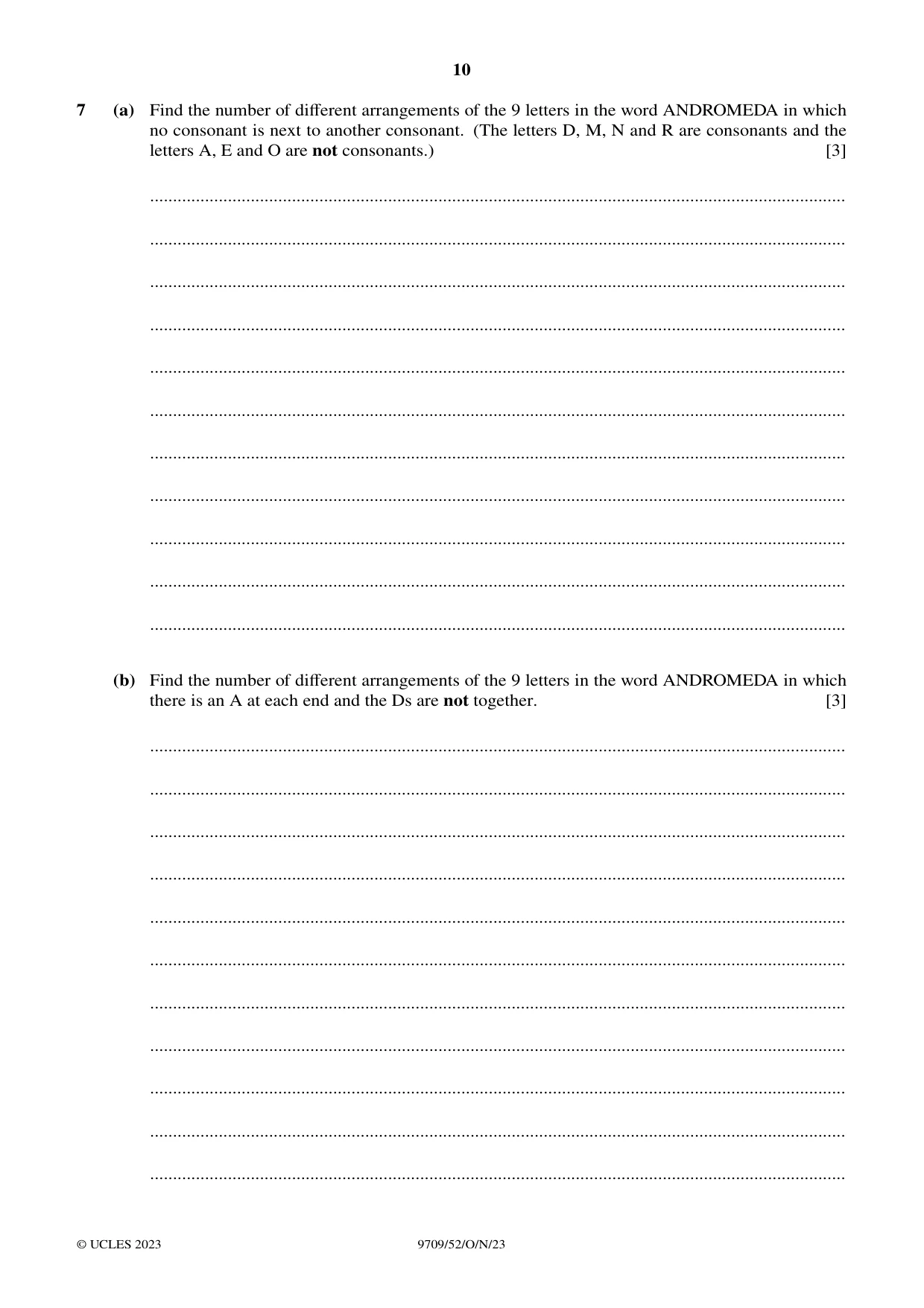
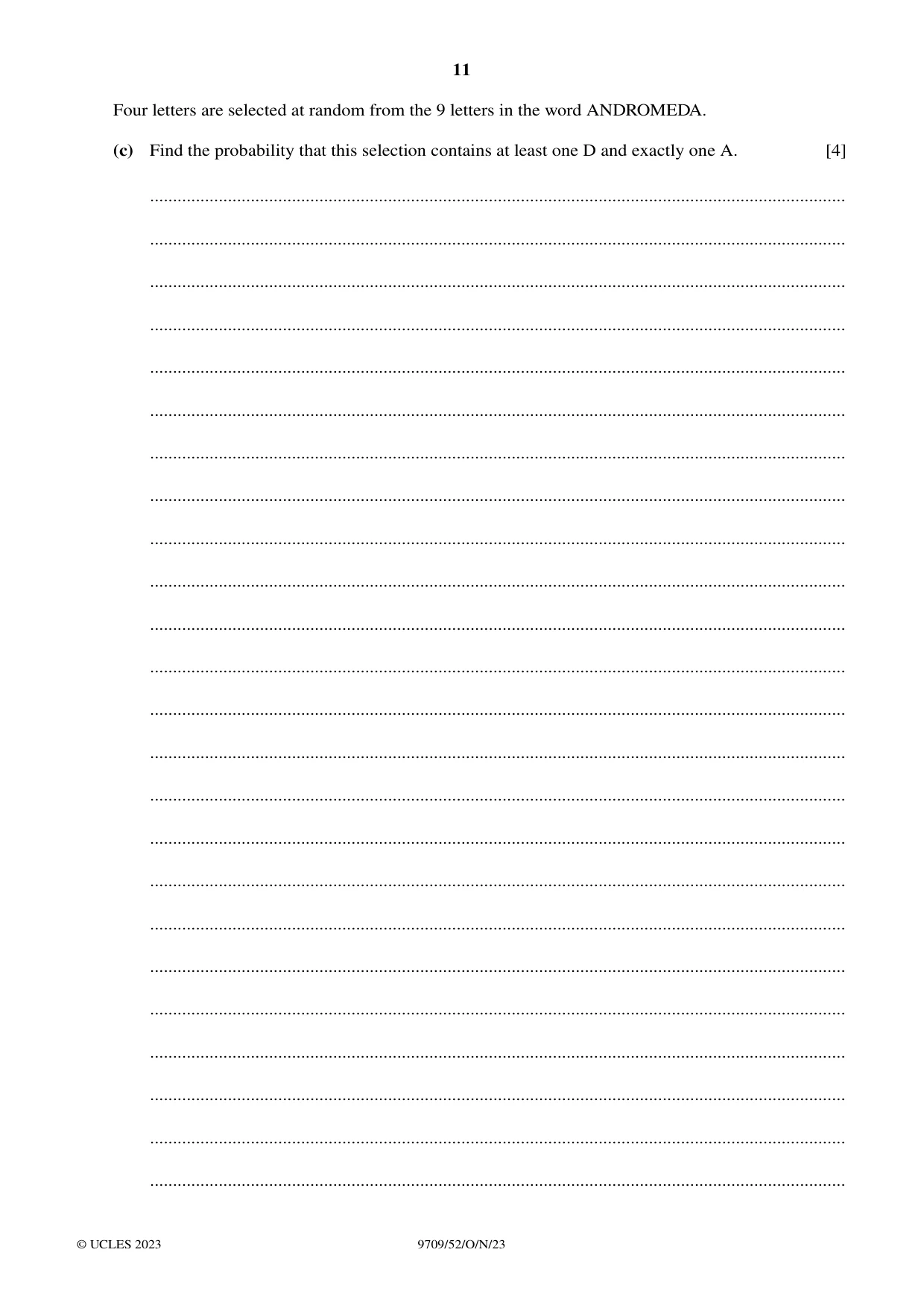
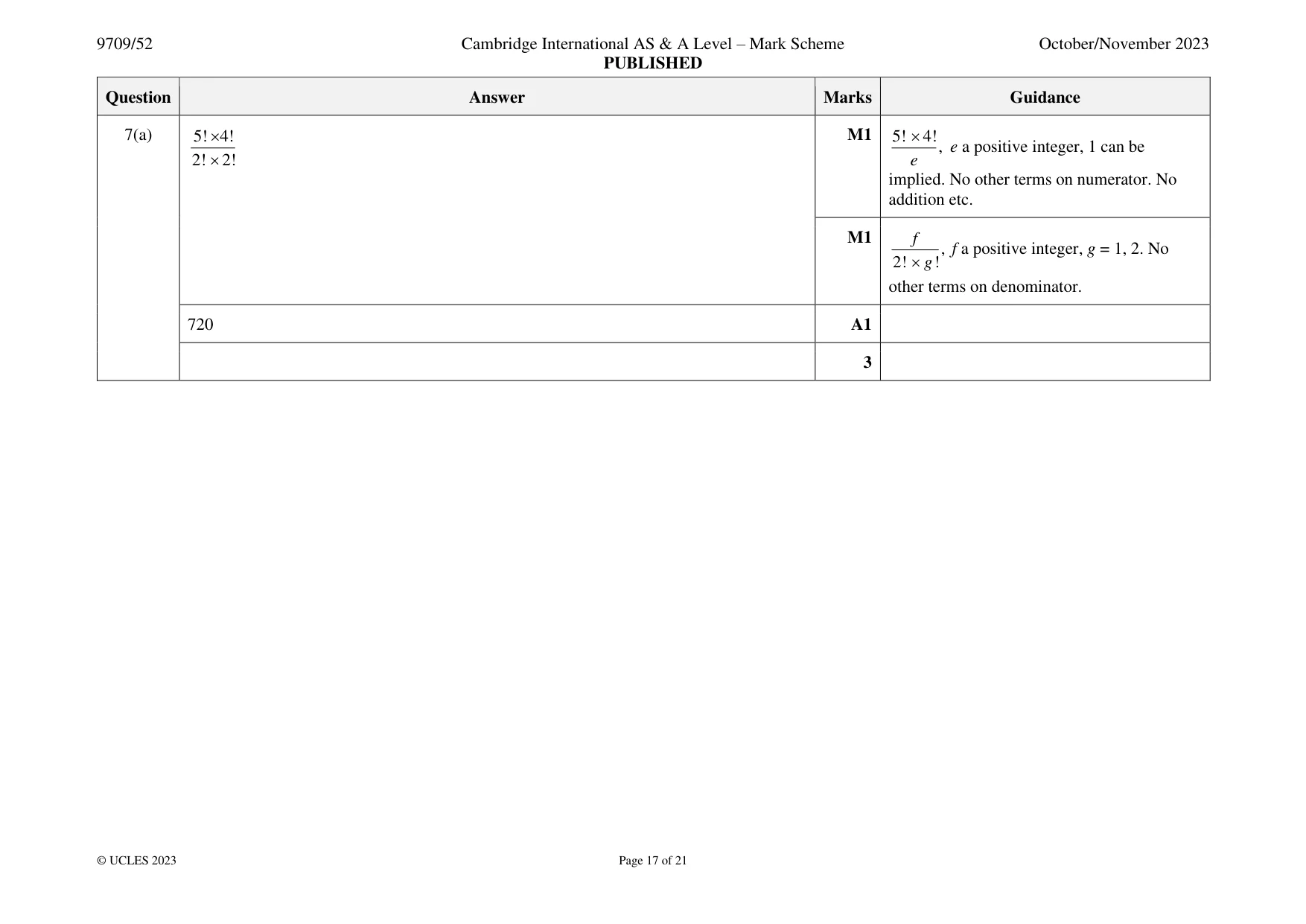
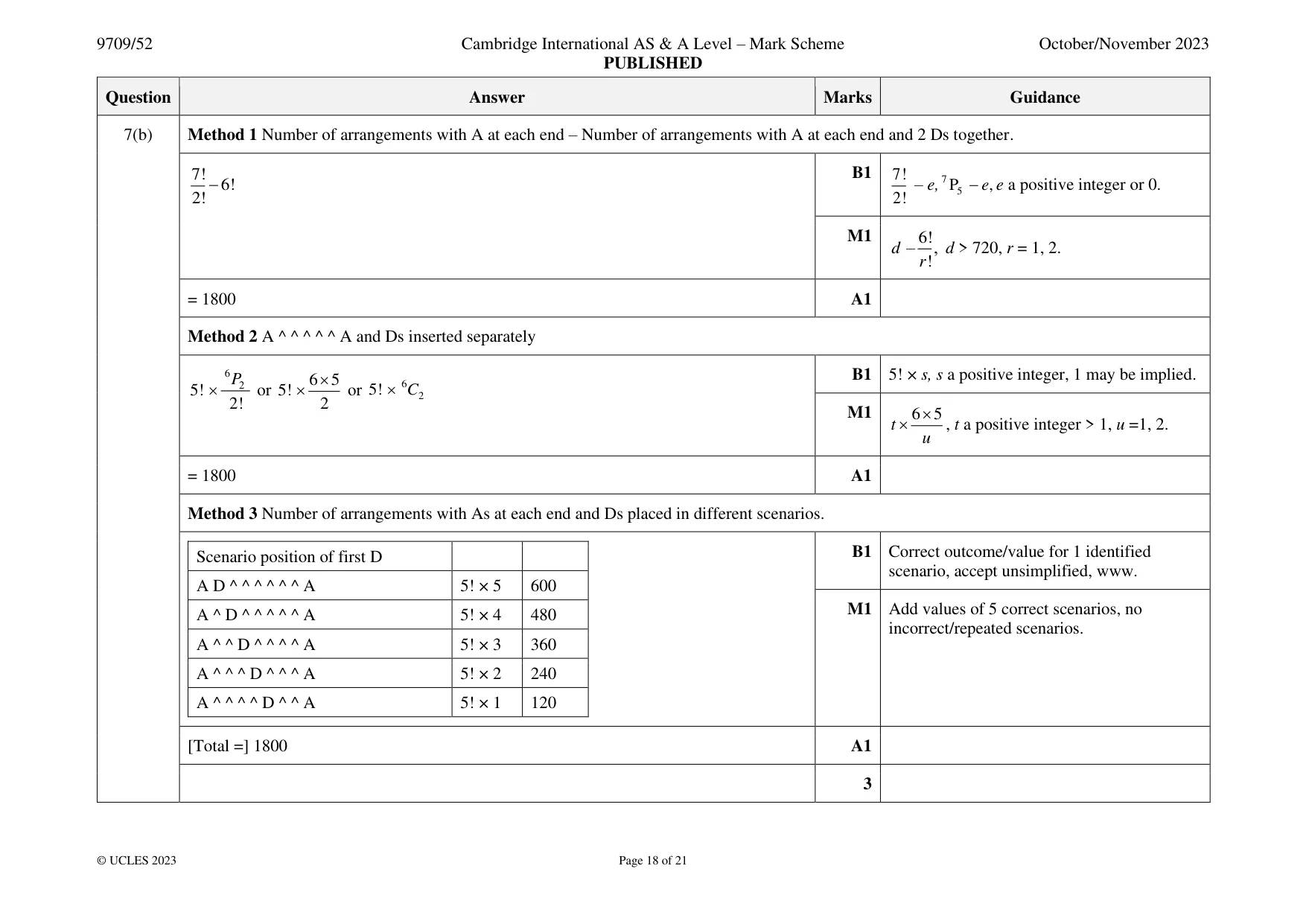
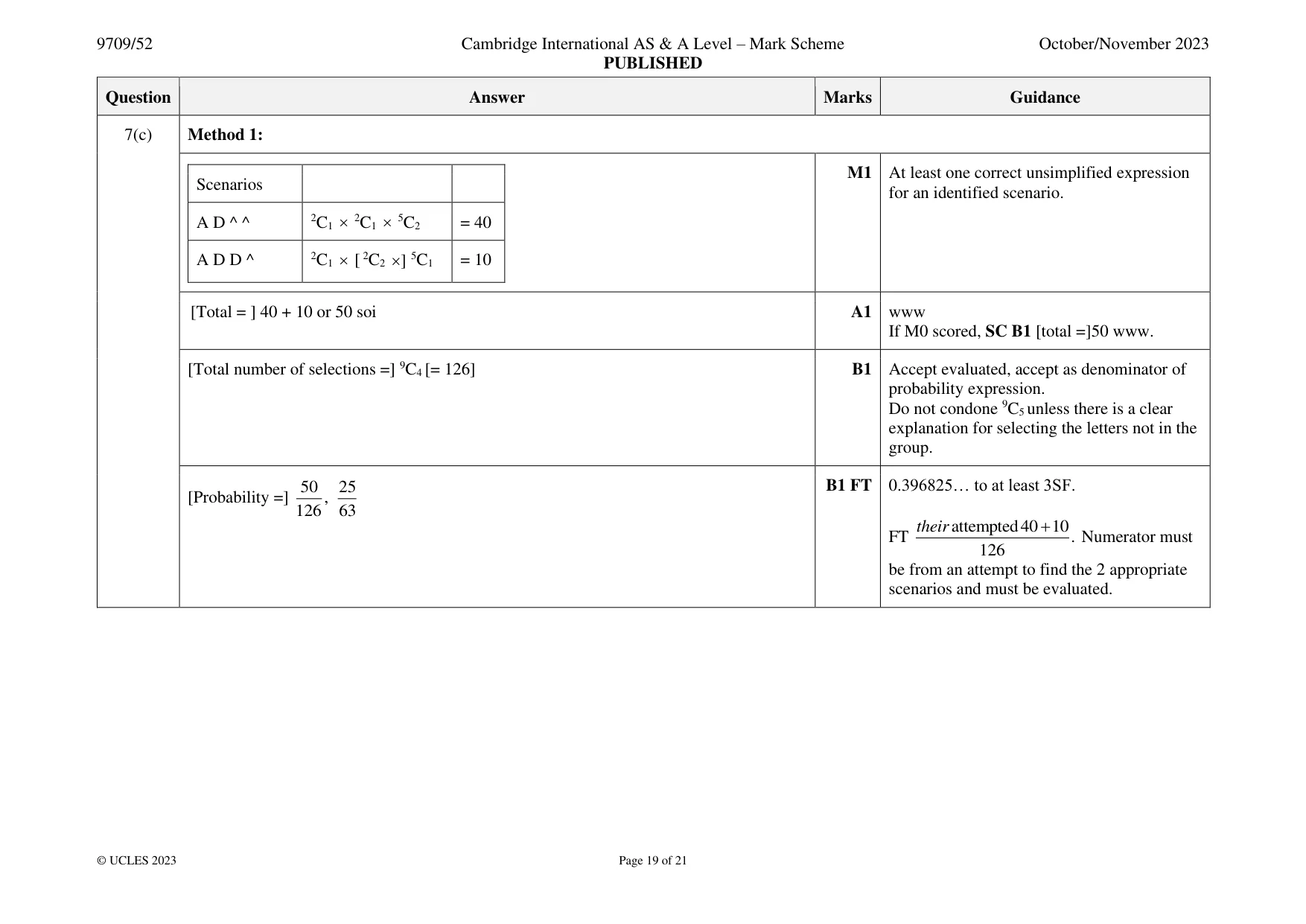
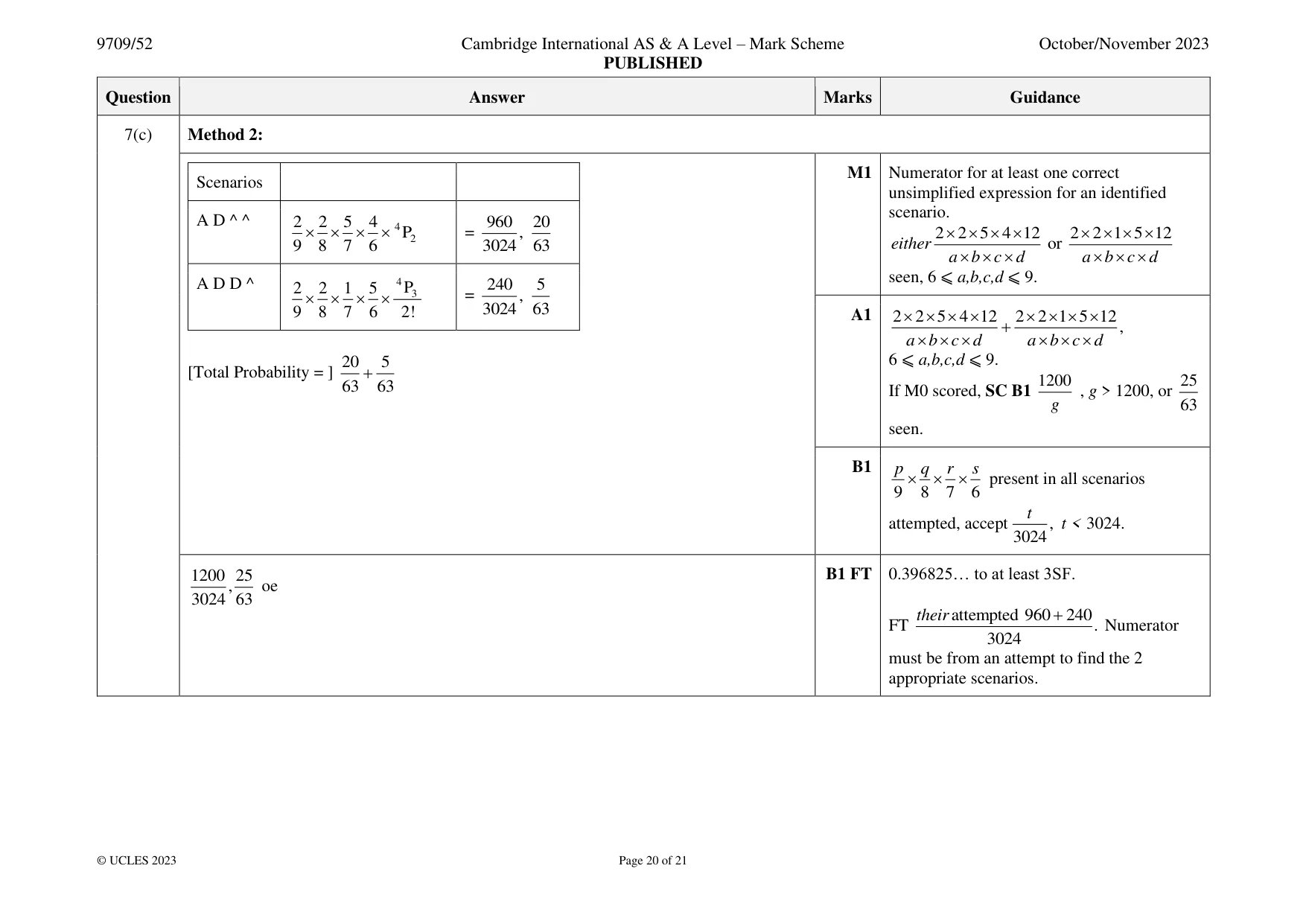
7 (a) Find the number of different arrangements of the 9 letters in the word ANDROMEDA in which no consonant is next to another consonant. (The letters D, M, N and R are consonants and the letters A, E and O are not consonants.) [3] ........................................................................................................................................................ ........................................................................................................................................................ ........................................................................................................................................................ ........................................................................................................................................................ ........................................................................................................................................................ ........................................................................................................................................................ ........................................................................................................................................................ ........................................................................................................................................................ ........................................................................................................................................................ ........................................................................................................................................................ ........................................................................................................................................................ (b) Find the number of different arrangements of the 9 letters in the word ANDROMEDA in which there is an A at each end and the Ds are not together. [3] ........................................................................................................................................................ ........................................................................................................................................................ ........................................................................................................................................................ ........................................................................................................................................................ ........................................................................................................................................................ ........................................................................................................................................................ ........................................................................................................................................................ ........................................................................................................................................................ ........................................................................................................................................................ ........................................................................................................................................................ ........................................................................................................................................................ Four letters are selected at random from the 9 letters in the word ANDROMEDA. (c) Find the probability that this selection contains at least one D and exactly one A. [4] ........................................................................................................................................................ ........................................................................................................................................................ ........................................................................................................................................................ ........................................................................................................................................................ ........................................................................................................................................................ ........................................................................................................................................................ ........................................................................................................................................................ ........................................................................................................................................................ ........................................................................................................................................................ ........................................................................................................................................................ ........................................................................................................................................................ ........................................................................................................................................................ ........................................................................................................................................................ ........................................................................................................................................................ ........................................................................................................................................................ ........................................................................................................................................................ ........................................................................................................................................................ ........................................................................................................................................................ ........................................................................................................................................................ ........................................................................................................................................................ ........................................................................................................................................................ ........................................................................................................................................................ ........................................................................................................................................................ ........................................................................................................................................................
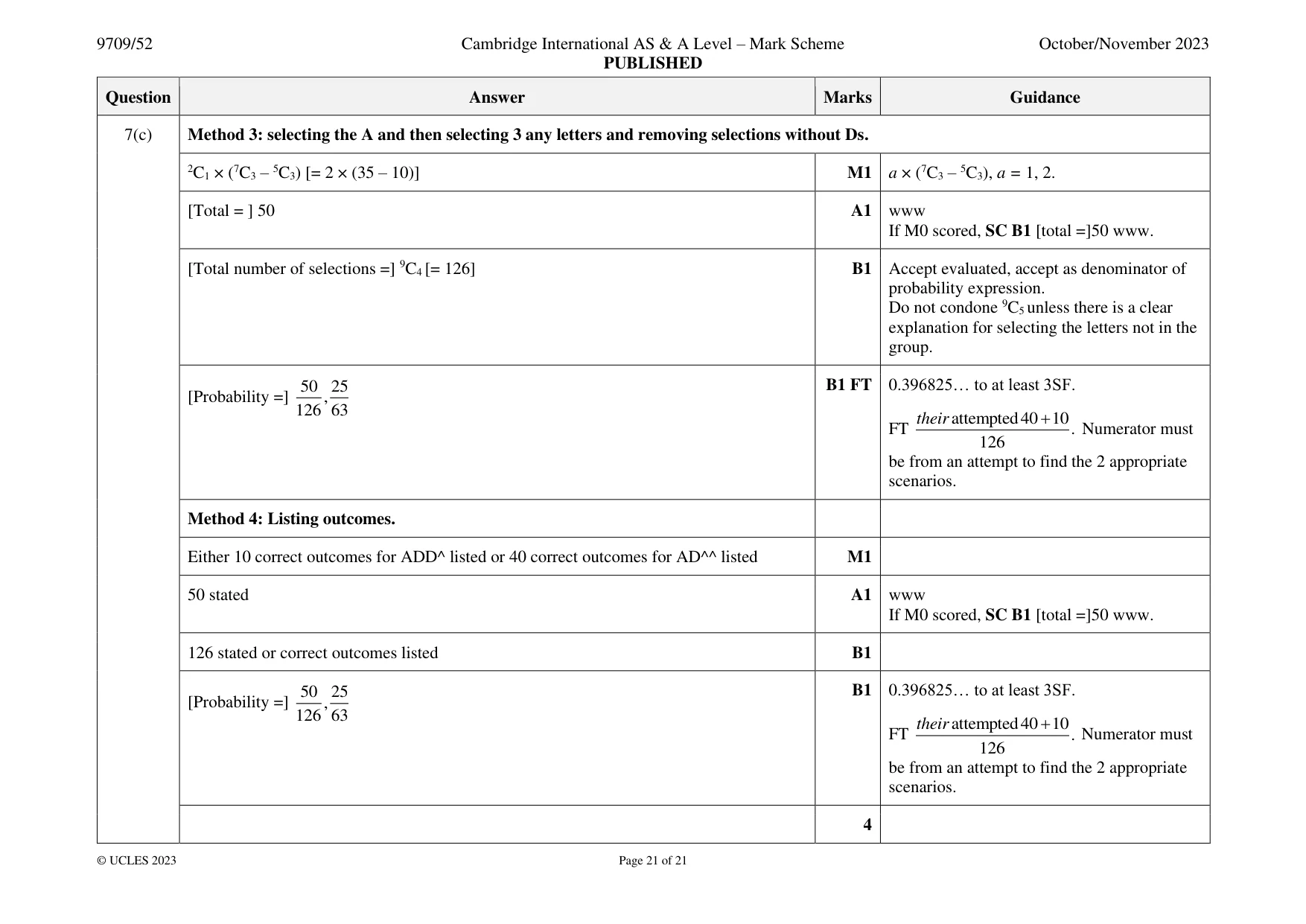
Mark scheme: 7(a) 5! 4! M1 5! 4!, e a positive integer, 1 can be 2! 2! e implied. No other terms on numerator. No addition etc. M1 f , f a positive integer, g = 1, 2. No 2! g ! other terms on denominator. 720 A1 3 7(b) Method 1 Number of arrangements with A at each end – Number of arrangements with A at each end and 2 Ds together. 7! B1 7! 7 2!− 6! 2! – e, 5P − ,e e a positive integer or 0. M1 6! d – d > 720, r = 1, 2. r ,! = 1800 A1 Method 2 A ^ ^ ^ ^ ^ A and Ds inserted separately 6 P2 6 5 6 B1 5! × s, s a positive integer, 1 may be implied. 5! or 5! or 5! C 2 2! 2 M1 6 5 t , t a positive integer > 1, u =1, 2. u = 1800 A1 Method 3 Number of arrangements with As at each end and Ds placed in different scenarios. B1 Correct outcome/value for 1 identified Scenario position of first D scenario, accept unsimplified, www. A D ^ ^ ^ ^ ^ ^ A 5! × 5 600 M1 Add values of 5 correct scenarios, no A ^ D ^ ^ ^ ^ ^ A 5! × 4 480 incorrect/repeated scenarios. A ^ ^ D ^ ^ ^ ^ A 5! × 3 360 A ^ ^ ^ D ^ ^ ^ A 5! × 2 240 A ^ ^ ^ ^ D ^ ^ A 5! × 1 120 [Total =] 1800 A1 3 7(c) Method 1: M1 At least one correct unsimplified expression Scenarios for an identified scenario. A D ^ ^ 2C1 2C1 5C2 = 40 A D D ^ 2C1 [ 2C2 ] 5C1 = 10 [Total = ] 40 + 10 or 50 soi A1 www If M0 scored, SC B1 [total =]50 www. [Total number of selections =] 9C4 [= 126] B1 Accept evaluated, accept as denominator of probability expression. Do not condone 9C5 unless there is a clear explanation for selecting the letters not in the group. 50 25 B1 FT 0.396825… to at least 3SF. [Probability =] , 126 63 their attempted 40 + FT 10. Numerator must 126 be from an attempt to find the 2 appropriate scenarios and must be evaluated. 7(c) Method 2: M1 Numerator for at least one correct Scenarios unsimplified expression for an identified scenario. A D ^ ^ 2 2 5 4 4 960 20 P2 = , 2 2 5 4 12 2 2 1 5 12 9 8 7 6 3024 63 either or a b c d a b c d 4 seen, 6 ⩽ a,b,c,d ⩽ 9. A D D ^ 2 2 1 5 3P = 240 , 5 9 8 7 6 2! 3024 63 A1 2 2 5 4 12 2 2 1 5 + 12, a b c d a b c d 20 5 6 ⩽ a,b,c,d ⩽ 9. [Total Probability = ] + 1200 25 63 63 If M0 scored, SC B1 , g > 1200, or g 63 seen. B1 p q r s present in all scenarios 9 8 7 6 t attempted, accept , t < 3024. 3024 1200 25 B1 FT 0.396825… to at least 3SF. , oe 3024 63 their attempted 960 + FT 240. Numerator 3024 must be from an attempt to find the 2 appropriate scenarios. 7(c) Method 3: selecting the A and then selecting 3 any letters and removing selections without Ds. 2C1 × (7C3 – 5C3) [= 2 × (35 – 10)] M1 a × (7C3 – 5C3), a = 1, 2. [Total = ] 50 A1 www If M0 scored, SC B1 [total =]50 www. [Total number of selections =] 9C4 [= 126] B1 Accept evaluated, accept as denominator of probability expression. Do not condone 9C5 unless there is a clear explanation for selecting the letters not in the group. 50 25 B1 FT 0.396825… to at least 3SF. [Probability =] , 126 63 their attempted 40 + FT 10. Numerator must 126 be from an attempt to find the 2 appropriate scenarios. Method 4: Listing outcomes. Either 10 correct outcomes for ADD^ listed or 40 correct outcomes for AD^^ listed M1 50 stated A1 www If M0 scored, SC B1 [total =]50 www. 126 stated or correct outcomes listed B1 50 25 B1 0.396825… to at least 3SF. [Probability =] , 126 63 their attempted 40 + FT 10. Numerator must 126 be from an attempt to find the 2 appropriate scenarios. 4
What was in this paper
The subtopics covered by these 6 questions, and how many questions each got. Open one in a new tab to see every Cambridge question on it.
What you needed in this session
Cambridge’s own grade thresholds for 2023 Oct/Nov, Paper 5 · Variant 2. A higher threshold means an easier paper — the bar moves with how the cohort did.