Questions as text
Q1 · Y 6 y = 3x – 2 x O 1 2 6 The diagram shows part of the curve y = 3x −2 9709/11 May/June 2009
9 y 6 y = 3x – 2 x O 1 2 6 The diagram shows part of the curve y = 3x −2. (i) Find the gradient of the curve at the point where x = 2. [3] (ii) Find the volume obtained when the shaded region is rotated through 360◦about the x-axis, giving your answer in terms of π. [5]
8 marks
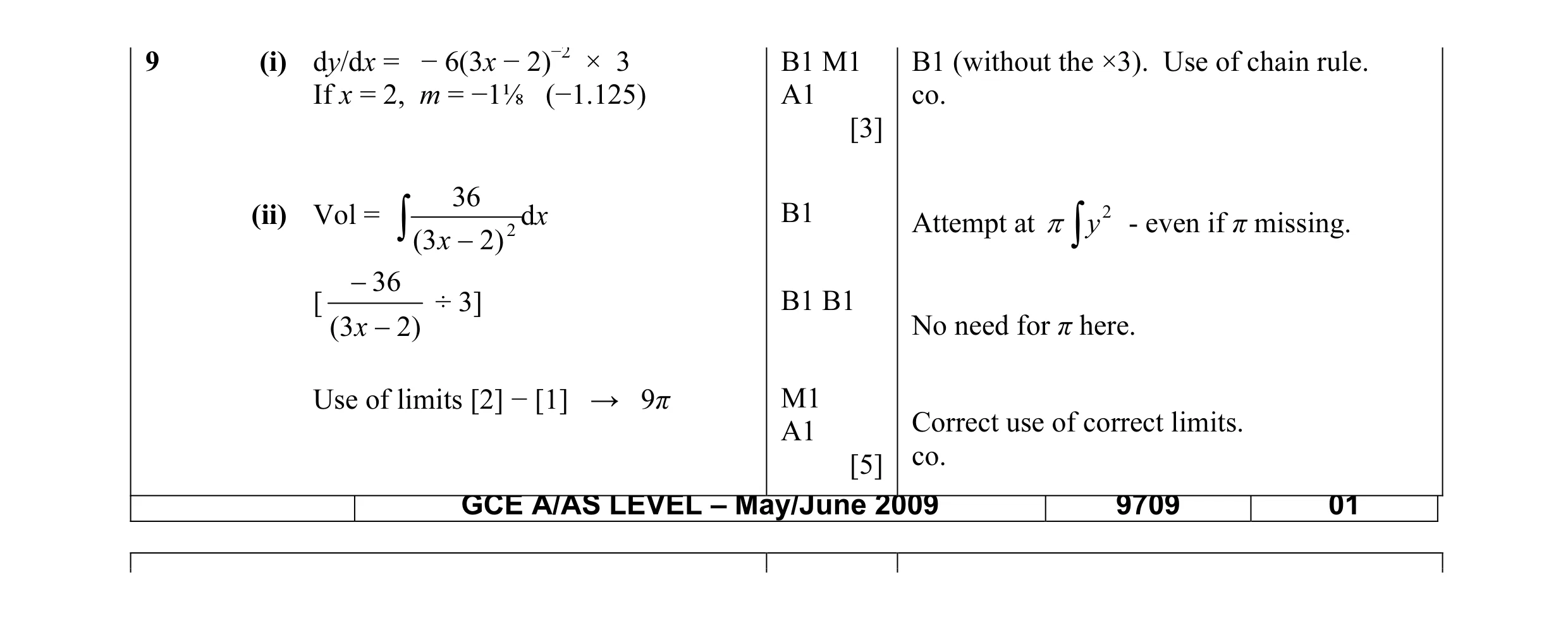
Mark scheme: 9 (i) dy/dx = − 6(3x − 2)−2 × 3 B1 M1 B1 (without the ×3). Use of chain rule. If x = 2, m = −1⅛ (−1.125) A1 co. [3] 36 d x B1 2 Attempt at π ∫ y 2 - even if π missing. (ii) Vol = ∫ (3 x − 2 ) − 36 [ ÷ 3] B1 B1 (3 x − 2) No need for π here. Use of limits [2] − [1] → 9π M1 Correct use of correct limits. A1 co. [5] GCE A/AS LEVEL – May/June 2009 9709 01
This question in 9709/11 May/June 2009
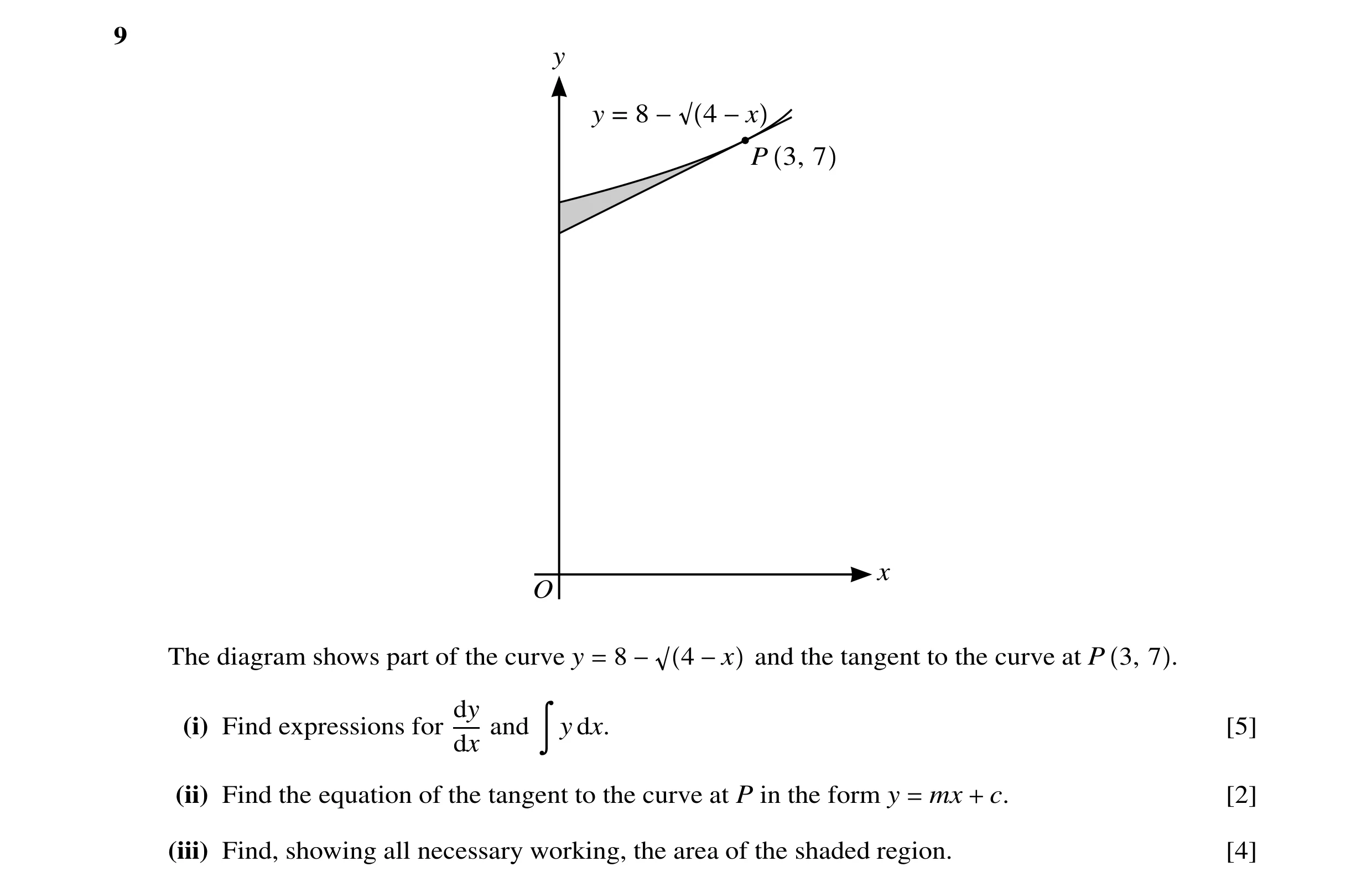
Q2 · Y y = 8 −ï 4 −x P 3, 7 x O The diagram shows part of the curve y 8 4 and the tangent to… 9709/12 May/June 2014
9 y y = 8 −ï 4 −x P 3, 7 x O The diagram shows part of the curve y 8 4 and the tangent to the curve at P 3, 7 . = − −x dy (i) Find expressions for and y dx. [5] dx Ó (ii) Find the equation of the tangent to the curve at P in the form y mx c. [2] = + (iii) Find, showing all necessary working, the area of the shaded region. [4]
11 marks
Mark scheme: 9 y = 8 − 4 − x d y 1 − 1 (i) = − (4 − x ) 2 × −1 B1 B1 Without (−1). For (×−1). d x 2 3 (4 − x ) 2 ∫y dx = 8 x − ÷ −1 3 × B1 B1 for "8x" and +c". B1 for all except 3 2 ÷(−1). B1 for ÷(−1). [5] (n.b. these 5 marks can be gained in(ii) or (ii) Eqn y − 7 = 1 2 ( x − 3 ) (iii)) → y = ½x + 5½ M1A1 M1 unsimplified. A1 as y=mx+c [2] (iii) Area under curve = ∫ from 0 to 3 (58/3) M1 Use of limits – needs use of “0” Area under line = ½(5½ + 7)×3 M1 Correct method 1 2 11x Or 4 x + from 0 to 3 M1 A1 M1 Subtraction. A1 co 2 [4] 58 75 7 → − = 3 4 12
This question in 9709/12 May/June 2014
Q3 · Dy 12 6 A curve is such that = , where a is a constant 9709/13 May/June 2014
dy 12 6 A curve is such that = , where a is a constant. The point P 2, 14 lies on the curve and dx 4x + a the normal to the curve at P is 3y + x = 5. (i) Show that a = 8. [3] (ii) Find the equation of the curve. [4]
7 marks
Mark scheme: dy 12 6 = P (2, 14) Normal 3y + x = 44 dx 4 x + a (i) m of normal = 1 B1 co −3 dy 12 = 3 = → a = 8 M1 A1 Use of m1m₂ = −1. AG. dx 4 x + a [3] 1 1 (ii) ∫ y = 12(4x + a) 2 ÷ ÷ 4 (+c) B1 B1 Correct without “÷4”. for “÷4”. 2 Uses (2, 14) M1 Uses in an integral only. Dep ‘c’. c = −10 A1 co All 4 marks can be given in (i) [4] GCE AS/A LEVEL – May/June 2014 9709 13
This question in 9709/13 May/June 2014
Q4 · Dy −1 9 A curve passes through the point A 4, 6 and is such that = 1 + 2x 2 9709/13 Oct/Nov 2015
dy −1 9 A curve passes through the point A 4, 6 and is such that = 1 + 2x 2. A point P is moving along dx the curve in such a way that the x-coordinate of P is increasing at a constant rate of 3 units per minute. (i) Find the rate at which the y-coordinate of P is increasing when P is at A. [3] (ii) Find the equation of the curve. [3] (iii) The tangent to the curve at A crosses the x-axis at B and the normal to the curve at A crosses the x-axis at C. Find the area of triangle ABC. [5]
11 marks
Mark scheme: dy 9 (i) At x = ,4 = 2 B1 dx d y dy d x = × = 2 × 3 = 6 M1A1 Use of Chain rule d t d x d t [3] 1 (ii) ( y ) = x + 4 x 2 ( + c ) B1 1 Sub x = ,4 y = 6 → 6 = 4 + ( 4 × 4 2 ) + c M1 Must include c 1 c = − 6 → ( y = x + 4 x 2 − 6 A1 [3] (iii) Eqn of tangent is y − 6 = 2 ( x − 4 ) or M1 Correct eqn thru (4, 6) & with m = ( 6 − 0 ) /( 4 − x ) = 2 A1 their 2 B = (1, 0) (Allow 1) M1 [Expect eqn of normal: ½ Gradient of normal = −1/2 A1 8] C = (16, 0) (Allow 16) A1 1 [5] Area of triangle = × 15 × 6 = 45 Or AB = 45 , AC = 180 → 2 Area = 45.0 3
This question in 9709/13 Oct/Nov 2015
Q5 · Dy 6 A curve has a stationary point at 3, 91 and has an equation for which = ax2 + a2x… 9709/11 Oct/Nov 2018
dy 6 A curve has a stationary point at 3, 91 and has an equation for which = ax2 + a2x, where a is a 2 dx non-zero constant. (i) Find the value of a. [2] … … … … … … … … … … (ii) Find the equation of the curve. [4] … … … … … … … … … … … … … … … … … … … … … … … … (iii) Determine, showing all necessary working, the nature of the stationary point. [2] … … … … … … … … … … … …
8 marks
Mark scheme: 6(i) 2 0 9 3 = + a a M1 Sub d 0 and 3 d y x x = = 3 = − a only A1 2 6(ii) ( ) 2 2 3 d 9 3 9 d 2 y x x x y x c x = − + → = − + + M1A1FT Attempt integration. 3 2 2 13 ½ + ax a x scores M1. Ft on their a. 9½ 27 40½ = − + + c DM1 Sub 3, 9½ = = x y . Dependent on c present 4 = − c A1 Expect 2 3 9 4 2 = − + − x y x 4 6(iii) 2 2 d 6 9 d y x x = − + M1 2 2 + ax a scores M1 At 2 2 d 3, 9 0 d y x x = = − < MAX www A1 Requires at least one of ‒9 or < 0. Other methods possible. 2
This question in 9709/11 Oct/Nov 2018
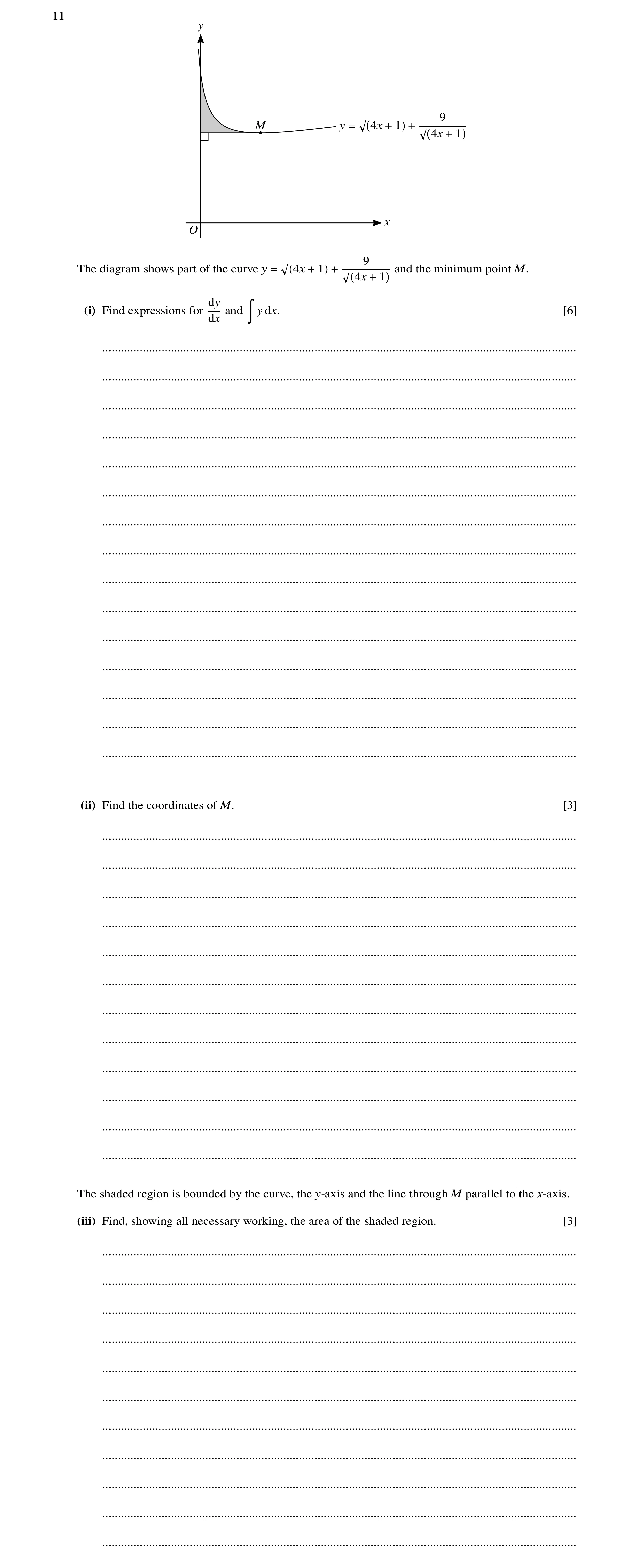
Q6 · Y 9 M y = 4x + 1 + 4x + 1 x O 9 The diagram shows part of the curve y 4x 1 and the… 9709/12 May/June 2019
11 y 9 M y = 4x + 1 + 4x + 1 x O 9 The diagram shows part of the curve y 4x 1 and the minimum point M. = + + 4x 1 + dy (i) Find expressions for and y dx. [6] dx Ó … … … … … … … … … … … … … … … (ii) Find the coordinates of M. [3] … … … … … … … … … … … … The shaded region is bounded by the curve, the y-axis and the line through M parallel to the x-axis. (iii) Find, showing all necessary working, the area of the shaded region. [3] … … … … … … … … … … …
12 marks
Mark scheme: 11(i) ( ) 1 2 d 1 4 1 d 2 − = + y x x [× 4] ( ) 3 2 9 4 1 2 − − + x [× 4] B1B1B1 ( ) ( ) 3 3 2 2 18 8 16 4 1 4 1 4 1 − − + + + x or x x x SC If no other marks awarded award B1 for both powers of (4x +1) correct. ∫ydx = ( ) 3 2 4 1 3 2 + x [÷ 4] + ( ) 1 2 9 4 1 1 2 + x [÷ 4] (+C) B1B1B1 B1 B1 for each, without ÷ 4. B1 for ÷4 twice. + C not required. ( ) ( ) 3 4 1 9 4 1 ( ) 6 2 x x C + + + + SC If no other marks awarded , B1 for both powers of (4x +1) correct. 6 11(ii) d 0 d = y x → 2 4 1 + x − ( ) 3 2 18 4 1 + x = 0 M1 Sets their d d y x to 0 (and attempts to solve 4x + 1 = 9 or (4x + 1)2 = 81 A1 Must be from correct differential. x = 2, y = 6 or M is (2, 6) only. A1 Both values required. Must be from correct differential. 3 Question Answer Marks Guidance 11(iii) Realises area is ∫y dx and attempt to use their 2 and sight of 0. *M1 Needs to use their integral and to see ‘their 2’ substituted. Uses limits 0 to 2 correctly → [4.5 + 13.5] – [ 1 6 + 4.5] ( = 13⅓ ) DM1 Uses both 0 and ‘their 2’ and subtracts. Condone wrong way round. (Area =) 1⅓ or 1.33 A1 Must be from a correct differential and integral. 3 13⅓ or 1⅓ with little or no working scores M1DM0A0.
This question in 9709/12 May/June 2019
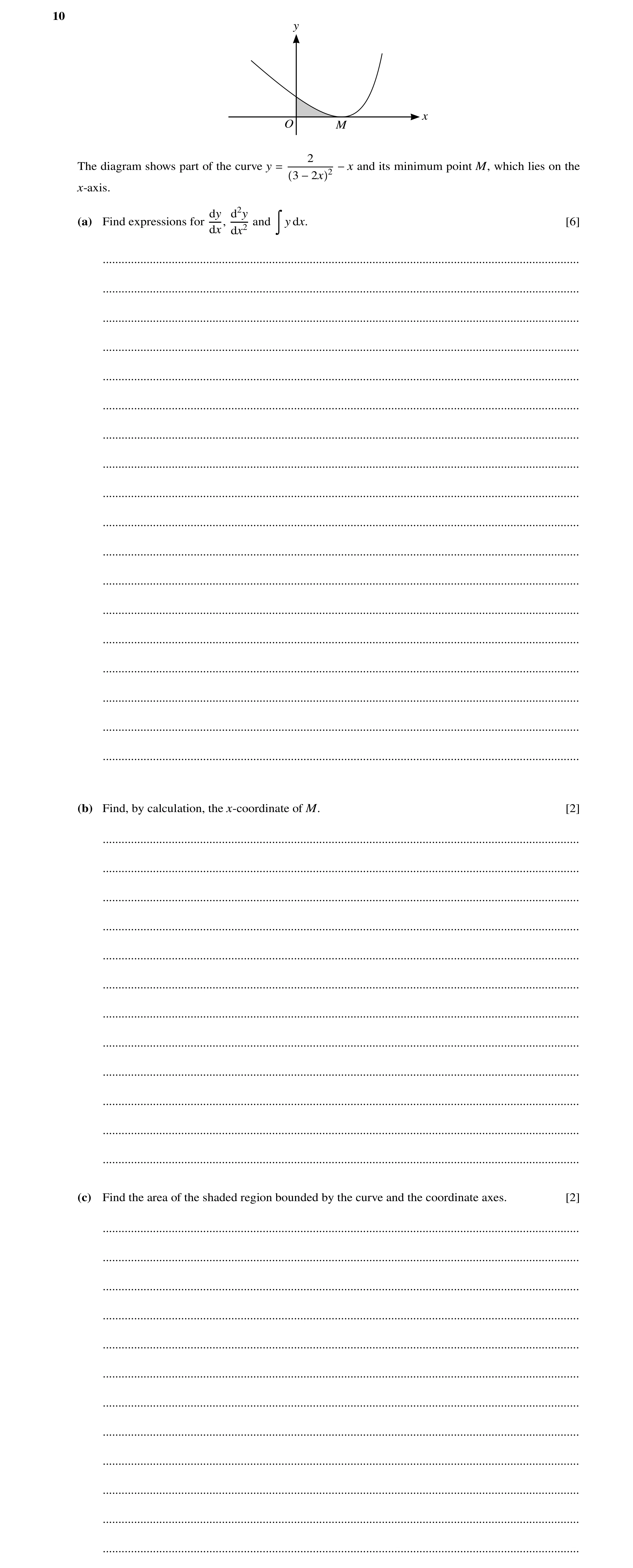
Q7 · Y x O M 2 The diagram shows part of the curve y and its minimum point M, which lies on… 9709/12 Oct/Nov 2020
10 y x O M 2 The diagram shows part of the curve y and its minimum point M, which lies on the 2 −x = 3 −2x x-axis. dy d2y (a) Find expressions for dx, dx2 and Ó y dx. [6] … … … … … … … … … … … … … … … … … … (b) Find, by calculation, the x-coordinate of M. [2] … … … … … … … … … … … … (c) Find the area of the shaded region bounded by the curve and the coordinate axes. [2] … … … … … … … … … … … …
10 marks
Mark scheme: 10(a) d (d y x ) = [8] ( 3 [ 3 2 ) − × − + x [ −1] ( ) 8 1 3 2 ³ x = − − B2, 1, 0 B2 for all three elements correct, B1 for two elements correct, B0 for only one or no elements correct. d² d ² y x = ( ) 4 3 8 (3 2 ) 2 − −× × − × − x ( ) 4 48 3 2x = − B1 FT FT providing their bracket is to a negative power ∫ydx = [(3− 2x)−1 ] [2 ÷ (−1 × −2)] [ − ½x²] (+c) 2 1 1 3 2 2 x c x = − + − B1 B1 B1 Simplification not needed, B1 for each correct element 6 Question Answer Marks Guidance 10(b) d d y x = 0 → (3 – 2x)³ = 8 → 3 – 2x = k → x = M1 Setting their 2-term differential to 0 and attempts to solve as far as x = 1 2 A1 Alternative method for question 10(b) ( ) 2 2 2 0 0 2 (2 1) 0 (3 2 ) y x x x x x = → − = → − − = → = − M1 Setting y to 0 and attempts to solve a cubic as far as x = (3 factors needed) 1 2 A1 2 10(c) Area under curve = their 1 ² 1 1 2 0 1 2 3 2 0 3 2 2 − − − − × − × M1 Using their integral, their positive x limit from part (b) and 0 correctly. 1 24 A1 2
This question in 9709/12 Oct/Nov 2020
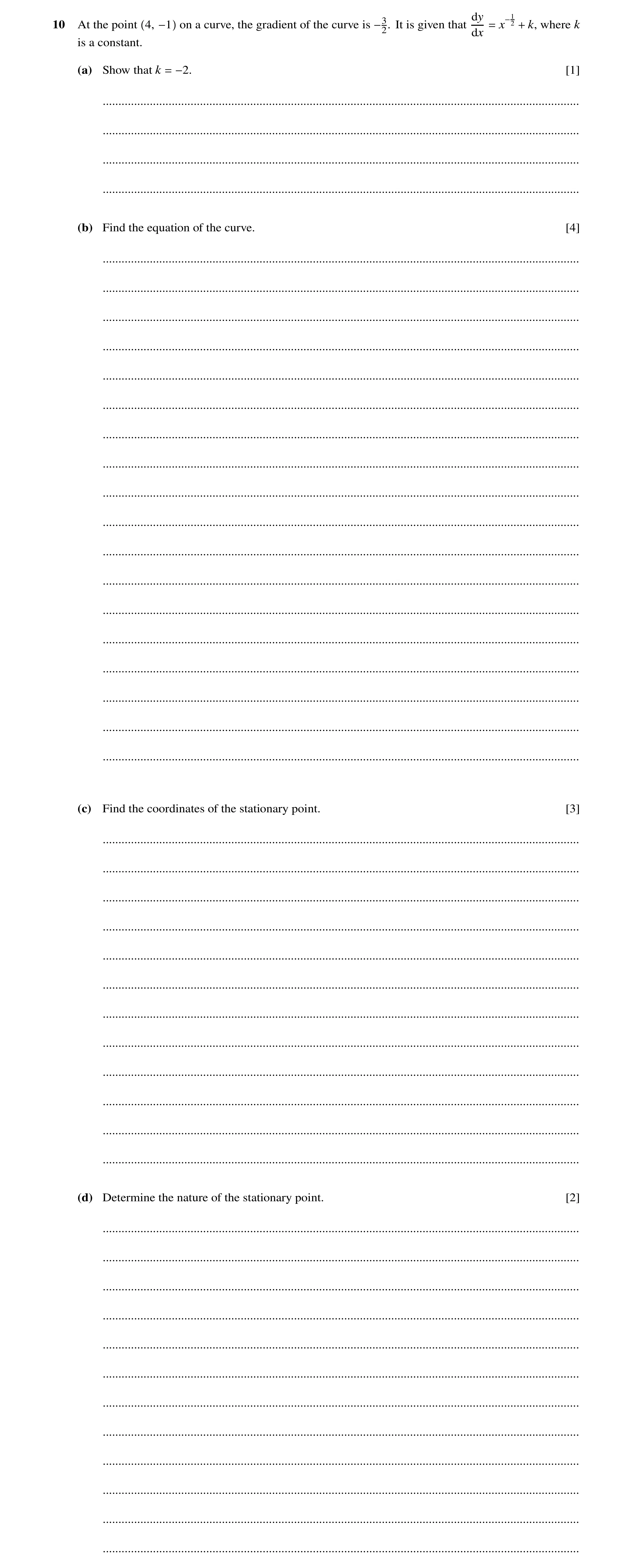
Q8 · Dy10 At the point 4, −1 on a curve, the gradient of the curve is −3 It is given that =… 9709/12 Feb/March 2023
dy10 At the point 4, −1 on a curve, the gradient of the curve is −3 It is given that = x−1 2. 2 + k, where k dx is a constant. (a) Show that k = −2. [1] … … … … (b) Find the equation of the curve. [4] … … … … … … … … … … … … … … … … … … (c) Find the coordinates of the stationary point. [3] … … … … … … … … … … … … (d) Determine the nature of the stationary point. [2] … … … … … … … … … … … …
10 marks
Mark scheme: 110(a) B1 − 3 1 1 − = + k leading to k = −2 2 evaluated as or better. AG Need to see 4 1 2 2 4 2 1 10(b) 1 M1 A1 1 2 y = 2 x 2 − 2 x + c x Allow − 2 x . 12 −=1 4 −+c8 M1 Substitute x = 4, y = −1 (c present) Expect c = 3. 1 A1 Allow if f(x) = or y = anywhere in the solution. y = 2 x 2 − 2 x + 3 or y = 2 x − 2 x + 3 4 10(c) x −1/2 − 2 = 0 M1 d y Set their to zero. d x 1 A1 2 x = 1 1 1 1 = max of M1A1 if If ,3 seen. 4 2 4 4 2 (¼, 3½) A1 3 10(d) d 2 y 1 − 32 B1 2 = − x d x 2 < 0 (or −)4 hence Maximum DB1 1 WWW Ignore extra solutions from x = − . 4 2
This question in 9709/12 Feb/March 2023
Q9 · D2y 10 A curve has a stationary point at 2, −10 and is such that = 6x 9709/11 Oct/Nov 2023
d2y 10 A curve has a stationary point at 2, −10 and is such that = 6x. dx2 dy (a) Find dx. [3] … … … … … … … … … … (b) Find the equation of the curve. [3] … … … … … … … … … … … … (c) Find the coordinates of the other stationary point and determine its nature. [3] … … … … … … … … … … … … (d) Find the equation of the tangent to the curve at the point where the curve crosses the y-axis. [2] … … … … … … … … … … … …
11 marks
Mark scheme: 10(a) dy 2 B1 = 3 x + c dx 3 2 2 + c = 0 M1 dy Substitute x = 2 and = 0 into an integral (c must be dx present). dy 2 A1 = 3 x −12 dx 3 10(b) 3 B1 FT FT on their non-zero c (dependent on c being found at y = x − 12 x +k some stage). −10 = 23 − 12 2 + k M1 Substitute x = 2, y = ‒10 (k present). 3 A1 3 y = x − 12 x + 6 Must be y = (unless y = x − 12 x + k stated earlier). 3 10(c) 3 x 2 − 12 = 0 [leading to x =−2 ] M1 dy Set their two term = 0 . Expect x =−2 . dx Ignore x = 2 given in addition. 3 A1 y = ( −2 ) − 12 −( 2 ) + 6 = 22 leading to (‒2, 22) d 2 y A1 dy When x = −2, 2 0 (or ‒12) hence Maximum Can be from correct conclusion from sign diagram dx dx dy if calculated correctly. dx Do not allow concave downward for final A1. Can be awarded if the only error is incorrect or missing y-coordinate. 3 10(d) dy M1 d y At x = 0, = −12, y = 6 Both required. FT on their and y. dx d x y − 6 = −12 x A1 OE 2
This question in 9709/11 Oct/Nov 2023
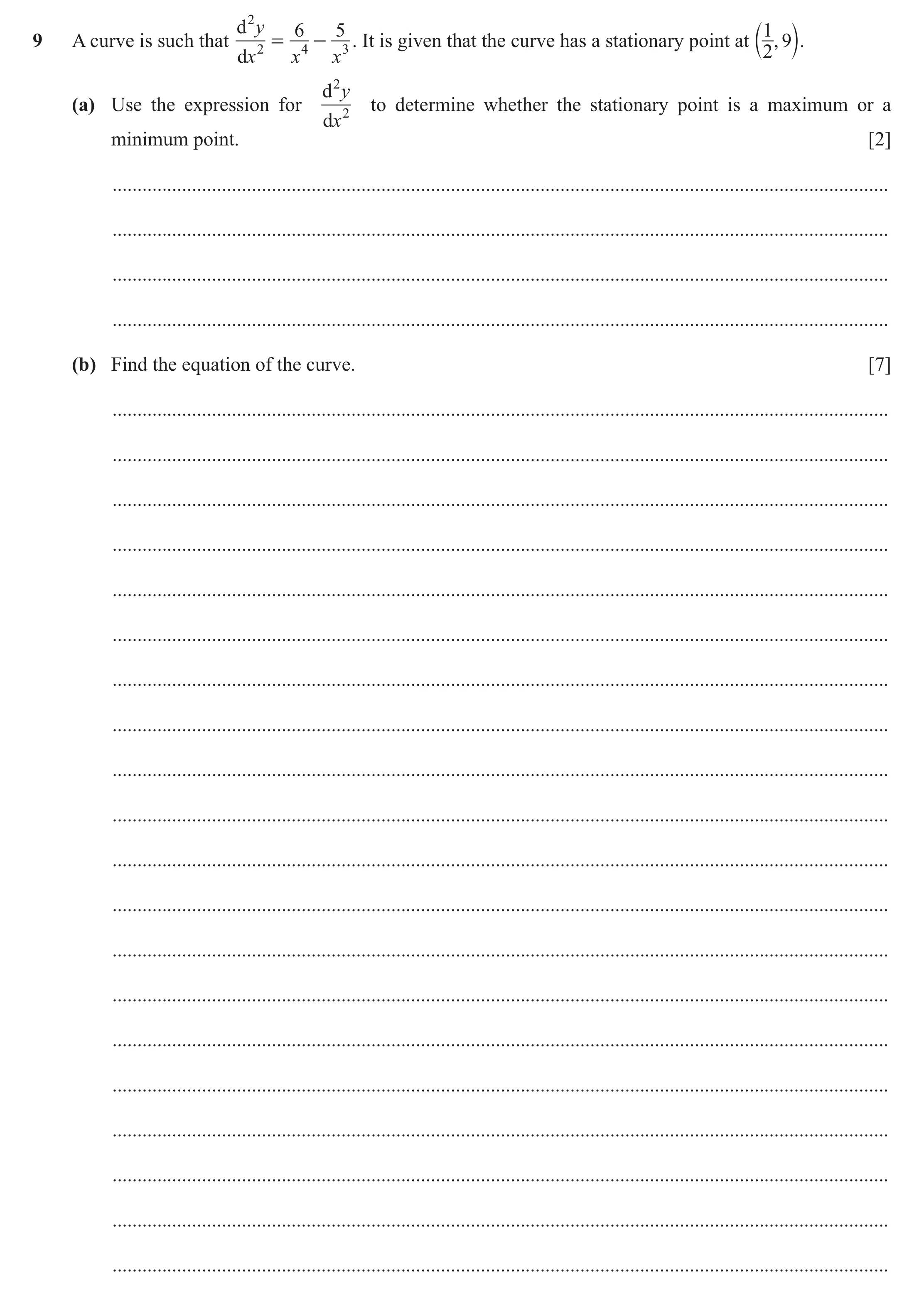
Q10 · D 2 y 6 5 1 9 A curve is such that = - 9709/12 Feb/March 2025
d 2 y 6 5 1 9 A curve is such that = - . It is given that the curve has a stationary point at b , 9l. dx 2 x 4 x 3 2 d 2 y (a) Use the expression for to determine whether the stationary point is a maximum or a dx 2 minimum point. [2] … … … … (b) Find the equation of the curve. [7] … … … … … … … … … … … … … … … … … … … …
9 marks
Mark scheme: 9(a) 6 5 M1 1 and evaluate second derivative. − Substitute x = 2 1 4 1 3 2 2 96 − 40 = 56 0 Minimum A1 CWO Evidence and conclusion. d 2 y SC B1 for 2 0 without sight of 96 − 40 or 56. d x 2 9(b) 6 −3 5 −2 B1 B1 OE x − x + c1 −3 −2 B1 for each correct { }. −3 1 into two terms of an integrated expression −2 M1 Substitute x = 2 6 1 5 1 0 = − + c1 (at least one correct power), now with c1, and equate to 0 to −3 2 −2 2 find c1. c1 = 6 A1 k1 x −2 + k 2 x −1 + k3 x +c 2 M1 d y Integration of their to produce at least two terms with d x correct powers, k1 , k 2 0. 1 5 1 M1 OE 9 = − + 6 + c2 1 2 , 9 ) into integrated expression (at least two 1 1 2 Substitute ( 2 2 2 2 correct powers) to find c2. −2 5 −1 A1 OE y = x − x + 6 x + 7 Condone their final answer being c2 = 7 if a completely 2 correct simplified expression for the equation containing c 2 has been stated previously. 7
This question in 9709/12 Feb/March 2025
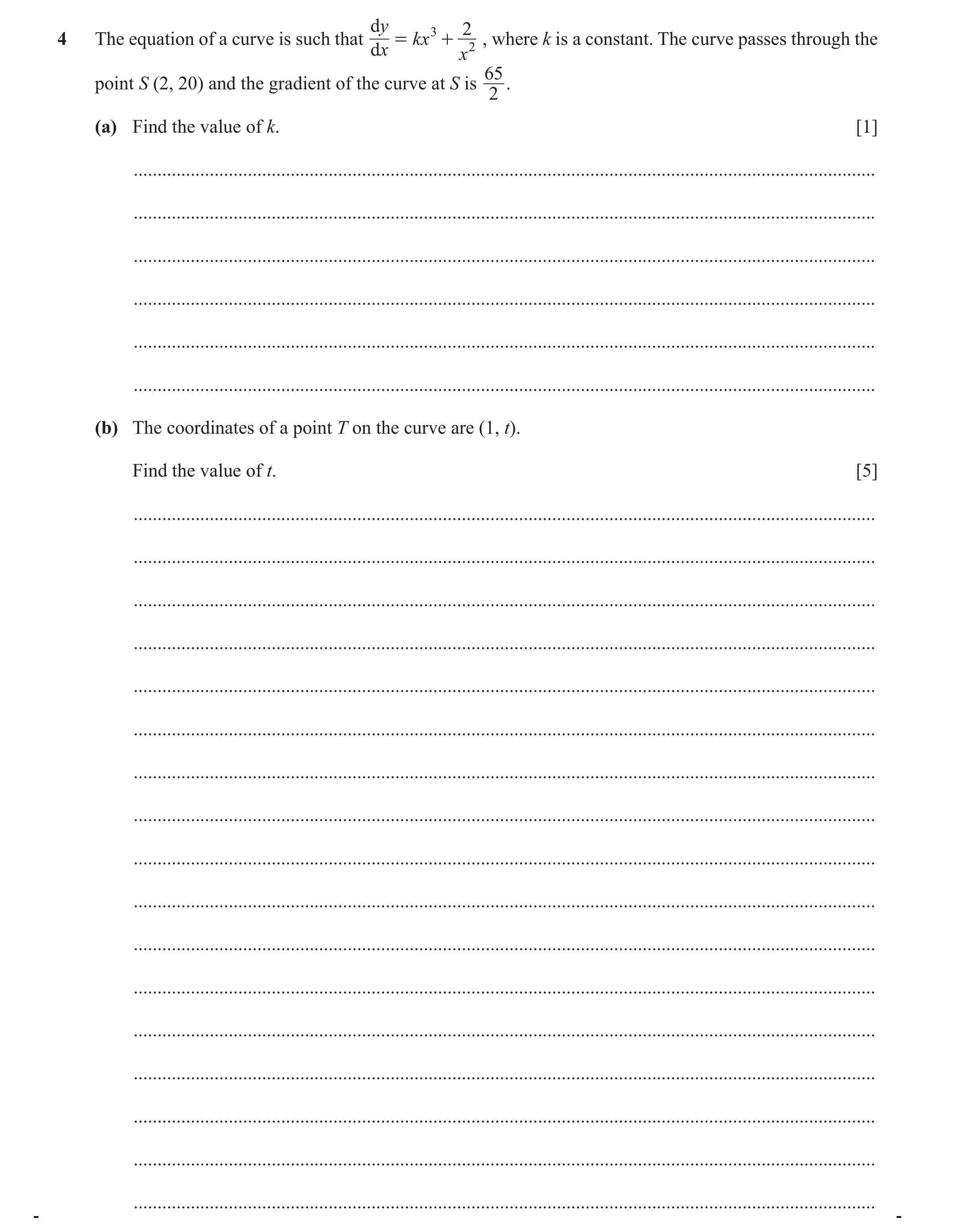
Q11 · Dy 3 2 4 The equation of a curve is such that = kx + , where k is a constant 9709/12 Oct/Nov 2025
dy 3 2 4 The equation of a curve is such that = kx + , where k is a constant. The curve passes through the dx x 2 point S (2, 20) and the gradient of the curve at S is 65. 2 (a) Find the value of k. [1] … … … … … … (b) The coordinates of a point T on the curve are (1, t). Find the value of t. [5] … … … … … … … … … … … … … … … … …
6 marks
Mark scheme: 4(a) [ k =] 4 B1 1 4(b) k 4 2 x −+2 1 B2,1,0FT FT their k from 4(a) or the letter k. x + + c B2 for both correct components and no other x-terms. 4 −+2 1 B1 for one correct. their k 4 2 M1 Substituting x = 2 and y = 20 into their integrated 20 = 2 − + c 4 2 expression (defined by having at least one correct power and including a '+ 'c ). Allow one slip. c = 5 A1 t = 4 A1 5
This question in 9709/12 Oct/Nov 2025
![Question 1: y 6 y = 3x – 2 x O 1 2 6 The diagram shows part of the curve y = 3x −2. (i) Find the gradient of the curve at the point where x = 2. [3] (i…](https://img.pastlit.com/crops/38b78239-bbb0-4ce9-b04c-cea1bd1921a3/q9.webp)
 1 / 13
 2 / 13
![Question 9: d2y 10 A curve has a stationary point at 2, −10 and is such that = 6x. dx2 dy (a) Find dx. [3] ............................................…](https://img.pastlit.com/crops/da1f0cf8-1a72-4ff8-ba7b-7896fbd6fc66/q10.webp)
 12 / 13
 13 / 13
 8
8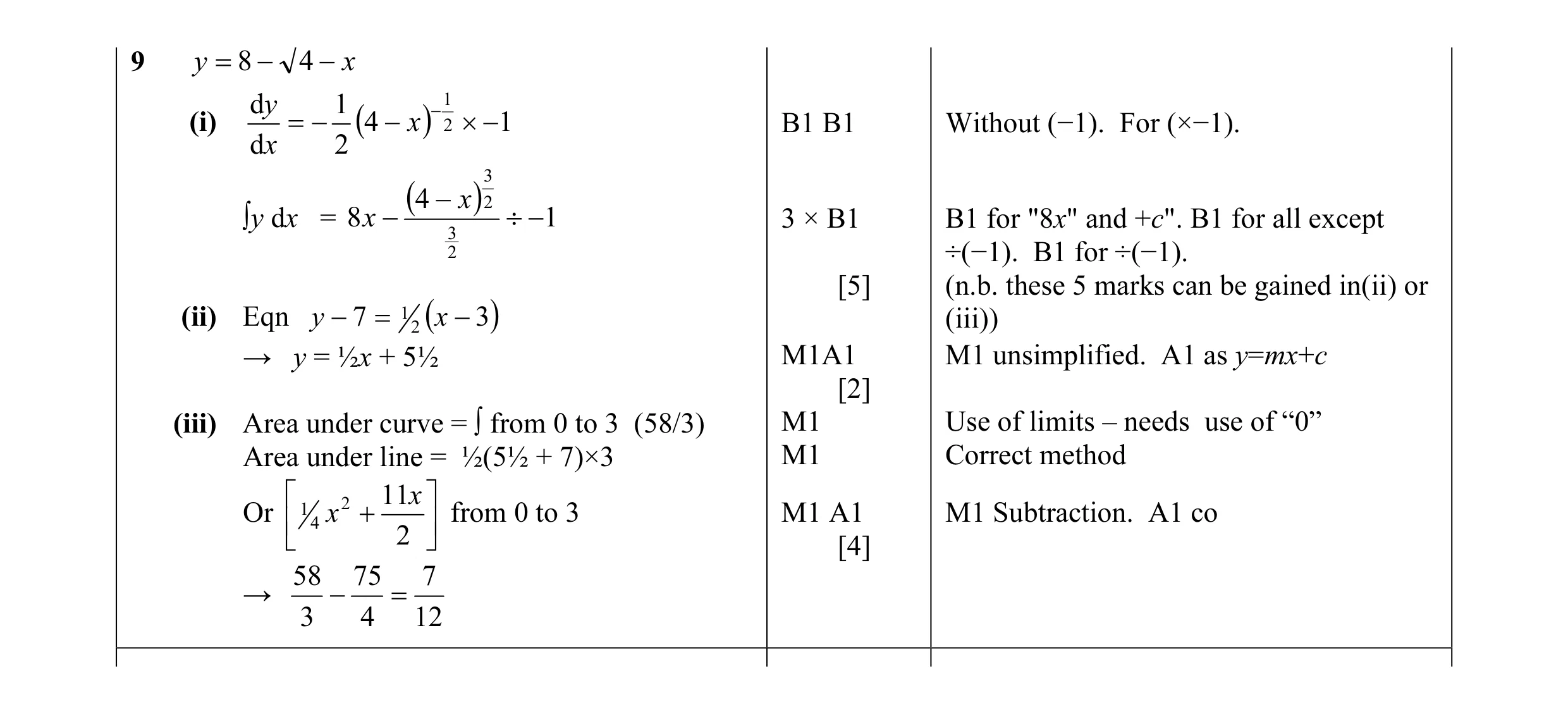 11
11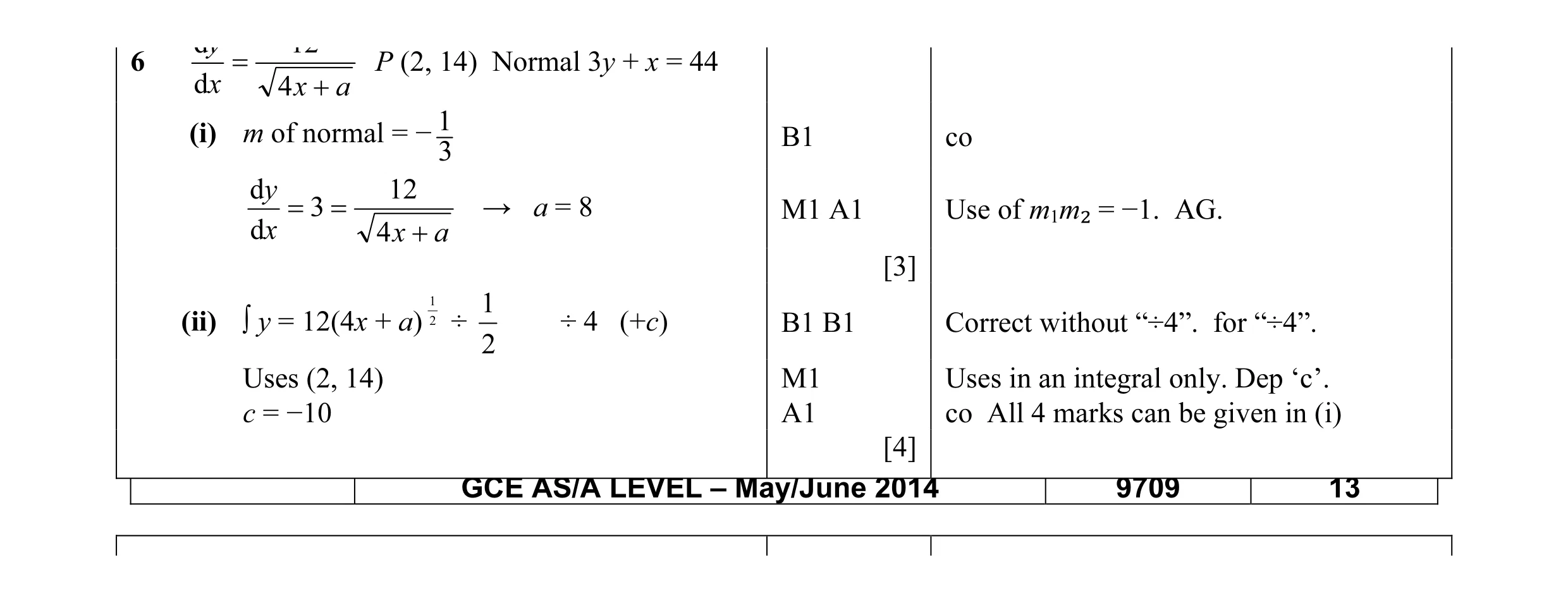 7
7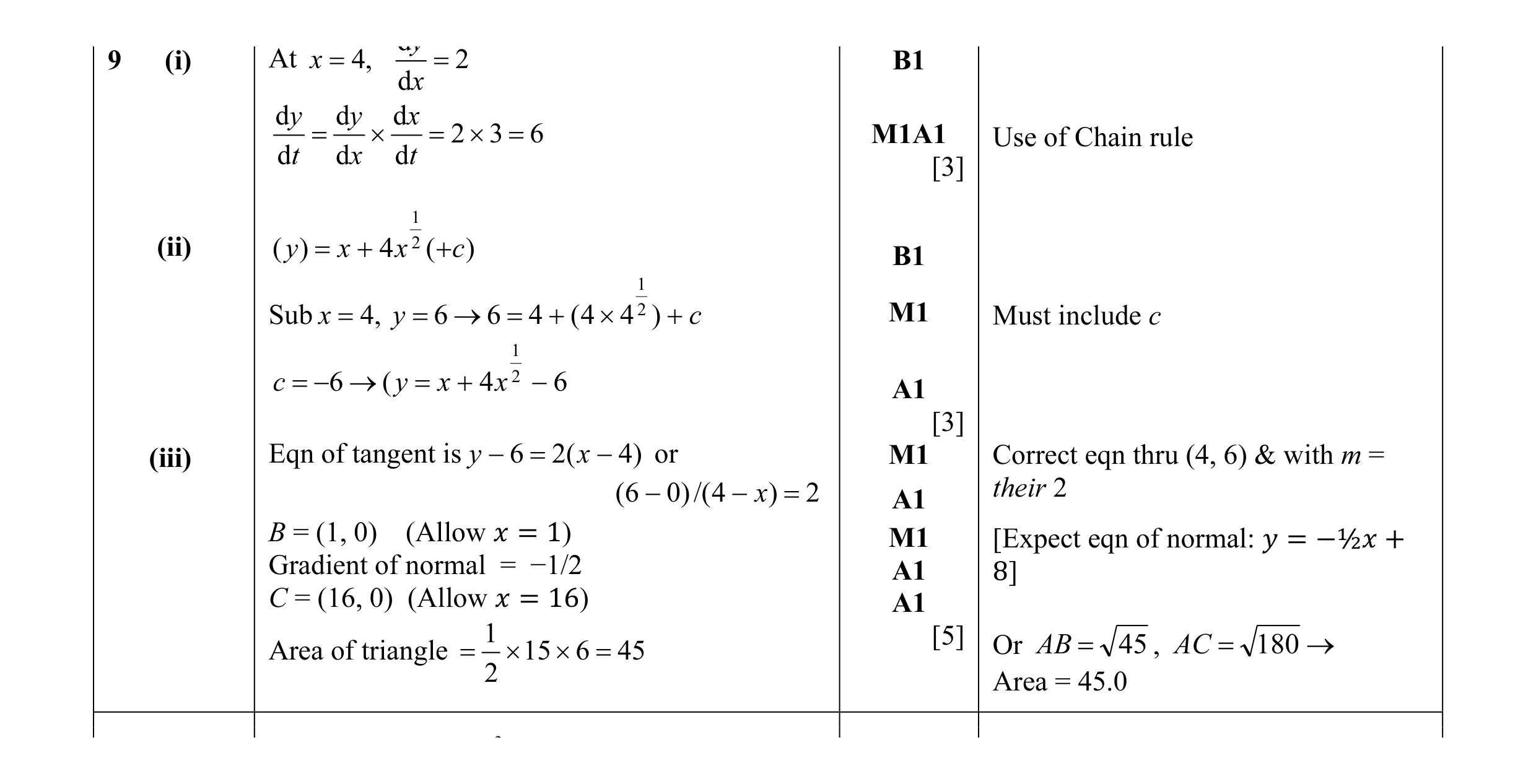 11
11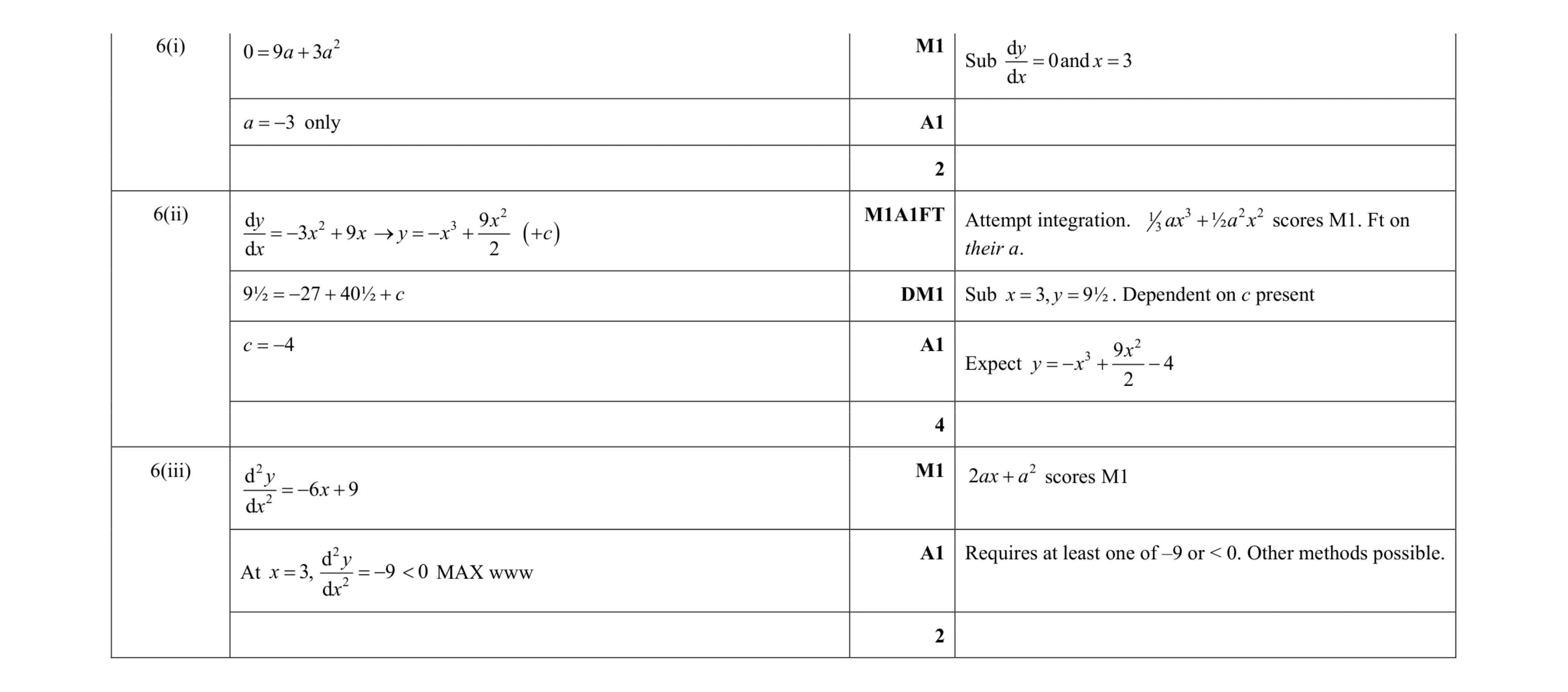 8
8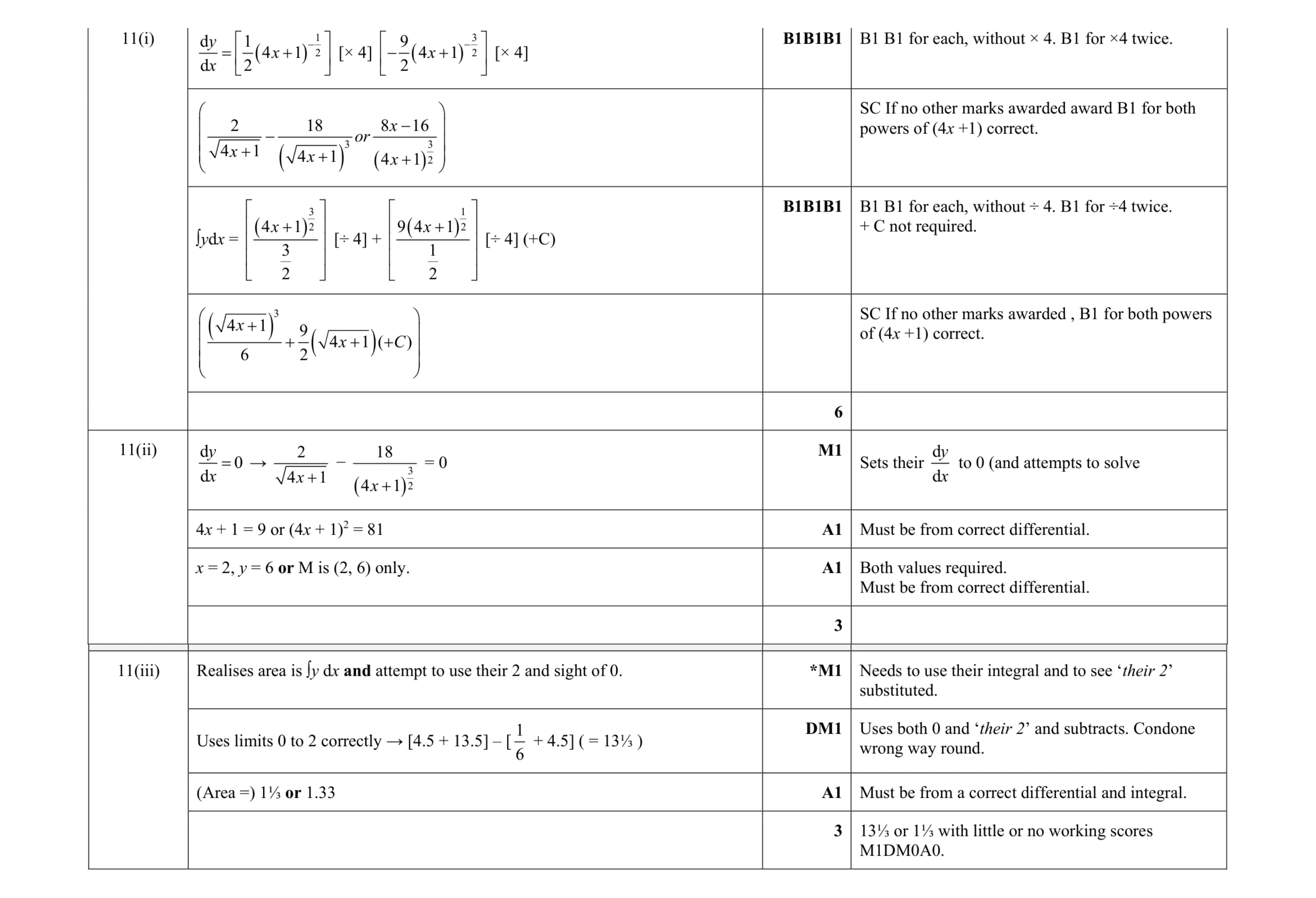 12
12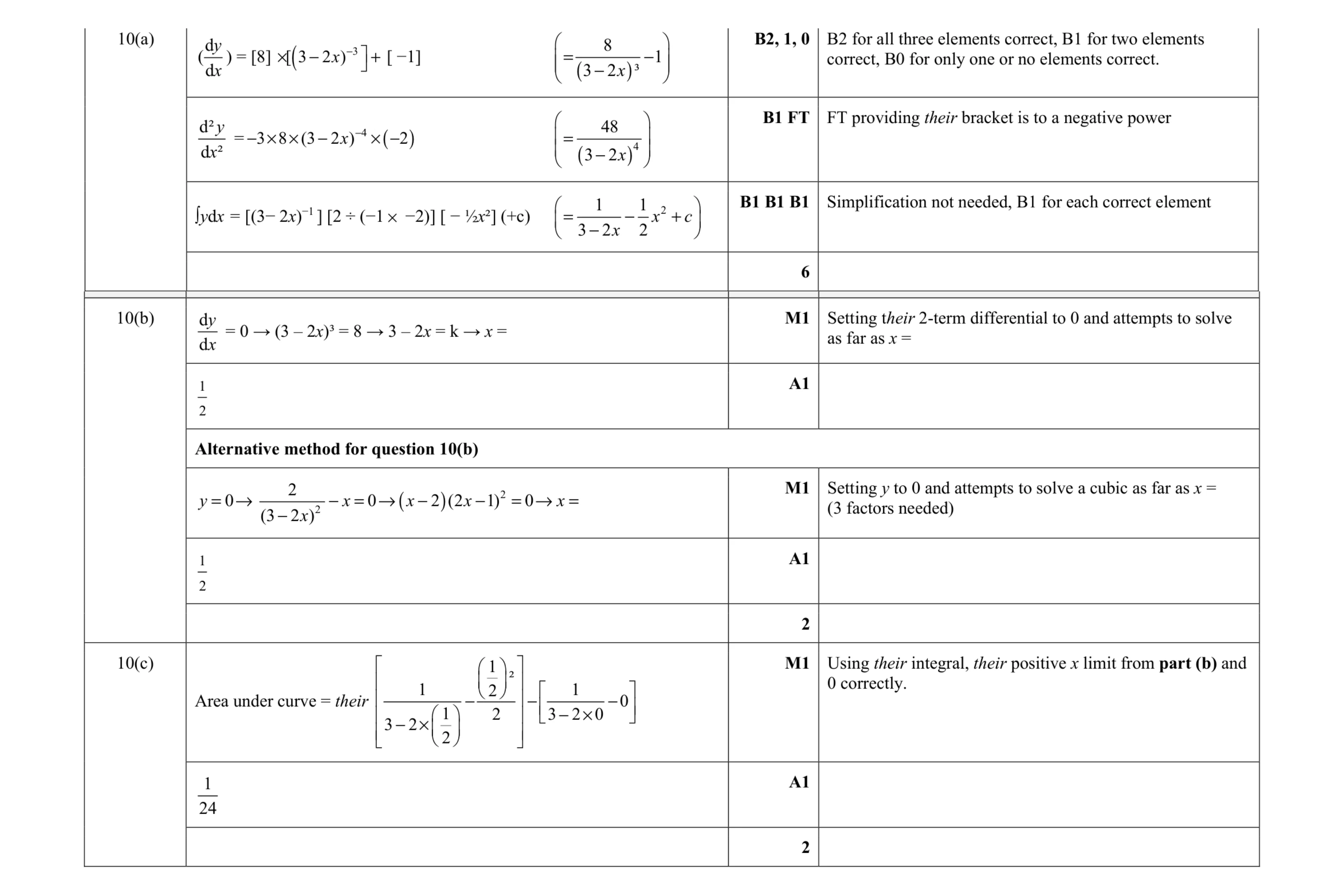 10
10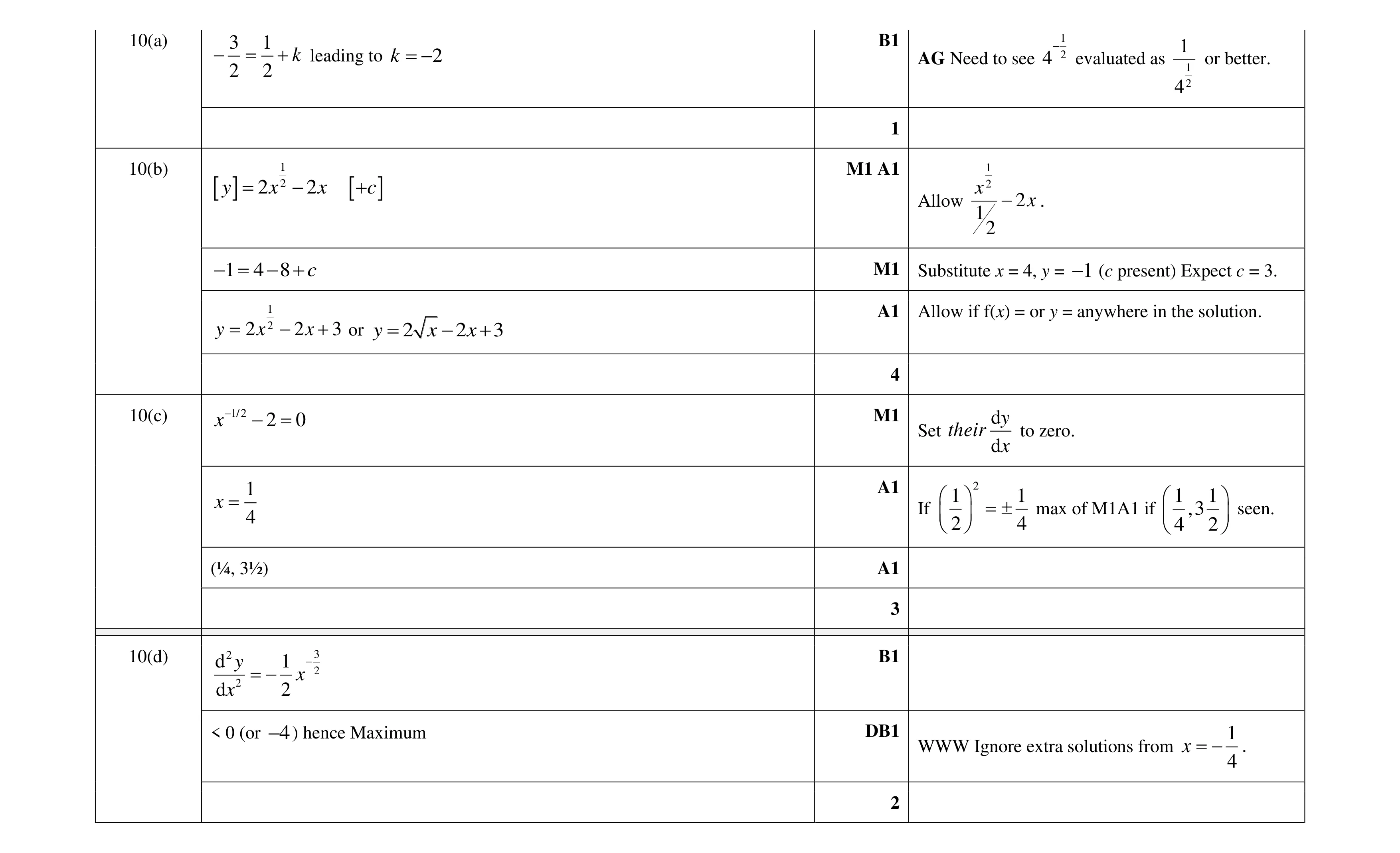 10
10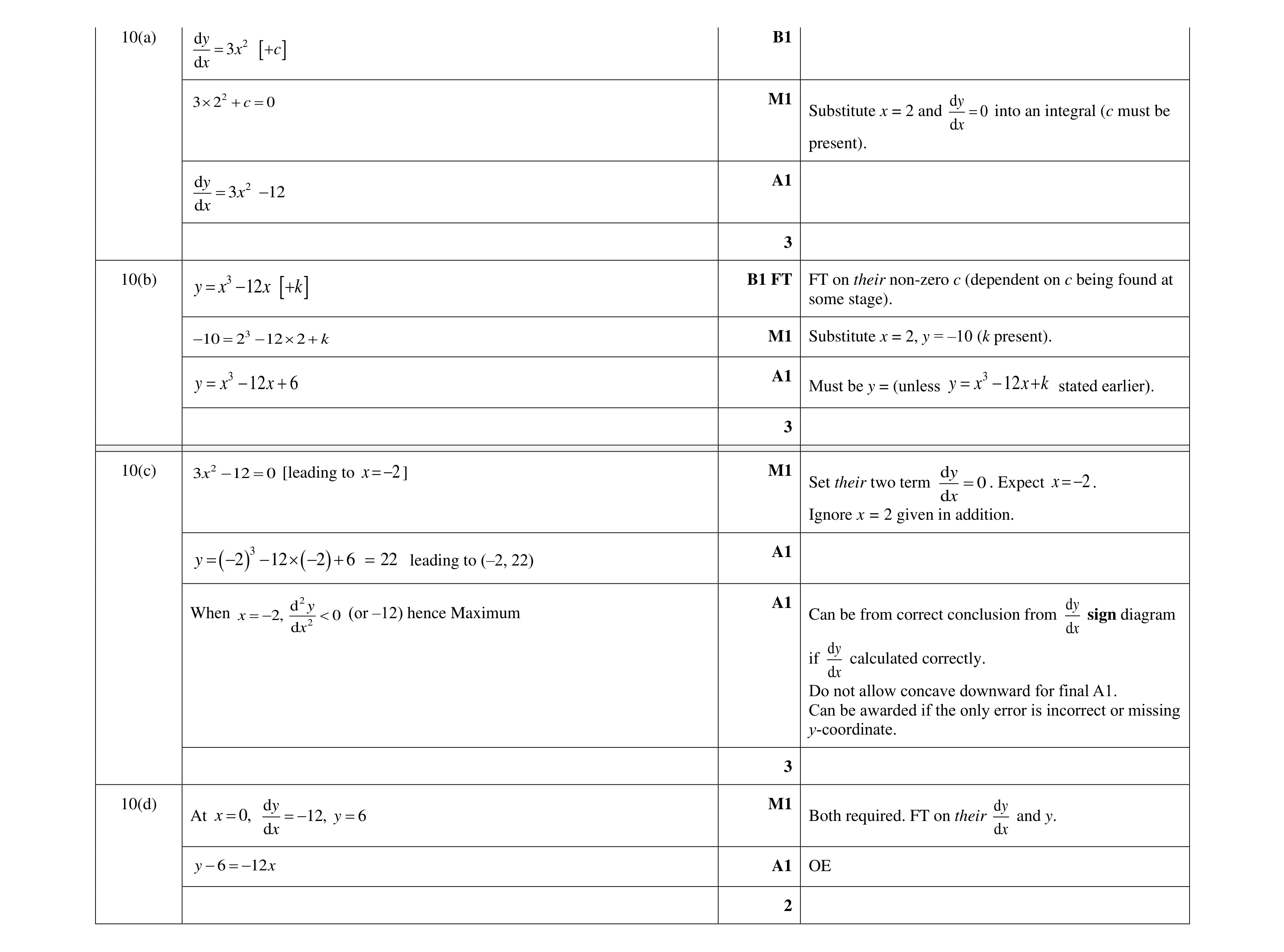 11
11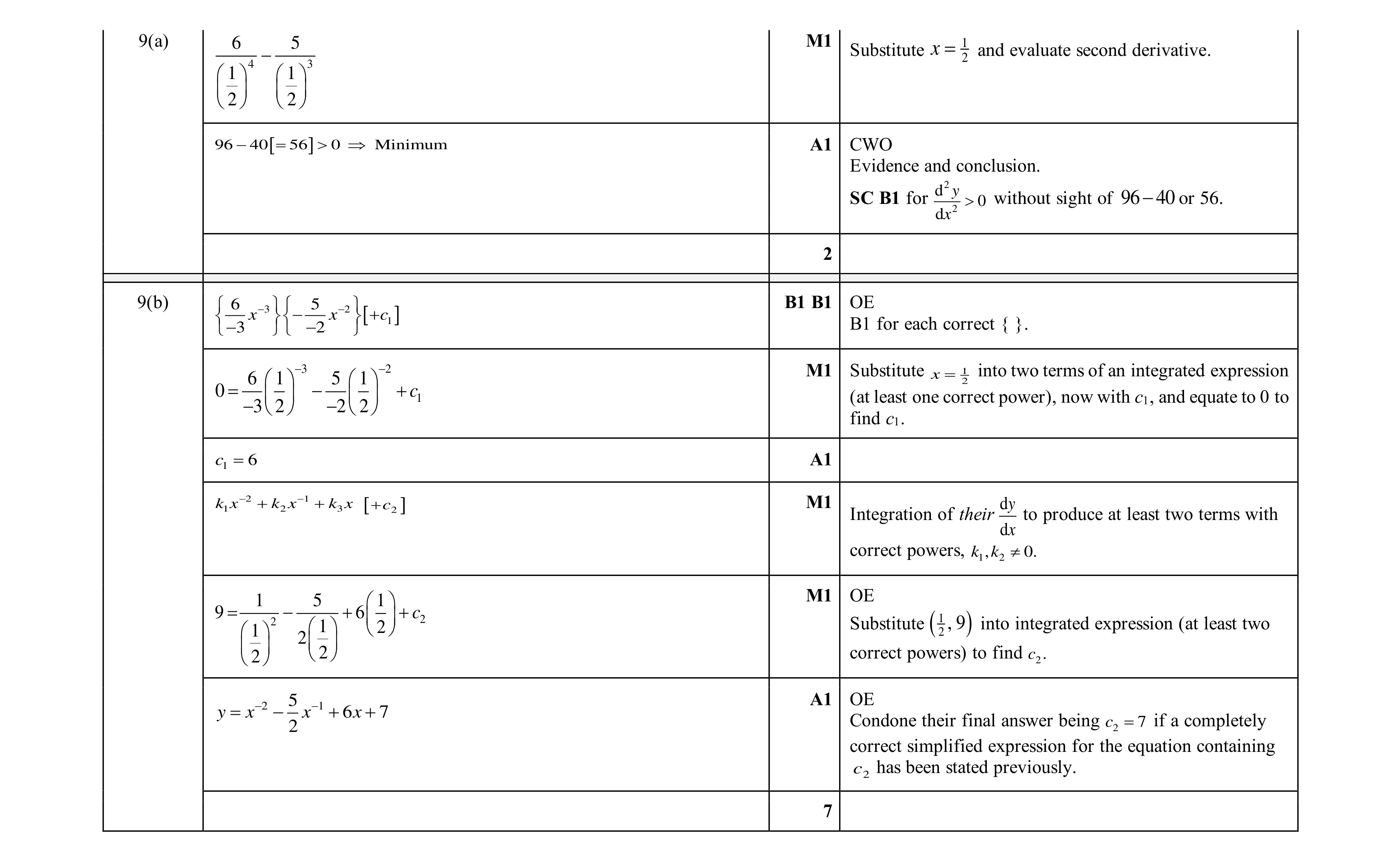 9
9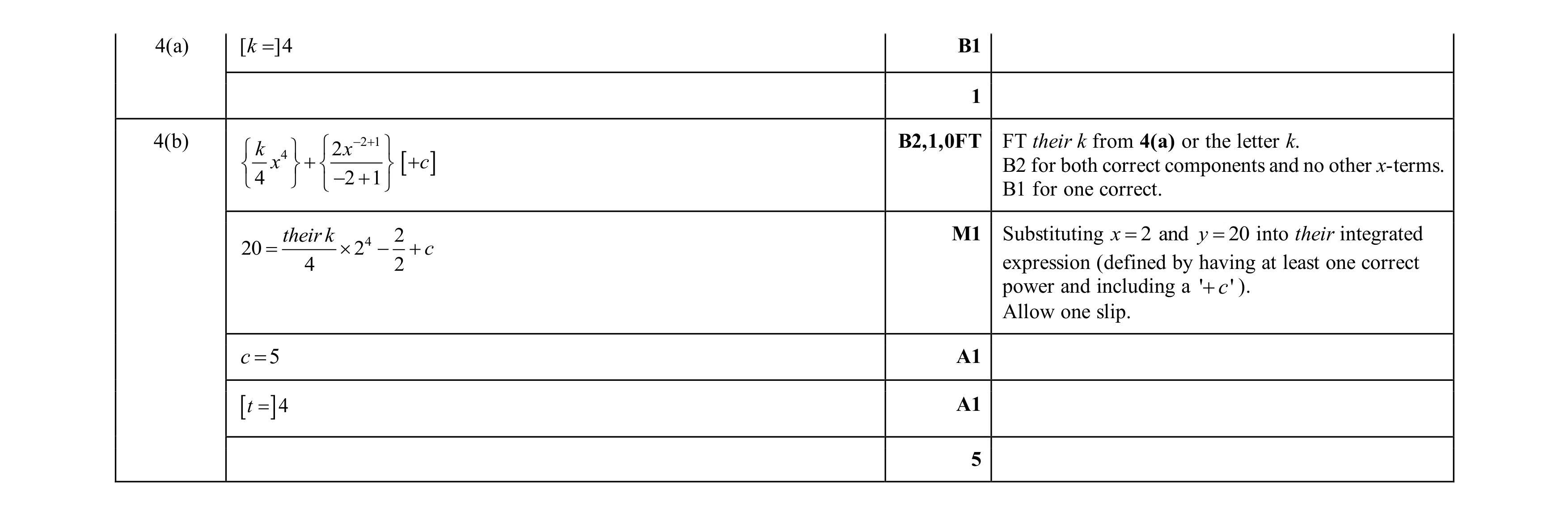 6
6