Questions as text
Q1 · Solve the equation ln(1 + x) = 1 + ln x, giving your answer correct to 2 significant figures 9709/31 Oct/Nov 2004
2 Solve the equation ln(1 + x) = 1 + ln x, giving your answer correct to 2 significant figures. [4]
4 marks
Mark scheme: 2 Use law for subtraction or addition of logarithms, or the equivalent in exponentials M1 Use In e = 1 or e = exp(1) M1 1 + x Obtain a correct equation free of logarithms e.g. = e or 1 + x = ex A1 x Obtain answer x = 0.58 (allow 0.582 or answer rounding to it) A1 4
This question in 9709/31 Oct/Nov 2004
Q2 · Solve the equation ln(x + 2) = 2 + ln x, giving your answer correct to 3 decimal places 9709/31 Oct/Nov 2008
1 Solve the equation ln(x + 2) = 2 + ln x, giving your answer correct to 3 decimal places. [3]
3 marks
Mark scheme: 1 Use laws of logarithms and remove logarithms correctly M1 Obtain x + 2 = e 2 x , or equivalent A1 Obtain answer x = 0.313 A1 [3] [SR: If the logarithmic work is to base 10 then only the M mark is available.] 1
This question in 9709/31 Oct/Nov 2008
Q3 · Solve the equation ln 5 x, ln(5 −x) = −ln giving your answers correct to 3 significant… 9709/32 Oct/Nov 2009
1 Solve the equation ln 5 x, ln(5 −x) = −ln giving your answers correct to 3 significant figures. [4]
4 marks
Mark scheme: 1 Use law of the logarithm of a product or quotient and remove logarithms M1 Obtain quadratic equation x2 – 5x + 5 = 0, or equivalent A1 Solve 3-term quadratic obtaining 1 or 2 roots A1 Obtain answers 1.38 and 3.62 A1 [4] 3
This question in 9709/32 Oct/Nov 2009
Q4 · X 8 Let f(x) = (1 + x)(1 + 2x2) 9709/32 Oct/Nov 2010
3x 8 Let f(x) = (1 + x)(1 + 2x2). (i) Express in partial fractions. [5] f(x) (ii) Hence obtain the expansion of in ascending powers of x, up to and including the term in x3. f(x) [5] [Questions 9 and 10 are printed on the next page.]
10 marks
Mark scheme: A Bx + C 8 (i) State or imply the form + 2 B1 1 + x 1 + 2 x Use any relevant method to evaluate a constant M1 Obtain one of A = –1, B = 2, C = 1 A1 Obtain a second value A1 Obtain the third value A1 [5] (ii) Use correct method to obtain the first two terms of the expansion of (1 + x )−1 or (1 + 2 x 2 )−1 M1 Obtain correct expansion of each partial fraction as far as necessary A1√ + A1√ Multiply out fully by Bx + C, where BC Þ 0 M1 Obtain answer 3x – 3x2 – 3x3 A1 [5] − 1 [Symbolic binomial coefficients, e.g., are not sufficient for the first M1. The f.t. 1 is on A, B, C.] [If B or C omitted from the form of fractions, give B0M1A0A0A0 in (i); M1A1√A1√ in (ii), max 4/10.] [If a constant D is added to the correct form, give M1A1A1A1 and B1 if and only if D = 0 is stated.] [If an extra term D/(1 + 2x2) is added, give B1M1A1A1, and A1 if C + D = 1 is resolved to 1/(1 + 2x2).] [In the case of an attempt to expand 3x(1 + x)–1(1 + 2x2)–1, give M1A1A1 for the expansions up to the term in x2, M1 for multiplying out fully, and A1 for the final answer.] [For the identity 3x ≡ (1 + x + 2x2 + 2x3)(a + bx + cx2 + dx3) give M1A1; then M1A1 for using a relevant method to find two of a = 0, b = 3, c = –3 and d = –3; and then A1 for the final answer in series form.]
This question in 9709/32 Oct/Nov 2010
Q5 · X −x2 8 (i) Express in partial fractions 9709/32 May/June 2011
5x −x2 8 (i) Express in partial fractions. [5] (1 + x)(2 + x2) 5x −x2 (ii) Hence obtain the expansion of in ascending powers of x, up to and including the (1 + x)(2 + x2) term in x3. [5]
10 marks
Mark scheme: A Bx + C 8 (i) State or imply partial fractions are of the form + B1 1 + x 2 + x 2 Use a relevant method to determine a constant M1 Obtain one of the values A = –2, B = 1, C = 4 A1 Obtain a second value A1 Obtain the third value A1 [5] (ii) Use correct method to obtain the first two terms of the expansion of (1 + x ) −1 , −1 x M1 + 1 1 x 2 or (2 + x 2 )−1 in ascending powers of 2 Obtain correct unsimplified expansion up to the term in x3 of each partial fraction A1√ + A1√ Multiply out fully by Bx + C, where BC ≠ 0 M1 5 2 7 3 Obtain final answer x − 3 x + x , or equivalent A1 [5] 2 4 − 1 [Symbolic binomial coefficients, e.g. , are not sufficient for the first M1. The f.t. is 1 on A, B, C.] [If B or C omitted from the form of fractions, give B0M1A0A0A0 in (i); M1A1√A1√ in (ii), max 4/10.] [In the case of an attempt to expand (5x – x2)(1 + x)–1(2 + x2)–1, give M1A1A1 for the expansions, M1 for the multiplying out fully, and A1 for the final answer.] [Allow use of Maclaurin, giving M1A1√A1√ for differentiating and obtaining f(0) = 0 5 21 and f '(0) = , A1√ for f ''(0) = –6, and A1 for f '''(0) = and the final answer (the f.t. 2 2 is on A, B, C if used).] [For the identity 5 x − x 2 ≡ (2 + 2 x + x 2 + x 3 )( a + bx + cx 2 + dx 3 ) give M1A1; then M1A1 5 7 for using a relevant method to obtain two of a = 0, b = , c = –3 and d = ; then A1 for 2 4 the final answer in series form.] GCE AS/A LEVEL – May/June 2011 9709 32
This question in 9709/32 May/June 2011
Q6 · Solve the equation 5x 5x−1 = −5, giving your answer correct to 3 significant figures 9709/31 Oct/Nov 2012
2 Solve the equation 5x 5x−1 = −5, giving your answer correct to 3 significant figures. [4]
4 marks
Mark scheme: 2 EITHER Use laws of indices correctly and solve for 5x or for 5–x or for 5x–1 M1 5 Obtain 5x or for 5–x or for 5x–1 in any correct form, e.g. 5x = A1 1 – 1 5 Use correct method for solving 5x = a, or 5–x = a, or 5x–1 = a, where a 0 M1 Obtain answer x = 1.14 A1 ln 5x–1+5 OR Use an appropriate iterative formula, e.g. xn+1 = ln 5 , correctly, at least once M1 Obtain answer 1.14 A1 Show sufficient iterations to at least 3 d.p. to justify 1.14 to 2 d.p., or show there is a sign change in the interval (1.135, 1.145) A1 Show there is no other root A1 [4] [For the solution x = 1.14 with no relevant working give B1, and a further B1 if 1.14 is shown to be the only solution.]
This question in 9709/31 Oct/Nov 2012
Q7 · Solve the equation 5x 5x−1 = −5, giving your answer correct to 3 significant figures 9709/32 Oct/Nov 2012
2 Solve the equation 5x 5x−1 = −5, giving your answer correct to 3 significant figures. [4]
4 marks
Mark scheme: 2 EITHER Use laws of indices correctly and solve for 5x or for 5–x or for 5x–1 M1 5 Obtain 5x or for 5–x or for 5x–1 in any correct form, e.g. 5x = A1 1 – 1 5 Use correct method for solving 5x = a, or 5–x = a, or 5x–1 = a, where a 0 M1 Obtain answer x = 1.14 A1 ln 5x–1+5 OR Use an appropriate iterative formula, e.g. xn+1 = ln 5 , correctly, at least once M1 Obtain answer 1.14 A1 Show sufficient iterations to at least 3 d.p. to justify 1.14 to 2 d.p., or show there is a sign change in the interval (1.135, 1.145) A1 Show there is no other root A1 [4] [For the solution x = 1.14 with no relevant working give B1, and a further B1 if 1.14 is shown to be the only solution.]
This question in 9709/32 Oct/Nov 2012
Q8 · X2 −7x −1 7 Let f x = 9709/32 Oct/Nov 2013
2x2 −7x −1 7 Let f x = . x −2 x2 + 3 (i) Express f x in partial fractions. [5] (ii) Hence obtain the expansion of f x in ascending powers of x, up to and including the term in x2. [5]
10 marks
Mark scheme: A Bx + C 7 (i) State or imply partial fractions are of the form + 2 B1 x − 2 x + 3 Use a relevant method to determine a constant M1 Obtain one of the values A = –1, B = 3, C = –1 A1 Obtain a second value A1 Obtain the third value A1 [5] (ii) Use correct method to obtain the first two terms of the expansions of ( x − 2 )−1 , − 1 − 1 − 1 1 x , (x 2 + 3) −1 or + 1 1 x 2 M1 2 3 Substitute correct unsimplified expansions up to the term in x2 into each partial fraction A1 +A1 Multiply out fully by Bx + C, where BC ≠ 0 M1 1 5 17 2 Obtain final answer + x + x , or equivalent A1 [5] 6 4 72 − 1 [Symbolic binomial coefficients, e.g. are not sufficient for the M1. The f.t. is 1 on A, B, C.] 2 −1 2 −1 [In the case of an attempt to expand (2 x − 7 x − 1)( x − 2 ) (x + 3) , give M1A1A1 for the expansions, M1 for multiplying out fully, and A1 for the final answer.] [If B or C omitted from the form of partial fractions, give B0M1A0A0A0 in (i); M1A1 A1 in (ii)]
This question in 9709/32 Oct/Nov 2013
Q9 · Use logarithms to solve the equation ex giving your answer correct to 3 decimal places 9709/31 Oct/Nov 2014
1 Use logarithms to solve the equation ex giving your answer correct to 3 decimal places. [3] = 3x−2,
3 marks
Mark scheme: 1 Use law of the logarithm of a power M1 Obtain a correct linear equation in any form, e.g. x = ( x − 2)ln 3 A1 Obtain answer x = 22.281 A1 [3]
This question in 9709/31 Oct/Nov 2014
Q10 · Showing all necessary working, solve the equation 52x 5x 5 9709/33 May/June 2018
2 Showing all necessary working, solve the equation 52x 5x 5. Give your answer correct to 3 decimal places. = + [5] … … … … … … … … … … … … … … … … … … … … … … … … …
5 marks
Mark scheme: 2 State or imply u 2 = u + 5 , or equivalent in 5x B1 Solve for u, or 5x M1 1 A1 Obtain root (1 + 21 ), or decimal in [2.79, 2.80] 2 Use correct method for finding x from a positive root M1 Obtain answer x = 0.638 and no other answer A1 Total: 5
This question in 9709/33 May/June 2018
Q11 · A 2 8 Let f ( x) = , where a is a positive constant 9709/33 Oct/Nov 2024
7a 2 8 Let f ( x) = , where a is a positive constant. ( a - 2x)( 3a + x) (a) Express f ( )x in partial fractions. [3] … … … … … … … … … … … … … … … … … … … … … … … … … … (b) Hence obtain the expansion of f ( )x in ascending powers of x, up to and including the term in x2. [4] … … … … … … … … … … … … … … … … … … (c) State the set of values of x for which the expansion in part (b) is valid. [1] … … … … … … … …
8 marks
Mark scheme: 8(a) A B M1 State or imply the form + and use a correct method to find a constant a − 2 x 3a + x Obtain A = 2a or B = a A1 Obtain A = 2a and B = a A1 3 8(b) −1 M1 Use a correct method to obtain the first two terms of the expansion of ( a − 2 x ) or −1 −1 2 x −1 x 1 − or ( 3a + x ) or 1 + a 3a 2 x 4 x 2 A1ft OE. May be unsimplified. Obtain +2 1 + + 2 + ... Follow their A, B for an expansion involving a. a a 1 x x 2 A1ft OE. May be unsimplified. Obtain + 1 − + 2 + ... Follow their A, B for an expansion involving a. 3 3a 9 a 7 35 x 217 x 2 A1 Or simplified equivalent. Final answer. Obtain + + + 2 Ignore any terms in higher powers of x. 3 9 a 27 a Do not ISW, e.g. multiplying by 27a2. Condone different order of terms. 8(b) Alternative Method for Question 8(b) Expanding 7a 2 ( a − 2 x )−1 ( 3a + x )−1 from the original question. M1 Use a correct method to obtain the first two terms of the expansion of ( a − 2 x ) −1 or −1 −1 2 x −1 x 1 − or ( 3a + x ) or 1 + a 3a 2 x 4 x 2 7 a x x 2 A1 OE. May be unsimplified. Obtain +7 a 1 + + 2 + ... or + 1 − + 2 + ... May be implied by the expression shown for the a a 3 3a 9 a next A1. 7 2 x 4 x 2 x x 2 A1 OE. May be unsimplified. Obtain + 1 + + 2 + ... 1 − + 2 + ... 3 a a 3a 9 a 7 35 x 217 x 2 A1 Or simplified equivalent. Final answer. Obtain + + + 2 Ignore any terms in higher powers of x. 3 9 a 27 a Do not ISW, e.g. multiplying by 27a2. Condone different order of terms. 4 8(c) B1 a a x a Or − x . 2 2 2 Mark final answer. Must make a clear statement. 1
This question in 9709/33 Oct/Nov 2024
Q12 · A - 5x 7 Let f ( x) = , where a is a positive constant 9709/33 May/June 2025
3a - 5x 7 Let f ( x) = , where a is a positive constant. ( 3 a + 2x)( 2a - x) (a) Express f ( )x in partial fractions. [3] … … … … … … … … … … … … … … … … … … … … … … … … … … (b) Hence obtain the expansion of f ( )x in ascending powers of x, up to and including the term in x2. [4] … … … … … … … … … … … … … … … … … … … (c) State the set of values of x for which the expansion in part (b) is valid. [1] … … … … … … …
8 marks
Mark scheme: 7(a) A B M1 State or imply the form + and use a correct method to find a constant 3a + 2 x 2 a − x Obtain one of A = 3 and B = −1 A1 Allow M1 A1 if correct A or B found even if unwanted terms in the partial fractions expression. Obtain the second value A1 ISW 3 7(b) Use a correct method to obtain the first two terms in the expansion of M1 −1 −1 −1 2 x −1 x ( 3a + 2 x ) , 1 + , ( 2 a − x ) , or 1 − 3a 2 a Obtain the correct unsimplified expansions in terms of a, up to the term in 2x . A2 FT A1 FT for each partial fraction. Follow their A, B 3 2 x 2 x 2 1 x x 2 1 − + .. , − 1 + + .. . 3a 3a 3a 2 a 2 a 2 a 1 11 23 2 A1 Ignore terms in higher powers of x. Obtain final answer − x + x 2 3 Do not ISW. 2a 12a 72a Allow reverse order. 4 7(c) State x 32 a B1 OE 1
This question in 9709/33 May/June 2025
![Question 1: Solve the equation ln(1 + x) = 1 + ln x, giving your answer correct to 2 significant figures. [4]](https://img.pastlit.com/crops/94c119d2-4c4b-40f9-8932-046f3d9fd834/q2.webp)
![Question 2: Solve the equation ln(x + 2) = 2 + ln x, giving your answer correct to 3 decimal places. [3]](https://img.pastlit.com/crops/50741b57-4b57-4e85-9f09-4497a8622d84/q1.webp)
![Question 3: Solve the equation ln 5 x, ln(5 −x) = −ln giving your answers correct to 3 significant figures. [4]](https://img.pastlit.com/crops/35d6677e-6411-4197-a9e1-6e07a41ed3f7/q1.webp)
![Question 4: x 8 Let f(x) = (1 + x)(1 + 2x2). (i) Express in partial fractions. [5] f(x) (ii) Hence obtain the expansion of in ascending powers of x, up…](https://img.pastlit.com/crops/658e5349-2f08-4903-881d-6443720f3016/q8.webp)
![Question 5: x −x2 8 (i) Express in partial fractions. [5] (1 + x)(2 + x2) 5x −x2 (ii) Hence obtain the expansion of in ascending powers of x, up to and…](https://img.pastlit.com/crops/4bf8f599-bb44-417c-8dac-7e136b851345/q8.webp)
![Question 6: Solve the equation 5x 5x−1 = −5, giving your answer correct to 3 significant figures. [4]](https://img.pastlit.com/crops/993bc930-69c0-462c-906f-7f46ed9923c3/q2.webp) 1 / 7
1 / 7![Question 7: Solve the equation 5x 5x−1 = −5, giving your answer correct to 3 significant figures. [4]](https://img.pastlit.com/crops/950f411d-6ca2-4a14-93da-d283f37bfbb0/q2.webp)
![Question 8: x2 −7x −1 7 Let f x = . x −2 x2 + 3 (i) Express f x in partial fractions. [5] (ii) Hence obtain the expansion of f x in ascending powers of…](https://img.pastlit.com/crops/a575eb4f-320f-4393-8689-6a54ea362bc0/q7.webp)
![Question 9: Use logarithms to solve the equation ex giving your answer correct to 3 decimal places. [3] = 3x−2,](https://img.pastlit.com/crops/73d395a1-71ab-4073-ad96-d8b8b818a909/q1.webp) 2 / 7
2 / 7![Question 10: Showing all necessary working, solve the equation 52x 5x 5. Give your answer correct to 3 decimal places. = + [5] .........................…](https://img.pastlit.com/crops/30e4a639-f62d-48be-bef3-66259ea80d86/q2.webp) 3 / 7
3 / 7![Question 11: a 2 8 Let f ( x) = , where a is a positive constant. ( a - 2x)( 3a + x) (a) Express f ( )x in partial fractions. [3] ......................…](https://img.pastlit.com/crops/0e06fcb7-d82e-40ae-b193-314a4df26a57/q8.webp)
![Question 12: a - 5x 7 Let f ( x) = , where a is a positive constant. ( 3 a + 2x)( 2a - x) (a) Express f ( )x in partial fractions. [3] .................…](https://img.pastlit.com/crops/415ffc4f-fb97-4c15-bcf3-c75615bc7963/q7.webp)
 4
4 3
3 4
4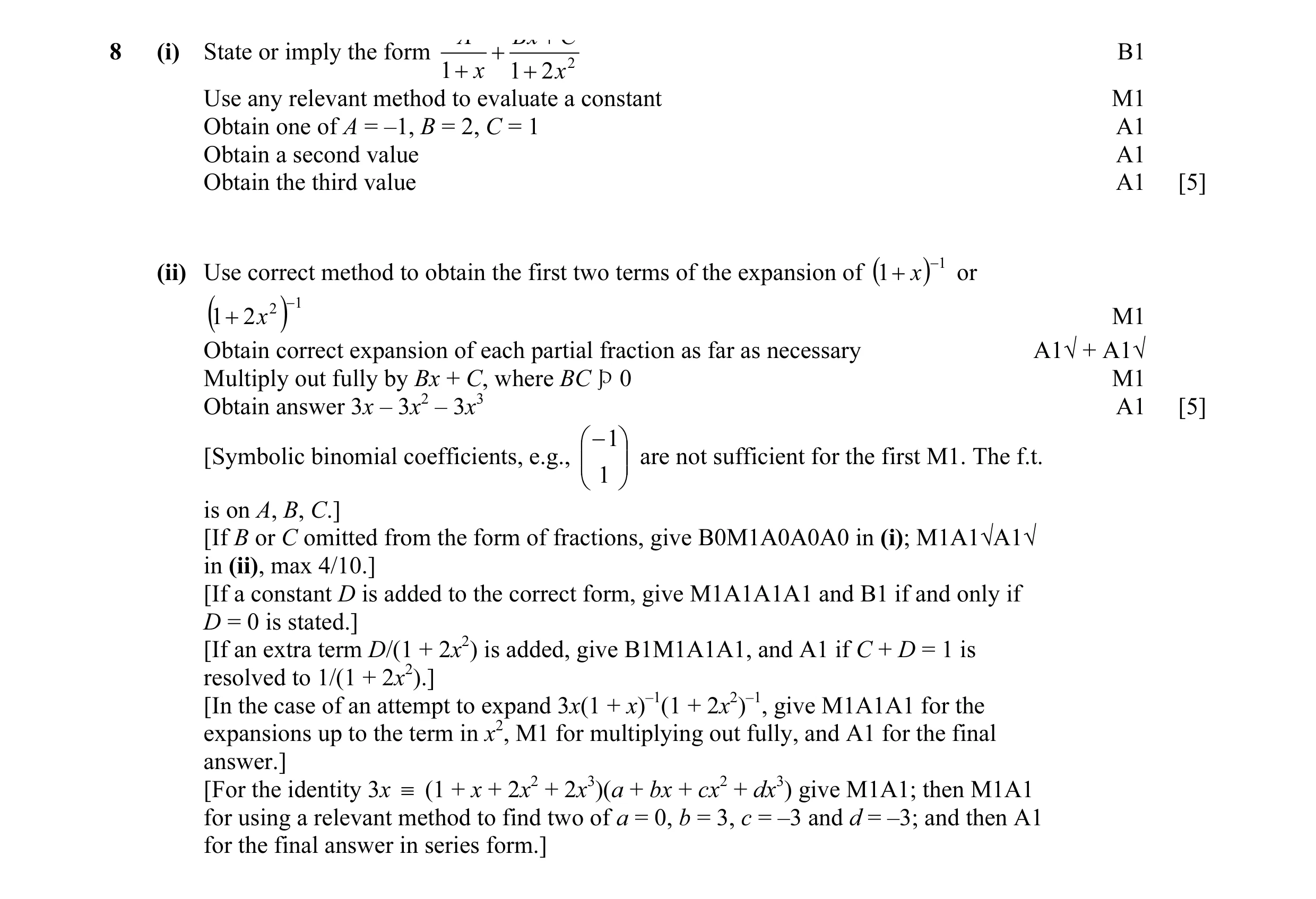 10
10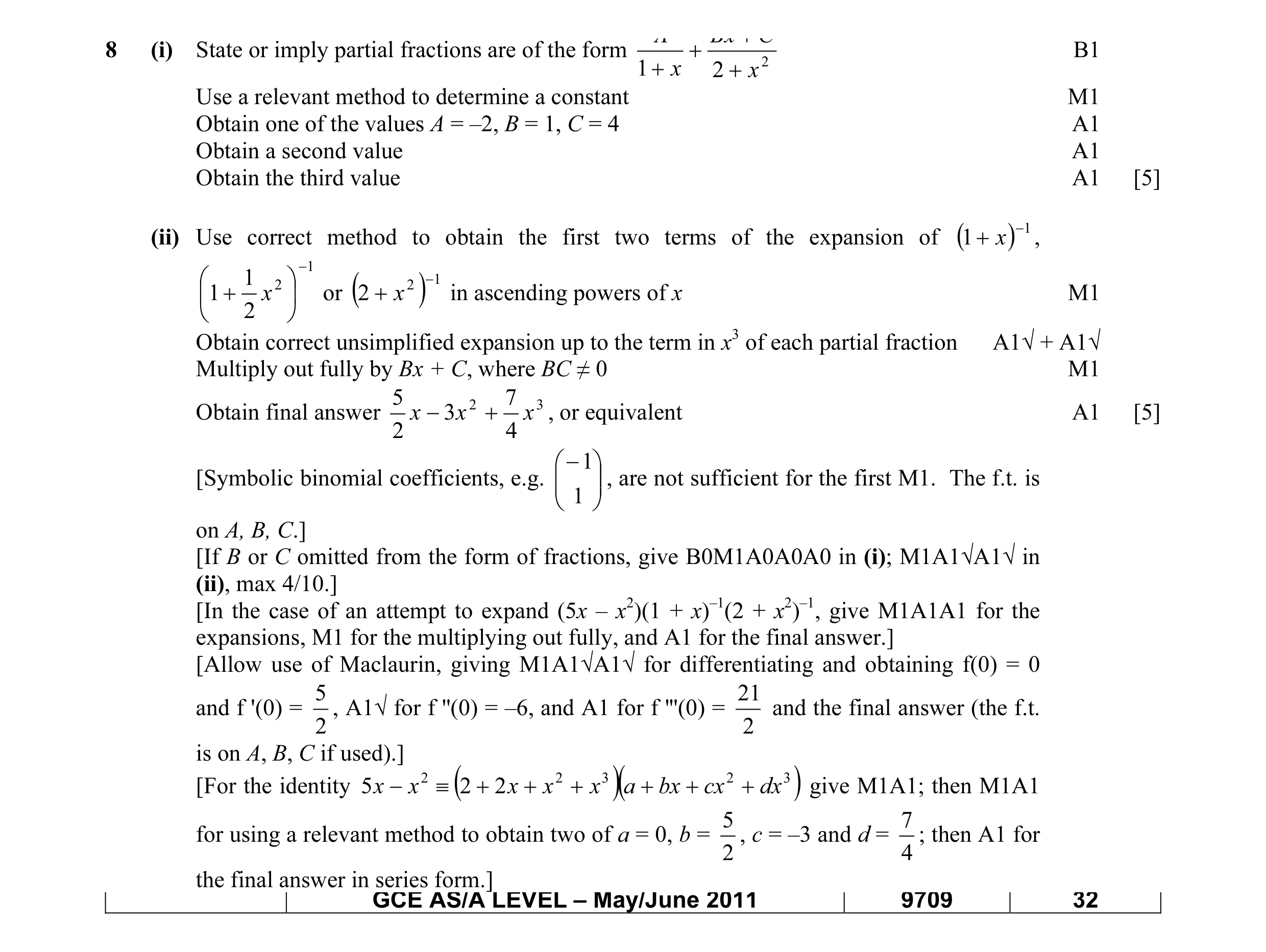 10
10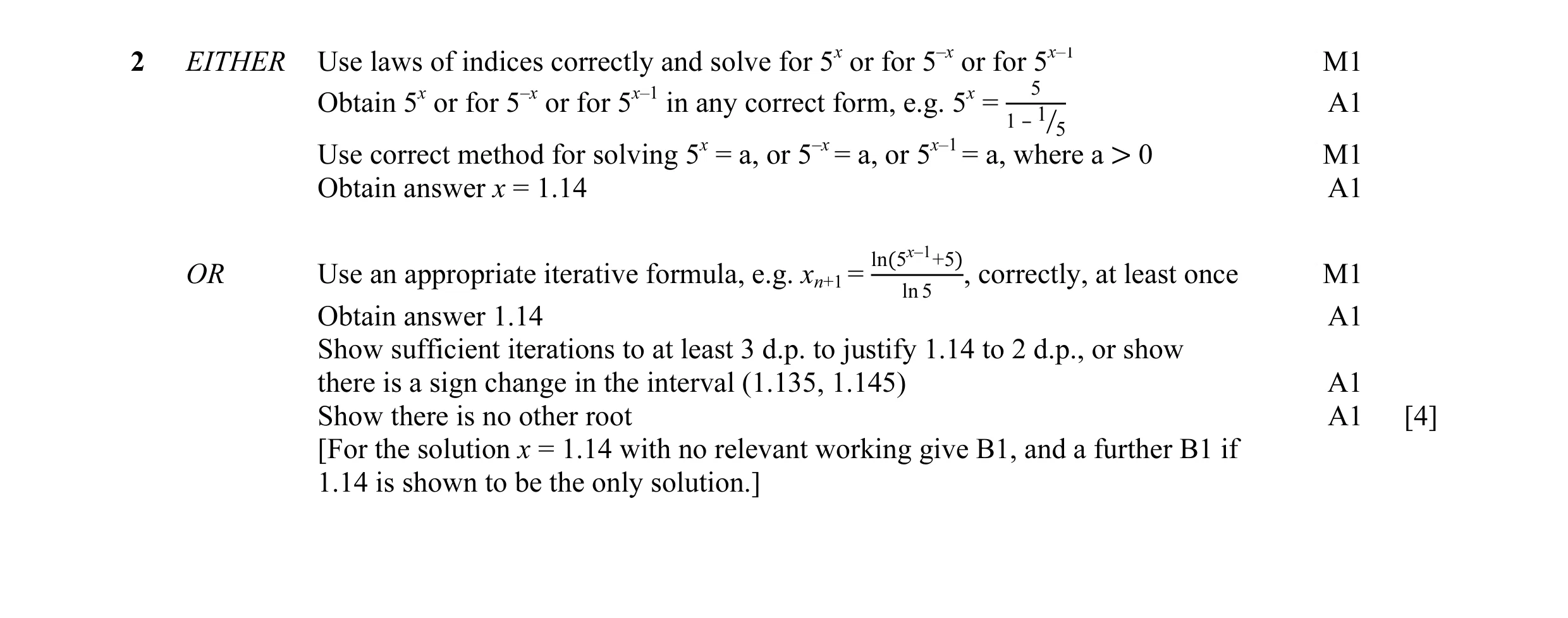 4
4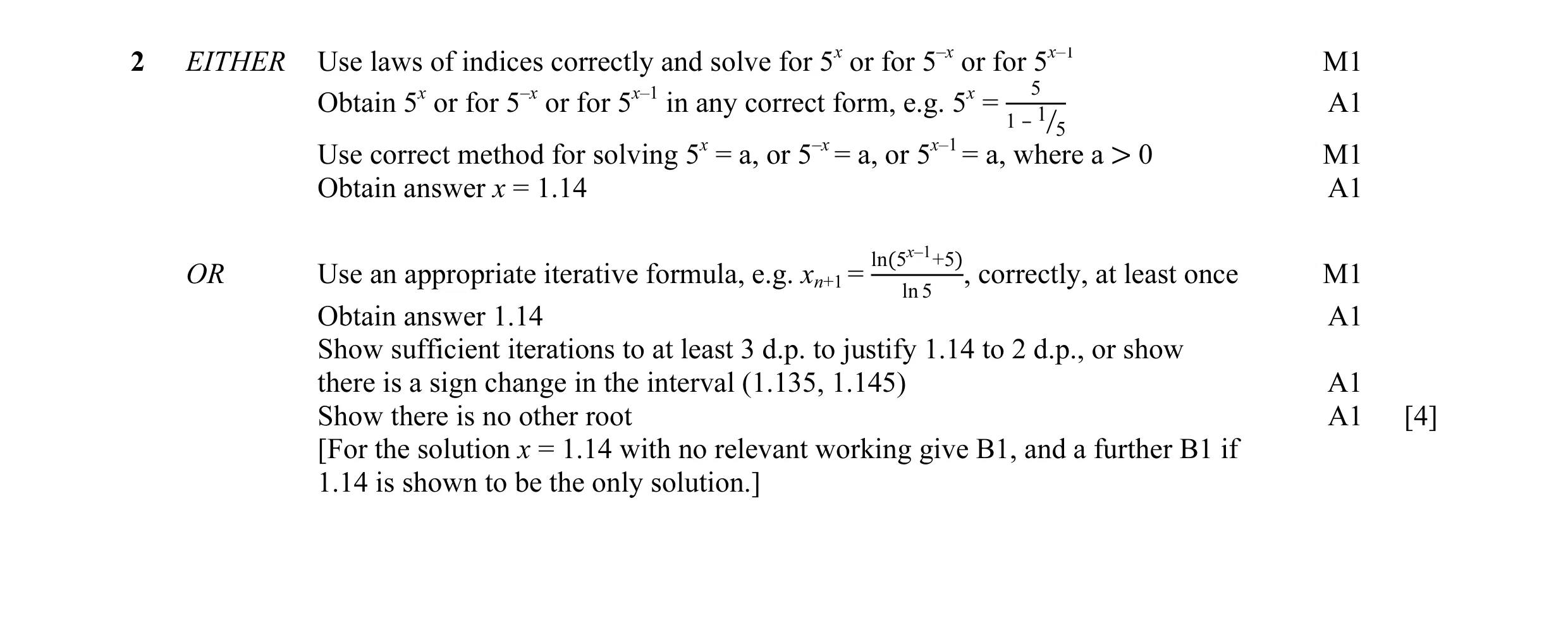 4
4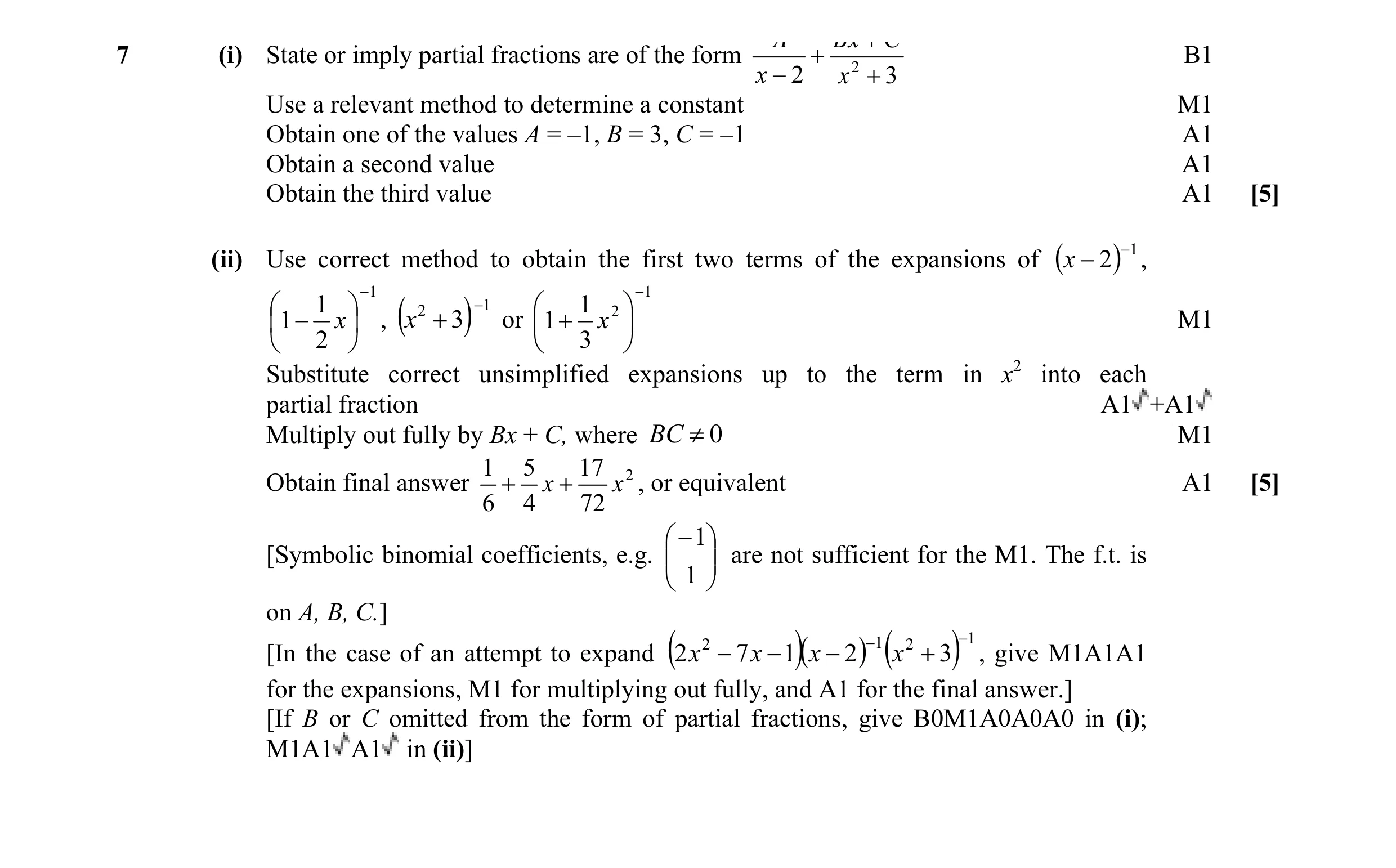 10
10 3
3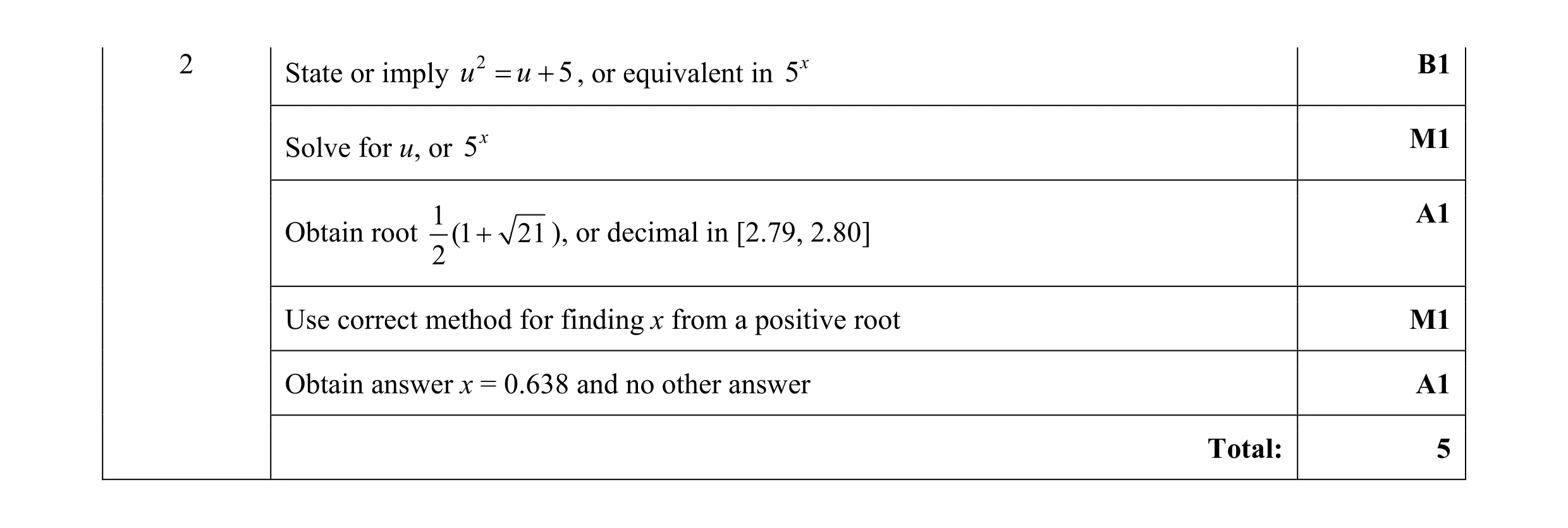 5
5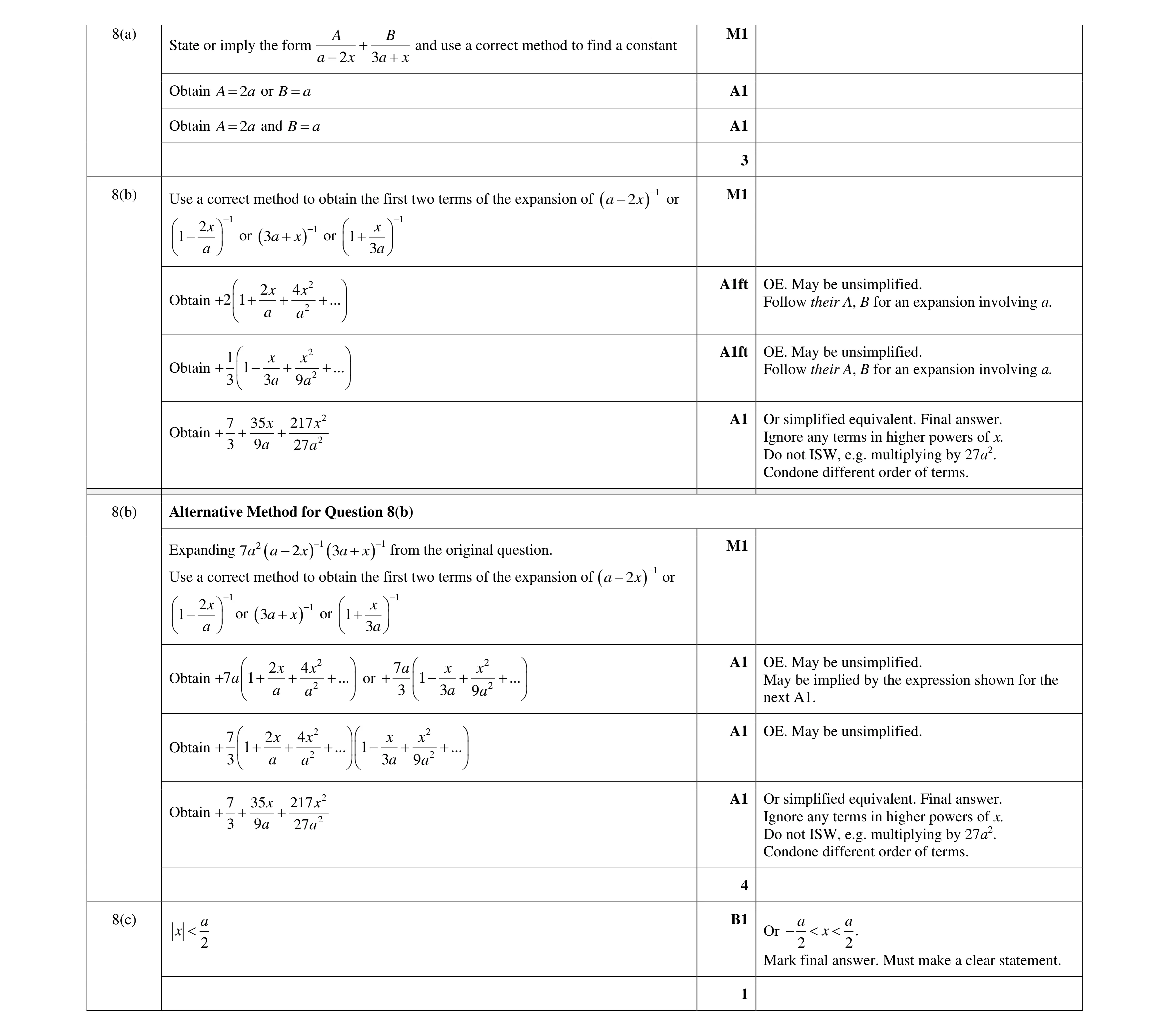 8
8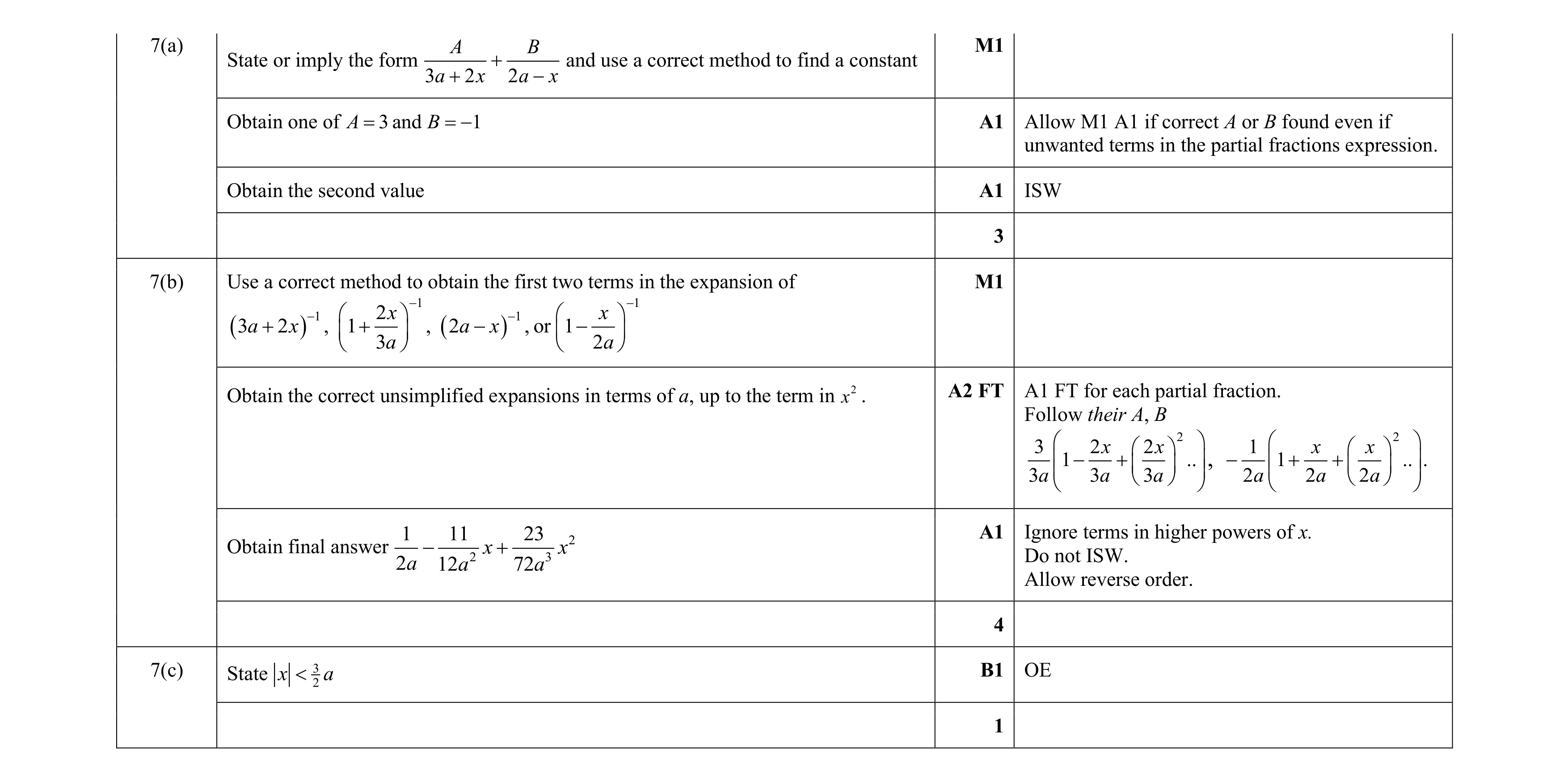 8
8