Cambridge A Level Marine Science 9693 — 2016 Oct/Nov Paper 3 · Variant 1
9693/31/O/N/16 · 75 marks · ≈84 min
The question paper and its mark scheme, free to read here and free to download. This is Cambridge’s own paper, exactly as it was sat.
Question paper20 pages
Mark scheme10 pages
Answers below. Sit the paper first if you are practising.
Paper as text
Question paper, page 1
This document consists of 18 printed pages and 2 blank pages. DC (KN/SW) 113369/2 © UCLES 2016 [Turn over Cambridge International Examinations Cambridge International Advanced Subsidiary and Advanced Level * 5 0 4 1 0 8 7 9 4 7 * MARINE SCIENCE 9693/03 Paper 3 A2 Structured Questions October/November 2016 1 hour 30 minutes Candidates answer on the Question Paper. No Additional Materials are required. READ THESE INSTRUCTIONS FIRST Write your Centre number, candidate number and name on all the work you hand in. Write in dark blue or black pen. You may use an HB pencil for any diagrams or graphs. Do not use staples, paper clips, glue or correction fluid. DO NOT WRITE IN ANY BARCODES. Answer all questions. Write your answers in the spaces provided on the Question Paper. Electronic calculators may be used. You may lose marks if you do not show your working or if you do not use appropriate units. At the end of the examination, fasten all your work securely together. The number of marks is given in brackets [ ] at the end of each question or part question.
Question paper, page 2
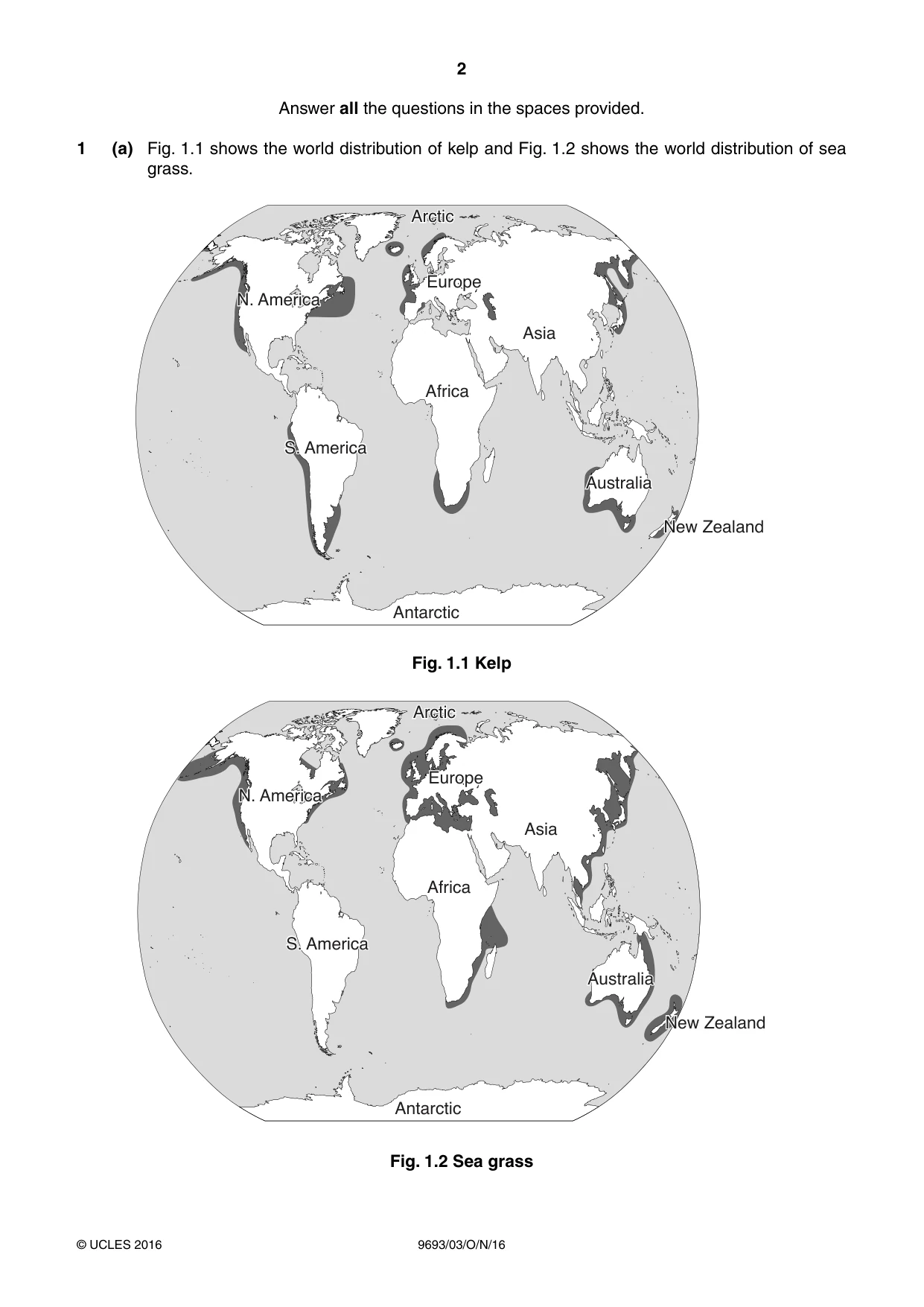
2 9693/03/O/N/16 © UCLES 2016 Answer all the questions in the spaces provided. 1 (a) Fig. 1.1 shows the world distribution of kelp and Fig. 1.2 shows the world distribution of sea grass. Arctic N. America S. America Africa Europe Australia New Zealand Asia Arctic N. America S. America Africa Europe Australia New Zealand Antarctic Asia Fig. 1.1 Kelp Arctic N. America S. America Africa Europe Australia New Zealand Asia Arctic N. America S. America Africa Europe Australia New Zealand Antarctic Asia Fig. 1.2 Sea grass
Question paper, page 3
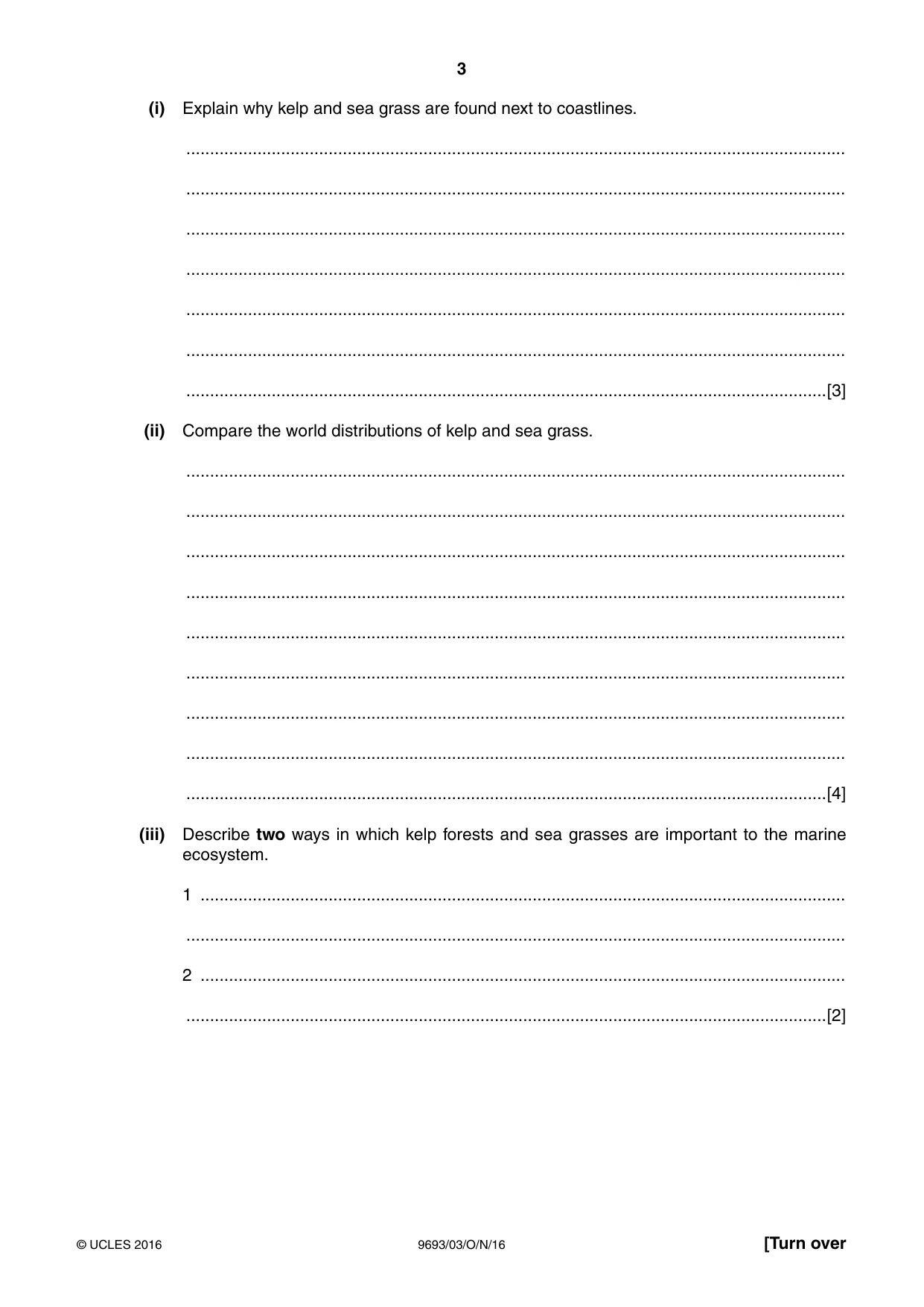
3 9693/03/O/N/16 © UCLES 2016 [Turn over (i) Explain why kelp and sea grass are found next to coastlines. … … … … … … …[3] (ii) Compare the world distributions of kelp and sea grass. … … … … … … … … …[4] (iii) Describe two ways in which kelp forests and sea grasses are important to the marine ecosystem. 1 … … 2 … …[2]
Question paper, page 4
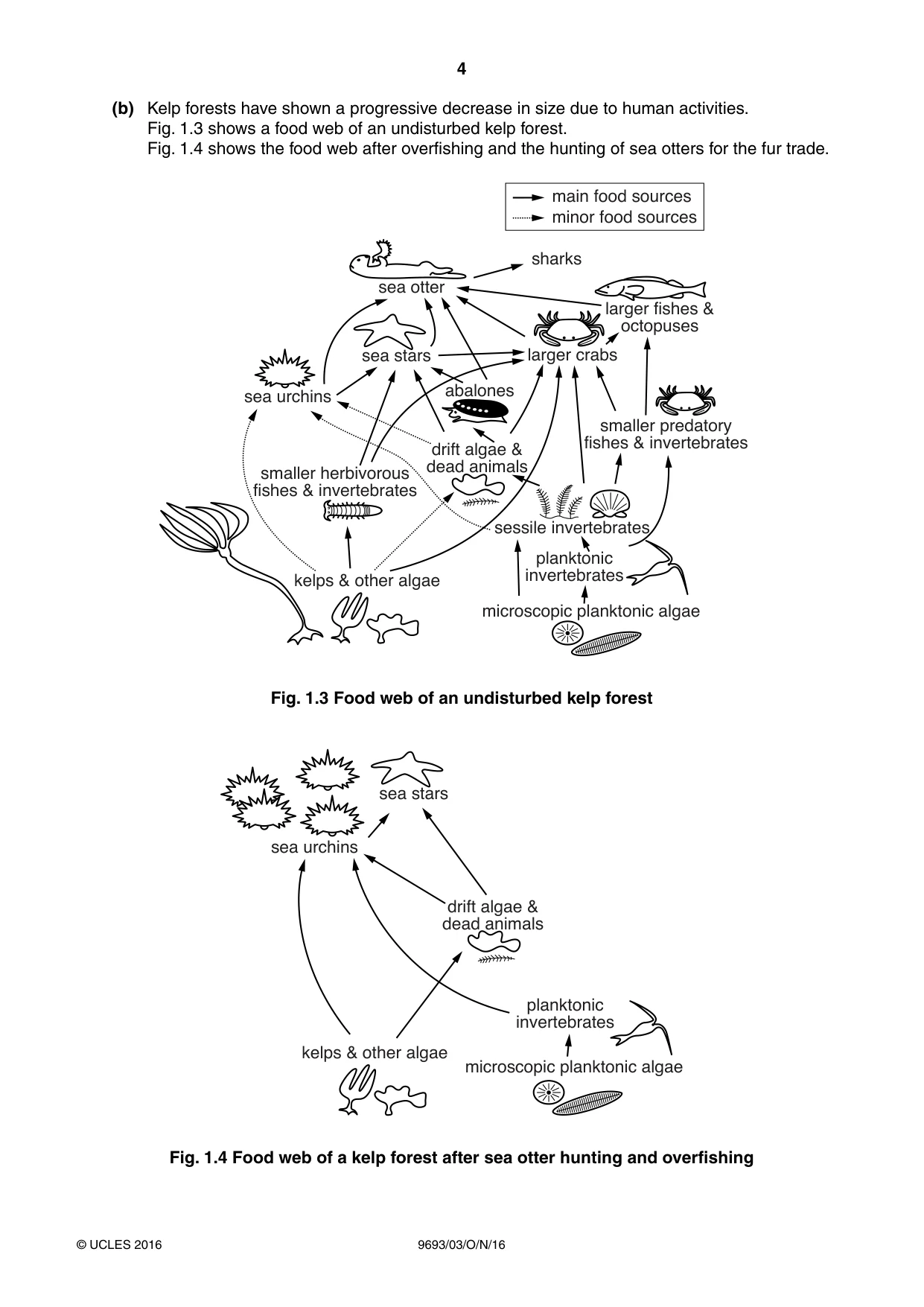
4 9693/03/O/N/16 © UCLES 2016 (b) Kelp forests have shown a progressive decrease in size due to human activities. Fig. 1.3 shows a food web of an undisturbed kelp forest. Fig. 1.4 shows the food web after overfishing and the hunting of sea otters for the fur trade. sea otter sharks main food sources minor food sources larger fishes & octopuses larger crabs smaller predatory fishes & invertebrates sea stars sea urchins kelps & other algae smaller herbivorous fishes & invertebrates abalones drift algae & dead animals sessile invertebrates planktonic invertebrates microscopic planktonic algae Fig. 1.3 Food web of an undisturbed kelp forest sea stars sea urchins kelps & other algae drift algae & dead animals planktonic invertebrates microscopic planktonic algae Fig. 1.4 Food web of a kelp forest after sea otter hunting and overfishing
Question paper, page 5
5 9693/03/O/N/16 © UCLES 2016 [Turn over Explain how overfishing and hunting of the sea otters for the fur trade have led to these changes in the food web. … … … … … … … … …[4] [Total: 13]
Question paper, page 6
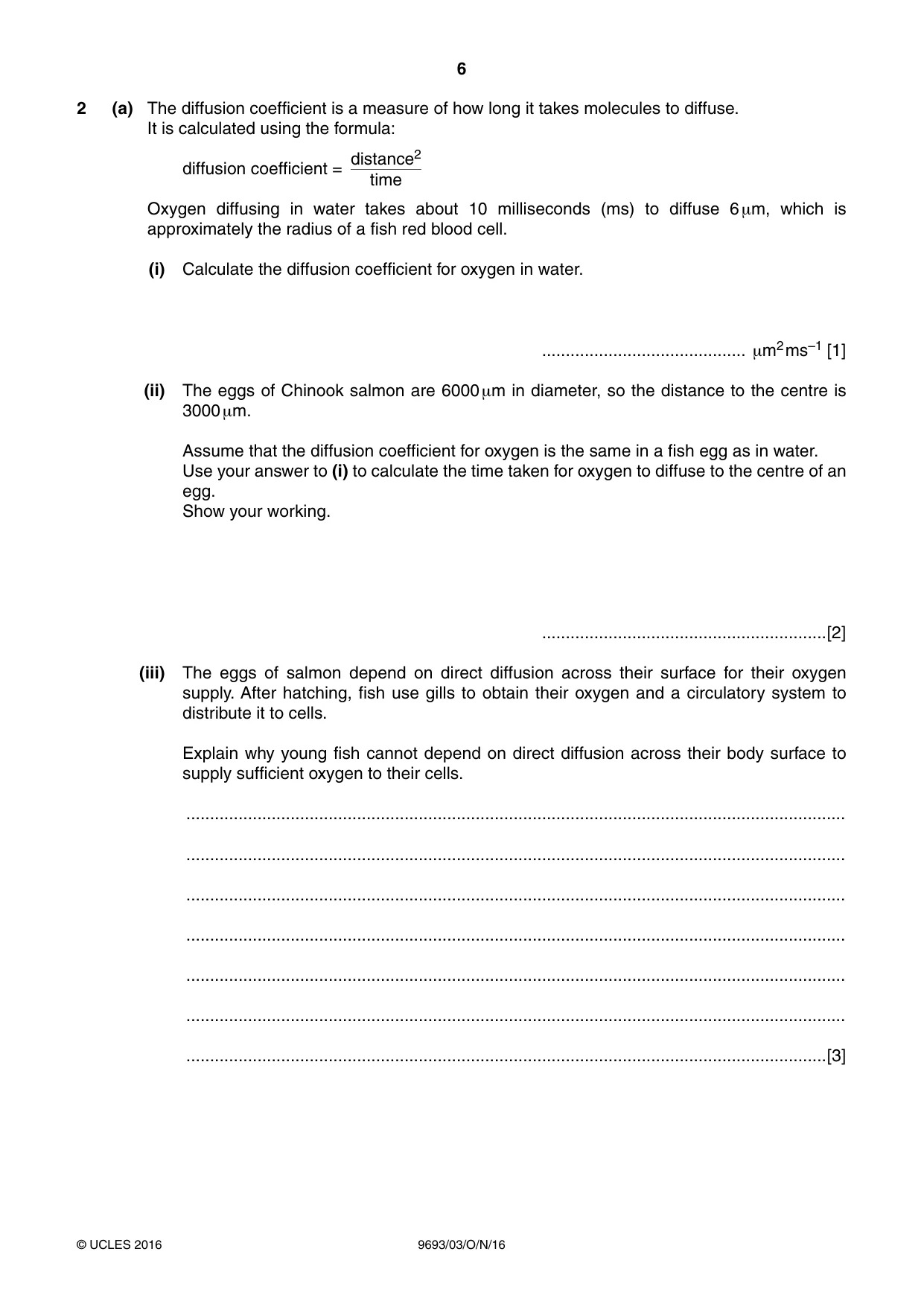
6 9693/03/O/N/16 © UCLES 2016 2 (a) The diffusion coefficient is a measure of how long it takes molecules to diffuse. It is calculated using the formula: diffusion coefficient = distance2 time Oxygen diffusing in water takes about 10 milliseconds (ms) to diffuse 6 μm, which is approximately the radius of a fish red blood cell. (i) Calculate the diffusion coefficient for oxygen in water. … μm2 ms–1 [1] (ii) The eggs of Chinook salmon are 6000 μm in diameter, so the distance to the centre is 3000 μm. Assume that the diffusion coefficient for oxygen is the same in a fish egg as in water. Use your answer to (i) to calculate the time taken for oxygen to diffuse to the centre of an egg. Show your working. …[2] (iii) The eggs of salmon depend on direct diffusion across their surface for their oxygen supply. After hatching, fish use gills to obtain their oxygen and a circulatory system to distribute it to cells. Explain why young fish cannot depend on direct diffusion across their body surface to supply sufficient oxygen to their cells. … … … … … … …[3]
Question paper, page 7
7 9693/03/O/N/16 © UCLES 2016 [Turn over (b) (i) Salmon swimming at low speeds use pumped ventilation. Describe how pumped ventilation causes water to move across the gills. … … … … … … … … …[4] (ii) When swimming at high speed salmon change from pumped ventilation to ram ventilation. Describe how this increases the rate of oxygen uptake by the salmon. … … …[1] [Total: 11]
Question paper, page 8
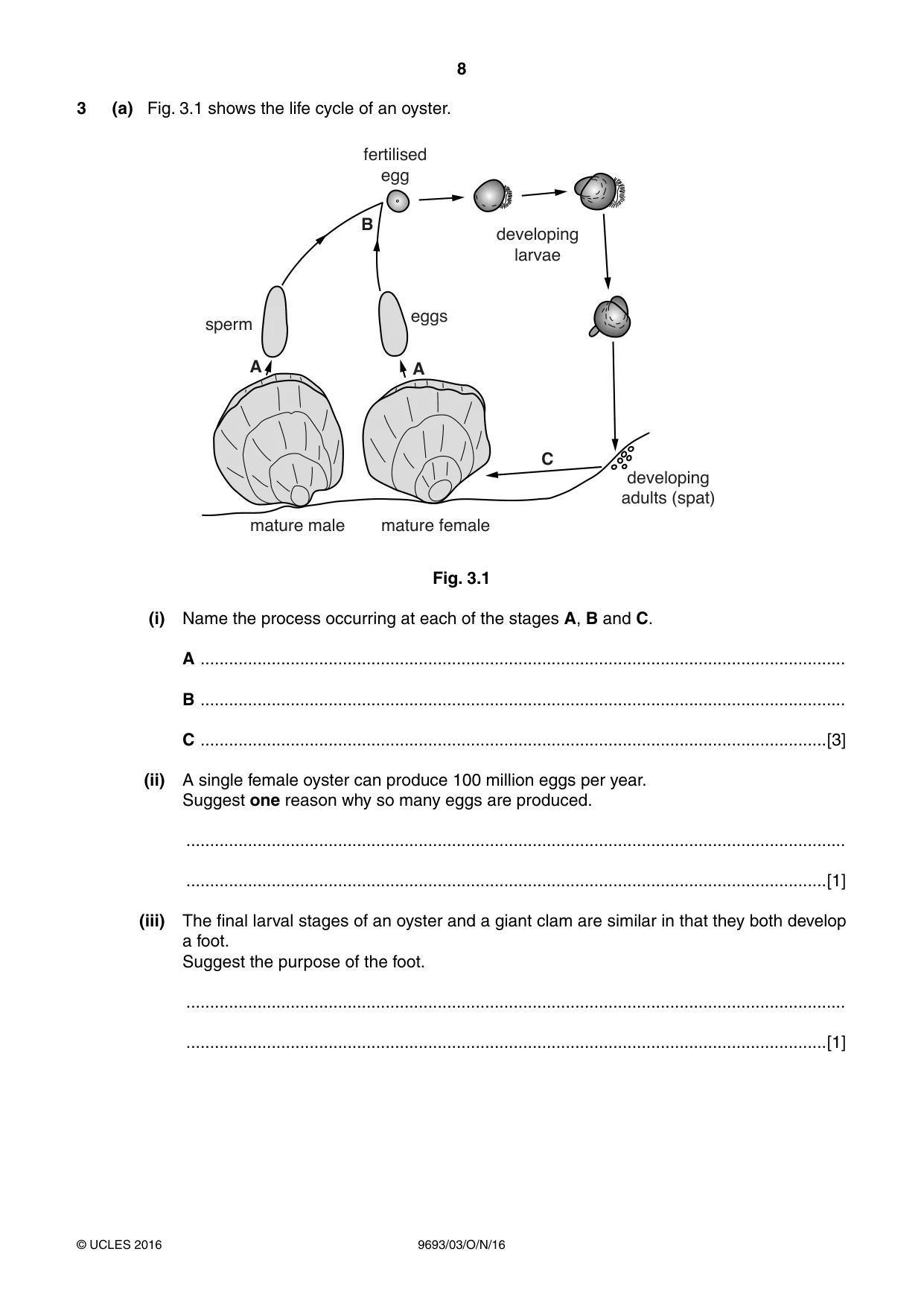
8 9693/03/O/N/16 © UCLES 2016 3 (a) Fig. 3.1 shows the life cycle of an oyster. eggs sperm developing larvae fertilised egg developing adults (spat) mature female C A A B mature male Fig. 3.1 (i) Name the process occurring at each of the stages A, B and C. A … B … C …[3] (ii) A single female oyster can produce 100 million eggs per year. Suggest one reason why so many eggs are produced. … …[1] (iii) The final larval stages of an oyster and a giant clam are similar in that they both develop a foot. Suggest the purpose of the foot. … …[1]
Question paper, page 9
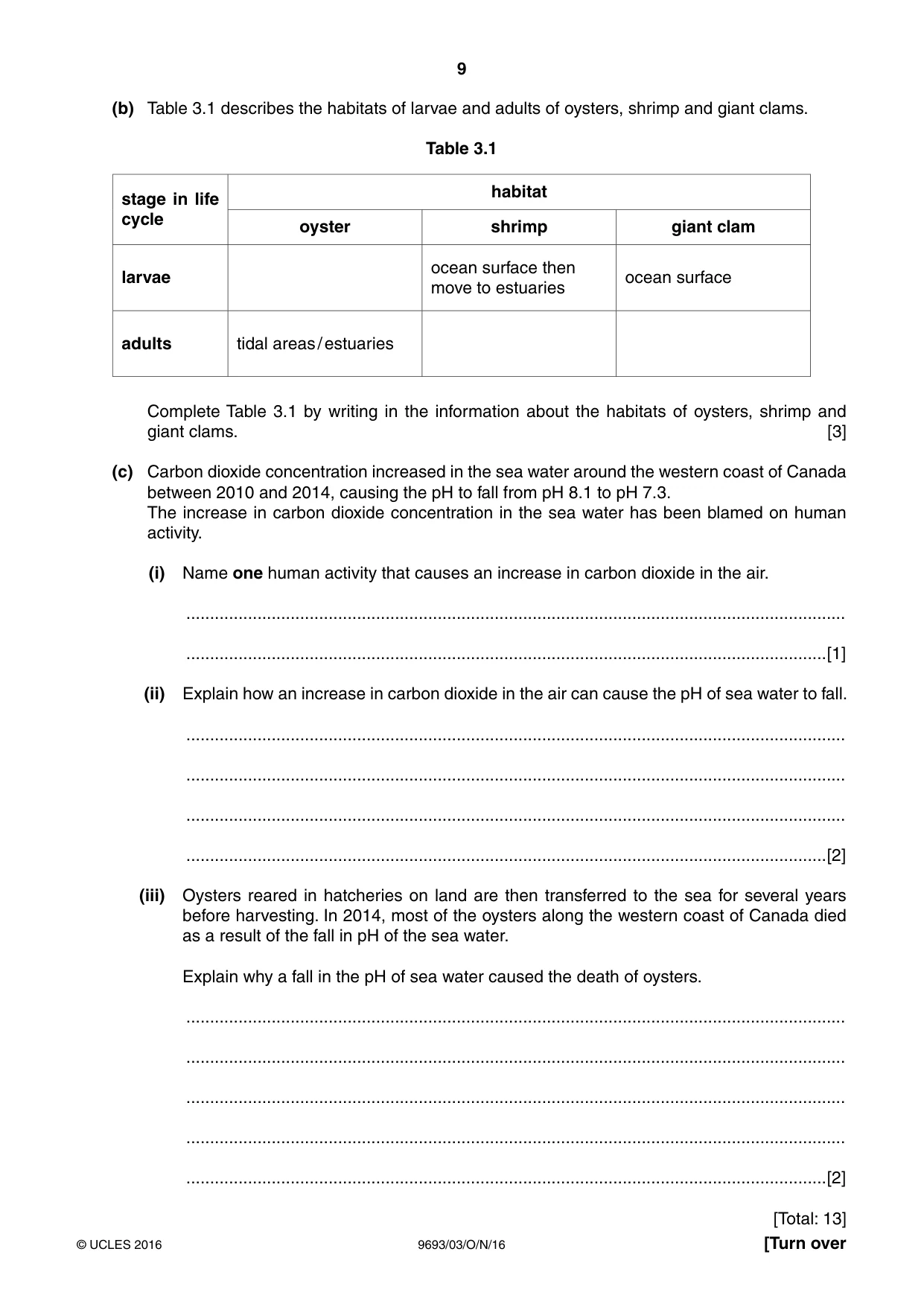
9 9693/03/O/N/16 © UCLES 2016 [Turn over (b) Table 3.1 describes the habitats of larvae and adults of oysters, shrimp and giant clams. Table 3.1 stage in life cycle habitat oyster shrimp giant clam larvae ocean surface then move to estuaries ocean surface adults tidal areas / estuaries Complete Table 3.1 by writing in the information about the habitats of oysters, shrimp and giant clams. [3] (c) Carbon dioxide concentration increased in the sea water around the western coast of Canada between 2010 and 2014, causing the pH to fall from pH 8.1 to pH 7.3. The increase in carbon dioxide concentration in the sea water has been blamed on human activity. (i) Name one human activity that causes an increase in carbon dioxide in the air. … …[1] (ii) Explain how an increase in carbon dioxide in the air can cause the pH of sea water to fall. … … … …[2] (iii) Oysters reared in hatcheries on land are then transferred to the sea for several years before harvesting. In 2014, most of the oysters along the western coast of Canada died as a result of the fall in pH of the sea water. Explain why a fall in the pH of sea water caused the death of oysters. … … … … …[2] [Total: 13]
Question paper, page 10
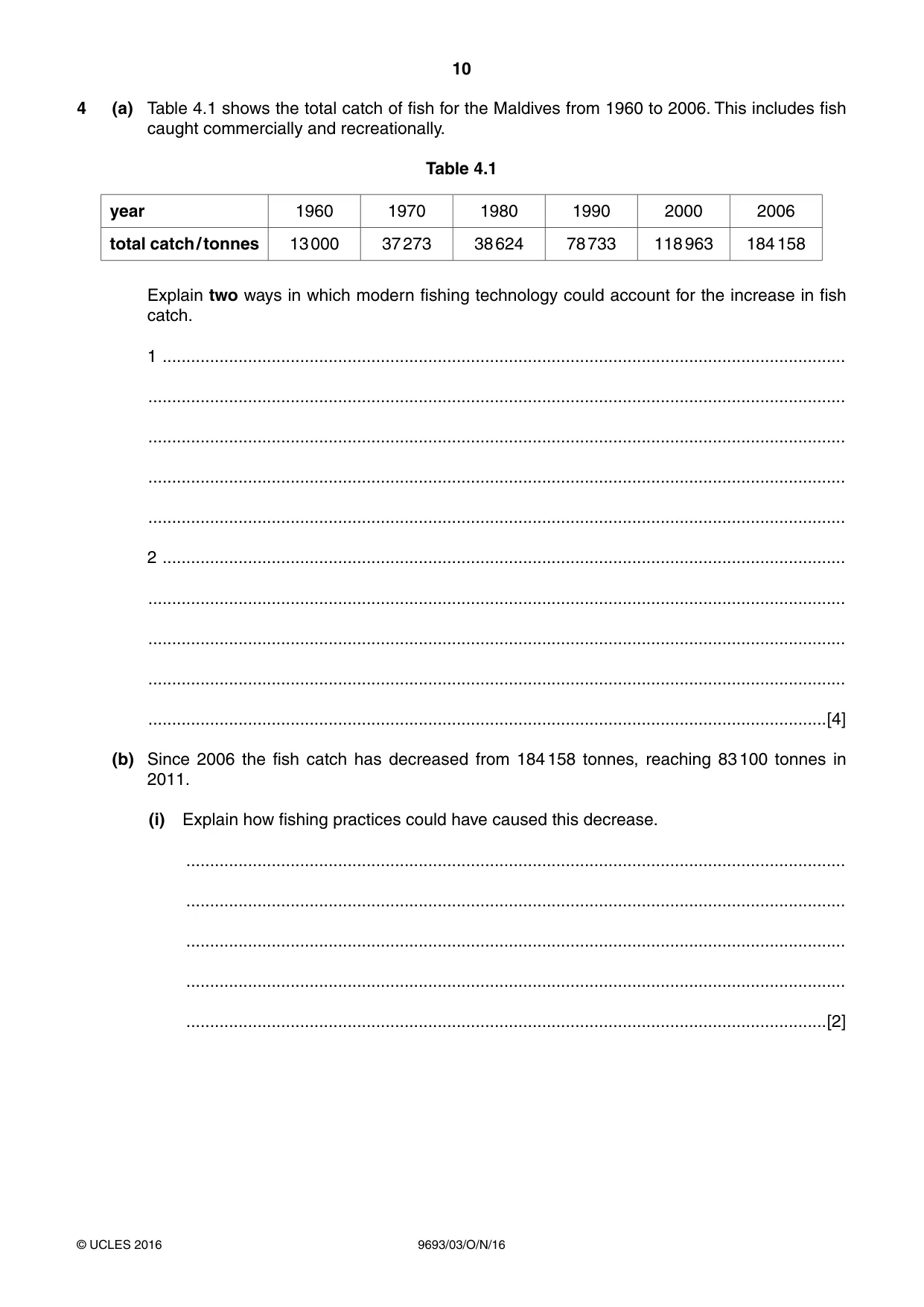
10 9693/03/O/N/16 © UCLES 2016 4 (a) Table 4.1 shows the total catch of fish for the Maldives from 1960 to 2006. This includes fish caught commercially and recreationally. Table 4.1 year 1960 1970 1980 1990 2000 2006 total catch / tonnes 13 000 37 273 38 624 78 733 118 963 184 158 Explain two ways in which modern fishing technology could account for the increase in fish catch. 1 … … … … … 2 … … … … …[4] (b) Since 2006 the fish catch has decreased from 184 158 tonnes, reaching 83 100 tonnes in 2011. (i) Explain how fishing practices could have caused this decrease. … … … … …[2]
Question paper, page 11
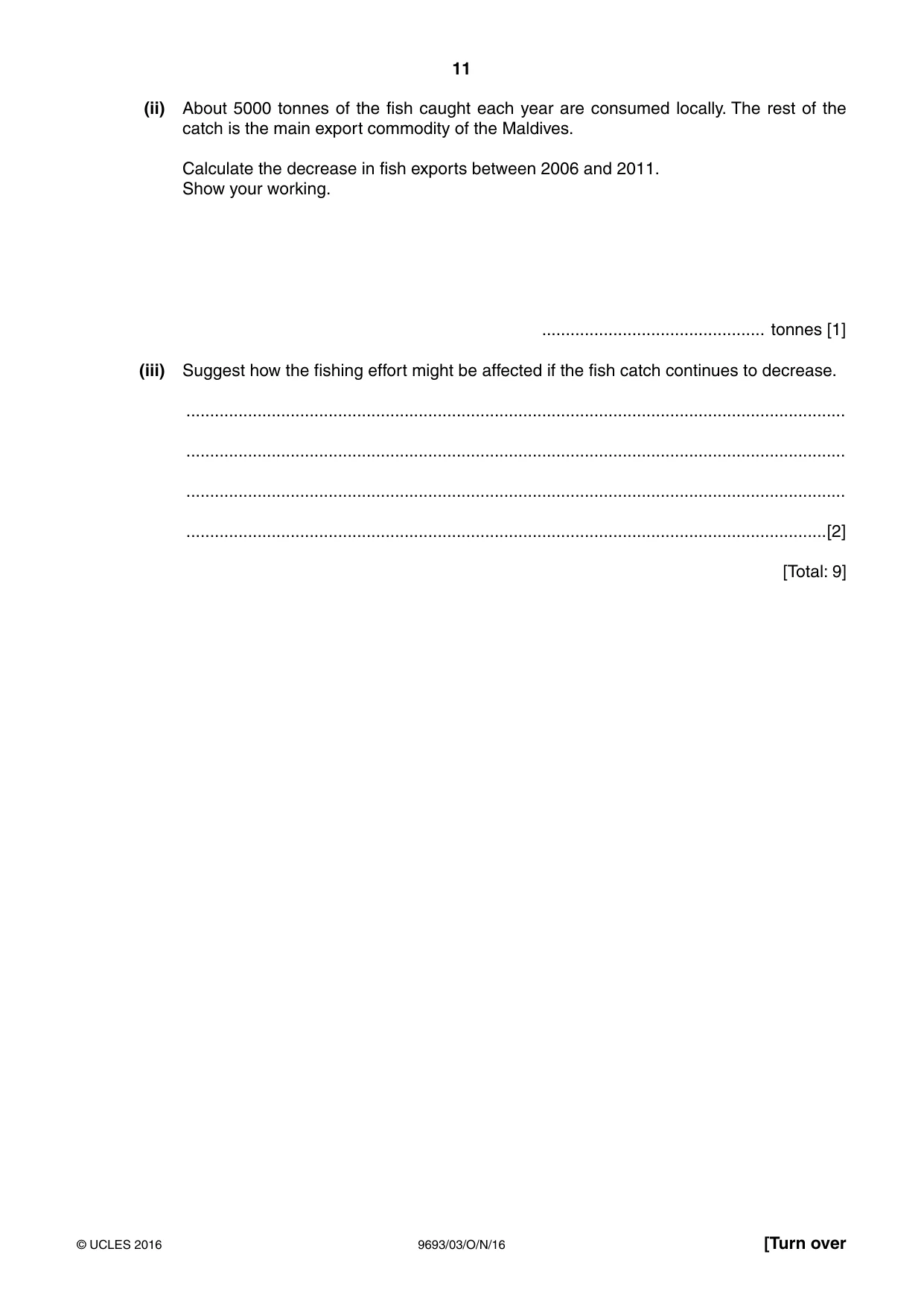
11 9693/03/O/N/16 © UCLES 2016 [Turn over (ii) About 5000 tonnes of the fish caught each year are consumed locally. The rest of the catch is the main export commodity of the Maldives. Calculate the decrease in fish exports between 2006 and 2011. Show your working. … tonnes [1] (iii) Suggest how the fishing effort might be affected if the fish catch continues to decrease. … … … …[2] [Total: 9]
Question paper, page 12
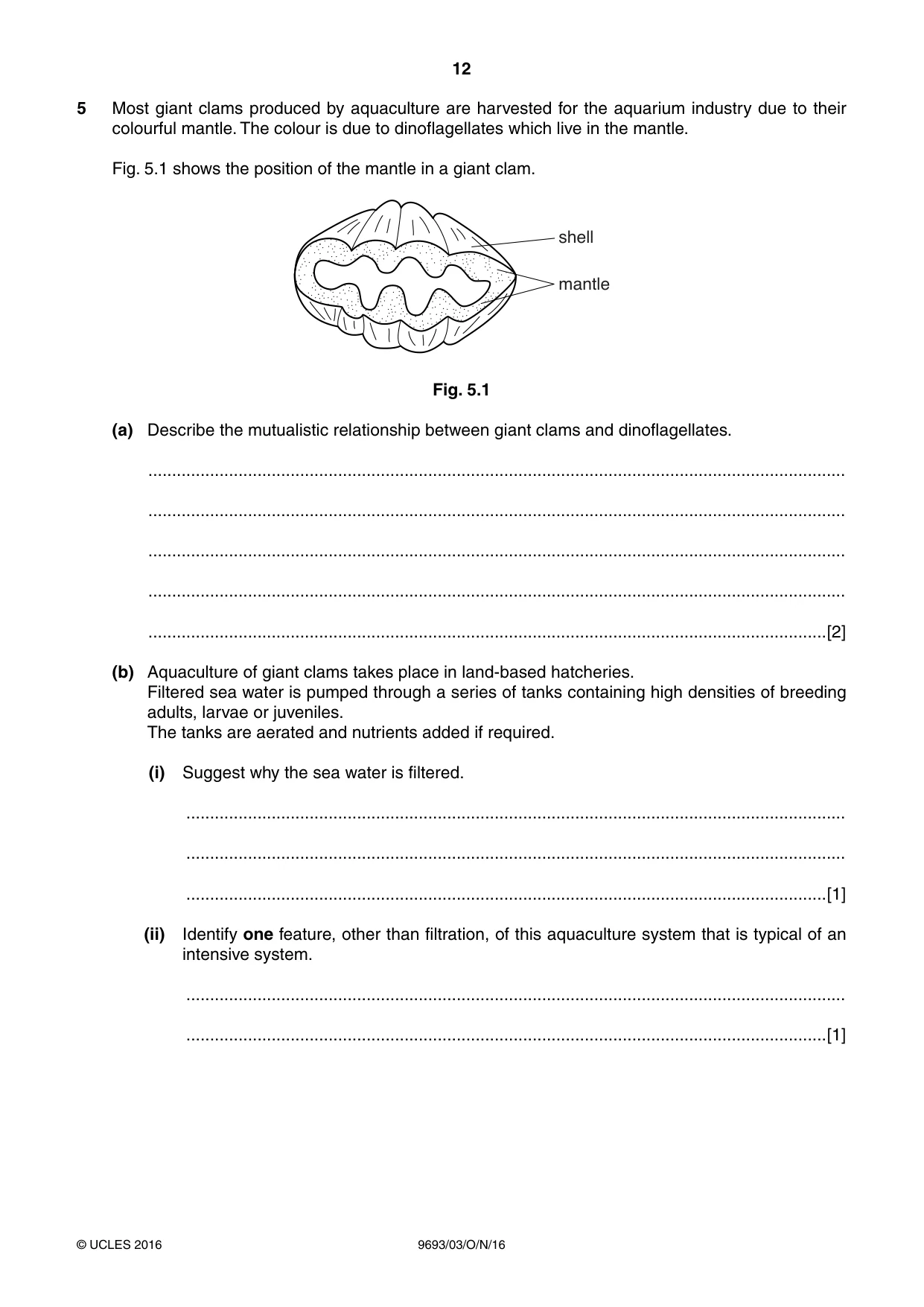
12 9693/03/O/N/16 © UCLES 2016 5 Most giant clams produced by aquaculture are harvested for the aquarium industry due to their colourful mantle. The colour is due to dinoflagellates which live in the mantle. Fig. 5.1 shows the position of the mantle in a giant clam. shell mantle Fig. 5.1 (a) Describe the mutualistic relationship between giant clams and dinoflagellates. … … … … …[2] (b) Aquaculture of giant clams takes place in land-based hatcheries. Filtered sea water is pumped through a series of tanks containing high densities of breeding adults, larvae or juveniles. The tanks are aerated and nutrients added if required. (i) Suggest why the sea water is filtered. … … …[1] (ii) Identify one feature, other than filtration, of this aquaculture system that is typical of an intensive system. … …[1]
Question paper, page 13
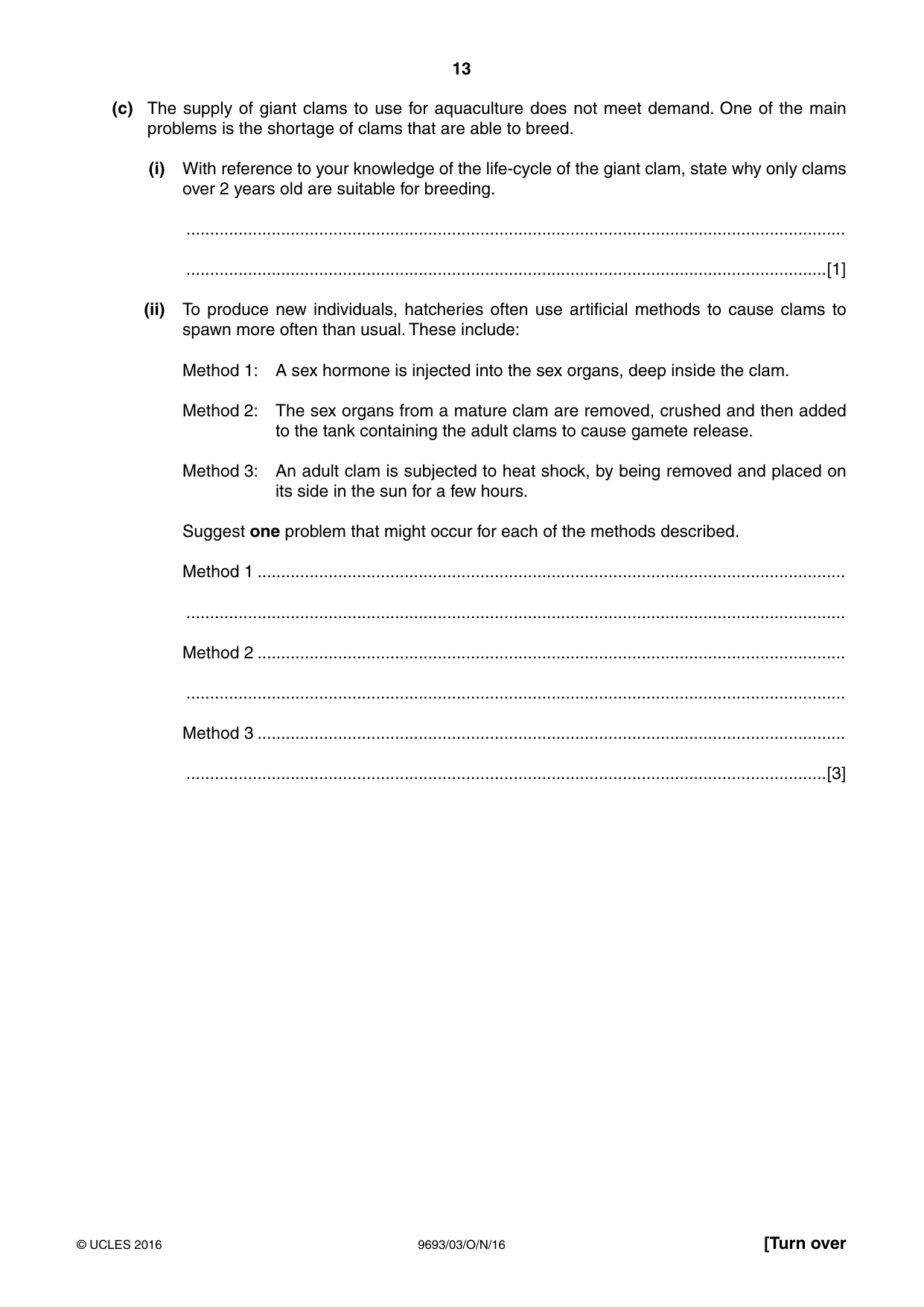
13 9693/03/O/N/16 © UCLES 2016 [Turn over (c) The supply of giant clams to use for aquaculture does not meet demand. One of the main problems is the shortage of clams that are able to breed. (i) With reference to your knowledge of the life-cycle of the giant clam, state why only clams over 2 years old are suitable for breeding. … …[1] (ii) To produce new individuals, hatcheries often use artificial methods to cause clams to spawn more often than usual. These include: Method 1: A sex hormone is injected into the sex organs, deep inside the clam. Method 2: The sex organs from a mature clam are removed, crushed and then added to the tank containing the adult clams to cause gamete release. Method 3: An adult clam is subjected to heat shock, by being removed and placed on its side in the sun for a few hours. Suggest one problem that might occur for each of the methods described. Method 1 … … Method 2 … … Method 3 … …[3]
Question paper, page 14
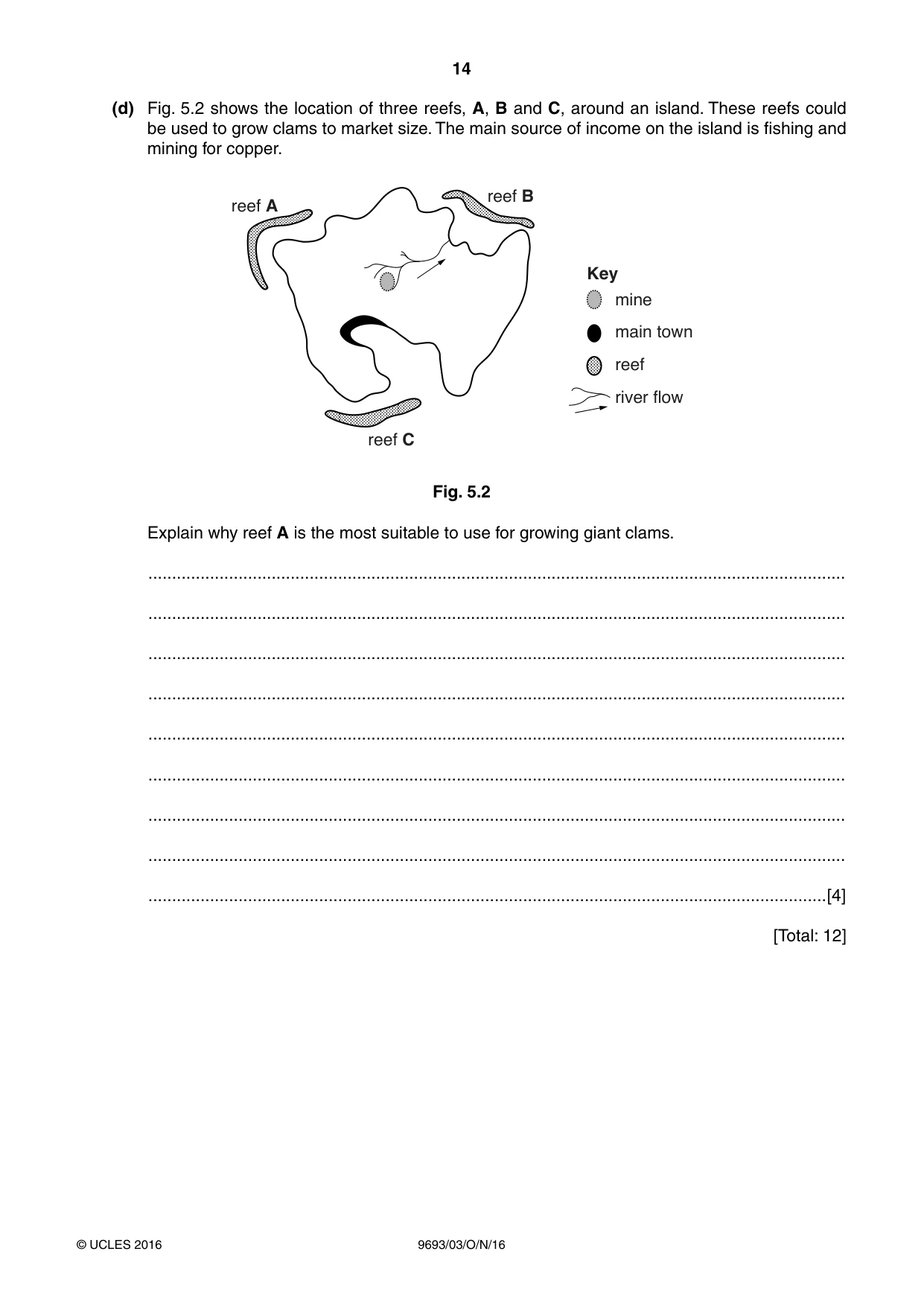
14 9693/03/O/N/16 © UCLES 2016 (d) Fig. 5.2 shows the location of three reefs, A, B and C, around an island. These reefs could be used to grow clams to market size. The main source of income on the island is fishing and mining for copper. mine main town reef river flow reef C reef A reef B Key Fig. 5.2 Explain why reef A is the most suitable to use for growing giant clams. … … … … … … … … …[4] [Total: 12]
Question paper, page 15
15 9693/03/O/N/16 © UCLES 2016 [Turn over Question 6 starts on Page 16
Question paper, page 16
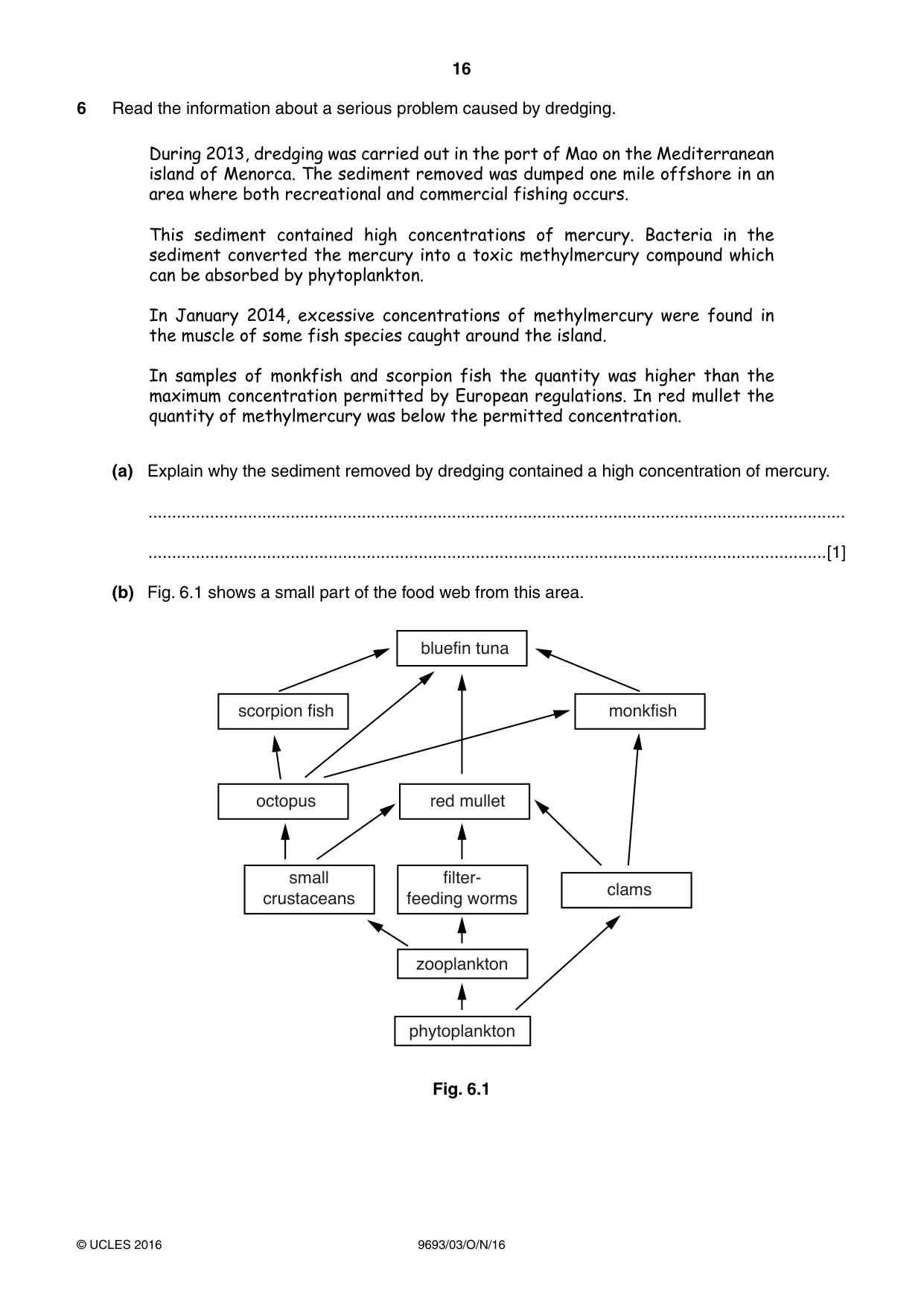
16 9693/03/O/N/16 © UCLES 2016 6 Read the information about a serious problem caused by dredging. During 2013, dredging was carried out in the port of Mao on the Mediterranean island of Menorca. The sediment removed was dumped one mile offshore in an area where both recreational and commercial fishing occurs. This sediment contained high concentrations of mercury. Bacteria in the sediment converted the mercury into a toxic methylmercury compound which can be absorbed by phytoplankton. In January 2014, excessive concentrations of methylmercury were found in the muscle of some fish species caught around the island. In samples of monkfish and scorpion fish the quantity was higher than the maximum concentration permitted by European regulations. In red mullet the quantity of methylmercury was below the permitted concentration. (a) Explain why the sediment removed by dredging contained a high concentration of mercury. … …[1] (b) Fig. 6.1 shows a small part of the food web from this area. bluefin tuna scorpion fish monkfish octopus small crustaceans filter- feeding worms zooplankton phytoplankton red mullet clams Fig. 6.1
Question paper, page 17
17 9693/03/O/N/16 © UCLES 2016 [Turn over (i) With reference to Fig. 6.1, explain why monkfish and scorpion fish contain a higher concentration of methylmercury than red mullet. … … … …[2] (ii) Identify a consumer in Fig. 6.1 that you would expect to have a similar concentration of methylmercury to the small crustaceans. Give a reason for your answer. name of consumer … reason … …[2] (iii) Explain why pregnant women should avoid eating too much bluefin tuna caught from this area. … … … …[2] (c) The dumped material from dredging contains small particles of silt which become suspended in the sea water. Explain how the suspended silt in sea water could affect the population of zooplankton. … … … … … …[3] (d) Suggest one way in which the dredged material could be disposed of without harming the environment. … …[1] [Total: 11]
Question paper, page 18
18 9693/03/O/N/16 © UCLES 2016 7 (a) One definition of ecotourism is: Responsible travel to natural areas that conserves the environment and improves the well- being of local people. Whale watching along migration routes is a popular ecotourism activity. Tourists often observe whales from boats close to the migration route. Some boats travel to observation areas and anchor for several hours waiting for whales to swim by. (i) Suggest and explain two ways in which companies that organise the whale watching can minimise the impact of ecotourism from these boats. 1 … … … … … 2 … … … … …[4] (ii) Suggest two ways in which whale watching could improve the well-being of local people. 1 … … … 2 … … …[2] [Total: 6]
Question paper, page 19
19 9693/03/O/N/16 © UCLES 2016 BLANK PAGE
Question paper, page 20
20 9693/03/O/N/16 © UCLES 2016 Permission to reproduce items where third-party owned material protected by copyright is included has been sought and cleared where possible. Every reasonable effort has been made by the publisher (UCLES) to trace copyright holders, but if any items requiring clearance have unwittingly been included, the publisher will be pleased to make amends at the earliest possible opportunity. To avoid the issue of disclosure of answer-related information to candidates, all copyright acknowledgements are reproduced online in the Cambridge International Examinations Copyright Acknowledgements Booklet. This is produced for each series of examinations and is freely available to download at www.cie.org.uk after the live examination series. Cambridge International Examinations is part of the Cambridge Assessment Group. Cambridge Assessment is the brand name of University of Cambridge Local Examinations Syndicate (UCLES), which is itself a department of the University of Cambridge. BLANK PAGE
Mark scheme, page 1
® IGCSE is the registered trademark of Cambridge International Examinations. This document consists of 10 printed pages. © UCLES 2016 [Turn over Cambridge International Examinations Cambridge International Advanced Subsidiary and Advanced Level MARINE SCIENCE 9693/03 Paper 3 A2 Structured Questions October/November 2016 MARK SCHEME Maximum Mark: 75 Published This mark scheme is published as an aid to teachers and candidates, to indicate the requirements of the examination. It shows the basis on which Examiners were instructed to award marks. It does not indicate the details of the discussions that took place at an Examiners’ meeting before marking began, which would have considered the acceptability of alternative answers. Mark schemes should be read in conjunction with the question paper and the Principal Examiner Report for Teachers. Cambridge will not enter into discussions about these mark schemes. Cambridge is publishing the mark schemes for the October/November 2016 series for most Cambridge IGCSE®, Cambridge International A and AS Level components and some Cambridge O Level components.
Mark scheme, page 2
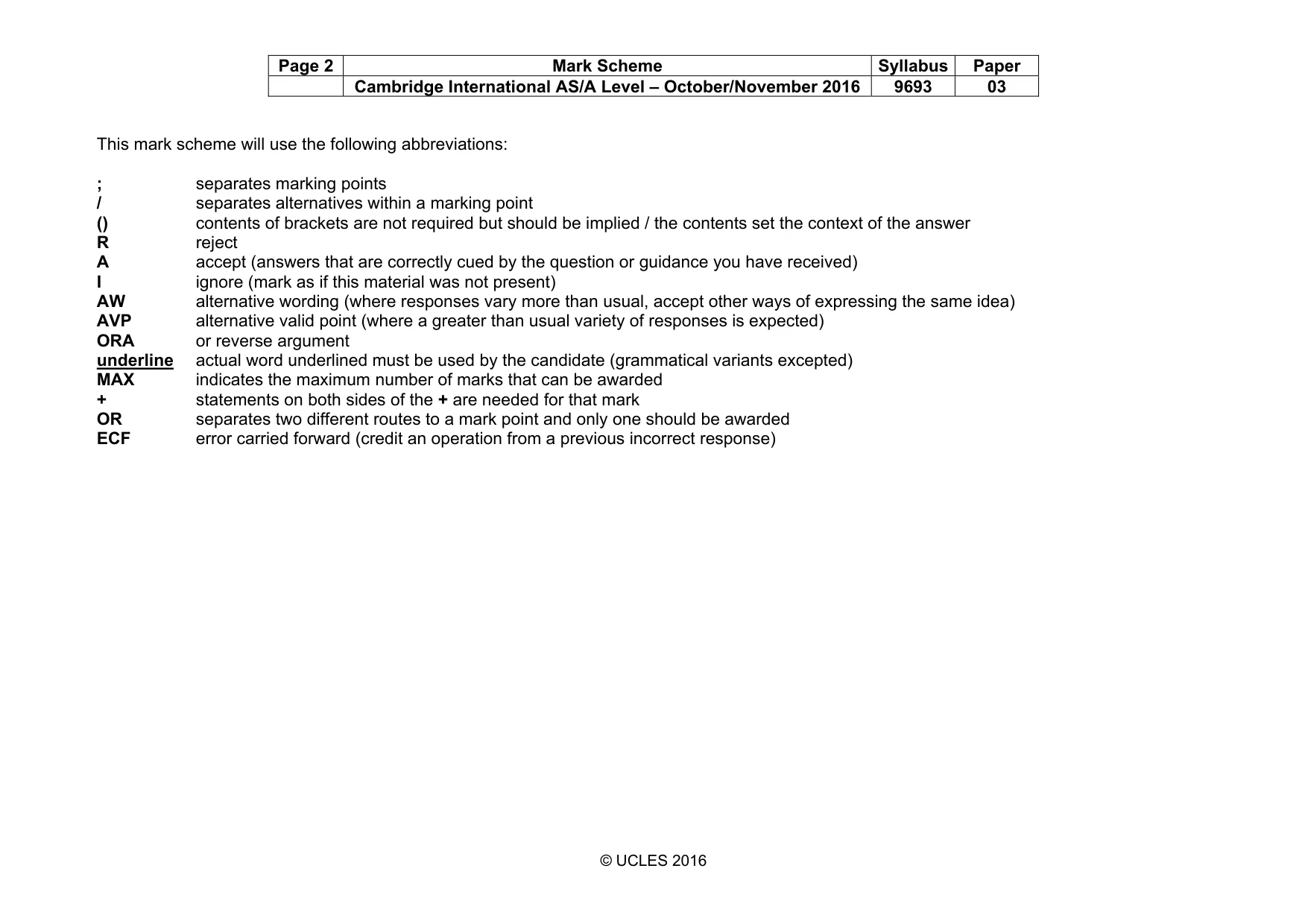
Page 2 Mark Scheme Syllabus Paper Cambridge International AS/A Level – October/November 2016 9693 03 © UCLES 2016 This mark scheme will use the following abbreviations: ; separates marking points / separates alternatives within a marking point () contents of brackets are not required but should be implied / the contents set the context of the answer R reject A accept (answers that are correctly cued by the question or guidance you have received) I ignore (mark as if this material was not present) AW alternative wording (where responses vary more than usual, accept other ways of expressing the same idea) AVP alternative valid point (where a greater than usual variety of responses is expected) ORA or reverse argument underline actual word underlined must be used by the candidate (grammatical variants excepted) MAX indicates the maximum number of marks that can be awarded + statements on both sides of the + are needed for that mark OR separates two different routes to a mark point and only one should be awarded ECF error carried forward (credit an operation from a previous incorrect response)
Mark scheme, page 3
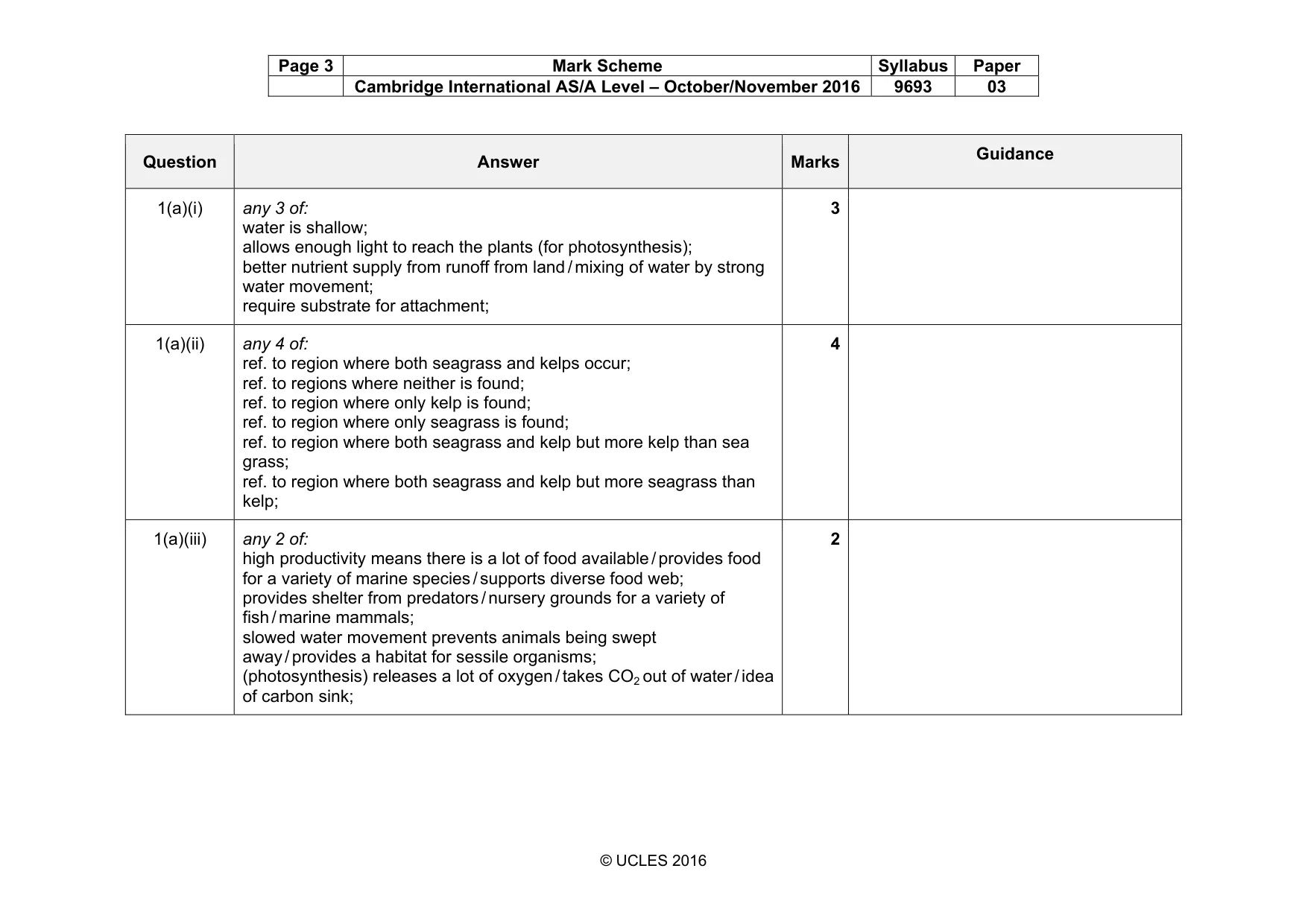
Page 3 Mark Scheme Syllabus Paper Cambridge International AS/A Level – October/November 2016 9693 03 © UCLES 2016 Question Answer Marks Guidance 1(a)(i) any 3 of: water is shallow; allows enough light to reach the plants (for photosynthesis); better nutrient supply from runoff from land / mixing of water by strong water movement; require substrate for attachment; 3 1(a)(ii) any 4 of: ref. to region where both seagrass and kelps occur; ref. to regions where neither is found; ref. to region where only kelp is found; ref. to region where only seagrass is found; ref. to region where both seagrass and kelp but more kelp than sea grass; ref. to region where both seagrass and kelp but more seagrass than kelp; 4 1(a)(iii) any 2 of: high productivity means there is a lot of food available / provides food for a variety of marine species / supports diverse food web; provides shelter from predators / nursery grounds for a variety of fish / marine mammals; slowed water movement prevents animals being swept away / provides a habitat for sessile organisms; (photosynthesis) releases a lot of oxygen / takes CO2 out of water / idea of carbon sink; 2
Mark scheme, page 4
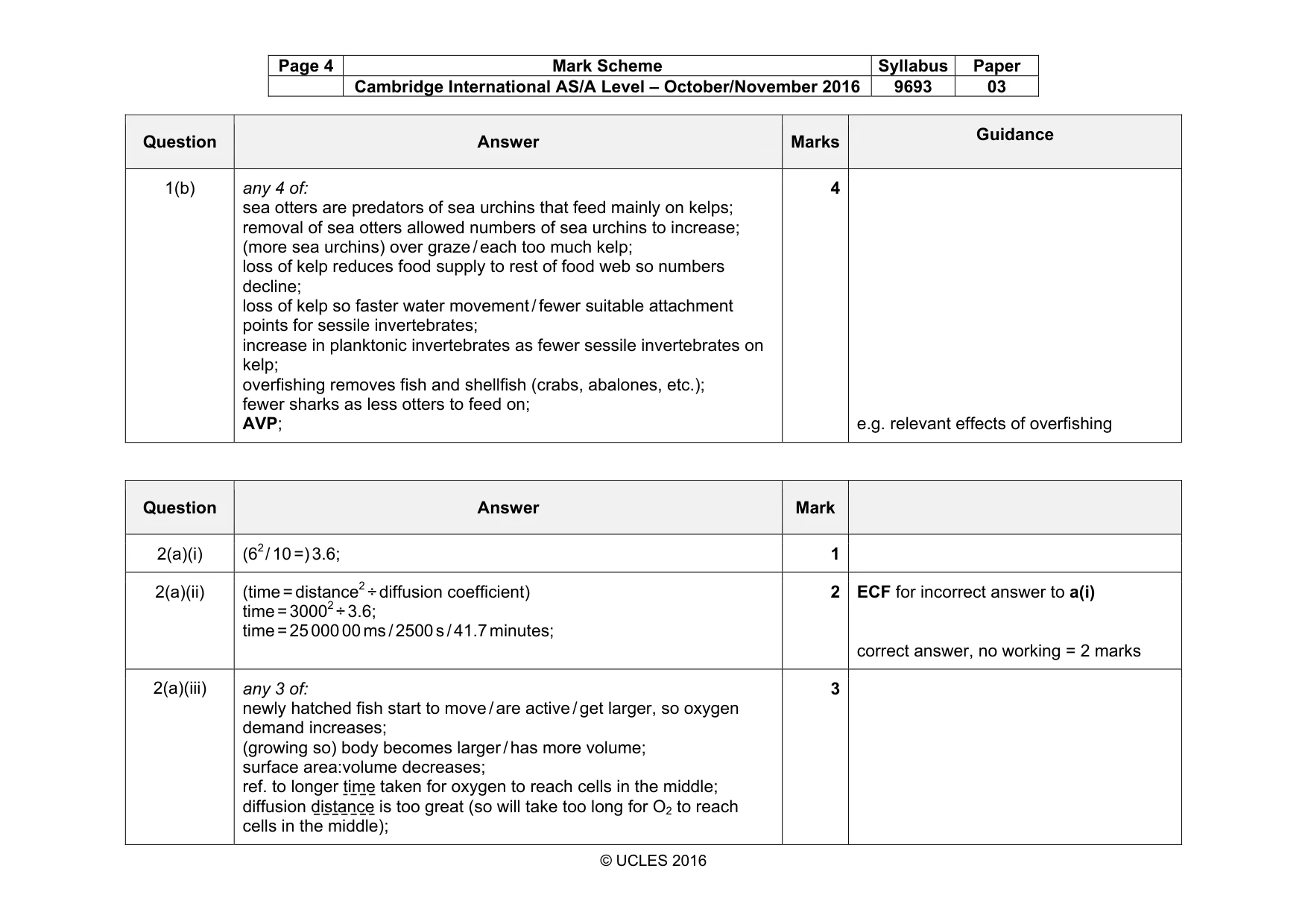
Page 4 Mark Scheme Syllabus Paper Cambridge International AS/A Level – October/November 2016 9693 03 © UCLES 2016 Question Answer Marks Guidance 1(b) any 4 of: sea otters are predators of sea urchins that feed mainly on kelps; removal of sea otters allowed numbers of sea urchins to increase; (more sea urchins) over graze / each too much kelp; loss of kelp reduces food supply to rest of food web so numbers decline; loss of kelp so faster water movement / fewer suitable attachment points for sessile invertebrates; increase in planktonic invertebrates as fewer sessile invertebrates on kelp; overfishing removes fish and shellfish (crabs, abalones, etc.); fewer sharks as less otters to feed on; AVP; 4 e.g. relevant effects of overfishing Question Answer Mark 2(a)(i) (62 / 10 =) 3.6; 1 2(a)(ii) (time = distance2 ÷ diffusion coefficient) time = 30002 ÷ 3.6; time = 25 000 00 ms / 2500 s / 41.7 minutes; 2 ECF for incorrect answer to a(i) correct answer, no working = 2 marks 2(a)(iii) any 3 of: newly hatched fish start to move / are active / get larger, so oxygen demand increases; (growing so) body becomes larger / has more volume; surface area:volume decreases; ref. to longer time taken for oxygen to reach cells in the middle; diffusion distance is too great (so will take too long for O2 to reach cells in the middle); 3
Mark scheme, page 5
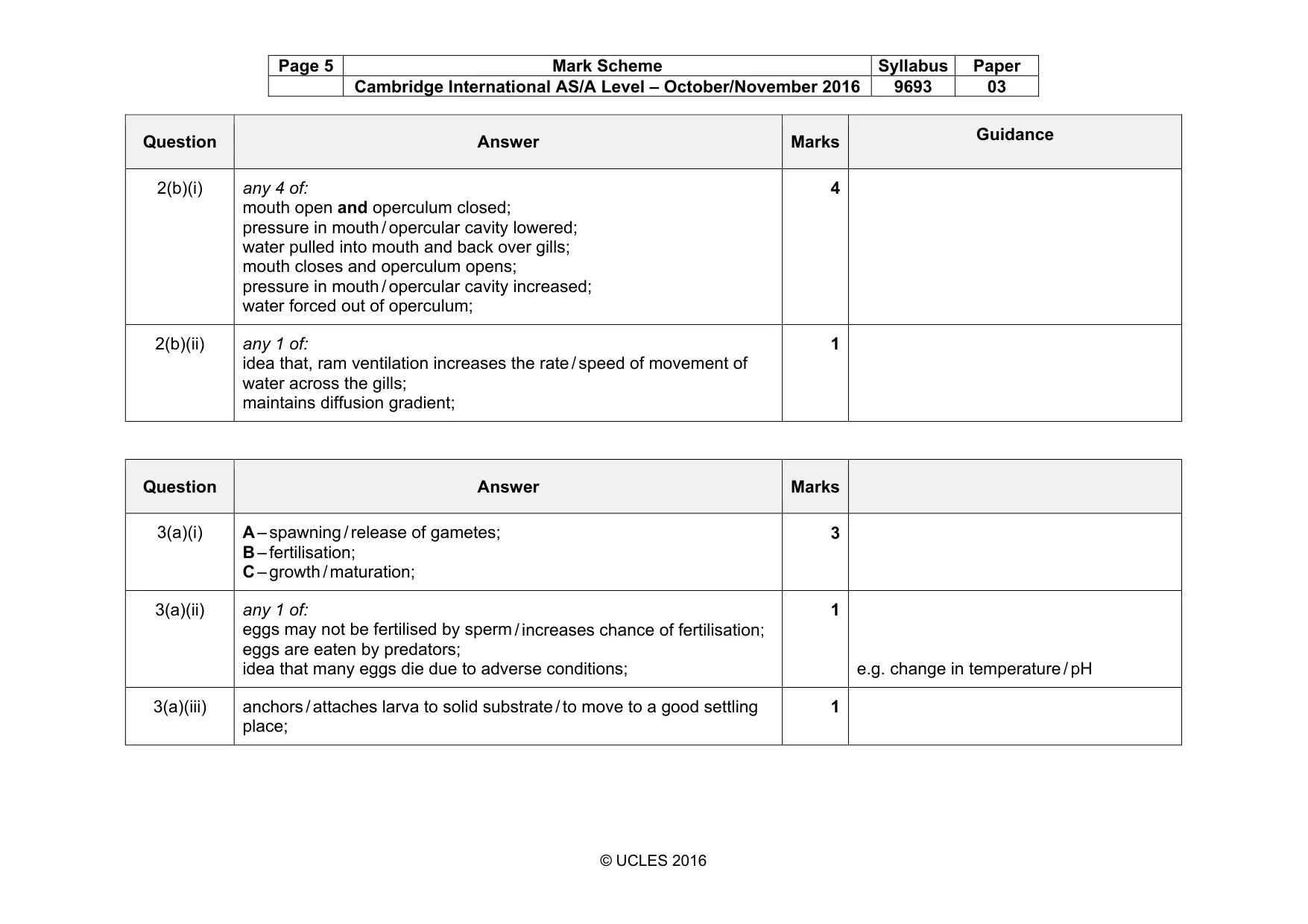
Page 5 Mark Scheme Syllabus Paper Cambridge International AS/A Level – October/November 2016 9693 03 © UCLES 2016 Question Answer Marks Guidance 2(b)(i) any 4 of: mouth open and operculum closed; pressure in mouth / opercular cavity lowered; water pulled into mouth and back over gills; mouth closes and operculum opens; pressure in mouth / opercular cavity increased; water forced out of operculum; 4 2(b)(ii) any 1 of: idea that, ram ventilation increases the rate / speed of movement of water across the gills; maintains diffusion gradient; 1 Question Answer Marks 3(a)(i) A – spawning / release of gametes; B – fertilisation; C – growth / maturation; 3 3(a)(ii) any 1 of: eggs may not be fertilised by sperm / increases chance of fertilisation; eggs are eaten by predators; idea that many eggs die due to adverse conditions; 1 e.g. change in temperature / pH 3(a)(iii) anchors / attaches larva to solid substrate / to move to a good settling place; 1
Mark scheme, page 6
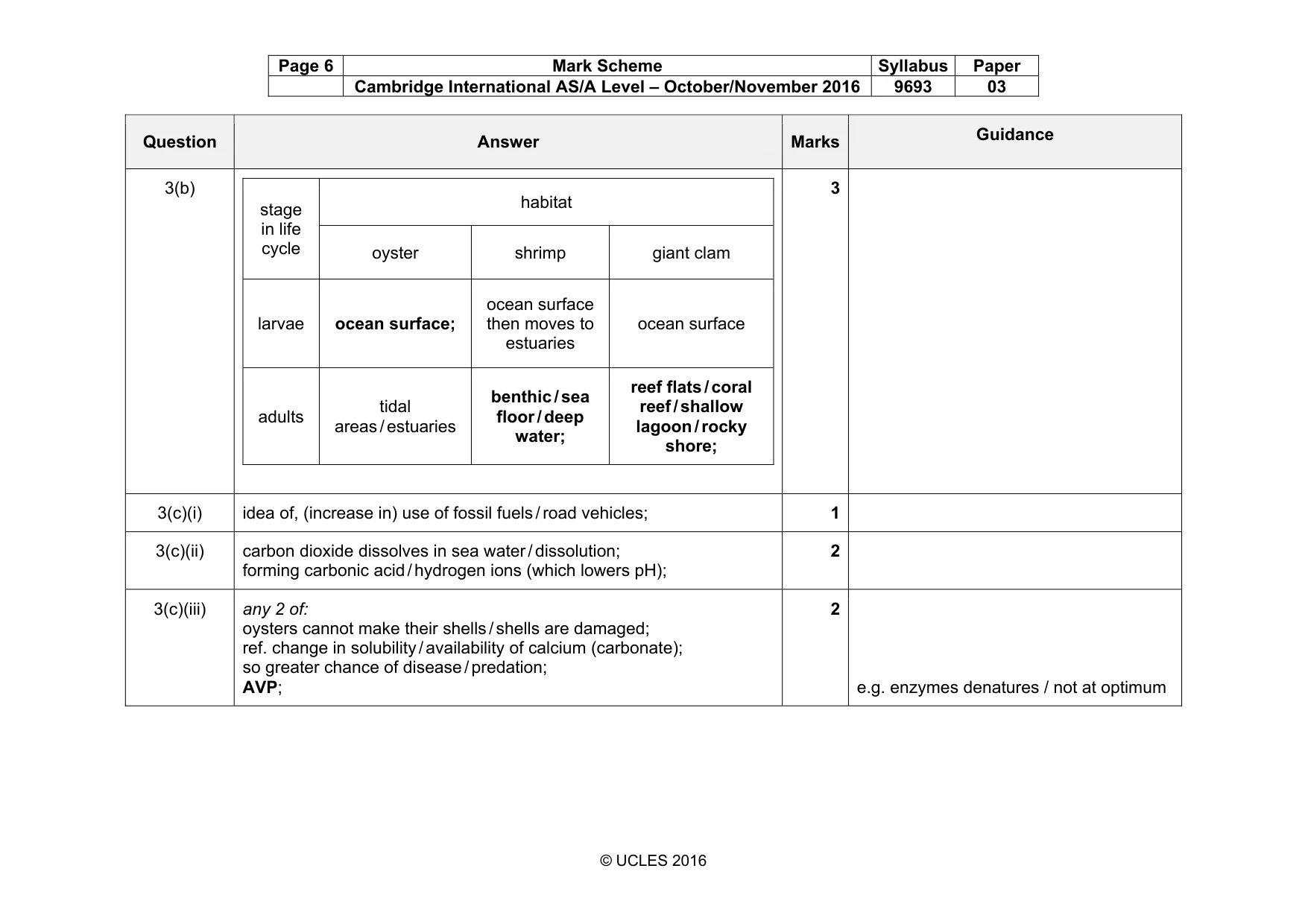
Page 6 Mark Scheme Syllabus Paper Cambridge International AS/A Level – October/November 2016 9693 03 © UCLES 2016 Question Answer Marks Guidance 3(b) stage in life cycle habitat oyster shrimp giant clam larvae ocean surface; ocean surface then moves to estuaries ocean surface adults tidal areas / estuaries benthic / sea floor / deep water; reef flats / coral reef / shallow lagoon / rocky shore; 3 3(c)(i) idea of, (increase in) use of fossil fuels / road vehicles; 1 3(c)(ii) carbon dioxide dissolves in sea water / dissolution; forming carbonic acid / hydrogen ions (which lowers pH); 2 3(c)(iii) any 2 of: oysters cannot make their shells / shells are damaged; ref. change in solubility / availability of calcium (carbonate); so greater chance of disease / predation; AVP; 2 e.g. enzymes denatures / not at optimum
Mark scheme, page 7
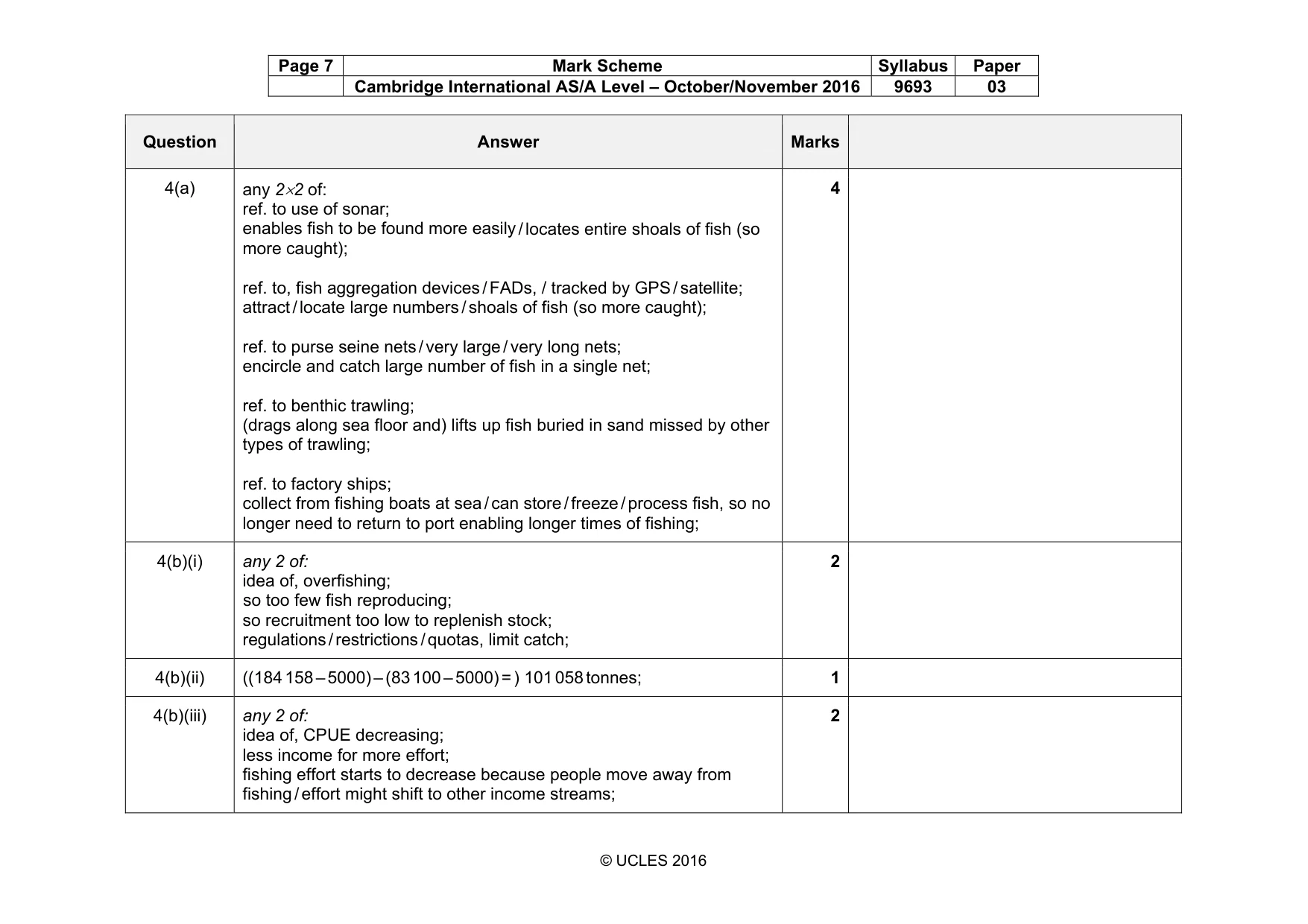
Page 7 Mark Scheme Syllabus Paper Cambridge International AS/A Level – October/November 2016 9693 03 © UCLES 2016 Question Answer Marks 4(a) any 2×2 of: ref. to use of sonar; enables fish to be found more easily / locates entire shoals of fish (so more caught); ref. to, fish aggregation devices / FADs, / tracked by GPS / satellite; attract / locate large numbers / shoals of fish (so more caught); ref. to purse seine nets / very large / very long nets; encircle and catch large number of fish in a single net; ref. to benthic trawling; (drags along sea floor and) lifts up fish buried in sand missed by other types of trawling; ref. to factory ships; collect from fishing boats at sea / can store / freeze / process fish, so no longer need to return to port enabling longer times of fishing; 4 4(b)(i) any 2 of: idea of, overfishing; so too few fish reproducing; so recruitment too low to replenish stock; regulations / restrictions / quotas, limit catch; 2 4(b)(ii) ((184 158 – 5000) – (83 100 – 5000) = ) 101 058 tonnes; 1 4(b)(iii) any 2 of: idea of, CPUE decreasing; less income for more effort; fishing effort starts to decrease because people move away from fishing / effort might shift to other income streams; 2
Mark scheme, page 8
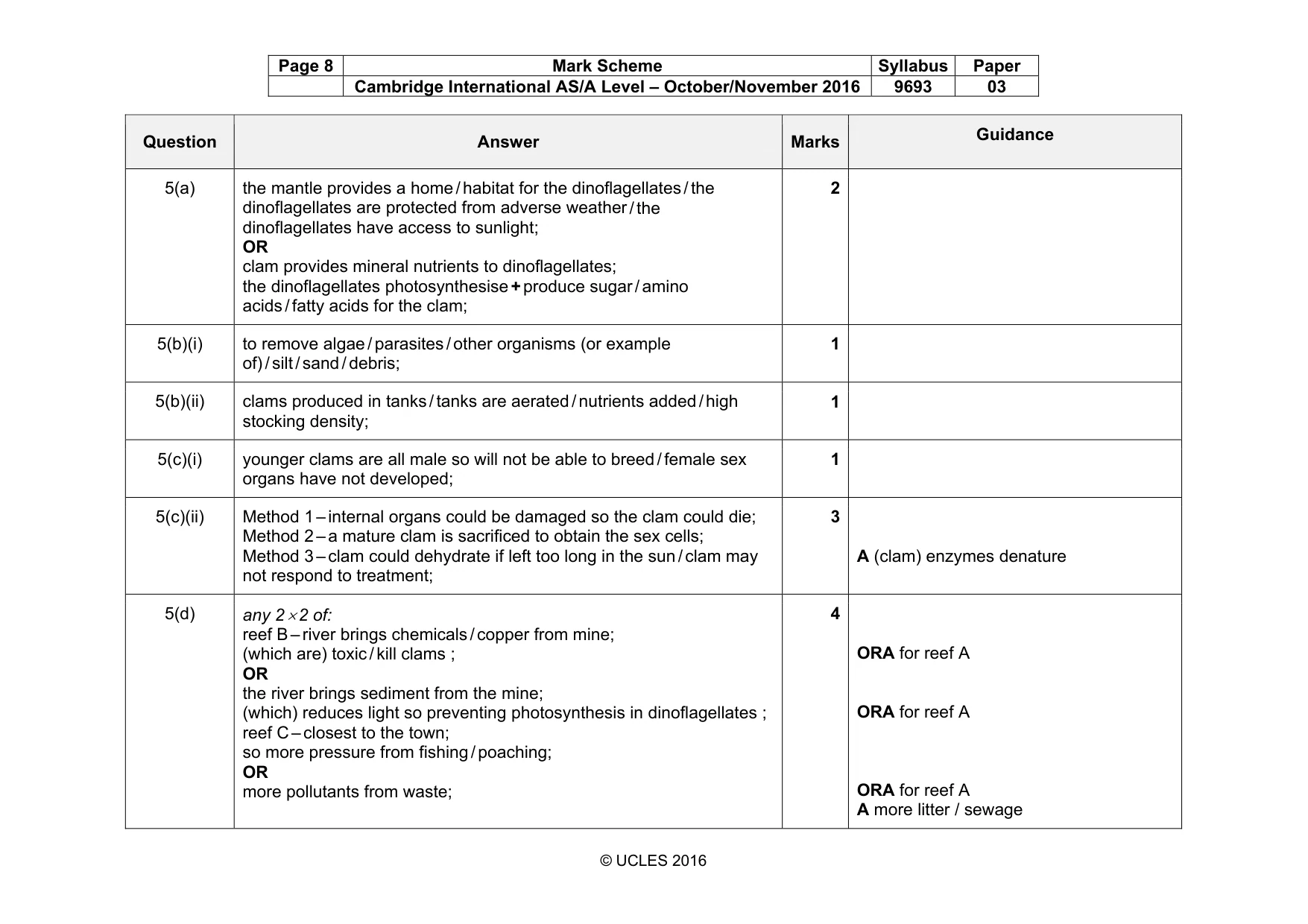
Page 8 Mark Scheme Syllabus Paper Cambridge International AS/A Level – October/November 2016 9693 03 © UCLES 2016 Question Answer Marks Guidance 5(a) the mantle provides a home / habitat for the dinoflagellates / the dinoflagellates are protected from adverse weather / the dinoflagellates have access to sunlight; OR clam provides mineral nutrients to dinoflagellates; the dinoflagellates photosynthesise + produce sugar / amino acids / fatty acids for the clam; 2 5(b)(i) to remove algae / parasites / other organisms (or example of) / silt / sand / debris; 1 5(b)(ii) clams produced in tanks / tanks are aerated / nutrients added / high stocking density; 1 5(c)(i) younger clams are all male so will not be able to breed / female sex organs have not developed; 1 5(c)(ii) Method 1 – internal organs could be damaged so the clam could die; Method 2 – a mature clam is sacrificed to obtain the sex cells; Method 3 – clam could dehydrate if left too long in the sun / clam may not respond to treatment; 3 A (clam) enzymes denature 5(d) any 2 × 2 of: reef B – river brings chemicals / copper from mine; (which are) toxic / kill clams ; OR the river brings sediment from the mine; (which) reduces light so preventing photosynthesis in dinoflagellates ; reef C – closest to the town; so more pressure from fishing / poaching; OR more pollutants from waste; 4 ORA for reef A ORA for reef A ORA for reef A A more litter / sewage
Mark scheme, page 9
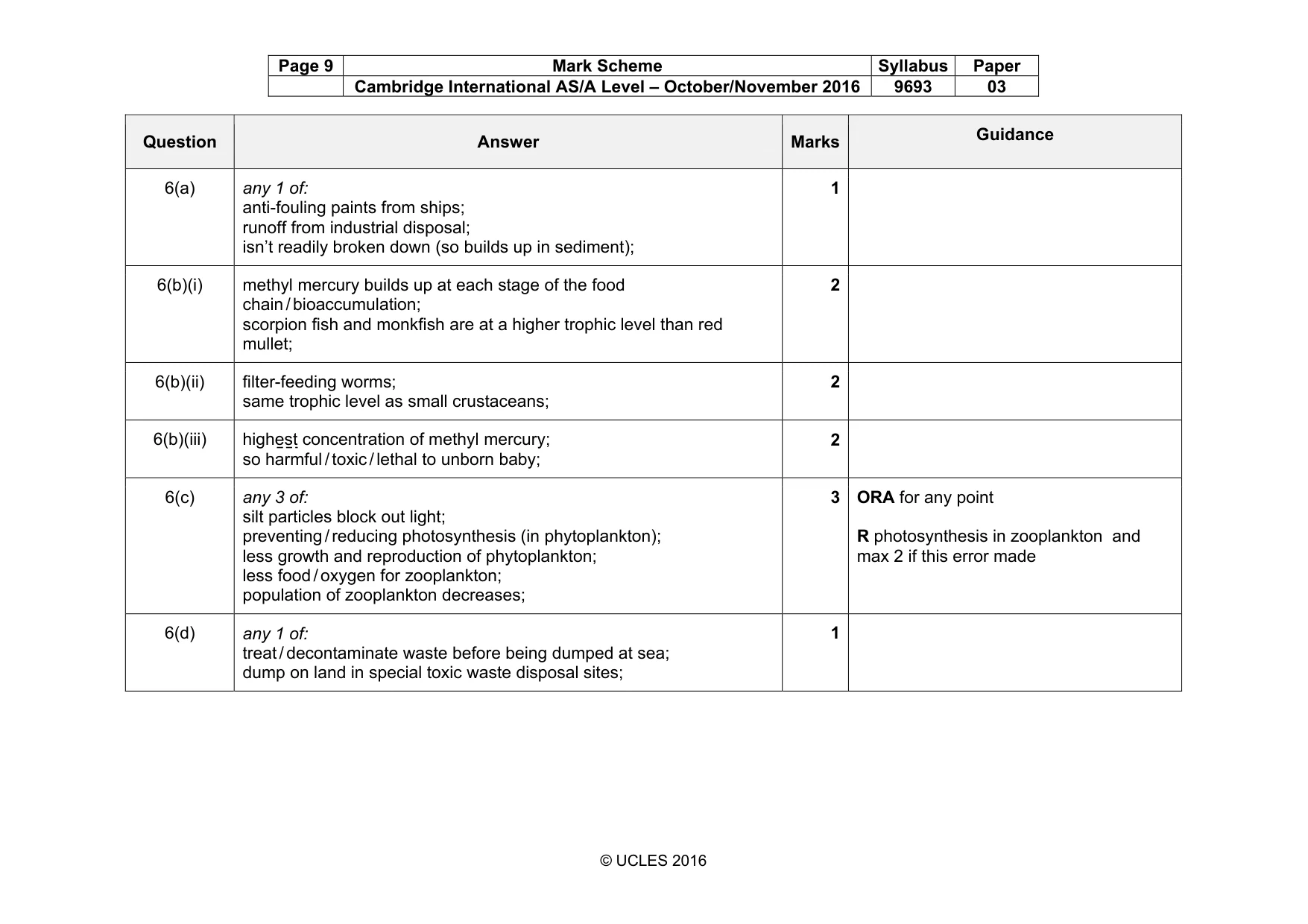
Page 9 Mark Scheme Syllabus Paper Cambridge International AS/A Level – October/November 2016 9693 03 © UCLES 2016 Question Answer Marks Guidance 6(a) any 1 of: anti-fouling paints from ships; runoff from industrial disposal; isn’t readily broken down (so builds up in sediment); 1 6(b)(i) methyl mercury builds up at each stage of the food chain / bioaccumulation; scorpion fish and monkfish are at a higher trophic level than red mullet; 2 6(b)(ii) filter-feeding worms; same trophic level as small crustaceans; 2 6(b)(iii) highest concentration of methyl mercury; so harmful / toxic / lethal to unborn baby; 2 6(c) any 3 of: silt particles block out light; preventing / reducing photosynthesis (in phytoplankton); less growth and reproduction of phytoplankton; less food / oxygen for zooplankton; population of zooplankton decreases; 3 ORA for any point R photosynthesis in zooplankton and max 2 if this error made 6(d) any 1 of: treat / decontaminate waste before being dumped at sea; dump on land in special toxic waste disposal sites; 1
Mark scheme, page 10
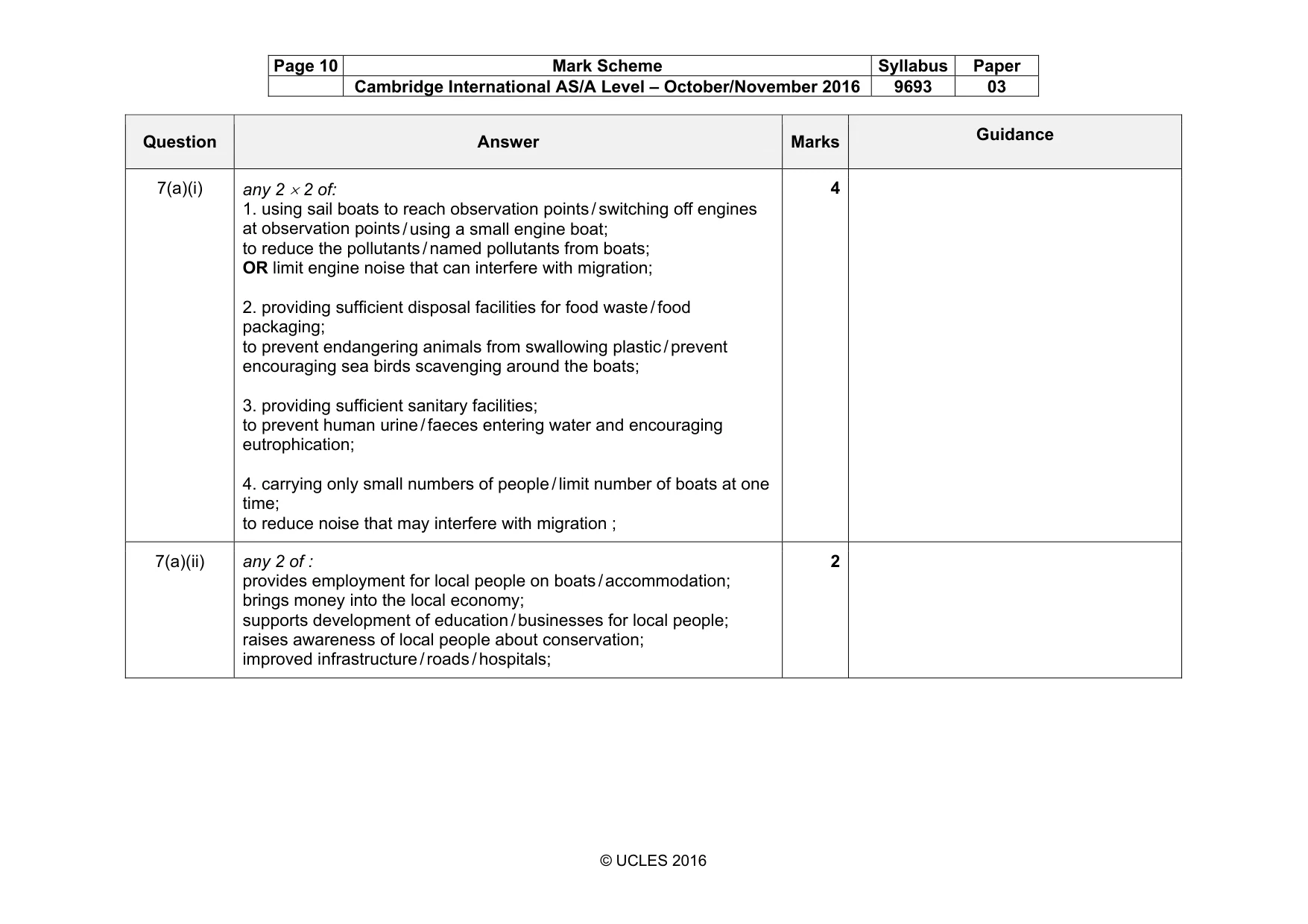
Page 10 Mark Scheme Syllabus Paper Cambridge International AS/A Level – October/November 2016 9693 03 © UCLES 2016 Question Answer Marks Guidance 7(a)(i) any 2 × 2 of: 1. using sail boats to reach observation points / switching off engines at observation points / using a small engine boat; to reduce the pollutants / named pollutants from boats; OR limit engine noise that can interfere with migration; 2. providing sufficient disposal facilities for food waste / food packaging; to prevent endangering animals from swallowing plastic / prevent encouraging sea birds scavenging around the boats; 3. providing sufficient sanitary facilities; to prevent human urine / faeces entering water and encouraging eutrophication; 4. carrying only small numbers of people / limit number of boats at one time; to reduce noise that may interfere with migration ; 4 7(a)(ii) any 2 of : provides employment for local people on boats / accommodation; brings money into the local economy; supports development of education / businesses for local people; raises awareness of local people about conservation; improved infrastructure / roads / hospitals; 2
What you needed in this session
Cambridge’s own grade thresholds for 2016 Oct/Nov, Paper 3 · Variant 1. A higher threshold means an easier paper — the bar moves with how the cohort did.