Cambridge A Level Marine Science 9693 — 2015 Oct/Nov Paper 3 · Variant 1
9693/31/O/N/15 · 75 marks · ≈84 min
The question paper and its mark scheme, free to read here and free to download. This is Cambridge’s own paper, exactly as it was sat.
Question paper16 pages

Mark scheme7 pages
Answers below. Sit the paper first if you are practising.
Paper as text
Question paper, page 1
This document consists of 16 printed pages. DC (ST/JG) 98755/3 © UCLES 2015 [Turn over Cambridge International Examinations Cambridge International Advanced Subsidiary and Advanced Level * 8 1 6 2 9 8 8 2 2 0 * MARINE SCIENCE 9693/03 Paper 3 A2 Structured Questions October/November 2015 1 hour 30 minutes Candidates answer on the Question Paper. No Additional Materials are required. READ THESE INSTRUCTIONS FIRST Write your Centre number, candidate number and name on all the work you hand in. Write in dark blue or black pen. You may use an HB pencil for any diagrams or graphs. Do not use staples, paper clips, glue or correction fluid. DO NOT WRITE IN ANY BARCODES. Answer all questions. Write your answers in the spaces provided on the Question Paper. Electronic calculators may be used. You may lose marks if you do not show your working or if you do not use appropriate units. At the end of the examination, fasten all your work securely together. The number of marks is given in brackets [ ] at the end of each question or part question.
Question paper, page 2
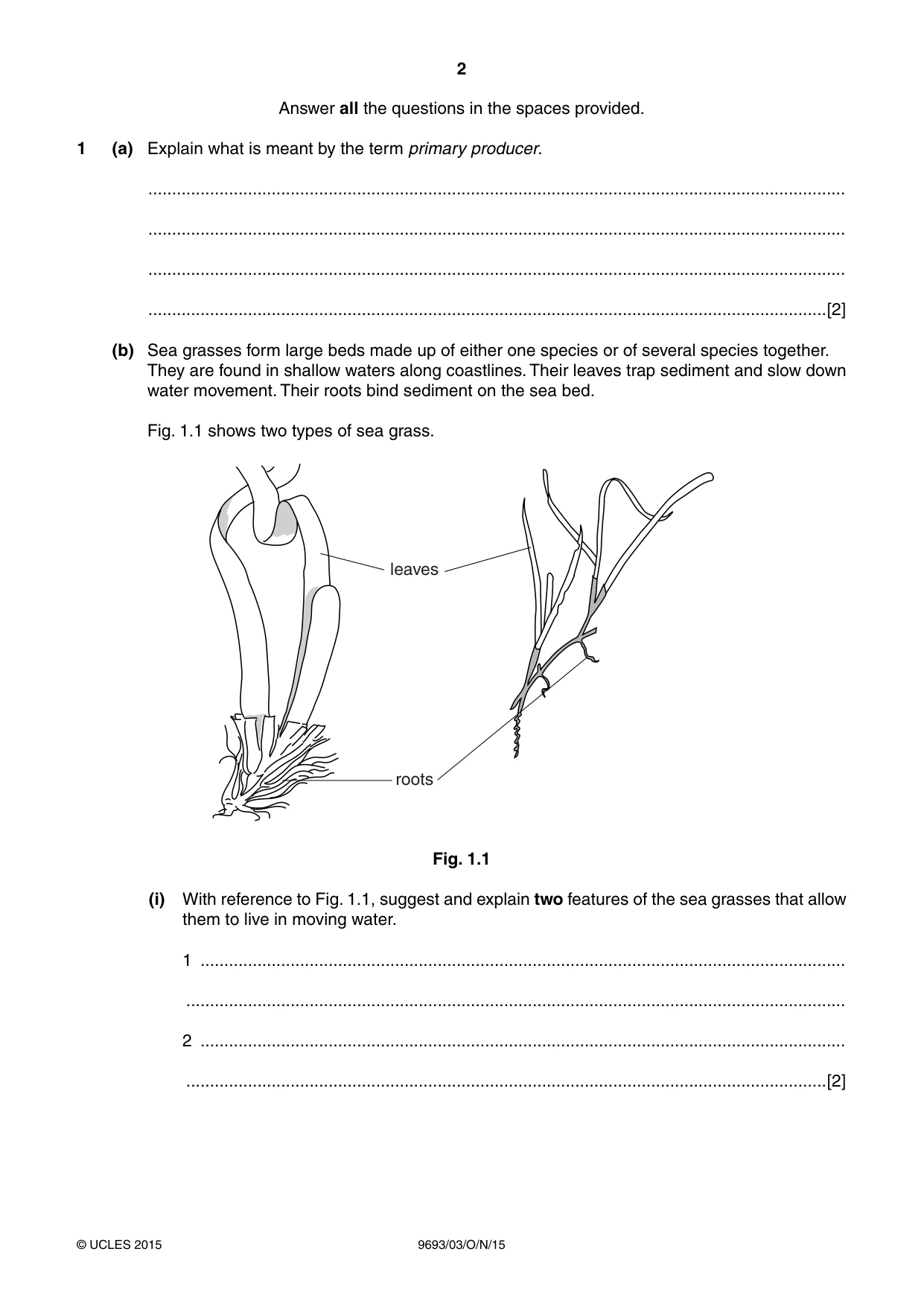
2 9693/03/O/N/15 © UCLES 2015 Answer all the questions in the spaces provided. 1 (a) Explain what is meant by the term primary producer. … … … …[2] (b) Sea grasses form large beds made up of either one species or of several species together. They are found in shallow waters along coastlines. Their leaves trap sediment and slow down water movement. Their roots bind sediment on the sea bed. Fig. 1.1 shows two types of sea grass. leaves roots Fig. 1.1 (i) With reference to Fig. 1.1, suggest and explain two features of the sea grasses that allow them to live in moving water. 1 … … 2 … …[2]
Question paper, page 3
3 9693/03/O/N/15 © UCLES 2015 [Turn over (ii) Explain why sea grasses are found only in shallow water. … … … …[2] (iii) Corals survive best in clear water and are often found close to sea grass beds. Suggest how sea grass beds aid the survival of coral. … …[1] (c) Suggest three reasons why sea grass beds are often nursery areas for many species of marine animals. 1 … … 2 … … 3 … …[3] (d) Sea grass beds have shown a progressive decrease in size due to human activities. Suggest two ways in which humans cause damage to sea grass beds. 1 … … 2 … …[2] [Total: 12]
Question paper, page 4
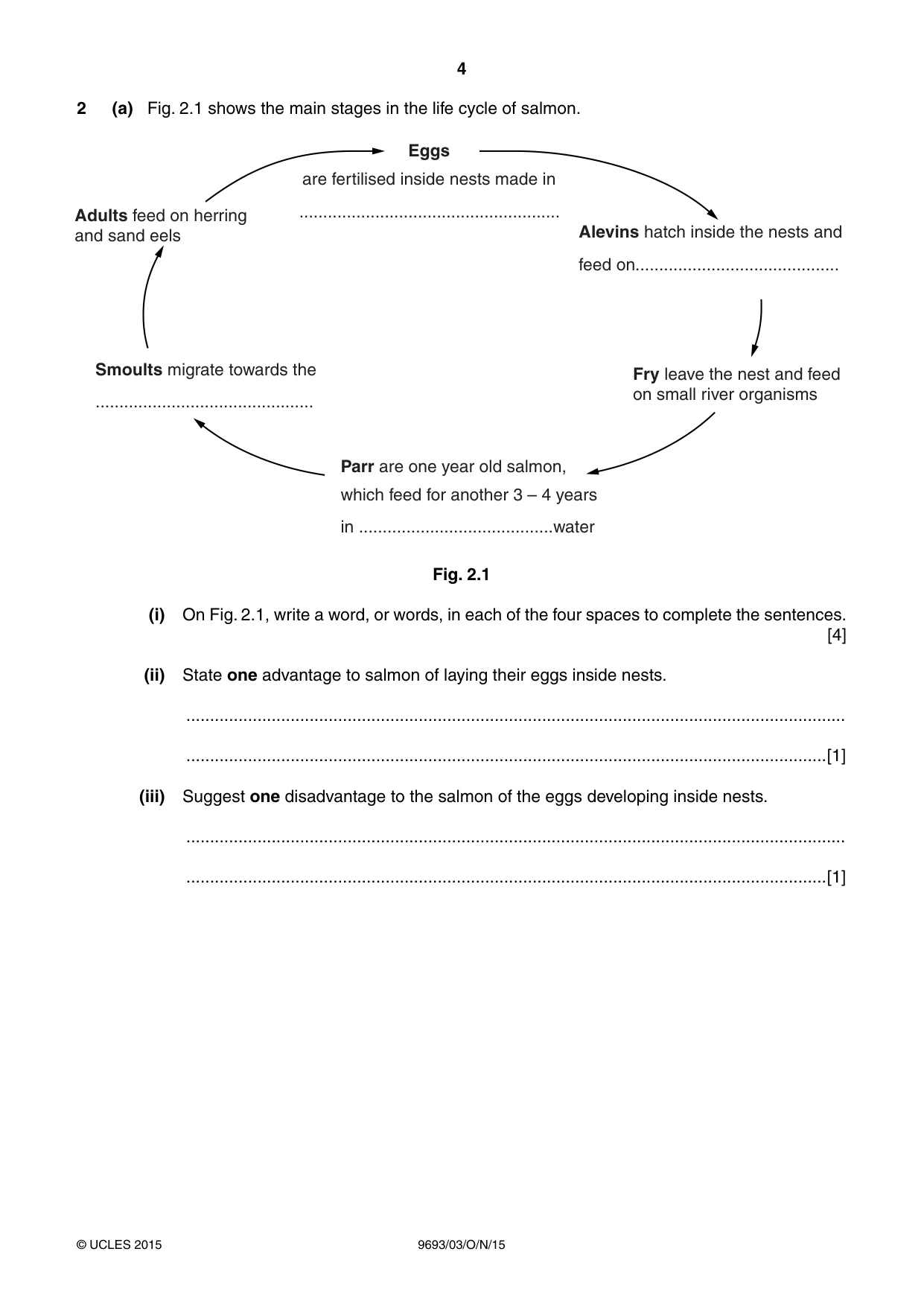
4 9693/03/O/N/15 © UCLES 2015 2 (a) Fig. 2.1 shows the main stages in the life cycle of salmon. Eggs are fertilised inside nests made in … Alevins hatch inside the nests and feed on… Fry leave the nest and feed on small river organisms Parr are one year old salmon, which feed for another 3 – 4 years in …water Smoults migrate towards the … Adults feed on herring and sand eels Fig. 2.1 (i) On Fig. 2.1, write a word, or words, in each of the four spaces to complete the sentences. [4] (ii) State one advantage to salmon of laying their eggs inside nests. … …[1] (iii) Suggest one disadvantage to the salmon of the eggs developing inside nests. … …[1]
Question paper, page 5
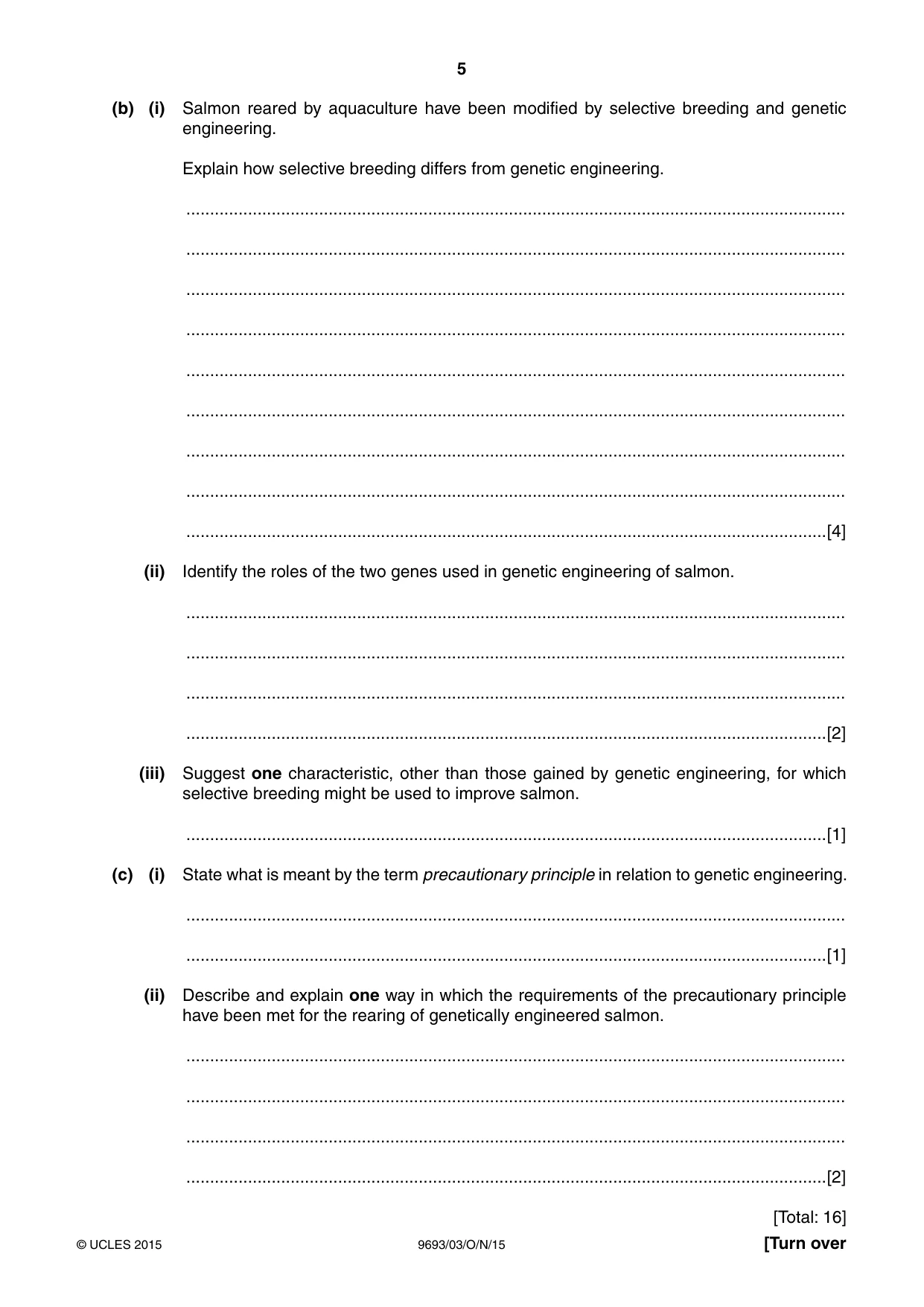
5 9693/03/O/N/15 © UCLES 2015 [Turn over (b) (i) Salmon reared by aquaculture have been modified by selective breeding and genetic engineering. Explain how selective breeding differs from genetic engineering. … … … … … … … … …[4] (ii) Identify the roles of the two genes used in genetic engineering of salmon. … … … …[2] (iii) Suggest one characteristic, other than those gained by genetic engineering, for which selective breeding might be used to improve salmon. …[1] (c) (i) State what is meant by the term precautionary principle in relation to genetic engineering. … …[1] (ii) Describe and explain one way in which the requirements of the precautionary principle have been met for the rearing of genetically engineered salmon. … … … …[2] [Total: 16]
Question paper, page 6
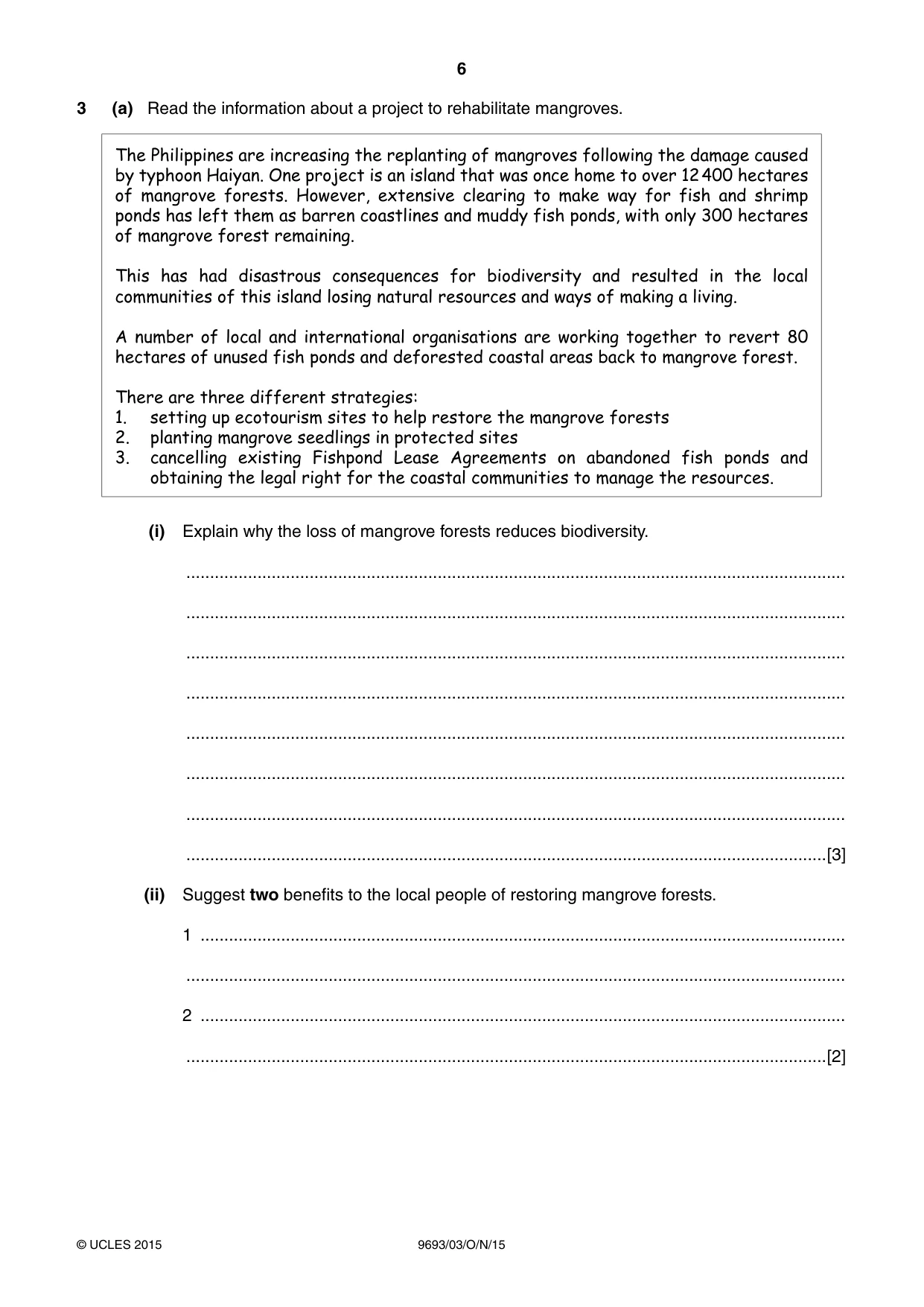
6 9693/03/O/N/15 © UCLES 2015 3 (a) Read the information about a project to rehabilitate mangroves. The Philippines are increasing the replanting of mangroves following the damage caused by typhoon Haiyan. One project is an island that was once home to over 12 400 hectares of mangrove forests. However, extensive clearing to make way for fish and shrimp ponds has left them as barren coastlines and muddy fish ponds, with only 300 hectares of mangrove forest remaining. This has had disastrous consequences for biodiversity and resulted in the local communities of this island losing natural resources and ways of making a living. A number of local and international organisations are working together to revert 80 hectares of unused fish ponds and deforested coastal areas back to mangrove forest. There are three different strategies: 1. setting up ecotourism sites to help restore the mangrove forests 2. planting mangrove seedlings in protected sites 3. cancelling existing Fishpond Lease Agreements on abandoned fish ponds and obtaining the legal right for the coastal communities to manage the resources. (i) Explain why the loss of mangrove forests reduces biodiversity. … … … … … … … …[3] (ii) Suggest two benefits to the local people of restoring mangrove forests. 1 … … 2 … …[2]
Question paper, page 7
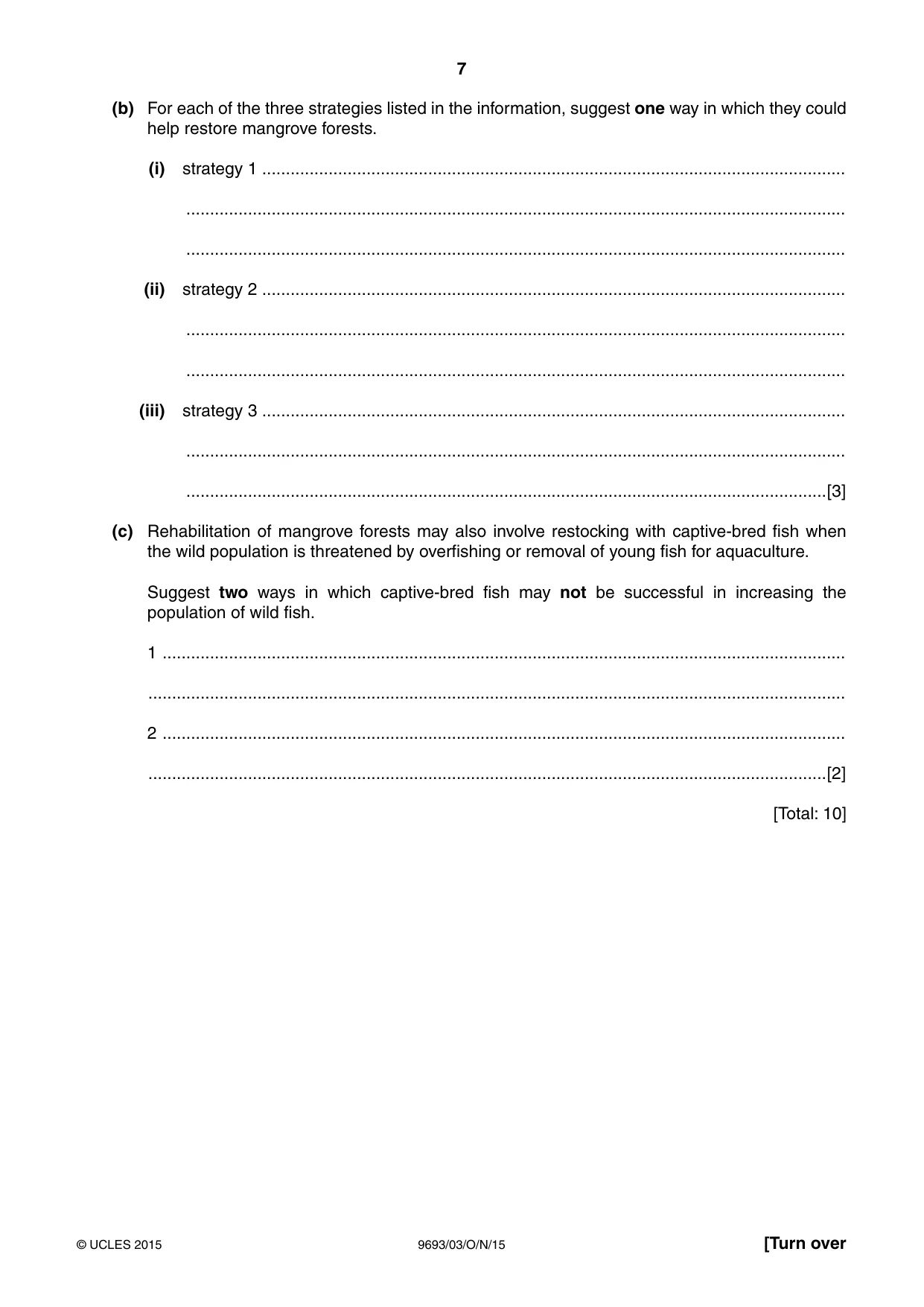
7 9693/03/O/N/15 © UCLES 2015 [Turn over (b) For each of the three strategies listed in the information, suggest one way in which they could help restore mangrove forests. (i) strategy 1 … … … (ii) strategy 2 … … … (iii) strategy 3 … … …[3] (c) Rehabilitation of mangrove forests may also involve restocking with captive-bred fish when the wild population is threatened by overfishing or removal of young fish for aquaculture. Suggest two ways in which captive-bred fish may not be successful in increasing the population of wild fish. 1 … … 2 … …[2] [Total: 10]
Question paper, page 8
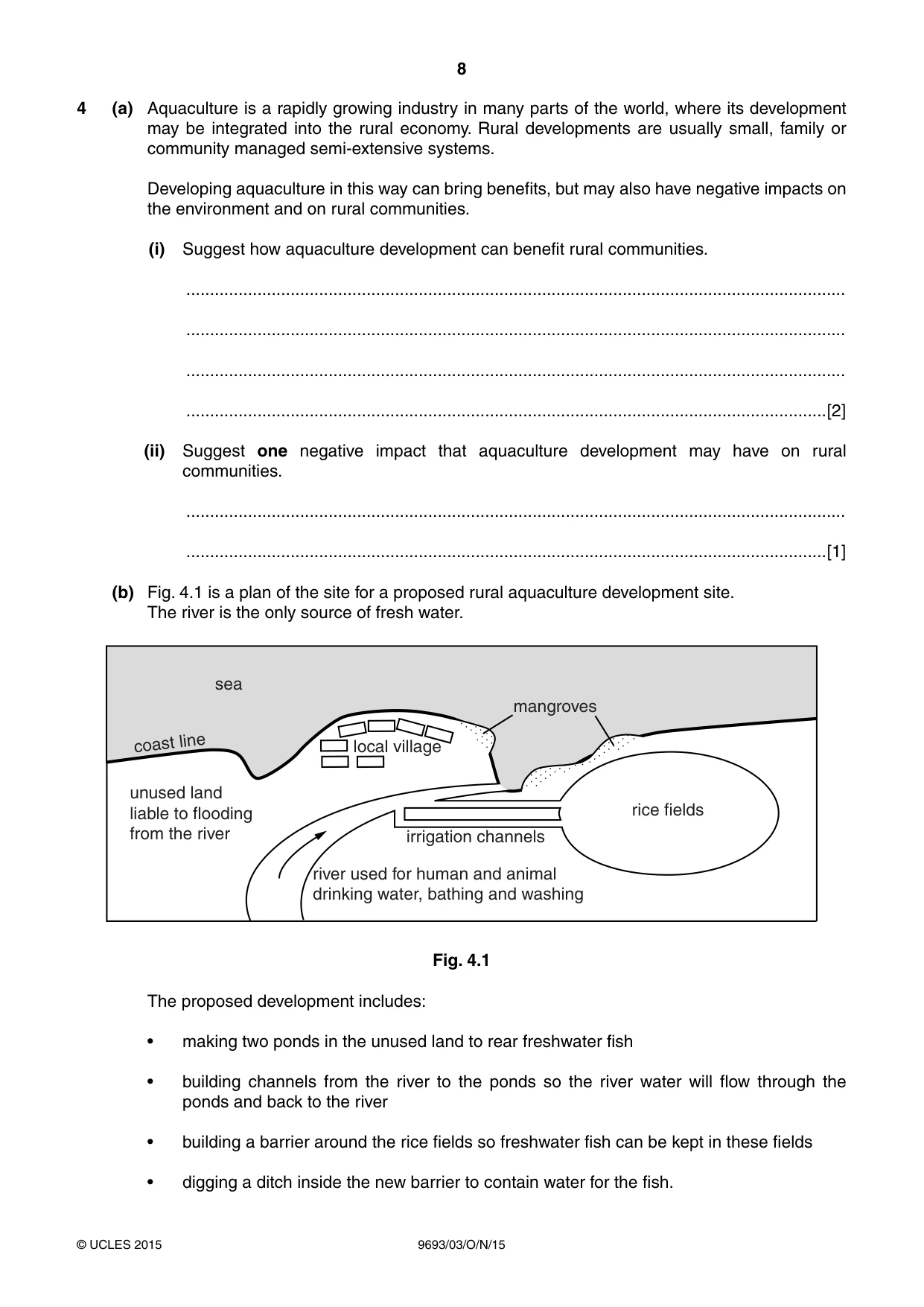
8 9693/03/O/N/15 © UCLES 2015 4 (a) Aquaculture is a rapidly growing industry in many parts of the world, where its development may be integrated into the rural economy. Rural developments are usually small, family or community managed semi-extensive systems. Developing aquaculture in this way can bring benefits, but may also have negative impacts on the environment and on rural communities. (i) Suggest how aquaculture development can benefit rural communities. … … … …[2] (ii) Suggest one negative impact that aquaculture development may have on rural communities. … …[1] (b) Fig. 4.1 is a plan of the site for a proposed rural aquaculture development site. The river is the only source of fresh water. local village unused land liable to flooding from the river rice fields river used for human and animal drinking water, bathing and washing irrigation channels mangroves sea coast line Fig. 4.1 The proposed development includes: • making two ponds in the unused land to rear freshwater fish • building channels from the river to the ponds so the river water will flow through the ponds and back to the river • building a barrier around the rice fields so freshwater fish can be kept in these fields • digging a ditch inside the new barrier to contain water for the fish.
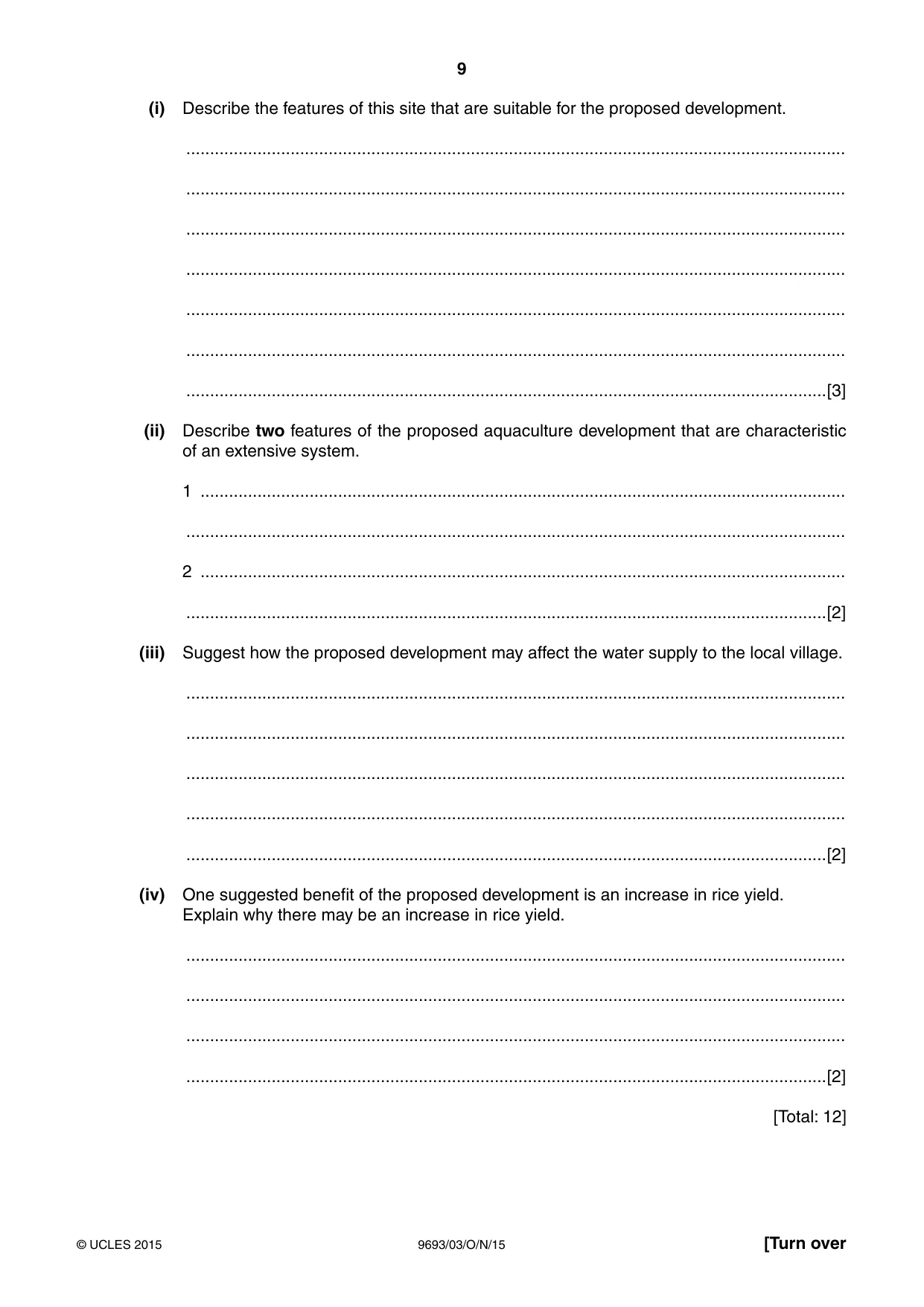
Question paper, page 9
9 9693/03/O/N/15 © UCLES 2015 [Turn over (i) Describe the features of this site that are suitable for the proposed development. … … … … … … …[3] (ii) Describe two features of the proposed aquaculture development that are characteristic of an extensive system. 1 … … 2 … …[2] (iii) Suggest how the proposed development may affect the water supply to the local village. … … … … …[2] (iv) One suggested benefit of the proposed development is an increase in rice yield. Explain why there may be an increase in rice yield. … … … …[2] [Total: 12]
Question paper, page 10
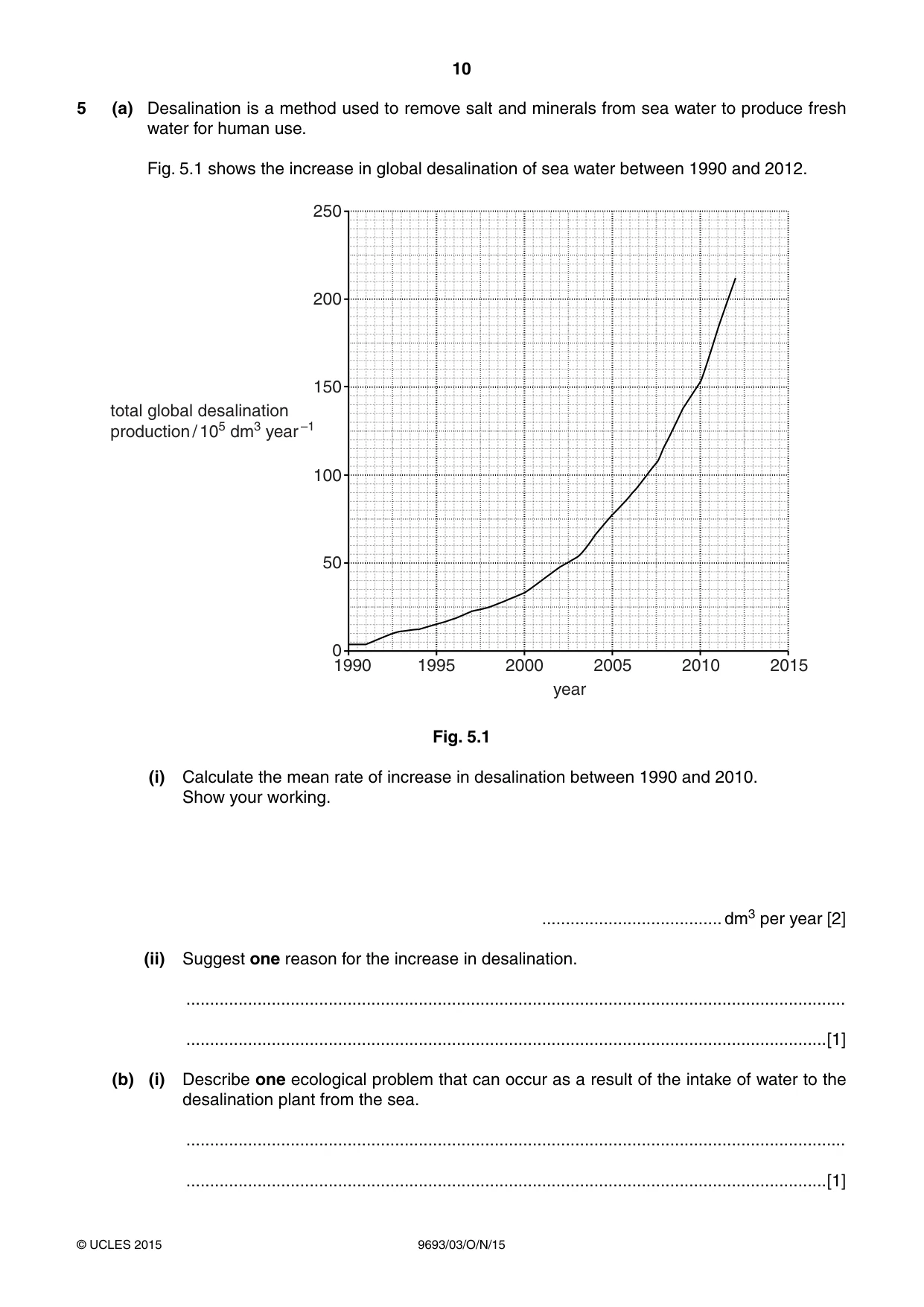
10 9693/03/O/N/15 © UCLES 2015 5 (a) Desalination is a method used to remove salt and minerals from sea water to produce fresh water for human use. Fig. 5.1 shows the increase in global desalination of sea water between 1990 and 2012. 1990 0 50 100 150 200 250 1995 2000 2005 2010 2015 year total global desalination production / 105 dm3 year –1 Fig. 5.1 (i) Calculate the mean rate of increase in desalination between 1990 and 2010. Show your working. …dm3 per year [2] (ii) Suggest one reason for the increase in desalination. … …[1] (b) (i) Describe one ecological problem that can occur as a result of the intake of water to the desalination plant from the sea. … …[1]
Question paper, page 11
11 9693/03/O/N/15 © UCLES 2015 [Turn over (ii) Desalination may release very concentrated brine (salt solution) into the sea. Explain why this may cause death to benthic organisms. … … … … … … …[3] [Total: 7]
Question paper, page 12
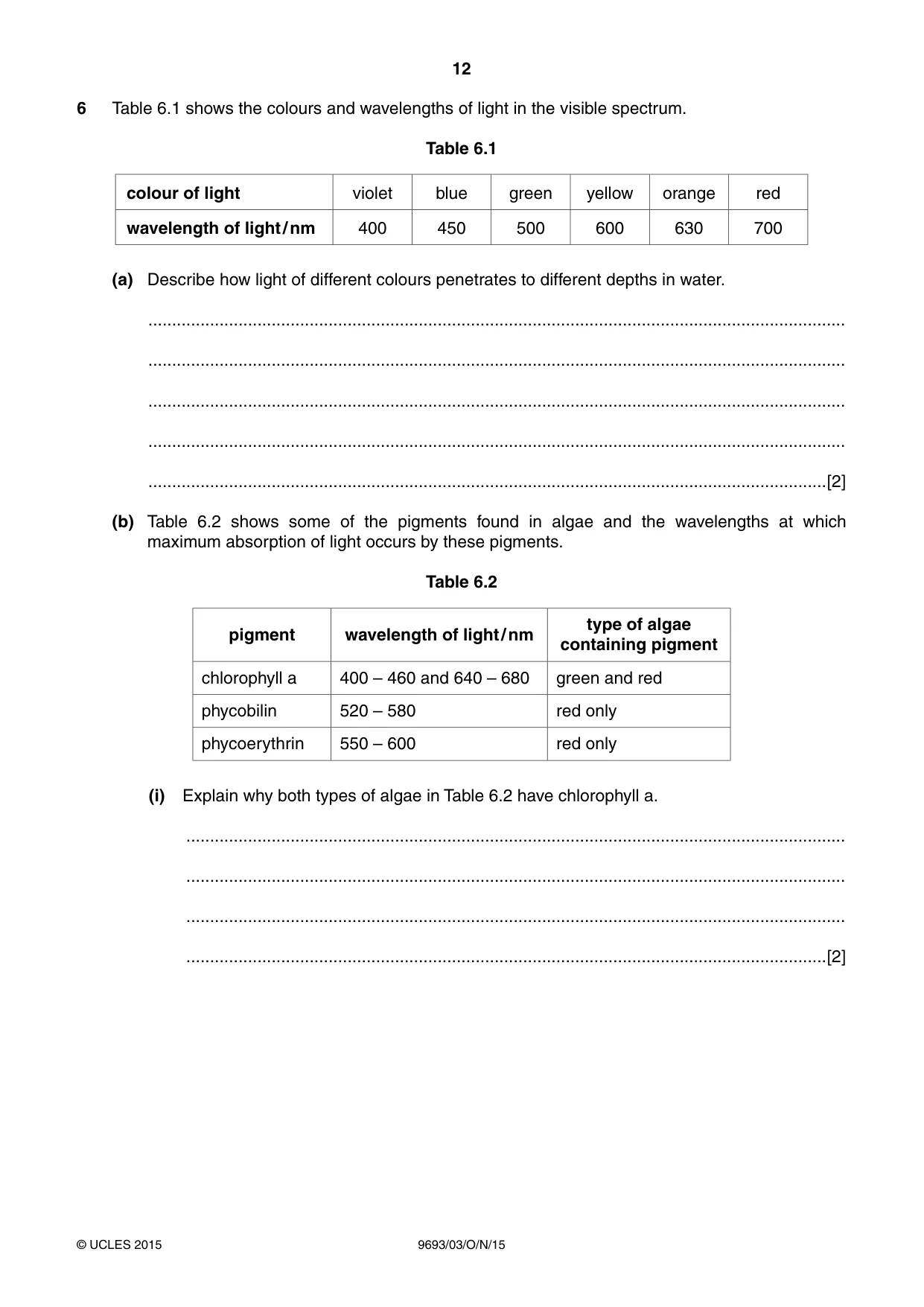
12 9693/03/O/N/15 © UCLES 2015 6 Table 6.1 shows the colours and wavelengths of light in the visible spectrum. Table 6.1 colour of light violet blue green yellow orange red wavelength of light / nm 400 450 500 600 630 700 (a) Describe how light of different colours penetrates to different depths in water. … … … … …[2] (b) Table 6.2 shows some of the pigments found in algae and the wavelengths at which maximum absorption of light occurs by these pigments. Table 6.2 pigment wavelength of light / nm type of algae containing pigment chlorophyll a 400 – 460 and 640 – 680 green and red phycobilin 520 – 580 red only phycoerythrin 550 – 600 red only (i) Explain why both types of algae in Table 6.2 have chlorophyll a. … … … …[2]
Question paper, page 13
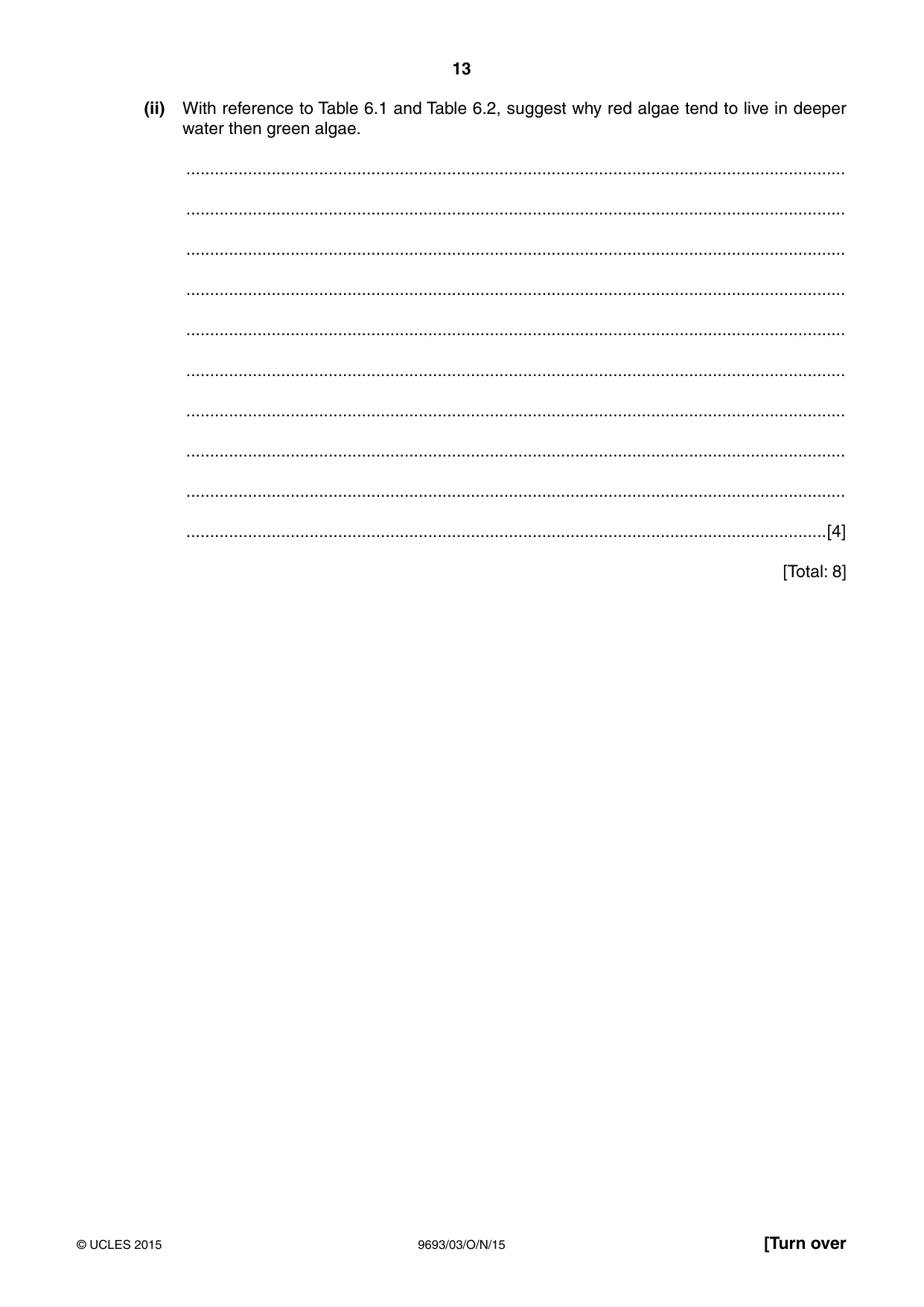
13 9693/03/O/N/15 © UCLES 2015 [Turn over (ii) With reference to Table 6.1 and Table 6.2, suggest why red algae tend to live in deeper water then green algae. … … … … … … … … … …[4] [Total: 8]
Question paper, page 14
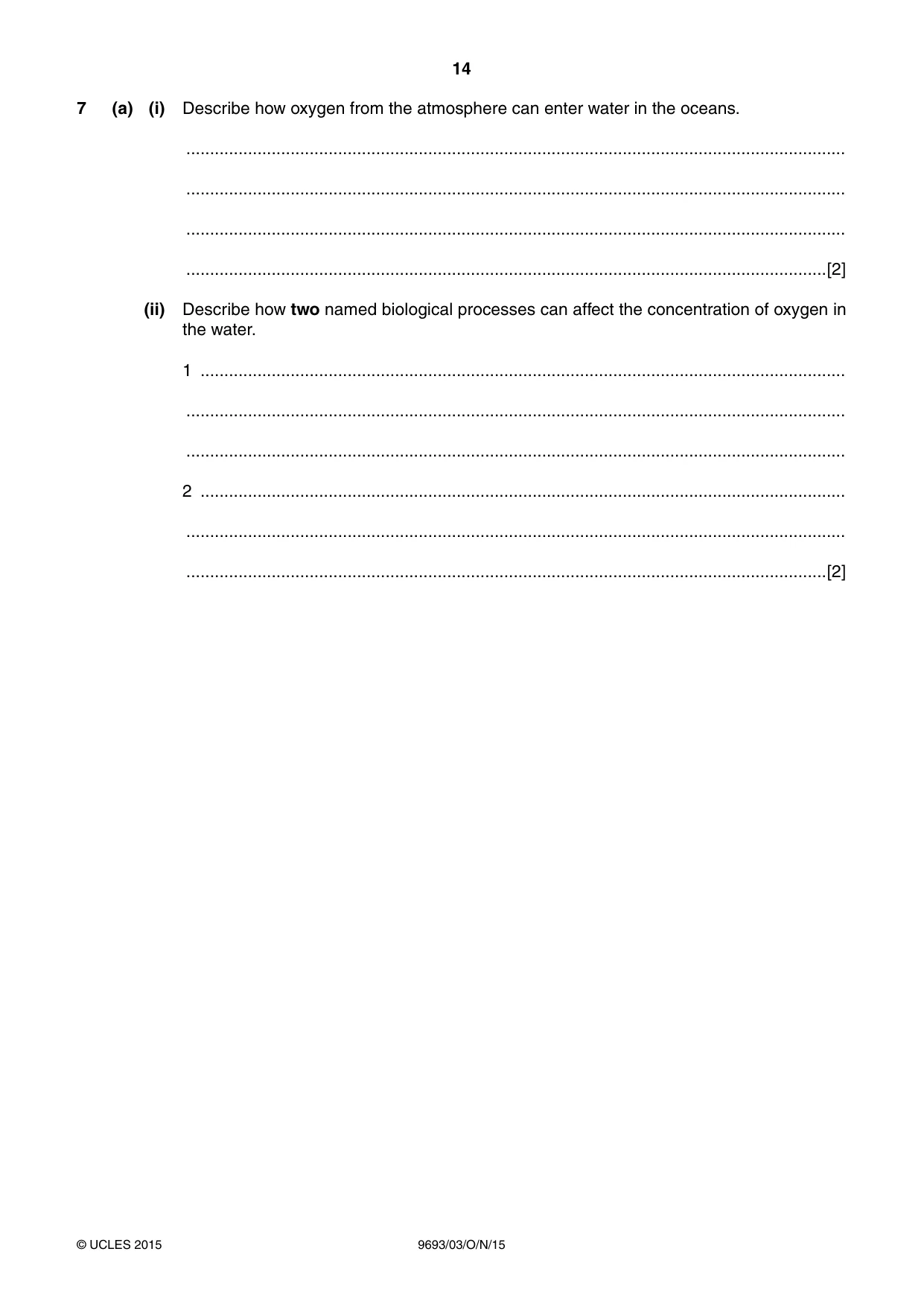
14 9693/03/O/N/15 © UCLES 2015 7 (a) (i) Describe how oxygen from the atmosphere can enter water in the oceans. … … … …[2] (ii) Describe how two named biological processes can affect the concentration of oxygen in the water. 1 … … … 2 … … …[2]
Question paper, page 15
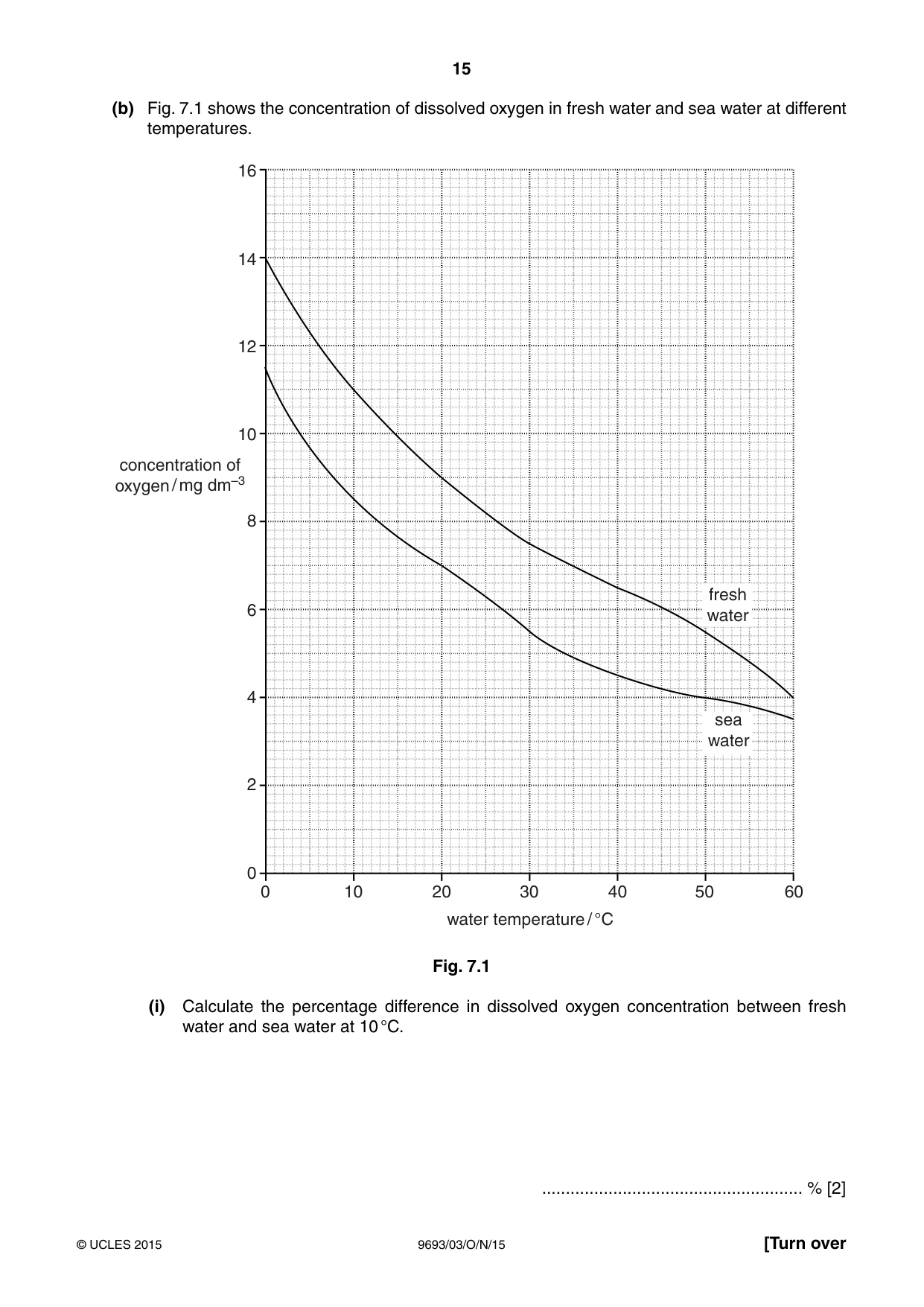
15 9693/03/O/N/15 © UCLES 2015 [Turn over (b) Fig. 7.1 shows the concentration of dissolved oxygen in fresh water and sea water at different temperatures. 0 0 2 4 6 8 10 12 14 16 10 20 30 40 50 60 fresh water sea water concentration of oxygen / mg dm–3 water temperature / °C Fig. 7.1 (i) Calculate the percentage difference in dissolved oxygen concentration between fresh water and sea water at 10 °C. … % [2]
Question paper, page 16
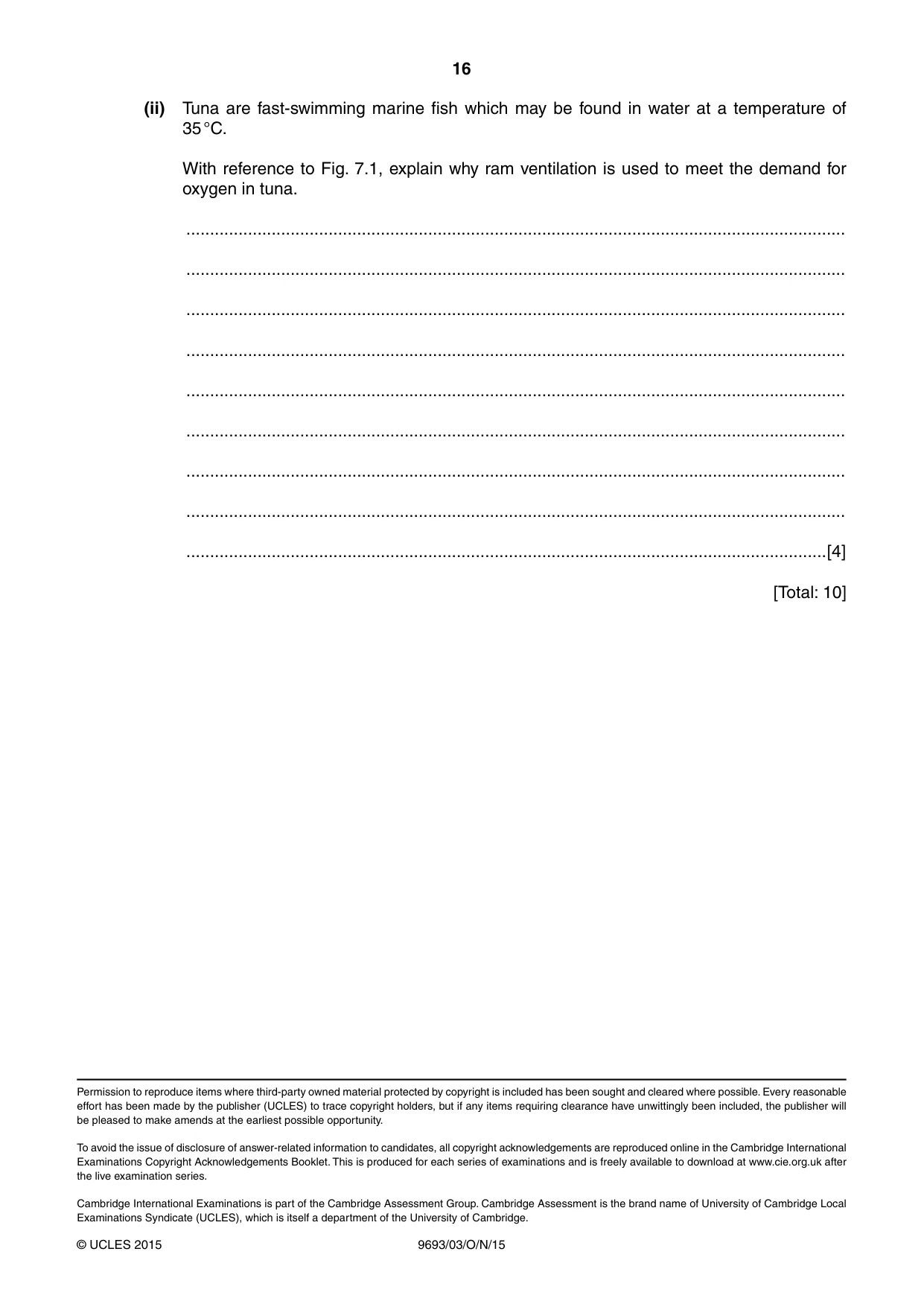
16 9693/03/O/N/15 © UCLES 2015 Permission to reproduce items where third-party owned material protected by copyright is included has been sought and cleared where possible. Every reasonable effort has been made by the publisher (UCLES) to trace copyright holders, but if any items requiring clearance have unwittingly been included, the publisher will be pleased to make amends at the earliest possible opportunity. To avoid the issue of disclosure of answer-related information to candidates, all copyright acknowledgements are reproduced online in the Cambridge International Examinations Copyright Acknowledgements Booklet. This is produced for each series of examinations and is freely available to download at www.cie.org.uk after the live examination series. Cambridge International Examinations is part of the Cambridge Assessment Group. Cambridge Assessment is the brand name of University of Cambridge Local Examinations Syndicate (UCLES), which is itself a department of the University of Cambridge. (ii) Tuna are fast-swimming marine fish which may be found in water at a temperature of 35 °C. With reference to Fig. 7.1, explain why ram ventilation is used to meet the demand for oxygen in tuna. … … … … … … … … …[4] [Total: 10]
Mark scheme, page 1
® IGCSE is the registered trademark of Cambridge International Examinations. CAMBRIDGE INTERNATIONAL EXAMINATIONS Cambridge International Advanced Level MARK SCHEME for the October/November 2015 series 9693 MARINE SCIENCE 9693/03 Paper 3 (Structured Questions), maximum raw mark 75 This mark scheme is published as an aid to teachers and candidates, to indicate the requirements of the examination. It shows the basis on which Examiners were instructed to award marks. It does not indicate the details of the discussions that took place at an Examiners’ meeting before marking began, which would have considered the acceptability of alternative answers. Mark schemes should be read in conjunction with the question paper and the Principal Examiner Report for Teachers. Cambridge will not enter into discussions about these mark schemes. Cambridge is publishing the mark schemes for the October/November 2015 series for most Cambridge IGCSE®, Cambridge International A and AS Level components and some Cambridge O Level components.
Mark scheme, page 2
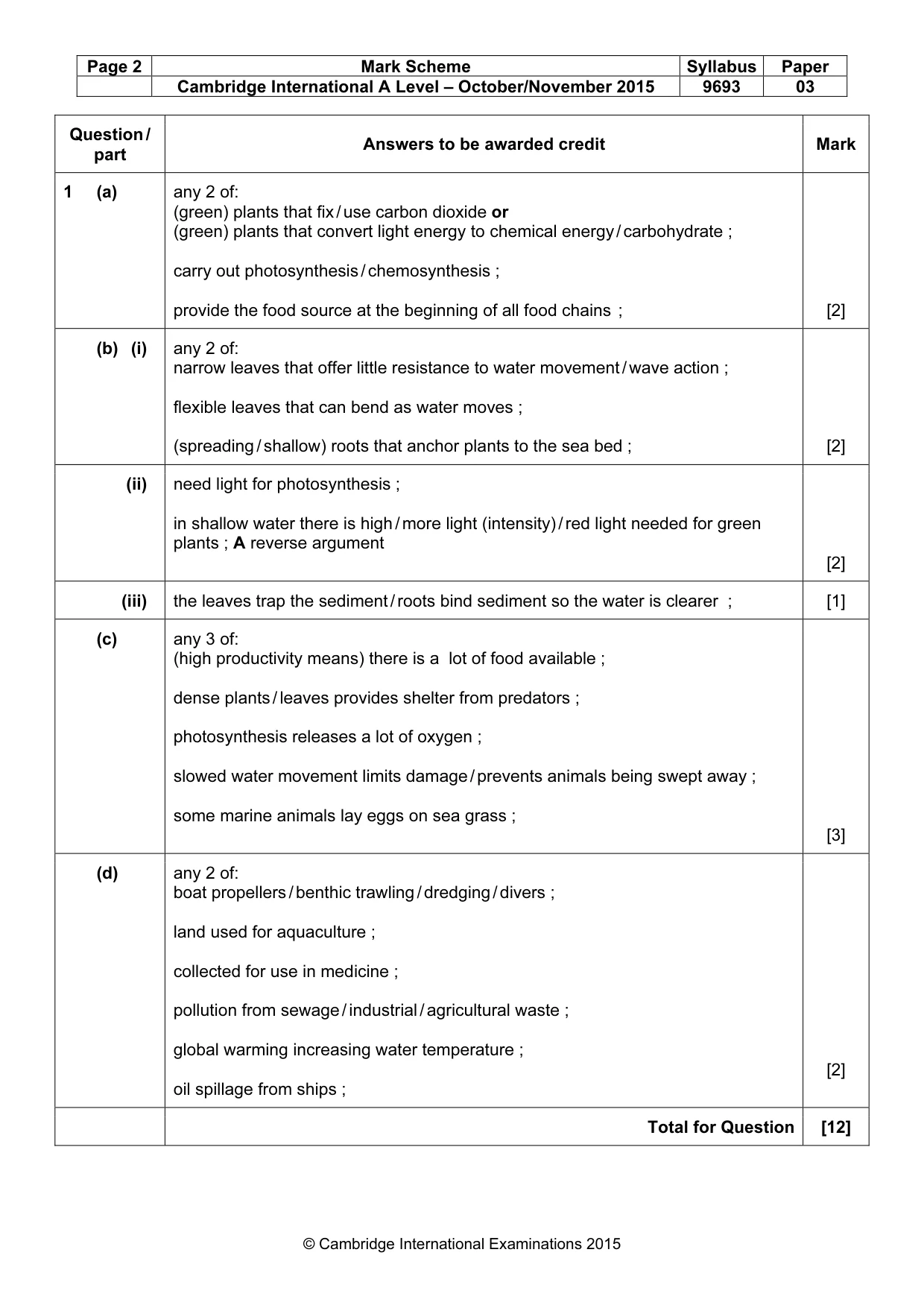
Page 2 Mark Scheme Syllabus Paper Cambridge International A Level – October/November 2015 9693 03 © Cambridge International Examinations 2015 Question / part Answers to be awarded credit Mark 1 (a) any 2 of: (green) plants that fix / use carbon dioxide or (green) plants that convert light energy to chemical energy / carbohydrate ; carry out photosynthesis / chemosynthesis ; provide the food source at the beginning of all food chains ; [2] (b) (i) any 2 of: narrow leaves that offer little resistance to water movement / wave action ; flexible leaves that can bend as water moves ; (spreading / shallow) roots that anchor plants to the sea bed ; [2] (ii) need light for photosynthesis ; in shallow water there is high / more light (intensity) / red light needed for green plants ; A reverse argument [2] (iii) the leaves trap the sediment / roots bind sediment so the water is clearer ; [1] (c) any 3 of: (high productivity means) there is a lot of food available ; dense plants / leaves provides shelter from predators ; photosynthesis releases a lot of oxygen ; slowed water movement limits damage / prevents animals being swept away ; some marine animals lay eggs on sea grass ; [3] (d) any 2 of: boat propellers / benthic trawling / dredging / divers ; land used for aquaculture ; collected for use in medicine ; pollution from sewage / industrial / agricultural waste ; global warming increasing water temperature ; oil spillage from ships ; [2] Total for Question [12]
Mark scheme, page 3
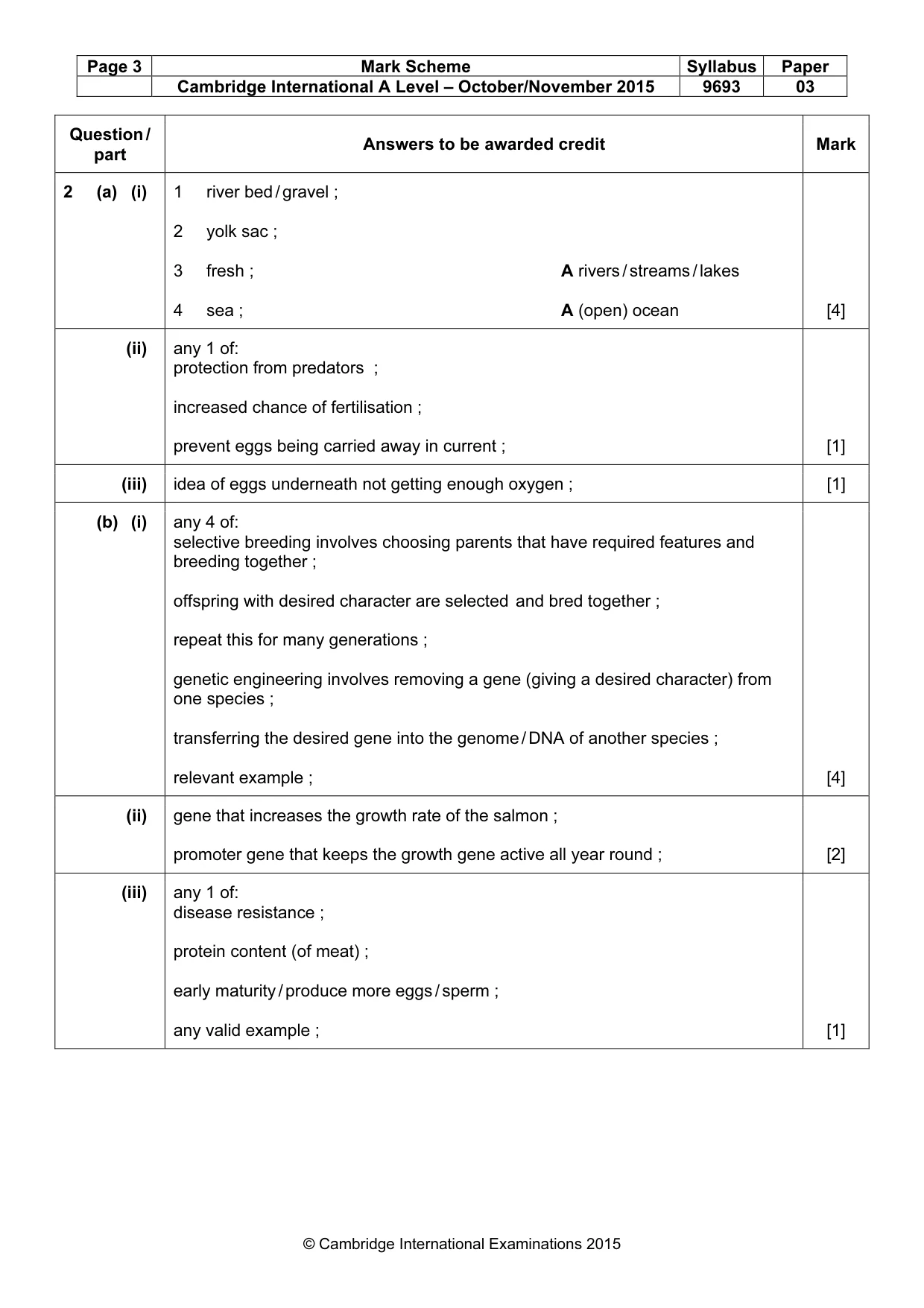
Page 3 Mark Scheme Syllabus Paper Cambridge International A Level – October/November 2015 9693 03 © Cambridge International Examinations 2015 Question / part Answers to be awarded credit Mark 2 (a) (i) 1 river bed / gravel ; 2 yolk sac ; 3 fresh ; A rivers / streams / lakes 4 sea ; A (open) ocean [4] (ii) any 1 of: protection from predators ; increased chance of fertilisation ; prevent eggs being carried away in current ; [1] (iii) idea of eggs underneath not getting enough oxygen ; [1] (b) (i) any 4 of: selective breeding involves choosing parents that have required features and breeding together ; offspring with desired character are selected and bred together ; repeat this for many generations ; genetic engineering involves removing a gene (giving a desired character) from one species ; transferring the desired gene into the genome / DNA of another species ; relevant example ; [4] (ii) gene that increases the growth rate of the salmon ; promoter gene that keeps the growth gene active all year round ; [2] (iii) any 1 of: disease resistance ; protein content (of meat) ; early maturity / produce more eggs / sperm ; any valid example ; [1]
Mark scheme, page 4
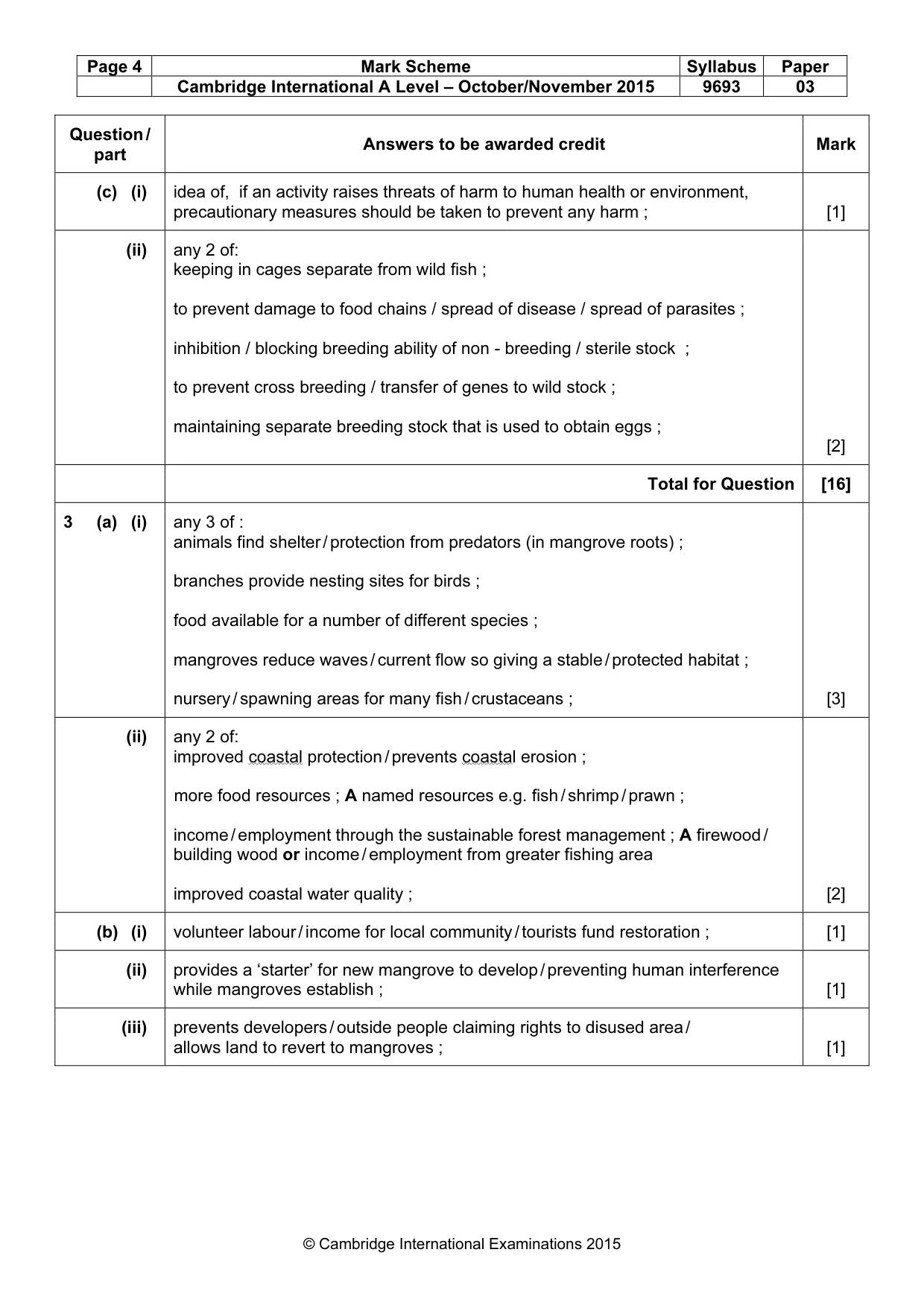
Page 4 Mark Scheme Syllabus Paper Cambridge International A Level – October/November 2015 9693 03 © Cambridge International Examinations 2015 Question / part Answers to be awarded credit Mark (c) (i) idea of, if an activity raises threats of harm to human health or environment, precautionary measures should be taken to prevent any harm ; [1] (ii) any 2 of: keeping in cages separate from wild fish ; to prevent damage to food chains / spread of disease / spread of parasites ; inhibition / blocking breeding ability of non - breeding / sterile stock ; to prevent cross breeding / transfer of genes to wild stock ; maintaining separate breeding stock that is used to obtain eggs ; [2] Total for Question [16] 3 (a) (i) any 3 of : animals find shelter / protection from predators (in mangrove roots) ; branches provide nesting sites for birds ; food available for a number of different species ; mangroves reduce waves / current flow so giving a stable / protected habitat ; nursery / spawning areas for many fish / crustaceans ; [3] (ii) any 2 of: improved coastal protection / prevents coastal erosion ; more food resources ; A named resources e.g. fish / shrimp / prawn ; income / employment through the sustainable forest management ; A firewood / building wood or income / employment from greater fishing area improved coastal water quality ; [2] (b) (i) volunteer labour / income for local community / tourists fund restoration ; [1] (ii) provides a ‘starter’ for new mangrove to develop / preventing human interference while mangroves establish ; [1] (iii) prevents developers / outside people claiming rights to disused area / allows land to revert to mangroves ; [1]
Mark scheme, page 5
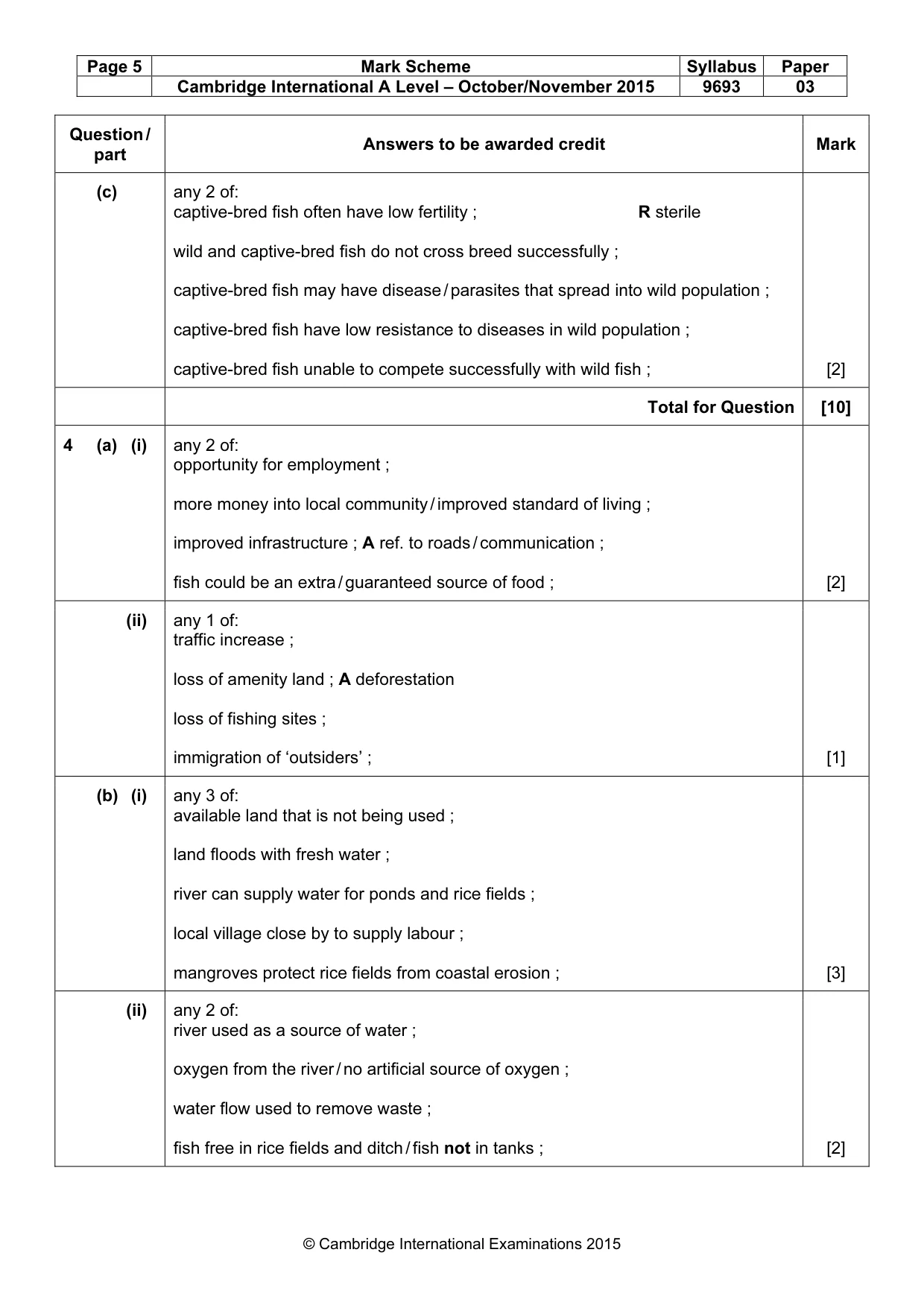
Page 5 Mark Scheme Syllabus Paper Cambridge International A Level – October/November 2015 9693 03 © Cambridge International Examinations 2015 Question / part Answers to be awarded credit Mark (c) any 2 of: captive-bred fish often have low fertility ; R sterile wild and captive-bred fish do not cross breed successfully ; captive-bred fish may have disease / parasites that spread into wild population ; captive-bred fish have low resistance to diseases in wild population ; captive-bred fish unable to compete successfully with wild fish ; [2] Total for Question [10] 4 (a) (i) any 2 of: opportunity for employment ; more money into local community / improved standard of living ; improved infrastructure ; A ref. to roads / communication ; fish could be an extra / guaranteed source of food ; [2] (ii) any 1 of: traffic increase ; loss of amenity land ; A deforestation loss of fishing sites ; immigration of ‘outsiders’ ; [1] (b) (i) any 3 of: available land that is not being used ; land floods with fresh water ; river can supply water for ponds and rice fields ; local village close by to supply labour ; mangroves protect rice fields from coastal erosion ; [3] (ii) any 2 of: river used as a source of water ; oxygen from the river / no artificial source of oxygen ; water flow used to remove waste ; fish free in rice fields and ditch / fish not in tanks ; [2]
Mark scheme, page 6
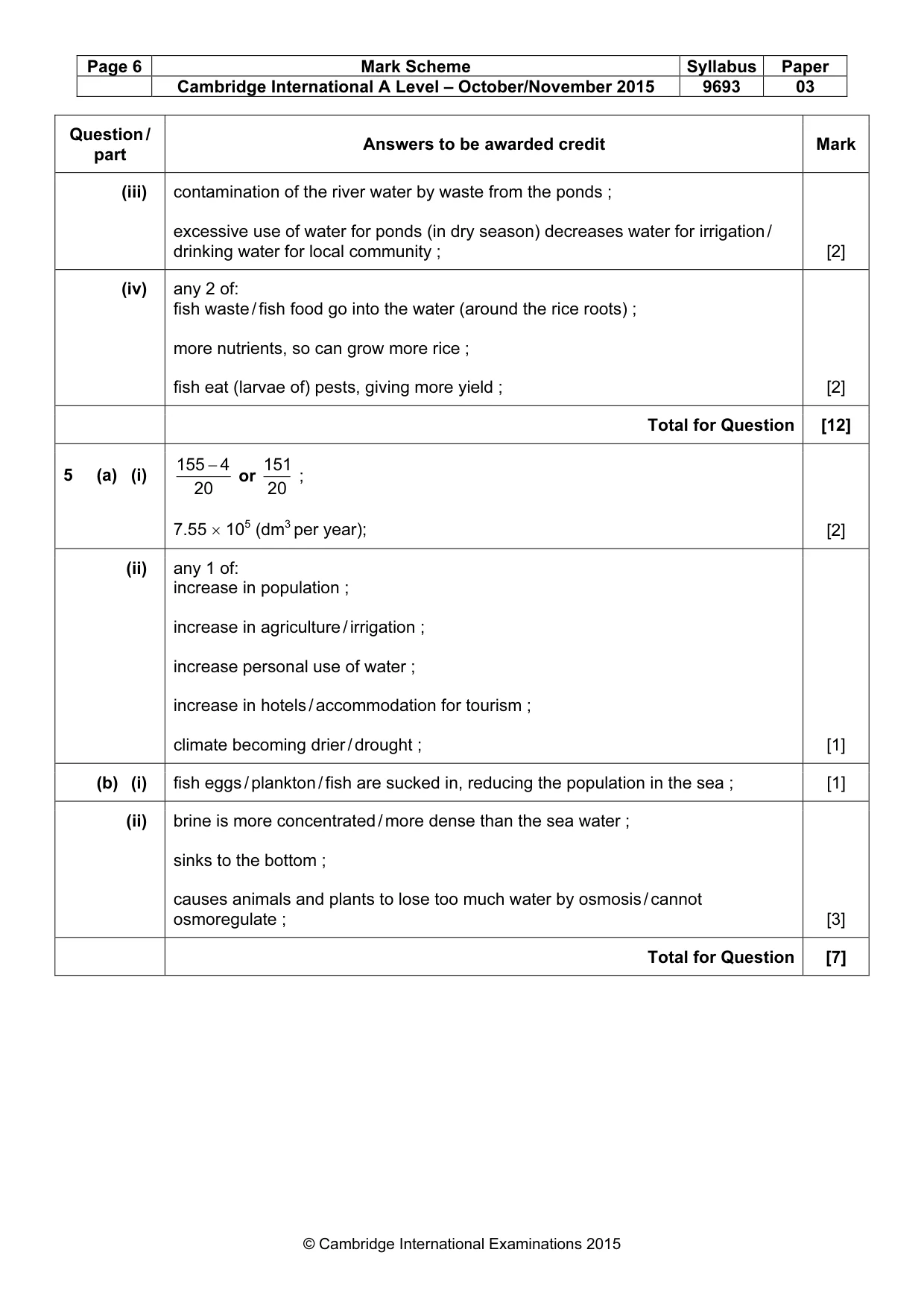
Page 6 Mark Scheme Syllabus Paper Cambridge International A Level – October/November 2015 9693 03 © Cambridge International Examinations 2015 Question / part Answers to be awarded credit Mark (iii) contamination of the river water by waste from the ponds ; excessive use of water for ponds (in dry season) decreases water for irrigation / drinking water for local community ; [2] (iv) any 2 of: fish waste / fish food go into the water (around the rice roots) ; more nutrients, so can grow more rice ; fish eat (larvae of) pests, giving more yield ; [2] Total for Question [12] 5 (a) (i) 20 4 155 − or 20 151 ; 7.55 × 10⁵ (dm3 per year); [2] (ii) any 1 of: increase in population ; increase in agriculture / irrigation ; increase personal use of water ; increase in hotels / accommodation for tourism ; climate becoming drier / drought ; [1] (b) (i) fish eggs / plankton / fish are sucked in, reducing the population in the sea ; [1] (ii) brine is more concentrated / more dense than the sea water ; sinks to the bottom ; causes animals and plants to lose too much water by osmosis / cannot osmoregulate ; [3] Total for Question [7]
Mark scheme, page 7
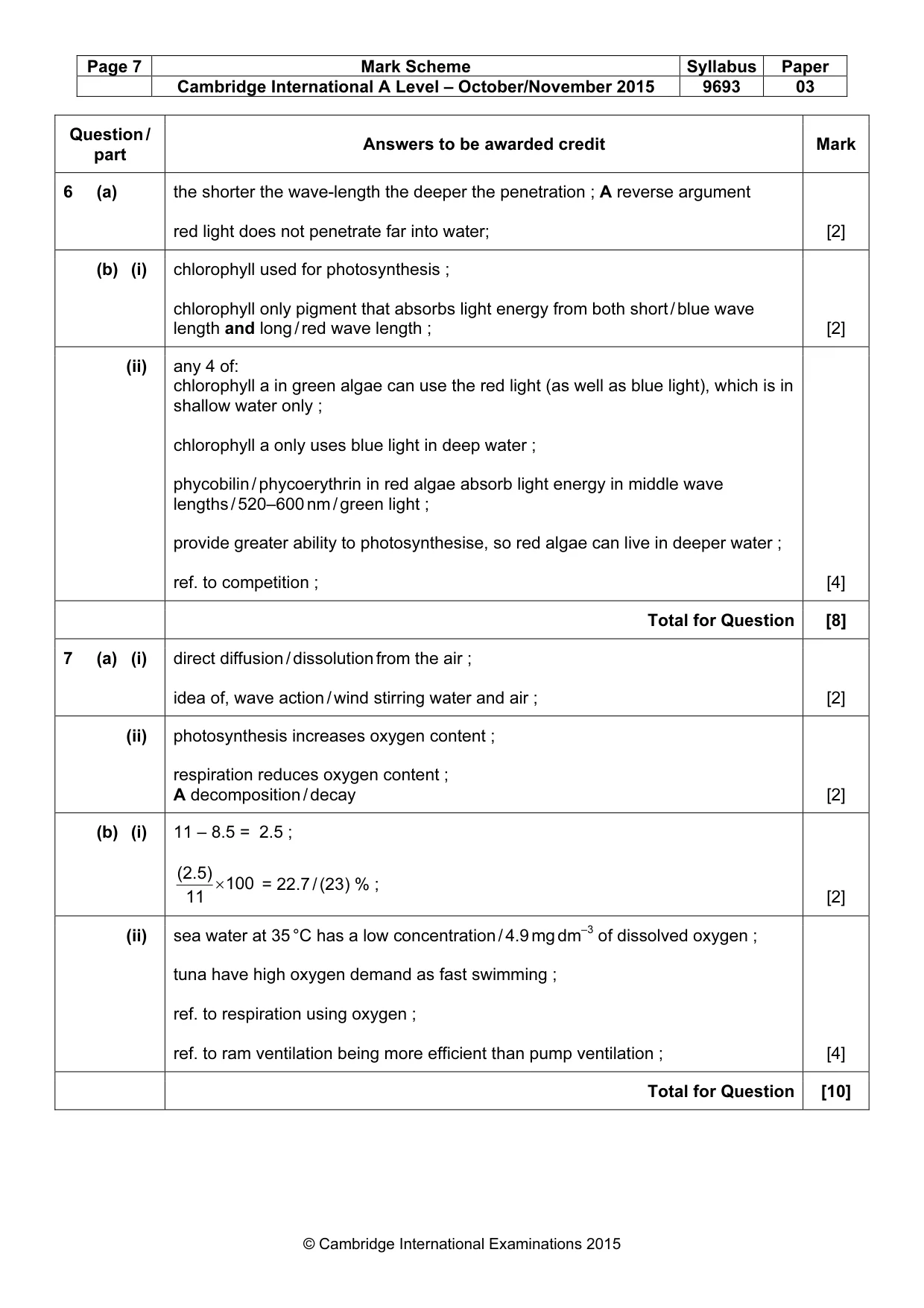
Page 7 Mark Scheme Syllabus Paper Cambridge International A Level – October/November 2015 9693 03 © Cambridge International Examinations 2015 Question / part Answers to be awarded credit Mark 6 (a) the shorter the wave-length the deeper the penetration ; A reverse argument red light does not penetrate far into water; [2] (b) (i) chlorophyll used for photosynthesis ; chlorophyll only pigment that absorbs light energy from both short / blue wave length and long / red wave length ; [2] (ii) any 4 of: chlorophyll a in green algae can use the red light (as well as blue light), which is in shallow water only ; chlorophyll a only uses blue light in deep water ; phycobilin / phycoerythrin in red algae absorb light energy in middle wave lengths / 520–600 nm / green light ; provide greater ability to photosynthesise, so red algae can live in deeper water ; ref. to competition ; [4] Total for Question [8] 7 (a) (i) direct diffusion / dissolution from the air ; idea of, wave action / wind stirring water and air ; [2] (ii) photosynthesis increases oxygen content ; respiration reduces oxygen content ; A decomposition / decay [2] (b) (i) 11 – 8.5 = 2.5 ; 100 11 (2.5) × = 22.7 / (23) % ; [2] (ii) sea water at 35 °C has a low concentration / 4.9 mg dm–3 of dissolved oxygen ; tuna have high oxygen demand as fast swimming ; ref. to respiration using oxygen ; ref. to ram ventilation being more efficient than pump ventilation ; [4] Total for Question [10]
What you needed in this session
Cambridge’s own grade thresholds for 2015 Oct/Nov, Paper 3 · Variant 1. A higher threshold means an easier paper — the bar moves with how the cohort did.