Cambridge A Level Marine Science 9693 — 2015 May/June Paper 3 · Variant 1
9693/31/M/J/15 · 75 marks · ≈84 min
The question paper and its mark scheme, free to read here and free to download. This is Cambridge’s own paper, exactly as it was sat.
Question paper16 pages

Mark scheme13 pages
Answers below. Sit the paper first if you are practising.
Paper as text
Question paper, page 1
This document consists of 15 printed pages and 1 blank page. DC (SJF/CGW) 93475/4 © UCLES 2015 [Turn over Cambridge International Examinations Cambridge International Advanced Subsidiary and Advanced Level * 4 2 4 5 6 1 5 7 9 6 * MARINE SCIENCE 9693/03 Paper 3 A2 Structured Questions May/June 2015 1 hour 30 minutes Candidates answer on the Question Paper. No Additional Materials are required. READ THESE INSTRUCTIONS FIRST Write your Centre number, candidate number and name on all the work you hand in. Write in dark blue or black pen. You may use an HB pencil for any diagrams or graphs. Do not use staples, paper clips, glue or correction fluid. DO NOT WRITE IN ANY BARCODES. Answer all questions. Write your answers in the spaces provided on the Question Paper. Electronic calculators may be used. You may lose marks if you do not show your working or if you do not use appropriate units. At the end of the examination, fasten all your work securely together. The number of marks is given in brackets [ ] at the end of each question or part question.
Question paper, page 2
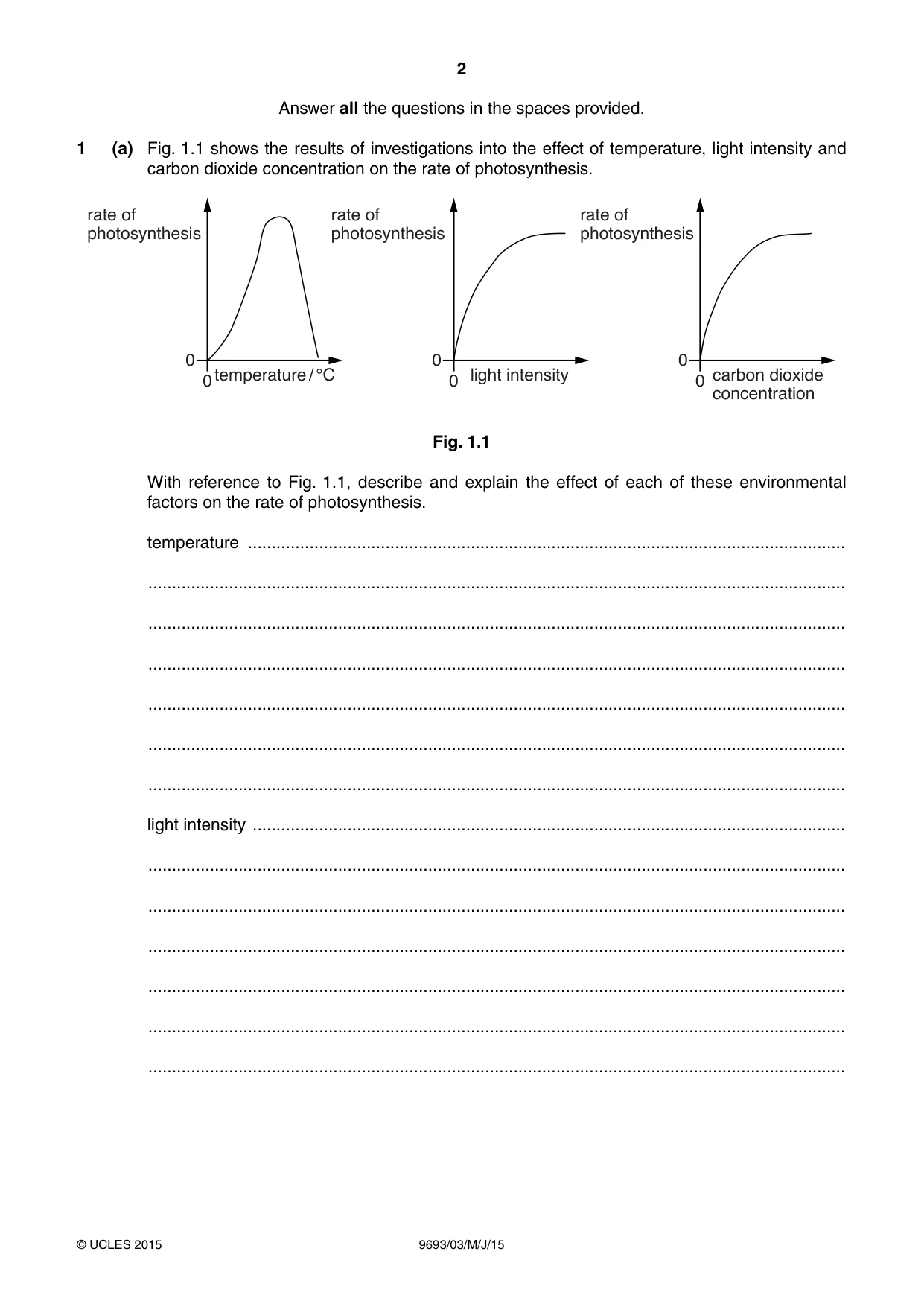
2 9693/03/M/J/15 © UCLES 2015 Answer all the questions in the spaces provided. 1 (a) Fig. 1.1 shows the results of investigations into the effect of temperature, light intensity and carbon dioxide concentration on the rate of photosynthesis. rate of photosynthesis temperature / °C 0 rate of photosynthesis light intensity 0 rate of photosynthesis carbon dioxide concentration 0 0 0 0 Fig. 1.1 With reference to Fig. 1.1, describe and explain the effect of each of these environmental factors on the rate of photosynthesis. temperature … … … … … … … light intensity … … … … … … …
Question paper, page 3
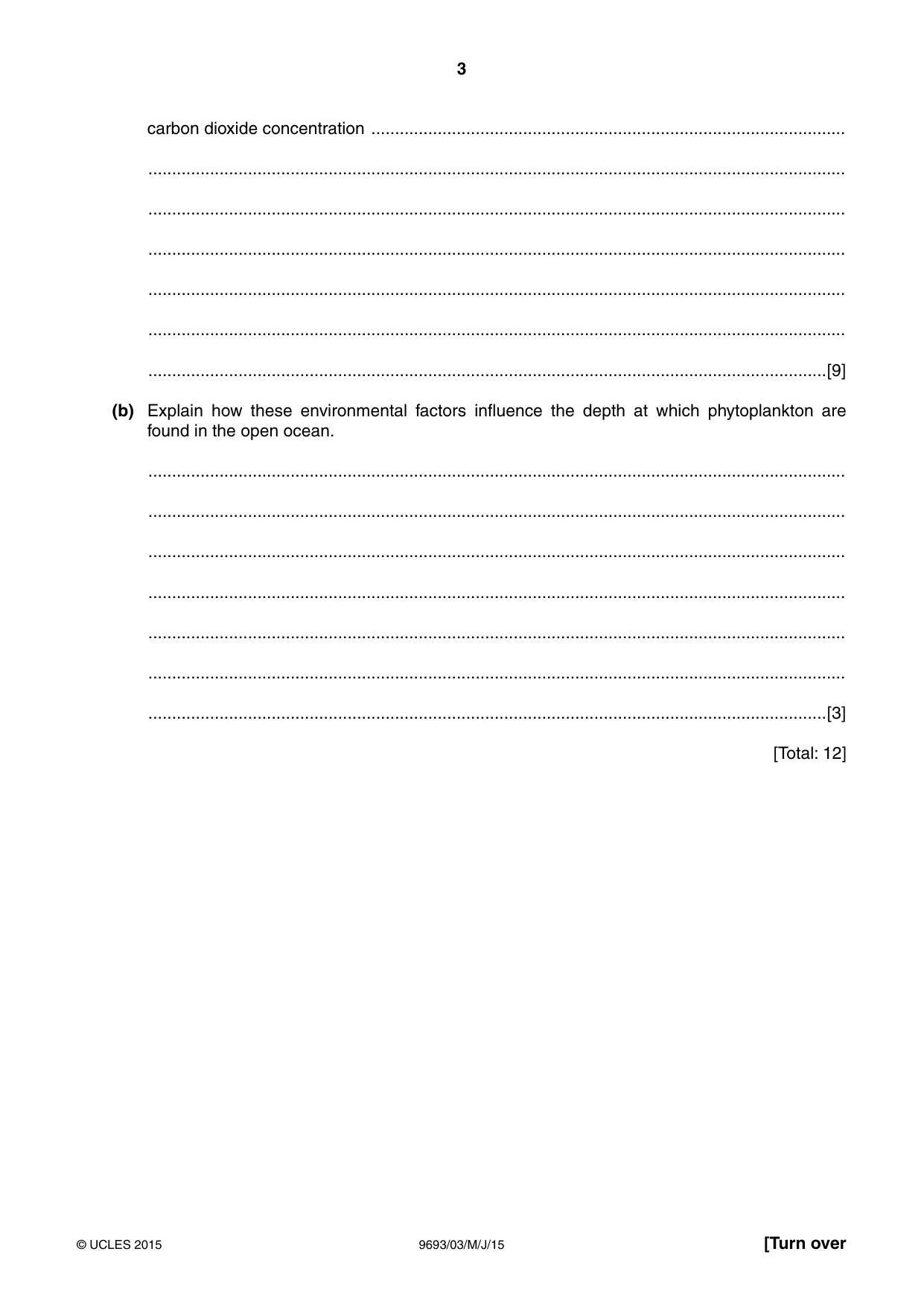
3 9693/03/M/J/15 © UCLES 2015 [Turn over carbon dioxide concentration … … … … … … …[9] (b) Explain how these environmental factors influence the depth at which phytoplankton are found in the open ocean. … … … … … … …[3] [Total: 12]
Question paper, page 4
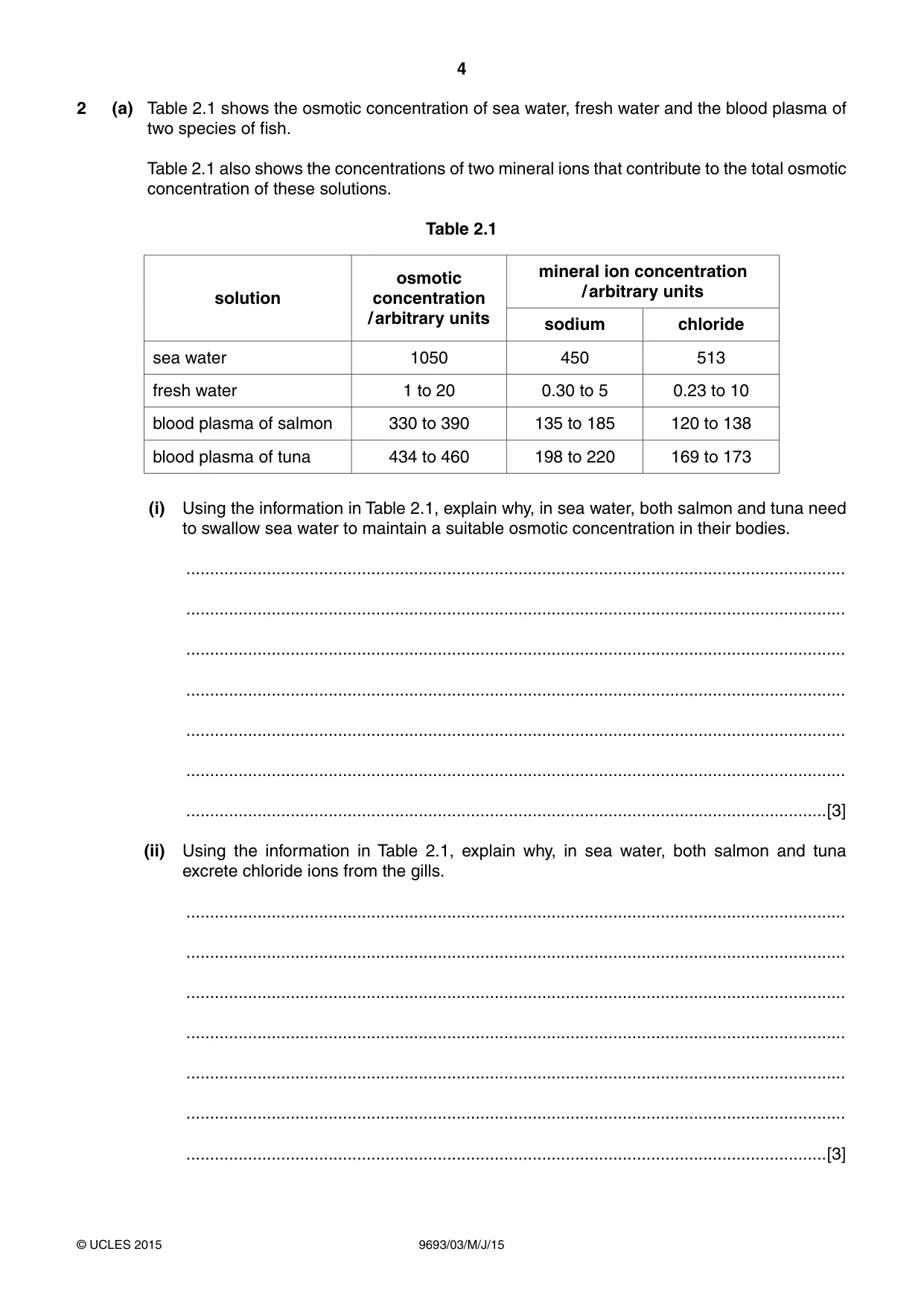
4 9693/03/M/J/15 © UCLES 2015 2 (a) Table 2.1 shows the osmotic concentration of sea water, fresh water and the blood plasma of two species of fish. Table 2.1 also shows the concentrations of two mineral ions that contribute to the total osmotic concentration of these solutions. Table 2.1 solution osmotic concentration / arbitrary units mineral ion concentration / arbitrary units sodium chloride sea water 1050 450 513 fresh water 1 to 20 0.30 to 5 0.23 to 10 blood plasma of salmon 330 to 390 135 to 185 120 to 138 blood plasma of tuna 434 to 460 198 to 220 169 to 173 (i) Using the information in Table 2.1, explain why, in sea water, both salmon and tuna need to swallow sea water to maintain a suitable osmotic concentration in their bodies. … … … … … … …[3] (ii) Using the information in Table 2.1, explain why, in sea water, both salmon and tuna excrete chloride ions from the gills. … … … … … … …[3]
Question paper, page 5
5 9693/03/M/J/15 © UCLES 2015 [Turn over (b) Explain why salmon are able to survive in both fresh water and sea water, but tuna can survive only in sea water. … … … … … … … … … … … …[5] [Total: 11]
Question paper, page 6
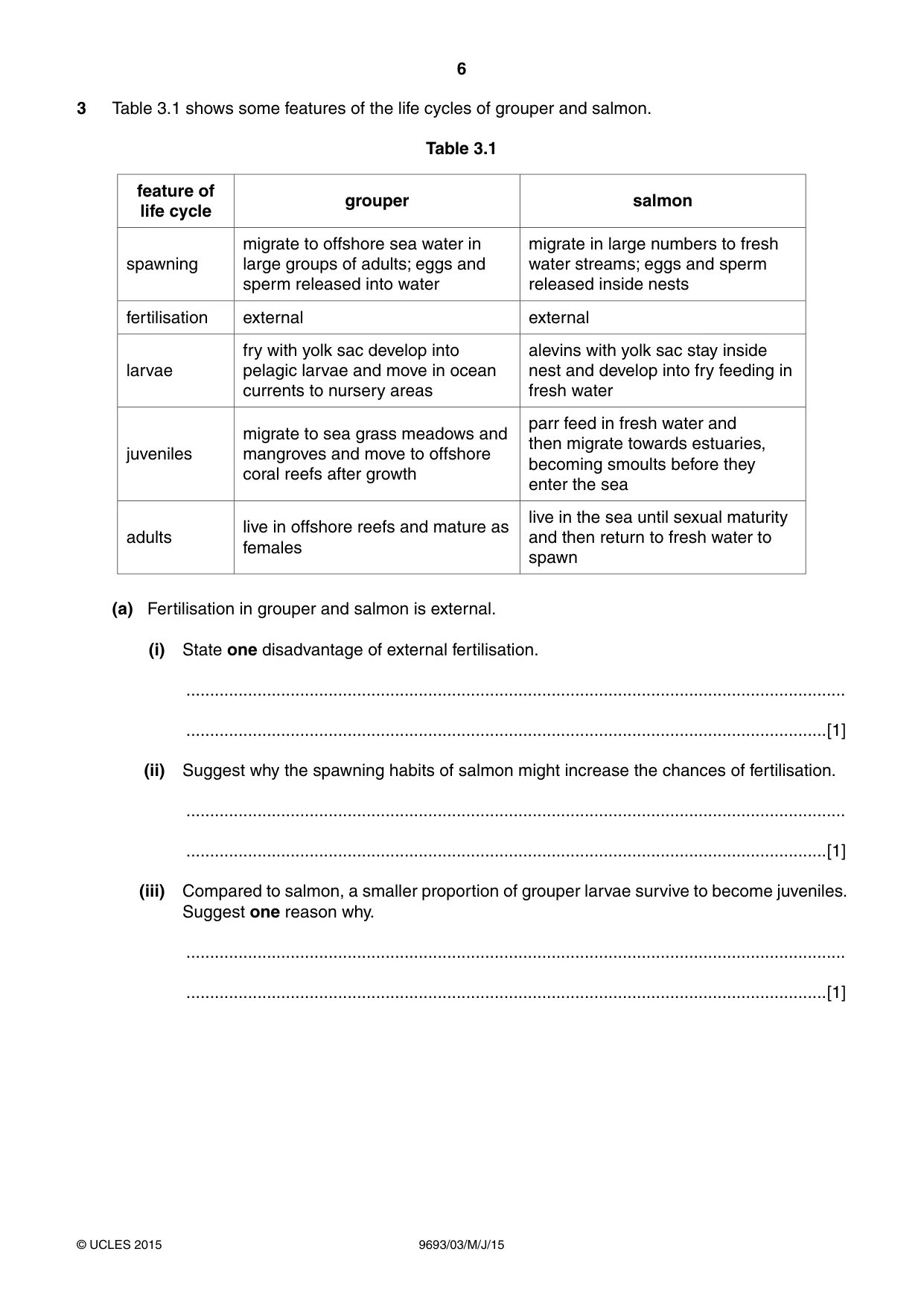
6 9693/03/M/J/15 © UCLES 2015 3 Table 3.1 shows some features of the life cycles of grouper and salmon. Table 3.1 feature of life cycle grouper salmon spawning migrate to offshore sea water in large groups of adults; eggs and sperm released into water migrate in large numbers to fresh water streams; eggs and sperm released inside nests fertilisation external external larvae fry with yolk sac develop into pelagic larvae and move in ocean currents to nursery areas alevins with yolk sac stay inside nest and develop into fry feeding in fresh water juveniles migrate to sea grass meadows and mangroves and move to offshore coral reefs after growth parr feed in fresh water and then migrate towards estuaries, becoming smoults before they enter the sea adults live in offshore reefs and mature as females live in the sea until sexual maturity and then return to fresh water to spawn (a) Fertilisation in grouper and salmon is external. (i) State one disadvantage of external fertilisation. … …[1] (ii) Suggest why the spawning habits of salmon might increase the chances of fertilisation. … …[1] (iii) Compared to salmon, a smaller proportion of grouper larvae survive to become juveniles. Suggest one reason why. … …[1]
Question paper, page 7
7 9693/03/M/J/15 © UCLES 2015 [Turn over (b) Using the information in Table 3.1, explain why the spawning behaviour of grouper and salmon may increase the risk of overfishing. … … … …[2] (c) Suggest the advantages to juveniles of both salmon and grouper of migrating from one habitat to another. … … … …[2] [Total: 7]
Question paper, page 8
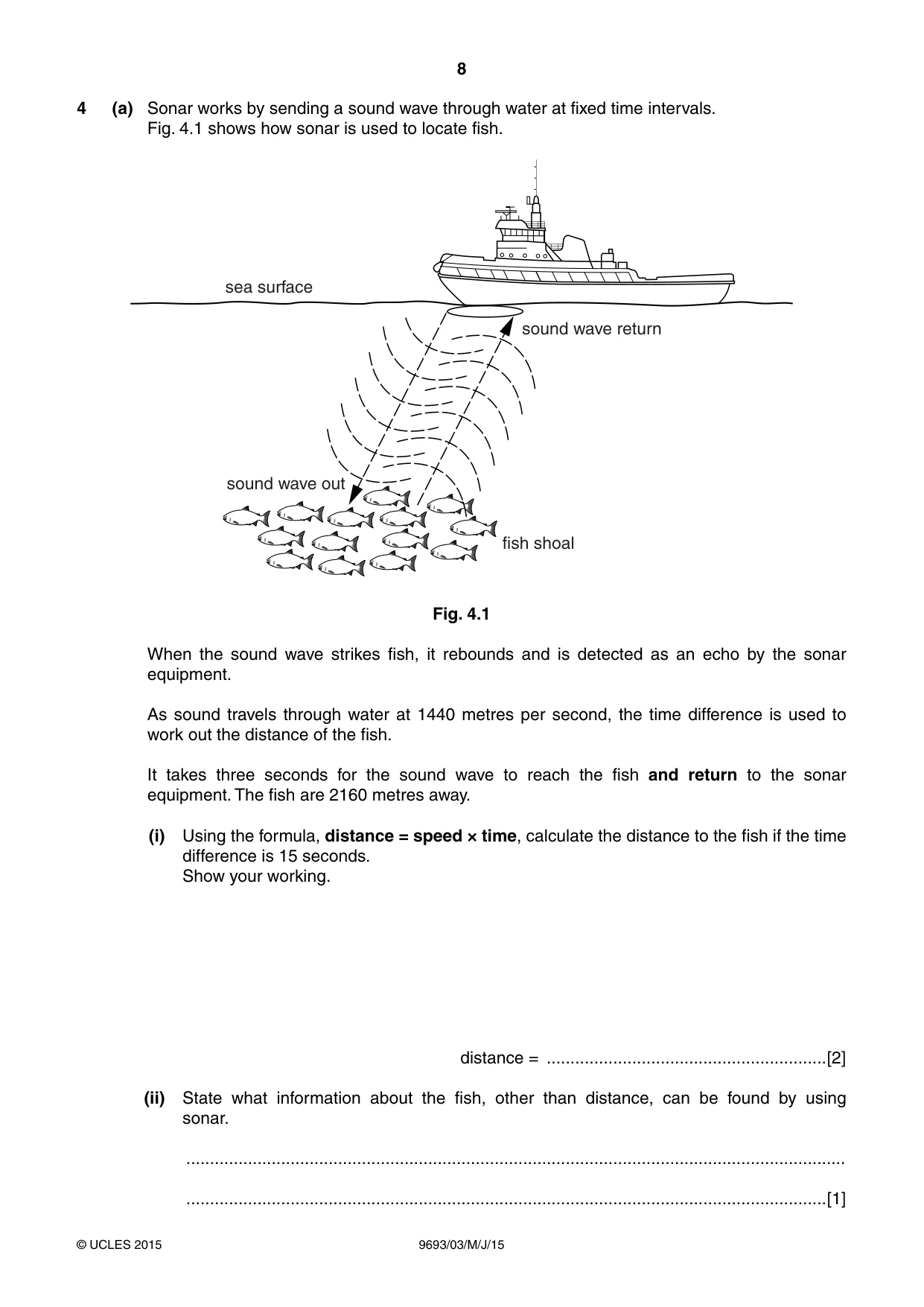
8 9693/03/M/J/15 © UCLES 2015 4 (a) Sonar works by sending a sound wave through water at fixed time intervals. Fig. 4.1 shows how sonar is used to locate fish. sea surface fish shoal sound wave return sound wave out Fig. 4.1 When the sound wave strikes fish, it rebounds and is detected as an echo by the sonar equipment. As sound travels through water at 1440 metres per second, the time difference is used to work out the distance of the fish. It takes three seconds for the sound wave to reach the fish and return to the sonar equipment. The fish are 2160 metres away. (i) Using the formula, distance = speed × time, calculate the distance to the fish if the time difference is 15 seconds. Show your working. distance = …[2] (ii) State what information about the fish, other than distance, can be found by using sonar. … …[1]
Question paper, page 9
9 9693/03/M/J/15 © UCLES 2015 [Turn over (b) Benthic trawling and purse seine fishing are common fishing techniques. For each of these methods, describe their impact on non-target species. (i) benthic trawling … … … … … … … … …[4] (ii) purse seine fishing … … … …[2] (c) Suggest two advantages to a fishery of using factory ships. 1 … … 2 … …[2] [Total: 11]
Question paper, page 10
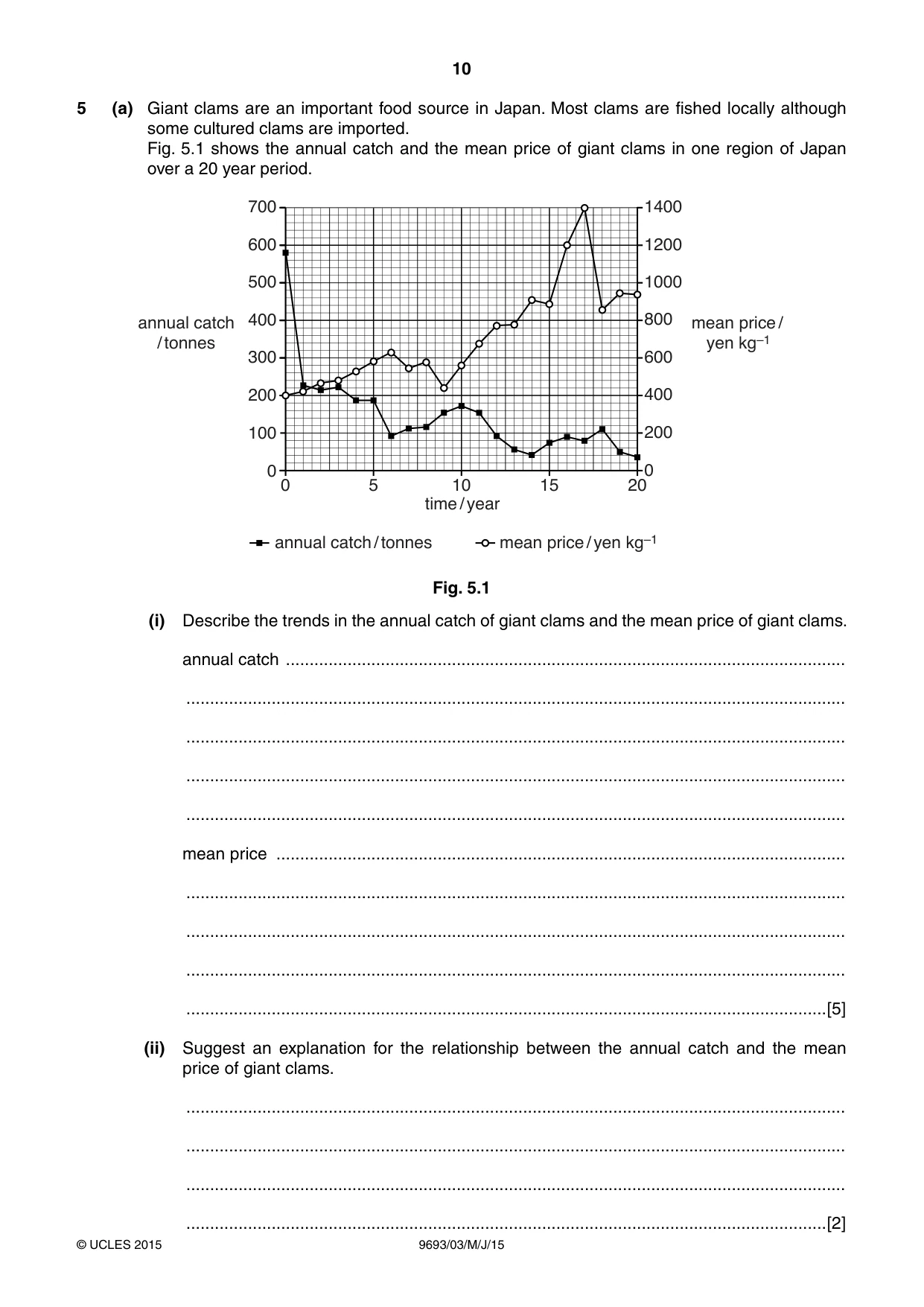
10 9693/03/M/J/15 © UCLES 2015 5 (a) Giant clams are an important food source in Japan. Most clams are fished locally although some cultured clams are imported. Fig. 5.1 shows the annual catch and the mean price of giant clams in one region of Japan over a 20 year period. 600 400 200 800 600 1200 1000 1400 0 500 700 400 300 annual catch / tonnes mean price / yen kg–1 200 100 0 5 annual catch / tonnes 10 time / year 15 20 0 mean price / yen kg–1 Fig. 5.1 (i) Describe the trends in the annual catch of giant clams and the mean price of giant clams. annual catch … … … … … mean price … … … … …[5] (ii) Suggest an explanation for the relationship between the annual catch and the mean price of giant clams. … … … …[2]
Question paper, page 11
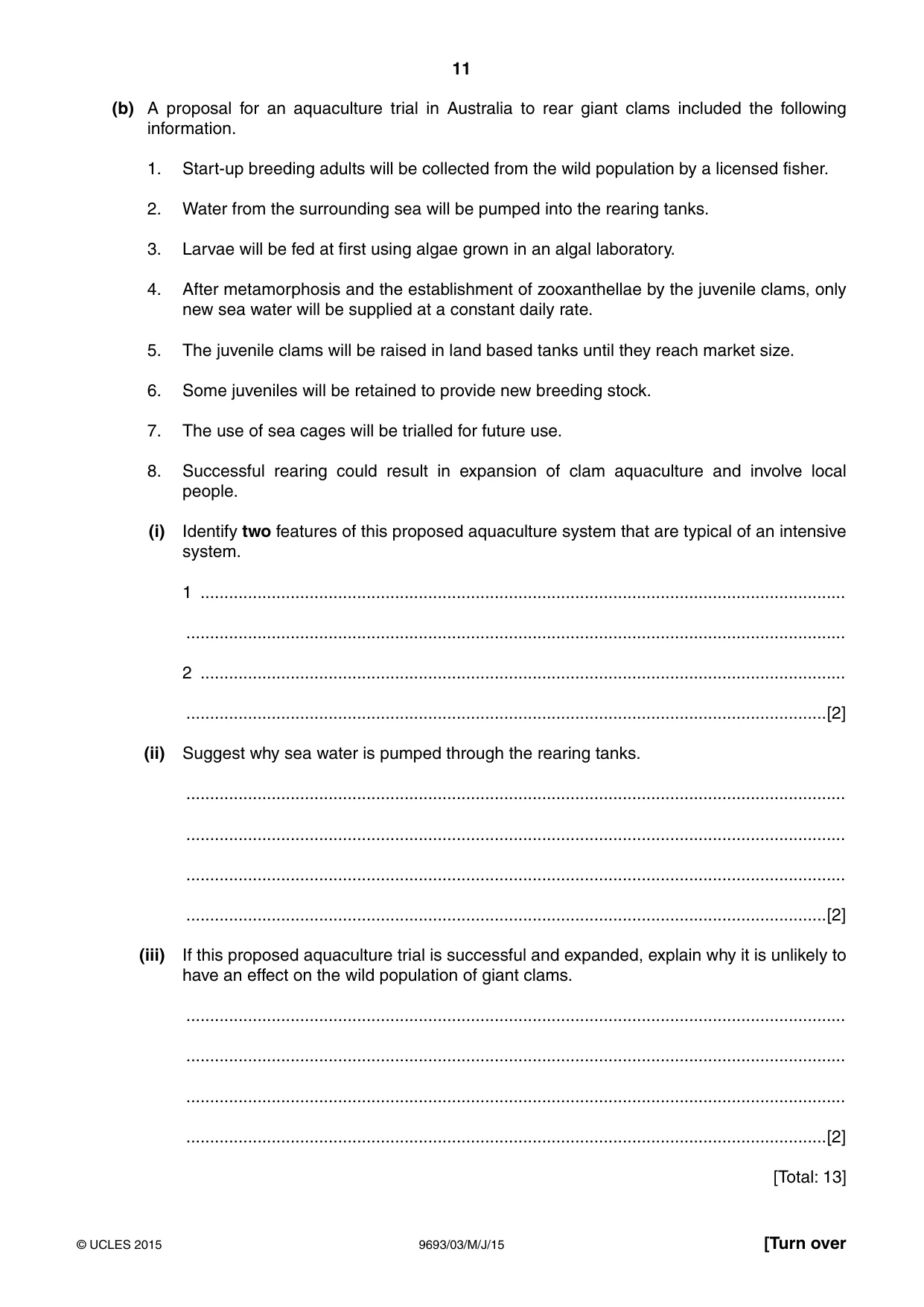
11 9693/03/M/J/15 © UCLES 2015 [Turn over (b) A proposal for an aquaculture trial in Australia to rear giant clams included the following information. 1. Start-up breeding adults will be collected from the wild population by a licensed fisher. 2. Water from the surrounding sea will be pumped into the rearing tanks. 3. Larvae will be fed at first using algae grown in an algal laboratory. 4. After metamorphosis and the establishment of zooxanthellae by the juvenile clams, only new sea water will be supplied at a constant daily rate. 5. The juvenile clams will be raised in land based tanks until they reach market size. 6. Some juveniles will be retained to provide new breeding stock. 7. The use of sea cages will be trialled for future use. 8. Successful rearing could result in expansion of clam aquaculture and involve local people. (i) Identify two features of this proposed aquaculture system that are typical of an intensive system. 1 … … 2 … …[2] (ii) Suggest why sea water is pumped through the rearing tanks. … … … …[2] (iii) If this proposed aquaculture trial is successful and expanded, explain why it is unlikely to have an effect on the wild population of giant clams. … … … …[2] [Total: 13]
Question paper, page 12
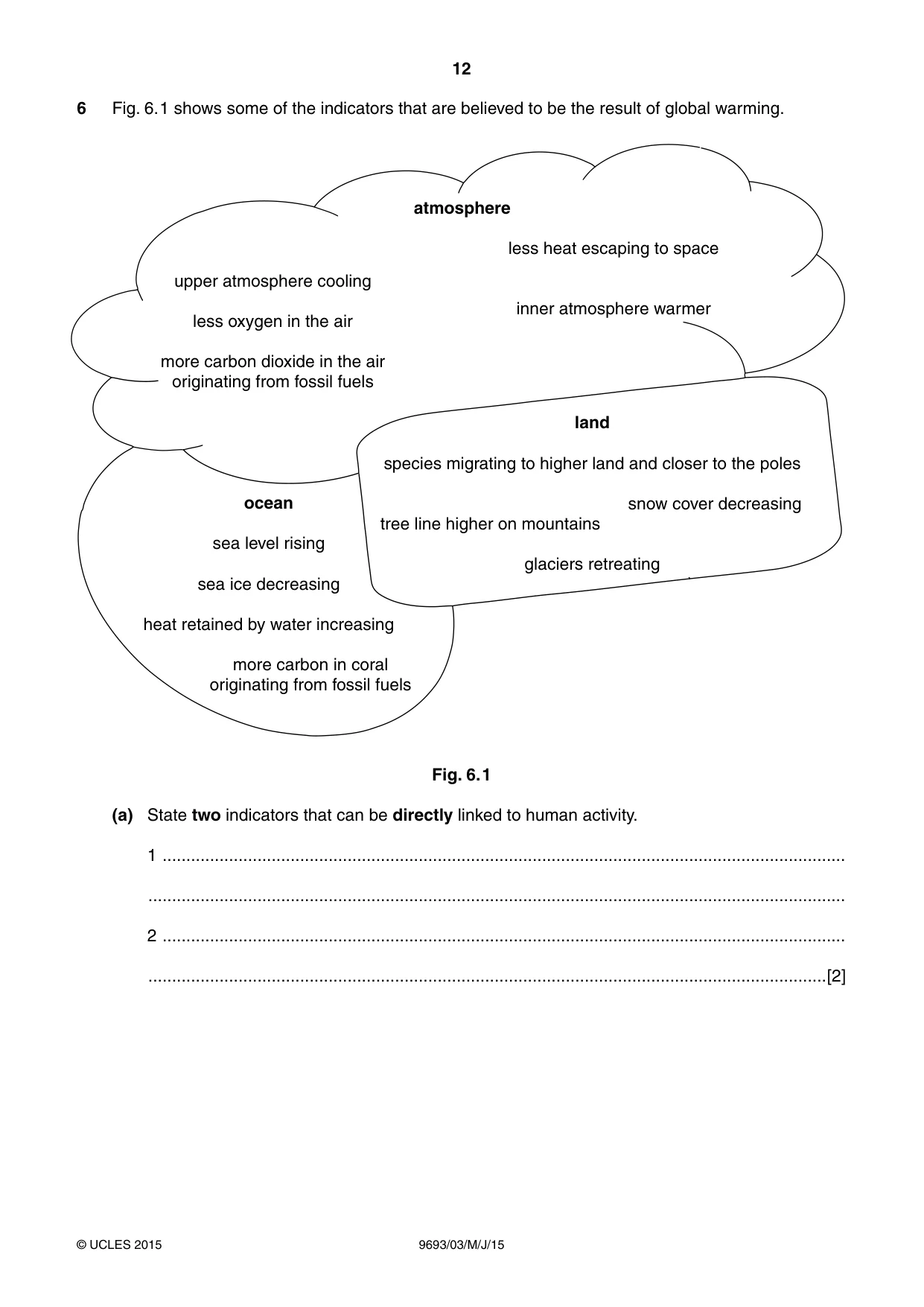
12 9693/03/M/J/15 © UCLES 2015 6 Fig. 6. 1 shows some of the indicators that are believed to be the result of global warming. atmosphere land species migrating to higher land and closer to the poles snow cover decreasing tree line higher on mountains glaciers retreating ocean sea level rising sea ice decreasing heat retained by water increasing more carbon in coral originating from fossil fuels upper atmosphere cooling less oxygen in the air more carbon dioxide in the air originating from fossil fuels less heat escaping to space inner atmosphere warmer Fig. 6. 1 (a) State two indicators that can be directly linked to human activity. 1 … … 2 … …[2]
Question paper, page 13
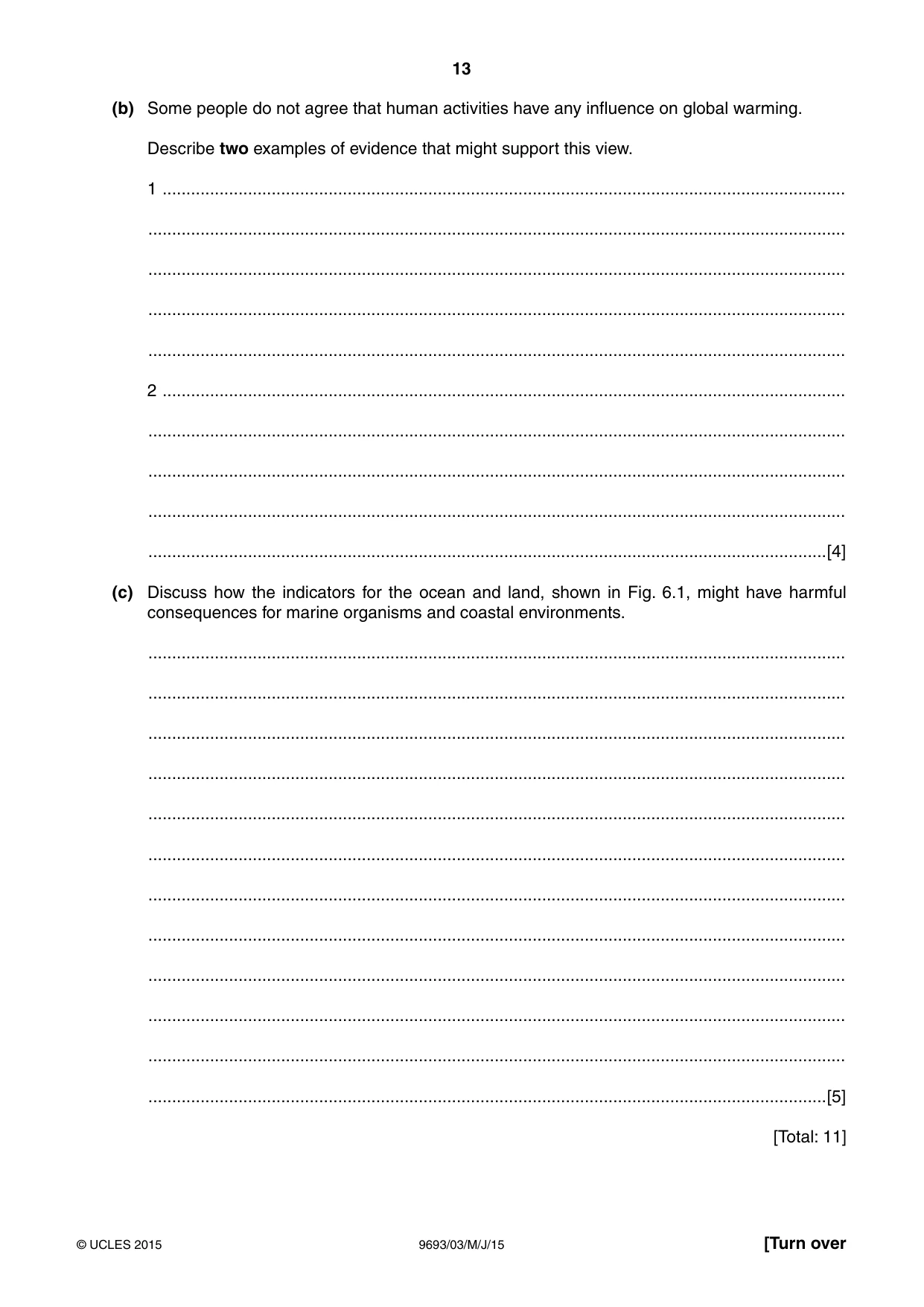
13 9693/03/M/J/15 © UCLES 2015 [Turn over (b) Some people do not agree that human activities have any influence on global warming. Describe two examples of evidence that might support this view. 1 … … … … … 2 … … … … …[4] (c) Discuss how the indicators for the ocean and land, shown in Fig. 6.1, might have harmful consequences for marine organisms and coastal environments. … … … … … … … … … … … …[5] [Total: 11]
Question paper, page 14
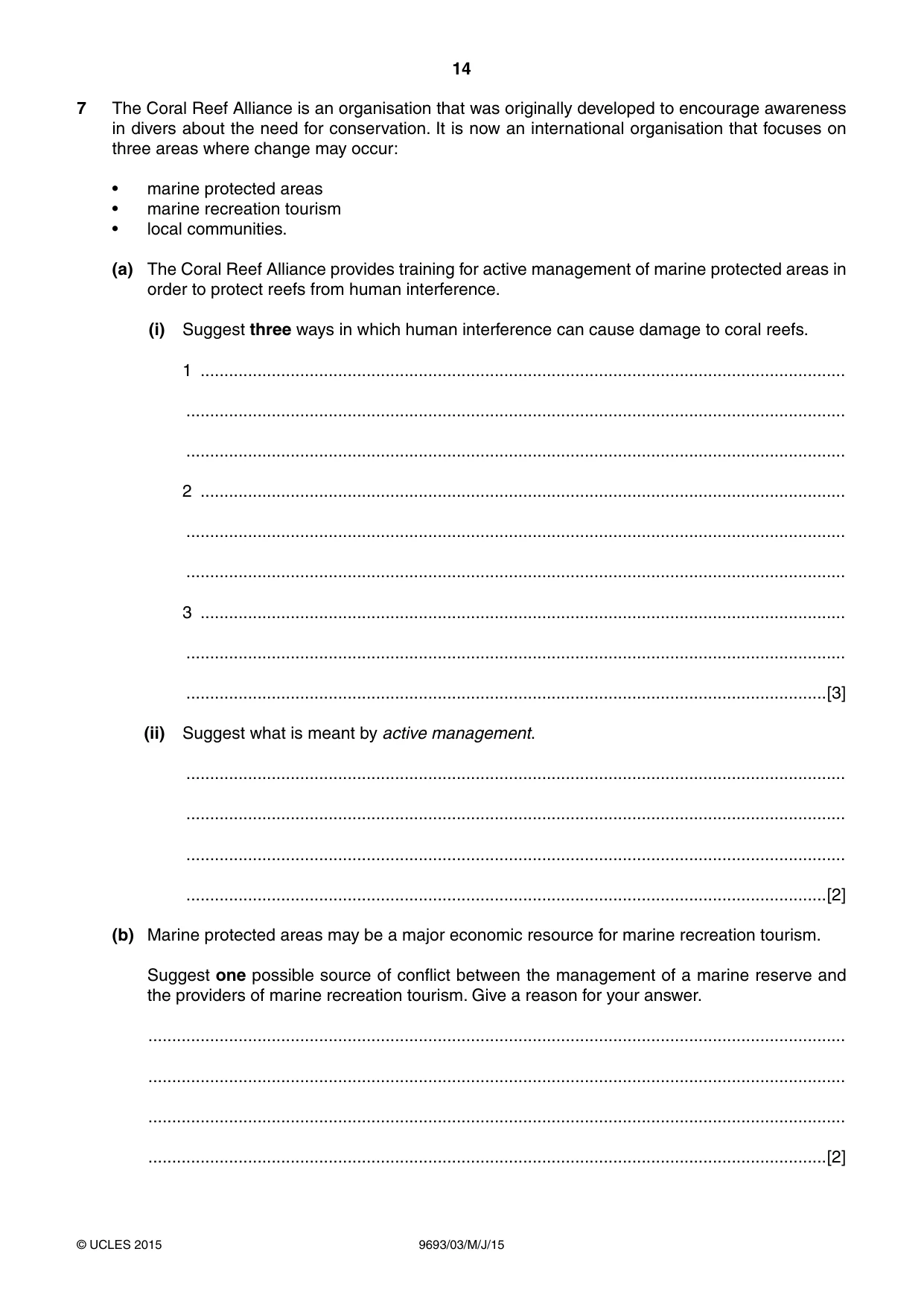
14 9693/03/M/J/15 © UCLES 2015 7 The Coral Reef Alliance is an organisation that was originally developed to encourage awareness in divers about the need for conservation. It is now an international organisation that focuses on three areas where change may occur: • marine protected areas • marine recreation tourism • local communities. (a) The Coral Reef Alliance provides training for active management of marine protected areas in order to protect reefs from human interference. (i) Suggest three ways in which human interference can cause damage to coral reefs. 1 … … … 2 … … … 3 … … …[3] (ii) Suggest what is meant by active management. … … … …[2] (b) Marine protected areas may be a major economic resource for marine recreation tourism. Suggest one possible source of conflict between the management of a marine reserve and the providers of marine recreation tourism. Give a reason for your answer. … … … …[2]
Question paper, page 15
15 9693/03/M/J/15 © UCLES 2015 (c) Local communities have different interests in how the resources in a marine protected area might be used. Suggest three examples of conflict between conservation groups, hotel operators, local fishermen and local shopkeepers about the management of a marine protected area. 1 … … … 2 … … … 3 … … …[3] [Total: 10]
Question paper, page 16
16 9693/03/M/J/15 © UCLES 2015 Permission to reproduce items where third-party owned material protected by copyright is included has been sought and cleared where possible. Every reasonable effort has been made by the publisher (UCLES) to trace copyright holders, but if any items requiring clearance have unwittingly been included, the publisher will be pleased to make amends at the earliest possible opportunity. To avoid the issue of disclosure of answer-related information to candidates, all copyright acknowledgements are reproduced online in the Cambridge International Examinations Copyright Acknowledgements Booklet. This is produced for each series of examinations and is freely available to download at www.cie.org.uk after the live examination series. Cambridge International Examinations is part of the Cambridge Assessment Group. Cambridge Assessment is the brand name of University of Cambridge Local Examinations Syndicate (UCLES), which is itself a department of the University of Cambridge. BLANK PAGE
Mark scheme, page 1
® IGCSE is the registered trademark of Cambridge International Examinations. CAMBRIDGE INTERNATIONAL EXAMINATIONS Cambridge International Advanced Subsidiary and Advanced Level MARK SCHEME for the May/June 2015 series 9693 MARINE SCIENCE 9693/03 Paper 3 (A2 Structured Questions), maximum raw mark 75 This mark scheme is published as an aid to teachers and candidates, to indicate the requirements of the examination. It shows the basis on which Examiners were instructed to award marks. It does not indicate the details of the discussions that took place at an Examiners’ meeting before marking began, which would have considered the acceptability of alternative answers. Mark schemes should be read in conjunction with the question paper and the Principal Examiner Report for Teachers. Cambridge will not enter into discussions about these mark schemes. Cambridge is publishing the mark schemes for the May/June 2015 series for most Cambridge IGCSE®, Cambridge International A and AS Level components and some Cambridge O Level components.
Mark scheme, page 2
Page 2 Mark Scheme Syllabus Paper Cambridge International AS/A Level – May/June 2015 9693 03 © Cambridge International Examinations 2015 Mark schemes will use these abbreviations: ; separates marking points / alternatives () contents of brackets are not required but should be implied R reject A accept (for answers correctly cued by the question, or guidance for examiners) Ig ignore (for incorrect but irrelevant responses) AW alternative wording (where responses vary more than usual) AVP alternative valid point (where a greater than usual variety of responses is expected) ORA or reverse argument underline actual word underlined must be used by candidate (grammatical variants excepted) max indicates the maximum number of marks that can be given + statements on both sides of the + are needed for that mark
Mark scheme, page 3
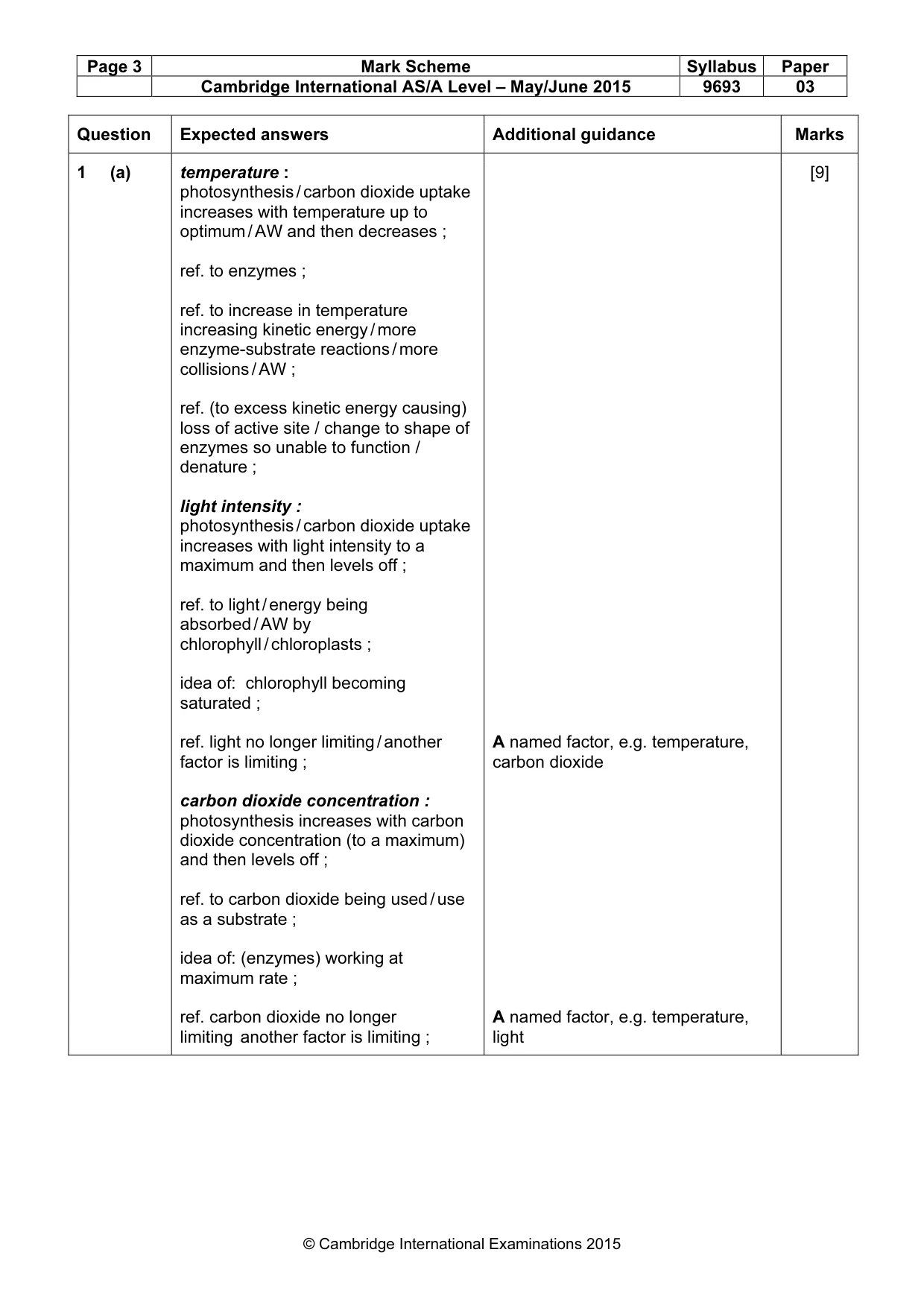
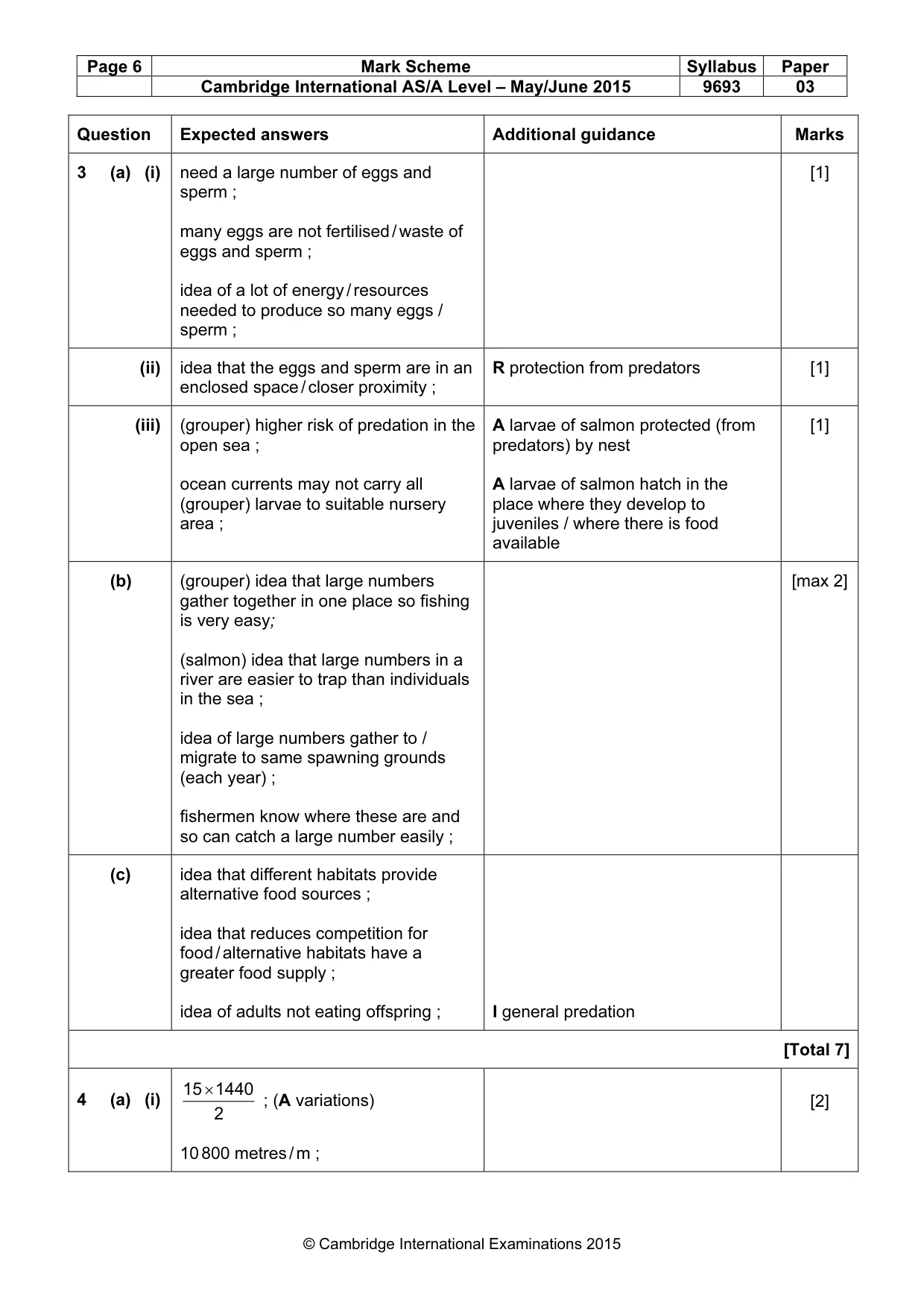
Page 3 Mark Scheme Syllabus Paper Cambridge International AS/A Level – May/June 2015 9693 03 © Cambridge International Examinations 2015 Question Expected answers Additional guidance Marks 1 (a) temperature : photosynthesis / carbon dioxide uptake increases with temperature up to optimum / AW and then decreases ; ref. to enzymes ; ref. to increase in temperature increasing kinetic energy / more enzyme-substrate reactions / more collisions / AW ; ref. (to excess kinetic energy causing) loss of active site / change to shape of enzymes so unable to function / denature ; light intensity : photosynthesis / carbon dioxide uptake increases with light intensity to a maximum and then levels off ; ref. to light / energy being absorbed / AW by chlorophyll / chloroplasts ; idea of: chlorophyll becoming saturated ; ref. light no longer limiting / another factor is limiting ; carbon dioxide concentration : photosynthesis increases with carbon dioxide concentration (to a maximum) and then levels off ; ref. to carbon dioxide being used / use as a substrate ; idea of: (enzymes) working at maximum rate ; ref. carbon dioxide no longer limiting another factor is limiting ; A named factor, e.g. temperature, carbon dioxide A named factor, e.g. temperature, light [9]
Mark scheme, page 4
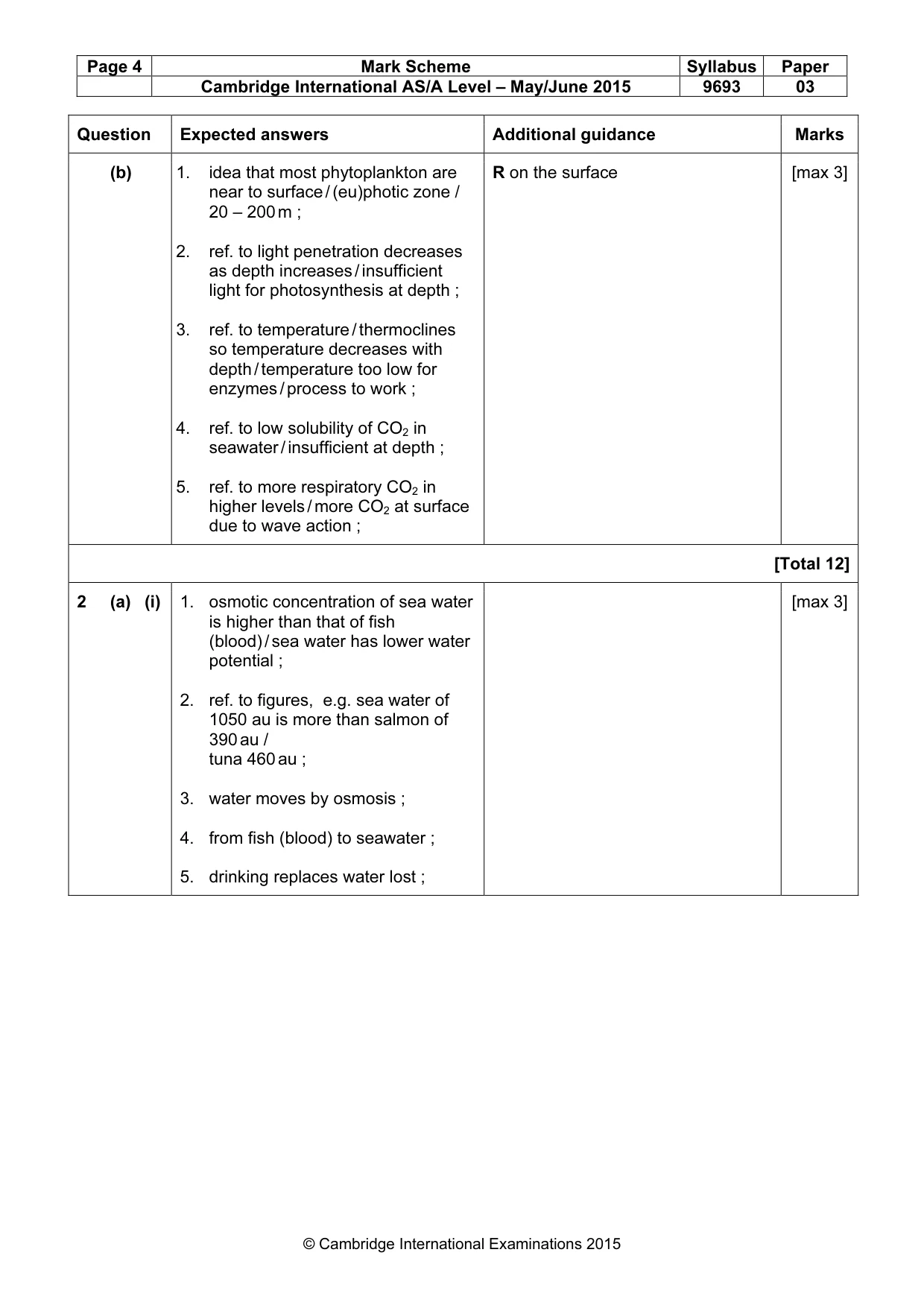
Page 4 Mark Scheme Syllabus Paper Cambridge International AS/A Level – May/June 2015 9693 03 © Cambridge International Examinations 2015 Question Expected answers Additional guidance Marks (b) 1. idea that most phytoplankton are near to surface / (eu)photic zone / 20 – 200 m ; 2. ref. to light penetration decreases as depth increases / insufficient light for photosynthesis at depth ; 3. ref. to temperature / thermoclines so temperature decreases with depth / temperature too low for enzymes / process to work ; 4. ref. to low solubility of CO2 in seawater / insufficient at depth ; 5. ref. to more respiratory CO2 in higher levels / more CO2 at surface due to wave action ; R on the surface [max 3] [Total 12] 2 (a) (i) 1. osmotic concentration of sea water is higher than that of fish (blood) / sea water has lower water potential ; 2. ref. to figures, e.g. sea water of 1050 au is more than salmon of 390 au / tuna 460 au ; 3. water moves by osmosis ; 4. from fish (blood) to seawater ; 5. drinking replaces water lost ; [max 3]
Mark scheme, page 5
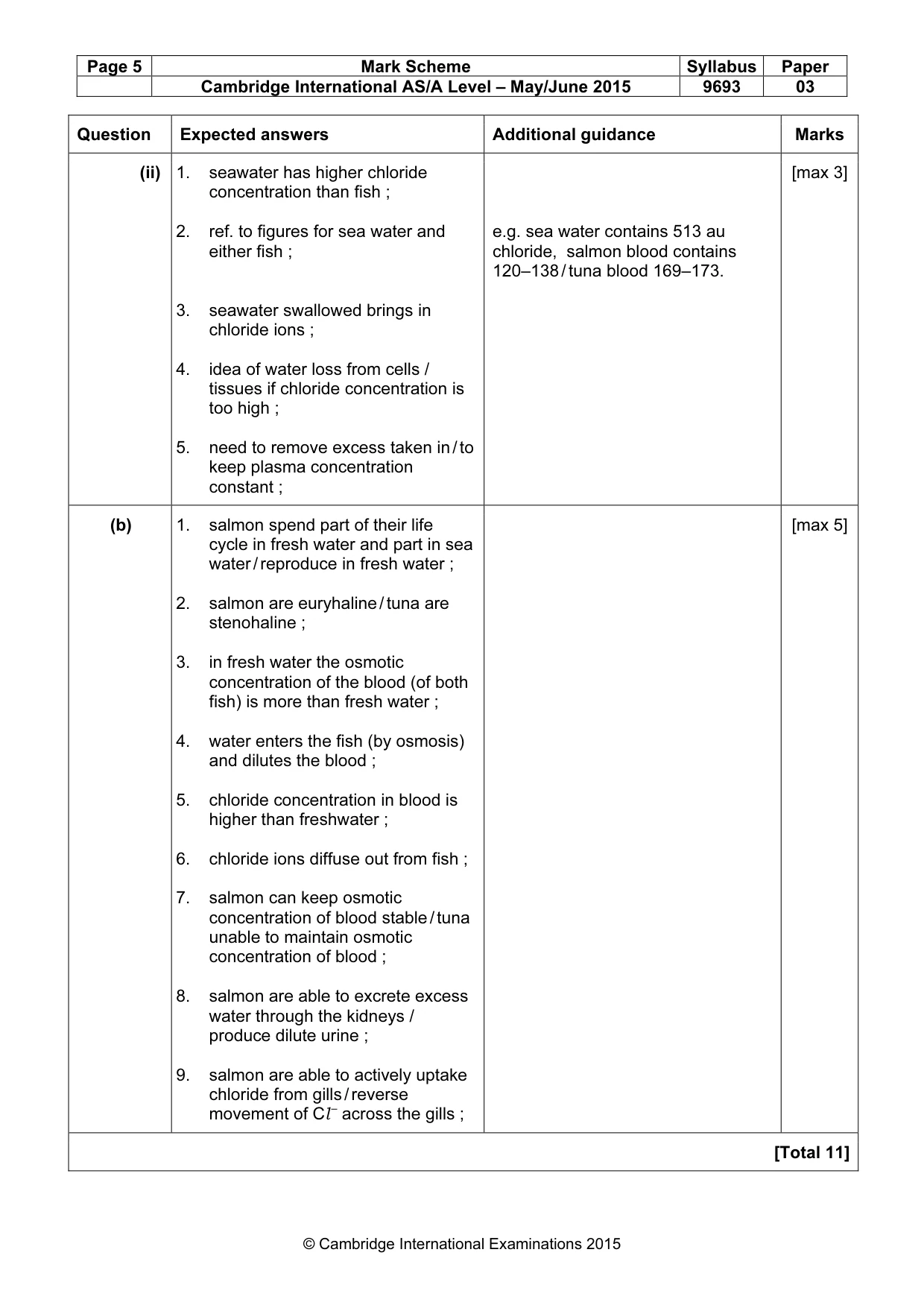
Page 5 Mark Scheme Syllabus Paper Cambridge International AS/A Level – May/June 2015 9693 03 © Cambridge International Examinations 2015 Question Expected answers Additional guidance Marks (ii) 1. seawater has higher chloride concentration than fish ; 2. ref. to figures for sea water and either fish ; 3. seawater swallowed brings in chloride ions ; 4. idea of water loss from cells / tissues if chloride concentration is too high ; 5. need to remove excess taken in / to keep plasma concentration constant ; e.g. sea water contains 513 au chloride, salmon blood contains 120–138 / tuna blood 169–173. [max 3] (b) 1. salmon spend part of their life cycle in fresh water and part in sea water / reproduce in fresh water ; 2. salmon are euryhaline / tuna are stenohaline ; 3. in fresh water the osmotic concentration of the blood (of both fish) is more than fresh water ; 4. water enters the fish (by osmosis) and dilutes the blood ; 5. chloride concentration in blood is higher than freshwater ; 6. chloride ions diffuse out from fish ; 7. salmon can keep osmotic concentration of blood stable / tuna unable to maintain osmotic concentration of blood ; 8. salmon are able to excrete excess water through the kidneys / produce dilute urine ; 9. salmon are able to actively uptake chloride from gills / reverse movement of Cl – across the gills ; [max 5] [Total 11]
Mark scheme, page 6
Page 6 Mark Scheme Syllabus Paper Cambridge International AS/A Level – May/June 2015 9693 03 © Cambridge International Examinations 2015 Question Expected answers Additional guidance Marks 3 (a) (i) need a large number of eggs and sperm ; many eggs are not fertilised / waste of eggs and sperm ; idea of a lot of energy / resources needed to produce so many eggs / sperm ; [1] (ii) idea that the eggs and sperm are in an enclosed space / closer proximity ; R protection from predators [1] (iii) (grouper) higher risk of predation in the open sea ; ocean currents may not carry all (grouper) larvae to suitable nursery area ; A larvae of salmon protected (from predators) by nest A larvae of salmon hatch in the place where they develop to juveniles / where there is food available [1] (b) (grouper) idea that large numbers gather together in one place so fishing is very easy; (salmon) idea that large numbers in a river are easier to trap than individuals in the sea ; idea of large numbers gather to / migrate to same spawning grounds (each year) ; fishermen know where these are and so can catch a large number easily ; [max 2] (c) idea that different habitats provide alternative food sources ; idea that reduces competition for food / alternative habitats have a greater food supply ; idea of adults not eating offspring ; I general predation [Total 7] 4 (a) (i) 2 1440 15× ; (A variations) 10 800 metres / m ; [2]
Mark scheme, page 7
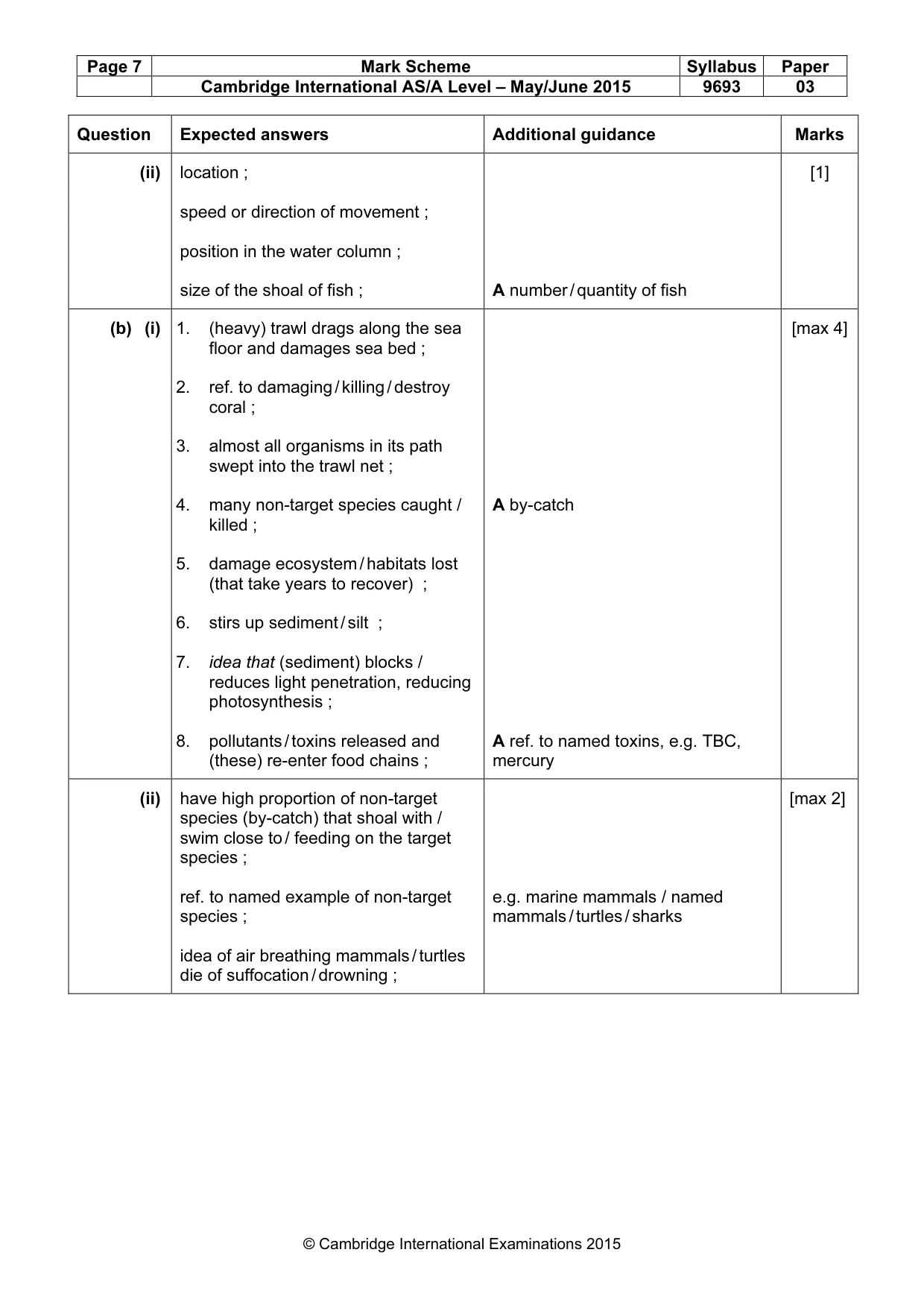
Page 7 Mark Scheme Syllabus Paper Cambridge International AS/A Level – May/June 2015 9693 03 © Cambridge International Examinations 2015 Question Expected answers Additional guidance Marks (ii) location ; speed or direction of movement ; position in the water column ; size of the shoal of fish ; A number / quantity of fish [1] (b) (i) 1. (heavy) trawl drags along the sea floor and damages sea bed ; 2. ref. to damaging / killing / destroy coral ; 3. almost all organisms in its path swept into the trawl net ; 4. many non-target species caught / killed ; 5. damage ecosystem / habitats lost (that take years to recover) ; 6. stirs up sediment / silt ; 7. idea that (sediment) blocks / reduces light penetration, reducing photosynthesis ; 8. pollutants / toxins released and (these) re-enter food chains ; A by-catch A ref. to named toxins, e.g. TBC, mercury [max 4] (ii) have high proportion of non-target species (by-catch) that shoal with / swim close to / feeding on the target species ; ref. to named example of non-target species ; idea of air breathing mammals / turtles die of suffocation / drowning ; e.g. marine mammals / named mammals / turtles / sharks [max 2]
Mark scheme, page 8
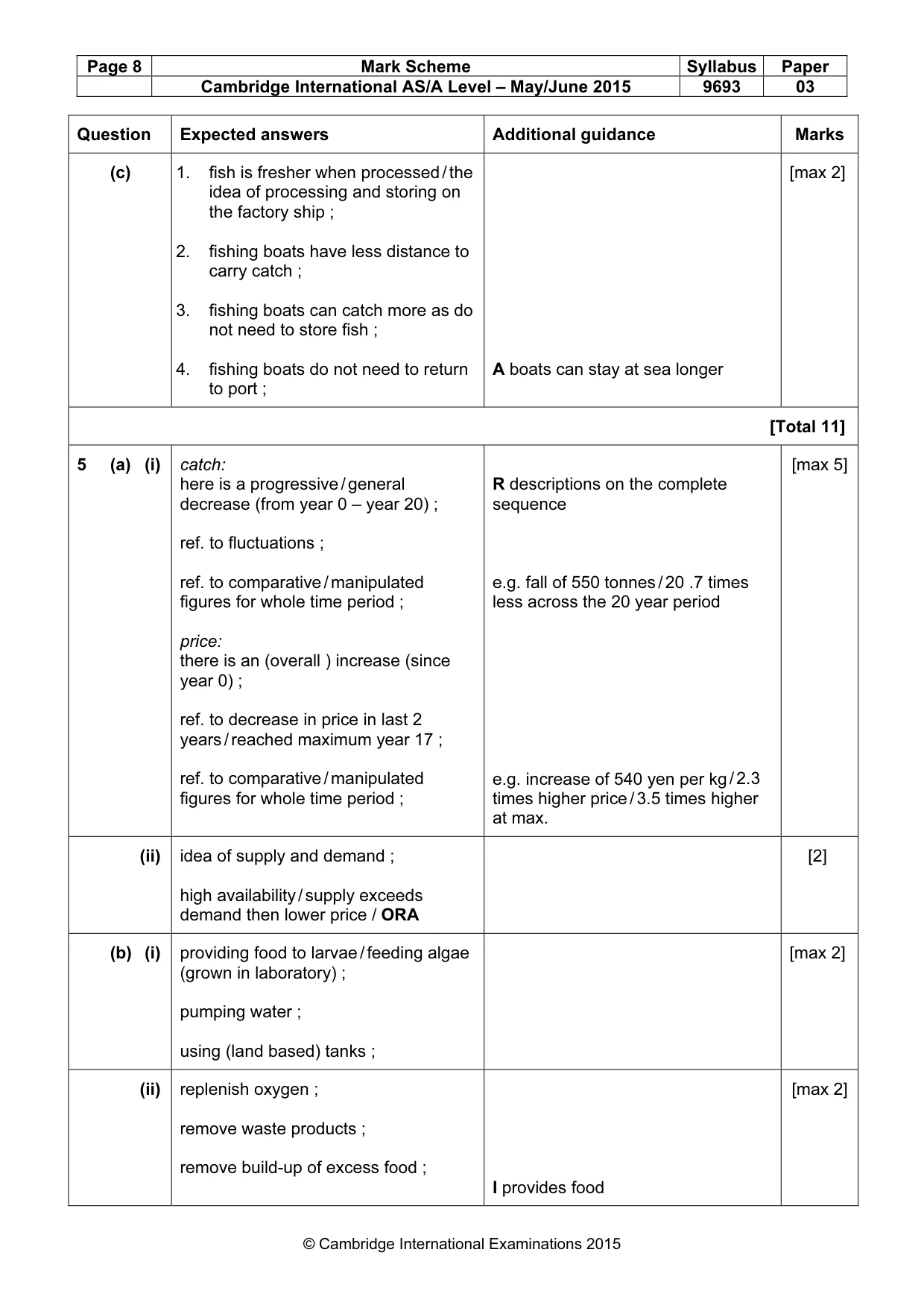
Page 8 Mark Scheme Syllabus Paper Cambridge International AS/A Level – May/June 2015 9693 03 © Cambridge International Examinations 2015 Question Expected answers Additional guidance Marks (c) 1. fish is fresher when processed / the idea of processing and storing on the factory ship ; 2. fishing boats have less distance to carry catch ; 3. fishing boats can catch more as do not need to store fish ; 4. fishing boats do not need to return to port ; A boats can stay at sea longer [max 2] [Total 11] 5 (a) (i) catch: here is a progressive / general decrease (from year 0 – year 20) ; ref. to fluctuations ; ref. to comparative / manipulated figures for whole time period ; price: there is an (overall ) increase (since year 0) ; ref. to decrease in price in last 2 years / reached maximum year 17 ; ref. to comparative / manipulated figures for whole time period ; R descriptions on the complete sequence e.g. fall of 550 tonnes / 20 .7 times less across the 20 year period e.g. increase of 540 yen per kg / 2.3 times higher price / 3.5 times higher at max. [max 5] (ii) idea of supply and demand ; high availability / supply exceeds demand then lower price / ORA [2] (b) (i) providing food to larvae / feeding algae (grown in laboratory) ; pumping water ; using (land based) tanks ; [max 2] (ii) replenish oxygen ; remove waste products ; remove build-up of excess food ; I provides food [max 2]
Mark scheme, page 9
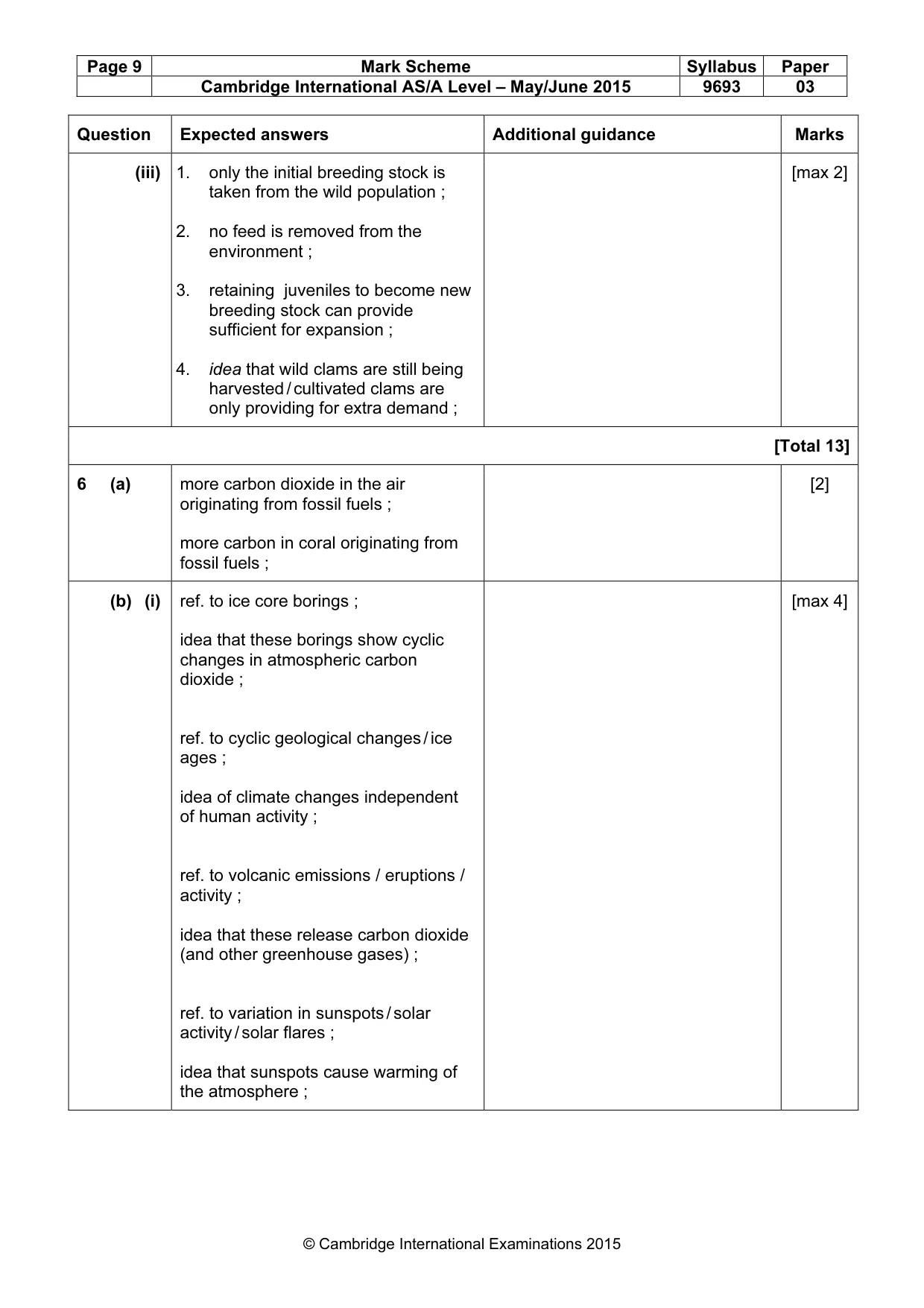
Page 9 Mark Scheme Syllabus Paper Cambridge International AS/A Level – May/June 2015 9693 03 © Cambridge International Examinations 2015 Question Expected answers Additional guidance Marks (iii) 1. only the initial breeding stock is taken from the wild population ; 2. no feed is removed from the environment ; 3. retaining juveniles to become new breeding stock can provide sufficient for expansion ; 4. idea that wild clams are still being harvested / cultivated clams are only providing for extra demand ; [max 2] [Total 13] 6 (a) more carbon dioxide in the air originating from fossil fuels ; more carbon in coral originating from fossil fuels ; [2] (b) (i) ref. to ice core borings ; idea that these borings show cyclic changes in atmospheric carbon dioxide ; ref. to cyclic geological changes / ice ages ; idea of climate changes independent of human activity ; ref. to volcanic emissions / eruptions / activity ; idea that these release carbon dioxide (and other greenhouse gases) ; ref. to variation in sunspots / solar activity / solar flares ; idea that sunspots cause warming of the atmosphere ; [max 4]
Mark scheme, page 10
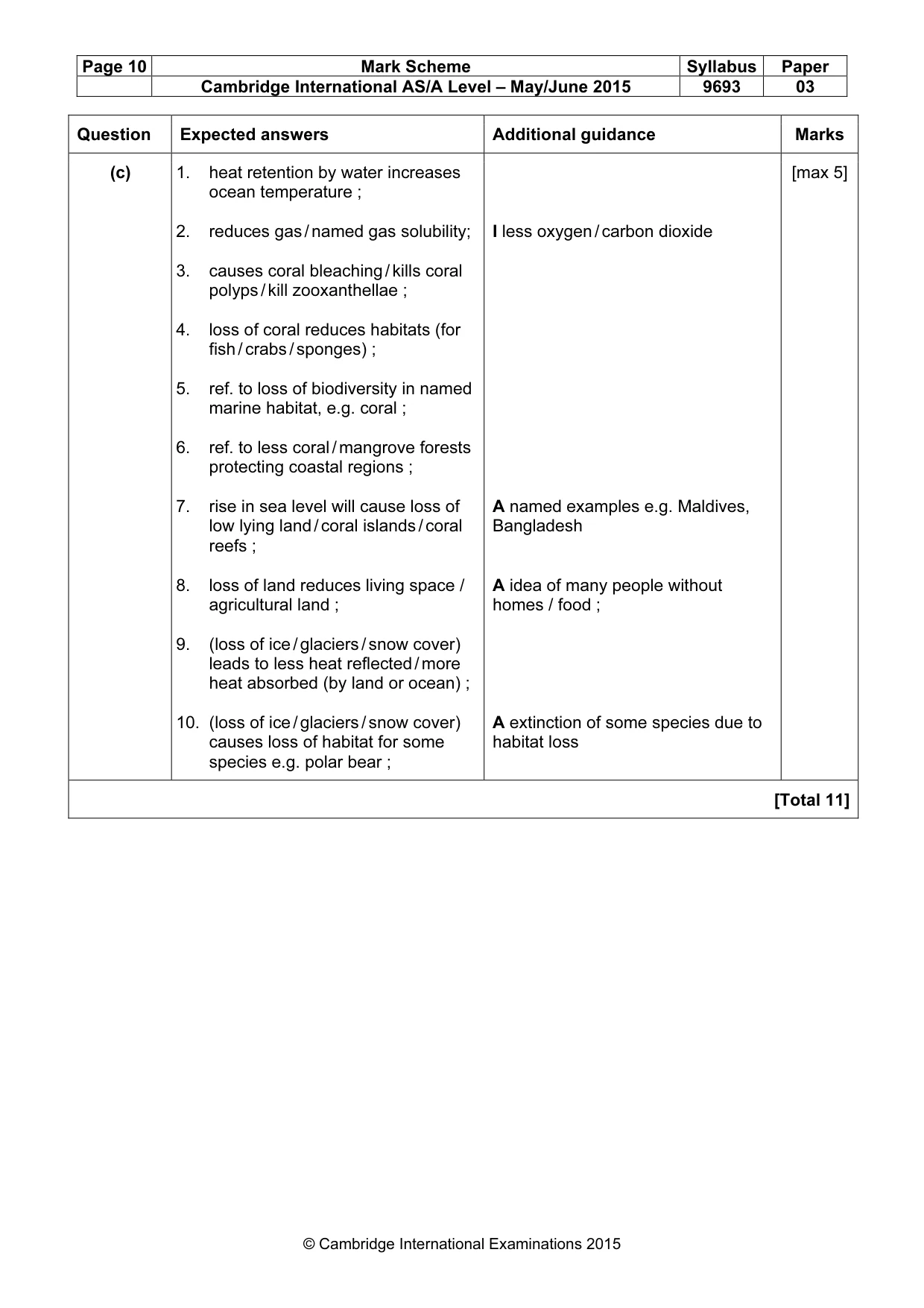
Page 10 Mark Scheme Syllabus Paper Cambridge International AS/A Level – May/June 2015 9693 03 © Cambridge International Examinations 2015 Question Expected answers Additional guidance Marks (c) 1. heat retention by water increases ocean temperature ; 2. reduces gas / named gas solubility; 3. causes coral bleaching / kills coral polyps / kill zooxanthellae ; 4. loss of coral reduces habitats (for fish / crabs / sponges) ; 5. ref. to loss of biodiversity in named marine habitat, e.g. coral ; 6. ref. to less coral / mangrove forests protecting coastal regions ; 7. rise in sea level will cause loss of low lying land / coral islands / coral reefs ; 8. loss of land reduces living space / agricultural land ; 9. (loss of ice / glaciers / snow cover) leads to less heat reflected / more heat absorbed (by land or ocean) ; 10. (loss of ice / glaciers / snow cover) causes loss of habitat for some species e.g. polar bear ; I less oxygen / carbon dioxide A named examples e.g. Maldives, Bangladesh A idea of many people without homes / food ; A extinction of some species due to habitat loss [max 5] [Total 11]
Mark scheme, page 11
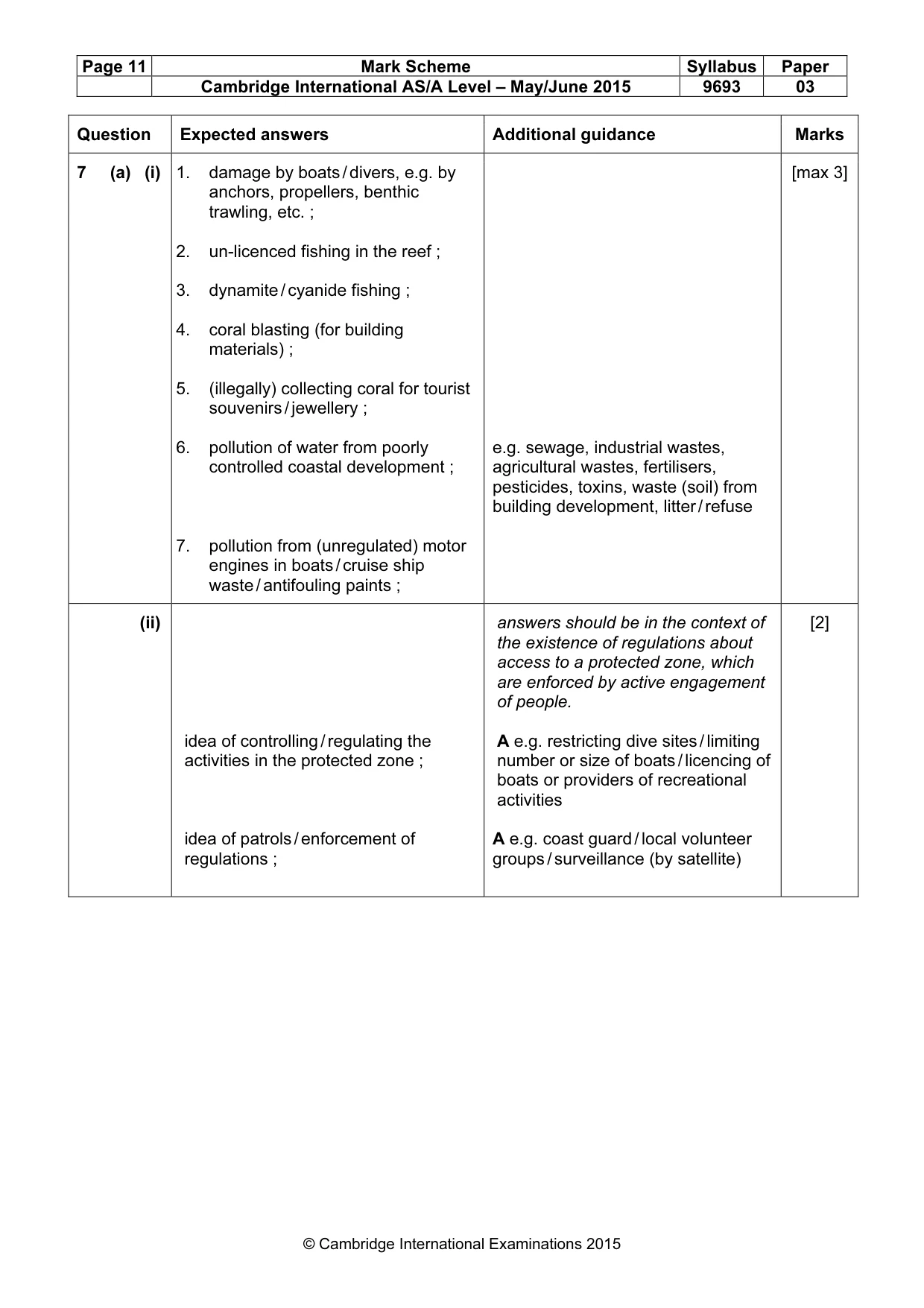
Page 11 Mark Scheme Syllabus Paper Cambridge International AS/A Level – May/June 2015 9693 03 © Cambridge International Examinations 2015 Question Expected answers Additional guidance Marks 7 (a) (i) 1. damage by boats / divers, e.g. by anchors, propellers, benthic trawling, etc. ; 2. un-licenced fishing in the reef ; 3. dynamite / cyanide fishing ; 4. coral blasting (for building materials) ; 5. (illegally) collecting coral for tourist souvenirs / jewellery ; 6. pollution of water from poorly controlled coastal development ; 7. pollution from (unregulated) motor engines in boats / cruise ship waste / antifouling paints ; e.g. sewage, industrial wastes, agricultural wastes, fertilisers, pesticides, toxins, waste (soil) from building development, litter / refuse [max 3] (ii) idea of controlling / regulating the activities in the protected zone ; idea of patrols / enforcement of regulations ; answers should be in the context of the existence of regulations about access to a protected zone, which are enforced by active engagement of people. A e.g. restricting dive sites / limiting number or size of boats / licencing of boats or providers of recreational activities A e.g. coast guard / local volunteer groups / surveillance (by satellite) [2]
Mark scheme, page 12
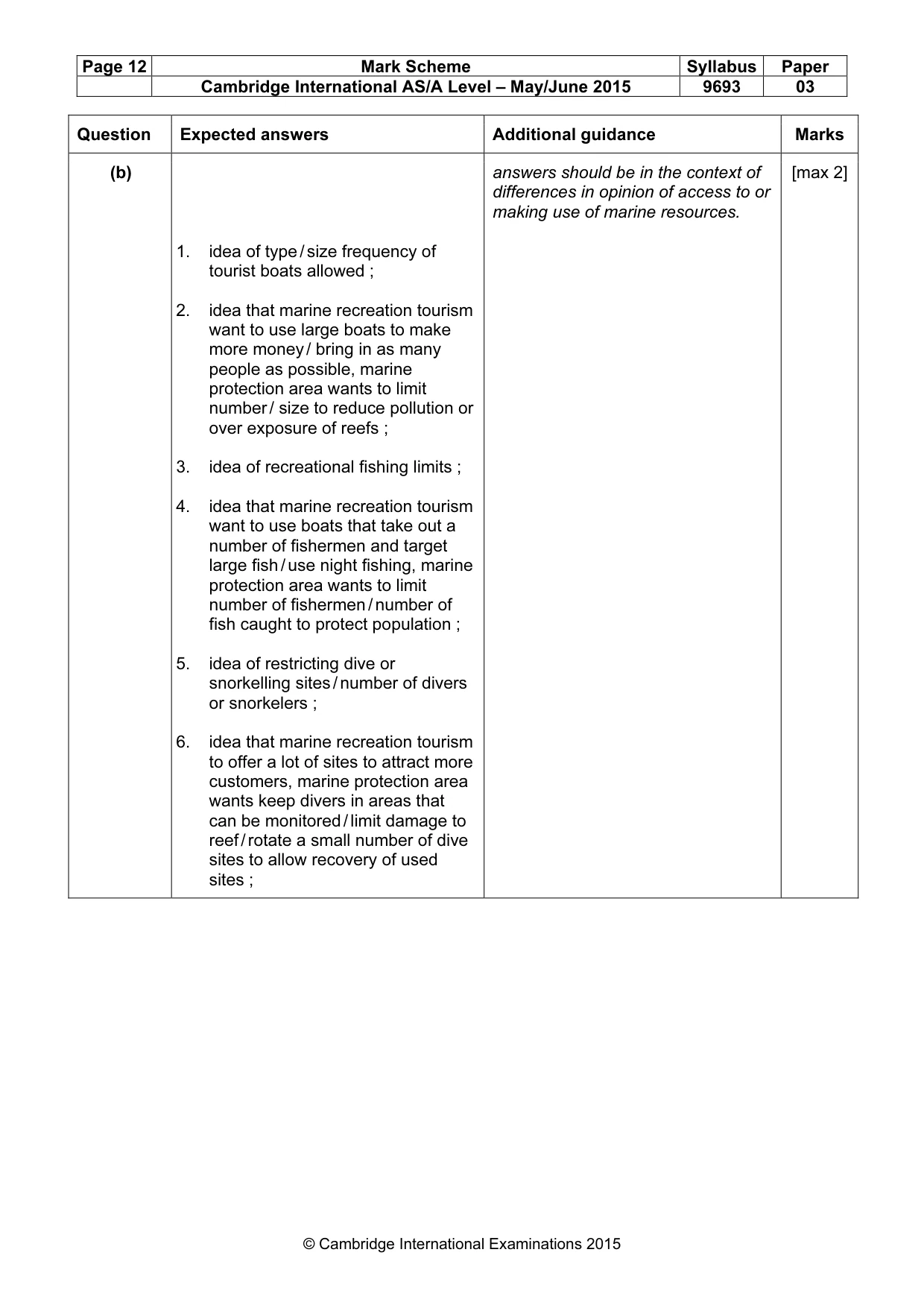
Page 12 Mark Scheme Syllabus Paper Cambridge International AS/A Level – May/June 2015 9693 03 © Cambridge International Examinations 2015 Question Expected answers Additional guidance Marks (b) 1. idea of type / size frequency of tourist boats allowed ; 2. idea that marine recreation tourism want to use large boats to make more money / bring in as many people as possible, marine protection area wants to limit number / size to reduce pollution or over exposure of reefs ; 3. idea of recreational fishing limits ; 4. idea that marine recreation tourism want to use boats that take out a number of fishermen and target large fish / use night fishing, marine protection area wants to limit number of fishermen / number of fish caught to protect population ; 5. idea of restricting dive or snorkelling sites / number of divers or snorkelers ; 6. idea that marine recreation tourism to offer a lot of sites to attract more customers, marine protection area wants keep divers in areas that can be monitored / limit damage to reef / rotate a small number of dive sites to allow recovery of used sites ; answers should be in the context of differences in opinion of access to or making use of marine resources. [max 2]
Mark scheme, page 13
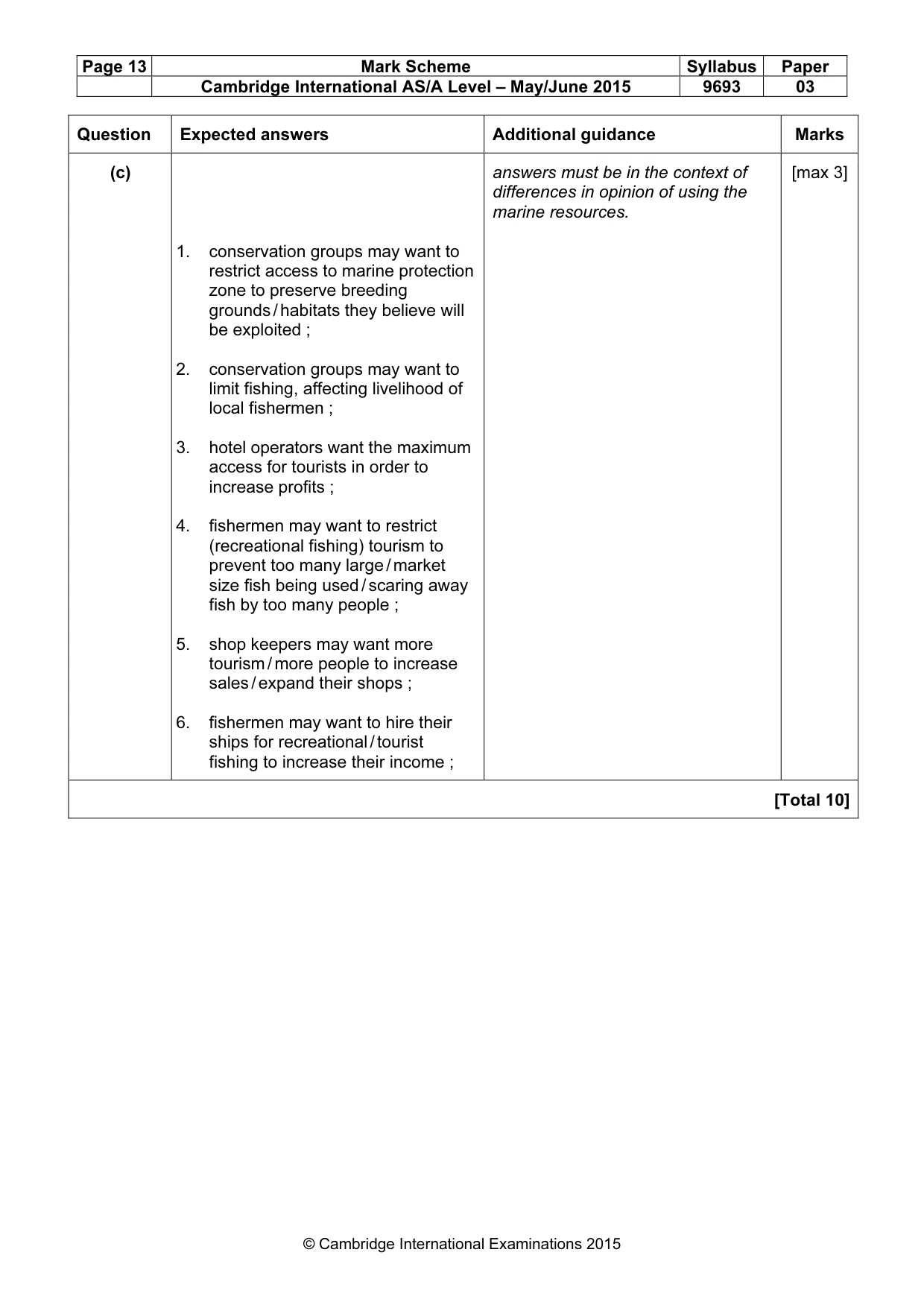
Page 13 Mark Scheme Syllabus Paper Cambridge International AS/A Level – May/June 2015 9693 03 © Cambridge International Examinations 2015 Question Expected answers Additional guidance Marks (c) 1. conservation groups may want to restrict access to marine protection zone to preserve breeding grounds / habitats they believe will be exploited ; 2. conservation groups may want to limit fishing, affecting livelihood of local fishermen ; 3. hotel operators want the maximum access for tourists in order to increase profits ; 4. fishermen may want to restrict (recreational fishing) tourism to prevent too many large / market size fish being used / scaring away fish by too many people ; 5. shop keepers may want more tourism / more people to increase sales / expand their shops ; 6. fishermen may want to hire their ships for recreational / tourist fishing to increase their income ; answers must be in the context of differences in opinion of using the marine resources. [max 3] [Total 10]
What you needed in this session
Cambridge’s own grade thresholds for 2015 May/June, Paper 3 · Variant 1. A higher threshold means an easier paper — the bar moves with how the cohort did.