Cambridge A Level Marine Science 9693 — 2015 May/June Paper 2 · Variant 1
9693/21/M/J/15 · 50 marks · ≈56 min
The question paper and its mark scheme, free to read here and free to download. This is Cambridge’s own paper, exactly as it was sat.
Question paper12 pages

Mark scheme6 pages
Answers below. Sit the paper first if you are practising.
Paper as text
Question paper, page 1
This document consists of 11 printed pages and 1 blank page. DC (LK/SW) 93474/3 © UCLES 2015 [Turn over * 4 8 3 7 7 3 8 7 0 7 * MARINE SCIENCE 9693/02 Paper 2 AS Data-Handling and Free-Response May/June 2015 1 hour 15 minutes Candidates answer on the Question Paper. No Additional Materials are required. READ THESE INSTRUCTIONS FIRST Write your Centre number, candidate number and name on all the work you hand in. Write in dark blue or black pen. You may use an HB pencil for any diagrams or graphs. Do not use staples, paper clips, glue or correction fluid. DO NOT WRITE IN ANY BARCODES. Section A Answer both questions in this section. Write your answers in the spaces provided on the Question Paper. Section B Answer both questions in this section. Write your answers in the spaces provided on the Question Paper. Electronic calculators may be used. You may lose marks if you do not show your working or if you do not use appropriate units. At the end of the examination, fasten all your work securely together. The number of marks is given in brackets [ ] at the end of each question or part question. Cambridge International Examinations Cambridge International Advanced Subsidiary and Advanced Level
Question paper, page 2
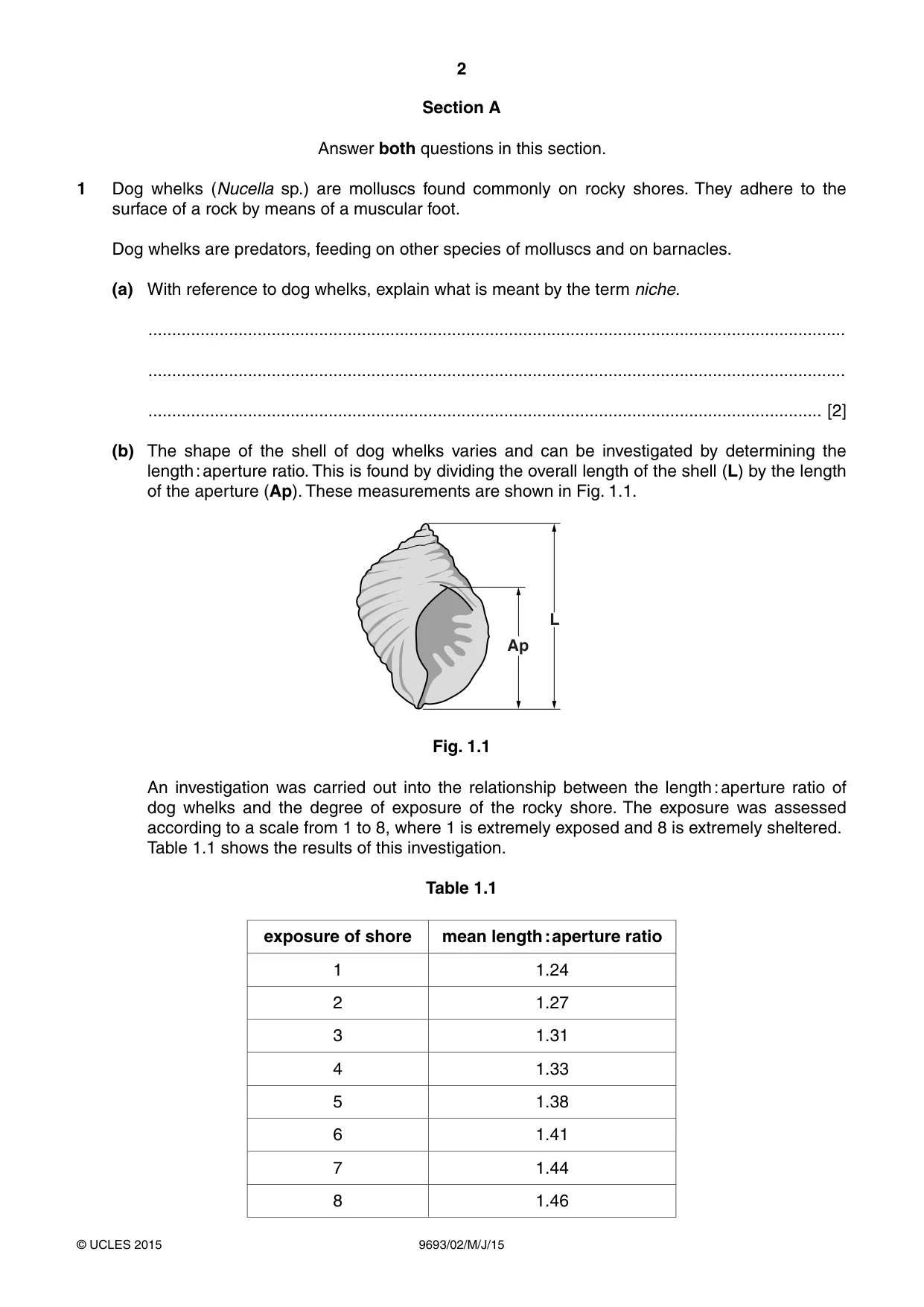
2 9693/02/M/J/15 © UCLES 2015 Section A Answer both questions in this section. 1 Dog whelks (Nucella sp.) are molluscs found commonly on rocky shores. They adhere to the surface of a rock by means of a muscular foot. Dog whelks are predators, feeding on other species of molluscs and on barnacles. (a) With reference to dog whelks, explain what is meant by the term niche. … … … [2] (b) The shape of the shell of dog whelks varies and can be investigated by determining the length : aperture ratio. This is found by dividing the overall length of the shell (L) by the length of the aperture (Ap). These measurements are shown in Fig. 1.1. Ap L Fig. 1.1 An investigation was carried out into the relationship between the length : aperture ratio of dog whelks and the degree of exposure of the rocky shore. The exposure was assessed according to a scale from 1 to 8, where 1 is extremely exposed and 8 is extremely sheltered. Table 1.1 shows the results of this investigation. Table 1.1 exposure of shore mean length : aperture ratio 1 1.24 2 1.27 3 1.31 4 1.33 5 1.38 6 1.41 7 1.44 8 1.46
Question paper, page 3
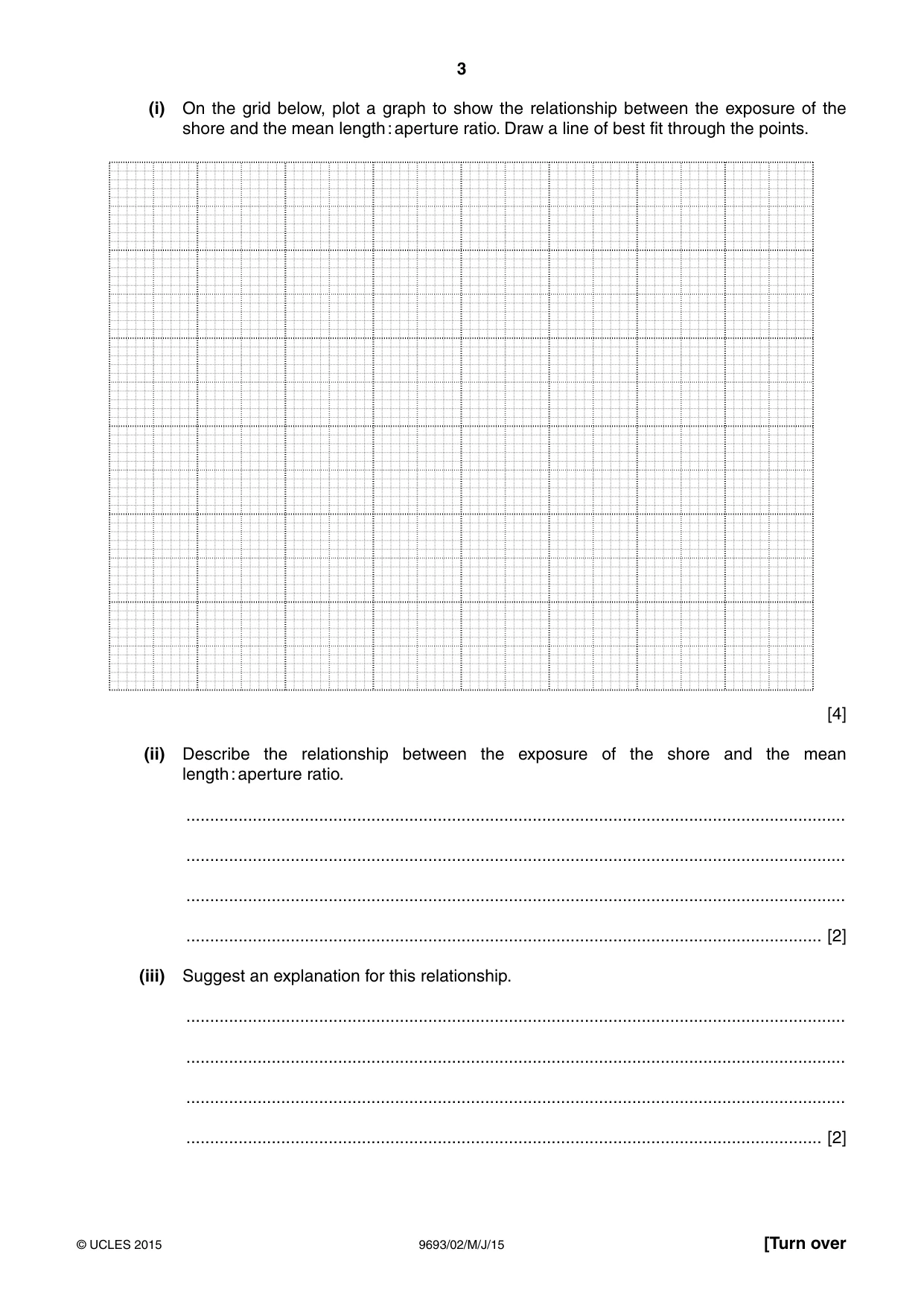
3 9693/02/M/J/15 © UCLES 2015 [Turn over (i) On the grid below, plot a graph to show the relationship between the exposure of the shore and the mean length : aperture ratio. Draw a line of best fit through the points. [4] (ii) Describe the relationship between the exposure of the shore and the mean length : aperture ratio. … … … … [2] (iii) Suggest an explanation for this relationship. … … … … [2]
Question paper, page 4
4 9693/02/M/J/15 © UCLES 2015 (c) The rate of feeding of dog whelks is influenced by temperature. Describe a laboratory-based experiment you could carry out to investigate the effect of temperature on the rate of feeding of dog whelks on barnacles. Your answer should include references to the control of variables and the collection of quantitative data. … … … … … … … … … … … … … … … … [5] [Total: 15]
Question paper, page 5
5 9693/02/M/J/15 © UCLES 2015 [Turn over Question 2 begins on page 6
Question paper, page 6
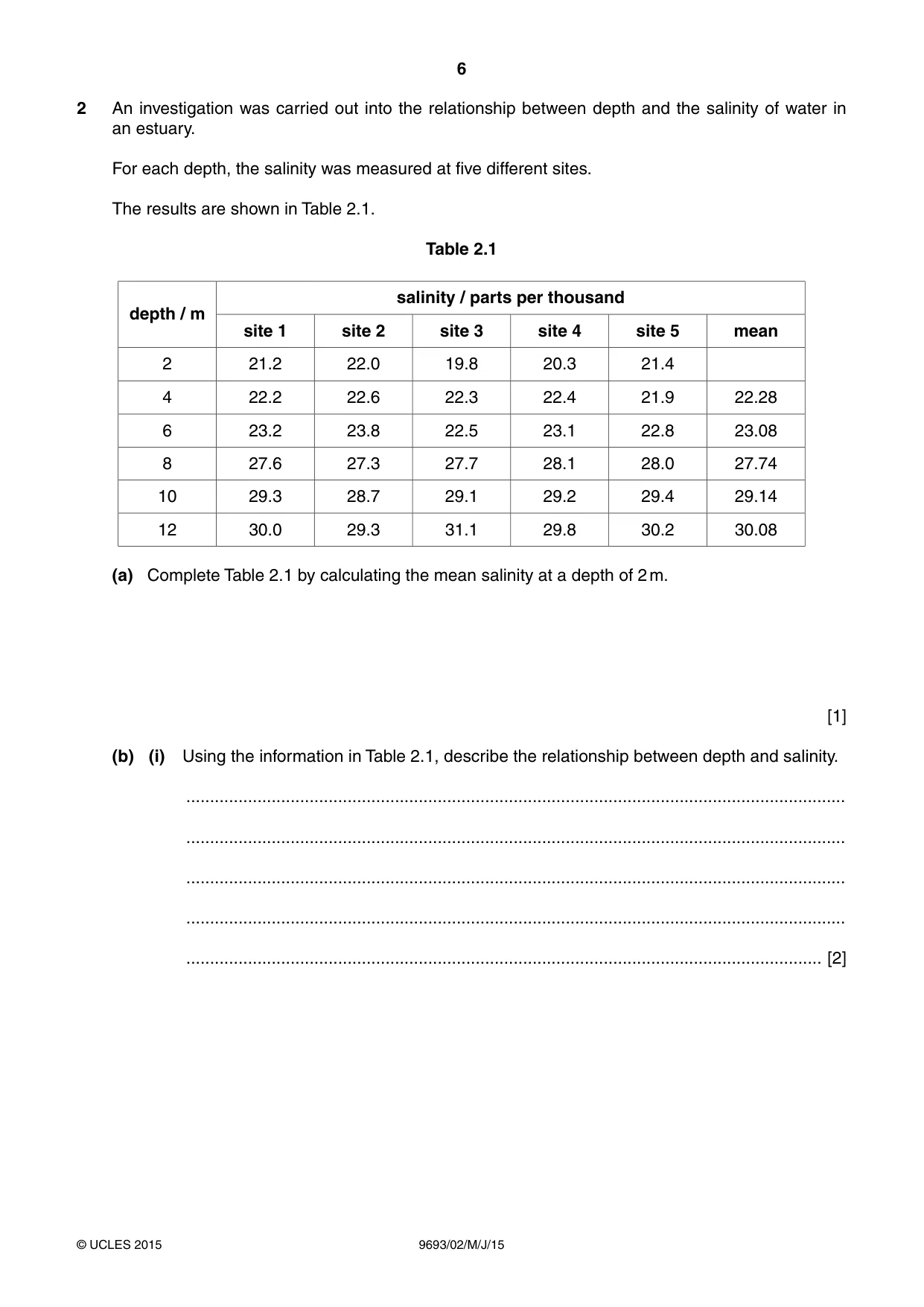
6 9693/02/M/J/15 © UCLES 2015 2 An investigation was carried out into the relationship between depth and the salinity of water in an estuary. For each depth, the salinity was measured at five different sites. The results are shown in Table 2.1. Table 2.1 depth / m salinity / parts per thousand site 1 site 2 site 3 site 4 site 5 mean 2 21.2 22.0 19.8 20.3 21.4 4 22.2 22.6 22.3 22.4 21.9 22.28 6 23.2 23.8 22.5 23.1 22.8 23.08 8 27.6 27.3 27.7 28.1 28.0 27.74 10 29.3 28.7 29.1 29.2 29.4 29.14 12 30.0 29.3 31.1 29.8 30.2 30.08 (a) Complete Table 2.1 by calculating the mean salinity at a depth of 2 m. [1] (b) (i) Using the information in Table 2.1, describe the relationship between depth and salinity. … … … … … [2]
Question paper, page 7
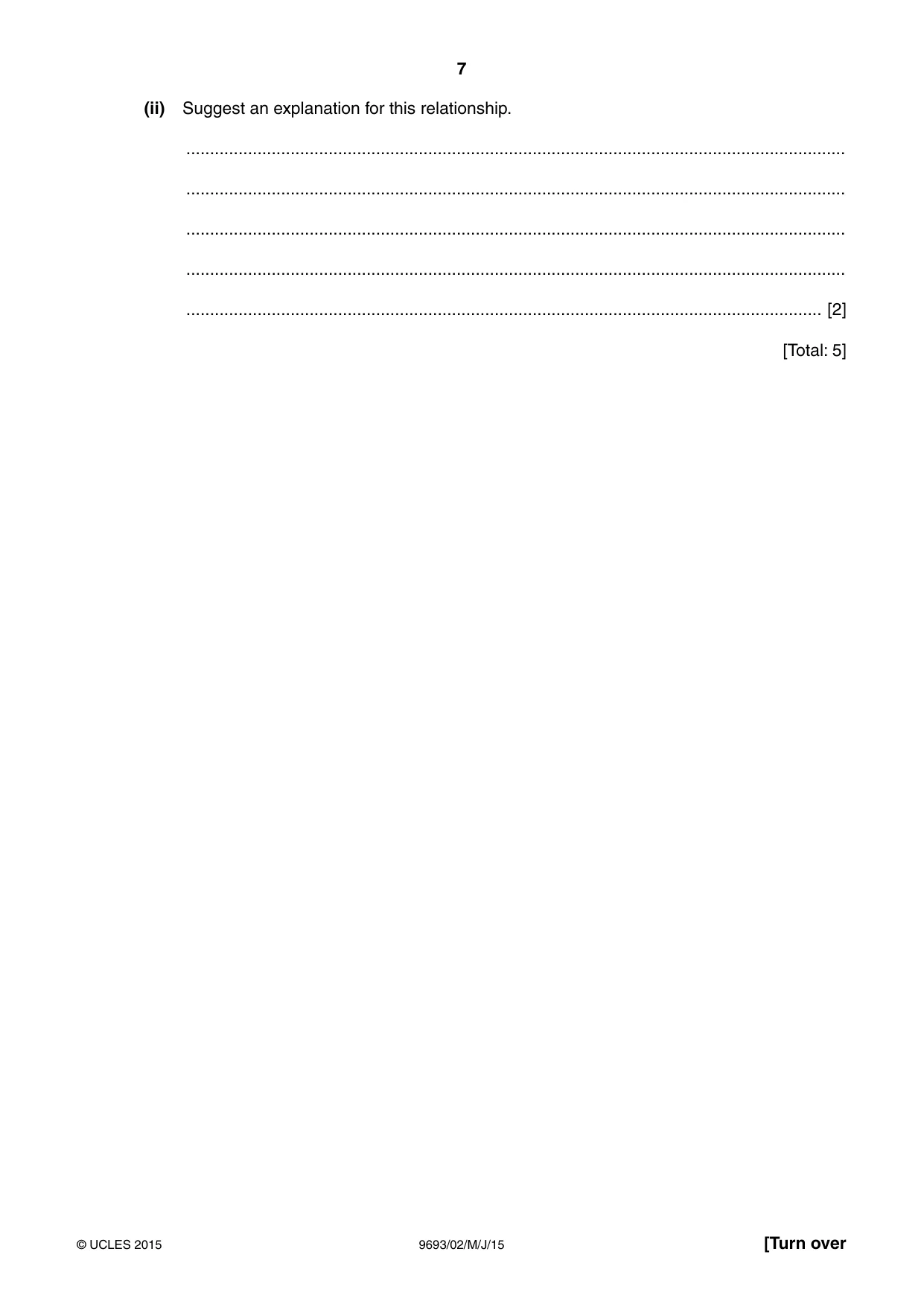
7 9693/02/M/J/15 © UCLES 2015 [Turn over (ii) Suggest an explanation for this relationship. … … … … … [2] [Total: 5]
Question paper, page 8
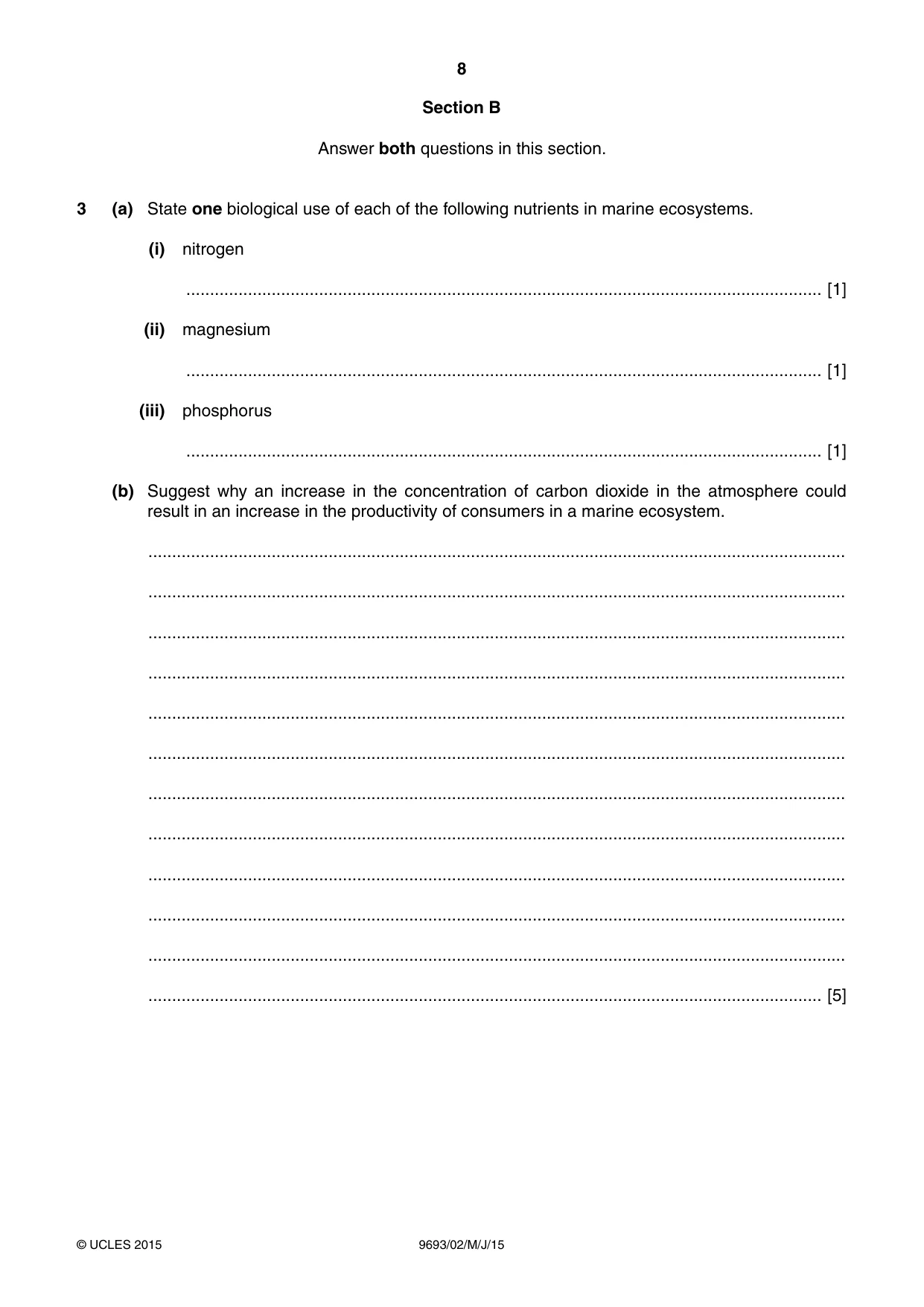
8 9693/02/M/J/15 © UCLES 2015 Section B Answer both questions in this section. 3 (a) State one biological use of each of the following nutrients in marine ecosystems. (i) nitrogen … [1] (ii) magnesium … [1] (iii) phosphorus … [1] (b) Suggest why an increase in the concentration of carbon dioxide in the atmosphere could result in an increase in the productivity of consumers in a marine ecosystem. … … … … … … … … … … … … [5]
Question paper, page 9
9 9693/02/M/J/15 © UCLES 2015 [Turn over (c) Discuss the reasons for the variability of the concentration of dissolved oxygen in sea water. … … … … … … … … … … … … … … … … … … … … [7] [Total: 15]
Question paper, page 10
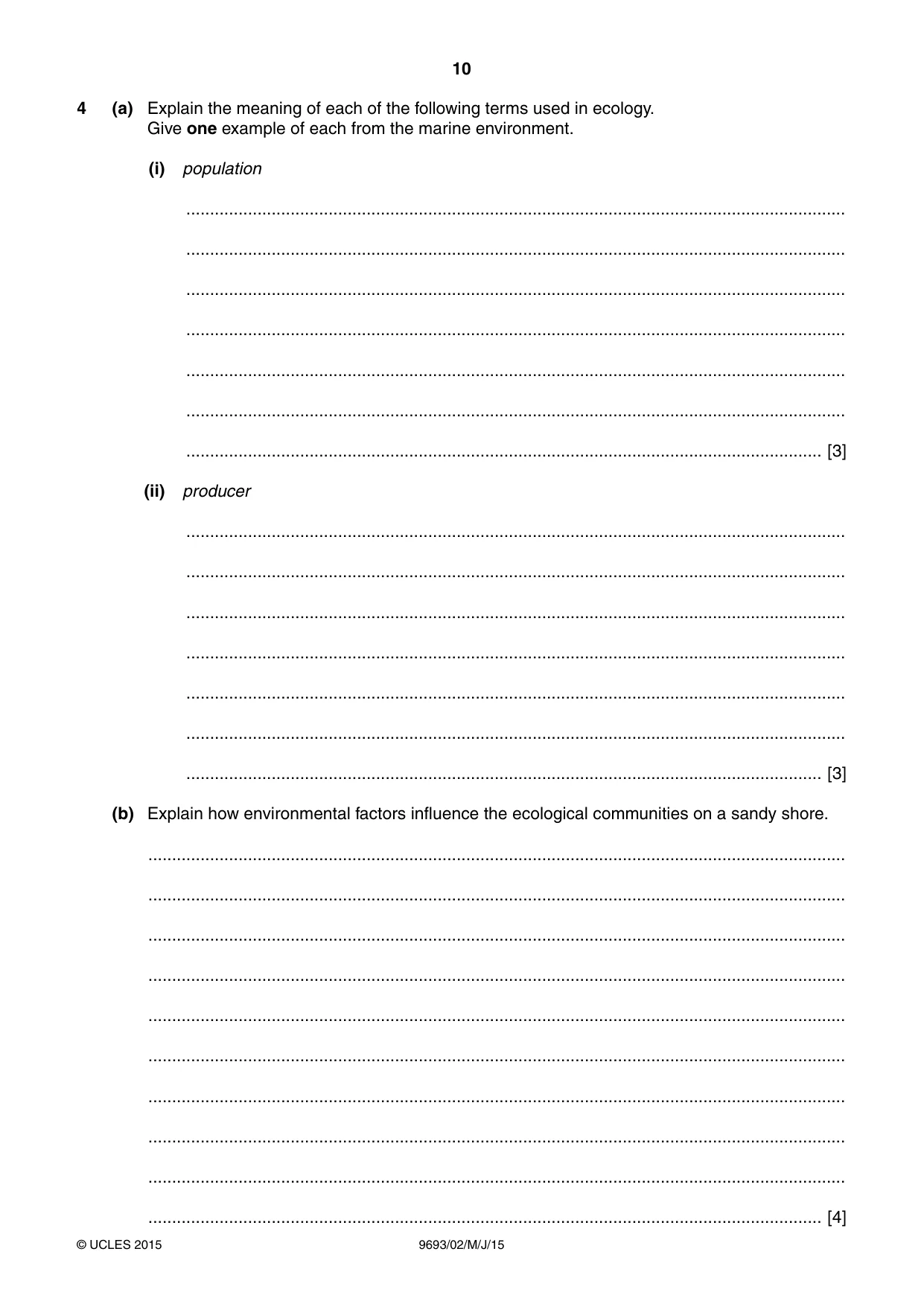
10 9693/02/M/J/15 © UCLES 2015 4 (a) Explain the meaning of each of the following terms used in ecology. Give one example of each from the marine environment. (i) population … … … … … … … [3] (ii) producer … … … … … … … [3] (b) Explain how environmental factors influence the ecological communities on a sandy shore. … … … … … … … … … … [4]
Question paper, page 11
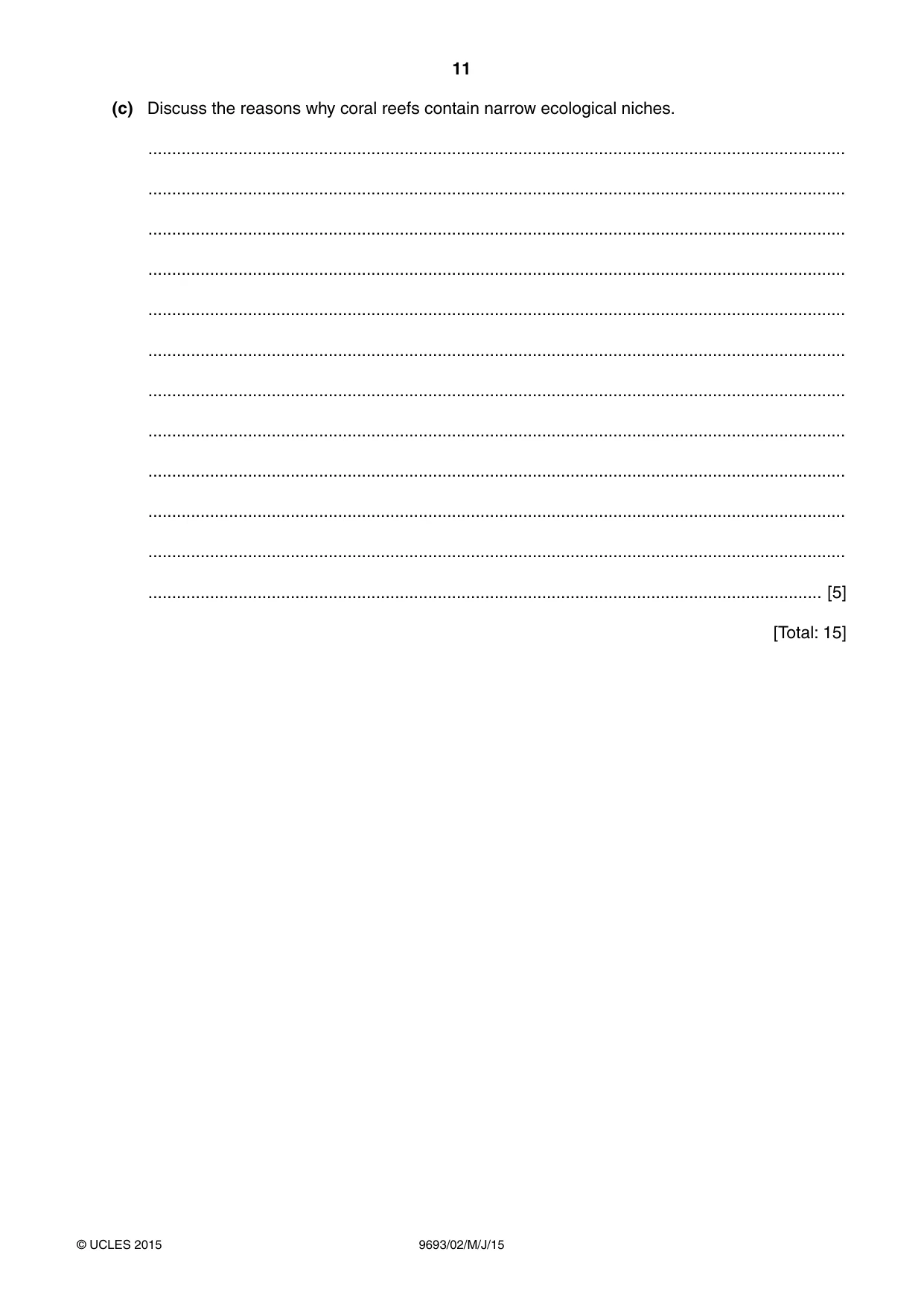
11 9693/02/M/J/15 © UCLES 2015 (c) Discuss the reasons why coral reefs contain narrow ecological niches. … … … … … … … … … … … … [5] [Total: 15]
Question paper, page 12
12 9693/02/M/J/15 © UCLES 2015 Permission to reproduce items where third-party owned material protected by copyright is included has been sought and cleared where possible. Every reasonable effort has been made by the publisher (UCLES) to trace copyright holders, but if any items requiring clearance have unwittingly been included, the publisher will be pleased to make amends at the earliest possible opportunity. To avoid the issue of disclosure of answer-related information to candidates, all copyright acknowledgements are reproduced online in the Cambridge International Examinations Copyright Acknowledgements Booklet. This is produced for each series of examinations and is freely available to download at www.cie.org.uk after the live examination series. Cambridge International Examinations is part of the Cambridge Assessment Group. Cambridge Assessment is the brand name of University of Cambridge Local Examinations Syndicate (UCLES), which is itself a department of the University of Cambridge. BLANK PAGE
Mark scheme, page 1
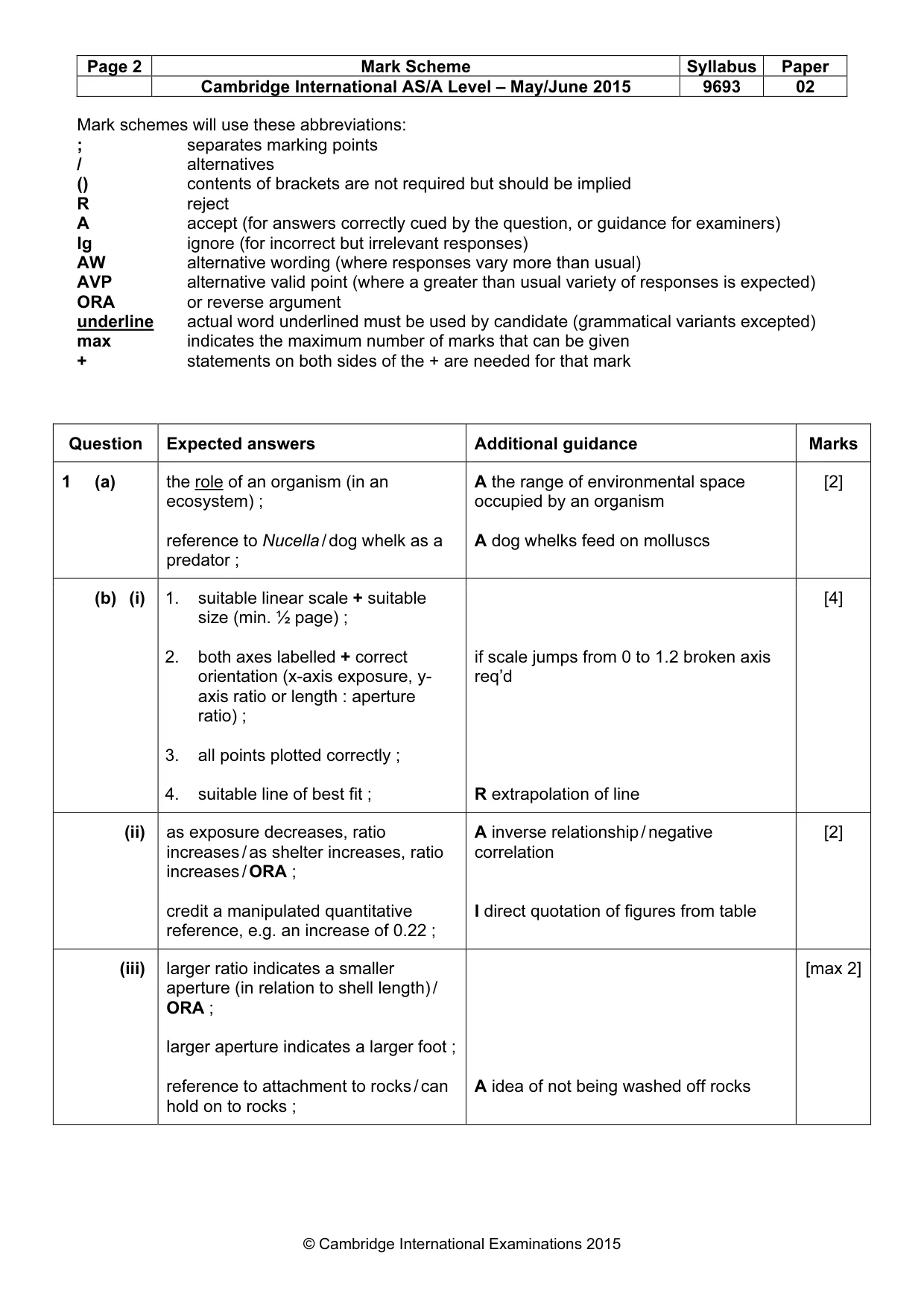
® IGCSE is the registered trademark of Cambridge International Examinations. CAMBRIDGE INTERNATIONAL EXAMINATIONS Cambridge International Advanced Subsidiary and Advanced Level MARK SCHEME for the May/June 2015 series 9693 MARINE SCIENCE 9693/02 Paper 2 (AS Data-Handling and Free-Response), maximum raw mark 50 This mark scheme is published as an aid to teachers and candidates, to indicate the requirements of the examination. It shows the basis on which Examiners were instructed to award marks. It does not indicate the details of the discussions that took place at an Examiners’ meeting before marking began, which would have considered the acceptability of alternative answers. Mark schemes should be read in conjunction with the question paper and the Principal Examiner Report for Teachers. Cambridge will not enter into discussions about these mark schemes. Cambridge is publishing the mark schemes for the May/June 2015 series for most Cambridge IGCSE®, Cambridge International A and AS Level components and some Cambridge O Level components.
Mark scheme, page 2
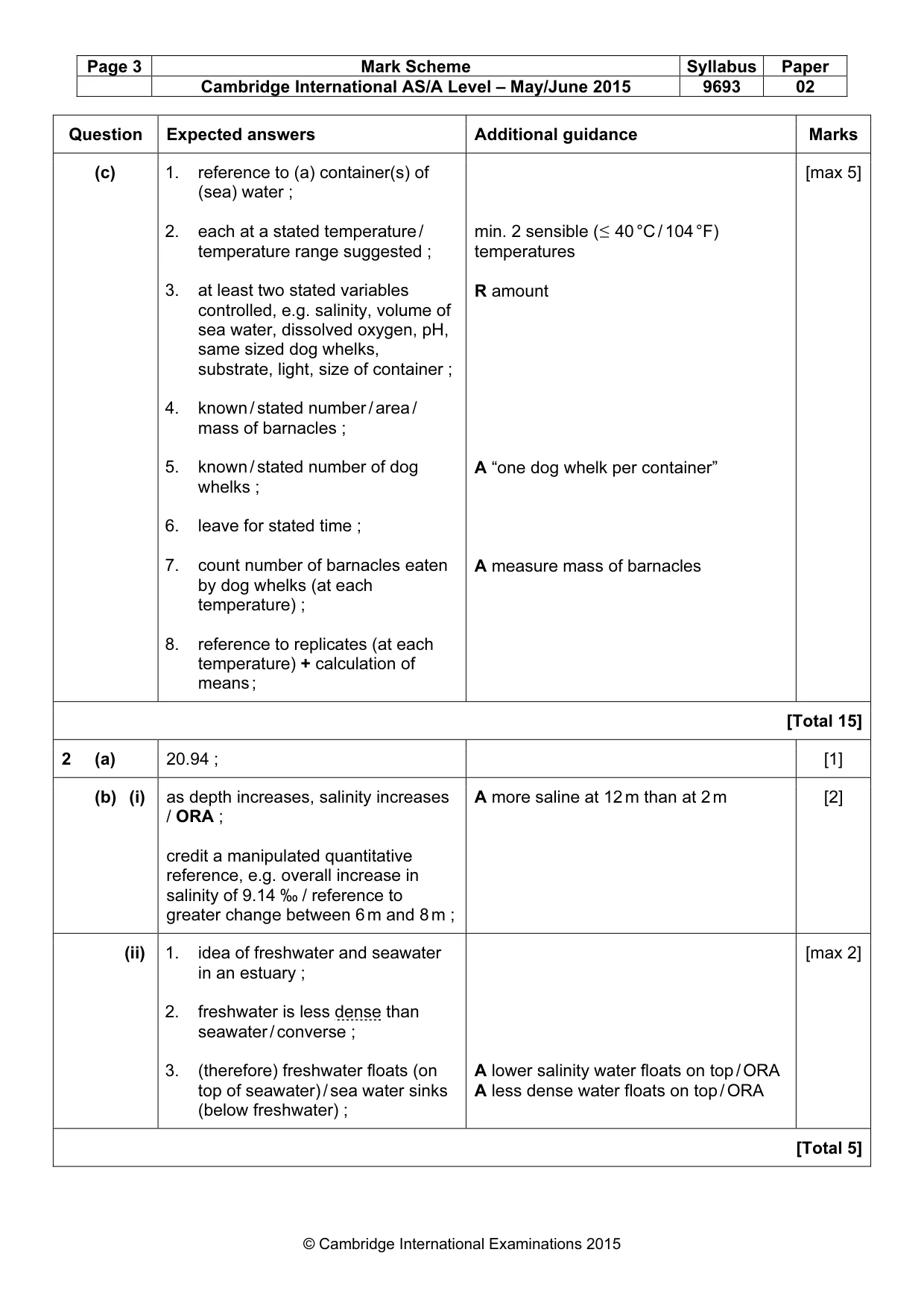
Page 2 Mark Scheme Syllabus Paper Cambridge International AS/A Level – May/June 2015 9693 02 © Cambridge International Examinations 2015 Mark schemes will use these abbreviations: ; separates marking points / alternatives () contents of brackets are not required but should be implied R reject A accept (for answers correctly cued by the question, or guidance for examiners) Ig ignore (for incorrect but irrelevant responses) AW alternative wording (where responses vary more than usual) AVP alternative valid point (where a greater than usual variety of responses is expected) ORA or reverse argument underline actual word underlined must be used by candidate (grammatical variants excepted) max indicates the maximum number of marks that can be given + statements on both sides of the + are needed for that mark Question Expected answers Additional guidance Marks 1 (a) the role of an organism (in an ecosystem) ; reference to Nucella / dog whelk as a predator ; A the range of environmental space occupied by an organism A dog whelks feed on molluscs [2] (b) (i) 1. suitable linear scale + suitable size (min. ½ page) ; 2. both axes labelled + correct orientation (x-axis exposure, y- axis ratio or length : aperture ratio) ; 3. all points plotted correctly ; 4. suitable line of best fit ; if scale jumps from 0 to 1.2 broken axis req’d R extrapolation of line [4] (ii) as exposure decreases, ratio increases / as shelter increases, ratio increases / ORA ; credit a manipulated quantitative reference, e.g. an increase of 0.22 ; A inverse relationship / negative correlation I direct quotation of figures from table [2] (iii) larger ratio indicates a smaller aperture (in relation to shell length) / ORA ; larger aperture indicates a larger foot ; reference to attachment to rocks / can hold on to rocks ; A idea of not being washed off rocks [max 2]
Mark scheme, page 3
Page 3 Mark Scheme Syllabus Paper Cambridge International AS/A Level – May/June 2015 9693 02 © Cambridge International Examinations 2015 Question Expected answers Additional guidance Marks (c) 1. reference to (a) container(s) of (sea) water ; 2. each at a stated temperature / temperature range suggested ; 3. at least two stated variables controlled, e.g. salinity, volume of sea water, dissolved oxygen, pH, same sized dog whelks, substrate, light, size of container ; 4. known / stated number / area / mass of barnacles ; 5. known / stated number of dog whelks ; 6. leave for stated time ; 7. count number of barnacles eaten by dog whelks (at each temperature) ; 8. reference to replicates (at each temperature) + calculation of means ; min. 2 sensible (≤ 40 °C / 104 °F) temperatures R amount A “one dog whelk per container” A measure mass of barnacles [max 5] [Total 15] 2 (a) 20.94 ; [1] (b) (i) as depth increases, salinity increases / ORA ; credit a manipulated quantitative reference, e.g. overall increase in salinity of 9.14 ‰ / reference to greater change between 6 m and 8 m ; A more saline at 12 m than at 2 m [2] (ii) 1. idea of freshwater and seawater in an estuary ; 2. freshwater is less dense than seawater / converse ; 3. (therefore) freshwater floats (on top of seawater) / sea water sinks (below freshwater) ; A lower salinity water floats on top / ORA A less dense water floats on top / ORA [max 2] [Total 5]
Mark scheme, page 4
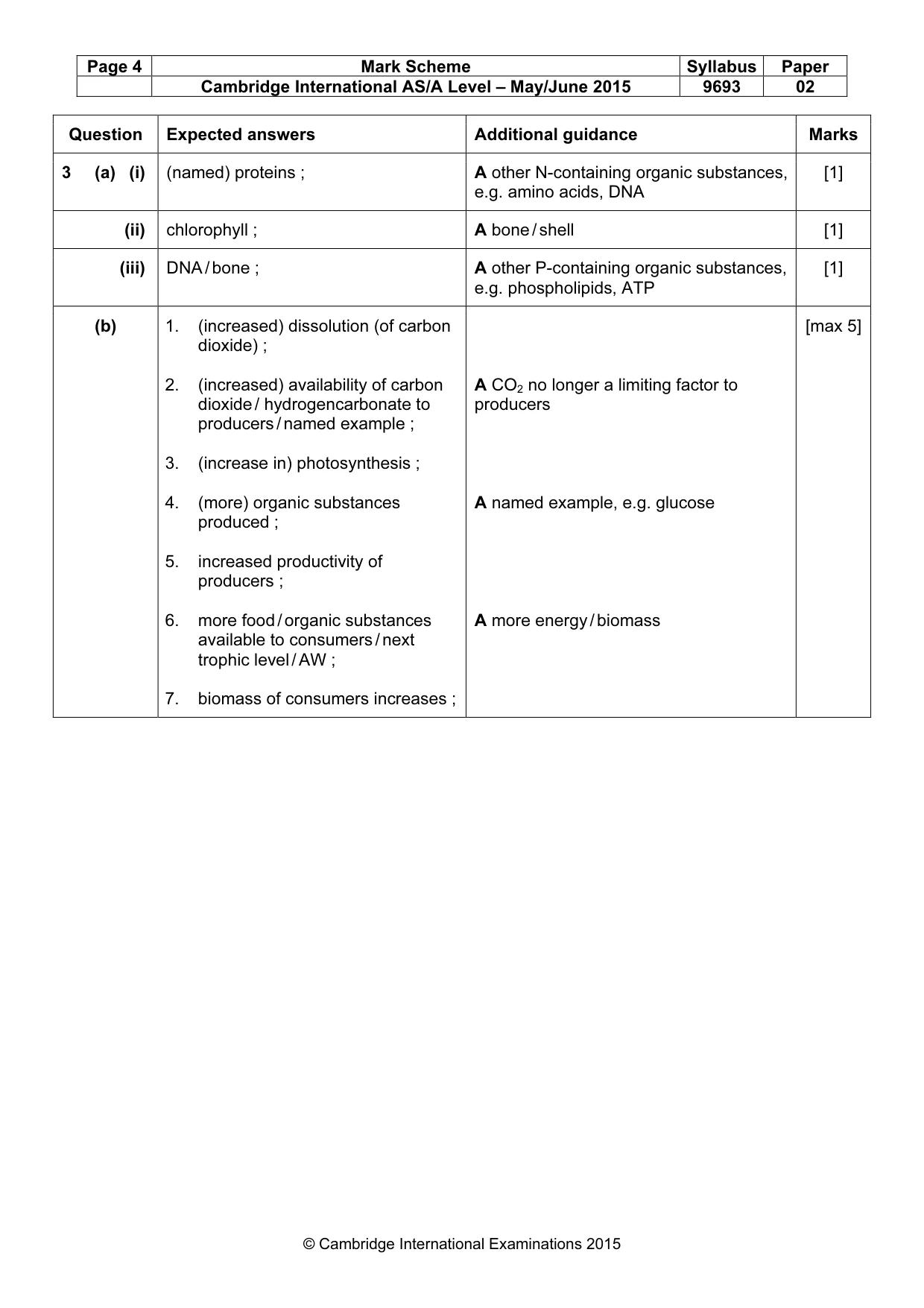
Page 4 Mark Scheme Syllabus Paper Cambridge International AS/A Level – May/June 2015 9693 02 © Cambridge International Examinations 2015 Question Expected answers Additional guidance Marks 3 (a) (i) (named) proteins ; A other N-containing organic substances, e.g. amino acids, DNA [1] (ii) chlorophyll ; A bone / shell [1] (iii) DNA / bone ; A other P-containing organic substances, e.g. phospholipids, ATP [1] (b) 1. (increased) dissolution (of carbon dioxide) ; 2. (increased) availability of carbon dioxide / hydrogencarbonate to producers / named example ; 3. (increase in) photosynthesis ; 4. (more) organic substances produced ; 5. increased productivity of producers ; 6. more food / organic substances available to consumers / next trophic level / AW ; 7. biomass of consumers increases ; A CO2 no longer a limiting factor to producers A named example, e.g. glucose A more energy / biomass [max 5]
Mark scheme, page 5
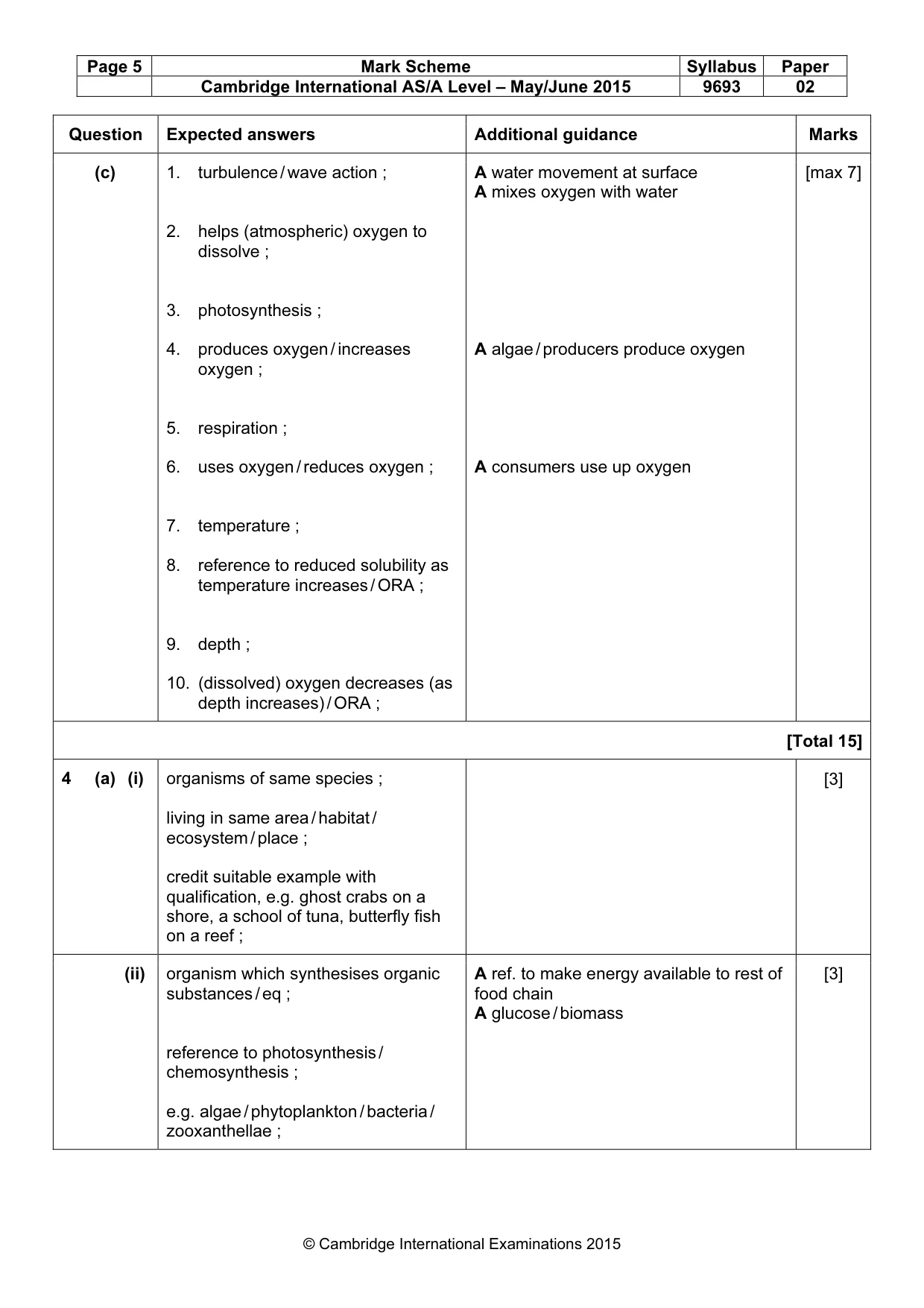
Page 5 Mark Scheme Syllabus Paper Cambridge International AS/A Level – May/June 2015 9693 02 © Cambridge International Examinations 2015 Question Expected answers Additional guidance Marks (c) 1. turbulence / wave action ; 2. helps (atmospheric) oxygen to dissolve ; 3. photosynthesis ; 4. produces oxygen / increases oxygen ; 5. respiration ; 6. uses oxygen / reduces oxygen ; 7. temperature ; 8. reference to reduced solubility as temperature increases / ORA ; 9. depth ; 10. (dissolved) oxygen decreases (as depth increases) / ORA ; A water movement at surface A mixes oxygen with water A algae / producers produce oxygen A consumers use up oxygen [max 7] [Total 15] 4 (a) (i) organisms of same species ; living in same area / habitat / ecosystem / place ; credit suitable example with qualification, e.g. ghost crabs on a shore, a school of tuna, butterfly fish on a reef ; [3] (ii) organism which synthesises organic substances / eq ; reference to photosynthesis / chemosynthesis ; e.g. algae / phytoplankton / bacteria / zooxanthellae ; A ref. to make energy available to rest of food chain A glucose / biomass [3]
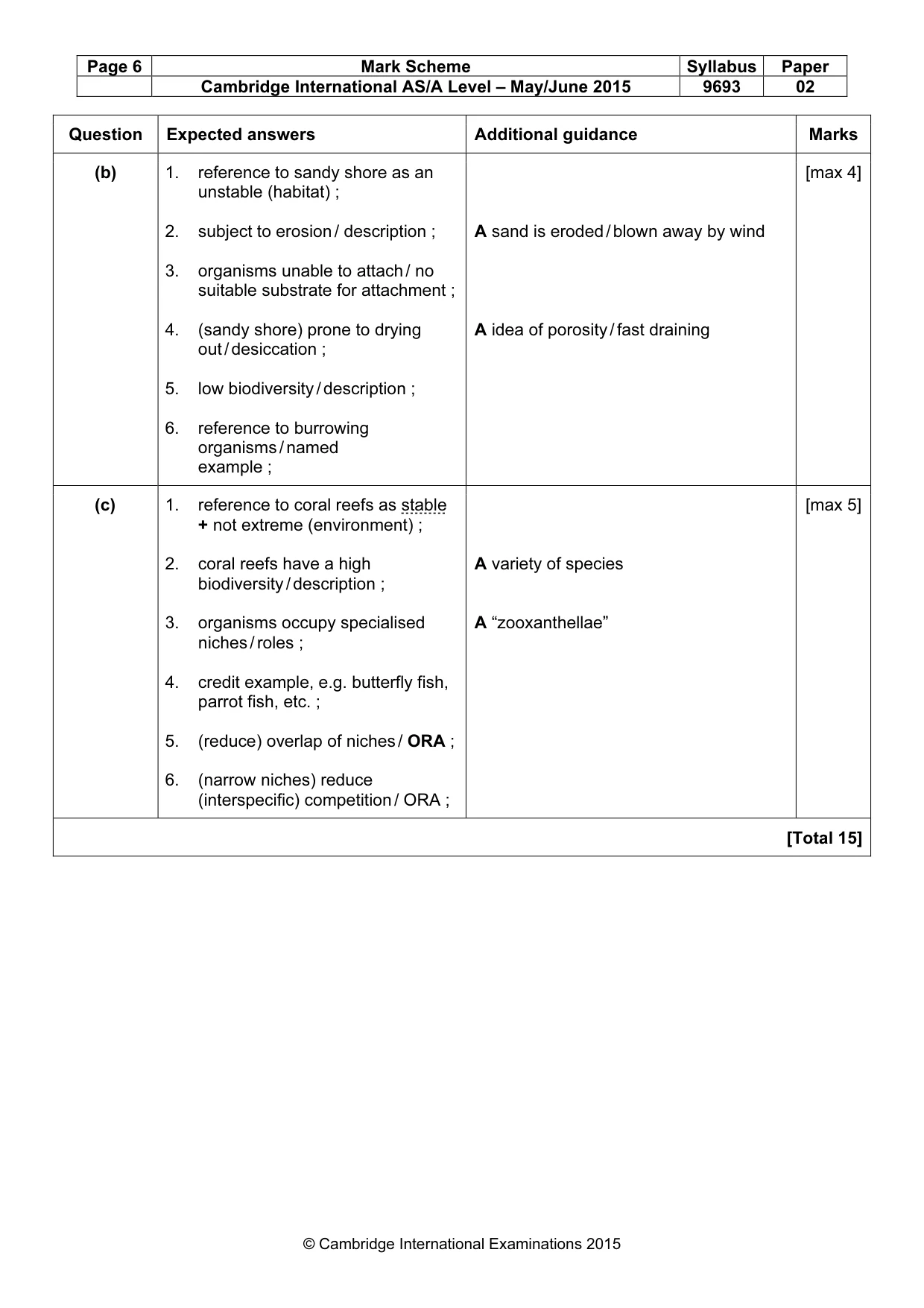
Mark scheme, page 6
Page 6 Mark Scheme Syllabus Paper Cambridge International AS/A Level – May/June 2015 9693 02 © Cambridge International Examinations 2015 Question Expected answers Additional guidance Marks (b) 1. reference to sandy shore as an unstable (habitat) ; 2. subject to erosion / description ; 3. organisms unable to attach / no suitable substrate for attachment ; 4. (sandy shore) prone to drying out / desiccation ; 5. low biodiversity / description ; 6. reference to burrowing organisms / named example ; A sand is eroded / blown away by wind A idea of porosity / fast draining [max 4] (c) 1. reference to coral reefs as stable + not extreme (environment) ; 2. coral reefs have a high biodiversity / description ; 3. organisms occupy specialised niches / roles ; 4. credit example, e.g. butterfly fish, parrot fish, etc. ; 5. (reduce) overlap of niches / ORA ; 6. (narrow niches) reduce (interspecific) competition / ORA ; A variety of species A “zooxanthellae” [max 5] [Total 15]
What you needed in this session
Cambridge’s own grade thresholds for 2015 May/June, Paper 2 · Variant 1. A higher threshold means an easier paper — the bar moves with how the cohort did.