Cambridge A Level Marine Science 9693 — 2014 Oct/Nov Paper 3 · Variant 1
9693/31/O/N/14 · 75 marks · ≈84 min
The question paper and its mark scheme, free to read here and free to download. This is Cambridge’s own paper, exactly as it was sat.
Question paper20 pages




Mark scheme10 pages
Answers below. Sit the paper first if you are practising.
Paper as text
Question paper, page 1
This document consists of 15 printed pages and 5 blank page. DC (ST/CGW) 108736 © UCLES 2014 [Turn over Cambridge International Examinations Cambridge International Advanced Subsidiary and Advanced Level * 3 6 2 0 6 6 6 2 8 1 * MARINE SCIENCE 9693/03 Paper 3 A2 Structured Questions October/November 2014 1 hour 30 minutes Candidates answer on the question paper. No Additional Materials are required. READ THESE INSTRUCTIONS FIRST Write your Centre number, candidate number and name on all the work you hand in. Write in dark blue or black pen. You may use an HB pencil for any diagrams or graphs. Do not use staples, paper clips, glue or correction fluid. DO NOT WRITE IN ANY BARCODES. Answer all questions. Write your answers in the spaces provided on the question paper. The number of marks is given in brackets [ ] at the end of each question or part question. Electronic calculators may be used. You may lose marks if you do not show your working or if you do not use appropriate units. At the end of the examination, fasten all your work securely together.
Question paper, page 2
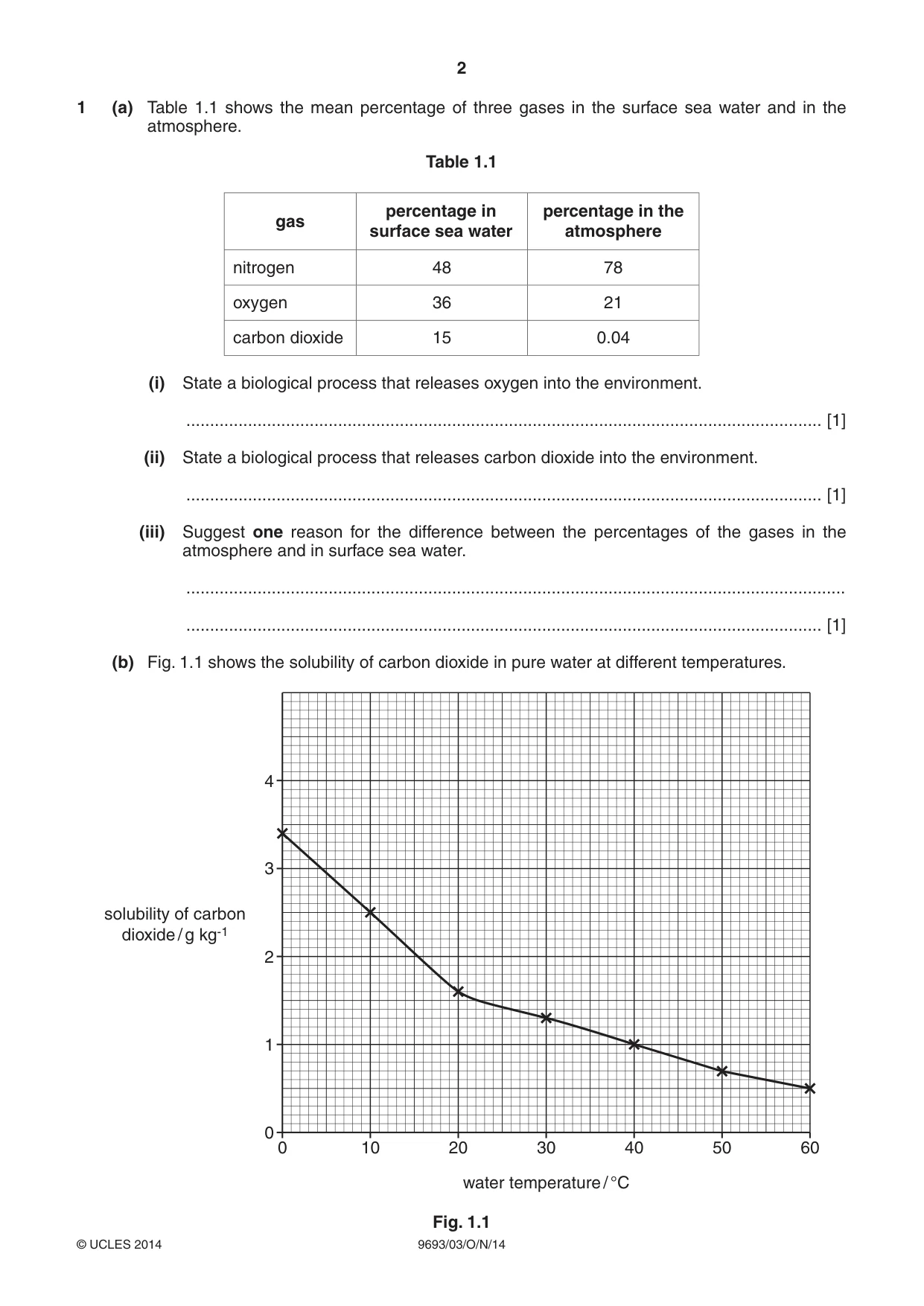
2 9693/03/O/N/14 © UCLES 2014 1 (a) Table 1.1 shows the mean percentage of three gases in the surface sea water and in the atmosphere. Table 1.1 gas percentage in surface sea water percentage in the atmosphere nitrogen 48 78 oxygen 36 21 carbon dioxide 15 0.04 (i) State a biological process that releases oxygen into the environment. … [1] (ii) State a biological process that releases carbon dioxide into the environment. … [1] (iii) Suggest one reason for the difference between the percentages of the gases in the atmosphere and in surface sea water. … … [1] (b) Fig. 1.1 shows the solubility of carbon dioxide in pure water at different temperatures. 0 0 1 2 3 4 10 20 30 water temperature / °C solubility of carbon dioxide / g kg-1 40 50 60 Fig. 1.1
Question paper, page 3
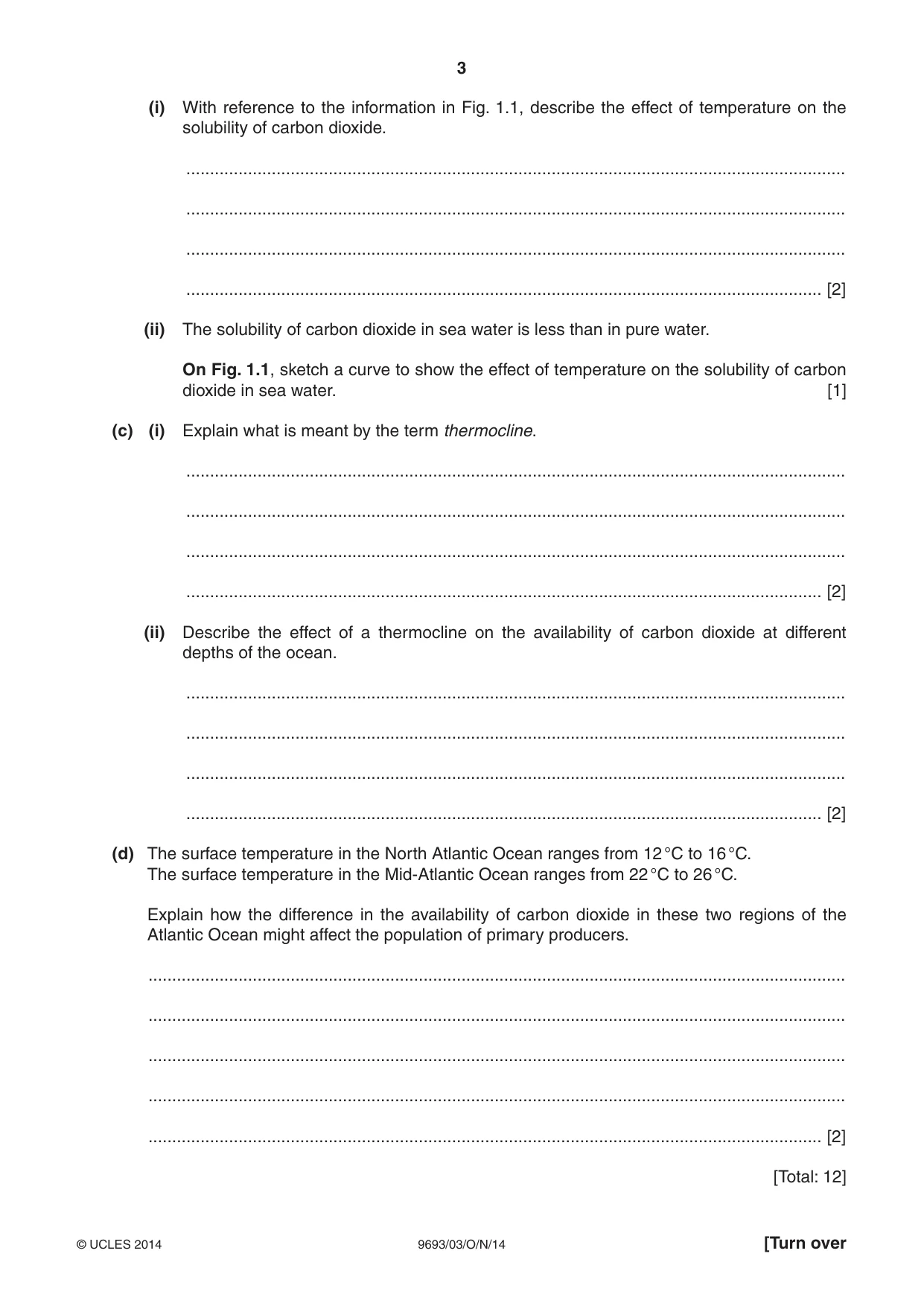
3 9693/03/O/N/14 © UCLES 2014 [Turn over (i) With reference to the information in Fig. 1.1, describe the effect of temperature on the solubility of carbon dioxide. … … … … [2] (ii) The solubility of carbon dioxide in sea water is less than in pure water. On Fig. 1.1, sketch a curve to show the effect of temperature on the solubility of carbon dioxide in sea water. [1] (c) (i) Explain what is meant by the term thermocline. … … … … [2] (ii) Describe the effect of a thermocline on the availability of carbon dioxide at different depths of the ocean. … … … … [2] (d) The surface temperature in the North Atlantic Ocean ranges from 12 °C to 16 °C. The surface temperature in the Mid-Atlantic Ocean ranges from 22 °C to 26 °C. Explain how the difference in the availability of carbon dioxide in these two regions of the Atlantic Ocean might affect the population of primary producers. … … … … … [2] [Total: 12]
Question paper, page 4
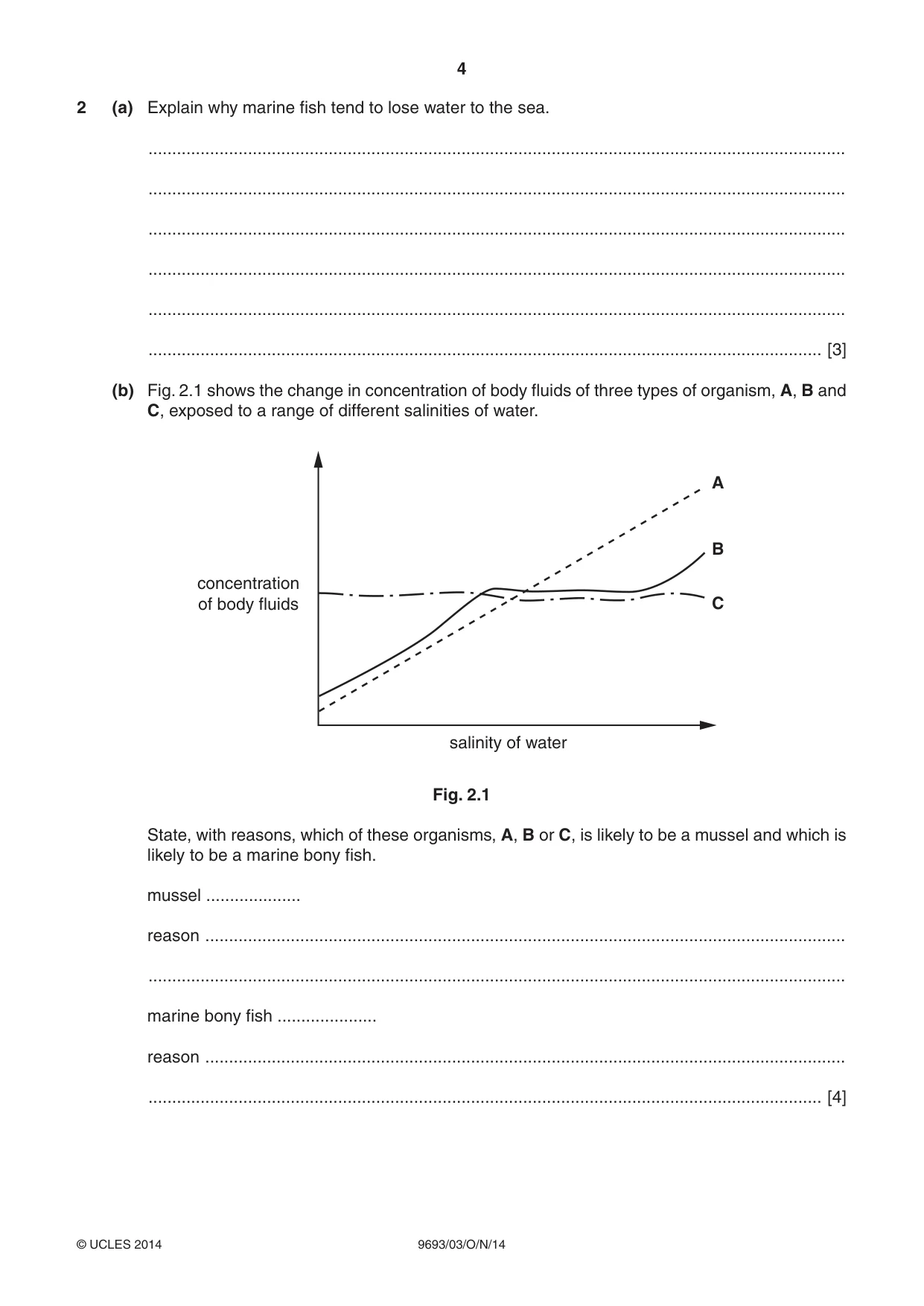
4 9693/03/O/N/14 © UCLES 2014 2 (a) Explain why marine fish tend to lose water to the sea. … … … … … … [3] (b) Fig. 2.1 shows the change in concentration of body fluids of three types of organism, A, B and C, exposed to a range of different salinities of water. concentration of body fluids salinity of water C B A Fig. 2.1 State, with reasons, which of these organisms, A, B or C, is likely to be a mussel and which is likely to be a marine bony fish. mussel … reason … … marine bony fish … reason … … [4]
Question paper, page 5
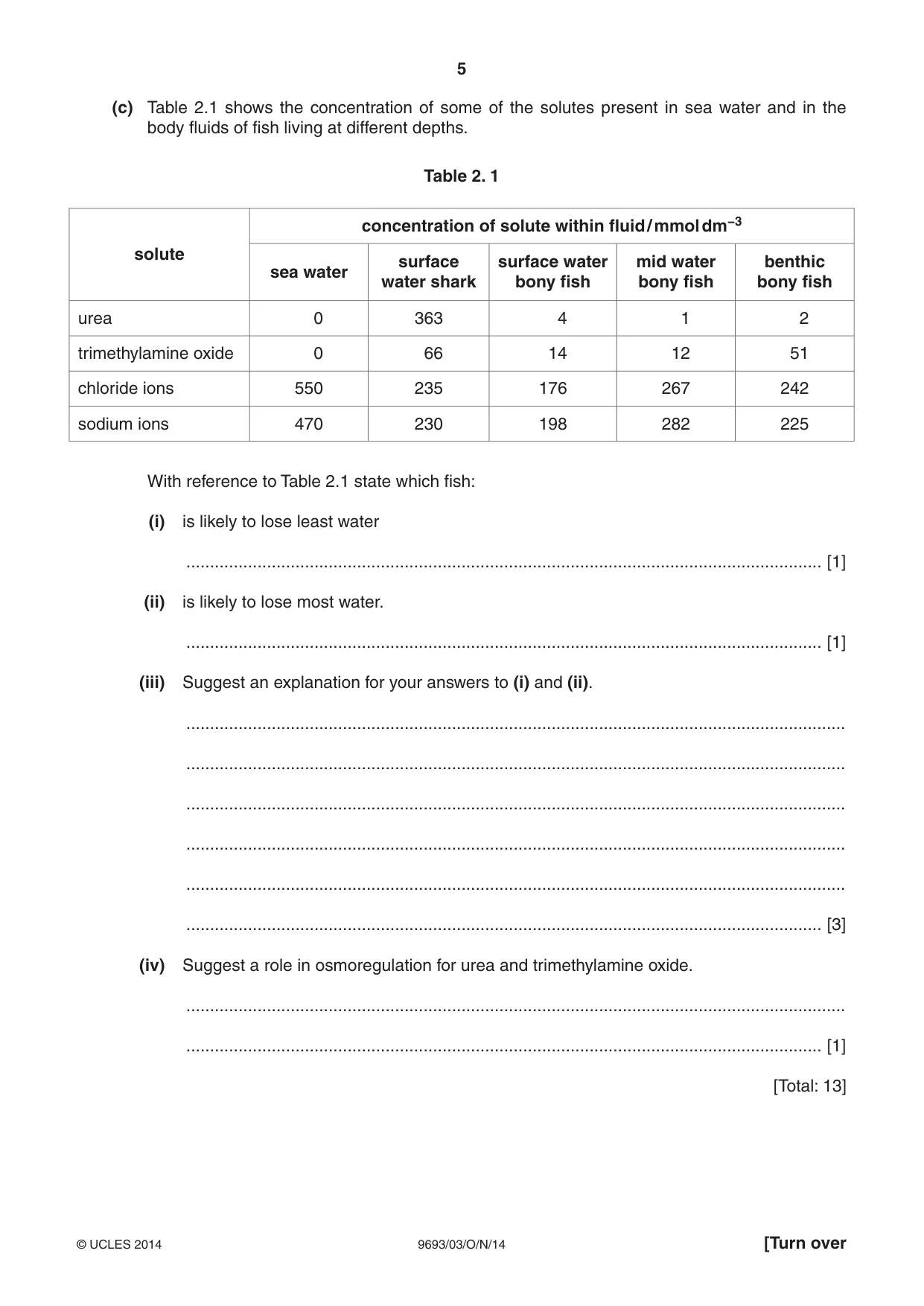
5 9693/03/O/N/14 © UCLES 2014 [Turn over (c) Table 2.1 shows the concentration of some of the solutes present in sea water and in the body fluids of fish living at different depths. Table 2. 1 solute concentration of solute within fluid / mmol dm−3 sea water surface water shark surface water bony fish mid water bony fish benthic bony fish urea 0 363 4 1 2 trimethylamine oxide 0 66 14 12 51 chloride ions 550 235 176 267 242 sodium ions 470 230 198 282 225 With reference to Table 2.1 state which fish: (i) is likely to lose least water … [1] (ii) is likely to lose most water. … [1] (iii) Suggest an explanation for your answers to (i) and (ii). … … … … … … [3] (iv) Suggest a role in osmoregulation for urea and trimethylamine oxide. … … [1] [Total: 13]
Question paper, page 6
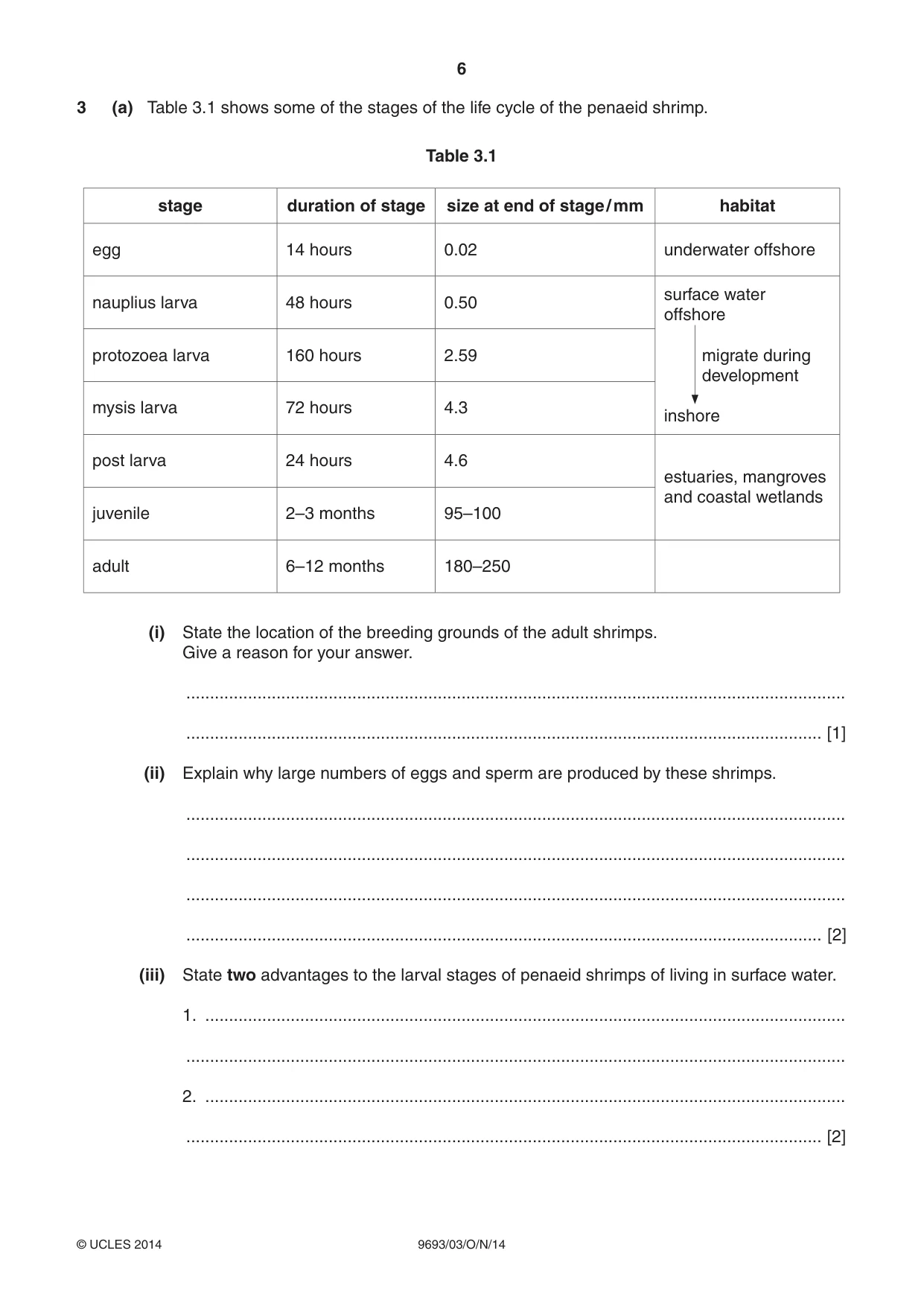
6 9693/03/O/N/14 © UCLES 2014 3 (a) Table 3.1 shows some of the stages of the life cycle of the penaeid shrimp. Table 3.1 stage duration of stage size at end of stage / mm habitat egg 14 hours 0.02 underwater offshore nauplius larva 48 hours 0.50 surface water offshore migrate during development inshore protozoea larva 160 hours 2.59 mysis larva 72 hours 4.3 post larva 24 hours 4.6 estuaries, mangroves and coastal wetlands juvenile 2–3 months 95–100 adult 6–12 months 180–250 (i) State the location of the breeding grounds of the adult shrimps. Give a reason for your answer. … … [1] (ii) Explain why large numbers of eggs and sperm are produced by these shrimps. … … … … [2] (iii) State two advantages to the larval stages of penaeid shrimps of living in surface water. 1. … … 2. … … [2]
Question paper, page 7
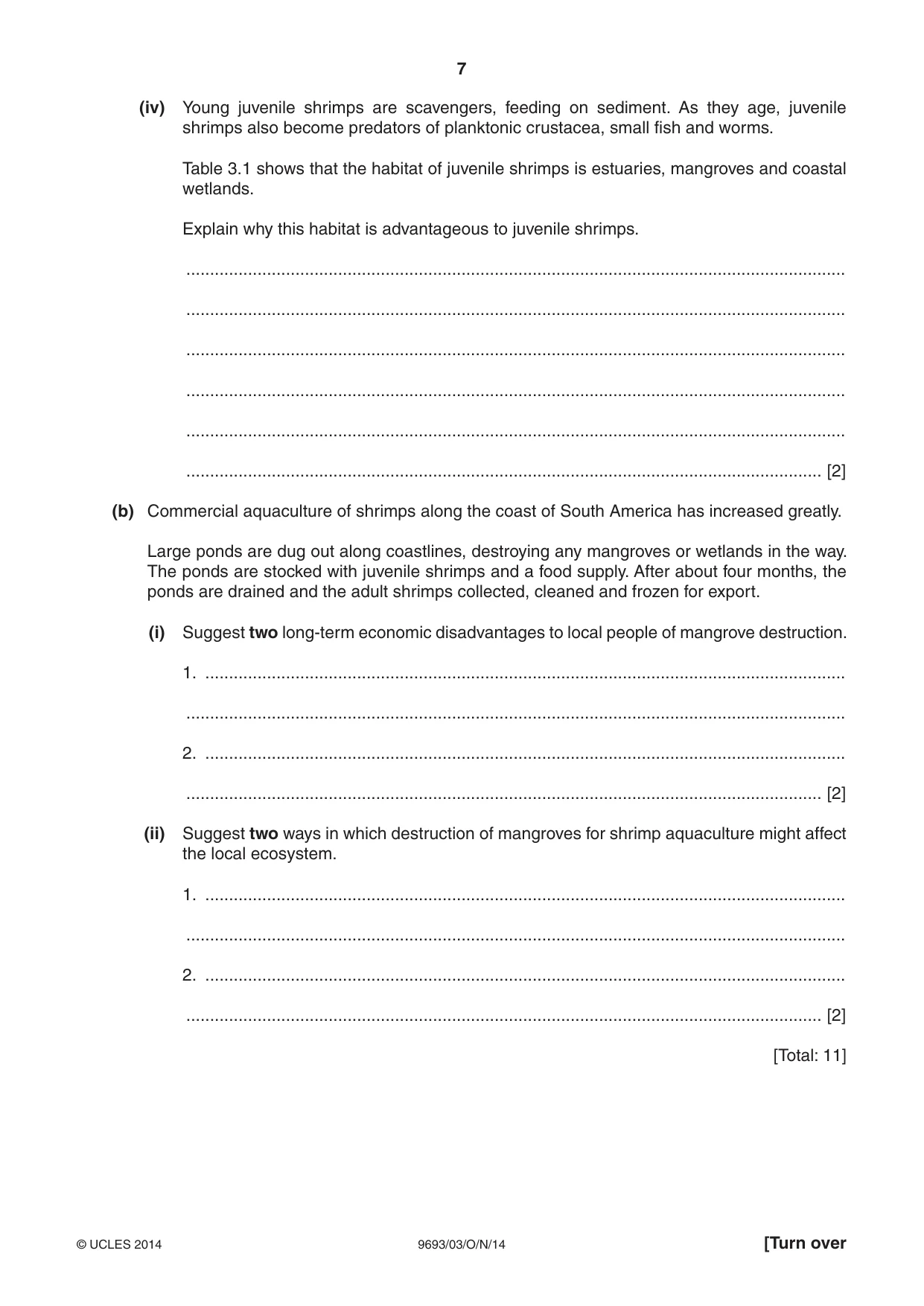
7 9693/03/O/N/14 © UCLES 2014 [Turn over (iv) Young juvenile shrimps are scavengers, feeding on sediment. As they age, juvenile shrimps also become predators of planktonic crustacea, small fish and worms. Table 3.1 shows that the habitat of juvenile shrimps is estuaries, mangroves and coastal wetlands. Explain why this habitat is advantageous to juvenile shrimps. … … … … … … [2] (b) Commercial aquaculture of shrimps along the coast of South America has increased greatly. Large ponds are dug out along coastlines, destroying any mangroves or wetlands in the way. The ponds are stocked with juvenile shrimps and a food supply. After about four months, the ponds are drained and the adult shrimps collected, cleaned and frozen for export. (i) Suggest two long-term economic disadvantages to local people of mangrove destruction. 1. … … 2. … … [2] (ii) Suggest two ways in which destruction of mangroves for shrimp aquaculture might affect the local ecosystem. 1. … … 2. … … [2] [Total: 11]
Question paper, page 8
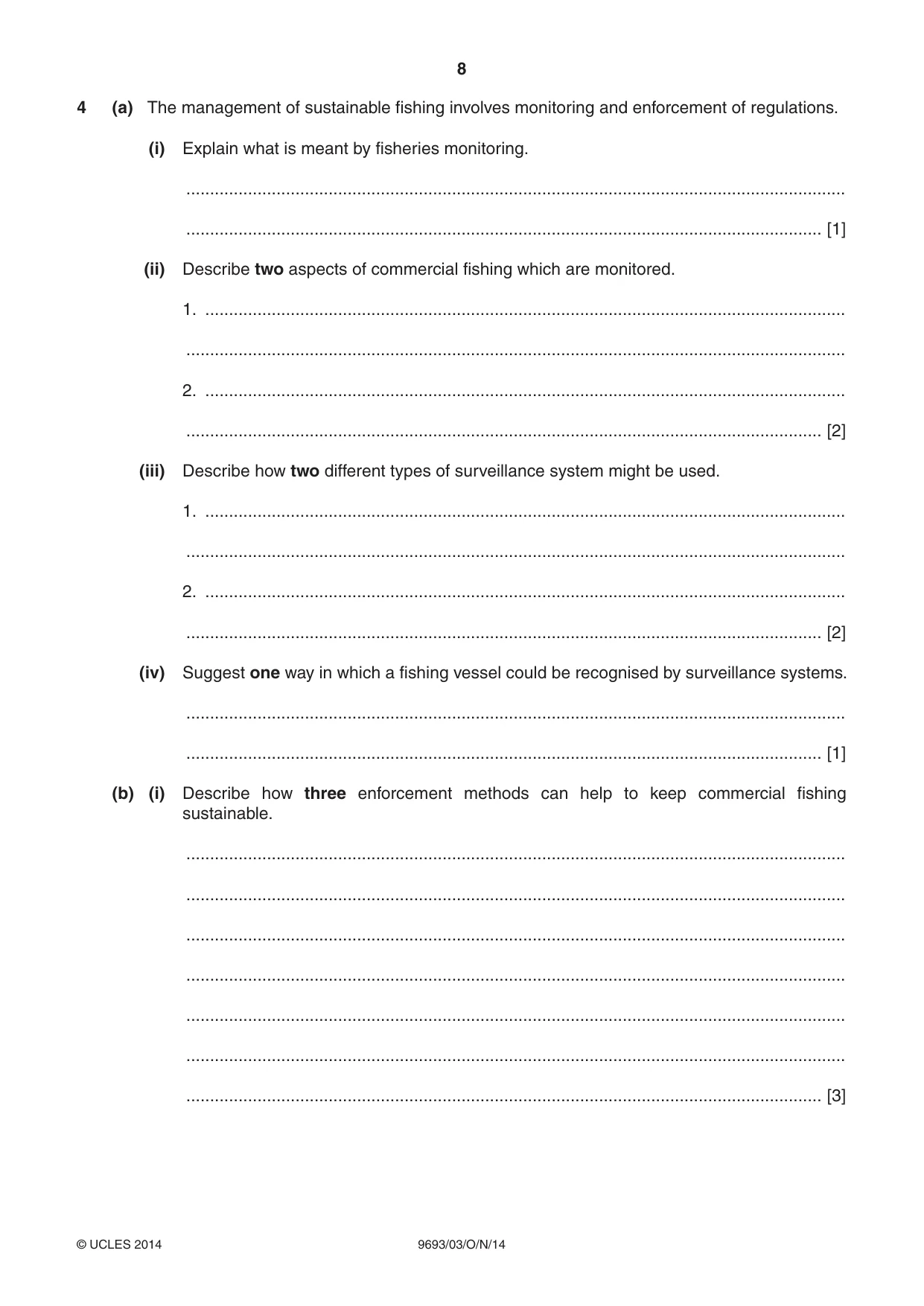
8 9693/03/O/N/14 © UCLES 2014 4 (a) The management of sustainable fishing involves monitoring and enforcement of regulations. (i) Explain what is meant by fisheries monitoring. … … [1] (ii) Describe two aspects of commercial fishing which are monitored. 1. … … 2. … … [2] (iii) Describe how two different types of surveillance system might be used. 1. … … 2. … … [2] (iv) Suggest one way in which a fishing vessel could be recognised by surveillance systems. … … [1] (b) (i) Describe how three enforcement methods can help to keep commercial fishing sustainable. … … … … … … … [3]
Question paper, page 9
9 9693/03/O/N/14 © UCLES 2014 [Turn over (ii) Describe three difficulties in enforcing fishing regulations. … … … … … … … [3] [Total: 12]
Question paper, page 10
10 9693/03/O/N/14 © UCLES 2014 BLANK PAGE
Question paper, page 11
11 9693/03/O/N/14 © UCLES 2014 [Turn over 5 (a) State what is meant by the term aquaculture. … … [1] (b) Salmon is one of the world’s most economically important fish in aquaculture. A small percentage of these fish are genetically engineered (GM salmon). Outline how salmon have been genetically engineered to increase growth rate. … … … … … … [3]
Question paper, page 12
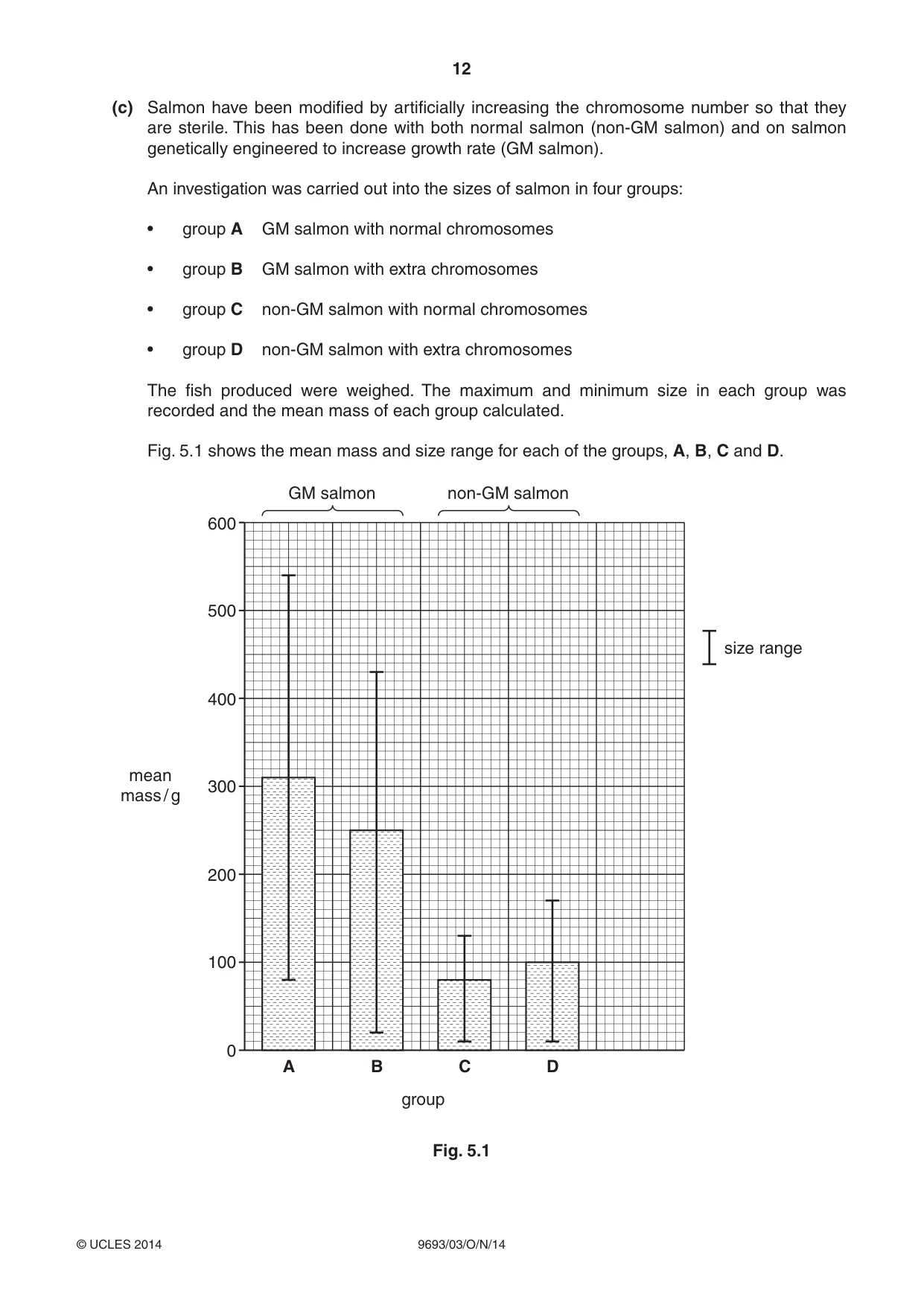
12 9693/03/O/N/14 © UCLES 2014 (c) Salmon have been modified by artificially increasing the chromosome number so that they are sterile. This has been done with both normal salmon (non-GM salmon) and on salmon genetically engineered to increase growth rate (GM salmon). An investigation was carried out into the sizes of salmon in four groups: • group A GM salmon with normal chromosomes • group B GM salmon with extra chromosomes • group C non-GM salmon with normal chromosomes • group D non-GM salmon with extra chromosomes The fish produced were weighed. The maximum and minimum size in each group was recorded and the mean mass of each group calculated. Fig. 5.1 shows the mean mass and size range for each of the groups, A, B, C and D. 0 100 A B C D 200 300 400 500 600 group size range GM salmon non-GM salmon mean mass / g Fig. 5.1
Question paper, page 13
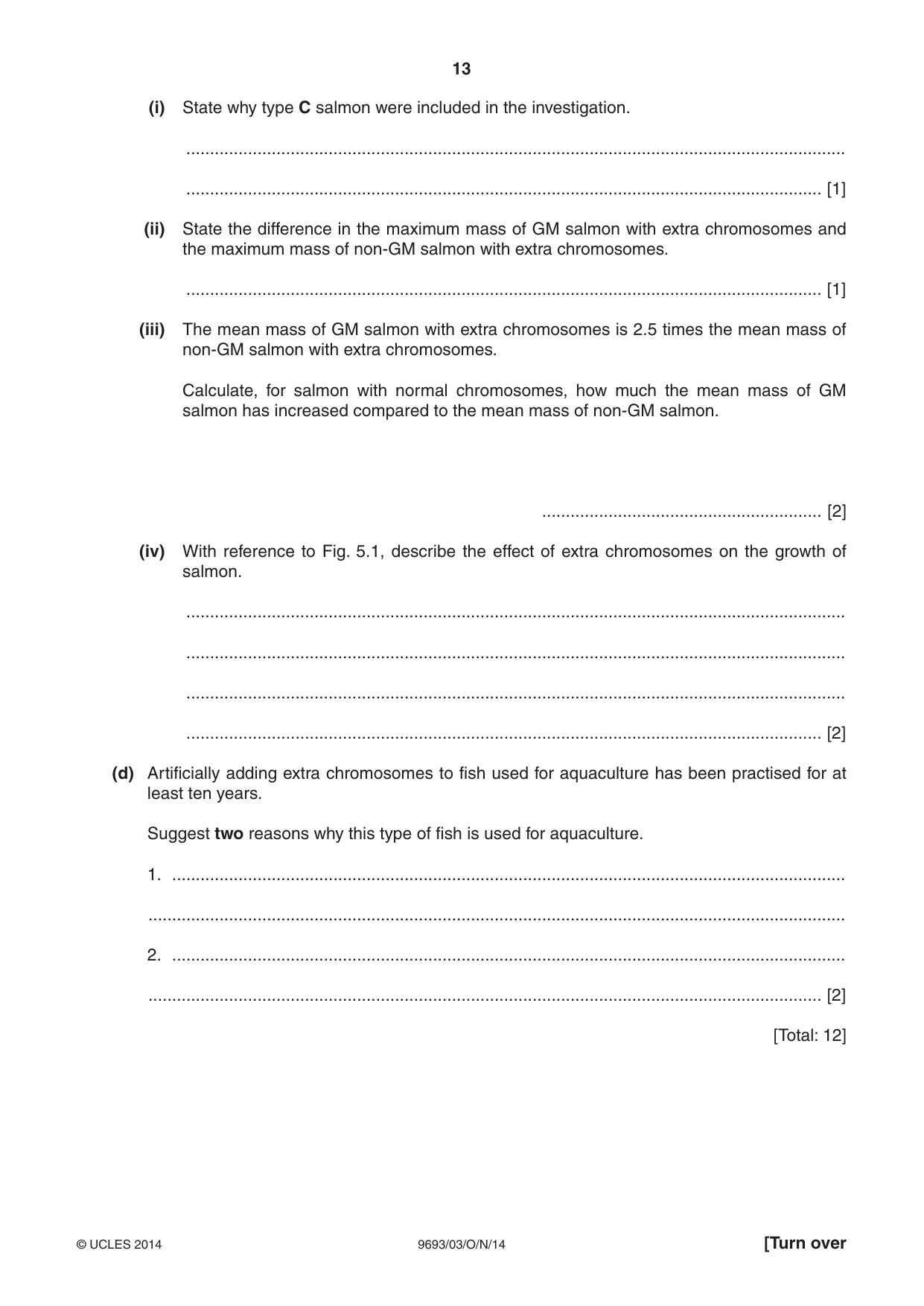
13 9693/03/O/N/14 © UCLES 2014 [Turn over (i) State why type C salmon were included in the investigation. … … [1] (ii) State the difference in the maximum mass of GM salmon with extra chromosomes and the maximum mass of non-GM salmon with extra chromosomes. … [1] (iii) The mean mass of GM salmon with extra chromosomes is 2.5 times the mean mass of non-GM salmon with extra chromosomes. Calculate, for salmon with normal chromosomes, how much the mean mass of GM salmon has increased compared to the mean mass of non-GM salmon. … [2] (iv) With reference to Fig. 5.1, describe the effect of extra chromosomes on the growth of salmon. … … … … [2] (d) Artificially adding extra chromosomes to fish used for aquaculture has been practised for at least ten years. Suggest two reasons why this type of fish is used for aquaculture. 1. … … 2. … … [2] [Total: 12]
Question paper, page 14
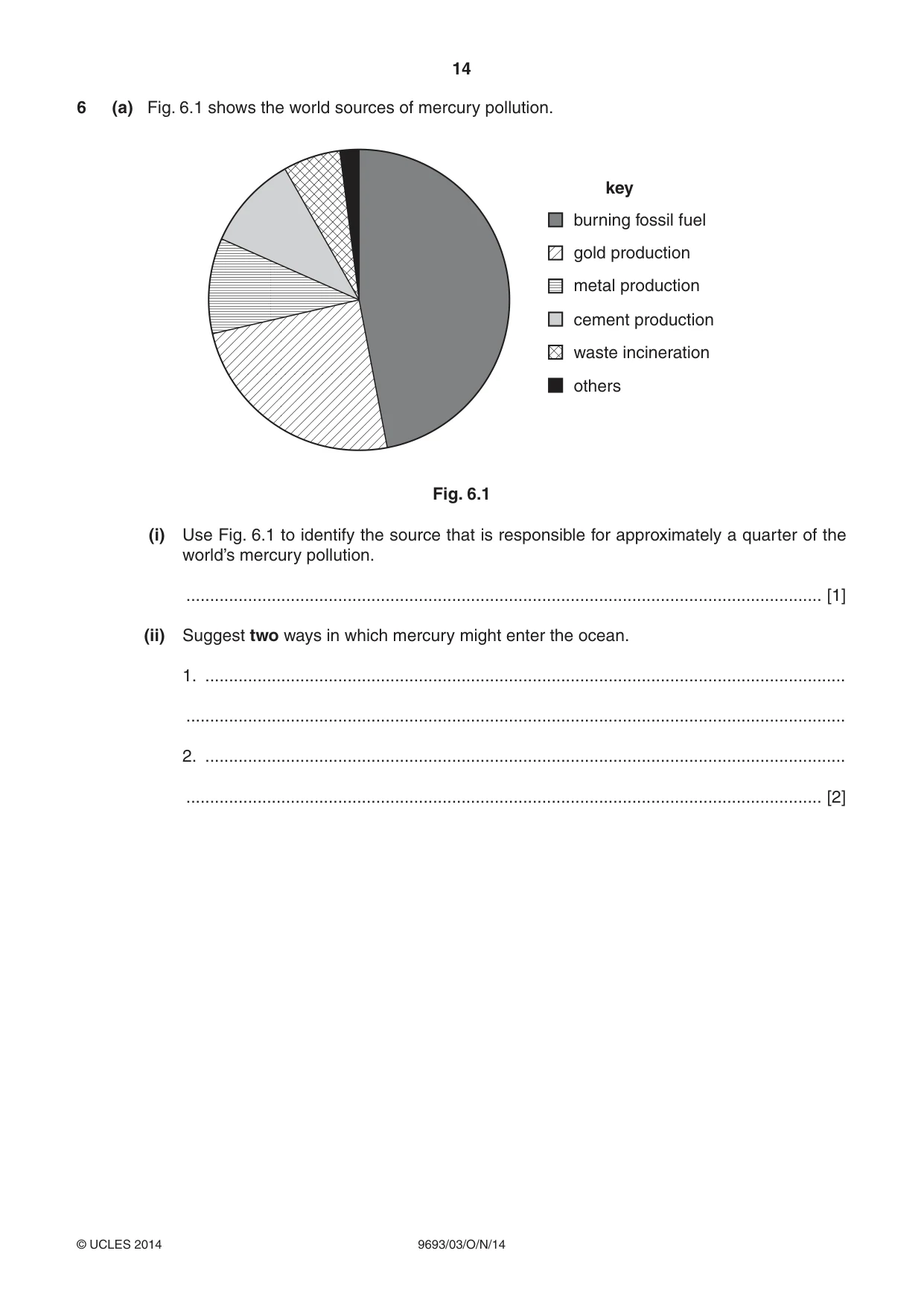
14 9693/03/O/N/14 © UCLES 2014 6 (a) Fig. 6.1 shows the world sources of mercury pollution. burning fossil fuel key gold production metal production cement production waste incineration others Fig. 6.1 (i) Use Fig. 6.1 to identify the source that is responsible for approximately a quarter of the world’s mercury pollution. … [1] (ii) Suggest two ways in which mercury might enter the ocean. 1. … … 2. … … [2]
Question paper, page 15
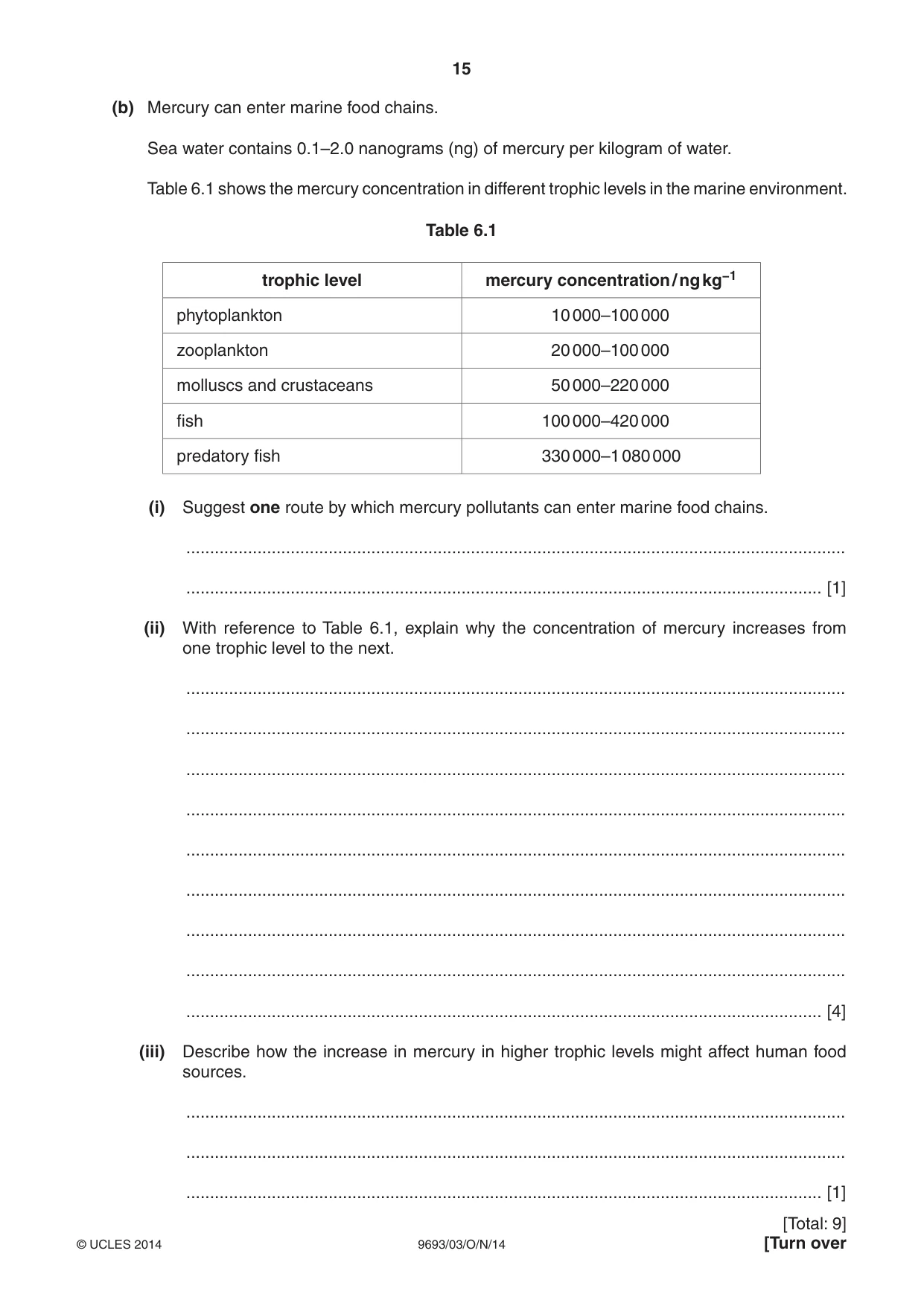
15 9693/03/O/N/14 © UCLES 2014 [Turn over (b) Mercury can enter marine food chains. Sea water contains 0.1–2.0 nanograms (ng) of mercury per kilogram of water. Table 6.1 shows the mercury concentration in different trophic levels in the marine environment. Table 6.1 trophic level mercury concentration / ng kg−1 phytoplankton 10 000–100 000 zooplankton 20 000–100 000 molluscs and crustaceans 50 000–220 000 fish 100 000–420 000 predatory fish 330 000–1 080 000 (i) Suggest one route by which mercury pollutants can enter marine food chains. … … [1] (ii) With reference to Table 6.1, explain why the concentration of mercury increases from one trophic level to the next. … … … … … … … … … [4] (iii) Describe how the increase in mercury in higher trophic levels might affect human food sources. … … … [1] [Total: 9]
Question paper, page 16
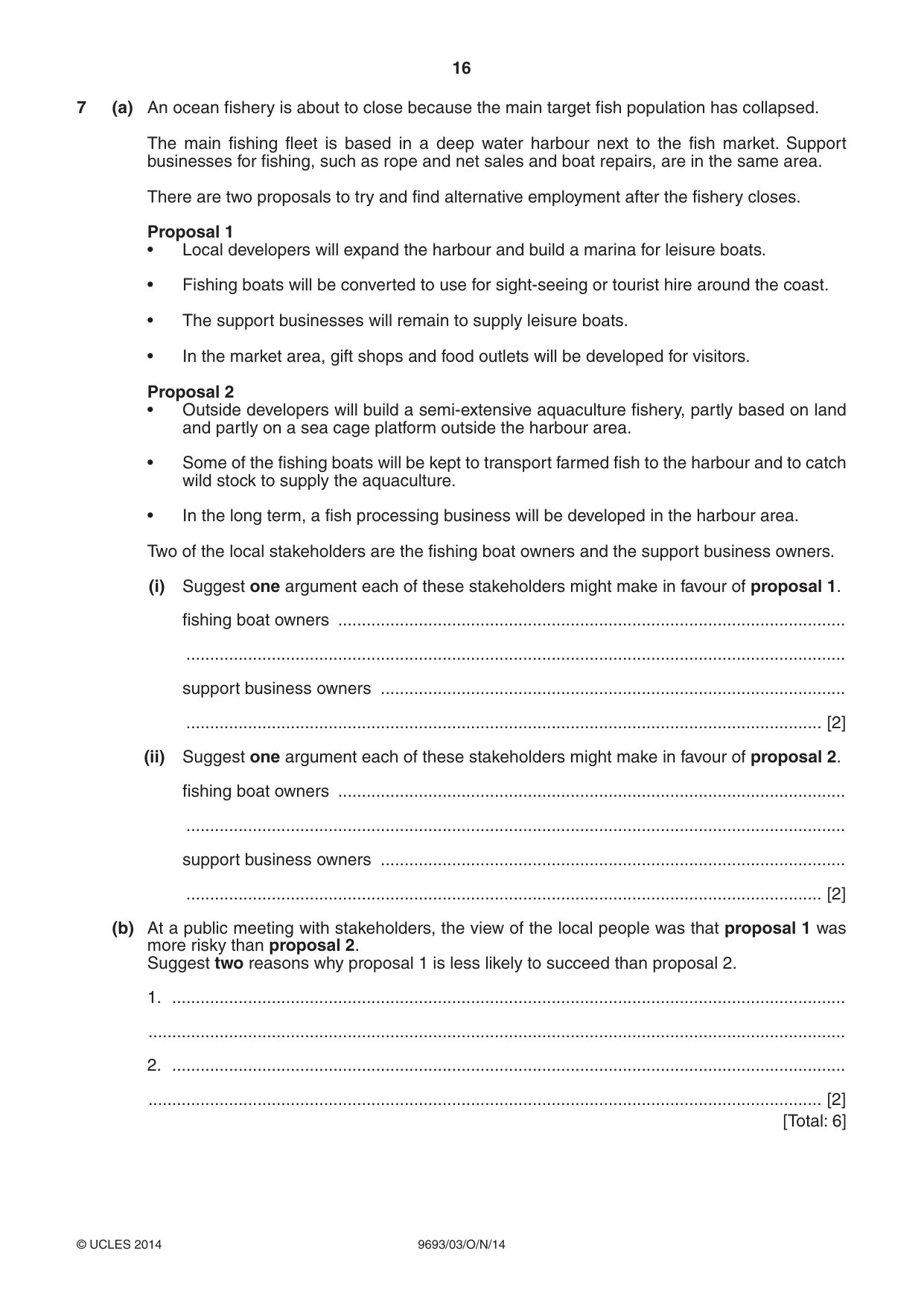
16 9693/03/O/N/14 © UCLES 2014 7 (a) An ocean fishery is about to close because the main target fish population has collapsed. The main fishing fleet is based in a deep water harbour next to the fish market. Support businesses for fishing, such as rope and net sales and boat repairs, are in the same area. There are two proposals to try and find alternative employment after the fishery closes. Proposal 1 • Local developers will expand the harbour and build a marina for leisure boats. • Fishing boats will be converted to use for sight-seeing or tourist hire around the coast. • The support businesses will remain to supply leisure boats. • In the market area, gift shops and food outlets will be developed for visitors. Proposal 2 • Outside developers will build a semi-extensive aquaculture fishery, partly based on land and partly on a sea cage platform outside the harbour area. • Some of the fishing boats will be kept to transport farmed fish to the harbour and to catch wild stock to supply the aquaculture. • In the long term, a fish processing business will be developed in the harbour area. Two of the local stakeholders are the fishing boat owners and the support business owners. (i) Suggest one argument each of these stakeholders might make in favour of proposal 1. fishing boat owners … … support business owners … … [2] (ii) Suggest one argument each of these stakeholders might make in favour of proposal 2. fishing boat owners … … support business owners … … [2] (b) At a public meeting with stakeholders, the view of the local people was that proposal 1 was more risky than proposal 2. Suggest two reasons why proposal 1 is less likely to succeed than proposal 2. 1. … … 2. … … [2] [Total: 6]
Question paper, page 17
17 9693/03/O/N/14 © UCLES 2014 BLANK PAGE
Question paper, page 18
18 9693/03/O/N/14 © UCLES 2014 BLANK PAGE
Question paper, page 19
19 9693/03/O/N/14 © UCLES 2014 BLANK PAGE
Question paper, page 20
20 9693/03/O/N/14 © UCLES 2014 BLANK PAGE Copyright Acknowledgements: Question 1b www.engineering toolbox.com/gases-solubility-water-d_1148.html Question 2c Griffiths; Biological Bulletin Vol 160, No. 2; Marine Biological Laboratory Question 3a http://www.aquaculture.ugent.be/Education/coursematerial/online courses/shrimp-cd/bio/table1b.htm Question 5c http://www.biofortified.org/2010/10/salmon Question 6a www.nrdc.org/health/effect/mercury/sources.asp Permission to reproduce items where third-party owned material protected by copyright is included has been sought and cleared where possible. Every reasonable effort has been made by the publisher (UCLES) to trace copyright holders, but if any items requiring clearance have unwittingly been included, the publisher will be pleased to make amends at the earliest possible opportunity. Cambridge International Examinations is part of the Cambridge Assessment Group. Cambridge Assessment is the brand name of University of Cambridge Local Examinations Syndicate (UCLES), which is itself a department of the University of Cambridge.
Mark scheme, page 1
® IGCSE is the registered trademark of Cambridge International Examinations. CAMBRIDGE INTERNATIONAL EXAMINATIONS Cambridge International Advanced Level MARK SCHEME for the October/November 2014 series 9693 MARINE SCIENCE 9693/03 Paper 3 (Structured Questions), maximum raw mark 75 This mark scheme is published as an aid to teachers and candidates, to indicate the requirements of the examination. It shows the basis on which Examiners were instructed to award marks. It does not indicate the details of the discussions that took place at an Examiners’ meeting before marking began, which would have considered the acceptability of alternative answers. Mark schemes should be read in conjunction with the question paper and the Principal Examiner Report for Teachers. Cambridge will not enter into discussions about these mark schemes. Cambridge is publishing the mark schemes for the October/November 2014 series for most Cambridge IGCSE®, Cambridge International A and AS Level components and some Cambridge O Level components.
Mark scheme, page 2
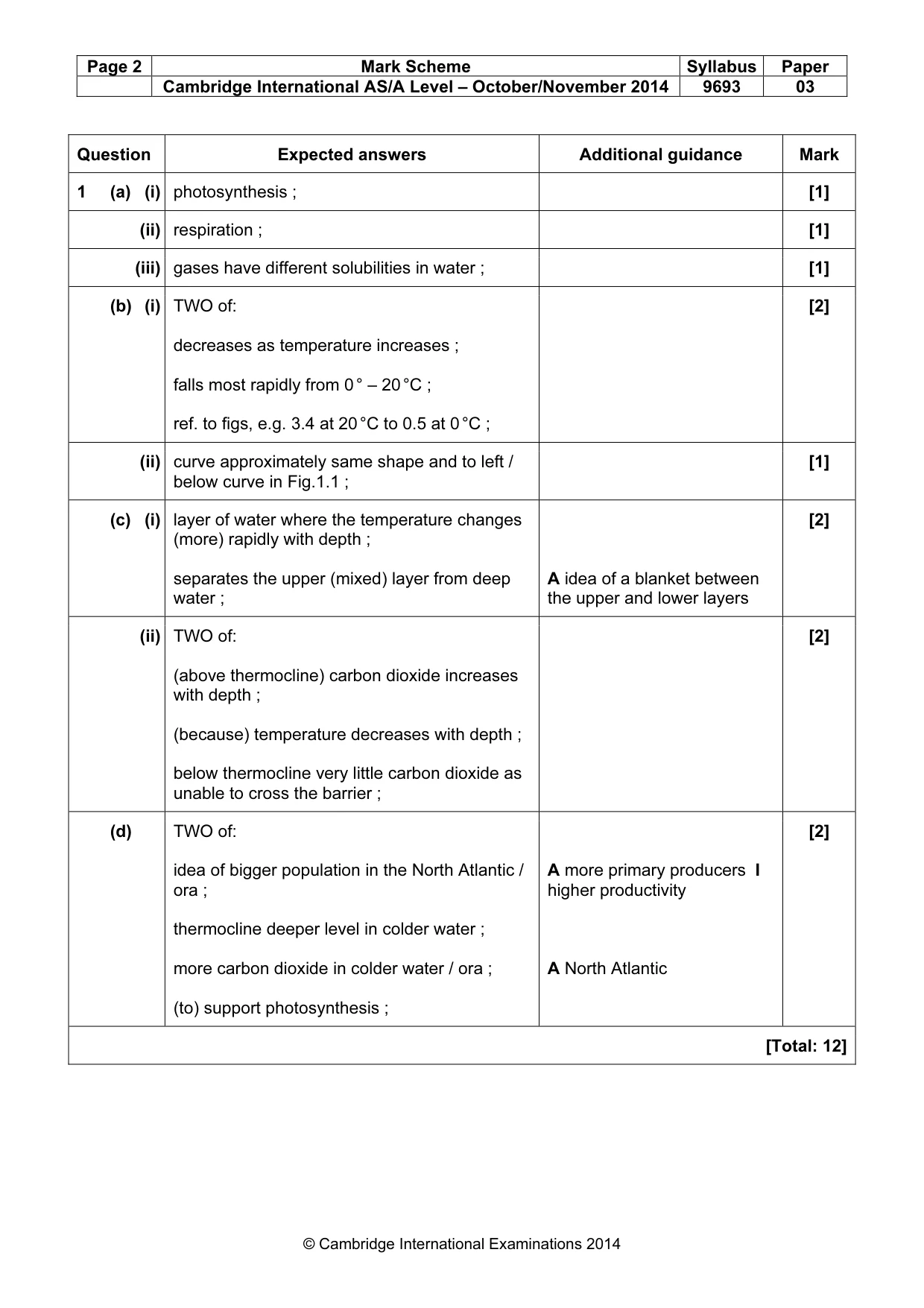
Page 2 Mark Scheme Syllabus Paper Cambridge International AS/A Level – October/November 2014 9693 03 © Cambridge International Examinations 2014 Question Expected answers Additional guidance Mark 1 (a) (i) photosynthesis ; [1] (ii) respiration ; [1] (iii) gases have different solubilities in water ; [1] (b) (i) TWO of: decreases as temperature increases ; falls most rapidly from 0 ° – 20 °C ; ref. to figs, e.g. 3.4 at 20 °C to 0.5 at 0 °C ; [2] (ii) curve approximately same shape and to left / below curve in Fig.1.1 ; [1] (c) (i) layer of water where the temperature changes (more) rapidly with depth ; separates the upper (mixed) layer from deep water ; A idea of a blanket between the upper and lower layers [2] (ii) TWO of: (above thermocline) carbon dioxide increases with depth ; (because) temperature decreases with depth ; below thermocline very little carbon dioxide as unable to cross the barrier ; [2] (d) TWO of: idea of bigger population in the North Atlantic / ora ; thermocline deeper level in colder water ; more carbon dioxide in colder water / ora ; (to) support photosynthesis ; A more primary producers I higher productivity A North Atlantic [2] [Total: 12]
Mark scheme, page 3
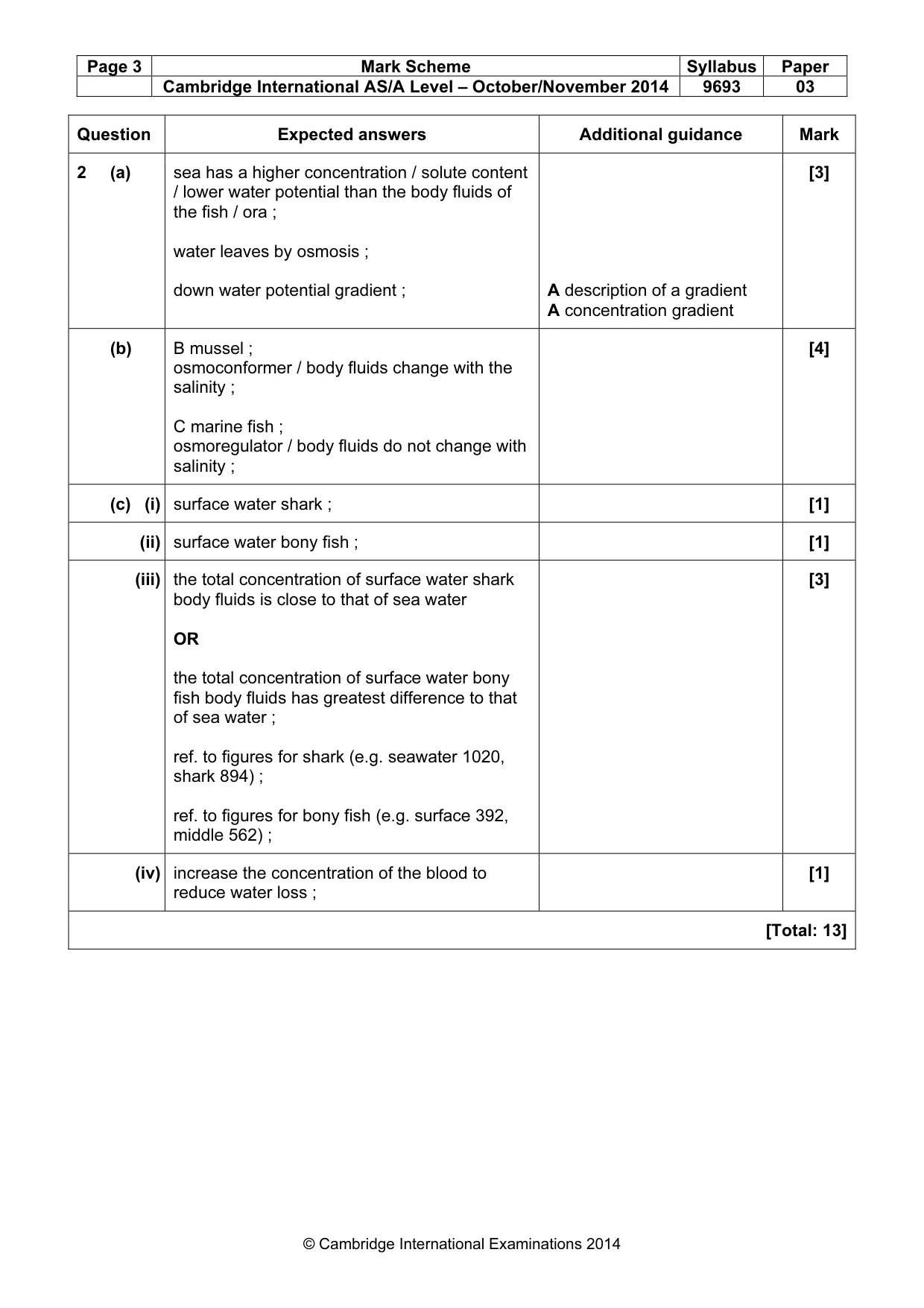
Page 3 Mark Scheme Syllabus Paper Cambridge International AS/A Level – October/November 2014 9693 03 © Cambridge International Examinations 2014 Question Expected answers Additional guidance Mark 2 (a) sea has a higher concentration / solute content / lower water potential than the body fluids of the fish / ora ; water leaves by osmosis ; down water potential gradient ; A description of a gradient A concentration gradient [3] (b) B mussel ; osmoconformer / body fluids change with the salinity ; C marine fish ; osmoregulator / body fluids do not change with salinity ; [4] (c) (i) surface water shark ; [1] (ii) surface water bony fish ; [1] (iii) the total concentration of surface water shark body fluids is close to that of sea water OR the total concentration of surface water bony fish body fluids has greatest difference to that of sea water ; ref. to figures for shark (e.g. seawater 1020, shark 894) ; ref. to figures for bony fish (e.g. surface 392, middle 562) ; [3] (iv) increase the concentration of the blood to reduce water loss ; [1] [Total: 13]
Mark scheme, page 4
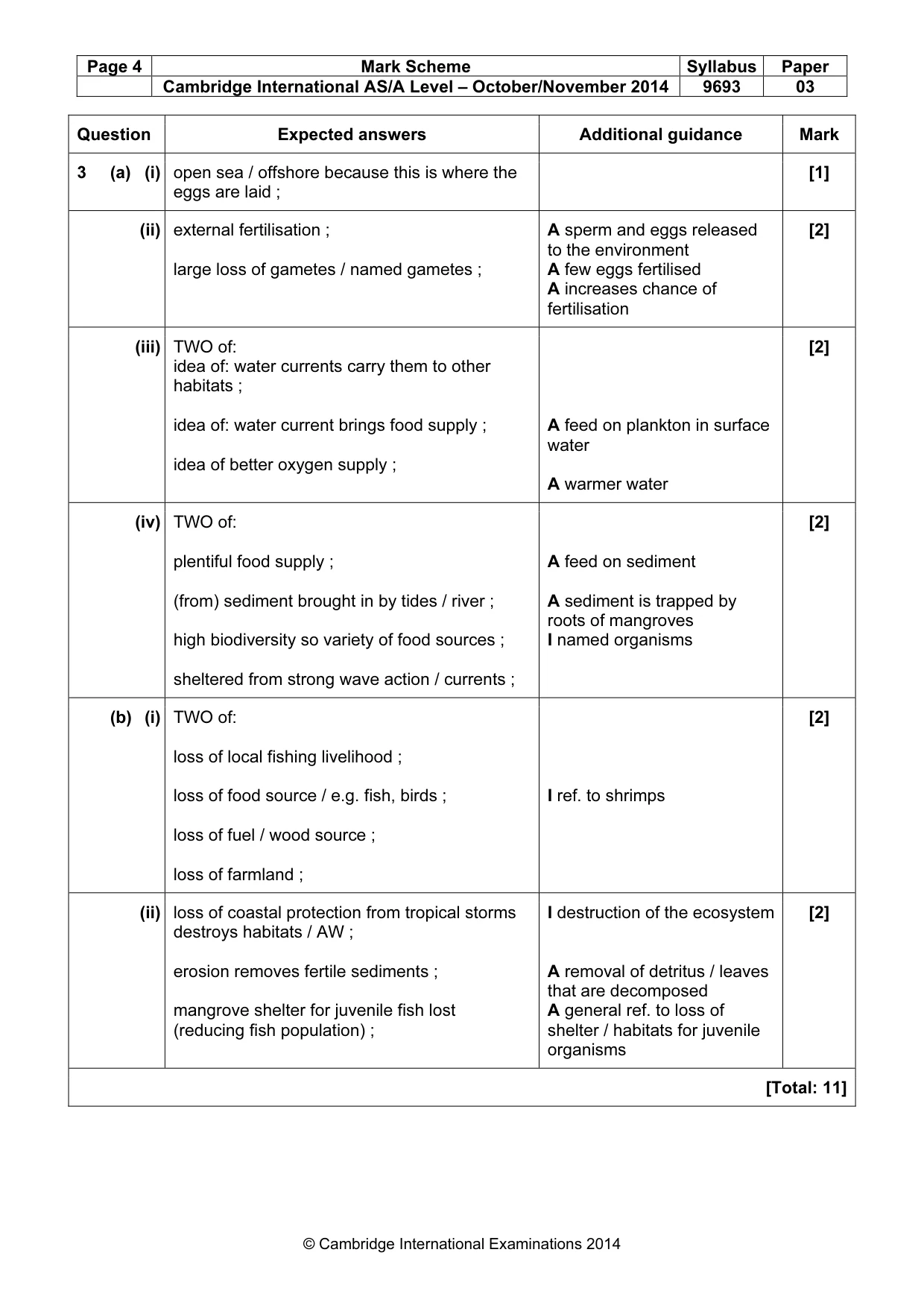
Page 4 Mark Scheme Syllabus Paper Cambridge International AS/A Level – October/November 2014 9693 03 © Cambridge International Examinations 2014 Question Expected answers Additional guidance Mark 3 (a) (i) open sea / offshore because this is where the eggs are laid ; [1] (ii) external fertilisation ; large loss of gametes / named gametes ; A sperm and eggs released to the environment A few eggs fertilised A increases chance of fertilisation [2] (iii) TWO of: idea of: water currents carry them to other habitats ; idea of: water current brings food supply ; idea of better oxygen supply ; A feed on plankton in surface water A warmer water [2] (iv) TWO of: plentiful food supply ; (from) sediment brought in by tides / river ; high biodiversity so variety of food sources ; sheltered from strong wave action / currents ; A feed on sediment A sediment is trapped by roots of mangroves I named organisms [2] (b) (i) TWO of: loss of local fishing livelihood ; loss of food source / e.g. fish, birds ; loss of fuel / wood source ; loss of farmland ; I ref. to shrimps [2] (ii) loss of coastal protection from tropical storms destroys habitats / AW ; erosion removes fertile sediments ; mangrove shelter for juvenile fish lost (reducing fish population) ; I destruction of the ecosystem A removal of detritus / leaves that are decomposed A general ref. to loss of shelter / habitats for juvenile organisms [2] [Total: 11]
Mark scheme, page 5
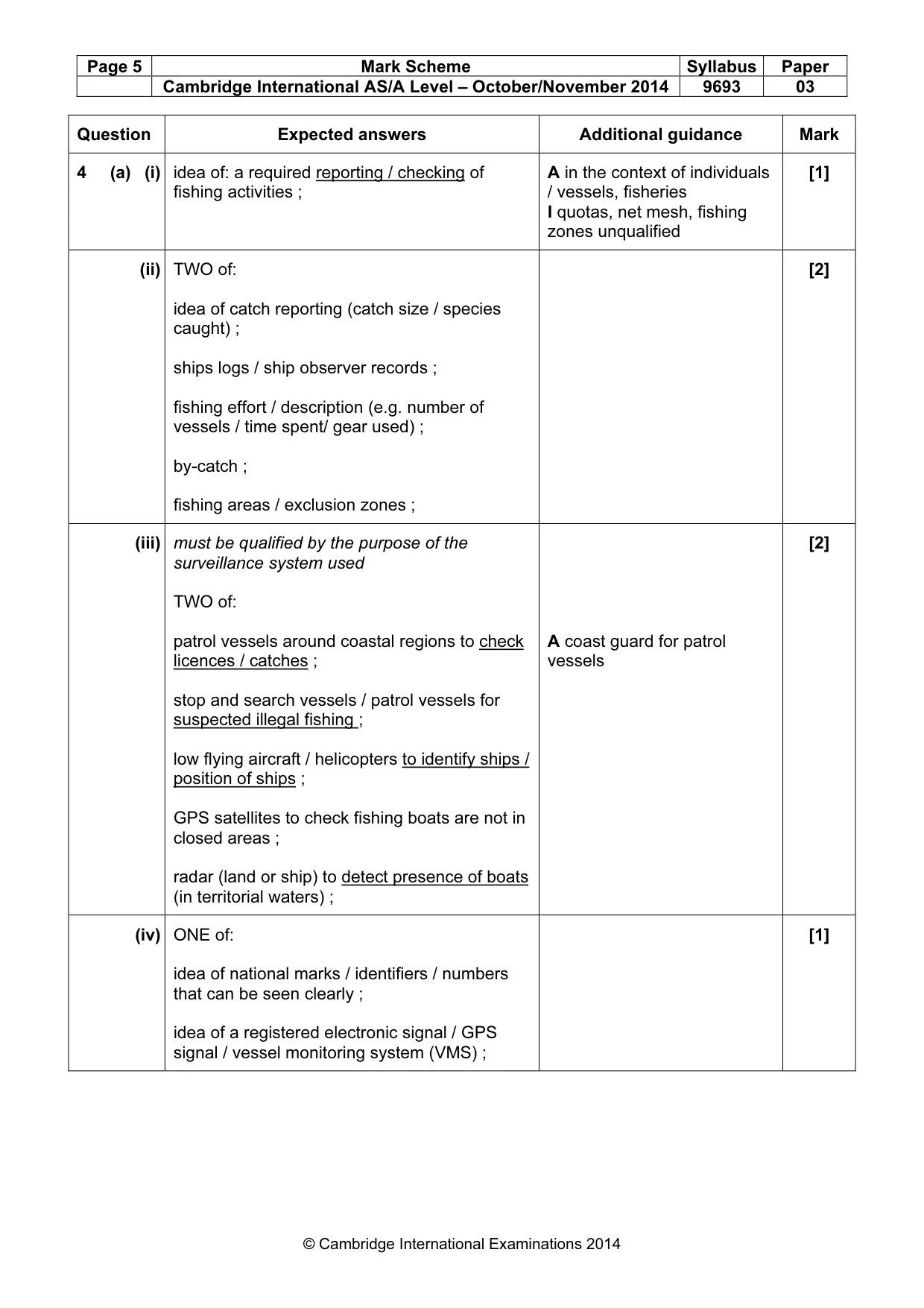
Page 5 Mark Scheme Syllabus Paper Cambridge International AS/A Level – October/November 2014 9693 03 © Cambridge International Examinations 2014 Question Expected answers Additional guidance Mark 4 (a) (i) idea of: a required reporting / checking of fishing activities ; A in the context of individuals / vessels, fisheries I quotas, net mesh, fishing zones unqualified [1] (ii) TWO of: idea of catch reporting (catch size / species caught) ; ships logs / ship observer records ; fishing effort / description (e.g. number of vessels / time spent/ gear used) ; by-catch ; fishing areas / exclusion zones ; [2] (iii) must be qualified by the purpose of the surveillance system used TWO of: patrol vessels around coastal regions to check licences / catches ; stop and search vessels / patrol vessels for suspected illegal fishing ; low flying aircraft / helicopters to identify ships / position of ships ; GPS satellites to check fishing boats are not in closed areas ; radar (land or ship) to detect presence of boats (in territorial waters) ; A coast guard for patrol vessels [2] (iv) ONE of: idea of national marks / identifiers / numbers that can be seen clearly ; idea of a registered electronic signal / GPS signal / vessel monitoring system (VMS) ; [1]
Mark scheme, page 6
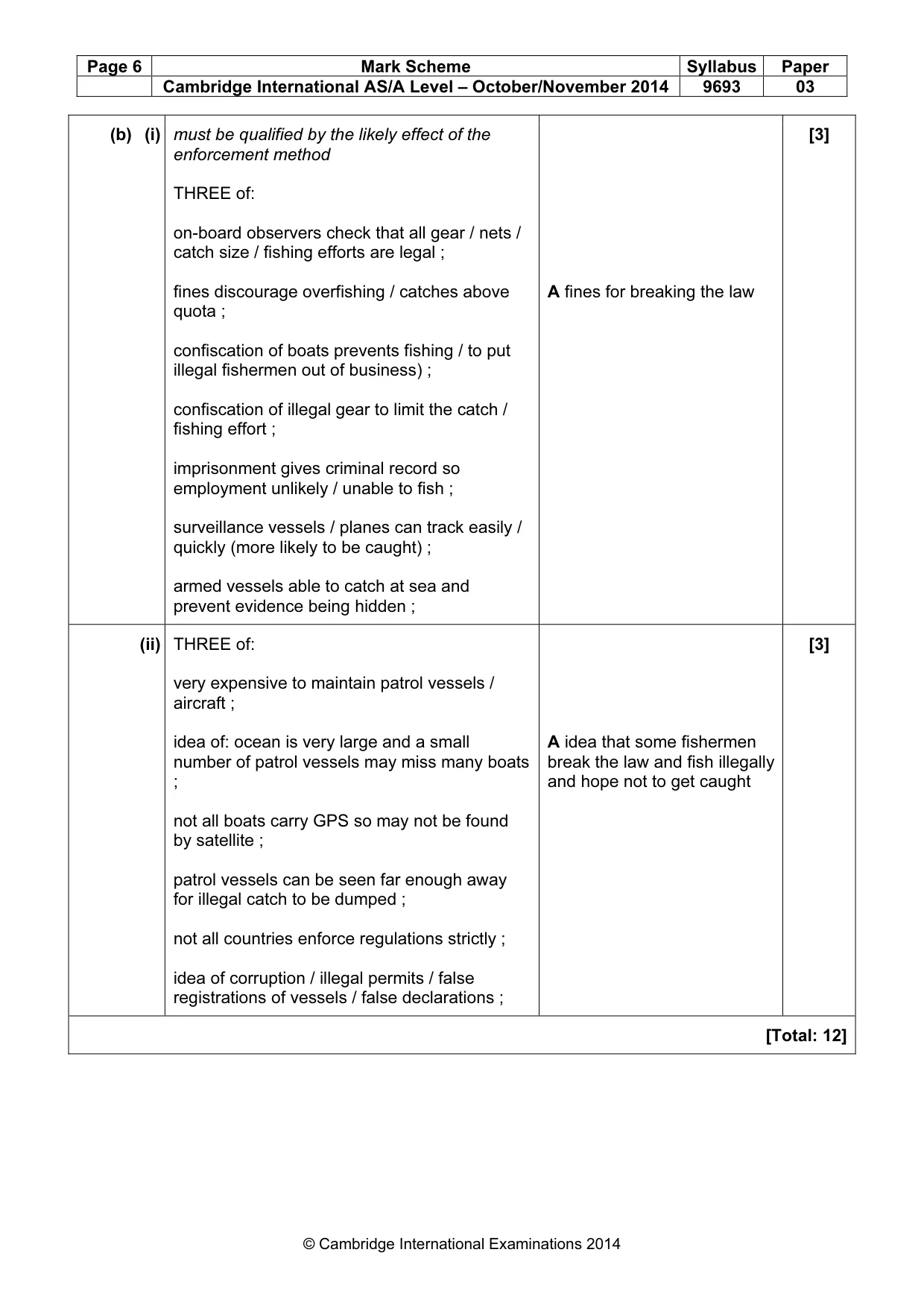
Page 6 Mark Scheme Syllabus Paper Cambridge International AS/A Level – October/November 2014 9693 03 © Cambridge International Examinations 2014 (b) (i) must be qualified by the likely effect of the enforcement method THREE of: on-board observers check that all gear / nets / catch size / fishing efforts are legal ; fines discourage overfishing / catches above quota ; confiscation of boats prevents fishing / to put illegal fishermen out of business) ; confiscation of illegal gear to limit the catch / fishing effort ; imprisonment gives criminal record so employment unlikely / unable to fish ; surveillance vessels / planes can track easily / quickly (more likely to be caught) ; armed vessels able to catch at sea and prevent evidence being hidden ; A fines for breaking the law [3] (ii) THREE of: very expensive to maintain patrol vessels / aircraft ; idea of: ocean is very large and a small number of patrol vessels may miss many boats ; not all boats carry GPS so may not be found by satellite ; patrol vessels can be seen far enough away for illegal catch to be dumped ; not all countries enforce regulations strictly ; idea of corruption / illegal permits / false registrations of vessels / false declarations ; A idea that some fishermen break the law and fish illegally and hope not to get caught [3] [Total: 12]
Mark scheme, page 7
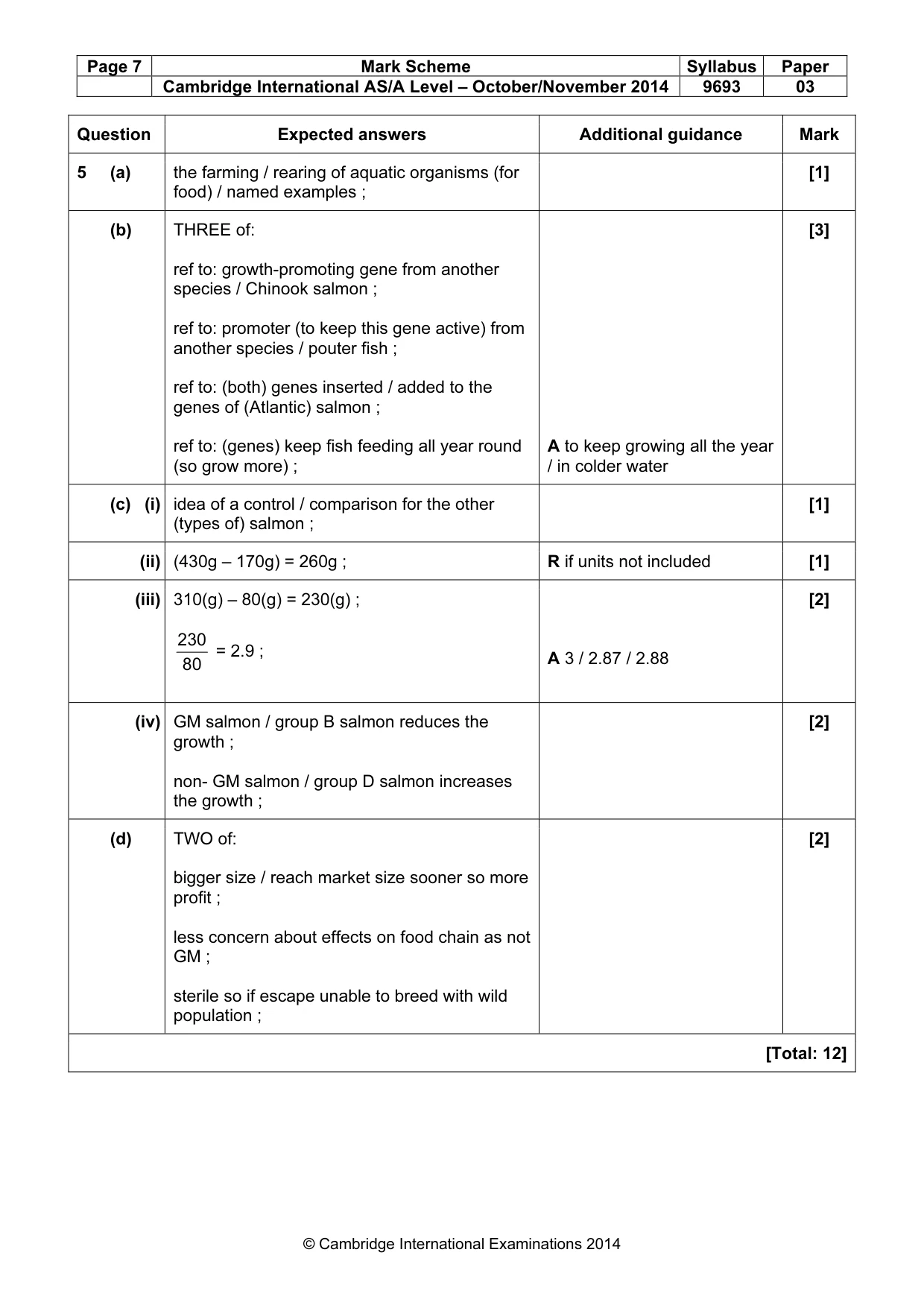
Page 7 Mark Scheme Syllabus Paper Cambridge International AS/A Level – October/November 2014 9693 03 © Cambridge International Examinations 2014 Question Expected answers Additional guidance Mark 5 (a) the farming / rearing of aquatic organisms (for food) / named examples ; [1] (b) THREE of: ref to: growth-promoting gene from another species / Chinook salmon ; ref to: promoter (to keep this gene active) from another species / pouter fish ; ref to: (both) genes inserted / added to the genes of (Atlantic) salmon ; ref to: (genes) keep fish feeding all year round (so grow more) ; A to keep growing all the year / in colder water [3] (c) (i) idea of a control / comparison for the other (types of) salmon ; [1] (ii) (430g – 170g) = 260g ; R if units not included [1] (iii) 310(g) – 80(g) = 230(g) ; 80 230 = 2.9 ; A 3 / 2.87 / 2.88 [2] (iv) GM salmon / group B salmon reduces the growth ; non- GM salmon / group D salmon increases the growth ; [2] (d) TWO of: bigger size / reach market size sooner so more profit ; less concern about effects on food chain as not GM ; sterile so if escape unable to breed with wild population ; [2] [Total: 12]
Mark scheme, page 8
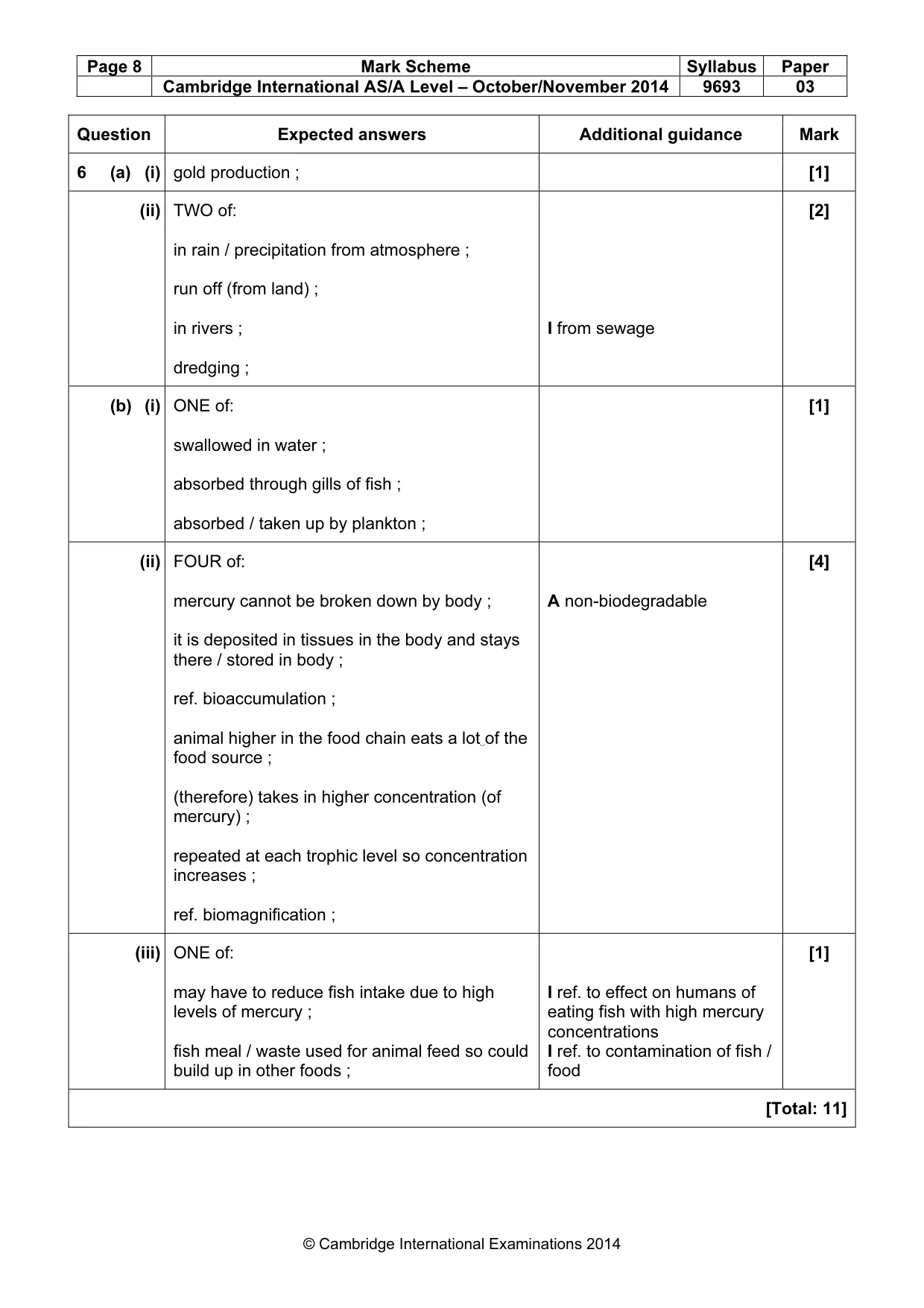
Page 8 Mark Scheme Syllabus Paper Cambridge International AS/A Level – October/November 2014 9693 03 © Cambridge International Examinations 2014 Question Expected answers Additional guidance Mark 6 (a) (i) gold production ; [1] (ii) TWO of: in rain / precipitation from atmosphere ; run off (from land) ; in rivers ; dredging ; I from sewage [2] (b) (i) ONE of: swallowed in water ; absorbed through gills of fish ; absorbed / taken up by plankton ; [1] (ii) FOUR of: mercury cannot be broken down by body ; it is deposited in tissues in the body and stays there / stored in body ; ref. bioaccumulation ; animal higher in the food chain eats a lot of the food source ; (therefore) takes in higher concentration (of mercury) ; repeated at each trophic level so concentration increases ; ref. biomagnification ; A non-biodegradable [4] (iii) ONE of: may have to reduce fish intake due to high levels of mercury ; fish meal / waste used for animal feed so could build up in other foods ; I ref. to effect on humans of eating fish with high mercury concentrations I ref. to contamination of fish / food [1] [Total: 11]
Mark scheme, page 9
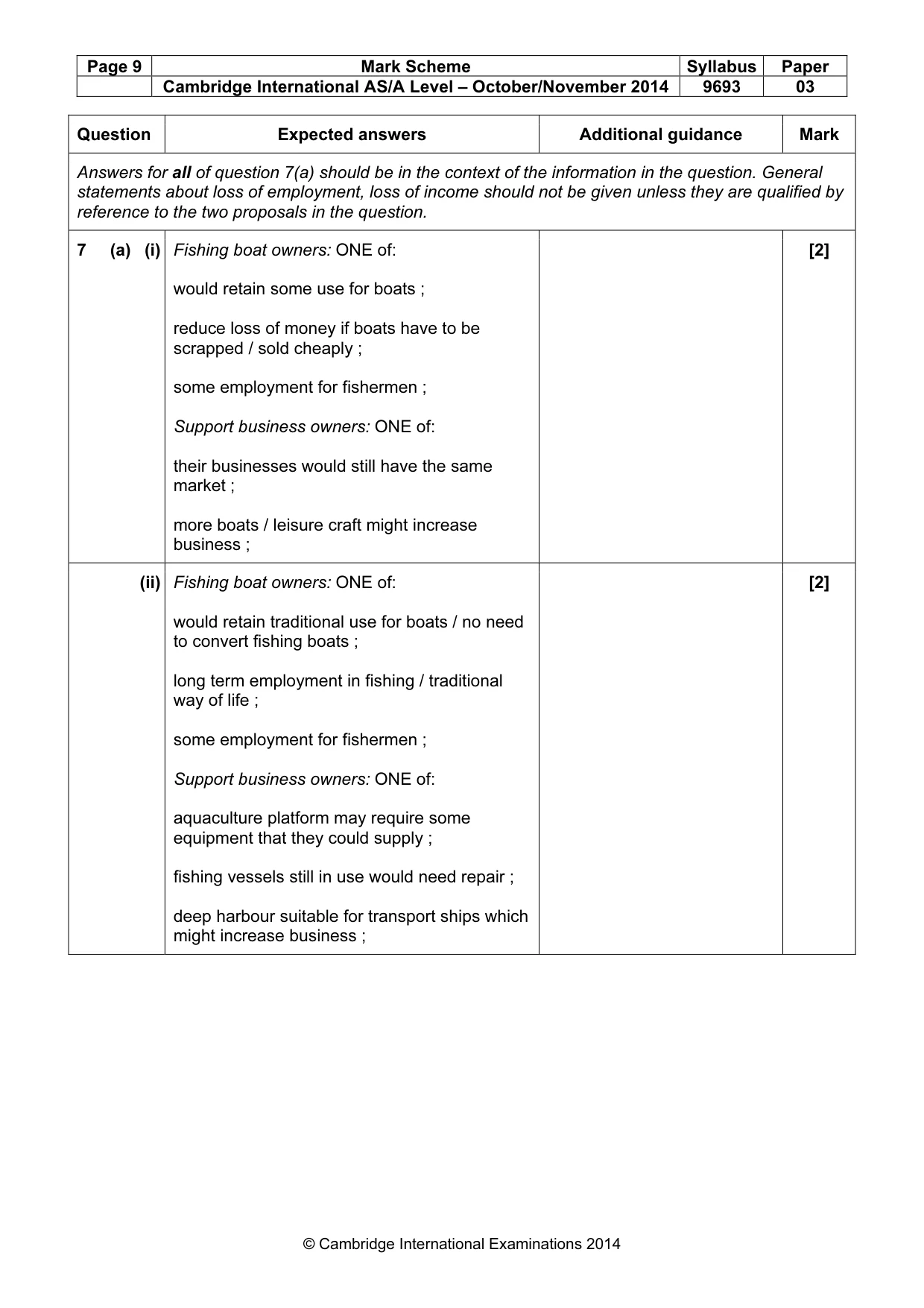
Page 9 Mark Scheme Syllabus Paper Cambridge International AS/A Level – October/November 2014 9693 03 © Cambridge International Examinations 2014 Question Expected answers Additional guidance Mark Answers for all of question 7(a) should be in the context of the information in the question. General statements about loss of employment, loss of income should not be given unless they are qualified by reference to the two proposals in the question. 7 (a) (i) Fishing boat owners: ONE of: would retain some use for boats ; reduce loss of money if boats have to be scrapped / sold cheaply ; some employment for fishermen ; Support business owners: ONE of: their businesses would still have the same market ; more boats / leisure craft might increase business ; [2] (ii) Fishing boat owners: ONE of: would retain traditional use for boats / no need to convert fishing boats ; long term employment in fishing / traditional way of life ; some employment for fishermen ; Support business owners: ONE of: aquaculture platform may require some equipment that they could supply ; fishing vessels still in use would need repair ; deep harbour suitable for transport ships which might increase business ; [2]
Mark scheme, page 10
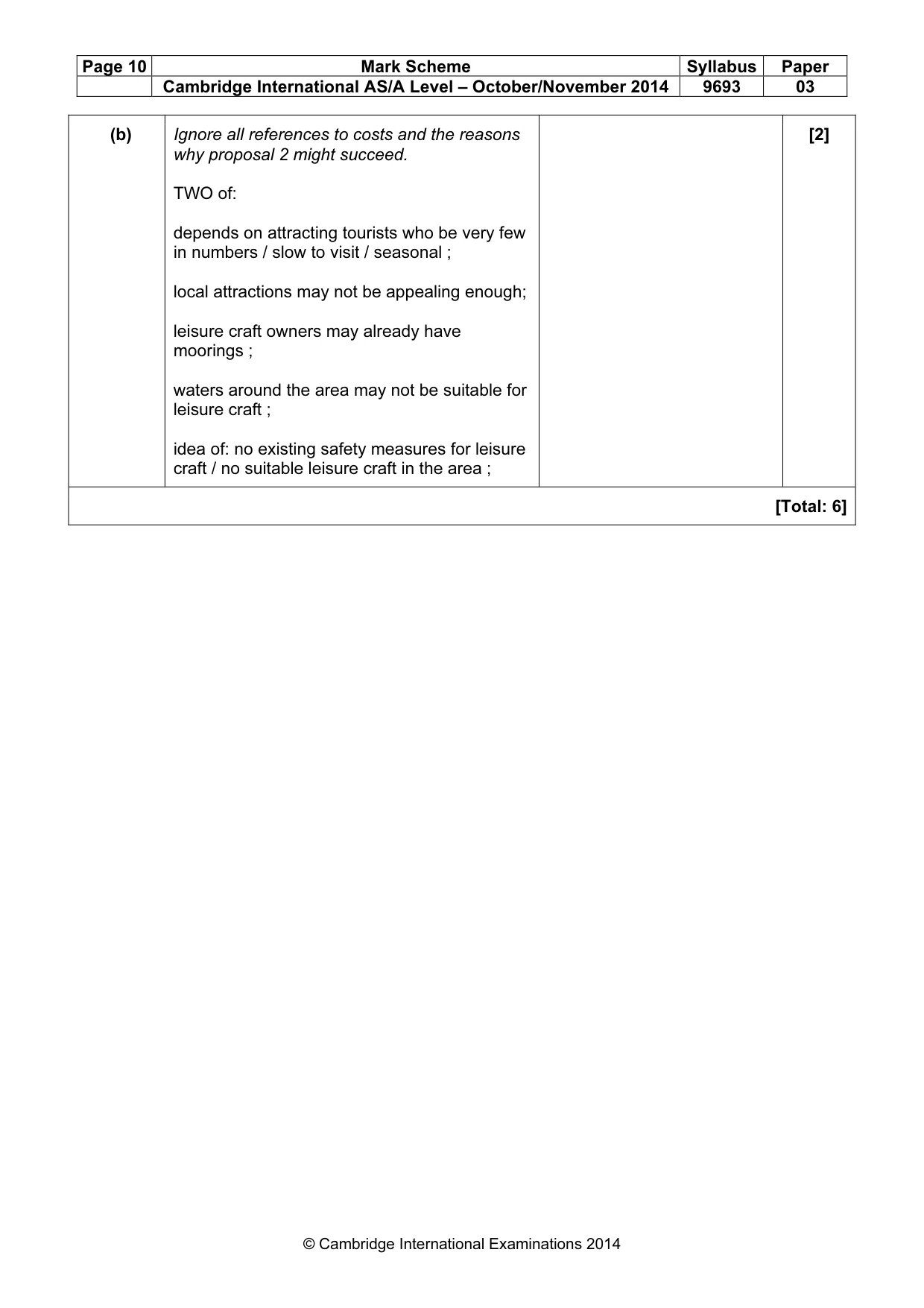
Page 10 Mark Scheme Syllabus Paper Cambridge International AS/A Level – October/November 2014 9693 03 © Cambridge International Examinations 2014 (b) Ignore all references to costs and the reasons why proposal 2 might succeed. TWO of: depends on attracting tourists who be very few in numbers / slow to visit / seasonal ; local attractions may not be appealing enough; leisure craft owners may already have moorings ; waters around the area may not be suitable for leisure craft ; idea of: no existing safety measures for leisure craft / no suitable leisure craft in the area ; [2] [Total: 6]
What you needed in this session
Cambridge’s own grade thresholds for 2014 Oct/Nov, Paper 3 · Variant 1. A higher threshold means an easier paper — the bar moves with how the cohort did.