Cambridge A Level Marine Science 9693 — 2014 Oct/Nov Paper 2 · Variant 1
9693/21/O/N/14 · 50 marks · ≈56 min
The question paper and its mark scheme, free to read here and free to download. This is Cambridge’s own paper, exactly as it was sat.
Question paper12 pages
Mark scheme5 pages
Answers below. Sit the paper first if you are practising.
Paper as text
Question paper, page 1
This document consists of 10 printed pages and 2 blank pages. DC (LK/SW) 81108/4 © UCLES 2014 [Turn over Cambridge International Examinations Cambridge International Advanced Subsidiary and Advanced Level * 8 1 7 9 1 5 7 8 7 7 * MARINE SCIENCE 9693/02 Paper 2 AS Data Handling and Free Response October/November 2014 1 hour 15 minutes Candidates answer on the Question Paper. No Additional Materials are required. READ THESE INSTRUCTIONS FIRST Write your Centre number, candidate number and name on all the work you hand in. Write in dark blue or black pen. You may use an HB pencil for any diagrams or graphs. Do not use staples, paper clips, glue or correction fluid. DO NOT WRITE IN ANY BARCODES. Answer all questions. At the end of the examination, fasten all your work securely together. The number of marks is given in brackets [ ] at the end of each question or part question. Electronic calculators may be used. You may lose marks if you do not show your working or if you do not use appropriate units. For Examiner’s Use 1 2 3 4 Total
Question paper, page 2
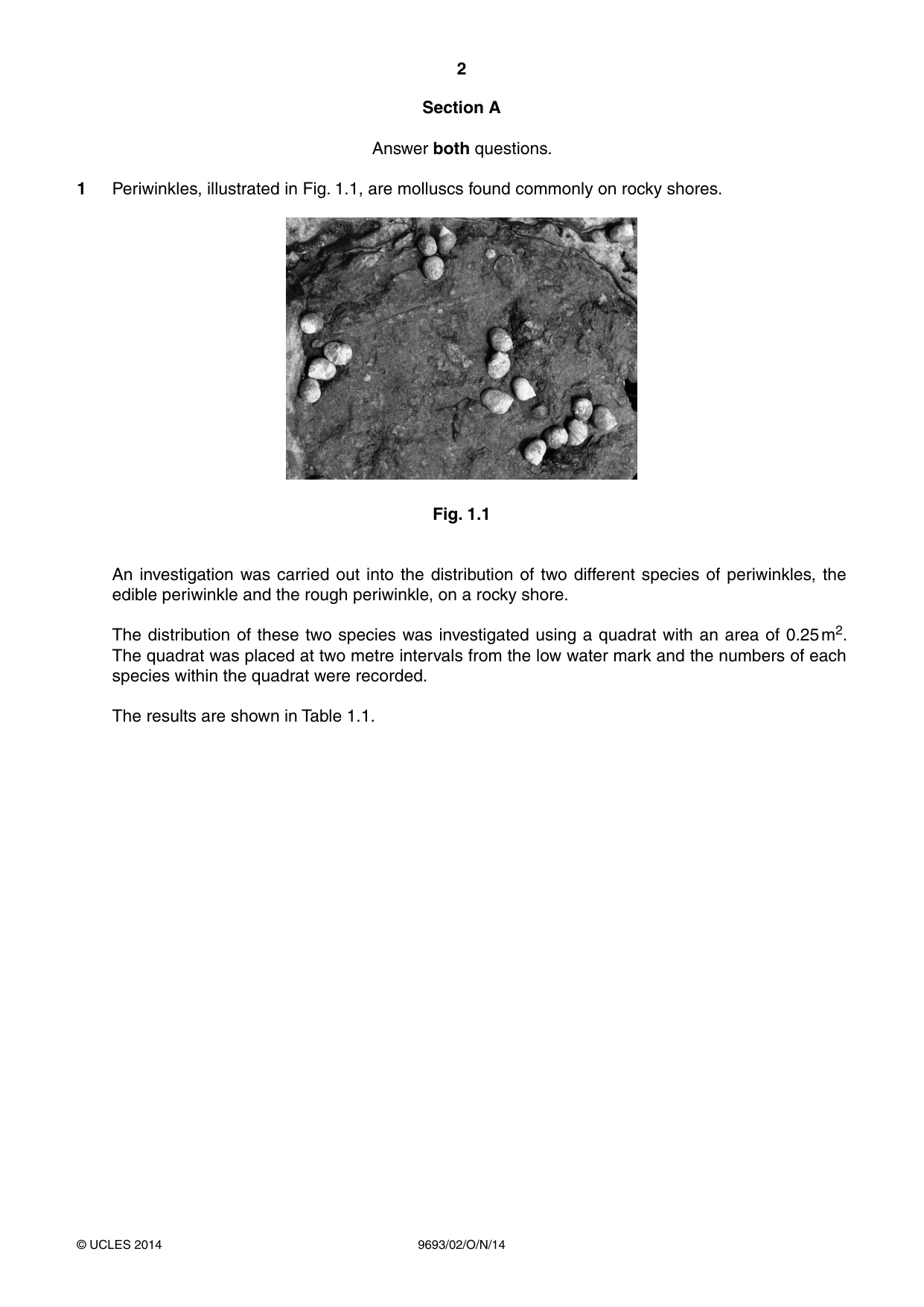
2 9693/02/O/N/14 © UCLES 2014 Section A Answer both questions. 1 Periwinkles, illustrated in Fig. 1.1, are molluscs found commonly on rocky shores. Fig. 1.1 An investigation was carried out into the distribution of two different species of periwinkles, the edible periwinkle and the rough periwinkle, on a rocky shore. The distribution of these two species was investigated using a quadrat with an area of 0.25 m2. The quadrat was placed at two metre intervals from the low water mark and the numbers of each species within the quadrat were recorded. The results are shown in Table 1.1.
Question paper, page 3
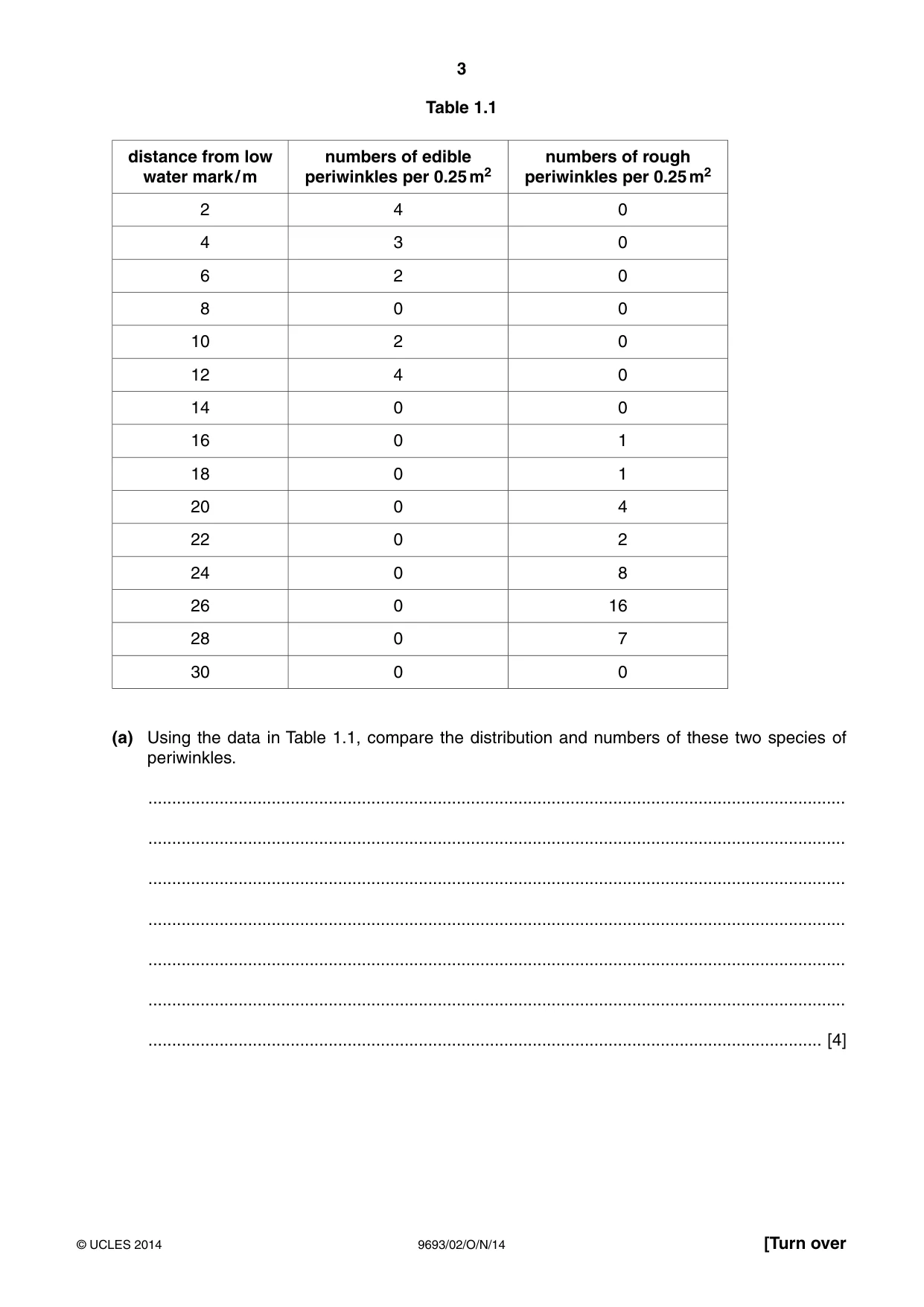
3 9693/02/O/N/14 © UCLES 2014 [Turn over Table 1.1 distance from low water mark / m numbers of edible periwinkles per 0.25 m2 numbers of rough periwinkles per 0.25 m2 2 4 0 4 3 0 6 2 0 8 0 0 10 2 0 12 4 0 14 0 0 16 0 1 18 0 1 20 0 4 22 0 2 24 0 8 26 0 16 28 0 7 30 0 0 (a) Using the data in Table 1.1, compare the distribution and numbers of these two species of periwinkles. … … … … … … … [4]
Question paper, page 4
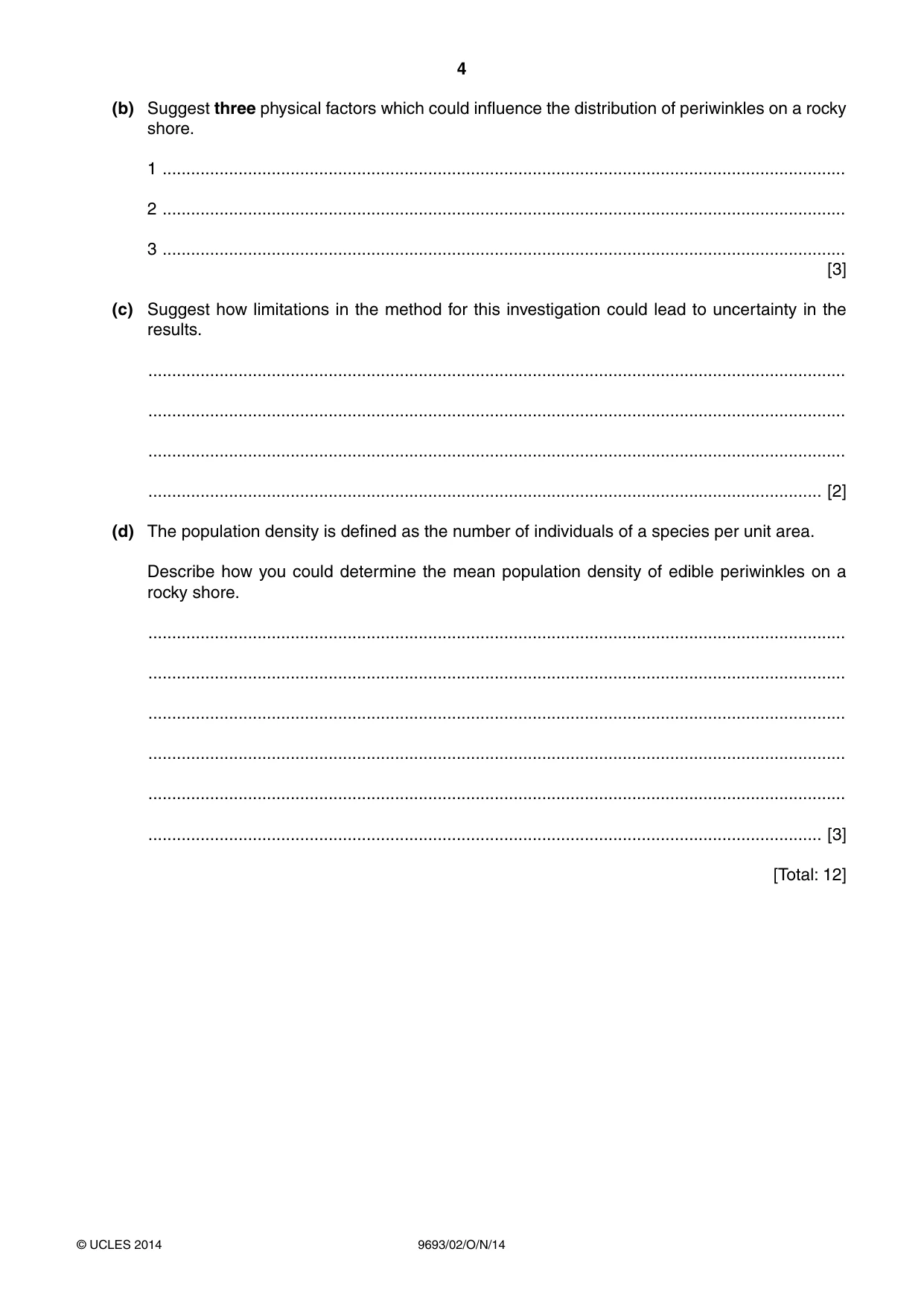
4 9693/02/O/N/14 © UCLES 2014 (b) Suggest three physical factors which could influence the distribution of periwinkles on a rocky shore. 1 … 2 … 3 … [3] (c) Suggest how limitations in the method for this investigation could lead to uncertainty in the results. … … … … [2] (d) The population density is defined as the number of individuals of a species per unit area. Describe how you could determine the mean population density of edible periwinkles on a rocky shore. … … … … … … [3] [Total: 12]
Question paper, page 5
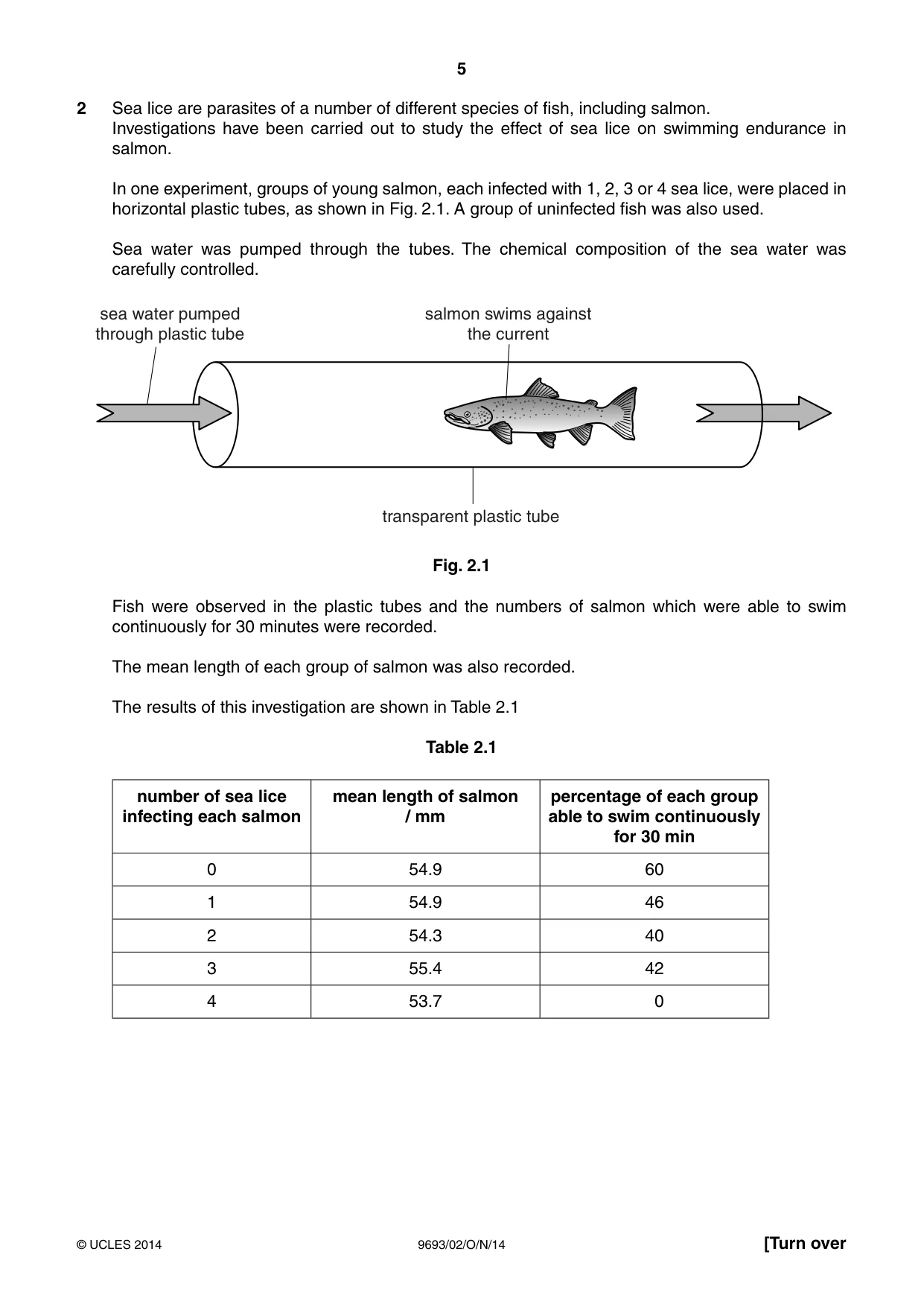
5 9693/02/O/N/14 © UCLES 2014 [Turn over 2 Sea lice are parasites of a number of different species of fish, including salmon. Investigations have been carried out to study the effect of sea lice on swimming endurance in salmon. In one experiment, groups of young salmon, each infected with 1, 2, 3 or 4 sea lice, were placed in horizontal plastic tubes, as shown in Fig. 2.1. A group of uninfected fish was also used. Sea water was pumped through the tubes. The chemical composition of the sea water was carefully controlled. sea water pumped through plastic tube transparent plastic tube salmon swims against the current Fig. 2.1 Fish were observed in the plastic tubes and the numbers of salmon which were able to swim continuously for 30 minutes were recorded. The mean length of each group of salmon was also recorded. The results of this investigation are shown in Table 2.1 Table 2.1 number of sea lice infecting each salmon mean length of salmon / mm percentage of each group able to swim continuously for 30 min 0 54.9 60 1 54.9 46 2 54.3 40 3 55.4 42 4 53.7 0
Question paper, page 6
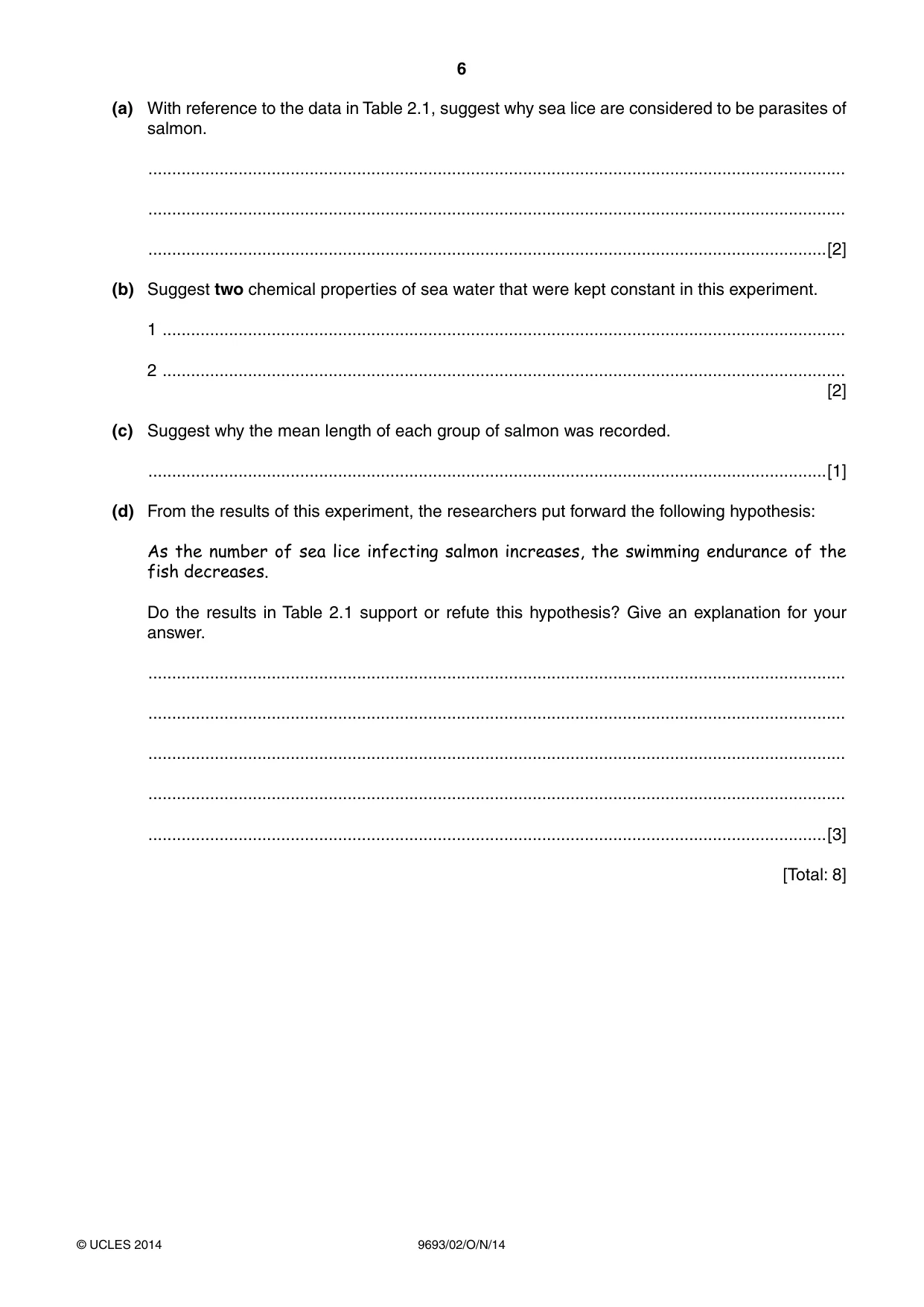
6 9693/02/O/N/14 © UCLES 2014 (a) With reference to the data in Table 2.1, suggest why sea lice are considered to be parasites of salmon. … … …[2] (b) Suggest two chemical properties of sea water that were kept constant in this experiment. 1 … 2 … [2] (c) Suggest why the mean length of each group of salmon was recorded. …[1] (d) From the results of this experiment, the researchers put forward the following hypothesis: As the number of sea lice infecting salmon increases, the swimming endurance of the fish decreases. Do the results in Table 2.1 support or refute this hypothesis? Give an explanation for your answer. … … … … …[3] [Total: 8]
Question paper, page 7
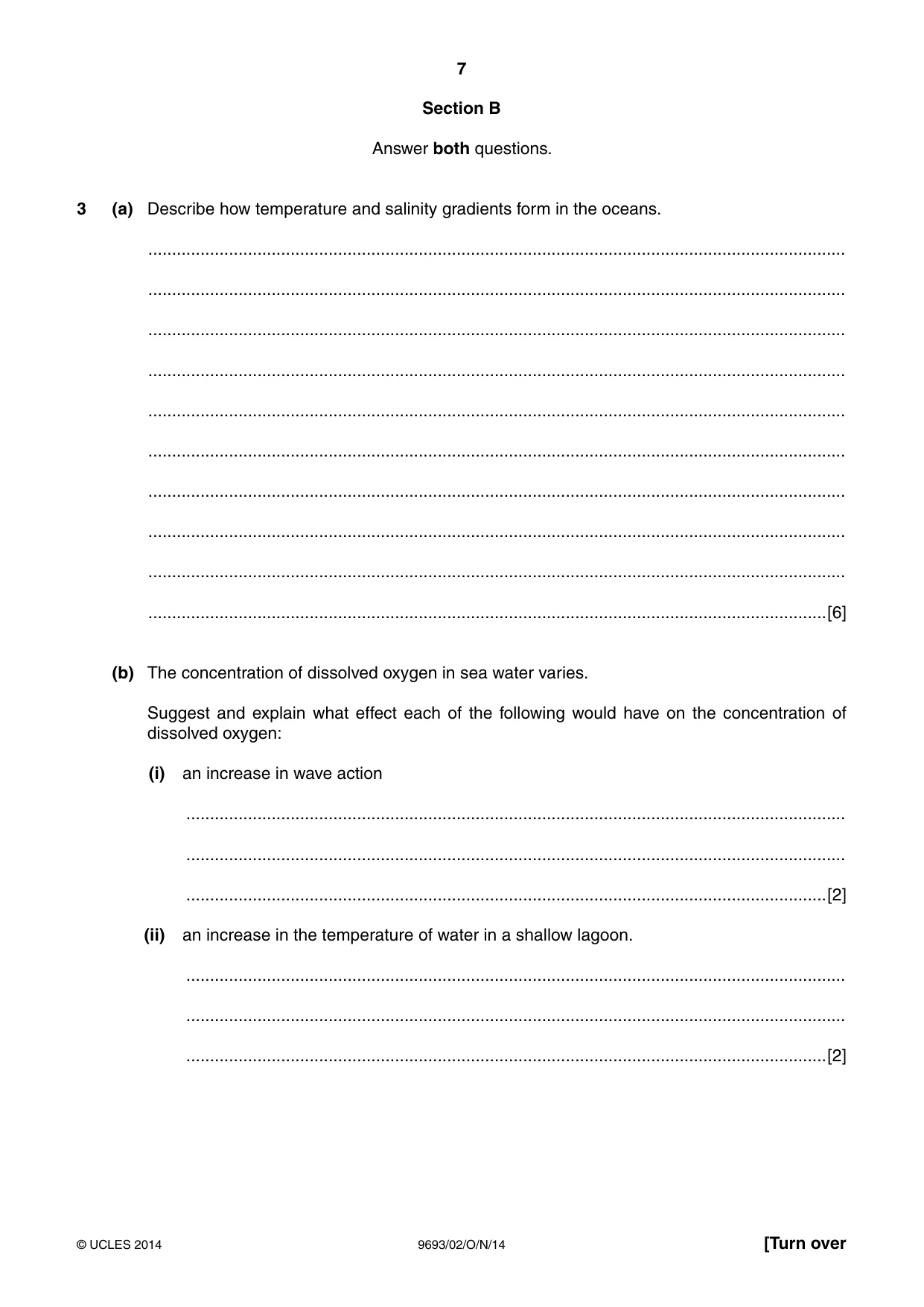
7 9693/02/O/N/14 © UCLES 2014 [Turn over Section B Answer both questions. 3 (a) Describe how temperature and salinity gradients form in the oceans. … … … … … … … … … …[6] (b) The concentration of dissolved oxygen in sea water varies. Suggest and explain what effect each of the following would have on the concentration of dissolved oxygen: (i) an increase in wave action … … …[2] (ii) an increase in the temperature of water in a shallow lagoon. … … …[2]
Question paper, page 8
8 9693/02/O/N/14 © UCLES 2014 (c) Explain why India may experience heavy rainfall during the months of June until September. … … … … … … … … … …[5] [Total: 15]
Question paper, page 9
9 9693/02/O/N/14 © UCLES 2014 [Turn over 4 (a) Describe the conditions required for the growth of corals. … … … … … … … …[4] (b) Describe the methods used for reconstructing the history of coral reefs. … … … … … … … … … … … … … … … …[8]
Question paper, page 10
10 9693/02/O/N/14 © UCLES 2014 (c) Artificial reefs are constructed from a variety of materials including concrete blocks and sunken ships. State three benefits of artificial reefs. 1 … 2 … 3 … [3] [Total: 15]
Question paper, page 11
11 9693/02/O/N/14 © UCLES 2014 BLANK PAGE
Question paper, page 12
12 9693/02/O/N/14 © UCLES 2014 BLANK PAGE Copyright Acknowledgements: Question 2 © Data adapted from: http://www.sfu.ca/biology/faculty/dill/publications/CJFAS_Dill.pdf Permission to reproduce items where third-party owned material protected by copyright is included has been sought and cleared where possible. Every reasonable effort has been made by the publisher (UCLES) to trace copyright holders, but if any items requiring clearance have unwittingly been included, the publisher will be pleased to make amends at the earliest possible opportunity. Cambridge International Examinations is part of the Cambridge Assessment Group. Cambridge Assessment is the brand name of University of Cambridge Local Examinations Syndicate (UCLES), which is itself a department of the University of Cambridge.
Mark scheme, page 1
® IGCSE is the registered trademark of Cambridge International Examinations. CAMBRIDGE INTERNATIONAL EXAMINATIONS Cambridge International Advanced Subsidiary Level MARK SCHEME for the October/November 2014 series 9693 MARINE SCIENCE 9693/02 Paper 2 (AS Data-Handling and Free-Response), maximum raw mark 50 This mark scheme is published as an aid to teachers and candidates, to indicate the requirements of the examination. It shows the basis on which Examiners were instructed to award marks. It does not indicate the details of the discussions that took place at an Examiners’ meeting before marking began, which would have considered the acceptability of alternative answers. Mark schemes should be read in conjunction with the question paper and the Principal Examiner Report for Teachers. Cambridge will not enter into discussions about these mark schemes. Cambridge is publishing the mark schemes for the October/November 2014 series for most Cambridge IGCSE®, Cambridge International A and AS Level components and some Cambridge O Level components.
Mark scheme, page 2
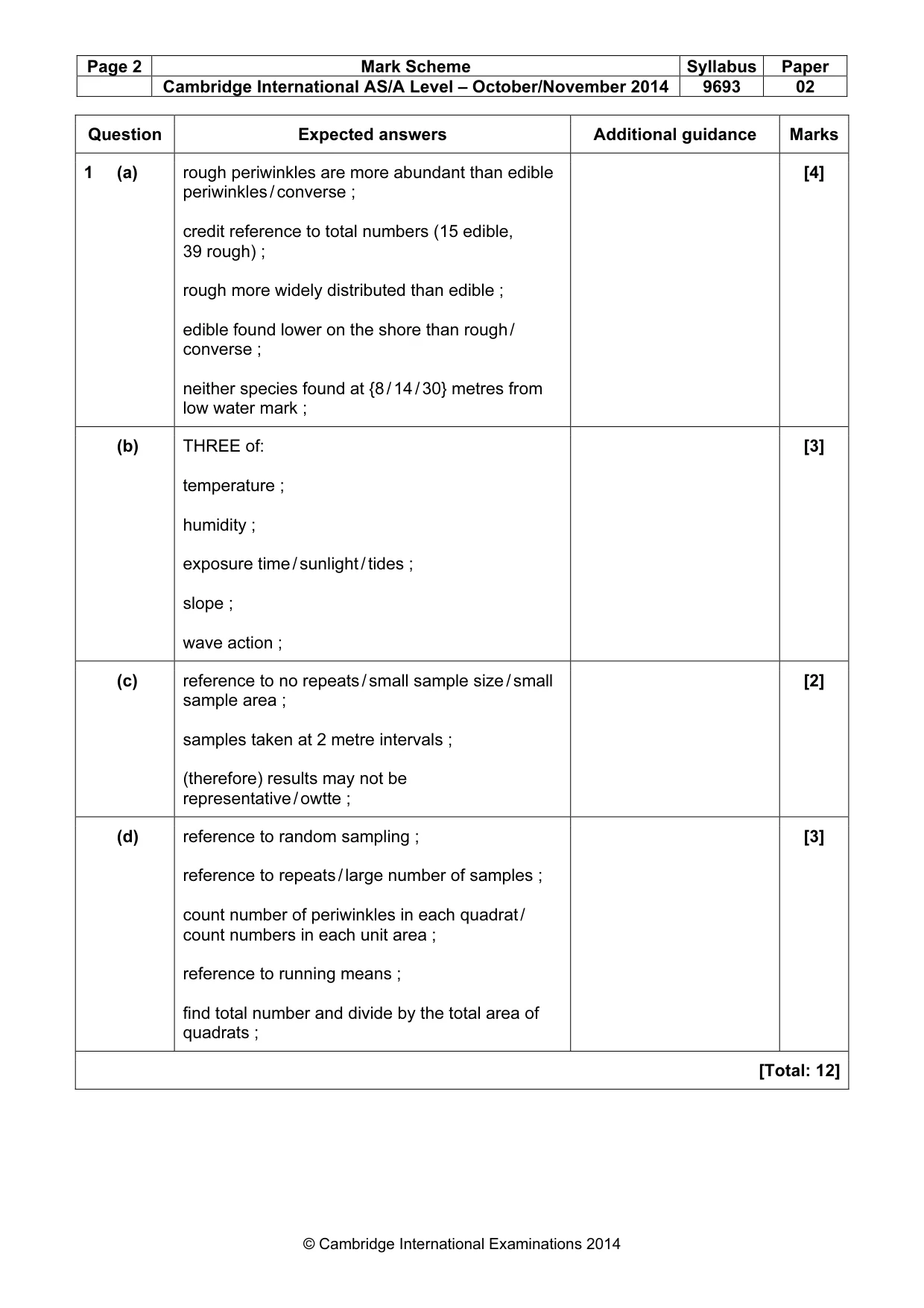
Page 2 Mark Scheme Syllabus Paper Cambridge International AS/A Level – October/November 2014 9693 02 © Cambridge International Examinations 2014 Question Expected answers Additional guidance Marks 1 (a) rough periwinkles are more abundant than edible periwinkles / converse ; credit reference to total numbers (15 edible, 39 rough) ; rough more widely distributed than edible ; edible found lower on the shore than rough / converse ; neither species found at {8 / 14 / 30} metres from low water mark ; [4] (b) THREE of: temperature ; humidity ; exposure time / sunlight / tides ; slope ; wave action ; [3] (c) reference to no repeats / small sample size / small sample area ; samples taken at 2 metre intervals ; (therefore) results may not be representative / owtte ; [2] (d) reference to random sampling ; reference to repeats / large number of samples ; count number of periwinkles in each quadrat / count numbers in each unit area ; reference to running means ; find total number and divide by the total area of quadrats ; [3] [Total: 12]
Mark scheme, page 3
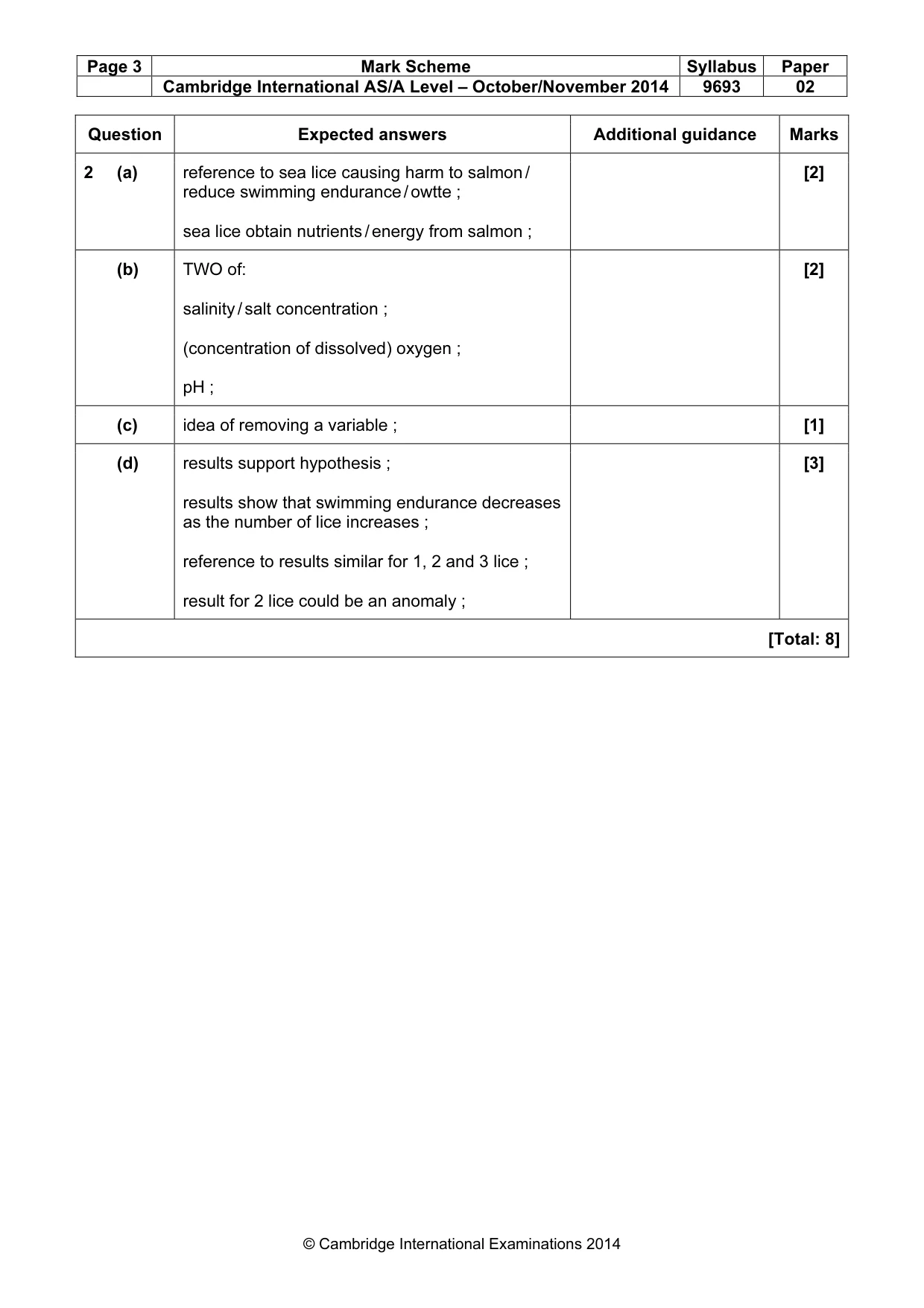
Page 3 Mark Scheme Syllabus Paper Cambridge International AS/A Level – October/November 2014 9693 02 © Cambridge International Examinations 2014 Question Expected answers Additional guidance Marks 2 (a) reference to sea lice causing harm to salmon / reduce swimming endurance / owtte ; sea lice obtain nutrients / energy from salmon ; [2] (b) TWO of: salinity / salt concentration ; (concentration of dissolved) oxygen ; pH ; [2] (c) idea of removing a variable ; [1] (d) results support hypothesis ; results show that swimming endurance decreases as the number of lice increases ; reference to results similar for 1, 2 and 3 lice ; result for 2 lice could be an anomaly ; [3] [Total: 8]
Mark scheme, page 4
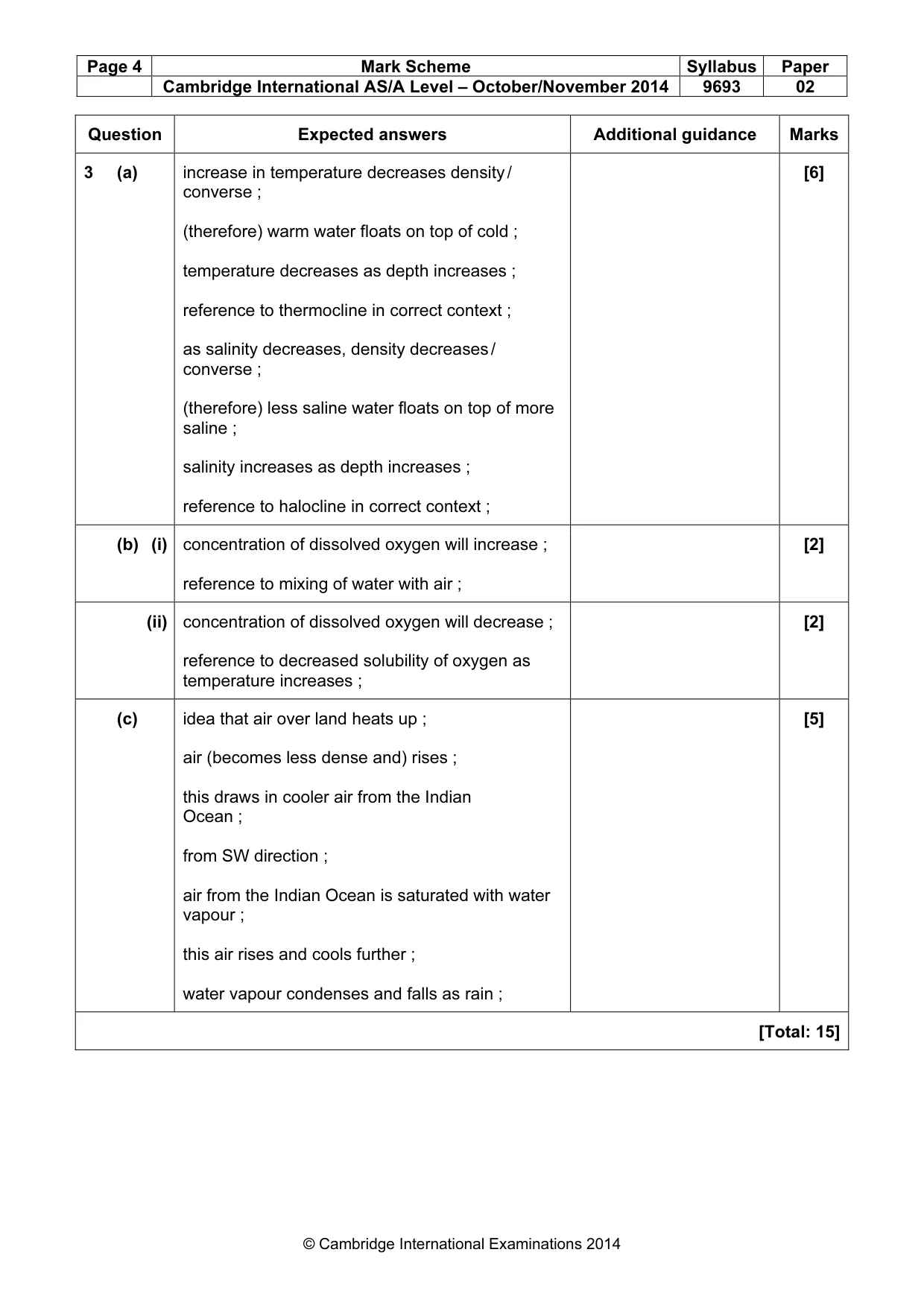
Page 4 Mark Scheme Syllabus Paper Cambridge International AS/A Level – October/November 2014 9693 02 © Cambridge International Examinations 2014 Question Expected answers Additional guidance Marks 3 (a) increase in temperature decreases density / converse ; (therefore) warm water floats on top of cold ; temperature decreases as depth increases ; reference to thermocline in correct context ; as salinity decreases, density decreases / converse ; (therefore) less saline water floats on top of more saline ; salinity increases as depth increases ; reference to halocline in correct context ; [6] (b) (i) concentration of dissolved oxygen will increase ; reference to mixing of water with air ; [2] (ii) concentration of dissolved oxygen will decrease ; reference to decreased solubility of oxygen as temperature increases ; [2] (c) idea that air over land heats up ; air (becomes less dense and) rises ; this draws in cooler air from the Indian Ocean ; from SW direction ; air from the Indian Ocean is saturated with water vapour ; this air rises and cools further ; water vapour condenses and falls as rain ; [5] [Total: 15]
Mark scheme, page 5
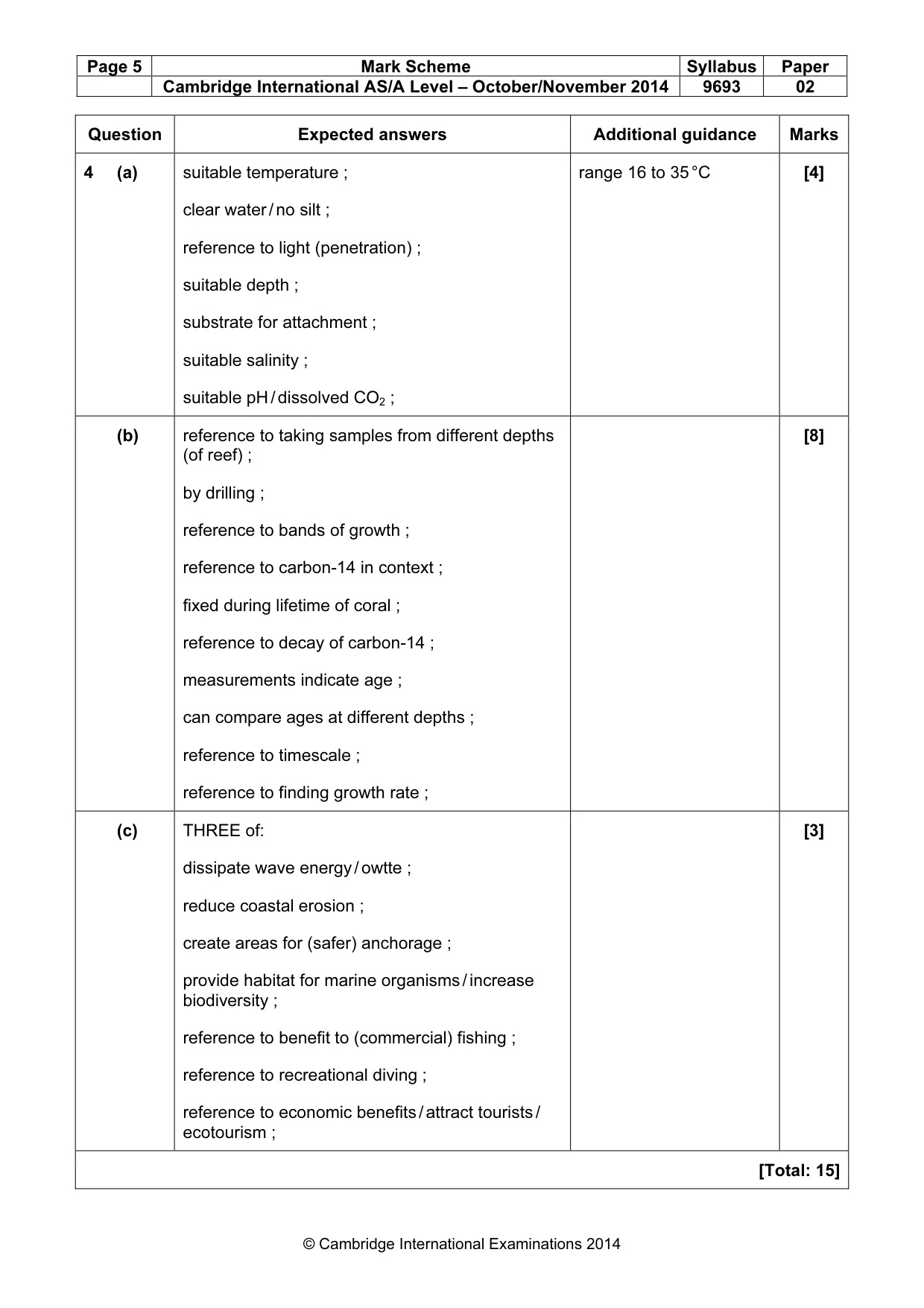
Page 5 Mark Scheme Syllabus Paper Cambridge International AS/A Level – October/November 2014 9693 02 © Cambridge International Examinations 2014 Question Expected answers Additional guidance Marks 4 (a) suitable temperature ; clear water / no silt ; reference to light (penetration) ; suitable depth ; substrate for attachment ; suitable salinity ; suitable pH / dissolved CO2 ; range 16 to 35 °C [4] (b) reference to taking samples from different depths (of reef) ; by drilling ; reference to bands of growth ; reference to carbon-14 in context ; fixed during lifetime of coral ; reference to decay of carbon-14 ; measurements indicate age ; can compare ages at different depths ; reference to timescale ; reference to finding growth rate ; [8] (c) THREE of: dissipate wave energy / owtte ; reduce coastal erosion ; create areas for (safer) anchorage ; provide habitat for marine organisms / increase biodiversity ; reference to benefit to (commercial) fishing ; reference to recreational diving ; reference to economic benefits / attract tourists / ecotourism ; [3] [Total: 15]
What you needed in this session
Cambridge’s own grade thresholds for 2014 Oct/Nov, Paper 2 · Variant 1. A higher threshold means an easier paper — the bar moves with how the cohort did.