Cambridge A Level Marine Science 9693 — 2014 May/June Paper 3 · Variant 1
9693/31/M/J/14 · 75 marks · ≈84 min
The question paper and its mark scheme, free to read here and free to download. This is Cambridge’s own paper, exactly as it was sat.
Question paper20 pages


Mark scheme10 pages
Answers below. Sit the paper first if you are practising.
Paper as text
Question paper, page 1
This document consists of 17 printed pages and 3 blank pages. DC (HB (EL)) 80636/6 © UCLES 2014 [Turn over Cambridge International Examinations Cambridge International Advanced Subsidiary and Advanced Level * 3 1 1 8 2 5 5 4 1 1 * MARINE SCIENCE 9693/03 Structured Questions May/June 2014 Paper 3 1 hour 30 minutes Candidates answer on the Question Paper. No Additional Materials are required. READ THESE INSTRUCTIONS FIRST Write your Centre number, candidate number and name on all the work you hand in. Write in dark blue or black pen. You may use an HB pencil for any diagrams or graphs. Do not use staples, paper clips, glue or correction fluid. DO NOT WRITE IN ANY BARCODES. Answer all questions. Write your answers in the spaces provided on the Question Paper. At the end of the examination, fasten all your work securely together. The number of marks is given in brackets [ ] at the end of each question or part question. Electronic calculators may be used. You may lose marks if you do not show your working or if you do not use appropriate units.
Question paper, page 2
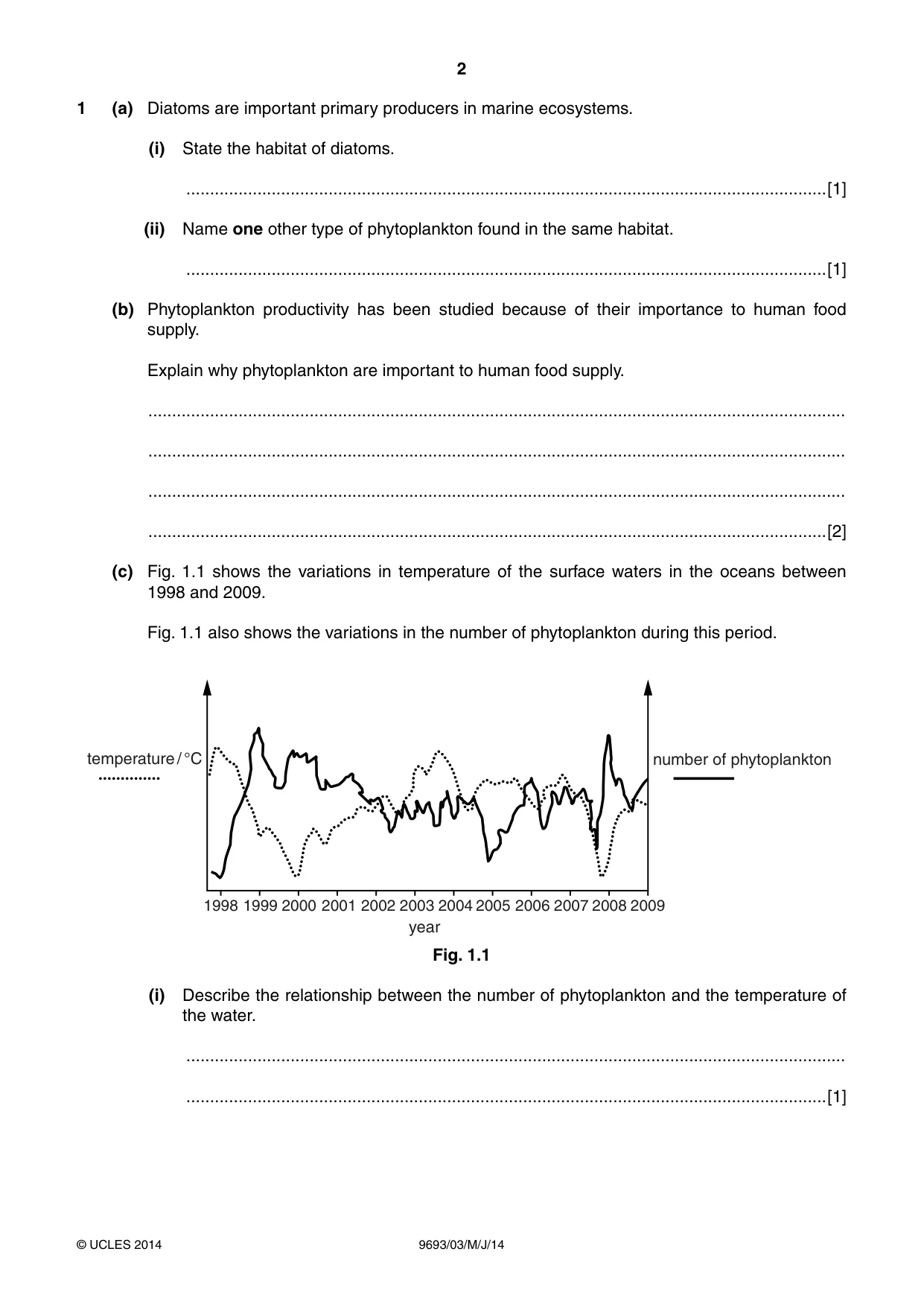
2 9693/03/M/J/14 © UCLES 2014 1 (a) Diatoms are important primary producers in marine ecosystems. (i) State the habitat of diatoms. …[1] (ii) Name one other type of phytoplankton found in the same habitat. …[1] (b) Phytoplankton productivity has been studied because of their importance to human food supply. Explain why phytoplankton are important to human food supply. … … … …[2] (c) Fig. 1.1 shows the variations in temperature of the surface waters in the oceans between 1998 and 2009. Fig. 1.1 also shows the variations in the number of phytoplankton during this period. 1998 1999 2000 2001 2002 2003 2004 2005 2006 2007 2008 2009 temperature / °C number of phytoplankton year Fig. 1.1 (i) Describe the relationship between the number of phytoplankton and the temperature of the water. … …[1]
Question paper, page 3
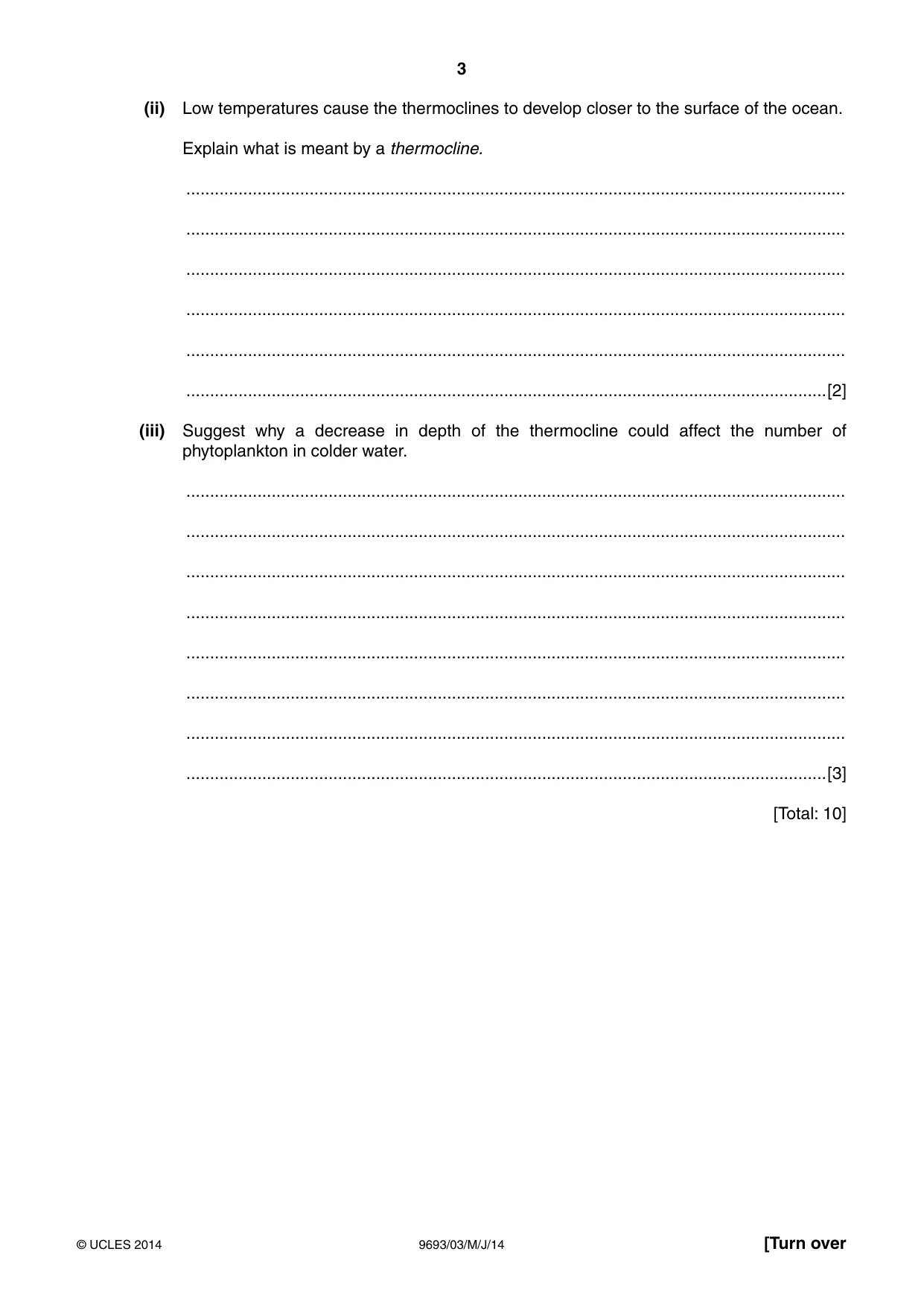
3 9693/03/M/J/14 © UCLES 2014 [Turn over (ii) Low temperatures cause the thermoclines to develop closer to the surface of the ocean. Explain what is meant by a thermocline. … … … … … …[2] (iii) Suggest why a decrease in depth of the thermocline could affect the number of phytoplankton in colder water. … … … … … … … …[3] [Total: 10]
Question paper, page 4
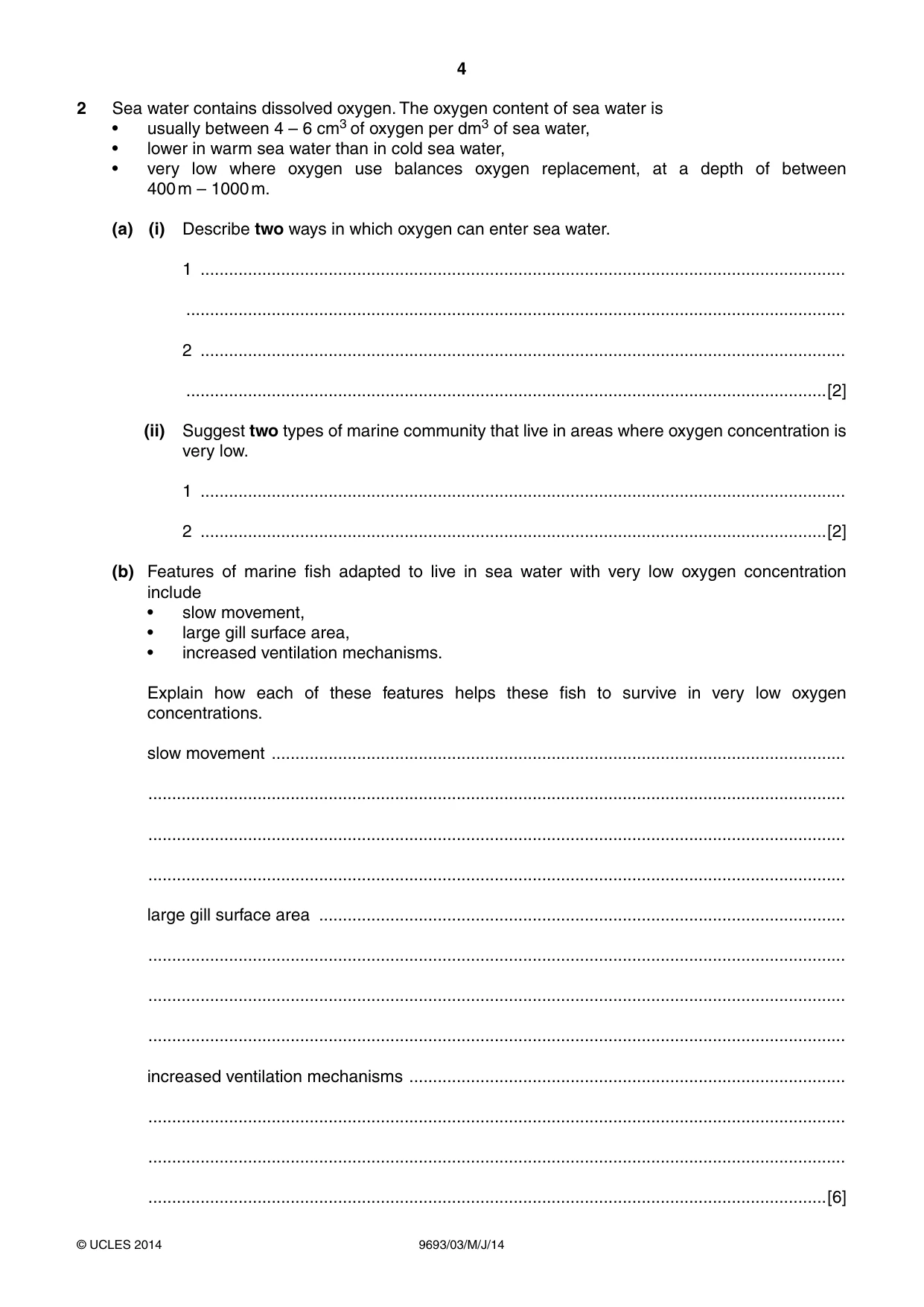
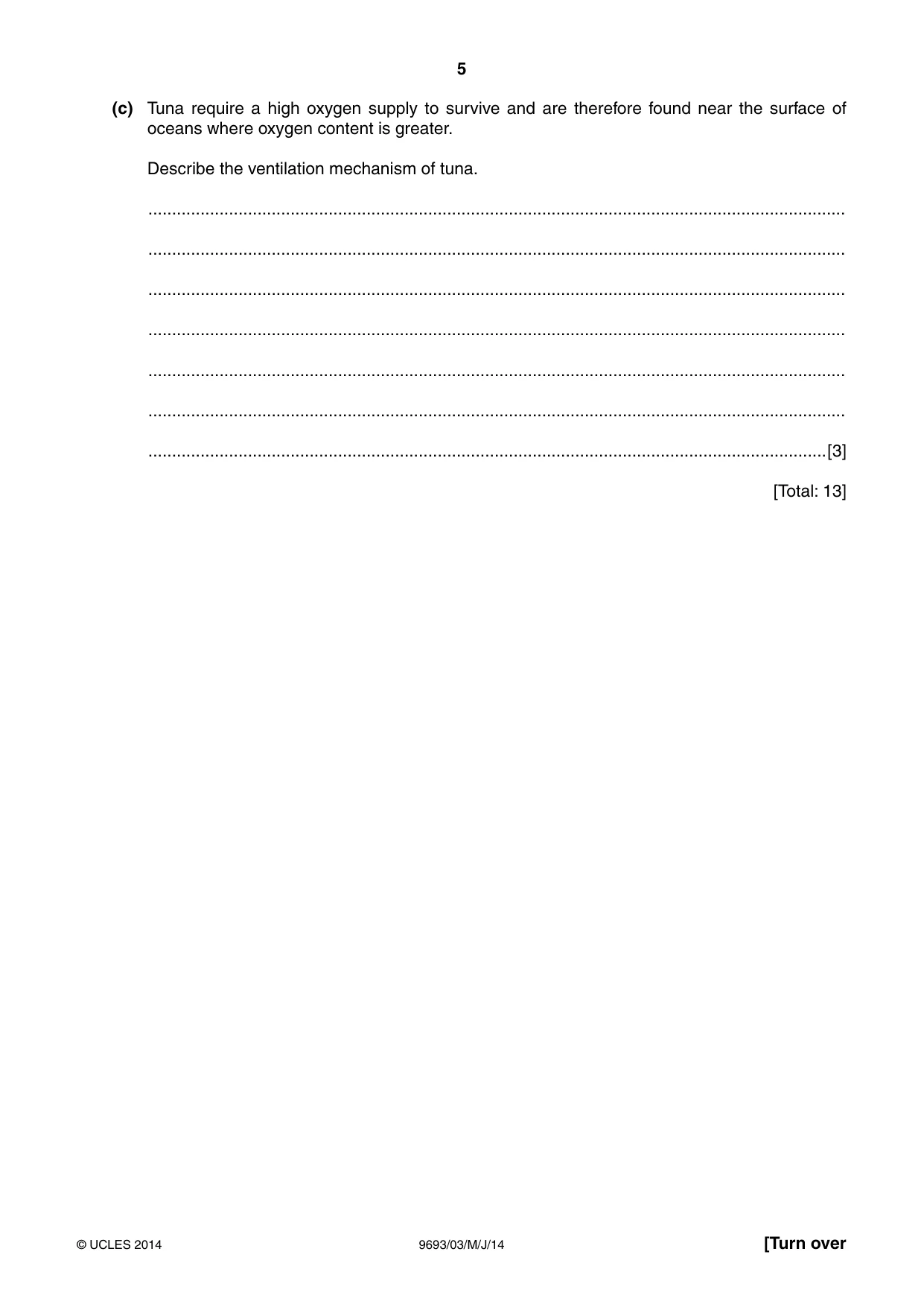
4 9693/03/M/J/14 © UCLES 2014 2 Sea water contains dissolved oxygen. The oxygen content of sea water is • usually between 4 – 6 cm3 of oxygen per dm3 of sea water, • lower in warm sea water than in cold sea water, • very low where oxygen use balances oxygen replacement, at a depth of between 400 m – 1000 m. (a) (i) Describe two ways in which oxygen can enter sea water. 1 … … 2 … …[2] (ii) Suggest two types of marine community that live in areas where oxygen concentration is very low. 1 … 2 …[2] (b) Features of marine fish adapted to live in sea water with very low oxygen concentration include • slow movement, • large gill surface area, • increased ventilation mechanisms. Explain how each of these features helps these fish to survive in very low oxygen concentrations. slow movement … … … … large gill surface area … … … … increased ventilation mechanisms … … … …[6]
Question paper, page 5
5 9693/03/M/J/14 © UCLES 2014 [Turn over (c) Tuna require a high oxygen supply to survive and are therefore found near the surface of oceans where oxygen content is greater. Describe the ventilation mechanism of tuna. … … … … … … …[3] [Total: 13]
Question paper, page 6
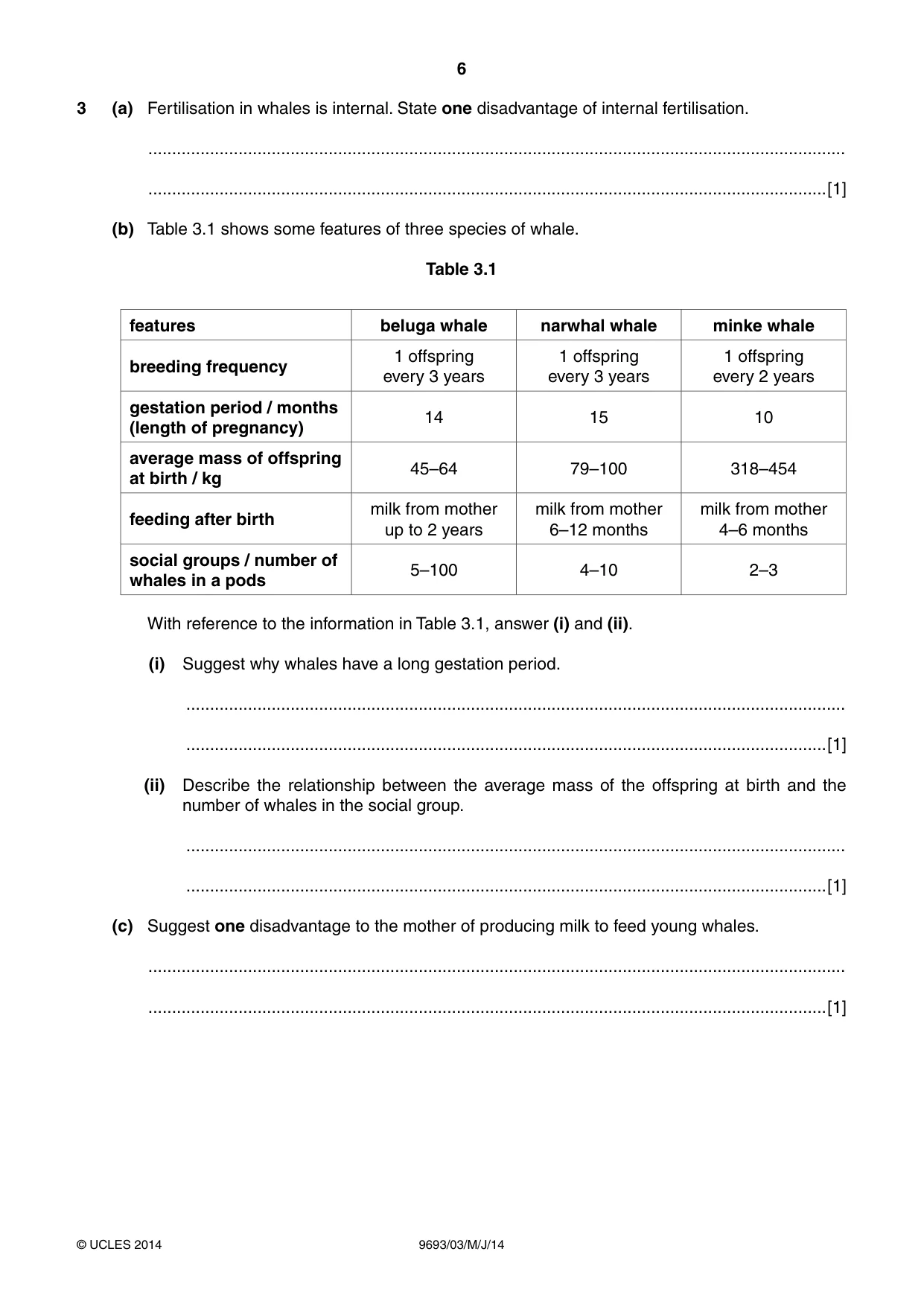
6 9693/03/M/J/14 © UCLES 2014 3 (a) Fertilisation in whales is internal. State one disadvantage of internal fertilisation. … …[1] (b) Table 3.1 shows some features of three species of whale. Table 3.1 features beluga whale narwhal whale minke whale breeding frequency 1 offspring every 3 years 1 offspring every 3 years 1 offspring every 2 years gestation period / months (length of pregnancy) 14 15 10 average mass of offspring at birth / kg 45–64 79–100 318–454 feeding after birth milk from mother up to 2 years milk from mother 6–12 months milk from mother 4–6 months social groups / number of whales in a pods 5–100 4–10 2–3 With reference to the information in Table 3.1, answer (i) and (ii). (i) Suggest why whales have a long gestation period. … …[1] (ii) Describe the relationship between the average mass of the offspring at birth and the number of whales in the social group. … …[1] (c) Suggest one disadvantage to the mother of producing milk to feed young whales. … …[1]
Question paper, page 7
7 9693/03/M/J/14 © UCLES 2014 [Turn over (d) The survival of newborn whales to maturity is over 85% for most species. Suggest how living in social groups may help the survival of the young. … … … …[2] (e) Many species of whale are endangered and are protected from hunting by humans. Suggest one reason, other than hunting, that may contribute to the falling populations of many species of whale. … …[1] [Total: 7]
Question paper, page 8
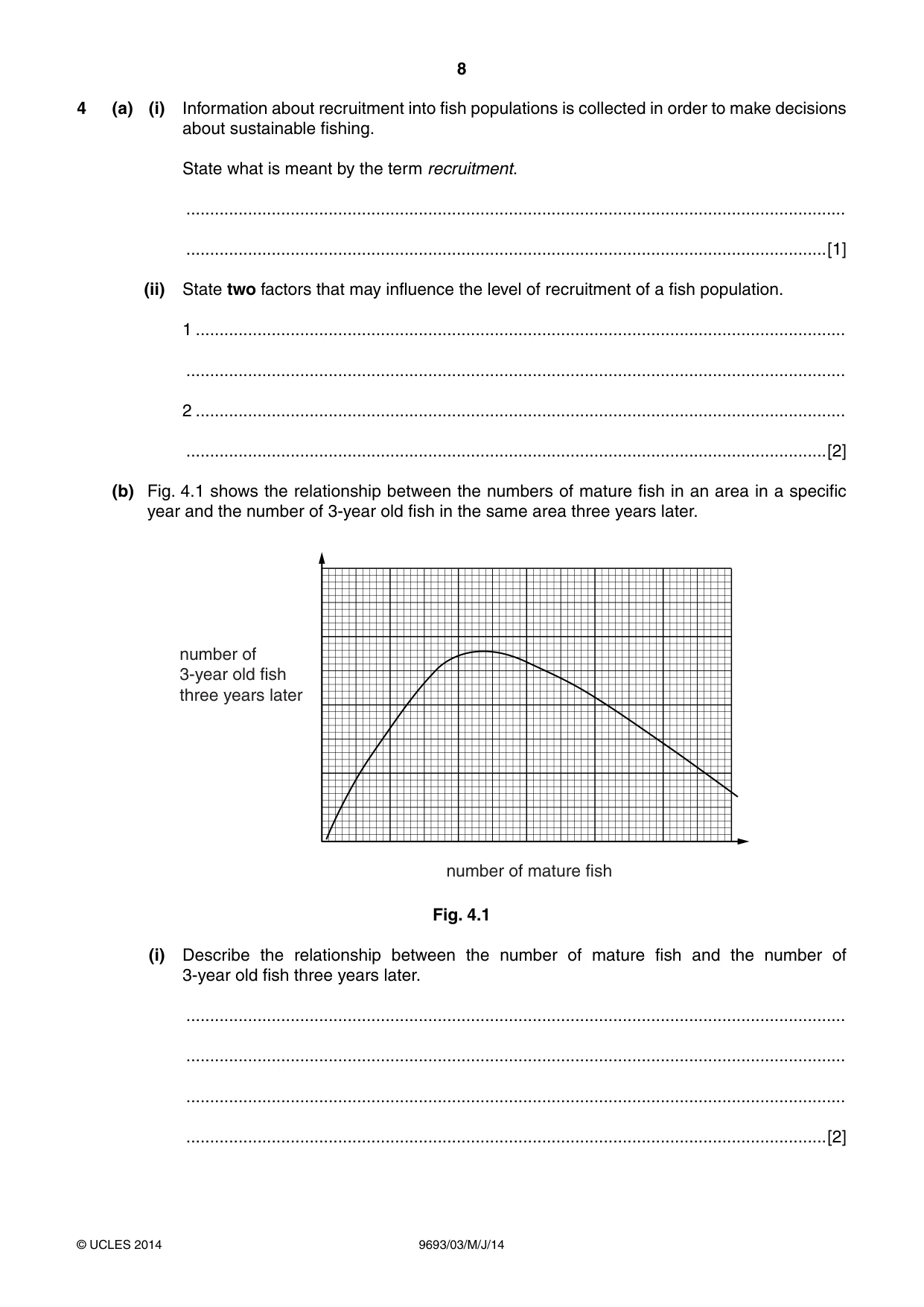
8 9693/03/M/J/14 © UCLES 2014 4 (a) (i) Information about recruitment into fish populations is collected in order to make decisions about sustainable fishing. State what is meant by the term recruitment. … …[1] (ii) State two factors that may influence the level of recruitment of a fish population. 1 … … 2 … …[2] (b) Fig. 4.1 shows the relationship between the numbers of mature fish in an area in a specific year and the number of 3-year old fish in the same area three years later. number of 3-year old fish three years later number of mature fish Fig. 4.1 (i) Describe the relationship between the number of mature fish and the number of 3-year old fish three years later. … … … …[2]
Question paper, page 9
9 9693/03/M/J/14 © UCLES 2014 [Turn over (ii) Suggest an explanation for this relationship. … … … … … …[3]
Question paper, page 10
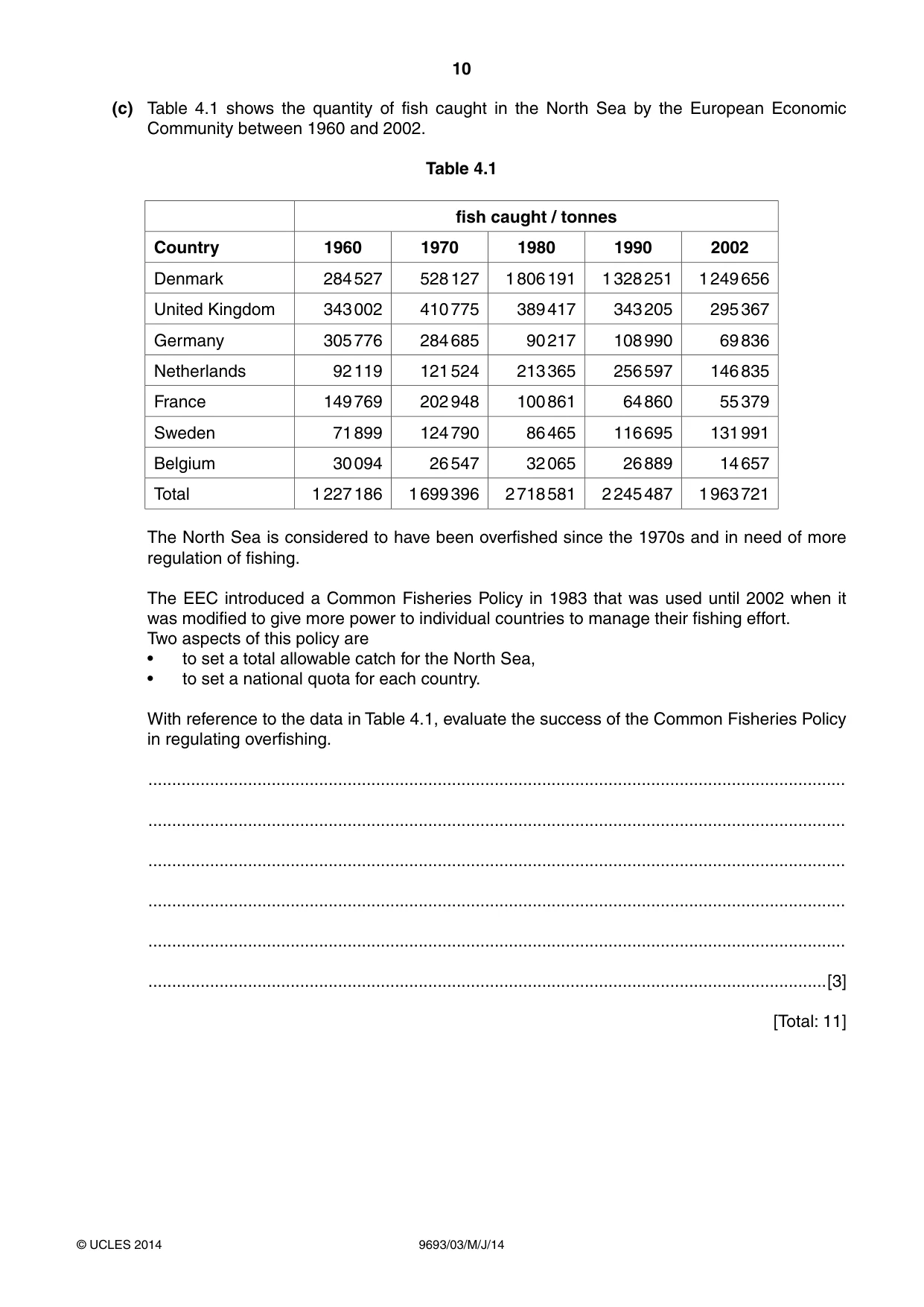
10 9693/03/M/J/14 © UCLES 2014 (c) Table 4.1 shows the quantity of fish caught in the North Sea by the European Economic Community between 1960 and 2002. Table 4.1 fish caught / tonnes Country 1960 1970 1980 1990 2002 Denmark 284 527 528 127 1 806 191 1 328 251 1 249 656 United Kingdom 343 002 410 775 389 417 343 205 295 367 Germany 305 776 284 685 90 217 108 990 69 836 Netherlands 92 119 121 524 213 365 256 597 146 835 France 149 769 202 948 100 861 64 860 55 379 Sweden 71 899 124 790 86 465 116 695 131 991 Belgium 30 094 26 547 32 065 26 889 14 657 Total 1 227 186 1 699 396 2 718 581 2 245 487 1 963 721 The North Sea is considered to have been overfished since the 1970s and in need of more regulation of fishing. The EEC introduced a Common Fisheries Policy in 1983 that was used until 2002 when it was modified to give more power to individual countries to manage their fishing effort. Two aspects of this policy are • to set a total allowable catch for the North Sea, • to set a national quota for each country. With reference to the data in Table 4.1, evaluate the success of the Common Fisheries Policy in regulating overfishing. … … … … … …[3] [Total: 11]
Question paper, page 11
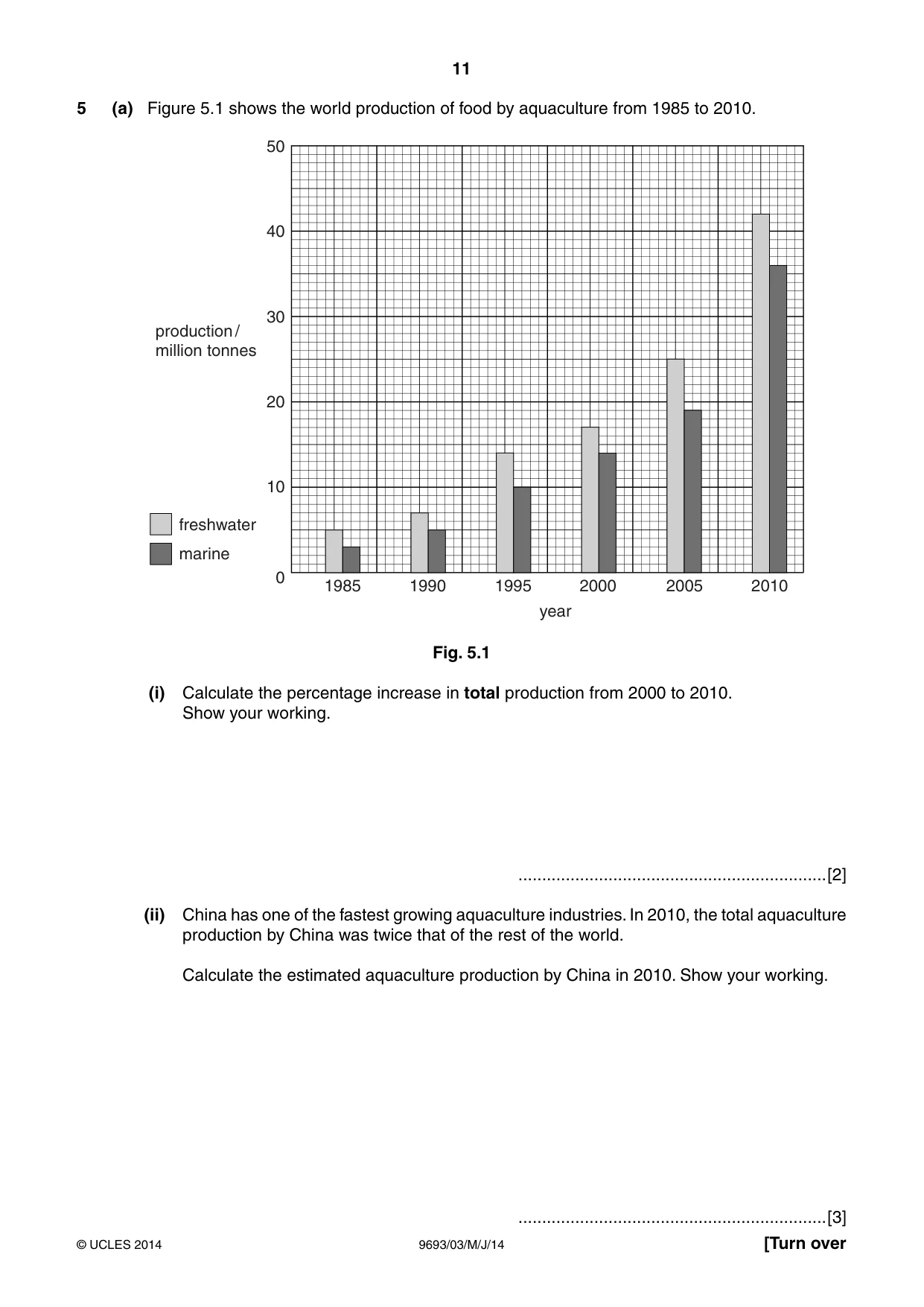
11 9693/03/M/J/14 © UCLES 2014 [Turn over 5 (a) Figure 5.1 shows the world production of food by aquaculture from 1985 to 2010. 1985 freshwater marine 1990 1995 2000 2005 2010 0 10 20 30 40 50 year production / million tonnes Fig. 5.1 (i) Calculate the percentage increase in total production from 2000 to 2010. Show your working. …[2] (ii) China has one of the fastest growing aquaculture industries. In 2010, the total aquaculture production by China was twice that of the rest of the world. Calculate the estimated aquaculture production by China in 2010. Show your working. …[3]
Question paper, page 12
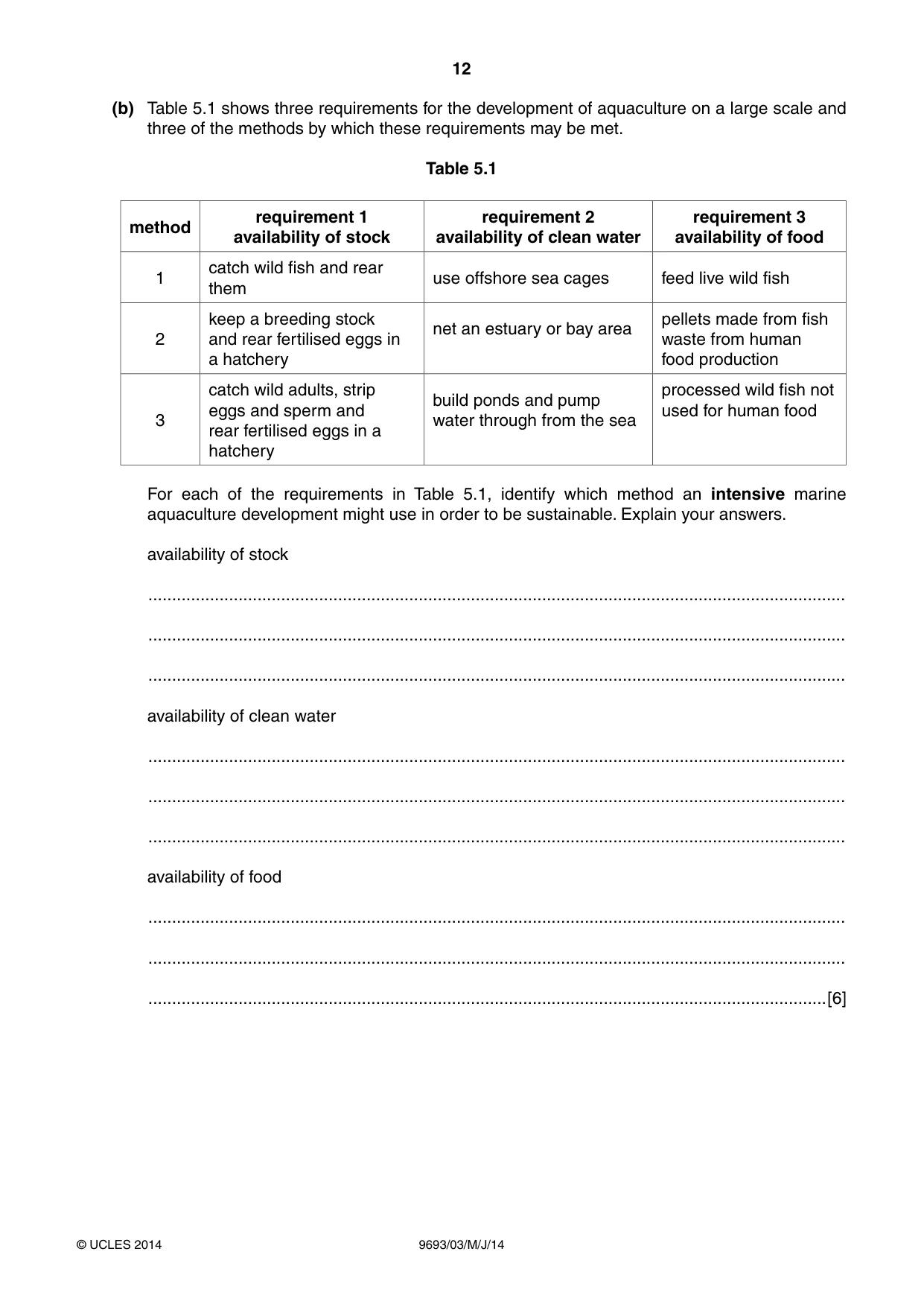
12 9693/03/M/J/14 © UCLES 2014 (b) Table 5.1 shows three requirements for the development of aquaculture on a large scale and three of the methods by which these requirements may be met. Table 5.1 method requirement 1 availability of stock requirement 2 availability of clean water requirement 3 availability of food 1 catch wild fish and rear them use offshore sea cages feed live wild fish 2 keep a breeding stock and rear fertilised eggs in a hatchery net an estuary or bay area pellets made from fish waste from human food production 3 catch wild adults, strip eggs and sperm and rear fertilised eggs in a hatchery build ponds and pump water through from the sea processed wild fish not used for human food For each of the requirements in Table 5.1, identify which method an intensive marine aquaculture development might use in order to be sustainable. Explain your answers. availability of stock … … … availability of clean water … … … availability of food … … …[6]
Question paper, page 13
13 9693/03/M/J/14 © UCLES 2014 [Turn over (c) Describe two economic considerations of sustainable aquaculture. 1 … … 2 … …[2] [Total: 13]
Question paper, page 14
14 9693/03/M/J/14 © UCLES 2014 6 (a) The information below is about sewage and refuse disposal from small boats by tourists visiting marine sites. Sewage and refuse disposal from small boats has become a subject of concern for many within the tourism industry. Boats discharging raw or partially treated sewage and dumping refuse in coastal waters pose an increasing threat to both people and the environment. Human waste contains nutrients that can contribute to harmful algal blooms in coastal marine environments. This waste also contains pathogens that can cause disease. Refuse such as plastic objects, fishing lines, cigarette butts and expanded polystyrene debris are often consumed by turtles, seabirds, fish and marine mammals. When refuse from tourist fishing boats becomes entangled on coral and rocky reefs, it can smother coral and pose a safety hazard to snorkelers, divers and young marine mammals. (i) Suggest how human waste in coastal waters can cause disease. … … … … … … …[3] (ii) Explain why algal blooms can be harmful. … … … … … … …[3]
Question paper, page 15
15 9693/03/M/J/14 © UCLES 2014 [Turn over (b) (i) Explain two ways in which eating refuse is a danger to turtles, seabirds, fish or marine mammals. … … … … … … … …[4] (ii) Suggest one type of fishing boat refuse that may be a safety hazard to snorkelers, divers and young marine mammals. Explain why this type of refuse may be a safety hazard. hazard … explanation … … …[3] [Total: 13]
Question paper, page 16
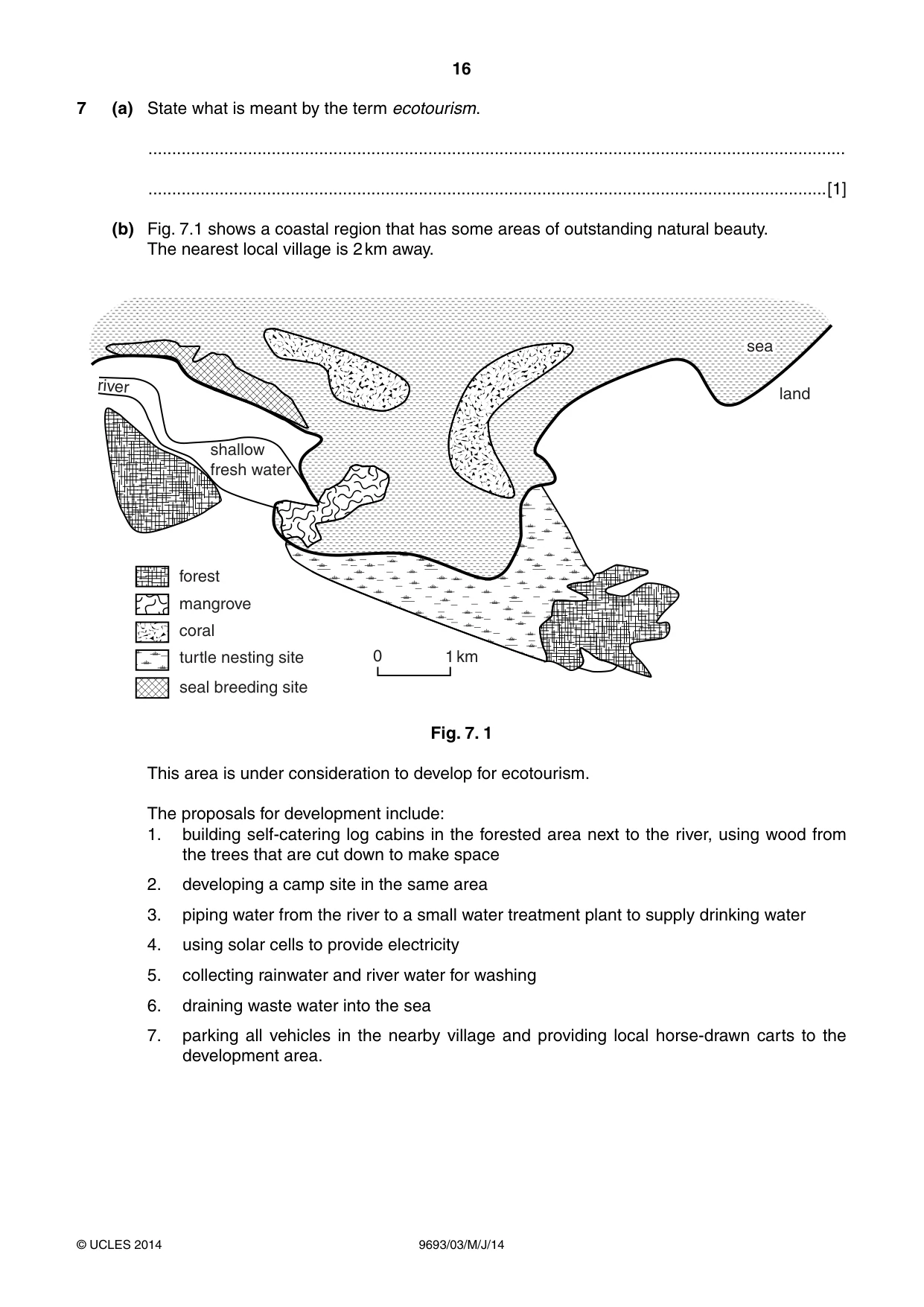
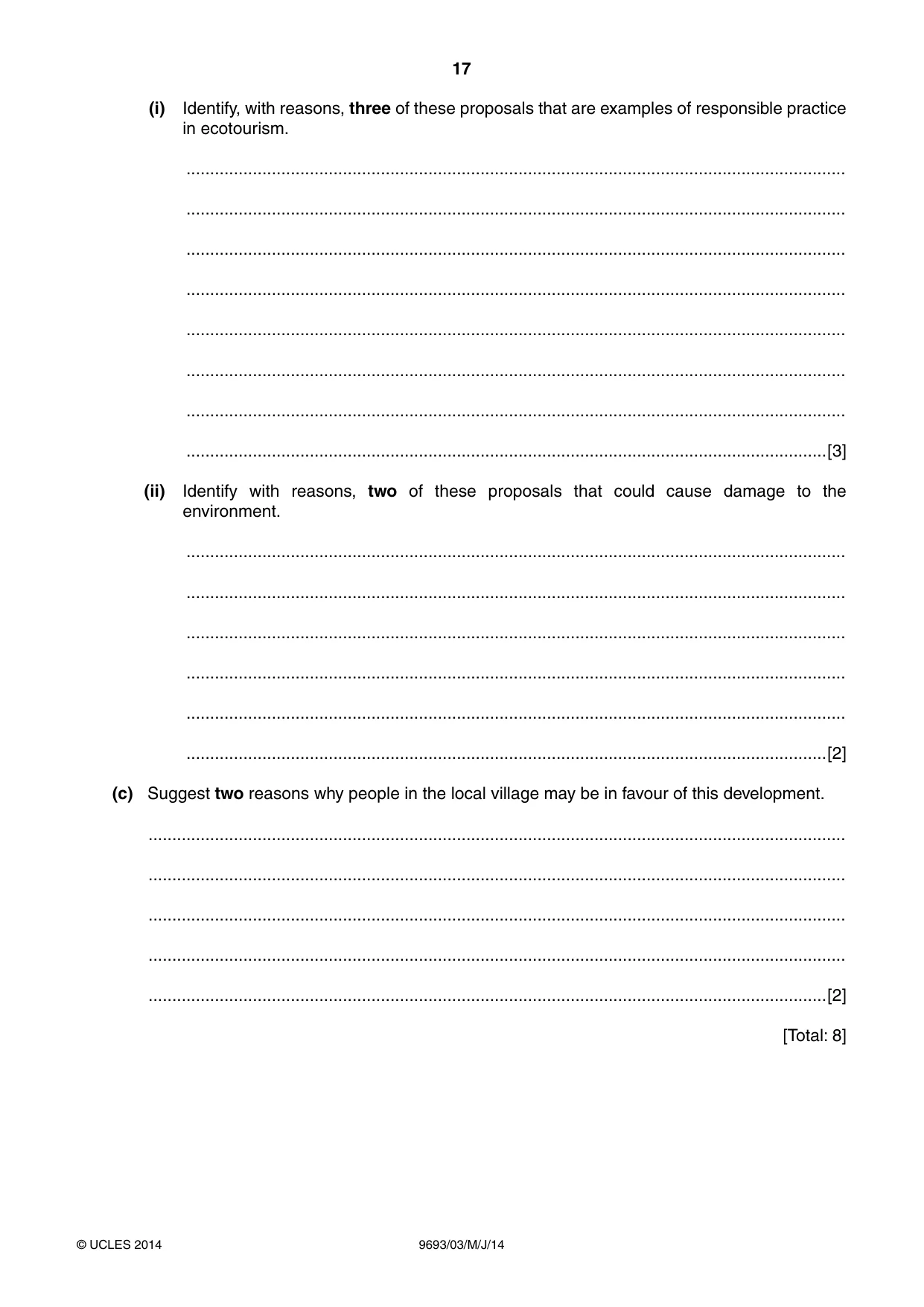
16 9693/03/M/J/14 © UCLES 2014 7 (a) State what is meant by the term ecotourism. … …[1] (b) Fig. 7.1 shows a coastal region that has some areas of outstanding natural beauty. The nearest local village is 2 km away. forest river shallow fresh water land sea mangrove coral turtle nesting site seal breeding site 1 km 0 Fig. 7. 1 This area is under consideration to develop for ecotourism. The proposals for development include: 1. building self-catering log cabins in the forested area next to the river, using wood from the trees that are cut down to make space 2. developing a camp site in the same area 3. piping water from the river to a small water treatment plant to supply drinking water 4. using solar cells to provide electricity 5. collecting rainwater and river water for washing 6. draining waste water into the sea 7. parking all vehicles in the nearby village and providing local horse-drawn carts to the development area.
Question paper, page 17
17 9693/03/M/J/14 © UCLES 2014 (i) Identify, with reasons, three of these proposals that are examples of responsible practice in ecotourism. … … … … … … … …[3] (ii) Identify with reasons, two of these proposals that could cause damage to the environment. … … … … … …[2] (c) Suggest two reasons why people in the local village may be in favour of this development. … … … … …[2] [Total: 8]
Question paper, page 18
18 9693/03/M/J/14 © UCLES 2014 BLANK PAGE
Question paper, page 19
19 9693/03/M/J/14 © UCLES 2014 BLANK PAGE
Question paper, page 20
20 9693/03/M/J/14 © UCLES 2014 Permission to reproduce items where third-party owned material protected by copyright is included has been sought and cleared where possible. Every reasonable effort has been made by the publisher (UCLES) to trace copyright holders, but if any items requiring clearance have unwittingly been included, the publisher will be pleased to make amends at the earliest possible opportunity. Cambridge International Examinations is part of the Cambridge Assessment Group. Cambridge Assessment is the brand name of University of Cambridge Local Examinations Syndicate (UCLES), which is itself a department of the University of Cambridge. BLANK PAGE
Mark scheme, page 1
CAMBRIDGE INTERNATIONAL EXAMINATIONS GCE Advanced Subsidiary Level and GCE Advanced Level MARK SCHEME for the May/June 2014 series 9693 MARINE SCIENCE 9693/03 Paper 3 (A2 Structured Questions), maximum raw mark 75 This mark scheme is published as an aid to teachers and candidates, to indicate the requirements of the examination. It shows the basis on which Examiners were instructed to award marks. It does not indicate the details of the discussions that took place at an Examiners’ meeting before marking began, which would have considered the acceptability of alternative answers. Mark schemes should be read in conjunction with the question paper and the Principal Examiner Report for Teachers. Cambridge will not enter into discussions about these mark schemes. Cambridge is publishing the mark schemes for the May/June 2014 series for most IGCSE, GCE Advanced Level and Advanced Subsidiary Level components and some Ordinary Level components.
Mark scheme, page 2
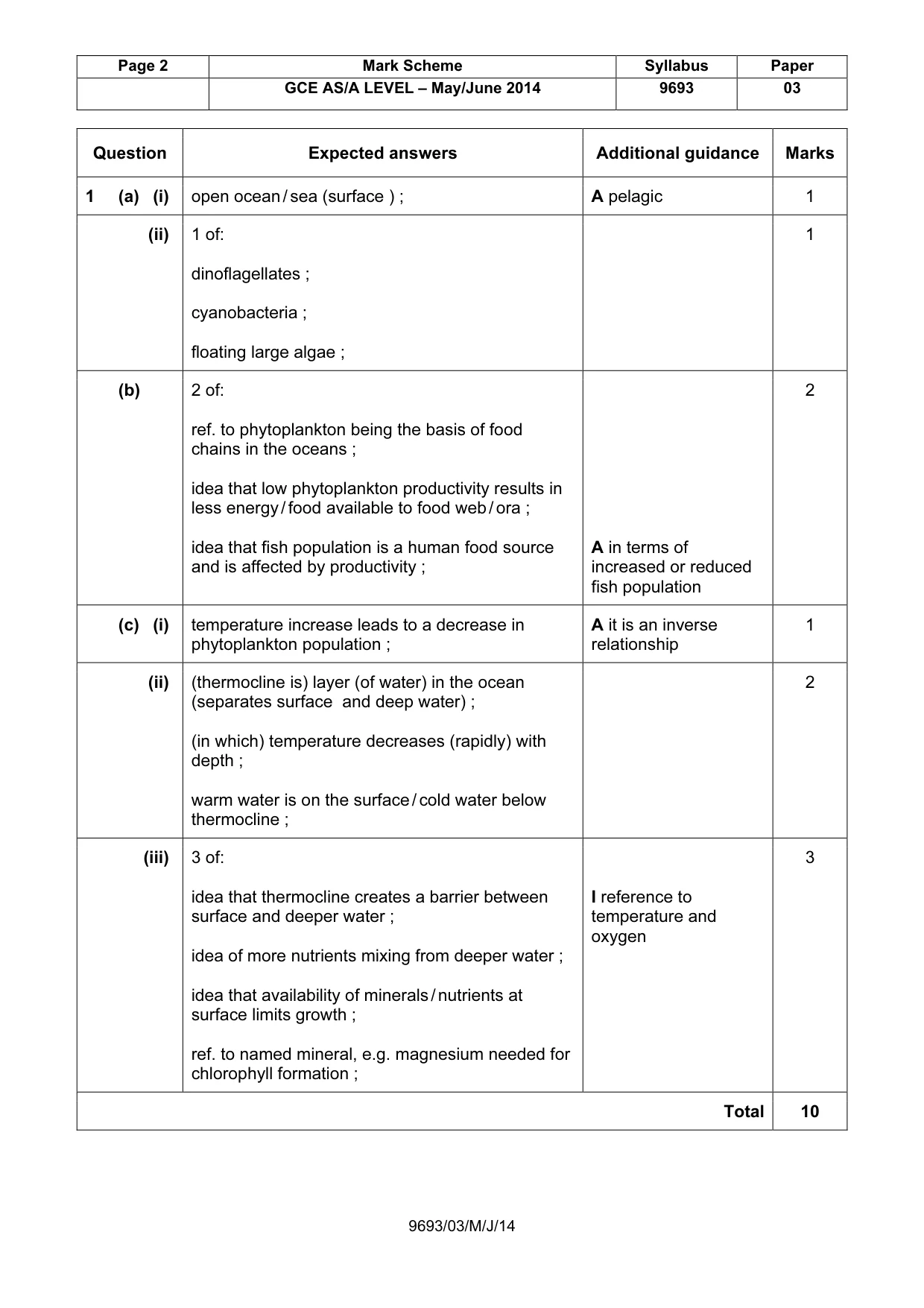
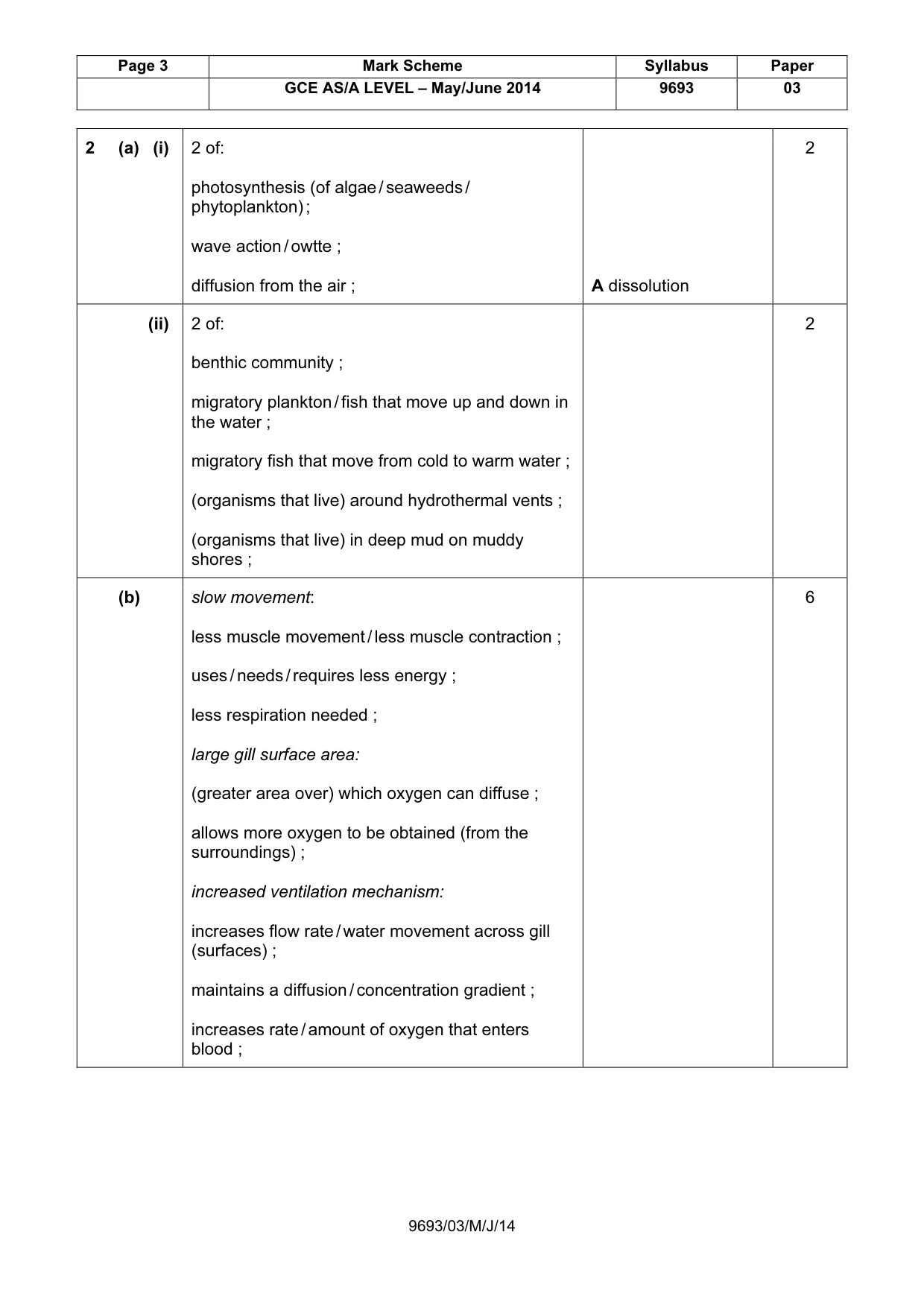
Page 2 Mark Scheme Syllabus Paper GCE AS/A LEVEL – May/June 2014 9693 03 9693/03/M/J/14 Question Expected answers Additional guidance Marks 1 (a) (i) open ocean / sea (surface ) ; A pelagic 1 (ii) 1 of: dinoflagellates ; cyanobacteria ; floating large algae ; 1 (b) 2 of: ref. to phytoplankton being the basis of food chains in the oceans ; idea that low phytoplankton productivity results in less energy / food available to food web / ora ; idea that fish population is a human food source and is affected by productivity ; A in terms of increased or reduced fish population 2 (c) (i) temperature increase leads to a decrease in phytoplankton population ; A it is an inverse relationship 1 (ii) (thermocline is) layer (of water) in the ocean (separates surface and deep water) ; (in which) temperature decreases (rapidly) with depth ; warm water is on the surface / cold water below thermocline ; 2 (iii) 3 of: idea that thermocline creates a barrier between surface and deeper water ; idea of more nutrients mixing from deeper water ; idea that availability of minerals / nutrients at surface limits growth ; ref. to named mineral, e.g. magnesium needed for chlorophyll formation ; I reference to temperature and oxygen 3 Total 10
Mark scheme, page 3
Page 3 Mark Scheme Syllabus Paper GCE AS/A LEVEL – May/June 2014 9693 03 9693/03/M/J/14 2 (a) (i) 2 of: photosynthesis (of algae / seaweeds / phytoplankton) ; wave action / owtte ; diffusion from the air ; A dissolution 2 (ii) 2 of: benthic community ; migratory plankton / fish that move up and down in the water ; migratory fish that move from cold to warm water ; (organisms that live) around hydrothermal vents ; (organisms that live) in deep mud on muddy shores ; 2 (b) slow movement: less muscle movement / less muscle contraction ; uses / needs / requires less energy ; less respiration needed ; large gill surface area: (greater area over) which oxygen can diffuse ; allows more oxygen to be obtained (from the surroundings) ; increased ventilation mechanism: increases flow rate / water movement across gill (surfaces) ; maintains a diffusion / concentration gradient ; increases rate / amount of oxygen that enters blood ; 6
Mark scheme, page 4
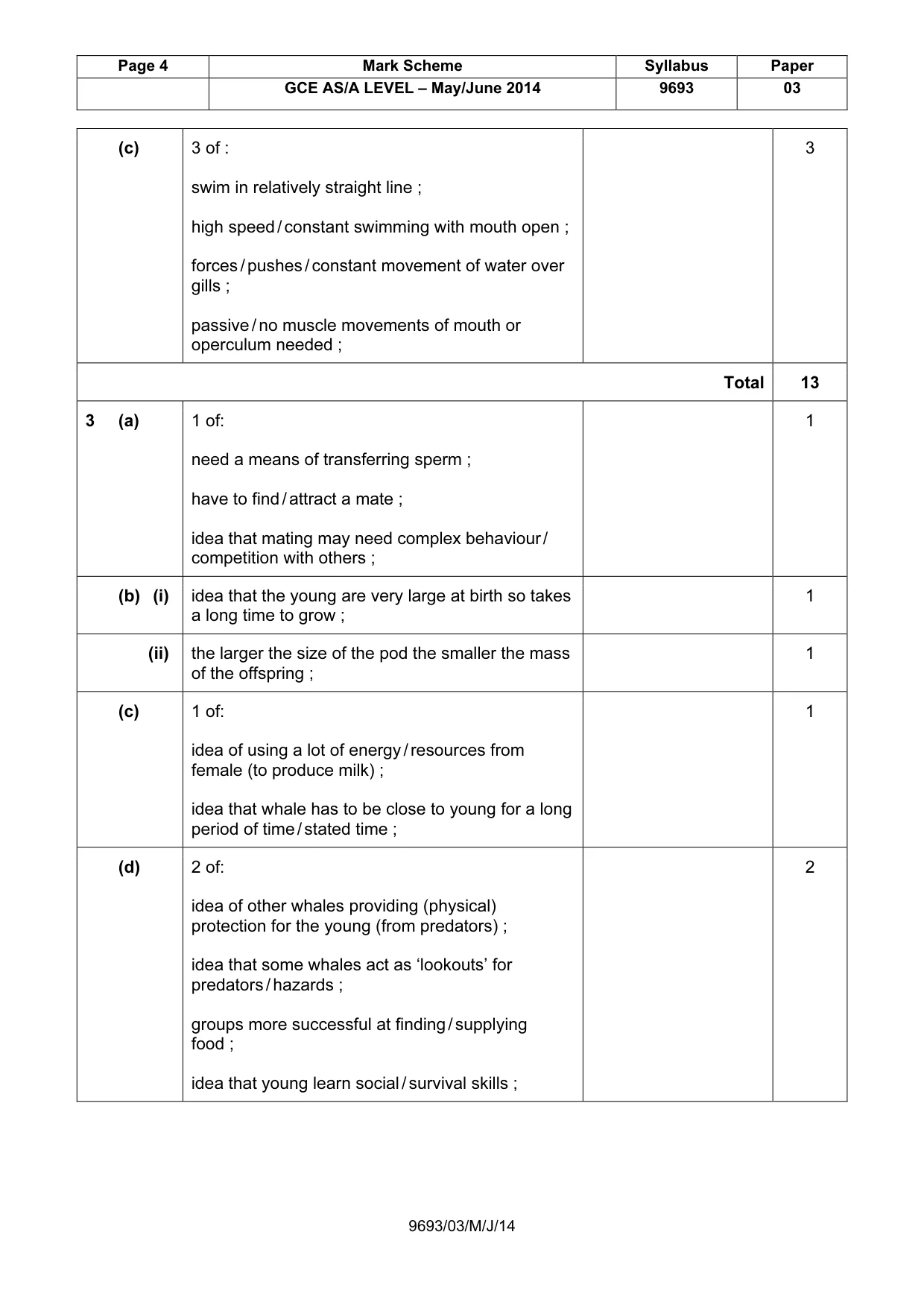
Page 4 Mark Scheme Syllabus Paper GCE AS/A LEVEL – May/June 2014 9693 03 9693/03/M/J/14 (c) 3 of : swim in relatively straight line ; high speed / constant swimming with mouth open ; forces / pushes / constant movement of water over gills ; passive / no muscle movements of mouth or operculum needed ; 3 Total 13 3 (a) 1 of: need a means of transferring sperm ; have to find / attract a mate ; idea that mating may need complex behaviour / competition with others ; 1 (b) (i) idea that the young are very large at birth so takes a long time to grow ; 1 (ii) the larger the size of the pod the smaller the mass of the offspring ; 1 (c) 1 of: idea of using a lot of energy / resources from female (to produce milk) ; idea that whale has to be close to young for a long period of time / stated time ; 1 (d) 2 of: idea of other whales providing (physical) protection for the young (from predators) ; idea that some whales act as ‘lookouts’ for predators / hazards ; groups more successful at finding / supplying food ; idea that young learn social / survival skills ; 2
Mark scheme, page 5
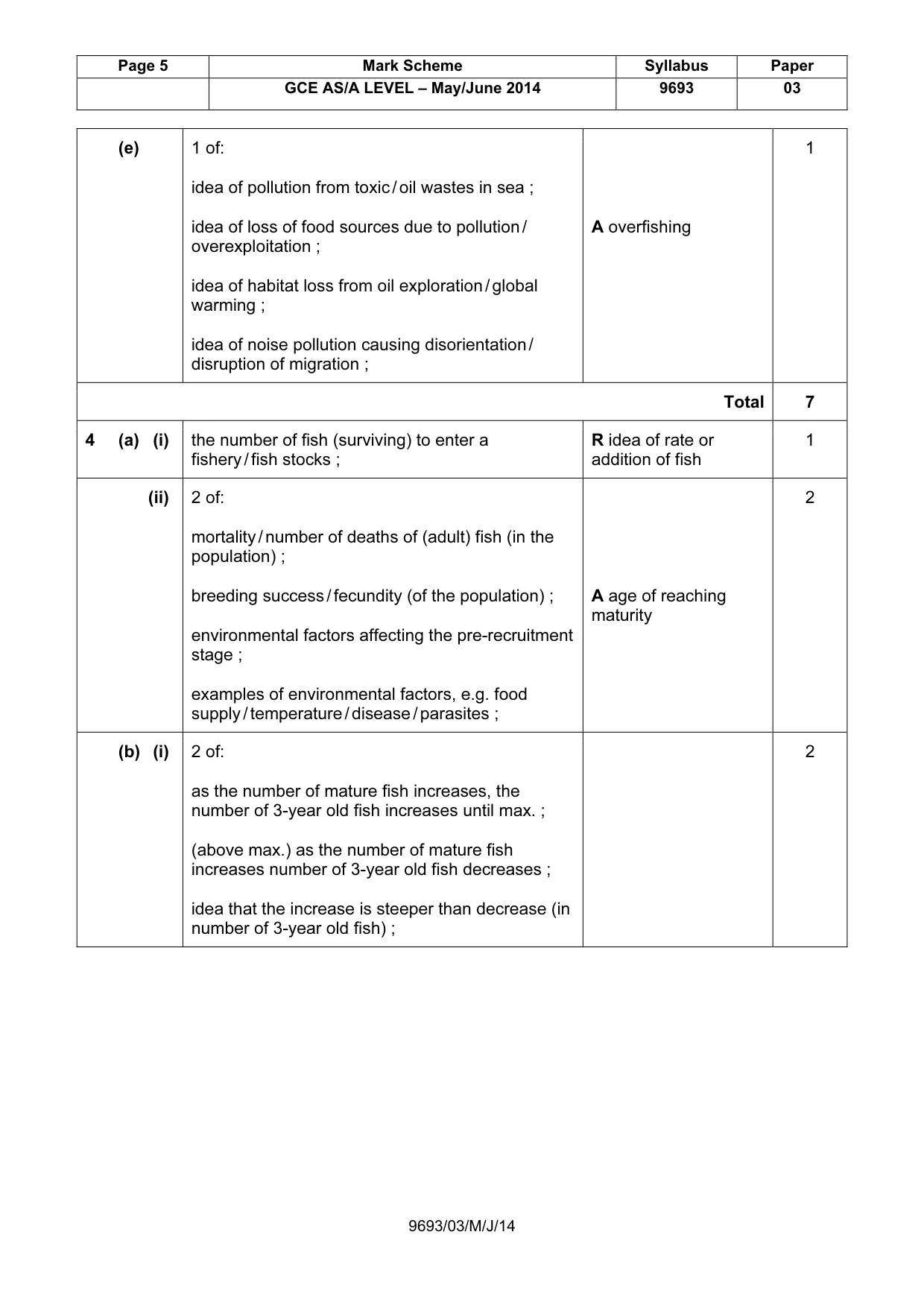
Page 5 Mark Scheme Syllabus Paper GCE AS/A LEVEL – May/June 2014 9693 03 9693/03/M/J/14 (e) 1 of: idea of pollution from toxic / oil wastes in sea ; idea of loss of food sources due to pollution / overexploitation ; idea of habitat loss from oil exploration / global warming ; idea of noise pollution causing disorientation / disruption of migration ; A overfishing 1 Total 7 4 (a) (i) the number of fish (surviving) to enter a fishery / fish stocks ; R idea of rate or addition of fish 1 (ii) 2 of: mortality / number of deaths of (adult) fish (in the population) ; breeding success / fecundity (of the population) ; environmental factors affecting the pre-recruitment stage ; examples of environmental factors, e.g. food supply / temperature / disease / parasites ; A age of reaching maturity 2 (b) (i) 2 of: as the number of mature fish increases, the number of 3-year old fish increases until max. ; (above max.) as the number of mature fish increases number of 3-year old fish decreases ; idea that the increase is steeper than decrease (in number of 3-year old fish) ; 2
Mark scheme, page 6
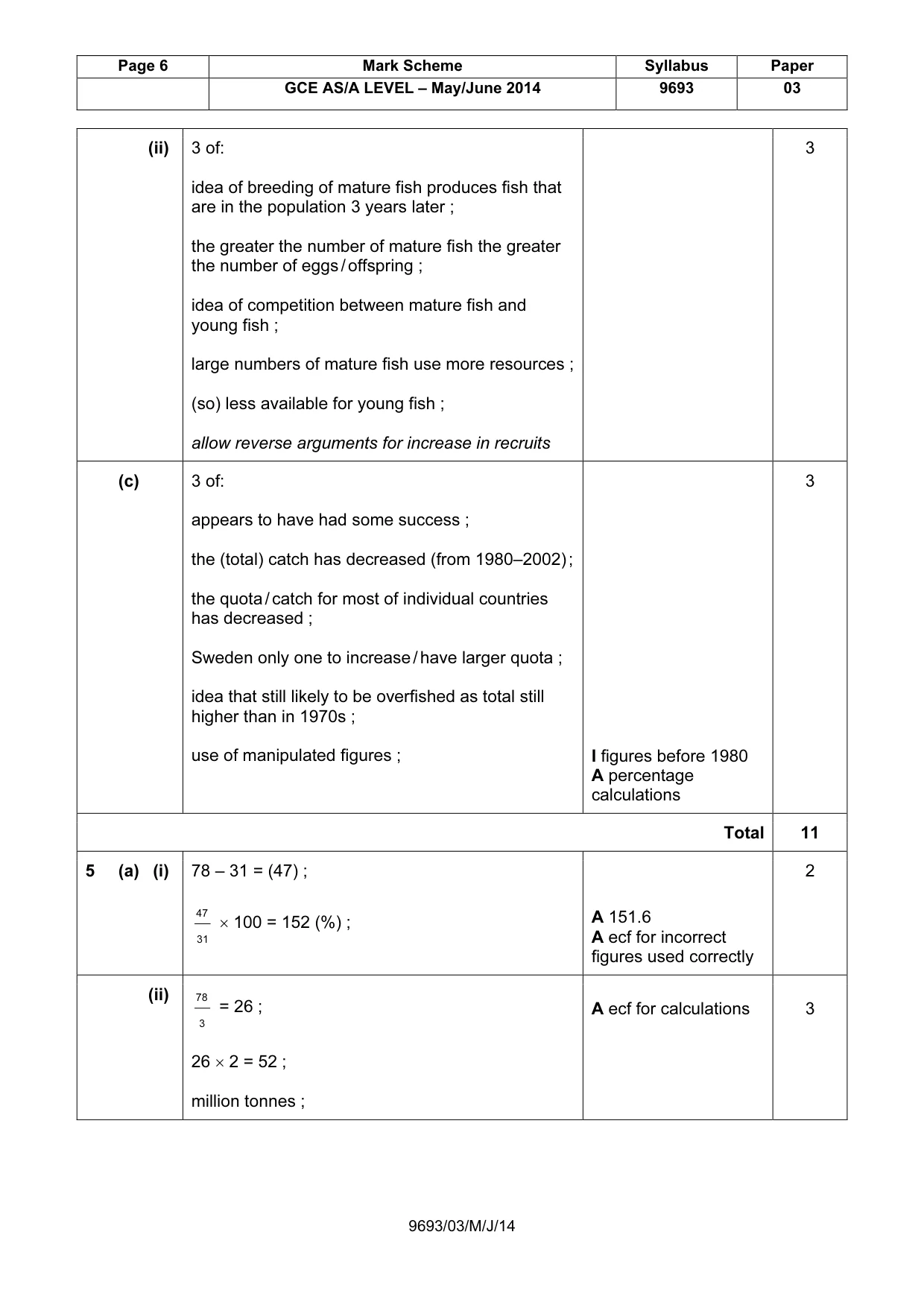
Page 6 Mark Scheme Syllabus Paper GCE AS/A LEVEL – May/June 2014 9693 03 9693/03/M/J/14 (ii) 3 of: idea of breeding of mature fish produces fish that are in the population 3 years later ; the greater the number of mature fish the greater the number of eggs / offspring ; idea of competition between mature fish and young fish ; large numbers of mature fish use more resources ; (so) less available for young fish ; allow reverse arguments for increase in recruits 3 (c) 3 of: appears to have had some success ; the (total) catch has decreased (from 1980–2002) ; the quota / catch for most of individual countries has decreased ; Sweden only one to increase / have larger quota ; idea that still likely to be overfished as total still higher than in 1970s ; use of manipulated figures ; I figures before 1980 A percentage calculations 3 Total 11 5 (a) (i) 78 – 31 = (47) ; 31 47 × 100 = 152 (%) ; A 151.6 A ecf for incorrect figures used correctly 2 (ii) 3 78 = 26 ; 26 × 2 = 52 ; million tonnes ; A ecf for calculations 3
Mark scheme, page 7
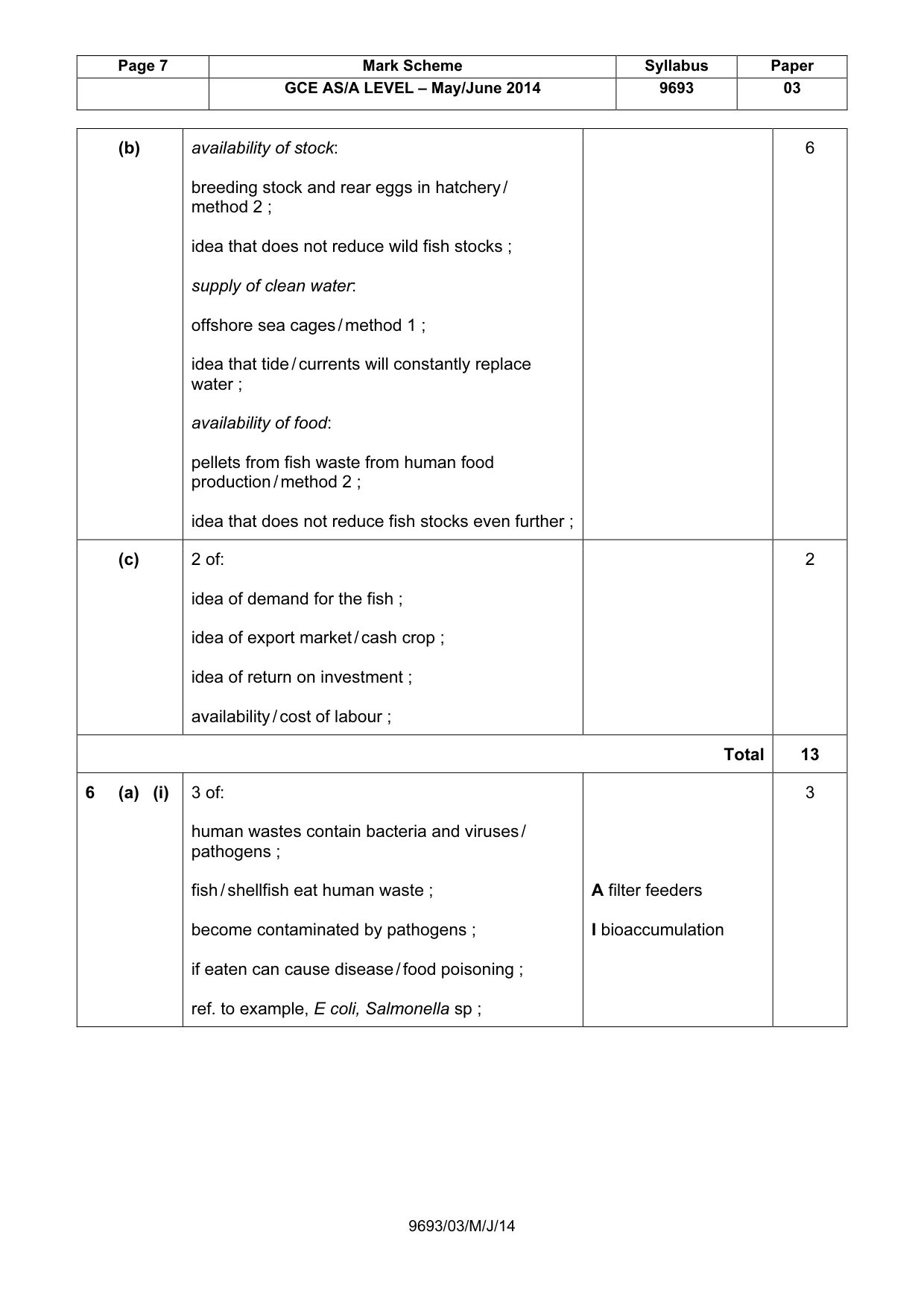
Page 7 Mark Scheme Syllabus Paper GCE AS/A LEVEL – May/June 2014 9693 03 9693/03/M/J/14 (b) availability of stock: breeding stock and rear eggs in hatchery / method 2 ; idea that does not reduce wild fish stocks ; supply of clean water: offshore sea cages / method 1 ; idea that tide / currents will constantly replace water ; availability of food: pellets from fish waste from human food production / method 2 ; idea that does not reduce fish stocks even further ; 6 (c) 2 of: idea of demand for the fish ; idea of export market / cash crop ; idea of return on investment ; availability / cost of labour ; 2 Total 13 6 (a) (i) 3 of: human wastes contain bacteria and viruses / pathogens ; fish / shellfish eat human waste ; become contaminated by pathogens ; if eaten can cause disease / food poisoning ; ref. to example, E coli, Salmonella sp ; A filter feeders I bioaccumulation 3
Mark scheme, page 8
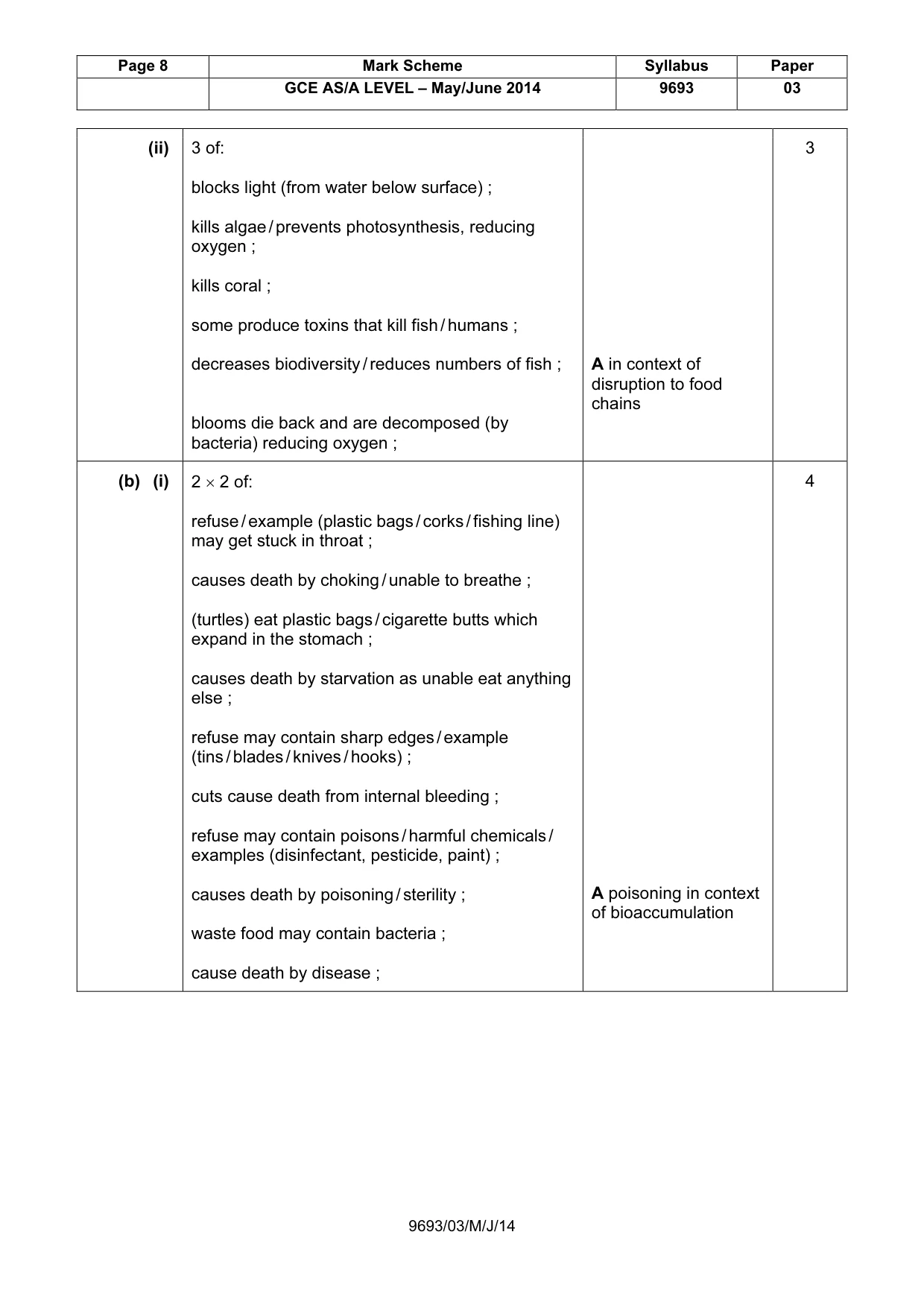
Page 8 Mark Scheme Syllabus Paper GCE AS/A LEVEL – May/June 2014 9693 03 9693/03/M/J/14 (ii) 3 of: blocks light (from water below surface) ; kills algae / prevents photosynthesis, reducing oxygen ; kills coral ; some produce toxins that kill fish / humans ; decreases biodiversity / reduces numbers of fish ; blooms die back and are decomposed (by bacteria) reducing oxygen ; A in context of disruption to food chains 3 (b) (i) 2 × 2 of: refuse / example (plastic bags / corks / fishing line) may get stuck in throat ; causes death by choking / unable to breathe ; (turtles) eat plastic bags / cigarette butts which expand in the stomach ; causes death by starvation as unable eat anything else ; refuse may contain sharp edges / example (tins / blades / knives / hooks) ; cuts cause death from internal bleeding ; refuse may contain poisons / harmful chemicals / examples (disinfectant, pesticide, paint) ; causes death by poisoning / sterility ; waste food may contain bacteria ; cause death by disease ; A poisoning in context of bioaccumulation 4
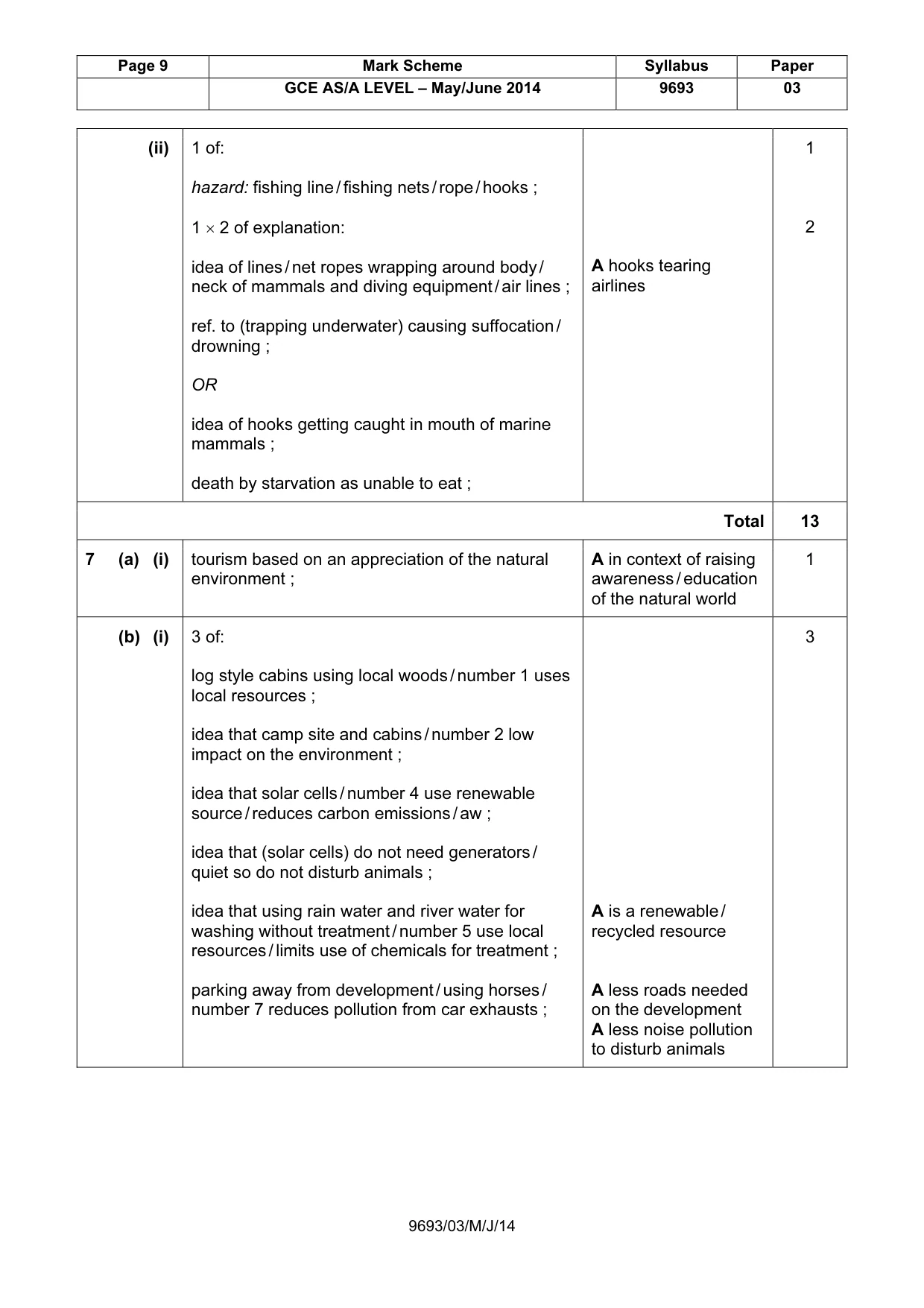
Mark scheme, page 9
Page 9 Mark Scheme Syllabus Paper GCE AS/A LEVEL – May/June 2014 9693 03 9693/03/M/J/14 (ii) 1 of: hazard: fishing line / fishing nets / rope / hooks ; 1 × 2 of explanation: idea of lines / net ropes wrapping around body / neck of mammals and diving equipment / air lines ; ref. to (trapping underwater) causing suffocation / drowning ; OR idea of hooks getting caught in mouth of marine mammals ; death by starvation as unable to eat ; A hooks tearing airlines 1 2 Total 13 7 (a) (i) tourism based on an appreciation of the natural environment ; A in context of raising awareness / education of the natural world 1 (b) (i) 3 of: log style cabins using local woods / number 1 uses local resources ; idea that camp site and cabins / number 2 low impact on the environment ; idea that solar cells / number 4 use renewable source / reduces carbon emissions / aw ; idea that (solar cells) do not need generators / quiet so do not disturb animals ; idea that using rain water and river water for washing without treatment / number 5 use local resources / limits use of chemicals for treatment ; parking away from development / using horses / number 7 reduces pollution from car exhausts ; A is a renewable / recycled resource A less roads needed on the development A less noise pollution to disturb animals 3
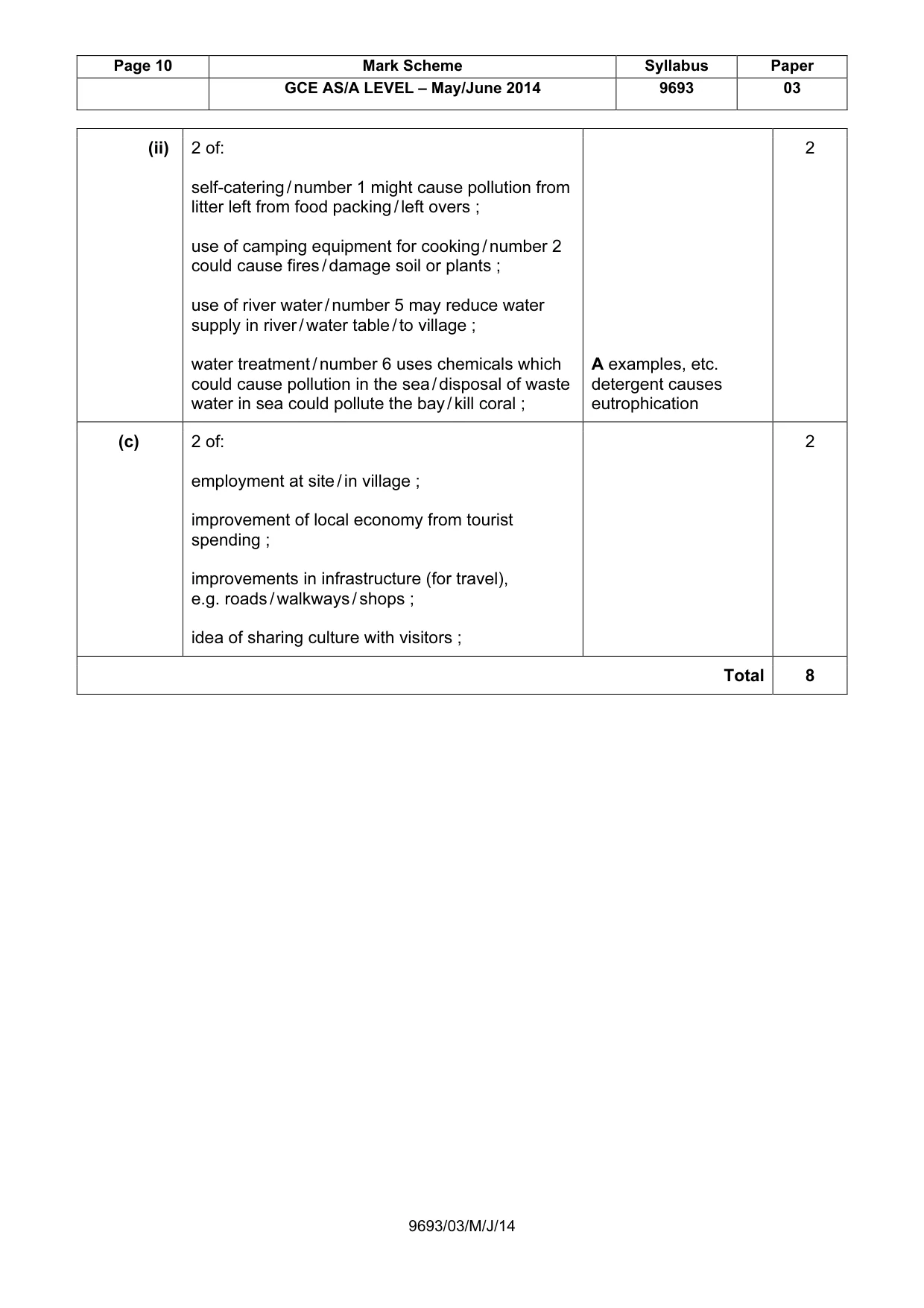
Mark scheme, page 10
Page 10 Mark Scheme Syllabus Paper GCE AS/A LEVEL – May/June 2014 9693 03 9693/03/M/J/14 (ii) 2 of: self-catering / number 1 might cause pollution from litter left from food packing / left overs ; use of camping equipment for cooking / number 2 could cause fires / damage soil or plants ; use of river water / number 5 may reduce water supply in river / water table / to village ; water treatment / number 6 uses chemicals which could cause pollution in the sea / disposal of waste water in sea could pollute the bay / kill coral ; A examples, etc. detergent causes eutrophication 2 (c) 2 of: employment at site / in village ; improvement of local economy from tourist spending ; improvements in infrastructure (for travel), e.g. roads / walkways / shops ; idea of sharing culture with visitors ; 2 Total 8
What you needed in this session
Cambridge’s own grade thresholds for 2014 May/June, Paper 3 · Variant 1. A higher threshold means an easier paper — the bar moves with how the cohort did.