Cambridge A Level Marine Science 9693 — 2014 May/June Paper 2 · Variant 1
9693/21/M/J/14 · 50 marks · ≈56 min
The question paper and its mark scheme, free to read here and free to download. This is Cambridge’s own paper, exactly as it was sat.
Question paper12 pages



Mark scheme5 pages
Answers below. Sit the paper first if you are practising.
Paper as text
Question paper, page 1
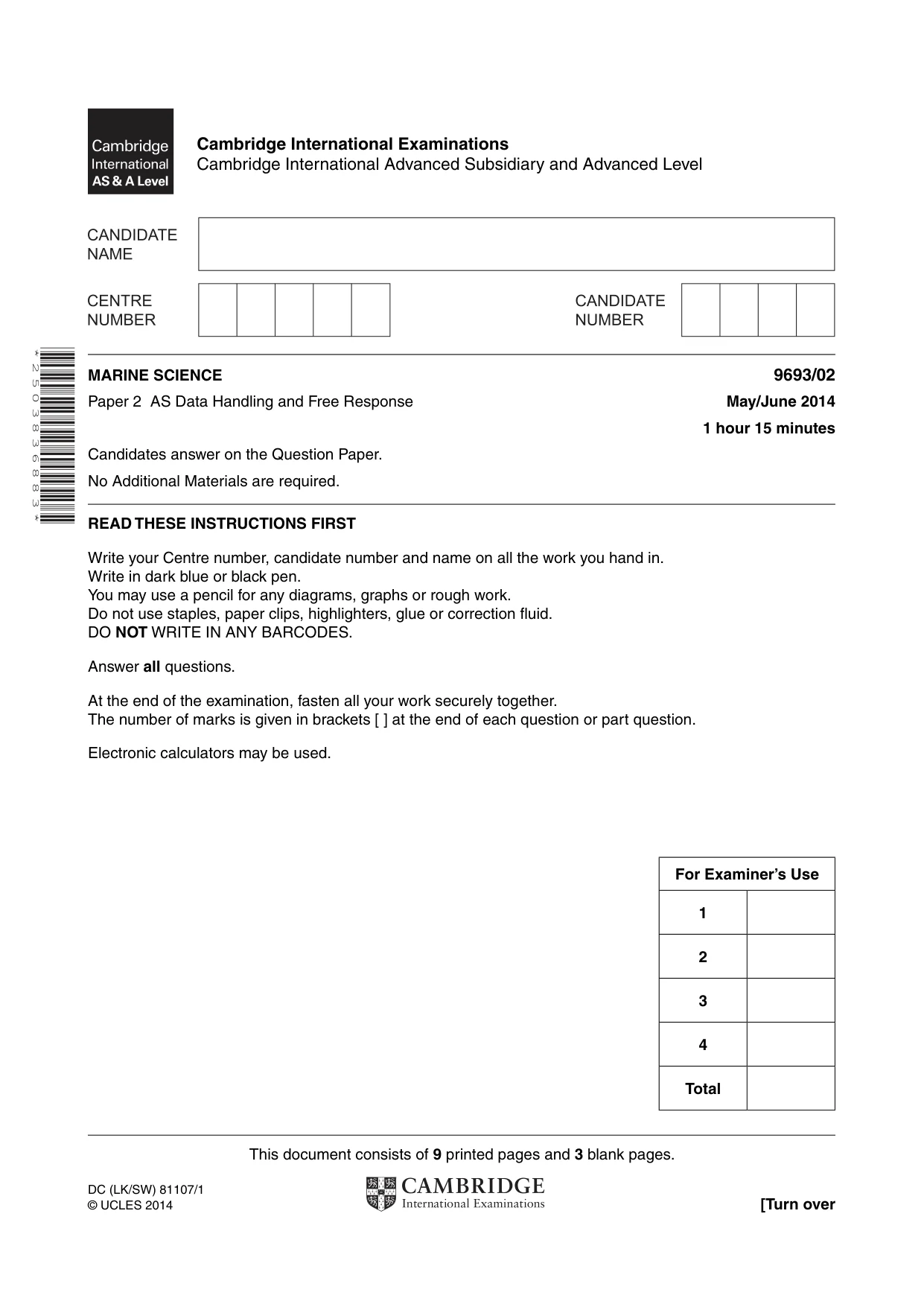
This document consists of 9 printed pages and 3 blank pages. DC (LK/SW) 81107/1 © UCLES 2014 [Turn over Cambridge International Examinations Cambridge International Advanced Subsidiary and Advanced Level * 2 5 0 3 8 3 6 8 8 3 * MARINE SCIENCE 9693/02 Paper 2 AS Data Handling and Free Response May/June 2014 1 hour 15 minutes Candidates answer on the Question Paper. No Additional Materials are required. READ THESE INSTRUCTIONS FIRST Write your Centre number, candidate number and name on all the work you hand in. Write in dark blue or black pen. You may use a pencil for any diagrams, graphs or rough work. Do not use staples, paper clips, highlighters, glue or correction fluid. DO NOT WRITE IN ANY BARCODES. Answer all questions. At the end of the examination, fasten all your work securely together. The number of marks is given in brackets [ ] at the end of each question or part question. Electronic calculators may be used. For Examiner’s Use 1 2 3 4 Total
Question paper, page 2
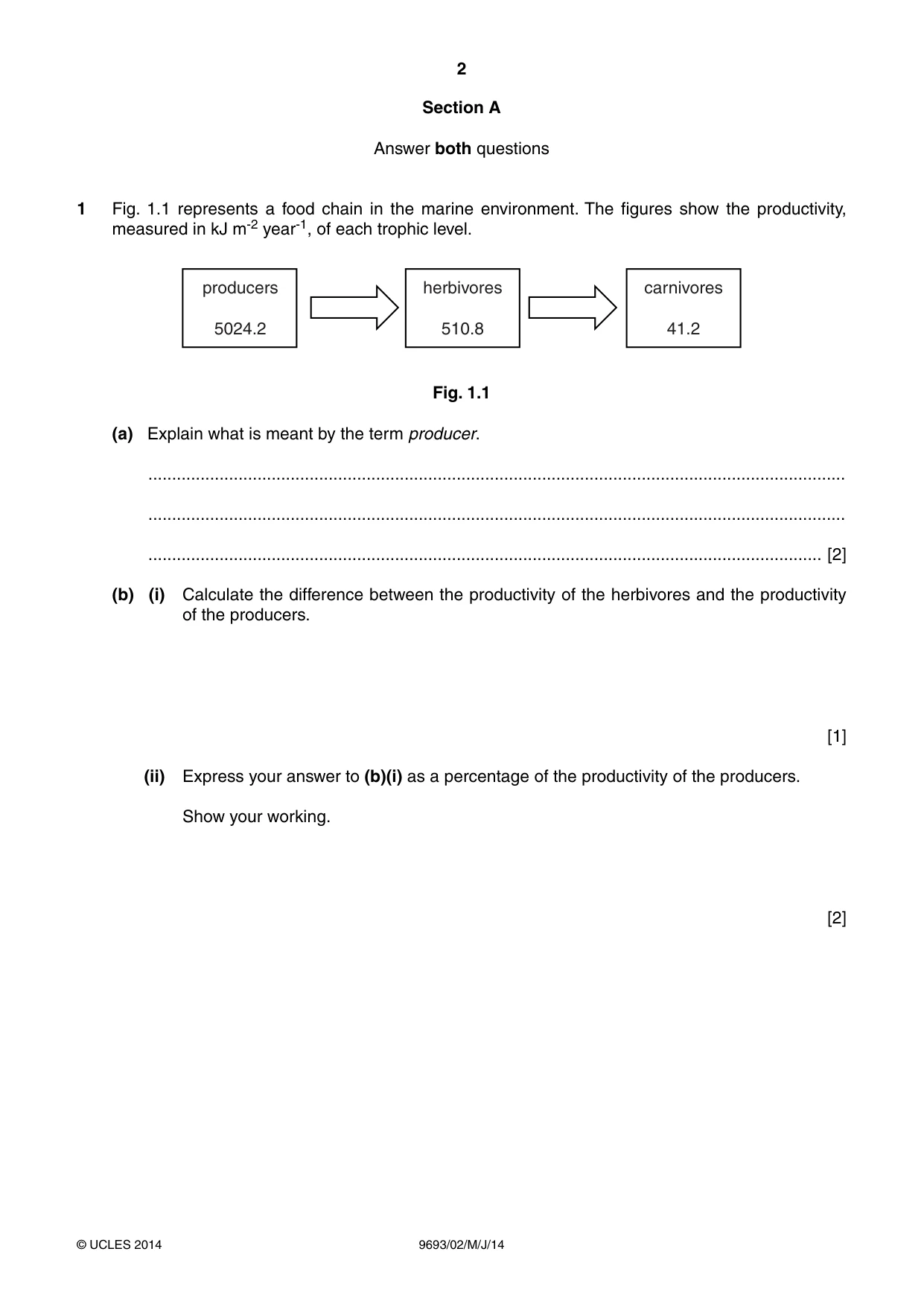
2 9693/02/M/J/14 © UCLES 2014 Section A Answer both questions 1 Fig. 1.1 represents a food chain in the marine environment. The figures show the productivity, measured in kJ m-2 year-1, of each trophic level. producers 5024.2 herbivores 510.8 carnivores 41.2 Fig. 1.1 (a) Explain what is meant by the term producer. … … … [2] (b) (i) Calculate the difference between the productivity of the herbivores and the productivity of the producers. [1] (ii) Express your answer to (b)(i) as a percentage of the productivity of the producers. Show your working. [2]
Question paper, page 3
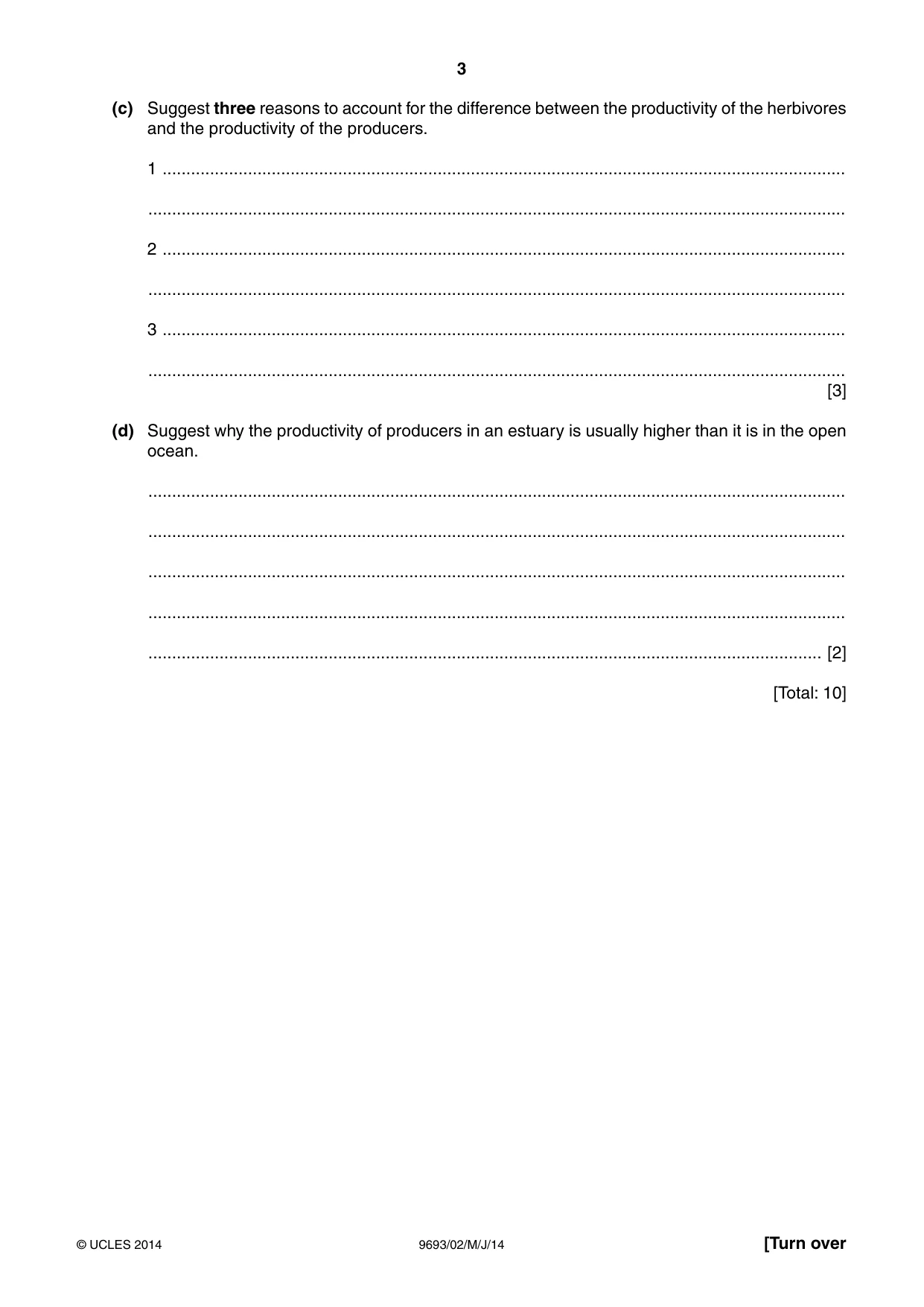
3 9693/02/M/J/14 © UCLES 2014 [Turn over (c) Suggest three reasons to account for the difference between the productivity of the herbivores and the productivity of the producers. 1 … … 2 … … 3 … … [3] (d) Suggest why the productivity of producers in an estuary is usually higher than it is in the open ocean. … … … … … [2] [Total: 10]
Question paper, page 4
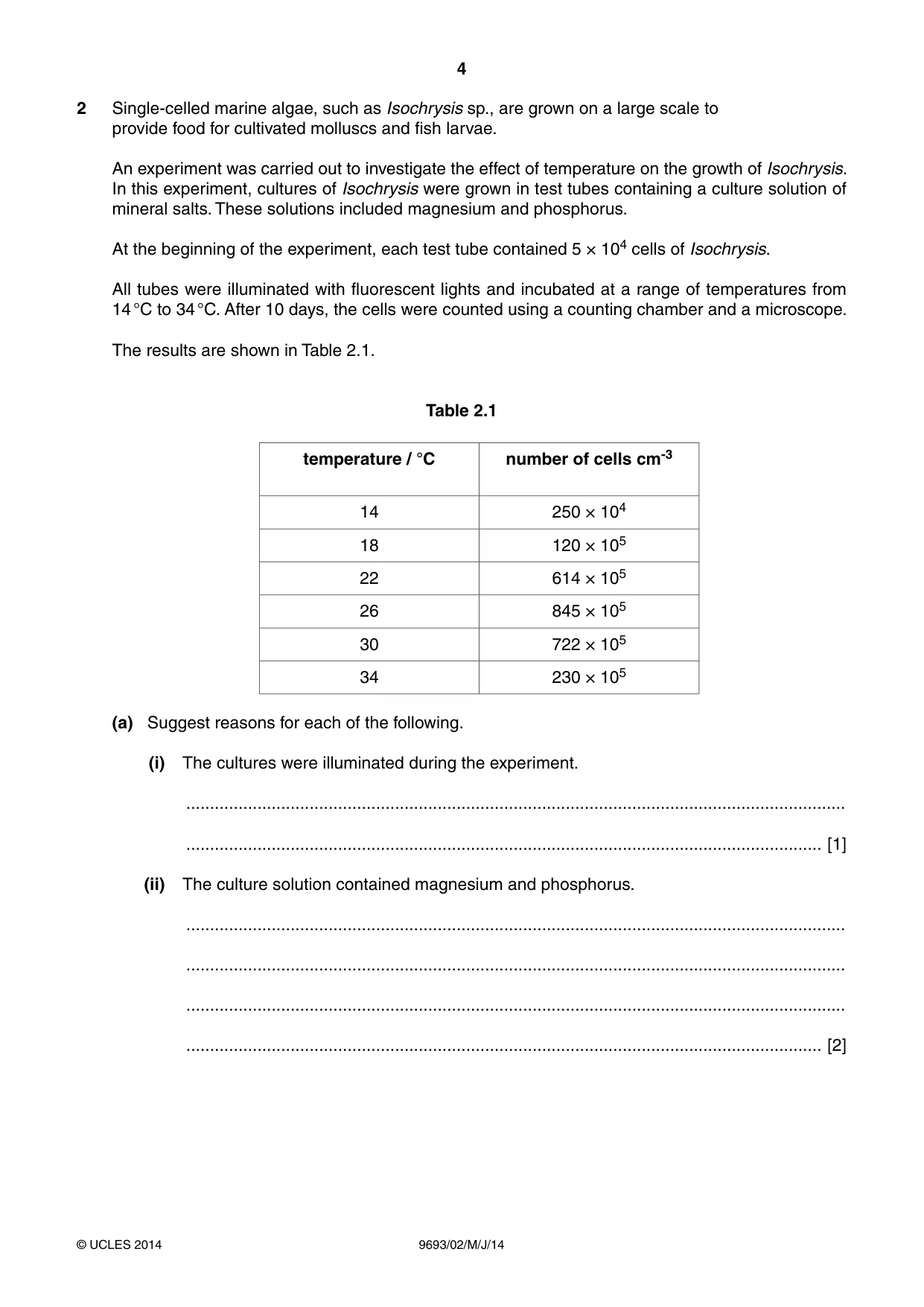
4 9693/02/M/J/14 © UCLES 2014 2 Single-celled marine algae, such as Isochrysis sp., are grown on a large scale to provide food for cultivated molluscs and fish larvae. An experiment was carried out to investigate the effect of temperature on the growth of Isochrysis. In this experiment, cultures of Isochrysis were grown in test tubes containing a culture solution of mineral salts. These solutions included magnesium and phosphorus. At the beginning of the experiment, each test tube contained 5 × 10⁴ cells of Isochrysis. All tubes were illuminated with fluorescent lights and incubated at a range of temperatures from 14 °C to 34 °C. After 10 days, the cells were counted using a counting chamber and a microscope. The results are shown in Table 2.1. Table 2.1 temperature / °C number of cells cm-3 14 250 × 104 18 120 × 105 22 614 × 105 26 845 × 105 30 722 × 105 34 230 × 105 (a) Suggest reasons for each of the following. (i) The cultures were illuminated during the experiment. … … [1] (ii) The culture solution contained magnesium and phosphorus. … … … … [2]
Question paper, page 5
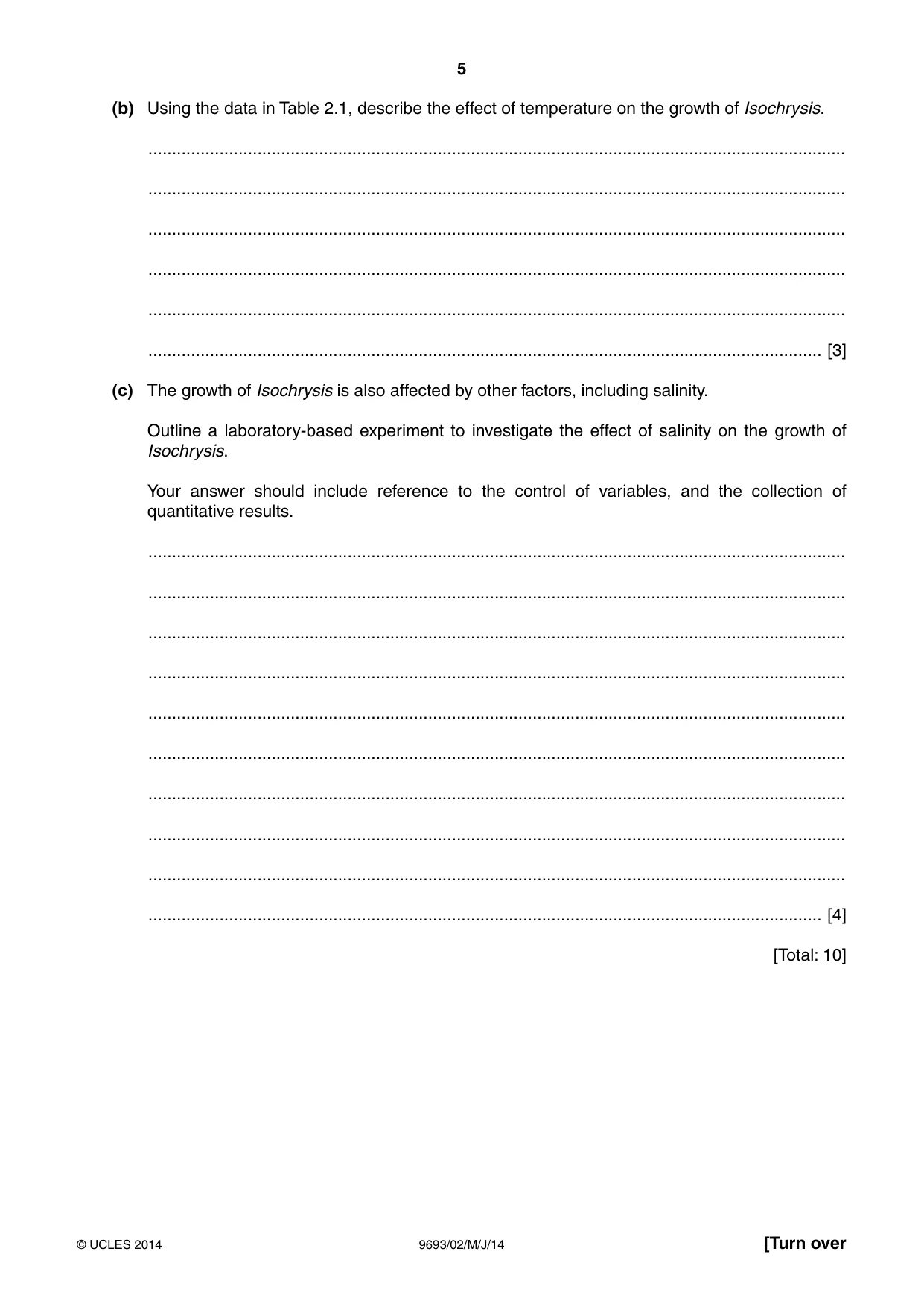
5 9693/02/M/J/14 © UCLES 2014 [Turn over (b) Using the data in Table 2.1, describe the effect of temperature on the growth of Isochrysis. … … … … … … [3] (c) The growth of Isochrysis is also affected by other factors, including salinity. Outline a laboratory-based experiment to investigate the effect of salinity on the growth of Isochrysis. Your answer should include reference to the control of variables, and the collection of quantitative results. … … … … … … … … … … [4] [Total: 10]
Question paper, page 6
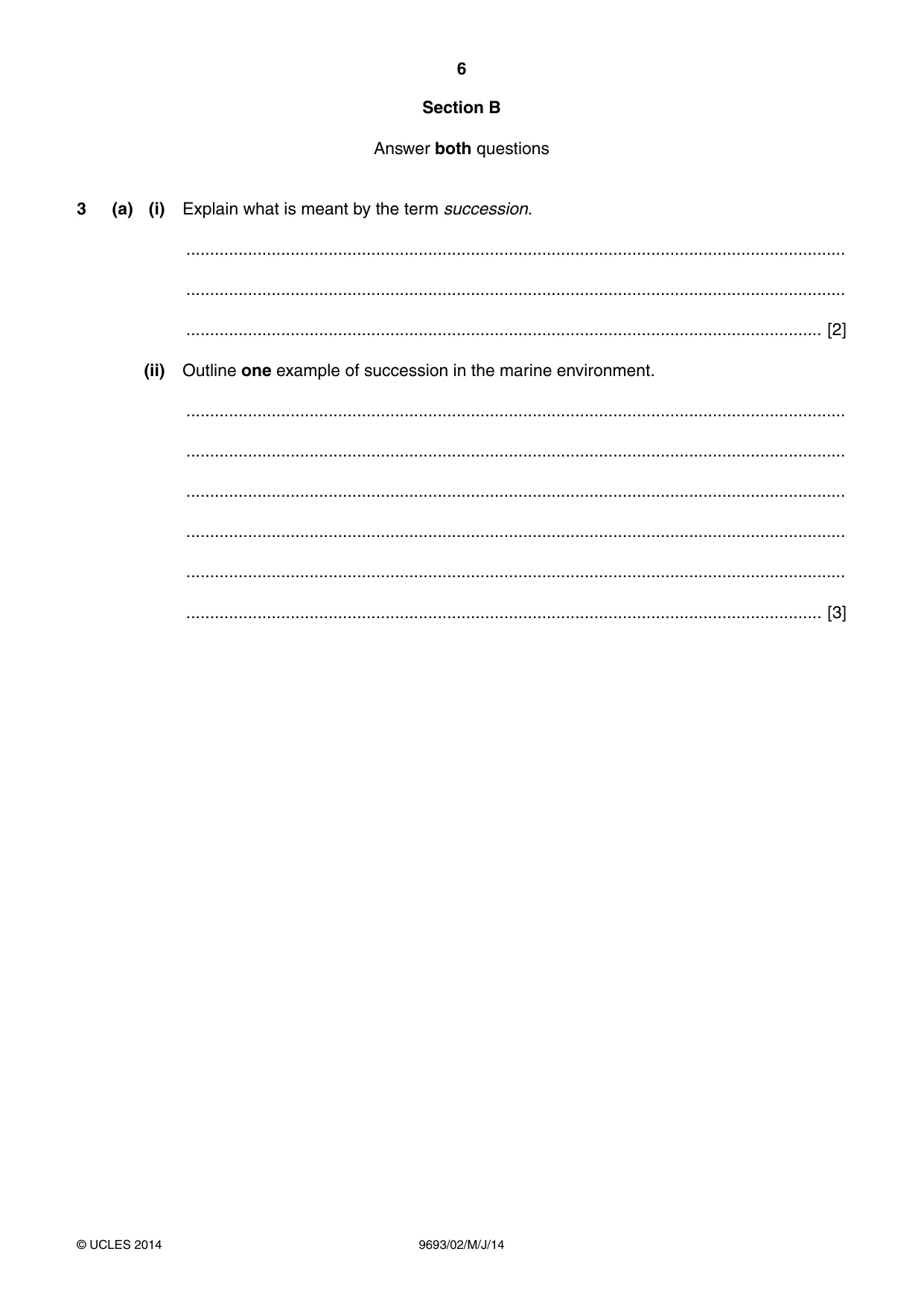
6 9693/02/M/J/14 © UCLES 2014 Section B Answer both questions 3 (a) (i) Explain what is meant by the term succession. … … … [2] (ii) Outline one example of succession in the marine environment. … … … … … … [3]
Question paper, page 7
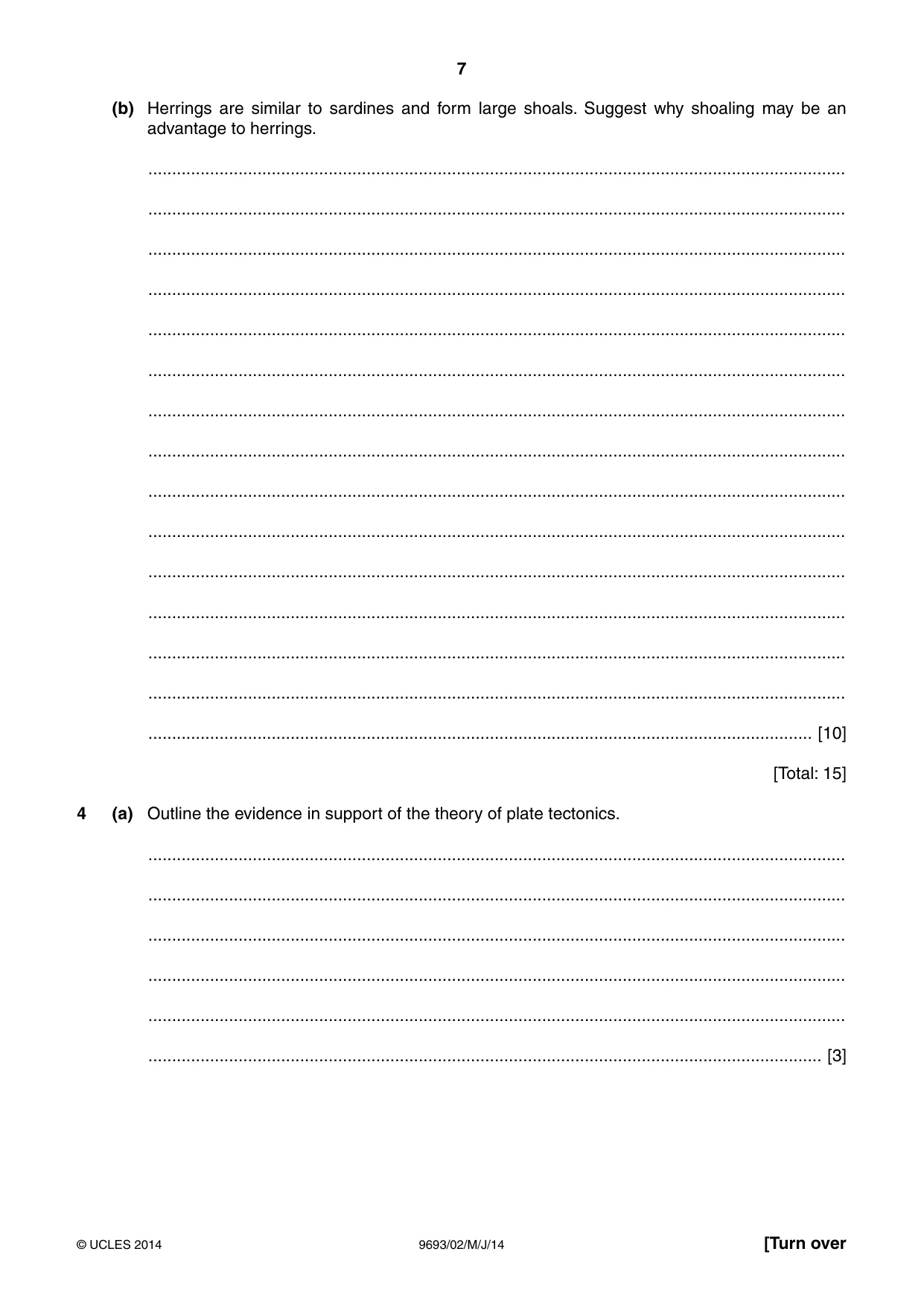
7 9693/02/M/J/14 © UCLES 2014 [Turn over (b) Herrings are similar to sardines and form large shoals. Suggest why shoaling may be an advantage to herrings. … … … … … … … … … … … … … … … [10] [Total: 15] 4 (a) Outline the evidence in support of the theory of plate tectonics. … … … … … … [3]
Question paper, page 8
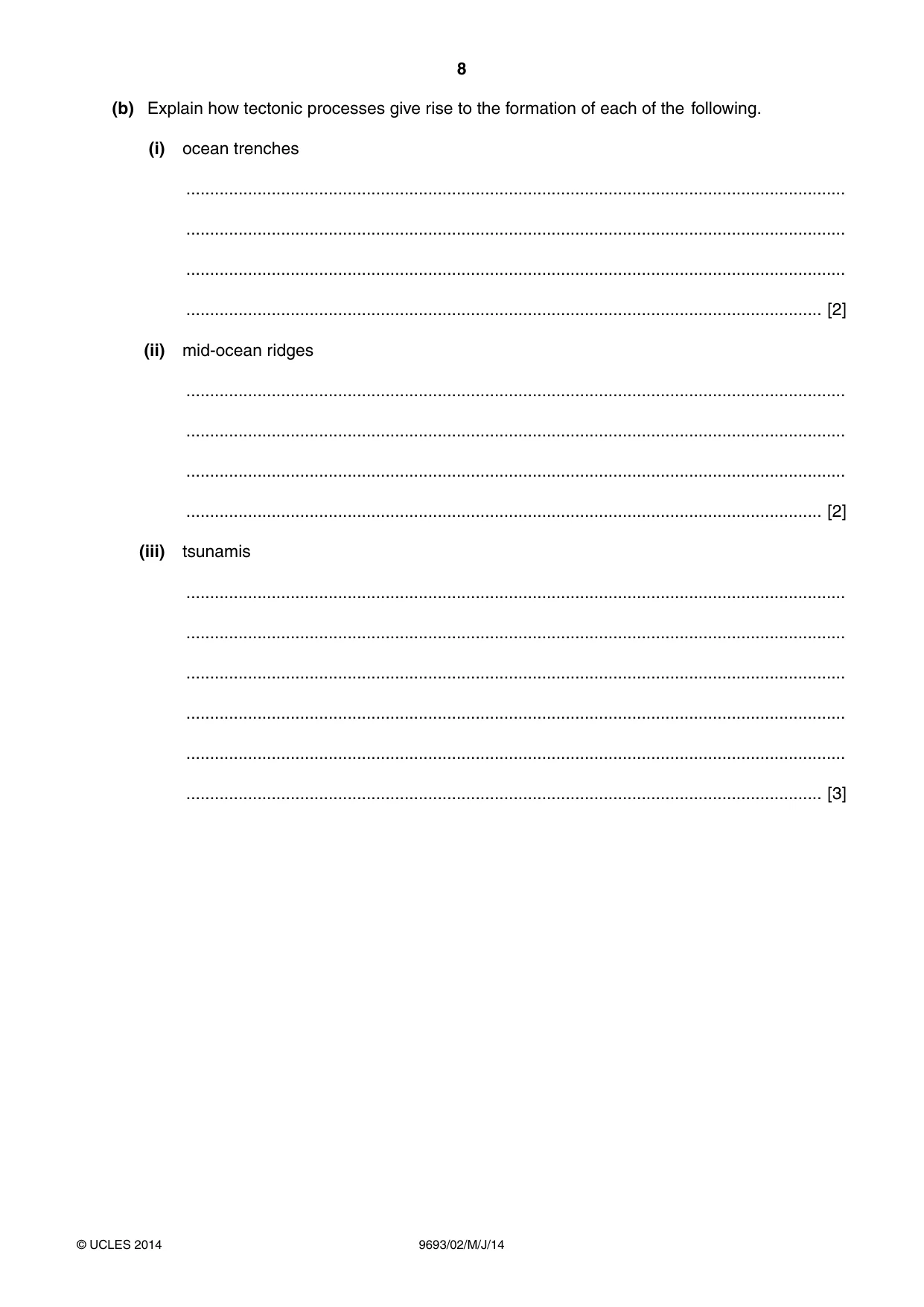
8 9693/02/M/J/14 © UCLES 2014 (b) Explain how tectonic processes give rise to the formation of each of the following. (i) ocean trenches … … … … [2] (ii) mid-ocean ridges … … … … [2] (iii) tsunamis … … … … … … [3]
Question paper, page 9
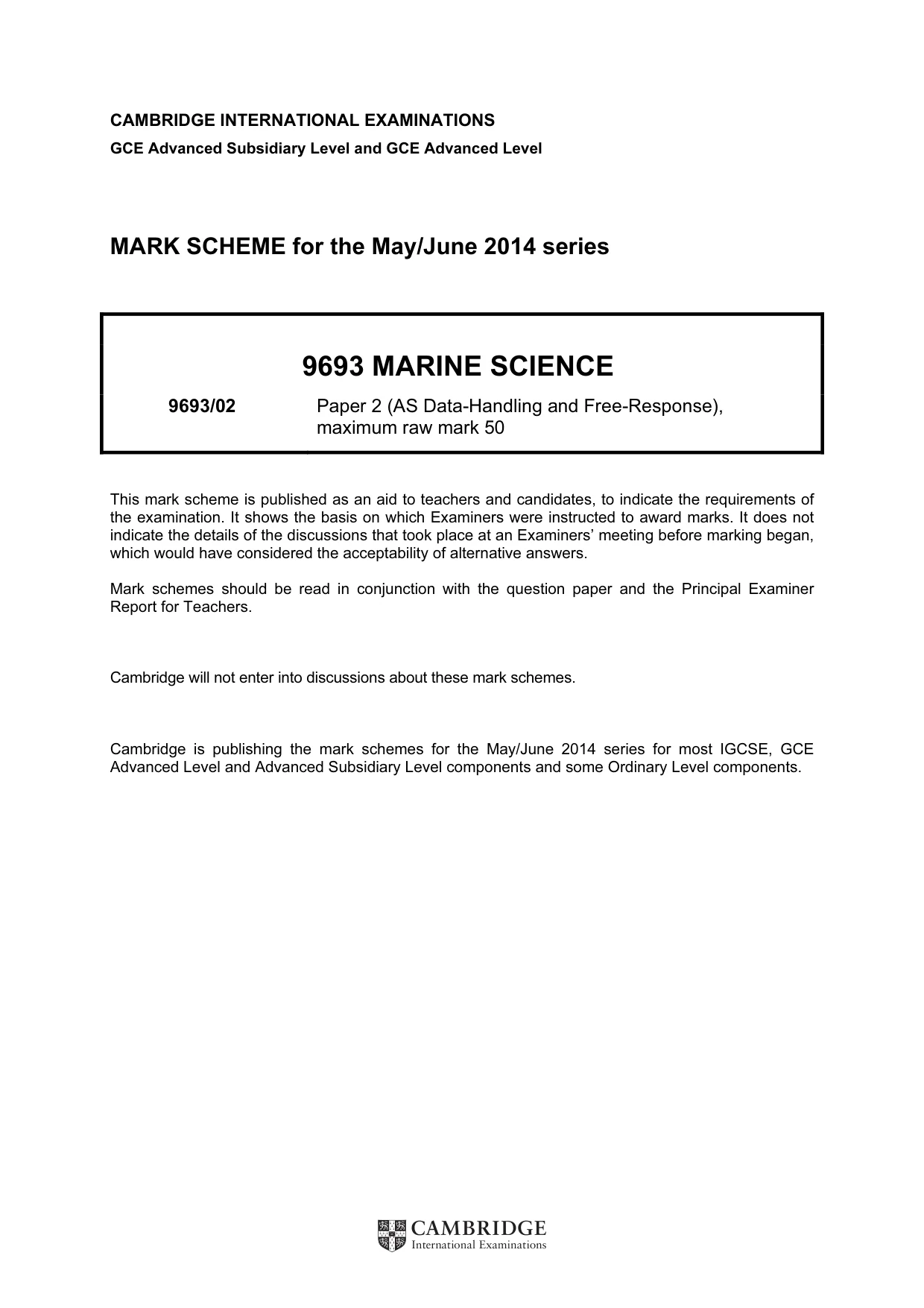
9 9693/02/M/J/14 © UCLES 2014 (c) Describe the physical and chemical environmental factors associated with hydrothermal vents that affect the living organisms in these marine environments. … … … … … … … … … … [5] [Total 15 marks]
Question paper, page 10
10 9693/02/M/J/14 © UCLES 2014 BLANK PAGE
Question paper, page 11
11 9693/02/M/J/14 © UCLES 2014 BLANK PAGE
Question paper, page 12
12 9693/02/M/J/14 © UCLES 2014 BLANK PAGE Copyright Acknowledgements: Question 2 © Data adapted from: http://www.bashanfoundation.org/drora/droraoptimalgrowth.pdf Permission to reproduce items where third-party owned material protected by copyright is included has been sought and cleared where possible. Every reasonable effort has been made by the publisher (UCLES) to trace copyright holders, but if any items requiring clearance have unwittingly been included, the publisher will be pleased to make amends at the earliest possible opportunity. Cambridge International Examinations is part of the Cambridge Assessment Group. Cambridge Assessment is the brand name of University of Cambridge Local Examinations Syndicate (UCLES), which is itself a department of the University of Cambridge.
Mark scheme, page 1
CAMBRIDGE INTERNATIONAL EXAMINATIONS GCE Advanced Subsidiary Level and GCE Advanced Level MARK SCHEME for the May/June 2014 series 9693 MARINE SCIENCE 9693/02 Paper 2 (AS Data-Handling and Free-Response), maximum raw mark 50 This mark scheme is published as an aid to teachers and candidates, to indicate the requirements of the examination. It shows the basis on which Examiners were instructed to award marks. It does not indicate the details of the discussions that took place at an Examiners’ meeting before marking began, which would have considered the acceptability of alternative answers. Mark schemes should be read in conjunction with the question paper and the Principal Examiner Report for Teachers. Cambridge will not enter into discussions about these mark schemes. Cambridge is publishing the mark schemes for the May/June 2014 series for most IGCSE, GCE Advanced Level and Advanced Subsidiary Level components and some Ordinary Level components.
Mark scheme, page 2
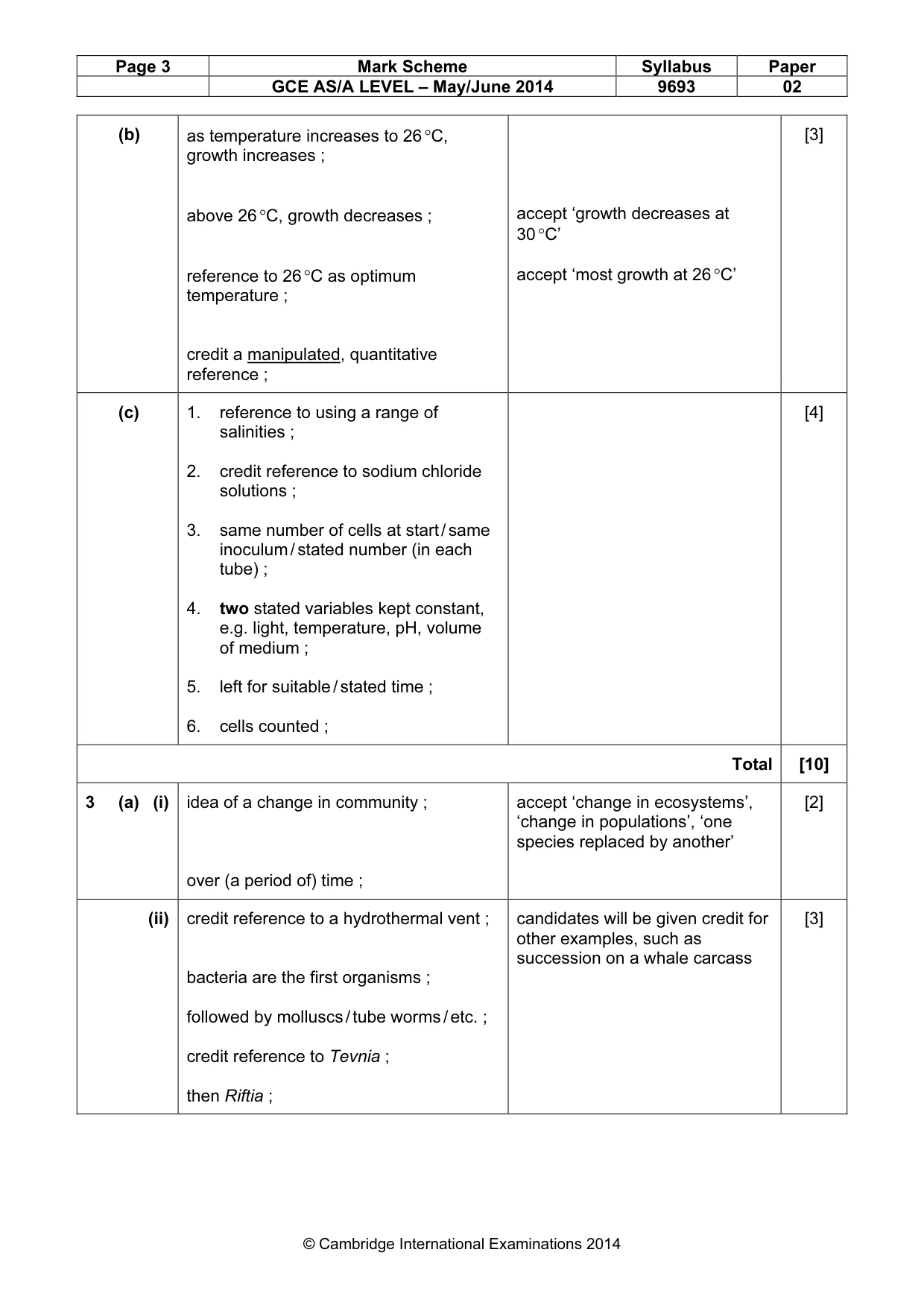
Page 2 Mark Scheme Syllabus Paper GCE AS/A LEVEL – May/June 2014 9693 02 © Cambridge International Examinations 2014 Question Expected answers Additional guidance Marks 1 (a) use light (energy) / sun(light) / photosynthesis / chemical energy / chemosynthesis / reference to autotrophic nutrition ; to synthesise organic substances / named example / food / provide food for next trophic level / eq ; [2] (b) (i) 4513.4 kJ m–2 year –1 ; answer to include full units for mark [1] (ii) appropriate calculation ; = 89.8(%) ; correct answer, with no working shown, gains both marks allow ecf from an incorrect answer to (b)(i) [2] (c) 1. reference to energy loss by respiration / heat ; 2. not all producers eaten ; 3. some parts not eaten ; 4. reference to losses in undigested material / faeces / egestion ; 5. reference to losses in urine / excretion ; [3] (d) idea of nutrients in estuary ; due to run-off / brought in by rivers ; accept a named example of a nutrient [2] Total [10] 2 (a) (i) algae require light for photosynthesis / eq ; accept a description of the process of photosynthesis [1] (ii) magnesium needed for chlorophyll ; phosphorus for DNA / other appropriate compound ; [2]
Mark scheme, page 3
Page 3 Mark Scheme Syllabus Paper GCE AS/A LEVEL – May/June 2014 9693 02 © Cambridge International Examinations 2014 (b) as temperature increases to 26 °C, growth increases ; above 26 °C, growth decreases ; reference to 26 °C as optimum temperature ; credit a manipulated, quantitative reference ; accept ‘growth decreases at 30 °C’ accept ‘most growth at 26 °C’ [3] (c) 1. reference to using a range of salinities ; 2. credit reference to sodium chloride solutions ; 3. same number of cells at start / same inoculum / stated number (in each tube) ; 4. two stated variables kept constant, e.g. light, temperature, pH, volume of medium ; 5. left for suitable / stated time ; 6. cells counted ; [4] Total [10] 3 (a) (i) idea of a change in community ; over (a period of) time ; accept ‘change in ecosystems’, ‘change in populations’, ‘one species replaced by another’ [2] (ii) credit reference to a hydrothermal vent ; bacteria are the first organisms ; followed by molluscs / tube worms / etc. ; credit reference to Tevnia ; then Riftia ; candidates will be given credit for other examples, such as succession on a whale carcass [3]
Mark scheme, page 4
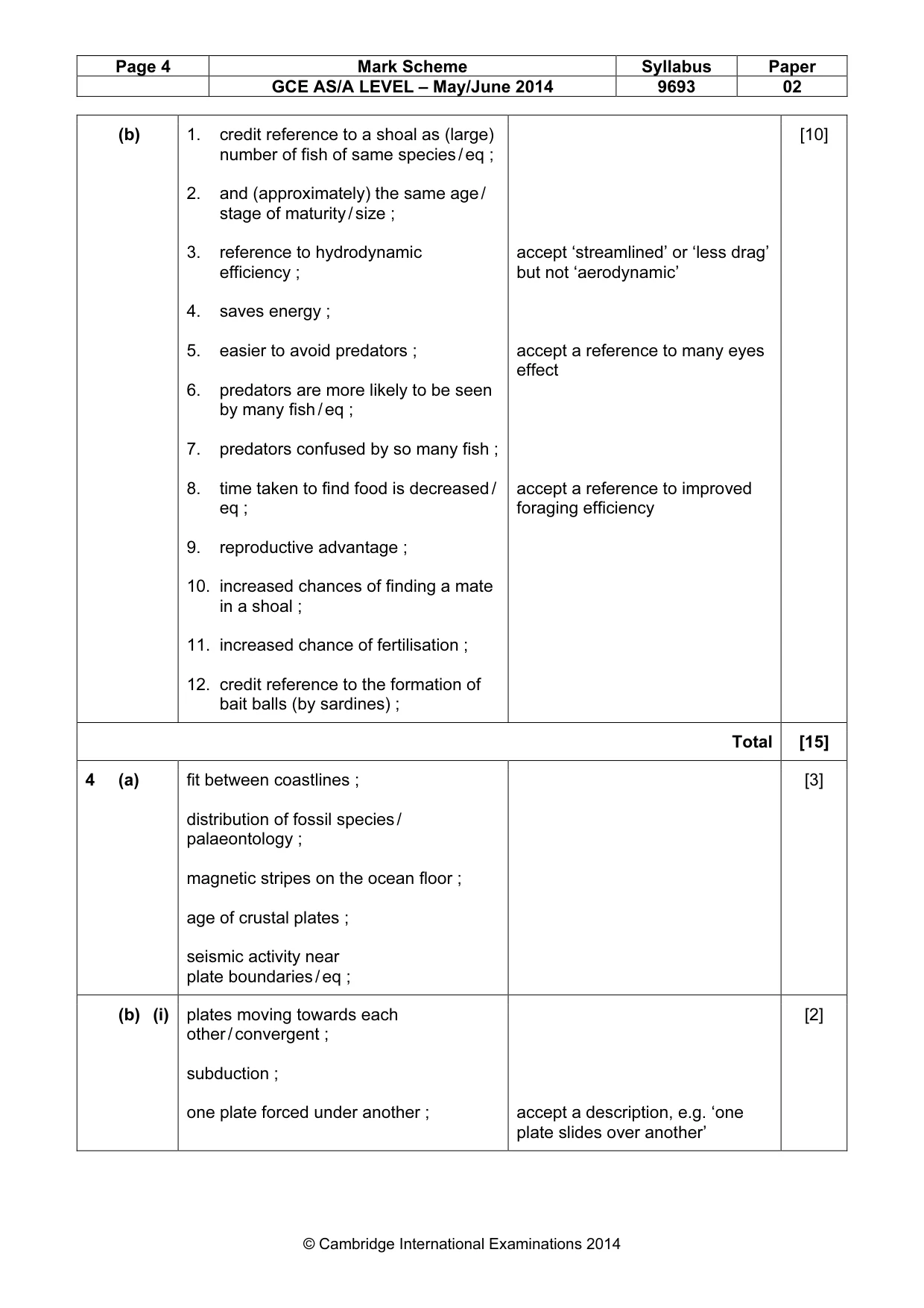
Page 4 Mark Scheme Syllabus Paper GCE AS/A LEVEL – May/June 2014 9693 02 © Cambridge International Examinations 2014 (b) 1. credit reference to a shoal as (large) number of fish of same species / eq ; 2. and (approximately) the same age / stage of maturity / size ; 3. reference to hydrodynamic efficiency ; 4. saves energy ; 5. easier to avoid predators ; 6. predators are more likely to be seen by many fish / eq ; 7. predators confused by so many fish ; 8. time taken to find food is decreased / eq ; 9. reproductive advantage ; 10. increased chances of finding a mate in a shoal ; 11. increased chance of fertilisation ; 12. credit reference to the formation of bait balls (by sardines) ; accept ‘streamlined’ or ‘less drag’ but not ‘aerodynamic’ accept a reference to many eyes effect accept a reference to improved foraging efficiency [10] Total [15] 4 (a) fit between coastlines ; distribution of fossil species / palaeontology ; magnetic stripes on the ocean floor ; age of crustal plates ; seismic activity near plate boundaries / eq ; [3] (b) (i) plates moving towards each other / convergent ; subduction ; one plate forced under another ; accept a description, e.g. ‘one plate slides over another’ [2]
Mark scheme, page 5
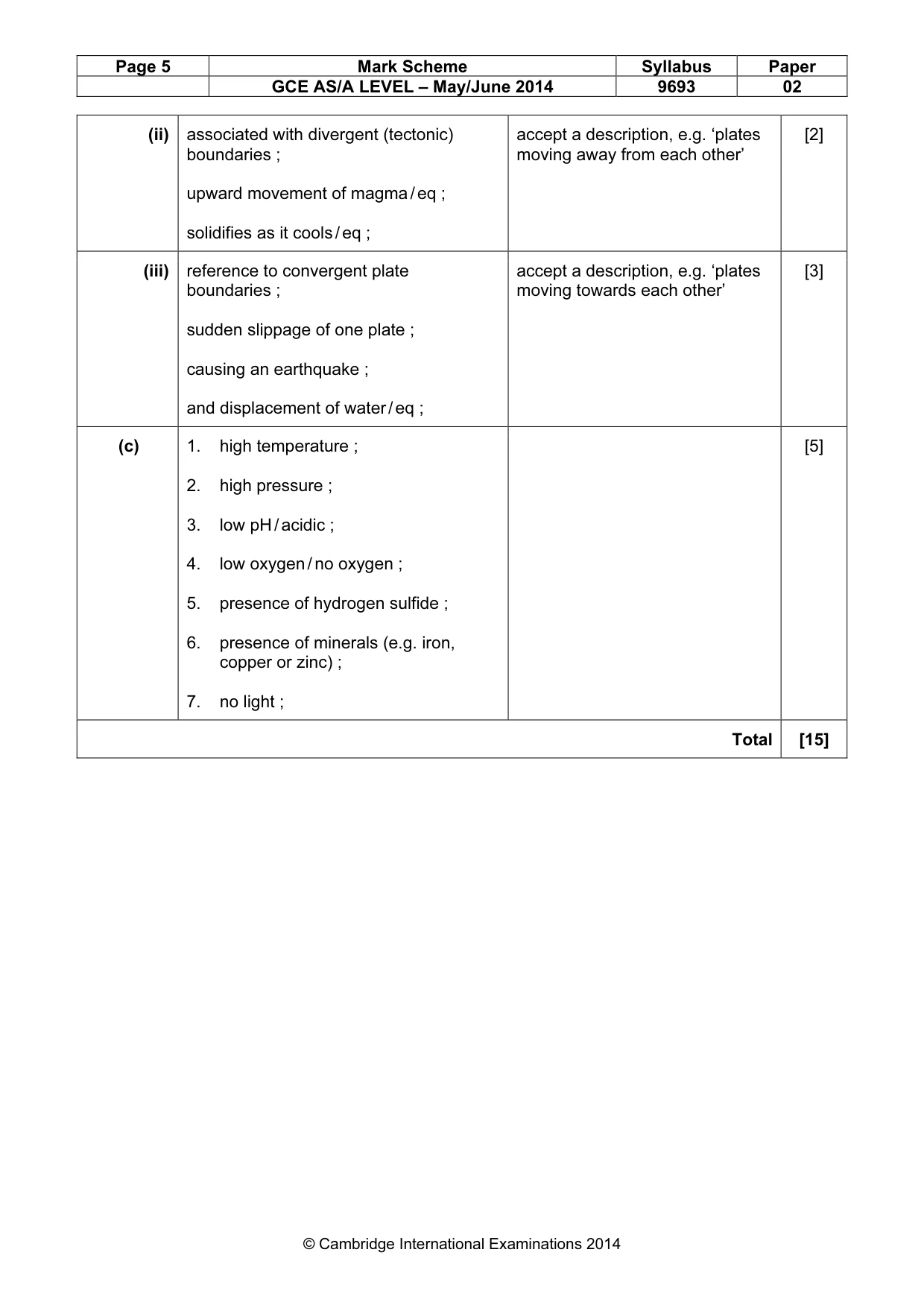
Page 5 Mark Scheme Syllabus Paper GCE AS/A LEVEL – May/June 2014 9693 02 © Cambridge International Examinations 2014 (ii) associated with divergent (tectonic) boundaries ; upward movement of magma / eq ; solidifies as it cools / eq ; accept a description, e.g. ‘plates moving away from each other’ [2] (iii) reference to convergent plate boundaries ; sudden slippage of one plate ; causing an earthquake ; and displacement of water / eq ; accept a description, e.g. ‘plates moving towards each other’ [3] (c) 1. high temperature ; 2. high pressure ; 3. low pH / acidic ; 4. low oxygen / no oxygen ; 5. presence of hydrogen sulfide ; 6. presence of minerals (e.g. iron, copper or zinc) ; 7. no light ; [5] Total [15]
What you needed in this session
Cambridge’s own grade thresholds for 2014 May/June, Paper 2 · Variant 1. A higher threshold means an easier paper — the bar moves with how the cohort did.