Cambridge A Level Law 9084 — 2024 Oct/Nov Paper 3 · Variant 2
9084/32/O/N/24 · 75 marks · ≈84 min
The question paper and its mark scheme, free to read here and free to download. This is Cambridge’s own paper, exactly as it was sat.
Question paper4 pages

Mark scheme20 pages
Answers below. Sit the paper first if you are practising.

Paper as text
Question paper, page 1
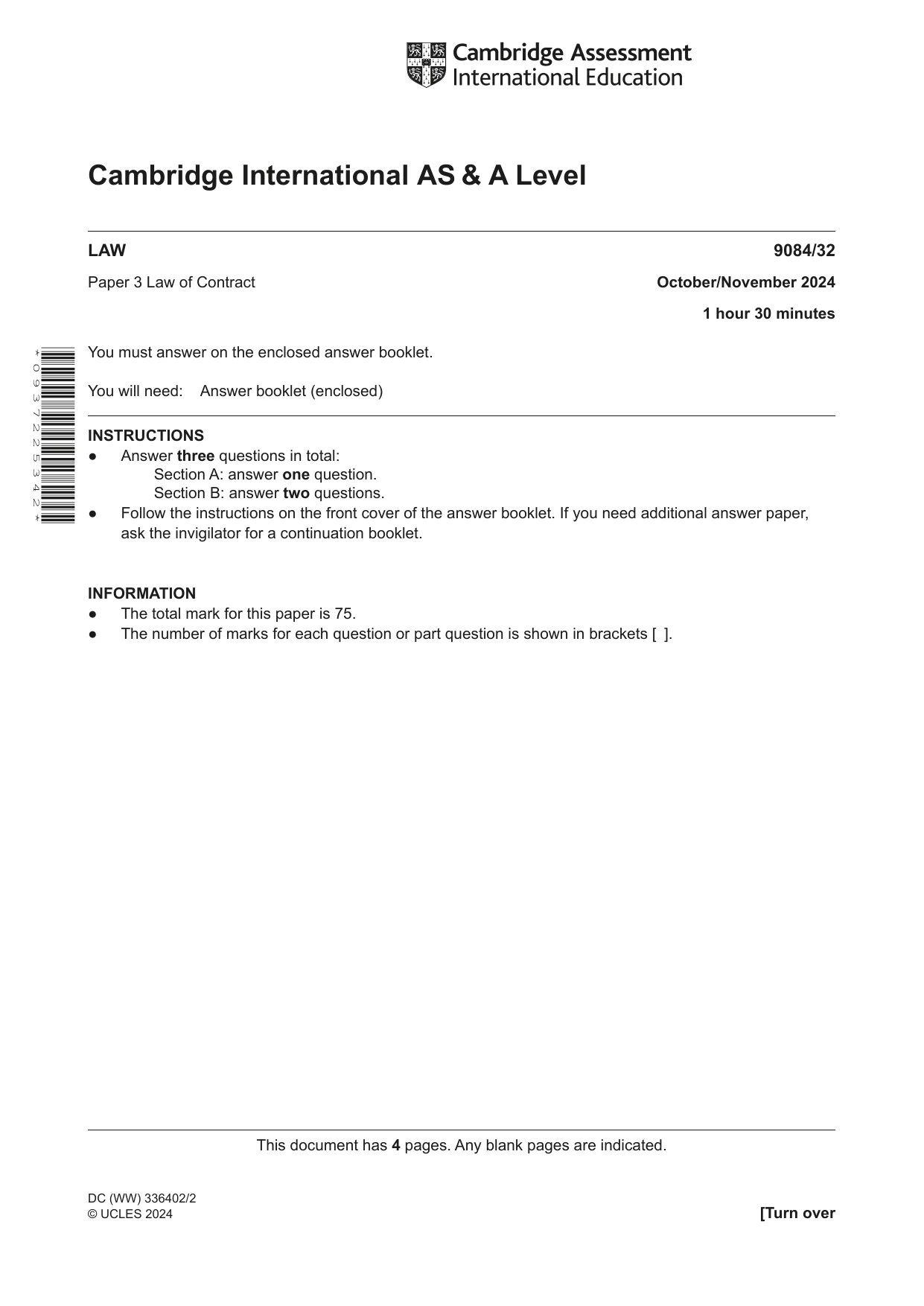
[Turn over Cambridge International AS & A Level This document has 4 pages. Any blank pages are indicated. DC (WW) 336402/2 © UCLES 2024 * 0 9 3 7 2 2 5 3 4 2 * LAW 9084/32 Paper 3 Law of Contract October/November 2024 1 hour 30 minutes You must answer on the enclosed answer booklet. You will need: Answer booklet (enclosed) INSTRUCTIONS ● Answer three questions in total: Section A: answer one question. Section B: answer two questions. ● Follow the instructions on the front cover of the answer booklet. If you need additional answer paper, ask the invigilator for a continuation booklet. INFORMATION ● The total mark for this paper is 75. ● The number of marks for each question or part question is shown in brackets [ ].
Question paper, page 2
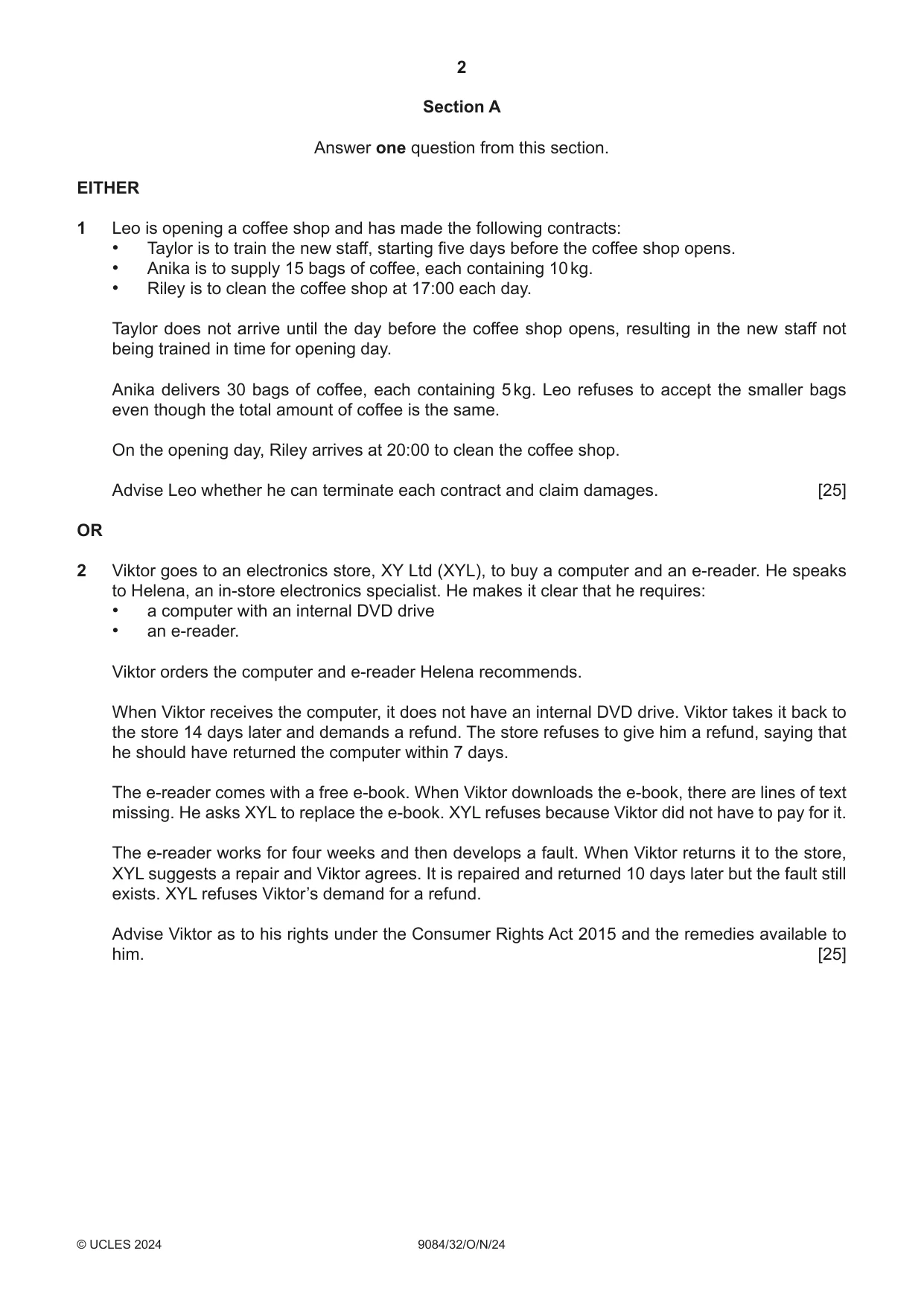
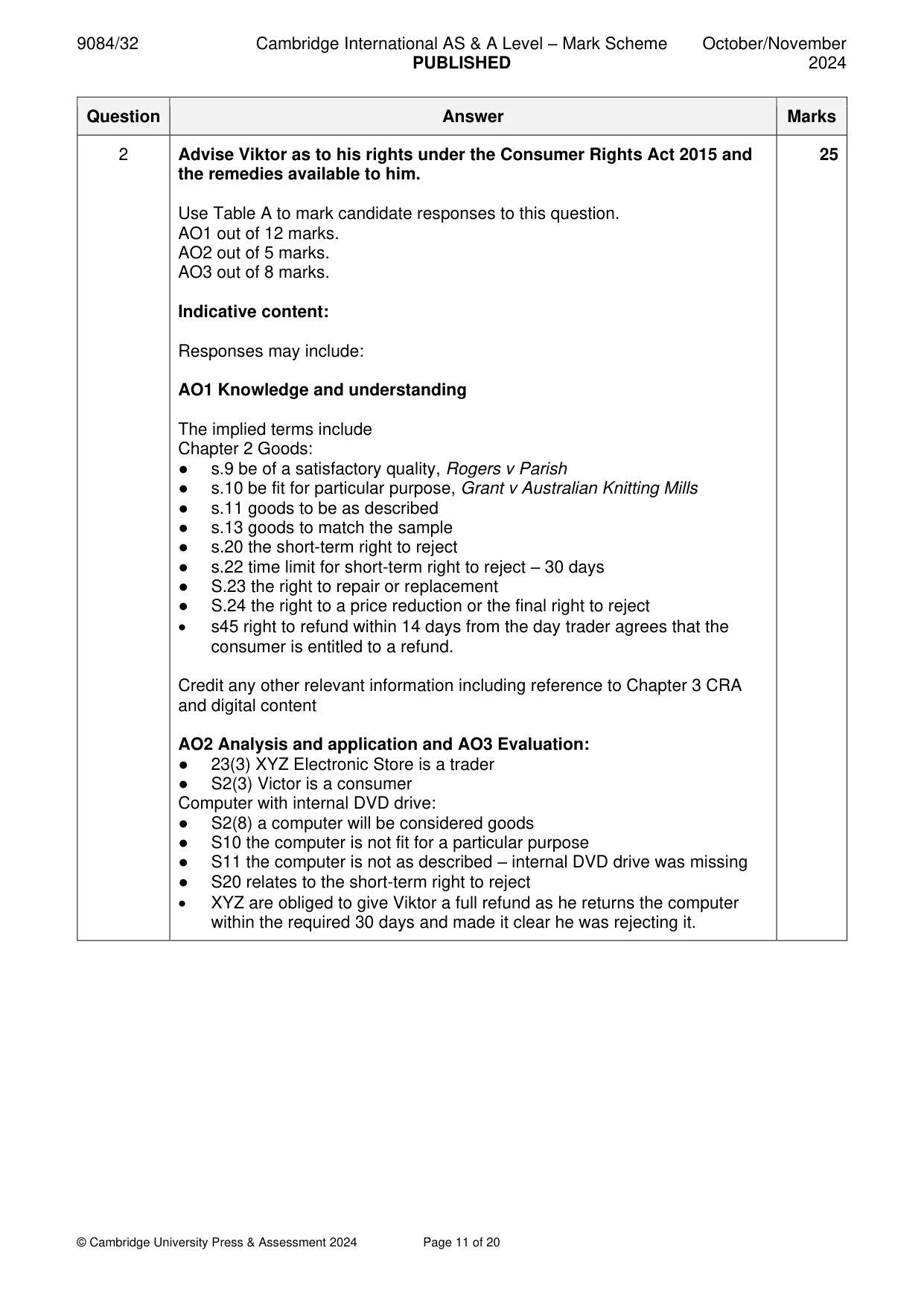
2 9084/32/O/N/24 © UCLES 2024 Section A Answer one question from this section. EITHER 1 Leo is opening a coffee shop and has made the following contracts: • Taylor is to train the new staff, starting five days before the coffee shop opens. • Anika is to supply 15 bags of coffee, each containing 10 kg. • Riley is to clean the coffee shop at 17:00 each day. Taylor does not arrive until the day before the coffee shop opens, resulting in the new staff not being trained in time for opening day. Anika delivers 30 bags of coffee, each containing 5 kg. Leo refuses to accept the smaller bags even though the total amount of coffee is the same. On the opening day, Riley arrives at 20:00 to clean the coffee shop. Advise Leo whether he can terminate each contract and claim damages. [25] OR 2 Viktor goes to an electronics store, XY Ltd (XYL), to buy a computer and an e-reader. He speaks to Helena, an in-store electronics specialist. He makes it clear that he requires: • a computer with an internal DVD drive • an e-reader. Viktor orders the computer and e-reader Helena recommends. When Viktor receives the computer, it does not have an internal DVD drive. Viktor takes it back to the store 14 days later and demands a refund. The store refuses to give him a refund, saying that he should have returned the computer within 7 days. The e-reader comes with a free e-book. When Viktor downloads the e-book, there are lines of text missing. He asks XYL to replace the e-book. XYL refuses because Viktor did not have to pay for it. The e-reader works for four weeks and then develops a fault. When Viktor returns it to the store, XYL suggests a repair and Viktor agrees. It is repaired and returned 10 days later but the fault still exists. XYL refuses Viktor’s demand for a refund. Advise Viktor as to his rights under the Consumer Rights Act 2015 and the remedies available to him. [25]
Question paper, page 3
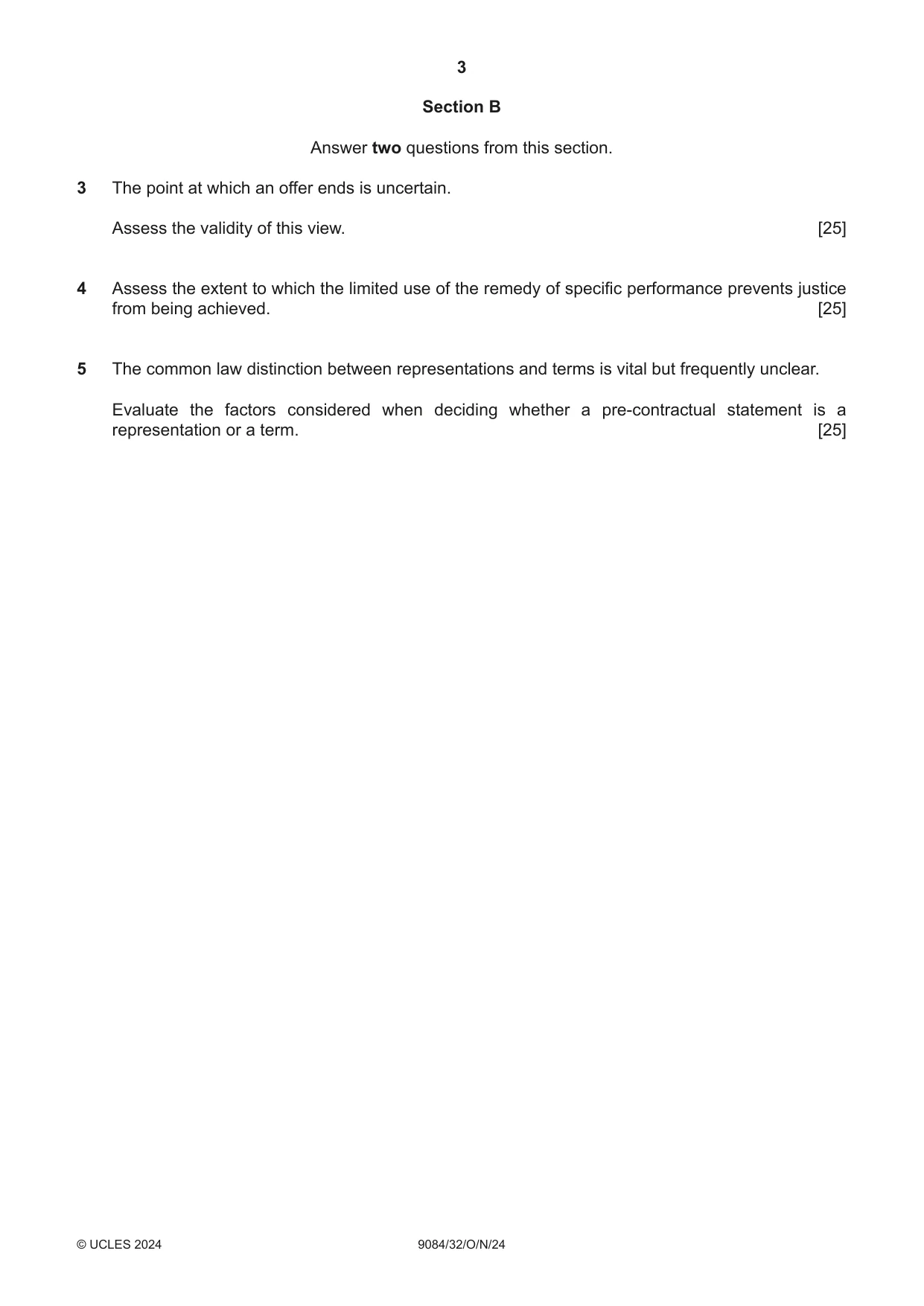
3 9084/32/O/N/24 © UCLES 2024 Section B Answer two questions from this section. 3 The point at which an offer ends is uncertain. Assess the validity of this view. [25] 4 Assess the extent to which the limited use of the remedy of specific performance prevents justice from being achieved. [25] 5 The common law distinction between representations and terms is vital but frequently unclear. Evaluate the factors considered when deciding whether a pre-contractual statement is a representation or a term. [25]
Question paper, page 4
4 9084/32/O/N/24 © UCLES 2024 Permission to reproduce items where third-party owned material protected by copyright is included has been sought and cleared where possible. Every reasonable effort has been made by the publisher (UCLES) to trace copyright holders, but if any items requiring clearance have unwittingly been included, the publisher will be pleased to make amends at the earliest possible opportunity. To avoid the issue of disclosure of answer-related information to candidates, all copyright acknowledgements are reproduced online in the Cambridge Assessment International Education Copyright Acknowledgements Booklet. This is produced for each series of examinations and is freely available to download at www.cambridgeinternational.org after the live examination series. Cambridge Assessment International Education is part of Cambridge Assessment. Cambridge Assessment is the brand name of the University of Cambridge Local Examinations Syndicate (UCLES), which is a department of the University of Cambridge. BLANK PAGE
Mark scheme, page 1
This document consists of 20 printed pages. © Cambridge University Press & Assessment 2024 [Turn over Cambridge International AS & A Level LAW 9084/32 Paper 3 Law of Contract October/November 2024 MARK SCHEME Maximum Mark: 75 Published This mark scheme is published as an aid to teachers and candidates, to indicate the requirements of the examination. It shows the basis on which Examiners were instructed to award marks. It does not indicate the details of the discussions that took place at an Examiners’ meeting before marking began, which would have considered the acceptability of alternative answers. Mark schemes should be read in conjunction with the question paper and the Principal Examiner Report for Teachers. Cambridge International will not enter into discussions about these mark schemes. Cambridge International is publishing the mark schemes for the October/November 2024 series for most Cambridge IGCSE, Cambridge International A and AS Level components, and some Cambridge O Level components.
Mark scheme, page 2
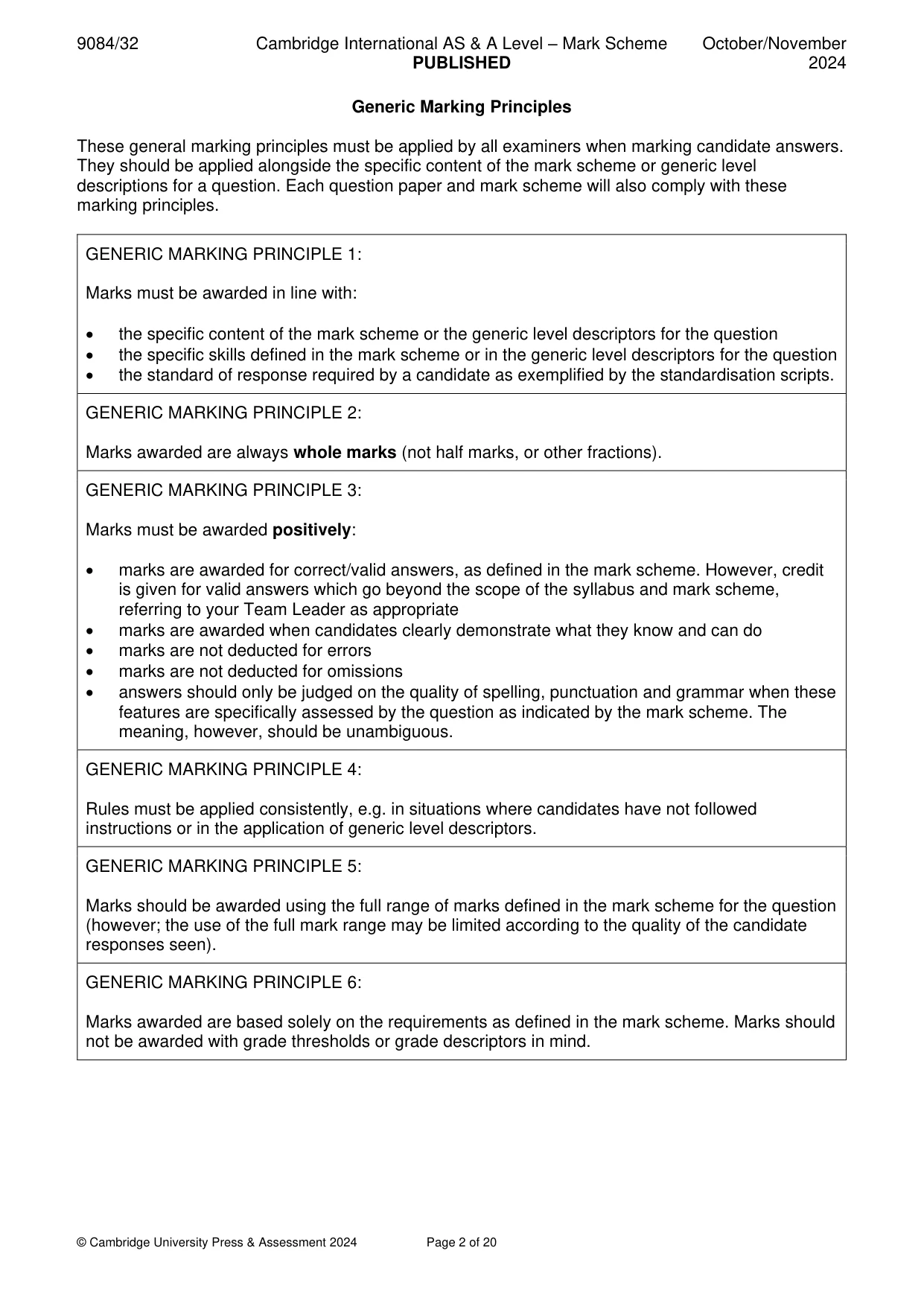
9084/32 Cambridge International AS & A Level – Mark Scheme PUBLISHED October/November 2024 © Cambridge University Press & Assessment 2024 Page 2 of 20 Generic Marking Principles These general marking principles must be applied by all examiners when marking candidate answers. They should be applied alongside the specific content of the mark scheme or generic level descriptions for a question. Each question paper and mark scheme will also comply with these marking principles. GENERIC MARKING PRINCIPLE 1: Marks must be awarded in line with: • the specific content of the mark scheme or the generic level descriptors for the question • the specific skills defined in the mark scheme or in the generic level descriptors for the question • the standard of response required by a candidate as exemplified by the standardisation scripts. GENERIC MARKING PRINCIPLE 2: Marks awarded are always whole marks (not half marks, or other fractions). GENERIC MARKING PRINCIPLE 3: Marks must be awarded positively: • marks are awarded for correct/valid answers, as defined in the mark scheme. However, credit is given for valid answers which go beyond the scope of the syllabus and mark scheme, referring to your Team Leader as appropriate • marks are awarded when candidates clearly demonstrate what they know and can do • marks are not deducted for errors • marks are not deducted for omissions • answers should only be judged on the quality of spelling, punctuation and grammar when these features are specifically assessed by the question as indicated by the mark scheme. The meaning, however, should be unambiguous. GENERIC MARKING PRINCIPLE 4: Rules must be applied consistently, e.g. in situations where candidates have not followed instructions or in the application of generic level descriptors. GENERIC MARKING PRINCIPLE 5: Marks should be awarded using the full range of marks defined in the mark scheme for the question (however; the use of the full mark range may be limited according to the quality of the candidate responses seen). GENERIC MARKING PRINCIPLE 6: Marks awarded are based solely on the requirements as defined in the mark scheme. Marks should not be awarded with grade thresholds or grade descriptors in mind.
Mark scheme, page 3
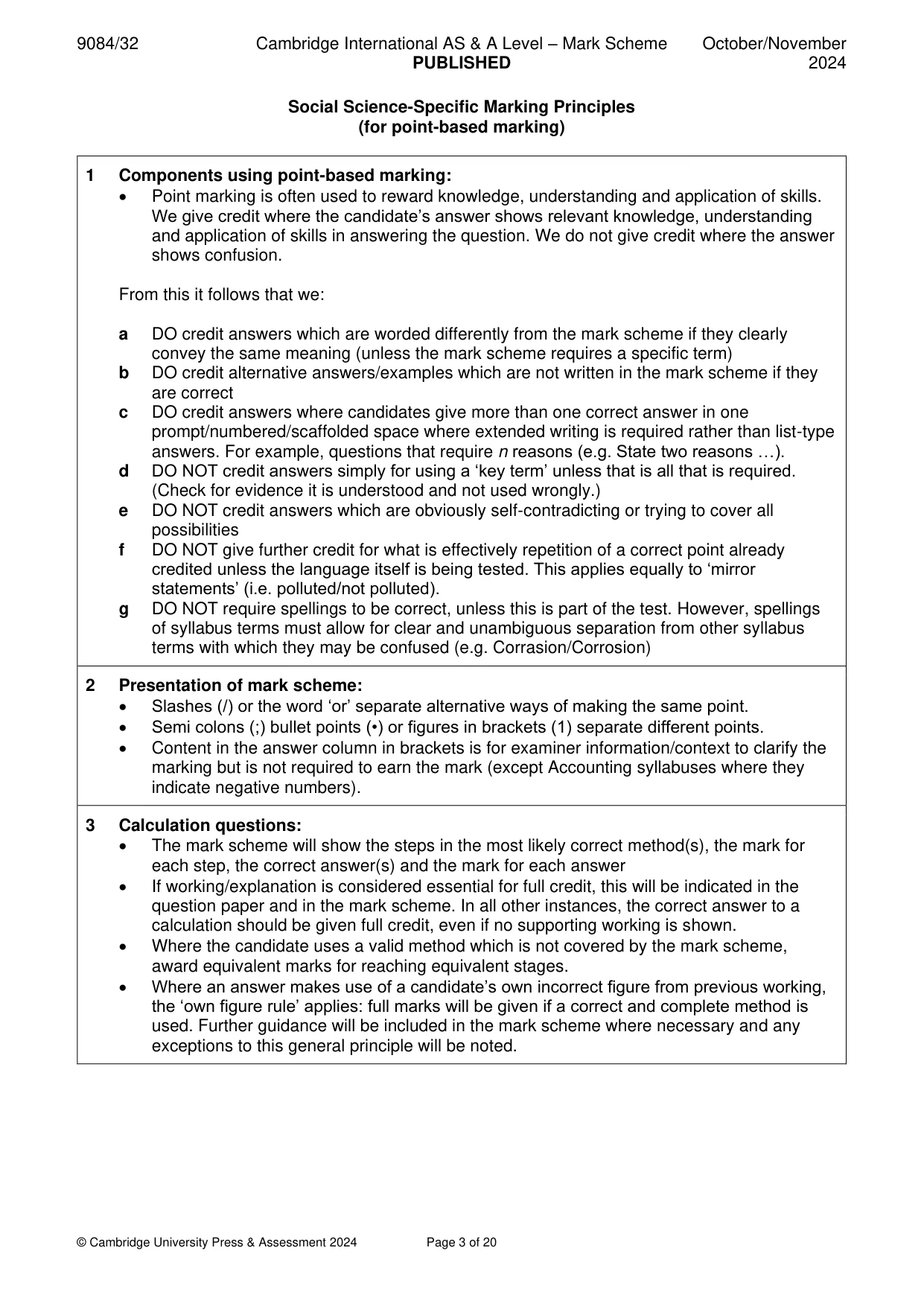
9084/32 Cambridge International AS & A Level – Mark Scheme PUBLISHED October/November 2024 © Cambridge University Press & Assessment 2024 Page 3 of 20 Social Science-Specific Marking Principles (for point-based marking) 1 Components using point-based marking: • Point marking is often used to reward knowledge, understanding and application of skills. We give credit where the candidate’s answer shows relevant knowledge, understanding and application of skills in answering the question. We do not give credit where the answer shows confusion. From this it follows that we: a DO credit answers which are worded differently from the mark scheme if they clearly convey the same meaning (unless the mark scheme requires a specific term) b DO credit alternative answers/examples which are not written in the mark scheme if they are correct c DO credit answers where candidates give more than one correct answer in one prompt/numbered/scaffolded space where extended writing is required rather than list-type answers. For example, questions that require n reasons (e.g. State two reasons …). d DO NOT credit answers simply for using a ‘key term’ unless that is all that is required. (Check for evidence it is understood and not used wrongly.) e DO NOT credit answers which are obviously self-contradicting or trying to cover all possibilities f DO NOT give further credit for what is effectively repetition of a correct point already credited unless the language itself is being tested. This applies equally to ‘mirror statements’ (i.e. polluted/not polluted). g DO NOT require spellings to be correct, unless this is part of the test. However, spellings of syllabus terms must allow for clear and unambiguous separation from other syllabus terms with which they may be confused (e.g. Corrasion/Corrosion) 2 Presentation of mark scheme: • Slashes (/) or the word ‘or’ separate alternative ways of making the same point. • Semi colons (;) bullet points (•) or figures in brackets (1) separate different points. • Content in the answer column in brackets is for examiner information/context to clarify the marking but is not required to earn the mark (except Accounting syllabuses where they indicate negative numbers). 3 Calculation questions: • The mark scheme will show the steps in the most likely correct method(s), the mark for each step, the correct answer(s) and the mark for each answer • If working/explanation is considered essential for full credit, this will be indicated in the question paper and in the mark scheme. In all other instances, the correct answer to a calculation should be given full credit, even if no supporting working is shown. • Where the candidate uses a valid method which is not covered by the mark scheme, award equivalent marks for reaching equivalent stages. • Where an answer makes use of a candidate’s own incorrect figure from previous working, the ‘own figure rule’ applies: full marks will be given if a correct and complete method is used. Further guidance will be included in the mark scheme where necessary and any exceptions to this general principle will be noted.
Mark scheme, page 4
9084/32 Cambridge International AS & A Level – Mark Scheme PUBLISHED October/November 2024 © Cambridge University Press & Assessment 2024 Page 4 of 20 4 Annotation: • For point marking, ticks can be used to indicate correct answers and crosses can be used to indicate wrong answers. There is no direct relationship between ticks and marks. Ticks have no defined meaning for levels of response marking. • For levels of response marking, the level awarded should be annotated on the script. • Other annotations will be used by examiners as agreed during standardisation, and the meaning will be understood by all examiners who marked that paper.
Mark scheme, page 5
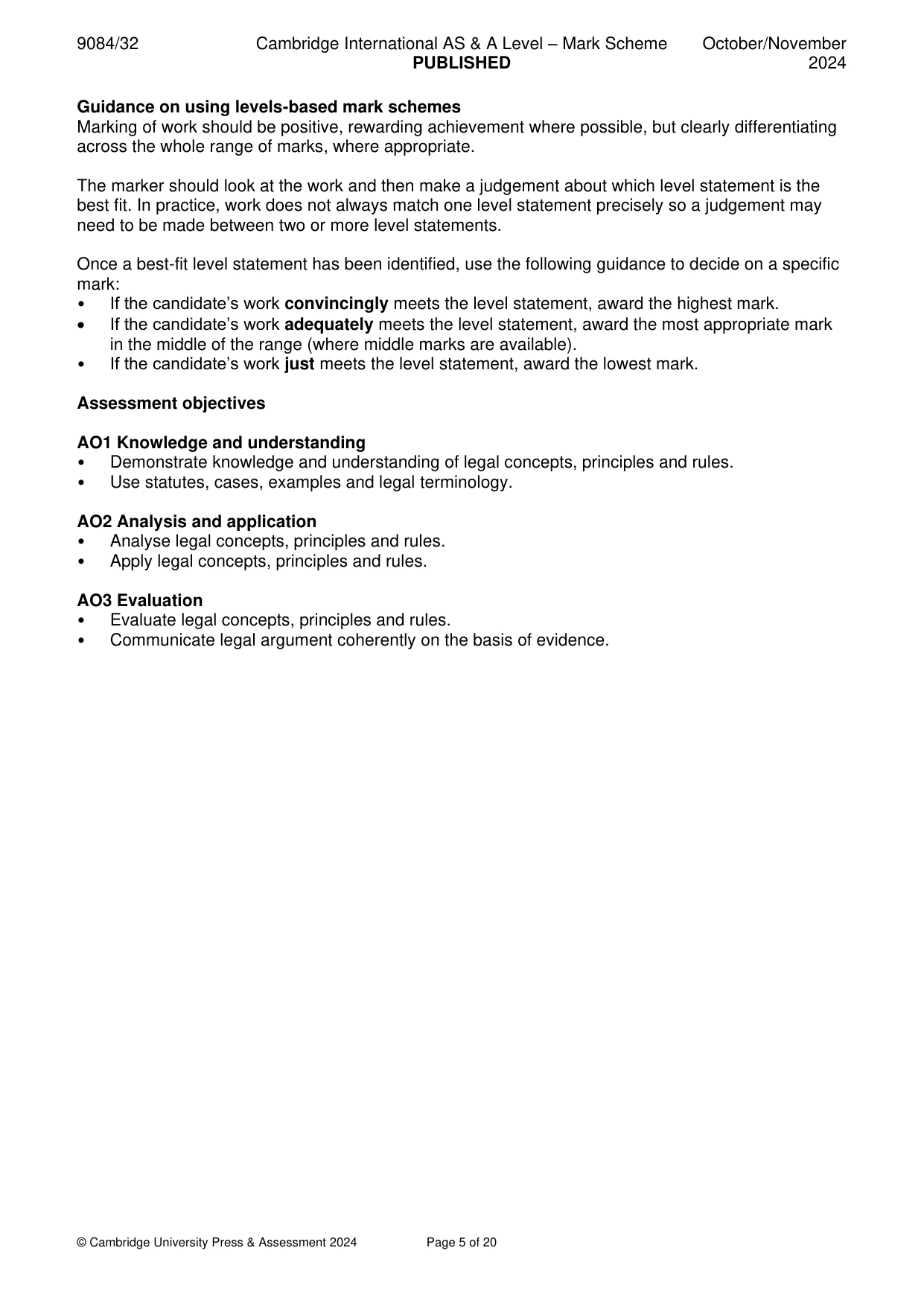
9084/32 Cambridge International AS & A Level – Mark Scheme PUBLISHED October/November 2024 © Cambridge University Press & Assessment 2024 Page 5 of 20 Guidance on using levels-based mark schemes Marking of work should be positive, rewarding achievement where possible, but clearly differentiating across the whole range of marks, where appropriate. The marker should look at the work and then make a judgement about which level statement is the best fit. In practice, work does not always match one level statement precisely so a judgement may need to be made between two or more level statements. Once a best-fit level statement has been identified, use the following guidance to decide on a specific mark: • If the candidate’s work convincingly meets the level statement, award the highest mark. • If the candidate’s work adequately meets the level statement, award the most appropriate mark in the middle of the range (where middle marks are available). • If the candidate’s work just meets the level statement, award the lowest mark. Assessment objectives AO1 Knowledge and understanding • Demonstrate knowledge and understanding of legal concepts, principles and rules. • Use statutes, cases, examples and legal terminology. AO2 Analysis and application • Analyse legal concepts, principles and rules. • Apply legal concepts, principles and rules. AO3 Evaluation • Evaluate legal concepts, principles and rules. • Communicate legal argument coherently on the basis of evidence.
Mark scheme, page 6
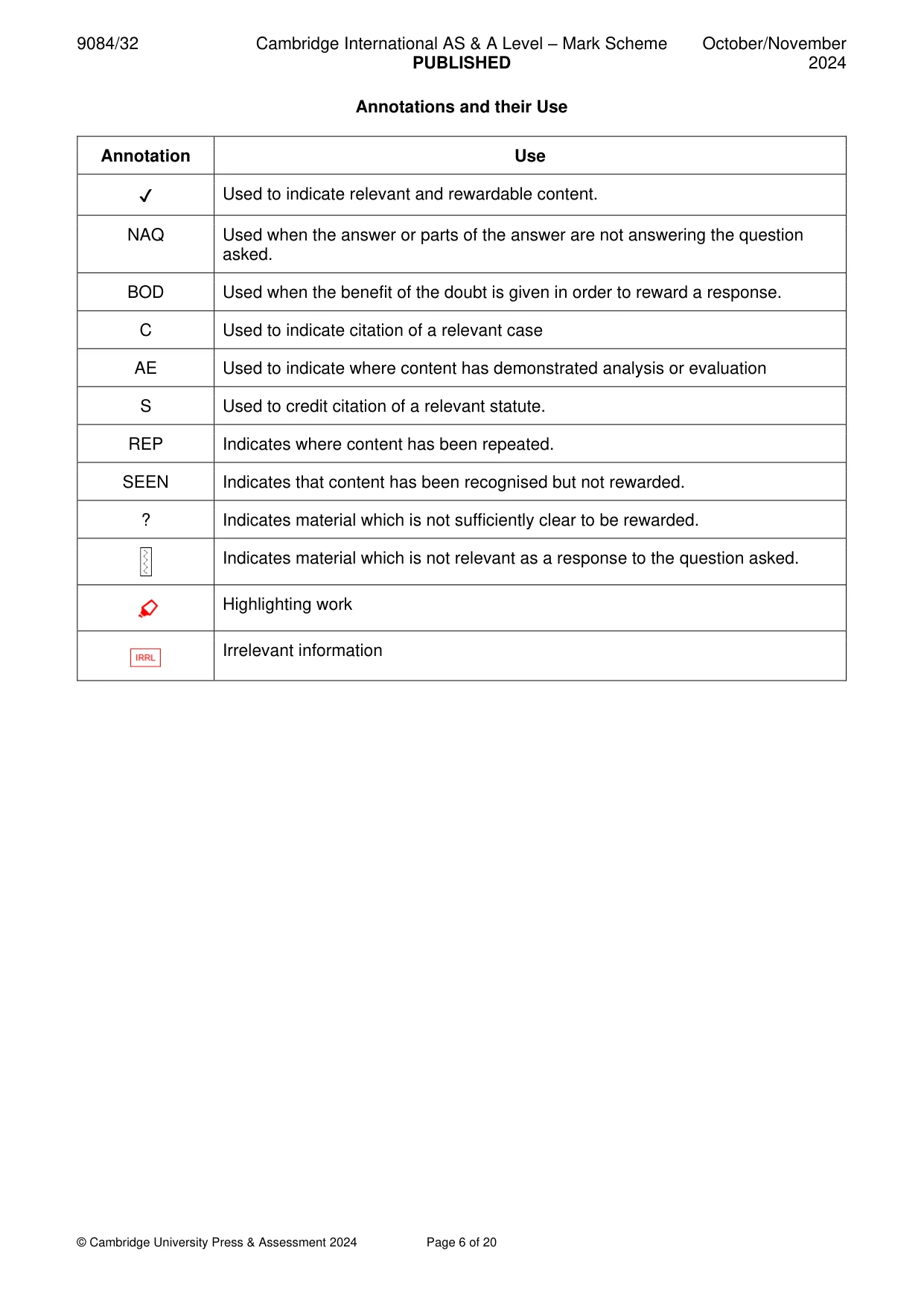
9084/32 Cambridge International AS & A Level – Mark Scheme PUBLISHED October/November 2024 © Cambridge University Press & Assessment 2024 Page 6 of 20 Annotations and their Use Annotation Use ✔ Used to indicate relevant and rewardable content. NAQ Used when the answer or parts of the answer are not answering the question asked. BOD Used when the benefit of the doubt is given in order to reward a response. C Used to indicate citation of a relevant case AE Used to indicate where content has demonstrated analysis or evaluation S Used to credit citation of a relevant statute. REP Indicates where content has been repeated. SEEN Indicates that content has been recognised but not rewarded. ? Indicates material which is not sufficiently clear to be rewarded. Indicates material which is not relevant as a response to the question asked. Highlighting work Irrelevant information
Mark scheme, page 7
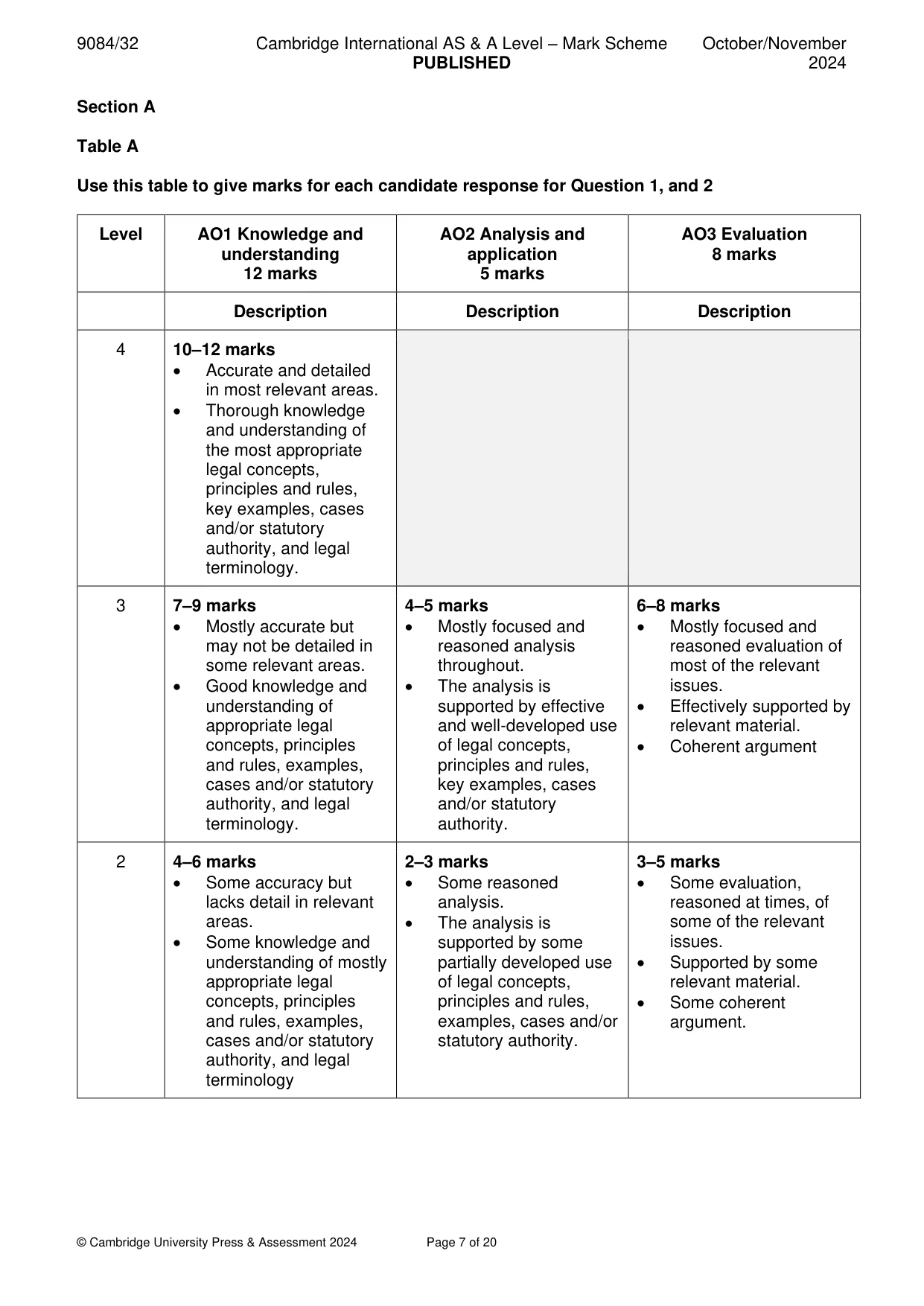
9084/32 Cambridge International AS & A Level – Mark Scheme PUBLISHED October/November 2024 © Cambridge University Press & Assessment 2024 Page 7 of 20 Section A Table A Use this table to give marks for each candidate response for Question 1, and 2 Level AO1 Knowledge and understanding 12 marks AO2 Analysis and application 5 marks AO3 Evaluation 8 marks Description Description Description 4 10–12 marks • Accurate and detailed in most relevant areas. • Thorough knowledge and understanding of the most appropriate legal concepts, principles and rules, key examples, cases and/or statutory authority, and legal terminology. 3 7–9 marks • Mostly accurate but may not be detailed in some relevant areas. • Good knowledge and understanding of appropriate legal concepts, principles and rules, examples, cases and/or statutory authority, and legal terminology. 4–5 marks • Mostly focused and reasoned analysis throughout. • The analysis is supported by effective and well-developed use of legal concepts, principles and rules, key examples, cases and/or statutory authority. 6–8 marks • Mostly focused and reasoned evaluation of most of the relevant issues. • Effectively supported by relevant material. • Coherent argument 2 4–6 marks • Some accuracy but lacks detail in relevant areas. • Some knowledge and understanding of mostly appropriate legal concepts, principles and rules, examples, cases and/or statutory authority, and legal terminology 2–3 marks • Some reasoned analysis. • The analysis is supported by some partially developed use of legal concepts, principles and rules, examples, cases and/or statutory authority. 3–5 marks • Some evaluation, reasoned at times, of some of the relevant issues. • Supported by some relevant material. • Some coherent argument.
Mark scheme, page 8
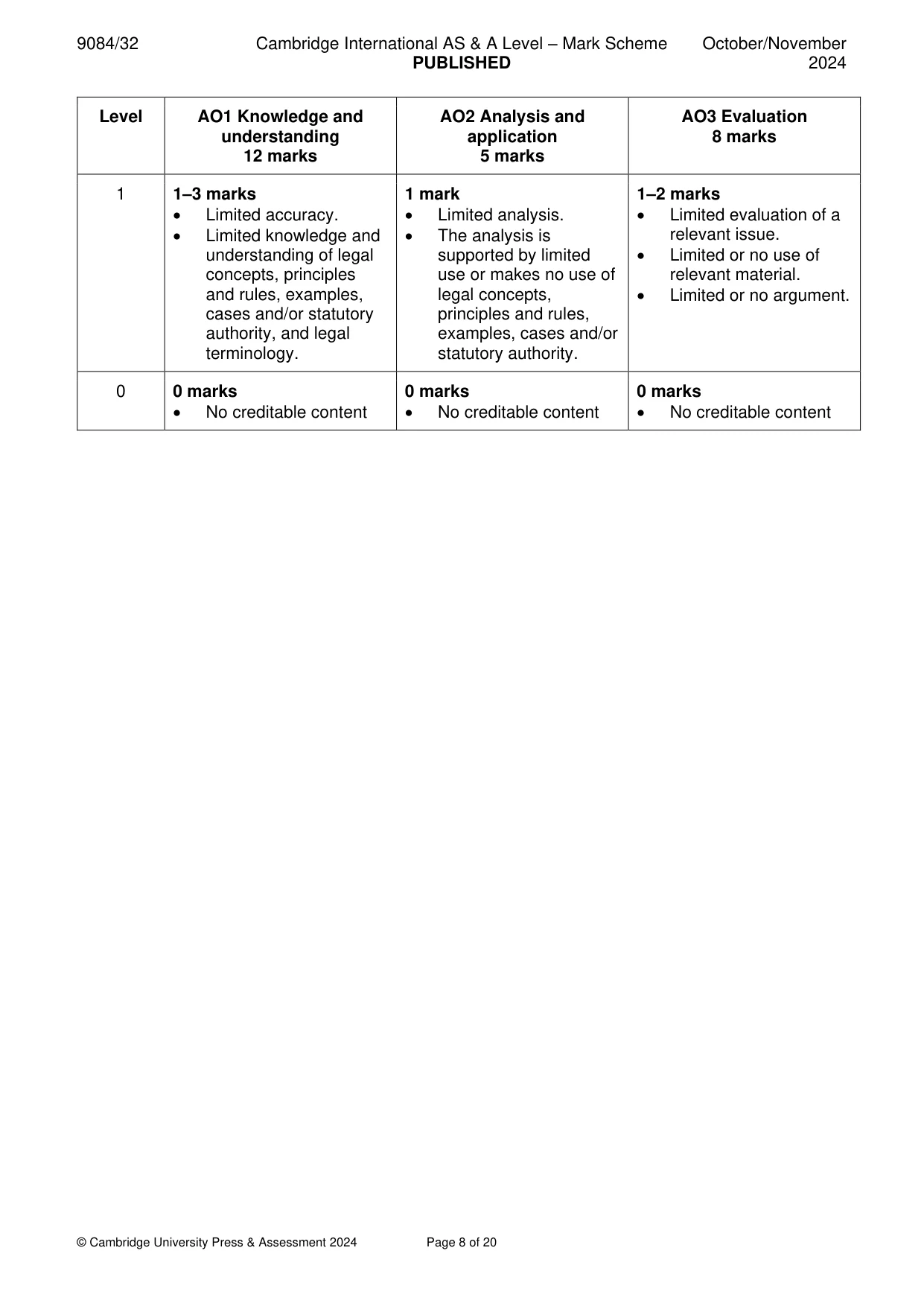
9084/32 Cambridge International AS & A Level – Mark Scheme PUBLISHED October/November 2024 © Cambridge University Press & Assessment 2024 Page 8 of 20 Level AO1 Knowledge and understanding 12 marks AO2 Analysis and application 5 marks AO3 Evaluation 8 marks 1 1–3 marks • Limited accuracy. • Limited knowledge and understanding of legal concepts, principles and rules, examples, cases and/or statutory authority, and legal terminology. 1 mark • Limited analysis. • The analysis is supported by limited use or makes no use of legal concepts, principles and rules, examples, cases and/or statutory authority. 1–2 marks • Limited evaluation of a relevant issue. • Limited or no use of relevant material. • Limited or no argument. 0 0 marks • No creditable content 0 marks • No creditable content 0 marks • No creditable content
Mark scheme, page 9
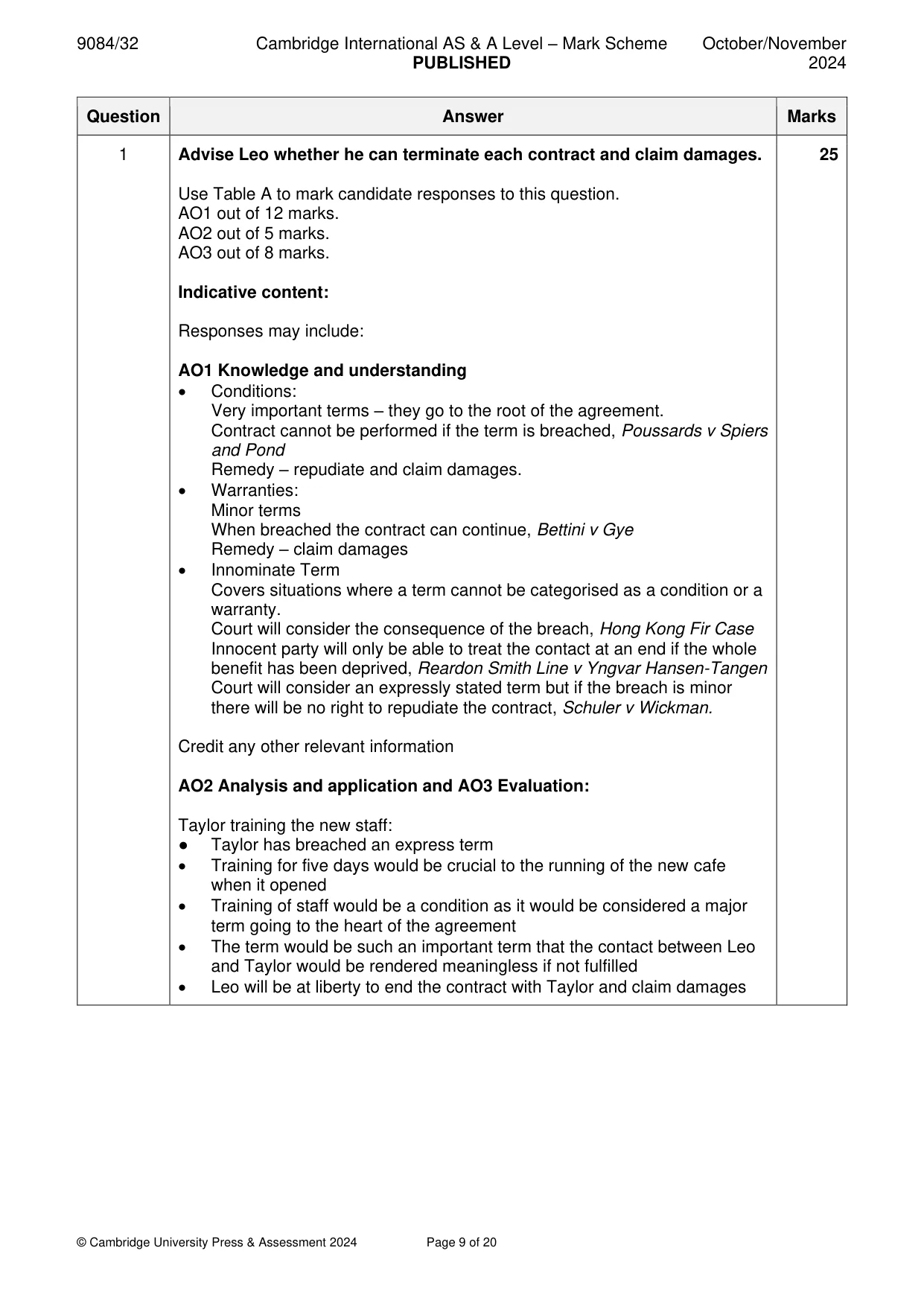
9084/32 Cambridge International AS & A Level – Mark Scheme PUBLISHED October/November 2024 © Cambridge University Press & Assessment 2024 Page 9 of 20 Question Answer Marks 1 Advise Leo whether he can terminate each contract and claim damages. Use Table A to mark candidate responses to this question. AO1 out of 12 marks. AO2 out of 5 marks. AO3 out of 8 marks. Indicative content: Responses may include: AO1 Knowledge and understanding • Conditions: Very important terms – they go to the root of the agreement. Contract cannot be performed if the term is breached, Poussards v Spiers and Pond Remedy – repudiate and claim damages. • Warranties: Minor terms When breached the contract can continue, Bettini v Gye Remedy – claim damages • Innominate Term Covers situations where a term cannot be categorised as a condition or a warranty. Court will consider the consequence of the breach, Hong Kong Fir Case Innocent party will only be able to treat the contact at an end if the whole benefit has been deprived, Reardon Smith Line v Yngvar Hansen-Tangen Court will consider an expressly stated term but if the breach is minor there will be no right to repudiate the contract, Schuler v Wickman. Credit any other relevant information AO2 Analysis and application and AO3 Evaluation: Taylor training the new staff: ● Taylor has breached an express term • Training for five days would be crucial to the running of the new cafe when it opened • Training of staff would be a condition as it would be considered a major term going to the heart of the agreement • The term would be such an important term that the contact between Leo and Taylor would be rendered meaningless if not fulfilled • Leo will be at liberty to end the contract with Taylor and claim damages 25
Mark scheme, page 10
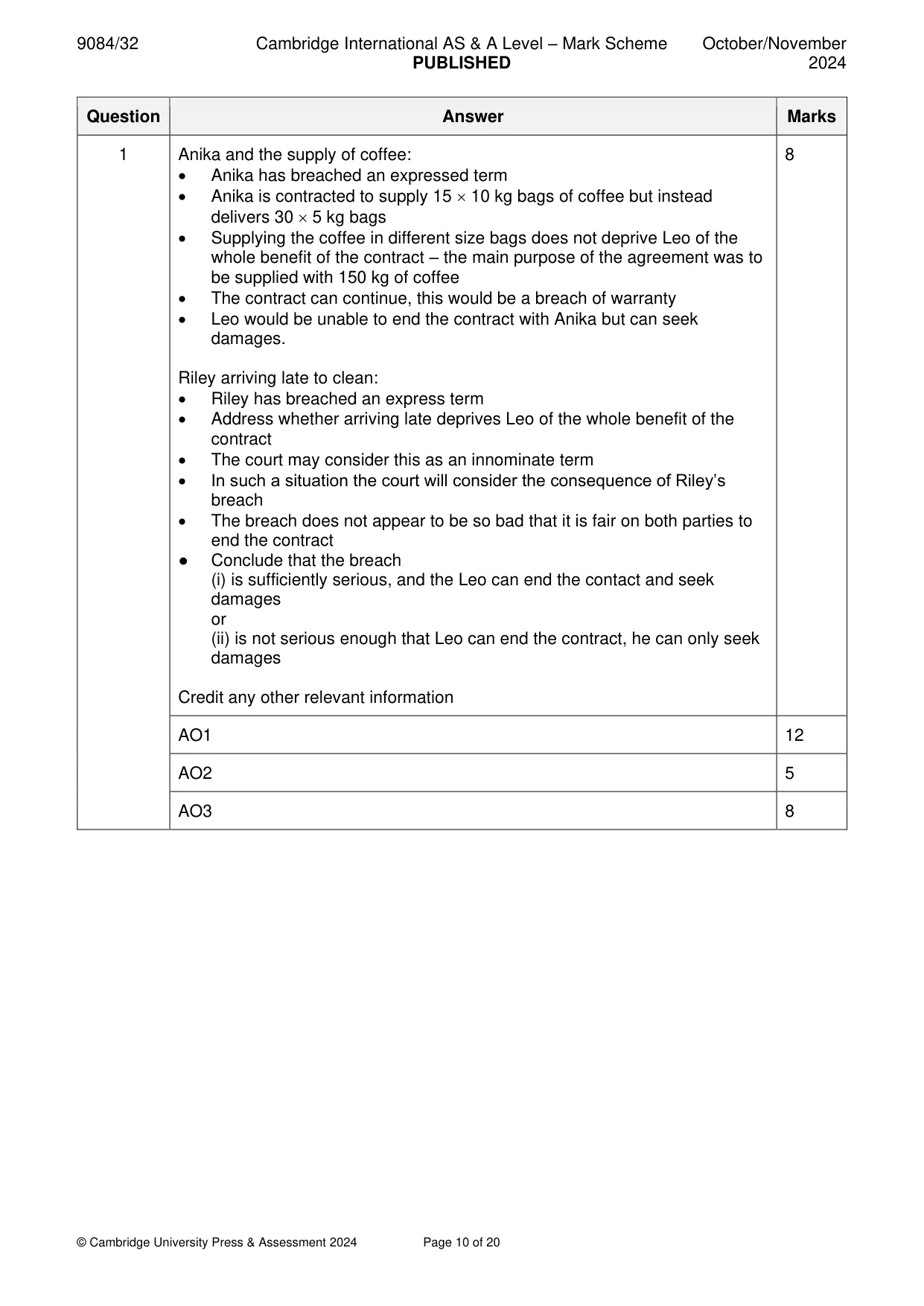
9084/32 Cambridge International AS & A Level – Mark Scheme PUBLISHED October/November 2024 © Cambridge University Press & Assessment 2024 Page 10 of 20 Question Answer Marks 1 Anika and the supply of coffee: • Anika has breached an expressed term • Anika is contracted to supply 15 10 kg bags of coffee but instead delivers 30 5 kg bags • Supplying the coffee in different size bags does not deprive Leo of the whole benefit of the contract – the main purpose of the agreement was to be supplied with 150 kg of coffee • The contract can continue, this would be a breach of warranty • Leo would be unable to end the contract with Anika but can seek damages. Riley arriving late to clean: • Riley has breached an express term • Address whether arriving late deprives Leo of the whole benefit of the contract • The court may consider this as an innominate term • In such a situation the court will consider the consequence of Riley’s breach • The breach does not appear to be so bad that it is fair on both parties to end the contract ● Conclude that the breach (i) is sufficiently serious, and the Leo can end the contact and seek damages or (ii) is not serious enough that Leo can end the contract, he can only seek damages Credit any other relevant information 8 AO1 12 AO2 5 AO3 8
Mark scheme, page 11
9084/32 Cambridge International AS & A Level – Mark Scheme PUBLISHED October/November 2024 © Cambridge University Press & Assessment 2024 Page 11 of 20 Question Answer Marks 2 Advise Viktor as to his rights under the Consumer Rights Act 2015 and the remedies available to him. Use Table A to mark candidate responses to this question. AO1 out of 12 marks. AO2 out of 5 marks. AO3 out of 8 marks. Indicative content: Responses may include: AO1 Knowledge and understanding The implied terms include Chapter 2 Goods: ● s.9 be of a satisfactory quality, Rogers v Parish ● s.10 be fit for particular purpose, Grant v Australian Knitting Mills ● s.11 goods to be as described ● s.13 goods to match the sample ● s.20 the short-term right to reject ● s.22 time limit for short-term right to reject – 30 days ● S.23 the right to repair or replacement ● S.24 the right to a price reduction or the final right to reject • s45 right to refund within 14 days from the day trader agrees that the consumer is entitled to a refund. Credit any other relevant information including reference to Chapter 3 CRA and digital content AO2 Analysis and application and AO3 Evaluation: ● 23(3) XYZ Electronic Store is a trader ● S2(3) Victor is a consumer Computer with internal DVD drive: ● S2(8) a computer will be considered goods ● S10 the computer is not fit for a particular purpose ● S11 the computer is not as described – internal DVD drive was missing ● S20 relates to the short-term right to reject • XYZ are obliged to give Viktor a full refund as he returns the computer within the required 30 days and made it clear he was rejecting it. 25
Mark scheme, page 12
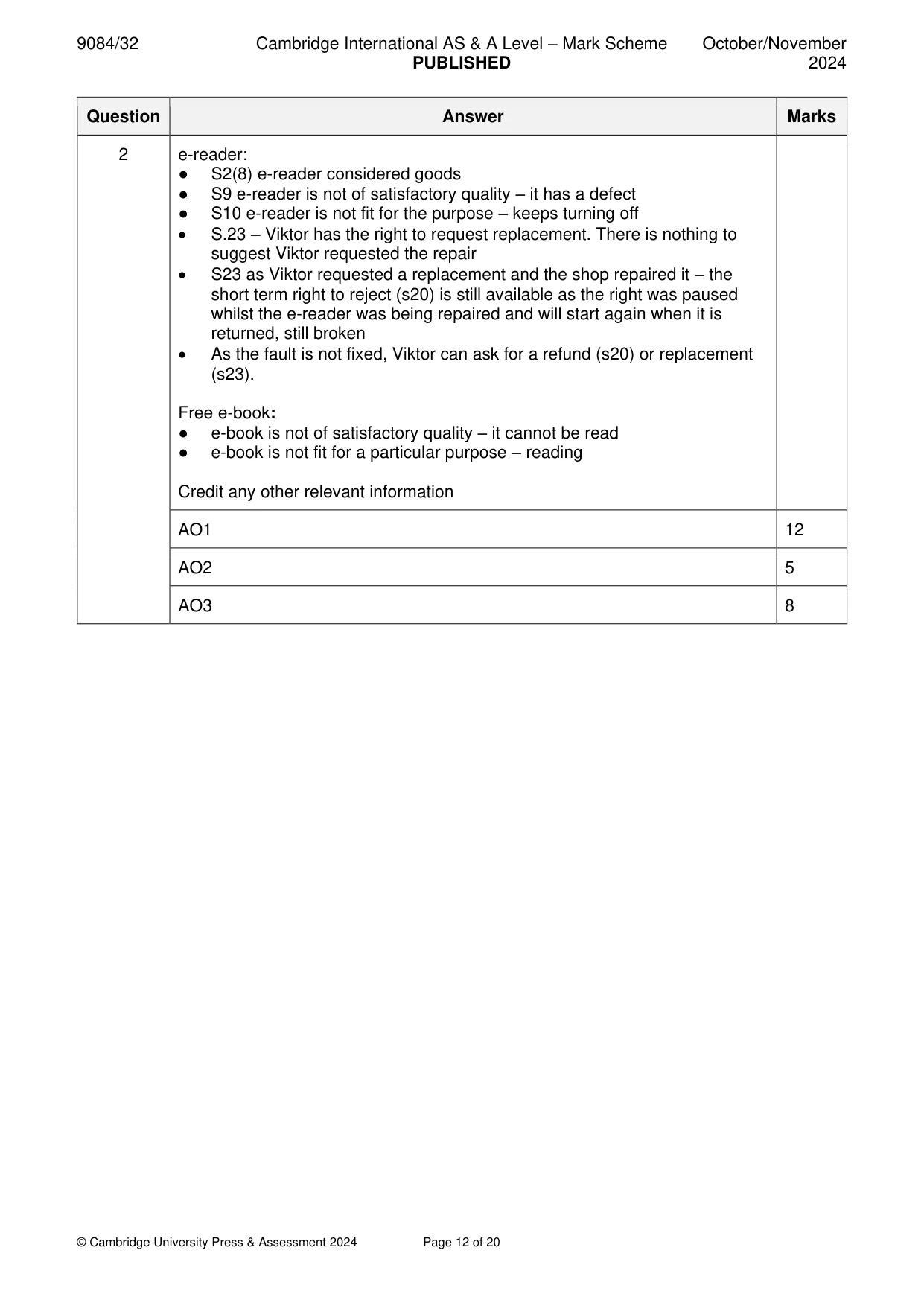
9084/32 Cambridge International AS & A Level – Mark Scheme PUBLISHED October/November 2024 © Cambridge University Press & Assessment 2024 Page 12 of 20 Question Answer Marks 2 e-reader: ● S2(8) e-reader considered goods ● S9 e-reader is not of satisfactory quality – it has a defect ● S10 e-reader is not fit for the purpose – keeps turning off • S.23 – Viktor has the right to request replacement. There is nothing to suggest Viktor requested the repair • S23 as Viktor requested a replacement and the shop repaired it – the short term right to reject (s20) is still available as the right was paused whilst the e-reader was being repaired and will start again when it is returned, still broken • As the fault is not fixed, Viktor can ask for a refund (s20) or replacement (s23). Free e-book: ● e-book is not of satisfactory quality – it cannot be read ● e-book is not fit for a particular purpose – reading Credit any other relevant information AO1 12 AO2 5 AO3 8
Mark scheme, page 13
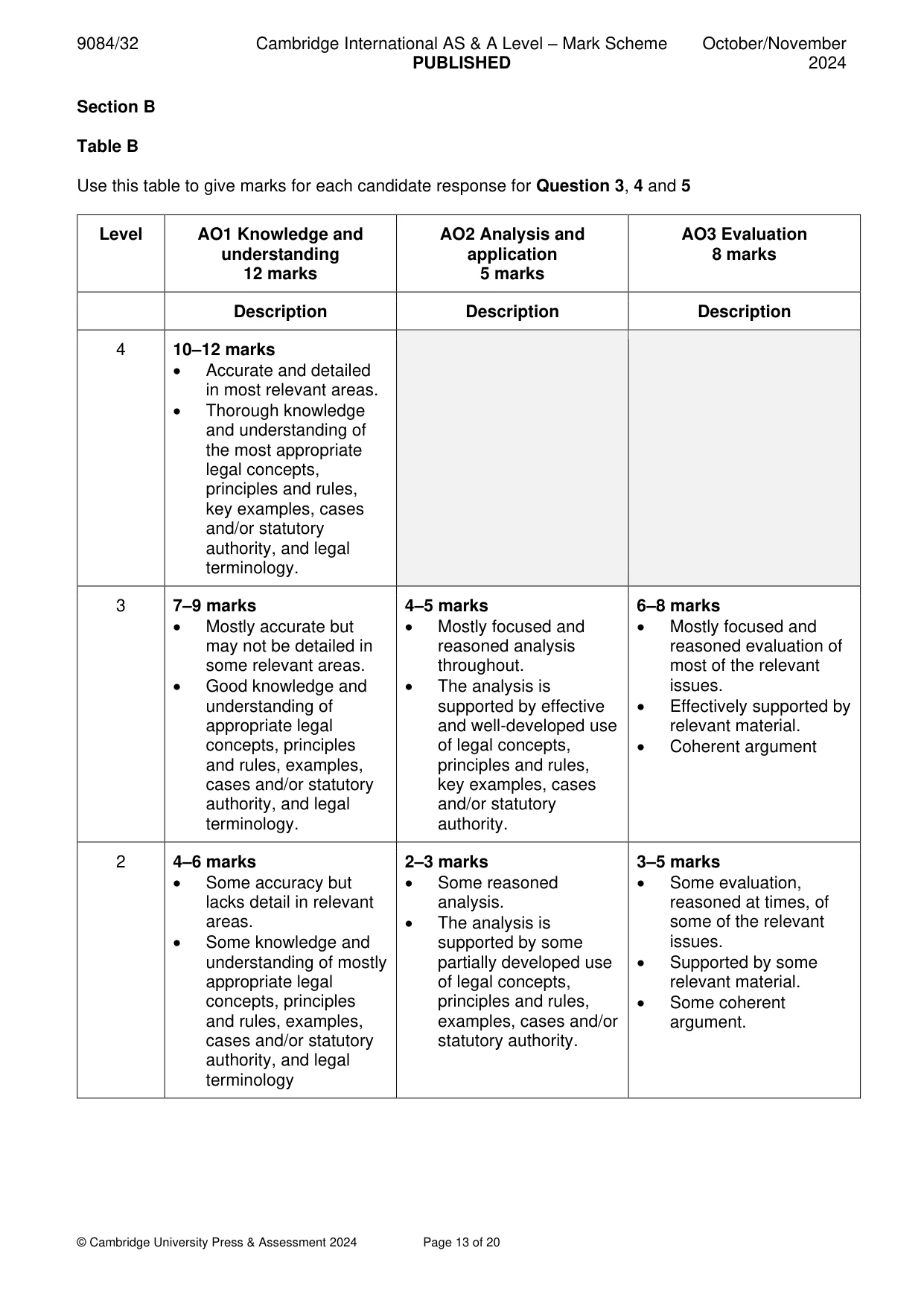
9084/32 Cambridge International AS & A Level – Mark Scheme PUBLISHED October/November 2024 © Cambridge University Press & Assessment 2024 Page 13 of 20 Section B Table B Use this table to give marks for each candidate response for Question 3, 4 and 5 Level AO1 Knowledge and understanding 12 marks AO2 Analysis and application 5 marks AO3 Evaluation 8 marks Description Description Description 4 10–12 marks • Accurate and detailed in most relevant areas. • Thorough knowledge and understanding of the most appropriate legal concepts, principles and rules, key examples, cases and/or statutory authority, and legal terminology. 3 7–9 marks • Mostly accurate but may not be detailed in some relevant areas. • Good knowledge and understanding of appropriate legal concepts, principles and rules, examples, cases and/or statutory authority, and legal terminology. 4–5 marks • Mostly focused and reasoned analysis throughout. • The analysis is supported by effective and well-developed use of legal concepts, principles and rules, key examples, cases and/or statutory authority. 6–8 marks • Mostly focused and reasoned evaluation of most of the relevant issues. • Effectively supported by relevant material. • Coherent argument 2 4–6 marks • Some accuracy but lacks detail in relevant areas. • Some knowledge and understanding of mostly appropriate legal concepts, principles and rules, examples, cases and/or statutory authority, and legal terminology 2–3 marks • Some reasoned analysis. • The analysis is supported by some partially developed use of legal concepts, principles and rules, examples, cases and/or statutory authority. 3–5 marks • Some evaluation, reasoned at times, of some of the relevant issues. • Supported by some relevant material. • Some coherent argument.
Mark scheme, page 14
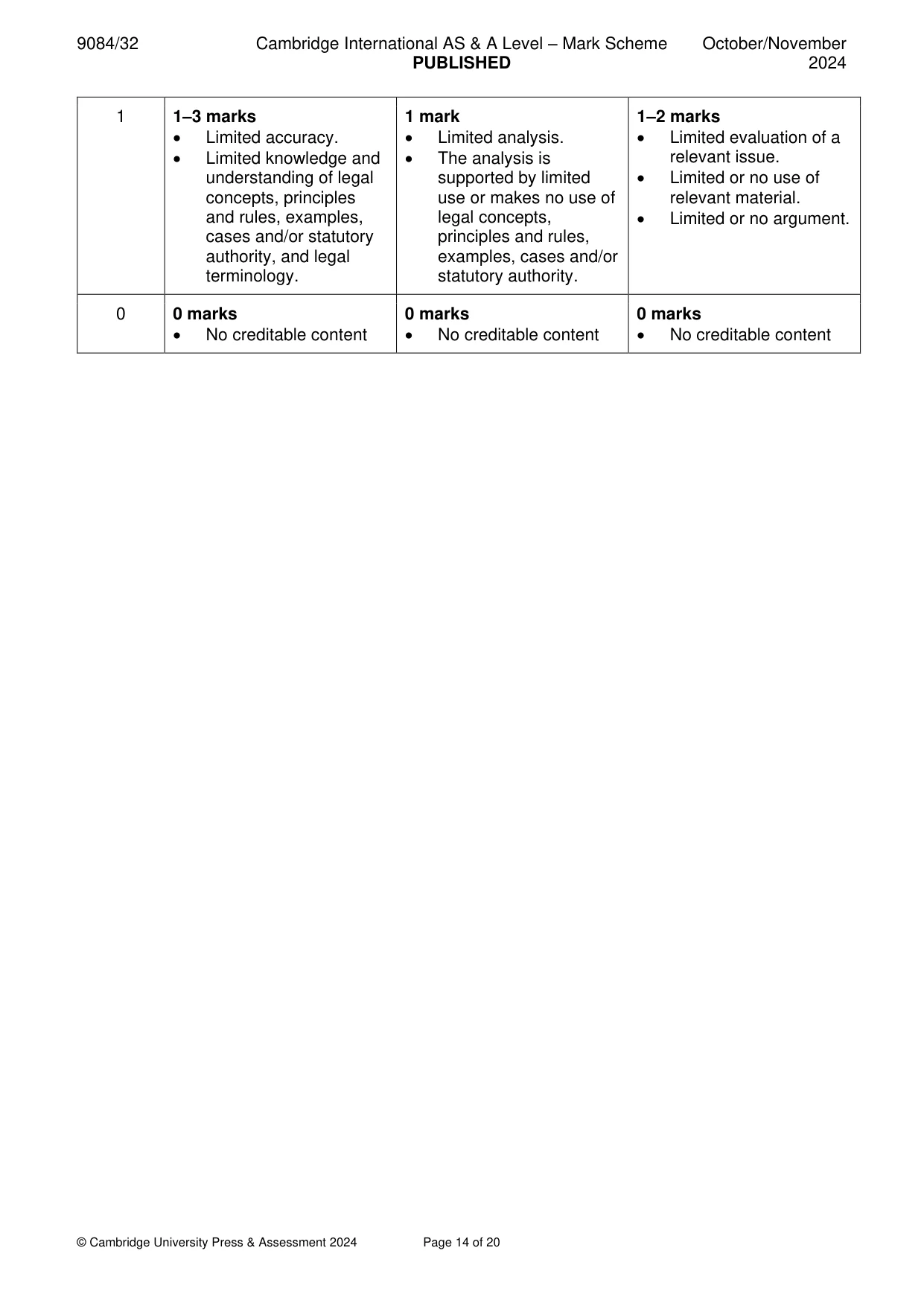
9084/32 Cambridge International AS & A Level – Mark Scheme PUBLISHED October/November 2024 © Cambridge University Press & Assessment 2024 Page 14 of 20 1 1–3 marks • Limited accuracy. • Limited knowledge and understanding of legal concepts, principles and rules, examples, cases and/or statutory authority, and legal terminology. 1 mark • Limited analysis. • The analysis is supported by limited use or makes no use of legal concepts, principles and rules, examples, cases and/or statutory authority. 1–2 marks • Limited evaluation of a relevant issue. • Limited or no use of relevant material. • Limited or no argument. 0 0 marks • No creditable content 0 marks • No creditable content 0 marks • No creditable content
Mark scheme, page 15
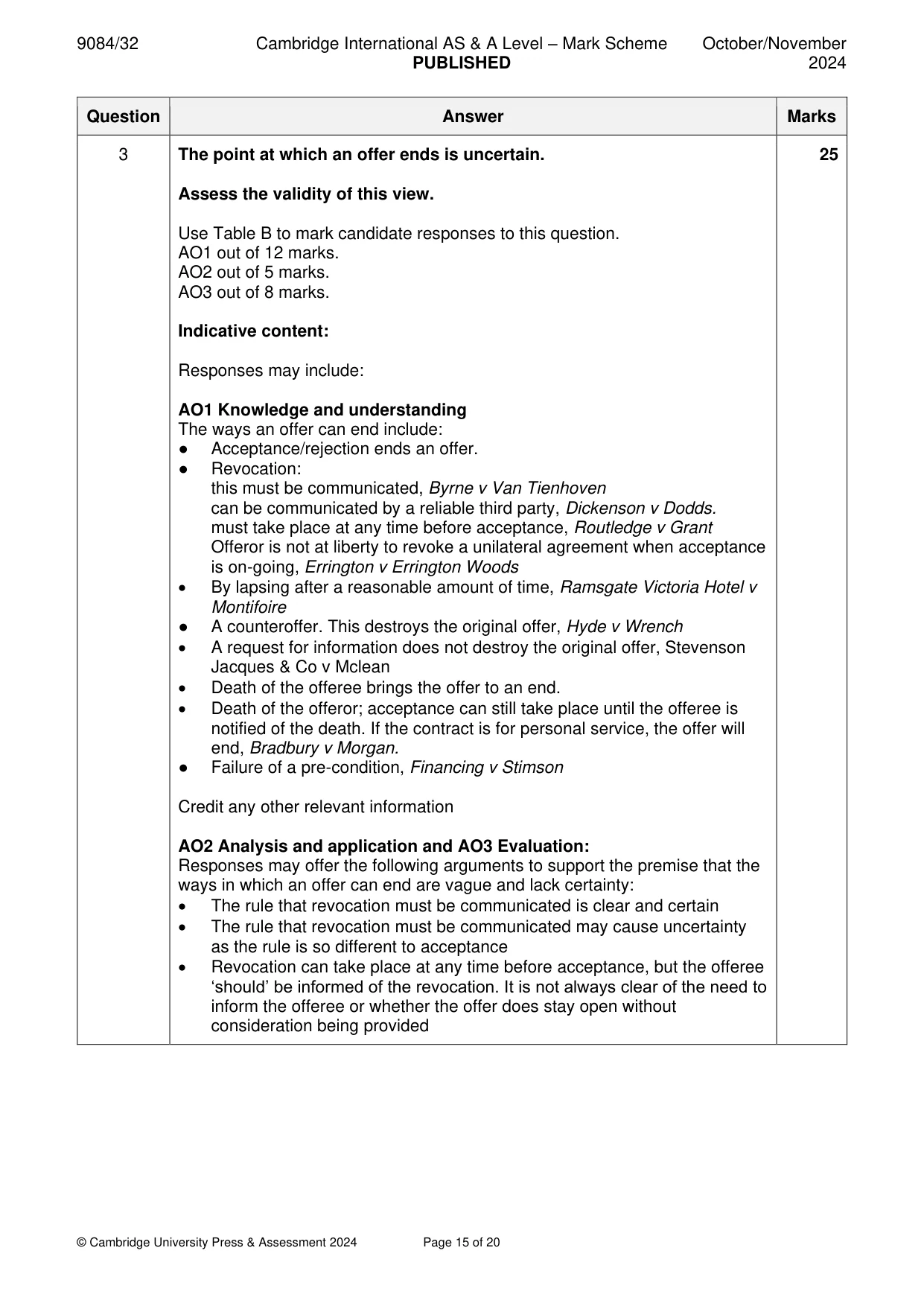
9084/32 Cambridge International AS & A Level – Mark Scheme PUBLISHED October/November 2024 © Cambridge University Press & Assessment 2024 Page 15 of 20 Question Answer Marks 3 The point at which an offer ends is uncertain. Assess the validity of this view. Use Table B to mark candidate responses to this question. AO1 out of 12 marks. AO2 out of 5 marks. AO3 out of 8 marks. Indicative content: Responses may include: AO1 Knowledge and understanding The ways an offer can end include: ● Acceptance/rejection ends an offer. ● Revocation: this must be communicated, Byrne v Van Tienhoven can be communicated by a reliable third party, Dickenson v Dodds. must take place at any time before acceptance, Routledge v Grant Offeror is not at liberty to revoke a unilateral agreement when acceptance is on-going, Errington v Errington Woods • By lapsing after a reasonable amount of time, Ramsgate Victoria Hotel v Montifoire ● A counteroffer. This destroys the original offer, Hyde v Wrench • A request for information does not destroy the original offer, Stevenson Jacques & Co v Mclean • Death of the offeree brings the offer to an end. • Death of the offeror; acceptance can still take place until the offeree is notified of the death. If the contract is for personal service, the offer will end, Bradbury v Morgan. ● Failure of a pre-condition, Financing v Stimson Credit any other relevant information AO2 Analysis and application and AO3 Evaluation: Responses may offer the following arguments to support the premise that the ways in which an offer can end are vague and lack certainty: • The rule that revocation must be communicated is clear and certain • The rule that revocation must be communicated may cause uncertainty as the rule is so different to acceptance • Revocation can take place at any time before acceptance, but the offeree ‘should’ be informed of the revocation. It is not always clear of the need to inform the offeree or whether the offer does stay open without consideration being provided 25
Mark scheme, page 16
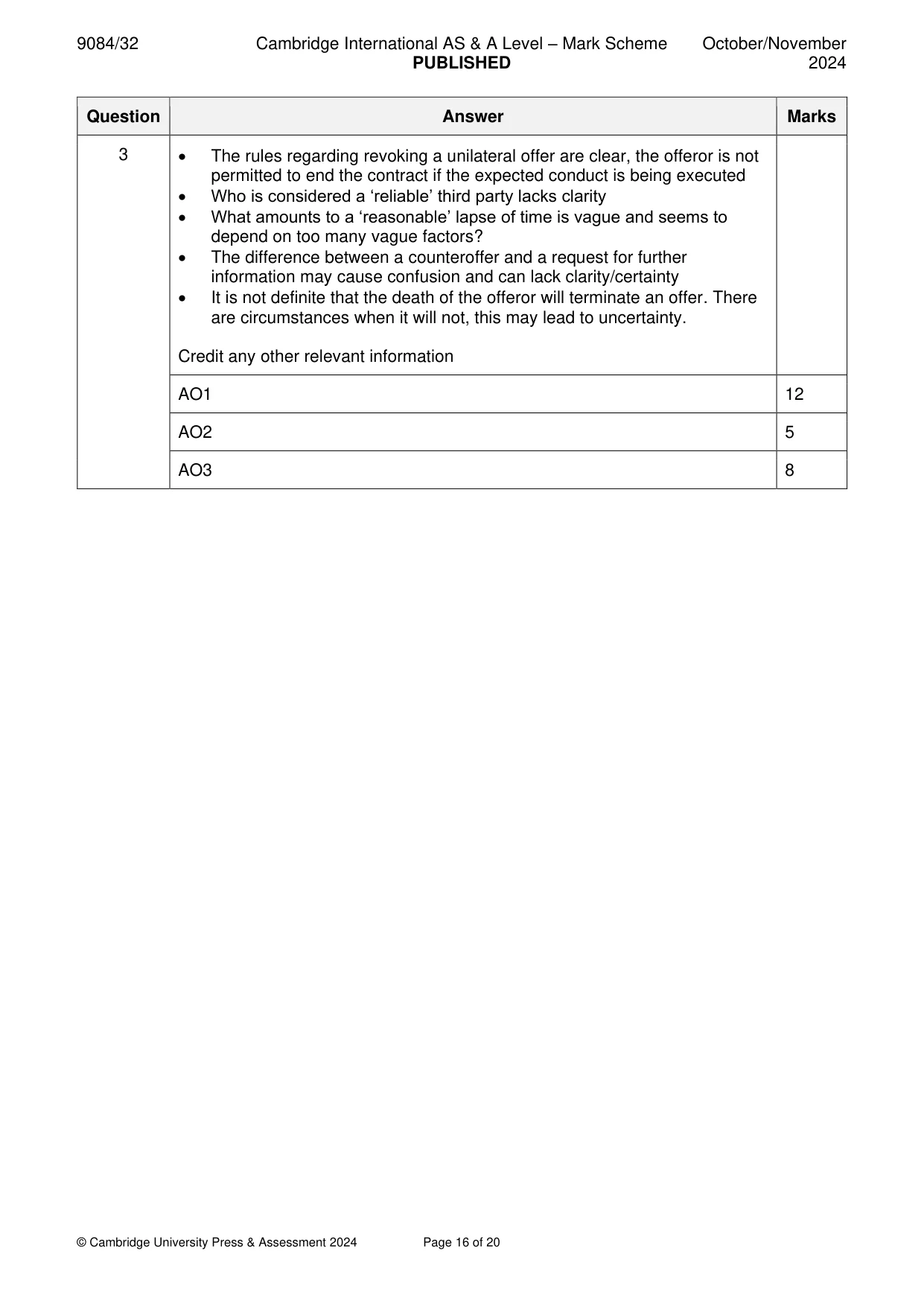
9084/32 Cambridge International AS & A Level – Mark Scheme PUBLISHED October/November 2024 © Cambridge University Press & Assessment 2024 Page 16 of 20 Question Answer Marks 3 • The rules regarding revoking a unilateral offer are clear, the offeror is not permitted to end the contract if the expected conduct is being executed • Who is considered a ‘reliable’ third party lacks clarity • What amounts to a ‘reasonable’ lapse of time is vague and seems to depend on too many vague factors? • The difference between a counteroffer and a request for further information may cause confusion and can lack clarity/certainty • It is not definite that the death of the offeror will terminate an offer. There are circumstances when it will not, this may lead to uncertainty. Credit any other relevant information AO1 12 AO2 5 AO3 8
Mark scheme, page 17
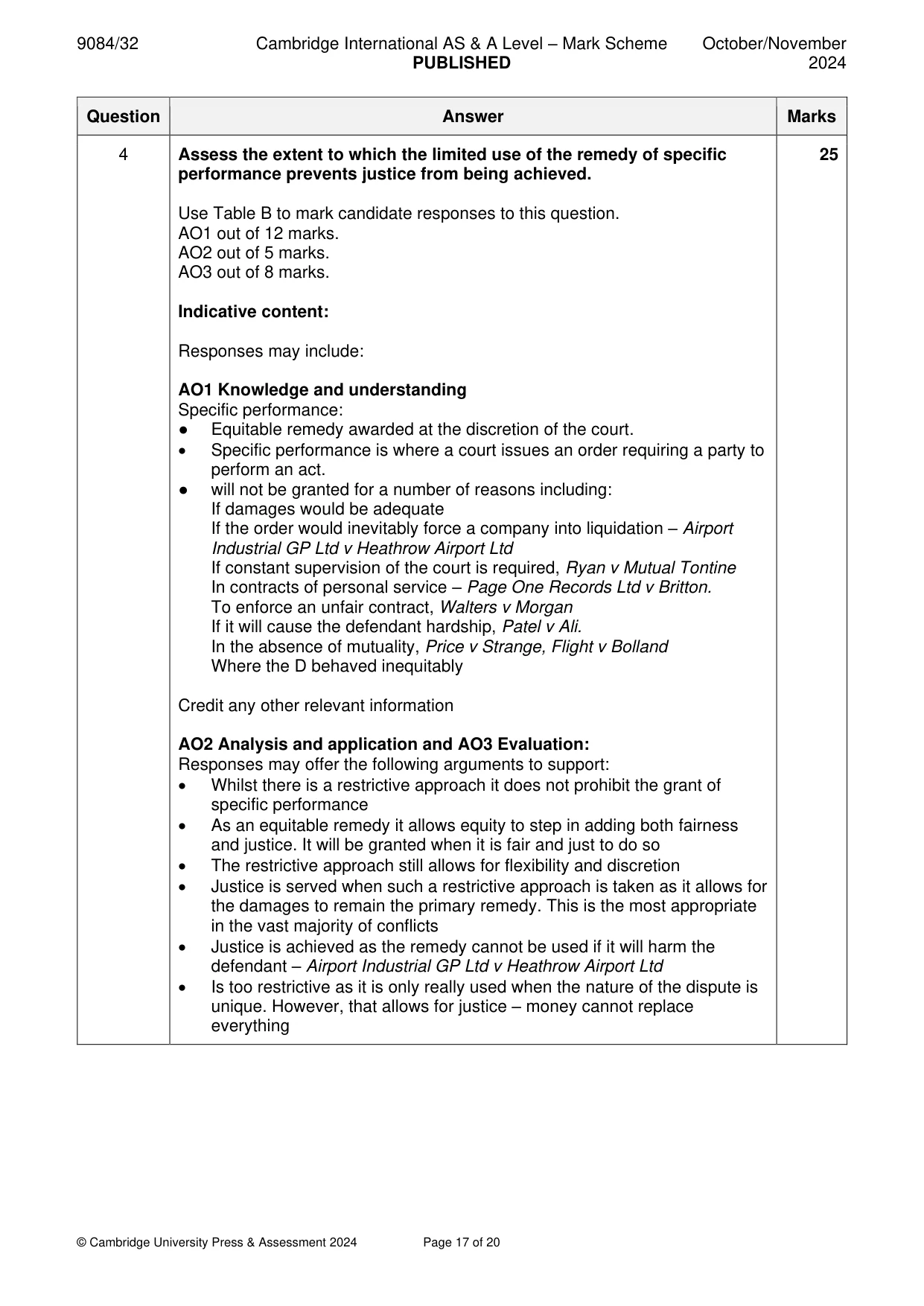
9084/32 Cambridge International AS & A Level – Mark Scheme PUBLISHED October/November 2024 © Cambridge University Press & Assessment 2024 Page 17 of 20 Question Answer Marks 4 Assess the extent to which the limited use of the remedy of specific performance prevents justice from being achieved. Use Table B to mark candidate responses to this question. AO1 out of 12 marks. AO2 out of 5 marks. AO3 out of 8 marks. Indicative content: Responses may include: AO1 Knowledge and understanding Specific performance: ● Equitable remedy awarded at the discretion of the court. • Specific performance is where a court issues an order requiring a party to perform an act. ● will not be granted for a number of reasons including: If damages would be adequate If the order would inevitably force a company into liquidation – Airport Industrial GP Ltd v Heathrow Airport Ltd If constant supervision of the court is required, Ryan v Mutual Tontine In contracts of personal service – Page One Records Ltd v Britton. To enforce an unfair contract, Walters v Morgan If it will cause the defendant hardship, Patel v Ali. In the absence of mutuality, Price v Strange, Flight v Bolland Where the D behaved inequitably Credit any other relevant information AO2 Analysis and application and AO3 Evaluation: Responses may offer the following arguments to support: • Whilst there is a restrictive approach it does not prohibit the grant of specific performance • As an equitable remedy it allows equity to step in adding both fairness and justice. It will be granted when it is fair and just to do so • The restrictive approach still allows for flexibility and discretion • Justice is served when such a restrictive approach is taken as it allows for the damages to remain the primary remedy. This is the most appropriate in the vast majority of conflicts • Justice is achieved as the remedy cannot be used if it will harm the defendant – Airport Industrial GP Ltd v Heathrow Airport Ltd • Is too restrictive as it is only really used when the nature of the dispute is unique. However, that allows for justice – money cannot replace everything 25
Mark scheme, page 18
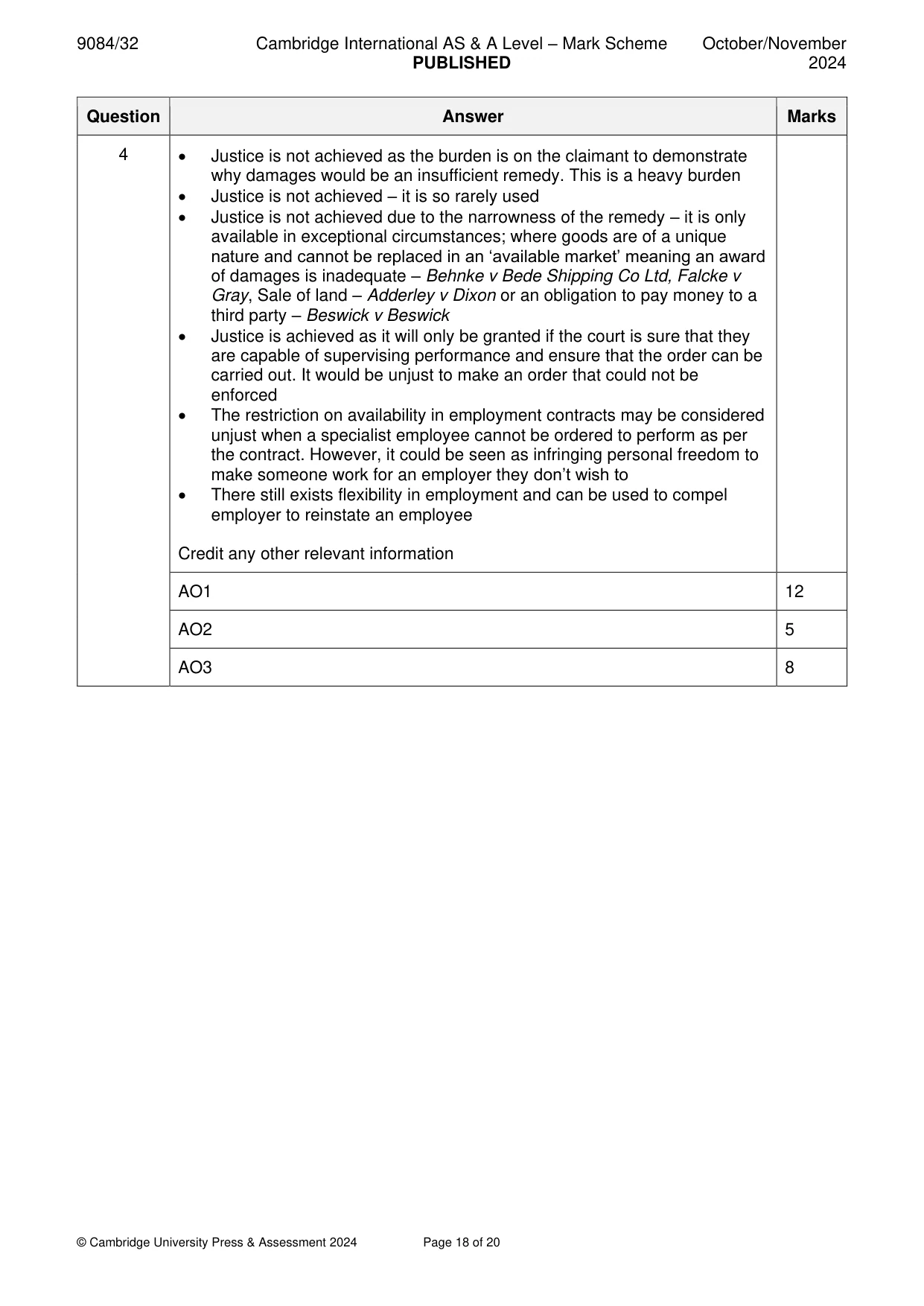
9084/32 Cambridge International AS & A Level – Mark Scheme PUBLISHED October/November 2024 © Cambridge University Press & Assessment 2024 Page 18 of 20 Question Answer Marks 4 • Justice is not achieved as the burden is on the claimant to demonstrate why damages would be an insufficient remedy. This is a heavy burden • Justice is not achieved – it is so rarely used • Justice is not achieved due to the narrowness of the remedy – it is only available in exceptional circumstances; where goods are of a unique nature and cannot be replaced in an ‘available market’ meaning an award of damages is inadequate – Behnke v Bede Shipping Co Ltd, Falcke v Gray, Sale of land – Adderley v Dixon or an obligation to pay money to a third party – Beswick v Beswick • Justice is achieved as it will only be granted if the court is sure that they are capable of supervising performance and ensure that the order can be carried out. It would be unjust to make an order that could not be enforced • The restriction on availability in employment contracts may be considered unjust when a specialist employee cannot be ordered to perform as per the contract. However, it could be seen as infringing personal freedom to make someone work for an employer they don’t wish to • There still exists flexibility in employment and can be used to compel employer to reinstate an employee Credit any other relevant information AO1 12 AO2 5 AO3 8
Mark scheme, page 19
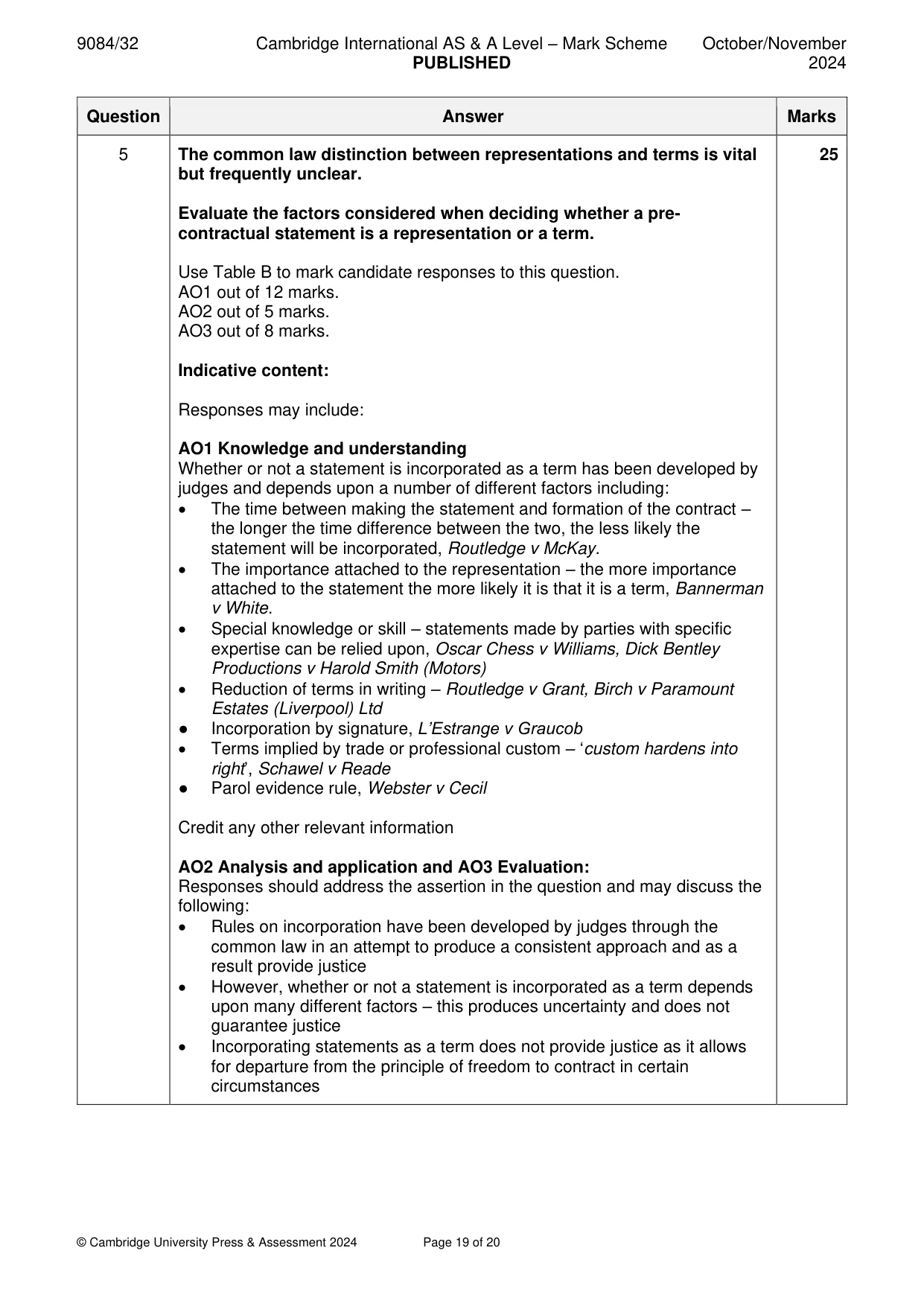
9084/32 Cambridge International AS & A Level – Mark Scheme PUBLISHED October/November 2024 © Cambridge University Press & Assessment 2024 Page 19 of 20 Question Answer Marks 5 The common law distinction between representations and terms is vital but frequently unclear. Evaluate the factors considered when deciding whether a pre- contractual statement is a representation or a term. Use Table B to mark candidate responses to this question. AO1 out of 12 marks. AO2 out of 5 marks. AO3 out of 8 marks. Indicative content: Responses may include: AO1 Knowledge and understanding Whether or not a statement is incorporated as a term has been developed by judges and depends upon a number of different factors including: • The time between making the statement and formation of the contract – the longer the time difference between the two, the less likely the statement will be incorporated, Routledge v McKay. • The importance attached to the representation – the more importance attached to the statement the more likely it is that it is a term, Bannerman v White. • Special knowledge or skill – statements made by parties with specific expertise can be relied upon, Oscar Chess v Williams, Dick Bentley Productions v Harold Smith (Motors) • Reduction of terms in writing – Routledge v Grant, Birch v Paramount Estates (Liverpool) Ltd ● Incorporation by signature, L’Estrange v Graucob • Terms implied by trade or professional custom – ‘custom hardens into right’, Schawel v Reade ● Parol evidence rule, Webster v Cecil Credit any other relevant information AO2 Analysis and application and AO3 Evaluation: Responses should address the assertion in the question and may discuss the following: • Rules on incorporation have been developed by judges through the common law in an attempt to produce a consistent approach and as a result provide justice • However, whether or not a statement is incorporated as a term depends upon many different factors – this produces uncertainty and does not guarantee justice • Incorporating statements as a term does not provide justice as it allows for departure from the principle of freedom to contract in certain circumstances 25
Mark scheme, page 20
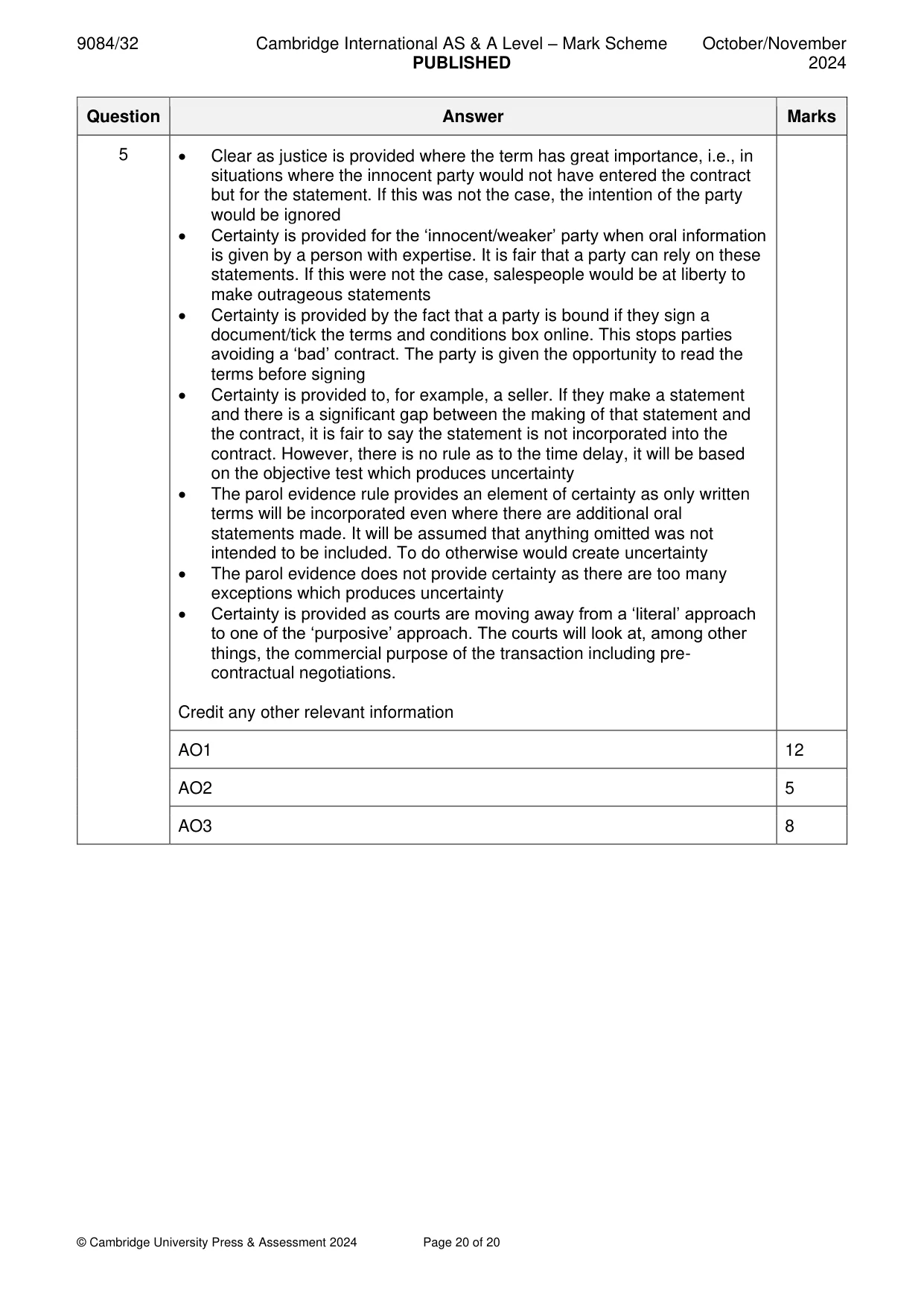
9084/32 Cambridge International AS & A Level – Mark Scheme PUBLISHED October/November 2024 © Cambridge University Press & Assessment 2024 Page 20 of 20 Question Answer Marks 5 • Clear as justice is provided where the term has great importance, i.e., in situations where the innocent party would not have entered the contract but for the statement. If this was not the case, the intention of the party would be ignored • Certainty is provided for the ‘innocent/weaker’ party when oral information is given by a person with expertise. It is fair that a party can rely on these statements. If this were not the case, salespeople would be at liberty to make outrageous statements • Certainty is provided by the fact that a party is bound if they sign a document/tick the terms and conditions box online. This stops parties avoiding a ‘bad’ contract. The party is given the opportunity to read the terms before signing • Certainty is provided to, for example, a seller. If they make a statement and there is a significant gap between the making of that statement and the contract, it is fair to say the statement is not incorporated into the contract. However, there is no rule as to the time delay, it will be based on the objective test which produces uncertainty • The parol evidence rule provides an element of certainty as only written terms will be incorporated even where there are additional oral statements made. It will be assumed that anything omitted was not intended to be included. To do otherwise would create uncertainty • The parol evidence does not provide certainty as there are too many exceptions which produces uncertainty • Certainty is provided as courts are moving away from a ‘literal’ approach to one of the ‘purposive’ approach. The courts will look at, among other things, the commercial purpose of the transaction including pre- contractual negotiations. Credit any other relevant information AO1 12 AO2 5 AO3 8
What you needed in this session
Cambridge’s own grade thresholds for 2024 Oct/Nov, Paper 3 · Variant 2. A higher threshold means an easier paper — the bar moves with how the cohort did.