Cambridge A Level Law 9084 — 2023 Oct/Nov Paper 3 · Variant 2
9084/32/O/N/23 · 75 marks · ≈84 min
The question paper and its mark scheme, free to read here and free to download. This is Cambridge’s own paper, exactly as it was sat.
Question paper4 pages

Mark scheme12 pages
Answers below. Sit the paper first if you are practising.
Paper as text
Question paper, page 1
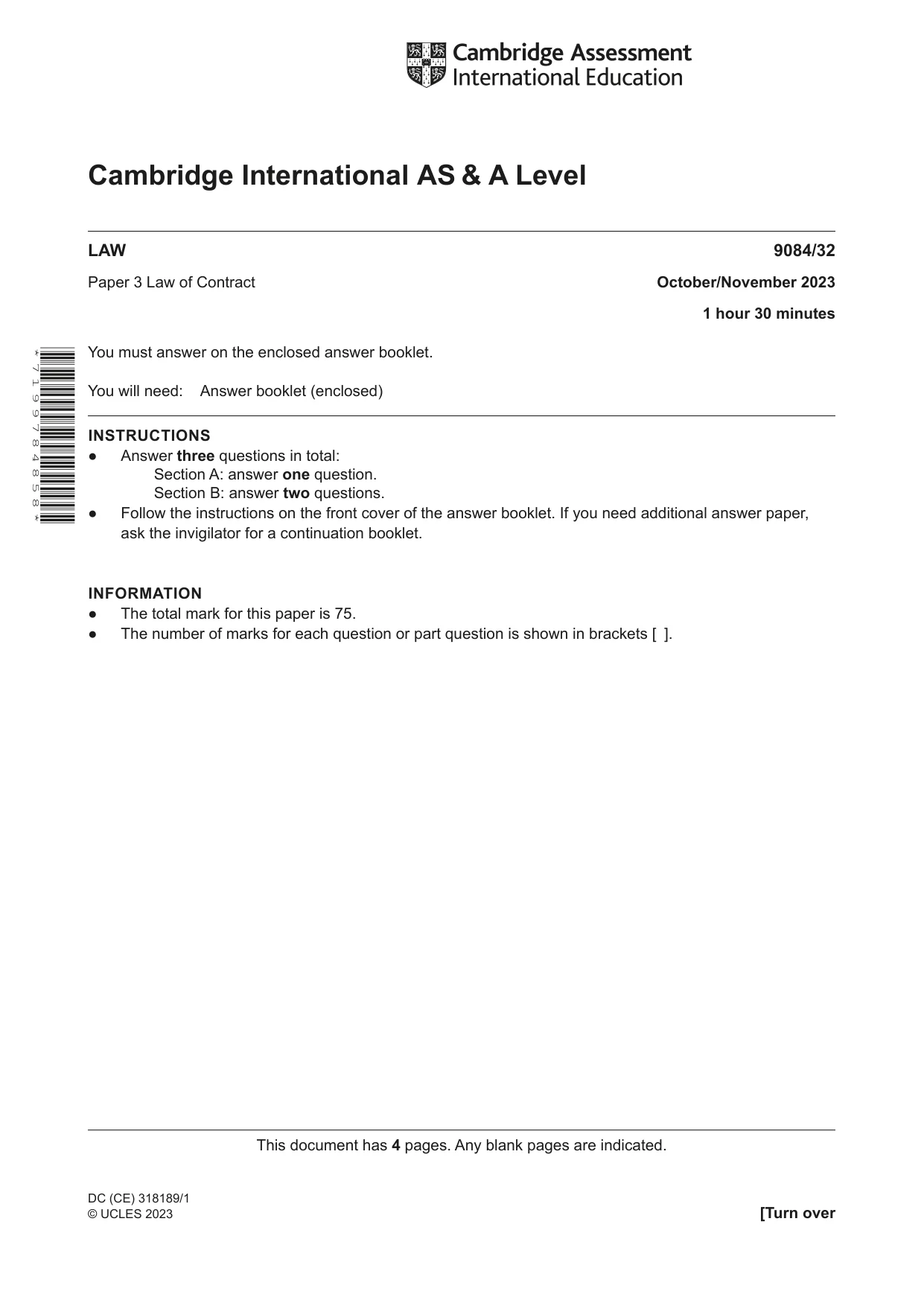
This document has 4 pages. Any blank pages are indicated. [Turn over Cambridge International AS & A Level DC (CE) 318189/1 © UCLES 2023 LAW 9084/32 Paper 3 Law of Contract October/November 2023 1 hour 30 minutes You must answer on the enclosed answer booklet. You will need: Answer booklet (enclosed) INSTRUCTIONS ● Answer three questions in total: Section A: answer one question. Section B: answer two questions. ● Follow the instructions on the front cover of the answer booklet. If you need additional answer paper, ask the invigilator for a continuation booklet. INFORMATION ● The total mark for this paper is 75. ● The number of marks for each question or part question is shown in brackets [ ]. * 7 1 9 9 7 8 4 8 5 8 *
Question paper, page 2
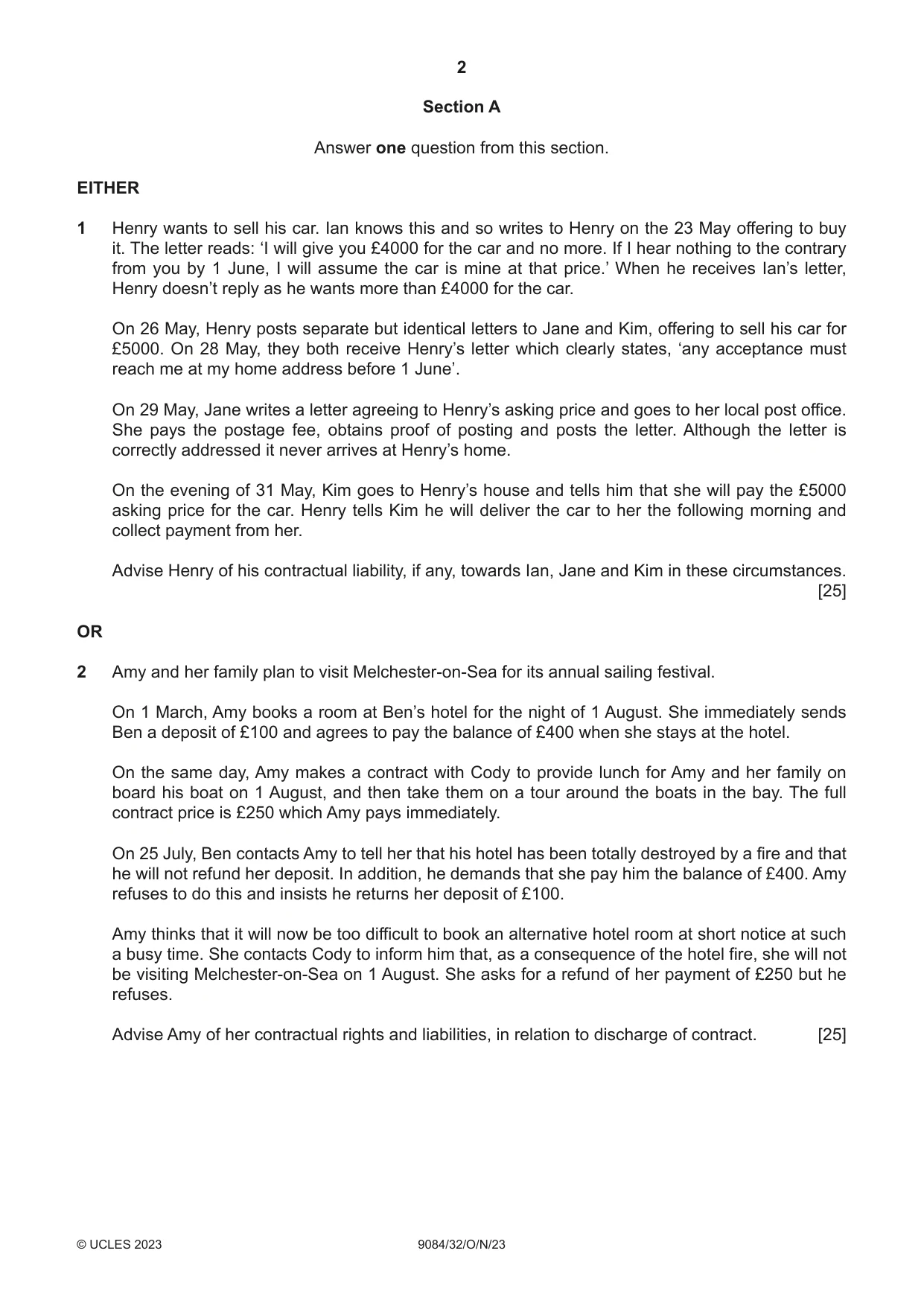
2 9084/32/O/N/23 © UCLES 2023 Section A Answer one question from this section. EITHER 1 Henry wants to sell his car. Ian knows this and so writes to Henry on the 23 May offering to buy it. The letter reads: ‘I will give you £4000 for the car and no more. If I hear nothing to the contrary from you by 1 June, I will assume the car is mine at that price.’ When he receives Ian’s letter, Henry doesn’t reply as he wants more than £4000 for the car. On 26 May, Henry posts separate but identical letters to Jane and Kim, offering to sell his car for £5000. On 28 May, they both receive Henry’s letter which clearly states, ‘any acceptance must reach me at my home address before 1 June’. On 29 May, Jane writes a letter agreeing to Henry’s asking price and goes to her local post office. She pays the postage fee, obtains proof of posting and posts the letter. Although the letter is correctly addressed it never arrives at Henry’s home. On the evening of 31 May, Kim goes to Henry’s house and tells him that she will pay the £5000 asking price for the car. Henry tells Kim he will deliver the car to her the following morning and collect payment from her. Advise Henry of his contractual liability, if any, towards Ian, Jane and Kim in these circumstances. [25] OR 2 Amy and her family plan to visit Melchester-on-Sea for its annual sailing festival. On 1 March, Amy books a room at Ben’s hotel for the night of 1 August. She immediately sends Ben a deposit of £100 and agrees to pay the balance of £400 when she stays at the hotel. On the same day, Amy makes a contract with Cody to provide lunch for Amy and her family on board his boat on 1 August, and then take them on a tour around the boats in the bay. The full contract price is £250 which Amy pays immediately. On 25 July, Ben contacts Amy to tell her that his hotel has been totally destroyed by a fire and that he will not refund her deposit. In addition, he demands that she pay him the balance of £400. Amy refuses to do this and insists he returns her deposit of £100. Amy thinks that it will now be too difficult to book an alternative hotel room at short notice at such a busy time. She contacts Cody to inform him that, as a consequence of the hotel fire, she will not be visiting Melchester-on-Sea on 1 August. She asks for a refund of her payment of £250 but he refuses. Advise Amy of her contractual rights and liabilities, in relation to discharge of contract. [25]
Question paper, page 3
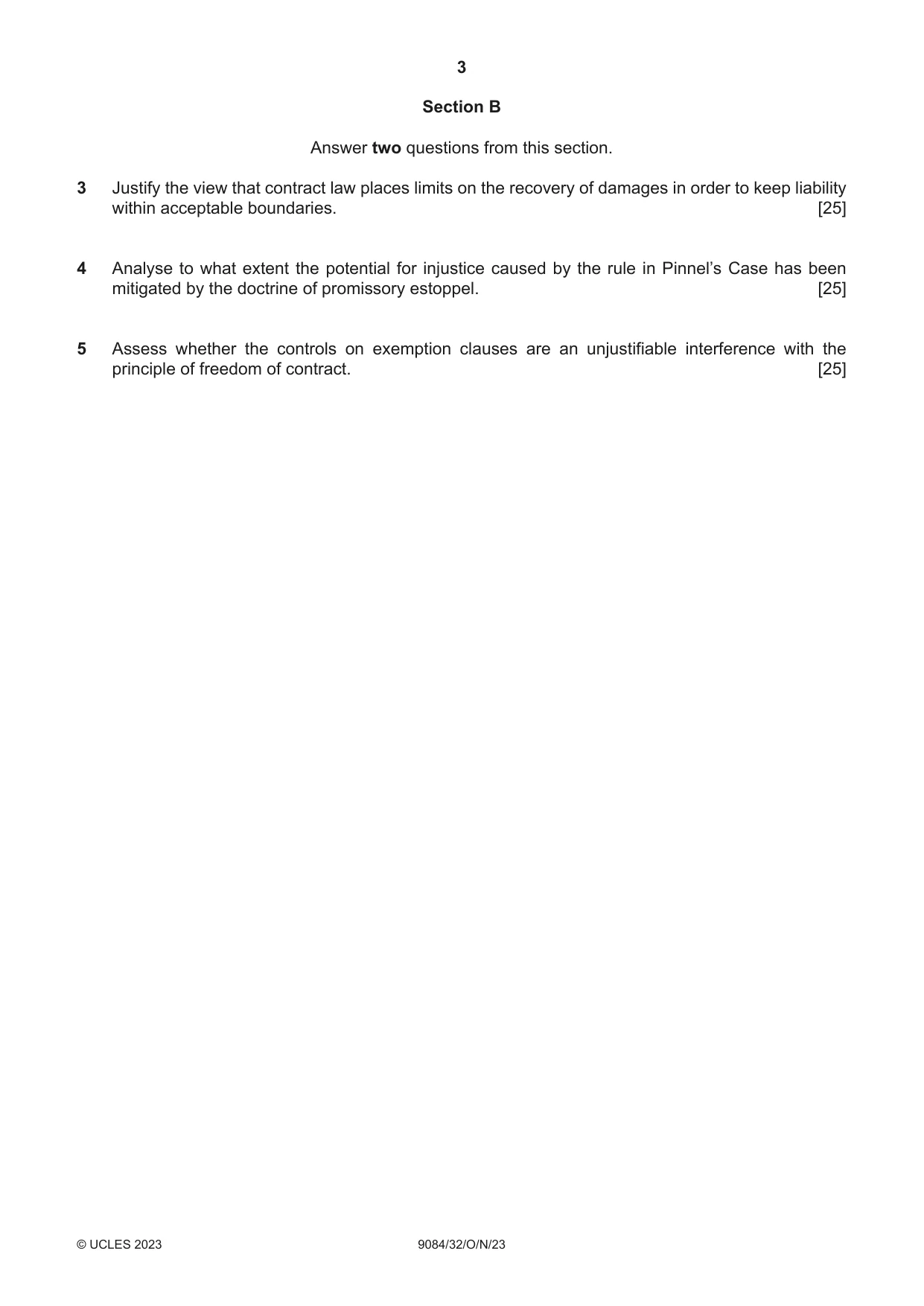
3 9084/32/O/N/23 © UCLES 2023 Section B Answer two questions from this section. 3 Justify the view that contract law places limits on the recovery of damages in order to keep liability within acceptable boundaries. [25] 4 Analyse to what extent the potential for injustice caused by the rule in Pinnel’s Case has been mitigated by the doctrine of promissory estoppel. [25] 5 Assess whether the controls on exemption clauses are an unjustifiable interference with the principle of freedom of contract. [25]
Question paper, page 4
4 9084/32/O/N/23 © UCLES 2023 Permission to reproduce items where third-party owned material protected by copyright is included has been sought and cleared where possible. Every reasonable effort has been made by the publisher (UCLES) to trace copyright holders, but if any items requiring clearance have unwittingly been included, the publisher will be pleased to make amends at the earliest possible opportunity. To avoid the issue of disclosure of answer-related information to candidates, all copyright acknowledgements are reproduced online in the Cambridge Assessment International Education Copyright Acknowledgements Booklet. This is produced for each series of examinations and is freely available to download at www.cambridgeinternational.org after the live examination series. Cambridge Assessment International Education is part of Cambridge Assessment. Cambridge Assessment is the brand name of the University of Cambridge Local Examinations Syndicate (UCLES), which is a department of the University of Cambridge. BLANK PAGE
Mark scheme, page 1
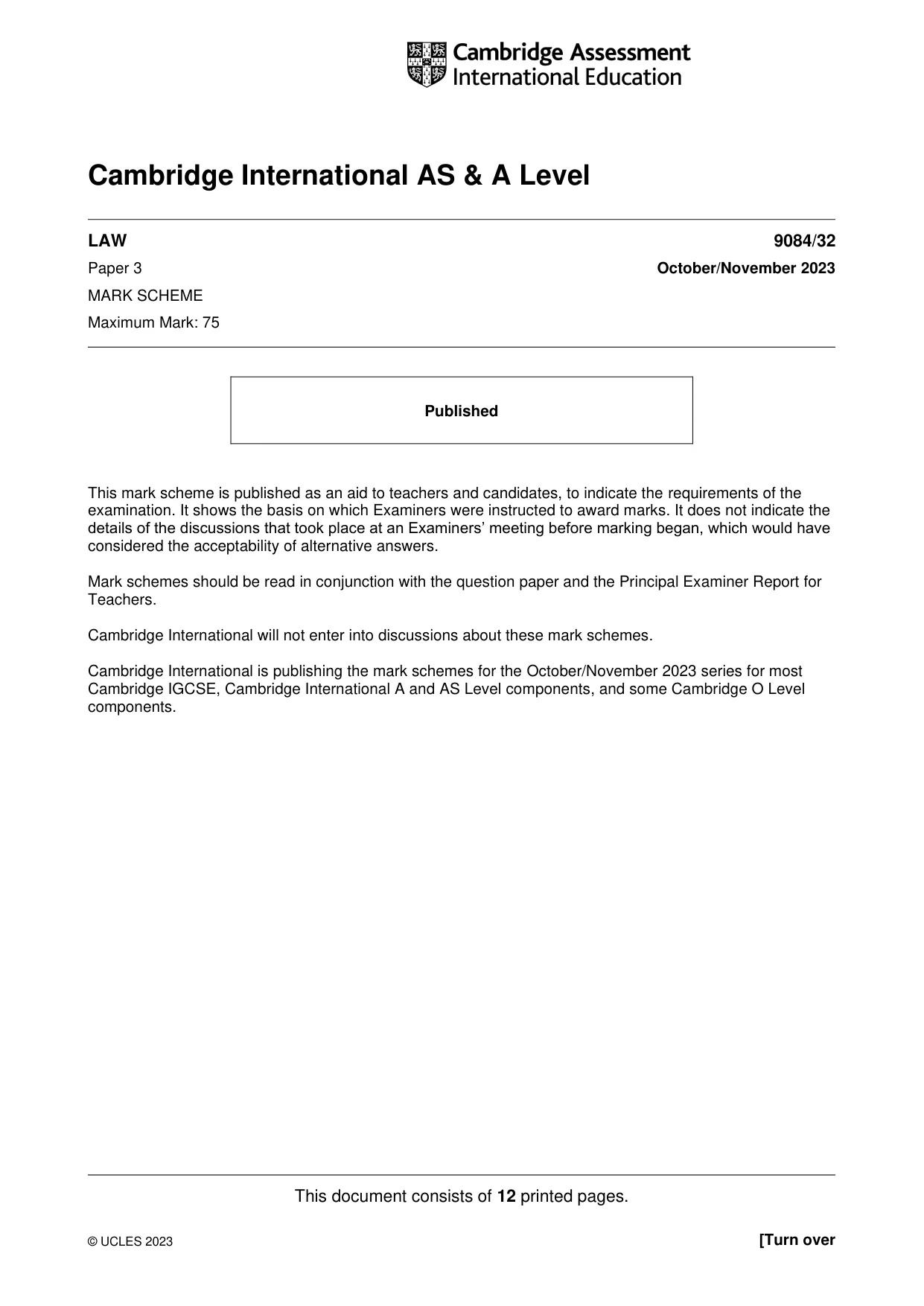
This document consists of 12 printed pages. © UCLES 2023 [Turn over Cambridge International AS & A Level LAW 9084/32 Paper 3 October/November 2023 MARK SCHEME Maximum Mark: 75 Published This mark scheme is published as an aid to teachers and candidates, to indicate the requirements of the examination. It shows the basis on which Examiners were instructed to award marks. It does not indicate the details of the discussions that took place at an Examiners’ meeting before marking began, which would have considered the acceptability of alternative answers. Mark schemes should be read in conjunction with the question paper and the Principal Examiner Report for Teachers. Cambridge International will not enter into discussions about these mark schemes. Cambridge International is publishing the mark schemes for the October/November 2023 series for most Cambridge IGCSE, Cambridge International A and AS Level components, and some Cambridge O Level components.
Mark scheme, page 2
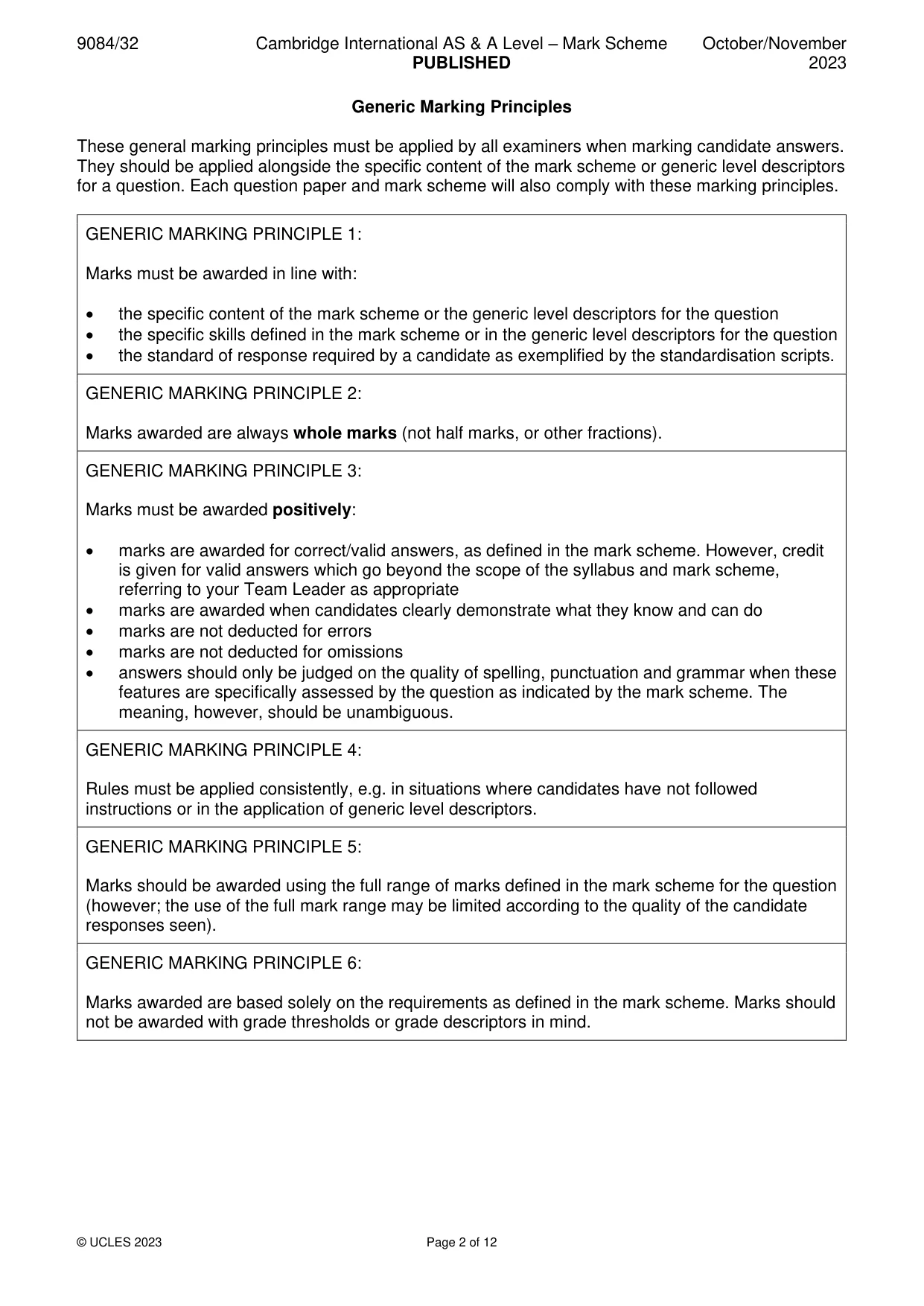
9084/32 Cambridge International AS & A Level – Mark Scheme PUBLISHED October/November 2023 © UCLES 2023 Page 2 of 12 Generic Marking Principles These general marking principles must be applied by all examiners when marking candidate answers. They should be applied alongside the specific content of the mark scheme or generic level descriptors for a question. Each question paper and mark scheme will also comply with these marking principles. GENERIC MARKING PRINCIPLE 1: Marks must be awarded in line with: • the specific content of the mark scheme or the generic level descriptors for the question • the specific skills defined in the mark scheme or in the generic level descriptors for the question • the standard of response required by a candidate as exemplified by the standardisation scripts. GENERIC MARKING PRINCIPLE 2: Marks awarded are always whole marks (not half marks, or other fractions). GENERIC MARKING PRINCIPLE 3: Marks must be awarded positively: • marks are awarded for correct/valid answers, as defined in the mark scheme. However, credit is given for valid answers which go beyond the scope of the syllabus and mark scheme, referring to your Team Leader as appropriate • marks are awarded when candidates clearly demonstrate what they know and can do • marks are not deducted for errors • marks are not deducted for omissions • answers should only be judged on the quality of spelling, punctuation and grammar when these features are specifically assessed by the question as indicated by the mark scheme. The meaning, however, should be unambiguous. GENERIC MARKING PRINCIPLE 4: Rules must be applied consistently, e.g. in situations where candidates have not followed instructions or in the application of generic level descriptors. GENERIC MARKING PRINCIPLE 5: Marks should be awarded using the full range of marks defined in the mark scheme for the question (however; the use of the full mark range may be limited according to the quality of the candidate responses seen). GENERIC MARKING PRINCIPLE 6: Marks awarded are based solely on the requirements as defined in the mark scheme. Marks should not be awarded with grade thresholds or grade descriptors in mind.
Mark scheme, page 3
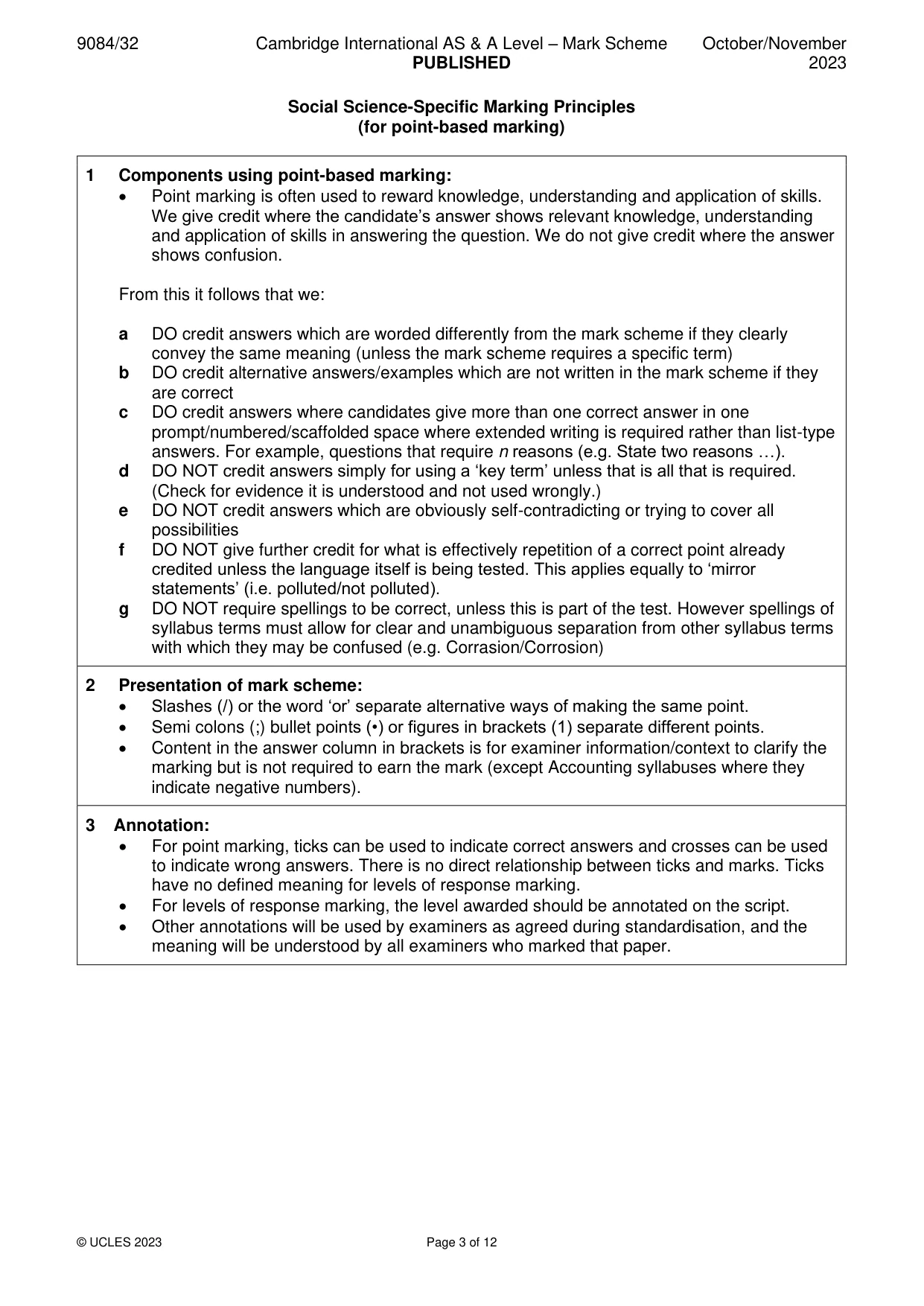
9084/32 Cambridge International AS & A Level – Mark Scheme PUBLISHED October/November 2023 © UCLES 2023 Page 3 of 12 Social Science-Specific Marking Principles (for point-based marking) 1 Components using point-based marking: • Point marking is often used to reward knowledge, understanding and application of skills. We give credit where the candidate’s answer shows relevant knowledge, understanding and application of skills in answering the question. We do not give credit where the answer shows confusion. From this it follows that we: a DO credit answers which are worded differently from the mark scheme if they clearly convey the same meaning (unless the mark scheme requires a specific term) b DO credit alternative answers/examples which are not written in the mark scheme if they are correct c DO credit answers where candidates give more than one correct answer in one prompt/numbered/scaffolded space where extended writing is required rather than list-type answers. For example, questions that require n reasons (e.g. State two reasons …). d DO NOT credit answers simply for using a ‘key term’ unless that is all that is required. (Check for evidence it is understood and not used wrongly.) e DO NOT credit answers which are obviously self-contradicting or trying to cover all possibilities f DO NOT give further credit for what is effectively repetition of a correct point already credited unless the language itself is being tested. This applies equally to ‘mirror statements’ (i.e. polluted/not polluted). g DO NOT require spellings to be correct, unless this is part of the test. However spellings of syllabus terms must allow for clear and unambiguous separation from other syllabus terms with which they may be confused (e.g. Corrasion/Corrosion) 2 Presentation of mark scheme: • Slashes (/) or the word ‘or’ separate alternative ways of making the same point. • Semi colons (;) bullet points (•) or figures in brackets (1) separate different points. • Content in the answer column in brackets is for examiner information/context to clarify the marking but is not required to earn the mark (except Accounting syllabuses where they indicate negative numbers). 3 Annotation: • For point marking, ticks can be used to indicate correct answers and crosses can be used to indicate wrong answers. There is no direct relationship between ticks and marks. Ticks have no defined meaning for levels of response marking. • For levels of response marking, the level awarded should be annotated on the script. • Other annotations will be used by examiners as agreed during standardisation, and the meaning will be understood by all examiners who marked that paper.
Mark scheme, page 4
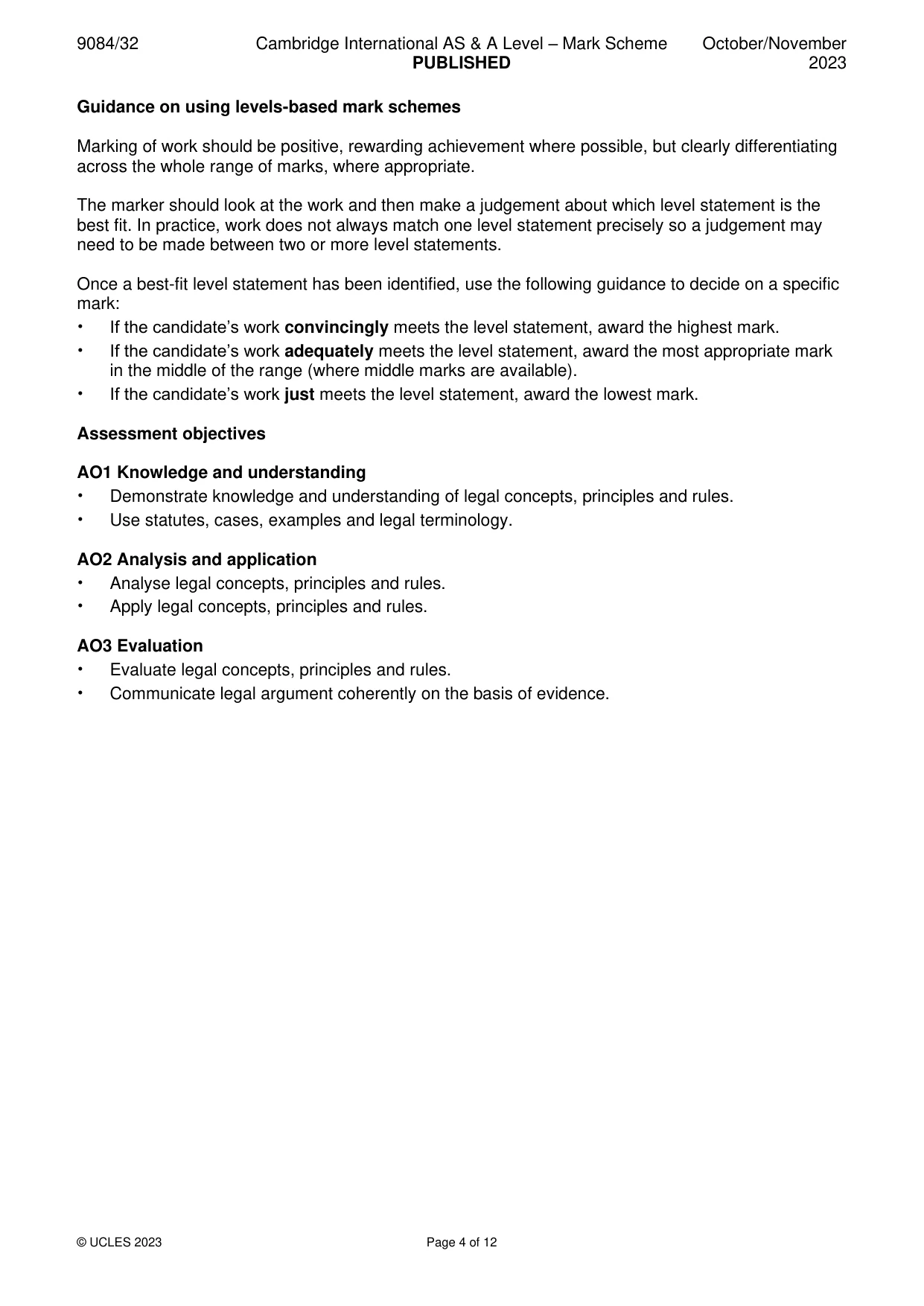
9084/32 Cambridge International AS & A Level – Mark Scheme PUBLISHED October/November 2023 © UCLES 2023 Page 4 of 12 Guidance on using levels-based mark schemes Marking of work should be positive, rewarding achievement where possible, but clearly differentiating across the whole range of marks, where appropriate. The marker should look at the work and then make a judgement about which level statement is the best fit. In practice, work does not always match one level statement precisely so a judgement may need to be made between two or more level statements. Once a best-fit level statement has been identified, use the following guidance to decide on a specific mark: • If the candidate’s work convincingly meets the level statement, award the highest mark. • If the candidate’s work adequately meets the level statement, award the most appropriate mark in the middle of the range (where middle marks are available). • If the candidate’s work just meets the level statement, award the lowest mark. Assessment objectives AO1 Knowledge and understanding • Demonstrate knowledge and understanding of legal concepts, principles and rules. • Use statutes, cases, examples and legal terminology. AO2 Analysis and application • Analyse legal concepts, principles and rules. • Apply legal concepts, principles and rules. AO3 Evaluation • Evaluate legal concepts, principles and rules. • Communicate legal argument coherently on the basis of evidence.
Mark scheme, page 5
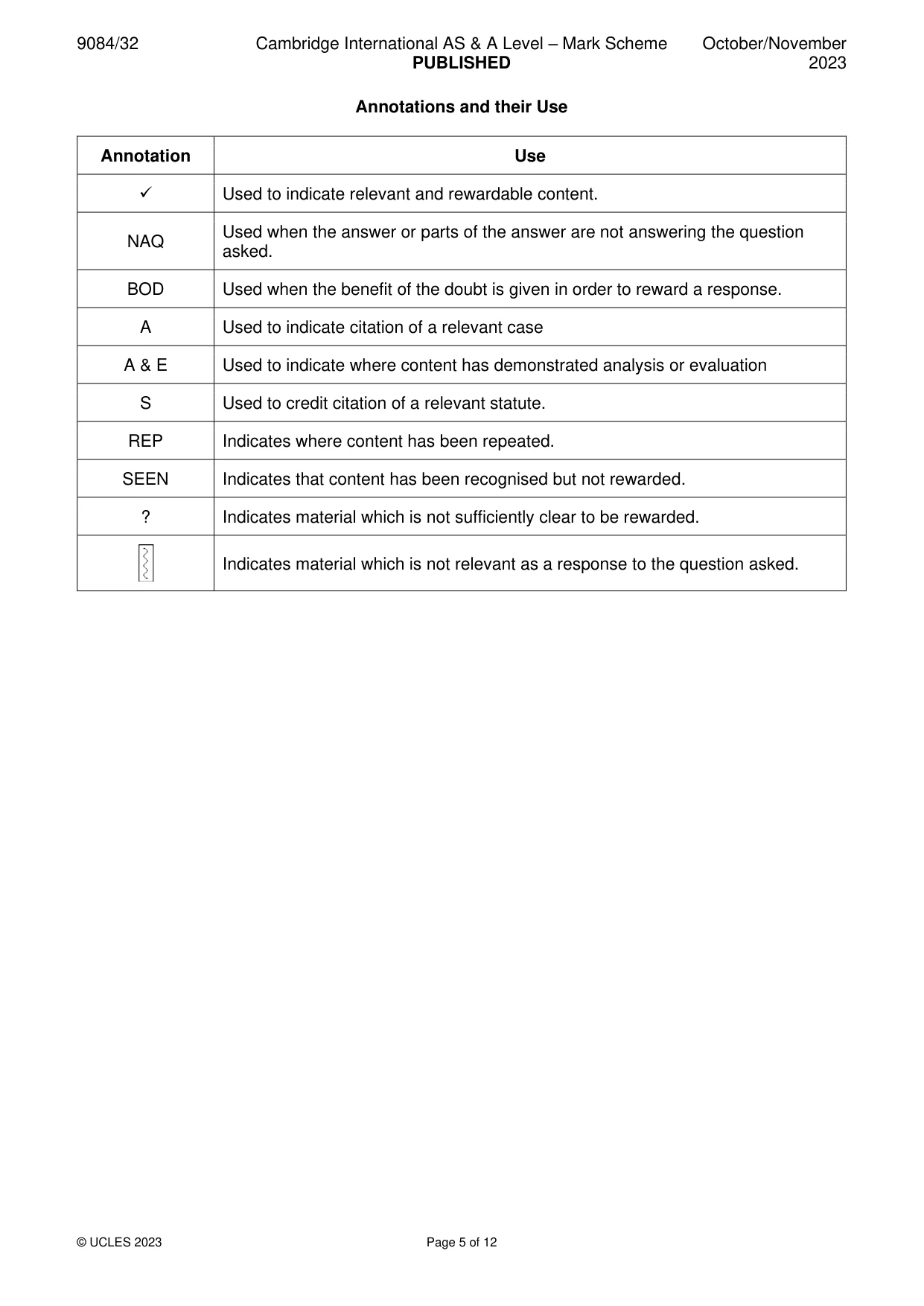
9084/32 Cambridge International AS & A Level – Mark Scheme PUBLISHED October/November 2023 © UCLES 2023 Page 5 of 12 Annotations and their Use Annotation Use ✓ Used to indicate relevant and rewardable content. NAQ Used when the answer or parts of the answer are not answering the question asked. BOD Used when the benefit of the doubt is given in order to reward a response. A Used to indicate citation of a relevant case A & E Used to indicate where content has demonstrated analysis or evaluation S Used to credit citation of a relevant statute. REP Indicates where content has been repeated. SEEN Indicates that content has been recognised but not rewarded. ? Indicates material which is not sufficiently clear to be rewarded. Indicates material which is not relevant as a response to the question asked.
Mark scheme, page 6
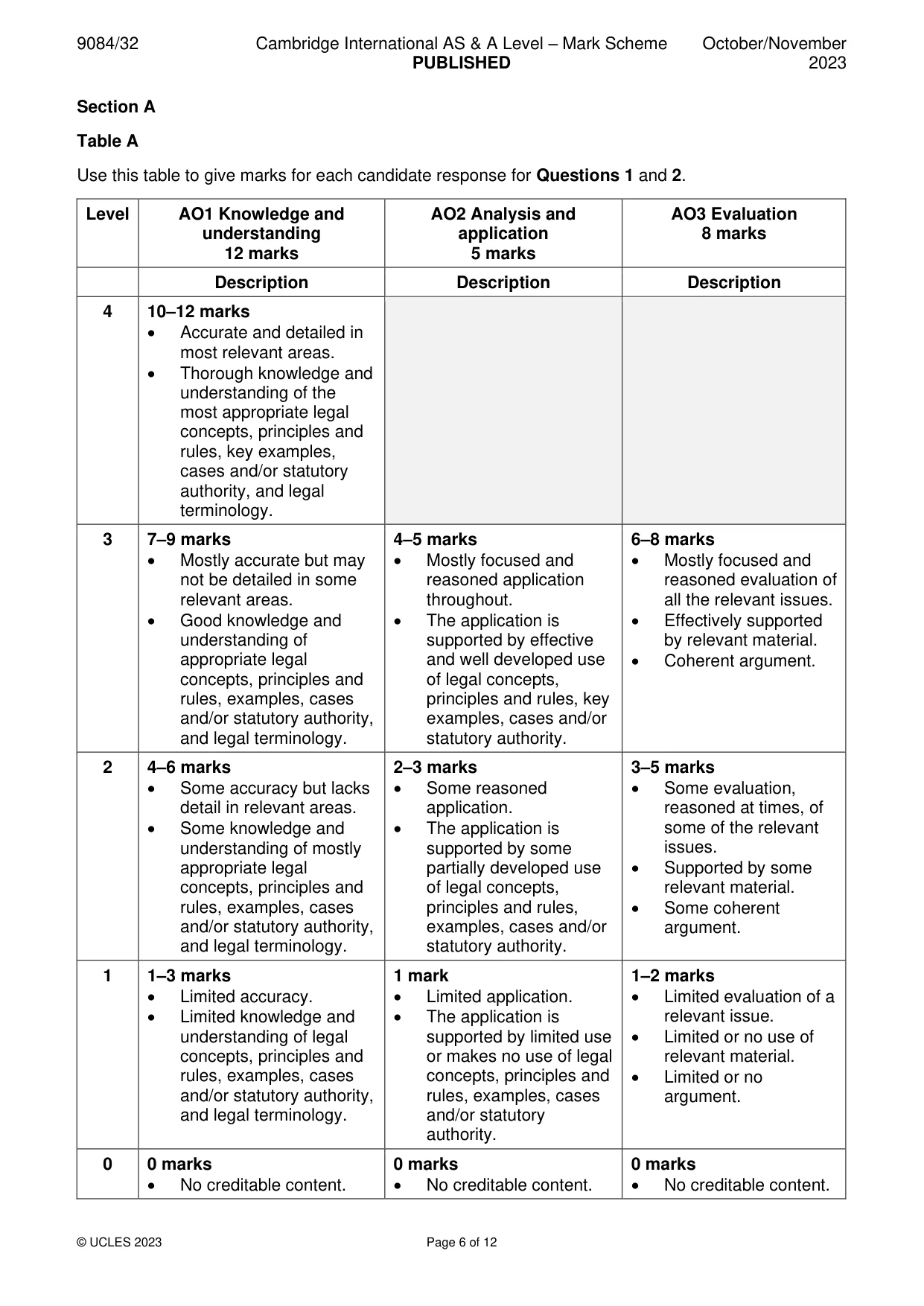
9084/32 Cambridge International AS & A Level – Mark Scheme PUBLISHED October/November 2023 © UCLES 2023 Page 6 of 12 Section A Table A Use this table to give marks for each candidate response for Questions 1 and 2. Level AO1 Knowledge and understanding 12 marks AO2 Analysis and application 5 marks AO3 Evaluation 8 marks Description Description Description 4 10–12 marks • Accurate and detailed in most relevant areas. • Thorough knowledge and understanding of the most appropriate legal concepts, principles and rules, key examples, cases and/or statutory authority, and legal terminology. 3 7–9 marks • Mostly accurate but may not be detailed in some relevant areas. • Good knowledge and understanding of appropriate legal concepts, principles and rules, examples, cases and/or statutory authority, and legal terminology. 4–5 marks • Mostly focused and reasoned application throughout. • The application is supported by effective and well developed use of legal concepts, principles and rules, key examples, cases and/or statutory authority. 6–8 marks • Mostly focused and reasoned evaluation of all the relevant issues. • Effectively supported by relevant material. • Coherent argument. 2 4–6 marks • Some accuracy but lacks detail in relevant areas. • Some knowledge and understanding of mostly appropriate legal concepts, principles and rules, examples, cases and/or statutory authority, and legal terminology. 2–3 marks • Some reasoned application. • The application is supported by some partially developed use of legal concepts, principles and rules, examples, cases and/or statutory authority. 3–5 marks • Some evaluation, reasoned at times, of some of the relevant issues. • Supported by some relevant material. • Some coherent argument. 1 1–3 marks • Limited accuracy. • Limited knowledge and understanding of legal concepts, principles and rules, examples, cases and/or statutory authority, and legal terminology. 1 mark • Limited application. • The application is supported by limited use or makes no use of legal concepts, principles and rules, examples, cases and/or statutory authority. 1–2 marks • Limited evaluation of a relevant issue. • Limited or no use of relevant material. • Limited or no argument. 0 0 marks • No creditable content. 0 marks • No creditable content. 0 marks • No creditable content.
Mark scheme, page 7
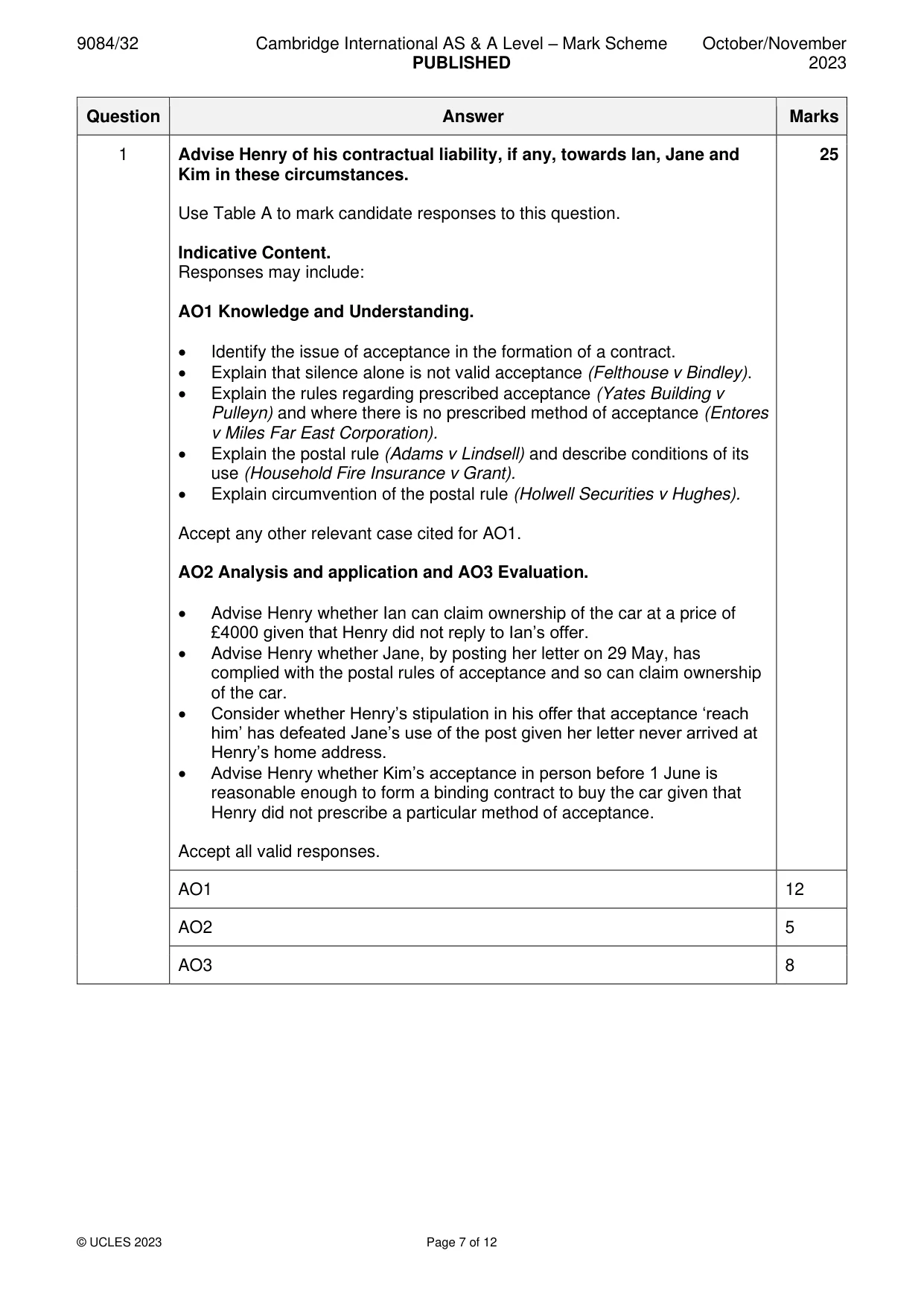
9084/32 Cambridge International AS & A Level – Mark Scheme PUBLISHED October/November 2023 © UCLES 2023 Page 7 of 12 Question Answer Marks 1 Advise Henry of his contractual liability, if any, towards Ian, Jane and Kim in these circumstances. Use Table A to mark candidate responses to this question. Indicative Content. Responses may include: AO1 Knowledge and Understanding. • Identify the issue of acceptance in the formation of a contract. • Explain that silence alone is not valid acceptance (Felthouse v Bindley). • Explain the rules regarding prescribed acceptance (Yates Building v Pulleyn) and where there is no prescribed method of acceptance (Entores v Miles Far East Corporation). • Explain the postal rule (Adams v Lindsell) and describe conditions of its use (Household Fire Insurance v Grant). • Explain circumvention of the postal rule (Holwell Securities v Hughes). Accept any other relevant case cited for AO1. AO2 Analysis and application and AO3 Evaluation. • Advise Henry whether Ian can claim ownership of the car at a price of £4000 given that Henry did not reply to Ian’s offer. • Advise Henry whether Jane, by posting her letter on 29 May, has complied with the postal rules of acceptance and so can claim ownership of the car. • Consider whether Henry’s stipulation in his offer that acceptance ‘reach him’ has defeated Jane’s use of the post given her letter never arrived at Henry’s home address. • Advise Henry whether Kim’s acceptance in person before 1 June is reasonable enough to form a binding contract to buy the car given that Henry did not prescribe a particular method of acceptance. Accept all valid responses. 25 AO1 12 AO2 5 AO3 8
Mark scheme, page 8
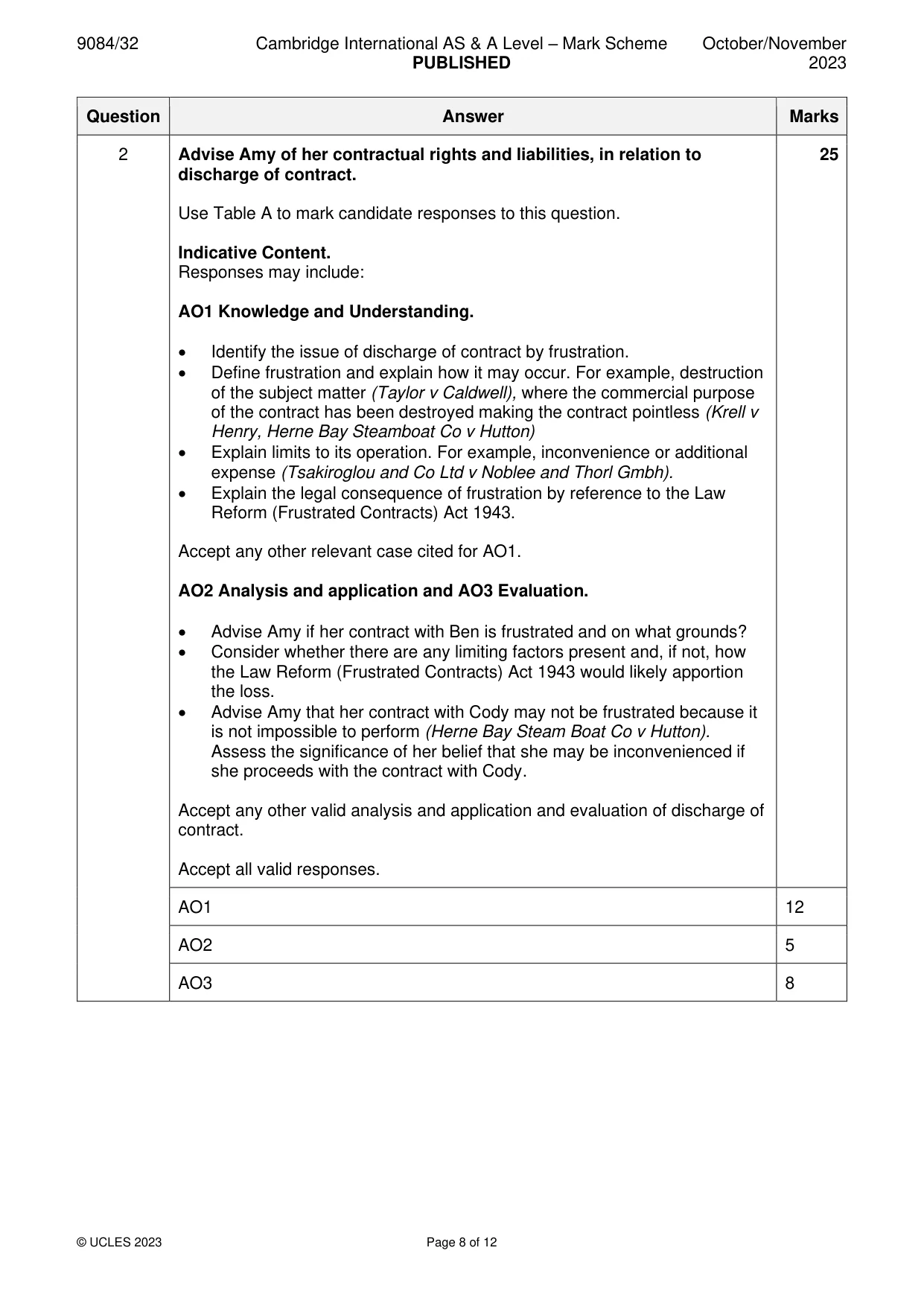
9084/32 Cambridge International AS & A Level – Mark Scheme PUBLISHED October/November 2023 © UCLES 2023 Page 8 of 12 Question Answer Marks 2 Advise Amy of her contractual rights and liabilities, in relation to discharge of contract. Use Table A to mark candidate responses to this question. Indicative Content. Responses may include: AO1 Knowledge and Understanding. • Identify the issue of discharge of contract by frustration. • Define frustration and explain how it may occur. For example, destruction of the subject matter (Taylor v Caldwell), where the commercial purpose of the contract has been destroyed making the contract pointless (Krell v Henry, Herne Bay Steamboat Co v Hutton) • Explain limits to its operation. For example, inconvenience or additional expense (Tsakiroglou and Co Ltd v Noblee and Thorl Gmbh). • Explain the legal consequence of frustration by reference to the Law Reform (Frustrated Contracts) Act 1943. Accept any other relevant case cited for AO1. AO2 Analysis and application and AO3 Evaluation. • Advise Amy if her contract with Ben is frustrated and on what grounds? • Consider whether there are any limiting factors present and, if not, how the Law Reform (Frustrated Contracts) Act 1943 would likely apportion the loss. • Advise Amy that her contract with Cody may not be frustrated because it is not impossible to perform (Herne Bay Steam Boat Co v Hutton). Assess the significance of her belief that she may be inconvenienced if she proceeds with the contract with Cody. Accept any other valid analysis and application and evaluation of discharge of contract. Accept all valid responses. 25 AO1 12 AO2 5 AO3 8
Mark scheme, page 9
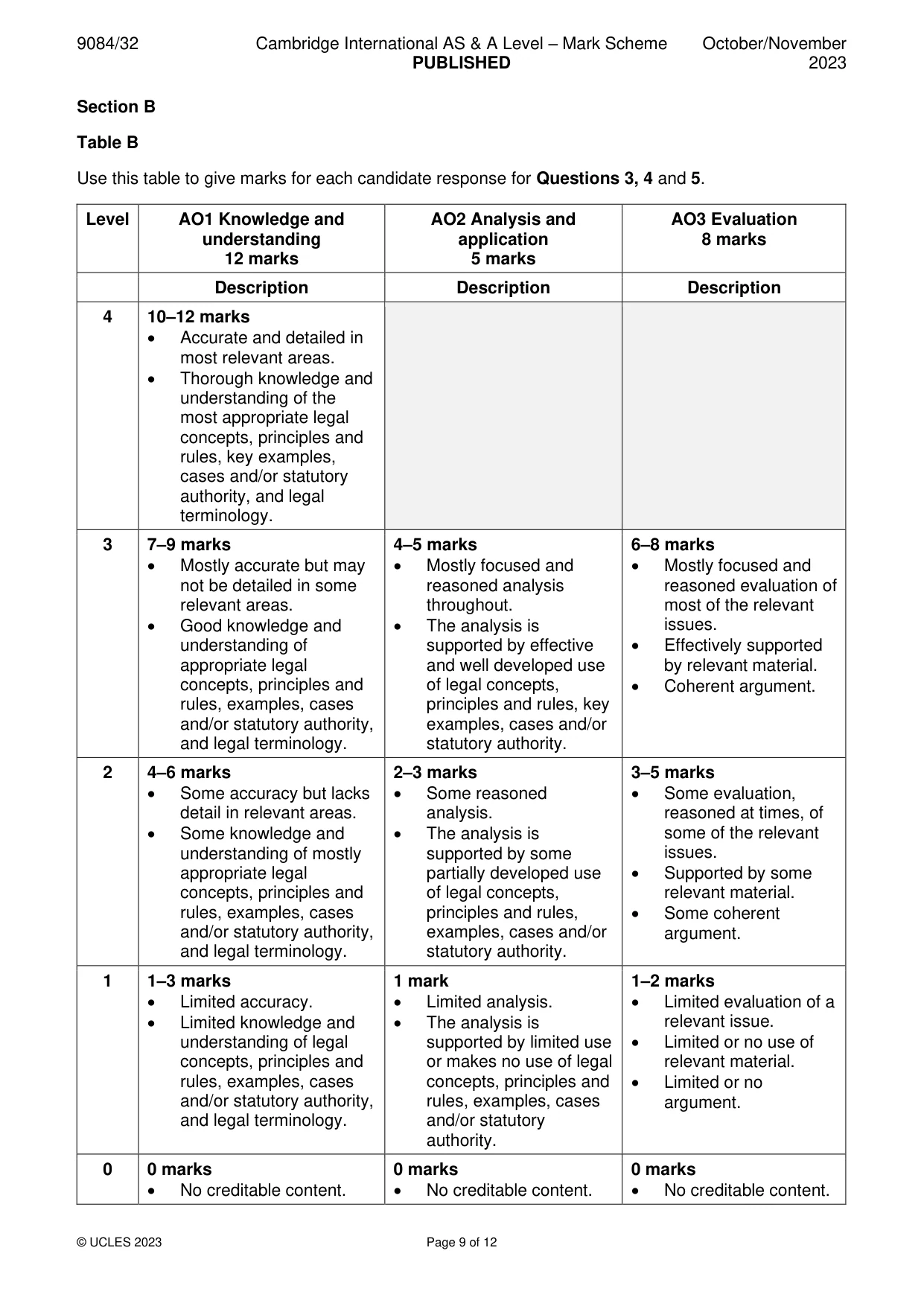
9084/32 Cambridge International AS & A Level – Mark Scheme PUBLISHED October/November 2023 © UCLES 2023 Page 9 of 12 Section B Table B Use this table to give marks for each candidate response for Questions 3, 4 and 5. Level AO1 Knowledge and understanding 12 marks AO2 Analysis and application 5 marks AO3 Evaluation 8 marks Description Description Description 4 10–12 marks • Accurate and detailed in most relevant areas. • Thorough knowledge and understanding of the most appropriate legal concepts, principles and rules, key examples, cases and/or statutory authority, and legal terminology. 3 7–9 marks • Mostly accurate but may not be detailed in some relevant areas. • Good knowledge and understanding of appropriate legal concepts, principles and rules, examples, cases and/or statutory authority, and legal terminology. 4–5 marks • Mostly focused and reasoned analysis throughout. • The analysis is supported by effective and well developed use of legal concepts, principles and rules, key examples, cases and/or statutory authority. 6–8 marks • Mostly focused and reasoned evaluation of most of the relevant issues. • Effectively supported by relevant material. • Coherent argument. 2 4–6 marks • Some accuracy but lacks detail in relevant areas. • Some knowledge and understanding of mostly appropriate legal concepts, principles and rules, examples, cases and/or statutory authority, and legal terminology. 2–3 marks • Some reasoned analysis. • The analysis is supported by some partially developed use of legal concepts, principles and rules, examples, cases and/or statutory authority. 3–5 marks • Some evaluation, reasoned at times, of some of the relevant issues. • Supported by some relevant material. • Some coherent argument. 1 1–3 marks • Limited accuracy. • Limited knowledge and understanding of legal concepts, principles and rules, examples, cases and/or statutory authority, and legal terminology. 1 mark • Limited analysis. • The analysis is supported by limited use or makes no use of legal concepts, principles and rules, examples, cases and/or statutory authority. 1–2 marks • Limited evaluation of a relevant issue. • Limited or no use of relevant material. • Limited or no argument. 0 0 marks • No creditable content. 0 marks • No creditable content. 0 marks • No creditable content.
Mark scheme, page 10
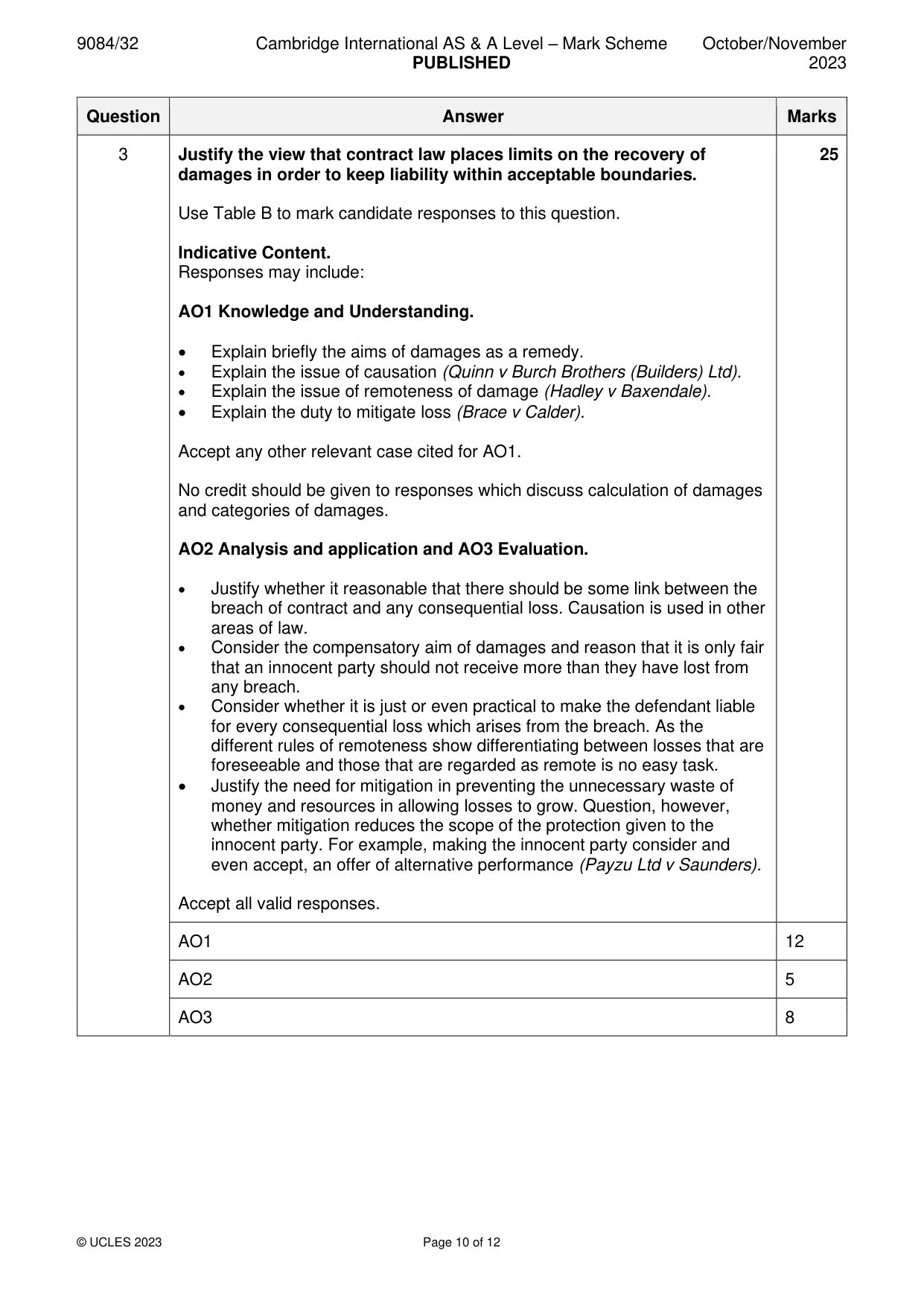
9084/32 Cambridge International AS & A Level – Mark Scheme PUBLISHED October/November 2023 © UCLES 2023 Page 10 of 12 Question Answer Marks 3 Justify the view that contract law places limits on the recovery of damages in order to keep liability within acceptable boundaries. Use Table B to mark candidate responses to this question. Indicative Content. Responses may include: AO1 Knowledge and Understanding. • Explain briefly the aims of damages as a remedy. • Explain the issue of causation (Quinn v Burch Brothers (Builders) Ltd). • Explain the issue of remoteness of damage (Hadley v Baxendale). • Explain the duty to mitigate loss (Brace v Calder). Accept any other relevant case cited for AO1. No credit should be given to responses which discuss calculation of damages and categories of damages. AO2 Analysis and application and AO3 Evaluation. • Justify whether it reasonable that there should be some link between the breach of contract and any consequential loss. Causation is used in other areas of law. • Consider the compensatory aim of damages and reason that it is only fair that an innocent party should not receive more than they have lost from any breach. • Consider whether it is just or even practical to make the defendant liable for every consequential loss which arises from the breach. As the different rules of remoteness show differentiating between losses that are foreseeable and those that are regarded as remote is no easy task. • Justify the need for mitigation in preventing the unnecessary waste of money and resources in allowing losses to grow. Question, however, whether mitigation reduces the scope of the protection given to the innocent party. For example, making the innocent party consider and even accept, an offer of alternative performance (Payzu Ltd v Saunders). Accept all valid responses. 25 AO1 12 AO2 5 AO3 8
Mark scheme, page 11
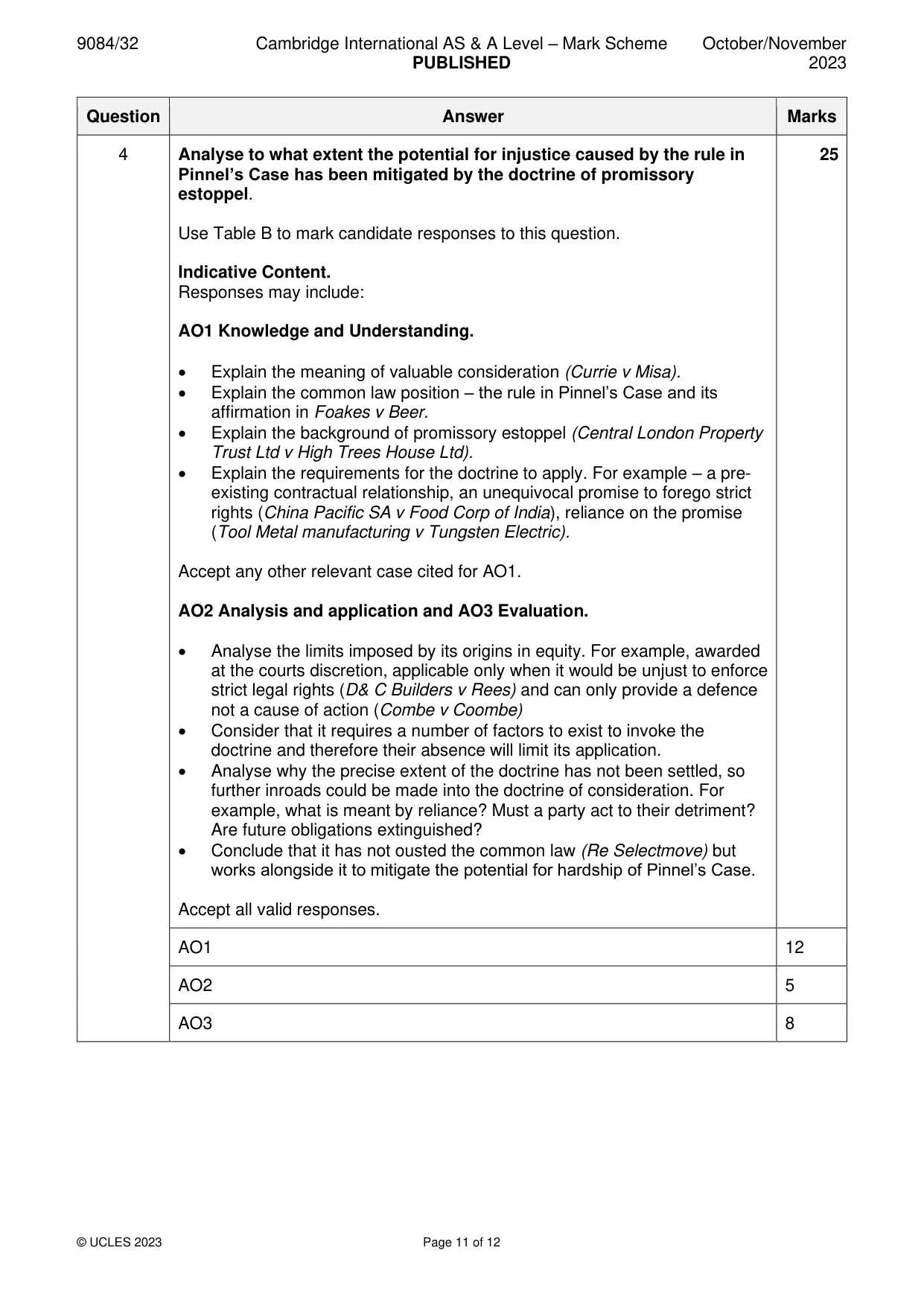
9084/32 Cambridge International AS & A Level – Mark Scheme PUBLISHED October/November 2023 © UCLES 2023 Page 11 of 12 Question Answer Marks 4 Analyse to what extent the potential for injustice caused by the rule in Pinnel’s Case has been mitigated by the doctrine of promissory estoppel. Use Table B to mark candidate responses to this question. Indicative Content. Responses may include: AO1 Knowledge and Understanding. • Explain the meaning of valuable consideration (Currie v Misa). • Explain the common law position – the rule in Pinnel’s Case and its affirmation in Foakes v Beer. • Explain the background of promissory estoppel (Central London Property Trust Ltd v High Trees House Ltd). • Explain the requirements for the doctrine to apply. For example – a pre- existing contractual relationship, an unequivocal promise to forego strict rights (China Pacific SA v Food Corp of India), reliance on the promise (Tool Metal manufacturing v Tungsten Electric). Accept any other relevant case cited for AO1. AO2 Analysis and application and AO3 Evaluation. • Analyse the limits imposed by its origins in equity. For example, awarded at the courts discretion, applicable only when it would be unjust to enforce strict legal rights (D& C Builders v Rees) and can only provide a defence not a cause of action (Combe v Coombe) • Consider that it requires a number of factors to exist to invoke the doctrine and therefore their absence will limit its application. • Analyse why the precise extent of the doctrine has not been settled, so further inroads could be made into the doctrine of consideration. For example, what is meant by reliance? Must a party act to their detriment? Are future obligations extinguished? • Conclude that it has not ousted the common law (Re Selectmove) but works alongside it to mitigate the potential for hardship of Pinnel’s Case. Accept all valid responses. 25 AO1 12 AO2 5 AO3 8
Mark scheme, page 12
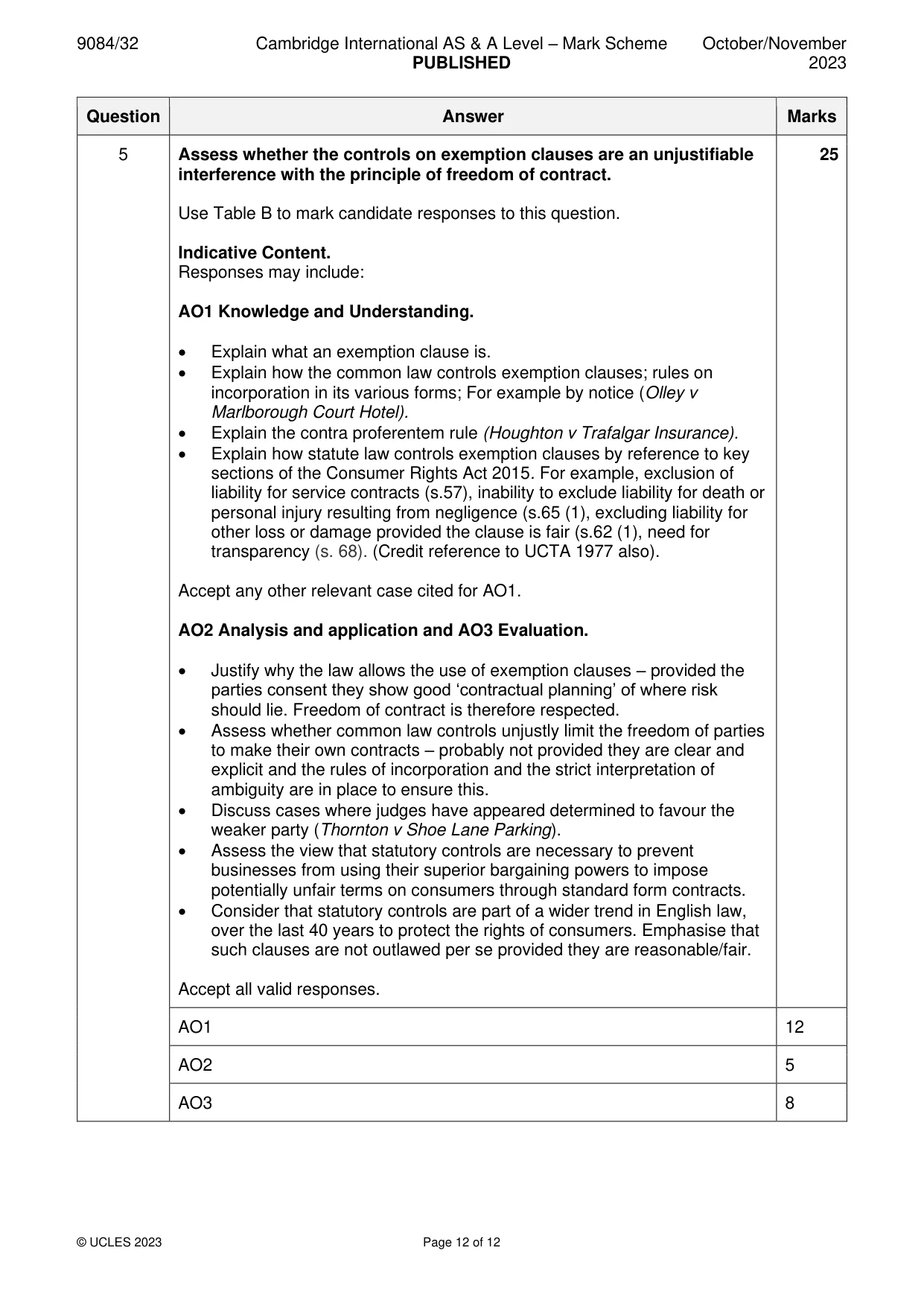
9084/32 Cambridge International AS & A Level – Mark Scheme PUBLISHED October/November 2023 © UCLES 2023 Page 12 of 12 Question Answer Marks 5 Assess whether the controls on exemption clauses are an unjustifiable interference with the principle of freedom of contract. Use Table B to mark candidate responses to this question. Indicative Content. Responses may include: AO1 Knowledge and Understanding. • Explain what an exemption clause is. • Explain how the common law controls exemption clauses; rules on incorporation in its various forms; For example by notice (Olley v Marlborough Court Hotel). • Explain the contra proferentem rule (Houghton v Trafalgar Insurance). • Explain how statute law controls exemption clauses by reference to key sections of the Consumer Rights Act 2015. For example, exclusion of liability for service contracts (s.57), inability to exclude liability for death or personal injury resulting from negligence (s.65 (1), excluding liability for other loss or damage provided the clause is fair (s.62 (1), need for transparency (s. 68). (Credit reference to UCTA 1977 also). Accept any other relevant case cited for AO1. AO2 Analysis and application and AO3 Evaluation. • Justify why the law allows the use of exemption clauses – provided the parties consent they show good ‘contractual planning’ of where risk should lie. Freedom of contract is therefore respected. • Assess whether common law controls unjustly limit the freedom of parties to make their own contracts – probably not provided they are clear and explicit and the rules of incorporation and the strict interpretation of ambiguity are in place to ensure this. • Discuss cases where judges have appeared determined to favour the weaker party (Thornton v Shoe Lane Parking). • Assess the view that statutory controls are necessary to prevent businesses from using their superior bargaining powers to impose potentially unfair terms on consumers through standard form contracts. • Consider that statutory controls are part of a wider trend in English law, over the last 40 years to protect the rights of consumers. Emphasise that such clauses are not outlawed per se provided they are reasonable/fair. Accept all valid responses. 25 AO1 12 AO2 5 AO3 8
What you needed in this session
Cambridge’s own grade thresholds for 2023 Oct/Nov, Paper 3 · Variant 2. A higher threshold means an easier paper — the bar moves with how the cohort did.