Cambridge A Level Law 9084 — 2025 Oct/Nov Paper 3 · Variant 1
9084/31/O/N/25 · 75 marks · ≈84 min
The question paper and its mark scheme, free to read here and free to download. This is Cambridge’s own paper, exactly as it was sat.
Question paper4 pages

Mark scheme18 pages
Answers below. Sit the paper first if you are practising.

Paper as text
Question paper, page 1
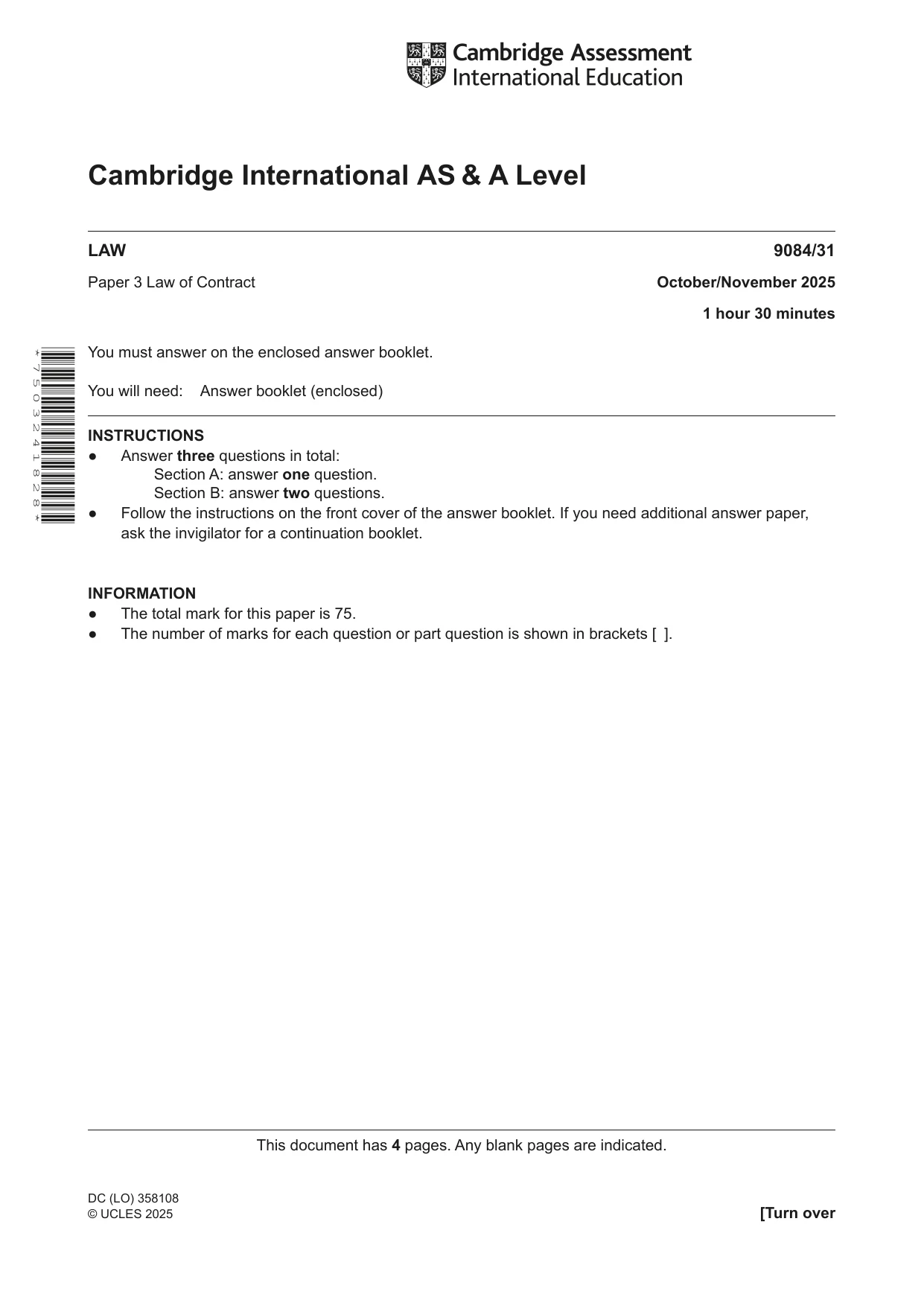
This document has 4 pages. Any blank pages are indicated. [Turn over Cambridge International AS & A Level * 7 5 0 3 2 4 1 8 2 8 * LAW 9084/31 Paper 3 Law of Contract October/November 2025 1 hour 30 minutes You must answer on the enclosed answer booklet. You will need: Answer booklet (enclosed) INSTRUCTIONS ● Answer three questions in total: Section A: answer one question. Section B: answer two questions. ● Follow the instructions on the front cover of the answer booklet. If you need additional answer paper, ask the invigilator for a continuation booklet. INFORMATION ● The total mark for this paper is 75. ● The number of marks for each question or part question is shown in brackets [ ]. DC (LO) 358108 © UCLES 2025
Question paper, page 2
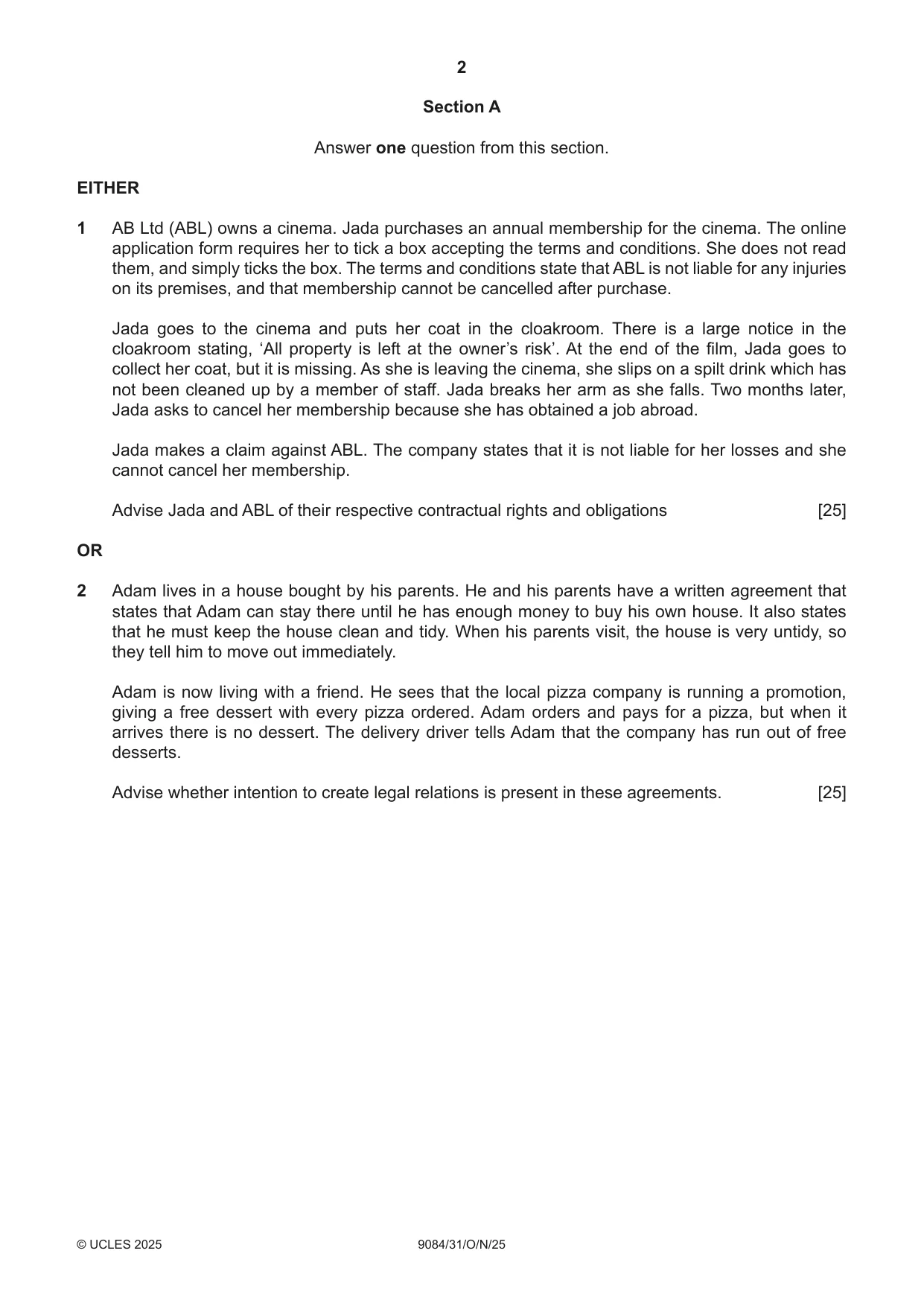
2 9084/31/O/N/25 © UCLES 2025 Section A Answer one question from this section. EITHER 1 AB Ltd (ABL) owns a cinema. Jada purchases an annual membership for the cinema. The online application form requires her to tick a box accepting the terms and conditions. She does not read them, and simply ticks the box. The terms and conditions state that ABL is not liable for any injuries on its premises, and that membership cannot be cancelled after purchase. Jada goes to the cinema and puts her coat in the cloakroom. There is a large notice in the cloakroom stating, ‘All property is left at the owner’s risk’. At the end of the film, Jada goes to collect her coat, but it is missing. As she is leaving the cinema, she slips on a spilt drink which has not been cleaned up by a member of staff. Jada breaks her arm as she falls. Two months later, Jada asks to cancel her membership because she has obtained a job abroad. Jada makes a claim against ABL. The company states that it is not liable for her losses and she cannot cancel her membership. Advise Jada and ABL of their respective contractual rights and obligations [25] OR 2 Adam lives in a house bought by his parents. He and his parents have a written agreement that states that Adam can stay there until he has enough money to buy his own house. It also states that he must keep the house clean and tidy. When his parents visit, the house is very untidy, so they tell him to move out immediately. Adam is now living with a friend. He sees that the local pizza company is running a promotion, giving a free dessert with every pizza ordered. Adam orders and pays for a pizza, but when it arrives there is no dessert. The delivery driver tells Adam that the company has run out of free desserts. Advise whether intention to create legal relations is present in these agreements. [25]
Question paper, page 3
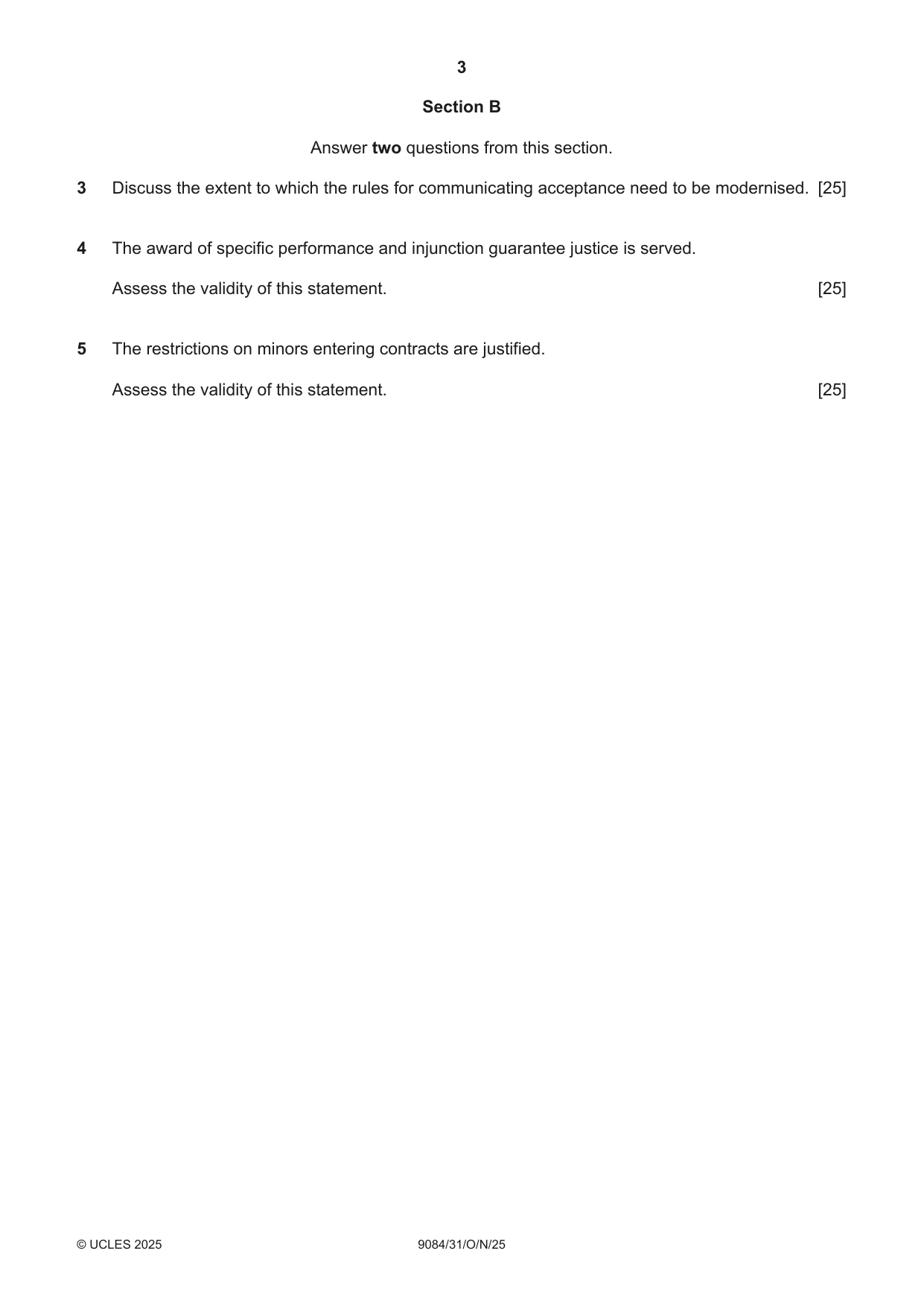
3 9084/31/O/N/25 © UCLES 2025 Section B Answer two questions from this section. 3 Discuss the extent to which the rules for communicating acceptance need to be modernised. [25] 4 The award of specific performance and injunction guarantee justice is served. Assess the validity of this statement. [25] 5 The restrictions on minors entering contracts are justified. Assess the validity of this statement. [25]
Question paper, page 4
4 9084/31/O/N/25 © UCLES 2025 Permission to reproduce items where third-party owned material protected by copyright is included has been sought and cleared where possible. Every reasonable effort has been made by the publisher (UCLES) to trace copyright holders, but if any items requiring clearance have unwittingly been included, the publisher will be pleased to make amends at the earliest possible opportunity. To avoid the issue of disclosure of answer-related information to candidates, all copyright acknowledgements are reproduced online in the Cambridge Assessment International Education Copyright Acknowledgements Booklet. This is produced for each series of examinations and is freely available to download at www.cambridgeinternational.org after the live examination series. Cambridge Assessment International Education is part of Cambridge Assessment. Cambridge Assessment is the brand name of the University of Cambridge Local Examinations Syndicate (UCLES), which is a department of the University of Cambridge. BLANK PAGE
Mark scheme, page 1
This document consists of 18 printed pages. © Cambridge University Press & Assessment 2025 [Turn over Cambridge International AS & A Level LAW 9084/31 Paper 3 Law of Contract October/November 2025 MARK SCHEME Maximum Mark: 75 Published This mark scheme is published as an aid to teachers and candidates, to indicate the requirements of the examination. It shows the basis on which Examiners were instructed to award marks. It does not indicate the details of the discussions that took place at an Examiners’ meeting before marking began, which would have considered the acceptability of alternative answers. Mark schemes should be read in conjunction with the question paper and the Principal Examiner Report for Teachers. Cambridge International will not enter into discussions about these mark schemes. Cambridge International is publishing the mark schemes for the October/November 2025 series for most Cambridge IGCSE, Cambridge International A and AS Level components, and some Cambridge O Level components.
Mark scheme, page 2
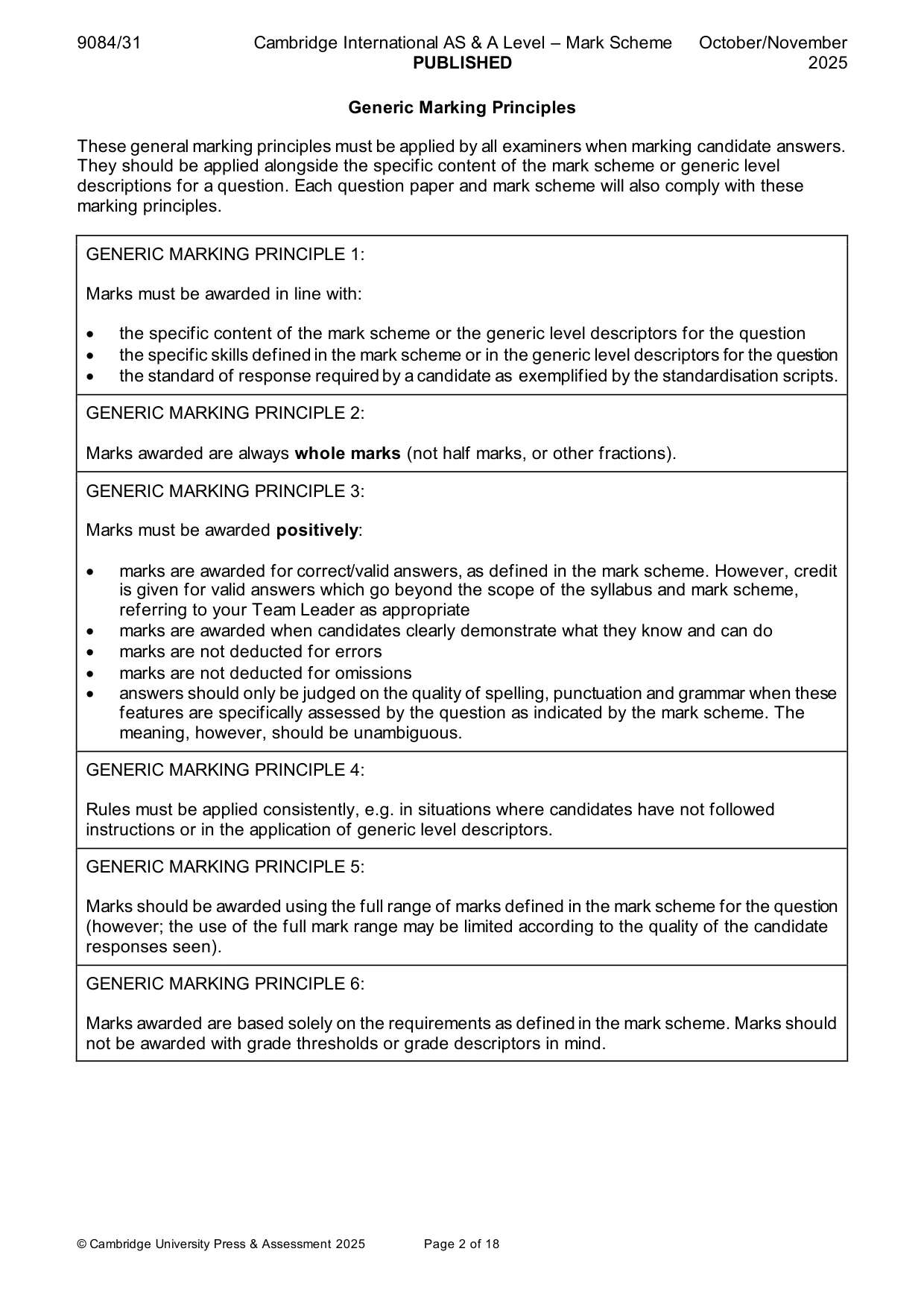
9084/31 Cambridge International AS & A Level – Mark Scheme PUBLISHED October/November 2025 © Cambridge University Press & Assessment 2025 Page 2 of 18 Generic Marking Principles These general marking principles must be applied by all examiners when marking candidate answers. They should be applied alongside the specific content of the mark scheme or generic level descriptions for a question. Each question paper and mark scheme will also comply with these marking principles. GENERIC MARKING PRINCIPLE 1: Marks must be awarded in line with: • the specific content of the mark scheme or the generic level descriptors for the question • the specific skills defined in the mark scheme or in the generic level descriptors for the question • the standard of response required by a candidate as exemplified by the standardisation scripts. GENERIC MARKING PRINCIPLE 2: Marks awarded are always whole marks (not half marks, or other fractions). GENERIC MARKING PRINCIPLE 3: Marks must be awarded positively: • marks are awarded for correct/valid answers, as defined in the mark scheme. However, credit is given for valid answers which go beyond the scope of the syllabus and mark scheme, referring to your Team Leader as appropriate • marks are awarded when candidates clearly demonstrate what they know and can do • marks are not deducted for errors • marks are not deducted for omissions • answers should only be judged on the quality of spelling, punctuation and grammar when these features are specifically assessed by the question as indicated by the mark scheme. The meaning, however, should be unambiguous. GENERIC MARKING PRINCIPLE 4: Rules must be applied consistently, e.g. in situations where candidates have not followed instructions or in the application of generic level descriptors. GENERIC MARKING PRINCIPLE 5: Marks should be awarded using the full range of marks defined in the mark scheme for the question (however; the use of the full mark range may be limited according to the quality of the candidate responses seen). GENERIC MARKING PRINCIPLE 6: Marks awarded are based solely on the requirements as defined in the mark scheme. Marks should not be awarded with grade thresholds or grade descriptors in mind.
Mark scheme, page 3
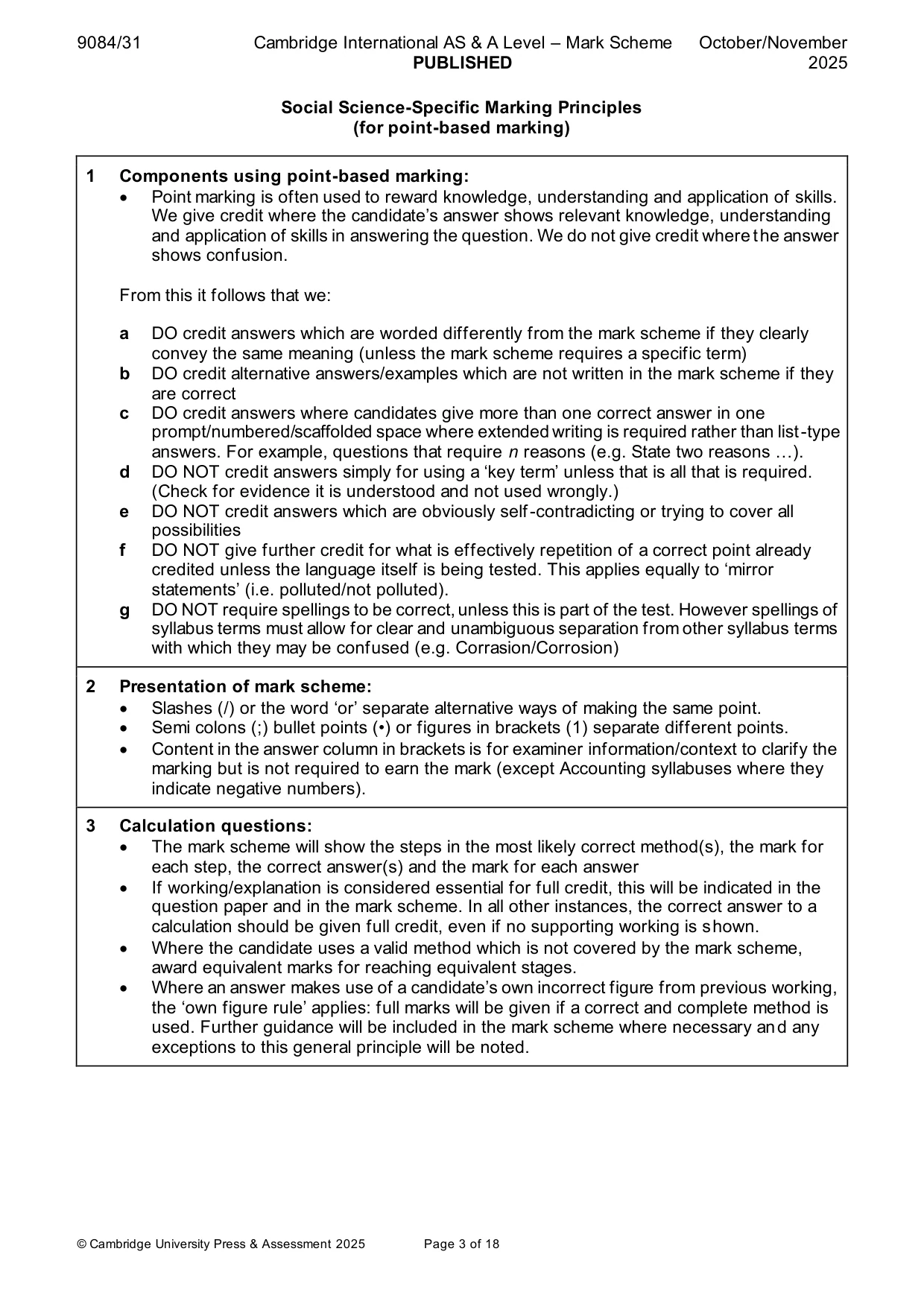
9084/31 Cambridge International AS & A Level – Mark Scheme PUBLISHED October/November 2025 © Cambridge University Press & Assessment 2025 Page 3 of 18 Social Science-Specific Marking Principles (for point-based marking) 1 Components using point-based marking: • Point marking is often used to reward knowledge, understanding and application of skills. We give credit where the candidate’s answer shows relevant knowledge, understanding and application of skills in answering the question. We do not give credit where the answer shows confusion. From this it follows that we: a DO credit answers which are worded differently from the mark scheme if they clearly convey the same meaning (unless the mark scheme requires a specific term) b DO credit alternative answers/examples which are not written in the mark scheme if they are correct c DO credit answers where candidates give more than one correct answer in one prompt/numbered/scaffolded space where extended writing is required rather than list-type answers. For example, questions that require n reasons (e.g. State two reasons …). d DO NOT credit answers simply for using a ‘key term’ unless that is all that is required. (Check for evidence it is understood and not used wrongly.) e DO NOT credit answers which are obviously self-contradicting or trying to cover all possibilities f DO NOT give further credit for what is effectively repetition of a correct point already credited unless the language itself is being tested. This applies equally to ‘mirror statements’ (i.e. polluted/not polluted). g DO NOT require spellings to be correct, unless this is part of the test. However spellings of syllabus terms must allow for clear and unambiguous separation from other syllabus terms with which they may be confused (e.g. Corrasion/Corrosion) 2 Presentation of mark scheme: • Slashes (/) or the word ‘or’ separate alternative ways of making the same point. • Semi colons (;) bullet points (•) or figures in brackets (1) separate different points. • Content in the answer column in brackets is for examiner information/context to clarify the marking but is not required to earn the mark (except Accounting syllabuses where they indicate negative numbers). 3 Calculation questions: • The mark scheme will show the steps in the most likely correct method(s), the mark for each step, the correct answer(s) and the mark for each answer • If working/explanation is considered essential for full credit, this will be indicated in the question paper and in the mark scheme. In all other instances, the correct answer to a calculation should be given full credit, even if no supporting working is shown. • Where the candidate uses a valid method which is not covered by the mark scheme, award equivalent marks for reaching equivalent stages. • Where an answer makes use of a candidate’s own incorrect figure from previous working, the ‘own figure rule’ applies: full marks will be given if a correct and complete method is used. Further guidance will be included in the mark scheme where necessary and any exceptions to this general principle will be noted.
Mark scheme, page 4
9084/31 Cambridge International AS & A Level – Mark Scheme PUBLISHED October/November 2025 © Cambridge University Press & Assessment 2025 Page 4 of 18 4 Annotation: • For point marking, ticks can be used to indicate correct answers and crosses can be used to indicate wrong answers. There is no direct relationship between ticks and marks. Ticks have no defined meaning for levels of response marking. • For levels of response marking, the level awarded should be annotated on the script. • Other annotations will be used by examiners as agreed during standardisation, and the meaning will be understood by all examiners who marked that paper.
Mark scheme, page 5
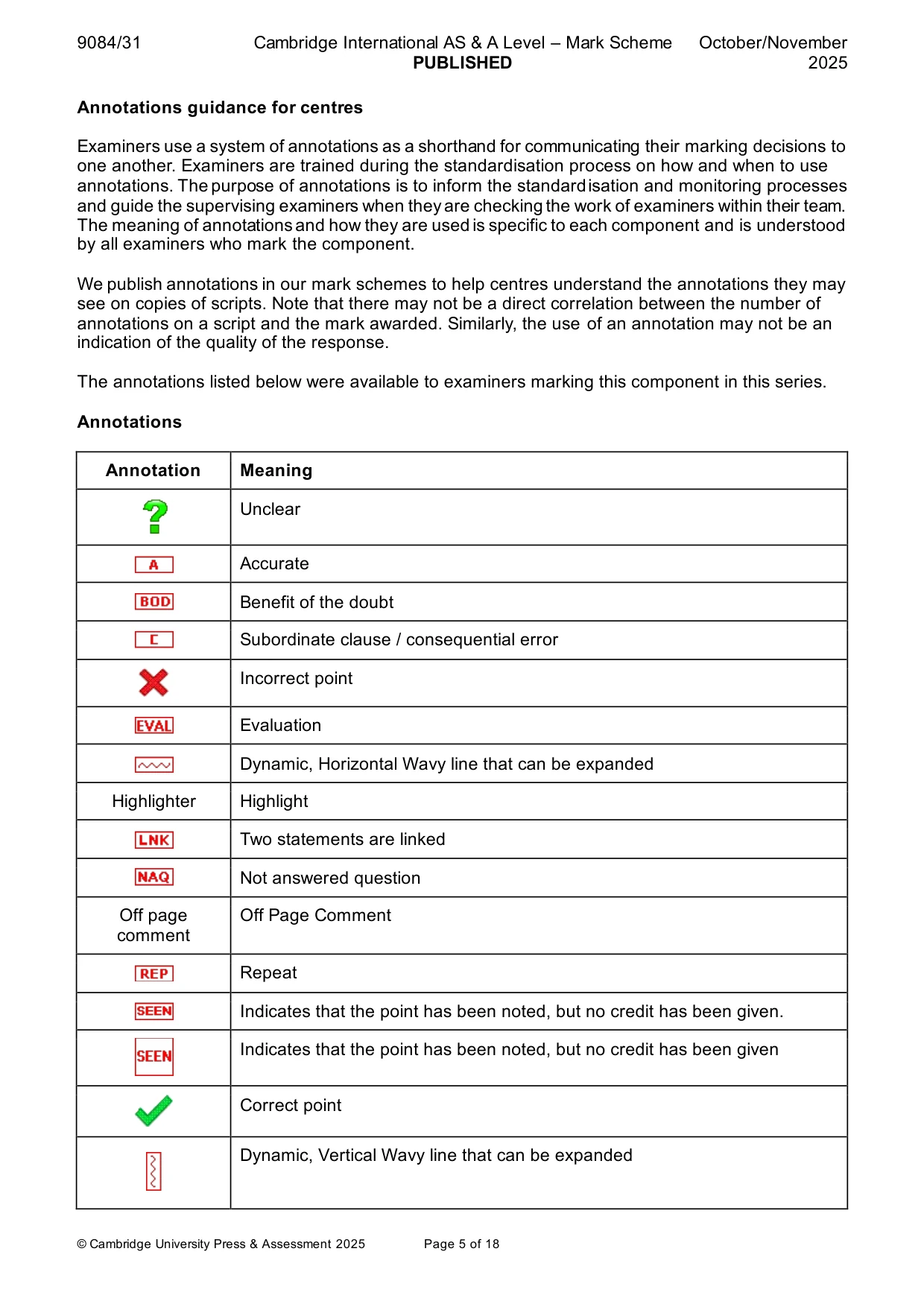
9084/31 Cambridge International AS & A Level – Mark Scheme PUBLISHED October/November 2025 © Cambridge University Press & Assessment 2025 Page 5 of 18 Annotations guidance for centres Examiners use a system of annotations as a shorthand for communicating their marking decisions to one another. Examiners are trained during the standardisation process on how and when to use annotations. The purpose of annotations is to inform the standardisation and monitoring processes and guide the supervising examiners when they are checking the work of examiners within their team. The meaning of annotations and how they are used is specific to each component and is understood by all examiners who mark the component. We publish annotations in our mark schemes to help centres understand the annotations they may see on copies of scripts. Note that there may not be a direct correlation between the number of annotations on a script and the mark awarded. Similarly, the use of an annotation may not be an indication of the quality of the response. The annotations listed below were available to examiners marking this component in this series. Annotations Annotation Meaning Unclear Accurate Benefit of the doubt Subordinate clause / consequential error Incorrect point Evaluation Dynamic, Horizontal Wavy line that can be expanded Highlighter Highlight Two statements are linked Not answered question Off page comment Off Page Comment Repeat Indicates that the point has been noted, but no credit has been given. Indicates that the point has been noted, but no credit has been given Correct point Dynamic, Vertical Wavy line that can be expanded
Mark scheme, page 6
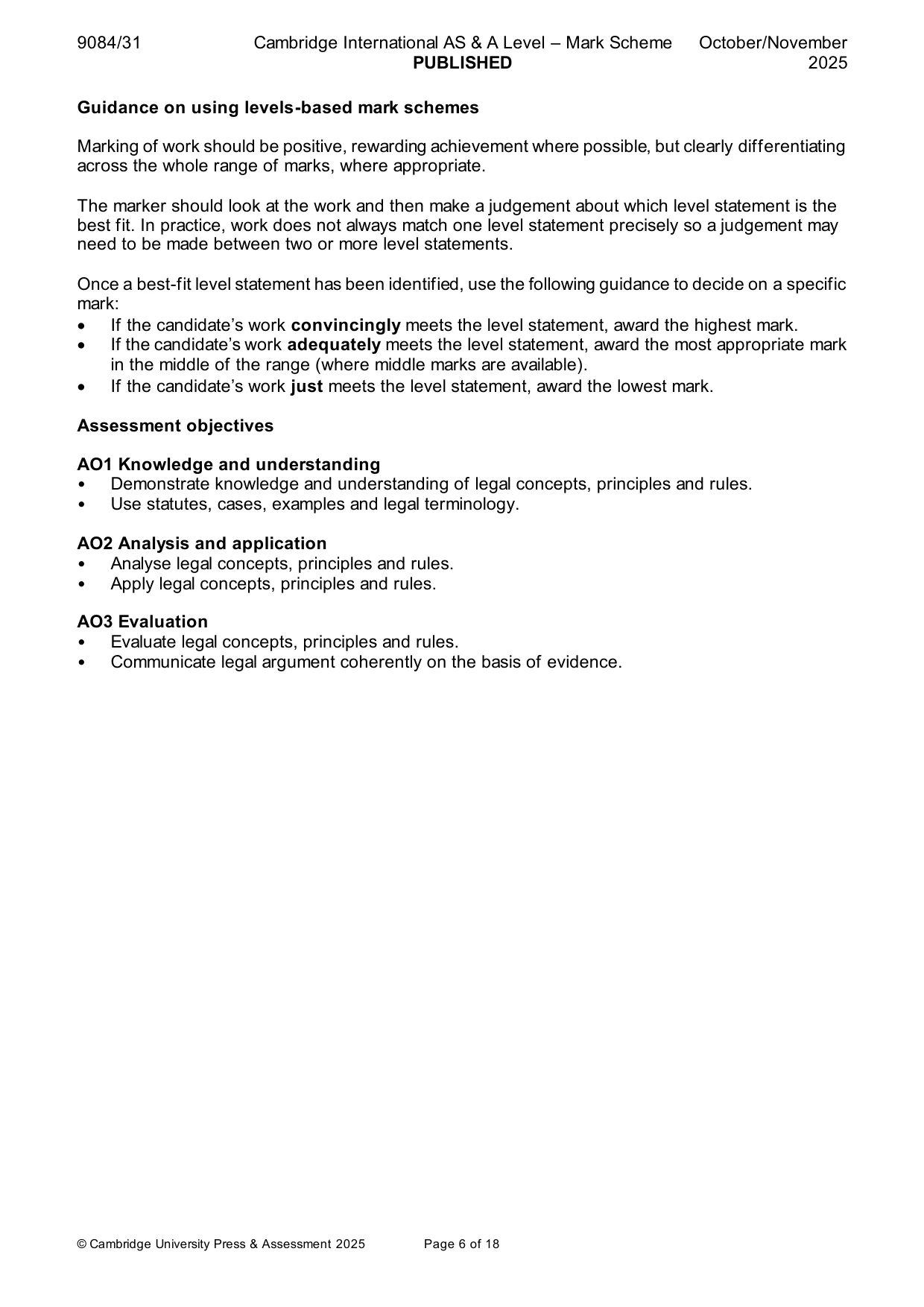
9084/31 Cambridge International AS & A Level – Mark Scheme PUBLISHED October/November 2025 © Cambridge University Press & Assessment 2025 Page 6 of 18 Guidance on using levels-based mark schemes Marking of work should be positive, rewarding achievement where possible, but clearly differentiating across the whole range of marks, where appropriate. The marker should look at the work and then make a judgement about which level statement is the best fit. In practice, work does not always match one level statement precisely so a judgement may need to be made between two or more level statements. Once a best-fit level statement has been identified, use the following guidance to decide on a specific mark: • If the candidate’s work convincingly meets the level statement, award the highest mark. • If the candidate’s work adequately meets the level statement, award the most appropriate mark in the middle of the range (where middle marks are available). • If the candidate’s work just meets the level statement, award the lowest mark. Assessment objectives AO1 Knowledge and understanding • Demonstrate knowledge and understanding of legal concepts, principles and rules. • Use statutes, cases, examples and legal terminology. AO2 Analysis and application • Analyse legal concepts, principles and rules. • Apply legal concepts, principles and rules. AO3 Evaluation • Evaluate legal concepts, principles and rules. • Communicate legal argument coherently on the basis of evidence.
Mark scheme, page 7
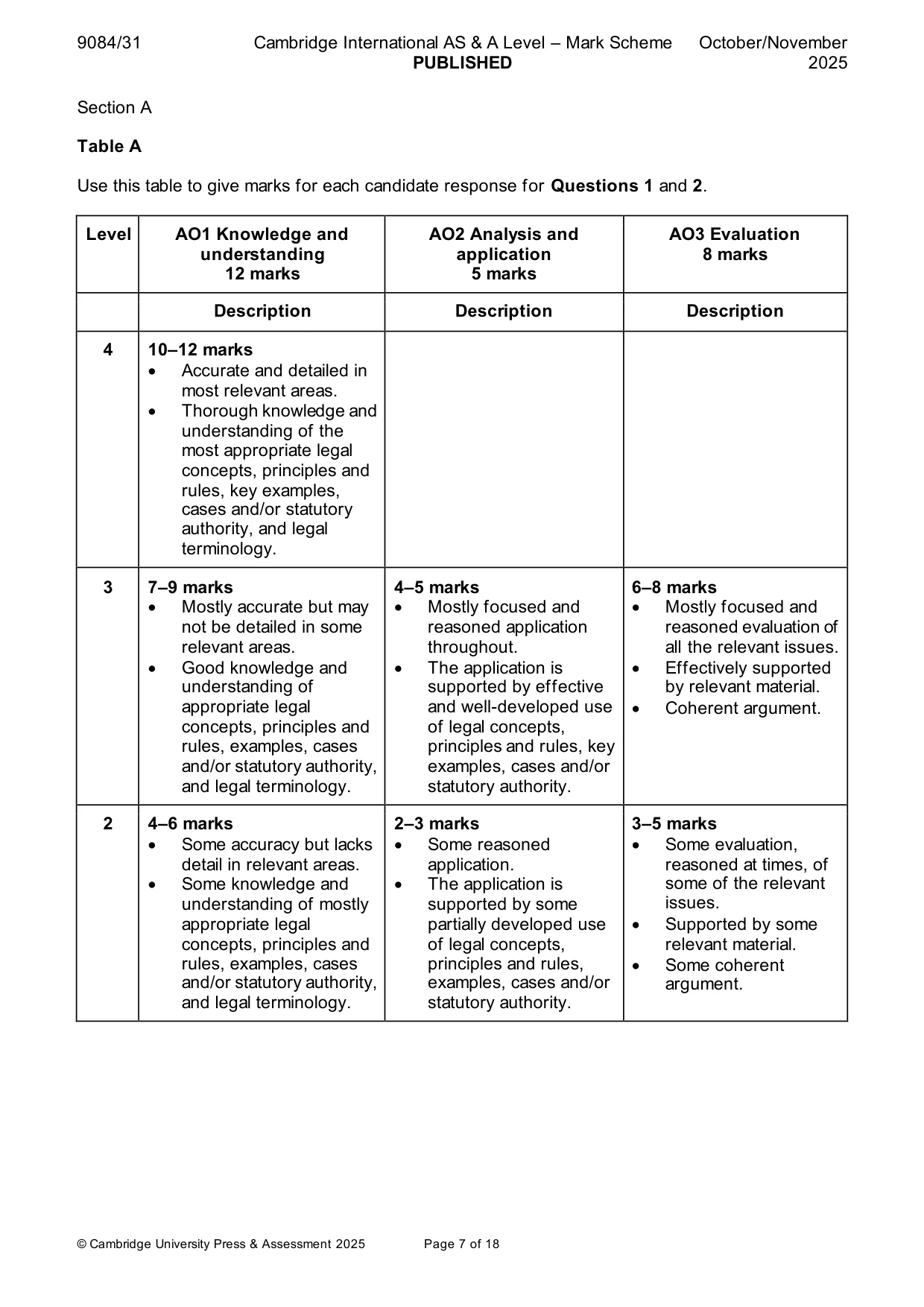
9084/31 Cambridge International AS & A Level – Mark Scheme PUBLISHED October/November 2025 © Cambridge University Press & Assessment 2025 Page 7 of 18 Section A Table A Use this table to give marks for each candidate response for Questions 1 and 2. Level AO1 Knowledge and understanding 12 marks AO2 Analysis and application 5 marks AO3 Evaluation 8 marks Description Description Description 4 10–12 marks • Accurate and detailed in most relevant areas. • Thorough knowledge and understanding of the most appropriate legal concepts, principles and rules, key examples, cases and/or statutory authority, and legal terminology. 3 7–9 marks • Mostly accurate but may not be detailed in some relevant areas. • Good knowledge and understanding of appropriate legal concepts, principles and rules, examples, cases and/or statutory authority, and legal terminology. 4–5 marks • Mostly focused and reasoned application throughout. • The application is supported by effective and well-developed use of legal concepts, principles and rules, key examples, cases and/or statutory authority. 6–8 marks • Mostly focused and reasoned evaluation of all the relevant issues. • Effectively supported by relevant material. • Coherent argument. 2 4–6 marks • Some accuracy but lacks detail in relevant areas. • Some knowledge and understanding of mostly appropriate legal concepts, principles and rules, examples, cases and/or statutory authority, and legal terminology. 2–3 marks • Some reasoned application. • The application is supported by some partially developed use of legal concepts, principles and rules, examples, cases and/or statutory authority. 3–5 marks • Some evaluation, reasoned at times, of some of the relevant issues. • Supported by some relevant material. • Some coherent argument.
Mark scheme, page 8
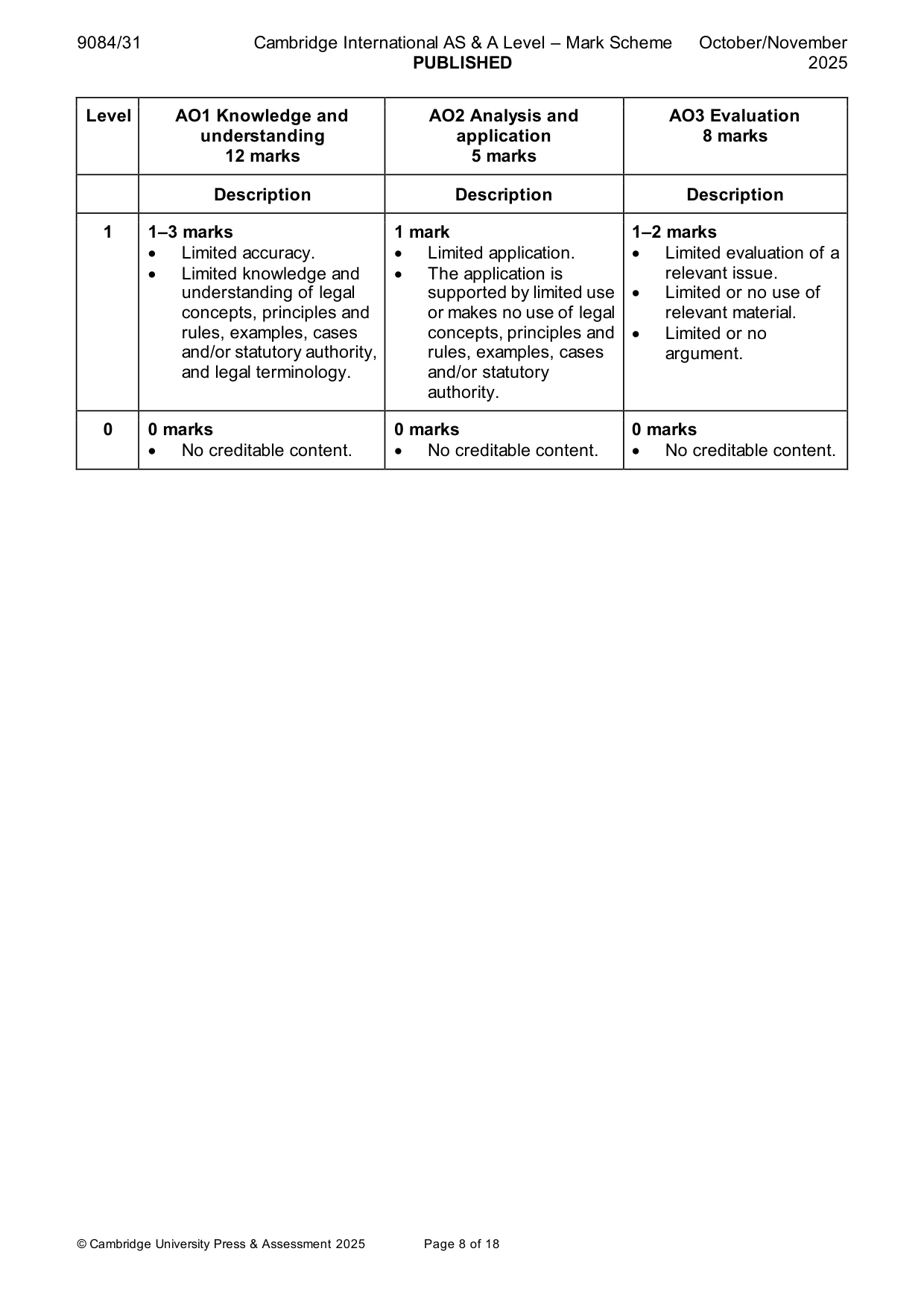
9084/31 Cambridge International AS & A Level – Mark Scheme PUBLISHED October/November 2025 © Cambridge University Press & Assessment 2025 Page 8 of 18 Level AO1 Knowledge and understanding 12 marks AO2 Analysis and application 5 marks AO3 Evaluation 8 marks Description Description Description 1 1–3 marks • Limited accuracy. • Limited knowledge and understanding of legal concepts, principles and rules, examples, cases and/or statutory authority, and legal terminology. 1 mark • Limited application. • The application is supported by limited use or makes no use of legal concepts, principles and rules, examples, cases and/or statutory authority. 1–2 marks • Limited evaluation of a relevant issue. • Limited or no use of relevant material. • Limited or no argument. 0 0 marks • No creditable content. 0 marks • No creditable content. 0 marks • No creditable content.
Mark scheme, page 9
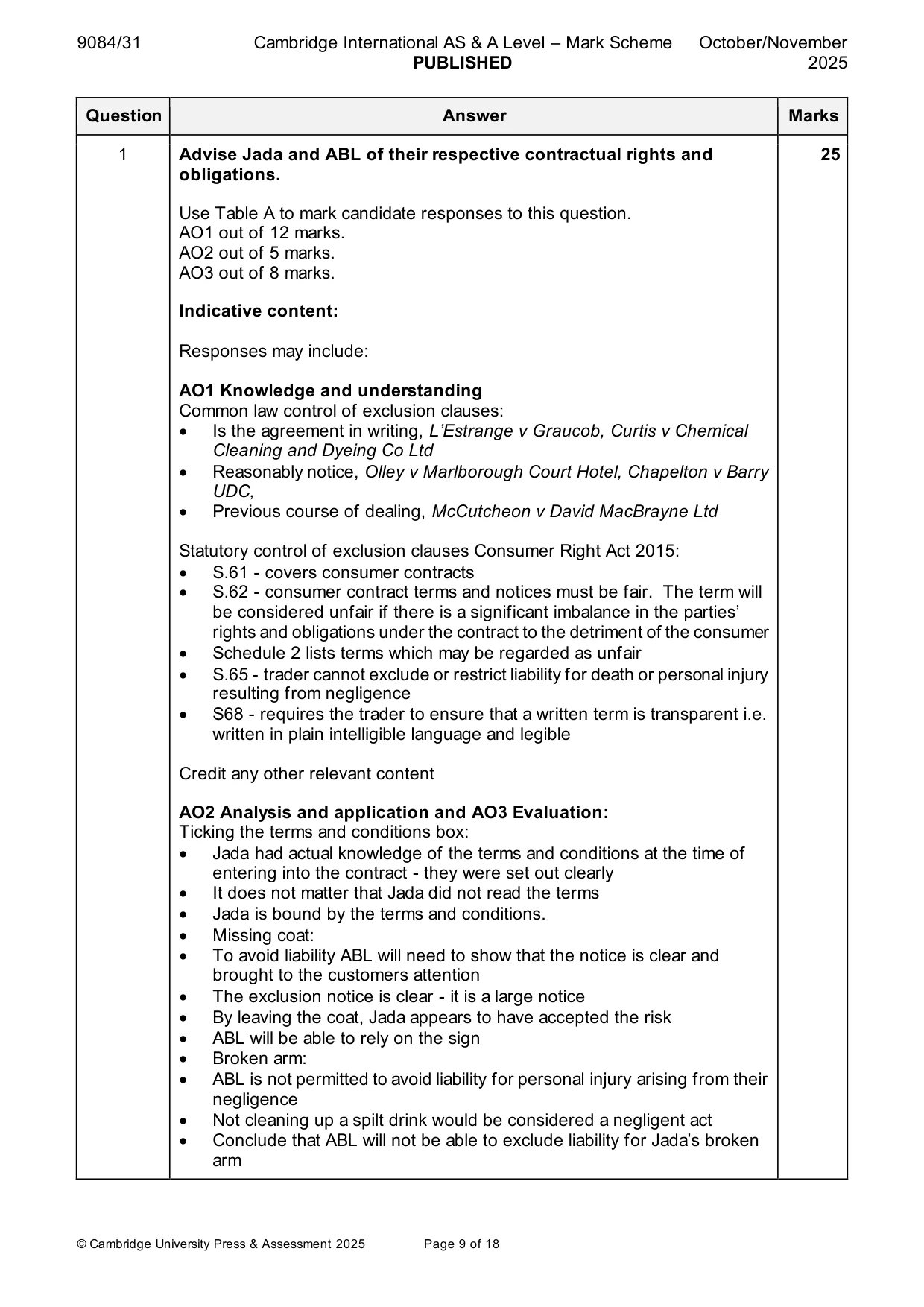
9084/31 Cambridge International AS & A Level – Mark Scheme PUBLISHED October/November 2025 © Cambridge University Press & Assessment 2025 Page 9 of 18 Question Answer Marks 1 Advise Jada and ABL of their respective contractual rights and obligations. Use Table A to mark candidate responses to this question. AO1 out of 12 marks. AO2 out of 5 marks. AO3 out of 8 marks. Indicative content: Responses may include: AO1 Knowledge and understanding Common law control of exclusion clauses: • Is the agreement in writing, L’Estrange v Graucob, Curtis v Chemical Cleaning and Dyeing Co Ltd • Reasonably notice, Olley v Marlborough Court Hotel, Chapelton v Barry UDC, • Previous course of dealing, McCutcheon v David MacBrayne Ltd Statutory control of exclusion clauses Consumer Right Act 2015: • S.61 - covers consumer contracts • S.62 - consumer contract terms and notices must be fair. The term will be considered unfair if there is a significant imbalance in the parties’ rights and obligations under the contract to the detriment of the consumer • Schedule 2 lists terms which may be regarded as unfair • S.65 - trader cannot exclude or restrict liability for death or personal injury resulting from negligence • S68 - requires the trader to ensure that a written term is transparent i.e. written in plain intelligible language and legible Credit any other relevant content AO2 Analysis and application and AO3 Evaluation: Ticking the terms and conditions box: • Jada had actual knowledge of the terms and conditions at the time of entering into the contract - they were set out clearly • It does not matter that Jada did not read the terms • Jada is bound by the terms and conditions. • Missing coat: • To avoid liability ABL will need to show that the notice is clear and brought to the customers attention • The exclusion notice is clear - it is a large notice • By leaving the coat, Jada appears to have accepted the risk • ABL will be able to rely on the sign • Broken arm: • ABL is not permitted to avoid liability for personal injury arising from their negligence • Not cleaning up a spilt drink would be considered a negligent act • Conclude that ABL will not be able to exclude liability for Jada’s broken arm 25
Mark scheme, page 10
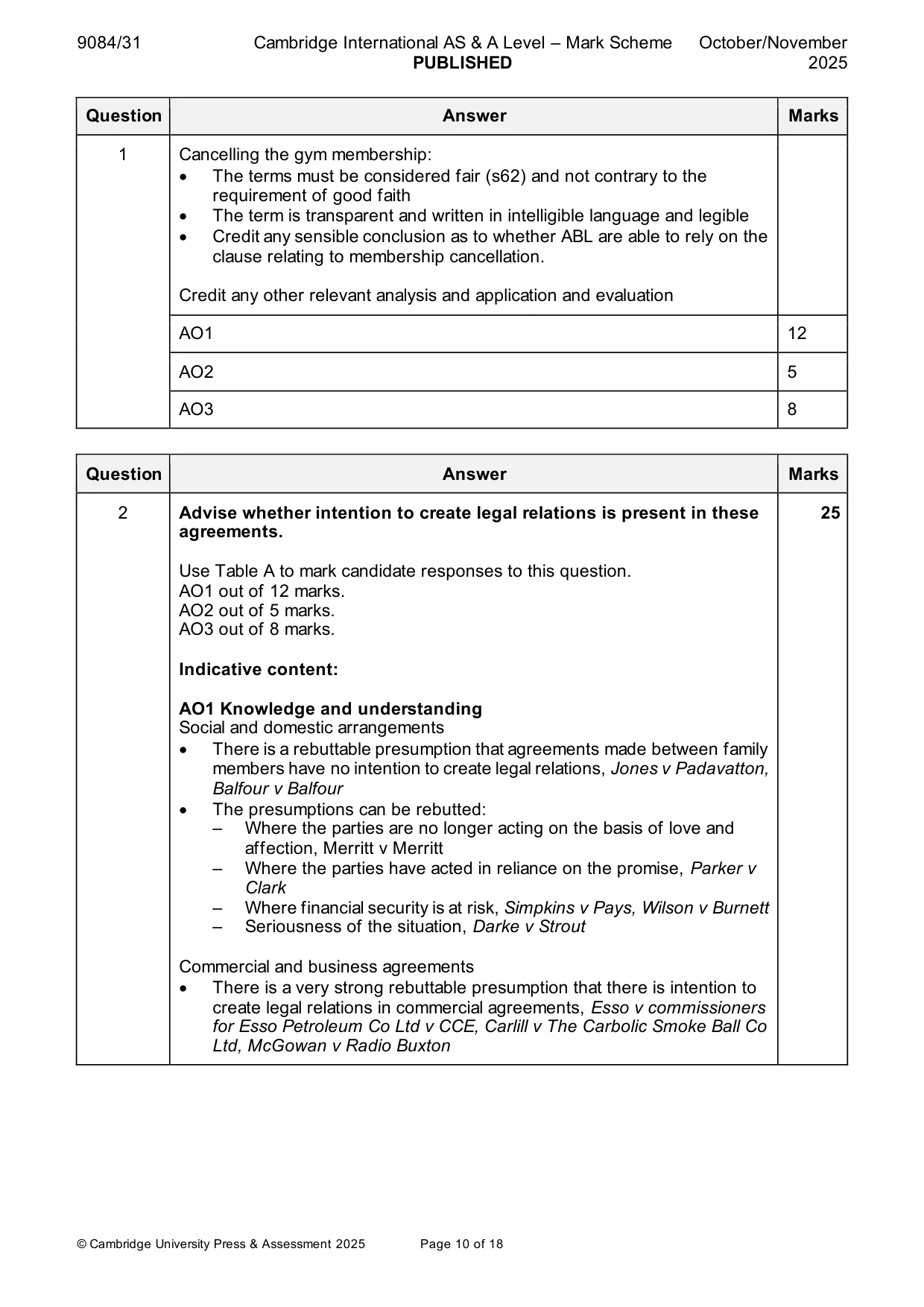
9084/31 Cambridge International AS & A Level – Mark Scheme PUBLISHED October/November 2025 © Cambridge University Press & Assessment 2025 Page 10 of 18 Question Answer Marks 1 Cancelling the gym membership: • The terms must be considered fair (s62) and not contrary to the requirement of good faith • The term is transparent and written in intelligible language and legible • Credit any sensible conclusion as to whether ABL are able to rely on the clause relating to membership cancellation. Credit any other relevant analysis and application and evaluation AO1 12 AO2 5 AO3 8 Question Answer Marks 2 Advise whether intention to create legal relations is present in these agreements. Use Table A to mark candidate responses to this question. AO1 out of 12 marks. AO2 out of 5 marks. AO3 out of 8 marks. Indicative content: AO1 Knowledge and understanding Social and domestic arrangements • There is a rebuttable presumption that agreements made between family members have no intention to create legal relations, Jones v Padavatton, Balfour v Balfour • The presumptions can be rebutted: – Where the parties are no longer acting on the basis of love and affection, Merritt v Merritt – Where the parties have acted in reliance on the promise, Parker v Clark – Where financial security is at risk, Simpkins v Pays, Wilson v Burnett – Seriousness of the situation, Darke v Strout Commercial and business agreements • There is a very strong rebuttable presumption that there is intention to create legal relations in commercial agreements, Esso v commissioners for Esso Petroleum Co Ltd v CCE, Carlill v The Carbolic Smoke Ball Co Ltd, McGowan v Radio Buxton 25
Mark scheme, page 11
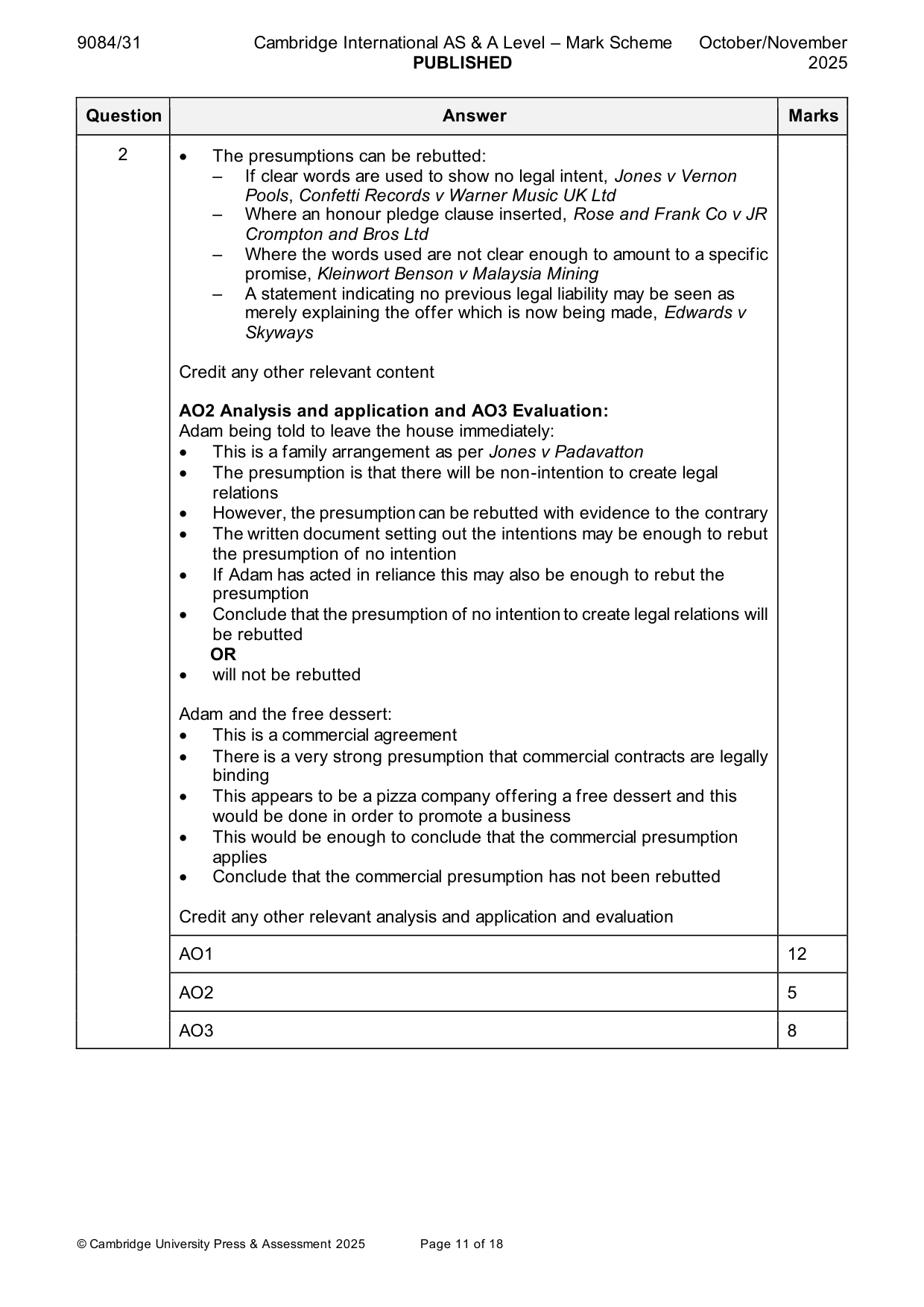
9084/31 Cambridge International AS & A Level – Mark Scheme PUBLISHED October/November 2025 © Cambridge University Press & Assessment 2025 Page 11 of 18 Question Answer Marks 2 • The presumptions can be rebutted: – If clear words are used to show no legal intent, Jones v Vernon Pools, Confetti Records v Warner Music UK Ltd – Where an honour pledge clause inserted, Rose and Frank Co v JR Crompton and Bros Ltd – Where the words used are not clear enough to amount to a specific promise, Kleinwort Benson v Malaysia Mining – A statement indicating no previous legal liability may be seen as merely explaining the offer which is now being made, Edwards v Skyways Credit any other relevant content AO2 Analysis and application and AO3 Evaluation: Adam being told to leave the house immediately: • This is a family arrangement as per Jones v Padavatton • The presumption is that there will be non-intention to create legal relations • However, the presumption can be rebutted with evidence to the contrary • The written document setting out the intentions may be enough to rebut the presumption of no intention • If Adam has acted in reliance this may also be enough to rebut the presumption • Conclude that the presumption of no intention to create legal relations will be rebutted OR • will not be rebutted Adam and the free dessert: • This is a commercial agreement • There is a very strong presumption that commercial contracts are legally binding • This appears to be a pizza company offering a free dessert and this would be done in order to promote a business • This would be enough to conclude that the commercial presumption applies • Conclude that the commercial presumption has not been rebutted Credit any other relevant analysis and application and evaluation AO1 12 AO2 5 AO3 8
Mark scheme, page 12
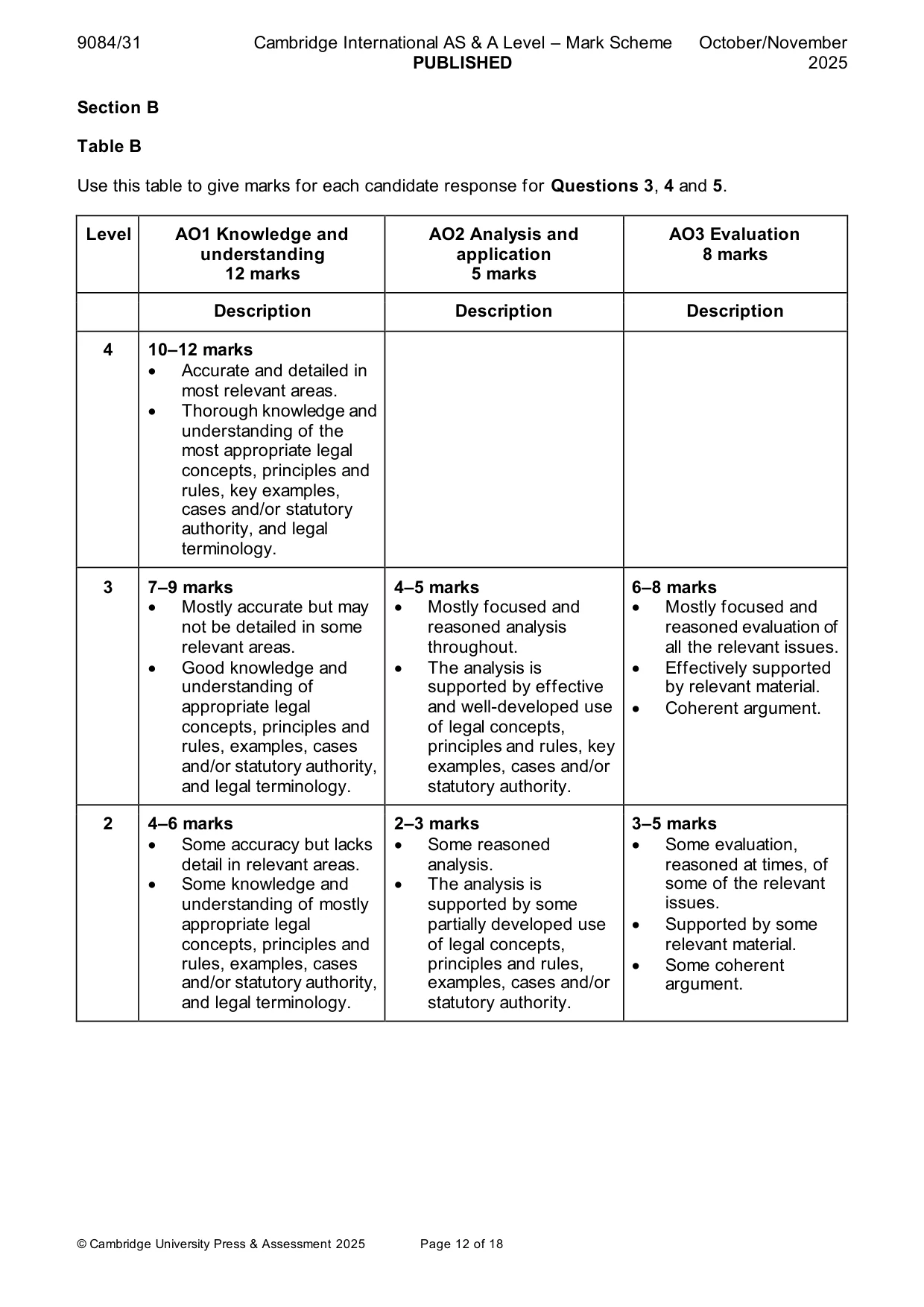
9084/31 Cambridge International AS & A Level – Mark Scheme PUBLISHED October/November 2025 © Cambridge University Press & Assessment 2025 Page 12 of 18 Section B Table B Use this table to give marks for each candidate response for Questions 3, 4 and 5. Level AO1 Knowledge and understanding 12 marks AO2 Analysis and application 5 marks AO3 Evaluation 8 marks Description Description Description 4 10–12 marks • Accurate and detailed in most relevant areas. • Thorough knowledge and understanding of the most appropriate legal concepts, principles and rules, key examples, cases and/or statutory authority, and legal terminology. 3 7–9 marks • Mostly accurate but may not be detailed in some relevant areas. • Good knowledge and understanding of appropriate legal concepts, principles and rules, examples, cases and/or statutory authority, and legal terminology. 4–5 marks • Mostly focused and reasoned analysis throughout. • The analysis is supported by effective and well-developed use of legal concepts, principles and rules, key examples, cases and/or statutory authority. 6–8 marks • Mostly focused and reasoned evaluation of all the relevant issues. • Effectively supported by relevant material. • Coherent argument. 2 4–6 marks • Some accuracy but lacks detail in relevant areas. • Some knowledge and understanding of mostly appropriate legal concepts, principles and rules, examples, cases and/or statutory authority, and legal terminology. 2–3 marks • Some reasoned analysis. • The analysis is supported by some partially developed use of legal concepts, principles and rules, examples, cases and/or statutory authority. 3–5 marks • Some evaluation, reasoned at times, of some of the relevant issues. • Supported by some relevant material. • Some coherent argument.
Mark scheme, page 13
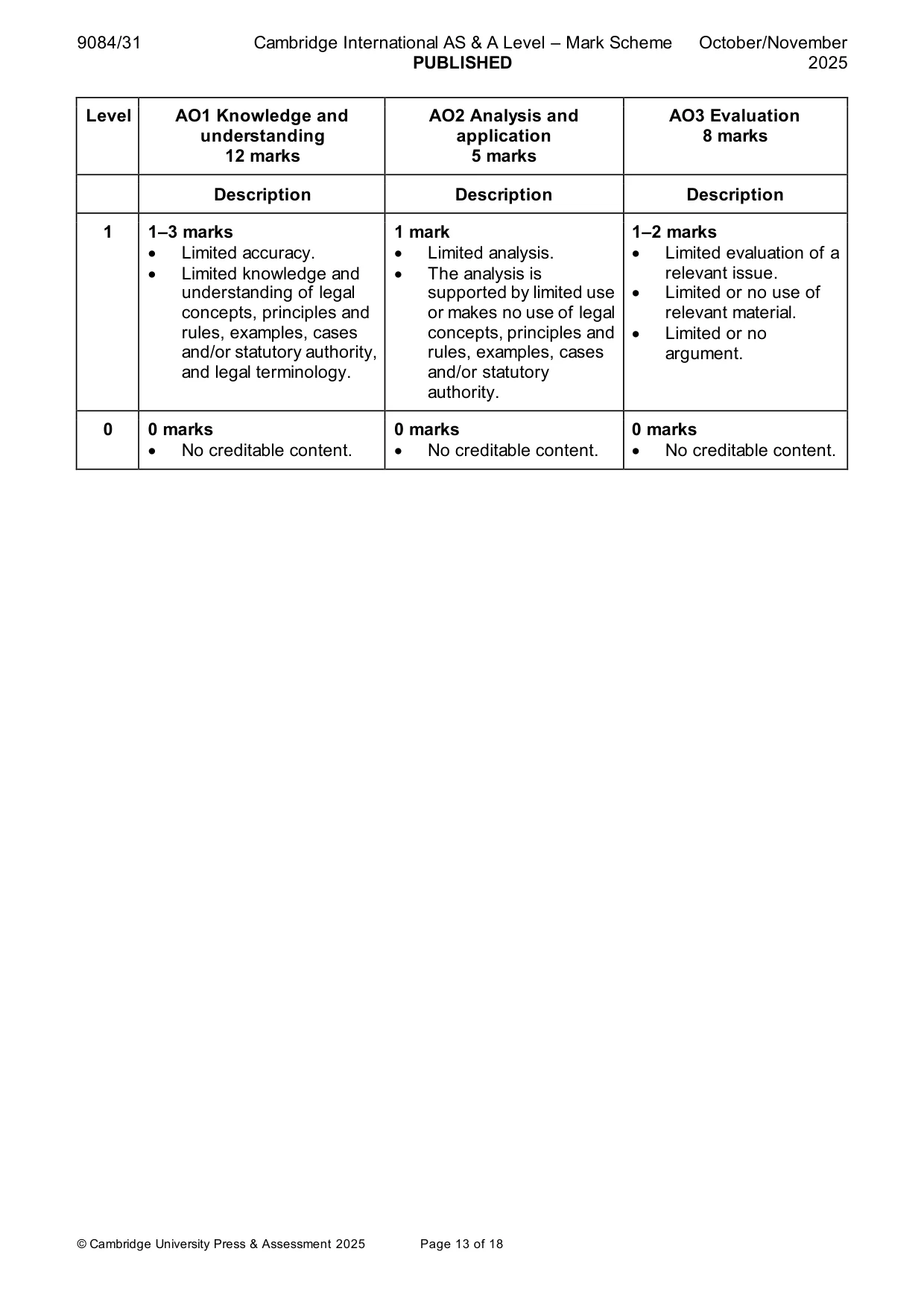
9084/31 Cambridge International AS & A Level – Mark Scheme PUBLISHED October/November 2025 © Cambridge University Press & Assessment 2025 Page 13 of 18 Level AO1 Knowledge and understanding 12 marks AO2 Analysis and application 5 marks AO3 Evaluation 8 marks Description Description Description 1 1–3 marks • Limited accuracy. • Limited knowledge and understanding of legal concepts, principles and rules, examples, cases and/or statutory authority, and legal terminology. 1 mark • Limited analysis. • The analysis is supported by limited use or makes no use of legal concepts, principles and rules, examples, cases and/or statutory authority. 1–2 marks • Limited evaluation of a relevant issue. • Limited or no use of relevant material. • Limited or no argument. 0 0 marks • No creditable content. 0 marks • No creditable content. 0 marks • No creditable content.
Mark scheme, page 14
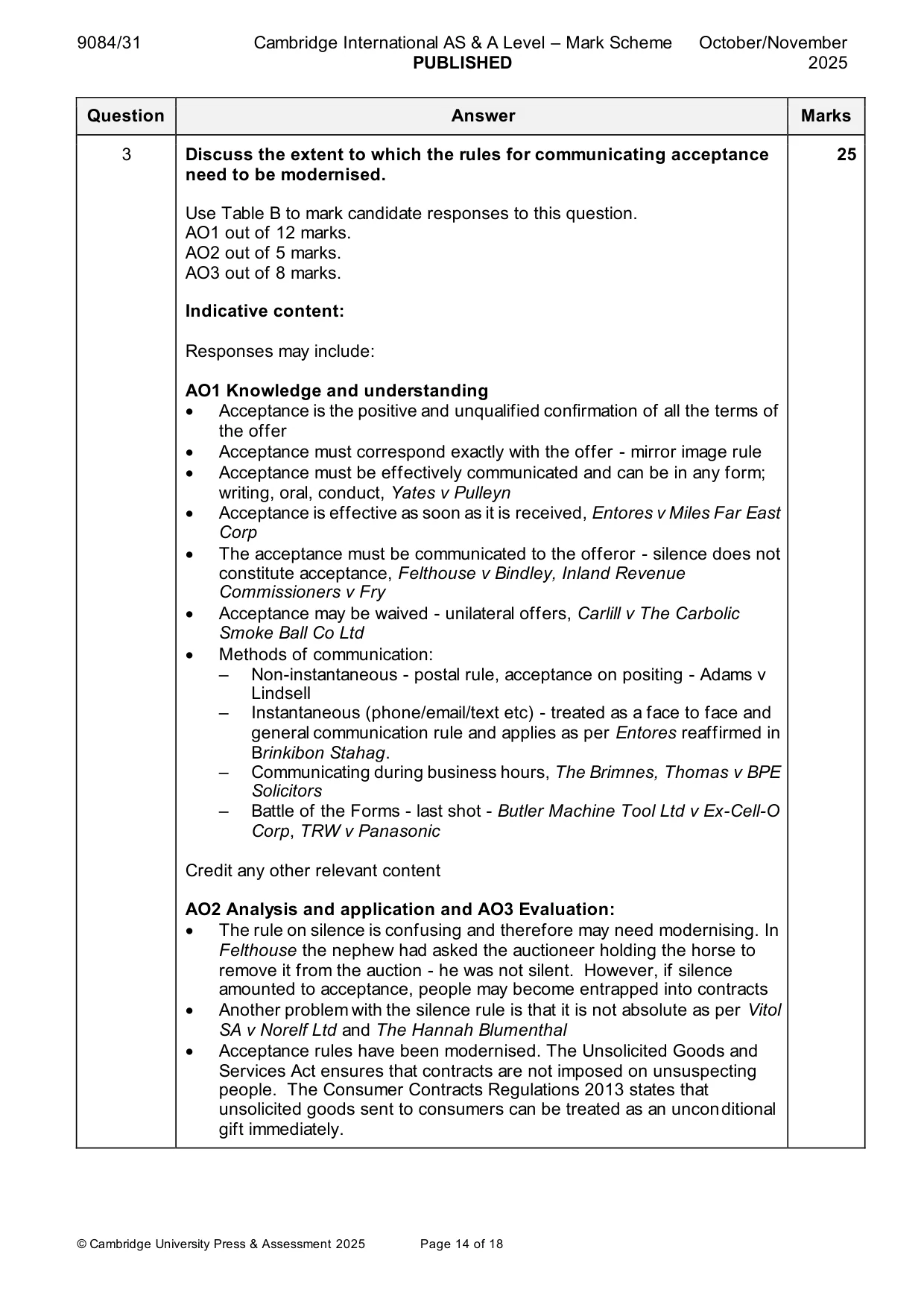
9084/31 Cambridge International AS & A Level – Mark Scheme PUBLISHED October/November 2025 © Cambridge University Press & Assessment 2025 Page 14 of 18 Question Answer Marks 3 Discuss the extent to which the rules for communicating acceptance need to be modernised. Use Table B to mark candidate responses to this question. AO1 out of 12 marks. AO2 out of 5 marks. AO3 out of 8 marks. Indicative content: Responses may include: AO1 Knowledge and understanding • Acceptance is the positive and unqualified confirmation of all the terms of the offer • Acceptance must correspond exactly with the offer - mirror image rule • Acceptance must be effectively communicated and can be in any form; writing, oral, conduct, Yates v Pulleyn • Acceptance is effective as soon as it is received, Entores v Miles Far East Corp • The acceptance must be communicated to the offeror - silence does not constitute acceptance, Felthouse v Bindley, Inland Revenue Commissioners v Fry • Acceptance may be waived - unilateral offers, Carlill v The Carbolic Smoke Ball Co Ltd • Methods of communication: – Non-instantaneous - postal rule, acceptance on positing - Adams v Lindsell – Instantaneous (phone/email/text etc) - treated as a face to face and general communication rule and applies as per Entores reaffirmed in Brinkibon Stahag. – Communicating during business hours, The Brimnes, Thomas v BPE Solicitors – Battle of the Forms - last shot - Butler Machine Tool Ltd v Ex-Cell-O Corp, TRW v Panasonic Credit any other relevant content AO2 Analysis and application and AO3 Evaluation: • The rule on silence is confusing and therefore may need modernising. In Felthouse the nephew had asked the auctioneer holding the horse to remove it from the auction - he was not silent. However, if silence amounted to acceptance, people may become entrapped into contracts • Another problem with the silence rule is that it is not absolute as per Vitol SA v Norelf Ltd and The Hannah Blumenthal • Acceptance rules have been modernised. The Unsolicited Goods and Services Act ensures that contracts are not imposed on unsuspecting people. The Consumer Contracts Regulations 2013 states that unsolicited goods sent to consumers can be treated as an unconditional gift immediately. 25
Mark scheme, page 15
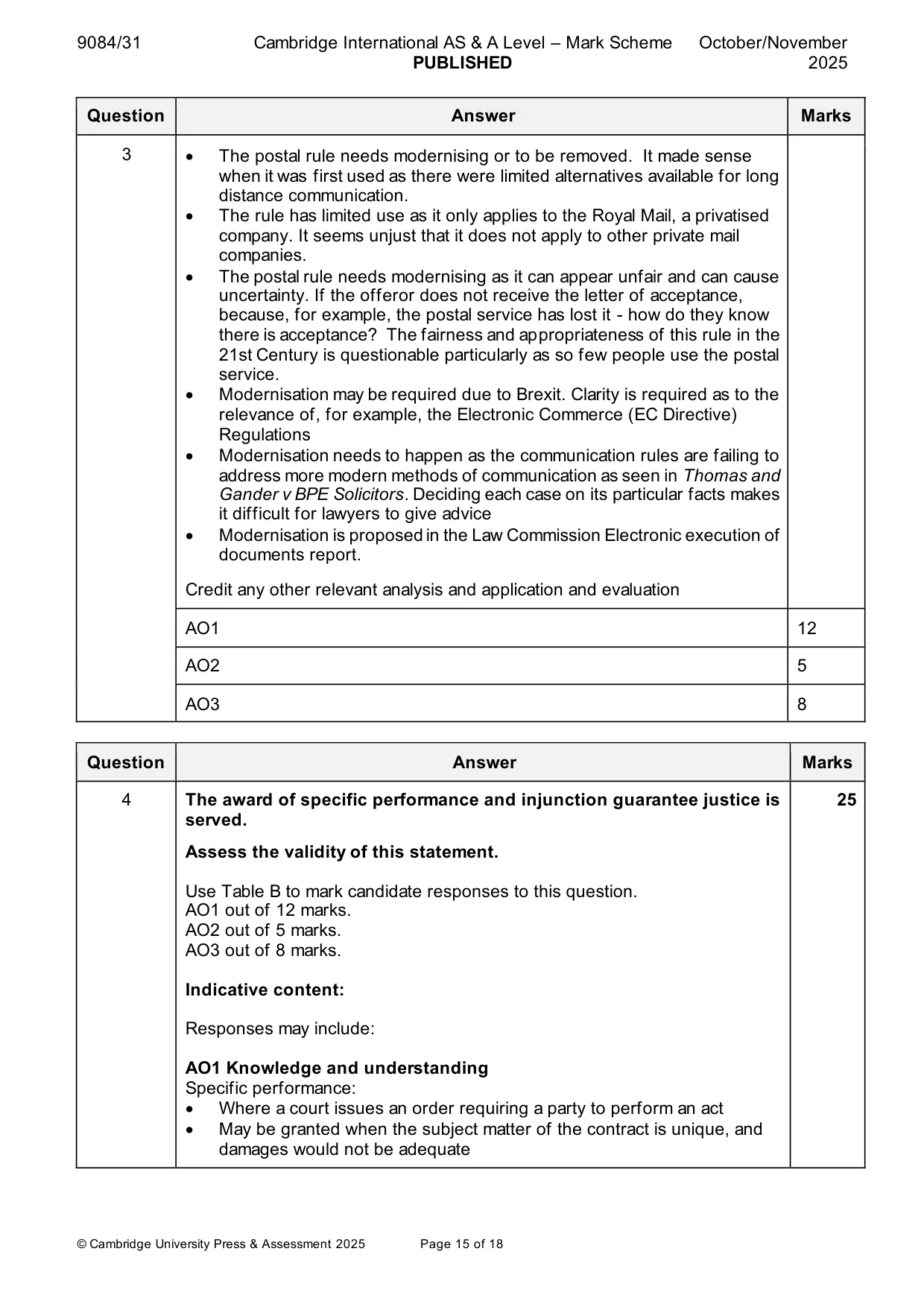
9084/31 Cambridge International AS & A Level – Mark Scheme PUBLISHED October/November 2025 © Cambridge University Press & Assessment 2025 Page 15 of 18 Question Answer Marks 3 • The postal rule needs modernising or to be removed. It made sense when it was first used as there were limited alternatives available for long distance communication. • The rule has limited use as it only applies to the Royal Mail, a privatised company. It seems unjust that it does not apply to other private mail companies. • The postal rule needs modernising as it can appear unfair and can cause uncertainty. If the offeror does not receive the letter of acceptance, because, for example, the postal service has lost it - how do they know there is acceptance? The fairness and appropriateness of this rule in the 21st Century is questionable particularly as so few people use the postal service. • Modernisation may be required due to Brexit. Clarity is required as to the relevance of, for example, the Electronic Commerce (EC Directive) Regulations • Modernisation needs to happen as the communication rules are failing to address more modern methods of communication as seen in Thomas and Gander v BPE Solicitors. Deciding each case on its particular facts makes it difficult for lawyers to give advice • Modernisation is proposed in the Law Commission Electronic execution of documents report. Credit any other relevant analysis and application and evaluation AO1 12 AO2 5 AO3 8 Question Answer Marks 4 The award of specific performance and injunction guarantee justice is served. Assess the validity of this statement. Use Table B to mark candidate responses to this question. AO1 out of 12 marks. AO2 out of 5 marks. AO3 out of 8 marks. Indicative content: Responses may include: AO1 Knowledge and understanding Specific performance: • Where a court issues an order requiring a party to perform an act • May be granted when the subject matter of the contract is unique, and damages would not be adequate 25
Mark scheme, page 16
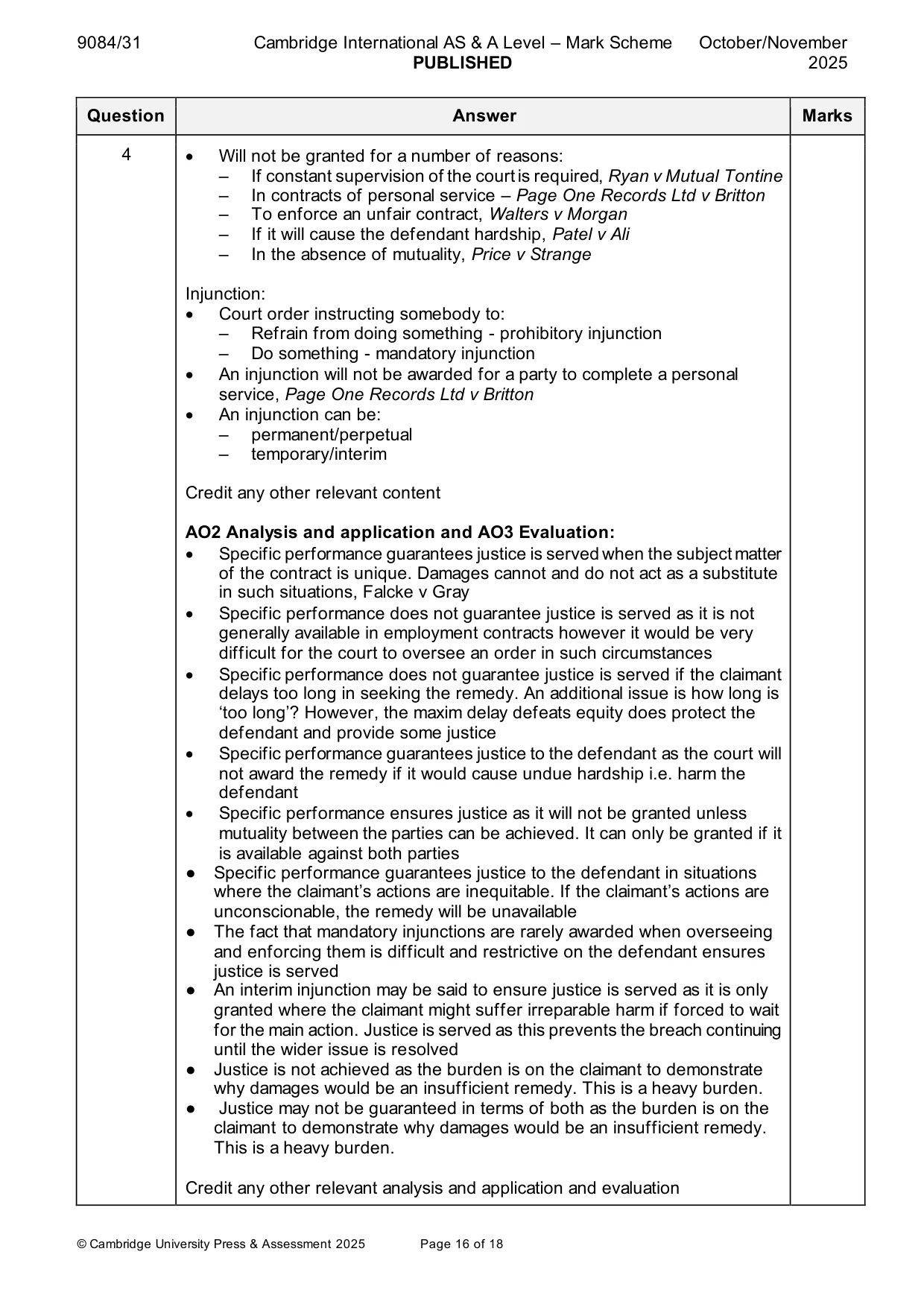
9084/31 Cambridge International AS & A Level – Mark Scheme PUBLISHED October/November 2025 © Cambridge University Press & Assessment 2025 Page 16 of 18 Question Answer Marks 4 • Will not be granted for a number of reasons: – If constant supervision of the court is required, Ryan v Mutual Tontine – In contracts of personal service – Page One Records Ltd v Britton – To enforce an unfair contract, Walters v Morgan – If it will cause the defendant hardship, Patel v Ali – In the absence of mutuality, Price v Strange Injunction: • Court order instructing somebody to: – Refrain from doing something - prohibitory injunction – Do something - mandatory injunction • An injunction will not be awarded for a party to complete a personal service, Page One Records Ltd v Britton • An injunction can be: – permanent/perpetual – temporary/interim Credit any other relevant content AO2 Analysis and application and AO3 Evaluation: • Specific performance guarantees justice is served when the subject matter of the contract is unique. Damages cannot and do not act as a substitute in such situations, Falcke v Gray • Specific performance does not guarantee justice is served as it is not generally available in employment contracts however it would be very difficult for the court to oversee an order in such circumstances • Specific performance does not guarantee justice is served if the claimant delays too long in seeking the remedy. An additional issue is how long is ‘too long’? However, the maxim delay defeats equity does protect the defendant and provide some justice • Specific performance guarantees justice to the defendant as the court will not award the remedy if it would cause undue hardship i.e. harm the defendant • Specific performance ensures justice as it will not be granted unless mutuality between the parties can be achieved. It can only be granted if it is available against both parties ● Specific performance guarantees justice to the defendant in situations where the claimant’s actions are inequitable. If the claimant’s actions are unconscionable, the remedy will be unavailable ● The fact that mandatory injunctions are rarely awarded when overseeing and enforcing them is difficult and restrictive on the defendant ensures justice is served ● An interim injunction may be said to ensure justice is served as it is only granted where the claimant might suffer irreparable harm if forced to wait for the main action. Justice is served as this prevents the breach continuing until the wider issue is resolved ● Justice is not achieved as the burden is on the claimant to demonstrate why damages would be an insufficient remedy. This is a heavy burden. ● Justice may not be guaranteed in terms of both as the burden is on the claimant to demonstrate why damages would be an insufficient remedy. This is a heavy burden. Credit any other relevant analysis and application and evaluation
Mark scheme, page 17
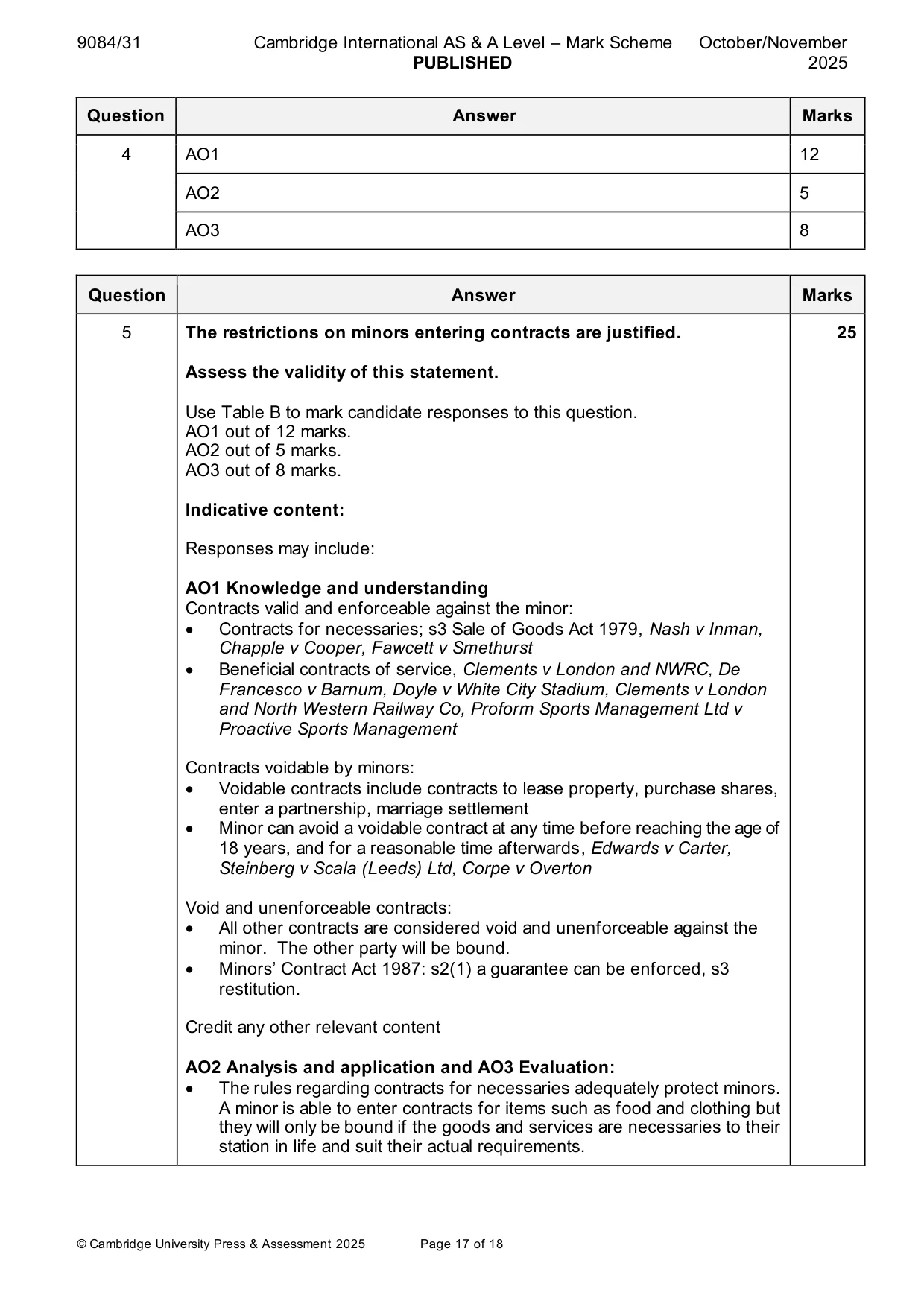
9084/31 Cambridge International AS & A Level – Mark Scheme PUBLISHED October/November 2025 © Cambridge University Press & Assessment 2025 Page 17 of 18 Question Answer Marks 4 AO1 12 AO2 5 AO3 8 Question Answer Marks 5 The restrictions on minors entering contracts are justified. Assess the validity of this statement. Use Table B to mark candidate responses to this question. AO1 out of 12 marks. AO2 out of 5 marks. AO3 out of 8 marks. Indicative content: Responses may include: AO1 Knowledge and understanding Contracts valid and enforceable against the minor: • Contracts for necessaries; s3 Sale of Goods Act 1979, Nash v Inman, Chapple v Cooper, Fawcett v Smethurst • Beneficial contracts of service, Clements v London and NWRC, De Francesco v Barnum, Doyle v White City Stadium, Clements v London and North Western Railway Co, Proform Sports Management Ltd v Proactive Sports Management Contracts voidable by minors: • Voidable contracts include contracts to lease property, purchase shares, enter a partnership, marriage settlement • Minor can avoid a voidable contract at any time before reaching the age of 18 years, and for a reasonable time afterwards, Edwards v Carter, Steinberg v Scala (Leeds) Ltd, Corpe v Overton Void and unenforceable contracts: • All other contracts are considered void and unenforceable against the minor. The other party will be bound. • Minors’ Contract Act 1987: s2(1) a guarantee can be enforced, s3 restitution. Credit any other relevant content AO2 Analysis and application and AO3 Evaluation: • The rules regarding contracts for necessaries adequately protect minors. A minor is able to enter contracts for items such as food and clothing but they will only be bound if the goods and services are necessaries to their station in life and suit their actual requirements. 25
Mark scheme, page 18
9084/31 Cambridge International AS & A Level – Mark Scheme PUBLISHED October/November 2025 © Cambridge University Press & Assessment 2025 Page 18 of 18 Question Answer Marks 5 • An unscrupulous adult/business will not take advantage of a minor by overcharging. If a good or service is considered necessaries the minor is only obliged to pay a reasonable price • The restrictions also ensure that a minor is only obliged to pay for goods actually supplied. • The law is protective rather than restrictive as contracts for necessaries will not be enforceable if the terms of the contract are prejudicial to the minor’s best interests. • The rules on beneficial contracts of service allow minors to enter contracts to support themselves financially in terms of education and employment but they are protected as if any of the terms act to the minor’s detriment they will automatically invalidate the contract of service • The restrictions in place regarding voidable contracts protect a minor due to their onerous nature. • The ability to repudiate all obligations under a voidable contract stops a minor committing themselves to a long-term recurring obligation and being taken advantage of • The MCA allows a minor to enter a contract with the backing of a guarantor (s2) and protects the minor as the obligations will be enforceable against the guarantor. Credit any other relevant analysis and application and evaluation AO1 12 AO2 5 AO3 8
What you needed in this session
Cambridge’s own grade thresholds for 2025 Oct/Nov, Paper 3 · Variant 1. A higher threshold means an easier paper — the bar moves with how the cohort did.