Cambridge A Level Law 9084 — 2023 May/June Paper 1 · Variant 2
9084/12/M/J/23 · 75 marks · ≈84 min
The question paper and its mark scheme, free to read here and free to download. This is Cambridge’s own paper, exactly as it was sat.
Question paper4 pages


Mark scheme14 pages
Answers below. Sit the paper first if you are practising.
Paper as text
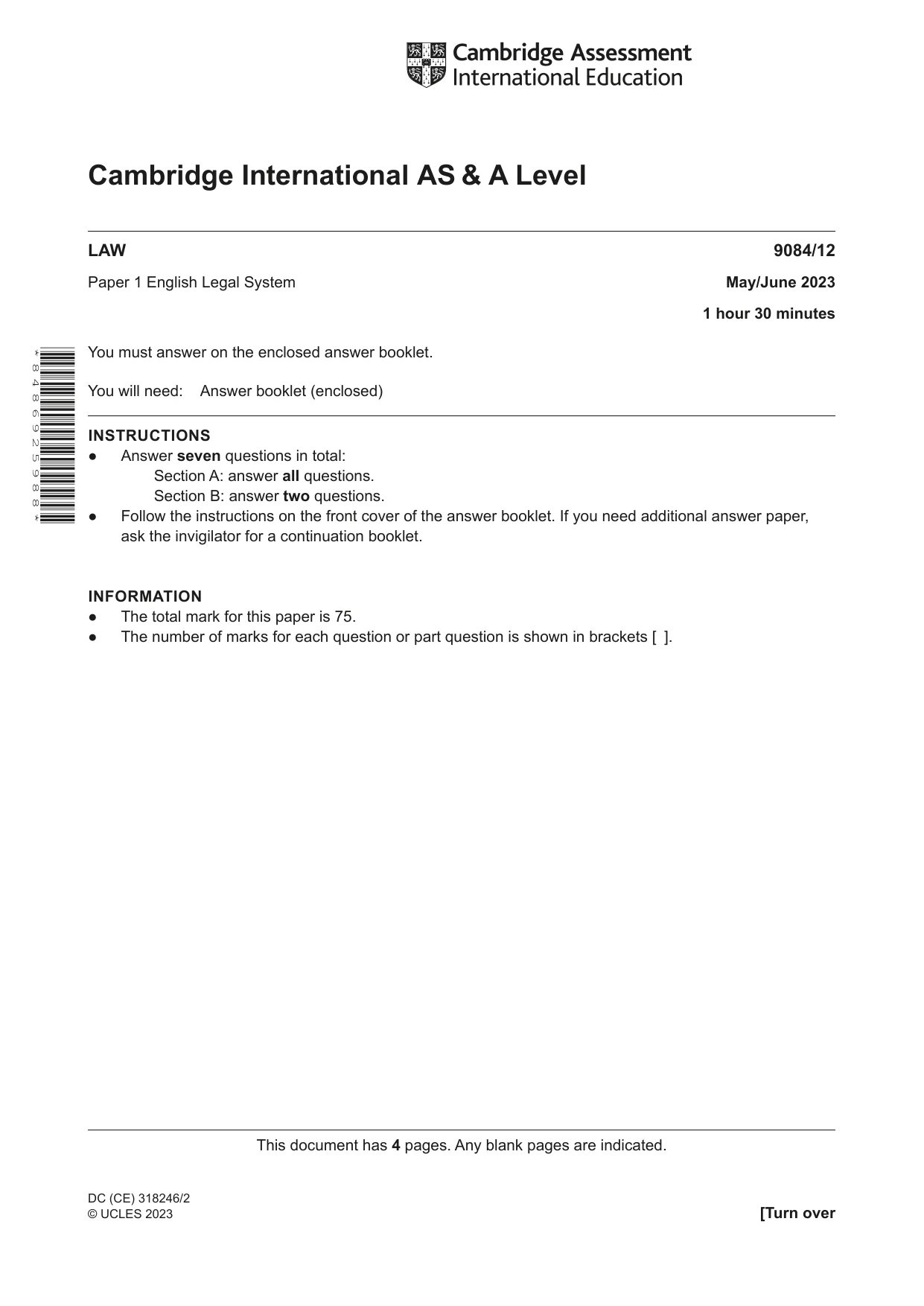
Question paper, page 1
This document has 4 pages. Any blank pages are indicated. [Turn over Cambridge International AS & A Level * 8 4 8 6 9 2 5 9 8 8 * LAW 9084/12 Paper 1 English Legal System May/June 2023 1 hour 30 minutes You must answer on the enclosed answer booklet. You will need: Answer booklet (enclosed) INSTRUCTIONS ● Answer seven questions in total: Section A: answer all questions. Section B: answer two questions. ● Follow the instructions on the front cover of the answer booklet. If you need additional answer paper, ask the invigilator for a continuation booklet. INFORMATION ● The total mark for this paper is 75. ● The number of marks for each question or part question is shown in brackets [ ]. DC (CE) 318246/2 © UCLES 2023
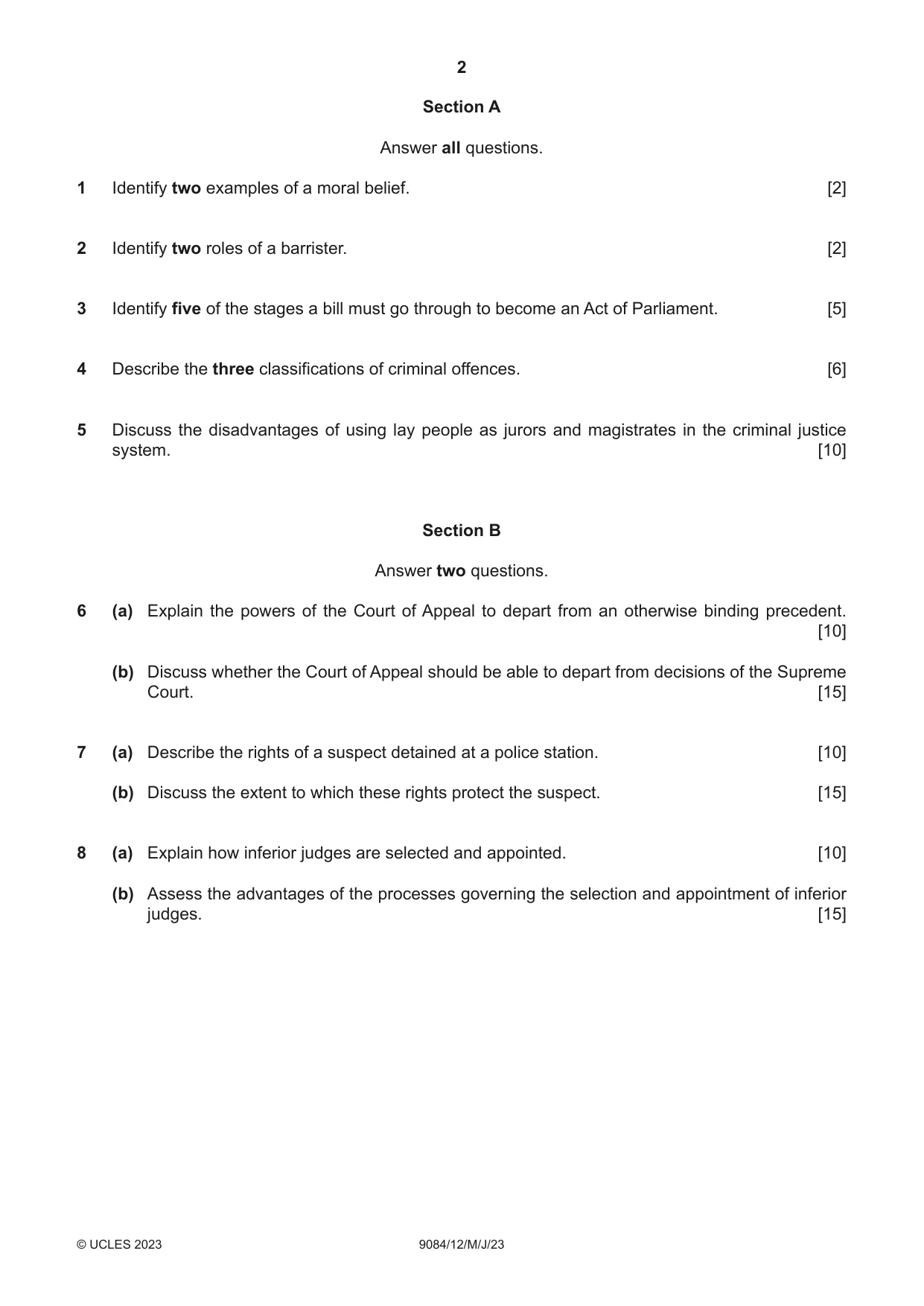
Question paper, page 2
2 9084/12/M/J/23 © UCLES 2023 Section A Answer all questions. 1 Identify two examples of a moral belief. [2] 2 Identify two roles of a barrister. [2] 3 Identify five of the stages a bill must go through to become an Act of Parliament. [5] 4 Describe the three classifications of criminal offences. [6] 5 Discuss the disadvantages of using lay people as jurors and magistrates in the criminal justice system. [10] Section B Answer two questions. 6 (a) Explain the powers of the Court of Appeal to depart from an otherwise binding precedent. [10] (b) Discuss whether the Court of Appeal should be able to depart from decisions of the Supreme Court. [15] 7 (a) Describe the rights of a suspect detained at a police station. [10] (b) Discuss the extent to which these rights protect the suspect. [15] 8 (a) Explain how inferior judges are selected and appointed. [10] (b) Assess the advantages of the processes governing the selection and appointment of inferior judges. [15]
Question paper, page 3
3 9084/12/M/J/23 © UCLES 2023 BLANK PAGE
Question paper, page 4
4 9084/12/M/J/23 © UCLES 2023 Permission to reproduce items where third-party owned material protected by copyright is included has been sought and cleared where possible. Every reasonable effort has been made by the publisher (UCLES) to trace copyright holders, but if any items requiring clearance have unwittingly been included, the publisher will be pleased to make amends at the earliest possible opportunity. To avoid the issue of disclosure of answer-related information to candidates, all copyright acknowledgements are reproduced online in the Cambridge Assessment International Education Copyright Acknowledgements Booklet. This is produced for each series of examinations and is freely available to download at www.cambridgeinternational.org after the live examination series. Cambridge Assessment International Education is part of Cambridge Assessment. Cambridge Assessment is the brand name of the University of Cambridge Local Examinations Syndicate (UCLES), which is a department of the University of Cambridge. BLANK PAGE
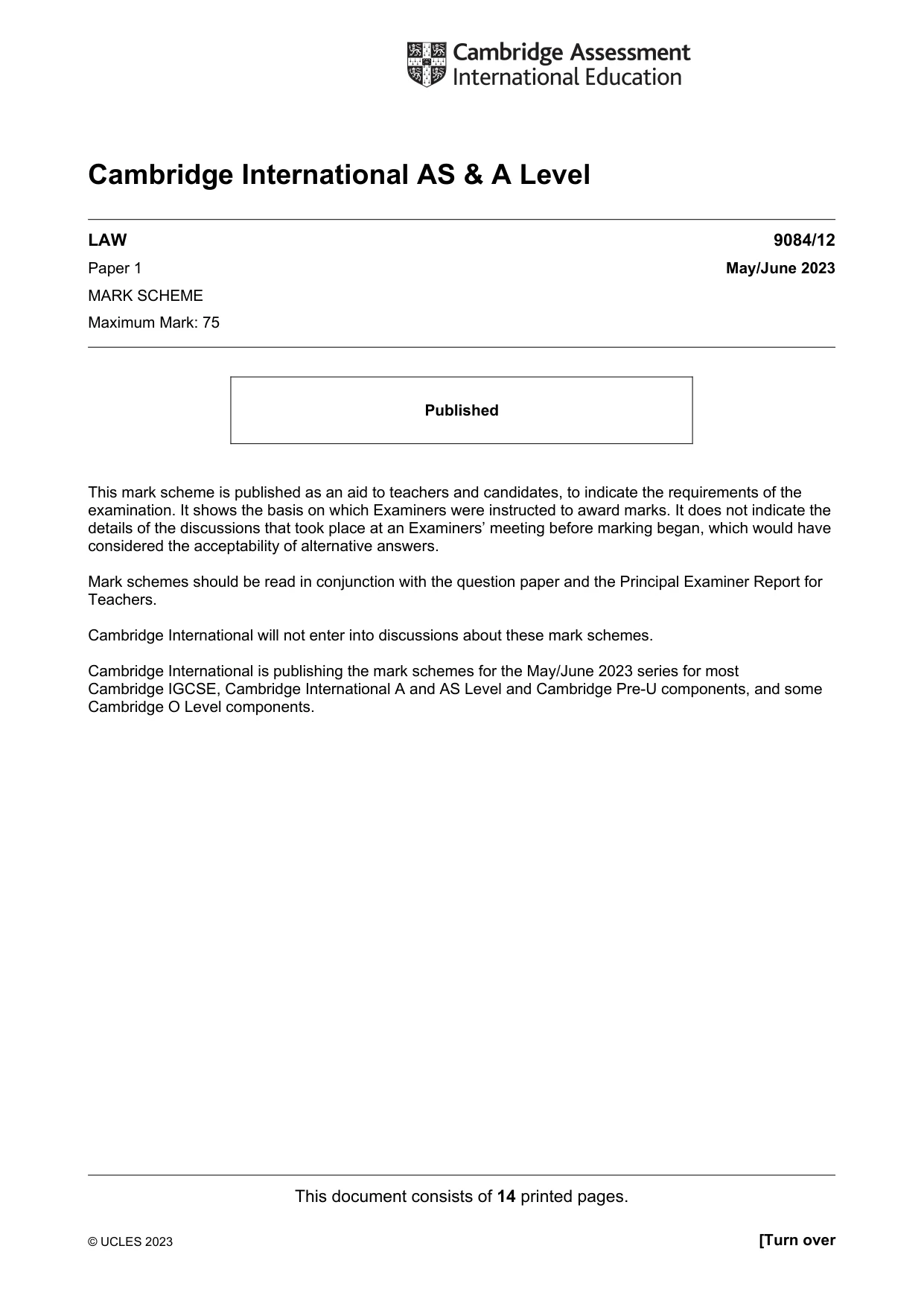
Mark scheme, page 1
This document consists of 14 printed pages. © UCLES 2023 [Turn over Cambridge International AS & A Level LAW 9084/12 Paper 1 May/June 2023 MARK SCHEME Maximum Mark: 75 Published This mark scheme is published as an aid to teachers and candidates, to indicate the requirements of the examination. It shows the basis on which Examiners were instructed to award marks. It does not indicate the details of the discussions that took place at an Examiners’ meeting before marking began, which would have considered the acceptability of alternative answers. Mark schemes should be read in conjunction with the question paper and the Principal Examiner Report for Teachers. Cambridge International will not enter into discussions about these mark schemes. Cambridge International is publishing the mark schemes for the May/June 2023 series for most Cambridge IGCSE, Cambridge International A and AS Level and Cambridge Pre-U components, and some Cambridge O Level components.
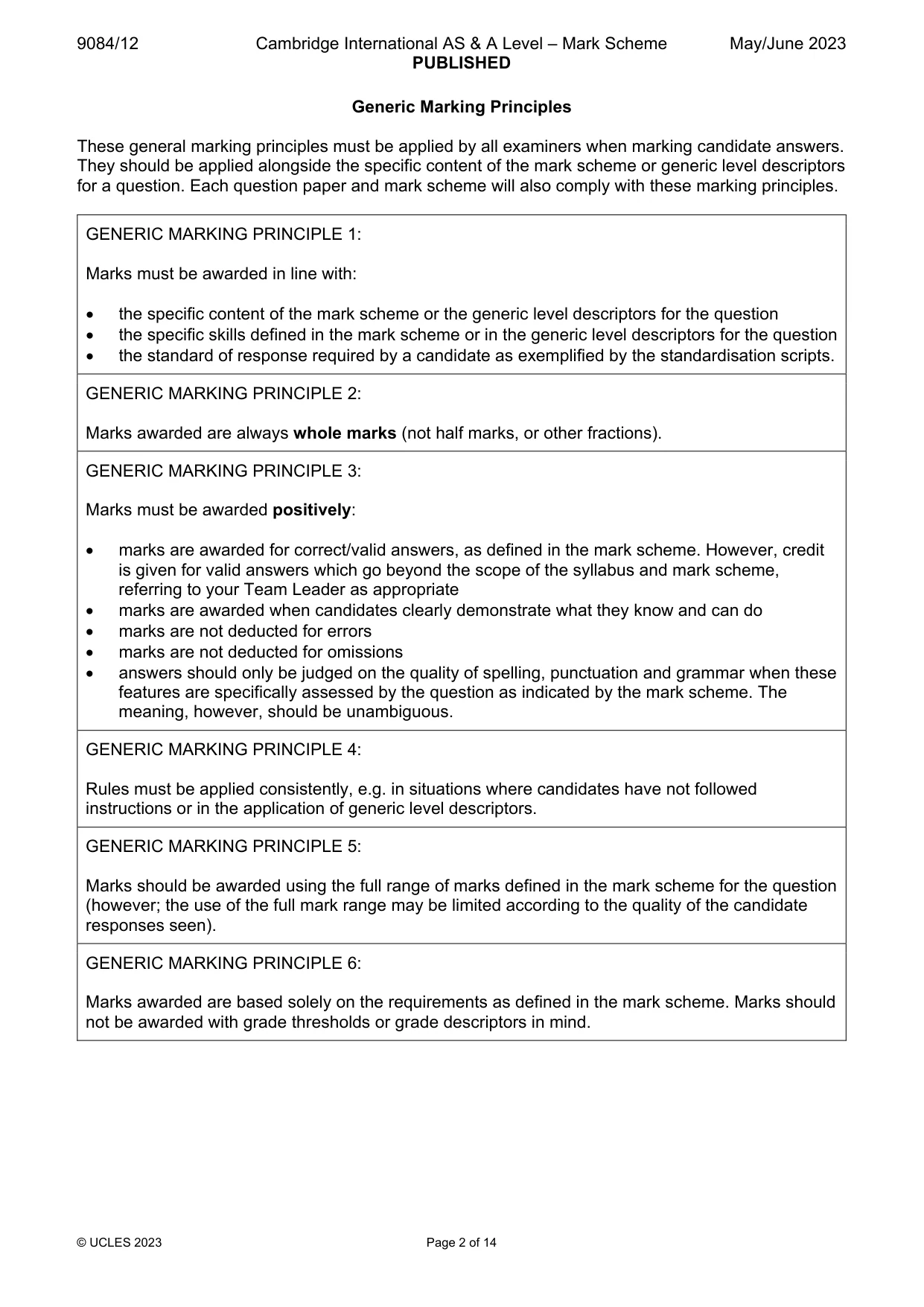
Mark scheme, page 2
9084/12 Cambridge International AS & A Level – Mark Scheme PUBLISHED May/June 2023 © UCLES 2023 Page 2 of 14 Generic Marking Principles These general marking principles must be applied by all examiners when marking candidate answers. They should be applied alongside the specific content of the mark scheme or generic level descriptors for a question. Each question paper and mark scheme will also comply with these marking principles. GENERIC MARKING PRINCIPLE 1: Marks must be awarded in line with: the specific content of the mark scheme or the generic level descriptors for the question the specific skills defined in the mark scheme or in the generic level descriptors for the question the standard of response required by a candidate as exemplified by the standardisation scripts. GENERIC MARKING PRINCIPLE 2: Marks awarded are always whole marks (not half marks, or other fractions). GENERIC MARKING PRINCIPLE 3: Marks must be awarded positively: marks are awarded for correct/valid answers, as defined in the mark scheme. However, credit is given for valid answers which go beyond the scope of the syllabus and mark scheme, referring to your Team Leader as appropriate marks are awarded when candidates clearly demonstrate what they know and can do marks are not deducted for errors marks are not deducted for omissions answers should only be judged on the quality of spelling, punctuation and grammar when these features are specifically assessed by the question as indicated by the mark scheme. The meaning, however, should be unambiguous. GENERIC MARKING PRINCIPLE 4: Rules must be applied consistently, e.g. in situations where candidates have not followed instructions or in the application of generic level descriptors. GENERIC MARKING PRINCIPLE 5: Marks should be awarded using the full range of marks defined in the mark scheme for the question (however; the use of the full mark range may be limited according to the quality of the candidate responses seen). GENERIC MARKING PRINCIPLE 6: Marks awarded are based solely on the requirements as defined in the mark scheme. Marks should not be awarded with grade thresholds or grade descriptors in mind.
Mark scheme, page 3
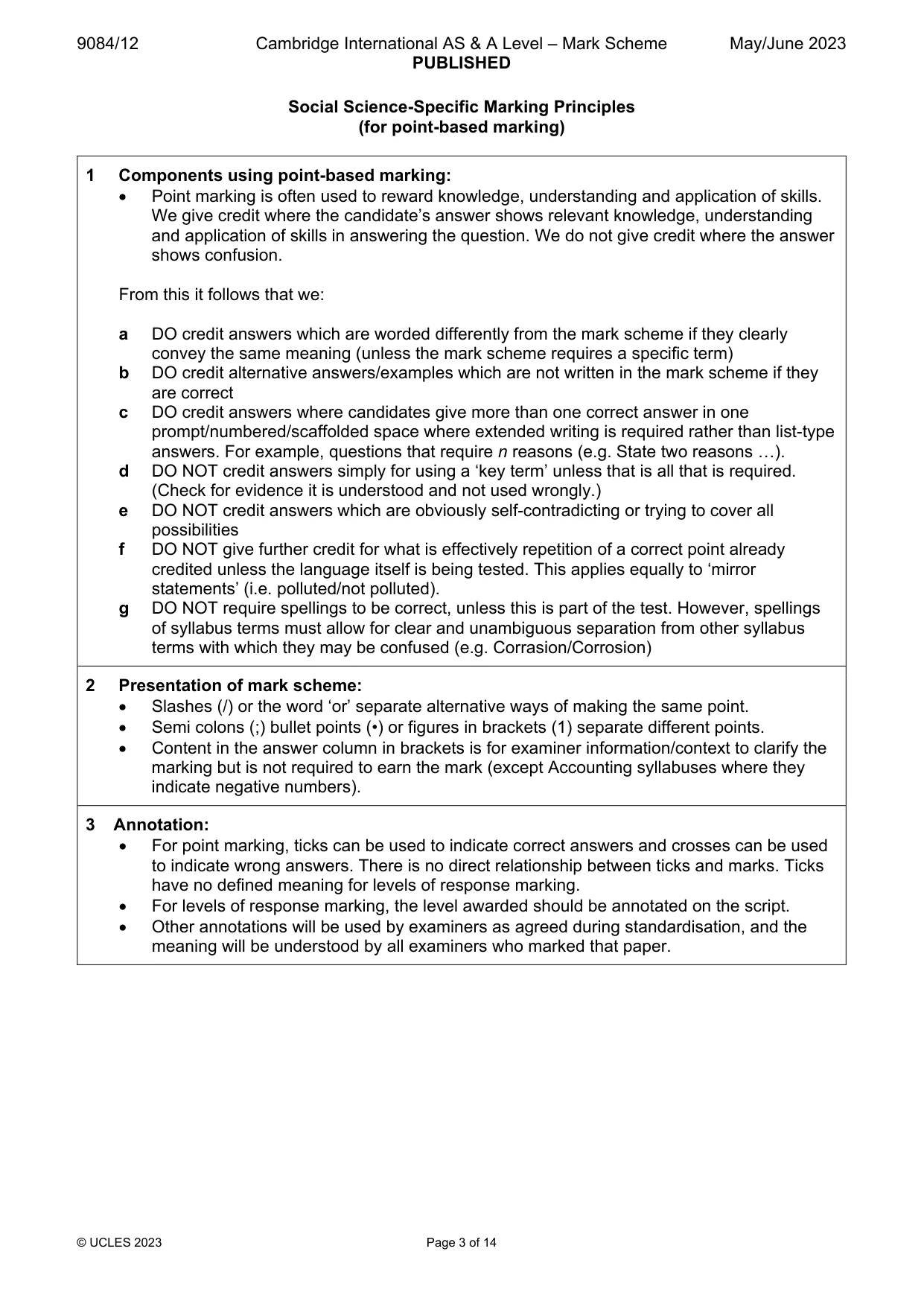
9084/12 Cambridge International AS & A Level – Mark Scheme PUBLISHED May/June 2023 © UCLES 2023 Page 3 of 14 Social Science-Specific Marking Principles (for point-based marking) 1 Components using point-based marking: Point marking is often used to reward knowledge, understanding and application of skills. We give credit where the candidate’s answer shows relevant knowledge, understanding and application of skills in answering the question. We do not give credit where the answer shows confusion. From this it follows that we: a DO credit answers which are worded differently from the mark scheme if they clearly convey the same meaning (unless the mark scheme requires a specific term) b DO credit alternative answers/examples which are not written in the mark scheme if they are correct c DO credit answers where candidates give more than one correct answer in one prompt/numbered/scaffolded space where extended writing is required rather than list-type answers. For example, questions that require n reasons (e.g. State two reasons …). d DO NOT credit answers simply for using a ‘key term’ unless that is all that is required. (Check for evidence it is understood and not used wrongly.) e DO NOT credit answers which are obviously self-contradicting or trying to cover all possibilities f DO NOT give further credit for what is effectively repetition of a correct point already credited unless the language itself is being tested. This applies equally to ‘mirror statements’ (i.e. polluted/not polluted). g DO NOT require spellings to be correct, unless this is part of the test. However, spellings of syllabus terms must allow for clear and unambiguous separation from other syllabus terms with which they may be confused (e.g. Corrasion/Corrosion) 2 Presentation of mark scheme: Slashes (/) or the word ‘or’ separate alternative ways of making the same point. Semi colons (;) bullet points (•) or figures in brackets (1) separate different points. Content in the answer column in brackets is for examiner information/context to clarify the marking but is not required to earn the mark (except Accounting syllabuses where they indicate negative numbers). 3 Annotation: For point marking, ticks can be used to indicate correct answers and crosses can be used to indicate wrong answers. There is no direct relationship between ticks and marks. Ticks have no defined meaning for levels of response marking. For levels of response marking, the level awarded should be annotated on the script. Other annotations will be used by examiners as agreed during standardisation, and the meaning will be understood by all examiners who marked that paper.
Mark scheme, page 4
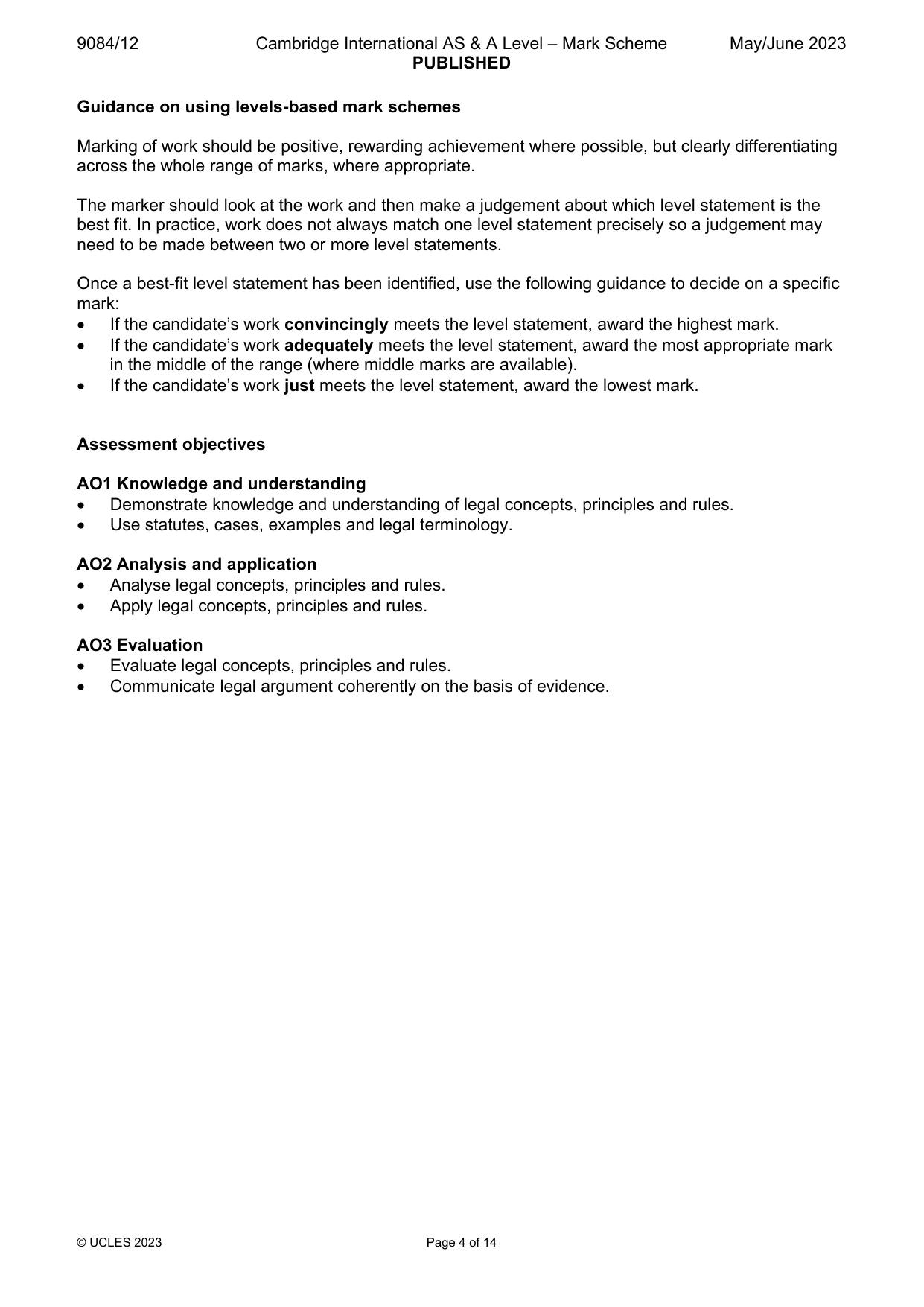
9084/12 Cambridge International AS & A Level – Mark Scheme PUBLISHED May/June 2023 © UCLES 2023 Page 4 of 14 Guidance on using levels-based mark schemes Marking of work should be positive, rewarding achievement where possible, but clearly differentiating across the whole range of marks, where appropriate. The marker should look at the work and then make a judgement about which level statement is the best fit. In practice, work does not always match one level statement precisely so a judgement may need to be made between two or more level statements. Once a best-fit level statement has been identified, use the following guidance to decide on a specific mark: If the candidate’s work convincingly meets the level statement, award the highest mark. If the candidate’s work adequately meets the level statement, award the most appropriate mark in the middle of the range (where middle marks are available). If the candidate’s work just meets the level statement, award the lowest mark. Assessment objectives AO1 Knowledge and understanding Demonstrate knowledge and understanding of legal concepts, principles and rules. Use statutes, cases, examples and legal terminology. AO2 Analysis and application Analyse legal concepts, principles and rules. Apply legal concepts, principles and rules. AO3 Evaluation Evaluate legal concepts, principles and rules. Communicate legal argument coherently on the basis of evidence.
Mark scheme, page 5
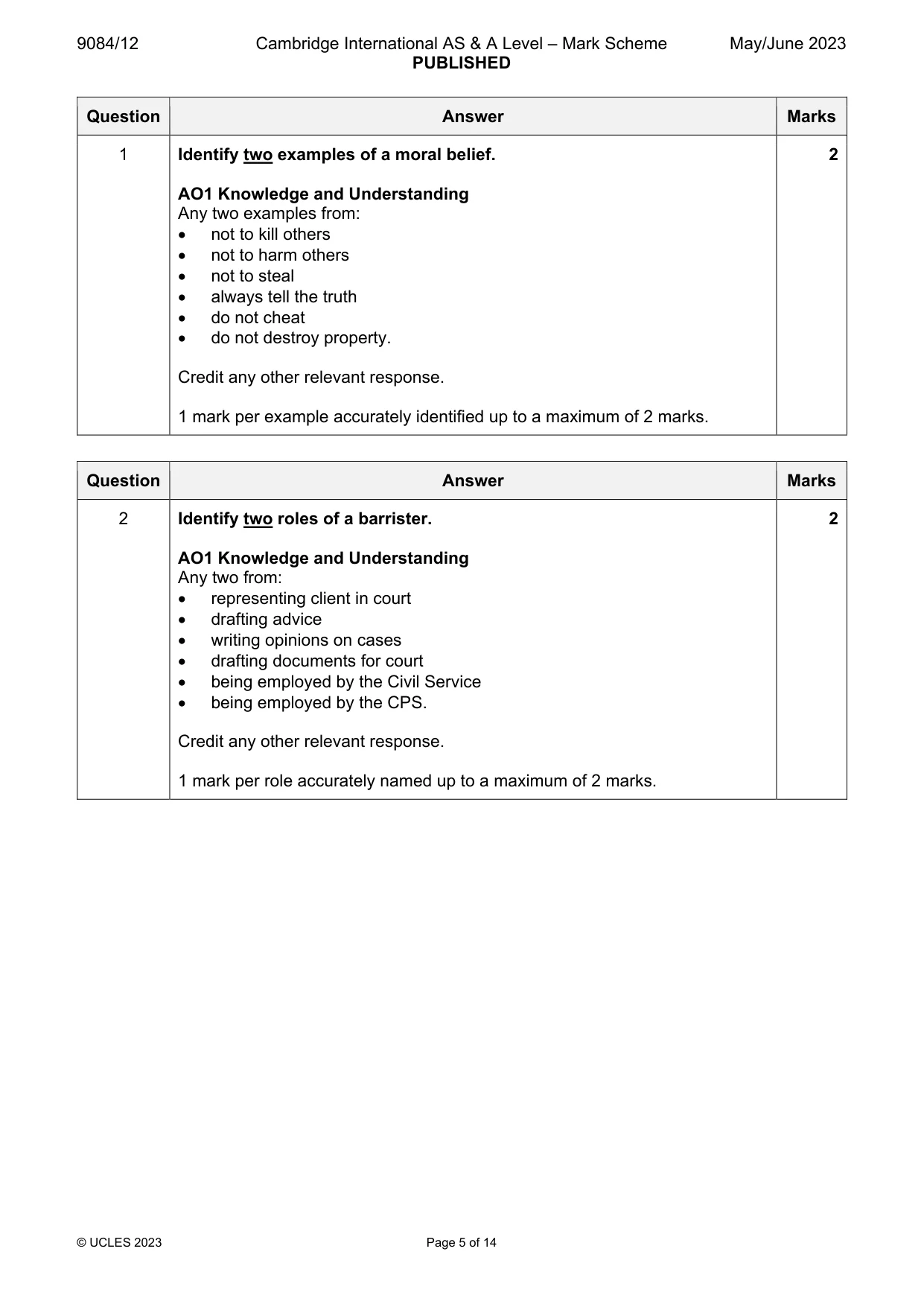
9084/12 Cambridge International AS & A Level – Mark Scheme PUBLISHED May/June 2023 © UCLES 2023 Page 5 of 14 Question Answer Marks 1 Identify two examples of a moral belief. AO1 Knowledge and Understanding Any two examples from: not to kill others not to harm others not to steal always tell the truth do not cheat do not destroy property. Credit any other relevant response. 1 mark per example accurately identified up to a maximum of 2 marks. 2 Question Answer Marks 2 Identify two roles of a barrister. AO1 Knowledge and Understanding Any two from: representing client in court drafting advice writing opinions on cases drafting documents for court being employed by the Civil Service being employed by the CPS. Credit any other relevant response. 1 mark per role accurately named up to a maximum of 2 marks. 2
Mark scheme, page 6
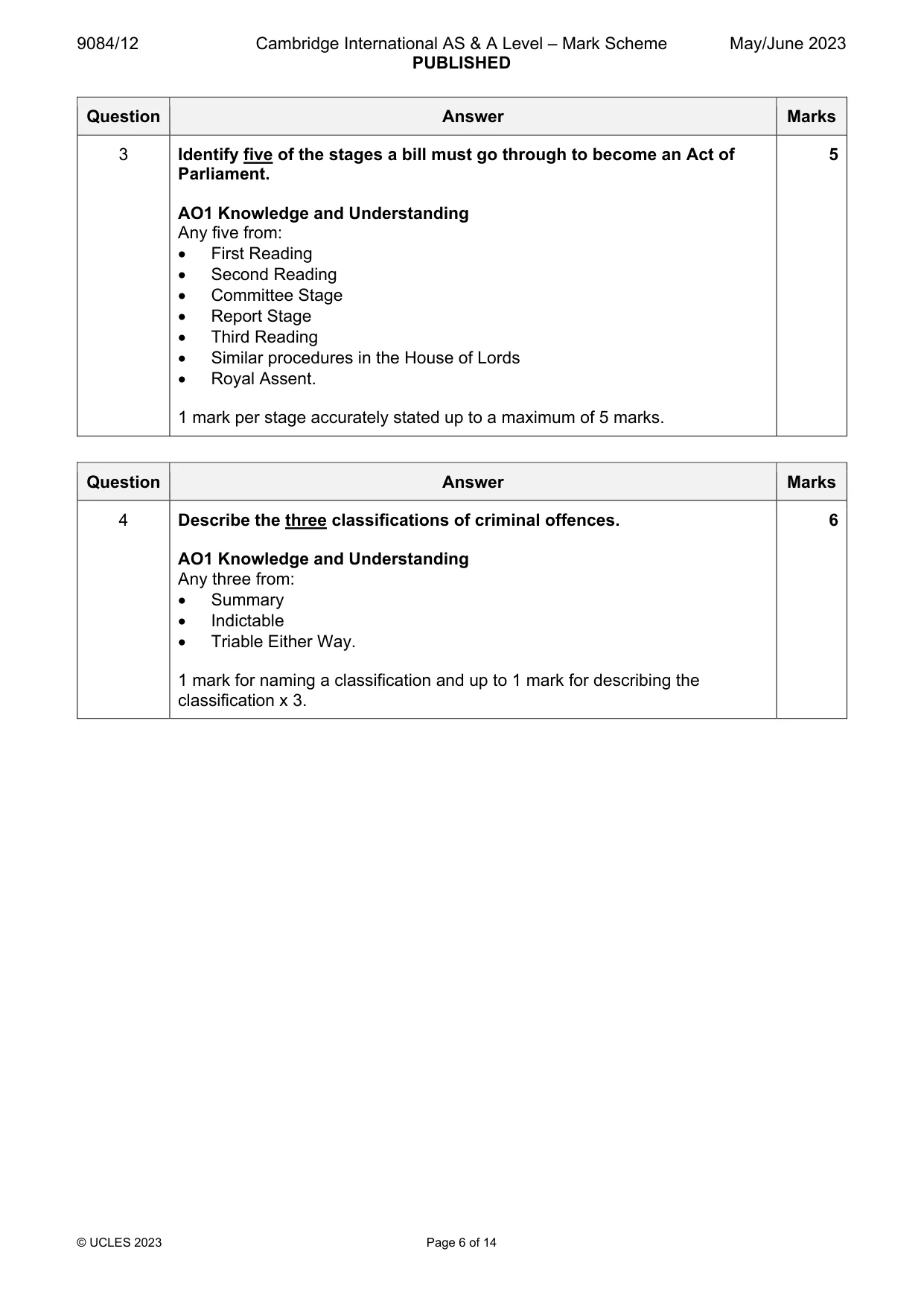
9084/12 Cambridge International AS & A Level – Mark Scheme PUBLISHED May/June 2023 © UCLES 2023 Page 6 of 14 Question Answer Marks 3 Identify five of the stages a bill must go through to become an Act of Parliament. AO1 Knowledge and Understanding Any five from: First Reading Second Reading Committee Stage Report Stage Third Reading Similar procedures in the House of Lords Royal Assent. 1 mark per stage accurately stated up to a maximum of 5 marks. 5 Question Answer Marks 4 Describe the three classifications of criminal offences. AO1 Knowledge and Understanding Any three from: Summary Indictable Triable Either Way. 1 mark for naming a classification and up to 1 mark for describing the classification x 3. 6
Mark scheme, page 7
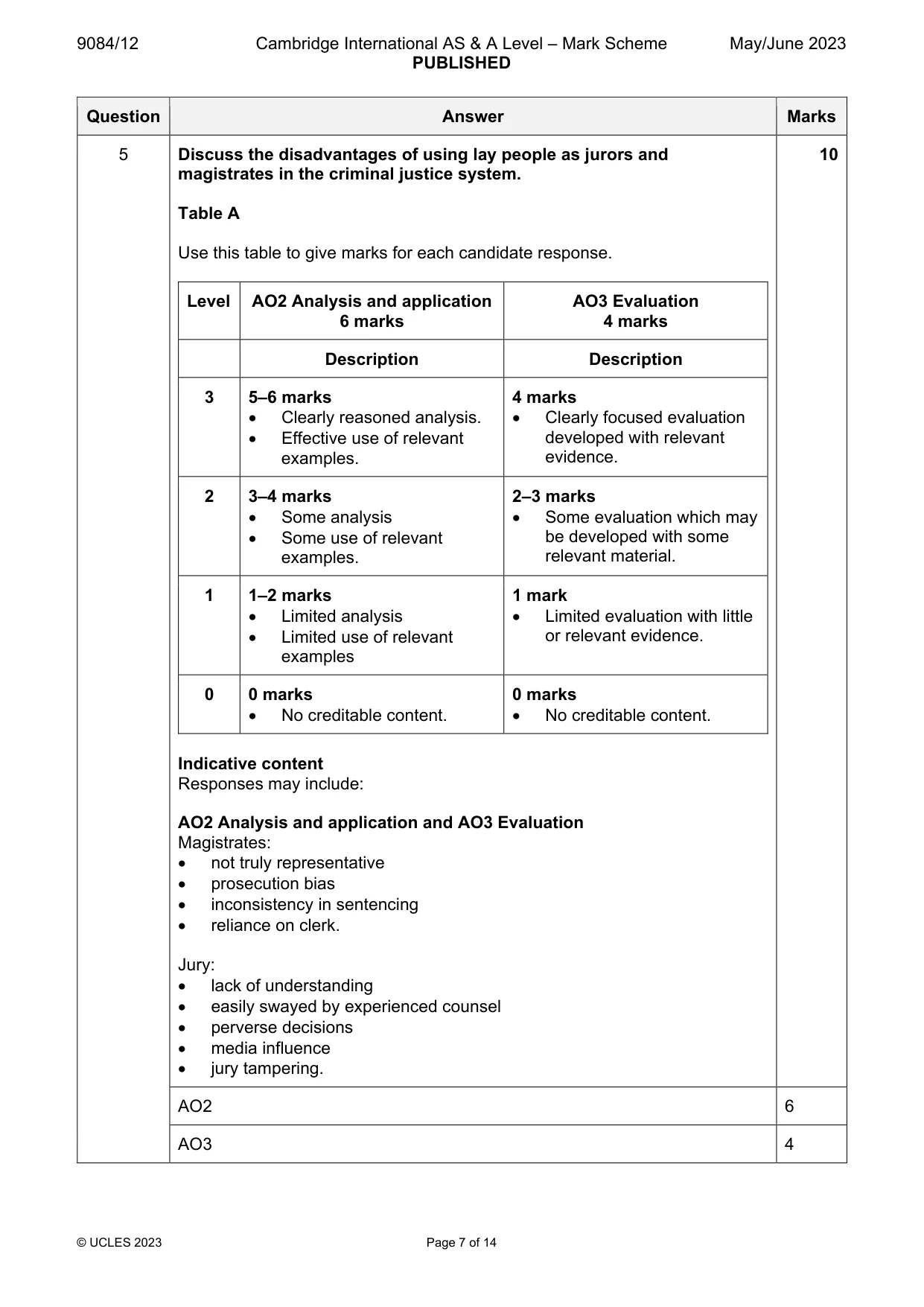
9084/12 Cambridge International AS & A Level – Mark Scheme PUBLISHED May/June 2023 © UCLES 2023 Page 7 of 14 Question Answer Marks 5 Discuss the disadvantages of using lay people as jurors and magistrates in the criminal justice system. Table A Use this table to give marks for each candidate response. Level AO2 Analysis and application 6 marks AO3 Evaluation 4 marks Description Description 3 5–6 marks Clearly reasoned analysis. Effective use of relevant examples. 4 marks Clearly focused evaluation developed with relevant evidence. 2 3–4 marks Some analysis Some use of relevant examples. 2–3 marks Some evaluation which may be developed with some relevant material. 1 1–2 marks Limited analysis Limited use of relevant examples 1 mark Limited evaluation with little or relevant evidence. 0 0 marks No creditable content. 0 marks No creditable content. Indicative content Responses may include: AO2 Analysis and application and AO3 Evaluation Magistrates: not truly representative prosecution bias inconsistency in sentencing reliance on clerk. Jury: lack of understanding easily swayed by experienced counsel perverse decisions media influence jury tampering. 10 AO2 6 AO3 4
Mark scheme, page 8
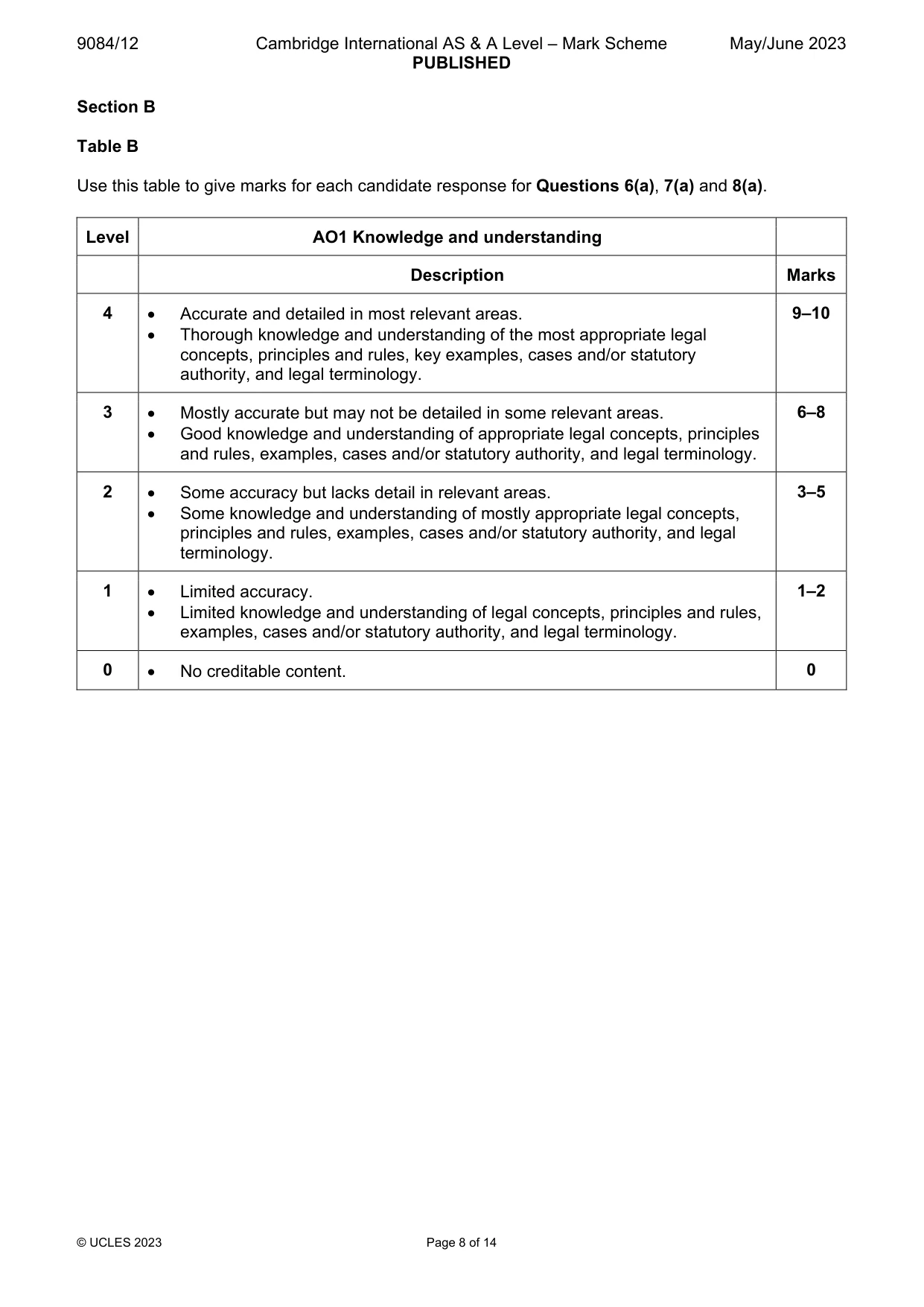
9084/12 Cambridge International AS & A Level – Mark Scheme PUBLISHED May/June 2023 © UCLES 2023 Page 8 of 14 Section B Table B Use this table to give marks for each candidate response for Questions 6(a), 7(a) and 8(a). Level AO1 Knowledge and understanding Description Marks 4 Accurate and detailed in most relevant areas. Thorough knowledge and understanding of the most appropriate legal concepts, principles and rules, key examples, cases and/or statutory authority, and legal terminology. 9–10 3 Mostly accurate but may not be detailed in some relevant areas. Good knowledge and understanding of appropriate legal concepts, principles and rules, examples, cases and/or statutory authority, and legal terminology. 6–8 2 Some accuracy but lacks detail in relevant areas. Some knowledge and understanding of mostly appropriate legal concepts, principles and rules, examples, cases and/or statutory authority, and legal terminology. 3–5 1 Limited accuracy. Limited knowledge and understanding of legal concepts, principles and rules, examples, cases and/or statutory authority, and legal terminology. 1–2 0 No creditable content. 0
Mark scheme, page 9
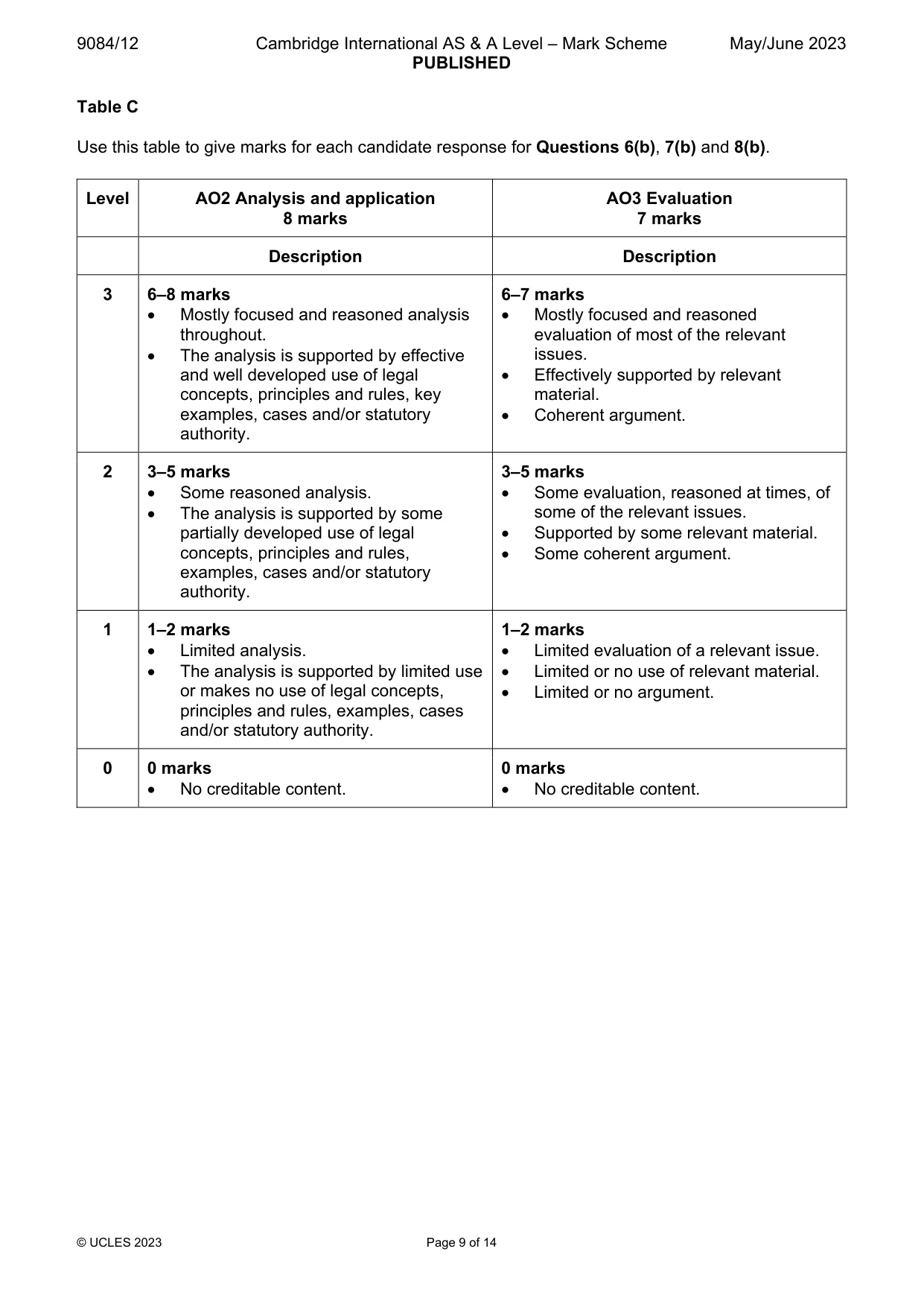
9084/12 Cambridge International AS & A Level – Mark Scheme PUBLISHED May/June 2023 © UCLES 2023 Page 9 of 14 Table C Use this table to give marks for each candidate response for Questions 6(b), 7(b) and 8(b). Level AO2 Analysis and application 8 marks AO3 Evaluation 7 marks Description Description 3 6–8 marks Mostly focused and reasoned analysis throughout. The analysis is supported by effective and well developed use of legal concepts, principles and rules, key examples, cases and/or statutory authority. 6–7 marks Mostly focused and reasoned evaluation of most of the relevant issues. Effectively supported by relevant material. Coherent argument. 2 3–5 marks Some reasoned analysis. The analysis is supported by some partially developed use of legal concepts, principles and rules, examples, cases and/or statutory authority. 3–5 marks Some evaluation, reasoned at times, of some of the relevant issues. Supported by some relevant material. Some coherent argument. 1 1–2 marks Limited analysis. The analysis is supported by limited use or makes no use of legal concepts, principles and rules, examples, cases and/or statutory authority. 1–2 marks Limited evaluation of a relevant issue. Limited or no use of relevant material. Limited or no argument. 0 0 marks No creditable content. 0 marks No creditable content.
Mark scheme, page 10
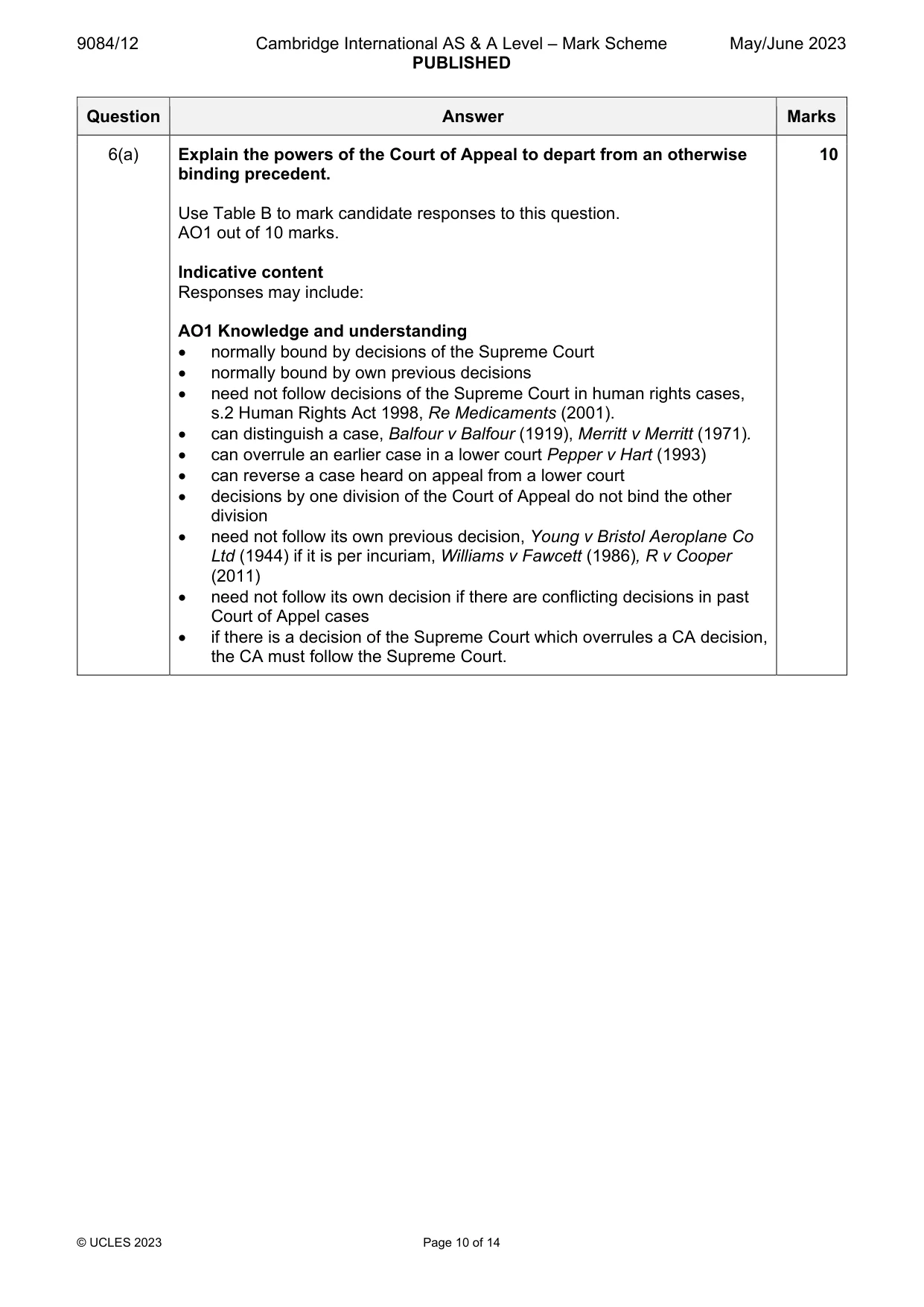
9084/12 Cambridge International AS & A Level – Mark Scheme PUBLISHED May/June 2023 © UCLES 2023 Page 10 of 14 Question Answer Marks 6(a) Explain the powers of the Court of Appeal to depart from an otherwise binding precedent. Use Table B to mark candidate responses to this question. AO1 out of 10 marks. Indicative content Responses may include: AO1 Knowledge and understanding normally bound by decisions of the Supreme Court normally bound by own previous decisions need not follow decisions of the Supreme Court in human rights cases, s.2 Human Rights Act 1998, Re Medicaments (2001). can distinguish a case, Balfour v Balfour (1919), Merritt v Merritt (1971). can overrule an earlier case in a lower court Pepper v Hart (1993) can reverse a case heard on appeal from a lower court decisions by one division of the Court of Appeal do not bind the other division need not follow its own previous decision, Young v Bristol Aeroplane Co Ltd (1944) if it is per incuriam, Williams v Fawcett (1986), R v Cooper (2011) need not follow its own decision if there are conflicting decisions in past Court of Appel cases if there is a decision of the Supreme Court which overrules a CA decision, the CA must follow the Supreme Court. 10
Mark scheme, page 11
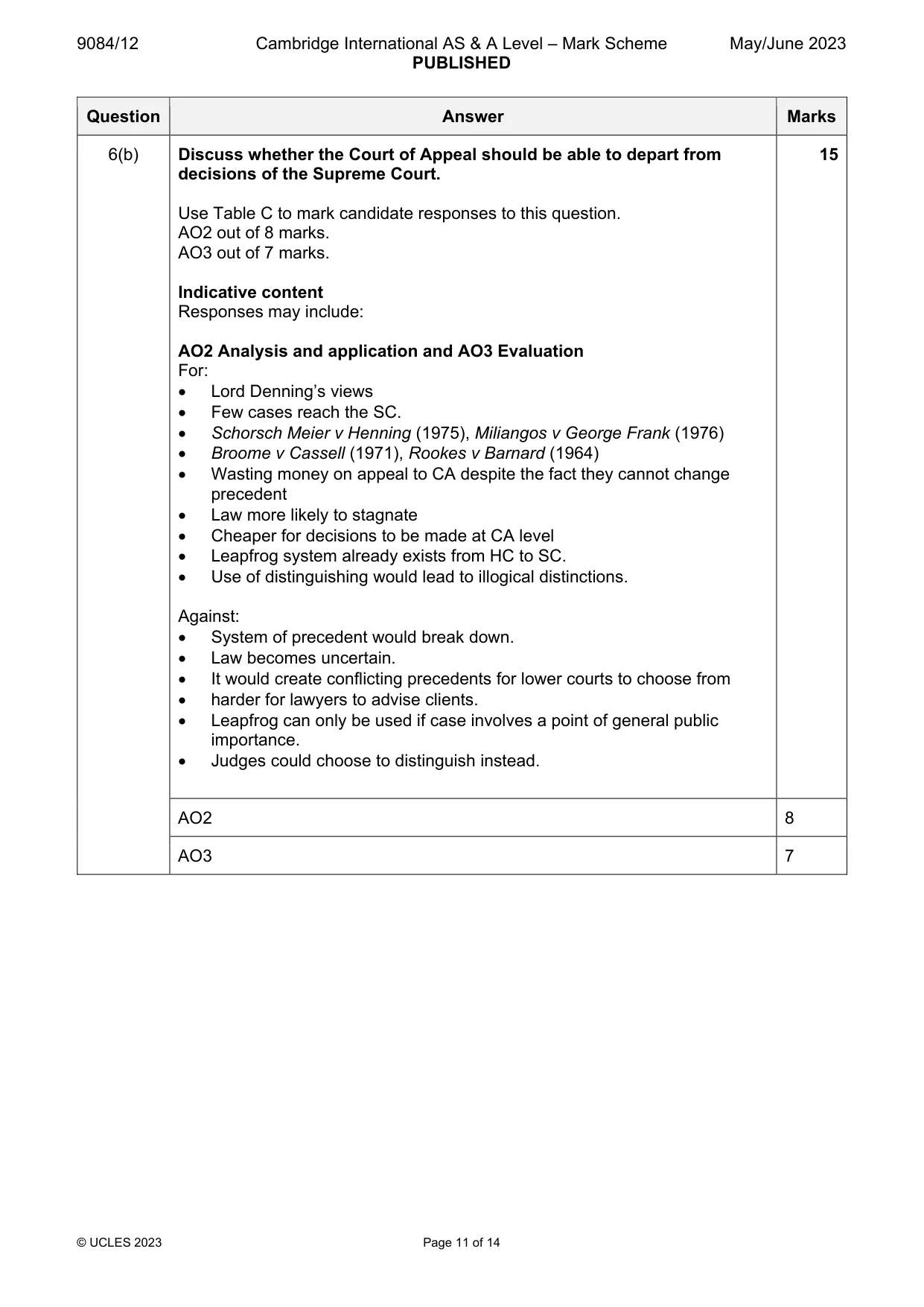
9084/12 Cambridge International AS & A Level – Mark Scheme PUBLISHED May/June 2023 © UCLES 2023 Page 11 of 14 Question Answer Marks 6(b) Discuss whether the Court of Appeal should be able to depart from decisions of the Supreme Court. Use Table C to mark candidate responses to this question. AO2 out of 8 marks. AO3 out of 7 marks. Indicative content Responses may include: AO2 Analysis and application and AO3 Evaluation For: Lord Denning’s views Few cases reach the SC. Schorsch Meier v Henning (1975), Miliangos v George Frank (1976) Broome v Cassell (1971), Rookes v Barnard (1964) Wasting money on appeal to CA despite the fact they cannot change precedent Law more likely to stagnate Cheaper for decisions to be made at CA level Leapfrog system already exists from HC to SC. Use of distinguishing would lead to illogical distinctions. Against: System of precedent would break down. Law becomes uncertain. It would create conflicting precedents for lower courts to choose from harder for lawyers to advise clients. Leapfrog can only be used if case involves a point of general public importance. Judges could choose to distinguish instead. 15 AO2 8 AO3 7
Mark scheme, page 12
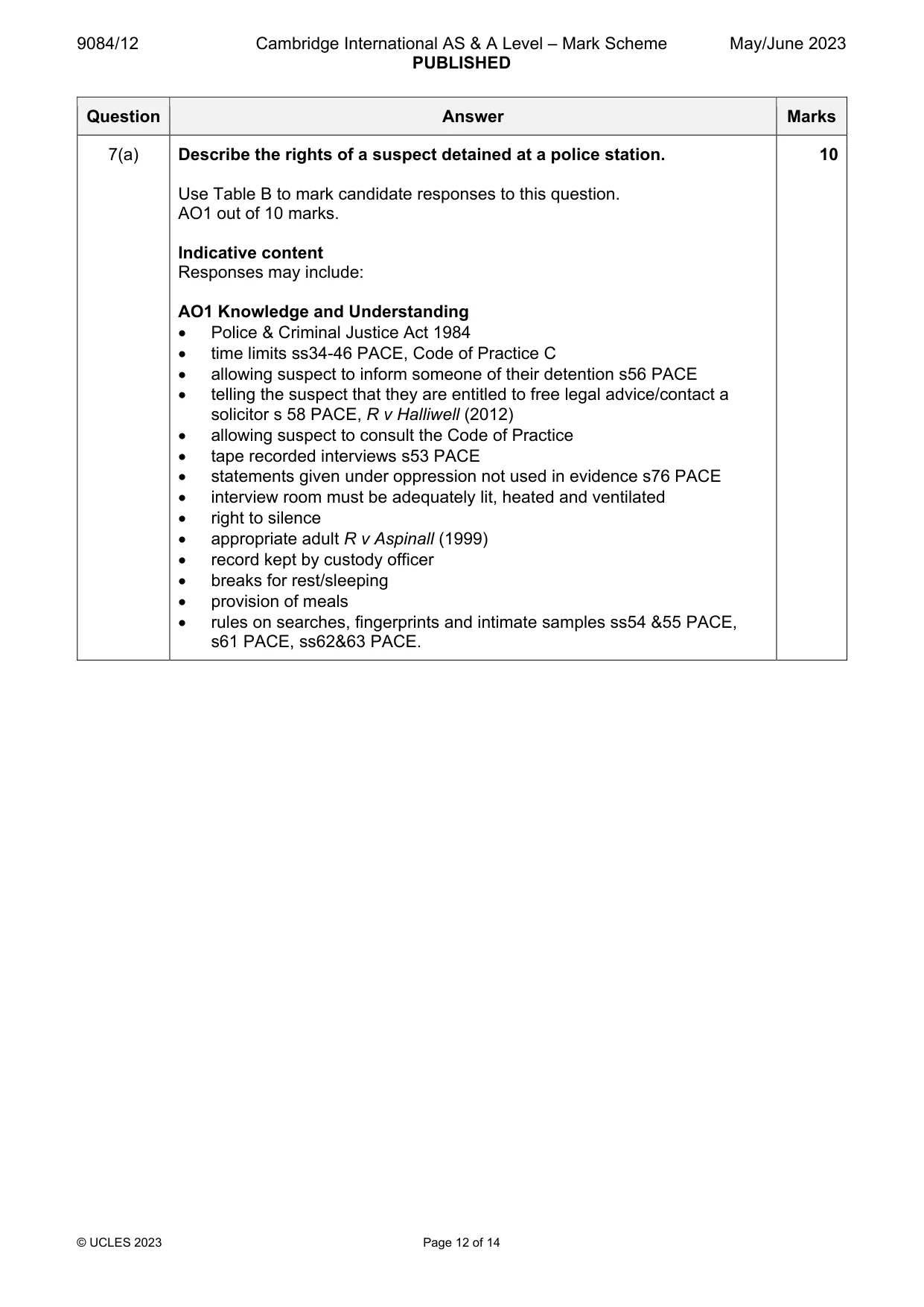
9084/12 Cambridge International AS & A Level – Mark Scheme PUBLISHED May/June 2023 © UCLES 2023 Page 12 of 14 Question Answer Marks 7(a) Describe the rights of a suspect detained at a police station. Use Table B to mark candidate responses to this question. AO1 out of 10 marks. Indicative content Responses may include: AO1 Knowledge and Understanding Police & Criminal Justice Act 1984 time limits ss34-46 PACE, Code of Practice C allowing suspect to inform someone of their detention s56 PACE telling the suspect that they are entitled to free legal advice/contact a solicitor s 58 PACE, R v Halliwell (2012) allowing suspect to consult the Code of Practice tape recorded interviews s53 PACE statements given under oppression not used in evidence s76 PACE interview room must be adequately lit, heated and ventilated right to silence appropriate adult R v Aspinall (1999) record kept by custody officer breaks for rest/sleeping provision of meals rules on searches, fingerprints and intimate samples ss54 &55 PACE, s61 PACE, ss62&63 PACE. 10
Mark scheme, page 13
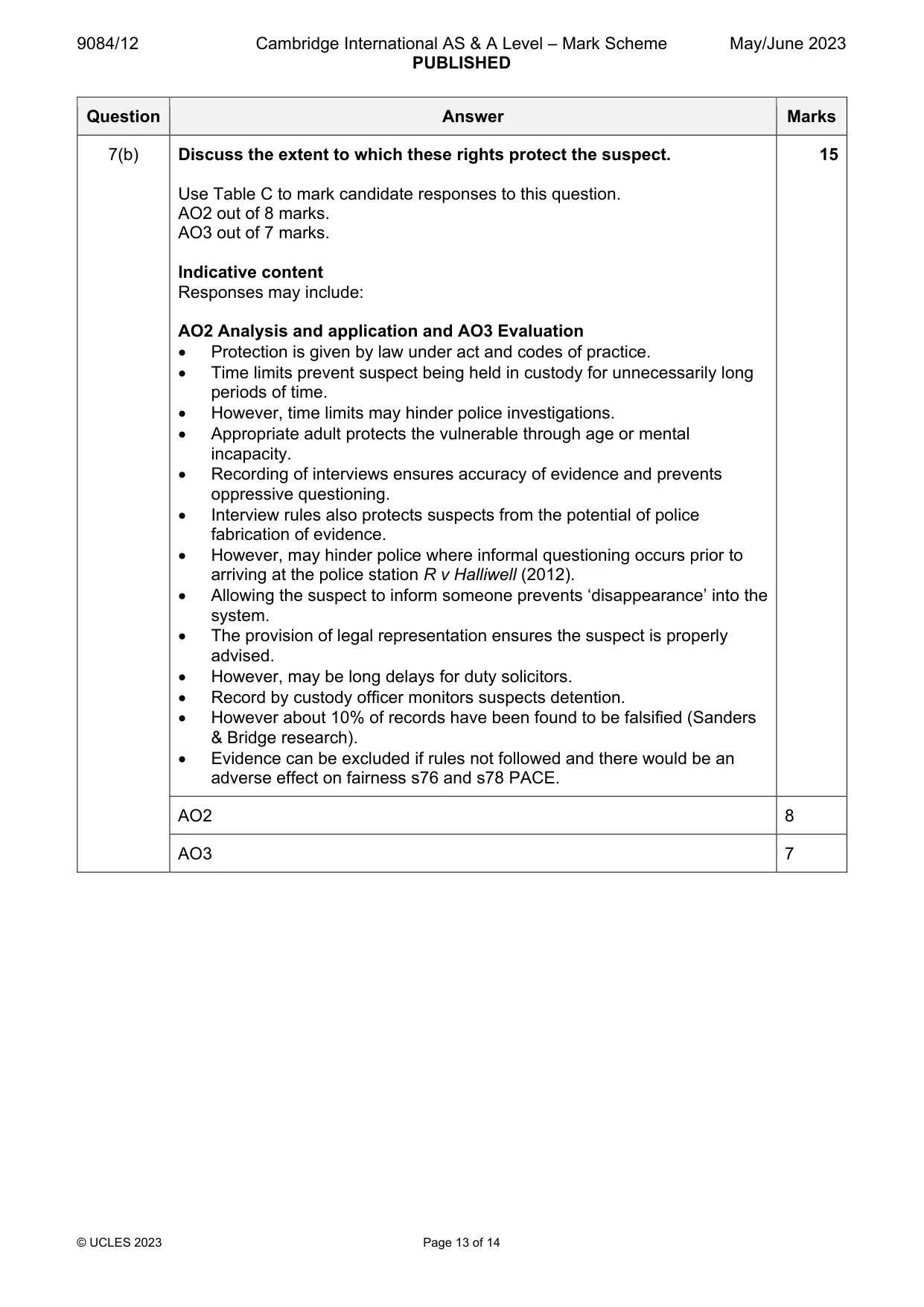
9084/12 Cambridge International AS & A Level – Mark Scheme PUBLISHED May/June 2023 © UCLES 2023 Page 13 of 14 Question Answer Marks 7(b) Discuss the extent to which these rights protect the suspect. Use Table C to mark candidate responses to this question. AO2 out of 8 marks. AO3 out of 7 marks. Indicative content Responses may include: AO2 Analysis and application and AO3 Evaluation Protection is given by law under act and codes of practice. Time limits prevent suspect being held in custody for unnecessarily long periods of time. However, time limits may hinder police investigations. Appropriate adult protects the vulnerable through age or mental incapacity. Recording of interviews ensures accuracy of evidence and prevents oppressive questioning. Interview rules also protects suspects from the potential of police fabrication of evidence. However, may hinder police where informal questioning occurs prior to arriving at the police station R v Halliwell (2012). Allowing the suspect to inform someone prevents ‘disappearance’ into the system. The provision of legal representation ensures the suspect is properly advised. However, may be long delays for duty solicitors. Record by custody officer monitors suspects detention. However about 10% of records have been found to be falsified (Sanders & Bridge research). Evidence can be excluded if rules not followed and there would be an adverse effect on fairness s76 and s78 PACE. 15 AO2 8 AO3 7
Mark scheme, page 14
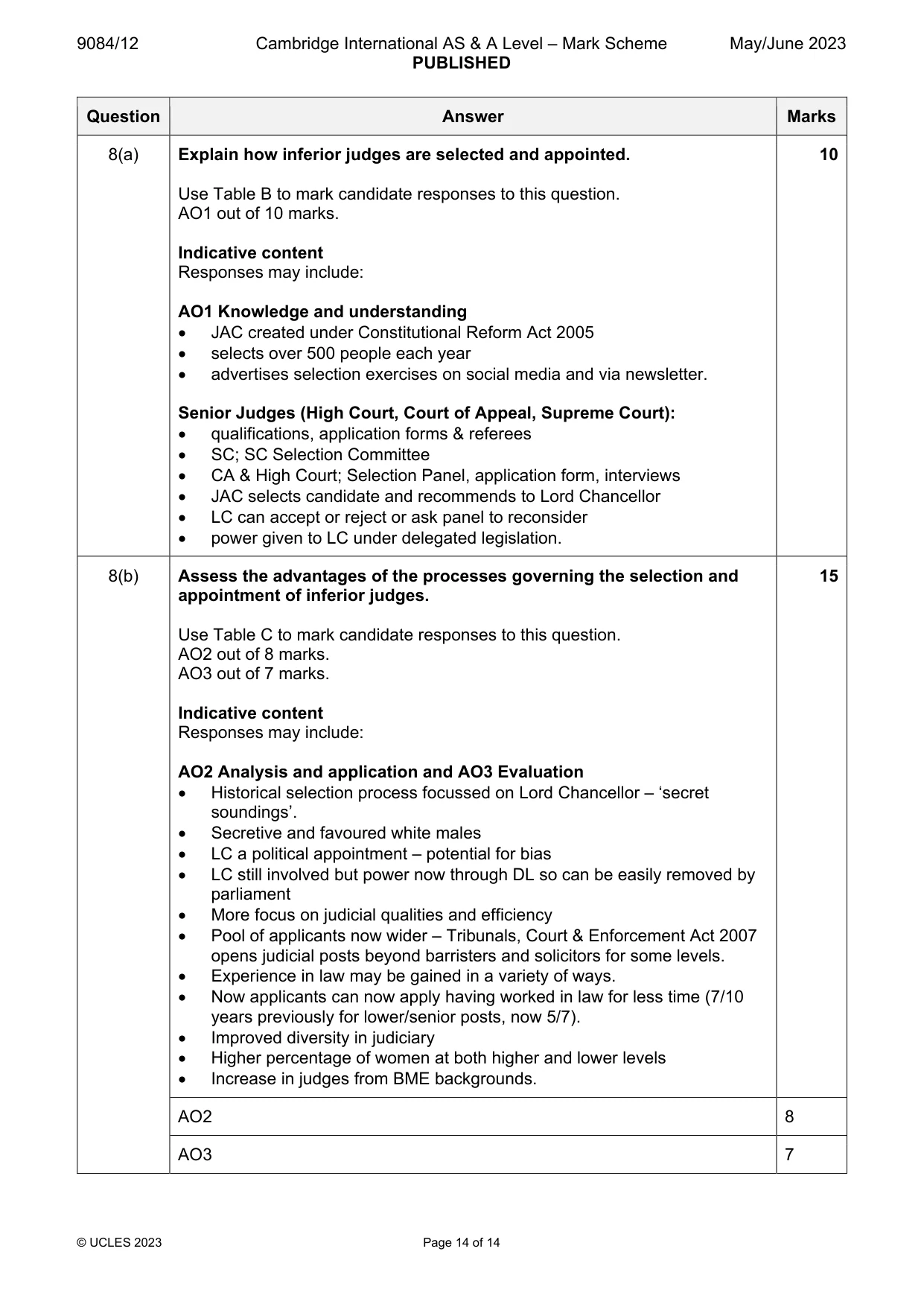
9084/12 Cambridge International AS & A Level – Mark Scheme PUBLISHED May/June 2023 © UCLES 2023 Page 14 of 14 Question Answer Marks 8(a) Explain how inferior judges are selected and appointed. Use Table B to mark candidate responses to this question. AO1 out of 10 marks. Indicative content Responses may include: AO1 Knowledge and understanding JAC created under Constitutional Reform Act 2005 selects over 500 people each year advertises selection exercises on social media and via newsletter. Senior Judges (High Court, Court of Appeal, Supreme Court): qualifications, application forms & referees SC; SC Selection Committee CA & High Court; Selection Panel, application form, interviews JAC selects candidate and recommends to Lord Chancellor LC can accept or reject or ask panel to reconsider power given to LC under delegated legislation. 10 8(b) Assess the advantages of the processes governing the selection and appointment of inferior judges. Use Table C to mark candidate responses to this question. AO2 out of 8 marks. AO3 out of 7 marks. Indicative content Responses may include: AO2 Analysis and application and AO3 Evaluation Historical selection process focussed on Lord Chancellor – ‘secret soundings’. Secretive and favoured white males LC a political appointment – potential for bias LC still involved but power now through DL so can be easily removed by parliament More focus on judicial qualities and efficiency Pool of applicants now wider – Tribunals, Court & Enforcement Act 2007 opens judicial posts beyond barristers and solicitors for some levels. Experience in law may be gained in a variety of ways. Now applicants can now apply having worked in law for less time (7/10 years previously for lower/senior posts, now 5/7). Improved diversity in judiciary Higher percentage of women at both higher and lower levels Increase in judges from BME backgrounds. 15 AO2 8 AO3 7
What you needed in this session
Cambridge’s own grade thresholds for 2023 May/June, Paper 1 · Variant 2. A higher threshold means an easier paper — the bar moves with how the cohort did.