Cambridge A Level Law 9084 — 2022 May/June Paper 1 · Variant 3
9084/13/M/J/22 · 75 marks · ≈84 min
The question paper and its mark scheme, free to read here and free to download. This is Cambridge’s own paper, exactly as it was sat.
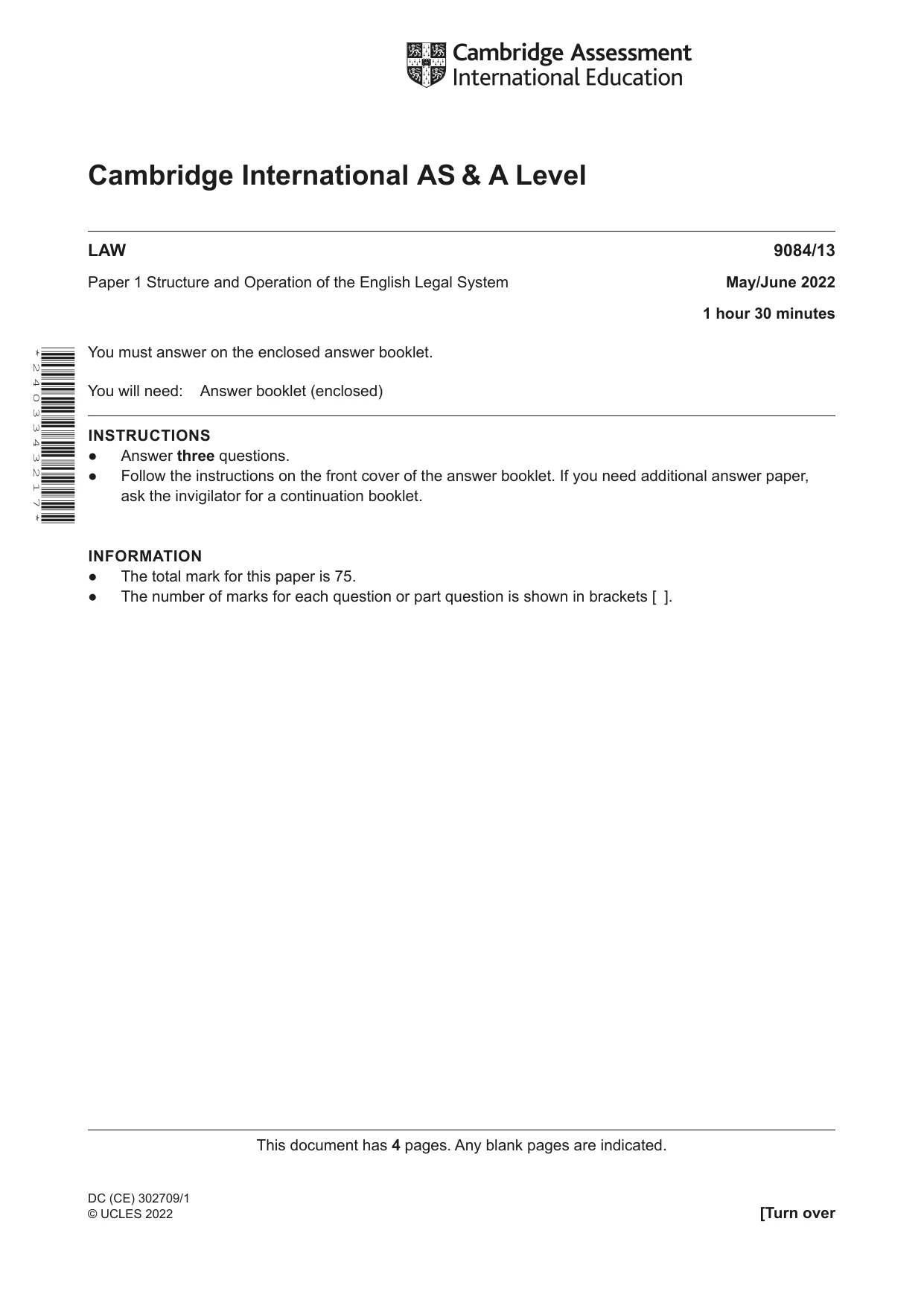
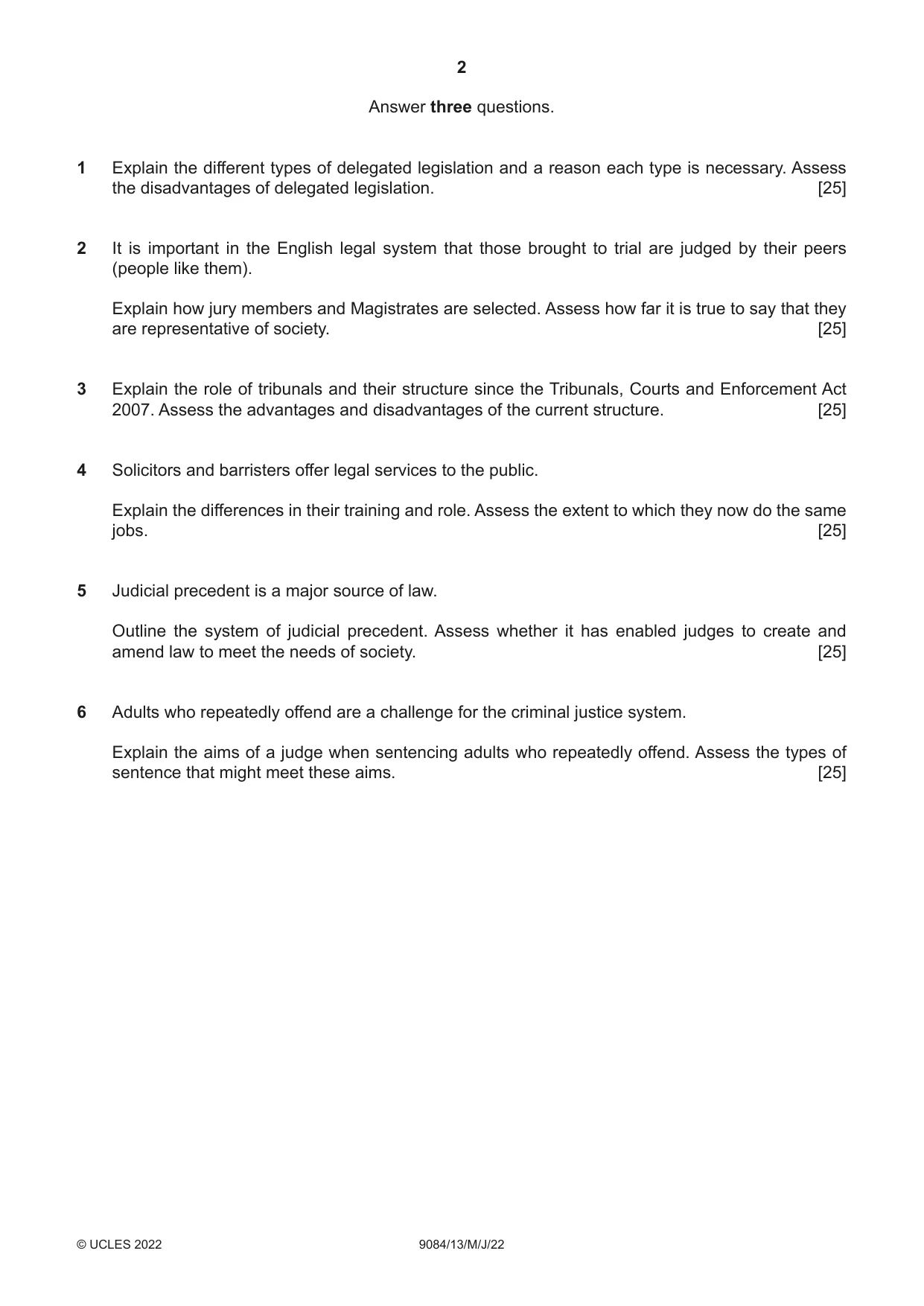
Question paper4 pages


Mark scheme10 pages
Answers below. Sit the paper first if you are practising.
Paper as text
Question paper, page 1
This document has 4 pages. Any blank pages are indicated. [Turn over Cambridge International AS & A Level * 2 4 0 3 3 4 3 2 1 7 * DC (CE) 302709/1 © UCLES 2022 LAW 9084/13 Paper 1 Structure and Operation of the English Legal System May/June 2022 1 hour 30 minutes You must answer on the enclosed answer booklet. You will need: Answer booklet (enclosed) INSTRUCTIONS ● Answer three questions. ● Follow the instructions on the front cover of the answer booklet. If you need additional answer paper, ask the invigilator for a continuation booklet. INFORMATION ● The total mark for this paper is 75. ● The number of marks for each question or part question is shown in brackets [ ].
Question paper, page 2
2 9084/13/M/J/22 © UCLES 2022 Answer three questions. 1 Explain the different types of delegated legislation and a reason each type is necessary. Assess the disadvantages of delegated legislation. [25] 2 It is important in the English legal system that those brought to trial are judged by their peers (people like them). Explain how jury members and Magistrates are selected. Assess how far it is true to say that they are representative of society. [25] 3 Explain the role of tribunals and their structure since the Tribunals, Courts and Enforcement Act 2007. Assess the advantages and disadvantages of the current structure. [25] 4 Solicitors and barristers offer legal services to the public. Explain the differences in their training and role. Assess the extent to which they now do the same jobs. [25] 5 Judicial precedent is a major source of law. Outline the system of judicial precedent. Assess whether it has enabled judges to create and amend law to meet the needs of society. [25] 6 Adults who repeatedly offend are a challenge for the criminal justice system. Explain the aims of a judge when sentencing adults who repeatedly offend. Assess the types of sentence that might meet these aims. [25]
Question paper, page 3
3 9084/13/M/J/22 © UCLES 2022 BLANK PAGE
Question paper, page 4
4 9084/13/M/J/22 © UCLES 2022 Permission to reproduce items where third-party owned material protected by copyright is included has been sought and cleared where possible. Every reasonable effort has been made by the publisher (UCLES) to trace copyright holders, but if any items requiring clearance have unwittingly been included, the publisher will be pleased to make amends at the earliest possible opportunity. To avoid the issue of disclosure of answer-related information to candidates, all copyright acknowledgements are reproduced online in the Cambridge Assessment International Education Copyright Acknowledgements Booklet. This is produced for each series of examinations and is freely available to download at www.cambridgeinternational.org after the live examination series. Cambridge Assessment International Education is part of Cambridge Assessment. Cambridge Assessment is the brand name of the University of Cambridge Local Examinations Syndicate (UCLES), which is a department of the University of Cambridge. BLANK PAGE
Mark scheme, page 1
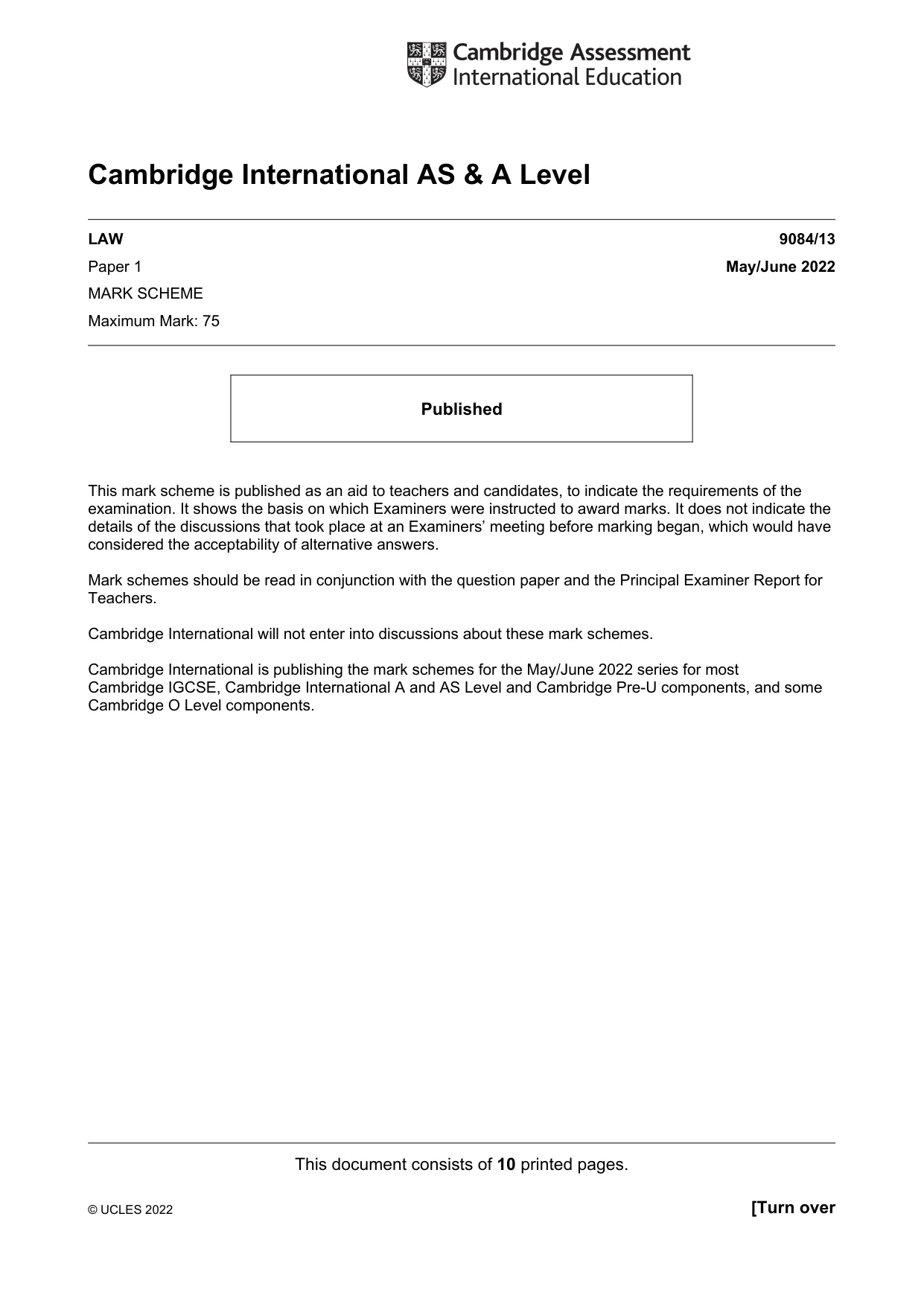
This document consists of 10 printed pages. © UCLES 2022 [Turn over Cambridge International AS & A Level LAW 9084/13 Paper 1 May/June 2022 MARK SCHEME Maximum Mark: 75 Published This mark scheme is published as an aid to teachers and candidates, to indicate the requirements of the examination. It shows the basis on which Examiners were instructed to award marks. It does not indicate the details of the discussions that took place at an Examiners’ meeting before marking began, which would have considered the acceptability of alternative answers. Mark schemes should be read in conjunction with the question paper and the Principal Examiner Report for Teachers. Cambridge International will not enter into discussions about these mark schemes. Cambridge International is publishing the mark schemes for the May/June 2022 series for most Cambridge IGCSE, Cambridge International A and AS Level and Cambridge Pre-U components, and some Cambridge O Level components.
Mark scheme, page 2
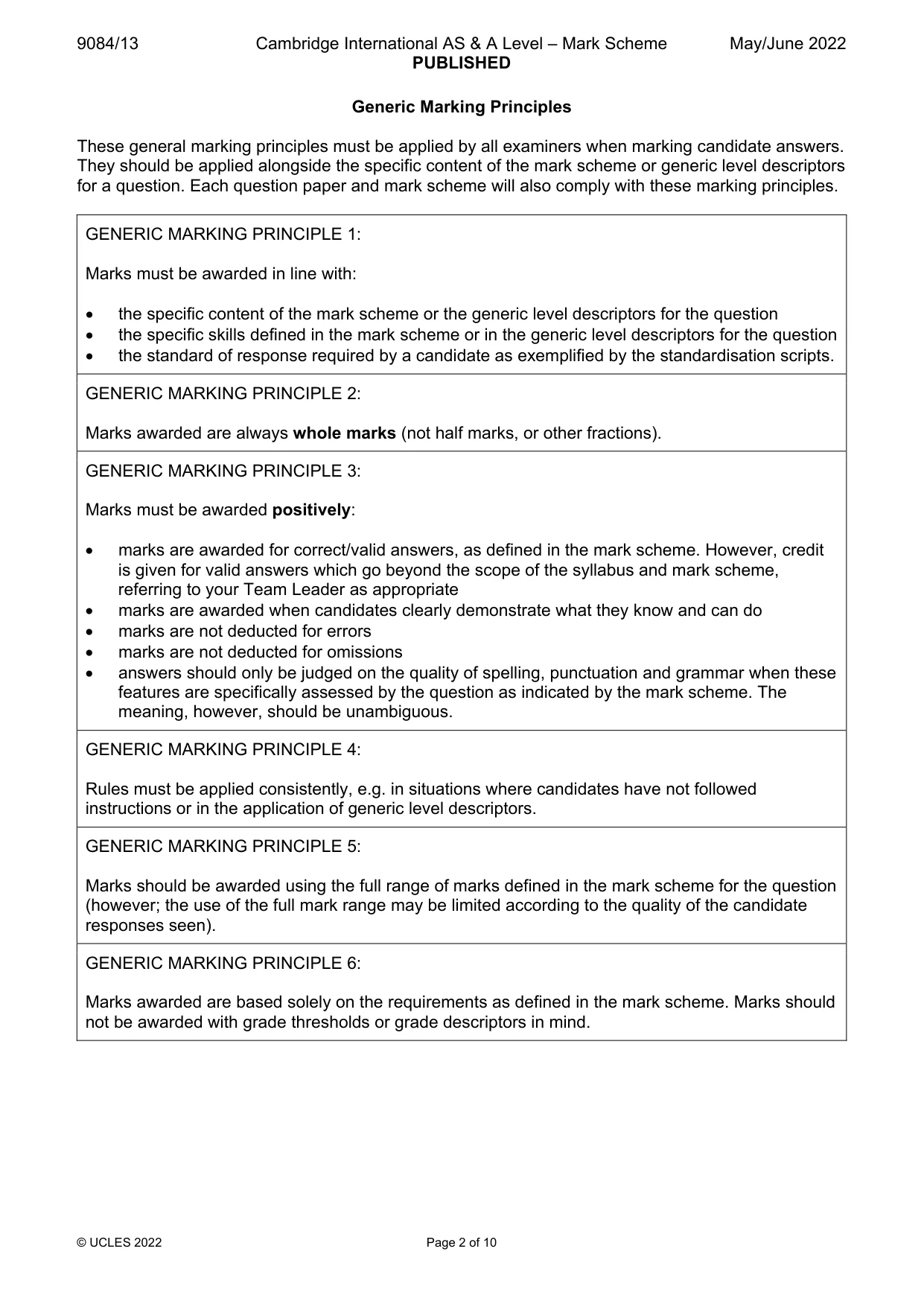
9084/13 Cambridge International AS & A Level – Mark Scheme PUBLISHED May/June 2022 © UCLES 2022 Page 2 of 10 Generic Marking Principles These general marking principles must be applied by all examiners when marking candidate answers. They should be applied alongside the specific content of the mark scheme or generic level descriptors for a question. Each question paper and mark scheme will also comply with these marking principles. GENERIC MARKING PRINCIPLE 1: Marks must be awarded in line with: the specific content of the mark scheme or the generic level descriptors for the question the specific skills defined in the mark scheme or in the generic level descriptors for the question the standard of response required by a candidate as exemplified by the standardisation scripts. GENERIC MARKING PRINCIPLE 2: Marks awarded are always whole marks (not half marks, or other fractions). GENERIC MARKING PRINCIPLE 3: Marks must be awarded positively: marks are awarded for correct/valid answers, as defined in the mark scheme. However, credit is given for valid answers which go beyond the scope of the syllabus and mark scheme, referring to your Team Leader as appropriate marks are awarded when candidates clearly demonstrate what they know and can do marks are not deducted for errors marks are not deducted for omissions answers should only be judged on the quality of spelling, punctuation and grammar when these features are specifically assessed by the question as indicated by the mark scheme. The meaning, however, should be unambiguous. GENERIC MARKING PRINCIPLE 4: Rules must be applied consistently, e.g. in situations where candidates have not followed instructions or in the application of generic level descriptors. GENERIC MARKING PRINCIPLE 5: Marks should be awarded using the full range of marks defined in the mark scheme for the question (however; the use of the full mark range may be limited according to the quality of the candidate responses seen). GENERIC MARKING PRINCIPLE 6: Marks awarded are based solely on the requirements as defined in the mark scheme. Marks should not be awarded with grade thresholds or grade descriptors in mind.
Mark scheme, page 3
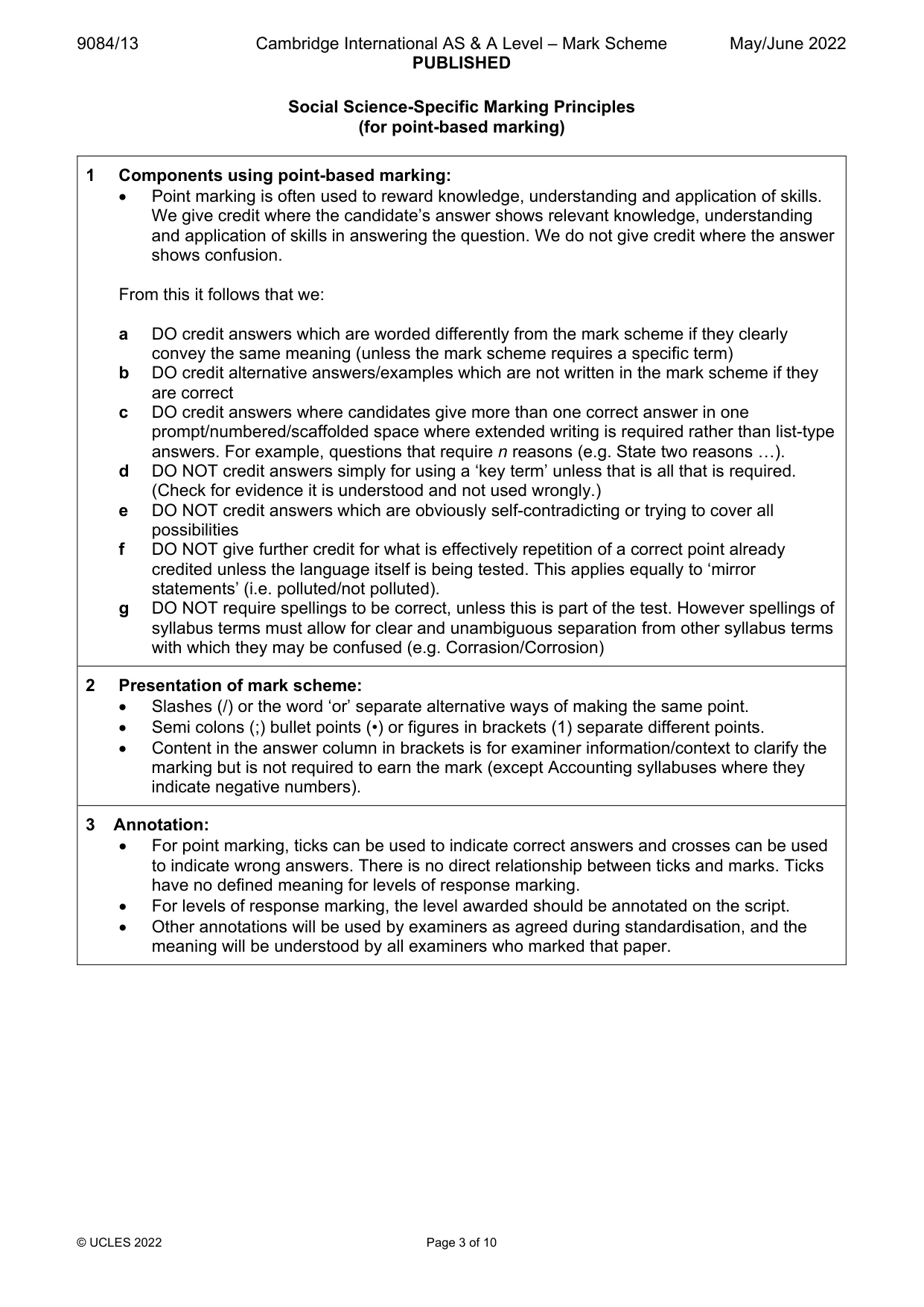
9084/13 Cambridge International AS & A Level – Mark Scheme PUBLISHED May/June 2022 © UCLES 2022 Page 3 of 10 Social Science-Specific Marking Principles (for point-based marking) 1 Components using point-based marking: Point marking is often used to reward knowledge, understanding and application of skills. We give credit where the candidate’s answer shows relevant knowledge, understanding and application of skills in answering the question. We do not give credit where the answer shows confusion. From this it follows that we: a DO credit answers which are worded differently from the mark scheme if they clearly convey the same meaning (unless the mark scheme requires a specific term) b DO credit alternative answers/examples which are not written in the mark scheme if they are correct c DO credit answers where candidates give more than one correct answer in one prompt/numbered/scaffolded space where extended writing is required rather than list-type answers. For example, questions that require n reasons (e.g. State two reasons …). d DO NOT credit answers simply for using a ‘key term’ unless that is all that is required. (Check for evidence it is understood and not used wrongly.) e DO NOT credit answers which are obviously self-contradicting or trying to cover all possibilities f DO NOT give further credit for what is effectively repetition of a correct point already credited unless the language itself is being tested. This applies equally to ‘mirror statements’ (i.e. polluted/not polluted). g DO NOT require spellings to be correct, unless this is part of the test. However spellings of syllabus terms must allow for clear and unambiguous separation from other syllabus terms with which they may be confused (e.g. Corrasion/Corrosion) 2 Presentation of mark scheme: Slashes (/) or the word ‘or’ separate alternative ways of making the same point. Semi colons (;) bullet points (•) or figures in brackets (1) separate different points. Content in the answer column in brackets is for examiner information/context to clarify the marking but is not required to earn the mark (except Accounting syllabuses where they indicate negative numbers). 3 Annotation: For point marking, ticks can be used to indicate correct answers and crosses can be used to indicate wrong answers. There is no direct relationship between ticks and marks. Ticks have no defined meaning for levels of response marking. For levels of response marking, the level awarded should be annotated on the script. Other annotations will be used by examiners as agreed during standardisation, and the meaning will be understood by all examiners who marked that paper.
Mark scheme, page 4
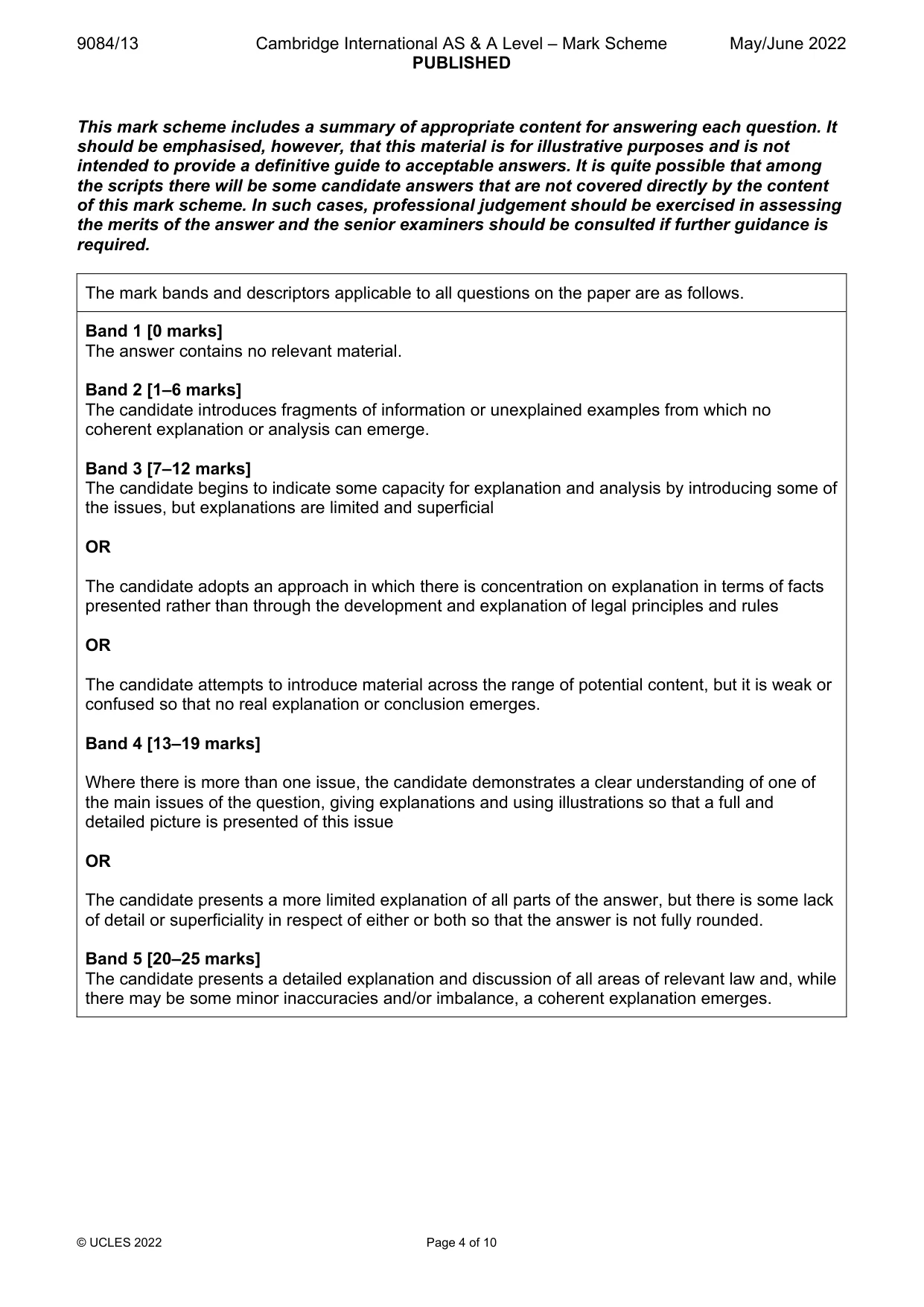
9084/13 Cambridge International AS & A Level – Mark Scheme PUBLISHED May/June 2022 © UCLES 2022 Page 4 of 10 This mark scheme includes a summary of appropriate content for answering each question. It should be emphasised, however, that this material is for illustrative purposes and is not intended to provide a definitive guide to acceptable answers. It is quite possible that among the scripts there will be some candidate answers that are not covered directly by the content of this mark scheme. In such cases, professional judgement should be exercised in assessing the merits of the answer and the senior examiners should be consulted if further guidance is required. The mark bands and descriptors applicable to all questions on the paper are as follows. Band 1 [0 marks] The answer contains no relevant material. Band 2 [1–6 marks] The candidate introduces fragments of information or unexplained examples from which no coherent explanation or analysis can emerge. Band 3 [7–12 marks] The candidate begins to indicate some capacity for explanation and analysis by introducing some of the issues, but explanations are limited and superficial OR The candidate adopts an approach in which there is concentration on explanation in terms of facts presented rather than through the development and explanation of legal principles and rules OR The candidate attempts to introduce material across the range of potential content, but it is weak or confused so that no real explanation or conclusion emerges. Band 4 [13–19 marks] Where there is more than one issue, the candidate demonstrates a clear understanding of one of the main issues of the question, giving explanations and using illustrations so that a full and detailed picture is presented of this issue OR The candidate presents a more limited explanation of all parts of the answer, but there is some lack of detail or superficiality in respect of either or both so that the answer is not fully rounded. Band 5 [20–25 marks] The candidate presents a detailed explanation and discussion of all areas of relevant law and, while there may be some minor inaccuracies and/or imbalance, a coherent explanation emerges.
Mark scheme, page 5
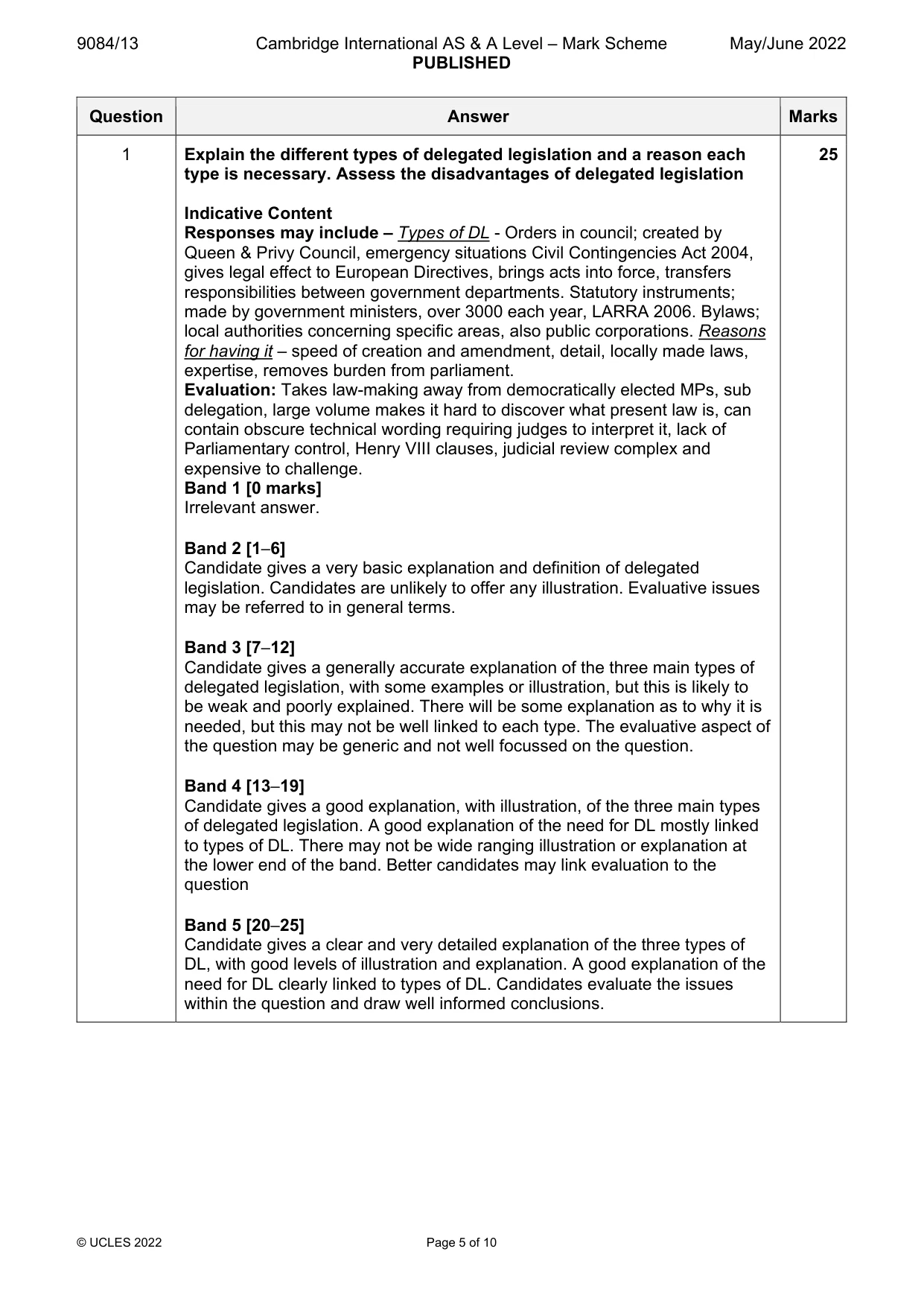
9084/13 Cambridge International AS & A Level – Mark Scheme PUBLISHED May/June 2022 © UCLES 2022 Page 5 of 10 Question Answer Marks 1 Explain the different types of delegated legislation and a reason each type is necessary. Assess the disadvantages of delegated legislation Indicative Content Responses may include – Types of DL - Orders in council; created by Queen & Privy Council, emergency situations Civil Contingencies Act 2004, gives legal effect to European Directives, brings acts into force, transfers responsibilities between government departments. Statutory instruments; made by government ministers, over 3000 each year, LARRA 2006. Bylaws; local authorities concerning specific areas, also public corporations. Reasons for having it – speed of creation and amendment, detail, locally made laws, expertise, removes burden from parliament. Evaluation: Takes law-making away from democratically elected MPs, sub delegation, large volume makes it hard to discover what present law is, can contain obscure technical wording requiring judges to interpret it, lack of Parliamentary control, Henry VIII clauses, judicial review complex and expensive to challenge. Band 1 [0 marks] Irrelevant answer. Band 2 [16] Candidate gives a very basic explanation and definition of delegated legislation. Candidates are unlikely to offer any illustration. Evaluative issues may be referred to in general terms. Band 3 [712] Candidate gives a generally accurate explanation of the three main types of delegated legislation, with some examples or illustration, but this is likely to be weak and poorly explained. There will be some explanation as to why it is needed, but this may not be well linked to each type. The evaluative aspect of the question may be generic and not well focussed on the question. Band 4 [1319] Candidate gives a good explanation, with illustration, of the three main types of delegated legislation. A good explanation of the need for DL mostly linked to types of DL. There may not be wide ranging illustration or explanation at the lower end of the band. Better candidates may link evaluation to the question Band 5 [2025] Candidate gives a clear and very detailed explanation of the three types of DL, with good levels of illustration and explanation. A good explanation of the need for DL clearly linked to types of DL. Candidates evaluate the issues within the question and draw well informed conclusions. 25
Mark scheme, page 6
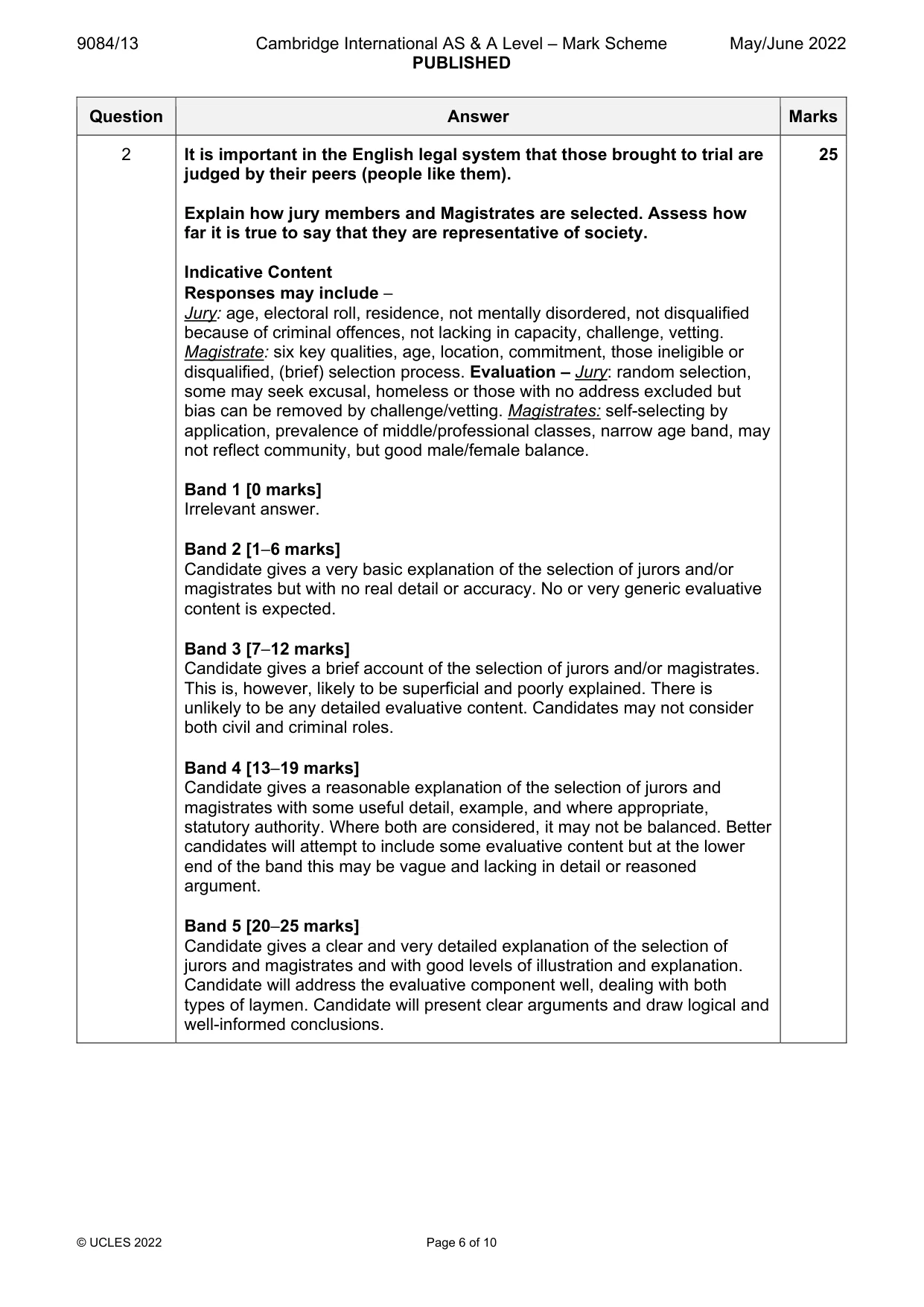
9084/13 Cambridge International AS & A Level – Mark Scheme PUBLISHED May/June 2022 © UCLES 2022 Page 6 of 10 Question Answer Marks 2 It is important in the English legal system that those brought to trial are judged by their peers (people like them). Explain how jury members and Magistrates are selected. Assess how far it is true to say that they are representative of society. Indicative Content Responses may include Jury: age, electoral roll, residence, not mentally disordered, not disqualified because of criminal offences, not lacking in capacity, challenge, vetting. Magistrate: six key qualities, age, location, commitment, those ineligible or disqualified, (brief) selection process. Evaluation – Jury: random selection, some may seek excusal, homeless or those with no address excluded but bias can be removed by challenge/vetting. Magistrates: self-selecting by application, prevalence of middle/professional classes, narrow age band, may not reflect community, but good male/female balance. Band 1 [0 marks] Irrelevant answer. Band 2 [16 marks] Candidate gives a very basic explanation of the selection of jurors and/or magistrates but with no real detail or accuracy. No or very generic evaluative content is expected. Band 3 [712 marks] Candidate gives a brief account of the selection of jurors and/or magistrates. This is, however, likely to be superficial and poorly explained. There is unlikely to be any detailed evaluative content. Candidates may not consider both civil and criminal roles. Band 4 [1319 marks] Candidate gives a reasonable explanation of the selection of jurors and magistrates with some useful detail, example, and where appropriate, statutory authority. Where both are considered, it may not be balanced. Better candidates will attempt to include some evaluative content but at the lower end of the band this may be vague and lacking in detail or reasoned argument. Band 5 [2025 marks] Candidate gives a clear and very detailed explanation of the selection of jurors and magistrates and with good levels of illustration and explanation. Candidate will address the evaluative component well, dealing with both types of laymen. Candidate will present clear arguments and draw logical and well-informed conclusions. 25
Mark scheme, page 7
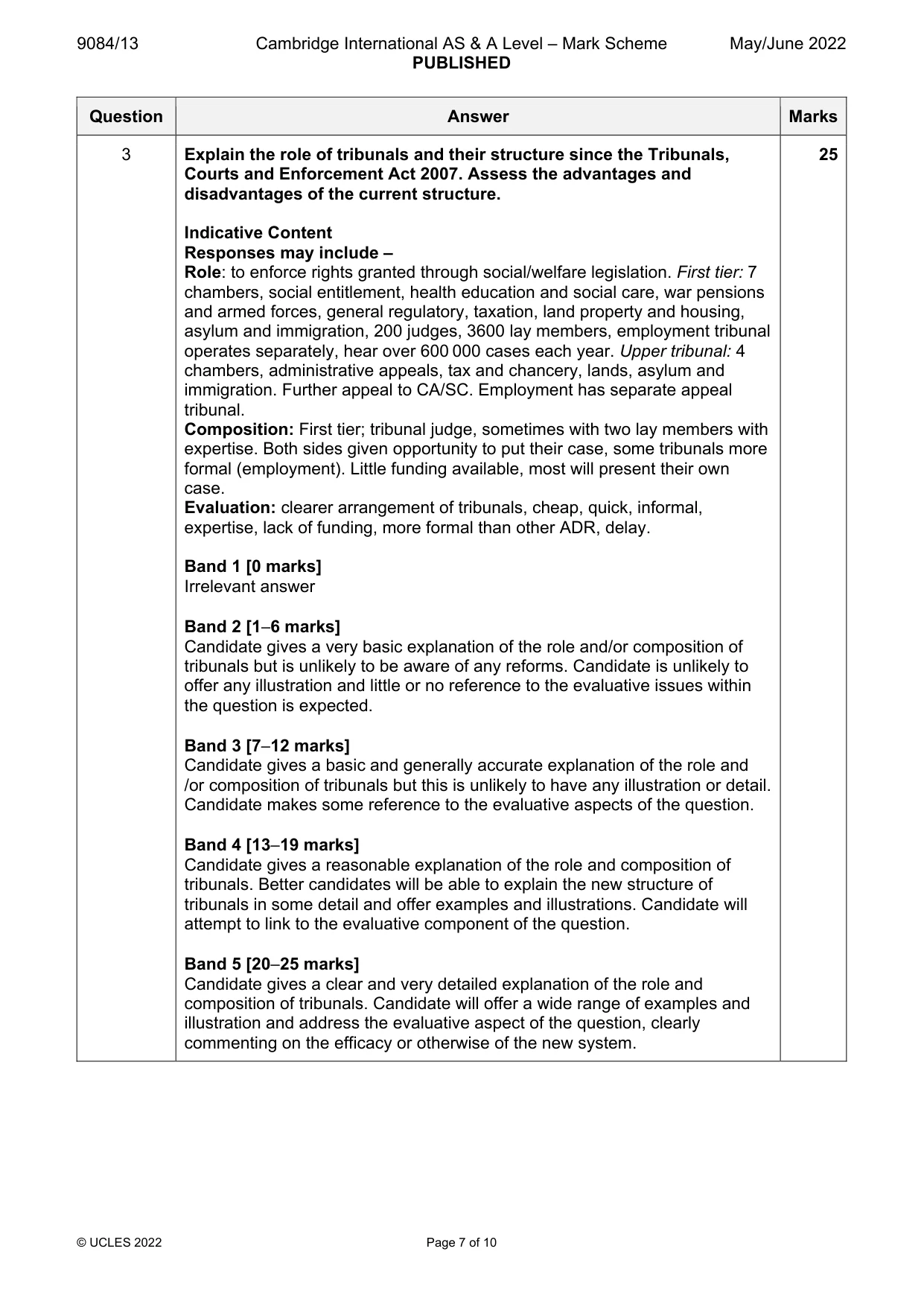
9084/13 Cambridge International AS & A Level – Mark Scheme PUBLISHED May/June 2022 © UCLES 2022 Page 7 of 10 Question Answer Marks 3 Explain the role of tribunals and their structure since the Tribunals, Courts and Enforcement Act 2007. Assess the advantages and disadvantages of the current structure. Indicative Content Responses may include – Role: to enforce rights granted through social/welfare legislation. First tier: 7 chambers, social entitlement, health education and social care, war pensions and armed forces, general regulatory, taxation, land property and housing, asylum and immigration, 200 judges, 3600 lay members, employment tribunal operates separately, hear over 600 000 cases each year. Upper tribunal: 4 chambers, administrative appeals, tax and chancery, lands, asylum and immigration. Further appeal to CA/SC. Employment has separate appeal tribunal. Composition: First tier; tribunal judge, sometimes with two lay members with expertise. Both sides given opportunity to put their case, some tribunals more formal (employment). Little funding available, most will present their own case. Evaluation: clearer arrangement of tribunals, cheap, quick, informal, expertise, lack of funding, more formal than other ADR, delay. Band 1 [0 marks] Irrelevant answer Band 2 [16 marks] Candidate gives a very basic explanation of the role and/or composition of tribunals but is unlikely to be aware of any reforms. Candidate is unlikely to offer any illustration and little or no reference to the evaluative issues within the question is expected. Band 3 [712 marks] Candidate gives a basic and generally accurate explanation of the role and /or composition of tribunals but this is unlikely to have any illustration or detail. Candidate makes some reference to the evaluative aspects of the question. Band 4 [1319 marks] Candidate gives a reasonable explanation of the role and composition of tribunals. Better candidates will be able to explain the new structure of tribunals in some detail and offer examples and illustrations. Candidate will attempt to link to the evaluative component of the question. Band 5 [2025 marks] Candidate gives a clear and very detailed explanation of the role and composition of tribunals. Candidate will offer a wide range of examples and illustration and address the evaluative aspect of the question, clearly commenting on the efficacy or otherwise of the new system. 25
Mark scheme, page 8
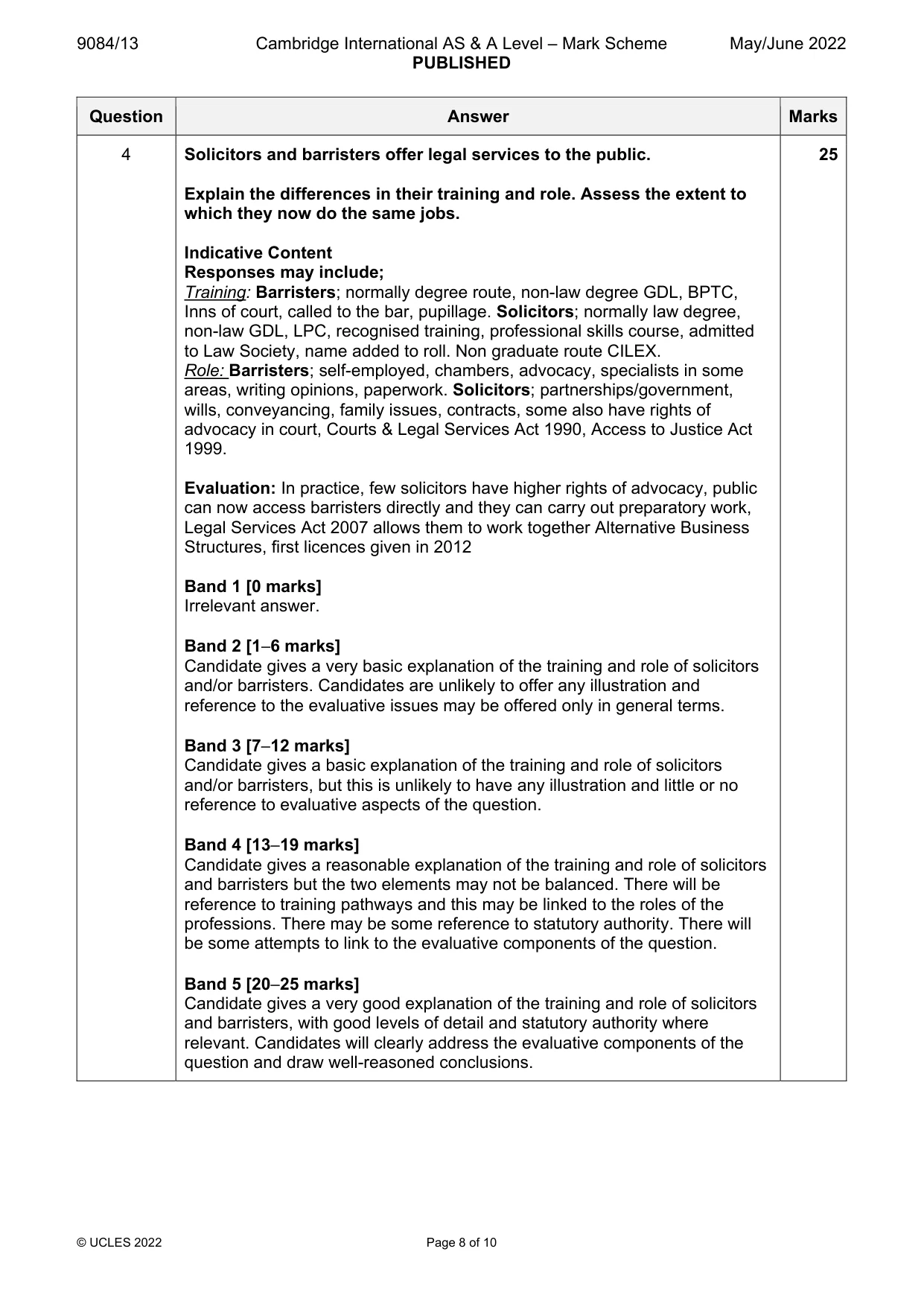
9084/13 Cambridge International AS & A Level – Mark Scheme PUBLISHED May/June 2022 © UCLES 2022 Page 8 of 10 Question Answer Marks 4 Solicitors and barristers offer legal services to the public. Explain the differences in their training and role. Assess the extent to which they now do the same jobs. Indicative Content Responses may include; Training: Barristers; normally degree route, non-law degree GDL, BPTC, Inns of court, called to the bar, pupillage. Solicitors; normally law degree, non-law GDL, LPC, recognised training, professional skills course, admitted to Law Society, name added to roll. Non graduate route CILEX. Role: Barristers; self-employed, chambers, advocacy, specialists in some areas, writing opinions, paperwork. Solicitors; partnerships/government, wills, conveyancing, family issues, contracts, some also have rights of advocacy in court, Courts & Legal Services Act 1990, Access to Justice Act 1999. Evaluation: In practice, few solicitors have higher rights of advocacy, public can now access barristers directly and they can carry out preparatory work, Legal Services Act 2007 allows them to work together Alternative Business Structures, first licences given in 2012 Band 1 [0 marks] Irrelevant answer. Band 2 [16 marks] Candidate gives a very basic explanation of the training and role of solicitors and/or barristers. Candidates are unlikely to offer any illustration and reference to the evaluative issues may be offered only in general terms. Band 3 [712 marks] Candidate gives a basic explanation of the training and role of solicitors and/or barristers, but this is unlikely to have any illustration and little or no reference to evaluative aspects of the question. Band 4 [1319 marks] Candidate gives a reasonable explanation of the training and role of solicitors and barristers but the two elements may not be balanced. There will be reference to training pathways and this may be linked to the roles of the professions. There may be some reference to statutory authority. There will be some attempts to link to the evaluative components of the question. Band 5 [2025 marks] Candidate gives a very good explanation of the training and role of solicitors and barristers, with good levels of detail and statutory authority where relevant. Candidates will clearly address the evaluative components of the question and draw well-reasoned conclusions. 25
Mark scheme, page 9
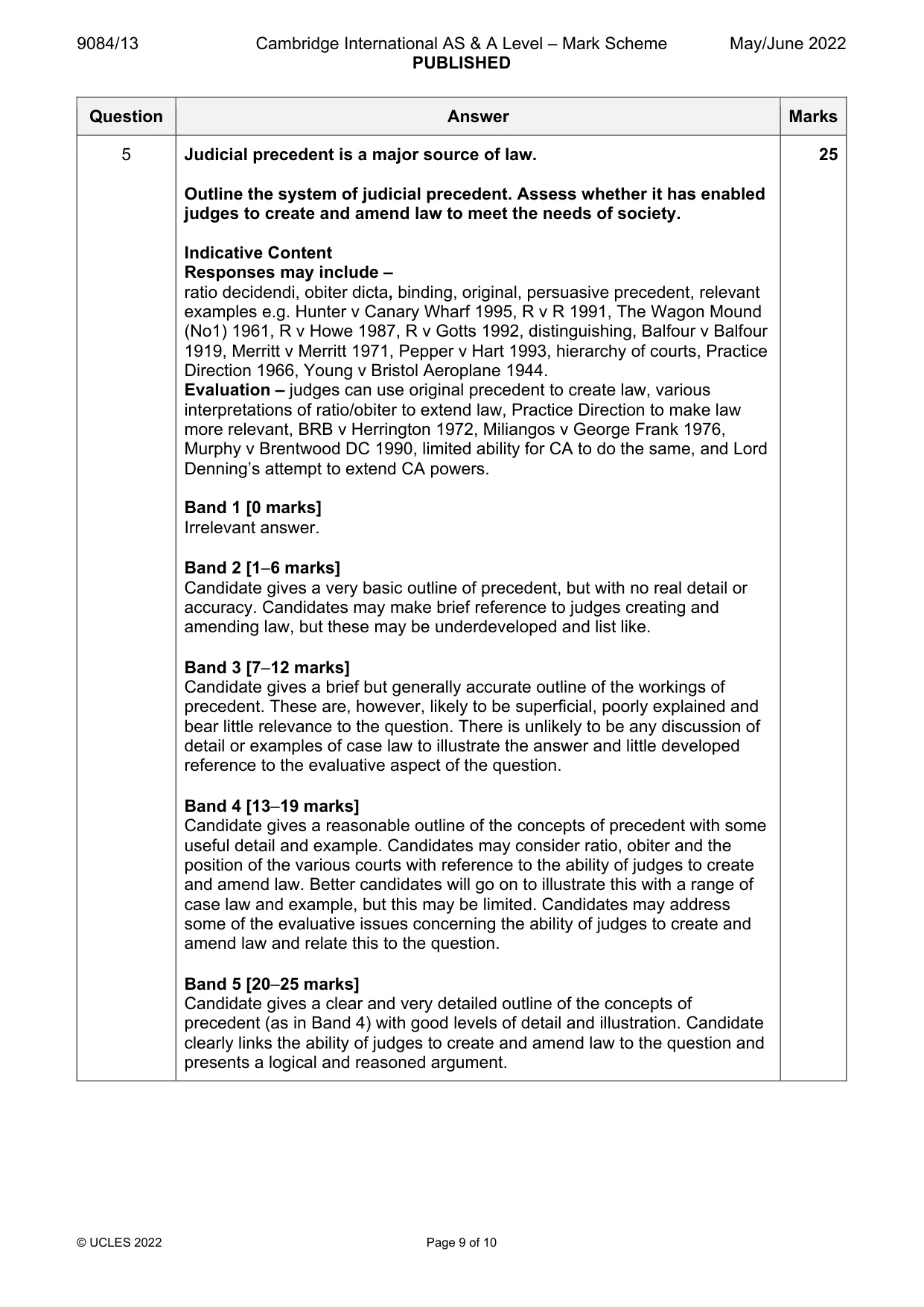
9084/13 Cambridge International AS & A Level – Mark Scheme PUBLISHED May/June 2022 © UCLES 2022 Page 9 of 10 Question Answer Marks 5 Judicial precedent is a major source of law. Outline the system of judicial precedent. Assess whether it has enabled judges to create and amend law to meet the needs of society. Indicative Content Responses may include – ratio decidendi, obiter dicta, binding, original, persuasive precedent, relevant examples e.g. Hunter v Canary Wharf 1995, R v R 1991, The Wagon Mound (No1) 1961, R v Howe 1987, R v Gotts 1992, distinguishing, Balfour v Balfour 1919, Merritt v Merritt 1971, Pepper v Hart 1993, hierarchy of courts, Practice Direction 1966, Young v Bristol Aeroplane 1944. Evaluation – judges can use original precedent to create law, various interpretations of ratio/obiter to extend law, Practice Direction to make law more relevant, BRB v Herrington 1972, Miliangos v George Frank 1976, Murphy v Brentwood DC 1990, limited ability for CA to do the same, and Lord Denning’s attempt to extend CA powers. Band 1 [0 marks] Irrelevant answer. Band 2 [16 marks] Candidate gives a very basic outline of precedent, but with no real detail or accuracy. Candidates may make brief reference to judges creating and amending law, but these may be underdeveloped and list like. Band 3 [712 marks] Candidate gives a brief but generally accurate outline of the workings of precedent. These are, however, likely to be superficial, poorly explained and bear little relevance to the question. There is unlikely to be any discussion of detail or examples of case law to illustrate the answer and little developed reference to the evaluative aspect of the question. Band 4 [1319 marks] Candidate gives a reasonable outline of the concepts of precedent with some useful detail and example. Candidates may consider ratio, obiter and the position of the various courts with reference to the ability of judges to create and amend law. Better candidates will go on to illustrate this with a range of case law and example, but this may be limited. Candidates may address some of the evaluative issues concerning the ability of judges to create and amend law and relate this to the question. Band 5 [2025 marks] Candidate gives a clear and very detailed outline of the concepts of precedent (as in Band 4) with good levels of detail and illustration. Candidate clearly links the ability of judges to create and amend law to the question and presents a logical and reasoned argument. 25
Mark scheme, page 10
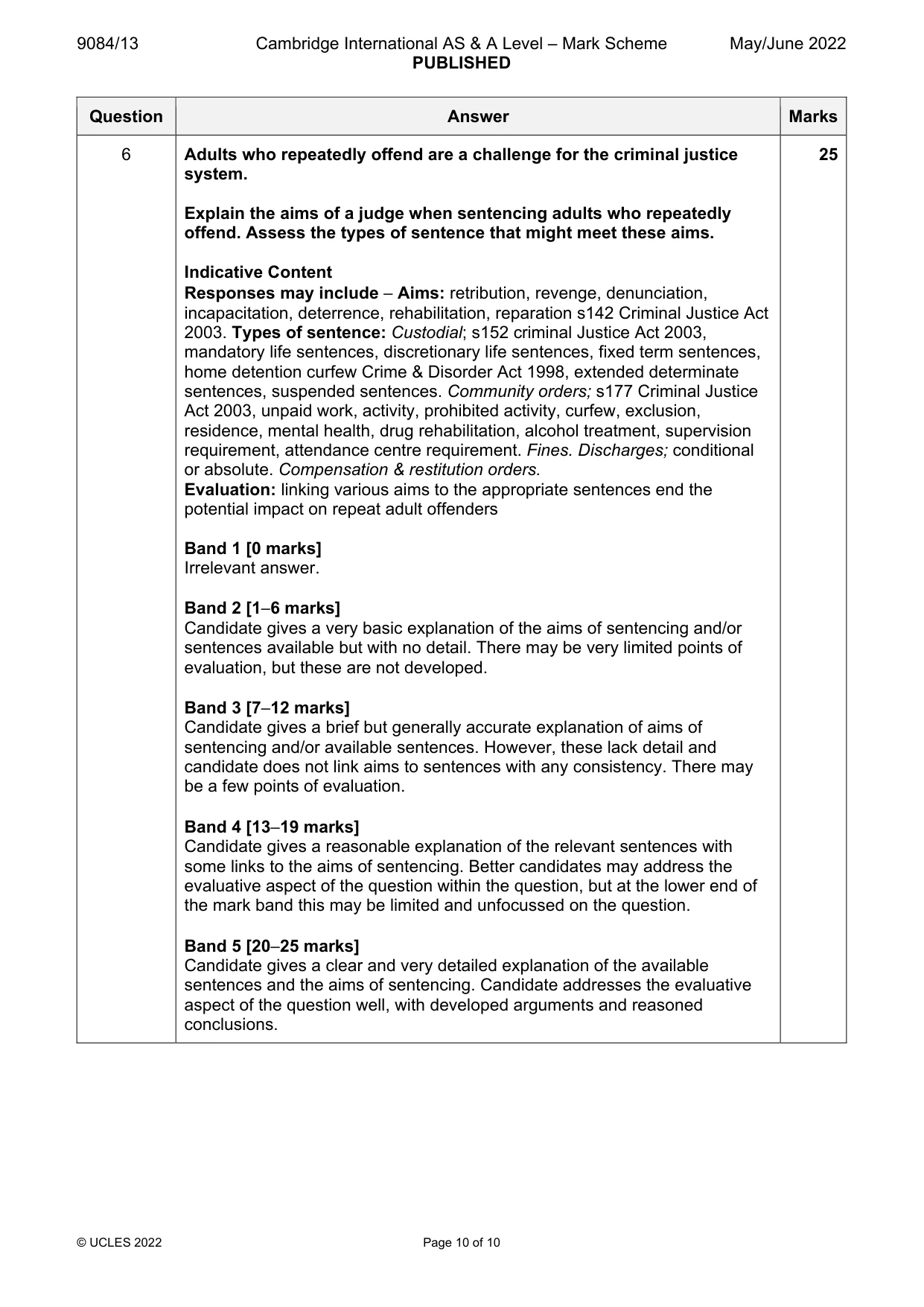
9084/13 Cambridge International AS & A Level – Mark Scheme PUBLISHED May/June 2022 © UCLES 2022 Page 10 of 10 Question Answer Marks 6 Adults who repeatedly offend are a challenge for the criminal justice system. Explain the aims of a judge when sentencing adults who repeatedly offend. Assess the types of sentence that might meet these aims. Indicative Content Responses may include Aims: retribution, revenge, denunciation, incapacitation, deterrence, rehabilitation, reparation s142 Criminal Justice Act 2003. Types of sentence: Custodial; s152 criminal Justice Act 2003, mandatory life sentences, discretionary life sentences, fixed term sentences, home detention curfew Crime & Disorder Act 1998, extended determinate sentences, suspended sentences. Community orders; s177 Criminal Justice Act 2003, unpaid work, activity, prohibited activity, curfew, exclusion, residence, mental health, drug rehabilitation, alcohol treatment, supervision requirement, attendance centre requirement. Fines. Discharges; conditional or absolute. Compensation & restitution orders. Evaluation: linking various aims to the appropriate sentences end the potential impact on repeat adult offenders Band 1 [0 marks] Irrelevant answer. Band 2 [16 marks] Candidate gives a very basic explanation of the aims of sentencing and/or sentences available but with no detail. There may be very limited points of evaluation, but these are not developed. Band 3 [712 marks] Candidate gives a brief but generally accurate explanation of aims of sentencing and/or available sentences. However, these lack detail and candidate does not link aims to sentences with any consistency. There may be a few points of evaluation. Band 4 [1319 marks] Candidate gives a reasonable explanation of the relevant sentences with some links to the aims of sentencing. Better candidates may address the evaluative aspect of the question within the question, but at the lower end of the mark band this may be limited and unfocussed on the question. Band 5 [2025 marks] Candidate gives a clear and very detailed explanation of the available sentences and the aims of sentencing. Candidate addresses the evaluative aspect of the question well, with developed arguments and reasoned conclusions. 25
What you needed in this session
Cambridge’s own grade thresholds for 2022 May/June, Paper 1 · Variant 3. A higher threshold means an easier paper — the bar moves with how the cohort did.