Cambridge A Level Law 9084 — 2022 May/June Paper 1 · Variant 2
9084/12/M/J/22 · 75 marks · ≈84 min
The question paper and its mark scheme, free to read here and free to download. This is Cambridge’s own paper, exactly as it was sat.
Question paper4 pages


Mark scheme14 pages
Answers below. Sit the paper first if you are practising.




Paper as text
Question paper, page 1
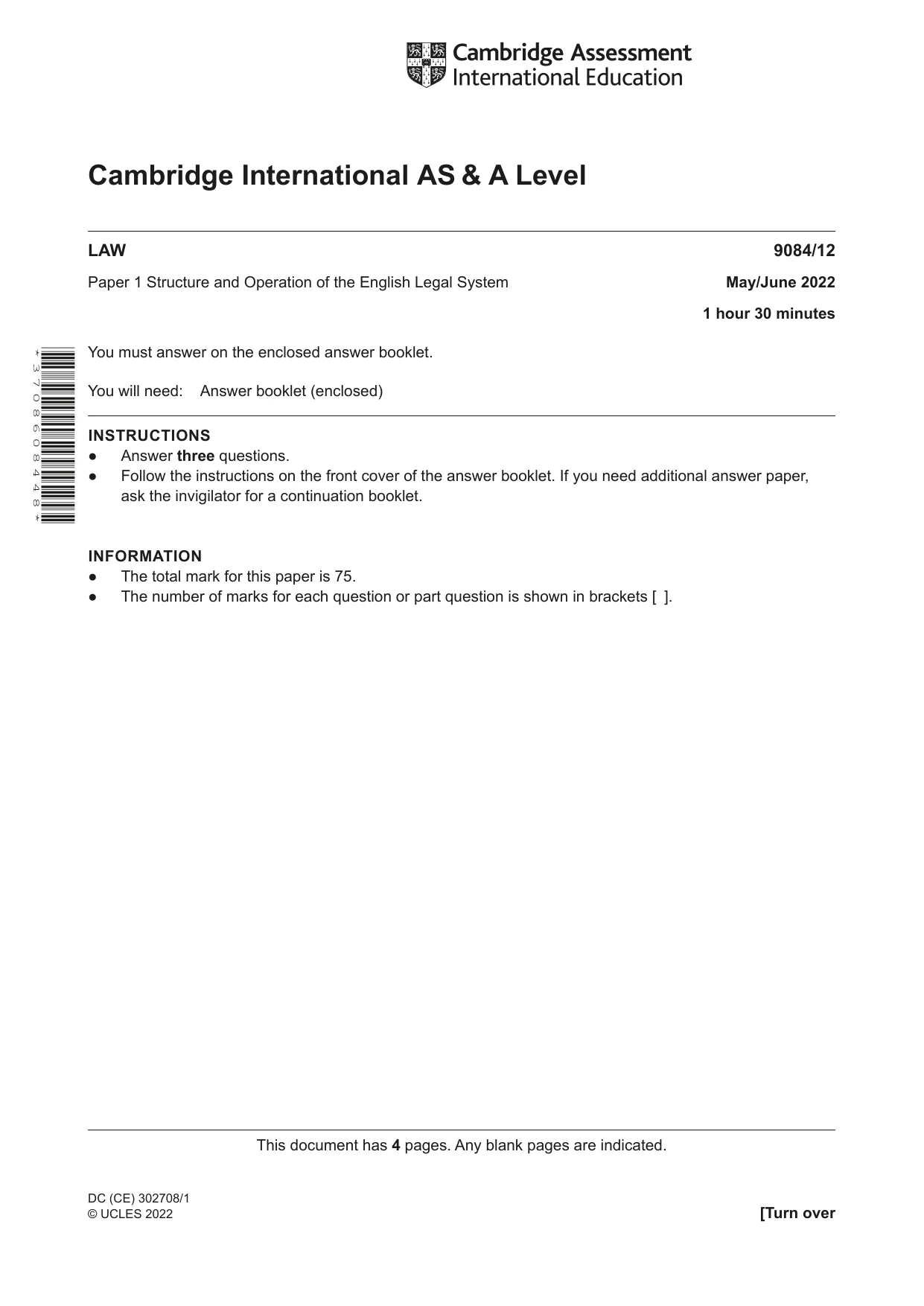
This document has 4 pages. Any blank pages are indicated. [Turn over Cambridge International AS & A Level DC (CE) 302708/1 © UCLES 2022 LAW 9084/12 Paper 1 Structure and Operation of the English Legal System May/June 2022 1 hour 30 minutes You must answer on the enclosed answer booklet. You will need: Answer booklet (enclosed) INSTRUCTIONS ● Answer three questions. ● Follow the instructions on the front cover of the answer booklet. If you need additional answer paper, ask the invigilator for a continuation booklet. INFORMATION ● The total mark for this paper is 75. ● The number of marks for each question or part question is shown in brackets [ ]. * 3 7 0 8 6 0 8 4 4 8 *
Question paper, page 2
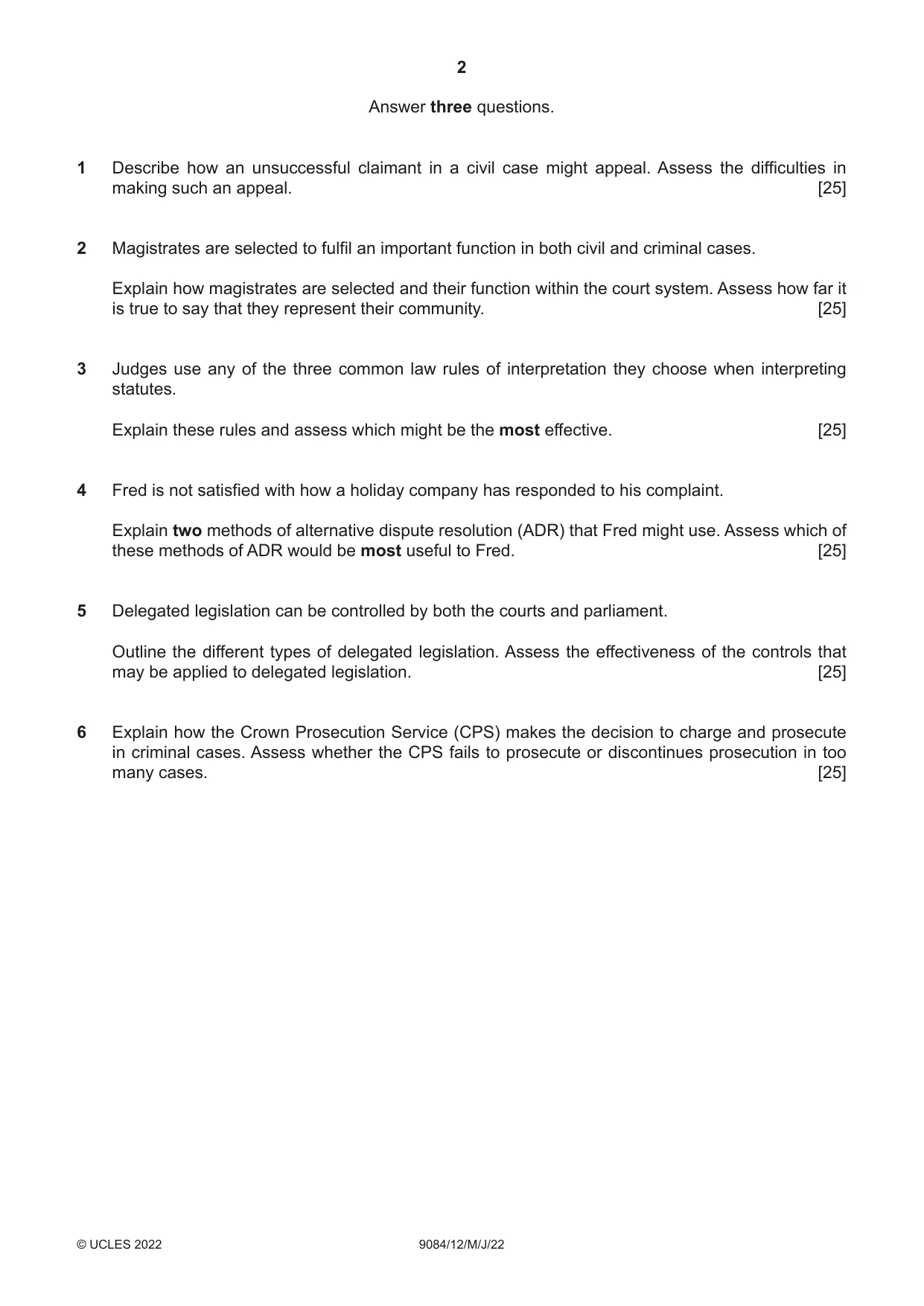
2 9084/12/M/J/22 © UCLES 2022 Answer three questions. 1 Describe how an unsuccessful claimant in a civil case might appeal. Assess the difficulties in making such an appeal. [25] 2 Magistrates are selected to fulfil an important function in both civil and criminal cases. Explain how magistrates are selected and their function within the court system. Assess how far it is true to say that they represent their community. [25] 3 Judges use any of the three common law rules of interpretation they choose when interpreting statutes. Explain these rules and assess which might be the most effective. [25] 4 Fred is not satisfied with how a holiday company has responded to his complaint. Explain two methods of alternative dispute resolution (ADR) that Fred might use. Assess which of these methods of ADR would be most useful to Fred. [25] 5 Delegated legislation can be controlled by both the courts and parliament. Outline the different types of delegated legislation. Assess the effectiveness of the controls that may be applied to delegated legislation. [25] 6 Explain how the Crown Prosecution Service (CPS) makes the decision to charge and prosecute in criminal cases. Assess whether the CPS fails to prosecute or discontinues prosecution in too many cases. [25]
Question paper, page 3
3 9084/12/M/J/22 © UCLES 2022 BLANK PAGE
Question paper, page 4
4 9084/12/M/J/22 © UCLES 2022 Permission to reproduce items where third-party owned material protected by copyright is included has been sought and cleared where possible. Every reasonable effort has been made by the publisher (UCLES) to trace copyright holders, but if any items requiring clearance have unwittingly been included, the publisher will be pleased to make amends at the earliest possible opportunity. To avoid the issue of disclosure of answer-related information to candidates, all copyright acknowledgements are reproduced online in the Cambridge Assessment International Education Copyright Acknowledgements Booklet. This is produced for each series of examinations and is freely available to download at www.cambridgeinternational.org after the live examination series. Cambridge Assessment International Education is part of Cambridge Assessment. Cambridge Assessment is the brand name of the University of Cambridge Local Examinations Syndicate (UCLES), which is a department of the University of Cambridge. BLANK PAGE
Mark scheme, page 1
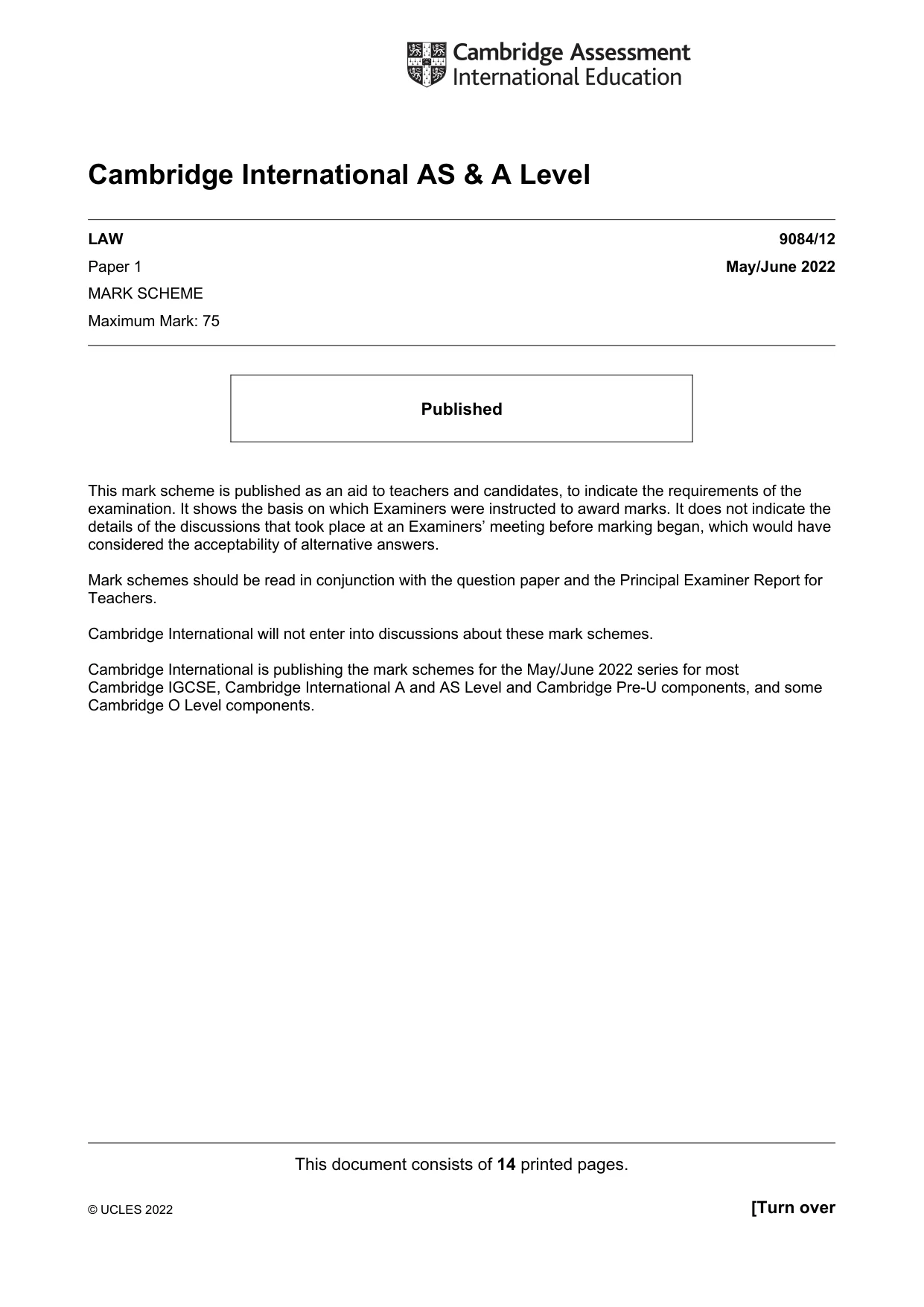
This document consists of 14 printed pages. © UCLES 2022 [Turn over Cambridge International AS & A Level LAW 9084/12 Paper 1 May/June 2022 MARK SCHEME Maximum Mark: 75 Published This mark scheme is published as an aid to teachers and candidates, to indicate the requirements of the examination. It shows the basis on which Examiners were instructed to award marks. It does not indicate the details of the discussions that took place at an Examiners’ meeting before marking began, which would have considered the acceptability of alternative answers. Mark schemes should be read in conjunction with the question paper and the Principal Examiner Report for Teachers. Cambridge International will not enter into discussions about these mark schemes. Cambridge International is publishing the mark schemes for the May/June 2022 series for most Cambridge IGCSE, Cambridge International A and AS Level and Cambridge Pre-U components, and some Cambridge O Level components.
Mark scheme, page 2
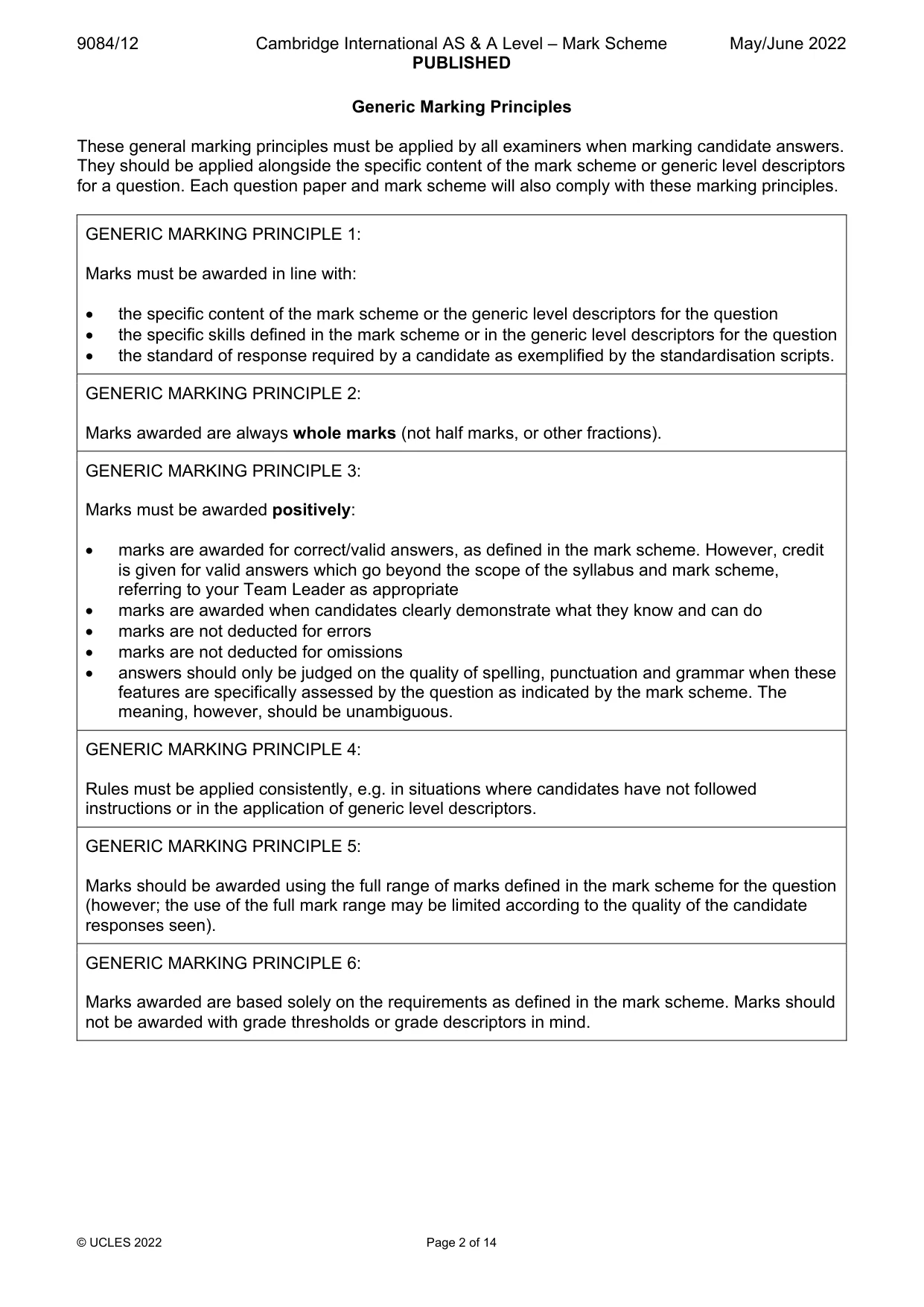
9084/12 Cambridge International AS & A Level – Mark Scheme PUBLISHED May/June 2022 © UCLES 2022 Page 2 of 14 Generic Marking Principles These general marking principles must be applied by all examiners when marking candidate answers. They should be applied alongside the specific content of the mark scheme or generic level descriptors for a question. Each question paper and mark scheme will also comply with these marking principles. GENERIC MARKING PRINCIPLE 1: Marks must be awarded in line with: the specific content of the mark scheme or the generic level descriptors for the question the specific skills defined in the mark scheme or in the generic level descriptors for the question the standard of response required by a candidate as exemplified by the standardisation scripts. GENERIC MARKING PRINCIPLE 2: Marks awarded are always whole marks (not half marks, or other fractions). GENERIC MARKING PRINCIPLE 3: Marks must be awarded positively: marks are awarded for correct/valid answers, as defined in the mark scheme. However, credit is given for valid answers which go beyond the scope of the syllabus and mark scheme, referring to your Team Leader as appropriate marks are awarded when candidates clearly demonstrate what they know and can do marks are not deducted for errors marks are not deducted for omissions answers should only be judged on the quality of spelling, punctuation and grammar when these features are specifically assessed by the question as indicated by the mark scheme. The meaning, however, should be unambiguous. GENERIC MARKING PRINCIPLE 4: Rules must be applied consistently, e.g. in situations where candidates have not followed instructions or in the application of generic level descriptors. GENERIC MARKING PRINCIPLE 5: Marks should be awarded using the full range of marks defined in the mark scheme for the question (however; the use of the full mark range may be limited according to the quality of the candidate responses seen). GENERIC MARKING PRINCIPLE 6: Marks awarded are based solely on the requirements as defined in the mark scheme. Marks should not be awarded with grade thresholds or grade descriptors in mind.
Mark scheme, page 3
9084/12 Cambridge International AS & A Level – Mark Scheme PUBLISHED May/June 2022 © UCLES 2022 Page 3 of 14 Social Science-Specific Marking Principles (for point-based marking) 1 Components using point-based marking: Point marking is often used to reward knowledge, understanding and application of skills. We give credit where the candidate’s answer shows relevant knowledge, understanding and application of skills in answering the question. We do not give credit where the answer shows confusion. From this it follows that we: a DO credit answers which are worded differently from the mark scheme if they clearly convey the same meaning (unless the mark scheme requires a specific term) b DO credit alternative answers/examples which are not written in the mark scheme if they are correct c DO credit answers where candidates give more than one correct answer in one prompt/numbered/scaffolded space where extended writing is required rather than list-type answers. For example, questions that require n reasons (e.g. State two reasons …). d DO NOT credit answers simply for using a ‘key term’ unless that is all that is required. (Check for evidence it is understood and not used wrongly.) e DO NOT credit answers which are obviously self-contradicting or trying to cover all possibilities f DO NOT give further credit for what is effectively repetition of a correct point already credited unless the language itself is being tested. This applies equally to ‘mirror statements’ (i.e. polluted/not polluted). g DO NOT require spellings to be correct, unless this is part of the test. However spellings of syllabus terms must allow for clear and unambiguous separation from other syllabus terms with which they may be confused (e.g. Corrasion/Corrosion) 2 Presentation of mark scheme: Slashes (/) or the word ‘or’ separate alternative ways of making the same point. Semi colons (;) bullet points (•) or figures in brackets (1) separate different points. Content in the answer column in brackets is for examiner information/context to clarify the marking but is not required to earn the mark (except Accounting syllabuses where they indicate negative numbers). 3 Annotation: For point marking, ticks can be used to indicate correct answers and crosses can be used to indicate wrong answers. There is no direct relationship between ticks and marks. Ticks have no defined meaning for levels of response marking. For levels of response marking, the level awarded should be annotated on the script. Other annotations will be used by examiners as agreed during standardisation, and the meaning will be understood by all examiners who marked that paper.
Mark scheme, page 4
9084/12 Cambridge International AS & A Level – Mark Scheme PUBLISHED May/June 2022 © UCLES 2022 Page 4 of 14 This mark scheme includes a summary of appropriate content for answering each question. It should be emphasised, however, that this material is for illustrative purposes and is not intended to provide a definitive guide to acceptable answers. It is quite possible that among the scripts there will be some candidate answers that are not covered directly by the content of this mark scheme. In such cases, professional judgement should be exercised in assessing the merits of the answer and the senior examiners should be consulted if further guidance is required. The mark bands and descriptors applicable to all questions on the paper are as follows. Band 1 [0 marks] The answer contains no relevant material. Band 2 [1–6 marks] The candidate introduces fragments of information or unexplained examples from which no coherent explanation or analysis can emerge. Band 3 [7–12 marks] The candidate begins to indicate some capacity for explanation and analysis by introducing some of the issues, but explanations are limited and superficial OR The candidate adopts an approach in which there is concentration on explanation in terms of facts presented rather than through the development and explanation of legal principles and rules OR The candidate attempts to introduce material across the range of potential content, but it is weak or confused so that no real explanation or conclusion emerges. Band 4 [13–19 marks] Where there is more than one issue, the candidate demonstrates a clear understanding of one of the main issues of the question, giving explanations and using illustrations so that a full and detailed picture is presented of this issue OR The candidate presents a more limited explanation of all parts of the answer, but there is some lack of detail or superficiality in respect of either or both so that the answer is not fully rounded. Band 5 [20–25 marks] The candidate presents a detailed explanation and discussion of all areas of relevant law and, while there may be some minor inaccuracies and/or imbalance, a coherent explanation emerges.
Mark scheme, page 5
9084/12 Cambridge International AS & A Level – Mark Scheme PUBLISHED May/June 2022 © UCLES 2022 Page 5 of 14 Question Answer Marks 1 Describe how an unsuccessful claimant in a civil case might appeal. Assess the difficulties in making such an appeal. Indicative Content Responses may include – From County Court: Part 52 Civil Procedure Rules, Fast track cases; if dealt with by DJ appeal heard by CJ, if dealt with by CJ appeal heard by HCJ. Multi track cases; heard in County Court right of appeal to High Court. Small claims; since October 2000 same as for fast track. Where first appeal heard by CJ or HCJ, further appeal to CA, only exceptional cases s55 Access to Justice Act 1999. From High Court: appeal to CA, rarely ‘leapfrog’ appeal direct to SC Administration of Justice Act 1969, as amended Criminal Justice & Courts Act 2015. Further appeals: From CA to SC only with leave, possibly also to ECJ by Article 267 referral. Evaluation – expense, time, need for legal advice, in commercial issues making it hard to trade in the future, need for leave to appeal. Band 1 [0 marks] Irrelevant answer. Band 2 [1–6 marks] Candidate gives a very basic description of civil appeals with little detail or undermined by error. There may be some unfocused evaluative comment. Band 3 [7–12 marks] Candidate gives a basic description of the civil appeal pathways from civil trial but the explanations are limited and superficial. Some general statements concerning difficulties may be evident, but they may be weak and confused. Band 4 [13–19 marks] Candidate gives a reasonable description of the appeal pathways from civil trial and grounds of appeal. Candidate makes an attempt to make a link with the evaluative component of the question and to discuss the problems. Band 5 [20–25 marks] Candidate gives a clear description of routes of appeal with good levels of detail. Candidates make clear and informed links to the evaluative component of the question. 25
Mark scheme, page 6
9084/12 Cambridge International AS & A Level – Mark Scheme PUBLISHED May/June 2022 © UCLES 2022 Page 6 of 14 Question Answer Marks 2 Magistrates are selected to fulfil an important function in both civil and criminal cases. Explain how magistrates are selected and their function within the court system. Assess how far it is true to say that they represent their community. Indicative Content Responses may include – six key qualities, ages, live near local justice area, 26 half days a year, no serious criminal convictions, undischarged bankrupts, members of the armed forces and those whose work is incompatible with the role. Not appointed if health means that duties cannot be carried out, Local Advisory Committees, application, first and second interviews, names submitted to Senior Presiding Judge, appointment Criminal role: Summary trials, preliminary hearings for other types of offence, youth court, warrants, bail, remand hearings, sentencing, and appeal in Crown Court. Civil Role: Non-payment of council tax, non-payment of TV licenses, appeals from LA refusal of licenses for sale of alcohol, licenses for betting and gaming. Use of Justices’ Clerk Evaluation: Appointed from the community, good male/female balance, live locally, but ‘middle aged, middle class’, professional, often retired Band 1 [0 marks] Irrelevant answer. Band 2 [1–6 marks] Candidate gives a very basic explanation of the selection and/or role of lay magistrates but with no real detail or accuracy and/or reference to the evaluative issues in general terms. Band 3 [7–12 marks] Candidate gives a basic account of the selection and/or role of the lay magistrate This is, however, likely to be superficial and poorly explained and authority is unlikely. Any evaluative content is likely to be vague and unfocussed. Band 4 [13–19 marks] Candidate gives a reasonable explanation of the selection and role with some useful detail and example. These elements may not be balanced. Better candidates will attempt to include some evaluative content addressing the question, but this may be vague and lacking in reasoned argument concerning the question. Candidates would be unlikely to achieve more than 13 marks if they if they restrict their discussion to only selection or role 25
Mark scheme, page 7
9084/12 Cambridge International AS & A Level – Mark Scheme PUBLISHED May/June 2022 © UCLES 2022 Page 7 of 14 Question Answer Marks 2 Band 5 [20–25 marks] Candidate gives a very detailed explanation of both selection and training with good levels of citation, illustration and explanation. Candidate will address the evaluative component well, presenting well-reasoned arguments and drawing logical and well-informed conclusions.
Mark scheme, page 8
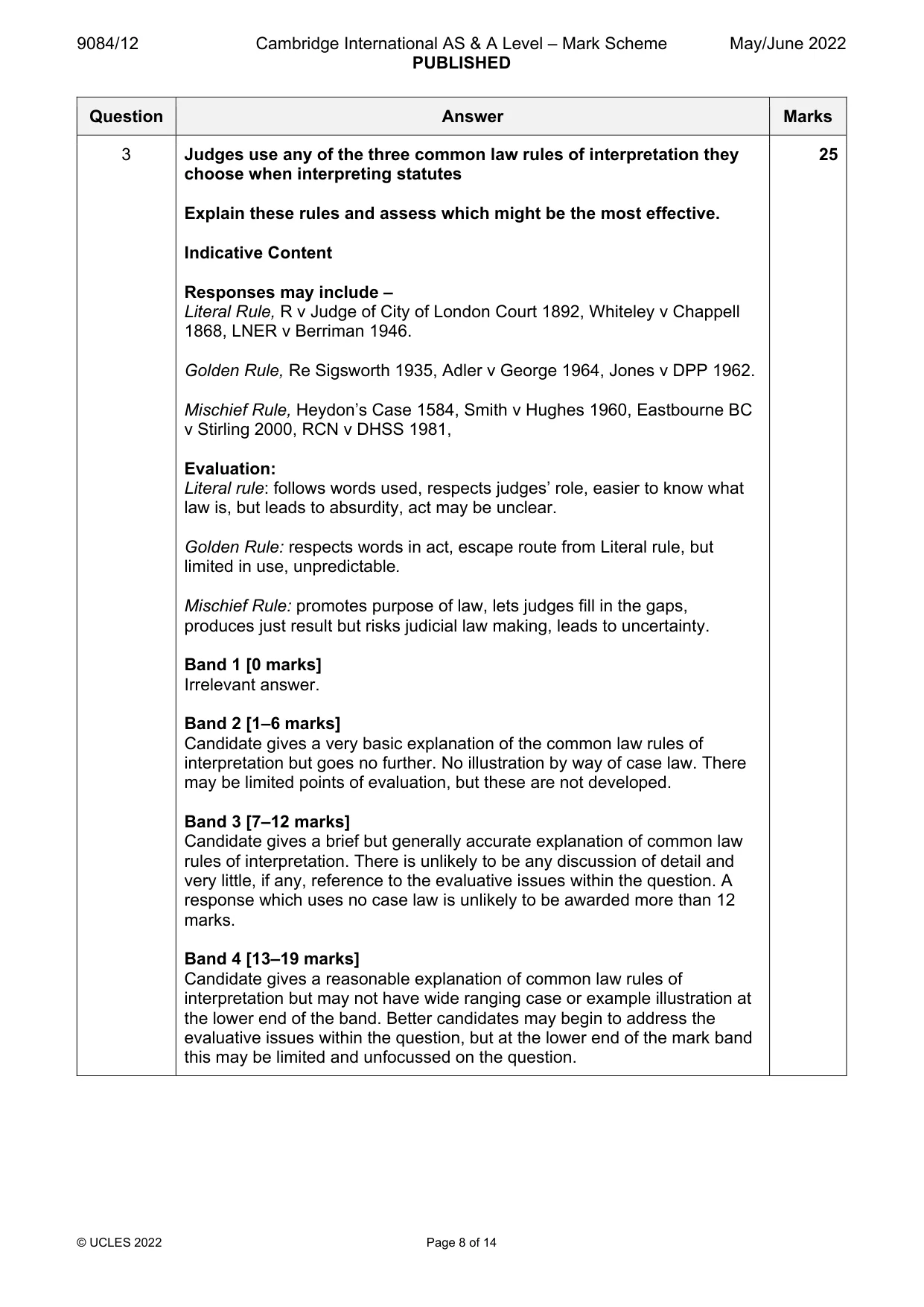
9084/12 Cambridge International AS & A Level – Mark Scheme PUBLISHED May/June 2022 © UCLES 2022 Page 8 of 14 Question Answer Marks 3 Judges use any of the three common law rules of interpretation they choose when interpreting statutes Explain these rules and assess which might be the most effective. Indicative Content Responses may include – Literal Rule, R v Judge of City of London Court 1892, Whiteley v Chappell 1868, LNER v Berriman 1946. Golden Rule, Re Sigsworth 1935, Adler v George 1964, Jones v DPP 1962. Mischief Rule, Heydon’s Case 1584, Smith v Hughes 1960, Eastbourne BC v Stirling 2000, RCN v DHSS 1981, Evaluation: Literal rule: follows words used, respects judges’ role, easier to know what law is, but leads to absurdity, act may be unclear. Golden Rule: respects words in act, escape route from Literal rule, but limited in use, unpredictable. Mischief Rule: promotes purpose of law, lets judges fill in the gaps, produces just result but risks judicial law making, leads to uncertainty. Band 1 [0 marks] Irrelevant answer. Band 2 [1–6 marks] Candidate gives a very basic explanation of the common law rules of interpretation but goes no further. No illustration by way of case law. There may be limited points of evaluation, but these are not developed. Band 3 [7–12 marks] Candidate gives a brief but generally accurate explanation of common law rules of interpretation. There is unlikely to be any discussion of detail and very little, if any, reference to the evaluative issues within the question. A response which uses no case law is unlikely to be awarded more than 12 marks. Band 4 [13–19 marks] Candidate gives a reasonable explanation of common law rules of interpretation but may not have wide ranging case or example illustration at the lower end of the band. Better candidates may begin to address the evaluative issues within the question, but at the lower end of the mark band this may be limited and unfocussed on the question. 25
Mark scheme, page 9
9084/12 Cambridge International AS & A Level – Mark Scheme PUBLISHED May/June 2022 © UCLES 2022 Page 9 of 14 Question Answer Marks 3 Band 5 [20–25 marks] Candidate gives a clear and very detailed explanation of common law rules of interpretation, with detailed and wide-ranging illustrations. Candidate evaluates the issues concerning each of the approaches, covering the differing effects of the various approaches in particular and drawing well- reasoned conclusions. Candidate should come to a conclusion as to which rule is the most effective and may discuss the purposive approach as a modern alternative to the three implied in the question.
Mark scheme, page 10
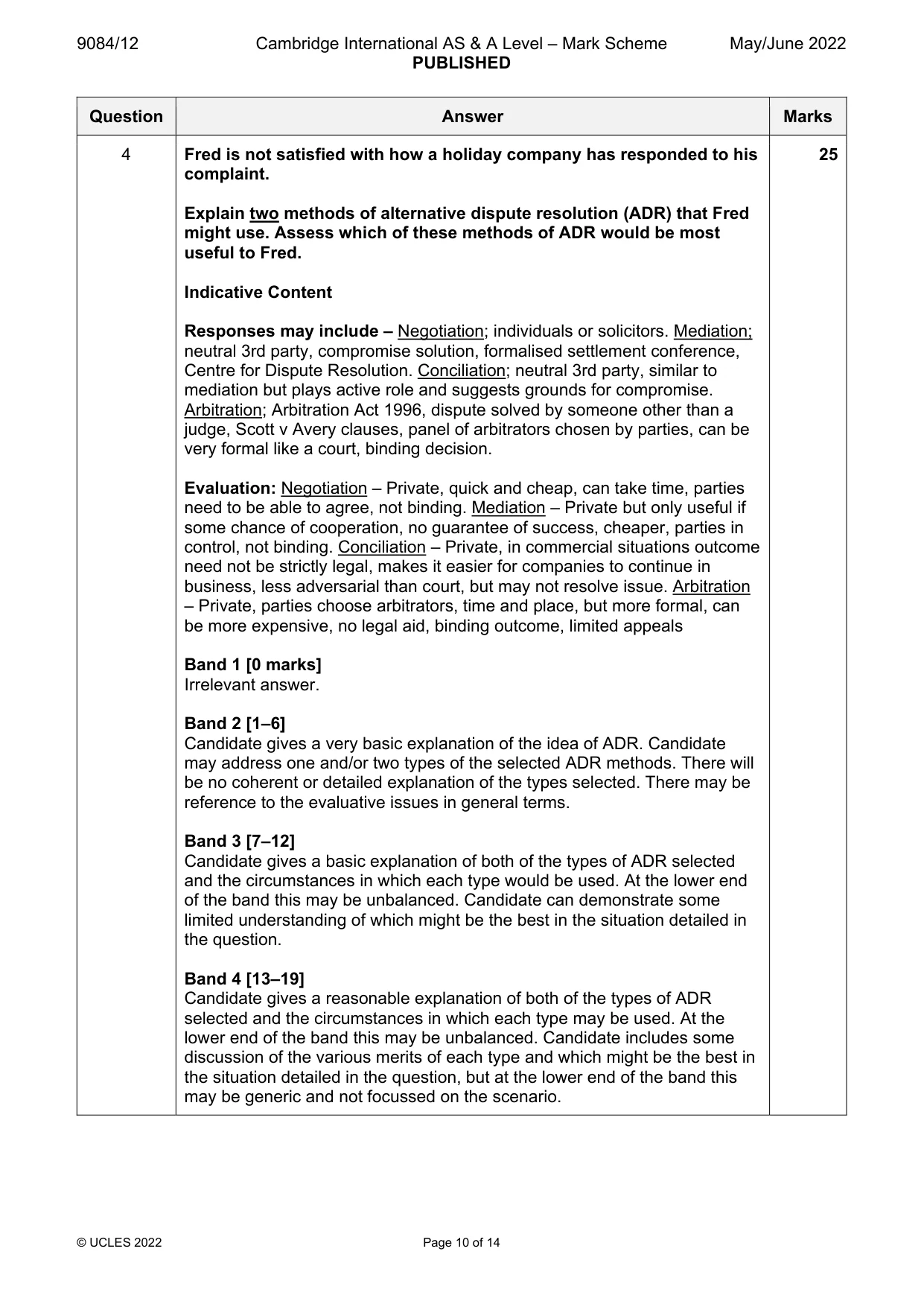
9084/12 Cambridge International AS & A Level – Mark Scheme PUBLISHED May/June 2022 © UCLES 2022 Page 10 of 14 Question Answer Marks 4 Fred is not satisfied with how a holiday company has responded to his complaint. Explain two methods of alternative dispute resolution (ADR) that Fred might use. Assess which of these methods of ADR would be most useful to Fred. Indicative Content Responses may include – Negotiation; individuals or solicitors. Mediation; neutral 3rd party, compromise solution, formalised settlement conference, Centre for Dispute Resolution. Conciliation; neutral 3rd party, similar to mediation but plays active role and suggests grounds for compromise. Arbitration; Arbitration Act 1996, dispute solved by someone other than a judge, Scott v Avery clauses, panel of arbitrators chosen by parties, can be very formal like a court, binding decision. Evaluation: Negotiation – Private, quick and cheap, can take time, parties need to be able to agree, not binding. Mediation – Private but only useful if some chance of cooperation, no guarantee of success, cheaper, parties in control, not binding. Conciliation – Private, in commercial situations outcome need not be strictly legal, makes it easier for companies to continue in business, less adversarial than court, but may not resolve issue. Arbitration – Private, parties choose arbitrators, time and place, but more formal, can be more expensive, no legal aid, binding outcome, limited appeals Band 1 [0 marks] Irrelevant answer. Band 2 [1–6] Candidate gives a very basic explanation of the idea of ADR. Candidate may address one and/or two types of the selected ADR methods. There will be no coherent or detailed explanation of the types selected. There may be reference to the evaluative issues in general terms. Band 3 [7–12] Candidate gives a basic explanation of both of the types of ADR selected and the circumstances in which each type would be used. At the lower end of the band this may be unbalanced. Candidate can demonstrate some limited understanding of which might be the best in the situation detailed in the question. Band 4 [13–19] Candidate gives a reasonable explanation of both of the types of ADR selected and the circumstances in which each type may be used. At the lower end of the band this may be unbalanced. Candidate includes some discussion of the various merits of each type and which might be the best in the situation detailed in the question, but at the lower end of the band this may be generic and not focussed on the scenario. 25
Mark scheme, page 11
9084/12 Cambridge International AS & A Level – Mark Scheme PUBLISHED May/June 2022 © UCLES 2022 Page 11 of 14 Question Answer Marks 4 Band 5 [20–25] Candidate gives a clear explanation of both of the types of ADR selected and which might be the best in the situation detailed in the question. Candidate offers clear and informed links to the evaluative component of the question and presents a reasoned argument and conclusion. Candidate needs to be focused on the most appropriate form of ADR for Fred and come to a conclusion. Candidate should also be credited for discussing types that may not be relevant for Fred and reasons why this may be the case.
Mark scheme, page 12
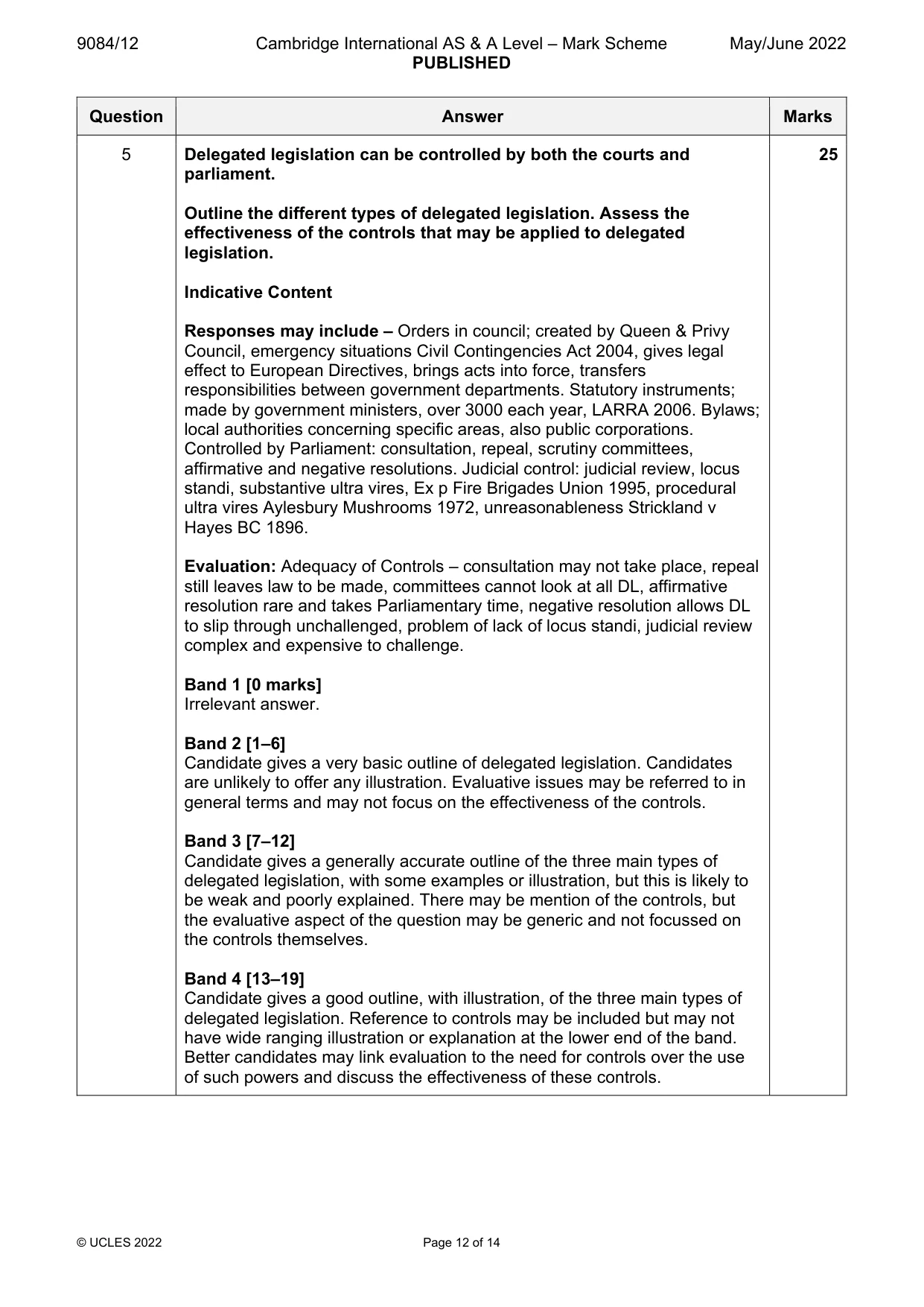
9084/12 Cambridge International AS & A Level – Mark Scheme PUBLISHED May/June 2022 © UCLES 2022 Page 12 of 14 Question Answer Marks 5 Delegated legislation can be controlled by both the courts and parliament. Outline the different types of delegated legislation. Assess the effectiveness of the controls that may be applied to delegated legislation. Indicative Content Responses may include – Orders in council; created by Queen & Privy Council, emergency situations Civil Contingencies Act 2004, gives legal effect to European Directives, brings acts into force, transfers responsibilities between government departments. Statutory instruments; made by government ministers, over 3000 each year, LARRA 2006. Bylaws; local authorities concerning specific areas, also public corporations. Controlled by Parliament: consultation, repeal, scrutiny committees, affirmative and negative resolutions. Judicial control: judicial review, locus standi, substantive ultra vires, Ex p Fire Brigades Union 1995, procedural ultra vires Aylesbury Mushrooms 1972, unreasonableness Strickland v Hayes BC 1896. Evaluation: Adequacy of Controls – consultation may not take place, repeal still leaves law to be made, committees cannot look at all DL, affirmative resolution rare and takes Parliamentary time, negative resolution allows DL to slip through unchallenged, problem of lack of locus standi, judicial review complex and expensive to challenge. Band 1 [0 marks] Irrelevant answer. Band 2 [1–6] Candidate gives a very basic outline of delegated legislation. Candidates are unlikely to offer any illustration. Evaluative issues may be referred to in general terms and may not focus on the effectiveness of the controls. Band 3 [7–12] Candidate gives a generally accurate outline of the three main types of delegated legislation, with some examples or illustration, but this is likely to be weak and poorly explained. There may be mention of the controls, but the evaluative aspect of the question may be generic and not focussed on the controls themselves. Band 4 [13–19] Candidate gives a good outline, with illustration, of the three main types of delegated legislation. Reference to controls may be included but may not have wide ranging illustration or explanation at the lower end of the band. Better candidates may link evaluation to the need for controls over the use of such powers and discuss the effectiveness of these controls. 25
Mark scheme, page 13
9084/12 Cambridge International AS & A Level – Mark Scheme PUBLISHED May/June 2022 © UCLES 2022 Page 13 of 14 Question Answer Marks 5 Band 5 [20–25] Candidate gives a clear and very detailed outline of the three types of DL, with good levels of illustration and explanation. Candidates explain the controls and the need for them clearly and in some detail, evaluate the issues within the question well and draw well informed conclusions.
Mark scheme, page 14
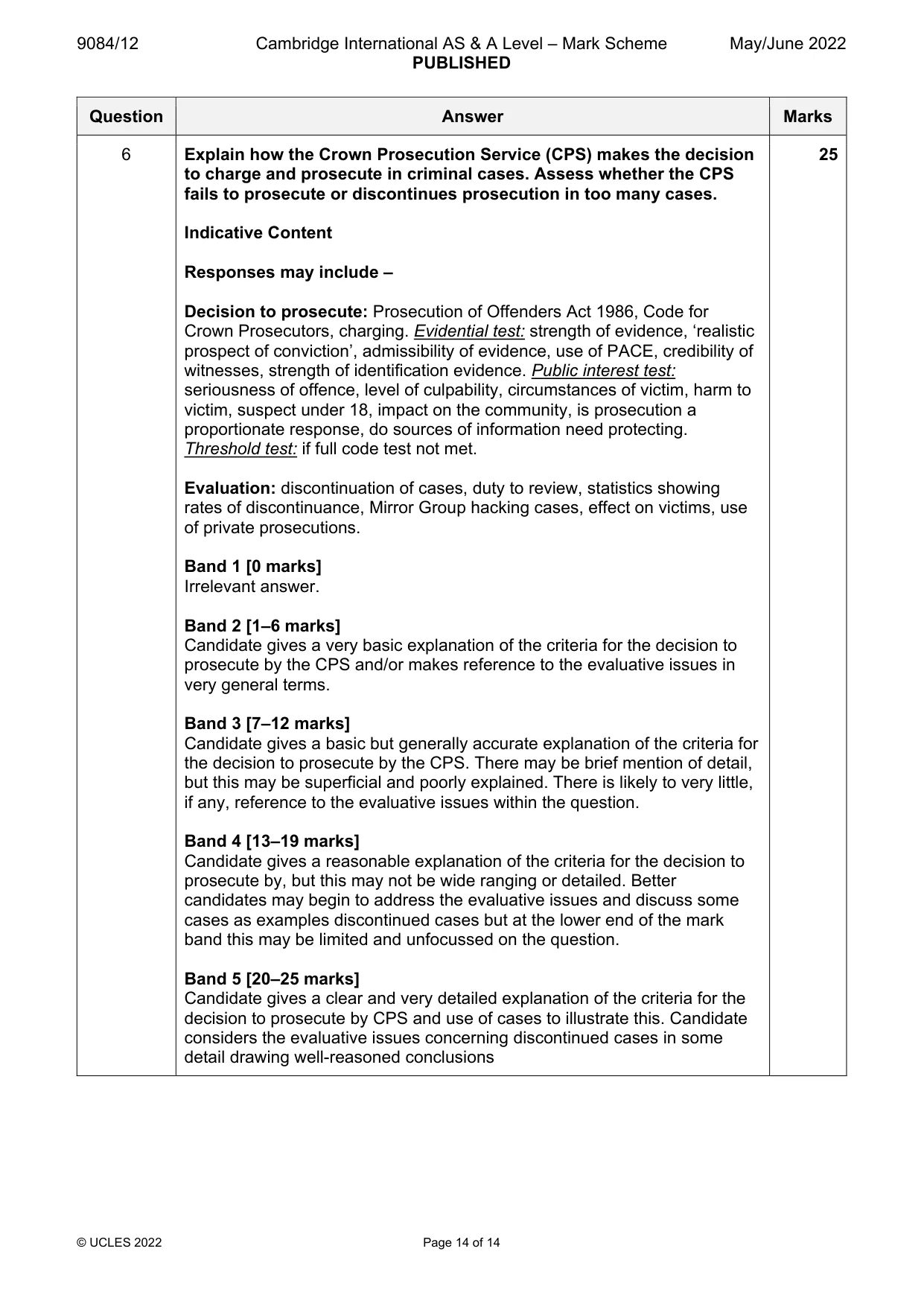
9084/12 Cambridge International AS & A Level – Mark Scheme PUBLISHED May/June 2022 © UCLES 2022 Page 14 of 14 Question Answer Marks 6 Explain how the Crown Prosecution Service (CPS) makes the decision to charge and prosecute in criminal cases. Assess whether the CPS fails to prosecute or discontinues prosecution in too many cases. Indicative Content Responses may include – Decision to prosecute: Prosecution of Offenders Act 1986, Code for Crown Prosecutors, charging. Evidential test: strength of evidence, ‘realistic prospect of conviction’, admissibility of evidence, use of PACE, credibility of witnesses, strength of identification evidence. Public interest test: seriousness of offence, level of culpability, circumstances of victim, harm to victim, suspect under 18, impact on the community, is prosecution a proportionate response, do sources of information need protecting. Threshold test: if full code test not met. Evaluation: discontinuation of cases, duty to review, statistics showing rates of discontinuance, Mirror Group hacking cases, effect on victims, use of private prosecutions. Band 1 [0 marks] Irrelevant answer. Band 2 [1–6 marks] Candidate gives a very basic explanation of the criteria for the decision to prosecute by the CPS and/or makes reference to the evaluative issues in very general terms. Band 3 [7–12 marks] Candidate gives a basic but generally accurate explanation of the criteria for the decision to prosecute by the CPS. There may be brief mention of detail, but this may be superficial and poorly explained. There is likely to very little, if any, reference to the evaluative issues within the question. Band 4 [13–19 marks] Candidate gives a reasonable explanation of the criteria for the decision to prosecute by, but this may not be wide ranging or detailed. Better candidates may begin to address the evaluative issues and discuss some cases as examples discontinued cases but at the lower end of the mark band this may be limited and unfocussed on the question. Band 5 [20–25 marks] Candidate gives a clear and very detailed explanation of the criteria for the decision to prosecute by CPS and use of cases to illustrate this. Candidate considers the evaluative issues concerning discontinued cases in some detail drawing well-reasoned conclusions 25
What you needed in this session
Cambridge’s own grade thresholds for 2022 May/June, Paper 1 · Variant 2. A higher threshold means an easier paper — the bar moves with how the cohort did.