Cambridge A Level Law 9084 — 2020 Oct/Nov Paper 3 · Variant 3
9084/33/O/N/20 · 75 marks · ≈84 min
The question paper and its mark scheme, free to read here and free to download. This is Cambridge’s own paper, exactly as it was sat.
Question paper4 pages

Mark scheme10 pages
Answers below. Sit the paper first if you are practising.
Paper as text
Question paper, page 1
Cambridge International AS & A Level * 4 2 6 0 2 1 0 8 0 0 * DC (RW) 206880 © UCLES 2020 [Turn over This document has 4 pages. Blank pages are indicated. LAW 9084/33 Paper 3 Law of Contract October/November 2020 1 hour 30 minutes You must answer on the enclosed answer booklet. You will need: Answer booklet (enclosed) INSTRUCTIONS ● Answer three questions in total: Answer at least one question from Section A. Answer at least one question from Section B. Answer one other question from either Section A or Section B. ● Follow the instructions on the front cover of the answer booklet. If you need additional answer paper, ask the invigilator for a continuation booklet. INFORMATION ● The total mark for this paper is 75. ● The number of marks for each question or part question is shown in brackets [ ].
Question paper, page 2
2 9084/33/O/N/20 © UCLES 2020 Answer at least one question from Section A. Answer at least one question from Section B. Answer one other question from either Section A or Section B. Section A 1 Silence can never amount to an actionable misrepresentation. Describe this rule and assess the validity of the statement above. [25] 2 Explain the postal rule for the acceptance of an offer and assess whether it continues to be relevant. [25] 3 The intention to create legal relations is an essential element in the formation of a contract. Explain the approaches regarding legal intent and assess the validity of the statement above. [25]
Question paper, page 3
3 9084/33/O/N/20 © UCLES 2020 Section B 4 Lola is opening a new restaurant in London and is keen to create a great reputation with diners and the wider public. She promises her head chef, Mary, that she will give her £1000 in addition to her monthly wage if, during the first few weeks of business, she can be especially ‘creative’ and ‘delight’ the customers with her menu. Mary agrees. Within a month of opening, Lola’s restaurant receives much praise on social media because of the quality of the food on offer. A review by a respected food critic in a national newspaper is highly complimentary about the taste and presentation of the food provided. When Mary asks for the additional £1000 promised, Lola refuses to pay. Advise Mary of her rights, if any, in contract law. [25] 5 Gina, who lives in London, books a holiday to Paris with Fun Tours on the basis that its brochure promises: ‘a city centre hotel close to all the tourist attractions and entertainment in the restaurant every night’. Gina also plans to attend a concert on the evening of her arrival, paying £100 for the ticket. Gina books ABC Taxis to pick her up at 12:00 to take her to the airport. The taxi driver, however, arrives over an hour late and she misses her flight. Gina is forced to pay an extra £200 to catch a later flight and she arrives after the concert has finished. She discovers that the hotel is located on the outskirts of Paris and the restaurant is closed for the duration of her stay as it is being redecorated. On her return home Gina complains to Fun Tours that she is disappointed that the holiday did not live up to her expectations and demands compensation. In addition, she insists that ABC Taxis reimburse her for the £200 cost of the later flight and her unused £100 concert ticket. Advise Gina as to her rights and remedies against Fun Tours and ABC Taxis in relation to the law on damages. [25] 6 Paula is a fitness enthusiast and has seen a running treadmill advertised on the website of Runztec. This seems perfect for her needs. Paula completes the online order form, which states Runztec’s terms and conditions, including: • Runztec accepts no liability for any injury to users of our products, however this may arise. • Runztec cannot be held liable for any losses arising from delay to delivery of our products due to the unavailability of the customer to receive them on the agreed delivery date. Runztec gives Paula a delivery date and she takes a day off work to be at home when it arrives. However, when delivery was attempted, Paula was having a shower and delivery could not be made. Paula has to take a second day off work to take delivery. She uses the treadmill on the day it is delivered but receives an electric shock when she touches the hand rail, badly burning her hand. Advise Paula of her rights in relation to the delayed delivery and the injury. [25]
Question paper, page 4
4 9084/33/O/N/20 © UCLES 2020 BLANK PAGE Permission to reproduce items where third-party owned material protected by copyright is included has been sought and cleared where possible. Every reasonable effort has been made by the publisher (UCLES) to trace copyright holders, but if any items requiring clearance have unwittingly been included, the publisher will be pleased to make amends at the earliest possible opportunity. To avoid the issue of disclosure of answer-related information to candidates, all copyright acknowledgements are reproduced online in the Cambridge Assessment International Education Copyright Acknowledgements Booklet. This is produced for each series of examinations and is freely available to download at www.cambridgeinternational.org after the live examination series. Cambridge Assessment International Education is part of the Cambridge Assessment Group. Cambridge Assessment is the brand name of the University of Cambridge Local Examinations Syndicate (UCLES), which itself is a department of the University of Cambridge.
Mark scheme, page 1
This document consists of 10 printed pages. © UCLES 2020 [Turn over Cambridge International AS & A Level LAW 9084/33 Paper 3 October/November 2020 MARK SCHEME Maximum Mark: 75 Published This mark scheme is published as an aid to teachers and candidates, to indicate the requirements of the examination. It shows the basis on which Examiners were instructed to award marks. It does not indicate the details of the discussions that took place at an Examiners’ meeting before marking began, which would have considered the acceptability of alternative answers. Mark schemes should be read in conjunction with the question paper and the Principal Examiner Report for Teachers. Cambridge International will not enter into discussions about these mark schemes. Cambridge International is publishing the mark schemes for the October/November 2020 series for most Cambridge IGCSE™, Cambridge International A and AS Level and Cambridge Pre-U components, and some Cambridge O Level components.
Mark scheme, page 2
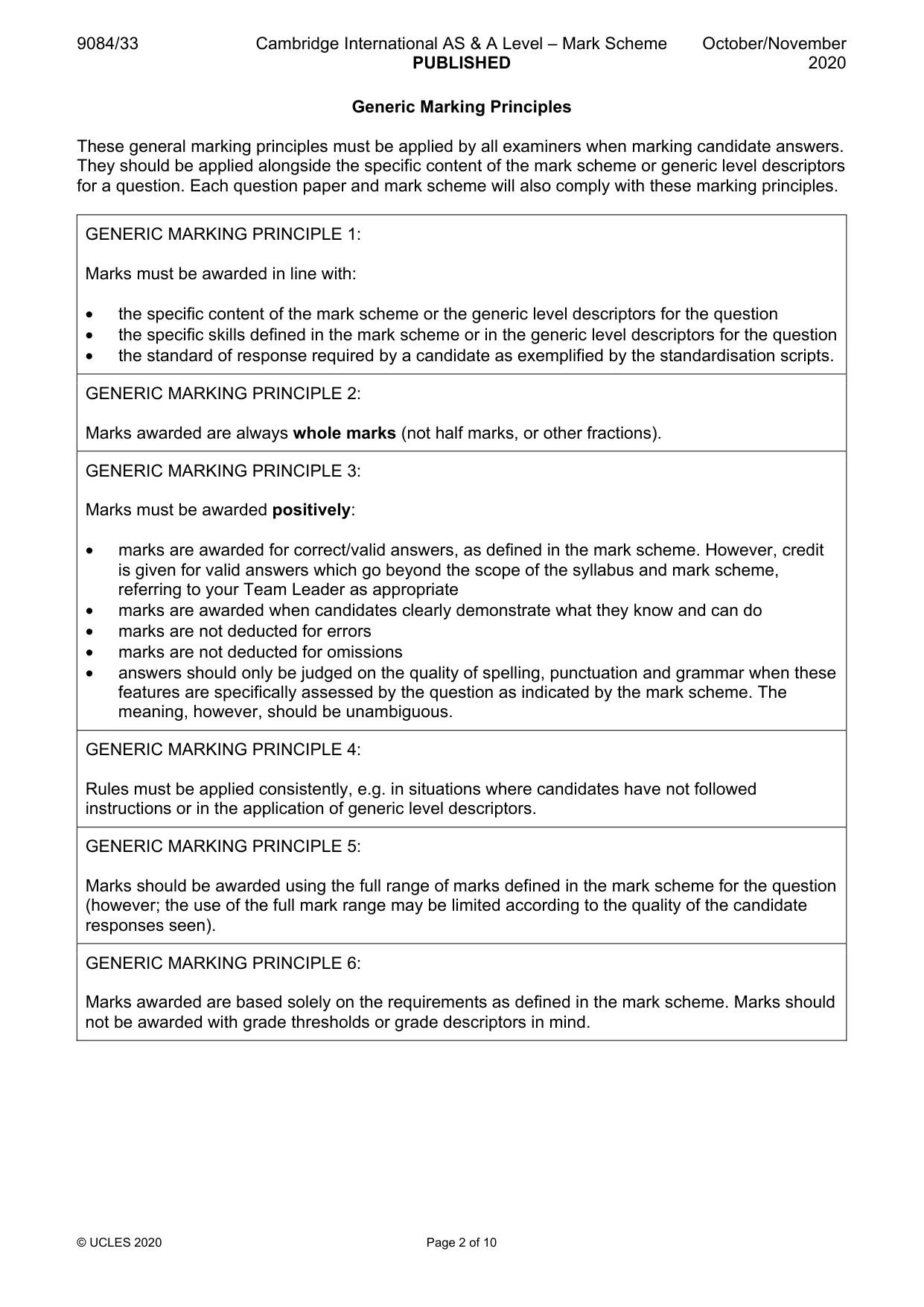
9084/33 Cambridge International AS & A Level – Mark Scheme PUBLISHED October/November 2020 © UCLES 2020 Page 2 of 10 Generic Marking Principles These general marking principles must be applied by all examiners when marking candidate answers. They should be applied alongside the specific content of the mark scheme or generic level descriptors for a question. Each question paper and mark scheme will also comply with these marking principles. GENERIC MARKING PRINCIPLE 1: Marks must be awarded in line with: • the specific content of the mark scheme or the generic level descriptors for the question • the specific skills defined in the mark scheme or in the generic level descriptors for the question • the standard of response required by a candidate as exemplified by the standardisation scripts. GENERIC MARKING PRINCIPLE 2: Marks awarded are always whole marks (not half marks, or other fractions). GENERIC MARKING PRINCIPLE 3: Marks must be awarded positively: • marks are awarded for correct/valid answers, as defined in the mark scheme. However, credit is given for valid answers which go beyond the scope of the syllabus and mark scheme, referring to your Team Leader as appropriate • marks are awarded when candidates clearly demonstrate what they know and can do • marks are not deducted for errors • marks are not deducted for omissions • answers should only be judged on the quality of spelling, punctuation and grammar when these features are specifically assessed by the question as indicated by the mark scheme. The meaning, however, should be unambiguous. GENERIC MARKING PRINCIPLE 4: Rules must be applied consistently, e.g. in situations where candidates have not followed instructions or in the application of generic level descriptors. GENERIC MARKING PRINCIPLE 5: Marks should be awarded using the full range of marks defined in the mark scheme for the question (however; the use of the full mark range may be limited according to the quality of the candidate responses seen). GENERIC MARKING PRINCIPLE 6: Marks awarded are based solely on the requirements as defined in the mark scheme. Marks should not be awarded with grade thresholds or grade descriptors in mind.
Mark scheme, page 3
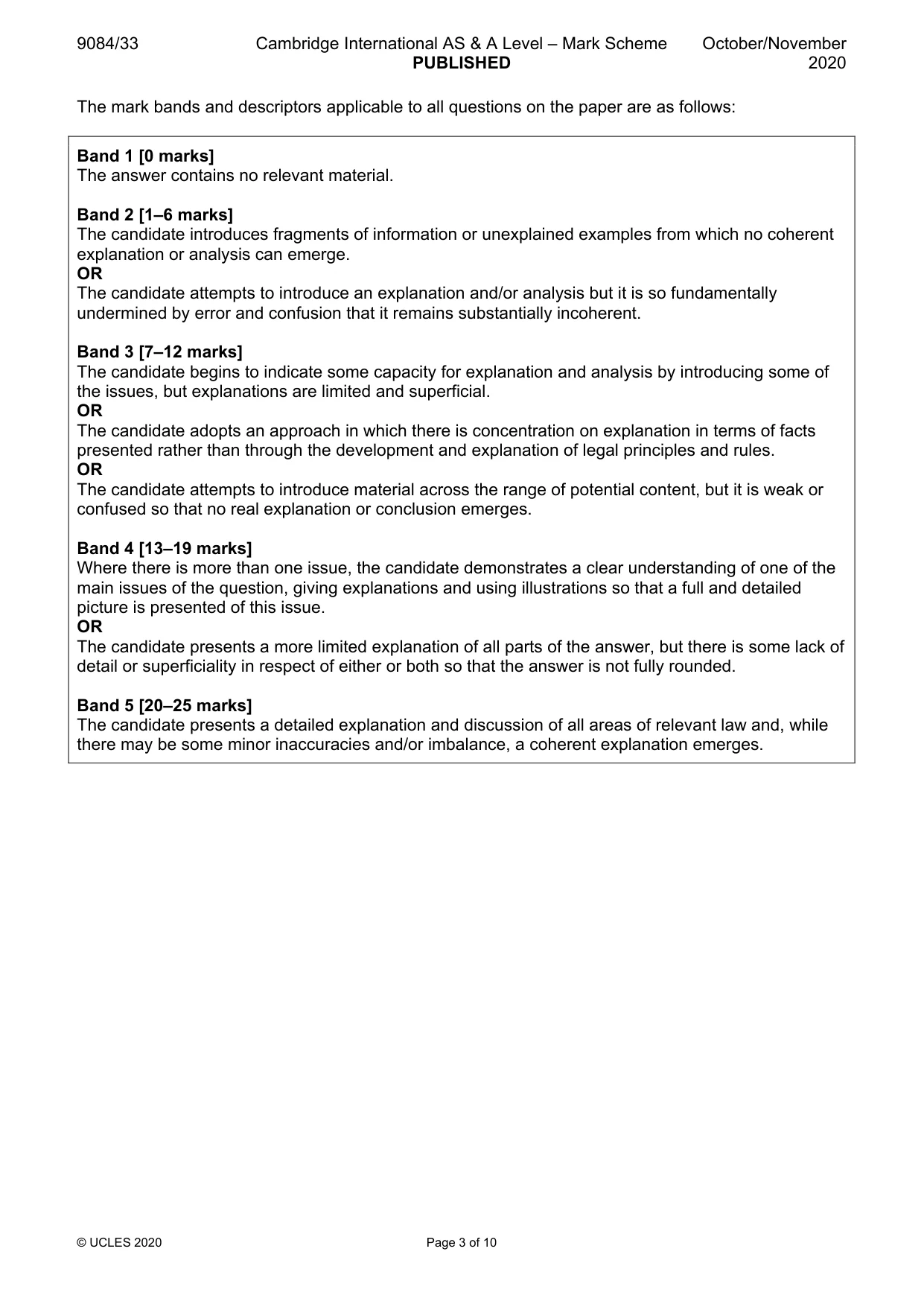
9084/33 Cambridge International AS & A Level – Mark Scheme PUBLISHED October/November 2020 © UCLES 2020 Page 3 of 10 The mark bands and descriptors applicable to all questions on the paper are as follows: Band 1 [0 marks] The answer contains no relevant material. Band 2 [1–6 marks] The candidate introduces fragments of information or unexplained examples from which no coherent explanation or analysis can emerge. OR The candidate attempts to introduce an explanation and/or analysis but it is so fundamentally undermined by error and confusion that it remains substantially incoherent. Band 3 [7–12 marks] The candidate begins to indicate some capacity for explanation and analysis by introducing some of the issues, but explanations are limited and superficial. OR The candidate adopts an approach in which there is concentration on explanation in terms of facts presented rather than through the development and explanation of legal principles and rules. OR The candidate attempts to introduce material across the range of potential content, but it is weak or confused so that no real explanation or conclusion emerges. Band 4 [13–19 marks] Where there is more than one issue, the candidate demonstrates a clear understanding of one of the main issues of the question, giving explanations and using illustrations so that a full and detailed picture is presented of this issue. OR The candidate presents a more limited explanation of all parts of the answer, but there is some lack of detail or superficiality in respect of either or both so that the answer is not fully rounded. Band 5 [20–25 marks] The candidate presents a detailed explanation and discussion of all areas of relevant law and, while there may be some minor inaccuracies and/or imbalance, a coherent explanation emerges.
Mark scheme, page 4
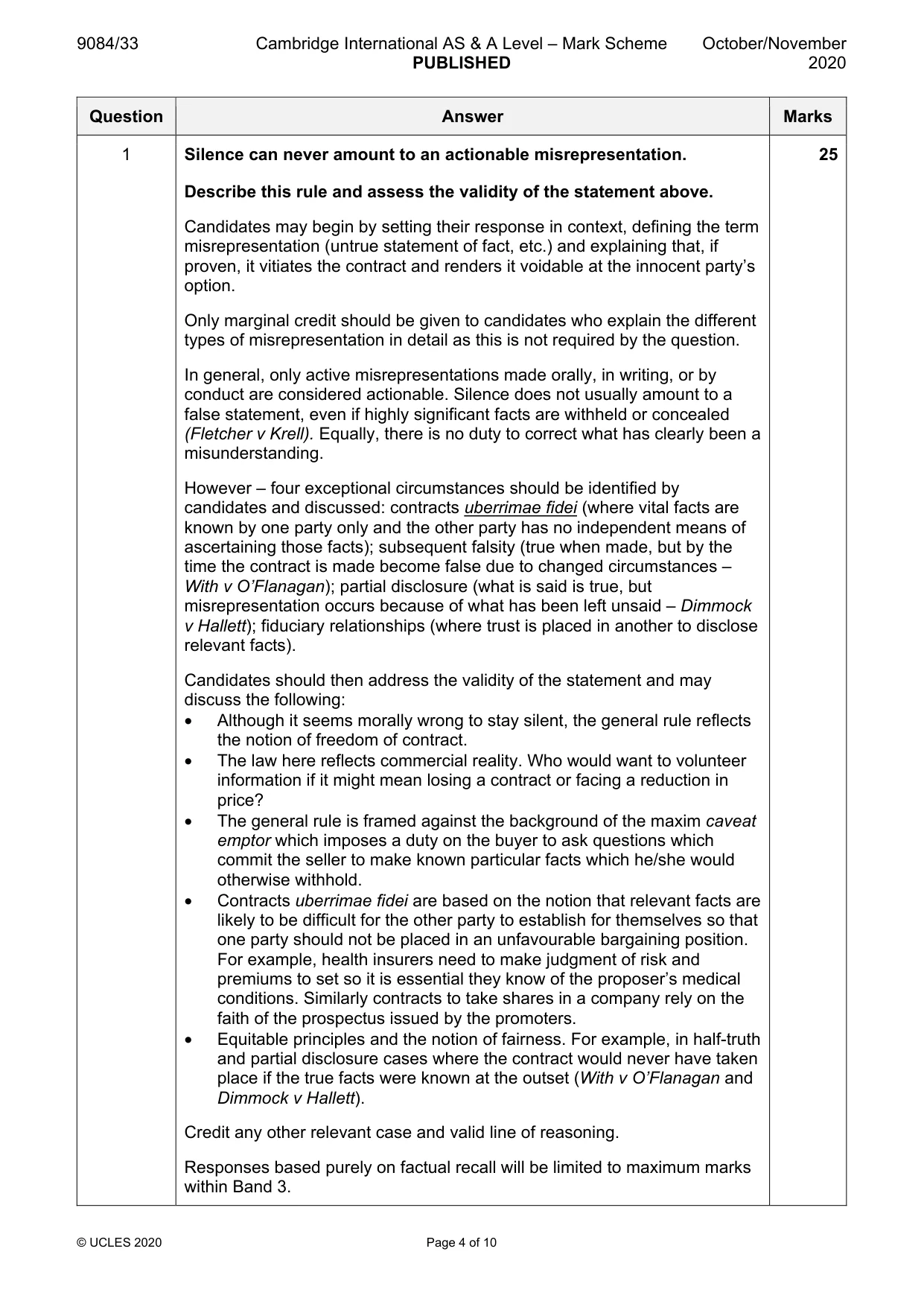
9084/33 Cambridge International AS & A Level – Mark Scheme PUBLISHED October/November 2020 © UCLES 2020 Page 4 of 10 Question Answer Marks 1 Silence can never amount to an actionable misrepresentation. Describe this rule and assess the validity of the statement above. Candidates may begin by setting their response in context, defining the term misrepresentation (untrue statement of fact, etc.) and explaining that, if proven, it vitiates the contract and renders it voidable at the innocent party’s option. Only marginal credit should be given to candidates who explain the different types of misrepresentation in detail as this is not required by the question. In general, only active misrepresentations made orally, in writing, or by conduct are considered actionable. Silence does not usually amount to a false statement, even if highly significant facts are withheld or concealed (Fletcher v Krell). Equally, there is no duty to correct what has clearly been a misunderstanding. However – four exceptional circumstances should be identified by candidates and discussed: contracts uberrimae fidei (where vital facts are known by one party only and the other party has no independent means of ascertaining those facts); subsequent falsity (true when made, but by the time the contract is made become false due to changed circumstances – With v O’Flanagan); partial disclosure (what is said is true, but misrepresentation occurs because of what has been left unsaid – Dimmock v Hallett); fiduciary relationships (where trust is placed in another to disclose relevant facts). Candidates should then address the validity of the statement and may discuss the following: • Although it seems morally wrong to stay silent, the general rule reflects the notion of freedom of contract. • The law here reflects commercial reality. Who would want to volunteer information if it might mean losing a contract or facing a reduction in price? • The general rule is framed against the background of the maxim caveat emptor which imposes a duty on the buyer to ask questions which commit the seller to make known particular facts which he/she would otherwise withhold. • Contracts uberrimae fidei are based on the notion that relevant facts are likely to be difficult for the other party to establish for themselves so that one party should not be placed in an unfavourable bargaining position. For example, health insurers need to make judgment of risk and premiums to set so it is essential they know of the proposer’s medical conditions. Similarly contracts to take shares in a company rely on the faith of the prospectus issued by the promoters. • Equitable principles and the notion of fairness. For example, in half-truth and partial disclosure cases where the contract would never have taken place if the true facts were known at the outset (With v O’Flanagan and Dimmock v Hallett). Credit any other relevant case and valid line of reasoning. Responses based purely on factual recall will be limited to maximum marks within Band 3. 25
Mark scheme, page 5
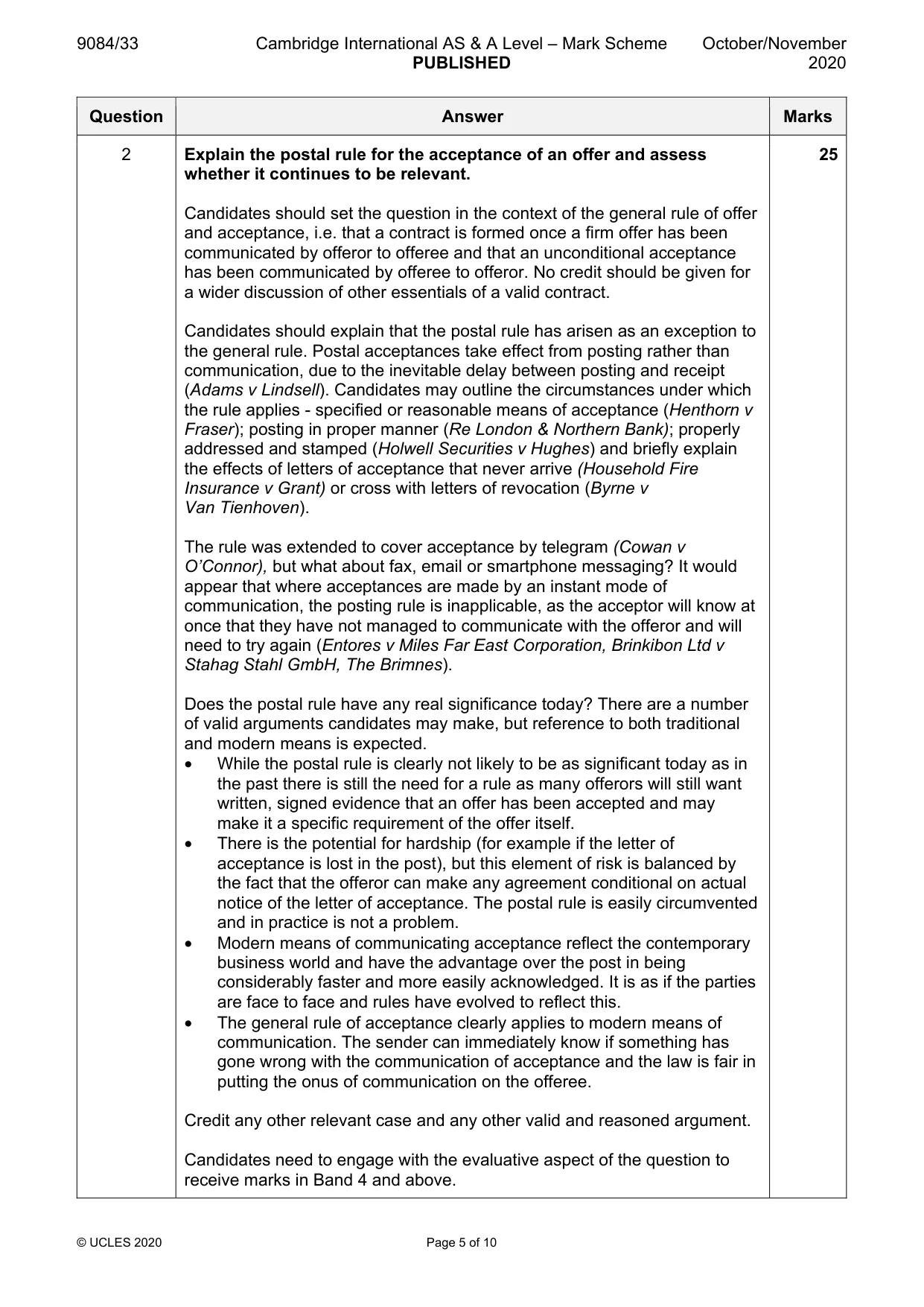
9084/33 Cambridge International AS & A Level – Mark Scheme PUBLISHED October/November 2020 © UCLES 2020 Page 5 of 10 Question Answer Marks 2 Explain the postal rule for the acceptance of an offer and assess whether it continues to be relevant. Candidates should set the question in the context of the general rule of offer and acceptance, i.e. that a contract is formed once a firm offer has been communicated by offeror to offeree and that an unconditional acceptance has been communicated by offeree to offeror. No credit should be given for a wider discussion of other essentials of a valid contract. Candidates should explain that the postal rule has arisen as an exception to the general rule. Postal acceptances take effect from posting rather than communication, due to the inevitable delay between posting and receipt (Adams v Lindsell). Candidates may outline the circumstances under which the rule applies - specified or reasonable means of acceptance (Henthorn v Fraser); posting in proper manner (Re London & Northern Bank); properly addressed and stamped (Holwell Securities v Hughes) and briefly explain the effects of letters of acceptance that never arrive (Household Fire Insurance v Grant) or cross with letters of revocation (Byrne v Van Tienhoven). The rule was extended to cover acceptance by telegram (Cowan v O’Connor), but what about fax, email or smartphone messaging? It would appear that where acceptances are made by an instant mode of communication, the posting rule is inapplicable, as the acceptor will know at once that they have not managed to communicate with the offeror and will need to try again (Entores v Miles Far East Corporation, Brinkibon Ltd v Stahag Stahl GmbH, The Brimnes). Does the postal rule have any real significance today? There are a number of valid arguments candidates may make, but reference to both traditional and modern means is expected. • While the postal rule is clearly not likely to be as significant today as in the past there is still the need for a rule as many offerors will still want written, signed evidence that an offer has been accepted and may make it a specific requirement of the offer itself. • There is the potential for hardship (for example if the letter of acceptance is lost in the post), but this element of risk is balanced by the fact that the offeror can make any agreement conditional on actual notice of the letter of acceptance. The postal rule is easily circumvented and in practice is not a problem. • Modern means of communicating acceptance reflect the contemporary business world and have the advantage over the post in being considerably faster and more easily acknowledged. It is as if the parties are face to face and rules have evolved to reflect this. • The general rule of acceptance clearly applies to modern means of communication. The sender can immediately know if something has gone wrong with the communication of acceptance and the law is fair in putting the onus of communication on the offeree. Credit any other relevant case and any other valid and reasoned argument. Candidates need to engage with the evaluative aspect of the question to receive marks in Band 4 and above. 25
Mark scheme, page 6
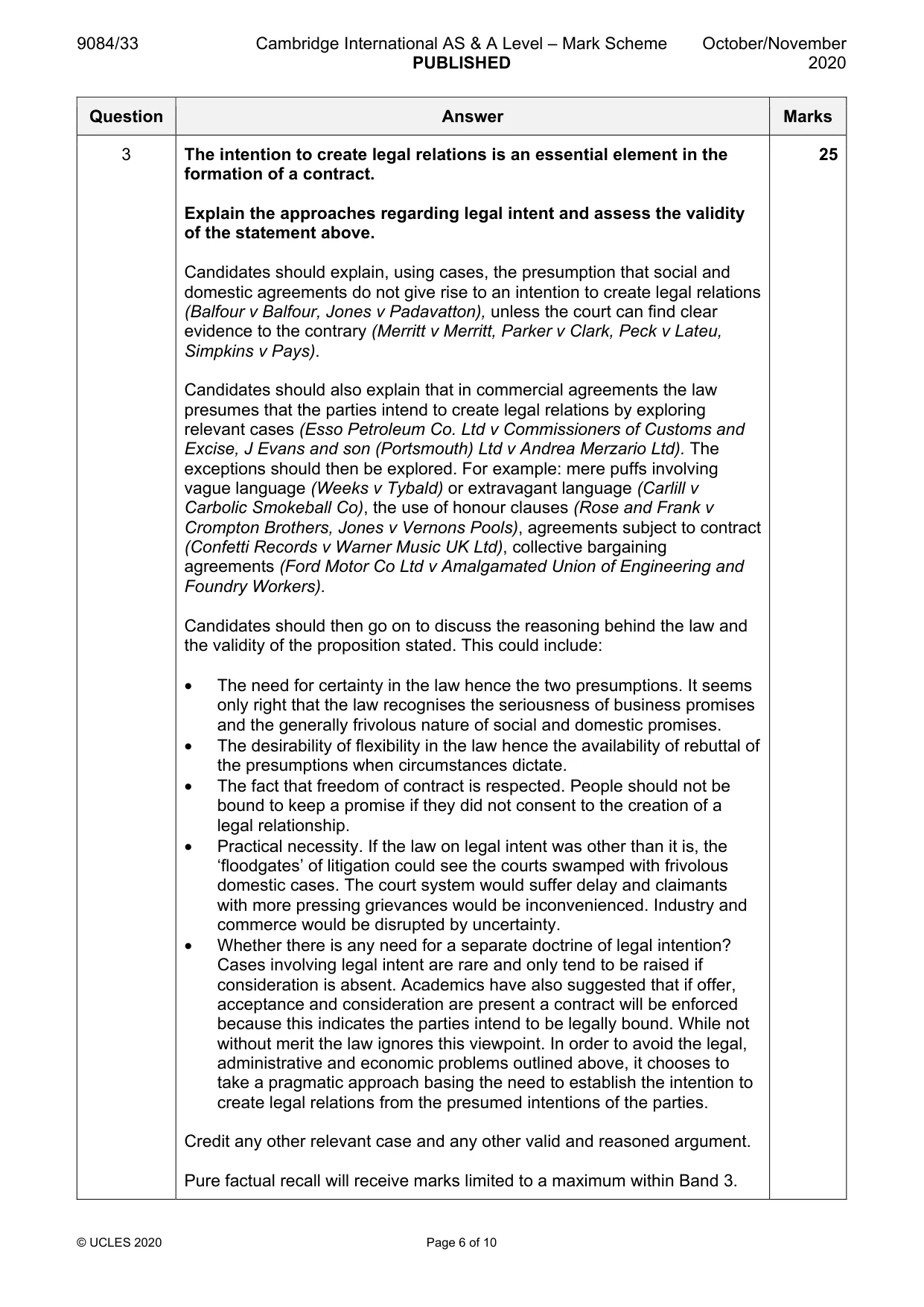
9084/33 Cambridge International AS & A Level – Mark Scheme PUBLISHED October/November 2020 © UCLES 2020 Page 6 of 10 Question Answer Marks 3 The intention to create legal relations is an essential element in the formation of a contract. Explain the approaches regarding legal intent and assess the validity of the statement above. Candidates should explain, using cases, the presumption that social and domestic agreements do not give rise to an intention to create legal relations (Balfour v Balfour, Jones v Padavatton), unless the court can find clear evidence to the contrary (Merritt v Merritt, Parker v Clark, Peck v Lateu, Simpkins v Pays). Candidates should also explain that in commercial agreements the law presumes that the parties intend to create legal relations by exploring relevant cases (Esso Petroleum Co. Ltd v Commissioners of Customs and Excise, J Evans and son (Portsmouth) Ltd v Andrea Merzario Ltd). The exceptions should then be explored. For example: mere puffs involving vague language (Weeks v Tybald) or extravagant language (Carlill v Carbolic Smokeball Co), the use of honour clauses (Rose and Frank v Crompton Brothers, Jones v Vernons Pools), agreements subject to contract (Confetti Records v Warner Music UK Ltd), collective bargaining agreements (Ford Motor Co Ltd v Amalgamated Union of Engineering and Foundry Workers). Candidates should then go on to discuss the reasoning behind the law and the validity of the proposition stated. This could include: • The need for certainty in the law hence the two presumptions. It seems only right that the law recognises the seriousness of business promises and the generally frivolous nature of social and domestic promises. • The desirability of flexibility in the law hence the availability of rebuttal of the presumptions when circumstances dictate. • The fact that freedom of contract is respected. People should not be bound to keep a promise if they did not consent to the creation of a legal relationship. • Practical necessity. If the law on legal intent was other than it is, the ‘floodgates’ of litigation could see the courts swamped with frivolous domestic cases. The court system would suffer delay and claimants with more pressing grievances would be inconvenienced. Industry and commerce would be disrupted by uncertainty. • Whether there is any need for a separate doctrine of legal intention? Cases involving legal intent are rare and only tend to be raised if consideration is absent. Academics have also suggested that if offer, acceptance and consideration are present a contract will be enforced because this indicates the parties intend to be legally bound. While not without merit the law ignores this viewpoint. In order to avoid the legal, administrative and economic problems outlined above, it chooses to take a pragmatic approach basing the need to establish the intention to create legal relations from the presumed intentions of the parties. Credit any other relevant case and any other valid and reasoned argument. Pure factual recall will receive marks limited to a maximum within Band 3. 25
Mark scheme, page 7
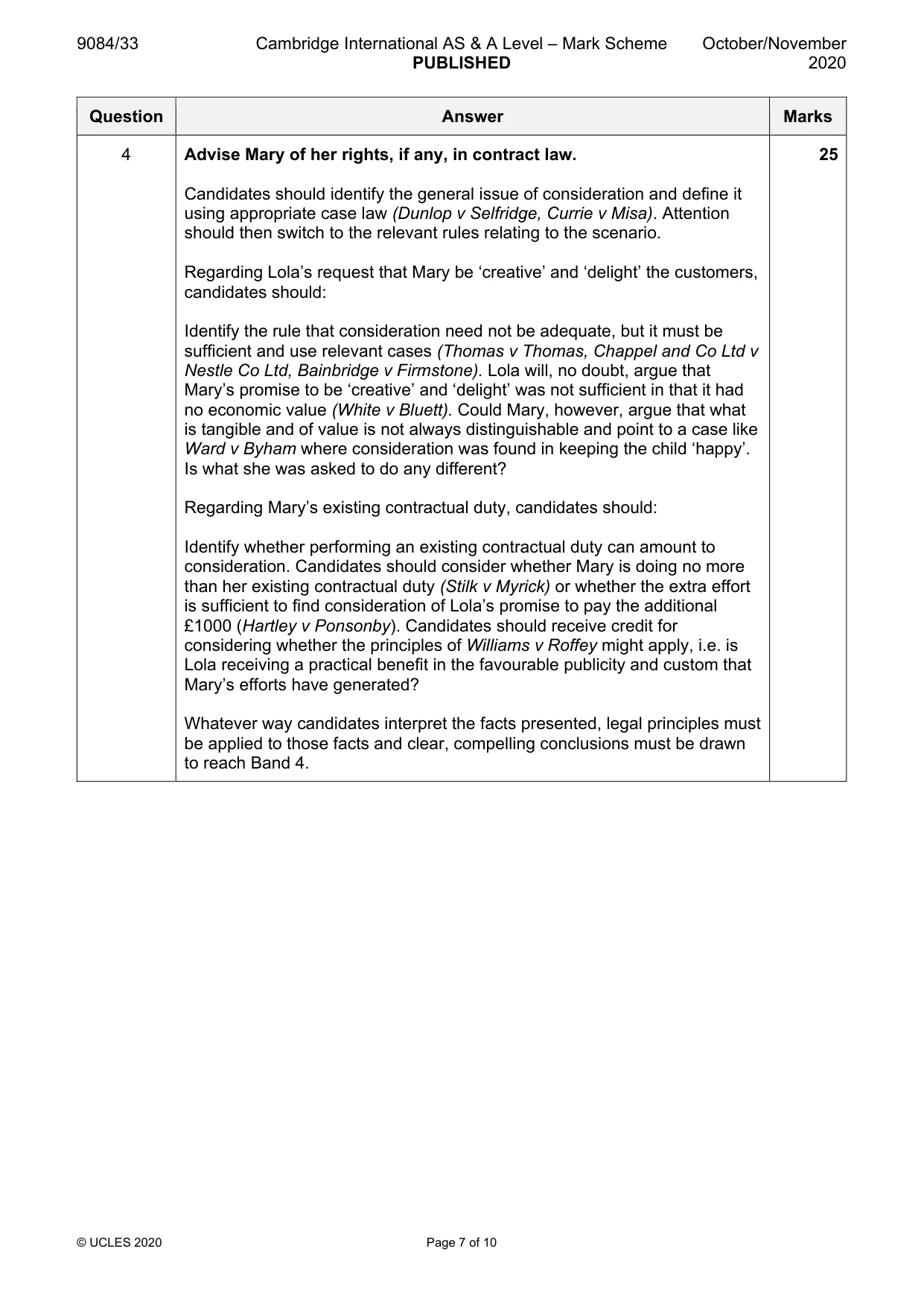
9084/33 Cambridge International AS & A Level – Mark Scheme PUBLISHED October/November 2020 © UCLES 2020 Page 7 of 10 Question Answer Marks 4 Advise Mary of her rights, if any, in contract law. Candidates should identify the general issue of consideration and define it using appropriate case law (Dunlop v Selfridge, Currie v Misa). Attention should then switch to the relevant rules relating to the scenario. Regarding Lola’s request that Mary be ‘creative’ and ‘delight’ the customers, candidates should: Identify the rule that consideration need not be adequate, but it must be sufficient and use relevant cases (Thomas v Thomas, Chappel and Co Ltd v Nestle Co Ltd, Bainbridge v Firmstone). Lola will, no doubt, argue that Mary’s promise to be ‘creative’ and ‘delight’ was not sufficient in that it had no economic value (White v Bluett). Could Mary, however, argue that what is tangible and of value is not always distinguishable and point to a case like Ward v Byham where consideration was found in keeping the child ‘happy’. Is what she was asked to do any different? Regarding Mary’s existing contractual duty, candidates should: Identify whether performing an existing contractual duty can amount to consideration. Candidates should consider whether Mary is doing no more than her existing contractual duty (Stilk v Myrick) or whether the extra effort is sufficient to find consideration of Lola’s promise to pay the additional £1000 (Hartley v Ponsonby). Candidates should receive credit for considering whether the principles of Williams v Roffey might apply, i.e. is Lola receiving a practical benefit in the favourable publicity and custom that Mary’s efforts have generated? Whatever way candidates interpret the facts presented, legal principles must be applied to those facts and clear, compelling conclusions must be drawn to reach Band 4. 25
Mark scheme, page 8
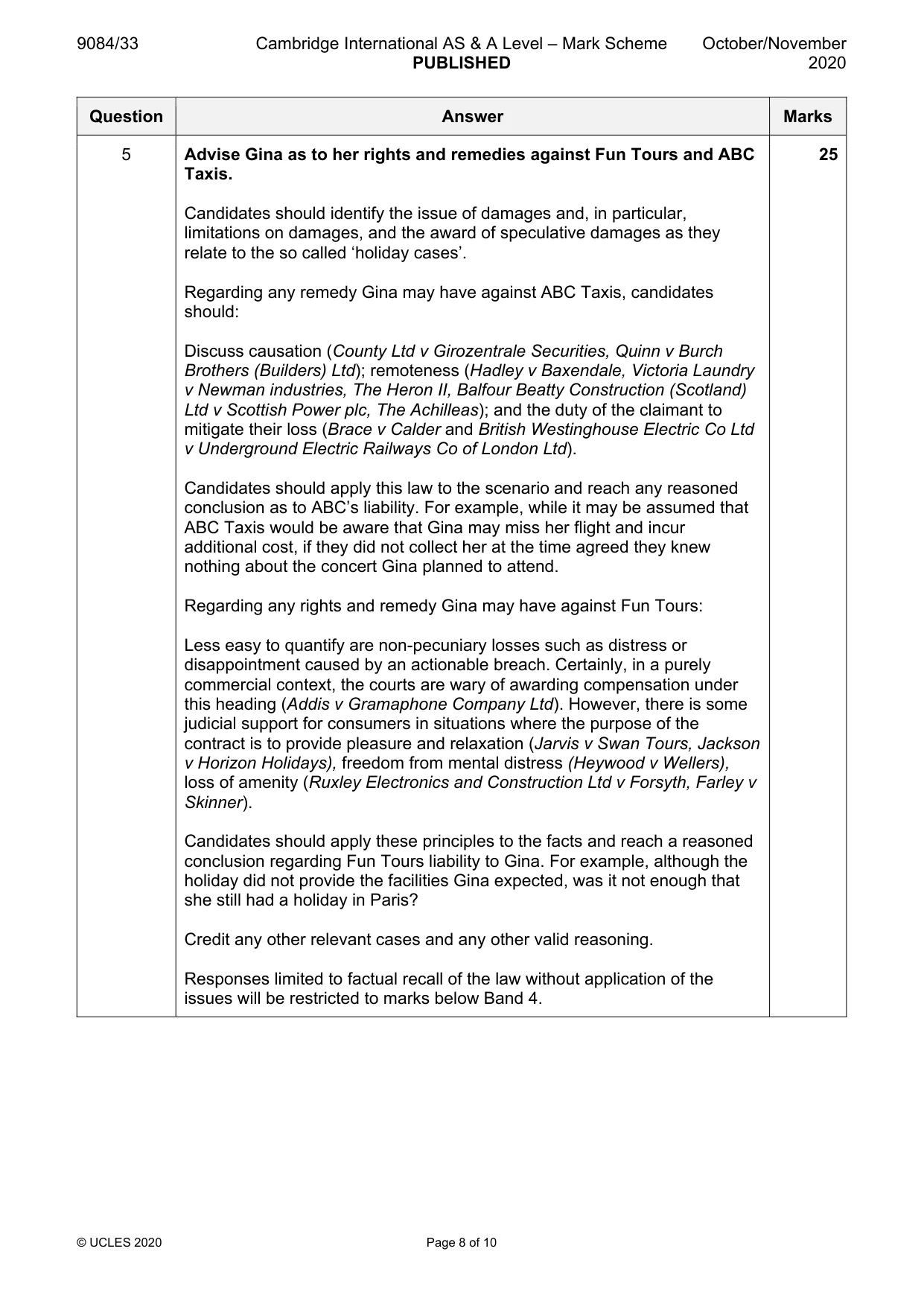
9084/33 Cambridge International AS & A Level – Mark Scheme PUBLISHED October/November 2020 © UCLES 2020 Page 8 of 10 Question Answer Marks 5 Advise Gina as to her rights and remedies against Fun Tours and ABC Taxis. Candidates should identify the issue of damages and, in particular, limitations on damages, and the award of speculative damages as they relate to the so called ‘holiday cases’. Regarding any remedy Gina may have against ABC Taxis, candidates should: Discuss causation (County Ltd v Girozentrale Securities, Quinn v Burch Brothers (Builders) Ltd); remoteness (Hadley v Baxendale, Victoria Laundry v Newman industries, The Heron II, Balfour Beatty Construction (Scotland) Ltd v Scottish Power plc, The Achilleas); and the duty of the claimant to mitigate their loss (Brace v Calder and British Westinghouse Electric Co Ltd v Underground Electric Railways Co of London Ltd). Candidates should apply this law to the scenario and reach any reasoned conclusion as to ABC’s liability. For example, while it may be assumed that ABC Taxis would be aware that Gina may miss her flight and incur additional cost, if they did not collect her at the time agreed they knew nothing about the concert Gina planned to attend. Regarding any rights and remedy Gina may have against Fun Tours: Less easy to quantify are non-pecuniary losses such as distress or disappointment caused by an actionable breach. Certainly, in a purely commercial context, the courts are wary of awarding compensation under this heading (Addis v Gramaphone Company Ltd). However, there is some judicial support for consumers in situations where the purpose of the contract is to provide pleasure and relaxation (Jarvis v Swan Tours, Jackson v Horizon Holidays), freedom from mental distress (Heywood v Wellers), loss of amenity (Ruxley Electronics and Construction Ltd v Forsyth, Farley v Skinner). Candidates should apply these principles to the facts and reach a reasoned conclusion regarding Fun Tours liability to Gina. For example, although the holiday did not provide the facilities Gina expected, was it not enough that she still had a holiday in Paris? Credit any other relevant cases and any other valid reasoning. Responses limited to factual recall of the law without application of the issues will be restricted to marks below Band 4. 25
Mark scheme, page 9
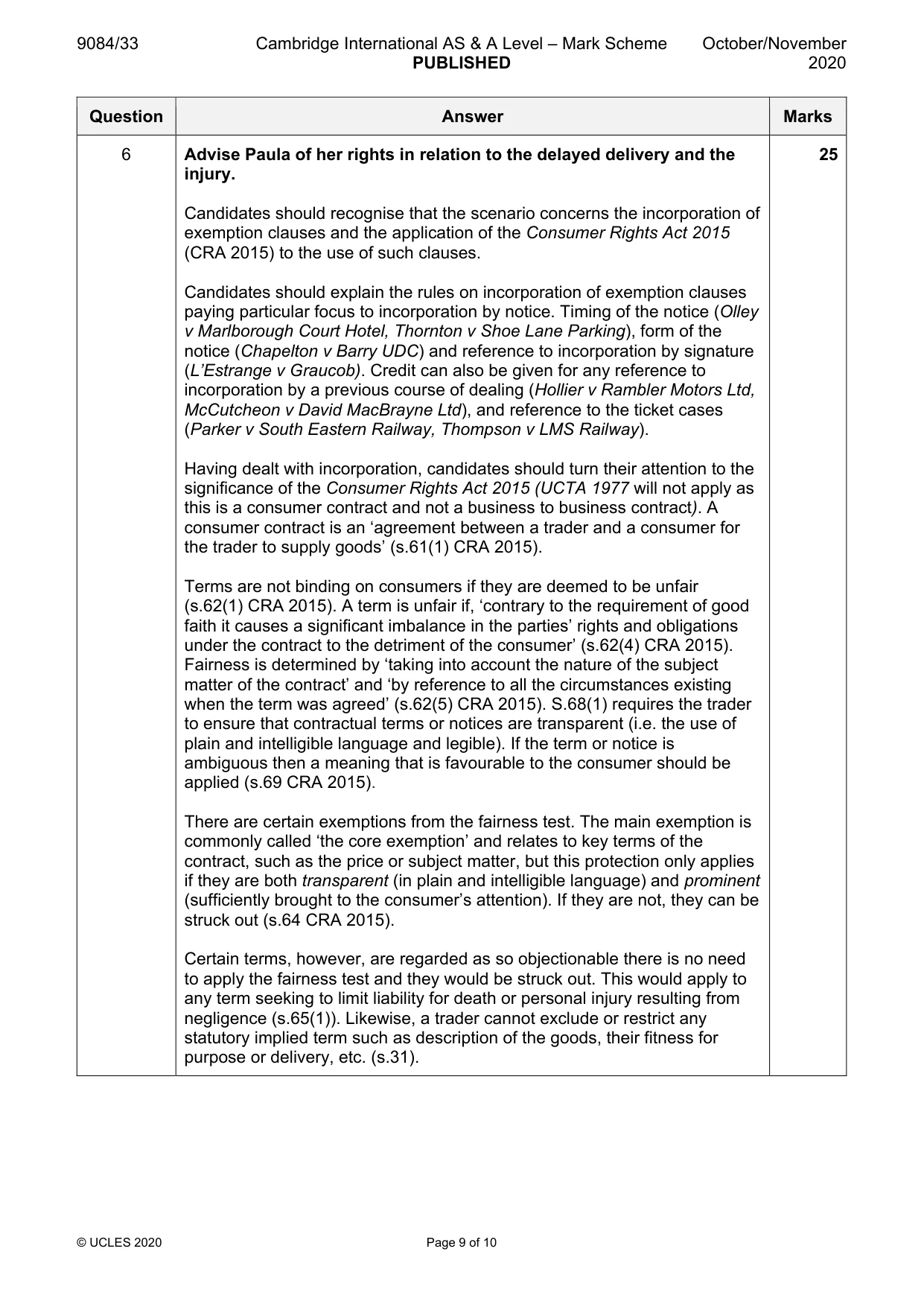
9084/33 Cambridge International AS & A Level – Mark Scheme PUBLISHED October/November 2020 © UCLES 2020 Page 9 of 10 Question Answer Marks 6 Advise Paula of her rights in relation to the delayed delivery and the injury. Candidates should recognise that the scenario concerns the incorporation of exemption clauses and the application of the Consumer Rights Act 2015 (CRA 2015) to the use of such clauses. Candidates should explain the rules on incorporation of exemption clauses paying particular focus to incorporation by notice. Timing of the notice (Olley v Marlborough Court Hotel, Thornton v Shoe Lane Parking), form of the notice (Chapelton v Barry UDC) and reference to incorporation by signature (L’Estrange v Graucob). Credit can also be given for any reference to incorporation by a previous course of dealing (Hollier v Rambler Motors Ltd, McCutcheon v David MacBrayne Ltd), and reference to the ticket cases (Parker v South Eastern Railway, Thompson v LMS Railway). Having dealt with incorporation, candidates should turn their attention to the significance of the Consumer Rights Act 2015 (UCTA 1977 will not apply as this is a consumer contract and not a business to business contract). A consumer contract is an ‘agreement between a trader and a consumer for the trader to supply goods’ (s.61(1) CRA 2015). Terms are not binding on consumers if they are deemed to be unfair (s.62(1) CRA 2015). A term is unfair if, ‘contrary to the requirement of good faith it causes a significant imbalance in the parties’ rights and obligations under the contract to the detriment of the consumer’ (s.62(4) CRA 2015). Fairness is determined by ‘taking into account the nature of the subject matter of the contract’ and ‘by reference to all the circumstances existing when the term was agreed’ (s.62(5) CRA 2015). S.68(1) requires the trader to ensure that contractual terms or notices are transparent (i.e. the use of plain and intelligible language and legible). If the term or notice is ambiguous then a meaning that is favourable to the consumer should be applied (s.69 CRA 2015). There are certain exemptions from the fairness test. The main exemption is commonly called ‘the core exemption’ and relates to key terms of the contract, such as the price or subject matter, but this protection only applies if they are both transparent (in plain and intelligible language) and prominent (sufficiently brought to the consumer’s attention). If they are not, they can be struck out (s.64 CRA 2015). Certain terms, however, are regarded as so objectionable there is no need to apply the fairness test and they would be struck out. This would apply to any term seeking to limit liability for death or personal injury resulting from negligence (s.65(1)). Likewise, a trader cannot exclude or restrict any statutory implied term such as description of the goods, their fitness for purpose or delivery, etc. (s.31). 25
Mark scheme, page 10
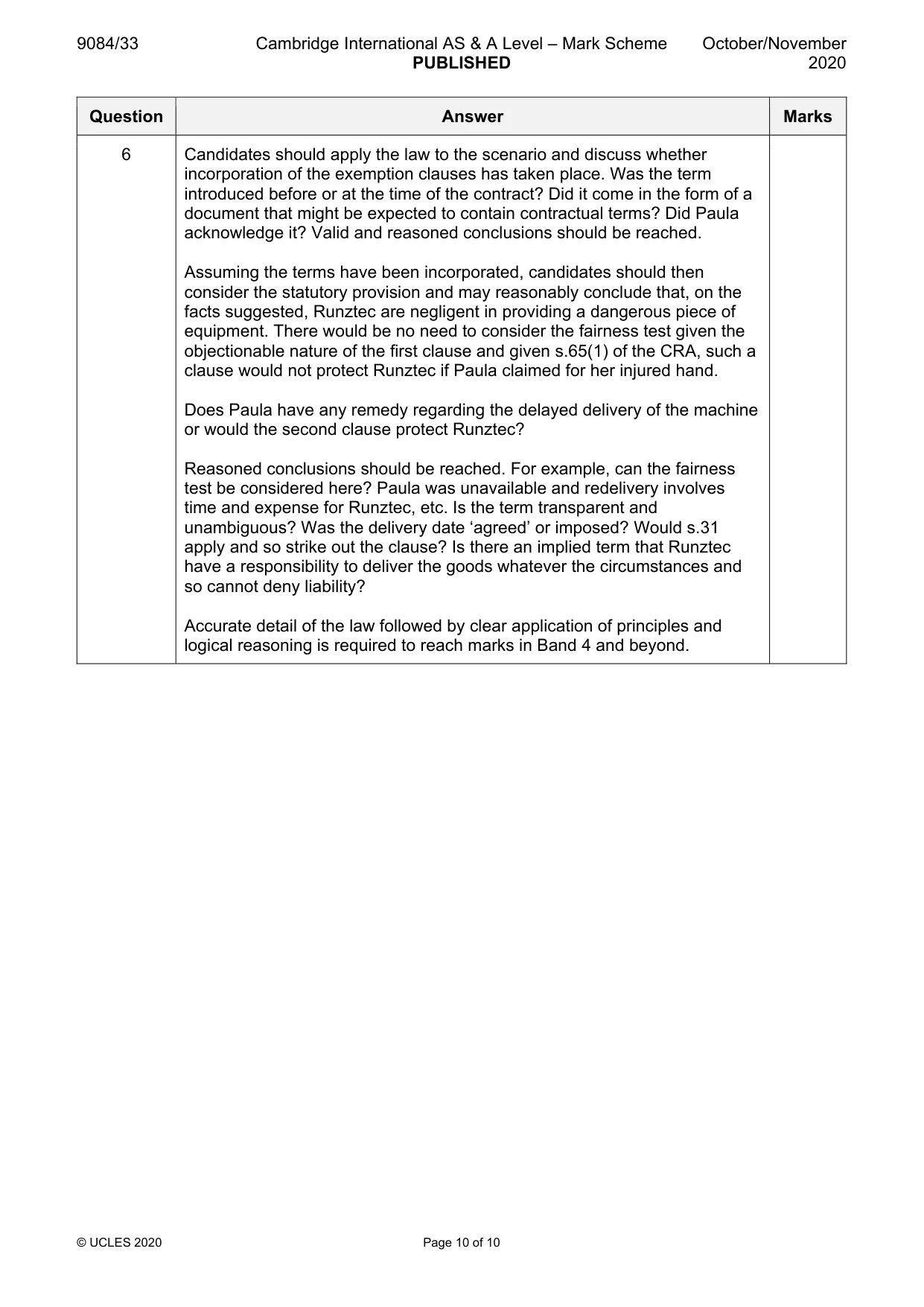
9084/33 Cambridge International AS & A Level – Mark Scheme PUBLISHED October/November 2020 © UCLES 2020 Page 10 of 10 Question Answer Marks 6 Candidates should apply the law to the scenario and discuss whether incorporation of the exemption clauses has taken place. Was the term introduced before or at the time of the contract? Did it come in the form of a document that might be expected to contain contractual terms? Did Paula acknowledge it? Valid and reasoned conclusions should be reached. Assuming the terms have been incorporated, candidates should then consider the statutory provision and may reasonably conclude that, on the facts suggested, Runztec are negligent in providing a dangerous piece of equipment. There would be no need to consider the fairness test given the objectionable nature of the first clause and given s.65(1) of the CRA, such a clause would not protect Runztec if Paula claimed for her injured hand. Does Paula have any remedy regarding the delayed delivery of the machine or would the second clause protect Runztec? Reasoned conclusions should be reached. For example, can the fairness test be considered here? Paula was unavailable and redelivery involves time and expense for Runztec, etc. Is the term transparent and unambiguous? Was the delivery date ‘agreed’ or imposed? Would s.31 apply and so strike out the clause? Is there an implied term that Runztec have a responsibility to deliver the goods whatever the circumstances and so cannot deny liability? Accurate detail of the law followed by clear application of principles and logical reasoning is required to reach marks in Band 4 and beyond.
What you needed in this session
Cambridge’s own grade thresholds for 2020 Oct/Nov, Paper 3 · Variant 3. A higher threshold means an easier paper — the bar moves with how the cohort did.