Cambridge A Level Law 9084 — 2016 May/June Paper 3 · Variant 3
9084/33/M/J/16 · 75 marks · ≈84 min
The question paper and its mark scheme, free to read here and free to download. This is Cambridge’s own paper, exactly as it was sat.
Question paper4 pages

Mark scheme7 pages
Answers below. Sit the paper first if you are practising.
Paper as text
Question paper, page 1
This document consists of 3 printed pages, 1 blank page and 1 insert. DC (LM) 125020 © UCLES 2016 [Turn over * 3 2 1 1 0 4 0 0 2 6 * LAW 9084/33 Paper 3 Law of Contract May/June 2016 1 hour 30 minutes No Additional Materials are required. READ THESE INSTRUCTIONS FIRST An answer booklet is provided inside this question paper. You should follow the instructions on the front cover of the answer booklet. If you need additional answer paper ask the invigilator for a continuation booklet. Answer one question from Section A, one from Section B and one other, thus making a total of three responses required. The number of marks is given in brackets [ ] at the end of each question or part question. Cambridge International Examinations Cambridge International Advanced Subsidiary and Advanced Level
Question paper, page 2
2 9084/33/M/J/16 © UCLES 2016 Candidates must attempt one question from Section A, one from Section B and one other, thus making a total of three responses required. Section A 1 Distinctions are frequently drawn between advertisements for unilateral and bilateral contracts. Critically analyse this statement with reference to the formation of contracts. [25] 2 The law relating to unfair terms in contracts is confusing and thus inaccessible to consumers who require protection. Discuss whether the Unfair Contract Terms Act 1977 and the Unfair Terms in Consumer Contracts Regulations 1999 effectively regulate the use of terms in contracts. [25] 3 Common law damages are available as of right if a contract is breached and will compensate fully for losses suffered. Critically assess the accuracy of this statement. [25]
Question paper, page 3
3 9084/33/M/J/16 © UCLES 2016 Section B 4 Ahmed decides to retire and sell the bakery shop which he has owned for 30 years. Balquees works in the bakery department of a large local supermarket and wants to buy a shop of her own. Balquees sees Ahmed’s shop advertised and makes enquiries. Ahmed shows Balquees the shop’s sales figures up to the previous year and it appears to her that the business is in a healthy financial state. However, Ahmed does not tell Balquees that the shop has been less profitable over the last few months since being closed for several weeks due to flooding. Ahmed is also aware that there are plans to build a new shopping centre nearby which is likely to result in a further reduction in the shop’s customers, but he does not tell Balquees. When asked by Balquees, whether the property experiences problems with flooding from the stream nearby, Ahmed says “No”. Consider whether Ahmed would be liable if Balquees decides to buy the shop and suffers a loss after the first year of trading. Discuss any remedies that she might have against him. [25] 5 Floella is 17 years of age when she moves to London to find work. She soon gets a full-time job in a restaurant owned by Enrique. She signs a contract to work five days a week with an additional day each week attending a local college for customer service training. She is also provided with a small apartment which she agrees to rent from Enrique for three years. She pays Enrique a deposit of three months’ rent. Floella works in the restaurant for six months and then finds another job. She gives Enrique a week’s notice that she is resigning from her job and leaving the apartment. Enrique reminds her that her contract requires her to give him at least four weeks’ notice to resign from the job and tells her that he will keep back three weeks’ worth of her wages in lieu of notice. He also tells her that if she breaks the agreement to rent the apartment, she will have to pay him a further three months’ rent. Discuss Floella’s rights and liabilities with regard to both the employment contract and rental agreement she has made with Enrique. [25] 6 Carlos telephones his friend Domingo to tell him that he is going on a business trip and asks him if he will water the plants in Carlos’ garden while he is away. Domingo agrees. In addition to watering the plants as requested, Domingo spends time removing weeds and repairing Carlos’ broken fence. On his return, Carlos is very grateful to Domingo and he promises to give him £500 for the work. Critically analyse Carlos’ legal liability to pay Domingo the money promised for all his work. [25]
Question paper, page 4
4 9084/33/M/J/16 © UCLES 2016 Permission to reproduce items where third-party owned material protected by copyright is included has been sought and cleared where possible. Every reasonable effort has been made by the publisher (UCLES) to trace copyright holders, but if any items requiring clearance have unwittingly been included, the publisher will be pleased to make amends at the earliest possible opportunity. To avoid the issue of disclosure of answer-related information to candidates, all copyright acknowledgements are reproduced online in the Cambridge International Examinations Copyright Acknowledgements Booklet. This is produced for each series of examinations and is freely available to download at www.cie.org.uk after the live examination series. Cambridge International Examinations is part of the Cambridge Assessment Group. Cambridge Assessment is the brand name of University of Cambridge Local Examinations Syndicate (UCLES), which is itself a department of the University of Cambridge. BLANK PAGE
Mark scheme, page 1
® IGCSE is the registered trademark of Cambridge International Examinations. This document consists of 7 printed pages. © UCLES 2016 [Turn over Cambridge International Examinations Cambridge International Advanced Subsidiary and Advanced Level LAW 9084/33 Paper 3 May/June 2016 MARK SCHEME Maximum Mark: 75 Published This mark scheme is published as an aid to teachers and candidates, to indicate the requirements of the examination. It shows the basis on which Examiners were instructed to award marks. It does not indicate the details of the discussions that took place at an Examiners’ meeting before marking began, which would have considered the acceptability of alternative answers. Mark schemes should be read in conjunction with the question paper and the Principal Examiner Report for Teachers. Cambridge will not enter into discussions about these mark schemes. Cambridge is publishing the mark schemes for the May/June 2016 series for most Cambridge IGCSE®, Cambridge International A and AS Level components and some Cambridge O Level components.
Mark scheme, page 2
Page 2 Mark Scheme Syllabus Paper Cambridge International AS/A Level – May/June 2016 9084 33 © Cambridge International Examinations 2016 Assessment Objectives Candidates are expected to demonstrate: Knowledge and Understanding − recall, select, use and develop knowledge and understanding of legal principles and rules by means of example and citation Analysis, Evaluation and Application − analyse and evaluate legal materials, situations and issues and accurately apply appropriate principles and rules Communication and Presentation − use appropriate legal terminology to present logical and coherent argument and to communicate relevant material in a clear and concise manner. Specification Grid The relationship between the Assessment Objectives and this individual component is detailed below. The objectives are weighted to give an indication of their relative importance, rather than to provide a precise statement of the percentage mark allocation to particular assessment objectives, but indicative marks per question attempted on Paper 3 are shown in brackets. Assessment Objective Paper 1 Paper 2 Paper 3 Paper 4 Advanced Level Knowledge/ Understanding 50 50 50 (13) 50 50 Analysis/ Evaluation/ Application 40 40 40 (10) 40 40 Communication/ Presentation 10 10 10 (2) 10 10
Mark scheme, page 3
Page 3 Mark Scheme Syllabus Paper Cambridge International AS/A Level – May/June 2016 9084 33 © Cambridge International Examinations 2016 Mark Bands The mark bands and descriptors applicable to all questions on the paper are as follows. Maximum mark allocations are indicated in the table at the foot of the page. Indicative content for each of the questions follows overleaf. Band 1: The answer contains no relevant material. Band 2: The candidate introduces fragments of information or unexplained examples from which no coherent explanation or analysis can emerge OR The candidate attempts to introduce an explanation and/or analysis but it is so fundamentally undermined by error and confusion that it remains substantially incoherent. Band 3: The candidate begins to indicate some capacity for explanation and analysis by introducing some of the issues, but explanations are limited and superficial OR The candidate adopts an approach in which there is concentration on explanation in terms of facts presented rather than through the development and explanation of legal principles and rules OR The candidate attempts to introduce material across the range of potential content, but it is weak or confused so that no real explanation or conclusion emerges. Band 4: Where there is more than one issue, the candidate demonstrates a clear understanding of one of the main issues of the question, giving explanations and using illustrations so that a full and detailed picture is presented of this issue OR The candidate presents a more limited explanation of all parts of the answer, but there is some lack of detail or superficiality in respect of either or both so that the answer is not fully rounded. Band 5: The candidate presents a detailed explanation and discussion of all areas of relevant law and, while there may be some minor inaccuracies and/or imbalance, a coherent explanation emerges. Maximum Mark Allocations: Question 1 2 3 4 5 6 Band 1 0 0 0 0 0 0 Band 2 6 6 6 6 6 6 Band 3 12 12 12 12 12 12 Band 4 19 19 19 19 19 19 Band 5 25 25 25 25 25 25
Mark scheme, page 4
Page 4 Mark Scheme Syllabus Paper Cambridge International AS/A Level – May/June 2016 9084 33 © Cambridge International Examinations 2016 Section A 1 Distinctions are frequently drawn between advertisements for unilateral and bilateral contracts. Critically analyse this statement with reference to the formation of contracts. Candidates should contextualise their response by stating the general rule that a contract cannot come into existence until there has been an offer and corresponding acceptance and by briefly discussing the need to distinguish between offers and invitations to treat as only the former can be accepted to form a valid, binding contract. Candidates should offer definitions of the terms ‘offer’ and ‘invitation to treat’. Candidates should go on to explain that confusion can arise, however, because some advertisements would appear to amount to an offer but are held by the law to be merely an invitation to treat. Unilateral contracts result from advertisements which call for action only of those reading them, such as that in the case of Carlill v Carbolic Smoke Ball Company or those offering rewards in return for information or for returning a lost item are usually considered to be firm offers capable of acceptance without the need for further negotiation and ones which the advertiser intends to be bound by. By comparison, advertisements that intimate action or further negotiation between advertiser and customer before a bilateral contract results are generally seen as invitations to treat or something that invites the viewer to make a consequential offer to the advertiser. Shop window displays and classified advertising are classic examples as exemplified by cases such as Partridge v Crittenden, Fisher v Bell and Pharmaceutical Society of GB v Boots Cash Chemists (Southern) Ltd. In these instances, it is considered that potential buyers may still wish to negotiate price and that sellers might wish to refuse to sell their goods or services to certain buyers in some circumstances. Generalised responses lacking focus on the question or those based purely on factual recall will receive marks limited to the maximum in band 3. Evidence of critical analysis is required for marks to be awarded within bands 4 and 5. 2 The law relating to unfair terms in contracts is confusing and thus inaccessible to consumers who require protection. Discuss whether the Unfair Contract Terms Act 1977 and the Unfair Terms in Consumer Contracts Regulations 1999 effectively regulate the use of terms in contracts. This legislation as now been superceded by the Consumer Rights Act 2015, but given its relatively recent enactment candidates cannot be expected to exhibit knowledge of it. Nevertheless, due credit will be awarded where such knowledge and understanding of impact is demonstrated. Candidates should introduce their response by explaining why the two pieces of legislation exist: to control the use of clauses limiting or excluding liability for breach of contract (UCTA) and to give effect to the EU Directive on Unfair Terms in Consumer Contracts (1993) and thus provide consumer protection (UTCCR).
Mark scheme, page 5
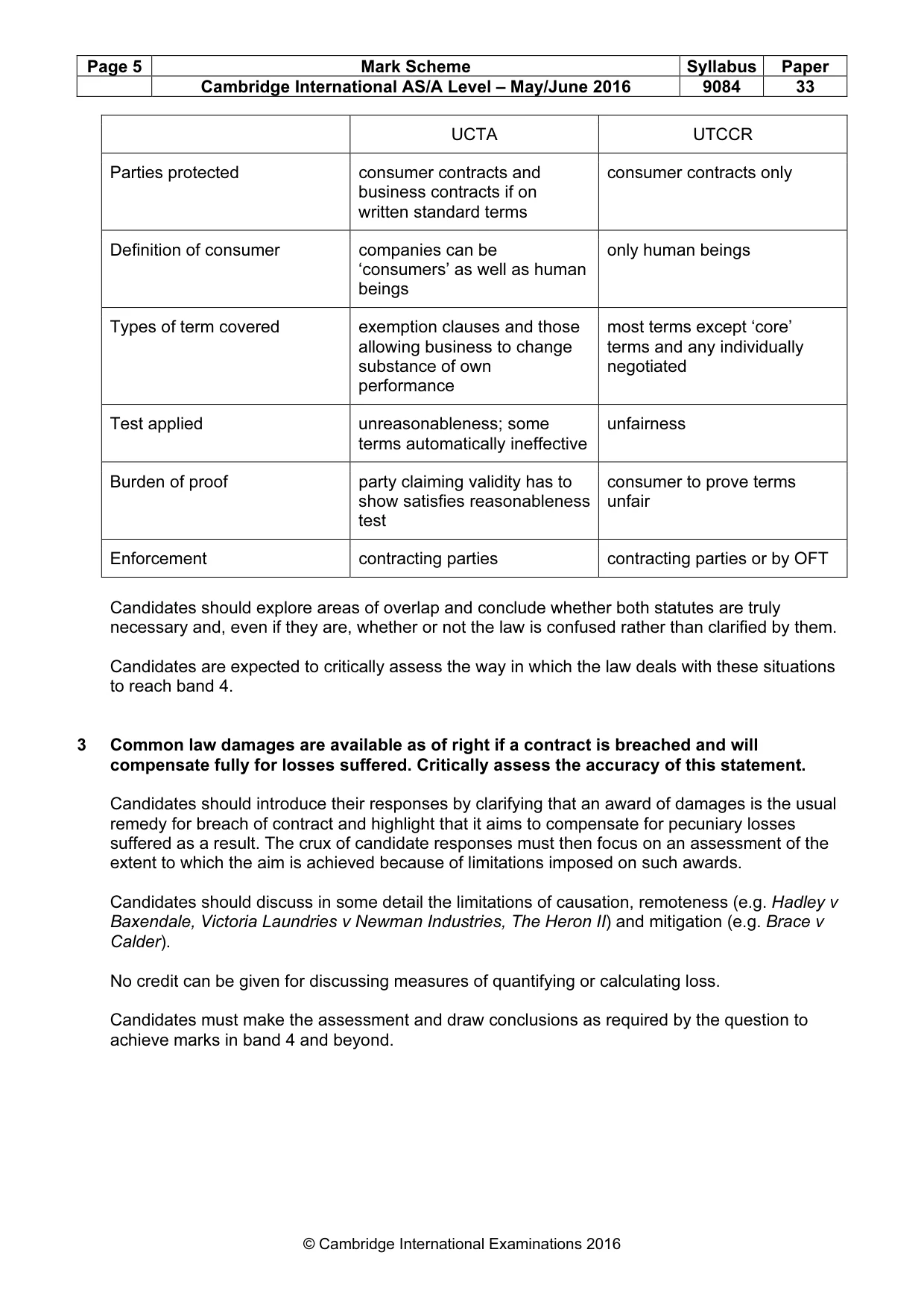
Page 5 Mark Scheme Syllabus Paper Cambridge International AS/A Level – May/June 2016 9084 33 © Cambridge International Examinations 2016 UCTA UTCCR Parties protected consumer contracts and business contracts if on written standard terms consumer contracts only Definition of consumer companies can be ‘consumers’ as well as human beings only human beings Types of term covered exemption clauses and those allowing business to change substance of own performance most terms except ‘core’ terms and any individually negotiated Test applied unreasonableness; some terms automatically ineffective unfairness Burden of proof party claiming validity has to show satisfies reasonableness test consumer to prove terms unfair Enforcement contracting parties contracting parties or by OFT Candidates should explore areas of overlap and conclude whether both statutes are truly necessary and, even if they are, whether or not the law is confused rather than clarified by them. Candidates are expected to critically assess the way in which the law deals with these situations to reach band 4. 3 Common law damages are available as of right if a contract is breached and will compensate fully for losses suffered. Critically assess the accuracy of this statement. Candidates should introduce their responses by clarifying that an award of damages is the usual remedy for breach of contract and highlight that it aims to compensate for pecuniary losses suffered as a result. The crux of candidate responses must then focus on an assessment of the extent to which the aim is achieved because of limitations imposed on such awards. Candidates should discuss in some detail the limitations of causation, remoteness (e.g. Hadley v Baxendale, Victoria Laundries v Newman Industries, The Heron II) and mitigation (e.g. Brace v Calder). No credit can be given for discussing measures of quantifying or calculating loss. Candidates must make the assessment and draw conclusions as required by the question to achieve marks in band 4 and beyond.
Mark scheme, page 6
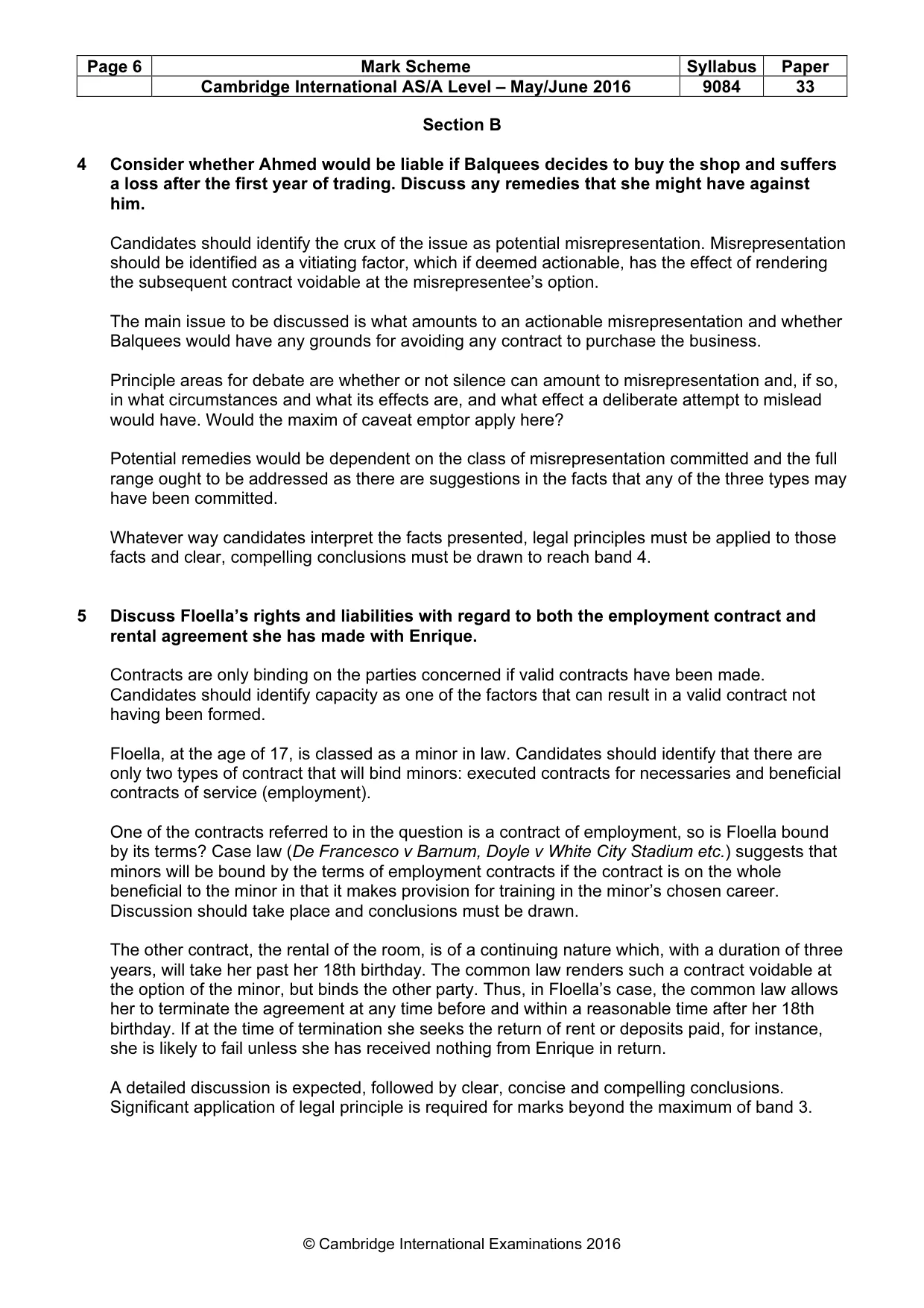
Page 6 Mark Scheme Syllabus Paper Cambridge International AS/A Level – May/June 2016 9084 33 © Cambridge International Examinations 2016 Section B 4 Consider whether Ahmed would be liable if Balquees decides to buy the shop and suffers a loss after the first year of trading. Discuss any remedies that she might have against him. Candidates should identify the crux of the issue as potential misrepresentation. Misrepresentation should be identified as a vitiating factor, which if deemed actionable, has the effect of rendering the subsequent contract voidable at the misrepresentee’s option. The main issue to be discussed is what amounts to an actionable misrepresentation and whether Balquees would have any grounds for avoiding any contract to purchase the business. Principle areas for debate are whether or not silence can amount to misrepresentation and, if so, in what circumstances and what its effects are, and what effect a deliberate attempt to mislead would have. Would the maxim of caveat emptor apply here? Potential remedies would be dependent on the class of misrepresentation committed and the full range ought to be addressed as there are suggestions in the facts that any of the three types may have been committed. Whatever way candidates interpret the facts presented, legal principles must be applied to those facts and clear, compelling conclusions must be drawn to reach band 4. 5 Discuss Floella’s rights and liabilities with regard to both the employment contract and rental agreement she has made with Enrique. Contracts are only binding on the parties concerned if valid contracts have been made. Candidates should identify capacity as one of the factors that can result in a valid contract not having been formed. Floella, at the age of 17, is classed as a minor in law. Candidates should identify that there are only two types of contract that will bind minors: executed contracts for necessaries and beneficial contracts of service (employment). One of the contracts referred to in the question is a contract of employment, so is Floella bound by its terms? Case law (De Francesco v Barnum, Doyle v White City Stadium etc.) suggests that minors will be bound by the terms of employment contracts if the contract is on the whole beneficial to the minor in that it makes provision for training in the minor’s chosen career. Discussion should take place and conclusions must be drawn. The other contract, the rental of the room, is of a continuing nature which, with a duration of three years, will take her past her 18th birthday. The common law renders such a contract voidable at the option of the minor, but binds the other party. Thus, in Floella’s case, the common law allows her to terminate the agreement at any time before and within a reasonable time after her 18th birthday. If at the time of termination she seeks the return of rent or deposits paid, for instance, she is likely to fail unless she has received nothing from Enrique in return. A detailed discussion is expected, followed by clear, concise and compelling conclusions. Significant application of legal principle is required for marks beyond the maximum of band 3.
Mark scheme, page 7
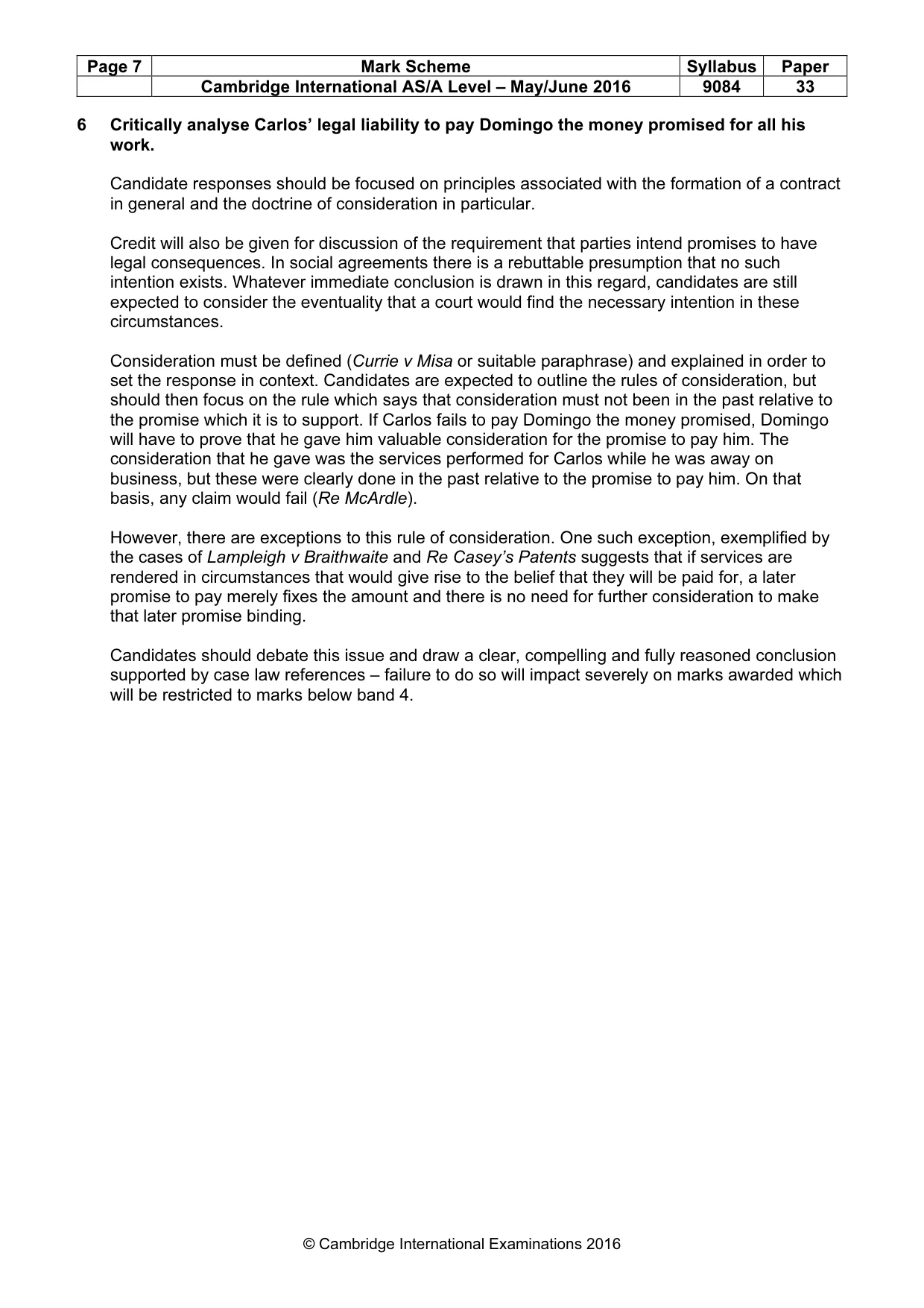
Page 7 Mark Scheme Syllabus Paper Cambridge International AS/A Level – May/June 2016 9084 33 © Cambridge International Examinations 2016 6 Critically analyse Carlos’ legal liability to pay Domingo the money promised for all his work. Candidate responses should be focused on principles associated with the formation of a contract in general and the doctrine of consideration in particular. Credit will also be given for discussion of the requirement that parties intend promises to have legal consequences. In social agreements there is a rebuttable presumption that no such intention exists. Whatever immediate conclusion is drawn in this regard, candidates are still expected to consider the eventuality that a court would find the necessary intention in these circumstances. Consideration must be defined (Currie v Misa or suitable paraphrase) and explained in order to set the response in context. Candidates are expected to outline the rules of consideration, but should then focus on the rule which says that consideration must not been in the past relative to the promise which it is to support. If Carlos fails to pay Domingo the money promised, Domingo will have to prove that he gave him valuable consideration for the promise to pay him. The consideration that he gave was the services performed for Carlos while he was away on business, but these were clearly done in the past relative to the promise to pay him. On that basis, any claim would fail (Re McArdle). However, there are exceptions to this rule of consideration. One such exception, exemplified by the cases of Lampleigh v Braithwaite and Re Casey’s Patents suggests that if services are rendered in circumstances that would give rise to the belief that they will be paid for, a later promise to pay merely fixes the amount and there is no need for further consideration to make that later promise binding. Candidates should debate this issue and draw a clear, compelling and fully reasoned conclusion supported by case law references – failure to do so will impact severely on marks awarded which will be restricted to marks below band 4.
What you needed in this session
Cambridge’s own grade thresholds for 2016 May/June, Paper 3 · Variant 3. A higher threshold means an easier paper — the bar moves with how the cohort did.