Cambridge A Level Law 9084 — 2014 Oct/Nov Paper 3 · Variant 3
9084/33/O/N/14 · 75 marks · ≈84 min
The question paper and its mark scheme, free to read here and free to download. This is Cambridge’s own paper, exactly as it was sat.
Question paper4 pages

Mark scheme9 pages
Answers below. Sit the paper first if you are practising.
Paper as text
Question paper, page 1
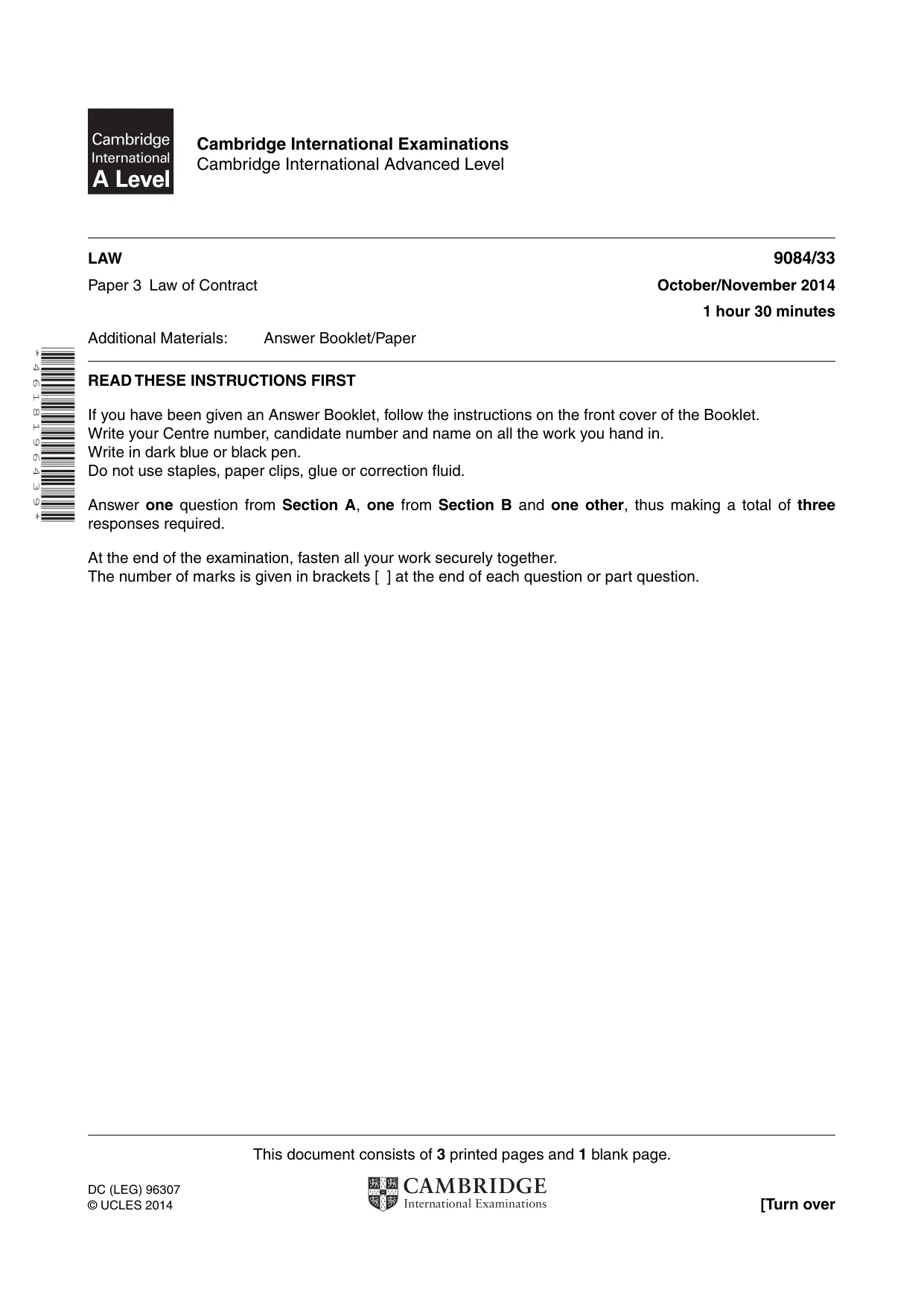
This document consists of 3 printed pages and 1 blank page. DC (LEG) 96307 © UCLES 2014 [Turn over Cambridge International Examinations Cambridge International Advanced Level * 4 6 1 8 1 9 6 4 3 9 * LAW 9084/33 Paper 3 Law of Contract October/November 2014 1 hour 30 minutes Additional Materials: Answer Booklet/Paper READ THESE INSTRUCTIONS FIRST If you have been given an Answer Booklet, follow the instructions on the front cover of the Booklet. Write your Centre number, candidate number and name on all the work you hand in. Write in dark blue or black pen. Do not use staples, paper clips, glue or correction fluid. Answer one question from Section A, one from Section B and one other, thus making a total of three responses required. At the end of the examination, fasten all your work securely together. The number of marks is given in brackets [ ] at the end of each question or part question.
Question paper, page 2
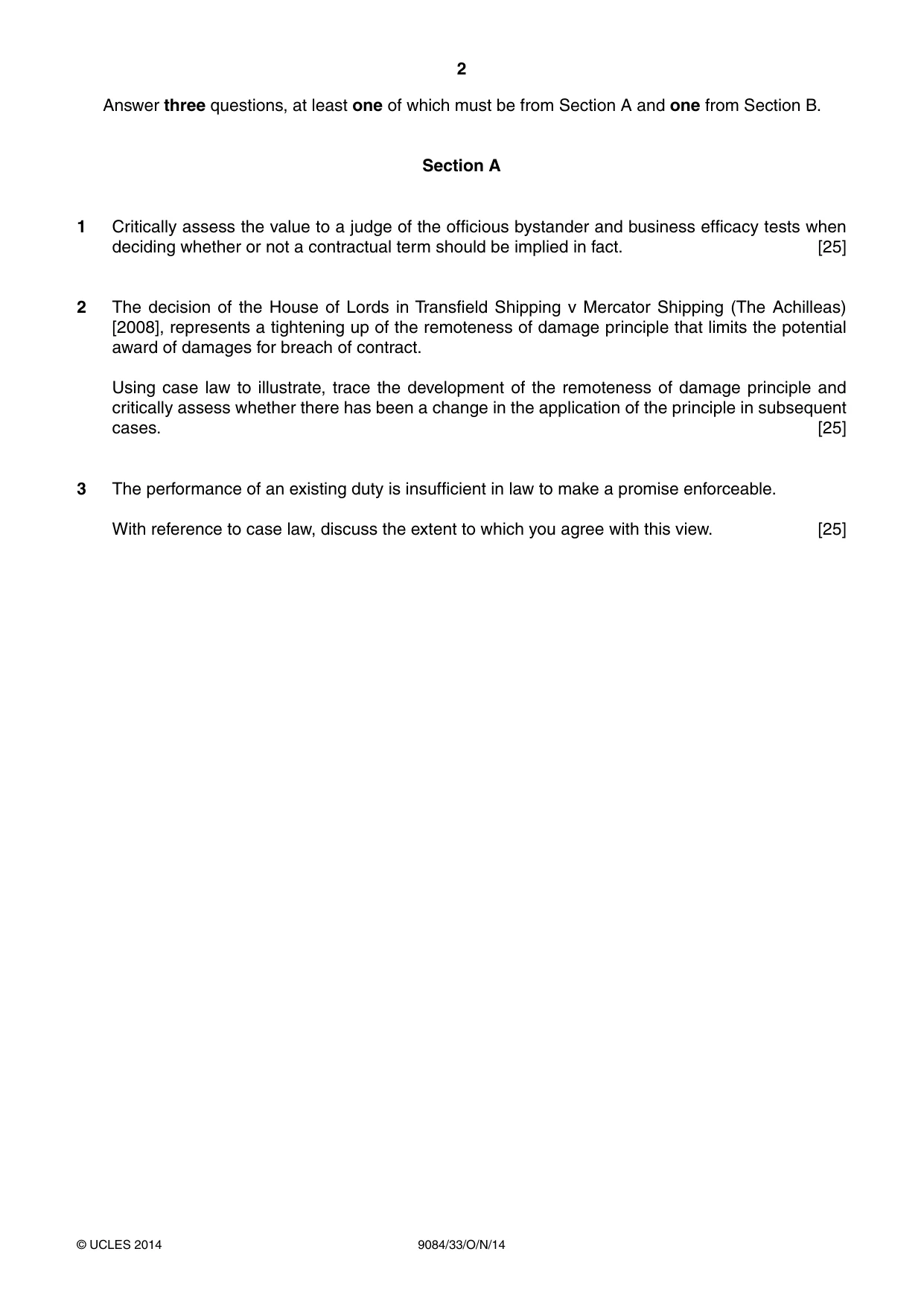
2 9084/33/O/N/14 © UCLES 2014 Answer three questions, at least one of which must be from Section A and one from Section B. Section A 1 Critically assess the value to a judge of the officious bystander and business efficacy tests when deciding whether or not a contractual term should be implied in fact. [25] 2 The decision of the House of Lords in Transfield Shipping v Mercator Shipping (The Achilleas) [2008], represents a tightening up of the remoteness of damage principle that limits the potential award of damages for breach of contract. Using case law to illustrate, trace the development of the remoteness of damage principle and critically assess whether there has been a change in the application of the principle in subsequent cases. [25] 3 The performance of an existing duty is insufficient in law to make a promise enforceable. With reference to case law, discuss the extent to which you agree with this view. [25]
Question paper, page 3
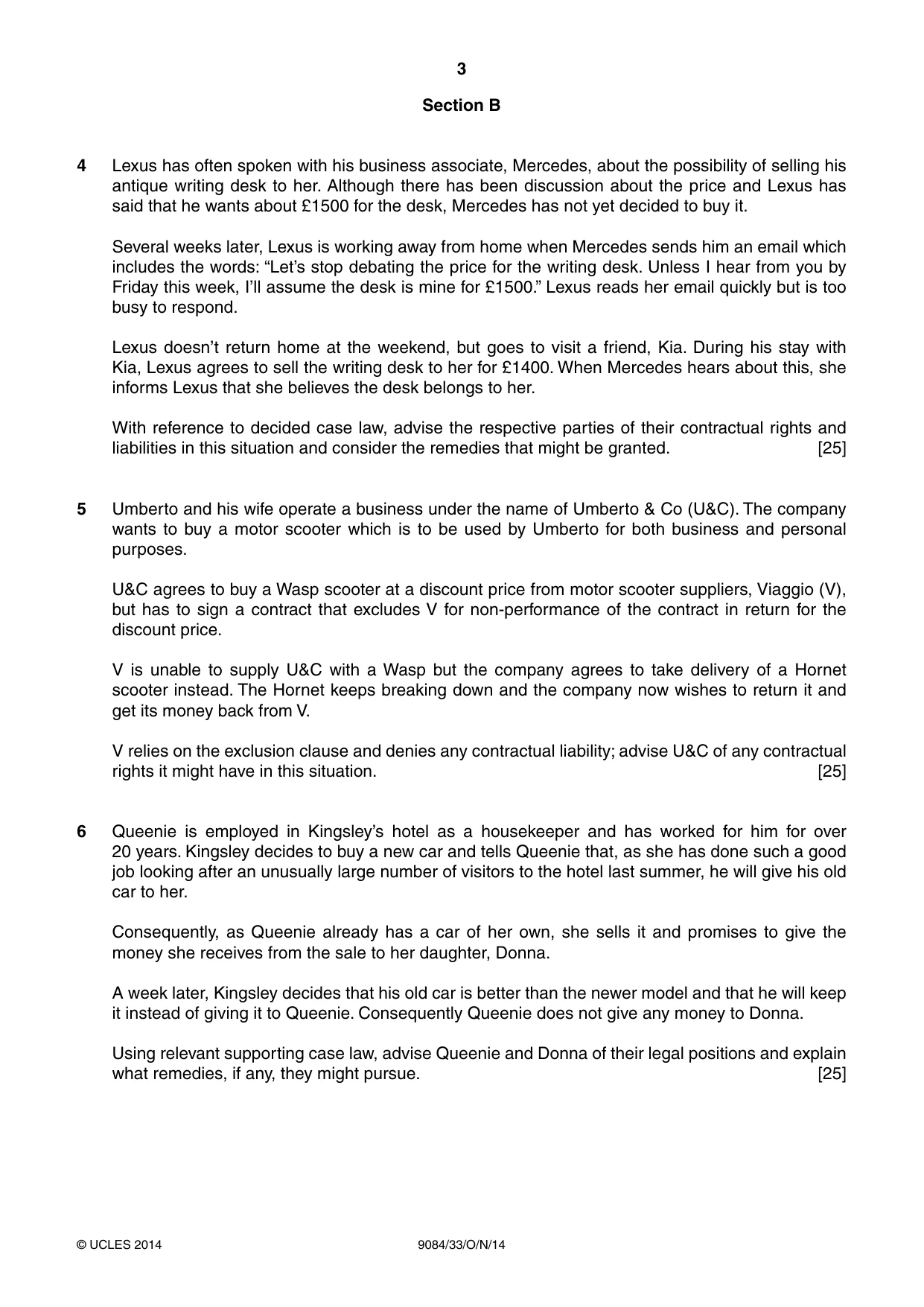
3 9084/33/O/N/14 © UCLES 2014 Section B 4 Lexus has often spoken with his business associate, Mercedes, about the possibility of selling his antique writing desk to her. Although there has been discussion about the price and Lexus has said that he wants about £1500 for the desk, Mercedes has not yet decided to buy it. Several weeks later, Lexus is working away from home when Mercedes sends him an email which includes the words: “Let’s stop debating the price for the writing desk. Unless I hear from you by Friday this week, I’ll assume the desk is mine for £1500.” Lexus reads her email quickly but is too busy to respond. Lexus doesn’t return home at the weekend, but goes to visit a friend, Kia. During his stay with Kia, Lexus agrees to sell the writing desk to her for £1400. When Mercedes hears about this, she informs Lexus that she believes the desk belongs to her. With reference to decided case law, advise the respective parties of their contractual rights and liabilities in this situation and consider the remedies that might be granted. [25] 5 Umberto and his wife operate a business under the name of Umberto & Co (U&C). The company wants to buy a motor scooter which is to be used by Umberto for both business and personal purposes. U&C agrees to buy a Wasp scooter at a discount price from motor scooter suppliers, Viaggio (V), but has to sign a contract that excludes V for non-performance of the contract in return for the discount price. V is unable to supply U&C with a Wasp but the company agrees to take delivery of a Hornet scooter instead. The Hornet keeps breaking down and the company now wishes to return it and get its money back from V. V relies on the exclusion clause and denies any contractual liability; advise U&C of any contractual rights it might have in this situation. [25] 6 Queenie is employed in Kingsley’s hotel as a housekeeper and has worked for him for over 20 years. Kingsley decides to buy a new car and tells Queenie that, as she has done such a good job looking after an unusually large number of visitors to the hotel last summer, he will give his old car to her. Consequently, as Queenie already has a car of her own, she sells it and promises to give the money she receives from the sale to her daughter, Donna. A week later, Kingsley decides that his old car is better than the newer model and that he will keep it instead of giving it to Queenie. Consequently Queenie does not give any money to Donna. Using relevant supporting case law, advise Queenie and Donna of their legal positions and explain what remedies, if any, they might pursue. [25]
Question paper, page 4
4 9084/33/O/N/14 © UCLES 2014 BLANK PAGE Permission to reproduce items where third-party owned material protected by copyright is included has been sought and cleared where possible. Every reasonable effort has been made by the publisher (UCLES) to trace copyright holders, but if any items requiring clearance have unwittingly been included, the publisher will be pleased to make amends at the earliest possible opportunity. Cambridge International Examinations is part of the Cambridge Assessment Group. Cambridge Assessment is the brand name of University of Cambridge Local Examinations Syndicate (UCLES), which is itself a department of the University of Cambridge.
Mark scheme, page 1
® IGCSE is the registered trademark of Cambridge International Examinations. CAMBRIDGE INTERNATIONAL EXAMINATIONS Cambridge International Advanced Level MARK SCHEME for the October/November 2014 series 9084 LAW 9084/33 Paper 3, maximum raw mark 75 This mark scheme is published as an aid to teachers and candidates, to indicate the requirements of the examination. It shows the basis on which Examiners were instructed to award marks. It does not indicate the details of the discussions that took place at an Examiners’ meeting before marking began, which would have considered the acceptability of alternative answers. Mark schemes should be read in conjunction with the question paper and the Principal Examiner Report for Teachers. Cambridge will not enter into discussions about these mark schemes. Cambridge is publishing the mark schemes for the October/November 2014 series for most Cambridge IGCSE®, Cambridge International A and AS Level components and some Cambridge O Level components.
Mark scheme, page 2
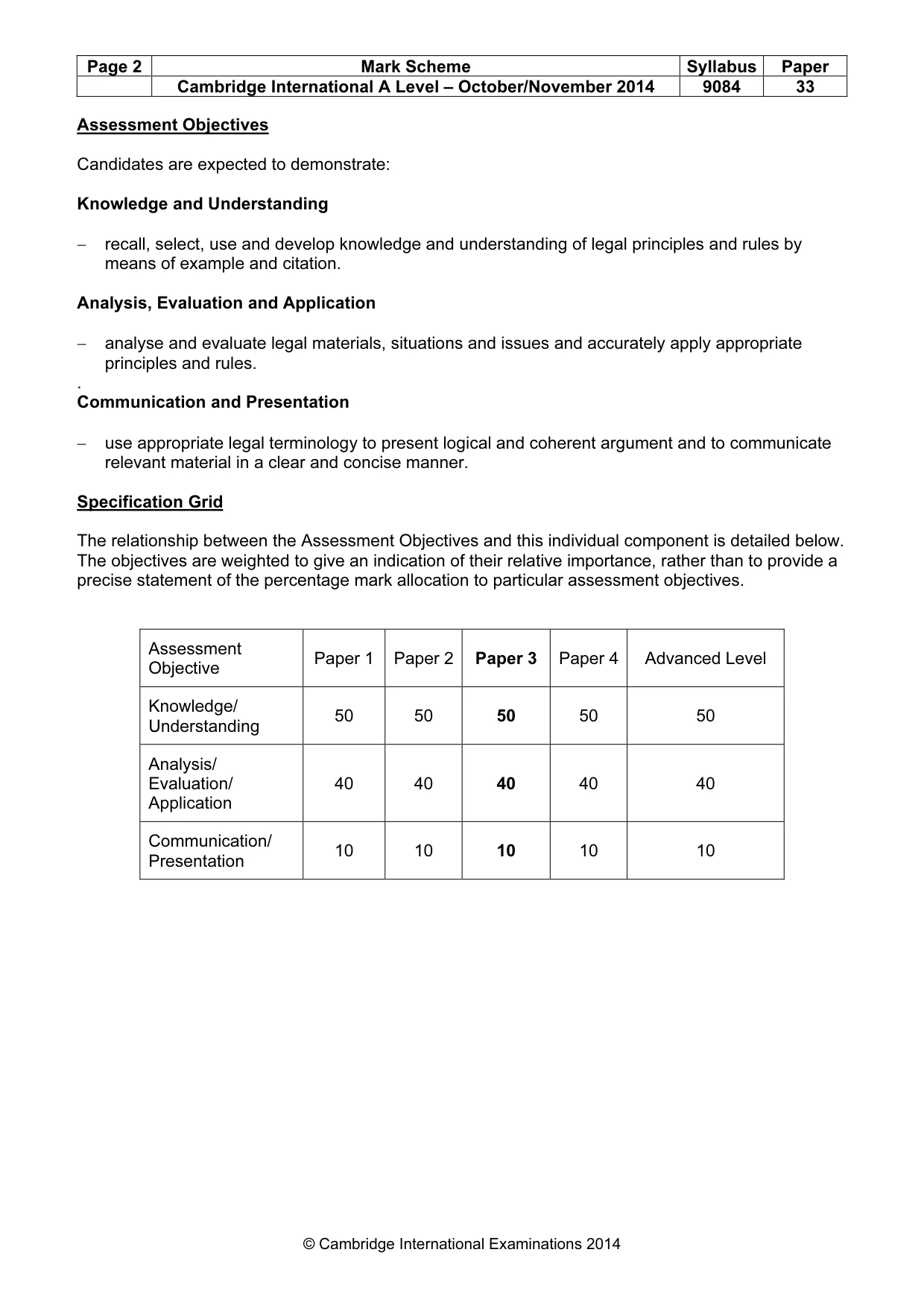
Page 2 Mark Scheme Syllabus Paper Cambridge International A Level – October/November 2014 9084 33 © Cambridge International Examinations 2014 Assessment Objectives Candidates are expected to demonstrate: Knowledge and Understanding − recall, select, use and develop knowledge and understanding of legal principles and rules by means of example and citation. Analysis, Evaluation and Application − analyse and evaluate legal materials, situations and issues and accurately apply appropriate principles and rules. . Communication and Presentation − use appropriate legal terminology to present logical and coherent argument and to communicate relevant material in a clear and concise manner. Specification Grid The relationship between the Assessment Objectives and this individual component is detailed below. The objectives are weighted to give an indication of their relative importance, rather than to provide a precise statement of the percentage mark allocation to particular assessment objectives. Assessment Objective Paper 1 Paper 2 Paper 3 Paper 4 Advanced Level Knowledge/ Understanding 50 50 50 50 50 Analysis/ Evaluation/ Application 40 40 40 40 40 Communication/ Presentation 10 10 10 10 10
Mark scheme, page 3
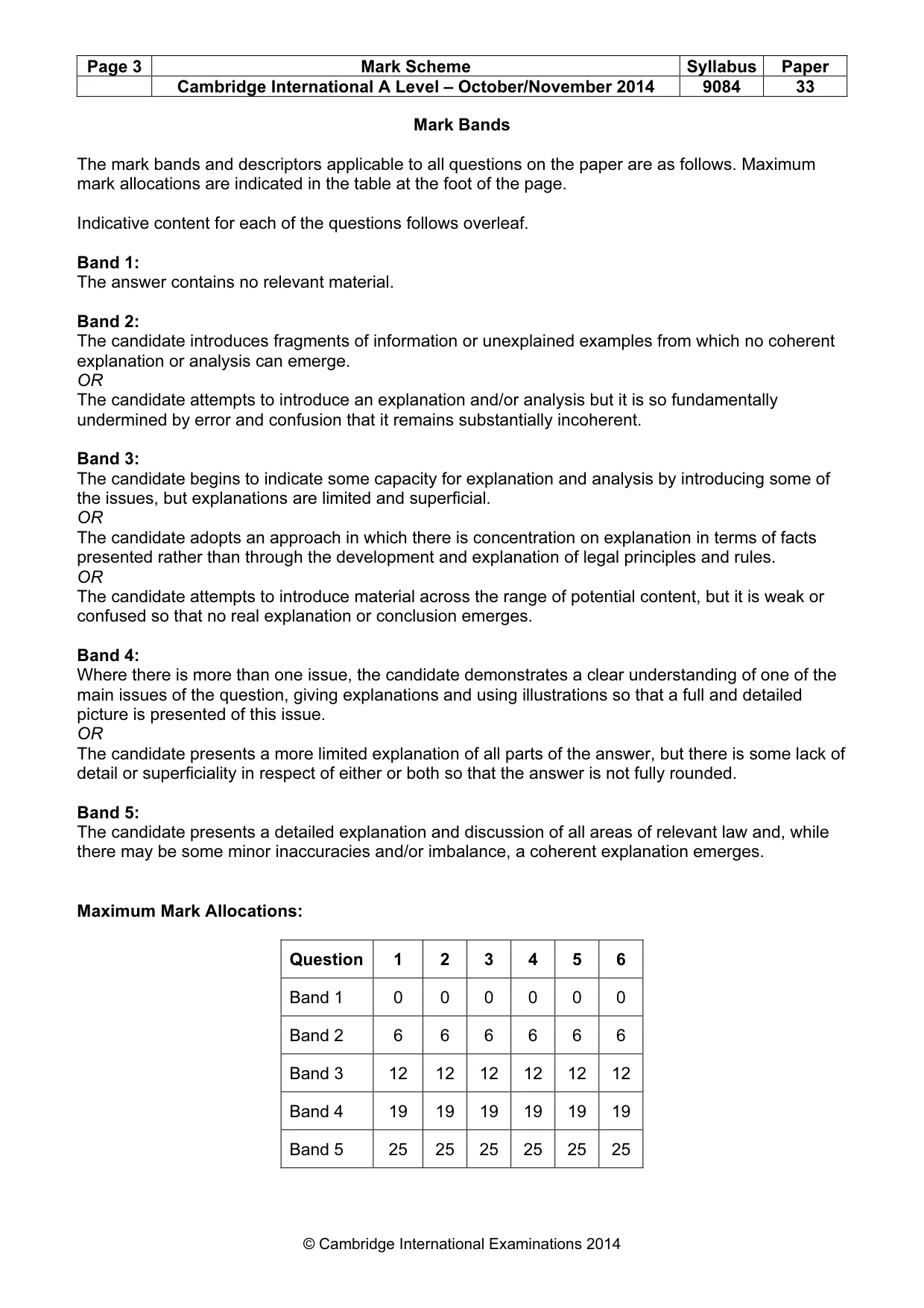
Page 3 Mark Scheme Syllabus Paper Cambridge International A Level – October/November 2014 9084 33 © Cambridge International Examinations 2014 Mark Bands The mark bands and descriptors applicable to all questions on the paper are as follows. Maximum mark allocations are indicated in the table at the foot of the page. Indicative content for each of the questions follows overleaf. Band 1: The answer contains no relevant material. Band 2: The candidate introduces fragments of information or unexplained examples from which no coherent explanation or analysis can emerge. OR The candidate attempts to introduce an explanation and/or analysis but it is so fundamentally undermined by error and confusion that it remains substantially incoherent. Band 3: The candidate begins to indicate some capacity for explanation and analysis by introducing some of the issues, but explanations are limited and superficial. OR The candidate adopts an approach in which there is concentration on explanation in terms of facts presented rather than through the development and explanation of legal principles and rules. OR The candidate attempts to introduce material across the range of potential content, but it is weak or confused so that no real explanation or conclusion emerges. Band 4: Where there is more than one issue, the candidate demonstrates a clear understanding of one of the main issues of the question, giving explanations and using illustrations so that a full and detailed picture is presented of this issue. OR The candidate presents a more limited explanation of all parts of the answer, but there is some lack of detail or superficiality in respect of either or both so that the answer is not fully rounded. Band 5: The candidate presents a detailed explanation and discussion of all areas of relevant law and, while there may be some minor inaccuracies and/or imbalance, a coherent explanation emerges. Maximum Mark Allocations: Question 1 2 3 4 5 6 Band 1 0 0 0 0 0 0 Band 2 6 6 6 6 6 6 Band 3 12 12 12 12 12 12 Band 4 19 19 19 19 19 19 Band 5 25 25 25 25 25 25
Mark scheme, page 4
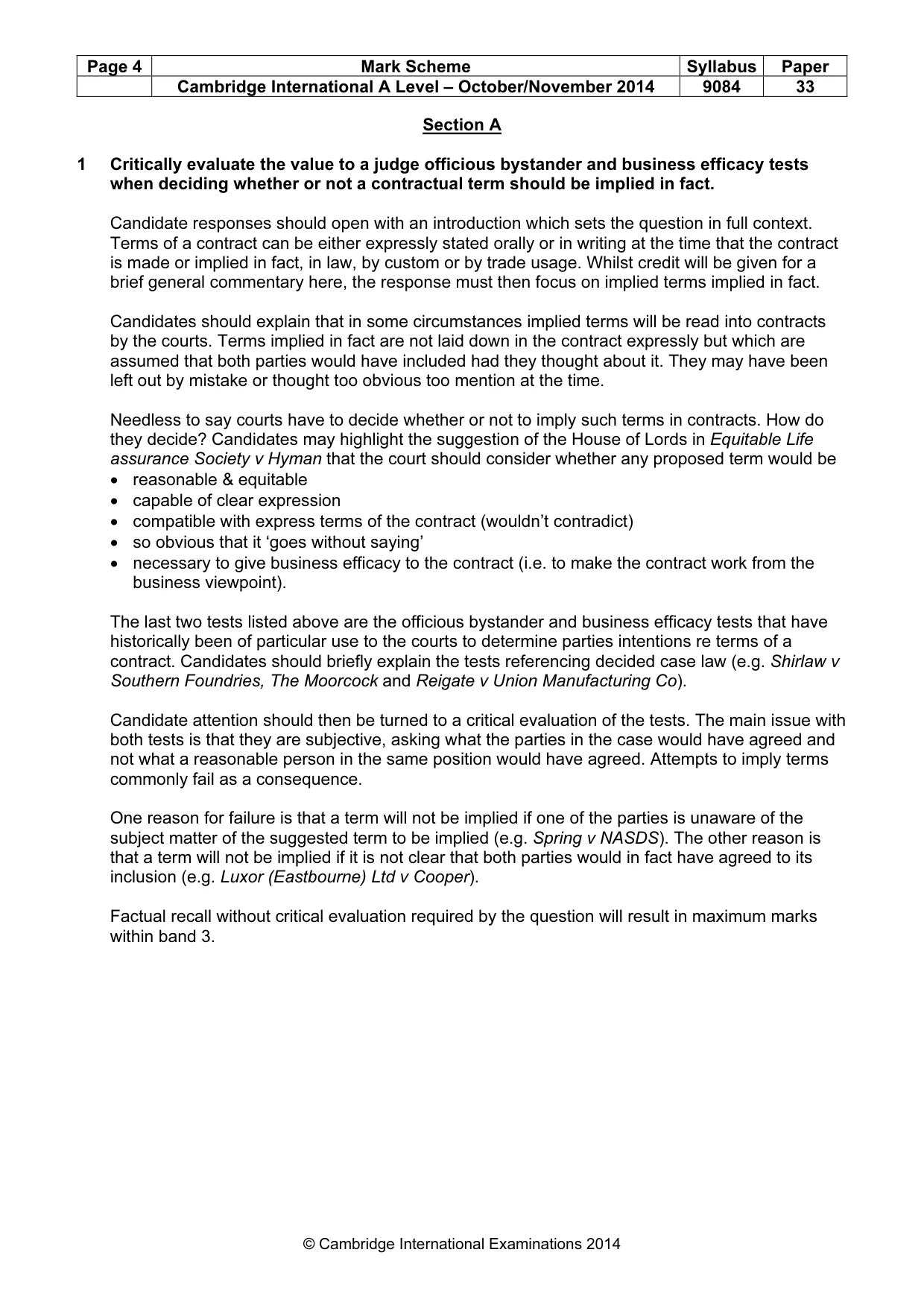
Page 4 Mark Scheme Syllabus Paper Cambridge International A Level – October/November 2014 9084 33 © Cambridge International Examinations 2014 Section A 1 Critically evaluate the value to a judge officious bystander and business efficacy tests when deciding whether or not a contractual term should be implied in fact. Candidate responses should open with an introduction which sets the question in full context. Terms of a contract can be either expressly stated orally or in writing at the time that the contract is made or implied in fact, in law, by custom or by trade usage. Whilst credit will be given for a brief general commentary here, the response must then focus on implied terms implied in fact. Candidates should explain that in some circumstances implied terms will be read into contracts by the courts. Terms implied in fact are not laid down in the contract expressly but which are assumed that both parties would have included had they thought about it. They may have been left out by mistake or thought too obvious too mention at the time. Needless to say courts have to decide whether or not to imply such terms in contracts. How do they decide? Candidates may highlight the suggestion of the House of Lords in Equitable Life assurance Society v Hyman that the court should consider whether any proposed term would be • reasonable & equitable • capable of clear expression • compatible with express terms of the contract (wouldn’t contradict) • so obvious that it ‘goes without saying’ • necessary to give business efficacy to the contract (i.e. to make the contract work from the business viewpoint). The last two tests listed above are the officious bystander and business efficacy tests that have historically been of particular use to the courts to determine parties intentions re terms of a contract. Candidates should briefly explain the tests referencing decided case law (e.g. Shirlaw v Southern Foundries, The Moorcock and Reigate v Union Manufacturing Co). Candidate attention should then be turned to a critical evaluation of the tests. The main issue with both tests is that they are subjective, asking what the parties in the case would have agreed and not what a reasonable person in the same position would have agreed. Attempts to imply terms commonly fail as a consequence. One reason for failure is that a term will not be implied if one of the parties is unaware of the subject matter of the suggested term to be implied (e.g. Spring v NASDS). The other reason is that a term will not be implied if it is not clear that both parties would in fact have agreed to its inclusion (e.g. Luxor (Eastbourne) Ltd v Cooper). Factual recall without critical evaluation required by the question will result in maximum marks within band 3.
Mark scheme, page 5
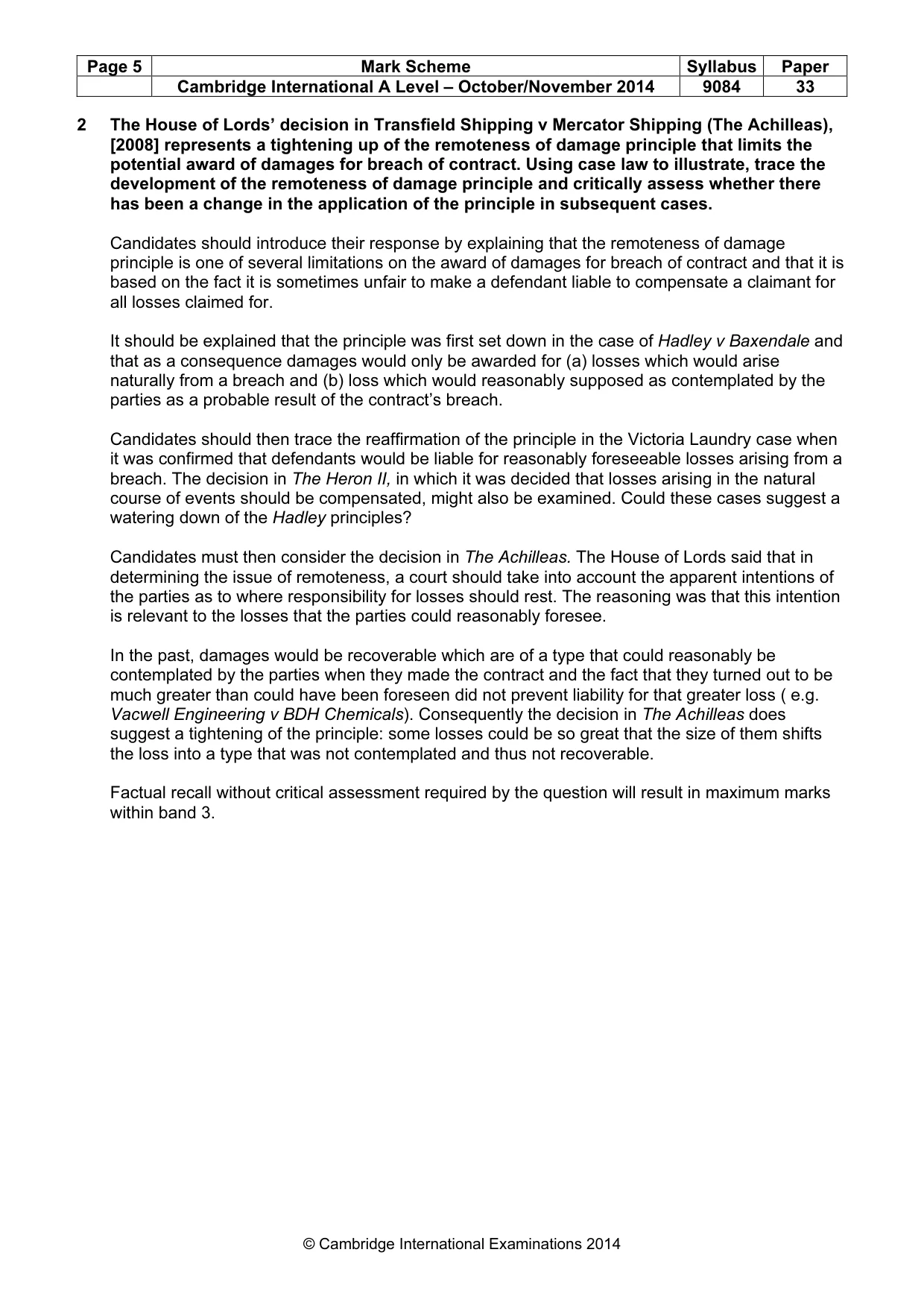
Page 5 Mark Scheme Syllabus Paper Cambridge International A Level – October/November 2014 9084 33 © Cambridge International Examinations 2014 2 The House of Lords’ decision in Transfield Shipping v Mercator Shipping (The Achilleas), [2008] represents a tightening up of the remoteness of damage principle that limits the potential award of damages for breach of contract. Using case law to illustrate, trace the development of the remoteness of damage principle and critically assess whether there has been a change in the application of the principle in subsequent cases. Candidates should introduce their response by explaining that the remoteness of damage principle is one of several limitations on the award of damages for breach of contract and that it is based on the fact it is sometimes unfair to make a defendant liable to compensate a claimant for all losses claimed for. It should be explained that the principle was first set down in the case of Hadley v Baxendale and that as a consequence damages would only be awarded for (a) losses which would arise naturally from a breach and (b) loss which would reasonably supposed as contemplated by the parties as a probable result of the contract’s breach. Candidates should then trace the reaffirmation of the principle in the Victoria Laundry case when it was confirmed that defendants would be liable for reasonably foreseeable losses arising from a breach. The decision in The Heron II, in which it was decided that losses arising in the natural course of events should be compensated, might also be examined. Could these cases suggest a watering down of the Hadley principles? Candidates must then consider the decision in The Achilleas. The House of Lords said that in determining the issue of remoteness, a court should take into account the apparent intentions of the parties as to where responsibility for losses should rest. The reasoning was that this intention is relevant to the losses that the parties could reasonably foresee. In the past, damages would be recoverable which are of a type that could reasonably be contemplated by the parties when they made the contract and the fact that they turned out to be much greater than could have been foreseen did not prevent liability for that greater loss ( e.g. Vacwell Engineering v BDH Chemicals). Consequently the decision in The Achilleas does suggest a tightening of the principle: some losses could be so great that the size of them shifts the loss into a type that was not contemplated and thus not recoverable. Factual recall without critical assessment required by the question will result in maximum marks within band 3.
Mark scheme, page 6
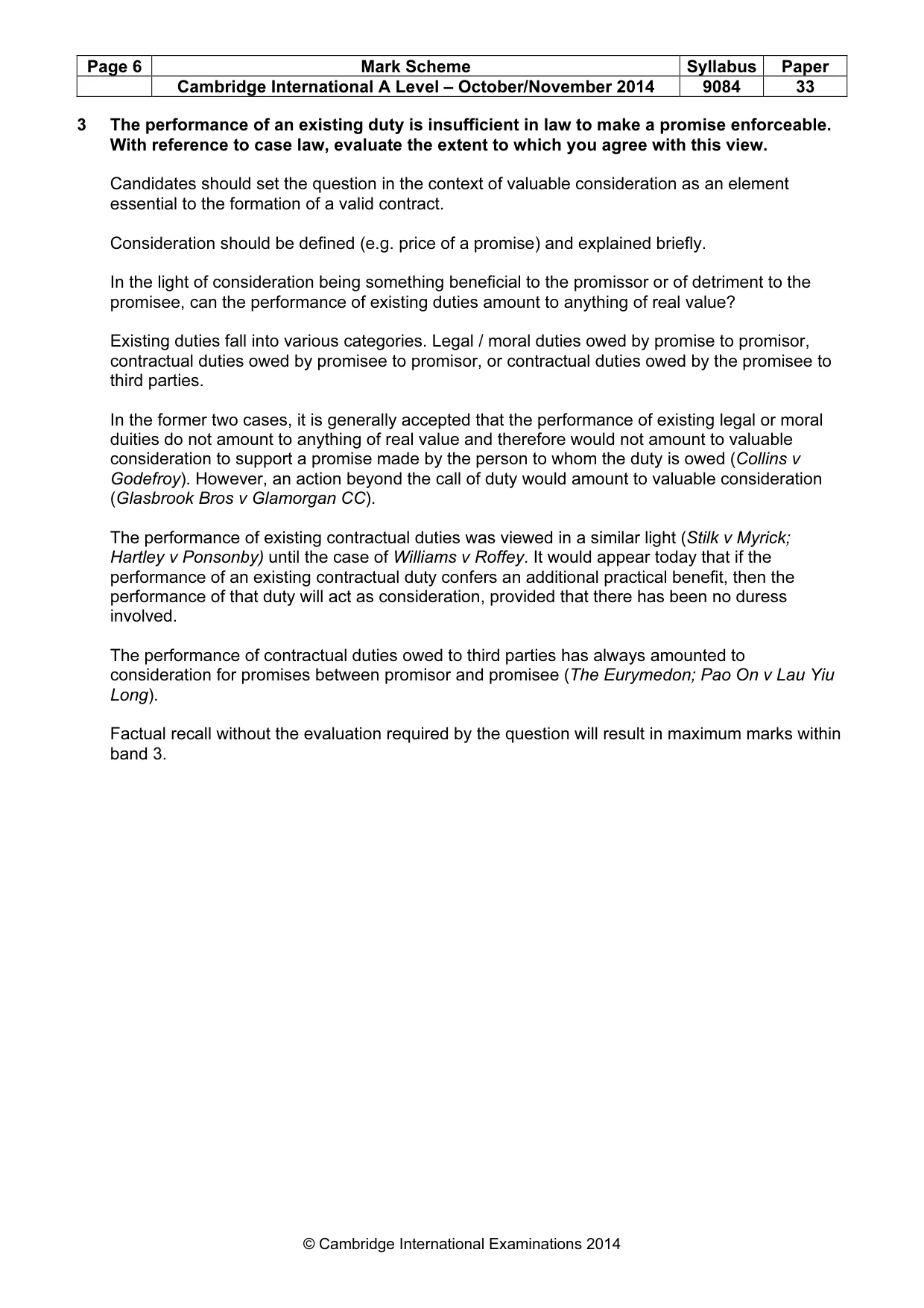
Page 6 Mark Scheme Syllabus Paper Cambridge International A Level – October/November 2014 9084 33 © Cambridge International Examinations 2014 3 The performance of an existing duty is insufficient in law to make a promise enforceable. With reference to case law, evaluate the extent to which you agree with this view. Candidates should set the question in the context of valuable consideration as an element essential to the formation of a valid contract. Consideration should be defined (e.g. price of a promise) and explained briefly. In the light of consideration being something beneficial to the promissor or of detriment to the promisee, can the performance of existing duties amount to anything of real value? Existing duties fall into various categories. Legal / moral duties owed by promise to promisor, contractual duties owed by promisee to promisor, or contractual duties owed by the promisee to third parties. In the former two cases, it is generally accepted that the performance of existing legal or moral duities do not amount to anything of real value and therefore would not amount to valuable consideration to support a promise made by the person to whom the duty is owed (Collins v Godefroy). However, an action beyond the call of duty would amount to valuable consideration (Glasbrook Bros v Glamorgan CC). The performance of existing contractual duties was viewed in a similar light (Stilk v Myrick; Hartley v Ponsonby) until the case of Williams v Roffey. It would appear today that if the performance of an existing contractual duty confers an additional practical benefit, then the performance of that duty will act as consideration, provided that there has been no duress involved. The performance of contractual duties owed to third parties has always amounted to consideration for promises between promisor and promisee (The Eurymedon; Pao On v Lau Yiu Long). Factual recall without the evaluation required by the question will result in maximum marks within band 3.
Mark scheme, page 7
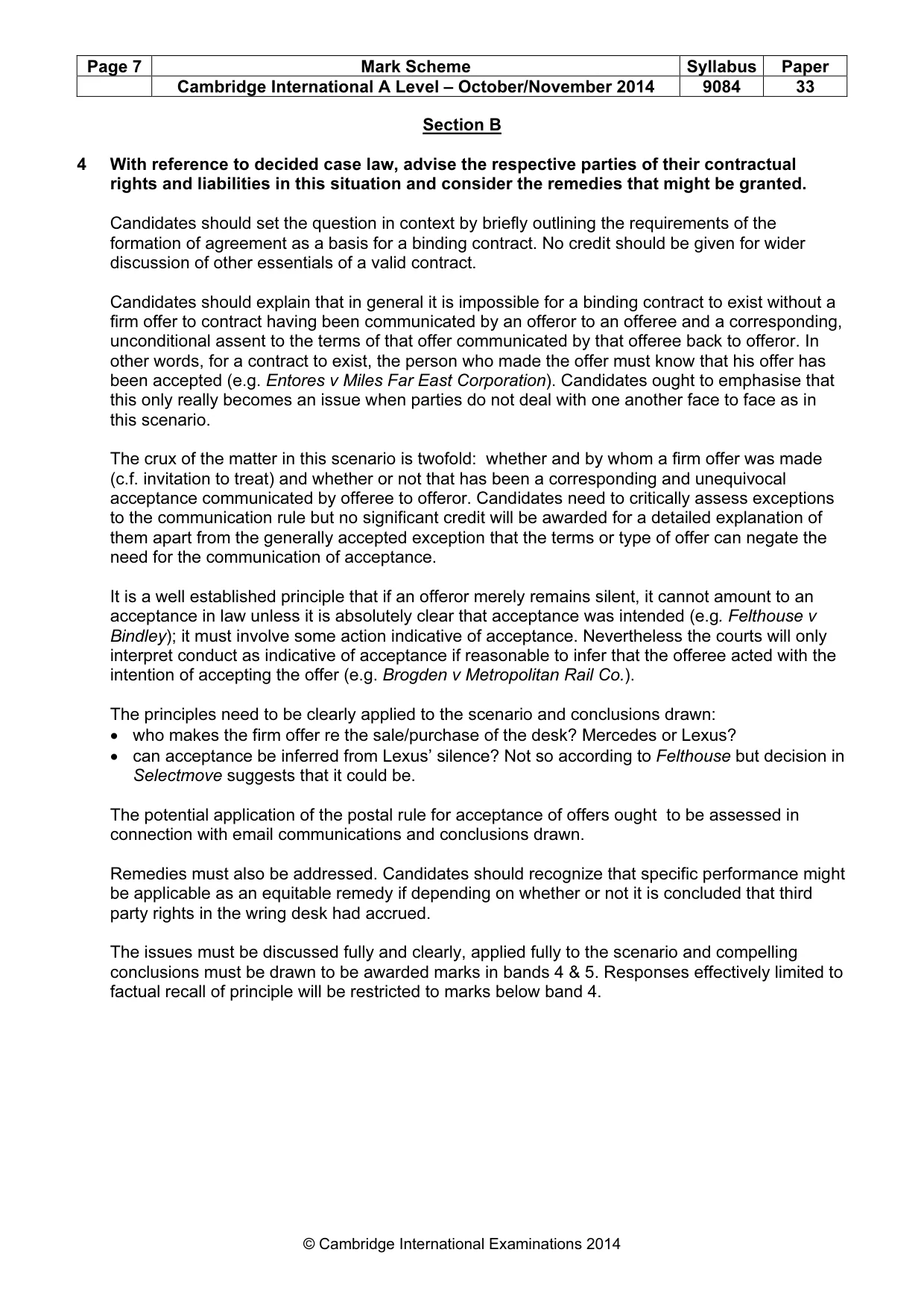
Page 7 Mark Scheme Syllabus Paper Cambridge International A Level – October/November 2014 9084 33 © Cambridge International Examinations 2014 Section B 4 With reference to decided case law, advise the respective parties of their contractual rights and liabilities in this situation and consider the remedies that might be granted. Candidates should set the question in context by briefly outlining the requirements of the formation of agreement as a basis for a binding contract. No credit should be given for wider discussion of other essentials of a valid contract. Candidates should explain that in general it is impossible for a binding contract to exist without a firm offer to contract having been communicated by an offeror to an offeree and a corresponding, unconditional assent to the terms of that offer communicated by that offeree back to offeror. In other words, for a contract to exist, the person who made the offer must know that his offer has been accepted (e.g. Entores v Miles Far East Corporation). Candidates ought to emphasise that this only really becomes an issue when parties do not deal with one another face to face as in this scenario. The crux of the matter in this scenario is twofold: whether and by whom a firm offer was made (c.f. invitation to treat) and whether or not that has been a corresponding and unequivocal acceptance communicated by offeree to offeror. Candidates need to critically assess exceptions to the communication rule but no significant credit will be awarded for a detailed explanation of them apart from the generally accepted exception that the terms or type of offer can negate the need for the communication of acceptance. It is a well established principle that if an offeror merely remains silent, it cannot amount to an acceptance in law unless it is absolutely clear that acceptance was intended (e.g. Felthouse v Bindley); it must involve some action indicative of acceptance. Nevertheless the courts will only interpret conduct as indicative of acceptance if reasonable to infer that the offeree acted with the intention of accepting the offer (e.g. Brogden v Metropolitan Rail Co.). The principles need to be clearly applied to the scenario and conclusions drawn: • who makes the firm offer re the sale/purchase of the desk? Mercedes or Lexus? • can acceptance be inferred from Lexus’ silence? Not so according to Felthouse but decision in Selectmove suggests that it could be. The potential application of the postal rule for acceptance of offers ought to be assessed in connection with email communications and conclusions drawn. Remedies must also be addressed. Candidates should recognize that specific performance might be applicable as an equitable remedy if depending on whether or not it is concluded that third party rights in the wring desk had accrued. The issues must be discussed fully and clearly, applied fully to the scenario and compelling conclusions must be drawn to be awarded marks in bands 4 & 5. Responses effectively limited to factual recall of principle will be restricted to marks below band 4.
Mark scheme, page 8
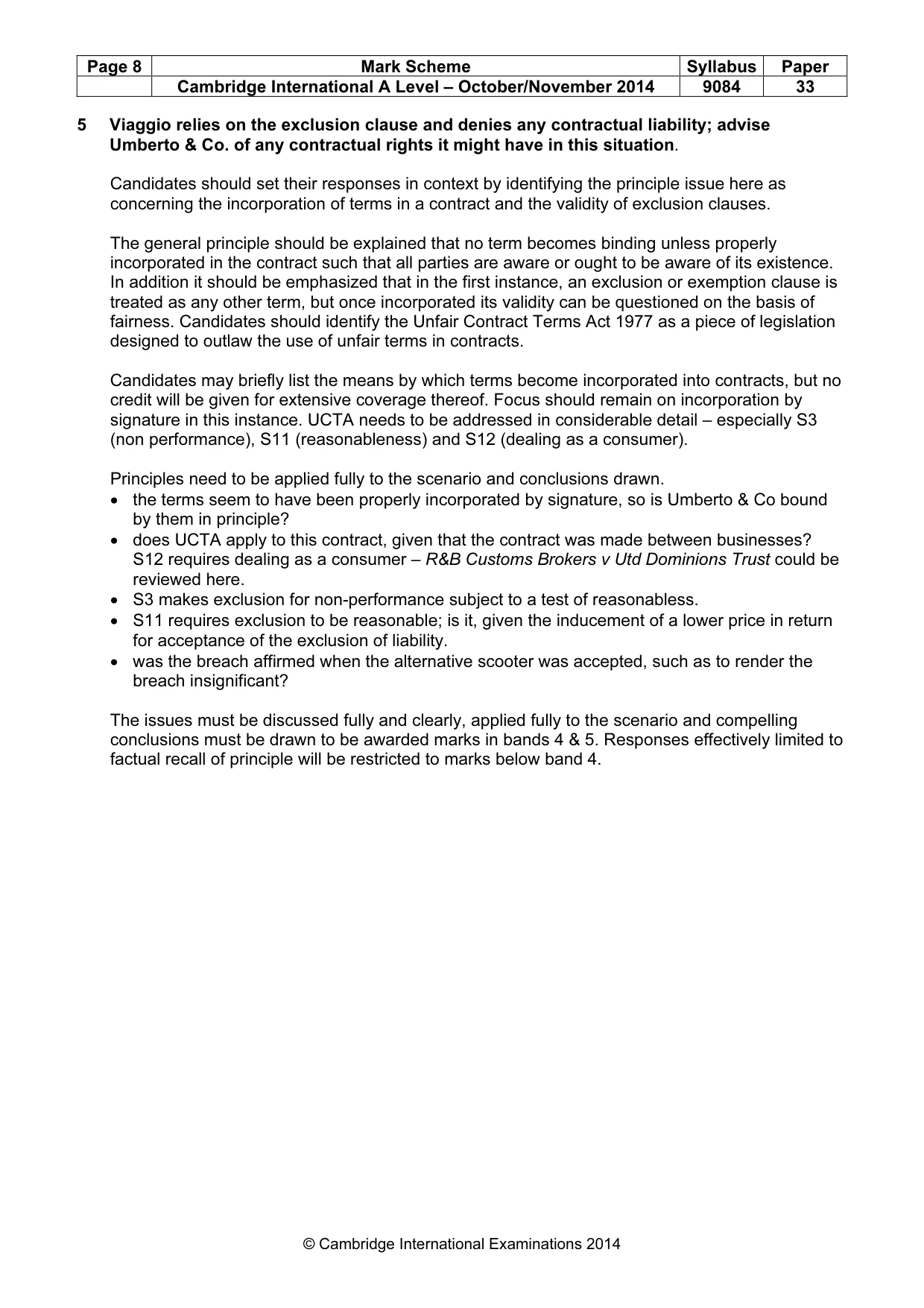
Page 8 Mark Scheme Syllabus Paper Cambridge International A Level – October/November 2014 9084 33 © Cambridge International Examinations 2014 5 Viaggio relies on the exclusion clause and denies any contractual liability; advise Umberto & Co. of any contractual rights it might have in this situation. Candidates should set their responses in context by identifying the principle issue here as concerning the incorporation of terms in a contract and the validity of exclusion clauses. The general principle should be explained that no term becomes binding unless properly incorporated in the contract such that all parties are aware or ought to be aware of its existence. In addition it should be emphasized that in the first instance, an exclusion or exemption clause is treated as any other term, but once incorporated its validity can be questioned on the basis of fairness. Candidates should identify the Unfair Contract Terms Act 1977 as a piece of legislation designed to outlaw the use of unfair terms in contracts. Candidates may briefly list the means by which terms become incorporated into contracts, but no credit will be given for extensive coverage thereof. Focus should remain on incorporation by signature in this instance. UCTA needs to be addressed in considerable detail – especially S3 (non performance), S11 (reasonableness) and S12 (dealing as a consumer). Principles need to be applied fully to the scenario and conclusions drawn. • the terms seem to have been properly incorporated by signature, so is Umberto & Co bound by them in principle? • does UCTA apply to this contract, given that the contract was made between businesses? S12 requires dealing as a consumer – R&B Customs Brokers v Utd Dominions Trust could be reviewed here. • S3 makes exclusion for non-performance subject to a test of reasonabless. • S11 requires exclusion to be reasonable; is it, given the inducement of a lower price in return for acceptance of the exclusion of liability. • was the breach affirmed when the alternative scooter was accepted, such as to render the breach insignificant? The issues must be discussed fully and clearly, applied fully to the scenario and compelling conclusions must be drawn to be awarded marks in bands 4 & 5. Responses effectively limited to factual recall of principle will be restricted to marks below band 4.
Mark scheme, page 9
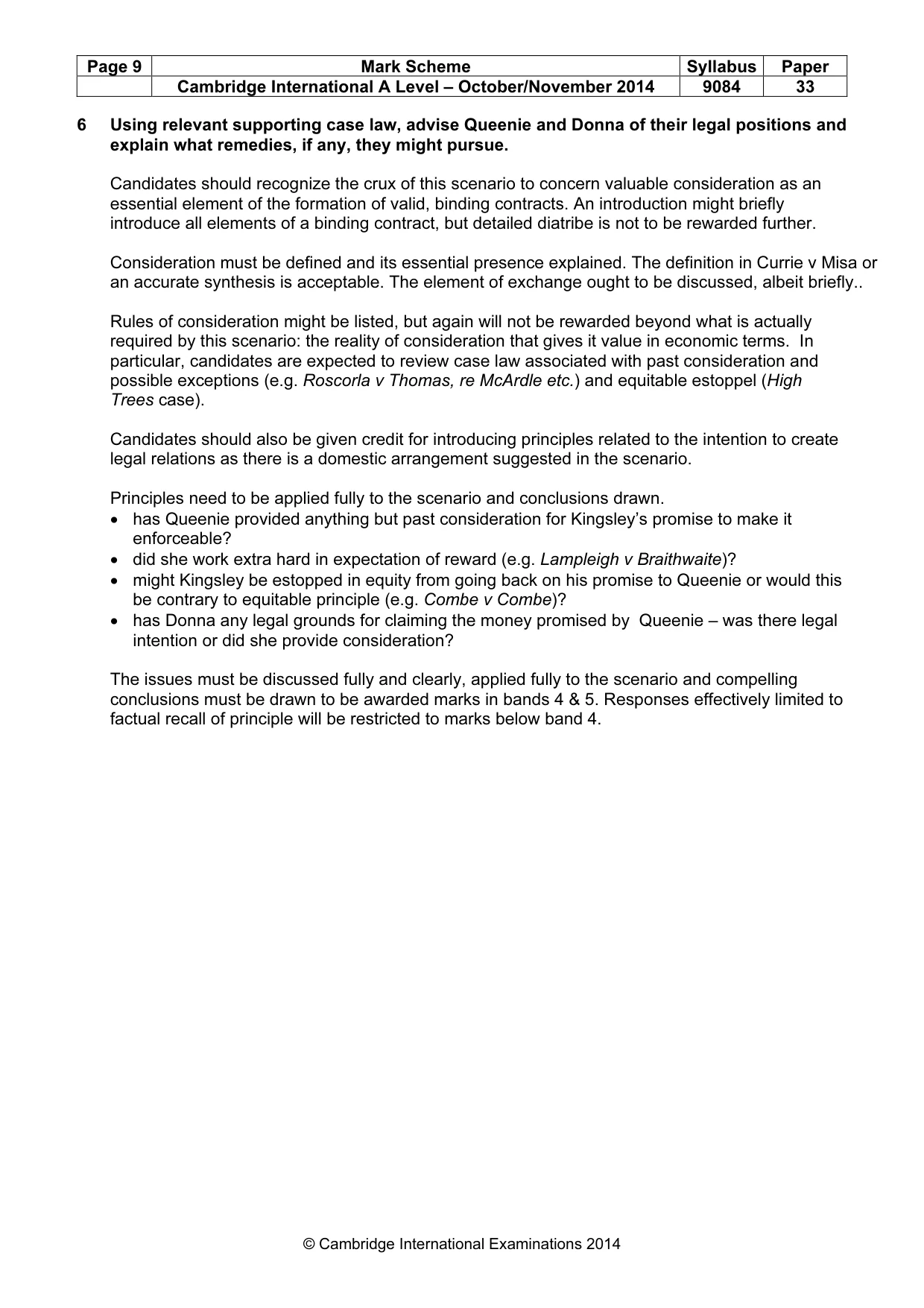
Page 9 Mark Scheme Syllabus Paper Cambridge International A Level – October/November 2014 9084 33 © Cambridge International Examinations 2014 6 Using relevant supporting case law, advise Queenie and Donna of their legal positions and explain what remedies, if any, they might pursue. Candidates should recognize the crux of this scenario to concern valuable consideration as an essential element of the formation of valid, binding contracts. An introduction might briefly introduce all elements of a binding contract, but detailed diatribe is not to be rewarded further. Consideration must be defined and its essential presence explained. The definition in Currie v Misa or an accurate synthesis is acceptable. The element of exchange ought to be discussed, albeit briefly.. Rules of consideration might be listed, but again will not be rewarded beyond what is actually required by this scenario: the reality of consideration that gives it value in economic terms. In particular, candidates are expected to review case law associated with past consideration and possible exceptions (e.g. Roscorla v Thomas, re McArdle etc.) and equitable estoppel (High Trees case). Candidates should also be given credit for introducing principles related to the intention to create legal relations as there is a domestic arrangement suggested in the scenario. Principles need to be applied fully to the scenario and conclusions drawn. • has Queenie provided anything but past consideration for Kingsley’s promise to make it enforceable? • did she work extra hard in expectation of reward (e.g. Lampleigh v Braithwaite)? • might Kingsley be estopped in equity from going back on his promise to Queenie or would this be contrary to equitable principle (e.g. Combe v Combe)? • has Donna any legal grounds for claiming the money promised by Queenie – was there legal intention or did she provide consideration? The issues must be discussed fully and clearly, applied fully to the scenario and compelling conclusions must be drawn to be awarded marks in bands 4 & 5. Responses effectively limited to factual recall of principle will be restricted to marks below band 4.
What you needed in this session
Cambridge’s own grade thresholds for 2014 Oct/Nov, Paper 3 · Variant 3. A higher threshold means an easier paper — the bar moves with how the cohort did.