Cambridge A Level Law 9084 — 2010 May/June Paper 1 · Variant 3
9084/13/M/J/10 · 75 marks · ≈84 min
The question paper and its mark scheme, free to read here and free to download. This is Cambridge’s own paper, exactly as it was sat.
Question paper2 pages
Mark scheme4 pages
Answers below. Sit the paper first if you are practising.
Paper as text
Question paper, page 1
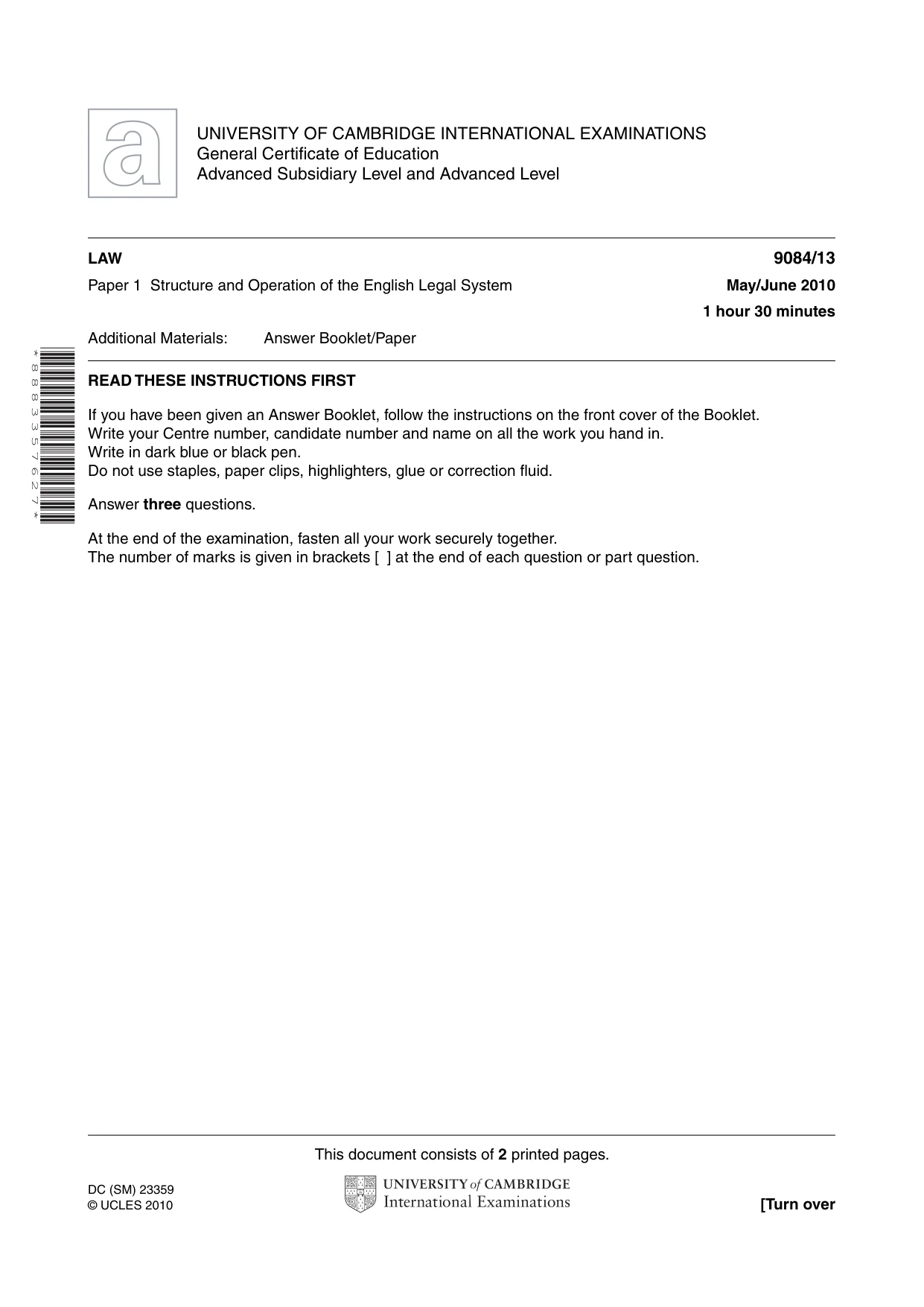
This document consists of 2 printed pages. DC (SM) 23359 © UCLES 2010 [Turn over UNIVERSITY OF CAMBRIDGE INTERNATIONAL EXAMINATIONS General Certificate of Education Advanced Subsidiary Level and Advanced Level READ THESE INSTRUCTIONS FIRST If you have been given an Answer Booklet, follow the instructions on the front cover of the Booklet. Write your Centre number, candidate number and name on all the work you hand in. Write in dark blue or black pen. Do not use staples, paper clips, highlighters, glue or correction fluid. Answer three questions. At the end of the examination, fasten all your work securely together. The number of marks is given in brackets [ ] at the end of each question or part question. * 8 8 8 3 3 5 7 6 2 7 * LAW 9084/13 Paper 1 Structure and Operation of the English Legal System May/June 2010 1 hour 30 minutes Additional Materials: Answer Booklet/Paper
Question paper, page 2
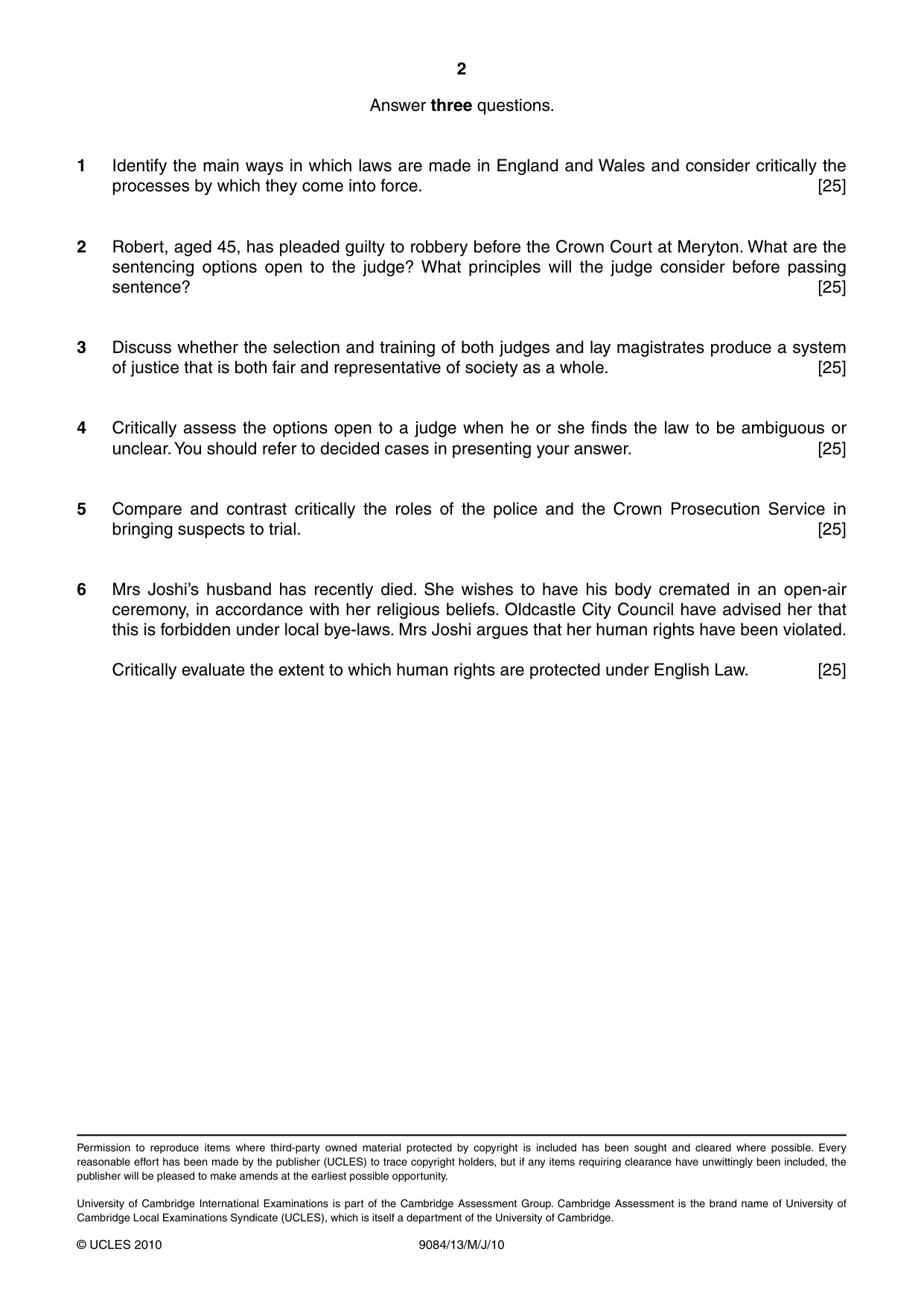
2 9084/13/M/J/10 © UCLES 2010 Answer three questions. 1 Identify the main ways in which laws are made in England and Wales and consider critically the processes by which they come into force. [25] 2 Robert, aged 45, has pleaded guilty to robbery before the Crown Court at Meryton. What are the sentencing options open to the judge? What principles will the judge consider before passing sentence? [25] 3 Discuss whether the selection and training of both judges and lay magistrates produce a system of justice that is both fair and representative of society as a whole. [25] 4 Critically assess the options open to a judge when he or she finds the law to be ambiguous or unclear. You should refer to decided cases in presenting your answer. [25] 5 Compare and contrast critically the roles of the police and the Crown Prosecution Service in bringing suspects to trial. [25] 6 Mrs Joshi’s husband has recently died. She wishes to have his body cremated in an open-air ceremony, in accordance with her religious beliefs. Oldcastle City Council have advised her that this is forbidden under local bye-laws. Mrs Joshi argues that her human rights have been violated. Critically evaluate the extent to which human rights are protected under English Law. [25] Permission to reproduce items where third-party owned material protected by copyright is included has been sought and cleared where possible. Every reasonable effort has been made by the publisher (UCLES) to trace copyright holders, but if any items requiring clearance have unwittingly been included, the publisher will be pleased to make amends at the earliest possible opportunity. University of Cambridge International Examinations is part of the Cambridge Assessment Group. Cambridge Assessment is the brand name of University of Cambridge Local Examinations Syndicate (UCLES), which is itself a department of the University of Cambridge.
Mark scheme, page 1
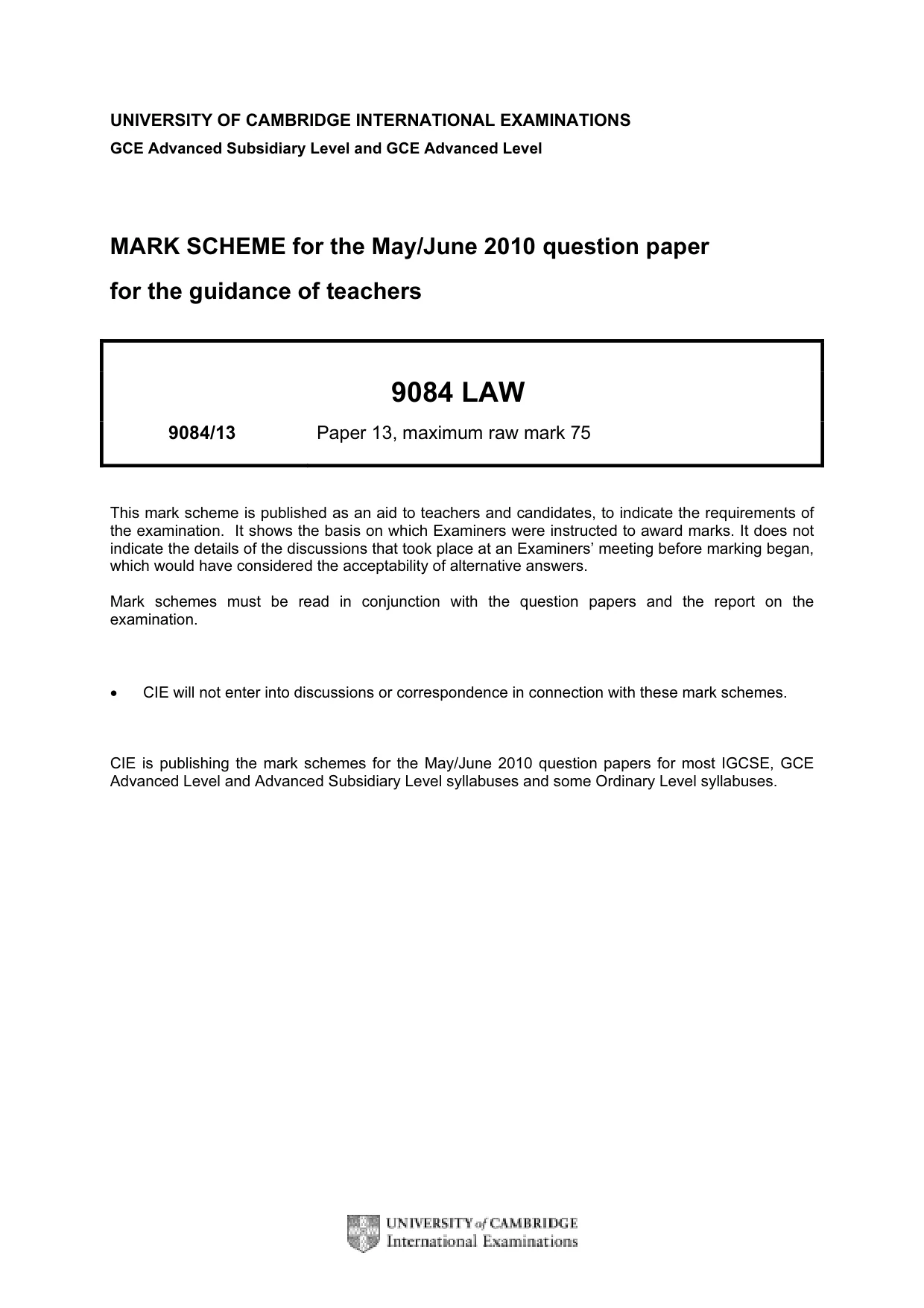
UNIVERSITY OF CAMBRIDGE INTERNATIONAL EXAMINATIONS GCE Advanced Subsidiary Level and GCE Advanced Level MARK SCHEME for the May/June 2010 question paper for the guidance of teachers 9084 LAW 9084/13 Paper 13, maximum raw mark 75 This mark scheme is published as an aid to teachers and candidates, to indicate the requirements of the examination. It shows the basis on which Examiners were instructed to award marks. It does not indicate the details of the discussions that took place at an Examiners’ meeting before marking began, which would have considered the acceptability of alternative answers. Mark schemes must be read in conjunction with the question papers and the report on the examination. • CIE will not enter into discussions or correspondence in connection with these mark schemes. CIE is publishing the mark schemes for the May/June 2010 question papers for most IGCSE, GCE Advanced Level and Advanced Subsidiary Level syllabuses and some Ordinary Level syllabuses.
Mark scheme, page 2
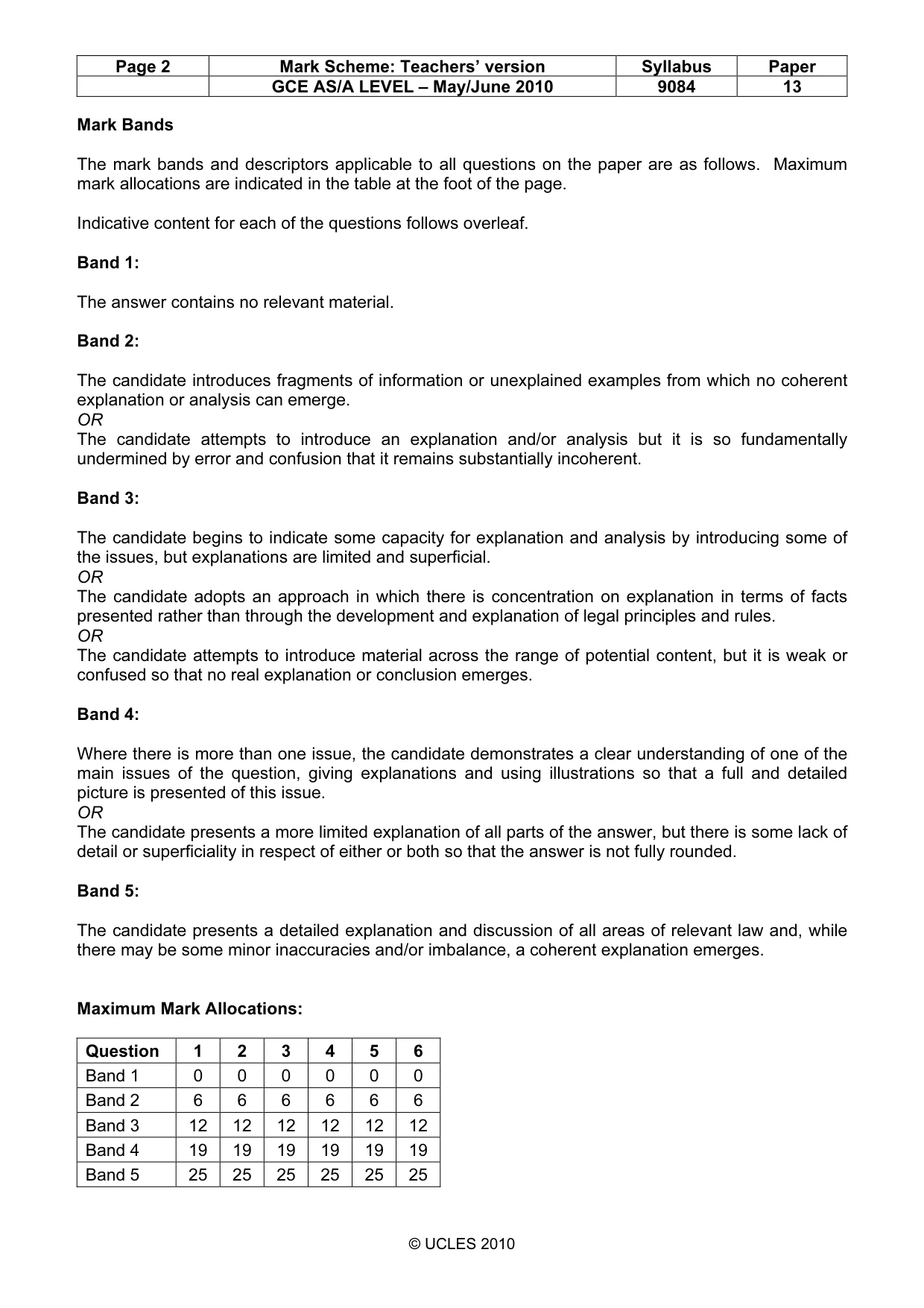
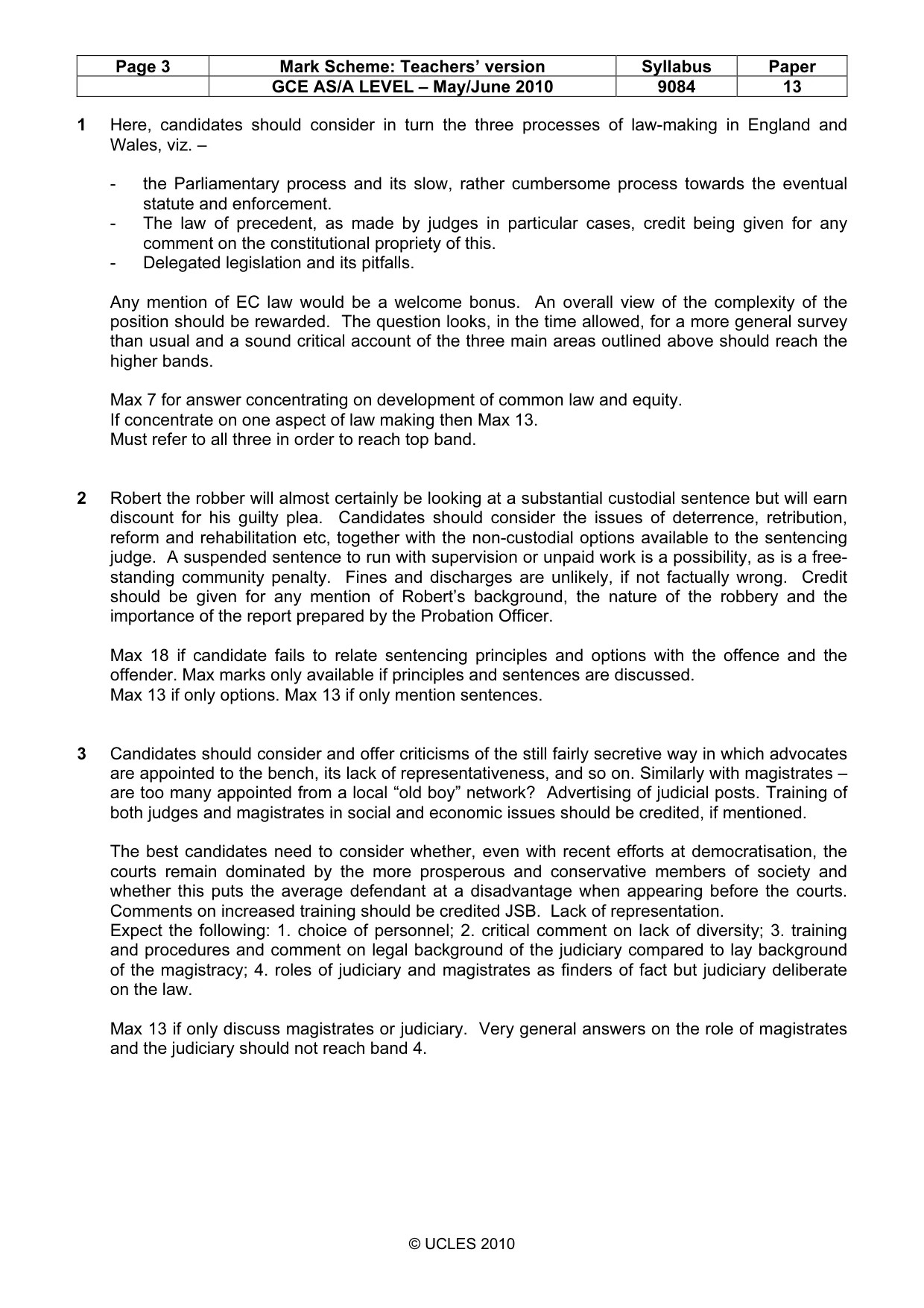
Page 2 Mark Scheme: Teachers’ version Syllabus Paper GCE AS/A LEVEL – May/June 2010 9084 13 © UCLES 2010 Mark Bands The mark bands and descriptors applicable to all questions on the paper are as follows. Maximum mark allocations are indicated in the table at the foot of the page. Indicative content for each of the questions follows overleaf. Band 1: The answer contains no relevant material. Band 2: The candidate introduces fragments of information or unexplained examples from which no coherent explanation or analysis can emerge. OR The candidate attempts to introduce an explanation and/or analysis but it is so fundamentally undermined by error and confusion that it remains substantially incoherent. Band 3: The candidate begins to indicate some capacity for explanation and analysis by introducing some of the issues, but explanations are limited and superficial. OR The candidate adopts an approach in which there is concentration on explanation in terms of facts presented rather than through the development and explanation of legal principles and rules. OR The candidate attempts to introduce material across the range of potential content, but it is weak or confused so that no real explanation or conclusion emerges. Band 4: Where there is more than one issue, the candidate demonstrates a clear understanding of one of the main issues of the question, giving explanations and using illustrations so that a full and detailed picture is presented of this issue. OR The candidate presents a more limited explanation of all parts of the answer, but there is some lack of detail or superficiality in respect of either or both so that the answer is not fully rounded. Band 5: The candidate presents a detailed explanation and discussion of all areas of relevant law and, while there may be some minor inaccuracies and/or imbalance, a coherent explanation emerges. Maximum Mark Allocations: Question 1 2 3 4 5 6 Band 1 0 0 0 0 0 0 Band 2 6 6 6 6 6 6 Band 3 12 12 12 12 12 12 Band 4 19 19 19 19 19 19 Band 5 25 25 25 25 25 25
Mark scheme, page 3
Page 3 Mark Scheme: Teachers’ version Syllabus Paper GCE AS/A LEVEL – May/June 2010 9084 13 © UCLES 2010 1 Here, candidates should consider in turn the three processes of law-making in England and Wales, viz. – - the Parliamentary process and its slow, rather cumbersome process towards the eventual statute and enforcement. - The law of precedent, as made by judges in particular cases, credit being given for any comment on the constitutional propriety of this. - Delegated legislation and its pitfalls. Any mention of EC law would be a welcome bonus. An overall view of the complexity of the position should be rewarded. The question looks, in the time allowed, for a more general survey than usual and a sound critical account of the three main areas outlined above should reach the higher bands. Max 7 for answer concentrating on development of common law and equity. If concentrate on one aspect of law making then Max 13. Must refer to all three in order to reach top band. 2 Robert the robber will almost certainly be looking at a substantial custodial sentence but will earn discount for his guilty plea. Candidates should consider the issues of deterrence, retribution, reform and rehabilitation etc, together with the non-custodial options available to the sentencing judge. A suspended sentence to run with supervision or unpaid work is a possibility, as is a free- standing community penalty. Fines and discharges are unlikely, if not factually wrong. Credit should be given for any mention of Robert’s background, the nature of the robbery and the importance of the report prepared by the Probation Officer. Max 18 if candidate fails to relate sentencing principles and options with the offence and the offender. Max marks only available if principles and sentences are discussed. Max 13 if only options. Max 13 if only mention sentences. 3 Candidates should consider and offer criticisms of the still fairly secretive way in which advocates are appointed to the bench, its lack of representativeness, and so on. Similarly with magistrates – are too many appointed from a local “old boy” network? Advertising of judicial posts. Training of both judges and magistrates in social and economic issues should be credited, if mentioned. The best candidates need to consider whether, even with recent efforts at democratisation, the courts remain dominated by the more prosperous and conservative members of society and whether this puts the average defendant at a disadvantage when appearing before the courts. Comments on increased training should be credited JSB. Lack of representation. Expect the following: 1. choice of personnel; 2. critical comment on lack of diversity; 3. training and procedures and comment on legal background of the judiciary compared to lay background of the magistracy; 4. roles of judiciary and magistrates as finders of fact but judiciary deliberate on the law. Max 13 if only discuss magistrates or judiciary. Very general answers on the role of magistrates and the judiciary should not reach band 4.
Mark scheme, page 4
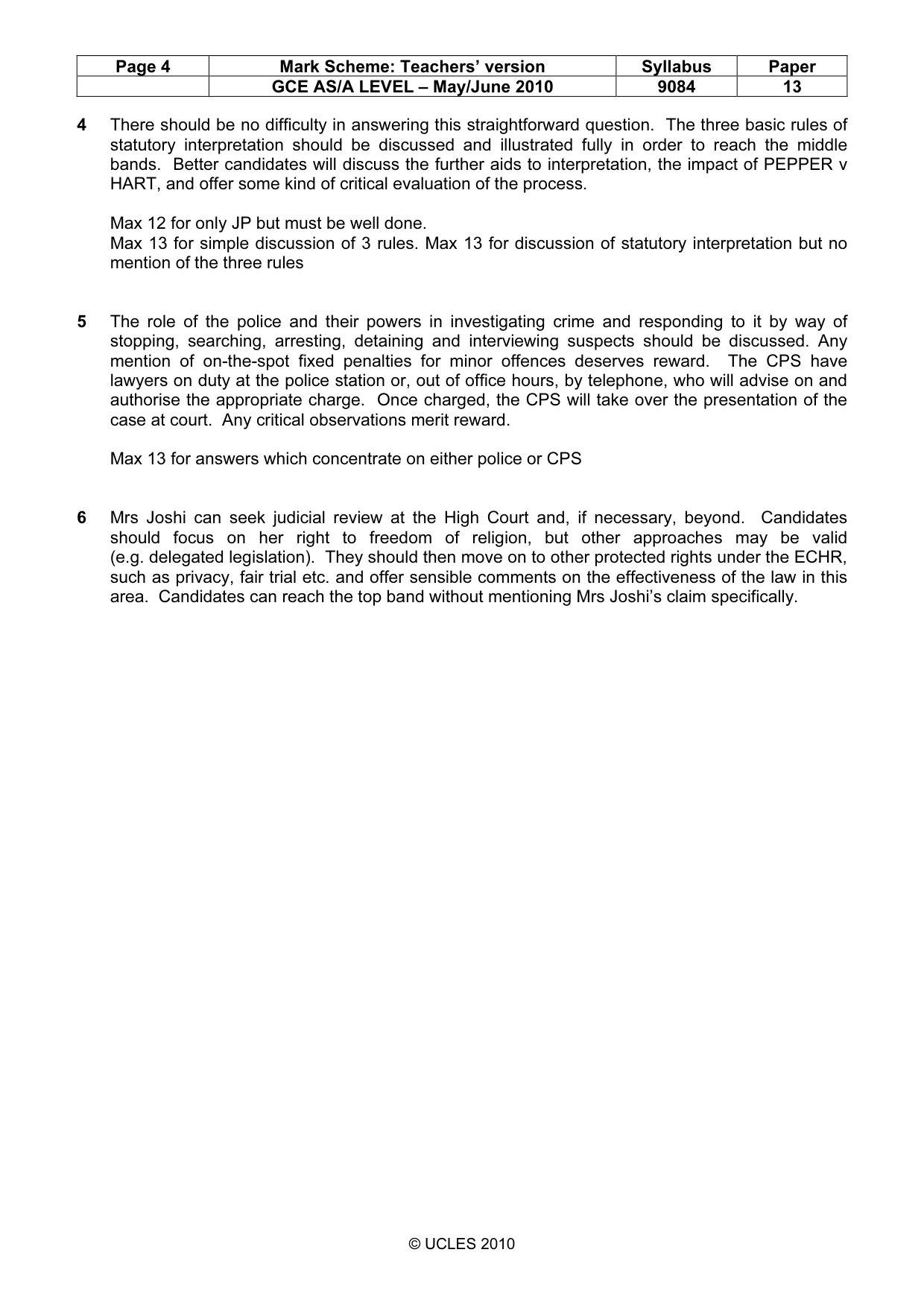
Page 4 Mark Scheme: Teachers’ version Syllabus Paper GCE AS/A LEVEL – May/June 2010 9084 13 © UCLES 2010 4 There should be no difficulty in answering this straightforward question. The three basic rules of statutory interpretation should be discussed and illustrated fully in order to reach the middle bands. Better candidates will discuss the further aids to interpretation, the impact of PEPPER v HART, and offer some kind of critical evaluation of the process. Max 12 for only JP but must be well done. Max 13 for simple discussion of 3 rules. Max 13 for discussion of statutory interpretation but no mention of the three rules 5 The role of the police and their powers in investigating crime and responding to it by way of stopping, searching, arresting, detaining and interviewing suspects should be discussed. Any mention of on-the-spot fixed penalties for minor offences deserves reward. The CPS have lawyers on duty at the police station or, out of office hours, by telephone, who will advise on and authorise the appropriate charge. Once charged, the CPS will take over the presentation of the case at court. Any critical observations merit reward. Max 13 for answers which concentrate on either police or CPS 6 Mrs Joshi can seek judicial review at the High Court and, if necessary, beyond. Candidates should focus on her right to freedom of religion, but other approaches may be valid (e.g. delegated legislation). They should then move on to other protected rights under the ECHR, such as privacy, fair trial etc. and offer sensible comments on the effectiveness of the law in this area. Candidates can reach the top band without mentioning Mrs Joshi’s claim specifically.
What you needed in this session
Cambridge’s own grade thresholds for 2010 May/June, Paper 1 · Variant 3. A higher threshold means an easier paper — the bar moves with how the cohort did.