Cambridge A Level Law 9084 — 2010 May/June Paper 1 · Variant 2
9084/12/M/J/10 · 75 marks · ≈84 min
The question paper and its mark scheme, free to read here and free to download. This is Cambridge’s own paper, exactly as it was sat.
Question paper2 pages
Mark scheme3 pages
Answers below. Sit the paper first if you are practising.
Paper as text
Question paper, page 1
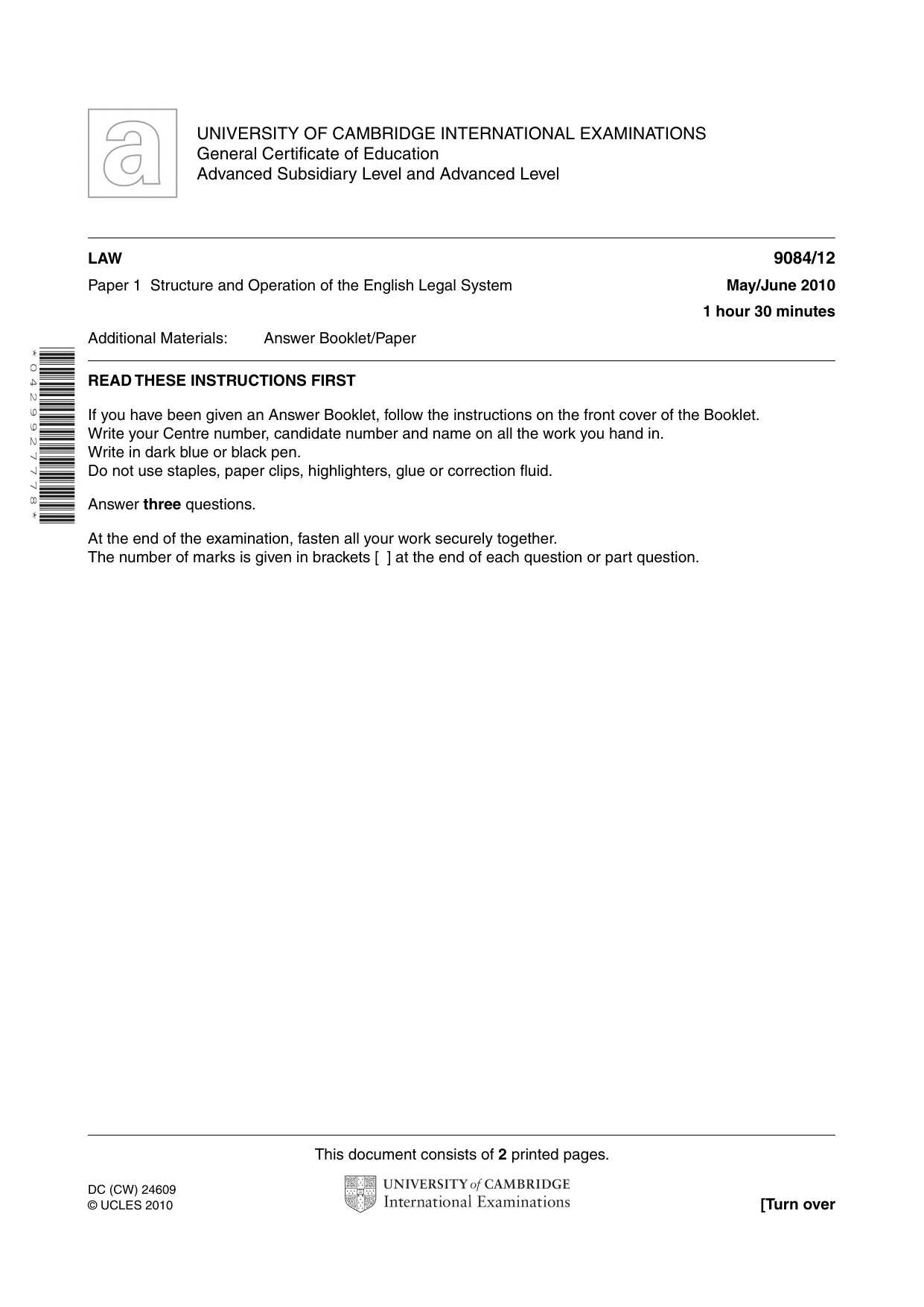
This document consists of 2 printed pages. DC (CW) 24609 © UCLES 2010 [Turn over UNIVERSITY OF CAMBRIDGE INTERNATIONAL EXAMINATIONS General Certificate of Education Advanced Subsidiary Level and Advanced Level READ THESE INSTRUCTIONS FIRST If you have been given an Answer Booklet, follow the instructions on the front cover of the Booklet. Write your Centre number, candidate number and name on all the work you hand in. Write in dark blue or black pen. Do not use staples, paper clips, highlighters, glue or correction fluid. Answer three questions. At the end of the examination, fasten all your work securely together. The number of marks is given in brackets [ ] at the end of each question or part question. * 0 4 2 9 9 2 7 7 7 8 * LAW 9084/12 Paper 1 Structure and Operation of the English Legal System May/June 2010 1 hour 30 minutes Additional Materials: Answer Booklet/Paper
Question paper, page 2
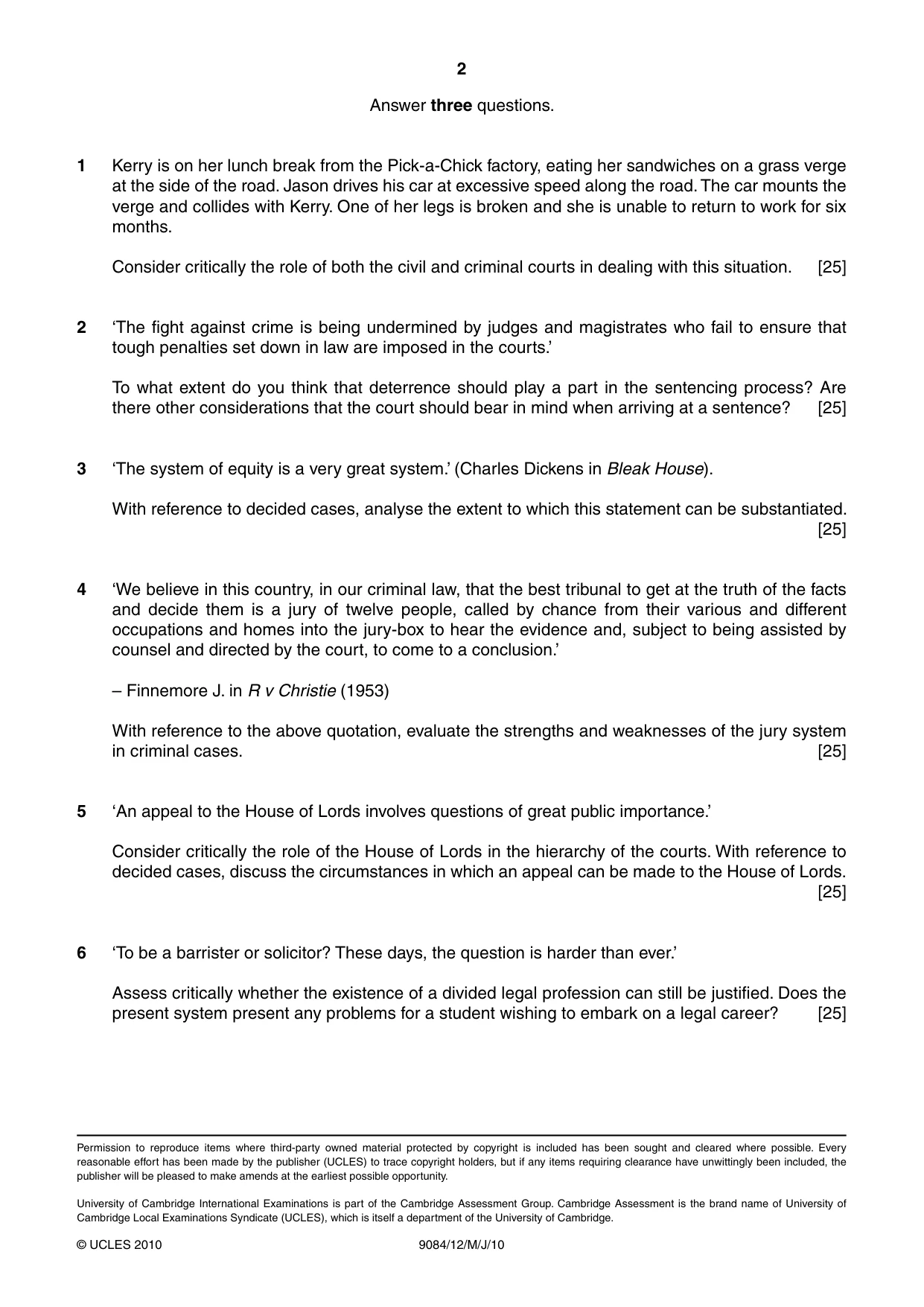
2 9084/12/M/J/10 © UCLES 2010 Answer three questions. 1 Kerry is on her lunch break from the Pick-a-Chick factory, eating her sandwiches on a grass verge at the side of the road. Jason drives his car at excessive speed along the road. The car mounts the verge and collides with Kerry. One of her legs is broken and she is unable to return to work for six months. Consider critically the role of both the civil and criminal courts in dealing with this situation. [25] 2 ‘The fight against crime is being undermined by judges and magistrates who fail to ensure that tough penalties set down in law are imposed in the courts.’ To what extent do you think that deterrence should play a part in the sentencing process? Are there other considerations that the court should bear in mind when arriving at a sentence? [25] 3 ‘The system of equity is a very great system.’ (Charles Dickens in Bleak House). With reference to decided cases, analyse the extent to which this statement can be substantiated. [25] 4 ‘We believe in this country, in our criminal law, that the best tribunal to get at the truth of the facts and decide them is a jury of twelve people, called by chance from their various and different occupations and homes into the jury-box to hear the evidence and, subject to being assisted by counsel and directed by the court, to come to a conclusion.’ – Finnemore J. in R v Christie (1953) With reference to the above quotation, evaluate the strengths and weaknesses of the jury system in criminal cases. [25] 5 ‘An appeal to the House of Lords involves questions of great public importance.’ Consider critically the role of the House of Lords in the hierarchy of the courts. With reference to decided cases, discuss the circumstances in which an appeal can be made to the House of Lords. [25] 6 ‘To be a barrister or solicitor? These days, the question is harder than ever.’ Assess critically whether the existence of a divided legal profession can still be justified. Does the present system present any problems for a student wishing to embark on a legal career? [25] Permission to reproduce items where third-party owned material protected by copyright is included has been sought and cleared where possible. Every reasonable effort has been made by the publisher (UCLES) to trace copyright holders, but if any items requiring clearance have unwittingly been included, the publisher will be pleased to make amends at the earliest possible opportunity. University of Cambridge International Examinations is part of the Cambridge Assessment Group. Cambridge Assessment is the brand name of University of Cambridge Local Examinations Syndicate (UCLES), which is itself a department of the University of Cambridge.
Mark scheme, page 1
UNIVERSITY OF CAMBRIDGE INTERNATIONAL EXAMINATIONS GCE Advanced Subsidiary Level and GCE Advanced Level MARK SCHEME for the May/June 2010 question paper for the guidance of teachers 9084 LAW 9084/12 Paper 12, maximum raw mark 75 This mark scheme is published as an aid to teachers and candidates, to indicate the requirements of the examination. It shows the basis on which Examiners were instructed to award marks. It does not indicate the details of the discussions that took place at an Examiners’ meeting before marking began, which would have considered the acceptability of alternative answers. Mark schemes must be read in conjunction with the question papers and the report on the examination. • CIE will not enter into discussions or correspondence in connection with these mark schemes. CIE is publishing the mark schemes for the May/June 2010 question papers for most IGCSE, GCE Advanced Level and Advanced Subsidiary Level syllabuses and some Ordinary Level syllabuses.
Mark scheme, page 2
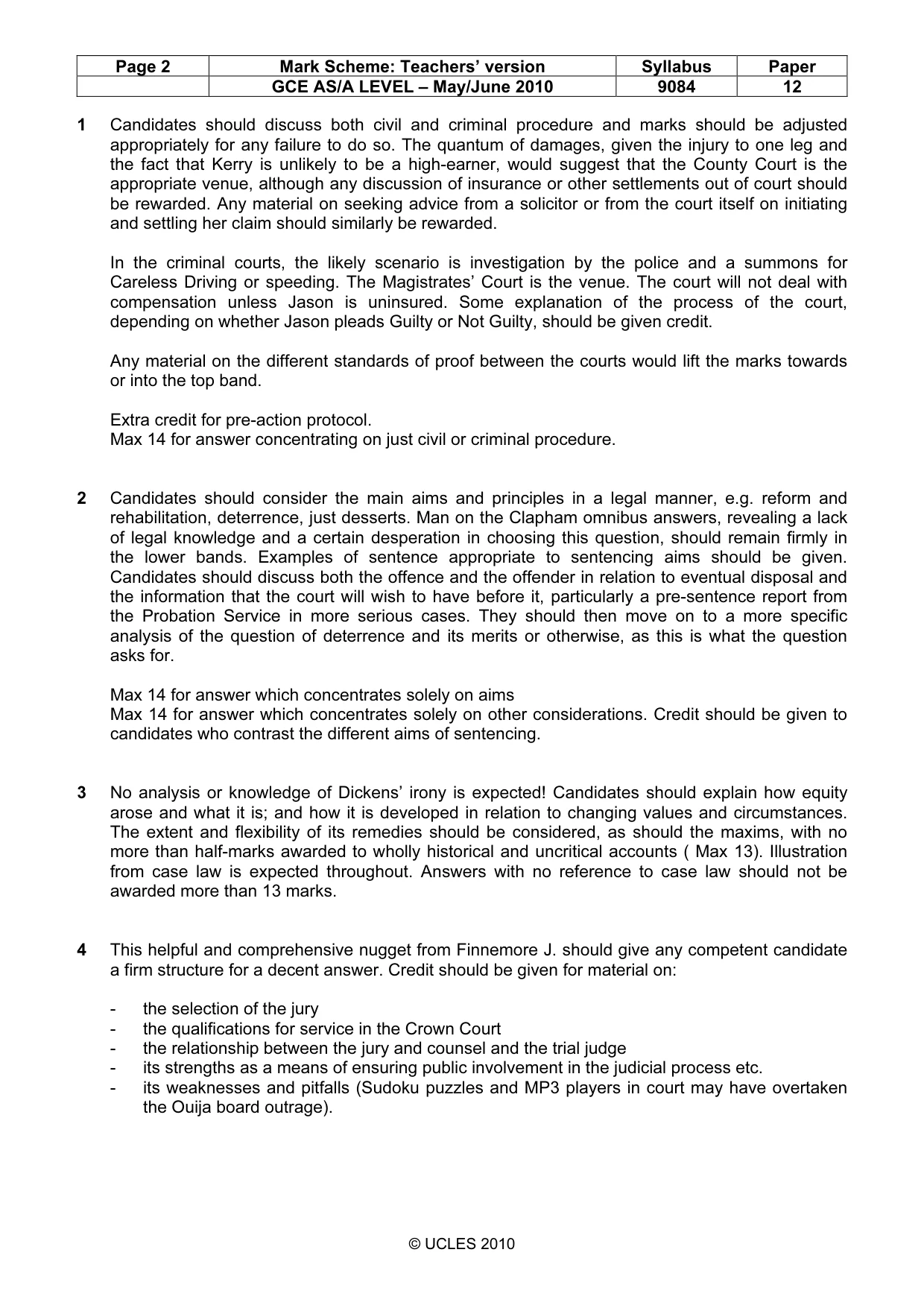
Page 2 Mark Scheme: Teachers’ version Syllabus Paper GCE AS/A LEVEL – May/June 2010 9084 12 © UCLES 2010 1 Candidates should discuss both civil and criminal procedure and marks should be adjusted appropriately for any failure to do so. The quantum of damages, given the injury to one leg and the fact that Kerry is unlikely to be a high-earner, would suggest that the County Court is the appropriate venue, although any discussion of insurance or other settlements out of court should be rewarded. Any material on seeking advice from a solicitor or from the court itself on initiating and settling her claim should similarly be rewarded. In the criminal courts, the likely scenario is investigation by the police and a summons for Careless Driving or speeding. The Magistrates’ Court is the venue. The court will not deal with compensation unless Jason is uninsured. Some explanation of the process of the court, depending on whether Jason pleads Guilty or Not Guilty, should be given credit. Any material on the different standards of proof between the courts would lift the marks towards or into the top band. Extra credit for pre-action protocol. Max 14 for answer concentrating on just civil or criminal procedure. 2 Candidates should consider the main aims and principles in a legal manner, e.g. reform and rehabilitation, deterrence, just desserts. Man on the Clapham omnibus answers, revealing a lack of legal knowledge and a certain desperation in choosing this question, should remain firmly in the lower bands. Examples of sentence appropriate to sentencing aims should be given. Candidates should discuss both the offence and the offender in relation to eventual disposal and the information that the court will wish to have before it, particularly a pre-sentence report from the Probation Service in more serious cases. They should then move on to a more specific analysis of the question of deterrence and its merits or otherwise, as this is what the question asks for. Max 14 for answer which concentrates solely on aims Max 14 for answer which concentrates solely on other considerations. Credit should be given to candidates who contrast the different aims of sentencing. 3 No analysis or knowledge of Dickens’ irony is expected! Candidates should explain how equity arose and what it is; and how it is developed in relation to changing values and circumstances. The extent and flexibility of its remedies should be considered, as should the maxims, with no more than half-marks awarded to wholly historical and uncritical accounts ( Max 13). Illustration from case law is expected throughout. Answers with no reference to case law should not be awarded more than 13 marks. 4 This helpful and comprehensive nugget from Finnemore J. should give any competent candidate a firm structure for a decent answer. Credit should be given for material on: - the selection of the jury - the qualifications for service in the Crown Court - the relationship between the jury and counsel and the trial judge - its strengths as a means of ensuring public involvement in the judicial process etc. - its weaknesses and pitfalls (Sudoku puzzles and MP3 players in court may have overtaken the Ouija board outrage).
Mark scheme, page 3
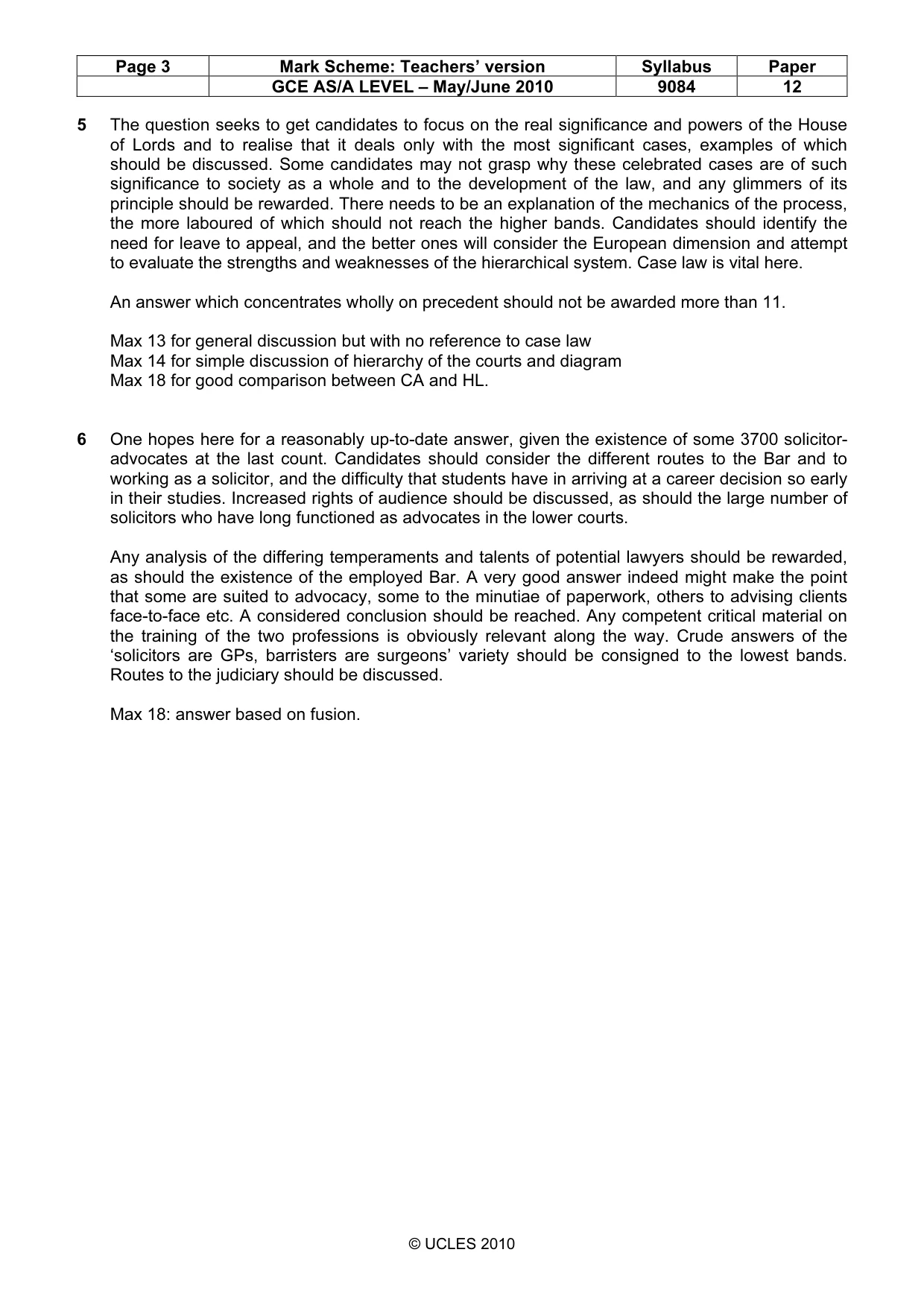
Page 3 Mark Scheme: Teachers’ version Syllabus Paper GCE AS/A LEVEL – May/June 2010 9084 12 © UCLES 2010 5 The question seeks to get candidates to focus on the real significance and powers of the House of Lords and to realise that it deals only with the most significant cases, examples of which should be discussed. Some candidates may not grasp why these celebrated cases are of such significance to society as a whole and to the development of the law, and any glimmers of its principle should be rewarded. There needs to be an explanation of the mechanics of the process, the more laboured of which should not reach the higher bands. Candidates should identify the need for leave to appeal, and the better ones will consider the European dimension and attempt to evaluate the strengths and weaknesses of the hierarchical system. Case law is vital here. An answer which concentrates wholly on precedent should not be awarded more than 11. Max 13 for general discussion but with no reference to case law Max 14 for simple discussion of hierarchy of the courts and diagram Max 18 for good comparison between CA and HL. 6 One hopes here for a reasonably up-to-date answer, given the existence of some 3700 solicitor- advocates at the last count. Candidates should consider the different routes to the Bar and to working as a solicitor, and the difficulty that students have in arriving at a career decision so early in their studies. Increased rights of audience should be discussed, as should the large number of solicitors who have long functioned as advocates in the lower courts. Any analysis of the differing temperaments and talents of potential lawyers should be rewarded, as should the existence of the employed Bar. A very good answer indeed might make the point that some are suited to advocacy, some to the minutiae of paperwork, others to advising clients face-to-face etc. A considered conclusion should be reached. Any competent critical material on the training of the two professions is obviously relevant along the way. Crude answers of the ‘solicitors are GPs, barristers are surgeons’ variety should be consigned to the lowest bands. Routes to the judiciary should be discussed. Max 18: answer based on fusion.
What you needed in this session
Cambridge’s own grade thresholds for 2010 May/June, Paper 1 · Variant 2. A higher threshold means an easier paper — the bar moves with how the cohort did.