Cambridge A Level Japanese Language (AS Level only) 8281 — 2014 Oct/Nov Paper 2 · Variant 1
8281/21/O/N/14 · 70 marks · ≈79 min
The question paper and its mark scheme, free to read here and free to download. This is Cambridge’s own paper, exactly as it was sat.
Question paper8 pages
Mark scheme7 pages
Answers below. Sit the paper first if you are practising.
Paper as text
Question paper, page 1
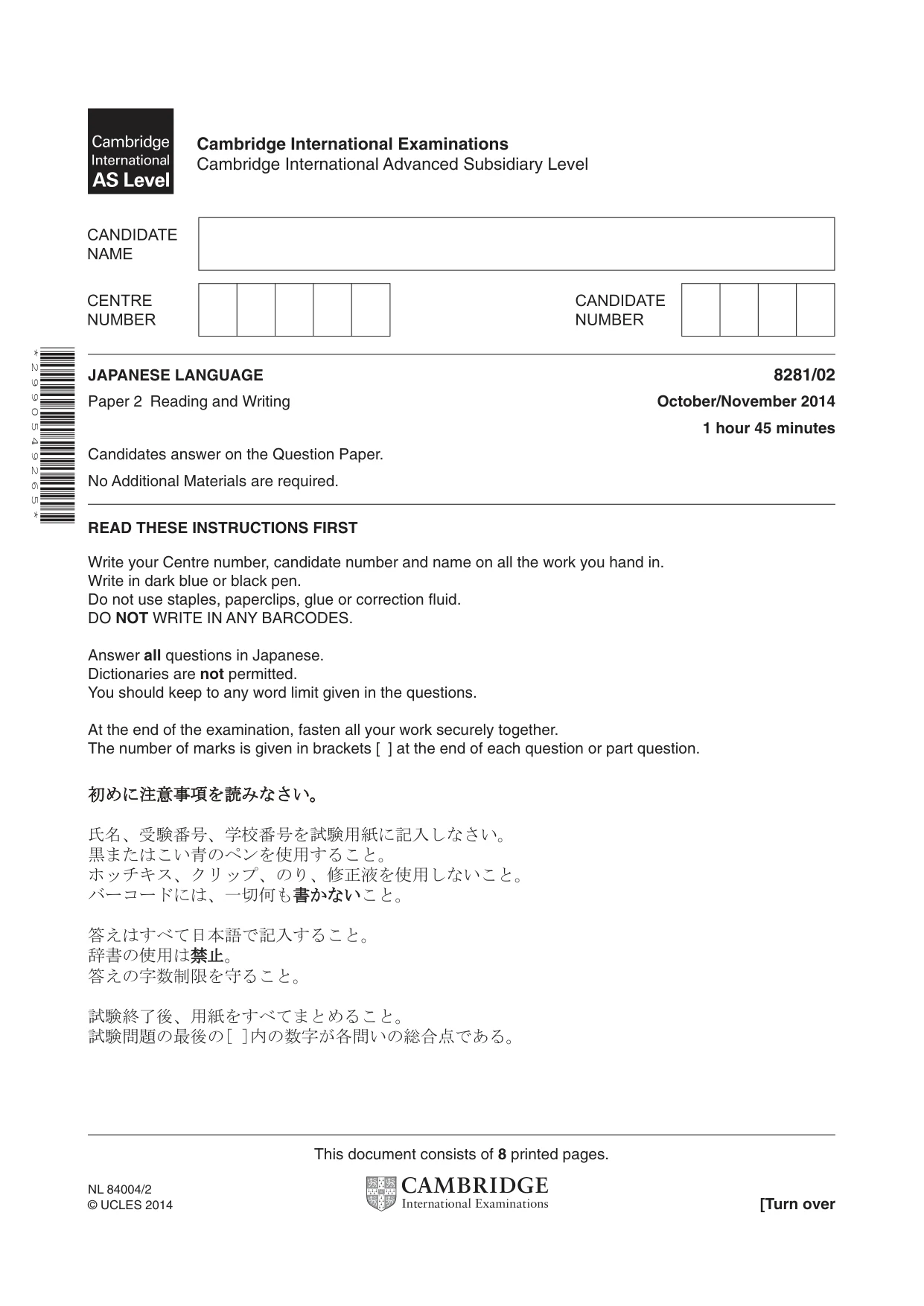
READ THESE INSTRUCTIONS FIRST Write your Centre number, candidate number and name on all the work you hand in. Write in dark blue or black pen. Do not use staples, paperclips, glue or correction fluid. DO NOT WRITE IN ANY BARCODES. Answer all questions in Japanese. Dictionaries are not permitted. You should keep to any word limit given in the questions. At the end of the examination, fasten all your work securely together. The number of marks is given in brackets [ ] at the end of each question or part question. 初めに注意事項を読みなさい。 氏名、受験番号、学校番号を試験用紙に記入しなさい。 黒またはこい青のペンを使用すること。 ホッチキス、クリップ、のり、修正液を使用しないこと。 バーコードには、一切何も書かないこと。 答えはすべて日本語で記入すること。 辞書の使用は禁止。 答えの字数制限を守ること。 試験終了後、用紙をすべてまとめること。 試験問題の最後の[ ]内の数字が各問いの総合点である。 JAPANESE LANGUAGE 8281/02 Paper 2 Reading and Writing October/November 2014 1 hour 45 minutes Candidates answer on the Question Paper. No Additional Materials are required. * 2 9 9 0 5 4 9 2 6 5 * This document consists of 8 printed pages. NL 84004/2 © UCLES 2014 [Turn over Cambridge International Examinations Cambridge International Advanced Subsidiary Level
Question paper, page 2
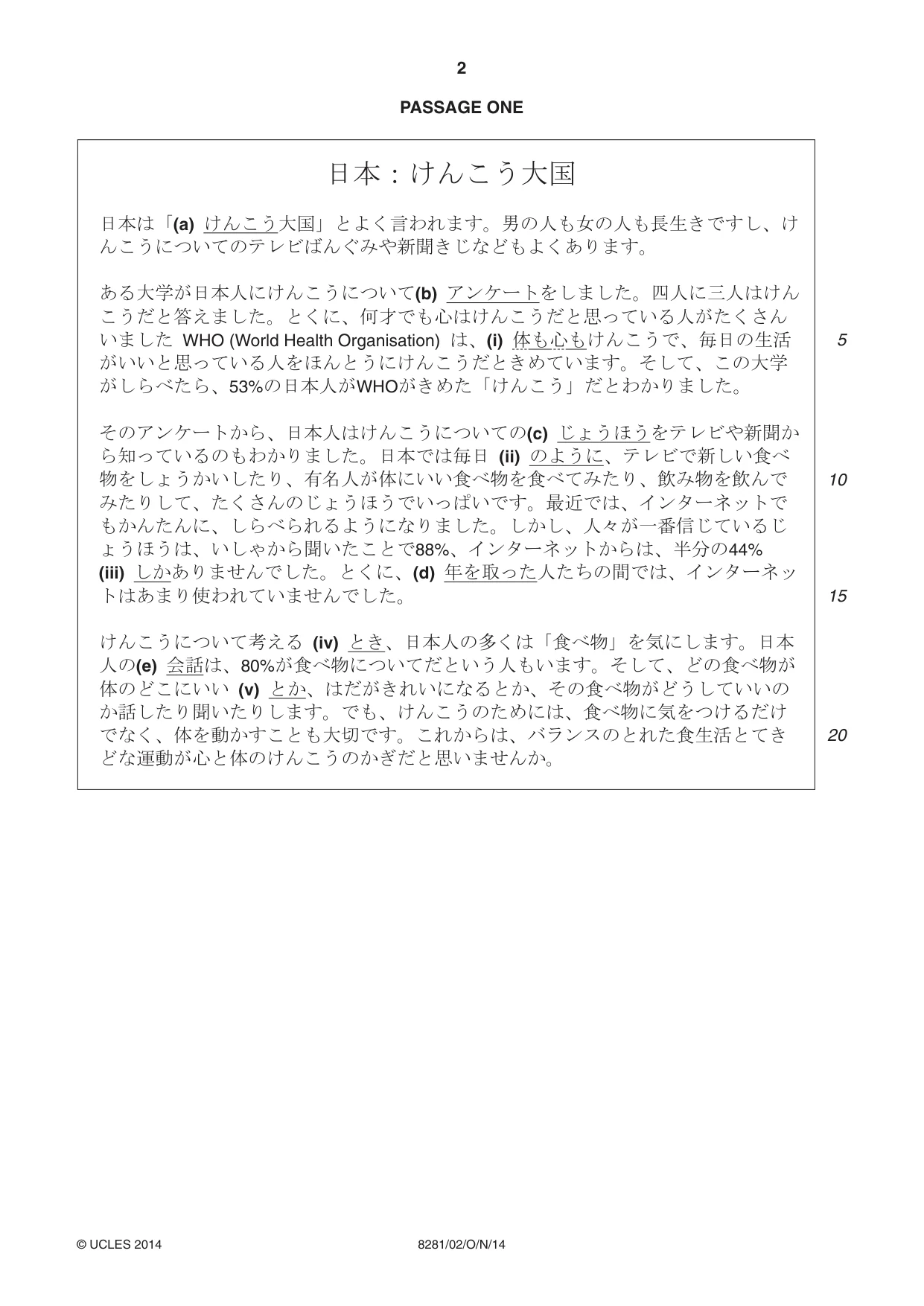
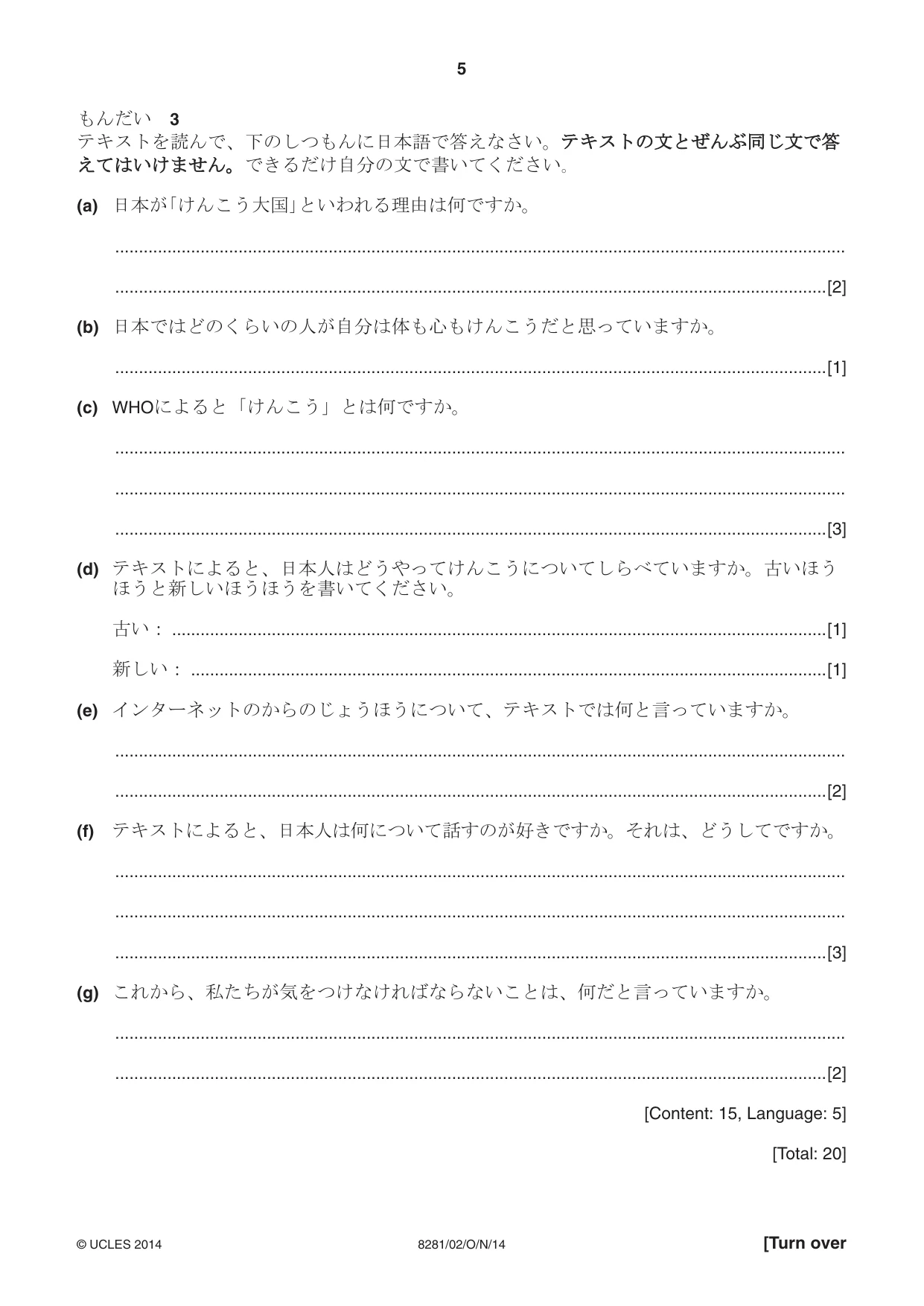
2 8281/02/O/N/14 © UCLES 2014 PASSAGE ONE 日本:けんこう大国 日本は「(a) けんこう大国」とよく言われます。男の人も女の人も長生きですし、け んこうについてのテレビばんぐみや新聞きじなどもよくあります。 ある大学が日本人にけんこうについて(b) アンケートをしました。四人に三人はけん こうだと答えました。とくに、何才でも心はけんこうだと思っている人がたくさん いました WHO (World Health Organisation) は、(i) 体も心もけんこうで、毎日の生活 がいいと思っている人をほんとうにけんこうだときめています。そして、この大学 がしらべたら、53%の日本人がWHOがきめた「けんこう」だとわかりました。 そのアンケートから、日本人はけんこうについての(c) じょうほうをテレビや新聞か ら知っているのもわかりました。日本では毎日 (ii) のように、テレビで新しい食べ 物をしょうかいしたり、有名人が体にいい食べ物を食べてみたり、飲み物を飲んで みたりして、たくさんのじょうほうでいっぱいです。最近では、インターネットで もかんたんに、しらべられるようになりました。しかし、人々が一番信じているじ ょうほうは、いしゃから聞いたことで88%、インターネットからは、半分の44% (iii) しかありませんでした。とくに、(d) 年を取った人たちの間では、インターネッ トはあまり使われていませんでした。 けんこうについて考える (iv) とき、日本人の多くは「食べ物」を気にします。日本 人の(e) 会話は、80%が食べ物についてだという人もいます。そして、どの食べ物が 体のどこにいい (v) とか、はだがきれいになるとか、その食べ物がどうしていいの か話したり聞いたりします。でも、けんこうのためには、食べ物に気をつけるだけ でなく、体を動かすことも大切です。これからは、バランスのとれた食生活とてき どな運動が心と体のけんこうのかぎだと思いませんか。 5 10 15 20
Question paper, page 3
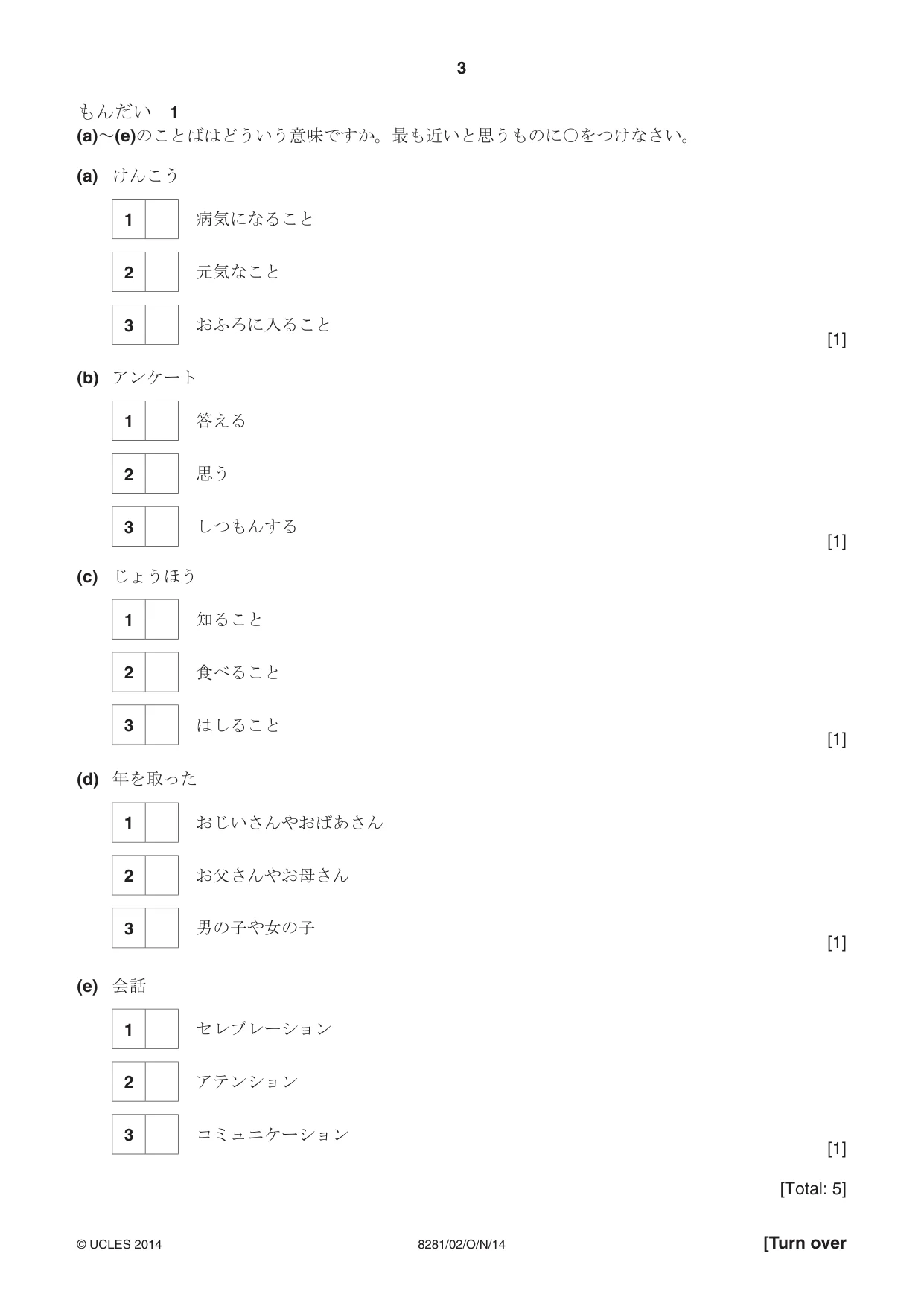
3 8281/02/O/N/14 © UCLES 2014 [Turn over もんだい 1 (a)~(e)のことばはどういう意味ですか。最も近いと思うものに○をつけなさい。 (a) けんこう 1 病気になること 2 元気なこと 3 おふろに入ること [1] (b) アンケート 1 答える 2 思う 3 しつもんする [1] (c) じょうほう 1 知ること 2 食べること 3 はしること [1] (d) 年を取った 1 おじいさんやおばあさん 2 お父さんやお母さん 3 男の子や女の子 [1] (e) 会話 1 セレブレーション 2 アテンション 3 コミュニケーション [1] [Total: 5]
Question paper, page 4
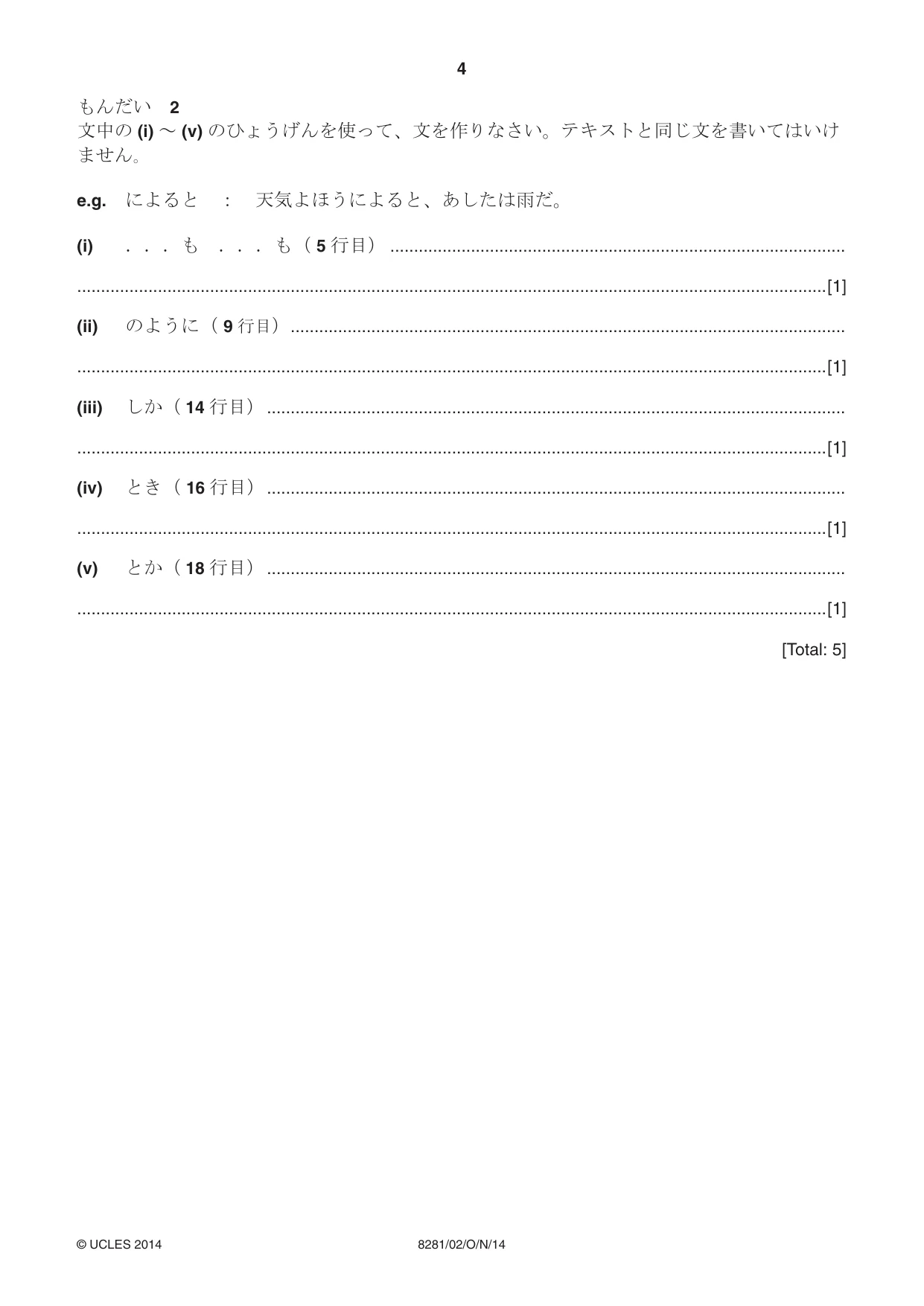
4 8281/02/O/N/14 © UCLES 2014 もんだい 2 文中の (i) ~ (v) のひょうげんを使って、文を作りなさい。テキストと同じ文を書いてはいけ ません。 e.g. によると : 天気よほうによると、あしたは雨だ。 (i) ...も ...も( 5 行目) … …[1] (ii) のように( 9 行目) … …[1] (iii) しか( 14 行目) … …[1] (iv) とき( 16 行目) … …[1] (v) とか( 18 行目) … …[1] [Total: 5]
Question paper, page 5
5 8281/02/O/N/14 © UCLES 2014 [Turn over もんだい 3 テキストを読んで、下のしつもんに日本語で答えなさい。テキストの文とぜんぶ同じ文で答 えてはいけません。できるだけ自分の文で書いてください。 (a) 日本が「けんこう大国」といわれる理由は何ですか。 … …[2] (b) 日本ではどのくらいの人が自分は体も心もけんこうだと思っていますか。 …[1] (c) WHOによると「けんこう」とは何ですか。 … … …[3] (d) テキストによると、日本人はどうやってけんこうについてしらべていますか。古いほう ほうと新しいほうほうを書いてください。 古い: …[1] 新しい: …[1] (e) インターネットのからのじょうほうについて、テキストでは何と言っていますか。 … …[2] (f) テキストによると、日本人は何について話すのが好きですか。それは、どうしてですか。 … … …[3] (g) これから、私たちが気をつけなければならないことは、何だと言っていますか。 … …[2] [Content: 15, Language: 5] [Total: 20]
Question paper, page 6
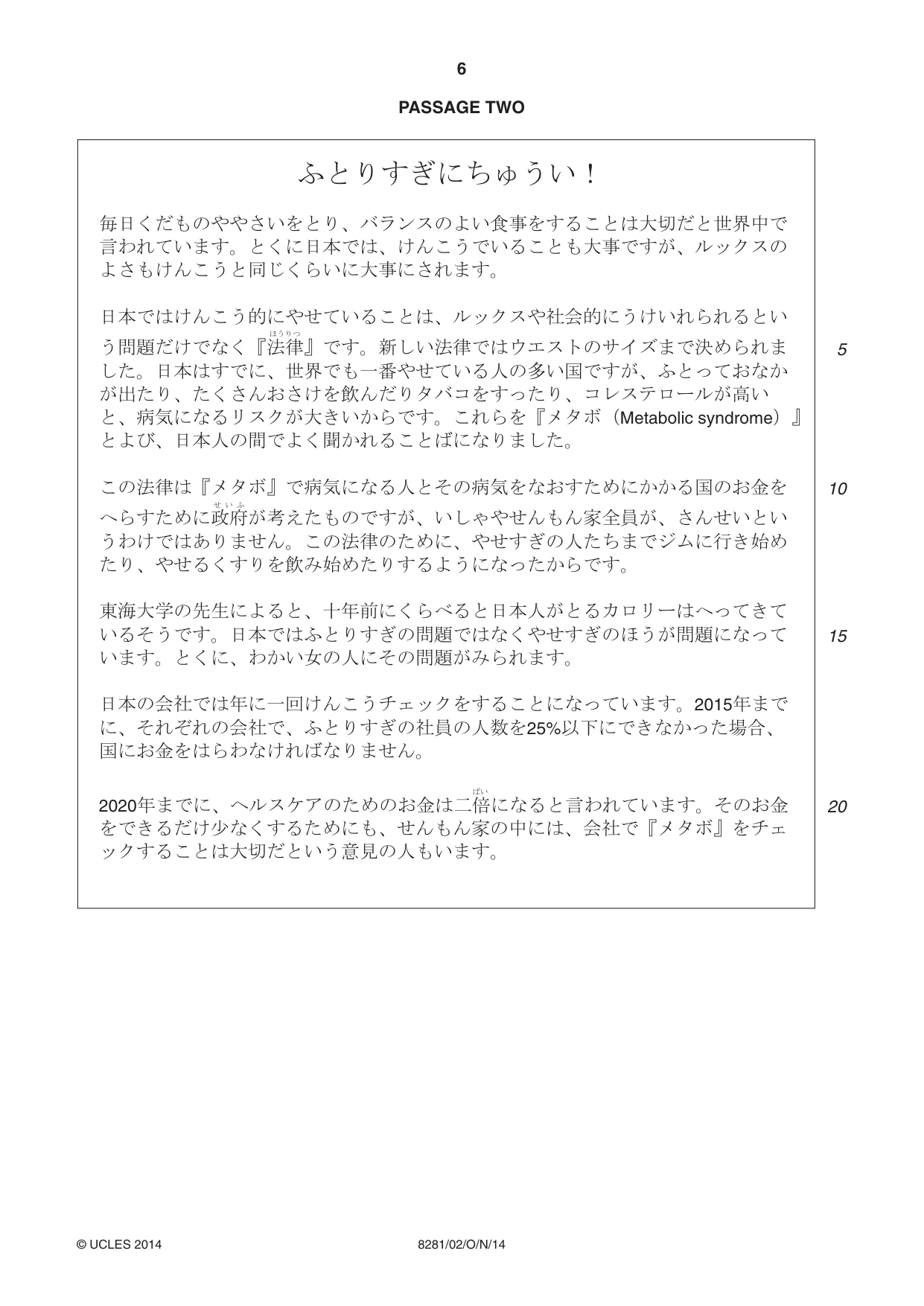
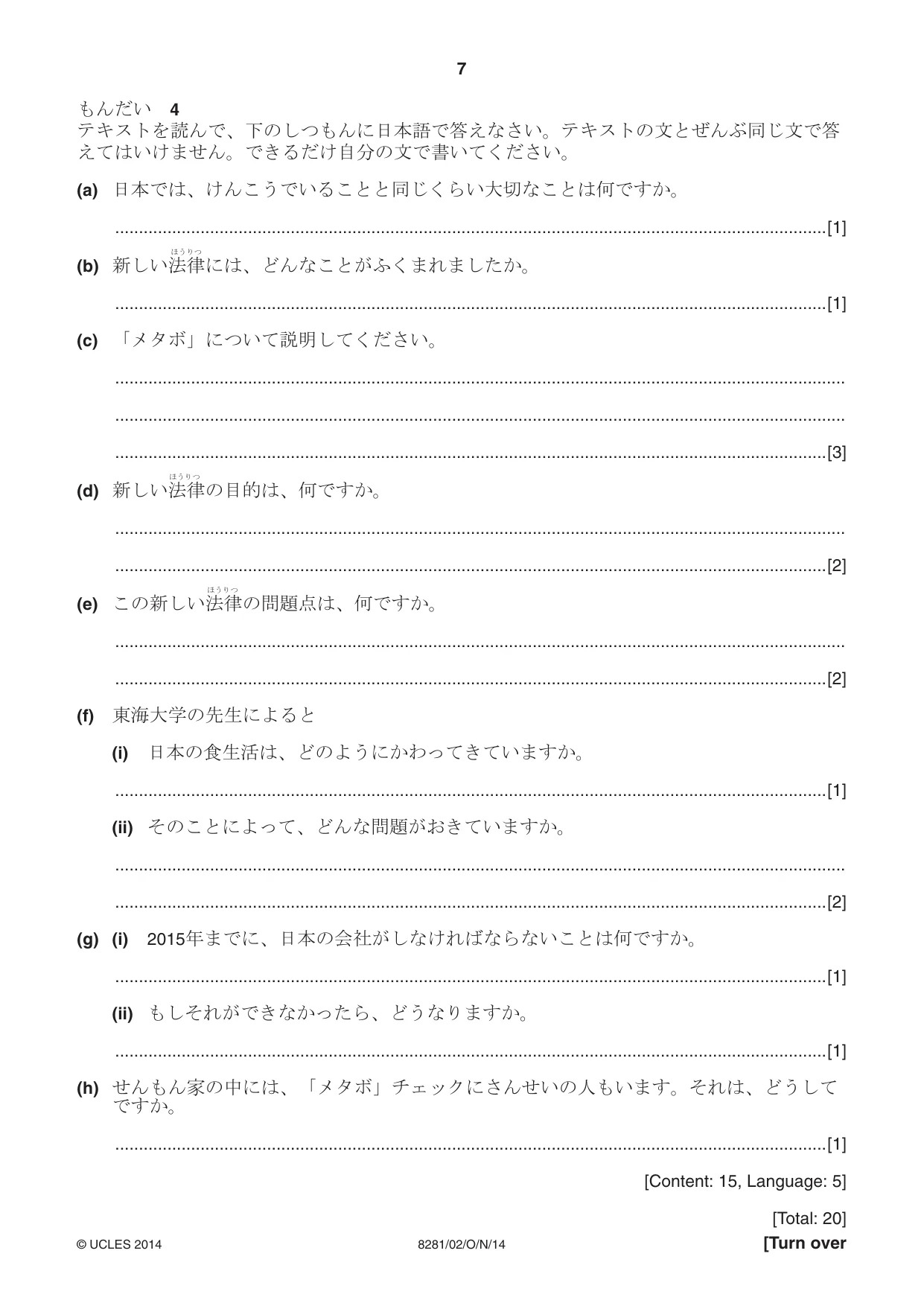
6 8281/02/O/N/14 © UCLES 2014 PASSAGE TWO ふとりすぎにちゅうい! 毎日くだものややさいをとり、バランスのよい食事をすることは大切だと世界中で 言われています。とくに日本では、けんこうでいることも大事ですが、ルックスの よさもけんこうと同じくらいに大事にされます。 日本ではけんこう的にやせていることは、ルックスや社会的にうけいれられるとい ほうりつ う問題だけでなく『法律』です。新しい法律ではウエストのサイズまで決められま した。日本はすでに、世界でも一番やせている人の多い国ですが、ふとっておなか が出たり、たくさんおさけを飲んだりタバコをすったり、コレステロールが高い と、病気になるリスクが大きいからです。これらを『メタボ(Metabolic syndrome)』 とよび、日本人の間でよく聞かれることばになりました。 この法律は『メタボ』で病気になる人とその病気をなおすためにかかる国のお金を せ い ふ へらすために政府が考えたものですが、いしゃやせんもん家全員が、さんせいとい うわけではありません。この法律のために、やせすぎの人たちまでジムに行き始め たり、やせるくすりを飲み始めたりするようになったからです。 東海大学の先生によると、十年前にくらべると日本人がとるカロリーはへってきて いるそうです。日本ではふとりすぎの問題ではなくやせすぎのほうが問題になって います。とくに、わかい女の人にその問題がみられます。 日本の会社では年に一回けんこうチェックをすることになっています。2015年まで に、それぞれの会社で、ふとりすぎの社員の人数を25%以下にできなかった場合、 国にお金をはらわなければなりません。 ばい 2020年までに、ヘルスケアのためのお金は二倍になると言われています。そのお金 をできるだけ少なくするためにも、せんもん家の中には、会社で『メタボ』をチェ ックすることは大切だという意見の人もいます。 5 10 15 20
Question paper, page 7
7 8281/02/O/N/14 © UCLES 2014 [Turn over もんだい 4 テキストを読んで、下のしつもんに日本語で答えなさい。テキストの文とぜんぶ同じ文で答 えてはいけません。できるだけ自分の文で書いてください。 (a) 日本では、けんこうでいることと同じくらい大切なことは何ですか。 …[1] ほうりつ (b) 新しい法律には、どんなことがふくまれましたか。 …[1] (c) 「メタボ」について説明してください。 … … …[3] ほうりつ (d) 新しい法律の目的は、何ですか。 … …[2] ほうりつ (e) この新しい法律の問題点は、何ですか。 … …[2] (f) 東海大学の先生によると (i) 日本の食生活は、どのようにかわってきていますか。 …[1] (ii) そのことによって、どんな問題がおきていますか。 … …[2] (g) (i) 2015年までに、日本の会社がしなければならないことは何ですか。 …[1] (ii) もしそれができなかったら、どうなりますか。 …[1] (h) せんもん家の中には、「メタボ」チェックにさんせいの人もいます。それは、どうして ですか。 …[1] [Content: 15, Language: 5] [Total: 20]
Question paper, page 8
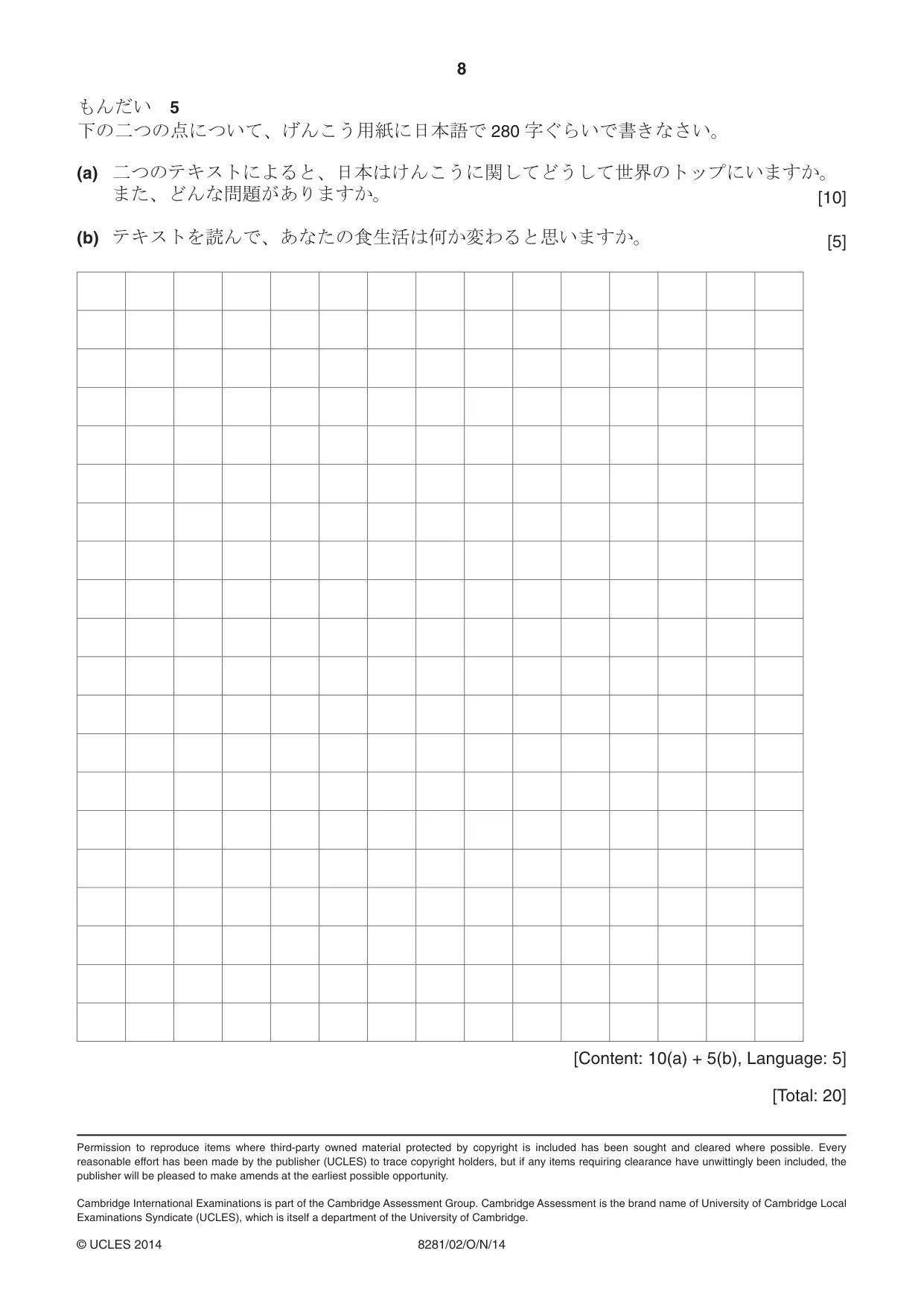
8 8281/02/O/N/14 © UCLES 2014 もんだい 5 下の二つの点について、げんこう用紙に日本語で 280 字ぐらいで書きなさい。 (a) 二つのテキストによると、日本はけんこうに関してどうして世界のトップにいますか。 また、どんな問題がありますか。 [10] (b) テキストを読んで、あなたの食生活は何か変わると思いますか。 [5] [Content: 10(a) + 5(b), Language: 5] [Total: 20] Permission to reproduce items where third-party owned material protected by copyright is included has been sought and cleared where possible. Every reasonable effort has been made by the publisher (UCLES) to trace copyright holders, but if any items requiring clearance have unwittingly been included, the publisher will be pleased to make amends at the earliest possible opportunity. Cambridge International Examinations is part of the Cambridge Assessment Group. Cambridge Assessment is the brand name of University of Cambridge Local Examinations Syndicate (UCLES), which is itself a department of the University of Cambridge.
Mark scheme, page 1
® IGCSE is the registered trademark of Cambridge International Examinations. CAMBRIDGE INTERNATIONAL EXAMINATIONS Cambridge International Advanced Subsidiary Level MARK SCHEME for the October/November 2014 series 8281 JAPANESE LANGUAGE 8281/02 Paper 2 (Reading and Writing), maximum raw mark 70 This mark scheme is published as an aid to teachers and candidates, to indicate the requirements of the examination. It shows the basis on which Examiners were instructed to award marks. It does not indicate the details of the discussions that took place at an Examiners’ meeting before marking began, which would have considered the acceptability of alternative answers. Mark schemes should be read in conjunction with the question paper and the Principal Examiner Report for Teachers. Cambridge will not enter into discussions about these mark schemes. Cambridge is publishing the mark schemes for the October/November 2014 series for most Cambridge IGCSE®, Cambridge International A and AS Level components and some Cambridge O Level components.
Mark scheme, page 2
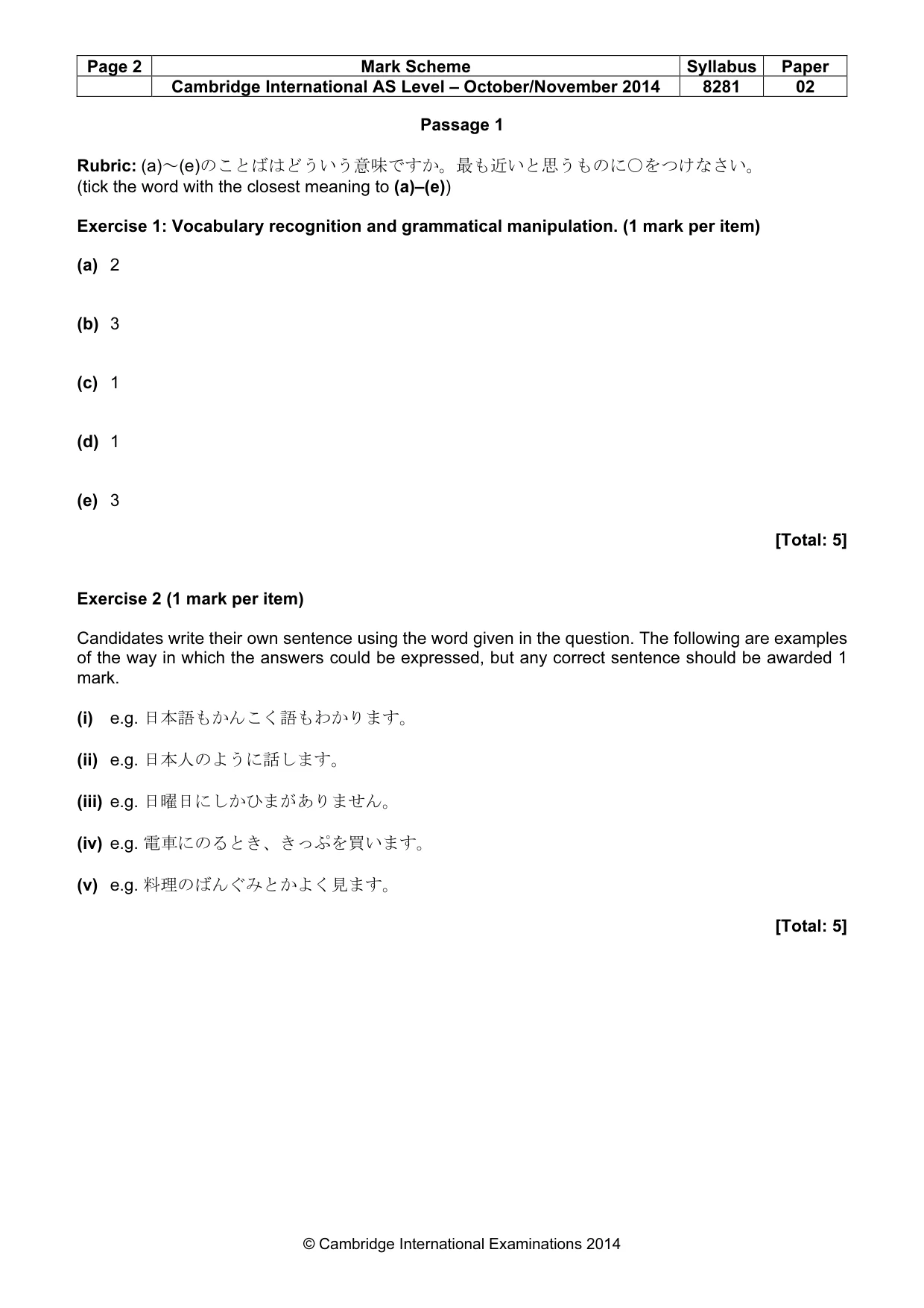
Page 2 Mark Scheme Syllabus Paper Cambridge International AS Level – October/November 2014 8281 02 © Cambridge International Examinations 2014 Passage 1 Rubric: (a)~(e)のことばはどういう意味ですか。最も近いと思うものに○をつけなさい。 (tick the word with the closest meaning to (a)–(e)) Exercise 1: Vocabulary recognition and grammatical manipulation. (1 mark per item) (a) 2 (b) 3 (c) 1 (d) 1 (e) 3 [Total: 5] Exercise 2 (1 mark per item) Candidates write their own sentence using the word given in the question. The following are examples of the way in which the answers could be expressed, but any correct sentence should be awarded 1 mark. (i) e.g. 日本語もかんこく語もわかります。 (ii) e.g. 日本人のように話します。 (iii) e.g. 日曜日にしかひまがありません。 (iv) e.g. 電車にのるとき、きっぷを買います。 (v) e.g. 料理のばんぐみとかよく見ます。 [Total: 5]
Mark scheme, page 3
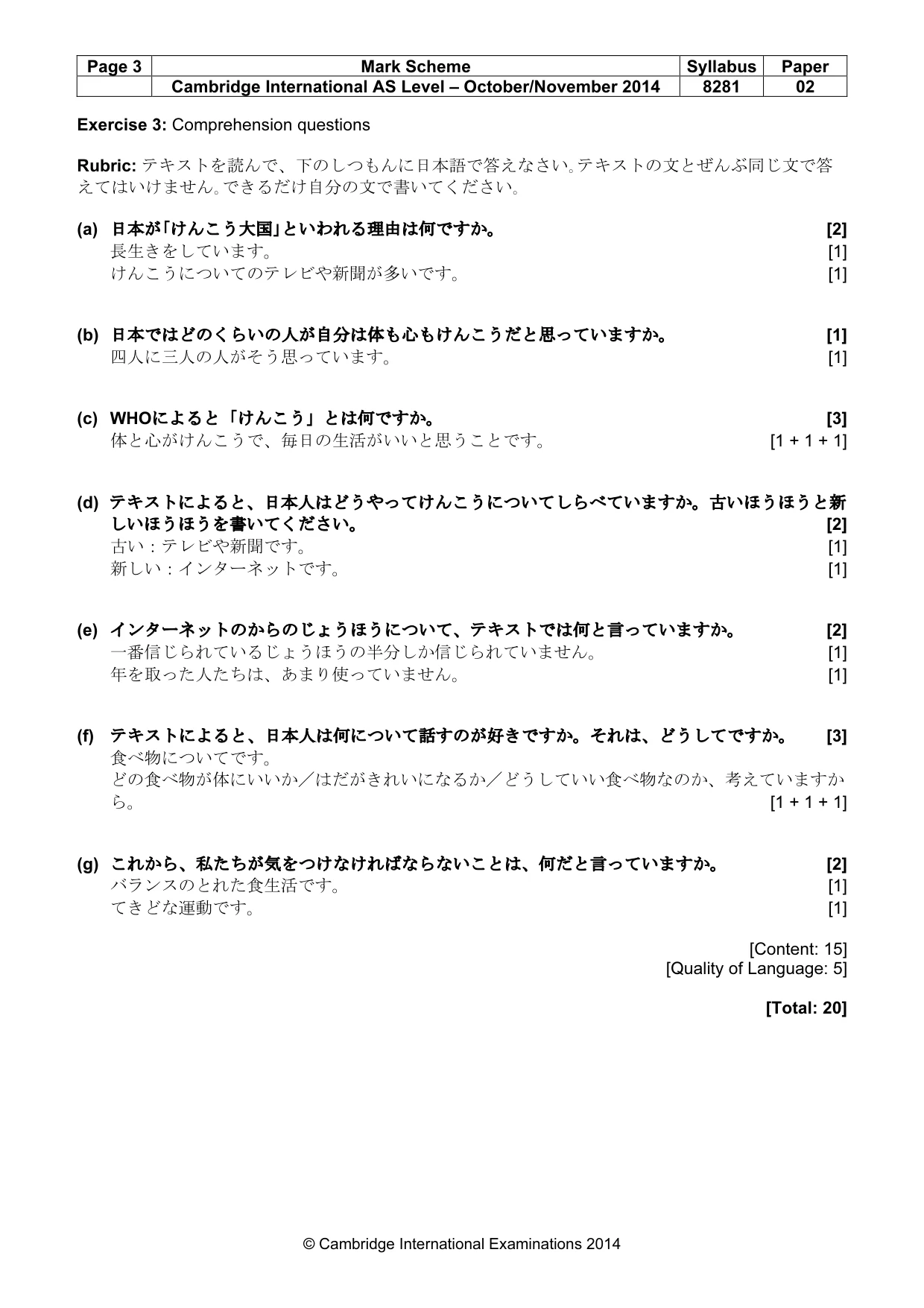
Page 3 Mark Scheme Syllabus Paper Cambridge International AS Level – October/November 2014 8281 02 © Cambridge International Examinations 2014 Exercise 3: Comprehension questions Rubric: テキストを読んで、下のしつもんに日本語で答えなさい。テキストの文とぜんぶ同じ文で答 えてはいけません。できるだけ自分の文で書いてください。 (a) 日本が「けんこう大国」といわれる理由は何ですか。 [2] 長生きをしています。 [1] けんこうについてのテレビや新聞が多いです。 [1] (b) 日本ではどのくらいの人が自分は体も心もけんこうだと思っていますか。 [1] 四人に三人の人がそう思っています。 [1] (c) WHOによると「けんこう」とは何ですか。 [3] 体と心がけんこうで、毎日の生活がいいと思うことです。 [1 + 1 + 1] (d) テキストによると、日本人はどうやってけんこうについてしらべていますか。古いほうほうと新 しいほうほうを書いてください。 [2] 古い:テレビや新聞です。 [1] 新しい:インターネットです。 [1] (e) インターネットのからのじょうほうについて、テキストでは何と言っていますか。 [2] 一番信じられているじょうほうの半分しか信じられていません。 [1] 年を取った人たちは、あまり使っていません。 [1] (f) テキストによると、日本人は何について話すのが好きですか。それは、どうしてですか。 [3] 食べ物についてです。 どの食べ物が体にいいか/はだがきれいになるか/どうしていい食べ物なのか、考えていますか ら。 [1 + 1 + 1] (g) これから、私たちが気をつけなければならないことは、何だと言っていますか。 [2] バランスのとれた食生活です。 [1] てきどな運動です。 [1] [Content: 15] [Quality of Language: 5] [Total: 20]
Mark scheme, page 4
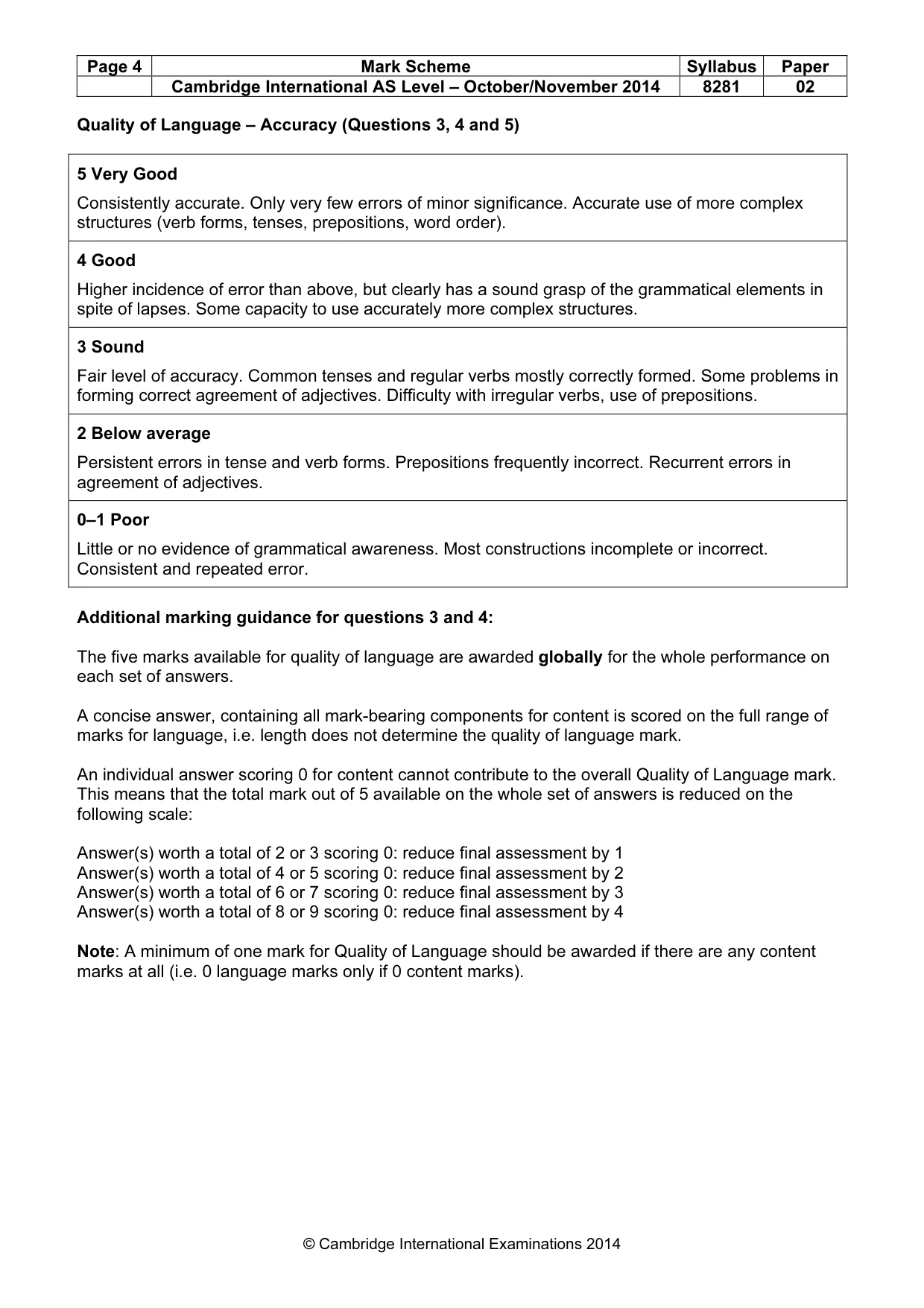
Page 4 Mark Scheme Syllabus Paper Cambridge International AS Level – October/November 2014 8281 02 © Cambridge International Examinations 2014 Quality of Language – Accuracy (Questions 3, 4 and 5) 5 Very Good Consistently accurate. Only very few errors of minor significance. Accurate use of more complex structures (verb forms, tenses, prepositions, word order). 4 Good Higher incidence of error than above, but clearly has a sound grasp of the grammatical elements in spite of lapses. Some capacity to use accurately more complex structures. 3 Sound Fair level of accuracy. Common tenses and regular verbs mostly correctly formed. Some problems in forming correct agreement of adjectives. Difficulty with irregular verbs, use of prepositions. 2 Below average Persistent errors in tense and verb forms. Prepositions frequently incorrect. Recurrent errors in agreement of adjectives. 0–1 Poor Little or no evidence of grammatical awareness. Most constructions incomplete or incorrect. Consistent and repeated error. Additional marking guidance for questions 3 and 4: The five marks available for quality of language are awarded globally for the whole performance on each set of answers. A concise answer, containing all mark-bearing components for content is scored on the full range of marks for language, i.e. length does not determine the quality of language mark. An individual answer scoring 0 for content cannot contribute to the overall Quality of Language mark. This means that the total mark out of 5 available on the whole set of answers is reduced on the following scale: Answer(s) worth a total of 2 or 3 scoring 0: reduce final assessment by 1 Answer(s) worth a total of 4 or 5 scoring 0: reduce final assessment by 2 Answer(s) worth a total of 6 or 7 scoring 0: reduce final assessment by 3 Answer(s) worth a total of 8 or 9 scoring 0: reduce final assessment by 4 Note: A minimum of one mark for Quality of Language should be awarded if there are any content marks at all (i.e. 0 language marks only if 0 content marks).
Mark scheme, page 5
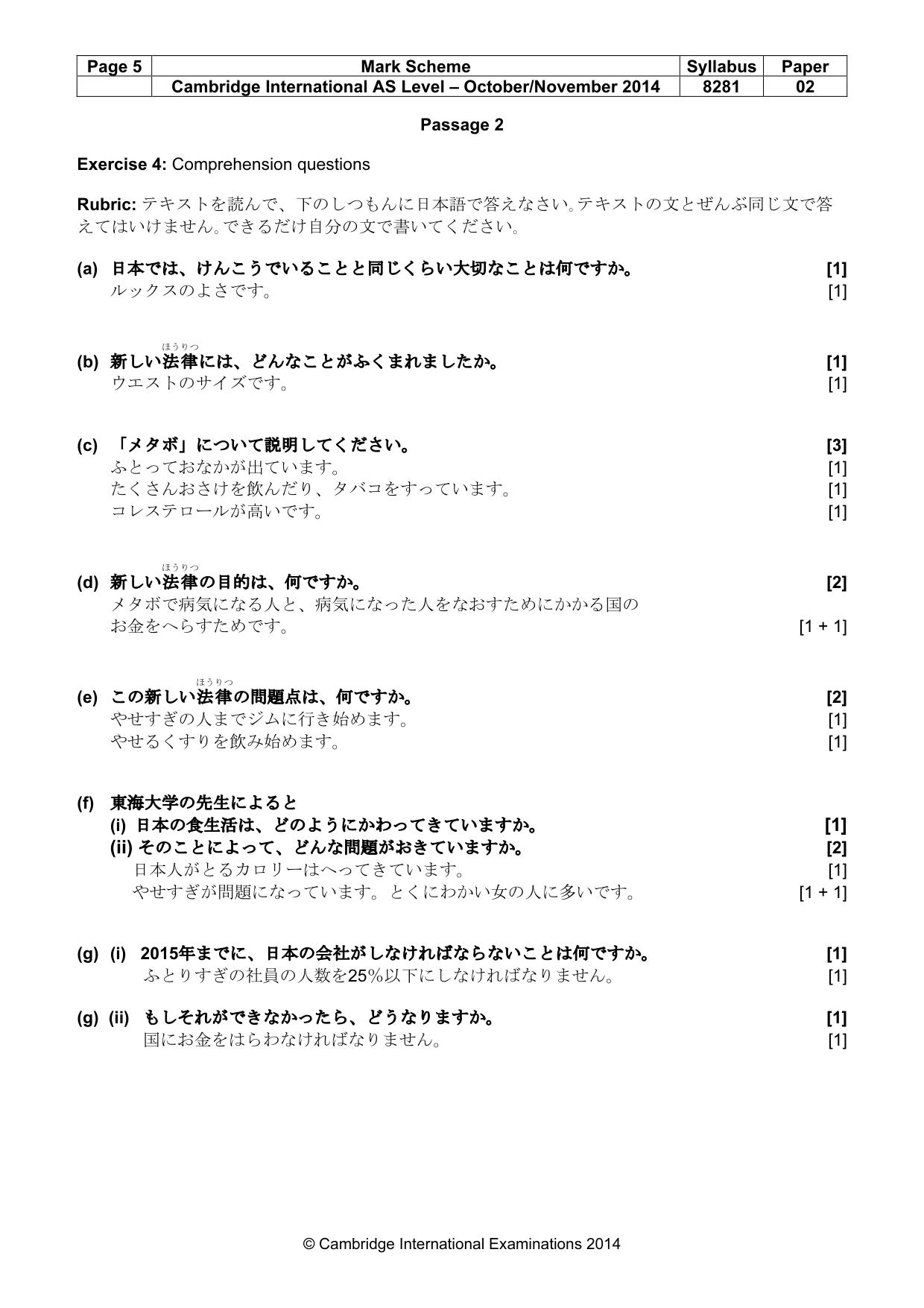
Page 5 Mark Scheme Syllabus Paper Cambridge International AS Level – October/November 2014 8281 02 © Cambridge International Examinations 2014 Passage 2 Exercise 4: Comprehension questions Rubric: テキストを読んで、下のしつもんに日本語で答えなさい。テキストの文とぜんぶ同じ文で答 えてはいけません。できるだけ自分の文で書いてください。 (a) 日本では、けんこうでいることと同じくらい大切なことは何ですか。 [1] ルックスのよさです。 [1] (b) 新しい法律 ほうりつ には、どんなことがふくまれましたか。 [1] ウエストのサイズです。 [1] (c) 「メタボ」について説明してください。 [3] ふとっておなかが出ています。 [1] たくさんおさけを飲んだり、タバコをすっています。 [1] コレステロールが高いです。 [1] (d) 新しい法律 ほうりつ の目的は、何ですか。 [2] メタボで病気になる人と、病気になった人をなおすためにかかる国の お金をへらすためです。 [1 + 1] (e) この新しい法律 ほうりつ の問題点は、何ですか。 [2] やせすぎの人までジムに行き始めます。 [1] やせるくすりを飲み始めます。 [1] (f) 東海大学の先生によると (i) 日本の食生活は、どのようにかわってきていますか。 [1] (ii) そのことによって、どんな問題がおきていますか。 [2] 日本人がとるカロリーはへってきています。 [1] やせすぎが問題になっています。とくにわかい女の人に多いです。 [1 + 1] (g) (i) 2015年までに、日本の会社がしなければならないことは何ですか。 [1] ふとりすぎの社員の人数を25%以下にしなければなりません。 [1] (g) (ii) もしそれができなかったら、どうなりますか。 [1] 国にお金をはらわなければなりません。 [1]
Mark scheme, page 6
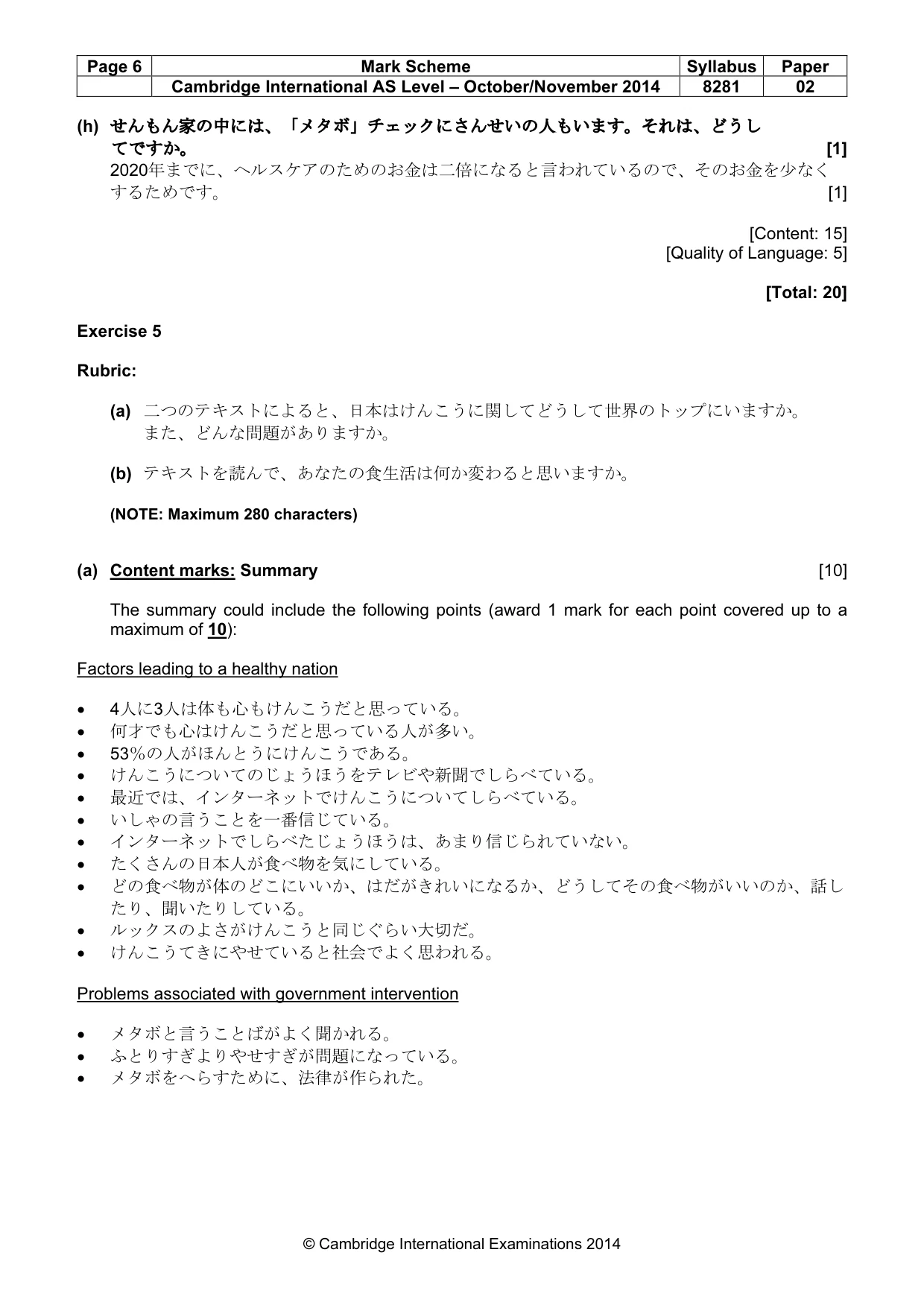
Page 6 Mark Scheme Syllabus Paper Cambridge International AS Level – October/November 2014 8281 02 © Cambridge International Examinations 2014 (h) せんもん家の中には、「メタボ」チェックにさんせいの人もいます。それは、どうし てですか。 [1] 2020年までに、ヘルスケアのためのお金は二倍になると言われているので、そのお金を少なく するためです。 [1] [Content: 15] [Quality of Language: 5] [Total: 20] Exercise 5 Rubric: (a) 二つのテキストによると、日本はけんこうに関してどうして世界のトップにいますか。 また、どんな問題がありますか。 (b) テキストを読んで、あなたの食生活は何か変わると思いますか。 (NOTE: Maximum 280 characters) (a) Content marks: Summary [10] The summary could include the following points (award 1 mark for each point covered up to a maximum of 10): Factors leading to a healthy nation • 4人に3人は体も心もけんこうだと思っている。 • 何才でも心はけんこうだと思っている人が多い。 • 53%の人がほんとうにけんこうである。 • けんこうについてのじょうほうをテレビや新聞でしらべている。 • 最近では、インターネットでけんこうについてしらべている。 • いしゃの言うことを一番信じている。 • インターネットでしらべたじょうほうは、あまり信じられていない。 • たくさんの日本人が食べ物を気にしている。 • どの食べ物が体のどこにいいか、はだがきれいになるか、どうしてその食べ物がいいのか、話し たり、聞いたりしている。 • ルックスのよさがけんこうと同じぐらい大切だ。 • けんこうてきにやせていると社会でよく思われる。 Problems associated with government intervention • メタボと言うことばがよく聞かれる。 • ふとりすぎよりやせすぎが問題になっている。 • メタボをへらすために、法律が作られた。
Mark scheme, page 7
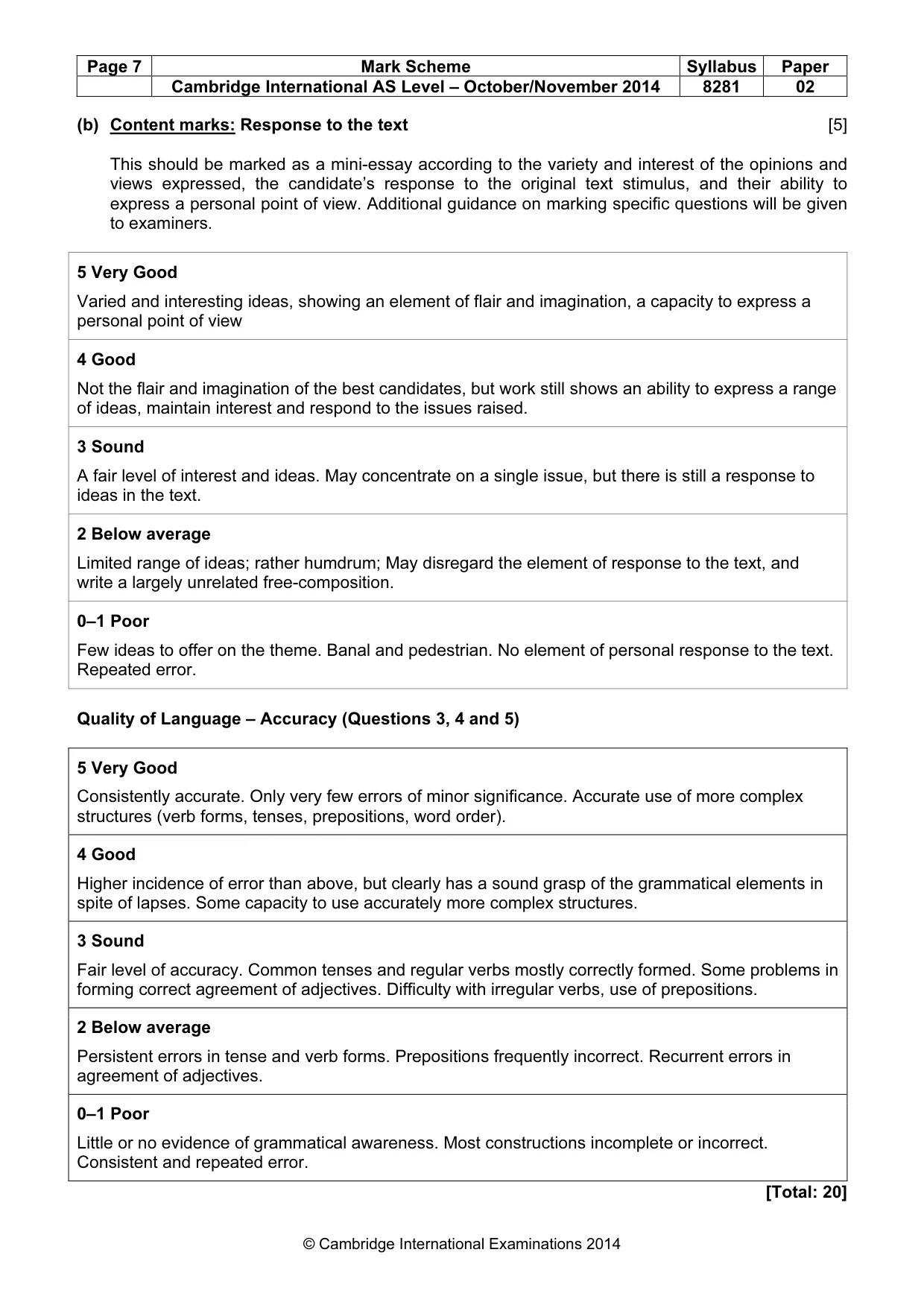
Page 7 Mark Scheme Syllabus Paper Cambridge International AS Level – October/November 2014 8281 02 © Cambridge International Examinations 2014 (b) Content marks: Response to the text [5] This should be marked as a mini-essay according to the variety and interest of the opinions and views expressed, the candidate’s response to the original text stimulus, and their ability to express a personal point of view. Additional guidance on marking specific questions will be given to examiners. 5 Very Good Varied and interesting ideas, showing an element of flair and imagination, a capacity to express a personal point of view 4 Good Not the flair and imagination of the best candidates, but work still shows an ability to express a range of ideas, maintain interest and respond to the issues raised. 3 Sound A fair level of interest and ideas. May concentrate on a single issue, but there is still a response to ideas in the text. 2 Below average Limited range of ideas; rather humdrum; May disregard the element of response to the text, and write a largely unrelated free-composition. 0–1 Poor Few ideas to offer on the theme. Banal and pedestrian. No element of personal response to the text. Repeated error. Quality of Language – Accuracy (Questions 3, 4 and 5) 5 Very Good Consistently accurate. Only very few errors of minor significance. Accurate use of more complex structures (verb forms, tenses, prepositions, word order). 4 Good Higher incidence of error than above, but clearly has a sound grasp of the grammatical elements in spite of lapses. Some capacity to use accurately more complex structures. 3 Sound Fair level of accuracy. Common tenses and regular verbs mostly correctly formed. Some problems in forming correct agreement of adjectives. Difficulty with irregular verbs, use of prepositions. 2 Below average Persistent errors in tense and verb forms. Prepositions frequently incorrect. Recurrent errors in agreement of adjectives. 0–1 Poor Little or no evidence of grammatical awareness. Most constructions incomplete or incorrect. Consistent and repeated error. [Total: 20]
What you needed in this session
Cambridge’s own grade thresholds for 2014 Oct/Nov, Paper 2 · Variant 1. A higher threshold means an easier paper — the bar moves with how the cohort did.