Questions as text
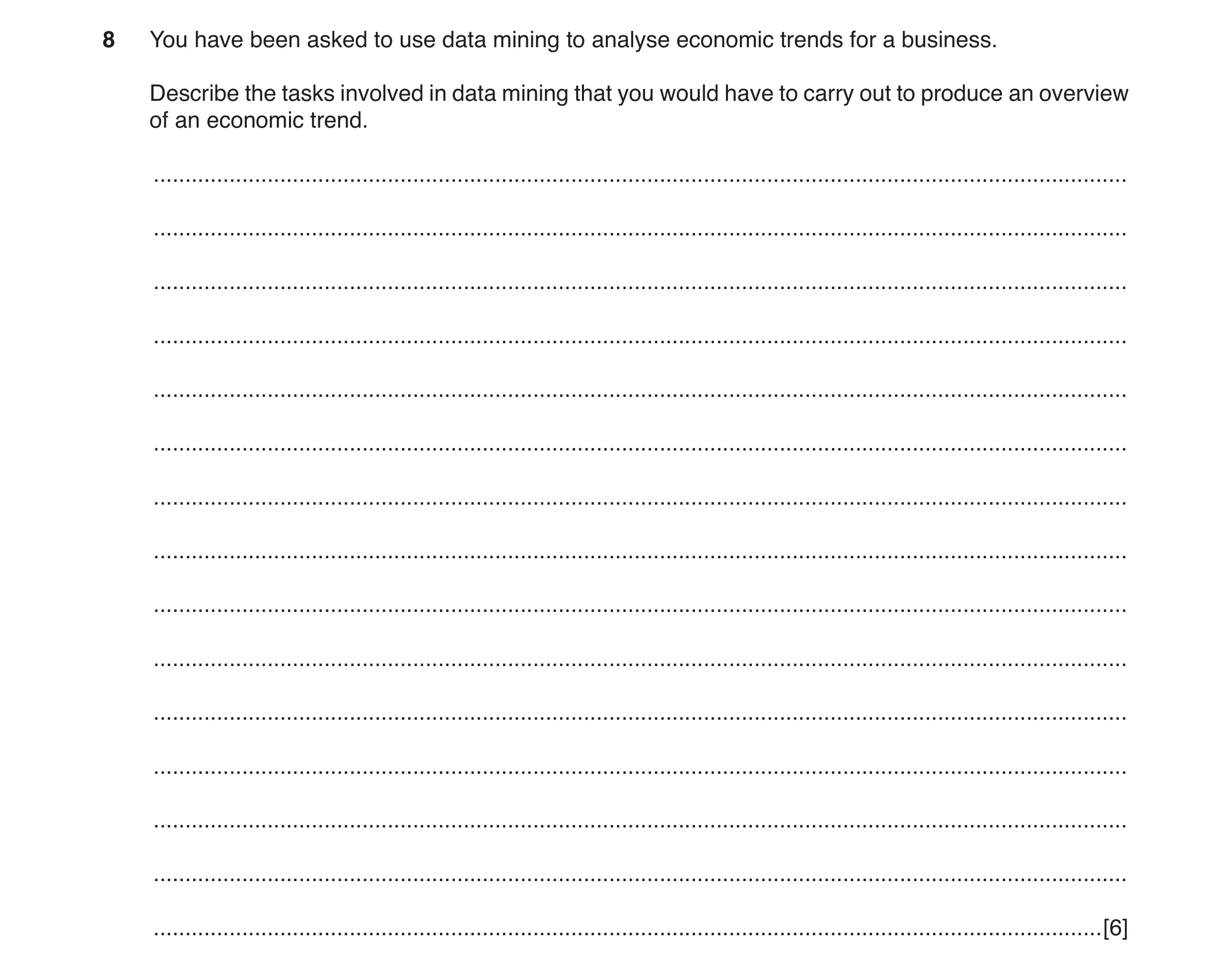
Q1 · You have been asked to use data mining to analyse economic trends for a business 9626/31 May/June 2017
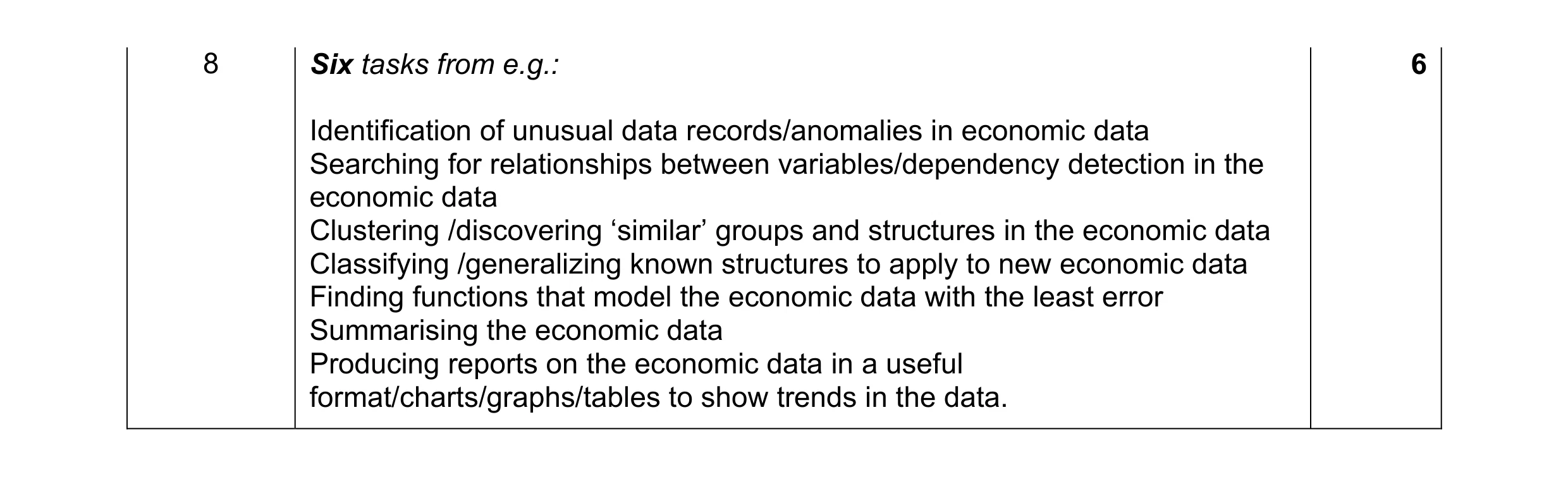
8 You have been asked to use data mining to analyse economic trends for a business. Describe the tasks involved in data mining that you would have to carry out to produce an overview of an economic trend. … … … … … … … … … … … … … … … [6]
6 marks
Mark scheme: 8 Six tasks from e.g.: 6 Identification of unusual data records/anomalies in economic data Searching for relationships between variables/dependency detection in the economic data Clustering /discovering ‘similar’ groups and structures in the economic data Classifying /generalizing known structures to apply to new economic data Finding functions that model the economic data with the least error Summarising the economic data Producing reports on the economic data in a useful format/charts/graphs/tables to show trends in the data.
This question in 9626/31 May/June 2017
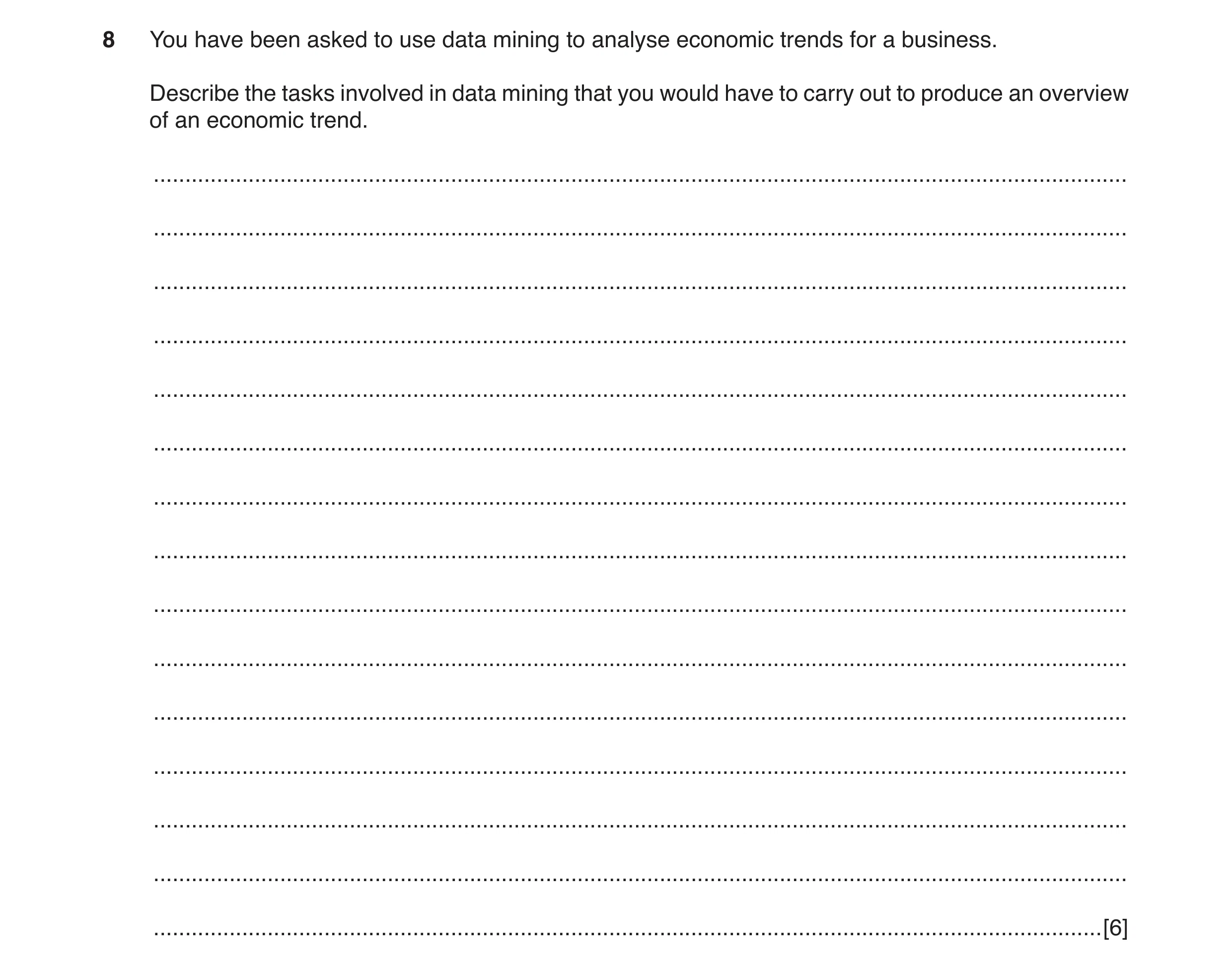
Q2 · You have been asked to use data mining to analyse economic trends for a business 9626/33 May/June 2017
8 You have been asked to use data mining to analyse economic trends for a business. Describe the tasks involved in data mining that you would have to carry out to produce an overview of an economic trend. … … … … … … … … … … … … … … … [6]
6 marks
Mark scheme: 8 Six tasks from e.g.: 6 Identification of unusual data records/anomalies in economic data Searching for relationships between variables/dependency detection in the economic data Clustering /discovering ‘similar’ groups and structures in the economic data Classifying /generalizing known structures to apply to new economic data Finding functions that model the economic data with the least error Summarising the economic data Producing reports on the economic data in a useful format/charts/graphs/tables to show trends in the data.
This question in 9626/33 May/June 2017
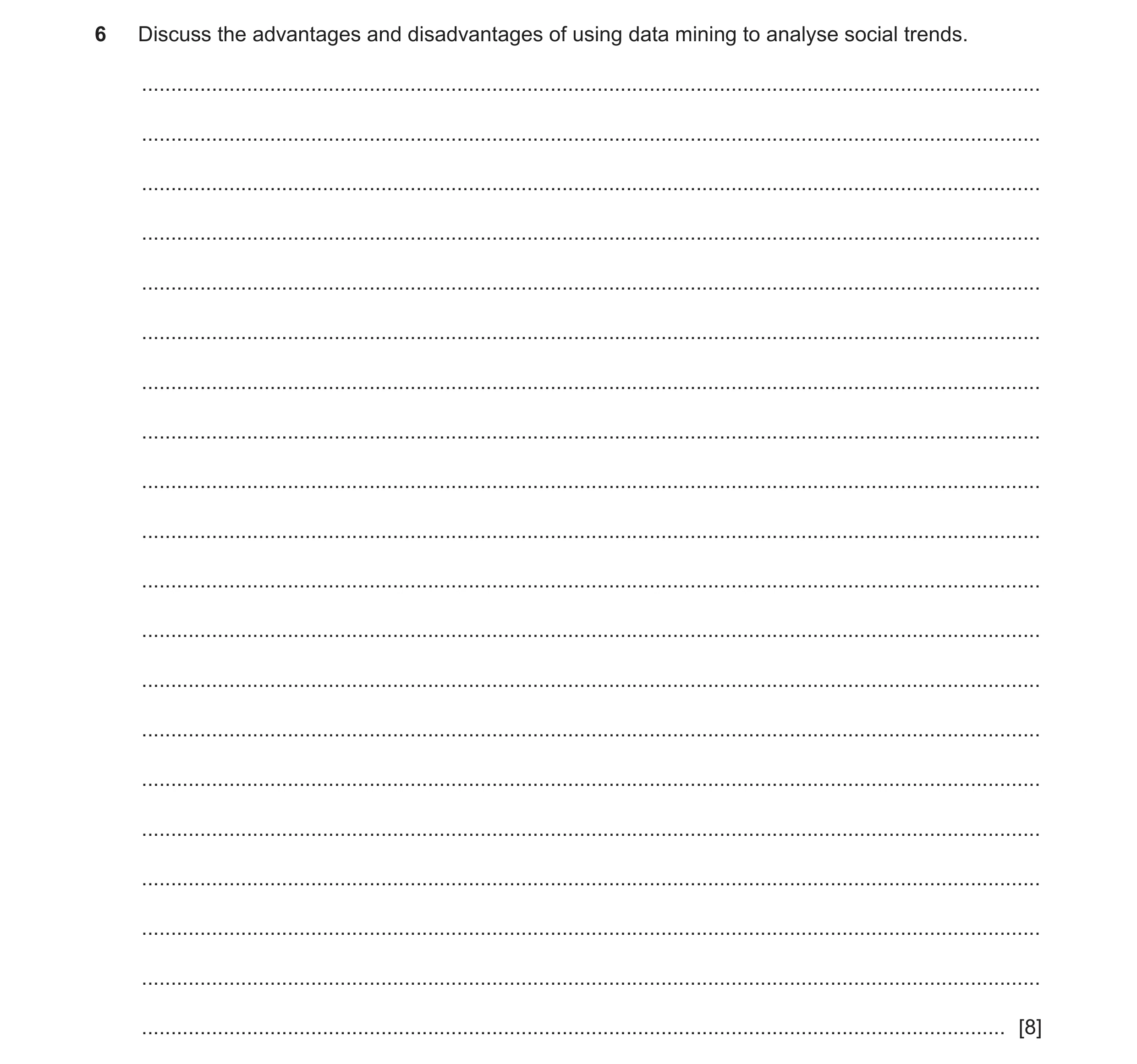
Q3 · Discuss the advantages and disadvantages of using data mining to analyse social trends 9626/32 Oct/Nov 2020
6 Discuss the advantages and disadvantages of using data mining to analyse social trends. … … … … … … … … … … … … … … … … … … … … [8]
8 marks
Mark scheme: 6 Eight from e.g.: 8 Advantages: Useful/helpful for predicting future trends Useful/helpful in keeping track of customer habits/behaviour Useful/helpful in decision making Speeds up the data analysis As people can collect information about marketed products online this eventually reduces the cost of the product and their services With the help of marketing analysis can find out fraudulent/fake products available Can cause the sudden fall in popularity of some films following e.g. ‘me-too’ campaigns Can influence the rebellion against plastic wrapped goods being identified by data mining of social trends Disadvantages: Violates user privacy Can collect additional irrelevant information Highly skilled person is required to carry out the analysis/prepare and understand the data Safety and security measures can be minimal so data can be misused to harm others Results of data mining can be stolen/sold to others without being anonymised so revealing personal details/data Data patterns/results of mining can be misused/used to discriminate against different social/demographic groups Accuracy of data can be in doubt Must have at least one of each for full marks. One mark available for a reasoned conclusion.
This question in 9626/32 Oct/Nov 2020
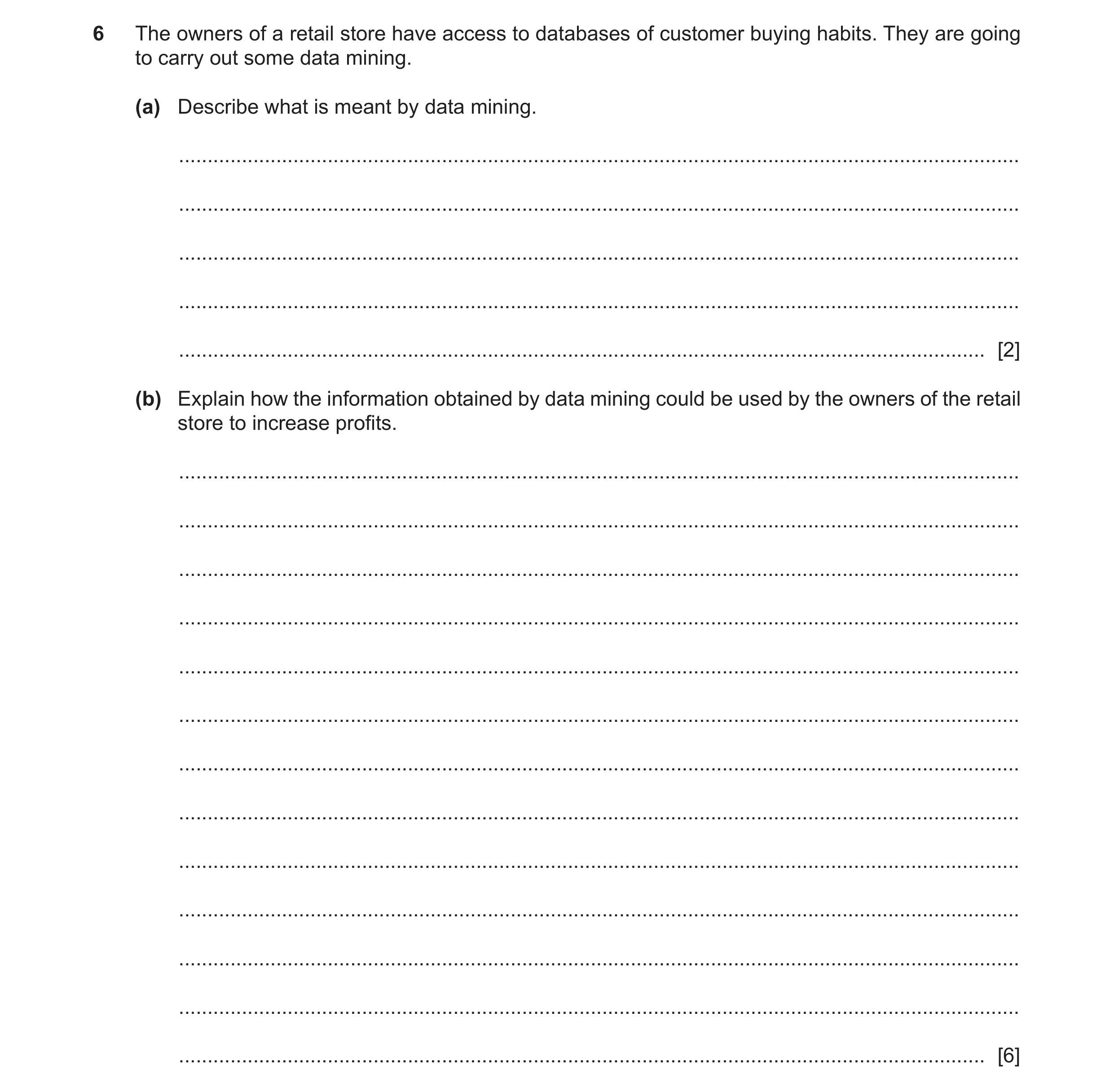
Q4 · The owners of a retail store have access to databases of customer buying habits 9626/31 May/June 2022
6 The owners of a retail store have access to databases of customer buying habits. They are going to carry out some data mining. (a) Describe what is meant by data mining. … … … … … [2] (b) Explain how the information obtained by data mining could be used by the owners of the retail store to increase profits. … … … … … … … … … … … … … [6]
8 marks
Mark scheme: 6(a) Two from: (Data mining is) the process of analysing a large quantity of data/information Used to discern/discover/show trends Used to discern/discover/show patterns. 2 6(b) Six from: Divide customers into groups according to purchasing habits Customer groups include e.g. recency/frequency/monetary (RFM) groups Customers in the different groups are targeted by different marketing campaigns E.g. recent buyers sent money-off coupons with time limit/frequent customers sent coupons off regular purchases/suggestions for additional purchases/big spenders dealt with differently from those who spend little at a time Can decide when to put items on sale/at full price Can target specific customers/customer groupings from customers purchasing habits via social media/email marketing Can target specific customers/customer groupings from loyalty card schemes via social media/email marketing Can decide which advertising campaigns worked/which did not Can decide which items sold well to different demographics/which did not. 6
This question in 9626/31 May/June 2022
Q5 · The data mining process consists of several phases 9626/32 May/June 2022
10 The data mining process consists of several phases. Describe the tasks that occur in each of the phases shown below. (a) Data understanding … … … … … … … … … … … [4] (b) Deployment … … … … … … … … … … … [4]
8 marks
Mark scheme: 10(a) Four from: Gathering the data required for the phase Documenting/describing the data e.g. location of source/how acquired Listing the source of the data that has been gathered Populate the analysis tool/software with the data Reviewing/exploring the data to check for e.g. completeness/anomalies/outliers (Visually) checking the data for patterns/trends/groupings within the data set(s) Verifying the quality of the data that has been gathered. 10(b) Three from: Planning how the data mining results will be used/reported Creating a plan to monitor/maintain the model to ensure it remains valid/useful Applying the data model/process to new data to generate predictions/trends/analysis as required by business Reporting the final results of the data mining process Reviewing the final results of the data mining process to check for errors and how to correct them. 4
This question in 9626/32 May/June 2022
Q6 · The owners of a retail store have access to databases of customer buying habits 9626/33 May/June 2022
6 The owners of a retail store have access to databases of customer buying habits. They are going to carry out some data mining. (a) Describe what is meant by data mining. … … … … … [2] (b) Explain how the information obtained by data mining could be used by the owners of the retail store to increase profits. … … … … … … … … … … … … … [6]
8 marks
Mark scheme: 6(a) Two from: (Data mining is) the process of analysing a large quantity of data/information Used to discern/discover/show trends Used to discern/discover/show patterns. 2 6(b) Six from: Divide customers into groups according to purchasing habits Customer groups include e.g. recency/frequency/monetary (RFM) groups Customers in the different groups are targeted by different marketing campaigns E.g. recent buyers sent money-off coupons with time limit/frequent customers sent coupons off regular purchases/suggestions for additional purchases/big spenders dealt with differently from those who spend little at a time Can decide when to put items on sale/at full price Can target specific customers/customer groupings from customers purchasing habits via social media/email marketing Can target specific customers/customer groupings from loyalty card schemes via social media/email marketing Can decide which advertising campaigns worked/which did not Can decide which items sold well to different demographics/which did not. 6
This question in 9626/33 May/June 2022
Q7 · The process of data mining is divided into phases 9626/31 Oct/Nov 2022
3 The process of data mining is divided into phases. Describe the tasks that occur in each of the following phases. (a) business understanding … … … … … … … … … [3] (b) data modelling … … … … … … … … … … … [4]
7 marks
Mark scheme: 3(a) Three from: 3 Identifying the business goals and their impact on the business/organisation Assessing the situation/problem that is to be solved by/what is required from the data mining Defining the goals of the data mining process Producing a project plan. 3(b) Four from: 4 Gathering the data required for the process Documenting/describing the data e.g. location of source/how acquired Listing the source of the data that has been gathered Populate the analysis tool/software with the data Reviewing/exploring the data to check e.g. completeness/anomalies/outliers Visually checking the data for patterns/trends/groupings within the data set(s) Verifying the quality of the data that has been gathered.
This question in 9626/31 Oct/Nov 2022
Q8 · Data mining is used by health care organisations to analyse large amounts of patient data 9626/32 Oct/Nov 2022
2 Data mining is used by health care organisations to analyse large amounts of patient data. Explain why health care organisations use data mining to analyse their patient data. … … … … … … … … … … … … … [6]
6 marks
Mark scheme: 2 Six from: 6 Identify patterns in large sets of data Data patterns help to determine/predict trends in information Compare and contrast symptoms to analyse disease causes/processes Determine the effectiveness of treatments/drugs for illnesses to determine most effective course of treatment/medicines/actions Repeated analysis (to attempt) to standardise treatment of specific diseases (Repeated analysis) to speed up diagnosis and treatment of diseases Determine (normal) patterns of medical claims by patients/doctors/clinics/hospitals to help reduce costs Determine abnormal patient outcomes from treatments/procedures Determine abnormal/unusual patterns of medical claims by patients/doctors/clinics/hospitals to identify fraudulent claims.
This question in 9626/32 Oct/Nov 2022
Q9 · The process of data mining is divided into phases 9626/33 Oct/Nov 2022
3 The process of data mining is divided into phases. Describe the tasks that occur in each of the following phases. (a) business understanding … … … … … … … … … [3] (b) data modelling … … … … … … … … … … … [4]
7 marks
Mark scheme: 3(a) Three from: 3 Identifying the business goals and their impact on the business/organisation Assessing the situation/problem that is to be solved by/what is required from the data mining Defining the goals of the data mining process Producing a project plan. 3(b) Four from: 4 Gathering the data required for the process Documenting/describing the data e.g. location of source/how acquired Listing the source of the data that has been gathered Populate the analysis tool/software with the data Reviewing/exploring the data to check e.g. completeness/anomalies/outliers Visually checking the data for patterns/trends/groupings within the data set(s) Verifying the quality of the data that has been gathered.
This question in 9626/33 Oct/Nov 2022
Q10 · Discuss the benefits and drawbacks of the use of data mining by businesses 9626/31 Oct/Nov 2023
10 Discuss the benefits and drawbacks of the use of data mining by businesses. … … … … … … … … … … … … … … … … [6]
6 marks
Mark scheme: 10 Discuss: write about issues(s) or topic(s) in depth in a structured way. 6 Six from e.g.: Benefits: Max five from: • Data mining analyses a vast amount of data from numerous source • to discover trends/relationships/links between data that are not (immediately) obvious • Retail businesses analyse historical data to be able to predict who may respond to advertising campaigns/targeted advertising • to increase sales/find new markets/customers • who may/may not respond to different advertising techniques using social media/emails/direct marketing/discounts/vouchers • who may/may not buy related goods/which goods may be related in terms of sales • Financial institutions analyses customer data to discover/detect fraudulent credit card transactions • to protect credit card owner/user • detect/determine what (type of) customers may/may not be a good risk for loans • Manufacturers analyse engineering/production data to detect faulty equipment/determine optimal control parameters • to increase quality/reduce errors/defects in their processes Drawbacks: Max five from: • Personal privacy issues of extracting data from internet activities/social networks/e-commerce/forums/blogs concerns the public • so people are reluctant to allow their data to be used/analysed so businesses cannot rely on the results of data mining to make informed decisions • Businesses may lose control of their customer data when it is used for data mining and may be/could be responsible for resulting any data loss/breach • Customers/clients cannot be sure/certain their data is anonymised during data mining/data cannot be traced back • so are reluctant to provide full details to businesses • Customers data must be kept secure during the data mining process • because any data loss will result in costs to the business/legal liability for the business • Data collected/determined/found/linked through data mining can be misused by businesses • to take advantage of vulnerable people/discriminate against a group of people. Max 5 if all benefits or all drawbacks. Max 4 marks if bullets/list of points.
This question in 9626/31 Oct/Nov 2023
Q11 · Discuss the benefits and drawbacks of the use of data mining by businesses 9626/33 Oct/Nov 2023
10 Discuss the benefits and drawbacks of the use of data mining by businesses. … … … … … … … … … … … … … … … … [6]
6 marks
Mark scheme: 10 Discuss: write about issues(s) or topic(s) in depth in a structured way. 6 Six from e.g.: Benefits: Max five from: • Data mining analyses a vast amount of data from numerous source • to discover trends/relationships/links between data that are not (immediately) obvious • Retail businesses analyse historical data to be able to predict who may respond to advertising campaigns/targeted advertising • to increase sales/find new markets/customers • who may/may not respond to different advertising techniques using social media/emails/direct marketing/discounts/vouchers • who may/may not buy related goods/which goods may be related in terms of sales • Financial institutions analyses customer data to discover/detect fraudulent credit card transactions • to protect credit card owner/user • detect/determine what (type of) customers may/may not be a good risk for loans • Manufacturers analyse engineering/production data to detect faulty equipment/determine optimal control parameters • to increase quality/reduce errors/defects in their processes Drawbacks: Max five from: • Personal privacy issues of extracting data from internet activities/social networks/e-commerce/forums/blogs concerns the public • so people are reluctant to allow their data to be used/analysed so businesses cannot rely on the results of data mining to make informed decisions • Businesses may lose control of their customer data when it is used for data mining and may be/could be responsible for resulting any data loss/breach • Customers/clients cannot be sure/certain their data is anonymised during data mining/data cannot be traced back • so are reluctant to provide full details to businesses • Customers data must be kept secure during the data mining process • because any data loss will result in costs to the business/legal liability for the business • Data collected/determined/found/linked through data mining can be misused by businesses • to take advantage of vulnerable people/discriminate against a group of people. Max 5 if all benefits or all drawbacks. Max 4 marks if bullets/list of points.
This question in 9626/33 Oct/Nov 2023
Q12 · A specialist data mining company has been asked by a bank to create a data mining model 9626/31 May/June 2024
7 A specialist data mining company has been asked by a bank to create a data mining model. The bank will use the model to find out if there is fraudulent activity in the use of credit cards. Describe the process the data mining company will use to create the model for the bank. … … … … … … … … … … … … … … … … … … … … [8]
8 marks
Mark scheme: 7 Eight from: Max 1 mark for naming at least 3 stages: business understanding, data understanding, data preparation, data modelling, evaluating, deployment. Business understanding: which determines what is required from the data mining process Deciding if the data mining is worth the cost/risk of being carried out Deciding the success criteria of the data mining process Data understanding: which collects/identifies the data sets to be used Ensuring that there is enough data available to carry out the mining process Ensuring that there is enough time/computer resources available to carry out the data mining Creating a description/report on the data sets to be used Data preparation: selects the data to be used according to e.g. its relevance to the company’s requirements ‘Cleaning’ the data to remove redundant/inaccurate/irrelevant data Creating combinations of data by merging data with common characteristics/features/customer uses Data modelling: out the mining to discover relationships/links/patterns in the data Creating new relationships/links/patterns to analyse the patterns Document the mining to allow repetition/testing/evaluation of the results Evaluating: the process against the success criteria If the success criteria are not met the model is amended and rerun If the success criteria are met the company is shown the results to assess Deployment: of the data mining model for use by company/the data mining model is passed to the bank for use/run for the bank Full documentation is created so the process can be repeated/monitored/maintained. 8
This question in 9626/31 May/June 2024
Q13 · A specialist data mining company has been asked by a bank to create a data mining model 9626/33 May/June 2024
7 A specialist data mining company has been asked by a bank to create a data mining model. The bank will use the model to find out if there is fraudulent activity in the use of credit cards. Describe the process the data mining company will use to create the model for the bank. … … … … … … … … … … … … … … … … … … … … [8]
8 marks
Mark scheme: 7 Eight from: Max 1 mark for naming at least 3 stages: business understanding, data understanding, data preparation, data modelling, evaluating, deployment. Business understanding: which determines what is required from the data mining process Deciding if the data mining is worth the cost/risk of being carried out Deciding the success criteria of the data mining process Data understanding: which collects/identifies the data sets to be used Ensuring that there is enough data available to carry out the mining process Ensuring that there is enough time/computer resources available to carry out the data mining Creating a description/report on the data sets to be used Data preparation: selects the data to be used according to e.g. its relevance to the company’s requirements ‘Cleaning’ the data to remove redundant/inaccurate/irrelevant data Creating combinations of data by merging data with common characteristics/features/customer uses Data modelling: out the mining to discover relationships/links/patterns in the data Creating new relationships/links/patterns to analyse the patterns Document the mining to allow repetition/testing/evaluation of the results Evaluating: the process against the success criteria If the success criteria are not met the model is amended and rerun If the success criteria are met the company is shown the results to assess Deployment: of the data mining model for use by company/the data mining model is passed to the bank for use/run for the bank Full documentation is created so the process can be repeated/monitored/maintained. 8
This question in 9626/33 May/June 2024
Q14 · The data mining process consists of several phases 9626/32 Oct/Nov 2024
7 The data mining process consists of several phases. Describe the tasks that occur in each of the following phases in the data mining process. (a) data preparation … … … … … … … … … … [4] (b) evaluation … … … … … … … … … … [4]
8 marks
Mark scheme: 7(a) Four from: 4 • Selection of the data to be mined with reference to its relevance to the requirements of the client • Selection by reference to quality / technical restrictions e.g. type / quantity / size of data set / number of data sets • Detection and removal of corrupt / inaccurate records in the data sets • Data is ’cleaned’ by removal of irrelevant parts of the data / data set • Creation / construction of new records derived from existing records in the data / data set • Merging data / records with common features / summarising data / aggregating data. 7(b) Four from: 4 • Checks data mining model against the success criteria laid out in the first / business understanding phase • Returns model / creates reports / sends model back to data preparation and / or modelling processes for amendments to be carried out if success criteria not met • Checks against reports / testing outcomes of previous phases to ensure all errors have been addressed / corrected • Creates / produces reports detailing the evaluation process / results / outcomes for client / developers • If success criteria met moves model to deployment phase.
This question in 9626/32 Oct/Nov 2024
Q15 · Data mining is used by businesses to analyse very large quantities of data 9626/33 Oct/Nov 2024
8 Data mining is used by businesses to analyse very large quantities of data. Discuss the use of data mining by businesses. … … … … … … … … … … … … … … … … … … … … [8]
8 marks
Mark scheme: 8 Command word: Discuss: write about issue(s) or topic(s) in depth in a structured way. 8 Eight from e.g.: • Data mining allows businesses to collect reliable information for use in marketing research (1) to determine the products that interest customers (1) and then make those products available (1) • Helps businesses find patterns in their data (1) to evaluate their own policies and procedures for effectiveness (1) • Can be used to find correlations between products/consumers/suppliers (1) to help identify trends that might not have been previously identified before (1) to help make more accurate predictions/target marketing (1) to help make informed decisions/better decision-making based on trends within large quantities of data (1) • Can be used to detect fraud/risks (1) that may not be apparent through traditional data analysis (1) • Can be used to discover trends/patterns in customer buying habits (1) which can be used to suggest products/advertise/target products at specific demographics (1) • Data mining tools are complex/difficult to use (1) so specialised staff are required/needs to be outsourced (1) which increases costs/can be expensive (1) • Inaccurate information may be produced (1) where data is incomplete/from inaccurate sources (1) resulting in inaccurate predictions/poor decisions being made (1) • Privacy of individuals cannot be guaranteed/data may not be completely anonymised (1) so personal/private data of individuals may be exposed/individuals may be identified (1) • Accuracy/effectiveness dependent on size of databases (1) so businesses have to share data with others (1) • Can be expensive and costs may exceed the benefits/increased profits for some/small businesses.
This question in 9626/33 Oct/Nov 2024
Q16 · Discuss the benefits and drawbacks of using data mining in businesses 9626/31 May/June 2025
7 Discuss the benefits and drawbacks of using data mining in businesses. … … … … … … … … … … … … … … … … … … … … [8]
8 marks
Mark scheme: 7 Command word: Discuss – write about issues(s) or topic(s) in a structured way. 8 EIGHT from: Max TWO marks: • data mining (is a set of techniques and tools) used to from work on / analyse large data sets • to Max extract relevant information • to discover trends / patterns / to find relationships Content areas could include: Max SIX from: Benefits: e.g.: • used to predict marketing trends • used to improve sales / profits (1st) by targeting customers / demographics (1) • used to adjust business operations • used to alter / amend business process to ensure greater productivity / efficiency • (usually) extracts reliable information • provides a sound basis for decision-making Max SIX from: Drawbacks: e.g.: • extracted information may not be accurate (1st) depends on source of data set (1) • complex tools required • need skilled operators • large databases needed • requires large storage spaces (1st) • expensive to purchase (1) • must ensure privacy of individuals / conform to data protection regulations • time-consuming / expensive to anonymise data sets
This question in 9626/31 May/June 2025
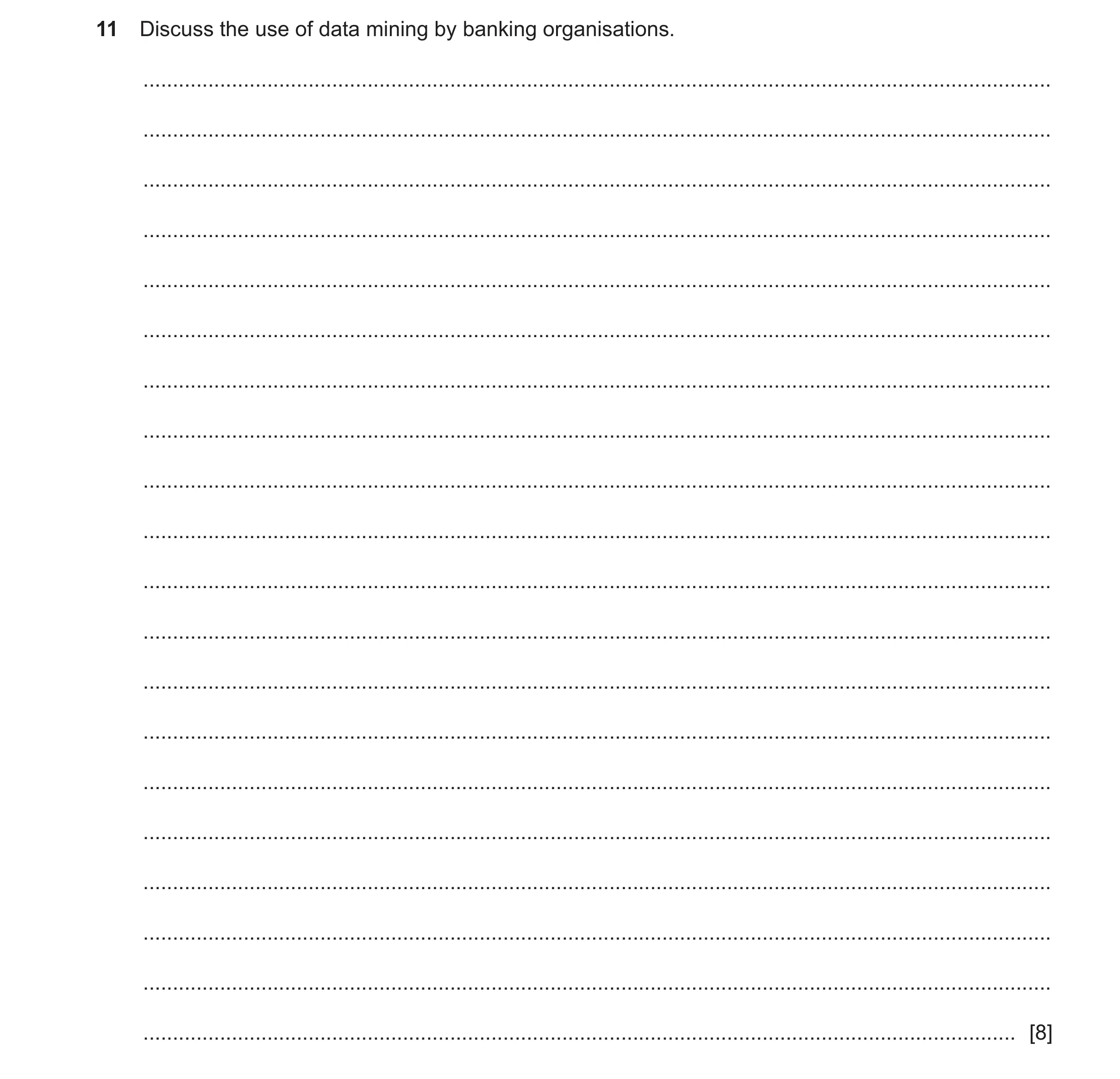
Q17 · Discuss the use of data mining by banking organisations 9626/32 May/June 2025
11 Discuss the use of data mining by banking organisations. … … … … … … … … … … … … … … … … … … … … [8]
8 marks
Mark scheme: 11 Command word: Discuss – write about issues(s) or topic(s) in a structured way. 8 EIGHT from: Content areas could include: e.g.: • Determines links / relationships / trends • In large datasets (of customer activities / products / services) between products used by customers so used in marketing of other bank / financial products • Increases sales by targeting of products based on customer choices / preferences / activity • Risk analysis discover trends / relationships / links between customer activity on credit / debit cards discover fraud / fraudulent / illegal activity / financial transactions • Used in credit scoring analyse customer activity over many accounts / time to determine reliability of customer management of customer financial portfolios…discover trends in stock / share values (over time) allocate capital / resources / money in trading of e.g. stocks and shares maximise profits for bank / customers • Investment banking discover suitable investments predict trends in value of investments • Privacy / security of personal information issues • Costs involved
This question in 9626/32 May/June 2025
 1 / 17
 2 / 17
 3 / 17
 4 / 17
 5 / 17
 6 / 17
 7 / 17
 8 / 17
 9 / 17
 10 / 17
 11 / 17
 12 / 17
 13 / 17
 14 / 17
 15 / 17
 16 / 17
 17 / 17
 6
6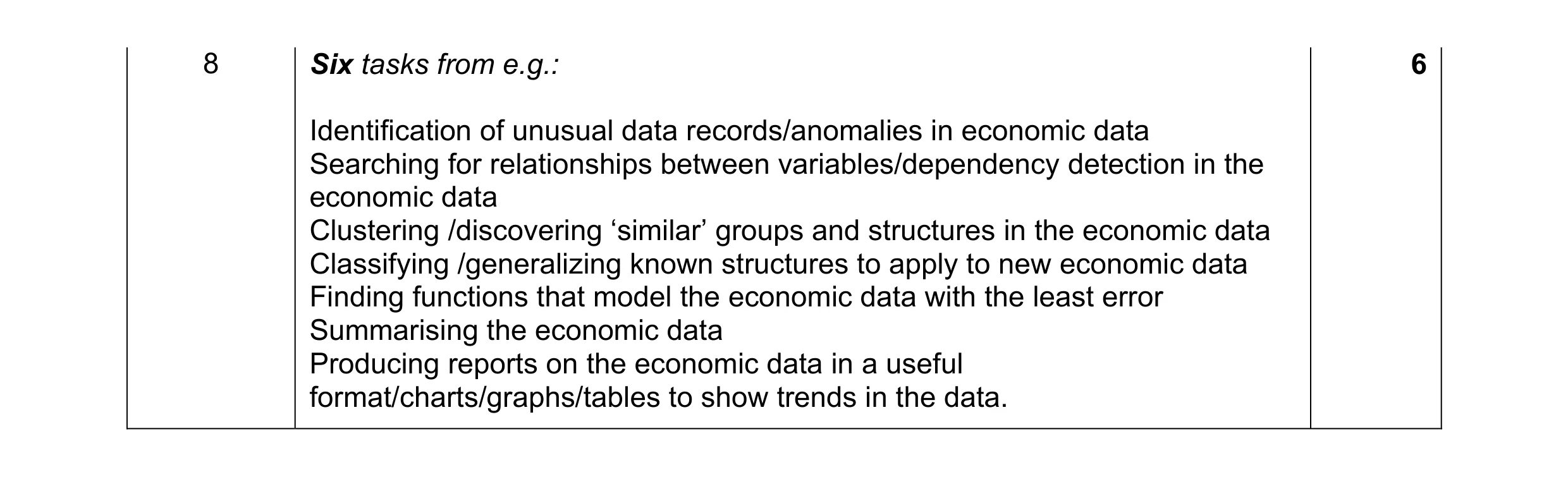 6
6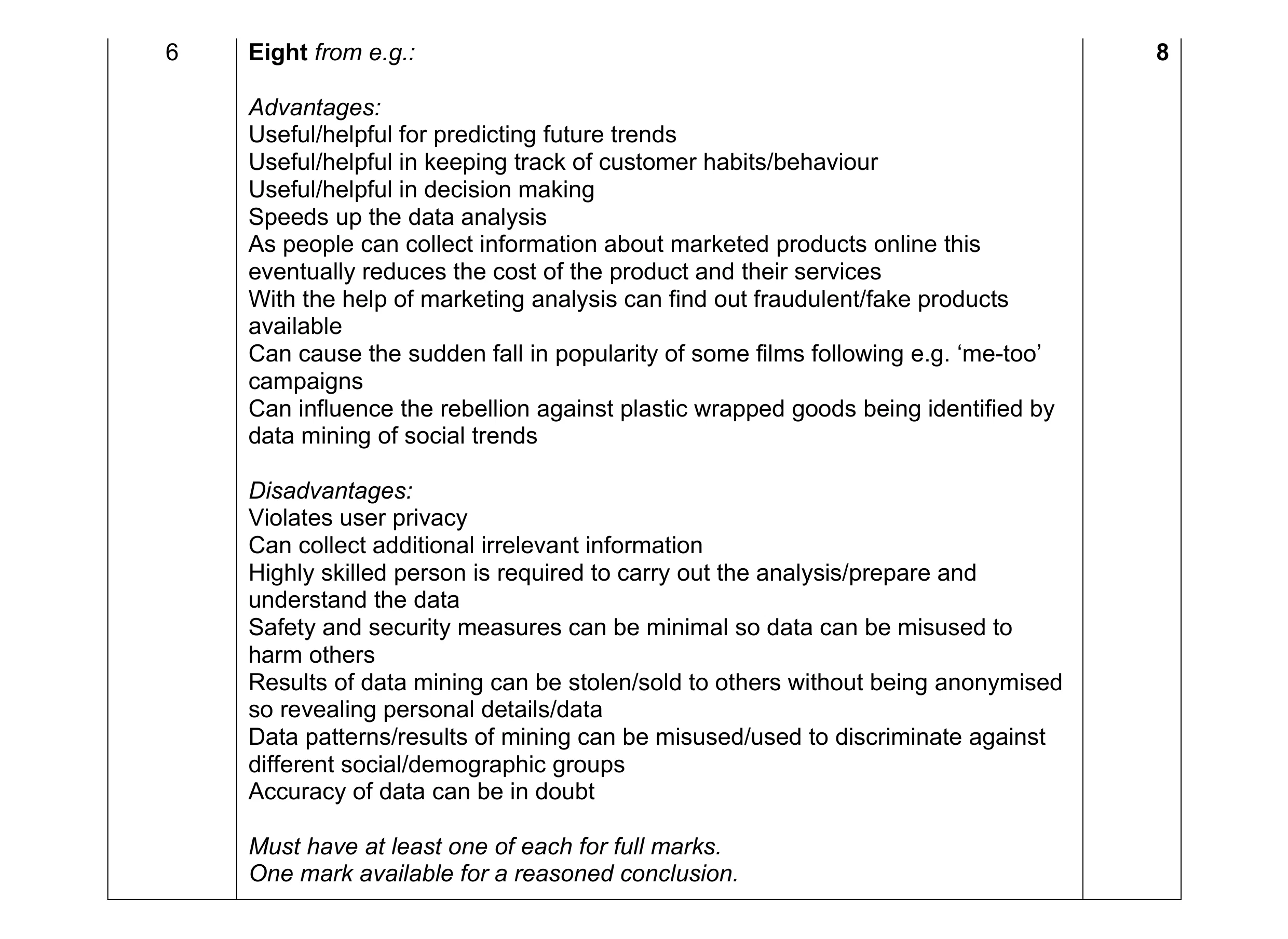 8
8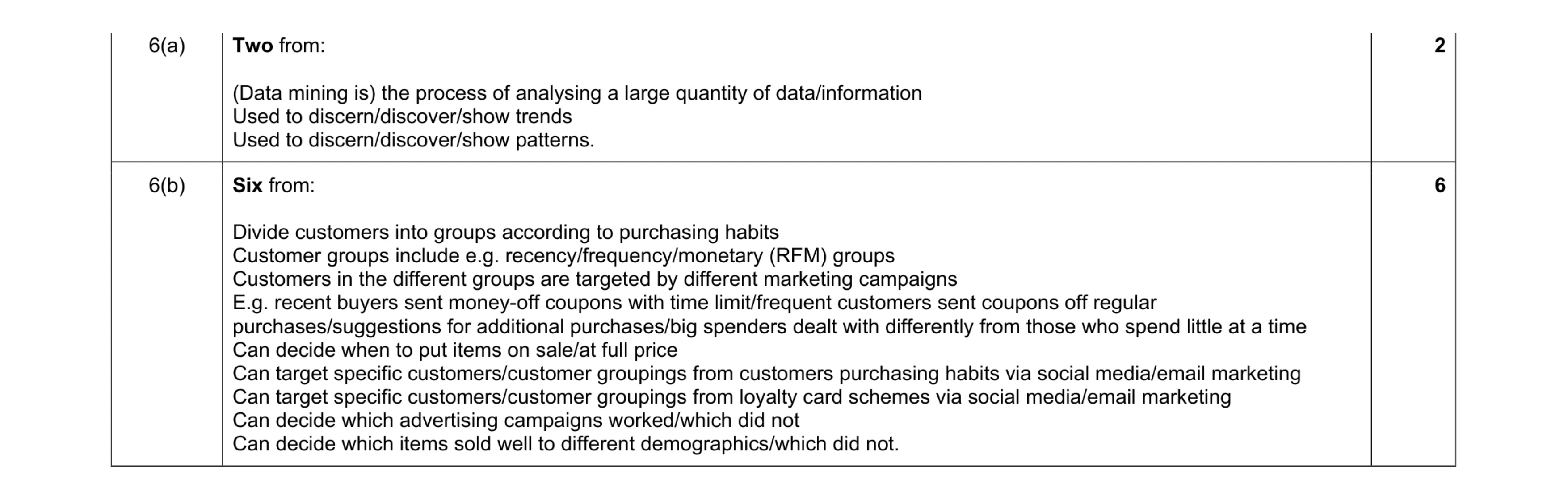 8
8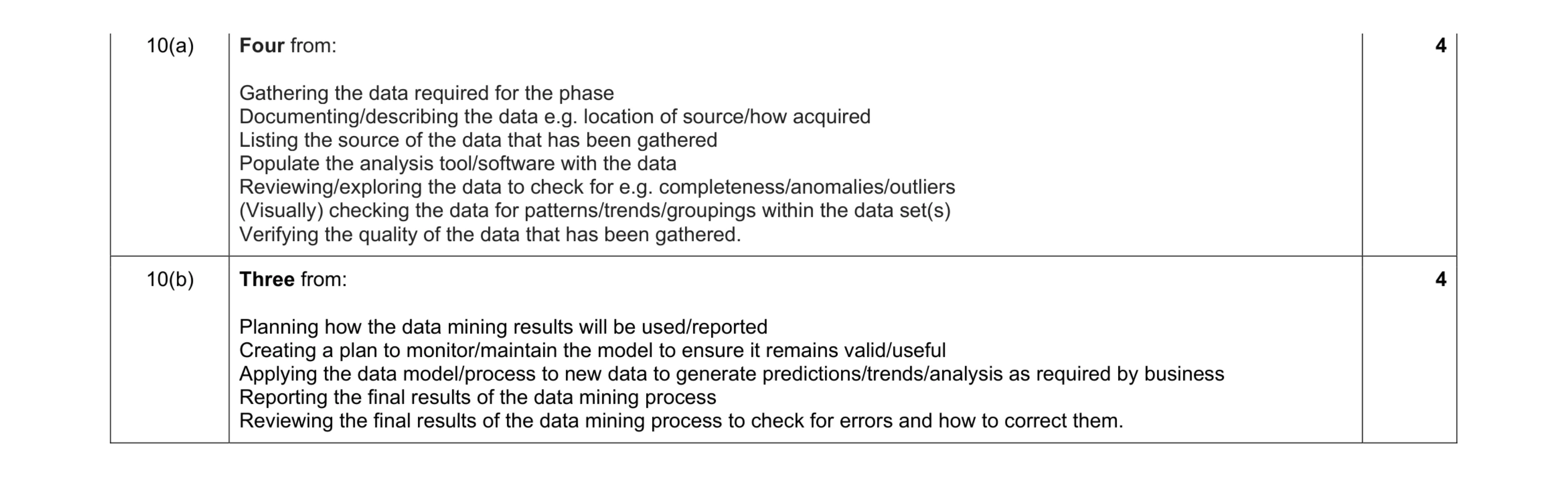 8
8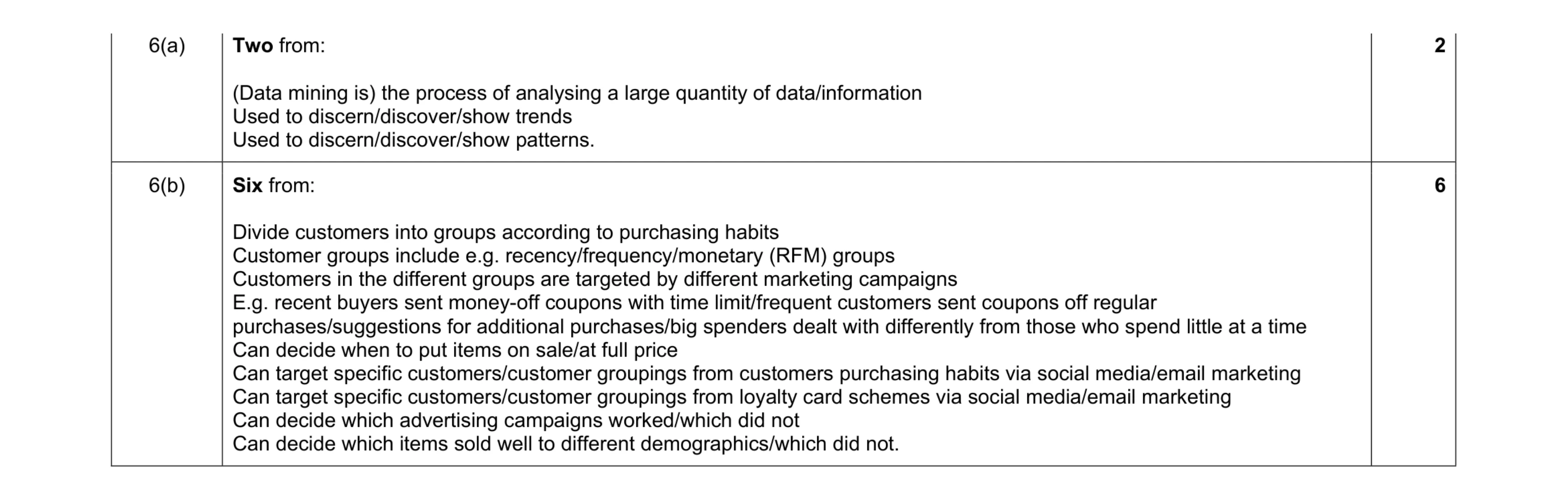 8
8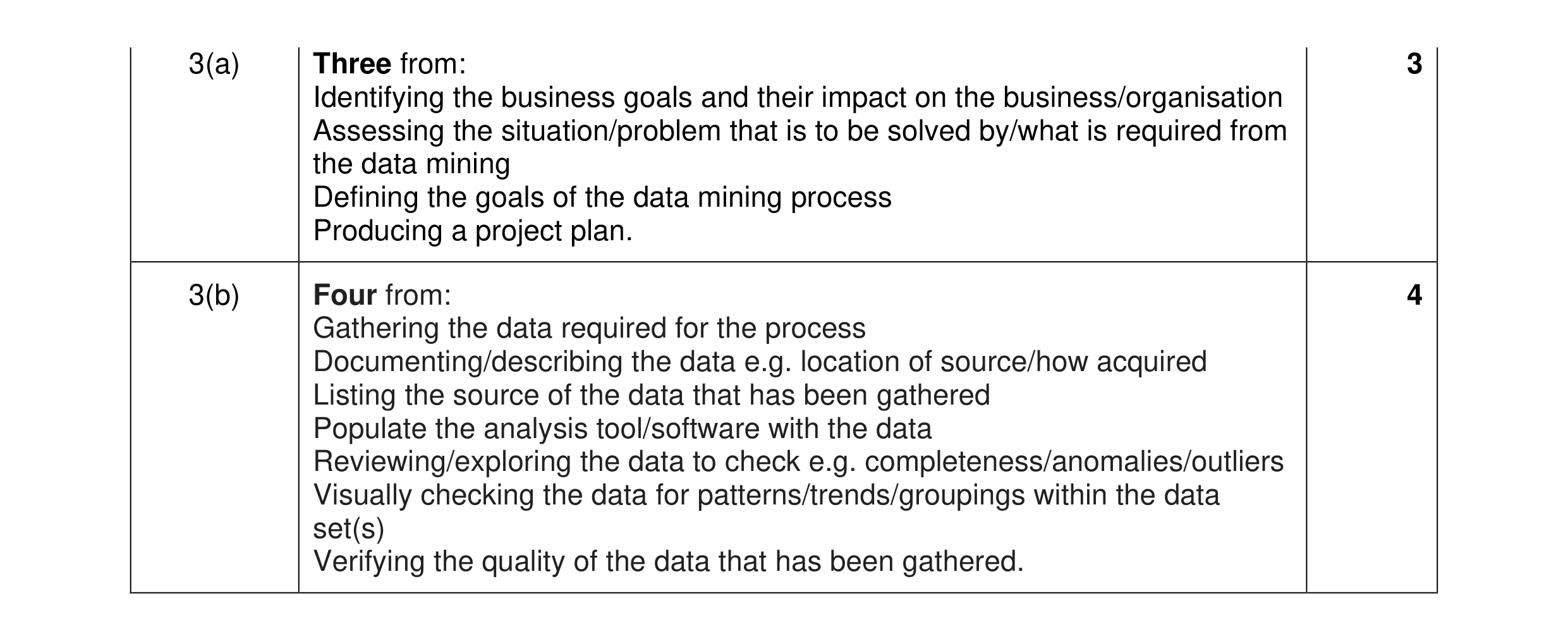 7
7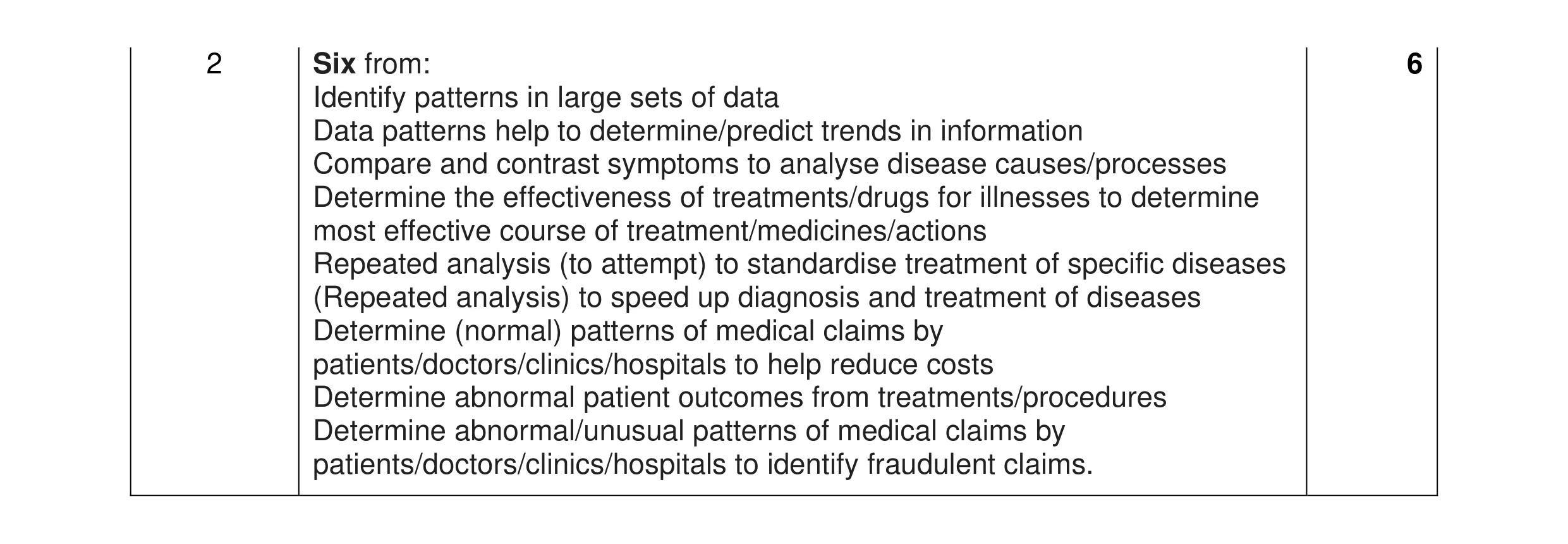 6
6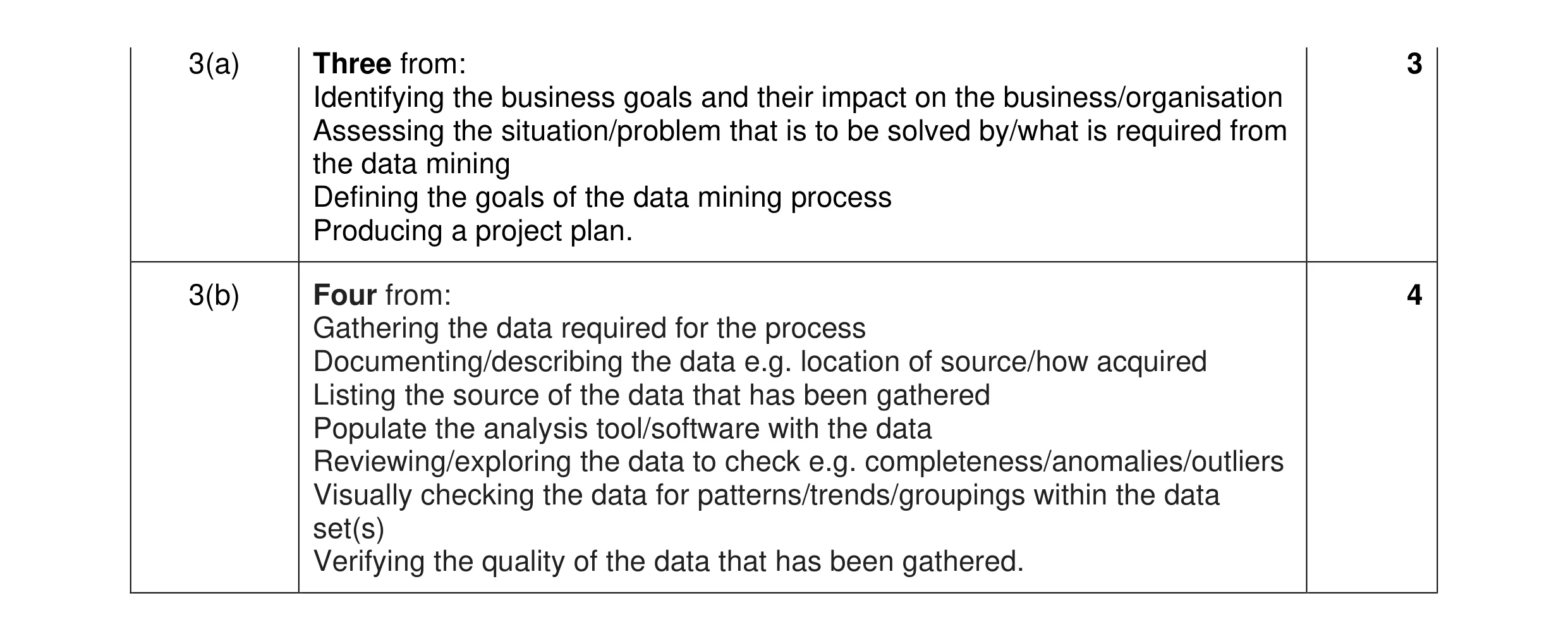 7
7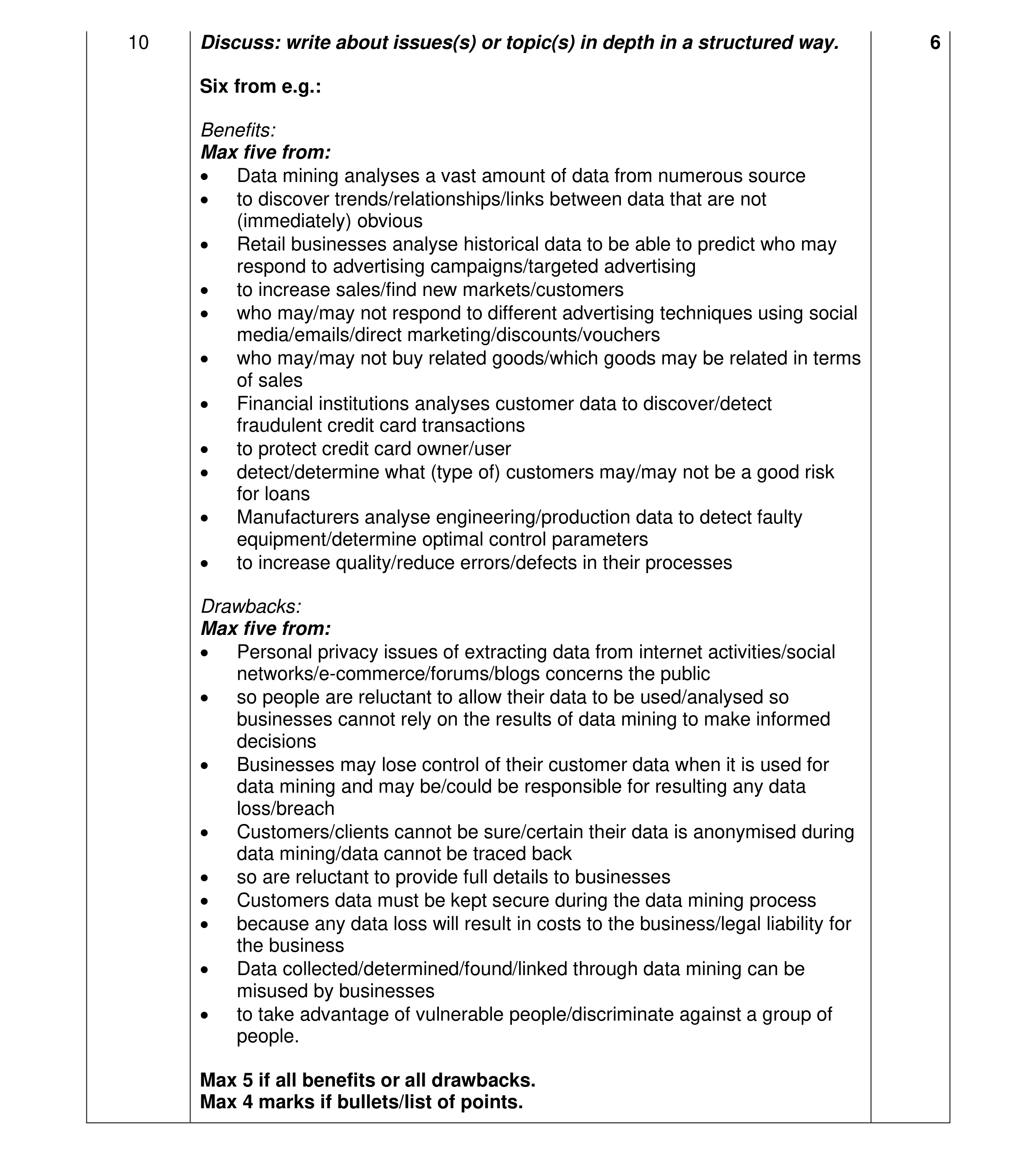 6
6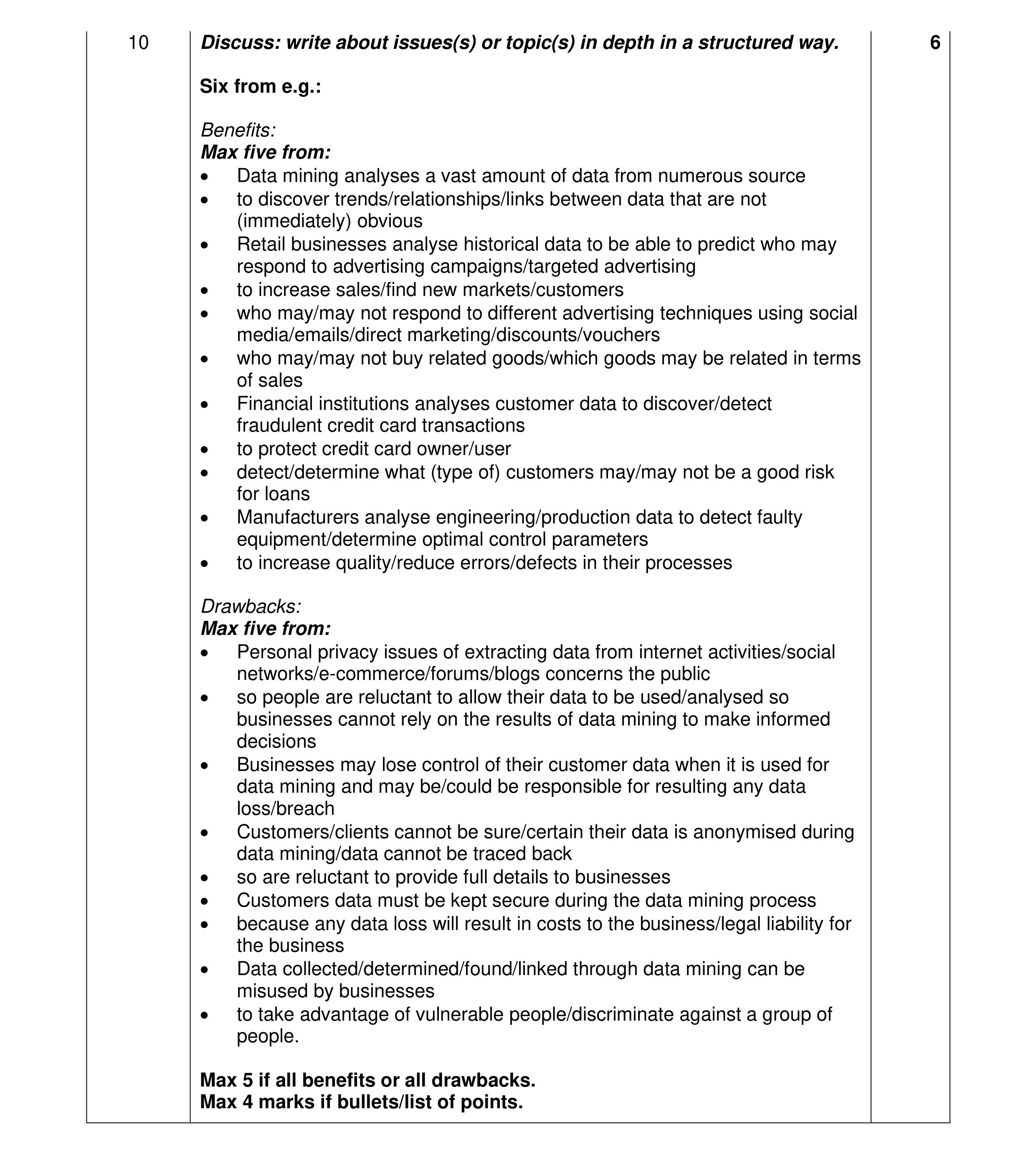 6
6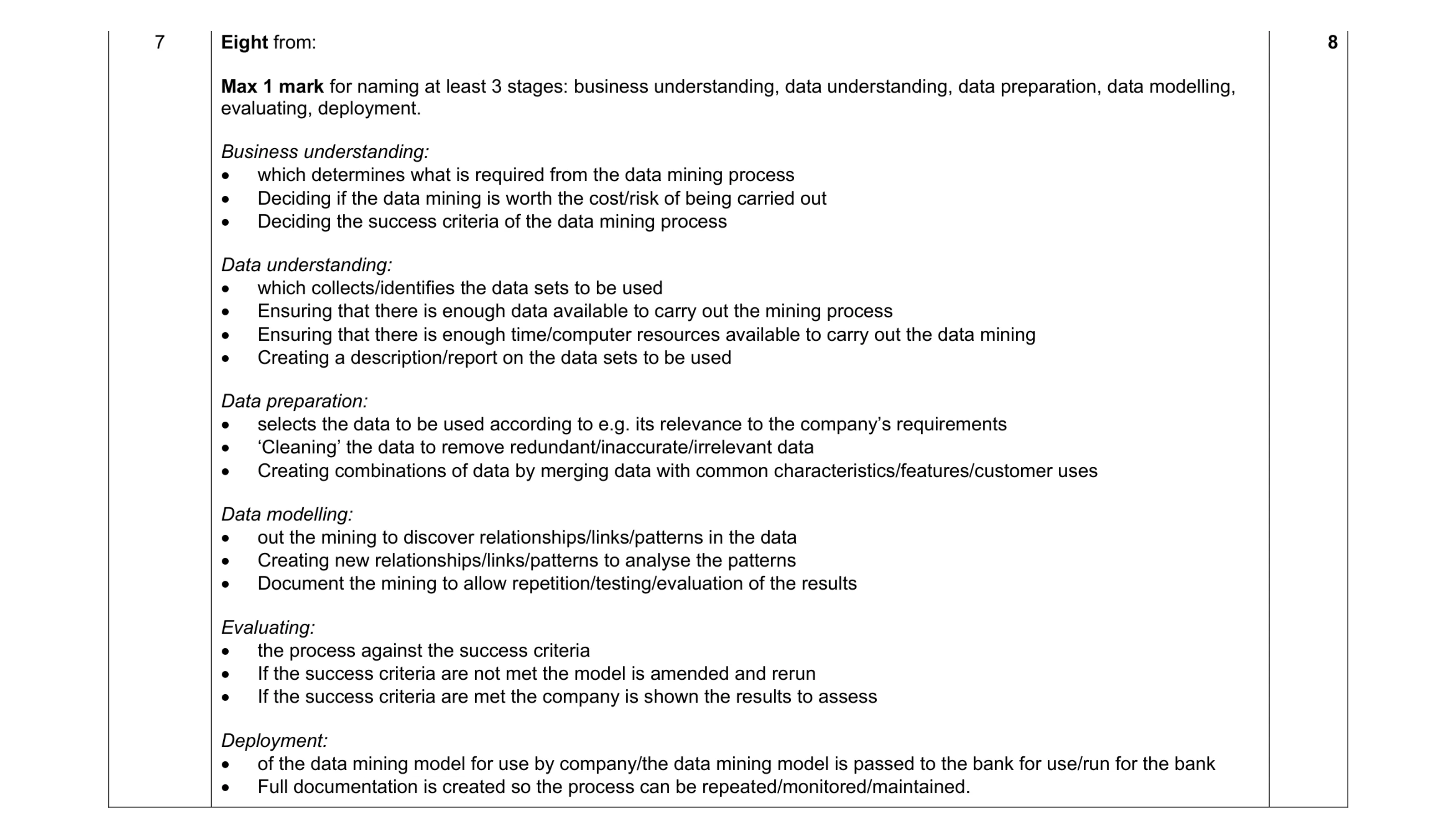 8
8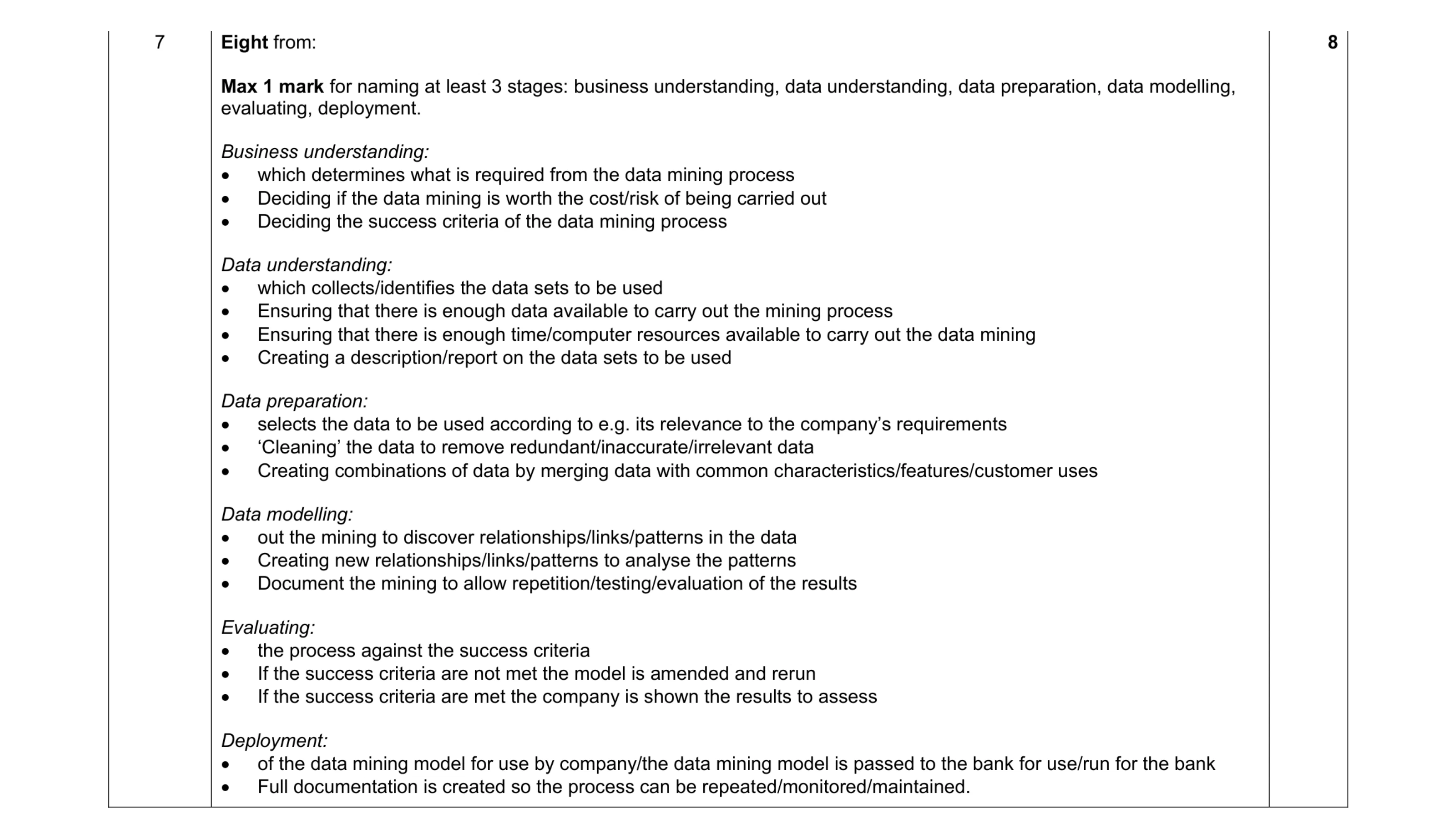 8
8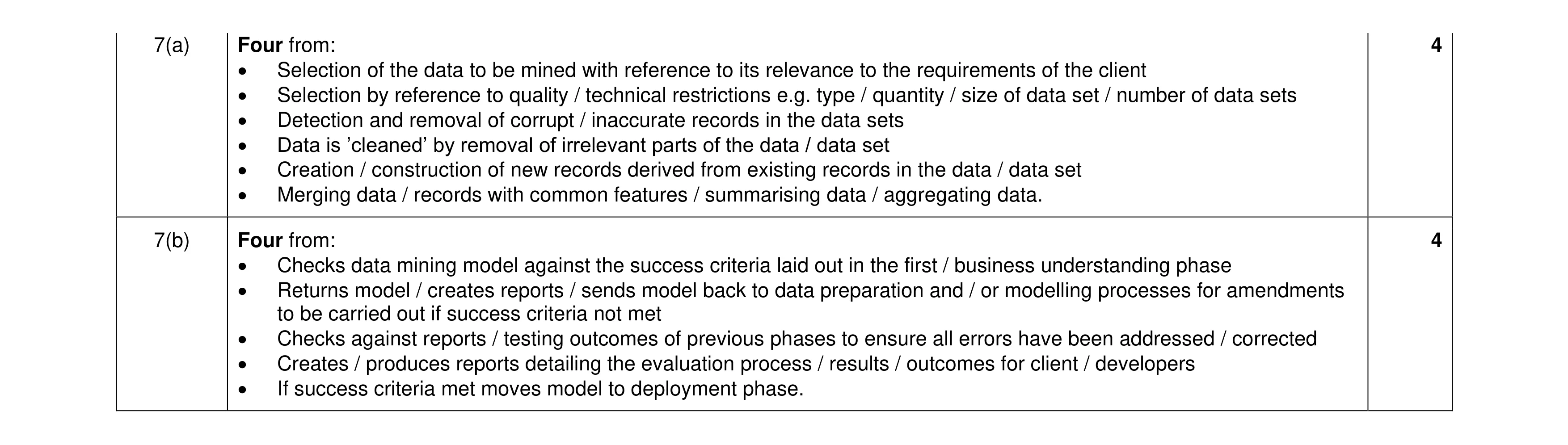 8
8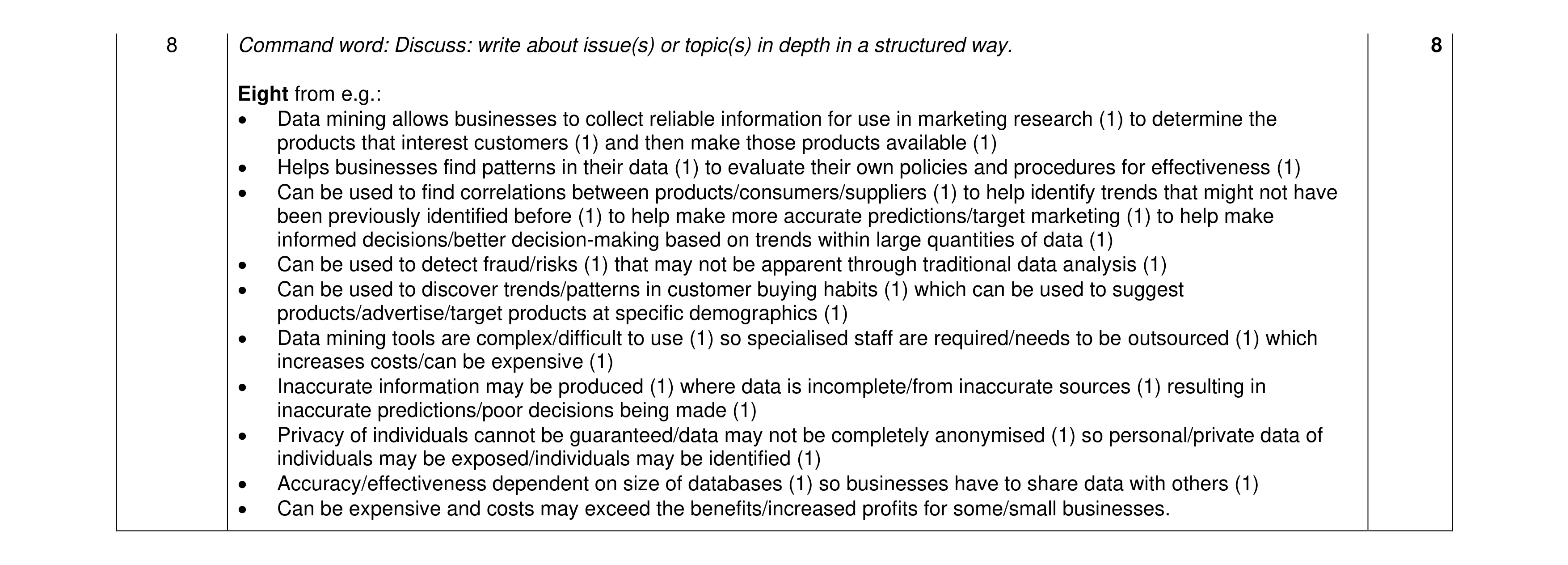 8
8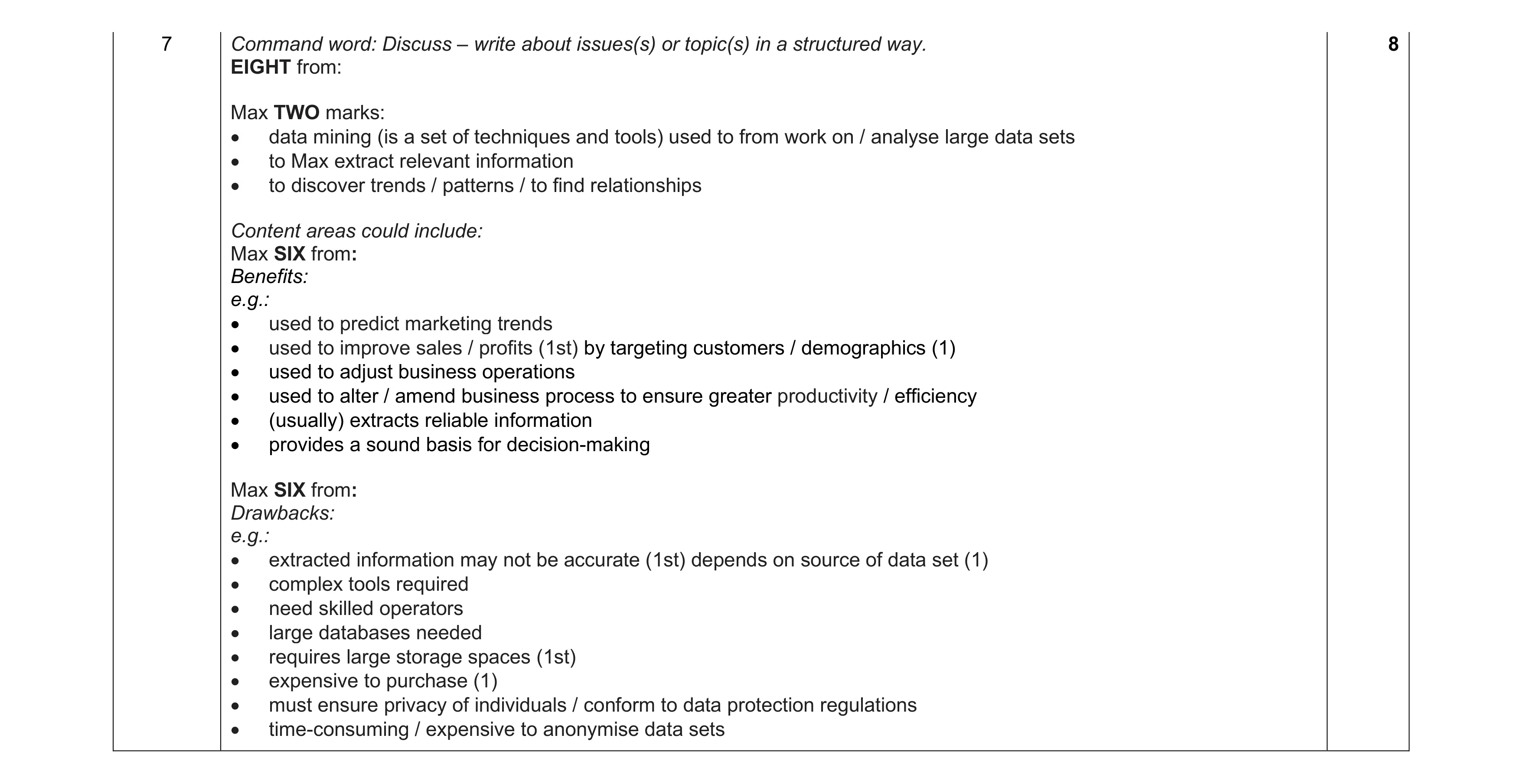 8
8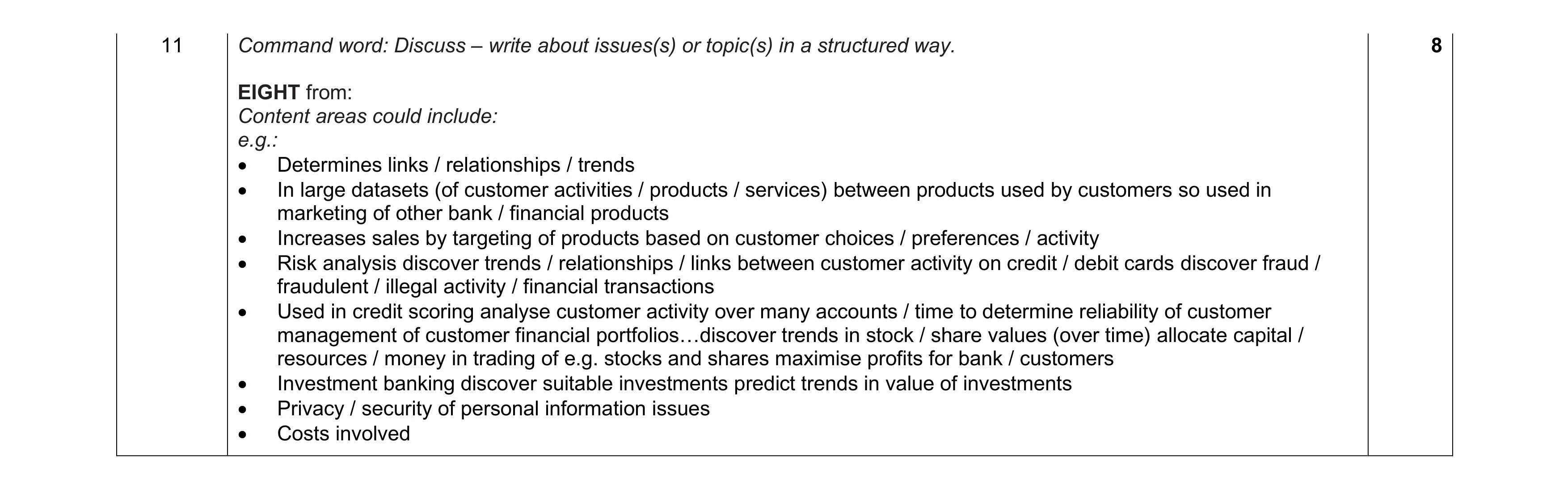 8
8