Cambridge A Level History (pre-2015) 9697 — 2012 May/June Paper 1 · Variant 2
9697/12/M/J/12 · 100 marks · ≈113 min
The question paper and its mark scheme, free to read here and free to download. This is Cambridge’s own paper, exactly as it was sat.
Question paper4 pages
Mark scheme11 pages
Answers below. Sit the paper first if you are practising.
Paper as text
Question paper, page 1
This document consists of 4 printed pages. DC (NS) 49432/2 © UCLES 2012 [Turn over UNIVERSITY OF CAMBRIDGE INTERNATIONAL EXAMINATIONS General Certificate of Education Advanced Subsidiary Level and Advanced Level * 6 8 2 5 5 4 3 7 3 2 * HISTORY 9697/12 Paper 1 Modern European History, 1789–1939 May/June 2012 3 hours Additional Materials: Answer Paper READ THESE INSTRUCTIONS FIRST Write your Centre number, candidate number and name on all the work you hand in. Write in dark blue or black pen. You may use a soft pencil for any rough working. Do not use staples, paper clips, highlighters, glue or correction fluid. Section A Answer Question 1. Section B Answer any three questions. At the end of the examination, fasten all your work securely together. All questions in this paper carry equal marks.
Question paper, page 2
2 9697/12/M/J/12 © UCLES 2012 Section A: The Origins of World War I, 1870–1914 You must answer Question 1. SERBIA’S RESPONSIBILITY FOR THE 1914 CRISIS 1 Read the Sources, and then answer the question. When answering Question 1, candidates are advised to pay particular attention to the interpretation and evaluation of the Sources both individually and as a group. Source A I said to a leading Austrian official, ‘The Serbian government condemns most energetically the Sarajevo outrage and will certainly do everything to prove that it will not tolerate within its territory any agitation or illegal proceedings calculated to disturb our already delicate relations with Austria. The Serbian government is prepared also to put on trial any persons implicated in the plot, if it is proved that there are any in Serbia. The Serbian government, in spite of all the obstacles hitherto placed in its way by Austrian diplomacy, remains sincere in its desire to establish a sound basis for our good neighbourly relations. You know that something has been done and achieved in this direction. Serbia intends to continue to work for this object, convinced that it is practicable and ought to be continued. The Sarajevo outrage ought not to, and cannot, prevent this happening.’ Yovanovitch, Serbian Ambassador to Austria, reporting to Pasic, the Serbian Prime Minister and Minister for Foreign Affairs, 30 June 1914. Source B The Austrian Press Bureau is trying to excite public opinion in Europe. This Bureau interprets neither correctly nor sincerely the tone of the Serbian press. It selects false news designed to mislead public opinion in Austria. The Press Bureau quotes especially extracts from articles from those Serbian newspapers which do not represent any political party or official group. Since the Bosnian crisis of 1908, Austria prohibited the entry into the country of all Serbian political and other newspapers, and thus our press cannot affect public opinion in Austria and Europe. The press in Serbia is absolutely free. Newspapers can be confiscated only for revolutionary propaganda. Confiscation is illegal in all other cases. There is no censorship of newspapers. You should point out that we have no other constitutional or legal means at our disposal for the control of our press. When the articles in our papers are compared with those of Austria, it is evident that the Austrian papers are responsible for the controversy. Ours merely reply. Please also emphasise the fact that public opinion in Serbia is relatively calm, and that there is no desire on our part to provoke and insult Austria. Message from Pasic, the Serbian Prime Minister and Minister for Foreign Affairs, to Serbian embassies in Europe, 14 July 1914.
Question paper, page 3
3 9697/12/M/J/12 © UCLES 2012 [Turn over Source C The history of recent years, especially the terrible assassination at Sarajevo, has been proof of a terrorist movement in Serbia, whose ultimate aim is to take over some Austrian territories. This movement developed under the eyes of the Serbian government, which did nothing to suppress it. It tolerated the criminal activities of terrorist societies, the outrageous language of the press, and the wild popularity of plotters. It allowed army officers and officials to take part in the plans and tolerated unhealthy propaganda. The investigation and confessions of the Sarajevo assassins prove that the murder was prepared in Belgrade. The murderers received weapons and bombs from army officers and officials. The criminals and their weapons went to Bosnia with the co-operation of Serbian frontier officials. Message from Berchtold, Austrian Foreign Minister, to the Austrian Ambassador to Serbia, 20 July 1914. Source D A beautiful sunny day has dawned. I hurry to the hospital wondering how we are going to operate on our patients in such heat. The head surgeon invites all the doctors to his office. He says, ‘Austria has sent an ultimatum to Serbia.’ We are astounded. We look at each other in bewilderment, but must go back to work. Today’s operations must go on. After the Sarajevo assassination, we expected relations with Austria to get tense. However, we did not expect an ultimatum. The news spreads quickly around the hospital and causes alarm. Not just in the hospital. The whole town is in shock. Streets and cafes are filling up with anxious people. How will our government respond? Can a new war be avoided? It is less than a year since our little Serbia emerged from two bloody wars, with Turkey and Bulgaria. Some of the wounded still lie in hospital. Are we to see more bloodshed and more tragedy? A doctor’s diary, written in Belgrade, the capital of Serbia, 24 July 1914. Source E The Serb minority in Austria supported the appeals for a greater Serbia that came from Belgrade, the capital of Serbia. The Austrian seizure of Bosnia in 1908 was a cause of grievance for the Serbs, similar to French resentment at the loss of Alsace-Lorraine to Germany. It frustrated the aims and ideals of Pan-Slavism. The Serb secret societies that fought Austria were financed by Russia. Since 1908 they had kept up terrorist activity against Austrian officials in Bosnia. Their stated aim was to make the Austrian position impossible. The Serbian government was aware of their activity because the chiefs of the Black Hand, the main terrorist organisation, had important positions in the Serbian intelligence service. The Serbian government cannot be excused from its responsibility. The Austrian government was not deceived and the army chief demanded action against the real culprits. From a French history of World War I, published 1973. Now answer the following question. ‘The Serbian government was responsible for the tense relations with Austria before the outbreak of World War I.’ Use Sources A–E to show how far the evidence confirms this statement.
Question paper, page 4
4 9697/12/M/J/12 © UCLES 2012 Copyright Acknowledgements: Question 1 Source E © M Ferro; The Great War 1914–1918; Routledge; 1973. Permission to reproduce items where third-party owned material protected by copyright is included has been sought and cleared where possible. Every reasonable effort has been made by the publisher (UCLES) to trace copyright holders, but if any items requiring clearance have unwittingly been included, the publisher will be pleased to make amends at the earliest possible opportunity. University of Cambridge International Examinations is part of the Cambridge Assessment Group. Cambridge Assessment is the brand name of University of Cambridge Local Examinations Syndicate (UCLES), which is itself a department of the University of Cambridge. Section B You must answer three questions from this section. 2 How far did the people of France gain liberty and equality during the period from 1789 to 1815? 3 Assess the claim that the middle classes benefited most from the Industrial Revolution. (You should refer to developments in at least two of Britain, France and Germany in your answer.) 4 Assess the strengths and weaknesses of nationalism in Italy from 1815 to 1849. 5 Why was Britain more successful than France and Germany in enlarging its overseas empire in the later nineteenth century? 6 Analyse the reasons why the Bolsheviks seized power in Russia in the October 1917 Revolution. 7 How far did Stalin’s power in Russia to 1939 depend on terror? 8 Explain which had the greater effects on nineteenth-century Europe: the Napoleonic Wars or the Franco-Prussian War (1870–71).
Mark scheme, page 1
UNIVERSITY OF CAMBRIDGE INTERNATIONAL EXAMINATIONS GCE Advanced Subsidiary Level and GCE Advanced Level MARK SCHEME for the May/June 2012 question paper for the guidance of teachers 9697 HISTORY 9697/12 Paper 1, maximum raw mark 100 This mark scheme is published as an aid to teachers and candidates, to indicate the requirements of the examination. It shows the basis on which Examiners were instructed to award marks. It does not indicate the details of the discussions that took place at an Examiners’ meeting before marking began, which would have considered the acceptability of alternative answers. Mark schemes must be read in conjunction with the question papers and the report on the examination. • Cambridge will not enter into discussions or correspondence in connection with these mark schemes. Cambridge is publishing the mark schemes for the May/June 2012 question papers for most IGCSE, GCE Advanced Level and Advanced Subsidiary Level syllabuses and some Ordinary Level syllabuses.
Mark scheme, page 2
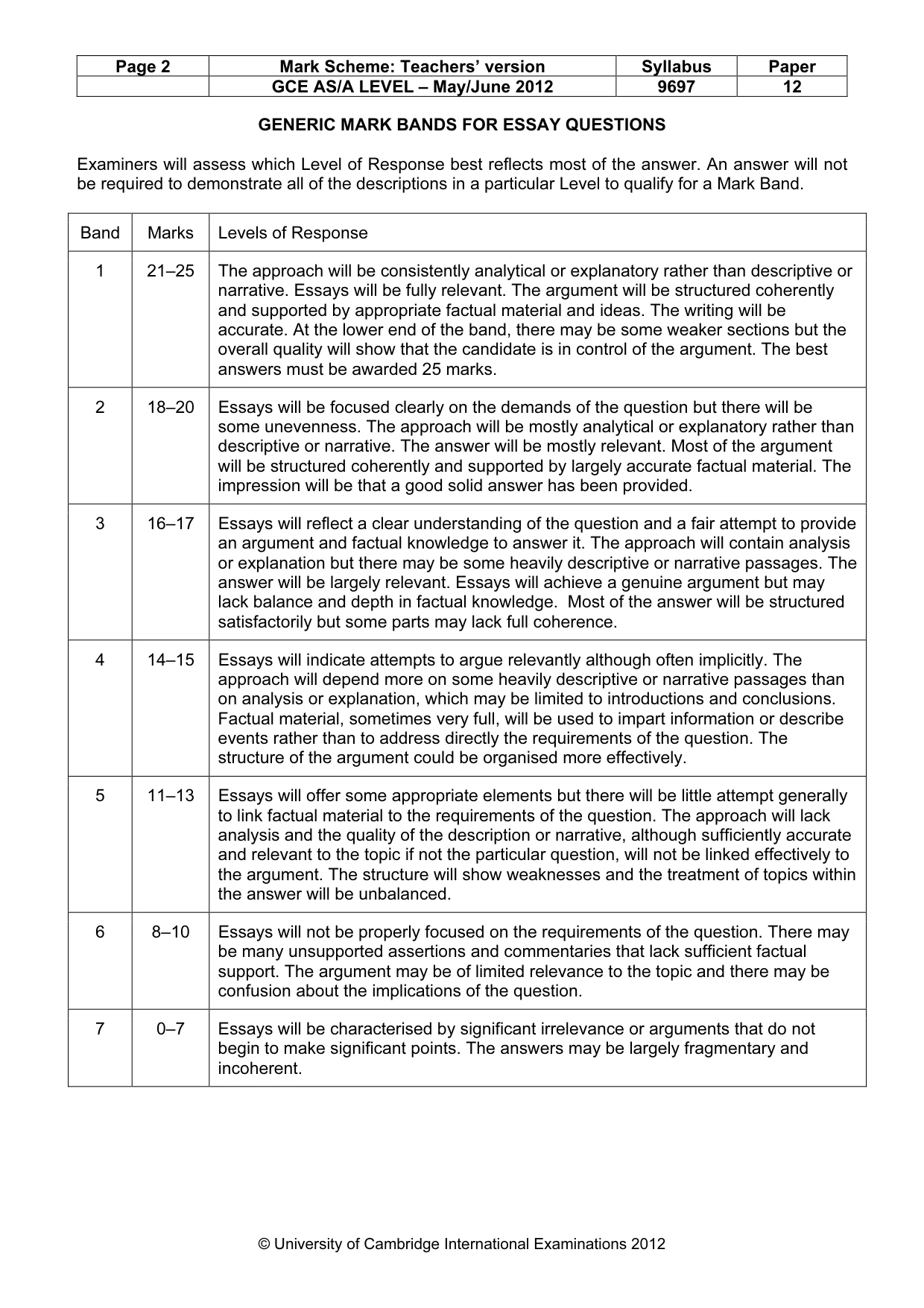
Page 2 Mark Scheme: Teachers’ version Syllabus Paper GCE AS/A LEVEL – May/June 2012 9697 12 © University of Cambridge International Examinations 2012 GENERIC MARK BANDS FOR ESSAY QUESTIONS Examiners will assess which Level of Response best reflects most of the answer. An answer will not be required to demonstrate all of the descriptions in a particular Level to qualify for a Mark Band. Band Marks Levels of Response 1 21–25 The approach will be consistently analytical or explanatory rather than descriptive or narrative. Essays will be fully relevant. The argument will be structured coherently and supported by appropriate factual material and ideas. The writing will be accurate. At the lower end of the band, there may be some weaker sections but the overall quality will show that the candidate is in control of the argument. The best answers must be awarded 25 marks. 2 18–20 Essays will be focused clearly on the demands of the question but there will be some unevenness. The approach will be mostly analytical or explanatory rather than descriptive or narrative. The answer will be mostly relevant. Most of the argument will be structured coherently and supported by largely accurate factual material. The impression will be that a good solid answer has been provided. 3 16–17 Essays will reflect a clear understanding of the question and a fair attempt to provide an argument and factual knowledge to answer it. The approach will contain analysis or explanation but there may be some heavily descriptive or narrative passages. The answer will be largely relevant. Essays will achieve a genuine argument but may lack balance and depth in factual knowledge. Most of the answer will be structured satisfactorily but some parts may lack full coherence. 4 14–15 Essays will indicate attempts to argue relevantly although often implicitly. The approach will depend more on some heavily descriptive or narrative passages than on analysis or explanation, which may be limited to introductions and conclusions. Factual material, sometimes very full, will be used to impart information or describe events rather than to address directly the requirements of the question. The structure of the argument could be organised more effectively. 5 11–13 Essays will offer some appropriate elements but there will be little attempt generally to link factual material to the requirements of the question. The approach will lack analysis and the quality of the description or narrative, although sufficiently accurate and relevant to the topic if not the particular question, will not be linked effectively to the argument. The structure will show weaknesses and the treatment of topics within the answer will be unbalanced. 6 8–10 Essays will not be properly focused on the requirements of the question. There may be many unsupported assertions and commentaries that lack sufficient factual support. The argument may be of limited relevance to the topic and there may be confusion about the implications of the question. 7 0–7 Essays will be characterised by significant irrelevance or arguments that do not begin to make significant points. The answers may be largely fragmentary and incoherent.
Mark scheme, page 3
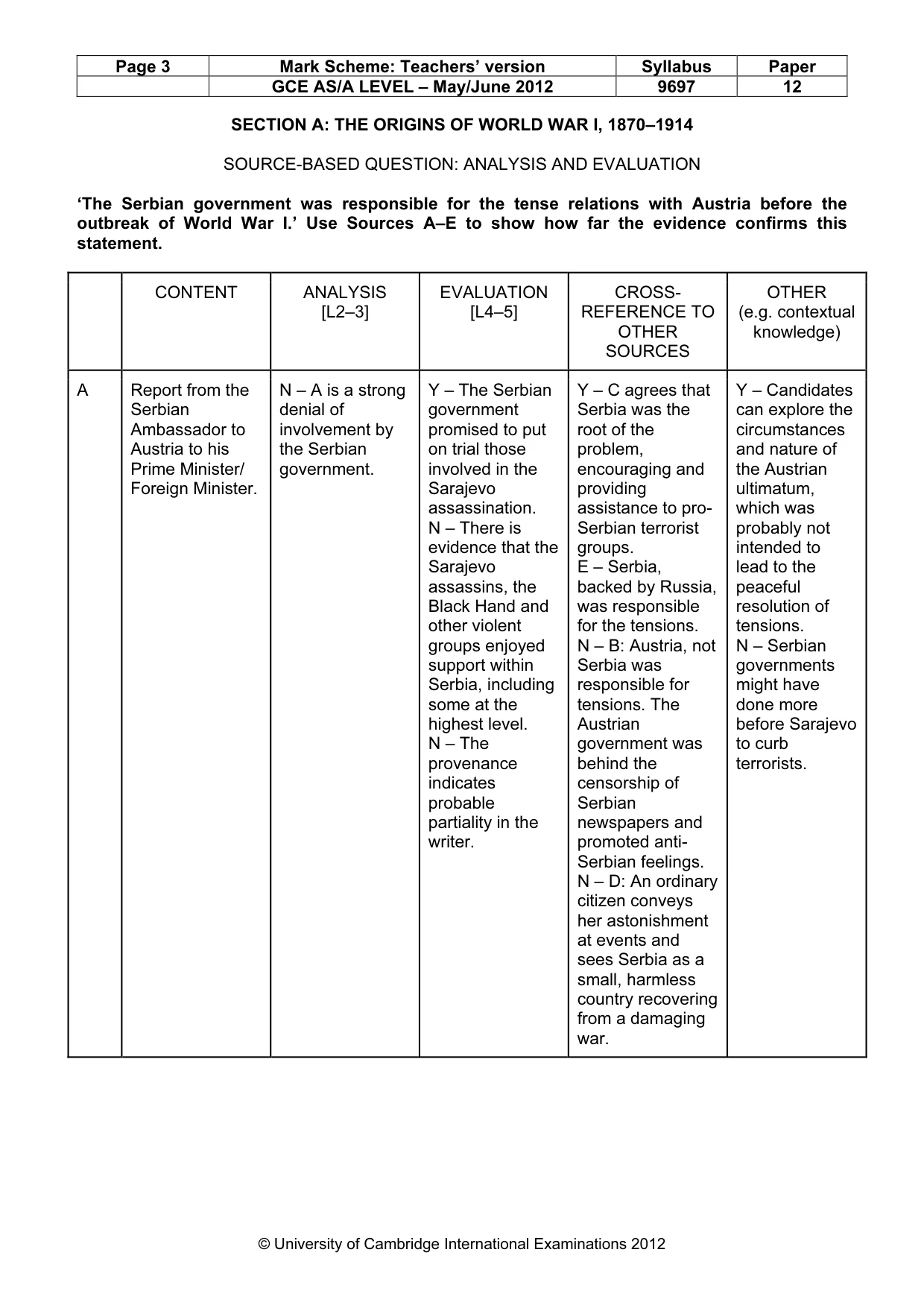
Page 3 Mark Scheme: Teachers’ version Syllabus Paper GCE AS/A LEVEL – May/June 2012 9697 12 © University of Cambridge International Examinations 2012 SECTION A: THE ORIGINS OF WORLD WAR I, 1870–1914 SOURCE-BASED QUESTION: ANALYSIS AND EVALUATION ‘The Serbian government was responsible for the tense relations with Austria before the outbreak of World War I.’ Use Sources A–E to show how far the evidence confirms this statement. CONTENT ANALYSIS [L2–3] EVALUATION [L4–5] CROSS- REFERENCE TO OTHER SOURCES OTHER (e.g. contextual knowledge) A Report from the Serbian Ambassador to Austria to his Prime Minister/ Foreign Minister. N – A is a strong denial of involvement by the Serbian government. Y – The Serbian government promised to put on trial those involved in the Sarajevo assassination. N – There is evidence that the Sarajevo assassins, the Black Hand and other violent groups enjoyed support within Serbia, including some at the highest level. N – The provenance indicates probable partiality in the writer. Y – C agrees that Serbia was the root of the problem, encouraging and providing assistance to pro- Serbian terrorist groups. E – Serbia, backed by Russia, was responsible for the tensions. N – B: Austria, not Serbia was responsible for tensions. The Austrian government was behind the censorship of Serbian newspapers and promoted anti- Serbian feelings. N – D: An ordinary citizen conveys her astonishment at events and sees Serbia as a small, harmless country recovering from a damaging war. Y – Candidates can explore the circumstances and nature of the Austrian ultimatum, which was probably not intended to lead to the peaceful resolution of tensions. N – Serbian governments might have done more before Sarajevo to curb terrorists.
Mark scheme, page 4
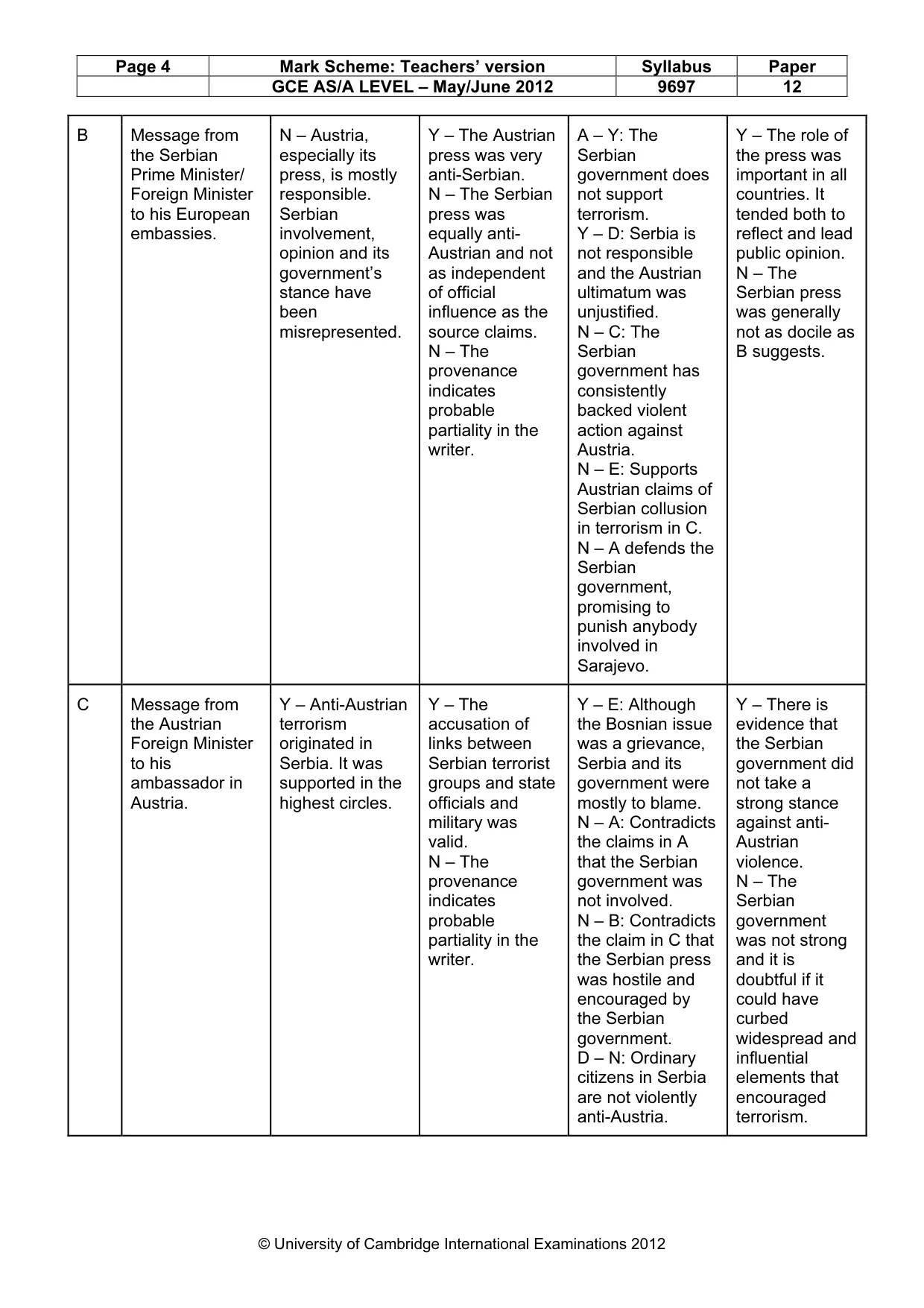
Page 4 Mark Scheme: Teachers’ version Syllabus Paper GCE AS/A LEVEL – May/June 2012 9697 12 © University of Cambridge International Examinations 2012 B Message from the Serbian Prime Minister/ Foreign Minister to his European embassies. N – Austria, especially its press, is mostly responsible. Serbian involvement, opinion and its government’s stance have been misrepresented. Y – The Austrian press was very anti-Serbian. N – The Serbian press was equally anti- Austrian and not as independent of official influence as the source claims. N – The provenance indicates probable partiality in the writer. A – Y: The Serbian government does not support terrorism. Y – D: Serbia is not responsible and the Austrian ultimatum was unjustified. N – C: The Serbian government has consistently backed violent action against Austria. N – E: Supports Austrian claims of Serbian collusion in terrorism in C. N – A defends the Serbian government, promising to punish anybody involved in Sarajevo. Y – The role of the press was important in all countries. It tended both to reflect and lead public opinion. N – The Serbian press was generally not as docile as B suggests. C Message from the Austrian Foreign Minister to his ambassador in Austria. Y – Anti-Austrian terrorism originated in Serbia. It was supported in the highest circles. Y – The accusation of links between Serbian terrorist groups and state officials and military was valid. N – The provenance indicates probable partiality in the writer. Y – E: Although the Bosnian issue was a grievance, Serbia and its government were mostly to blame. N – A: Contradicts the claims in A that the Serbian government was not involved. N – B: Contradicts the claim in C that the Serbian press was hostile and encouraged by the Serbian government. D – N: Ordinary citizens in Serbia are not violently anti-Austria. Y – There is evidence that the Serbian government did not take a strong stance against anti- Austrian violence. N – The Serbian government was not strong and it is doubtful if it could have curbed widespread and influential elements that encouraged terrorism.
Mark scheme, page 5
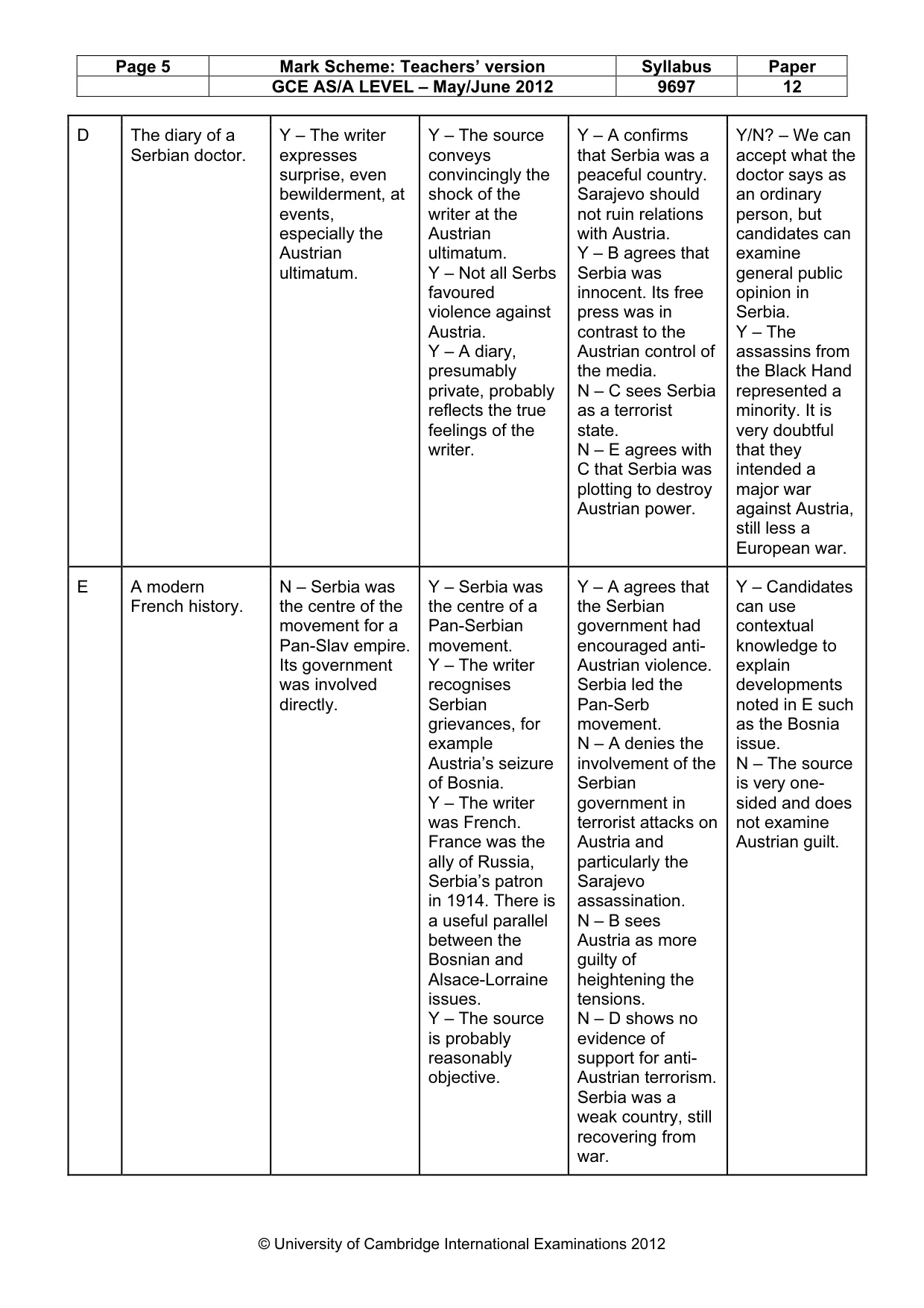
Page 5 Mark Scheme: Teachers’ version Syllabus Paper GCE AS/A LEVEL – May/June 2012 9697 12 © University of Cambridge International Examinations 2012 D The diary of a Serbian doctor. Y – The writer expresses surprise, even bewilderment, at events, especially the Austrian ultimatum. Y – The source conveys convincingly the shock of the writer at the Austrian ultimatum. Y – Not all Serbs favoured violence against Austria. Y – A diary, presumably private, probably reflects the true feelings of the writer. Y – A confirms that Serbia was a peaceful country. Sarajevo should not ruin relations with Austria. Y – B agrees that Serbia was innocent. Its free press was in contrast to the Austrian control of the media. N – C sees Serbia as a terrorist state. N – E agrees with C that Serbia was plotting to destroy Austrian power. Y/N? – We can accept what the doctor says as an ordinary person, but candidates can examine general public opinion in Serbia. Y – The assassins from the Black Hand represented a minority. It is very doubtful that they intended a major war against Austria, still less a European war. E A modern French history. N – Serbia was the centre of the movement for a Pan-Slav empire. Its government was involved directly. Y – Serbia was the centre of a Pan-Serbian movement. Y – The writer recognises Serbian grievances, for example Austria’s seizure of Bosnia. Y – The writer was French. France was the ally of Russia, Serbia’s patron in 1914. There is a useful parallel between the Bosnian and Alsace-Lorraine issues. Y – The source is probably reasonably objective. Y – A agrees that the Serbian government had encouraged anti- Austrian violence. Serbia led the Pan-Serb movement. N – A denies the involvement of the Serbian government in terrorist attacks on Austria and particularly the Sarajevo assassination. N – B sees Austria as more guilty of heightening the tensions. N – D shows no evidence of support for anti- Austrian terrorism. Serbia was a weak country, still recovering from war. Y – Candidates can use contextual knowledge to explain developments noted in E such as the Bosnia issue. N – The source is very one- sided and does not examine Austrian guilt.
Mark scheme, page 6
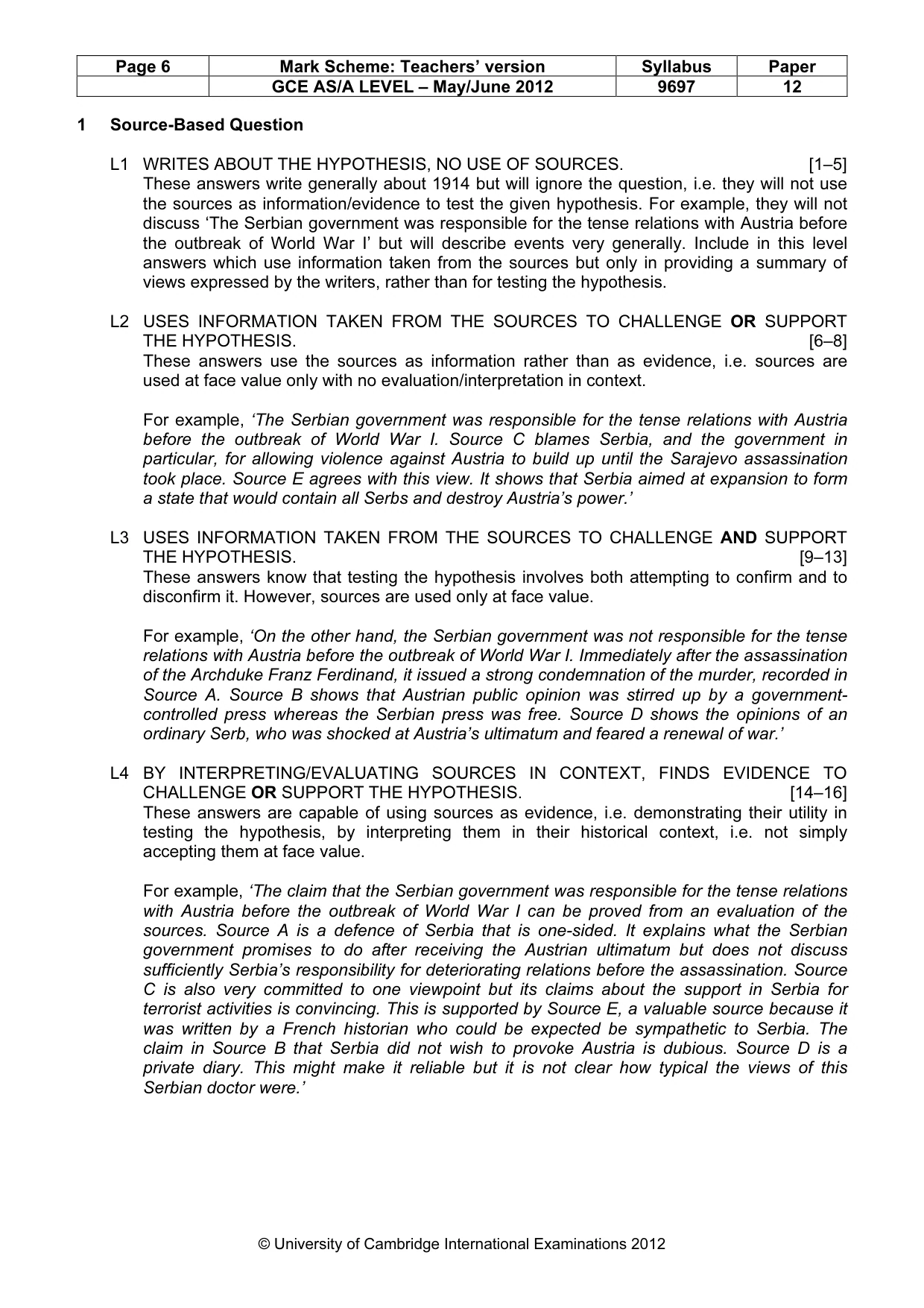
Page 6 Mark Scheme: Teachers’ version Syllabus Paper GCE AS/A LEVEL – May/June 2012 9697 12 © University of Cambridge International Examinations 2012 1 Source-Based Question L1 WRITES ABOUT THE HYPOTHESIS, NO USE OF SOURCES. [1–5] These answers write generally about 1914 but will ignore the question, i.e. they will not use the sources as information/evidence to test the given hypothesis. For example, they will not discuss ‘The Serbian government was responsible for the tense relations with Austria before the outbreak of World War I’ but will describe events very generally. Include in this level answers which use information taken from the sources but only in providing a summary of views expressed by the writers, rather than for testing the hypothesis. L2 USES INFORMATION TAKEN FROM THE SOURCES TO CHALLENGE OR SUPPORT THE HYPOTHESIS. [6–8] These answers use the sources as information rather than as evidence, i.e. sources are used at face value only with no evaluation/interpretation in context. For example, ‘The Serbian government was responsible for the tense relations with Austria before the outbreak of World War I. Source C blames Serbia, and the government in particular, for allowing violence against Austria to build up until the Sarajevo assassination took place. Source E agrees with this view. It shows that Serbia aimed at expansion to form a state that would contain all Serbs and destroy Austria’s power.’ L3 USES INFORMATION TAKEN FROM THE SOURCES TO CHALLENGE AND SUPPORT THE HYPOTHESIS. [9–13] These answers know that testing the hypothesis involves both attempting to confirm and to disconfirm it. However, sources are used only at face value. For example, ‘On the other hand, the Serbian government was not responsible for the tense relations with Austria before the outbreak of World War I. Immediately after the assassination of the Archduke Franz Ferdinand, it issued a strong condemnation of the murder, recorded in Source A. Source B shows that Austrian public opinion was stirred up by a government- controlled press whereas the Serbian press was free. Source D shows the opinions of an ordinary Serb, who was shocked at Austria’s ultimatum and feared a renewal of war.’ L4 BY INTERPRETING/EVALUATING SOURCES IN CONTEXT, FINDS EVIDENCE TO CHALLENGE OR SUPPORT THE HYPOTHESIS. [14–16] These answers are capable of using sources as evidence, i.e. demonstrating their utility in testing the hypothesis, by interpreting them in their historical context, i.e. not simply accepting them at face value. For example, ‘The claim that the Serbian government was responsible for the tense relations with Austria before the outbreak of World War I can be proved from an evaluation of the sources. Source A is a defence of Serbia that is one-sided. It explains what the Serbian government promises to do after receiving the Austrian ultimatum but does not discuss sufficiently Serbia’s responsibility for deteriorating relations before the assassination. Source C is also very committed to one viewpoint but its claims about the support in Serbia for terrorist activities is convincing. This is supported by Source E, a valuable source because it was written by a French historian who could be expected be sympathetic to Serbia. The claim in Source B that Serbia did not wish to provoke Austria is dubious. Source D is a private diary. This might make it reliable but it is not clear how typical the views of this Serbian doctor were.’
Mark scheme, page 7
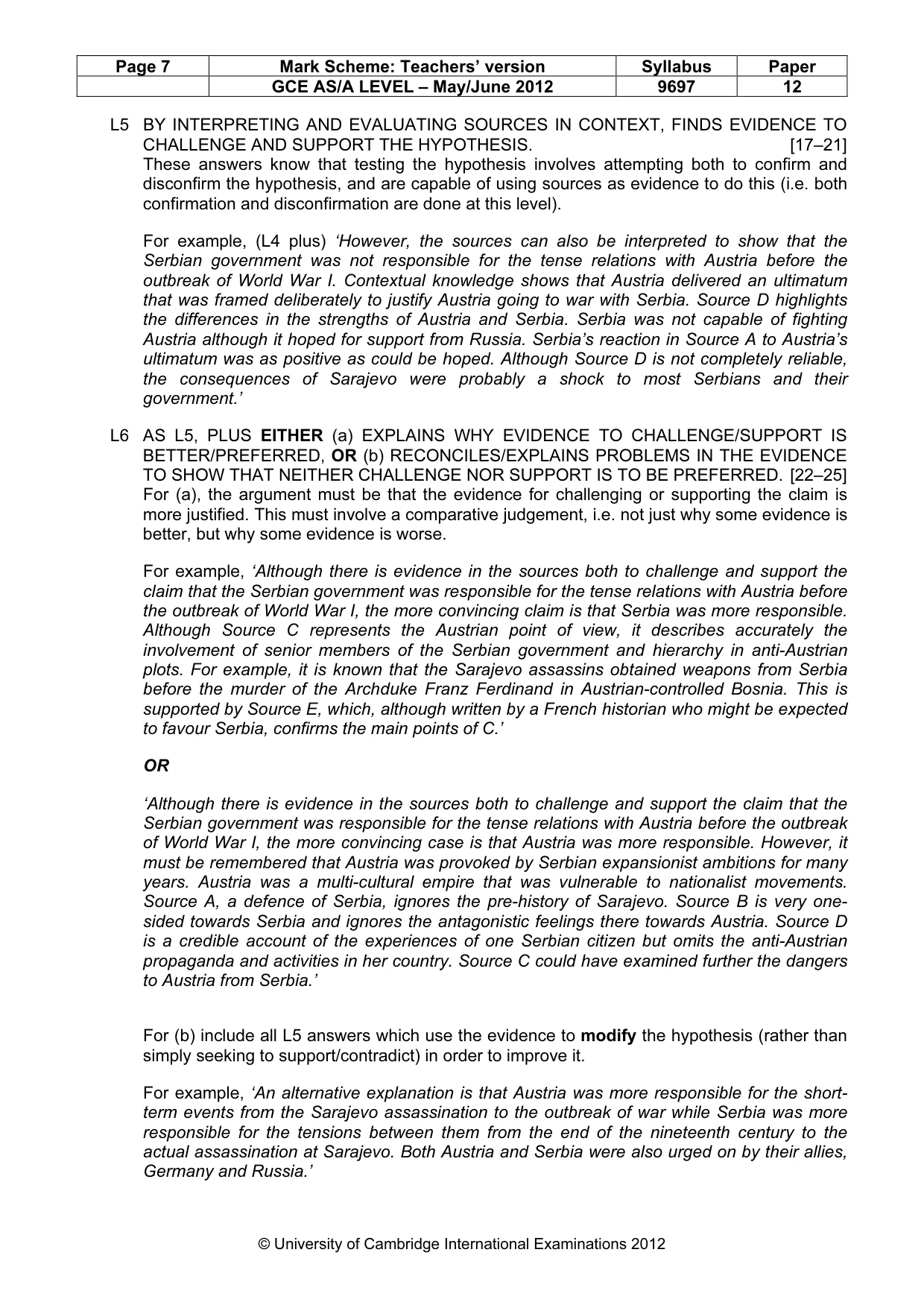
Page 7 Mark Scheme: Teachers’ version Syllabus Paper GCE AS/A LEVEL – May/June 2012 9697 12 © University of Cambridge International Examinations 2012 L5 BY INTERPRETING AND EVALUATING SOURCES IN CONTEXT, FINDS EVIDENCE TO CHALLENGE AND SUPPORT THE HYPOTHESIS. [17–21] These answers know that testing the hypothesis involves attempting both to confirm and disconfirm the hypothesis, and are capable of using sources as evidence to do this (i.e. both confirmation and disconfirmation are done at this level). For example, (L4 plus) ‘However, the sources can also be interpreted to show that the Serbian government was not responsible for the tense relations with Austria before the outbreak of World War I. Contextual knowledge shows that Austria delivered an ultimatum that was framed deliberately to justify Austria going to war with Serbia. Source D highlights the differences in the strengths of Austria and Serbia. Serbia was not capable of fighting Austria although it hoped for support from Russia. Serbia’s reaction in Source A to Austria’s ultimatum was as positive as could be hoped. Although Source D is not completely reliable, the consequences of Sarajevo were probably a shock to most Serbians and their government.’ L6 AS L5, PLUS EITHER (a) EXPLAINS WHY EVIDENCE TO CHALLENGE/SUPPORT IS BETTER/PREFERRED, OR (b) RECONCILES/EXPLAINS PROBLEMS IN THE EVIDENCE TO SHOW THAT NEITHER CHALLENGE NOR SUPPORT IS TO BE PREFERRED. [22–25] For (a), the argument must be that the evidence for challenging or supporting the claim is more justified. This must involve a comparative judgement, i.e. not just why some evidence is better, but why some evidence is worse. For example, ‘Although there is evidence in the sources both to challenge and support the claim that the Serbian government was responsible for the tense relations with Austria before the outbreak of World War I, the more convincing claim is that Serbia was more responsible. Although Source C represents the Austrian point of view, it describes accurately the involvement of senior members of the Serbian government and hierarchy in anti-Austrian plots. For example, it is known that the Sarajevo assassins obtained weapons from Serbia before the murder of the Archduke Franz Ferdinand in Austrian-controlled Bosnia. This is supported by Source E, which, although written by a French historian who might be expected to favour Serbia, confirms the main points of C.’ OR ‘Although there is evidence in the sources both to challenge and support the claim that the Serbian government was responsible for the tense relations with Austria before the outbreak of World War I, the more convincing case is that Austria was more responsible. However, it must be remembered that Austria was provoked by Serbian expansionist ambitions for many years. Austria was a multi-cultural empire that was vulnerable to nationalist movements. Source A, a defence of Serbia, ignores the pre-history of Sarajevo. Source B is very one- sided towards Serbia and ignores the antagonistic feelings there towards Austria. Source D is a credible account of the experiences of one Serbian citizen but omits the anti-Austrian propaganda and activities in her country. Source C could have examined further the dangers to Austria from Serbia.’ For (b) include all L5 answers which use the evidence to modify the hypothesis (rather than simply seeking to support/contradict) in order to improve it. For example, ‘An alternative explanation is that Austria was more responsible for the short- term events from the Sarajevo assassination to the outbreak of war while Serbia was more responsible for the tensions between them from the end of the nineteenth century to the actual assassination at Sarajevo. Both Austria and Serbia were also urged on by their allies, Germany and Russia.’
Mark scheme, page 8
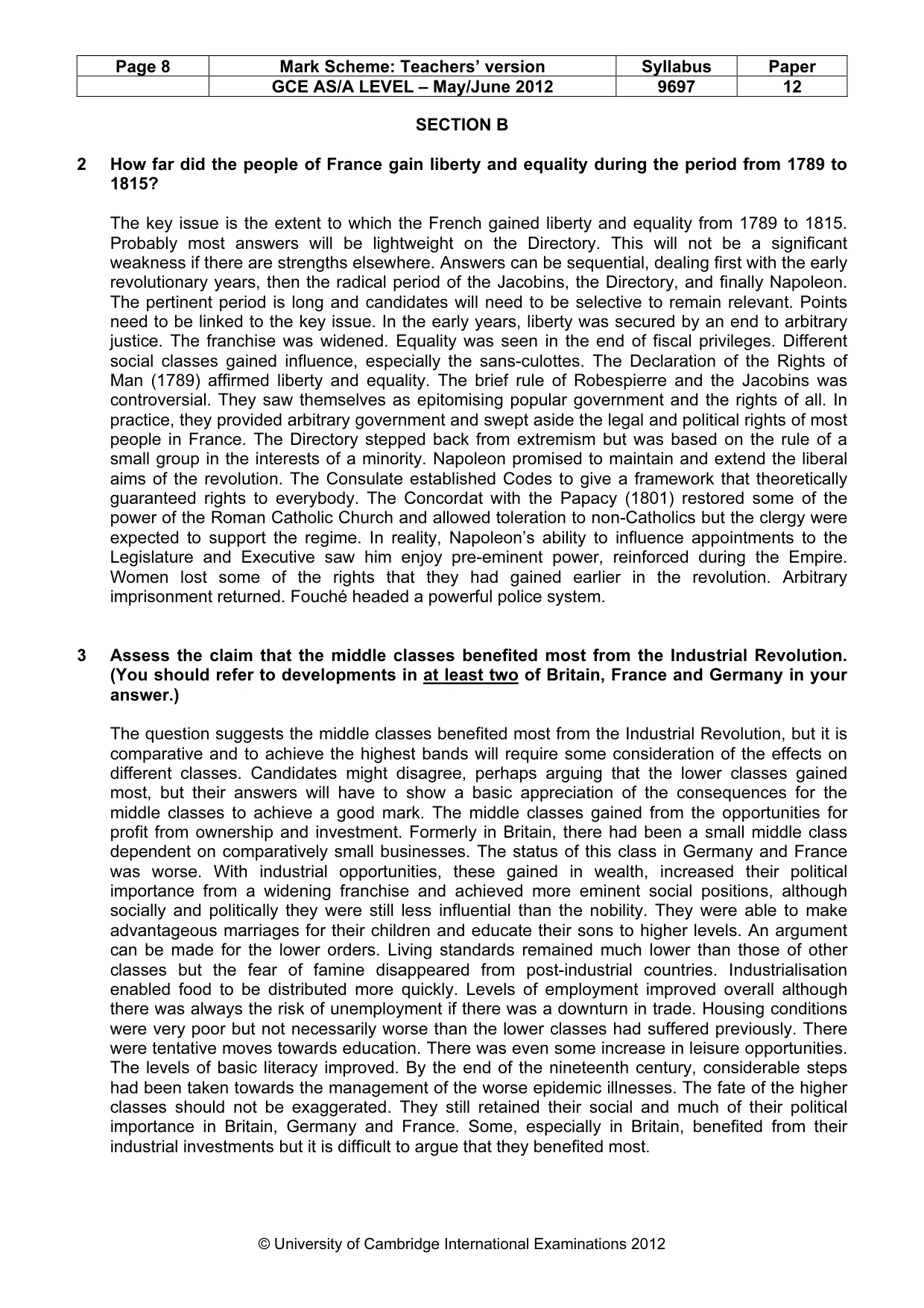
Page 8 Mark Scheme: Teachers’ version Syllabus Paper GCE AS/A LEVEL – May/June 2012 9697 12 © University of Cambridge International Examinations 2012 SECTION B 2 How far did the people of France gain liberty and equality during the period from 1789 to 1815? The key issue is the extent to which the French gained liberty and equality from 1789 to 1815. Probably most answers will be lightweight on the Directory. This will not be a significant weakness if there are strengths elsewhere. Answers can be sequential, dealing first with the early revolutionary years, then the radical period of the Jacobins, the Directory, and finally Napoleon. The pertinent period is long and candidates will need to be selective to remain relevant. Points need to be linked to the key issue. In the early years, liberty was secured by an end to arbitrary justice. The franchise was widened. Equality was seen in the end of fiscal privileges. Different social classes gained influence, especially the sans-culottes. The Declaration of the Rights of Man (1789) affirmed liberty and equality. The brief rule of Robespierre and the Jacobins was controversial. They saw themselves as epitomising popular government and the rights of all. In practice, they provided arbitrary government and swept aside the legal and political rights of most people in France. The Directory stepped back from extremism but was based on the rule of a small group in the interests of a minority. Napoleon promised to maintain and extend the liberal aims of the revolution. The Consulate established Codes to give a framework that theoretically guaranteed rights to everybody. The Concordat with the Papacy (1801) restored some of the power of the Roman Catholic Church and allowed toleration to non-Catholics but the clergy were expected to support the regime. In reality, Napoleon’s ability to influence appointments to the Legislature and Executive saw him enjoy pre-eminent power, reinforced during the Empire. Women lost some of the rights that they had gained earlier in the revolution. Arbitrary imprisonment returned. Fouché headed a powerful police system. 3 Assess the claim that the middle classes benefited most from the Industrial Revolution. (You should refer to developments in at least two of Britain, France and Germany in your answer.) The question suggests the middle classes benefited most from the Industrial Revolution, but it is comparative and to achieve the highest bands will require some consideration of the effects on different classes. Candidates might disagree, perhaps arguing that the lower classes gained most, but their answers will have to show a basic appreciation of the consequences for the middle classes to achieve a good mark. The middle classes gained from the opportunities for profit from ownership and investment. Formerly in Britain, there had been a small middle class dependent on comparatively small businesses. The status of this class in Germany and France was worse. With industrial opportunities, these gained in wealth, increased their political importance from a widening franchise and achieved more eminent social positions, although socially and politically they were still less influential than the nobility. They were able to make advantageous marriages for their children and educate their sons to higher levels. An argument can be made for the lower orders. Living standards remained much lower than those of other classes but the fear of famine disappeared from post-industrial countries. Industrialisation enabled food to be distributed more quickly. Levels of employment improved overall although there was always the risk of unemployment if there was a downturn in trade. Housing conditions were very poor but not necessarily worse than the lower classes had suffered previously. There were tentative moves towards education. There was even some increase in leisure opportunities. The levels of basic literacy improved. By the end of the nineteenth century, considerable steps had been taken towards the management of the worse epidemic illnesses. The fate of the higher classes should not be exaggerated. They still retained their social and much of their political importance in Britain, Germany and France. Some, especially in Britain, benefited from their industrial investments but it is difficult to argue that they benefited most.
Mark scheme, page 9
Page 9 Mark Scheme: Teachers’ version Syllabus Paper GCE AS/A LEVEL – May/June 2012 9697 12 © University of Cambridge International Examinations 2012 4 Assess the strengths and weaknesses of nationalism in Italy from 1815 to 1849. The key issue is the condition and extent of nationalism in Italy from 1815 to 1849. The dates define what will be relevant. It is possible to broaden the argument briefly in a conclusion to look forward to later developments but the focus must be on the specified period. There is no need to give equal time to strengths and weaknesses but the best answers can be expected to be reasonably confident about both aspects. A strength of nationalism was that the conservative forces could not extinguish it during this period. Leaders, especially Mazzini, persevered with their hopes for a united Italy in spite of continuing setbacks. Through the Carbonari and United Italy (1831), a framework was formed for a national movement. Piedmont under Charles Albert emerged to be the best potential leader of Italy. On the other hand, the enemies of nationalism proved too strong during this period. Austrian power remained paramount but other rulers and entrenched authorities were able to check nationalism. Metternich was an effective enemy of nationalism. Rulers, for example in Parma and Naples, were foreign and were preoccupied with maintaining an autocracy that was threatened by nationalism. Most ‘nationalists’ were more in favour of regional independence and provincial rights. Manin in Venice, for example, was suspicious of both Mazzini and Piedmont. It might be argued that Catholicism was the only unifying factor for most Italians. The Papacy was mostly anti-nationalist except for a brief period during the early papacy of Pius IX. Italian nationalism could not rely on external support. France moved to protect Rome against Mazzini and Garibaldi in 1848–49. The revolutions in 1848–49 showed the lack of unity among nationalists. Risings in Venice and Rome enjoyed little support elsewhere. 5 Why was Britain more successful than France and Germany in enlarging its overseas empire in the late nineteenth century? Candidates do not need to give an equal balance to France and Germany, still less to each of the three countries, but answers in Band 1 should be able to make some salient points about the continental countries. Britain had a head start, already possessing varied and influential colonies by the middle of the nineteenth century. This made further expansion more natural. France was recovering late in the nineteenth century from its political problems that culminated in the fall of Napoleon III and the troublesome establishment of the Third Republic. Germany was not unified until 1870 and Bismarck’s new country did not have imperial expansion as an immediate priority. Bismarck himself did not see the need for imperial ventures until the 1880s. The Industrial Revolution, begun earlier in Britain, provided the impetus and opportunity for imperial expansion. The British navy was much larger than those of France and Germany. It was comparatively unconcerned about European diplomacy and intervention on the continent (although not yet isolationist). Britain had the capital investment necessary. However, this did not mean that imperialism provided the largest market for investments or that large profits were to be made. It is possible to argue that Britain had seized the best regions to exploit before France and Germany tried to catch up.
Mark scheme, page 10
Page 10 Mark Scheme: Teachers’ version Syllabus Paper GCE AS/A LEVEL – May/June 2012 9697 12 © University of Cambridge International Examinations 2012 6 Analyse the reasons why the Bolsheviks seized power in Russia in October 1917. The question gives the opportunity to explain the development of the Bolsheviks under Lenin’s leadership from 1903 (the split in the Social Democratic Party) but answers might well begin with the February Revolution in 1917. Candidates might discuss the strengths of the Bolsheviks and the weaknesses of Kerensky’s Provisional Government. Credit should be given to essays that point out how sudden and unexpected was the Bolsheviks’ success. The July Days were a serious setback but the Bolsheviks won power only three months later. They were well led by Lenin, who combined steely determination with the complementary abilities to plan and to adapt to circumstances. He appreciated what was necessary to win power and used slogans such as ‘Power to the Soviets’ to make his point. His decision to move in October was very much his own and was made against the advice of other Bolshevik leaders. Against the traditional view of communist historians, it was very much the seizure of power by a minority. The problems of the Provisional Government prepared the ground. Well-meaning and liberal, Kerensky lacked the firmness that was necessary to hold on to power. He faced a constant struggle against the factions in the Provisional Government and the wider groups outside. His decision to continue the war as a matter of honour was a millstone around his neck. The economic problems, including shortages of food and grievances about land, increased and were exploited by Lenin. The Kornilov rising exposed the military weakness of the Provisional Government and could be put down only with the assistance of the Bolsheviks. To achieve marks in Bands 1 and 2 essays will need analysis and explanation. Candidates might devote time to the causes of revolution in Russia in February. This can be given credit only if it is linked to the later success of the Bolsheviks. 7 How far did Stalin’s power in Russia to 1939 depend on terror? By 1939, terror embraced all sections of the population. Old Bolsheviks such as Zinoviev and Kamenev were executed. Trotsky was first hounded out of Russia and later murdered in Mexico. Both important and lesser members of the Communist party were purged. The leaders of the military suffered. The intelligentsia, including engineers, suffered. Not even the NKVD was immune. Yagoda and Yezhov were executed. The indiscriminate nature of the terror meant that it extended to ordinary Russians, who were executed or sent to gulags without trial simply in order to meet targets. Non-Russian racial groups were victimised. Stalin himself took a detailed interest in the choice of victims. By 1939, almost 20 million people had been arrested and perhaps 7 million executed. For Stalin, terror fulfilled two purposes – possibly three. It safeguarded his personal position by removing any real or suspected rivals in the communist party and in the military. (He remembered the role of the army in the 1917 revolutions.) It enabled him to drive through major economic reforms. The search for economic transformation depended on enforced obedience and slave labour. And it might well have been terror for its own sake. The best responses will look more widely to place terror in the context of other aspects of government. Stalin saw himself as leading an economic revolution in order to strengthen Russia and bring it quickly up to the standards of industrial societies elsewhere. He could not wait for an evolution towards industrialisation. Candidates might argue that there were real dangers to his primacy. It has been claimed that he was not totally secure until the mid-1930s.
Mark scheme, page 11
Page 11 Mark Scheme: Teachers’ version Syllabus Paper GCE AS/A LEVEL – May/June 2012 9697 12 © University of Cambridge International Examinations 2012 8 Explain which had the greater effects on nineteenth-century Europe, the Napoleonic Wars or the Franco-Prussian War (1870–71). The focus on ‘greater effects’ means examiners will expect a reasonable, but not complete, balance in the highest bands. More time can be spent on the preferred choice. Most candidates can be expected to organise their answers sequentially and this can merit any mark band. Napoleon broke the balance of power and asserted French dominance in Europe. He took on all of the major powers of Europe and defeated each of them except Britain. Within the regions that he controlled directly, he overturned the established social order. While imposing a dictatorial rule, he claimed that he was defending the interests of the population against corrupt and oppressive hierarchies. By 1815, he was defeated but his influence persisted. Much of the diplomacy in next fifty years arose from an attempt to maintain a Congress of Europe, not only against Napoleonic influence but also the liberalism and nationalism that might be thought to be among the results of his wars. Bismarck also broke the balance of power in Europe. Prussia and Germany became major states. Austria was relegated to the second division. France fought hard to resist a similar relegation. However, the outcomes for these countries were different. Austria believed that its best interests were served by an alliance with Germany while France remained unreconciled. The Franco-Prussian War resulted in a very different sort of diplomacy at the end of the century. Bismarck, then William II, embarked on policies that were founded on war with France. It will be relevant, but not necessary, to examine the domestic effects on France of both wars and on Germany of the later war. The Napoleonic Legend lived on in France and troubled regimes until 1870. Success against France made Prussia the dominant force in Germany and justified the shape of the new German Empire and its domestic policies, including the importance of the army in politics.
What you needed in this session
Cambridge’s own grade thresholds for 2012 May/June, Paper 1 · Variant 2. A higher threshold means an easier paper — the bar moves with how the cohort did.