Cambridge A Level History (pre-2015) 9697 — 2013 May/June Paper 1 · Variant 2
9697/12/M/J/13 · 100 marks · ≈113 min
The question paper and its mark scheme, free to read here and free to download. This is Cambridge’s own paper, exactly as it was sat.
Question paper4 pages
Mark scheme10 pages
Answers below. Sit the paper first if you are practising.
Paper as text
Question paper, page 1
This document consists of 4 printed pages. DC (CW) 59038/3 © UCLES 2013 [Turn over UNIVERSITY OF CAMBRIDGE INTERNATIONAL EXAMINATIONS General Certificate of Education Advanced Subsidiary Level and Advanced Level * 5 8 3 2 3 7 8 3 8 9 * HISTORY 9697/12 Paper 1 Modern European History, 1789–1939 May/June 2013 3 hours Additional Materials: Answer Paper READ THESE INSTRUCTIONS FIRST Write your Centre number, candidate number and name on all the work you hand in. Write in dark blue or black pen. You may use a soft pencil for any rough working. Do not use staples, paper clips, highlighters, glue or correction fluid. Section A Answer Question 1. Section B Answer any three questions. At the end of the examination, fasten all your work securely together. All questions in this paper carry equal marks.
Question paper, page 2
2 9697/12/M/J/13 © UCLES 2013 Section A: The Origins of World War I, 1870–1914 You must answer Question 1. SARAJEVO 1 Read the Sources, and then answer the question. When answering Question 1, candidates are advised to pay particular attention to the interpretation and evaluation of the Sources both individually and as a group. Source A A tiny clipping from a newspaper, mailed from a secret band of terrorists in Croatia to their comrades in Serbia, was the torch which set the world afire with war in 1914. That bit of paper wrecked old, proud empires. It gave birth to new, free nations. I was one of the members of the terrorist band in Serbia which received it. The little clipping declared that the Austrian Archduke Franz Ferdinand would visit Sarajevo, the capital of Bosnia, on 28 June, to direct army manoeuvres in the neighbouring mountains. It reached our meeting place in a cafe one night in the latter part of April 1914. That little piece of paper caused a great sensation among us when it was passed from hand to hand almost in silence. It greatly inflamed our hearts. As everyone knows, the old Austrian empire was built by conquest and intrigues and treachery. Jevtic, one of the leaders of the ‘Black Hand’, who was arrested immediately after the Archduke’s assassination, gave this later account of the 1914 plot. Source B The main motive which guided me in my deed was the avenging of the Serbian people. I am a Nationalist. I aimed to free the Slavs, for I am a Slav. As far as Serbia is concerned, it is her duty to free us. I aimed my gun at the Archduke. I do not remember what I thought at that moment. I only know that I fired twice or perhaps several times, without knowing whether I had hit or missed. Princip’s statement after the assassination, 1914. Source C Serbia has continually pursued the aim of undermining, by hostile propaganda and revolutionary plots, those territories of Austria-Hungary which are inhabited by the Southern Slavs, in order to tear them away from Austria and achieve the Serbian claims to expansion. How far the hopes of Serbia had been raised, and how near she thought she was to achieving her vile aims, became evident in the embittered hatred which was created in this crazy and deluded country by Austria’s annexation of Bosnia, which almost caused war. A whole series of murderous attacks ended in the appalling crime, carefully prepared in Serbia, against the exalted person of the heir to the throne, the Archduke Franz Ferdinand. Official statement by the Austrian government issued soon after the outbreak of war, 1914.
Question paper, page 3
3 9697/12/M/J/13 © UCLES 2013 [Turn over Source D On 28 June 1914, the Austrian Archduke Franz Ferdinand and his wife were assassinated at Sarajevo by Bosnian students who opposed the reforms that he supported and demanded the union of Bosnia and Serbia. The Serbian government was not responsible for the killings. The Serbian government warned the Austrian authorities earlier in June of possible trouble during the Archduke’s visit. Nevertheless, the guns and bombs were provided by Colonel Dimitrijevic, head of the Serbian Intelligence Bureau and head of the ‘Black Hand’ society. The Serbian government had almost no control over his activities. Conrad, the Chief of Austria’s Military Staff, wanted to settle the Serbian question once and for all. Berchtold, the Austrian Foreign Minister, had previously preferred peaceful policies but was now persuaded to go along with the military. The aged Emperor, Franz Joseph, wavered but Moltke, the Chief of Germany’s Military Staff, persuaded Kaiser William II to send a ‘blank cheque’. This provided Austria with unconditional support if she went to war with Serbia. A modern British historian’s view of the Sarajevo crisis, published in 1987. Source E Princip was only one of a group of seven conspirators who had positioned themselves at crucial points around Sarajevo. All of them were between 17 and 20 years of age and members of the nationalist movement ‘Young Bosnia’. They were enemies of Austria, idealists who dreamed of a Greater Serbian state. But the strings were being pulled by another figure, Chief of Intelligence for the Serbian General Staff, Colonel Dimitrijevic. He had backing from Russian officials. Franz Ferdinand had in fact been aiming to strengthen the Serbs in the Austrian empire, in order to defuse the political situation. Seventy years later, the Archduke’s daughter, who was thirteen years old in 1914, described her father’s aims. ‘He wanted to avoid extreme nationalism and keep each of the countries in the empire happy’, she explained. ‘But of course, the official language was to remain German. He just wanted to take away a bit of land from other Balkan territories in the Austrian empire to give to Serbia. He knew what he was letting himself in for.’ Today, historians agree that those who planned the murder of Franz Ferdinand, the core of the Serbian Intelligence Staff and Russian diplomats in Serbia, needed to eliminate a monarch who could have brought peace to the region. Franz Ferdinand’s plans to integrate the unhappy Slav racial groups in the Austrian empire would have undermined the aggressive support for a breakaway movement in the southern Slav parts of the empire. The undermining of the support in the rest of the Balkans would have robbed them of their ambitions. A modern German view of the assassination at Sarajevo, posted on the internet. Now answer the following question. ‘Austria was responsible for the Sarajevo crisis.’ Use Sources A–E to show how far the evidence confirms this statement.
Question paper, page 4
4 9697/12/M/J/13 © UCLES 2013 Section B You must answer three questions from this section. 2 ‘A complete betrayal of the French Revolution.’ Assess this claim about Napoleon’s government of France from 1799. 3 Did industrialisation bring more problems than advantages to governments in nineteenth-century Europe? (You should refer to at least two of Britain, France and Germany in your answer.) 4 Assess the internal and external problems that Bismarck faced in bringing about the unification of Germany. 5 Why did imperialism cause competition between European countries in the late-nineteenth century? (You should refer to at least two of Britain, France and Germany in your answer.) 6 How successfully did Lenin govern Russia from 1917 to 1924? 7 Why was the Weimar Republic replaced by a Nazi dictatorship in 1933? 8 How similar were the methods by which Nicholas II and Stalin ruled Russia during the period from 1900 to 1939? Copyright Acknowledgements: Source D Gildea R; Barricades and Borders: Europe 1800–1914; OUP; 1987 Source E www.todayinhistory.de/index.php Permission to reproduce items where third-party owned material protected by copyright is included has been sought and cleared where possible. Every reasonable effort has been made by the publisher (UCLES) to trace copyright holders, but if any items requiring clearance have unwittingly been included, the publisher will be pleased to make amends at the earliest possible opportunity. University of Cambridge International Examinations is part of the Cambridge Assessment Group. Cambridge Assessment is the brand name of University of Cambridge Local Examinations Syndicate (UCLES), which is itself a department of the University of Cambridge.
Mark scheme, page 1
CAMBRIDGE INTERNATIONAL EXAMINATIONS GCE Advanced Subsidiary Level and GCE Advanced Level MARK SCHEME for the May/June 2013 series 9697 HISTORY 9697/12 Paper 1, maximum raw mark 100 This mark scheme is published as an aid to teachers and candidates, to indicate the requirements of the examination. It shows the basis on which Examiners were instructed to award marks. It does not indicate the details of the discussions that took place at an Examiners’ meeting before marking began, which would have considered the acceptability of alternative answers. Mark schemes should be read in conjunction with the question paper and the Principal Examiner Report for Teachers. Cambridge will not enter into discussions about these mark schemes. Cambridge is publishing the mark schemes for the May/June 2013 series for most IGCSE, GCE Advanced Level and Advanced Subsidiary Level components and some Ordinary Level components.
Mark scheme, page 2
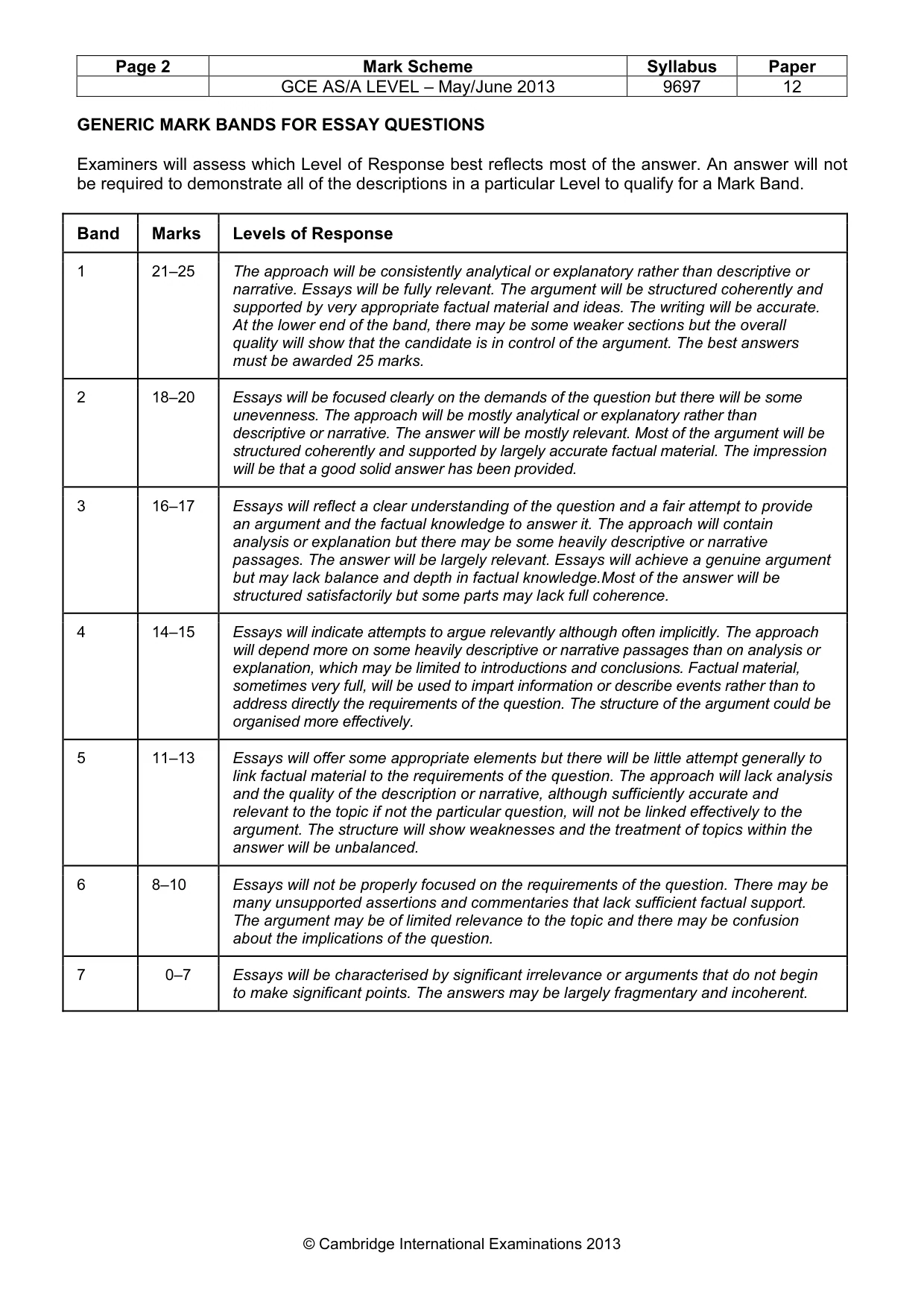
Page 2 Mark Scheme Syllabus Paper GCE AS/A LEVEL – May/June 2013 9697 12 © Cambridge International Examinations 2013 GENERIC MARK BANDS FOR ESSAY QUESTIONS Examiners will assess which Level of Response best reflects most of the answer. An answer will not be required to demonstrate all of the descriptions in a particular Level to qualify for a Mark Band. Band Marks Levels of Response 1 21–25 The approach will be consistently analytical or explanatory rather than descriptive or narrative. Essays will be fully relevant. The argument will be structured coherently and supported by very appropriate factual material and ideas. The writing will be accurate. At the lower end of the band, there may be some weaker sections but the overall quality will show that the candidate is in control of the argument. The best answers must be awarded 25 marks. 2 18–20 Essays will be focused clearly on the demands of the question but there will be some unevenness. The approach will be mostly analytical or explanatory rather than descriptive or narrative. The answer will be mostly relevant. Most of the argument will be structured coherently and supported by largely accurate factual material. The impression will be that a good solid answer has been provided. 3 16–17 Essays will reflect a clear understanding of the question and a fair attempt to provide an argument and the factual knowledge to answer it. The approach will contain analysis or explanation but there may be some heavily descriptive or narrative passages. The answer will be largely relevant. Essays will achieve a genuine argument but may lack balance and depth in factual knowledge.Most of the answer will be structured satisfactorily but some parts may lack full coherence. 4 14–15 Essays will indicate attempts to argue relevantly although often implicitly. The approach will depend more on some heavily descriptive or narrative passages than on analysis or explanation, which may be limited to introductions and conclusions. Factual material, sometimes very full, will be used to impart information or describe events rather than to address directly the requirements of the question. The structure of the argument could be organised more effectively. 5 11–13 Essays will offer some appropriate elements but there will be little attempt generally to link factual material to the requirements of the question. The approach will lack analysis and the quality of the description or narrative, although sufficiently accurate and relevant to the topic if not the particular question, will not be linked effectively to the argument. The structure will show weaknesses and the treatment of topics within the answer will be unbalanced. 6 8–10 Essays will not be properly focused on the requirements of the question. There may be many unsupported assertions and commentaries that lack sufficient factual support. The argument may be of limited relevance to the topic and there may be confusion about the implications of the question. 7 0–7 Essays will be characterised by significant irrelevance or arguments that do not begin to make significant points. The answers may be largely fragmentary and incoherent.
Mark scheme, page 3
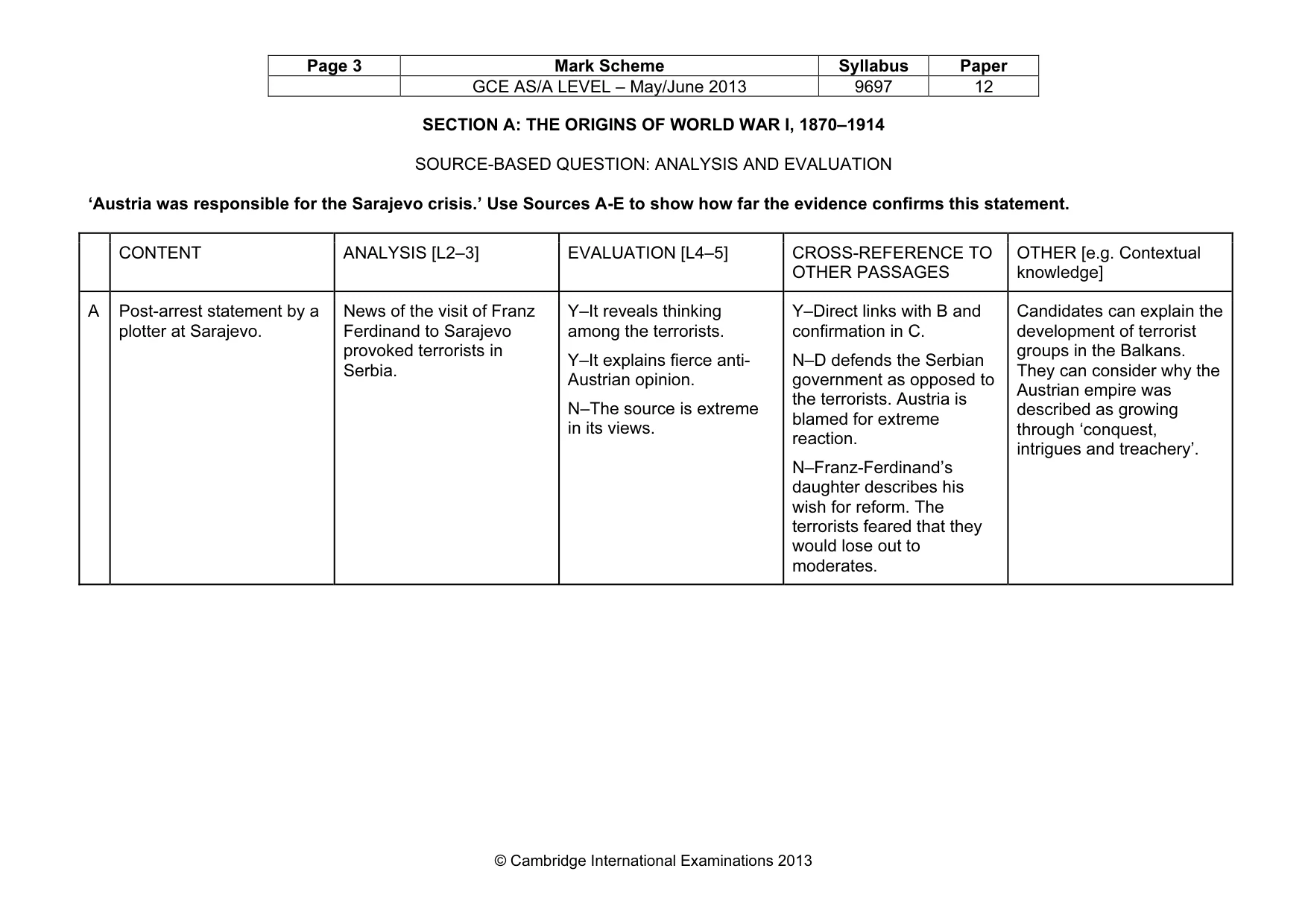
Page 3 Mark Scheme Syllabus Paper GCE AS/A LEVEL – May/June 2013 9697 12 © Cambridge International Examinations 2013 SECTION A: THE ORIGINS OF WORLD WAR I, 1870–1914 SOURCE-BASED QUESTION: ANALYSIS AND EVALUATION ‘Austria was responsible for the Sarajevo crisis.’ Use Sources A-E to show how far the evidence confirms this statement. CONTENT ANALYSIS [L2–3] EVALUATION [L4–5] CROSS-REFERENCE TO OTHER PASSAGES OTHER [e.g. Contextual knowledge] A Post-arrest statement by a plotter at Sarajevo. News of the visit of Franz Ferdinand to Sarajevo provoked terrorists in Serbia. Y–It reveals thinking among the terrorists. Y–It explains fierce anti- Austrian opinion. N–The source is extreme in its views. Y–Direct links with B and confirmation in C. N–D defends the Serbian government as opposed to the terrorists. Austria is blamed for extreme reaction. N–Franz-Ferdinand’s daughter describes his wish for reform. The terrorists feared that they would lose out to moderates. Candidates can explain the development of terrorist groups in the Balkans. They can consider why the Austrian empire was described as growing through ‘conquest, intrigues and treachery’.
Mark scheme, page 4
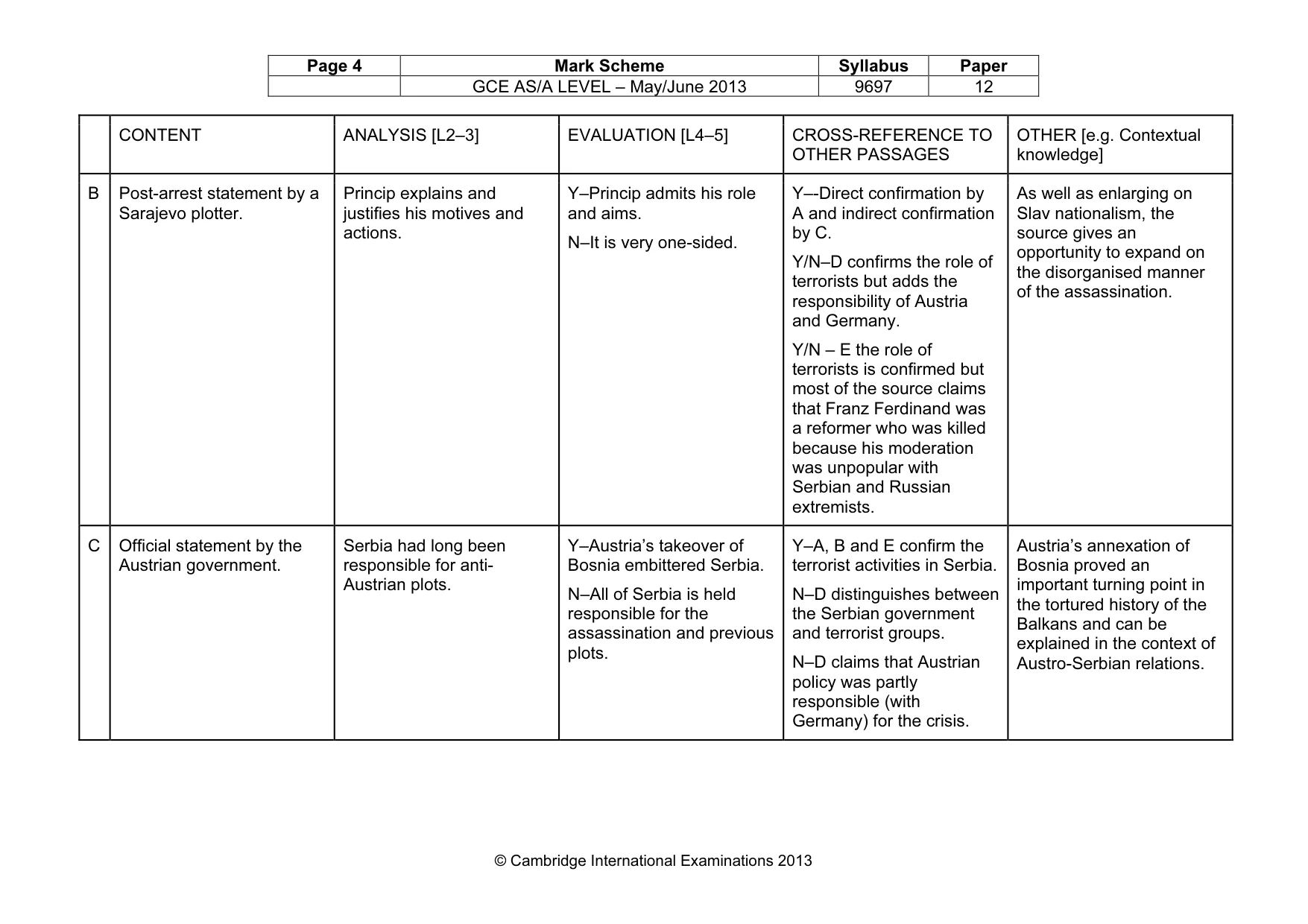
Page 4 Mark Scheme Syllabus Paper GCE AS/A LEVEL – May/June 2013 9697 12 © Cambridge International Examinations 2013 CONTENT ANALYSIS [L2–3] EVALUATION [L4–5] CROSS-REFERENCE TO OTHER PASSAGES OTHER [e.g. Contextual knowledge] B Post-arrest statement by a Sarajevo plotter. Princip explains and justifies his motives and actions. Y–Princip admits his role and aims. N–It is very one-sided. Y–-Direct confirmation by A and indirect confirmation by C. Y/N–D confirms the role of terrorists but adds the responsibility of Austria and Germany. Y/N – E the role of terrorists is confirmed but most of the source claims that Franz Ferdinand was a reformer who was killed because his moderation was unpopular with Serbian and Russian extremists. As well as enlarging on Slav nationalism, the source gives an opportunity to expand on the disorganised manner of the assassination. C Official statement by the Austrian government. Serbia had long been responsible for anti- Austrian plots. Y–Austria’s takeover of Bosnia embittered Serbia. N–All of Serbia is held responsible for the assassination and previous plots. Y–A, B and E confirm the terrorist activities in Serbia. N–D distinguishes between the Serbian government and terrorist groups. N–D claims that Austrian policy was partly responsible (with Germany) for the crisis. Austria’s annexation of Bosnia proved an important turning point in the tortured history of the Balkans and can be explained in the context of Austro-Serbian relations.
Mark scheme, page 5
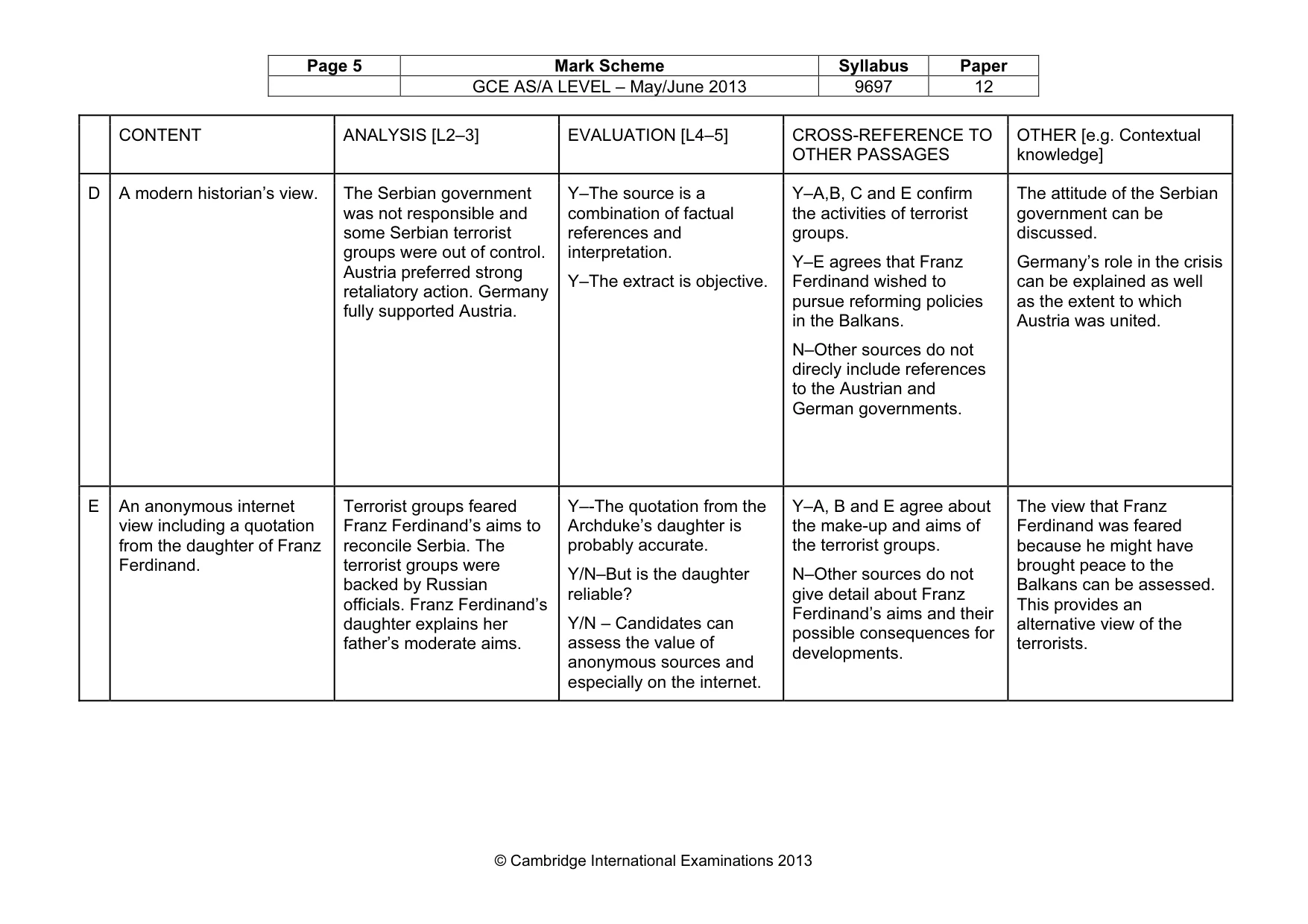
Page 5 Mark Scheme Syllabus Paper GCE AS/A LEVEL – May/June 2013 9697 12 © Cambridge International Examinations 2013 CONTENT ANALYSIS [L2–3] EVALUATION [L4–5] CROSS-REFERENCE TO OTHER PASSAGES OTHER [e.g. Contextual knowledge] D A modern historian’s view. The Serbian government was not responsible and some Serbian terrorist groups were out of control. Austria preferred strong retaliatory action. Germany fully supported Austria. Y–The source is a combination of factual references and interpretation. Y–The extract is objective. Y–A,B, C and E confirm the activities of terrorist groups. Y–E agrees that Franz Ferdinand wished to pursue reforming policies in the Balkans. N–Other sources do not direcly include references to the Austrian and German governments. The attitude of the Serbian government can be discussed. Germany’s role in the crisis can be explained as well as the extent to which Austria was united. E An anonymous internet view including a quotation from the daughter of Franz Ferdinand. Terrorist groups feared Franz Ferdinand’s aims to reconcile Serbia. The terrorist groups were backed by Russian officials. Franz Ferdinand’s daughter explains her father’s moderate aims. Y–-The quotation from the Archduke’s daughter is probably accurate. Y/N–But is the daughter reliable? Y/N – Candidates can assess the value of anonymous sources and especially on the internet. Y–A, B and E agree about the make-up and aims of the terrorist groups. N–Other sources do not give detail about Franz Ferdinand’s aims and their possible consequences for developments. The view that Franz Ferdinand was feared because he might have brought peace to the Balkans can be assessed. This provides an alternative view of the terrorists.
Mark scheme, page 6
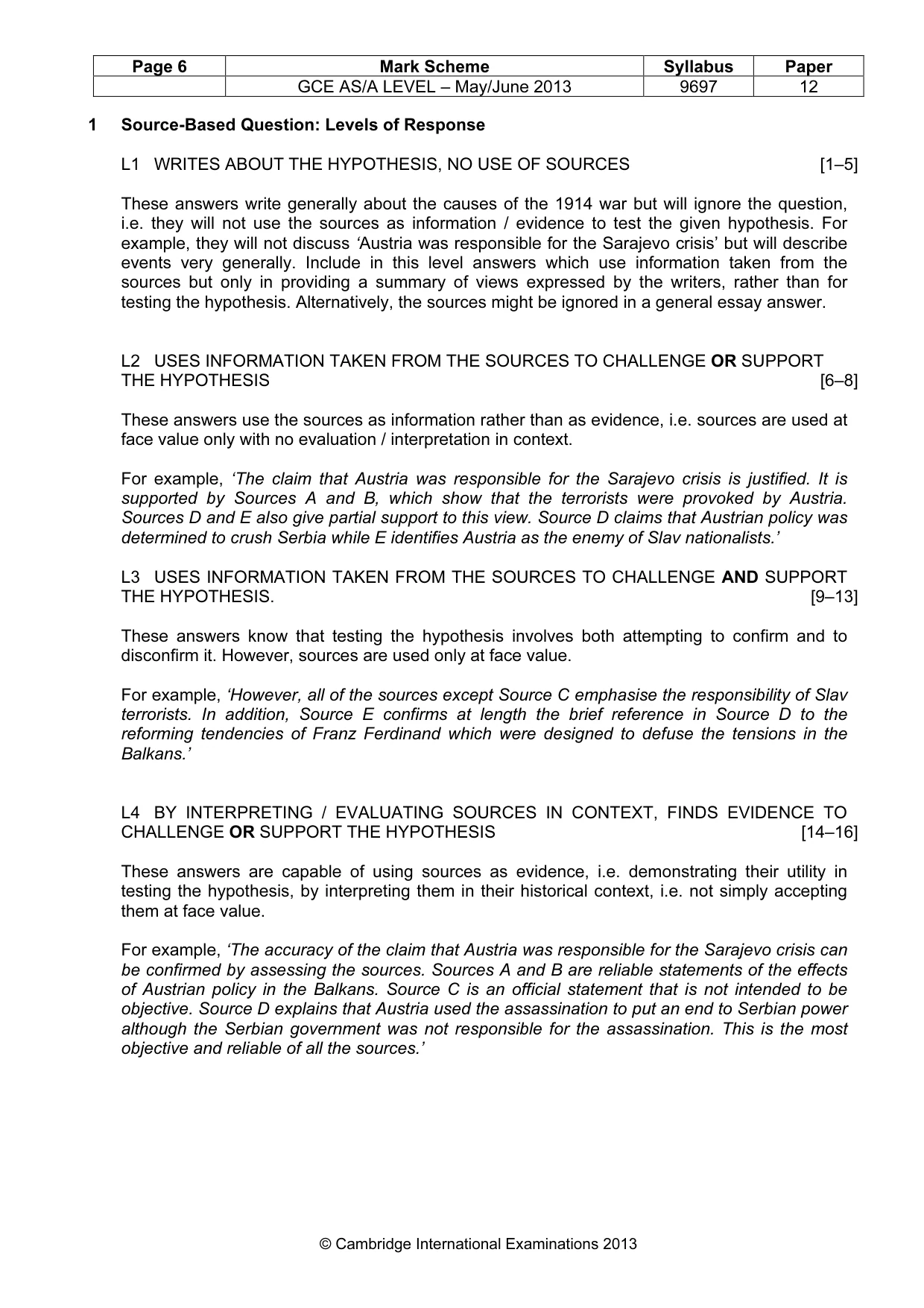
Page 6 Mark Scheme Syllabus Paper GCE AS/A LEVEL – May/June 2013 9697 12 © Cambridge International Examinations 2013 1 Source-Based Question: Levels of Response L1 WRITES ABOUT THE HYPOTHESIS, NO USE OF SOURCES [1–5] These answers write generally about the causes of the 1914 war but will ignore the question, i.e. they will not use the sources as information / evidence to test the given hypothesis. For example, they will not discuss ‘Austria was responsible for the Sarajevo crisis’ but will describe events very generally. Include in this level answers which use information taken from the sources but only in providing a summary of views expressed by the writers, rather than for testing the hypothesis. Alternatively, the sources might be ignored in a general essay answer. L2 USES INFORMATION TAKEN FROM THE SOURCES TO CHALLENGE OR SUPPORT THE HYPOTHESIS [6–8] These answers use the sources as information rather than as evidence, i.e. sources are used at face value only with no evaluation / interpretation in context. For example, ‘The claim that Austria was responsible for the Sarajevo crisis is justified. It is supported by Sources A and B, which show that the terrorists were provoked by Austria. Sources D and E also give partial support to this view. Source D claims that Austrian policy was determined to crush Serbia while E identifies Austria as the enemy of Slav nationalists.’ L3 USES INFORMATION TAKEN FROM THE SOURCES TO CHALLENGE AND SUPPORT THE HYPOTHESIS. [9–13] These answers know that testing the hypothesis involves both attempting to confirm and to disconfirm it. However, sources are used only at face value. For example, ‘However, all of the sources except Source C emphasise the responsibility of Slav terrorists. In addition, Source E confirms at length the brief reference in Source D to the reforming tendencies of Franz Ferdinand which were designed to defuse the tensions in the Balkans.’ L4 BY INTERPRETING / EVALUATING SOURCES IN CONTEXT, FINDS EVIDENCE TO CHALLENGE OR SUPPORT THE HYPOTHESIS [14–16] These answers are capable of using sources as evidence, i.e. demonstrating their utility in testing the hypothesis, by interpreting them in their historical context, i.e. not simply accepting them at face value. For example, ‘The accuracy of the claim that Austria was responsible for the Sarajevo crisis can be confirmed by assessing the sources. Sources A and B are reliable statements of the effects of Austrian policy in the Balkans. Source C is an official statement that is not intended to be objective. Source D explains that Austria used the assassination to put an end to Serbian power although the Serbian government was not responsible for the assassination. This is the most objective and reliable of all the sources.’
Mark scheme, page 7
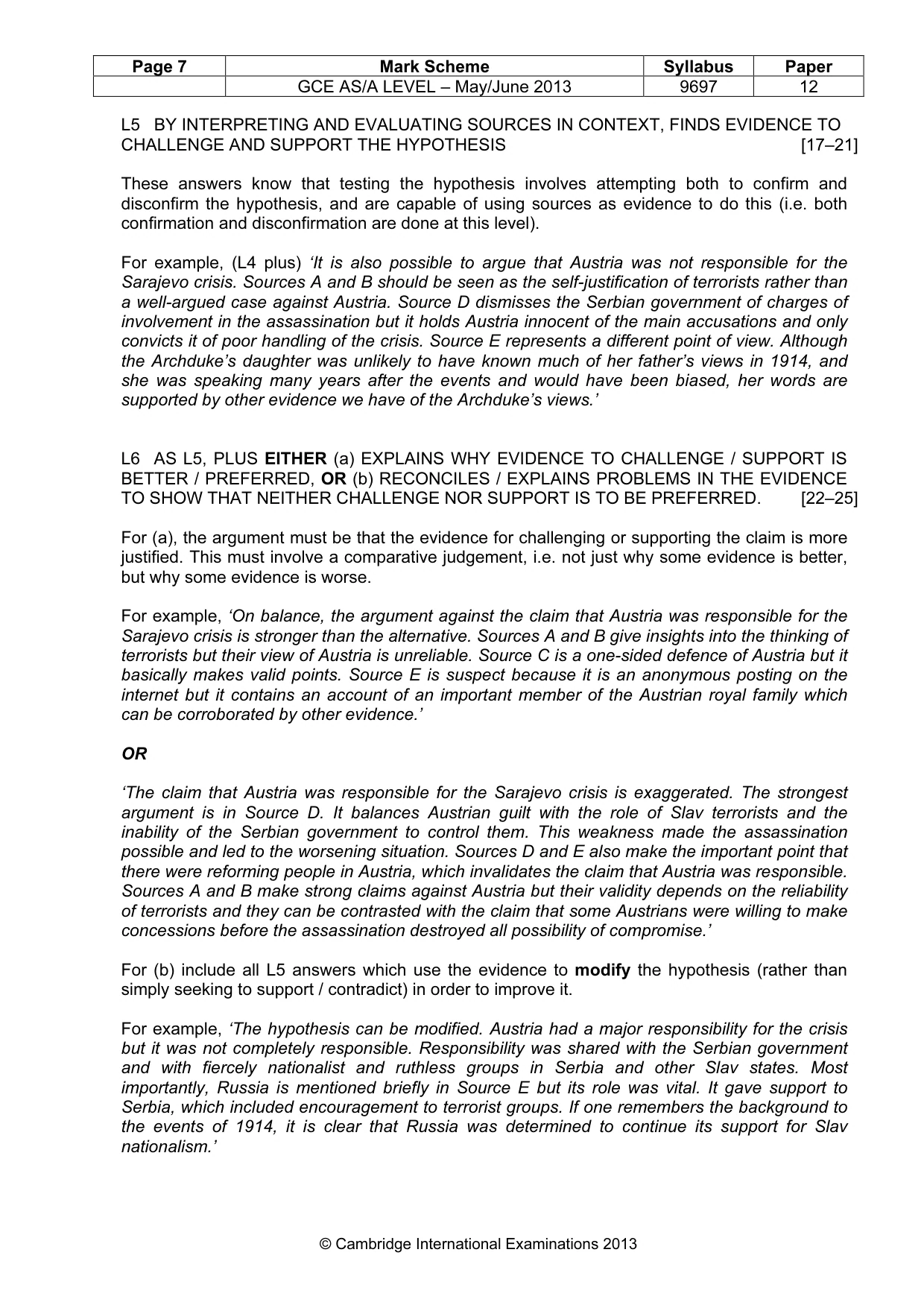
Page 7 Mark Scheme Syllabus Paper GCE AS/A LEVEL – May/June 2013 9697 12 © Cambridge International Examinations 2013 L5 BY INTERPRETING AND EVALUATING SOURCES IN CONTEXT, FINDS EVIDENCE TO CHALLENGE AND SUPPORT THE HYPOTHESIS [17–21] These answers know that testing the hypothesis involves attempting both to confirm and disconfirm the hypothesis, and are capable of using sources as evidence to do this (i.e. both confirmation and disconfirmation are done at this level). For example, (L4 plus) ‘It is also possible to argue that Austria was not responsible for the Sarajevo crisis. Sources A and B should be seen as the self-justification of terrorists rather than a well-argued case against Austria. Source D dismisses the Serbian government of charges of involvement in the assassination but it holds Austria innocent of the main accusations and only convicts it of poor handling of the crisis. Source E represents a different point of view. Although the Archduke’s daughter was unlikely to have known much of her father’s views in 1914, and she was speaking many years after the events and would have been biased, her words are supported by other evidence we have of the Archduke’s views.’ L6 AS L5, PLUS EITHER (a) EXPLAINS WHY EVIDENCE TO CHALLENGE / SUPPORT IS BETTER / PREFERRED, OR (b) RECONCILES / EXPLAINS PROBLEMS IN THE EVIDENCE TO SHOW THAT NEITHER CHALLENGE NOR SUPPORT IS TO BE PREFERRED. [22–25] For (a), the argument must be that the evidence for challenging or supporting the claim is more justified. This must involve a comparative judgement, i.e. not just why some evidence is better, but why some evidence is worse. For example, ‘On balance, the argument against the claim that Austria was responsible for the Sarajevo crisis is stronger than the alternative. Sources A and B give insights into the thinking of terrorists but their view of Austria is unreliable. Source C is a one-sided defence of Austria but it basically makes valid points. Source E is suspect because it is an anonymous posting on the internet but it contains an account of an important member of the Austrian royal family which can be corroborated by other evidence.’ OR ‘The claim that Austria was responsible for the Sarajevo crisis is exaggerated. The strongest argument is in Source D. It balances Austrian guilt with the role of Slav terrorists and the inability of the Serbian government to control them. This weakness made the assassination possible and led to the worsening situation. Sources D and E also make the important point that there were reforming people in Austria, which invalidates the claim that Austria was responsible. Sources A and B make strong claims against Austria but their validity depends on the reliability of terrorists and they can be contrasted with the claim that some Austrians were willing to make concessions before the assassination destroyed all possibility of compromise.’ For (b) include all L5 answers which use the evidence to modify the hypothesis (rather than simply seeking to support / contradict) in order to improve it. For example, ‘The hypothesis can be modified. Austria had a major responsibility for the crisis but it was not completely responsible. Responsibility was shared with the Serbian government and with fiercely nationalist and ruthless groups in Serbia and other Slav states. Most importantly, Russia is mentioned briefly in Source E but its role was vital. It gave support to Serbia, which included encouragement to terrorist groups. If one remembers the background to the events of 1914, it is clear that Russia was determined to continue its support for Slav nationalism.’
Mark scheme, page 8
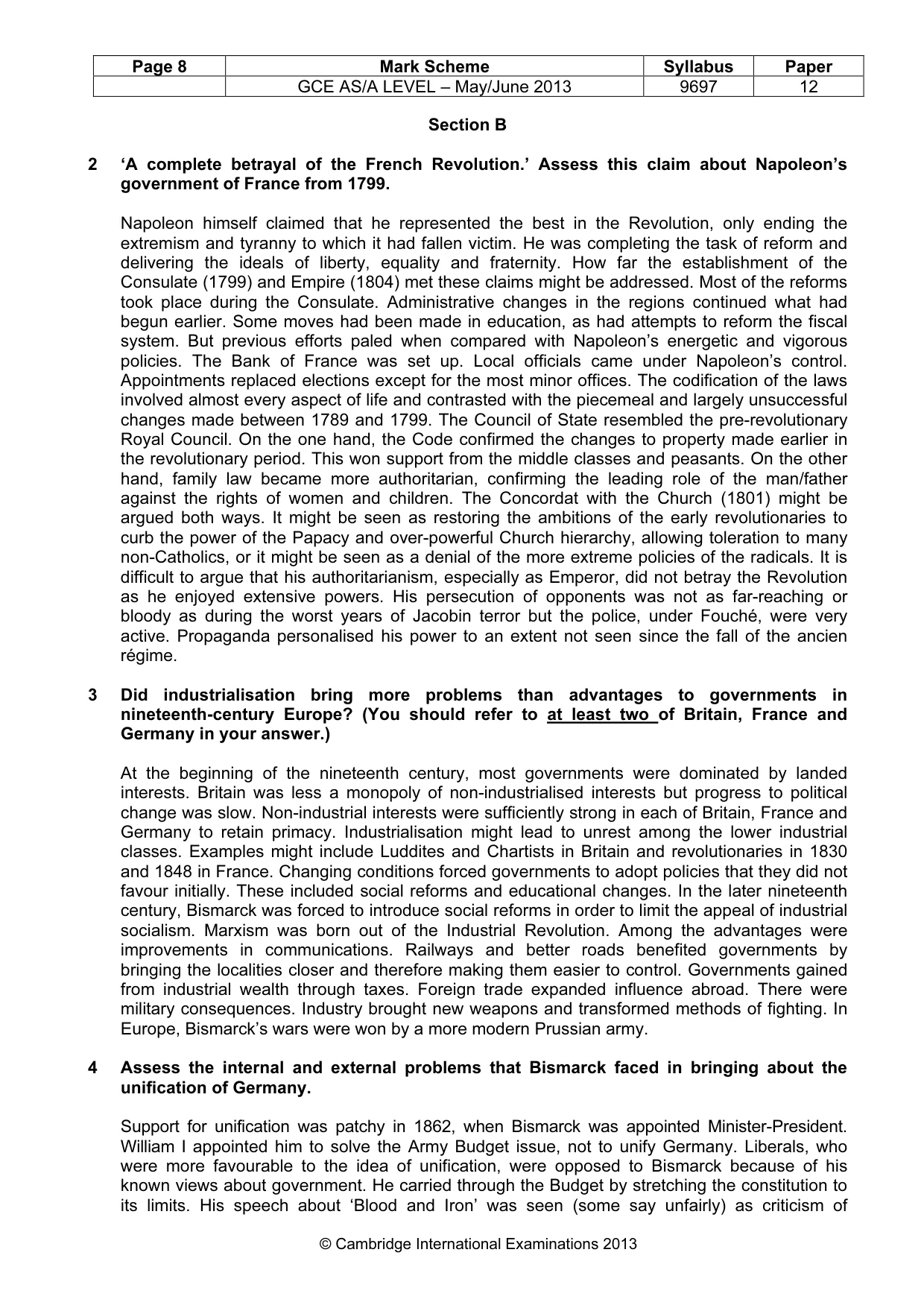
Page 8 Mark Scheme Syllabus Paper GCE AS/A LEVEL – May/June 2013 9697 12 © Cambridge International Examinations 2013 Section B 2 ‘A complete betrayal of the French Revolution.’ Assess this claim about Napoleon’s government of France from 1799. Napoleon himself claimed that he represented the best in the Revolution, only ending the extremism and tyranny to which it had fallen victim. He was completing the task of reform and delivering the ideals of liberty, equality and fraternity. How far the establishment of the Consulate (1799) and Empire (1804) met these claims might be addressed. Most of the reforms took place during the Consulate. Administrative changes in the regions continued what had begun earlier. Some moves had been made in education, as had attempts to reform the fiscal system. But previous efforts paled when compared with Napoleon’s energetic and vigorous policies. The Bank of France was set up. Local officials came under Napoleon’s control. Appointments replaced elections except for the most minor offices. The codification of the laws involved almost every aspect of life and contrasted with the piecemeal and largely unsuccessful changes made between 1789 and 1799. The Council of State resembled the pre-revolutionary Royal Council. On the one hand, the Code confirmed the changes to property made earlier in the revolutionary period. This won support from the middle classes and peasants. On the other hand, family law became more authoritarian, confirming the leading role of the man/father against the rights of women and children. The Concordat with the Church (1801) might be argued both ways. It might be seen as restoring the ambitions of the early revolutionaries to curb the power of the Papacy and over-powerful Church hierarchy, allowing toleration to many non-Catholics, or it might be seen as a denial of the more extreme policies of the radicals. It is difficult to argue that his authoritarianism, especially as Emperor, did not betray the Revolution as he enjoyed extensive powers. His persecution of opponents was not as far-reaching or bloody as during the worst years of Jacobin terror but the police, under Fouché, were very active. Propaganda personalised his power to an extent not seen since the fall of the ancien régime. 3 Did industrialisation bring more problems than advantages to governments in nineteenth-century Europe? (You should refer to at least two of Britain, France and Germany in your answer.) At the beginning of the nineteenth century, most governments were dominated by landed interests. Britain was less a monopoly of non-industrialised interests but progress to political change was slow. Non-industrial interests were sufficiently strong in each of Britain, France and Germany to retain primacy. Industrialisation might lead to unrest among the lower industrial classes. Examples might include Luddites and Chartists in Britain and revolutionaries in 1830 and 1848 in France. Changing conditions forced governments to adopt policies that they did not favour initially. These included social reforms and educational changes. In the later nineteenth century, Bismarck was forced to introduce social reforms in order to limit the appeal of industrial socialism. Marxism was born out of the Industrial Revolution. Among the advantages were improvements in communications. Railways and better roads benefited governments by bringing the localities closer and therefore making them easier to control. Governments gained from industrial wealth through taxes. Foreign trade expanded influence abroad. There were military consequences. Industry brought new weapons and transformed methods of fighting. In Europe, Bismarck’s wars were won by a more modern Prussian army. 4 Assess the internal and external problems that Bismarck faced in bringing about the unification of Germany. Support for unification was patchy in 1862, when Bismarck was appointed Minister-President. William I appointed him to solve the Army Budget issue, not to unify Germany. Liberals, who were more favourable to the idea of unification, were opposed to Bismarck because of his known views about government. He carried through the Budget by stretching the constitution to its limits. His speech about ‘Blood and Iron’ was seen (some say unfairly) as criticism of
Mark scheme, page 9
Page 9 Mark Scheme Syllabus Paper GCE AS/A LEVEL – May/June 2013 9697 12 © Cambridge International Examinations 2013 ineffective but obstructive liberals. Another internal problem was the state of the army itself. It was not yet the powerful force that it became under Moltke and Roon. Support for a united Germany was uneven. Some states were unenthusiastic, even hostile, because it was obvious that Prussia would be the leading state. Catholic provinces, especially in the south, were not as hostile to Austria. Among the external problems were the wars of unification. Each of the three major wars had to be handled carefully. War with Denmark (1864) gave Bismarck the opportunity to win wide support in Germany. Austria was needed as a short-term ally because Schleswig-Holstein needed to be sold as a German rather than a Prussian issue. The Austro- Prussian war did not seem to be as easy as it turned out. The victory had to be handled carefully. Bismarck won the support, or at least the benevolent neutrality, of France, Russia, Britain and Piedmont. He did not want to make Austria a permanent enemy and agreed a moderate peace settlement. Discussion of the war with France might show that there are arguments about the consistency of his intentions. Again the weakness of the French army can be exaggerated and he depended on the unpredictable Napoleon III. 5 Why did imperialism cause competition between European countries in the late- nineteenth century? (You should refer to at least two of Britain, France and Germany in your answer.) To achieve the highest bands answers require clear overseas examples from two of Britain, France and Germany. No particular balance is expected between the countries. Imperialism led to strategic and military rivalries, for example in African regions and in the Far East. It also led to incidents that might have led to war, for example at Fashoda (1898). Germany saw its interests in central Africa threatened and took advantage of the Jameson Raid (1895). There was competition in China although Russia came nearest to war (with Japan in 1904–05). The Berlin Conference (1884-85) was Bismarck’s attempt to defuse imperial rivalries but it was a limited success. Expansion meant that European countries seized territories that had little strategic or economic advantage but which reflected them as ‘great’ powers. Trade rather than land was the impetus for activity in China. The activities of individuals, often uncontrolled by their governments, could cause rivalries. 6 How successfully did Lenin govern Russia from 1917 to 1924? The starting point for this question is after the October Revolution although it might be pointed out that it was an achievement to put the Bolsheviks in power. It was a success to hold on to power in the civil war. The Whites were not well organised but they represented a powerful collection of opponents, including Tsarists and non-Russian minorities. Some might point out that victory owed much to Trotsky. Lenin achieved the peace that he promised Russia. The Treaty of Brest-Litovsk with its vast concessions showed his realism. The settlement showed Lenin’s personal standing in the Bolshevik government. It was opposed by many of his colleagues who believed that the price was too high. He set up a government that worked and secured the co-operation of a disparate group of revolutionaries. He was tolerant of diversity within the ruling group but ruthless with opposition from outside. The Cheka was used with his full support and he was an open advocate of terror. By 1924, it was clear that Bolshevism would survive his death. He dominated government and there was no effective rivalry within. Capitalist foreign countries tolerated a communist regime in Russia after the civil war. However, the succession was uncertain. Lenin’s final years were overshadowed by failing health. Limitations to his success might be the introduction of a state that showed little of Lenin’s Marxism: rule by a minority rather than the proletarian majority, dictatorship rather than representation. There might be different views about the economy. War Communism was a reaction to dire economic conditions but it failed. The NEP was a step back towards a mixed economy.
Mark scheme, page 10
Page 10 Mark Scheme Syllabus Paper GCE AS/A LEVEL – May/June 2013 9697 12 © Cambridge International Examinations 2013 7 Why was the Weimar Republic replaced by a Nazi dictatorship in 1933? The Weimar Republic was unpopular with many sections of the public from the start because of myths about its inception. These included the ‘Stab in the Back’ as a cause of Germany’s defeat in World War I. Hitler promised a strong military, breaking the terms of the Versailles settlement. In fact, the officer class had forced the Kaiser to end the war. The alleged ‘November criminals’ accepted the Versailles settlement. Hitler promised a tougher foreign policy. He took the popular line that Weimar politicians betrayed Germany, whereas they had no alternative. Weimar agreed to the cession of German territories, resulting in the exclusion of German citizens. Hitler undertook to restore a greater Germany. The democratic system in Weimar resulted in multiple small parties, of which the Nazis became one. Before 1934, Hitler did not declare that he favoured a single-party state but advocated stronger government. Communists were feared more than extreme right-wing groups by business men and other middle class people. Hitler promised to deal with them harshly but seemed to drop his extremism in favour of legal methods of politics after the failed Munich Putsch (1923). Weimar’s record on the economy can be contrasted with the programme outlined by Hitler. Germany had largely recovered from post-war depression and inflation by the later 1920s. The problems when Hitler gained power were caused mostly by the Wall Street Crash (1929). Political leadership was important. Weimar was weakened by the death of Stresemann. Hitler had to deal with lesser men. He had a forceful public image. He used the SA to suppress dissidents. He combined an apparent regard for legitimacy with ruthlessness, for example the Reichstag Fire, to secure the Enabling Act (1933) and the suppression of other parties. 8 How similar were the methods by which Nicholas II and Stalin ruled Russia during the period from 1900 to 1939? Both Nicholas II and Stalin were absolute rulers. All government emanated from them. However, Nicholas II gave some apparent concessions in the October Manifesto, even if they were negated by the Fundamental Laws and the Tsar’s unwillingness to implement the reforms that he promised. There were no equivalents under Stalin. Personally, they were very different. Nicholas II was liable to be influenced by courtiers and ministers (at least those who gave him advice that he wanted to hear). He was a weak man with power. Stalin was not influenced in the same way. But where Nicholas II inherited power, Stalin had to manoeuvre carefully to gain power. Apart from giving broad indications of his preferred policies, the Tsar was a ‘hands-off’ ruler whereas Stalin was concerned about the most detailed and minor affairs of government. Both were repressive in dealing with opposition, using a secret police and the army. However, Stalin was much more extreme. There were no real similarities between the Tsar’s punishments of internal and external exile and comparatively few executions and the numbers of those whom Stalin executed or sent to gulags. In economic terms, Nicholas II was not interested in economic change and was suspicious of the attempts of Witte and Stolypin to modernise. Stalin was driven by the determination to modernise Russia and was a social and economic revolutionary. The Tsar’s ideas about government were general. He embraced tradition and the Church. Stalin adopted a Marxist ideology to justify his aims and methods although it might be argued that this was only a cover to conceal very different motives and methods. In terms of propaganda Nicholas II embraced the traditional regard for a tsar. Stalin used more modern, deliberate and extensive methods of propaganda. To achieve the highest bands answers need to take a comparative approach.
What you needed in this session
Cambridge’s own grade thresholds for 2013 May/June, Paper 1 · Variant 2. A higher threshold means an easier paper — the bar moves with how the cohort did.