Cambridge A Level History (pre-2015) 9697 — 2014 Oct/Nov Paper 1 · Variant 2
9697/12/O/N/14 · 100 marks · ≈113 min
The question paper and its mark scheme, free to read here and free to download. This is Cambridge’s own paper, exactly as it was sat.
Question paper4 pages
Mark scheme10 pages
Answers below. Sit the paper first if you are practising.
Paper as text
Question paper, page 1
This document consists of 4 printed pages. DC (NF) 83498/2 © UCLES 2014 [Turn over Cambridge International Examinations Cambridge International Advanced Subsidiary and Advanced Level * 7 8 0 9 3 7 3 4 5 1 * HISTORY 9697/12 Paper 1 Modern European History, 1789–1939 October/November 2014 3 hours Additional Materials: Answer Paper READ THESE INSTRUCTIONS FIRST Write your Centre number, candidate number and name on all the work you hand in. Write in dark blue or black pen. You may use an HB pencil for any diagrams or graphs. Do not use staples, paper clips, glue or correction fluid. DO NOT WRITE IN ANY BARCODES. Section A Answer Question 1. Section B Answer any three questions. At the end of the examination, fasten all your work securely together. All questions in this paper carry equal marks.
Question paper, page 2
2 9697/12/O/N/14 © UCLES 2014 Section A: The Origins of World War I, 1870–1914 You must answer Question 1. FRANCE AND GERMANY 1 Read the Sources, and then answer the question. When answering Question 1, candidates are advised to pay particular attention to the interpretation and evaluation of the Sources, both individually and as a group. Source A Bismarck maintained that the Franco-Prussian War of 1870 had not been caused by Prussia. It arose from the intolerance of the French, who regarded the prosperity of other nations as an insult to themselves. He maintained that the same feeling would continue. He said, ‘We must not deceive ourselves. We must soon expect a new attack. We cannot look forward to a lasting peace, and this is quite independent of the conditions we might impose on France. It is a defeat which the French nation will never forgive. If we were to withdraw from France now without taking any territory and without any financial contribution, the French would have the same hatred, the same spirit of revenge, because of their vanity and love of power.’ He believed that Germany must be protected from the danger of French attack. Germany would never be safe so long as Alsace and Lorraine were in French hands. France had made war on Germany twenty times in the past, but no threat to the peace of Europe was to be feared from Germany. If France had been successful it would have taken much territory from Germany. What claim had France to be treated with a leniency which she had never shown to any conquered enemy? France assumed that she was a privileged country; that she had freedom to conquer and divide the land of her neighbours, and that every proposal to win back from her what she had taken from others was a crime against humanity. A British historian writing about Bismarck’s attitude towards France after the Franco-Prussian War, published in 1899. Source B After the establishment of the unified state in 1871, Bismarck considered Germany to be a fully satisfied country. German policy in Europe remained very cautious. It had to be, considering the deep and lasting hatred the loss of Alsace and Lorraine had caused among the French, the difficulty of remaining on good terms with both Austria and Russia, and the growing reluctance of Britain towards continental alliances. Germany wanted time to consolidate itself and her gains. Her interest was to maintain peace. A British historian describing German foreign policy after unification, published in 1979. Source C It has been usual to meet Germans who declare that France’s military plans are unjustified. A member of the German Parliament, who is not a fanatic, talked to his friends of the new three years’ military service in France. He said, ‘It is a provocation; we will not allow it.’ Other people state that France with her forty million inhabitants has no right to compete in this way with Germany. Germany considers that our place in the sun is too large for our forty million inhabitants. Germans keep on claiming that they wish for peace (William II more than anyone), but they do not understand that peace involves either concessions or a balance of armaments. They want to be feared. A French military diplomat reporting from Germany to the French Minister of War, March 1913.
Question paper, page 3
3 9697/12/O/N/14 © UCLES 2014 [Turn over Source D From observations which contacts in Germany have been able to collect from many different people, two feelings sway and irritate most Germans’ minds: (1) The outcome of the Balkan crisis in 1912 was a disappointment for Germany; (2) France is a new France undreamed of before 1911. Germany is a warlike country and wants war. Members of all the parties in the German Parliament, from the Conservatives to the Socialists, are unanimous on these two points. They represent the different districts and all the social groups in Germany. From a report on German public opinion prepared by French diplomats in Germany for the French Minister for Foreign Affairs, July 1913. Source E France has a clear conscience about the outbreak of the war in 1914. She had nothing to do with the disputes between Austria and Serbia, or between Austria, Germany and Russia. Once war proved inevitable, France accepted the responsibilities of the Russian alliance. Germany was an obvious aggressor against France. Germany’s plans for the quick annihilation of France, before attacking Russia, are well known to the world. Everybody is aware how scrupulously France avoided every hostile measure, and, during the critical days preceding the war, withdrew all troops ten kilometres from the frontier to prevent a clash. In order to justify their advance, Germany invented preposterous tales of bombs dropped by aeroplanes or of the violation of Belgian neutrality by French officers in cars. France had no idea of invading Belgium. All the French military plans aimed at the protection of its frontier, and they were defeated by the dishonest move of Germany through Belgium. In 1914 France was not even prepared for war. No nation ever looked forward with more horror and dread to military conflict than the French. They had been the last victims of a great European war, of which the memories were still alive. However much the loss of Alsace-Lorraine saddened them, they knew too well the madness of war to seek it again. A new generation had grown up reconciled to fate and willing to let bygones be bygones. But Germany would not. It dreamed of world supremacy. An American historian, published in 1916. Now answer the following question. ‘France was a greater threat to international peace from 1871 to 1914 than Germany.’ Use Sources A–E to show how far the evidence confirms this statement.
Question paper, page 4
4 9697/12/O/N/14 © UCLES 2014 Section B You must answer three questions from this section. 2 Assess the view that, from 1799 to 1815, Napoleon Bonaparte’s main aim was to preserve the achievements of the French Revolution. 3 Analyse the main differences between the Industrial Revolutions in Britain and either France or Germany. 4 Assess the problems facing the movement for Italian unification from 1849 to 1871. 5 ‘Winning popular support was the main aim of European countries in “New Imperialism” at the end of the nineteenth century.’ How far do you agree with this judgement? (You should refer to at least two of Britain, France and Germany in your answer.) 6 Analyse the reasons why Lenin became a successful revolutionary leader. 7 ‘Authoritarian but not totalitarian.’ Assess this judgement on Mussolini’s government of Italy up to 1939. 8 How different were the economies of Britain and Russia by the end of the nineteenth century? Copyright Acknowledgements: Source B © J A Bowle; A History of Europe; Pan Books; 1979. Permission to reproduce items where third-party owned material protected by copyright is included has been sought and cleared where possible. Every reasonable effort has been made by the publisher (UCLES) to trace copyright holders, but if any items requiring clearance have unwittingly been included, the publisher will be pleased to make amends at the earliest possible opportunity. Cambridge International Examinations is part of the Cambridge Assessment Group. Cambridge Assessment is the brand name of University of Cambridge Local Examinations Syndicate (UCLES), which is itself a department of the University of Cambridge.
Mark scheme, page 1
® IGCSE is the registered trademark of Cambridge International Examinations. CAMBRIDGE INTERNATIONAL EXAMINATIONS Cambridge International Advanced Subsidiary and Advanced Level MARK SCHEME for the October/November 2014 series 9697 HISTORY 9697/12 Paper 1 (Modern European History, 1789–1939), maximum raw mark 100 This mark scheme is published as an aid to teachers and candidates, to indicate the requirements of the examination. It shows the basis on which Examiners were instructed to award marks. It does not indicate the details of the discussions that took place at an Examiners’ meeting before marking began, which would have considered the acceptability of alternative answers. Mark schemes should be read in conjunction with the question paper and the Principal Examiner Report for Teachers. Cambridge will not enter into discussions about these mark schemes. Cambridge is publishing the mark schemes for the October/November 2014 series for most Cambridge IGCSE®, Cambridge International A and AS Level components and some Cambridge O Level components.
Mark scheme, page 2
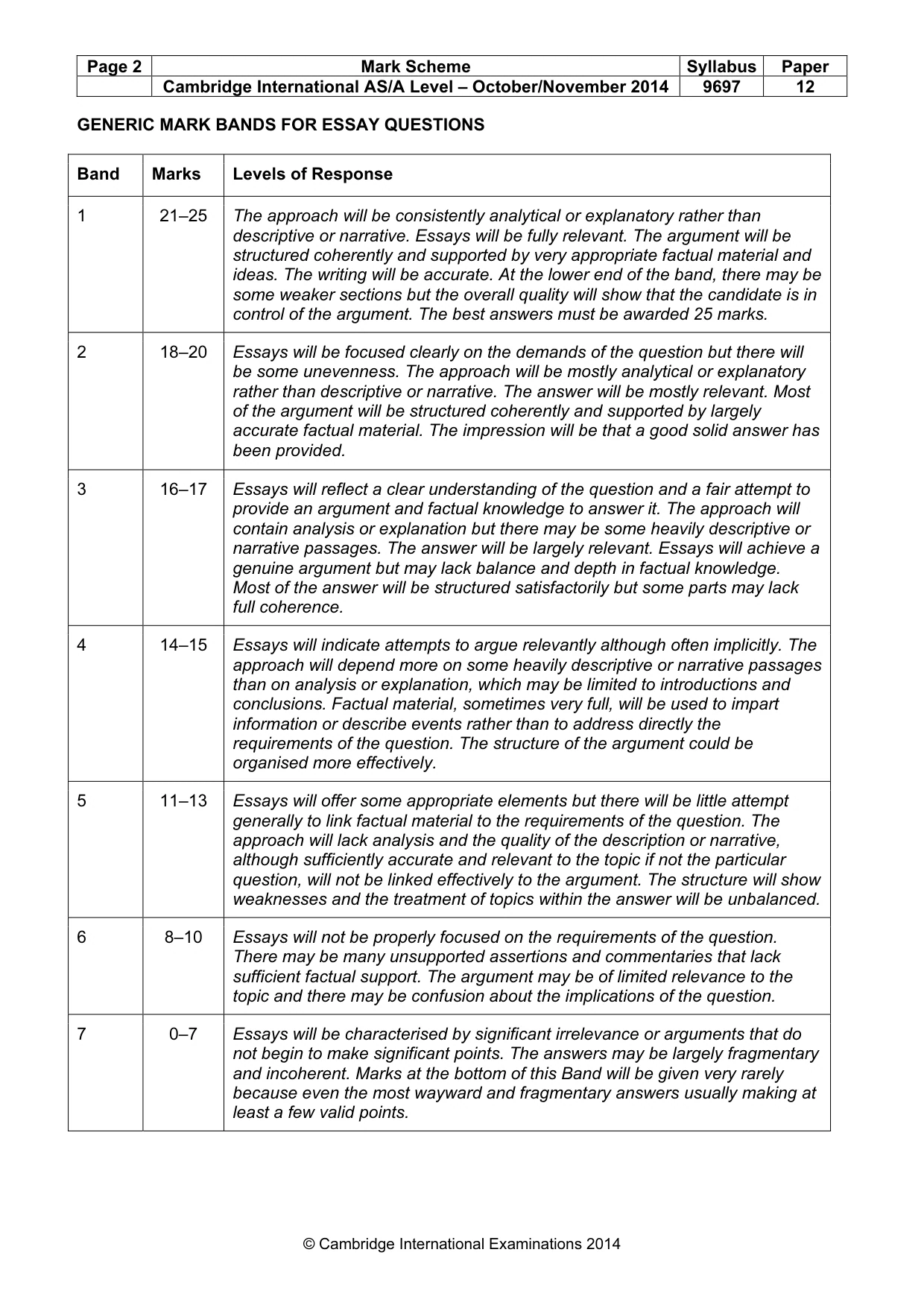
Page 2 Mark Scheme Syllabus Paper Cambridge International AS/A Level – October/November 2014 9697 12 © Cambridge International Examinations 2014 GENERIC MARK BANDS FOR ESSAY QUESTIONS Band Marks Levels of Response 1 21–25 The approach will be consistently analytical or explanatory rather than descriptive or narrative. Essays will be fully relevant. The argument will be structured coherently and supported by very appropriate factual material and ideas. The writing will be accurate. At the lower end of the band, there may be some weaker sections but the overall quality will show that the candidate is in control of the argument. The best answers must be awarded 25 marks. 2 18–20 Essays will be focused clearly on the demands of the question but there will be some unevenness. The approach will be mostly analytical or explanatory rather than descriptive or narrative. The answer will be mostly relevant. Most of the argument will be structured coherently and supported by largely accurate factual material. The impression will be that a good solid answer has been provided. 3 16–17 Essays will reflect a clear understanding of the question and a fair attempt to provide an argument and factual knowledge to answer it. The approach will contain analysis or explanation but there may be some heavily descriptive or narrative passages. The answer will be largely relevant. Essays will achieve a genuine argument but may lack balance and depth in factual knowledge. Most of the answer will be structured satisfactorily but some parts may lack full coherence. 4 14–15 Essays will indicate attempts to argue relevantly although often implicitly. The approach will depend more on some heavily descriptive or narrative passages than on analysis or explanation, which may be limited to introductions and conclusions. Factual material, sometimes very full, will be used to impart information or describe events rather than to address directly the requirements of the question. The structure of the argument could be organised more effectively. 5 11–13 Essays will offer some appropriate elements but there will be little attempt generally to link factual material to the requirements of the question. The approach will lack analysis and the quality of the description or narrative, although sufficiently accurate and relevant to the topic if not the particular question, will not be linked effectively to the argument. The structure will show weaknesses and the treatment of topics within the answer will be unbalanced. 6 8–10 Essays will not be properly focused on the requirements of the question. There may be many unsupported assertions and commentaries that lack sufficient factual support. The argument may be of limited relevance to the topic and there may be confusion about the implications of the question. 7 0–7 Essays will be characterised by significant irrelevance or arguments that do not begin to make significant points. The answers may be largely fragmentary and incoherent. Marks at the bottom of this Band will be given very rarely because even the most wayward and fragmentary answers usually making at least a few valid points.
Mark scheme, page 3
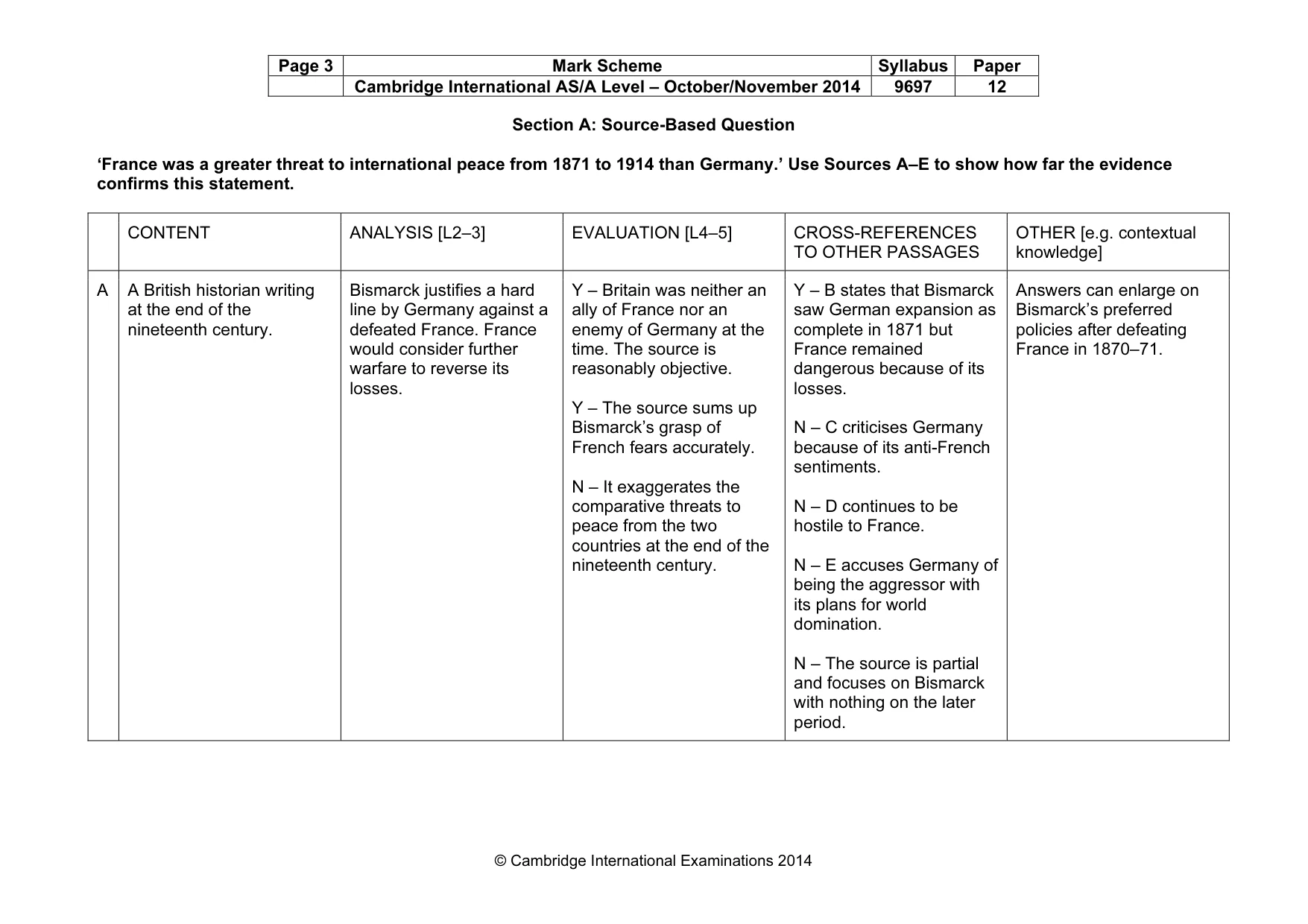
Page 3 Mark Scheme Syllabus Paper Cambridge International AS/A Level – October/November 2014 9697 12 © Cambridge International Examinations 2014 Section A: Source-Based Question ‘France was a greater threat to international peace from 1871 to 1914 than Germany.’ Use Sources A–E to show how far the evidence confirms this statement. CONTENT ANALYSIS [L2–3] EVALUATION [L4–5] CROSS-REFERENCES TO OTHER PASSAGES OTHER [e.g. contextual knowledge] A A British historian writing at the end of the nineteenth century. Bismarck justifies a hard line by Germany against a defeated France. France would consider further warfare to reverse its losses. Y – Britain was neither an ally of France nor an enemy of Germany at the time. The source is reasonably objective. Y – The source sums up Bismarck’s grasp of French fears accurately. N – It exaggerates the comparative threats to peace from the two countries at the end of the nineteenth century. Y – B states that Bismarck saw German expansion as complete in 1871 but France remained dangerous because of its losses. N – C criticises Germany because of its anti-French sentiments. N – D continues to be hostile to France. N – E accuses Germany of being the aggressor with its plans for world domination. N – The source is partial and focuses on Bismarck with nothing on the later period. Answers can enlarge on Bismarck’s preferred policies after defeating France in 1870–71.
Mark scheme, page 4
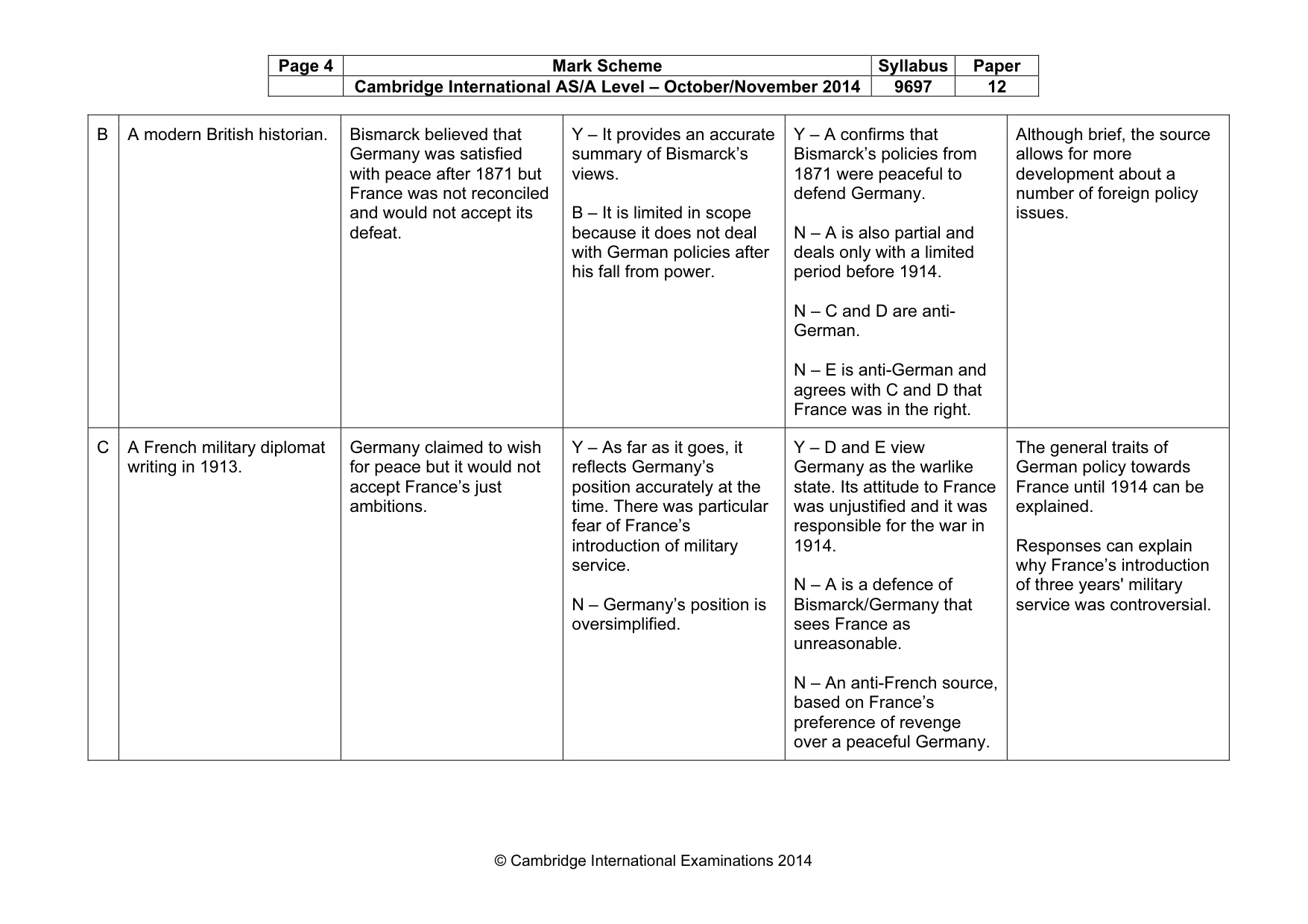
Page 4 Mark Scheme Syllabus Paper Cambridge International AS/A Level – October/November 2014 9697 12 © Cambridge International Examinations 2014 B A modern British historian. Bismarck believed that Germany was satisfied with peace after 1871 but France was not reconciled and would not accept its defeat. Y – It provides an accurate summary of Bismarck’s views. B – It is limited in scope because it does not deal with German policies after his fall from power. Y – A confirms that Bismarck’s policies from 1871 were peaceful to defend Germany. N – A is also partial and deals only with a limited period before 1914. N – C and D are anti- German. N – E is anti-German and agrees with C and D that France was in the right. Although brief, the source allows for more development about a number of foreign policy issues. C A French military diplomat writing in 1913. Germany claimed to wish for peace but it would not accept France’s just ambitions. Y – As far as it goes, it reflects Germany’s position accurately at the time. There was particular fear of France’s introduction of military service. N – Germany’s position is oversimplified. Y – D and E view Germany as the warlike state. Its attitude to France was unjustified and it was responsible for the war in 1914. N – A is a defence of Bismarck/Germany that sees France as unreasonable. N – An anti-French source, based on France’s preference of revenge over a peaceful Germany. The general traits of German policy towards France until 1914 can be explained. Responses can explain why France’s introduction of three years' military service was controversial.
Mark scheme, page 5
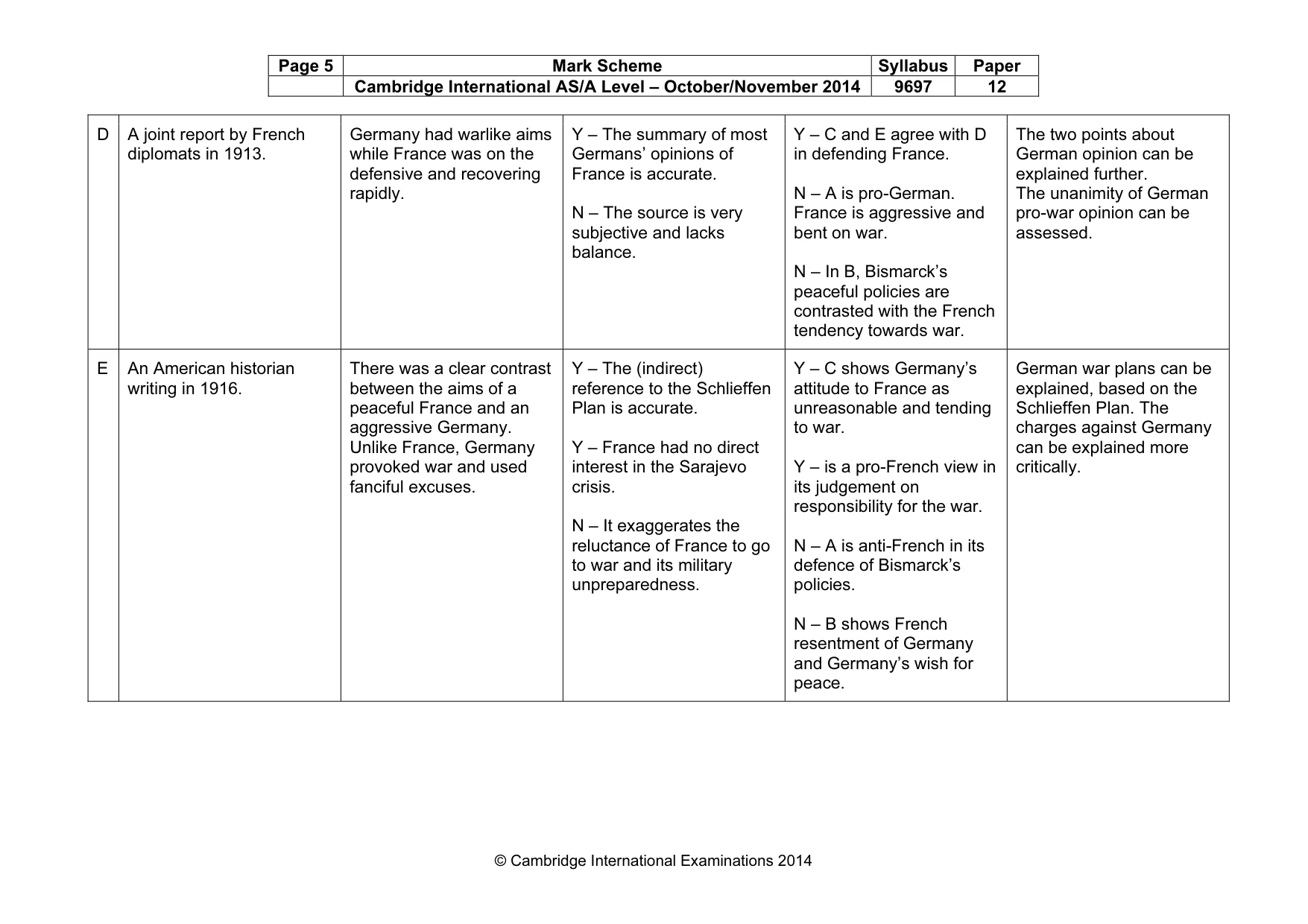
Page 5 Mark Scheme Syllabus Paper Cambridge International AS/A Level – October/November 2014 9697 12 © Cambridge International Examinations 2014 D A joint report by French diplomats in 1913. Germany had warlike aims while France was on the defensive and recovering rapidly. Y – The summary of most Germans’ opinions of France is accurate. N – The source is very subjective and lacks balance. Y – C and E agree with D in defending France. N – A is pro-German. France is aggressive and bent on war. N – In B, Bismarck’s peaceful policies are contrasted with the French tendency towards war. The two points about German opinion can be explained further. The unanimity of German pro-war opinion can be assessed. E An American historian writing in 1916. There was a clear contrast between the aims of a peaceful France and an aggressive Germany. Unlike France, Germany provoked war and used fanciful excuses. Y – The (indirect) reference to the Schlieffen Plan is accurate. Y – France had no direct interest in the Sarajevo crisis. N – It exaggerates the reluctance of France to go to war and its military unpreparedness. Y – C shows Germany’s attitude to France as unreasonable and tending to war. Y – is a pro-French view in its judgement on responsibility for the war. N – A is anti-French in its defence of Bismarck’s policies. N – B shows French resentment of Germany and Germany’s wish for peace. German war plans can be explained, based on the Schlieffen Plan. The charges against Germany can be explained more critically.
Mark scheme, page 6
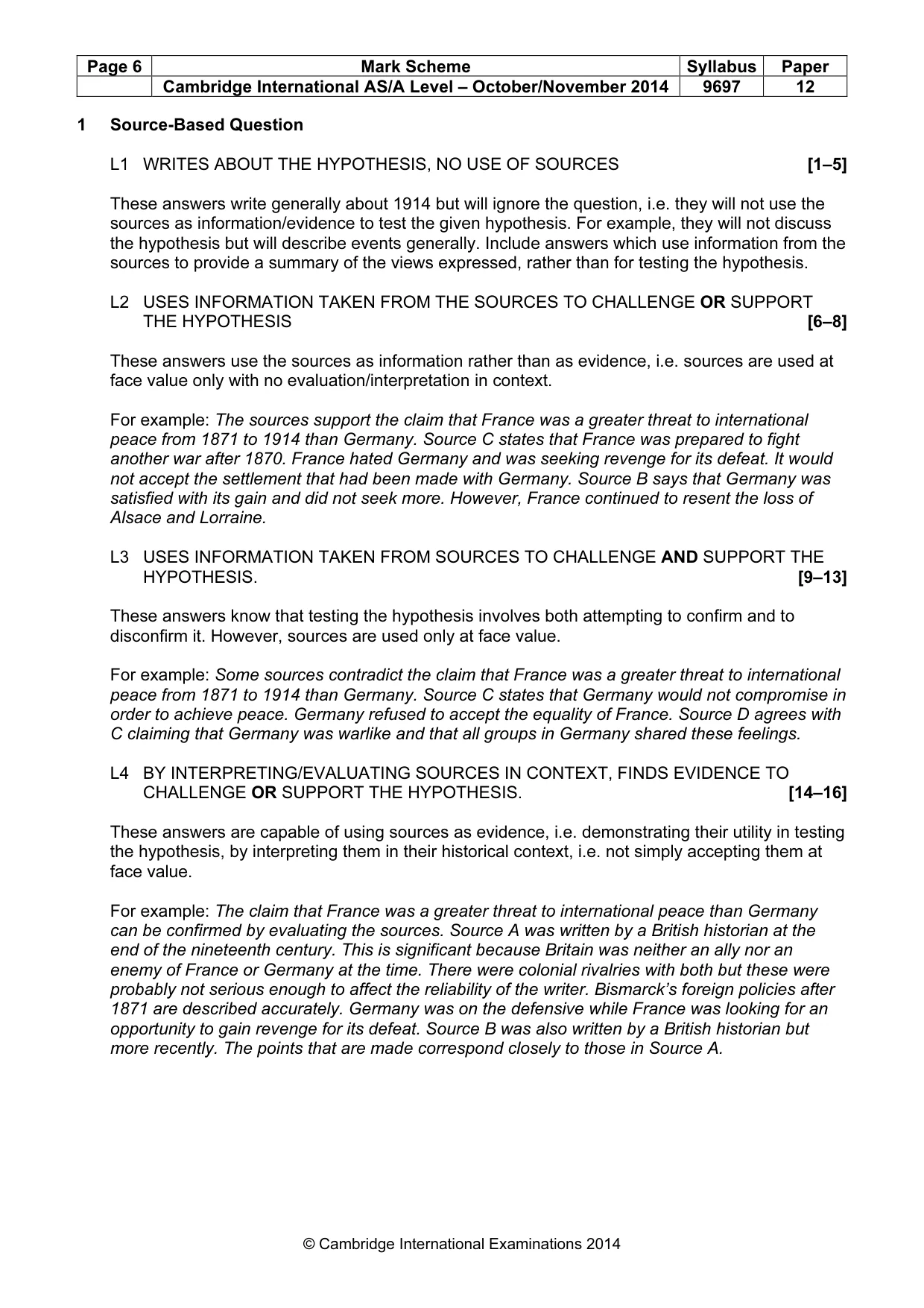
Page 6 Mark Scheme Syllabus Paper Cambridge International AS/A Level – October/November 2014 9697 12 © Cambridge International Examinations 2014 1 Source-Based Question L1 WRITES ABOUT THE HYPOTHESIS, NO USE OF SOURCES [1–5] These answers write generally about 1914 but will ignore the question, i.e. they will not use the sources as information/evidence to test the given hypothesis. For example, they will not discuss the hypothesis but will describe events generally. Include answers which use information from the sources to provide a summary of the views expressed, rather than for testing the hypothesis. L2 USES INFORMATION TAKEN FROM THE SOURCES TO CHALLENGE OR SUPPORT THE HYPOTHESIS [6–8] These answers use the sources as information rather than as evidence, i.e. sources are used at face value only with no evaluation/interpretation in context. For example: The sources support the claim that France was a greater threat to international peace from 1871 to 1914 than Germany. Source C states that France was prepared to fight another war after 1870. France hated Germany and was seeking revenge for its defeat. It would not accept the settlement that had been made with Germany. Source B says that Germany was satisfied with its gain and did not seek more. However, France continued to resent the loss of Alsace and Lorraine. L3 USES INFORMATION TAKEN FROM SOURCES TO CHALLENGE AND SUPPORT THE HYPOTHESIS. [9–13] These answers know that testing the hypothesis involves both attempting to confirm and to disconfirm it. However, sources are used only at face value. For example: Some sources contradict the claim that France was a greater threat to international peace from 1871 to 1914 than Germany. Source C states that Germany would not compromise in order to achieve peace. Germany refused to accept the equality of France. Source D agrees with C claiming that Germany was warlike and that all groups in Germany shared these feelings. L4 BY INTERPRETING/EVALUATING SOURCES IN CONTEXT, FINDS EVIDENCE TO CHALLENGE OR SUPPORT THE HYPOTHESIS. [14–16] These answers are capable of using sources as evidence, i.e. demonstrating their utility in testing the hypothesis, by interpreting them in their historical context, i.e. not simply accepting them at face value. For example: The claim that France was a greater threat to international peace than Germany can be confirmed by evaluating the sources. Source A was written by a British historian at the end of the nineteenth century. This is significant because Britain was neither an ally nor an enemy of France or Germany at the time. There were colonial rivalries with both but these were probably not serious enough to affect the reliability of the writer. Bismarck’s foreign policies after 1871 are described accurately. Germany was on the defensive while France was looking for an opportunity to gain revenge for its defeat. Source B was also written by a British historian but more recently. The points that are made correspond closely to those in Source A.
Mark scheme, page 7
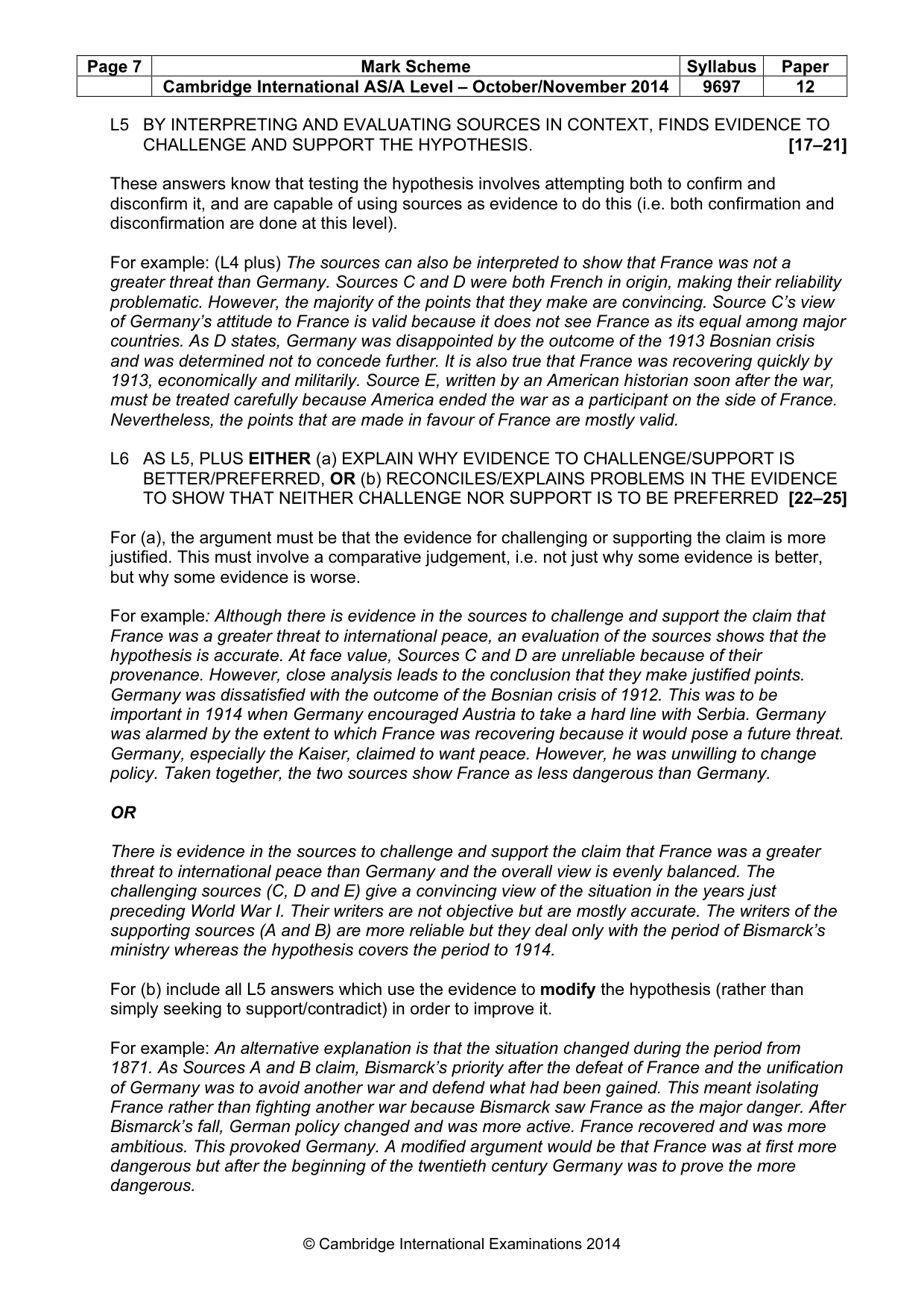
Page 7 Mark Scheme Syllabus Paper Cambridge International AS/A Level – October/November 2014 9697 12 © Cambridge International Examinations 2014 L5 BY INTERPRETING AND EVALUATING SOURCES IN CONTEXT, FINDS EVIDENCE TO CHALLENGE AND SUPPORT THE HYPOTHESIS. [17–21] These answers know that testing the hypothesis involves attempting both to confirm and disconfirm it, and are capable of using sources as evidence to do this (i.e. both confirmation and disconfirmation are done at this level). For example: (L4 plus) The sources can also be interpreted to show that France was not a greater threat than Germany. Sources C and D were both French in origin, making their reliability problematic. However, the majority of the points that they make are convincing. Source C’s view of Germany’s attitude to France is valid because it does not see France as its equal among major countries. As D states, Germany was disappointed by the outcome of the 1913 Bosnian crisis and was determined not to concede further. It is also true that France was recovering quickly by 1913, economically and militarily. Source E, written by an American historian soon after the war, must be treated carefully because America ended the war as a participant on the side of France. Nevertheless, the points that are made in favour of France are mostly valid. L6 AS L5, PLUS EITHER (a) EXPLAIN WHY EVIDENCE TO CHALLENGE/SUPPORT IS BETTER/PREFERRED, OR (b) RECONCILES/EXPLAINS PROBLEMS IN THE EVIDENCE TO SHOW THAT NEITHER CHALLENGE NOR SUPPORT IS TO BE PREFERRED [22–25] For (a), the argument must be that the evidence for challenging or supporting the claim is more justified. This must involve a comparative judgement, i.e. not just why some evidence is better, but why some evidence is worse. For example: Although there is evidence in the sources to challenge and support the claim that France was a greater threat to international peace, an evaluation of the sources shows that the hypothesis is accurate. At face value, Sources C and D are unreliable because of their provenance. However, close analysis leads to the conclusion that they make justified points. Germany was dissatisfied with the outcome of the Bosnian crisis of 1912. This was to be important in 1914 when Germany encouraged Austria to take a hard line with Serbia. Germany was alarmed by the extent to which France was recovering because it would pose a future threat. Germany, especially the Kaiser, claimed to want peace. However, he was unwilling to change policy. Taken together, the two sources show France as less dangerous than Germany. OR There is evidence in the sources to challenge and support the claim that France was a greater threat to international peace than Germany and the overall view is evenly balanced. The challenging sources (C, D and E) give a convincing view of the situation in the years just preceding World War I. Their writers are not objective but are mostly accurate. The writers of the supporting sources (A and B) are more reliable but they deal only with the period of Bismarck’s ministry whereas the hypothesis covers the period to 1914. For (b) include all L5 answers which use the evidence to modify the hypothesis (rather than simply seeking to support/contradict) in order to improve it. For example: An alternative explanation is that the situation changed during the period from 1871. As Sources A and B claim, Bismarck’s priority after the defeat of France and the unification of Germany was to avoid another war and defend what had been gained. This meant isolating France rather than fighting another war because Bismarck saw France as the major danger. After Bismarck’s fall, German policy changed and was more active. France recovered and was more ambitious. This provoked Germany. A modified argument would be that France was at first more dangerous but after the beginning of the twentieth century Germany was to prove the more dangerous.
Mark scheme, page 8
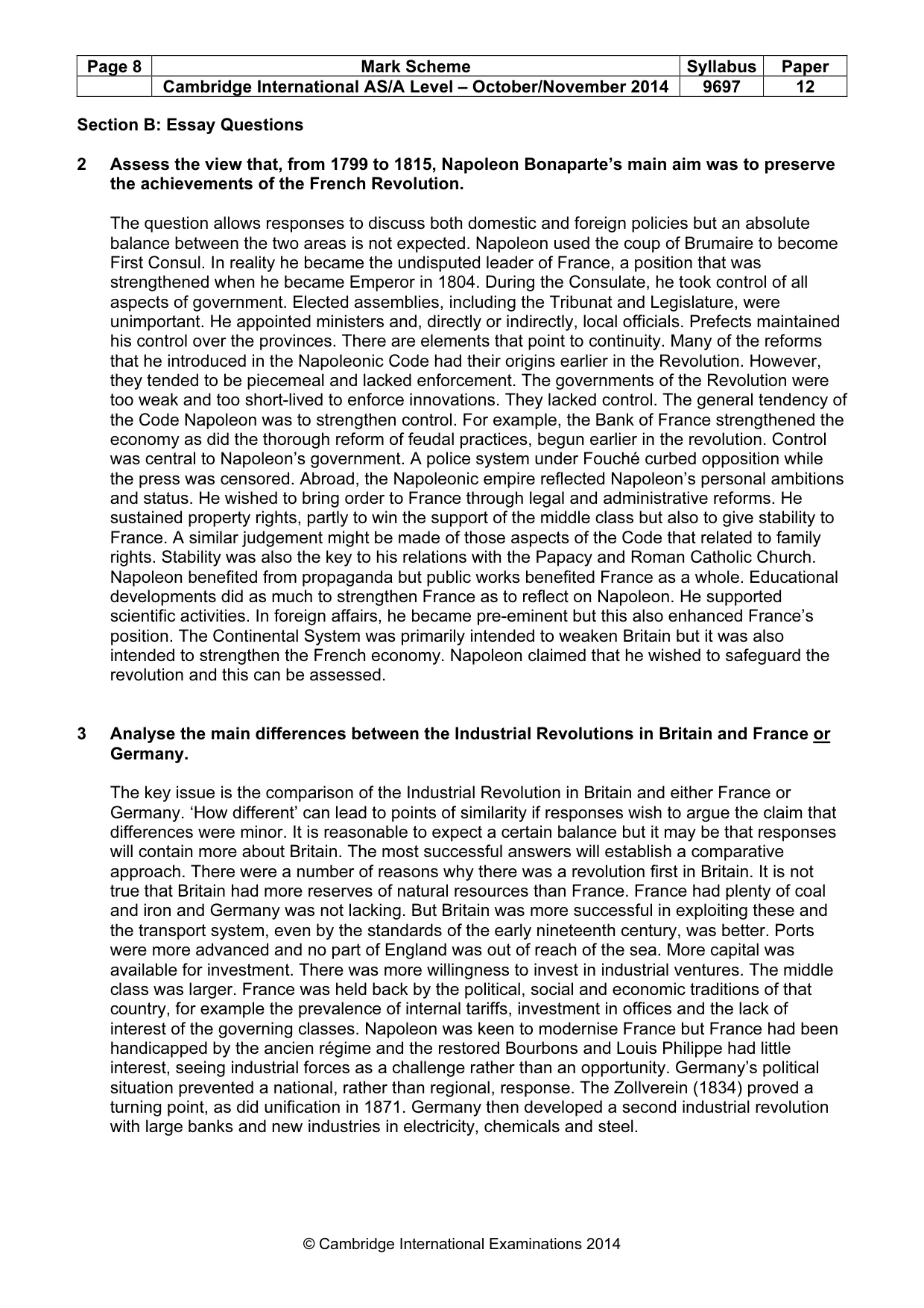
Page 8 Mark Scheme Syllabus Paper Cambridge International AS/A Level – October/November 2014 9697 12 © Cambridge International Examinations 2014 Section B: Essay Questions 2 Assess the view that, from 1799 to 1815, Napoleon Bonaparte’s main aim was to preserve the achievements of the French Revolution. The question allows responses to discuss both domestic and foreign policies but an absolute balance between the two areas is not expected. Napoleon used the coup of Brumaire to become First Consul. In reality he became the undisputed leader of France, a position that was strengthened when he became Emperor in 1804. During the Consulate, he took control of all aspects of government. Elected assemblies, including the Tribunat and Legislature, were unimportant. He appointed ministers and, directly or indirectly, local officials. Prefects maintained his control over the provinces. There are elements that point to continuity. Many of the reforms that he introduced in the Napoleonic Code had their origins earlier in the Revolution. However, they tended to be piecemeal and lacked enforcement. The governments of the Revolution were too weak and too short-lived to enforce innovations. They lacked control. The general tendency of the Code Napoleon was to strengthen control. For example, the Bank of France strengthened the economy as did the thorough reform of feudal practices, begun earlier in the revolution. Control was central to Napoleon’s government. A police system under Fouché curbed opposition while the press was censored. Abroad, the Napoleonic empire reflected Napoleon’s personal ambitions and status. He wished to bring order to France through legal and administrative reforms. He sustained property rights, partly to win the support of the middle class but also to give stability to France. A similar judgement might be made of those aspects of the Code that related to family rights. Stability was also the key to his relations with the Papacy and Roman Catholic Church. Napoleon benefited from propaganda but public works benefited France as a whole. Educational developments did as much to strengthen France as to reflect on Napoleon. He supported scientific activities. In foreign affairs, he became pre-eminent but this also enhanced France’s position. The Continental System was primarily intended to weaken Britain but it was also intended to strengthen the French economy. Napoleon claimed that he wished to safeguard the revolution and this can be assessed. 3 Analyse the main differences between the Industrial Revolutions in Britain and France or Germany. The key issue is the comparison of the Industrial Revolution in Britain and either France or Germany. ‘How different’ can lead to points of similarity if responses wish to argue the claim that differences were minor. It is reasonable to expect a certain balance but it may be that responses will contain more about Britain. The most successful answers will establish a comparative approach. There were a number of reasons why there was a revolution first in Britain. It is not true that Britain had more reserves of natural resources than France. France had plenty of coal and iron and Germany was not lacking. But Britain was more successful in exploiting these and the transport system, even by the standards of the early nineteenth century, was better. Ports were more advanced and no part of England was out of reach of the sea. More capital was available for investment. There was more willingness to invest in industrial ventures. The middle class was larger. France was held back by the political, social and economic traditions of that country, for example the prevalence of internal tariffs, investment in offices and the lack of interest of the governing classes. Napoleon was keen to modernise France but France had been handicapped by the ancien régime and the restored Bourbons and Louis Philippe had little interest, seeing industrial forces as a challenge rather than an opportunity. Germany’s political situation prevented a national, rather than regional, response. The Zollverein (1834) proved a turning point, as did unification in 1871. Germany then developed a second industrial revolution with large banks and new industries in electricity, chemicals and steel.
Mark scheme, page 9
Page 9 Mark Scheme Syllabus Paper Cambridge International AS/A Level – October/November 2014 9697 12 © Cambridge International Examinations 2014 4 Assess the problems facing the movement for Italian unification from 1849 to 1871. Answers can be organised chronologically or structured thematically – the key factor is that arguments are well-supported. The major problems of 1849 were connected with the failure of the revolutions. They lacked mass support. They also lacked the support of most Italian rulers. Charles Albert of Piedmont was an exception but unsuccessful. Mazzini’s leadership was ineffective. Some of his major ideas were misconceived, for example that Italy did not need foreign assistance and could free itself. The Risorgimento lacked unity. Some wanted a monarchy, others a republic. Pius IX’s hostility was supported by the majority of Italians because of his place in the Roman Catholic Church. Perhaps the major problem was the strength of Austria and its determination to defeat the movement for unification. This threatened its internal as well as its external interests. Italy lacked a leading state that could play the role of Germany’s Prussia. Piedmont became pre-eminent but in a lower league. Regionalism was stronger than nationalism. Some of these problems continued to 1871. Cavour perceived the difficulties and first set about making Piedmont stronger. This policy was successful but it highlighted the difference between Piedmont and the rest of Italy, especially the south. Its army was strengthened so that it could play a part in unification. But its army alone was still weaker than Austria’s and it depended on Prussia to win Venetia and Rome (1866 and 1870). The problem of a national Italy remained unsolved by Cavour’s death in 1861 and even to 1871. Mazzini remained disillusioned. Italy had a united constitution but was divided socially and economically, even religiously because Pius IX refused to be reconciled. 5 ‘Winning popular support was the main aim of European countries in “New Imperialism” at the end of the nineteenth century.’ How far do you agree with this judgement? (You should refer to at least two of Britain, France and Germany in your answer.) Responses can be limited to consideration of either Africa or Asia but arguments should be supported by specific references to at least two of the countries listed and to some colonial regions. The quotation in the question claims that winning public support was the priority. Responses can disagree and offer another explanation but should show some awareness of the stated reason in order to achieve a balanced argument. Reference might be made to Disraeli and British interests in Africa, Bismarck’s reluctance to be involved in imperialism as a desirable policy in Germany and the contrast with William II’s change to a more assertive line though Weltpolitik. Public opinion played its part in France but there were more divisions between the right and left wings, with the latter being more sceptical about the benefits of imperialism. With this foundation, answers can range more widely and consider other factors, such as economic and strategic issues. Responses might deal with social aims in religion and Social Darwinism. The question does not require an assessment of countries’ relative success in building empires. This can be considered in answers if links are made with the key issue but its omission would not be regarded as a gap. 6 Analyse the reasons why Lenin became a successful revolutionary leader. The timeframe for this question is flexible but there is no need to begin earlier than 1905 because this pre-dates Lenin’s success. A very good case can be made to begin in 1917 with an emphasis on ‘successful’. A relevant part of answers could be the weakness of the opposition in 1917 but this should be summarised quickly so that the focus on Lenin is maintained. Although it can be argued that 1906–17 were years of failure and did not reveal him as a successful revolutionary, Lenin was building the foundations for success. He was willing to split the opposition to tsarism to create a dedicated and disciplined group that he could lead. He departed from the views of other opposing groups by rejecting the middle class/bourgeoisie and targeted the peasantry, disorganised but full of grievances, instead. He used propaganda. While in exile, Lenin managed to circulate his writings throughout Russia and became very influential. The outbreak of the
Mark scheme, page 10
Page 10 Mark Scheme Syllabus Paper Cambridge International AS/A Level – October/November 2014 9697 12 © Cambridge International Examinations 2014 February Revolution took Lenin by surprise but his return to Russia (with German help) was immediate in its effects. He could represent popular grievances succinctly: Peace, Land and Bread. He gambled and won when he refused to cooperate with the Provisional Government and other radicals. His tactical instincts were proved right except in the failure of the July Days, from which he recovered quickly. His decisiveness was apparent in October when he overrode the hesitations of other Bolsheviks to strike for power. The end point is also open - it could be either October 1917 or Lenin’s death in 1924. If the latter, responses should go beyond mere description and include assessments of Lenin. 7 ‘Authoritarian but not totalitarian.’ Assess this judgement of Mussolini’s government of Italy to 1939. The best answers will explain the term totalitarian and apply it to a range of developments during Mussolini’s rule to 1939. Dictatorship is a term generally applied to political power. Totalitarianism has a wider connotation. It relates to control of almost every aspect of life in a given period. Most responses will agree that Mussolini was a dictator. After Mussolini gained power in 1922, he quickly established a political dictatorship. His Fascists won a majority in the 1924 election. The murder of the Socialist Matteotti, and the withdrawal of many deputies in the Aventine Secession, allowed Mussolini to declare one-party rule in which he held supreme power. Political opposition was banned as were trade unions, independent local officials and a free press. This would point towards totalitarianism but Mussolini did not enjoy complete power. While he had ambitious economic policies, they were not essentially different because they cemented the power of big business. Large landowners retained their position. The Lateran Treaties (1929) with the Papacy allowed the Roman Catholic Church considerable powers and Mussolini mostly kept to the bargain that he had made. He showed respect for the monarchy. While Italy was a one-party state, mild opponents of Fascism were not hounded ruthlessly. Critics could survive as long as they were not blatant. Mussolini’s economic ambitions did not bring success. He did not change Italy’s economy fundamentally. Some responses might use the question to make comparisons and contrasts between Mussolini and Hitler/Stalin. This could be useful to illustrate the extent of his ‘totalitarian’ rule but is not a requirement. 8 How different were the economies of Britain and Russia by the end of the nineteenth century? The key issue is the contrast between (largely) industrialised Britain and (very largely) non- industrialised Russia. The most effective answers are likely to develop a comparative approach. Britain had the benefit of more favourable political economic and social circumstances. Whereas the Russian governmental system did not favour change, Britain was more open. A mixed constitution gave the opportunity to those who advocated different economic ventures. The British middle class grew while the middle class remained very small and isolated in Russia. This encouraged innovation in the one country and inhibited it in the other. There was a considerable difference in the money available for investment. Landowners had different attitudes to change. In Britain, large landowners embraced enclosure and other forms of modernisation. Russia was tied to serfdom for much of the nineteenth century and emancipation did little to improve the situation. The rapid growth of railways in Britain contrasted with the situation in Russia. Some ministers in Russia did appreciate the need for change. Reference might be made to Witte and Stolypin. They favoured modernisation but had little support from tsars and the large majority of the ruling class. Markets, both internal and external, differed. Responses might look at natural resources and claim that Britain had all the advantages. This was not so. The problem in Russia was that natural resources could not be exploited as effectively. There was a large Russian export trade in cereals, at least in years of good harvests.
What you needed in this session
Cambridge’s own grade thresholds for 2014 Oct/Nov, Paper 1 · Variant 2. A higher threshold means an easier paper — the bar moves with how the cohort did.