Cambridge A Level History (pre-2015) 9697 — 2012 May/June Paper 1 · Variant 1
9697/11/M/J/12 · 100 marks · ≈113 min
The question paper and its mark scheme, free to read here and free to download. This is Cambridge’s own paper, exactly as it was sat.
Question paper4 pages
Mark scheme11 pages
Answers below. Sit the paper first if you are practising.
Paper as text
Question paper, page 1
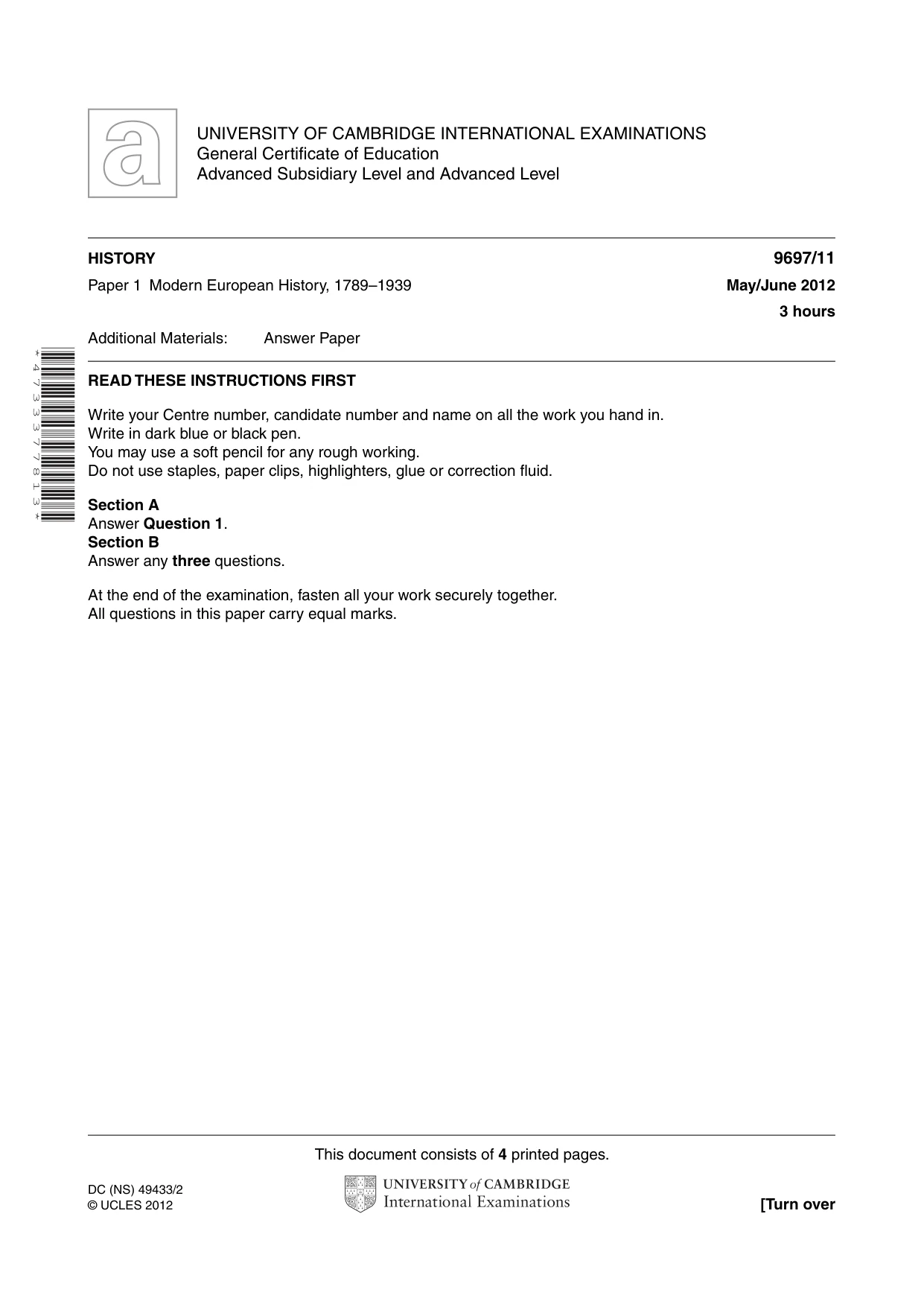
This document consists of 4 printed pages. DC (NS) 49433/2 © UCLES 2012 [Turn over UNIVERSITY OF CAMBRIDGE INTERNATIONAL EXAMINATIONS General Certificate of Education Advanced Subsidiary Level and Advanced Level * 4 7 3 3 3 7 7 8 1 3 * HISTORY 9697/11 Paper 1 Modern European History, 1789–1939 May/June 2012 3 hours Additional Materials: Answer Paper READ THESE INSTRUCTIONS FIRST Write your Centre number, candidate number and name on all the work you hand in. Write in dark blue or black pen. You may use a soft pencil for any rough working. Do not use staples, paper clips, highlighters, glue or correction fluid. Section A Answer Question 1. Section B Answer any three questions. At the end of the examination, fasten all your work securely together. All questions in this paper carry equal marks.
Question paper, page 2
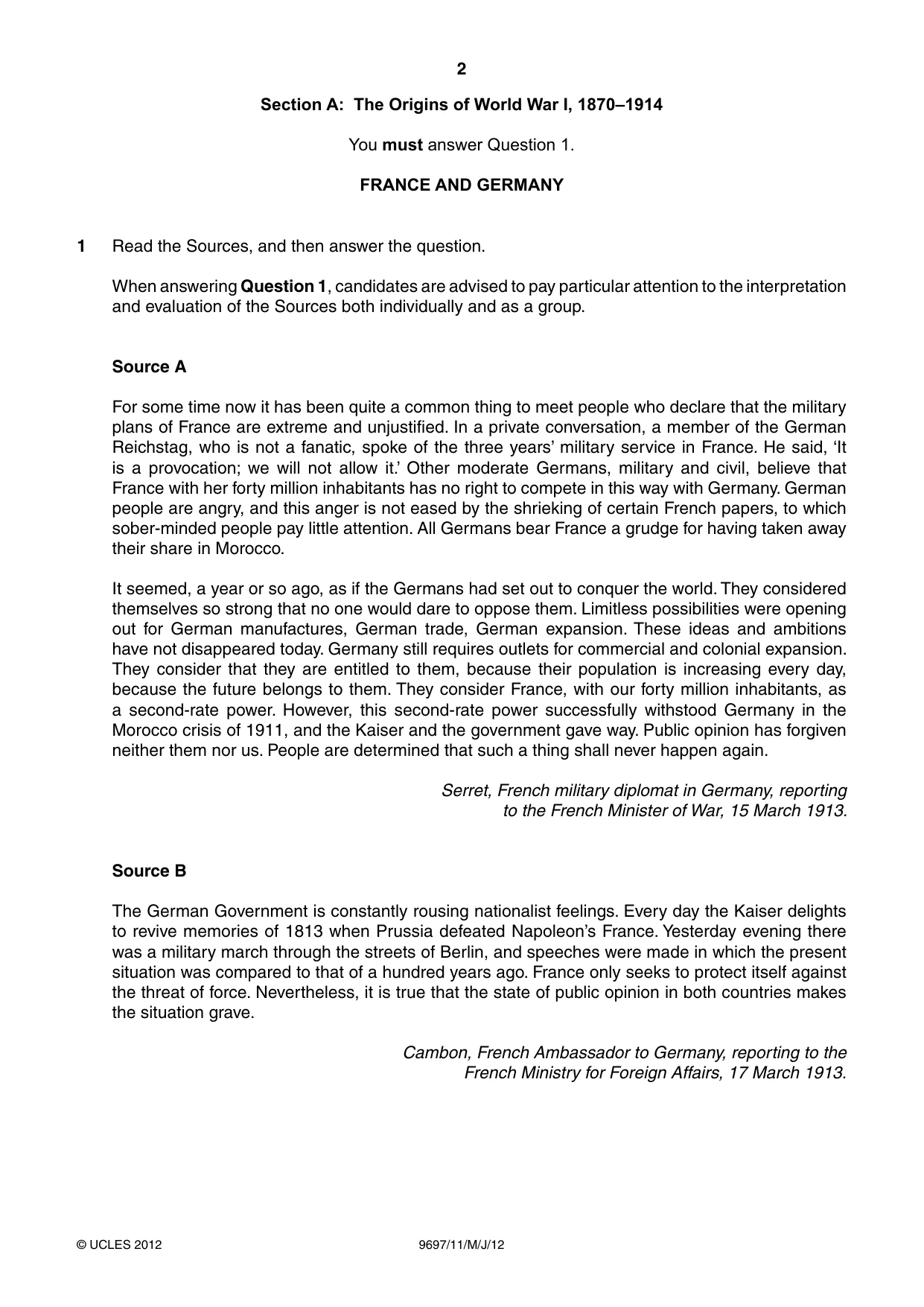
2 9697/11/M/J/12 © UCLES 2012 Section A: The Origins of World War I, 1870–1914 You must answer Question 1. FRANCE AND GERMANY 1 Read the Sources, and then answer the question. When answering Question 1, candidates are advised to pay particular attention to the interpretation and evaluation of the Sources both individually and as a group. Source A For some time now it has been quite a common thing to meet people who declare that the military plans of France are extreme and unjustified. In a private conversation, a member of the German Reichstag, who is not a fanatic, spoke of the three years’ military service in France. He said, ‘It is a provocation; we will not allow it.’ Other moderate Germans, military and civil, believe that France with her forty million inhabitants has no right to compete in this way with Germany. German people are angry, and this anger is not eased by the shrieking of certain French papers, to which sober-minded people pay little attention. All Germans bear France a grudge for having taken away their share in Morocco. It seemed, a year or so ago, as if the Germans had set out to conquer the world. They considered themselves so strong that no one would dare to oppose them. Limitless possibilities were opening out for German manufactures, German trade, German expansion. These ideas and ambitions have not disappeared today. Germany still requires outlets for commercial and colonial expansion. They consider that they are entitled to them, because their population is increasing every day, because the future belongs to them. They consider France, with our forty million inhabitants, as a second-rate power. However, this second-rate power successfully withstood Germany in the Morocco crisis of 1911, and the Kaiser and the government gave way. Public opinion has forgiven neither them nor us. People are determined that such a thing shall never happen again. Serret, French military diplomat in Germany, reporting to the French Minister of War, 15 March 1913. Source B The German Government is constantly rousing nationalist feelings. Every day the Kaiser delights to revive memories of 1813 when Prussia defeated Napoleon’s France. Yesterday evening there was a military march through the streets of Berlin, and speeches were made in which the present situation was compared to that of a hundred years ago. France only seeks to protect itself against the threat of force. Nevertheless, it is true that the state of public opinion in both countries makes the situation grave. Cambon, French Ambassador to Germany, reporting to the French Ministry for Foreign Affairs, 17 March 1913.
Question paper, page 3
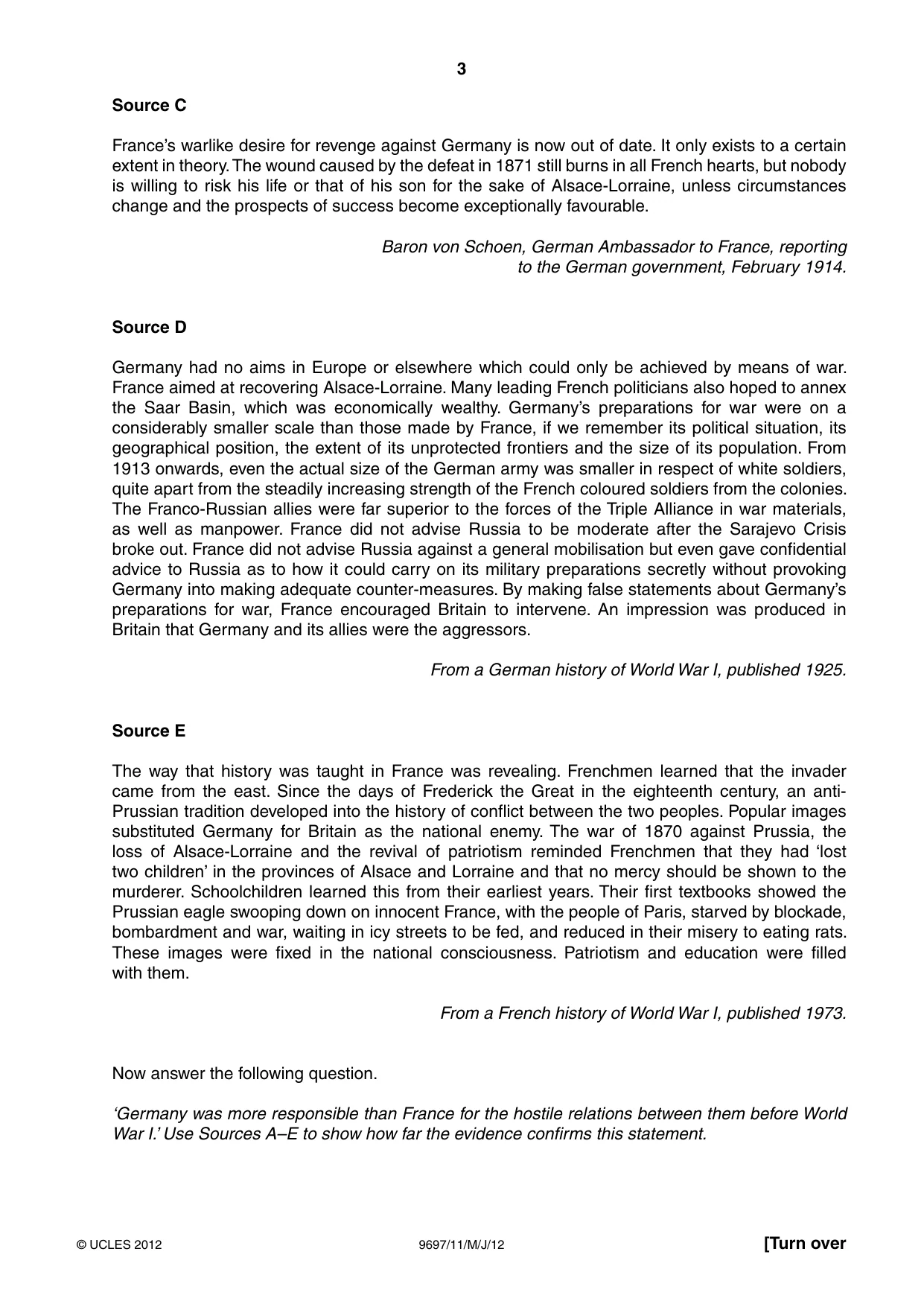
3 9697/11/M/J/12 © UCLES 2012 [Turn over Source C France’s warlike desire for revenge against Germany is now out of date. It only exists to a certain extent in theory. The wound caused by the defeat in 1871 still burns in all French hearts, but nobody is willing to risk his life or that of his son for the sake of Alsace-Lorraine, unless circumstances change and the prospects of success become exceptionally favourable. Baron von Schoen, German Ambassador to France, reporting to the German government, February 1914. Source D Germany had no aims in Europe or elsewhere which could only be achieved by means of war. France aimed at recovering Alsace-Lorraine. Many leading French politicians also hoped to annex the Saar Basin, which was economically wealthy. Germany’s preparations for war were on a considerably smaller scale than those made by France, if we remember its political situation, its geographical position, the extent of its unprotected frontiers and the size of its population. From 1913 onwards, even the actual size of the German army was smaller in respect of white soldiers, quite apart from the steadily increasing strength of the French coloured soldiers from the colonies. The Franco-Russian allies were far superior to the forces of the Triple Alliance in war materials, as well as manpower. France did not advise Russia to be moderate after the Sarajevo Crisis broke out. France did not advise Russia against a general mobilisation but even gave confidential advice to Russia as to how it could carry on its military preparations secretly without provoking Germany into making adequate counter-measures. By making false statements about Germany’s preparations for war, France encouraged Britain to intervene. An impression was produced in Britain that Germany and its allies were the aggressors. From a German history of World War I, published 1925. Source E The way that history was taught in France was revealing. Frenchmen learned that the invader came from the east. Since the days of Frederick the Great in the eighteenth century, an anti- Prussian tradition developed into the history of conflict between the two peoples. Popular images substituted Germany for Britain as the national enemy. The war of 1870 against Prussia, the loss of Alsace-Lorraine and the revival of patriotism reminded Frenchmen that they had ‘lost two children’ in the provinces of Alsace and Lorraine and that no mercy should be shown to the murderer. Schoolchildren learned this from their earliest years. Their first textbooks showed the Prussian eagle swooping down on innocent France, with the people of Paris, starved by blockade, bombardment and war, waiting in icy streets to be fed, and reduced in their misery to eating rats. These images were fixed in the national consciousness. Patriotism and education were filled with them. From a French history of World War I, published 1973. Now answer the following question. ‘Germany was more responsible than France for the hostile relations between them before World War I.’ Use Sources A–E to show how far the evidence confirms this statement.
Question paper, page 4
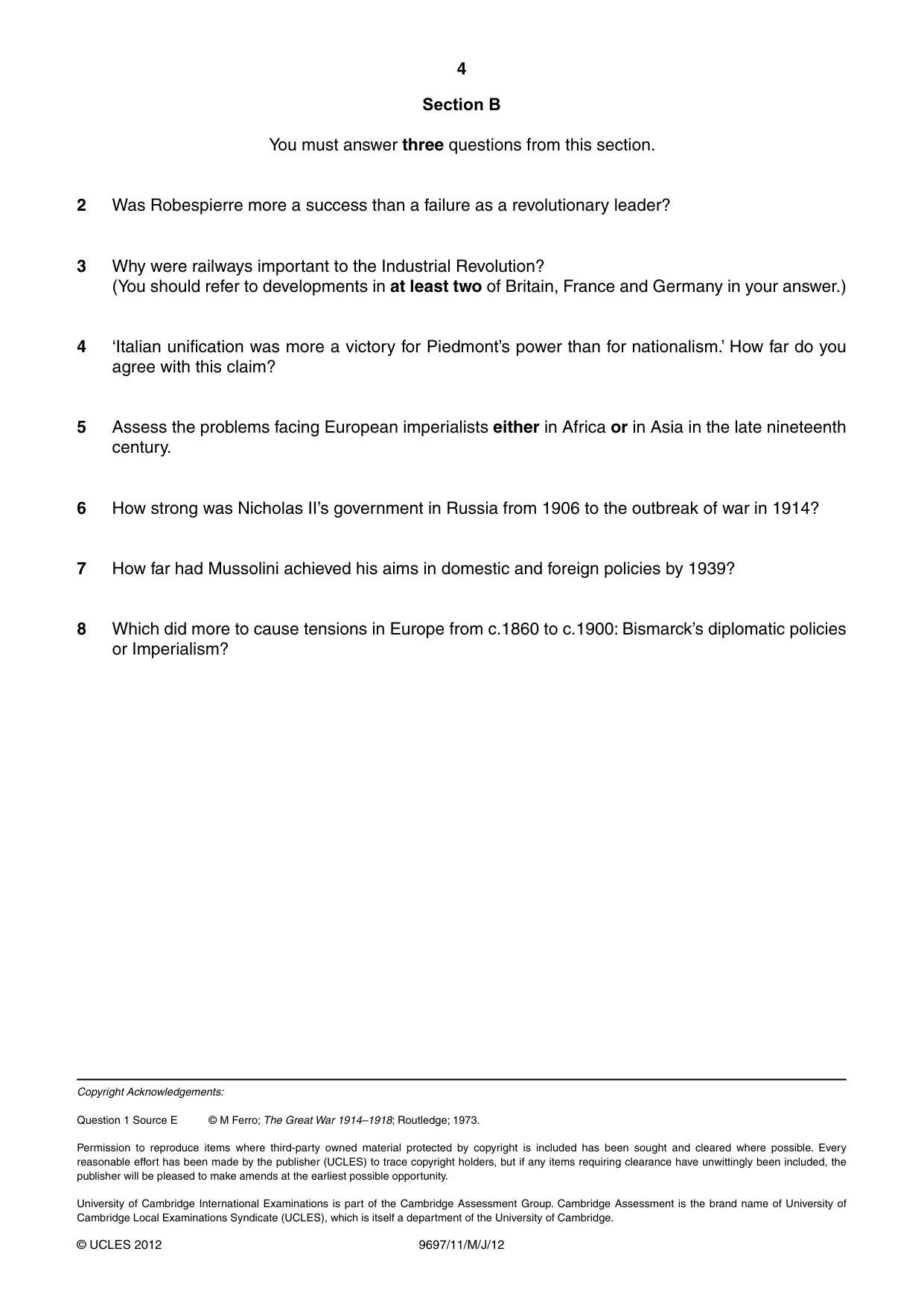
4 9697/11/M/J/12 © UCLES 2012 Copyright Acknowledgements: Question 1 Source E © M Ferro; The Great War 1914–1918; Routledge; 1973. Permission to reproduce items where third-party owned material protected by copyright is included has been sought and cleared where possible. Every reasonable effort has been made by the publisher (UCLES) to trace copyright holders, but if any items requiring clearance have unwittingly been included, the publisher will be pleased to make amends at the earliest possible opportunity. University of Cambridge International Examinations is part of the Cambridge Assessment Group. Cambridge Assessment is the brand name of University of Cambridge Local Examinations Syndicate (UCLES), which is itself a department of the University of Cambridge. Section B You must answer three questions from this section. 2 Was Robespierre more a success than a failure as a revolutionary leader? 3 Why were railways important to the Industrial Revolution? (You should refer to developments in at least two of Britain, France and Germany in your answer.) 4 ‘Italian unification was more a victory for Piedmont’s power than for nationalism.’ How far do you agree with this claim? 5 Assess the problems facing European imperialists either in Africa or in Asia in the late nineteenth century. 6 How strong was Nicholas II’s government in Russia from 1906 to the outbreak of war in 1914? 7 How far had Mussolini achieved his aims in domestic and foreign policies by 1939? 8 Which did more to cause tensions in Europe from c.1860 to c.1900: Bismarck’s diplomatic policies or Imperialism?
Mark scheme, page 1
UNIVERSITY OF CAMBRIDGE INTERNATIONAL EXAMINATIONS GCE Advanced Subsidiary Level and GCE Advanced Level MARK SCHEME for the May/June 2012 question paper for the guidance of teachers 9697 HISTORY 9697/11 Paper 1, maximum raw mark 100 This mark scheme is published as an aid to teachers and candidates, to indicate the requirements of the examination. It shows the basis on which Examiners were instructed to award marks. It does not indicate the details of the discussions that took place at an Examiners’ meeting before marking began, which would have considered the acceptability of alternative answers. Mark schemes must be read in conjunction with the question papers and the report on the examination. • Cambridge will not enter into discussions or correspondence in connection with these mark schemes. Cambridge is publishing the mark schemes for the May/June 2012 question papers for most IGCSE, GCE Advanced Level and Advanced Subsidiary Level syllabuses and some Ordinary Level syllabuses.
Mark scheme, page 2
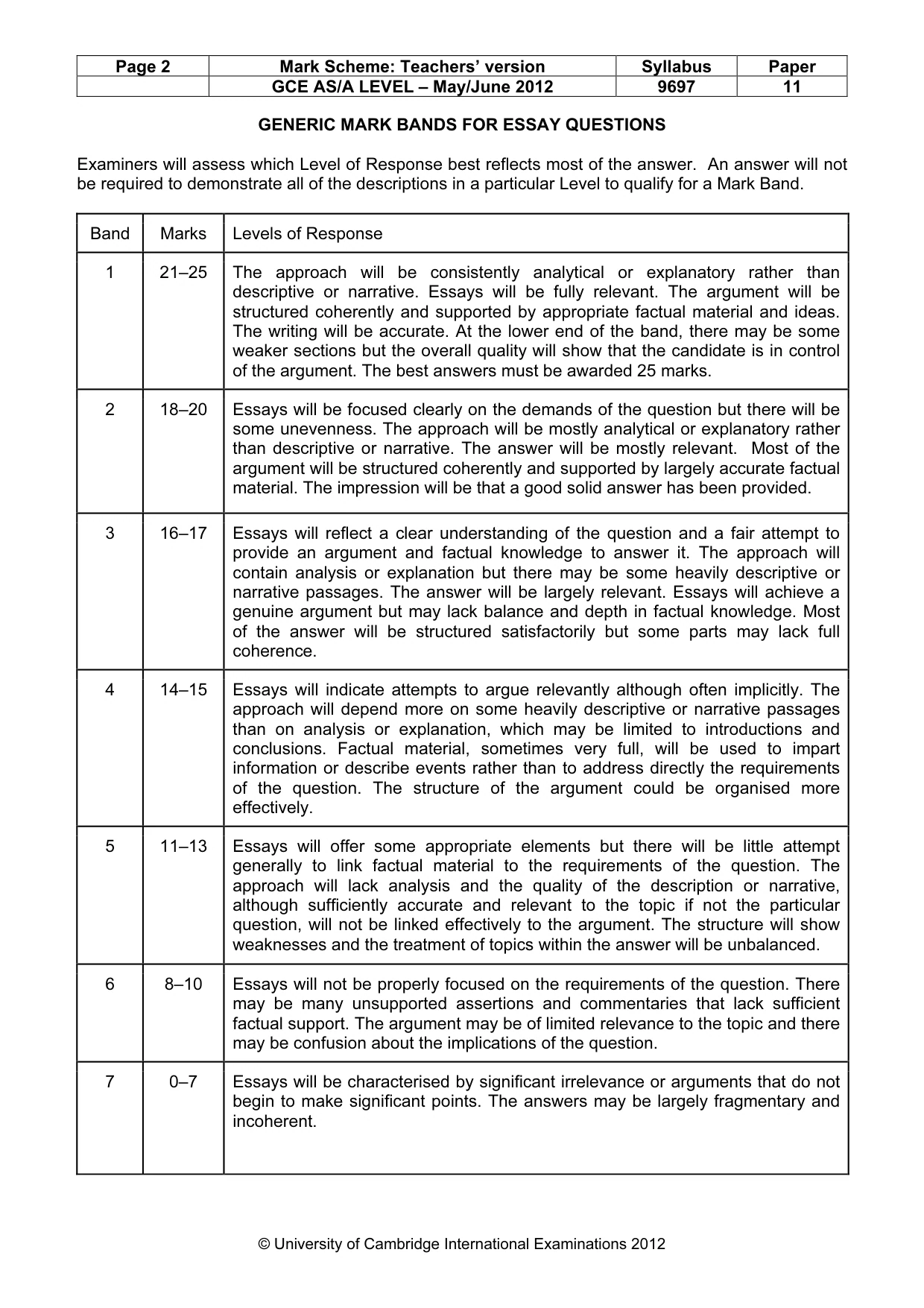
Page 2 Mark Scheme: Teachers’ version Syllabus Paper GCE AS/A LEVEL – May/June 2012 9697 11 © University of Cambridge International Examinations 2012 GENERIC MARK BANDS FOR ESSAY QUESTIONS Examiners will assess which Level of Response best reflects most of the answer. An answer will not be required to demonstrate all of the descriptions in a particular Level to qualify for a Mark Band. Band Marks Levels of Response 1 21–25 The approach will be consistently analytical or explanatory rather than descriptive or narrative. Essays will be fully relevant. The argument will be structured coherently and supported by appropriate factual material and ideas. The writing will be accurate. At the lower end of the band, there may be some weaker sections but the overall quality will show that the candidate is in control of the argument. The best answers must be awarded 25 marks. 2 18–20 Essays will be focused clearly on the demands of the question but there will be some unevenness. The approach will be mostly analytical or explanatory rather than descriptive or narrative. The answer will be mostly relevant. Most of the argument will be structured coherently and supported by largely accurate factual material. The impression will be that a good solid answer has been provided. 3 16–17 Essays will reflect a clear understanding of the question and a fair attempt to provide an argument and factual knowledge to answer it. The approach will contain analysis or explanation but there may be some heavily descriptive or narrative passages. The answer will be largely relevant. Essays will achieve a genuine argument but may lack balance and depth in factual knowledge. Most of the answer will be structured satisfactorily but some parts may lack full coherence. 4 14–15 Essays will indicate attempts to argue relevantly although often implicitly. The approach will depend more on some heavily descriptive or narrative passages than on analysis or explanation, which may be limited to introductions and conclusions. Factual material, sometimes very full, will be used to impart information or describe events rather than to address directly the requirements of the question. The structure of the argument could be organised more effectively. 5 11–13 Essays will offer some appropriate elements but there will be little attempt generally to link factual material to the requirements of the question. The approach will lack analysis and the quality of the description or narrative, although sufficiently accurate and relevant to the topic if not the particular question, will not be linked effectively to the argument. The structure will show weaknesses and the treatment of topics within the answer will be unbalanced. 6 8–10 Essays will not be properly focused on the requirements of the question. There may be many unsupported assertions and commentaries that lack sufficient factual support. The argument may be of limited relevance to the topic and there may be confusion about the implications of the question. 7 0–7 Essays will be characterised by significant irrelevance or arguments that do not begin to make significant points. The answers may be largely fragmentary and incoherent.
Mark scheme, page 3
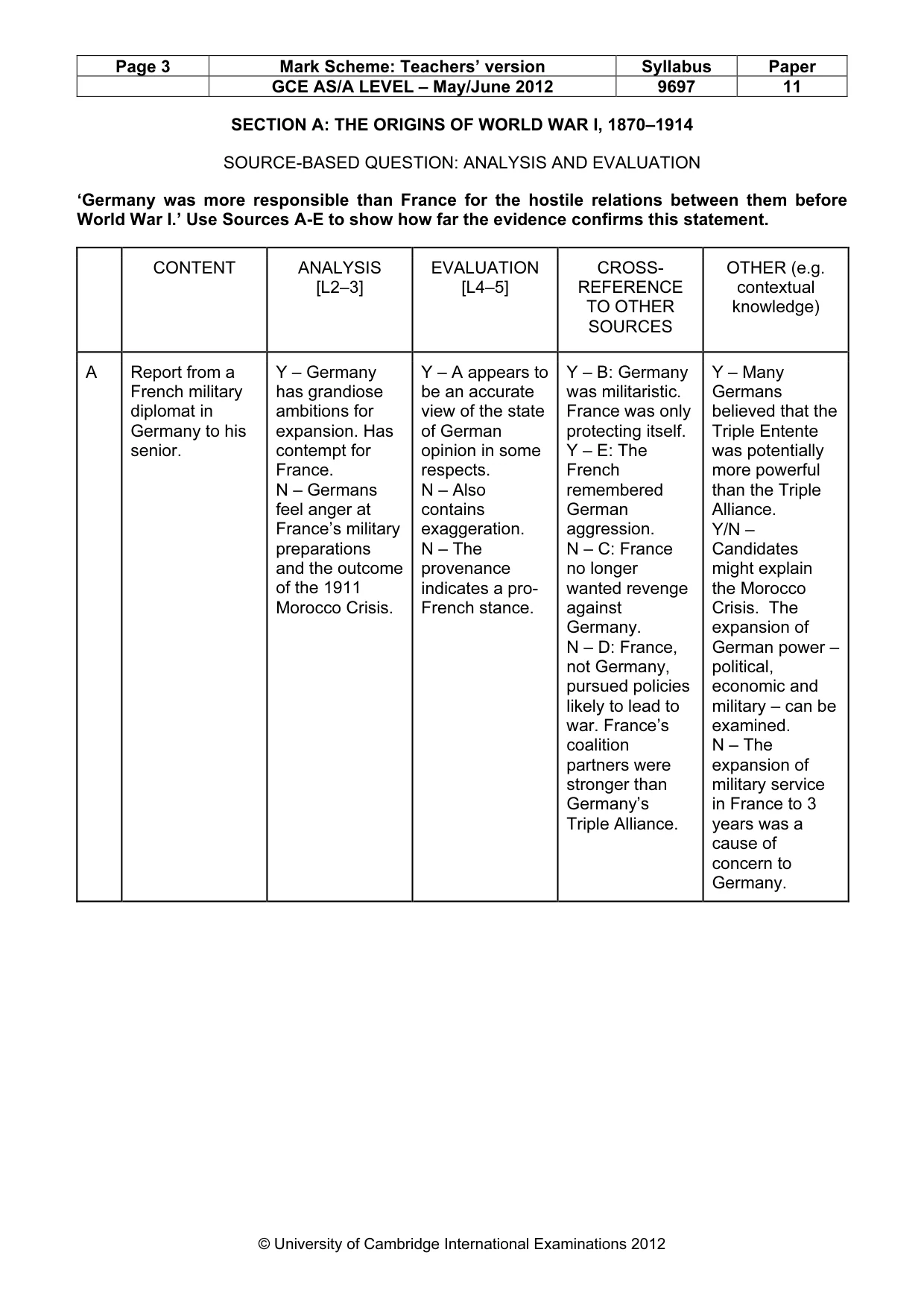
Page 3 Mark Scheme: Teachers’ version Syllabus Paper GCE AS/A LEVEL – May/June 2012 9697 11 © University of Cambridge International Examinations 2012 SECTION A: THE ORIGINS OF WORLD WAR I, 1870–1914 SOURCE-BASED QUESTION: ANALYSIS AND EVALUATION ‘Germany was more responsible than France for the hostile relations between them before World War I.’ Use Sources A-E to show how far the evidence confirms this statement. CONTENT ANALYSIS [L2–3] EVALUATION [L4–5] CROSS- REFERENCE TO OTHER SOURCES OTHER (e.g. contextual knowledge) A Report from a French military diplomat in Germany to his senior. Y – Germany has grandiose ambitions for expansion. Has contempt for France. N – Germans feel anger at France’s military preparations and the outcome of the 1911 Morocco Crisis. Y – A appears to be an accurate view of the state of German opinion in some respects. N – Also contains exaggeration. N – The provenance indicates a pro- French stance. Y – B: Germany was militaristic. France was only protecting itself. Y – E: The French remembered German aggression. N – C: France no longer wanted revenge against Germany. N – D: France, not Germany, pursued policies likely to lead to war. France’s coalition partners were stronger than Germany’s Triple Alliance. Y – Many Germans believed that the Triple Entente was potentially more powerful than the Triple Alliance. Y/N – Candidates might explain the Morocco Crisis. The expansion of German power – political, economic and military – can be examined. N – The expansion of military service in France to 3 years was a cause of concern to Germany.
Mark scheme, page 4
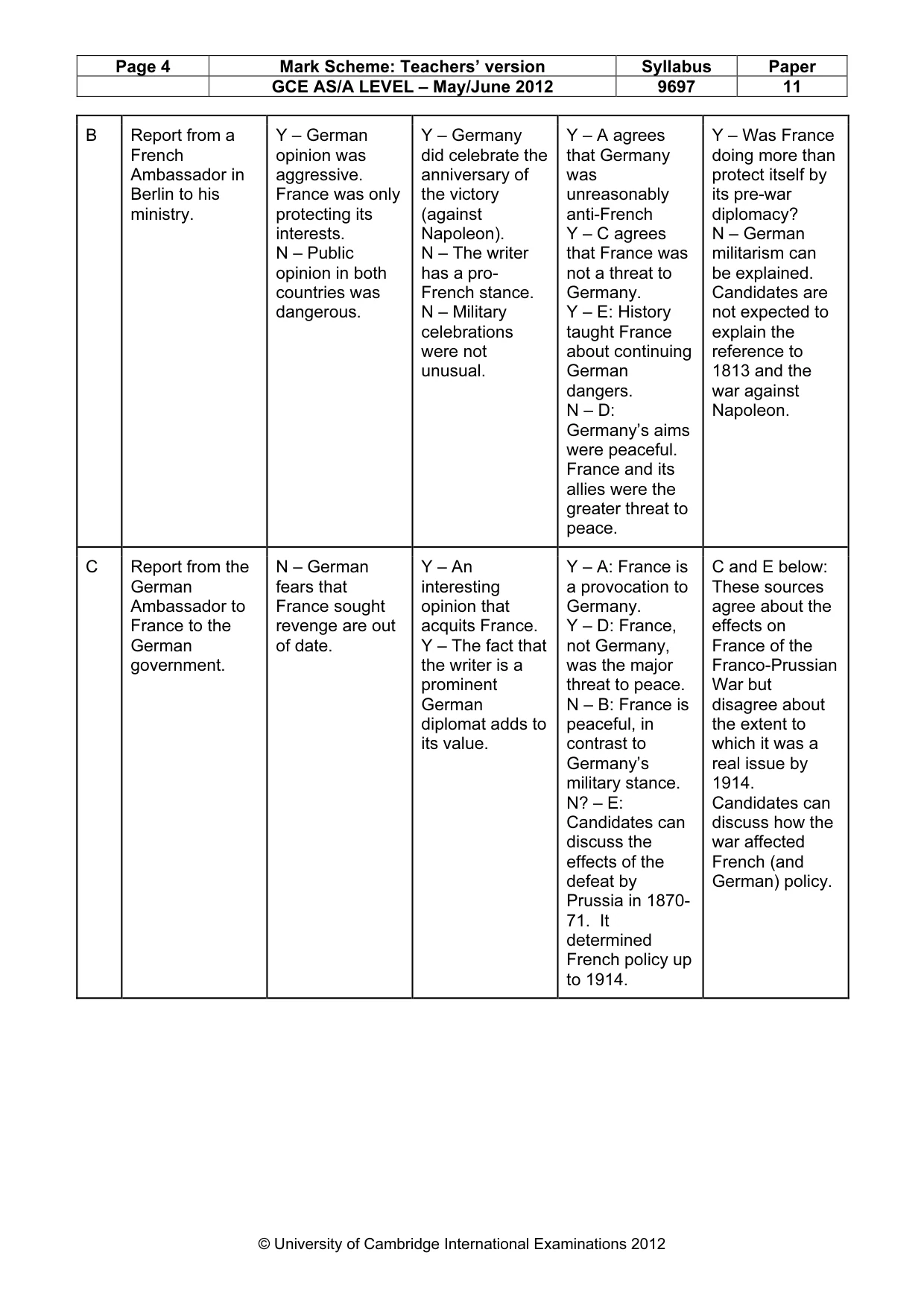
Page 4 Mark Scheme: Teachers’ version Syllabus Paper GCE AS/A LEVEL – May/June 2012 9697 11 © University of Cambridge International Examinations 2012 B Report from a French Ambassador in Berlin to his ministry. Y – German opinion was aggressive. France was only protecting its interests. N – Public opinion in both countries was dangerous. Y – Germany did celebrate the anniversary of the victory (against Napoleon). N – The writer has a pro- French stance. N – Military celebrations were not unusual. Y – A agrees that Germany was unreasonably anti-French Y – C agrees that France was not a threat to Germany. Y – E: History taught France about continuing German dangers. N – D: Germany’s aims were peaceful. France and its allies were the greater threat to peace. Y – Was France doing more than protect itself by its pre-war diplomacy? N – German militarism can be explained. Candidates are not expected to explain the reference to 1813 and the war against Napoleon. C Report from the German Ambassador to France to the German government. N – German fears that France sought revenge are out of date. Y – An interesting opinion that acquits France. Y – The fact that the writer is a prominent German diplomat adds to its value. Y – A: France is a provocation to Germany. Y – D: France, not Germany, was the major threat to peace. N – B: France is peaceful, in contrast to Germany’s military stance. N? – E: Candidates can discuss the effects of the defeat by Prussia in 1870- 71. It determined French policy up to 1914. C and E below: These sources agree about the effects on France of the Franco-Prussian War but disagree about the extent to which it was a real issue by 1914. Candidates can discuss how the war affected French (and German) policy.
Mark scheme, page 5
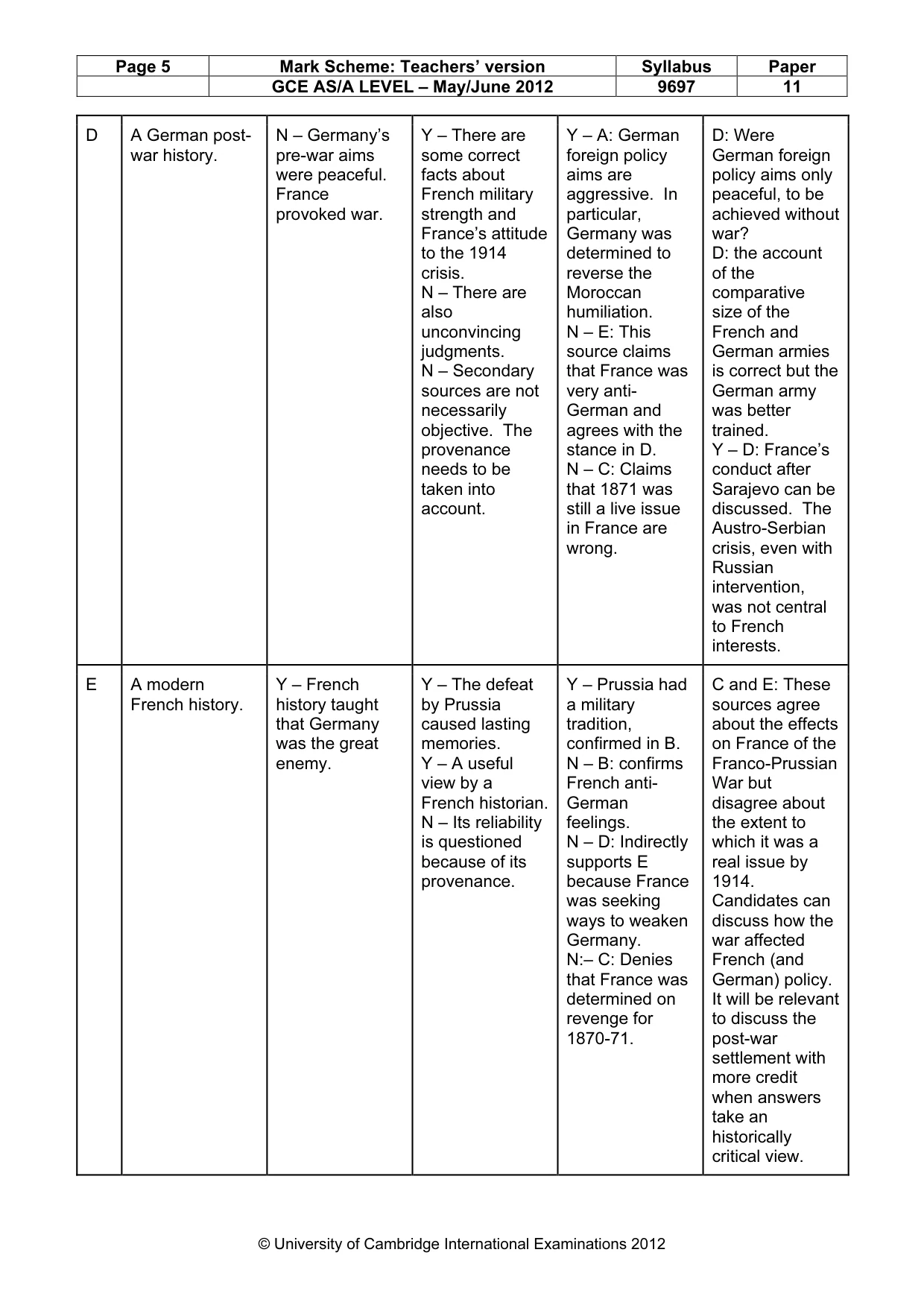
Page 5 Mark Scheme: Teachers’ version Syllabus Paper GCE AS/A LEVEL – May/June 2012 9697 11 © University of Cambridge International Examinations 2012 D A German post- war history. N – Germany’s pre-war aims were peaceful. France provoked war. Y – There are some correct facts about French military strength and France’s attitude to the 1914 crisis. N – There are also unconvincing judgments. N – Secondary sources are not necessarily objective. The provenance needs to be taken into account. Y – A: German foreign policy aims are aggressive. In particular, Germany was determined to reverse the Moroccan humiliation. N – E: This source claims that France was very anti- German and agrees with the stance in D. N – C: Claims that 1871 was still a live issue in France are wrong. D: Were German foreign policy aims only peaceful, to be achieved without war? D: the account of the comparative size of the French and German armies is correct but the German army was better trained. Y – D: France’s conduct after Sarajevo can be discussed. The Austro-Serbian crisis, even with Russian intervention, was not central to French interests. E A modern French history. Y – French history taught that Germany was the great enemy. Y – The defeat by Prussia caused lasting memories. Y – A useful view by a French historian. N – Its reliability is questioned because of its provenance. Y – Prussia had a military tradition, confirmed in B. N – B: confirms French anti- German feelings. N – D: Indirectly supports E because France was seeking ways to weaken Germany. N:– C: Denies that France was determined on revenge for 1870-71. C and E: These sources agree about the effects on France of the Franco-Prussian War but disagree about the extent to which it was a real issue by 1914. Candidates can discuss how the war affected French (and German) policy. It will be relevant to discuss the post-war settlement with more credit when answers take an historically critical view.
Mark scheme, page 6
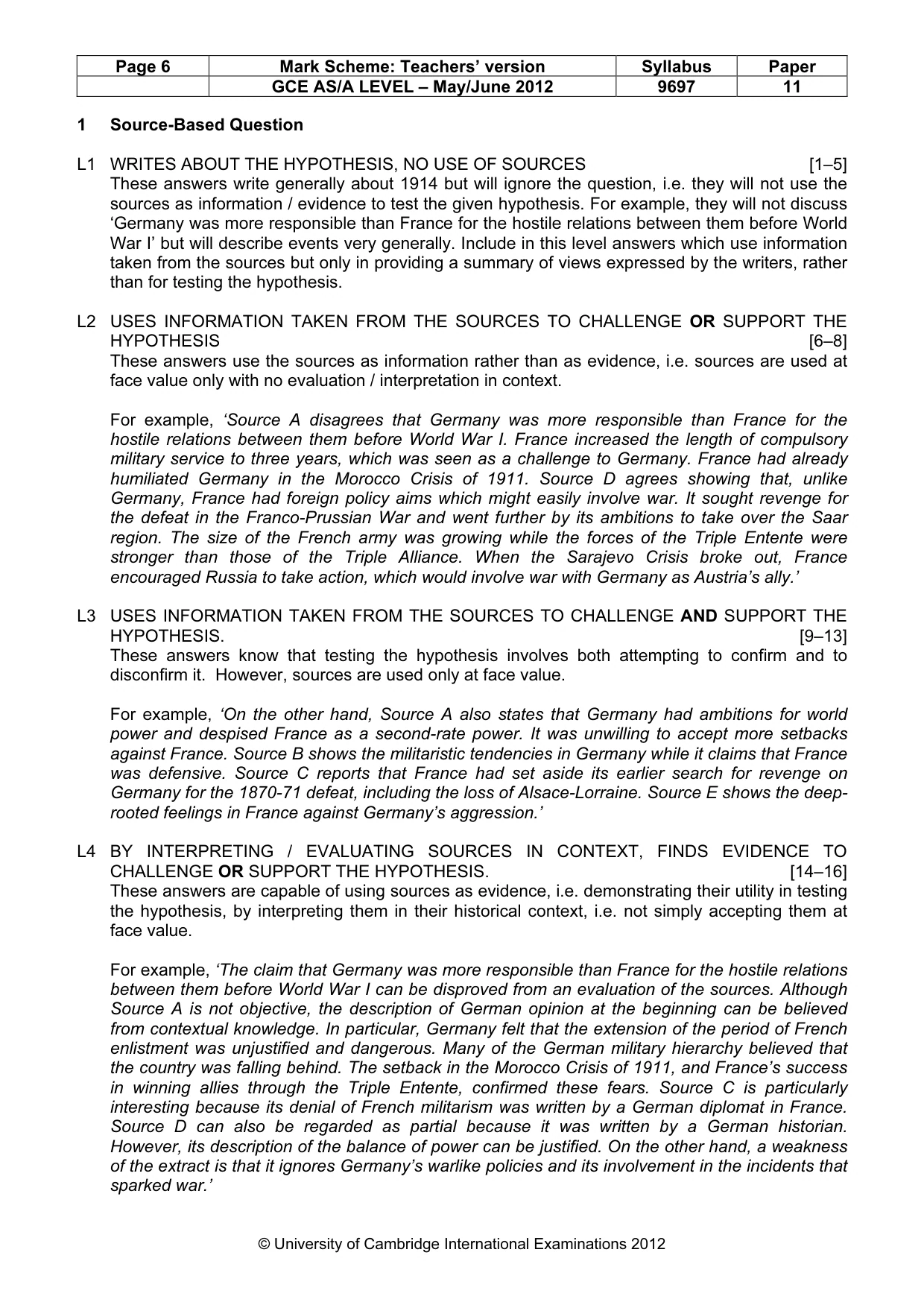
Page 6 Mark Scheme: Teachers’ version Syllabus Paper GCE AS/A LEVEL – May/June 2012 9697 11 © University of Cambridge International Examinations 2012 1 Source-Based Question L1 WRITES ABOUT THE HYPOTHESIS, NO USE OF SOURCES [1–5] These answers write generally about 1914 but will ignore the question, i.e. they will not use the sources as information / evidence to test the given hypothesis. For example, they will not discuss ‘Germany was more responsible than France for the hostile relations between them before World War I’ but will describe events very generally. Include in this level answers which use information taken from the sources but only in providing a summary of views expressed by the writers, rather than for testing the hypothesis. L2 USES INFORMATION TAKEN FROM THE SOURCES TO CHALLENGE OR SUPPORT THE HYPOTHESIS [6–8] These answers use the sources as information rather than as evidence, i.e. sources are used at face value only with no evaluation / interpretation in context. For example, ‘Source A disagrees that Germany was more responsible than France for the hostile relations between them before World War I. France increased the length of compulsory military service to three years, which was seen as a challenge to Germany. France had already humiliated Germany in the Morocco Crisis of 1911. Source D agrees showing that, unlike Germany, France had foreign policy aims which might easily involve war. It sought revenge for the defeat in the Franco-Prussian War and went further by its ambitions to take over the Saar region. The size of the French army was growing while the forces of the Triple Entente were stronger than those of the Triple Alliance. When the Sarajevo Crisis broke out, France encouraged Russia to take action, which would involve war with Germany as Austria’s ally.’ L3 USES INFORMATION TAKEN FROM THE SOURCES TO CHALLENGE AND SUPPORT THE HYPOTHESIS. [9–13] These answers know that testing the hypothesis involves both attempting to confirm and to disconfirm it. However, sources are used only at face value. For example, ‘On the other hand, Source A also states that Germany had ambitions for world power and despised France as a second-rate power. It was unwilling to accept more setbacks against France. Source B shows the militaristic tendencies in Germany while it claims that France was defensive. Source C reports that France had set aside its earlier search for revenge on Germany for the 1870-71 defeat, including the loss of Alsace-Lorraine. Source E shows the deep- rooted feelings in France against Germany’s aggression.’ L4 BY INTERPRETING / EVALUATING SOURCES IN CONTEXT, FINDS EVIDENCE TO CHALLENGE OR SUPPORT THE HYPOTHESIS. [14–16] These answers are capable of using sources as evidence, i.e. demonstrating their utility in testing the hypothesis, by interpreting them in their historical context, i.e. not simply accepting them at face value. For example, ‘The claim that Germany was more responsible than France for the hostile relations between them before World War I can be disproved from an evaluation of the sources. Although Source A is not objective, the description of German opinion at the beginning can be believed from contextual knowledge. In particular, Germany felt that the extension of the period of French enlistment was unjustified and dangerous. Many of the German military hierarchy believed that the country was falling behind. The setback in the Morocco Crisis of 1911, and France’s success in winning allies through the Triple Entente, confirmed these fears. Source C is particularly interesting because its denial of French militarism was written by a German diplomat in France. Source D can also be regarded as partial because it was written by a German historian. However, its description of the balance of power can be justified. On the other hand, a weakness of the extract is that it ignores Germany’s warlike policies and its involvement in the incidents that sparked war.’
Mark scheme, page 7
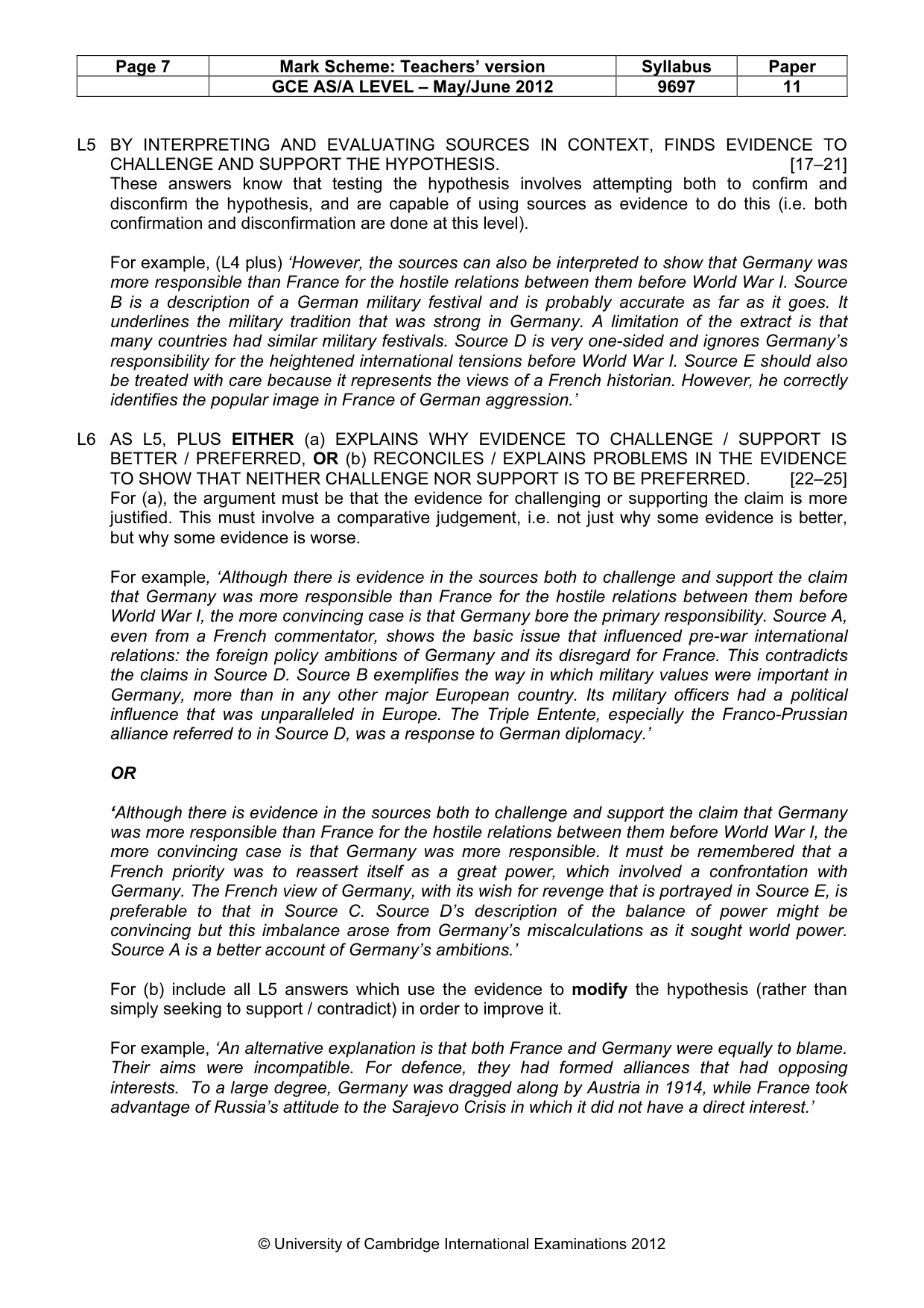
Page 7 Mark Scheme: Teachers’ version Syllabus Paper GCE AS/A LEVEL – May/June 2012 9697 11 © University of Cambridge International Examinations 2012 L5 BY INTERPRETING AND EVALUATING SOURCES IN CONTEXT, FINDS EVIDENCE TO CHALLENGE AND SUPPORT THE HYPOTHESIS. [17–21] These answers know that testing the hypothesis involves attempting both to confirm and disconfirm the hypothesis, and are capable of using sources as evidence to do this (i.e. both confirmation and disconfirmation are done at this level). For example, (L4 plus) ‘However, the sources can also be interpreted to show that Germany was more responsible than France for the hostile relations between them before World War I. Source B is a description of a German military festival and is probably accurate as far as it goes. It underlines the military tradition that was strong in Germany. A limitation of the extract is that many countries had similar military festivals. Source D is very one-sided and ignores Germany’s responsibility for the heightened international tensions before World War I. Source E should also be treated with care because it represents the views of a French historian. However, he correctly identifies the popular image in France of German aggression.’ L6 AS L5, PLUS EITHER (a) EXPLAINS WHY EVIDENCE TO CHALLENGE / SUPPORT IS BETTER / PREFERRED, OR (b) RECONCILES / EXPLAINS PROBLEMS IN THE EVIDENCE TO SHOW THAT NEITHER CHALLENGE NOR SUPPORT IS TO BE PREFERRED. [22–25] For (a), the argument must be that the evidence for challenging or supporting the claim is more justified. This must involve a comparative judgement, i.e. not just why some evidence is better, but why some evidence is worse. For example, ‘Although there is evidence in the sources both to challenge and support the claim that Germany was more responsible than France for the hostile relations between them before World War I, the more convincing case is that Germany bore the primary responsibility. Source A, even from a French commentator, shows the basic issue that influenced pre-war international relations: the foreign policy ambitions of Germany and its disregard for France. This contradicts the claims in Source D. Source B exemplifies the way in which military values were important in Germany, more than in any other major European country. Its military officers had a political influence that was unparalleled in Europe. The Triple Entente, especially the Franco-Prussian alliance referred to in Source D, was a response to German diplomacy.’ OR ‘Although there is evidence in the sources both to challenge and support the claim that Germany was more responsible than France for the hostile relations between them before World War I, the more convincing case is that Germany was more responsible. It must be remembered that a French priority was to reassert itself as a great power, which involved a confrontation with Germany. The French view of Germany, with its wish for revenge that is portrayed in Source E, is preferable to that in Source C. Source D’s description of the balance of power might be convincing but this imbalance arose from Germany’s miscalculations as it sought world power. Source A is a better account of Germany’s ambitions.’ For (b) include all L5 answers which use the evidence to modify the hypothesis (rather than simply seeking to support / contradict) in order to improve it. For example, ‘An alternative explanation is that both France and Germany were equally to blame. Their aims were incompatible. For defence, they had formed alliances that had opposing interests. To a large degree, Germany was dragged along by Austria in 1914, while France took advantage of Russia’s attitude to the Sarajevo Crisis in which it did not have a direct interest.’
Mark scheme, page 8
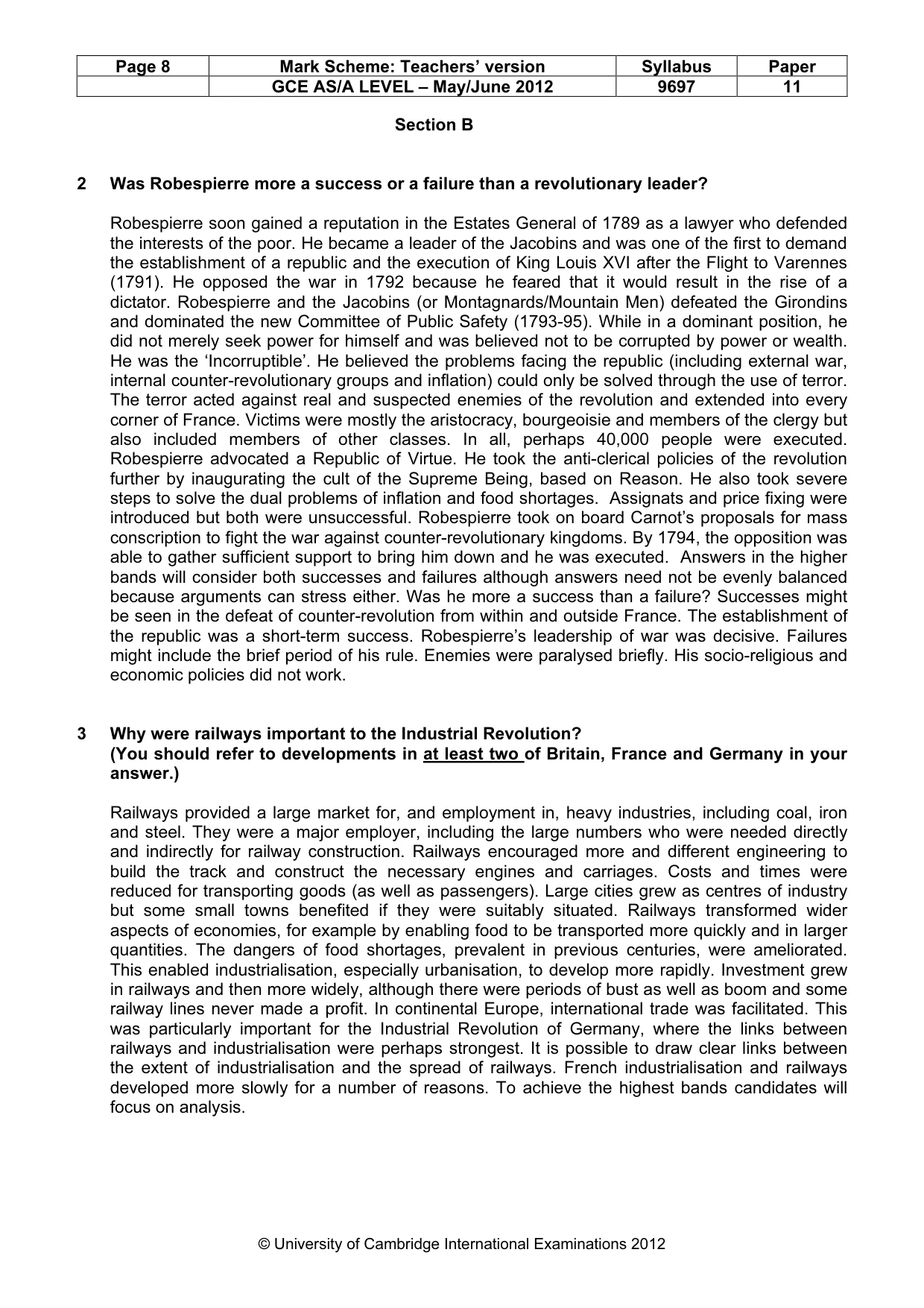
Page 8 Mark Scheme: Teachers’ version Syllabus Paper GCE AS/A LEVEL – May/June 2012 9697 11 © University of Cambridge International Examinations 2012 Section B 2 Was Robespierre more a success or a failure than a revolutionary leader? Robespierre soon gained a reputation in the Estates General of 1789 as a lawyer who defended the interests of the poor. He became a leader of the Jacobins and was one of the first to demand the establishment of a republic and the execution of King Louis XVI after the Flight to Varennes (1791). He opposed the war in 1792 because he feared that it would result in the rise of a dictator. Robespierre and the Jacobins (or Montagnards/Mountain Men) defeated the Girondins and dominated the new Committee of Public Safety (1793-95). While in a dominant position, he did not merely seek power for himself and was believed not to be corrupted by power or wealth. He was the ‘Incorruptible’. He believed the problems facing the republic (including external war, internal counter-revolutionary groups and inflation) could only be solved through the use of terror. The terror acted against real and suspected enemies of the revolution and extended into every corner of France. Victims were mostly the aristocracy, bourgeoisie and members of the clergy but also included members of other classes. In all, perhaps 40,000 people were executed. Robespierre advocated a Republic of Virtue. He took the anti-clerical policies of the revolution further by inaugurating the cult of the Supreme Being, based on Reason. He also took severe steps to solve the dual problems of inflation and food shortages. Assignats and price fixing were introduced but both were unsuccessful. Robespierre took on board Carnot’s proposals for mass conscription to fight the war against counter-revolutionary kingdoms. By 1794, the opposition was able to gather sufficient support to bring him down and he was executed. Answers in the higher bands will consider both successes and failures although answers need not be evenly balanced because arguments can stress either. Was he more a success than a failure? Successes might be seen in the defeat of counter-revolution from within and outside France. The establishment of the republic was a short-term success. Robespierre’s leadership of war was decisive. Failures might include the brief period of his rule. Enemies were paralysed briefly. His socio-religious and economic policies did not work. 3 Why were railways important to the Industrial Revolution? (You should refer to developments in at least two of Britain, France and Germany in your answer.) Railways provided a large market for, and employment in, heavy industries, including coal, iron and steel. They were a major employer, including the large numbers who were needed directly and indirectly for railway construction. Railways encouraged more and different engineering to build the track and construct the necessary engines and carriages. Costs and times were reduced for transporting goods (as well as passengers). Large cities grew as centres of industry but some small towns benefited if they were suitably situated. Railways transformed wider aspects of economies, for example by enabling food to be transported more quickly and in larger quantities. The dangers of food shortages, prevalent in previous centuries, were ameliorated. This enabled industrialisation, especially urbanisation, to develop more rapidly. Investment grew in railways and then more widely, although there were periods of bust as well as boom and some railway lines never made a profit. In continental Europe, international trade was facilitated. This was particularly important for the Industrial Revolution of Germany, where the links between railways and industrialisation were perhaps strongest. It is possible to draw clear links between the extent of industrialisation and the spread of railways. French industrialisation and railways developed more slowly for a number of reasons. To achieve the highest bands candidates will focus on analysis.
Mark scheme, page 9
Page 9 Mark Scheme: Teachers’ version Syllabus Paper GCE AS/A LEVEL – May/June 2012 9697 11 © University of Cambridge International Examinations 2012 4 ‘Italian unification was more a victory for Piedmont’s power than for nationalism.’ How far do you agree with this claim? After 1815, Piedmont emerged as the major Italian state to oppose Austria’s power in Italy. However, its leadership was not accepted universally and was unpopular in some quarters. Other places with their leaders had claims, e.g. Rome and Venice. Charles Albert of Piedmont played a controversial role in 1848, seeming to lead the resistance to Austria but in the narrower interests of Piedmont and being willing to exploit the problems of risings elsewhere. After 1848 and under Victor Emmanuel, Piedmont became the more obvious candidate for leadership of Italy. It was independent of Austrian influence, with a constitution including the Statuto, was the wealthiest state in Italy and possessed an army which, although not equal to that of Austria, was stronger than that of other Italian states. Responses might build on this to examine the particular role of Cavour. He aimed to modernise Piedmont and then win allies to help to weaken Austria. By his death in 1861 his policies were successful in expanding Piedmont’s role in the north and in the Duchies. Garibaldi’s success in the south led him to go further than he probably wanted. But by 1861 Venetia and Rome were still outside the new kingdom of Italy in which Piedmont was the most powerful state. Italian nationalism was diverse in its aims. Mazzini aimed at the unification of the entire peninsula but he was foiled in the 1830s and in 1848-49. Other leaders such as Manin in Venice and, briefly, the Pope in 1848-49 had very limited success. None of these gained universal support from inside or outside Italy and crucially lacked military power. However, the role of nationalists, especially Garibaldi, should not be underestimated. Garibaldi played a crucial role in Cavour’s later years and he continued to aim at the incorporation of Rome. Candidates might point out that the final stages of unification (Venetia in 1866 and Rome in 1870) owed little to either Piedmont or to other Italian nationalists. To achieve the highest bands answers need not be evenly balanced between Piedmont and nationalism but should be sound on each. 5 Assess the problems facing European imperialists either in Africa or in Asia in the late nineteenth century. Candidates should note that Africa and Asia are exclusively distinctive regions. They should not discuss both. Answers in Band 3+ should include some specific, rather than vague, examples. To achieve the highest bands answers should indicate to some extent the priority of the problems. Candidates might consider the problems that followed from international rivalries. This could mean that some countries became involved in regions that offered little in the way of economic or strategic advantage. Military commitments were necessary. Control could be an issue. The large distances which imperial expansion necessitated resulted in home governments having limited control, for example over the ‘man on the spot’ or on the details of military activity. Public opinion could be a problem. On the one hand, it might press politicians further than they would wish to go, for example Bismarck. On the other hand, failure could result in unpopularity, for example Gladstone and the Sudan. While it was comparatively easy to gain control of some regions, others in Africa and Asia proved more troublesome. Britain became involved in the Boer War and China was a difficult region in which to expand. Costs could be heavy. Some overseas territories were profitable. Many were not. Some candidates might refer to the problem of health. There were many casualties of disease in Africa and Asia although advances were made, for example against malaria, by the end of the nineteenth century.
Mark scheme, page 10
Page 10 Mark Scheme: Teachers’ version Syllabus Paper GCE AS/A LEVEL – May/June 2012 9697 11 © University of Cambridge International Examinations 2012 6 How strong was Nicholas II’s government in Russia from 1906 to the outbreak of war in 1914? The key issue is the assessment of the strength of the tsarist regime in Russia from 1906 to 1914. 1906 marks the aftermath of the 1905 Revolution. This was a severe challenge to the regime but order was restored by the combination of a loyal army and some political concessions, especially the October Manifesto. The best responses will consider both strengths and weaknesses, coming to a considered judgement. However, arguments are not expected to be evenly balanced. A case might be made for a regime that was fundamentally strong, enjoying the loyalty of most people and reliant on the army and the police. The opposition was divided. After 1905, the split between the revolutionaries grew and Lenin dismissed the middle classes as a revolutionary force. The economy improved. On the other hand, Nicholas II did not address the basic problems that faced his government. With the Fundamental Laws (1906), he asserted his autocracy. But he lacked the ability to govern effectively and rejected the advice of modernisers such as Stolypin in favour of the reactionaries at court. The Dumas were treated with contempt. It can be argued that the revolutionaries were weak but they were not crushed. Although their leaders were in prison or in exile, they continued to organise themselves and spread their programmes. Industrial unrest continued. Candidates might refer to the war years and the 1917 revolution in a brief conclusion but the 1914+ period cannot be given credit as part of the main argument. 7 How far had Mussolini achieved his aims in domestic and foreign policies by 1939? The question refers to domestic and foreign policies but an entirely even balance will not be expected. However, the issue of ‘How far..?’ will require an assessment for the two highest bands. It might be argued that Mussolini’s most important aim was to seek personal power. He was appointed Prime Minister in 1922 and soon exercised dictatorial powers. Opponents were brow-beaten. He was probably responsible for the death of Matteotti. The withdrawal of members of other parties (Aventine Secession) gave the Fascists a monopoly of power. Candidates can explain how far his power extended. It can be argued that his was not a totalitarian regime. He came to a necessary compromise with the Pope in the Lateran Treaties (1929). Although King Victor Emmanuel III was ignored in matters of policy, he still had the respect of many Italians which Mussolini had to recognise. Mussolini had grandiose economic and social aims in which his own role, through the Corporate State, loomed large. The practical effects were mixed. The success of the ‘Battles’ was exaggerated in official propaganda. However, the output of heavy industry was impressive, although Italy remained dependent on other countries for the import of raw materials. The police system was largely, but not completely, successful in curbing opposition. Mussolini himself was not as vicious a dictator as Hitler or Stalin. The question ends in 1939 and it can be argued that his foreign policy aims were mostly successful by that date. His priority was to restore Italy to its ancient position of greatness. By 1939 he had been recognised as an important international figure, allied to Hitler’s Germany but also courted by Britain and France. The Abyssinian war was seen as a great success. The reality was that by 1939 he was the junior partner of Hitler, who made all the running in the events leading to World War II. Mussolini wasted men and resources in the Spanish Civil War. Abyssinia was a small and backward country and its conquest did not prove Italy’s military might.
Mark scheme, page 11
Page 11 Mark Scheme: Teachers’ version Syllabus Paper GCE AS/A LEVEL – May/June 2012 9697 11 © University of Cambridge International Examinations 2012 8 Which did more to cause tensions in Europe from c.1860 to c.1900, Bismarck’s diplomatic policies or Imperialism? The key issue is the comparative importance of Bismarck’s diplomatic policies and Imperialism as a cause of tensions in Europe from c.1860 to c.1900. Answers in the highest bands will be reasonably balanced but candidates can devote more time to their priority factor because they are asked to explain which had the greater effect. Bismarck’s diplomatic policies revolved around the consequences of the establishment of the new German empire, with the international effects of the wars of unification, and then the effects of the Franco-Prussian War and his own attitude to imperialism. The consequences for relations with Austria and France up to 1871 can be discussed. The effects on Britain, Italy and Russia could also be relevant. From 1871, the balance of power changed. Bismarck sought to secure peace by isolating France. His series of treaties and diplomatic agreements, such as the Dreikaiserbund (1871), the Dual Alliance with Austria (1879) and the Triple Alliance with Austria and Italy (1882) aimed to safeguard Germany’s interests but set off a chain reaction that destabilised Europe. Germany could not remain close to both Austria and Russia. The defeat of France led to a division in Europe between Germany and its allies and those countries that became more friendly to France, especially Russia. It laid the foundations for a European alliance system that was intended to secure peace but ultimately was a major factor in causing a world war. Imperialism led to overseas tensions. Britain saw its interests threatened by France and Germany. There was friction in Africa and in the Far East. Attempts to solve the problem at the Congress of Berlin (1878) failed. One important by-product was the naval race between Germany and Britain. One outcome was that Britain and France resolved their differences. Slightly beyond 1900 but allowable: the Entente Cordiale (1904) was originally an agreement between Britain and France to settle their colonial rivalries but it then expanded into a wider alliance. Germany’s ambitions for a world role under Kaiser William II were a destabilising factor.
What you needed in this session
Cambridge’s own grade thresholds for 2012 May/June, Paper 1 · Variant 1. A higher threshold means an easier paper — the bar moves with how the cohort did.