Cambridge A Level History (pre-2015) 9697 — 2012 May/June Paper 1 · Variant 3
9697/13/M/J/12 · 100 marks · ≈113 min
The question paper and its mark scheme, free to read here and free to download. This is Cambridge’s own paper, exactly as it was sat.
Question paper4 pages
Mark scheme11 pages
Answers below. Sit the paper first if you are practising.
Paper as text
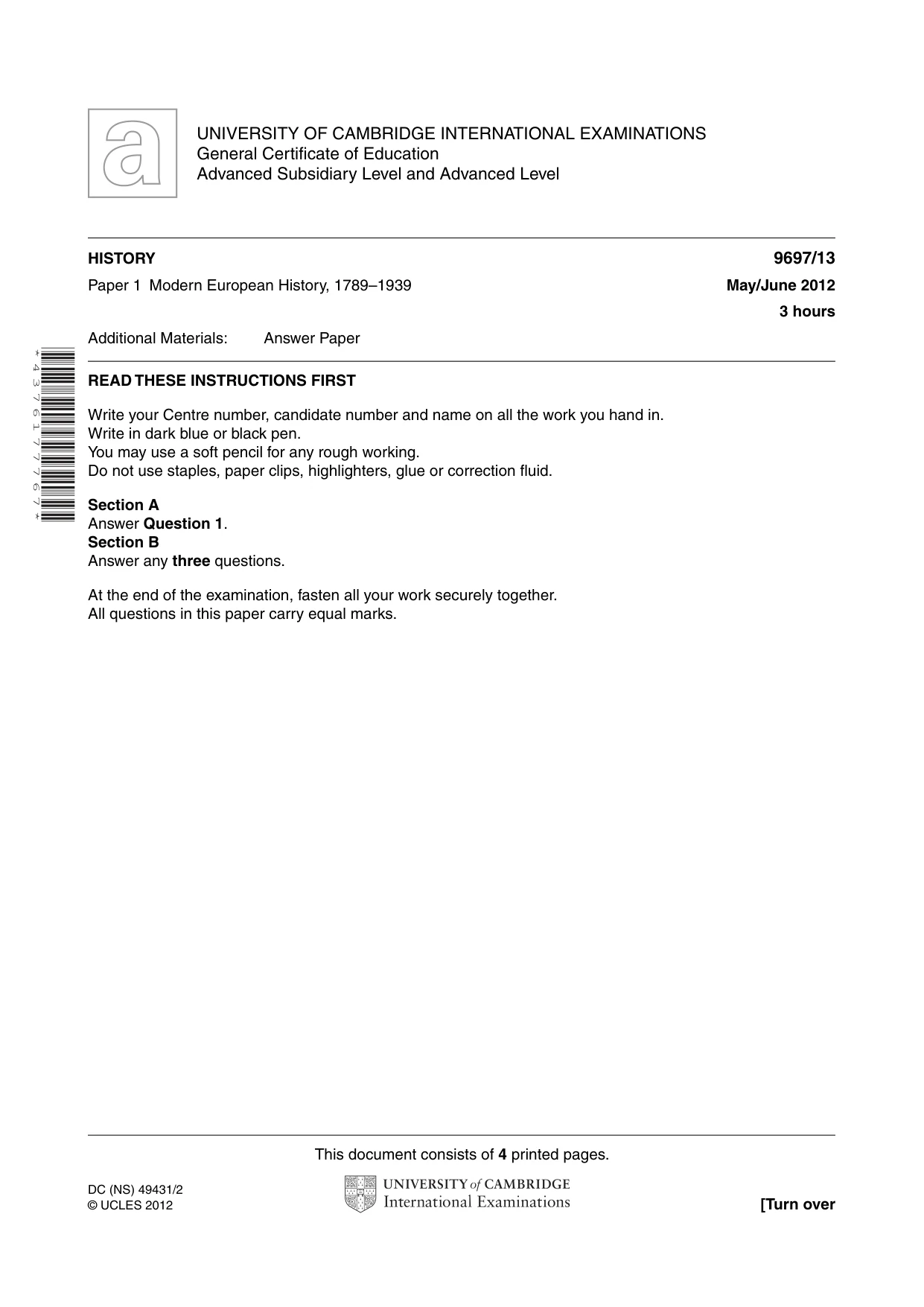
Question paper, page 1
This document consists of 4 printed pages. DC (NS) 49431/2 © UCLES 2012 [Turn over UNIVERSITY OF CAMBRIDGE INTERNATIONAL EXAMINATIONS General Certificate of Education Advanced Subsidiary Level and Advanced Level * 4 3 7 6 1 7 7 7 6 7 * HISTORY 9697/13 Paper 1 Modern European History, 1789–1939 May/June 2012 3 hours Additional Materials: Answer Paper READ THESE INSTRUCTIONS FIRST Write your Centre number, candidate number and name on all the work you hand in. Write in dark blue or black pen. You may use a soft pencil for any rough working. Do not use staples, paper clips, highlighters, glue or correction fluid. Section A Answer Question 1. Section B Answer any three questions. At the end of the examination, fasten all your work securely together. All questions in this paper carry equal marks.
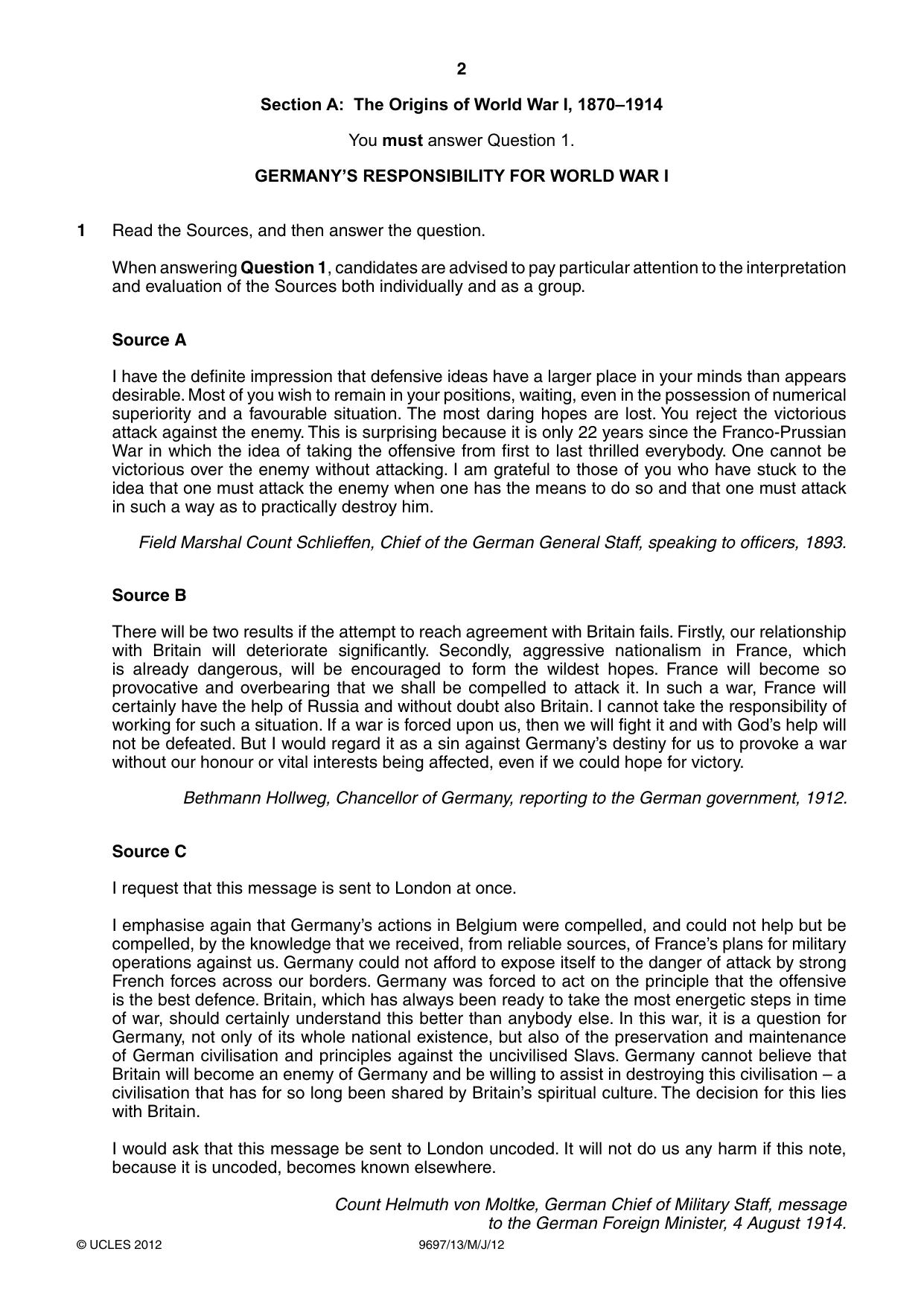
Question paper, page 2
2 9697/13/M/J/12 © UCLES 2012 Section A: The Origins of World War I, 1870–1914 You must answer Question 1. GERMANY’S RESPONSIBILITY FOR WORLD WAR I 1 Read the Sources, and then answer the question. When answering Question 1, candidates are advised to pay particular attention to the interpretation and evaluation of the Sources both individually and as a group. Source A I have the definite impression that defensive ideas have a larger place in your minds than appears desirable. Most of you wish to remain in your positions, waiting, even in the possession of numerical superiority and a favourable situation. The most daring hopes are lost. You reject the victorious attack against the enemy. This is surprising because it is only 22 years since the Franco-Prussian War in which the idea of taking the offensive from first to last thrilled everybody. One cannot be victorious over the enemy without attacking. I am grateful to those of you who have stuck to the idea that one must attack the enemy when one has the means to do so and that one must attack in such a way as to practically destroy him. Field Marshal Count Schlieffen, Chief of the German General Staff, speaking to officers, 1893. Source B There will be two results if the attempt to reach agreement with Britain fails. Firstly, our relationship with Britain will deteriorate significantly. Secondly, aggressive nationalism in France, which is already dangerous, will be encouraged to form the wildest hopes. France will become so provocative and overbearing that we shall be compelled to attack it. In such a war, France will certainly have the help of Russia and without doubt also Britain. I cannot take the responsibility of working for such a situation. If a war is forced upon us, then we will fight it and with God’s help will not be defeated. But I would regard it as a sin against Germany’s destiny for us to provoke a war without our honour or vital interests being affected, even if we could hope for victory. Bethmann Hollweg, Chancellor of Germany, reporting to the German government, 1912. Source C I request that this message is sent to London at once. I emphasise again that Germany’s actions in Belgium were compelled, and could not help but be compelled, by the knowledge that we received, from reliable sources, of France’s plans for military operations against us. Germany could not afford to expose itself to the danger of attack by strong French forces across our borders. Germany was forced to act on the principle that the offensive is the best defence. Britain, which has always been ready to take the most energetic steps in time of war, should certainly understand this better than anybody else. In this war, it is a question for Germany, not only of its whole national existence, but also of the preservation and maintenance of German civilisation and principles against the uncivilised Slavs. Germany cannot believe that Britain will become an enemy of Germany and be willing to assist in destroying this civilisation – a civilisation that has for so long been shared by Britain’s spiritual culture. The decision for this lies with Britain. I would ask that this message be sent to London uncoded. It will not do us any harm if this note, because it is uncoded, becomes known elsewhere. Count Helmuth von Moltke, German Chief of Military Staff, message to the German Foreign Minister, 4 August 1914.
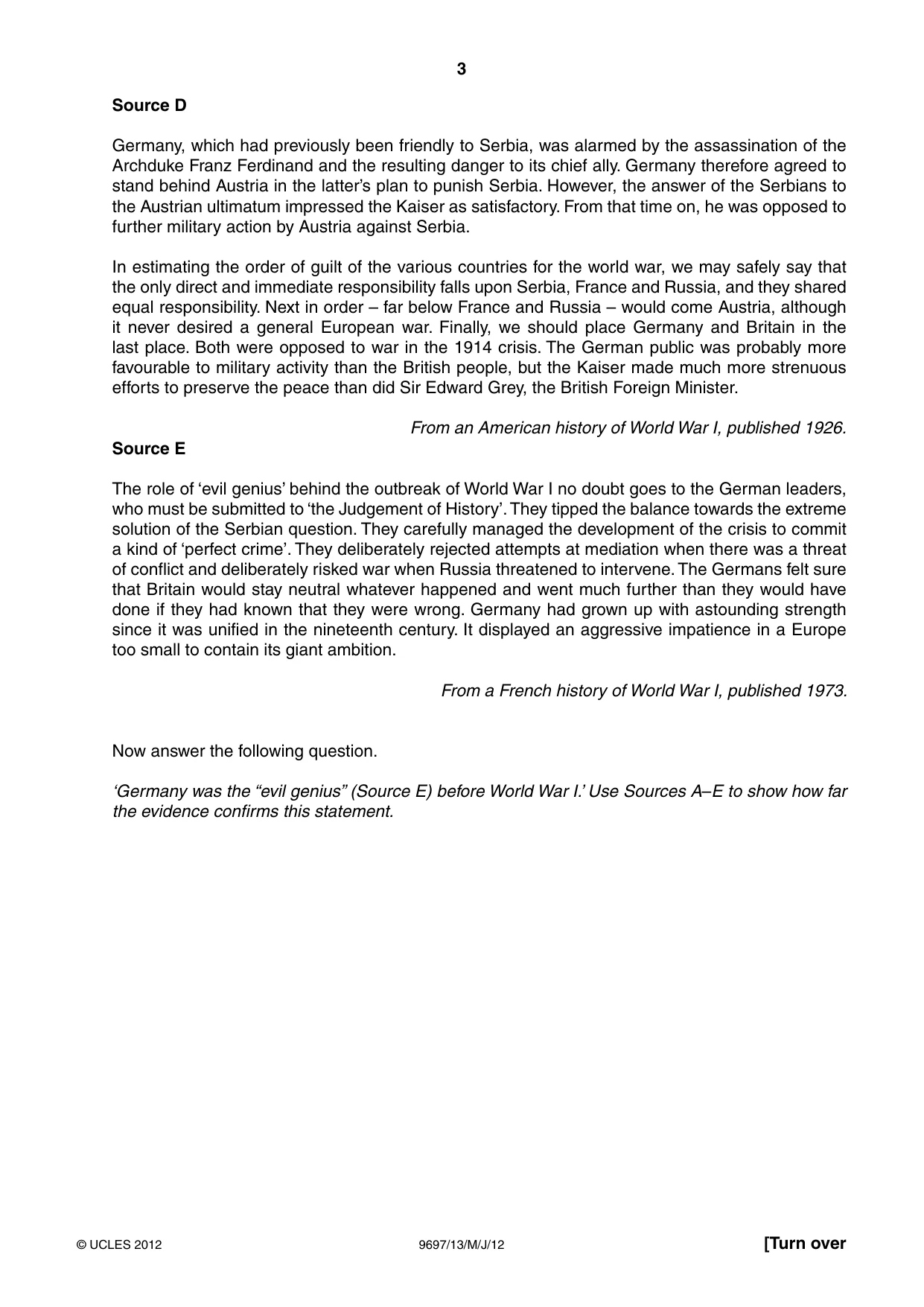
Question paper, page 3
3 9697/13/M/J/12 © UCLES 2012 [Turn over Source D Germany, which had previously been friendly to Serbia, was alarmed by the assassination of the Archduke Franz Ferdinand and the resulting danger to its chief ally. Germany therefore agreed to stand behind Austria in the latter’s plan to punish Serbia. However, the answer of the Serbians to the Austrian ultimatum impressed the Kaiser as satisfactory. From that time on, he was opposed to further military action by Austria against Serbia. In estimating the order of guilt of the various countries for the world war, we may safely say that the only direct and immediate responsibility falls upon Serbia, France and Russia, and they shared equal responsibility. Next in order – far below France and Russia – would come Austria, although it never desired a general European war. Finally, we should place Germany and Britain in the last place. Both were opposed to war in the 1914 crisis. The German public was probably more favourable to military activity than the British people, but the Kaiser made much more strenuous efforts to preserve the peace than did Sir Edward Grey, the British Foreign Minister. From an American history of World War I, published 1926. Source E The role of ‘evil genius’ behind the outbreak of World War I no doubt goes to the German leaders, who must be submitted to ‘the Judgement of History’. They tipped the balance towards the extreme solution of the Serbian question. They carefully managed the development of the crisis to commit a kind of ‘perfect crime’. They deliberately rejected attempts at mediation when there was a threat of conflict and deliberately risked war when Russia threatened to intervene. The Germans felt sure that Britain would stay neutral whatever happened and went much further than they would have done if they had known that they were wrong. Germany had grown up with astounding strength since it was unified in the nineteenth century. It displayed an aggressive impatience in a Europe too small to contain its giant ambition. From a French history of World War I, published 1973. Now answer the following question. ‘Germany was the “evil genius” (Source E) before World War I.’ Use Sources A–E to show how far the evidence confirms this statement.
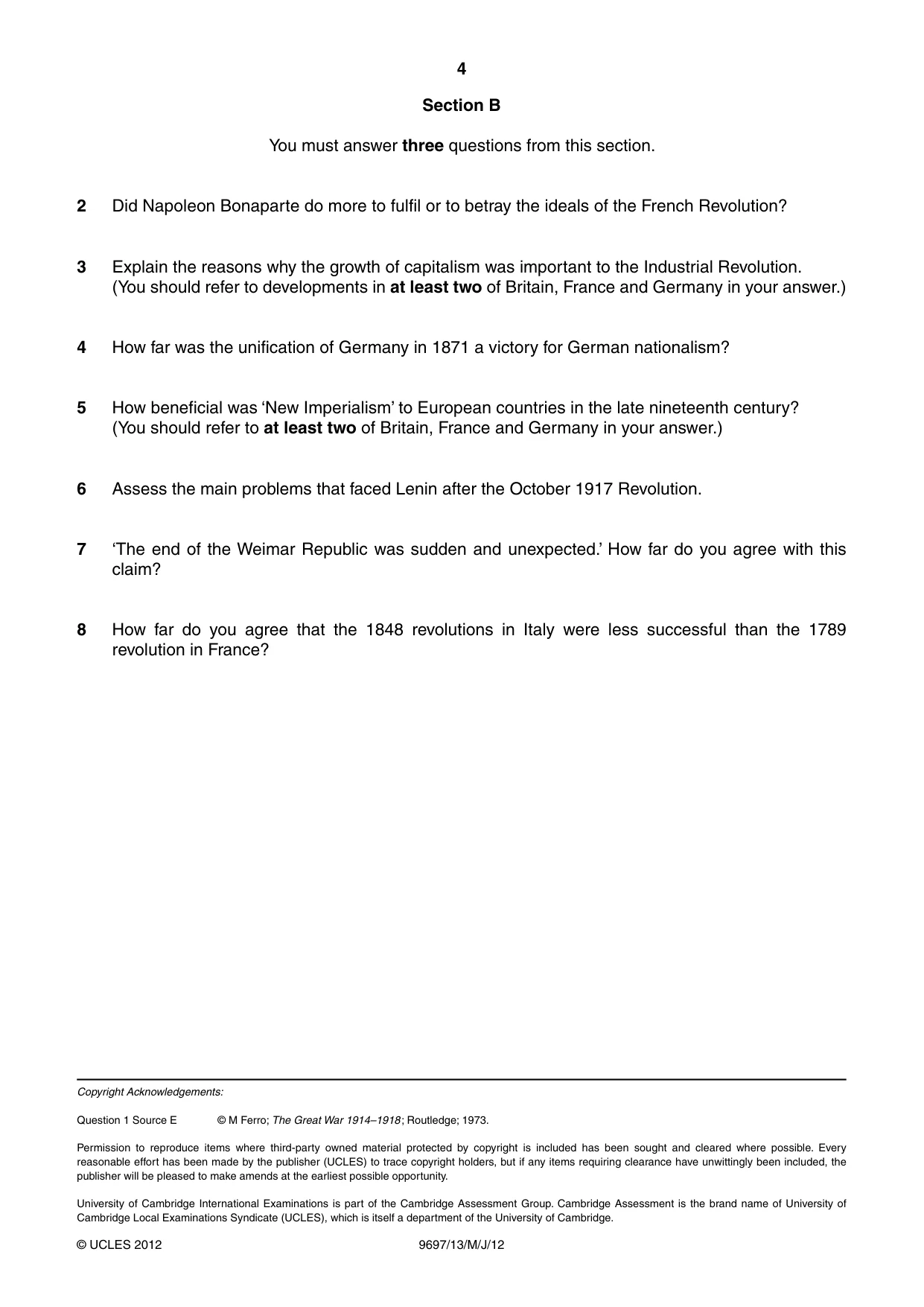
Question paper, page 4
4 9697/13/M/J/12 © UCLES 2012 Section B You must answer three questions from this section. 2 Did Napoleon Bonaparte do more to fulfil or to betray the ideals of the French Revolution? 3 Explain the reasons why the growth of capitalism was important to the Industrial Revolution. (You should refer to developments in at least two of Britain, France and Germany in your answer.) 4 How far was the unification of Germany in 1871 a victory for German nationalism? 5 How beneficial was ‘New Imperialism’ to European countries in the late nineteenth century? (You should refer to at least two of Britain, France and Germany in your answer.) 6 Assess the main problems that faced Lenin after the October 1917 Revolution. 7 ‘The end of the Weimar Republic was sudden and unexpected.’ How far do you agree with this claim? 8 How far do you agree that the 1848 revolutions in Italy were less successful than the 1789 revolution in France? Copyright Acknowledgements: Question 1 Source E © M Ferro; The Great War 1914–1918 ; Routledge; 1973. Permission to reproduce items where third-party owned material protected by copyright is included has been sought and cleared where possible. Every reasonable effort has been made by the publisher (UCLES) to trace copyright holders, but if any items requiring clearance have unwittingly been included, the publisher will be pleased to make amends at the earliest possible opportunity. University of Cambridge International Examinations is part of the Cambridge Assessment Group. Cambridge Assessment is the brand name of University of Cambridge Local Examinations Syndicate (UCLES), which is itself a department of the University of Cambridge.
Mark scheme, page 1
UNIVERSITY OF CAMBRIDGE INTERNATIONAL EXAMINATIONS GCE Advanced Subsidiary Level and GCE Advanced Level MARK SCHEME for the May/June 2012 question paper for the guidance of teachers 9697 HISTORY 9697/13 Paper 1, maximum raw mark 100 This mark scheme is published as an aid to teachers and candidates, to indicate the requirements of the examination. It shows the basis on which Examiners were instructed to award marks. It does not indicate the details of the discussions that took place at an Examiners’ meeting before marking began, which would have considered the acceptability of alternative answers. Mark schemes must be read in conjunction with the question papers and the report on the examination. • Cambridge will not enter into discussions or correspondence in connection with these mark schemes. Cambridge is publishing the mark schemes for the May/June 2012 question papers for most IGCSE, GCE Advanced Level and Advanced Subsidiary Level syllabuses and some Ordinary Level syllabuses.
Mark scheme, page 2
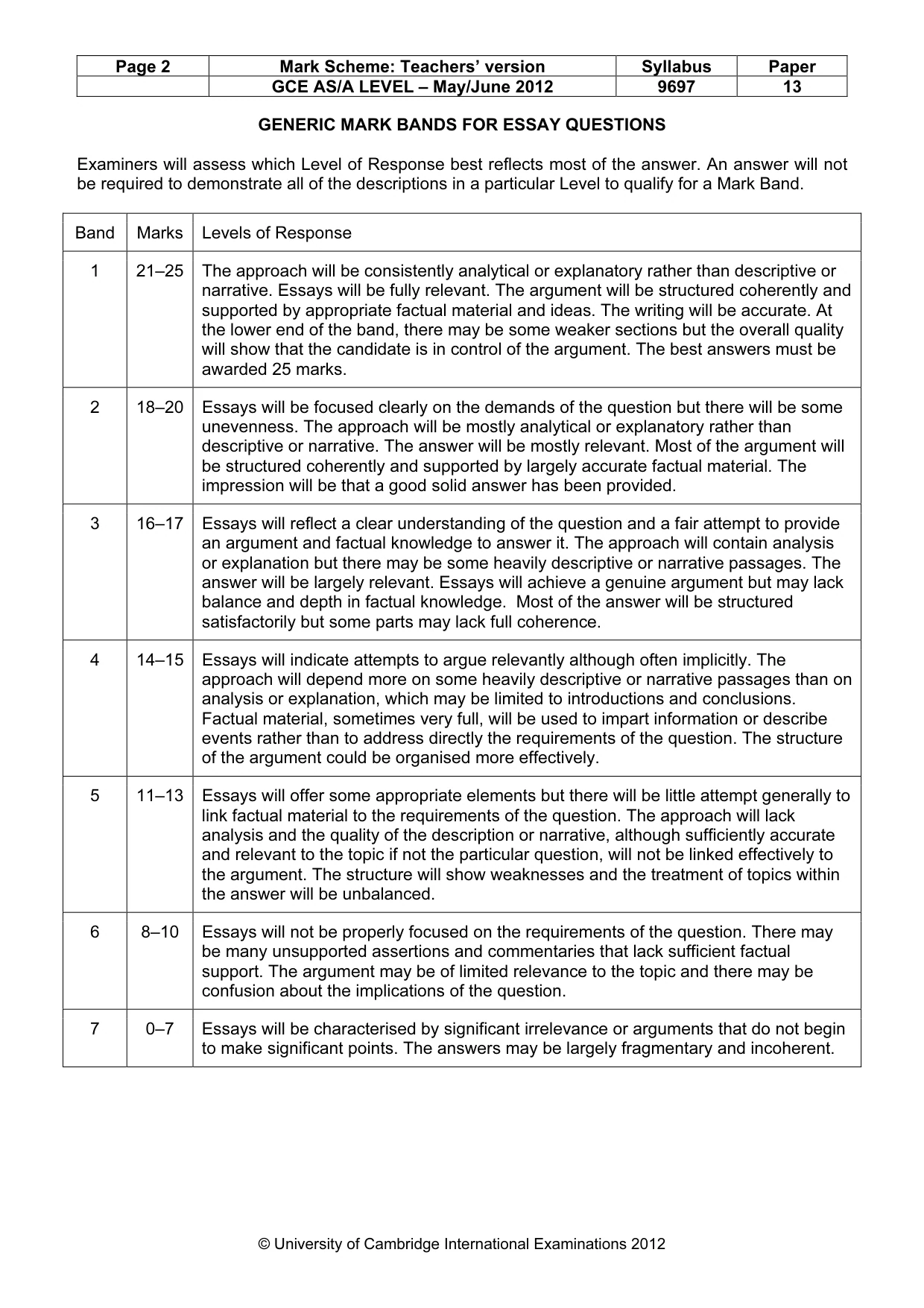
Page 2 Mark Scheme: Teachers’ version Syllabus Paper GCE AS/A LEVEL – May/June 2012 9697 13 © University of Cambridge International Examinations 2012 GENERIC MARK BANDS FOR ESSAY QUESTIONS Examiners will assess which Level of Response best reflects most of the answer. An answer will not be required to demonstrate all of the descriptions in a particular Level to qualify for a Mark Band. Band Marks Levels of Response 1 21–25 The approach will be consistently analytical or explanatory rather than descriptive or narrative. Essays will be fully relevant. The argument will be structured coherently and supported by appropriate factual material and ideas. The writing will be accurate. At the lower end of the band, there may be some weaker sections but the overall quality will show that the candidate is in control of the argument. The best answers must be awarded 25 marks. 2 18–20 Essays will be focused clearly on the demands of the question but there will be some unevenness. The approach will be mostly analytical or explanatory rather than descriptive or narrative. The answer will be mostly relevant. Most of the argument will be structured coherently and supported by largely accurate factual material. The impression will be that a good solid answer has been provided. 3 16–17 Essays will reflect a clear understanding of the question and a fair attempt to provide an argument and factual knowledge to answer it. The approach will contain analysis or explanation but there may be some heavily descriptive or narrative passages. The answer will be largely relevant. Essays will achieve a genuine argument but may lack balance and depth in factual knowledge. Most of the answer will be structured satisfactorily but some parts may lack full coherence. 4 14–15 Essays will indicate attempts to argue relevantly although often implicitly. The approach will depend more on some heavily descriptive or narrative passages than on analysis or explanation, which may be limited to introductions and conclusions. Factual material, sometimes very full, will be used to impart information or describe events rather than to address directly the requirements of the question. The structure of the argument could be organised more effectively. 5 11–13 Essays will offer some appropriate elements but there will be little attempt generally to link factual material to the requirements of the question. The approach will lack analysis and the quality of the description or narrative, although sufficiently accurate and relevant to the topic if not the particular question, will not be linked effectively to the argument. The structure will show weaknesses and the treatment of topics within the answer will be unbalanced. 6 8–10 Essays will not be properly focused on the requirements of the question. There may be many unsupported assertions and commentaries that lack sufficient factual support. The argument may be of limited relevance to the topic and there may be confusion about the implications of the question. 7 0–7 Essays will be characterised by significant irrelevance or arguments that do not begin to make significant points. The answers may be largely fragmentary and incoherent.
Mark scheme, page 3
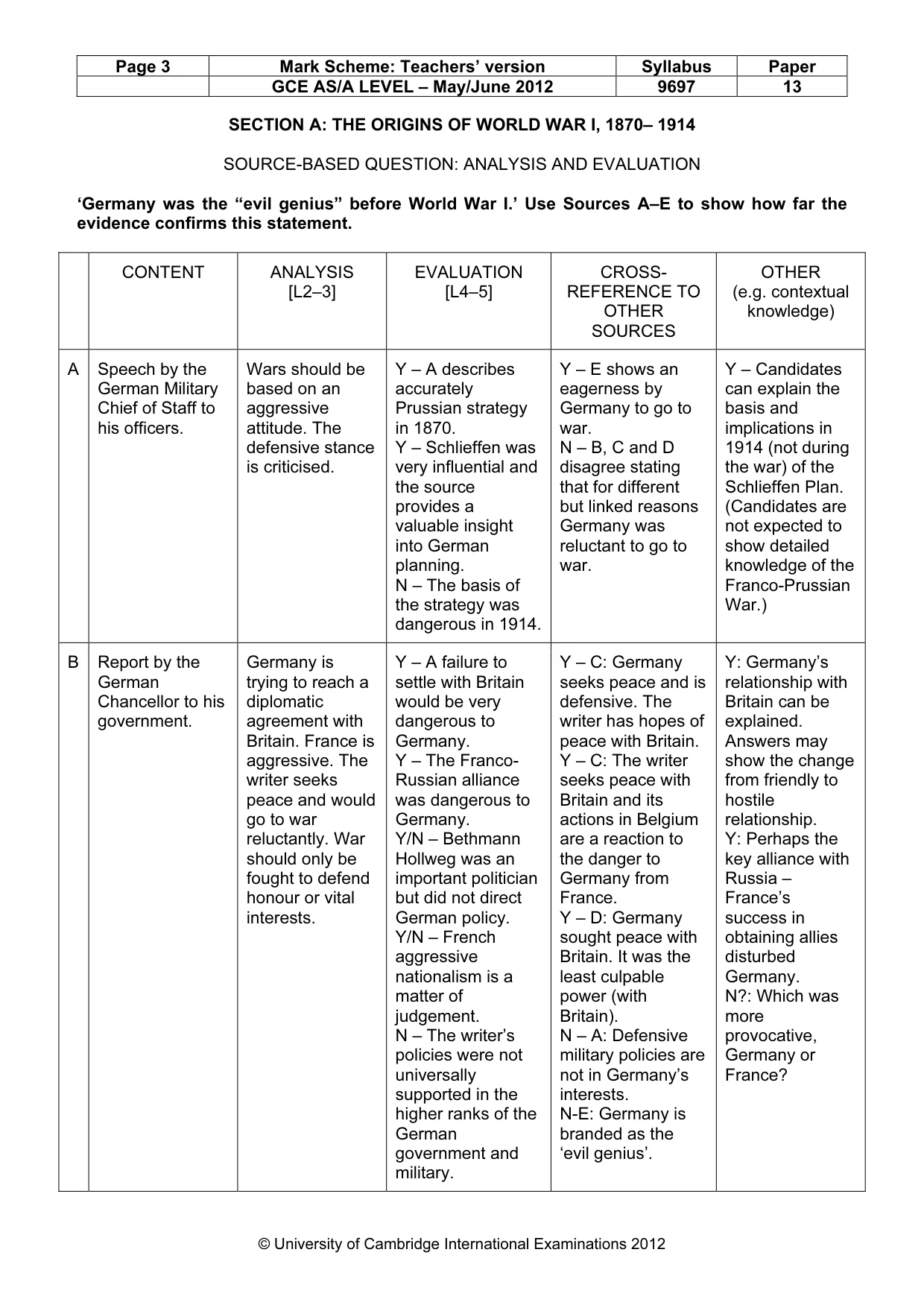
Page 3 Mark Scheme: Teachers’ version Syllabus Paper GCE AS/A LEVEL – May/June 2012 9697 13 © University of Cambridge International Examinations 2012 SECTION A: THE ORIGINS OF WORLD WAR I, 1870– 1914 SOURCE-BASED QUESTION: ANALYSIS AND EVALUATION ‘Germany was the “evil genius” before World War I.’ Use Sources A–E to show how far the evidence confirms this statement. CONTENT ANALYSIS [L2–3] EVALUATION [L4–5] CROSS- REFERENCE TO OTHER SOURCES OTHER (e.g. contextual knowledge) A Speech by the German Military Chief of Staff to his officers. Wars should be based on an aggressive attitude. The defensive stance is criticised. Y – A describes accurately Prussian strategy in 1870. Y – Schlieffen was very influential and the source provides a valuable insight into German planning. N – The basis of the strategy was dangerous in 1914. Y – E shows an eagerness by Germany to go to war. N – B, C and D disagree stating that for different but linked reasons Germany was reluctant to go to war. Y – Candidates can explain the basis and implications in 1914 (not during the war) of the Schlieffen Plan. (Candidates are not expected to show detailed knowledge of the Franco-Prussian War.) B Report by the German Chancellor to his government. Germany is trying to reach a diplomatic agreement with Britain. France is aggressive. The writer seeks peace and would go to war reluctantly. War should only be fought to defend honour or vital interests. Y – A failure to settle with Britain would be very dangerous to Germany. Y – The Franco- Russian alliance was dangerous to Germany. Y/N – Bethmann Hollweg was an important politician but did not direct German policy. Y/N – French aggressive nationalism is a matter of judgement. N – The writer’s policies were not universally supported in the higher ranks of the German government and military. Y – C: Germany seeks peace and is defensive. The writer has hopes of peace with Britain. Y – C: The writer seeks peace with Britain and its actions in Belgium are a reaction to the danger to Germany from France. Y – D: Germany sought peace with Britain. It was the least culpable power (with Britain). N – A: Defensive military policies are not in Germany’s interests. N-E: Germany is branded as the ‘evil genius’. Y: Germany’s relationship with Britain can be explained. Answers may show the change from friendly to hostile relationship. Y: Perhaps the key alliance with Russia – France’s success in obtaining allies disturbed Germany. N?: Which was more provocative, Germany or France?
Mark scheme, page 4
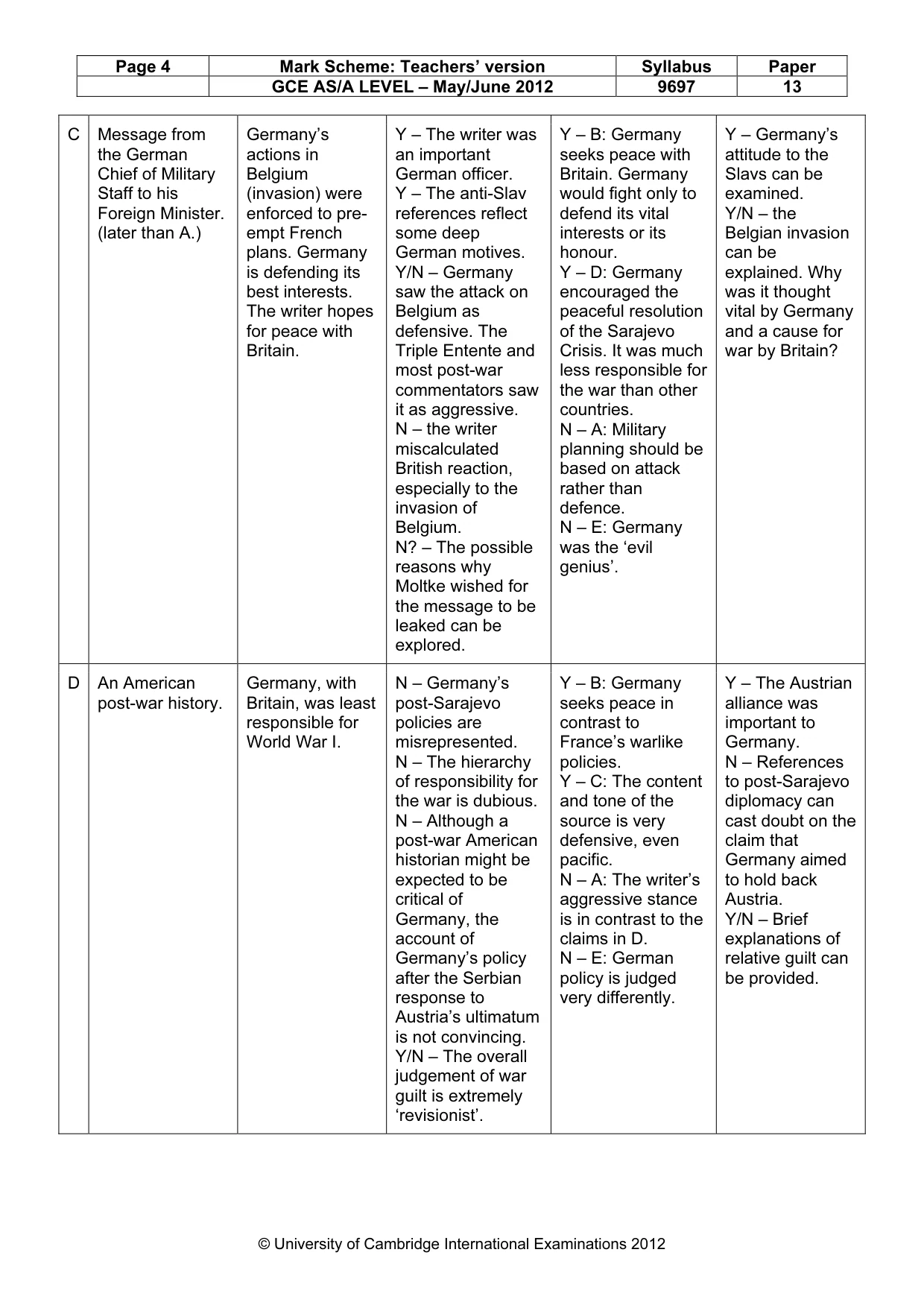
Page 4 Mark Scheme: Teachers’ version Syllabus Paper GCE AS/A LEVEL – May/June 2012 9697 13 © University of Cambridge International Examinations 2012 C Message from the German Chief of Military Staff to his Foreign Minister. (later than A.) Germany’s actions in Belgium (invasion) were enforced to pre- empt French plans. Germany is defending its best interests. The writer hopes for peace with Britain. Y – The writer was an important German officer. Y – The anti-Slav references reflect some deep German motives. Y/N – Germany saw the attack on Belgium as defensive. The Triple Entente and most post-war commentators saw it as aggressive. N – the writer miscalculated British reaction, especially to the invasion of Belgium. N? – The possible reasons why Moltke wished for the message to be leaked can be explored. Y – B: Germany seeks peace with Britain. Germany would fight only to defend its vital interests or its honour. Y – D: Germany encouraged the peaceful resolution of the Sarajevo Crisis. It was much less responsible for the war than other countries. N – A: Military planning should be based on attack rather than defence. N – E: Germany was the ‘evil genius’. Y – Germany’s attitude to the Slavs can be examined. Y/N – the Belgian invasion can be explained. Why was it thought vital by Germany and a cause for war by Britain? D An American post-war history. Germany, with Britain, was least responsible for World War I. N – Germany’s post-Sarajevo policies are misrepresented. N – The hierarchy of responsibility for the war is dubious. N – Although a post-war American historian might be expected to be critical of Germany, the account of Germany’s policy after the Serbian response to Austria’s ultimatum is not convincing. Y/N – The overall judgement of war guilt is extremely ‘revisionist’. Y – B: Germany seeks peace in contrast to France’s warlike policies. Y – C: The content and tone of the source is very defensive, even pacific. N – A: The writer’s aggressive stance is in contrast to the claims in D. N – E: German policy is judged very differently. Y – The Austrian alliance was important to Germany. N – References to post-Sarajevo diplomacy can cast doubt on the claim that Germany aimed to hold back Austria. Y/N – Brief explanations of relative guilt can be provided.
Mark scheme, page 5
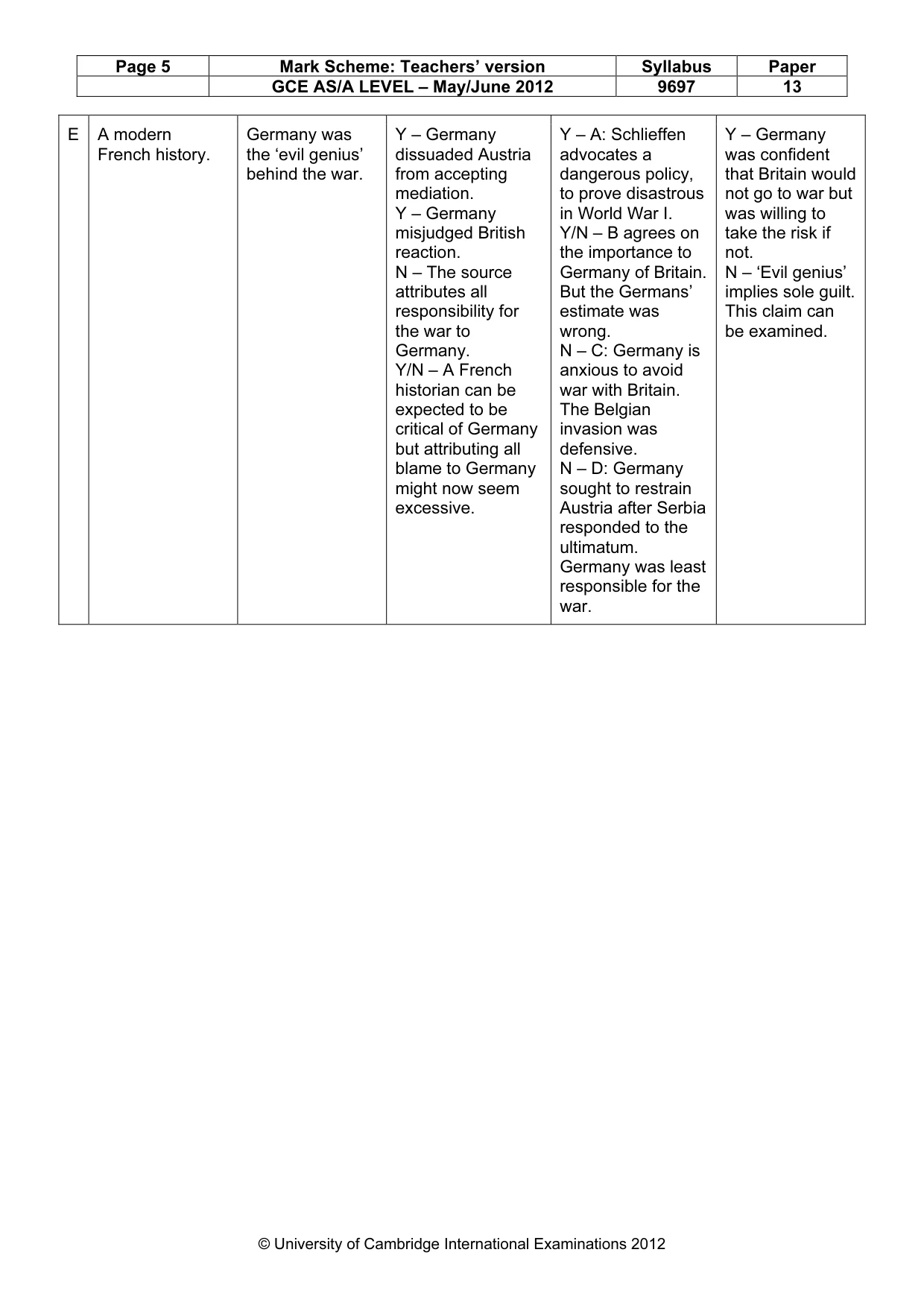
Page 5 Mark Scheme: Teachers’ version Syllabus Paper GCE AS/A LEVEL – May/June 2012 9697 13 © University of Cambridge International Examinations 2012 E A modern French history. Germany was the ‘evil genius’ behind the war. Y – Germany dissuaded Austria from accepting mediation. Y – Germany misjudged British reaction. N – The source attributes all responsibility for the war to Germany. Y/N – A French historian can be expected to be critical of Germany but attributing all blame to Germany might now seem excessive. Y – A: Schlieffen advocates a dangerous policy, to prove disastrous in World War I. Y/N – B agrees on the importance to Germany of Britain. But the Germans’ estimate was wrong. N – C: Germany is anxious to avoid war with Britain. The Belgian invasion was defensive. N – D: Germany sought to restrain Austria after Serbia responded to the ultimatum. Germany was least responsible for the war. Y – Germany was confident that Britain would not go to war but was willing to take the risk if not. N – ‘Evil genius’ implies sole guilt. This claim can be examined.
Mark scheme, page 6
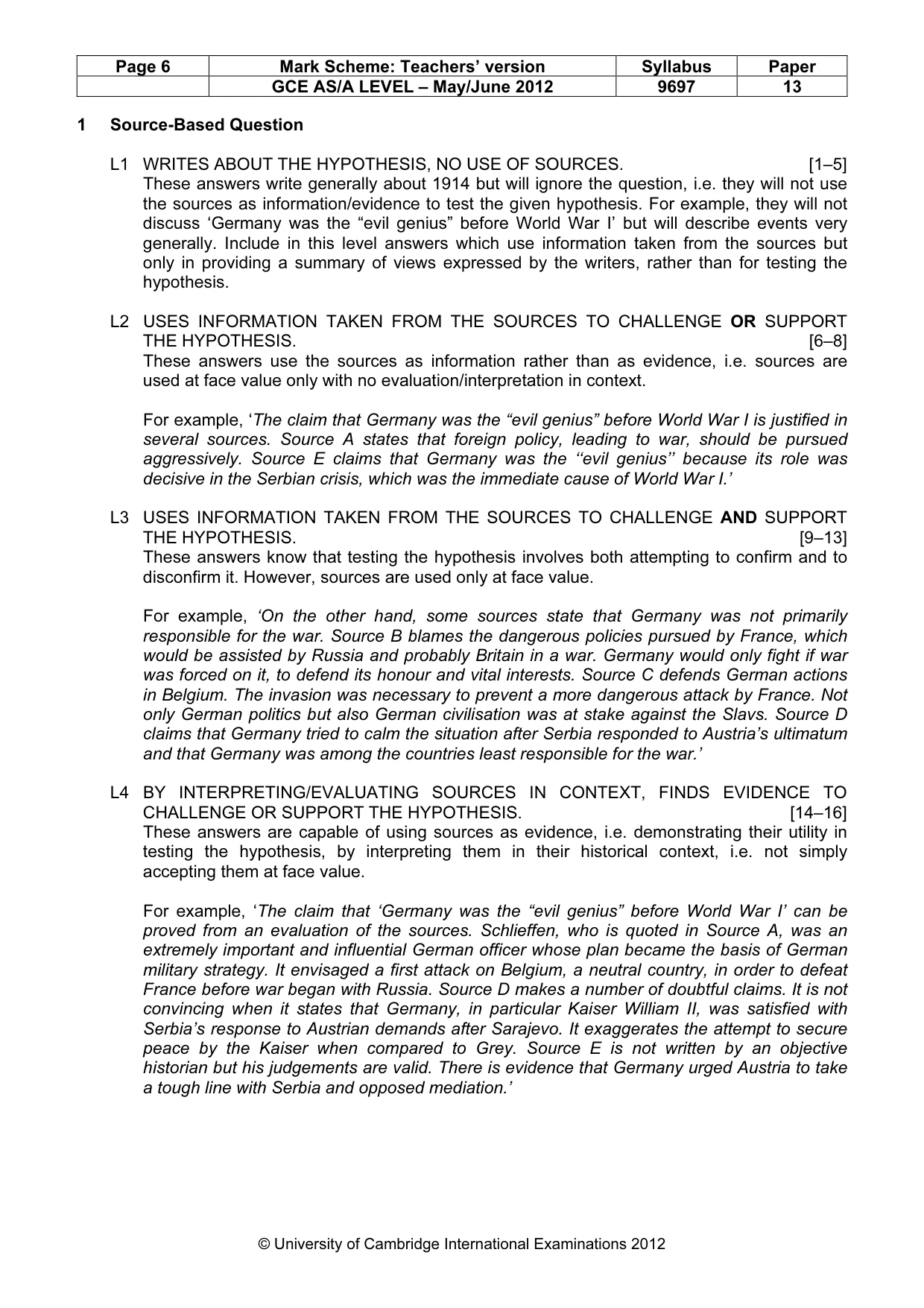
Page 6 Mark Scheme: Teachers’ version Syllabus Paper GCE AS/A LEVEL – May/June 2012 9697 13 © University of Cambridge International Examinations 2012 1 Source-Based Question L1 WRITES ABOUT THE HYPOTHESIS, NO USE OF SOURCES. [1–5] These answers write generally about 1914 but will ignore the question, i.e. they will not use the sources as information/evidence to test the given hypothesis. For example, they will not discuss ‘Germany was the “evil genius” before World War I’ but will describe events very generally. Include in this level answers which use information taken from the sources but only in providing a summary of views expressed by the writers, rather than for testing the hypothesis. L2 USES INFORMATION TAKEN FROM THE SOURCES TO CHALLENGE OR SUPPORT THE HYPOTHESIS. [6–8] These answers use the sources as information rather than as evidence, i.e. sources are used at face value only with no evaluation/interpretation in context. For example, ‘The claim that Germany was the “evil genius” before World War I is justified in several sources. Source A states that foreign policy, leading to war, should be pursued aggressively. Source E claims that Germany was the ‘‘evil genius’’ because its role was decisive in the Serbian crisis, which was the immediate cause of World War I.’ L3 USES INFORMATION TAKEN FROM THE SOURCES TO CHALLENGE AND SUPPORT THE HYPOTHESIS. [9–13] These answers know that testing the hypothesis involves both attempting to confirm and to disconfirm it. However, sources are used only at face value. For example, ‘On the other hand, some sources state that Germany was not primarily responsible for the war. Source B blames the dangerous policies pursued by France, which would be assisted by Russia and probably Britain in a war. Germany would only fight if war was forced on it, to defend its honour and vital interests. Source C defends German actions in Belgium. The invasion was necessary to prevent a more dangerous attack by France. Not only German politics but also German civilisation was at stake against the Slavs. Source D claims that Germany tried to calm the situation after Serbia responded to Austria’s ultimatum and that Germany was among the countries least responsible for the war.’ L4 BY INTERPRETING/EVALUATING SOURCES IN CONTEXT, FINDS EVIDENCE TO CHALLENGE OR SUPPORT THE HYPOTHESIS. [14–16] These answers are capable of using sources as evidence, i.e. demonstrating their utility in testing the hypothesis, by interpreting them in their historical context, i.e. not simply accepting them at face value. For example, ‘The claim that ‘Germany was the “evil genius” before World War I’ can be proved from an evaluation of the sources. Schlieffen, who is quoted in Source A, was an extremely important and influential German officer whose plan became the basis of German military strategy. It envisaged a first attack on Belgium, a neutral country, in order to defeat France before war began with Russia. Source D makes a number of doubtful claims. It is not convincing when it states that Germany, in particular Kaiser William II, was satisfied with Serbia’s response to Austrian demands after Sarajevo. It exaggerates the attempt to secure peace by the Kaiser when compared to Grey. Source E is not written by an objective historian but his judgements are valid. There is evidence that Germany urged Austria to take a tough line with Serbia and opposed mediation.’
Mark scheme, page 7
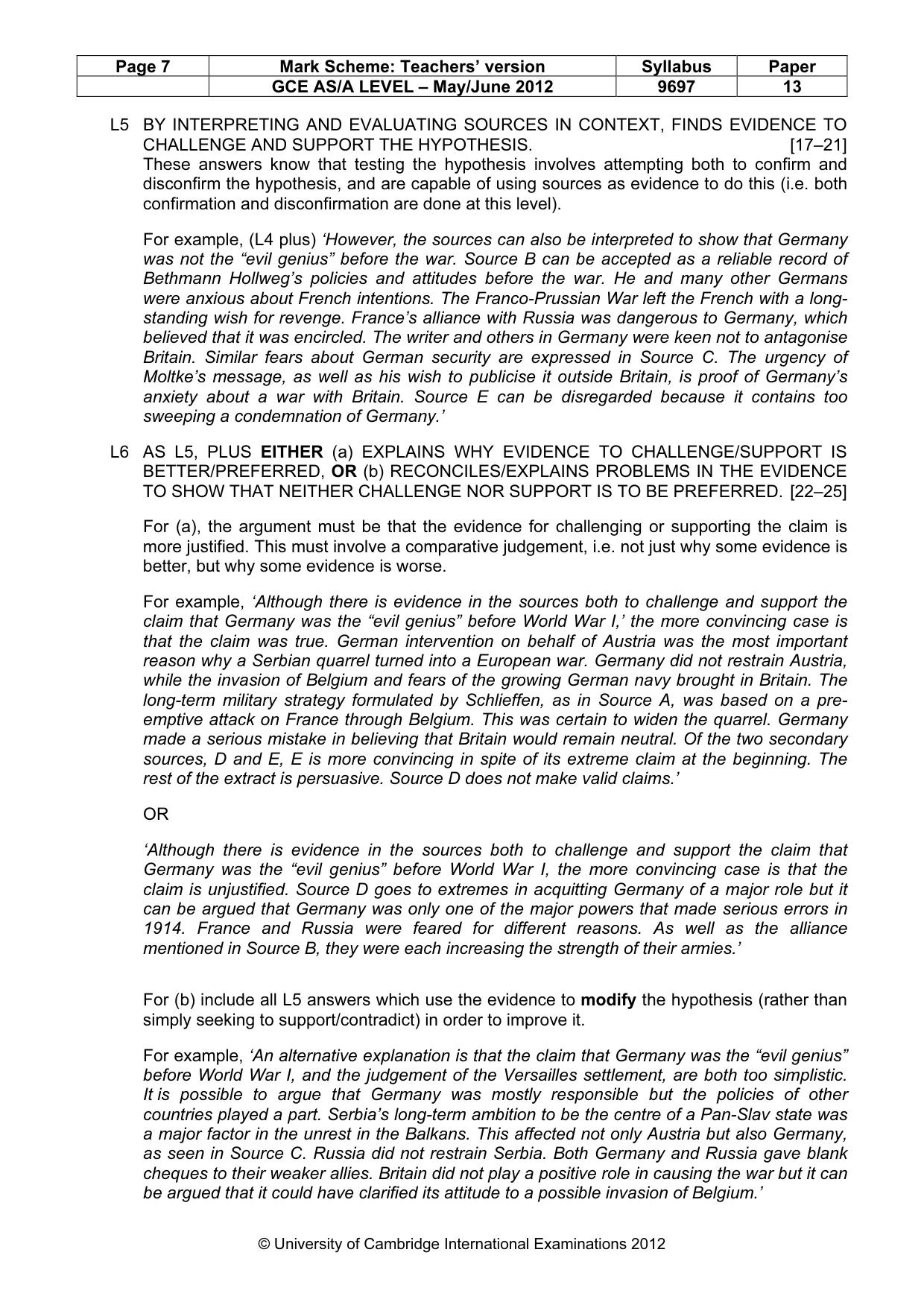
Page 7 Mark Scheme: Teachers’ version Syllabus Paper GCE AS/A LEVEL – May/June 2012 9697 13 © University of Cambridge International Examinations 2012 L5 BY INTERPRETING AND EVALUATING SOURCES IN CONTEXT, FINDS EVIDENCE TO CHALLENGE AND SUPPORT THE HYPOTHESIS. [17–21] These answers know that testing the hypothesis involves attempting both to confirm and disconfirm the hypothesis, and are capable of using sources as evidence to do this (i.e. both confirmation and disconfirmation are done at this level). For example, (L4 plus) ‘However, the sources can also be interpreted to show that Germany was not the “evil genius” before the war. Source B can be accepted as a reliable record of Bethmann Hollweg’s policies and attitudes before the war. He and many other Germans were anxious about French intentions. The Franco-Prussian War left the French with a long- standing wish for revenge. France’s alliance with Russia was dangerous to Germany, which believed that it was encircled. The writer and others in Germany were keen not to antagonise Britain. Similar fears about German security are expressed in Source C. The urgency of Moltke’s message, as well as his wish to publicise it outside Britain, is proof of Germany’s anxiety about a war with Britain. Source E can be disregarded because it contains too sweeping a condemnation of Germany.’ L6 AS L5, PLUS EITHER (a) EXPLAINS WHY EVIDENCE TO CHALLENGE/SUPPORT IS BETTER/PREFERRED, OR (b) RECONCILES/EXPLAINS PROBLEMS IN THE EVIDENCE TO SHOW THAT NEITHER CHALLENGE NOR SUPPORT IS TO BE PREFERRED. [22–25] For (a), the argument must be that the evidence for challenging or supporting the claim is more justified. This must involve a comparative judgement, i.e. not just why some evidence is better, but why some evidence is worse. For example, ‘Although there is evidence in the sources both to challenge and support the claim that Germany was the “evil genius” before World War I,’ the more convincing case is that the claim was true. German intervention on behalf of Austria was the most important reason why a Serbian quarrel turned into a European war. Germany did not restrain Austria, while the invasion of Belgium and fears of the growing German navy brought in Britain. The long-term military strategy formulated by Schlieffen, as in Source A, was based on a pre- emptive attack on France through Belgium. This was certain to widen the quarrel. Germany made a serious mistake in believing that Britain would remain neutral. Of the two secondary sources, D and E, E is more convincing in spite of its extreme claim at the beginning. The rest of the extract is persuasive. Source D does not make valid claims.’ OR ‘Although there is evidence in the sources both to challenge and support the claim that Germany was the “evil genius” before World War I, the more convincing case is that the claim is unjustified. Source D goes to extremes in acquitting Germany of a major role but it can be argued that Germany was only one of the major powers that made serious errors in 1914. France and Russia were feared for different reasons. As well as the alliance mentioned in Source B, they were each increasing the strength of their armies.’ For (b) include all L5 answers which use the evidence to modify the hypothesis (rather than simply seeking to support/contradict) in order to improve it. For example, ‘An alternative explanation is that the claim that Germany was the “evil genius” before World War I, and the judgement of the Versailles settlement, are both too simplistic. It is possible to argue that Germany was mostly responsible but the policies of other countries played a part. Serbia’s long-term ambition to be the centre of a Pan-Slav state was a major factor in the unrest in the Balkans. This affected not only Austria but also Germany, as seen in Source C. Russia did not restrain Serbia. Both Germany and Russia gave blank cheques to their weaker allies. Britain did not play a positive role in causing the war but it can be argued that it could have clarified its attitude to a possible invasion of Belgium.’
Mark scheme, page 8
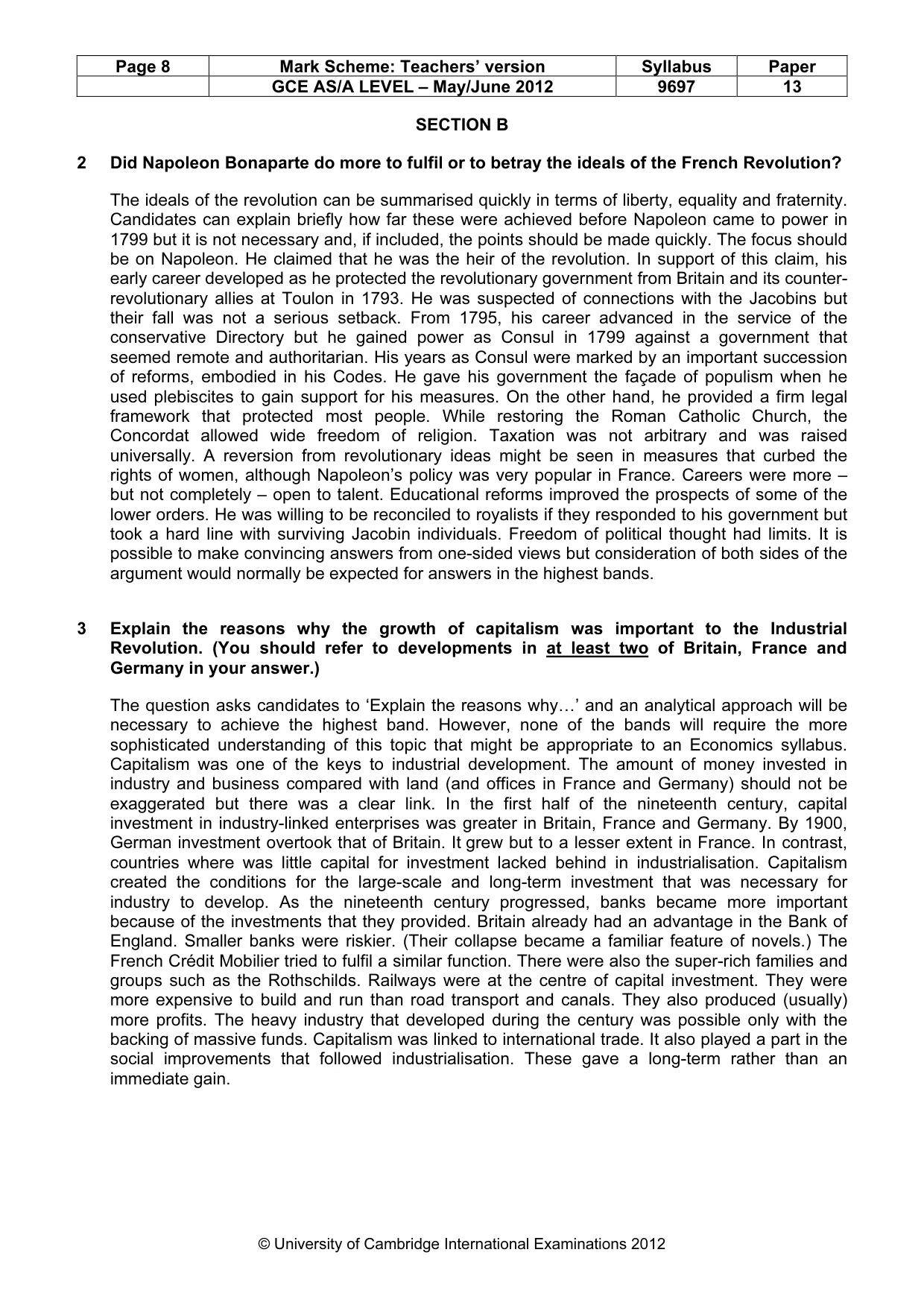
Page 8 Mark Scheme: Teachers’ version Syllabus Paper GCE AS/A LEVEL – May/June 2012 9697 13 © University of Cambridge International Examinations 2012 SECTION B 2 Did Napoleon Bonaparte do more to fulfil or to betray the ideals of the French Revolution? The ideals of the revolution can be summarised quickly in terms of liberty, equality and fraternity. Candidates can explain briefly how far these were achieved before Napoleon came to power in 1799 but it is not necessary and, if included, the points should be made quickly. The focus should be on Napoleon. He claimed that he was the heir of the revolution. In support of this claim, his early career developed as he protected the revolutionary government from Britain and its counter- revolutionary allies at Toulon in 1793. He was suspected of connections with the Jacobins but their fall was not a serious setback. From 1795, his career advanced in the service of the conservative Directory but he gained power as Consul in 1799 against a government that seemed remote and authoritarian. His years as Consul were marked by an important succession of reforms, embodied in his Codes. He gave his government the façade of populism when he used plebiscites to gain support for his measures. On the other hand, he provided a firm legal framework that protected most people. While restoring the Roman Catholic Church, the Concordat allowed wide freedom of religion. Taxation was not arbitrary and was raised universally. A reversion from revolutionary ideas might be seen in measures that curbed the rights of women, although Napoleon’s policy was very popular in France. Careers were more – but not completely – open to talent. Educational reforms improved the prospects of some of the lower orders. He was willing to be reconciled to royalists if they responded to his government but took a hard line with surviving Jacobin individuals. Freedom of political thought had limits. It is possible to make convincing answers from one-sided views but consideration of both sides of the argument would normally be expected for answers in the highest bands. 3 Explain the reasons why the growth of capitalism was important to the Industrial Revolution. (You should refer to developments in at least two of Britain, France and Germany in your answer.) The question asks candidates to ‘Explain the reasons why…’ and an analytical approach will be necessary to achieve the highest band. However, none of the bands will require the more sophisticated understanding of this topic that might be appropriate to an Economics syllabus. Capitalism was one of the keys to industrial development. The amount of money invested in industry and business compared with land (and offices in France and Germany) should not be exaggerated but there was a clear link. In the first half of the nineteenth century, capital investment in industry-linked enterprises was greater in Britain, France and Germany. By 1900, German investment overtook that of Britain. It grew but to a lesser extent in France. In contrast, countries where was little capital for investment lacked behind in industrialisation. Capitalism created the conditions for the large-scale and long-term investment that was necessary for industry to develop. As the nineteenth century progressed, banks became more important because of the investments that they provided. Britain already had an advantage in the Bank of England. Smaller banks were riskier. (Their collapse became a familiar feature of novels.) The French Crédit Mobilier tried to fulfil a similar function. There were also the super-rich families and groups such as the Rothschilds. Railways were at the centre of capital investment. They were more expensive to build and run than road transport and canals. They also produced (usually) more profits. The heavy industry that developed during the century was possible only with the backing of massive funds. Capitalism was linked to international trade. It also played a part in the social improvements that followed industrialisation. These gave a long-term rather than an immediate gain.
Mark scheme, page 9
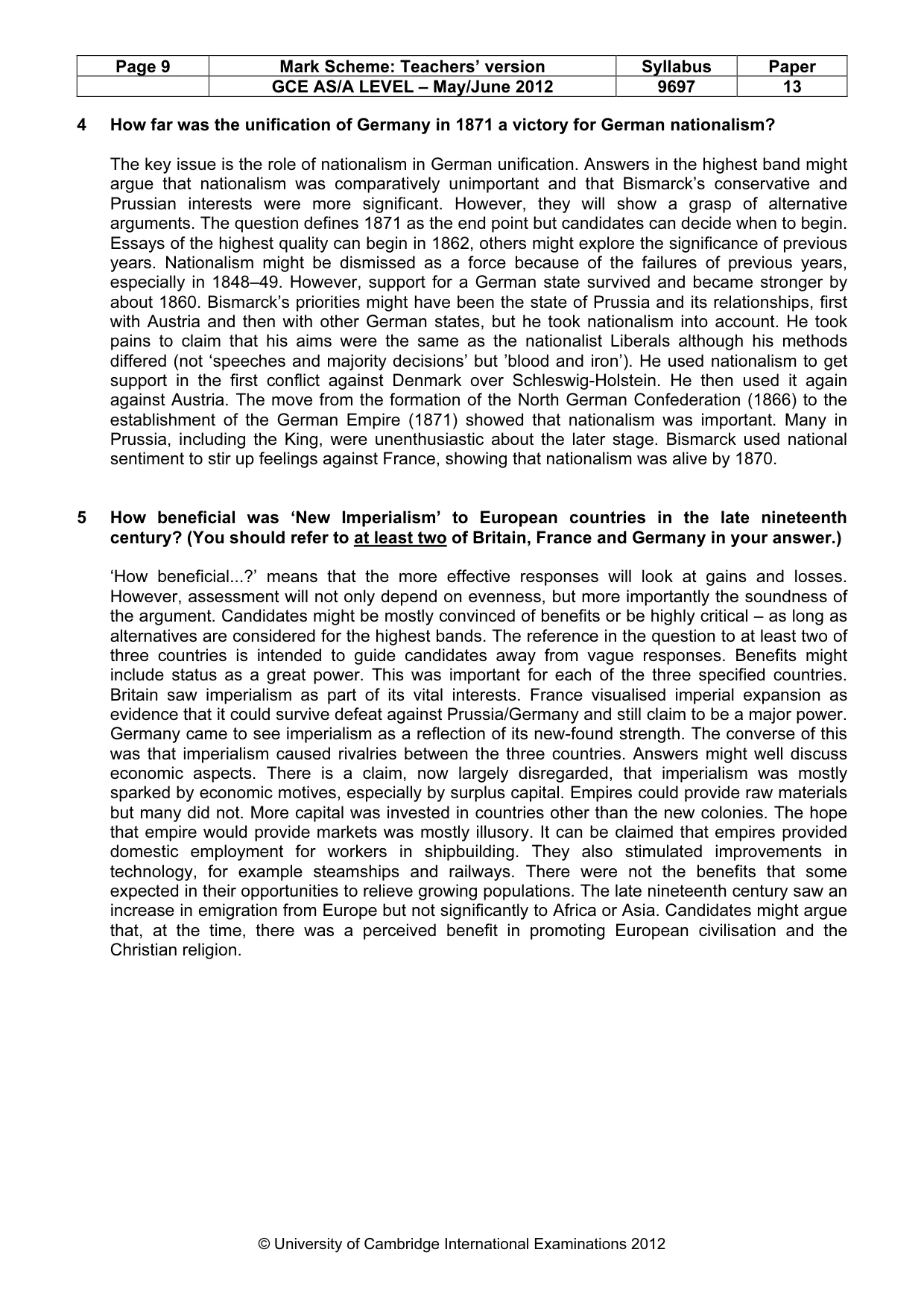
Page 9 Mark Scheme: Teachers’ version Syllabus Paper GCE AS/A LEVEL – May/June 2012 9697 13 © University of Cambridge International Examinations 2012 4 How far was the unification of Germany in 1871 a victory for German nationalism? The key issue is the role of nationalism in German unification. Answers in the highest band might argue that nationalism was comparatively unimportant and that Bismarck’s conservative and Prussian interests were more significant. However, they will show a grasp of alternative arguments. The question defines 1871 as the end point but candidates can decide when to begin. Essays of the highest quality can begin in 1862, others might explore the significance of previous years. Nationalism might be dismissed as a force because of the failures of previous years, especially in 1848–49. However, support for a German state survived and became stronger by about 1860. Bismarck’s priorities might have been the state of Prussia and its relationships, first with Austria and then with other German states, but he took nationalism into account. He took pains to claim that his aims were the same as the nationalist Liberals although his methods differed (not ‘speeches and majority decisions’ but ’blood and iron’). He used nationalism to get support in the first conflict against Denmark over Schleswig-Holstein. He then used it again against Austria. The move from the formation of the North German Confederation (1866) to the establishment of the German Empire (1871) showed that nationalism was important. Many in Prussia, including the King, were unenthusiastic about the later stage. Bismarck used national sentiment to stir up feelings against France, showing that nationalism was alive by 1870. 5 How beneficial was ‘New Imperialism’ to European countries in the late nineteenth century? (You should refer to at least two of Britain, France and Germany in your answer.) ‘How beneficial...?’ means that the more effective responses will look at gains and losses. However, assessment will not only depend on evenness, but more importantly the soundness of the argument. Candidates might be mostly convinced of benefits or be highly critical – as long as alternatives are considered for the highest bands. The reference in the question to at least two of three countries is intended to guide candidates away from vague responses. Benefits might include status as a great power. This was important for each of the three specified countries. Britain saw imperialism as part of its vital interests. France visualised imperial expansion as evidence that it could survive defeat against Prussia/Germany and still claim to be a major power. Germany came to see imperialism as a reflection of its new-found strength. The converse of this was that imperialism caused rivalries between the three countries. Answers might well discuss economic aspects. There is a claim, now largely disregarded, that imperialism was mostly sparked by economic motives, especially by surplus capital. Empires could provide raw materials but many did not. More capital was invested in countries other than the new colonies. The hope that empire would provide markets was mostly illusory. It can be claimed that empires provided domestic employment for workers in shipbuilding. They also stimulated improvements in technology, for example steamships and railways. There were not the benefits that some expected in their opportunities to relieve growing populations. The late nineteenth century saw an increase in emigration from Europe but not significantly to Africa or Asia. Candidates might argue that, at the time, there was a perceived benefit in promoting European civilisation and the Christian religion.
Mark scheme, page 10
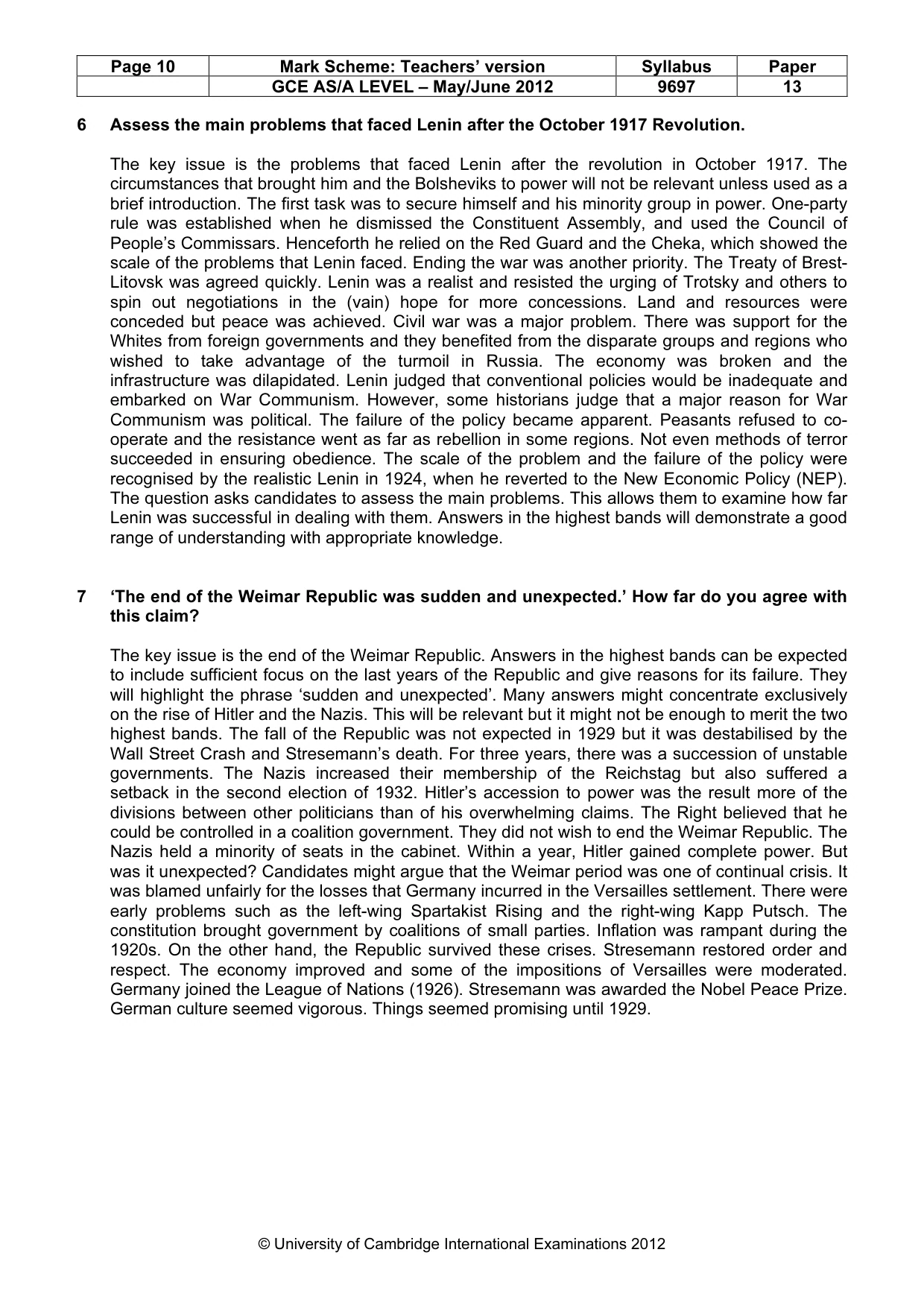
Page 10 Mark Scheme: Teachers’ version Syllabus Paper GCE AS/A LEVEL – May/June 2012 9697 13 © University of Cambridge International Examinations 2012 6 Assess the main problems that faced Lenin after the October 1917 Revolution. The key issue is the problems that faced Lenin after the revolution in October 1917. The circumstances that brought him and the Bolsheviks to power will not be relevant unless used as a brief introduction. The first task was to secure himself and his minority group in power. One-party rule was established when he dismissed the Constituent Assembly, and used the Council of People’s Commissars. Henceforth he relied on the Red Guard and the Cheka, which showed the scale of the problems that Lenin faced. Ending the war was another priority. The Treaty of Brest- Litovsk was agreed quickly. Lenin was a realist and resisted the urging of Trotsky and others to spin out negotiations in the (vain) hope for more concessions. Land and resources were conceded but peace was achieved. Civil war was a major problem. There was support for the Whites from foreign governments and they benefited from the disparate groups and regions who wished to take advantage of the turmoil in Russia. The economy was broken and the infrastructure was dilapidated. Lenin judged that conventional policies would be inadequate and embarked on War Communism. However, some historians judge that a major reason for War Communism was political. The failure of the policy became apparent. Peasants refused to co- operate and the resistance went as far as rebellion in some regions. Not even methods of terror succeeded in ensuring obedience. The scale of the problem and the failure of the policy were recognised by the realistic Lenin in 1924, when he reverted to the New Economic Policy (NEP). The question asks candidates to assess the main problems. This allows them to examine how far Lenin was successful in dealing with them. Answers in the highest bands will demonstrate a good range of understanding with appropriate knowledge. 7 ‘The end of the Weimar Republic was sudden and unexpected.’ How far do you agree with this claim? The key issue is the end of the Weimar Republic. Answers in the highest bands can be expected to include sufficient focus on the last years of the Republic and give reasons for its failure. They will highlight the phrase ‘sudden and unexpected’. Many answers might concentrate exclusively on the rise of Hitler and the Nazis. This will be relevant but it might not be enough to merit the two highest bands. The fall of the Republic was not expected in 1929 but it was destabilised by the Wall Street Crash and Stresemann’s death. For three years, there was a succession of unstable governments. The Nazis increased their membership of the Reichstag but also suffered a setback in the second election of 1932. Hitler’s accession to power was the result more of the divisions between other politicians than of his overwhelming claims. The Right believed that he could be controlled in a coalition government. They did not wish to end the Weimar Republic. The Nazis held a minority of seats in the cabinet. Within a year, Hitler gained complete power. But was it unexpected? Candidates might argue that the Weimar period was one of continual crisis. It was blamed unfairly for the losses that Germany incurred in the Versailles settlement. There were early problems such as the left-wing Spartakist Rising and the right-wing Kapp Putsch. The constitution brought government by coalitions of small parties. Inflation was rampant during the 1920s. On the other hand, the Republic survived these crises. Stresemann restored order and respect. The economy improved and some of the impositions of Versailles were moderated. Germany joined the League of Nations (1926). Stresemann was awarded the Nobel Peace Prize. German culture seemed vigorous. Things seemed promising until 1929.
Mark scheme, page 11
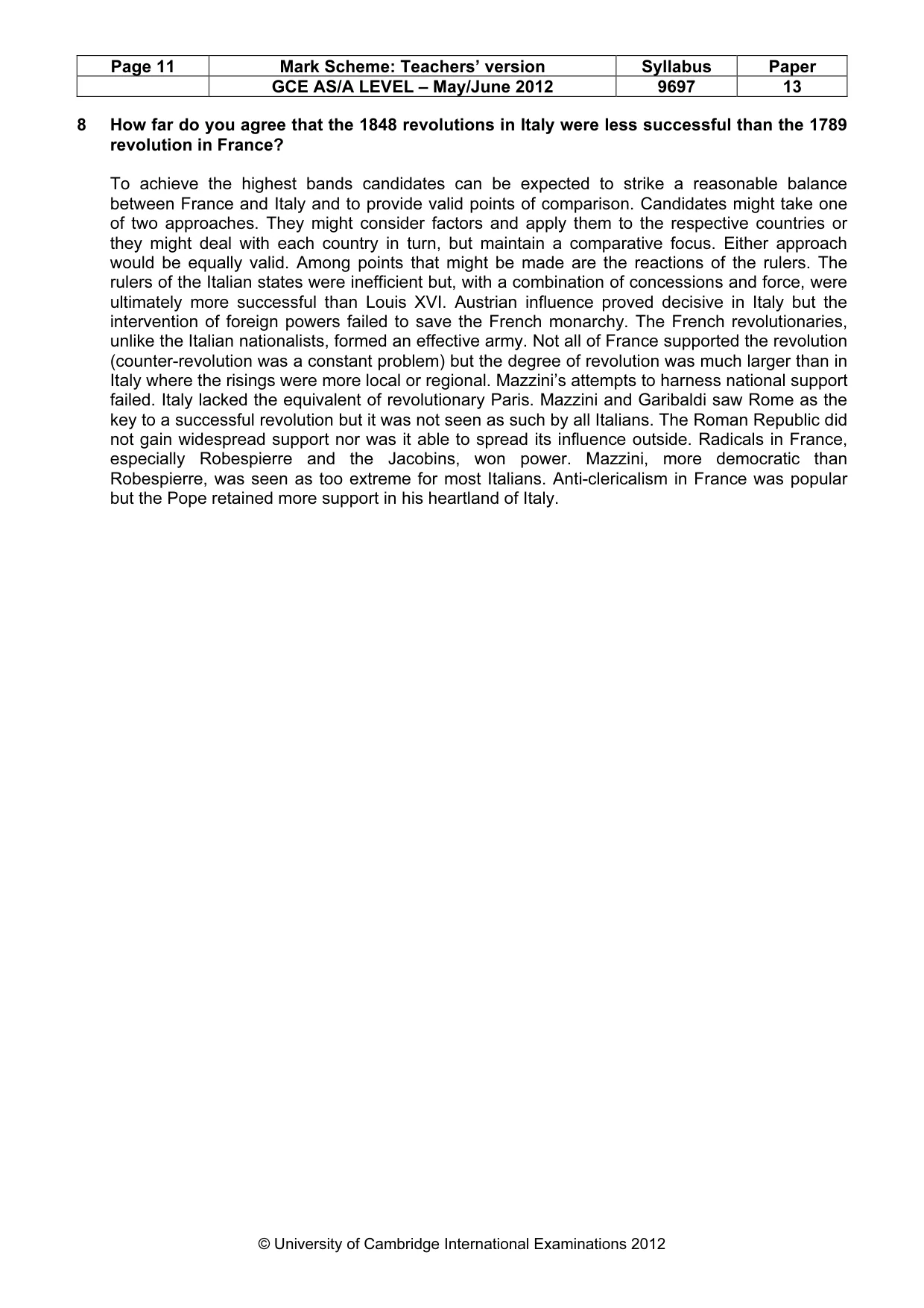
Page 11 Mark Scheme: Teachers’ version Syllabus Paper GCE AS/A LEVEL – May/June 2012 9697 13 © University of Cambridge International Examinations 2012 8 How far do you agree that the 1848 revolutions in Italy were less successful than the 1789 revolution in France? To achieve the highest bands candidates can be expected to strike a reasonable balance between France and Italy and to provide valid points of comparison. Candidates might take one of two approaches. They might consider factors and apply them to the respective countries or they might deal with each country in turn, but maintain a comparative focus. Either approach would be equally valid. Among points that might be made are the reactions of the rulers. The rulers of the Italian states were inefficient but, with a combination of concessions and force, were ultimately more successful than Louis XVI. Austrian influence proved decisive in Italy but the intervention of foreign powers failed to save the French monarchy. The French revolutionaries, unlike the Italian nationalists, formed an effective army. Not all of France supported the revolution (counter-revolution was a constant problem) but the degree of revolution was much larger than in Italy where the risings were more local or regional. Mazzini’s attempts to harness national support failed. Italy lacked the equivalent of revolutionary Paris. Mazzini and Garibaldi saw Rome as the key to a successful revolution but it was not seen as such by all Italians. The Roman Republic did not gain widespread support nor was it able to spread its influence outside. Radicals in France, especially Robespierre and the Jacobins, won power. Mazzini, more democratic than Robespierre, was seen as too extreme for most Italians. Anti-clericalism in France was popular but the Pope retained more support in his heartland of Italy.
What you needed in this session
Cambridge’s own grade thresholds for 2012 May/June, Paper 1 · Variant 3. A higher threshold means an easier paper — the bar moves with how the cohort did.