Cambridge A Level History (pre-2015) 9697 — 2012 Oct/Nov Paper 1 · Variant 2
9697/12/O/N/12
The question paper and its mark scheme, free to read here and free to download. This is Cambridge’s own paper, exactly as it was sat.
Question paper4 pages
Mark scheme11 pages
Answers below. Sit the paper first if you are practising.
Paper as text
Question paper, page 1
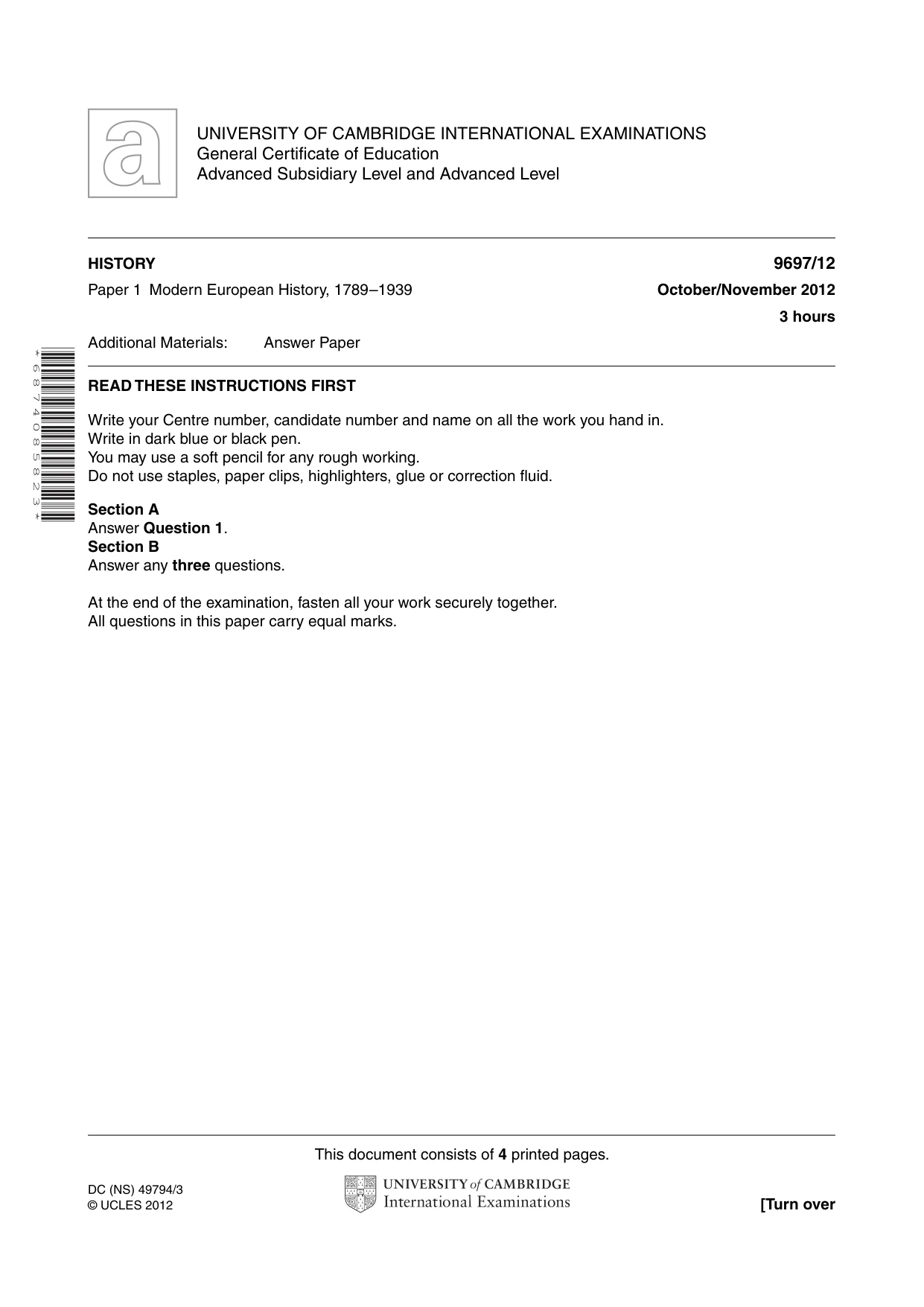
This document consists of 4 printed pages. DC (NS) 49794/3 © UCLES 2012 [Turn over UNIVERSITY OF CAMBRIDGE INTERNATIONAL EXAMINATIONS General Certificate of Education Advanced Subsidiary Level and Advanced Level * 6 8 7 4 0 8 5 8 2 3 * HISTORY 9697/12 Paper 1 Modern European History, 1789–1939 October/November 2012 3 hours Additional Materials: Answer Paper READ THESE INSTRUCTIONS FIRST Write your Centre number, candidate number and name on all the work you hand in. Write in dark blue or black pen. You may use a soft pencil for any rough working. Do not use staples, paper clips, highlighters, glue or correction fluid. Section A Answer Question 1. Section B Answer any three questions. At the end of the examination, fasten all your work securely together. All questions in this paper carry equal marks.
Question paper, page 2
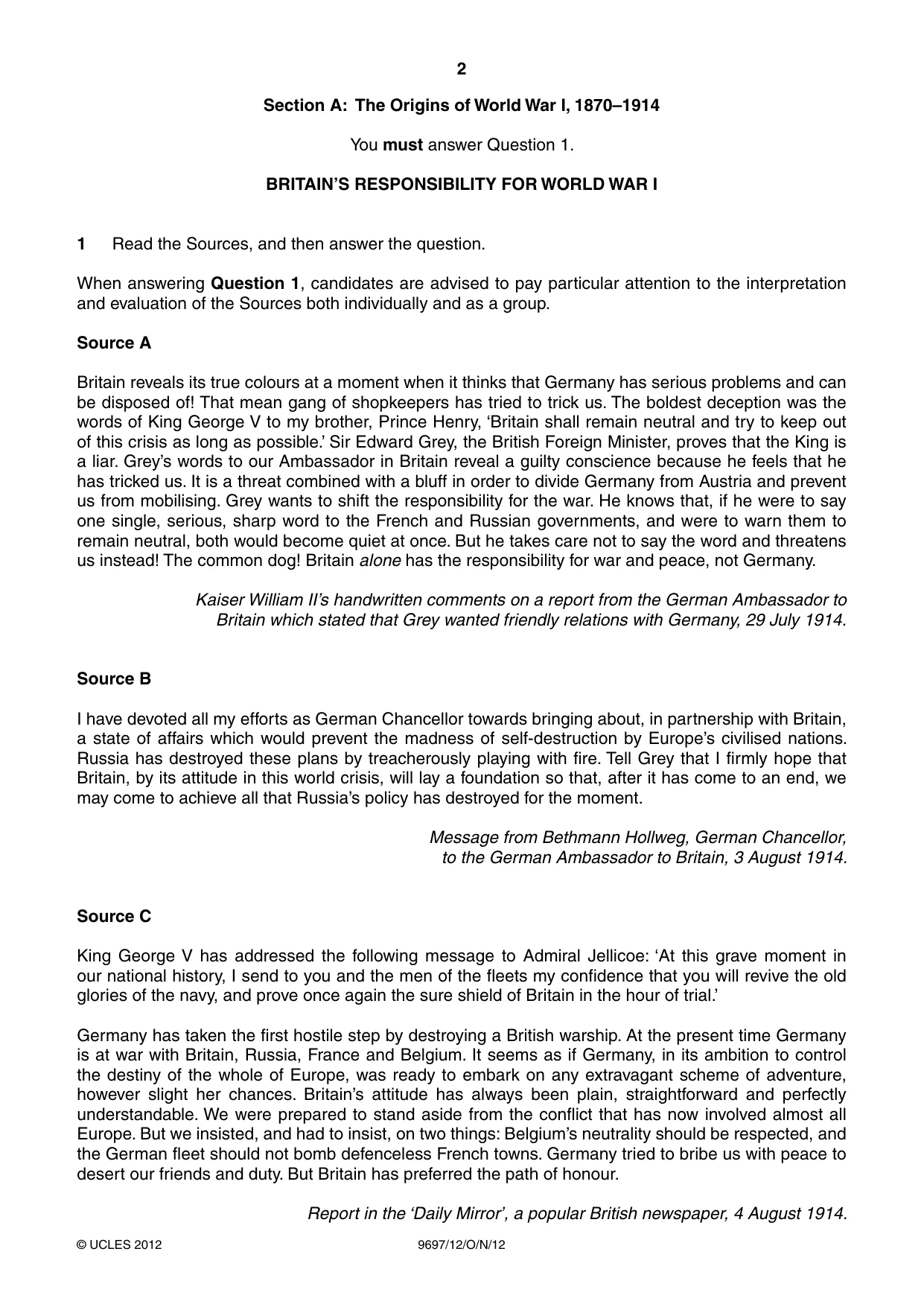
2 9697/12/O/N/12 © UCLES 2012 Section A: The Origins of World War I, 1870–1914 You must answer Question 1. BRITAIN’S RESPONSIBILITY FOR WORLD WAR I 1 Read the Sources, and then answer the question. When answering Question 1, candidates are advised to pay particular attention to the interpretation and evaluation of the Sources both individually and as a group. Source A Britain reveals its true colours at a moment when it thinks that Germany has serious problems and can be disposed of! That mean gang of shopkeepers has tried to trick us. The boldest deception was the words of King George V to my brother, Prince Henry, ‘Britain shall remain neutral and try to keep out of this crisis as long as possible.’ Sir Edward Grey, the British Foreign Minister, proves that the King is a liar. Grey’s words to our Ambassador in Britain reveal a guilty conscience because he feels that he has tricked us. It is a threat combined with a bluff in order to divide Germany from Austria and prevent us from mobilising. Grey wants to shift the responsibility for the war. He knows that, if he were to say one single, serious, sharp word to the French and Russian governments, and were to warn them to remain neutral, both would become quiet at once. But he takes care not to say the word and threatens us instead! The common dog! Britain alone has the responsibility for war and peace, not Germany. Kaiser William II’s handwritten comments on a report from the German Ambassador to Britain which stated that Grey wanted friendly relations with Germany, 29 July 1914. Source B I have devoted all my efforts as German Chancellor towards bringing about, in partnership with Britain, a state of affairs which would prevent the madness of self-destruction by Europe’s civilised nations. Russia has destroyed these plans by treacherously playing with fire. Tell Grey that I firmly hope that Britain, by its attitude in this world crisis, will lay a foundation so that, after it has come to an end, we may come to achieve all that Russia’s policy has destroyed for the moment. Message from Bethmann Hollweg, German Chancellor, to the German Ambassador to Britain, 3 August 1914. Source C King George V has addressed the following message to Admiral Jellicoe: ‘At this grave moment in our national history, I send to you and the men of the fleets my confidence that you will revive the old glories of the navy, and prove once again the sure shield of Britain in the hour of trial.’ Germany has taken the first hostile step by destroying a British warship. At the present time Germany is at war with Britain, Russia, France and Belgium. It seems as if Germany, in its ambition to control the destiny of the whole of Europe, was ready to embark on any extravagant scheme of adventure, however slight her chances. Britain’s attitude has always been plain, straightforward and perfectly understandable. We were prepared to stand aside from the conflict that has now involved almost all Europe. But we insisted, and had to insist, on two things: Belgium’s neutrality should be respected, and the German fleet should not bomb defenceless French towns. Germany tried to bribe us with peace to desert our friends and duty. But Britain has preferred the path of honour. Report in the ‘Daily Mirror’, a popular British newspaper, 4 August 1914.
Question paper, page 3
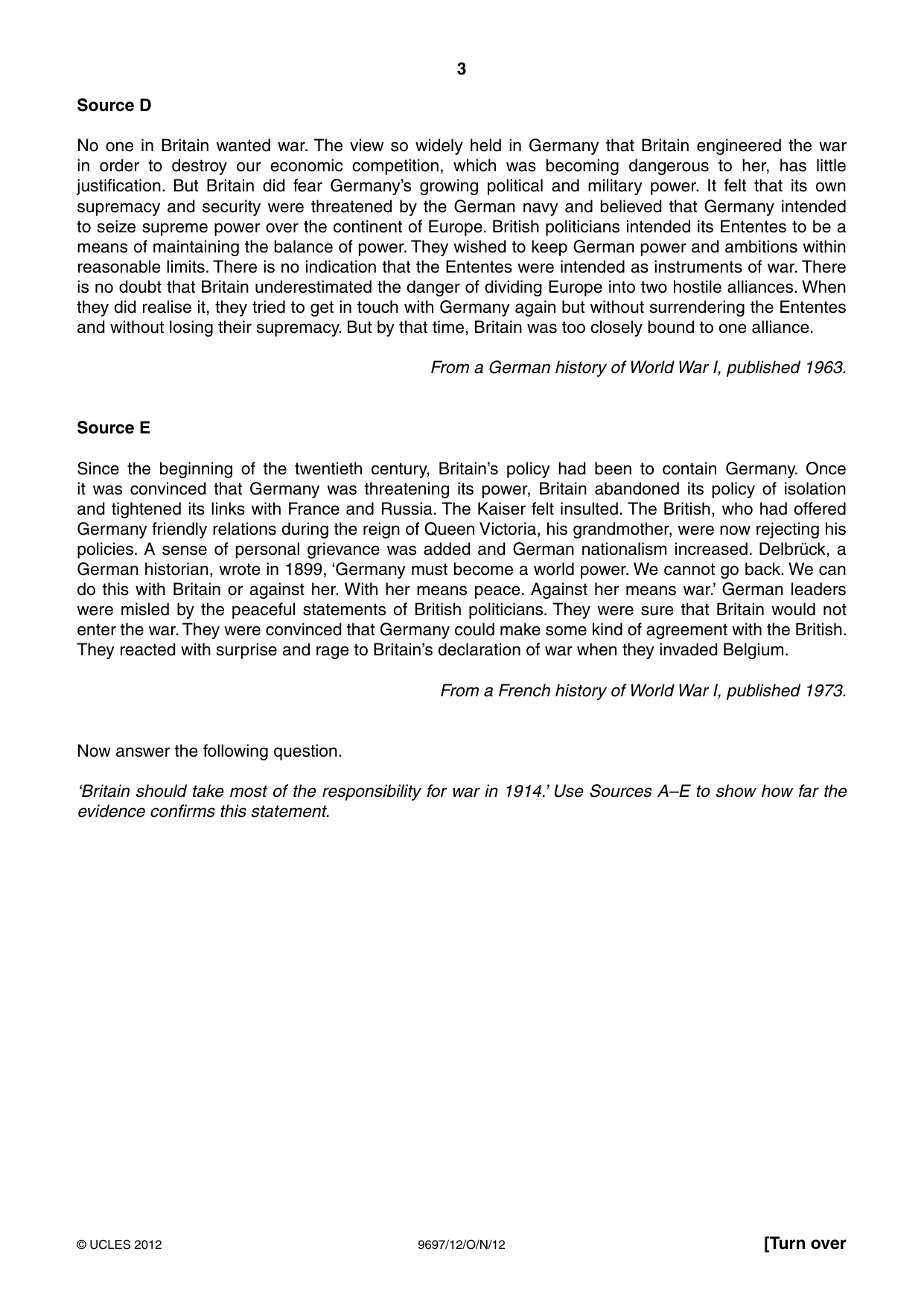
3 9697/12/O/N/12 © UCLES 2012 [Turn over Source D No one in Britain wanted war. The view so widely held in Germany that Britain engineered the war in order to destroy our economic competition, which was becoming dangerous to her, has little justification. But Britain did fear Germany’s growing political and military power. It felt that its own supremacy and security were threatened by the German navy and believed that Germany intended to seize supreme power over the continent of Europe. British politicians intended its Ententes to be a means of maintaining the balance of power. They wished to keep German power and ambitions within reasonable limits. There is no indication that the Ententes were intended as instruments of war. There is no doubt that Britain underestimated the danger of dividing Europe into two hostile alliances. When they did realise it, they tried to get in touch with Germany again but without surrendering the Ententes and without losing their supremacy. But by that time, Britain was too closely bound to one alliance. From a German history of World War I, published 1963. Source E Since the beginning of the twentieth century, Britain’s policy had been to contain Germany. Once it was convinced that Germany was threatening its power, Britain abandoned its policy of isolation and tightened its links with France and Russia. The Kaiser felt insulted. The British, who had offered Germany friendly relations during the reign of Queen Victoria, his grandmother, were now rejecting his policies. A sense of personal grievance was added and German nationalism increased. Delbrück, a German historian, wrote in 1899, ‘Germany must become a world power. We cannot go back. We can do this with Britain or against her. With her means peace. Against her means war.’ German leaders were misled by the peaceful statements of British politicians. They were sure that Britain would not enter the war. They were convinced that Germany could make some kind of agreement with the British. They reacted with surprise and rage to Britain’s declaration of war when they invaded Belgium. From a French history of World War I, published 1973. Now answer the following question. ‘Britain should take most of the responsibility for war in 1914.’ Use Sources A–E to show how far the evidence confirms this statement.
Question paper, page 4
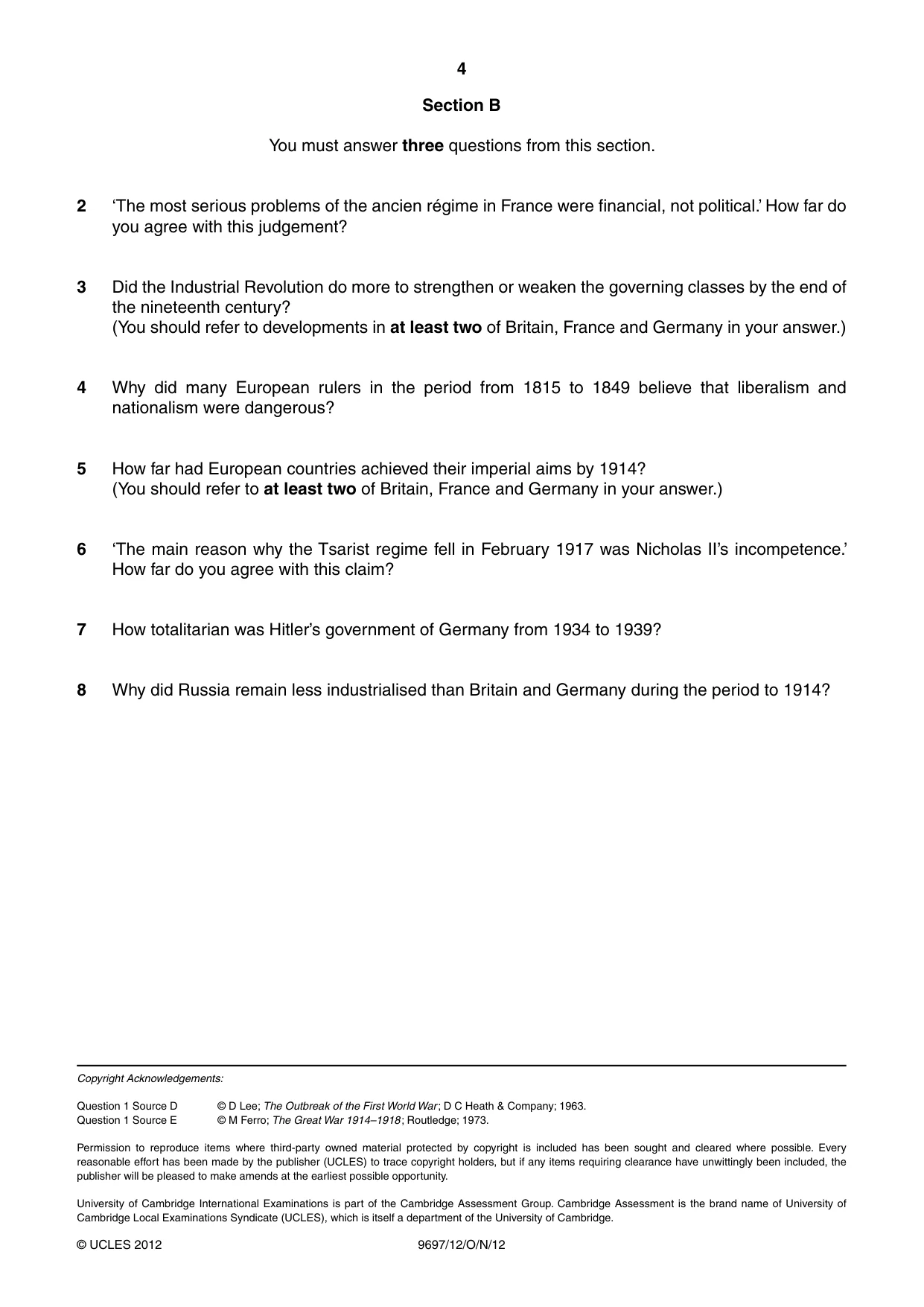
4 9697/12/O/N/12 © UCLES 2012 Section B You must answer three questions from this section. 2 ‘The most serious problems of the ancien régime in France were financial, not political.’ How far do you agree with this judgement? 3 Did the Industrial Revolution do more to strengthen or weaken the governing classes by the end of the nineteenth century? (You should refer to developments in at least two of Britain, France and Germany in your answer.) 4 Why did many European rulers in the period from 1815 to 1849 believe that liberalism and nationalism were dangerous? 5 How far had European countries achieved their imperial aims by 1914? (You should refer to at least two of Britain, France and Germany in your answer.) 6 ‘The main reason why the Tsarist regime fell in February 1917 was Nicholas II’s incompetence.’ How far do you agree with this claim? 7 How totalitarian was Hitler’s government of Germany from 1934 to 1939? 8 Why did Russia remain less industrialised than Britain and Germany during the period to 1914? Copyright Acknowledgements: Question 1 Source D © D Lee; The Outbreak of the First World War ; D C Heath & Company; 1963. Question 1 Source E © M Ferro; The Great War 1914–1918 ; Routledge; 1973. Permission to reproduce items where third-party owned material protected by copyright is included has been sought and cleared where possible. Every reasonable effort has been made by the publisher (UCLES) to trace copyright holders, but if any items requiring clearance have unwittingly been included, the publisher will be pleased to make amends at the earliest possible opportunity. University of Cambridge International Examinations is part of the Cambridge Assessment Group. Cambridge Assessment is the brand name of University of Cambridge Local Examinations Syndicate (UCLES), which is itself a department of the University of Cambridge.
Mark scheme, page 1
CAMBRIDGE INTERNATIONAL EXAMINATIONS GCE Advanced Subsidiary Level and GCE Advanced Level MARK SCHEME for the October/November 2012 series 9697 HISTORY 9697/12 Paper 1, maximum raw mark 100 This mark scheme is published as an aid to teachers and candidates, to indicate the requirements of the examination. It shows the basis on which Examiners were instructed to award marks. It does not indicate the details of the discussions that took place at an Examiners’ meeting before marking began, which would have considered the acceptability of alternative answers. Mark schemes should be read in conjunction with the question paper and the Principal Examiner Report for Teachers. Cambridge will not enter into discussions about these mark schemes. Cambridge is publishing the mark schemes for the October/November 2012 series for most IGCSE, GCE Advanced Level and Advanced Subsidiary Level components and some Ordinary Level components.
Mark scheme, page 2
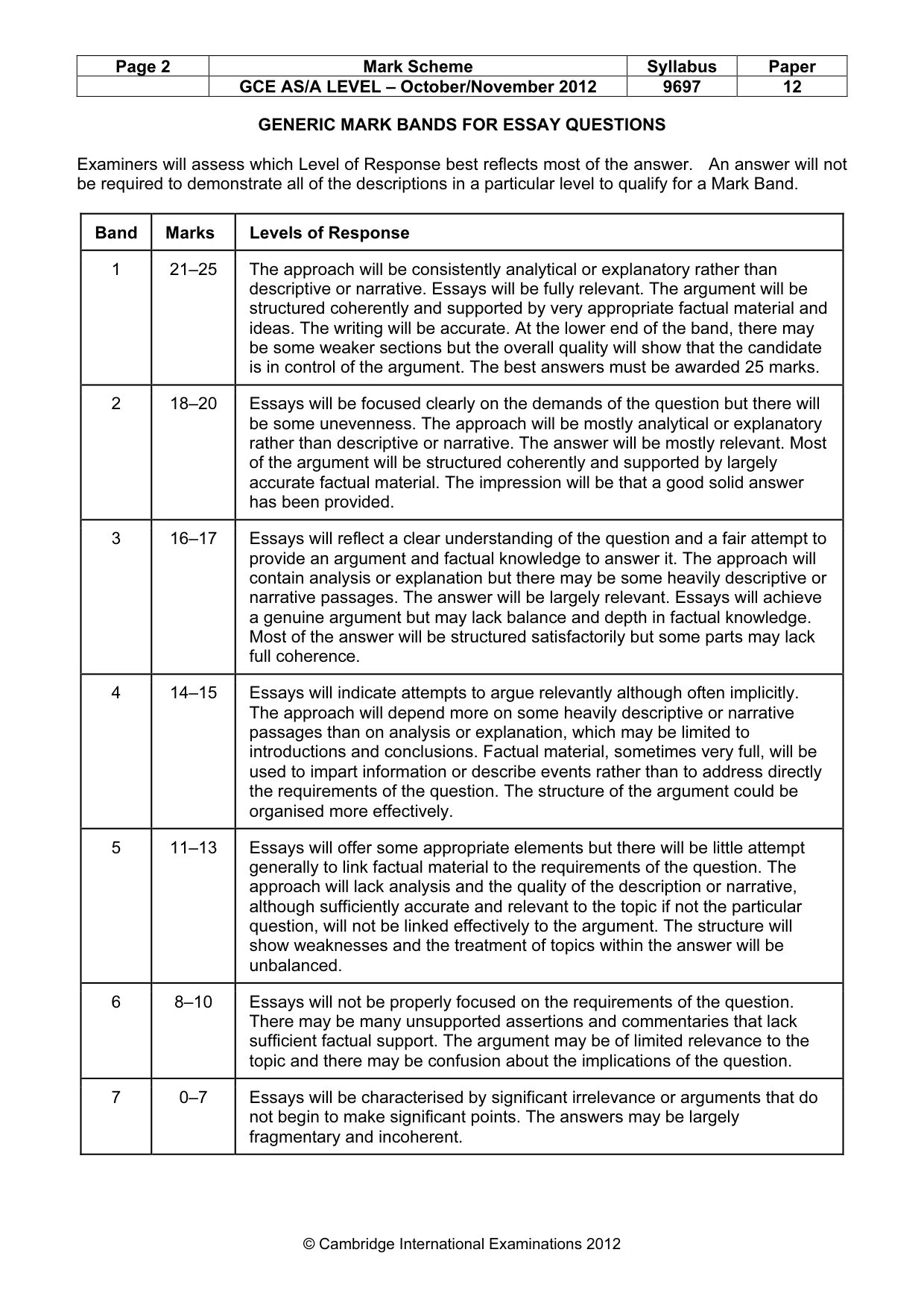
Page 2 Mark Scheme Syllabus Paper GCE AS/A LEVEL – October/November 2012 9697 12 © Cambridge International Examinations 2012 GENERIC MARK BANDS FOR ESSAY QUESTIONS Examiners will assess which Level of Response best reflects most of the answer. An answer will not be required to demonstrate all of the descriptions in a particular level to qualify for a Mark Band. Band Marks Levels of Response 1 21–25 The approach will be consistently analytical or explanatory rather than descriptive or narrative. Essays will be fully relevant. The argument will be structured coherently and supported by very appropriate factual material and ideas. The writing will be accurate. At the lower end of the band, there may be some weaker sections but the overall quality will show that the candidate is in control of the argument. The best answers must be awarded 25 marks. 2 18–20 Essays will be focused clearly on the demands of the question but there will be some unevenness. The approach will be mostly analytical or explanatory rather than descriptive or narrative. The answer will be mostly relevant. Most of the argument will be structured coherently and supported by largely accurate factual material. The impression will be that a good solid answer has been provided. 3 16–17 Essays will reflect a clear understanding of the question and a fair attempt to provide an argument and factual knowledge to answer it. The approach will contain analysis or explanation but there may be some heavily descriptive or narrative passages. The answer will be largely relevant. Essays will achieve a genuine argument but may lack balance and depth in factual knowledge. Most of the answer will be structured satisfactorily but some parts may lack full coherence. 4 14–15 Essays will indicate attempts to argue relevantly although often implicitly. The approach will depend more on some heavily descriptive or narrative passages than on analysis or explanation, which may be limited to introductions and conclusions. Factual material, sometimes very full, will be used to impart information or describe events rather than to address directly the requirements of the question. The structure of the argument could be organised more effectively. 5 11–13 Essays will offer some appropriate elements but there will be little attempt generally to link factual material to the requirements of the question. The approach will lack analysis and the quality of the description or narrative, although sufficiently accurate and relevant to the topic if not the particular question, will not be linked effectively to the argument. The structure will show weaknesses and the treatment of topics within the answer will be unbalanced. 6 8–10 Essays will not be properly focused on the requirements of the question. There may be many unsupported assertions and commentaries that lack sufficient factual support. The argument may be of limited relevance to the topic and there may be confusion about the implications of the question. 7 0–7 Essays will be characterised by significant irrelevance or arguments that do not begin to make significant points. The answers may be largely fragmentary and incoherent.
Mark scheme, page 3
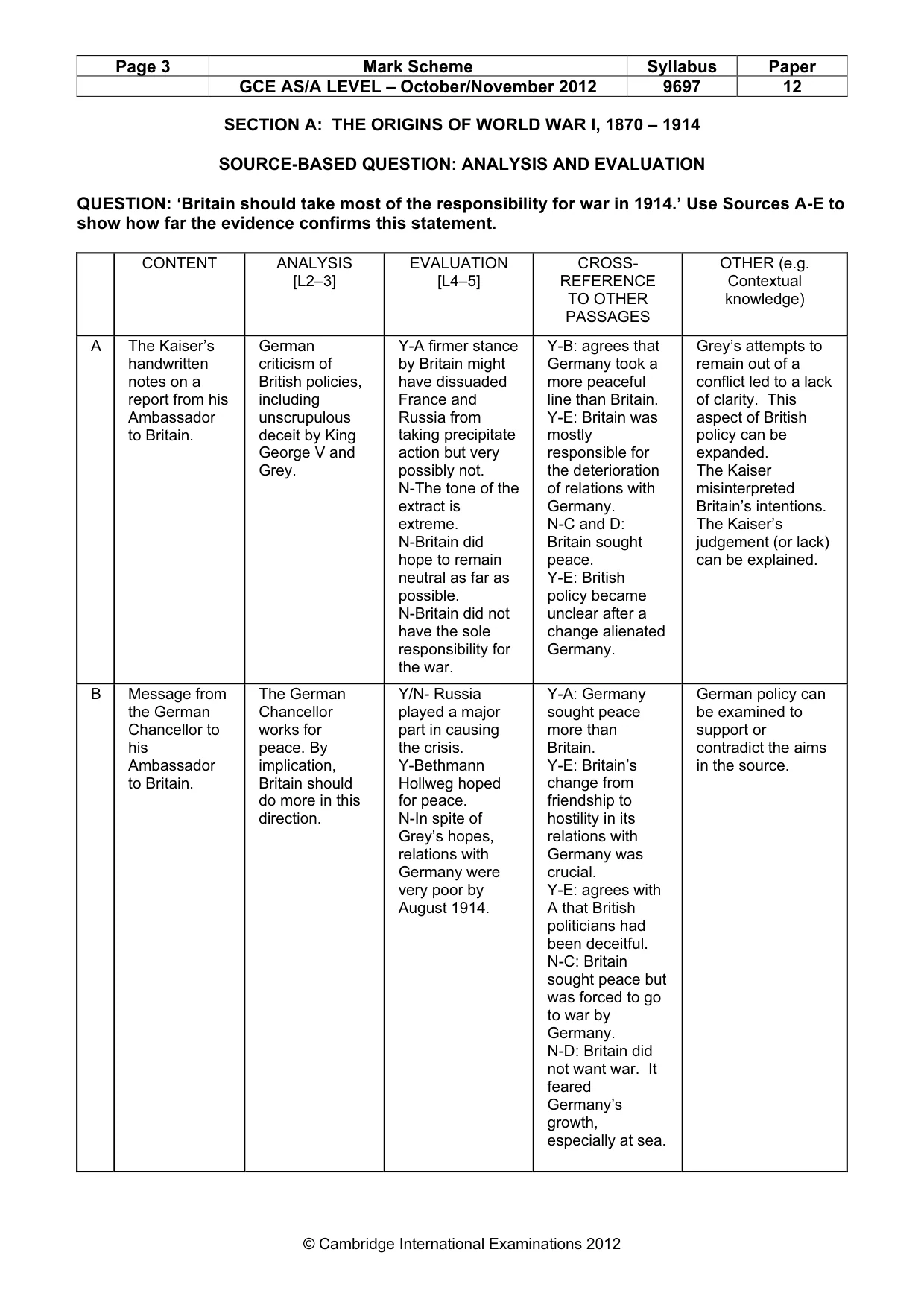
Page 3 Mark Scheme Syllabus Paper GCE AS/A LEVEL – October/November 2012 9697 12 © Cambridge International Examinations 2012 SECTION A: THE ORIGINS OF WORLD WAR I, 1870 – 1914 SOURCE-BASED QUESTION: ANALYSIS AND EVALUATION QUESTION: ‘Britain should take most of the responsibility for war in 1914.’ Use Sources A-E to show how far the evidence confirms this statement. CONTENT ANALYSIS [L2–3] EVALUATION [L4–5] CROSS- REFERENCE TO OTHER PASSAGES OTHER (e.g. Contextual knowledge) A The Kaiser’s handwritten notes on a report from his Ambassador to Britain. German criticism of British policies, including unscrupulous deceit by King George V and Grey. Y-A firmer stance by Britain might have dissuaded France and Russia from taking precipitate action but very possibly not. N-The tone of the extract is extreme. N-Britain did hope to remain neutral as far as possible. N-Britain did not have the sole responsibility for the war. Y-B: agrees that Germany took a more peaceful line than Britain. Y-E: Britain was mostly responsible for the deterioration of relations with Germany. N-C and D: Britain sought peace. Y-E: British policy became unclear after a change alienated Germany. Grey’s attempts to remain out of a conflict led to a lack of clarity. This aspect of British policy can be expanded. The Kaiser misinterpreted Britain’s intentions. The Kaiser’s judgement (or lack) can be explained. B Message from the German Chancellor to his Ambassador to Britain. The German Chancellor works for peace. By implication, Britain should do more in this direction. Y/N- Russia played a major part in causing the crisis. Y-Bethmann Hollweg hoped for peace. N-In spite of Grey’s hopes, relations with Germany were very poor by August 1914. Y-A: Germany sought peace more than Britain. Y-E: Britain’s change from friendship to hostility in its relations with Germany was crucial. Y-E: agrees with A that British politicians had been deceitful. N-C: Britain sought peace but was forced to go to war by Germany. N-D: Britain did not want war. It feared Germany’s growth, especially at sea. German policy can be examined to support or contradict the aims in the source.
Mark scheme, page 4
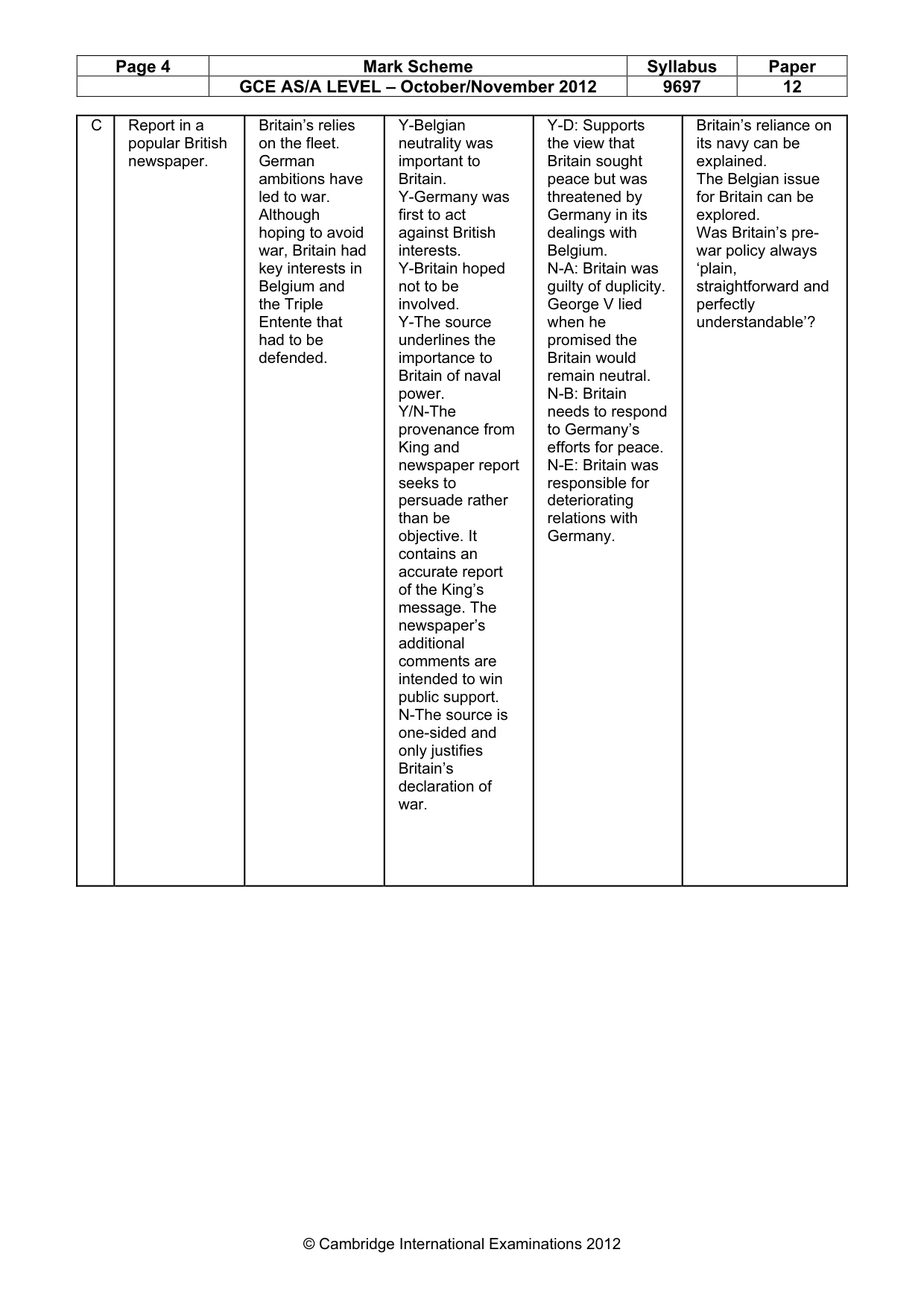
Page 4 Mark Scheme Syllabus Paper GCE AS/A LEVEL – October/November 2012 9697 12 © Cambridge International Examinations 2012 C Report in a popular British newspaper. Britain’s relies on the fleet. German ambitions have led to war. Although hoping to avoid war, Britain had key interests in Belgium and the Triple Entente that had to be defended. Y-Belgian neutrality was important to Britain. Y-Germany was first to act against British interests. Y-Britain hoped not to be involved. Y-The source underlines the importance to Britain of naval power. Y/N-The provenance from King and newspaper report seeks to persuade rather than be objective. It contains an accurate report of the King’s message. The newspaper’s additional comments are intended to win public support. N-The source is one-sided and only justifies Britain’s declaration of war. Y-D: Supports the view that Britain sought peace but was threatened by Germany in its dealings with Belgium. N-A: Britain was guilty of duplicity. George V lied when he promised the Britain would remain neutral. N-B: Britain needs to respond to Germany’s efforts for peace. N-E: Britain was responsible for deteriorating relations with Germany. Britain’s reliance on its navy can be explained. The Belgian issue for Britain can be explored. Was Britain’s pre- war policy always ‘plain, straightforward and perfectly understandable’?
Mark scheme, page 5
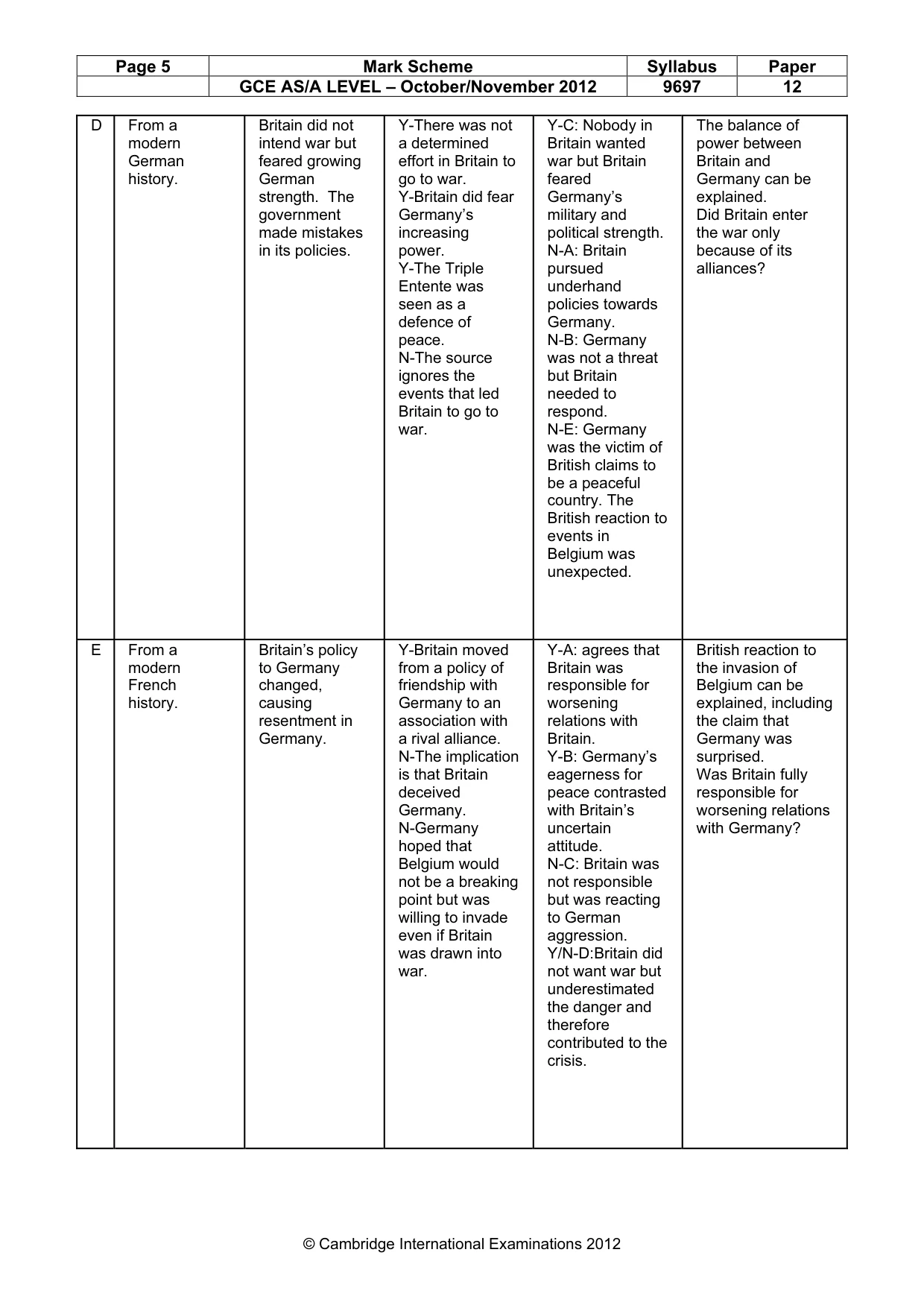
Page 5 Mark Scheme Syllabus Paper GCE AS/A LEVEL – October/November 2012 9697 12 © Cambridge International Examinations 2012 D From a modern German history. Britain did not intend war but feared growing German strength. The government made mistakes in its policies. Y-There was not a determined effort in Britain to go to war. Y-Britain did fear Germany’s increasing power. Y-The Triple Entente was seen as a defence of peace. N-The source ignores the events that led Britain to go to war. Y-C: Nobody in Britain wanted war but Britain feared Germany’s military and political strength. N-A: Britain pursued underhand policies towards Germany. N-B: Germany was not a threat but Britain needed to respond. N-E: Germany was the victim of British claims to be a peaceful country. The British reaction to events in Belgium was unexpected. The balance of power between Britain and Germany can be explained. Did Britain enter the war only because of its alliances? E From a modern French history. Britain’s policy to Germany changed, causing resentment in Germany. Y-Britain moved from a policy of friendship with Germany to an association with a rival alliance. N-The implication is that Britain deceived Germany. N-Germany hoped that Belgium would not be a breaking point but was willing to invade even if Britain was drawn into war. Y-A: agrees that Britain was responsible for worsening relations with Britain. Y-B: Germany’s eagerness for peace contrasted with Britain’s uncertain attitude. N-C: Britain was not responsible but was reacting to German aggression. Y/N-D:Britain did not want war but underestimated the danger and therefore contributed to the crisis. British reaction to the invasion of Belgium can be explained, including the claim that Germany was surprised. Was Britain fully responsible for worsening relations with Germany?
Mark scheme, page 6
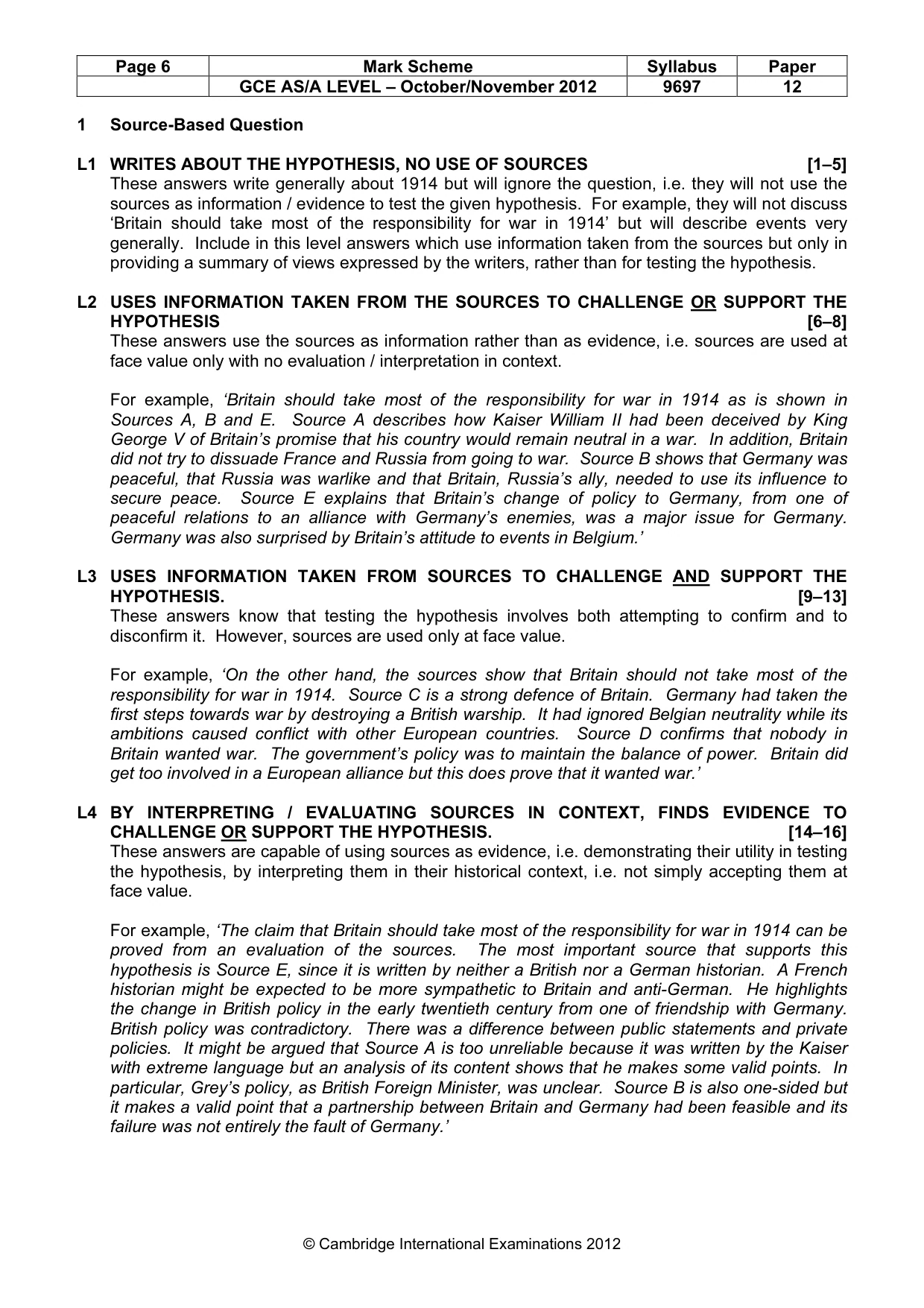
Page 6 Mark Scheme Syllabus Paper GCE AS/A LEVEL – October/November 2012 9697 12 © Cambridge International Examinations 2012 1 Source-Based Question L1 WRITES ABOUT THE HYPOTHESIS, NO USE OF SOURCES [1–5] These answers write generally about 1914 but will ignore the question, i.e. they will not use the sources as information / evidence to test the given hypothesis. For example, they will not discuss ‘Britain should take most of the responsibility for war in 1914’ but will describe events very generally. Include in this level answers which use information taken from the sources but only in providing a summary of views expressed by the writers, rather than for testing the hypothesis. L2 USES INFORMATION TAKEN FROM THE SOURCES TO CHALLENGE OR SUPPORT THE HYPOTHESIS [6–8] These answers use the sources as information rather than as evidence, i.e. sources are used at face value only with no evaluation / interpretation in context. For example, ‘Britain should take most of the responsibility for war in 1914 as is shown in Sources A, B and E. Source A describes how Kaiser William II had been deceived by King George V of Britain’s promise that his country would remain neutral in a war. In addition, Britain did not try to dissuade France and Russia from going to war. Source B shows that Germany was peaceful, that Russia was warlike and that Britain, Russia’s ally, needed to use its influence to secure peace. Source E explains that Britain’s change of policy to Germany, from one of peaceful relations to an alliance with Germany’s enemies, was a major issue for Germany. Germany was also surprised by Britain’s attitude to events in Belgium.’ L3 USES INFORMATION TAKEN FROM SOURCES TO CHALLENGE AND SUPPORT THE HYPOTHESIS. [9–13] These answers know that testing the hypothesis involves both attempting to confirm and to disconfirm it. However, sources are used only at face value. For example, ‘On the other hand, the sources show that Britain should not take most of the responsibility for war in 1914. Source C is a strong defence of Britain. Germany had taken the first steps towards war by destroying a British warship. It had ignored Belgian neutrality while its ambitions caused conflict with other European countries. Source D confirms that nobody in Britain wanted war. The government’s policy was to maintain the balance of power. Britain did get too involved in a European alliance but this does prove that it wanted war.’ L4 BY INTERPRETING / EVALUATING SOURCES IN CONTEXT, FINDS EVIDENCE TO CHALLENGE OR SUPPORT THE HYPOTHESIS. [14–16] These answers are capable of using sources as evidence, i.e. demonstrating their utility in testing the hypothesis, by interpreting them in their historical context, i.e. not simply accepting them at face value. For example, ‘The claim that Britain should take most of the responsibility for war in 1914 can be proved from an evaluation of the sources. The most important source that supports this hypothesis is Source E, since it is written by neither a British nor a German historian. A French historian might be expected to be more sympathetic to Britain and anti-German. He highlights the change in British policy in the early twentieth century from one of friendship with Germany. British policy was contradictory. There was a difference between public statements and private policies. It might be argued that Source A is too unreliable because it was written by the Kaiser with extreme language but an analysis of its content shows that he makes some valid points. In particular, Grey’s policy, as British Foreign Minister, was unclear. Source B is also one-sided but it makes a valid point that a partnership between Britain and Germany had been feasible and its failure was not entirely the fault of Germany.’
Mark scheme, page 7
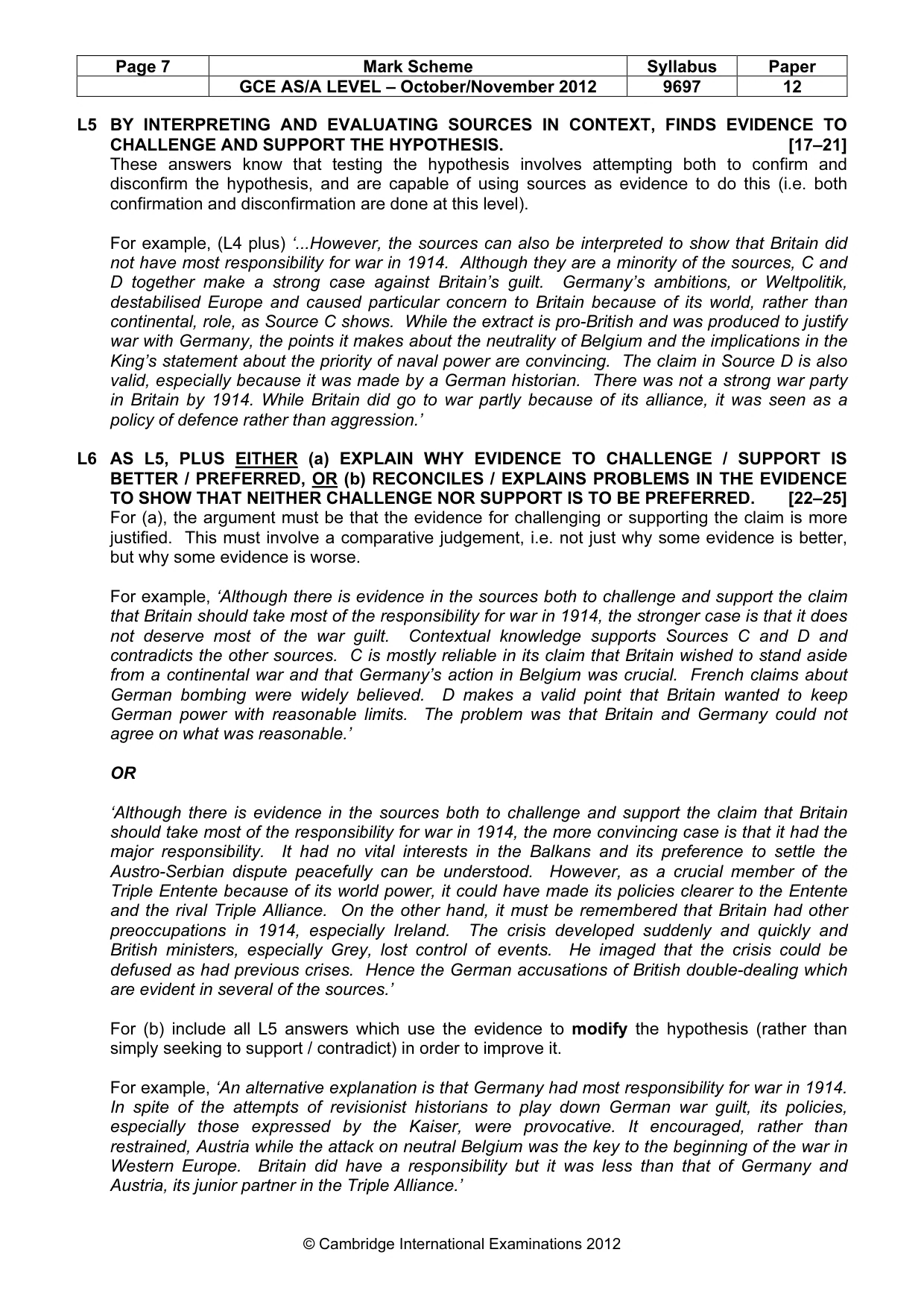
Page 7 Mark Scheme Syllabus Paper GCE AS/A LEVEL – October/November 2012 9697 12 © Cambridge International Examinations 2012 L5 BY INTERPRETING AND EVALUATING SOURCES IN CONTEXT, FINDS EVIDENCE TO CHALLENGE AND SUPPORT THE HYPOTHESIS. [17–21] These answers know that testing the hypothesis involves attempting both to confirm and disconfirm the hypothesis, and are capable of using sources as evidence to do this (i.e. both confirmation and disconfirmation are done at this level). For example, (L4 plus) ‘...However, the sources can also be interpreted to show that Britain did not have most responsibility for war in 1914. Although they are a minority of the sources, C and D together make a strong case against Britain’s guilt. Germany’s ambitions, or Weltpolitik, destabilised Europe and caused particular concern to Britain because of its world, rather than continental, role, as Source C shows. While the extract is pro-British and was produced to justify war with Germany, the points it makes about the neutrality of Belgium and the implications in the King’s statement about the priority of naval power are convincing. The claim in Source D is also valid, especially because it was made by a German historian. There was not a strong war party in Britain by 1914. While Britain did go to war partly because of its alliance, it was seen as a policy of defence rather than aggression.’ L6 AS L5, PLUS EITHER (a) EXPLAIN WHY EVIDENCE TO CHALLENGE / SUPPORT IS BETTER / PREFERRED, OR (b) RECONCILES / EXPLAINS PROBLEMS IN THE EVIDENCE TO SHOW THAT NEITHER CHALLENGE NOR SUPPORT IS TO BE PREFERRED. [22–25] For (a), the argument must be that the evidence for challenging or supporting the claim is more justified. This must involve a comparative judgement, i.e. not just why some evidence is better, but why some evidence is worse. For example, ‘Although there is evidence in the sources both to challenge and support the claim that Britain should take most of the responsibility for war in 1914, the stronger case is that it does not deserve most of the war guilt. Contextual knowledge supports Sources C and D and contradicts the other sources. C is mostly reliable in its claim that Britain wished to stand aside from a continental war and that Germany’s action in Belgium was crucial. French claims about German bombing were widely believed. D makes a valid point that Britain wanted to keep German power with reasonable limits. The problem was that Britain and Germany could not agree on what was reasonable.’ OR ‘Although there is evidence in the sources both to challenge and support the claim that Britain should take most of the responsibility for war in 1914, the more convincing case is that it had the major responsibility. It had no vital interests in the Balkans and its preference to settle the Austro-Serbian dispute peacefully can be understood. However, as a crucial member of the Triple Entente because of its world power, it could have made its policies clearer to the Entente and the rival Triple Alliance. On the other hand, it must be remembered that Britain had other preoccupations in 1914, especially Ireland. The crisis developed suddenly and quickly and British ministers, especially Grey, lost control of events. He imaged that the crisis could be defused as had previous crises. Hence the German accusations of British double-dealing which are evident in several of the sources.’ For (b) include all L5 answers which use the evidence to modify the hypothesis (rather than simply seeking to support / contradict) in order to improve it. For example, ‘An alternative explanation is that Germany had most responsibility for war in 1914. In spite of the attempts of revisionist historians to play down German war guilt, its policies, especially those expressed by the Kaiser, were provocative. It encouraged, rather than restrained, Austria while the attack on neutral Belgium was the key to the beginning of the war in Western Europe. Britain did have a responsibility but it was less than that of Germany and Austria, its junior partner in the Triple Alliance.’
Mark scheme, page 8
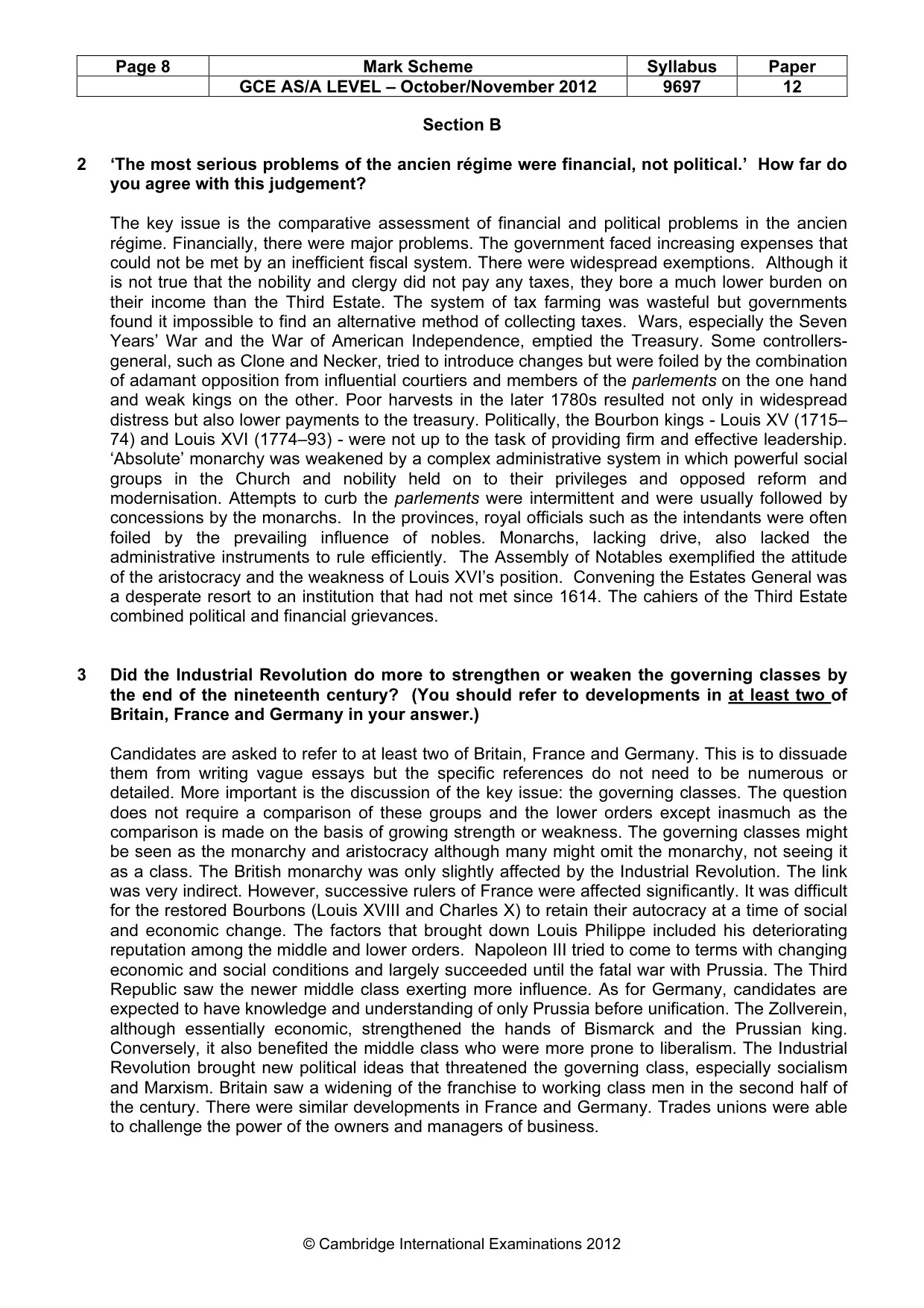
Page 8 Mark Scheme Syllabus Paper GCE AS/A LEVEL – October/November 2012 9697 12 © Cambridge International Examinations 2012 Section B 2 ‘The most serious problems of the ancien régime were financial, not political.’ How far do you agree with this judgement? The key issue is the comparative assessment of financial and political problems in the ancien régime. Financially, there were major problems. The government faced increasing expenses that could not be met by an inefficient fiscal system. There were widespread exemptions. Although it is not true that the nobility and clergy did not pay any taxes, they bore a much lower burden on their income than the Third Estate. The system of tax farming was wasteful but governments found it impossible to find an alternative method of collecting taxes. Wars, especially the Seven Years’ War and the War of American Independence, emptied the Treasury. Some controllers- general, such as Clone and Necker, tried to introduce changes but were foiled by the combination of adamant opposition from influential courtiers and members of the parlements on the one hand and weak kings on the other. Poor harvests in the later 1780s resulted not only in widespread distress but also lower payments to the treasury. Politically, the Bourbon kings - Louis XV (1715– 74) and Louis XVI (1774–93) - were not up to the task of providing firm and effective leadership. ‘Absolute’ monarchy was weakened by a complex administrative system in which powerful social groups in the Church and nobility held on to their privileges and opposed reform and modernisation. Attempts to curb the parlements were intermittent and were usually followed by concessions by the monarchs. In the provinces, royal officials such as the intendants were often foiled by the prevailing influence of nobles. Monarchs, lacking drive, also lacked the administrative instruments to rule efficiently. The Assembly of Notables exemplified the attitude of the aristocracy and the weakness of Louis XVI’s position. Convening the Estates General was a desperate resort to an institution that had not met since 1614. The cahiers of the Third Estate combined political and financial grievances. 3 Did the Industrial Revolution do more to strengthen or weaken the governing classes by the end of the nineteenth century? (You should refer to developments in at least two of Britain, France and Germany in your answer.) Candidates are asked to refer to at least two of Britain, France and Germany. This is to dissuade them from writing vague essays but the specific references do not need to be numerous or detailed. More important is the discussion of the key issue: the governing classes. The question does not require a comparison of these groups and the lower orders except inasmuch as the comparison is made on the basis of growing strength or weakness. The governing classes might be seen as the monarchy and aristocracy although many might omit the monarchy, not seeing it as a class. The British monarchy was only slightly affected by the Industrial Revolution. The link was very indirect. However, successive rulers of France were affected significantly. It was difficult for the restored Bourbons (Louis XVIII and Charles X) to retain their autocracy at a time of social and economic change. The factors that brought down Louis Philippe included his deteriorating reputation among the middle and lower orders. Napoleon III tried to come to terms with changing economic and social conditions and largely succeeded until the fatal war with Prussia. The Third Republic saw the newer middle class exerting more influence. As for Germany, candidates are expected to have knowledge and understanding of only Prussia before unification. The Zollverein, although essentially economic, strengthened the hands of Bismarck and the Prussian king. Conversely, it also benefited the middle class who were more prone to liberalism. The Industrial Revolution brought new political ideas that threatened the governing class, especially socialism and Marxism. Britain saw a widening of the franchise to working class men in the second half of the century. There were similar developments in France and Germany. Trades unions were able to challenge the power of the owners and managers of business.
Mark scheme, page 9
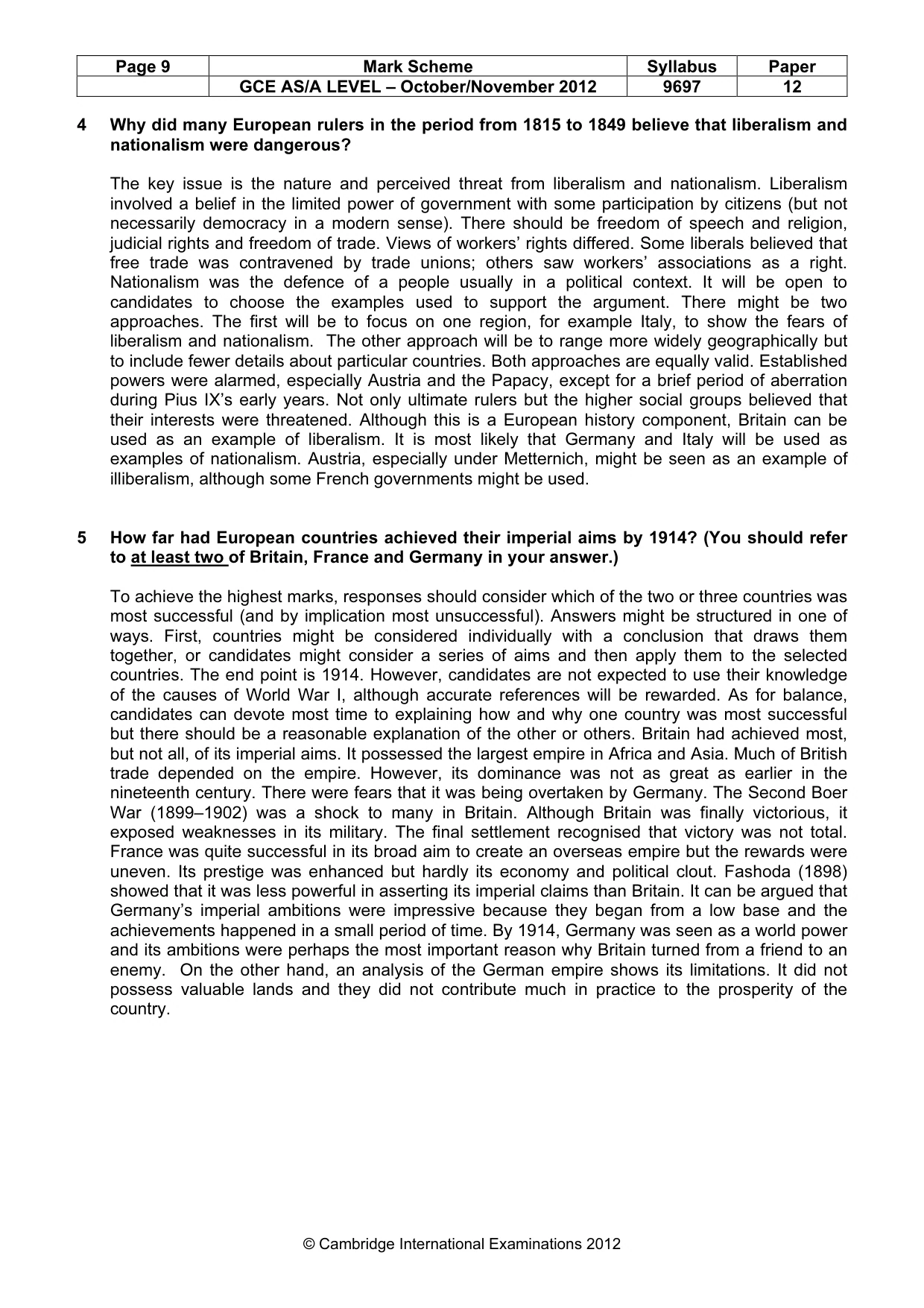
Page 9 Mark Scheme Syllabus Paper GCE AS/A LEVEL – October/November 2012 9697 12 © Cambridge International Examinations 2012 4 Why did many European rulers in the period from 1815 to 1849 believe that liberalism and nationalism were dangerous? The key issue is the nature and perceived threat from liberalism and nationalism. Liberalism involved a belief in the limited power of government with some participation by citizens (but not necessarily democracy in a modern sense). There should be freedom of speech and religion, judicial rights and freedom of trade. Views of workers’ rights differed. Some liberals believed that free trade was contravened by trade unions; others saw workers’ associations as a right. Nationalism was the defence of a people usually in a political context. It will be open to candidates to choose the examples used to support the argument. There might be two approaches. The first will be to focus on one region, for example Italy, to show the fears of liberalism and nationalism. The other approach will be to range more widely geographically but to include fewer details about particular countries. Both approaches are equally valid. Established powers were alarmed, especially Austria and the Papacy, except for a brief period of aberration during Pius IX’s early years. Not only ultimate rulers but the higher social groups believed that their interests were threatened. Although this is a European history component, Britain can be used as an example of liberalism. It is most likely that Germany and Italy will be used as examples of nationalism. Austria, especially under Metternich, might be seen as an example of illiberalism, although some French governments might be used. 5 How far had European countries achieved their imperial aims by 1914? (You should refer to at least two of Britain, France and Germany in your answer.) To achieve the highest marks, responses should consider which of the two or three countries was most successful (and by implication most unsuccessful). Answers might be structured in one of ways. First, countries might be considered individually with a conclusion that draws them together, or candidates might consider a series of aims and then apply them to the selected countries. The end point is 1914. However, candidates are not expected to use their knowledge of the causes of World War I, although accurate references will be rewarded. As for balance, candidates can devote most time to explaining how and why one country was most successful but there should be a reasonable explanation of the other or others. Britain had achieved most, but not all, of its imperial aims. It possessed the largest empire in Africa and Asia. Much of British trade depended on the empire. However, its dominance was not as great as earlier in the nineteenth century. There were fears that it was being overtaken by Germany. The Second Boer War (1899–1902) was a shock to many in Britain. Although Britain was finally victorious, it exposed weaknesses in its military. The final settlement recognised that victory was not total. France was quite successful in its broad aim to create an overseas empire but the rewards were uneven. Its prestige was enhanced but hardly its economy and political clout. Fashoda (1898) showed that it was less powerful in asserting its imperial claims than Britain. It can be argued that Germany’s imperial ambitions were impressive because they began from a low base and the achievements happened in a small period of time. By 1914, Germany was seen as a world power and its ambitions were perhaps the most important reason why Britain turned from a friend to an enemy. On the other hand, an analysis of the German empire shows its limitations. It did not possess valuable lands and they did not contribute much in practice to the prosperity of the country.
Mark scheme, page 10
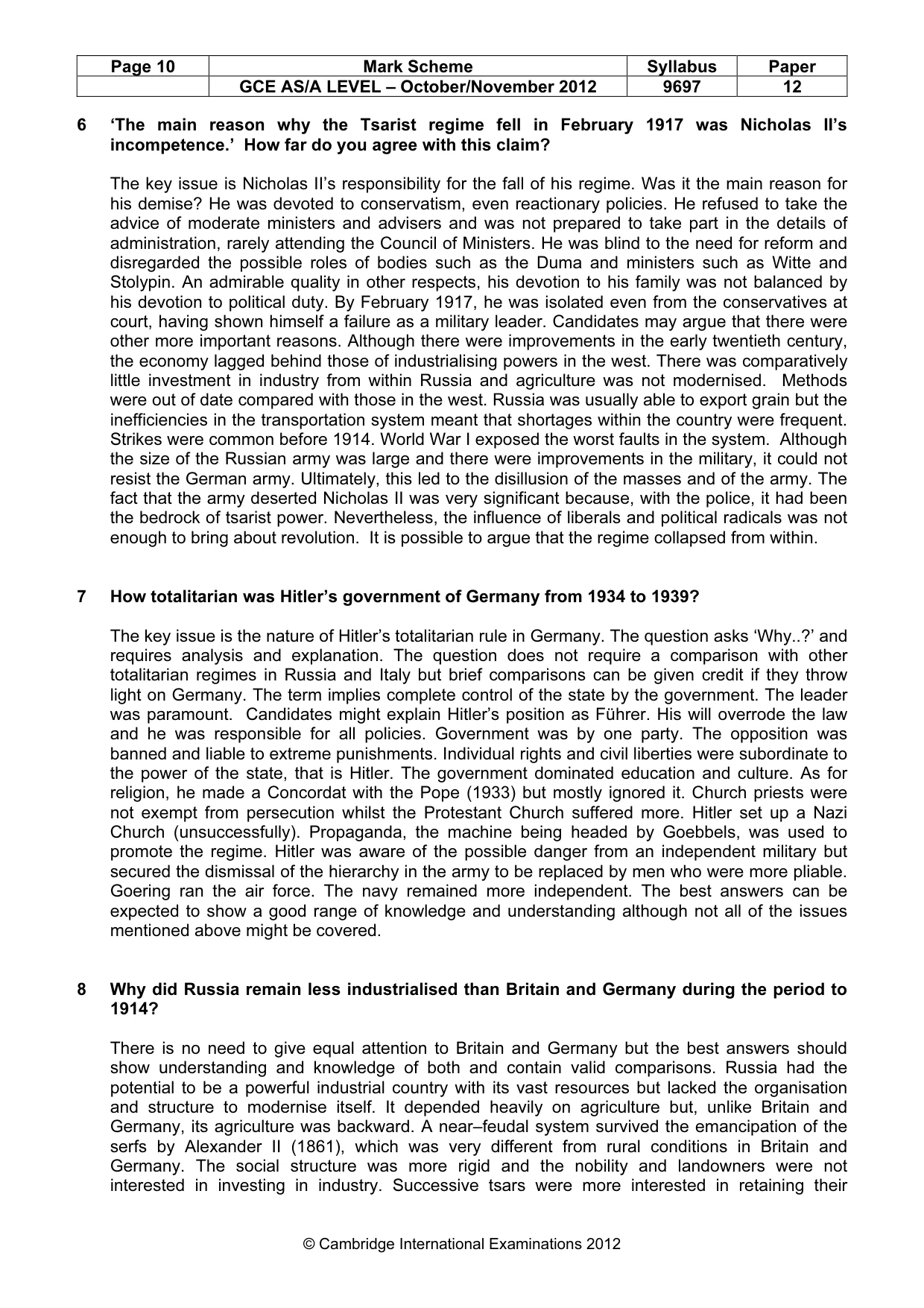
Page 10 Mark Scheme Syllabus Paper GCE AS/A LEVEL – October/November 2012 9697 12 © Cambridge International Examinations 2012 6 ‘The main reason why the Tsarist regime fell in February 1917 was Nicholas II’s incompetence.’ How far do you agree with this claim? The key issue is Nicholas II’s responsibility for the fall of his regime. Was it the main reason for his demise? He was devoted to conservatism, even reactionary policies. He refused to take the advice of moderate ministers and advisers and was not prepared to take part in the details of administration, rarely attending the Council of Ministers. He was blind to the need for reform and disregarded the possible roles of bodies such as the Duma and ministers such as Witte and Stolypin. An admirable quality in other respects, his devotion to his family was not balanced by his devotion to political duty. By February 1917, he was isolated even from the conservatives at court, having shown himself a failure as a military leader. Candidates may argue that there were other more important reasons. Although there were improvements in the early twentieth century, the economy lagged behind those of industrialising powers in the west. There was comparatively little investment in industry from within Russia and agriculture was not modernised. Methods were out of date compared with those in the west. Russia was usually able to export grain but the inefficiencies in the transportation system meant that shortages within the country were frequent. Strikes were common before 1914. World War I exposed the worst faults in the system. Although the size of the Russian army was large and there were improvements in the military, it could not resist the German army. Ultimately, this led to the disillusion of the masses and of the army. The fact that the army deserted Nicholas II was very significant because, with the police, it had been the bedrock of tsarist power. Nevertheless, the influence of liberals and political radicals was not enough to bring about revolution. It is possible to argue that the regime collapsed from within. 7 How totalitarian was Hitler’s government of Germany from 1934 to 1939? The key issue is the nature of Hitler’s totalitarian rule in Germany. The question asks ‘Why..?’ and requires analysis and explanation. The question does not require a comparison with other totalitarian regimes in Russia and Italy but brief comparisons can be given credit if they throw light on Germany. The term implies complete control of the state by the government. The leader was paramount. Candidates might explain Hitler’s position as Führer. His will overrode the law and he was responsible for all policies. Government was by one party. The opposition was banned and liable to extreme punishments. Individual rights and civil liberties were subordinate to the power of the state, that is Hitler. The government dominated education and culture. As for religion, he made a Concordat with the Pope (1933) but mostly ignored it. Church priests were not exempt from persecution whilst the Protestant Church suffered more. Hitler set up a Nazi Church (unsuccessfully). Propaganda, the machine being headed by Goebbels, was used to promote the regime. Hitler was aware of the possible danger from an independent military but secured the dismissal of the hierarchy in the army to be replaced by men who were more pliable. Goering ran the air force. The navy remained more independent. The best answers can be expected to show a good range of knowledge and understanding although not all of the issues mentioned above might be covered. 8 Why did Russia remain less industrialised than Britain and Germany during the period to 1914? There is no need to give equal attention to Britain and Germany but the best answers should show understanding and knowledge of both and contain valid comparisons. Russia had the potential to be a powerful industrial country with its vast resources but lacked the organisation and structure to modernise itself. It depended heavily on agriculture but, unlike Britain and Germany, its agriculture was backward. A near–feudal system survived the emancipation of the serfs by Alexander II (1861), which was very different from rural conditions in Britain and Germany. The social structure was more rigid and the nobility and landowners were not interested in investing in industry. Successive tsars were more interested in retaining their
Mark scheme, page 11
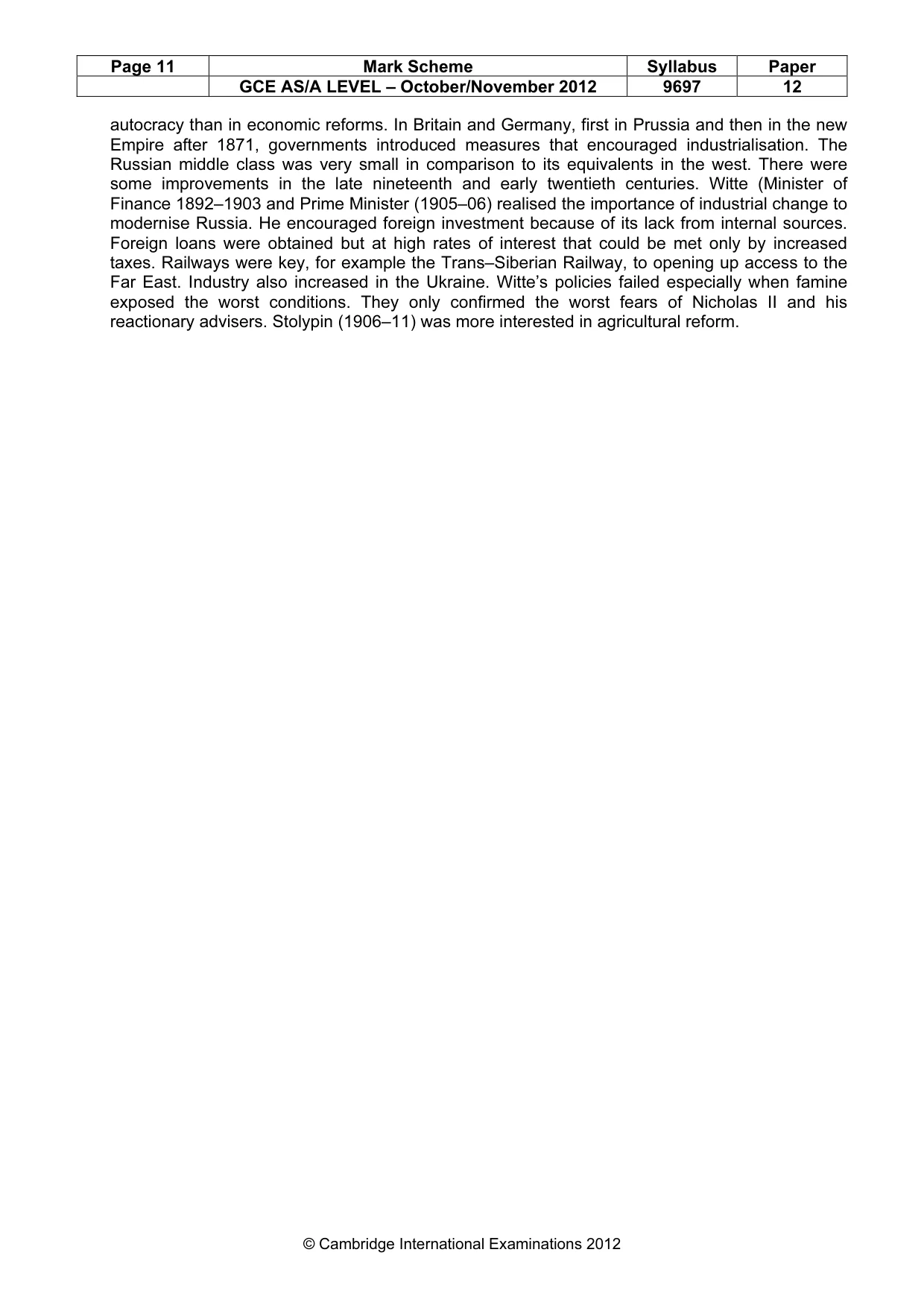
Page 11 Mark Scheme Syllabus Paper GCE AS/A LEVEL – October/November 2012 9697 12 © Cambridge International Examinations 2012 autocracy than in economic reforms. In Britain and Germany, first in Prussia and then in the new Empire after 1871, governments introduced measures that encouraged industrialisation. The Russian middle class was very small in comparison to its equivalents in the west. There were some improvements in the late nineteenth and early twentieth centuries. Witte (Minister of Finance 1892–1903 and Prime Minister (1905–06) realised the importance of industrial change to modernise Russia. He encouraged foreign investment because of its lack from internal sources. Foreign loans were obtained but at high rates of interest that could be met only by increased taxes. Railways were key, for example the Trans–Siberian Railway, to opening up access to the Far East. Industry also increased in the Ukraine. Witte’s policies failed especially when famine exposed the worst conditions. They only confirmed the worst fears of Nicholas II and his reactionary advisers. Stolypin (1906–11) was more interested in agricultural reform.