Cambridge A Level History (pre-2015) 9697 — 2014 Oct/Nov Paper 1 · Variant 1
9697/11/O/N/14 · 100 marks · ≈113 min
The question paper and its mark scheme, free to read here and free to download. This is Cambridge’s own paper, exactly as it was sat.
Question paper4 pages
Mark scheme10 pages
Answers below. Sit the paper first if you are practising.
Paper as text
Question paper, page 1
This document consists of 4 printed pages. DC (CW) 83439/2 © UCLES 2014 [Turn over Cambridge International Examinations Cambridge International Advanced Subsidiary and Advanced Level * 7 6 2 0 1 3 0 4 2 4 * HISTORY 9697/11 Paper 1 Modern European History, 1789–1939 October/November 2014 3 hours Additional Materials: Answer Paper READ THESE INSTRUCTIONS FIRST Write your Centre number, candidate number and name on all the work you hand in. Write in dark blue or black pen. You may use an HB pencil for any diagrams or graphs. Do not use staples, paper clips, glue or correction fluid. DO NOT WRITE IN ANY BARCODES. Section A Answer Question 1. Section B Answer any three questions. At the end of the examination, fasten all your work securely together. All questions in this paper carry equal marks.
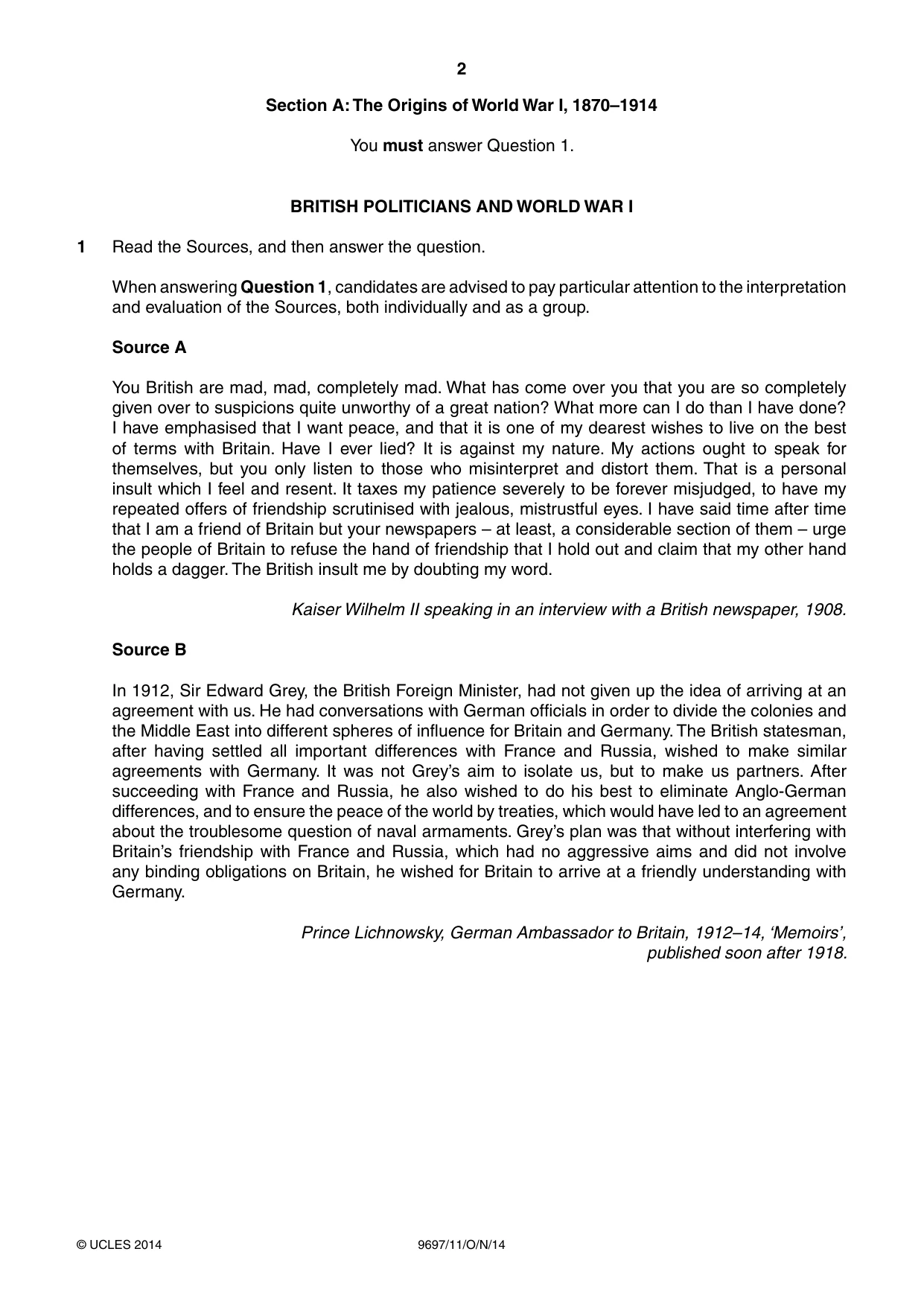
Question paper, page 2
2 9697/11/O/N/14 © UCLES 2014 Section A: The Origins of World War I, 1870–1914 You must answer Question 1. BRITISH POLITICIANS AND WORLD WAR I 1 Read the Sources, and then answer the question. When answering Question 1, candidates are advised to pay particular attention to the interpretation and evaluation of the Sources, both individually and as a group. Source A You British are mad, mad, completely mad. What has come over you that you are so completely given over to suspicions quite unworthy of a great nation? What more can I do than I have done? I have emphasised that I want peace, and that it is one of my dearest wishes to live on the best of terms with Britain. Have I ever lied? It is against my nature. My actions ought to speak for themselves, but you only listen to those who misinterpret and distort them. That is a personal insult which I feel and resent. It taxes my patience severely to be forever misjudged, to have my repeated offers of friendship scrutinised with jealous, mistrustful eyes. I have said time after time that I am a friend of Britain but your newspapers – at least, a considerable section of them – urge the people of Britain to refuse the hand of friendship that I hold out and claim that my other hand holds a dagger. The British insult me by doubting my word. Kaiser Wilhelm II speaking in an interview with a British newspaper, 1908. Source B In 1912, Sir Edward Grey, the British Foreign Minister, had not given up the idea of arriving at an agreement with us. He had conversations with German officials in order to divide the colonies and the Middle East into different spheres of influence for Britain and Germany. The British statesman, after having settled all important differences with France and Russia, wished to make similar agreements with Germany. It was not Grey’s aim to isolate us, but to make us partners. After succeeding with France and Russia, he also wished to do his best to eliminate Anglo-German differences, and to ensure the peace of the world by treaties, which would have led to an agreement about the troublesome question of naval armaments. Grey’s plan was that without interfering with Britain’s friendship with France and Russia, which had no aggressive aims and did not involve any binding obligations on Britain, he wished for Britain to arrive at a friendly understanding with Germany. Prince Lichnowsky, German Ambassador to Britain, 1912–14, ‘Memoirs’, published soon after 1918.
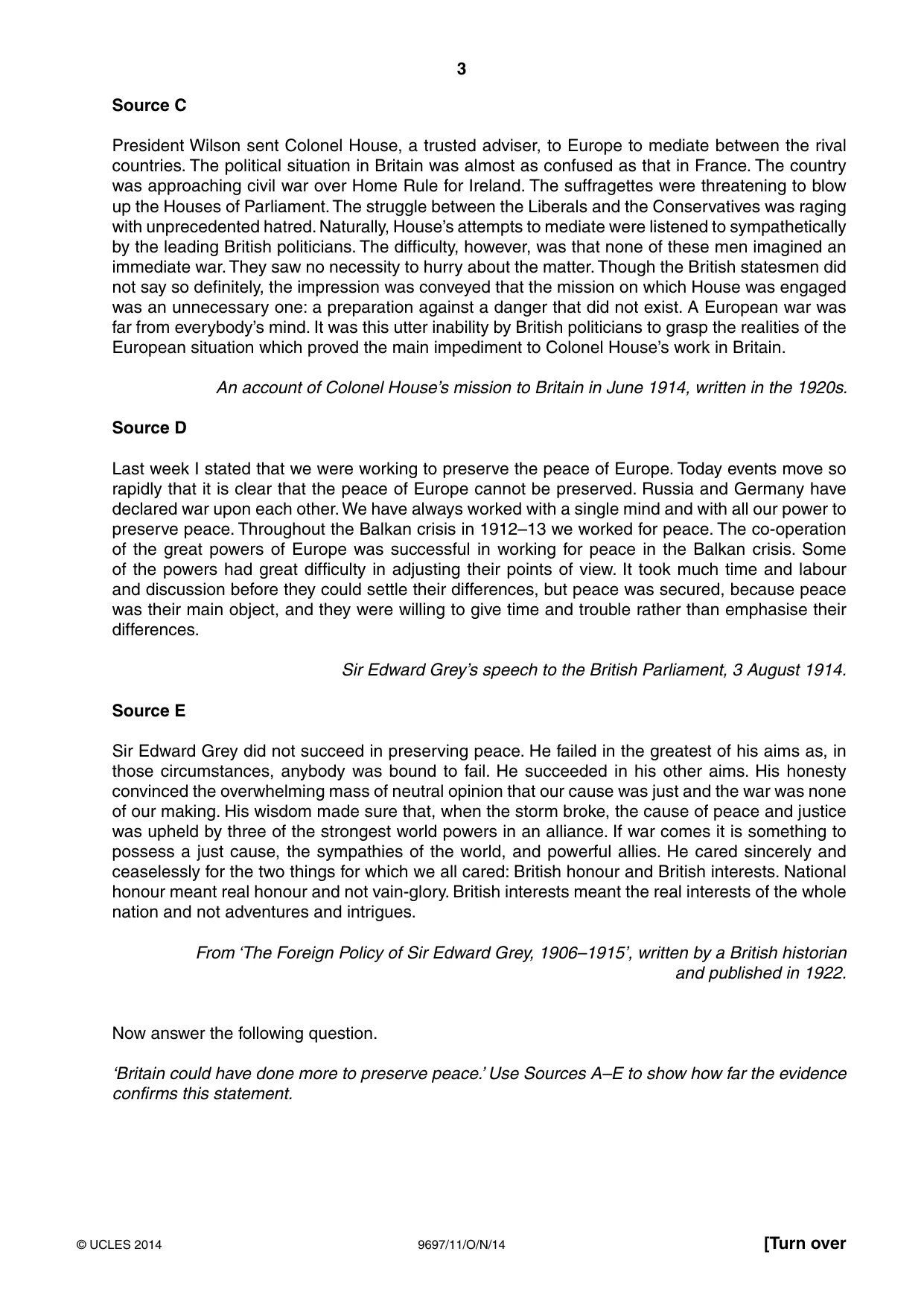
Question paper, page 3
3 9697/11/O/N/14 © UCLES 2014 [Turn over Source C President Wilson sent Colonel House, a trusted adviser, to Europe to mediate between the rival countries. The political situation in Britain was almost as confused as that in France. The country was approaching civil war over Home Rule for Ireland. The suffragettes were threatening to blow up the Houses of Parliament. The struggle between the Liberals and the Conservatives was raging with unprecedented hatred. Naturally, House’s attempts to mediate were listened to sympathetically by the leading British politicians. The difficulty, however, was that none of these men imagined an immediate war. They saw no necessity to hurry about the matter. Though the British statesmen did not say so definitely, the impression was conveyed that the mission on which House was engaged was an unnecessary one: a preparation against a danger that did not exist. A European war was far from everybody’s mind. It was this utter inability by British politicians to grasp the realities of the European situation which proved the main impediment to Colonel House’s work in Britain. An account of Colonel House’s mission to Britain in June 1914, written in the 1920s. Source D Last week I stated that we were working to preserve the peace of Europe. Today events move so rapidly that it is clear that the peace of Europe cannot be preserved. Russia and Germany have declared war upon each other. We have always worked with a single mind and with all our power to preserve peace. Throughout the Balkan crisis in 1912–13 we worked for peace. The co-operation of the great powers of Europe was successful in working for peace in the Balkan crisis. Some of the powers had great difficulty in adjusting their points of view. It took much time and labour and discussion before they could settle their differences, but peace was secured, because peace was their main object, and they were willing to give time and trouble rather than emphasise their differences. Sir Edward Grey’s speech to the British Parliament, 3 August 1914. Source E Sir Edward Grey did not succeed in preserving peace. He failed in the greatest of his aims as, in those circumstances, anybody was bound to fail. He succeeded in his other aims. His honesty convinced the overwhelming mass of neutral opinion that our cause was just and the war was none of our making. His wisdom made sure that, when the storm broke, the cause of peace and justice was upheld by three of the strongest world powers in an alliance. If war comes it is something to possess a just cause, the sympathies of the world, and powerful allies. He cared sincerely and ceaselessly for the two things for which we all cared: British honour and British interests. National honour meant real honour and not vain-glory. British interests meant the real interests of the whole nation and not adventures and intrigues. From ‘The Foreign Policy of Sir Edward Grey, 1906–1915’, written by a British historian and published in 1922. Now answer the following question. ‘Britain could have done more to preserve peace.’ Use Sources A–E to show how far the evidence confirms this statement.
Question paper, page 4
4 9697/11/O/N/14 © UCLES 2014 Section B You must answer three questions from this section. 2 To what extent did Napoleon achieve absolute rule from 1799 to 1815? 3 Did the Industrial Revolution do more to improve or to worsen the social conditions of the poor by the end of the nineteenth century? (You should refer to developments in at least two of Britain, France and Germany in your answer.) 4 Why did the appointment of Bismarck as Minister-President in Prussia represent a decisive development in the movement towards German unification? 5 How far did European countries benefit from ‘New Imperialism’ in the late nineteenth century? 6 How far was the 1905 Revolution an important turning point for Russia during the period from 1900 to 1914? 7 How far had Stalin modernised the Russian economy by 1939? 8 Which did more to make European countries more powerful by 1900: the Industrial Revolution or Imperialism? Permission to reproduce items where third-party owned material protected by copyright is included has been sought and cleared where possible. Every reasonable effort has been made by the publisher (UCLES) to trace copyright holders, but if any items requiring clearance have unwittingly been included, the publisher will be pleased to make amends at the earliest possible opportunity. Cambridge International Examinations is part of the Cambridge Assessment Group. Cambridge Assessment is the brand name of University of Cambridge Local Examinations Syndicate (UCLES), which is itself a department of the University of Cambridge.
Mark scheme, page 1
® IGCSE is the registered trademark of Cambridge International Examinations. CAMBRIDGE INTERNATIONAL EXAMINATIONS Cambridge International Advanced Subsidiary and Advanced Level MARK SCHEME for the October/November 2014 series 9697 HISTORY 9697/11 Paper 1 (Modern European History, 1789–1939), maximum raw mark 100 This mark scheme is published as an aid to teachers and candidates, to indicate the requirements of the examination. It shows the basis on which Examiners were instructed to award marks. It does not indicate the details of the discussions that took place at an Examiners’ meeting before marking began, which would have considered the acceptability of alternative answers. Mark schemes should be read in conjunction with the question paper and the Principal Examiner Report for Teachers. Cambridge will not enter into discussions about these mark schemes. Cambridge is publishing the mark schemes for the October/November 2014 series for most Cambridge IGCSE®, Cambridge International A and AS Level components and some Cambridge O Level components.
Mark scheme, page 2
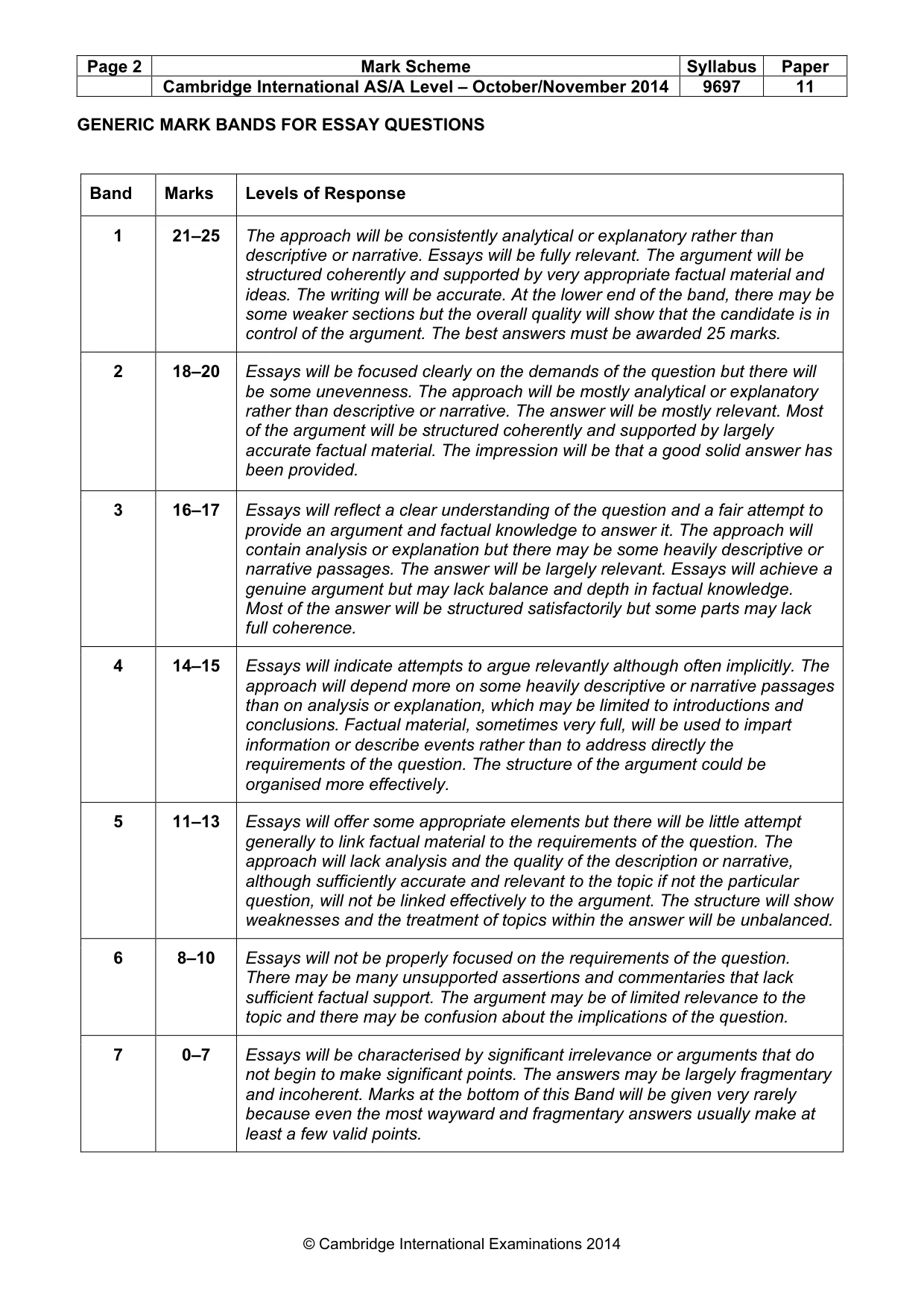
Page 2 Mark Scheme Syllabus Paper Cambridge International AS/A Level – October/November 2014 9697 11 © Cambridge International Examinations 2014 GENERIC MARK BANDS FOR ESSAY QUESTIONS Band Marks Levels of Response 1 21–25 The approach will be consistently analytical or explanatory rather than descriptive or narrative. Essays will be fully relevant. The argument will be structured coherently and supported by very appropriate factual material and ideas. The writing will be accurate. At the lower end of the band, there may be some weaker sections but the overall quality will show that the candidate is in control of the argument. The best answers must be awarded 25 marks. 2 18–20 Essays will be focused clearly on the demands of the question but there will be some unevenness. The approach will be mostly analytical or explanatory rather than descriptive or narrative. The answer will be mostly relevant. Most of the argument will be structured coherently and supported by largely accurate factual material. The impression will be that a good solid answer has been provided. 3 16–17 Essays will reflect a clear understanding of the question and a fair attempt to provide an argument and factual knowledge to answer it. The approach will contain analysis or explanation but there may be some heavily descriptive or narrative passages. The answer will be largely relevant. Essays will achieve a genuine argument but may lack balance and depth in factual knowledge. Most of the answer will be structured satisfactorily but some parts may lack full coherence. 4 14–15 Essays will indicate attempts to argue relevantly although often implicitly. The approach will depend more on some heavily descriptive or narrative passages than on analysis or explanation, which may be limited to introductions and conclusions. Factual material, sometimes very full, will be used to impart information or describe events rather than to address directly the requirements of the question. The structure of the argument could be organised more effectively. 5 11–13 Essays will offer some appropriate elements but there will be little attempt generally to link factual material to the requirements of the question. The approach will lack analysis and the quality of the description or narrative, although sufficiently accurate and relevant to the topic if not the particular question, will not be linked effectively to the argument. The structure will show weaknesses and the treatment of topics within the answer will be unbalanced. 6 8–10 Essays will not be properly focused on the requirements of the question. There may be many unsupported assertions and commentaries that lack sufficient factual support. The argument may be of limited relevance to the topic and there may be confusion about the implications of the question. 7 0–7 Essays will be characterised by significant irrelevance or arguments that do not begin to make significant points. The answers may be largely fragmentary and incoherent. Marks at the bottom of this Band will be given very rarely because even the most wayward and fragmentary answers usually make at least a few valid points.
Mark scheme, page 3
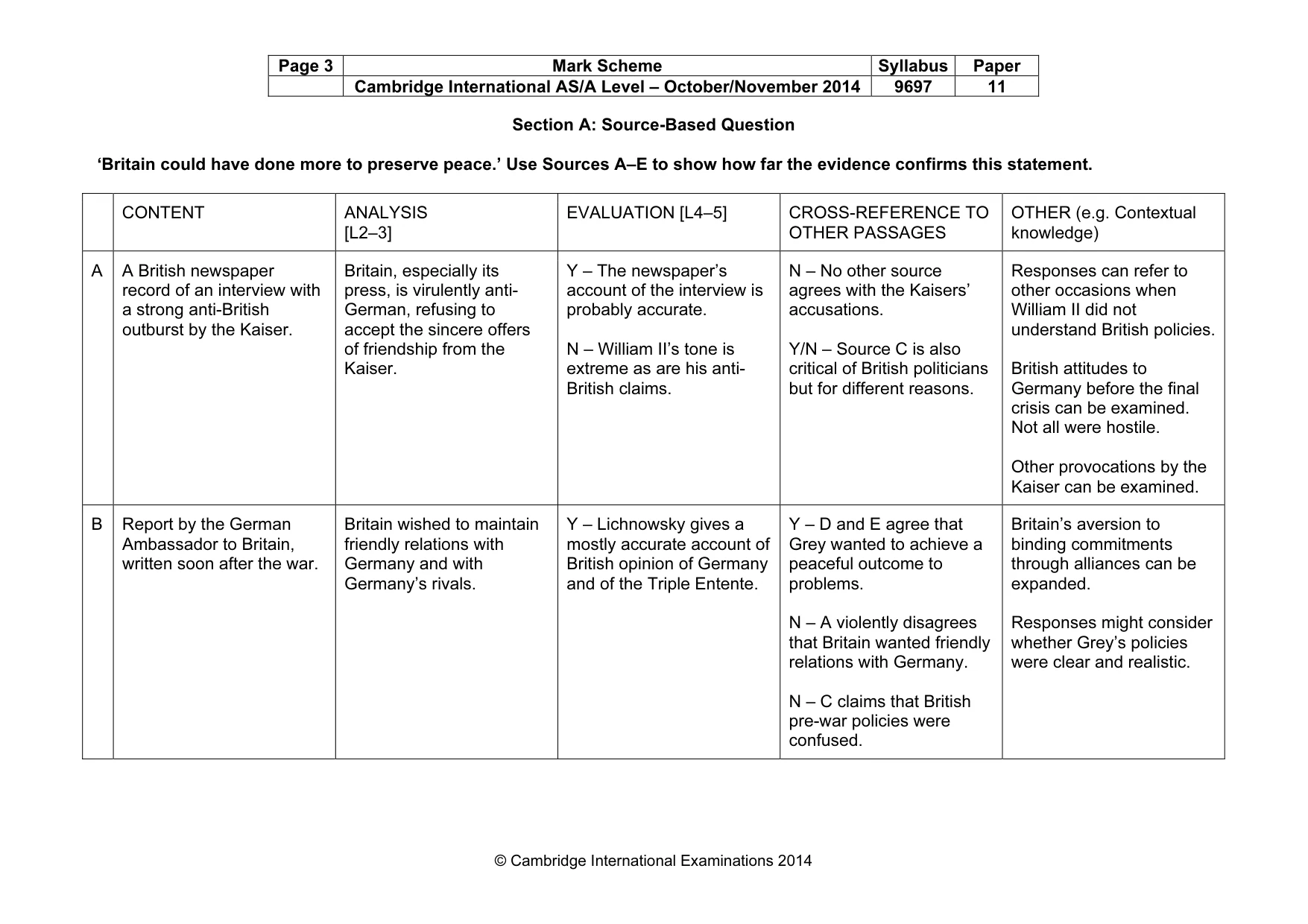
Page 3 Mark Scheme Syllabus Paper Cambridge International AS/A Level – October/November 2014 9697 11 © Cambridge International Examinations 2014 Section A: Source-Based Question ‘Britain could have done more to preserve peace.’ Use Sources A–E to show how far the evidence confirms this statement. CONTENT ANALYSIS [L2–3] EVALUATION [L4–5] CROSS-REFERENCE TO OTHER PASSAGES OTHER (e.g. Contextual knowledge) A A British newspaper record of an interview with a strong anti-British outburst by the Kaiser. Britain, especially its press, is virulently anti- German, refusing to accept the sincere offers of friendship from the Kaiser. Y – The newspaper’s account of the interview is probably accurate. N – William II’s tone is extreme as are his anti- British claims. N – No other source agrees with the Kaisers’ accusations. Y/N – Source C is also critical of British politicians but for different reasons. Responses can refer to other occasions when William II did not understand British policies. British attitudes to Germany before the final crisis can be examined. Not all were hostile. Other provocations by the Kaiser can be examined. B Report by the German Ambassador to Britain, written soon after the war. Britain wished to maintain friendly relations with Germany and with Germany’s rivals. Y – Lichnowsky gives a mostly accurate account of British opinion of Germany and of the Triple Entente. Y – D and E agree that Grey wanted to achieve a peaceful outcome to problems. N – A violently disagrees that Britain wanted friendly relations with Germany. N – C claims that British pre-war policies were confused. Britain’s aversion to binding commitments through alliances can be expanded. Responses might consider whether Grey’s policies were clear and realistic.
Mark scheme, page 4
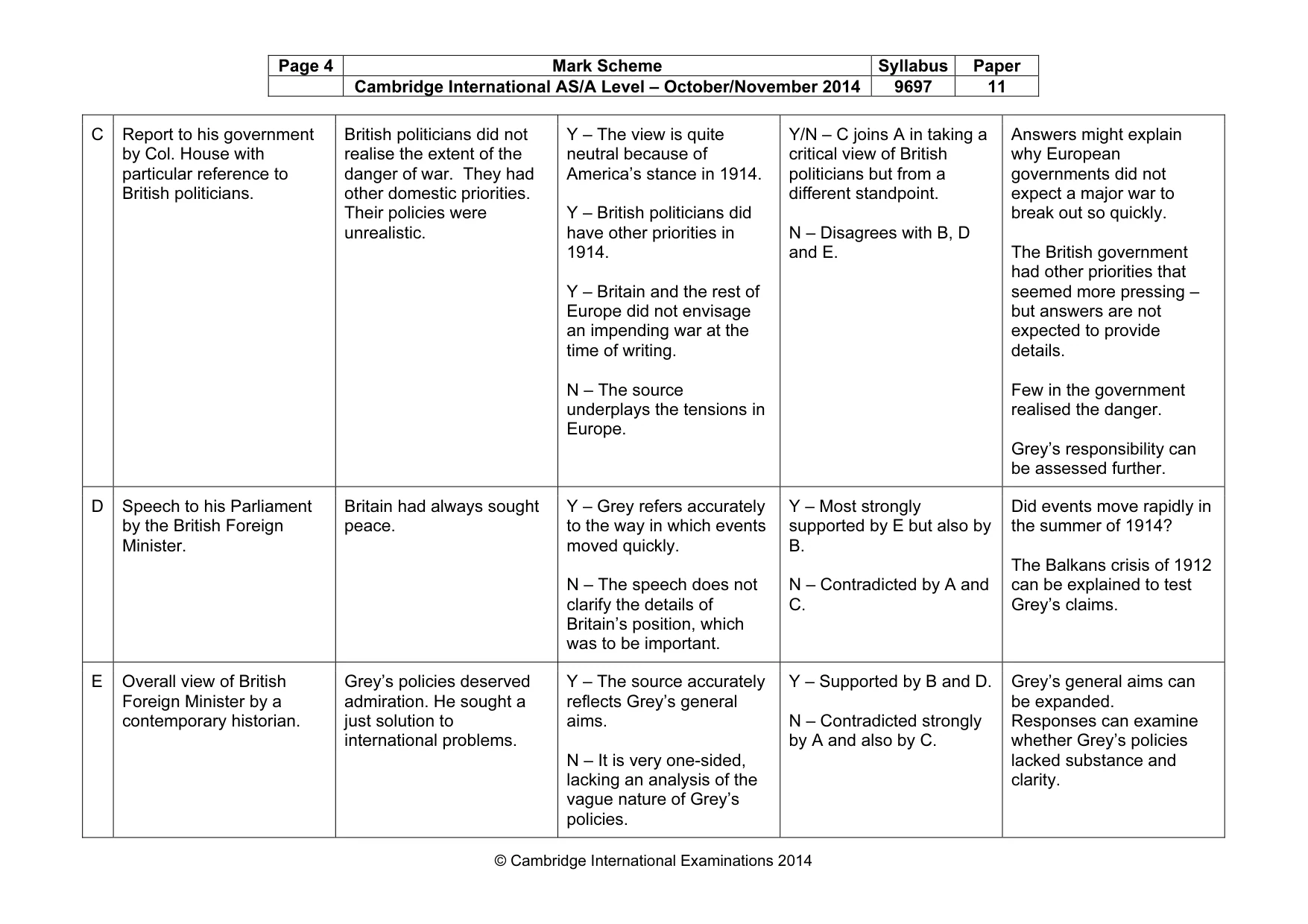
Page 4 Mark Scheme Syllabus Paper Cambridge International AS/A Level – October/November 2014 9697 11 © Cambridge International Examinations 2014 C Report to his government by Col. House with particular reference to British politicians. British politicians did not realise the extent of the danger of war. They had other domestic priorities. Their policies were unrealistic. Y – The view is quite neutral because of America’s stance in 1914. Y – British politicians did have other priorities in 1914. Y – Britain and the rest of Europe did not envisage an impending war at the time of writing. N – The source underplays the tensions in Europe. Y/N – C joins A in taking a critical view of British politicians but from a different standpoint. N – Disagrees with B, D and E. Answers might explain why European governments did not expect a major war to break out so quickly. The British government had other priorities that seemed more pressing – but answers are not expected to provide details. Few in the government realised the danger. Grey’s responsibility can be assessed further. D Speech to his Parliament by the British Foreign Minister. Britain had always sought peace. Y – Grey refers accurately to the way in which events moved quickly. N – The speech does not clarify the details of Britain’s position, which was to be important. Y – Most strongly supported by E but also by B. N – Contradicted by A and C. Did events move rapidly in the summer of 1914? The Balkans crisis of 1912 can be explained to test Grey’s claims. E Overall view of British Foreign Minister by a contemporary historian. Grey’s policies deserved admiration. He sought a just solution to international problems. Y – The source accurately reflects Grey’s general aims. N – It is very one-sided, lacking an analysis of the vague nature of Grey’s policies. Y – Supported by B and D. N – Contradicted strongly by A and also by C. Grey’s general aims can be expanded. Responses can examine whether Grey’s policies lacked substance and clarity.
Mark scheme, page 5
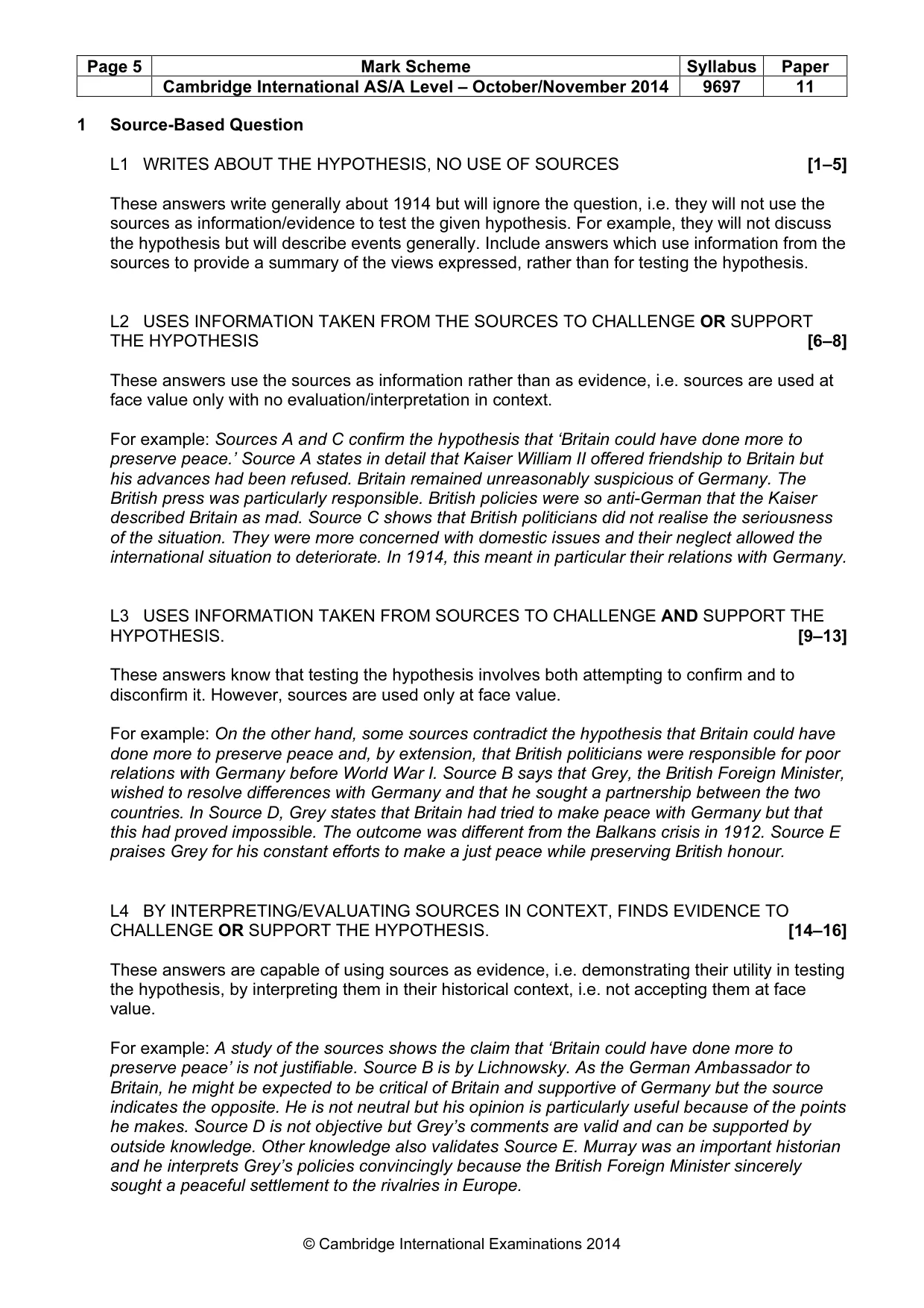
Page 5 Mark Scheme Syllabus Paper Cambridge International AS/A Level – October/November 2014 9697 11 © Cambridge International Examinations 2014 1 Source-Based Question L1 WRITES ABOUT THE HYPOTHESIS, NO USE OF SOURCES [1–5] These answers write generally about 1914 but will ignore the question, i.e. they will not use the sources as information/evidence to test the given hypothesis. For example, they will not discuss the hypothesis but will describe events generally. Include answers which use information from the sources to provide a summary of the views expressed, rather than for testing the hypothesis. L2 USES INFORMATION TAKEN FROM THE SOURCES TO CHALLENGE OR SUPPORT THE HYPOTHESIS [6–8] These answers use the sources as information rather than as evidence, i.e. sources are used at face value only with no evaluation/interpretation in context. For example: Sources A and C confirm the hypothesis that ‘Britain could have done more to preserve peace.’ Source A states in detail that Kaiser William II offered friendship to Britain but his advances had been refused. Britain remained unreasonably suspicious of Germany. The British press was particularly responsible. British policies were so anti-German that the Kaiser described Britain as mad. Source C shows that British politicians did not realise the seriousness of the situation. They were more concerned with domestic issues and their neglect allowed the international situation to deteriorate. In 1914, this meant in particular their relations with Germany. L3 USES INFORMATION TAKEN FROM SOURCES TO CHALLENGE AND SUPPORT THE HYPOTHESIS. [9–13] These answers know that testing the hypothesis involves both attempting to confirm and to disconfirm it. However, sources are used only at face value. For example: On the other hand, some sources contradict the hypothesis that Britain could have done more to preserve peace and, by extension, that British politicians were responsible for poor relations with Germany before World War I. Source B says that Grey, the British Foreign Minister, wished to resolve differences with Germany and that he sought a partnership between the two countries. In Source D, Grey states that Britain had tried to make peace with Germany but that this had proved impossible. The outcome was different from the Balkans crisis in 1912. Source E praises Grey for his constant efforts to make a just peace while preserving British honour. L4 BY INTERPRETING/EVALUATING SOURCES IN CONTEXT, FINDS EVIDENCE TO CHALLENGE OR SUPPORT THE HYPOTHESIS. [14–16] These answers are capable of using sources as evidence, i.e. demonstrating their utility in testing the hypothesis, by interpreting them in their historical context, i.e. not accepting them at face value. For example: A study of the sources shows the claim that ‘Britain could have done more to preserve peace’ is not justifiable. Source B is by Lichnowsky. As the German Ambassador to Britain, he might be expected to be critical of Britain and supportive of Germany but the source indicates the opposite. He is not neutral but his opinion is particularly useful because of the points he makes. Source D is not objective but Grey’s comments are valid and can be supported by outside knowledge. Other knowledge also validates Source E. Murray was an important historian and he interprets Grey’s policies convincingly because the British Foreign Minister sincerely sought a peaceful settlement to the rivalries in Europe.
Mark scheme, page 6
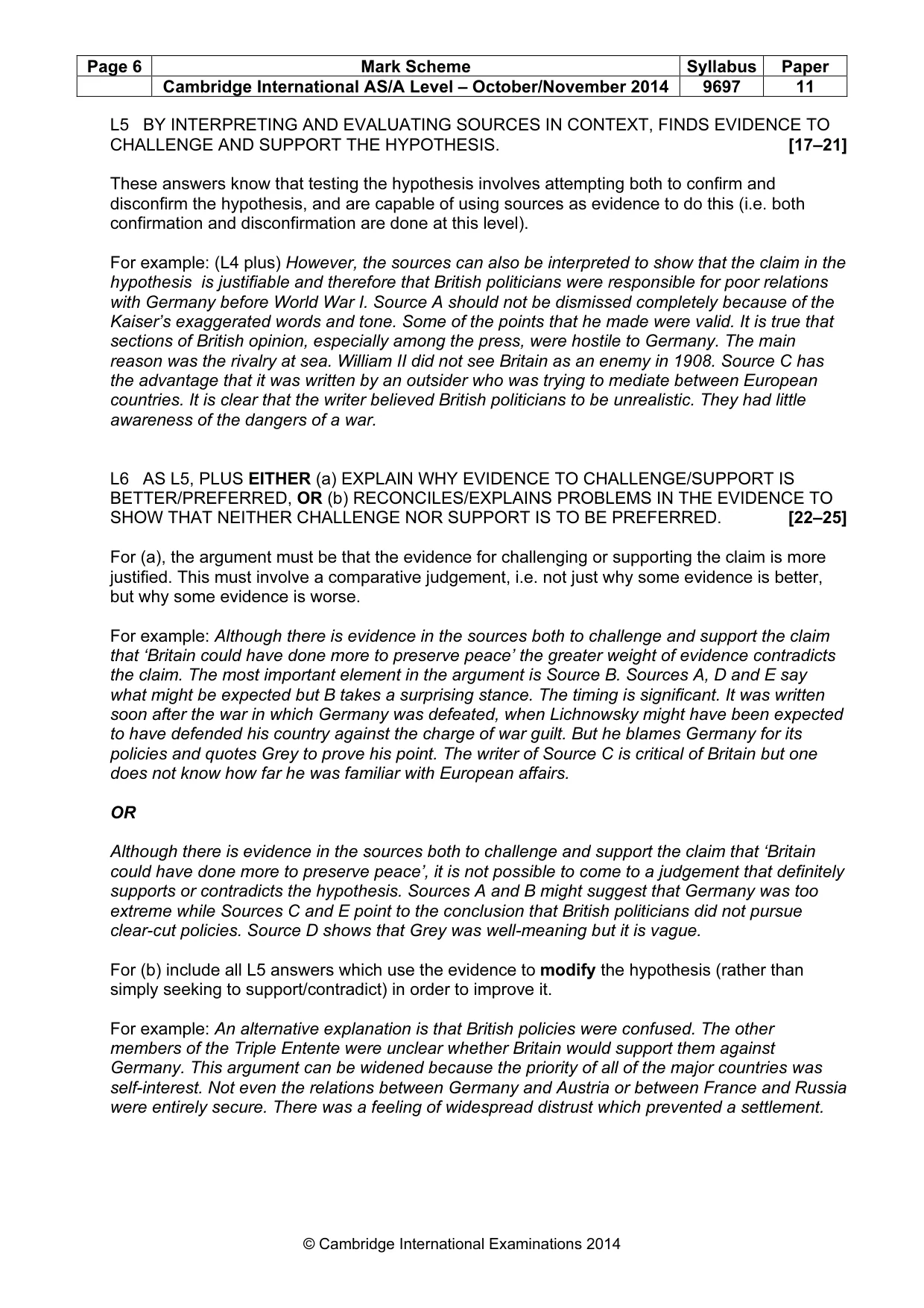
Page 6 Mark Scheme Syllabus Paper Cambridge International AS/A Level – October/November 2014 9697 11 © Cambridge International Examinations 2014 L5 BY INTERPRETING AND EVALUATING SOURCES IN CONTEXT, FINDS EVIDENCE TO CHALLENGE AND SUPPORT THE HYPOTHESIS. [17–21] These answers know that testing the hypothesis involves attempting both to confirm and disconfirm the hypothesis, and are capable of using sources as evidence to do this (i.e. both confirmation and disconfirmation are done at this level). For example: (L4 plus) However, the sources can also be interpreted to show that the claim in the hypothesis is justifiable and therefore that British politicians were responsible for poor relations with Germany before World War I. Source A should not be dismissed completely because of the Kaiser’s exaggerated words and tone. Some of the points that he made were valid. It is true that sections of British opinion, especially among the press, were hostile to Germany. The main reason was the rivalry at sea. William II did not see Britain as an enemy in 1908. Source C has the advantage that it was written by an outsider who was trying to mediate between European countries. It is clear that the writer believed British politicians to be unrealistic. They had little awareness of the dangers of a war. L6 AS L5, PLUS EITHER (a) EXPLAIN WHY EVIDENCE TO CHALLENGE/SUPPORT IS BETTER/PREFERRED, OR (b) RECONCILES/EXPLAINS PROBLEMS IN THE EVIDENCE TO SHOW THAT NEITHER CHALLENGE NOR SUPPORT IS TO BE PREFERRED. [22–25] For (a), the argument must be that the evidence for challenging or supporting the claim is more justified. This must involve a comparative judgement, i.e. not just why some evidence is better, but why some evidence is worse. For example: Although there is evidence in the sources both to challenge and support the claim that ‘Britain could have done more to preserve peace’ the greater weight of evidence contradicts the claim. The most important element in the argument is Source B. Sources A, D and E say what might be expected but B takes a surprising stance. The timing is significant. It was written soon after the war in which Germany was defeated, when Lichnowsky might have been expected to have defended his country against the charge of war guilt. But he blames Germany for its policies and quotes Grey to prove his point. The writer of Source C is critical of Britain but one does not know how far he was familiar with European affairs. OR Although there is evidence in the sources both to challenge and support the claim that ‘Britain could have done more to preserve peace’, it is not possible to come to a judgement that definitely supports or contradicts the hypothesis. Sources A and B might suggest that Germany was too extreme while Sources C and E point to the conclusion that British politicians did not pursue clear-cut policies. Source D shows that Grey was well-meaning but it is vague. For (b) include all L5 answers which use the evidence to modify the hypothesis (rather than simply seeking to support/contradict) in order to improve it. For example: An alternative explanation is that British policies were confused. The other members of the Triple Entente were unclear whether Britain would support them against Germany. This argument can be widened because the priority of all of the major countries was self-interest. Not even the relations between Germany and Austria or between France and Russia were entirely secure. There was a feeling of widespread distrust which prevented a settlement.
Mark scheme, page 7
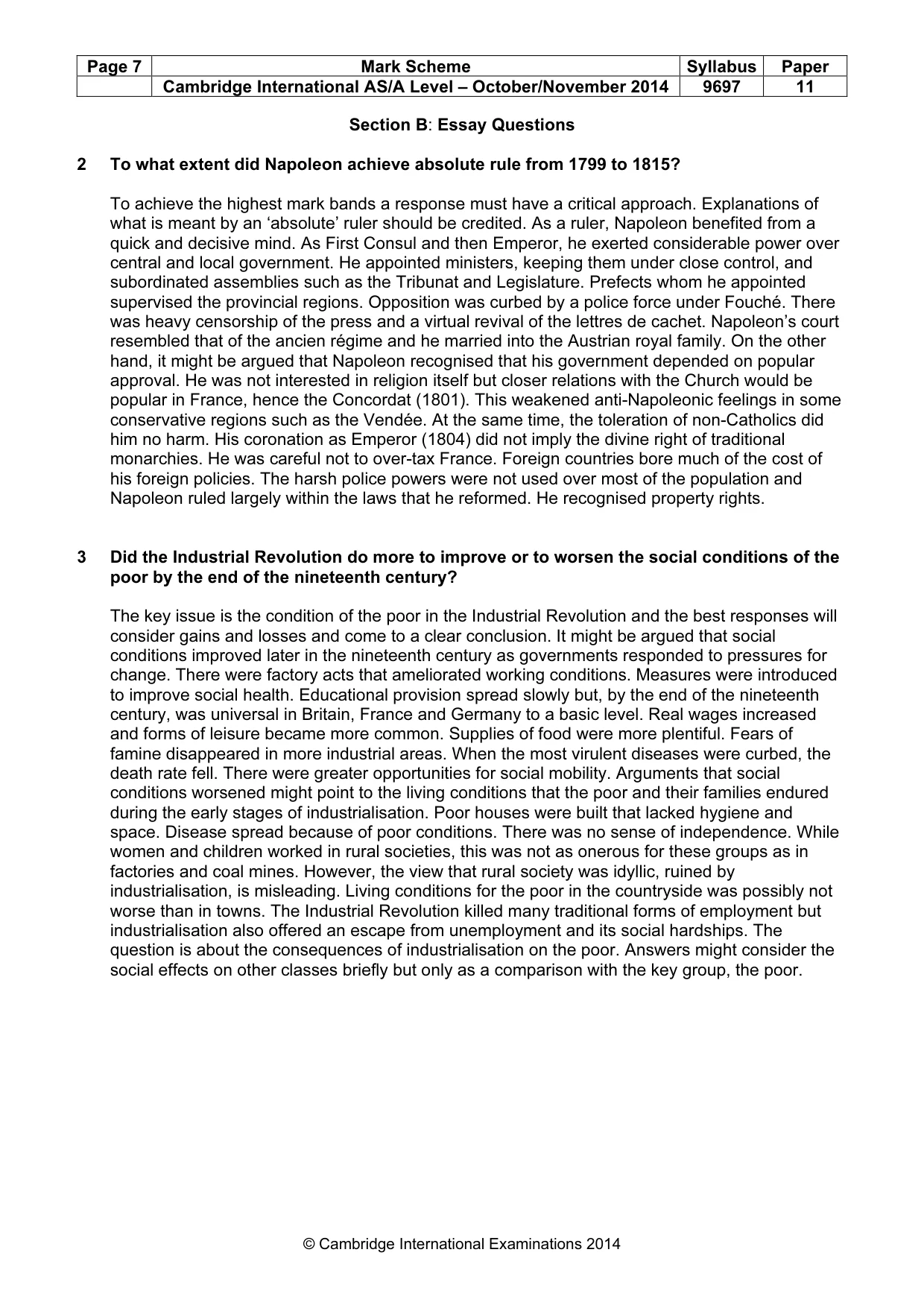
Page 7 Mark Scheme Syllabus Paper Cambridge International AS/A Level – October/November 2014 9697 11 © Cambridge International Examinations 2014 Section B: Essay Questions 2 To what extent did Napoleon achieve absolute rule from 1799 to 1815? To achieve the highest mark bands a response must have a critical approach. Explanations of what is meant by an ‘absolute’ ruler should be credited. As a ruler, Napoleon benefited from a quick and decisive mind. As First Consul and then Emperor, he exerted considerable power over central and local government. He appointed ministers, keeping them under close control, and subordinated assemblies such as the Tribunat and Legislature. Prefects whom he appointed supervised the provincial regions. Opposition was curbed by a police force under Fouché. There was heavy censorship of the press and a virtual revival of the lettres de cachet. Napoleon’s court resembled that of the ancien régime and he married into the Austrian royal family. On the other hand, it might be argued that Napoleon recognised that his government depended on popular approval. He was not interested in religion itself but closer relations with the Church would be popular in France, hence the Concordat (1801). This weakened anti-Napoleonic feelings in some conservative regions such as the Vendée. At the same time, the toleration of non-Catholics did him no harm. His coronation as Emperor (1804) did not imply the divine right of traditional monarchies. He was careful not to over-tax France. Foreign countries bore much of the cost of his foreign policies. The harsh police powers were not used over most of the population and Napoleon ruled largely within the laws that he reformed. He recognised property rights. 3 Did the Industrial Revolution do more to improve or to worsen the social conditions of the poor by the end of the nineteenth century? The key issue is the condition of the poor in the Industrial Revolution and the best responses will consider gains and losses and come to a clear conclusion. It might be argued that social conditions improved later in the nineteenth century as governments responded to pressures for change. There were factory acts that ameliorated working conditions. Measures were introduced to improve social health. Educational provision spread slowly but, by the end of the nineteenth century, was universal in Britain, France and Germany to a basic level. Real wages increased and forms of leisure became more common. Supplies of food were more plentiful. Fears of famine disappeared in more industrial areas. When the most virulent diseases were curbed, the death rate fell. There were greater opportunities for social mobility. Arguments that social conditions worsened might point to the living conditions that the poor and their families endured during the early stages of industrialisation. Poor houses were built that lacked hygiene and space. Disease spread because of poor conditions. There was no sense of independence. While women and children worked in rural societies, this was not as onerous for these groups as in factories and coal mines. However, the view that rural society was idyllic, ruined by industrialisation, is misleading. Living conditions for the poor in the countryside was possibly not worse than in towns. The Industrial Revolution killed many traditional forms of employment but industrialisation also offered an escape from unemployment and its social hardships. The question is about the consequences of industrialisation on the poor. Answers might consider the social effects on other classes briefly but only as a comparison with the key group, the poor.
Mark scheme, page 8
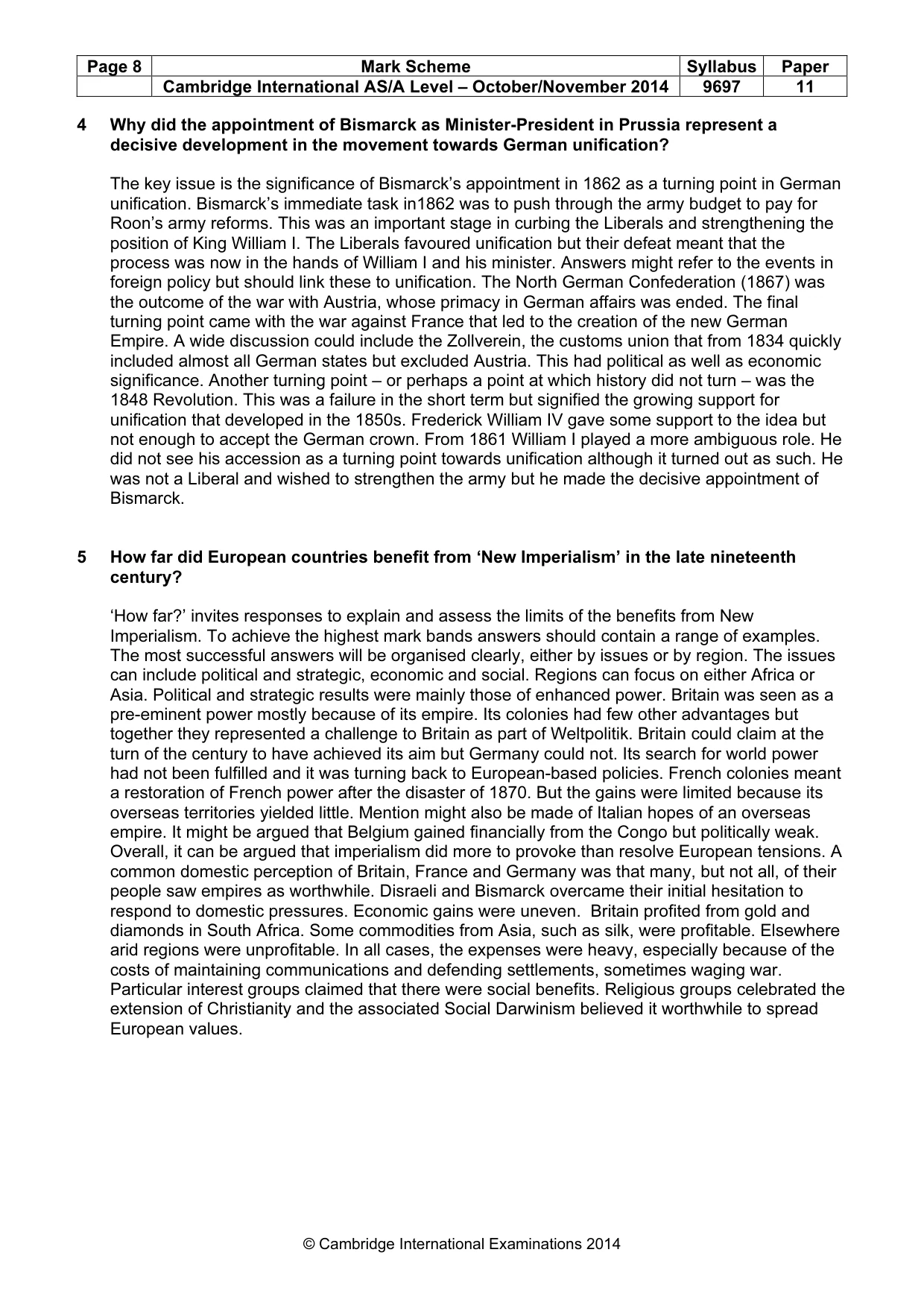
Page 8 Mark Scheme Syllabus Paper Cambridge International AS/A Level – October/November 2014 9697 11 © Cambridge International Examinations 2014 4 Why did the appointment of Bismarck as Minister-President in Prussia represent a decisive development in the movement towards German unification? The key issue is the significance of Bismarck’s appointment in 1862 as a turning point in German unification. Bismarck’s immediate task in1862 was to push through the army budget to pay for Roon’s army reforms. This was an important stage in curbing the Liberals and strengthening the position of King William I. The Liberals favoured unification but their defeat meant that the process was now in the hands of William I and his minister. Answers might refer to the events in foreign policy but should link these to unification. The North German Confederation (1867) was the outcome of the war with Austria, whose primacy in German affairs was ended. The final turning point came with the war against France that led to the creation of the new German Empire. A wide discussion could include the Zollverein, the customs union that from 1834 quickly included almost all German states but excluded Austria. This had political as well as economic significance. Another turning point – or perhaps a point at which history did not turn – was the 1848 Revolution. This was a failure in the short term but signified the growing support for unification that developed in the 1850s. Frederick William IV gave some support to the idea but not enough to accept the German crown. From 1861 William I played a more ambiguous role. He did not see his accession as a turning point towards unification although it turned out as such. He was not a Liberal and wished to strengthen the army but he made the decisive appointment of Bismarck. 5 How far did European countries benefit from ‘New Imperialism’ in the late nineteenth century? ‘How far?’ invites responses to explain and assess the limits of the benefits from New Imperialism. To achieve the highest mark bands answers should contain a range of examples. The most successful answers will be organised clearly, either by issues or by region. The issues can include political and strategic, economic and social. Regions can focus on either Africa or Asia. Political and strategic results were mainly those of enhanced power. Britain was seen as a pre-eminent power mostly because of its empire. Its colonies had few other advantages but together they represented a challenge to Britain as part of Weltpolitik. Britain could claim at the turn of the century to have achieved its aim but Germany could not. Its search for world power had not been fulfilled and it was turning back to European-based policies. French colonies meant a restoration of French power after the disaster of 1870. But the gains were limited because its overseas territories yielded little. Mention might also be made of Italian hopes of an overseas empire. It might be argued that Belgium gained financially from the Congo but politically weak. Overall, it can be argued that imperialism did more to provoke than resolve European tensions. A common domestic perception of Britain, France and Germany was that many, but not all, of their people saw empires as worthwhile. Disraeli and Bismarck overcame their initial hesitation to respond to domestic pressures. Economic gains were uneven. Britain profited from gold and diamonds in South Africa. Some commodities from Asia, such as silk, were profitable. Elsewhere arid regions were unprofitable. In all cases, the expenses were heavy, especially because of the costs of maintaining communications and defending settlements, sometimes waging war. Particular interest groups claimed that there were social benefits. Religious groups celebrated the extension of Christianity and the associated Social Darwinism believed it worthwhile to spread European values.
Mark scheme, page 9
Page 9 Mark Scheme Syllabus Paper Cambridge International AS/A Level – October/November 2014 9697 11 © Cambridge International Examinations 2014 6 How far was the 1905 Revolution an important turning point for Russia during the period from 1900 to 1914? 1914 is clearly the end point of this question and discussion of the 1917 Revolutions can only be relevant if included as a brief conclusion. To discuss whether 1905 was a ‘turning point’ needs some understanding of the background to 1905. There are broadly two alternative arguments that might be proposed. 1905 was important because it exposed deep weaknesses and significant problems in tsarist Russia. Alternatively responses might argue that the regime recovered quickly from the worst dangers of 1905 - the problems were not solved but they were not worse than before. 1905 revealed much widespread social unrest, particularly among the peasantry and urban workers. Policies of ‘russification’ were unpopular among the minorities. The unsuccessful war against Japan (1904–05) showed the poor state of the military and navy. Although Nicholas II was not responsible for Bloody Sunday, his highly personal rule meant that he was blamed. The economy was generally backward. Answers are likely to discuss how far these problems were solved by 1914. The position of the Tsar was still paramount although there was unrest. The radical elements seemed to be under the control of the loyal army and police. The economy was improving and Stolypin aimed to reconcile the potentially dangerous peasantry. However, his ministry was cut short in 1911 and he received little support from Nicholas II who also backed those who wished to minimise the concessions in the October Manifesto. There was heavy investment in the army and navy but with consequent implications for 1914. 7 How far had Stalin modernised the Russian economy by 1939? Stalin realised that Russia lagged behind the economies of Western Europe and the USA and feared attack. Support for the Whites in the civil war was a recent memory for the communist government. He wanted to push through radical measures to change the economy, instigating a complete economic revolution to catch up with the west in 10 years. ‘Socialism in one country’ meant that Russia would rely on its own efforts. Responses are most likely to deal with the two most important aspects of the economy: agriculture and industry. In agriculture, modernisation meant collectivisation to create large estates to replace small holdings. Production could be organised centrally, in theory more efficiently. Modern equipment such as tractors would replace primitive methods. Backward peasants and obstructive kulaks would form a different social and economic order. The immediate results were horrific. Many thousands, perhaps millions, of peasants/kulaks were killed, sent to gulags or forced to migrate to new regions. Production figures fell, leading to famine when millions died. There was some recovery in the 1930s but Russia did not achieve a modern farming system. Many of the figures issued by the government to show improvements were false. Industrial modernisation was carried out through the Five Years Plans (1928–32, 1933–37 and 1938–42). The emphasis was on heavy industry exclusively at first but later with some concessions to consumer goods. The Plans developed hydroelectric power, major infrastructure schemes and the founding of vast industrial city complexes. Allowing for propaganda, the achievements were clear although the human costs were high. By 1939, the industrial sector was transformed but Russia was still largely an agrarian country.
Mark scheme, page 10
Page 10 Mark Scheme Syllabus Paper Cambridge International AS/A Level – October/November 2014 9697 11 © Cambridge International Examinations 2014 8 Which did more to make European countries more powerful by 1900, the Industrial Revolution or Imperialism? The best answers will achieve a reasonable (but not necessarily equal) balance between the two stated factors. While it is expected that responses might normally cover Britain, France and Germany, this does not rule out discussions of other countries. A case can be made for either industrialisation or imperialism. Some might make the good point that the two factors were linked because the Industrial Revolution created favourable conditions for the development of imperialism. The focus should be on ‘power’. The Industrial Revolution brought wealth to governments as well as to individuals and social groups. Armies and navies were more expensive. Germany’s wars of unification under Bismarck are good examples of the benefits of a modern economy. His success was built on the Zollverein and an efficient army. Industrialisation continued to make Germany a powerful country to the end of the century and Germany became the dominant force in the alliances which it made. Britain was the first industrialised country. Its power largely depended on its navy rather than a comparatively weak army. France’s recovery from its defeat in 1870–71 by Prussia also depended on a stronger industrial economy. Britain’s strategic strength was a reflection of its imperial position. The empires of Germany and France also grew as they both sought a ‘place in the sun’. Their imperial ambitions were also based on a wish to be a world power. Although less successful than Britain in acquiring colonies, imperial possessions were important to their power and status.
What you needed in this session
Cambridge’s own grade thresholds for 2014 Oct/Nov, Paper 1 · Variant 1. A higher threshold means an easier paper — the bar moves with how the cohort did.